
Report to Congressional Committees
United States Government Accountability Office
A report to congressional committees
Contact Diana Maurer at maurerd@gao.gov
What GAO Found
Since 2021, F-35 sustainment costs have continued to increase, but the F-35 has not met performance goals and performance has trended down. Across the fleet from fiscal year 2021 through fiscal year 2025:
· The mission capable rate (percentage of time the aircraft can perform one of its tasked missions) declined from 67 percent to 44 percent.
· The full mission capable rate (percentage of time the aircraft can perform all of its missions) declined from 38 percent to 25 percent.
In response, the F-35 Joint Program Office (JPO) updated its sustainment strategy, which it refers to as the Global Support Solution (GSS) Reset. The GSS Reset requires an estimated $13.7 billion more than previously planned through fiscal year 2031 and seeks to address challenges GAO previously identified, including a lack of spare parts and heavy reliance on contractors.
GAO found that multiple risks threaten JPO’s ability to achieve GSS Reset goals. For example, JPO will be reliant on the private sector to deliver more than $7 billion in additional parts and other material. But capacity constraints persist for key parts. Estimated costs for the F-35 also continue to increase. As a result, the U.S. military services will annually face a more than $1 billion gap between the projected costs to sustain their F-35s and their affordability goals by the mid-2030s. GSS Reset is a positive step toward addressing sustainment challenges, but risk mitigation plans would better position JPO to attain GSS Reset goals.
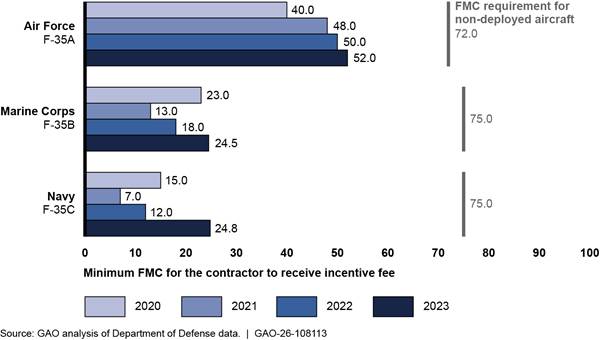
Further, JPO’s use of contract incentives did not achieve F-35 readiness goals, due in part to JPO paying incentive fees for performance that did not align with service requirements (see figure). Until JPO ensures the future use of incentives better achieves desired performance, it risks rewarding contractor performance that does not help meet program goals.
Minimum Full Mission Capable Rate (FMC) Requirements for Contractors to Receive a Portion of Incentive Fees Compared with Service Requirements, 2020–2023
Why GAO Did This Study
The F-35 aircraft is the Department of Defense’s (DOD) most costly weapon system, with lifetime sustainment costs for the United States alone estimated at $1.6 trillion, as of 2024. DOD operates and sustains over 800 U.S. F-35s and plans to buy about 1,700 more aircraft by the mid-2040s. DOD uses the F-35 to perform a wide range of missions. It is vital to the success of U.S. combat operations and homeland defense, according to DOD.
The National Defense Authorization Act for Fiscal Year 2022, as amended, includes a provision for GAO to conduct an annual review of F-35 sustainment efforts. This report assesses the extent to which JPO has evaluated the performance of its sustainment strategy and managed sustainment responsibilities with contractors to achieve goals, among other objectives.
GAO analyzed performance metrics, cost information, and sustainment contract incentive fee data for, among other things, full mission capable-related goals from 2020 through 2023, the last contract in which that metric was incentivized. GAO also reviewed relevant program documentation and interviewed DOD officials and contractor representatives.
What GAO Recommends
GAO is making three recommendations, including for DOD to develop risk mitigation plans associated with GSS Reset and ensure that future incentive approaches better achieve the desired performance for sustainment contracts. DOD did not provide formal comments on this report but noted in draft comments that it concurred with the recommendations.
|
Abbreviations |
|
DOD Department of Defense |
|
FAR Federal Acquisition Regulation |
|
FMC full mission capable |
|
GSS Global Support Solution |
|
JPO F-35 Joint Program Office |
|
MC mission capable |
|
WCF working capital fund |
This is a work of the U.S. government and is not subject to copyright protection in the United States. The published product may be reproduced and distributed in its entirety without further permission from GAO. However, because this work may contain copyrighted images or other material, permission from the copyright holder may be necessary if you wish to reproduce this material separately.
June 11, 2026
The Honorable Roger Wicker
Chairman
The Honorable Jack Reed
Ranking Member
Committee on Armed Services
United States Senate
The Honorable Mike Rogers
Chairman
The Honorable Adam Smith
Ranking Member
Committee on Armed Services
House of Representatives
The F-35 Lightning II (F-35) aircraft is the Department of Defense’s (DOD) most costly weapon system, with sustainment costs for the United States estimated at $1.6 trillion for the life of the program to 2088, as of 2024.[1] DOD operates and sustains over 800 F-35s and plans to buy about 1,700 more aircraft by the mid-2040s. DOD uses the F-35 to perform a wide range of missions and it is vital to the success of U.S. combat operations and homeland defense, according to DOD.
Since 2014, we have examined various aspects of the F-35 program and have made 46 recommendations designed to improve the department’s operation and sustainment of the program. Many of these recommendations have been directed to the F-35 Joint Program Office (JPO). JPO manages and oversees the support functions required to field and maintain the readiness and operational capability of the F-35 aircraft across the U.S. Air Force, U.S. Navy, U.S. Marine Corps, international partners, and foreign military sales customers.[2] DOD agreed with many of these recommendations and, as of March 2026 has implemented 14 of them. But, DOD has not yet taken action to implement the other 32. Fully implementing these open recommendations could help DOD further improve F-35 program operations and sustainment.
Section 357 of the National Defense Authorization Act for Fiscal Year 2022 includes a provision for us to conduct an annual review of F-35 aircraft sustainment efforts.[3] This report assesses the extent to which (1) JPO has evaluated the performance of its sustainment strategy and any supporting initiatives; (2) long-standing financial management issues affect F-35 sustainment; and (3) JPO has managed sustainment responsibilities with prime contractors to achieve readiness goals.
To address our first objective, we reviewed relevant DOD documents and collected and analyzed relevant performance metrics from fiscal year 2020 through fiscal year 2025. To address our second objective, we reviewed and analyzed relevant DOD documents related to an ongoing inventory of the global spares pool, which is the population of F-35 parts and equipment. We also reviewed DOD Office of the Inspector General and Defense Contract Management Agency reporting, and our previous reviews of F-35 financial management issues and related effects on F-35 sustainment. To address our third objective, we reviewed and analyzed relevant DOD documents and data related to contractor management, performance metrics, and performance incentive fees from fiscal year 2020 through fiscal year 2025.
For all objectives, we interviewed officials from relevant DOD offices, the Air Force, the Navy, and the Marine Corps, as well as prime contractor officials, and assessed the reliability of performance data. We assessed the reliability of the data by reviewing related documentation, interviewing knowledgeable agency officials, and performing electronic data testing for missing data, outliers, and obvious errors. We determined these performance data to be sufficiently reliable for the purposes of summarizing and presenting trends in performance metrics and related information. We determined that certain incentive fee metric data were sufficiently reliable for reporting trends, as discussed later in the report. For a detailed description of our scope and methodology, see appendix I.
We conducted this performance audit from January 2025 to June 2026 in accordance with generally accepted government auditing standards. Those standards require that we plan and perform the audit to obtain sufficient, appropriate evidence to provide a reasonable basis for our findings and conclusions based on our audit objectives. We believe that the evidence obtained provides a reasonable basis for our findings and conclusions based on our audit objectives.
Background
F-35 Program and Sustainment
The F-35 program is a joint, multinational acquisition program intended to develop and field a family of next-generation strike fighter aircraft. Program participants include the Air Force, Navy, and Marine Corps; seven international partners; and multiple foreign military sales customers.
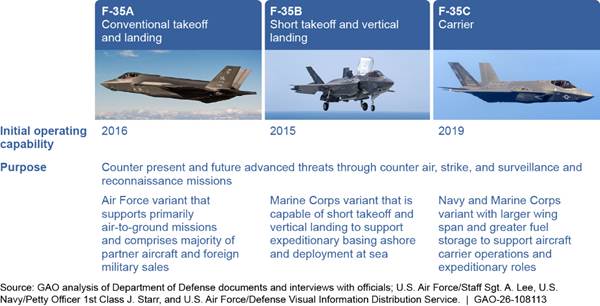
As shown in figure 1, the program has developed and has been delivering three variants of the F-35 aircraft: F-35A, F-35B, and F-35C. DOD is in the process of replacing a variety of its current fighter aircraft with the F-35, including the F-16 Falcon in the Air Force and the AV-8B Harrier and the F/A-18 C/D Hornet in the Marine Corps.
DOD’s sustainment effort for the F-35 aircraft is a large and complex undertaking involving many stakeholders, as shown in figure 2. Sustainment costs are for operating and supporting the F-35 aircraft. These costs are for pilots and maintenance personnel, maintenance to repair the aircraft and its parts, and system modifications, among other things, to ensure the aircraft can fly and perform its various missions.
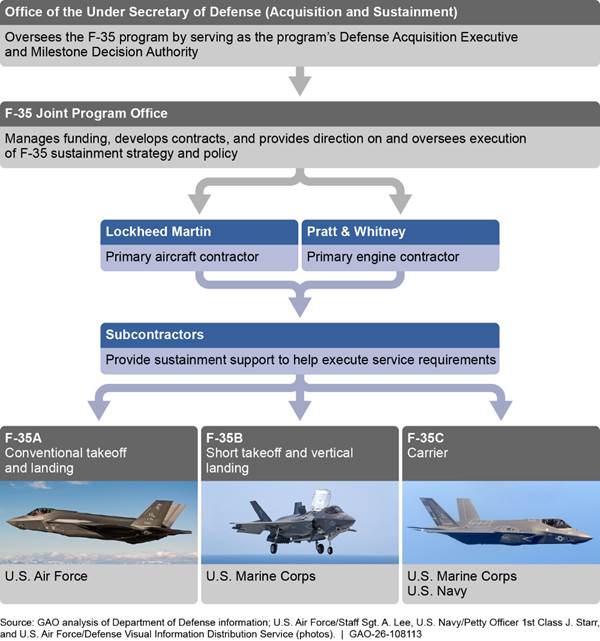
Note: The Defense Acquisition Executive is the entity responsible for supervising the Defense Acquisition System and takes precedence on all acquisition matters after the Secretary and Deputy Secretary of Defense. The Milestone Decision Authority is the designated entity with overall responsibility for a program. The F-35 Program Executive Officer heads the F-35 Joint Program Office.
JPO manages F-35 sustainment through contracts with prime contractors Lockheed Martin Aeronautics and Pratt & Whitney, performing specific sustainment functions for the air vehicle and propulsion, respectively.
F-35 Global Support Solution and GAO-Identified Sustainment Challenges
DOD uses a common Global Support Solution (GSS) to meet the sustainment requirements of its F-35 customers. As part of this common solution, participants share most sources of support, such as spare parts, depot maintenance, and training. At the core of the F-35 GSS is the F-35 supply chain. The F-35 supply chain is a network of manufacturers, commercial and government depots to repair parts, and base and regional warehouses located around the world to provide parts to support the operational and training requirements of all F-35 program participants.
The Air Force, Navy, and Marine Corps have deployed the F-35 to forward locations including Air Force deployments to Europe, the Middle East and the Pacific; Navy aircraft carrier deployments in the Pacific and Mediterranean; and Marine Corps stationing in Japan and deployments on amphibious ships and aircraft carriers around the world. However, in recent years, the program has not met performance goals for F-35 aircraft readiness due to multiple challenges we have identified in our prior work (see fig. 3).
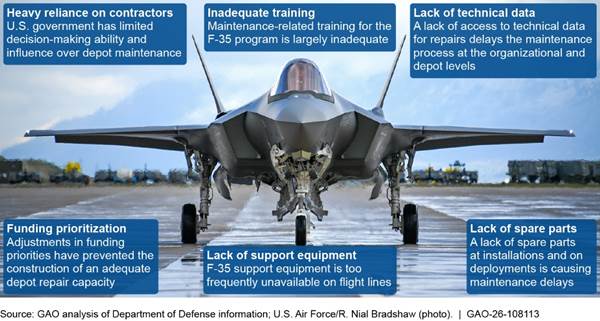
We have found that these issues hinder the ability of maintainers to maintain the aircraft, including in deployed environments. When programs overpromise a weapon’s prospective performance and deliver systems that cannot achieve their requirements, such as mission capable goals, the warfighter receives less capability than originally promised.
JPO Developed an Updated Sustainment Strategy to Address Poor Performance but Lacks Formal Risk Mitigation Plans
In response to long-standing sustainment challenges, JPO initiated an update to its sustainment strategy in June 2025 referred to as the GSS Reset. The GSS Reset aims to remedy issues—including an insufficient supply of spare parts and inefficient maintenance practices—that prevented the program from meeting performance goals. JPO estimates that to achieve its goals, it will need about $13.7 billion in additional funding from fiscal year 2026 through fiscal year 2031. However, we found JPO lacks formal risk mitigation plans for GSS Reset efforts.
Sustainment Performance Has Generally Declined
Since 2021, F-35 sustainment costs have increased as fleet size has grown, but the F-35 fleet continues to not meet sustainment performance goals, with mission capable (MC) rates and full mission capable (FMC) rates declining (see fig. 4).[4] See appendix II for additional details on F-35 sustainment costs.
Figure 4: Annual F-35 Operating and Support Costs Overlaid with Mission Capable Rates from Fiscal Years 2021-2025
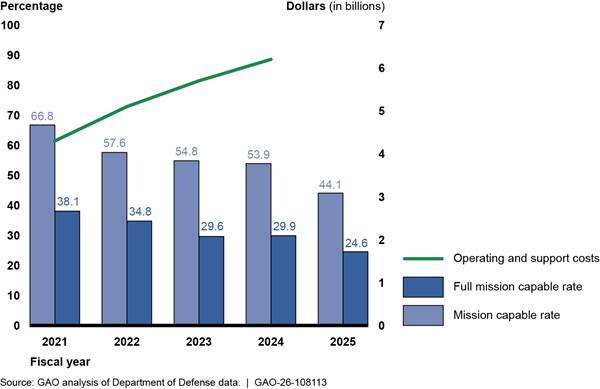
Note: The mission capable rate (the percentage of time during which the aircraft can fly and perform at least one of its tasked missions) and the full mission capable rate (the percentage of time during which the aircraft can perform all of its tasked missions) are key measures of the health and readiness of a military aircraft fleet. The size of the U.S. F-35 fleet grew from about 450 F-35s in fiscal year 2021 to more than 800 in fiscal year 2025. Fiscal year 2024 is the latest year for which actual operating and support cost information is available. Operating and support costs are in fiscal year 2024 inflation-adjusted dollars.
Examining performance by F-35 variant, since 2020, the F-35 has not met the minimum performance goals desired by the U.S. military services by wide margins and performance has generally trended down for FMC rates (see fig. 5) and MC rates (see fig. 6), particularly for the Air Force F-35A.[5]
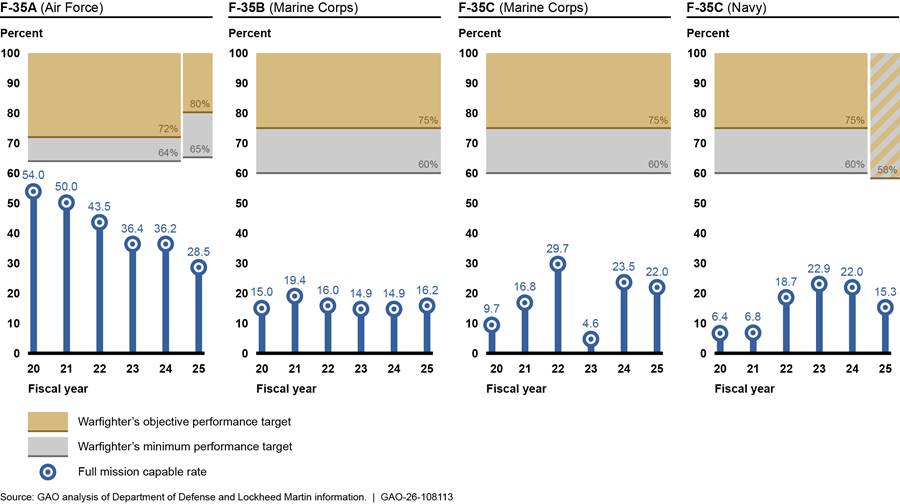
Note: The full mission capable rate assesses only aircraft that are in the possession of F-35 units. It measures the percentage of time during which these aircraft are fully capable of accomplishing all tasked missions. The warfighter’s minimum and objective performance targets are those requirements established for non-deployed F-35 aircraft by the U.S. Air Force for the F-35A, by the U.S. Marine Corps for the F-35B, and by the U.S. Navy for the F-35C, in their respective performance-based arrangements. According to Air Force officials, the fiscal year 2025 decline in full mission capable rates was due to the fact that the program accepted new aircraft that were non-mission capable due to software delays, as well as ongoing challenges with scarce parts and corrosion inspections and remediation. For 2025, the Navy’s objective and minimum performance targets were both 58 percent.
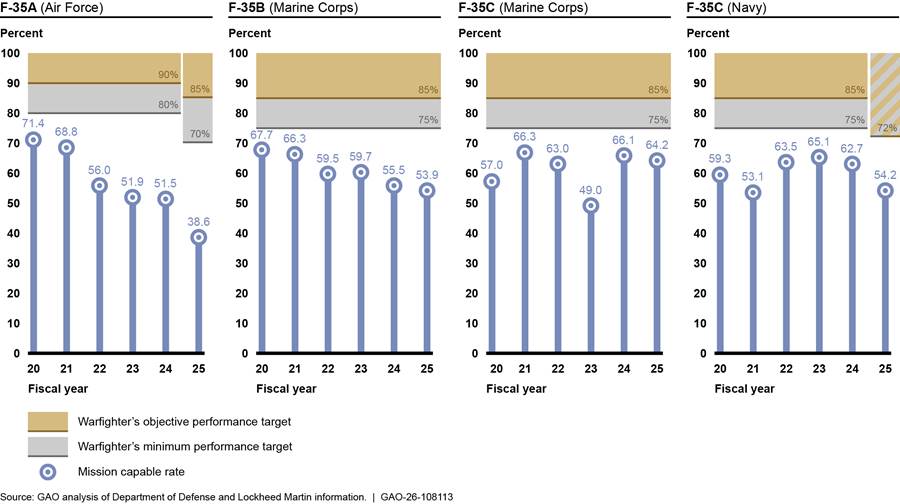
Note: The mission capable rate assesses only aircraft that are in the possession of F-35 units. It measures the percentage of time during which these aircraft can fly and are able to perform at least one tasked mission. The warfighter’s minimum and objective performance targets are those requirements established for non-deployed F-35 aircraft by the U.S. Air Force for the F-35A, by the U.S. Marine Corps for the F-35B, and by the U.S. Navy for the F-35C, in their respective performance-based arrangements. According to Air Force officials, the fiscal year 2025 decline in mission capable rates was due to the fact that the program accepted new aircraft that were non-mission capable due to software delays, as well as ongoing challenges with scarce parts and corrosion inspections and remediation. For 2025, the Navy’s objective and minimum performance targets were both 72 percent.
JPO Evaluated Performance of Its Sustainment Strategy and Found a Range of Issues
Recognizing these long-standing sustainment challenges, in 2024, JPO evaluated the performance of its F-35 sustainment strategy. Similar to our past findings, JPO identified depot repair speed and the ability to procure parts as root causes driving low sustainment performance rates. JPO’s evaluation additionally identified several challenges rooted in an imbalance between production and sustainment. Specifically:
1. Insufficient spares and consumables in the supply system. According to JPO officials and documentation, these shortages were caused, in part, by historically underestimating the number of required spare parts to support the full fleet.[6]
2. Maintenance philosophy and program not optimized to reduce workload or aircraft downtime. For example, JPO officials said that maintainers would wait until parts ran out before ordering more, instead of using available data to predict the best time to order. The maintenance program also has multiple inspections that are currently conducted separately instead of simultaneously, increasing the amount of time aircraft are down for inspection.
3. Industrial base capacity constrained for repairs and parts. For example, we have previously found that key parts, such as the canopy, are constrained by industrial base capacity and are among the top contributors to non-mission capable rates.[7]
|
F-35 Program Cost Allocation Rules According to F-35 program documentation, equitable sharing of costs and benefits among the participants is a fundamental principle for the F-35 program. Participants agree to cost allocation rules for production, sustainment, and follow-on development. As of March 2024, there were nearly 100 individual rules. While some costs are unique to each country, others are allocated proportionally. Deviation from these rules requires consent from all affected participants. Source: GAO analysis of F-35 program information. | GAO‑26‑108113 |
4. High technical complexity due to continuous development. JPO officials said that there are multiple configurations of the F-35 in service today, each requiring different maintenance practices and parts supply requirements.
5. Complex global program structure and rigid processes. For example, JPO officials said that there are many different cost allocation arrangements with the various F-35 partners (see sidebar) they must work through when trying to make changes, which limits their flexibility.
6. Corrosion. JPO found that the program failed to properly mitigate corrosion including providing parts, equipment, data, and staffing to conduct corrosion inspections and corrective work.
JPO attributed these challenges to the F-35 program and U.S. military services historically underinvesting in sustainment—prioritizing procurement of aircraft early in the program’s life cycle over the creation of critical depot and repair capability. As a result, JPO determined the sustainment system cannot fully support the F-35 fleet. According to JPO officials, without significant changes, sustainment—which was already not meeting performance goals—would worsen over time as more F-35s are added to the fleet.
JPO Developed an Updated Sustainment Strategy and Funding Needs
In response to these identified challenges, in June 2025 JPO initiated an update to its sustainment strategy, referred to as the GSS Reset. This strategy includes both increased investments in F-35 sustainment as well as programmatic changes to improve sustainment processes. According to JPO, the GSS Reset seeks to address key challenges and calls for an investment of about $13.7 billion in addition to previously planned spending through fiscal year 2031 to meet performance objectives. Overall, the strategy aims to achieve a fleetwide readiness level of an 80 percent MC rate and a 65 percent FMC rate by 2030.[8] For the U.S. military services, this strategy would improve upon the MC and FMC rates for fiscal year 2025 of 44 percent and 25 percent, respectively. If successful, the FMC rate would more than double by 2030. JPO officials said that if they can get the sustainment system to a level where it is meeting the needs of the fleet, it should be able to sustain the fleet as additional F-35s are added.
JPO has identified seven lines of effort to achieve this goal (see table 1). According to JPO officials, JPO, the U.S. military services, and contractors will need to collectively take actions to meet overall goals.
|
Lines of effort |
|
|
Supply |
Line of effort 1: Improvement to spare parts modeling, purchase of additional spare parts and consumables, investment in repairs. |
|
Line of effort 2: Revise part allocation rules to more efficiently move parts to the fleet. |
|
|
Line of effort 3: Expand depot component repair capacity and speed. |
|
|
Line of effort 4: Expand and accelerate efforts to improve availability of top-degrader components. |
|
|
Maintenance |
Line of effort 5: Optimize maintenance program to conduct maintenance activities concurrently and minimize downtime. |
|
Line of effort 6: Standardize personnel staffing requirement for the fleet to ensure units are optimally staffed. |
|
|
Line of effort 7: Adopt new maintenance tools and best practices. |
|
Source: GAO analysis of F-35 Joint Program Office information. | GAO‑26‑108113
The GSS Reset lines of effort target all but one issue we have previously identified as challenges for F-35 sustainment, as shown in figure 7.
Figure 7: F-35 Joint Program Office Global Support Solution Reset Lines of Effort Compared to GAO-Identified Sustainment Challenges
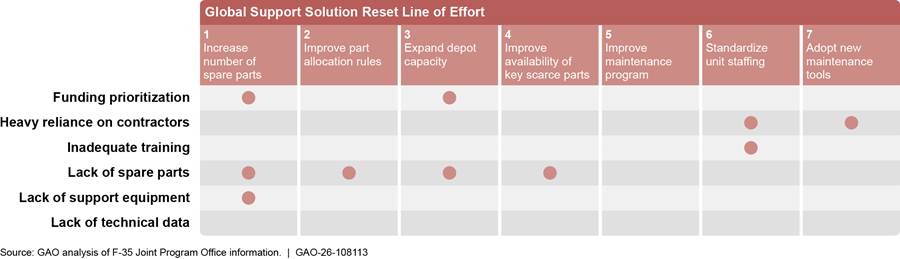
Note: GAO discusses F-35 sustainment challenges related to technical data later in GAO‑26‑108113.
By targeting these issues as planned, JPO should be better positioned to improve F-35 sustainment performance. For example, we reported in 2019 that JPO did not plan for enough spare parts to meet warfighter requirements.[9] By improving modeling to determine specific parts needed, increasing investment in spare parts, and increasing investments to increase repair speed, JPO should help improve the supply of spare parts to the F-35 fleet. Additionally, JPO efforts to improve maintenance practices and implement new maintenance tools should help alleviate challenges associated with inadequate training as well as reliance on contractors.
To achieve GSS Reset goals, JPO estimated in October 2025 that the U.S. military services will need to increase funding for F-35 sustainment by roughly $13.7 billion over previously planned spending from fiscal year 2026 to fiscal year 2031.[10] JPO estimates that:
· About 50 percent of the cost ($7.3 billion) would be allocated to the purchase of additional spare parts and stocks of material needed to repair parts at the depots.
· About $3.1 billion would be allocated to procurement, which includes increasing depot activations to develop repair capabilities and capacity.
· About $3.3 billion would be allocated to additional operation and maintenance funding, which the services use to support flying the aircraft, including conducting maintenance on the aircraft, purchasing fuel, and conducting depot-level maintenance.
According to JPO officials, approximately $2.2 billion of the $13.7 billion is part of what they refer to officially as “GSS Reset.” JPO plans to invest these funds primarily during fiscal years 2026 and 2027.[11] While more than half of this amount is to purchase additional spare parts, JPO also plans for investments to reduce the backlog of air vehicle and engine parts awaiting repair, increase depot activations, and implement maintenance initiatives. According to JPO officials, these maintenance initiatives include, among other things, establishing a corrosion control program and making changes to the unit-level maintenance program.[12]
The remainder of the estimated $13.7 billion (about $11.5 billion) from fiscal year 2027 through fiscal year 2031 is not part of what JPO officials call “GSS Reset.” According to JPO officials, the remaining amount is to make up for shortfalls in what the U.S. military services had previously planned for F-35 sustainment funding. In 2025, JPO estimated that F-35 sustainment would require approximately $50.8 billion in funding from the U.S. military services from fiscal year 2027 through fiscal year 2031. However, according to JPO documentation, the U.S. military services had budgeted for about $38.1 billion for that same period, leaving a potential shortfall of about $12.7 billion.[13] JPO officials said that most of the $12.7 billion needed to address this shortfall is not considered part of GSS Reset.[14] However, JPO officials said the total $13.7 billion is what is required to meet their GSS Reset goal of 80 percent MC and 65 percent FMC by 2030.
DOD Is Planning to Use a Working Capital Fund for F-35 Sustainment Supply
In addition to the GSS Reset, DOD is planning to transition to the use of a working capital fund (WCF) for the supply portion of F-35 sustainment, which JPO identifies as the preferred long-term solution for F-35 supply.[15] A WCF operates similar to a commercial business when financing inventories of supplies and can provide some benefits to more effectively control and account for the cost of a program. For example, according to DOD documentation:
· Since the WCF is not operated for profit, WCF managers can retain capabilities that private sector companies may choose to divest. For example, they can retain inventories of spare parts with low demand, an important consideration with aging weapon systems. They can also retain excess maintenance capacity during peacetime for use during extended contingencies.
· Because the WCF has budgetary contract authority, managers can order replacements prior to the receipt of funded orders, an important consideration for long-lead-time items.
· The prices the WCF managers charge for parts or maintenance once set in the budget are not normally changed during the execution year. So, programs are protected from inflation; the price the program budgets for an item or labor hour is the price paid.
· The WCF managers have extensive procurement expertise to seek the best price for spare parts from the industrial base and find new sources of supply when manufacturers decide to discontinue support.
According to JPO officials, the F-35 program is too big to manage using annual appropriations for the supply element of sustainment. Additionally, according to DOD officials, continuing resolutions have had a negative impact on the ability for the program to obtain parts and fund repairs.[16] According to DOD, JPO, Air Force, and Navy officials, transitioning to a WCF would directly improve F-35 sustainment. For example, DOD and Navy officials said a WCF would help acquire parts that take a long time to procure. The ability to procure parts in advance may help remedy the long-standing issue related to a limited supply of spare parts.
Similar to GSS Reset, the transition of F-35 supply support to a WCF is a long-term effort to adjust the sustainment strategy.[17] As of March 2026, DOD plans for the transition of F-35 supply support to a WCF to take place no earlier than October 2028.[18]
JPO Has Not Formally Developed Plans to Mitigate Sustainment Risks
We have previously found that DOD has faced significant risks with regard to sustainment of the F-35 program. For example, in 2014 we found that DOD faced risks to the long-term affordability and operational readiness of the F-35 program, including with the reliability and maintainability of the whole air system.[19] However, at the time, the department had not taken steps to fully address these risks, affecting the development of the sustainment strategy. In 2017, we found that the F-35 program was experiencing sustainment challenges due, in part, to some underfunded requirements. This presented a continued risk going forward if sustainment for the F-35 was not affordable and within the services’ budgets.[20]
The GSS Reset itself contains lines of effort to address previously identified risks that have hindered F-35 sustainment. For example, in 2019, we found that the quantity of parts that DOD was planning to purchase versus the quantity needed would hinder DOD’s ability to meet warfighter performance requirements.[21] Similarly, as part of JPO’s 2025 evaluation of the sustainment strategy, it identified the previous low estimates for the number of spare parts required as a cause of insufficient spare parts. JPO now estimates that additional investments in spare parts will be necessary to meet performance requirements and plans to achieve this through the GSS Reset.
While these lines of effort are positive steps in addressing long-standing sustainment challenges, we found multiple risks that potentially threaten JPO’s ability to achieve GSS Reset goals.
JPO’s limited access to necessary technical data. The GSS Reset plan does not address the long-standing issue we identified regarding access to technical data. According to JPO officials, one element of the GSS Reset plan is to invest in certain maintenance initiatives, including associated technical data costs. However, long-standing challenges remain that are associated with access to technical data, which could threaten sustainment improvement initiatives.
Since 2014, we have reported that limited access to necessary technical data could hinder the F-35 program.[22] For example, in 2014 we reported that unless technical data rights needs are considered up front, critical data and software may not be acquired, rendering them unavailable (or unaffordable) years later when seeking to maximize competition on a program during its sustainment phase. At the time we recommended that DOD develop a long-term intellectual property strategy to include, but not be limited to, the identification of (1) current levels of technical data rights ownership by the federal government and (2) all critical technical data needs and their associated costs.[23] DOD concurred with this recommendation, but it has yet to fully implement it.
In 2023, we found that JPO projects to improve maintainers’ ability to conduct aircraft maintenance were hindered by a lack of access to technical data.[24] According to JPO officials at the time, the inability to obtain the requisite technical data—often due to the associated cost of procuring such data and extensive delays due to vendor negotiations—prevented many planned projects from ever getting started. We recommended that DOD reconsider aspects of the F-35 sustainment strategy including, among other things, assessing the level of necessary technical data.[25] DOD also concurred with this recommendation; however, it has not yet fully implemented it.
In 2025, we found that according to JPO officials and maintainers, the F-35 faces significant corrosion issues that maintainers cannot repair without contractor support due to a lack of technical data.[26] We reported that the program is attempting to develop organic sustainment capabilities by incrementally obtaining technical data to enable maintainers to do more repairs and improve timelines. In 2025, we recommended that DOD assess whether F-35 maintenance personnel are granted appropriate authorities and access to technical data and information when deployed and make any changes necessary to ensure the success of the F-35 in future uncontested and contested environments. DOD concurred with this recommendation but has not yet fully implemented it.[27]
We have consistently found that technical data issues have hindered F-35 sustainment. While the department has taken some incremental steps to address these issues, significant challenges remain without a clear timeline for resolution. Therefore, we continue to believe that implementation of our technical data-related recommendations will better position the program to understand its technical data needs and obtain such data to improve sustainment performance. Until DOD and JPO implement these recommendations, there is risk that a lack of necessary technical data will continue to hinder sustainment improvement initiatives.
JPO’s reliance on industry capacity. Even with additional funding, JPO will be reliant on industry to deliver additional parts to achieve GSS Reset goals. As described above, JPO plans to invest more than $7 billion to procure additional spare parts and other material. However, capacity constraints may hinder industry’s ability to deliver all required parts. In 2025, the prime contractor for the air vehicle conducted a study that found that there was enough supply capacity to meet demand for 95 percent of F-35 parts.[28] However, the study found that for 2 percent of parts, there was a supply gap.[29] While that amount appears low as an overall percentage, this supply gap represents 48 parts that have insufficient supplier capacity. We have previously found that some of these parts identified in the study, such as the canopy, are among the top contributors to non-mission capable rates.[30]
The contractor for the engine also cited material shortages as a potential challenge for meeting demand for parts through 2029. Contractor officials cited historical underfunding as a cause of defense industrial base capacity constraints. Both engine contractor and JPO officials acknowledged that even with additional funding, there may not be enough industry capacity to meet demand. In September 2025, we reported that the engine contractor delivered all 123 engines late in 2024 due to production and supply chain issues.[31] Defense Contract Management Agency officials said that such challenges will inevitably affect sustainment, as the same suppliers and facilities make engine parts for new jets and sustainment efforts. The officials said that sustainment may worsen in the next several years as older F-35 engines require mid-life servicing, increasing the demand for engine parts.
For both air vehicle and engine parts, JPO and contractors have ongoing efforts to resolve shortages. However, previous efforts to address part shortages have not achieved program goals. Officials from all three services also identified limited industry capacity as a potential hinderance even with additional funding. They said they were unsure if industry could meet additional demand.
Affordability of future funding plans. As discussed above, JPO estimates that it will need approximately $13.7 billion from fiscal year 2026 through fiscal year 2031 to achieve its goals with GSS Reset. The military services will have to provide this funding, which is more than previously budgeted for the F-35, according to JPO documentation. While Air Force officials said they could likely afford the costs associated with GSS Reset, both Navy and Marine Corps officials said that competing priorities within their respective services may limit the extent to which they can fund the GSS Reset and associated costs.
JPO officials acknowledged that insufficient funding was a potential risk. In a preliminary analysis, JPO estimated that if the services fund below the full estimated amount for GSS Reset, JPO would not be able to meet MC goals. For example, funding to 66 percent of the requirement would reduce the improvement to MC rates by roughly 14 percentage points and increase the cost per percentage point gain by $10 million. JPO officials also said that each GSS Reset line of effort is interdependent, meaning that all efforts will need to be funded to achieve their collective goals.
JPO officials said they were optimistic that future budget requests would generally align with their estimated requirements. And, according to JPO documentation, the fiscal year 2027 budget request includes amounts providing for 97 percent of the funding needed to meet JPO’s estimated sustainment requirement for fiscal years 2027 through 2031. JPO officials also said that a $1 billion Air Force allocation for spare parts in 2025 and an increase of $440 million for air vehicle and engine spares in the fiscal year 2026 defense appropriations bill demonstrates broad commitment to fund F-35 sustainment.[32] However, the fiscal year 2026 requirement for sustainment was only partially funded. According to JPO officials, this amounted to a roughly $2 billion total shortfall across operation and maintenance, procurement, and spares funding. This underfunding was already forcing JPO to develop solutions to mitigate the impact to its planned FMC rate, according to JPO documentation.
Furthermore, in 2025, JPO estimated that the cost per aircraft per year would exceed service affordability targets for all variants when the services would be operating the F-35 at its maximum capability, roughly the mid-2030s, which is referred to as the steady state period (see fig. 8). In fiscal year 2027, JPO expects that the Air Force will meet the affordability target for the F-35A, but all other services and variants will exceed their respective targets.
Figure 8: Differences Between Service F-35 Affordability Targets and 2025 Cost Estimates for Annual Sustainment Costs per Aircraft, at Program Steady State
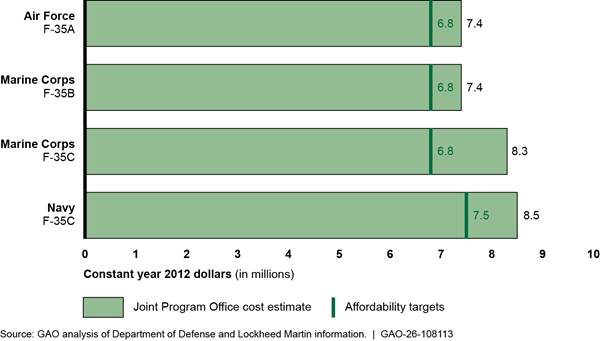
Note: Each service has set a target for the amount of money it projects it can afford per aircraft per year for the F-35. According to program officials, the steady state period for each military service is the period in which it intends to be operating the F-35 at its maximum capability, roughly the mid-2030s for each variant.
The 2025 cost estimates, apart from the Marine Corps F-35C, are higher than the 2023 estimates we previously reported.[33] For example, the estimated costs increased 47 percent for the Navy F-35C, 21 percent for the Marine Corps F-35B, and 12 percent for the Air Force F-35A, in part due to increases in the planned number of flight hours. This growth in estimated costs will result in about $1.2 billion in annual gaps between estimated costs and service affordability targets during the steady state period (see app. II for further details). Though current service funding requests for sustainment may be expected to meet requirements, long-term affordability will remain a challenge for the program, potentially threatening sustainment initiatives.
Goals are not fully aligned with service needs. Air Force and Marine Corps officials said that JPO’s stated goal of 80 percent MC and 65 percent FMC is a good start but does not fully align with their needs. For example, Air Force officials said that their goal is to achieve an 80 percent FMC rate for their fleet. Navy officials said that the proposed goals would meet Navy sustainment performance requirements.
Furthermore, improvement in MC and FMC rates will take time. JPO officials said that sustainment performance will likely get worse before it gets better. Initial improvements in MC and FMC rates may not materialize until late 2026 or after, according to JPO documentation. Though service officials said that the GSS Reset goal is a good start, there is risk that failure to achieve that goal will deliver even less performance than what the services require. We have previously reported that when programs overpromise a weapon’s prospective performance and deliver systems that cannot achieve their requirements, such as mission capable goals, the warfighter receives less capability than originally promised.[34]
In addition to the four risks identified above, JPO officials said that several other high-level risks could hinder the GSS Reset. According to these officials, risks included a reduced JPO workforce, contracting inflexibility, and a future conflict. JPO officials have acknowledged these risks to the GSS Reset; however, JPO officials said they have not included procedures to develop risk mitigation plans in the GSS Reset. JPO officials said that they are finding it more efficient to identify and address risks in real time during their GSS Reset efforts. We found that some risks are identified in various JPO briefs, including the potential for a funding shortfall in fiscal year 2026. Additionally, JPO officials said that there is a risk management working group that meets biweekly as well as a charter in draft form. However, as of February 2026, no charter has been published, according to JPO officials.
According to JPO’s Joint Risk Management Plan, project planners should identify and analyze risk and opportunity root causes, their associated mitigation plans, and determine how to implement and track actions to mitigate the risk or achieve the opportunity.[35] The GSS Reset is a positive step in addressing critical sustainment challenges. But, until JPO proactively develops risk mitigation plans—to include risks associated with access to technical data, industry capacity, affordability, and alignment with service goals—JPO may not be positioned to effectively address issues that could derail achievement of GSS Reset and other sustainment improvement goals.
Long-Standing Financial Management Issues Threaten Sustainment Initiatives
Long-Standing Deficiencies in Financial Management Practices Threaten Sustainment Initiatives
Long-standing and ongoing deficiencies in financial management practices, including accountability for parts, threaten initiatives to improve F-35 sustainment. As described above, DOD is implementing two efforts—the GSS Reset and transition to a WCF—to improve the health of the F-35 sustainment system. Both initiatives rely on strong financial management practices to achieve desired goals.
· GSS Reset. JPO plans to implement GSS Reset and associated investments to improve F-35 sustainment. Specifically, JPO estimates that it will need an additional $7.3 billion to purchase parts and other material from fiscal year 2026 through 2031. However, JPO will need an accurate record of parts to prevent it from unnecessarily purchasing parts already on hand. Furthermore, JPO and the U.S. military services will need accurate, real-time data on the F-35 parts inventory to effectively track and distribute parts and monitor supply levels.
· Working Capital Fund (WCF). A WCF may allow DOD to improve F-35 sustainment by, among other things, facilitating the ability to procure materials required for sustainment that may take a long time to receive. To accomplish this goal, DOD needs to transition F-35 parts currently on hand and managed by industry to the Air Force and Navy, which operate the WCFs. However, according to DOD documentation and officials, DOD would need to obtain a complete inventory of F-35 parts with related costs, assign identifying numbers to these parts, and establish an information technology system to allow for tracking of parts.[36]
As we previously reported, in 2012, the program determined that F-35 parts would be titled to the U.S. government when not installed on an aircraft, but subsequently failed to develop a plan to maintain accountability over the parts that it already owned or would purchase in the future.[37] Our previous work related to F-35 financial management practices as well as multiple DOD agency reviews have found that DOD and the prime contractors cannot fully account for F-35 spare parts within the supply chain and their associated costs (see table 2).[38]
Table 2: GAO and Department of Defense (DOD) Agency Findings on Deficiencies in F-35 Financial Management Practices
|
Deficiency |
GAO findings |
DOD agency findings |
|
Inventory management |
· DOD cannot fully account for F-35 spare parts within the supply chain. Specifically, the department did not have records indicating how many F-35 parts it has purchased, or where they are all located. · JPO did not design inventory counts to verify completeness of contractors’ property records or conduct any inventory procedures at F-35 sites that are not contractor facilities. As a result, we found that JPO cannot be sure that the inventory count resulted in appropriate verification and an accurate baseline of F-35 parts. · JPO did not have procedures for performing periodic inventories, leading to an increased risk that JPO will not be able to execute an inventory in accordance with DOD policy. This is necessary to ensure that, among other things, JPO has accurate records of F-35 parts to prevent management unnecessarily purchasing parts already on hand. |
· DOD lacked an accurate and complete part universe, potentially leading to uninformed logistical and budgetary decisions · DOD did not have controls to verify the existence and completeness of F-35 property. Accountability of these parts supports mission readiness and efficiency by providing management with information such as where parts are, who is responsible for them, and what condition they are in. · F-35 contractor guidance permitted the distribution of government property before and sometimes without authorization, potentially increasing the risk of unauthorized property use or disposition. Additionally, contractor procedures granted contractor personnel authority to transfer government-owned material, raising potential conflicts of interest and weakening government oversight of its parts. |
|
Cost information |
· DOD does not have comprehensive cost information for individual F-35 spare parts, and the military services cannot track the funds that they have spent on F-35 spare parts to the actual parts purchased by the program office on their financial statements and supporting documentation. |
· DOD does not have the controls to verify the value of its F-35 property. |
|
Data systems |
· DOD designated property data system did not capture real-time changes related to F-35 part information and many data elements were missing from records in the systems. · Management could not demonstrate how controls in the designated system were identified, implemented, and tested to assist in the accurate and timely entry of data. |
· The F-35 Joint Program Office did not enforce a contract requirement for the contractor to identify and provide data on government property within its possession. |
Source: GAO analysis of GAO, DOD Office of the Inspector General, and Defense Contract Management Agency information. | GAO‑26‑108113
JPO Is Taking Steps to Improve Financial Management, but Sustained Effort Is Required to Meet Goals
In response to the above identified challenges and to meet larger DOD financial management goals, JPO is taking steps to improve its practices related to the F-35 program.[39] These steps include implementing corrective action plans developed in response to DOD Office of the Inspector General findings and our recommendations, and completing an inventory of F-35 parts and equipment.[40] These corrective action plans include several steps that may address challenges we identified with management of F-35 parts. For example, according to JPO officials and corrective action plan documentation, the plans call for
1. establishing and maintaining an accurate and complete baseline of F-35 parts in JPO’s property management system;[41]
2. establishing and maintaining an automated interface between applicable information technology systems; and
3. establishing compliant values for and financial reporting of F-35 parts in accordance with guidance.
JPO is conducting these actions to comply with all property accountability and financial reporting-related guidance, according to JPO officials.
However, we have identified some potential issues with how JPO is implementing the steps to date. For example, according to JPO officials, through fiscal year 2025 JPO conducted inventories of F-35 parts and equipment, but only including equipment with a value of over $1 million. Additionally, JPO is not verifying the accuracy and completeness of all data in property records. Finally, as information technology systems are not fully in place, ad hoc inventories during fiscal year 2026 are based on data provided to government officials by contractors during visits to individual sites, according to JPO officials and documentation.[42] Such practices may make it difficult to ensure that JPO has an accurate, complete, and timely population of F-35 parts and may result in DOD failing to meet financial management goals. We have ongoing work reviewing these and other financial management issues in detail and expect to report on them in late 2026.
Until JPO completes the inventory of F-35 parts and equipment and implements past recommendations related to financial management, initiatives to improve F-35 sustainment, such as the GSS Reset and establishment of a WCF, may be at risk. Sustained effort to remedy all identified challenges is necessary to meet DOD goals and ensure that the F-35 program is positioned to meet the needs of the warfighter.
JPO Has Not Effectively Incentivized Performance and Lacks Complete Documentation of Payments
JPO’s use of incentive fees paid to the F-35 air vehicle contractor, Lockheed Martin, for sustainment performance has consistently not incentivized the achievement of JPO and U.S. military service readiness requirements.[43] In addition, JPO does not have accurate records of incentive fees it paid for contractor performance in 2021 through 2023.
JPO Has Consistently Not Effectively Incentivized Air Vehicle Contractor Performance to Achieve Readiness Goals
JPO negotiated with the F-35 air vehicle contractor various contract incentives aimed at improving program outcomes, including several incentives tied to sustainment performance, but has not effectively incentivized performance to improve F-35 program outcomes.[44] The contractor can earn additional incentive fees for meeting certain sustainment-related targets in addition to the base contract fee. For example, JPO negotiates with the contractor on what sustainment targets are (1) attainable within the designated period, and (2) an improvement to current sustainment levels. Once both parties agree on the targets and the contract is in effect, JPO awards incentive fees—ranging from millions to hundreds of millions of dollars—if the contractor reaches the sustainment targets within the specified time period.
JPO included these incentive fees in its F-35 air vehicle contract for all four of the finalized contracts we reviewed from fiscal years 2020 through 2025. These four contracts include the 2020 contract; the 2021 through 2023 contract; the 2024 contract; and the current 2025 through 2028 contract. However, we found that JPO’s use of contract incentives failed to incentivize contractors to achieve air vehicle readiness requirements in three ways: (1) contract incentives did not align with service requirements; (2) the contractor and JPO reconciled sustainment metric rates for higher fees through contract clauses even when the actual performance metrics fell short of targets; and (3) the 2025 sustainment contract covering years 2025 through 2028 did not include metrics to incentivize contractor-controlled maintenance performance or metrics fully aligned with JPO goals.
Contracted air vehicle incentive metrics did not align with service requirements. For all contracts since 2020, JPO included incentive metrics in the air vehicle sustainment contract that did not align with service requirements.
· The 2020 contract and 2021 through 2023 contract. While both contracts included incentive fees for sustainment performance, such as FMC, the targets were significantly lower than the service requirements (see fig. 9).
· The 2024 contract. This contract did not include or incentivize service requirements for MC or FMC. Instead, the contract focused on incentives for Gross Issue Effectiveness, a supply-based metric.[45]
Figure 9: Comparison of the Minimum Full Mission Capable Rate (FMC) Requirements for the Air Vehicle Contractor to Receive Incentive Fees with the Service FMC Requirements, 2020–2023
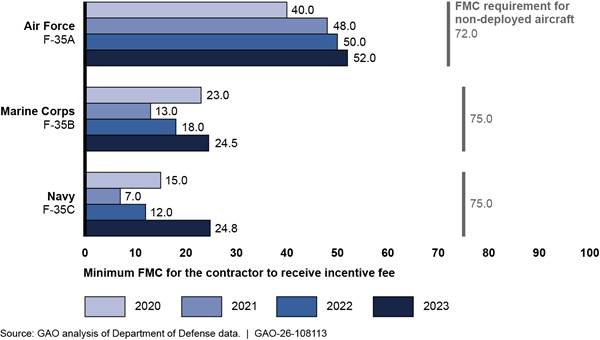
Note: The 2024 contract did not incentivize FMC and therefore is not included in this figure. The minimum FMC for the contractor to receive an incentive fee reflects the threshold target, at which the contractor would earn 50 percent of the fee (in 2020) or 40 percent of the fee (in 2021-2023).
The contractor earns about half of the FMC incentive fee for reaching the minimum thresholds listed in figure 9. JPO officials said that aligning the contract with service requirements can be difficult because (1) the contractor has a lot of leverage in negotiations and the service requirements are above what the contractors would consider possible; (2) the services and foreign partners have varying performance requirements and JPO must incentivize to a single sustainment target; and (3) JPO must balance negotiating performance incentives with other considerations, such as awarding the contract in a timely manner. However, JPO agreed to service-specific performance requirements outlined in bilateral performance-based agreements, which set the minimum and desired F-35 performance requirements for certain sets of years, all of which include 2020 through 2024.
The DOD Office of Inspector General had similar findings in its review of the 2024 sustainment contract. It found that JPO did not adequately oversee contractor performance in its 2024 sustainment contract, as the contract failed to align incentives with service requirements.[46] According to the inspector general report, JPO did not include readiness performance, such as FMC, or other measurable requirements in the contract. The report recommended that JPO ensure contracts include incentive metrics that support service performance requirements, or obtain a waiver from each service for not including such requirements. However, DOD did not agree with this recommendation. It stated that the metrics included in the contract for years 2025 through 2028 are the most appropriate mechanism to hold the contractor accountable and that it cannot alter the contract without lengthy negotiations.[47] The DOD Office of Inspector General maintained its recommendation and stated that until the transfer of sustainment responsibility moves from the contractors to the services, the contract must hold the contractor to the metrics required by the services.
The contractor and JPO often reconciled incentive metrics for higher payments. As a result of the incentive fee structure, JPO paid incentive fees to the air vehicle contractor after reconciling incentive metrics based on contract clauses, even though overall performance metrics were below service requirements.[48] JPO primarily used FMC and supply-related metrics—such as Customer Wait Time and Gross Issue Effectiveness—to calculate incentive fees for the 2020 through 2023 period, which spans two sustainment contracts.[49] For this period, JPO paid the contractor over $114 million, out of around $269 million in available incentive fees designed to improve FMC and supply-related rates over time.[50] However, both FMC and supply rates have generally stagnated or worsened since 2020.
To calculate and award incentive fees, JPO conducts quarterly performance review meetings with the contractor to determine the final FMC and other rates for reconciliation. During these meetings, JPO and the contractor adjust the raw rates to a reconciled rate. The contract lists acceptable reasons for JPO to allow for adjusting the rate in a contract clause, such as service-caused delivery delays. For example, an FMC rate might be negatively impacted by service-caused deferred maintenance or damaged parts and is therefore outside of contractor control. In our review of reconciliation documentation, justifications for adjusting the final rate appear to be based on valid conditions in accordance with the contract. However, we found nearly half of the reconciled rates for FMC resulted in achieving a better performance threshold and thus higher incentive fees for the contractor (see fig. 10).
Figure 10: F-35 Full Mission Capable (FMC) Rates Overlaid with Air Vehicle Contractor Performance Incentive Fee Thresholds by Quarter, 2020–2023
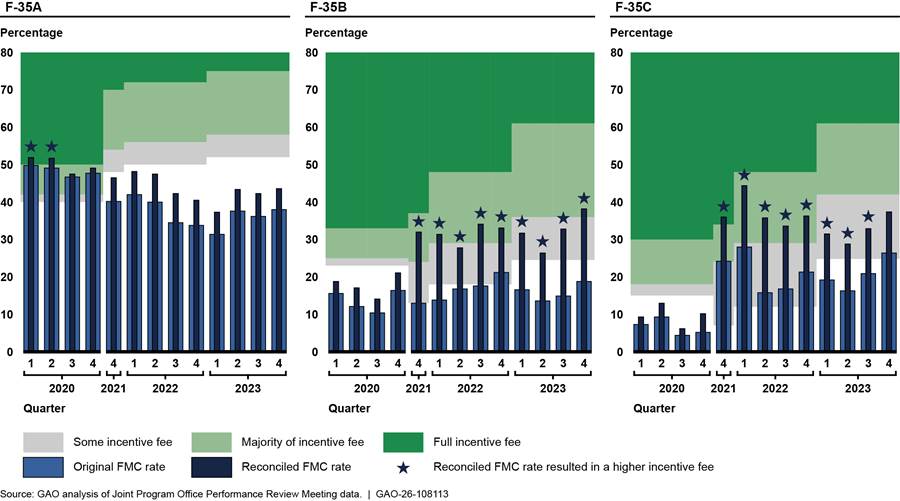
Note: Higher and darker thresholds correspond to an increased incentive payment to the air vehicle contractor. The 2021 through 2023 contract did not include incentive fees for the first three quarters of 2021 for this metric. This figure includes data calculated using the contracted incentive fee payment formula.
Between 2020 and 2023, the contractor and JPO reconciled the FMC rate to achieve a higher incentive fee payout threshold in 19 of the 39 performance periods (nearly 50 percent) with little, if any, improvement to actual FMC rates. In that same period, the contractor collected over $55 million in available FMC incentive fees, about half of which are based on reconciled FMC rates.[51] If JPO had paid the incentive fees over this period based on the actual FMC rate, it would have awarded an estimated $30 million to the contractor (see fig. 11).
Figure 11: Estimated Air Vehicle Contractor Reconciled Performance Incentive Fee for Full Mission Capable (FMC) Rates Compared with Original Fee, 2020–2023
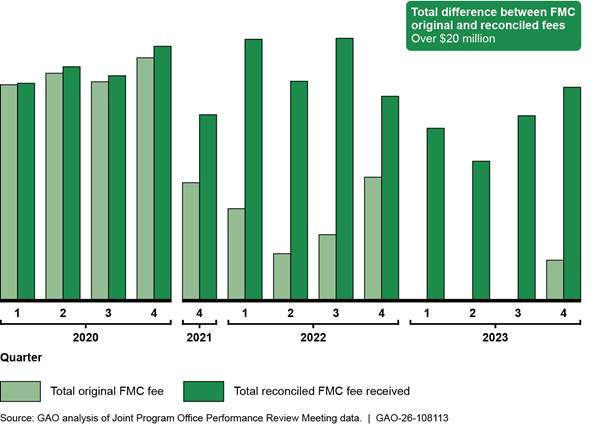
Note: This figure includes data calculated using the contracted incentive fee payment formula and the fees are estimated based on quarterly Performance Review Meeting data. The 2021 through 2023 contract did not include incentive fees for the first three quarters of 2021 for this metric. Details related to incentive fee available, incentive fee earned, and incentive fee structure were identified as confidential commercial and financial information.
Similarly, the contractor and JPO reconciled the supply rate incentive, which is based on metrics like Gross Issue Effectiveness and Customer Wait Time, to a higher incentive fee payout despite little to no improvement in performance in the overall program for the 2020 through 2023 contract period. JPO awarded the contractor over $59 million in total supply incentive fees, nearly half of which was based on reconciled metrics. Based on the raw metrics alone, JPO would have awarded an estimated $30 million in supply incentive fees (see fig. 12).
Figure 12: Estimated Air Vehicle Contractor Reconciled Performance Incentive Fee for the Total Supply Rate Compared with Original Fee, 2020–2023
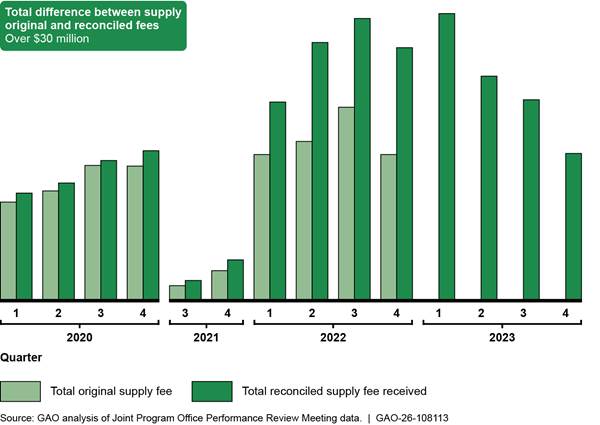
Note: This figure includes data calculated using the contracted incentive fee payment formula and the fees are estimated based on quarterly Performance Review Meeting data. The 2021 through 2023 contract did not include incentive fees for the first two quarters of 2021 for this metric. Details related to incentive fee available, incentive fee earned, and incentive fee structure were identified as confidential commercial and financial information.
During the 2024 contract, JPO lowered the sustainment goal and paid over $3 million in incentive fees to the contractor. That contract only incentivized Gross Issue Effectiveness, a supply metric. According to JPO officials, the shift away from readiness metrics, like FMC, to supply-based metrics was to focus incentives on factors more within contractor control and because other metrics were under contract negotiations during this time. However, JPO set the incentive goal lower than in previous years. For example, the 2021 through 2023 contractor targets for Gross Issue Effectiveness were 80 percent, 81 percent, and 82 percent, respectively for each year; while the 2024 contractor target was 77 percent. The Gross Issue Effectiveness was at 76 percent in the final quarter of 2023.
According to JPO officials, this incentive structure was designed to keep the contractor engaged in negotiations for the 2025 through 2028 contract. It was also intended as a check to determine if the contractor could meet a minimum performance goal. According to officials, this incentive was crucial to build performance models for both JPO and the contractor. These officials also said that the incentive fee JPO eventually paid the contractor, over $3 million, was insignificant when compared to the value of the overall contract, about $1.6 billion.
JPO did not fully align the current contract with program goals. JPO’s current air vehicle sustainment contract incentivizes supply metrics but does not incentivize achieving JPO maintenance goals. The contract covers 2025 through 2028 and includes incentive fees on new metrics: the S-rate and First Pass Effectiveness-Timed. The S-rate measures how frequently aircraft cannot fully perform missions due to a lack of spare parts, while First Pass Effectiveness-Timed measures how quickly the supply system meets demands.
However, the current metrics incentivize supply support and there is no incentive fee tied directly to contractor performance related to maintenance or FMC rates. According to JPO officials, the metrics will allow JPO to better hold the contractor accountable for performance because contractors can better control the environment and improve outcomes for things like providing parts than for an aircraft’s ability to perform missions. For example, an FMC rate can be impacted by service-caused delays, such as a lack of depot capacity, even if the contractor delivered a part on time. However, as the contractor is also responsible for significant maintenance planning and management efforts, JPO now lacks the ability to hold the contractor accountable or incentivize performance in that area of readiness.[52] JPO officials also said that it would be inappropriate to incentivize service-controlled maintenance metrics, such as non-mission capable due to maintenance rate, and therefore did not include maintenance related incentives in the 2025 through 2028 contract.[53] However, we have previously reported that the prime contractor leads depot maintenance, including planning and management, and JPO provides oversight of the contractor.[54]
|
S-Rate in the Context of F-35 The S-rate measures how frequently aircraft cannot fully perform missions due to a lack of spare parts. Therefore, a 25 percent S-rate means that 25 percent—or about 200—of the U.S. F-35 fleet of over 800 aircraft cannot fully perform missions due to insufficient spare parts. Source: GAO analysis of F-35 program information. | GAO‑26‑108113 |
Additionally, the current contract incentives do not fully align with the JPO’s stated GSS Reset goals. The current contract includes different thresholds for fees awarded to the contractor if the S-rate reaches between 24 and 38 percent, which is higher than the GSS Reset goal of 15 percent for the air vehicle (see sidebar). According to JPO officials, the contract is just one lever to achieve their 15 percent S-rate goal, and they plan to achieve the 24 percent S-rate by 2028, providing additional time for the program to meet its 15 percent goal before 2030. However, as shown above, the contractor and JPO reconciled nearly half of the supply-related incentive fees during the 2020 through 2023 contract period.
Furthermore, the current contract relies on JPO investments and initiatives—such as those included in the GSS Reset—to achieve the contracted sustainment target of a 24 percent S-rate. According to the JPO officials and the contractor, the agreed-upon performance objectives depend on significant funding into JPO initiatives, such as additional spare parts. If JPO does not reach certain targets, such as a certain number of parts by a specific date, the contractor and JPO may reconcile the incentive fees based on the contract clause, thus qualifying for portions of the incentive fee at a lower performance rate.
We have previously reported that, when structured correctly, the use of contract incentives can more closely align contractor motivations with the government’s desired outcomes.[55] However, our prior work has shown that if not well-managed, the use of contract incentives can lead to unnecessary costs shouldered by the American taxpayer, among other problems.[56]
DOD guidance for using incentive and other contract types indicates that DOD should limit the use of incentive fees in cases where fee earnings are inconsistent with contract performance. The guidance also states that incentive fees must be sufficient to motivate contractor performance and should not be excessive for the effort contracted, but incentive fees should not be so low that the contractor has limited incentive to respond to government concerns.[57]
However, we found JPO has not used incentive fees effectively to influence positive contractor performance. As discussed above, JPO has
· not fully aligned incentive fees with service requirements;
· paid increased incentive fees to contractors based on reconciled rates when performance rates were below service requirements; and
· set contract targets below JPO’s own goals through 2028.
While JPO has changed the incentivizing metrics used from readiness based to supply based, the current metrics rely heavily on the success of certain JPO investments and GSS Reset initiatives. Moreover, JPO has not ensured that incentive approaches achieve the desired performance for sustainment contracts and the overall F-35 program. Such approaches could include, for example, adopting penalties for poor performance, reevaluating incentive threshold levels to improve sustainment performance to meet service requirements, or omitting performance incentives.
JPO officials said that the supply incentive metrics—rather than service readiness metrics like FMC—included in the current contract will better hold the contractor accountable for performance because the contractor has more control over supply-related metrics. While this may help alleviate situations in which the contractor is able to frequently reconcile metrics for better rates, JPO set incentives below its stated goals for GSS Reset and did not include incentives that would measure maintenance and readiness performance. JPO officials said that they are preparing to start work on sustainment contracts that would begin in 2029. Without ensuring that the future use of incentive approaches better achieves the desired performance for sustainment contracts, JPO is at greater risk of continuing to reward performance in future contracts that does not help the program meet its goals.
JPO Lacks Accurate Records of Incentive Fees Paid for Air Vehicle Contractor Performance
During the air vehicle sustainment contract period of 2021 through 2023, JPO did not maintain accurate records of performance incentive metrics and calculations for payments made to the contractor.
Specifically, in our review of JPO’s performance incentive fee information, we found the following:
· JPO did not use the contracted formula to calculate incentive fee payments and did not document the change. While contracts can be changed to account for new information as long as both parties agree, bilateral changes that reflect an agreement of the parties modifying the terms of the contract should be in writing and signed by the contractor and contracting officer.[58] According to JPO officials, JPO and the contractor agreed upon a formula different from the one listed in the contract because the listed formula inaccurately inflated contractor performance. However, JPO did not document this agreement, such as through a memorandum or a contract modification, to explain the deviation from the contracted formula. The formula JPO used to calculate incentive payments changed variables from the contracted formula. These differences resulted in JPO paying the contractor an estimated $3.7 million less than it would have using the formula in the contract.
· JPO was unable to produce consistent and accurate documentation of its performance incentive fee calculations for payments made to the contractor for the period reviewed. For example, over the course of our review, we received from JPO three different versions of the spreadsheet it used to determine incentive fees after we identified input errors and formula differences with the contract, as noted above. According to JPO officials, these errors may have been the result of poor version control and copy-paste errors when moving the document from one saved file to another. Initially, JPO officials stated that some invoices did not match the values listed in the contract or JPO’s spreadsheets when asked to provide documentation of payments made to the contractors. However, as of March 2026, they were able to match the payments calculated in their spreadsheets with those listed in the invoices and did not find evidence to suggest incorrect information was used to calculate payments, according to JPO officials.
· Certain performance metrics JPO used to calculate incentive fees did not align with the formally documented metrics based on the contractor reconciliation process. As discussed above, JPO conducts quarterly meetings with the contractor to reconcile metrics based on contracted clauses. However, JPO’s incentive fee spreadsheets for the review period did not align with certain agreed-upon metrics documented during these meetings. For example, JPO’s spreadsheet lists a different fee multiplier from other documentation for the 2021 through 2023 contract, which changes the final incentive fee amount. According to JPO officials, they were able to align the documented metric and the contract but could not account for why their internal spreadsheet was different.
According to Standards for Internal Control in the Federal Government, management should obtain or generate relevant, quality information and use it to support the functioning of the internal control system.[59] The standards also state that management should consider risks related to fraud, improper payments, and information security when identifying, analyzing, and responding to risks. Furthermore, the Federal Acquisition Regulation (FAR) indicates that bilateral modifications changing the terms of a contract should be in writing and signed by the contractor and contracting officer.[60]
However, we found JPO has not developed and implemented a system with quality control safeguards in place to obtain, generate, and store relevant, quality incentive fee metric and payment information, and ensure that procedures for documenting changes to the contract are followed. JPO’s processes for its incentive fee calculations, payments, and documentation are not designed to produce reliable and quality information to support its objectives. Further, JPO did not correct and document its contract formula in accordance with the FAR. JPO officials stated the formula difference was an oversight and that they will revisit their processes to make sure it does not happen again. According to JPO officials, the incorrect incentive fee values listed in their spreadsheet may have been the result of input errors. Additionally, the officials stated that JPO does not maintain a single location for incentive fee related documentation. Instead, they must pull information from three different databases to confirm incentive fee metric records and payment information. Officials also stated that while attempting to reconcile the differences between documentation, they discovered that some databases also contained input errors.
These officials stated that they are making efforts to improve recordkeeping practices and implement lessons learned as a result of these findings. However, until JPO develops and fully implements a system with quality control safeguards in place to obtain, generate, and store relevant, quality incentive fee metric and payment information and ensures that procedures for documenting changes to the contract are followed, JPO will lack full transparency into its incentive fees. Further, it will be unable to account for fee payments made or owed to the contractor, thus increasing its risk of payment errors.
Conclusions
The F-35 aircraft provides DOD with a valuable edge in tactical aviation against U.S. adversaries. However, our work has shown that the F-35 has not met warfighter requirements for sustainment performance, reducing the number of F-35s available to the U.S. military services. Furthermore, sustainment performance has declined each year since 2020 due to long-standing challenges with both supply and maintenance. In response, JPO initiated an update to its sustainment strategy, the GSS Reset. With additional investments estimated at about $13.7 billion over roughly 6 fiscal years, JPO intends to improve sustainment and ensure that the sustainment system remains capable of supporting a growing fleet. This effort is a positive step to address the challenges we have previously identified, targeting long-standing issues related to both F-35 supply and maintenance. However, to ensure the GSS Reset is positioned to achieve its goals, JPO would benefit from proactively developing risk mitigation plans.
Long-term sustainment efforts, such as the GSS Reset and the transition of the F-35 supply to a working capital fund, rely on improvement to financial management practices associated with the F-35 program. DOD agencies and our work have found that challenges related to financial management hinder F-35 sustainment. DOD and JPO are taking steps to address these issues, but sustained efforts are needed to fully address our previous recommendations and achieve goals related to both F-35 sustainment and broader DOD financial management objectives.
Additionally, JPO did not effectively incentivize contractors in support of F-35 readiness goals and has not maintained accurate records of its incentive fee information. Until it ensures the future use of incentive fees better achieves the desired performance, JPO increases its risk of continuing to reward performance that does not help the program meet its goals. This could include adopting alternative incentive approaches, such as penalties for poor performance, reevaluating threshold levels, or omitting performance incentives. Moreover, until it improves its system and procedures for obtaining, generating, and storing accurate incentive fee metric and payment information and ensures that procedures for documenting changes to the contract are followed, JPO will be unable to fully account for fee payments made or owed to the contractor, increasing its risk of payment errors.
Recommendations for Executive Action
We are making the following three recommendations to DOD.
The Secretary of Defense should ensure that the F-35 Program Executive Officer proactively develops risk mitigation plans—including, but not limited to, for risks such as access to technical data, industry capacity, affordability, and alignment with service goals—associated with sustainment improvement initiatives such as the GSS Reset. (Recommendation 1)
The Secretary of Defense, through the Under Secretary of Defense for Acquisition and Sustainment, in consultation with the F-35 Program Executive Officer, should ensure future incentive approaches better achieve the desired performance for sustainment contracts. Such approaches could include adopting penalties for poor performance, reevaluating incentive threshold levels to improve performance to meet service requirements, or omitting performance incentives. (Recommendation 2)
The Secretary of Defense should ensure that the Under Secretary of Defense for Acquisition and Sustainment, in consultation with the F-35 Program Executive Officer, develops and implements a system with quality control safeguards in place to obtain, generate, and store relevant, quality incentive fee metric and payment information, and ensure that procedures for documenting changes to the contract are followed. (Recommendation 3)
Agency Comments
We provided a draft of our report to DOD for review and comment in April 2026. As of our publishing deadline, DOD had not provided official comments on this report. DOD provided draft comments indicating that it concurred with the recommendations. DOD also provided technical comments, which we incorporated as appropriate.
We are sending copies of this report to the appropriate congressional committees; the Secretary of Defense; the Under Secretary of Defense for Acquisition and Sustainment; the F-35 Program Executive Officer; the Secretaries of the Air Force and Navy; and the Commandant of the Marine Corps. In addition, the report is available at no charge on the GAO website at https://www.gao.gov.
If you or your staff have any questions about this report, please contact me at maurerd@gao.gov. Contact points for our Offices of Congressional Relations and Media Relations may be found on the last page of this report. GAO staff who made key contributions to this report are listed in appendix IV.
Diana Maurer
Director, Defense Capabilities and Management
To address our first objective—the extent to which the F-35 Joint Program Office (JPO) has evaluated the performance of its sustainment strategy and any supporting initiatives—we reviewed relevant planning and sustainment-related F-35 program documents including, but not limited to, the F-35’s Global Support Solution (GSS) and Life Cycle Sustainment Plan. We reviewed F-35 program documentation related to planning for adjustments to the GSS as well as cost estimates associated with those plans. We collected and analyzed performance metrics, such as mission capable rates, from fiscal year 2020 through fiscal year 2025 to determine the current state of performance related to F-35 sustainment. We conducted a data reliability assessment to determine the completeness and accuracy of the data obtained. We obtained responses from knowledgeable officials to questions regarding the reliability of the data. We also conducted electronic checks of the data to look for missing data, outliers, and obvious errors. We determined that the data were sufficiently reliable for the purposes of reporting sustainment performance metrics from fiscal year 2020 through fiscal year 2025. We interviewed officials from JPO, the Office of the Under Secretary of Defense for Acquisition and Sustainment, the Air Force, the Navy, and the Marine Corps, as well as Lockheed Martin and Pratt & Whitney, to discuss the status of F-35 sustainment and efforts to adjust the GSS. We evaluated the JPO planning against criteria in JPO’s Joint Risk Management Plan.[61]
To address our second objective—the extent to which long-standing financial management issues affect F-35 sustainment—we reviewed F-35 program documents related to the ongoing inventory of the global spares pool, which is the population of the F-35 parts and equipment. We interviewed officials from JPO and the Office of the Under Secretary of Defense for Acquisition and Sustainment on the status of the inventory. We also reviewed findings from the Department of Defense (DOD) Office of the Inspector General and Defense Contract Management Agency, as well as our previous reviews of F-35 financial management issues and related effects on F-35 sustainment. We reviewed F-35 sustainment initiatives, such as the GSS Reset and the transition of the F-35 program to a working capital fund (WCF), and examined how financial management practices would affect those efforts. We have ongoing work reviewing multiple financial management issues in detail and plan to report on them in late 2026.
To address our third objective—the extent to which JPO has managed sustainment responsibilities with the prime contractors to achieve readiness goals—we reviewed and analyzed relevant F-35 program documents related to sustainment contract management, incentives, and performance data. We reviewed sustainment contracts from fiscal year 2020 to fiscal year 2025 to determine how JPO manages sustainment responsibilities with the contractors. We collected and analyzed documentation and data on performance metrics used to calculate performance incentive fees for the same period. We obtained responses from knowledgeable officials to questions regarding the reliability of the data obtained and interviewed officials regarding the reliability of the data. We performed electronic data testing for missing data, outliers, and obvious errors. We determined that certain documentation and data were sufficiently reliable for the purposes of reporting sustainment performance metrics and incentive fee payments from 2020 to 2024. We interviewed officials from JPO, the Office of the Under Secretary of Defense for Acquisition and Sustainment, and the Air Force, the Navy, and the Marine Corps. We also interviewed representatives of the prime contractors for sustainment: Lockheed Martin and Pratt & Whitney. We evaluated JPO management of sustainment performance against criteria in April 2016 DOD Guidance on Using Incentive and Other Contract Types, and Standards for Internal Control in the Federal Government.[62]
We conducted this performance audit from January 2025 to June 2026 in accordance with generally accepted government auditing standards. Those standards require that we plan and perform the audit to obtain sufficient, appropriate evidence to provide a reasonable basis for our findings and conclusions based on our audit objectives. We believe that the evidence obtained provides a reasonable basis for our findings and conclusions based on our audit objectives.
JPO Includes Sustainment Costs in Annual Cost Estimate
As part of its program management activities, the F-35 Joint Program Office (JPO) produces an annual cost estimate that projects program costs throughout the program’s lifetime.[63] Overall, JPO’s fiscal year 2025 cost estimates for sustainment requirements have increased since the prior year estimates. JPO’s 2025 cost estimate increases the total lifetime sustainment costs for the program by $18.8 billion compared with the 2024 estimate (using constant year 2012 dollars).[64] But, Global Support Solution (GSS) Reset costs are not the primary driver of this lifetime increase. Changes to service plans for U.S. F-35 fleets—including the Air Force and Navy adding a year to their fleet life and the Navy adding additional flight hours—represent the largest factor in lifetime cost increases.
For fiscal year 2026, JPO officials reported that total approved funding for sustainment was about $6.7 billion for the U.S. military services. Additionally, as discussed in our report, the Air Force allocated about $1 billion for spare parts, according to JPO and Air Force officials. JPO officials said that this was provided as fiscal year 2025 funding but is available for use in calendar year 2026. However, even with the Air Force allocation, JPO reports that current funding is more than $2 billion less than their estimated sustainment requirement of about $9.8 billion for fiscal year 2026.
For fiscal year 2027 through fiscal year 2031, JPO estimates that F-35 sustainment will require about $50.8 billion in funding from the services.[65] This was approximately $12.7 billion more than what the U.S. military services had previously planned for F-35 sustainment over that same time.
For fiscal years 2026 and 2027, JPO planned to increase investments in F-35 sustainment as part of what it refers to as the GSS Reset. The total estimated cost for GSS Reset for the U.S. military services is about $2.2 billion (see table 3). These costs are included as part of the total sustainment requirements described above.
Table 3: F-35 Joint Program Office Global Support Solution (GSS) Estimated Costs for U.S. Military Services
Estimated costs in then-year dollars, in millions, fiscal years (FY) 2026–2027
|
FY 2026 |
FY 2027 |
Total |
|
|
Operations and maintenance |
$0 |
$456 |
$456 |
|
Production support |
$0 |
$179 |
$179 |
|
Initial spares |
$976 |
$608 |
$1,584 |
|
Total GSS Reset |
$976 |
$1,243 |
$2,219 |
Source: GAO analysis of F-35 Joint Program Office information. | GAO‑26‑108113
Note: Estimates are for U.S. military services only. F-35 partner nations and foreign military sales customers would contribute an estimated additional $1.03 billion total to the GSS Reset effort.
Though GSS Reset costs are estimated at $2.2 billion, JPO estimates that the U.S. military services will need to provide about $13.7 billion total over previously planned F-35 sustainment funding from fiscal year 2026 through fiscal year 2031 to meet GSS Reset goals. This equates to about $8 billion for the Air Force, $2.6 billion for the Marine Corps (for both F-35B and F-35C variants), and $3.2 billion for the Navy, according to JPO officials.[66]
Annual Costs per Aircraft Have Increased Since 2023
In 2025, JPO estimated that the cost per aircraft per year would exceed service affordability targets for all services and variants during the steady state period (roughly the mid-2030s for each of the services).[67] In 2024, we reported that the cost per aircraft per year per JPO’s 2023 cost estimate would meet service affordability targets.[68] This was attributed to two factors: (1) reducing the amount of time the services estimate they will fly the aircraft each year and (2) increasing the Air Force’s affordability target.
However, according to JPO documentation from 2025, the cost per aircraft per year increased for all variants except for the Marine Corps F-35C from the 2023 estimate to the 2025 estimate, in part due to the services increasing the number of flight hours they plan to fly per year.
Based on the 2025 estimates, the U.S. services would face a roughly $1.2 billion gap between the projected costs to sustain their respective F-35 fleets at steady state and their stated affordability goals (see table 4).
Table 4: F-35 Joint Program Office Estimated Costs Compared to U.S. Military Service Affordability Targets during Program Steady State
Estimated costs in constant-year 2012 dollars, in millions.
|
Service and variant |
F-35 Joint Program Office fiscal year 2025 Cost per aircraft per year estimate in steady state |
Service affordability targets |
Gap between projected cost and affordability target |
Planned aircraft total in steady state year 2036 |
Total cost overrun in steady state year 2036 |
|
|
Air Force F-35A |
$7.4 |
$6.8 |
$0.6 |
1,077 |
$646 |
|
|
Marine Corps F-35B |
$7.4 |
$6.8 |
$0.6 |
257 |
$154 |
|
|
Marine Corps F-35C |
$8.3 |
$6.8 |
$1.5 |
94 |
$141 |
|
|
Navy F-35C |
$8.5 |
$7.5 |
$1.0 |
278 |
$278 |
|
|
Total |
- |
- |
- |
- |
$1,219 |
|
Source: GAO analysis of F-35 Joint Program Office information. | GAO‑26‑108113
Note: According to program officials, the steady state period for each service is the period in which it intends to be operating the F-35 at its maximum capability. Steady state years for the F-35 program are defined in each respective service’s affordability analysis as follows: U.S. Air Force/F-35A: 2036–2041; U.S. Marine Corps/F-35B and F-35C: 2033–2037; U.S. Navy/F-35C: 2036–2043.
In 2021, we identified similar affordability gaps and reported that such cost overruns would lead to increasing and significant pressure on DOD’s annual budget.[69] Though JPO’s 2023 estimate show the services generally meeting revised affordability goals, these gaps returned in 2025.
Department of Defense Working Capital Funds
The Department of Defense (DOD) uses working capital funds (WCF) to procure and provide certain materiel and commercial products and services to its forces. A WCF is a type of revolving fund account that finances the operations of self-supporting entities conducting a regular cycle of businesslike activities, such as acquiring parts and supplies, equipment maintenance, weapon system sustainment, transporting personnel and equipment, research and development and natural disaster relief. To control and account more effectively for the cost of programs and work performed, the Secretary of Defense may establish working capital funds to finance inventories of designated supplies and provide working capital for industrial- and commercial-type activities that provide common services within or among DOD components. DOD WCFs are authorized under 10 U.S.C. § 2208 and their amounts are generally available until expended.
Unlike businesses, WCFs are intended to operate on a break-even basis, neither incurring gains nor losses over time although they may realize gains or losses within each fiscal year. DOD’s current cash management policy requires the WCFs to maintain a positive cash balance necessary to meet operating, capital investment, and other justified requirements throughout the fiscal year and to support continuing requirements into the subsequent fiscal year.[70] In setting upper and lower cash requirements, DOD officials responsible for managing WCFs are to consider the following four elements:
Rate of disbursement. The average amount disbursed between collection cycles calculated by dividing the total planned disbursements by the number of collection cycles planned for the year to determine the average amount of cash needed. The rate describes the average amount of cash needed to cover disbursements from one collection cycle to the next.
Range of operation. Defense WCFs maintain cash balances within upper and lower required cash levels or an operating range.[71] This difference between the highest and lowest expected cash levels is based on assumptions and past experience. Cash balance volatility can result from annual, quarterly, and more frequent seasonal trends and significant onetime events.
Risk mitigation. Additional cash may be required to mitigate the inherent risk of unplanned and uncontrollable events, including budget estimation errors, commodity price fluctuations, and crisis response.
Reserves. Cash reserves are funds held for known future requirements to provide for specific requirements that are not expected to disburse until subsequent fiscal years.
Higher-than-expected costs or lower-than-expected customer sales can result in lower cash balances. If projections of cash disbursements and collections indicate that cash balances will drop below the lower cash requirement, the WCF may need to generate additional cash. DOD regulations provide cash managers with options to generate cash such as out-of-cycle rate adjustments, surcharges, and reprogramming actions.
The ability of WCF-supported activities to maintain WCF cash flow consistent with DOD’s cash management policy depends on accurately (1) projecting workload, (2) estimating costs, and (3) setting rates to recover the full costs of provided goods and services, which include costs associated with materials, overhead, and operations.
WCF in F-35 Context
DOD is in the early stages of transitioning the F-35 program to a WCF construct, which would fall under the current Navy and Air Force WCFs. The Navy and Air Force use WCFs to finance the provision of certain goods and services, such as depot maintenance. Unlike businesses, working capital funds are intended to operate on a break-even basis, neither incurring gains nor losses over time. The Navy and Air Force finance WCF activities through customer payments for goods or services provided (see fig. 13).
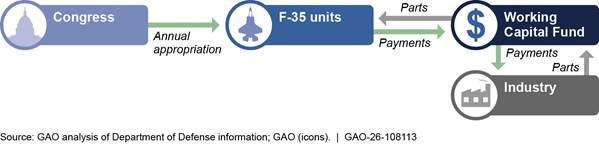
According to DOD officials, they are developing the details for transitioning the F-35 program to the Navy and Air Force WCFs. As discussed above, completing an inventory of F-35 parts within the global spares pool is a necessary requirement for transiting to a WCF. As of June 2026, DOD currently estimates that the transition to the service WCFs will take place from December 2028 to December 2029. According to DOD officials, though the details remain in development, DOD has determined which services will be responsible for F-35 parts. The Air Force will be responsible for all F-35A parts, as well as all parts common among the three variants. The Navy will be responsible for all parts unique to the F-35B and F-35C variants.
Diana Maurer, MaurerD@gao.gov
In addition to the contact named above, Chris Watson (Assistant Director), Michael Dworman (Analyst in Charge), Anna Beischer, Rathi Bose, John Bumgarner, Vincent Buquicchio, Emile Ettedgui, Christopher Gezon, Terry Richardson, Dacia Stewart, Anne Thomas, and Emily Wilson made key contributions to this report.
Military Readiness: DOD Should Take Further Actions to Address Challenges Across the Air, Sea, Ground, and Space Domains. GAO‑26‑108888. Washington, D.C.: March 4, 2026.
Defense Budget: Effects of Continuing Resolutions on Selected Activities and Programs Critical to DOD’s National Security Mission. GAO‑26‑107065. Washington, D.C.: January 21, 2026.
F-35 Joint Strike Fighter: Actions Needed to Address Late Deliveries and Improve Future Development. GAO‑25‑107632. Washington, D.C.: September 3, 2025.
Military Readiness: Implementing GAO’s Recommendations Can Help DOD Address Persistent Challenges across Air, Sea, Ground, and Space Domains. GAO‑25‑108104. Washington, D.C.: March 12, 2025.
F-35 Sustainment: Costs Continue to Rise While Planned Use and Availability Have Decreased. GAO‑24‑106703. Washington, D.C.: April 15, 2024.
F-35 Aircraft: DOD and the Military Services Need to Reassess the Future Sustainment Strategy. GAO‑23‑105341. Washington, D.C.: September 21, 2023.
Weapon System Sustainment: Aircraft Mission Capable Goals Were Generally Not Met and Sustainment Costs Varied by Aircraft. GAO‑23‑106217. Washington, D.C.: November 10, 2022.
F-35 Aircraft: DOD Should Assess and Update Its Engine Sustainment Strategy to Support Desired Outcomes. GAO‑22‑104678. Washington, D.C.: July 19, 2022.
F-35 Sustainment: DOD Needs to Cut Billions in Estimated Costs to Achieve Affordability. GAO‑21‑439. Washington, D.C.: July 7, 2021.
F-35 Aircraft Sustainment: DOD Needs to Address Substantial Supply Chain Challenges. GAO‑19‑321. Washington, D.C.: April 25, 2019.
F-35 Aircraft Sustainment: DOD Needs to Address Challenges Affecting Readiness and Cost Transparency. GAO‑18‑75. Washington, D.C.: October 26, 2017.
Defense Contracting: DOD Needs Better Information on Incentive Outcomes. GAO‑17‑291. Washington, D.C.: July 11, 2017.
F-35 Sustainment: Need for Affordable Strategy, Greater Attention to Risks, and Improved Cost Estimates. GAO‑14‑778. Washington, D.C.: September 23, 2014.
Defense Acquisitions: DOD Has Paid Billions in Award and Incentive Fees Regardless of Acquisition Outcomes. GAO‑06‑66. Washington, D.C.: December 19, 2005.
The Government Accountability Office, the audit, evaluation, and investigative arm of Congress, exists to support Congress in meeting its constitutional responsibilities and to help improve the performance and accountability of the federal government for the American people. GAO examines the use of public funds; evaluates federal programs and policies; and provides analyses, recommendations, and other assistance to help Congress make informed oversight, policy, and funding decisions. GAO’s commitment to good government is reflected in its core values of accountability, integrity, and reliability.
Obtaining Copies of GAO Reports and Testimony
The fastest and easiest way to obtain copies of GAO documents at no cost is through our website. Each weekday afternoon, GAO posts on its website newly released reports, testimony, and correspondence. You can also subscribe to GAO’s email updates to receive notification of newly posted products.
Order by Phone
The price of each GAO publication reflects GAO’s actual cost of production and distribution and depends on the number of pages in the publication and whether the publication is printed in color or black and white. Pricing and ordering information is posted on GAO’s website, https://www.gao.gov/ordering.htm.
Place orders by calling (202) 512-6000, toll free (866) 801-7077,
or
TDD (202) 512-2537.
Orders may be paid for using American Express, Discover Card, MasterCard, Visa, check, or money order. Call for additional information.
Connect with GAO
Connect with GAO on X,
LinkedIn, Instagram, and YouTube.
Subscribe to our Email Updates. Listen to our Podcasts.
Visit GAO on the web at https://www.gao.gov.
To Report Fraud, Waste, and Abuse in Federal Programs
Contact FraudNet:
Website: https://www.gao.gov/about/what-gao-does/fraudnet
Automated answering system: (800) 424-5454
Media Relations
Sarah Kaczmarek, Managing Director, Media@gao.gov
Congressional Relations
David A. Powner, Acting Managing Director, CongRel@gao.gov
General Inquiries
[1]Sustainment costs are for operating and support estimates for the F-35 aircraft. These costs are for pilots and maintenance personnel, maintenance to repair the aircraft and its parts, and system modifications, among other things, to ensure the aircraft can fly and perform its various missions.
[2]For the purposes of this report, we refer to the U.S. Air Force, U.S. Navy, and U.S. Marine Corps as the “U.S. military services.” The U.S. Army, U.S. Space Force, and U.S. Coast Guard do not operate the F-35 aircraft. Seven partner nations—Australia, Canada, Denmark, Italy, Netherlands, Norway, and the United Kingdom—contribute to F-35 development, production, and sustainment. As of March 2026, 12 other nations comprise the program’s foreign military sales customers: Belgium, Czech Republic, Finland, Germany, Greece, Israel, Japan, Poland, Romania, Singapore, South Korea and Switzerland. According to program officials, additional countries are at various stages of consideration for foreign military sales.
[3]Pub. L. No. 117-81, § 357 (2021), as amended by the Servicemember Quality of Life Improvement and National Defense Authorization Act for Fiscal Year 2025 (Pub. L. No. 118-159, § 332 (2024)).
[4]The MC rate (the percentage of time during which the aircraft can fly and perform at least one of its tasked missions) and the FMC rate (the percentage of time during which the aircraft can perform all of its tasked missions) are key measures of the health and readiness of a military aircraft fleet. Since 2017, we have regularly reported on these measures for DOD aircraft across the military services. See, for example, GAO, Weapon System Sustainment: Aircraft Mission Capable Goals Were Generally Not Met and Sustainment Costs Varied by Aircraft, GAO‑23‑106217 (Washington, D.C.: Nov. 10, 2022). Operating and support cost elements provide coverage for the recurring operations of the global F-35 production aircraft fleet from the first aircraft delivery through fleet retirement. This includes all costs of operating, maintaining, and supporting a fielded capability and excludes initial development and procurement costs. The size of the U.S. F-35 fleet grew from about 450 F-35s in fiscal year 2021 to more than 800 in fiscal year 2025.
[5]We have made 46 recommendations to DOD related to F-35 sustainment. DOD has implemented 14 of these recommendations but has not yet taken actions to fully implement the remaining 32.
[6]In 2019, we reported that the F-35 program was not planning for the quantity of spare parts necessary to meet warfighter performance requirements. GAO, F‑35 Aircraft Sustainment: DOD Needs to Address Substantial Supply Chain Challenges, GAO‑19‑321 (Washington, D.C.: Apr. 25, 2019).
[7]GAO‑19‑321. GAO, F‑35 Aircraft: DOD and the Military Services Need to Reassess the Future Sustainment Strategy, GAO‑23‑105341 (Washington, D.C.: Sept. 21, 2023).
[8]Fleetwide refers to F-35s operated by the U.S. services, partner nations, and foreign military sales customers.
[10]GSS Reset includes an estimated investment of about $976 million in fiscal year 2026 for additional parts. Appendix II contains additional detail on current and future F-35 sustainment costs.
[11]The $2.2 billion is for U.S. military services only. F-35 partner nations and foreign military sales customers would contribute an additional roughly $1 billion for a total of about $3.2 billion.
[12]The specific amounts for these planned investments are considered sensitive by JPO and are not included in this report.
[13]The services planned this funding amount as part of budget estimates for fiscal year 2027.
[14]In fiscal year 2027, GSS Reset costs are estimated at about $1.2 billion. The estimated total potential shortfall for fiscal year 2027 was about $2.9 billion. The remaining potential shortfall from fiscal year 2028 through fiscal year 2031 is not due to GSS Reset costs, according to JPO officials.
[15]F-35 sustainment consists of 12 elements, one of which is “supply support.” This element includes all management actions, procedures, and techniques necessary to determine requirements to acquire, catalog, receive, store, transfer, issue, and dispose of spares, repair parts, and supplies. Working capital funds (WCF) operate as self-supporting entities that are designed to break even (i.e., not make profits or take losses) over the long term and do not typically rely on annual appropriations from Congress. Defense WCFs are designed to control the costs of products and services by providing incentives for customers to limit orders to their needs and for providers to reduce or eliminate costs. Customer agencies can more easily plan and budget because WCFs establish standard prices in advance of agencies’ budgeting processes. See appendix III for additional details on WCF functioning.
[16]In January 2026, we found that DOD officials in certain activities and programs—including the F-35 program—reported facing delays, increased costs, operational challenges, spending challenges, and administrative burdens while operating under temporary appropriations in the form of continuing resolutions. GAO, Defense Budget: Effects of Continuing Resolutions on Selected Activities and Programs Critical to DOD’s National Security Mission, GAO‑26‑107065 (Washington, D.C.: Jan. 21, 2026). JPO officials additionally told us that continuing resolutions limit their ability to procure sustainment services and materials in a cost-effective manner. For example, officials said that during a continuing resolution, the slower and inconsistent flow of funds makes it difficult to make sustainment investments without knowing the full amount and when it will arrive for contract execution.
[17]The transition to a WCF is part of a larger effort to transfer all functions relating to the management, planning, and execution of sustainment activities for the F-35 fleet from the F-35 JPO to the Secretary of the Air Force and the Secretary of the Navy. Section 142 of the National Defense Authorization Act for Fiscal Year 2022 requires this transfer to occur by October 1, 2027. Pub. L. No. 117-81, §142 (2021). According to DOD, this transition will ensure that the U.S. government is executing the inherently governmental functions necessary to enable warfighter readiness, long-term affordability, wartime response and surge requirements, and financial reporting and audit requirements, while mitigating contested logistics environments.
[18]Section 342 of the National Defense Authorization Act for Fiscal Year 2026 requires the Secretary of Defense to submit to the congressional defense committees a report on the F-35 program that includes, among other things, a description of a plan by fiscal year, to integrate certain spare parts into the working-capital funds of the Department of the Air Force and Department of the Navy, respectively. Pub. L. No. 119-60, §342(d) (2025).
[19]GAO, F‑35 Sustainment: Need for Affordable Strategy, Greater Attention to Risks, and Improved Cost Estimates, GAO‑14‑778 (Washington, D.C.: Sept. 23, 2014).
[20]GAO, F‑35 Aircraft Sustainment: DOD Needs to Address Challenges Affecting Readiness and Cost Transparency, GAO‑18‑75 (Washington, D.C.: Oct. 26, 2017).
[23]We have designated this a priority recommendation, which is a recommendation that, when implemented, may significantly improve government operations by, for example, realizing large dollar savings; eliminating mismanagement, fraud, and abuse; or making progress toward addressing a high-risk or duplication issue. GAO, Priority Open Recommendations: Department of Defense, GAO‑25‑108043 (Washington, D.C.: June 2, 2025).
[25]We issued seven recommendations in this report related to reassessing F-35 sustainment elements to determine government and contractor responsibility and any required technical data, and making final decisions on changes to F-35 sustainment to address performance and affordability. We have designated all of these as priority recommendations. As of April 2026, all of these recommendations remain open. According to DOD officials, implementation of most of these recommendations will be dependent on long-term decisions associated with transition of F-35 sustainment responsibilities to the Air Force and Navy.
[26]A JPO official said the program may have data rights to broad technical data for its weapon systems, but depot-level maintainers may not have data rights that allow government personnel to make repairs without support from, or contracting with, original equipment manufacturers and the prime contractor. We included a matter for congressional consideration that Congress should consider clarifying how DOD and contractors should treat detailed manufacturing or process data that is necessary for operation, maintenance, installation, and training purposes. This could broaden the ability of government personnel to make repairs themselves or compete maintenance work to different vendors while balancing the considerations of the industrial base. GAO, Weapon System Sustainment, DOD Can Improve Planning and Management of Data Rights, GAO‑25‑107468 (Washington, D.C.: Sept. 29, 2025).
[27]As of February 2026, DOD reported that actions to address this recommendation are not estimated to be completed until 2029. GAO, F‑35 Aircraft: Actions Needed to Address Long-Standing Risks to Operational Effectiveness, GAO‑25‑107101C (Washington, D.C.: Mar. 7, 2025).
[28]According to Lockheed Martin officials, there was not enough actual supply to meet demand for 95 percent of parts as the F-35 program was not fully funded for parts in previous years. Lockheed Martin, F-35 Capacity Limitations (2025).
[29]For the additional 3 percent of parts, the study said that a capacity study was in progress.
[31]GAO, F‑35 Joint Strike Fighter: Actions Needed to Address Late Deliveries and Improve Future Development, GAO‑25‑107632 (Washington, D.C.: Sept. 3, 2025).
[32]According to Air Force and JPO officials, the Air Force allocated more than $1 billion for F-35 spare parts, which was received as part of the reconciliation bill passed in July 2025, Pub. L. No. 119-21 (2025). JPO officials said this will support the purchase of shared parts. The joint explanatory statement accompanying the Consolidated Appropriations Act, 2026 listed $140 million more than requested for both the Air Force and the Navy for F-35 engine spare parts and $80 million more than requested for both the Air Force and the Navy for air vehicle spare parts. See Pub. L. No. 119-75 (2026); 172 Cong. Rec. H1450, H1473 (daily ed. Jan. 22, 2026).
[33]GAO, F‑35 Sustainment: Costs Continue to Rise While Planned Use and Availability Have Decreased, GAO‑24‑106703 (Washington, D.C.: Apr. 15, 2024).
[34]GAO, Military Readiness: Implementing GAO’s Recommendations Can Help DOD Address Persistent Challenges across Air, Sea, Ground, and Space Domains, GAO‑25‑108104 (Washington, D.C.: Mar. 12, 2025).
[35]F-35 Joint Program Office, Joint Risk Management Plan (May 1, 2019) (incorporating changes effective Feb. 13, 2023).
[36]Costs include not just the amounts paid to vendors, but all additional purchase costs, such as handling, storage, overhead, and transportation charges to the location of intended use. F-35 parts will all need a National Stock Number, which is a unique, item-identifying series of numbers. When a National Stock Number is assigned to an item of supply, data are assembled to describe the item, including the item name, manufacturer’s reference number, unit price, and physical and performance characteristics. National Stock Numbers are an essential part of the military logistics supply chain used in managing, moving, storing, and disposing of material. National Stock Numbers are used to identify and manage almost every imaginable item—from aircraft parts to toilet paper, or from space vehicles to nuts and bolts.
[37]See GAO‑19‑321.
[38]Overall, we have made 15 recommendations related to DOD’s financial management of the F-35 program. As of April 2026, 12 of these recommendations remain open. For example, in 2022 we recommended that DOD develop procedures for performing periodic physical inventories once the initial inventory count has been completed. DOD has not implemented this recommendation.
[39]The National Defense Authorization Act for Fiscal Year 2024 requires DOD to receive an unqualified opinion on the financial statements of the department by not later than December 31, 2028. See Pub. L. No. 118-31, §1005 (2023). DOD’s assets represent a significant portion of the federal government’s reported total assets. DOD’s ability to properly account for and report these assets improves its ability to successfully carry out its mission and is critical for DOD to achieve an unmodified (clean) audit opinion. However, DOD remains the only major federal agency that has yet to receive a clean audit opinion on its financial statements, as serious financial management problems have prevented DOD from adequately supporting the information in its financial statements. This not only impedes DOD’s financial transparency, but also that of the U.S. government as a whole.
[40]The National Defense Authorization Act for Fiscal Year 2026 required the Secretary of Defense to ensure that each F-35 contractor has provided to the Secretary of Defense, and the Secretary has validated as accurate, all information necessary for the Department of Defense to successfully complete the financial reporting and accountability requirements for F-35 property. This included the incorporation of information relating to the management and reporting of government property that has been provided for contractor performance, as defined and agreed upon in the contract entered into by the contractor; and the remediation of all material weaknesses of the F-35 program identified in the Department of Defense Agency Financial Report for Fiscal Year 2024 that are within the control and responsibility of the contractor. The statute also required that spare parts for F-35 aircraft titled to the United States government under the international system for managing such spare parts commonly referred to as the ‘‘global spares pool’’ are initially provisioned and catalogued with national stock numbers. See Pub. L. No. 119-60 §342 (Dec. 18, 2025).
[41]According to JPO officials, this is an accountable property system of record called the Enterprise Logistics Management System.
[42]JPO is conducting these inventories in addition to annual and other periodic inventories of F-35 parts and equipment at government- and contractor-managed sites, according to JPO officials.
[43]The F-35 program has two prime sustainment contractors: (1) for the air vehicle, which refers to all parts excluding propulsion, and (2) for the propulsion system, which includes the aircraft’s engine. Lockheed Martin is the prime contractor for the air vehicle and Pratt & Whitney is the prime contractor for propulsion. During our review, we reviewed both air vehicle and propulsion contracts to determine the extent to which JPO managed sustainment responsibilities with prime contractors to achieve readiness requirements. The propulsion contractor has met sustainment targets since 2022 after responding to issues discussed in our 2021 and 2022 reports. GAO, F‑35 Sustainment: DOD Needs to Cut Billions in Estimated Costs to Achieve Affordability, GAO‑21‑439 (Washington, D.C.: July 7, 2021) and GAO, F‑35 Aircraft: DOD Should Assess and Update Its Engine Sustainment Strategy to Support Desired Outcomes, GAO‑22‑104678 (Washington, D.C.: July 19, 2022).
[44]In September 2025, we reported on similar performance incentive fee issues for contractor on-time deliveries of parts. We found that JPO paid contractors hundreds of millions of dollars in incentive fees that were intended to improve on-time delivery. However, the structure of on-time delivery incentives allowed the contractor to deliver aircraft up to 60 days late and still earn some of the fee. DOD concurred with our recommendations to reevaluate the use of incentive fees in future production contracts. GAO, F‑35 Joint Strike Fighter: Actions Needed to Address Late Deliveries and Improve Future Development, GAO‑25‑107632 (Washington, D.C.: Sept. 3, 2025).
[45]Gross Issue Effectiveness measures how effective the base inventory is in supporting operational demands. A higher Gross Issue Effectiveness rate equates to better performance.
[46]Department of Defense Office of Inspector General, Audit of the DoD’s Oversight of Contractor Performance for the F‑35 Joint Strike Fighter Sustainment Contracts, Report No. DODIG‑2026‑039 (Dec. 19, 2025).
[47]The 2025 through 2028 contract includes performance incentives and goals for supply-based metrics such as S-rate and First Pass Effectiveness-Timed. The S-rate measures how frequently aircraft cannot fully perform missions due to lack of spare parts. First Pass Effectiveness-Timed measures how effective the inventory that is being maintained across the fleet is supporting operational demands: a higher rate for this equates to better performance.
[48]Air vehicle performance incentive-related information and data in this section of the report are based on data collected from the contracts and documentation of the quarterly Performance Review Meeting held between JPO and the contractors to discuss reconciliation candidate metrics. According to JPO officials, this is the most accurate incentive fee metric data available for this period because of errors we identified in JPO’s incentive fee spreadsheet, which we discuss later in this report.
[49]We estimate some incentive fees in portions of this report because we determined that certain documentation provided to us by JPO was not sufficiently reliable to calculate the unreconciled incentive fee payments by quarter. The estimated total supply incentive fee is calculated using the following metrics in accordance with the contracted formula: Gross Issue Effectiveness, Customer Wait Time, and Electronic Equipment Logbook Ready for Issue. Gross Issue Effectiveness measures how effective the base inventory is in supporting operational demands. A higher Gross Issue Effectiveness equates to better performance. Customer Wait Time measures how quickly the supply chain can respond to operational demands when an item is not available at a base. A lower Customer Wait Time in days equates to better performance. Electronic Equipment Logbook Ready for Issue measures the percentage of total logbook required parts received during the specified period of performance in a ready for issue condition.
[50]JPO paid the contractor over $3 million in supply-related incentive fees for the 2024 air vehicle sustainment contract. According to JPO officials, the 2025 through 2028 sustainment contract has not yet started reporting incentive related information as of March 2026.
[51]Details related to incentive fee available, incentive fee earned, and incentive fee structure were identified as confidential commercial and financial information.
[52]The prime contractors are contracted to perform the Maintenance Planning functions. For example, JPO and contractors deliver and sustain support equipment, including aircraft maintenance at the unit level.
[53]Non-mission capable due to maintenance rate measures the percentage of time during which aircraft in the possession of F-35 units are unable to conduct any of their assigned missions because of maintenance.
[54]The U.S. government depot provides the facilities and manual labor for the depot maintenance; the prime contractor provides management oversight, guidance, and components and spare parts for their activities. This structure leaves the government, according to DOD officials, with limited decision-making ability to influence critical aspects of depot maintenance. GAO‑23‑105341.
[55]GAO, F‑35 Joint Strike Fighter: Actions Needed to Address Late Deliveries and Improve Future Development, GAO‑25‑107632, (Washington, D.C.: Sept. 3, 2025) and GAO, Defense Contracting: DOD Needs Better Information on Incentive Outcomes, GAO‑17‑291 (Washington, D.C.: July 11, 2017).
[56]GAO‑25‑107632; GAO‑17‑291; GAO, Federal Contracting: Guidance on Award Fees Has Led to Better Practices but Is Not Consistently Applied, GAO‑09‑630 (Washington, D.C.: May 29, 2009); and GAO, Defense Acquisitions: DOD Has Paid Billions in Award and Incentive Fees Regardless of Acquisition Outcomes, GAO‑06‑66 (Washington, D.C.: Dec. 19, 2005).
[57]Department of Defense, Guidance on Using Incentive and Other Contract Types (Apr. 1, 2016).
[58]See Federal Acquisition Regulation (FAR) 43.103 (describing bilateral modifications as signed by the contractor and the contracting officer, among other things).
[59]GAO, Standards for Internal Control in the Federal Government, GAO‑25‑107721 (Washington, D.C.: May 2025).
[60]See FAR 43.103.
[61]F-35 Joint Program Office, Joint Risk Management Plan (May 1, 2019) (incorporating changes effective Feb. 13, 2023).
[62]Department of Defense, Guidance on Using Incentive and Other Contract Types (Apr. 1, 2016) and GAO, Standards for Internal Control in the Federal Government, GAO‑25‑107721 (Washington, D.C.: May 2025).
[63]The July 2025 annual cost estimate is the most current available at the time of reporting. The 2026 annual cost estimate is expected to be completed in July 2026.
[64]JPO’s estimates include estimated costs through fiscal year 2083. This increase includes both operating and support costs ($15.9 billion) and Production Autonomic Logistics Support ($2.9 billion). Production Autonomic Logistics Support provides all projected procurement costs associated with the establishment of the logistics infrastructure that will be used to sustain the global F-35 fleet. These costs include initial spares, training devices, support equipment, information systems infrastructure, depot stand-up, and logistics manpower.
[65]According to JPO officials, these estimates do not include sustainment-related modifications, which JPO tracks separately.
[66]Total does not equal overall total of $13.7 billion due to rounding.
[67]According to program officials, the steady state period for each service is the period in which it intends to be operating the F-35 at its maximum capability. Steady state years for the F-35 program are defined in each respective service’s affordability analysis as follows: U.S. Air Force/F-35A: 2036–2041; U.S. Marine Corps/F-35B and F-35C: 2033–2037; U.S. Navy/F-35C: 2036–2043. In fiscal year 2027, JPO estimates that the Air Force will meet the affordability target, but all other services and variants will exceed targets. However, the fiscal year 2027 estimates were developed before current operations, such as those associated with Operation Epic Fury, and may not capture total costs associated with any increase in flight hours.
[68]We found that the Marine Corps F-35C cost per aircraft per year exceeded the service affordability target. GAO, F‑35 Sustainment: Costs Continue to Rise While Planned Use and Availability Have Decreased, GAO‑24‑106703 (Washington, D.C.: Apr. 15, 2024).
[69]GAO, F‑35 Sustainment: DOD Needs to Cut Billions in Estimated Costs to Achieve Affordability, GAO‑21‑439 (Washington, D.C.: July 7, 2021).
[70]Department of Defense (DOD) 7000.14-R, Financial Management Regulation, vol. 2B, chap. 9, “Defense Working Capital Fund Budget Justification Analysis” (Aug. 2022).
[71]DOD 7000.14-R, vol. 2B, chap. 9.