
Report to Congressional Committees
United States Government Accountability Office
A report to congressional committees
For more information, contact: Alyssa M. Hundrup at HundrupA@gao.gov
What GAO Found
The 988 Suicide & Crisis Lifeline (988 Lifeline) is a network of independent crisis contact centers that answer calls, texts, and chats from people in suicidal crisis or emotional distress.
The U.S. Health and Human Services’ (HHS) Substance Abuse and Mental Health Services Administration (SAMHSA) set up the 988 Lifeline to connect individuals with local crisis contact centers in states and minimize the time they wait, according to officials. As of March 2026, calls are generally routed to local crisis contact centers based on callers’ approximate location. In contrast, texts and chats are routed based on individuals’ area codes or zip codes. SAMHSA plans to begin routing texts based on approximate location by April 2027, in accordance with a Federal Communications Commission rule.
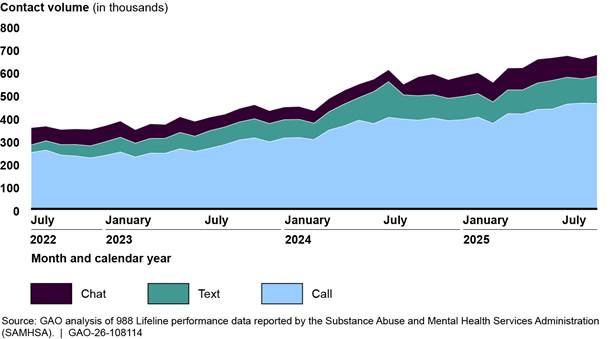
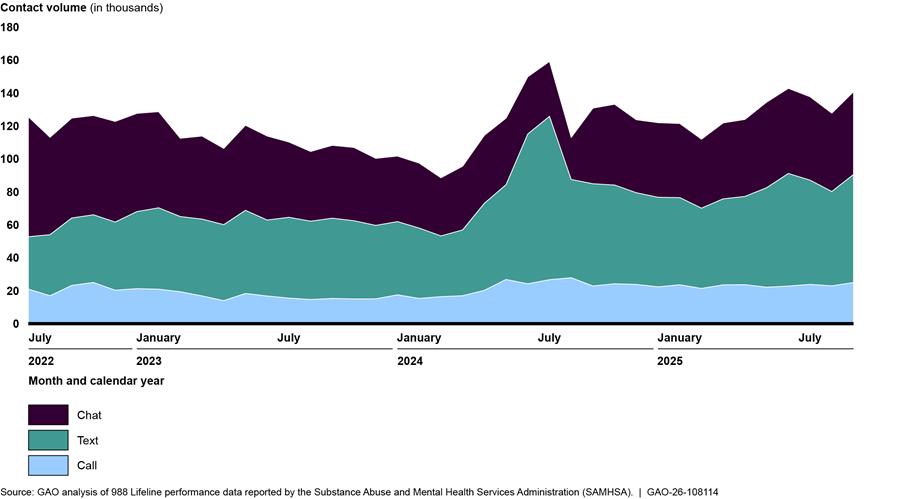
SAMHSA primarily measures the 988 Lifeline’s capacity through contact volume, answer rates (i.e., the percentage of contacts that are responded to), and the average time to answer. About 19.1 million calls, texts, and chats were routed to crisis contact centers from July 2022 through September 2025. During that time, call volume increased by about 87 percent, text volume by about 260 percent, and chat volume by about 23 percent (see figure). Call answer rates increased; text and chat answer rates fluctuated over time, as did average time to answer.
SAMHSA incorporated selected key performance management practices in assessing the 988 Lifeline’s routing and capacity. Specifically, SAMHSA set long- and near-term goals for the 988 Lifeline, collected information related to those goals, and used that information to assess progress and communicate information about performance. For example, to promote answer rate improvement, SAMHSA set a goal for local crisis contact centers, by September 2026, to answer more than 90 percent of the texts and chats they receive. SAMHSA also reviewed performance data and published them on its website.
Why GAO Did This Study
Suicide is one of the leading causes of death in the United States, resulting in over 49,000 deaths in 2023 (the latest data available from the Centers for Disease Control and Prevention as of June 2026)—or about one death every 11 minutes. Overall, suicide rates increased about 31 percent from 2003 through 2023.
SAMHSA provides federal funding for and oversees the 988 Lifeline. Local crisis contact centers within states may also receive funding through state appropriations, state-enacted 988 telecommunications fees, or other sources. In consultation with SAMHSA, a nonprofit network administrator is responsible for administering the 988 Lifeline.
Congress included a provision in the Consolidated Appropriations Act, 2023, for GAO to review the 988 Lifeline. This report, among other things, (1) describes how calls, texts, and chats are routed to the 988 Lifeline; (2) describes how SAMHSA measures capacity of the 988 Lifeline and what those measures showed; and (3) examines how SAMHSA assesses routing and capacity of the 988 Lifeline.
GAO analyzed 988 Lifeline performance data reported by SAMHSA for the period beginning July 2022, the month the 988 Lifeline number went into effect, through September 2025. GAO also reviewed documentation from and interviewed officials from SAMHSA, the Federal Communications Commission, and a nongeneralizable sample of nine states and two territories. States and territories were selected to obtain variation in geographic location, percentage of the total population living in rural areas, and other factors. Additionally, GAO examined SAMHSA’s efforts related to assessing routing and capacity of the 988 Lifeline against selected key performance management practices.
|
Abbreviations |
|
|
|
|
|
988 Lifeline |
988 Suicide & Crisis Lifeline |
|
FCC |
Federal Communications Commission |
|
LGBTQ+ |
lesbian, gay, bisexual, transgender, queer or questioning |
|
SAMHSA |
Substance Abuse and Mental Health Services Administration |
This is a work of the U.S. government and is not subject to copyright protection in the United States. The published product may be reproduced and distributed in its entirety without further permission from GAO. However, because this work may contain copyrighted images or other material, permission from the copyright holder may be necessary if you wish to reproduce this material separately.
July 1, 2026
The Honorable Bill Cassidy, M.D.
Chair
The Honorable Bernard Sanders
Ranking Member
Committee on Health, Education, Labor and Pensions
United States Senate
The Honorable Brett Guthrie
Chairman
The Honorable Frank Pallone, Jr.
Ranking Member
Committee on Energy and Commerce
House of Representatives
Suicide is one of the leading causes of death in the United States, resulting in over 49,000 deaths in 2023—or about one death every 11 minutes.[1] In 2024, an estimated 14.3 million adults aged 18 or older and 2.6 million adolescents aged 12 to 17 had serious thoughts of suicide in the past year.[2] Of those, an estimated 4.6 million adults and 1.1 million adolescents reported making plans for or attempting suicide. Overall, suicide rates increased about 31 percent from 2003 through 2023.[3]
The Substance Abuse and Mental Health Services Administration (SAMHSA), an agency within the U.S. Department of Health and Human Services, oversees the 988 Suicide & Crisis Lifeline (988 Lifeline).[4] Previously known as the National Suicide Prevention Lifeline, the 988 Lifeline launched in 2022. It is available 24 hours a day, 7 days a week and provides free and confidential emotional support to people experiencing suicidal crisis, substance misuse, or emotional distress. The 988 Lifeline comprises a network of over 200 independent crisis contact centers across the United States and its territories. These centers are staffed with crisis counselors who answer calls, texts, or chats from people experiencing a behavioral health crisis and can connect them to additional crisis response services.[5] In consultation with SAMHSA, a network administrator (a nonprofit organization) is responsible for administering the lifeline, including its clinical, technical, and operational performance.[6]
The Consolidated Appropriations Act, 2023, includes a provision for us to review the 988 Lifeline.[7] In this report, we
1. describe how calls, texts, and chats are routed to the 988 Lifeline;
2. describe how SAMHSA measures capacity of the 988 Lifeline and what those measures showed;
3. examine how SAMHSA assesses routing and capacity of the 988 Lifeline; and
4. describe challenges selected states and the network administrator faced related to the 988 Lifeline and what actions they and SAMHSA took to support capacity.
To obtain information for all four objectives, we reviewed documentation related to 988 Lifeline routing functionality and capacity and interviewed SAMHSA officials and network administrator representatives. We additionally interviewed officials from a nongeneralizable sample of nine states and two territories—which we refer to as 11 selected states—on topics related to routing, capacity, challenges encountered, and interactions with SAMHSA and the network administrator.[8] We selected states to obtain variation in (1) location based on Census Bureau geographic regions; (2) percentage of the total population living in rural areas; and (3) monthly average 988 Lifeline answer rates and contact volume from January 2025 through March 2025.[9] We interviewed state officials from June 2025 through August 2025.
For the first objective, we additionally reviewed SAMHSA documentation on 988 Lifeline routing processes. We also interviewed officials from the Federal Communications Commission (FCC)—which has adopted rules requiring wireless providers to transmit certain data with calls and texts to the 988 Lifeline—and reviewed supporting documentation, such as regulations.
For the second objective, we additionally analyzed 988 Lifeline performance data for July 2022 through September 2025 reported by SAMHSA, including contact volume, answer rates, and average time to answer. To assess the reliability of the data, we reviewed related documentation, interviewed SAMHSA officials and network administrator representatives, conducted checks for missing or erroneous data, and compared the data against published data from SAMHSA and the network administrators’ websites.[10] See appendix I for additional information about the 988 Lifeline data we used. Based on these activities, we determined that the data were sufficiently reliable for the purposes of describing SAMHSA’s capacity measures for the 988 Lifeline.
For the third objective, we additionally reviewed SAMHSA documentation related to its performance management practices as of September 2025, such as notices of funding opportunity that included goals related to states’ local capacity to answer 988 Lifeline calls, texts, and chats. We further examined SAMHSA’s efforts related to assessing routing and capacity of the 988 Lifeline against selected GAO performance management practices.[11]
We conducted this performance audit from February 2025 to April 2026 in accordance with generally accepted government auditing standards. Those standards require that we plan and perform the audit to obtain sufficient, appropriate evidence to provide a reasonable basis for our findings and conclusions based on our audit objectives. We believe that the evidence obtained provides a reasonable basis for our findings and conclusions based on our audit objectives.
Background
History of the 988 Lifeline
Since July 2022, individuals in suicidal crisis or emotional distress can reach the 988 Suicide & Crisis Lifeline by calling or texting 988, or by initiating a chat on the 988 Lifeline’s website.[12] The 988 Lifeline has added additional services over time, such as Spanish language text and chat support, videophone support for the deaf and hard of hearing, and specialized service for lesbian, gay, bisexual, transgender, queer or questioning (LGBTQ+) youth and young adults.[13] See figure 1 for more information on the 988 Lifeline’s history.
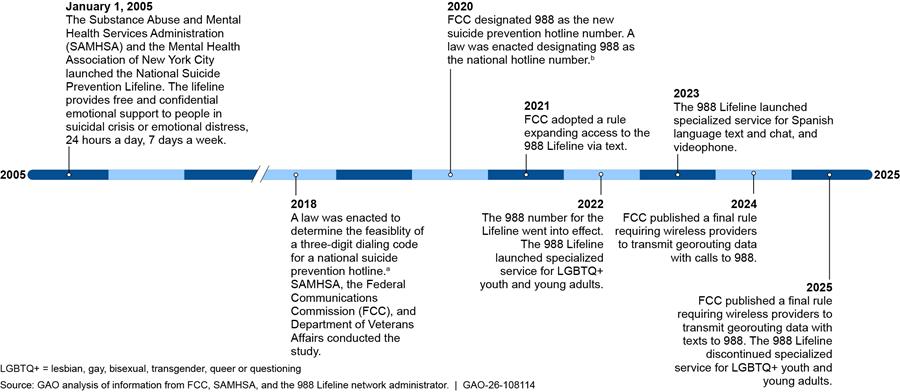
Notes: Information about a caller’s approximate geographic location is also referred to as georouting data.
aNational Suicide Hotline Prevention Act of 2018, Pub. L. No. 115-233, § 3, 132 Stat. 2424.
bNational Suicide Hotline Designation Act of 2020, Pub. L. No. 116-172, § 3, 134 Stat. 832.
Structure of the 988 Lifeline Network
The 988 Lifeline comprises a network of more than 200 independent crisis contact centers across the U.S. and its territories, which offer free and accessible virtual support through call, text, or chat. Crisis contact center staff may also refer someone seeking help to additional services (such as from local community mental health professionals or clinics) for further assessment and treatment or may call for emergency services if needed.
SAMHSA is the lead federal agency that oversees implementation of the 988 Lifeline through a number of 988 grants, including a cooperative agreement with a network administrator.[14] The network administrator manages implementation of the 988 Lifeline network in consultation with SAMHSA, including its clinical, technical, and operational performance and infrastructure.
Local crisis contact centers provide suicide prevention and crisis intervention services and may be operated by states, local governments, or private entities. National backup crisis contact centers similarly provide suicide prevention and crisis intervention services; they are operated by entities contracted with the network administrator. Other national crisis contact centers provide specialized services, such as voice, text, or chat service in Spanish. These centers are operated by entities contracted with the network administrator.
Funding for the 988 Lifeline
Crisis contact centers for the 988 Lifeline may receive funding from a variety of sources, such as federal funding from cooperative agreements with SAMHSA, state appropriations, state 988 telecommunications fees, or other sources.
From fiscal years 2021 through 2025, SAMHSA awarded funding through three cooperative agreements to support the ability to answer calls, texts, or chats to the 988 Lifeline:[15]
· One cooperative agreement designated and provided funding for a 988 Lifeline administrator to operate the network. The network administrator was responsible for developing and operating the 988 Lifeline crisis contact center network infrastructure, establishing system requirements, providing technology support, and implementing crisis counselor training standards.
· Two cooperative agreements with states supported the development or improvement of routing or capacity infrastructure so that their local crisis contact centers would be better able to answer calls, texts, or chats (see table 1).
Table 1: Selected SAMHSA Cooperative Agreements (Dollars in Millions) for the 988 Lifeline, Fiscal Years (FY) 2021 through 2025
|
Award name |
Award purpose |
Total number of awardees |
Project period |
Amount awarded (dollars in millions) |
|
FY 2021 Cooperative Agreement for National Suicide Prevention Lifeline and Disaster Distress Helpline |
Award to a single entity to manage, enhance, and strengthen the 988 Lifeline that routes individuals in the U.S. to a network of certified crisis centers. This includes supporting the integration of 988 into the Lifeline center crisis network as required by the National Suicide Hotline Designation Act of 2020. |
Nationwide network administrator (one nonprofit organization) |
Sept. 30, 2021-Sept. 29, 2026 |
$635.7 |
|
FY 2022 Cooperative Agreements for States and Territories to Build Local 988 Capacity |
Recruit, hire, and train workforce to staff 988 Lifeline centers and engage with other Lifeline crisis centers to unify 988 response across states and territories. |
48 states, the District of Columbia, and five U.S. territories |
Apr. 30, 2022-Apr. 29, 2025 |
$151.0 |
|
FY 2023 Cooperative Agreements for States and Territories to Improve Local 988 Capacity |
Enhance hiring and training of the 988 workforce, implement technology and security measures, and improve support for high-risk and underserved populations. |
47 states, the District of Columbia, and five U.S. territories |
Sept. 30, 2023-Sept. 29, 2026 |
$354.7 |
Source: GAO analysis of Substance Abuse and Mental Health Services Administration (SAMHSA) information. | GAO‑26‑108114
Notes: This table refers to cooperative agreements that supported the network administrator and building capacity for calls, texts, or chats to be answered at local crisis contact centers within states and territories. It does not include all cooperative agreements related to the 988 Lifeline, such as those that supported connecting individuals with follow-up services. The amounts shown were awarded as of July 24, 2025.
To meet the needs of their jurisdictions, behavioral health officials have told us that states and others often combine, or braid, SAMHSA funding with other funds, including state appropriations and payments from Medicaid. As a result of disparate needs and priorities of each state and differences in the availability of funding, states collectively exhibit a range of capacity in offering behavioral health crisis services.
988 Lifeline Routing Depends on Contact Method and Type of Service Sought
The 988 Lifeline routing processes are similar across contact methods (calls, texts, and chats), but aspects of the process differ depending on the contact method and service selected (local crisis contact center support or Spanish language crisis contact center support).[16] For all contact methods, the 988 Lifeline routes contacts after individuals seeking help contact 988 and select a service from a service menu. See figure 2 for an overview of routing processes for calls and figure 3 for an overview of routing processes for texts and chats.
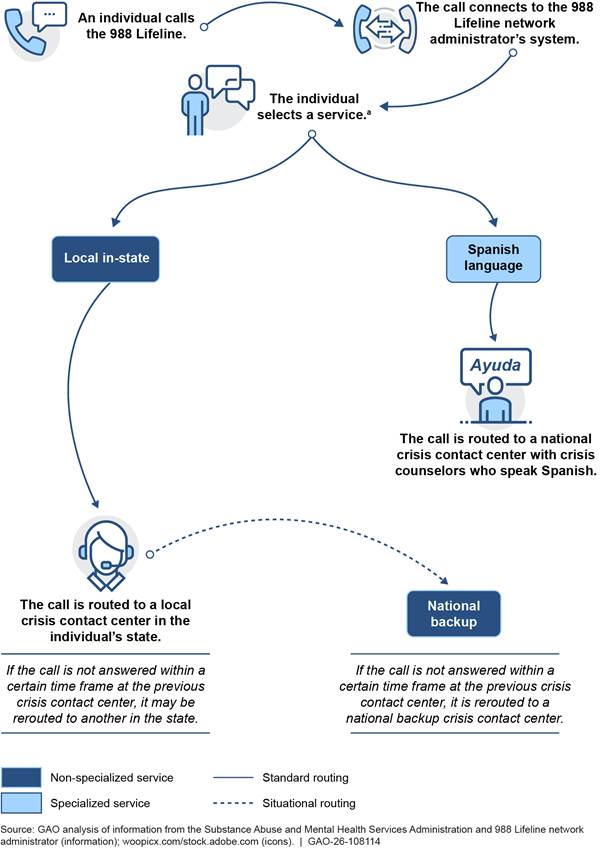
Notes: According to SAMHSA officials, states could choose to have calls rerouted to another local crisis contact center in their state if they were not answered at the first center within a certain amount of time. They said calls were rerouted from a state’s local crisis contact centers to national backups if they were not answered within 2 minutes.
According to SAMHSA and the network administrator, callers who selected local service were generally routed directly from the network administrator’s system to local crisis contact centers. However, states could choose to set up their own systems for routing calls from the network administrator’s system to local crisis contact centers in their state. Network administrator representatives said states may choose to develop such systems for various reasons, such as to meet regulatory requirements or improve interoperability of crisis response within the state. As of March 2026, SAMHSA officials said two states used their own systems to route calls to local crisis contact centers within their state.
From September 2022 until July 2025, the 988 Lifeline also offered specialized service for lesbian, gay, bisexual, transgender, queer or questioning (LGBTQ+) youth and young adults. In reports referenced by the Explanatory Statement accompanying the Consolidated Appropriations Act, 2026, funding was restored, and SAMHSA was directed to use the funding to provide specialized services for LGBTQ+ youth. As of March 2026, SAMHSA officials said they were actively working through the requirements of the appropriation.
aThe National Suicide Hotline Designation Act of 2020 designates 988 as the universal telephone number for the hotline operating through the National Suicide Prevention Lifeline as well as for the Veterans Crisis Line, a service run by the Department of Veterans Affairs that supports veterans and their family and friends. Pub. L. No. 116-172, § 3(a) 132 Stat. 832, 832-33 (codified at 47 U.S.C. § 251(e)(4)). Individuals who call the 988 Lifeline can choose an option to be transferred from the 988 Lifeline to the Veterans Crisis Line.
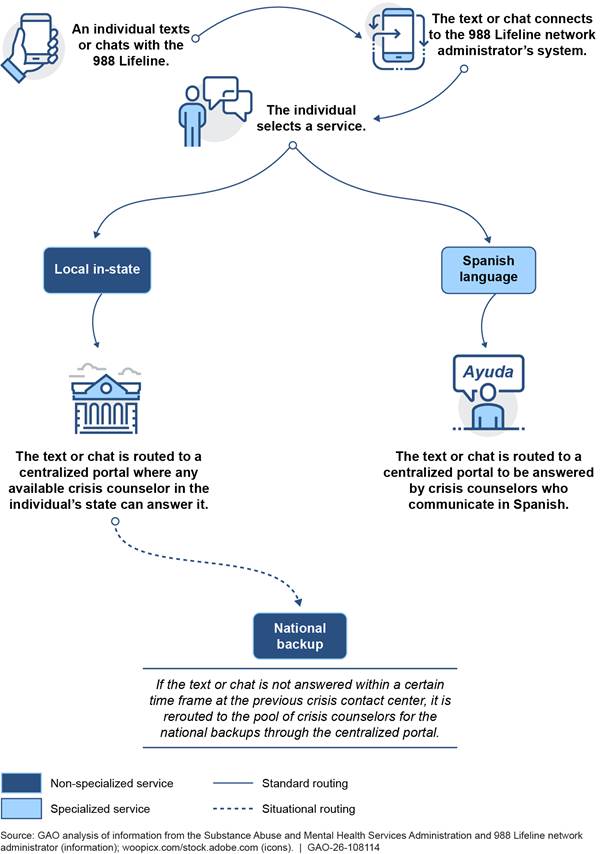
Notes: According to SAMHSA officials, as of September 2025, texts and chats to crisis counselors at local crisis contact centers were rerouted to the pool of crisis counselors at national backup crisis contact centers if they were not answered within 5 minutes.
According to SAMHSA and the network administrator, texts and chats for local service were generally routed to a centralized portal where any available crisis counselor in the individual’s state could answer it. However, states could choose to set up their own systems for routing texts and chats to crisis counselors in their state. Network administrator representatives said states may choose to develop such systems for various reasons, such as to meet regulatory requirements or improve interoperability of crisis response within the state. As of March 2026, SAMHSA officials said six states used their own systems for routing texts and chats to local crisis counselors.
From September 2022 until July 2025, the 988 Lifeline also offered specialized service for lesbian, gay, bisexual, transgender, queer or questioning (LGBTQ+) youth and young adults. In reports referenced by the Explanatory Statement accompanying the Consolidated Appropriations Act, 2026, funding was restored, and SAMHSA was directed to use the funding to provide specialized services for LGBTQ+ youth. As of March 2026, SAMHSA officials said they were actively working through the requirements of the appropriation.
Calls, texts, and chats for local service that are not answered within a certain amount of time—generally 2 minutes for calls and 5 minutes for texts and chats, according to SAMHSA officials—are to be rerouted to national backup crisis contact centers.[17] Officials explained that this time limit was selected to balance minimizing wait times to reach someone with allowing time for a call, text, or chat to be answered at local crisis contact centers. Network administrator representatives said local centers were best able to connect individuals with local resources, such as local mental health services or mobile crisis teams. Network administrator representatives explained that calls, texts, and chats routed to the Spanish language service do not have a maximum queue time due to the language requirement. They said the national backup crisis contact centers only provided services in English, so calls, texts, and chats to the Spanish language service could not be rerouted to the national backups regardless of the time spent in queue.[18]
The 988 Lifeline generally uses individuals’ approximate location—also known as georouting data—to route calls. It uses other information to route texts and chats. Starting in September 2024, the 988 Lifeline began using information about a caller’s approximate location to route calls. The 988 Lifeline uses the texter’s phone number area code to route texts and the zip code entered during a short pre-chat survey to route chats. According to SAMHSA, calls, texts, and chats requesting help in Spanish are routed to crisis contact centers providing that service. See figure 4 for a summary of information the network administrator uses to route calls, texts, and chats to local crisis contact centers.
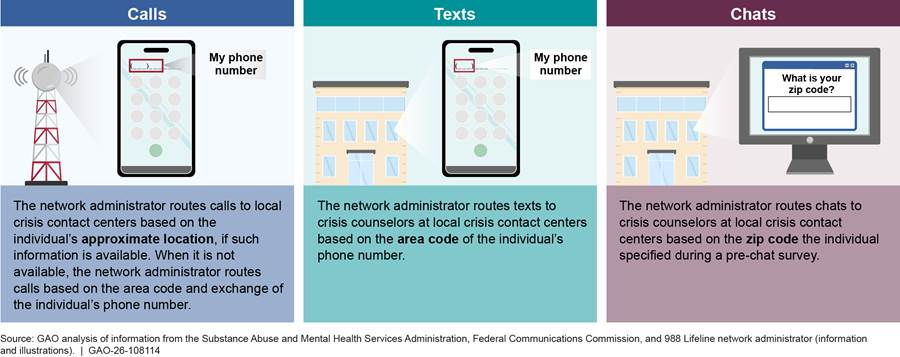
Notes: Information about a caller’s approximate geographic location is also referred to as georouting data.
The information the network administrator uses to route calls to local crisis contact centers has changed since 2024, and additional changes are planned for routing texts.[19]
· Information used for routing calls. FCC published a final rule in November 2024 requiring wireless providers to transmit georouting data with calls to 988 to help inform call routing.[20] Nationwide wireless providers (i.e., AT&T, T-Mobile, and Verizon) were required to transmit georouting data with calls to 988 by January 13, 2025, and, according to FCC and SAMHSA, are now doing so. The FCC rule requires non-nationwide wireless providers to transmit georouting data with calls to 988 by December 14, 2026.
Prior to the use of georouting data, calls were routed to local crisis contact centers based on the caller’s area code and telephone number exchange (i.e., the three digits of the phone number immediately following the area code). If a caller’s location did not correspond with the geographic area suggested by their telephone number, the call was routed to a crisis contact center that may not have been local to the caller.
Network administrator representatives explained that crisis counselors at local crisis contact centers are best positioned to connect callers with local resources for follow-up support, such as local community mental health professionals or clinics. They also said crisis counselors at national crisis contact centers had limited information about the resources available for follow-up support in a caller’s local area.
· Information used for routing texts. FCC published a final rule in September 2025 requiring wireless providers to transmit georouting data with texts to 988.[21] The FCC rule facilitates routing of 988 Lifeline texts to the nearest crisis contact center to the texter based on georouting data. Similar to the final rule for calls, this rule requires wireless providers to transmit georouting data with texts to 988 that could be used to inform routing. Nationwide wireless providers are required to transmit georouting data with texts to 988 by April 16, 2027, and non-nationwide wireless providers are required to transmit such information by October 16, 2028.
Overall Volume Increased from July 2022 through September 2025 While Answer Rate and Average Time to Answer Varied by Contact Method
SAMHSA Measures 988 Lifeline Capacity through Contact Volume, Answer Rate, and Average Time to Answer
SAMHSA primarily measures 988 Lifeline capacity in terms of contact volume, answer rates, and average time to answer, according to SAMHSA officials and network administrator representatives.[22] See table 2.
|
Measure |
Definition |
|
Contact volume |
The number of contacts that were routed to a crisis contact center after individuals selected a service (local; Spanish language; or lesbian, gay, bisexual, transgender, queer or questioning youth and young adult). |
|
Answer rate |
The percentage of contacts that were routed to crisis contact centers and were answered by crisis counselors. |
|
Average time to answer |
The average length of time it took for contacts to be answered after they were routed to crisis contact centers. |
Source: GAO analysis of information from the Substance Abuse and Mental Health Services Administration (SAMHSA) and the 988 Lifeline network administrator. | GAO‑26‑108114
As described in more detail later in this report, the network administrator, in collaboration with SAMHSA, used 988 Lifeline capacity measures to assess performance, to forecast contact volume, and better understand staffing needs nationally and for individual crisis contact centers, according to SAMHSA officials and network administrator representatives.
SAMHSA and the network administrator also collected other information to understand network capacity, officials told us. For example, the network administrator, in collaboration with SAMHSA, collects information on the percentage of contacts that disconnected prior to being answered and the percentage of contacts that were rerouted to national backup crisis contact centers. Additionally, SAMHSA collects information about conversation length, and, according to officials, the network administrator collects some limited information on crisis contact center staffing, such as how many crisis counselors completed their required training.
Overall Contact Volume for the 988 Lifeline Increased and Local Crisis Contact Centers Answered a Larger Share of Contacts over Time
The overall contact volume (for calls, texts, and chats) for the 988 Lifeline increased by about 90 percent from July 2022 through September 2025, according to SAMHSA Lifeline data. Similarly, the percentage of contacts answered at local crisis contact centers, as opposed to national backup centers, also increased over time. Most calls (about 76 percent) were answered at local crisis contact centers, while most texts and chats (about 58 percent) were answered at national backup crisis contact centers during the period.
Overall Contact Volume
From July 2022 through September 2025, about 19.1 million contacts (i.e., calls, texts, and chats) were routed to 988 Lifeline crisis contact centers. About 68 percent of all contacts were calls, about 18 percent were texts, and about 15 percent were chats.[23]
The 988 Lifeline data showed the volume of calls, texts, and chats routed to the 988 Lifeline generally increased from July 2022 through September 2025. Specifically, call volume increased by about 87 percent, text volume increased by about 260 percent, and chat volume increased by about 23 percent over the time period (see fig. 5).
Figure 5: Contact Volume by Contact Method for the 988 Lifeline Overall, July 2022 through September 2025
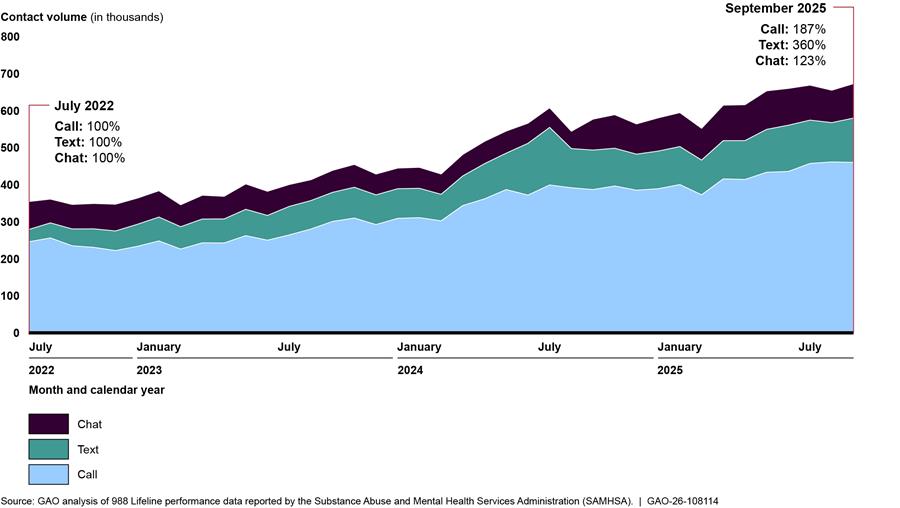
Note: Contact volume reflects the number of calls, texts, and chats that were routed to crisis contact centers after individuals selected a service. Data shown include contacts that were routed to local, Spanish language, lesbian, gay, bisexual, transgender, queer or questioning youth and young adult, and national backup crisis contact centers. Call volume increased from 245,905 in July 2022 to 460,264 in September 2025 (87 percent increase); text volume increased from 33,279 in July 2022 to 119,747 in September 2025 (260 percent increase); and chat volume increased from 75,441 in July 2022 to 92,936 in September 2025 (23 percent increase).
Contact volume generally increased across each of the 988 Lifeline service types (i.e., local, Spanish language, LGBTQ+ youth and young adult, and national backup) during the period we reviewed. For example, the contact volume for the LGBTQ+ youth and young adult service increased from 1,752 contacts in September 2022 (the month the service was first launched) to 69,571 contacts in June 2025 (the last full month the service was provided).[24] Additionally, call volume for local services increased in 53 states, and text and chat volume increased in 45 states from August 2022 (the first full month of service after the “988” number was assigned to the Lifeline) to September 2025.[25] See appendix III for more information on contact volume by 988 Lifeline service type.
Officials from SAMHSA and selected states we interviewed identified several factors that contributed to increases in contact volume. According to SAMHSA officials, advertising campaigns, system improvements (such as shortening the pre-chat survey), and seasonality contributed to increases in contact volume.[26] Similarly, officials from all 11 states we interviewed said advertising campaigns contributed to increases in contact volume at crisis contact centers in their state. Officials from ten of the 11 states identified additional factors that may have contributed to increases in volume, such as natural disasters, high-profile suicides, or public health emergencies.
Where Contacts Were Answered
Calls. From July 2022 through September 2025, about 76 percent of the calls to the 988 Lifeline were answered at local crisis contact centers, SAMHSA Lifeline data show. Specifically, local crisis contact centers answered an increasingly large share of calls over time, from about 74 percent in July 2022 to about 83 percent in September 2025 (see fig. 6).[27]
Figure 6: Number of Calls Answered and Abandoned for the 988 Lifeline Overall, July 2022 through September 2025
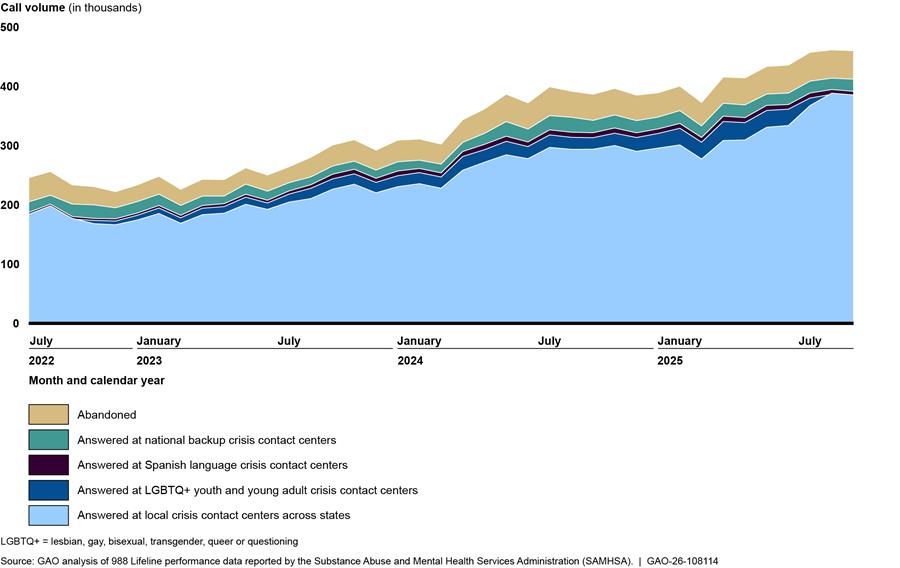
Note: Call volume reflects the number of calls that were routed to a 988 Lifeline crisis contact center after the individual selected a service. Specialized service for LGBTQ+ youth and young adults began in September 2022 and was discontinued on July 17, 2025. National backup crisis contact centers answered calls, texts, and chats not answered within a certain amount of time at local or LGBTQ+ youth and young adult crisis contact centers, according to SAMHSA officials. Abandoned contacts were routed to a service but disconnected before being answered by a crisis counselor. According to SAMHSA, disconnection could occur for various reasons, including the individual changing their mind about getting care at that moment and due to random technical service interruptions. A small number of calls (approximately 0.01 percent of all calls) had an unknown outcome and are not shown.
Texts. From July 2022 through September 2025, most of the texts to the 988 Lifeline were answered at national backup crisis contact centers (about 58 percent), while local crisis contact centers answered a smaller share (about 28 percent). However, the share of texts to the 988 Lifeline that were answered at local crisis contact centers increased over time, from about 5 percent in July 2022 to about 43 percent in September 2025 (see fig. 7). The increase in share of texts answered at local centers aligned with an increase in the number of states supporting local service for texts, with 18 states supporting texts in July 2022 and 44 states supporting texts in September 2025.
Figure 7: Number of Texts Answered and Abandoned for the 988 Lifeline Overall, July 2022 through September 2025
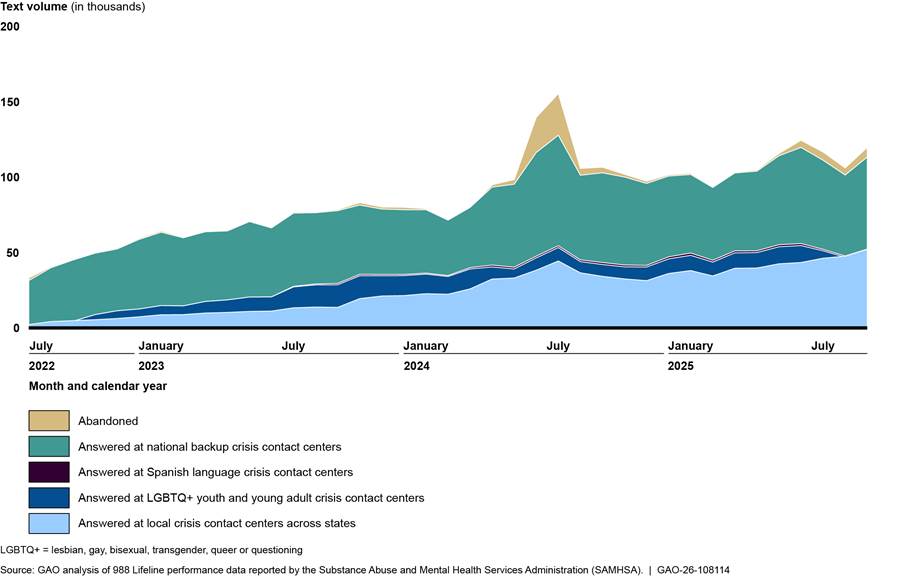
Notes: Text volume reflects the number of texts that were routed to a 988 Lifeline crisis contact center after the individual selected a service. Specialized service for LGBTQ+ youth and young adults began in September 2022 and was discontinued on July 17, 2025. The Spanish language service began supporting texts in July 2023. National backup crisis contact centers answered calls, texts, and chats that were not answered within a certain amount of time at local or LGBTQ+ youth and young adult crisis contact centers, according to SAMHSA officials.
Text volume increased notably in June and July 2024, which corresponded with an increase in the average time it took to answer those texts. Abandoned contacts were routed to a service but disconnected before being answered by a crisis counselor. According to SAMHSA, disconnection could occur for various reasons, including the individual changing their mind about getting care at that moment and due to random technical service interruptions. A small number of texts (less than 0.01 percent of all texts) had an unknown outcome and are not shown.
Chats. From July 2022 through September 2025, most of the chats to the 988 Lifeline (about 58 percent) were answered at national backup crisis contact centers, while local crisis contact centers answered a smaller share (about 22 percent). However, the share of chats answered at local crisis contact centers increased over time, from about 3 percent in July 2022 to about 39 percent in September 2025 (see fig. 8). Similar to texts, the increase in share of chats answered at local centers aligned with an increase in the number of states supporting local service for chats, with 18 states supporting chats in July 2022 and 44 states supporting chats in September 2025.
Figure 8: Number of Chats Answered and Abandoned for the 988 Lifeline Overall, July 2022 through September 2025
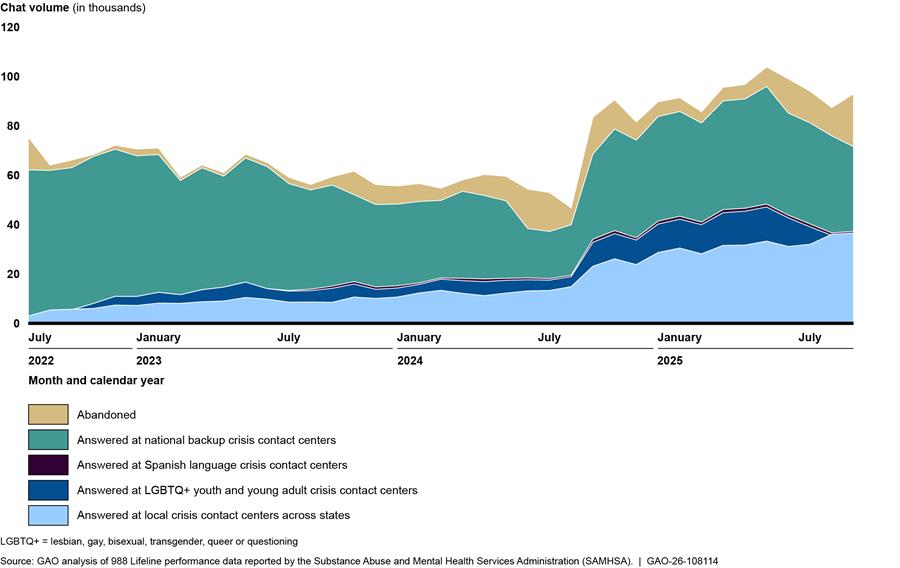
Notes: Chat volume reflects the number of chats that were routed to a 988 Lifeline crisis contact center after the individual selected a service. Specialized service for LGBTQ+ youth and young adults began in September 2022 and was discontinued on July 17, 2025. The Spanish language service began supporting chats in July 2023. National backup crisis contact centers answered calls, texts, and chats that were not answered within a certain amount of time at local or LGBTQ+ youth and young adult crisis contact centers, according to SAMHSA officials.
Abandoned contacts were routed to a service but disconnected before being answered by a crisis counselor. According to SAMHSA, disconnection could occur for various reasons, including the individual changing their mind about getting care at that moment and due to random technical service interruptions. A small number of chats (less than 0.01 percent of all chats) had an unknown outcome and are not shown.
Answer Rates for Calls Generally Increased and Fluctuated for Texts and Chats; Average Time to Answer Varied across Contact Methods
Answer rates and average times to answer varied by contact method from July 2022 through September 2025, according to 988 Lifeline data. Various factors, including staff availability, may affect answer rates and average time to answer, according to officials we interviewed from SAMHSA and our 11 selected states. Other factors that these officials identified included funding for staff, contact volume, and technology issues.
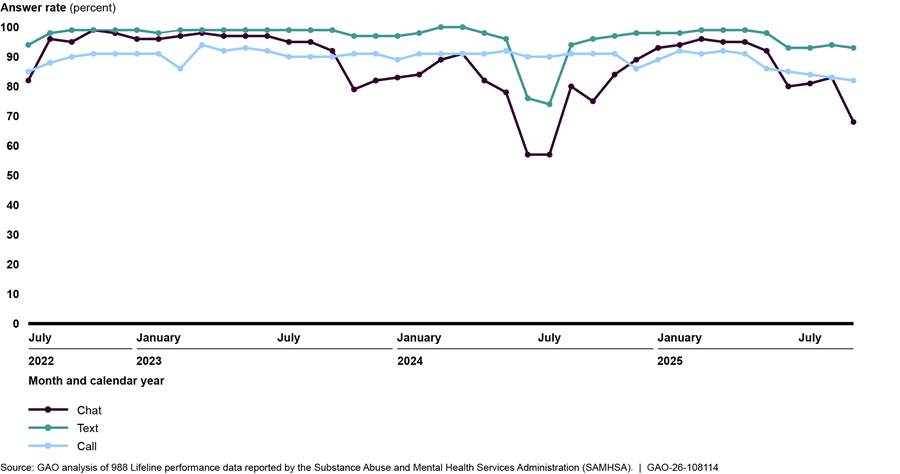
Answer rates. From July 2022 through September 2025, answer rates for all calls to the 988 Lifeline modestly increased while text and chat answer rates fluctuated. Specifically, call answer rates for the 988 Lifeline increased from about 83 percent in July 2022 to about 90 percent in September 2025.[28] Answer rates for texts ranged from about 82 percent to about 100 percent, and answer rates for chats ranged from about 70 percent to about 99 percent (see fig. 9). According to SAMHSA officials, a substantial increase in text and chat volume in June and July 2024 contributed to the lower answer rates for texts and chats during those months.[29] Similarly, officials said that increases in text volume and average conversation length contributed to the lower answer rates for texts and chats from June through September 2025. Officials explained that increases in conversation length can delay crisis counselors’ availability to accept new texts and chats.
Figure 9: Answer Rate by Contact Method for the 988 Lifeline Overall, July 2022 through September 2025
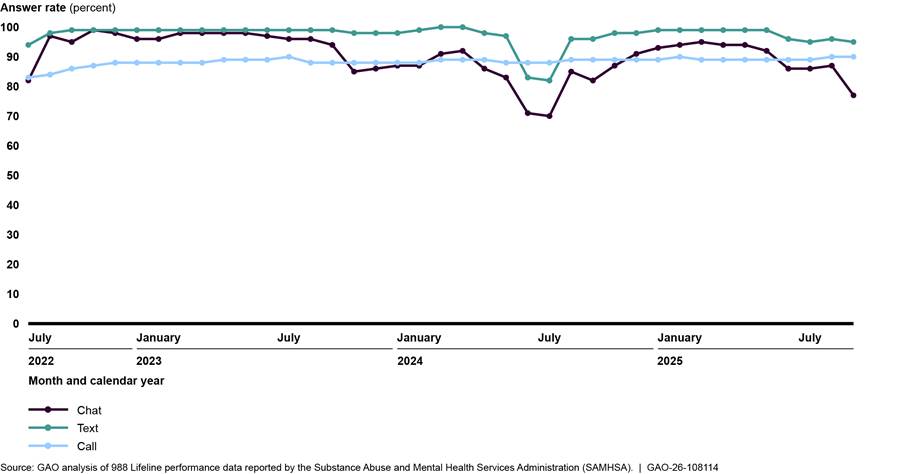
Note: Answer rate reflects the percentage of calls, texts, and chats routed to crisis contact centers that were answered by crisis counselors. Data shown include contacts that were routed to local, Spanish language, lesbian, gay, bisexual, transgender, queer or questioning youth and young adult, and national backup crisis contact centers.
Average time to answer. The average length of time it took to answer calls, texts, and chats each month varied from July 2022 through September 2025, but was generally higher for texts and chats compared to calls. During this period, the average time to answer texts ranged from 44 seconds to more than 12 minutes, and the average time to answer for chats ranged from 27 seconds to more than 4 minutes. Comparatively, the average time to answer 988 Lifeline calls ranged from 31 seconds to 39 seconds (see fig. 10). Similar to answer rates, a substantial increase in text and chat volume in June and July 2024 contributed to the increased average time to answer for texts and chats during those months, according to SAMHSA officials.[30]
Figure 10: Average Time to Answer by Contact Method for the 988 Lifeline Overall, July 2022 through September 2025
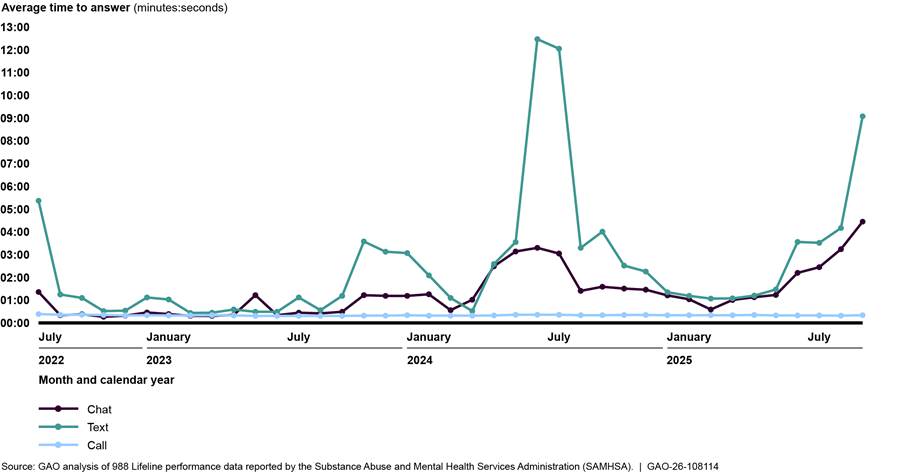
Note: Average time to answer reflects the average length of time it took for calls, texts, or chats to be answered after they were initially routed to crisis contact centers. Data shown include contacts that were routed to local, Spanish language, lesbian, gay, bisexual, transgender, queer or questioning youth and young adult, and national backup crisis contact centers. For any contacts that were rerouted, such as to the backup crisis contact centers, the average time to answer includes any time spent waiting prior to being rerouted.
According to SAMHSA officials, various factors contributed to the greater variation in average time to answer texts and chats compared to calls, including lower staffing availability for local text and chat services and longer conversation length for texts and chats. For example, SAMHSA officials said that, unlike for calls, some states do not provide local chat and text services 24 hours a day, 7 days a week, leading to increased dependence on national backups when states are not providing local services.
Additionally, SAMHSA officials said that texts and chats have longer average conversation lengths than calls.[31] Officials said longer conversation lengths generally contribute to longer times to answer because crisis counselors are not available to answer new contacts as frequently, particularly during periods of increased contact volume or lower staffing availability. Officials also noted that some crisis counselors may manage more than one text or chat interaction simultaneously, which can reduce time to answer compared to managing a single text or chat.
Performance for specific 988 Lifeline service types and in specific states varies and differs from the 988 Lifeline overall. For example, in September 2025, call answer rates for individual states ranged from about 57 percent to 100 percent, compared to about 90 percent for the Lifeline overall. For information on volume, answer rates, and average time to answer at the state level, see our interactive graphic at http://www.gao.gov/products/GAO-26-108114. Additionally, see appendix III for further information on answer rate and average time to answer by 988 Lifeline service type.
SAMHSA Incorporated Selected Key Practices in Assessing the 988 Lifeline’s Routing and Capacity
We found that, as of September 2025, SAMHSA incorporated selected key performance management practices in its efforts to assess routing and capacity of the 988 Lifeline.[32] Specifically, SAMHSA followed these practices by setting a long-term goal and various near-term goals for the 988 Lifeline to plan for performance, collected information related to those goals, and used the information to assess and communicate information about the Lifeline’s performance.
|
Saving Lives in America: 988 Quality and Services Plan In April 2024, the Substance Abuse and Mental Health Services Administration (SAMHSA) published the Saving Lives in America: 988 Quality and Services Plan. The plan outlined a variety of requirements for crisis contact centers and the network administrator, such as for training, referral, follow-up, data collection, communications, and quality assurance. Source: GAO review of SAMHSA documentation. | GAO‑26‑108114 |
Set long-term and near-term goals. Our key performance management practices call for defining goals to plan for performance. SAMHSA set both a long-term goal and near-term goals related to the routing and capacity of the 988 Lifeline. Specifically, SAMHSA specified in its April 2024 Saving Lives in America: 988 Quality and Services Plan that its long-term goal for the program was to save lives by serving anyone, at any time, from anywhere across the nation, and in a manner that promotes linkages to ongoing local supports.[33]
SAMHSA also set measurable near-term goals related to georouting and answering contacts to support its long-term goal of saving lives, according to officials. For example, officials said one near-term goal was for the network administrator to begin routing calls from nationwide wireless providers to local crisis contact centers using available georouting data by January 2025, which it achieved. SAMHSA officials said they had a similar near-term goal to begin routing texts using available georouting data by April 16, 2027. Another near-term goal was for more than 90 percent of texts and chats that were routed to local crisis contact centers in states to be answered at those crisis contact centers by September 29, 2026. According to network administrator representatives, this goal was intended to promote answer rate improvement among local crisis contact centers, without the expectation that all centers would achieve it.[34] As noted, the percentage of texts and chats answered by local crisis contact centers increased from July 2022 through September 2025, as did the number of states that offered local support for text and chat.
Collect information. Our key performance management practices call for collecting information related to goals. In collaboration with SAMHSA, the network administrator collected information on the performance of the more than 200 independent crisis contact centers comprising the 988 Lifeline network as of September 2025. Specifically, to assess network performance, the network administrator’s systems continuously collected data on contact volume, answer rates, average time to answer, and georouting implementation, among other information.
Use information. Our key performance management practices call for using the information that was collected, which agencies can do in a variety of ways. SAMHSA used the information that was collected on the 988 Lifeline network’s performance to assess and communicate performance information. For example, SAMHSA officials said they routinely reviewed data on the network’s performance and discussed those data with network administrator representatives responsible for administering the Lifeline.
Additionally, officials from nine states we interviewed said they discussed network performance data with SAMHSA officials or network administrator representatives, including changes to routing or capacity that could affect crisis contact centers in their state. For example, network administrator representatives used 988 Lifeline data to estimate how contact volume would change in states once the 988 Lifeline began georouting calls. Network administrator representatives subsequently met with officials from states that were expected to experience the largest increases in contact volume to share their estimates and develop plans to accommodate the change, according to SAMHSA documentation.
SAMHSA and the network administrator also routinely published information about the 988 Lifeline network’s performance on their websites. SAMHSA published statistics for the overall 988 Lifeline, specialized services, and national backups, including contact volume, answer rate, average time to answer, and average conversation length.[35] The network administrator published similar monthly statistics for each state.[36]
To further facilitate communication of performance information, the network administrator developed dashboards that state officials could access to see performance data for crisis contact centers in their state. Additionally, with funding from SAMHSA, it created a separate dashboard to forecast future call volume and workforce needs for states and their local crisis contact centers to help states and local crisis contact centers plan for staffing needs and improve answer rates. Officials from one of the states we interviewed said the dashboard helped them plan for future growth of the 988 Lifeline’s contact volume in their state.
Selected States Reported Staffing and Other Challenges; States, the Network Administrator, and SAMHSA Took Actions to Support Capacity
Selected States Reported Staffing, Funding, and Other 988 Lifeline Challenges
Officials from the 11 selected states in our review told us of challenges they faced related to implementing the 988 Lifeline. Two of the most common challenges reported by state officials related to staffing and funding. Officials from all our selected states said sufficient staffing and funding were key factors in a local crisis contact center’s ability to answer 988 Lifeline contacts in a timely manner.
Staffing recruitment and retention. Staffing recruitment and retention for local crisis contact centers was a challenge to supporting capacity, according to officials in five of our selected states. Selected state officials cited various reasons staffing recruitment and retention was a challenge, including the high-stress nature of the work, difficulty offering competitive pay, and around-the-clock hours. For example, officials from one state said retaining staff was difficult because of the emotionally taxing nature of the work and that retaining staff in rural areas was particularly challenging because the salaries the center was able to offer were not competitive. Officials from another state said the combination of high turnover and a lengthy recruitment and training process made staffing a key factor affecting local crisis contact centers’ ability to answer 988 Lifeline contacts in a timely manner.
|
988 Lifeline Crisis Contact Center Funding The 988 Lifeline is funded through federal, state, and private sources. Federal funding includes cooperative agreements to a network administrator, states, and territories, among other things. States also may appropriate funding to support 988 Lifeline operations or impose or collect telecommunication fees to help support 988 Lifeline operations. Source: GAO review of Substance Abuse and Mental Health Services Administration documentation. | GAO‑26‑108114 |
Funding. Funding for local crisis contact centers was a challenge, according to officials in four of our selected states. Officials from three of the four states indicated that limited funding has prevented or may prevent their local crisis contact centers from hiring more staff to meet rising demand. Additionally, officials from all but one of our 11 selected states noted the importance of federal funding for maintaining or expanding access at the local level. For example, officials from one state said loss of federal funding would result in a significant reduction in 988 Lifeline crisis contact center staffing. Officials from another state said loss of federal funding would require them to reduce their crisis contact center’s hours of operation and phase out answering texts and chats.
Network administrator representatives also said states may not have enough funding to fully meet the increasing demand for 988 Lifeline services, even with existing federal funds. Specifically, they said the primary challenge for calls is the availability of funding to expand capacity to meet increasing demand, and the primary challenge for chat and text services is building capacity, particularly at local crisis contact centers within states.[37] As noted, call, text, and chat volume generally increased across most states from August 2022 through September 2025. Network administrator representatives further explained that support for text and chat services remains relatively new for the 988 Lifeline, and many local crisis contact centers were still developing support for these services.
Officials in our selected states also reported other challenges related to implementing the 988 Lifeline. Examples include challenges related to coordination with the network administrator and SAMHSA, and abusive callers.
· Coordination with the network administrator—which, in consultation with SAMHSA, administers the 988 Lifeline and helps ensure system capacity—was a challenge, according to officials from five selected states. The most common issue cited by officials in these states was that the network administrator could sometimes be slow to respond to questions, requests, or concerns. For example, officials from one state said they sometimes followed up numerous times over several months to get a response from the network administrator, and that concerns did not always get resolved.
· Coordination with SAMHSA was also a challenge, according to officials from two selected states. For example, officials from both states said changes in SAMHSA’s workforce resulted in less frequent meetings with their SAMHSA contacts who provided program oversight and technical assistance. As of March 2026, SAMHSA officials said the agency was fully staffed with government project officers who provide program oversight and technical assistance for the 988 Lifeline state cooperative agreements.
· Abusive contacts—abusive or harassing contacts—was a challenge, according to officials from two selected states. For example, officials from one of the states said a small number of individuals may call the 988 Lifeline hundreds of times per week, often hanging up until they get a specific preferred staff person.
States, the Network Administrator, and SAMHSA Reported Changes to Staffing Processes and Other Actions to Support Capacity
Officials from selected states, SAMHSA, and representatives from the network administrator reported taking actions to better support local capacity to answer 988 Lifeline contacts. Specifically, selected state officials reported taking actions to improve staff recruitment and retention, and to increase funding. Network administrator representatives reported actions they took—in coordination with and funded by SAMHSA—to improve coordination with and support to states and local crisis contact centers. SAMHSA officials reported additional efforts by the network administrator and SAMHSA to improve staffing recruitment and retention.
State Actions
Staffing recruitment and retention. Officials from states we interviewed described taking a variety of actions to improve staffing recruitment and retention for local crisis contact centers. For example:
· Officials from three states said they refined their hiring processes to improve recruitment and retention, such as by giving job candidates a better idea of what the work entails or improving interview practices to help ensure hires are a good fit.
· Officials from four states said they provided staff with increased training or mentoring. Officials from one of the states said they were creating trainings to improve staff retention, including trainings on topics such as self-care, staff resilience, and burnout.
· Officials from three states noted they provided break rooms or made sure staff took sufficient breaks.
· Officials from one state said they raised salaries and offered flexible schedules and telework to better recruit and retain staff.
Addressing funding challenges. To address funding challenges, three states noted charging a 988 telecommunications fee to support 988 Lifeline operations.[38] Officials from one state that enacted a fee said their state used the funding to increase local crisis center capacity to answer contacts.
Other actions reported by at least one of our selected states to address funding challenges included using state-appropriated funding to help support their 988 Lifeline operations and hiring volunteers for some crisis center staffing positions.[39]
Network Administrator and SAMHSA Actions
Network administrator representatives said SAMHSA, in addition to providing funding, consistently provided input that helped the network administrator support states and local crisis contact centers, including strategies to maximize capacity and accommodate increasing contact volume. Additionally, network administrator representatives took a variety of actions to further support local capacity, including actions to improve coordination and communication, access to performance data, and crisis center staffing.
Coordination and communication. Network administrator representatives have assigned a single point of contact to states and local crisis contact centers to streamline coordination and communication, beginning in 2022. Representatives said this contact coordinates with other network administrator staff to address questions or concerns from states or local crisis contact centers.
Officials we interviewed in three states said the single point of contact simplified or streamlined communication. Officials from one state said the change generally improved responsiveness but that responses could still be slow at times. Officials from another state said the effectiveness varied depending on the individual who was the point of contact.
Access to performance data. Network administrator representatives provided access for states and crisis contact centers to a centralized data portal with interactive data dashboards of capacity performance data, beginning in 2023. The dashboards aimed to facilitate communication and data exchange, according to network administrator representatives. They provided states and crisis contact centers access to near real-time customizable reports with performance-related metrics, such as contact volume, answer rates, average time to answer, and other statistics.
Officials in two of our selected states said access to real-time data was a substantial improvement compared to the monthly data reports previously provided by the network administrator. Officials from one of the states added that the data improved their state’s visibility into the ongoing performance of its crisis contact centers.
Crisis center staffing. In December 2023, network administrator representatives launched a workforce management dashboard within the portal that crisis contact centers could use to aid workforce planning and help ensure that resources matched anticipated call volume. Crisis contact centers are to submit crisis counselor staffing information into the portal every two weeks, to be compared to forecasted call volume generally updated daily, according to network administrator representatives.[40]
Officials from one selected state in our review said they used the dashboard to predict when the 988 Lifeline will experience higher volume so their local crisis contact centers could schedule more staff during those times.
According to SAMHSA officials, the network administrator also provides crisis contact centers with resources to help recruit and retain staff. For example, officials said the network administrator provides sample job descriptions and best practices for recruiting volunteer counselors. In addition, while SAMHSA is not responsible for recruiting and retaining local crisis contact centers’ staff, SAMHSA officials reported that the agency engaged in efforts to improve staffing recruitment and retention. For example, SAMHSA officials reported offering a webinar series with evidence-based strategies and practical tools to help crisis contact center staff build resilience, manage stress, and prevent burnout.
Agency Comments
We provided a draft of this report to the Department of Health and Human Services and the Federal Communications Commission for review and comment. Both agencies provided technical comments, which we incorporated as appropriate.
We are sending copies of this report to the appropriate congressional committees, the Secretary of Health and Human Services, the Chair of FCC, and other interested parties. In addition, the report is available at no charge on the GAO website at https://www.gao.gov.
If you or your staff have any questions about this report, please contact me at HundrupA@gao.gov. Contact points for our Offices of Congressional Relations and Media Relations may be found on the last page of this report. GAO staff who made key contributions to this report are listed in appendix IV.

Alyssa M. Hundrup
Director, Health Care
This appendix provides further details about the 988 Suicide & Crisis Lifeline (988 Lifeline) data we used to address our second reporting objective, to describe how capacity of the 988 Lifeline was measured and what those measures showed.
For this objective, we reviewed aggregated monthly 988 Lifeline performance data provided by the U.S. Department of Health and Human Services’ Substance Abuse and Mental Health Services Administration (SAMHSA) for July 2022 through September 2025, including contact volume, answer rates, and average time to answer.[41] We did not review data for individual 988 Lifeline contacts. We reviewed aggregated monthly data for the following 988 Lifeline service types: 1) local, 2) lesbian, gay, bisexual, transgender, queer or questioning (LGBTQ+) youth and young adult, 3) Spanish language, and 4) national backup. We also reviewed aggregated monthly data for the 988 Lifeline overall, which includes contacts (i.e., calls, texts, and chats) across the four previously mentioned service types.[42] Additionally, we reviewed aggregated monthly performance data for the 988 Lifeline’s videophone service for people who are deaf or hard of hearing.[43]
For the data we reviewed, contact volume reflected the number of contacts that were routed to crisis contact centers after the individual selected a service. Answer rate reflected the percentage of contacts that were routed to crisis contact centers and were answered by crisis counselors as calculated by SAMHSA for each service type. Average time to answer reflected the average length of time it took for contacts to be answered after they were routed to crisis contact centers.
To assess the reliability of those data, we reviewed related documentation, interviewed officials from SAMHSA and representatives from the 988 Lifeline network administrator about the data, conducted checks for missing or erroneous data, and compared the data against published totals. Based on these activities, we determined that the data were sufficiently reliable for the purposes of describing SAMHSA’s capacity measures for the 988 Lifeline.
The data we reviewed were provided to us by SAMHSA and, according to SAMHSA officials, collected by the network administrator.[44] Other sources of 988 Lifeline performance data—such as data collected by states from their local crisis contact centers—could generate different estimates. According to SAMHSA officials and network administrator documentation, the network administrator, local crisis contact centers, and states have different systems that may be configured differently or use different definitions for reporting, resulting in differences between routed contact volume, answer rates, or other statistics. Additionally, officials from seven states we interviewed said there are differences between state and network administrator data.
Officials from six of the 11 states we interviewed and network administrator representatives said they have been working to minimize differences between state and network administrator data. For example, network administrator representatives said they work with local crisis contact centers to identify reasons for differences in data when the differences exceed certain thresholds. However, network administrator representatives said they did not change how they publicly reported statistics because they wanted to maintain consistency.
There were several limitations to the 988 Lifeline performance data we reviewed.
1. Records with unknown outcomes. A small number of records from July 2022 through September 2025 did not have an outcome recorded—that is, it was unknown whether the call, text, or chat was answered or abandoned. According to agency officials, this could occur due to rare errors in automated recording or transmitting of data between different systems. Based on the data SAMHSA provided, we found 1,654 out of 19,097,000 (about 0.009 percent) of total routed contacts between July 2022 and September 2025 had unknown outcomes.
2. Outliers in average time to answer. The aggregated monthly data SAMHSA provided included the average time to answer contacts. According to SAMHSA officials, the records that were used to compute the average time to answer included those with unusually long times to answer. For example, between July 2022 and May 2025, SAMHSA officials said the records for 1 out of every 100,000 contacts had an average time to answer that exceeded four hours. Officials told us these outliers occasionally occurred due to issues with the telecommunications provider. Officials further said SAMHSA routinely retains those outliers when analyzing and reporting 988 Lifeline performance data.
3. Inclusion of testing and training data. According to SAMHSA officials, the records that were used to compute the aggregated monthly data SAMHSA provided included calls, texts, and chats that were used for testing and training purposes. Officials said the 988 Lifeline’s system did not indicate which calls, texts, and chats were for testing or training and hence could not exclude them from the data. SAMHSA officials said they expected a maximum of 1 percent of contact volume to be due to testing on days when system changes were implemented. Additionally, officials estimated that 10 to 15 texts and chats per month were due to training.[45]
Appendix II: Contact Volume, Answer Rates, and Average Time to Answer for the 988 Lifeline’s Videophone Service
This appendix details monthly contact volume, answer rates, and average time to answer for the 988 Suicide & Crisis Lifeline’s (988 Lifeline) videophone service for people who are deaf or hard of hearing from September 2023—when videophone services began—through September 2025.[46]
Contact volume. From September 2023 to September 2025, the volume of videophone calls to the 988 Lifeline generally fluctuated over time. Specifically, the volume of monthly videophone calls to the 988 Lifeline ranged from 496 to 7,086 (see fig. 11). According to SAMHSA officials, individuals with high utilization patterns contributed to the observed increase in volume from January 2024 through July 2024, as well as in September 2024 and October 2024.
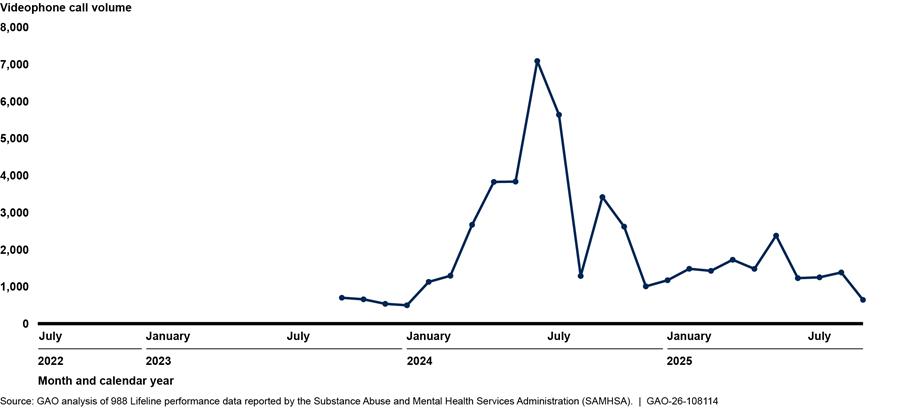
Notes: The 988 number went into effect for the Lifeline in July 2022. The 988 Lifeline began supporting videophone calls in September 2023.
Answer rate. From September 2023 to September 2025, the answer rate for videophone calls to the 988 Lifeline increased by about 3 percentage points (about 95 percent to about 98 percent). Over this period, the monthly answer rate for videophone calls ranged from about 90 percent to about 99 percent (see fig. 12).
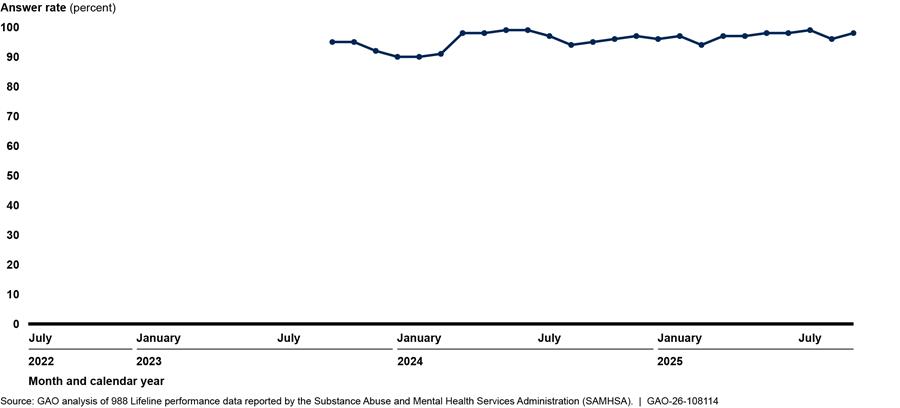
Notes: Answer rate reflects the percentage of videophone calls that were answered by a crisis counselor. Videophone calls that were not answered were abandoned. The 988 number went into effect for the Lifeline in July 2022. The 988 Lifeline began supporting videophone calls in September 2023.
Average time to answer. From September 2023 to September 2025, the average time to answer videophone calls to the 988 Lifeline generally increased. Specifically, the average time to answer increased from 16 seconds in September 2023 to 21 seconds in September 2025. Over this period, the monthly average time to answer videophone calls ranged from 12 seconds to 22 seconds (see fig. 13).
Figure 13: Average Time to Answer for the 988 Lifeline’s Videophone Service, July 2022 through September 2025
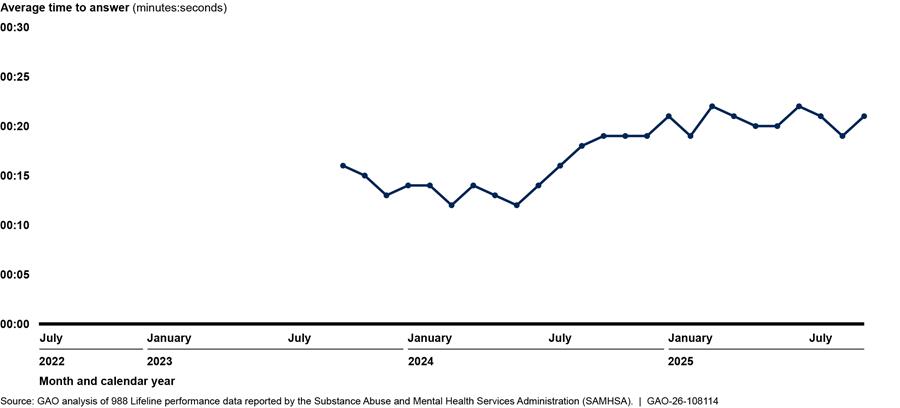
Notes: Average time to answer reflects the average length of time it took for videophone calls to be answered. The 988 number went into effect for the Lifeline in July 2022. The 988 Lifeline began supporting videophone calls in September 2023.
This appendix details monthly contact volume, answer rates, and average times to answer, for calls, texts, and chats to the 988 Suicide & Crisis Lifeline (988 Lifeline) from July 2022 to September 2025. Data are presented separately for services provided by the 988 Lifeline’s 1) local, 2) lesbian, gay, bisexual, transgender, queer or questioning (LGBTQ+) youth and young adult, 3) Spanish language, and 4) national backup crisis contact centers.
Local Services
Local services are calls, texts, and chats to the 988 Lifeline that were routed to local crisis contact centers in states.[47] As of September 2025, not all states provided local call, text, or chat services through their local crisis contact centers.[48] However, the number of states providing local call services increased from 53 in July 2022 to 55 in September 2025, and the number of states providing local chat and text services increased from 18 in July 2022 to 44 in September 2025. For more information on local services by state, including monthly contact volume, answer rates, and average time to answer, see our interactive graphic at http://www.gao.gov/products/GAO-26-108114.
Contact volume. From August 2022—the first full month of service after the “988” number for the Lifeline went into effect—to September 2025, the volume of calls, texts, and chats increased for most states. Specifically, call volume increased in 53 states, and text and chat volume increased in 45 states. In September 2025, contacts answered at local crisis contact centers made up about 70 percent of all contacts to the 988 Lifeline.
Answer rates. In September 2025, one state did not provide call services at local crisis contact centers, and 12 states did not provide text and chat services at local crisis contact centers.[49] Among the states that answered calls in September 2025, the answer rates ranged from about 57 percent to 100 percent and the median answer rate was about 88 percent. Among the states that answered texts and chats in September 2025, the answer rates for both texts and chats ranged from about 6 percent to about 95 percent. Additionally, the median answer rate for texts was about 60 percent and the median answer rate for chats was about 55 percent.
Average time to answer. Among the states that answered calls in September 2025, the average time to answer ranged from 1 second to 59 seconds and the median average time to answer calls was 22 seconds. Among the states that answered texts and chats in September 2025, the average time to answer texts ranged from 8 seconds to more than 5 minutes and the average time to answer chats ranged from 8 seconds to more than 13 minutes. The median average time to answer was 28 seconds for texts and 28.5 seconds for chats.
LGBTQ+ Youth and Young Adult Service
The 988 Lifeline’s specialized service for LGBTQ+ youth and young adults started in September 2022 and was discontinued on July 17, 2025.[50] The service provided specialized call, text, and chat services to LGBTQ+ youth and young adults.[51]
Contact volume. From September 2022 to July 2025, call, text, and chat volume generally increased for the LGBTQ+ youth and young adult service. Specifically, from September 2022 to June 2025 (the last full month the service was provided), the volume of calls increased from 614 to 42,977, the volume of texts increased from 625 to 13,167, and the volume of chats increased from 513 chats to 13,427 (see fig. 14). In June 2025, contacts answered at LGBTQ+ youth and young adult crisis contact centers made up about 8 percent of all contacts to the 988 Lifeline.
Figure 14: Contact Volume by Contact Method for the 988 Lifeline’s LGBTQ+ Youth and Young Adult Service, July 2022 through September 2025
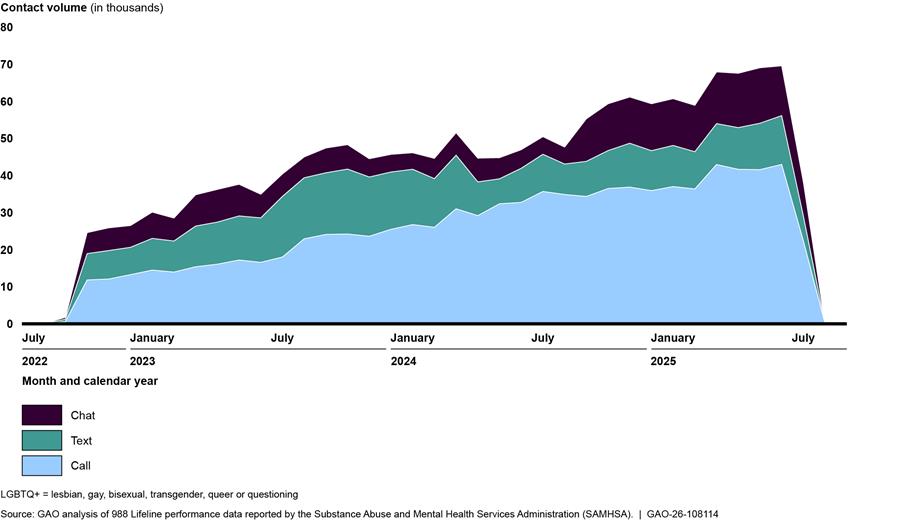
Notes: Contact volume reflects the number of calls, texts, and chats that were routed to crisis contact centers after individuals selected a service. The 988 number went into effect for the Lifeline in July 2022. Service for the LGBTQ+ youth and young adult service began in September 2022 and was discontinued on July 17, 2025. According to SAMHSA, the LGBTQ+ youth and young adult service line was discontinued because the federal funding provided for the service was fully expended. In reports referenced by the Explanatory Statement accompanying the Consolidated Appropriations Act, 2026, funding was restored and SAMHSA was directed to use the funding to provide specialized services for LGBTQ+ youth. As of March 2026, SAMHSA officials said they were actively working through the requirements of the appropriation. See Explanatory Statement accompanying Pub. L. No. 119-75, 140 Stat. 173 (2026), referencing S. Rpt. 119-55 at 175 (July 31, 2025) and S. Rpt. 118-84 at 140 (July 27, 2023).
Answer rates. From September 2022 to July 2025, answer rates for LGBTQ+ youth and young adult varied across calls, texts, and chats. During this period, answer rates for calls ranged from about 62 percent to about 85 percent, answer rates for texts ranged from about 47 percent to about 100 percent, and answer rates for chats ranged from about 33 percent to about 99 percent (see fig. 15).[52]
Figure 15: Answer Rates by Contact Method for the 988 Lifeline’s LGBTQ+ Youth and Young Adult Service, July 2022 through September 2025
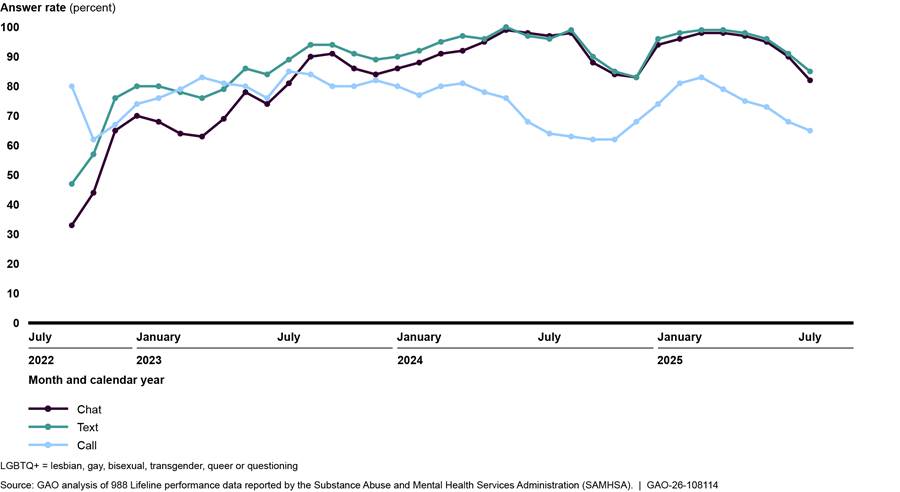
Notes: Answer rate reflects the percentage of calls, texts, and chats routed to crisis contact centers that were answered by crisis counselors. According to SAMHSA officials, contacts to the LGBTQ+ youth and young adult service were rerouted to either the national backup service (for calls) or local services (for texts and chats) if they were not answered within a certain amount of time. SAMHSA officials said that the maximum wait time before being rerouted varied over time for calls (ranging from 6 to 8 minutes). The maximum wait time before being rerouted was 5 minutes for texts and chats, according to SAMHSA officials. The 988 number went into effect for the Lifeline in July 2022. The LGBTQ+ youth and young adult service began in September 2022 and was discontinued on July 17, 2025. According to SAMHSA, the LGBTQ+ youth and young adult service line was discontinued because the federal funding provided for the service was fully expended. In reports referenced by the Explanatory Statement accompanying the Consolidated Appropriations Act, 2026, funding was restored and SAMHSA was directed to use the funding to provide specialized services for LGBTQ+ youth. As of March 2026, SAMHSA officials said they were actively working through the requirements of the appropriation. See Explanatory Statement accompanying Pub. L. No. 119-75, 140 Stat. 173 (2026), referencing S. Rpt. 119-55 at 175 (July 31, 2025) and S. Rpt. 118-84 at 140 (July 27, 2023).
Average time to answer. From September 2022 to July 2025, the average time to answer calls, texts, and chats for the LGBTQ+ youth and young adult service varied. During this period, the average time to answer calls ranged from 8 seconds to 1 minute, average time to answer texts ranged from 14 seconds to 1 minute 24 seconds, and average time to answer chats ranged from 13 to 55 seconds (see fig. 16).[53]
Figure 16: Average Time to Answer by Contact Method for the 988 Lifeline LGBTQ+ Youth and Young Adult Service, July 2022 through September 2025
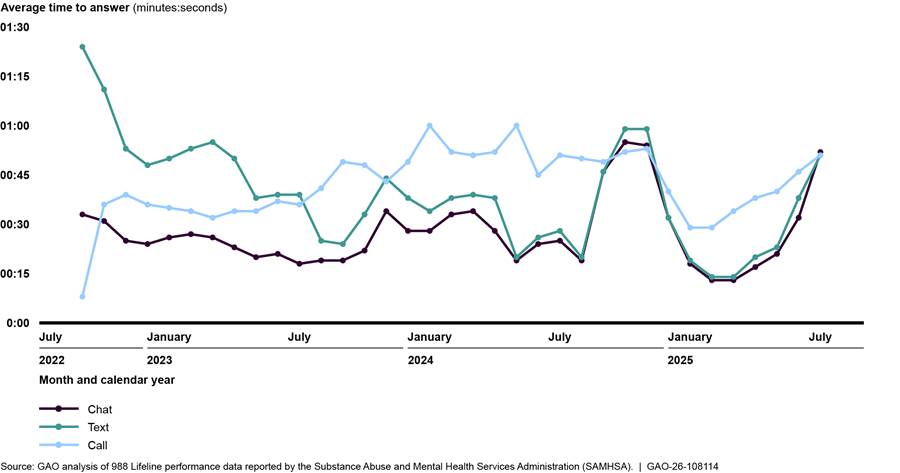
Notes: Average time to answer reflects the average length of time it took for calls, texts, or chats to be answered after they were routed to crisis contact centers. The 988 number went into effect for the Lifeline in July 2022. The LGBTQ+ youth and young adult service began in September 2022 and was discontinued on July 17, 2025. According to SAMHSA, the LGBTQ+ youth and young adult service line was discontinued because the federal funding provided for the service was fully expended. In reports referenced by the Explanatory Statement accompanying the Consolidated Appropriations Act, 2026, funding was restored and SAMHSA was directed to use the funding to provide specialized services for LGBTQ+ youth. As of March 2026, SAMHSA officials said they were actively working through the requirements of the appropriation. See Explanatory Statement accompanying Pub. L. No. 119-75, 140 Stat. 173 (2026), referencing S. Rpt. 119-55 at 175 (July 31, 2025) and S. Rpt. 118-84 at 140 (July 27, 2023).
Spanish Language Service
The 988 Lifeline’s Spanish language service provides call, text, and chat services in Spanish to Spanish-speaking individuals. The 988 Lifeline began supporting Spanish language texts and chats in July 2023.
Contact volume. From July 2022 to September 2025, contact volume for the Spanish language service generally increased across all contact types. During this period, contact volume for Spanish language calls increased by about 19 percent (from 7,899 to 9,388). Additionally, contact volume for texts increased by about 152 percent (from 383 to 965) and contact volume for chats increased by about 399 percent (from 287 to 1,431) from July 2023—the first month Spanish text and chat services were available—to September 2025 (see fig. 17). In September 2025, contacts answered by the Spanish language service accounted for about 1 percent of all contacts to the 988 Lifeline.
Figure 17: Contact Volume by Contact Method for the 988 Lifeline Spanish Language Service, July 2022 through September 2025
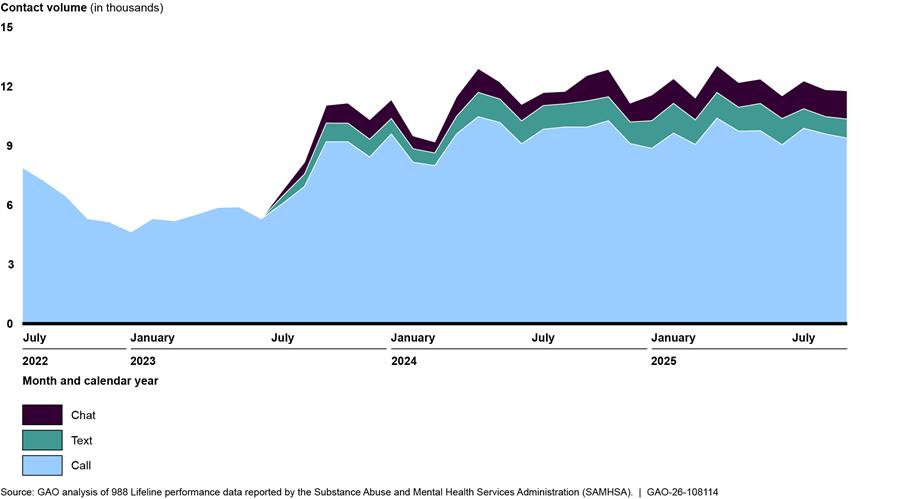
Notes: Contact volume reflects the number of calls, texts, and chats that were routed to crisis contact centers after individuals selected a service. The Spanish language service began supporting texts and chats in July 2023.
Answer rates. From July 2022 to September 2025, answer rates for the 988 Lifeline’s Spanish language service varied across calls, texts, and chats. During this period, answer rates for calls increased from about 63 percent in July 2022 to about 84 percent in September 2025. Answer rates for texts stayed relatively consistent over time, with answer rates ranging from about 97 percent to 100 percent. Answer rates for chats generally decreased over time, from about 99 percent in July 2023 to about 76 percent in September 2025 (see fig. 18).[54]
Figure 18: Answer Rates by Contact Method for the 988 Lifeline Spanish Language Service, July 2022 through September 2025
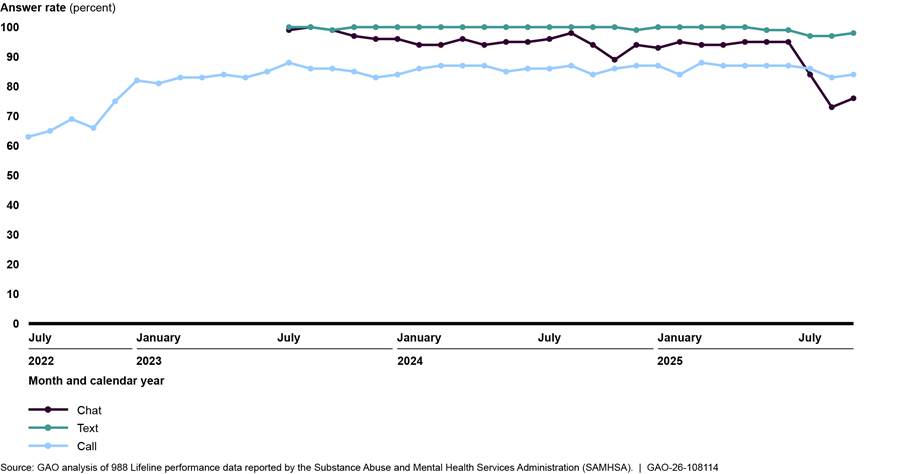
Notes: Answer rate reflects the percentage of calls, texts, and chats routed to crisis contact centers that were answered by crisis counselors. Contacts that were not answered after being routed to the Spanish language service were abandoned. Network administrator representatives said contacts that were routed to the Spanish language service could not be rerouted to the national backup service since the national backup service did not offer support in Spanish. The Spanish language service began supporting texts and chats in July 2023.
Average time to answer. From July 2022 to September 2025, the average time to answer calls, texts, and chats for the 988 Lifeline’s Spanish language service varied. During this period, the average time to answer texts and chats fluctuated more than it did for calls. Specifically, average time to answer calls ranged from 28 seconds to 1 minute 27 seconds, average time to answer for texts ranged from 22 seconds to 10 minutes 25 seconds, and average time to answer for chats ranged from 23 seconds to 2 minutes 39 seconds (see fig. 19).[55]
Figure 19: Average Time to Answer by Contact Method for the 988 Lifeline Spanish Language Service, July 2022 through September 2025
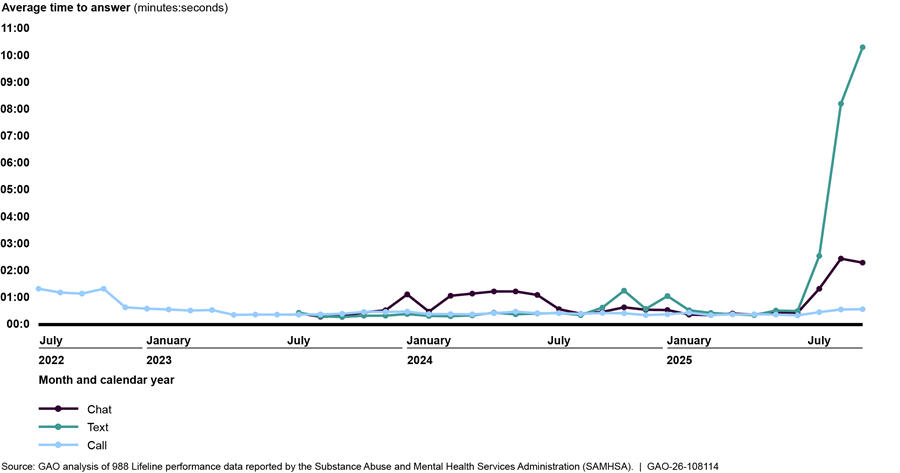
Notes: Average time to answer reflects the average length of time it took for calls, texts, or chats to be answered after they were routed to crisis contact centers. The Spanish language service began supporting texts and chats in July 2023.
National Backup Service
National backup crisis contact centers answered calls, texts, and chats that were not answered within a certain amount of time at local crisis contact centers and calls that were not answered at LGBTQ+ youth and young adult crisis contact centers.[56]
Contact volume. From July 2022 to September 2025, contact volume for national backup calls and texts generally increased while contact volume for chats generally decreased. Specifically, call volume increased by about 19 percent (from 21,030 to 24,965), text volume increased by about 107 percent (from 31,739 to 65,574), and chat volume decreased by about 31 percent (from 72,866 to 50,274; see fig. 20). In September 2025, contacts answered at national backup crisis contact centers accounted for about 17 percent of all contacts to the 988 Lifeline.
Figure 20: Contact Volume by Contact Method for the 988 Lifeline National Backup Service, July 2022 through September 2025
Note: Contact volume reflects the number of calls, texts, and chats that were routed to crisis contact centers after individuals selected a service.
Answer rates. From July 2022 to September 2025, answer rates for the 988 Lifeline’s national backup service varied across calls, texts, and chats. During this period, answer rates for calls ranged from about 82 percent to about 94 percent, answer rates for texts ranged from about 74 percent to about 100 percent, and answer rates for chats ranged from about 57 percent to about 99 percent (see fig. 21).[57]
Figure 21: Answer Rates by Contact Method for the 988 Lifeline National Backup Service, July 2022 through September 2025
Note: Answer rate reflects the percentage of calls, texts, and chats routed to crisis contact centers that were answered by crisis counselors.
Average time to answer. From July 2022 to September 2025, the average time to answer calls, texts, and chats routed to the 988 Lifeline’s national backup service varied.[58] In general, the average time to answer fluctuated more for texts and chats compared to calls. Average time to answer calls ranged from 1 minute 25 seconds to 2 minutes 28 seconds, average time to answer for texts ranged from 47 seconds to 21 minutes 24 seconds, and average time to answer for chats ranged from 29 seconds to 9 minutes 6 seconds (see fig. 22).[59]
Figure 22: Average Time to Answer by Contact Method for the 988 Lifeline National Backup Service, July 2022 through September 2025
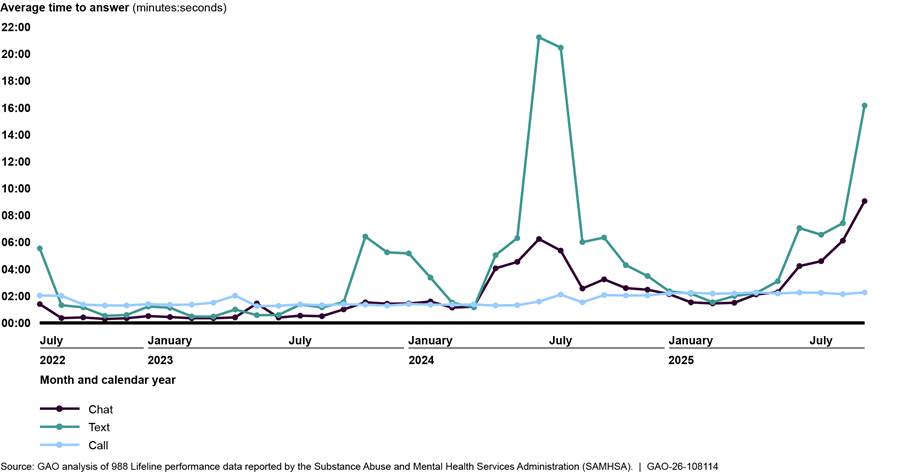
Note: Average time to answer reflects the average length of time it took for calls, texts, or chats to be answered after they were initially routed to crisis contact centers. The average time to answer shown includes any time spent waiting prior to being rerouted to backup crisis contact centers.
GAO Contact
Alyssa M. Hundrup, HundrupA@gao.gov
Staff Acknowledgments
In addition to the contacts named above, Rebecca Abela (Assistant Director), Brandon Nakawaki (Analyst-in-Charge), Jennie Apter, Barbara Hansen, and Foster Ritchie made key contributions to this report. Also contributing were Cynthia Khan, Robert Letzler, Jeanne Murphy-Stone, Monica Perez-Nelson, and Roxanna Sun.
The Government Accountability Office, the audit, evaluation, and investigative arm of Congress, exists to support Congress in meeting its constitutional responsibilities and to help improve the performance and accountability of the federal government for the American people. GAO examines the use of public funds; evaluates federal programs and policies; and provides analyses, recommendations, and other assistance to help Congress make informed oversight, policy, and funding decisions. GAO’s commitment to good government is reflected in its core values of accountability, integrity, and reliability.
Obtaining Copies of GAO Reports and Testimony
The fastest and easiest way to obtain copies of GAO documents at no cost is through our website. Each weekday afternoon, GAO posts on its website newly released reports, testimony, and correspondence. You can also subscribe to GAO’s email updates to receive notification of newly posted products.
Order by Phone
The price of each GAO publication reflects GAO’s actual cost of production and distribution and depends on the number of pages in the publication and whether the publication is printed in color or black and white. Pricing and ordering information is posted on GAO’s website, https://www.gao.gov/ordering.htm.
Place orders by calling (202) 512-6000, toll free (866) 801-7077,
or
TDD (202) 512-2537.
Orders may be paid for using American Express, Discover Card, MasterCard, Visa, check, or money order. Call for additional information.
Connect with GAO
Connect with GAO on X,
LinkedIn, Instagram, and YouTube.
Subscribe to our Email Updates. Listen to our Podcasts.
Visit GAO on the web at https://www.gao.gov.
To Report Fraud, Waste, and Abuse in Federal Programs
Contact FraudNet:
Website: https://www.gao.gov/about/what-gao-does/fraudnet
Automated answering system: (800) 424-5454
Media Relations
Sarah Kaczmarek, Managing Director, Media@gao.gov
Congressional Relations
David A. Powner, Acting Managing Director, CongRel@gao.gov
General Inquiries
[1]See U.S. Department of Health and Human Services, Centers for Disease Control and Prevention, Facts About Suicide, https://www.cdc.gov/suicide/facts/index.html, accessed June 5, 2026. These data were the most current available at the time of our review.
[2]See U.S. Department of Health and Human Services, Substance Abuse and Mental Health Services Administration, Center for Behavioral Health Statistics and Quality, Key Substance Use and Mental Health Indicators in the United States: Results from the 2024 National Survey on Drug Use and Health (HHS Publication No. PEP25-07-007, NSDUH Series H-60) (2025).
[3]See U.S. Department of Health and Human Services, Centers for Disease Control and Prevention, Suicide Data and Statistics, https://www.cdc.gov/suicide/facts/data.html, accessed April 22, 2026. These data were the most current available at the time of our review.
[4]On March 27, 2025, the U.S. Department of Health and Human Services announced that it would restructure the department, including by consolidating SAMHSA into a new Administration for a Healthy America. See Department of Health and Human Services, Office of the Assistant Secretary for Public Affairs, HHS Announces Transformation to Make America Healthy Again (Mar. 27, 2025). In May 2025, several states filed a lawsuit alleging that the March 27 announcement left the department incapable of performing statutory functions; litigation is ongoing. See New York v. Kennedy, No. 25-cv-00196 (D.R.I. May 5, 2025). As of March 2026, the transition to a new structure had not occurred and accordingly, we refer to the agency as SAMHSA throughout this report.
[5]Service is also available via videophone for individuals who are deaf and hard of hearing who choose to contact the 988 Lifeline with a videophone number.
[6]As of April 2026, Vibrant Emotional Health served as the network administrator for the 988 Lifeline.
[7]Pub. L. No. 117-328, § 1103(d), 136 Stat. 4459, 5637-5640 (2022).
[8]We interviewed officials from California, Connecticut, Delaware, Guam, Idaho, Indiana, Louisiana, Minnesota, Pennsylvania, Puerto Rico, and Tennessee. We also use the term “states” to refer to states, the District of Columbia, and five U.S. territories when describing 988 Lifeline capacity data.
[9]We also considered other characteristics to ensure we met with officials from states that had varied experiences with the 988 Lifeline, including whether the state had a 988 telecommunications fee that supported their 988 Lifeline crisis contact centers and whether the state had its own platform for routing calls.
[10]See U.S. Department of Health and Human Services, Substance Abuse and Mental Health Services Administration, 988 Lifeline Performance Metrics, https://www.samhsa.gov/mental‑health/988/performance‑metrics, accessed April 21, 2026; and U.S. Department of Health and Human Services, Substance Abuse and Mental Health Services Administration and Vibrant Emotional Health, State-Based Monthly Reports, https://988lifeline.org/professionals/our‑network/state‑based‑monthly‑reports, accessed April 21, 2026.
[11]Specifically, we used key practices outlined in GAO, Evidence-Based Policymaking: Practices to Help Manage and Assess the Results of Federal Efforts, GAO‑23‑105460 (Washington, D.C.: July 12, 2023) that we deemed relevant for this review. Among other things, those practices explain that an agency should (1) define long-term goals and measurable near-term goals for its activities; (2) collect information related to its near-term goals; and (3) use the information it collects. We refer to these as performance management practices because they can help federal agencies to manage program performance.
[12]Suicidal crisis is a situation in which an individual communicates about or attempts suicide.
[13]In addition to providing service in Spanish, the 988 Lifeline had interpretation support available in more than 240 languages as of March 2026. Specialized service for LGBTQ+ youth and young adults was discontinued on July 17, 2025. According to a statement from SAMHSA, funding for the service was fully expended as of June 2025. In reports referenced by the Explanatory Statement accompanying the Consolidated Appropriations Act, 2026, funding was restored and SAMHSA was directed to use the funding to provide specialized services for LGBTQ+ youth. As of March 2026, SAMHSA officials said they were actively working through the requirements of the appropriation. See Explanatory Statement accompanying Pub. L. No. 119-75, 140 Stat. 173 (2026), referencing S. Rpt. 119-55 at 175 (July 31, 2025) and S. Rpt. 118-84 at 140 (July 27, 2023).
[14]Cooperative agreements are a type of federal assistance similar to grants that are used when the federal government expects to have substantial involvement in a program along with the award recipient.
[15]SAMHSA funded three additional cooperative agreements that supported connecting individuals with follow-up services, among other things. We previously reported on SAMHSA’s efforts to support crisis response services, including federal funding that supported the 988 Lifeline. See GAO, Behavioral Health: Federal Activities to Support Crisis Response Services, GAO‑25‑107586 (Washington, D.C.: Sept. 4, 2025) and Behavioral Health: Reported Funding for COVID-19 and 988 Suicide & Crisis Lifeline, 2020-2025, GAO‑26‑107915 (Washington, D.C.: Feb. 25, 2026).
[16]Local crisis contact centers provide service in English; interpretation support for local crisis contact centers was available in more than 240 languages as of March 2026. From September 2022 until July 2025, the 988 Lifeline also offered specialized service for LGBTQ+ youth and young adults. According to a statement from SAMHSA, funding for the service was fully expended as of June 2025. In reports referenced by the Explanatory Statement accompanying the Consolidated Appropriations Act, 2026, funding was restored and SAMHSA was directed to use the funding to provide specialized services for LGBTQ+ youth. As of March 2026, SAMHSA officials said they were actively working through the requirements of the appropriation.
[17]According to SAMHSA officials, states could choose to have calls rerouted to another local crisis contact center in their state if they are not answered at the first center within a certain amount of time. They said calls are rerouted from a state’s local crisis contact centers to national backups if they are not answered within 2 minutes. SAMHSA officials and network administrator representatives explained that the maximum amount of time before a call is rerouted to national backups is determined in consultation with representatives from the network administrator, the crisis contact center, and the state in which the crisis contact center is located but is generally set at 2 minutes.
[18]The 988 Lifeline had interpretation support available in more than 240 languages as of March 2026.
[19]The 988 Lifeline has not changed routing processes for chats, and no changes were planned as of March 2026, according to SAMHSA.
[20]89 Fed. Reg. 88,890 (Nov. 12, 2024). The rule defines georouting data as location data generated from cell-based location technology that is aggregated to a level that will not identify the location of the cell site or base station receiving the 988 call or otherwise identify the precise location of the handset. Unlike geolocation, georouting data does not disclose the precise geographic location of the caller.
[21]90 Fed. Reg. 44,564 (Sept. 16, 2025).
[22]Average time to answer is also known as “average speed to answer” or “average wait time.”
[23]The 988 Lifeline also provides service for videophone calls for individuals who are deaf and hard of hearing and who chose to contact the 988 Lifeline with their videophone number. See appendix II for data on the videophone service. Videophone data are presented separately from call, text, and chat data for consistency with how SAMHSA and the network administrator publicly report 988 Lifeline performance data.
[24]The 988 Lifeline’s LGBTQ+ youth and young adult service was discontinued on July 17, 2025. According to SAMHSA, the service was discontinued due to appropriations being fully expended as of June 2025. In reports referenced by the Explanatory Statement accompanying the Consolidated Appropriations Act, 2026, funding was restored and SAMHSA was directed to use the funding to provide specialized services for LGBTQ+ youth. As of March 2026, SAMHSA officials said they were actively working through the requirements of the appropriation.
[25]For information on volume, answer rates, and average time to answer at the state level, see our interactive graphic at http://www.gao.gov/products/GAO-26-108114. For reporting purposes, we use the term “states” to refer to states, the District of Columbia, and five U.S. territories.
[26]Individuals who contacted the 988 Lifeline via chat were asked to complete a brief pre-chat survey, which asked for their zip code and whether they were experiencing thoughts of suicide, among other things.
[27]The number of states with local support for calls increased from 53 states in July 2022 to 55 states in September 2025.
[28]Abandoned contacts were routed to a service but disconnected before being answered by a crisis counselor. According to SAMHSA, disconnection could occur for various reasons, including the individual changing their mind about getting care at that moment and due to random technical service interruptions.
[29]SAMHSA officials told us that the increase in chat and text volume in June and July 2024 was primarily related to external advertising campaigns and system improvements for texts and chats.
[30]SAMHSA officials also said that increases in text volume and average conversation length contributed to the increased average time to answer for texts and chats from June through September 2025.
[31]SAMHSA officials said that text and chat conversations are asynchronous and commonly have longer pauses between responses compared to calls, leading to longer conversation length. As of September 2025, the 988 Lifeline’s overall average conversation length was about 14 minutes for calls, 30 minutes for chats, and 53 minutes for texts.
[32]Our prior work identified key practices that can help federal agencies effectively build and use evidence to manage performance. Among those practices, an agency should (1) define long-term goals and measurable near-term goals for its activities; (2) collect information related to its near-term goals; and (3) use the information it collects. See GAO, Evidence-Based Policymaking: Practices to Help Manage and Assess the Results of Federal Efforts, GAO‑23‑105460 (Washington, D.C.: July 12, 2023).
[33]U.S. Department of Health and Human Services, Substance Abuse and Mental Health Services Administration, Saving Lives in America: 988 Quality and Services Plan (Rockville, Md.: Apr. 2024).
[34]This near-term goal was characterized as a key performance indicator for a cooperative agreement awarded to states that had a project period ending September 29, 2026. Network administrator representatives said the goal was set at a level intended to promote improvement, but crisis contact centers would not always be able to meet the goal due to funding or other resource constraints.
[35]SAMHSA, 988 Lifeline Performance Metrics, accessed April 21, 2026.
[36]SAMHSA and Vibrant Emotional Health, State-Based Monthly Reports, accessed April 21, 2026.
[37]Network administrator representatives said that more staff are required to support chat and text services because chat and text conversations have taken longer than calls. As of September 2025, the 988 Lifeline’s overall average conversation length was about 14 minutes for calls, 30 minutes for chats, and 53 minutes for texts.
[38]The National Suicide Hotline Designation Act of 2020 provides for states’ authority to impose or collect fees on state residents’ phone services to support 988 operations. Pub. L. No. 116-172, § 4, 134 Stat. 832, 832-22 (codified at 47 U.S.C. § 251a). Section 4 states that a state fee shall only be imposed, collected, and used to pay expenses that a state (or other specified parties) is expected to incur that are reasonably attributed to ensuring the efficient and effective routing of calls made to the 988 national suicide prevention and mental health crisis hotline to an appropriate crisis center; and the provision of acute mental health, crisis outreach and stabilization services by directly responding to the 988 hotline.
[39]According to SAMHSA officials, states that were awarded certain 988 Lifeline cooperative agreements are required to submit plans for maintaining local 988 Lifeline services once federal funding ends. Officials said that as of March 2026, approximately half of states had enacted appropriations or established dedicated funding mechanisms for their local 988 Lifeline services. Officials said SAMHSA plans to issue a notice of funding opportunity for new 988 Lifeline state and territory cooperative agreements in fiscal year 2026.
[40]Network administrator representatives said they planned to add support for chat and text forecasting to the dashboard in the future.
[41]Average time to answer is also referred to as “average speed to answer” or “average wait time.”
[42]The data we reviewed did not include data for the Native and Strong Lifeline, which is a 988 Lifeline service available to all Indigenous people in Washington state.
[43]Videophone data are presented separately from call, text, and chat data for consistency with how SAMHSA and the network administrator publicly report 988 Lifeline performance data.
[44]According to SAMHSA officials, data for videophone calls were collected by a vendor for the network administrator.
[45]Officials said training calls went directly to crisis contact centers without going through the 988 Lifeline’s system, so they were not counted as part of the 988 Lifeline’s contact volume.
[46]Individuals who are deaf and hard of hearing who had a videophone number could contact the 988 Lifeline through their videophone number. Network administrator representatives said videophone calls to the 988 Lifeline were automatically routed to the videophone service. The 988 Lifeline also supported teletypewriter (TTY) relay services. Videophone data are presented separately from call, text, and chat data for consistency with how SAMHSA and the network administrator publicly report 988 Lifeline performance data.
[47]For reporting purposes, we use the term “states” to refer to states, the District of Columbia, and U.S. territories.
[48]According to SAMHSA officials and network administrator representatives, contacts were routed to the 988 Lifeline’s national backup network of crisis contact centers if services were unavailable at local crisis contact centers.
[49]In September 2025, the U.S. Virgin Islands did not provide local services for 988 Lifeline calls, texts, or chats. Additionally, the following states did not provide local services for texts and chats in September 2025: Alabama, American Samoa, Arizona, Florida, Guam, Massachusetts, Maine, Michigan, the Northern Mariana Islands, Montana, and Puerto Rico.
[50]According to SAMHSA, the LGBTQ+ youth and young adult service line was discontinued because the federal funding provided for the service was fully expended. In reports referenced by the Explanatory Statement accompanying the Consolidated Appropriations Act, 2026, funding was restored and SAMHSA was directed to use the funding to provide specialized services for LGBTQ+ youth. As of March 2026, SAMHSA officials said they were actively working through the requirements of the appropriation. See Explanatory Statement accompanying Pub. L. No. 119-75, 140 Stat. 173 (2026), referencing S. Rpt. 119-55 at 175 (July 31, 2025) and S. Rpt. 118-84 at 140 (July 27, 2023).
[51]Contacts that were routed to the LGBTQ+ youth and young adult service were answered by crisis counselors trained to support the needs of LGBTQ+ youth and young adults.
[52]According to SAMHSA officials, increased call volume contributed to the decrease in answer rate for calls from May 2024 through December 2024 and from April 2025 through July 2025. Additionally, SAMHSA officials said that the decrease in answer rate for texts and chats from September 2024 through November 2024, as well as for June and July 2025, was primarily due to implementation of a system improvement that shortened the pre-chat survey and consequently increased the volume of individuals who stayed connected and were routed to crisis contact centers. SAMHSA officials said this increase in volume temporarily contributed to an increase in the average time it took to be answered by crisis counselors who supported both text and chat. In turn, the increase in the time it took to be answered may have contributed to more texts and chats being abandoned and hence decreased answer rates for those months.
[53]According to SAMHSA officials, the increase in average time to answer for texts and chats from September 2024 through November 2024, as well as for June and July 2025, was primarily due to implementation of a system improvement that shortened the pre-chat survey and consequently increased the volume of individuals who stayed connected and were routed to crisis contact centers. SAMHSA officials said this increase in volume temporarily contributed to an increase in the average time it took to be answered by crisis counselors who supported both text and chat.
[54]According to SAMHSA officials, decreased staffing availability contributed to the decreased chat answer rates from July through September 2025. Specifically, the crisis contact center with the biggest portion of staff providing Spanish language chat and text support voluntarily ended service on July 17, 2025. Additionally, another crisis contact center providing Spanish language chat and text support decreased operating hours due to budget decreases, leading to the center only being active overnight. Officials said Spanish language chat and text answer rates were sensitive to changes in staffing availability since staffing was intended to match its relatively low volume.
[55]Decreased staffing availability contributed to the increased average time to answer texts and chats from July through September 2025. Specifically, the crisis contact center with the biggest portion of staff supporting the 988 Lifeline’s Spanish chat and text service voluntarily ended service on July 17, 2025. Additionally, another crisis contact center providing Spanish language chat and text support decreased operating hours due to budget decreases, leading to the center only being active overnight.
[56]The LGBTQ+ youth and young adult service began in September 2022 and was discontinued on July 17, 2025. According to SAMHSA, the LGBTQ+ youth and young adult service line was discontinued because the federal funding provided for the service was fully expended. In reports referenced by the Explanatory Statement accompanying the Consolidated Appropriations Act, 2026, funding was restored and SAMHSA was directed to use the funding to provide specialized services for LGBTQ+ youth. As of March 2026, SAMHSA officials said they were actively working through the requirements of the appropriation. See Explanatory Statement accompanying Pub. L. No. 119-75, 140 Stat. 173 (2026), referencing S. Rpt. 119-55 at 175 (July 31, 2025) and S. Rpt. 118-84 at 140 (July 27, 2023).
[57]According to SAMHSA officials, a substantial increase in text and chat volume during June and July 2024 contributed to the decrease in answer rates during those months.
[58]Average time to answer reflects the average length of time it took for calls, texts, or chats to be answered after they were initially routed to crisis contact centers. The average time to answer includes any time spent waiting prior to being rerouted to the backup crisis contact centers.
[59]According to SAMHSA officials, a substantial increase in text and chat volume during June and July 2024 contributed to the increase in average time to answer during those months.