
Report to Congressional Committees
United States Government Accountability Office
A report to congressional committees
Contact: James R. McTigue, Jr. at mctiguej@gao.gov
What GAO Found
The Department of the Treasury and the Internal Revenue Service (IRS) proposed 236 tax regulations and finalized 231 regulations between January 21, 2017, and March 31, 2026. These regulations included those that implemented provisions of the sweeping tax law changes of 2017, 2022, and 2025. IRS rulemaking procedures generally provided the public with an opportunity to comment on proposed tax regulations.
GAO found that Treasury and IRS could improve the usefulness of regulatory economic analyses required for economically significant tax regulations which have $100 million or more in economic effects, with 28 tax regulations designated as such in the period GAO reviewed. Treasury and IRS consistently used one of the Office of Management and Budget’s (OMB) recommended practices for the economically significant regulations reviewed. This practice of analyzing alternative ways to design the regulations resulted in decisions that made it easier for taxpayers to claim new tax benefits. However, Treasury and IRS used other recommended practices less consistently. These practices, if used, would help Treasury and IRS make more informed selections of regulatory alternatives by providing specific cost, benefit, and revenue estimates.
Treasury and IRS are not following leading practices for public engagement in rulemaking and risk not being prepared to address voluminous public comments, sometimes tens of thousands, on proposed tax regulations. IRS faces increasing challenges with AI-generated public comments which make it more difficult for IRS to identify duplicate comments. IRS has not developed policies for addressing mass public comments or comments written with the assistance of AI. Treasury and IRS hold public hearings on proposed regulations in Washington, D.C., upon request. Effective virtual participation by members of the public from across the United States is challenging because IRS only uses dial-in technology rather than widely available video conferencing technology. A federal advisory agency recommends that agencies reduce barriers to public regulatory participation. GAO also identified additional opportunities to document public comments made at hearings to ensure important concerns are considered.
Why GAO Did This Study
In recent years, Treasury and IRS have been affected by significant legal decisions, changes in the requirements for rulemaking, and rapidly evolving technologies that enable mass public comments.
The Inflation Reduction Act of 2022 (IRA) directed GAO to oversee the use of IRA funds including Treasury and IRS regulatory actions. GAO’s objectives included assessing: (1) the development of regulations in light of recent tax law changes, (2) the extent to which Treasury and IRS perform economic analysis for major tax regulations and measure revenue effects, and (3) the extent to which Treasury and IRS follow leading practices for public engagement in rulemaking.
GAO analyzed regulatory activity between January 2017 and March 2026; compared four selected regulatory economic analyses against recommended practices by OMB with the regulations selected, in part, because the economic analyses were the most relevant examples in selecting alternative regulatory designs; and compared public comment and regulatory hearing procedures against leading practices.
What GAO Recommends
GAO is making six recommendations to Treasury and IRS, including providing more specific economic analyses, developing a policy to identify and document mass public comments including comments written with the assistance of AI, enhancing virtual participation in and documentation of regulatory hearings. Treasury agreed with two recommendations and disagreed with four recommendations. GAO maintains that implementation of all six recommendations would improve the development of tax regulations.
|
Abbreviations |
|
|
|
|
|
ACUS |
Administrative Conference of the United States |
|
APA |
Administrative Procedure Act |
|
EO |
Executive Order |
|
IRA |
Inflation Reduction Act of 2022 |
|
IRM |
Internal Revenue Manual |
|
IRS |
Internal Revenue Service |
|
LLM |
Large Language Model |
|
NTA |
National Taxpayer Advocate |
|
OBBBA |
One Big Beautiful Bill Act |
|
OIRA |
Office of Information and Regulatory Affairs |
|
OMB |
Office of Management and Budget |
|
PGP |
Priority Guidance Plan |
|
TAS |
Taxpayer Advocate Service |
|
TCJA |
Tax Cuts and Jobs Act of 2017 |
This is a work of the U.S. government and is not subject to copyright protection in the United States. The published product may be reproduced and distributed in its entirety without further permission from GAO. However, because this work may contain copyrighted images or other material, permission from the copyright holder may be necessary if you wish to reproduce this material separately.
July 21, 2026
Congressional Committees
The Department of the Treasury and the Internal Revenue Service (IRS) issue regulations to help taxpayers understand and comply with tax law. Congress made sweeping tax law changes in statutes known as the One Big Beautiful Bill Act in 2025, the Inflation Reduction Act of 2022 (IRA), and the Tax Cuts and Jobs Act of 2017.[1] Each law authorized or required the agency to issue regulations. Since we last reported on tax rulemaking procedures in 2021, Treasury and IRS have been affected by changes in the policy and legal landscape as well as changes in technology, including:
· new executive branch requirements to analyze costs and benefits of proposed tax regulations;
· recent, significant legal decisions; and
· rapidly evolving technologies, including AI applications for generating public comments on proposed rulemakings.[2]
The IRA provided IRS tens of billions of dollars to improve taxpayer service and achieve other objectives, such as directing Treasury and IRS to issue regulations implementing tax law changes. The act also included a provision for GAO to oversee the distribution and use of IRA funds.[3] This report (1) assesses how Treasury and IRS have developed regulations implementing recent tax law changes and determined regulatory priorities, (2) assesses the extent to which Treasury and IRS perform economic analysis for major tax regulations and measure the economic and revenue effects of agency regulatory decisions, (3) assesses the extent to which Treasury and IRS follow leading practices for public engagement in rulemaking, and (4) identifies potential effects of recent legal decisions on tax rulemaking.
To address our first objective, we conducted a quantitative analysis of tax regulations proposed or issued between January 21, 2017, and March 31, 2026, following major tax law changes during the three most recent presidential administrations.[4] In addition, we reviewed (1) IRS planning documents identifying regulations needed to implement tax law changes; (2) a section of the Internal Revenue Manual (which we refer to as the regulation handbook) directing agency employees on how to develop regulations; and (3) relevant legal requirements for notice-and-comment rulemaking, centralized review of agency regulations, and economic analysis for significant regulations.[5]
We also assessed how Treasury and IRS determined regulatory priorities by (1) reviewing regulatory suggestions from the National Taxpayer Advocate who heads the Taxpayer Advocate Service, which is an independent organization within IRS; (2) using a large language model (LLM) to summarize suggestions members of the public had made for regulatory priorities; and (3) reviewing the agency’s annual priority guidance plans for 2017 through 2026.[6] We also compared tax rulemaking procedures to relevant principles for internal control, specifically that management should identify, analyze, and respond to significant changes in the external environment.[7] We reviewed our relevant prior reports on tax rulemaking and interviewed Treasury and IRS officials to inform all report objectives.
To assess the extent to which Treasury and IRS analyze the economic and revenue effects of major tax regulations, we reviewed a 2018 interagency agreement between Treasury and the Office of Management and Budget (OMB) that requires economic analysis for significant tax regulations and relevant sections of the regulation handbook and reviewed our prior reports that evaluated economic analyses for tax regulations.[8] We compared four final tax regulations’ economic analyses, prepared by IRS and Treasury, against four selected economic analysis practices recommended by OMB’s Circular A-4.[9] We selected these regulations based on the following considerations: (1) whether the final regulations were issued when the agency was required to conduct economic analysis (this requirement has changed over time), and (2) the economic analyses done for these regulations helped inform agency decision-making and were the most relevant examples in selecting alternative regulatory designs, according to agency officials. We analyzed the extent to which the agency followed OMB’s recommended practices of (1) analyzing alternative approaches; (2) identifying economic costs and benefits; (3) estimating revenue effects of regulatory decisions; and (4) summarizing economic effects in a recommended accounting statement. We reviewed the section of the regulatory preamble containing the required economic analysis for each selected final rule and assessed the extent to which Treasury and IRS addressed the recommended practices using the following scale:[10]
· Fully addressed. The explanations entirely or mostly addressed a recommended practice.
· Partially addressed. The explanations followed some of the recommended practice but lacked specificity in important areas.
· Not addressed. The agency provided no explanation for a recommended practice.
To address our third objective of assessing the extent to which Treasury and IRS follow leading practices for public engagement in rulemaking, we analyzed opportunities for the public to comment on 10 proposed regulations randomly selected from 231 regulations proposed between January 2017 and February 2026. We reviewed the extent to which Treasury and IRS may have procedures for addressing emerging challenges related to the use of AI to generate mass public comments on proposed rules. We compared the procedures against leading practices for public engagement identified by the Administrative Conference of the United States (ACUS), which is a federal executive branch agency that identifies and promotes improvements in the efficiency, adequacy, and fairness of procedures used by federal regulatory agencies.[11] We attended a public regulatory hearing in Washington, D.C., in July 2025. The hearing allowed us to observe agency procedures for considering public comments made at hearings on proposed regulations, supporting remote participation in hearings by members of the public, and for documenting public comments made at hearings. We compared these procedures to leading practices on virtual participation in agency rulemaking identified by ACUS.[12]
To address our fourth objective of identifying potential effects of recent legal decisions on tax rulemaking, we searched relevant databases in May 2025 for studies, articles, and stakeholder commentary published between January 2017 and May 2025 in law and scholarly journals concerning such topics as notice-and-comment procedures and judicial review of tax regulations. We interviewed 10 external stakeholders who had authored or co-authored relevant publications based on the relevance of their publications to our report objectives and the professional experience of the author, including experience in government or academia.
We conducted this performance audit from February 2025 to July 2026 in accordance with generally accepted government auditing standards. Those standards require that we plan and perform the audit to obtain sufficient, appropriate evidence to provide a reasonable basis for our findings and conclusions based on our audit objectives. We believe that the evidence obtained provides a reasonable basis for our findings and conclusions based on our audit objectives.
Background
Treasury’s Office of Tax Policy and IRS’s Office of Chief Counsel work together to develop tax regulations containing the agency’s official interpretation of tax laws.[13] Federal law establishes certain requirements agencies must follow before making regulations in the Administrative Procedure Act (APA). In general, agencies must: (1) publish a notice of proposed rulemaking in the Federal Register; (2) allow interested persons an opportunity to comment on the proposed rule; (3) issue a final rule which includes the agency’s response to comments on the proposed regulation; and (4) publish the final rule at least 30 days before it becomes effective.[14] This process, referred to as notice-and-comment rulemaking, gives the public an opportunity to provide information to agencies on the potential effects of a rule or to suggest alternatives for agencies to consider.[15] Members of the public may submit comments on proposed tax regulations through regulations.gov, which is a government-wide website that includes Treasury and IRS regulatory actions.
Executive orders have directed OMB’s Office of Information and Regulatory Affairs (OIRA) to follow additional procedures, such as conducting centralized reviews of planned significant regulations, including reviewing agency assessments of the anticipated benefits, costs, and potential alternative ways to design the regulation. Executive Order (EO) 12866, signed in 1993, directs agencies to submit significant rules to OIRA that agencies plan to propose to the public and again before the agency issues the final rule.[16]
EO 12866 requires agencies to provide OIRA with the text of the draft of each significant regulatory action, a description of the need for the regulatory action, an explanation of how the regulatory action will meet that need, and an assessment of the potential costs and benefits of the regulatory action.[17] EO 12866 requires additional assessments to be provided to OIRA for economically significant regulations:
· The anticipated benefits, such as promoting the efficient functioning of the economy and private markets. Benefits should be quantified to the extent feasible.
· The anticipated costs, such as the direct cost to businesses and others in complying and any adverse effects on the efficient functioning of the economy. Costs should be quantified to the extent feasible.
· The costs and the benefits of potentially effective and reasonably feasible alternatives and an explanation of why the planned regulatory action is preferable.[18]
OMB’s Circular A-4 provides guidance to agencies on how to do the required regulatory economic analyses and recommends that agencies use the following practices:
· State the need for the proposed action.
· Examine alternative regulatory approaches, such as comparing the costs and benefits of different compliance dates or different requirements for large and small firms. Circular A-4 states that the number and choice of alternatives selected for detailed analysis is a matter of judgment.
· Evaluate benefits and costs—quantitative and qualitative—of the proposed action and the main alternatives identified by the analysis. Agencies should compare benefits and costs to a clearly stated alternative (referred to as a baseline). Circular A-4 also states that regulatory actions may affect taxes, which are to be reported separately in the economic analysis as transfer payments.
The economic analysis requirements changed during the time period our review encompassed.[19] Between 1983 and 2017, OIRA and Treasury had agreements in place to generally exempt tax regulations from OIRA review. OIRA and Treasury agreed in 2018 that OIRA would review actions likely to result in a rule that may: (1) create a serious inconsistency or otherwise interfere with an action taken or planned by another agency; (2) raise novel legal or policy issues, such as by prescribing a rule of conduct backed by an assessable payment; or (3) have an annual non-revenue effect on the economy of $100 million or more, measured against a no-action baseline.[20] OIRA review of tax regulations ended in June 2023 following another interagency agreement.[21] In January 2025, EO 14192 directed Treasury and OMB to reinstate the 2018 agreement requiring OIRA review of significant tax regulations. OIRA review was subsequently reinstated by another interagency agreement in July 2025.[22]
Treasury and IRS Used Rulemaking Procedures and Public Input to Implement Tax Law Changes
Treasury and IRS Published Hundreds of Regulations to Implement Recent Tax Law Changes
Treasury and IRS proposed 236 regulations and issued 231 final regulations between January 2017 and March 2026 as shown in figure 1.
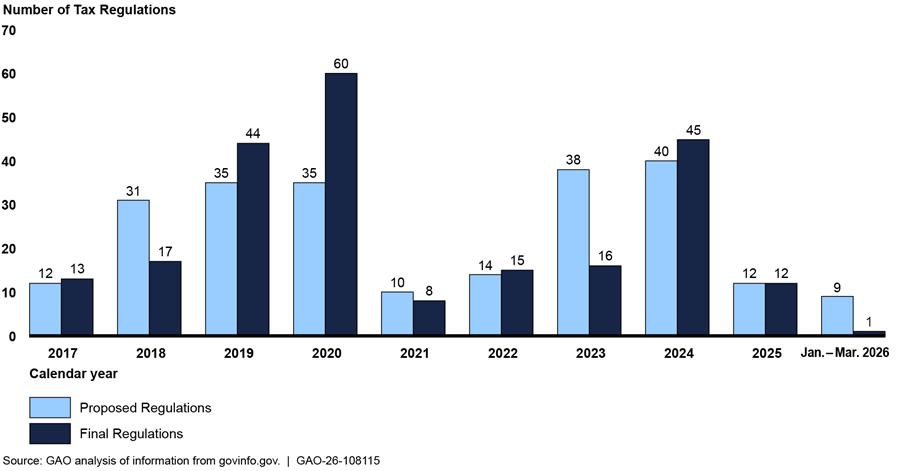
Notes: Regulations proposed or finalized by the outgoing administration from January 1 through 20 are included in the prior-year totals for 2020 and 2024. The number of proposed rules and final rules within a given year can vary, in part, because counts can include final regulations that were proposed in previous years. Temporary regulations were included in the count of final regulations. Counts do not include documents correcting proposed or final regulations; announcing regulatory hearings; extending comment periods; or withdrawing rules.
Many of these regulations implemented tax law changes Congress made in 2017, 2022, and 2025. According to agency documents, Treasury and IRS published:[23]
· 70 proposed regulations and 65 final regulations to implement the Tax Cuts and Jobs Act of 2017 (TCJA),[24]
· 23 proposed regulations and 14 final regulations to implement the Inflation Reduction Act of 2022 (IRA),[25] and
· four proposed regulations to implement the One Big Beautiful Bill Act (OBBBA) as of February 2026. Treasury and IRS are planning to propose 30 additional regulations to implement this law. We identified one final regulation and one temporary regulation published in the Federal Register implementing OBBBA provisions as of May 19, 2026.[26]
We found that by identifying regulations needed to implement tax law changes IRS met the internal control principle that management should identify, analyze, and respond to significant changes, including external changes such as changes in the legal environment.[27]
Treasury and IRS Consider Public Input When Prioritizing the Development of New Regulations
Treasury’s and IRS’s annual Priority Guidance Plan (PGP) considers public input from taxpayers, tax practitioners, and a review of recently enacted laws to identify and prioritize the development of regulations and guidance. Between 2017 and 2025, IRS received 544 public comments suggesting regulatory or guidance priorities. After considering public comments and other considerations, Treasury and IRS identified 105 regulatory and guidance projects in the 2025-2026 PGP to which the agency would allocate resources between July 2025 and June 2026, in areas such as OBBBA implementation, deregulation and burden reduction, and other areas such as digital assets.[28] The PGP does not specify a deadline for completing these projects.
Public engagement was high for all PGPs reviewed from 2017 to 2025 with IRS receiving between 51 and 105 public comments for the PGPs reviewed.[29] We analyzed comments suggesting regulations and guidance for possible inclusion in the 2025-2026 PGP using a large language model and determined five specific areas of concern:
· Enhancing housing affordability and tenant protections
· Facilitating renewable energy investments and clean technology
· Modernizing retirement account rules and administration
· Addressing taxation of digital assets and financial products
· Clarifying employee benefit and insurance regulations
Treasury and IRS identified regulatory and guidance projects in the 2025-2026 PGP which addressed the five themes we identified in public comments. Treasury and IRS identified additional regulatory priorities, such as implementing the OBBBA.
IRS has improved the coordination and development of regulations with the National Taxpayer Advocate (NTA), who heads the Taxpayer Advocate Service (TAS) which is an independent organization within IRS. The NTA reported that in response to prior concerns IRS’s Office of Chief Counsel now shares advance copies of certain draft regulations with TAS staff for review. TAS provided input on the PGP, such as suggesting guidance for taxpayers on deducting losses due to fraud or theft. While the 2025-2026 PGP did not describe planned regulations or guidance in this area, TAS staff noted that IRS’s Office of Chief Counsel issued a memorandum providing advice that TAS shared with the public in an April 2025 blog post.[30]
After Treasury and IRS determine that a tax regulation is needed, agency employees must follow rulemaking procedures contained in the Internal Revenue Manual’s regulation handbook as summarized in figure 2. IRS forms a drafting team consisting of Treasury and IRS officials to develop the regulation. The drafting team must follow administrative law. For example, officials must compile public comments on proposed regulations in a docket to address APA requirements, when notice-and-comment procedures are used.[31] The regulation handbook also provides templates and examples for officials to use. Providing clear guidance to agency officials on how to comply with specific legal requirements is consistent with the internal control principle that management should communicate relevant and quality information to employees, including objectives and responsibilities.[32]
Figure 2: How the Department of the Treasury and the Internal Revenue Service (IRS) Develop Tax Regulations
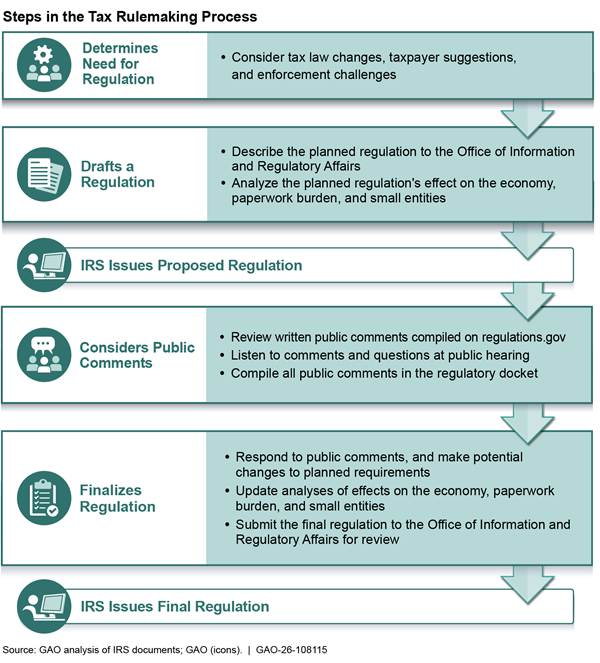
Notes: Not all steps apply to all rulemakings. Treasury also works with IRS to develop tax regulations.
Significant Tax Regulations Now Require Additional Analysis and Review by OIRA
IRS modified the regulation handbook in 2019 to require additional information about significant tax regulations to be submitted for OIRA review.[33] This was consistent with a 2018 interagency agreement between Treasury and OIRA that established substantive OIRA review of significant tax regulations. Treasury and IRS have had a long-standing requirement to inform OIRA of regulatory actions by drafting a “7-point memo” providing context for each planned regulation, summarizing the content of the regulation, and explaining the significance of the regulation using criteria from EO 12866, such as whether the regulation is expected to be economically significant. We reviewed three examples of memorandums Treasury and IRS submitted to OIRA. In them, the agency stated that it believed that two planned regulations would be significant: a planned regulation on reporting cryptocurrency transactions and another planned regulation concerning government agencies reporting to IRS on fines and restitution paid by businesses.[34] IRS requires these memorandums to be submitted to OIRA as early as possible when officials are drafting regulations.
EO 12866 states that agencies must provide OIRA with the text of planned significant regulatory actions, a description of the need for the regulatory action and an explanation of how the regulatory action will meet that need, an assessment of the potential costs and benefits of the regulatory action, and additional information for economically significant regulations. While the regulation handbook does not prescribe how Treasury and IRS should assess the costs and benefits of significant regulations, Treasury officials told us that economists from the Office of Tax Policy are assigned to regulatory projects for which economic analysis is required. They also said that officials from IRS’s Research, Applied Analytics and Statistics division may assist with tasks, such as by preparing a taxpayer profile to inform the discussions about complex regulations when feasible. Agency officials told us that they determine if a regulation must be submitted to OIRA by considering the type of taxpayer and entities affected by the regulation and the reporting, recordkeeping, and disclosure burdens on affected taxpayers compared to existing requirements to determine whether it is significant under EO 12866.
Treasury and OIRA agreed in 2018 and 2025 that OIRA would generally complete its review of tax regulations within 45 days of Treasury and IRS submitting the information required by EO 12866. However, under certain circumstances, OIRA review may be expedited. Treasury and OIRA agreed that regulations implementing TCJA and the OBBBA would be reviewed within 10 business days. These time frames are faster than the 90 calendar-day time frame for other agencies’ regulations to be reviewed by OIRA under EO 12866.[35]
OIRA met the agreed upon time frames for reviewing more than half of the 107 tax regulations that Treasury and IRS submitted between January 2017 and March 2026. OIRA’s review of proposed tax regulations took a median of 34 days. Reviews of individual proposed rules ranged from zero to 130 days. OIRA’s review of final tax regulations took a median of 21 days. Reviews of individual final rules ranged from 4 to 129 days. OIRA conducted most of its reviews between 2018 and 2020, which was during the period when OIRA review was first required as shown in figure 3. In June 2023, Treasury and IRS were no longer required to submit tax regulations and supporting regulatory analyses for OIRA review. That decision was reversed in July 2025. However, OIRA reviewed few tax regulations in 2025 and the first quarter of 2026 because overall regulatory activity was down following the presidential transition and OIRA review of tax regulations resumed in July 2025.
Figure 3: Office of Information and Regulatory Affairs’ Review of Significant Tax Regulations, January 21, 2017–March 31, 2026
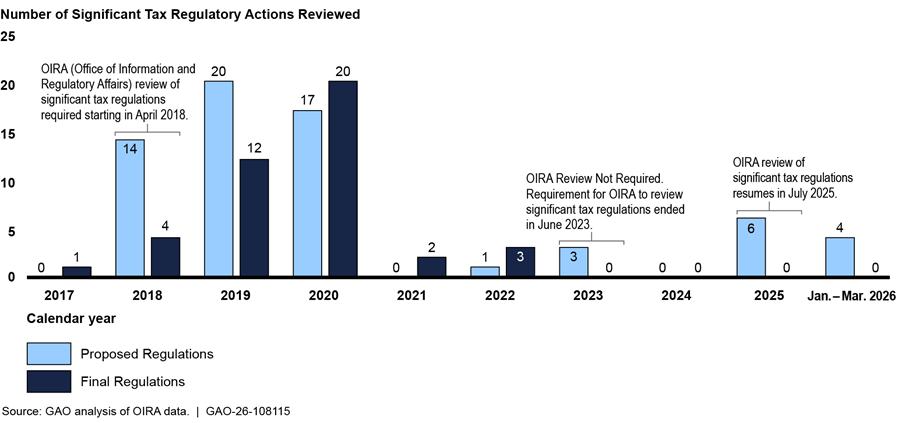
Notes: Regulations reviewed by OIRA following presidential transition periods from January 1 through 20 are included in the prior-year totals for 2020 and 2024. Regulations reviewed for 2017 are from January 21 through December 31.
Treasury and IRS officials said that OIRA review can add time to the regulatory process. They noted that for economically significant regulations and technically complex regulations, they often provide preview briefings for OIRA staff prior to the official regulation submission. Agency officials did not have data tracking the time required to prepare or conduct these briefings. Reginfo.gov states that there were 28 economically significant final Treasury and IRS regulations reviewed by OIRA and published in the Federal Register between January 21, 2017, and March 31, 2026.
External stakeholders provided different perspectives on whether they thought OIRA review had improved the quality of tax regulations. One perspective is that there has been no increase in the quality of regulations and that OIRA review delays the regulations.[36] Other stakeholders had a different perspective and suggested that OIRA review may improve the quality of tax regulations. Their analysis found that tax regulations reviewed by OIRA contained a higher word count, on average, in the regulatory preamble than those tax regulations not reviewed by OIRA. The stakeholders believe that this supports a conclusion that OIRA review has likely resulted in more explanation and transparency for the public on how Treasury and IRS made regulatory decisions.[37]
IRS Officials Reassess Rulemaking Procedures as Legal Environment Evolves
IRS officials said they intend to update rulemaking procedures in response to two recent changes in the legal environment: a shift in taxpayers challenging tax regulations and the Supreme Court’s Loper Bright decision.[38] First, Treasury and IRS officials said they have noted an increase in taxpayers challenging tax regulations in court over the past 10 years with taxpayers more likely to challenge older tax regulations. Agency officials said that some taxpayers have argued that tax regulations should be overturned because public comments were not sufficiently addressed. The officials said they have added explanations to the preamble of new final regulations to describe how the agency addressed public comments. IRS officials told us in March 2026 that they are updating the regulation handbook to reflect recent developments in administrative jurisprudence, but do not have a time frame for completing these updates.
Second, in October 2024, IRS’s Chief Counsel issued guidance following the Supreme Court’s June 2024 decision in the Loper Bright case, which required courts to exercise their independent judgment in deciding whether an agency acted within its statutory authority in rulemaking. The Counsel’s memorandum states that courts will likely focus on whether Congress gave the agency authority to issue specific regulations. The memorandum also states that courts will likely assess agencies’ compliance with APA requirements, including reasoned decision-making. Thus, IRS directs attorneys to ground regulations in statutory text and specific delegations of authority; avoid relying solely on ambiguity in tax laws; clearly explain policy rationales and changes in position; and meaningfully respond to public comments.
Treasury and IRS Could Improve the Usefulness of Regulatory Economic Analyses
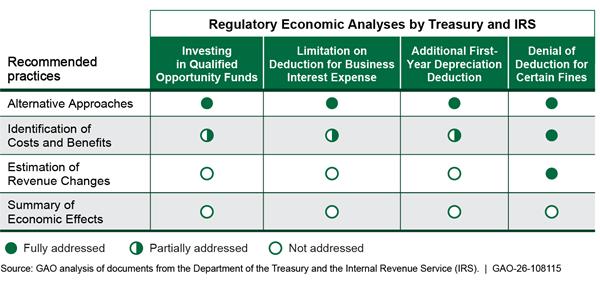
Our review of four tax regulations found that Treasury and IRS used some of OMB’s recommended practices for economic analysis more consistently than others, as shown in figure 4.[39] The agency issued the four regulations in 2020 and 2021 to implement TCJA provisions when the EO 12866 economic analysis requirements were in effect and OIRA designated the four regulations as economically significant.[40] Further, Treasury officials told us that these four economic analyses were the most relevant examples in selecting alternative regulatory designs.
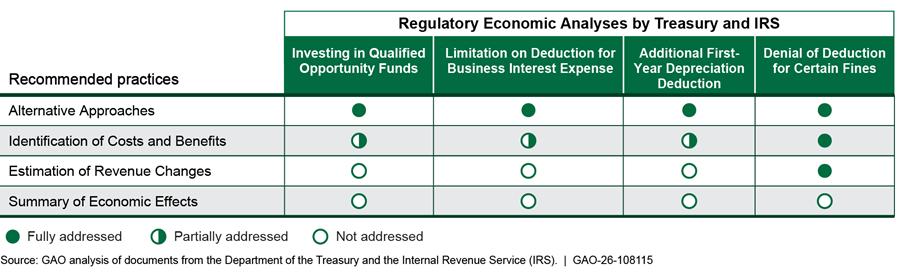
Note: The final regulations issued were: Investing in Qualified Opportunity Funds, 85 Fed. Reg. 1866 (Jan. 13. 2020); Limitation on Deduction for Business Interest Expense, 85 Fed. Reg. 56686 (Sept. 14, 2020); Additional First-Year Depreciation Deduction, 85 Fed. Reg. 71734 (Nov. 10, 2020); and Denial of Deduction for Certain Fines, 86 Fed. Reg. 4970 (Jan. 19, 2021).
Alternative Approaches. Treasury and IRS fully addressed this recommended practice by analyzing alternative ways to design the four regulations we reviewed. The agency’s analysis of alternatives resulted in regulatory decisions that made it easier for taxpayers to claim new benefits TCJA established.
· Investing in Qualified Opportunity Funds – Fully Addressed: The final rule stated that capital losses would not offset capital gains for taxpayers calculating a tax deferral. This was a change from the alternative approach described in the proposed rule in which losses would be required to offset gains.[41] If a taxpayer sold two properties and gained $1 million from one property and lost $300,000 from the other property, the taxpayer could defer $1 million under the final rule compared to $700,000 under the proposed rule.
· Limitation on Deduction for Business Interest Expense – Fully Addressed: Treasury and IRS considered two alternatives: changing through regulation how certain businesses calculated adjustable taxable income—the option adopted in the final rule—or not making regulatory adjustments.[42]
· Additional First-Year Depreciation Deduction – Fully Addressed: Treasury and IRS considered two alternatives: prohibiting businesses which had interest expenses exceeding a threshold from ever claiming bonus depreciation and making this determination annually. The latter option was adopted in the final rule.[43]
· Denial of Deduction for Certain Fines – Fully Addressed: Treasury and IRS considered alternative dollar thresholds for a reporting requirement.[44] The final rule set the threshold at $50,000.
Identification of Costs and Benefits. Treasury’s and IRS’s economic analyses partially addressed this recommended practice for three of the four regulations. The economic analyses lacked specific estimates of the anticipated costs and benefits for the three regulations. Treasury and IRS fully addressed the recommended practice for the fourth regulation which concerned the denial of the deduction for certain business fines.
Investing in Qualified Opportunity Funds – Partially Addressed: Treasury and IRS stated that they did not attempt to quantify any changes in business activity due to the final regulation because of lack of a data and economic models to do so. However, the economic analysis described relevant data IRS collected for tax year 2018 from Qualified Opportunity Funds. IRS and Treasury used this preliminary data to estimate that 6,000 to 15,000 businesses and between 55,000 to 120,000 investors would be affected by the regulation.[45] Estimating the number of businesses and investors affected could help begin to quantify changes in business activity. Treasury and IRS also stated that the alternative selected of not requiring capital losses to offset capital gains would expand the capital gains eligible for deferral. Circular A-4 states that Congress established some regulatory programs to redistribute resources to select groups, which relates to this regulation for opportunity funds. Circular A-4 recommends that agencies examine such regulations to ensure they are effective. For example, we described above how Treasury and IRS selected an alternative regulatory design that made the tax deferral more valuable for taxpayers, but there was no analysis of how this decision may affect investment in economically distressed communities.
Limitation on Deduction for Business Interest Expense – Partially Addressed: Treasury and IRS did not estimate the changes in business activity due to this regulation. However, the analysis projected annual economic effects of more than $100 million based on data which showed interest deductions for corporations, partnerships, and sole proprietorships totaling approximately $800 billion in tax year 2013. The regulatory economic analysis also cited a study which found that business investment is responsive to effective tax rates, one component of which is the deductibility of interest expenses.
Additional First-Year Depreciation Deduction – Partially Addressed: Treasury and IRS estimated that one regulatory alternative they selected would cause investment to increase by approximately $25 million annually between 2019 and 2028 in businesses such as motor vehicle dealerships.[46] As described above, Treasury and IRS determined that these businesses could claim bonus depreciation if their interest expenses remained below a specified threshold for a given tax year. However, Treasury and IRS stated that investment in other industries would be reduced, which relates to undesirable side effects that Circular A-4 states may occur due to regulations. Treasury and IRS do not quantify how much investment may decrease in other industries.
Denial of Deduction for Certain Fines – Fully Addressed: We determined that Treasury and IRS fully addressed this recommended practice for this regulation because they estimated that government agencies would save $74 million per year (in 2018 dollars) due to the decision to require fines of $50,000 or more to be reported to IRS. For this regulation, Treasury and IRS used their regulatory discretion to lower costs for government agencies by not requiring smaller dollar fines to be reported. Saving agencies money and time spent on paperwork is an example of reducing the economic cost regulations may impose. While Circular A-4 recommends that agencies analyze potential undesirable side effects, Treasury and IRS state in the final regulation that they do not anticipate a significant effect on tax revenue because they believe fines of more than $50,000 account for most fines.
Treasury and IRS officials stated that in general they are unable to quantify the benefits or costs of tax regulations due to lack of data or economic models. The officials’ concern about limited data applies to the regulations we reviewed for this report and additional regulations reviewed in prior reports. We heard similar concerns in 2021 when we reviewed Treasury’s and IRS’s efforts to develop regulations implementing TCJA tax provisions. For our prior report, Treasury and IRS officials stated that it was not feasible to quantify the costs and benefits of regulations implementing changes in how international business income is taxed because of the novelty of the tax law provisions and little data available.[47] The officials told us that they were expecting IRS to begin receiving relevant data at a later time. We recommended that relevant data be used to develop quantitative estimates of the benefits and costs for future regulations related to TCJA’s international provisions. While Treasury and IRS generally agreed with the goal of this recommendation, as of July 2025 they had made little progress in addressing the recommendation even as more data has become available and the agency gains experience administering the tax law changes stemming from TCJA. Our analysis for the four selected regulations in this report shows that Treasury and IRS provided little specific analysis of the costs and benefits for three of the four additional tax regulations we reviewed which implemented additional TCJA tax law changes, such as related to business interest expenses and depreciation which are areas of tax law that Treasury and IRS have more experience administering prior to TCJA.
Estimation of Revenue Changes. Treasury and IRS fully addressed this recommended practice for one of the four regulations we reviewed—Denial of Deduction for Certain Fines. Treasury and IRS did not address this recommended practice for the other three regulations: Investing in Qualified Opportunity Funds, Limitation on Deduction for Business Interest Expense, and Additional First-Year Depreciation Deduction. These three regulations made the tax benefits available to additional taxpayers, but there was no analysis of how this would affect tax revenue.
Treasury officials told us that they generally do not estimate the revenue effects of tax regulatory decisions. However, our review found historical precedent for estimating revenue effects when Treasury and IRS make regulatory decisions. We also found that estimating revenue effects is consistent with OMB’s recommended practices. In December 2020, Treasury and OIRA agreed that regulatory analyses would account for revenue effects.[48] Treasury officials told us in May 2026 that the requirement to estimate revenue effects was not reinstated in 2025 when EO 12866 economic analysis requirements were reinstated. However, our review of OMB’s Circular A-4 found that it remains a recommended practice for agencies to describe distributional effects which are how the regulation affects different groups within the economy and society, including changes in revenue. Treasury officials told us that they only know of two examples in which the agency estimated revenue or spending changes due to regulatory decisions:
· Treasury and IRS collaborated with two other agencies on a rule which took effect in 2019 expanding access to health reimbursement arrangements which was estimated to reduce income and payroll tax revenue by $51 billion over 10 years.[49]
· A final rule which took effect in 2022 expanding eligibility for the premium tax credit. This rule was expected to provide subsidized coverage for approximately 1 million individuals and increase the federal deficit by an average of $3.8 billion per year over 10 years.[50]
Some stakeholders we spoke with told us that economic analyses for tax regulations would be more useful if effects on revenues were considered. They suggested three core elements for economic analysis: (1) how regulatory decisions may affect revenues; (2) how regulatory decisions may change the tax burden referred to as distributional analysis; and (3) how regulatory decisions may affect the compliance burden for taxpayers.[51] They stated in their publication and reiterated in the discussion that their recommended approach should focus on analyzing regulatory alternatives where Treasury and IRS exercise substantial discretion and would fulfill the requirements for cost benefit analysis established by EO 12866. The publication also described their recommended analytical approach as consistent with Circular A-4 in that Treasury and IRS would identify the revenues and costs anticipated to result from tax regulations. However, the publication stated that other guidance in Circular A-4 may not help describe the economic tradeoffs of tax regulations because the guidance states that revenue collected through taxes should be reported as transfer payments and not included in economic costs or benefits. The publication expressed concern that this may make it more difficult to establish regulations that raise revenue to fund the government. As noted above, our review found that Treasury and IRS had not estimated the revenue effects of three of four regulations reviewed. Another stakeholder expressed concern that Treasury and IRS may write regulations that reduce revenue because taxpayers adversely affected by a regulation are generally the only individuals who have standing to sue the government.[52] In general, taxpayers only have standing to challenge a tax rule in federal court if they can show they were injured in a specific and concrete way, such as owing more in taxes.[53]
Circular A-4 states that regulations may have differential distributional effects across the population and economy, including changes in taxes, and the regulatory analysis should provide a separate description of distributional effects. Treasury officials stated that they make regular revisions to their projections of federal tax receipts to account for changes in economic conditions and updated data from tax returns. The officials stated that changes in revenue due to regulatory decisions are included in projections of tax receipts. However, they expressed concern about trying to separate the effect of regulatory decisions from other factors. Agency officials also noted that the 2018 agreement with OIRA refers to non-revenue effects for determining whether a tax regulation is economically significant and subject to additional analytical requirements. However, the interagency agreement does not prohibit Treasury and IRS from estimating revenue effects if doing so could inform regulatory decisions. Further, Treasury had previously agreed in 2020 to estimate revenue effects and doing so is consistent with a recommended practice from OMB’s Circular A-4.
We heard similar concerns during a 2020 review evaluating Treasury’s and IRS’s efforts to implement other changes TCJA made to how business income is taxed.[54] For the prior report, we found that Treasury’s analyses generally did not assess the distributional effects, including effects on tax revenue collection, of regulatory decisions. We recommended in 2020 that Treasury’s internal guidance be updated to ensure that analyses examine the distributional effects of revenue changes when regulations influence tax liability. While Treasury officials did not comment on the recommendation we made in 2020, they generally disagreed with the report’s findings regarding economic analyses and noted that in their view the agreement with OIRA requires analysis to focus on non-revenue effects. Treasury officials reiterated for this report their view that they are not required to analyze revenue effects and expressed concern about the time required to conduct a distributional analysis. Treasury had not addressed this recommendation as of May 2026.
Our review focused on a more specific challenge that Treasury and IRS continue to face, which is the absence of revenue estimates to inform selection of regulatory alternatives. External stakeholders we interviewed for this report suggested that Treasury and IRS could make the economic analyses more useful by analyzing revenue effects for regulatory alternatives where Treasury and IRS exercise substantial discretion. Our review found that Treasury and IRS are selecting regulatory alternatives that made tax benefits more widely available and thus may diminish federal revenues.
Summary of Economic Effects. Treasury and IRS did not address this recommended practice for the four regulations reviewed. Circular A-4 recommends that agencies prepare an accounting statement with tables reporting benefit and cost estimates for each major final rule and provides an example of such a table. Treasury and IRS officials said they do not prepare these tables for tax regulations. As Treasury and IRS continue to improve economic analyses for tax regulations, summarizing benefit and cost estimates in an accounting statement would help communicate key points to external audiences.
IRS Could Better Leverage Technology to Facilitate Greater Public Participation in Rulemaking
The Public Generally Has Opportunities to Comment on Proposed Tax Regulations
Treasury and IRS used notice-and-comment procedures for all 10 proposed regulations we randomly selected from 231 tax regulations proposed between January 21, 2017, and February 28, 2026. IRS’s regulation handbook states that it will publish a notice of proposed rulemaking in the Federal Register informing the public of a planned regulation, inviting comments on the proposed rule, and will issue a final regulation after considering public comments submitted on regulations.gov.[55] Public comments received by Treasury and IRS for these 10 regulations ranged from 11,050 for one regulation to five or fewer for four regulations as shown in table 1.[56] The agency provided a median time of 61.5 days for the public to comment on the selected proposed regulations. While IRS officials did not have data on how often notice-and-comment procedures are used, they stated that the agency generally does so.
Treasury and IRS also issued a temporary regulation concurrent with proposing a regulation concerning religious exemptions and accommodations for coverage of certain preventive services under the Affordable Care Act. IRS’s regulation handbook states that temporary regulations may be issued without notice and comment to provide immediate guidance; however, the agency must also publish concurrently a proposed regulation, following the notice-and-comment procedures. Temporary tax regulations expire after 3 years.[57]
Table 1: Examples of Public Comment Opportunities on Selected Tax Regulations Proposed Between January 21, 2017, and February 28, 2026
|
Regulation Title |
Public Comment Period Length (Days) |
Number of Comments Received |
|
||
|
Electing Small Business Trusts With Nonresident Aliens as Potential Current Beneficiaries (84 Fed. Reg. 16415 (Apr. 19, 2019)) |
46 |
1 |
|
||
|
Exclusion of Foreign Currency Gain or Loss Related to Business Needs from Foreign Personal Holding Company Income; Mark-to-Market Method of Accounting for Section 988 Transactions (82 Fed. Reg. 60135 (Dec. 19, 2017)) |
91 |
2a |
|
||
|
Taxable Year of Income Inclusion Under an Accrual Method of Accounting (84 Fed. Reg. 47191 (Sept. 9, 2019)) |
61 |
11a |
|
||
|
Previously Taxed Earnings and Profits and Related Basis Adjustments (89 Fed. Reg. 95362 (Dec. 2, 2024)) |
92 |
16a |
|
||
|
Religious Exemptions and Accommodations for Coverage of Certain Preventive Services Under the Affordable Care Act; Proposed Rulemakingc (82 Fed. Reg. 47658 (Oct. 13, 2017)) |
54 |
11,050a,b |
|
||
|
Section 30D New Clean Vehicle Credit (88 Fed. Reg. 23370 (Apr. 17, 2023)) |
61 |
91a |
|||
|
Multiple Employer Plans (84 Fed. Reg. 31777 (July 3, 2019)) |
91 |
25 |
|||
|
Determination of the Maximum Value of a Vehicle for Use with the Fleet-Average and Vehicle Cents-per-Mile Valuation Rules (84 Fed. Reg. 44258 (Aug. 23, 2019)) |
61 |
0 |
|||
|
Investing in Qualified Opportunity Funds (84 Fed. Reg. 18652 (May 1, 2019)) |
62 |
129 |
|||
|
Accounting for Disregarded Transactions Between a Qualified Business Unit and Its Owner (89 Fed. Reg. 99782 (Dec.11, 2024)) |
91 |
5a |
|||
Source: GAO analysis of Treasury and IRS rules published in the Federal Register and information from regulations.gov. | GAO‑26‑108115
aThe public continues to be able to submit comments for these proposed regulations on regulations.gov as of March 12, 2026.
bTreasury and the Internal Revenue Service (IRS) proposed this rule with two other federal agencies and the comments counted in this table are in the IRS docket for this proposed rule on regulations.gov.
cThe notice of proposed rulemaking also referred to temporary regulations with the public invited to comment on whether the requirements should be made permanent.
To finalize a regulation, Treasury and IRS consider public comments and may make changes to the requirements or regulatory analyses. The APA requires agencies to consider all relevant matters presented in comments; however, the APA does not require the agency to make changes in response to every comment. The regulation handbook states that the agency will summarize comments received in the final rule and specify the comments the agency found persuasive, and others that were not, in issuing the final regulations.[58] IRS officials told us they do not have any more detailed guidance because the regulation handbook was designed to be flexible in this area. IRS officials told us that they believe the public comment process generally functions well under the framework of the APA.
While IRS updated one section of the regulation handbook to describe notice-and-comment procedures, IRS officials told us in February 2026 that they intend to update another section of the regulation handbook to state that most tax regulations are legislative rules that under the APA generally require notice-and-comment procedures to be used. IRS officials define legislative rules as having the force and effect of law, imposing rights or duties or changing the status of regulated parties, and being issued under authority delegated by the Internal Revenue Code (or other statutory provisions). While the handbook continues to state that APA notice-and-comment procedures do not apply to most tax regulations, IRS officials told us that they plan to update the handbook because they no longer view the legal distinction between interpretative and legislative rules to be informative when issuing regulations.[59]
Treasury and IRS Risk Not Being Prepared to Address Voluminous Public Comments on Future Tax Regulations
IRS officials identified two emerging challenges related to mass mail campaigns and AI. They said mass mail campaigns create workload challenges because officials must review large volumes of identical or near-duplicate comments. Agency officials also reported that members of the public used AI to write comments responding to one proposed regulation on digital asset transactions, which increased the number of comments and workload challenges. IRS officials noted that AI writes different comments for each person, even if they are making the same point. The regulation handbook establishes procedures related to public comments.[60] Thus, we will focus on IRS procedures in this section of the report.
The Administrative Conference of the United States (ACUS) states that organizations may encourage many individuals or groups to submit comments to the agency on a proposed regulation or allow the organization(s) to submit comments in their names in a mass mail campaign.[61] ACUS also defined computer-generated comments in 2021 as those that are generated by a software algorithm, thus replacing both human content generation and human interaction with the agency. Since ACUS issued the report, members of the public have access to AI writing aids.
IRS’s regulation handbook does not discuss mass mail campaigns or AI. Agency officials told us that they do not have a formal definition or numeric threshold for determining when they have received mass comments. Agency officials also noted that the legal obligations under the APA remain the same regardless of the number of comments. Agency officials did not characterize the 10 proposed regulations we randomly selected for review as having received an unusually large volume of public comments. However, agency officials provided two other examples of proposed regulations that the public submitted many comments on:
· A proposed regulation in August 2023 concerning digital asset transactions has 44,821 comments posted to regulations.gov.[62]
· A proposed regulation in December 2023 concerning a tax credit for the production of clean hydrogen established by the Inflation Reduction Act of 2022 has 29,989 comments posted to regulations.gov.[63]
IRS officials noted that some commenters on the proposed rule on digital asset transactions reported using AI to write comments. We confirmed that some commenters reported using AI. We also identified other public comments that expressed concerns that the agency had been “spammed” with AI-written submissions that would make it more difficult for their concerns to be heard. IRS officials said that interest groups encouraged mass comments on the proposed clean hydrogen rule by providing templates for their members to use in writing comments. Treasury and IRS officials told us that the number of comments received for these proposed regulations did not substantially alter the agency’s time frames for completing the regulations. The officials said they had sufficient staff at the time to address public comments and finalize the two regulations. Treasury and IRS issued the final regulation concerning digital asset transactions in July and December 2024.[64] In March 2025, Congress passed a resolution disapproving the rule under the Congressional Review Act, which was signed by the President in April 2025, meaning that the final rule has no legal force or effect.[65] Treasury and IRS issued the final regulation on clean hydrogen production in January 2025.[66]
To address challenges with mass mail campaigns, IRS has litigation-support software to identify duplicative or near-duplicative public comments for proposed regulations for which the agency anticipates litigation. We found this software helped IRS identify duplicative comments for the proposed digital asset transactions rule and helped categorize comments, such as how responsive a comment was to the proposed rule. However, IRS seldom uses the software. IRS officials said they used the software to analyze public comments submitted for approximately five proposed tax regulations. IRS officials told us that even for regulations for which litigation is anticipated, they sometimes consider the software to be less efficient than manual processes for reviewing comments because it takes time to upload comments and set up accounts for officials.
Concerning AI, IRS officials in the Office of Chief Counsel told us in February 2026 that there has been discussion by other IRS offices of potentially developing AI technology tools to help analyze public comments on proposed regulations. IRS officials in the Office of Chief Counsel told us they would need to assess whether AI analysis of public comments would meet APA requirements. The officials stated that unique comments—whether generated by AI or not—must be considered and addressed when finalizing regulations. We found that IRS does not have AI technology tools to analyze public regulatory comments even if IRS determined that doing so met legal requirements. For example, we reviewed an inventory of IRS AI systems (as of January 2026) and found no AI system for analyzing tax regulatory comments. The litigation support software described above does not have AI capabilities, according to the contract we reviewed.
IRS partially addressed recommended practices ACUS identified for how regulatory agencies should handle mass comments. IRS used de-duplication tools provided in its litigation support software, which ACUS stated may save time. [67]
ACUS recommends that agencies consider posting only a single representative example of identical comments in the online rulemaking docket or, alternatively, that they separately report the total number of identical or substantively identical comments if agency resources permit. This could potentially help address public concerns that the agency is being “spammed,” including by AI-written comments, that may not reflect distinct viewpoints or independently submitted feedback.
To address computer-generated comments, ACUS recommends that agencies flag such comments, although ACUS’s 2021 report was written before members of the public had routine access to AI. IRS officials stated in January 2026 that they have no means for identifying comments that were written with the help of AI. IRS does not have policies for addressing either mass comments or comments written with AI. Without such a policy, Treasury and IRS risk being underprepared for mass public engagement on future proposed tax regulations.
IRS Does Not Use Available Technology to Make Regulatory Hearings More Accessible to the Public
IRS offers taxpayers and members of the public an additional opportunity to comment on proposed regulations at public hearings. The regulation handbook establishes procedures for conducting public hearings and states that a notice of proposed rulemaking will generally announce the date of a public hearing or inform the public that a hearing will be scheduled if a person requests a hearing.[68] IRS records show that 80 regulatory hearings were held between March 2017 and February 2026. While Treasury officials also participated in the hearings, we evaluated IRS policies for conducting and documenting the hearings.
We observed IRS and Treasury officials engaged in listening to the perspectives of two members of the public who spoke at a regulatory hearing held in Washington, D.C., in July 2025. The hearing was on a proposed regulation made in January 2025 to determine the source of income from cloud transactions. Five IRS and Treasury officials who conducted the hearing took notes and asked questions to understand the perspectives of the two individuals who spoke better.[69] For example, one speaker raised concerns that the proposed regulation could affect other areas of taxation, such as concerning real estate investment trusts. The hearing allowed agency officials to ask follow-up questions to understand the person’s concerns better. IRS’s senior technical reviewer stated that the person’s response to her questions had been helpful.
We observed that the technology used by IRS for regulatory hearings made virtual participation more difficult than readily-available alternatives. IRS conducts in-person hearings at the agency’s headquarters in Washington, D.C., with an audio-only phone connection for remote participants.[70] Neither speaker at the hearing we observed came to IRS headquarters. One speaker said he wanted to speak in person, but experienced travel delays. The limitations of audio-only technology became clear at the hearing we observed as it was not possible to show the section of the proposed regulation the speaker had questions about. While we observed effective communication between agency officials and the speakers at the hearing, there exists the risk that speakers or agency officials do not recognize non-verbal cues, such as when a person may not be following the discussion.
IRS officials told us that they do not intend to use videoconferencing technology for conducting regulatory hearings. IRS officials stated that agency security policies prohibit photography within IRS facilities, which includes videoconferencing platforms if users can record images or make recordings.[71] IRS officials did not elaborate on their specific security concerns and we observed no sensitive information visible in the IRS headquarters’ auditorium, where the regulatory hearing was held. IRS’s policy also states that agency officials can ask for an exception to these policies which would allow videoconferencing to be used, but IRS officials told us they have not done so. Rather, IRS officials told us that they do not intend to use videoconferencing platforms for regulatory hearings. In their view, videoconferencing would provide limited benefits to the rulemaking process. They told us in March 2026 that they are considering changing the regulation handbook to reflect current practices of telephonic participation in regulatory hearings.
IRS procedures are not fully consistent with ACUS recommendations. In a 2023 report, ACUS recommended that agencies hold public rulemaking engagements when it would be beneficial to do so.[72] While IRS procedures are consistent with this recommendation because the agency will hold a hearing if a person requests one, IRS does not fully address other ACUS recommendations. For example, ACUS recommends that agencies address barriers to participation, including geographical constraints. IRS partially addresses this constraint by providing a phone connection for those who are not able or do not wish to travel to Washington, D.C. However, the phone connection does not eliminate other geographical barriers, such as allowing the person on the phone to see non-verbal communication to ensure that officials are following the arguments. It also means that all participants in the hearing, whether attending in person in Washington, D.C., or dialing in, cannot benefit from seeing relevant portions of the proposed regulation under discussion. Furthermore, ACUS reported that videoconferencing technology can expand opportunities for public engagement in agency rulemaking by helping reach participants beyond the Washington, D.C. area. ACUS also suggested agencies select virtual meeting platforms that are accessible on mobile devices, provide dial-in options for participants without reliable internet access, and test different platforms to select the one which best meets their needs and those needs of the public, such as controlling the content attendees can see during a meeting.[73] These recommendations would help address IRS’s security concerns because agency officials could test different videoconferencing platforms to ensure that members of the public can only see authorized content during public hearings on proposed regulations.
The ACUS report also recommended that agencies record or transcribe any public rulemaking engagement that takes place after an agency proposes a rule and that agencies make the record available in the docket. The ACUS report states that while not all agencies are required by the law to record or transcribe public rulemaking engagements, agencies should provide a high-level summary of the meeting in the interest of transparency. However, the IRS documentation requirements for public hearings are more limited. The regulation handbook requires the agenda for the hearing, summary of written comments the agency has received during the public comment period, and written comments and outlines of the topics speakers plan to cover to be added to the legal file for the proposed regulation.[74] IRS regulations require those who sign up to speak at an IRS regulatory hearing to submit an outline of the topics the person will discuss.[75] There is no requirement that agency officials document the specific comments of the person speaking or dialogue that may occur as agency officials ask questions and the person responds.
At the hearing we observed, agency officials listened to the speakers and took notes. We also found that a media organization prepared a transcript of the discussion, although IRS officials told us that they have found errors in media transcripts of past hearings. IRS officials told us they do not record or transcribe the hearings and noted that transcriptions are not required under the APA.
While video conferencing technology can also help prepare transcripts, IRS officials believe that using this technology is inconsistent with agency security policies. They also encourage people who speak at a hearing to submit their comments on regulations.gov. However, this presents risks that important comments may inadvertently be lost. Specifically, IRS policy presumes that members of the public who speak at a hearing will also submit written comments through regulations.gov. However, not all members of the public are familiar with IRS rulemaking procedures and may believe that speaking to a panel of agency officials is sufficient. Furthermore, regulations.gov allows anonymous comments, making it potentially difficult to link a person who spoke at a hearing to written comments submitted on the site. Modern video conferencing tools could help IRS address these challenges. As noted above, an ACUS report recommends recording or transcribing all public rulemaking engagements that take place after an agency proposes a rule and making the record available in the docket.[76] Doing so would allow IRS officials to go back after a hearing and review important points members of the public raised. Without using modern videoconferencing software to supplement in person hearings, IRS risks making it more difficult for perspectives from across the country to be considered in rulemaking and increases the risk that important concerns could be lost.
Recent Court Decisions Have Increased Judicial Scrutiny of Tax Regulations and Made Addressing Public Comments More Important
One perspective we heard is that the Loper Bright decision may increase litigation risk or affect how IRS issues guidance, including potentially encouraging more cautious or procedurally robust rulemaking, for example by issuing longer and more detailed preambles or relying more on informal guidance.[77] Another perspective we heard is that the effect of Loper Bright would vary among different tax regulations depending on the statutory authority underlying a regulation. For example, stakeholders noted that Congress expressly delegated regulatory authority to IRS in certain areas, which may make those regulations less vulnerable to challenge, such as transfer pricing and the treatment of debt and equity.[78]
The United States Court of Appeals for the Eighth Circuit was among the first courts to use the Loper Bright standard of judicial review in a tax case.[79] The October 2025 decision concerned a dispute between IRS and the 3M Corporation involving reallocation of royalty income between a foreign subsidiary and its parent. In its decision, the court applied the new Loper Bright legal standard in a tax case in favor of the 3M Corporation. Stakeholders noted that additional tax rules could be challenged following Loper Bright, such as rules related to corporate taxation, because the relevant sections of tax law can be written in broad terms.
One stakeholder we interviewed presented an empirical analysis of federal appellate court cases reviewing agency regulatory actions following Loper Bright in January 2026. The study found that agencies prevailed in approximately 61 percent of 122 lawsuits challenging agency actions. The study compared the rate at which the government prevailed following Loper Bright with analyses other stakeholders had done when appeals courts were required to use the Chevron precedent which gave agencies more deference to interpretations of statutory provisions. The study reported that these past studies had found the government prevailed in approximately 57 to 81 percent of lawsuits.[80] These findings do not necessarily indicate that Loper Bright has made it harder for agencies to prevail in court. Further, there is limited data available because it will take time for courts to review cases following Loper Bright. The study found that appeals courts had ruled on five lawsuits challenging IRS regulations following Loper Bright and Treasury and IRS prevailed in three cases and lost two cases. The stakeholder said that Loper Bright did not change several foundational aspects of administrative law, including APA standards of review and existing statutory delegations of authority. According to some stakeholders we interviewed, individual courts may decide to continue to rely on agency expertise in practice, even without formal deference, which may help explain the continuity in case outcomes. However, others believed the decision may increase litigation risk or affect how IRS develops regulations, including by encouraging more detailed administrative records or changes in how guidance is issued.
Stakeholders we spoke with thought that using notice-and-comment procedures make it more likely that Treasury and IRS could defend tax regulations in court. We identified two Supreme Court decisions that assessed IRS notice-and-comment procedures:
· Mayo Foundation for Medical Education and Research v. United States (2011): The Supreme Court upheld an IRS regulation imposing payroll taxes on stipends paid to doctors in training.[81] The Court found that Treasury and IRS had the authority to prescribe needful rules and regulations and had issued the rule after following notice-and-comment procedures, which the Court considered to be good indicators of an agency rule that merited deference from the courts. Following the Mayo decision, courts were more likely to uphold tax regulations where Treasury and IRS had followed notice-and-comment requirements.
· CIC Services, LLC v. Internal Revenue Service et al (2021): The Supreme Court ruled in favor of a tax advisor who asserted that IRS violated the APA by establishing reporting requirements for certain insurance transactions without notice and comment.[82] Rather than proposing a regulation, a notice in the Internal Revenue Bulletin informed taxpayers that certain transactions of interest must be reported or subject to penalties.[83] One publication found that the CIC Services decision makes it easier for taxpayers to challenge IRS requirements if APA notice-and-comment procedures are not used.[84]
One perspective we heard is that Treasury and IRS have improved their processes for responding to public comments over time. For example, the agency provides more explanation of regulatory decisions, including more detailed regulatory preambles, which stakeholders said improved the transparency of the rulemaking process. We also heard concerns about how the public comment process may have uneven equity implications, including concerns about participation being skewed toward well-resourced stakeholders or comments being used to support litigation by building administrative records or preserving arguments for judicial review rather than providing substantive input on the rule.[85]
Conclusions
IRS’s procedures for developing tax regulations have helped IRS and Treasury propose and issue many regulations implementing recent tax law changes. IRS is also planning changes to its rulemaking procedures to address new judicial developments, such as the Loper Bright decision, that could help provide continued public engagement opportunities when new tax regulations are proposed.
Treasury and IRS have made little progress in making the newly required economic analyses for significant tax regulations more useful for decision-making. While the agencies describe important alternatives considered in the rules we reviewed, there was little specific explanation of how the alternative selected may affect the economy and tax revenues. Treasury and IRS could improve economic analyses by following recommended practices.
Treasury and IRS could do more to prepare for the emerging challenges of AI and mass public comments on future proposed tax regulations. While AI makes it easier for members of the public to write and submit comments, it also presents potential future workload challenges if Treasury and IRS increasingly receive large numbers of comments on tax regulations. While tax regulatory hearings help Treasury and IRS obtain important information from the public, it is difficult for all members of the public to fully participate virtually.
Recommendations for Executive Action
We are making a total of six recommendations, including three to the Secretary of the Treasury and three to the Commissioner of Internal Revenue. Specifically:
The Secretary of the Treasury should direct agency officials in coordination with relevant IRS officials to include in regulatory economic analyses specific cost and benefit estimates to inform regulatory alternatives the agency is considering. (Recommendation 1)
The Secretary of the Treasury should direct agency officials in coordination with relevant IRS officials to include in regulatory economic analyses estimated changes in federal revenues to inform regulatory alternatives the agency is considering. (Recommendation 2)
The Secretary of the Treasury should direct agency officials in coordination with relevant IRS officials to summarize improved cost, benefit, and revenue estimates for regulatory decisions, when such estimates are made. (Recommendation 3)
The Commissioner of Internal Revenue should direct agency officials in coordination with relevant Treasury officials to establish policies and procedures for the efficient identification, documentation, and disposition of mass public comments, including comments written with the assistance of AI, on proposed tax regulations, consistent with legal requirements. (Recommendation 4)
The Commissioner of Internal Revenue should direct agency officials in coordination with relevant Treasury officials to establish policies and procedures for public regulatory hearings that enhance virtual participation options. (Recommendation 5)
The Commissioner of Internal Revenue should direct agency officials, in coordination with relevant Treasury officials, to establish policies and procedures for public regulatory hearings that ensure documentation of important public comments made at hearings not otherwise documented through other means. (Recommendation 6)
Agency Comments and our Evaluation
We provided a draft of this report to Treasury and IRS for review and comment. Treasury provided a response to all recommendations. In comments provided by the Assistant Secretary of the Treasury for Tax Policy, reproduced in appendix I, Treasury agreed with one recommendation, partially agreed with a second recommendation, and disagreed with four recommendations. Treasury also provided technical comments, which we incorporated as appropriate.
Treasury agreed with the intent of our first recommendation, for regulatory economic analyses to include specific cost and benefit estimates to inform regulatory alternatives the agency is considering.
Treasury disagreed with our second recommendation, for regulatory economic analyses to estimate changes in federal revenue to inform regulatory alternatives the agency is considering. Treasury stated that changes in federal revenues do not guide regulatory alternatives the agency considers. Treasury stated that tax regulations implement laws by strictly adhering to the text and purpose of statutes while, to the extent possible, minimizing taxpayer compliance burdens. However, our review found that for three of the four tax regulations we reviewed, Treasury and IRS used the authority provided in law to select alternative regulatory designs that allowed additional taxpayers to claim new tax benefits. As such, Treasury’s and IRS’s regulatory decisions will likely affect federal revenues. Our recommendation does not suggest that regulatory decisions be made based on potential revenue effects. We maintain that decision-makers within the executive branch and Congress should have an estimate of differential revenue outcomes when Treasury and IRS exercise substantial discretion in selecting a regulatory alternative.
Treasury partially agreed with the intent of our third recommendation, to summarize improved cost, benefit, and revenue estimates for regulatory decisions, when such estimates are made. Treasury stated that the agency generally provides a qualitative summary of costs and benefits and will consider providing a table summarizing these costs and benefits and quantifying these costs and benefits when feasible. We also recommended that Treasury summarize revenue estimates for regulatory decisions. Treasury stated that qualitative summaries of regulatory costs and benefits exclude revenue estimates.
Regarding recommendation four, while Treasury agreed that a robust process to consider public comments is crucial to the rulemaking process, the agency disagreed with our recommendation to establish policies and procedures for the efficient identification, documentation, and disposition of mass public comments, including comments written with the assistance of Al. Treasury stated that existing guidelines reflect extensive experience with mass public comments and that these guidelines are intentionally non-prescriptive. While Treasury referred to extensive experience with mass public comments, IRS’s Internal Revenue Manual provides no specific guidance in this regard, as discussed in our report. We also found that IRS seldom uses technology for identifying duplicative public comments. Our findings raise questions about how prepared the agency is for future mass public comment campaigns leveraging AI. Treasury’s letter responding to our report acknowledges that the AI landscape is rapidly developing. Advances in AI make it more likely that Treasury and IRS will continue to receive—potentially in greater volume—mass public comments on proposed regulations. We maintain that IRS policies and procedures should be updated to provide additional guidance on how to address large public comment campaigns and emerging challenges related to comments leveraging AI.
Treasury disagreed with our fifth recommendation, to establish policies and procedures for public regulatory hearings that enhance virtual participation options. The agency stated that the use of existing dial-in technology strikes the appropriate balance between facilitating broad public participation in the rulemaking process while mitigating security risks and reducing costs. Treasury cited IRS’s existing policy of generally not permitting photos and video recording in IRS facilities, as well as the safety of agency personnel, as a reason for not using video-conferencing technologies for public hearings. As we note in our report, no sensitive taxpayer information is visible at regulatory hearings. Furthermore, as described in our report, ACUS suggests that agencies test videoconferencing platform features, including those related to security. ACUS also suggests establishing rules for public hearings. For example, Treasury and IRS could address potential safety concerns by requiring that any person who engages in threatening, abusive, or harassing language or behavior be removed from IRS headquarters, the phone connection, or virtual platform. Finally, Treasury expressed concern about the IT resources needed to implement our recommendation. One approach would be for the agency to leverage existing videoconference resources that are already used for other agency meetings.
Treasury disagreed with our sixth recommendation, to establish policies and procedures for public regulatory hearings that ensure documentation of important public comments made at hearings not otherwise documented through other means. Treasury stated that its existing procedures ensure that important public comments made at hearings are appropriately documented. The agency also stated that it would require substantial resources to transcribe or otherwise document comments made at a hearing. If Treasury and IRS choose to implement the recommendation described above to enhance participation with commonly used videoconferencing platforms, those platforms generally include transcription and recording capabilities that could efficiently capture public input at little or no additional cost.
We are sending copies of this report to the appropriate congressional committees, the Secretary of the Treasury, the Commissioner of the IRS, and other interested parties. In addition, the report is available at no charge on the GAO website at https://www.gao.gov.
If you or your staff have any questions about this report, please contact me at mctiguej@gao.gov. Contact points for our Offices of Congressional Relations and Media Relations may be found on the last page of this report. GAO staff who made key contributions to this report are listed in appendix II.

James R. McTigue, Jr.
Director, Strategic Issues
Tax Policy and Administration
List of Committees
The Honorable Mike Crapo
Chairman
The Honorable Ron Wyden
Ranking Member
Committee on Finance
United States Senate
The Honorable Rand Paul, M.D.
Chairman
The Honorable Gary C. Peters
Ranking Member
Committee on Homeland Security and Governmental Affairs
United States Senate
The Honorable Jason Smith
Chairman
The Honorable Richard Neal
Ranking Member
Committee on Ways and Means
House of Representatives
The Honorable James Comer
Chairman
The Honorable Robert Garcia
Ranking Member
Committee on Oversight and Government Reform
House of Representatives
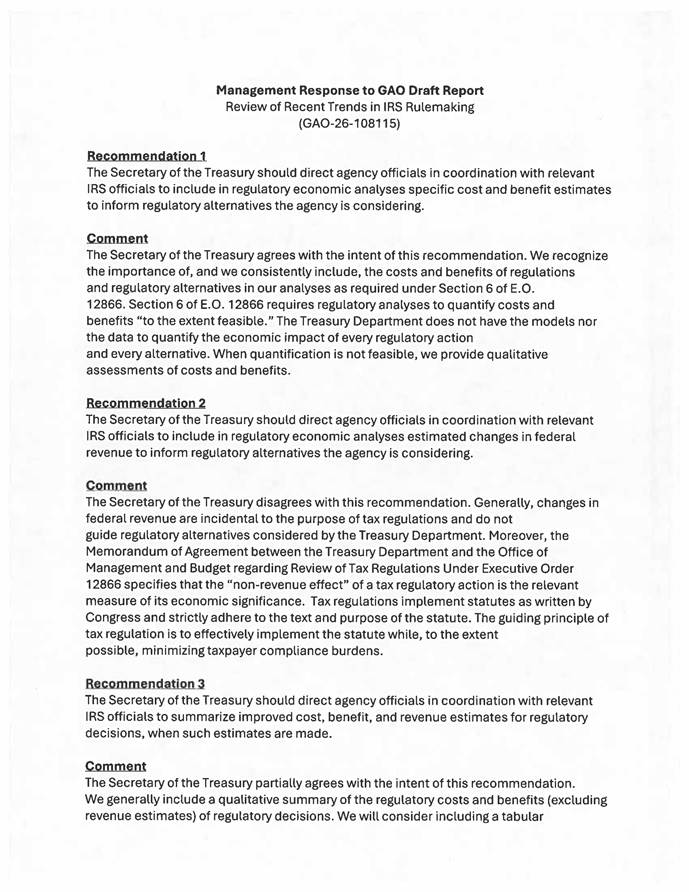
GAO Contact
James R. McTigue, Jr., McTigueJ@gao.gov
Staff Acknowledgments
In addition to the contact named above, Tara Carter (Assistant Director), Michael O’Neill (Analyst in Charge), Michael Bechetti, Ryan Bhandari, John Borman, Jieun Chang, Amor Chambers, Rob Gebhart, Vincent Patierno-Beavers, Samuel Portnow, Dylan Stagner, and Andrew J. Stephens made key contributions to this report.
The Government Accountability Office, the audit, evaluation, and investigative arm of Congress, exists to support Congress in meeting its constitutional responsibilities and to help improve the performance and accountability of the federal government for the American people. GAO examines the use of public funds; evaluates federal programs and policies; and provides analyses, recommendations, and other assistance to help Congress make informed oversight, policy, and funding decisions. GAO’s commitment to good government is reflected in its core values of accountability, integrity, and reliability.
Obtaining Copies of GAO Reports and Testimony
The fastest and easiest way to obtain copies of GAO documents at no cost is through our website. Each weekday afternoon, GAO posts on its website newly released reports, testimony, and correspondence. You can also subscribe to GAO’s email updates to receive notification of newly posted products.
Order by Phone
The price of each GAO publication reflects GAO’s actual cost of production and distribution and depends on the number of pages in the publication and whether the publication is printed in color or black and white. Pricing and ordering information is posted on GAO’s website, https://www.gao.gov/ordering.htm.
Place orders by calling (202) 512-6000, toll free (866) 801-7077,
or
TDD (202) 512-2537.
Orders may be paid for using American Express, Discover Card, MasterCard, Visa, check, or money order. Call for additional information.
Connect with GAO
Connect with GAO on X,
LinkedIn, Instagram, and YouTube.
Subscribe to our Email Updates. Listen to our Podcasts.
Visit GAO on the web at https://www.gao.gov.
To Report Fraud, Waste, and Abuse in Federal Programs
Contact FraudNet:
Website: https://www.gao.gov/about/what-gao-does/fraudnet
Automated answering system: (800) 424-5454
Media Relations
Sarah Kaczmarek, Managing Director, Media@gao.gov
Congressional Relations
David A. Powner, Acting Managing Director, CongRel@gao.gov
General Inquiries
[1]Pub. L. No. 119-21, 139 Stat. 72 (2025); Pub. L. No. 117-169, 136 Stat. 1818 (2022); and Pub. L. No. 115-97, 131 Stat. 2054 (2017).
[2]GAO, Tax Cuts and Jobs Act: Future Rulemaking Should Provide Greater Detail on Paperwork Burden and Economic Effects of International Business Provisions, GAO‑21‑277 (Washington, D.C.: Apr. 28, 2021); Tax Cuts and Jobs Act: Considerable Progress Made Implementing Business Provisions, but IRS Faces Administrative and Compliance Challenges, GAO‑20‑103 (Washington, D.C.: Feb. 25, 2020); and Regulatory Guidance Processes: Treasury and OMB Need to Reevaluate Long-standing Exemptions of Tax Regulations and Guidance, GAO‑16‑720 (Washington, D.C.: Sept. 6, 2016).
[3]Pub. L. No. 117-169, tit. VII, § 70004, 136. Stat. 1818, 2087 (2022).
[4]We counted proposed and final Treasury and IRS regulations by analyzing data from govinfo.gov, which compiles regulations published in the Federal Register where federal regulations must be published. We searched for keywords indicating that a document proposed regulations or issued final or temporary regulations; filtered out documents correcting proposed or final regulations, announcing regulatory hearings, extending comment periods, or withdrawing rules; and did other data reliability steps such as comparing our analysis to IRS documents tracking regulatory activity. We also analyzed data from reginfo.gov to count how many tax regulations were reviewed by the Office of Information and Regulatory Affairs (OIRA) and calculated summary statistics concerning OIRA review time.
[5]The Chief Counsel Regulation Handbook is part of the Internal Revenue Manual (IRM) and addresses the following topics: overview of the regulations process (IRM 32.1.1), publication handbook, introduction to the Chief Counsel publication handbook (IRM 32.2.1), outlining and drafting substantive regulatory text (IRM 32.1.4), and required format for regulations (IRM 32.1.5.). We also reviewed 5 U.S.C. § 553 and Exec. Order No. 12866, Regulatory Planning and Review, 58 Fed. Reg. 51735 (Oct. 4, 1993).
[6]Different analytical approaches using LLM may identify additional themes.
[7]GAO, Standards for Internal Control in the Federal Government, GAO‑25‑107721 (Washington, D.C.: May 15, 2025).
[8]GAO‑21‑277 and GAO‑20‑103.
[9]Office of Management and Budget, Circular A-4 (Sept. 17, 2003); Investing in Qualified Opportunity Funds, 85 Fed. Reg. 1866 (Jan. 13. 2020); Limitation on Deduction for Business Interest Expense, 85 Fed. Reg. 56686 (Sept. 14, 2020); Additional First-Year Depreciation Deduction, 85 Fed. Reg. 71734 (Nov. 10, 2020); and Denial of Deduction for Certain Fines, 86 Fed. Reg. 4970 (Jan. 19, 2021).
[10]The regulatory preamble is intended to inform a nonexpert reader of the basis and purpose for the rule or the proposed rule. The regulatory economic analysis is provided in the preamble if the agency is required to conduct an analysis for a rule. Our analysis focused on the economic analysis section and did not review other sections of the preamble, such as the section covering paperwork burden estimates. We reviewed the economic analyses in the final regulations because the analyses reflect final decisions Treasury and IRS made.
[11]Steve Balla, Reeve Bull, Bridget Dooling, Emily Hammond, Michael Herz, Michael Livermore, & Beth Simone Noveck, Mass, Computer-Generated, and Fraudulent Comments (June 1, 2021) (report to ACUS); and ACUS, Recommendation 2021-1, Managing Mass, Computer-Generated, and Falsely Attributed Comments, 86 Fed. Reg. 36075 (July 8, 2021).
[12]Kazia Nowacki, Virtual Public Engagement in Agency Rulemaking (May 25, 2023) (report to ACUS). ACUS, Recommendation 2023-2, Virtual Public Engagement in Agency Rulemaking, 88 Fed. Reg. 42680 (July 3, 2023).
[13]Because Treasury and IRS work together to issue regulations, this report will generally refer to both entities, except for instances in which one entity has responsibility for doing a particular task.
[14]5 U.S.C. § 553. The Congressional Review Act separately requires agencies to delay the effective date for certain major rules until 60 days after the later of when the rule is submitted to Congress and when it is published in the Federal Register. 5 U.S.C. § 801(a)(3).
[15]GAO, Federal Rulemaking: Agencies Could Take Additional Steps to Respond to Public Comments, GAO‑13‑21 (Washington, D.C.: Dec. 20, 2012).
[16]Exec. Order No. 12866, Regulatory Planning and Review, 58 Fed. Reg. 51735, 51737, 51741 (Oct. 4, 1993).
[17]EO 12866 also requires explanation of how the regulatory action is consistent with a statutory mandate and, to the extent permitted by law, promotes the President’s priorities and avoids undue interference with state, local, and tribal governments in the exercise of their governmental functions.
[18]EO 12866 states that agencies must provide the proceeding information unless prohibited by law. 58 Fed. Reg. 51741.
[19]EO 14094 signed in April 2023 raised the threshold for an economically significant regulation from $100 million to $200 million and stated that this value would be adjusted in the future by OIRA to reflect changes in gross domestic product. Exec. Order. No. 14094, Modernizing Regulatory Review, 88 Fed. Reg. 21879 (Apr. 11, 2023). OMB also published a new version of Circular A-4 in 2023. EO 14094 was revoked by section 2(ddd) of EO 14148 in January 2025. 90 Fed. Reg. 8237, 8239 (Jan. 28, 2025). Section 6(b) of EO 14192 revoked the 2023 version of Circular A-4 and reinstated the 2003 version of Circular A-4. 90 Fed. Reg. 9065, 9067 (Feb. 6, 2025).
[20]Memorandum of Agreement-The Department of the Treasury and the Office of Management and Budget Review of Tax Regulations under Executive Order 12866 (Apr. 11, 2018). The requirement to prepare additional economic assessments for economically significant regulations took effect in 2019.
[21]Memorandum of Agreement: The Department of the Treasury and the Office of Management and Budget: Review of Treasury Regulations under Executive Order 12866 (June 9, 2023).
[22]Exec. Order No. 14192, Unleashing Prosperity Through Deregulation, § 6(c), 90 Fed. Reg. 9065, 9067 (Feb. 6, 2025); and Memorandum of Agreement: The Department of the Treasury and the Office of Management and Budget: Review of Treasury Regulations under Executive Order 12866 (July 4, 2025).
[23]These documents identify the sections of the law for which regulations or guidance are needed, describes the regulations, and identifies target dates for submitting drafts to relevant Treasury and IRS offices, and providing the regulations or guidance to the public.
[24]While the agency stopped centralized tracking of TCJA regulations in 2021, agency officials told us that the decision to stop tracking was not a determination that rulemaking was complete for this law.
[25]In April 2025, IRS officials told us that they paused work on regulations implementing IRA due to a regulatory freeze enacted by the new presidential administration.
[26]91 Fed. Reg. 19026 (Apr. 13, 2026) and 91 Fed. Reg. 23380 (May 1, 2026).
[28]Department of the Treasury, 2025-2026 Priority Guidance Plan (Sept. 30, 2025).
[29]Regulations.gov has multiple public comment counts. We measured the overall number of comments, which may include attachments a commenter submits.
[30]Internal Revenue Service, Office of Chief Counsel, Allowance of Theft Losses for Victims of Scams Under I.R.C. Section 165, Memorandum Number 202511015 (Mar. 14, 2025). National Taxpayer Advocate, “IRS Chief Counsel Advice on Theft Loss Deductions for Scam Victims and What It Means for Taxpayers,” NTA Blog, published April 24, 2025, last updated December 3, 2025.
[31]IRM 32.1.3.2 and IRM 32.1.7.2.1.
[33]IRM 32.1.2.4. While this section of the IRM refers to OMB, we use OIRA for clarity because that is the relevant office within OMB. EO 12866 requires OIRA review of significant regulatory actions.
[34]88 Fed. Reg. 59576 (Aug. 29, 2023); 85 Fed. Reg. 28524 (May 13, 2020).
[35]EO 12866 states that OIRA will complete its review within 45 days, rather than 90 days, if OIRA previously reviewed the information and, since that review, there has been no material change in the facts and circumstances upon which the regulatory action is based.
[36]Martin A. Sullivan, “Economic Analysis: OMB-Treasury Memo Creates Guidance Uncertainty and Delay,” 159 Tax Notes 443–47 (Apr. 23, 2018).; Greg Leiserson and Adam Looney, “A Framework for Economic Analysis of Tax Regulations” (Washington, D.C.: Washington Center for Equitable Growth and Brookings Institution, December 2018).
[37]Kristin E. Hickman and Bridget C.E. Dooling, “Delay, Politics, and Expertise in OIRA Tax Review,” Virginia Tax Review 45, no. 2 (2025): 125.
[38]Loper Bright Enters. v. Raimondo, 603 U.S. 369 (2024).
[39]Office of Management and Budget, Circular A-4 (Sept. 17, 2003).
[40]For the Denial of Deduction for Certain Fines regulation, Treasury and IRS stated in the final regulation that it had been designated by OIRA as subject to review under EO 12866. Reginfo.gov states that it was designated as economically significant.
[41]85 Fed. Reg. 1866, 1943–1944 (Jan. 13. 2020).
[42]85 Fed. Reg. 56686, 56746–56747 (Sept. 14, 2020).
[43]85 Fed. Reg. 71734, 71748 (Nov. 10, 2020).
[44]86 Fed. Reg. 4970, 4978 (Jan. 19, 2021). The statute set the threshold at $600 and provided the agency with the authority to adjust the threshold of efficient tax administration. 26 U.S.C. § 6050X(a)(2)(A)(ii), (B).
[45]The agency assumed that each qualified opportunity fund would have 10 investors.
[46]The agency projected that additional investment would not exceed $55 million in any year.
[48]Addendum to the Memorandum of Agreement: The Department of the Treasury and the Office of Management and Budget Review of Tax Regulations under Executive Order 12866 (Dec. 11, 2020).
[49]84 Fed. Reg. 28888, 28965 (June 20, 2019).
[50]87 Fed. Reg. 61979, 61999 (Oct. 13, 2022).
[51]Greg Leiserson and Adam Looney, “A Framework for Economic Analysis of Tax Regulations”, (Washington Center for Equitable Growth and Brookings Institution, December 2018).
[52]Daniel J. Hemel, “The President’s Power to Tax,” 102 Cornell Law Review 633 (2017).
[53]See, Tax Analysts and Advocates, et al. v. Michael Blumenthal, 566 F.2d 130 (D.C. Cir. 1977).
[55]IRM 32.1.1.2.2; and 32.1.1.2.4. IRS also accepts comments submitted by mail.
[56]Regulations.gov has multiple public comment counts. We measured the number of document comments for this analysis. Commenters may specify that they are submitting attachments to their comments, which can be counted as additional comments in some measures posted on regulations.gov.
[57]IRM 32.1.1.2.3. 26 U.S.C. § 7805(e). The statute does not guarantee finalization or permanence. Regulations issued as both temporary and proposed may be modified in response to public comments if finalized after the temporary regulation expires.
[58]IRM 32.1.5.4.7.2.
[59]IRM 32.1.1.2.6. Under the APA, notice-and-comment rulemaking is not required for interpretative rules. 5 U.S.C. § 553(b)(A). Legislative rules and interpretative rules are generally considered distinct categories.
[60]IRM 32.1.7.2.
[61]Steve Balla, Reeve Bull, Bridget Dooling, Emily Hammond, Michael Herz, Michael Livermore, & Beth Simone Noveck, Mass, Computer-Generated, and Fraudulent Comments (June 1, 2021) (report to ACUS).
[62]Regulations.gov states that 44,821 comments were received commenting on the document containing the proposed regulation with 125,070 total comments received on the docket, which may include attachments commenters submitted. 88 Fed. Reg. 59576 (Aug. 29, 2023).
[63]Regulations.gov states that 29,989 comments were received commenting on the document containing the proposed regulation with 30,067 total comments received on the docket, which may include attachments commenters submitted. The comment counts are as of June 11, 2026. 88 Fed. Reg. 89220 (Dec. 26, 2023).
[64]Gross Proceeds and Basis Reporting by Brokers and Determination of Amount Realized and Basis for Digital Asset Transactions, 89 Fed. Reg. 56480 (July 9. 2024); and Gross Proceeds Reporting by Brokers That Regularly Provide Services Effectuating Digital Asset Sales, 89 Fed. Reg. 106928 (Dec. 30. 2024).
[65]Pub. L. No. 119-5, 139 Stat. 48 (2025); 90 Fed. Reg 30825 (July 11, 2025). The Congressional Review Act created special procedures for Congress to pass joint resolutions disapproving rules issued by agencies.
[66]90 Fed. Reg 2224 (Jan. 10, 2025).
[67]ACUS, Recommendation 2021-1, Managing Mass, Computer-Generated, and Falsely Attributed Comments, 86 Fed. Reg. 36075 (July 8, 2021). ACUS recommended that the General Services Administration’s eRulemaking Program provide a common de-duplication tool for agencies to use allowing agencies to modify the de-duplication tool to fit their needs or to use another tool. IRS uses its own tool. Steve Balla, Reeve Bull, Bridget Dooling, Emily Hammond, Michael Herz, Michael Livermore, & Beth Simone Noveck, Mass, Computer-Generated, and Fraudulent Comments (June 1, 2021) (report to ACUS).
[68]IRM 32.1.7.3.
[69]90 Fed. Reg. 23494 (June 3, 2025) was the hearing notice and 90 Fed. Reg. 3075 (Jan. 14, 2025) was the proposed rule. A third person signed up to speak but did not speak.
[70]IRS officials said that one hearing was held in New Carrollton, Maryland, in 2019 due to expected space constraints.
[71]IRM 10.2.14.6.
[72]ACUS, Recommendation 2023-2, Virtual Public Engagement in Agency Rulemaking, 88 Fed. Reg. 42680 (July 3, 2023).
[73]Kazia Nowacki, Virtual Public Engagement in Agency Rulemaking (May 25, 2023) (report to ACUS).
[74]IRM 32.1.7.3.
[75]26 C.F.R. § 601.601(a)(3)(ii).
[76]Kazia Nowacki, Virtual Public Engagement in Agency Rulemaking (May 25, 2023) (report to ACUS).
[77]The stakeholders referred to a June 2022 Supreme Court decision that the Environmental Protection Agency did not have authority to restrict carbon dioxide emissions from coal and gas power plants (West Virginia et al. v. Environmental Protection Agency et. al.).
[78]See 26 U.S.C. §§ 482; 385.
[79]3M Company v. Commissioner, 154 F.4th 574 (8th Cir. 2025).
[80]Lindsay Clayton, “Defending Agency Actions After Loper Bright: Sea Change or the Same Old Beach?” (forthcoming article 2026), and “Empirical Analysis of Circuit-level post-Loper Bright,” presentation to the D.C. Bar Tax Conference, January 8, 2026.
[81]Mayo Foundation for Medical Education and Research v. United States, 562 U.S. 44 (2011).; 69 Fed. Reg. 8604 (Feb. 25, 2004); 69 Fed. Reg. 76404 (Dec. 21, 2004).
[82]CIC Services, LLC v. Internal Revenue Service, 593 U.S. 209 (2021).
[83]IRS Notice 2016-66: Transaction of Interest — Section 831(b) Micro-Captive Transactions. 2016-47 I.R.B. 745. Microcaptive insurance refers to insurance provided by firms owned by the firm being insured. The penalty framework for requiring reporting of transactions of interest was established in regulation; within that framework specific types of transactions were identified by regulation, notice, or other published guidance. 26 C.F.R. § 1.6011-4(b)(6), implementing 26 U.S.C. § 6111.
[84]Mark A. Luscombe, “Tax Trends: Conservation Easements, Listed Transactions, and the Administrative Procedures Act,” Taxes: The Tax Magazine (2023).
[85]Brian Galle and Stephen Shay, “Admin Law and the Crisis of Tax Administration,” North Carolina Law Review 101, no. 6 (2023): 1645; Joshua D. Blank and Leigh Osofsky, “The Inequity of Informal Guidance,” 75 Vanderbilt Law Review 1093 (2023); Leigh Osofsky, “Legislation and Comment: The Making of the Section 199A Regulations,” 69 Emory Law Journal 209 (2019), Clinton G. Wallace, “Congressional Control of Tax Rulemaking,” 71 Tax Law Review 179 (2017); and Shu-Yi Oei and Leigh Osofsky, “Legislation and Comment: The Making of the Section 199A Regulations,” 69 Emory Law Journal 209 (2019).