
Report to Congressional Committees
United States Government Accountability Office
A report to congressional committees.
For more information, contact: Diana Maurer at maurerd@gao.gov.
What GAO Found
Operating and support (O&S) costs are comprised of costs for repair parts, maintenance activities, contract services, and personnel. The Department of Defense (DOD) identified 14 systems with critical O&S cost growth out of 36 weapon system sustainment reviews it conducted for fiscal years 2023 and 2024. This critical O&S cost growth represents at least a 25 percent increase in the cost estimate for the remainder of a system’s life cycle compared with its most recent independent cost estimate, or at least a 50 percent increase compared with the original baseline cost estimate. GAO identified common causes DOD reported for the critical O&S cost growth for the 14 systems, such as extensions to operational life.
Weapon System Sustainment Reviews with Reported Critical Operating and Support Cost Growth and Causes, Fiscal Years 2023 and 2024
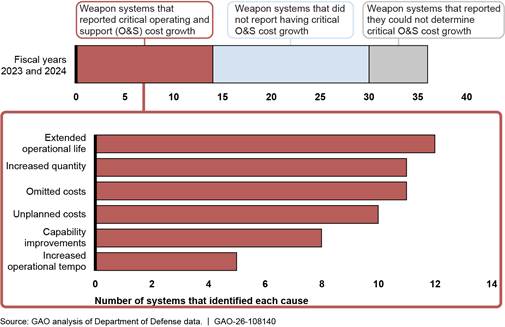
Note: Weapon systems experienced critical O&S cost growth in either Category A (growth is at least 25 percent more than the estimate documented in the most recent independent cost estimate for the system) or Category B (growth is at least 50 percent more than the original baseline cost estimate for the system).
DOD has taken some actions to address critical O&S cost growth identified in fiscal year 2021 and fiscal year 2022. However, GAO found the Army has not fully completed a software update that it reported would remediate a top maintenance issue for its Common Remotely Operated Weapons Station (CROWS). Doing so would yield cost savings that GAO estimates would be more than $130 million over the program’s remaining approximately 30 years of life. Without ensuring that its units implement the software update identified in the CROWS remediation plan on a timely basis, the Army is missing an opportunity to address a top maintenance issue affecting this weapon system and to achieve a cost savings of more than $130 million over the remaining life of the program.
DOD identified challenges in conducting sustainment reviews and determining O&S cost growth. GAO found that DOD has taken steps to address challenges, such as revising guidance to correct cost estimating data deficiencies.
Why GAO Did This Study
DOD spends tens of billions of dollars to sustain its weapon systems. O&S costs are about 70 percent of a system’s total life-cycle cost. In response to a statutory provision, DOD has been required to annually submit sustainment reviews that include O&S cost estimates and the reasons for any critical cost growth, although the National Defense Authorization Act for Fiscal Year 2026 eliminated the requirement for DOD to include the O&S cost growth information in its sustainment reports.
The National Defense Authorization Act for Fiscal Year 2021 included a provision for GAO to review DOD’s annual sustainment reviews and O&S cost estimates through 2025. This report, the final one to be submitted under this statutory requirement, evaluates the extent to which DOD (1) identified critical O&S cost growth in its fiscal years 2023 and 2024 weapon system sustainment reviews and the causes of that growth, (2) has taken actions to address the critical O&S cost growth identified in the fiscal years 2021 and 2022 sustainment reviews, and (3) has taken steps to identify challenges and improve the sustainment review process.
GAO analyzed DOD guidance and weapon system sustainment reviews DOD conducted in fiscal years 2023 and 2024 and cost savings initiatives identified in the fiscal years 2021 and 2022 reviews and interviewed DOD officials who conducted the reviews.
What GAO Recommends
GAO is making one recommendation to the Army to ensure that its units implement the software update identified in the Common Remotely Operated Weapons Station remediation plan on a timely basis. DOD agreed with the recommendation.
|
Abbreviations |
|
|
|
CAPE |
Cost Assessment and Program Evaluation |
|
|
CROWS |
Common Remotely Operated Weapons Station |
|
|
DOD |
Department of Defense |
|
|
O&S |
operating and support |
|
|
USD(A&S) |
Under Secretary of Defense for Acquisition and Sustainment |
|
This is a work of the U.S. government and is not subject to copyright protection in the United States. The published product may be reproduced and distributed in its entirety without further permission from GAO. However, because this work may contain copyrighted images or other material, permission from the copyright holder may be necessary if you wish to reproduce this material separately.
April 23, 2026
Congressional Committees
The Department of Defense (DOD) spends tens of billions of dollars annually to sustain its weapon systems, from aircraft to ships to ground combat vehicles. These dollars are meant to ensure that these weapon systems are available to simultaneously support today’s military operations and maintain the capability over their planned life cycle. Operating and support (O&S) costs historically account for approximately 70 percent of a weapon system’s total life-cycle cost, which is the cost to operate and sustain the system from initial operations through the end of its life. Included in the costs are repair parts, depot and field maintenance, contract services, engineering support, and personnel, among other things. Weapon systems are costly to sustain, in part because they often incorporate a complex array of technical subsystems and components and need expensive repair parts and logistics support to meet required readiness levels. DOD’s strategic management framework includes an objective to reduce O&S costs to maximize readiness.[1]
Until passage of the National Defense Authorization Act for Fiscal Year 2026 in December 2025, section 4323 of title 10, United States Code, required the secretaries of the military departments to annually submit to the congressional defense committees covered weapon system (hereafter referred to in this report as weapon systems) sustainment reviews, to include information on the weapon systems’ life-cycle O&S costs, completed for the prior fiscal year.[2],[3] For any weapon system that experienced critical O&S cost growth, the provision required the submitted sustainment reviews to include either a remediation plan to reduce O&S costs or a certification by the relevant military department secretary that such critical O&S cost growth is necessary to meet national security requirements.[4] The statute defined critical O&S cost growth as O&S cost growth of (a) at least 25 percent more than the estimate documented in the most recent independent cost estimate for the system or (b) at least 50 percent more than the estimate documented in the original baseline cost estimate for the system.[5] For the purposes of this report, we refer to these categories of critical O&S cost growth as Category A and Category B, respectively. The National Defense Authorization Act for Fiscal Year 2026, among other changes, eliminated the requirement for sustainment reviews submitted by DOD to the congressional defense committees to include this information on O&S costs.[6]
Section 802 of the William M. (Mac) Thornberry National Defense Authorization Act for Fiscal Year 2021 includes a provision for us to assess sustainment reviews conducted by DOD on an annual basis through 2025.[7] Specifically, the provision requires that we annually select 10 weapon systems for which a sustainment review has been submitted by the military departments to the congressional defense committees and assess the military departments’ efforts to quantify and address critical O&S cost growth for those systems.[8]
This report assesses the extent to which DOD (1) identified critical O&S cost growth in its fiscal year 2023 and fiscal year 2024 weapon system sustainment reviews and the causes of that growth, (2) has taken actions to address the critical O&S cost growth identified in the fiscal year 2021 and fiscal year 2022 sustainment reviews, and (3) has taken steps to identify challenges and improve the sustainment review process.
To address these objectives, we reviewed relevant laws, regulations, and DOD and military service guidance that govern the sustainment review process. We analyzed documentation from each of the 36 weapon system sustainment reviews DOD conducted in fiscal year 2023 and fiscal year 2024 to identify reported critical O&S cost growth and causes for such growth, actions taken to mitigate future O&S cost growth, and steps to identify any lessons learned to improve the sustainment review process.[9] Additionally, we interviewed officials from the Office of the Secretary of Defense, military department headquarters and cost agencies, and the 14 program offices whose weapon systems had critical O&S cost growth in fiscal years 2023 and 2024. We analyzed documentation from our prior work on the nine sustainment reviews DOD conducted in fiscal year 2021 and fiscal year 2022 to determine action taken to address critical O&S cost growth, including cost savings initiatives.[10]
We reviewed the documentary and testimonial evidence we collected as well as DOD and military service guidance to gain an understanding of the sustainment review process and how critical O&S cost growth is identified and remediated. We also assessed the evidence against the Standards for Internal Control in the Federal Government.[11] Specifically, we determined that the monitoring component of the standards was significant to our objectives, including the underlying principles that management should assess the quality of performance over time, promptly resolve the findings, and remediate identified internal control deficiencies on a timely basis.
We conducted this performance audit from February 2025 to April 2026 in accordance with generally accepted government auditing standards. Those standards require that we plan and perform the audit to obtain sufficient, appropriate evidence to provide a reasonable basis for our findings and conclusions based on our audit objectives. We believe that the evidence obtained provides a reasonable basis for our findings and conclusions based on our audit objectives.
Background
O&S Costs for Weapon Systems
DOD’s Operating and Support Cost-Estimating Guide provides direction to the military departments on developing estimates of O&S costs that support various analyses and reviews throughout the life cycle of the program.[12] According to the guide, O&S costs are organized into five cost categories (see table 1).
|
Cost category |
Description |
|
Unit-level personnela |
Cost of operators, maintainers, and other support personnel assigned to operating units |
|
Unit operations |
Cost of unit operating materiel (such as fuel and training materiel) and unit support services |
|
Maintenance |
Cost of system maintenance, including depot- and intermediate-level maintenance, other than personnel assigned to operating units |
|
Sustaining support |
Cost of system-support activities other than maintenance that can be attributed to a system and are provided by organizations other than the system’s operating units |
|
Continuing system improvements |
Cost of system hardware and software modifications to keep the system operating and operationally current |
Source: GAO analysis of Department of Defense’s (DOD) Operating and Support Cost-Estimating Guide. ǀ GAO‑25‑108140
aDOD refers to this cost category as unit-level manpower.
Total and Unit O&S Cost Estimating
Total and unit O&S cost figures in sustainment reviews are used to measure the magnitude of a weapon system’s O&S costs, as well as to determine critical cost growth. Total costs include costs for the entire system for the remainder of the life cycle. Unit costs divide the total cost by the number of units per year of operation to develop an amount that accounts for cost increases potentially related to changes in the number of units.
Statutory Requirements for Conducting Sustainment Reviews
Prior to December 2025, section 4323 of title 10, United States Code, required the secretary of each military department to conduct a sustainment review for each weapon system no later than 5 years after declaration of initial operational capability and every 5 years afterward throughout its life cycle to assess the product support strategy, performance, and O&S costs.[13] The results of the reviews were to be reported to the congressional defense committees. The sustainment reviews were to, at a minimum, assess execution of the life-cycle sustainment plans for the weapon systems and, among other things, include an independent cost estimate for the remainder of the life cycle of each system. As a part of the sustainment review process, the military departments evaluated each weapon system to determine if there had been critical O&S cost growth. This evaluation used the independent cost estimates that are prepared for each sustainment review, which forecasts costs for the remainder of a system’s life cycle.
Roles and Responsibilities
Several DOD and military department entities have roles and responsibilities related to sustaining weapon systems and conducting sustainment reviews. Specifically:
The Under Secretary of Defense for Acquisition and Sustainment (USD(A&S)) is the principal staff assistant and advisor to the Secretary of Defense for all matters relating to acquisition and sustainment.[14] The USD(A&S) establishes policies on, and supervises all elements of, DOD relating to sustainment, including logistics, maintenance, and materiel readiness, among other responsibilities.
The Deputy Assistant Secretary of Defense for Materiel Readiness serves as the principal advisor to the USD(A&S) on policies and procedures for maintenance support of major weapon systems and military equipment.
The Director of Cost Assessment and Program Evaluation (CAPE) oversees implementation of the procedures and prepares clarifying guidance, as needed, for the conduct of cost estimating and analysis to all elements of DOD, among other responsibilities.[15] Additionally, the Director is responsible for developing and maintaining a department-wide database on actual O&S costs for major weapon systems compiled from military department O&S cost databases.
The military service cost entities include the Office of the Deputy Assistant Secretary for the Army for Cost and Economics, the Office of the Air Force Deputy Assistant Secretary for Cost and Economics, and the Naval Cost Agency. Each maintains a data system that tracks O&S costs for major weapon systems and related noncost data about measures such as system quantities and operational tempo.[16] Each cost agency uses these data to analyze trends in O&S costs, identify major cost drivers, and complete independent cost estimates.
The Department of the Army entities include the Office of the Assistant Secretary of the Army for Acquisition, Logistics, and Technology, which is designated as the single office within the headquarters of the Department of the Army for acquisition and development functions.[17] In addition, the U.S. Army Materiel Command is the Army’s primary logistics and sustainment command, responsible for managing the global supply chain and ensuring installation materiel readiness solutions for the Army.
The Department of the Navy entities include the Office of the Assistant Secretary of the Navy for Research, Development and Acquisition, which is responsible for all the acquisition functions and programs for the Navy and Marine Corps.[18] In addition, the Naval Air Systems Command’s mission is to provide full life-cycle support of naval aviation aircraft, weapons, and systems. The Naval Sea Systems Command provides sustainment oversight for ships, submarines, and systems. The Naval Information Warfare Systems Command’s mission includes sustaining information warfare capabilities and services.
The Department of the Air Force entities include the Office of the Assistant Secretary of the Air Force for Acquisition, Technology and Logistics, which has overall responsibility for acquisition of systems, including product support, for the Department of the Air Force.[19] In addition, the Air Force Materiel Command develops, acquires, and sustains weapon systems through research, development, testing, evaluation, acquisition, maintenance, and program management of the systems and their components.
The weapon system program managers within each military department lead the development, delivery, and sustainment of individual weapon systems throughout their life cycles. They are responsible for accomplishing a program’s sustainment objectives to meet its users’ operational needs, as well as for conducting each system’s sustainment review. Further, they are typically supported by a complex supplier network that can include a prime contractor, subcontractors, and various tiers of parts suppliers.
Fiscal Year 2023 and Fiscal Year 2024 Sustainment Reviews
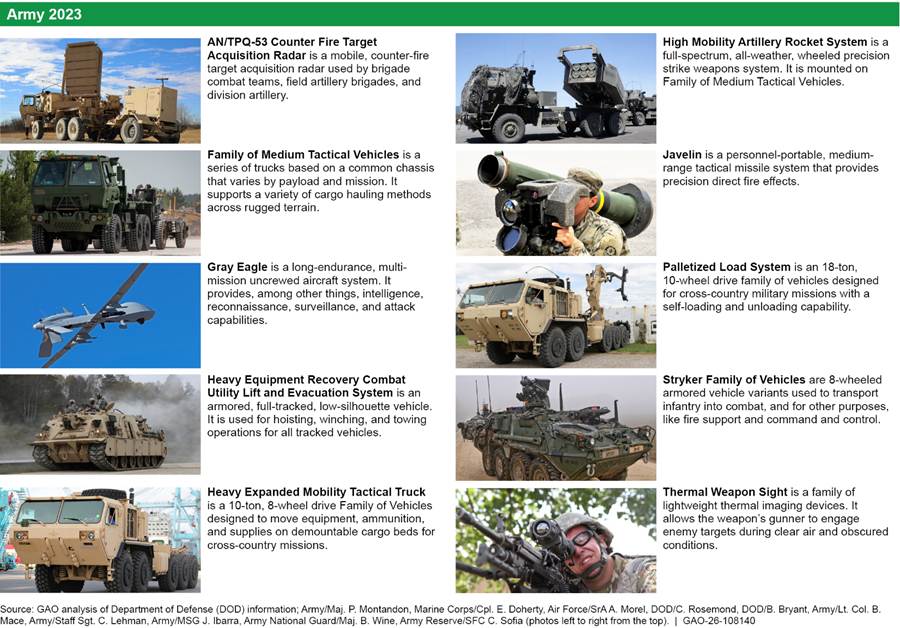
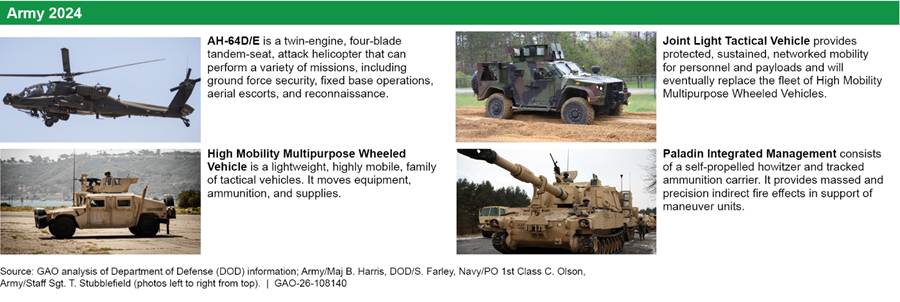
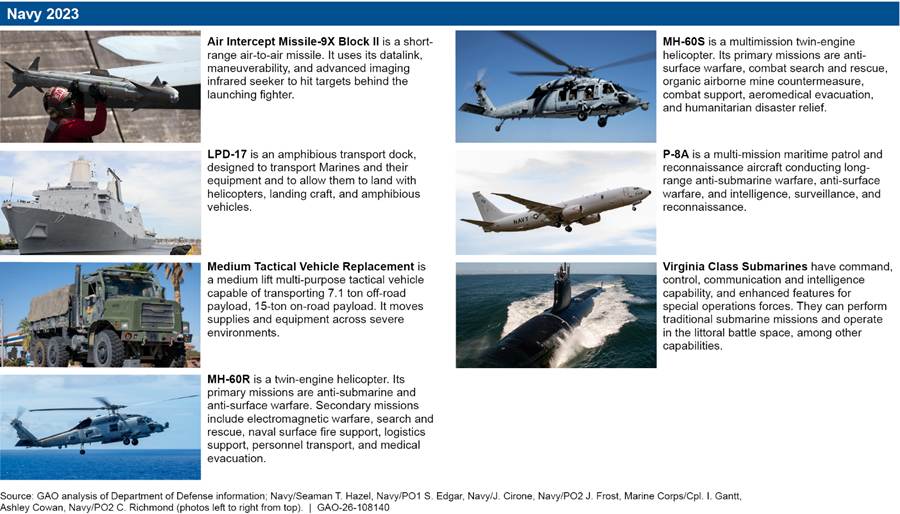
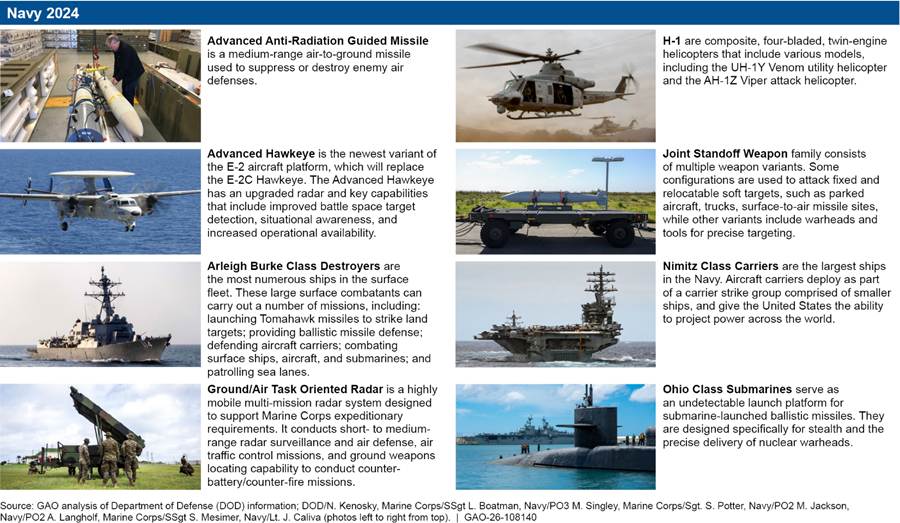
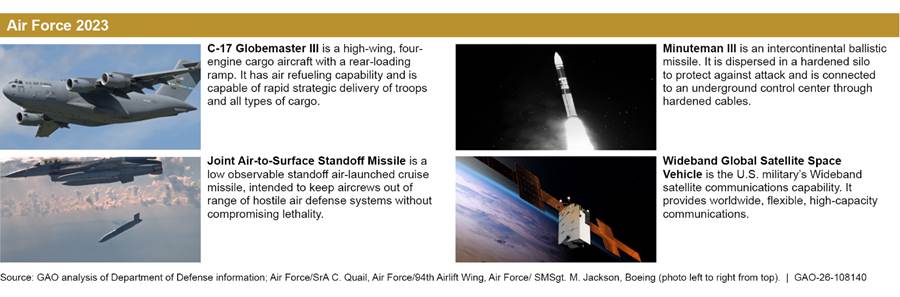
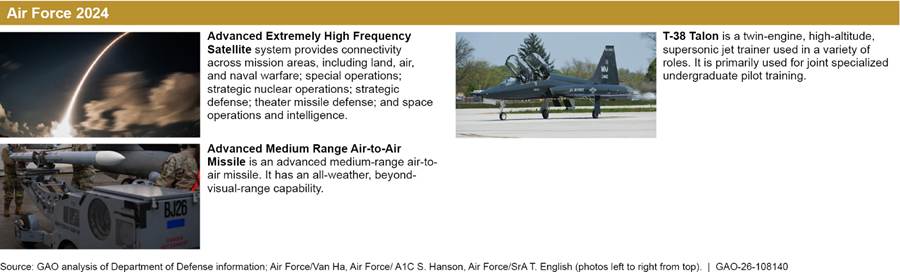
In fiscal year 2023, the military departments conducted sustainment reviews of 21 weapon systems and submitted them to the congressional defense committees.[20] In fiscal year 2024, the military departments conducted sustainment reviews of 15 weapon systems and submitted them to the congressional defense committees.[21] Figures 1-6 provide a description of these weapon systems.
DOD Reviewed 36 Weapon Systems in Fiscal Years 2023 and 2024 and Identified 14 with Critical O&S Cost Growth
DOD reviewed 36 weapon systems in fiscal years 2023 and 2024 and identified 14 Army and Navy systems with critical O&S cost growth. In their fiscal year 2023 and 2024 submissions, the Army and the Navy both identified and submitted summaries of the causes of critical O&S cost growth for the 14 weapon systems. Appendix III provides detailed information on the causes for weapon systems that experienced critical O&S cost growth in fiscal years 2023 and 2024.
DOD Reviewed 21 Systems in Fiscal Year 2023 and Identified 10 with Critical O&S Cost Growth
DOD, via the military departments, conducted sustainment reviews of 21 weapon systems in fiscal year 2023 and identified that 10 of the 21 systems experienced critical O&S cost growth. As a part of these sustainment reviews, DOD developed independent cost estimates and assessed each system for life-cycle O&S cost growth, as was required.[22] Of the 10 weapon systems, six Army systems and four Navy systems experienced critical O&S cost growth—as shown in figures 7 (Army) and 8 (Navy). The Air Force did not identify any systems experiencing critical O&S cost growth.
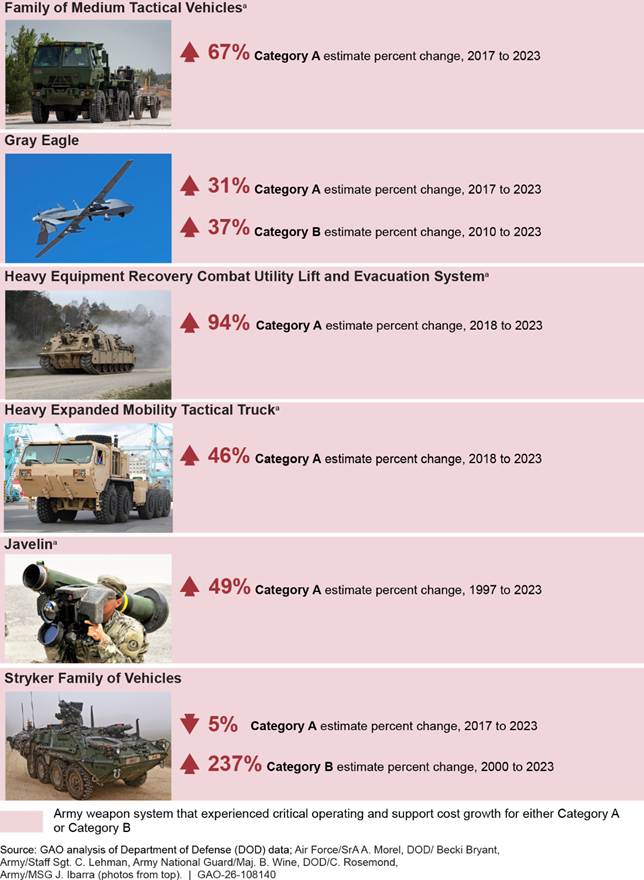
Note: Category A is critical operating and support (O&S) cost growth when there is at least 25 percent more growth than the estimate documented in the most recent independent cost estimate for the system. Category B is critical O&S cost growth when there is at least 50 percent more growth than the estimate documented in the original baseline cost estimate for the system. Appendix III in this report (GAO‑26‑108140) provides detailed information on the causes for weapon systems that experienced critical O&S cost growth in fiscal year 2023.
aAccording to the Army’s sustainment review, these weapon systems did not have a Category B calculation because no original baseline estimate existed for this system. We discuss this issue later in the report (GAO‑26‑108140).
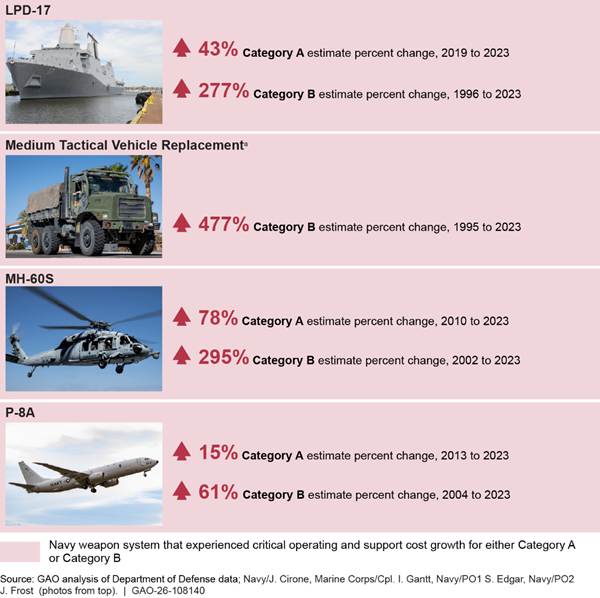
Note: Category A is critical operating and support (O&S) cost growth when there is at least 25 percent more growth than the estimate documented in the most recent independent cost estimate for the system. Category B is critical O&S cost growth when there is at least 50 percent more growth than the estimate documented in the original baseline cost estimate for the system. Appendix III in this report (GAO‑26‑108140) provides detailed information on the causes for weapon systems that experienced critical O&S cost growth in fiscal year 2023.
aAccording to the Navy’s sustainment review, this weapon system did not have a Category A comparison because no recent independent cost estimate existed for the system. We discuss this issue later in the report (GAO‑26‑108140).
According to the military departments’ sustainment reviews, eight of the 21 weapon systems had O&S cost changes but did not experience critical O&S cost growth as was defined in statute.[23] The military departments were unable to make a critical O&S cost growth determination for either Category A or B for three of the 21 systems in fiscal year 2023 because the weapon systems did not have a previous or original baseline cost estimate needed to determine cost growth, according to their sustainment review submissions to the congressional defense committees.[24] See appendix I for details on the weapon systems that DOD reported had changes to the O&S cost in fiscal year 2023.
DOD Reviewed 15 Systems in Fiscal Year 2024 and Identified Four with Critical O&S Cost Growth
DOD, via the military departments, conducted sustainment reviews of 15 weapon systems in fiscal year 2024 and identified that four of 15 weapon systems experienced critical O&S cost growth. As a part of these sustainment reviews, DOD developed independent cost estimates and assessed each system for life-cycle O&S cost growth, as was required.[25] Of the four weapon systems, one Army and three Navy systems experienced critical O&S cost growth—as shown in figures 9 (Army) and 10 (Navy). The Air Force did not identify any systems experiencing critical O&S cost growth.
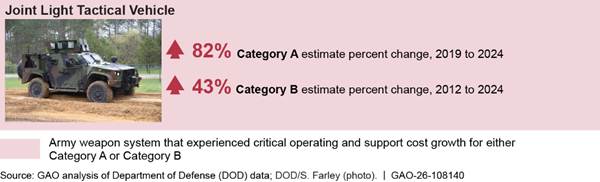
Note: Category A is critical operating and support (O&S) cost growth when there is at least 25 percent more growth than the estimate documented in the most recent independent cost estimate for the system. Category B is critical O&S cost growth when there is at least 50 percent more growth than the estimate documented in the original baseline cost estimate for the system. Appendix III in this report (GAO‑26‑108140) provides detailed information on the causes for weapon systems that experienced critical O&S cost growth in fiscal year 2024.
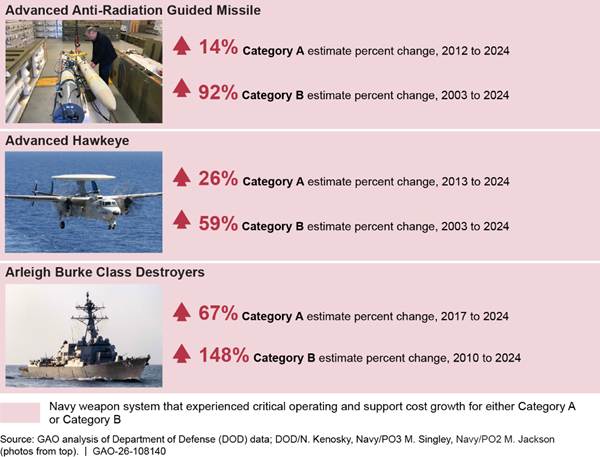
Note: Category A is critical operating and support (O&S) cost growth when there is at least 25 percent more growth than the estimate documented in the most recent independent cost estimate for the system. Category B is critical O&S cost growth when there is at least 50 percent more growth than the estimate documented in the original baseline cost estimate for the system. Appendix III in this report (GAO‑26‑108140) provides detailed information on the causes for weapon systems that experienced critical O&S cost growth in fiscal year 2024.
According to the military departments’ sustainment reviews, eight of the 15 weapon systems experienced O&S cost changes but did not experience critical O&S cost growth as defined in statute. The military departments were unable to make a critical O&S cost growth determination for either Category A or B for three systems in fiscal year 2024 because the weapon systems did not have a previous or original baseline cost estimate needed to determine cost growth, according to their submissions to the congressional defense committees.[26] See appendix II for details on the weapon systems that DOD reported had changes to the O&S cost in fiscal year 2024.
Army and Navy Identified Causes of Critical Cost Growth and Reported Taking Action to Address Them
As of December 2025, DOD guidance required the military departments to submit a summary to Congress of the causes for any weapon system that experiences critical O&S cost growth.[27] In their fiscal year 2023 and 2024 submissions, the Army and the Navy both identified and submitted summaries of the causes of critical O&S cost growth for 14 weapon systems. We identified common causes the Army and Navy reported for critical O&S cost growth in their fiscal year 2023 and fiscal year 2024 submissions (see fig. 11). The Secretaries of the Army and Navy certified the cost growth as necessary for national security.[28] As noted above, the Air Force did not identify any weapon systems with critical O&S cost growth during this time frame. Appendix III provides detailed information on the causes for weapon systems that experienced critical O&S cost growth in fiscal years 2023 and 2024.
Figure 11: Army and Navy Identified Causes for Critical Operating and Support Cost Growth, Fiscal Years 2023 and 2024
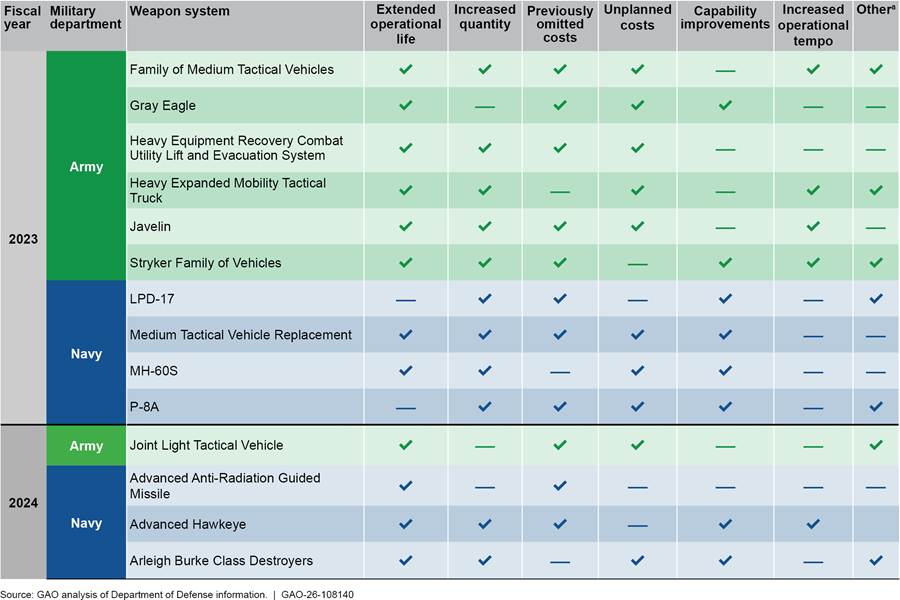
Note: The Air Force did not identify any weapon systems that experienced critical operating and support cost growth in its fiscal year 2023 and fiscal year 2024 sustainment reviews.
aOther common causes for critical O&S cost
growth can include, among other things, changes in inflation guidance,
obsolescence, and supply chain issues, according to DOD’s sustainment review
submissions.
More specifically, for the 14 Army and Navy weapon systems with critical O&S cost growth, the following are common causes:
· Extended operational life: 12 of the 14 systems reported extensions to the service or program life, sustainment period, or economic useful life of weapon systems.[29] For example, for the Gray Eagle program, the sustainment period increased by 6 years from the prior cost estimate and, after reliability testing, the Javelin program extended the economic useful life from 20 years to 25 years. The service life increased for the Medium Tactical Vehicle Replacement program. The MH-60S program’s service life increased from 30 years to 50 years. Additionally, the Army extended the economic useful life calculation from 20 years to 30 years for several of its programs.
· Increased quantity: Eleven of 14 systems reported increased production or procurement of weapon systems. Army and Navy systems procured additional weapon systems, in some cases hundreds or several thousands more than in original cost estimates—including aircraft, vehicles, and ships—to meet national security requirements. For example, the Family of Medium Tactical Vehicles program procured additional A2 variants, and the Heavy Equipment Recovery Combat Utility Lift and Evacuation System program procured additional A2 variants.
· Included previously omitted costs: Eleven of 14 systems reported previously omitted costs, such as variants, quantities, sunk costs, spares and reparables, contracting services, depot and unscheduled maintenance overhauls, modifications, and hardware and software updates from the prior cost estimate. For example, the prior cost estimate for the Family of Medium Tactical Vehicles program had omitted several thousand vehicles, while the most recent cost estimate included the AO and A1 variants, as well as other factors. Similarly, the Heavy Equipment Recovery Combat Utility Lift and Evacuation System program only included the A2 variant, while the most recent cost estimated included the A1 and A2 variants. The Gray Eagle program had omitted contractor costs in its previous estimate, and the Advanced Anti-Radiation Guided Missile program had omitted the cost of spares and repair replenishment requirements.
· Unplanned costs: Ten of 14 systems reported unplanned costs, such as increases in fuel, transportation, reparable parts, maintenance, or crew or maintainer costs. For example, the crew size for the Joint Light Tactical Vehicle increased from one operator to two for general purpose, utility vehicle variants, and to three operators for heavy gun carrier/close combat weapons vehicle variants. The number of Stryker Brigade Combat Teams increased from six to nine from the prior cost estimate.
· Capability improvements: Eight of 14 systems reported some type of capability improvement, such as programmatic changes from increased warfighting requirements driven by critical capability and high readiness outcomes, hardware and software updates, maintenance, modifications, and continued system improvements. For example, the Stryker Family of Vehicles program reported new system variants requiring significant hardware modifications and software maintenance that were omitted from the previous cost estimate. The LPD-17 program reported that it implemented additional maintenance requirements and modernization activities to support hardware and software upgrades necessary to meet warfighting requirements. The Arleigh Burke Class Destroyer program reported that it had experienced increased maintenance costs for modernization efforts and capability improvements.
· Increased operational tempo: Five of the 14 systems attributed higher O&S costs to an increased operational tempo, or rate at which military units were involved in military activities, including contingency operations, exercises, and training deployment. For example, the Heavy Expanded Mobility Tactical Truck program reported that it experienced a higher operational tempo since its last cost estimate and, as a result, experienced increases in its transportation costs, including increased petroleum, oil, and lubricant costs and increased fuel prices.
Other common causes for critical O&S cost growth indicated in the submissions include, among other things, changes in inflation guidance and obsolescence, which in this case refers to a lack of availability of a part due it no longer being current or available for production.[30] These causes were similar to those identified in our prior work examining weapon systems in fiscal year 2022.[31]
Section 4323 of title 10, United States Code, required the sustainment reviews for weapon systems with critical O&S cost growth to include a remediation plan to reduce O&S costs, or a certification by the relevant military department secretary that such cost growth is necessary to meet national security requirements.[32] While some cost growth can be remediated, other cost growth is inherent to the weapon system, such as extensions to operational life or increased quantity from additional procurement, and require no additional actions.
In their submissions for the fiscal year 2023 and fiscal year 2024 sustainment reviews, the Secretaries of the Army and Navy certified that the critical O&S cost growth for their systems was necessitated by national security considerations. Where applicable, the Army and Navy described in their submission how they have taken, or plan to take, action to mitigate costs for the systems that have experienced critical O&S cost growth. For example, programs intend to incorporate appropriate sustainment strategy changes resulting from the sustainment review. Program officials also told us they are using oversight mechanisms, such as the Navy’s reliability control boards, to identify and correct different causes of cost growth.
Navy and Army Have Taken Some Actions to Address Critical O&S Cost Growth Identified in Fiscal Years 2021 and 2022, but Army Has Not Fully Implemented a Key Software Update
The Navy and the Army identified nine weapon systems with critical O&S cost growth in fiscal years 2021 and 2022 and submitted sustainment reviews to Congress, as we previously reported.[33] Our analysis of the sustainment reviews and program documentation found that the Navy and the Army provided detail on initiatives to address critical O&S cost growth for four of the nine systems over this time frame.[34] While both military services reported taking actions that have yielded cost savings or cost reductions, the Army has not fully implemented its remediation plan to address cost growth for one of its systems.
The Navy Reported Progress Toward Mitigating Cost Growth of the EA-18G and F/A-18E/F
The Navy’s fiscal year 2022 sustainment reviews identified critical O&S cost growth for the EA-18G Growler and F/A-18E/F Super Hornet.
|
Navy EA-18G Growler and F/A-18E/F Super Hornet The EA-18G Growler is the fourth variant of the F/A-18 family of aircraft. It combines the F/A-18E/F Super Hornet platform with an advanced electronic warfare suite. We previously reported that the Navy’s fiscal year 2022 sustainment review submission estimated the Category B critical operating and support cost growth to be 219 percent since the baseline estimate was developed in 2003.
EA-18G Growler The F/A-18E/F Super Hornet is a twin-engine mid-wing, tactical aircraft used primarily as a fighter escort and for fleet air defense when in fighter mode and for protection, interdiction, and air support when in attack mode. We previously reported that the Navy’s fiscal year 2022 sustainment review submission estimated the Category A critical operating and support cost growth to be 179 percent since the previous estimate was developed in 2012.
F/A-18E/F Super Hornet Sources: Department of Defense, Fiscal Year 2022 Sustainment Review to Congress; GAO‑24‑107378; and U.S. Navy/Chief Mass Communication Specialist S. Renfroe. I GAO‑26‑108140 |
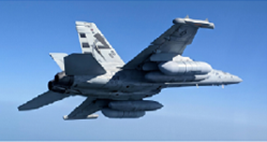
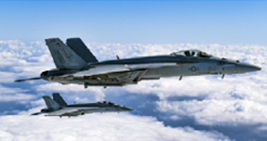
The Navy certified the cost growth of these two weapon systems as necessary to meet national security requirements and did not submit remediation plans. However, the Navy told us they have several cost mitigation initiatives underway that have yielded cost savings or cost avoidances for these systems, including investments to improve system reliability, engineering design changes, improved product support, and increasing the number of repairs completed at facilities operated by the Navy.
Reliability improvements. Navy officials told us they are making investments to improve the reliability of both the EA-18G and F/A-18 E/F systems. Officials told us they are using data collected by the Reliability Control Boards to identify and correct different causes of cost growth; changing to a strategy that initiates maintenance based on condition, rather than following a fixed schedule; conducting maintenance activities in specialized facilities shared by multiple operating units; and improving training, as well as field service support. According to Navy officials, the Reliability Control Board examines data from weapon systems, identifies the causes of ineffective performance, and develops corrective actions, including actions to improve component reliability, maintainability, and availability. Together, these initiatives saved $173 million for the EA-18G and the F/A-18E/F, according to program documentation.
Engineering design changes. Navy officials told us the EA-18G and F/A-18 E/F programs are implementing engineering design changes to improve reliability and lower future repair costs. For example, Navy officials stated that coating landing gears in a zinc-nickel surface treatment will have a future cost avoidance of $30 million to $50 million, starting in fiscal year 2030.
Improved product support. Navy officials told us the EA-18G and F/A-18 E/F programs are improving product support through developing and analyzing 1189 Interactive Electronic Technical Manual updates, 635 reliability-centered maintenance analyses, 34 improved training materials, and 1029 maintenance plan or task updates in fiscal years 2023 and 2024. Officials stated these actions reduced cost per flight hour growth, as well as annual cost savings to the flight hour account. For example, officials stated they identified a specific component on the EA-18G and the F/A18-E/F that was beyond repair at a rate of 100 or more per year. Navy officials explained they instituted a special inspection to repair the component before it reached a condition that could no longer be repaired. Program documentation showed a resulting reduction in the number of these components that reached a condition beyond repair, yielding a net savings of $140 million per year.
Increased number of repairs conducted at Navy-operated facilities. Navy officials told us they are increasing their organic (or in-house) military service repair capability through adding intermediate-level repair capability reduced repair turnaround time and achieved cost reductions and cost savings for the E-18G and F/A18-E/F. For example, for the EA-18G, the Navy established organic repair capability for the electronic warfare radar system, which reduced repair turnaround time by 3 months and achieved an annual cost savings of $3.5 million, according to program documentation.
Moreover, for the F/A-18E/F, Navy officials told us that the number of items organically repaired doubled, with an increase from 260 items in fiscal year 2022 to 527 items in fiscal year 2024. Additionally, Navy officials also told us that establishing the organic repair capability for the exterior light power supply reduced the repair turnaround time from 18 months to 6 months, reducing costs by 70 percent.
The Army Reported Progress Toward Mitigating Cost Growth of the CH-47F
The Army’s fiscal year 2021 sustainment review submission identified critical O&S cost growth for the CH-47F, Block I Chinook.
|
Army CH-47F, Block I Chinook The CH-47F, Block I Chinook is the Army’s only heavy-lift cargo rotary wing aircraft that supports combat and other critical operations. It transports forces and heavy equipment and provides routine aerial sustainment of maneuver forces. We previously reported that the Army’s fiscal year 2021 sustainment review submission estimated the Category A critical operating and support cost increase to be about 27 percent since the previous estimate was developed in 2004. The Army’s submission also estimated the Category B cost increase to be about 208 percent from the baseline cost estimate.
Army Ch-47F, Block I Chinook Sources: Department of Defense, Fiscal Year 2021 Sustainment Review to Congress; GAO‑23‑106341; and U.S. Army/Scott T. Sturkol. I GAO‑26‑108140 |
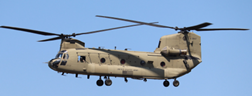
The Secretary of the Army certified the weapon system as necessary to meet national security requirements and did not submit remediation plans. However, the Army did report an initiative to transition the entire fleet to a new plan to reduce maintenance downtime.
Reduced maintenance downtime. An Army official stated that in 2014, they began identifying ways to lower the maintenance burden and associated costs, while increasing overall readiness. The Army began a maintenance steering group, which uses commercial maintenance practices to build effective maintenance schedules, officials told us.
This approach reduced the time spent by maintenance specialists and overall maintenance-related downtime, according to program documentation. The CH-47F program reported realizing benefits related to readiness after implementing this new maintenance plan, including a 70 percent increase in the average time between unscheduled maintenance actions and a 48 percent reduction in the ratio of total maintenance worker hours per flight hour, leading to cost savings and cost avoidance.
The Army Has Not Fully Implemented a Key Software Update to Reduce O&S Cost Growth Identified in Its Fiscal Year 2022 Remediation Plan
CROWS program was due to internal factors, rather than national security requirements, and submitted a remediation plan to the congressional committees. In the remediation plan, the Army stated that it planned to implement cost saving initiatives, including engineering design changes. However, the Army has not fully completed a software update that it identified to address a top maintenance driver and yield significant cost savings. Specifically, the Army estimated the full implementation of the software update could result in an annual cost savings of up to $7.7 million. Given that CROWS has approximately 30 years remaining in its life expectancy and that more than half the CROWS systems have yet to implement the software update, this type of annual savings could yield a total cost savings of over $130 million.
|
The Army’s fiscal year 2022 sustainment review submission identified critical O&S cost growth for the Common Remotely Operated Weapons Station (CROWS). The Army determined that a portion of the critical cost growth for the Army Common Remotely Operated Weapons Station The Common Remotely Operated Weapons Station is an externally mounted weapon system for multiple types of vehicles that allows the gunner to remain safely inside the vehicle while firing the weapon. We previously reported that the Army’s fiscal year 2022 sustainment review submission estimated the Category A critical O&S cost growth to be 335 percent above the previous cost estimate developed in 2017.
Army Common Remotely Operated Weapons Station Sources: Fiscal Year 2022 Sustainment Review to Congress; GAO‑24‑107378; and Army National Guard/CPL I. Matthews. I GAO‑26‑108140 |
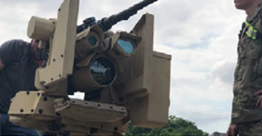
The Army reported progress in implementing two engineering design changes for the CROWS program to reduce O&S costs by preventing avoidable breakage. Specifically, the Army engineered design changes to better secure a mounting pin that safeguards the weapon while it is firing, or if the vehicle carrying the weapon is in motion. This design change prevents the pin from vibrating out of position and creating resistance that could require replacement of the mainframe assembly.
Additionally, the Army redesigned the thermal imaging module used by the weapon operator to include multiple stationary cameras, rather than one camera with moving parts. In May 2025, Army officials stated they had recently issued the last available legacy camera with moving parts and expect to see the new thermal cameras deployed as additional cameras need to be replaced.
In the CROWS remediation plan, the Army also outlined plans to release a software update that warns operators when they fail to disengage the travel locks before powering up the system, creating a risk of physical damage to the housing assembly.[35] The Army had initially planned to release the software update to the field in February 2023, notify system users, and track the number of units that have installed the software update on their CROWS systems. According to program documentation, the Army expected units to complete the software update 90 days after its release. However, the release of the software update has faced delays.
According to Army officials, the Army released the software update to its units in August 2024 through a maintenance action memorandum and provided units 120 days to install the update. As of May 2025, Army officials told us, and provided documentation, that approximately 37 percent of CROWS systems had reported completion of the software update. After our inquiry, Army officials told us they had not been monitoring the implementation of the software update but have since begun tracking the implementation through quarterly reporting. However, as of July 2025, less than 50 percent of CROWS systems had reported completion of the software update, according to program documentation.[36]
Officials stated that several potential barriers could further delay the implementation of the update. For example, the data system the Army uses to track implementation does not have a reminder function to notify units of maintenance action memorandum, and the number of personnel to install the software and funds to ship software discs may have been insufficient to implement the software update, according to program officials. Additionally, officials stated that CROWS systems with the Army National Guard, Army Reserve, and as part of the Army Prepositioned Stocks have not been used as frequently as active component units, and units may not prioritize the software update.
Standards for Internal Control in the Federal Government state that management should assess the quality of performance over time and promptly resolve the findings of audits and other reviews.[37] The standards also state that management should remediate identified internal control deficiencies on a timely basis. However, the Army has not fully implemented the initiatives called for in the remediation plan because it has not established processes and procedures to ensure that its units implement the software update. Army officials that were responsible for issuing the maintenance action memorandum explained that they lack the authority to ensure that units comply with it. Further, although an Army regulation calls for reporting compliance with maintenance messages up through Army headquarters, program sustainment officials told us they were unaware as to which headquarters’ offices they should report data on the completion of the software update and that they had not been asked by higher headquarters to provide reports on the implementation status.[38] The software update is now more than a year behind schedule. Without ensuring that its units implement the software update identified in the CROWS remediation plan on a timely basis, the Army is missing an opportunity to address a top maintenance driver affecting the CROWs system. It is also missing an opportunity to achieve a cost savings of more than $130 million over the remaining life of the program.
DOD Is Taking Steps to Address Sustainment Review Challenges
DOD Is Addressing Data Deficiencies and Scoping Decisions
DOD and the military services have identified challenges in conducting sustainment reviews and identifying critical O&S cost growth. Specifically, officials from the Office of the Secretary of Defense, DOD cost agencies, military headquarters, and the 14 program offices whose systems had critical O&S cost growth in fiscal year 2023 and fiscal year 2024 described challenges with available O&S cost data and unclear scope or baseline, such as identifying which variants to include in the cost estimate. They also described the steps being taken to mitigate those challenges.
Unavailable or limited data. In some instances, previous or original baseline O&S cost estimates were unavailable. According to our review of the 36 sustainment review submissions to the congressional defense committees, the military departments were unable to make a critical O&S cost growth determination for either Category A or B for three of the 21 systems in fiscal year 2023 and three of the 15 systems in fiscal year 2024.[39]
Additionally, in some instances, O&S cost data have been limited. DOD’s Operating and Support Cost-Estimating Guide includes a cost element structure for the military departments to categorize and define specific cost elements that, in total, comprise the full range of O&S costs that could occur for any defense system. However, Army and Navy program officials acknowledged instances in which O&S costs were not always captured within these categories and, therefore, were not included in the military departments’ O&S cost databases. For example, they identified the following scenarios:
· Unit-level personnel: Some personnel information has not always been captured as an O&S cost, such as costs for time spent by operators and other personnel who work on more than one system.
· Unit-level operations: Some costs for unit-level operations are difficult to quantify and have not been collected for specific weapon systems, such as vehicle fuel usage.
· Maintenance: Some costs for unscheduled maintenance performed at depots have not been previously captured as an O&S cost.
· Sustaining support: Some contractor support costs have not previously been collected because the requirement to do so was not clearly specified or enforced.
· Continuing system improvements: Some costs for weapon system modernization efforts previously have been classified as the research, development, test, and evaluation category of acquisition costs because the efforts involved new development.
Moreover, DOD officials told us that the Office of Cost Assessment and Program Evaluation (CAPE) updated its guidance on cost analysis in October 2024 and the operating and support cost-estimating guide in February 2025.[40] According to officials, because the military departments’ O&S cost databases collect cost data from several other databases, there have been data quality issues as the O&S cost categories have not always been aligned to the latest cost element structure provided in the CAPE O&S Cost Estimating Guide.
To mitigate these challenges, DOD and program officials told us they are taking steps to capture necessary O&S cost data elements in the services’ O&S cost databases, including
· adding additional steps to capture O&S cost data elements, such as personnel, fuel use, and unscheduled maintenance;
· clearly specifying what O&S cost data contractors are required to report;
· aligning O&S cost categories into the military departments’ O&S cost data systems; and
· coordinating with CAPE in the development of an enterprise-wide O&S cost database that can track and monitor these costs holistically across the department.
Unclear scope or baseline. Program officials specified that poor program definition at the beginning of the sustainment review process created challenges when comparing the current O&S cost estimate with the previous estimates. O&S cost estimates are based upon a series of assumptions about each weapon system. For example, Navy officials told us there was confusion over which variants of a weapon system should be included in a sustainment review and how to capture costs associated with capability improvements and modernization efforts. CAPE and military department guidance on conducting sustainment reviews has evolved over the past 5 years. Revisions to the guidance, such as changing economic useful life from 20 years to 30 years, or including modernization costs in the O&S cost element structure, have yielded different cost estimates as weapon systems conduct a subsequent sustainment review, according to our analysis of sustainment reviews and DOD officials.
To mitigate these challenges, DOD and the military services have continued to revise policies and guidance to better collect and align variables to allow effective comparison of cost estimates to determine cost growth. For example, in 2025, CAPE revised its O&S Cost Estimating guidance to include changes to the cost element structure, specifically the cost category capturing continuing systems improvements. Additionally, according to Army officials, the Army designed and implemented the use of templates to help standardize and guide the program office and cost estimators to define the scope and baseline of the sustainment review to ensure coordination and avoid rework. Army officials told us they are establishing specific meetings early in a weapon system’s sustainment review to discuss available data and data limitations in calculating O&S costs.
Military Departments Varied in Their Approaches for Determining and Reporting Critical O&S Cost Growth
We found that the military departments varied in how they determined and reported critical O&S cost growth in their fiscal years 2023 and 2024 sustainment reviews. Some military departments used total O&S cost growth to compare recent cost estimates against either the most recent cost estimate or the original baseline cost estimate, or both. In other cases, the military departments used unit O&S cost growth, or a combination of the two. More specifically:
· The Army used total O&S cost growth in its fiscal years 2021, 2022, and 2023 sustainment reviews. The Army then used unit O&S cost growth in fiscal year 2024. The Army made this change based on a CAPE recommendation that they determine whether cost growth can be reported on a unit basis in order to facilitate more meaningful cost comparisons, according to Army officials.
· The Navy used total O&S cost growth in its fiscal years 2021, 2022, and 2023 sustainment reviews. The Navy then used both total and unit O&S cost growth in fiscal year 2024, based in part on CAPE’s recommendation. Navy officials told us that they plan to use both total and unit O&S for subsequent sustainment reviews.
· In general, the Air Force relied on total O&S cost growth in its fiscal years 2021, 2022, 2023, and 2024 sustainment reviews. However, in a few instances, the Air Force used unit cost growth. Air Force officials told us that because the statute directing the sustainment reviews did not call for total O&S cost growth or unit O&S cost growth, they believed they had the flexibility to choose between total and unit cost growth to determine critical O&S cost growth.[41]
We also found that not all reported cost growth reflected causes that need to be remediated because the cost growth was certified to meet national security requirements.[42] DOD officials reported that critical O&S cost increases due to total cost growth do not always signal an inefficiency but can occur due to increased procurement or added weapon system capability. A military service official reported that, because of changes in the quantities and capabilities of weapon systems, using the total O&S cost increases to determine critical O&S cost growth can be misleading for decision-makers. While the military departments varied in how they determined and reported critical O&S cost growth, the National Defense Authorization Act for Fiscal Year 2026 eliminated the need for DOD to calculate and report O&S cost growth in future sustainment review reports. However, as noted earlier in our report, DOD guidance includes details on analyzing and estimating O&S costs, and the military departments will be conducting independent cost estimates every 5 years for systems once they achieve initial operating capability.[43] Though DOD’s congressional reporting requirement on critical O&S cost growth was eliminated, tracking O&S cost growth remains an important way for DOD to hold programs accountable and identify opportunities for savings.
Conclusions
The Navy and Army have taken some actions to address critical O&S cost growth identified in the fiscal years 2021 and 2022 weapon system sustainment reviews, but the Army has not yet fully implemented a key software update. Without ensuring that its units implement the software update identified in the CROWS remediation plan on a timely basis, the Army is missing an opportunity to address a top maintenance driver affecting this weapon system and to achieve a cost savings of more than $130 million over the remaining life of the program.
Recommendation for Executive Action
The Secretary of the Army, in coordination with the Chief of Staff of the Army, should ensure that the Army’s units implement the software update identified in the CROWS remediation plan on a timely basis. (Recommendation 1)
Agency Comments and Our Evaluation
We provided a draft of this report to DOD for review and comment. In written comments on a draft of this report, DOD concurred with the recommendation. DOD’s comments are reprinted in their entirety in appendix IV. DOD also provided written technical comments, which we incorporated as appropriate.
We are sending copies of this report to the appropriate congressional committees, the Secretary of Defense, the Secretaries of the Army, Navy, and Air Force, and the Commandant of the Marine Corps. In addition, the report is available at no charge on the GAO website at http://www.gao.gov.
If you or your staff have any questions about this report, please contact me at maurerd@gao.gov. Contact points for our Office of Congressional Relations and Media Relations may be found on the last page of this report. Staff members making key contributions to this report are listed in appendix V.

Diana Maurer
Director, Defense Capabilities and Management
List of Congressional Committees
The Honorable Roger F. Wicker
Chairman
The Honorable Jack Reed
Ranking Member
Committee on Armed Services
United States Senate
The Honorable Mitch McConnell
Chair
The Honorable Christopher Coons
Ranking Member
Subcommittee on Defense
Committee on Appropriations
United States Senate
The Honorable Mike Rogers
Chairman
The Honorable Adam Smith
Ranking Member
Committee on Armed Services
House of Representatives
The Honorable Ken Calvert
Chairman
The Honorable Betty McCollum
Ranking Member
Subcommittee on Defense
Committee on Appropriations
House of Representatives
For the fiscal year 2023 sustainment reviews, the Department of Defense (DOD) identified operating and support (O&S) cost changes for 18 systems and critical cost growth for 10 systems.[44] See figures 12-14 for details related to each weapon system for which the military departments identified O&S cost changes.
Figure 12: Army Weapon Systems with Operating and Support Cost Changes Identified in 2023 Sustainment Reviews
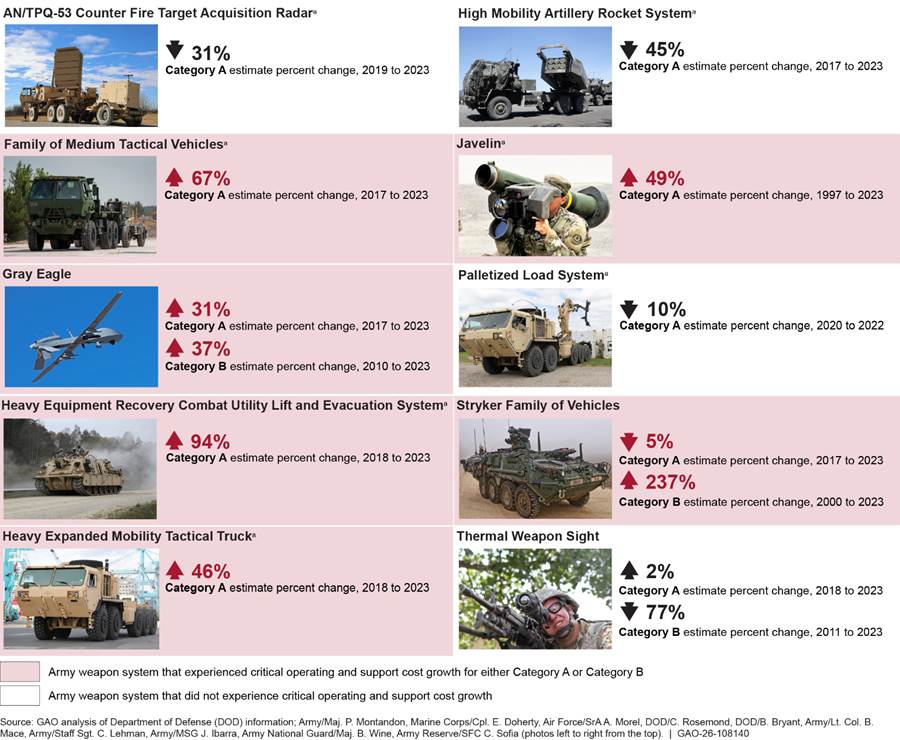
Note: Category A is critical operating and support (O&S) cost growth when there is at least 25 percent more growth than the estimate documented in the most recent independent cost estimate for the system. Category B is critical O&S cost growth when there is at least 50 percent more growth than the estimate documented in the original baseline cost estimate for the system. Appendix III in this report (GAO‑26‑108140) provides detailed information on the causes for weapon systems that experienced critical O&S cost growth in fiscal year 2023.
aAccording to the Army’s submission, this weapon system did not have a Category B comparison because no original baseline estimate existed for this system. We discuss this issue in GAO‑26‑108140.
Figure 13: Navy Weapon Systems with Operating and Support Cost Changes Identified in 2023 Sustainment Reviews
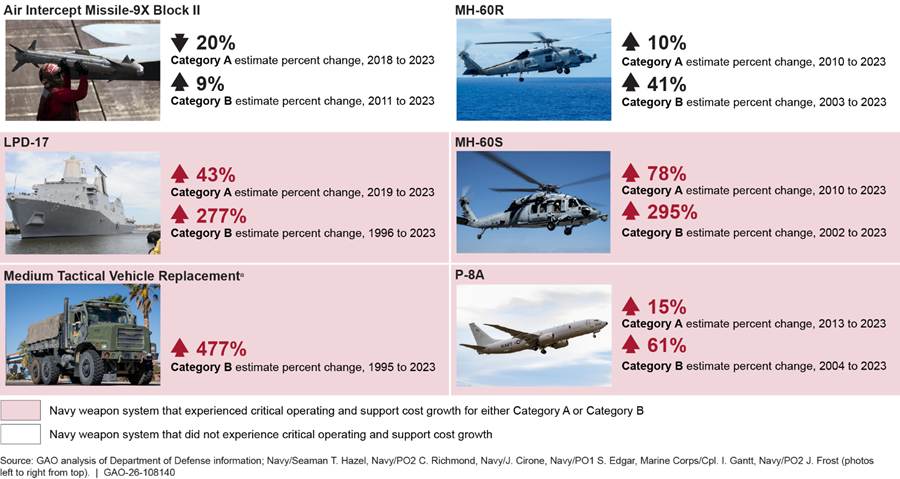
Note: Category A is critical operating and support (O&S) cost growth when there is at least 25 percent more growth than the estimate documented in the most recent independent cost estimate for the system. Category B is critical O&S cost growth when there is at least 50 percent more growth than the estimate documented in the original baseline cost estimate for the system. Appendix III in this report (GAO‑26‑108140) provides detailed information on the causes for weapon systems that experienced critical O&S cost growth in fiscal year 2023.
aAccording to the Navy’s submission, this weapon system did not have a Category A comparison because no recent independent cost estimate existed for the system. We discuss this issue in GAO‑26‑108140.
Figure 14: Air Force Weapon Systems with Operating and Support Cost Changes Identified in 2023 Sustainment Reviews
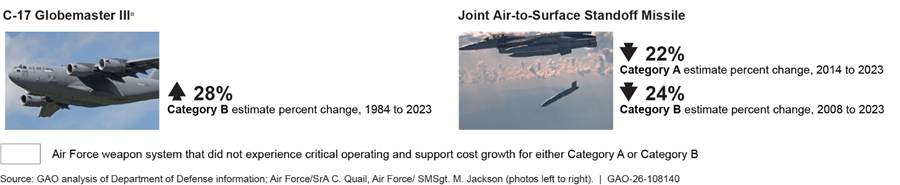
Note: Category A is critical operating and support (O&S) cost growth when there is at least 25 percent more growth than the estimate documented in the most recent independent cost estimate for the system. Category B is critical O&S cost growth when there is at least 50 percent more growth than the estimate documented in the original baseline cost estimate for the system.
aAccording to the Air Force’s submission, this weapon system did not have a Category A comparison because no recent independent cost estimate existed for the system. We discuss this issue in GAO‑26‑108140.
For the fiscal year 2024 sustainment reviews, the Department of Defense (DOD) identified operating and support (O&S) cost changes for 12 systems and critical cost growth for four systems.[45] See figures 15-17 for details related to each weapon system for which the military departments identified O&S cost changes.
Figure 15: Army Weapon Systems with Operating and Support Cost Changes Identified in 2024 Sustainment Reviews
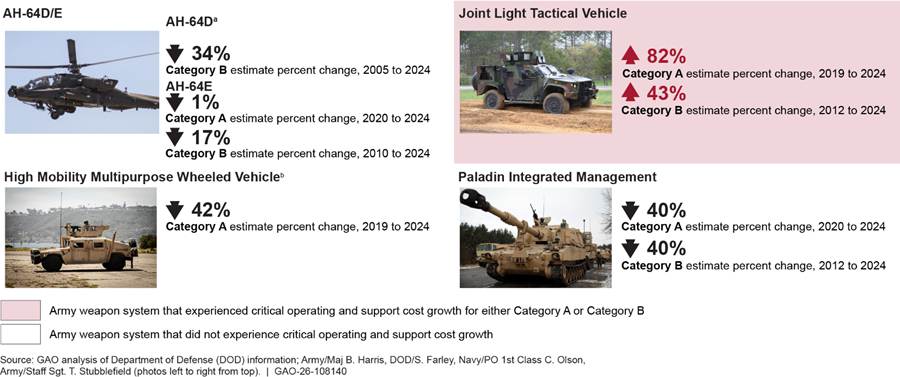
Note: Category A is critical operating and support (O&S) cost growth when there is at least 25 percent more growth than the estimate documented in the most recent independent cost estimate for the system. Category B is critical O&S cost growth when there is at least 50 percent more growth than the estimate documented in the original baseline cost estimate for the system. Appendix III in this report (GAO‑26‑108140) provides detailed information on the causes for weapon systems that experienced critical O&S cost growth in fiscal year 2024.
aAccording to the Army’s submission, this weapon system did not have a Category A comparison because no recent independent cost estimate existed for the system. We discuss this issue in GAO‑26‑108140.
bAccording to the Army’s submission, this weapon system did not have a Category B comparison because no original baseline estimate existed for this system. We discuss this issue in GAO‑26‑108140.
Figure 16: Navy Weapon Systems with Operating and Support Cost Changes Identified in 2024 Sustainment Reviews
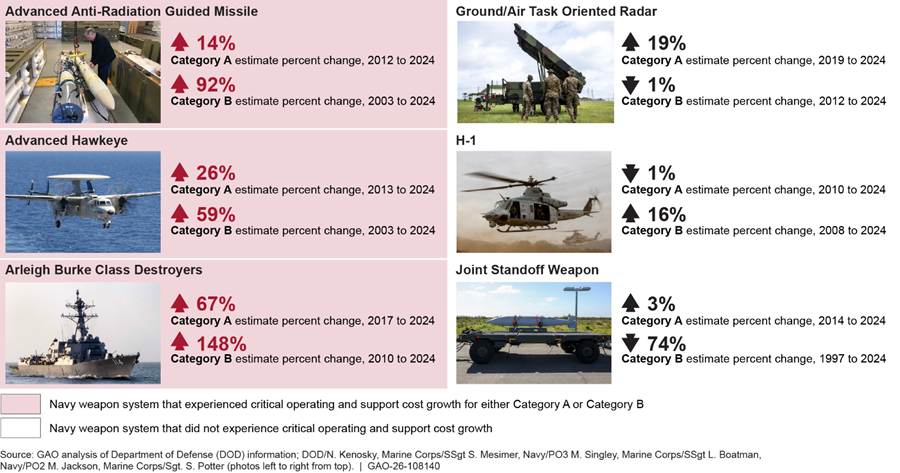
Note: Category A is critical operating and support (O&S) cost growth when there is at least 25 percent more growth than the estimate documented in the most recent independent cost estimate for the system. Category B is critical O&S cost growth when there is at least 50 percent more growth than the estimate documented in the original baseline cost estimate for the system. Appendix III in this report (GAO‑26‑108140) provides detailed information on the causes for weapon systems that experienced critical O&S cost growth in fiscal year 2024.
Figure 17: Air Force Weapon Systems with Operating and Support Cost Changes Identified in 2024 Sustainment Reviews
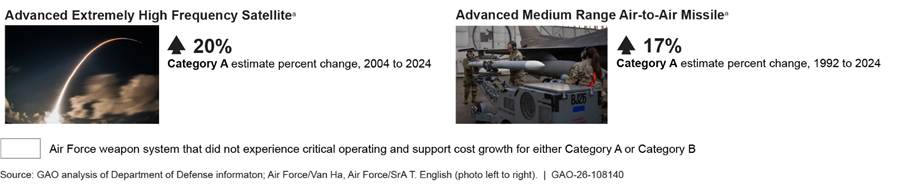
Note: Category A is critical operating and support (O&S) cost growth when there is at least 25 percent more growth than the estimate documented in the most recent independent cost estimate for the system. Category B is critical O&S cost growth when there is at least 50 percent more growth than the estimate documented in the original baseline cost estimate for the system.
aAccording to the Air Force’s submission, this weapon system did not have a Category B comparison because no original baseline estimate existed for this system. We discuss this issue in GAO‑26‑108140.
Appendix III: Detailed Information on the Causes of Critical Operating and Support Cost Growth, by Weapon System for Fiscal Years 2023 and 2024
The military department’s fiscal year 2023 and fiscal year 2024 sustainment reviews provided weapon system operating and support (O&S) cost growth in baseline or constant year dollars.[46] To standardize these data for comparability, we converted the totals to a common year, specifically fiscal year 2024. Following is detailed information on the causes of critical operating and support cost growth by weapon system for fiscal years 2023 and 2024.
Army fiscal year 2023. In the Army’s submission to the congressional defense committees, the Secretary of the Army certified that the critical operating and support cost growth for all six weapon systems was necessary for national security. These systems include Family of Medium Tactical Vehicles, Gray Eagle, Heavy Equipment Recovery Combat Utility Lift and Evacuation System M88, Heavy Expanded Mobility Tactical Truck, Javelin, and Stryker Family of Vehicles. Below are details on the causes of the critical O&S cost growth and any efforts to mitigate them.
· Family of Medium Tactical Vehicles: The Army’s sustainment review submission estimated the Category A critical total O&S cost growth to be 67 percent above the previous cost estimate developed in 2017. This equates to a $9.7 billion (2024 constant year value) top-line increase from the last independent cost estimate. The Army’s submission attributed the cost growth to several causes. First, the economic useful life calculation for vehicles increased from 20 to 30 years. Second, quantities and variants were omitted from the prior review, including 1180 A0 vehicles, 23631 A1 vehicles, and 570 vehicles in the Army’s data interchange program. Third, the program procured more A2 variants, though an exact procurement quantity was not included. Finally, unscheduled maintenance or overhauls and newly available data describing additional sunk costs, fuel price increase, indirect costs, and increased operational tempo contributed to the cost growth. Program officials are currently evolving the current O&S cost growth oversight mechanisms to better manage cost growth.
· Gray Eagle: The Army’s sustainment review submission estimated the Category A critical total O&S cost growth to be 31 percent and a Category A critical unitized O&S cost growth to be 31 percent above the previous cost estimate developed in 2017. These estimates equate to a $4.6 billion (2024 constant year value) top-line increase and a $14 million (2024 constant year value) per unit increase from the last independent cost estimate. The Army’s submission attributed the cost growth to several causes. First, the sustainment period increased by 6 years. Additionally, sunk costs were updated from the prior cost estimate; crew and maintainer costs increased; and previously omitted contractor engineering services efforts, including sustaining/systems engineering, hardware, and software contributed to the cost growth. Finally, labor and nonlabor shared services were included in the most recent estimate. The program intends to incorporate appropriate sustainment strategy changes resulting from the sustainment review.
· Heavy Equipment Recovery Combat Utility Lift and Evacuation System M88: The Army’s sustainment review submission estimated the Category A critical total O&S cost growth to be 94 percent above the previous cost estimate developed in 2018. This estimate equates to a $9.7 billion (2024 constant year value) top-line increase from the last independent cost estimate. The Army’s submission attributed the cost growth to several causes. First, the 2018 estimate only included the A2 variant of the vehicle, while the 2023 sustainment review included both the A1 and A2 variants. Second, the economic useful life for the program increased from 20 to 30 years. Third, 50 additional A2 variant vehicles were procured. Fourth, reparables and consumables increased in cost. Finally, the sustainment review included previously omitted transportation, depot maintenance, and sunk costs. The program intends to incorporate appropriate sustainment strategy changes resulting from the sustainment review.
· Heavy Expanded Mobility Tactical Truck: The Army’s sustainment review submission estimated the Category A critical total O&S cost growth to be 46 percent above the previous cost estimate developed in 2018. This estimate equates to a $14.2 billion (2024 constant year value) top-line increase from the last independent cost estimate. The Army’s submission attributed the cost growth to several causes. First, the program increased its procurement quantities by 1,208 vehicles. Second, the economic useful life of vehicles increased from 20 to 30 years. Finally, increased operational tempo resulted in cost growth. Additionally, challenges contributed to the cost growth: methodological discrepancies, specifically the use of the Maintenance Ratio instead of the Manpower Requirements Criteria; transportation costs, including increased petroleum, oil, and lubricant costs; decreased fuel economy; and increased consumables and repair costs associated with an increase in the vehicle economic useful life. The program intends to incorporate appropriate sustainment strategy changes resulting from the sustainment review.
· Javelin: The Army’s sustainment review submissions estimated the Category A critical total O&S cost growth to be 49 percent above the previous cost estimate developed in 1997. This estimate equates to a $1.6 billion (2024 constant year value) top-line increase from the last independent cost estimate. The Army’s submission attributed the cost growth to several causes. First, the quantity of Javelins increased by 17,594 missiles and 3,886 Command Launch Units. Second, additional variants were included in the sustainment review that were previously omitted. Third, the calculation of economic useful life increased based on Stockpile Reliability Program Testing. Fourth, Block 0 and Block 1 Command Launch Units were fielded longer than expected in the previous estimate. Finally, discrepancies in methodology for estimating annual available personnel time for unit-level staffing contributed to cost growth. The program intends to incorporate appropriate sustainment strategy changes resulting from the sustainment review.
· Stryker Family of Vehicles: The Army’s sustainment review submissions estimated the Category B critical total O&S cost growth to be 237 percent above the program’s original baseline estimate developed in 2000. This estimate equates to a $31.7 billion (constant year value) top-line increase since the program’s original baseline. The Army’s submission attributed the cost growth to several causes. First, the calculation of economic useful life increased from 20 to 30 years. Second, system procurement increased by 2,328 (about a 109 percent increase). Third, cost growth was attributed to increases in operation tempo, to include fuel consumption per mile, increased annual training ammunition required, increased cost per mile of reparables and consumables, and the inclusion of overhaul and reset schedule costs. Fourth, the number of Stryker units increased from six Stryker Brigade Combat Teams to nine. Finally, new system variants requiring significant hardware modifications and software maintenance that were previously omitted contributed to cost growth. The program intends to incorporate appropriate sustainment strategy changes resulting from the sustainment review.
Army fiscal year 2024. The Army identified causes for systems that experienced critical cost growth. In the Army’s submission to the congressional defense committees, the Secretary of the Army certified that the critical O&S cost growth for the Joint Light Tactical Vehicle was necessary for national security. Specifically:
· Joint Light Tactical Vehicle: The Army’s sustainment review submissions estimated the Category A critical total O&S cost growth to be 161 percent, and the Category A critical unitized O&S cost growth, to be 82 percent above the previous cost estimate developed in 2019. These estimates equate to a $62.7 billion (2024 constant year value) top-line increase and a $25 million (2024 constant year value) per unit increase from the last independent cost estimate. Additionally, sustainment review materials estimate a Category B critical total O&S cost growth to be 142 percent above the program’s original baseline estimate developed in 2012. This estimate equates to a $53 billion (2024 constant year value) top-line increase from the program’s original baseline. The Army’s submission attributed the cost growth to several causes. First, the crew size increased from one to two operators per general purpose/utility vehicle variants and to three operators for heavy gun carrier/close combat weapons vehicle variants. Second, project newness resulted in insufficient data, leading to methodological assumptions and updates. Third, calculation of economic useful life increased from 20 to 30 years. Finally, costs in depot maintenance, fuel, and consumables and reparables increased. The program plans to continue using and developing oversight mechanisms to monitor O&S cost growth. Additionally, the program office intends to continuously update the Cost Assessment Data Enterprise dataset to ensure compliance. The Enterprise Visibility and Management of Operating and Support Costs dataset is in development, and completeness will improve with continued development, filling data gaps.
Navy fiscal year 2023. The Navy identified causes for systems that experienced critical cost growth. In the Navy’s submission to the congressional defense committees, the Acting Assistant Secretary of the Navy for Research, Development and Acquisition certified that the critical O&S cost growth for all four weapon systems was necessary to meet national security requirements. These systems include the LPD-17, the Medium Tactical Vehicle Replacement, the MH-60S, and the P-8A.
· LPD-17: The Navy’s sustainment review submission estimated the Category A critical total O&S cost growth to be 43 percent and the Category A critical unitized O&S cost growth to be 43 percent above the previous cost estimate developed in 2019. These estimates equate to a $36.3 billion (2024 constant year value) top-line increase and a $35 million (2024 constant year value) per unit level increase from the last independent cost estimate. Additionally, the sustainment review submission estimated the Category B critical total O&S cost growth to be 277 percent and the Category B critical unitized O&S cost growth to be 74 percent above the program’s original baseline estimate developed in 1996. These estimates equate to an $88.1 billion (2024 constant year value) top-line increase and a $49 million (2024 constant year value) per unit increase from the program’s original baseline. The Navy’s submission attributed the cost growth to several causes. First, the program procured 14 additional ships between the original baseline and the sustainment review. Second, the program implemented capability improvements. Third, the program cited the application of updated inflation and escalation best practices. Finally, the program implemented additional maintenance requirements and modernization activities to support hardware and software upgrades. These programmatic changes were necessary to meet the warfighting requirements of the LPD-17 Program, including meeting critical capability and high readiness program outcomes. According to program officials, the program intends to address cost growth by continuing to utilize cost growth oversight mechanisms. Additionally, the program intends to conduct additional analysis to ensure accurate data tracking and reporting. This effort includes actions to implement a data-based approach to identify sustainment gaps, utilizing CORONA data, populating Driver Tree, engaging obsolescence earlier, and developing a platform-level holistic modernization and sustainment strategy.
· Medium Tactical Vehicle Replacement: The Navy’s sustainment review submission estimated the Category B critical total O&S cost growth to be a 477 percent increase above the program’s original baseline estimate developed in 1995. This estimate equates to a $7 billion (2024 constant year value) top-line increase from the program’s original baseline. The Navy’s submission attributed the cost growth to several causes. First, there was an increase in vehicle procurement of 9,750 additional vehicles. Second, the cost of capability improvement modifications was not previously captured, including improvements to armor and fuel efficiency. Third, the service life increased from 22 years to 42 years. Fourth, increased maintenance and reparables and consumables costs contributed to cost growth. Finally, the original baseline estimate in 1995 used a different methodological approach compared with the current sustainment review. According to program officials, programmatic changes were necessary to meet increased warfighting requirements, including critical capability. The program is currently undergoing an Approved Acquisition Objective reduction, which will reduce some O&S cost, though no cost savings are expected to be realized due to the service-level staffing requirements. A system sustainment working group is working to analyze data accuracy and completeness and to resolve data issues in the Enterprise Visibility and Management of Operating and Support Cost system.
· MH-60S: The Navy’s sustainment review submission estimated the Category A critical total O&S cost growth to be 78 percent above the previous cost estimate developed in 2010. This estimate equates to a $25 billion (2024 constant year value) top-line increase from the last independent cost estimate. Additionally, the Navy’s sustainment submission estimated the Category B critical total O&S cost growth to be 295 percent and the Category B critical unitized O&S cost growth to be 96 percent above the program’s original baseline estimate developed in 2002. These estimates equate to a $42.6 billion (2024 constant year value) top-line increase and a $3 million (2024 constant year value) per unit increase from the program’s original baseline. The Navy’s submission attributed the cost growth to several causes. First, there was an increase in aircraft procured – 38 additional aircraft were procured between the original baseline and the sustainment review. Second, the service life was extended from 30 years to 50 years. Third, capability improvements were implemented. Finally, fuel prices increased. Programmatic changes were necessary to meet increased warfighting requirements, including critical capability and high readiness program outcomes. According to program officials, the program plans to continue the utilization of oversight mechanisms to monitor O&S cost growth.
· P-8A: The Navy’s sustainment review submission estimated the Category B critical total O&S cost growth to be 61 percent above the program’s original baseline estimate developed in 2004. This estimate equates to an $18.8 billion (2024 constant year value) top-line increase from the program’s original baseline. The Navy’s submission attributed the cost growth to several causes. First, additional aircraft were procured: one aircraft between the original baseline and the previous independent cost estimate, and 19 aircraft between the program’s previous independent cost estimate and the sustainment review. Second, the most recent cost estimate included program increments 2 and 3, as well as quick reaction capability improvements. Finally, other factors that contributed to cost growth included increased fuel prices and implementation of inflation and escalation guidance. Programmatic changes were necessary to meet increased warfighting requirements, including critical capability and high readiness program outcomes. According to program officials, the program plans to continue using current oversight mechanisms to monitor O&S cost growth, including the Naval Sustainment System – Aviation Cost Pillar to optimize staffing, facilities, and aircraft. Objectives are achieved through Naval Aviation Enterprise stakeholder engagements conducted by the program’s Reliability Control Board, performance reviews, and Naval Supply End-to-End Value Stream mapping. Finally, the program collaborates with Australia through engineering support cost-sharing and economic order quantity procurements.
Navy fiscal year 2024. The Navy identified causes for systems that experienced critical cost growth. In the Navy’s submission to the congressional defense committees, the Acting Assistant Secretary of the Navy for Research, Development and Acquisition certified that the critical O&S cost growth for all four weapon systems was necessary to meet national security requirements. These systems include the Advanced Anti-Radiation Guided Missile, Advanced Hawkeye, and the Arleigh Burke Class Destroyer.
· Advanced Anti-Radiation Guided Missile: The Navy sustainment review submission estimated the Category B critical total O&S cost growth to be 92 percent above the program’s original baseline estimate developed in 2003. This estimate equates to a $127 billion (2024 constant year value) top-line increase from the program’s original baseline. The Navy’s submission attributed the cost growth to several causes. First, the program life was extended. Second, the cost of spares and repair replenishment requirements was previously omitted. These programmatic changes were deemed necessary to meet increased warfighting requirements, including critical capability and high readiness program outcomes. According to program officials, the program intends to continue using cost growth oversight mechanisms to monitor cost growth.
· Advanced Hawkeye: The Navy’s sustainment review submission estimated the Category A critical total O&S cost growth to be 26 percent above the previous cost estimate developed in 2013. This estimate equates to a $5.7 billion (2024 constant year value) top-line increase from the last independent cost estimate. Additionally, the Navy sustainment review submission estimated the Category B critical total O&S cost growth to be 59 percent above the program’s original baseline estimate developed in 2003. This estimate equates to a $10.5 billion (2024 constant year value) top-line increase from the program’s original baseline. The Navy’s submission attributed the cost growth to several causes. First, the program procured additional aircraft (five aircraft since the program’s last independent cost estimate). Second, utilization and service life rates were extended. More specifically, the latest programmatic documents illustrate a utilization rate that is lower than prior estimates resulting in current estimates, reflecting a profile where the platform is flying longer and driving cost. Third, the program implemented capability improvements, such as aerial refueling and the Towed Auxiliary Receive Array System, and these costs were not captured in the prior cost estimate. Programmatic changes were necessary to meet increased warfighting requirements, including critical capability and high readiness program outcomes. According to program officials, the program plans to continue using O&S cost growth oversight mechanisms to monitor this growth, including the Reliability Control Board and Naval Sustainment System – Aviation Cost Pillar process.
· Arleigh Burke Class Destroyers: The Navy’s sustainment review submission estimated the Category A critical total O&S cost growth to be 67 percent and the Category A critical unitized O&S cost growth to be 26 percent above the previous cost estimate developed in 2017. This estimate equates to a $178.2 billion (2024 constant year value) top-line increase and a $20 million (2024 constant year value) per unit increase from the last independent cost estimate. Additionally, the submission estimated the Category B critical total O&S cost growth to be 148 percent above the program’s original baseline estimate developed in 2010. This estimate equates to a $267 billion (2024 constant year value) top-line increase since the program’s original baseline. The Navy’s submission attributed the cost growth to several causes. First, the program procured additional ships (18 ships between the original baseline and the previous independent cost estimate, and 28 ships between the program’s previous independent cost estimate and the sustainment review). Second, the service life of the fleet increased. Third, the program experienced increased maintenance costs for modernization efforts and capability improvements. Fourth, the program experienced pandemic-related supply change disruptions and maintenance. Finally, inflation guidance, updated ship personnel requirements, and data inconsistencies all affected cost growth. According to program officials, the program is working to create governance frameworks, performance dashboards, refined cost models, and updating Life Cycle Sustainment Plans. In the future, the program plans to engage in asset recovery, Readiness-Based Sparing modeling, accelerated modernization, enhanced analytics, and type command alignment to monitor O&S cost growth.
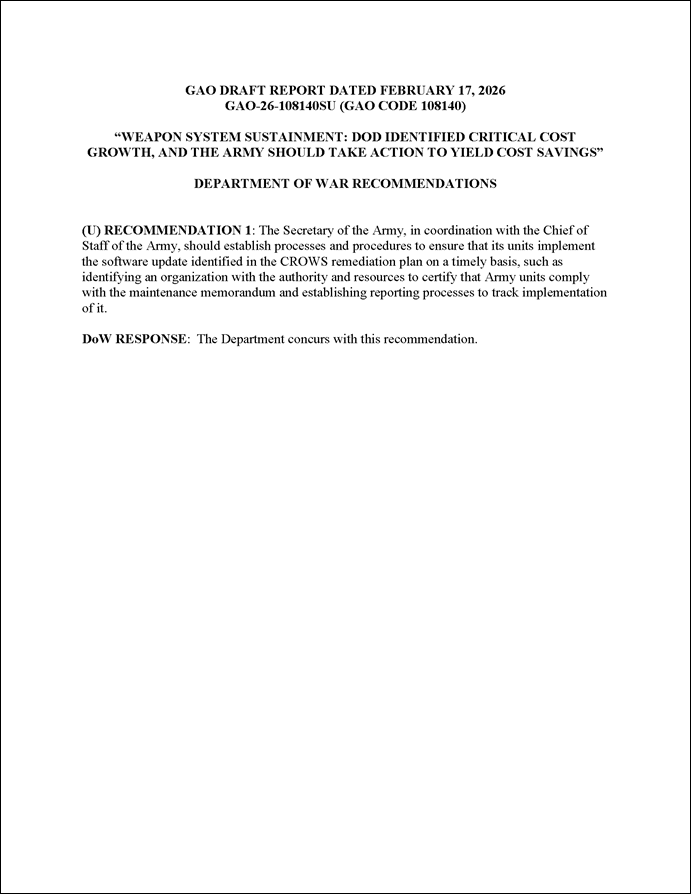
Diana Maurer, or maurerd@gao.gov
In addition to the contact named above, Lori Atkinson (Assistant Director), Matthew Ullengren (Assistant Director), Laura Czohara (Analyst in Charge), Jesse Andrews, Vincent Buquicchio, Daniel Falcon, Adrian Good, Sam Kim, Jennifer Leotta, Terry Richardson, and Cosette Vincent made key contributions to this report.
The Government Accountability Office, the audit, evaluation, and investigative arm of Congress, exists to support Congress in meeting its constitutional responsibilities and to help improve the performance and accountability of the federal government for the American people. GAO examines the use of public funds; evaluates federal programs and policies; and provides analyses, recommendations, and other assistance to help Congress make informed oversight, policy, and funding decisions. GAO’s commitment to good government is reflected in its core values of accountability, integrity, and reliability.
Obtaining Copies of GAO Reports and Testimony
The fastest and easiest way to obtain copies of GAO documents at no cost is through our website. Each weekday afternoon, GAO posts on its website newly released reports, testimony, and correspondence. You can also subscribe to GAO’s email updates to receive notification of newly posted products.
Order by Phone
The price of each GAO publication reflects GAO’s actual cost of production and distribution and depends on the number of pages in the publication and whether the publication is printed in color or black and white. Pricing and ordering information is posted on GAO’s website, https://www.gao.gov/ordering.htm.
Place orders by calling (202) 512-6000, toll free (866) 801-7077,
or
TDD (202) 512-2537.
Orders may be paid for using American Express, Discover Card, MasterCard, Visa, check, or money order. Call for additional information.
Connect with GAO
Connect with GAO on X,
LinkedIn, Instagram, and YouTube.
Subscribe to our Email Updates. Listen to our Podcasts.
Visit GAO on the web at https://www.gao.gov.
To Report Fraud, Waste, and Abuse in Federal Programs
Contact FraudNet:
Website: https://www.gao.gov/about/what-gao-does/fraudnet
Automated answering system: (800) 424-5454
Media Relations
Sarah Kaczmarek, Managing Director, Media@gao.gov
Congressional Relations
David A. Powner, Acting Managing Director, CongRel@gao.gov
General Inquiries
[1]Department of Defense, DOD Strategic Management Plan for Fiscal Years 2022–2026 (March 2023).
[2]The National Defense Authorization Act for Fiscal Year 2026 eliminated the requirement for DOD to include the information on the weapon systems’ life-cycle O&S costs from sustainment reports submitted pursuant to section 4323. See Pub. L. No. 119-60, § 1803(b) (2025) (amending section 4323). At all times relevant to our work producing this report, the previous relevant statutes were valid and in force, and the report is based on the requirements within the statutory provisions as they existed during that time period. Therefore, details from the statutes that appear in this report will be stated in the past tense whenever appropriate, to include portions of the report that lay out statutory requirements and definitions, and citations to the relevant statutory provisions will make clear when the statute no longer exists as described.
[3]10 U.S.C. § 4323(d) (repealed December 2025). The statute defined a covered system as (1) a major defense acquisition program as defined in section 4201 of title 10, United States Code; or (2) an acquisition program or project carried out using the rapid fielding or rapid prototyping acquisition pathway under 10 U.S.C. § 3602, that is estimated by the Secretary of Defense to require an eventual total expenditure of more than $300 million for research, development, test, and evaluation, or $1.8 billion for procurement (dollar amounts are in fiscal year 1990 constant dollars). 10 U.S.C. § 4324(d)(5) (amended December 2025).
[4]10 U.S.C. § 4323(d)(3) (repealed December 2025).
[5]10 U.S.C. § 4323(e)(2) (repealed December 2025). The statute referenced section 4214, which defines an original baseline cost estimate for a weapon system as the baseline description established with respect to a weapon system acquisition program before it enters system development and demonstration, or at program initiation, whichever occurs later, without adjustment or revision, with some exceptions. See 10 U.S.C. §§ 4323(e)(2)(B) (repealed December 2025), 4214(d)(1).
[6]Following the amendments, section 4323 still calls for “sustainment reviews” and describes reports the military departments must submit to Congress. How DOD implements the revised requirement remains to be seen; however, as noted above, the statute no longer expressly requires the reports to contain the O&S cost growth information discussed in this report.
[7]Pub. L. No. 116-283, § 802(d) (2021). This report is the final one to be submitted under this statutory requirement.
[8]For this report, we reviewed all the sustainment reviews that the military departments completed in fiscal years 2023 and 2024. We have previously reported on weapon system sustainment reviews DOD conducted for fiscal years 2021 and 2022. See GAO, Weapon System Sustainment: DOD Identified Operating and Support Cost Growth but Needs to Improve the Consistency and Completeness of Information to Congress, GAO‑24‑107378 (Washington, D.C.: Feb. 29, 2024); and Weapon System Sustainment: The Army and Air Force Conducted Reviews and the Army Identified Operating and Support Cost Growth, GAO‑23‑106341 (Washington, D.C.: Mar. 30, 2023).
[9]According to DOD officials, the department selects certain systems per fiscal year to conduct sustainment reviews on. Systems are selected based on several factors, including personnel availability and when the system is scheduled to be at 5 years post initial operating capability.
[11]GAO, Standards for Internal Control in the Federal Government, GAO‑14‑704G (Washington, D.C.: September 2014).
[12]Department of Defense, Office of Cost Assessment and Program Evaluation, Operating and Support Cost-Estimating Guide (February 2025).
[13]10 U.S.C. §4323(a) (amended December 2025). Initial operational capability is generally when some organizations in the force structure scheduled to receive a system have received it and can employ and maintain it.
[14]Department of Defense Directive 5135.02, Under Secretary of Defense for Acquisition and Sustainment (USD (A&S)) (July 15, 2020).
[15]Department of Defense Instruction 5000.73, Cost Analysis Guidance and Procedures (Oct. 24, 2024).
[16]Operational tempo is the rate at which military units are involved in military activities, including contingency operations, exercises, and training deployment.
[17]Army Regulation 70-1, Army Operation of the Adaptive Acquisition Framework (Nov. 28, 2023).
[18]See Secretary of the Navy Instruction 5400.15D, Department of the Navy Research and Development, Acquisition, Associated Life-Cycle Management, and Sustainment Responsibilities and Accountability (Jan. 19, 2021).
[19]Air Force Mission Directive 1-10, Assistant Secretary of the Air Force (Acquisition) (Sept. 2, 2016).
[20]Of the 21 weapon systems, the Army reviewed 10; the Navy, seven; and the Air Force, four.
[21]Of the 15 weapon systems, the Army reviewed four; the Navy, eight; and the Air Force, three.
[22]See 10 U.S.C. § 4323(b)(1) (repealed December 2025). While the Department of the Navy completed some elements of the sustainment review for the Virginia Class Submarines, some elements related to identifying critical operating and support cost growth were not completed. According to Navy officials, as of October 2025, results from the independent cost estimate remain pending.
[23]Specifically, section 4323 of title 10, U.S. Code, defined critical O&S cost growth as O&S cost growth of (a) at least 25 percent more than the estimate documented in the most recent independent cost estimate for the system or (b) at least 50 percent more than the estimate documented in the original baseline cost estimate for the system. For the purposes of this report, we refer to these categories of critical cost growth as Category A and Category B, respectively. 10 U.S.C. § 4323(e)(2) (repealed December 2025).
[24]The three systems that the military departments reported did not have a previous or original baseline cost estimate, needed to determine O&S cost growth, were the Navy’s Virginia Class Submarines and the Air Force’s Minuteman III and Wideband Global Satellite Communications Space Vehicle.
[25]See 10 U.S.C. § 4323(b)(1) (repealed December 2025).
[26]The three systems that the military departments reported did not have a previous or original baseline cost estimate, needed to determine O&S cost growth, were the Navy’s Ohio Class Submarines and Nimitz Class Carriers and the Air Force’s T-38 Talon.
[27]Under Secretary of Defense for Acquisition and Sustainment Memorandum, Implementation of Sustainment Reviews (June 2, 2021). The memorandum was DOD’s implementation guidance for 10 U.S.C. § 4323 as that statute read at the time, and it is unknown how or when the guidance will change as a result of the statutory changes described previously.
[28]In the case of the Navy, for fiscal year 2024, the Assistant Secretary of the Navy for Research, Development and Acquisition certified on behalf of the Secretary.
[29]The Army defines economic useful life as an estimate of the point in time when the Army should plan on replacing or modernizing a weapon or system, based on the expected impact to readiness (technical or operational obsolescence) and resources (business case analysis and cost benefit analysis). Army Regulation 70-1.
[30]See app. III for detailed information on the causes of critical O&S cost growth by weapon system for fiscal years 2023 and 2024.
[32]10 U.S.C. § 4323(d)(3) (repealed December 2025).
[34]The four systems were the EA-18G Growler, the F/A-18E/F Super Hornet, and the CH-47F, Block I Chinook in fiscal year 2021, and the Common Remotely Operated Weapons Station in fiscal year 2022. The Army and Navy attributed critical O&S cost growth for the other five systems to expanded procurement and capability improvement and reported to Congress that these causes did not warrant remediation. See GAO‑24‑107378; and GAO‑23‑106341.
[35]Upon powerup of the CROWS system, the upgraded software applies a low amount of torque along the horizontal plane. If the system senses resistance, a warning message reminds the operator to confirm that travel locks have been disengaged.
[36]As of December 2025, DOD did not provide an update of its implementation of the software update.
[38]Army Regulation 750-6, Army Equipment Safety and Maintenance Notification System (Jan. 12, 2018).
[39]The Navy was unable to determine critical O&S cost growth for one of the seven systems in fiscal year 2023 and for two of the eight systems in fiscal year 2024. Similarly, the Air Force was unable to determine critical O&S cost growth for two of the four systems in fiscal year 2023 and for one of the three systems in fiscal year 2024.
[40]Department of Defense Instruction 5000.73, Cost Analysis Guidance and Procedures (Oct. 24, 2024); and Department of Defense, Cost Assessment and Program Evaluation, Operating and Support Cost-Estimating Guide (February 2025).
[41]CAPE did not make a similar recommendation to the Air Force. According to CAPE officials, CAPE did not release an assessment memorandum on the Air Force fiscal year 2023 sustainment review submission with a recommendation because an update to its guidance made this optional.
[42]10 U.S.C. § 4323(d)(3) (repealed December 2025).
[43]Department of Defense Instruction 5000.73; and Department of Defense, Cost Assessment and Program Evaluation, Operating and Support Cost-Estimating Guide.
[44]Three systems did not have a previous or original baseline cost estimate needed to determine O&S cost growth. These include the Navy’s Virginia Class Submarines and the Air Force’s Minuteman III and Wideband Global Satellite Space Vehicle.
[45]Three systems did not have a previous or original baseline cost estimate needed to determine O&S cost growth. These include the Navy’s Ohio Class Submarines and Nimitz Class Carriers and the Air Force’s T-38 Talon.
[46]Dollars are expressed in the value of a specific year and do not include escalation or inflation. Base year dollars are also known as constant dollars. See GAO, Cost Estimating and Assessment Guide: Best Practices for Developing and Managing Program Costs, GAO‑20‑195G (Washington, D.C.: Mar. 12, 2020).