
Report to Congressional Committees
United States Government Accountability Office
A report to congressional committees
For more information, contact: Andrew Von Ah at vonaha@gao.gov
What GAO Found
Mariner students typically take training courses to begin or advance their careers, and many such courses are approved by the U.S. Coast Guard (USCG) to meet requirements for credentials to work on vessels. Institutions offering USCG-approved courses include one national and six state maritime academies, colleges and universities, and other training institutions such as ones affiliated with maritime unions. Of non-academy institutions, the Maritime Administration (MARAD) has designated 47 as part of the Centers of Excellence program for domestic maritime workforce training. The eligibility of training institutions for federal financial aid varies. For example, maritime academies are eligible for aid from MARAD and the Departments of Education and Veterans Affairs (VA). In contrast, most other training institutions do not have the approvals required for mariner students to use available aid. Of the 197 non-academy institutions that offered USCG-approved courses as of August 2025, GAO’s analysis found that less than 20 percent of them were approved to accept aid through the Departments of Education, VA, or Labor.

MARAD has taken limited steps to help address challenges that mariner training institutions face in being able to accept federal financial aid. Survey respondents from 26 Center of Excellence institutions that offer mariner training said they face challenges such as navigating separate approval processes for Education, VA, and Labor. MARAD has identified strategies to address some of the challenges but has taken limited steps to implement them due to staff resource constraints. By leveraging existing resources, such as the U.S. Committee on the Marine Transportation System (CMTS), a federal interagency coordinating committee, MARAD could work with other agencies to help address challenges, such as sharing expertise from VA and Labor on aid approval processes.
MARAD has shared information about its financial aid, and its strategies call for publicizing other agencies’ financial aid. However, MARAD has taken limited steps to implement these strategies. GAO’s review of MARAD websites found links to other agencies’ websites with little context on their financial aid, such as type of aid offered. Respondents from 11 of 26 surveyed institutions reported that MARAD had not communicated with them in the past 3 years on aid available to students, and respondents from another 11 institutions reported they did not know if MARAD had offered such communication. While MARAD has limited resources, additional targeted action to promote financial aid, such as using social media, could help MARAD reach more students. In addition, promoting available financial aid would better position MARAD to support its mission of growing the maritime workforce to promote national and economic security.
Why GAO Did This Study
The maritime industry relies on mariners to work on vessels carrying goods and passengers domestically and internationally. However, industry stakeholders have raised concerns about a mariner shortage. To work in the industry, mariners often take courses through a training institution. MARAD and the Departments of Education, VA, and Labor administer federal financial aid that students could use for mariner training.
The National Defense Authorization Act for Fiscal Year 2024 contains a provision for GAO to review issues related to federal financial aid for mariner training. This report addresses: 1) use of aid available for mariner training through MARAD, Education, VA, and Labor; 2) challenges mariner training institutions face related to this aid and MARAD’s steps to address those challenges; and 3) MARAD’s communication about aid available for mariner training. GAO reviewed MARAD documents and analyzed data from federal agencies and selected training institutions on financial aid for mariner training for fiscal years 2024 and 2025. GAO interviewed officials from MARAD, Education, VA, Labor, USCG, and four maritime unions. GAO also obtained information from a selection of mariner training institutions, including through a survey of 47 institutions in the Centers of Excellence program; 46 institutions responded.
What GAO Recommends
GAO is making four recommendations to MARAD, including that it leverage the CTMS to identify options to help mariner training institutions address challenges in accessing federal aid programs and that it identify and use targeted actions to share more information about other federal agencies’ financial aid. MARAD agreed with the recommendations.
Abbreviations
CMTS U.S. Committee on the Marine Transportation System
COE Centers of
Excellence for Domestic Maritime Workforce
Training and Education
MARAD Maritime Administration
SIP Student Incentive Payment
USCG U.S. Coast Guard
USMMA U.S. Merchant Marine Academy
VA Department of Veterans Affairs
WIOA Workforce Innovation and Opportunity Act
This is a work of the U.S. government and is not subject to copyright protection in the United States. The published product may be reproduced and distributed in its entirety without further permission from GAO. However, because this work may contain copyrighted images or other material, permission from the copyright holder may be necessary if you wish to reproduce this material separately.
May 7, 2026
Congressional Committees
The U.S. maritime industry—including commercial ships registered in the U.S. and the mariners who operate them—contributes substantially to the nation’s economy. Mariners work on ships that transport goods and passengers domestically and internationally.[1] Mariners also support national defense in times of emergency and war. To ensure they can safely operate vessels, mariners must meet training requirements and obtain mariner credentials from the U.S. Coast Guard (USCG), within the Department of Homeland Security, showing they meet the qualifications for their respective positions.
Within the Department of Transportation, the Maritime Administration’s (MARAD) responsibilities include fostering, promoting, and developing the maritime industry, as well as ensuring that enough U.S. mariners are trained to meet national defense and other objectives.[2] MARAD is authorized to provide for the education and training of U.S. mariners for the safe and efficient operation of commercial ships.[3] MARAD has efforts to grow the mariner workforce to ensure that sufficient mariners would be available to operate U.S. commercial ships and strategic sealift vessels in response to a conflict or other prolonged crisis. According to the agency’s most recent mariner workforce plan, MARAD remains concerned about a mariner shortage, in part because the COVID-19 pandemic negatively impacted mariner retention.[4]
In addition to MARAD, other federal agencies have roles related to mariner training, including several that administer federal financial aid. The USCG develops training standards; approves maritime schools, courses, and instructors; and issues credentials to mariners. MARAD provides some funding to support mariner training and several other federal agencies, including the Departments of Education, Labor, and Veterans Affairs (VA), have aid programs that could be used for this purpose. However, according to MARAD, some mariners who seek training do not have sufficient access to federal financial aid, including those wishing to advance their careers.
The National Defense Authorization Act for Fiscal Year 2024 contains a provision for us to review the federal financial aid available for mariner training.[5] This report examines 1) the types and use of federal financial aid available to mariners for training through MARAD and the Departments of Education, VA, and Labor; 2) challenges that mariner training institutions face related to available federal financial aid and steps MARAD is taking to address those challenges; and 3) progress MARAD has made in improving its communication about federal financial aid for mariner training and mariner careers.
To address all three objectives, we interviewed officials at MARAD; the Departments of Education, VA and Labor; USCG within the Department of Homeland Security; and a selection of maritime stakeholders, including from four unions representing mariners and 11 mariner training institutions. Those institutions included the U.S. Merchant Marine Academy (USMMA), the six state maritime academies, and four selected non-academy training institutions.[6] We also surveyed the 47 institutions in the MARAD-designated Centers of Excellence for Domestic Maritime Workforce Training and Education (COE) program.[7] The COEs are non-academy training institutions that provide training for domestic maritime careers. Our survey was open from August 7, 2025, until October 3, 2025, and we received responses from 46 institutions, a 98 percent response rate. Of these institutions, 26 reported having a mariner training program. We analyzed information from these 26 institutions’ responses to report on all three objectives.[8] We also facilitated a discussion group with students attending one COE institution to gain insights into their experiences. We asked questions about the students’ awareness of available federal financial aid, considerations used to decide where to pursue mariner training, and other related topics.
To describe the federal financial aid available for mariner training, we analyzed data from MARAD, Education, VA, and Labor on federal aid used for mariner training for academic year 2024–2025, the most recent data available at the time of our review.[9] In interviews with agency officials, we included questions about who can access the respective agencies’ funds as well as any gaps in the types of mariners with access to funds, among other topics. In addition, we requested and analyzed data from the COE institutions for the 2024–2025 academic year, including the estimated tuition fees and other study-related costs for mariner training, and estimated number of mariner students receiving federal financial aid overall and by source (e.g., Education, VA, Labor). We also requested and analyzed data from the USMMA and state maritime academies, including data on enrollment and graduation rates, estimated tuition fees and other costs, and estimated number of students receiving MARAD and other aid for academic year 2024–2025. Further, we requested and analyzed data from USCG about the mariner workforce, including on applications for mariner credentials received from 2020 through 2024. To assess the reliability of these data, we reviewed documentation on the respective databases. We found these data sufficiently reliable for our reporting purposes. Appendix I includes more details about our data sources and how we assessed the reliability of the data.
To describe the challenges that mariner training institutions face related to available federal financial aid for mariner training and MARAD efforts to address challenges, we reviewed relevant MARAD reports, guidance, and documentation. In addition, in the COE survey and interviews with selected maritime stakeholders, we included questions about challenges faced in getting the required approval to accept federal aid and related topics. We identified steps MARAD had taken and compared them to (1) MARAD’s outlined plans and strategies to address known challenges faced by mariner training institutions and (2) federal standards for internal control on information and communication.[10]
To evaluate the progress that MARAD has made in improving its communication about available federal aid and mariner careers, we reviewed relevant MARAD reports. These reports include the MARAD 2022 report Evaluating the Availability of Federal Financial Assistance for Merchant Mariner Training and MARAD’s Mariner Workforce Strategic Plan FY 2023 to FY 2027.[11] Through interviews with officials from MARAD and other agencies and document reviews, we identified actions MARAD has taken to communicate information about these issues. We also included questions in the COE survey and interviews with selected unions and mariner training institutions to solicit these stakeholders’ thoughts on MARAD’s relevant communication efforts, and we summarized their perspectives related to this issue. We compared MARAD’s actions to criteria included in the agency’s plans to address relevant recommendations in the 2022 report and the agency’s related strategic goals from the workforce strategic plan. For more details about the methodologies we used, see appendix I.
We conducted this performance audit from March 2025 to May 2026 in accordance with generally accepted government auditing standards. Those standards require that we plan and perform the audit to obtain sufficient, appropriate evidence to provide a reasonable basis for our findings and conclusions based on our audit objectives. We believe that the evidence obtained provides a reasonable basis for our findings and conclusions based on our audit objectives.
Background
Mariner Workforce
The U.S. maritime industry is diverse. U.S. mariners operate vessels of various types and sizes in the U.S. domestic waterways and the world’s oceans.[12] Mariners serve in different positions in the deck department (steering and guiding the vessel) or the engine department (watching over and maintaining the engines), as well as other roles. Figure 1 provides examples of deck and engineering positions for different career levels, based on a mariner’s experience, training, and education.
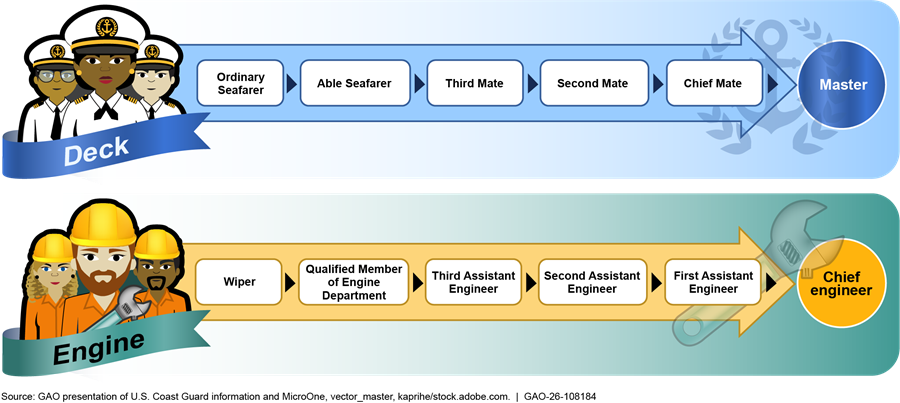
Note: Wipers help maintain proper running order in the engine spaces below deck. Their duties include wiping down machinery and cleaning oil spills, painting the engine room and its equipment, and assisting in maintenance and repairs.
During times of conflict and national emergencies, U.S. mariners support national defense by participating in military sealift to help transport Department of Defense and other federal equipment and supplies needed by the armed forces. Some qualified mariners do so through the Strategic Sealift Officer Program and serve as an auxiliary to the Navy. To qualify to be a sealift officer, according to MARAD, a mariner must hold a current and valid Merchant Mariner Credential with an endorsement for either unlimited tonnage (for deck officers) or unlimited horsepower (for engineers) that is valid on all oceans and meet other requirements.[13]
While this program is sponsored by the Navy, most Strategic Sealift officers are USMMA graduates or graduates from the six state maritime academies who participated in MARAD’s Student Incentive Payment (SIP) program. Through this voluntary, competitive program, students can receive financial aid in the form of tuition support in exchange for the completion of a service obligation after graduation to, among other things, serve in the U.S. maritime industry or on active duty within a U.S. armed or uniformed service for a specified number of years.[14]
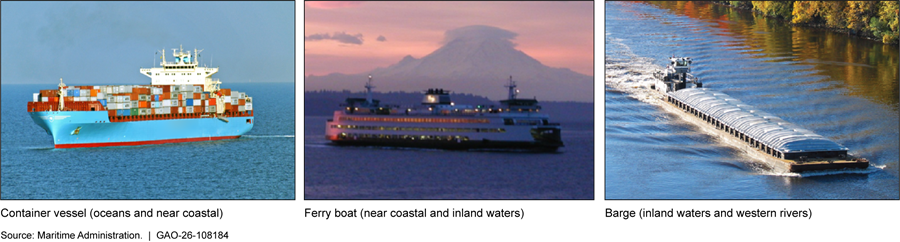
Mariners in commercial positions include those working on vessels transporting passengers and goods domestically or abroad. For example, as shown in figure 2, mariners work on vessels
· on the world’s oceans, such as on large vessels transporting cargo;
· in coastal regions, such as on ferries in New York and Washington state transporting people; and
· on inland waterways, such as on tugboats and barges transporting goods along the Mississippi river and its tributaries.
USCG Approval of Merchant Mariner Credentials and Training
Depending on where they decide to work and in what capacity, mariners pursue the necessary USCG Merchant Marine Credentials, which show that they meet the qualifications necessary for the shipboard position. Credentials specify the position for which the holder is qualified (e.g., an officer such as chief mate, a non-officer such as an able seafarer).[15] Credentials are issued for domestic and international service with unlimited or limited endorsements (i.e., for service on vessels of a certain type, tonnage, or horsepower, or on certain waterways).[16] For example, the requirements for an able seafarer unlimited endorsement include proof of completing at least 540 days of deck service on vessels operating in ocean or Great Lakes waters as well as either completing required courses, passing a USCG exam, or doing both.[17] A mariner may request a credential for the first time (an “original credential”) or seek a renewed or upgraded credential (i.e., increase in authority and responsibility).
About 200,000 individuals held valid mariner credentials as of 2023, according to MARAD. The number of applications submitted to USCG for original credentials rose over the last 5 years from 11,945 in 2020 to 20,451 in 2024. This change represents an increase from a lower number of credential applications during the COVID-19 pandemic, as we reported in 2023.[18] Once issued, credentials are generally valid for 5 years.
To obtain USCG credentials, mariners take USCG-approved training that corresponds to their desired endorsement. USCG approves mariner training to ensure it meets regulatory and policy standards, which according to USCG officials, includes approving the course content, instructors’ qualifications, and the institutions offering the training. For example, in 2024, USCG approved 1,877 courses, according to agency data.
Training and Training Institutions
Those in training to work as mariners (i.e., “mariner students” for purposes of this report) have a range of training options. Depending on the mariner student’s desired career path, the time needed to complete programs can range substantially, from week-long basic training courses for entry-level mariners to 4 years for officer programs embedded in college degree programs. Training requirements also vary based on where a vessel operates and its size.
A wide range of institutions provide mariner training.[19] These mariner training institutions include, but are not limited to, over 200 that offer USCG-approved courses (see table 1).[20]
Table 1: Types of Mariner Training Institutions Offering Courses Approved by the U.S. Coast Guard, as of 2025
|
Type of institution |
Number |
|
Description |
|
Maritime academies |
7 |
|
4-year universities that offer Bachelor’s degrees in maritime studies, with options for graduating with officers’ credentials. |
|
Non-academy universities, colleges, and community colleges |
23 |
|
Universities and colleges that offer mariner training programs that can lead to a degree or certification or can provide training that does not lead to a degree or certification. |
|
Training centers and schools |
106 |
|
Freestanding training institutions operated by private entities. |
|
Union schools |
4 |
|
Training institutions operated by or affiliated with maritime unions that primarily offer training to union members. |
|
Other training institutions |
64 |
|
Training programs operated by entities, including private companies, nonprofit organizations, and state government agencies. |
|
Total |
204 |
|
|
Source: GAO analysis of data from U.S. Coast Guard, the Maritime Administration, and selected training institutions. | GAO‑26‑108184
Note: This count of institutions does not include federal agencies or branches of the military that are approved by the U.S. Coast Guard to provide courses.
The different types of mariner training institutions may offer different degrees or certificates, attract different types of mariner students, and provide a pipeline to different mariner positions.
· Maritime academies. While the courses of study offered vary by academy, all seven academies offer Bachelor’s degrees, such as in Marine Transportation (for a deck officer) and Marine Engineering (for an engineering officer).[21] After graduation, these mariners can start working on vessels in officer positions as third mates or third assistant engineers. Mariner students attending the academies have the option of pursuing officer endorsements, which require them to complete sea time on a training vessel and pass a USCG exam.
· Non-academy colleges and universities. Through these institutions, mariner students can pursue a range of programs, including to begin a career in a position below an officer’s level, such as an able seafarer or a qualified member of the engineering department such as an oiler. Depending on the program, these mariners may receive an associate’s degree or a certificate, or complete course work for obtaining a USCG credential. For example, community colleges may offer programs in marine deck or engineering technology through which mariner students can earn a certificate or an associate degree in applied science.
· Training centers. Through these centers, mariner students could pursue a certificate or work towards a new or upgraded credential. Some training centers are geared towards mariners already working in the industry, offering courses that support renewals and upgrades for credentials. For example, some USCG-approved courses offered by training centers include vessel operations, radar observation, and programs to advance from mate to master.
· Union schools. In general, these schools provide training to mariners who are union members pursuing new or upgraded credentials. These schools offer a wide range of training, including courses tailored to the needs of specific vessel operators.
MARAD’s COE program designates institutions that, according to MARAD, prepare students for careers in the maritime industry aboard vessels and ashore (e.g., shipbuilding).[22] Congress authorized the program in 2017, and certain eligible entities must apply for and be approved by MARAD to be designated as a COE.[23] The COE program statute includes language authorizing grants, subject to the appropriation of funds, to COEs to develop their maritime programs, but funding has not been appropriated for this grant program. MARAD announced the first COE designees in 2021. There were 32 COEs, comprising 47 institutions, in the program as of August 2025. COE institutions include non-academy colleges and universities, training centers, and union schools. As of October 2025, about half (26) of surveyed COE institutions reported that they offer mariner training.[24]
Federal Financial Aid
Several federal agencies provide financial aid to eligible students that may be used to help pay for mariner training.
MARAD. MARAD provides funding to the USMMA and six state maritime academies that directly supports students. MARAD funds tuition and most other costs for USMMA students.[25] For fiscal year 2025, MARAD appropriations for USMMA operations were $92.7 million.[26] For the state academies, MARAD administers the competitive SIP program that provides financial aid to a small percentage of students. Through SIP, MARAD can provide up to $64,000 per student over 4 years for tuition and other training costs. Congress appropriated $2.4 million for SIP for fiscal year 2025, to remain available through fiscal year 2029.[27] Using this funding, MARAD offered up to $64,000 per student through SIP. Congress also appropriated $36.8 million in fiscal year 2025 to MARAD to support the state maritime academies.[28]
Education. Education has had the most extensive programs providing students with federal financial aid for education and training.[29] Specifically, Education administers Pell Grants and other grants and several types of direct student loans.[30] To receive Education aid, an individual must complete the Free Application for Federal Student Aid, which the college or other training institution uses to determine the type and amount of aid. Furthermore, in general, an institution must be approved to accept Education aid. Approval generally requires several steps: (1) the state authorizes the institution to offer postsecondary education, (2) an Education-recognized accrediting agency gives it institutional accreditation, and (3) Education then certifies the institution. According to Education, in fiscal year 2025, overall, the department disbursed financial aid to students including about $39.9 billion in Pell Grants, $925 million in Federal Supplemental Educational Opportunity Grants, and $88.9 billion in Direct Loans.[31]
VA. VA education benefit programs help veterans, service members, and qualified family members pay for a range of education and programs.[32] The largest VA education benefit programs are the GI Bill programs, particularly the Post-9/11 GI Bill program. VA enters into agreements with state approving agencies to oversee schools and programs where beneficiaries use VA benefits, and a state approving agency may add its own requirements to the federal requirements.[33] Only institutions approved by state approving agencies may accept VA education assistance funds. Types of eligible training institutions include colleges, universities, and vocational and technical training institutions. VA makes direct payments for tuition and fees to approved training providers, and veterans may also be eligible for a housing allowance and funds for books and supplies. According to a VA budget report, overall, payments to veterans and beneficiaries for VA education benefits for fiscal year 2025 totaled $14.3 billion.[34]
Labor. Labor administers a range of programs that provide career services for individuals. In particular, Labor administers the Workforce Innovation and Opportunity Act (WIOA).[35] WIOA is the largest single source of federal funding for state workforce development activities. States administer several WIOA programs, which can fund training services for eligible adults and dislocated workers. States approve training providers as eligible to receive WIOA funds through training vouchers.[36] Training participants can use WIOA vouchers called individual training accounts at programs approved as WIOA eligible. Local workforce boards can also contract with a training provider that trains multiple students in the same program. Adults who need training to obtain or keep a job are eligible to participate in WIOA programs. Congress appropriated $885.6 million for WIOA services for adults in fiscal year 2025.[37]
Registered Apprenticeships might be eligible to receive federal funding to support earn-and-learn opportunities for trainees. An apprenticeship is an arrangement that includes a paid-work component and an instructional component where an individual obtains knowledge and skills relevant to a specific occupation.[38] To be a Registered Apprenticeship program, the sponsor of an apprenticeship must register it with Labor or a state apprenticeship agency recognized by Labor. Separately, once the apprenticeship is registered, the sponsor could apply for federal funds to support its training, such as by applying to become eligible for WIOA funds. Congress appropriated $285 million to Labor for fiscal year 2025 to expand Registered Apprenticeship opportunities across industries.[39] According to Labor officials, this appropriation is being used to broaden such opportunities across multiple sectors, which could include mariner occupations as a focus area.
Labor also administers the Job Corps program to offer tuition-free educational and vocational training to eligible individuals aged 16 through 24 to help them find employment. The Job Corps program offers a range of careers in multiple industries in locations across the country. Congress appropriated $1.7 billion for Job Corps for fiscal year 2025.[40]
Recent Federal Efforts Related to Mariner Training and Federal Financial Aid
Since the COE program received statutory authorization in 2017, MARAD has issued two reports related to mariner training.
· In 2022, MARAD issued the report Evaluating the Availability of Federal Financial Assistance for Merchant Mariner Training, in response to a requirement in statute.[41] This report describes institutions that offer mariner training, the types of federal financial aid available for those in training, and recommendations for MARAD to address some identified gaps in those able to access this aid.
· In 2025, MARAD issued an updated Mariner Workforce Strategic Plan to strengthen MARAD’s mariner education and training programs and improve retention within the industry.[42] This report includes MARAD strategies related to federal financial aid available for mariner training, including efforts to increase dialogue between MARAD and other federal agencies to promote mariner students’ access to federal financial aid.
In addition, Executive Order 14269, issued in April 2025, established a policy to revitalize and rebuild the domestic maritime industries and workforce.[43] This order required MARAD and other federal agencies to take certain actions related to the mariner workforce. For example, it required MARAD and other agencies to develop a report on the maritime industry needs, to include an inventory of federal programs that could be used to sustain and grow the supply of and demand for U.S. mariners and the maritime fleet. In February 2026, the White House issued a Maritime Action Plan that outlines priority actions for Congress, MARAD, and other federal agencies to take to further strengthen the maritime workforce, including actions aimed at reforming maritime workforce education and training.[44]
Available Federal Financial Aid Depends on the Institution a Mariner Student Attends, and Some Students Do Not Have Access to Aid
Students at the Maritime Academies Have Access to MARAD Aid and May Supplement It with Aid from Other Federal Agencies
Only mariner students attending the USMMA and six state maritime academies have access to any financial support from MARAD. In recent years, an average of 1,400 mariner students graduated annually from the seven academies, according to MARAD.[45] In academic year 2024-2025, for example, about 200 students graduated from USMMA, and about 1,000 students in total graduated from the six state academies.
As noted above, MARAD funds tuition and most other costs for USMMA students. Based on USMMA’s assessment of education costs, the academy determined that the education cost per student was about $99,000 for the 2023-2024 academic year.[46] In exchange, USMMA graduates incur an obligation to serve the foreign and domestic commerce and the national defense of the U.S., through sailing on their credential or serving on active duty after graduation for at least 5 years.[47] According to agency officials, MARAD also covers other costs of USMMA students including their room and board.
Further, MARAD provides financial aid through its competitive SIP program to a small percentage of students attending the six state maritime academies. For the academic year starting in 2024, 126 of 3,041 students at all six academies (about 4 percent) who were enrolled to pursue credentials with unlimited endorsements received SIP funds, according to MARAD. In exchange for receiving this aid, SIP recipients incur an obligation to serve the foreign and domestic commerce and the national defense of the U.S., through sailing on their credential for at least 3 years, among other requirements.[48] The average respective in-state and out-of-state tuition at the six academies for 2025 was about $18,800 and $26,300, based on academy data.
Beginning in 2023, SIP has experienced higher student demand than available slots, according to MARAD officials and representatives from four of the six academies. Increased student demand corresponded with a December 2023 statutory increase in the maximum authorized SIP financial aid, from $32,000 to $64,000 total per student over 4 years.[49] According to MARAD officials, starting in academic year 2024-2025, the agency has provided $64,000 in total to each new SIP student.
The state maritime academies are also approved to receive financial aid through Education and VA, and some students at the six state academies have used aid through these sources (see table 2).[50]
Table 2: Students Enrolled in Credential Track Programs at State Maritime Academies Using Federal Aid, 2024–2025
|
Agency and aid source |
California |
Great Lakes |
Maine |
Massachusetts |
New York |
Texas |
Total |
|
Maritime Administration Student Incentive Payment (SIP) Program |
38a (6%) |
11 (6%) |
17 (3%) |
19 (3%) |
15c (2%) |
17 (5%) |
117 (4%) |
|
Department of Education aid |
254b (42%) |
100 (51%) |
522 (86%) |
623 (91%) |
410d (45%) |
160 (51%) |
2,069 (62%) |
|
Department of Veterans Affairs (VA) aid |
79b (13%) |
18 (9%) |
50 (8%) |
12 (2%) |
28 (3%) |
21 (7%) |
208 (6%) |
|
Total students enrolled in credential track program(s) |
603 |
198 |
609 |
686 |
905 |
312e |
3,313 |
Source: GAO analysis of data from the state maritime academies. | GAO‑26‑108184
Notes: In this table, numbers in parentheses are the percentages of students enrolled in credential track programs at each state maritime academy who received each type of aid in academic year 2024–2025. The six academies are the California Polytechnic State University Maritime Academy, Great Lakes Maritime Academy, Maine Maritime Academy, Massachusetts Maritime Academy, the State University of New York Maritime College, and Texas A&M Maritime Academy.
Education aid used at the academies includes those students who received grants and those who received loans, unless noted otherwise. Some students may receive both types of aid. Estimates for students who used VA aid are based on data provided by the state maritime academies. Additional students may have received VA aid directly, who would not be included in these estimates.
aSIP numbers for California Polytechnic State University Maritime Academy students were for fiscal year 2024-2025, from October 2024 through September 2025.
bThe numbers for the California Polytechnic State University Maritime Academy of credential track students were for the college year 2024-2025, from summer 2024 through spring 2025.
cAccording to State University of New York Maritime College staff, in addition to the reported SIP recipients, approximately 30 students were working towards eligibility awaiting placement in the program.
dThis was the number of State University of New York Maritime College credential track students who received loans. In addition, 179 (about 20 percent) of these students received Pell grants.
eThis was the number of students in Texas A&M Maritime Academy’s unlimited endorsement program.
|
How State Maritime Students Pay for Sea Time According to representatives from five of six state maritime academies, sea time is required to obtain specific U.S. Coast Guard endorsements. Based on interviews with three state academies, students typically complete three sea terms with costs ranging from $12,000 to over $16,000 per term. However, they told GAO that students taking courses to obtain the required sea time—often completed in the summer as a part-time courseload—generally do not use Department of Education or Veterans Affairs (VA) funds to pay for it. They said most students rely on other forms of aid to fund the sea terms, such as institutional or alumni scholarships or state funding. Representatives from one academy said that while some students may qualify for federal loans to cover some sea term costs, this could reduce the amount those students could borrow for the fall and spring semesters. Further, staff at one state maritime academy said that VA beneficiaries will often pay out-of-pocket for the sea term and temporarily suspend their GI Bill benefits, then go back to using these VA funds when they return to full-time study. Source: GAO interviews with state maritime academies. | GAO-26-108184 |
· Education aid. The majority of students enrolled at the six state academies used Education aid to help pay for mariner training, according to data from the academies.[51] For example, students at two academies received Education aid averaging $7,500 and $10,500, respectively, for the 2024-2025 academic year, according to academy officials.
· VA aid. A smaller percentage of students at the six academies used VA aid. At the six state academies, the percentage of students who used VA aid in 2024 varied but averaged about 7 percent, according to data from all academies.[52] For example, students at two academies received VA benefits averaging $10,200 and $15,500 that year, according to academy officials.
Students at Approved Training Institutions May Receive Aid from Education, Veterans Affairs, and Labor
For non-academy training institutions, a mariner student’s access to financial aid through Education, VA, and Labor depends on whether the institution and specific mariner program that the student attends have the required approvals to accept these funds. As detailed below, we found at the time of our review that most such institutions did not have the required approval to accept these aid funds, if mariner students had sought to attend these institutions.[53] Consequently, mariner students attending most non-academy training institutions would need to pay tuition and other costs without any federal aid.
Training costs at non-academy institutions vary greatly. Based on our analysis of COE survey responses, the estimated tuition and other associated costs for the 2024-2025 academic year at 26 COE institutions with mariner programs averaged around $6,300 for tuition and $4,700 for other costs, for a total average cost around $11,000. However, these costs ranged greatly by type of institution, with average tuition of about $2,700 for community colleges, $4,400 for for-profit training centers, and $7,600 for universities. Our analysis of survey responses also showed that just under 17,000 students collectively attended programs at the 21 of 26 institutions that charged tuition for their mariner programs in the 2024-2025 year.[54]
Education aid. Mariner students at most non-academy institutions did not have access to Education aid, the federal aid source most widely used by students nationwide, since a minority of non-academy institutions and their mariner training programs were approved to accept Education funds. For example, 20 of 197 (about 10 percent) of the non-academy training institutions that had USCG-approved courses as of August 2025 were approved for their students to use Education funds, based on our analysis.[55] All but one (20 of 21) of those approved institutions were colleges or universities.
The results of our COE survey showed that, overall, few students in mariner programs at these institutions used Education funds to help pay for training. Among the 21 COE institutions with tuition-based mariner training programs, nine institutions reported that their students received Education aid.[56] Seven of these nine institutions were colleges or universities. Through our survey results, we identified 228 mariner students enrolled across these institutions that received Education funds in 2024-2025. Of the COE institutions that reported their students used Education aid, the percentage of mariner students who used this aid varied substantially, with four institutions reporting that less than 25 percent of their students received this aid, and one institution reporting that more than 75 percent of its students received it.[57]
VA aid. Based on our analysis, about 18 percent of non-academy training institutions with USCG-approved courses (35 of 197) were approved to accept VA aid. Most of the approved institutions (22 of 35) were colleges or universities. While a larger percentage of non-academy mariner training institutions were approved to accept VA aid than were approved to accept Education aid, more mariner students would likely qualify for receiving Education aid, since eligibility for receiving VA benefits generally requires being either a veteran or a veteran’s dependent.
The results of our COE survey showed that a small percentage of students enrolled in tuition-based COE mariner programs used VA aid to pay for training. Twelve of the 21 COE institutions reported that their students received VA aid. Through our survey results, we identified 428 students across these institutions that used VA funds in 2024-2025. Nearly all 12 institutions reported that less than 25 percent of their students used VA funds to pay for training.[58]
Labor aid. According to agency officials, Labor generally allocates employment and training funds—including through WIOA programs—to state workforce agencies, which then suballocate funds to local workforce development areas. These local workforce development areas determine WIOA participant eligibility and, when appropriate, reimburse training institutions to train individual participants, according to Labor officials. Based on our analysis, about 12 percent of non-academy training institutions with USCG-approved courses (24 of 197) were approved to accept WIOA program funds.
Based on our survey of COE institutions, few mariners had access to Labor funds for training programs at these institutions. Among the 21 institutions, seven reported that their students received Labor aid to pay for training. Most (5 of 7) of these institutions reported that less than 25 percent of their students used Labor funds to pay for training.[59] Through our survey results, we identified 249 mariner students at these institutions with tuition-based mariner training that used Labor funds in 2024-2025.
Labor officials also provided information on programs operated or overseen by Labor through which mariner students could receive training, with some of the students obtaining training at no cost to the individual. For example, according to agency officials, Labor operates two Job Corps programs for mariners: the Inland Waterway Program in Morganfield, Kentucky, and the Able Seafarer Program in Astoria, Oregon. According to Labor officials, 133 individuals were enrolled in these two programs in fiscal year 2024, at no cost to the individuals. The same year, 92 mariners graduated from these programs. In another example, some mariner students could receive training through a Registered Apprenticeship Program, but as we previously reported, federal funding for these programs is limited.[60] Labor officials told us that there were five active Registered Apprenticeship Programs in the mariner occupation. In fiscal year 2024, about 400 apprentices participated in those programs nationwide: 351 in training to become an able-bodied seafarer and 42 in training to become an officer in charge of a navigational watch.
Some Mariner Students Do Not Have Access to Federal Financial Aid
As discussed above, mariner students attending most of the 197 non-academy institutions with USCG-approved courses do not have access to Education and VA aid. According to selected stakeholders from unions and mariner training institutions, students at non-college institutions and current mariners seeking training to advance their careers are particularly likely to lack access to federal aid.[61]
Mariner students attending non-college training institutions. Non-college institutions comprise most of the institutions with approved USCG courses, but few were approved to accept Education or VA funds. Specifically, of the 197 non-academy institutions that had USCG-approved courses as of August 2025, 174 were non-college institutions and included mariner training centers. Of these 174 institutions, only one was approved for Education funds and 13 (about 7 percent) were approved for VA funds.
While the total number of mariner students attending non-academy institutions is not known, six stakeholders stated in interviews and COE survey responses that some mariner students could benefit from greater access to federal aid. For instance, survey respondents from five COE institutions suggested expanding federal aid to mariner students, including those attending non-colleges. In addition, staff at one COE institution suggested broadening Education accreditation standards and approving more institutions such as maritime training centers. They explained that mariner students seeking to work in some parts of the industry, such as in the inland waterways and near coastal areas, do not have access to federal aid.
Currently employed mariners seeking training to upgrade to officer positions. Based on USCG data, in recent years, the agency received 1,500 or more applications per year from mariners seeking “raises of grade” from non-officer to officer positions. For instance, in 2023, 2024, and 2025, USCG received about 2,300, 1,630, and 1,500 such applications, respectively.
Representatives from three non-academy training institutions and three unions told us that mariners currently employed as able seafarers or in other positions below an officer’s level struggle to fund an upgrade to an officer’s position. For example, staff at one COE institution with a program designed for such an upgrade (i.e., able seafarer to mate) told us that career advancement can be financially burdensome, especially if the mariner pursues the training all at once, as some training programs cost $30,000 to $40,000 in total for one or more years of training. They said that the lost wages from time off to attend a training program presented an additional financial burden. Similarly, representatives of a mariner union told us that to become an officer through work experience combined with training at a non-academy institution would likely cost $45,000, but no federal financial aid is available to advance in this way. Representatives of another union said that the mariners in training to transition from non-officer positions to officer positions would particularly benefit from federal financial aid, as this training is expensive, and only the mariner is responsible for covering the cost.
MARAD Is Not Fully Leveraging Resources to Address Challenges That Institutions Face in Accessing Aid for Mariner Training
Stakeholders Said Navigating Multiple Processes to Apply for and Maintain Financial Aid Approval for Their Institutions Can Be Challenging
According to some maritime industry stakeholders, it can be challenging for mariner training institutions to navigate the separate processes of Education, VA, and Labor to receive approval for students in their mariner courses to use federal financial aid.[62] While such processes may present challenges for institutions, these approval processes are intended to help ensure that institutions receiving federal funds can provide a quality education to students and meet other requirements, as we have reported.[63]
· Education process. To receive Education funds, an institution must be certified by Education to qualify as an institution of higher education for purposes of student assistance programs. Obtaining this qualification generally involves the institution being accredited by a nationally recognized accrediting agency or association and undergoing an on-site review every 3, 5, or 10 years, among other requirements.[64] Nine of 14 COE institutions with mariner training programs that responded to the survey question on the approval process found that applying for the initial accreditation to receive Education funds is a moderate to very great challenge.[65] For example, one institution stated that the process to get initial accreditation is lengthy and time-consuming, varies depending on the reviewer, and may require additional paperwork.
· VA process. To receive VA funds, programs at an institution must receive approval from a designated state approving agency and meet other requirements.[66] Seven of 15 COE institutions that responded to the survey question on the approval process found that applying for the initial accreditation to receive VA funds is a moderate to very great challenge.[67] For example, representatives from one training institution we interviewed told us it can be challenging for mariner training programs to meet VA’s definition of qualified vocational training, as VA is more familiar with degree programs.[68] They noted that as a result, individual courses that are critical to train for the maritime industry are not always approved for VA funds.
· Labor process. Generally, to receive Labor funds, specifically WIOA funds, programs must be on the state’s eligible training provider list.[69] Eight of 13 COE institutions that responded to the survey question on the approval process found that applying for the initial approval to receive Labor funds is a moderate to great challenge.[70] Further, six of 12 institutions reported that maintaining institutional eligibility (after receiving the initial approval) is a moderate to great challenge.
Staff at two institutions also told us that Labor and USCG use different criteria for approving mariner apprenticeships. For example, staff at one training institution noted that USCG might have a more rigid process for approving mariner training programs or courses. Staff at a different, union-affiliated training center—which focuses on continuing education and upgrading credentials—said their USCG-approved apprenticeship programs do not generally qualify for Labor funds. Labor officials noted the process to become a registered apprenticeship is separate from the process to receive WIOA funds, and that many registered apprenticeships do not get federal aid.
MARAD officials and some maritime industry stakeholders also recognized pursuing the approval processes of multiple federal agencies can be challenging for institutions. MARAD officials said that in addition to completing the USCG-approval process for training courses, institutions must determine whether to pursue the separate processes based on their available resources and other factors. For example, they noted that each COE institution varies in its administrative capacity, and many have limited personnel and other resources for navigating complex grant or financial aid applications. Further, representatives from one training institution said that USCG vocabulary for training differs from that used by other federal agencies, and agencies may not be familiar with each other’s terminology in the approval processes for aid.
Survey respondents from seven of 26 COE institutions stated that an institution’s size could affect whether it pursues approval for federal aid, with two also noting that Education’s process is resource-intensive, costly, or time consuming.[71] For example, three respondents stated that larger schools may have more resources to manage the general federal aid process. One respondent stated that an institution’s size and type can have a large effect on the institution’s ability to obtain federal aid given the resources and costs involved in seeking accreditation.
Some Characteristics of Mariner Training Do Not Align with Certain Federal Aid Requirements
Federal aid requirements, as we and others have reported, are designed to act as safeguards to ensure that participating institutions provide students with quality education.[72] For example, the requirements are intended to provide a balance between consumer protection, quality assurance, and oversight and compliance among institutions participating in Education’s aid programs, according to a 2024 Congressional Research Service report.[73]
Some common characteristics of mariner training, however, do not align with certain federal aid requirements, making most training institutions with USCG-approved courses—including many COE institutions with tuition-based programs—less likely to be eligible for federal funding. Specifically, according to MARAD officials and some maritime industry stakeholders, these characteristics include (1) the short duration of many USCG-approved courses and (2) courses offered outside a degree program.
Short course duration. According to MARAD officials and three COE institutions, the short duration of many USCG-approved courses often does not align with some Education requirements for funding. According to Education guidance, programs at postsecondary vocational institutions—such as at maritime training centers—must be at least 600 clock hours during a minimum of 15 weeks of instruction; eligible short-term programs must provide at least 300 hours (and would only qualify for federal loans, not grants).[74] Many necessary USCG-approved courses (including courses to upgrade one’s credentials) are short, according to MARAD officials.[75] USCG-approved courses for obtaining a credential vary in length, with some common courses lasting 2 days, 3 days, or 5 days, according to a training institution.[76] Additional examples include the following:
· MARAD officials noted that mariners working as ordinary seafarers, especially in the Great Lakes and inland waterways, and seeking to upgrade a credential often take a specific 21-day course.[77] They also noted that some common USCG-approved courses are 1-week long, such as one on personal safety and one on radar, and are very unlikely to meet the requirements for Education aid.
· One survey respondent stated that most USCG-approved courses are less than 80 hours in duration.[78]
· Another survey respondent stated that its maritime training institution offers USCG-approved courses, including 1- to 2-week courses for students to begin a career as a mariner.
According to USCG officials, although many USCG courses are short and require less than 80 hours to complete, mariner students seeking to upgrade their credentials often need to take multiple courses. Taken collectively, these courses could be time consuming and financially burdensome, according to officials. USCG officials said some typical credential upgrades require close to 300 hours of coursework. In addition, they said that for a mariner to advance up by two officer ranks—for instance, from Third Assistant Engineer to Chief Engineer—it might require 10 or more courses totaling over 400 hours of training. These officials noted that a mariner could pursue a training program where all 400 hours are taken at once, or pursue a la carte training, potentially at different institutions, involving several rounds of courses when they have time off from a ship.[79] USCG officials said that this flexibility allows mariners to meet training requirements in a way that works for them.
Non-degree programs. According to a 2020 Congressional Research Service report, most direct federal aid available for education and training was generally not accessible to individuals pursuing training through non-degree programs, whether offered at colleges, trade schools, or other institutions.[80] Representatives from four institutions stated that many mariner programs are not approved for students to receive Education aid, and potentially other federal aid, because they include non-credit courses offered outside a degree or certificate program (i.e., non-degree programs), according to interviews and survey responses. For example, staff from one institution we interviewed said they do not offer any degrees and focus on pathways to obtain credentials with an officer’s endorsement, such as a 20-day exam prep course that prepares students to obtain a credential. While the training center can receive VA aid for eligible students, such as those in VA-approved courses that are part of an Able Seafarer to Mate program, it is not accredited to receive Education aid. In addition, a community college that has USCG-approved courses that responded to our COE survey stated that non-credit courses do not meet certain requirements for federal aid; thus, students enrolled in those courses are not able to use the aid.
MARAD officials said that, given individual interest and career plans, some, but not all, mariner students need to complete a degree or certificate program. They noted that each sector of the maritime industry may require different USCG endorsements. For instance, an individual seeking to become a mariner may only need to take one or two USCG-approved training courses outside of a degree or certificate program. In addition, MARAD officials said when financial aid or funding is available for more mainstream occupations, the requirements for this aid may not align with the types of training that are more specific to mariners—which often can be offered through non-degree programs.
Some of these identified challenges could be mitigated by the newly-enacted Workforce Pell Grant program that could make Education aid more accessible to students in certain eligible short-term training programs that are not eligible for the traditional Pell Grants.[81] For example, the new Workforce Pell Grant Program applies to certain eligible programs of a shorter duration than the traditional Pell Grants that prepare students to pursue one or more degree or certificate programs.[82] Students in mariner training programs at some institutions that were previously not eligible for Education aid based on program length and clock hours might, therefore, be able to access the Workforce Pell Grants. However, USCG-approved courses that are typically under 8 weeks or are mariner courses that are not part of a degree program would likely still not be eligible for aid based on the new program’s proposed provisions.
Education used the negotiated rulemaking process to develop a notice of proposed rulemaking to implement the Workforce Pell Grant program.[83] In December 2025, Education concluded meetings with stakeholders and, in March 2026, issued a Notice of Proposed Rulemaking.[84] According to Education documents, the program could begin as soon as July 2026.
MARAD Is Not Fully Leveraging Resources to Address Challenges That Institutions Face in Accessing Aid for Mariner Training
MARAD is aware of and has outlined strategies to address challenges that institutions face in accessing federal financial aid for mariner training. For example, MARAD’s 2022 report notes the limited availability of federal aid for mariner students pursuing training outside of a full-time college or academy program.[85] Recognizing that many institutions offering USCG-approved training are currently not approved to participate in federal aid programs, MARAD’s Mariner Workforce Strategic Plan and 2022 report also included strategies and recommendations to help improve access to federal aid. One strategy, for example, was to work with other government agencies to identify options for maritime training institutions to participate in federal student aid programs.[86] In addition, the MARAD 2022 report recommended working with Education to identify barriers to participation in aid.
Although it has outlined these strategies, MARAD has taken limited actions to implement them to help improve access to federal aid. When asked about the agency’s related actions, MARAD officials told us that one effort involved reaching out to Education officials and others involved in aid approvals to explain the various aspects of mariner training and how they differ from other industries’ degree or certificate training programs. Officials did not mention any further efforts consistent with their outlined strategies relevant to helping address institutions’ challenges in obtaining such aid. Further, MARAD removed a strategy from MARAD’s Workforce Strategic Plan—that entailed working with Education to identify barriers to participation in aid—when it revised this plan in March 2025. MARAD officials told us they eliminated the strategy because they felt Education should handle such issues individually with training institutions.
According to MARAD officials, the agency’s ability to address known challenges is limited by staff resources, noting that it has only 1.5 full-time employees to work on workforce development. However, we found that MARAD is not fully leveraging the resources to which it has access. One such resource is the U.S. Committee on the Marine Transportation System (CMTS)—a federal interagency coordinating committee of over 35 agencies, including Labor and USCG—currently chaired by the Secretary of Transportation.[87] VA has interacted with CMTS about mariner workforce issues through the Military to Mariner initiative.[88] Officials from VA and Labor said that there have been some general discussions with MARAD on the mariner workforce through CMTS. However, a CMTS official told us the committee has not discussed available federal aid for mariner training. CMTS has a standing Mariner and Marine Transportation System Workforce Integrated Action Team, which currently focuses primarily on mariner recruitment and retention, rather than mariner training. When MARAD released its 2022 report on federal aid for mariner training, MARAD officials said the report was announced at leadership meetings that included CMTS members. However, they said that the topic had not been discussed at CMTS meetings since then. In January 2026, MARAD officials told us the agency had not brought this topic to CMTS for discussion recently because of, among other things, the government shutdown in 2025.
MARAD’s stated strategy is to work with other government agencies to identify options for maritime training institutions to participate in federal student aid programs. Federal standards for internal control also state that an agency should communicate relevant and quality information with external parties. This communication includes information for the agency to achieve its objectives.[89]
By leveraging the CMTS forum, MARAD could use existing resources and access cross-cutting expertise to address challenges and improve mariner students’ access to federal aid for training. For example, MARAD could leverage expertise from Labor and VA officials about these agencies’ federal aid approval processes. With this and other expertise, such as from USCG officials, CMTS could be a venue to explore potential options—both options to help institutions that are currently eligible for aid but have limited resources to apply for existing aid (e.g., a grant program to assist with the application), or to help institutions access new aid. For example, when Education issues the final rules for the Workforce Pell Grant program, MARAD would have an opportunity to discuss it with the relevant CMTS Integrated Action Team, including whether it addresses challenges specific to mariner training. Further, in CMTS discussions on federal aid, MARAD could include perspectives from others, such as COE institutions with insights into where mariner training does not align with aid approval processes.[90] Working to help overcome challenges mariner training institutions face in getting approved for federal aid by leveraging expertise in the CMTS could help more mariner students access needed funds to pay for their training, potentially helping to resolve any mariner shortages.
MARAD Has Taken Steps to Raise Awareness of Its Federal Financial Aid for Mariner Training but Has Limited Efforts to Publicize Other Federal Aid Options or Mariner Careers
MARAD Has Provided Information About Its Own Federal Aid to Students
Consistent with its strategic goals, MARAD has provided information about its own SIP Program to raise awareness of the aid available to students attending the six state maritime academies. According to MARAD’s Mariner Workforce Strategic Plan, promoting the use of existing federal aid programs for education and training can help the agency achieve its goal to strengthen workforce programs.[91]
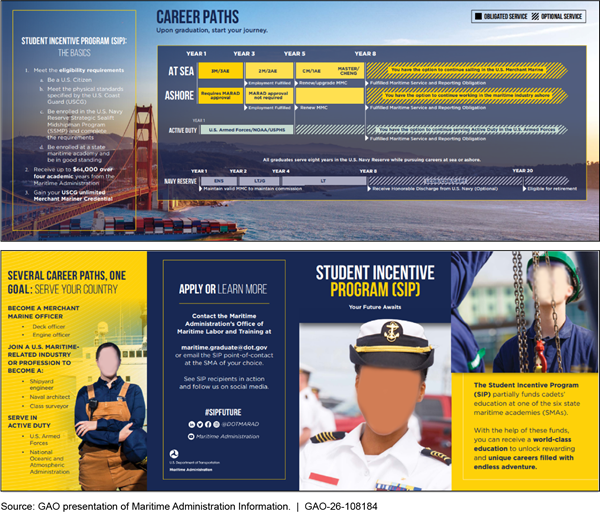
MARAD has provided information about its SIP Program to current and potential students through websites and promotional materials. Specifically, MARAD maintains a SIP website and SIP portal with links to resources it has developed about the program, such as a booklet and pocket guide (see fig. 3).[92] The SIP booklet provides an overview of the program, eligibility requirements, and other key points, such as students’ service obligation after graduation. The SIP Pocket Guide is a short flyer about the program and various career paths, and it includes points of contact to learn more. Further, MARAD has promoted the SIP Program on social media through Instagram and Facebook. For example, in a March 2025 Facebook post, MARAD posted about a recent academy graduate who used SIP funds, including their career experiences in the Strategic Sealift Officer Program, to help promote interest.
Further, representatives from all six state academies said MARAD has conducted outreach efforts at their locations to promote SIP to students, such as yearly campus visits and distributing brochures and other materials. For example, representatives from one academy noted that MARAD visited in fall 2024 for 2 days to meet separately with staff and students to discuss SIP. In addition, representatives from four state academies told us that MARAD’s efforts to promote SIP have increased student awareness and interest, such that the program had more applicants than available spots as of 2025.
MARAD Has Taken Limited Steps to Share Information on Other Federal Agencies’ Aid for Mariner Training
While MARAD has provided information about its own SIP Program, we found that the agency has taken few steps to share information, as outlined in its plans and reports, about the federal aid for mariner training available through other agencies. MARAD’s Mariner Workforce Strategic Plan and 2022 report include strategies and recommendations to improve the agency’s communication on the available federal financial aid for mariner training.[93] In particular, the 2022 report found that potential mariners’ awareness of and access to information on federal financial aid resources needs improvement and recommended that MARAD strengthen its communication about available aid.
MARAD has established some strategies to (1) promote the use of existing federal information resources by maritime job seekers (e.g., federal financial assistance programs for education and training) and (2) increase dialogue between MARAD and other federal agencies to promote access to federal financial aid. However, we found that MARAD has taken limited steps to implement those strategies.
For example, according to our review of MARAD websites, COE survey responses, and union interviews, the information that MARAD has shared with the public and institutions about accessing federal financial aid available through Education, Labor, and VA is limited and high-level.
· MARAD websites. In our review of MARAD websites from August 2025 to February 2026, we found little information on the aid available to students through other agencies. For example, until February 2026, MARAD had no information on its websites that described the aid provided through Education or Labor. MARAD’s website noted VA aid, but did not provide detailed information on that aid, as it only discussed that this aid could be used as part of the Military to Mariner initiative.[94] In February 2026, MARAD added three links to its COE web page that direct individuals to general aid websites for the Departments of Education, Labor, and VA to learn more. MARAD’s websites also include a list of the institutions that are part of the COEs but does not have information on which COE institutions are approved for different types of federal aid.[95] Further, as of February 2026, MARAD had not posted its 2022 report—which describes the other federal aid programs that could be used for mariner training in detail—on any website. MARAD officials told us that this report is available upon request. However, they did not provide additional details regarding whether the members of the public would be aware of the report to request it.
· MARAD communications. In February 2026, MARAD officials said they notify the COE points of contact, often presidents, of relevant Labor funding opportunities, and provided examples from 2023 and 2025.[96] For instance, officials told us they shared a funding notice for a Labor grant program focused on the shipbuilding workforce, for which an award of $8 million for one COE was announced in January 2026. They also noted the COE institutions did not request more information on federal aid available for mariner training in response or identify such aid as a primary concern in recent COE meetings.
However, according to survey responses, this information on aid opportunities
may not be reaching all the contacts involved at the COE institutions. Survey
respondents from 11 of 26 COE institutions with mariner training programs
reported that MARAD had not communicated with them in the last 3 years about
what federal aid is available to their students, while four reported MARAD had
communicated with them on the topic. Another 11 COE institutions reported they
do not know if MARAD has offered such communication. In addition, respondents
from six institutions reported being somewhat or very dissatisfied with MARAD’s
level of communication, and 16 reported being neither satisfied nor
dissatisfied. Respondents from seven institutions suggested ways for MARAD to
improve communications about available federal aid for mariner training. For
example, three institutions suggested that MARAD provide more information
through direct emails, meetings, or a maritime user group. In addition, five
institutions suggested that MARAD communicate information about the types of
available aid. Representatives from two of four maritime unions we interviewed
also said they were not aware of any MARAD communication efforts related to
available federal aid.
In addition, officials from Education, Labor, and VA told us there had been little communication between MARAD and their agencies related to promoting available aid for mariner training.[97] Officials from Labor and VA stated that their agencies have had some communication with MARAD about mariners as part of CMTS, including through past efforts related to the Military to Mariner initiative that involved VA, but not on ways to promote awareness of the aid for mariner training—which was confirmed by a CMTS official.
In September 2025, MARAD officials told us that they are aware of the agency’s limited progress on its planned efforts to strengthen awareness of federal financial aid programs provided through Education, Labor, and VA. Officials pointed to the agency’s limited staffing resources and said MARAD lacks funding to conduct an information campaign to promote federal aid available through other agencies. They said that, as a result, it is difficult for them to take more related action. In addition, they told us that MARAD generally refers institutions (and students) to these three federal agencies that provide information and counseling on their respective aid programs.
Despite these constraints, MARAD could raise awareness through targeted approaches that may not require a large investment of resources. For example, CMTS publishes the Federal Funding Handbook for the Marine Transportation System (Federal Funding Handbook), which provides information about the grants and federal funds available throughout the marine transportation system. The purpose of the handbook is to provide a resource for the mariner transportation system community, and it is organized into several funding categories, such as research and development. The most recent publicly available handbook, released in 2024, did not include information about federal aid for mariner training.[98] A CMTS official said the committee could include information on federal aid for mariner training in its next edition of the Federal Funding Handbook, if MARAD requested that it do so. If CMTS included this information in its handbook, it could help provide another means for promoting federal aid available to mariner students to pay for training. In February 2026, a CMTS official said they planned to include it in the next edition of the published handbook. However, the CMTS official told us that MARAD would need to request this information be included to ensure the information would be part of the next edition. Providing detailed information on federal aid for mariner training in the handbook could help raise awareness about the various sources of aid available to help mariner students pay for training.
In addition to requesting that CMTS include information on aid for mariner training in the handbook, other approaches could include social media efforts to promote various types of aid or expanding email distribution on grant and funding opportunities to more people or institutions. MARAD could also consider adding more information to its website to describe or promote tools, such as Labor’s Career One Stop website, which the MARAD 2022 report identified as an existing resource to better promote.[99] In addition, MARAD could develop a single web page or guide that briefly describes each of the various sources of available aid and directs students interested in mariner training to the relevant websites for specific aid for more information.[100] Such efforts could help raise awareness about the new Workforce Pell Grant Program, when that program is implemented.[101] They also would not necessarily require a large investment of resources if, for instance, they built on other MARAD efforts. For example, MARAD could expand its social media efforts beyond promoting SIP to also cover other federal aid.
Identifying and using such targeted approaches to promote available aid would enable MARAD to reach more students or potential students attending the full range of mariner training institutions, who may not otherwise be aware of such available aid. While MARAD officials told us that COEs can also undertake their own efforts to share information about federal aid to students, additional MARAD efforts could serve to amplify the COEs’ own efforts to raise awareness about such aid. As discussed above, the COEs represent a small portion of institutions that offer mariner training, so MARAD communication efforts could reach more students. For example, students from our student discussion group told us that, to the extent they looked, there was generally no information on the internet about sources of federal aid for mariner training. The students in this discussion group said it would help if more information was provided, such as online.
MARAD Has Taken Some Steps to Raise Awareness about Mariner Careers, but Selected Stakeholders Identified Opportunities for Additional Action
Through its workforce planning, MARAD is seeking to help grow the mariner workforce, including to raise national awareness about the benefits of a seagoing career.[102] The agency’s Mariner Workforce Strategic Plan identifies three strategies: (1) promote the use of existing federal information resources by maritime job seekers, including by working with industry stakeholders; (2) promote the COE program and its broad network of employment pathways; and (3) increase national awareness of the U.S. Merchant Marine’s role in peacetime, national emergencies, and national security and the benefits of the seagoing mariner profession. These strategies align with MARAD’s mission to foster, promote, and develop the merchant maritime industry of the U.S.[103]
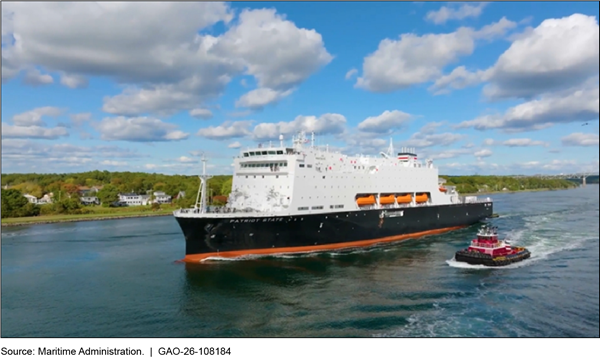
Consistent with these strategies, MARAD officials told us they have conducted some marketing and outreach efforts to educate prospective mariners about career opportunities and identified plans to continue doing so. For example, MARAD’s website includes seven promotional videos on the USMMA and six state maritime academies, with information about life in mariner occupations (see fig. 4). MARAD officials noted that the academies and school counselors can use these videos on their websites to help increase student interest in mariner careers. Officials also said MARAD’s efforts to promote the five new National Security Multi-Mission Vessels—which are designed to provide a state-of-the-art training platform for academy students—has helped increase interest in pursuing a mariner career at the state academies. MARAD also attended the 2025 American School Counselor Association National Conference with other maritime stakeholders, an effort led by a maritime union, according to officials.[104] MARAD officials said they used the conference to promote the maritime industry, including mariner careers, and plan to attend next year. MARAD officials also plan to continue to use contractor support for K-12 outreach and to attend events to promote awareness of the maritime industry and COE institutions, such as at regional boat shows.[105]
Figure 4: Screenshot of the Maritime Administration’s Video for Massachusetts Maritime Academy Showing the Patriot State National Security Multi-Mission Vessel for Mariner Training
However, survey responses from most COE institutions indicated that additional MARAD efforts could help to raise awareness of the maritime industry, especially about mariner careers.[106] Specifically, of 26 responding COE institutions:
· 22 institutions responded that it would be very or extremely beneficial to use social media advertisements to communicate about the industry.
· 21 institutions responded that it would be very or extremely beneficial to use informational resources (e.g., pamphlets, emails, websites) to communicate about the industry.
· 18 institutions responded that it would be very or extremely beneficial to use advertisement campaigns (e.g., television, radio) to communicate about the industry.
In addition, survey respondents from five COE institutions suggested that MARAD provide more information on the types of mariner training or career path opportunities, as this type of information could assist those considering a mariner career to make choices. Two respondents also stated it would be beneficial for MARAD to promote the opportunities that the COE institutions provide to the workforce, including the value of mariner training and trade schools.[107] Also, a student from our discussion group told us they did not realize that their union-affiliated school was a pathway to becoming a mariner until someone told them; previously, they assumed the USMMA was the only path to pursue the career.
Stakeholders we interviewed from three state maritime academies, three unions, and one training center also sought more MARAD efforts at the national level to promote the maritime industry and mariner careers.[108] For example, representatives from three state academies and two unions told us that a MARAD nationwide advertisement campaign could help address the public’s limited awareness of the maritime industry and promote interest in becoming a mariner. Representatives from one academy also told us that MARAD undertaking a broader nationwide effort to increase understanding about mariner careers would bolster training institutions’ efforts to increase knowledge about the industry in local communities. Students from our discussion group told us that they learned about mariner careers through word of mouth, then used online videos to learn more about what it entails. These students said it would be helpful to have more promotional efforts through the internet and school career fairs to encourage people to join the mariner profession.
Representatives from one union told us that most promotion of the U.S. Merchant Marine is done by maritime industry participants on an ad hoc basis. They noted that there has not been a concentrated effort at a national level to promote and help recruit individuals into the maritime industry since World War II, while there have been promotions of military services (e.g., Army, Navy). Further, representatives from another union said that their union has led promotional efforts on behalf of the maritime industry using its own funds and hopes that eventually MARAD will take leadership over this effort as part of its mission to promote the industry.
Due to limited resources, MARAD officials said the agency cannot undertake efforts to promote awareness of the maritime industry entirely on its own, so MARAD leverages conferences and contractor support. They also noted that promoting the maritime industry should involve a public-private partnership. However, MARAD could build on its ongoing work through identification and use of targeted outreach efforts, such as by using social media as suggested by COE survey respondents. Further, MARAD’s mission is to promote and develop the U.S. merchant maritime industry, and leading promotional efforts could help promote the industry and be helpful in efforts to address concerns about a mariner shortage. For example, MARAD could help recruit individuals into the industry through further action to raise awareness of mariner careers, according to representatives from one state maritime academy and two unions. Promoting the attractiveness of domestic industry jobs in addition to oceangoing jobs is also important to address the overall mariner shortage, according to representatives from one training institution.[109] Further, such efforts would also align with the April 2025 Executive Order, which aimed to revitalize and grow the domestic maritime workforce to promote national and economic security, as well as actions proposed in the Maritime Action Plan released in February 2026.[110]
Conclusions
MARAD is responsible for promoting and developing the U.S. maritime industry, including ensuring enough mariners are properly trained and available to support national defense and the economy. While federal financial aid is available through the Departments of Education, VA, and Labor, many mariner students lack access to this aid.
MARAD has identified strategies to help improve access to aid, but the agency is not fully leveraging existing resources to do so, such as through CMTS. By leveraging expertise from relevant agencies through CMTS, MARAD could more effectively facilitate discussions about options to help institutions that offer mariner training address challenges in accessing aid. MARAD has also taken some steps to communicate information on the available federal aid provided through other agencies, such as on its own website, but information shared through such methods is limited. This makes it difficult for students interested in pursuing mariner training to readily access the information on federal financial aid they need to make decisions. Also, the CMTS Federal Funding Handbook covers a wide range of funding available to support the maritime system and industry, but it does not include information on federal financial aid that could benefit institutions and students. Further, MARAD has undertaken few agency-led efforts to broadly communicate information about mariner careers at the national level, missing an opportunity to raise the public’s limited awareness of opportunities in this industry. By providing more complete information on available federal aid for mariner training and mariner careers, through the Federal Funding Handbook and targeted approaches to raise awareness, MARAD could bolster efforts to recruit individuals to help address concerns about a mariner shortage. By undertaking these communication efforts and leveraging CMTS, MARAD would be better positioned to support its mission of growing the domestic maritime workforce to promote national and economic security.
Recommendations for Executive Action
We are making a total of four recommendations to MARAD. Specifically:
The Administrator of the Maritime Administration should leverage the CMTS to identify options to help institutions that offer mariner training address challenges in accessing federal aid programs, including institutions with USCG-approved courses. (Recommendation 1)
The Administrator of the Maritime Administration should request that CMTS include information about federal financial aid for mariner training in the Federal Funding Handbook. (Recommendation 2)
The Administrator of the Maritime Administration should identify and use targeted approaches to help raise awareness of the available federal financial aid for mariner training provided through the Departments of Education, Labor, and Veterans Affairs. (Recommendation 3)
The Administrator of the Maritime Administration should identify and use targeted approaches, such as social media efforts, to help raise awareness of maritime careers, including raising awareness on the various types of mariner occupations and training pathways. (Recommendation 4)
Agency Comments
We provided a draft of this report to the Departments of Education, Homeland Security, Labor, Transportation, and Veterans Affairs for review and comment. MARAD provided written comments, which are reproduced in appendix II. MARAD agreed with the recommendations. Homeland Security, Transportation, and Labor provided technical comments, which we incorporated as appropriate. Education and Veterans Affairs told us that they had no comments on the draft report.
We are sending copies of this report to the appropriate congressional committees, and the Secretaries of Education, Homeland Security, Labor, Transportation, and Veterans Affairs. In addition, the report is available at no charge on the GAO website at https://www.gao.gov.
If you or your staff have any questions about this report, please contact me at vonaha@gao.gov. Contact points for our Offices of Congressional Relations and Media Relations may be found on the last page of this report. GAO staff who made key contributions to this report are listed in appendix III.

Andrew Von Ah
Director, Physical Infrastructure Issues
List of Committees
The Honorable Ted Cruz
Chairman
The Honorable Maria Cantwell
Ranking Member
Committee on Commerce, Science, and Transportation
United States Senate
The Honorable Mike Rogers
Chairman
The Honorable Adam Smith
Ranking Member
Committee on Armed Services
House of Representatives
The Honorable Sam Graves
Chairman
The Honorable Rick Larsen
Ranking Member
Committee on Transportation and Infrastructure
House of Representatives
This report examines: 1) the federal financial aid available to mariners for training through the Maritime Administration (MARAD) and the Departments of Education, Veterans Affairs (VA), and Labor; 2) challenges that mariner training institutions face related to available federal financial aid; and 3) progress MARAD has made in improving its communication about federal financial aid for mariner training and mariner careers.
To address all three objectives, we interviewed officials at MARAD; the Departments of Education, VA and Labor; and the U.S. Coast Guard (USCG) within the Department of Homeland Security. In addition, we gathered information from a non-generalizable selection of stakeholders with experience related to mariner training, including interviewing representatives from four unions and 11 mariner training institutions. We selected unions to include those representing oceangoing and domestic mariners, and mariners serving in both deck and engineering roles. We selected 11 mariner training institutions for a mix of 1) institution types, to include maritime academies, non-academy universities or community colleges, and training centers; and 2) geographic location, to include institutions on the West Coast, East Coast, and in the inland waterways. We conducted most of our interviews virtually but held five in-person interviews with training institutions and visited their mariner training facilities during site visits to New York, Rhode Island, and Washington state.
We interviewed six other stakeholders to hear perspectives about how aware prospective mariners are about available federal financial aid. We interviewed a guidance counselor at a school district in Burien, Washington, and discussed topics such as the types of federal aid the high school students are more or less familiar with and the federal websites used to inform conversations with students.[111] We also facilitated a discussion group with five mariner students at the Seafarers’ Harry Lundeberg School of Seamanship in Piney Point, Maryland, a training center led by the Seafarers International Union. While this student discussion group is not generalizable to mariner students, we used it to gain insights into the mariner student experience. For example, in the discussion group we asked the students questions related to: 1) how they had learned about and become interested a mariner career, 2) their considerations when deciding where to train, 3) resources used when doing this research, such as federal agency websites, and 4) to what extent that had learned about federal financial aid available. See table 3 for a list of the maritime industry stakeholders we interviewed.
|
Stakeholder |
Location |
|
Maritime academies |
|
|
California Polytechnic State University Maritime Academy |
Vallejo, CA |
|
Great Lakes Maritime Academy |
Traverse City, MI |
|
Maine Maritime Academy |
Castine, ME |
|
Massachusetts Maritime Academy |
Buzzards Bay, MA |
|
State University of New York Maritime College |
Bronx, NY |
|
Texas A&M Maritime Academy |
Galveston, TX |
|
U.S. Merchant Marine Academy (USMMA) |
Kings Point, NY |
|
Non-academy maritime training institutions |
|
|
Community College of Rhode Islanda |
Westerly, RI |
|
Kingsborough Community College, part of City University of New York |
Brooklyn, NY |
|
Maritime Institute of Technology & Graduate Studiesa |
Seattle, WA |
|
Seattle Maritime Academy, part of Seattle Central Collegea |
Seattle, WA |
|
Maritime unions |
|
|
American Maritime Officersb |
Dania Beach, FL |
|
Marine Engineers Beneficial Associationb |
Washington, DC |
|
Sailors’ Union of the Pacific |
San Francisco, CA |
|
Seafarers International Unionb |
Camp Springs, MD |
|
Other stakeholders |
|
|
Guidance counselor at Highline Public Schools |
Burien, WA |
|
Discussion group of students at Seafarers’ Harry Lundeberg School of Seamanship |
Piney Point, MD |
Source: GAO. | GAO‑26‑108184
aThese training institutions were part of the Centers of Excellence for Domestic Maritime Workforce Training and Education (COE) program as of August 2025.
bThese unions had affiliated training centers that were part of the COE program as of August 2025.
Survey of Training Institutions
To address all three objectives, we also surveyed 47 institutions that were part of the 32 MARAD-designated Centers of Excellence for Domestic Maritime Workforce Training and Education (COE) as of August 2025. We conducted a web-based survey of the institutions from August 7, 2025, through October 3, 2025. Forty-six of the 47 COE institutions completed the online questionnaire. Of the 46 responding COE institutions, 26 reported offering mariner training, and 17 reported offering shipbuilding training in response to a question on the training available at each institution.[112] We used our survey to ask all institutions about their experiences in the COE program. For institutions with mariner training programs, the survey asked about whether their training programs were free or tuition-based, the availability and use of federal financial aid for mariner training, and MARAD’s communication related to such assistance. For institutions with tuition-based programs, the survey asked for data on tuition fees and other study-related costs and the number of students receiving federal financial aid overall and by source (e.g., Education, VA and Labor) for the 2024-2025 academic year.
To minimize errors arising from differences in how questions might be interpreted and to reduce variability in responses due to misinterpretation, we conducted five survey pretests with representatives from four COE institutions using video calls. We selected the pretest participants to reflect variability in type of institutions (e.g., college, training center), type of training offered (e.g., mariner training, shipbuilding training), and geographic representation. We revised our survey based on feedback obtained during these discussions, as appropriate. Prior to launching the survey, we sent respondents a notification email to identify the best point of contact and then emailed them a web link to complete the survey. To reduce nonresponse bias, we followed up by phone or email with COE institutions that had not responded to the survey to encourage them to complete it. After closing the web survey, we reviewed the 46 completed responses to check for data entry errors (e.g., outlier values), missing values, and unclear responses. We clarified unclear responses with survey respondents and edited the survey data based on these clarifications, as appropriate.
Our survey contained a mixture of closed- and open-ended questions. We analyzed the closed-ended responses to report counts. For the open-ended questions, we reviewed the responses for illustrative examples or reoccurring comments. We also conducted content analyses of responses to relevant open-ended questions from the 26 institutions that offer mariner training, as applicable to inform our second and third research objectives.
Analysis of Data on Federal Financial Aid Available
To address our first objective, we explored available data and used several data sources to describe federal aid used for mariner training in fiscal years 2024 and 2025, the most recent data available across agencies and institutions at the time of our review. We sought to use available federal aid data to the extent possible but also used other data given some inherent limitations of the federal data. For example, since the Education, Labor, and VA aid programs are not specific to mariners, these agencies did not track data on the numbers of mariners helped with aid funds through their respective programs. Specifically, we used the following data from the federal agencies:
· MARAD. We analyzed MARAD data in budget and other reports on the agency funds used in recent years for the USMMA and the Student Incentive Payment (SIP) Program. We also reviewed data provided by agency officials about how the agency tracks maritime academy students and graduates and the SIP funds they receive. We determined that the MARAD data were sufficiently reliable for reporting on mariner students at the USMMA and state maritime academies who received MARAD aid in recent years.
· Education. Unlike MARAD, Education does not have aid programs specific to mariners. For Education data, we downloaded publicly available data from the Integrated Postsecondary Education Data System, a database managed by the National Center for Education Statistics in the Department of Education. We analyzed this data to help describe, for our selected mariner training institutions, the cost of attendance, percentages of students who used Education aid, and amount of Education aid used. To determine the reliability of the data from Education, we reviewed documentation on the database. We determined that the data were sufficiently reliable to report on data for students who attended the 11 training institutions with mariner programs that we selected to interview, including the percentages of students who received Education grants and loans.
· Labor. Labor does not have aid programs specific to mariners. However, Labor officials provided data on the numbers of mariner students who have benefited through two of their programs in recent years: Job Corps and the Registered Apprenticeship Program. To determine the reliability of the data provided by Labor, we reviewed documentation on how the agency tracks individuals in Job Corps and apprenticeship programs and interviewed knowledgeable agency officials. We determined that Labor data were sufficient to provide examples and estimates of mariner students who benefited from Labor aid in recent years.
· VA. VA does not have aid programs specific to mariners. We used publicly available VA data, such as in budget reports. We used data from our COE institutions to report on the numbers and percentages of students who used VA aid and the amounts of funding.
We also requested and analyzed data from the USMMA and state maritime academies, including on enrollment and graduation rates, estimated tuition fees and other costs, and estimated number of students receiving MARAD and other aid for academic years 2024 to 2025, the most recent data available at the time of our review. We used information from our survey of COE institutions to provide examples and estimates of mariners who used Education, VA, and Labor funds in recent years.
To describe the mariner workforce, we reviewed MARAD and USCG reports about the number of credentialed mariners.[113] We also requested and analyzed USCG data on the mariner credentials applications the agency received from 2020 through 2024. These data included the total numbers of all applications received as well as a breakdown by type of application, such as original applications, applications for renewal, and applications for raises in grade, including for those seeking to move from non-officer positions to officer positions. To determine the reliability of USCG data, we reviewed documentation on, and interviewed agency officials with knowledge of, the Merchant Mariner Credentialing System and the course approvals database. We determined that these USCG data were sufficient for providing this context on the mariner workforce.
To describe the number of mariner training institutions that are approved to accept Education, VA, and Labor aid, we asked USCG for a list of the training institutions with USCG-approved courses. We reviewed the USCG-approved course provider list provided to us in August 2025 and removed duplicative entries by consolidating multiple programs collocated at the same training institution. We also removed federal agencies because their training courses are not likely open to members of the public. Then we compared the list of 204 remaining training institutions with USCG-approved courses with three publicly available tools that we accessed in January and February 2026:
· Education’s 2024-2025 Federal School Code List of Participating Schools, a list accessible online that allows users to search for institutions eligible to receive funds through Title IV.[114]
· VA’s GI Bill Comparison Tool, an online tool allowing users to compare GI Bill benefits (e.g., under the Post-9/11 Veterans Educational Assistance Act of 2008) at approved institutions that are eligible to receive VA funds.[115]
· Labor’s Workforce Innovation and Opportunity Act (WIOA) Eligible Training Provider List, a list of organizations approved to provide training services using WIOA funds. These organizations are on respective states’ eligible training provider list.[116]
These agency sources represented the most appropriate data available for determining the number and percentage of non-academy institutions that had approval.
Challenges Related to Available Federal Financial Aid and Related MARAD Efforts
To address our second objective, we reviewed relevant agencies’ guidance, websites, and documentation, including reports outlining MARAD’s plans for addressing known challenges, such as MARAD’s 2022 report Evaluating the Availability of Federal Financial Assistance for Merchant Mariner Training.[117] In interviews with federal agencies and selected maritime stakeholders (e.g., state maritime academies, COE institutions, unions), we asked questions about challenges related to federal financial aid. In addition, we conducted a content analysis of COE survey responses from the 26 institutions offering mariner training to three relevant open-ended questions on: (1) challenges the institution faces related to obtaining federal aid for mariner training, (2) how the characteristics of an institution affect its ability to receive such aid, and (3) suggestions for improving the availability of federal aid for mariner training. We also conducted a content analysis of these 26 institutions’ responses to relevant open-ended questions on the benefits of becoming a COE and suggestions to improve the COE program. Overall, we identified steps MARAD had taken to address known challenges and compared them to (1) MARAD’s outlined plans and strategies and (2) federal standards for internal control on information and communication.[118]
Evaluation of MARAD’s Communication Efforts
To address our third objective, we compared MARAD’s progress to improve its communication about the available federal aid for mariner training and mariner careers against relevant criteria, including strategies and recommendations in agency reports. These reports included MARAD’s Mariner Workforce Strategic Plan for Fiscal Years 2023 to 2027 and MARAD’s 2022 report Evaluating the Availability of Federal Financial Assistance for Merchant Mariner Training.[119] To select the relevant strategies and recommendations from these MARAD documents to use as criteria, two analysts reviewed the description of each agency strategy and recommendation and independently determined which were the most applicable for evaluating MARAD’s communications.[120]
To assess the progress MARAD has made to improve its communications against the selected criteria, we reviewed relevant MARAD websites from August 2025 to February 2026 and other MARAD documentation. We also included questions on communication efforts in interviews with officials from MARAD, Education, VA, and Labor and with selected maritime stakeholders (i.e., USMMA and the state maritime academies, COE institutions, unions). We also analyzed the responses to relevant questions in the COE survey. For example, we conducted a content analysis of the responses to four relevant open-ended questions from the 26 institutions that offer mariner training, such as a question on suggestions to improve MARAD’s communication efforts and a question on suggestions for improving the availability of federal aid for mariner training.[121]
We conducted this performance audit from March 2025 to May 2026 in accordance with generally accepted government auditing standards. Those standards require that we plan and perform the audit to obtain sufficient, appropriate evidence to provide a reasonable basis for our findings and conclusions based on our audit objectives. We believe that the evidence obtained provides a reasonable basis for our findings and conclusions based on our audit objectives.
GAO Contact
Andrew Von Ah at VonAhA@gao.gov
Staff Acknowledgments
In addition to the contact above, Joanie Lofgren (Assistant Director), Jessica Bryant-Bertail (Analyst-In-Charge), Sarah Arnett, Ben Atwater, Tammy Beltran, Sharon Dyer, Melissa Emrey-Arras, Meeta Engle, Ashley Grospitch, Geoff Hamilton, Delwen Jones, Michael Kniss, Ying Long, Heather MacLeod, Anne McDonough, Jonathan Muchin, Shelby Oakley, Debra Prescott, Justin Snover, Malika Williams, Miranda Wickham, Elizabeth Wood, and John Yee made key contributions to this report.
The Government Accountability Office, the audit, evaluation, and investigative arm of Congress, exists to support Congress in meeting its constitutional responsibilities and to help improve the performance and accountability of the federal government for the American people. GAO examines the use of public funds; evaluates federal programs and policies; and provides analyses, recommendations, and other assistance to help Congress make informed oversight, policy, and funding decisions. GAO’s commitment to good government is reflected in its core values of accountability, integrity, and reliability.
Obtaining Copies of GAO Reports and Testimony
The fastest and easiest way to obtain copies of GAO documents at no cost is through our website. Each weekday afternoon, GAO posts on its website newly released reports, testimony, and correspondence. You can also subscribe to GAO’s email updates to receive notification of newly posted products.
Order by Phone
The price of each GAO publication reflects GAO’s actual cost of production and distribution and depends on the number of pages in the publication and whether the publication is printed in color or black and white. Pricing and ordering information is posted on GAO’s website, https://www.gao.gov/ordering.htm.
Place orders by calling (202) 512-6000, toll free (866) 801-7077,
or
TDD (202) 512-2537.
Orders may be paid for using American Express, Discover Card, MasterCard, Visa, check, or money order. Call for additional information.
Connect with GAO
Connect with GAO on X,
LinkedIn, Instagram, and YouTube.
Subscribe to our Email Updates. Listen to our Podcasts.
Visit GAO on the web at https://www.gao.gov.
To Report Fraud, Waste, and Abuse in Federal Programs
Contact FraudNet:
Website: https://www.gao.gov/about/what-gao-does/fraudnet
Automated answering system: (800) 424-5454
Media Relations
Sarah Kaczmarek, Managing Director, Media@gao.gov
Congressional Relations
David A. Powner, Acting Managing Director, CongRel@gao.gov
General Inquiries
[1]In this report, we use “mariners” and “mariner students” to refer to individuals who have or are seeking merchant mariner credentials for shipboard positions on commercial vessels, respectively.
[2]See 46 U.S.C. §§ 109(a). 50101, 51103(a). See also 49 C.F.R. § 1.93(a).
[3]46 U.S.C. § 51103(a).
[4]Department of Transportation, Maritime Administration, Maritime Administration Mariner Workforce Strategic Plan FY 2023 to FY 2027 (Washington, D.C.: August 2023, revised March 2025).
[5]Pub. L. No. 118-31, § 3521, 137 Stat. 136, 819 (2023).
[6]We selected training institutions for a mix of types (to include maritime academies, non-academy universities or community colleges, and training centers) and a mix of geographic locations.
[7]Under statute, the Secretary of Transportation, and MARAD via delegation from the Secretary, after consultation with the USCG, are authorized to designate specified training entities as a COE for domestic maritime workforce training and education for a 5-year period. 46 U.S.C. § 51706(a). As of September 2025, the program had 32 Centers with 47 affiliated institutions in total (some Centers include more than one institution).
[8]COE institutions might offer mariner training or training in related maritime fields such as shipbuilding. Of the 26 institutions that reported having a mariner training program, 21 reported charging tuition for these programs. Mariner programs that do not charge tuition to their students include union schools that pay for training for union members, according to staff from two union schools.
[9]In this report, we refer to the federal funds available to students for mariner training as “federal financial aid,” even though the types of funding and terms used to describe MARAD, Education, VA, and Labor funds differ. For example, Education officials noted that they refer to these funds as Title IV aid or federal student aid. Labor officials noted that funds allocated through Workforce Innovation and Opportunity Act programs are grants. VA funds are education benefits to which veterans and other eligible individuals are entitled. Regarding USMMA, MARAD officials stated that the support this federal service academy’s students obtain is often described as a full scholarship.
[10]GAO, Standards for Internal Control in the Federal Government, GAO‑25‑107721 (Washington, D.C.: May 15, 2025). We determined that the principle for communicating externally of federal internal control standards was significant to our review.
[11]Department of Transportation, Maritime Administration, Evaluating the Availability of Federal Financial Assistance for Merchant Mariner Training (Washington, D.C.: March 2022), and Mariner Workforce Strategic Plan.
[12]In this report, we use “mariners” and “mariner students” to refer to individuals who have or are seeking merchant mariner credentials for shipboard positions on commercial vessels, respectively. In some cases, we use “merchant mariners” as this aligns with MARAD’s and USCG’s descriptions of the workforce.
[13]Other requirements can include meeting the Standards for Training, Certification, and Watchkeeping and having a current and valid Transportation Worker Identification Credential.
[14]In addition, to ensure that enough active, commercially viable, militarily useful, privately-owned vessels are available to supplement military vessels during sealift efforts, MARAD administers the Maritime Security Program. Through this program, participating vessel operators operating in the foreign trade or mixed foreign and domestic commerce of the U.S. receive financial support to partially offset the higher operating costs of keeping these vessels under the U.S. flag (i.e., registered in the U.S.). These vessels are to be available for use by the Department of Defense upon request during times of war or national emergency. We previously reported that the operating costs of U.S.-flag vessels are generally higher than foreign-flag vessels. See GAO, Maritime Administration: Actions Needed to Enhance Cargo Preference Oversight, GAO‑22‑105160 (Washington. D.C.: Sept. 12, 2022).
[15]See GAO, Merchant Mariner Credentialing: Coast Guard Performance Measures Could Better Address Mariners’ Needs, GAO‑23‑106629 (Washington. D.C.: July 26, 2023).
[16]The USCG requirements for service aboard ships in international service incorporate (1) the International Convention on Standards of Training, Certification and Watchkeeping for Seafarers, as amended, which was established by the International Maritime Organization in 1978 and (2) its associated code, the Seafarer’s Training, Certification, and Watchkeeping Code, as amended, which describes requirements for theoretical knowledge, practical skills, and demonstrated competence, as well as minimum levels of experience at sea. The USCG has issued regulations that apply the Standards of Training, Certification and Watchkeeping training requirements with respect to the USCG’s requirements for credentialing of U.S. mariners working on ships in international service. See, e.g., 78 Fed. Reg. 77796 (Dec. 13, 2013).
[17]In December 2023, section 3534(j) of the National Defense Authorization Act for Fiscal Year 2024 temporarily reduced the lengths of certain periods of service needed for certain able seamen endorsements, including the required service for an unlimited able seaman from “at least 3 years” to “at least 18 months” (540 days) for a 3-year period ending in December 2026. Pub. L. No. 118-31, § 3534(j), 137 Stat. 136, 833 (2023). After this act was passed, USCG changed the job titles for “seamen” to “seafarers.”
[19]We refer to all such institutions, regardless of type, as mariner training institutions. However, many of them are part of larger entities that offer a broader array of courses and fields of study. For example, universities and community colleges with USCG approved courses often offer a maritime training program along with other courses or fields of study.
[20]Some training institutions offer mariner courses that are not approved by USCG, such as courses geared towards specific industries. For example, one surveyed COE institution reported offering mariner training for those seeking to become commercial divers.
[21]The seven academies are: California Polytechnic State University Maritime Academy, Great Lakes Maritime Academy, Maine Maritime Academy, Massachusetts Maritime Academy, the State University of New York Maritime College, Texas A&M Maritime Academy, and the U.S. Merchant Marine Academy.
[22]We are currently conducting an ongoing review of the Navy and Coast Guard’s shipbuilding trades workforce challenges, including the training, hiring, and retention of trades workers, expected to be issued in fall 2026.
[23]For the program’s authorization, see National Defense Authorization Act for Fiscal Year 2018, Pub. L. No. 115-91, § 3507, 131 Stat. 1283, 1914 (2017). For eligible entities applying to be a COE, see e.g., 85 Fed. Reg. 67599 (Oct. 23, 2020), 89 Fed. Reg., 74366 (Sept. 12, 2024), 91 Fed. Reg. 6723 (Feb. 12, 2026).
[24]As noted above, COE institutions might choose to exclusively offer training for the land-based sector of the mariner industry.
[25]According to MARAD officials, USMMA students must cover book, uniform, and personal expenses out of pocket, which these officials estimated to cost $9,000 annually. As described later in this report, some USMMA students used aid from other federal agencies to cover such costs not covered by MARAD.
[26]Full-Year Continuing Appropriations and Extensions Act, 2025, Pub. L. No. 119-4, div. A, tit. I, § 1101(a)(12), 139 Stat. 9, 12; Consolidated Appropriations Act, 2024, Pub. L. No. 118–42, div. F, tit. I, 138 Stat. 25, 336.
[27]Full-Year Continuing Appropriations and Extensions Act, 2025, Pub. L. No. 119-4, div. A, tit. I, § 1101(a)(12), 139 Stat. 9, 12; Consolidated Appropriations Act, 2024, Pub. L. No. 118–42, div. F, tit. I, 138 Stat. 25, 337.
[28]Across state maritime academies, this assistance included $6 million for direct payments to these academies (that MARAD allocated at $1 million to each academy) for fiscal year 2025, $8.8 million for training ship fuel assistance to remain available until expended, and $22 million for maintenance repair and life extension of training ships to remain available until expended. This total does not include the previously mentioned $2.4 million for SIP or $86.6 million for the national security multi-mission vessel program, including funds for construction, planning, administration, and design of school ships to remain available until expended. Full-Year Continuing Appropriations and Extensions Act, 2025, Pub. L. No. 119-4, div. A, tit. I, § 1101(a)(12), 139 Stat. 9, 12; Consolidated Appropriations Act, 2024, Pub. L. No. 118–42, div. F, tit. I, 138 Stat. 25, 337.
[29]In this review, we focused on the aid available for the 2024-2025 academic year. The One Big Beautiful Bill Act, enacted in July 2025, included provisions that may affect the amount of grants and loans available through Education. See Pub. L. No. 119-21, § 83002, 139 Stat. 72, 350 (2025).
[30]Education administers federal student aid programs authorized under Title IV of the Higher Education Act of 1965, as amended. In general, eligible students can use these funds to pay for tuition, fees, housing and food expenses, books and supplies, transportation, and certain other educational costs for eligible programs at participating schools. Pell Grants and Federal Supplemental Educational Opportunity Grants are generally for undergraduate students with exceptional financial need, according to the Department of Education’s office of Federal Student Aid. Under the Direct Loan program, Education issues several types of student loans, including loans to undergraduate students, graduate students, and parents of dependent undergraduate students.
[31]Department of Education, Fiscal Year 2025 Agency Financial Report (Washington, D.C.: Jan. 22, 2026).
[32]According to VA, education benefits can cover tuition for college programs, certificate programs, licensing and certification exams, and apprenticeship programs.
[33]According to VA, state approving agencies are generally responsible for the approval of education and training programs in their respective states. Such approvals, according to VA, are the pathway into VA for a program’s recognition and identification as being eligible for the payment of VA educational benefits. According to VA, accredited programs must meet the requirements of 38 U.S.C. § 3675 and 38 C.F.R. § 21.4253. Non-accredited programs must meet the requirements of 38 U.S.C. § 3676 and 38 C.F.R. § 21.4254, according to VA.
[34]Department of Veterans Affairs, Fiscal Year 2026 Budget Submission, Budget in Brief (Washington. D.C.: May 2025).
[35]Pub. L. No. 113-128, 128 Stat. 1425 (2014). For our purposes, we focused on WIOA title I programs.
[36]Additionally, apprenticeship programs that are registered with the Department of Labor or a Labor-recognized state apprenticeship agency (discussed below) may opt in to be included as eligible training providers under WIOA.
[37]Full-Year Continuing Appropriations and Extensions Act, 2025, Pub. L. No. 119-4, div. A, tit. I, § 1101(a)(8), 139 Stat. 9, 11; Further Consolidated Appropriations Act, 2024, Pub. L. No. 118–47, div. D, tit. I, 138 Stat. 460, 628.
[38]See GAO, Apprenticeship: Earn-And-Learn Opportunities Can Benefit Workers and Employers, GAO‑25‑107040 (Washington, D.C.: Apr. 28, 2025).
[39]Full-Year Continuing Appropriations and Extensions Act, 2025, Pub. L. No. 119-4, div. A, tit. I, § 1101(a)(8), 139 Stat. 9, 11; Further Consolidated Appropriations Act, 2024, Pub. L. No. 118–47, div. D, tit. I, 138 Stat. 460, 631.
[40]Id.
[41]Maritime Administration, Evaluating the Availability of Federal Financial Assistance. This report was required by section 3508(c) of the William M. (Mac) Thornberry National Defense Authorization Act for Fiscal year 2021, Pub. L. No. 116-283, § 3508(c), 134 Stat. 3388, 4406.
[42]Maritime Administration, Mariner Workforce Strategic Plan FY 2023-FY 2027, Strengthening the Recruitment, Training and Retention of Credentialed American Mariners, (Washington, D.C.: August 2023, revised March 2025).
[43]See Executive Order 14269, Restoring America’s Maritime Dominance, 90 Fed. Reg. 15635 (Apr. 15, 2025).
[44]See America’s Maritime Action Plan (Feb. 13, 2026). This plan was required by section 3 of Executive Order 14269, 90 Fed. Reg. 15635 (Apr. 15, 2025).
[45]This annual average was for the last six academic years. See Department of Transportation, Maritime Administration, Fiscal Year 2025 Publication of Information about Students and Recent Graduates of Maritime Academies.
[46]USMMA prepared this assessment in January 2025 to determine the cost per midshipman education. Considering costs beyond tuition, MARAD officials told us that the total 4-year average cost per USMMA student is about $300,000.
[47]Other obligations include maintaining their credential for at least 6 years and maintaining a military reserve commission for at least 8 years after the date of commissioning.
[48]To participate in SIP, students must accept enlisted reserve status and be accepted into the Strategic Sealift Midshipman Program or the Coast Guard Reserve before receiving any SIP payments. Other requirements include maintaining a credential with an officer’s endorsement for 6 years after graduation.
[49]See, 46 U.S.C. § 51509.
[50]No students at USMMA or the state maritime academies used Labor funds to help pay for mariner training, according to academy officials.
[51]While MARAD covers tuition and most other costs for USMMA students, according to agency officials, some USMMA students used other federal aid to cover other costs. In 2024, about 11 percent of USMMA students used Education aid to help cover their non-tuition costs, according to USMMA officials. According to these officials, students use Education aid to help cover training-related expenses not covered by MARAD, such as covering USMMA’s annual fee of up to $1,000 used for maintaining uniforms.
[52]According to USMMA officials, in the 2024-2025 academic year about 1 percent of USMMA students received VA benefits.
[53]As described in appendix I, we analyzed whether training institutions with USCG-approved courses were on lists of institutions authorized to receive federal aid through Education, VA and Labor. There is no comprehensive list of institutions that offer mariner training. We used a list of institutions with courses approved by USCG as of August 2025. We then used publicly available lists of institutions approved for aid through Education, VA, and Labor, as of January and February 2026.
[54]As noted above, some mariner programs do not charge tuition. These include some union schools, where the union pays the tuition costs.
[55]The Education, VA, and WIOA sources have approval information at the institution level, and not all the institution’s programs may be approved. Thus, this may be an overcount of institutions with mariner programs approved to accept this aid. These agency sources represented the most appropriate data available for determining the number and percentage of non-academy institutions that had approval.
[56]Our survey included questions about whether the COE institution had students that received Education, VA, and Labor aid and the numbers of students at the COE institution who had received Education, VA and Labor aid. We calculated the percentages of students who used this aid based on the institution’s reported student numbers.
[57]In the survey, we asked these COE institutions about the number of their students who received this aid. Based on their responses, we calculated the percentage of students that used Education aid for each institution. Two COE institutions that reported their students used Education aid did not provide data on the number of recipients, so we could not calculate the percentage of students attending those institutions who used Education aid.
[58]In survey questions, we asked these COE institutions for the number of students at their institutions who received this aid. Based on their responses, we calculated the percentage of students that used VA aid for each institution. One COE institution that reported its students used VA aid did not provide data on the number of recipients, so we could not calculate the percentage of students attending that institution who used VA aid.
[59]In survey questions, we asked these COE institutions for the number of students at their institutions who received this aid. Based on their responses, we calculated the percentage of students that used Labor aid for each institution. One COE institution that reported its students used Labor aid did not provide data on the number of recipients, so we could not calculate the percentage of students attending that institution who used Labor aid.
[60]Although according to agency officials, these apprenticeships are to be approved and registered by Labor or a state apprenticeship agency recognized by Labor, most apprenticeships receive little or no federal funding. We reported in 2025 that Labor grant funding helped fund about 3 percent of participants across all registered apprenticeship programs in fiscal year 2024. See GAO‑25‑107040.
[61]We previously reported in 2014 that some mariners lacked access to financial aid to pay for training, including mariners attending non-college programs and mariners that were not in a union. See GAO, U.S. Merchant Marine: Maritime Administration Should Assess Potential Mariner-Training Needs, GAO‑14‑212 (Washington, D.C.: Jan. 31, 2014).
[62]The approval processes can also vary in whether the review and approval occur at the institution or program level.
[63]For example, we reported that Education’s Office of Federal Student Aid is responsible for ensuring that schools with access to federal student aid are capable of properly administering federal student aid funds, according to standards established by Education and authorized by the Higher Education Act. See GAO, Federal Student Aid: Education’s Postsecondary School Certification Process, GAO‑18‑481 (Washington. D.C.: July 17, 2018).
[64]According to Education guidelines, during these on-site reviews of the institution or program, the accrediting agency’s team obtains sufficient information to determine if the institution or program complies with the agency’s standards. Accreditors are independent agencies responsible for ensuring that schools provide a quality education and must be recognized by Education as reliable authorities on educational quality. Accreditors can issue sanctions, including terminations and probations, to schools that do not meet accreditor standards. See GAO, Higher Education: Opportunities to Strengthen Federal Accountability, GAO‑19‑484T (Washington. D.C.: Apr. 3, 2019).
[65]Of these nine COE institutions, four were community colleges, two were for-profit training centers, one was a university, and two selected “other” to describe their institution type. Based on the survey responses, 26 COE institutions offer mariner training programs. When asked about the approval process for the initial accreditation to receive federal funds, 12 COE institutions with mariner training programs reported that this was “not applicable to their institution” for the Education process. The rating scale for the survey question asked if this process was a very great challenge, great challenge, moderate challenge, slight challenge, not a challenge, or not applicable.
[66]State approving agencies are generally responsible for approving education and training programs in their respective states. Both accredited and non-accredited institutions have similar approval requirements.
[67]Of these seven COE institutions, three were community colleges, two were union-affiliated training centers, one was a for-profit training center, and one selected other. Based on the survey responses, 26 COE institutions offer mariner training programs. When asked about the approval process for the initial accreditation to receive federal funds, 11 COE institutions with mariner training programs reported that this was “not applicable to their institution” for the VA process. The rating scale for the survey question asked if this process was a very great challenge, great challenge, moderate challenge, slight challenge, not a challenge, or not applicable.
[68]These representatives also said that the training institution has adjusted how they present programs to VA to help get approval as the agency has become more particular about the process, including reminding VA that maritime training has a vocational objective with classroom education.
[69]According to Labor officials, there are opportunities for programs not on the state’s eligible training provider list to receive WIOA funds through training contracts.
[70]Of these eight COE institutions, five were community colleges, two were for-profit training centers, and one selected other. Based on the survey responses, 26 COE institutions offer mariner training programs. When asked about the approval process for the initial accreditation to receive federal funds, 13 COE institutions with mariner training programs reported that this was “not applicable to their institution” for the Labor process. The rating scale for the survey question asked if this process was a very great challenge, great challenge, moderate challenge, slight challenge, not a challenge, or not applicable.
[71]These comments were in response to relevant open-ended survey questions on any challenges an institution faces related to obtaining federal aid for mariner training and characteristics of an institution affecting its ability to receive such aid.
[72]Accreditation is one basis for determining a school’s eligibility to participate in federal student aid programs. One of accreditation’s main purposes is ensuring that schools—which receive over $125 billion in federal student aid annually—provide a quality education to students. See GAO, Higher Education: Expert Views of U.S. Accreditation, GAO‑18‑5 (Washington. D.C.: Dec. 22, 2017).
[73]Congressional Research Service, Eligibility for Participation in Title IV Student Financial Aid Programs (Washington D.C.: October 16, 2024).
[74]According to Education officials, there are several types of eligible programs at proprietary institutions or postsecondary vocational institutions. Generally, these programs must meet minimum length requirements and provide training that prepares a student for gainful employment in a recognized occupation. For example, for Education’s higher education student assistance programs, an eligible program must require either (1) at least 600 clock hours during a minimum of 15 weeks of instruction or (2) at least 300 clock hours for a minimum of 10 weeks of instruction for an undergraduate program that requires the equivalent of an associate degree for admissions, or a graduate or professional program. 34 C.F.R. § 668.8. Even eligible short-term programs must provide at least 300 hours during a minimum of 10 weeks of instruction and would qualify only for loans. As discussed later, a new Workforce Pell Grant Program was created in 2025 legislation that, among other things, applies to programs offered by eligible institutions with at least 150 clock hours of instruction but less than 600 clock hours of instruction during a minimum of 8 weeks but less than 15 weeks. This legislation is to take effect in July 2026 and first apply to award year 2026-2027. Pub. L. No. 119-21, § 83002, 139 Stat. 72, 351 (2025).
[75]Officials also noted that students may only need to take one or two USCG-approved courses to obtain specific USCG credentials, but do not need to complete a structured degree program to become a mariner.
[76]For example, some original basic training courses (original certification courses) are 5 days in length, such as the Proficiency in Survival Craft course and the Fire Fighting Combined Basic and Advanced course.
[77]One survey respondent also stated that courses for USCG mariner credentials—such as for prospective mariners seeking entry level and officer credentials, or mid-career mariners looking to raise their credential level—typically are not eligible for federal aid.
[78]For example, a USCG-approved able seafarer 5-day course at one of the COE institutions costs $1,150.
[79]They noted that taking one course at a cost of $500 might not be very burdensome, but taking 10 or more courses at once, as part of a program, could cost thousands of dollars. A la carte training is a model that allows students to select one or more courses from an array of course offerings, which provides individuals with flexibility to tailor training to their schedules.
[80]Congressional Research Service, Direct Federal Support of Individuals Pursuing Training and Education in Non-degree Programs (Washington D.C.: Apr. 3, 2020). This report states that several federal programs provided direct financial aid to students to pursue post-secondary education in a non-degree setting, but that none of the programs or the aid provided focused exclusively on promoting non-degree program pursuits. According to the report, various types of institutions offer non-degree programs, including traditional postsecondary educational institutions (i.e., colleges, universities) as well as trade, vocational, and technical schools. The report noted that the federal government annually made available over $100 billion in direct financial aid to individuals pursuing postsecondary education, but the majority of those funds were not available to a significant proportion of individuals pursuing training and education through non-degree programs.
[81]The One Big Beautiful Bill Act, enacted in July 2025, establishes Workforce Pell Grants by amending section 401 of the Higher Education Act of 1965; whereby the Workforce Pell Grants are an expansion of the existing Pell Grant program. Pub. L. No. 119-21, § 83002, 139 Stat. 72, 351 (2025). Workforce Pell Grants are to be funded out of the same funding that supports existing Pell Grants. In addition, the Workforce Pell Grant statutory provisions specify that students may not concurrently receive a traditional Pell Grant and a Workforce Pell Grant.
[82]The Workforce Pell Grant Program applies to programs offered by eligible institutions with at least 150 clock hours of instruction but less than 600 clock hours of instruction during a minimum of 8 weeks but less than 15 weeks. In addition, such a program must, in general, be offered at the institution for at least 1 year before it becomes eligible for the Workforce Pell Grant Program. Institutions also need to be accredited to participate.
[83]Negotiated rulemaking generally refers to a rulemaking process that uses a negotiated rulemaking committee—an advisory committee established by an agency to consider and discuss issues for the purpose of reaching a consensus in the development of a proposed rule. See, 5 U.S.C. § 562. The Department of Education is required by statute to use negotiated rulemaking to develop proposed rules for programs authorized under Title IV of the Higher Education Act of 1965, as amended unless the Secretary determines that doing so is impracticable, unnecessary, or contrary to public interest. See, 20 U.S.C. § 1098a. MARAD officials said they were aware of the new Workforce Pell Grant Program, but their Maritime Workforce Development Office was not invited to participate in the rulemaking process.
[84]Department of Education, Notice of Proposed Rulemaking. Accountability in Higher Education and Access Through Demand-Driven Workforce Pell: Pell Grant Exclusion Relating to Other Grant Aid; and Workforce Pell Grants. 91 Fed. Reg. 11378 (Mar. 9, 2026).
[85]Maritime Administration, Evaluating the Availability of Federal Financial Assistance.
[86]MARAD’s Mariner Workforce Strategic Plan also identified other strategies to help address the challenges in accessing federal aid for mariner training, such as investigating a Mariner Student Loan Program.
[87]See, 46 U.S.C. § 50401. The U.S. Committee on the Marine Transportation System is directed to improve and make recommendations on federal policies that impact the marine transportation system, among other tasks. The Chair position is to rotate each year among specified committee members, and the Maritime Administrator, as designated by the Secretary of Transportation, is the 2025-2026 Chair of the CMTS Coordinating Board. The Secretary of Education is not listed in the CMTS statute as a voting member of the committee. The CMTS statute provides, however, that the Committee may “include as many nonvoting members as a majority of the voting members…determines is appropriate to further the purpose and activities of the Committee.”
[88]VA officials told us they have met with MARAD and the other agencies for years on the merchant marine workforce through CMTS, including on the Military to Mariner initiative. VA is one of the participating agencies of the CMTS Military to Mariner Task Force—which was aimed at supporting veterans transitioning from active-duty service to civilian employment, including to identify relevant experience that meets specific requirements for U.S. Merchant Marine Credential. According to a CMTS official, the Military to Mariner initiative was merged with a larger workforce integrated action team.
[90]When asked about suggestions for MARAD or Congress to improve the Center of Excellence Program, 13 of 17 institutions that provided a response to the survey question suggested funding the program. The statutory COE program provisions authorize the Secretary to award a maritime career training center grant to a designated COE. See, 46 U.S.C. § 51706(b). Four respondents noted that funding the COE grant program could help reduce tuition costs for students pursuing mariner training. In addition, four respondents stated that funding the COE program could help institutions expand mariner training programs.
[91]MARAD’s Mariner Workforce Strategic Plan identifies six goals and 31 strategies to accomplish those goals.
[92]See Department of Transportation, Maritime Administration, https://www.maritime.dot.gov/education/maritime-academies/student-incentive-payment-sip-program last updated June 30, 2025, and https://sip.marad.dot.gov/.
[93]In particular, the MARAD 2022 report provides recommendations that seek to 1) promote greater use of, or access to, existing or potential federal financial aid programs for the training of mariners, or 2) promote awareness of those programs to eligible new or existing mariners. Maritime Administration, Evaluating the Availability of Federal Financial Assistance, and Maritime Administration Mariner Workforce Strategic Plan.
[94]Military to Mariner is a multi-agency initiative that aims to facilitate the accession of military veterans to civilian employment in the U.S. Merchant Marine or related positions. The initiative does not provide direct financial aid to veterans for this purpose.
[95]As of February 2026, MARAD had designated 32 COEs, consisting of 47 institutions. MARAD’s website promotes the COE Program, providing information about the program and a 2024 COE Interactive Map. See https://www.maritime.dot.gov/maritime-workforce/maritime-centers-excellence.
[96]Officials told us they sent a 2023 email about the Labor Employment and Training Administration grant programs (e.g., Apprenticeship Building America, YouthBuild). In addition, officials noted they shared the notice on Labor’s Revitalizing Domestic Manufacturing grants in 2025. Further, MARAD officials noted that Labor programs seem to focus more on vocational skills that could apply to both maritime aboard and ashore jobs, in contrast to Education or VA programs, which are broader and less specific to training offered by COEs.
[97]In April 2026, Labor officials told us that they had been involved in some discussions about topics related to mariner training, particularly for the development of the Maritime Action Plan, in which MARAD took a leading role.
[98]U.S. Committee on the Marine Transportation System, Federal Funding Handbook for the Marine Transportation System, 6th edition (Washington, D.C.: March 2024).
[99]The MARAD 2022 report identified several Labor resources in its recommendation to promote the use of existing federal information resources, including CareerOneStop.org, Job Corps, and Apprenticeship.gov.
[100]Although, as discussed above, MARAD added three links to the COE Homepage linking to the relevant agencies, it provides little detail on what specific sources of aid are available for mariner training (e.g., what is a Pell Grant). For example, the COE Homepage only includes the following information on Labor corresponding to the link: U.S. Dept. of Labor, Employment and Training Administration, Employment Services: https://www.dol.gov/agencies/eta/employment-services. WIOA funds are not mentioned in the bullet or in the link provided.
[101]As discussed above, Education was in the process of developing proposed regulations to implement the new Workforce Pell Grant Program. The legislation establishing this program expands Pell grant eligibility to certain eligible short-term job training programs of specified durations. To be eligible for this aid, the legislation requires that programs must be 8 to 14 weeks in length (and 150 to 599 clock hours), count as credit towards a subsequent degree, and meet other requirements
[102]Maritime Administration, Maritime Administration Mariner Workforce Strategic Plan.
[103]See e.g., 49 U.S.C. § 109(a).
[104]The 2025 American School Counselor Association National Conference brought together a cross-section of the maritime industry, including international shipping companies, labor unions, and maritime training facilities, according to one mariner union. The goal was to educate school counselors about maritime careers and answer questions about this work.
[105]Students from our discussion group pursuing mariner training also suggested leveraging efforts through career fairs or high schools to raise awareness of mariner careers.
[106]These responses in the COE survey were to the following question: How helpful would it be for MARAD to undertake additional communication efforts about the maritime industry to the general public?
[107]Another survey respondent stated that training centers train large numbers of mariners annually to work in waterways.
[108]MARAD officials told us that the Servicemember Quality of Life Improvement and National Defense Authorization Act for Fiscal Year 2025 directed the Secretary of the Navy to contract for a targeted mariner marketing campaign in coordination with the heads of other Federal agencies as the Secretary deems appropriate, but there have been no recent communications from Navy on this campaign. See, Pub. L. No. 118-159, § 539A, 138 Stat. 1773, 1890 (2024).
[109]These representatives also told us there is an overall shortage of mariners as well as in specific parts of the maritime industry (e.g., engineers). They noted that making domestic maritime jobs (e.g., careers on inland rivers) visible to individuals is harder than for the more recognized oceangoing jobs, such as on cruise ships or cargo ships.
[110]Exec. Order No. 14269, Restoring America’s Maritime Dominance, is aimed at revitalizing the domestic maritime industries and the workforce to promote national security and economic prosperity, including developing a Report on Maritime Industry Needs. This report was to include an inventory of federal programs that could be used to sustain and grow the supply of and demand for the United States maritime industry. 90 Fed. Reg. 15635 (Apr. 15, 2025). In February 2026, the Maritime Action Plan was issued, which included a section on Expanding Mariner Training and Education. MARAD officials said MARAD wrote this response to Section 13 of the Executive Order in collaboration with USCG and Departments of Defense and the Navy, Labor, and Commerce, among others. They noted that MARAD volunteered to lead efforts and has been very engaged with the Navy in this response to the Executive Order.
[111]We interviewed this guidance counselor based on a recommendation from a stakeholder based in Seattle, WA. We selected this school district because it has a maritime high school whose students can attend a local mariner training institution to pursue a mariner career.
[112]We asked a survey question to identify whether responding COE institutions offered mariner training or shipbuilding training.
[113]Department of Transportation, Maritime Administration, Maritime Workforce Working Group Report (Washington, D.C.: September 2017), and National Merchant Marine Personnel Advisory Committee, Mariner Workforce Issues, Task Statement 22-4, presented at the committee meeting on March 30, 2023.
[114]As of April 6, 2026, the tool was publicly available here: https://fsapartners.ed.gov/knowledge-center/library/federal-school-code-lists/2024-07-26/2024-25-federal-school-code-list-participating-schools-august-2024. According to the website, this resource is managed by Federal Student Aid, an office in the Department of Education.
[115]As of April 6, 2026, the tool was publicly available here: https://www.va.gov/education/gi-bill-comparison-tool/.
[116]As of April 6, 2026, the tool was publicly available here: https://www.trainingproviderresults.gov/#!/about.
[117]Department of Transportation, Maritime Administration, Evaluating the Availability of Federal Financial Assistance for Merchant Mariner Training (Washington, D.C.: March 2022), and Maritime Administration, Mariner Workforce Strategic Plan FY 2023 to FY 2027 (Washington, D.C.: August 2023, revised March 2025).
[118]GAO, Standards for Internal Control in the Federal Government, GAO‑25‑107721 (Washington, D.C.: May 15, 2025). We determined that the principle for communicating externally in the federal internal control standards was significant to our review.
[119]Maritime Administration, Evaluating the Availability of Federal Financial Assistance, and Maritime Administration Mariner Workforce Strategic Plan.
[120]The MARAD Mariner Workforce Strategic Plan identifies six goals and 31 strategies to accomplish those goals related to strengthening the recruitment, training, and retention of credentialed mariners. The MARAD 2022 report identifies four recommendations (and sub-recommendations) related to promoting awareness, use, and access to federal financial assistance programs for mariner training.
[121]An institution may provide similar information related to MARAD communications in one or more open-ended questions. To address this, the content analysis reviewed the responses by each institution.