
Report to Congressional Addressees
United States Government Accountability Office
A report to congressional addressees.
For more information, contact: Nagla'a El-Hodiri at ElHodiriN@gao.gov.
What GAO Found
The Department of State must report to Congress all international agreements and qualifying nonbinding instruments twice: (1) after being signed, concluded, or otherwise finalized, including their authorizing authority, and (2) after entering into force or becoming operative, including any implementing authority. This twofold reporting enables Congress to provide oversight of U.S. government agencies’ agreements and instruments before and after they enter into force or become operative.
State reported 311 agreements and instruments to Congress between October 2023 and March 2025, but nearly one-third were reported late at one or both points. Late-reported agreements and instruments were on average 2.3 reporting cycles late. For example, an agreement concluded on November 4, 2024, was to have been reported by the end of December 2024 but was not reported until the end of March 2025 (three reporting cycles late). This means Congress was notified about the agreement about 5 months after its conclusion. GAO found that State does not track the timeliness of State bureaus or offices or other federal agencies in submitting their agreements or instruments for State to report to Congress. Doing so would better position State to identify and address potential related challenges. State also does not collect, from agencies or State bureaus or offices, the legal authorities for their instruments, although it is required to report this information to Congress. The timing and completeness of State’s reporting is critical for Congress to meaningfully oversee the agreements and instruments, including to evaluate whether they align with U.S. national security and foreign policy interests.
Timeliness of State Reporting of International Agreements and Qualifying Nonbinding Instruments to Congress Between October 2023 and March 2025
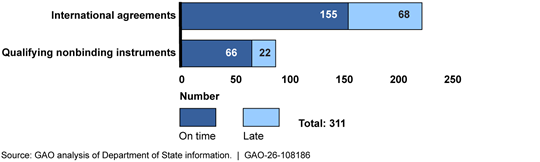
Note: A late-reported agreement or instrument is one that was signed, concluded, or otherwise finalized during the prior month, or that entered into force or became operative during the prior month, but was not reported during the following month.
GAO’s analysis of a generalizable sample of agreements and instruments found that State generally published text and legal authority information for agreements and instruments on its website but missed the 120-day statutorily mandated deadline about half of the time. GAO also found State’s website for agreements and instruments does not enable Congress or the public to find information efficiently, when compared to best practices. Specifically, State posted fragmented information on agreements, instruments, and their legal authorities across four webpages on its website, without a way to search across the universe of agreements and instruments, such as by country, agency, or subject. By establishing written, standard operating procedures to help ensure information is published within the 120-day deadline, and optimizing its website for efficiency and searchability, State could maximize transparency for Congress and the public, and the usability of its website.
Why GAO Did This Study
Amendments in the James M. Inhofe National Defense Authorization Act for Fiscal Year 2023, which took effect on September 19, 2023, expanded the Case-Zablocki Act’s transparency provisions. For the first time, qualifying nonbinding instruments—commitments that do not legally bind the U.S. to their terms—must generally be reported to Congress and made available to the public. Previously, reporting and publishing requirements applied only to international agreements, which are legally binding under international law. The statute mandates that U.S. government agencies report their agreements and instruments to State. State is responsible for reporting them to Congress and publishing them on State’s website.
Congress included a provision in statute for GAO to review State’s implementation of the amended requirements. This report examines the extent to which State addressed reporting and publishing requirements related to international agreements and qualifying nonbinding instruments and any challenges to meeting those requirements. GAO assessed information State reported to Congress between October 2023 and March 2025 and posted to its website in relation to statutory requirements. GAO interviewed officials from State and six other agencies about late reporting.
What GAO Recommends
GAO is making seven recommendations, including that State improve the timeliness and completeness of its reporting on agreements and instruments, and optimize its website for discoverability and searchability. State concurred with five recommendations and did not concur with two. GAO continues to believe all the recommendations are warranted, as discussed in the report.
Abbreviations
21st Century IDEA 21st Century Integrated Digital Experience Act
C-175 Circular 175 procedure
FAM Foreign Affairs Manual
FY 2023 NDAA National
Defense Authorization Act for Fiscal Year
2023
OMB Office of Management and Budget
TIAS Treaties and Other International Acts Series
TIMS Treaty Information Management System
Treaty Office Office
of the Assistant Legal Adviser for Treaty
Affairs
This is a work of the U.S. government and is not subject to copyright protection in the United States. The published product may be reproduced and distributed in its entirety without further permission from GAO. However, because this work may contain copyrighted images or other material, permission from the copyright holder may be necessary if you wish to reproduce this material separately.
June 23, 2026
Congressional Addressees
Concern that the executive branch had entered into international agreements—which are legally binding under international law—without congressional knowledge led to the Case-Zablocki Act.[1] The Case-Zablocki Act, as first enacted in 1972, aimed to inform Congress of all international agreements concluded by U.S. government agencies without Senate approval.[2] Amendments that went into effect in 2023 expanded the Case-Zablocki Act’s transparency provisions. For the first time, both international agreements and qualifying nonbinding instruments must generally be reported to Congress and made available to the public.[3] This change was to allow Congress to have greater visibility and oversight over a broader range of international commitments, not just those that create legally binding rights or obligations.
Section 5947 of the National Defense Authorization Act for Fiscal Year 2023 (FY 2023 NDAA) includes a provision for us to review the Department of State’s implementation of the amended requirements.[4] Section 5947 also calls for us to engage with agencies that did not provide timely or complete information to State for transmittal to Congress and posting to State’s website. GAO was mandated to conduct a review every 3 years for a 9-year period. This first report examines the extent to which State addressed (1) reporting requirements related to international agreements and qualifying nonbinding instruments and any challenges to meeting those requirements and (2) publishing requirements related to international agreements and qualifying nonbinding instruments and any challenges to meeting those requirements.
To address the first objective, we assessed information related to international agreements and qualifying nonbinding instruments that State transmitted to Congress between October 2023 and March 2025 against statutory and regulatory requirements. We selected seven agencies, including State, to conduct interviews about the reasons for late reporting of agreements and instruments to Congress.[5] Altogether the selected agencies accounted for 84 percent (64 of 76) of the agreements and instruments that were reported late to Congress between April 2024 and March 2025. We focused on late reporting during this 12-month period (April 2024 to March 2025) to allow for adjustment to the new reporting requirements during the first 6 months (October 2023 to March 2024).
To address the second objective, we drew a generalizable sample of agreements and instruments transmitted to Congress between October 2023 and March 2025. We then reviewed State’s website to determine whether the required information had been posted, as of July 15, 2025. To address both objectives, we interviewed officials from State about their reporting and publishing processes and reviewed relevant documentation. We assessed State’s efforts to address any challenges to meeting the reporting and publishing requirements against relevant statutes and regulations and selected federal internal control standards—specifically, those related to designing control activities (principle 10) and using and communicating quality information (principles 13 and 15).[6] See appendix I for a detailed description of our scope and methodology.
We conducted this performance audit from March 2025 to June 2026 in accordance with generally accepted government auditing standards. Those standards require that we plan and perform the audit to obtain sufficient, appropriate evidence to provide a reasonable basis for our findings and conclusions based on our audit objectives. We believe that the evidence obtained provides a reasonable basis for our findings and conclusions based on our audit objectives.
Background
The Case-Zablocki Act of 1972
In 1972, Congress enacted a reporting framework for international agreements in what became popularly known as the Case-Zablocki Act.[7] The Case-Zablocki Act originally required the Secretary of State to transmit to Congress the text of any international agreement to which the U.S. is a party, other than a treaty, no later than 60 days after the agreement has entered into force. Leading up to its enactment, members of Congress had expressed concern that the President and other officials of the executive branch had entered into international agreements without congressional knowledge and had withheld agreements from Congress. For example, a congressional subcommittee created in 1969—the Subcommittee on U.S. Security Agreements and Commitments Abroad—discovered various military assistance and base agreements that had been concluded without congressional knowledge or oversight.[8]
Since the Case-Zablocki Act’s inception, studies have found that State’s reporting of international agreements has often been late.[9] Congress has amended the Case-Zablocki Act several times to address late reporting. For example, a 1978 amendment required the President to submit to the Speaker of the House of Representatives and the Chairman of the Senate Foreign Relations Committee a report every year describing fully and completely the reasons for any late-reported agreements.[10] Congress has also enacted funding restrictions in an effort to improve timeliness.[11]
2022 Case-Zablocki Act Amendments
In Section 5947 of the FY 2023 NDAA—enacted December 2022 and effective September 2023—Congress amended the Case-Zablocki Act to broaden the scope of reporting and impose new transparency requirements for qualifying nonbinding instruments. It also reduced the deadline for making information available to the public. Key changes included:
· Increased reporting. International agreements and qualifying nonbinding instruments must be reported twice: first, after being signed, concluded, or otherwise finalized, and again, after entering into force or becoming operative. Previously, only international agreements had to be reported after entering into force. Because international agreements may enter into force months or years after being concluded, this created a transparency gap where agreements were in place before Congress or the public was notified.
· Legal authority reporting and publishing. Reporting and publishing must include the legal authority authorizing each agreement and instrument signed, concluded, or otherwise finalized, and any new or amended statutory or regulatory authority anticipated to be necessary to implement an agreement that entered into force or instrument that became operative. Previously, there was no requirement to report and publish authorizing and implementing authorities.
· Reduced publishing deadline. International agreements and qualifying nonbinding instruments and their legal authority information must be published within 120 days of an agreement entering into force or instrument becoming operative. Previously, international agreements had to be published within 180 days of entering into force and there was no publishing requirement for qualifying nonbinding instruments. Certain agreements and instruments such as those that are classified are exempt from the publishing requirements. (See table 1 for reporting and publishing requirements for State under the amended Case-Zablocki Act.)
|
Item |
Requirement |
|
List |
Each month, the Secretary of State must provide to the Senate Foreign Relations Committee, House Foreign Affairs Committee, Senate Majority and Minority Leaders, House Speaker, and House Minority Leader a list of all international agreements signed, concluded, or otherwise finalized during the prior month. all international agreements that entered into force during the prior month. all qualifying nonbinding instruments signed, concluded, or otherwise finalized during the prior month. all qualifying nonbinding instruments that became operative during the prior month. |
|
Text |
Each month, the Secretary of State must provide (1) the text of all international agreements and qualifying nonbinding instruments signed, concluded, or otherwise finalized during the prior month, and (2) the text of all international agreements that entered into force and qualifying nonbinding instruments that become operative during the prior month, only if the text differs from what was previously provided. |
|
Authorizing authority |
Each month, the Secretary of State must provide a detailed description of the legal authority (or authorities) that, in the view of the Secretary of State, provides authorization for each international agreement and that, in the view of the appropriate department or agency, provides authorization for each qualifying nonbinding instrument to become operative. All citations to the U.S. Constitution, a treaty, or a statute must include, if available, the specific article or section and subsection being relied upon, and, if not available, must be as specific as possible. If the relied-upon authority includes Article II of the U.S. Constitution, the Secretary of State or appropriate department or agency must explain the basis for that reliance. |
|
Implementing authority |
Each month, the Secretary of State must provide a statement describing any new or amended statutory or regulatory authority anticipated to be required to fully implement each international agreement that entered into force during the prior month and each qualifying nonbinding instrument that became operative during the prior month. |
|
Web posting |
The Secretary of State must make available to the public on State’s website (1) the text and legal authority for each international agreement within 120 days of the agreement entering into force and (2) the text and legal authority for each qualifying nonbinding instrument within 120 days of the instrument becoming operative. Certain agreements and instruments such as those containing classified information are exempt from the publishing requirements. |
Source: GAO analysis of 1 U.S.C. 112b. | GAO‑26‑108186
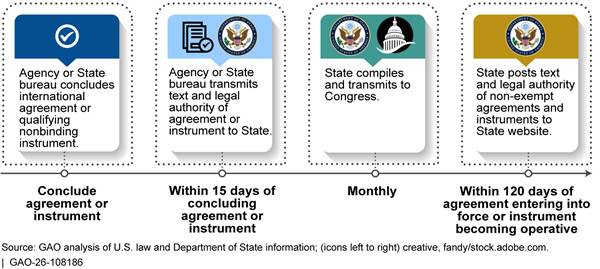
In October 2023, State issued a final rule[12] revising its regulations[13] to reflect and implement the provisions of the amended Case-Zablocki Act. Though issued by State, the regulations apply to all U.S. government agencies responsible for negotiating and concluding international agreements and qualifying nonbinding instruments, guiding agencies on both procedural and substantive matters to ensure compliance. The amendments and State’s regulations established a 15-day transmittal rule.[14] Any U.S. government department or agency, including State, that enters into an international agreement or qualifying nonbinding instrument must transmit the text and legal authority for each agreement or instrument to the Secretary of State within 15 days of signature or conclusion.[15] This rule, according to State regulations, is needed in order for State to meet its legal obligations to provide monthly reporting of international agreements and qualifying nonbinding instruments to Congress.[16]
State Processes for Collecting Information from U.S. Government Agencies
State uses different approaches to collect information on international agreements and qualifying nonbinding instruments from U.S. government agencies. Specifically, State administers the Circular 175 (C-175) procedure for international agreements—such as the April 2025 agreement to establish the United States-Ukraine Reconstruction Investment Fund. State administers a separate “tasker process” for qualifying nonbinding instruments—such as the March 2025 instrument providing for the transfer of individuals from the U.S. to El Salvador. State’s Office of the Assistant Legal Adviser for Treaty Affairs (Treaty Office) is responsible for collecting, reporting, and publishing information on agreements and instruments on behalf of the Secretary of State (see fig. 1 for related time frames).
Figure 1: Time Frames for Collecting, Reporting, and Publishing International Agreements and Qualifying Nonbinding Instruments
International agreements. Consistent with the amended Case-Zablocki Act, State regulations mandate that no U.S. government agency may sign or otherwise conclude an international agreement without prior consultation with State.[17] State’s Treaty Office administers the C-175 procedure to review, authorize, and report international agreements to Congress.[18] The C-175 procedure is intended to ensure that U.S. government agencies have proper legal authority to negotiate and conclude international agreements. Any agency proposing to negotiate or conclude an international agreement must submit to State for consultation the draft text and legal basis for the proposed agreement, and other relevant background information. Once consultations are completed, and with approval from State, the agency receives authority to negotiate and conclude the agreement. Once an agreement is concluded, agencies must provide required information to State’s Treaty Office within 15 days, such as the original text of the agreement and a statement identifying the C-175 authorization so that the sources of legal authority under which the agreement was concluded and implemented can be readily identified. State Treaty Office officials said the C-175 procedure applies to all other federal agencies as well as State bureaus and offices responsible for negotiating and concluding international agreements.
Qualifying nonbinding instruments. The amended Case-Zablocki Act and State regulations do not require U.S. government agencies to seek specific authorization from State before concluding a qualifying nonbinding instrument.[19] When an agency or State bureau or office determines that a nonbinding instrument “could reasonably be expected to have a significant impact on the foreign policy of the United States,”[20] State regulations consistent with the amended Case-Zablocki Act require that agency or bureau or office to provide information to State within 15 days of the instrument’s conclusion.[21] Such information includes the text of the instrument, along with a description of the legal authority relied upon to conclude the instrument and any new or amended statutory or regulatory authority anticipated to be necessary to implement the instrument.
State’s Treaty Office administers a separate “tasker process” to collect information from agencies as well as State bureaus and offices on qualifying nonbinding instruments for reporting to Congress. The Treaty Office sends a standard reporting instruction, called a tasker, to State bureaus and offices and all other federal agencies at the end of each month.[22] The tasker provides guidance and instructs agencies as well as State bureaus and offices to provide all qualifying nonbinding instruments for the reporting period and to fill in a transmittal sheet template with required information for each instrument. Once received, the Treaty Office may interact with the agency or State bureau or office about whether the instrument meets the “significant impact on U.S. foreign policy” criteria for inclusion as well as make sure that all parties involved in its negotiation and conclusion agree that it can be made public.
State Reported Agreements and Instruments to Congress but Is Hindered by Delays and Incomplete Information
State reported over 300 international agreements and qualifying nonbinding instruments to Congress between October 2023 and March 2025 as called for by the amended Case-Zablocki Act. However, we found State’s reporting is hindered by delays and incomplete information in part because (1) other agencies as well as State bureaus and offices were late to provide State’s Treaty Office necessary data, or (2) State’s Treaty Office did not collect all needed data.
State Reported Nearly One-Third of Agreements and Instruments Late to Congress
State must report an international agreement or qualifying nonbinding instrument to Congress at two points, both after it is signed, concluded, or otherwise finalized, and after it enters into force or becomes operative.[23] Of the 311 agreements and instruments State reported to Congress between October 2023 and March 2025, about two-thirds (221 of 311) were reported on time, while nearly one-third (90 of 311) were reported late at one or both reporting points.[24] Late-reported agreements and instruments were on average 2.3 reporting cycles late. For example, an agreement that was concluded on November 4, 2024, should have been reported by the end of December 2024 but was not reported until the end of March 2025. In this case, because the agreement was three reporting cycles late, Congress was notified about the agreement about 5 months after its conclusion.
State’s late reporting rate during this period was higher for international agreements than for qualifying nonbinding instruments. State reported 30 percent of international agreements late compared to 25 percent of qualifying nonbinding instruments. See figure 2.
Figure 2: Timeliness of State Reporting of International Agreements and Qualifying Nonbinding Instruments to Congress Between October 2023 and March 2025
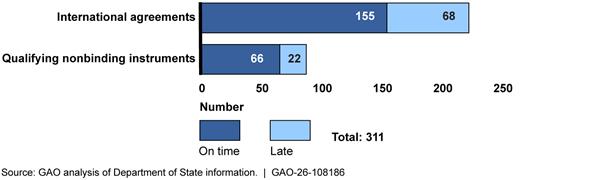
Note: A late-reported agreement or instrument is an agreement or instrument that was signed, concluded, or otherwise finalized during the prior month, or that entered into force or became operative during the prior month, but was not reported during the following month. For example, an agreement that concluded or entered into force on December 1, 2024, would need to be reported by January 31, 2025, or it would be considered late. Among the 90 agreements and instruments that were reported to Congress late, they were on average late by 2.3 reporting cycles.
Because State does not systematically track which agencies conclude agreements and instruments, officials from State’s Treaty Office manually reviewed their records to identify that 19 agencies concluded the 90 late-reported agreements and instruments we identified.
To allow for adjustment to the new reporting requirements during the first 6 months (October 2023 to March 2024), we focused our agency follow up on late reporting from April 2024 to March 2025. In reviewing the information provided by Treaty Office officials, we found that 76 of the 90 agreements and instruments were reported late to Congress during this 12-month period. Seven agencies, including State, accounted for 84 percent (64 of 76) of the total late-reported agreements and instruments during this period.
In interviews with the seven selected agencies, we found that late reporting was in part because agencies as well as State bureaus and offices were late to provide information to State’s Treaty Office. We also found that logistical factors, including delays in receiving information via physical mail and administrative errors, contributed to late reporting.
State. State Treaty Office officials said that one factor for late reporting to Congress was that agencies as well as State bureaus and offices sometimes did not meet the 15-day deadline for transmitting concluded agreements and instruments to the Treaty Office. For example, there can be delays for the Treaty Office in obtaining the final agreement or instrument, including foreign language translations and diplomatic notes.
Other six agencies. Officials from the other six agencies we interviewed acknowledged their agency had provided one or more agreements or instruments late to State’s Treaty Office. However, in some cases, officials said their agency transmitted information on time or that State was responsible for late reporting.
· Officials from the six agencies acknowledged that in some cases their agency had missed the 15-day deadline for transmitting one or more of the concluded agreements or instruments to State. Officials told us that late transmission to State was caused by logistical factors. These included
· delays in receiving the signed hard copy of the agreement from the foreign partner,
· discussions with the Treaty Office over public release of information and to determine whether instruments qualify as reportable, and
· administrative reasons such as errors or personnel turnover.
· In some cases, officials said their agency had transmitted the agreement or instrument to State within the 15-day deadline. However, Treaty Office officials explained that they may still receive transmittals after the 15-day deadline in some cases because of delays for the Treaty Office in obtaining the final agreement via physical mail. Treaty Office officials also acknowledged that in some cases agencies met the 15-day deadline but administrative errors in the Treaty Office contributed to late reporting to Congress.
·
Officials also said that in some cases State “signed” or “executed”
the agreement and therefore was responsible for transmitting the agreement to
the Treaty Office. Treaty Office officials explained that multiple agencies,
including State, can be involved in negotiating, concluding, or both
negotiating and concluding an agreement. Treaty Office officials told us they
recognized that State bureaus or offices involved in negotiating and concluding
the agreement have missed the 15-day window in some cases for transmitting the
agreement to the Treaty Office.
State Does Not Assess Timeliness of Agreement or Instrument Submissions from Agencies
We found that the data in State’s official system of record—the Treaty Information Management System (TIMS)—do not allow State’s Treaty Office to readily assess the timeliness of submissions from agencies or State bureaus or offices. Yet, State’s ability to provide timely and complete information to Congress is impaired when agencies or State bureaus or offices do not transmit concluded international agreements and qualifying nonbinding instruments within the required 15-day window.
To track the timeliness of submissions, State would need to
1. track the agency or State bureau or office that concluded the agreement or instrument, and
2. track and compare the date the agency or State bureau or office concluded the agreement or instrument with the date the agency or State bureau or office submitted the concluded agreement or instrument to State’s Treaty Office.
According to State Treaty Office officials, personnel have historically used TIMS to manage information on international agreements. Following the 2022 Case-Zablocki Act amendments, Treaty Office officials also began manually entering information on any qualifying nonbinding instruments submitted to State’s Treaty Office. State’s Treaty Office then uses TIMS to compile State’s report to Congress each month.
Treaty Office officials said some basic information, such as the title of the agreement or instrument, partner country, and date concluded, is entered into TIMS. However, information such as the agency or State bureau or office that concluded the agreement or instrument or its date of submission to State is not entered. According to Treaty Office officials, State can determine when required information on agreements and instruments is submitted by manually searching such records as emails but does not formally track the extent of compliance with the 15-day deadline for transmitting concluded agreements and instruments to the Treaty Office. State also does not track the agency or State bureau or office primarily responsible for concluding the agreement or instrument.
Treaty Office officials did not identify plans to update TIMS or other systems to track timeliness of agency and State bureau and office submissions. The officials said State plans to launch an online portal in 2026 to allow agencies and State bureaus and offices to upload international agreements and required data fields directly to TIMS. According to Treaty Office officials, this will allow State to streamline reporting and publication of international agreements. However, officials said these updates will not allow State to track submission timeliness and will apply to international agreements only.
The 15-day transmittal rule enables State to meet its monthly reporting obligations to Congress, thereby supporting Congress’s ability to provide timely oversight of U.S. international commitments. Federal internal control standards call for management to use quality information to achieve the entity’s objectives, including compliance with applicable laws and regulations.[25] Management uses the quality information to assess the entity’s performance in achieving key objectives and addressing risks.
Tracking and assessing the timeliness of submissions from agencies as well as State bureaus and offices would provide State with greater awareness of whether agencies and State bureaus and offices are reporting information on international agreements and qualifying nonbinding instruments to State within required time frames and any challenges to meeting reporting time frames. This, in turn, would enable State to take steps, as needed, to improve the timeliness of reporting by agencies and State bureaus and offices to State, and by State to Congress. Without such data, State’s ability to assess and ensure timeliness of submissions and provide timely information on international agreements and qualifying nonbinding instruments to Congress is impaired. Untimely or incomplete reporting could potentially compromise Congress’s ability to meaningfully oversee the agreements and instruments, including to evaluate whether they align with U.S. national security and foreign policy interests.
State Does Not Collect All Information Required of Agencies for Reporting to Congress
State has procedures in place to identify the legal authority relevant to an international agreement’s conclusion and implementation. However, we found that State does not collect legal authority information for qualifying nonbinding instruments. State does not ask other federal agencies or bureaus and offices within State to provide in its monthly tasker the authorizing authority or implementing authority for qualifying nonbinding instruments, which State must report to Congress. When collecting information on these instruments, State instructs agencies as well as State bureaus and offices to transmit the instruments along with a transmittal sheet for each instrument containing the following information:
· title of instrument;
· date signed, concluded, or otherwise finalized;
· date instrument becomes operative (if different than signature/conclusion/finalization date);
· parties or participants to the instrument; and
· whether the instrument has been published and, if so, by whom.
Authorizing Authority. State does not request any information in its monthly tasker related to the authorizing authority for qualifying nonbinding instruments. State’s process for collecting information does not fully align with its regulations, which instruct agencies as well as State bureaus to provide a detailed description of the Constitutional, treaty, or statutory authority or authorities relied upon to conclude the qualifying nonbinding instrument.[26] The regulations also state that all citations to the U.S. Constitution, a treaty, or a statute must include the specific article or section and subsection reference whenever available and, if not available, must be as specific as possible.[27] If the authority relied upon is or includes Article II of the U.S. Constitution, the basis for that reliance must be explained.
In reviewing the qualifying nonbinding instruments State reported to Congress between October 2023 and March 2025, we found that State used a blanket statement to describe the authorizing authority for the qualifying nonbinding instruments reported to Congress during this period:
Unless otherwise indicated, the following statement of legal authority in accordance with 1 USC 112b(a)(1)(A)(iii) applies to all listed instruments: The authority to enter into nonbinding instruments with foreign states and other foreign actors in connection with the conduct of foreign relations derives from the President’s powers under Article II of the Constitution. The President has authority under Article II to represent the nation in foreign affairs, including the authority to communicate with foreign governments and to determine the form and manner in which the Executive engages in diplomacy. As applied to the entry into nonbinding instruments with foreign states and other foreign actors in connection with the conduct of foreign relations, these authorities are exercised on a day-to-day basis by the agencies and departments of the executive branch under the general supervision of the President as Chief Executive, and in consultation with the Secretary of State.
In contrast, in reviewing the international agreements State reported to Congress between October 2023 and March 2025, we found that State generally cited one or more authority for each agreement. For international agreements, State uses the C-175 procedure to identify the sources of legal authority relevant to the agreement’s conclusion and implementation. The authorities cited included the U.S. Constitution, treaties, and statutes. For example, State included the following citations in its reporting to Congress:
· For some agreements entered into by the Millennium Challenge Corporation, State cited 22 U.S.C. 7704 and 22 U.S.C. 7708. These sections authorize the Millennium Challenge Corporation to provide foreign assistance to eligible countries.
· For some agreements entered into by the Nuclear Regulatory Commission, State cited 42 U.S.C. 2013(e) and 42 U.S.C. 2051(a). Section 2013(e) provides for a program of international cooperation to promote the common defense and security and to make available to cooperating nations the benefits of peaceful applications of atomic energy. Section 2051(a) authorizes the Nuclear Regulatory Commission to make contracts, agreements, and loans for research and development activities related to atomic energy.
Implementing Authority. State also does not request any information in its monthly tasker related to the implementing authority for qualifying nonbinding instruments. State’s process for collecting information does not fully align with its regulations, which instruct agencies as well as State bureaus to provide a description of any new or amended statutory or regulatory authority anticipated to be required to implement the instrument for inclusion in reporting to Congress.[28] In reviewing the qualifying nonbinding instruments State reported to Congress between October 2023 and March 2025, we found that State used a blanket statement to describe the implementing authority for the qualifying nonbinding instruments reported to Congress during this period:
Unless otherwise indicated, no new or amended statutory or regulatory authority is anticipated to be required to implement the listed instruments.
While State uses the C-175 procedure to identify the sources of legal authority relevant to an international agreement’s conclusion and implementation, we found that State used the same blanket statement to describe the implementing authority for the international agreements State reported to Congress between October 2023 and March 2025. State officials told us that because there have been no instances in that time period in which new or amended statutory or regulatory authority was anticipated to be required to implement the agreements, State used the blanket statement for the agreements.
State officials acknowledged the need to modify the monthly tasker to align with their regulations. Federal internal control standards call for management to design control activities to achieve objectives, including compliance with applicable laws and regulations.[29] By not updating its template for submitting qualifying nonbinding instruments to include legal authority information, State does not have a control in place to help ensure that agencies meet the requirements outlined in its regulations. Further, State does not have assurance that there is no other authorizing authority or implementing authority that it should be reporting to Congress under section 5947 of the FY 2023 NDAA. If agencies are not fully meeting their reporting obligations, Congress may lack timely and complete information to support its oversight role.
State Does Not Have Reasonable Assurance It Is Identifying All Reportable Agreements and Instruments
State lacks reasonable assurance that it is identifying and reporting all international agreements and qualifying nonbinding instruments to Congress because: (1) State’s process for collecting information does not ensure noncompliance gets reported and (2) State does not request that other federal agencies or bureaus and offices within State confirm that they do not have any reportable agreements or instruments for a given reporting period.
No compliance reporting mechanism. The Case-Zablocki Act, as amended by section 5947 of the FY 2023 NDAA, requires the Secretary of State to establish, within 270 days of enactment, a mechanism for State personnel to report any suspected or known instances of noncompliance with the transparency provisions for international agreements and qualifying nonbinding instruments.[30] However, we found that State has not established a reporting mechanism for this purpose. As of May 2026, State had not issued any formal policy instructing State personnel where to report suspected or known noncompliance with international agreement and qualifying nonbinding instrument reporting requirements.
State Treaty Office officials said State relies on its monthly tasker to State bureaus and offices and a dedicated email inbox to meet this requirement.[31] However, the monthly tasker instructs recipients to reply to the designated email inbox only if personnel have a qualifying nonbinding instrument for the designated period of collection. The instructions do not direct them to use the email inbox to report compliance issues or describe where personnel should direct reports of possible noncompliance. Because State has neither created a dedicated mechanism for State personnel nor made clear its intention that the tasker also be used to report noncompliance, any State employees who are aware of international agreements or qualifying nonbinding instruments that were not submitted to Congress or posted publicly as required, have no explicit avenue to relay those concerns to State leadership for remediation.
Without a designated way for State personnel to flag potential unreported agreements or instruments, State’s ability to identify and promptly correct potential reporting lapses is limited. Establishing a reporting mechanism, and communicating its availability, would better position State to detect potential unreported agreements and instruments and fulfill its legal obligations. This step would strengthen oversight of international agreements and qualifying nonbinding instruments.
No confirmation requirement. State also lacks reasonable assurance that it is identifying and reporting to Congress all international agreements and qualifying nonbinding instruments because it does not request that agencies or State bureaus and offices confirm that they are submitting all agreements and instruments or do not have any agreements or instruments to submit.
The amended Case-Zablocki Act requires State to report to Congress each month (1) all international agreements signed, concluded, or otherwise finalized and that entered into force during the prior month and (2) all qualifying nonbinding instruments signed, concluded, or otherwise finalized and that became operative during the prior month.[32] Additionally, federal internal control standards call for management to communicate quality information that is complete, accurate, and timely—such as a complete list of all agreements and instruments each month—to external parties, including Congress.[33]
State lacks reasonable assurance that it is reporting such a complete list of agreements and instruments to Congress without asking the agency or State bureau or office to confirm that. For example, State’s monthly tasker instructs agencies and State bureaus and offices to respond only if they have a qualifying nonbinding instrument for the designated period of collection. It does not request that agencies or State bureaus or offices confirm that they have submitted all reportable qualifying nonbinding instruments or do not have reportable qualifying nonbinding instruments. By updating its guidance to request that agencies as well as State bureaus and offices confirm that they have either (1) submitted all agreements and instruments, or (2) do not have any to submit for a given reporting period, State would have greater assurance that it is identifying all agreements and instruments and reporting complete information to Congress each month.
State Generally Published Agreements and Instruments, but Information Was Delayed, Incomplete, or Difficult to Find
State’s Completeness and Timeliness in Publishing Varied
We found that State generally published information about international agreements and qualifying nonbinding instruments but frequently missed the statutorily required 120-day deadline.
The amended Case-Zablocki Act requires State to make available to the public on its website the text and legal authority for each international agreement and qualifying nonbinding instrument reported to Congress within 120 days of entering into force or becoming operative, respectively.[34] We drew a generalizable sample of 156 agreements and instruments and found that an estimated 75 percent of the agreements and instruments were subject to the publishing requirements.[35] Certain agreements and instruments such as those containing classified information are exempt from the publishing requirements.[36]
Based on the agreements and instruments subject to the publishing requirements, we estimated that State published text and legal authority information for agreements and instruments about 86 percent of the time.[37] We estimated that State had a higher rate in publishing information for instruments (at an estimated 100 percent) than agreements (at an estimated 77 percent), as shown in figure 3.[38]
Figure 3: Estimated Percentage of International Agreements and Qualifying Nonbinding Instruments State Published on Its Website, as of July 15, 2025
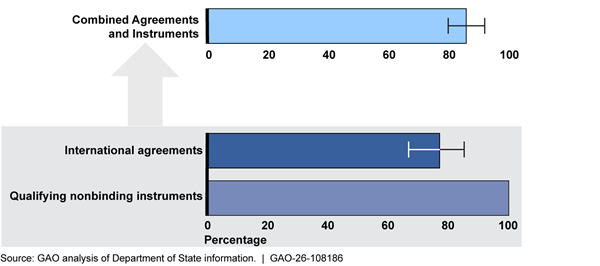
Note: Horizonal bars (shaded area) provide point estimates based on a generalizable sample of agreements and instruments and include a 95 percent confidence interval (horizonal line). The sample was drawn from the agreements and instruments the Department of State transmitted to Congress between October 2023 and March 2025.
Additionally, based on the agreements and instruments subject to the publishing requirements, we estimated that State met timeliness requirements about 53 percent of the time.[39] We estimated that State was twice as likely to publish information for instruments (at an estimated 78 percent) than agreements (at an estimated 38 percent) within the 120-day deadline.[40] Further detail is provided in figure 4.
Figure 4: Estimated Percentage of International Agreements and Qualifying Nonbinding Instruments State Published on Its Website Within 120-Day Deadline, as of July 15, 2025
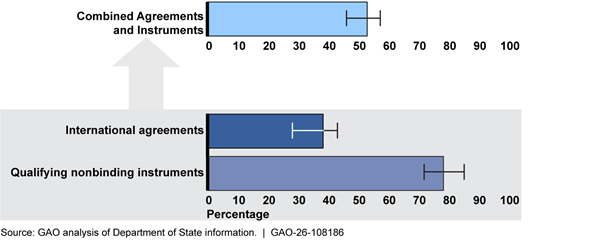
Note: Horizonal bars (shaded area) provide point estimates based on a generalizable sample of agreements and instruments and include a 95 percent confidence interval (horizonal line). The sample was drawn from the agreements and instruments the Department of State transmitted to Congress between October 2023 and March 2025. Agreements and instruments must be published on State’s website within 120 days of entering into force or becoming operative.
State Treaty Office officials generally attributed missing and delayed information to administrative errors. Officials also stated that a lack of awareness of State’s publishing requirements contributed to delays. For example, officials said agencies as well as State bureaus and offices sometimes provide copies of instruments that do not meet State’s publishing standards or provide foreign language translations of agreements that have not been certified by State’s Office of Language Services, which results in additional coordination time to obtain required information.
State Treaty Office officials said they understand State’s publishing requirements under the amended Case-Zablocki Act, but they have not established written, standard operating procedures for the publishing process, which could help reduce administrative errors and address challenges. Federal internal control standards state that federal government entities should establish an effective internal control system to meet entity objectives, including operations, reporting, and compliance.[41] One of the components of internal control is control activities—policies and procedures established by an entity’s management to mitigate risks in achieving the entity’s objectives. By not establishing written, standard operating procedures for its publishing process, State risks continuing to miss the 120-day statutorily mandated deadline for posting information to its website, thus limiting the public’s access to timely and complete information.
State’s Website for Publishing Agreements and Instruments Is Not Easily Searchable
State publishes information related to international agreements and qualifying nonbinding instruments on its website, but the content is not optimized for searchability, a key component of user-friendly design.[42] The publication requirements in section 5947 of the FY 2023 NDAA do not specify how State’s website must present information about international agreements and qualifying nonbinding instruments. However, the 21st Century Integrated Digital Experience Act (21st Century IDEA), enacted in December 2018, required federal websites and digital services to be consistent, not duplicative, searchable, and designed around user needs, among other things.[43] Subsequently, the Office of Management and Budget (OMB) issued guidance in September 2023 describing a number of actions that agencies should perform to implement the act’s requirements.[44]
For example, one of 21st Century IDEA’s modernization requirements is for new or redesigned websites to include a search function that allows users to easily search content intended for public use.[45] The OMB memorandum later spotlighted the act’s requirements and expounded on how agencies could optimize website content for discoverability and searchability. This guidance was preceded by OMB’s November 2016 guidance, which also highlighted discoverability and searchability.[46] These elements align with long-standing guidelines on best practices for website design and usability.[47]
We determined that some aspects of State’s website for agreements and instruments do not reflect the best practices for optimal content discoverability and searchability.[48] For example:
· Discoverability. According to OMB’s 2023 guidance, agencies should optimize online content to help the public find what they are looking for as efficiently as possible, with the fewest number of steps or clicks. State posts the text and legal authority of international agreements and qualifying nonbinding instruments across four separate webpages on its website’s landing page for Case-Zablocki Act reporting. Specifically, State posts: (1) the text of international agreements at: https://www.state.gov/tias/; (2) the text of qualifying nonbinding instruments at: https://foia.state.gov/FOIALIBRARY/QNI2.aspx; (3) legal authority information for international agreements at: https://foia.state.gov/FOIALIBRARY/IRIA2.aspx; and (4) legal authority information for qualifying nonbinding instruments at: https://foia.state.gov/FOIALIBRARY/IRQNI2.aspx. Users must take additional steps to identify and match relevant information for each agreement or instrument across the various webpages. There is uncertainty linking international agreements to their legal authority because, in addition to being posted on separate webpages, they lack a common unique identifier.
· Searchability. According to OMB’s 2023 guidance, public-facing websites should contain an on-site search function that allows users to easily search content intended for the public. State’s website and its webpages for agreements and instruments do not contain a search function that allows users to easily search information across the universe of agreements and instruments. For example, content is not searchable across the universe of agreements and instruments by key characteristics such as country, agency, or subject.
To find text and legal authority information for instruments, users may face challenges with discoverability and searchability due to the design of the webpages on State’s website. For example, users must take the following steps to locate a particular instrument and its corresponding legal authority:
1. Since text and legal authority information for instruments must be published within 120 days of the instrument becoming operative, users must know the month and year when the information was published because the information is uploaded in files with month and year naming convention.
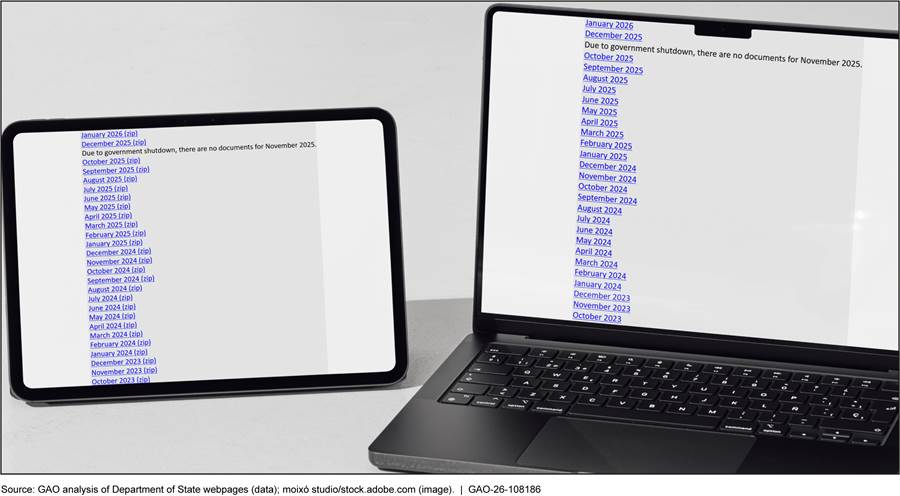
2. Unless users already know the month and year that the text and legal authority information for an instrument was published, they must open all the files to find it. As of April 9, 2026, there were 54 files across the webpages, which is illustrated in figure 5.
Figure 5: Illustration of the Design of State’s Webpages for Text (Left) and Legal Authority Information (Right) of Qualifying Nonbinding Instruments, as of April 9, 2026
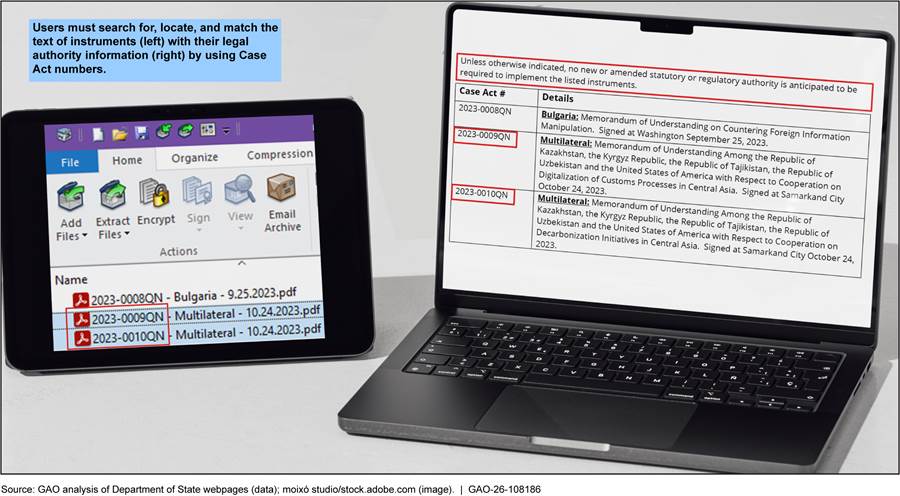
3. Once the files are open, users must search across all the files and know the Case Act number associated with the instrument to locate the text and legal authority information of the instrument. This is because Case Act numbers are the sole unique identifier for instruments since a country can enter into multiple instruments over a short span of time.
4. Finally, users must manually match the text and legal authority information they identified across separate webpages by ensuring Case Act numbers are identical, as shown in figure 6.
Figure 6: Example of Matching Text to Legal Authority Information of Qualifying Nonbinding Instruments Posted Across State’s Webpages, as of April 9, 2026
To find text and legal authority information for agreements, users face similar challenges with discoverability and searchability in addition to the webpages using different designs and unique identifiers for agreements. For example, users must take the following steps:
1. Since text and legal authority information for agreements must be published within 120 days of the agreement entering into force, users must know when the agreement entered into force or when the information was published. Specifically, on the text webpage, information is published by the year the agreement entered into force so users must know the publication year or the entered into force date in order to derive the publication year. Meanwhile, for the legal authority webpage, users must know the month and year when the information was published because the information is uploaded in files with month and year naming convention.
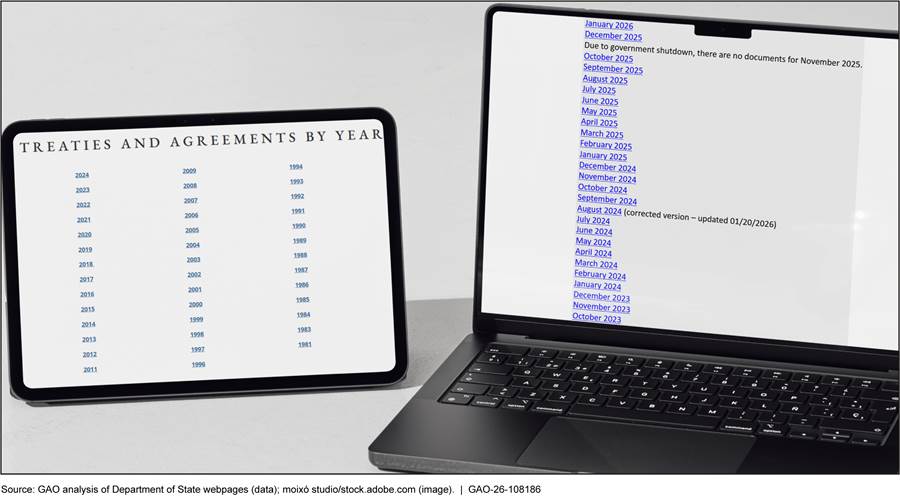
2. Without knowing the year the text was published, users must click each year to search for the agreement (as of April 9, 2026, years 1981 to 2025 were posted). Without knowing the month and year that the legal authority information was published, users must open all the files to find it (as of April 9, 2026, there were 27 files). The differing webpage designs are illustrated in figure 7.
Figure 7: Illustration of the Design of State’s Webpages for Text (Left) and Legal Authority Information (Right) of International Agreements, as of April 9, 2026
3. Next, for the text webpage, users must search across all the files spanning various years and know the Treaties and Other International Acts Series (TIAS) number associated with the agreement to locate the text of the agreement.[49] Meanwhile, for the legal authority webpage, users must search across all the files and know the Case Act number associated with the agreement to locate the legal authority information of the agreement.[50] This is because TIAS and Case Act numbers, respectively, are the sole unique identifiers for text and legal authority information for agreements since a country can enter into multiple agreements over a short span of time.
4. Finally, users must match the text and legal authority information they identified across separate webpages. However, users cannot confidently match information because TIAS and Case Act numbers are independent of each other.
Others have also expressed challenges using State’s website to access agreements and instruments. For example, in the course of our work, we spoke with law professors with backgrounds in international law about the importance of publishing these agreements and instruments. They independently noted similar challenges in using State’s website. They described the burden of having to find and match information across four separate webpages and said it was not possible to search across the universe of agreements and instruments for a particular subject or country. These individuals also flagged that using State’s website will become more cumbersome over time as more information is published online.
We shared our observations with State officials about the challenges in using State’s website. State officials told us they are considering updates, including on-site search functionality improvements, but that such improvements are dependent on funding and would apply solely to the webpage for the text of international agreements, not to the other webpages.
Federal agencies have an opportunity to use leading practices for discoverability and searchability when publishing content online so users can find what they need, understand what they find, and use what they find to meet their needs. By optimizing the webpages on its website for discoverability and searchability, State can maximize transparency and usability, thereby easing Congress’s and the public’s search for agreements and instruments and their respective legal authorities.
Conclusions
The Case-Zablocki Act fosters transparency by informing Congress and the public of international agreements and qualifying nonbinding instruments concluded by U.S. government agencies. State’s data collection procedures do not provide for systematic tracking and assessing of compliance by State bureaus and offices and other federal agencies with the 15-day transmittal rule; nor do they ensure transmittal of the legal authorities for qualifying nonbinding instruments. State is also missing opportunities to identify potential unreported agreements or instruments, for example, through the compliance reporting mechanism called for by the amended Case-Zablocki Act. Taking steps to address these issues would better position State to provide timely and complete reporting to Congress. Without timely and complete reporting across international agreements and qualifying nonbinding instruments, congressional visibility and oversight into U.S. international commitments made by the executive branch could be diminished.
State’s process and website for publishing international agreements and qualifying nonbinding instruments and their legal authorities could also be strengthened. State risks continuing to limit access to timely and complete information by not establishing written, standard operating procedures to help ensure that information is published within the 120-day statutorily mandated deadline. State is also missing opportunities to ensure Congress and members of the public can efficiently search for international agreements and qualifying nonbinding instruments and their legal authorities. By taking steps to optimize the content on its website for discoverability and searchability, State can maximize transparency and usability for Congress and the public.
Recommendations for Executive Action
We are making the following seven recommendations to State:
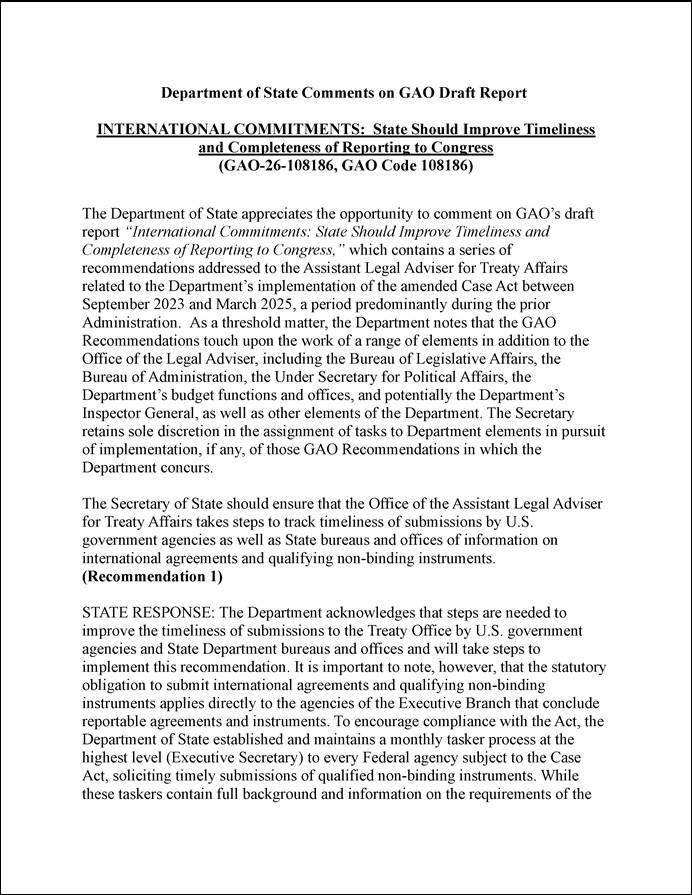
The Secretary of State should ensure that the Office of the Assistant Legal Adviser for Treaty Affairs takes steps to track timeliness of submissions by U.S. government agencies as well as State bureaus and offices of information on international agreements and qualifying nonbinding instruments. (Recommendation 1)
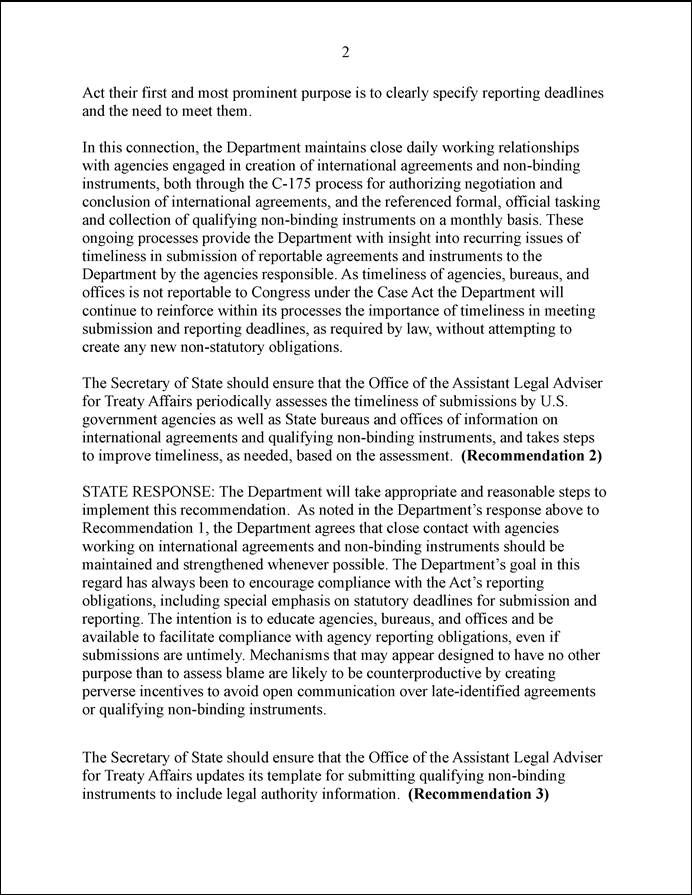
The Secretary of State should ensure that the Office of the Assistant Legal Adviser for Treaty Affairs periodically assesses the timeliness of submissions by U.S. government agencies as well as State bureaus and offices of information on international agreements and qualifying nonbinding instruments, and takes steps to improve timeliness, as needed, based on the assessment. (Recommendation 2)
The Secretary of State should ensure that the Office of the Assistant Legal Adviser for Treaty Affairs updates its template for submitting qualifying nonbinding instruments to include legal authority information. (Recommendation 3)
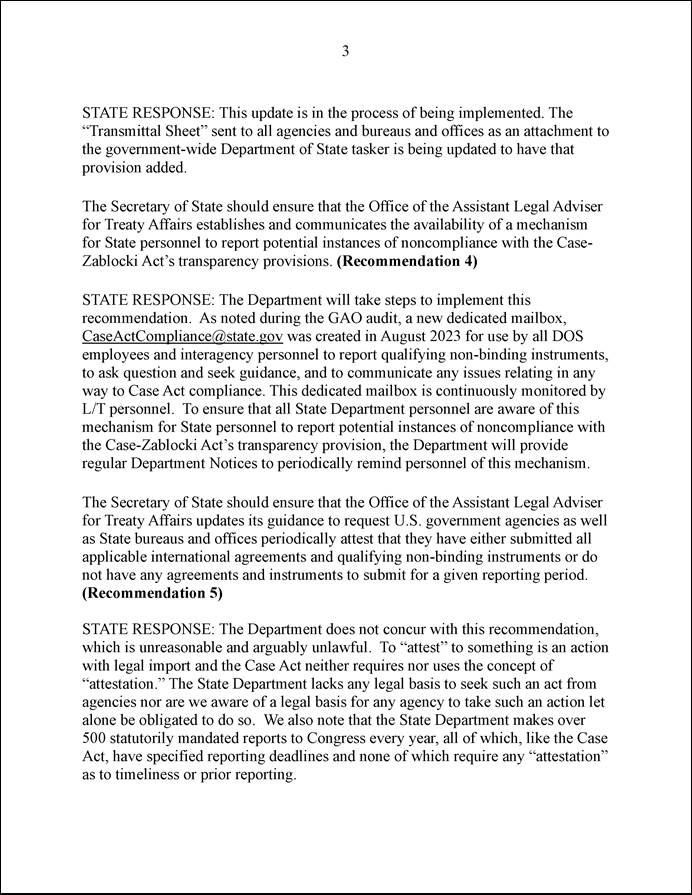
The Secretary of State should ensure that the Office of the Assistant Legal Adviser for Treaty Affairs establishes and communicates the availability of a mechanism for State personnel to report potential instances of noncompliance with the Case-Zablocki Act’s transparency provisions. (Recommendation 4)
The Secretary of State should ensure that the Office of the Assistant Legal Adviser for Treaty Affairs updates its guidance to request U.S. government agencies as well as State bureaus and offices periodically confirm that they have either submitted all applicable international agreements and qualifying nonbinding instruments or do not have any agreements and instruments to submit for a given reporting period. (Recommendation 5)
The Secretary of State should ensure that the Office of the Assistant Legal Adviser for Treaty Affairs establishes written, standard operating procedures for its publishing process to help ensure international agreements and qualifying nonbinding instruments and their legal authorities are published within the 120-day deadline. (Recommendation 6)
The Secretary of State should take steps to optimize the webpages on its website for international agreements and qualifying nonbinding instruments and their legal authorities for discoverability and searchability. (Recommendation 7)
Agency Comments and Our Evaluation
We provided a draft of this report to State and to the Department of Defense, Department of Energy, Department of Justice, Department of the Treasury, Millennium Challenge Corporation, and National Aeronautics and Space Administration for review and comment.
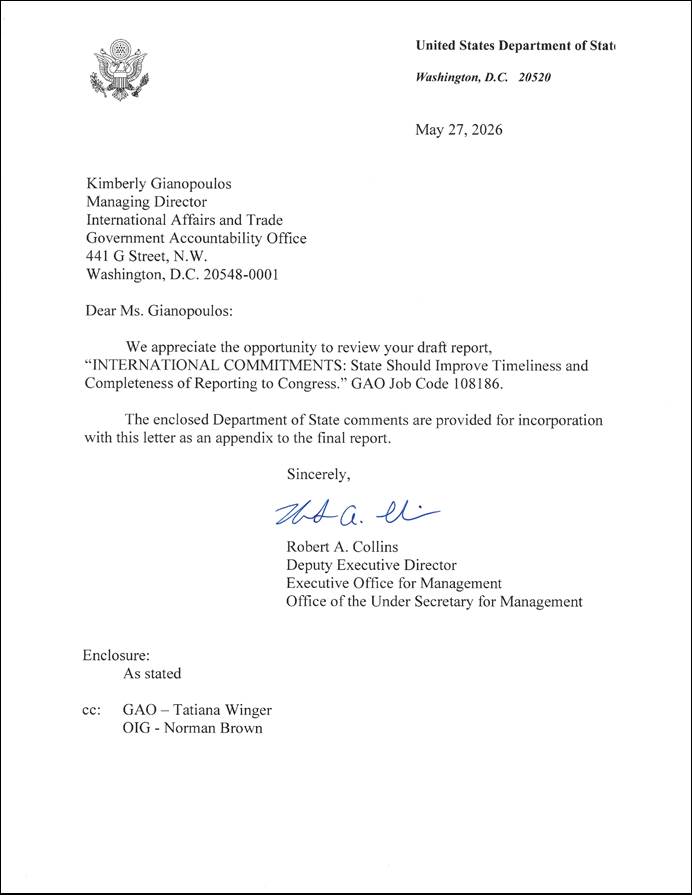
In its comments, reproduced in appendix II, State concurred with five of the seven recommendations directed to the Secretary of State (recommendations 1–4 and 7) and said that it will take steps to address them. State did not concur with recommendation 5 and said recommendation 6 had already been addressed.
State said implementing recommendation 5—which calls on State to periodically ask agencies to attest that they have submitted all international agreements and qualifying nonbinding instruments or do not have any to submit—would be unreasonable. However, as we discuss in our report, State is required to report all international agreements and qualifying nonbinding instruments to Congress. By periodically asking agencies to confirm that they have either submitted all applicable agreements and instruments or do not have any to submit, State would have greater assurance that it is identifying all agreements and instruments and reporting complete information to Congress. For example, State could use its tasker process to ask agencies on an annual basis to confirm that they have submitted all applicable instruments or do not have any to submit for the period. State also cited concerns with our use of the term “attest.” According to State, to “attest” to something is an action with legal import and is not required by the statute. We replaced the term “attest” with “confirm” throughout our report to address State’s concerns.
In response to recommendation 6—which calls on State to establish documented procedures to ensure information on agreements and instruments is published within the 120-day deadline—State said such procedures already exist.[51] While State revised its regulations to reflect the 120-day statutorily mandated deadline, it did not establish written, standard operating procedures to ensure that, in practice, information is published within the 120-day deadline. As we discuss in our report, between October 2023 and March 2025, State frequently missed the 120-day deadline and risks continuing to do so. State officials also generally attributed delays to administrative errors as well as agencies providing copies of agreements and instruments that do not meet State’s publishing standards. By establishing written, standard operating procedures that lay out the process needed to ensure information is published within the 120-day deadline, State could minimize the risk of limiting the public’s timely access to international agreements and qualifying nonbinding instruments and their legal authorities.
The Department of Defense, Department of Justice, and Department of the Treasury provided technical comments, which we incorporated as appropriate. The Department of Energy, Millennium Challenge Corporation, and National Aeronautics and Space Administration did not have any comments on the report.
We are sending copies of this report to the appropriate congressional committees, the Secretary of State, Secretary of Defense, Secretary of Energy, Assistant Attorney General for Administration, Secretary of the Treasury, Acting Chief of Staff of Millennium Challenge Corporation, Acting Administrator of National Aeronautics and Space Administration, and other interested parties. In addition, the report is available at no charge on the GAO website at https://www.gao.gov.
If you or your staff have any questions about this report, please contact me at ElHodiriN@gao.gov. Contact points for our Offices of Congressional Relations and Media Relations may be found on the last page of this report. GAO staff who made key contributions to this report are listed in appendix III.

Dr. Nagla’a El-Hodiri
Director, International Affairs and Trade
List of Requesters
The Honorable John Thune
Majority Leader
United States Senate
The Honorable Charles E. Schumer
Minority Leader
United States Senate
The Honorable James E. Risch
Chairman
The Honorable Jeanne Shaheen
Ranking Member
Committee on Foreign Relations
United States Senate
The Honorable Mike Johnson
Speaker of the House
House of Representatives
The Honorable Hakeem Jeffries
Minority Leader
House of Representatives
The Honorable Brian J. Mast
Chairman
The Honorable Gregory W. Meeks
Ranking Member
Committee on Foreign Affairs
House of Representatives
This report examines two objectives (1) to what extent the Department of State addressed reporting requirements related to international agreements and qualifying nonbinding instruments and any challenges to meeting those requirements and (2) to what extent State addressed publishing requirements related to international agreements and qualifying nonbinding instruments and any challenges to meeting those requirements.
To address the first objective, we reviewed section 5947 of the National Defense Authorization Act for Fiscal Year 2023 (FY 2023 NDAA)[52] and 22 C.F.R. Part 181[53] to identify statutory and regulatory reporting requirements for international agreements and qualifying nonbinding instruments. To understand how State implemented these statutory and regulatory requirements, we interviewed State officials about their reporting processes, and reviewed relevant documentation, including State’s monthly tasker[54] and Circular 175 procedure.[55] We assessed information related to international agreements and qualifying nonbinding instruments that State transmitted to Congress between October 2023 and March 2025 against these statutory and regulatory requirements. To conduct our assessment, we collected the information State transmitted to Congress during this 18-month period and compiled a database of
· all 311 agreements and instruments transmitted to Congress;
· the date each agreement and instrument was signed, concluded, or otherwise finalized;
· the date each agreement entered into force and instrument became operative;
· the legal authority information included for each agreement and instrument; and
· the date each agreement and instrument and their legal authority information was transmitted to Congress.
We then used our database to ascertain
· completeness (the extent to which State transmitted each agreement and instrument and their legal authority information to Congress) and
· timeliness (the extent to which State transmitted each agreement and instrument and their legal authority information to Congress within statutorily mandated time frames).
The 311 agreements and instruments represent the set submitted by U.S. government agencies as well as State bureaus and offices to State’s Treaty Office for reporting to Congress.[56] We did not independently identify and assess additional agreements and instruments signed, concluded, or otherwise finalized by individual agencies, bureaus, or offices that may be potentially subject to reporting. We excluded classified agreements and instruments from our analysis.[57] State also reported various agreements that entered into force before amendments made by section 5947 of the FY 2023 NDAA took effect on September 19, 2023. We excluded these from our analysis since GAO was mandated to review State’s implementation of the requirements in section 5947 of the FY 2023 NDAA.
To assess the timeliness of State’s reporting of agreements and instruments to Congress, we compared the dates they were submitted to Congress to the dates they were signed, concluded, or otherwise finalized and to the dates they entered into force or became operative. For the purposes of this analysis, a late-reported agreement or instrument is an agreement or instrument that was signed, concluded, or otherwise finalized during the prior month, or that entered into force or became operative during the prior month, but was not reported during the following month. For example, an agreement that concluded or entered into force on December 1, 2024, would need to be reported by January 31, 2025, or it would be considered late. Our analysis showed State reported 90 agreements and instruments late to Congress between October 2023 and March 2025. Because State does not systematically track agreements and instruments by agency, officials from State’s Treaty Office had to manually review their records to identify the 19 agencies that concluded the 90 agreements and instruments.
We selected seven agencies, including State, to conduct interviews about the reasons for late reporting of agreements and instruments to Congress.[58] We selected these agencies because they each concluded three or more of the agreements or instruments that were reported late to Congress between April 2024 and March 2025. Altogether the selected agencies accounted for 84 percent (64 of 76) of the total late-reported agreements and instruments during this period. We focused on late reporting during this 12-month period (April 2024 to March 2025) to allow for adjustment to the new reporting requirements during the first 6 months (October 2023 to March 2024). We assessed State’s efforts to address any challenges to meeting reporting requirements against relevant statutes and regulations and selected federal internal control standards—specifically, those related to designing control activities (principle 10) and using and communicating quality information (principles 13 and 15).[59]
To address the second objective, we conducted a statistical analysis of a generalizable sample of the 311 agreements and instruments that were reported to Congress between October 2023 and March 2025. From the 311 agreements and instruments, we drew a sample of 156, of which 101 were agreements and 55 were instruments. We reviewed section 5947 of the FY 2023 NDAA[60] and 22 C.F.R. Part 181[61] to identify statutory and regulatory publishing requirements for agreements and instruments. We compared the information State reported to Congress to the information made available to the public on State’s website through postings on four separate webpages to determine whether information for agreements and instruments had been posted, as of July 15, 2025.[62] Since State’s website does not show when information was posted, we collected posting dates from State and compared those to the entered into force date for agreements and to the became operative date for instruments to determine whether information was posted within the 120-day statutorily mandated deadline.
During our review, we identified instances of missing text and legal authority information on State’s website. Of the 156 agreements and instruments included in the initial sample, we estimated that 25 percent—all of which were agreements—were not subject to the publishing requirements.[63] Therefore, we excluded the agreements from the statistical analysis. We determined these 25 percent were not subject to the publishing requirements because
1. the agreement had yet to enter into force;
2. the agreement had entered into force, but it was still within the 120-day time frame for publishing online;
3. the agreement was exempt from publishing online;[64] or
4. State later determined that the agreement should not have been reported to Congress.
Using the estimated 75 percent of agreements and instruments subject to the publishing requirements, we determined State’s rate in publishing information on its website and in meeting the 120-day statutorily mandated publishing deadline.[65] We interviewed State officials to determine the causes for missing and delayed information. We assessed State’s efforts to address any challenges to meeting publishing requirements against relevant statutes and regulations and selected federal internal control standards related to designing control activities (principle 10).[66]
While collecting the required information for this review, we found the content on State’s website for international agreements and qualifying nonbinding instruments was not optimized for discoverability and searchability.[67] We compared user experiences against Office of Management and Budget guidance[68] and other long-standing guidelines[69] to assess State’s implementation of best practices to achieve optimal website content discoverability and searchability.
We conducted this performance audit from March 2025 to June 2026 in accordance with generally accepted government auditing standards. Those standards require that we plan and perform the audit to obtain sufficient, appropriate evidence to provide a reasonable basis for our findings and conclusions based on our audit objectives. We believe that the evidence obtained provides a reasonable basis for our findings and conclusions based on our audit objectives.
GAO Contact
Nagla’a El-Hodiri, ElHodiriN@gao.gov
Staff Acknowledgments
In addition to the contact named above, Kim Frankena (Assistant Director), Esther Toledo (Analyst-in-Charge), Almir Hodzic, Elisabeth Schaerr Garlock, Claire Labovitz, Donna Morgan, Bahareh Etemadian, Gergana Danailova, Abinash Mohanty, and Alexa Stechschulte made key contributions to this report.
The Government Accountability Office, the audit, evaluation, and investigative arm of Congress, exists to support Congress in meeting its constitutional responsibilities and to help improve the performance and accountability of the federal government for the American people. GAO examines the use of public funds; evaluates federal programs and policies; and provides analyses, recommendations, and other assistance to help Congress make informed oversight, policy, and funding decisions. GAO’s commitment to good government is reflected in its core values of accountability, integrity, and reliability.
Obtaining Copies of GAO Reports and Testimony
The fastest and easiest way to obtain copies of GAO documents at no cost is through our website. Each weekday afternoon, GAO posts on its website newly released reports, testimony, and correspondence. You can also subscribe to GAO’s email updates to receive notification of newly posted products.
Order by Phone
The price of each GAO publication reflects GAO’s actual cost of production and distribution and depends on the number of pages in the publication and whether the publication is printed in color or black and white. Pricing and ordering information is posted on GAO’s website, https://www.gao.gov/ordering.htm.
Place orders by calling (202) 512-6000, toll free (866) 801-7077,
or
TDD (202) 512-2537.
Orders may be paid for using American Express, Discover Card, MasterCard, Visa, check, or money order. Call for additional information.
Connect with GAO
Connect with GAO on X,
LinkedIn, Instagram, and YouTube.
Subscribe to our Email Updates. Listen to our Podcasts.
Visit GAO on the web at https://www.gao.gov.
To Report Fraud, Waste, and Abuse in Federal Programs
Contact FraudNet:
Website: https://www.gao.gov/about/what-gao-does/fraudnet
Automated answering system: (800) 424-5454
Media Relations
Sarah Kaczmarek, Managing Director, Media@gao.gov
Congressional Relations
David A. Powner, Acting Managing Director, CongRel@gao.gov
General Inquiries
[1]118 Cong. Rec. 28085–87 (1972).
[2]The Case-Zablocki Act is codified as amended at 1 U.S.C. § 112b. The law originally stated that any international agreement to which the U.S. is a party, other than a treaty, must be transmitted to Congress no later than 60 days after it enters into force.
[3]Under the amended Case-Zablocki Act, U.S. international commitments can take the form of “international agreements” or “qualifying nonbinding instruments,” according to Department of State officials. International agreements are legally binding under international law. For example, the U.S. and Ukraine signed an international agreement in April 2025 to establish the United States-Ukraine Reconstruction Investment Fund to support Ukraine’s long-term reconstruction, modernization, and economic recovery. Qualifying nonbinding instruments are intended to have political or moral weight, rather than legal force. For example, a March 2025 exchange of diplomatic notes between the U.S. and El Salvador constitutes a qualifying nonbinding instrument. It provides for the transfer of individuals from the U.S. to El Salvador in exchange for in-kind support and funding.
[4]James M. Inhofe National Defense Authorization Act for Fiscal Year 2023, Pub. L. No. 117-263, § 5947, 136 Stat. 2395, 3479–80 (2022).
[5]The other six agencies we interviewed were the Department of Defense, Department of Energy, Department of Justice, Department of the Treasury, Millennium Challenge Corporation, and National Aeronautics and Space Administration.
[6]GAO, Standards for Internal Control in the Federal Government, GAO‑14‑704G (Washington, D.C.: Sept. 10, 2014) and GAO, Standards for Internal Control in the Federal Government, GAO‑25‑107721 (Washington, D.C.: May 15, 2025). GAO‑25‑107721 superseded GAO‑14‑704G, effective October 1, 2025.
[7]See Pub. L. No. 92-403, 86 Stat. 619 (1972) (codified as amended at 1 U.S.C. § 112b).
[8]In response to the agreements uncovered by the subcommittee, Senator Clifford P. Case introduced the legislation that became the Case-Zablocki Act, according to the Congressional Research Service. See Congressional Research Service, Treaties and Other International Agreements: The Role of the United States Senate (Washington, D.C.: Jan. 2, 2021). This study was prepared for the Senate Foreign Relations Committee and summarizes the history of the treatymaking provisions of the Constitution and international and domestic law on treaties and other international agreements.
[9]For example, studies show State’s late reporting spanning at least 33 years. See GAO, Reporting of U.S. International Agreements by Executive Agencies Has Improved, ID-78-57 (Washington, D.C.: Oct. 31, 1978); Congressional Research Service, Treaties and Other International Agreements: The Role of the United States Senate (Washington, D.C.: Jan. 2, 2021); and Oona A. Hathaway, Curtis A. Bradley, and Jack L. Goldsmith, “The Failed Transparency Regime for Executive Agreements: An Empirical and Normative Analysis,” Harvard Law Review, vol. 134, no. 2 (2020): 629. These studies cover 1976 to 1999 and 2006 to 2013. This report covers October 2023 to March 2025.
[10]Foreign Relations Authorization Act, Fiscal Year 1979, Pub. L. No. 95-426, § 708, 92 Stat. 963, 993 (1978). This reporting requirement was eliminated as of May 15, 2000, under a provision that phased out various executive branch reporting requirements. See Federal Reports Elimination and Sunset Act of 1995, Pub. L. No. 104-66, § 3003, 109 Stat. 707, 734 (codified at 31 U.S.C. § 1113 note).
[11]Congress prohibited the use of federal funds to implement any international agreement that was subject to the reporting requirement but was not submitted to Congress within the 60-day deadline in fiscal years 1988 and 1989 and again in fiscal years 2005 to 2007. Foreign Relations Authorization Act, Fiscal Years 1988 and 1989, Pub. L. No. 100-204, § 139, 101 Stat. 1331, 1347 (1987); Intelligence Reform and Terrorism Prevention Act of 2004, Pub. L. 108-458, § 7121(e), 118 Stat. 3638, 3808.
[12]Publication, Coordination, and Reporting of International Agreements: Amendments, 88 Fed. Reg. 67643 (Oct. 2, 2023). Section 5947 of the FY 2023 NDAA mandated the President, through the Secretary of State, to promulgate such rules and regulations as may be necessary to carry out this section. Pub. L. No. 117-263, § 5947(a)(1), 136 Stat. at 3480. It also mandated the Secretary of State to consult and brief relevant congressional committees on matters related to the implementation of this section. Id. § 5947(a)(6). According to State officials, State conducted briefings with relevant congressional committees approximately every 90 days for a 1-year period from the date of enactment. In addition, following this 1-year period, officials said State has briefed, responded to inquiries from, and held discussions with relevant committee staff.
[13]See 22 C.F.R. pt. 181 (2026).
[14]1 U.S.C. § 112b(d); 22 C.F.R. § 181.7.
[15]Departments or agencies whose responsibilities include the negotiation and conclusion of international agreements or qualifying nonbinding instruments must also designate a Chief International Agreements Officer. State designated the Deputy Legal Adviser with supervisory responsibility over the Office of Treaty Affairs as Chief International Agreements Officer.
[16]22 C.F.R. § 181.7(a).
[17]See 1 U.S.C. § 112b(g); 22 C.F.R. § 181.6(a). State regulations require consultations to be completed pursuant to the C-175 procedure. Id. § 181.6(b).
[18]The C-175 procedure is detailed in the Foreign Affairs Manual (FAM). See 11 FAM 720, Negotiation and Conclusion.
[19]See 1 U.S.C. § 112b; 22 C.F.R. pt.181.
[20]22 C.F.R. § 181.7(a)(2). State regulations identify factors that may be relevant in determining whether an instrument could reasonably be expected to have a significant impact on U.S. foreign policy. These include whether, and to what extent, the instrument: (1) is of importance to the U.S.’ relationship with another country, such as by addressing a significant new policy or initiative (rather than ongoing activities or cooperation); (2) affects the rights or responsibilities of U.S. citizens, U.S. nationals, or individuals in the U.S.; (3) impacts State laws; (4) has budgetary or appropriations impact; (5) requires changes to U.S. law to satisfy commitments made therein; (6) presents a new commitment or risk for the entire Nation; and (7) is of Congressional or public interest. Id. § 181.4(b)(3)(i).
[21]Although the relevant regulations do not specifically mention State offices, State clarified that the 15-day transmittal rule applies to bureaus and offices within State. Therefore, we include State bureaus and offices throughout this report.
[22]State Treaty Office officials said the tasker is circulated to over 100 federal agencies that State identified as being subject to the Case-Zablocki Act.
[23]For the purposes of this analysis, a late-reported agreement or instrument is an agreement or instrument that was signed, concluded, or otherwise finalized during the prior month, or that entered into force or became operative during the prior month, but was not reported during the following month. For example, an agreement that concluded or entered into force on December 1, 2024, would need to be reported by January 31, 2025, or it would be considered late.
[24]This analysis does not include classified agreements or instruments. Section 5947 of the FY 2023 NDAA requires State to provide the text of the agreement or instrument and its legal authority in unclassified form, though it may include a classified annex. Pub. L. No. 117-263, § 5947(a)(1), 136 Stat. at 3477. State officials told us State cannot fully meet the requirement to provide all agreements and instruments in unclassified form because agencies may enter into classified agreements or instruments with foreign partners and submit them to State in classified form. State officials said when an agreement or instrument is classified, State delivers a hardcopy of the agreement or instrument to Congress. State also reported various international agreements that entered into force before section 5947 of the FY 2023 NDAA took effect on September 19, 2023. We excluded these from our analysis since GAO was mandated to review State’s implementation of the requirements in section 5947 of the FY 2023 NDAA.
[25]GAO‑14‑704G and GAO‑25‑107721, Principle 13. GAO‑25‑107721 supersedes GAO‑14‑704G, effective October 1, 2025.
[26]See 22 C.F.R. § 181.7(a)(2).
[27]Id.
[28]See 22 C.F.R. § 181.7(a)(2).
[29]GAO‑14‑704G and GAO‑25‑107721, Principle 10. GAO‑25‑107721 supersedes GAO‑14‑704G, effective October 1, 2025.
[30]1 U.S.C. § 112b note.
[31]State’s Treaty Office sends two monthly taskers: one to internal State bureaus and offices, and another to other executive branch agencies.
[32]1 U.S.C. § 112b(a)(1).
[33]GAO‑14‑704G and GAO‑25‑107721, Principle 15. GAO‑25‑107721 supersedes GAO‑14‑704G, effective October 1, 2025.
[34]1 U.S.C. § 112b(b)(1)-(2).
[35]The 95 percent confidence interval for the estimated 75 percent is (70, 80). We found that an estimated 25 percent (the 95 percent confidence interval is 20, 30) of the agreements and instruments included in the initial sample were not subject to the publishing requirements and we excluded these from the statistical analysis. See appendix I for a detailed description of our methodology for conducting a statistical analysis of a generalizable sample of international agreements and qualifying nonbinding instruments.
[36]Exempted agreements and instruments are those that (1) contain classified information or information otherwise exempt from public disclosure, (2) address certain military matters, (3) establish the terms for certain foreign assistance, (4) principally establish technical details for projects undertaken pursuant to already published agreements or instruments, or (5) have been published separately.
[37]The 95 percent confidence interval for the estimated 86 percent is (81, 91).
[38]The 95 percent confidence interval for the estimated 77 percent is (70, 85).
[39]The 95 percent confidence interval for the estimated 53 percent is (47, 59).
[40]The 95 percent confidence interval for the estimated 78 percent is (71, 85). The 95 percent confidence interval for the estimated 38 percent is (29, 47).
[41]GAO‑14‑704G and GAO‑25‑107721. GAO‑25‑107721 superseded GAO‑14‑704G, effective October 1, 2025.
[42]A website is a set of related webpages located under a single host name. Office of Management and Budget, Delivering a Digital-First Public Experience, M-23-22 (Washington, D.C.: Sept. 22, 2023).
[43]21st Century Integrated Digital Experience Act, Pub. L. No. 115-336, § 3, 132 Stat. 5025, 5025–26 (2018).
[44]Office of Management and Budget, Delivering a Digital-First Public Experience, M-23-22 (Washington, D.C.: Sept. 22, 2023).
[45]21st Century IDEA requires that both new and redesigned public-facing websites and digital services created by federal agencies, to the greatest extent practical, be: (1) accessible, (2) consistent, (3) not duplicative, (4) searchable, (5) encrypted, (6) user data-driven, (7) customizable, and (8) mobile-friendly.
[46]Office of Management and Budget, Policies for Federal Agency Public Websites and Digital Services, M-17-06 (Washington, D.C.: Nov. 8, 2016). OMB’s November 2016 guidance discussed most areas later addressed by 21st Century IDEA. Specifically, M-17-06 offered guidance related to the (1) accessible, (2) consistent, (3) searchable, (4) encrypted, (5) user data-driven, (6) customizable, and (7) mobile-friendly requirements. M-17-06 did not address the not duplicative requirement. Although related to the requirements, this guidance was not directly in reference to the act.
[47]Over a dozen experts from the government, private sector, and academia contributed to the Research-Based Web Design & Usability Guidelines by providing sources and strength of evidence ratings for the guidelines. Regarding discoverability and searchability, the guidelines discuss that websites should be designed to facilitate and encourage efficient and effective user interactions and reduce the user’s workload. They also discuss that on-site search functions should be easy to use and allow users to be successful when searching. See Department of Health and Human Services, Research-Based Web Design & Usability Guidelines (Washington, D.C.: Aug. 1, 2004) and Department of Health and Human Services, Research-Based Web Design & Usability Guidelines (Washington, D.C.: Aug. 15, 2006).
[48]State’s website for agreements and instruments consists of four separate webpages and is accessible at: https://foia.state.gov/FOIALIBRARY/CaseAct2.aspx. According to State officials, the webpage for the text of international agreements is based on a legacy website that was launched in 2006 and redesigned in 2018. Officials said the other three webpages were launched in 2024.
[49]TIAS numbers are unique identifiers associated with international agreements. The TIAS number is included in the naming convention of agreements posted on State’s webpage for the text of agreements: https://www.state.gov/tias/.
[50]Case Act numbers are unique identifiers associated with agreements and instruments included in State’s monthly reports to Congress and related information posted on the following webpages: (1) the text of qualifying nonbinding instruments: https://foia.state.gov/FOIALIBRARY/QNI2.aspx; (2) legal authority information for international agreements: https://foia.state.gov/FOIALIBRARY/IRIA2.aspx; and (3) legal authority information for qualifying nonbinding instruments: https://foia.state.gov/FOIALIBRARY/IRQNI2.aspx.
[51]We clarified throughout our report that “documented procedures” refers to “written, standard operating procedures.”
[52]James M. Inhofe National Defense Authorization Act for Fiscal Year 2023, Pub. L. No. 117-263, § 5947, 136 Stat. 2395, 3476–82.
[53]22 C.F.R. pt.181.
[54]To collect information on qualifying nonbinding instruments, State sends a standard reporting instruction, called a tasker, to State bureaus and offices and all other federal agencies at the end of each month.
[55]State administers the Circular 175 (C-175) procedure to review, authorize, and report international agreements to Congress. The C-175 procedure is detailed in the Foreign Affairs Manual (FAM). See 11 FAM 720, Negotiation and Conclusion.
[56]According to State officials, no oral or implementing agreements or arrangements were reported during this period (October 2023 to March 2025). Section 5947 of the FY 2023 NDAA calls for oral international agreements to be reduced to writing and for any written request from the Chair or Ranking Member of the Senate Foreign Relations Committee or House Foreign Affairs Committee to the Secretary of State for the text of any implementing agreement or arrangement not otherwise required to be submitted to be met within 30 days of receiving the request. Pub. L. No. 117-263, § 5947(a)(1), 136 Stat. at 3478, 3479. According to State officials, U.S. government agencies do not enter into oral international agreements, and State did not receive any requests for an implementing agreement or arrangement during this period.
[57]Section 5947 of the FY 2023 NDAA requires State to provide the text of the agreement or instrument and its legal authority in unclassified form, though it may include a classified annex. Pub. L. No. 117-263, § 5947(a)(1), 136 Stat. at 3477. State officials told us State cannot fully meet the requirement to provide all agreements and instruments in unclassified form because agencies may enter into classified agreements or instruments with foreign partners and submit them to State in classified form. State officials said when an agreement or instrument is classified, State delivers a hardcopy of the agreement or instrument to Congress.
[58]The other six agencies we interviewed were the Department of Defense, Department of Energy, Department of Justice, Department of the Treasury, Millennium Challenge Corporation, and National Aeronautics and Space Administration.
[59]GAO, Standards for Internal Control in the Federal Government, GAO‑14‑704G (Washington, D.C.: Sept. 10, 2014) and GAO, Standards for Internal Control in the Federal Government, GAO‑25‑107721 (Washington, D.C.: May 15, 2025). GAO‑25‑107721 superseded GAO‑14‑704G, effective October 1, 2025.
[60]Pub. L. No. 117-263, § 5947, 136 Stat. at 3476–82.
[61]22 C.F.R. pt.181.
[62]State posts (1) the text of international agreements at: https://www.state.gov/tias/; (2) the text of qualifying nonbinding instruments at: https://foia.state.gov/FOIALIBRARY/QNI2.aspx; (3) legal authority information for international agreements at: https://foia.state.gov/FOIALIBRARY/IRIA2.aspx; and (4) legal authority information for qualifying nonbinding instruments at: https://foia.state.gov/FOIALIBRARY/IRQNI2.aspx.
[63]The 95 percent confidence interval for the estimated 25 percent is (20, 30).
[64]Section 5947 of the FY 2023 NDAA exempts agreements and instruments from the publishing requirements that (1) contain classified information or information otherwise exempt from public disclosure, (2) address certain military matters, (3) establish the terms for certain foreign assistance, (4) principally establish technical details for projects undertaken pursuant to already published agreements or instruments, or (5) have been published separately. Pub. L. No. 117-263, § 5947(a)(1), 136 Stat. at 3477–78. State determined various agreements qualified for the publishing exemption and cited reasons 2 through 5 for the exemptions.
[65]The 95 percent confidence interval for the estimated 75 percent is (70, 80).
[66]GAO‑14‑704G and GAO‑25‑107721. GAO‑25‑107721 superseded GAO‑14‑704G, effective October 1, 2025.
[67]State’s website for international agreements and qualifying nonbinding instruments consists of four separate webpages and is accessible at: https://foia.state.gov/FOIALIBRARY/CaseAct2.aspx. According to State officials, the webpage for the text of international agreements is based on a legacy website that was launched in 2006 and redesigned in 2018. Officials said the other three webpages were launched in 2024.
[68]Office of Management and Budget, Delivering a Digital-First Public Experience, M-23-22 (Washington, D.C.: Sept. 22, 2023). Office of Management and Budget, Policies for Federal Agency Public Websites and Digital Services, M-17-06 (Washington, D.C.: Nov. 8, 2016).
[69]Department of Health and Human Services, Research-Based Web Design & Usability Guidelines (Washington, D.C.: Aug. 1, 2004) and Department of Health and Human Services, Research-Based Web Design & Usability Guidelines (Washington, D.C.: Aug. 15, 2006).