
Report to Congressional Requesters
United States Government Accountability Office
A report to congressional requesters
Contact: Mary Denigan-Macauley at DeniganmacauleyM@gao.gov
What GAO Found
In 2016, the Food and Drug Administration (FDA) expanded its authority to oversee all tobacco products, including millions of e-cigarettes that were already on the market. In response, it received a surge of applications from manufacturers in 2020 for products seeking authorization to remain on the market legally. Specifically, it received over 25 million applications in 2020 and 2021, compared to just over 1 thousand applications in 2018 and 2019. This led to a backlog of applications. While FDA has since reviewed most of the applications submitted during this period, almost 132 thousand remained without a completed review as of December 31, 2025. (See figure.)
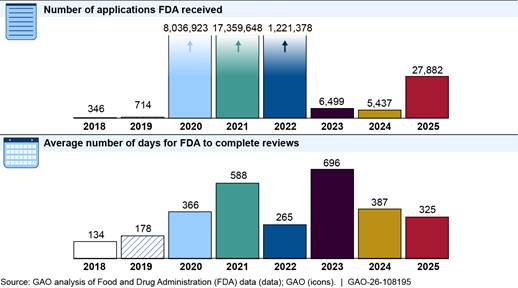
From CY2018 to CY2025, FDA took an average of 507 days to complete its review of tobacco product applications. FDA has goals for each phase of the review process, ranging from 7 to 180 days. For the screening phase, FDA did not meet its goals, although it has made progress toward them. FDA also has goals for the last phase of review, when it must review an application’s scientific information. However, FDA’s data system was not designed to track steps in this part of the review process. Thus, it does not collect the data necessary to monitor whether it is meeting these goals. According to practices identified in prior GAO work, collecting performance information and using it to monitor performance are needed to assess if programs and activities are achieving intended goals. Meeting these goals will help FDA ensure a more predictably timed application process, and more completed reviews will help clarify which products are legally marketed, thus allowing FDA to take action against unauthorized products.
FDA has taken steps to improve review timeliness. For example, since the surge of applications, it issued multiple guidance documents for manufacturers to improve application quality, as it found that poor quality applications slowed the review process. In September 2025, the agency also created a pilot program aimed at streamlining the review process for nicotine pouches and plans to apply lessons learned from that pilot to other product types. However, the changes are too recent to know whether they will increase the timeliness of reviews.
Why GAO Did This Study
FDA has regulated certain tobacco products, such as cigarettes, since 2009. A surge of new product applications soon after led to an application backlog and significant delays, as GAO reported in 2013. FDA took steps to address these challenges and implemented performance measures for review timeliness. However, the 2016 expansion of FDA’s authority to oversee all tobacco products once again raised questions about timeliness.
GAO was asked to provide an update on FDA’s efforts to review applications and provide timely responses. This report examines (1) the status of FDA’s reviews of tobacco product applications submitted 2018 through 2025, (2) the extent to which it met its timeliness goals for reviewing these applications, and (3) the steps FDA took to improve the timeliness of these reviews, among other topics.
GAO analyzed FDA tobacco product application data for submissions FDA received in 2018 through 2025, reviewed agency documents, and interviewed FDA officials and tobacco representatives.
What GAO Recommends
GAO recommends FDA collect the data necessary to monitor whether it is meeting its timeliness goals for reviewing scientific information in all tobacco product applications. HHS agreed with the recommendation.
Abbreviations
FDA Food and Drug Administration
HHS Department of Health and Human Services
This is a work of the U.S. government and is not subject to copyright protection in the United States. The published product may be reproduced and distributed in its entirety without further permission from GAO. However, because this work may contain copyrighted images or other material, permission from the copyright holder may be necessary if you wish to reproduce this material separately.
September 30, 2026
The Honorable Brett Guthrie
Chairman
Committee on Energy and Commerce
House of Representatives
The Honorable H. Morgan Griffith
Chairman
Subcommittee on Health
Committee on Energy and Commerce
House of Representatives
In 2009, the Family Smoking Prevention and Tobacco Control Act (Tobacco Control Act) granted the Food and Drug Administration (FDA) authority to regulate cigarettes, cigarette tobacco, roll-your-own tobacco, and smokeless tobacco.[1] The Tobacco Control Act also established various pathways for manufacturers to seek FDA’s authorization to legally market new tobacco products, depending on a product’s characteristics.[2]
In 2013, a few years after FDA received the first tobacco product applications for review, we reported that the agency faced challenges reviewing those applications.[3] Specifically, as of June 2013, about 3 years after the first applications were submitted, FDA had made final decisions on only six of the almost 4,000 applications it had received. FDA officials identified multiple factors that affected the agency’s review timeframes, such as receiving incomplete applications. At the same time, industry representatives, which included manufacturers, told us that FDA had not provided timely or adequate guidance on what to include in their applications. FDA took steps to address these factors, but we found the agency had not set performance measures to assess progress in its review of timeliness. In our 2013 report, we recommended that FDA establish timeframes for reviewing applications and begin monitoring its performance in meeting these timeframes. FDA agreed with these recommendations and implemented them in 2014.
FDA again faced challenges with its application review process after it received another surge of applications in 2020. Specifically, in 2016, FDA issued a final rule deeming all tobacco products to be subject to the agency’s authorities under the Tobacco Control Act.[4] This included e-cigarettes—battery-powered devices that convert a liquid, including nicotine, into an inhalable aerosol.[5] Manufacturers of tobacco products on the market as of August 8, 2016, were required to submit applications for these products to FDA by September 9, 2020.
Since the 2016 rule, the agency has received applications for more than 26 million products, most of which were e-cigarettes, according to FDA officials. This volume of applications, as well as resource challenges, led to significant review delays and a substantial backlog of applications, according to a Department of Health and Human Services (HHS) Office of Inspector General report in 2023.[6] In addition, a 2022 report from the Reagan Udall Foundation for the Food and Drug Administration reported that after FDA issued the 2016 rule, millions of e-cigarette products had increasingly entered the U.S. market without authorization from FDA, making them illegal. The foundation’s report also noted that completing reviews of these pending applications was a first step for FDA in clarifying which products are legally marketed and which are not, thus allowing FDA to then take enforcement action to remove unauthorized products from the market.[7]
You asked us to provide an update on FDA’s efforts to review tobacco product applications and provide timely responses. In this report, we
(1) describe the status of FDA’s reviews for tobacco product applications submitted from 2018 through 2025,
(2) examine the extent to which FDA has met its goals for reviewing applications from 2018 through 2025,
(3) describe the steps FDA has taken to improve the timeliness of its application reviews, and
(4) describe how FDA funds and staff have been allocated to tobacco product oversight.
To describe the status of FDA’s review of tobacco product applications, we analyzed data maintained by FDA’s Center for Tobacco Products—the office primarily responsible for reviewing applications for tobacco products. We analyzed application data for calendar years (CY) 2018 through 2025. This timeframe allowed us to analyze the status of FDA’s application reviews before and after the influx of e-cigarette applications in 2020, and 2025 was the most recent calendar year of data available at the time of our review. We analyzed data on applications that FDA received and reviewed decisions issued by FDA and the dates that key steps occurred.[8] To calculate the start of FDA’s review, we used the submission date, as that is when the manufacturer submitted the application and determined that the trends were not significantly different from an analysis using receipt date.
To examine the extent to which FDA has met its timeliness goals for reviewing applications, we reviewed FDA internal guidance describing the agency’s goals for completing key steps in the tobacco product application review process and reviewed laws and regulations. We then used the same application data to calculate the number of calendar days it took FDA to complete these steps and compared these to FDA’s established goals. We also interviewed FDA officials to learn about the agency’s process for tracking and reviewing submissions, and to identify factors that contributed to the time FDA took to review applications. In addition to assessing the extent to which FDA has met its timeliness goals, we assessed whether FDA is measuring its timeliness in conducting scientific reviews as part of its application review process. To do this, we compared FDA’s practices with best practices identified in prior GAO work, which specify that performance measures such as time frames and the monitoring of actual performance against measures are an integral part of operating efficiently, achieving effective results, and planning appropriately.[9]
To describe the steps FDA has taken to improve the timeliness of its application reviews, we reviewed documents describing FDA’s efforts, such as guidance documents for industry and internal job aids for FDA application reviewers. We also interviewed FDA officials about these efforts and progress made by the agency. We interviewed five tobacco product manufacturers, an association representing tobacco product manufacturers, and a nonprofit with the goal of reducing tobacco use to get their perspectives on the tobacco product application process and FDA’s efforts to improve timeliness. We selected these five tobacco product manufacturers because they had submitted applications to FDA. Our selection included two manufacturers of the types of products subject to user fees (e.g., cigarettes) and three manufacturers of products not subject to user fees, including e-cigarettes and nicotine pouches.[10]
To describe how FDA funds and staff have been allocated to tobacco product oversight, we reviewed FDA data, including the amount of funding obligated for and staff allocated to support tobacco product activities from fiscal years (FY) 2018 through 2025.[11] This timeframe allowed us to analyze FDA funding and staffing before and after the influx of e-cigarette applications in FY2020, and FY2025 was the most recent fiscal year of data available at the time of our review. We also reviewed the amount of tobacco user fees carried over in each of those fiscal years. We analyzed the data to determine how funds were obligated across different tobacco oversight responsibilities and how staff were allocated across the different offices in the Center for Tobacco Products. We also interviewed FDA officials about the obligations and the responsibilities of FDA staff.
We assessed the reliability of the data we received from FDA by interviewing knowledgeable agency officials about the steps taken to ensure data are accurate and reliable, and reviewing data for obvious errors and inconsistencies. We found these data to be sufficiently reliable for our purposes.
We conducted this performance audit from March 2025 to September 2026 in accordance with generally accepted government auditing standards. Those standards require that we plan and perform the audit to obtain sufficient, appropriate evidence to provide a reasonable basis for our findings and conclusions based on our audit objectives. We believe that the evidence obtained provides a reasonable basis for our findings and conclusions based on our audit objectives.
Background
Tobacco products include both traditional tobacco products, such as cigarettes and cigars, and other nicotine products that do not contain leaf tobacco, such as e-cigarettes (also known as vapes or electronic nicotine delivery systems). These products may include nicotine derived from tobacco or non-tobacco sources (also known as synthetic nicotine).[12]
FDA—through the Center for Tobacco Products—has several oversight responsibilities under the Tobacco Control Act. These include reviewing applications to market new tobacco products, setting scientific standards for tobacco products, developing and issuing regulations and guidance, monitoring the manufacturing and sale of tobacco products, taking regulatory and enforcement action when violations occur, and engaging in public education and outreach activities.
Tobacco User Fees
FDA’s activities to oversee tobacco products are entirely funded by user fees that the agency collects from tobacco product manufacturers and other entities. Specifically, the Tobacco Control Act requires FDA to assess and collect user fees from domestic manufacturers and importers of cigarettes, cigars, snuff, chewing tobacco, pipe tobacco, and roll-your-own tobacco.[13] FDA is not authorized to collect user fees from manufacturers of other classes of tobacco products not specified in the act, such as e-cigarettes and nicotine pouches. The Tobacco Control Act specifies the total amount of user fees FDA is authorized to assess and collect for each fiscal year beginning with FY2009 and stipulates that the fees must be used for FDA’s tobacco oversight. For FY2019 and in each subsequent fiscal year, the act authorizes FDA to assess and collect a total of $712 million in user fees. FDA does not receive discretionary appropriations to fund tobacco product oversight.
Tobacco Product Application Review Process
Before introducing a new tobacco product to the U.S. market, the manufacturer must obtain FDA authorization, which begins with submission of an application to FDA through one of three pathways depending on the product’s characteristics: premarket tobacco product application pathway (premarket pathway), substantial equivalence pathway, or substantial equivalence exemption pathway (see table 1).[14] The Tobacco Control Act establishes a different review standard for each pathway. For example, FDA reviews premarket pathway applications to determine if the marketing of the new product would be “appropriate for the protection of the public health.”[15] To do this, manufacturers that submit premarket pathway applications may have to demonstrate that their product meets relevant public health standards by providing study data related to different disciplinary areas: chemistry, microbiology, and toxicology, among others.
|
Pathway |
Purpose |
Examples of products that may use the pathway |
|
Substantial equivalence pathway |
Used for products substantially equivalent to either a product marketed as of February 15, 2007, or a product previously found substantially equivalent. |
A cigar product that is substantially equivalent to an existing marketed cigar. |
|
Substantial equivalence exemption pathway |
Used for products that have minor modifications to a legally marketed tobacco product, and where FDA has determined a substantial equivalence report is not necessary to ensure the marketing of the new tobacco product is appropriate for the protection of the public health. |
A marketed cigarette product that changed the type of cigarette paper used. |
|
Premarket tobacco product application pathway |
Used for all other products that are not eligible for another pathway. |
An e-cigarette or nicotine pouch product that is not eligible for the substantially equivalence or substantially equivalence exemption pathways. |
Source: GAO summary of Food and Drug Administration (FDA) information. | GAO‑26‑108195
Notes: For the purposes of this report, we refer to premarket tobacco product applications, substantial equivalence reports, and substantial equivalence exemption requests as “tobacco product applications” or “applications.” A fourth pathway, known as the modified risk tobacco product pathway, is available for manufacturers seeking to make claims that a marketed tobacco product is less harmful, presents lower disease risk, or reduces exposure to harmful chemicals. 21 U.S.C. 387k.
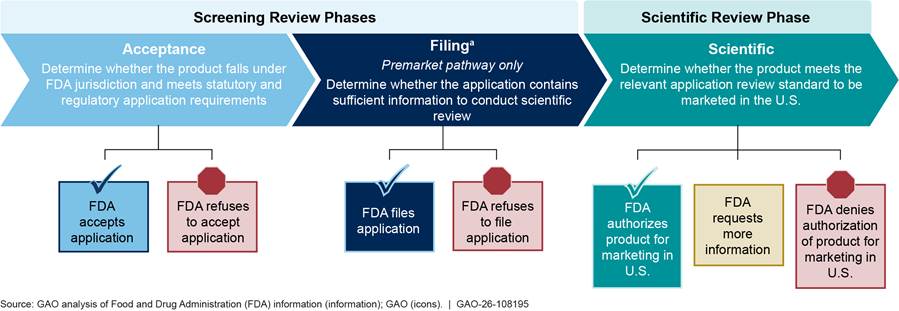
When a manufacturer submits an application to FDA, the agency first screens the application before conducting a scientific review.[16] (See fig. 1.)
Screening. FDA first screens the application to ensure the product falls under FDA’s tobacco product authorities and meets statutory and regulatory application requirements. FDA refers to this as the “acceptance phase” of review. After this review, FDA will either accept or refuse to accept the application via a letter sent to the manufacturer.
Screening for premarket pathway applications also includes what FDA refers to as the “filing phase” of review.[17] This review involves a determination of whether the application contains sufficient information for FDA to conduct a scientific review. Sufficient information includes, but is not limited to, health risk investigations and study reports, manufacturing information, and ingredient information. After this review, FDA will either file or refuse to file the application via a letter sent to the manufacturer.
Scientific review. After screening, FDA conducts a scientific review to determine whether the tobacco product meets the application review standard. In the scientific review, a multidisciplinary team of reviewers evaluates the scientific information and data in the application to ensure that tobacco products are evaluated and regulated based on the best available scientific evidence, with the goal of protecting public health, reducing harm, and preventing youth access. For example, reviewers disciplined in toxicology may assess the data in a premarket pathway application to identify harmful levels of carcinogens. Meetings between reviewers and supervisors also occur during this review to discuss findings, deficiencies, concerns, the basis for a marketing decision, and more. Based on the scientific review, FDA may authorize the product to be marketed, deny the authorization to market the product, or issue a deficiency letter asking that the manufacturer provide additional information to FDA.
Notes: This figure depicts the phases of review for the premarket tobacco application, substantial equivalence, and substantial equivalence exemption pathways. A fourth pathway, known as the modified risk tobacco product pathway, is available for manufacturers seeking to make claims that a marketed tobacco product is less harmful, presents lower disease risk, or reduces exposure to harmful chemicals. 21 U.S.C. 387k.
aThe substantial equivalence and substantial equivalence exemption pathways follow a similar process but do not have a filing phase.
Timeliness Goals for Application Review
FDA has both a statutory requirement and internal goals for how long it should take to complete different phases of that process. To help monitor the timeliness of its reviews, FDA established internal goals for how long it should take to complete each phase of the review process for all three pathways.[18] (See table 2.)
Table 2: FDA’s Timeliness Goals for Completing Tobacco Product Application Review, by Phase and Pathway
|
Pathway |
Acceptance phase |
Filing phase |
Scientific review phase |
|||
|
Accepted |
Refused |
Filed |
Refused |
Authorized |
Denied authorization |
|
|
Substantial equivalence pathway |
7 days |
21 days |
N/A |
N/A |
73 days |
73 days |
|
Substantial equivalence exemption pathway |
7 days |
21 days |
N/A |
N/A |
48 days |
48 days |
|
Premarket tobacco product application pathway |
7 days |
21 days |
7 days |
23 days |
180 days |
180 days |
Source: GAO summary of Food and Drug Administration (FDA) information. | GAO‑26‑108195
Notes: The substantial equivalence and substantial equivalence exemption pathways do not have a filing phase of review. Once FDA receives an application, the first reviewer is expected to review the application in 3 days. Then the application goes to a supervisory reviewer who has 2 days to complete their review. If the application is accepted, an acceptance letter is to be issued on day 7. If the application is refused, the reviews are sent to another reviewer to determine if any additional clearance levels are needed and a refuse to accept letter is to be issued on day 21. FDA has a statutory requirement to complete reviews of premarket tobacco product applications no later than 180 days after receipt of the application. 21 U.S.C. 387j(c)(1)(A).
In addition, for premarket tobacco applications, FDA is required to issue an order allowing or denying marketing of the product as promptly as possible but no later than 180 days after receipt of the application.[19] FDA regulations further specify the agency will complete its review within 180 days of receipt of an application that has met the agency’s requirements for filing.[20] In other words, FDA applies the 180-day statutory requirement only to its scientific review of premarket pathway applications.
FDA Completed Review of Most Tobacco Product Applications Received and Has Made Progress Completing Remaining Reviews
FDA Received a Surge of Tobacco Product Applications Starting in CY2020
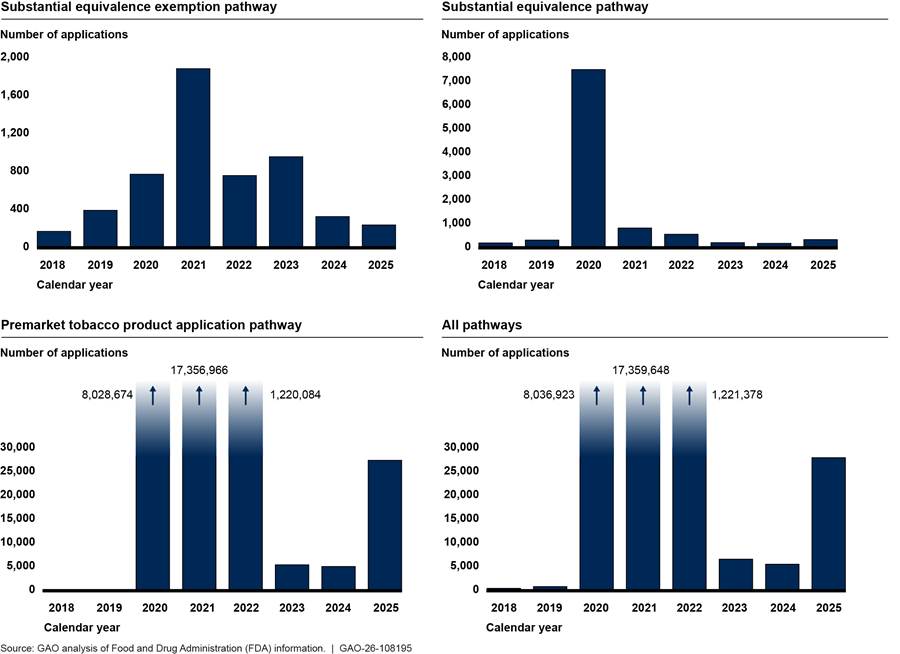
FDA received a surge of tobacco product applications starting in CY2020, and the number of applications generally decreased in subsequent years. (See fig. 2.) Specifically, FDA received 25,396,571 applications in CY2020 and CY2021. Relative to CY2018 and CY2019, when FDA received 1,060 applications, FDA received thousands more substantial equivalence pathway applications and millions more premarket applications in CY2020.[21] This surge in applications was the result of a 2016 FDA final rule, which deemed all tobacco products—including e-cigarettes—to be subject to the agency’s authorities under the Tobacco Control Act.[22] Manufacturers of tobacco products on the market as of August 8, 2016, were required to submit applications for these newly deemed products to FDA by September 9, 2020.
Note: For the purposes of this report, we categorized applications by the date they were submitted to FDA for review.
FDA Completed Review of Most Applications Submitted and Is Making Progress on Those Remaining
While FDA had completed its review of most tobacco product applications submitted since CY2018, 131,915 remained without a complete review.[23] Specifically, as of December 31, 2025, FDA had completed reviews for 26,526,862 of the 26,658,777 applications submitted since CY2018. FDA authorized few of the products for which it completed reviews from CY2020 through CY2025, since the influx of applications in CY2020. In contrast, in CY2018 and CY2019, FDA authorized most of the products in the applications that it received. (See table 3.) FDA officials attribute this low authorization rate to the poor quality of applications. However, they said they have seen recent improvements in quality following guidance provided by the agency.
Table 3: Percentage of Tobacco Products Authorized, by Year of Application Submission, Calendar Years 2018-2025
|
Pathway |
2018 |
2019 |
2020 |
2021 |
2022 |
2023 |
2024 |
2025 |
Total |
|
Substantial equivalence exemption pathway |
92% |
74% |
47% |
19% |
35% |
34% |
13% |
23% |
34% |
|
Substantial equivalence pathway |
70% |
85% |
10% |
6% |
1% |
0% |
1% |
0% |
11% |
|
Premarket tobacco product application pathway |
100% |
33% |
0% |
0% |
0% |
0% |
0% |
0% |
0% |
Source: GAO analysis of Food and Drug Administration (FDA) data. | GAO‑26‑108195
Note: For the purposes of this report, we categorized applications by the date they were submitted to FDA for review.
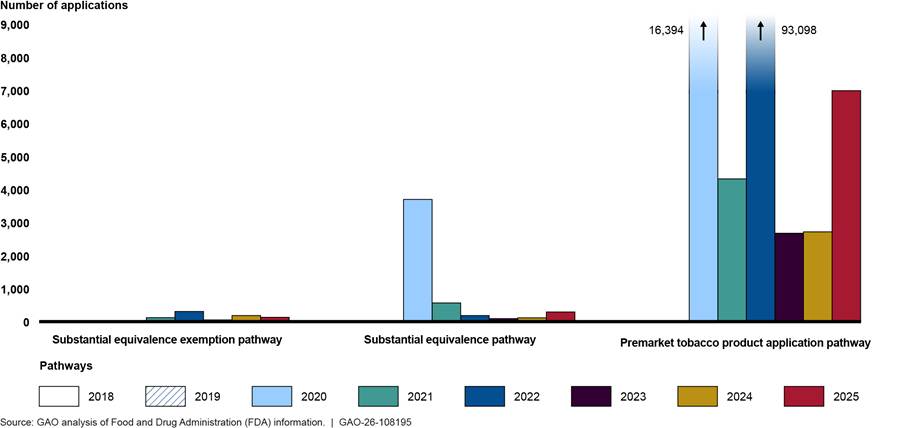
For 131,915 of the applications submitted from CY2018 through CY2025, FDA had not completed its review as of December 31, 2025. The number of applications for which FDA did not complete its review varied across the pathways after the influx of applications that started in CY2020. For example, the number of applications without a completed review generally decreased in the substantial equivalence pathway after the influx but remained elevated in CY2022 in the premarket pathway. (See fig. 3.)
Figure 3: Number of Tobacco Product Applications Without a Completed FDA Review as of December 31, 2025, by Pathway, Calendar Years 2018-2025
Notes: For the purposes of this report, we categorized applications by the date they were submitted to FDA for review. We define completed reviews as those for which FDA has made a final determination on the application.
The majority of applications for which FDA had not completed its review by the end of CY2025 were submitted prior to CY2023 and, therefore, had been waiting at least 2 years for a decision. On average, 1,266 days elapsed from the submission of applications awaiting a completed review to December 31, 2025. As of December 31, 2025, there were 131,915 of these applications. However, this number has decreased in recent years as the agency has worked through the backlog of applications from the CY2020 surge and as application quality has improved, according to FDA officials.
FDA Generally Did Not Meet Timeliness Goals for Screening Applications and Does Not Collect Data to Monitor Timeliness of Scientific Reviews
FDA took an average of 507 days to review tobacco product applications. The agency has internal goals for screening applications and scientific review. FDA generally did not meet its timeliness goals for screening applications during the period we reviewed and does not collect the data necessary to monitor whether it is meeting its goals for scientific review.
FDA Took an Average of 507 Days to Review Tobacco Product Applications, With Variation by Pathway
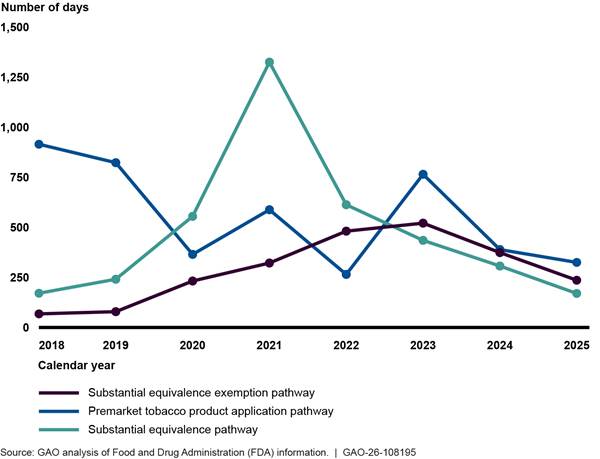
From CY2018 to CY2025, FDA took an average of 507 days to complete its review of tobacco product applications. Review times varied by pathway.[24] For example, FDA took an average of 331 days to review substantial equivalence exemption pathway applications. In comparison, FDA took an average of 560 days to review substantial equivalence pathway applications. Overall review times across all pathways decreased since CY2023, which FDA officials attribute to agency efforts to streamline the review process and better internal training for reviewers. (See fig. 4.)
Figure 4: Average Number of Days for FDA to Complete Reviews of Tobacco Product Applications, by Pathway, Calendar Years 2018-2025
Notes: For the purposes of this report, to calculate the start of FDA’s review, we used the date the applications were submitted to FDA. We define completed reviews as those for which FDA has made a final determination on the application.
FDA Generally Did Not Meet Its Timeliness Goals for Screening Applications, but Timeliness Has Improved
Our review of agency data shows that for CY2018 through CY2025, FDA generally did not meet its timeliness goals for screening tobacco product applications to determine if they are complete. For all three pathways, FDA’s goal is to complete the first phase of screening (known as the acceptance phase) in 7 to 21 days, depending on whether it accepts or refuses to accept the application. We found FDA did not meet these goals for any of the three application pathways. For example, it took FDA an average of 542 days to complete its review for premarket applications it refused to accept, well over its goal of 23 days. (See table 3.)
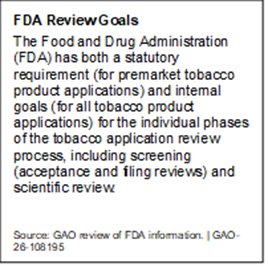
Table 4: FDA Average Review Times for Screening (Acceptance and Filing Phases) Tobacco Product Applications Submitted Calendar Years 2018-2025
|
Pathway |
|
Acceptance phase |
Filing phase |
||
|
Accepted |
Refused |
Filed |
Refused |
||
|
Substantial equivalence pathway |
FDA goal |
7 days |
21 days |
— |
— |
|
Actual |
81 days |
127 days |
— |
— |
|
|
Difference |
+74 days |
+106 days |
— |
— |
|
|
Substantial equivalence exemption pathway |
FDA goal |
7 days |
21 days |
— |
— |
|
Actual |
31 days |
189 days |
— |
— |
|
|
Difference |
+24 days |
+168 days |
— |
— |
|
|
Premarket tobacco product application pathway |
FDA goal |
7 days |
21 days |
7 days |
23 days |
|
Actual |
236 days |
542 days |
141 days |
116 days |
|
|
Difference |
+229 days |
+521 days |
+134 days |
+93 days |
|
Source: Food and Drug Administration (FDA) tobacco product application data. | GAO‑26‑108195
Notes: To calculate the start of FDA’s review, we used the date the applications were submitted to FDA. The substantial equivalence and substantial equivalence exemption pathways do not include the filing phase of review. When FDA accepts applications submitted through these pathways, the agency notifies and assigns staff following acceptance and the application moves to the scientific review phase.
The one-time surge in applications received in CY2020 contributed to FDA’s challenges in meeting its timeliness goals. Prior to CY2020, FDA was meeting some of its goals for screening applications, including those related to the acceptance phase of review for applications of the substantial equivalence and substantial equivalence exemption pathways. For example, FDA met its goal for the number of days to accept substantial equivalence exemption applications in CY2018, with reviews taking an average of 6 days. It also met its goal for the number of days to refuse to accept applications of the substantial equivalence pathway in CY2018, completing reviews in an average of 21 days. FDA’s performance meeting these goals decreased following the overall surge in applications in CY2020.
FDA officials told us they are aware the agency did not meet these performance goals. However, they said that they expect to see improvements in the timeliness of reviews now that the surge has passed. We found that FDA has made some progress in recent years towards meeting its timeliness goals for the screening phase. For example, for the substantial equivalence pathway, FDA reduced the average number of days to refuse to accept an application from 596 days in CY2023 to 170 days in CY2025. Similarly, for the premarket pathway, FDA reduced the average number of days to file an application from 845 days in CY2022 to 156 days in CY2025. While FDA did not meet its review goals, FDA officials have said that steps to improve the review process in CY2025 will further improve review times.
FDA Did Not Collect Data Needed to Monitor Its Timeliness in Completing Scientific Reviews, but Available Evidence Suggests It Has Not Met Timeliness Goals
FDA is not monitoring whether it is meeting its goals for scientific review of tobacco product applications as its system is not designed to collect the necessary data. As indicated earlier in this report, FDA has goals specifying the maximum amount of time the scientific review phase should take for each of its three pathways: 180 days for premarket applications, 73 days for applications of the substantial equivalence pathway, and 48 days for applications of the substantial equivalence exemption pathway, according to FDA officials. However, FDA officials stated that its system only tracks when the agency completed the prior phase of review and does not collect data on how long reviews take starting from the start of the scientific review phase to the end of the scientific review phase.[25] Officials said this is done under the assumption that an application immediately moves from one phase to the next in the review process. However, the backlog of applications stemming from the influx in CY2020 has left gaps between the end of one phase and the start of the next. In addition, FDA also does not track the amount of time that elapsed after FDA sends applications back to the applicant for needed changes, which could be used to stop the clock for FDA’s review. Without these data, FDA is unable to monitor the extent to which it is meeting its timeliness goals for scientific review.
While we were unable to use FDA’s data to assess whether it met these goals, available evidence we reviewed suggests that FDA did not. For example, in a 2023 report, the HHS Office of Inspector General reviewed a small sample of premarket applications and found FDA took from 483 to 633 days to complete scientific review, exceeding its goal of 180 days for that pathway.
FDA officials told us in March 2026 that they recently started manually tracking these data for a small number of applications. However, they said this manual tracking would not be possible to scale up for a larger number of applications. Officials said FDA is considering options to systematically track its performance data, but the agency did not have specific information about the status of those efforts at the time of our report.
According to our prior work, collecting performance information and using it to monitor performance is needed so agencies can assess whether or not programs and activities are achieving intended goals.[26] Because FDA does not collect the data necessary to monitor the timeliness of its scientific reviews, it does not know the extent to which it is meeting its established goals. Monitoring performance is important to helping the agency identify opportunities to improve its timeliness and performance in achieving its scientific review goals.
FDA Took Steps to Improve Application Quality and Speed Review
FDA Took Steps to Help Manufacturers Improve the Quality of Future Applications
Since the influx of applications in CY2020 that led to a review backlog, FDA took steps to improve review timeliness by providing guidance aimed at improving the quality of future applications. According to FDA officials, many of the applications submitted during the influx had quality problems because they lacked required information—such as the product name or an adequate assessment of the product’s environmental impacts—and this slowed FDA’s review process. Multiple manufacturers we interviewed said FDA’s guidance in place at the time of the CY2020 applications was unclear, and this created confusion and potentially unnecessary costs for them. For example, one manufacturer applying for authorization of a novel product expressed their confusion because FDA did not specify the scientific tests needed for the application at the time of the submission deadline. We previously reported in 2013 that manufacturers experienced similar challenges during a prior influx of reviews. At that time, FDA cited incomplete applications as a reason for delay, while manufacturers said FDA guidance was unclear and not timely.[27]
To improve the quality of submitted applications, FDA issued more information, held public meetings, and issued guidance on the application process for two of the three pathways, according to FDA officials. For example, FDA made memoranda pertinent to the scientific review phase covering multiple disciplines (e.g., toxicology and chemistry) that describe the scientific information that FDA considers during the substantive review. FDA officials said they have seen an improvement in the quality of applications being submitted since issuing this guidance, which has, in turn, led to the agency receiving more complete applications to conduct the scientific reviews. However, all five manufacturers that we spoke to said more clarity in FDA’s guidance is needed. For example, one manufacturer noted examples of where additional guidance—such as clear guidelines on the tests, designs, and thresholds needed for authorization—would be helpful. FDA officials said there is no set definition of its standard and decisions about authorization are made on a case-by-case basis. However, officials told us that they have tried to provide additional clarity to manufacturers through other venues, including trainings and individual meetings.
FDA Implemented Internal Training and Process Improvements to Speed Application Review
FDA took steps to speed the agency’s application review process by providing reviewers with additional training and guidance and streamlining the process overall. For example, FDA implemented internal training for its reviewers to improve timeliness. These included job aids to guide reviewers through each stage of review and, according to FDA officials, quarterly workshops to discuss short- and long-term goals of the application process.
FDA has also taken steps to streamline the review process.
· Bundled similar applications. In 2020, FDA established a bundling method across all tobacco product applications to allow it to more efficiently review similar groups of applications together, according to FDA officials.[28] For example, FDA may bundle each of a manufacturer’s applications covering different flavors for an otherwise similar product. This allows FDA to review them together and issue review decisions faster, according to FDA officials. This method has dramatically reduced the number of separate applications for FDA to review—from 26,658,777 individual applications to 18,197 bundled applications.
· Automatic validation process. FDA has automated many elements of the application review processes. For example, in the fall of CY2025, FDA updated the portal that manufacturers use to submit their applications and it now electronically validates those submissions, according to FDA officials. Specifically, this update allows the agency to quickly check applications for certain required information to ensure they are complete and correctly formatted, according to FDA officials. This is a review that FDA staff used to manually conduct during acceptance phase of review.
· Implemented pilot program. FDA implemented a pilot program for nicotine pouches in September 2025 to improve the timeliness of the application review process. FDA officials stated the pilot included four manufacturers and featured a streamlined review process that allowed the agency to improve the efficiency of reviews without compromising scientific rigor. Officials told us that one way FDA intended to do this was by increasing communication between the agency and applicants.[29] For example, the agency increased informal interactions between manufacturers and project managers at FDA to resolve issues in the application process, rather than waiting for FDA to issue a formal letter.
Representatives we interviewed from one manufacturer that participated in the pilot highlighted the benefits of outreach from FDA. For example, the manufacturer said that FDA worked directly with participants to modify their applications to meet a requirement rather than the usual process of requiring them to withdraw and resubmit it. FDA officials said they were satisfied with the outcomes of the program, noting that, from the pilot’s start in September, FDA had authorized six products for marketing by December 2025.[30] FDA officials said they were considering lessons learned from this pilot that could be applied to the review of other products. In April 2026, FDA issued internal guidance for reviewers to incorporate lessons from the pilot into the review of premarket applications for e-cigarettes.
It is too soon to know if these efforts will speed up application reviews more broadly to successfully address the backlog. However, FDA officials said there had been recent progress in reducing the backlog of applications.
One challenge still exists, although FDA is taking steps to address it. Specifically, FDA officials told us that the agency no longer notifies an applicant via a letter when it is preparing to start scientific review of an application, even though significant time may have passed since its submission. According to FDA officials, this is a change from a prior practice that FDA put in place to address timeliness challenges and ensure applications were up to date before the agency started its scientific review.[31] Specifically, in CY2012, FDA began notifying manufacturers that had submitted applications of the substantial equivalence pathway that the agency would be starting scientific review within 45 days and offering manufacturers the opportunity to update their applications. However, in CY2018, FDA stopped providing this notification letter because too many manufacturers then tried to make inappropriate updates to their applications, according to FDA officials.[32] As a result of manufacturers having not received these notifications from FDA, some applications may no longer be up to date by the time the agency begins scientific review, particularly when significant time has passed since the original submission, as was the case following the surge of applications in CY2020.[33] FDA officials also said that after a long delay in the review, it is reasonable that new information would be available for a product. In April 2026, FDA implemented lessons learned from the pouch pilot program indicating that FDA may reach out to manufacturers before beginning the scientific review of premarket pathway applications to request whether there is additional information that will facilitate FDA’s review of the product.
FDA Obligations for Tobacco Product Oversight Peaked in FY2021 and an Increasing Portion of Its Funding and Staff Supported Application Reviews
FDA Obligations for Tobacco Product Oversight Peaked in FY2021 and Have Increasingly Been Allocated for Application Review
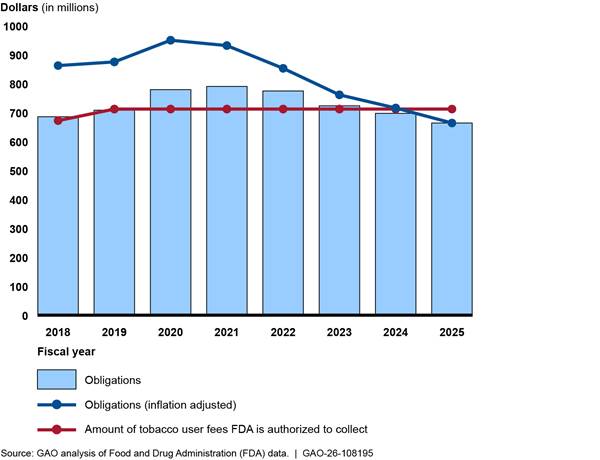
From FY2018 through FY2021, FDA obligations for tobacco product oversight increased from about $686 million to $790 million, though obligations then declined to $664 million by FY2025.[34] (See fig. 5.) All FDA funding for tobacco product oversight is derived from user fees; user fees that FDA does not obligate in a given fiscal year are carried over into the next fiscal year.
· Since FY2019, FDA has been authorized to collect up to $712 million in tobacco user fees each year. FDA may obligate those funds or carry them over into the following fiscal year. For example, at the end of each fiscal year, FDA has historically carried over a portion of its tobacco user fees to cover expenditures in the first quarter of the next fiscal year.
· In FY2025, FDA carried over $374 million into FY2026. This carryover is higher than in the prior 6 fiscal years, when FDA carried over from $221 million to nearly $280 million into the following fiscal year.[35]
· FDA reported the amount carried over from FY2025 is higher than past fiscal years due to reductions in spending to align with “the mandatory HHS cost efficiency initiative.”[36] FDA officials told us they plan to use these funds to increase spending on compliance and enforcement and application reviews in FY2026.
From FY2018 through FY2025, FDA obligated more funds to support tobacco product application reviews than it did to support any other area. (See fig. 6.)
· An average of about $292 million was obligated to application reviews.
· An average of about $150 million was obligated to public education and communication.
· An average of about $131 million was obligated to compliance and enforcement.
· An average of about $156 million was obligated to management, administration, and overhead activities.
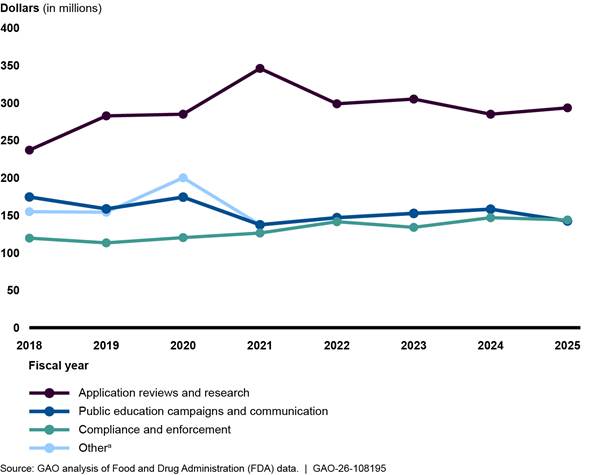
aOther is the combination of management and administration and overhead activities.
While obligations for application review and compliance and enforcement generally stayed steady or increased from FY2018 through FY2025, obligations for public education and communication generally decreased. Specifically, obligations for public education and communication decreased by 52 percent over this time period. According to FDA’s FY2027 Justification of Estimates for Appropriations Committees, the agency was planning to further divert public education and communication funds to support other priorities in FY2027 due to growing resource constraints.[37] The agency anticipated this change would reduce the target percentage of youths who receive information about harmful effects of tobacco use from 80 percent in FY2025 to 70 percent in FY2027.[38] However, according to agency officials, since the publication of the Justification of Estimates for Appropriations Committees, FDA now has more funds available for obligation in FY2027, and the agency continues to consider the appropriate funding levels for all programs and priorities.
FDA Increased Staff for Tobacco Product Oversight Since FY2018, Especially for Application Review, but Overall Number of Staff Declined in FY2025
Our analysis of FDA data shows that from FY2018 through FY2025, the number of FDA staff working on tobacco product oversight in the Center for Tobacco Products peaked at 1,195 in FY2024 before declining to 1,090 in FY2025.[39] In addition to this reduction of 105 staff, 97 staff were on paid administrative leave at the end of FY2025 pending a reduction in force action.[40] However, according to FDA officials, those reductions in force were later rescinded and all center staff subject to the action were asked to return from administrative leave.
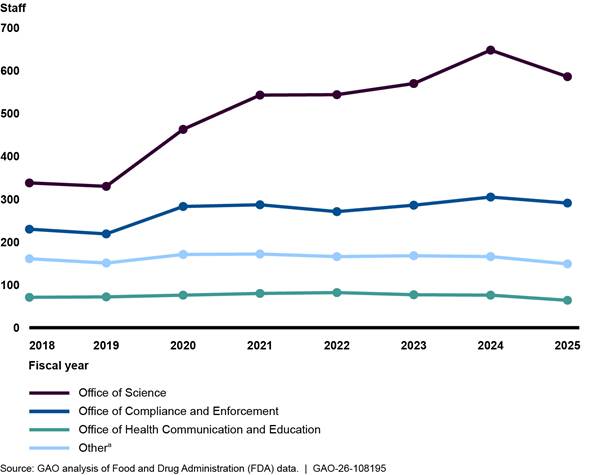
Over the 8-year period included in our review, FDA allocated the largest portions of staff in the Center for Tobacco Products to the office responsible for reviewing tobacco product applications (the Office of Science). On average, this office received 49 percent of the center’s staff and the number of staff increased from 338 to 586, the largest increase of any office. In contrast, the office that is responsible for compliance and enforcement received 27 percent of the center’s staff and the number of staff increased by 230 to 291. The office responsible for the center’s public education and communication received 8 percent of staff from FY2018 through FY2025, and the number of staff decreased from 71 to 64. (See fig. 7.)
aOther is the combination of Director, Regulations, and Management offices.
Conclusions
FDA has faced challenges ensuring the timely review of tobacco product applications. In our current review, much as we reported in 2013, the agency faced difficulty responding to a sudden influx of applications. This surge in applications led to a backlog of applications requiring FDA’s review and long wait times for manufacturers to receive a decision. FDA has since made several efforts to reduce that backlog and improve the timeliness of its reviews.
While FDA has also implemented efforts to speed application review, it is too soon to know whether these efforts will be successful. Further, FDA does not have information on the extent to which it is meeting its statutory requirement and internal timeliness goals for conducting scientific reviews across all tobacco product applications pathways because the agency does not collect the necessary data and monitor how long these reviews are taking. Conducting such monitoring will help FDA determine whether its recent initiatives have been effective and whether any further changes are needed to meet its goals. Ultimately, meeting these goals will help the agency ensure a more predictably timed application process, and more completed reviews will help clarify which products are legally marketed, thus allowing FDA to remove unauthorized products from the market.
Recommendation for Executive Action
The Commissioner of FDA should collect the data necessary to accurately monitor whether it is meeting its timeliness goals for the scientific review phase for all tobacco product application pathways and monitor whether it is meeting these goals. (Recommendation 1)
Agency Comments
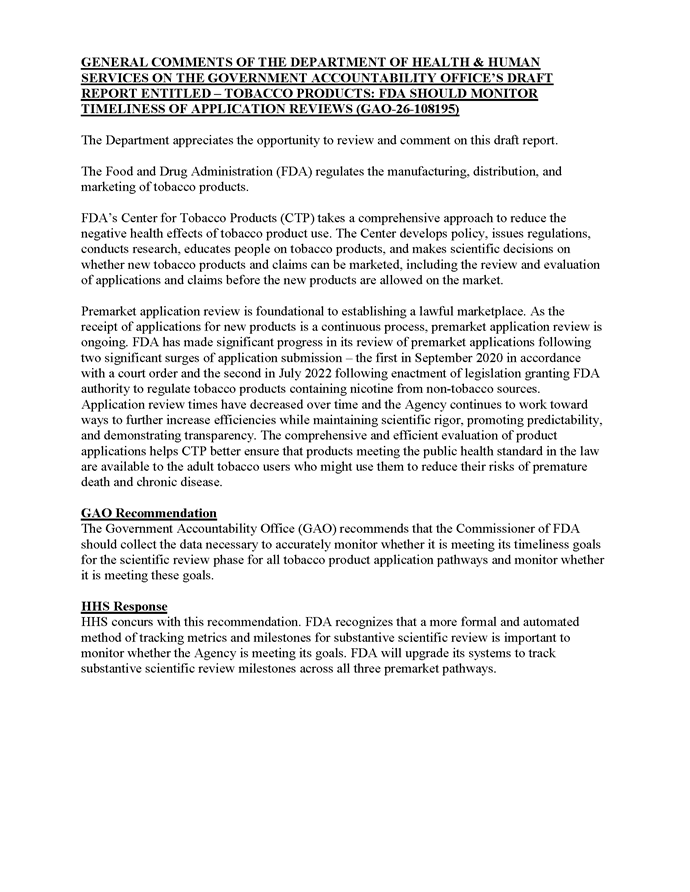
We provided a draft of this report to HHS for review and comment and received written comments from HHS, which are reproduced in appendix I. In its comments, the department concurred with our recommendation that FDA collect the data necessary to monitor whether it is meeting its timeliness goals for reviewing scientific information in all tobacco product applications. HHS recognized the importance of tracking substantive scientific review milestones for monitoring its efforts in meeting its goals. HHS said FDA will upgrade its systems to track substantive scientific review milestones across all three premarket pathways.
As agreed with your offices, unless you publicly announce the contents of this report earlier, we plan no further distribution until 1 day from the report date. At that time, we will send copies of this report to the appropriate congressional committees, the Secretary of Health and Human Services, and other interested parties. In addition, the report is available at no charge on the GAO website at http://www.gao.gov.
If you or your staff have any questions about this report, please contact me at deniganmacauleym@gao.gov. Contact points for our Offices of Congressional Relations and Media Relations may be found on the last page of this report. GAO staff who made major contributions to this report are listed in appendix II.
Mary Denigan-Macauley
Director, Health Care
GAO Contact
Mary Denigan-Macauley, DeniganMacauleyM@gao.gov
Staff Acknowledgments
In addition to the contact named above, William Hadley (Assistant Director), Carolyn Garvey (Analyst-in-Charge), N’dea Moore-Petinak, Laurie Pachter, Daniel Ries, and Roxanna Sun made key contributions to this report.
The Government Accountability Office, the audit, evaluation, and investigative arm of Congress, exists to support Congress in meeting its constitutional responsibilities and to help improve the performance and accountability of the federal government for the American people. GAO examines the use of public funds; evaluates federal programs and policies; and provides analyses, recommendations, and other assistance to help Congress make informed oversight, policy, and funding decisions. GAO’s commitment to good government is reflected in its core values of accountability, integrity, and reliability.
Obtaining Copies of GAO Reports and Testimony
The fastest and easiest way to obtain copies of GAO documents at no cost is through our website. Each weekday afternoon, GAO posts on its website newly released reports, testimony, and correspondence. You can also subscribe to GAO’s email updates to receive notification of newly posted products.
Order by Phone
The price of each GAO publication reflects GAO’s actual cost of production and distribution and depends on the number of pages in the publication and whether the publication is printed in color or black and white. Pricing and ordering information is posted on GAO’s website, https://www.gao.gov/ordering.htm.
Place orders by calling (202) 512-6000, toll free (866) 801-7077,
or
TDD (202) 512-2537.
Orders may be paid for using American Express, Discover Card, MasterCard, Visa, check, or money order. Call for additional information.
Connect with GAO
Connect with GAO on X,
LinkedIn, Instagram, and YouTube.
Subscribe to our Email Updates. Listen to our Podcasts.
Visit GAO on the web at https://www.gao.gov.
To Report Fraud, Waste, and Abuse in Federal Programs
Contact FraudNet:
Website: https://www.gao.gov/about/what-gao-does/fraudnet
Automated answering system: (800) 424-5454
Media Relations
Sarah Kaczmarek, Managing Director, Media@gao.gov
Congressional Relations
David A. Powner, Acting Managing Director, CongRel@gao.gov
General Inquiries
[1]Pub. L. No. 111-31, div. A, 123 Stat. 1776, 1776-1852 (2009). These types of tobacco products were immediately covered by FDA’s tobacco product authorities under the act. For other tobacco products, the act authorized FDA to issue regulations deeming the products to be subject to the agency’s authorities. See 21 U.S.C. § 387a(b).
[2]There are three tobacco application pathways for manufacturers to use when seeking FDA’s authorization to market new tobacco products: premarket tobacco product application, substantially equivalent, and substantially equivalence exemption requests. Generally, manufacturers of new tobacco products must submit a premarket tobacco product application for FDA review and obtain authorization to legally market new tobacco products. If the product is substantially equivalent to a predicate tobacco product, manufacturers may instead submit a substantial equivalence report for the agency’s review. Certain products with minor modifications may be eligible for substantial equivalence exemption requests. See 21 U.S.C. § 387j(a)(2). For the purpose of this report, we refer to premarket tobacco product applications, substantial equivalence reports, and substantial equivalence exemption requests as “tobacco product applications” or “applications.”
[3]GAO, New Tobacco Products: FDA Needs to Set Time Frames for Its Review Process, GAO‑13‑723 (Washington, D.C.: Sept. 6, 2013).
[4]81 Fed. Reg. 28,974 (May 10, 2016) (codified at 21 C.F.R. § 1100.1). The term “tobacco product” means “any product made or derived from tobacco, or containing nicotine from any source, that is intended for human consumption, including any component, part, or accessory of a tobacco product (except for raw materials other than tobacco used in manufacturing a component, part, or accessory of a tobacco product).” 21 U.S.C. § 321(rr).
[5]FDA refers to these products as “electronic nicotine delivery systems.” For the purpose of this report, we refer to them as e-cigarettes.
[6]Department of Health and Human Services, Office of Inspector General, The Food and Drug Administration Needs to Improve the Premarket Tobacco Application Review Process for Electronic Nicotine Delivery Systems to Protect Public Health, A-06-22-01002 (Washington, D.C.: Nov. 8, 2023).
[7]Reagan-Udall Foundation for the Food and Drug Administration, Operational Evaluation of Certain Components of FDA’s Tobacco Program (Washington, D.C.: Dec. 19, 2022).
[8]FDA may rescind an application in the course of the review process. In some cases, FDA may later continue review of that application when it is resubmitted. This may result in duplication in the FDA dataset. From CY2018 through CY2025, fewer than 0.01 percent of applications were rescinded.
[9]GAO, Evidence-Based Policymaking: Practices to Help Manage and Assess the Results of Federal Efforts, GAO‑23‑105460 (Washington, D.C.: July 12, 2023).
[10]The Tobacco Control Act requires FDA to assess and collect user fees from manufacturers of cigarettes, cigars, snuff, chewing tobacco, pipe tobacco, and roll-your-own tobacco. 21 U.S.C. § 387s. According to the Centers for Disease Control and Prevention, nicotine pouches contain a powder made of nicotine, flavorings, and other ingredients. The powder dissolves in the mouth, and nicotine is absorbed through the gums and lining of the mouth.
[11]The term obligation refers to a definite commitment by a federal agency that creates a legal liability to make payments immediately or in the future.
We received data for FY2018 through FY2021 from FDA. We obtained data for FY2022 through FY2025 from FDA’s annual report of tobacco regulation activities as required by the Consolidated Appropriations Act, 2022, Pub. L. No. 117-103, div. P, tit. I, subtit. B, § 112, 136 Stat. 49, 790-92 (codified at 21 U.S.C. § 387v).
[12]The Consolidated Appropriations Act, 2022, further extended FDA’s authority to include the regulation of tobacco products containing nicotine from any source, including synthetic nicotine. Pub. L. No. 117-103, div. P, tit. I, subtit. B, § 111, 136 Stat. at 789-90 (codified at 21 U.S.C. § 321(rr)).
[13]21 U.S.C. § 387s(b)(2)(B). Unlike other FDA user fee programs (e.g., for prescription drugs or medical devices) tobacco user fees do not need to be reauthorized periodically, nor are they negotiated with industry to include FDA performance commitments.
[14]A fourth pathway, known as the modified risk tobacco product pathway, is available for manufacturers seeking to make claims that a marketed tobacco product is less harmful, presents lower disease risk, or reduces exposure to harmful chemicals. 21 U.S.C. § 387k.
[15]21 U.S.C. § 387j(c)(2). Under this standard, FDA must consider the risks and benefits of the tobacco product to the population as a whole, including users and nonusers.
[16]For this report, the word screen is used to describe the type of review that FDA does before it conducts a scientific review of a tobacco product application.
[17]The substantial equivalence and substantial equivalence exemption pathways do not include the filing phase of review.
[18]FDA established these internal goals in response to our 2013 report. See GAO‑13‑723.
[19]21 U.S.C. § 387j(c)(1)(A).
[20]21 C.F.R. § 1114.27(c).
[21]In contrast to those two pathways, the number of applications in the substantial equivalence exemption pathway, which is used to authorize minor modifications to previously authorized products, increased more slowly during this period.
[22]81 Fed. Reg. 28,974 (May 10, 2016) (codified at 21 C.F.R. § 1100.1).
[23]For the purposes of this report, we define completed reviews as those for which FDA has made a final determination on the application.
[24]CY2025 was the most recent year for which data were available at the time of our review. For a fourth pathway, known as the modified risk tobacco product pathway, review times averaged 576 days. This pathway represents a small subset of applications, with 154 applications in total from CY2018 through CY2025.
[25]FDA defines goals based on the start of one phase rather than the end of another. Officials stated this is because the agency wants its goals to be useful for determining a predictable time for staff to complete their review. According to officials, goals that include delays between the end of screening and the start of scientific review would not be an accurate measure of reviewer work.
[28]Bundles may include hundreds or even thousands of applications in the same pathway.
[29]FDA officials said that they invited manufacturers to participate in the pilot that had submitted applications with data sufficient for FDA to make decisions about whether their product met FDA’s standards for authorization.
[30]According to FDA officials, the pouch pilot program included 158 product applications. As of May 11, 2026, agency officials said FDA had authorized six products for marketing and 152 products were still in scientific review. FDA had issued no denials as of that date.
[32]FDA officials stated that, while applicants can update their applications to provide more up-to-date information to the agency, they cannot modify their application to substantially change the product for which they are seeking authorization, which is what FDA found was happening. FDA officials said the agency stopped sending the letters due to this confusion, but they acknowledged that the letters had not clearly indicated what types of updates were and were not allowed.
[33]FDA officials noted that manufacturers with pending applications may submit amendments containing additional information at any time.
[34]An obligation is a commitment that creates a legal liability of the government for the payment of goods and services ordered or received, or a legal duty on the part of the U.S. that could mature into a legal liability by virtue of actions on the part of the other party beyond the control of the U.S.
[35]FDA officials told us that it generally carries over $200 million from one fiscal year to the next.
[36]Agency officials told us reductions in spending during FY2025 occurred in response to a February 2025 Executive Order. White House, Implementing the President’s “Department of Government Efficiency Cost Efficiency” Initiative, Executive Order 14222 (Washington, D.C.: Feb. 26, 2025).
[37]FDA, Fiscal Year 2027 Justification of Estimates for Appropriations Committees.
[38]In FY2025 and FY2026, FDA had a performance goal to reach 75 percent of youth with its public education campaign message about the harmful effects of tobacco use. While FDA exceeded this goal in FY2025 (reaching 80 percent) and expected to meet it in FY2026, the agency reduced the goal to 70 percent for FY2027 due to the change in funding.
[39]In addition to these staff, tobacco user fees are also used to cover the cost of staff in other parts of FDA who spend at least a portion of their time on tobacco product oversight activities. For example, there are legal staff in FDA’s Office of Chief Counsel and investigators in the agency’s Office of Inspections and Investigations who support the tobacco program.
[40]According to FDA, these 97 staff included 71 staff from the Center for Tobacco Products’ Office of Management and 26 staff from its Office of Compliance and Enforcement.