
Report to the Subcommittee on Border Management, Federal Workforce and Regulatory Affairs, Committee on Homeland Security and Governmental Affairs, U.S. Senate
United States Government Accountability Office
A report to the Subcommittee on Border Management, Federal Workforce and Regulatory Affairs, Committee on Homeland Security and Governmental Affairs, U.S. Senate
Contact: Lisa Van Arsdale, vanarsdalel@gao.gov
What GAO Found
During the rulemaking process, agencies are generally required to issue a notice of proposed rulemaking (NPRM) and seek public comment before issuing a final rule. They can expedite the process and forgo this requirement when they find good cause that the process would be impracticable, unnecessary, or contrary to the public interest. This can occur, for example, when agencies are responding to natural disasters or public health emergencies. Agencies cited good cause reasons for expedited rulemaking for about 71 percent of major interim final rules GAO reviewed and that agencies published between January 20, 2013, and January 20, 2025. This is consistent with GAO’s 2012 report, which found that 77 percent of major rules issued without an NPRM cited good cause for doing so.
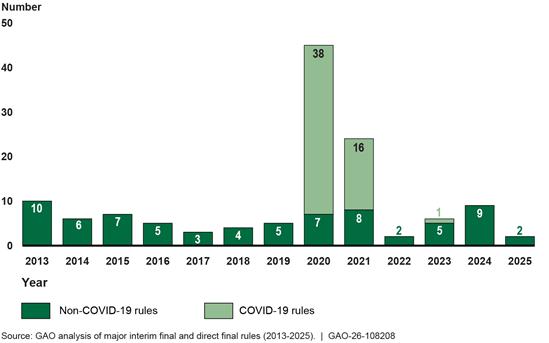
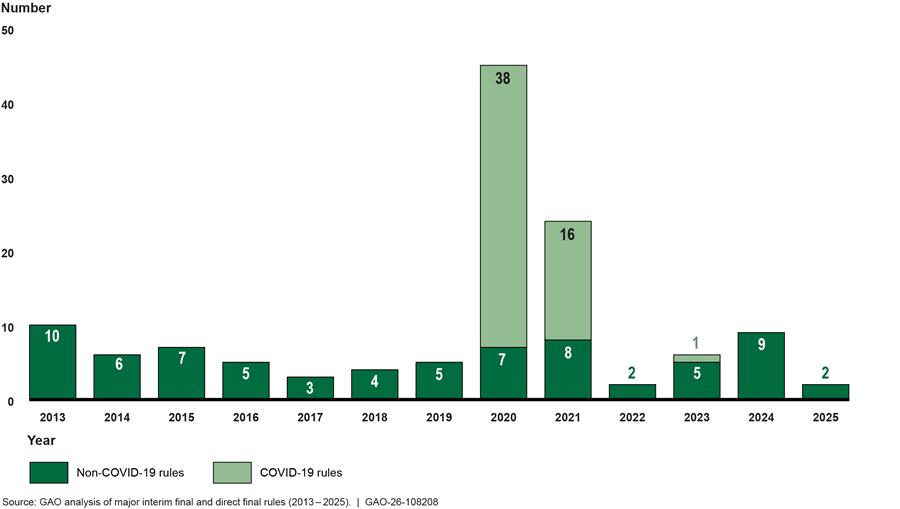
GAO found that the use of expedited rulemaking increased during the peak of the COVID-19 pandemic in 2020 and 2021. There was little variation in use during non-pandemic years from January 20, 2013, through January 20, 2025, as agencies issued between two and 10 major rules without an NPRM per year. During the pandemic agencies expedited the issuance of 55 rules in response to COVID-19. Agencies cited good cause for 41 of these rules.
Number of COVID-19 and Non-COVID-19 Major Rules Reviewed Using Expedited Rulemaking, by Year, Jan. 20, 2013–Jan. 20, 2025
Agencies reported on the economic effects of 66 percent of the rules that GAO reviewed. COVID-19 related rules were less likely to include this information due to the emergency nature of the rules. Agencies requested public comments for 99 percent of the interim final rules that GAO reviewed and received comments on 94 percent of these rules. This is an increase from GAO’s 2012 report which found agencies requested comments for 63 percent of major rules issued without an NPRM.
Why GAO Did This Study
On average, agencies publish over 2,000 final regulations each year to achieve goals such as ensuring access to food and healthcare services and addressing national emergencies. The Administrative Procedure Act establishes the basic procedural requirements agencies generally must follow when issuing regulations, including providing the public with an opportunity to comment on proposed rules. Public participation can improve the quality of rules, ensure fair treatment, and promote accountability. However, providing for public participation might not be appropriate in every situation before issuing a final rule and agencies may find good cause that notice-and-comment procedures are impracticable, unnecessary, or contrary to the public interest.
GAO was asked to provide information on the frequency, reasons, and trends for agencies issuing final rules without an NPRM. This report addresses (1) how frequently agencies found good cause to issue rules without an NPRM; (2) the extent to which the effect of the COVID-19 pandemic led to changes in issuing rules without prior notice-and-comment; and (3) the extent to which agencies assessed the rules’ economic benefits, among other things.
GAO reviewed 116 major interim final and 12 direct final rules published between January 20, 2013, and January 20, 2025. GAO also reviewed associated documents for the rules, relevant laws, executive orders, and guidance related to waiving notice-and-comment, and agencies’ use of regulatory flexibility during the pandemic.
|
Abbreviations |
|
|
|
|
|
APA |
Administrative Procedure Act |
|
CARES Act |
Coronavirus Aid, Relief, and Economic Security Act |
|
CRA |
Congressional Review Act |
|
DEA |
Drug Enforcement Agency |
|
DFR |
direct final rule |
|
DOD |
Department of Defense |
|
DOE |
Department of Energy |
|
DOJ |
Department of Justice |
|
EO |
executive order |
|
EPCA |
Energy Policy and Conservation Act |
|
FDA |
Food and Drug Administration |
|
HHS |
Department of Health and Human Services |
|
IFR |
interim final rule |
|
NOAA |
National Oceanic and Atmospheric Administration |
|
NPRM |
notice of proposed rulemaking |
|
OIRA |
Office of Information and Regulatory Affairs |
|
OMB |
Office of Management and Budget |
|
PPP |
Paycheck Protection Program |
|
SBA |
Small Business Administration |
|
VA |
Department of Veterans Affairs |
This is a work of the U.S. government and is not subject to copyright protection in the United States. The published product may be reproduced and distributed in its entirety without further permission from GAO. However, because this work may contain copyrighted images or other material, permission from the copyright holder may be necessary if you wish to reproduce this material separately.
August 5, 2026
The Honorable James Lankford
Chairman,
The Honorable John Fetterman
Ranking Member,
Subcommittee on Border Management, Federal Workforce and
Regulatory Affairs
Committee on Homeland Security and Governmental Affairs
United States Senate
Federal agencies publish, on average, over 2,000 final regulations each year to achieve goals such as ensuring access to food and healthcare services, controlling environmental pollution, addressing national emergencies, and providing oversight of financial institutions and markets.[1] During the rulemaking process, agencies are generally required to issue a notice of proposed rulemaking (NPRM) and seek public comment before issuing a final rule. This process gives the public an opportunity to comment and provide information to agencies, such as opinions and supplemental information, on the potential effects of a rule or to suggest alternatives for agencies to consider. The benefits of public participation in rulemaking have been cited by the courts and others and include generating higher-quality rules, ensuring the fair treatment of people affected by the rules, and promoting the political accountability of the agency.
However, there are some exceptions to the requirement for advanced notice and comment (notice-and-comment). For example, Congress sometimes passes laws that direct an agency to issue rules without notice-and-comment. In addition, agencies may have to respond to urgent issues like a natural disaster or public health emergency. In these instances, providing for public participation might not be appropriate before issuing a final rule. Therefore, federal agencies may issue final rules when the agency determines for good cause that notice-and-comment procedures are impracticable, unnecessary, or contrary to the public interest.[2]
We have previously reported on agencies’ use of good cause exceptions to notice-and-comment rulemaking. In 2012, we found that even when agencies found good cause to not follow notice-and-comment procedures, they often sought comments after the rules were issued. We also found that they frequently amended or finalized rules in response to comments received.[3]
You asked us to provide information on the frequency and reasons for issuing final rules without a prior NPRM, whether these trends have changed over time, and the use of the good cause exception during the COVID-19 pandemic.[4] This report analyzes major interim and direct final rules issued between January 20, 2013, and January 20, 2025, to provide data on (1) how frequently executive agencies found good cause to issue these rules without an NPRM; (2) the extent to which the effect of the COVID-19 pandemic led to changes in the issuance of rules without prior notice-and-comment; and (3) the extent to which agencies assessed the rules’ economic benefits and addressed public comments when applicable.[5]
To address each of these objectives, we used data from Reginfo.gov, the Federal Register, and our Congressional Review Act (CRA) database to compile a list of interim final rules (IFR) and direct final rules (DFR) issued between January 20, 2013, and January 20, 2025.[6] We focused on IFRs and DFRs because these rules are generally published without a prior NPRM, which is an indicator of possible use of the good cause exception. Further, we limited our review to major rules to focus on those rules with the largest effect on the economy. We identified 128 rules issued in our time frame that were published by executive branch agencies, that the agencies identified as IFRs or DFRs, and that were issued without a prior NPRM. We supplemented data from these sources with documentation related to each rule, including the Federal Register entries, our major rule reports, and regulatory dockets on regulations.gov. We tested the reliability of the databases and concluded that the data elements we used were sufficiently reliable for identifying interim and direct final rules for inclusion in our review.
Two analysts independently reviewed each rule’s documentation, including the Federal Register notice and other key materials to identify and record key characteristics of the rules, including whether the agency cited good cause, whether the rule was related to the COVID-19 pandemic, and whether the rule included information on projected economic effects.[7] A third analyst examined the codes assigned by the reviewers to ensure that coding criteria were consistently applied. That analyst resolved instances where the two reviewers did not agree.
We also conducted additional content analyses of the 128 rules to obtain more detailed information about agencies’ use of exceptions to notice-and-comment, how agencies described economic effects, and whether agencies (1) solicited public comments post-publication of the rules, and (2) responded to relevant comments.
We did not assess the appropriateness of agencies’ decisions to cite good cause and other exceptions or their determinations regarding the economic effects of their rules. We relied on the information agencies published in the Federal Register. Detailed information on our scope and methodology is included in appendix I.
We conducted this performance audit from March 2025 to August 2026 in accordance with generally accepted government auditing standards. Those standards require that we plan and perform the audit to obtain sufficient, appropriate evidence to provide a reasonable basis for our findings and conclusions based on our audit objectives. We believe that the evidence obtained provides a reasonable basis for our findings and conclusions based on our audit objectives.
Background
The Federal Rulemaking Process
Rulemaking refers to the process by which federal agencies develop regulations to carry out laws passed by Congress. Regulations, or rules, implement or interpret laws or policies and have the force of law. The Administrative Procedure Act (APA) establishes basic procedures federal agencies must follow when issuing regulations, including providing the public with an opportunity to comment on proposed rules.[8] Other laws, including the CRA, and executive orders (EO) also impose procedural and analytical requirements on the rulemaking process.[9]
The APA
The APA establishes procedures for both formal and informal rulemaking.[10] Most rules issued by federal agencies use informal rulemaking, also known as notice-and-comment rulemaking. Under this process, the APA generally requires agencies to publish an NPRM in the Federal Register to provide the public with an opportunity to comment on the proposed rule. According to the APA, a notice must include:
· a statement of the time, place, and nature of public rulemaking proceedings;
· reference to the legal authority under which the rule is proposed;
· the terms or substance of the proposed rule or a description of the subjects and issues involved; and
· a summary of the proposed rule.[11]
After publishing an NPRM, agencies are generally required to provide an opportunity for public comment unless an exception or other authority applies.[12] Comments may be submitted through regulations.gov and, in some cases, through other methods specified by the agency, such as mail, fax, or email. Agencies may also hold public meetings to gather public comment. The APA generally requires agencies to delay a rule’s effective date by at least 30 days after the rule’s publication in the Federal Register.[13]
The APA permits agencies to forgo notice-and-comment requirements when they determine for good cause that such requirements would be impracticable, unnecessary, or contrary to the public interest (see fig. 1). When agencies cite good cause, they must document their finding along with a brief statement explaining the basis for their determination in the published rule.[14] One such rulemaking approach is known as interim final rulemaking, a process whereby an agency issues a final rule, generally without first publishing an NPRM, but seeks public comment after the rule’s publication. When issuing an interim final rule IFR, an agency typically announces that it will respond to significant comments and issue a subsequent final rule incorporating any necessary changes.
When an agency decides that publishing a proposed rule is unnecessary because it would only relate to routine or uncontroversial matters, it may publish a DFR in the Federal Register. In a direct final rule, the agency states that the rule will go into effect on a certain date, unless it gets adverse comments during the comment period. An agency may finalize this process by publishing in the Federal Register confirmation that it received no adverse comments. If adverse comments are submitted, the agency is required to withdraw the DFR before the effective date. The agency may restart the rulemaking process by publishing a new NPRM or decide to end the rulemaking process entirely.
Figure 1: General Processes for Notice-and-Comment Rulemaking and Use of the Good Cause Exception Under the Administrative Procedure Act
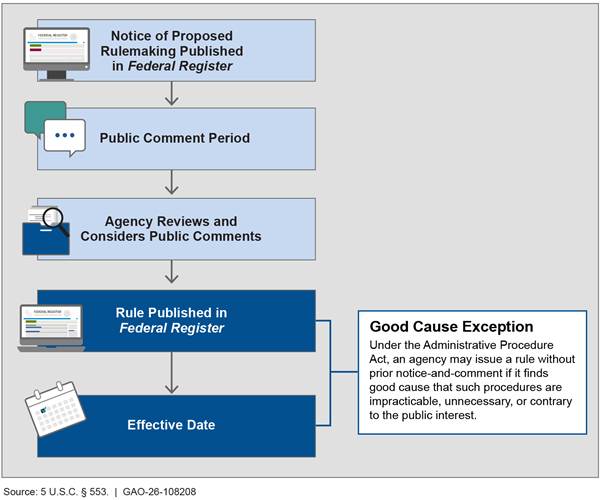
Note: Under the Administrative Procedure Act, a rule generally takes effect at least 30 days after publication in the Federal Register. For a rule designated as major, the Congressional Review Act requires a 60-day delay before a rule can take effect. The delay begins when Congress receives the rule or when it is published in the Federal Register, whichever is later. An agency may waive these delays as permitted under applicable law.
The APA also includes several exceptions to notice-and-comment requirements for certain categories of rules. These categories include rules related to:
· a military or foreign affairs function of the United States;
· agency management or personnel;
· public property, loans, grants, benefits, or contracts;
· interpretive rules;
· general statements of policy; or
· rules of agency organization, procedure, or practice.[15]
Other Federal Statutes that Permit Expedited Rulemaking
In addition to the APA’s good cause exception and categories of exempted rules, federal statutes may authorize agencies to issue regulations without regard to APA notice-and-comment requirements. For example, the Coronavirus Aid, Relief, and Economic Security Act (CARES Act) requiring the Small Business Administration (SBA) to issue rules implementing the Paycheck Protection Program (PPP) without regard to APA notice requirements.[16] In some cases, agencies issuing rules under statutory authority to waive notice-and-comment requirements have also invoked an APA exception.
Another example of a federal statute that provides for expedited rulemaking is the Energy Policy and Conservation Act, as amended (EPCA). EPCA authorizes the Department of Energy (DOE) to use DFRs to establish or amend certain energy and water conservation standards.[17]
The Congressional Review Act
In addition to the APA and other statutes, the CRA requires a federal agency that is about to issue a rule to submit a copy of the rule to Congress and the Comptroller General of the Government Accountability Office before it can take effect. The submission must include a general statement relating to the rule and the rule’s proposed effective date.[18] The CRA also provides Congress with an opportunity to review and reject a rule through enactment of a joint resolution of disapproval.[19]
The CRA establishes additional procedural requirements for major rules. For each major rule, the CRA requires us to prepare a report assessing the agency’s compliance with applicable procedural requirements, including cost-benefit analysis and other requirements under relevant statutes and executive orders.[20] The CRA further requires a 60-day delay before a major rule can take effect. However, an agency may allow the rule to take effect earlier if it finds good cause that notice-and-comment requirements are impracticable, unnecessary, or contrary to the public interest.[21] We previously reported on agencies’ implementation of the 60-day delay requirement for major rules.[22]
EO 12866
Presidents may also provide direction on agency rulemaking through EOs. EO 12866, issued in 1993, established a regulatory review and analytical framework for certain regulations.[23] The EO identifies the Office of Information and Regulatory Affairs (OIRA) as responsible for providing meaningful guidance and oversight to help ensure regulations are consistent with applicable law, the President’s priorities, and the principles set forth in EOs, and that decisions made by one agency do not conflict with the policies or actions taken or planned by another agency.
For economically significant rules (the definition of which is similar to the CRA’s definition of major rules), EO 12866 generally requires agencies to provide OIRA an assessment, including the underlying analysis of the costs and benefits anticipated from the regulatory action and feasible alternatives.[24] Office of Management and Budget’s Circular A-4, published in 2003, provides guidance to agencies on how to assess regulatory costs and benefits.[25]
Federal Agencies Cited Good Cause and Other Statutes When Issuing Major Rules without an NPRM
Federal Agencies Issued a Variety of Major IFRs and DFRs Without a Prior NPRM
Between January 20, 2013, and January 20, 2025, federal agencies published over 27,000 rules, 1,177 of which were major rules (4 percent). The rules were issued to address a variety of regulatory areas, including visa programs, health insurance, civil penalties, pension benefits, and veterans’ services. Of those major rules, we identified 128 rules consisting of 116 IFRs and 12 DFRs for inclusion in our review as they were issued without a prior NPRM (see fig. 2).[26] We refer to these 128 rules in this report as the rules covered by our review.
Figure 2: Total Number of Interim and Direct Final Rules Reviewed, As Part of the Total Number of Major Rules, Jan. 20, 2013—Jan. 20, 2025
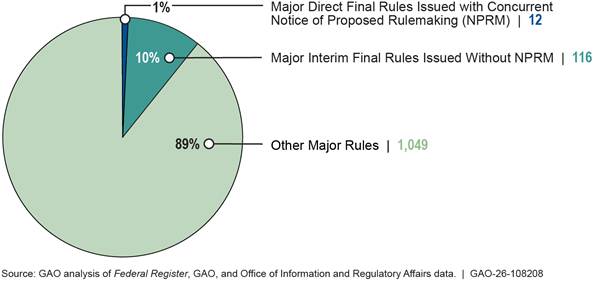
Note: “Other major rules” includes all major rules that followed the standard notice-and-comment process, Federal Acquisition Regulations, and interim final rules issued with a previous notice of proposed rulemaking.
Major IFRs
Sixteen agencies issued the 116 IFRs without an NPRM in our review. SBA published the most rules (31) without an NPRM. Other agencies that published a large number of rules without an NPRM were the Departments of Health and Human Services (HHS), Agriculture, and Veterans Affairs. Together, these agencies accounted for about 66 percent of major IFRs issued without notice-and-comment. Twelve other agencies accounted for the remaining rules (see fig. 3). Many of these 116 IFRs were issued in response to the COVID-19 pandemic, as discussed later in this report.
Figure 3: Federal Agencies Issuing Reviewed Major Interim Final Rules Without a Notice of Proposed Rulemaking, Jan. 20, 2013–Jan. 20, 2025
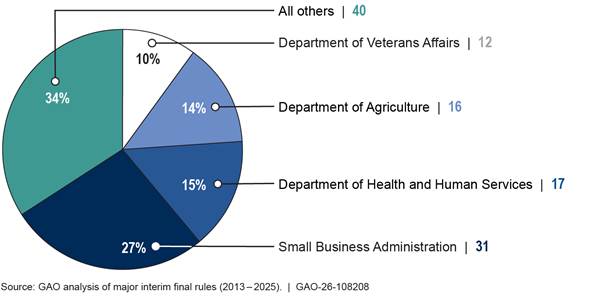
Note: “All others” includes the Departments of Commerce, Defense, Education, Energy, Homeland Security, Justice, Labor, Transportation, and the Treasury, as well as the Environmental Protection Agency, the Office of Personnel Management, and the Pension Benefit Guaranty Corporation. Some rules were jointly issued by two or more agencies. To prevent reporting the rule more than once, we attributed the rule to the agency that submitted the rule to Office of Information and Regulatory Affairs.
Major DFRs
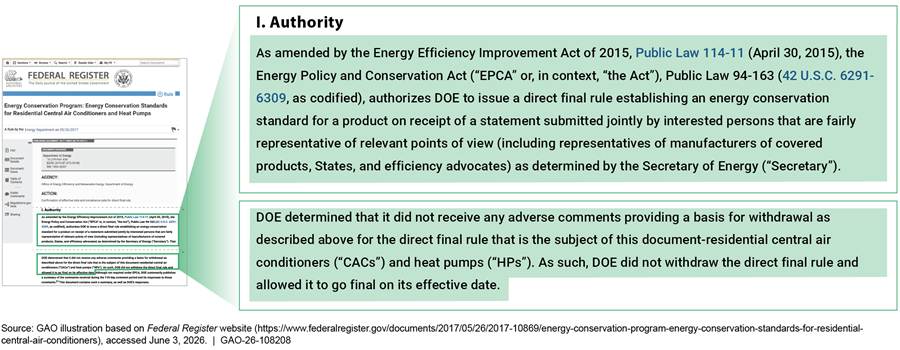
Of the 12 DFRs we reviewed, 11 were issued by the Department of Energy (DOE) and one was issued by the Food and Drug Administration (FDA), which is part of HHS. The DOE rules were issued as direct final rules under the authority of the (EPCA). This statute codifies a direct final rulemaking procedure for energy and water conservation standards under certain circumstances.[27] Under this procedure, agencies publish DFRs concurrently with an NPRM. The FDA’s rule addressed the uses of partially hydrogenated oils in foods and cited existing FDA guidance describing when and how the agency would employ direct final rulemaking.[28] For all 12 major DFRs, the agencies issued a concurrent NPRM and did not report receiving adverse comments. Therefore, they did not subsequently reissue the DFR with a new comment period. See figure 4 for an example of one of the DFRs being confirmed as final and effective after the comment period closed.
Figure 4: Example of a Department of Energy (DOE) Direct Final Rule (DFR) Being Confirmed Effective After Receiving No Adverse Comments
Note: For this example, we modified some elements of the web page due to space limitations.
Federal Agencies Frequently Cited Good Cause when Issuing Major IFRs Without an NPRM
Agencies that published major IFRs without an NPRM cited the good cause exception to waive notice-and-comment for 82 of the 116 rules in our population (71 percent). All but five of the remaining rules cited either other APA exceptions (e.g., military or foreign affairs function, agency management or personnel, or general statements of policy), other federal statutes such as the CARES Act, or both.[29] This is consistent with our 2012 findings that a majority (77 percent) of the major rules published without an NPRM claimed the good cause exception.
The APA provides three general reasons why an agency may invoke the good cause exception—impracticable, unnecessary, or contrary to the public interest.[30] Agencies tend not to precisely distinguish among these reasons as they are not specifically defined in the APA, and agencies can cite more than one reason when invoking good cause. In 2012 we reported that in practice, “impracticable” is used by agencies for rules subject to statutory deadlines or time constraints; “contrary to the public interest” is used when there are emergencies or threats to public safety; and “unnecessary” is used for technical corrections, or for rules where comments are unlikely to yield change, such as a rule pursuant to a statute that prescribed the content of the rule.[31]
For the 82 major IFRs in our population that cited good cause under the APA, agencies provided at least one of the three general reasons to forgo notice-and-comment and often cited more than one reason.[32] As shown in table 1, agencies most often cited “contrary to the public interest” and “impracticable” among the reasons provided for invoking good cause. Similarly, in 2012, we reported that agencies most often said that issuing an NPRM would be contrary to the public interest, but they also frequently cited multiple grounds for invoking the good cause exception.
Table 1: Reasons Agencies Provided when Citing the Good Cause Exception for 82 Major Interim Final Rules Published Without a Prior NPRM Jan. 20, 2013—Jan. 20, 2025
|
General reason for citing good cause |
Number of major interim final rules without a prior NPRM that cited the reason for good cause |
|
Contrary to the public interest |
75 |
|
Impracticable |
53 |
|
Unnecessary |
13 |
Source: GAO analysis of major interim final rules (2013—2025). ǀ GAO‑26‑108208
Note: Numbers do not total 82 because agencies often cited multiple reasons for citing good cause in some rules.
The following are three examples of agencies citing these reasons.
· Impracticable. The Department of Education published an IFR on May 16, 2013, that amended regulations governing the William D. Ford Federal Direct Loan Program, which allows eligible students and parents to borrow directly from Education at participating schools.[33] The IFR reflected changes made to the program by the Moving Ahead for Progress in the 21st Century Act.[34] The department claimed good cause stating that “it would be impracticable to conduct notice-and-comment rulemaking in time to implement these changes” by the time the statutory changes had effect.[35]
· Unnecessary. The Drug Enforcement Administration (DEA), part of the Department of Justice (DOJ), published an IFR on November 2, 2020,[36] that amended its regulations to make them consistent with the Substance Use-Disorder Prevention that Promotes Opioid Recovery and Treatment for Patients and Communities Act of 2018 and it implement the act’s requirements.[37] The agency claimed good cause and stated: “This rule merely incorporates the statutory amendments into DEA’s regulations, and publishing a notice of proposed rulemaking or soliciting public comment prior to publication is unnecessary.”[38]
· Contrary to the public interest. The Departments of Labor and Treasury, HHS, and the Office of Personnel Management, published a joint IFR on July 13, 2021, that implemented provisions of the No Surprises Act[39] to protect participants, beneficiaries, and enrollees in group health insurance plans and group and individual health insurance coverage from surprise medical bills for certain services.[40] The agencies cited several statutory authorities as providing authorization to promulgate IFRs in some circumstances.[41] In addition, the agencies state that they “have determined that it would be impracticable and contrary to the public interest to delay putting the provisions in these interim final rules in place until after a full public notice and comment process has been completed.”[42] The statutory provisions the IFR implemented applied to plan years beginning on or after January 1, 2022. The agencies recognized that while this effective date may have allowed for the regulations, if promulgated with the full notice-and-comment rulemaking process, to be in effect in time for the applicability date of the provisions in the act, this time frame would not have provided sufficient time for the regulated entities to implement the requirements. The issuing agencies claimed good cause citing that waiting for notice-and-comment before implementing the new regulations may cause consumers to delay needed medical care over concern of receiving surprise bills.[43]
Agencies Cited APA Broad Categorical Exceptions and Non-APA Statutes
In addition to the good cause exception, the APA includes six broad categorical exceptions to notice-and-comment rulemaking. Notice-and-comment rulemaking requirements do not apply to rulemakings that fall within one of these exceptions. Of the 116 IFRs in our review, agencies cited one or more of these exceptions in 17 (15 percent) (see table 2).
Table 2: Administrative Procedure Act (APA) Categorical Exceptions Cited by Agencies for 17 Major IFRs Published Without a Prior NPRM, Jan. 20, 2013—Jan. 20, 2025
|
APA Categorical Exception |
Number of major interim final rules without a prior NPRM that cited the exception |
|
Public property, loans, grants, benefits, or contracts |
11 |
|
Military or foreign affairs function |
3 |
|
Rules of agency organization, procedure, or practice |
3 |
|
Interpretative rules |
1 |
|
Agency management or personnel |
0 |
|
General statements of policy |
0 |
Source: GAO analysis of major interim final rules (2013—2025). ǀ GAO‑26‑108208
Note: Agencies invoked one of these six broad categorical exceptions in 17 of the 116 major IFRs (15 percent) we reviewed that were issued without notice-and-comment. Numbers do not total 17 because one rule cited two categorical exceptions.
Rules in our review cited four of the six APA categorical exceptions. Some rules that cited an exception also claimed good cause to waive notice-and-comment requirements. For example:
· Public property, loans, grants, benefits, or contracts. Treasury cited the grants part of this exception in a 2021 rule implementing the Coronavirus State Fiscal Recovery Fund and the Coronavirus Local Fiscal Recovery Fund established under the American Rescue Plan Act of 2021.[44] The rule specified eligible usage of funds and reporting requirements, among other provisions. Treasury explained the IFR implements statutory conditions on the eligible uses of the certain grants, and addresses the payment of those funds, the reporting on uses of funds, and potential consequences of ineligible uses.[45] The agency also stated that, to the extent the rule was not exempt on this basis, it had good cause for not undertaking notice-and-comment rulemaking given the historic economic and public health emergency and related urgency.[46]
· Military or foreign affairs. The Department of Defense (DOD) cited this exception in a 2015 rule that established policy, assigned responsibilities, and prescribed procedures for administering the DOD Transition Assistance Program, which assists servicemembers in transitioning back to civilian life.[47]
· Rules of agency organization, procedure, or practice. HHS cited this exception in a 2017 rule extending the compliance date for a previous final rule requiring disclosure of certain nutrition information for standard menu items in certain restaurants and retail food establishments. Figure 5 highlights the rule text noted in this example.[48] The agency also claimed good cause to forgo notice-and-comment procedures, given the imminence of the compliance date.[49]
· Interpretative rules. DOJ cited this exception in a 2016 rule implementing the James Zadroga 9/11 Victim Compensation Fund Reauthorization Act.[50] The agency stated that it claimed this categorical exception because the rule explains or clarifies language in the underlying statute and does not create new language independent of the statute.[51] The agency also determined that it would be unnecessary and contrary to the public interest to engage in full notice and comment rulemaking because delaying implementation would delay the determination and payment of certain claims and the regulatory modification of the IFR largely reflect statutory changes, among other reasons.[52]
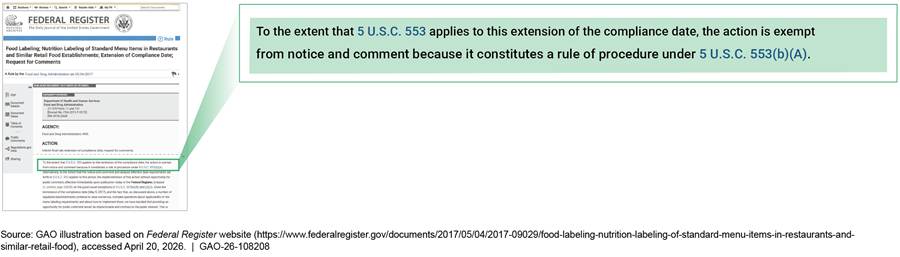
Note: 5 U.S.C. § 553 is the legal citation for the notice-and-comment requirements of the APA. Subsection (b)(A) refers to exceptions from notice-and-comment requirements for interpretative rules; general statements of policy; and rules of agency organization, procedure, or practice. For this example, we modified some elements of the web page due to space limitations.
In addition to the APA’s good cause exception and categorical exceptions for certain rules, agencies were also directed by other statutes to issue rules without regard to notice-and-comment requirements. Rules in our review cited non-APA statutes in 53 of the 116 major IFRs (46 percent) we reviewed. For example:
· A 2015 Department of Homeland Security rule adjusted the passenger civil aviation security service fee,[53] which helps finance security for the nation’s aviation transportation system. The rule cited a statutory authorization that exempted the rulemaking from notice-and-comment requirements.[54] The rule claimed good cause related to the need to resolve a discrepancy between the agency’s regulations and statutory requirements.
· Thirty SBA rules issued in 2020 and 2021 cited either the CARES Act, the Economic Aid Act, or both as authorization to forgo notice-and-comment.[55] These rules implemented the Paycheck Protection Program (PPP), which provided loans to small businesses to cover payroll costs during the COVID-19 pandemic.[56]
Federal Agencies Increased Use of Regulatory Flexibilities in Response to COVID-19
Agencies Leveraged Existing and New Flexibilities to Expedite Rulemaking During the Pandemic
Federal agencies relied on multiple new and existing regulatory flexibilities to expedite rulemaking during the COVID-19 pandemic.[57] On January 31, 2020, the Secretary of HHS declared a public health emergency as a result of COVID-19.[58] Subsequently, on March 13, 2020, the President declared COVID-19 a national emergency under the National Emergencies Act.[59] Agencies such as HHS and SBA cited emergency declarations when publishing interim final rules. In at least one instance, HHS relied on the public health emergency declaration to support a good cause finding for waiving notice-and-comment rulemaking. Specifically, in April 2020, HHS issued an IFR introducing temporary Medicare and Medicaid flexibilities in response to COVID-19. HHS stated that conducting notice-and-comment procedures during the ongoing public health emergency would be contrary to the public interest and cited the APA’s good cause exception to waive notice-and-comment requirements (see fig. 6).[60] SBA, for example referenced the national emergency declaration in many of the IFRs implementing the PPP.
Figure 6: Example of an Interim Final Rule Citing the COVID-19 Public Health Emergency (PHE) in Support of Waiving Notice-and-Comment Rulemaking
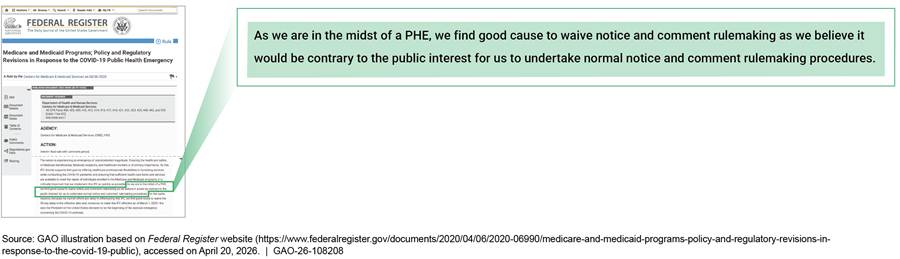
Note: PHE is shorthand for “public health emergency,” referring to the COVID-19 pandemic. For this example, we modified some elements of the web page due to space limitations.
Federal agencies also relied on other existing flexibilities under the APA to issue rules without prior notice-and-comment. For example, in May 2021, Treasury issued a rule implementing the Coronavirus State and Local Fiscal Recovery Funds program. The American Rescue Plan Act established the program to support state, local, and tribal governments in responding to the effects of COVID-19. Treasury issued the rule without prior notice-and-comment, relying on the APA exception for matters relating to grants.[61]
In addition to the flexibilities afforded under the APA, Congress passed new statutory authorities directing SBA to issue rules without prior notice-and-comment. For example, section 1114 of the CARES Act and section 303 of the Economic Aid to Hard-Hit Small Businesses, Nonprofits, and Venues Act directed SBA to issue regulations to implement the PPP without regard to APA notice-and-comment requirements.[62] In several instances, SBA relied on both existing and new authorities to issue rules without prior notice-and-comment.
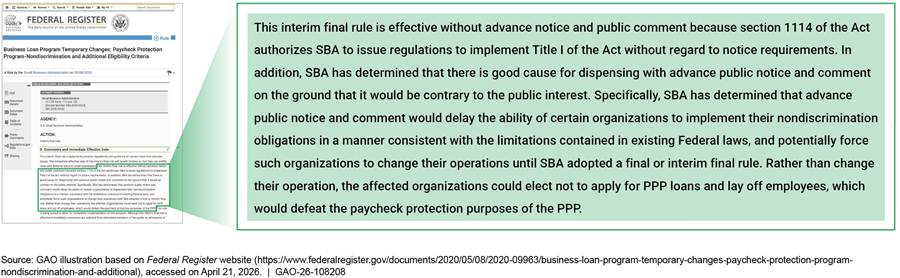
Our review identified 30 IFRs implementing PPP during the COVID-19 public health emergency. Across these IFRs, SBA cited the CARES Act or the Economic Aid Act as the statutory authority for issuing the rules as IFRs. Of these, 14 IFRs relied solely on statutory authority. The remaining 16 also cited the APA’s good cause exception as an additional basis for bypassing notice-and-comment requirements. For example, in issuing an IFR implementing changes to nondiscrimination and eligibility criteria for the PPP, SBA cited statutory authority under section 1114 of the CARES Act and claimed good cause under the APA (see fig. 7).[63]
Figure 7: Example of an Interim Final Rule Citing Other Statutory Authority in Addition to the Administrative Procedure Act’s Good Cause Exception to Issue Without Regard to Notice-and-Comment Requirements
Note: For this example, we modified some elements of the web page due to space limitations.
Agencies’ Use of Expedited Rulemaking Increased During COVID-19 Pandemic
A majority of rules we reviewed were issued during the COVID-19 public health emergency, which spanned January 31, 2020, through May 11, 2023. In the 6 years prior to the COVID pandemic (2013—2019), federal agencies published annually between three and 10 major IFRs or DFRs in our review. In 2020 and 2021, these numbers increased to 45 and 24, respectively, coinciding with the COVID-19 public health emergency. From 2023 through January 2025, the number of major IFRs and DFRs published returned to a range similar to earlier years. In total, agencies issued 55 rules in response to COVID-19, 41 of which cited good cause. (see fig. 8).
Figure 8: Number of COVID-19 and Non-COVID-19 Rules Reviewed Using Expedited Rulemaking, by Year, (Jan. 20, 2013 –-Jan. 20, 2025)
Note: We classified rules as issued in direct response to the COVID-19 pandemic if it was primarily issued, in part or whole, to respond to the COVID-19 pandemic, including responding to the pandemic’s socio-economic or other indirect effects.
2013 only includes published between January 20, 2013, and December 31, 2013.
2025 only includes published between January 1, 2025, and January 20, 2025.
Federal Agencies Generally Reported on Economic Effects and Requested Public Comments After Rules Were Issued
Among the 128 IFRs and DFRs we reviewed, 85 (66 percent) included information on expected costs and benefits in the published rule, which we refer to as economic effects. In addition to reporting on economic effects, agencies requested and received public comments for a majority of IFRs we reviewed. Our review further found that agencies generally documented responses to public comments when IFRs were reissued as final rules. Developments occurring after the time frame of the rules in our review, including recent executive actions and Office of Management and Budget (OMB) guidance, may influence future trends in expedited rulemaking.
Two-thirds of Major Rules Reported on Economic Effects
Of the 128 major rules we reviewed, 85 (66 percent) published information on economic effects.[64] Under EO 12866, agencies are directed to assess the costs and benefits of significant regulatory actions, to the extent practicable. Appendix I describes how we identified the numbers of rules reporting economic effects.
An example of a rule which reported information on economic effects is a 2021 Department of Commerce’s National Oceanic and Atmospheric Administration (NOAA) rule adjusting the Atlantic Sea Scallop Fishery Management Plan for fishing years 2021 and 2022.[65] NOAA estimated that the rule would reduce consumer and producer surplus by approximately $104.1 million in 2021, reflecting an 11.5 million pound reduction in the annual catch relative to the previous fishing year. NOAA also indicated that the rule would provide qualitative benefits, including helping to ensure sustainability of fishery stocks and minimizing adverse ecological effects.
EO 12866 also recognizes that agencies may need to act quickly in emergencies or when required by law and directs agencies in those circumstances to comply with the order’s requirements to the extent practicable. We found that, among IFRs issued during the COVID-19 public health emergency period, those intended to provide relief from the effects of COVID-19 reported information on economic effects at lower rates than other IFRs. Eighteen of the 55 IFRs (33 percent) in this group reported information on economic effects. By comparison, 38 of 41 IFRs (93 percent) issued before the public health emergency and 14 of 15 IFRs (93 percent) issued after the public health emergency reported such information.
SBA issued a substantial share of the rules we reviewed that did not report information on economic effects. Of the 31 such rules, 30 were issued to implement PPP. In each of these rules, SBA cited EO 12866’s emergency provision, which directs agencies to comply with certain reporting requirements to the extent practicable.
Figure 9: Number of Major Interim Final and Direct Final Rules Reviewed Reporting on Economic Effects by Federal Agency, Jan. 20, 2013–Jan. 20, 2025
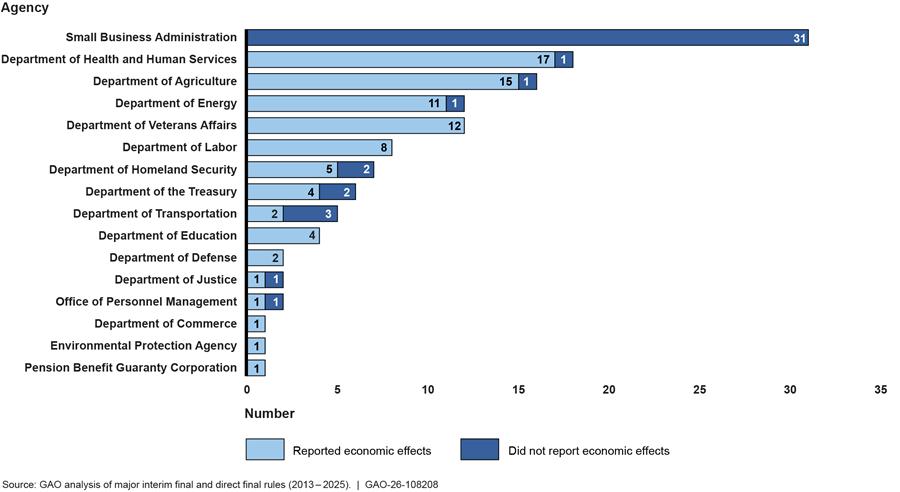
Note: Our review did not assess compliance with the related requirements. A finding that a rule reported information on economic effects does not necessarily mean the rule fully complied with the economic analysis requirements; conversely, a finding that a rule did not report information on economic effects does not mean the rule fails to comply with any requirements.
Federal Agencies Generally Requested Public Comments When Expediting Major Rules
When agencies issue an IFR under statutory authority that permits them to forgo notice-and-comment rulemaking, they may request public comments after the rule is issued but are not required to do so. For major rules in which agencies retain discretion, these comments can help agencies identify issues and obtain information and analyses that they may not have previously considered. Similarly, agencies are not required to respond to comments received on these rules.
Of the 116 IFRs issued without an NPRM that we reviewed, 115 requested public comment.[66] Of these, 109 (95 percent) received comment after the rule was published.[67] The number of comments varied across IFRs, ranging from one to over 120,000. This is an increase compared to our 2012 report that found agencies requested comments for 63 percent of major rules issued without an NPRM between 2003 and 2010.
Federal Agencies Generally Documented Consideration of Public Comments in Final Rules
Agencies documented their consideration of comments for 49 of 52 (94 percent) IFRs that were subsequently reissued the IFRs as final rules. For example, Education issued an IFR on total and permanent disability student loan discharge and requested public comment.[68] Education subsequently issued a final rule incorporating changes in response to comments.[69] This is also consistent with our finding in 2012 that agencies generally documented consideration of public comments in instances where IFRs were reissued as final rules.
Sixty-four of the 116 (55 percent) IFRs in our review were not followed by a subsequent final rule. As a result, we were unable to assess whether agencies addressed public comments on those IFRs through a subsequent final rule. However agencies generally state they will respond to significant comments, if warranted, in a subsequent final rule.
For the 12 DFRs in our population, DOE and HHS reviewed comments submitted in response to each DFR and found that none warranted withdrawing the rule. As a result, DOE and HHS published Federal Register notices confirming their effective dates.
Recent Policy Developments May Influence Federal Agencies’ Use of Expedited Rulemaking
Moving forward, assessing trends in expedited rulemaking, particularly the use of the APA’s good cause exception, will need to account for developments that occurred after the time frame of rules in our review. Recent executive actions have directed agencies to review and repeal certain regulations and have identified circumstances in which agencies may rely on the APA’s good cause exception to do so expeditiously. In February 2025, the President issued EO 14219, which directed agencies to identify regulations that may be unlawful or exceed statutory authority and to prioritize their modification or repeal.[70] Building on this directive, in April 2025, a presidential memorandum directed agencies to finalize repeal actions without notice-and-comment, where consistent with the APA’s good cause exception, including where such procedures would be impracticable, unnecessary, or contrary to the public interest.[71] In October 2025, OMB issued Memorandum M-25-36 which emphasized streamlining the review of deregulatory actions and outlined considerations for determining whether notice-and-comment procedures are warranted.[72] Taken together, these actions suggest potential changes in federal agencies’ application of the APA’s good cause exception in rulemaking. The extent to which these developments may affect longer-term trends is not yet known.
Agency Comments
We provided a draft of this report to the OMB for review and comment. OMB did not have any comments on the report.
As agreed with your offices, unless you publicly announce the contents of this report earlier, we plan no further distribution until 30 days from the report date. At that time, we will send copies to the appropriate congressional committees, the Director of OMB, and other interested parties. In addition, the report will be available at no charge on the GAO website at https://www.gao.gov.
If you or your staff have any questions about this report, please contact me at vanarsdalel@gao.gov. Contact points for our Offices of Congressional Relations and Media Relations may be found on the last page of this report. GAO staff who made key contributions to this report are listed in appendix III.
Lisa Van Arsdale
Acting Director, Strategic Issues
The objectives of this report were to:
· Identify how often executive agencies issued rules using the Administrative Procedure Act (APA) good cause exception, including which agencies most often issued such rules, and how often agencies cited exceptions other than APA’s good cause.
· Identify how the issuance of rules without prior notice-and-comment changed over time, including years before, during, and after the COVID-19 pandemic (January 31, 2020–May 11, 2023).
· Identify how often rules issued without prior notice-and-comment provided information on the rule’s economic effects, solicited public comments, and responded to public comments.
For all three objectives, our review included major interim final rules (IFR) and direct final rules (DFR) that were published between January 20, 2013, and January 20, 2025.
To address each of these objectives, we used data from Reginfo.gov, the Federal Register, and our Congressional Review Act (CRA) database to compile a list of IFRs and DFRs issued between January 20, 2013, and January 20, 2025.[73] We focused on interim and direct final rules because these rules are generally published without a prior notice of proposed rulemaking (NPRM), which is an indicator of use of a good cause exception. Further, we limited our review to major rules to focus on those rules with the largest effect on the economy.[74] We also excluded Federal Acquisition Regulation rules because they are not governed by the APA.[75] After these criteria were applied, we identified 134 rules issued in our timeframe that were published by federal agencies and that the agencies identified as IFRs or DFRs. To address our three objectives, we also reviewed associated documents for the rules reviewed, relevant laws, executive orders, and guidance related to waiving notice-and-comment. We also reviewed our prior work on agencies’ use of regulatory flexibility during the pandemic.
We reviewed these 134 rules and determined that six of the interim final rules were preceded by NPRMs and therefore, were excluded from further review. Therefore, we found that of the 128 rules covered in our review that were issued without a prior NPRM, 116 were IFRs and 12 were DFRs. In this report, we referred to these 128 rules as rules we reviewed or rules covered by our review. We supplemented data from the sources we used to compile our list of rules with documentation related to each rule, including the Federal Register entries, our major rule reports, and regulatory dockets on regulations.gov. We tested the reliability of the databases by testing for outliers, tracing a sample of entries to source documents, triangulating data across the sources, and reviewing documentation about how the databases are maintained. We concluded that the data elements we used were sufficiently reliable for identifying IFRs and DFRs for inclusion in our review.
To address all three objectives, two analysts independently reviewed each rule’s documentation to identify and record key characteristics of the rules, including whether the agency cited good cause, whether the rule was related to the COVID-19 pandemic, and whether the rule included information on projected economic effects.[76] A third analyst examined the codes assigned by the reviewers to ensure that coding criteria were consistently applied and resolved instances where the two reviewers were not in agreement.
To address our first objective, we identified (1) which agencies issued each of the 116 IFRs without notice-and-comment and (2) whether good cause was cited to forgo notice-and-comment. Where agencies claimed good cause, we also identified the specific reasons agencies gave for citing good cause. The three general reasons for agencies citing good cause (impracticable, unnecessary, and contrary to the public interest) are specified in the APA.[77] While this report categorizes the rules on the basis of which of the three terms they used, the usage of the general reasons often overlap in the rules’ texts.[78] For the 12 DFRs, we also reviewed whether each rule was concurrently issued with a notice of proposed rulemaking.
To address our second objective, we identified whether rules citing good cause to forgo notice-and-comment were issued in response to the COVID-19 pandemic (January 31, 2020, through May 11, 2023).[79] For purposes of this objective, if a rule stated it was issued to address the socio-economic effects of the pandemic, we considered it to be a pandemic-related rule. For example, we considered rules to be pandemic- related if they stated they were to address mass layoffs due to stay-at-home orders, increased risk of evictions, and mental health problems stemming from the pandemic.
To address our third objective, we identified whether agencies that issued major rules without notice-and-comment (1) provided information on the economic effects of the rules,[80] (2) solicited public comments when issuing final rules without notice-and-comment, and (3) responded to comments received on major rules without notice-and-comment.[81] Our review of the reported economic effects did not assess compliance with the related requirements. A finding that a rule reported information on economic effects does not necessarily mean the rule fully complied with the economic analysis requirements; conversely, a finding that a rule did not report information on economic effects does not mean the rule fails to comply with any requirements. We reviewed each rule and corresponding major rule report we submitted as required under the Congressional Review Act to determine whether the rule contained a cost-benefit analysis.[82]
To address all three objectives, we completed additional content analyses of the 128 major rules to obtain more detailed information on the stated reasons behind agencies’ use of exceptions to notice-and-comment rulemaking, including APA categorical exceptions and non-APA statutes, and whether agencies described the economic effects of rules. Each content analysis was conducted by of our staff members, who performed a similar review process as described above, then documented their findings. The results of these analyses only represent the facts and circumstances of the specific rules we reviewed and were used to inform our final determinations on those characteristics for each rule.
We did not assess the agencies’ decisions regarding claims of good cause and other exceptions or their determinations regarding the effects of their rules. Instead, we are providing information about what the agencies published in the Federal Register as the basis for their findings. Therefore, we limited our analysis to the information agencies specifically stated in their rules.
We conducted this performance audit from March 2025 to August 2026 in accordance with generally accepted government auditing standards. Those standards require that we plan and perform the audit to obtain sufficient, appropriate evidence to provide a reasonable basis for our findings and conclusions based on our audit objectives. We believe that the evidence obtained provides a reasonable basis for our findings and conclusions based on our audit objectives.
The following table provides key information obtained based on our review of the 116 major interim final rules (IFR) issued from 2013 through 2025 that we reviewed.[83] This table includes eight fields for each rule: (1) Rule Title, (2) Federal Register Cite, (3) RIN, (4) Agency, (5) Reasons Cited, (6) COVID-Related, (7) Received Comments, and (8) Described Economic Effects.
The Rule Title field shows the rule title of the IFR as it appears in the Federal Register.
Following the rule title is the Federal Register Cite field, which provides the volume and page number where the IFR was published in the Federal Register. The publication date appears as a parenthetical.
The RIN field shows all Regulation Identification Numbers (RIN) appearing in the header of the rule as it appears in the Federal Register. Multiple RINs are separated by semicolons. Where a rule has multiple RINs corresponding to multiple issuing agencies, the RINs are listed in the same order as the issuing agencies in the Agency field.
The Agency field shows all issuing agencies appearing in the header of the rule as it appears in the Federal Register. Some rules were jointly issued by one or more agencies, in which case they are separated by commas. To prevent reporting the rule more than once, we consider the lead agency to be the one that submitted the rule to the Office of Information and Regulatory Affairs (OIRA).[84] In such cases, this agency is listed first. Other agencies jointly issuing a rule are listed after the lead agency.[85]
The Reasons Cited field shows the reason or reasons agencies provided in the published IFR for waiving notice-and-comment. These reasons are categorized as follows: (1) Good Cause; (2) Administrative Procedure Act (APA) Categorical Exceptions;[86] (3) Non-APA Statute, and (4) No Reason Given. Some rules cited more than one reason. Rules were categorized as Good Cause if the IFR explicitly stated the agency was claiming good cause to waive notice-and-comment requirements of the APA, such as the APA 30-day delay and CRA 60-day delay requirements, but not the APA notice-and-comment requirements. These rules were not categorized as Good Cause. IFRs that claimed good cause and cited non-APA statutory reasons for claiming good cause, including statutory deadlines, were categorized as Good Cause. By way of contrast, IFRs which claimed good cause and separately discussed a non-APA statutory provisions as a stand-alone reason to forgo notice-and-comment rulemaking were categorized as both Good Cause and Non-APA Statute. Non-APA Statute includes cases where the IFR cited legislative history as the reason for forgoing notice-and-comment procedures.
The COVID-Related field shows a Yes when the IFR states it was primarily issued, in part or whole, to respond to the COVID-19 pandemic, including responding to the pandemic’s socio-economic or other indirect effects. However if a rule mentioned the COVID-19 pandemic as a reason, but not a primary reason the rule was issued, the field shows No. Rules that predate the COVID-19 pandemic or do not mention the pandemic also show “No” in this field.
The Received Comments field refers to whether a rule received comments via regulations.gov. For cases where this characteristic is “No”, it is possible the rule received comments via other sources (e.g. physical mail), but these comments were not uploaded to regulations.gov.
The Described Economic Effects field shows “Yes” when an agency provided information on economic costs and benefits for each rule. Otherwise the field shows No. Our review of the reported economic effects did not assess compliance with any applicable requirements. A finding that a rule reported information on economic effects does necessarily mean the rule fully complied with the economic analysis requirements; conversely, a finding that a rule did not report information on economic effects does not mean the rule fails to comply with any requirements. A determination that a rule did not describe economic effects was based on a review of the interim final rule only.
Table 3: Summary of Characteristics for Major Interim Final Rules Issued Without Prior Notice of Proposed Rulemaking (NPRM) That We Reviewed, Jan. 20, 2013—Jan. 20, 2025
|
Rule Attributes |
Summary of Key Characteristics |
|
Rule Title: Uniform Procedures for State Highway Safety Grant Programs Federal Register Cite: 78 Fed. Reg. 4986 (Jan. 23, 2013) RIN: 2127-AL30; 2127-AL29 Agency: Department of Transportation |
Reasons Cited: No Reason Provided COVID-Related: No Received Comments: Yes Described Economic Effects: No |
|
Rule Title: Guarantees for Bonds Issued for Community or Economic Development Purposes Federal Register Cite: 78 Fed. Reg. 8296 (Feb. 5, 2013) RIN: 1559-AA01 Agency: Department of the Treasury |
Reasons Cited: APA Categorical Exception COVID-Related: No Received Comments: Yes Described Economic Effects: Yes |
|
Rule Title: Emergency Relief Program Federal Register Cite: 78 Fed. Reg. 19136 (Mar. 29, 2013) RIN: 2132-AB13 Agency: Department of Transportation |
Reasons Cited: Non-APA Statute COVID-Related: No Received Comments: Yes Described Economic Effects: No |
|
Rule Title: Supplemental Nutrition Assistance Program: Nutrition Education and Obesity Prevention Grant Program Federal Register Cite: 78 Fed. Reg. 20411 (Apr. 5, 2013) RIN: 0584-AE07 Agency: Department of Agriculture |
Reasons Cited: Good Cause COVID-Related: No Received Comments: Yes Described Economic Effects: Yes |
|
Rule Title: Wage Methodology for the Temporary Non-Agricultural Employment H-2B Program, Part 2 Federal Register Cite: 78 Fed. Reg. 24047 (Apr. 24, 2013) RINs: 1205-AB69; 1615-AC02 Agency: Department of Labor; Department of Homeland Security |
Reasons Cited: Good Cause COVID-Related: No Received Comments: Yes Described Economic Effects: Yes |
|
Rule Title: William D. Ford Federal Direct Loan Program Federal Register Cite: 78 Fed. Reg. 28954 (May 16, 2013) RIN: 1840-AD13 Agency: Department of Education |
Reasons Cited: Good Cause COVID-Related: No Received Comments: Yes Described Economic Effects: Yes |
|
Rule Title: Pre-Existing Condition Insurance Plan Program Federal Register Cite: 78 Fed. Reg. 30218 (May 22, 2013) RIN: 0938-AQ70 Agency: Department of Health and Human Services |
Reasons Cited: Good Cause COVID-Related: No Received Comments: Yes Described Economic Effects: Yes |
|
Rule Title: National School Lunch Program and School Breakfast Program: Nutrition Standards for All Foods Sold in School as Required by the Healthy, Hunger-Free Kids Act of 2010 Federal Register Cite: 78 Fed. Reg. 39068 (June 28, 2013) RIN: 0584-AE09 Agency: Department of Agriculture |
Reasons Cited: Good Cause COVID-Related: No Received Comments: Yes Described Economic Effects: Yes |
|
Rule Title: Civilian Health and Medical Program of the Uniformed Services (CHAMPUS)/TRICARE: Pilot Program for Refills of Maintenance Medications for TRICARE for Life Beneficiaries through the TRICARE Mail Order Program Federal Register Cite: 78 Fed. Reg. 75245 (Dec. 11, 2013) RIN: 0720-AB60 Agency: Department of Defense |
Reasons Cited: Non-APA statute COVID-Related: No Received Comments: Yes Described Economic Effects: Yes |
|
Rule Title: Copayments for Medications in 2014 Federal Register Cite: 78 Fed. Reg. 79315 (Dec. 30, 2013) RIN: 2900-AO91 Agency: Department of Veterans Affairs |
Reasons Cited: Good Cause COVID-Related: No Received Comments: No Described Economic Effects: Yes |
|
Rule Title: Medicare Program: Extension of the Payment Adjustment for Low-Volume Hospitals and the Medicare-Dependent Hospital (MDH) Program under the Hospital Inpatient Prospective Payment Systems (IPPS) for Acute Care Hospitals for Fiscal Year 2014 Federal Register Cite: 79 Fed. Reg. 15022 (Mar. 18, 2014) RIN: 0938-AR12 Agency: Department of Health and Human Services |
Reasons Cited: Good Cause COVID-Related: No Received Comments: Yes Described Economic Effects: Yes |
|
Rule Title: Loan Guaranty: Ability-To-Repay Standards and Qualified Mortgage Definition Under the Truth in Lending Act Federal Register Cite: 79 Fed. Reg. 26620 (May 9, 2014) RIN: 2900-AO65 Agency: Department of Veterans Affairs |
Reasons Cited: Good Cause COVID-Related: No Received Comments: Yes Described Economic Effects: Yes |
|
Rule Title: General Administrative Regulations; Catastrophic Risk Protection Endorsement; Area Risk Protection Insurance Regulations; and the Common Crop Insurance Regulations, Basic Provisions Federal Register Cite: 79 Fed. Reg. 37155 (July 1, 2014) RIN: 0563-AC43 Agency: Department of Agriculture |
Reasons Cited: APA Categorical Exception COVID-Related: No Received Comments: Yes Described Economic Effects: Yes |
|
Rule Title: Copayments for Medications in 2015 Federal Register Cite: 79 Fed. Reg. 63819 (Oct. 27, 2014) RIN: 2900-AP15 Agency: Department of Veterans Affairs |
Reasons Cited: Good Cause COVID-Related: No Received Comments: Yes Described Economic Effects: Yes |
|
Rule Title: Expanded Access to Non-VA Care Through the Veterans Choice Program Federal Register Cite: 79 Fed. Reg. 65571 (Nov. 5, 2014) RIN: 2900-AP24 Agency: Department of Veterans Affairs |
Reasons Cited: Good Cause; Non-APA Statute COVID-Related: No Received Comments: Yes Described Economic Effects: Yes |
|
Rule Title: Environmental Quality Incentives Program (EQIP) Federal Register Cite: 79 Fed. Reg. 73954 (Dec. 12, 2014) RIN: 0578-AA62 Agency: Department of Agriculture |
Reasons Cited: No Reason Provided COVID-Related: No Received Comments: Yes Described Economic Effects: Yes |
|
Rule Title: Driving Distance Eligibility for the Veterans Choice Program Federal Register Cite: 80 Fed. Reg. 22906 (Apr. 24, 2015) RIN: 2900-AP24 Agency: Department of Veterans Affairs |
Reasons Cited: Good Cause; Non-APA Statute COVID-Related: No Received Comments: Yes Described Economic Effects: Yes |
|
Rule Title: Strategic Economic and Community Development Federal Register Cite: 80 Fed. Reg. 28807 (May 20, 2015) RIN: 0570-AA94 Agency: Department of Agriculture |
Reasons Cited: No Reason Provided COVID-Related: No Received Comments: Yes Described Economic Effects: Yes |
|
Rule Title: Adjustment of Passenger Civil Aviation Security Service Fee Federal Register Cite: 80 Fed. Reg. 31850 (June 4, 2015) RIN: 1652-AA68 Agency: Department of Homeland Security |
Reasons Cited: Good Cause; Non-APA Statute COVID-Related: No Received Comments: Yes Described Economic Effects: Yes |
|
Rule Title: Biorefinery, Renewable Chemical, and Biobased Product Manufacturing Assistance Program Federal Register Cite: 80 Fed. Reg. 36410 (June 24, 2015) RIN: 0570-AA73 Agency: Department of Agriculture |
Reasons Cited: No Reason Provided COVID-Related: No Received Comments: Yes Described Economic Effects: Yes |
|
Rule Title: Automated Commercial Environment (ACE) Filings for Electronic Entry/Entry Summary (Cargo Release and Related Entry) Federal Register Cite: 80 Fed. Reg. 61278 (Oct. 13, 2015) RIN: 1515-AE03 Agency: Department of the Treasury; Department of Homeland Security |
Reasons Cited: APA Categorical Exception COVID-Related: No Received Comments: Yes Described Economic Effects: Yes |
|
Rule Title: Transition Assistance Program (TAP) for Military Personnel Federal Register Cite: 80 Fed. Reg. 74678 (Nov. 30, 2015) RIN: 0790-AJ17 Agency: Department of Defense |
Reasons Cited: APA Categorical Exception COVID-Related: No Received Comments: Yes Described Economic Effects: Yes |
|
Rule Title: Expanded Access to Non-VA Care Through the Veterans Choice Program Federal Register Cite: 80 Fed. Reg. 74991 (Dec. 1, 2015) RIN: 2900-AP60 Agency: Department of Veterans Affairs |
Reasons Cited: Good Cause; Non-APA Statute COVID-Related: No Received Comments: Yes Described Economic Effects: Yes |
|
Rule Title: James Zadroga 9/11 Victim Compensation Fund Reauthorization Act Federal Register Cite: 81 Fed. Reg. 38936 (June 15, 2016) RIN: 1105-AB49 Agency: Department of Justice |
Reasons Cited: Good Cause; APA Categorical Exception COVID-Related: No Received Comments: Yes Described Economic Effects: No |
|
Rule Title: Department of Labor Federal Civil Penalties Inflation Adjustment Act Catch-Up Adjustments Federal Register Cite: 81 Fed. Reg. 43430 (July 1, 2016) RIN: 1290-AA31 Agency: Department of Labor |
Reasons Cited: Good Cause COVID-Related: No Received Comments: Yes Described Economic Effects: Yes |
|
Rule Title: Medicare Program; Conditions for Coverage for End-Stage Renal Disease Facilities—Third Party Payment Federal Register Cite: 81 Fed. Reg. 90211 (Dec. 14, 2016) RIN: 0938-AT11 Agency: Department of Health and Human Services |
Reasons Cited: Good Cause COVID-Related: No Received Comments: Yes Described Economic Effects: Yes |
|
Rule Title: Pipeline Safety: Safety of Underground Natural Gas Storage Facilities Federal Register Cite: 81 Fed. Reg. 91860 (Dec. 19, 2016) RIN: 2137-AF22 Agency: Department of Transportation |
Reasons Cited: Good Cause COVID-Related: No Received Comments: Yes Described Economic Effects: Yes |
|
Rule Title: Food Labeling; Nutrition Labeling of Standard Menu Items in Restaurants and Similar Retail Food Establishments; Extension of Compliance Date; Request for Comments Federal Register Cite: 82 Fed. Reg. 20825 (May 4, 2017) RIN: 0910-ZA48 Agency: Department of Health and Human Services |
Reasons Cited: Good Cause; APA Categorical Exception COVID-Related: No Received Comments: Yes Described Economic Effects: Yes |
|
Rule Title: Reimbursement for Emergency Treatment Federal Register Cite: 83 Fed. Reg. 974 (Jan. 9, 2018) RIN: 2900-AQ08 Agency: Department of Veterans Affairs |
Reasons Cited: Good Cause COVID-Related: No Received Comments: Yes Described Economic Effects: Yes |
|
Rule Title: Medicare Program; Durable Medical Equipment Fee Schedule Adjustments to Resume the Transitional 50/50 Blended Rates to Provide Relief in Rural Areas and Non-Contiguous Areas Federal Register Cite: 83 Fed. Reg. 21912 (May 11, 2018) RIN: 0938-AT21 Agency: Department of Health and Human Services |
Reasons Cited: Good Cause COVID-Related: No Received Comments: Yes Described Economic Effects: Yes |
|
Rule Title: Air Cargo Advance Screening (ACAS) Federal Register Cite: 83 Fed. Reg. 27380 (June 12, 2018) RIN: 1651-AB04 Agency: Department of Homeland Security |
Reasons Cited: Good Cause COVID-Related: No Received Comments: Yes Described Economic Effects: Yes |
|
Rule Title: Loan Guaranty: Revisions to VA-Guaranteed or Insured Cash-Out Home Refinance Loans Federal Register Cite: 83 Fed. Reg. 64459 (Dec. 17, 2018) RIN: 2900-AQ42 Agency: Department of Veterans Affairs |
Reasons Cited: Non-APA Statute COVID-Related: No Received Comments: Yes Described Economic Effects: Yes |
|
Rule Title: Establishment of a Domestic Hemp Production Program Federal Register Cite: 84 Fed. Reg. 58522 (Oct. 31, 2019) RIN: 0581-AD82a Agency: Department of Agriculture |
Reasons Cited: Good Cause COVID-Related: No Received Comments: Yes Described Economic Effects: Yes |
|
Rule Title: Conservation Stewardship Program (CSP) Interim Rule Federal Register Cite: 84 Fed. Reg. 60883 (Nov. 12, 2019) RIN: 0578-AA67 Agency: Department of Agriculture |
Reasons Cited: APA Categorical Exception; Non-APA Statute COVID-Related: No Received Comments: Yes Described Economic Effects: Yes |
|
Rule Title: Total and Permanent Disability Discharge of Loans Under Title IV of the Higher Education Act Federal Register Cite: 84 Fed. Reg. 65000 (Nov. 26, 2019) RIN: 1840-AD48 Agency: Department of Education |
Reasons Cited: Good Cause COVID-Related: No Received Comments: Yes Described Economic Effects: Yes |
|
Rule Title: Conservation Reserve Program Federal Register Cite: 84 Fed. Reg. 66813 (Dec. 6, 2019) RIN: 0560-AI41 Agency: Department of Agriculture |
Reasons Cited: APA Categorical Exception; Non-APA Statute COVID-Related: No Received Comments: Yes Described Economic Effects: Yes |
|
Rule Title: Environmental Quality Incentives Program Federal Register Cite: 84 Fed. Reg. 69272 (Dec. 17, 2019) RIN: 0578-AA68 Agency: Department of Agriculture |
Reasons Cited: APA Categorical Exception; Non-APA Statute COVID-Related: No Received Comments: Yes Described Economic Effects: Yes |
|
Rule Title: Agricultural Conservation Easement Program Federal Register Cite: 85 Fed. Reg. 558 (Jan. 6, 2020) RIN: 0578-AA66 Agency: Department of Agriculture |
Reasons Cited: APA Categorical Exception; Non-APA Statute COVID-Related: No Received Comments: Yes Described Economic Effects: Yes |
|
Rule Title: Extension of Compliance Date for Entry-Level Driver Training Federal Register Cite: 85 Fed. Reg. 6088 (Feb. 4, 2020) RIN: 2126-AC25 Agency: Department of Transportation |
Reasons Cited: Good Cause COVID-Related: No Received Comments: Yes Described Economic Effects: Yes |
|
Rule Title: Regional Conservation Partnership Program Federal Register Cite: 85 Fed. Reg. 8131 (Feb. 13, 2020) RIN: 0578-AA70 Agency: Department of Agriculture |
Reasons Cited: APA Categorical Exception; Non-APA Statute COVID-Related: No Received Comments: Yes Described Economic Effects: Yes |
|
Rule Title: Rural Broadband Loans, Loan/Grant Combinations, and Loan Guarantees Federal Register Cite: 85 Fed. Reg. 14393 (Mar. 12, 2020) RIN: 0572-AC46 Agency: Department of Agriculture |
Reasons Cited: No Reason Provided COVID-Related: No Received Comments: Yes Described Economic Effects: Yes |
|
Rule Title: Control of Communicable Diseases; Foreign Quarantine: Suspension of Introduction of Persons into United States from Designated Foreign Countries or Places for Public Health Purposes Federal Register Cite: 85 Fed. Reg. 16559 (Mar. 24, 2020) RIN: 0920-AA76 Agency: Department of Health and Human Services |
Reasons Cited: Good Cause; APA Categorical Exception COVID-Related: Yes Received Comments: Yes Described Economic Effects: No |
|
Rule Title: Medicare and Medicaid Programs; Policy and Regulatory Revisions in Response to the COVID-19 Public Health Emergency Federal Register Cite: 85 Fed. Reg. 19230 (Apr. 6, 2020) RIN: 0938-AU31 Agency: Department of Health and Human Services |
Reasons Cited: Good Cause COVID-Related: Yes Received Comments: Yes Described Economic Effects: Yes |
|
Rule Title: Business Loan Program Temporary Changes; Paycheck Protection Program Federal Register Cite: 85 Fed. Reg. 20811 (Apr. 15, 2020) RIN: 3245-AH34 Agency: Small Business Administration |
Reasons Cited: Non-APA Statute COVID-Related: Yes Received Comments: Yes Described Economic Effects: No |
|
Rule Title: Business Loan Program Temporary Changes; Paycheck Protection Program Federal Register Cite: 85 Fed. Reg. 20817 (Apr. 15, 2020) RIN: 3245-AH35 Agency: Small Business Administration |
Reasons Cited: Non-APA Statute COVID-Related: Yes Received Comments: Yes Described Economic Effects: No |
|
Rule Title: Business Loan Program Temporary Changes; Paycheck Protection Program – Additional Eligibility Criteria and Requirements for Certain Pledges of Loans Federal Register Cite: 85 Fed. Reg. 21747 (Apr. 20, 2020) RIN: 3245-AH36 Agency: Small Business Administration |
Reasons Cited: Non-APA Statute COVID-Related: Yes Received Comments: Yes Described Economic Effects: No |
|
Rule Title: Business Loan Program Temporary Changes; Paycheck Protection Program–Requirements–Promissory Notes, Authorizations, Affiliation, and Eligibility Federal Register Cite: 85 Fed. Reg. 23450 (Apr. 28, 2020) RIN: 3245-AH37 Agency: Small Business Administration |
Reasons Cited: Non-APA Statute COVID-Related: Yes Received Comments: Yes Described Economic Effects: No |
|
Rule Title: Small Business Administration Business Loan Program Temporary Changes; Paycheck Protection Program – Additional Criterion for Seasonal Employers Federal Register Cite: 85 Fed. Reg. 23917 (Apr. 30, 2020) RIN: 1505-AC67 Agency: Department of the Treasury |
Reasons Cited: Good Cause COVID-Related: Yes Received Comments: Yes Described Economic Effects: No |
|
Rule Title: Business Loan Program Temporary Changes; Paycheck Protection Program–Requirements–Disbursements Federal Register Cite: 85 Fed. Reg. 26321 (May 4, 2020) RIN: 3245-AH38 Agency: Small Business Administration |
Reasons Cited: Non-APA Statute COVID-Related: Yes Received Comments: Yes Described Economic Effects: No |
|
Rule Title: Business Loan Program Temporary Changes; Paycheck Protection Program–Requirements–Corporate Groups and Non-Bank and Non-Insured Depository Institution Lenders Federal Register Cite: 85 Fed. Reg. 26324 (May 4, 2020) RIN: 3245-AH39 Agency: Small Business Administration |
Reasons Cited: Non-APA Statute COVID-Related: Yes Received Comments: Yes Described Economic Effects: No |
|
Rule Title: Business Loan Program Temporary Changes; Paycheck Protection Program – Nondiscrimination and Additional Eligibility Criteria Federal Register Cite: 85 Fed. Reg. 27287 (May 8, 2020) RIN: 3245-AH40 Agency: Small Business Administration |
Reasons Cited: Good Cause; Non-APA Statute COVID-Related: Yes Received Comments: Yes Described Economic Effects: No |
|
Rule Title: Medicare and Medicaid Programs, Basic Health Program, and Exchanges; Additional Policy and Regulatory Revisions in Response to the COVID-19 Public Health Emergency and Delay of Certain Reporting Requirements for the Skilled Nursing Facility Quality Reporting Program Federal Register Cite: 85 Fed. Reg. 27550 (May 8, 2020) RIN: 0938-AU32 Agency: Department of Health and Human Services |
Reasons Cited: Good Cause COVID-Related: Yes Received Comments: Yes Described Economic Effects: Yes |
|
Rule Title: Emergency Management Priorities and Allocations System (EMPAS) Federal Register Cite: 85 Fed. Reg. 28500 (May 13, 2020) RIN: 1660-AB04 Agency: Department of Homeland Security |
Reasons Cited: Good Cause COVID-Related: Yes Received Comments: Yes Described Economic Effects: No |
|
Rule Title: Business Loan Program Temporary Changes; Paycheck Protection Program – Loan Increases Federal Register Cite: 85 Fed. Reg. 29842 (May 19, 2020) RIN: 3245-AH42 Agency: Small Business Administration |
Reasons Cited: Good Cause; Non-APA Statute COVID-Related: Yes Received Comments: Yes Described Economic Effects: No |
|
Rule Title: Business Loan Program Temporary Changes; Paycheck Protection Program–Requirements –Extension of Limited Safe Harbor with Respect to Certification Concerning Need for PPP Loan Request Federal Register Cite: 85 Fed. Reg. 29845 (May 19, 2020) RIN: 3245-AH41 Agency: Small Business Administration |
Reasons Cited: Good Cause; Non-APA Statute COVID-Related: Yes Received Comments: Yes Described Economic Effects: No |
|
Rule Title: Business Loan Program Temporary Changes; Paycheck Protection Program – Eligibility of Certain Electric Cooperatives Federal Register Cite: 85 Fed. Reg. 29847 (May 19, 2020) RIN: 3245-AH43 Agency: Small Business Administration |
Reasons Cited: Non-APA Statute COVID-Related: Yes Received Comments: Yes Described Economic Effects: No |
|
Rule Title: Business Loan Program Temporary Changes; Paycheck Protection Program – Treatment of Entities with Foreign Affiliates Federal Register Cite: 85 Fed. Reg. 30835 (May 21, 2020) RIN: 3245-AH44 Agency: Small Business Administration |
Reasons Cited: Non-APA Statute COVID-Related: Yes Received Comments: Yes Described Economic Effects: No |
|
Rule Title: Guaranteed Loanmaking and Serving Regulations Federal Register Cite: 85 Fed. Reg. 31035 (May 22, 2020) RIN: 0570-AB07 Agency: Department of Agriculture |
Reasons Cited: Good Cause COVID-Related: Yes Received Comments: Yes Described Economic Effects: No |
|
Rule Title: Business Loan Program Temporary Changes; Paycheck Protection Program – Second Extension of Limited Safe Harbor with Respect to Certification Concerning Need for PPP Loan and Lender Reporting Federal Register Cite: 85 Fed. Reg. 31357 (May 26, 2020) RIN: 3245-AH45 Agency: Small Business Administration |
Reasons Cited: Good Cause; Non-APA Statute COVID-Related: Yes Received Comments: Yes Described Economic Effects: No |
|
Rule Title: Business Loan Program Temporary Changes; Paycheck Protection Program –Requirements – Loan Forgiveness Federal Register Cite: 85 Fed. Reg. 33004 (June 1, 2020) RINs: 3245-AH46; 1505-AC69 Agency: Small Business Administration; Department of the Treasury |
Reasons Cited: Good Cause; Non-APA Statute COVID-Related: Yes Received Comments: Yes Described Economic Effects: No |
|
Rule Title: Business Loan Program Temporary Changes; Paycheck Protection Program – SBA Loan Review Procedures and Related Borrower and Lender Responsibilities Federal Register Cite: 85 Fed. Reg. 33010 (June 1, 2020) RIN: 3245-AH47 Agency: Small Business Administration |
Reasons Cited: Good Cause; Non-APA Statute COVID-Related: Yes Received Comments: Yes Described Economic Effects: No |
|
Rule Title: Business Loan Program Temporary Changes; Paycheck Protection Program – Eligibility of Certain Telephone Cooperatives Federal Register Cite: 85 Fed. Reg. 35550 (June 11, 2020) RIN: 3245-AH48 Agency: Small Business Administration |
Reasons Cited: Non-APA Statute COVID-Related: Yes Received Comments: Yes Described Economic Effects: No |
|
Rule Title: Business Loan Program Temporary Changes; Paycheck Protection Program – Revisions to First Interim Final Rule Federal Register Cite: 85 Fed. Reg. 36308 (June 16, 2020) RIN: 3245-AH49 Agency: Small Business Administration |
Reasons Cited: Good Cause; Non-APA Statute COVID-Related: Yes Received Comments: Yes Described Economic Effects: No |
|
Rule Title: Eligibility of Students at Institutions of Higher Education for Funds Under the Coronavirus Aid, Relief, and Economic Security (CARES) Act Federal Register Cite: 85 Fed. Reg. 36494 (June 17, 2020) RIN: 1840-ZA04 Agency: Department of Education |
Reasons Cited: Good Cause COVID-Related: Yes Received Comments: Yes Described Economic Effects: Yes |
|
Rule Title: Business Loan Program Temporary Changes; Paycheck Protection Program – Additional Revisions to First Interim Final Rule Federal Register Cite: 85 Fed. Reg. 36717 (June 18, 2020) RIN: 3245-AH50 Agency: Small Business Administration |
Reasons Cited: Good Cause; Non-APA Statute COVID-Related: Yes Received Comments: No Described Economic Effects: No |
|
Rule Title: Business Loan Program Temporary Changes; Paycheck Protection Program – Revisions to the Third and Sixth Interim Final Rules Federal Register Cite: 85 Fed. Reg. 36997 (June 19, 2020) RIN: 3245-AH51 Agency: Small Business Administration |
Reasons Cited: Good Cause; Non-APA Statute COVID-Related: Yes Received Comments: No Described Economic Effects: No |
|
Rule Title: Business Loan Program Temporary Changes; Paycheck Protection Program – Additional Eligibility Revisions to First Interim Final Rule Federal Register Cite: 85 Fed. Reg. 38301 (June 26, 2020) RIN: 3245-AH53 Agency: Small Business Administration |
Reasons Cited: Good Cause; Non-APA Statute COVID-Related: Yes Received Comments: Yes Described Economic Effects: No |
|
Rule Title: Business Loan Program Temporary Changes; Paycheck Protection Program – Revisions to Loan Forgiveness and Loan Review Procedures Interim Final Rules Federal Register Cite: 85 Fed. Reg. 38304 (June 26, 2020) RIN: 3245-AH52; 1505-AC70 Agency: Small Business Administration; Department of the Treasury |
Reasons Cited: Good Cause; Non-APA Statute COVID-Related: Yes Received Comments: Yes Described Economic Effects: No |
|
Rule Title: Business Loan Program Temporary Changes; Paycheck Protection Program – Certain Eligible Payroll Costs Federal Register Cite: 85 Fed. Reg. 39066 (June 30, 2020) RIN: 3245-AH54 Agency: Small Business Administration |
Reasons Cited: Good Cause; Non-APA Statute COVID-Related: Yes Received Comments: No Described Economic Effects: No |
|
Rule Title: CARES Act Programs; Equitable Services to Students and Teachers in Non-Public Schools Federal Register Cite: 85 Fed. Reg. 39479 (July 1, 2020) RIN: 1810-AB59 Agency: Department of Education |
Reasons Cited: Good Cause COVID-Related: Yes Received Comments: Yes Described Economic Effects: Yes |
|
Rule Title: High-Wage Components of the Labor Value Content Requirements Under the United States-Mexico-Canada Agreement Implementation Act Federal Register Cite: 85 Fed. Reg. 39782 (July 1, 2020) RIN: 1235-AA36 Agency: Department of Labor |
Reasons Cited: Good Cause; APA Categorical Exception COVID-Related: No Received Comments: Yes Described Economic Effects: Yes |
|
Rule Title: Business Loan Program Temporary Changes; Paycheck Protection Program – Treatment of Owners and Forgiveness of Certain Nonpayroll Costs Federal Register Cite: 85 Fed. Reg. 52881 (Aug. 27, 2020) RIN: 3245-AH56 Agency: Small Business Administration |
Reasons Cited: Good Cause; Non-APA Statute COVID-Related: Yes Received Comments: Yes Described Economic Effects: No |
|
Rule Title: Appeals of SBA Loan Review Decisions Under the Paycheck Protection Program Federal Register Cite: 85 Fed. Reg. 52883 (Aug. 27, 2020) RIN: 3245-AH55 Agency: Small Business Administration |
Reasons Cited: Good Cause; Non-APA Statute COVID-Related: Yes Received Comments: Yes Described Economic Effects: No |
|
Rule Title: Medicare and Medicaid Programs, Clinical Laboratory Improvement Amendments (CLIA), and Patient Protection and Affordable Care Act; Additional Policy and Regulatory Revisions in Response to the COVID-19 Public Health Emergency Federal Register Cite: 85 Fed. Reg. 54820 (Sept. 2, 2020) RIN: 0938-AU33 Agency: Department of Health and Human Services |
Reasons Cited: Good Cause COVID-Related: Yes Received Comments: Yes Described Economic Effects: Yes |
|
Rule Title: Pension Benefit Statements-Lifetime Income Illustrations Federal Register Cite: 85 Fed. Reg. 59132 (Sept. 18, 2020) RIN: 1210-AB20 Agency: Department of Labor |
Reasons Cited: Good Cause; Non-APA Statute COVID-Related: No Received Comments: Yes Described Economic Effects: Yes |
|
Rule Title: Strengthening Wage Protections for the Temporary and Permanent Employment of Certain Aliens in the United States Federal Register Cite: 85 Fed. Reg. 63872 (Oct. 8, 2020) RIN: 1205-AC00 Agency: Department of Labor |
Reasons Cited: Good Cause COVID-Related: Yes Received Comments: Yes Described Economic Effects: Yes |
|
Rule Title: Strengthening the H-1B Nonimmigrant Visa Classification Program Federal Register Cite: 85 Fed. Reg. 63918 (Oct. 8, 2020) RIN: 1615-AC13 Agency: Department of Homeland Security |
Reasons Cited: Good Cause COVID-Related: Yes Received Comments: Yes Described Economic Effects: Yes |
|
Rule Title: Business Loan Program Temporary Changes; Paycheck Protection Program – Additional Revisions to Loan Forgiveness and Loan Review Procedures Interim Final Rules Federal Register Cite: 85 Fed. Reg. 66214 (Oct. 19, 2020) RINs: 3245-AH59; 1505-AC71 Agency: Small Business Administration; Department of the Treasury |
Reasons Cited: Good Cause; Non-APA Statute COVID-Related: Yes Received Comments: Yes Described Economic Effects: No |
|
Rule Title: Implementation of the Substance Use-Disorder Prevention That Promotes Opioid Recovery and Treatment for Patients and Communities Act of 2018: Dispensing and Administering Controlled Substances for Medication-Assisted Treatment Federal Register Cite: 85 Fed. Reg. 69153 (Nov. 2, 2020) RIN: 1117-AB55 Agency: Department of Justice |
Reasons Cited: Good Cause COVID-Related: No Received Comments: Yes Described Economic Effects: Yes |
|
Rule Title: Information Blocking and the ONC Health IT Certification Program: Extension of Compliance Dates and Timeframes in Response to the COVID-19 Public Health Emergency Federal Register Cite: 85 Fed. Reg. 70064 (Nov. 4, 2020) RIN: 0955-AA02 Agency: Department of Health and Human Services |
Reasons Cited: Good Cause COVID-Related: Yes Received Comments: Yes Described Economic Effects: Yes |
|
Rule Title: Additional Policy and Regulatory Revisions in Response to the COVID-19 Public Health Emergency Federal Register Cite: 85 Fed. Reg. 71142 (Nov. 6, 2020) RINs: 0938-AU35; 1210-AB96; 1545-BP97 Agency: Department of Health and Human Services; Department of Labor; Department of the Treasury |
Reasons Cited: Good Cause COVID-Related: Yes Received Comments: Yes Described Economic Effects: Yes |
|
Rule Title: Most Favored Nation (MFN) Model Federal Register Cite: 85 Fed. Reg. 76180 (Nov. 27, 2020) RIN: 0938-AT91 Agency: Department of Health and Human Services |
Reasons Cited: Good Cause COVID-Related: Yes Received Comments: Yes Described Economic Effects: Yes |
|
Rule Title: Civil Penalties Federal Register Cite: 86 Fed. Reg. 3016 (Jan. 14, 2021) RIN: 2127-AM32 Agency: Department of Transportation |
Reasons Cited: Good Cause; Non-APA Statute COVID-Related: Yes Received Comments: Yes Described Economic Effects: No |
|
Rule Title: Business Loan Program Temporary Changes; Paycheck Protection Program as Amended by Economic Aid Act Federal Register Cite: 86 Fed. Reg. 3692 (Jan. 14, 2021) RINs: 3245-AH62; 1505-AC74 Agency: Small Business Administration; Department of the Treasury |
Reasons Cited: Non-APA Statute COVID-Related: Yes Received Comments: Yes Described Economic Effects: No |
|
Rule Title: Business Loan Program Temporary Changes; Paycheck Protection Program Second Draw Loans Federal Register Cite: 86 Fed. Reg. 3712 (Jan. 14, 2021) RIN: 3245-AH63 Agency: Small Business Administration |
Reasons Cited: Non-APA Statute COVID-Related: Yes Received Comments: Yes Described Economic Effects: No |
|
Rule Title: Business Loan Program Temporary Changes; Paycheck Protection Program – Loan Forgiveness Requirements and Loan Review Procedures as Amended by Economic Aid Act Federal Register Cite: 86 Fed. Reg. 8283 (Feb. 5, 2021) RINs: 3245-AH65; 1505-AC75 Agency: Small Business Administration; Department of the Treasury |
Reasons Cited: Non-APA Statute COVID-Related: Yes Received Comments: Yes Described Economic Effects: No |
|
Rule Title: Business Loan Program Temporary Changes; Paycheck Protection Program – Revisions to Loan Amount Calculation and Eligibility Federal Register Cite: 86 Fed. Reg. 13149 (Mar. 8, 2021) RIN: 3245-AH67 Agency: Small Business Administration |
Reasons Cited: Non-APA Statute COVID-Related: Yes Received Comments: Yes Described Economic Effects: No |
|
Rule Title: Emergency Capital Investment Program – Restrictions on Executive Compensation, Share Buybacks, and Dividends Federal Register Cite: 86 Fed. Reg. 13449 (Mar. 9, 2021) RIN: 1505-AC76 Agency: Department of the Treasury |
Reasons Cited: Good Cause; Non-APA Statute COVID-Related: Yes Received Comments: No Described Economic Effects: No |
|
Rule Title: Mandatory Advance Electronic Information for International Mail Shipments Federal Register Cite: 86 Fed. Reg. 14245 (Mar. 15, 2021) RIN: 1651-AB33 Agency: Department of Homeland Security |
Reasons Cited: Good Cause COVID-Related: Yes Received Comments: Yes Described Economic Effects: Yes |
|
Rule Title: Business Loan Program Temporary Changes; Paycheck Protection Program as Amended by American Rescue Plan Act Federal Register Cite: 86 Fed. Reg. 15083 (Mar. 22, 2021) RIN: 3245-AH77 Agency: Small Business Administration |
Reasons Cited: Non-APA Statute COVID-Related: Yes Received Comments: Yes Described Economic Effects: No |
|
Rule Title: Medicare and Medicaid Programs; COVID–19 Vaccine Requirements for Long-Term Care (LTC) Facilities and Intermediate Care Facilities for Individuals With Intellectual Disabilities (ICFs–IID) Residents, Clients, and Staff Federal Register Cite: 86 Fed. Reg. 26306 (May 13, 2021) RIN: 0938-AU57 Agency: Department of Health and Human Services |
Reasons Cited: Good Cause COVID-Related: Yes Received Comments: Yes Described Economic Effects: Yes |
|
Rule Title: Coronavirus State and Local Fiscal Recovery Funds Federal Register Cite: 86 Fed. Reg. 26786 (May 17, 2021) RIN: 1505-AC77 Agency: Department of the Treasury |
Reasons Cited: Good Cause; APA Categorical Exception COVID-Related: Yes Received Comments: Yes Described Economic Effects: Yes |
|
Rule Title: Fisheries of the Northeastern United States; Framework Adjustment 33 to the Atlantic Sea Scallop Fishery Management Plan Federal Register Cite: 86 Fed. Reg. 27042 (May 19, 2021) RIN: 0648-BK51 Agency: Department of Commerce |
Reasons Cited: Good Cause COVID-Related: No Received Comments: No Described Economic Effects: Yes |
|
Rule Title: Occupational Exposure to COVID–19; Emergency Temporary Standard Federal Register Cite: 86 Fed. Reg. 32376 (June 21, 2021) RIN: 1218-AD36 Agency: Department of Labor |
Reasons Cited: Good Cause; Non-APA Statute COVID-Related: Yes Received Comments: Yes Described Economic Effects: Yes |
|
Rule Title: Special Financial Assistance by PBGC Federal Register Cite: 86 Fed. Reg. 36598 (July 12, 2021) RIN: 1212-AB53 Agency: Pension Benefit Guaranty Corporation |
Reasons Cited: Good Cause COVID-Related: No Received Comments: Yes Described Economic Effects: Yes |
|
Rule Title: Requirements Related to Surprise Billing; Part I Federal Register Cite: 86 Fed. Reg. 36872 (July 13, 2021) RINs: 0938-AU63; 1210-AB99; 1545-BQ04; 3206-AO30 Agency: Department of Health and Human Services; Department of Labor; Department of the Treasury; Office of Personnel Management |
Reasons Cited: Good Cause COVID-Related: No Received Comments: Yes Described Economic Effects: Yes |
|
Rule Title: Business Loan Program Temporary Changes; Paycheck Protection Program – COVID Revenue Reduction Score, Direct Borrower Forgiveness Process, and Appeals Deferment Federal Register Cite: 86 Fed. Reg. 40921 (July 30, 2021) RIN: 3245-AH79 Agency: Small Business Administration |
Reasons Cited: Good Cause; Non-APA Statute COVID-Related: Yes Received Comments: Yes Described Economic Effects: No |
|
Rule Title: Presumptive Service Connection for Respiratory Conditions Due to Exposure to Particulate Matter Federal Register Cite: 86 Fed. Reg. 42724 (Aug. 5, 2021) RIN: 2900-AR25 Agency: Department of Veterans Affairs |
Reasons Cited: Good Cause COVID-Related: No Received Comments: Yes Described Economic Effects: Yes |
|
Rule Title: Access to Federal Employees Health Benefits (FEHB) for Employees of Certain Tribally Controlled Schools Federal Register Cite: 86 Fed. Reg. 49461 (Sept. 3, 2021) RIN: 3206-AO18 Agency: Office of Personnel Management |
Reasons Cited: Good Cause COVID-Related: No Received Comments: Yes Described Economic Effects: No |
|
Rule Title: Disaster Loan Program Changes Federal Register Cite: 86 Fed. Reg. 50214 (Sept. 8, 2021) RIN: 3245-AH80 Agency: Small Business Administration |
Reasons Cited: Good Cause COVID-Related: Yes Received Comments: Yes Described Economic Effects: No |
|
Rule Title: Requirements Related to Surprise Billing, Part II Federal Register Cite: 86 Fed. Reg. 55980 (Oct. 7, 2021) RINs: 1210-AC00; 0938-AU62; 1545-BQ05; 3206-AO29 Agency: Department of Labor; Department of Health and Human Services; Department of the Treasury; Office of Personnel Management |
Reasons Cited: Good Cause; Non-APA Statute COVID-Related: No Received Comments: Yes Described Economic Effects: Yes |
|
Rule Title: COVID-19 Vaccination and Testing; Emergency Temporary Standard Federal Register Cite: 86 Fed. Reg. 61402 (Nov. 5, 2021) RIN: 1218-AD42 Agency: Department of Labor |
Reasons Cited: Good Cause; Non-APA Statute COVID-Related: Yes Received Comments: Yes Described Economic Effects: Yes |
|
Rule Title: Medicare and Medicaid Programs; Omnibus COVID-19 Health Care Staff Vaccination Federal Register Cite: 86 Fed. Reg. 61555 (Nov. 5, 2021) RIN: 0938-AU75 Agency: Department of Health and Human Services |
Reasons Cited: Good Cause COVID-Related: Yes Received Comments: Yes Described Economic Effects: Yes |
|
Rule Title: Supportive Services for Veterans Families Federal Register Cite: 86 Fed. Reg. 62482 (Nov. 10, 2021) RIN: 2900-AR15 Agency: Department of Veterans Affairs |
Reasons Cited: Good Cause COVID-Related: No Received Comments: Yes Described Economic Effects: Yes |
|
Rule Title: Prescription Drug and Health Care Spending Federal Register Cite: 86 Fed. Reg. 66662 (Nov. 23, 2021) RINs: 0938-AU66; 1210-AC07; 1545-BQ10; 3206-AO27 Agency: Department of Health and Human Services; Department of Labor; Department of the Treasury; Office of Personnel Management |
Reasons Cited: Good Cause; Non-APA Statute COVID-Related: No Received Comments: Yes Described Economic Effects: Yes |
|
Rule Title: Vaccine and Mask Requirements To Mitigate the Spread of COVID-19 in Head Start Programs Federal Register Cite: 86 Fed. Reg. 68052 (Nov. 30, 2021) RINs: 0970-AC90 Agency: Department of Health and Human Services |
Reasons Cited: Good Cause, Non-APA Statute COVID-Related: Yes Received Comments: Yes Described Economic Effects: Yes |
|
Rule Title: Supplemental Nutrition Assistance Program: Requirement for Interstate Data Matching To Prevent Duplicate Issuances Federal Register Cite: 87 Fed. Reg. 59633 (Oct. 3, 2022) RIN: 0584-AE75 Agency: Department of Agriculture |
Reasons Cited: Non-APA Statute COVID-Related: No Received Comments: Yes Described Economic Effects: Yes |
|
Rule Title: Hermit’s Peak/Calf Canyon Fire Assistance Federal Register Cite: 87 Fed. Reg. 68085 (Nov. 14, 2022) RIN: 1660-AB14 Agency: Department of Homeland Security |
Reasons Cited: Good Cause; Non-APA Statute COVID-Related: No Received Comments: Yes Described Economic Effects: No |
|
Rule Title: Postal Service Reform Act; Establishment of the Postal Service Health Benefits Program Federal Register Cite: 88 Fed. Reg. 20383 (Apr. 6, 2023) RIN: 3206-AO43 Agency: Office of Personnel Management |
Reasons Cited: Good Cause COVID-Related: No Received Comments: Yes Described Economic Effects: Yes |
|
Rule Title: Loan Guarantees for Clean Energy Projects Federal Register Cite: 88 Fed. Reg. 34419 (May 30, 2023) RIN: 1901-AB59 Agency: Department of Energy |
Reasons Cited: Good Cause; APA Categorical Exception COVID-Related: No Received Comments: Yes Described Economic Effects: No |
|
Rule Title: Coronavirus State and Local Fiscal Recovery Funds Federal Register Cite: 88 Fed. Reg. 64986 (Sept. 20, 2023) RIN: 1505-AC81 Agency: Department of the Treasury |
Reasons Cited: Good Cause; APA Categorical Exception COVID-Related: Yes Received Comments: Yes Described Economic Effects: Yes |
|
Rule Title: Establishing the Summer EBT Program and Rural Non-Congregate Option in the Summer Meal Programs Federal Register Cite: 88 Fed. Reg. 90230 (Dec. 29, 2023) RIN: 0584-AE96 Agency: Department of Agriculture |
Reasons Cited: Non-APA Statute COVID-Related: No Received Comments: Yes Described Economic Effects: Yes |
|
Rule Title: Individual Assistance Program Equity Federal Register Cite: 89 Fed. Reg. 3990 (Jan. 22, 2024) RIN: 1660-AB07 Agency: Department of Homeland Security |
Reasons Cited: APA Categorical Exception COVID-Related: No Received Comments: Yes Described Economic Effects: Yes |
|
Rule Title: Federal “Good Neighbor Plan’’ for the 2015 Ozone National Ambient Air Quality Standards; Response to Judicial Stay Federal Register Cite: 89 Fed. Reg. 87960 (Nov. 6, 2024) RIN: 2060-AW30 Agency: Environmental Protection Agency |
Reasons Cited: Good Cause COVID-Related: No Received Comments: No Described Economic Effects: Yes |
|
Rule Title: Presumptive Service Connection for Bladder, Ureter, and Related Genitourinary Cancers Due to Exposure to Fine Particulate Matter Federal Register Cite: 90 Fed. Reg. 23 (Jan. 2, 2025) RIN: 2900-AS21 Agency: Department of Veterans Affairs |
Reasons Cited: Good Cause COVID-Related: No Received Comments: Yes Described Economic Effects: Yes |
|
Rule Title: Presumptive Service Connection for Leukemias, Multiple Myelomas, Myelodysplastic Syndromes, and Myelofibrosis Due to Exposure to Fine Particulate Matter Federal Register Cite: 90 Fed. Reg. 1894 (Jan. 10, 2025) RIN: 2900-AS27 Agency: Department of Veterans Affairs |
Reasons Cited: Good Cause COVID-Related: No Received Comments: Yes Described Economic Effects: Yes |
Source: GAO analysis of major interim final rules (2013—2025). | GAO‑26‑108208
aThe RIN for this rule was not included in the published rule text. The team obtained the RIN from the Office of Information and Regulatory Affairs dataset used to build the team’s population of rules.
The following table lists all 12 DFRs we reviewed. This table includes four fields for each rule: (1) Rule Title, (2) Federal Register Cite, (3) RIN, and (4) Agency. All four fields convey the same information as the ones in table 3. DFRs listed here were all issued with concurrent notices of proposed rulemaking and later confirmed as effective after the agency received no adverse comments. Also, all the rules included information on economic effects.[87]
|
Rule Attributes |
|
|
Rule Title: Energy Conservation Program: Energy Conservation Standards for Miscellaneous Refrigeration Products Federal Register Cite: 81 Fed. Reg. 75194 (Oct. 28, 2016) |
RIN: 1904-AC51 Agency: Department of Energy |
|
Rule Title: Energy Conservation Program: Energy Conservation Standards for Residential Central Air Conditioners and Heat Pumps Federal Register Cite: 82 Fed. Reg. 1786 (Jan. 6, 2017) |
RIN: 1904-AD37 Agency: Department of Energy |
|
Rule Title: Energy Conservation Program: Energy Conservation Standards for Dedicated-Purpose Pool Pumps Federal Register Cite: 82 Fed. Reg. 5650 (Jan. 18, 2017) |
RIN: 1904-AD52 Agency: Department of Energy |
|
Rule Title: Energy Conservation Program: Energy Conservation Standards for Electric Motors Federal Register Cite: 88 Fed. Reg. 36066 (June 1, 2023) |
RIN: 1904-AE63 Agency: Department of Energy |
|
Rule Title: Revocation of Uses of Partially Hydrogenated Oils in Foods Federal Register Cite: 88 Fed. Reg. 53764 (Aug. 9, 2023) |
RIN: 0910-AI15 Agency: Department of Health and Human Services |
|
Rule Title: Energy Conservation Program: Energy Conservation Standards for Refrigerators, Refrigerator-Freezers, and Freezers Federal Register Cite: 89 Fed. Reg. 3026 (Jan. 17, 2024) |
RIN: 1904-AF56 Agency: Department of Energy |
|
Rule Title: Energy Conservation Program: Energy Conservation Standards for Consumer Conventional Cooking Products Federal Register Cite: 89 Fed. Reg. 11434 (Feb. 14, 2024) |
RIN: 1904-AF57 Agency: Department of Energy |
|
Rule Title: Energy Conservation Program: Energy Conservation Standards for Consumer Clothes Dryers Federal Register Cite: 89 Fed. Reg. 18164 (Mar. 12, 2024) |
RIN: 1904-AF59 Agency: Department of Energy |
|
Rule Title: Energy Conservation Program: Energy Conservation Standards for Residential Clothes Washers Federal Register Cite: 89 Fed. Reg. 19026 (Mar. 15, 2024) |
RIN: 1904-AF58 Agency: Department of Energy |
|
Rule Title: Energy Conservation Program: Energy Conservation Standards for Dishwashers Federal Register Cite: 89 Fed. Reg. 31398 (Apr. 24, 2024) |
RIN: 1904-AF60 Agency: Department of Energy |
|
Rule Title: Energy Conservation Program: Energy Conservation Standards for Miscellaneous Refrigeration Products Federal Register Cite: 89 Fed. Reg. 38762 (May 7, 2024) |
RIN: 1904-AF62 Agency: Department of Energy |
|
Rule Title: Energy Conservation Program: Energy Conservation Standards for Air-Cooled Commercial Package Air Conditioners and Heat Pumps Federal Register Cite: 89 Fed. Reg. 44052 (May 20, 2024) |
RIN: 1904-AF34 Agency: Department of Energy |
Source: GAO analysis of major direct final rules (2013—2025). | GAO‑26‑108208
GAO Contact
Lisa Van Arsdale, vanarsdalel@gao.gov
Staff Acknowledgements
In addition to the contact named above, Danielle Novak (Assistant Director), Joseph Santiago (Analyst-in-Charge), Madeline Barch, Robert Gebhart, Yvonne D. Jones, Terence Lam, Sheila McCoy, Félix Muñiz Jr., Nathan Parmeter, Andrew J. Stephens, Alicia White, and Clarette Yen made key contributions to this report.
The Government Accountability Office, the audit, evaluation, and investigative arm of Congress, exists to support Congress in meeting its constitutional responsibilities and to help improve the performance and accountability of the federal government for the American people. GAO examines the use of public funds; evaluates federal programs and policies; and provides analyses, recommendations, and other assistance to help Congress make informed oversight, policy, and funding decisions. GAO’s commitment to good government is reflected in its core values of accountability, integrity, and reliability.
Obtaining Copies of GAO Reports and Testimony
The fastest and easiest way to obtain copies of GAO documents at no cost is through our website. Each weekday afternoon, GAO posts on its website newly released reports, testimony, and correspondence. You can also subscribe to GAO’s email updates to receive notification of newly posted products.
Order by Phone
The price of each GAO publication reflects GAO’s actual cost of production and distribution and depends on the number of pages in the publication and whether the publication is printed in color or black and white. Pricing and ordering information is posted on GAO’s website, https://www.gao.gov/ordering.htm.
Place orders by calling (202) 512-6000, toll free (866) 801-7077,
or
TDD (202) 512-2537.
Orders may be paid for using American Express, Discover Card, MasterCard, Visa, check, or money order. Call for additional information.
Connect with GAO
Connect with GAO on X,
LinkedIn, Instagram, and YouTube.
Subscribe to our Email Updates. Listen to our Podcasts.
Visit GAO on the web at https://www.gao.gov.
To Report Fraud, Waste, and Abuse in Federal Programs
Contact FraudNet:
Website: https://www.gao.gov/about/what-gao-does/fraudnet
Automated answering system: (800) 424-5454
Media Relations
Sarah Kaczmarek, Managing Director, Media@gao.gov
Congressional Relations
David A. Powner, Acting Managing Director, CongRel@gao.gov
General Inquiries
[1]For simplicity, we use the term “rules” to apply to all final regulatory actions published in the Federal Register.
[2]5 U.S.C. § 553(b)(B).
[3]GAO, Federal Rulemaking: Agencies Could Take Additional Steps to Respond to Public Comments, GAO‑13‑21 (Washington, D.C.: Dec. 20, 2012).
[4]When agencies cite good cause, they must document their finding along with a brief statement explaining the basis for their determination in the published rule. One such rulemaking approach is known as interim final rulemaking, a process whereby an agency issues a final rule, generally without first publishing an NPRM, but seeks public comment after the rule’s publication. This type of rule becomes effective immediately upon publication. When an agency decides that publishing a proposed rule is unnecessary because it would only relate to routine or uncontroversial matters, it may publish a direct final rule in the Federal Register, concurrent with an NPRM. In a direct final rule, the agency states that the rule will go into effect on a certain date, unless it gets adverse comments during the comment period.
[5]As defined by Congressional Review Act (CRA), a major rule is a rule that the Administrator of the Office of Information and Regulatory Affairs within the Office of Management and Budget finds has resulted in or is likely to result in (1) an annual effect on the economy of $100 million or more, (2) a major increase in costs or prices, or (3) significant adverse effects on competition, employment, investment, productivity, or innovation. CRA requires us to prepare a report to Congress on each major rule. 5 U.S.C. §§ 801(a)(2), 804(2). Agencies can use interim final and direct final rules to expedite the rulemaking process, generally by forgoing notice-and-comment before the rule becomes effective.
[6]We selected this time frame because it corresponded to the entirety of three presidential administrations since our last report on this topic, which provided us with a sufficient number of rules from which to draw reasonable conclusions, and to be able to contrast pre-COVID rules with those released during and immediately after the COVID-19 pandemic.
[7]Unless otherwise stated, “cited” or similar language refers to both (1) if agencies directly mentioned good cause or other exceptions to notice-and-comment in the rule text; or (2) did not directly mention good cause or other exceptions in the rule text, but we interpreted the rule text as citing or referring to said exceptions. See appendix I for more information on how we reviewed and interpreted each rule.
[8]5 U.S.C. § 553.
[9]CRA also imposes procedural requirements. These include requiring agencies to submit rules to us and Congress as well as establishing a delayed effective date for major rules. 5 U.S.C. §§ 801–808.
[10]5 U.S.C. §§ 553, 556–557. Section 553 establishes notice-and-comment rulemaking requirements. When a statute requires rulemaking to be conducted on the record after opportunity for an agency hearing, sections 556 and 557 apply. These procedures for a hearing are generally referred to as formal rulemaking.
[11]5 U.S.C. § 553(b).
[12]5 U.S.C. § 553(c).
[13]5 U.S.C. § 553(d). Agencies may waive the 30-day delay in a rule’s effective date when they find good cause that such a delay would be impracticable, unnecessary, or contrary to the public interest. This is distinct from the good cause exception that allows agencies to forgo notice-and-comment requirements.
[14]5 U.S.C. § 553(b)(B).
[15]5 U.S.C. § 553(a), (b)(A).
[16]Pub. L. No. 116-136, § 1114, 134 Stat. 281, 312 (2020). PPP provided forgivable loans to small businesses to maintain payroll and cover certain expenses.
[17]42 U.S.C. § 6295(p)(4).
[18]5 U.S.C. § 801(a)(1)(A)–(B).
[19]5 U.S.C. §§ 801–802. Under the CRA, Congress may pass a joint resolution of disapproval to overturn an agency rule. The resolution must be approved by both the House and Senate and signed by the President. If enacted, the rule has no force or effect. The issuing agency is generally prohibited from issuing a substantially similar rule unless specifically authorized by subsequent legislation.
[20]5 U.S.C. § 801(a)(2)(A).
[21]5 U.S.C. §§ 801(a)(3), 808(2).
[22]GAO, Congressional Review Act: Agencies and Congress Could Improve Implementation of 60-Day Delay for Major Rules, GAO‑26‑107825. (Washington, D.C.: Apr. 16, 2026).
[23]Exec. Order. No. 12866, Regulatory Planning and Review, 58 Fed. Reg. 51735 (Oct. 4, 1993).
[24]Exec. Order No. 12866, § 6(a)(3)(C), 58 Fed. Reg. at 51741. Exec. Order No. 12866 defines significant regulatory actions to include those rules that are likely to result in an annual effect on the economy of $100 million or more or adversely affect in a material way the economy, a sector of the economy, productivity, competition, jobs, the environment, public health or safety, or state, local, or tribal governments or communities. Rules classified as economically significant under EO 12866 are generally treated as major rules for purposes of the CRA. Exec. Order No. 12866, § 3(f), 58 Fed. Reg. at 51738.
[25]Office of Management and Budget, Circular A-4: Regulatory Analysis (Washington, D.C.: Sept. 17, 2003).
[26]See appendix II for a full list of major interim final and direct final rules we reviewed.
[27]42 U.S.C. § 6295(p)(4).
[28]88 Fed. Reg. 53764 (Aug. 9, 2023); 62 Fed. Reg. 62466 (Nov. 21, 1997).
[29]Four of the five interim final rules in question were issued by USDA, and the fifth was issued by the Department of Transportation. We did not identify any distinct reason behind these agencies forgoing notice-and-comment for these rules.
[30]5 U.S.C. § 553(b)(B).
[32]Thirty of the major interim final rules published without notice-and-comment in our population cited one of the three general reasons, 45 cited two of the three general reasons, and seven cited all three general reasons.
[33]78 Fed. Reg. 28954 (May 16, 2013).
[34]Pub. L. No. 112-141, §§ 100301, 100302, 126 Stat. 405, 979–980 (2012).
[35]78 Fed. Reg. at 28980–28981. The agency also stated that notice-and-comment rulemaking was contrary to the public interest for related reasons.
[36]85 Fed. Reg. 69153 (Nov. 2, 2020).
[37]Pub. L. No. 115-271, §§ 3201, 3202, 3204, 132 Stat. 3894, 3943–3947 (2018).
[38]85 Fed. Reg. at 69155. The rule cites several court cases in support of its good cause claim: ‘‘‘[W]hen regulations merely restate the statute they implement; notice-and-comment procedures are unnecessary.’ Gray Panthers Advocacy Committee v. Sullivan, 936 F.2d 1284, 1291 (D.C. Cir. 1991); see also United States v. Cain, 583 F.3d 408, 420 (6th Cir. 2009) (contrasting legislative rules, which require notice-and-comment procedures, ‘with regulations that merely restate or interpret statutory obligations,’ which do not); Komjathy v. Nat. Trans. Safety Bd., 832 F.2d 1294, 1296 (D.C. Cir. 1987) (when a rule ‘does no more than repeat, virtually verbatim, the statutory grant of authority’ notice-and-comment procedures are not required).”
[39]Pub. L. No. 116-260, div. BB, §§ 101–331, 134 Stat. 1182, 2757–2938 (2020).
[40]86 Fed. Reg. 36872 (July 13, 2021). While this rule was jointly issued by the agencies listed, to prevent reporting the rule more than once, we consider it an HHS rule since the department submitted the rule to OIRA.
[41]26 U.S.C. § 9833; 29 U.S.C. § 1191c; 42 U.S.C. § 300gg-92.
[42]86 Fed. Reg. at 36917.
[43]86 Fed. Reg. at 36918.
[44]86 Fed. Reg. 26786 (May 17, 2021); American Rescue Plan Act of 2021, Pub. L. No. 117-2. § 9901, 135 Stat. 4, 223–236 (2021).
[45]86 Fed. Reg. at 26815.
[46]86 Fed. Reg. at 26818.
[47]80 Fed. Reg. 74678 (Nov. 30, 2015).
[48]82 Fed. Reg. 20825 (May 4, 2017).
[49]82 Fed. Reg. at 20827–20828. The agency also noted that a number of regulated entities were continuing to raise numerous, complex questions about applicability of the menu labeling requirements and about how to implement them. By issuing this rule as an IFR, it allowed interested parties to submit further comments.
[50]81 Fed. Reg. 38936 (June 15, 2016); Consolidated Appropriations Act, 2016, Pub. L. No. 114-113, div. O, §§ 401–405., 129 Stat. 2242, 3000–3018 (2015).
[51]81 Fed. Reg. at 38939. The agency also stated that the IFR makes four additional changes not required by the statute, but these changes reduced certain regulatory burdens on claimants or otherwise benefited claimants.
[52]81 Fed. Reg. at 38939.
[53]80 Fed. Reg. 31850 (June 4, 2015).
[54]80 Fed. Reg. at 31851; 49 U.S.C. § 44940(d)(1).
[55]Pub. L. No. 116-136, § 1114, 134 Stat. 218, 312 (2020); Pub. L. No. 116-260, div. N, § 303, 134 Stat. 1182, 1993 (2020).
[56]For example, see 85 Fed. Reg. 33010 (June 1, 2020); 86 Fed. Reg. 15083 (Mar. 22, 2021).
[57]We previously reported on agencies’ use of regulatory flexibilities during COVID-19. Agencies could issue different types of rules that vary from the notice-and-comment rulemaking process, including interim final rules, which go into effect without a prior notice if the agency found that it had good cause to do so. See GAO, COVID-19: Agencies Increased Use of Some Regulatory Flexibilities and Are Taking Steps to Assess Them, GAO‑22‑105047 (Washington, D.C.: June 23, 2022).
[58]Department of Health and Human Services, Determination That a Public Health Emergency Exists (Jan. 31, 2020), available at https://aspr.hhs.gov/legal/PHE/Pages/2019‑nCoV.aspx (last visited June 8, 2026). The public health emergency remained in effect until May 11, 2023.
[59]85 Fed. Reg. 15337 (Mar. 18, 2020). The national emergency was terminated on April 10, 2023. See Pub. L. No. 118-3, 137 Stat. 6 (2023).
[60]85 Fed. Reg. 19230 (April 6, 2020).
[61]86 Fed. Reg. 26786 (May 17, 2021).
[62]Pub. L. No. 116-136, § 1114, 134 Stat. 281, 312 (2020); Pub. L. No. 116-260, div. N, tit. III, § 303, 134 Stat. 1182, 1993 (2020). The Paycheck Protection Program (PPP) was designed to provide forgivable loans to small businesses to maintain payroll and cover certain expenses.
[63]85 Fed. Reg. 27287 (May 8, 2020).
[64]Exec. Order No. 12866 requires agencies to assess the costs, benefits, and regulatory alternatives of significant regulatory actions to the extent practicable. OMB Circular A-4 provides guidance on conducting such analyses, including the identification and quantification of costs and benefits and the evaluation of alternatives. Office of Management and Budget, Circular A-4. Our review did not assess compliance with the EO or Circular A-4. A finding that a rule reported information on economic effects does not necessarily mean the rule fully complied with the requirements of the order; conversely, a finding that a rule did not report information on economic effects does not mean the rule fails to comply with any requirements.
[65]86 Fed. Reg. 27042 (May 19, 2021).
[66]The rule that did not request public comments was issued by EPA in 2023 to stay certain requirements of the Federal Good Neighbor Plan for the 2015 Ozone National Ambient Air Quality Standards. 88 Fed. Reg. 36654 (Nov. 6, 2024).
[67]This analysis is based on comments posted to regulations.gov. Totals may be understated if any comments received by agencies were not reflected on regulations.gov.
[68]84 Fed. Reg. 65000 (Nov. 26, 2019).
[69]86 Fed. Reg. 46972 (Aug. 23, 2021).
[70]Exec. Order No. 14219, Ensuring Lawful Governance and Implementing the President’s “Department of Government Efficiency” Deregulatory Initiative, 90 Fed. Reg. 10583 (Feb. 25, 2025).
[71]The White House, Memorandum on Directing the Repeal of Unlawful Regulations (Apr. 9, 2025), https://www.whitehouse.gov/presidential‑actions/2025/04/directing‑the‑repeal‑of‑unlawful‑regulations/.
[72]Office of Management and Budget, Memorandum M-25-36, Streamlining the Review of Deregulatory Actions (Oct. 21, 2025), https://www.whitehouse.gov/wp‑content/uploads/2025/10/M‑25‑36‑Streamlining‑the‑Review‑of‑Deregulatory‑Actions.pdf.
[73]We selected this time frame because it corresponded to the entirety of three presidential administrations since our last report on this topic, which provided us with a sufficient number of rules frow which to draw reasonable conclusions, and to be able to contrast pre-COVID rules from those released during and immediately after the COVID-19 pandemic.
[74]We relied on data from Reginfo.gov to determine which rules were major. In some cases, this conflicted with the text of the rule as published in the Federal Register and as submitted to Congress under the CRA.
[75]41 U.S.C. § 1707. See also 5 U.S.C. § 553(a)(2) (exempting matters related to contracts).
[76]Unless otherwise stated, “cited” or similar language refers to both (1) if agencies directly mentioned good cause or other exceptions to notice-and-comment in the rule text; or (2) did not directly mention good cause or other exceptions in the rule text, but based on context, we interpreted the rule text as citing or referring to said exceptions.
[77]5 U.S.C. § 553(b)(B).
[78]While some rules cited only one of the three general reasons, agencies more frequently cited two or all three of the general reasons.
[79]This start of the time frame (Jan. 31, 2020) corresponds to when the Secretary of Health and Human Services declared the pandemic a public health emergency, and the end of this time frame (May 11, 2023) corresponds to when the federal public health emergency expired.
[80]As a starting point, we reviewed CRA major rule reports, which state analyzed costs and benefits. For those rules where the CRA major rule report stated has a cost-benefit analysis, the team looked for whether agencies included information on economic benefits and costs of the rules. For rules without a CRA major rule report, we examined the rule text for whether agencies included information on economic costs and benefits. We then confirmed our conclusions with those of another staff member that performed similar analysis.
[81]We documented this characteristic only for IFRs that had a subsequent final rule published. For these cases, we downloaded the final rule texts from the Federal Register and reviewed them to determine if the agency responded to comments on the IFR.
[82]Twenty-six major IFRs we reviewed did not have a major rules report. For these rules, we reviewed just the rule text to determine whether the rule contained a cost-benefit analysis.
[83]We relied on data from Reginfo.gov to determine which rules were major. In some cases this conflicted with the text of the rule as published in the Federal Register and as submitted to Congress under the Congressional Review Act.
[84]This information was obtained from the OIRA dataset we used to build our population of rules for review, as detailed in appendix I.
[85]All listed agencies are at the department or cabinet level. While the rules may have been issued by one or more subagencies of a department-level agency, we did not include this information.
[86]The APA does not require an agency to engage in notice-and-comment rulemaking for rules falling into one or more of these exceptions. The six APA categorical exceptions are (1) public property, loans, grants, benefits, or contracts; (2) military or foreign affairs function; (3) rules of agency organization, procedure, or practice; (4) Interpretative rules; (5) agency management of personnel; and (6) general statements of policy. Seventeen major IFRs issued without notice-and-comment that we reviewed cited the former four categorical exceptions at least once, but we did not include specific exceptions cited in table 3.
[87]We made this determination based on the same methodology used for identifying whether major IFRs listed in table 3 included information on economic effects.