
Report to Congressional Committees
United States Government Accountability Office
A report to congressional committees
Contact: Kristy E. Williams at WilliamsK@gao.gov
What GAO Found
Remote and isolated military installations are often away from population centers or located in austere environments, making the delivery of critical support services, such as health care or housing, challenging. GAO found that while remote and isolated installations consistently faced challenges in areas such as recruiting and retaining civilian personnel, the causes and severity of those challenges differed by location. For example, in Alaska, Eielson Air Force Base had the most vacant positions (428) while Fort Greely and Clear Space Force Station had no vacant critical support services positions.
In 2024, the Department of Defense (DOD) issued guidance for designating installations as remote and isolated. As of May 2026, the Departments of the Army and Navy compiled lists of remote and isolated installations in accordance with this guidance. The Department of the Air Force has opted not to make a formal designation at this time. A DOD official stated that efforts to fully develop the risk assessment process outlined in the same guidance will begin once the initial designations of remote and isolated installations are complete. However, this guidance does not establish a clear definition for what a remote and isolated installation is. Moreover, other guidance varies in how these installations are defined. A consistent definition of remote and isolated installations would enhance DOD’s ability to produce an accurate picture of what is considered remote and isolated across the enterprise for purposes of identifying and assessing risks among these installations.

DOD implemented multiple efforts to reduce its civilian workforce since January 2025 that had significant impacts on the ability to staff or hire civilian positions in critical support services at remote and isolated installations. However, DOD has not assessed the effect of these reductions on remote and isolated locations where recruiting and retaining civilian personnel can be difficult. Collecting specific lessons learned at remote and isolated installations from the civilian workforce reduction efforts could assist DOD in understanding the effect of such reductions.
Why GAO Did This Study
DOD has established policies and programs intended to enhance quality of life and well-being of service members and their families. Installations that could be considered remote and isolated often have reduced support services for service members and their families.
The Joint Explanatory Statement accompanying the James M. Inhofe National Defense Authorization Act for Fiscal Year 2023 included a provision for GAO to assess civilian positions supporting critical services at remote installations. This report (1) describes the ability to fill civilian personnel positions in critical support services at remote and isolated installations and challenges providing critical support services at these locations; and assesses the extent to which DOD has (2) designated installations as remote and isolated and assessed risks at these locations; and (3) developed lessons learned from civilian workforce reductions on critical support service positions at remote and isolated installations.
GAO reviewed documentation and interviewed officials from a non-generalizable sample of nine remote and isolated installations to discuss the provision of critical support services at those installations. GAO also collected data from these installations for fiscal years 2023 through 2025 on vacancy rates and time to hire for civilian positions in the critical support services.
What GAO Recommends
GAO is making two recommendations, including that DOD update its guidance to ensure the term “remote and isolated installations” is clearly defined and to specifically examine lessons learned from civilian workforce reduction efforts at these locations. DOD concurred with these recommendations.
|
Abbreviations |
|
|
|
|
|
DRP |
Deferred resignation program |
|
DOD |
Department of Defense |
|
DODIG |
DOD Office of the Inspector General |
|
MWR |
Morale, Welfare, and Recreation |
This is a work of the U.S. government and is not subject to copyright protection in the United States. The published product may be reproduced and distributed in its entirety without further permission from GAO. However, because this work may contain copyrighted images or other material, permission from the copyright holder may be necessary if you wish to reproduce this material separately.
September 24, 2026
Congressional Committees
The Department of Defense (DOD) has established policies and programs intended to support military readiness and to enhance the quality of life and well-being of service members, their families, and other eligible members of the military community at hundreds of military installations throughout the world. The delivery of critical support services to service members and their dependents is vital to these efforts. Critical support services can include but are not limited to: (1) activities and facilities for Morale, Welfare, and Recreation (MWR); (2) availability of safe and affordable housing; (3) availability of dependent educational services; (4) availability of health care; and (5) employment opportunities for military spouses.[1]
Installations that could be considered “remote and isolated” often have reduced support services for service members and their dependents, such as limited access to health care and housing options.[2] The ability to provide these services is partially dependent upon the ability to hire and retain civilian support personnel, which, according to the DOD Office of the Inspector General (DODIG), is a persistent challenge and crucial to DOD mission success.[3] When these critical services are limited or unavailable, DOD officials noted that it can create financial or logistical burdens for service members and their families and have a detrimental effect on readiness.
The Joint Explanatory Statement accompanying the James M. Inhofe National Defense Authorization Act for Fiscal Year 2023 included a provision for us to review civilian positions supporting the critical services at remote and isolated military installations.[4] This review: (1) describes the ability to fill civilian personnel positions in critical support services at remote and isolated installations and challenges providing critical support services at these locations; (2) assesses the extent to which DOD has designated installations as remote and isolated and assessed risks at these locations; and (3) assesses the extent to which DOD has developed lessons learned from civilian workforce reductions on critical support service positions at remote and isolated installations.
To address these objectives, we examined DOD and military department policies related to remote and isolated installations, risk assessments, the civilian workforce at these installations, and processes for identifying and addressing challenges in providing critical support services. We interviewed Office of the Under Secretary of Defense for Personnel and Readiness and military service officials to discuss the identification of remote and isolated installations and the provision of critical support services at these installations.
To obtain installation-level perspectives on the provision of critical support services at military installations, we reviewed the MWR list of remote installations, examined prior GAO work on remote installations, and interviewed knowledgeable military service officials to identify a non-generalizable sample of nine installations across the five military services to visit that were geographically dispersed across the United States and were potential installations to be designated as remote and isolated. We also conducted virtual interviews with officials at an additional two installations. We interviewed installation officials to discuss the effects of DOD’s 2025 civilian workforce reductions and the hiring freeze on their installation’s ability to provide critical support services.
Further, we collected vacancy data and time-to-hire data on civilian personnel supporting the critical services from the nine installations we visited for fiscal years 2023 through 2025. We assessed the accuracy and completeness of these data by reviewing the data for missing and out of range values using DOD data and reviewing knowledgeable officials’ answers to our questions about the data. In instances where DOD did not calculate the vacancy rates and time to hire, but provided start and end dates, we calculated those values. We found the data to be generally sufficiently reliable for the purpose of calculating and reporting vacancy rate data and time-to-hire data for critical support services. Appendix I provides additional details on our scope and methodology.
We conducted this performance audit from March 2025 to September 2026 in accordance with generally accepted government auditing standards. Those standards require that we plan and perform the audit to obtain sufficient, appropriate evidence to provide a reasonable basis for our findings and conclusions based on our audit objectives. We believe that the evidence obtained provides a reasonable basis for our findings and conclusions based on our audit objectives.
Background
Remote and Isolated Military Installations
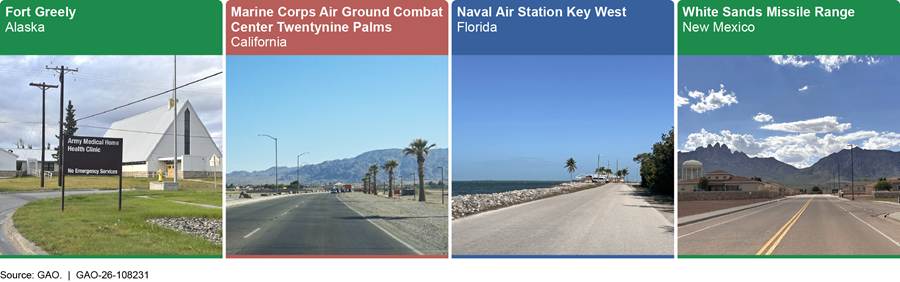
Remote and isolated installations may be in regions with lower overall populations, have fewer options and resources in the local community, and may lack essential critical support services such as comprehensive medical care. Figure 1 shows examples of remote and isolated installations—we visited these locations and others during our review.[5]
Efforts to designate military installations as remote and isolated began in 1989 with Congressional designation of over 200 installations that met the criteria of remote and isolated for MWR purposes.[6] With the publication of DOD Instruction 1015.18, DOD has started a process for designating installations as remote or isolated for reasons beyond MWR.[7] As recently as 2025, the National Defense Authorization Act for Fiscal Year 2026 designated two installations as remote and isolated.[8] Table 1 outlines milestones related to the designation of remote and isolated installations since 1989.
Table 1: Timeline of Activities Related to the Designation of Department of Defense (DOD) Remote and Isolated installations
|
Date |
Activity |
|
April 1989 |
House Armed Services Committee designated 207 remote and isolated installations for Morale, Welfare and Recreation (MWR) programs |
|
November 1989 |
House Armed Services Committee designated six additional installations as remote and isolated for MWR purposes |
|
June 2011 |
DOD designated Fort Hunter Liggett, California, as remote and isolated for MWR purposes |
|
July 2019 |
DOD designated Naval Support Activity Crane, Indiana, as remote and isolated for MWR purposes |
|
October 2020 |
DOD designated Naval Air Weapons Station China Lake, California, as remote and isolated for MWR purposes |
|
July 2021 |
GAO reported on services at remote and isolated installations, recommending that DOD (1) develop policy for designating installations in the United States as remote and isolated and (2) systematically assess the risks associated with not having the needed support services in remote and isolated areas (GAO‑21‑276) |
|
December 2021 |
The National Defense Authorization Act for Fiscal Year 2022 required DOD to develop a uniform policy for how to (1) identify remote and isolated military installations and (2) assess and manage challenges associated with remote and isolated installations and military personnel assigned to these locations |
|
May 2024 |
DOD issued policy (DOD Instruction 1015.18) for the military departments to (1) designate remote and isolated installations and (2) conduct a remote and isolated installation review that includes risk assessments of critical support services |
|
November 2024 |
Original deadline per DOD Instruction 1015.18 for the military departments to designate installations as remote and isolated |
|
March 2025 |
DOD issued a memorandum extending the deadline to March 2026 for designating military installations as remote and isolated |
|
December 2025 |
The National Defense Authorization Act for Fiscal Year 2026 designated Army Garrison Kwajalein Atoll and Creech Air Force Base, Nevada, as remote and isolated |
|
March 2026 |
Extended deadline for the military departments to designate installations as remote and isolated |
|
May 2026 |
The Army and Navy completed their designation of remote and isolated installations by the process set forth in DOD Instruction 1015.18. The Air Force did not complete the designation because it was seeking additional authorities to address challenges beyond the designation process. |
|
Ongoing |
The military departments will (1) update designations of remote and isolated installations and (2) address risks associated with insufficient critical support services every 3 years. Outside the three-year cycle, the military departments will report any significant emergent risks associated with having insufficient critical support services. |
|
Ongoing |
DOD will perform reviews of risk assessments every 2 years. |
Source: GAO analysis of DOD and Congressional documents. | GAO‑26‑108231
Recognizing concerns about DOD’s inconsistent approach to designating installations as remote or isolated and the implications for support services available at such installations, we reported in July 2021 that DOD’s process of designating installations as remote and isolated for the purposes of MWR programs did not consider other support services, such as housing and medical care, that often are more limited in remote and isolated locations.[9] We recommended that DOD (1) develop policy for designating installations in the United States as remote and isolated that includes a process for considering support services for service members and dependents in areas besides MWR and (2) systematically assess the risks associated with not having the needed support services for service members and their dependents stationed in remote or isolated areas and subsequently develop strategies to better meet those needs as appropriate. DOD concurred with our recommendations.
Subsequently, in December 2021, the National Defense Authorization Act for Fiscal Year 2022 required DOD to develop a uniform policy for how to (1) identify remote and isolated military installations and (2) assess and manage challenges associated with remote and isolated installations and military personnel assigned to those locations.[10] In response, DOD issued DOD Instruction 1015.18, Assessing and Managing Challenges Associated with Providing Critical Services at Remote and Isolated Military Installations, which developed policy regarding the designation of remote and isolated installations and risk assessments for these locations.[11] DOD implemented our recommendations by issuing this policy that incorporated factors in addition to the MWR programs, such as access to housing and medical care, for consideration of remote and isolated designations and created a process for assessing risk at these locations.
Defining Critical Support Services
DOD provides critical support services, to include access to health care and the availability of safe and affordable housing, to service members and their dependents regardless of location. These services are an integral part of the military and its benefits package and support individual, family, and mission readiness. However, remote and isolated installations can be more limited in the services they are able to provide. The critical support services included in our review are defined in figure 2.
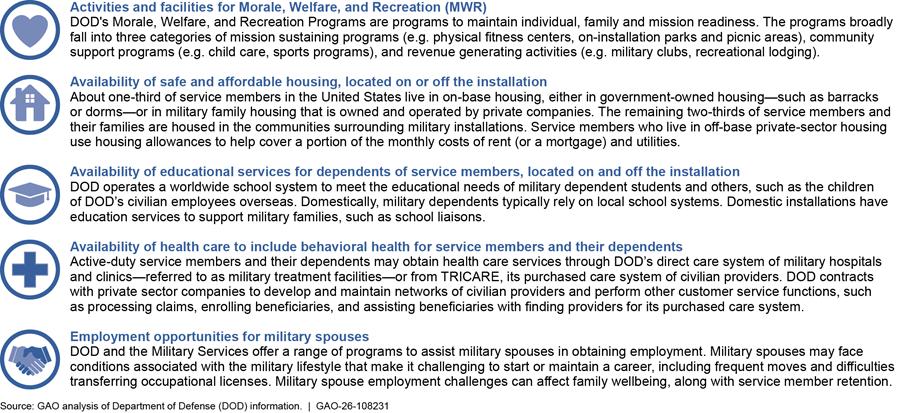
Note: This report focuses on the five critical support services outlined in DOD Instruction 1015.18. It does not encompass the full range of services offered by DOD.
According to the DODIG, ensuring access to essential services, stable living environments, and comprehensive support is critical to the overall wellness of the force. Moreover, our prior work has highlighted challenges in the provision of these services. For example, in 2024, we found DOD does not use its housing assessments to identify a comprehensive list of areas where service members and their families are most severely affected by housing supply or affordability challenges—DOD collects some information but does not routinely assess the negative financial and quality-of-life effects that limited supply or unaffordable housing has on affected service members.[12]
Remote and Isolated Installations Vary in Their Ability to Fill Civilian Support Positions and Face Challenges in Providing Critical Support Services
Vacancy and Time-to-Hire Rates Vary Among Selected Remote and Isolated Military Installations
The total number of vacant positions and time to hire for filling civilian positions in critical support services at the nine remote and isolated installations from which we collected data for fiscal years 2023 through 2025 varied by installation and geographic location.[13] Specifically, we found that Eielson Air Force Base, Alaska, had the most vacant positions—428 vacant positions—while Alaska installations Fort Greely and Clear Space Force Station had no vacant positions for civilians in critical support services positions. Furthermore, we found that, among the total vacancies for all critical support services, the critical support service with the most vacant positions was MWR with 607 vacant positions (of 624 total) across the nine installations in our review. Table 2 shows the number of vacant positions for the installations we visited.
Table 2: Total Number of Vacant Positions at Selected Remote and Isolated Installations from Fiscal Years 2023 Through 2025
|
State |
Installation |
Number of Vacant Positions |
|
Alaska |
Eielson Air Force Base |
428 |
|
Florida |
Naval Air Station Key West |
95 |
|
California |
Marine Corps Air Ground Combat Center |
83 |
|
Alaska |
Fort Wainwright |
7 |
|
New Mexico |
Cannon Air Force Base |
4 |
|
New Mexico |
Holloman Air Force Base |
4 |
|
New Mexico |
White Sands Missile Range |
3 |
|
Alaska |
Clear Space Force Station |
0 |
|
Alaska |
Fort Greely |
0 |
|
Total |
|
624 |
Source: GAO analysis of DOD data. | GAO‑26‑108231
We also found that for the remote and isolated installations we analyzed, it took anywhere from 64 to 407 days to hire civilians into critical support services.[14] Among these installations, we found that Eielson Air Force Base had the highest average time to hire rate (407 days) and Marine Corps Air Ground Combat Center had the lowest average time to hire rate (64 days). Table 3 shows the average time to hire for these remote and isolated installations included in our review. The average time to hire for all but one of these remote and isolated installations exceeded DOD’s average of 98 days.[15]
Table 3: Rate of Selected Remote and Isolated Installation Average Time to Hire from Fiscal Years 2023 Through 2025
|
State |
Installation |
Average Time to Hire |
|
Alaska |
Eielson Air Force Base |
407 days |
|
New Mexico |
White Sands Missile Range |
212 days |
|
New Mexico |
Cannon Air Force Base |
199 days |
|
Alaska |
Fort Wainwright |
194 days |
|
New Mexico |
Holloman Air Force Base |
158 days |
|
Alaska |
Fort Greely |
105 days |
|
Florida |
Naval Air Station Key West |
94 days |
|
California |
Marine Corps Air Ground Combat Center |
64 days |
|
Alaska |
Clear Space Force Station |
—a |
Source: GAO analysis of DOD data. | GAO‑26‑108231
aThe time-to-hire data were sufficiently reliable for reporting the average time to hire for all installations we visited other than Clear Space Force Base. Data provided by Clear Space Force Station were incomplete; thus, we were unable to calculate the vacancy rate for the installation.
According to installation officials that we spoke to, they have difficulty attracting candidates from the local area due to competing industries that pay significantly higher wages and candidates not being interested in working in a remote and isolated location with limited services and amenities, which can impact the ability to hire personnel for critical support services positions. For example, officials at three of the four Alaska installations we visited noted that certain positions like engineers or cooks often took higher paying jobs in competing industries such as in the oil and gold mining industries. In another example, hiring announcements, such as those for child care positions, at Naval Air Station Key West are always open because there is constant need to hire, officials there said.
Officials from the nine remote and isolated installations we visited noted that in the past, they have used various incentives to address identified staffing challenges.[16] For example, officials cited the use of recruitment incentives, to include sign-on bonuses, higher hourly wages, and the ability to earn college credit from a local university, to attract candidates to their installations. Officials also cited the use of relocation incentives to offset moving expenses. For example, officials at Fort Wainwright in Alaska noted they use relocation incentives to attract candidates as the cost to relocate to Alaska is expensive because of the financial burden of purchasing essentials like cold weather clothing and to winterize cars to address extreme cold weather. Some installations, to include Naval Air Station Key West, have also offered up to $2,000 in retention incentives to staff working in child care positions as an incentive for civilian hiring.
However, funds to incentivize civilians to address staffing challenges come from the same account as civilian pay for some installations. Officials noted that the more these incentives are used, the less funds are available to hire. For example, Cannon Air Force Base officials stated that if they need to hire 10 people but also want to use recruitment, retention, and relocation incentives, they may only have enough money to hire six or seven of the 10 positions. In addition, some incentives are limited to a specific category of hire. For example, Naval Air Station Key West officials stated that they have many incentives for hiring civilians who are in the General Schedule pay bands, but there are no incentives for nonappropriated fund positions.[17]
Challenges Identified with Providing Critical Support Services at Remote and Isolated Military Installations
We found common challenges associated with providing critical support services at the selected remote and isolated installations in our sample. However, the underlying causes and severity of those and other challenges varied by location.[18] The following summarizes the challenges we identified at the installations we visited.
|
Executive Branch Decisions in Fiscal Year 2025 Described as Affecting the Civilian Workforce Most installation officials expressed concerns about decisions the executive branch made in fiscal year 2025 that potentially affected civilian workforce staffing and their ability to hire and retain personnel. Specifically: Federal hiring freeze. Installations were not able to hire new personnel due to a federal and DOD hiring freeze instituted in January and February 2025. Deferred resignation program (DRP). This program was intended to encourage workforce reductions and employees transitions out of federal service. DOD-directed staffing reductions. GAO previously found that while not directed to reduce staffing, uncertainty at DOD depots associated with whether DOD’s decision to reduce its civilian workforce as part of a broader effort to reduce spending has affected personnel morale and potentially retention [GAO‑26‑107890]. Source: GAO analysis of DOD information. | GAO‑26‑108231 |
Health care. Every remote and isolated installation we visited identified challenges with the availability and administration of comprehensive health care, to include difficulty recruiting qualified civilian candidates, the shortage of medical services in the local community, and the lack of medical specialties on base. For example, officials at Cannon Air Force Base, New Mexico, stated the pay for health care positions is too low to attract qualified staff, and officials at Holloman Air Force Base, New Mexico, stated that recruiting and retaining civilians is challenging for all positions, but especially for specialty care. They often find a skills mismatch between the applicants willing to accept the position in a remote and isolated location and the skills needed to perform the work. Their behavioral health staffing is also stretched very thin, increasing the risk of burnout and inability to retain civilian staff.
Moreover, officials at Naval Air Station Key West, Florida, stated that for anything beyond basic health care services, patients must be referred to Miami, Florida, which is more than 150 miles away and is more than a 3-hour drive. Officials further noted that due to low staffing, when health clinic personnel are sick or on leave, the services are shut down at the installation. Officials at Fort Greely, Alaska, stated the installation is challenged with providing sufficient primary care and, as a result, they refer patients out to Bassett Army Hospital. This referral results in a one-way commute of over 100 miles and is incredibly challenging in winter conditions, which covers more than 6 months of the year in Alaska.
MWR. Officials at each of the remote and isolated installations we visited stated that staffing shortages, due in part to long hiring times and recent reductions to DOD’s civilian workforce, had a significant effect on MWR operations and led to reduced program offerings, shorter hours of operation, and closure of facilities.[19] For example, Fort Greely officials told us they planned to close the base dining facility for certain meals because they lacked the staff to operate the facility fulltime.[20] Officials also told us that closures or reduced hours create hardships for service members and their dependents who rely on these facilities for food or other supplies.
Officials at each of the installations with a dependent population also cited adequately staffing child care positions as a key challenge. Officials at Holloman Air Force Base, New Mexico; Fort Wainwright, Alaska; Naval Air Station Key West, Florida; and Marine Corps Air Ground Combat Center, California, said staffing shortages were responsible for the closure of or reduced hours for child care or youth services programs. In 2025, the DODIG reported that DOD’s struggle to deliver quality child care was one of its top management and performance challenges for fiscal year 2026. The DODIG report cited that a lack of accessible, safe, and transparent child care creates significant instability for military families.[21]
Availability of Housing. Some of the remote and isolated installations we visited identified challenges with safe and affordable housing. For example, officials at Holloman Air Force Base, New Mexico, noted that there was a lack of off-base housing. Officials stated that no new apartment buildings had been constructed since the 1990s and that they had over 100 families living in on-base housing at another remote installation over an hour away. At Naval Air Station Key West, Florida, officials noted that the cost of off-base housing was the biggest challenge they face in retaining their civilian workforce.
Educational Services. Challenges with the availability of educational services at the remote and isolated installations we visited varied widely. Some installation officials stated that the quality of education was not a concern, while other installations noted the counties they were located in ranked low nationally, had insufficient funds to support their schools, or were unable to offer robust extracurriculars to support pathways for college admissions. For example, at Eielson Air Force Base, Alaska, and Fort Wainwright, Alaska, officials noted that the county’s school budget has remained relatively flat over the past decade, resulting in the closing and consolidation of schools–including the junior and senior high school located on Eielson Air Force Base, forcing students to commute upwards of an hour to reach school. Officials at the Marine Corps Air Ground Combat Center who are also responsible for the Marine Corps Mountain Warfare Training Center, California, said that the only on-base school at the Mountain Warfare Training Center lacks academic rigor and extracurriculars so many military families chose to either live over an hour away in a neighboring state or commute that distance to school.
Spousal employment opportunities. Officials at most of the remote and isolated installations we visited noted challenges with spousal employment opportunities. For example, officials consistently noted that given their remoteness, off-base employment opportunities were limited. Additionally, these officials noted that challenges to hiring spouses on base were exacerbated by DOD’s 2025 hiring freeze. We have previously reported that employment is a top concern for spouses of active-duty military service members, and that military spouses have identified employment challenges such as being underpaid or overqualified for job opportunities and the lack of opportunities for career advancement.[22]
Officials at most of the installations we visited identified policy changes that could positively affect the ability to provide critical support services at remote and isolated installations. Some of these changes included leveraging telework for appropriate civilian positions, more highly prioritizing staffing of military personnel at remote and isolated locations, better utilization of health care screenings prior to assigning service members and their families to a remote and isolated installation, and relief from some of the hiring cuts and freezes given the outsized impact they have on remote and isolated installations.[23]
DOD Lacks a Consistent Definition for Designating Remote and Isolated Installations and Has Not Yet Implemented Its Risk Assessment Process
DOD has outlined a process and issued guidance for designating installations as remote and isolated and assessing risks at these locations. These designations of remote and isolated installations are separate and distinct from the remote and isolated designations under the MWR program. As of May 2026, the Departments of the Army and Navy have compiled a list designating which of their installations are remote and isolated, but the Department of the Air Force, which includes both the Air Force and Space Force, has not. Moreover, DOD’s guidance, DOD Instruction 1015.18, has not established a clear definition for what constitutes remote and isolated installations—and several existing DOD policies and guidance have varied definitions and varied measures of the adequacy of the critical support services. According to DOD officials, once the military departments have designated remote and isolated installations under the new guidance, efforts to fully develop a risk assessment process will begin.
DOD’s Process for Designating Remote and Isolated Installations and Assessing Risk
Designation Process
DOD has issued guidance and outlined a process for designating installations as remote and isolated. This guidance directed the military departments to designate remote and isolated installations using two criteria.[24]
· The first criterion is whether the military installation is more than 1-hour commuting time (one way) or more than 30 miles from a metro or micropolitan area that has critical support services available.[25] However, in a March 2025 memorandum, the Office of the Under Secretary of Defense for Personnel and Readiness granted an exception to the micropolitan distance criterion at the request of the military departments.[26] According to Air Force officials we spoke with, many military installations are located near areas where the number of military personnel and dependents at the installations themselves raise the population above the threshold for a micropolitan area—which would eliminate installations that should be considered as remote and isolated from being designated.
· The second criterion is that one or more critical support services are not available on the installation.[27] According to military service officials we spoke with, they were in the process of developing and using a scorecard to begin to assess each of these critical support services at each of their installations.
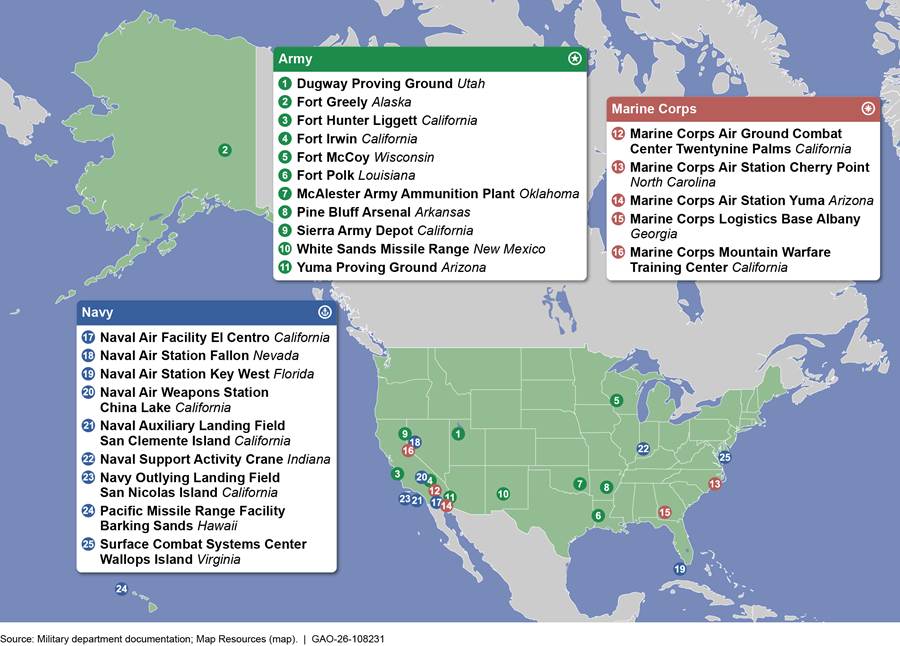
DOD’s guidance directed the miliary departments to complete the designation process of remote and isolated installations by November 30, 2024, but the Office of the Under Secretary of Defense for Personnel and Readiness granted an extension through March 2026. Although delayed, the Departments of the Army and Navy completed their designation process of remote and isolated installations in May 2026 by the process set forth in DOD Instruction 1015.18, as amended by the exception that allows them to designate as remote and isolated an installation located within a one-hour commute of a micropolitan area. These lists differ from the MWR list of remote and isolated installations with some installations being added or removed—based on the criteria in DOD Instruction 1015.18. Military department officials stated this was appropriate because the criteria to be on the remote and isolated list are different from the MWR list. Moreover, according to an official from the Office of the Under Secretary of Defense for Personnel and Readiness, the purposes of each of these lists are unique with the MWR designation of remote and isolated bases being a financial definition and the DOD Instruction 1015.18 designation being driven by availability of the five critical support services and proximity to a metropolitan area.[28] Additionally, both the Departments of the Army and Navy noted that they will continue to examine deficiencies with the critical support services at the installations they designated as remote and isolated. Figure 3 shows the installations designated by the Departments of the Army and Navy as remote and isolated within the United States.[29]
Figure 3: Department of Army and Department of Navy Installations Designated as Remote and Isolated in U.S. States
The Department of the Air Force, which includes both the Air Force and Space Force, has not completed its designation process of remote and isolated installations by the process set forth in DOD Instruction 1015.18. In a May 2026 memorandum to the Office of the Assistant Secretary of Defense for Manpower and Reserve Affairs, the Department of the Air Force stated that the additional designation of remote and isolated installations using the criteria set forth in DOD Instruction 1015.18 is premature. The memorandum stated this is because the DOD guidance does not provide additional authorities such as resources or exceptions to policy—thus the new designations of remote and isolated installations would have limited benefit.[30] It further stated that its analysis of critical service availability found that critical support service shortfalls are systemic throughout the Air Force, not just at remote and isolated installations.[31]
According to an Air Force official, designating installations now would not improve challenges facing remote and isolated installations. This official noted that the designation guidance needs to emphasize solutions to the challenges at remote and isolated installations. An official from the Office of the Under Secretary of Defense for Personnel and Readiness stated that the Air Force has valid concerns regarding compiling a list of remote installations. This official also noted that DOD Instruction 1015.18 does not address resourcing and that the Air Force’s objections will help the Department focus efforts to update the policy. Further, this official stated that Office of the Under Secretary of Defense for Personnel and Readiness’ goal is to issue policy that helps the military departments and not to create additional burdens.
Risk Assessment Process
DOD guidance further directs the military departments to assess and address the risks associated with having insufficient critical support services at remote and isolated installations every 3 years.[32] There is also a requirement for a DOD-wide review of the military departments’ risk assessments every 2 years that is to include metrics to measure success and progress, benchmarks and best practices, factors that cause or create a need for critical services and what to do to mitigate those factors, and usable or available data; these items have not yet been identified.[33] According to an Office of the Under Secretary of Defense for Personnel and Readiness official, the specific metrics will be added at a date to be determined in the future. Moreover, this official stated work on the risk assessment process would start once the military departments completed their designation of remote and isolated installations.
In submitting their list of remote and isolated installations, the Department of the Army stated that it plans to establish a risk assessment process by April 2027 in accordance with the DOD guidance.[34] The Department of the Army also noted that Army Installation Management Command would establish a funding line to help mitigate deficiencies identified in critical support services. In its memorandum, the Department of the Navy stated that it will continue to determine gaps and address deficiencies to critical support services and will partner with the Office of the Assistant Secretary of Defense for Manpower and Reserve Affairs to establish a process to review and assess risk.[35]
During our site visits, we identified some of the types of risks and gaps associated with the insufficiency or unavailability of critical support services at remote and isolated installations. For example, according to officials at Cannon Air Force Base in New Mexico, the unavailability of some health care services at the installation led to the Defense Health Agency spending $28 million for medical care outside of the installation for fiscal years 2024 and 2025. These officials also stated that in fiscal year 2025 alone, Cannon Air Force Base had approximately 12,400 referrals to health care facilities outside the military health system and approximately $587,000 in reimbursable patient travel expenses because these services could not be provided at the installation or in the immediate vicinity.
We also found that the inability to provide health care services at an installation can also affect readiness in the form of lost duty hours, thus affecting the operational mission. Officials at each installation we visited told us that both service members and civilians must routinely take time off work, in many cases at least one full day or more, to travel elsewhere to seek medical care. For example, Cannon Air Force Base officials told us that, based on voucher data, service members lost at least 5,000 duty days in fiscal year 2025 due to medical travel as they traveled approximately 110 to 350 miles each way to receive medical care. Other critical support services, such as child care, may also result in lost duty days, especially for dual-military families (both spouses are in the military) when service members are unable to access the service. Officials at every installation we visited told us that a lack of civilian staffing reduced the child development center’s ability to provide child care.
Another risk we found that affects remote and isolated installations, is recruitment and retention of civilian support personnel and retention of military personnel. Officials at most installations we visited told us recruiting and retaining civilians is more challenging in remote and isolated environments. For example, Naval Air Station Key West officials cited the lack of affordable housing as the primary obstacle for both recruiting and retaining civilian support staff. At Eielson Air Force Base and Clear Space Force Station in Alaska, officials noted that it is challenging to get civilians to relocate to Alaska and that the transition to cold, dark winters was a deterrent to someone accepting a job offer. We also heard from installation officials that the availability of these critical support services can negatively affect service members’ retention. Two locations—Cannon Air Force Base and Naval Air Station Key West— cited lower than service-average retention rates that they attributed in part to challenges with the availability of critical support services.
Definition of Remote and Isolated Installation Is Inconsistent
Despite efforts to designate installations as remote and isolated, we found that there is not a consistent definition of what constitutes a remote and isolated installation. In addition to the criteria established in DOD Instruction 1015.18, other DOD and military service policies provide alternative ways for defining remote and isolated installations. Table 4 outlines examples of various policies and the differences in their definition of remote and isolated installations.
Table 4: Examples of Department of Defense (DOD) Policies and Programs with Remote and Isolated Installation Definitions
|
Policy or Program Owner |
Guidance |
Definition of Remote and Isolated Installations |
|
DOD |
DOD Instruction 1015.10, Military Morale, Welfare, and Recreation (MWR) Programs (July 6, 2009) (incorporating change 1, May 6, 2011). |
Defines remote and isolated military installations through their ability to financially support revenue-generating programs which is the major factor in evaluating installations for remote and isolated status. |
|
|
DOD Instruction 1015.18, Assessing and Managing Challenges Associated with Providing Critical Services at Remote and Isolated Military Installations (May 30, 2024). |
Defines remote and isolated military installations by a combination of (a) being more than 1-hour commuting time one way or more than 30 miles from a metropolitan area with critical services available and |
|
|
|
(b) one or more critical support services are not available on the installations with the critical services including, but not limited to, (1) activities and facilities for morale, welfare, and recreation, (2) availability of safe and affordable housing, located on or off the installation, (3) availability of educational services for dependents of service members, located on and off the installation, (4) availability of health care to include behavioral health for service members and their dependents, and (5) employment opportunities for military spouses. |
|
|
32 C.F.R. § 199.16(e), TRICARE Prime Remote for Active Duty Members.a |
Defines remote locations in the United States by both home and work addresses being more than 50 miles or a 1-hour drive from an adequate military hospital or clinic. |
|
Department of Navy |
Military Personnel Manual 1300-302, Suitability for Overseas/Remote Duty Assignment and Suitability Reporting (Mar. 20, 2024).b |
Defines remote contiguous U.S. locations based on accessibility of health care services, such as limited dental capabilities, to be determined by the Bureau of Medicine and Surgery and Navy Personnel Distribution Management. |
|
|
Office of the Chief of Naval Operations Instruction 1754.2F, Exceptional Family Member Program (Nov. 15, 2017).c |
Defines remote and isolated classification (2-hour drive under most conditions to access specialty care). |
|
Department of Army |
The Army Transition Assistance Program Virtual Center is an interactive, virtual platform that provides transition services, such as counseling and training, to service members at small and remote installations. |
Defines isolated installations as those more than 50 miles from any military installations providing Transition Assistance classes. |
Source: GAO analysis of DOD Guidance and Programs. | GAO‑26‑108231
aTRICARE Prime Remote is an option within DOD’s TRICARE health care program that is available for service members who live in an area designated as remote.
bThis manual requires an overseas screening for all service members and dependents transferring to overseas or remote duty assignments, whether the transfer is from (a) a contiguous U.S. assignment to a contiguous U.S. remote duty assignment, (b) a contiguous U.S. assignment to an overseas or outside the contiguous U.S. assignment, (c) overseas or outside the contiguous U.S. assignment to contiguous U.S. remote duty, or (d) from overseas or outside the contiguous U.S. assignment remote duty (sea or shore) to overseas or outside the contiguous U.S. assignment remote duty (sea or shore).
cFamilies in the Exceptional Family Member Program must undergo suitability screenings before being sent to remote or overseas duty assignments. The policy identifies the same eight domestic naval installations as remote as Military Personnel Manual 1300-302, but the Military Personnel Manual 1300-302 includes an additional installation that the Office of the Chief of Naval Operations Instruction 1754.2F does not.
There are also other policies that refer to remote and isolated installations but do not address what the definition of remote and isolated installations is. For example, the Armed Forces Entertainment Program gives priority for providing entertainment to remote and isolated locations overseas.[36] The Joint Travel Regulations allow service members moving to remote areas in the contiguous United States to place household goods in non-temporary storage and allow civilian employees moving to remote and isolated locations to exceed normal move allowance limitations if the only means to travel to the location is by boat, aircraft, or unusual mode of transportation and the distance, time, and commuting conditions result in expense, inconvenience, or hardship significantly greater than that encountered in a metropolitan area.[37] Yet neither of these policies include the basis for what remote and isolated locations entail.
Further, the definition in DOD Instruction 1015.18 has the potential to make accurately identifying remote and isolated installations a challenge. The definition outlined in this guidance is based on subjective measures, such as assessments of availability of each critical support service and does not limit consideration to just the five critical support services listed in the guidance. As a result, the military services interpreted the criteria differently when identifying installations to designate as remote and isolated.[38] For example,
· Department of Army officials noted that the definition of the availability of critical support services was left up to each of the military departments to define as they each assessed their installations. These officials noted that the Army included child care as its own separate criteria when assessing critical support services and that the other military departments did not.
· Department of Navy officials told us that there was no standard way to measure the availability of the five critical support services. Navy and Marine Corps installation officials we met with also echoed this point. Department of Navy officials told us their focus when selecting installations to designate as remote and isolated was on installations with multiple severe critical service deficits—something the DOD instruction does not address.
· An Air Force official stated that each military service could weigh the importance of each criteria differently, resulting in an inconsistent identification process across the military departments. This official told us it was unclear what criteria each military department used to develop their respective lists and how an installation’s mission might play a role in developing these lists.
While there may be reasons for variability amongst policies and programs, we found that the lack of a consistent definition for remote and isolated installations leads to inconsistent application of policies. For example, Naval Air Station Whidbey Island is located near Seattle, Washington, but is more than 3 hours away from specialty services at the nearest military hospital that, according to officials, assigned service members are required to use.[39] However, this location is not considered remote and isolated by any Navy policy, yet Office of the Chief of Naval Operations Instruction 1754.2F, Exceptional Family Member Program, defines remote and isolated as a 2-hour drive under most conditions to access specialty care.[40] According to DOD officials, this location is out of compliance with the criteria outlined in the aforementioned Navy guidance. Separately, a Navy official told us the Navy did not include Whidbey Island Naval Air Station on its list of designated remote and isolated installations because, while the installation had a critical service that was not available, as noted above, the Navy focused on installations with multiple critical service deficits.
Emphasizing the need for a common approach, the National Defense Authorization Act for Fiscal Year 2022 required DOD to develop a uniform policy for how to identify remote and isolated military installations and to assess and manage challenges associated with remote and isolated installations and military personnel assigned to these installations.[41] In addition, Standards for Internal Control in the Federal Government state that management should communicate quality information throughout the organization to achieve its objectives. It states that management should define objectives clearly to enable the identification of risks. Specifically, terms should be fully and clearly set forth so they can be easily understood at all levels of the entity, including clearly defining what is to be achieved.[42]
The military departments’ efforts to designate installations as remote and isolated are inconsistent because DOD’s guidance, which the Under Secretary of Defense for Personnel and Readiness is responsible for, does not clearly define remote and isolated installations. Specifically, the guidance does not define how to measure the adequacy of critical support services when designating remote and isolated installations. This not only affects the designation process outlined in DOD Instruction 1015.18 but could also negatively affect other DOD programs and guidance, which may define remote and isolated installations differently. While there may be reasons for variability amongst policies, the inconsistencies can result in different interpretations among the military departments regarding what is considered remote and isolated and will produce an inaccurate picture of what constitutes a remote and isolated installation across the DOD enterprise. Officials from the Office of the Under Secretary of Defense for Personnel and Readiness expressed concern with developing a single definition that is too complex and would potentially not fit all unique circumstances. We recognize the need for flexibility in how policy is applied to remote and isolated installations. However, without a clear definition, DOD cannot develop an accurate list of remote and isolated installations and may struggle to address challenges at these installations it identifies through its future risk assessment process.
DOD Has Not Taken Steps to Assess Lessons Learned from Recent Civilian Workforce Reductions on Remote and Isolated Installations
Starting in early 2025, DOD rapidly implemented several efforts intended to reduce the size of its civilian workforce as part of the government-wide efforts to cut costs—including a civilian hiring freeze and a voluntary resignation program.[43] As a result of those and other factors, DOD’s federal civilian workforce decreased from over 793,000 in January 2025 to 714,780 in January 2026. According to DOD officials, these reductions, in addition to the existing challenges of hiring and retaining staff in a remote and isolated setting, had significant effects on the ability to staff or hire civilian positions in critical support services at remote and isolated installations. In our review, we identified challenges to the provision of critical support services based on civilian workforce reductions at the remote and isolated installations we visited.[44]
Hiring Freeze. According to DOD officials, when DOD announced the hiring freeze, there was confusion at the installation level as the initial memorandum did not grant blanket exemptions from the hiring freeze for categories of positions.[45] DOD later issued memorandums stating that hiring freeze exemptions would be considered and provided a list of categories of exempt positions, including positions for employees paid from nonappropriated funds (e.g., Child and Youth program staff, instructors at child care centers).[46] However, this confusion initially delayed hiring for nonappropriated funded positions at select installations until DOD issued guidance on hiring freeze exemptions—including nonappropriated funded positions.[47]
Officials also noted that the hiring freeze affected staffing for critical support services positions. As examples, Cannon Air Force Base officials said that the installation closed its youth center as a means to manage staffing shortfalls when DOD announced the hiring freeze. Officials further noted that the hiring freeze occurred as military spouses were rotating with their service members to a new installation and that incoming spouses could not be hired initially for civilian positions on the installation. At Holloman Air Force Base, the initial confusion about the hiring freeze made it difficult for its MWR program to hire lifeguards, officials said, since those positions were General Schedule positions that are part of the DOD civilian hiring freeze. Naval Air Station Key West officials stated that the hiring freeze has been the main cause of staff shortages for housing positions, including a barracks manager position that had been on hold for more than 11 months, since the start of the hiring freeze.
Deferred Resignation Program (DRP). DOD officials from most of the remote and isolated installations that we interviewed stated that they had staff who participated in the DRP, including from at least one or more of the critical support services.[48] For example, officials from Eielson Air Force Base stated that their housing office lost half of its staff from the DRP and now only have one position filled, which is responsible for housing inspections—a statutorily mandated activity. In addition, health care officials at Marine Corps Air Ground Combat Center told us they lost critical billets in logistics and nursing due to the DRP. Officials further stated that because some of the military personnel in the hospital deploy, they are reliant on civilians to backfill military personnel to support these deployments and still be able to provide services to their patients.
Despite the challenges in filling critical support service positions at remote and isolated installations prior to these reductions, some installation officials noted that in some cases, the military services eliminated open positions during the workforce reduction efforts. For example, officials from Naval Air Station Key West stated that the Navy opted to remove a billet that was vacant due to the hiring freeze. Similarly, Cannon Air Force Base officials stated that the Air Force eliminated vacant positions from personnel documents. In addition, officials from Eielson Air Force Base stated that Pacific Air Forces leadership issued an internal policy pausing new hiring with the exception of internal movement within the major command as long as it did not add to the command’s total number of personnel. These changes further exacerbated the challenges in filling these key positions.
According to key practices that we and others have identified for both program and project management, it is important to identify and apply lessons learned from programs, projects, and missions to limit the chance of recurrence of previous failures or difficulties. Key practices of a lessons learned process include collecting, analyzing, saving or archiving, and sharing and disseminating information and knowledge gained on positive and negative experiences.[49]
Remote and isolated military installations are often located far from key support services, making the need for civilian workforce support in the critical services available on the installation vital for military personnel and their dependents. DOD implemented multiple novel workforce reductions in rapid succession with limited time to identify, assess, and incorporate lessons learned from these workforce reduction efforts unique to how they affected remote and isolated installations. However, DOD has not conducted a formal assessment of lessons learned regarding civilian workforce reductions across the enterprise and thus no formal assessment for remote and isolated installations either. Consequently, DOD does not know the full impact of civilian workforce reductions on remote and isolated installations because it does not have a plan for collecting and sharing lessons learned from the implementation of these 2025 reduction efforts.
In May 2026, we reported that DOD does not have a plan to conduct a formal assessment of lessons learned from civilian workforce reductions.[50] In this report, we noted the importance of identifying and applying lessons learned to minimize the chance of recurrence of previous difficulties.[51] As such, we recommended, and DOD concurred, that the department develop and implement a plan for collecting and sharing lessons learned from the department’s implementation of workforce reduction efforts in 2025 to help inform any future workforce reduction efforts. Moreover, in November 2025, the DODIG reported that a smaller DOD civilian workforce reduced by resignations, hiring freezes, and early retirements creates risks to the capability to conduct critical support services and achieve strategic goals across the military services.[52] The report added that monitoring the results of DOD workforce reduction and restructuring efforts is essential to ensure that critical missions are not placed at risk.
As DOD takes steps to address our May 2026 recommendation, a specific focus on the impact of civilian workforce reductions on remote and isolated installations would assist DOD in understanding the effect of such reductions at these locations. A full understanding of these lessons learned unique to remote and isolated installations could also assist DOD in choosing between available strategies for future reductions and how they may want to apply future workforce reduction efforts differently at remote and isolated locations. Without collecting and sharing such information, DOD may miss opportunities to gain valuable knowledge based on the remote and isolated installation workforce reductions that may inform strategic human capital, be applied to any future workforce reduction efforts, and mitigate potential challenges.
Conclusions
Remote and isolated installations are unique, even among themselves. These installations are often away from population centers or located in austere environments, making the delivery of critical support services challenging. Remote and isolated installations also make the recruitment and retention of civilian support personnel difficult. As DOD looks to identify and solve these challenges, it should take steps to better ensure that it is consistently identifying those installations that are remote and isolated and consistently defining terms used to measure remote and isolated—such as ways to measure the adequacy of critical support services. A consistent definition of remote and isolated installations will improve DOD’s ability to make enterprise-wide decisions related to the designation of remote and isolated installations, assess risks, and better direct resources and policy changes to address gaps in critical support services.
Moreover, in May 2026, we recommended that DOD collect and share lessons learned from the department’s implementation of workforce reduction efforts in 2025 to help inform any future workforce reduction efforts. DOD concurred with this recommendation. As part of implementing that recommendation, DOD would benefit from specifically including lessons learned about the impact of workforce reductions on the civilian workforce at remote and isolated installations. Including lessons learned about the civilian workforce cuts specific to remote and isolated installations in DOD’s broader review will provide decision-makers with better information to inform future resource decisions for these installations.
Recommendations for Executive Actions
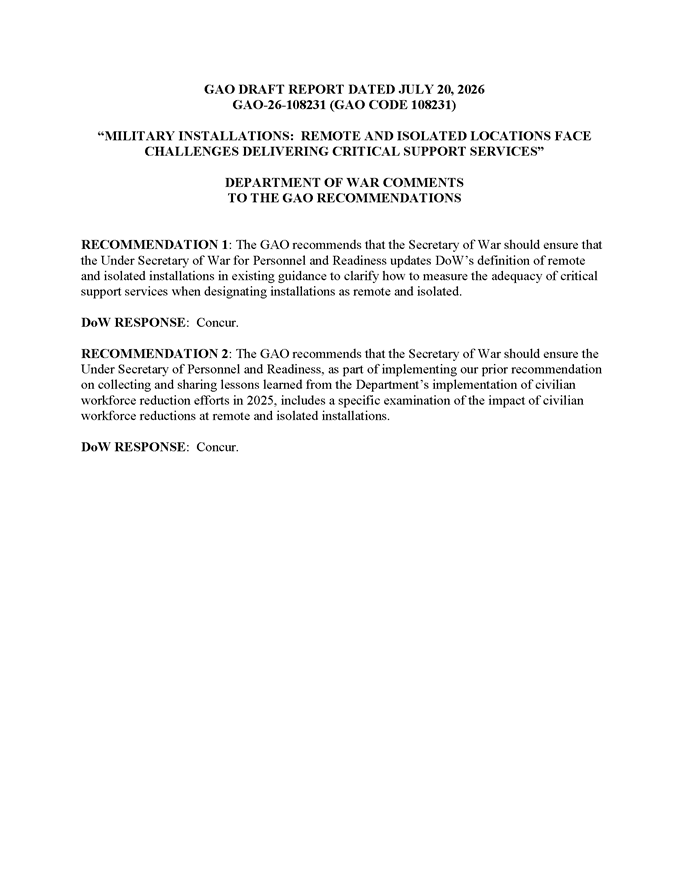
The Secretary of Defense should ensure that the Under Secretary of Defense for Personnel and Readiness updates DOD’s definition of remote and isolated installations in existing guidance to clarify how to measure the adequacy of critical support services when designating installations as remote and isolated. (Recommendation 1)
The Secretary of Defense should ensure the Under Secretary of Defense for Personnel and Readiness, as part of implementing our prior recommendation on collecting and sharing lessons learned from the department’s implementation of civilian workforce reduction efforts in 2025, includes a specific examination of the impact of civilian workforce reductions at remote and isolated installations. (Recommendation 2)
Agency comments
We provided a draft of this report to DOD for review and comment. In its written comments, reproduced in appendix II, DOD concurred with both recommendations. DOD also provided technical comments, which we incorporated as appropriate.
We are sending copies of this report to the appropriate congressional committees, the Secretary of Defense, and the Under Secretary of Defense for Personnel and Readiness. In addition, the report is available at no charge on the GAO website at https://www.gao.gov.
If you or your staff have any questions about this report, please contact me at WilliamsK@gao.gov. Contact points for our Offices of Congressional Relations and Media Relations may be found on the last page of this report. GAO staff who made key contributions to this report are listed in appendix III.

Kristy E. Williams
Director
Defense Capabilities and Management
List of Committees
The Honorable Roger Wicker
Chairman
The Honorable Jack Reed
Ranking Member
Committee on Armed Services
United States Senate
The Honorable Mitch McConnell
Chair
The Honorable Chris Coons
Ranking Member
Subcommittee on Defense
Committee on Appropriations
United States Senate
The Honorable Mike Rogers
Chairman
The Honorable Adam Smith
Ranking Member
Committee on Armed Services
House of Representatives
The Honorable Ken Calvert
Chairman
The Honorable Betty McCollum
Ranking Member
Subcommittee on Defense
Committee on Appropriations
House of Representatives
The Joint Explanatory Statement accompanying the James M. Inhofe National Defense Authorization Act for Fiscal Year 2023 included a provision for us to review civilian positions supporting the critical services at remote and isolated military installations.[53] This review: (1) describes civilian personnel in critical support services at remote and isolated installations and challenges providing critical support services at these locations; (2) assesses the extent to which the Department of Defense (DOD) has designated installations as remote and isolated and assessed risks at these locations; and (3) assesses the extent to which DOD has developed lessons learned from civilian workforce reductions on critical support service positions at remote and isolated installations.
For objective one, to determine number of vacancies and time to hire for civilian support positions at selected remote and isolated military installations, we collected civilian personnel data from a non-generalizable sample of nine installations we visited—described below—for fiscal years 2023 through 2025 on the number of vacant positions and time to hire for the five critical support services. We assessed the accuracy and completeness of these data by reviewing the data for missing and out of range values and reviewing knowledgeable officials’ answers to our questions about the data. In instances where DOD did not calculate the time to hire, but provided start and end dates, we calculated those values. In general, we found the data to be sufficiently reliable for the purpose of reporting the number of vacant positions and time to hire for critical support services for all installations we visited that had a critical support service with the exception of Clear Space Force Station, which was incomplete and did not include announcement data. Therefore, we did not report vacancy numbers for Clear Space Force Station.
To determine challenges with providing critical support services at remote and isolated military installations, we interviewed officials about the challenges faced at such locations, policy changes that would help address those challenges, and any steps DOD was taking to address those challenges.
For objective two, to assess DOD’s effort to designate installations as remote and isolated, we reviewed DOD policy on the designation of remote and isolated installations and DOD and military department policies relevant to remote and isolated installations to compare definitions of remote and isolated installations.[54] We examined existing lists of remote and isolated installations, produced by the House Armed Services Committee, DOD, or the military services, such as the list of existing remote and isolated installations in relation to DOD’s morale, welfare, and recreation (MWR) program. We also interviewed officials from the Office of the Under Secretary of Defense for Personnel and Readiness and the military services about their efforts to identify installations as remote and isolated and the varied definitions of these locations. To assess DOD’s efforts related to risk assessments for remote and isolated installations, we reviewed relevant Office of the Under Secretary of Defense for Personnel and Readiness policies and interviewed DOD and military department officials on the steps taken for the risk assessments. We considered selected principles from Standards for internal Control in the Federal Government.[55] We found that certain key principles of internal controls—such as those related to defining objectives and risk tolerances as well as communicating quality information—were relevant and could assist DOD as it develops its list of remote and isolated installations.
For objective three, to determine the extent to which DOD assessed the impact of civilian workforce reductions on critical support service positions at remote and isolated installations, we interviewed installation officials about the impact of DOD’s 2025 hiring freeze, cuts, and deferred resignation program on the installation’s ability to provide critical support services. We also discussed the effects of DOD’s 2025 civilian workforce reductions and the hiring freeze on their installation’s ability to provide critical support services. We reviewed DOD’s policies on reduction efforts outside the normal programming process, such as DOD’s DRP and hiring freeze initiatives.
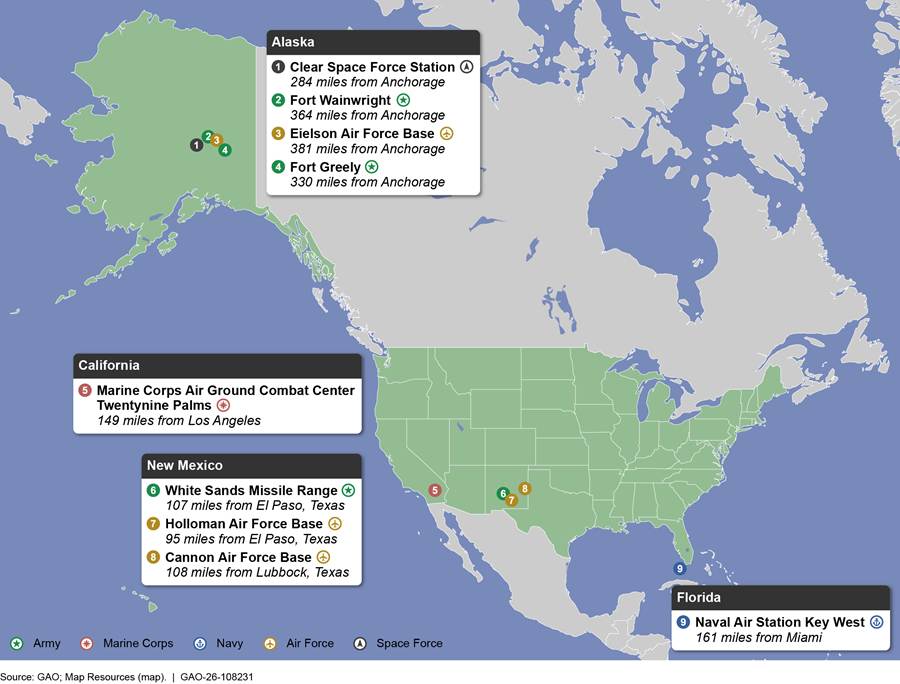
For each objective, to obtain installation-level perspectives on the provision of critical support services at military installations, we reviewed the MWR list of remote installations, examined our prior work on remote installations, and interviewed knowledgeable military service officials to identify a non-generalizable sample of nine installations located in the 50 U.S. states across the five military services that were potential installations to be designated as remote and isolated installations. We also conducted virtual interviews with an additional two installations. To identify the installations in our scope, we reviewed prior GAO work related to this topic; DOD Instruction 1015.10, Military Morale, Welfare, and Recreation (MWR) Programs, which lays out criteria for the MWR program in identifying remote locations, lists of the installations that DOD identified using the criteria; and DOD Instruction 1015.18; Assessing and Managing Challenges Associated with Providing Critical Services at Remote and Isolated Military Installations, which lays out criteria for the military departments in designating remote and isolated installations. We identified at least one installation for a site visit to the Army, Navy, Marine Corps, Air Force, and Space Force. We excluded U.S. territories and installations located outside of the 50 U.S. states. These installations were geographically dispersed across the United States—see figure 4.
To address all objectives, we contacted offices and components from across DOD, to include the following:
· Under Secretary of Defense for Personnel and Readiness, Military Community and Family Policy
· Department of Defense Education Activity
· United States Space Force
· Department of the Air Force
· United States Air Force, Manpower, Personnel, and Services Directorate
· United States Army Installation Management Command — Pacific
· Assistant Secretary of the Army for Manpower and Reserve Affairs
· Assistant Secretary of the Army for Installations, Energy, and Environment
· United States Marine Corps
· Department of the Navy, Office of Civilian Human Resources
· United States Navy
· Clear Space Force Station, Alaska
· Eielson Air Force Base, Alaska
· Fort Greely, Alaska
· Fort Wainwright, Alaska
· Cannon Air Force Base, New Mexico
· Holloman Air Force Base, New Mexico
· White Sands Missile Range, New Mexico
· Vandenberg Space Force Base, California
· Naval Air Station Key West, Florida
· Marine Corps Air Ground Combat Center and Marine Air Ground Task Force Training Command, California
· Marine Corps Mountain Warfare Training Center
We conducted this performance audit from March 2025 to September 2026 in accordance with generally accepted government auditing standards. Those standards require that we plan and perform the audit to obtain sufficient, appropriate evidence to provide a reasonable basis for our findings and conclusions based on our audit objectives. We believe that the evidence obtained provides a reasonable basis for our findings and conclusions based on our audit objectives.
GAO Contact
Kristy E. Williams, WilliamsK@gao.gov
Staff Acknowledgments
In addition to the contact named above, Vincent Balloon (Assistant Director), James Krustapentus (Analyst in Charge), Samuel Amrhein, Namita Bhatia Sabharwal, Jerome Brown, Stephen Brown, Vincent Buquicchio, Kyra Chan, Christopher Gezon, Tara Porter, Clarice Ransom, Michael Silver made key contributions to this report.
Defense Health Care: Actions Needed to Assess Civilian Partnerships’ Contributions to Readiness, GAO‑26‑107677 (Washington, D.C.: June 4, 2026).
Military Health Care: Families Face Challenges Accessing Care for Special Needs, Defense Has Not Reviewed Coverage, GAO‑26‑108086 (Washington, D.C.: June 1, 2026).
Civilian Workforce: DOD Should Assess Lessons Learned to Better Understand Reduction Impacts, GAO‑26‑108100 (Washington, D.C.: May 29, 2026).
Air Force Readiness: Actions Needed to Address Depot Maintenance Delays and Staffing Challenges, GAO‑26‑107890 (Washington, D.C.: May 14, 2026).
Military Personnel: DOD Should Improve Processes for Determining Cost-of-Living Allowances, GAO‑26‑107490 (Washington, D.C.: April 30, 2026).
Civilian Workforce: DOD Is Implementing Actions to Address Challenges with Accessing Health Care in Japan and Guam, GAO‑25‑107453 (Washington, D.C.: April 5, 2025).
Federal Agency Workforce Changes: Update for January to June 2025, GAO‑26‑108719 (Washington, D.C.: February 24, 2026).
Defense Workforce: Efforts to Address Challenges in Recruiting and Retaining Federal Wage System Employees, GAO‑25‑107152 (Washington, D.C.: September 3, 2025).
Defense Health Care: Information Needed to Improve Monitoring of Military Personnel Staffing at Medical Facilities, GAO‑25‑106988 (Washington, D.C.: July 21, 2025).
K-12 Education: DOD Needs to Assess Its Capacity to Provide Mental Health Services to Students, GAO‑25‑107247 (Washington, D.C.: May 14, 2025).
Federal Civilian Firefighters: DOD Should Take Action to Address Long-Standing Staffing Gaps, GAO‑25‑107288 (Washington, D.C.: April 30, 2025).
Defense Health Care: DOD Should Monitor Mental Health Screenings for Prenatal and Postpartum TRICARE Beneficiaries, GAO‑25‑107163 (Washington, D.C.: April 22, 2025).
Special Education: Improved Allocation of Resources Could Help DOD Education Activity Better Meet Students’ Needs, GAO‑25‑107053 (Washington, D.C.: April 17, 2025).
Defense Health Care: Actions Needed to Address Long-Standing Management Challenges with Medical Facilities, GAO‑25‑107432 (Washington, D.C.: April 10, 2025).
Military Housing: DOD Should Address Critical Supply and Affordability Challenges for Service Members, GAO‑25‑106208 (Washington, D.C.: October 30, 2024).
Federal Workforce: Actions Needed to Improve Recruitment and Retention in Alaska, Hawaii, and US Territories, GAO‑25‑106527 (Washington, D.C.: October 15, 2024).
Military Child Care: Services Should Assess Their Employee Retention Efforts, GAO‑24‑106524 (Washington, D.C.: May 14, 2024).
Military Spouse Employment: Part-Time Workforce Characteristics and Perspectives [Reissued with revisions on May 9, 2024], GAO‑24‑106263 (Washington, D.C.: Feb. 8, 2024).
Defense Health Care: DOD Should Monitor Urgent Referrals to Civilian Behavioral Health Providers to Ensure Timely Care, GAO‑24‑106267 (Washington, D.C.: February 6, 2024).
Military Housing: Strengthened Oversight Needed to Make and Sustain Improvements to Living Conditions, GAO‑23‑107038 (Washington, D.C.: September 27, 2023).
Military Barracks: Poor Living Conditions Undermine Quality of Life and Readiness, GAO‑23‑105797 (Washington, D.C.: September 19, 2023).
Defense Health Care: DOD Should Reevaluate Market Structure for Military Medical Treatment Facility Management, GAO‑23‑105441 (Washington, D.C.: August 21, 2023).
Defense Workforce: Opportunities for more Effective Management and Efficiencies, GAO‑23‑106966 (Washington, D.C.: July 26, 2023).
Defense Health Care: Additional Assessments Needed to Determine Effects of Active Duty Medical Personnel Reductions. GAO‑23‑106094. Washington, D.C.: July 11, 2023.
Defense Health Care: Improved Monitoring Could Help Ensure Completion of Mandated Reforms, GAO‑23‑105710 (Washington, D.C.: June 22, 2023).
Military Child Care: DOD Efforts to Provide Affordable, Quality Care for Families, GAO‑23‑105518 (Washington, D.C.: February 2, 2023).
Military Health Care: Improved Procedures and Monitoring Needed to Ensure Provider Qualifications and Competence, GAO‑22‑104668 (Washington, D.C.: Aug. 11, 2022).
Defense Health Care: Actions Needed to Improve Billing and Collection of Debt for Civilian Emergency Care, GAO‑22‑104770 (Washington, D.C.: July 7, 2022).
Military Personnel: Opportunities Exist to Improve Access to Services Supporting Caregivers of Dependents with Special Needs, GAO‑22‑105204 (Washington, D.C.: June 29, 2022).
Suicide Prevention: DOD Should Enhance Oversight, Staffing, Guidance, and Training Affecting Certain Remote Installations, GAO‑22‑105108 (Washington, D.C.: April 28, 2022).
Privatized Military Housing: Update on DOD’s Efforts to Address Oversight Challenges, GAO‑22‑105866 (Washington, D.C.: March 31, 2022).
Military Child Care: Potential Costs and Impacts of Expanding Off-Base Child Care Assistance for Children of Deceased Servicemembers, GAO‑22‑105186 (Washington, D.C.: December 14, 2021).
Military Installations: DOD Should Consider Various Support Services when Designating Sites as Remote or Isolated, GAO‑21‑276 (Washington, D.C.: July 29, 2021).
Military Personnel: DOD’s Transition Assistance Program at Small or Remote Installations, GAO‑21‑104608 (Washington, D.C.: July 21, 2021).
Defense Health Care: Actions Needed to Define and Sustain Wartime Medical Skills for Enlisted Personnel, GAO‑21‑337 (Washington, D.C.: June 17, 2021).
Military Housing Privatization: DOD Should Improve Oversight of Property Insurance and Natural Disaster Recovery, GAO‑21‑418 (Washington, D.C.: May 20, 2021).
K-12 Education: US Military Families Generally Have the Same Schooling Options as Other Families and Consider Multiple Factors When Selecting Schools, GAO‑21‑80 (Washington, D.C.: February 4, 2021).
Military Spouse Employment: DOD Should Continue Assessing State Licensing Practices and Increase Awareness of Resources, GAO‑21‑193 (Washington, D.C.: January 27, 2021).
Defense Health Care: Additional Information and Monitoring Needed to Better Position DOD for Restructuring Medical Treatment Facilities, GAO‑20‑371 (Washington, D.C.: May 29, 2020).
Military Housing: DOD Needs to Strengthen Oversight and Clarify Its Role in the Management of Privatized Housing, GAO‑20‑281 (Washington, D.C.: March 26, 2020).
Child Welfare: Increased Guidance and Collaboration Needed to Improve DOD’s Tracking and Response to Child Abuse, GAO‑20‑110 (Washington, D.C.: February 12, 2020).
Military Personnel: DOD Has Made Limited Progress toward Improving Oversight of the Exceptional Family Member Program, GAO‑20‑400T (Washington, D.C.: February 5, 2020).
Defense Health Care: DOD Should Collect and Use Key Information to Make Decisions about Incentives for Physicians and Dentists, GAO‑20‑165 (Washington, D.C.: January 15, 2020).
Defense Health Care: Actions Needed to Determine the Required Size and Readiness of Operational Medical and Dental Forces, GAO‑19‑206 (Washington, D.C.: February 21, 2019).
DOD Health Care: Improvements Needed or Tracking Coordination of Specialty Care Referrals for TRICARE Prime Beneficiaries, GAO‑19‑488 (Washington, D.C.: June 12, 2019).
Defense Health Care: Additional Assessments Needed to Better Ensure an Efficient Total Workforce, GAO‑19‑102 (Washington, D.C.: November 27, 2018).
Defense Health Care: DOD Should Demonstrate How Its Plan to Transfer the Administration of Military Treatment Facilities Will Improve Efficiency, GAO‑19‑53 (Washington, D.C.: October 30, 2018).
Military Personnel: DOD Needs to Improve Funding Process for Morale, Welfare, and Recreation Programs, GAO‑18‑424 (Washington, D.C.: August 8, 2018).
Military Personnel: DOD Should Improve Its Oversight of the Exceptional Family Member Program, GAO‑18‑348 (Washington, D.C.: May 18, 2018).
The Government Accountability Office, the audit, evaluation, and investigative arm of Congress, exists to support Congress in meeting its constitutional responsibilities and to help improve the performance and accountability of the federal government for the American people. GAO examines the use of public funds; evaluates federal programs and policies; and provides analyses, recommendations, and other assistance to help Congress make informed oversight, policy, and funding decisions. GAO’s commitment to good government is reflected in its core values of accountability, integrity, and reliability.
Obtaining Copies of GAO Reports and Testimony
The fastest and easiest way to obtain copies of GAO documents at no cost is through our website. Each weekday afternoon, GAO posts on its website newly released reports, testimony, and correspondence. You can also subscribe to GAO’s email updates to receive notification of newly posted products.
Order by Phone
The price of each GAO publication reflects GAO’s actual cost of production and distribution and depends on the number of pages in the publication and whether the publication is printed in color or black and white. Pricing and ordering information is posted on GAO’s website, https://www.gao.gov/ordering.htm.
Place orders by calling (202) 512-6000, toll free (866) 801-7077,
or
TDD (202) 512-2537.
Orders may be paid for using American Express, Discover Card, MasterCard, Visa, check, or money order. Call for additional information.
Connect with GAO
Connect with GAO on X,
LinkedIn, Instagram, and YouTube.
Subscribe to our Email Updates. Listen to our Podcasts.
Visit GAO on the web at https://www.gao.gov.
To Report Fraud, Waste, and Abuse in Federal Programs
Contact FraudNet:
Website: https://www.gao.gov/about/what-gao-does/fraudnet
Automated answering system: (800) 424-5454
Media Relations
Sarah Kaczmarek, Managing Director, Media@gao.gov
Congressional Relations
David A. Powner, Acting Managing Director, CongRel@gao.gov
General Inquiries
[1]MWR programs promote active living and improve the quality of life of service members, their families and other eligible patrons, including former and surviving spouses. MWR operates nearly 5,000 programs including fitness, aquatics, and recreation centers. For more on MWR programs, see DOD Instruction 1015.10, Military Morale, Welfare, and Recreation (MWR) Programs (July 6, 2009) (incorporating change 1, May 6, 2011).
[2]We will use the term remote and isolated throughout this report. Various legislation and DOD guidance uses the terms “remote and isolated,” “remote or isolated,” or just “remote” interchangeably.
[3]Department of Defense Inspector General, Fiscal Year 2026 Top DOD Management and Performance Challenges (Nov. 25, 2025). For the purposes of this report, civilian support personnel are nonuniformed employees of DOD who work in one of the five critical support services—MWR; housing; education services; health care; and spousal employment services.
[4]168 Cong. Rec. H9639 (daily ed. Dec. 8, 2022).
[5]See appendix I for a full list of the locations we visited during our review.
[6]U.S. House of Representatives, Committee on Armed Services letter to the Acting Assistant Secretary of Defense (Force Management and Personnel) (April 11, 1989). According to a memorandum from the Office of the Assistant Secretary of Defense for Force Management and Personnel, these installations would retroactively be considered remote and isolated for MWR purposes as of October 1, 1988.
[7]DOD Instruction 1015.18, Assessing and Managing Challenges Associated with Providing Critical Services at Remote and Isolated Military Installations (May 30, 2024).
[8]Pub. L. No. 119-60, §§ 665 and 2886 (enacted Dec. 18, 2025). Section 665 directed the Department to designate Army Garrison Kwajalein Atoll as remote and isolated pursuant to the criteria set forth in DOD Instruction 1015.18, while section 2886 simply directed the Department to designate Creech Air Force Base as “a remote or isolated installation”.
[9]GAO, Military Installations: DOD Should Consider Various Support Services when Designating Sites as Remote or Isolated, GAO‑21‑276 (Washington, D.C.; July 29, 2021).
[10]National Defense Authorization Act for Fiscal Year 2022, Pub. L. No. 117-81, § 565 (2021).
[11]DOD Instruction 1015.18, Assessing and Managing Challenges Associated with Providing Critical Services at Remote and Isolated Military Installations (May 30, 2024).
[12]GAO, Military Housing: DOD Should Address Critical Supply and Affordability Challenges for Service Members, GAO‑25‑106208 (Washington, D.C.: Oct. 30, 2024). For a complete list of our previous work in these areas, see the Related GAO Products page at the end of this report.
[13]For the purpose of this report, time-to-hire rate refers to the number of days it takes to hire an individual—from the date that DOD announces an open position to the date that DOD fills the position.
[14]The remote and isolated installations we analyzed are those that we visited and had sufficient data to analyze. The data provided by Clear Space Force Station were incomplete; thus, we were unable to calculate the time to hire for the installation.
[15]According to a Fiscal Year 2024 DOD action plan to improve the recruitment and retention of the civilian workforce, DOD identified a baseline of 98 days to hire civilian personnel. DOD Agency Priority Goal: Shape an Appropriately Skilled and Ready Future Workforce: Improve Recruitment and Retention of the Civilian Workforce. Fiscal Year 2024, 4th Quarter.
[16]We reported that Air Force maintenance depots have experienced civilian staff shortages in certain occupations, and the depots have taken some steps to mitigate this challenge by selectively using incentives. See GAO, Air Force Readiness: Actions Needed to Address Depot Maintenance Delays and Staffing Challenges, GAO‑26‑107890 (Washington, D.C.: May 14, 2026).
[17]DOD civilian personnel are funded through two avenues— appropriated and nonappropriated funds. Appropriated fund civilian employees are civilians hired by the DOD components whose salaries are paid directly from funds approved and authorized by Congress. Nonappropriated fund employees are civilians whose salaries are paid through DOD-generated revenue such as from military MWR activities. Hiring processes and employment benefits differ for appropriated and nonappropriated fund employees.
[18]Our review focuses on the challenges providing critical support services at remote and isolated installations; however, these challenges may exist at other installations as well, though the degree and severity may differ from a remote and isolated location. For example, Department of the Air Force officials noted that child care is a challenge nationwide.
[19]See below for more information on these reductions. Officials at most of the installations we visited told us that long hiring times were due to the difficulty in attracting candidates to the area, competing with local salaries and benefits, and the additional burden of the federal government hiring process. Further, officials at Naval Air Station Key West and the Marine Corps Ground Combat Center told us that background checks and fingerprinting added additional time to the process at remote and isolated locations as compared to populated locations because applicants had to travel farther to obtain these.
[20]During our site visits, we observed there were extremely limited alternative food options both on and off the installation given its remote and isolated location.
[21]Department of Defense Inspector General, Fiscal Year 2026 Top DOD Management and Performance Challenges (Nov. 25, 2025).
[22]GAO, Military Spouse Employment: Part-Time Workforce Characteristics and Perspectives [Reissued with revisions on May 9, 2024], GAO‑24‑106263 (Washington, D.C.: Feb. 8, 2024).
[23]Installation officials at Naval Air Station Key West and Marine Corps Air Ground Combat Center told us about an overseas medical suitability screening process that officials believed if applied to remote and isolated installations would greatly improve DOD’s ability to manage the challenges with limited medical care and services in remote and isolated locations. Suitability screenings are also used for dependents enrolled in the Exceptional Family Member Program to ensure they are assigned to locations with adequate care and support for these families.
[24]DODI 1015.18.
[25]According to the Office of Management and Budget, metropolitan areas of statistical significance are defined as having a population of 50,000 or more people and micropolitan area is defined as having a population between 10,000 and 49,999.
[26]Office of the Assistant Secretary of Defense for Manpower and Reserve Affairs Memorandum, Exceptions to Policy – Department of Defense Instruction 1015.18, “Assessing and Managing Challenges Associated with Providing Critical Services at Remote and Isolated Military Installations” (Mar. 26, 2025).
[27]The responsibilities set forth in DODI 1015.18 are for the military departments to determine critical support service availability. The Marine Corps list of remote and isolated installations will be submitted with the Department of the Navy, and the Space Force list will be submitted with the Department of the Air Force.
[28]DOD Instruction 1015.18 itself notes that the process it sets out is separate and apart from the process of designating remote and isolated installations for MWR purposes under DOD Instruction 1015.10.
[29]The 50 U.S. states are included in the map, but no U.S. territories or overseas installations.
[30]An Air Force official told us that specific resources, such as dedicated funding lines, new policy authorities, or exceptions to policy are the types of additional authorities needed to benefit the improvement of critical support services. For example, during our site visits, we heard from multiple installations that an exception to the policy not allowing civilian personnel to telework from remote locations would help remote and isolated locations hire and retain personnel in positions such as administration and information technology.
[31]Assistant Secretary of the Air Force for Manpower and Reserve Affairs Memorandum, Evaluation of Installations for Consideration of Remote & Isolated Designation (May 28, 2026).
[32]DOD Instruction 1015.18, section 3.2.
[33]DOD Instruction 1015.18, section 3.3(a).
[34]Under Secretary of the Army Memorandum, Official Designation of Army Installations as Remote and Isolated IAW Department of Defense Instruction 1015.18 (Apr. 7, 2026).
[35]Assistant Secretary of the Navy (Manpower and Reserve Affairs) Memorandum, Designation of Department of the Navy Remote and Isolated Installations (May 15, 2026).
[36]DOD Directive 1015.17E, DOD Executive Agent for Armed Forces Entertainment (Nov. 30, 2022).
[37]The Joint Travel Regulations, Uniformed Service Members and DOW Civilian Employees (June 1, 2026).
[38]Our prior work has shown that when there are inconsistent definitions, challenges can occur. For example, we found that the U.S. Army Corps of Engineers and DOD defined civil works programs differently, which resulted in developing separate inventories and limited the comparability of their programs for the purposes of the Office of Management and Budget’s federal-wide list of programs. GAO, Government Efficiency and Effectiveness: Inconsistent Definitions and Information Limit the Usefulness of Federal Program Inventories, GAO‑15‑83 (Washington, D.C.: Oct. 31, 2014).
[39]According to 32 C.F.R. § 199.17, service members must utilize military treatment facilities as their primary source for specialty care before seeking referrals to civilian care. Varied geographic features such as islands or mountains could isolate an installation that is otherwise near a major city. For Naval Air Station Whidbey Island, the primary means of transportation to the island is a ferry or a circuitous road route.
[40]OPNAV Instruction 1754.2F, Exceptional Family Member Program (Nov. 15, 2017). Neither the Military Personnel Manual 1300-302, Suitability for Overseas/Remote Duty Assignment and Suitability Reporting nor the Office of the Chief of Naval Operations Instruction 1754.2F, Exceptional Family Member Program, identifies Naval Air Station Whidbey Island as remote and isolated.
[41]Pub. L. No. 117-81, § 565.
[42]GAO, Standards for Internal Control in the Federal Government, GAO‑25‑107721 (Washington, D.C.: May 2025).
[43]Secretary of Defense Memorandum, Immediate Civilian Hiring Freeze for Alignment with National Defense Priorities (Feb. 28, 2025); Secretary of Defense Memorandum, Guidance Regarding the Department of Defense Civilian Hiring Freeze (Mar. 14, 2025); Office of the Under Secretary of Defense for Personnel and Readiness Memorandum, Guidance on Hiring Freeze Exemptions for the Civilian Workforce (Mar. 18, 2025); U.S. Office of Personnel Management Memorandum, Guidance Regarding Deferred Resignation Program (Jan. 28, 2025).
[44]For information on DOD-Identified Challenges of Civilian Workforce Reduction Efforts, see GAO, Civilian Workforce: DOD Should Assess Lessons Learned to Better Understand Reduction Impacts, GAO‑26‑108100 (Washington, D.C.: May 29, 2026).
[45]Secretary of Defense Memorandum, Immediate Civilian Hiring Freeze for Alignment with National Defense Priorities (Feb. 28, 2025). Instead, the memo noted that the Secretary of Defense would consider exemptions for positions essential to immigration enforcement, national security, and public safety, and positions that support such functions.
[46]Secretary of Defense Memorandum, Guidance Regarding the Department of Defense Civilian Hiring Freeze (Mar. 14, 2025); Office of the Under Secretary of Defense for Personnel and Readiness Memorandum, Guidance on Hiring Freeze Exemptions for the Civilian Workforce (Mar. 18, 2025). The DOD hiring freeze remained in effect as of January 2026, according to DOD officials. Those DOD officials told us that the department has been reforming the hiring process, such as through establishing strategic hiring committees, in line with administration priorities and goals, and they anticipated the hiring freeze being lifted once the committees are in place.
[47]Secretary of Defense Memorandum, Guidance Regarding the Department of Defense Civilian Hiring Freeze (Mar. 14, 2025); Office of the Under Secretary of Defense for Personnel and Readiness Memorandum, Guidance on Hiring Freeze Exemptions for the Civilian Workforce (Mar. 18, 2025).
[48]The DRP allowed DOD employees to enter a paid leave status for several months, prior to resigning or retiring. DOD’s Deferred Resignation Program succeeded the Office of Personnel Management’s government-wide DRP initiated on January 28, 2025. Office of Personnel Management Memorandum, Guidance Regarding Deferred Resignation Program (Jan. 28, 2025). Along with the DRP, DOD also offered the Voluntary Early Retirement Authority to all eligible civilian employees. Voluntary Early Retirement Authority allowed DOD to downsize or restructure by giving certain eligible federal employees the option to retire early and begin receiving their pension and other benefits before they would otherwise be eligible.
[49]We have previously identified lessons-learned practices from reports by GAO and the Center for Army Lessons Learned. See, for example: Project Management: DOE and NNSA Should Improve Their Lessons-Learned Process for Capital Asset Projects, GAO‑19‑25 (Washington, D.C.: Dec. 21, 2018).
[52]Department of Defense Inspector General, Fiscal Year 2026 Top DOD Management and Performance Challenges (Nov. 25, 2025).
[53]168 Cong. Rec. H9639 (daily ed. Dec. 8, 2022).
[54]DOD Instruction 1015.18, Assessing and Managing Challenges Associated with Providing Critical Services at Remote and Isolated Military Installations (May 30, 2024) ; DOD Instruction 1015.10, Military Morale, Welfare, and Recreation (MWR) Programs (July 6, 2009) (incorporating change 1, May 6, 2011); 32 C.F.R. § 199.16(e), TRICARE Prime Remote for Active Duty Members (Aug. 17, 2026); Naval Military Personnel Manual 1300-302, Suitability for Overseas/Remote Duty Assignment and Suitability Reporting (Mar. 20, 2024); and Office of the Chief of Naval Operations Instruction 1754.2F, Exceptional Family Member Program (Nov. 15, 2017).
[55]GAO, Standards for Internal Control in the Federal Government, GAO‑25‑107721 (Washington, D.C.: May 2025).