
Report to Congressional Committees
United States Government Accountability Office
A report to congressional committees
Contact: William Russell at russellw@gao.gov
What GAO Found
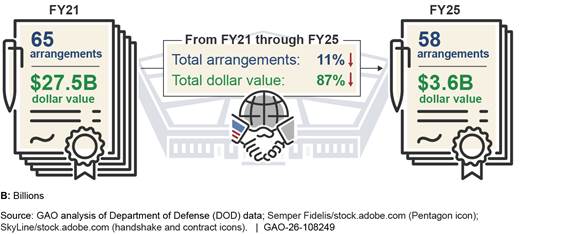
The Department of Defense (DOD) uses international agreements and arrangements to achieve political, economic, and military objectives. For example, these could include cooperatively developing and producing a military system with a foreign partner. From fiscal years 2021 through 2025, DOD established 303 acquisition-related international arrangements with an associated dollar value of $64 billion. However, both the number and dollar value of these arrangements declined over this period. DOD officials said that factors like personnel shortages and lengthy review and approval timelines contributed to this decline.
DOD’s internal coordination and communication for international arrangements varied. Apart from occasional difficulties, officials said that coordination between the Under Secretary of Defense (USD)-level offices—Acquisition and Sustainment (A&S), Office of General Counsel, and Policy—is working relatively well. However, communication between USD-level offices and the military departments about some key changes has not been timely. For example, changes to the application of cost-sharing requirements were not broadly communicated when they occurred and were instead shared on an agreement-by-agreement basis. According to military department officials, they subsequently had to adjust and renegotiate multiple arrangements, and some foreign partners opted out of arrangements entirely.
DOD has not yet fully identified or responded to the challenges it faces in establishing these arrangements, and its approach to managing these challenges has at times been ad hoc and reactive. Using a tailored version of GAO’s enterprise risk management framework, GAO identified benefits that DOD could realize by implementing a more systematic approach for managing challenges. For example, USD(A&S) could use available data to better leverage resources and pinpoint and monitor challenges to improve oversight. Ultimately, a more systematic approach could help ensure that DOD is better positioned to meet strategic goals for cost-sharing and defense industrial base improvements, while also reducing rework, wasted effort, and costs.
Why GAO Did This Study
DOD relies on international arrangements to achieve various purposes, including for acquisition activities like increasing access to needed parts, technologies, and resources. Responsibilities for developing these arrangements are dispersed throughout DOD, with the military departments developing and negotiating them, and USD offices reviewing and approving them.
A Senate report includes a provision for GAO to review DOD’s coordination for international arrangements. GAO’s report examines (1) data trends for selected arrangements for fiscal years 2021–2025; and (2) the extent to which DOD offices coordinate and communicate regarding these arrangements; and (3) assesses DOD’s approach to identifying and addressing challenges for these arrangements.
To conduct this work, GAO analyzed military department data for selected arrangements established during fiscal years 2021–2025; reviewed relevant statutes, regulations, and DOD policies; and interviewed DOD officials.
What GAO Recommends
GAO is recommending that DOD establish a mechanism to ensure timely communication about key changes; and implement a systematic, proactive approach for managing the challenges it faces with acquisition-related international arrangements. DOD concurred with both recommendations and identified actions to improve internal communication and oversight.
|
Abbreviations |
|
|
|
|
|
AUKUS |
Australia, United Kingdom, and United States |
|
DOD |
Department of Defense |
|
DOD OGC |
Department of Defense Office of General Counsel |
|
ERM |
enterprise risk management |
|
IATS |
International Agreement Tracking System |
|
MOU |
memorandum of understanding |
|
NDAA |
National Defense Authorization Act |
|
USD USD(A&S) |
Under Secretary of Defense Under Secretary of Defense for Acquisition and Sustainment |
|
USD(P) |
Under Secretary of Defense for Policy |
This is a work of the U.S. government and is not subject to copyright protection in the United States. The published product may be reproduced and distributed in its entirety without further permission from GAO. However, because this work may contain copyrighted images or other material, permission from the copyright holder may be necessary if you wish to reproduce this material separately.
August 6, 2026
The Honorable Roger Wicker
Chairman
The Honorable Jack Reed
Ranking Member
Committee on Armed Services
United States Senate
The Honorable Mike Rogers
Chairman
The Honorable Adam Smith
Ranking Member
Committee on Armed Services
House of Representatives
The Department of Defense (DOD) uses international agreements with foreign partners, like Australia, Canada, and the United Kingdom, to strengthen political-military ties, increase interoperability, and permit in-country access when needed. DOD also uses these agreements and other nonbinding instruments—collectively referred to as “international arrangements”—for acquisition activities, like cooperatively developing and producing military systems, exchanging data and personnel, and loaning equipment or materials.[1] These arrangements codify each partner’s respective commitments and responsibilities and can vary in content, structure, and type. Among other benefits, they can reduce development and production costs and increase accessibility to needed parts, technologies, and resources. The 2026 National Defense Strategy outlines DOD’s strategic goals and objectives, which include leveraging foreign partners to share costs and to contend with defense industrial base shortages.[2]
Senate Report 118-188 accompanying a bill for the National Defense Authorization Act (NDAA) for Fiscal Year 2025 raised concerns about the coordination between key DOD offices that oversee international arrangements and includes a provision for us to review the efficacy of this coordination. Our report examines (1) the trends for selected DOD acquisition-related international arrangements from fiscal years 2021 through 2025; and (2) the extent to which relevant DOD offices coordinate and communicate for acquisition-related international arrangements; and (3) assesses DOD’s approach for identifying and addressing challenges with developing acquisition-related international arrangements.
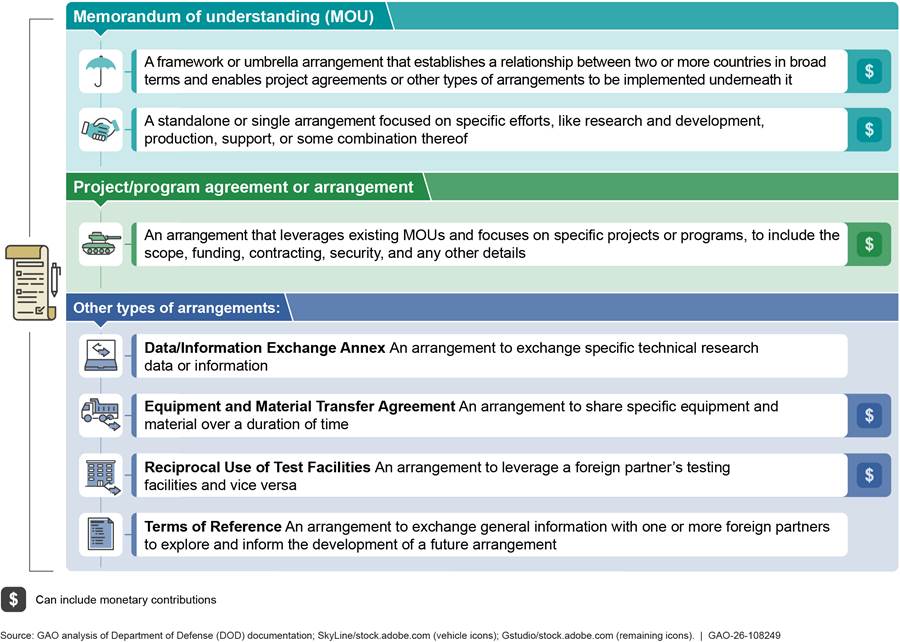
To conduct this work, we selected acquisition-related international arrangements for fiscal years 2021 through 2025 primarily governed by DOD Instruction 5530.03, led by the military departments—the Air Force, Army, and Navy—and approved by the Under Secretary of Defense for Acquisition and Sustainment (USD(A&S)). We focused on international arrangement types that typically include monetary contributions, such as project agreements or arrangements. We excluded arrangements that were led by other DOD entities or that typically cannot include monetary contributions, such as information exchange annexes and terms of reference.
To examine trends for the selected DOD acquisition-related international arrangements, we collected available data from the military departments. Specifically, the military departments provided their full list of acquisition-related international arrangements over this period, which included each arrangement’s title, purpose, partners, duration, and dollar value—the combined monetary and non-monetary contributions of the U.S. and one or more foreign partners. We consolidated these data and analyzed them to identify any trends. For comparability, we adjusted the dollar values of the arrangements to fiscal year 2025 dollars and identified and rectified any errors or missing details.[3] We determined that the data were sufficiently reliable for our purposes.
To examine the extent to which relevant DOD offices and the military departments coordinate and communicate for acquisition-related international arrangements, we identified requirements by reviewing statutes, regulations, and DOD policies and guidance. We collected documentation such as emails, reports, and briefings. We also interviewed officials from the DOD offices that oversee international arrangements, including USD(A&S) and USD Policy (USD(P)). We submitted questions to the DOD Office of General Counsel (DOD OGC). In addition, we interviewed officials from the offices within the military departments that oversee international arrangements. We compared the collected evidence with federal standards for internal control specific to internal communication (principle 14).[4] Principle 14 of these standards states that management should communicate information on a timely basis.
To assess DOD’s approach for identifying and addressing challenges with acquisition-related international arrangements, we reviewed relevant DOD policies and documentation and interviewed officials from USD(A&S) and the military departments. We used these documents and interviews to identify what approach, if any, DOD uses to identify and address challenges. For criteria, we leveraged our enterprise risk management (ERM) framework, which focuses on identifying and addressing risks.[5] We tailored this ERM framework by substituting risks with challenges. We then used this tailored framework to assess DOD’s current approach for identifying and addressing challenges with acquisition-related international arrangements to determine how well it aligns and if any differences exist. We also leveraged federal standards for internal control specific to internal and external communication (principles 14 and 15).[6] These principles include internally communicating throughout all levels of an entity—up, down, across, and around—and externally, as appropriate. Additional details on this report’s objectives, scope, and methodology are in appendix I.
We conducted this performance audit from March 2025 to August 2026 in accordance with generally accepted government auditing standards. Those standards require that we plan and perform the audit to obtain sufficient, appropriate evidence to provide a reasonable basis for our findings and conclusions based on our audit objectives. We believe that the evidence obtained provides a reasonable basis for our findings and conclusions based on our audit objectives.
Background
Overview of International Arrangements
DOD generally manages its international arrangements through delegated authority from the Department of State, which has the primary responsibility for negotiations with foreign partners and oversees the process for negotiating international arrangements on matters including science and technology.[7] DOD leverages this authority for international arrangements to achieve political, economic, and military objectives. These arrangements establish each partner’s commitments and responsibilities, the scope, and duration, among other details. Certain arrangements enable each partner to come to the other’s defense when needed or permit in-country access during combat or humanitarian missions.[8] Other arrangements are for specific acquisition activities, like developing and producing needed parts or systems. Figure 1 shows selected types of arrangements that DOD can leverage for acquisition activities, some of which can include dollar values (i.e., the combined monetary and non-monetary contributions from the U.S. and its foreign partners).
Over the years, Congress has also passed laws to enable DOD to use international arrangements for acquisition activities. For example, 10 U.S.C. § 2350a enables DOD to enter into memorandums of understanding (MOU) or other formal agreements with one or more countries for cooperative research and development of defense equipment and munitions, which under that authority, involves cost sharing among participants. However, when cost sharing is included, a determination of equitability must be made by the approving DOD officials.[9] As amended in 2021, this authority requires that when cost sharing between participants is on an unequal basis, the Secretary of Defense or delegee must make a written determination of its strategic value to enter into the agreement.[10]
DOD has also taken steps to expand its use of international arrangements. For example, the 2023 National Defense Industrial Strategy and the 2026 National Defense Strategy strongly encourage DOD to leverage foreign partners to (1) share the costs for developing and producing systems, and (2) address industrial base shortages, by obtaining needed parts and materials.[11] Moreover, DOD policy requires that the military departments and other DOD components consider using international arrangements early and throughout acquisition activities to improve economies of scale and strengthen the defense industrial base, among other benefits.[12]
Responsibilities for International Arrangements
The responsibilities for international arrangements, as identified in statutes and policies, are dispersed across and outside of DOD. USD(A&S) and DOD OGC are the entities with the primary responsibility for the oversight and approval of international arrangements involving acquisition activities.[13] Other entities, like USD(P) and the DOD Comptroller, are involved as required. DOD components, like the military departments—the Air Force, Army, and Navy—are responsible for developing, negotiating, and implementing these arrangements as delegated.
USD(A&S) and the military departments have dedicated offices to oversee international arrangements involving acquisition activities. These dedicated offices help prepare arrangements and facilitate the necessary reviews and approvals, and include:
· USD(A&S) for International Cooperation;
· Deputy Under Secretary of the Air Force, International Affairs;
· Deputy Assistant Secretary of the Army for Defense Exports and Cooperation; and
· Deputy Assistant Secretary of the Navy for International Programs, Navy International Programs Office.
Table 1 summarizes some of the key responsibilities for these dedicated offices, as well as other various DOD entities involved with international arrangements.
|
|
Responsibilities |
|
||||
|
Entity |
General |
Individual arrangements |
|
|||
|
Department of Defense (DOD) Under Secretary of Defense (USD) |
Acquisition and Sustainment (A&S)a |
· Oversees international arrangements for acquisition activities · Establishes policies and procedures, in coordination with DOD OGC and USD(P) · Develops, negotiates, and implements acquisition-related arrangements that involve more than one DOD component or partner |
· Coordinates with USD-level and other relevant stakeholders · Advises DOD components · Reviews and approves individual international arrangements |
|||
|
Office of General Counsel (DOD OGC) |
· Provides DOD’s legal position on matters, including statutes, regulations, policies, and executive orders · Establishes policies and procedures, in coordination with USD(A&S), and USD(P) · Liaises with the Department of State, as appropriateb · Maintains a central repository of all of DOD’s finalized international arrangements |
· Performs the legal review for each individual international arrangement, as required · Advises DOD components |
||||
|
Policy (P) |
· Oversees defense relationships with foreign partners · Establishes policies and guidance for defense relationships, defense-related arrangements, and international technology transfers |
· Reviews individual international arrangements, as warranted, to ensure alignment with policy initiatives, strategic goals and objectives, and the administration’s priorities |
||||
|
DOD componentsc |
· Establishes policies and procedures aligned with USD-level direction · Coordinates with all relevant stakeholders |
· Seeks opportunities for international arrangement with foreign partners to fulfill needs and strategic goals and objectives, among other reasons · Prepares individual international arrangements, as delegated · Finalizes and implements individual international arrangements |
|
|||
Source: GAO analysis of DOD and component policies. | GAO‑26‑108249
Note: These responsibilities apply to all other DOD components, but this table does not include an exhaustive list of DOD entities or responsibilities.
aThere is a dedicated office for International Cooperation within USD(A&S).
bDOD OGC liaises with the Department of State on international arrangements to carry out the implementation of Circular 175 and Section 112b of Title 1 U.S.C.
cThe military departments each have a dedicated office that oversees international arrangements for acquisition activities.
Other entities outside of DOD also have responsibilities related to international arrangements. Most notably, the Department of State reviews and authorizes certain international arrangements.[14] The Department of Commerce implements U.S. trade laws and monitors foreign partners’ compliance with specific trade and industrial base elements of international arrangements.
Establishing International Arrangements
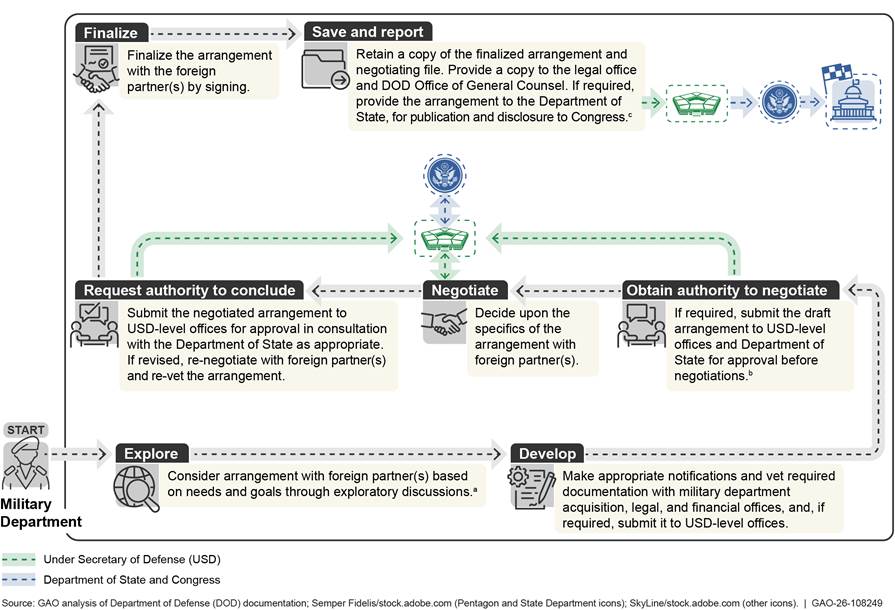
DOD has a multistep process for establishing international arrangements, which is outlined in DOD Instruction 5530.03.[15] As shown in figure 2, the process involves various levels within DOD, as well as external stakeholders like the Department of State and Congress.
Figure 2: DOD Process for Establishing Acquisition-Related International Arrangements with Foreign Partners
Note: This process applies to all DOD components pursuing an acquisition-related international arrangement.
aDOD policies require DOD components to consider foreign partners when determining how to best meet the component’s needs. Additionally, the 2026 National Defense Strategy encourages DOD components to leverage foreign partners for burden sharing and to improve the defense industrial base.
bCertain arrangement types must be reviewed and approved by the USD-level offices prior to negotiations.
cPer the Case-Zablocki Act, DOD must generally report all international agreements to the Department of State, which in turn, provides them to congressional leadership, the Senate Foreign Relations Committee, and House Foreign Affairs Committee. Nonbinding instruments made pursuant to DOD’s authorities are not qualifying nonbinding instruments as defined by the act and are not subject to the Act’s reporting requirements. 1 U.S.C. § 112b and implementing regulations at 22 C.F.R. 181. However, DOD must report all nonbinding instruments related to the Australia, United Kingdom, and United States trilateral security partnership known as “AUKUS partnership,” as set forth in Sec. 1333 of the National Defense Authorization Act for Fiscal Year 2024.
As shown in figure 2, DOD components, like the military departments, perform most of this multistep process for developing international arrangements. For example, the military departments consider if and how such arrangements can assist with their needs and goals; engage foreign partners to discuss; and if viable, subsequently prepare, negotiate, sign, and implement them. The military departments’ policies outline the required reviews, which typically include acquisition, legal, and budget offices.[16] Following these reviews, there are additional reviews at the USD-level, by USD(A&S), DOD OGC, and other relevant offices, like USD(P) and the DOD Comptroller, as applicable. Other DOD entities may also be included in these reviews, based on the type and details of the arrangement.[17] DOD policy sets forth the required reviews for these arrangements, which occur at the military department- and the USD-level.[18]
As a final step in the process, DOD must retain an original or certified copy of all arrangements and report certain arrangements to the Department of State for publication and disclosure to Congress. DOD must report all international agreements and certain nonbinding instruments. Most nonbinding instruments are exempt from this reporting requirement; thus, they are not reported outside of DOD for compliance with the Case-Zablocki Act.[19] For example, DOD is typically not required to report the data and information exchange annexes, equipment and material exchange agreements, reciprocal use of test facilities agreements, and terms of reference when these arrangements are nonbinding instruments.
Prior GAO Work
Our prior work on international arrangements has addressed specific types of arrangements and various aspects of the process. For example, we issued reports on DOD’s space-related arrangements and reciprocal defense procurement agreements.[20] For the former report, we assessed DOD’s external coordination with foreign partners on space-related arrangements. We found that DOD is increasing its efforts with foreign partners for space-related arrangements but faces persistent challenges—like a lack of metrics, overlapping roles and responsibilities, and personnel shortages—that impede its coordination internally and externally. For the latter report, we found that DOD often does not engage key stakeholders or monitor progress for reciprocal defense procurement agreements that enable the U.S. to buy goods and services from foreign partners.
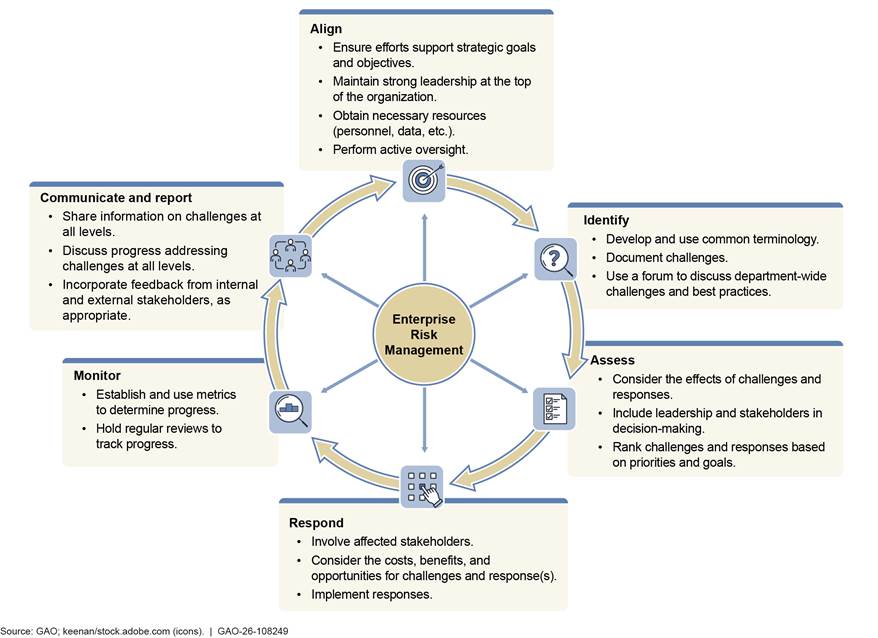
In other prior work, we highlighted our enterprise risk management (ERM) framework as a common-sense, forward-looking management approach to problem solving.[21] This framework includes six essential elements and associated good practices to identify, assess, respond to, monitor, and communicate risks. Any strengths or weaknesses in one element can have cascading effects on subsequent elements. Figure 3 illustrates how the ERM framework can be tailored for an entity to take a more structured approach to identifying and addressing challenges.
DOD’s Acquisition-Related International Arrangements Have Declined Since Fiscal Year 2021
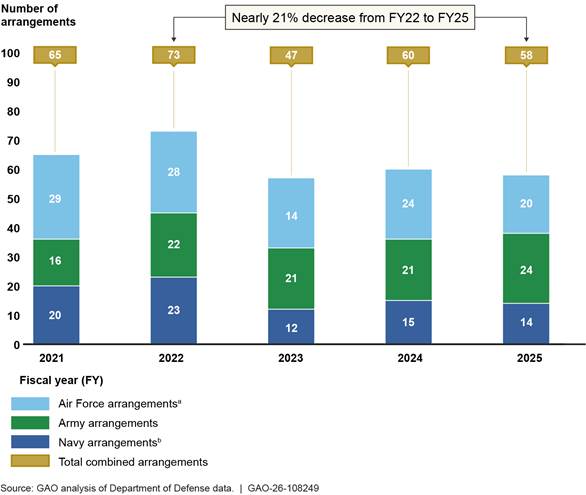
From fiscal years 2021 through 2025, the military departments established 303 acquisition-related arrangements with a dollar value totaling $64 billion, but the number of arrangements and associated dollar value declined over this period.[22] These arrangements provided for acquisition activities like developing uncrewed vehicles, exploring manufacturing advancements, and cooperatively producing a precision missile system. The military departments, which led efforts to enter into these arrangements, collectively averaged about 60 arrangements each fiscal year. During this 5-year period, the total number of arrangements was highest in fiscal year 2022 at 73 and declined by nearly 21 percent to 58 in fiscal year 2025 (see fig. 4).
Figure 4: Total Number of Military Departments’ Acquisition-Related International Arrangements, Fiscal Years 2021–2025
Note: The number of arrangements is the combined total—new and amended—established during the 5-year period across the Air Force, Army, and Navy. The types of arrangements include memorandums of understanding, project agreements or arrangements, equipment and material transfer agreements, and reciprocal use of test facilities agreements.
aAir Force data include Space Force arrangements.
bNavy data include Marine Corps arrangements.
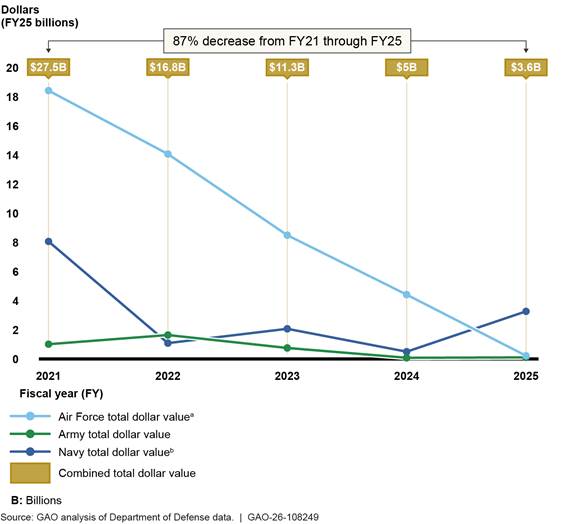
Similarly, the dollar value of the military departments’ acquisition-related arrangements was highest in fiscal year 2021 but decreased by 87 percent over the 5-year period. The Army’s and Navy’s dollar values fluctuated and generally declined. The Air Force’s dollar values, however, declined every year. Specifically, the dollar value of the Air Force’s arrangements declined by 99 percent—from $18.4 billion in fiscal year 2021 to $223 million in fiscal year 2025. This affected the department’s overall outlook because the Air Force was responsible for nearly 40 percent of the arrangements and over 70 percent of the total dollar value over this 5-year period. Air Force officials cited various reasons for this decline, including personnel shortages and delays in USD-level reviews and approvals. They also noted that at least 24 arrangements with a dollar value totaling over $1.7 billion are awaiting USD-level review and approval, some since 2023. Figure 5 illustrates the total dollar values of the arrangements across the 5-year period.
Figure 5: Total Dollar Value of Military Departments’ Acquisition-Related International Arrangements, Fiscal Years 2021–2025
Note: The dollar value is the combined total of U.S. and foreign partner contributions (monetary and non-monetary) for arrangements during this period across the Air Force, Army, and Navy. The types of arrangements include memorandums of understanding, project agreements or arrangements, equipment and material transfer agreements, and reciprocal use of test facilities.
aAir Force data include Space Force arrangements.
bNavy data include Marine Corps arrangements.
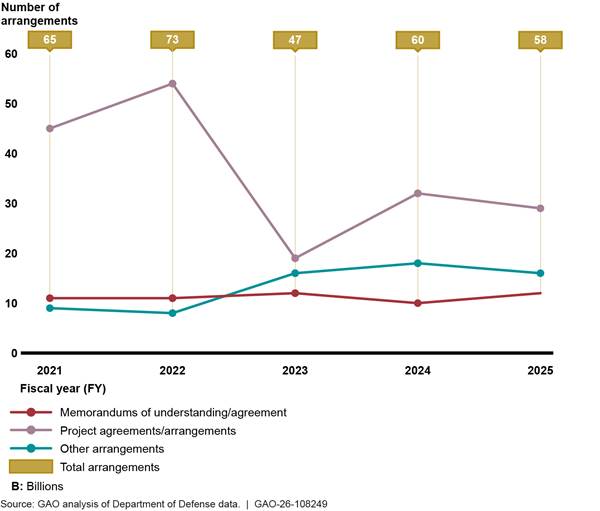
We found that a decline in one type of arrangement—project agreements—was one factor in the overall decline in the total dollar value of these arrangements over this period. Project agreements typically include a dollar value, varying from hundreds of thousands to billions of dollars. Figure 6 illustrates the overall decline in project agreements.
Figure 6: Military Departments’ Acquisition-Related International Arrangements by Type, Fiscal Years 2021–2025
Note: The number of arrangements is the combined total of arrangements established during this period across the Air Force, Army, and Navy. The Air Force totals include Space Force arrangements, and the Navy totals include Marine Corps arrangements. The types of arrangements include memorandums of understanding or agreement, project agreements or arrangements, equipment and material transfer arrangements, and reciprocal use of test facilities agreements.
USD- and military department-level officials attribute various other factors to the overall decline in the number and dollar values of acquisition-related international arrangements. For example:
· Review and approval timeline. USD(A&S) and military department officials said that the speed of the process to review, approve, and establish arrangements was also a major factor in the decline. The USD-level review and approval timeline typically ranges from 3 to 15 months, depending on the type of arrangement. However, some arrangements have taken years to finalize, which has affected foreign partners’ interest and military departments’ willingness to pursue them.
· Changes to cost sharing. USD(A&S) and military department officials cited changes in the application of cost sharing requirements as a potential reason for the decline in project agreements. Specifically, officials said that, up to fiscal year 2023, DOD approved project agreements that shared costs between participants on an equitable basis. This means that participants could provide different levels of monetary contributions. However, a USD(A&S) official said that, beginning in fiscal year 2023, DOD OGC began advising that costs must be shared equally among participants unless approved by the Secretary of Defense or a delegee.[23] Military department officials said that the requirement to obtain Secretary of Defense approval when the costs are not shared equally has deterred them from pursuing these agreements. [24] Further, military department officials said that some foreign partners cannot share costs equally, and thus, have opted out of agreements.
· Resources. USD(A&S) and military department officials noted personnel reductions and hiring freezes as other reasons for the decline. Military departments mentioned that certain key positions, like senior negotiators, remain open due to a hiring freeze. Ultimately, fewer people doing the work means fewer arrangements, according to officials.
Beyond these factors, military department officials cited the COVID-19 pandemic that affected travel and in-person interactions with foreign partners, which often facilitate new arrangements. To offset these challenges during that period, military department officials said that they opted to amend existing arrangements to extend the duration or increase the dollar value.
DOD Coordinates for Acquisition-Related International Arrangements, but Communication Shortfalls Exist
USD-level offices—USD(A&S), USD(P), and DOD OGC—internally coordinate on the international arrangement process and the review and approval of individual arrangements, and interface with the military departments as needed. While the USD-level offices have taken steps to improve communication with the military departments, these offices have not communicated some key changes in a timely manner.
USD-Level Offices Internally Coordinate on Acquisition-Related International Arrangements, as Required by Policy
USD-level offices internally coordinate, as required by policy and as needed, on both the process for establishing acquisition-related international arrangements and reviewing and approving individual arrangements. Various DOD policies establish the requirements and responsibilities for USD-level offices specific to acquisition-related international arrangements.[25]
Coordinating on the process for acquisition-related international arrangements. USD-level offices described generally good working relationships with each other. Officials said that they have clearly delineated roles and coordinate, when needed, to ensure the process is working as intended. As noted earlier, USD(A&S) oversees the process, DOD OGC advises on legal aspects, and USD(P) monitors foreign-partner relationships, administration priorities, and policy initiatives. Their roles intersect when determining which countries DOD cooperates with, under what legal authority, and for what purpose. For example, according to officials, USD(P) coordinated with USD(A&S) and DOD OGC in January 2025 to implement a pause that lasted at least 6 months to determine whether certain arrangements aligned with the current administration’s priorities.
However, USD-level offices also mentioned some difficulties with coordination. For example, officials noted an instance when USD(P) attempted to move forward on an MOU without involving other pertinent USD-level offices, including USD(A&S). Once known, USD(A&S) raised concerns about the proposed MOU, citing that it was unnecessarily complex, required significant investment of personnel, and that other arrangements could be leveraged instead. USD(A&S) noted that USD(P) ultimately discontinued its pursuit of the MOU.
To coordinate, USD-level officials told us that they currently use a tasking system, as well as informal mechanisms, like emails, phone calls, and in-person discussions. According to USD-level officials, they initially planned to create an intradepartmental forum to satisfy a legal requirement to establish two cross-functional teams for international cooperation activities.[26] However, they now plan to leverage existing forums.[27] USD-level officials said that they are planning to update relevant policies and guidance to further clarify responsibilities, as required by the same act and the creation of the new Assistant Secretary position for International Cooperation that centralizes oversight of international arrangements.
Coordinating on individual acquisition-related international arrangements. The USD-level offices described their specific responsibilities for individual arrangements and said that they coordinate as needed. USD(A&S) acts as the interface with the military departments and liaises with other USD-level offices for the review and approval of each arrangement. DOD OGC ensures that each arrangement is legally sound, and USD(P) has the opportunity to review arrangements, specifically those that are complex or high-profile (i.e., an arrangement that affects a relationship with a foreign partner or policy initiative). USD(P) also coordinates with USD(A&S) and DOD OGC to expedite individual arrangements. For example, USD-level officials noted an instance when USD(P) expedited a project agreement to add a partner to help cooperatively develop an important weapon system. According to USD(P) officials, they can also expedite arrangements so they can be signed during diplomatic visits between the President and a foreign partner’s leader, or between other senior leaders.
USD-level offices also rely on the same informal mechanisms to coordinate on individual arrangements but primarily use the International Agreement Tracking System (IATS). USD(A&S) created IATS in May 2017 to electronically route individual arrangements for review and approval. This system generates notifications as an arrangement moves through the various reviews and approvals and keeps stakeholders informed about the status. This system also generates reports on the number of arrangements returned to the military departments for significant revisions, the time it takes for the military departments to address those revisions, and the USD-level review and approval timeline.
USD-level Offices Have Taken Steps to Improve Communication, but Do Not Always Notify Military Departments About Key Changes in a Timely Manner
USD(A&S) has taken steps to improve communication and share information with the military departments about acquisition-related international arrangements. Since 2010, USD(A&S) has used email alerts to notify the military departments about changes. More recently, USD(A&S) restarted recurring meetings, created a digital library of policies and guidance, and piloted a training workshop (see fig. 7).
Figure 7: Steps DOD Has Taken to Improve Communication with the Military Departments About Acquisition-Related International Arrangements
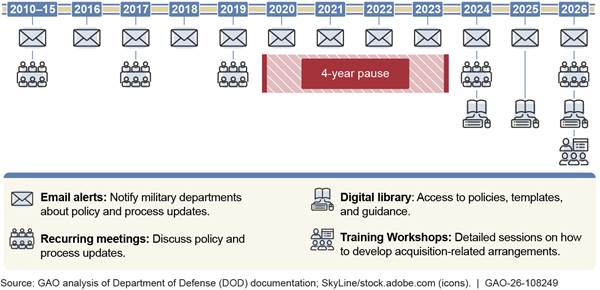
· In 2024, USD(A&S) restarted recurring meetings with the military departments, with the goal of holding these meetings annually, to discuss policies and process updates for acquisition-related international arrangements. USD(A&S) officials said that these meetings were paused for several years due to the COVID-19 pandemic and personnel shortages. Since restarting, USD(A&S) officials said that these meetings have enabled constructive, two-way conversations with the military departments, which provide potential topics and questions in advance. Military department officials said that these meetings have been informative and serve as their primary opportunity to discuss common issues and other challenges with USD-level offices and among themselves.
· In 2024, USD(A&S) also created a digital policy and guidance library for the military departments to access as needed. The library consolidates policies, templates, and other pertinent information for acquisition-related international arrangements.
· In 2026, USD(A&S) officials piloted a virtual training workshop to supplement the recurring meetings and provide more detailed instructions on how to prepare acquisition-related international arrangements. The content of this virtual training workshop included USD-level expectations for key documents, guidance on how to draft the relevant documents, and advice on how best to negotiate with foreign partners.
Despite these steps to improve communication, military department officials said that USD-level offices do not always notify them about key changes to requirements or guidance in a timely manner. Specifically, they told us that USD-level offices informed them about some key changes on an agreement-by-agreement basis rather than sending a broader alert when the changes occurred. As noted above, USD(A&S) and military department officials said that, in fiscal year 2023, DOD OGC began advising that a statutory amendment required project agreements with cost sharing to divide costs equally among participants, or obtain Secretary of Defense or delegee’s approval.[28] DOD OGC did not characterize the adjustments to cost sharing as a change to requirements for arrangements, according to officials.[29] Thus, USD(A&S) and DOD OGC did not communicate this change at the department level and did not update their guidance until 2026. As a result, the military departments continued to pursue project agreements with foreign partners that had equitable versus equal cost sharing. Military department officials said that not having timely communication about this change led to rework when arrangements had to be renegotiated and ultimately delayed finalizing arrangements. In some instances, foreign partners opted out of arrangements entirely, which means costs that could be shared with foreign partners may be borne by taxpayers. In other instances, these delayed arrangements could hinder the delivery of capabilities to the warfighter.
As another example, USD(A&S) informed military departments on an agreement-by-agreement basis about changes to the required advance notice for submitting substantively amended arrangements for review and approval. Substantive amendments include revisions to the scope, duration, or dollar value of an arrangements, among other things. USD(A&S) changed the required notice from 60 days to 6 months. A military department official said that they submitted a substantive amendment to an arrangement for review and approval within the requisite 60 days, and USD(A&S) then told them that the advance notice had changed to 6 months. Consequently, the military department decided to simplify the amendments to the arrangement and create an entirely separate arrangement for the remaining amendments to move the process along. Not having timely communication resulted in the military department investing time in creating multiple arrangements rather than one arrangement, which increased its workload and delayed finalizing the necessary amendments.
The examples above demonstrate that the military departments are not only reliant on the information that the USD-level communicates, but also timely and inclusive communication. DOD Instruction 5530.03 outlines the requirements for USD-level communication with the military departments regarding international arrangements. Specifically, it requires USD(A&S) to provide the military departments with appropriate guidance and assistance and DOD OGC to coordinate with the military departments throughout the process. Moreover, Standards for Internal Control in the Federal Government states that management should communicate information, like changes requirements or guidance, on a timely basis. Without improved communication between the USD- and military department-level offices regarding international arrangements, the military departments will continue to experience challenges and risk losing cost-sharing opportunities with international partners, among other things.
DOD Has Not Fully or Systematically Managed Its Challenges with Acquisition-Related International Arrangements
DOD has not yet fully identified and responded to the challenges it faces with acquisition-related international arrangements. Furthermore, DOD’s approach to managing these challenges has generally been ad hoc and reactive rather than systematic.
DOD Has Not Fully Identified or Responded to Challenges with Acquisition-Related International Arrangements
USD(A&S) and the military departments identified some challenges with acquisition-related international arrangements, but they have not fully responded to them:
· Review and approval timelines. USD(A&S) and the military departments identified lengthy review and approval timelines as a challenge. According to USD(A&S) guidance, the goal for the USD-level review and approval timeline is generally 90 days or fewer.[30] However, officials from a military department told us that they had at least 24 arrangements awaiting USD-level approval, some of which have been pending since fiscal year 2023. Furthermore, two MOUs we examined considerably exceeded the 90-day goal for review and approval, despite being designated as urgent (see fig. 8).
Figure 8: Comparison of the Guidance for USD-level Review and Approval Timeline with Actual Examples of Acquisition-Related International Arrangements
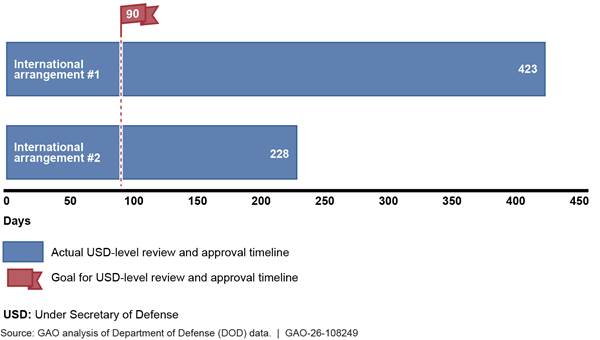
Note: The example arrangements are both memorandums of understanding that were designated as “urgent.” This indicates that an arrangement must proceed as swiftly as possible through USD-level review and approval.
USD(A&S) and military department officials said that DOD OGC’s review is a chokepoint that has caused delays for acquisition-related international arrangements. In response, USD(A&S) officials told us that, for the past few years, they shortened DOD OGC’s review time to get input sooner. Even if provided sooner, however, military department officials said that DOD OGC’s input often results in minor changes that must be renegotiated with foreign partners, thereby extending rather than accelerating the timeline for establishing arrangements. The military departments also tried to shorten review times by piloting a new type of project agreement that allows partners to consolidate into one arrangement what would typically be captured in multiple arrangements. However, USD(A&S) has expressed concerns about how these agreements may affect its oversight. Ultimately, USD(A&S) and the military departments took divergent approaches to respond to the review and approval timeline challenge.
· Personnel shortages. USD(A&S) and the military departments identified personnel shortages as a challenge but have not leveraged data to fully understand the effects of these shortages on arrangements. Specifically, USD(A&S) officials said that they do not have enough staff to develop, negotiate, and implement acquisition-related international arrangements. Similarly, the military departments cited shortages of senior negotiators crucial to securing these arrangements. Officials attributed these shortages to a series of leadership-directed staff reductions, and more recently, to a hiring freeze. In response to USD(A&S)’s staffing challenges, officials told us that they advocated for a recent statutory reorganization of their office, which allowed them to hire additional staff.[31] USD(A&S) officials said that they are also advocating for additional personnel for the military departments. Though officials stated that less personnel mean fewer arrangements, as noted above, they have not evaluated the relationship between their resources and the review timelines.
· Communication. USD(A&S) and the military departments identified communication as a challenge, as noted above, but USD(A&S) has not used existing opportunities or developed a mechanism to explicitly communicate about challenges with acquisition-related international arrangements. Specifically, officials from both USD(A&S) and the military departments said that not all pertinent personnel have been consistently informed about changes to requirements and guidance for arrangements on a timely basis, among other disconnects. In response, USD(A&S) took steps to improve communication by restarting recurring meetings with the military departments and by piloting a training workshop on preparing arrangements. However, the recurring meetings are infrequent, with only two held over the last 6 years, and challenges are only raised indirectly. The workshop also did not directly address challenges but instead intermixed them with topics like how to draft a project arrangement and navigate USD-level expectations.
Further, as part of our analysis, we identified several challenges that USD(A&S) had not yet detected. For example, we found that USD(A&S) and the military departments do not have insight into each other’s data on acquisition-related international arrangements. USD(A&S) has data from IATS that are specific to the review and approval process, like the timelines and number of arrangements that required significant revisions. The military departments, on the other hand, have data on the number, duration, and dollar value of their arrangements, among other details. However, USD(A&S) has not requested the military departments’ data, and the military departments do not currently have access to the data in IATS.
DOD Does Not Take a Systematic Approach to Managing Challenges with Acquisition-Related International Arrangements
USD(A&S) currently uses an ad hoc and reactive approach to managing the challenges it faces with acquisition-related international arrangements. While it is not required to use a more systematic approach, it has opportunities to better position itself and its efforts with acquisition-related international arrangements if it does so. We previously reported that other entities have benefited from using the ERM framework—a systematic approach to effectively manage risks—to better prioritize resources and make more informed decisions, among other things.[32] Given its utility, we substituted risks for challenges to create a tailored version of this framework to identify opportunities for DOD. Figure 9 provides our assessment of USD(A&S)’s current approach compared with each essential element of the tailored ERM framework.
Figure 9: Assessment of DOD’s Approach for Acquisition-Related International Arrangements Against GAO’s Tailored Enterprise Risk Management Framework
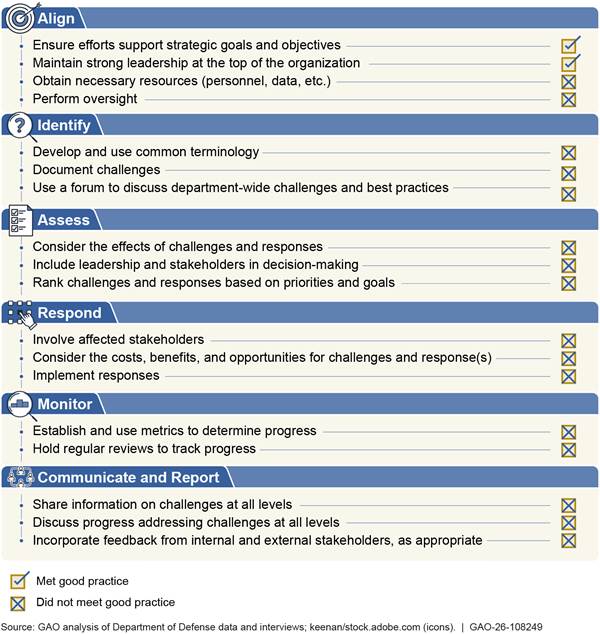
Note: This table contains a tailored, notional framework derived from the six essential elements and associated good practices outlined in GAO, Enterprise Risk Management: Selected Agencies’ Experiences Illustrate Good Practices in Managing Risk, GAO‑17‑63 (Washington, D.C.: Dec. 1, 2016).
The differences between DOD’s current approach and the tailored ERM framework highlight the essential elements that DOD could consider implementing for a more systematic and proactive approach to managing its challenges with acquisition-related international arrangements:
Align. USD(A&S) and the military departments lack the resources—personnel and data—to ensure alignment of their efforts with strategic goals and objectives and to perform oversight of acquisition-related international arrangements. The dedicated offices that oversee acquisition-related international arrangements noted staffing shortages. We also found that these offices do not have insight into each other’s data. Specifically, although the military departments have data that USD(A&S) could use to identify trends and develop a business case for additional personnel, a USD(A&S) official told us that they have not requested these data. Conversely, the military departments have expressed frustration with the number of arrangements that are returned for significant revisions. USD(A&S) has data showing that from fiscal years 2023 through 2025, approximately 50 percent of MOUs and project agreements required significant revisions. However, a USD(A&S) official said that the military departments do not currently have access to these data, although these data could help them identify ways to improve and expedite their arrangements and likely reduce rework and wasted effort.
Identify. USD(A&S) officials told us that they do not compile and document key challenges with acquisition-related international arrangements. We have previously reported that identifying risks, or in this instance challenges, is the foundational good practice for a systematic approach.[33] For instance, USD(A&S) compiling and documenting key challenges could provide a broader awareness of each challenge and deeper understanding by enabling the department to explore similarities and interrelations among challenges.
Assess. USD(A&S) does not currently evaluate the underlying causes, prevalence, and effects of challenges with acquisition-related international arrangements. Our tailored ERM framework outlines the benefits of assessing key challenges and the risks of not doing so. As noted above, USD(A&S) returned approximately half of all draft MOUs and project agreements to the military departments for significant revisions from fiscal years 2023 through 2025. While this trend is an indicator of a challenge, USD(A&S) has not assessed why so many revisions are needed or which types of arrangements are most affected. Military department officials told us anecdotally that this challenge has led to longer review and approval timelines. Moreover, since USD(A&S) has not identified or assessed other challenges, it is unable to effectively prioritize challenges—i.e., what is most important or urgent—or evaluate them based on factors like risk, cost, and complexity. Assessing and prioritizing challenges could help DOD provide the right responses at the right time and potentially alleviate wasted efforts.
Respond. USD(A&S) has responded to some challenges with acquisition-related international arrangements but has not fully involved affected stakeholders. Our tailored ERM framework highlights the importance of involving affected stakeholders, considering the cost, benefits, and opportunities of each challenge and response, and implementing responses. As noted above, USD(A&S) shortened DOD OGC’s review time but did not include the military departments in assessing or responding to this challenge, and the military departments responded to this challenge by piloting a new type of project agreement. USD(A&S) officials expressed concern that this new type of project agreement could minimize their oversight, contrary to DOD policy.[34] USD(A&S) and the military departments could benefit from responding to challenges collectively rather than independently by pooling resources, sharing ideas, and potentially avoiding the creation of additional challenges.
Monitor. USD(A&S) has not established metrics or held regular reviews to measure its progress addressing challenges with acquisition-related international arrangements. Our tailored ERM framework stresses the importance of using metrics and regular reviews to monitor how challenges are changing and if responses are successful. As described above, there is a variety of data that can help pinpoint challenges, such as (1) the number of arrangements returned for significant revisions, (2) review and approval timelines, and (3) total number of arrangements and dollar values, among other details. USD(A&S) could use these data to measure whether responses, like reducing DOD OGC’s review time improves approval timelines, or recent steps to improve communication with the military departments, decreases the number of arrangements returned for significant revisions.
Communicate and report. USD(A&S) has not fully leveraged available opportunities to communicate with stakeholders at all levels about challenges with acquisition-related international agreements. According to our ERM framework and federal standards for internal control for communication, agencies should share information at all levels—up, down, across, and around—and include all relevant stakeholders. USD(A&S) could use its recently restarted meetings or new training workshops to collectively and directly engage in targeted discussions about challenges with the military departments. Doing so will help DOD identify and address challenges departmentwide.
These examples, especially in the context of our tailored ERM framework, demonstrate that DOD has opportunities to more systematically manage the challenges it faces with acquisition-related international arrangements. As we noted, DOD is not required to implement such an approach. However, doing so in a way that considers the essential elements of a tailored ERM framework can help DOD better respond to challenges, perform oversight, and meet strategic goals and objectives.
Conclusions
DOD’s international arrangements can strengthen U.S. ties with foreign partners, and its acquisition-related international arrangements can ensure U.S. access to critical parts and materials, among other benefits. DOD’s internal coordination and communication are critical to effectively establishing these arrangements, but there is room for improvement. Specifically, USD(A&S) and DOD OGC have not communicated some required changes to the military departments in a timely manner, which has undermined the efficiency of the review process, caused delays, and negatively affected these arrangements. For example, some arrangements have been significantly stalled or abandoned entirely. Establishing a mechanism to ensure timely, top-down communication of key changes is paramount to avoiding similar issues in the future.
Furthermore, while DOD has taken some positive steps to address challenges with its acquisition-related international arrangements, it has an opportunity to improve its oversight in this area. Specifically, it could establish a common-sense, systematic approach to collectively and proactively tackle challenges. Such an approach should consider elements like sharing and leveraging data; prioritizing, assessing, and monitoring key challenges; and ensuring that all stakeholders are able to communicate about and respond to challenges. Without such an approach, continued delays may further strain relationships with foreign partners and result in more lost international arrangements. Ultimately, a systematic approach offers DOD the means to better advance military capabilities, meet strategic goals and objectives for cost sharing and defense industrial base improvements, and potentially reduce taxpayer costs.
Recommendations for Executive Action
We are making the following two recommendations to DOD:
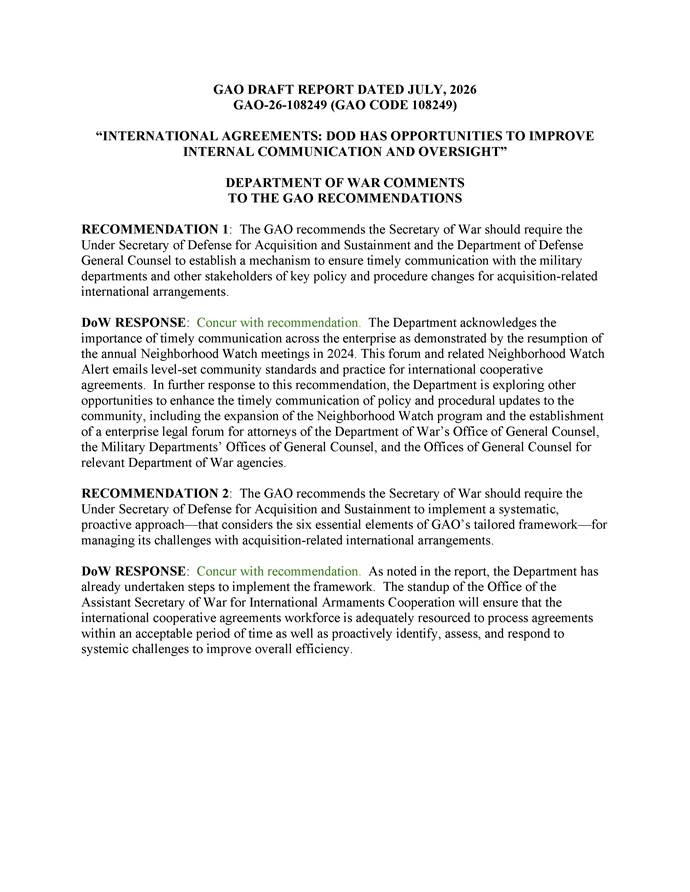
The Secretary of Defense should require the Under Secretary of Defense for Acquisition and Sustainment and the Department of Defense Office of General Counsel to establish a mechanism to ensure timely communication with the military departments and other stakeholders of key policy and procedure changes for acquisition-related international arrangements. (Recommendation 1)
The Secretary of Defense should require the Under Secretary of Defense for Acquisition and Sustainment to implement a systematic, proactive approach—that considers the six essential elements of GAO’s tailored framework—for managing its challenges with acquisition-related international arrangements. (Recommendation 2)
Agency Comments and Our Evaluation
We provided a draft of this report to the DOD for review and comment. In its comments, reproduced in appendix II, DOD agreed with our recommendations. DOD noted actions it is considering to improve communication and oversight for acquisition-related international arrangements. DOD also provided technical comments, which we incorporated as appropriate.
We are sending copies of this report to appropriate congressional committees, the Secretary of Defense; USD(A&S) and USD(P); DOD OGC; the Secretaries for the Air Force, Army, and Navy; and other interested parties. In addition, the report is available at no charge on the GAO website at http://www.gao.gov.
If you or your staff have any questions about this report, please contact me at Russellw@gao.gov. Contact points for our Offices of Congressional Relations and Media Relations may be found on the last page of this report. GAO staff who made key contributions to this report are listed in appendix III.

William Russell
Director, Contracting and National Security Acquisitions
The Department of Defense (DOD) uses international agreements with foreign partners, like Australia, Canada, and the United Kingdom, to strengthen political-military ties, increase interoperability, and permit in-country access when needed. DOD also uses these agreements and other nonbinding instruments—collectively, what we refer to as international arrangements—for acquisition activities like cooperatively developing and producing military systems, exchanging data, and loaning equipment or materials.[35] These arrangements codify each partner’s respective commitments and responsibilities and can vary in content, structure, and type.
Senate Report 118-188 accompanying a bill for the National Defense Authorization Act for Fiscal Year 2025 raised concerns about the coordination between key DOD offices that oversee international arrangements and included a provision for us to review the efficacy of this coordination. Our report examines (1) the trends for selected DOD acquisition-related international arrangements from fiscal years 2021 through 2025; and (2) the extent to which relevant DOD offices coordinate and communicate for acquisition-related international arrangements; and (3) assesses DOD’s approach for identifying and addressing challenges with developing acquisition-related international arrangements.
To conduct this work, we reviewed specific details about DOD’s acquisition-related international arrangements, as captured in our prior reports, existing statutes, laws, regulations and DOD policies and guidance. For instance, one prior report provided information on DOD’s space-related international arrangements, including specific challenges.[36] We reviewed relevant statutes, laws, and regulations for requirements, such as distinctions between agreements and nonbinding instruments, when the Department of State is involved, and which arrangements must be reported to the Department of State and congressional committees.[37] Current DOD policies contained the specific roles, responsibilities, and process for acquisition-related international arrangements, among other details.[38] The military department policies further elaborate on the roles, responsibilities, and process for acquisition-related international arrangements.[39]
We selected acquisition-related international arrangements primarily governed by DOD Instruction 5530.03, led by the military departments, and approved by Under Secretary of Defense for Acquisition and Sustainment (USD(A&S)). We focused on those international arrangements that can include monetary contributions, such as memorandums of understanding or agreement, project agreements or arrangements, equipment and material transfer agreements, and reciprocal use of test facility agreements. We excluded international arrangements that were led by other DOD entities or that typically cannot include monetary contributions, such as information exchange annexes and terms of reference.
To examine trends for the selected DOD acquisition-related international arrangements for fiscal years 2021 through 2025, we collected available data from the relevant offices within the military departments—the Air Force, Army, and Navy. The relevant offices include the Deputy Under Secretary of the Air Force, International Affairs; Deputy Assistant Secretary of the Army for Defense Exports and Cooperation; and the Deputy Assistant Secretary of the Navy, Navy International Programs Office. The Air Force’s data included Space Force arrangements and the Navy’s data included Marine Corps arrangements. We also collected available data from the office for International Cooperation within USD(A&S). These offices oversee and facilitate acquisition-related international arrangements.
The military departments provided their list of acquisition-related international arrangements for fiscal years 2021 through 2025, to include which foreign partners were involved, the purpose, the duration, and the associated dollar value (monetary and non-monetary contributions), among other details. We used the data to calculate the combined total of acquisition-related international arrangements for each fiscal year and the associated dollar value. For comparability, we converted the dollar values to fiscal year 2025 dollars using the Gross Domestic Product indexes. We assessed the reliability of the data by cross-checking the data with available source documents, such as finalized arrangements. We also asked the military departments questions about how they ensure the accuracy and reliability of the data, and we ensured any missing data and inconsistencies were addressed. We determined that the data were sufficiently reliable for the purposes of this report.
The USD(A&S) International Cooperation office provided data on the percentage of draft acquisition-related international arrangements that were returned for significant revisions and the USD-level review and approval timelines. These data were derived from reports in the International Agreements Tracking System, which is used to route arrangements for review and approval. The office also provided documentation on how this system works and explained the steps in the review and approval process. Additionally, the Air Force and Navy offices provided data on the review and approval timelines that they independently calculated by analyzing their past arrangements.
To examine the extent to which DOD offices and the military departments coordinate and communicate for acquisition-related international arrangements, we examined relevant statutes, regulations, and DOD and military department policies and guidance to identify any specific requirements for coordination and communication.[40] We collected relevant documentation, like Neighborhood Watch email alerts and briefing slides from recurring meetings that USD(A&S) uses to notify the military departments about changes specific to acquisition-related international arrangements. We interviewed officials in the relevant military department offices, USD(A&S), and the Under Secretary of Defense for Policy. We also submitted questions to the DOD Office of General Counsel (DOD OGC). We used the documentation and interviews to assess DOD’s coordination and communication for acquisition-related international arrangements against the Standards for Internal Control in the Federal Government specific to internal communication.[41] Principle 14 of these standards states that management should communicate information on a timely basis.
To assess DOD’s approach for identifying and addressing challenges with establishing acquisition-related international arrangements, we reviewed relevant DOD policies and guidance to identify any requirements for identifying and addressing challenges. We collected relevant documentation, like briefings, and interviewed officials from the pertinent offices within USD(A&S) and the military departments. We used the documentation and interviews to identify what approach, if any, DOD uses to identify and address challenges. To help understand what a systematic approach for addressing challenge could look like, we leveraged our enterprise risk management (ERM) framework for managing risks.[42] This framework is comprised of six essential elements—align, identify, assess, respond, monitor, and communicate and report—that provide a common-sense approach to identifying and addressing risks. We tailored the original ERM framework—substituting risks for challenges—to create a notional framework that DOD could use for identifying and addressing challenges with acquisition-related international arrangements. We then assessed DOD’s current approach against the notional framework to determine how well it aligns and if any differences exist. We also included principles 14 and 15 of the Standards for Internal Control in the Federal Government in our assessment.[43] These principles include internally communicating throughout all levels of an entity—up, down, across, and around—and externally communicating, as appropriate, and involving relevant stakeholders.
We conducted this performance audit from March 2025 to August 2026 in accordance with generally accepted government auditing standards. Those standards require that we plan and perform the audit to obtain sufficient, appropriate evidence to provide a reasonable basis for our findings and conclusions based on our audit objectives. We believe that the evidence obtained provides a reasonable basis for our findings and conclusions based on our audit objectives.
GAO Contact
William Russell, russellw@gao.gov
Staff Acknowledgments
In addition to the individual named above, Guisseli Reyes-Turnell (Assistant Director), Helena Johnson (Analyst-in-Charge), Caroline Baker, Rose Brister, Carole Cimitile, Nicolaas Cornelisse, Suellen Foth, Edward Harmon, Chaz Jones, Amelia Lowe, Jean McSween, Diana Moldafsky, James Reynolds, Anne Louise Taylor, Sarah Veale, Alyssa Weir, and Adam Wolfe made key contributions to this report.
The Government Accountability Office, the audit, evaluation, and investigative arm of Congress, exists to support Congress in meeting its constitutional responsibilities and to help improve the performance and accountability of the federal government for the American people. GAO examines the use of public funds; evaluates federal programs and policies; and provides analyses, recommendations, and other assistance to help Congress make informed oversight, policy, and funding decisions. GAO’s commitment to good government is reflected in its core values of accountability, integrity, and reliability.
Obtaining Copies of GAO Reports and Testimony
The fastest and easiest way to obtain copies of GAO documents at no cost is through our website. Each weekday afternoon, GAO posts on its website newly released reports, testimony, and correspondence. You can also subscribe to GAO’s email updates to receive notification of newly posted products.
Order by Phone
The price of each GAO publication reflects GAO’s actual cost of production and distribution and depends on the number of pages in the publication and whether the publication is printed in color or black and white. Pricing and ordering information is posted on GAO’s website, https://www.gao.gov/ordering.htm.
Place orders by calling (202) 512-6000, toll free (866) 801-7077,
or
TDD (202) 512-2537.
Orders may be paid for using American Express, Discover Card, MasterCard, Visa, check, or money order. Call for additional information.
Connect with GAO
Connect with GAO on X,
LinkedIn, Instagram, and YouTube.
Subscribe to our Email Updates. Listen to our Podcasts.
Visit GAO on the web at https://www.gao.gov.
To Report Fraud, Waste, and Abuse in Federal Programs
Contact FraudNet:
Website: https://www.gao.gov/about/what-gao-does/fraudnet
Automated answering system: (800) 424-5454
Media Relations
Sarah Kaczmarek, Managing Director, Media@gao.gov
Congressional Relations
David A. Powner, Acting Managing Director, CongRel@gao.gov
General Inquiries
[1]As implemented in Department of State regulations, the term “international agreements” refers to treaties and other international agreements to which the United States is a party and where the parties intend for the agreement to be legally-binding under international law. See 1 U.S.C. § 112b(k); 22 CFR 181.2(a). For the purposes of this report, we assessed the binding international commitments that DOD refers to as acquisition-related international agreements, as well as certain nonbinding instruments. We use the term “international arrangements” throughout this report to refer to both collectively.
[2]10 U.S.C. § 113 requires the Secretary of Defense to publish strategic guidance generally every 4 years on how the military will address security threats, prioritize resources, and support the President’s National Security Strategy. The defense industrial base is the companies with the people, technology, facilities, and materials that DOD relies on for weapon systems that meet warfighter needs and national security objectives.
[3]DOD 7000.14-R, Department of Defense Financial Management Regulation, Vol. 12, Ch. 9 (Jan. 2019) outlines the various methods for calculating expected contributions (monetary and non-monetary), which represent the total dollar value of an international arrangement. We adjusted the dollar values to fiscal year 2025 dollars using the Gross Domestic Product indexes.
[4]GAO, Standards for Internal Control in the Federal Government, GAO‑25‑107721 (Washington, D.C.: May 15, 2025).
[5]GAO, Enterprise Risk Management: Selected Agencies’ Experiences Illustrate Good Practices in Managing Risk, GAO‑17‑63 (Washington, D.C.: Dec. 1, 2016).
[7]22 U.S.C. § 2656; 22 U.S.C. § 2656d. Department of State authorization is required for any international agreement that is binding under international law. Department of State Foreign Affairs Manual, Vol. 11 Subchapter 720 (known as Department of State Circular 175 Procedures or “Circular 175”).
[8]Examples include status of forces agreements, defense cooperation agreements, and acquisition cross servicing agreements.
[9]DOD 7000.14-R, Department of Defense Financial Management Regulation, Vol. 12, Ch. 9 (Jan. 2019) outlines the various methods for calculating expected contributions (monetary and non-monetary) and determining equitability for international arrangements.
[10]10 U.S.C. § 2350a(c)(2), as amended; William M. (Mac) Thornberry National Defense Authorization Act for Fiscal Year 2021, Pub. L. No. 116-283, § 211 (2021). The Secretary may delegate authority to make the determination under subsection (c)(2).
[11]2026 National Defense Strategy, 2023 National Defense Industrial Strategy (Nov. 16, 2023).
[12]Department of Defense, DOD Directive 5000.01, The Defense Acquisition System (Sep. 9, 2020) (incorporating change 1, Jul. 28, 2022); DOD Instruction 5000.02, Operation of the Adaptive Acquisition Framework (Jan. 23, 2020) (incorporating change 2, Apr. 8, 2026); DOD Instruction 5000.85, Major Capability Acquisition (Aug. 6, 2020) (incorporating change 1, Nov. 4, 2021).
[13]The USD(A&S) office that currently oversees international arrangements is under the Deputy Assistant Secretary of Defense for International and Industry Engagement. However, section 903 of the National Defense Authorization Act for Fiscal Year 2026 amended 10 U.S.C. § 138(b) to establish an Assistant Secretary of Defense for International Armaments Cooperation. Pub. L. No. 119-60 (2025).
[14]1 U.S.C. § 112b; 22 C.F.R. Part 181.
[15]Department of Defense, DOD Instruction 5530.03, International Agreements (Dec. 4, 2019) (incorporating change 1, Jan. 17, 2025).
[16]Department of Defense, Department of the Air Force Instruction 16-110, Department of the Air Force Participation in International Armaments Cooperation Programs (Jan. 15, 2025); Air Force Manual 16-114, Participation in International Armaments Cooperation Programs (Oct. 23, 2018); Army Regulation 70-41, Armaments Cooperation (June 17, 2019); Army Regulation 550-51, International Agreements (May 2, 2008); Secretary of the Navy Instruction 5710.32, International Agreements and Arrangements (July 31, 2019).
[17]Other DOD entities include, for example, the Defense Security Cooperation Agency, which manages arrangements for defense-related services obtained by grant, loan, cash, or lease, and also oversees foreign military sales. As another example, the Defense Technology Security Administration provides input on the relevant policies and procedures for the disclosure and transfer of technology and information, as well as export controls.
[18]DOD Instruction 5530.03.
[19]1 U.S.C. § 112b, Case-Zablocki Act, requires DOD to provide the Department of State with the text of international agreements, as legally defined, no later than 15 days after they are signed or otherwise concluded. The Department of State must transmit agreements signed, concluded, or otherwise finalized during the prior month to Congress. DOD is generally exempt from automatically providing certain arrangements, such as nonbinding instruments, to the Department of State (and Congress). As an exception, section 1333 of the National Defense Authorization Act for Fiscal Year 2024 requires DOD to provide nonbinding instruments under the Australia-United Kingdom-U.S. trilateral security partnership known as “AUKUS partnership,” to the appropriate congressional committees. Pub. L. No. 118-31 (2023); 22 U.S.C. § 10413. For more information on AUKUS, see GAO, Columbia Class Submarine: Overcoming Persistent Challenges Requires Yet Undemonstrated Performance and Better-Informed Supplier Investments, GAO‑24‑107732 (Washington, D.C.: Sept. 30, 2024).
[20]GAO, International Trade: Agencies Should Improve Oversight of Reciprocal Defense Procurement Agreements, GAO‑25‑106936 (Washington, D.C.: Dec. 20, 2024); and Space Operations: DOD Is Pursuing Efforts to Collaborate with Allies and Partners but Needs to Address Key Challenges, GAO‑25‑108043 (Washington, D.C.: July 8, 2025). We also recently issued a report on the Department of State’s timeliness in reporting international arrangements to Congress. See GAO, International Commitments: State Should Improve Timeliness and Completeness of Reporting to Congress, GAO‑26‑108186 (Washington, D.C.: June 23, 2026).
[22]The number of arrangements is the combined total of arrangements—new and amended—established during the 5-year period across the Air Force, Army, and Navy. The Air Force totals include Space Force arrangements, and the Navy totals include the Marine Corps arrangements. The dollar value is the combined total of U.S. and foreign partner contributions (monetary and non-monetary) for these established arrangements. Not all arrangements include a dollar value, and the number of arrangements and dollar value do not necessarily correlate. A higher number of arrangements does not mean that there is a higher dollar value associated with them, and vice versa.
[23]10 U.S.C. § 2350a.
[24]DOD OGC said that the military departments could leverage other legal authorities or pursue Secretary of Defense approval; however, there were no requests from the military departments seeking such approval.
[25]DOD Directives 5111.01, 5135.02, 5145.01; and DOD Instruction 5530.03.
[26]The Servicemember Quality of Life Improvement and National Defense Authorization Act (NDAA) for Fiscal Year 2025, Pub. L. No. 118-159, Sec. 903 (2024) required DOD to establish two cross-functional teams, one by geographic area, such as a specific country, and the other by functional area, such as munitions production. Further, the NDAA required these cross-functional teams to have a designated chairperson and include representatives from USD(A&S), USD(P), and USD for Research and Engineering, and other offices as deemed appropriate.
[27]USD(A&S) officials said that for the geographic area, they plan to use the Partnership for Indo-Pacific Industrial Resilience, which is comprised of 15 allies and partners focused on the defense industrial base in that region. For the functional area, they plan to use the Cross-Department Working Group-Central Command, which focuses on the allocation, production, and delivery of critical munitions to key foreign partners. Moreover, they said that the creation of a new Assistant Secretary of Defense position, as outlined in Sec. 903 of the NDAA for Fiscal Year 2026, superseded the need for a nonprofit study on the sufficiency of DOD’s organization, resourcing, staffing, and training for international cooperation activities.
[28]10 U.S.C. § 2350a.
[29]The DOD Comptroller’s current guidance on the preferred methods for calculating expected contribution was issued in 2019. DOD 7000.14-R, Vol. 12, Ch. 9. In 2021, the law was amended to require the Secretary’s determination that unequal cost sharing provides strategic value to the U.S. or another project participant. William M. (Mac) Thornberry National Defense Authorization Act for Fiscal Year 2021, Pub. L. No. 116-283, § 211 (2021).
[30]Per DOD guidance, military departments generally submit an arrangement for USD-level review twice—once to obtain authority to begin negotiating and again to conclude the arrangement. The 90-day goal is the combined total of these reviews.
[31]Sec. 903 of the National Defense Authorization Act for Fiscal Year 2026 established an Assistant Secretary of Defense position for the USD(A&S) office. Pub. L. No. 119-60 (2025).
[34]DOD Directive 5135.02 and DOD Instruction 5530.03.
[35]As implemented in Department of State regulations, the term “international agreements” refers to treaties and other international agreements to which the United States is a party and where the parties intend for the agreement to be legally-binding under international law, among other specifics. See 1 U.S.C. § 112b(k); 22 CFR 181.2(a).
[36]GAO, Space Operations: DOD Is Pursuing Efforts to Collaborate with Allies and Partners but Needs to Address Key Challenges, GAO‑25‑108043 (Washington, D.C.: July 8, 2025).
[37]1 U.S.C. § 112b, 10 U.S.C. § 2350a, 10 U.S.C. § 2531, 22 U.S.C. § 2767, and the National Defense Authorization Acts for fiscal years 2021 through 2026.
[38]The DOD policies we examined include but are not limited to: DOD Directive 5000.01, The Defense Acquisition System (Sept. 9, 2020) (incorporating change 1, July 28, 2022); DOD Instruction 5000.02, Operation of the Adaptive Acquisition Framework (Jan. 23, 2020) (incorporating change 2, Apr. 8, 2026); DOD Instruction 5000.85, Major Capability Acquisition (Aug. 6, 2020) (incorporating change 1, Nov. 4, 2021); and DOD Instruction 5530.03, International Agreements (Dec. 4, 2019) (incorporating change 1, Jan. 17, 2025).
[39]Department of Defense, Department of the Air Force Instruction 16-110, Department of the Air Force Participation in International Armaments Cooperation Programs (Jan. 15, 2025); Air Force Manual 16-114, Participation in International Armaments Cooperation Programs (Oct. 23, 2018); Army Regulation 70-41, Armaments Cooperation (June 17, 2019); Army Regulation 550-51, International Agreements (May 2, 2008); and Secretary of the Navy Instruction 5710.32, International Agreements and Arrangements (July 31, 2019).
[40]DOD Instruction 5530.03; Department of the Air Force Instruction 16-110; Air Force Manual 16-114; Army Regulation 70-41; Army Regulation 550-51; and Secretary of the Navy Instruction 5710.32.
[41]GAO, Standards for Internal Control in the Federal Government, GAO‑25‑107721 (Washington, D.C.: May 15, 2025).