
Report to the
Ranking Member, Committee on Homeland Security
and Governmental Affairs, U.S. Senate
United States Government Accountability Office
GRANTS MANAGEMENT: Efforts to Address Challenges Through Government-wide Collaboration
A report to the Ranking Member, Committee on Homeland Security and Governmental Affairs, U.S. Senate
For more information, contact: Jeff Arkin at arkinj@gao.gov
What GAO Found
To design and administer federal grant programs, agencies must navigate a variety of requirements and guidance. While there are certain standard requirements, each grant program has different authorizing legislation and may also be subject to agency-specific regulations and guidance. For some aspects of grant design and administration, agencies also have more discretion to make decisions. As a result of these factors, there is substantial variation in the design and administration of grant programs across federal agencies.
To improve consistency and coordination for federal grants management, the Office of Management and Budget (OMB) established the Council on Federal Financial Assistance (COFFA) in August 2023. In fiscal year 2024, COFFA represented 38 of the 40 grantmaking agencies that obligated grant funding and over 99 percent of the total grant funding obligated by the federal government. COFFA is co-chaired by OMB and a member agency—the Department of Health and Human Services (HHS).
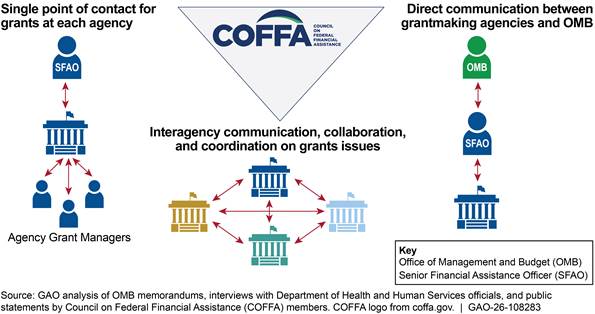
Member agencies communicate and collaborate in a variety of ways through COFFA, as shown in the figure below. For example, each agency has designated a senior official, known as a Senior Financial Assistance Officer, to serve as a single point of contact for grant programs at their agencies and raise questions and concerns at COFFA meetings. These officials communicate directly with OMB and with each other to share feedback and lessons learned. For example, when OMB revised guidance in 2024 to be clearer and more concise, the points of contact provided feedback to inform the revisions. In addition to providing feedback, COFFA also issued clarifying guidance to help agencies implement OMB’s revised guidance.
Why GAO Did This Study
In fiscal year 2024, the federal government obligated approximately $1.2 trillion in grants to tribal, state, local, and territorial governments. GAO’s prior work found opportunities to address long-standing challenges to federal grants management.
In recent years, multiple government-wide initiatives have been implemented to reform aspects of federal grants management. However, the flexibility at the grant program and agency level that may help programs meet specific goals can result in variation and complexity. This variation and complexity may hinder government-wide efforts to address crosscutting challenges.
GAO was asked to review recent initiatives to support agencies’ ability to collaboratively address grants management challenges. This report describes (1) the government-wide legal and administrative framework for federal grants management and (2) how member agencies communicate and collaborate through COFFA.
To describe the framework for federal grants management, GAO reviewed relevant legal and administrative documents, such as the Uniform Administrative Requirements, Cost Principles, and Audit Requirements for Federal Awards. GAO also reviewed relevant federal laws and executive orders.
To describe how member agencies interact through COFFA, GAO reviewed relevant OMB and COFFA guidance, and available information such as recorded events. GAO also interviewed officials and reviewed information from HHS.
|
Abbreviations |
|
|
|
|
|
|
|
CFO |
Chief Financial Officer |
|
|
COFAR |
Council on Financial Assistance Reform |
|
|
COFFA |
Council on Federal Financial Assistance |
|
|
HHS |
Department of Health and Human Services |
|
|
NOFO |
Notice of Funding Opportunity |
|
|
OMB |
Office of Management and Budget |
|
|
SFAO |
Senior Financial Assistance Officer |
|
|
Uniform Guidance |
Uniform Administrative Requirements, Cost Principles, and Audit Requirements for Federal Awards |
|
This is a work of the U.S. government and is not subject to copyright protection in the United States. The published product may be reproduced and distributed in its entirety without further permission from GAO. However, because this work may contain copyrighted images or other material, permission from the copyright holder may be necessary if you wish to reproduce this material separately.
April 14, 2026
The Honorable Gary C. Peters
Ranking Member
Committee on Homeland Security and Governmental Affairs
United States Senate
Federal grants represent a substantial financial commitment. For example, in fiscal year 2024, the federal government obligated approximately $1.2 trillion in grants to tribal, state, local, and territorial governments.[1] These grants vary greatly in terms of their size, the types of their grantees, and the nature of the programs they fund. In addition, there is substantial variation in the way federal agencies administer their grant programs. While flexibility at the grant and agency level may help ensure programs meet their goals, the resulting variation adds to the overall complexity of federal grants management and can hinder efforts to address crosscutting grants management challenges. We have previously reported on this and several long-standing grants management challenges.[2]
In August 2023, the Office of Management and Budget (OMB) established the Council on Federal Financial Assistance (COFFA) to improve the coordination, transparency, and accountability of federal grants.[3] This interagency council was tasked with providing strategic direction, policy recommendations, and priority-setting for government-wide grants-related activities. The current administration has also prioritized greater oversight, coordination, and streamlining of federal grantmaking.[4]
You asked us to review recent initiatives to support agencies’ ability to collaboratively address grants management challenges. In this report, we describe (1) the government-wide legal and administrative framework for federal grants management and (2) how member agencies communicate and collaborate through COFFA.
For this report, we focused on government-wide grants management of discretionary grants. We focused on grants management at the government-wide level because high-level decisions, guidance, and oversight may help facilitate more effective implementation of grant programs across government.[5] We focused on discretionary grants—which are generally characterized by a competitive application process—because of the greater complexity, variation, and administrative requirements on agencies and grantees, compared to other types of grants such as block and formula grants.[6]
To describe the government-wide framework for federal grants management, we reviewed and summarized relevant legal and administrative documents. For example, we conducted a legal review of selected sections of OMB’s guidance to federal agencies on administering and managing federal grants including the Uniform Administrative Requirements, Cost Principles, and Audit Requirements for Federal Awards.[7] We selected these sections because they provide flexibility and decision-making opportunities for grantmaking agencies and therefore would result in greater variability across grant programs and agencies. We also reviewed our prior reports and Congressional Research Service reports as well as relevant federal laws and executive orders.[8]
To describe how member agencies communicate and collaborate through COFFA, we requested documents and information from the agencies that currently serve as COFFA’s co-chairs: the Department of Health and Human Services (HHS) and OMB.[9] We interviewed HHS officials and reviewed documents provided by the agency, including an official presentation. We sent similar requests to OMB but did not receive a response beyond an acknowledgment of our outreach. As a result, we reviewed statements made by OMB staff at COFFA-related events. When we refer to statements made by OMB staff in this report, we are referring to information obtained from these sources.[10] We did not interview COFFA representatives from other member agencies, nor did we assess the effectiveness of the communication or collaboration of member agencies through COFFA.
We also identified and reviewed documentation related to COFFA. For example, we reviewed agency websites, OMB memorandums, guidance released by COFFA, and recorded events featuring COFFA members as panelists, among other sources. We also reviewed our prior work on COFFA and other relevant grants management topics.[11]
We conducted this performance audit from March 2025 to April 2026 in accordance with generally accepted government auditing standards. Those standards require that we plan and perform the audit to obtain sufficient, appropriate evidence to provide a reasonable basis for our findings and conclusions based on our audit objectives. We believe that the evidence obtained provides a reasonable basis for our findings and conclusions based on our audit objectives.
Background
Long-standing Challenges in Grants Management
We have previously reported on opportunities to address long-standing challenges to federal grants management in the following areas:[12]
· Streamlining. Streamlining may achieve cost savings and result in greater efficiencies in grant programs. Our work has shown that when grants management requirements are duplicative or overly burdensome, agencies must direct resources toward meeting them. This can make agency programs and services less cost effective and increase the burden for grant recipients.[13]
· Transparency. Greater transparency on how the federal government spends its funds may offer many potential benefits, such as enabling data-driven decisions about how to use government resources, opportunities for improving the efficiency and effectiveness of federal spending, and improving government’s accountability to the public. Our work has identified challenges related to the timeliness, completeness, and accuracy of grant data on USAspending.gov.[14]
· Internal controls and oversight. Our work has shown that when awarding and managing federal grants, effective oversight and internal control are important to provide reasonable assurance to federal managers and taxpayers that grants are awarded properly, recipients are eligible, improper payments are avoided, and federal grant funds are used as intended and in accordance with applicable laws and regulations. We have found that when internal controls are weak, grantmaking agencies face challenges in achieving grant program goals and assuring the proper and effective use of federal funds to help avoid improper payments.[15]
In recent years, multiple government-wide initiatives have been implemented to reform aspects of federal grants management across agencies.[16] Our prior work has identified challenges related to implementing government-wide reforms. In particular, reforms to improve grants data transparency have required considerable efforts for agencies to adopt common data definitions.[17] We have also previously reported that grants reform efforts should be designed to align with other government-wide reform efforts.[18] More recently, we reported on the experiences and insights of other countries that have implemented government-wide grants management reforms.[19]
Interagency Councils for Federal Grants Management
COFFA follows several prior interagency councils that were established with the goal of improving federal grants management.[20] Although these previous efforts had similar missions they varied in terms of membership (see table 1). For example, two of the prior councils—the Grants Executive Board and the Council on Financial Assistance Reform (COFAR)—limited permanent membership to the largest grantmaking agencies. Smaller grantmaking agencies were represented by one or two rotating members selected by OMB. When OMB dissolved each of the prior grants management councils, it provided a rationale for the dissolution and specified what would take the council’s place. For example, when COFAR was dissolved in 2017, OMB noted that moving forward, grants management issues would be addressed by the Chief Financial Officers (CFO) Council as part of its regular work to ensure broader representation across more grantmaking agencies.
|
Council |
Grants Policy Committee of the Chief Financial Officers (CFO) Council |
Grants Executive Boarda |
Council on Financial Assistance Reform (COFAR) |
Council on Federal Financial Assistance (COFFA) |
|
Dates of Operation |
1999 – 2011 |
2002 – 2011 |
2011 – 2017 |
2023 – Present |
|
Stated Purpose/ Mission |
To improve the management of federal grants government-wide by overseeing efforts of interagency work groups and recommending policies and practices to the Office of Management and Budget (OMB). |
To provide strategic direction and oversight of Grants.gov and the implementation of the Federal Financial Assistance Management Improvement Act of 1999 (Pub. L. No. 106-107), in coordination with OMB. |
To provide policy-level leadership for the grants community and implement reforms to improve the effectiveness and efficiency of federal grants. |
To improve coordination, transparency, and accountability for the award and management of federal grants. Built from lessons learned from prior councils including the CFO Council. |
|
Membership |
· Grants policy experts—largely program-level grants staff—from the 26 grantmaking agencies. |
· Senior officials from 11 of the larger grantmaking agencies. ·
Two rotating members from among the other, generally smaller, |
· OMB Controller. · Senior policy officials from eight grantmaking agencies that provide the largest amount of grants. · One rotating member from a different agency—selected by OMB—to represent the perspectives of other agencies that administer grants. |
· OMB Deputy Director for Management, or Controller as designee. · Officials from each of the 24 CFO Act agencies. OMB directed agencies to identify a Senior Financial Assistance Officer for this role. · One representative from the Small Agency Council, selected by the council. |
|
Rationale for Dissolution |
The Grants Policy Committee was replaced by COFAR “to create a more streamlined and accountable structure to coordinate financial assistance.” |
The Grants Executive Board was replaced by COFAR “to create a more streamlined and accountable structure to coordinate financial assistance.” |
COFAR’s responsibilities were transitioned to the CFO Council as part of its regular work, consistent with the goal of involving a broader group of grantmaking agencies in developing priorities for reforming federal grants management. |
As of April 2026, COFFA is still active. |
Source: GAO analysis of prior reports and OMB memorandums. | GAO‑26‑108283
aFrom 2002 to 2004, the council was called the Grants.gov Executive Board.
The goals, structure, and responsibilities of COFFA also took into account lessons learned from federal interagency councils that have been created to cover a variety of other issue areas. Such interagency councils identify emerging issues, share best practices, and develop solutions to common problems. According to OMB, COFFA’s design was influenced by existing government-wide policy councils such as the CFO Council, established in the 1990s to improve federal financial management.[21]
Like the CFO Council, COFFA includes representatives from each of the 24 CFO Act agencies as well as a representative from the Small Agency Council.[22] The Small Agency Council—serving about 80 small federal agencies—selects its representative to COFFA. This structure represents a shift from previous grants councils where OMB decided which agency or agencies would represent smaller grantmaking agencies. In fiscal year 2024, COFFA represented 38 of the 40 federal agencies that obligated grant funding that year and over 99 percent of the total grant funding obligated by the federal government.[23]
Agencies Navigate Complex Requirements to Design and Administer Grant Programs
Grants are a tool used by the federal government to provide financial assistance to eligible entities to carry out activities that align with certain policy objectives of the government. As such, federal grants fund a wide array of activities, including infrastructure, education, and healthcare, among others. Such grants also vary greatly in terms of size and the grantees who receive them. Federal law establishes multiple types of grants to help meet the scope and scale of national policy objectives.
Grantmaking agencies generally have some degree of authority to decide how to design and administer a federal grant program to best meet the program’s objectives, as long as the agencies follow the relevant statutes, regulations, and guidance that apply to their grant programs. While there are certain standard requirements, each grant program has different authorizing legislation and may also be subject to differing agency-specific regulations and guidance.
In particular, a grant program’s authorizing legislation plays a significant role in its administration. The authorizing legislation generally provides the basic structure of a grant program. Federal agencies may then develop more agency-specific regulations and guidance for administering the grant program.[24] Agencies apply a variety of requirements in designing and administering their grant programs, as shown in table 2.[25]
|
Requirement or Guidance |
Description of Requirement or Guidance |
|
Federal Statutes |
Laws that are passed by Congress and signed into law by the President, including authorizing legislation and appropriations for a grant program. |
|
Federal Regulations |
Rules published in the Federal Register, such as the Uniform Administrative Requirements, Cost Principles, and Audit Requirements for Federal Awards and agency regulations for specific grant programs. |
|
Executive Orders |
Directives issued to federal agencies by the Office of the President. |
|
Office of Management and Budget Policies |
Instructions that help agencies implement laws and regulations. |
|
Agency-specific Guidance |
Guidelines or standard terms and conditions set by agencies for any grant programs they develop. |
Source: GAO analysis of relevant guidance and legal authorities. | GAO‑26‑108283
In some cases, these various requirements could conflict with each other. For example, the Infrastructure Investment and Jobs Act included a provision that allowed Coronavirus State and Local Fiscal Recovery Funds to be used to meet non-federal matching funds requirements under specific circumstances.[26] This provision conflicted with the Uniform Administrative Requirements, Cost Principles, and Audit Requirements for Federal Awards (Uniform Guidance), which states that federal funds generally cannot be used to meet non-federal matching requirements of other federal programs while allowing exceptions. To address this conflict and assist grantees, the Department of Treasury issued guidance that identified which provisions in the Uniform Guidance were applicable.[27]
Grantmaking agencies are responsible for ensuring the compliance of their programs with all relevant requirements. For some aspects of grant design and administration, agencies have less direction and more discretion to make decisions. In 2024, OMB revised the Uniform Guidance to be clearer and more concise to help facilitate more consistent implementation across grantmaking agencies. The Uniform Guidance outlines requirements that agencies must follow as well as recommendations they should or may follow (see table 3).[28]
Table 3: Examples of Federal Agency Requirements and Recommendations or Discretion in the Uniform Administrative Requirements, Cost Principles, and Audit Requirements for Federal Awards
|
Section |
Example of Requirement |
Example of Recommendation or Discretion |
|
Program Planning and Design (2 C.F.R. § 200.202) |
Agencies must design the program: · with clear goals and objectives, consistent with the federal authorizing legislation; · to measure performance based on the goals and objectives; · to align with the agency’s strategic goals and objectives within its performance plan; · to align with the Program Management Improvement Accountability Act (Pub. L. No. 114-264) and the Foundations for Evidence-Based Policymaking Act (Pub. L. No. 115-435); and · to encourage applicants to engage members of the community that will benefit from or be impacted by the program. |
Agencies should develop programs in consultation with communities benefiting from or impacted by the program. Agencies should consider available data, evidence, and evaluation results from past programs and make every effort to extend eligibility requirements to all potential applicants. Agencies are encouraged to coordinate with other agencies during program planning and design, particularly when the goals and objectives of a program align with those of other agencies. |
|
Notices of Funding Opportunities (2 C.F.R. § 200.204) |
Agencies must announce specific funding opportunities for federal financial assistance that will be openly competed. |
Agencies should make all funding opportunities available for application for at least 60 days. No funding opportunity should be available for less than 30 calendar days unless an agency determines that exigent circumstances justify this. |
|
Federal Agency Review of Merit of Proposals (2 C.F.R. § 200.205) |
Agencies must generally design and execute a merit review process of applications for discretionary awards. The merit review process must be described or incorporated by reference in the funding opportunity. |
Agencies’ written standards should, for example, identify the number of people the agency requires to participate in the process, among other aspects. |
|
Performance Measurement (2 C.F.R. § 200.301) |
Agencies must measure the grantee’s performance to show achievement of program goals and objectives, share lessons learned, improve program outcomes, and foster the adoption of promising practices. |
Agencies should consider what information will be necessary to measure the grantee’s progress. Agencies should not require additional information that is not necessary for measuring program performance and evaluation. |
|
Monitoring and Reporting Program Performance (2 C.F.R. § 200.329) |
Agencies must use Office of Management and Budget-approved common information collections (e.g., Research Performance Progress Reports) when requesting performance reporting information. |
To the extent practicable, the agencies should align the due dates of performance reports and financial reports. |
|
Closeout (2 C.F.R. § 200.344) |
Agencies must close out the federal award when they determine that all administrative actions and required work of the award have been completed. Agencies must make every effort to complete all closeout actions no later than 1 year after the end of the period of performance. |
When justified, the agency may approve extensions to grantees for submitting final reports and liquidating financial obligations.a |
Source: GAO analysis of 2 C.F.R. part 200. | GAO‑26‑108283
aThe guidance does not define what could constitute appropriate justification for approving an extension.
Agencies are responsible not only for ensuring their own compliance with all relevant requirements but also for ensuring that federal funds awarded through their grant programs are spent consistent with all relevant requirements. As such, agencies need to provide direction and effectively oversee the compliance of their grantees.[29]
At the government-wide level, other types of entities have limited, defined roles related to grants oversight. For example, federal regulations outline OMB’s responsibilities, which include conducting broad oversight of government-wide compliance with certain OMB guidance.[30] The Council of the Inspectors General on Integrity and Efficiency has typically reported on the top management challenges—which have included grants management—across federal agencies.[31]
COFFA Provides Opportunities for Agency Collaboration on Federal Grants Management
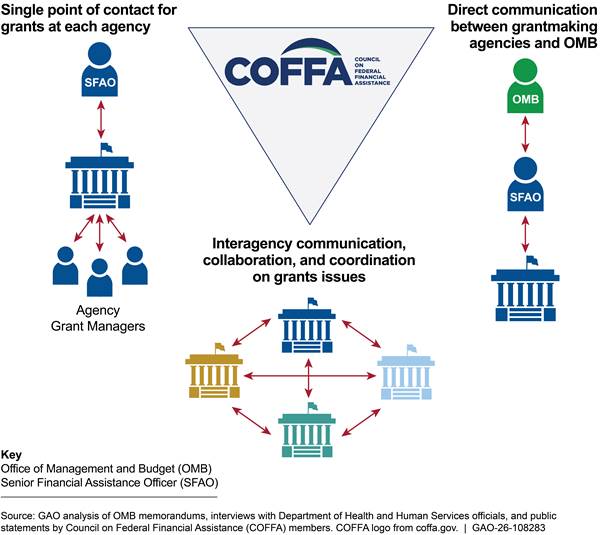
Under COFFA, federal grantmaking agencies communicate about and collaborate on federal grants management in several different ways, as shown in figure 1 and described below.
COFFA Agency Representatives Serve as a Single Point of Contact for Grants Issues at Each Agency
An important aspect of COFFA is the creation of the Senior Financial Assistance Officer (SFAO) role at each grantmaking agency. OMB staff said that prior to COFFA, agencies generally lacked a central point of contact who could speak for all the grant programs within their agency.[32] When COFFA was established in 2023, OMB directed agencies to select an SFAO to represent their agency on the council. In selecting an SFAO, agencies were directed to appoint a senior official with detailed knowledge of their agency’s grant programs who could both speak on behalf of their agency as well as influence internal decisions regarding administration of the agency’s grant programs.[33]
SFAOs serve as a single point of contact for grant programs at their agencies and can discuss questions and concerns at COFFA meetings.[34] Within agencies, grant program managers can share feedback and questions with their SFAO. For example, one SFAO noted they are regularly contacted by staff at their agency, such as with questions and challenges related to managing grant programs.[35] The SFAO said they are then able to take those questions to COFFA meetings and seek guidance from other agencies or OMB.[36]
After COFFA meetings, SFAOs can share decisions and other relevant information with their respective agencies. This can help grant program managers interpret guidance and implement grants management reforms more consistently across agencies and grant programs. OMB staff said that prior to COFFA, each agency generally interpreted and implemented grants guidance and requirements independently. In some cases, grant programs—potentially within the same agency—interpreted grants guidance and requirements differently.
OMB staff previously noted that the prior, more decentralized approach often resulted in agencies interpreting the same requirements in different or conflicting ways.[37] Specifically, OMB staff stated that certain sections of the Uniform Administrative Requirements, Cost Principles, and Audit Requirements for Federal Awards (Uniform Guidance)—prior to its revision in 2024—were being interpreted in different ways by grant programs.[38] As a result, grantees were sometimes hearing conflicting information from their programs. According to an SFAO, participating in COFFA has been helpful in ensuring consistent implementation across all grant programs within their agency.[39]
COFFA Provides a Forum for Direct Communication Between Grantmaking Agencies and OMB
SFAOs and OMB staff communicate directly with each other through COFFA. According to Department of Health and Human Services (HHS) officials, COFFA meetings provide OMB staff with opportunities to solicit input and feedback from agencies and for agencies to provide insight and implementation considerations on policies.
OMB staff previously noted that COFFA provides SFAOs with a forum where they can ask questions, prioritize concerns, and make recommendations, to which OMB can directly respond.[40] Specifically, OMB can evaluate the recommendation and either accept and implement it or explain why a recommendation cannot be accepted. According to OMB staff, COFFA meetings allow for two-way communication between OMB and the agencies through their SFAOs.
For example, according to HHS officials, OMB staff leveraged the SFAOs while working on the 2024 revisions to the Uniform Guidance. They said SFAOs collected and submitted to OMB a single set of comments per agency on the draft revisions. In addition, after the revisions were published and while agencies were developing their implementation plans to address the revisions, SFAOs communicated feedback from their agencies. Based in part on these conversations through COFFA with OMB, COFFA issued clarifying guidance.[41]
COFFA Provides Opportunities for Interagency Communication, Collaboration, and Coordination on Grants Issues
COFFA provides a variety of ways for SFAOs to work together, such as by communicating lessons learned, collaborating through working groups, and coordinating responses to topical issues.[42]
Communication. In prior work, we have found that sharing lessons learned from previous experiences is a powerful method to identify ways to improve work processes.[43] In particular, we found that sharing lessons learned in an interagency context is valuable since one agency can share lessons it has learned with other agencies that may benefit from the information. OMB staff noted that COFFA provides a forum for SFAOs to share information about their own agency and learn from the experiences of other agencies.[44]
For example, SFAOs learned from each other in COFFA meetings while responding to an OMB requirement to simplify their Notices of Funding Opportunity (NOFO). Specifically, according to HHS officials, some SFAOs represented agencies that had participated in NOFO simplification efforts and shared their lessons learned. HHS officials said other SFAOs shared the challenges their agencies faced and received suggestions and input from other SFAOs.
Collaboration. Through COFFA, SFAOs collaborate with each other on certain projects through working groups. COFFA working groups have ranged from short-term, discrete projects such as developing the council’s website to longer-term, complex projects like developing a set of workforce competencies for the grants community.[45]
One ongoing working group is developing government-wide grants data standards.[46] Established by charter as a standing working group under COFFA, the Data Standards Working Group is co-led by OMB and HHS and follows a structured process.[47] First, the lead agencies set priorities. Then, the working group members develop draft sets of data standards.[48] When a first draft of the data standards is complete, the working group members solicit formal feedback from SFAOs and, as needed, outside stakeholders. After feedback is incorporated into the draft set of data standards, OMB and HHS finalize and publish the data standards.[49]
To date, the working group has issued two sets of grants data standards aligned with specific grants life cycle activities: assistance listings and soliciting applications.[50] According to documentation from HHS, the group plans to issue additional data sets over a 3- to 4-year period, including applications, awards, payments, post-award, program oversight, and single audits.
Coordination. SFAOs also work together to help align how their agencies approach certain aspects of grants management. For example, in 2025 shortly after the new administration issued several grants-related executive orders, SFAOs met to discuss the implications of those orders.[51] HHS officials said that SFAOs discussed how to implement the new policies contained in the executive orders.
As needed, subsets of SFAOs meet to discuss specific topics that require the attention of some but not all SFAOs. An HHS official described these discussions as ad-hoc meetings that provide an opportunity for COFFA co-chairs and small groups of grantmaking agencies to study an issue in more depth. Typically, following such meetings, COFFA issues clarifying guidance for grantmaking agencies.
For example, an HHS official said some SFAOs met to discuss single audit reporting extensions.[52] Following the meeting, COFFA issued a decision to authorize extension periods for grantees affected by certain natural disasters.[53] The decision noted that it was a coordinated effort by COFFA members to ensure affected grantees were provided with consistent extension periods. Similar meetings have been held, for example, related to subaward reporting requirements.[54] An HHS official said COFFA solicited feedback from SFAOs on clarifying guidance related to subaward reporting requirements.
Agency Comments
We provided a draft of this report to HHS and OMB for review and comment. HHS responded that it did not have any comments on the report. OMB did not respond to our outreach.
We are sending copies of this report to the appropriate congressional committees, the Secretary of HHS, the Director of OMB, and other interested parties. In addition, the report is available at no charge on the GAO website at https://www.gao.gov.
If you or your staff have any questions about this report, please contact me at arkinj@gao.gov. Contact points for our Offices of Congressional Relations and Media Relations may be found on the last page of this report. GAO staff who made key contributions to this report are listed in the appendix.
Sincerely,
Jeff Arkin
Director, Strategic Issues
GAO Contact
Jeff Arkin, arkinj@gao.gov
Staff Acknowledgments
In addition to the contact named above, Peter Del Toro (Assistant Director), Tom James (Assistant Director), Kimberly Bohnet (Analyst-in-Charge), Ann Czapiewski, Evan Ismail, Amalia Konstas, Jeff A. Larson, Robert Robinson, and Mercedes Wilson-Barthes made key contributions to this report.
The Government Accountability Office, the audit, evaluation, and investigative arm of Congress, exists to support Congress in meeting its constitutional responsibilities and to help improve the performance and accountability of the federal government for the American people. GAO examines the use of public funds; evaluates federal programs and policies; and provides analyses, recommendations, and other assistance to help Congress make informed oversight, policy, and funding decisions. GAO’s commitment to good government is reflected in its core values of accountability, integrity, and reliability.
Obtaining Copies of GAO Reports and Testimony
The fastest and easiest way to obtain copies of GAO documents at no cost is through our website. Each weekday afternoon, GAO posts on its website newly released reports, testimony, and correspondence. You can also subscribe to GAO’s email updates to receive notification of newly posted products.
Order by Phone
The price of each GAO publication reflects GAO’s actual cost of production and distribution and depends on the number of pages in the publication and whether the publication is printed in color or black and white. Pricing and ordering information is posted on GAO’s website, https://www.gao.gov/ordering.htm.
Place orders by calling (202) 512-6000, toll free (866) 801-7077,
or
TDD (202) 512-2537.
Orders may be paid for using American Express, Discover Card, MasterCard, Visa, check, or money order. Call for additional information.
Connect with GAO
Connect with GAO on X,
LinkedIn, Instagram, and YouTube.
Subscribe to our Email Updates. Listen to our Podcasts.
Visit GAO on the web at https://www.gao.gov.
To Report Fraud, Waste, and Abuse in Federal Programs
Contact FraudNet:
Website: https://www.gao.gov/about/what-gao-does/fraudnet
Automated answering system: (800) 424-5454
Media Relations
Sarah Kaczmarek, Managing Director, Media@gao.gov
Congressional Relations
David A. Powner, Acting Managing Director, CongRel@gao.gov
General Inquiries
[1]See GAO, Financial Audit: FY 2024 and FY 2023 Consolidated Financial Statements of the U.S. Government, GAO‑25‑107421 (Washington, D.C.: Jan. 16, 2025). For the purposes of our report, we use the term grants to mean both grants and cooperative agreements. Cooperative agreements are a legal instrument of financial assistance between a federal agency and a recipient. They are distinguished from grants in that they provide for more substantial involvement of the federal agency in carrying out the activities of the agreement. 2 C.F.R. § 200.1.
[2]See GAO, Grants Management: Observations on Challenges with Access, Use, and Oversight, GAO‑23‑106797 (Washington, D.C.: May 2, 2023); Grants Management: Observations on Challenges and Opportunities for Reform, GAO‑18‑676T (Washington, D.C.: July 25, 2018); and Grants to State and Local Governments: An Overview of Federal Funding Levels and Selected Challenges, GAO‑12‑1016 (Washington, D.C.: Sept. 25, 2012).
[3]Office of Management and Budget, Establishment of the Council on Federal Financial Assistance, M-23-19 (Washington, D.C.: Aug. 9, 2023). In this memorandum, OMB acknowledged that COFFA’s work may be most focused on grants and cooperative agreements, rather than federal financial assistance more broadly.
[4]See, for example, Exec. Order No. 14332, Improving Oversight of Federal Grantmaking, 90 Fed. Reg. 38929 (Aug. 7, 2025).
[5]This type of overall grants management framework may also be referred to as grants governance. We have reported on governance frameworks related to other types of federal functions. For example, see GAO, Artificial Intelligence: An Accountability Framework for Federal Agencies and Other Entities, GAO‑21‑519SP (Washington, D.C.: June 30, 2021); and Data Governance: Agencies Made Progress in Establishing Governance, but Need to Address Key Milestones, GAO‑21‑152 (Washington, D.C.: Dec. 16, 2020).
[6]See 2 C.F.R. § 200.1. Block grants fund broad categories of activities, such as community development or public health, and generally give greater discretion to recipients in identifying problems and designing programs to address those problems. A formula grant allocates funding based on distribution formulas prescribed by legislation or administrative regulation. For further information, see GAO‑12‑1016.
[7]2 C.F.R. pt. 200.
[8]Executive orders issued by the current administration in 2025 may have implications for federal grants management. For example, see Exec. Order No. 14151, Ending Radical and Wasteful Government DEI Programs and Preferencing, 90 Fed. Reg. 8339 (Jan. 29, 2025); Exec. Order No. 14222, Implementing the President’s “Department of Government Efficiency” Cost Efficiency Initiative, 90 Fed. Reg. 11095 (Mar. 3, 2025); and Exec. Order No. 14332, Improving Oversight of Federal Grantmaking, 90 Fed. Reg. 38929 (Aug. 12, 2025). However, our report discusses how agencies responded to these executive orders through COFFA rather than on the implications of the executive orders on federal grants management more broadly.
[9]OMB co-chairs COFFA with a member agency that serves on a rotating basis and is selected by members of the council. HHS served as the inaugural co-chair for an initial 2-year term. In August 2025, an HHS official confirmed that the agency’s role as co-chair had been extended for a second 2-year term.
[10]Specifically, we reviewed National Academy of Public Administration, Grants Management Symposium on 2 CFR 200, the COFFA, and the Academy’s Uniform Guidance Field Guide – December 10, 2024, accessed July 2, 2025, https://napawash.org/working‑groups/active‑forums/grants‑management‑symposium; and “Introducing COFFA: Strengthening Collaboration and Accountability” (panel discussion at the AGA Professional Development Training, Denver, CO, July 17, 2024).
[11]For our prior work discussing COFFA and other grants management initiatives, see GAO‑25‑107421 and GAO, Grants Management: HHS Has Taken Steps to Modernize Government-wide Grants Management, GAO‑24‑106008 (Washington, D.C.: Dec. 14, 2023). For prior work on other relevant grants management topics, see, for example, GAO, Grants Management: Action Needed to Ensure Consistency and Usefulness of New Data Standards, GAO‑24‑106164 (Washington, D.C.: Jan. 25, 2024); GAO‑23‑106797; and GAO‑18‑676T.
[12]See, for example, GAO‑23‑106797.
[13]See, for example, GAO, Federal Research Grants: Opportunities Remain for Agencies to Streamline Administrative Requirements, GAO‑16‑573 (Washington, D.C.: June 22, 2016).
[14]See GAO, Federal Spending Transparency: Opportunities Exist to Further Improve the Information Available on USAspending.gov, GAO‑22‑104702 (Washington, D.C.: Nov. 8, 2021).
[15]See, for example, GAO‑23‑106797 and GAO‑18‑676T.
[16]See, for example, GAO‑24‑106008.
[17]See, for example, GAO‑24‑106164 and GAO, Federal Programs: OMB Needs a Structure to Govern and a Plan to Develop a Comprehensive Inventory, GAO‑24‑107656 (Washington, D.C.: Sept. 25, 2024).
[19]GAO, Grants Management: Approaches and Insights from Other Countries’ Reform Efforts, GAO‑25‑106920 (Washington, D.C.: Nov. 18, 2024).
[20]We have previously reported on some prior interagency councils. For example, see GAO, Grants Management: Selected Agencies Should Clarify Merit-Based Award Criteria and Provide Guidance for Reviewing Potentially Duplicative Awards, GAO‑17‑113 (Washington, D.C.: Jan. 12, 2017); and Grants Management: Improved Planning, Coordination, and Communication Needed to Strengthen Reform Efforts, GAO‑13‑383 (Washington, D.C.: May 23, 2013).
[21]M-23-19. We have previously reported on the CFO Council activities in federal financial management. See GAO, Federal Financial Management: Substantial Progress Made since Enactment of the 1990 CFO Act; Refinements Would Yield Added Benefits, GAO‑20‑566 (Washington, D.C.: Aug. 6, 2020).
[22]Chief Financial Officers Act of 1990, Pub. L. No. 101-576, § 302, 101 Stat. 2838, 2842-2843, codified as amended at 31 U.S.C. § 901(b). The CFO Act agencies consist of the Departments of Agriculture, Commerce, Defense, Education, Energy, Health and Human Services, Homeland Security, Housing and Urban Development, Interior, Justice, Labor, State, Transportation, Treasury, and Veterans Affairs, as well as the Agency for International Development, Environmental Protection Agency, General Services Administration, National Aeronautics and Space Administration, National Science Foundation, Nuclear Regulatory Commission, Office of Personnel Management, Small Business Administration, and Social Security Administration. Other than HHS, we did not interview any COFFA representatives—neither from CFO Act agencies nor the Small Agency Council—and we did not assess the effectiveness of their representation.
[23]Based on USAspending.gov data and agency membership in the Small Agency Council in fiscal year 2024. In fiscal year 2024, the two grantmaking agencies that obligated grant funds but were not represented by COFFA were the U.S. Agency for Global Media and the U.S. International Development Finance Corporation. We include data for fiscal year 2024 because in fiscal year 2025 the administration made midyear changes to numerous grant awards, including pauses and cancellations, rendering the fiscal year 2025 data more variable.
[24]The authorizing legislation is typically followed by an appropriation that provides spending authority for the grant program.
[25]For more information on the process of creating federal grant programs, see Congressional Research Service, Considerations for Creating a New Federal Grant Program: In Brief, R47928 (Feb. 22, 2024).
[26]The Coronavirus State and Local Fiscal Recovery Funds was a program established under the American Rescue Plan Act of 2021 that provided $350 billion to tribal governments, states, the District of Columbia, U.S. territories, and more than 30,000 local governments to help cover a broad range of costs stemming from the health and economic effects of the COVID-19 pandemic. We have previously reported on the Coronavirus State and Local Fiscal Recovery Funds. See, for example, GAO, COVID-19 Relief: Treasury Could Improve Compliance Procedures and Guidance for State and Local Fiscal Recovery Funds, GAO‑25‑107909 (Washington, D.C.: July 22, 2025).
[27]See Department of the Treasury, Coronavirus State and Local Fiscal Recovery Funds Frequently Asked Questions (Apr. 29, 2025); 2 C.F.R. § 200.306(b); Infrastructure Investment and Jobs Act, Pub. L. No. 117-58, § 40909, 135 Stat. 429, 1126 (2021).
[28]Throughout the Uniform Guidance, the word “must” indicates a requirement. The words “should” or “may” indicate a recommended approach and permit discretion. 2 C.F.R. § 200.101(a).
[29]While grantees may issue subawards to other entities to help carry out a portion of the grant work, the federal grantmaking agencies do not have a direct legal relationship with subrecipients. Therefore, the grantees are responsible for overseeing the compliance of their subaward entities. We have previously reported on subaward oversight. See, for example, GAO‑25‑107315.
[30]Specifically, the Uniform Guidance, which is codified in federal regulations, defines OMB’s responsibilities as (1) reviewing agency regulations and implementation, (2) providing interpretations of requirements, and (3) considering requests for exceptions to the Uniform Guidance requirements. Some legislation may have additional, specifically defined roles for OMB. We have previously reported on examples of legislation that directed OMB to develop guidance on grants-related topics. See, for example, GAO, Grants Management: Actions Needed to Improve Agency Reporting of Expired Grants, GAO‑23‑105700 (Washington, D.C.: Apr. 13, 2023).
[31]Council of the Inspectors General on Integrity and Efficiency, Top Management and Performance Challenges Facing Multiple Federal Agencies (September 2023). Agency inspectors general have responsibility within their respective agencies to prevent and detect fraud, waste, and abuse and to promote economy, efficiency, and effectiveness within agency programs and operations through audits and investigations. Inspector General Act of 1978, Pub. L. No. 95-452, § 4, 92 Stat. 1101, 1102-1103 (1978), codified as amended at 5 U.S.C. § 404.
[32]“Introducing COFFA: Strengthening Collaboration and Accountability” (panel discussion at the AGA Professional Development Training, Denver, CO, July 17, 2024).
[33]M-23-19. As mentioned earlier, COFFA was designed to be similar to the CFO Council. When the CFO Council was established, agencies were similarly directed to identify a senior official to represent the agency on the council. 31 U.S.C. § 901 note.
[34]According to HHS officials, council meetings are generally held monthly, although there were some exceptions in 2025.
[35]“Introducing COFFA: Strengthening Collaboration and Accountability” (panel discussion at the AGA Professional Development Training, Denver, CO, July 17, 2024).
[36]“Introducing COFFA: Strengthening Collaboration and Accountability” (panel discussion at the AGA Professional Development Training, Denver, CO, July 17, 2024).
[37]National Academy of Public Administration, Grants Management Symposium on 2 CFR 200, the COFFA, and the Academy’s Uniform Guidance Field Guide – December 10, 2024.
[38]National Academy of Public Administration, Grants Management Symposium on 2 CFR 200, the COFFA, and the Academy’s Uniform Guidance Field Guide – December 10, 2024. OMB revised the Uniform Guidance in 2024 to improve management of federal funds and reduce administrative burden for agencies and grantees, among other reasons. See Office of Management and Budget, Reducing Burden in the Administration of Federal Financial Assistance, M-24-11 (Washington, D.C.: Apr. 4, 2024).
[39]“Introducing COFFA: Strengthening Collaboration and Accountability” (panel discussion at the AGA Professional Development Training, Denver, CO, July 17, 2024).
[40]“Introducing COFFA: Strengthening Collaboration and Accountability” (panel discussion at the AGA Professional Development Training, Denver, CO, July 17, 2024).
[41]For the guidance, see COFFA, FY 2024 Revisions to 2 CFR: Federal Agency Implementation (Aug. 15, 2024). According to an OMB press release describing COFFA’s accomplishments, OMB indicated that this guidance was developed jointly between OMB and COFFA. See OMB, Fact Sheet: Marking the Achievements of the Council on Federal Financial Assistance on its First Anniversary (Oct. 22, 2024).
[42]For the purposes of this report, we define collaboration as multiple agencies working together on a shared outcome and coordination as multiple agencies consulting with each other to align their individual outcomes.
[43]See, for example, GAO, Grants Management: OMB Should Collect and Share Lessons Learned from Use of COVID-19-Related Grant Flexibilities, GAO‑21‑318 (Washington, D.C.: Mar. 31, 2021).
[44]National Academy of Public Administration, Grants Management Symposium on 2 CFR 200, the COFFA, and the Academy’s Uniform Guidance Field Guide – December 10, 2024.
[45]COFFA’s website—coffa.gov—was active from 2024 to 2026. In March 2026, the websites for multiple federal interagency councils were transitioned to Councils.gov. See for example, https://www.councils.gov/coffa/. In addition, HHS officials told us in August 2025 that while COFFA still plans to finish developing the workforce competency model, the working group is not currently active.
[46]Agencies collect and report information through a series of data elements. In federal grants management, data elements represent information collected from all stages of the grants life cycle, including the notice of opportunity, application review, award management, audits, and post-award. Data standardization is a recognized approach for increasing the consistency, and therefore the transparency, of data. Government-wide data standards provide a consistent, government-wide approach for describing the substance and structure of data. The common definitions and formats established by such government-wide data standards make it possible to collect data consistently across different agencies, which in turn provides the ability to accurately compare and aggregate data. See GAO‑24‑106164.
[47]The Grant Reporting Efficiency and Agreements Transparency Act of 2019 directs OMB and HHS to create data standards to help modernize grant reporting by grantees and strengthen agency management and oversight of federal grants. Pub. L. No. 116-103, § 2, 133 Stat. 3266 (2019), codified at 31 U.S.C. §§ 6401 note, 6402 note, 6401-04, 7505. We have previously reported that OMB staff and HHS officials expected COFFA to help implement the Act’s requirements, such as by conducting stakeholder consultation and providing a venue to support the development of data standards. See GAO‑24‑106164.
[48]According to the Data Standards Working Group charter, the working group’s members must be from federal grantmaking agencies and have a wide range of knowledge and experience in federal grant programs. The working group also includes a small number of temporary rotating subject matter experts who help with specific sets of data standards.
[49]As OMB and HHS are finalizing the set of data standards, the working group may provide recommendations to OMB and HHS on technical guidance to help agencies understand how to implement the set. OMB and HHS are responsible for issuing guidance that will, among other things, help agencies minimize the disruption to current data reporting practices while implementing the data standards. Finalized sets of grants data standards are published on https://www.grants.gov/data‑standards.
[50]Assistance listings are detailed public descriptions of federal programs that provide grants, loans, scholarships, insurance, and other types of assistance awards to, among others, state and local governments, the private sector, and individuals from the general public. For more on assistance listings, see the Federal Program Inventory: https://fpi.omb.gov/about/fpi.
[51]As mentioned earlier, multiple executive orders issued after the change in administration in January 2025 have had implications for federal grants management.
[52]“Introducing COFFA: Strengthening Collaboration and Accountability” (panel discussion at the AGA Professional Development Training, Denver, CO, July 17, 2024). Non-federal entities that spend $1 million or more in federal awards in their fiscal year are generally required to undergo an audit of their financial statements, known as a single audit. A non-federal entity may choose to undergo a program-specific audit instead provided they meet certain conditions, like only spending federal awards under one federal program, or if the award’s terms and conditions do not require a financial statement audit. Such audits must be performed by an independent auditor and conducted in accordance with generally accepted government auditing standards. See 31 U.S.C. §§ 7501-7506; 2 C.F.R. part 200, subpart F.
[53]See COFFA, Single Audit Report Extensions for Hurricane Helene, Hurricane Milton, and the California Wildfires (Mar. 11, 2025).
[54]As mentioned above, grantees can pass through federal grant funds to subrecipients in the form of a subaward. Grantees must generally report these subawards to a data system that tracks this information. Federal agencies are responsible for ensuring grantees report subaward information. See, for example, GAO‑25‑107315.