
Report to Congressional Committees
United States Government Accountability Office
A report to congressional committees
Contact: Danielle T. Giese at GieseD@gao.gov
What GAO Found
The Federal Aviation Administration (FAA) issues certificates to aircraft mechanics and to the more than 200 aviation maintenance schools that train them. Eleven of these certificated schools are high schools, and 43 are colleges, universities, or career and technical centers that serve high school students. In addition, at least 43 high schools offer programs in aviation maintenance but are not certificated by FAA. The school representatives that GAO interviewed had little data on career outcomes but cited a range of pathways that graduates have pursued, including further training and enrolling in 4-year colleges.
Stakeholders identified several barriers to students becoming aircraft mechanics, especially limited awareness of the career option among students entering high school. Stakeholders also offered options to address these barriers, such as internships with aviation industry partners to increase awareness. Some stakeholders cited as a barrier the ineligibility of students from uncertificated schools, who do not have the requisite work experience or additional education, to take the general written knowledge test—typically the first in a series of FAA tests that students must pass to become an FAA-certificated aircraft mechanic. For example, one stakeholder said that having to take courses at a certificated school can be costly after taking courses at an uncertificated school.
The FAA Reauthorization Act of 2024 requires FAA to task the Aviation Rulemaking Advisory Committee to establish the Airman Knowledge Testing Working Group by May 2025, to assess whether students who have successfully completed an aviation maintenance curriculum should be allowed to take the general written knowledge test. FAA has not established this working group or obtained this assessment. FAA officials said they were unable to do so because, according to the Department of Transportation, it terminated all members of the advisory committee pursuant to an executive order, which required termination of advisory committees deemed to be unnecessary. Convening a group of industry stakeholders and aviation experts to conduct an assessment, through the advisory committee or other mechanism, could help FAA obtain a range of perspectives on the potential benefits and drawbacks of allowing graduates of uncertificated schools to take the test. Through this assessment, FAA could also determine whether expanding access to the test could help address future workforce demand.
Why GAO Did This Study
A sufficient supply of aircraft mechanics, who service and repair aircraft, is necessary to ensure a safe aviation system. The Bureau of Labor Statistics estimates there will be about 11,300 open positions for aircraft mechanics annually through 2034. One way to meet this need is to recruit and train younger workers.
The FAA Reauthorization Act of 2024 includes a provision for GAO to review programs that train high school students in aviation maintenance and identify certain barriers for program graduates. This report discusses, among other things, (1) the number of such programs and the career outcomes of their graduates; and (2) barriers to students becoming aircraft mechanics through these programs, and options to address those barriers.
GAO analyzed FAA data and conducted a literature search to identify high school aviation maintenance programs, including those partnering with schools certificated by FAA. GAO also interviewed aviation industry stakeholders, including representatives of 12 certificated or uncertificated schools, selected based on type of school and geographic diversity. In addition, GAO compared FAA’s actions with statutory requirements.
What GAO Recommends
GAO recommends that FAA establish a group of industry stakeholders and aviation experts to assess whether students should be allowed to take FAA’s general written knowledge test for mechanics after successfully completing an aviation maintenance curriculum at an uncertificated school. DOT concurred with the recommendation.
|
Abbreviations |
|
ATEC Aviation Technician Education Council |
|
BLS Bureau of Labor Statistics |
|
DOT Department of Transportation |
|
FAA Federal Aviation Administration |
|
|
This is a work of the U.S. government and is not subject to copyright protection in the United States. The published product may be reproduced and distributed in its entirety without further permission from GAO. However, because this work may contain copyrighted images or other material, permission from the copyright holder may be necessary if you wish to reproduce this material separately.
September 1, 2026
The Honorable Ted Cruz
Chairman
The Honorable Maria Cantwell
Ranking Member
Committee on Commerce, Science, and Transportation
United States Senate
The Honorable Sam Graves
Chairman
The Honorable Rick Larsen
Ranking Member
Committee on Transportation and Infrastructure
House of Representatives
A sufficient supply of aircraft mechanics is necessary for ensuring a safe and robust aviation system. Aircraft mechanics inspect, service, and repair aircraft bodies (airframe) and engines (powerplant). The Bureau of Labor Statistics (BLS) estimated there were 139,400 aircraft mechanics and technicians employed in 2024, and it projects an average of about 11,300 job openings each year through 2034 for this occupation.[1] Federal and aviation industry stakeholders have expressed concern about the capacity of the industry to meet projected workforce needs due to factors such as retirements, attrition, and a growing demand for air travel.[2]
One way to meet the need for more aircraft mechanics is to recruit young people into the occupation. The Department of Transportation’s (DOT) Federal Aviation Administration (FAA) issues certificates to aircraft mechanics and schools—including high schools, colleges, and career and technical education centers —that train mechanics to ensure they are adequately prepared to service and maintain aircraft. In a 2022 report, a task force convened by FAA recommended that the agency take steps to recruit young people to aviation jobs. The report noted that high school students can take courses to earn credit toward their aircraft mechanic certificate. These courses may be available through the students’ high school or with aviation maintenance schools that have traditionally enrolled adults.
The FAA Reauthorization Act of 2024 includes a provision for GAO to review programs that train high school students in aviation maintenance and identify certain barriers for graduates of these programs.[3] This report examines (1) the number of U.S. high school aviation maintenance programs, the number of programs that partner with certificated schools, and the typical career outcomes of their graduates; [4] (2) stakeholders’ perspectives on FAA’s engagement with certificated schools that have high school aviation maintenance programs on establishing and maintaining certification; and (3) barriers to students and graduates becoming aircraft mechanics through high school aviation maintenance programs, and options to address those barriers.
To inform all objectives, we reviewed relevant statutes, regulations, DOT and FAA guidance, and other documentation on aircraft mechanics, as well as our prior work and industry publications. We also conducted semi-structured interviews with DOT and FAA officials as well as with a nongeneralizable selection of stakeholders. These stakeholders were from 20 organizations comprising 10 certificated and two uncertificated schools; four industry associations; an airline manufacturer; an aviation maintenance and repair company; and two state agencies that fund career and technical education in aviation maintenance. We selected schools to obtain a variety of perspectives based on whether they were certificated by FAA; their location; and their school type (college, high school, or career and technical education center). We selected four certificated high schools, two certificated colleges, two certificated career and technical education centers, and two schools with uncertificated programs. Finally, we conducted two discussion groups with recent graduates of high school aviation maintenance programs—one group of graduates from a certificated school, and one group of graduates from an uncertificated school.
To examine the number of high school aviation maintenance programs and their partnerships with certificated schools, we obtained and analyzed FAA’s information on all certificated schools, including those with high school aviation maintenance programs. We discussed the reliability of these data with FAA officials, including steps that FAA has taken to update, review, and verify the data. We determined the data to be reliable for our purposes.
To verify which of these schools included a high school aviation maintenance program or partnership, we researched schools on FAA’s list, which led to our adding and removing a few programs from the final list of identified schools.[5] We conducted this research and identified uncertificated schools through our own literature search and by checking grantees that received FAA Aviation Maintenance Technical Workers grants from fiscal year 2020 through fiscal year 2025. Our review of relevant literature spanned 10 years, including scholarly and peer-reviewed materials, trade and industry articles, and government reports, and it identified relevant news and industry publications. We used search terms related to aviation maintenance programs, high schools, and the aviation maintenance workforce. We also contacted selected certificated and uncertificated aviation maintenance schools to confirm whether they train high school students, provide training in aviation maintenance, or—if not a certificated high school—partner with certificated schools that provide this training. In addition, we analyzed information on students’ career outcomes from interviews from selected schools.
To obtain stakeholders’ perspectives on FAA’s engagement with certificated schools that have high school aviation maintenance programs on establishing and maintaining certification, we interviewed FAA officials and representatives of selected certificated schools. We selected these schools to obtain a variety of perspectives based on their location and school type (college, high school, or career and technical education center).
To examine barriers to students and graduates becoming aircraft mechanics through high school aviation maintenance programs, and options to address those barriers, we reviewed our relevant prior work and industry publications. We also analyzed responses from interviews with stakeholders, including certificated and uncertificated schools, and discussion groups with recent graduates of two high school aviation maintenance programs. We identified the most frequently cited barriers from this information, along with potential options to address those barriers. In addition, we reviewed FAA’s efforts to assess whether high school students can take FAA’s aircraft mechanic general written knowledge test if they complete an aviation maintenance curriculum, and we reviewed FAA’s actions within the context of relevant statutory provisions.[6]
We conducted this performance audit from March 2025 to September 2026 in accordance with generally accepted government auditing standards. Those standards require that we plan and perform the audit to obtain sufficient, appropriate evidence to provide a reasonable basis for our findings and conclusions based on our audit objectives. We believe that the evidence obtained provides a reasonable basis for our findings and conclusions based on our audit objectives.
Background
Aircraft Mechanics’ Tasks, Testing, and Certification
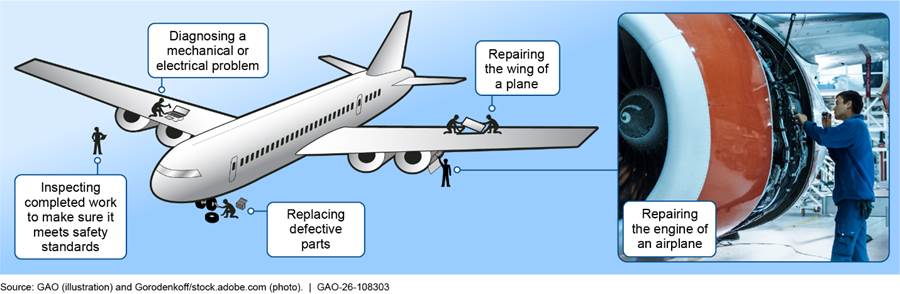
Aircraft mechanics perform a variety of tasks, including diagnosing mechanical or electrical problems and repairing aircraft bodies (airframe) and engines (powerplant) (see fig. 1).
FAA issues a mechanic certificate—and the associated ratings of airframe, powerplant, or both—to individuals who meet the eligibility requirements. These individuals must
· be at least age 18;
· have passed all the FAA mechanic tests (written knowledge, oral, and practical) within a period of 24 months; and
· be able to read, write, speak, and understand English.[7]
The mechanic certificate enables individuals to perform or supervise the maintenance or alterations of an aircraft or most aircraft parts covered by their certificate and rating(s). Individuals with an airframe rating are able to return the aircraft’s airframe to service after performing inspections, repairs, or alterations, and individuals with a powerplant rating are able to return the engine and propeller to service after performing inspections, repairs, or alterations.[8]
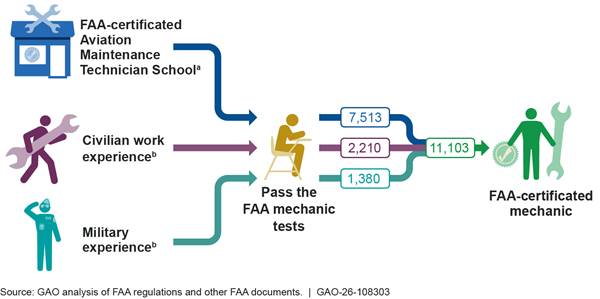
The FAA mechanic tests cover topics in FAA’s Aviation Mechanic General, Airframe, and Powerplant Airman Certification Standards, which outline the knowledge and skills needed to identify hazards and mitigate risks associated with repairing and maintaining aircraft. Individuals become eligible to take the FAA mechanic tests by training at a certificated school or completing on-the-job training in the civilian workforce or military.[9] Individuals meeting the eligibility requirement by training at a certificated school must satisfactorily complete the school’s general curriculum.[10] Students generally graduate from a certificated school in about 21 months. Alternatively, FAA requires that individuals completing on-the-job training have at least 18 months of practical aircraft maintenance experience for either the airframe or powerplant rating, and at least 30 months concurrently performing the duties appropriate for both ratings to be eligible to take the FAA mechanic tests.[11] In 2025, nearly seven of 10 new aircraft mechanics obtained their certificate after training at a certificated school; approximately 20 percent obtained their certificate through on-the-job civilian training in the civilian workforce; and approximately 12 percent obtained their certificate through military service (see fig. 2).
Figure 2: Individuals Who Completed Each Pathway to Become an Aircraft Mechanic Certificated by the Federal Aviation Administration (FAA), 2025
Note: In addition to passing the FAA mechanic tests (written knowledge, oral, and practical) within a period of 24 months, to be eligible to become aircraft mechanics, individuals must be at least age 18; comply with the certification requirements for the rating(s) sought; and read, write, speak, and understand English. 14 C.F.R. § 65.71.
aThe length of programs at these schools is approximately 21 months. Enrollment in a certificated school demonstrates to FAA that a student is prepared to take specified oral and practical tests. Students who have made satisfactory progress at a certificated school may take these tests during their final subjects at the school, before graduation, before meeting specified experience requirements, and before passing each section of the specified written test. 14 C.F.R. § 65.80.
bFAA requires at least 18 months of practical aircraft maintenance experience for either the airframe or powerplant rating, and at least 30 months concurrently performing the duties appropriate for both ratings. This experience could be civilian or military. Depending on an applicant’s military specialty, FAA may grant credit for military aviation maintenance experience toward the airframe or powerplant ratings. Students relying on the practical experience pathway may take the general written knowledge test prior to meeting specified practical experience requirements after providing authenticated documentation from a certificated school demonstrating satisfactory completion of the general portion of the school’s curriculum and specifying the completion date. See 14 C.F.R. § 65.75(c). In addition, individuals may also be eligible to take the FAA mechanic tests by completing the Joint Service Aviation Maintenance Technician Certification Council training course for military personnel, according to FAA.
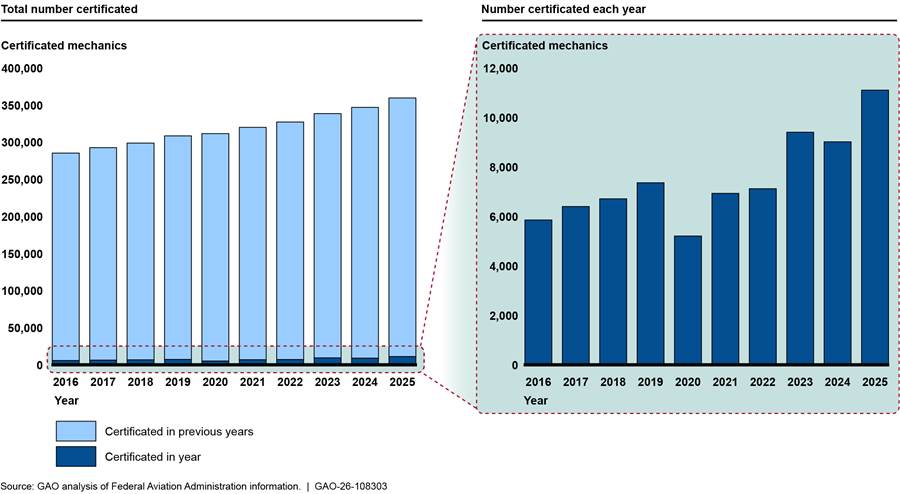
In calendar year 2025, 331,000 individuals had FAA-issued
mechanic certificates. From calendar year 2016 through calendar year 2025, the
number of mechanic certificates that FAA issued each year nearly doubled, from
approximately 5,900 in 2016 to a high of more than 11,100 in 2025 (see fig. 3).
FAA does not track how many certificated mechanics work in the aviation
maintenance industry, or whether these mechanics work in other industries.
Figure 3: Number of Mechanics Certificated by the Federal Aviation Administration, in Total and Annually, Fiscal Years 2016–2025
Schools That Train Aircraft Mechanics
Both certificated and uncertificated schools operate programs that train individuals, including high school students, in aviation maintenance. FAA provides oversight of schools that it certificates, but it does not do so for uncertificated schools.
Certificated schools. FAA issues certificates to schools to provide training for students seeking their mechanic certificate with ratings in airframe, powerplant, or both.[12] According to FAA, the number of these certificated schools increased from 170 in 2016 to 223 in August 2026. Certificated schools include high schools, colleges and universities, and career and technical schools. Some of these schools have partnerships with local school districts, where high school students can enroll in their aviation maintenance programs.
The Aircraft Certification, Safety, and Accountability Act, enacted in December 2020, included language directing FAA to issue new interim final regulations for aviation maintenance training.[13] In May 2022, FAA issued an interim final rule based largely on this statutorily prescribed language. The interim final rule also changed several prescriptive requirements to performance-based requirements.[14] For example, the interim final rule
· eliminated requirements for schools’ curriculum to include a minimum number of classroom hours and level of proficiency for specific subjects that students were required to fulfill, and instead required schools to align their curriculum with FAA’s Aviation Mechanic General, Airframe, and Powerplant Airman Certification Standards;
· changed the standard for performance from comparing a school’s performance with a national average to establishing a minimum rate for students at a school to pass the FAA mechanic tests;[15] and
· had less specific requirements than the previous regulations for facilities, materials, and equipment used by certificated schools, and instead required schools to assure the appropriateness of the materials for the curriculum they intend to use.
The new regulations’ requirements for school instructors are similar to the prior regulations. To obtain and maintain FAA certification, schools must employ instructors who are certificated mechanics or are otherwise qualified to teach their assigned content, and they must have no more than 25 students for every one instructor in shop classes, among other requirements.
Uncertificated schools. Uncertificated schools provide exposure to topics in aviation maintenance through online coursework and classroom instruction on inspecting, servicing, and repairing aircraft. While students at these schools may later seek employment as a mechanic, without relevant work experience or graduating from a certificated school, they are not generally eligible to take the FAA mechanic tests.[16] FAA does not provide oversight of these schools.
Almost 100 Aviation Maintenance Programs Train High School Students, but Data on Career Outcomes Is Limited
At Least 54 Certificated Schools Train High School Students, Mostly Through Partnerships with High Schools
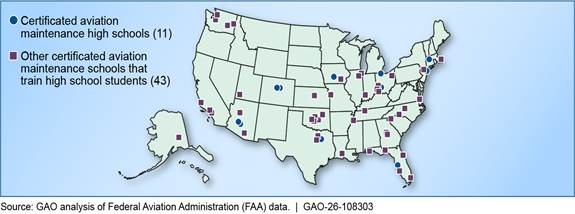
We identified at least 54 certificated schools that train high school students in aviation maintenance: 11 high schools and 43 colleges, universities, or career and technical education schools.[17] The schools are located in 24 states throughout the country, with four or more certificated schools in Arizona, Florida, Ohio, Oklahoma, and Washington (see fig. 4). See appendix I for a list of certificated schools that train high school students.
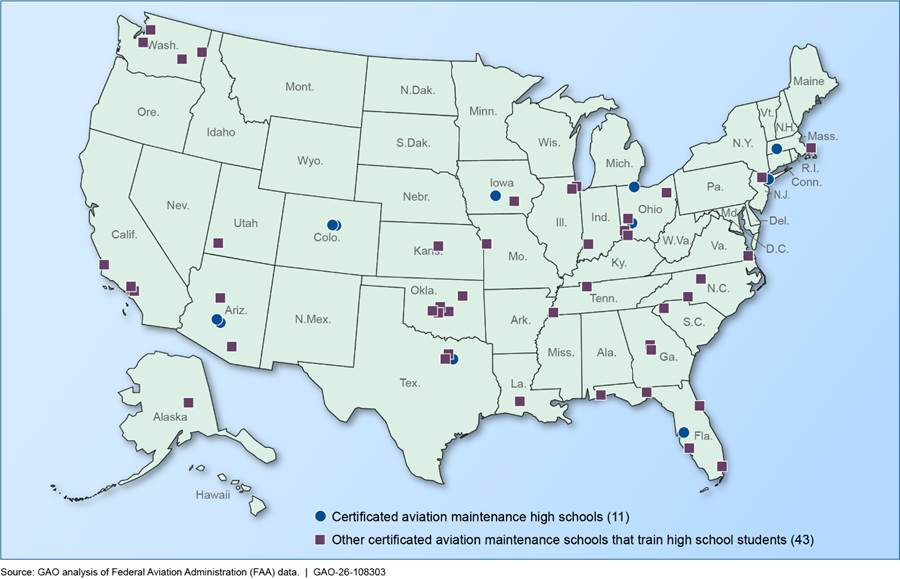
Note: Certificated schools are aviation maintenance technician schools certificated by FAA under 14 C.F.R. Part 147.
The certificated schools with high school aviation maintenance programs that we identified vary in size and approach. For example, according to a school representative, one certificated high school has approximately 2,000 students, including about 500 in its graduating class. According to an official from this school, students split their time between taking standard high school classes and aviation maintenance classes. The school is publicly funded by the city and state.[18] Students in all grades take aviation maintenance classes, but seniors select airframe or powerplant for their coursework to prepare for the FAA mechanic tests in that rating (see fig. 5). In addition, students can apply for a fifth year to take courses in the other licensing area they did not complete as a senior. Approximately 150 students complete the fifth year annually.
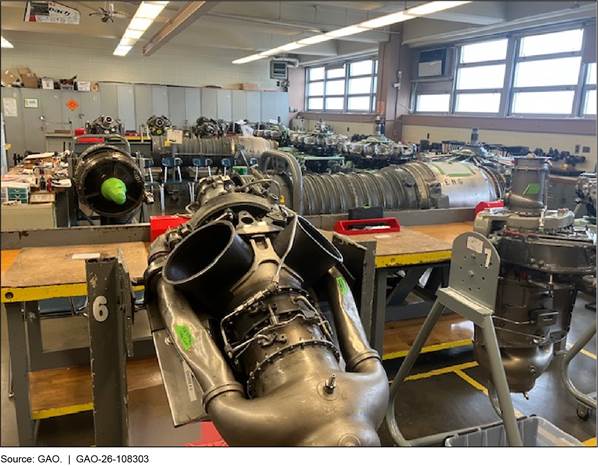
Note: Certificated schools are aviation maintenance technician schools certificated by the Federal Aviation Administration under 14 C.F.R. Part 147.
Conversely, according to a school representative, another certificated public high school has nearly 50 students. This high school receives state and federal funding to cover the costs of the program, and students attend free of charge. In addition to standard high school classes, students take 2 years of aviation maintenance courses during their junior and senior year to prepare them to take FAA’s general written knowledge test. Graduates can then enroll at a nearby certificated technical college to complete the 2 additional years of training needed to take FAA’s oral and practical aircraft mechanic tests, which are required to become an FAA-certificated mechanic.
In addition, we identified at least 43 certificated schools—26 certificated colleges or universities and 17 certificated career and technical education centers—that provide aviation maintenance classes to high school students through partnerships with high schools or school districts. These partnerships take various forms, such as:
Dual enrollment/credit programs for college credit. All 43 certificated schools that we identified offer dual enrollment, dual credit, or college credit to high school students for college aviation maintenance classes. Dual enrollment/credit programs allow high school students to earn college credits for courses taken at a certificated school. For example, a certificated university offers a dual enrollment program in aviation maintenance that allows high school seniors to earn up to six high school credits and 16 college credits while attending their final year of high school. In addition, a certificated community college offers aviation maintenance classes to high school students through the state’s Running Start program, which provides both high school and college credit. According to a school representative, these aviation maintenance credits count towards the airframe and powerplant certification at this community college.
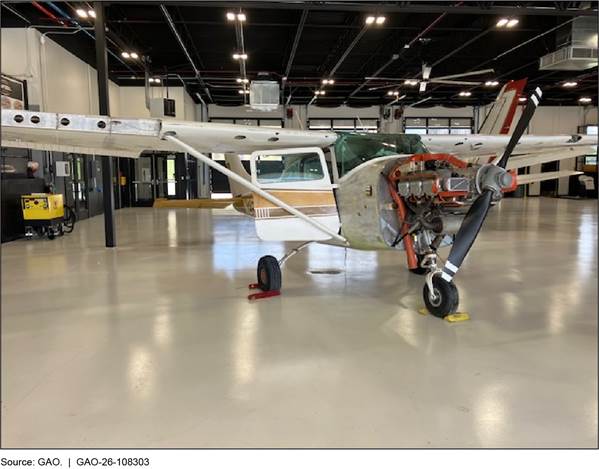
Enrollment in a certificated school through a high school district. Representatives from a certificated school told us that there are two high school districts in the state in which students can enroll in the aviation maintenance program of a nearby certificated career and technical education center (see fig. 6). This allows students from multiple high schools within a district to attend the certificated school.
Figure 6: Aircraft in a Hangar at a Certificated Career and Technical Education Center That Provides Aviation Maintenance Classes to High School Students
Note: Certificated schools are aviation maintenance technician schools
certificated by the Federal Aviation Administration under 14 C.F.R. Part 147.
Classes at a partner high school or academy. We identified two certificated universities that provide instructors to teach classes at a partner high school or academy. One certificated university provides instructors to teach classes on aviation maintenance at a local high school. By taking these classes in their high school, students can earn dual enrollment credits toward certification at the certificated school. Similarly, another certificated university offers aviation maintenance classes to high school students in multiple school districts.[19] According to a representative from this certificated university, students can take FAA’s general written knowledge test after completing the classes.
At Least 43 Uncertificated Schools Offer High School Aviation Maintenance Programs
We identified 43 uncertificated schools or districts that offer high school aviation maintenance programs.[20] These schools, which are not certificated by FAA, provide exposure to topics in aviation maintenance through online coursework and classroom instruction.[21] See appendix II for a list of uncertificated aviation maintenance schools that train high school students.
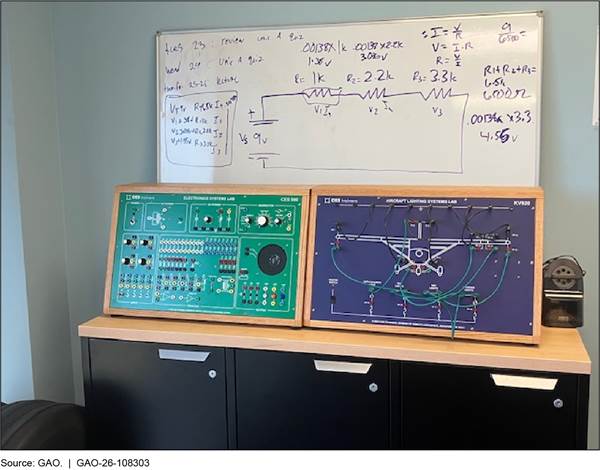
Of the 43 schools, 37 use the Choose Aerospace program, which provides aviation maintenance education that prepares students for more advanced training at certificated schools.[22] Representatives from a state department of career and technical education told us that 17 high schools in the state offer the Choose Aerospace program, and the state funds the program through grants.[23] Specifically, a school district in the state implements the Choose Aerospace curriculum as part of its aviation program, which enrolls approximately 60 students (see fig. 7 for an example of this curriculum in practice). Students spend half of each school day in the program and the other half at their home high schools. While in the program, students take some Choose Aerospace coursework online, receive classroom instruction, and apply concepts they have learned in aviation maintenance classes in labs.
Figure 7: Electrical Circuitry Board for Students to Diagnose Issues at an Uncertificated Aviation Maintenance Program
Note: Uncertificated schools are aviation maintenance schools not certificated by FAA under 14 C.F.R. Part 147.
In addition, we identified six uncertificated high schools with programs that provide a range of aviation coursework, including aviation maintenance.[24] For example, a high school aviation academy offers classes in piloting, engineering, and aviation maintenance. In addition to standard high school classes, students interested in aviation maintenance take aviation technology classes from 9th through 12th grades, with a focus on aviation maintenance beginning in 11th grade.
High School Aviation Maintenance Programs Had Limited Data on Career Outcomes, but Reported a Range of Post-Graduation Pathways
Representatives of three selected high school aviation maintenance programs told us that challenges associated with maintaining contact with graduates made it difficult to track career outcomes.[25] The representatives had little or no data on career outcomes, but they did provide anecdotal information about common pathways their graduates pursue after high school. These pathways include the following:
Working in the aviation maintenance field in the private sector or military. Representatives of seven aviation maintenance schools told us that some graduates of high school aviation maintenance programs pursue employment in the aviation maintenance field. According to a representative from a certificated school, employment may be with major airlines, an aircraft manufacturing company, or repair stations. Graduates also may work as aviation maintenance technicians in the military.
A representative of a certificated school told us that major airlines such as American, Delta, Jet Blue, Southwest, and United hired graduates with airframe and powerplant certificates. This representative also said that 10 to 20 percent of graduates went on to work in the aviation maintenance field. In our discussion group of graduates from this school, some told us they began working for the airlines after completing internships with them.
Representatives of an aviation industry association and an aviation maintenance and repair company told us that aviation companies and repair stations hire graduates as uncertificated aviation maintenance workers and can provide on-the-job training designed to prepare them to take the mechanic certification tests, if that is the path they choose. Representatives of the Aeronautical Repair Station Association, an aviation industry organization, told us that many students want to pursue a traditional career path with airlines and are often unaware of careers with repair stations that do not require certificates.[26] In our discussion group of graduates from an uncertificated school, two participants told us that after graduating, they began working for nearby aviation companies, including a local company at an airport that provides aircraft maintenance services.
The representative of one certificated school told us that some students, especially those in the Junior Reserve Officers’ Training Corps, go into the military and become aviation maintenance technicians there.[27]
Exiting the aviation maintenance field. Representatives of seven aviation maintenance schools told us that some aviation maintenance students exited the aviation maintenance field to pursue 4-year degrees in other fields or employment in other professions requiring mechanical skills.
A representative of a certificated aviation maintenance high school told us that most of its graduates go on to 4-year colleges. In our discussion group of graduates from a certificated school, some participants told us they enrolled in colleges where they were studying aviation management and related topics, rather than pursuing a career as a mechanic.
According to two stakeholders and our prior work, mechanical skills can transfer well across industries, and students with aviation maintenance skills are often in demand for other professions, such as performing maintenance on oil rigs or at amusement parks.[28]
Pursuing further training at certificated schools. According to five school representatives, some graduates of uncertificated schools and certificated schools with high school partnerships continue their education and training as aircraft mechanics after high school training ends. For example, a representative of one uncertificated school told us that five of its 13 graduates in 2025 pursued further aviation maintenance training at a certificated school. In addition, a certificated school with a high school partnership told us that most high school graduates went on to pursue their airframe and powerplant ratings.
Stakeholders Said FAA Generally Engaged Effectively with Schools on Their Certification
Stakeholders told us that FAA engaged effectively with certificated schools that operate high school aviation maintenance programs to help them establish and maintain their certification. The inspections that FAA conducts related to certification are designed to ensure that schools’ training curricula, facilities, and equipment comply with regulatory requirements. As mentioned above, such schools must align their curriculum with the Aviation Mechanic Airman Certification Standards.
Stakeholders described how FAA has engaged with them to ensure they meet certification requirements. For example:
· A representative of one certificated high school told us FAA officials actively engage in ensuring the quality of its program and inspect the school twice a year.
· Representatives of another certificated school told us they have worked collaboratively with FAA to develop and update the school’s curriculum. According to these representatives, FAA monitors the school’s curriculum and tracks students’ answers on each portion of the general, airframe, and powerplant written knowledge tests. The school modifies the curriculum if FAA data show that students are struggling on certain portions of the tests. For example, according to the school official, basic electricity is a difficult subject, and the school can adjust its instruction and curriculum to help students better understand the material.
· Representatives of a third certificated high school told us FAA has tracked how the school implemented its curriculum, reviewed the classroom space and equipment, and conducted a “teach-in” to observe how the staff teach the curriculum.
As discussed above, FAA made changes in regulations, as directed in law, to allow schools greater flexibility in how they can obtain and maintain FAA certification. Representatives of selected certificated schools told us they were generally satisfied with the changes, including FAA’s removal of the requirement of 1,900 hours of mandatory classroom time for a student to obtain an aviation maintenance certificate with combined airframe and powerplant ratings. Some representatives of certificated schools also said they appreciated that FAA no longer has requirements for hours in the classroom.
Stakeholders Identified Barriers That Students of High School Aviation Maintenance Programs Face and Options to Address Them
In our interviews with stakeholders, they most frequently identified limited awareness of aircraft maintenance careers as a barrier to students becoming mechanics through high school aviation maintenance programs.[29] They also frequently identified other barriers, including the cost of attending certificated aviation maintenance schools; the ineligibility of students who complete programs at uncertificated schools to take the FAA general written knowledge test; the cost of taking FAA aircraft mechanic tests; limited access to examiners who administer the FAA aircraft mechanic tests; limited resources and instructors at certificated schools serving high school students; and a lack of reliable transportation for students. Stakeholders also discussed options to address these barriers.
Limited Awareness of Aviation Maintenance Careers
According to FAA and 15 of 21 stakeholders we interviewed, and consistent with our prior work, limited awareness of aviation maintenance careers is a primary barrier to students becoming aircraft mechanics through high school programs.[30] Stakeholders said that aircraft mechanics are less visible than members of other aviation professions, such as pilots, flight attendants, and airline agents, and that families and students are often unaware that aviation maintenance is a rewarding and profitable career. Two stakeholders told us that aviation maintenance offers job opportunities for students who cannot afford to enroll in a university.
In our discussion groups with recent graduates, participants told us they were unaware of aviation maintenance as a career path until just before starting high school. These participants stated that more students would pursue training as aircraft mechanics if they knew the career offers competitive compensation, opportunities to work in any part of the country, and the ability to pursue various types of work, such as with aircrafts’ exteriors, interiors, or engines.[31]
To address this barrier, representatives from four schools told us their partnerships with industry helped their students’ understanding of aviation maintenance careers through hands-on experience and made them more likely to pursue these careers. For example, students at a certificated high school have benefited from paid internships for aviation maintenance with a national aircraft manufacturer during the school year and summer. In addition, a local repair station has provided job-shadowing opportunities for students at the school. Similarly, representatives of an uncertificated school said their efforts to build relationships with local aviation businesses that employ aircraft mechanics resulted in opportunities for internships and job shadowing for their students.
Representatives of some schools said they had formal partnerships with aviation industry organizations, such as councils and advisory groups. For example, a representative with a certificated school said the school coordinates with an aviation industry council that includes representatives of an aircraft maintenance company, airport, air museum, and private cargo airline. According to the representative, council members provide guidance to the school on skills needed in the industry, feedback on students’ projects, and presentations to students about their organizations.
Participants in one of our discussion groups told us that social media can support the aviation industry in reaching young people by conveying the message that a career in aviation maintenance is achievable. Similarly, representatives of an aviation trade organization said the aviation industry would benefit from a social media campaign in which mechanic role models highlight the benefits of the career.
FAA has also taken steps to raise awareness of aviation maintenance careers, including through outreach efforts and grants.[32] Officials participate in outreach events—such as engineering competitions, college and career fairs, and visits to schools—with high schools, 4-year colleges, and community colleges. According to FAA documentation, the agency conducted more than 800 outreach events to over 163,000 students at these events nationwide in fiscal year 2025. FAA documentation also shows that the agency has included aviation maintenance in its summer education program, which served approximately 1,700 students in elementary school through high school in summer 2025.[33] According to FAA officials, it has also started conducting regional webinars for school administrators and industry officials to highlight in-demand aviation careers. FAA officials told us that FAA held a webinar on aircraft maintenance in April 2025.
In response to a requirement in the FAA Reauthorization Act of 2018, FAA developed the Aviation Workforce Development Grant program to educate and recruit aviation maintenance technicians and develop the aviation maintenance workforce.[34] Since 2018, FAA has provided funding to 21 grantees that reported using funds to educate and conduct outreach to high school students.
Also in response to a requirement in the FAA Reauthorization Act of 2018,[35] FAA established the Youth Access to American Jobs in Aviation Task Force (Task Force) to identify recommendations for FAA to encourage high school students to pursue careers in aviation. The FAA Reauthorization Act of 2024 required FAA to submit a report to specified committees of Congress by May 2026 on its efforts to implement three recommendations made by the Task Force: (1) to improve information access about careers in aviation and aerospace; (2) to improve collaboration across FAA regions on outreach and workforce development programs; and (3) to increase opportunities for mentoring, pre-apprenticeships, and Registered Apprenticeships in aviation.[36] According to FAA officials, FAA expects to issue the report in summer 2026.
Cost of Attending Certificated Aviation Maintenance Schools
Six stakeholders told us that the cost of attending certificated aviation maintenance schools is a barrier for some graduates of high school aviation maintenance programs.[37] Graduates may enroll in these schools because certificated high schools with aviation maintenance programs prepare them for some, but not all, of the FAA mechanic exams. For example, in our discussion group with recent graduates of a certificated high school, participants explained that because only some students can obtain certification in both airframe and powerplant while in high school, many go on to complete the remaining classes for their certification at a high cost from a local certificated college.[38] In addition, graduates of uncertificated high schools with aviation maintenance programs must receive further training before taking the exams. For example, in our discussion group with recent graduates of an uncertificated school, some participants told us they enrolled at a local certificated college after graduation to pursue their certification in airframe and powerplant. According to the Aviation Technician Education Council (ATEC), an industry trade organization, the average cost of tuition at a certificated school is approximately $19,000 per year, and students take approximately 21 months to graduate.[39]
Stakeholders discussed options for students to cover the cost of attending certificated schools. Representatives of two certificated schools told us students at these schools are eligible to apply for federal student aid such as a Pell Grant, which is available based on financial need and other eligibility requirements. The maximum annual federal Pell Grant for award year 2026-2027 is $7,395.
Officials with a state department of career and technical education told us that local districts help subsidize the cost of students who reside in the district and attend one of the district’s 16 certificated career and technical education centers. High school juniors and seniors can attend these schools at no cost. Graduates of an uncertificated school in the state told us that they decided to attend a local certificated career and technical education center after high school because of the tuition assistance.
In addition, some aviation companies offer programs to pay students’ costs and offer Registered Apprenticeships to develop their future workforce. For example, Piedmont Airlines pays the tuition, FAA exam fees, and some fees for students at five aviation maintenance programs who are in good academic standing and commit to working with the airline within 90 days of obtaining their certification as an aircraft mechanic, among other requirements. In addition, Republic Airways operates a Registered Apprenticeship program with the Department of Labor that employs and pays apprentices while they train to prepare for the FAA exams.[40] According to Department of Labor officials, this Registered Apprenticeship is available to high school students.
Ineligibility of Students from Uncertificated Schools to Take the FAA General Written Knowledge Test
As discussed, individuals are eligible to take the FAA general written knowledge test if they have completed a certificated school’s general curriculum or if they have completed on-the-job training. Five stakeholders told us that FAA could better facilitate the process of becoming an aircraft mechanic by allowing students who complete programs at uncertificated schools to take the FAA general written knowledge test.[41]
Each certificated school must have procedures that describe how and when the school will issue credit, including whether and under what circumstances the school will credit prior instruction.[42] Many graduates of uncertificated schools do not receive credit for their prior coursework when they enter a certificated school and must repeat subjects at the certificated school, according to a representative of an uncertificated school. This representative stated that retaking courses makes the process of becoming an aircraft mechanic more time-consuming and costly and may discourage students from pursuing this career. In addition, graduates we spoke with from an uncertificated school said they felt prepared to take the test after they graduated from the uncertificated school.
Federal statute authorizes FAA to grant an exemption from specified regulations it has prescribed, if FAA finds that doing so is in the public interest.[43] In 2021, Choose Aerospace petitioned for exemption from FAA’s experience requirement regulation that, if granted, would permit students who completed the uncertificated Choose Aerospace general aviation maintenance curriculum to take the FAA general written knowledge test for a mechanic certificate.[44]
In 2022, FAA denied the petition for exemption, stating that it did not find that an exemption was in the public interest. FAA concluded that it was “impossible for the FAA to determine if the Choose Aerospace curriculum does, in fact, bestow an equivalent level of knowledge or quality of instruction, as that of a certificated school curriculum,” because Choose Aerospace did not provide a sample curriculum or outline of instruction to demonstrate to FAA that knowledge, skills, and experience objectives are equivalent to that of curriculum provided at an FAA-approved certificated school. In addition, FAA noted that it lacked general oversight of the educational institutions that would use Choose Aerospace’s curriculum, which it would need to ensure the implementation of the curriculum aligned with FAA’s Aviation Mechanic General, Airframe, and Powerplant Airman Certification Standards.
In its denial of Choose Aerospace’s petition, FAA also noted that the regulations in place at the time enabled mechanisms that could help students in high school or some other types of schools enter into the aviation maintenance industry. FAA noted that, for example, a certificated school can credit a student with both (1) instruction that has been completed at the scholastic levels comparable to the required curriculum subjects and (2) prior experience in the aviation maintenance industry comparable to the curriculum subjects such that students do not have to repeat courses or skill development. Stakeholders told us that in practice certificated schools do not accept instruction from uncertificated schools because they believe it is not equivalent to the curriculum at a certificated school.
FAA has not broadly assessed whether graduates of uncertificated schools should be allowed to take the general written knowledge test upon successful completion of an aviation maintenance curriculum.[45] Section 405(a) of the FAA Reauthorization Act of 2024 requires FAA to task the Aviation Rulemaking Advisory Committee to establish the Airman Knowledge Testing Working Group by May 16, 2025, to conduct such as assessment. However, as of May 2026, FAA had not established this working group or obtained this assessment. FAA officials told us the agency was unable to task a working group within its Aviation Rulemaking Advisory Committee because DOT terminated all committee members pursuant to Executive Order 14217.[46] Nonetheless, convening a group of aviation industry stakeholders and others with relevant expertise (either through the advisory committee or some other mechanism) to conduct such an assessment would enable FAA to consider the benefits and drawbacks of expanding eligibility to take the test, and to potentially identify opportunities to expand the pool of qualified aircraft mechanics and help address future workforce needs.[47]
Cost of Taking the FAA Aircraft Mechanic Tests
Seven stakeholders identified the cost of the FAA aircraft mechanic tests as a barrier for students of high school aviation maintenance programs.[48] Individuals seeking the mechanic certificate with both the airframe and powerplant ratings must take (1) three written knowledge exams administered by PSI Services, a testing company contracted by FAA; and (2) three oral and practical tests with designated mechanic examiners (examiners) approved by FAA.[49] According to FAA officials, PSI Services and examiners set their own fees. Stakeholders told us that the fee for each of the three written knowledge tests is approximately $175, and the fee for each of the three oral and practical tests ranges from approximately $500 to more than $1,000.
FAA officials told us they and PSI have a process for collecting comments and complaints about the knowledge tests, which could include concerns about cost. In addition, FAA officials said they expect examiners to set reasonable fees for the oral and practical tests, and that most examiners set consistent rates within the same geographic area. FAA investigates any complaints and reaches out to examiners as needed, according to officials.
Limited Access to Examiners Who Administer the FAA Aircraft Mechanic Tests
Limited access to examiners who conduct the oral and practical tests may impede students of high school aviation maintenance programs from pursuing their mechanic certificates, according to six stakeholders.[50] Representatives of two certificated schools told us their graduates must wait 1 to 6 months to take the oral and practical tests due to limited availability of examiners. Participants in our discussion group with recent graduates of a certificated high school told us that although teachers at their former school are examiners, many students take the tests around the same time during the summer, and securing an appointment with an examiner is difficult. The graduates said some students seek testing out of state when an examiner in the school or local area does not have availability; these students incur additional costs for travel.
In addition, representatives of two other certificated
schools said their states have areas with few examiners, which can affect
students’ access to the tests. Representatives of a certificated school in a
state in the West expressed concern that students would need to drive a great
distance if the teacher at the school, who is an examiner, was not available to
administer the tests. According to FAA’s database of examiners, this state has
only two examiners, and they are approximately 250 miles apart. Further,
representatives from a certificated school in another state said limited access
could discourage graduates from taking the tests and ultimately entering the
aviation maintenance workforce.
FAA officials told us they use various sources of information—feedback from
certificated schools and other stakeholders, data comparing the locations of
examiners and certificated schools, and observations by FAA staff—to determine
whether there are enough examiners to meet demand. Officials said that
examiners may have few requests for tests and then a sudden influx. Given the
variability in demand, FAA cannot always readily plan for the appropriate
number of examiners, according to officials. In October 2025, FAA revised its
guidance to allow qualified organizations, including some certificated schools,
to conduct oral and practical tests if they meet requirements such as having
qualified examiners, equipment, and facilities.[51] This change could help alleviate the
demand for examiners by allowing qualified instructors from these schools to
provide testing.
Limited Resources and Instructors at Certificated Schools
Six stakeholders reported challenges with high schools
having enough funds to offer or grow aviation maintenance programs.[52] Representatives of a certificated
high school stated that limited funding affects the school’s ability to buy
equipment needed to teach aviation maintenance. In our discussion group,
graduates of this school said the school’s old equipment limited or delayed
their ability to complete key tasks in their training. Given this issue, a
stakeholder said that high school partnerships with certificated schools may be
more cost-effective than establishing a program within a high school.
Representatives of two certificated colleges told us their states pay the cost
for high school students to enroll in their colleges.
Further, six stakeholders discussed challenges with recruiting and retaining
instructors to teach in high school aviation maintenance programs, including
the limited pool of applicants and low compensation relative to aircraft
mechanics in the workforce.[53]
Representatives of a certificated high school stated that many instructors have
second jobs due to low teaching salaries. In a 2025 survey of certificated
schools, ATEC reported that more than 90 percent of the respondents said
compensation and benefits were major obstacles to recruiting and retaining
instructors.[54]
Lack of Reliable Transportation for Students
Five stakeholders cited challenges with providing transportation for students in high school aviation maintenance programs.[55] For example, representatives of a certificated college with multiple locations around the country that partners with local high schools stated that a lack of reliable transportation was one of the barriers to attracting more high school students into their program. Further, representatives of another certificated school said students who do not have reliable transportation risk not meeting the attendance requirements for graduating from the program. Some high school aviation maintenance programs reported using federal funds under the Carl D. Perkins Career and Technical Education Act of 2006, as amended, to support their programs.[56] Schools can use these funds to, among other things, support costs associated with transporting certain students participating in career and technical education.[57]
Conclusions
BLS projects there will be an average of approximately 11,300 job openings for aircraft mechanics each year through 2034. Graduates of high school aviation maintenance programs can help address this projected workforce need. However, some of these students face barriers to becoming FAA-certificated aircraft mechanics, including the ineligibility of students from uncertificated schools to take the FAA general written knowledge test—the first step to becoming a certificated mechanic—without the requisite work experience or additional education. Convening a group of industry stakeholders and aviation experts to assess whether to expand eligibility would enable FAA to obtain a range of perspectives on the potential benefits and drawbacks of allowing these students to take the test. Moreover, doing so would give FAA an opportunity to consider how to address some stakeholders’ concerns about having enough qualified aircraft mechanics in the workforce to meet demand.
Recommendation for Executive Action
The FAA Administrator should establish a group of industry stakeholders and aviation experts to assess whether high school students, upon successful completion of aviation maintenance curricula at uncertificated schools, should be allowed to take the general written knowledge test. (Recommendation 1)
Agency Comments
We provided a draft of this report to DOT, the Department of Labor, and the Department of Education for review and comment. In its comments, reproduced in appendix III, DOT concurred with our recommendation and stated that it will provide a detailed response to the recommendation within 180 days of the report’s issuance. DOT, the Department of Labor, and the Department of Education also provided technical comments, which we incorporated as appropriate
We are sending copies of this report to the appropriate congressional committees, the Secretary of Transportation, the Secretary of Labor, the Secretary of Education, and other interested parties. In addition, the report is available at no charge on the GAO website at https://www.gao.gov.
If you or your staff have any questions about this report, please contact me at GieseD@gao.gov. Contact points for our Offices of Congressional Relations and Media Relations may be found on the last page of this report. GAO staff who made key contributions to this report are listed in appendix IV.
Danielle T. Giese
Director, Physical Infrastructure
Table 1: Certificated Aviation Maintenance Schools That Train High School Students, by Type of School
|
Certificated high school aviation maintenance schools |
State |
|
Aerospace Center |
Ohio |
|
American Leadership Academy Applied Technologies |
Arizona |
|
Aviation High School |
New York |
|
Central Florida Aerospace Academy |
Florida |
|
Cherry Creek Innovation Campus |
Colorado |
|
Des Moines Public Schools Aviation Technologies |
Iowa |
|
Greene County Career Center |
Ohio |
|
Skyline Career Development Center |
Texas |
|
Warren Tech |
Colorado |
|
Western Maricopa Education Center |
Arizona |
|
Westfield Technical Academy |
Massachusetts |
|
Colleges or universities |
|
|
Antelope Valley Community College |
California |
|
Big Bend Community College |
Washington |
|
Cape Cod Community College |
Massachusetts |
|
Central Georgia Technical College |
Georgia |
|
Chaffey Community College |
California |
|
Cincinnati State Technical and Community College |
Ohio |
|
Clover Park Technical College |
Washington |
|
Cuesta College - San Luis Obispo County Community |
California |
|
Embry-Riddle University |
Florida |
|
Everett Community College |
Washington |
|
George T. Baker Aviation Technical College |
Florida |
|
Greenville Technical College |
South Carolina |
|
Guilford Technical Community College |
North Carolina |
|
Indian Hills Community College |
Iowa |
|
Kansas State University - Salina |
Kansas |
|
Lewis University |
Illinois |
|
Middle Georgia State University |
Georgia |
|
Pensacola State College |
Florida |
|
Pima County Community College |
Arizona |
|
South Louisiana Community College |
Louisiana |
|
Southern Utah University |
Utah |
|
Spokane Community College |
Washington |
|
Tarrant County College |
Texas |
|
Tennessee College of Applied Technology-Memphis |
Tennessee |
|
University of Alaska Fairbanks |
Alaska |
|
Vincennes University |
Indiana |
|
Career and technical education centers |
|
|
Aviation Institute of Maintenance |
Illinois |
|
Aviation Institute of Maintenance (operating under the trade name of Technical Education Services Inc.) |
Missouri |
|
Aviation Institute of Maintenance |
New Jersey |
|
Aviation Institute of Maintenance (operating under the trade name of American Trans Air Training Corporation) |
North Carolina |
|
Aviation Institute of Maintenance (operating under the trade name of Training Services Inc.) |
Virginia |
|
Canadian Valley Technology Center |
Oklahoma |
|
Charlotte County Public Schools |
Florida |
|
Gordon Cooper Technology Center |
Oklahoma |
|
Great Oaks Joint Vocational School |
Ohio |
|
Lively Technical College |
Florida |
|
Metro Tech Aviation Career Center |
Oklahoma |
|
Miami Valley Career Technology Center |
Ohio |
|
Moore Norman Technology Center |
Oklahoma |
|
North Central Institute |
Tennessee |
|
Tulsa Technology Center School District Number 18 |
Oklahoma |
|
U.S. Aviation Academy LLC |
Texas |
Source: GAO analysis of Federal Aviation Administration (FAA) data and relevant literature. | GAO‑26‑108303.
Notes: GAO analyzed FAA data on certificated schools as of December 2025, and on grantees that received FAA Workforce Aviation Maintenance grants from fiscal year 2020 through fiscal year 2025. GAO also conducted a review of relevant literature spanning 10 years, including scholarly and peer-reviewed materials, trade and industry articles, and government reports.
Certificated schools are aviation maintenance technician schools certificated by FAA under 14 C.F.R. Part 147.
Appendix II: Uncertificated High Schools or School Districts That Offer Aviation Maintenance Programs
|
High schools or school districts using the Choose Aerospace program |
State |
|
Ascension Academy |
Texas |
|
Bismarck Schools |
North Dakota |
|
Bristow Public School |
Oklahoma |
|
Burke High School |
Nebraska |
|
Cascadia Tech (Evergreen School District) |
Washington |
|
Charles Page High School |
Oklahoma |
|
Cleveland High School |
Oklahoma |
|
College Community School District |
Iowa |
|
Dodge City High School |
Kansas |
|
East Central High School - Tulsa Public Schools |
Oklahoma |
|
Gateway Academy |
Kentucky |
|
Great Plains Technology Center |
Oklahoma |
|
Kiamichi Technology Center |
Oklahoma |
|
Liberty High School (Hillsboro School District) |
Oregon |
|
Metro Technology Center |
Oklahoma |
|
Moore Public Schools - Moore High |
Oklahoma |
|
Moore Public Schools - Southmoore |
Oklahoma |
|
Moore Public Schools - Westmoore |
Oklahoma |
|
Payette River Technical Academy |
Idaho |
|
Ponca City Public Schools |
Oklahoma |
|
Pryor Public Schools |
Oklahoma |
|
Putnam City Schools |
Oklahoma |
|
Rising Aviation High School |
Texas |
|
School District of Philadelphia (Frankford High School) |
Pennsylvania |
|
SEK-CTEC |
Kansas |
|
Somerset County Technology Center |
Pennsylvania |
|
Spring Valley High School |
West Virginia |
|
The Hub for Innovative Learning & Leadership |
Kentucky |
|
Tri-County Tech |
Oklahoma |
|
Trumbull Career and Technical Center |
Ohio |
|
Union Public Schools |
Oklahoma |
|
Vienna High School |
Illinois |
|
Weatherford Public Schools |
Oklahoma |
|
Wellington High School |
Kansas |
|
Western Heights Public Schools |
Oklahoma |
|
West Michigan Aviation Academy |
Michigan |
|
Williston High School |
North Dakota |
|
Other schools with high school aviation maintenance programs |
State |
|
Alabama Aerospace and Aviation Academy |
Alabama |
|
Butler Tech |
Ohio |
|
Denbigh High School Aviation Academy |
Virginia |
|
Irving High School |
Texas |
|
La Crosse Central High School |
Wisconsin |
|
Rancho High School |
Nevada |
Source: GAO analysis of Federal Aviation Administration (FAA) and Choose Aerospace data, and relevant literature. | GAO‑26‑108303
Note: GAO analyzed FAA data on grantees that received FAA Workforce Aviation Maintenance grants from fiscal year 2020 through fiscal year 2025, as well as Choose Aerospace data. GAO also conducted a review of relevant literature spanning 10 years, including scholarly and peer-reviewed materials, trade and industry articles, and government reports. GAO may not have identified some uncertificated schools that had a high school aviation maintenance program using this method.
Uncertificated schools are aviation maintenance schools not certificated by FAA under 14 C.F.R. Part 147.
GAO Contact
Danielle T. Giese, GieseD@gao.gov
Staff Acknowledgments
In addition to the contact named above, John W. Shumann (Assistant Director), Kieran McCarthy (Analyst in Charge), Adrienne Fernandes Alcantara, Laura Bonomini, Lilia Chaidez, Geoff Hamilton, Amy MacDonald, Jonathan Muchin, Josh Ormond, Laurel Voloder, Alicia Wilson, and Elizabeth Wood made key contributions to this report.
The Government Accountability Office, the audit, evaluation, and investigative arm of Congress, exists to support Congress in meeting its constitutional responsibilities and to help improve the performance and accountability of the federal government for the American people. GAO examines the use of public funds; evaluates federal programs and policies; and provides analyses, recommendations, and other assistance to help Congress make informed oversight, policy, and funding decisions. GAO’s commitment to good government is reflected in its core values of accountability, integrity, and reliability.
Obtaining Copies of GAO Reports and Testimony
The fastest and easiest way to obtain copies of GAO documents at no cost is through our website. Each weekday afternoon, GAO posts on its website newly released reports, testimony, and correspondence. You can also subscribe to GAO’s email updates to receive notification of newly posted products.
Order by Phone
The price of each GAO publication reflects GAO’s actual cost of production and distribution and depends on the number of pages in the publication and whether the publication is printed in color or black and white. Pricing and ordering information is posted on GAO’s website, https://www.gao.gov/ordering.htm.
Place orders by calling (202) 512-6000, toll free (866) 801-7077,
or
TDD (202) 512-2537.
Orders may be paid for using American Express, Discover Card, MasterCard, Visa, check, or money order. Call for additional information.
Connect with GAO
Connect with GAO on X,
LinkedIn, Instagram, and YouTube.
Subscribe to our Email Updates. Listen to our Podcasts.
Visit GAO on the web at https://www.gao.gov.
To Report Fraud, Waste, and Abuse in Federal Programs
Contact FraudNet:
Website: https://www.gao.gov/about/what-gao-does/fraudnet
Automated answering system: (800) 424-5454
Media Relations
Sarah Kaczmarek, Managing Director, Media@gao.gov
Congressional Relations
David A. Powner, Acting Managing Director, CongRel@gao.gov
General Inquiries
[1]As we have reported, the BLS category for aircraft mechanics and service technicians does not distinguish between aviation maintenance workers that are certificated by the Federal Aviation Administration (FAA) and those who are not. In addition to aircraft mechanics, the aviation maintenance workforce includes two groups of technicians: (1) repairmen, whose certification from FAA allows them to perform specific tasks, such as welding or painting, but is valid only in connection with the duties for the certificated holder by whom the repairman was employed; and (2) aviation maintenance workers who are not certificated and are supervised by certificated mechanics or repairmen in performing repair work. See GAO, Aviation Maintenance: Additional Coordination and Data Could Advance FAA Efforts to Promote a Robust, Diverse Workforce, GAO‑20‑206 (Washington, D.C.: Feb. 6, 2020).
[2]An industry report projects a need for almost 7,000 certificated mechanics in 2027, which will decrease to 4,200 in 2035 due to workforce growth. It also projects a need for 22,000 uncertificated mechanics in 2027, which will decrease to 14,000 in 2035. We have not assessed the methodology used in this report. See, Aviation Technician Education Council and Oliver Wyman, 2025 Pipeline Report & AMTS Directory (Sept. 18, 2025).
[3]Federal Aviation Reauthorization Act of 2024, Pub. L. No. 118-63 § 414, 238 Stat. 1025, 1160.
[4]We use the term “certificated schools” to describe aviation maintenance technician schools certificated by FAA under 14 C.F.R. Part 147.
[5]We may not have identified some schools that had a high school aviation maintenance program or partnership using this method.
[6]FAA’s general written knowledge test is the first of three knowledge tests that individuals must pass to receive an Aviation Mechanic certificate.
[7]14 C.F.R. § 65.71. If an individual does not meet the English language requirements and is employed outside the United States by a U.S. carrier, they could otherwise be eligible as long as their certificate is endorsed, “Valid only outside the United States.” 14 CFR 65.71(a)(2). An individual must comply with the certification regulations applicable to the rating(s) the applicant seeks. 14 C.F.R. 65.71(a)(4).
[8]14 C.F.R. §§ 65.81, 65.85, 65.87.
[9]Individuals may also be eligible to take the FAA mechanic tests by completing the Joint Service Aviation Maintenance Technician Certification Council training course for military personnel, according to FAA. The Joint Service Aviation Maintenance Technician Certification Council program is only available to U.S. military service members who have graduated from a military aviation technical school and hold the applicable military occupational skill.
[10]Individuals must meet requirements to take the general written knowledge test. Such individuals must present an authenticated document that indicates the student’s date of graduation and curriculum completed. In general, after passing each section of the general written knowledge test, a student may apply for the oral and practical tests. 14 C.F.R. § 65.75(b).
[11]In addition, such applicants for a mechanic certificate or rating may take the mechanic general written test prior to meeting the 18-month or 30-month practical experience requirement, provided the applicant presents an authenticated document from a certificated school that demonstrates satisfactory completion of the general portion of the school’s curriculum and specifies the completion date. 14 C.F.R. § 65.75(c). Enrolled students, for whom a certificated school demonstrates to the FAA that they are prepared to take specified oral and practical tests and have made satisfactory progress at the school, may take these tests during their final subjects at the school, before graduation, and before meeting specified experience requirements, and before passing each section of the specified written test. 14 C.F.R. § 65.80.
[12]14 C.F.R. Part 147.
[13]Pub. L. No. 116-260, div. V, § 135, 134 Stat. 2309, 2356 (2020).
[14]Aviation Maintenance Technician Schools, 87 Fed. Reg. 31391 (May 24, 2022).
[15]With respect to a minimum passage rate, the Aircraft Certification, Safety, and Accountability Act requires that a certificated aviation maintenance technician school shall maintain a pass rate of at least 70 percent of students who took a written, oral, or practical (or any combination thereof) FAA mechanic test within 60 days of graduation for the most recent 3-year period. Pub. L. No. 116-260, div. V, § 135, 134 Stat. 2309, 2359 (2020). FAA regulations require that for such students, an aviation maintenance technical school must count a failure on any one test as a student failure for purposes of determining the pass rate, unless the student passes that failed test within the 60-day window. 14 C.F.R. § 147.25(c).
[16]An applicant for a mechanic certificate or rating may take the general written knowledge test prior to meeting the applicable experience requirements if the applicant presents an authenticated document from a certificated aviation maintenance technician school that demonstrates satisfactory completion of the general portion of the school’s curriculum and specifies the completion date. 14 C.F.R. § 65.75(c).
[17]According to FAA data, FAA has certificated 223 schools in the United States. FAA does not track whether a certificated school is a high school, college or university, or career and technical education school, nor does it track the number of uncertificated schools. We researched schools on FAA’s list and identified at least 54 of the 223 schools that FAA certificated as training high school students in aviation maintenance. We classified 43 schools with high school partnerships as a college or career and technical education school based on our review of information about the school.
[18]According to an official from this certificated high school, the school also receives about $900,000 in Title 1 funding and about $500,000 in career and technical education (CTE) funding from the Department of Education. According to the official, this funding has restrictions, and the school also receives a small amount of Title 3 funding for English language learners.
[19]According to an official from this certificated university, the county school district and the university share the cost of the salary for the aviation maintenance instructor. According to the official, the state’s lottery provides much of the state funding that the county school district uses for the program, and the state’s scholarship program covers costs of the aviation maintenance program for most students, as long as they qualify.
[20]We did not identify a single data source on uncertificated schools. We identified 43 uncertificated aviation maintenance schools using our literature search and review of FAA workforce aviation maintenance grantees. See appendix II for a list of uncertificated schools that train high school students.
[21]Some stakeholders told us that it can be difficult to establish a certificated school due to the cost of equipment (such as engines and aircraft), facilities, and instructors. In addition to these 43 uncertificated aviation maintenance schools, we identified another aviation program that includes some aspects of aviation maintenance. Tango Flight is a program that allows students to learn aviation concepts by constructing an airplane. The curriculum focuses on aviation more broadly by introducing students to aerospace, electrical, mechanical, manufacturing, and design engineering through partnerships with over 20 programs around the country.
[22]Choose Aerospace is a nonprofit organization dedicated to strengthening the aerospace workforce pipeline through education, access, and industry alignment. It has developed an aviation maintenance curriculum that provides an early pathway to a career in aviation maintenance.
[23]The Aircraft Owners and Pilots Association announced in July 2025 that they plan to add an aviation maintenance track to their high school curriculum.
[24]These uncertificated schools are located in Alabama, Nevada, Ohio, Texas, Virginia, and Wisconsin.
[25]We have previously reported that obtaining longitudinal data on student outcomes is a common issue for career and technical education programs because of data sharing and privacy issues, among other reasons. Therefore, programs may be reliant on what former students are willing to share. See GAO, Career and Technical Education: Perspectives on Program Strategies and Challenges, GAO‑22‑104544 (Washington, D.C.: Mar. 30, 2022).
[26]These representatives also said that it is important to emphasize the benefits of working in aviation at a repair station versus an airline. For example, aviation maintenance work at repair stations is generally performed during traditional working hours and in air-conditioned facilities; by contrast, maintenance work at airlines may be more highly paid, but can involve odd hour shifts and come with exposure to the elements outside.
[27]The Junior Reserve Officers’ Training Corps is a federally funded high school development program sponsored by the U.S. Armed Forces, intended to instill values of citizenship, service to the United States, personal responsibility, and a sense of accomplishment.
[28]See GAO, Aviation Workforce: Current and Future Availability of Airline Pilots and Aircraft Mechanics, GAO‑23‑105571 (Washington, D.C.: May 17, 2023).
[29]Frequently identified barriers are those identified by at least four of the 21 stakeholders.
[30]These 15 stakeholders included six certificated schools, four aviation industry associations, two uncertificated schools, two aviation industry companies, and one state department of career and technical education. Our previous work has also reported on limited awareness of careers in aviation maintenance. GAO‑23‑10557.
[31]According to the BLS, the median annual wage for aircraft mechanics and service technicians was approximately $78,680, compared with $49,500 for all occupations in 2024.
[32]FAA has also supported research that identifies resources for youth to pursue aviation careers. FAA sponsored a study in 2019 by the Transportation Research Board that identifies pathways to engage students at an early age to pursue aviation, including challenges in maintaining these pathways and opportunities to overcome challenges. See, National Academies of Sciences, Engineering, and Medicine, Transportation Research Board, Developing Innovative Strategies for Aviation Education and Participation (Washington, D.C: 2019). In response to a requirement in Section 601 of the FAA Reauthorization Act of 2018, FAA also published a report on its outreach efforts to elementary and secondary education students to prepare and inspire such students for careers in aviation and mitigate an anticipate shortage of pilots and other aviation professionals. Federal Aviation Administration, Section 601 Youth in Aviation Student Outreach Report (Jan. 1, 2019). Pub. L. No.115-254, § 601, 132 Stat. 3185, 3400.
[33]FAA’s Science, Technology, Engineering, and Math Aviation and Space Education (STEM AVSED) program implements the summer education program. The program also engages in outreach events that focus on developing skills in aerospace. FAA 's STEM AVSED team also has an Adopt-a-School Program, which introduces aviation concepts to students at elementary schools and has a lesson on aircraft maintenance careers.
[34]Pub. L. No. 115-254, § 625, 132 Stat. 3185, 3405. Section 625 of this act also required FAA to establish a program to provide grants for eligible projects to support the education of future aircraft pilots and the development of the aircraft pilot workforce. Amendments in the FAA Reauthorization Act of 2024 included adding a third grant category to support the education and recruitment of aviation manufacturing technical workers and aerospace engineers and the development of the aviation manufacturing workforce. Pub. L. No. 118-63, § 440, 138 Stat. 1025, 1179. The FAA Reauthorization Act of 2018 authorized the grant programs for fiscal years 2019 through 2023 and the FAA Reauthorization Act of 2024 extended this authorization through fiscal year 2028. Each grant project was eligible to receive up to $500,000 per fiscal year for fiscal years 2019 through 2023. For fiscal years 2024 through 2028, the FAA Reauthorization Act of 2024 made each grant project eligible for up to $1 million per fiscal year. For the aviation maintenance workforce grants, DOT made available $5 million to grantees in the first round of funding, $5 million in the second round of funding, and $10.6 million in the third round of funding. DOT provided $18.8 million in aviation maintenance workforce grants across the three rounds of funding. DOT issued a notice of funding opportunity for the fourth round of funding in May 2026.
[35]Pub. L. No.115-254, § 602, 132 Stat. 3185, 3400. The 2018 act required FAA to establish the Youth Access to American Jobs in Aviation Task Force not later than January 3, 2019, and Task Force recommendations not later than 12 months after the establishment of the Task Force. The Task Force was established by FAA on October 3, 2019. See, 86 Fed. Reg. 26599 (May 14, 2021). The Task Force’s final report with recommendations was published on September 28, 2022.
[36]Pub. L. No. 118-63, § 423, 138 Stat. 1025, 1166. A Registered Apprenticeship is an industry-driven career pathway in which employers can develop and prepare their future workforce, and individuals can obtain paid work experience with a mentor, receive progressive wage increases, classroom instruction, and a portable, nationally recognized credential. Registered Apprenticeships are industry-vetted and approved and validated by the U.S. Department of Labor or a state apprenticeship agency.
[37]These stakeholders included three certificated schools, two aviation industry associations, and one uncertificated school.
[38]The high school offers either airframe or powerplant courses for students in 12th grade and selects some students to continue on for a fifth year to take courses in the license area they did not receive in 12th grade.
[39]Aviation Technician Education Council and Oliver Wyman, 2025 Pipeline Report.
[40]We reported on Registered Apprenticeships in GAO, Apprenticeship: Earn-and-Learn Opportunities Can Benefit Workers and Employers, GAO‑25‑107040 (Washington, D.C.: Apr. 28, 2025).
[41]These stakeholders included two aviation industry associations, one certificated school, one uncertificated school, and one aviation industry company.
[42]See, 14 C.F.R. § 147.23. See also, Aviation Maintenance Technician Schools, 87 Fed. Reg. 31391, 31403 (May 24, 2022). Certificated schools should only provide credit for prior satisfactorily completed work at: 1) an accredited university, college, community college, or junior college; 2) an accredited vocational, technical, trade, or high school; 3) a military technical school; or 4) another certificated school. FAA, AC 147-3C, Certification and Operation of Aviation Maintenance Technician Schools (Mar. 22, 2022).
[43]14 U.S.C. § 44701. In petitioning for an exemption, an entity must include several required pieces of information, including, the reasons why granting the petition would be in the public interest, and the reasons why granting the exemption would not adversely affect safety, or how the exemption would provide a level of safety at least equal to that provided by the rule from which the exemption is sought. 14 C.F.R. § 11.81. FAA also invites comments from the public on these petitions. 14 C.F.R. § 11.85.
[44]FAA, In the matter of the petition of CHOOSE AEROSPACE, INC. For an exemption from § 65.77 of Title 14, Code of Federal Regulations (Feb. 22, 2022). Exemption No. 10920, Regulatory Docket No. FAA-2021-0594.
[45]Persons presenting an authenticated document indicating the student’s date of graduation and curriculum completed at a certificated school, including high school students completing a high school aviation curriculum at a certificated school, may be allowed to take the general written knowledge test. See, 14 C.F.R. § 65.77(a).
[46]Exec. Order No. 14217, Commencing the Reduction of the Federal Bureaucracy, 90 Fed. Reg. 10577 (Feb. 25, 2025). Executive Order 14217 required that the Assistant to the President for National Security Affairs, the Assistant to the President for Economic Policy, and the Assistant to the President for Domestic Policy identify and submit to the President additional unnecessary Federal Advisory Committees that should be terminated on grounds that they are unnecessary. In September 2025, DOT solicited nominations for membership to serve on the Aviation Rulemaking Advisory Committee. FAA, Aviation Rulemaking Advisory Committee, 90 Fed. Reg. 45306 (Sept. 19, 2025). In May 2026, DOT officials told us that they do not know when, or if, the committee will be formed.
[47]According to OMB Memo M-25-07, Broadening Public Participation and Community Engagement with the Federal Government, federal agencies should broaden their participation and engagement with the public, because hearing from those who are most or uniquely affected by a particular issue can help agencies better understand how to address that issue.
[48]These stakeholders included six certificated schools and one industry association.
[49]14 C.F.R. 65.79; 14 C.F.R. § 183.25 specifies that examiners accept applications for and conduct FAA exams for issuing mechanic certificates under 14 C.F.R. Part 65.
[50]These stakeholders included five certificated schools and one state department of aviation.
[51]FAA, Order 8100.15C, Organization Designation Authorization Procedures (Oct. 1, 2025).
[52]These stakeholders included two certificated schools, two aviation industry associations, one state department of aviation, and one aviation industry company.
[53]These stakeholders included three certificated schools, one aviation industry association, one state department of aviation, and one aviation industry company.
[54]ATEC surveyed 209 aviation maintenance technician schools, and 98 schools responded, for a 47-percent response rate.
[55]These stakeholders included three certificated schools, one uncertificated school, and one aviation industry association.
[56]The Carl D. Perkins Career and Technical Education Act of 2006, as amended, is the primary federal law supporting career and technical education. 20 U.S.C. § 2301, et seq.
[57]See 20 U.S.C. §§ 2355(a), (b)(5)(S), 2302(48). The law specifies that eligible recipients such as local educational agencies (e.g., local school districts) may use funds to reduce or eliminate out-of-pocket expenses and support costs associated with transportation for special populations of students—including those with disabilities, from economically disadvantaged families, or preparing for non-transitional fields.