
Report to Congressional Requesters
United States Government Accountability Office
A report to congressional requesters
For more information, contact: Jessica Lucas-Judy at lucasjudyj@gao.gov.
What GAO Found
GAO identified 206 Department of Government Efficiency (DOGE) personnel who held positions in the Executive Office of the President (EOP) from January 20, 2025, through January 31, 2026. These individuals held positions at the U.S. DOGE Service (USDS), White House Office, and Office of Management and Budget (OMB). Some of these DOGE personnel were also detailed to other executive agencies outside of EOP. USDS is responsible for coordinating with executive agencies to advance DOGE’s initiatives.
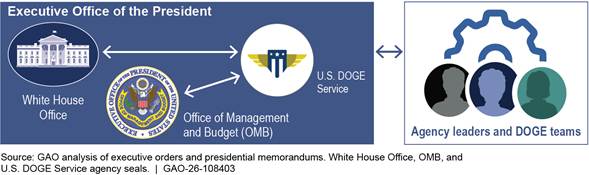
Of the 206 personnel GAO identified, administration officials characterized four as DOGE leaders. The other 202 personnel held positions at either USDS or the White House Office. These personnel held positions as employees, as detailees to these components from other federal agencies, and as volunteers. Twenty-seven of the 206 were special government employees (SGE). At least 128, including one SGE, had separated from their EOP positions by January 31, 2026.
EOP officials told GAO that DOGE personnel within EOP receive the same ethics and records management training as other EOP personnel. However, EOP did not respond to GAO’s requests for access to training records and financial disclosures for DOGE personnel. As a result, GAO could not determine all DOGE personnel who received training or completed financial disclosures with EOP.
Nine executive agencies provided information on ethics and records management activities for 64 DOGE personnel who held positions at those agencies and also within EOP. According to this information, 49 completed ethics training, 18 completed records management training, and 38 filed financial disclosures with those agencies during the time frame of GAO’s review. Officials from the nine agencies told GAO that some of the 28 personnel they identified as detailees should have completed these activities with their home agencies. Officials from six agencies told GAO that no individuals at those agencies met GAO’s scoping criteria. Ten did not provide requested information timely or at all. As a result, GAO could not determine all DOGE personnel who held positions, received training, or completed financial disclosures with these 10 agencies.
Officials from the Office of Government Ethics, the supervising ethics office for the executive branch, told GAO that they have limited responsibilities concerning the activities of DOGE personnel and do not oversee executive branch employees. Officials said their office has not reviewed an EOP ethics program since 2023 and has no plans to review USDS’s program in the next 4 years because the temporary organization within USDS terminated on July 4, 2026.
Why GAO Did This Study
In January and February 2025, several executive orders directed DOGE to implement a series of government reform initiatives, including to reform the federal workforce and reduce spending. DOGE personnel include SGEs. SGEs may have substantial financial interests outside the federal government that can conflict with their federal responsibilities. Appropriate ethics and records management practices can help support ethical behavior.
GAO was asked to review the employment status of selected DOGE personnel and their activities. This report examines information about (1) the federal positions of EOP DOGE personnel, and (2) their completion of ethics and records management training and their filing of financial disclosures.
For this review, GAO defined EOP DOGE personnel as those who held positions (1) as USDS personnel from January 20, 2025, through January 31, 2026; or (2) as personnel at other EOP components (White House Office or OMB) who assisted USDS or federal agencies in advancing DOGE’s initiatives during this time frame. This included individuals who were detailed from EOP to other agencies or from other agencies to EOP. GAO reviewed information from court filings, the administration, and executive agencies about identified personnel’s federal positions. GAO also reviewed information from these sources about identified personnel’s ethics and records management training and their filing of financial disclosures. In addition, GAO interviewed Office of Government Ethics and National Archives and Records Administration officials about their efforts to support EOP ethics and records management activities for DOGE personnel. GAO requested interviews with EOP, but EOP did not respond to these requests.
|
Abbreviations |
|
|
|
|
|
CFO Act |
Chief Financial Officers Act of 1990 |
|
DOGE |
Department of Government Efficiency |
|
EO |
Executive Order |
|
EOP |
Executive Office of the President |
|
GSA |
General Services Administration |
|
NARA |
National Archives and Records Administration |
|
OGE |
Office of Government Ethics |
|
OMB |
Office of Management and Budget |
|
OPM |
Office of Personnel Management |
|
PRA |
Presidential Records Act of 1978 |
|
SGE |
special government employee |
|
USDS |
U.S. DOGE Service |
|
WHO |
White House Office |
This is a work of the U.S. government and is not subject to copyright protection in the United States. The published product may be reproduced and distributed in its entirety without further permission from GAO. However, because this work may contain copyrighted images or other material, permission from the copyright holder may be necessary if you wish to reproduce this material separately.
August 5, 2026
Congressional Requesters
In January and February 2025, the President directed the heads of federal agencies to implement a series of initiatives to reform government operations. These initiatives included, among others, efforts to implement large-scale reductions in force, repeal regulations, and reduce federal spending.
The President established the Department of Government Efficiency (DOGE) to help advance these initiatives. DOGE includes the U.S. DOGE Service (USDS) and members of DOGE teams at federal agencies. Executive Order (EO) 14158 renamed and organized USDS within the Executive Office of the President (EOP) and established a U.S. DOGE Service Temporary Organization within USDS. This temporary organization was established to advance DOGE initiatives and under the terms of the EO terminated on July 4, 2026. Since the EO does not call for the termination of the broader USDS entity, it is possible that USDS and personnel at federal agencies could continue to do work that advances some of these initiatives after the temporary organization’s termination.
Members of Congress, employee unions, and others have raised questions about the roles of USDS personnel, DOGE team members, and White House Office (WHO) personnel who have assisted DOGE.[1] These groups have also expressed concern that DOGE personnel may have been involved in policy decisions while having financial conflicts of interest. A financial conflict of interest occurs under federal law when a federal employee participates personally and substantially in official matters where the employee or someone connected to them has a financial interest.[2]
Court filings show that DOGE personnel include, among others, individuals serving as special government employees (SGE). SGEs are employees who are retained, designated, appointed, or employed to perform temporary duties, with or without compensation, for no more than 130 days during a 1-year period. We have previously reported that SGEs often have substantial non-federal employment activities and may have financial interests that can conflict with their federal responsibilities.[3] We have also previously reported that appropriate records management practices can help promote accountability and ethical behavior.[4]
You asked us to review the employment status of selected DOGE personnel and their activities. This report examines information on (1) the federal positions held by DOGE personnel within EOP, and (2) their completion of ethics and records management training and filing of financial disclosure reports. We focused our review on DOGE personnel who held positions within EOP at any time from January 20, 2025, through January 31, 2026. For the purposes of this report, “DOGE personnel within EOP” refers to (1) all USDS employees (including SGEs), detailees to USDS from other federal agencies, and USDS volunteers; and (2) personnel at other EOP components who assisted USDS or other federal agencies in advancing DOGE initiatives.[5] These personnel at other EOP components include WHO and Office of Management and Budget (OMB) personnel who assisted either USDS or DOGE team members at executive agencies.[6]
Our scope does not include all DOGE personnel who worked to advance DOGE initiatives from January 20, 2025, through January 31, 2026. For example, it excludes DOGE team members and other individuals who helped to advance DOGE initiatives at federal agencies but who did not hold positions in EOP during this time frame.[7]
For our first objective, we reviewed information from public sources and from executive agencies. Public sources included court filings submitted by the federal government, including declarations, depositions, and other documents with information on DOGE personnel within EOP. They also included statements made by administration officials and information published by the administration.
We requested information from EOP and from 25 executive agencies on personnel at those agencies who met our criteria.[8] Fifteen agencies provided information responsive to our request. Of these, nine provided documentation, such as interagency agreements, and other information on the federal positions of personnel who met our criteria.[9] Six reported that no individuals who held positions at those agencies met our criteria.[10] As of July 23, 2026, the remaining 10 agencies had not provided the requested information.[11] In addition, EOP provided responses to some of our questions but did not provide requested information or documentation for these personnel. EOP also did not respond to our requests for interviews. As a result, we are not able to describe all positions that DOGE personnel within EOP held at these 10 agencies or within EOP.[12]
Through our review of information from these sources, we identified 206 DOGE personnel who held positions within EOP from January 20, 2025, through January 31, 2026. We also identified characteristics of the federal positions that these personnel held within EOP and each of the 25 executive agencies outside of EOP, where information was available. These characteristics included the position type (e.g., employee, detailee, or volunteer), position title, entrance date, separation date, appointment type, and SGE status.
To verify the accuracy and completeness of our analysis, we provided the results of our analysis to EOP and requested that EOP provide corrections and updates to this information, where appropriate. We also requested that the Office of Personnel Management (OPM) provide Enterprise Human Resources Integration data on the positions that identified personnel held as employees at other executive agencies during the time frame of our review.[13] As of July 2026, neither EOP nor OPM had responded to our requests.
For our second objective, we reviewed documentation and information provided by EOP and the 25 executive agencies about ethics training, records management training, and financial disclosure reports for DOGE personnel identified as in scope for our review. For the 25 executive agencies, we requested that those agencies provide information for all individuals whom those agencies identified as in scope for our review. In response to our request, nine executive agencies provided information for 64 personnel.[14] Where these nine agencies did not provide information about whether personnel who held positions at those agencies had completed these activities, we reviewed their explanations to understand why. We also reviewed relevant court filings for information about these activities, where available. As of July 23, 2026, 10 executive agencies and EOP had not provided ethics and records management training records or financial disclosure reports for DOGE personnel within EOP. EOP also did not respond to our requests for interviews. As a result, we are not able to determine the total number of DOGE personnel who held positions within EOP who received trainings or who completed financial disclosures at those 10 agencies or at EOP.
We reviewed financial disclosure reports that we received from the nine executive agencies to identify the filing characteristics of DOGE personnel identified by those agencies.[15] These characteristics include whether personnel filed disclosures and whether a supervisor or ethics official reviewed and approved those disclosures in a timely manner. We also interviewed officials from the Office of Government Ethics (OGE) and National Archives and Records Administration about their agencies’ respective roles in supporting ethics and records management programs for USDS and WHO personnel. For more details on our scope and methodology, see appendix I.
We conducted this performance audit from March 2025 to August 2026 in accordance with generally accepted government auditing standards. Those standards require that we plan and perform the audit to obtain sufficient, appropriate evidence to provide a reasonable basis for our findings and conclusions based on our audit objectives. We believe that the evidence obtained provides a reasonable basis for our findings and conclusions based on our audit objectives.
Background
USDS Organization and Responsibilities
The U.S. Digital Service was established within OMB in 2014 to enhance the use of IT in the federal government.[16] On January 20, 2025, the President issued EO 14158, which renamed the U.S. Digital Service the U.S. DOGE Service (USDS). Pursuant to EO 14158, USDS was moved out of OMB to become a free-standing component in EOP that is led by the USDS Administrator. The EO also established the U.S. DOGE Service Temporary Organization within USDS that was also led by the USDS Administrator.[17] The temporary organization was dedicated to advancing DOGE initiatives prior to its termination. According to a USDS official, USDS’s structure and authorities are derived from the EOs.[18]
Since its reorganization, certain USDS responsibilities have been outlined through a series of EOs issued in January and February 2025 (see fig. 1).
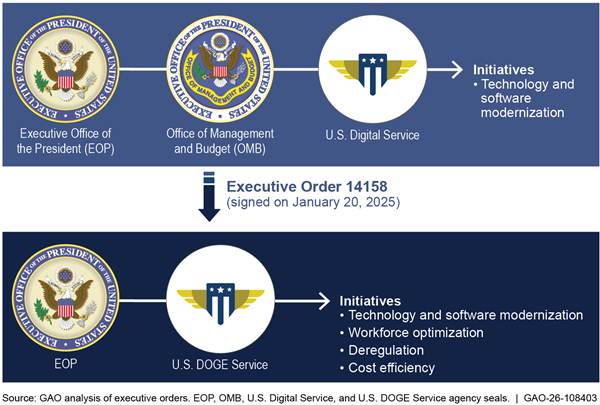
According to these EOs, USDS personnel are responsible for advancing initiatives related to technology and software modernization. Some are also responsible for advancing initiatives related to workforce optimization, deregulation, and cost efficiency through their coordination with DOGE team leads who hold positions at executive agencies outside of EOP.[19]
· Technology and software modernization. EO 14158 directed USDS to work with agencies to promote interoperability between their networks and systems, ensure data integrity, and facilitate responsible data collection and synchronization.[20]
· Workforce optimization. EO 14210 directed agencies to promptly undertake preparations to initiate large-scale reductions to the federal workforce.[21] According to the EO, reductions were to be prioritized to offices that perform functions not mandated by statute or other law, including agencies’ diversity, equity, and inclusion initiatives. The EO also directed agency heads to consult with their DOGE team leads in developing hiring plans for new career appointments.
· Deregulation. EO 14219 directed agency heads to coordinate with their agency DOGE teams and OMB to initiate a review of all regulations under their jurisdictions that meet certain criteria for possible recission or modification.[22] The agencies were to focus on regulations that are not authorized by clear statutory authority and that were determined to be harmful to the national interest.
· Cost efficiency. EO 14222 directed agency heads to build a centralized system within each agency to record every contract or grant payment issued by the agency, with assistance, as requested, from the agency DOGE team lead.[23] In consultation with the agency DOGE team lead, agency heads were also directed to review their contracts and grants for termination or modification with the goal of reducing or reallocating federal spending to promote efficiency. They were also directed to consult with the agency’s DOGE team lead and the Administrator of the General Services Administration to determine whether to exercise termination rights under existing leases of government-owned real property.
The Administrator of USDS has additional responsibilities to consult with certain EOP officials, including the Director of OMB, on plans to reform the federal hiring process, reduce the size of the federal workforce, and reduce spending on individuals without lawful immigration status.[24]
Ethics Standards for Executive Agency Employees
Executive agency employees, including EOP employees, are covered under numerous statutory prohibitions and requirements, EOs, and regulations.[25] Criminal statutes establish prohibitions and restrictions placed on employees’ personal financial gain while serving the public, including bribery and illegal gratuities prohibitions and criminal conflict of interest prohibitions.
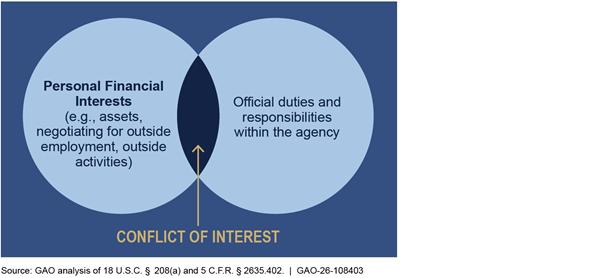
Under the principal criminal conflict of interest statute, a financial conflict of interest occurs when a federal employee participates personally and substantially in official matters where the employee or any person whose interests are sufficiently connected to the employee—such as the employee’s spouse or minor children—has a financial interest (see fig. 2).[26]
Court filings show that DOGE personnel included SGEs who are subject to most, but not all, of these criminal statutes. Similar to other employees, SGEs are subject to prohibitions on bribery and illegal gratuities[27] and are prohibited from participating in matters that directly affect their own financial interests (or the financial interests of individuals or entities attributed to the employee).[28] SGEs are generally not afforded different treatment under the various post-employment bans on the activities of former employees.[29] However, SGEs are subject to substantially fewer restrictions than other employees when it comes to representing a third party before the government.[30]
SGEs and other federal officials are subject to the standards of conduct regulations,[31] which implement the principles of ethical conduct established under EO 12674 and generally prohibit SGEs and other federal officials from, among other things, receiving compensation for teaching, speaking, and writing that is undertaken as part of the employee’s official duties.[32] The treatment of SGEs is generally the same as for other employees under these standards of conduct.
|
Example of a Potential Conflict of Interest A special government employee is employed by a company that competes for federal contracts to develop transportation infrastructure. The employee is also being considered for a detailee position at another federal agency. In that position, the employee would have access to sensitive data on their company’s competitors. The receiving agency could determine that this access would directly and predictably affect the employee’s financial interests. In that case, the employee could not perform the significant duties of the detailee position while remaining employed by the company, unless an exemption applied or the agency granted the employee a waiver. |
Source: GAO example based on analysis of 5 C.F.R. § 2635.403. | GAO‑26‑108403
Executive Agency Ethics Programs
Ethics programs can help agencies provide employees with knowledge needed to prevent and address conflicts of interest and ensure compliance with relevant laws and regulations. Executive agencies, including EOP components, are required to develop ethics programs for their employees.[33]
The Office of Government Ethics (OGE) provides overall leadership of the executive branch’s ethics program. The executive branch ethics program is decentralized by statute and is carried out by each agency in the executive branch, including WHO, which has its own ethics office for WHO employees.[34] Each executive agency is required to designate an agency ethics official who is primarily responsible for administering the agency’s ethics program and coordinating with OGE. Agencies develop and manage their own ethics programs because they each have specific missions and responsibilities and therefore face different risks.[35] Designated ethics officials are responsible for overseeing the ethics training of agency employees. They are also responsible for reviewing financial disclosure reports; helping to address financial conflicts of interest; and providing guidance on outside activities, post-government employment, misuse of public office, and other topics.[36]
OGE issues regulations for the management of agency ethics programs, advises ethics officials, and recommends that agencies investigate potential ethics violations, where appropriate.[37] According to OGE’s website, OGE generally aims to review each agency’s program at least once every 3 to 4 years.[38] OGE reviewers assess, among other things, the timeliness of financial disclosure report filing and whether the agency properly trains employees. OGE recommends actions to address the problems it identifies.
According to OGE guidance, executive agency employees who
are detailed from one agency to another agency generally should complete
required ethics training and file financial disclosure reports with their home
agency.[39]
According to OGE, ethics officials at the home agency should coordinate with
receiving agencies to share financial disclosure report information and ensure
that detailees have received required training.
Ethics Training
OGE requires executive agencies to implement an ethics training program to teach employees how to identify government ethics issues and obtain assistance in complying with government ethics laws and regulations. New agency employees generally must complete initial ethics training within 3 months of appointment.[40] Training must address the following topics: financial conflicts of interest, impartiality, misuse of position, and gifts. Confidential and public financial disclosure filers are required to complete ethics training each calendar year after they are initially appointed. A July 2023 OGE legal advisory to designated agency ethics officials states that although employees can be temporarily detailed to another agency, they fundamentally remain employees of their home agency.[41] Because detailees are employees of their home agency, the home agency is responsible for ensuring that each receives required ethics training. However, a home agency may meet this obligation by confirming that the detailee has received appropriate training at the receiving agency.
Financial Disclosure
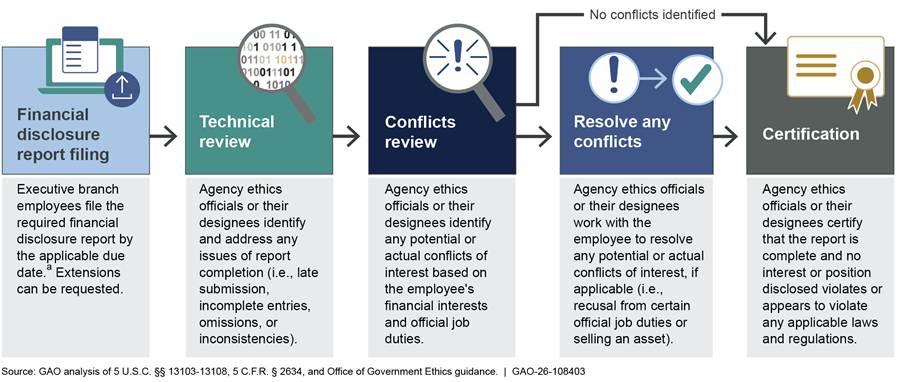
Disclosure of personal financial interests—such as assets, liabilities, and outside positions—allows ethics officials to help employees assess when their personal interests might conflict with their government responsibilities (see fig. 3).
aDeadlines for submitting financial disclosure reports vary by type of report and filer.
There are two categories of financial disclosure filers in executive agencies.[42]
· Public filers are typically high-level officials and career senior employees, such as political appointees requiring Senate confirmation and members of the Senior Executive Service. The Ethics in Government Act of 1978 requires that these filers’ reports be available to the public. The act designates public filers in executive agencies based on whether an employee holds a covered position or meets certain employment criteria.[43] Employees whose salaries or job classifications meet or exceed statutorily defined criteria must file public reports.
· Confidential (nonpublic) filers are generally lower-level employees whose job duties involve a heightened risk of conflicts of interest and other activities that affect the interests of non-federal entities. OGE regulations outline criteria that agencies subject to its authority must use to designate certain positions as subject to confidential filing requirements. These criteria relate to employees’ salaries, official job duties, and levels of responsibility.[44]
Confidential filers must generally disclose the same assets, liabilities, gifts, and relationships as public filers, but with less detail. For example, both public and confidential filers must report ownership of stocks and bonds. But only public filers are required to disclose (1) whether these securities are held by a spouse, minor child, or jointly; (2) the value of the asset (within a specified range); (3) the type of associated income from the asset; and (4) the amount of income earned from the asset during the reporting period.[45]
Designated agency ethics officials generally review reports submitted by the employee, unless this role is delegated to another agency official. OGE guidance that we previously reported on identifies several actions that agency ethics officials and employees can take to address potential conflicts of interest before disclosure reports are certified.[46] For example, employees can be disqualified or recuse themselves from certain job duties that conflict with their financial interests, divest from certain financial interests, or resign from outside positions, where appropriate.
Executive Agency Records Management Programs
Federal employees create records as part of their daily activities, according to the National Archives and Records Administration’s (NARA) website.[47] By effectively managing these records,[48] executive agencies can protect the rights and interests of the public, hold personnel accountable for their actions, and help their agencies operate more efficiently. Agency leaders can develop records management programs that provide personnel with appropriate training and guidance to achieve these goals. Agencies’ responsibilities for developing such programs vary according to the type of records created and used by the agency.
Most federal agencies create and use federal records. These agencies are subject to the records management requirements established by the Federal Records Act.[49] According to NARA, all agency personnel with email accounts or IT network resource access should complete federal records management training within 60 days of employment and annually thereafter.[50]
Certain agencies that advise and assist the President create and use presidential records.[51] These components are subject to the records management requirements established by the Presidential Records Act of 1978 (PRA), as amended.[52] Agencies creating presidential records that are subject to the PRA have generally included several offices and councils within EOP, such as WHO, the Council of Economic Advisors, and the National Security Council. Administration officials have stated that USDS maintains records pursuant to the PRA.[53]
The PRA assigns management authority for incumbent presidential records to the President.[54] The PRA also establishes requirements under which presidents must manage their records. These requirements address the preservation and filing of presidential records as well as procedures for public, congressional, and court access to them. The PRA does not establish specific training requirements for ensuring that personnel who create and use presidential records are aware of PRA requirements, including requirements for preserving those records. However, the USDS Acting Administrator has stated that USDS personnel were informed that they must adhere to records-preservation requirements.[55]
Over 200 DOGE Personnel Have Held Positions Within EOP, Including as Employees and Detailees
We identified 206 DOGE personnel who held positions within EOP from January 20, 2025, through January 31, 2026, according to our review of publicly available information, including court filings, and information provided by executive agencies.[56] Four of these personnel held leadership positions and directed the administration’s efforts to advance DOGE initiatives. Most others held positions as USDS employees, including USDS employees who were detailed from USDS to other executive agencies outside of EOP. The remaining personnel held other positions at USDS, WHO, or EOP components that we were unable to identify. Of these 206 personnel, we also found that at least 128 had separated from their positions within EOP that we identified by January 31, 2026.[57]
The 206 personnel do not represent all federal personnel who worked to advance DOGE initiatives from January 20, 2025, through January 31, 2026. For example, this total excludes DOGE team members and other individuals who assisted USDS or other federal agencies in advancing DOGE initiatives but who did not hold positions in EOP during this time frame. This total also does not include personnel who are in scope for our review but who have not been referred to in court filings or identified in agencies’ responses to our requests for information as of July 23, 2026.[58]
DOGE Leaders in EOP
Amy Gleason has served as the Acting Administrator of USDS since February 18, 2025, according to a sworn statement from a USDS official.[59] In this role, Ms. Gleason is responsible for overseeing USDS personnel responsible for advising executive agencies in advancing DOGE initiatives. According to a sworn deposition from a USDS official, the Acting Administrator is the only USDS official with authority over other USDS employees.[60] USDS has stated that the Acting Administrator is also responsible for making decisions about assigning USDS personnel to other agencies—for example, as employees or detailees.[61] However, those agencies have the discretion to accept or reject assignments of USDS personnel to their agencies, according to the USDS Acting Administrator.
We also identified three other personnel within EOP who have led the administration’s efforts to advance DOGE initiatives, according to administration officials and other sources:
· The Director of OMB, Russell Vought, has been responsible for consulting with the USDS Administrator and others on efforts to implement DOGE initiatives related to reforming the federal hiring process, reducing the size of the federal workforce, and reviewing spending on individuals without lawful immigration status.[62] In addition, the Director has been responsible for coordinating with agency heads to initiate processes for reviewing regulations and terminating regulatory enforcement actions to ensure compliance with applicable law and administration policy.[63] The Director has also been responsible for working with agency officials to develop plans for DOGE initiatives to reorganize agencies and to reduce the government’s real property portfolio.[64]
· Elon Musk worked within WHO as a special government employee (SGE) and held a position as a senior advisor to the President.[65] In February 2025, the President stated that Mr. Musk was the leader of the overall DOGE effort.[66] Mr. Musk did not hold a position in USDS, according to administration officials.[67] However, he advised on USDS’s work and therefore assisted USDS personnel in advancing DOGE initiatives. As an SGE, Mr. Musk was permitted to perform temporary duties for no more than 130 days during any 1-year period. According to a statement from the President, Mr. Musk left his WHO position in May 2025.
· Steve Davis held a senior advisor position within USDS. Mr. Davis advised across USDS and as a detailee to the General Services Administration (GSA).[68] In addition, a USDS official stated in a deposition that Mr. Davis also exercised authority for hiring USDS temporary organization personnel prior to February 18, 2025, when the current USDS Acting Administrator took office.[69] In June 2025, the Director of OMB testified before Congress that Mr. Davis had led USDS.[70] Mr. Davis left his USDS position in May 2025, according to USDS documentation we reviewed.
Other DOGE Personnel in EOP
In addition to the four leaders referenced above, we identified 202 other DOGE personnel who held positions within EOP from January 20, 2025, through January 31, 2026. Most of these personnel were USDS employees or detailees from other federal agencies to USDS. Some had held positions at WHO. This total also includes 33 EOP personnel that executive agencies identified as in-scope for our review, though we were unable to identify the EOP components at which these individuals held positions (see table 1).
Table 1: Position Types of Department of Government Efficiency Personnel Within the Executive Office of the President, January 20, 2025–January 31, 2026
|
|
Executive Office of the President (EOP) component |
|||
|
Position type |
U.S. DOGE Service (USDS) |
White House Office (WHO) |
Office of Management |
Not identified |
|
Employee |
145 |
1 |
1 |
0 |
|
Detailee |
16 |
9 |
0 |
0 |
|
Volunteer |
3 |
0 |
0 |
0 |
|
Not identified |
1 |
1 |
0 |
33 |
|
Total |
165 |
11 |
1 |
33 |
Source: GAO analysis of court filings and agency personnel information. | GAO‑26‑108403
Notes: This table includes information on the positions held at USDS, WHO, and other EOP components by all personnel that we identified as Department of Government Efficiency (DOGE) personnel within EOP, including DOGE leaders. This table totals to 210 because four of the 206 personnel that we identified held positions at both USDS and WHO. Of these four personnel, three were detailees to both EOP components, and one was a detailee to USDS and held an unidentified position type at WHO. We were unable to determine the EOP components or position types for 33 personnel identified for us by five executive agencies.
USDS Personnel
In addition to Acting Administrator Gleason and Mr. Davis, we identified 163 other personnel who held positions in USDS, according to publicly available information, including documentation submitted as court filings, and information provided by executive agencies, such as interagency agreements between those agencies and USDS. Most of these personnel held positions as USDS employees with titles as experts or consultants.
· USDS expert and consultant employees. USDS documentation identifies 127 USDS employees who held titles as digital services experts or consultants. Their areas of focus included design, engineering, and product communications, according to USDS documentation. Four of these employees were detailed to GSA after January 20, 2025. We identified no others who were detailed from USDS to executive agencies within the scope of our review. Twenty of these 127 digital services experts or consultant employees remained in their EOP positions as of January 16, 2026, according to USDS documentation we reviewed.
· Other USDS employees. Sixteen other USDS employees held non-leadership positions. Most of these 16 held positions as advisors. USDS documentation shows that advisors’ roles have focused on technology and efficiency, administrative operations, legal matters, and engineering. As of January 31, 2026, we found that USDS had detailed eight of these 16 employees to at least one of eight agencies: the Consumer Financial Protection Bureau; Departments of Education, the Interior, Labor, and Health and Human Services; Environmental Protection Agency; GSA; or the Social Security Administration.
|
Detailee to Employee Conversions We identified three U.S. DOGE Service (USDS) employees who were initially detailed to executive agencies but by March 2025 had become concurrently employed at both those agencies and USDS. These employees include Acting Administrator Amy Gleason who was detailed to the Centers for Medicare and Medicaid Services and later became an employee of its parent agency, the Department of Health and Human Services. They also include two USDS advisors who were detailed to and later became employees of the Department of Health and Human Services and the Consumer Financial Protection Bureau, respectively. |
Source: GAO analysis of court filings. | GAO‑26‑108403
In addition to USDS employees, 16 of the 206 personnel we identified were detailed to USDS from other agencies from January 20, 2025, through January 31, 2026. Interagency agreements show that eight of these individuals were detailed from GSA or the Office of Personnel Management (OPM). An agreement covering one detailee from GSA to USDS was not signed by a USDS official. GSA officials told us that they were unable to locate a copy of this agreement signed by officials from both agencies. We were unable to determine the home agencies of the remaining eight detailees to USDS.
Similar to USDS employees, detailees to USDS are responsible for advising and consulting with federal agencies on advancing DOGE initiatives, according to a USDS official’s sworn deposition.[71] Interagency agreements for the eight detailees stated that some of these individuals were also responsible for providing legal advice to USDS leaders, supporting USDS’s interagency hiring team, and assisting USDS with IT projects. Some of these individuals had been detailed by their home agencies to several executive agencies in addition to USDS (see fig. 4).
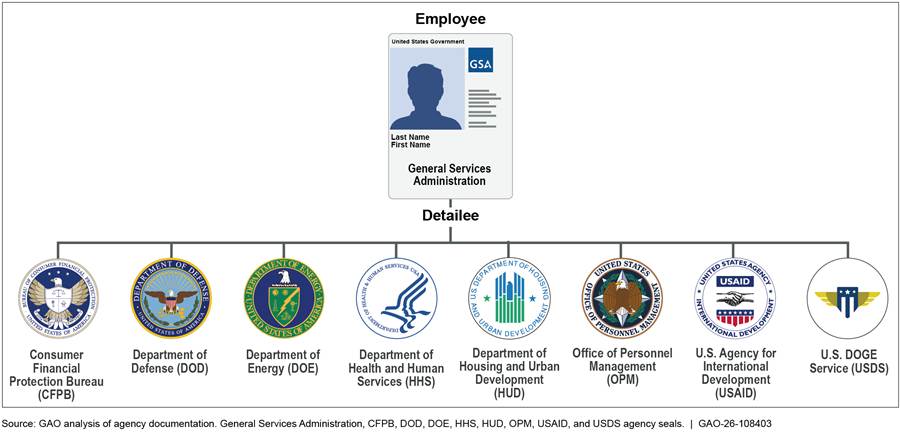
Note: Some detailee positions noted in this figure were held concurrently.
We identified three individuals who held positions as USDS volunteers. USDS documentation we reviewed did not identify the roles or responsibilities of these personnel in their positions as USDS volunteers. One of the three USDS volunteers also held positions at the Departments of Health and Human Services, Justice, Labor, and Treasury, according to information from agency officials.
WHO Personnel
In addition to Mr. Musk, we identified 10 other DOGE personnel within EOP who held positions in WHO from January 20, 2025, through January 31, 2026. For nine of these 10 personnel, interagency agreements showed that these personnel were detailed to WHO from either OPM or GSA. Three of these personnel were also detailed by these agencies to USDS. These nine personnel had helped to implement DOGE initiatives at OPM and GSA, according to officials at those agencies. Interagency agreements for some of these personnel show that their responsibilities as detailees to WHO included the following:
· assisting the Deputy Chief of Staff for Policy,
· advising the Office of Presidential Personnel on hiring processes for noncareer appointments throughout the federal government,
· advising the National Design Studio,[72] and
· assisting the White House Staff Secretary.
An interagency agreement for one of the detailees from OPM was not signed by an official from WHO. We requested a copy of this agreement signed by officials from both agencies. However, OPM did not respond to this request or provide further clarification.
The remaining individual we identified held a position at WHO. However, we were unable to determine their position type. According to a sworn statement from a federal agency official, this individual identified themself as a WHO attorney,[73] and an interagency agreement we reviewed showed that this individual was also detailed from OPM to USDS.
Other Personnel
Five executive agencies identified 33 additional personnel who—according to those agencies—assisted with the implementation of DOGE initiatives at those agencies and held positions in either USDS or WHO. The agencies did not specify in which of the EOP components these personnel had held positions. We were unable to determine this information, based on our review of interagency agreements, court filings, and other documentation. The five agencies stated that 23 of the 33 were employees at those agencies, while the remaining 10 were detailees to those agencies.
SGE Status and Appointment Types
Of the 206 DOGE personnel we identified, we found that at least 27 held noncareer positions as SGEs from January 20, 2025, through January 31, 2026.[74] As SGEs, these noncareer personnel were permitted to perform temporary duties for no more than 130 days during any 1-year period. Twenty-six of these 27 employees held SGE positions at executive agencies outside of EOP, while one, Elon Musk, held an SGE position at WHO.
We also found that 22 of the 206 personnel held noncareer positions based on their appointment types. This total includes 15 additional personnel not identified as SGEs. In these noncareer positions, these 22 employees were either subject to time limitations or subject to removal at any time for policy reasons. One of these 22 employees, the Director of OMB, held a presidential appointment with Senate confirmation. Twenty held excepted service positions through Schedule A or Schedule C appointments, as described below.[75] Three held noncareer appointments to Senior Executive Service positions, including two who had also previously held Schedule C appointments.[76]
· Schedule A. Five GSA personnel held Schedule A appointments, including two who were also SGEs. Schedule A allows agencies to make appointments to some positions for which it is “impracticable to examine.” The schedule can be used for a variety of purposes, subject to OPM approval, such as for temporary positions for which there are critical hiring needs. GSA officials stated that each of the five Schedule A personnel held non-permanent appointments.
· Schedule C. Fifteen personnel held Schedule C appointments, including four who were also SGEs. Schedule C allows agencies to hire political appointees who are involved in determining policy or whose work involves a close, confidential relationship with the agency head or other key officials at the appointing agency. Schedule C appointees serve at the pleasure of the appointing authority (usually the agency head) and may be dismissed without the right to appeal to the Merit Systems Protection Board.
· Noncareer Senior Executive Service. Three personnel held noncareer appointments to Senior Executive Service positions. Two had previously held Schedule C appointments, including one who had also been an SGE. Noncareer Senior Executive Service appointments may be political appointments and made without a time limitation. However, appointees serve at the pleasure of the appointing authority and may be dismissed without the right to appeal to the Merit Systems Protection Board.
We also identified four additional USDS employees who held excepted service positions, which may be subject to time limitations. These personnel include the USDS Acting Administrator and three senior advisors within USDS who also held positions in the USDS Temporary Organization, according to our review of information reported by the administration. The heads of temporary organizations are authorized by statute to appoint personnel to excepted service positions within those organizations.[77] These appointments may last until the termination of those temporary organizations.
Agencies did not provide, and thus we did not obtain, information about whether the more than 150 of the remaining 206 DOGE personnel that we identified held positions as SGEs from January 20, 2025, through January 31, 2026, or about their appointment types. This total includes the 127 USDS employees who held titles as digital services experts or consultants within USDS. Although USDS has stated that USDS positions last no more than 4 years, we were unable to determine whether these USDS employees or other personnel had held such time-limited appointments.
Some DOGE Personnel Completed Ethics and Records Management Activities
Some DOGE Personnel Completed Ethics Training, Records Management Training, or Filed Financial Disclosures
Officials from nine executive agencies provided information on ethics training, records management training, or the filing of financial disclosures for 64 DOGE personnel who held positions at their agencies and at EOP from January 20, 2025, through January 31, 2026.[78] However, we found that completion statuses for each of those activities varied by agency.[79] For example, officials from some agencies told us that all identified personnel completed one or both types of training or filed financial disclosure reports, but not all of them provided supporting documentation. Documentation provided included, among other things, copies of training completion certificates, internal emails, and financial disclosure reports. Other agency officials provided completion dates or other information for some—but not all—individuals they identified as DOGE personnel. Officials from EOP and 10 other agencies did not provide ethics and records management training records or financial disclosure reports by July 23, 2026.[80] As a result, we are not able to determine the total number of DOGE personnel within EOP who received trainings or who completed financial disclosures at those 10 agencies or at EOP. We reviewed court filings, where available, for additional information on DOGE personnel’s completion of ethics or records management trainings.
Ethics Training
Federal agency officials stated or provided information showing that 49 of the 64 individuals they identified as DOGE personnel had completed ethics training. According to our review of this information, 41 of those 49 individuals completed ethics training within the first 3 months (90 days) of becoming federal employees, as required.[81] The eight others completed ethics training after 90 days.
Our analysis of ethics training-related information found variations in reporting by agencies. Specifically:
· Departments of Defense and the Interior, Environmental Protection Agency, OPM, and Social Security Administration officials stated or provided documentation showing that the 27 individuals they identified as DOGE personnel completed ethics training.[82] The documentation these agencies provided included copies of completion certificates or internal emails.
· Department of Energy and GSA officials provided ethics training completion dates for 11 of the 23 individuals they identified as DOGE personnel. The agencies provided no ethics training completion dates for the remaining 12. The Department of Energy and GSA identified 13 of those 23 personnel as detailees. Department of Energy and GSA officials told us that these detailees’ home agencies were responsible for ensuring that the 13 detailed employees completed ethics training, consistent with Office of Government Ethics guidance.
· Department of Justice officials identified 14 individuals as DOGE personnel detailed to their department and stated that seven of them completed ethics training. They provided a copy of a training record for one of the seven showing that this individual had completed ethics training. Department of Justice officials told us that home agencies were responsible for ensuring completion for the rest.
· Department of Agriculture officials provided documentation stating that the individuals they identified as DOGE personnel had completed ethics training. The officials provided an ethics-related presentation for Trump Administration appointees. However, they provided no completion dates or other documentation (such as certificates of completion) for any of these individuals. As a result, we were unable to determine the extent to which specific DOGE personnel met their ethics training requirements.
· EOP officials reported that DOGE personnel who held positions within EOP receive the same ethics training as all other EOP personnel. They also stated that their training processes ensure compliance with applicable ethics laws, rules, and regulations. However, they did not respond to our requests for documentation showing whether individual DOGE personnel completed ethics training.
Some federal agencies included in our scope did not provide information that we requested; however, officials at those agencies have stated through court filings that at least some DOGE personnel at those agencies were subject to ethics training requirements, completed ethics training, or received ethics guidance. Some of the DOGE personnel involved in litigation held positions within EOP and are therefore in scope for this review.
· In February 2025, a detailee from USDS to the Department of Education stated in a supplemental declaration that one of six individuals who had roles in implementing EO 14158 initiatives at the department had not completed ethics training at the department.[83] Agency officials instructed this individual to complete their ethics training within 1 week, according to this declaration, and the individual agreed to do so. According to this official, two of the six individuals were detailed from USDS to the department.
· In April 2025, the Chief Information Officer at the Department of Health and Human Services stated in a sworn deposition that DOGE team members at the department were required to agree to adhere to rules for ethical behavior before receiving access to certain department systems.[84]
Records Management Training
Federal agency officials stated or provided documentation to show that 18 of the 64 individuals they identified as DOGE personnel had completed records management training. According to our review, 12 of those 18 individuals completed records management training within 60 days of becoming federal employees, consistent with National Archives and Records Administration (NARA) guidance. Four others completed records management training after 60 days. Documentation included, for example, screenshots of a spreadsheet from a training management system that showed training statuses. Agency officials told us that the two remaining individuals completed records management training, but they did not provide dates of completion. Officials with five agencies provided completion dates for at least some identified DOGE personnel: the Department of the Interior, Environmental Protection Agency, Department of Justice, GSA, and OPM.
· Department of the Interior and Environmental Protection Agency officials provided documentation of completion dates for records management training for each of the three individuals they identified as DOGE personnel.
· Department of Justice, GSA, and OPM officials stated or provided documentation to show that 16 of the 41 individuals they had identified as DOGE personnel had completed records management training.
1. Department of Justice officials provided documentation showing that seven of the 14 individuals they identified as DOGE personnel had completed records management training. The documentation they provided included copies of training records or a spreadsheet showing completion dates. Department of Justice officials told us that home agencies were responsible for ensuring that the seven remaining individuals completed records management training because these individuals were detailees.
2. GSA officials provided documentation showing that three of the 21 individuals they identified as DOGE personnel had completed records management training, and the 18 others had not. The documentation they provided included a spreadsheet showing training completion statuses for 18 of the 21 DOGE personnel. The spreadsheet lists the three individuals who completed records management training and eight others, all GSA employees, who had not yet completed it. Four of the eight GSA employees were registered for records management training and the remaining four were in a past due status. The remaining seven individuals and three others from the 21 DOGE personnel who were not identified in the spreadsheet were detailed from EOP to GSA.[85] GSA officials stated that it was the responsibility of EOP, the home agency for each individual, to ensure completion of training.[86] They also provided documentation for seven of these 11 individuals showing that three were registered and the remaining four were in a past due status for completion of records management training.
3. OPM officials stated that six of the eight individuals they identified as DOGE personnel completed records management training. They provided dates of completion for six individuals, but these officials provided no additional information, such as transcripts that show dates in which these individuals completed records management training.
Officials with four other agencies provided no documentation or completion dates for records management training for individuals they identified as DOGE personnel: the Department of Energy, Social Security Administration, Department of Defense, and the Department of Agriculture.
· Department of Energy officials told us that two identified personnel detailed to the department were to complete records management training at their home agencies. They also said the Department of Energy had no record that one identified DOGE employee had completed records management training. For another department employee, the department provided a training completion date almost 11 months later than when that employee entered into their position at the department.
· Social Security Administration officials stated that they had no information regarding whether the one individual they identified as a DOGE detailee to the administration had completed records management training at the individual’s home agency. The officials told us that while this individual was detailed to the administration for about 4 months, the individual did not have access to the Social Security Administration system used for records management training. This individual was detailed to the administration from USDS, according to an interagency agreement we reviewed.
· Department of Defense officials provided no records management training for the 16 individuals they identified as DOGE personnel (all SGEs) who had worked for the department. They stated that the department does not provide such training for SGEs. Department of Defense officials told us that the department would begin requiring as of July 1, 2026, that all DOGE personnel at the department, including SGEs, complete records management training.
· Department of Agriculture officials told us that no DOGE personnel at the agency had completed records management training because when they became employees, all training was paused for an agencywide review.
EOP officials stated that USDS employees receive the same records management training as all other EOP employees, including training on protecting information and records retention. However, EOP did not respond to our requests for documentation showing whether DOGE personnel completed records management training. EOP officials also stated that USDS’s records retention policy is consistent with the requirements of the Presidential Records Act of 1978 (PRA). We found that EOP provided a copy of USDS’s March 2025 records retention policy for a court proceeding.[87] This policy provides information to USDS personnel on (1) what constitutes a work-related record, and (2) their responsibilities to preserve such records (e.g., those required by court orders).
Financial Disclosures
Executive agency officials provided new entrant financial disclosure reports for 38 of the 64 individuals they identified as DOGE personnel.[88] These personnel filed one disclosure report with EOP, two with WHO, and the rest (35) with other executive agencies. Eighteen were public financial disclosure reports and 20 were confidential. Additionally:
· DOGE personnel submitted 31 of the 38 new entrant disclosures in a timely manner―within the 30-day time frame generally required.[89] Fourteen of the disclosures were public and 17 were confidential.[90]
· The seven additional disclosures were submitted after the 30-day time frame.[91] Four of those disclosures were public and three were confidential.
· A supervisor or ethics official certified 31 of the 38 new entrant disclosures in a timely manner―within the 60-day time frame generally required.[92] Of those certified in a timely manner, 12 were public and 19 were confidential.
· A supervisor or ethics official certified three additional public financial disclosures beyond the 60 days generally required. The personnel who filed the disclosures have since departed the agencies with which they filed them.
· No supervisor or ethics official certified the four remaining public financial disclosure reports. The financial disclosure process is incomplete without certification from the reviewing official.[93] At least two of the four individuals who filed these disclosures have since departed from the agencies with which they filed them.
Agency officials did not provide copies of financial disclosures for the remaining 26 individuals they identified as DOGE personnel. Twenty-one of the 26 individuals were detailees to the Department of Justice, GSA, or the Social Security Administration. One more of the 26 individuals was detailed from OPM to WHO. Three others were agency employees―two at GSA and one at the Department of Agriculture. GSA officials told us that both of their employees were SGEs who had separated from the agency before the required filing date. EOP and the Environmental Protection Agency did not provide copies of financial disclosure reports for identified DOGE personnel at those agencies. Environmental Protection Agency officials told us that they did not provide a financial disclosure for the one individual who they had identified as DOGE personnel because that individual worked for EOP and was detailed to their agency.
OGE and NARA Responsibilities Concerning DOGE Ethics and Records Management Activities
Office of Government Ethics (OGE) officials told us that OGE advised and counseled EOP DOGE personnel in meeting their ethics responsibilities. These efforts included providing advice to EOP and executive agency ethics officials and reviewing agencies’ ethics programs. OGE officials told us that their ethics advice and counsel activities extend to both executive agencies and EOP components, such as USDS. OGE officials told us that although OGE leads the executive branch ethics program, it generally does not directly advise, counsel, monitor, or maintain the records for the millions of executive branch employees in other agencies, including EOP personnel.
The National Archives and Records Administration’s (NARA) oversight role of EOP’s record management activities is limited, according to NARA officials. NARA officials said NARA provides records management advice and guidance to most executive agencies and, as needed, to EOP entities.[94]
OGE
OGE officials told us they were unsure of who is responsible for overseeing the ethics management program for DOGE personnel at EOP. They confirmed that the administration had designated ethics officials for some EOP components, such as the White House Counsel’s Office. However, OGE officials could not confirm if the same officials were overseeing USDS personnel. They also told us this uncertainty was not unusual following a change in administration or after an office reorganization. Further, they said it often takes time to fill designated ethics officials’ positions following reorganizations.[95]
OGE officials told us that they provided guidance to EOP ethics officials to assist them in applying conflicts of interest statutes for personnel within EOP, including DOGE personnel.[96] OGE officials told us that OGE regularly provides advice to employing agencies and offices, including WHO and EOP entities. When OGE becomes aware of potential ethics-related issues, OGE contacts those agencies to ensure that the agency is analyzing and taking proper actions regarding those issues. According to OGE officials:
· In February 2025, OGE advised EOP ethics officials on the required recusal obligations when an agency is engaging in certain activities that could lead to conflicts of interest involving non-federal employment held outside the federal government.
· In March and April 2025, OGE contacted WHO to follow up on congressional inquiries received by OGE and requested information on what actions, if any, EOP had taken in response to the congressional inquiries into potential ethics issues involving Mr. Musk and other DOGE personnel within EOP.
OGE officials told us that WHO’s designated agency ethics official responded to OGE, stating that WHO made process improvements to address concerns. OGE officials stated that they considered EOP’s responses to be sufficient and the matters to be closed. They also said they routinely correspond with EOP officials on other potential ethics issues, including those possibly involving DOGE personnel at EOP, consistent with OGE’s role in assisting agency ethics officials across the executive branch.
OGE officials also told us that—in line with their responsibilities as required by the Ethics in Government Act —they have helped to review financial disclosures for WHO employees (sometimes referred to as assistants to the President) but not those specifically for USDS employees.[97] They said they have received no conflict of interest waivers from WHO or USDS that required OGE review since January 2025.[98]
OGE officials told us that they have not reviewed an EOP ethics program since 2023. They said multiple prior administrations declined to work with OGE on a review because, according to these officials, certain EOP components do not meet the definition of “agencies” subject to OGE review.[99] While OGE officials typically conduct compliance reviews of each agency’s ethics program every 3 to 4 years, they said they have no plans to review USDS’s ethics program within the next 4 years given the restructuring of USDS and the USDS temporary organization’s termination.[100] According to OGE officials, challenges conducting effective reviews are common when entities like USDS undergo significant reorganization, have new ethics leadership, or both. USDS has not separately reviewed a U.S. DOGE Service or U.S. Digital Service ethics program.
NARA
NARA officials told us that their records management role depends on whether an entity within the executive branch is subject to the Federal Records Act or PRA.[101] Under the PRA, incumbent Presidents have exclusive responsibility for the custody and management of the presidential records of their administration while in office. NARA officials told us that NARA has no formal role in how incumbent presidents manage their records, except when the President proposes to dispose of records. Instead, NARA provides guidance and counsel to incumbent presidents and their designated officials, upon request.
In July 2025, NARA officials told us that they provide records management guidance to each administration on its responsibilities under the PRA. For example, NARA officials told us that NARA provided relevant guidance in 2024 and 2025 to both the outgoing and incoming administrations in the Presidential Transition Directory.[102] NARA’s guidance defines presidential records and requirements for managing such records under the PRA.[103]
We asked NARA to provide information on its efforts to coordinate with the EOP to support records management training for DOGE personnel within EOP. However, NARA officials did not provide the information we requested and told us to contact EOP officials for information on this topic. We requested information on whether DOGE personnel at EOP completed records management training, but EOP did not provide that information.
Agency Comments and Our Evaluation
We provided a draft of this report to the 24 CFO Act agencies, the Consumer Financial Protection Bureau, the National Archives and Records Administration, OGE, USDS, and the White House Office for review and comment. The Department of Defense, the Department of the Interior, and the Consumer Financial Protection Bureau provided technical comments, which we incorporated as appropriate. In written comments (reproduced in appendix II), OGE disagreed with our description of OGE’s role, stating that OGE does not oversee executive branch employees. OGE also stated that it has no plans to review USDS’s ethics program because the USDS temporary organization within USDS has terminated. We agree that USDS does not oversee executive branch employees and clarified in our report that OGE’s responsibilities concern executive branch ethics programs. We agree that the USDS temporary organization terminated on July 4, 2026, pursuant to the terms of the EO that created it. However, the EO did not terminate the broader USDS entity within EOP. The remaining 25 entities did not have any comments on the report.
We are sending copies of the report to the appropriate congressional committees, the heads of each of the 24 CFO Act agencies, the Acting Director of the Consumer Financial Protection Bureau, the Acting Archivist of the United States, the Acting Director of OGE, the Acting Administrator of USDS, and the White House Chief of Staff. In addition, the report will be available at no charge on the GAO website at https://www.gao.gov.
If you or your staff have any questions about this report, please contact me at lucasjudyj@gao.gov. Contact points for our Offices of Congressional Relations and Media Relations may be found on the last page of this report.
Sincerely,

Jessica Lucas-Judy
Director, Strategic Issues
List of Requesters
The Honorable Alex Padilla
Ranking Member
Committee on Rules and Administration
United States Senate
The Honorable Richard J. Durbin
United States Senate
The Honorable Christopher S. Murphy
United States Senate
The Honorable Richard Neal
Ranking Member
Committee on Ways and Means
House of Representatives
This report examines information on (1) the federal positions held by Department of Government Efficiency (DOGE) personnel within the Executive Office of the President (EOP), and (2) their completion of ethics and records management training and filing of financial disclosure reports.
We focused our review on DOGE personnel who held positions within EOP at any time from January 20, 2025 through January 31, 2026. For the purposes of this report, “DOGE personnel within EOP” refers to all U.S. DOGE Service (USDS) employees, including special government employees (SGE); detailees to USDS from other federal agencies; and volunteers.[104] It also refers to personnel at other EOP components who assisted USDS or other federal agencies in advancing DOGE initiatives. These personnel at other EOP components include White House Office (WHO) and Office of Management and Budget (OMB) personnel who assisted either USDS or DOGE teams at executive agencies.[105]
Our scope does not include all DOGE personnel who worked to advance DOGE initiatives from January 20, 2025, through January 31, 2026. For example, it excludes DOGE team members and other individuals who assisted federal agencies in advancing DOGE initiatives but did not hold positions in EOP during this time frame.
To identify DOGE personnel within EOP and information on their federal positions, we reviewed information from public sources and from executive agencies.
· Court filings, administration statements, and other public sources. We reviewed certain court filings in selected cases involving DOGE. Specifically, we reviewed court filings submitted by the federal government, including declarations, depositions, and other documents with information on DOGE personnel within EOP. We focused our review on filings in selected cases where either DOGE was a named party in the litigation or where the issues being litigated involved actions by DOGE personnel. We reviewed statements made by administration officials, such as the President and the Director of OMB. We also reviewed the Periodically Listing Updates to Management (PLUM) reporting website. Maintained by the Office of Personnel Management (OPM), the PLUM reporting website publishes data on politically appointed and career senior positions for executive branch agencies and certain legislative branch agencies.[106]
· Executive agencies. We requested that 25 executive agencies identify and provide personnel information on individuals who had (1) held positions at those agencies from January 20, 2025, through January 31, 2026, in which they assisted with the implementation of technology modernization efforts described in the USDS executive order or at least one other DOGE initiative; and (2) had also held positions at either USDS or WHO during this period.[107] We did not assess or evaluate USDS’s or agencies’ practices in hiring or detailing USDS personnel consistent with applicable laws, regulations, or policies.
We focused our request on the 24 Chief Financial Officers Act of 1990 (CFO Act) agencies and the Consumer Financial Protection Bureau.[108] We requested information from the 24 CFO Act agencies because they are generally the largest federal agencies. We requested information from the Consumer Financial Protection Bureau because our review of court filings found that at least one DOGE individual who held a position within EOP was also a bureau employee.
Fifteen agencies provided information responsive to our request. Of these, nine provided documentation, such as interagency agreements, and other information on the federal positions of personnel who met our criteria.[109] Six reported that no individuals who held positions at those agencies met our criteria.[110] As of July 23, 2026, the remaining 10 agencies had not provided the requested information.[111] As a result, we are not able to describe all positions that DOGE personnel within EOP held at these 10 agencies.
We also requested information from EOP about the positions of DOGE personnel within EOP.[112] EOP provided responses to some of our questions. However, as of July 2026, EOP had not provided requested information or documentation for these personnel. EOP also did not respond to our requests for interviews. As a result, we are not able to fully describe the positions that DOGE personnel held within EOP.
Through our review of information from the sources above, we identified 206 DOGE personnel who held positions within EOP from January 20, 2025, through January 31, 2026. We also identified characteristics of the federal positions that these personnel held within EOP, the 24 CFO Act agencies, and the Consumer Financial Protection Bureau during this period, where information was available. These characteristics included position type (e.g., employee, detailee, or volunteer), position title, entrance date, separation date, appointment type, and SGE status.
· USDS personnel. According to our review of documentation submitted as court filings and agency personnel information, including interagency agreements between USDS and executive agencies, 165 personnel held positions in USDS. Of these personnel,
1. 145 were USDS employees, including 12 detailees from USDS to executive agencies;
2. 16 were detailees from executive agencies to USDS, including two who were SGEs at their home agencies;
3. three were USDS volunteers; and
4. one held an unidentified position type.
· WHO personnel. Eleven personnel held positions in WHO and assisted USDS or other federal agencies in advancing DOGE initiatives.[113] For nine of the 11 personnel, officials from either the General Services Administration (GSA) or OPM told us that the individuals had assisted with the implementation of DOGE initiatives at that agency. Interagency agreements provided by these agencies showed that all nine had been detailed from GSA or OPM to WHO.
In addition to the nine detailees to WHO, we identified two other DOGE personnel within EOP who also held positions in WHO.
1. According to a statement made by the President, Elon Musk, a former senior advisor to the President, was a DOGE leader.[114] He was also a noncareer SGE.[115]
2. According to a sworn statement from a federal agency official, one individual identified themself as a White House attorney,[116] and an interagency agreement we reviewed showed that this individual also held a detailee position at USDS.
· Director of OMB. According to executive orders and a presidential memorandum, the Director of OMB, Russell Vought, has been responsible for consulting with the USDS Administrator and others on efforts to implement DOGE initiatives.[117]
· Other EOP personnel. Executive agencies identified 33 personnel who, according to those agencies, assisted with the implementation of DOGE initiatives at those agencies and held positions in either USDS or WHO. Agencies stated that 23 of the 33 personnel were employees at those agencies, including 19 SGEs. The remaining 10 were detailees. However, we were unable to determine whether any of the 33 had held positions in USDS, WHO, or both, based on our review of court filings and agency personnel information, including interagency agreements.
The 206 individuals may not represent all DOGE personnel who held positions within EOP from January 20, 2025, through January 31, 2026. For example, this total does not include identified individuals who have not been named in the public sources of information that we reviewed, such as court filings, or in executive agencies’ responses to our requests for information. This total may also include some personnel who did not hold positions as DOGE personnel within EOP—for example, individuals who agency officials misidentified as having held positions within EOP in their response to our requests.
To verify the accuracy and completeness of our analysis, we provided information on DOGE personnel that we identified as well as their federal positions to EOP. We requested that EOP provide corrections and updates to this information, where appropriate. We also requested that OPM provide Enterprise Human Resources Integration data on the positions that identified personnel held as employees at other executive agencies during the time frame of our review.[118] As of July 2026, neither EOP nor OPM had responded to our requests.
For our second objective, we reviewed documentation and information provided by EOP and the 25 executive agencies about ethics training, records management training, and financial disclosure reports for identified DOGE personnel who are in scope for our review.[119] For the 25 executive agencies, we requested that those agencies provide information for all individuals who those agencies identified as in scope for our review. In response to our request, nine executive agencies provided information for 64 personnel.[120] Where these nine agencies did not provide information about whether personnel who held positions at those agencies had completed these activities, we reviewed their explanations to understand why. We also reviewed relevant court filings for information about these activities, where available. As of July 23, 2026, 10 executive agencies and EOP had not provided ethics and records management training records or financial disclosure reports for DOGE personnel within EOP. As a result, we are not able to determine the total number of DOGE personnel who held positions within EOP who received trainings or who completed financial disclosures at those 10 agencies or at EOP.
We reviewed financial disclosure reports from the nine executive agencies to identify the filing characteristics of DOGE personnel identified by those agencies.[121] These characteristics include whether personnel filed disclosures and whether a supervisor or ethics official reviewed and approved those disclosures in a timely manner. We also interviewed officials from the Office of Government Ethics and National Archives and Records Administration about their agencies’ respective roles in supporting ethics and records management programs for USDS and WHO personnel.
We conducted this performance audit from March 2025 to August 2026 in accordance with generally accepted government auditing standards. Those standards require that we plan and perform the audit to obtain sufficient, appropriate information to provide a reasonable basis for our findings and conclusions based on our audit objectives. We believe that the information obtained provides a reasonable basis for our findings and conclusions based on our audit objectives.
GAO Contact
Jessica Lucas-Judy, lucasjudyj@gao.gov
The Government Accountability Office, the audit, evaluation, and investigative arm of Congress, exists to support Congress in meeting its constitutional responsibilities and to help improve the performance and accountability of the federal government for the American people. GAO examines the use of public funds; evaluates federal programs and policies; and provides analyses, recommendations, and other assistance to help Congress make informed oversight, policy, and funding decisions. GAO’s commitment to good government is reflected in its core values of accountability, integrity, and reliability.
Obtaining Copies of GAO Reports and Testimony
The fastest and easiest way to obtain copies of GAO documents at no cost is through our website. Each weekday afternoon, GAO posts on its website newly released reports, testimony, and correspondence. You can also subscribe to GAO’s email updates to receive notification of newly posted products.
Order by Phone
The price of each GAO publication reflects GAO’s actual cost of production and distribution and depends on the number of pages in the publication and whether the publication is printed in color or black and white. Pricing and ordering information is posted on GAO’s website, https://www.gao.gov/ordering.htm.
Place orders by calling (202) 512-6000, toll free (866) 801-7077,
or
TDD (202) 512-2537.
Orders may be paid for using American Express, Discover Card, MasterCard, Visa, check, or money order. Call for additional information.
Connect with GAO
Connect with GAO on X,
LinkedIn, Instagram, and YouTube.
Subscribe to our Email Updates. Listen to our Podcasts.
Visit GAO on the web at https://www.gao.gov.
To Report Fraud, Waste, and Abuse in Federal Programs
Contact FraudNet:
Website: https://www.gao.gov/about/what-gao-does/fraudnet
Automated answering system: (800) 424-5454
Media Relations
Sarah Kaczmarek, Managing Director, Media@gao.gov
Congressional Relations
David A. Powner, Acting Managing Director, CongRel@gao.gov
General Inquiries
[1]WHO includes senior advisors and other staff who serve the President. It is led by the White House Chief of Staff. It is a separate office and is distinct from other EOP components, such as USDS, the Office of Science and Technology Policy, and the Office of Management and Budget.
[2]18 U.S.C. § 208; 5 C.F.R. § 2635.402.
[3]GAO, Financial Disclosure: Updates Are Needed to the Public Reporting Requirements, GAO‑25‑107039 (Washington, D.C.: Dec. 10, 2024).
[4]GAO, Information Management: Selected Agencies Need to Fully Address Federal Electronic Recordkeeping Requirements, GAO‑20‑59 (Washington, D.C.: Feb. 27, 2020).
[5]In this report, we also refer to “DOGE personnel within EOP” as “DOGE personnel” for brevity. The head of a temporary organization, such as the USDS temporary organization within USDS, may accept volunteer services appropriate to the duties of the organization. 5 U.S.C. § 3161(i).
[6]EO 14158 directed the head of each executive agency, in consultation with USDS, to establish a DOGE team of at least four employees within their agency within 30 days of EO 14158’s issuance. 90 Fed. Reg. at 8441. Each DOGE team is responsible for advising its respective agency head on achieving DOGE’s goals and for coordinating with USDS. Pursuant to EO 14158, DOGE teams should generally include one DOGE team lead, one engineer, one human resources specialist, and one attorney.
[7]For more details on how we identified personnel, see appendix I.
[8]We requested information from the 24 Chief Financial Officers Act of 1990 agencies because they are generally the largest federal agencies. We also requested information from the Consumer Financial Protection Bureau because our review of court filings found that at least one DOGE individual who held a position within EOP was also a bureau employee.
[9]These nine agencies are the Departments of Agriculture, Defense, Energy, the Interior, and Justice; Environmental Protection Agency; General Services Administration; Office of Personnel Management; and Social Security Administration.
[10]These six agencies are the Departments of Housing and Urban Development, Labor, Transportation, and Treasury; National Aeronautics and Space Administration; and the National Science Foundation. Labor told us that no individuals who had held positions as department employees met our criteria. However, Labor did not address whether individuals who had held positions as detailees to the department met our criteria.
[11]These 10 agencies are the Consumer Financial Protection Bureau; Departments of Commerce, Education, Health and Human Services, Homeland Security, State, and Veterans Affairs; Nuclear Regulatory Commission; U.S. Agency for International Development; and Small Business Administration. On July 24, 2026, the Department of Homeland Security provided documentation in response to our January 2026 information request. However, there was not sufficient time to incorporate this information into our report.
[12]For example, we were unable to describe certain EOP positions, including Elon Musk’s position. Elon Musk is the Chief Executive Officer of Tesla and SpaceX. In February 2025, a White House official stated that Mr. Musk held a WHO position as a senior advisor to the President. Mr. Musk separated from his position in May 2025, according to the White House. In February 2025, the President stated that Mr. Musk was the leader of the overall DOGE effort. See President Donald J. Trump, Remarks at the Future Investment Initiative Priority Miami Summit (Feb. 19, 2025). We requested information from Mr. Musk after his separation by reaching out to senior policy advisors for federal government affairs at Tesla for whom contact information is publicly available. We asked these advisors to help facilitate a meeting with Mr. Musk or obtain his written responses to questions. However, we did not receive a response to our requests. We subsequently reached out to Mr. Musk by sending a letter addressed to him to Tesla headquarters and another letter to a senior policy advisor at Tesla’s Washington, D.C., office. Both letters were signed for upon delivery. We did not receive responses to either letter.
[13]The Enterprise Human Resources Integration database is a source for integrated information on the federal workforce. The database includes information on the characteristics of positions held by federal employees at most executive agencies, though it excluded information on positions of USDS employees and some other agencies as of December 2025.
[14]The nine agencies that identified these 64 personnel are the same nine agencies that provided information on the positions of federal personnel who met our criteria. Through our review of court filings and other public information sources, we identified six additional DOGE personnel within EOP who held positions at executive agencies outside of EOP (70 total). Some of these six personnel may have completed ethics and records management activities at executive agencies outside of EOP. However, agencies did not identify or provide relevant information for these individuals.
[15]We excluded from our reporting information that Social Security Administration officials initially provided on ethics training, records management training, and the filing of financial disclosure reports for two individuals because Social Security Administration officials later told us they did not have information showing that those two held positions within EOP. For one individual, the Social Security Administration initially provided a financial disclosure report that the individual, a detailee from OPM, submitted to OPM in January 2025. For the other individual, a former employee at the Social Security Administration, the agency stated that the individual was not compliant with their ethics training or records management training and did not file a financial disclosure report before they separated from the Social Security Administration.
[16]The U.S. Digital Service employed technology professionals who worked on short-term appointments with the goal of helping to help improve the federal government’s delivery of services to both the American public and federal employees. See also our prior reports: GAO, Information Technology: Digital Service Programs Need to Consistently Coordinate on Developing Guidance for Agencies, GAO‑22‑104492 (Washington, D.C.: Dec. 10, 2021); Information Technology: OMB Needs to Report On and Improve Its Oversight of the Highest Priority Programs, GAO‑18‑51 (Washington, D.C.: Nov. 21, 2017); and Digital Service Programs: Assessing Results and Coordinating with Chief Information Officers Can Improve Delivery of Federal Projects, GAO‑16‑602 (Washington, D.C.: Aug. 15, 2016).
[17]Whereas the EO contains a provision calling for the temporary organization to terminate on July 4, 2026, the EO contains no such provision with respect to the broader USDS entity. Exec. Order 14158, § 3. 90 Fed. Reg. at 8441 (Jan. 29, 2025).
[18]Citizens for Responsibility and Ethics in Washington v. U.S. Department of Government Efficiency, et al., Docket No. 1:25cv511, Motion for Summary Judgment (D.C. Cir., Mar. 19, 2025) (Declaration of Amy Gleason, Acting Administrator of USDS) (“USDS derives its structure and authority from the USDS Order. USDS has no independent statutory basis.”).
[19]Our scope excludes DOGE team members and other individuals who assisted federal agencies in advancing DOGE initiatives at federal agencies but did not hold positions in EOP from January 20, 2025, through January 31, 2026.
[20]Exec. Order 14158 § 4, 90 Fed. Reg. at 8441 (Jan. 29, 2025).
[21]Exec. Order 14210, § 3(c), 90 Fed. Reg. 9669 (Feb. 14, 2025).
[22]Exec. Order 14219, § 2, 90 Fed. Reg. 10583 (Feb. 25, 2025).
[23]Exec. Order 14222, § 3, 90 Fed. Reg. 11095 (Mar. 3, 2025).
[24]See Exec. Order 14218, Ending Taxpayer Subsidization of Open Borders, 90 Fed. Reg. 10581 (Feb. 25, 2025); Exec. Order 14170, Reforming the Federal Hiring Process and Restoring Merit to Government Service, 90 Fed. Reg. 8621 (Jan. 30, 2025); and Presidential Memorandum, Hiring Freeze (Jan. 28, 2025).
[25]Executive agencies include executive departments, government corporations, or independent establishments. 5 U.S.C. § 105.
[26]18 U.S.C. § 208; 5 C.F.R. § 2635.402.
[27]18 U.S.C. § 201.
[28]18 U.S.C. § 208.
[29]18 U.S.C. § 207.
[30]18 U.S.C. §§ 203, 205.
[31]5 C.F.R. § 2638.107; See generally, 5 C.F.R. pt. 2635.
[32]Exec. Order No. 12674, Principles of Ethical Conduct for Government Officers and Employees, 54 Fed. Reg. 15159 (Apr. 12, 1989) as amended, and Exec. Order No. 12731, 55 Fed. Reg. 42547 (Oct. 17, 1990).
[33]5 C.F.R. §§ 2638.104(a), (c); 2638.107(a).
[34]See 5 U.S.C. §§ 13122-13123.
[36]5 C.F.R. § 2638.104(c).
[37]See 5 C.F.R. pt. 2638 (agency ethics program management). OGE has also issued regulations (with the concurrence of the Attorney General) interpreting certain conflicts of interest statutes. See 5 C.F.R. pt. 2640 (interpreting and implementing 18 U.S.C. § 208) and part 2641 (interpreting and implementing 18 U.S.C. § 207).
[38]“Compliance Dashboards,” Resources for the Public, Office of Government Ethics, accessed May 11, 2026, https://www.oge.gov/web/OGE.nsf/publicresources_compliance.
[39]Office of Government Ethics, Guidance on Detailees Between Agencies and Need for Agency Coordination, LA-23-10 (Washington, D.C.: July 11, 2023).
[40]5 C.F.R. § 2638.304.
[41]OGE Legal Advisory LA-23-10 (July 11, 2023).
[42]Agencies subject to OGE regulations may exclude specific employees or groups of employees from all or a portion of the confidential financial disclosure reporting requirements if it is unlikely that an employee in that position would have a conflict of interest. 5 C.F.R. § 2634.904(b). In December 2024, we reported that of the 38,913 total SGEs who held positions in the executive branch in calendar year 2023, 162 filed public financial disclosure reports and 30,334 filed confidential reports, according to our analysis of OGE data. Executive branch agencies reported excluding more than 8,600 SGEs from all or a portion of the confidential filing requirements in 2023. GAO‑25‑107039.
[43]5 U.S.C. § 13103(f). Public filers also must file new entrant and termination reports.
[44]5 C.F.R. § 2634.904(a)(1).
[45]Confidential filers are also not required to disclose the sales or purchases of stocks, bonds, and certain other securities within 30 days; they include these transactions in their annual reports. 5 C.F.R. § 2634.907.
[47]The term “records” includes all recorded information, regardless of form or characteristics, made or received by a federal agency under federal law or in connection with the transaction of public business and preserved or appropriate for preservation by that agency or its legitimate successor as evidence of the organization, functions, policies, decisions, procedures, operations, or other activities of the United States government or because of the informational value of data in them, and does not include library and museum material made or acquired and preserved solely for reference or exhibition purposes or duplicate copies of records preserved only for convenience. 44 U.S.C. § 3301(a)(1).
[48]Records management means the planning, controlling, directing, organizing, training, promoting, and other managerial activities involved with respect to records creation, records maintenance and use, and records disposition to achieve adequate and proper documentation of the policies and transactions of the federal government and effective and economical management of agency operations. 44 U.S.C. § 2901(2).
[49]Federal Records Act, Pub. L. No. 81-754 (1950).
[50]Personnel include employees, contractors, volunteers, and others who create, receive, access, or use federal records on behalf of the agency. National Archives and Records Administration, Agency Records Management Training Requirements, Bulletin 2017-01 (Washington, D.C.: Nov. 29, 2016).
[51]Presidential records includes documentary materials, or any reasonably segregable portion thereof, created or received by the President, the President’s immediate staff, or a unit or individual of EOP whose function is to advise or assist the President in the course of conducting activities which relate to or have an effect upon the carrying out of the constitutional, statutory, or other official or ceremonial duties of the President. 44 U.S.C. § 2201.
[52]Pub. L. No. 95-591 (1978), codified at 44 U.S.C. §§ 2201-2209.
[53]See Citizens For Responsibility And Ethics In Washington v. U.S. Department of Government Efficiency, et al., Docket No 1:25-cv-511, Defendants’ Motion for Summary Judgment, Declaration of Amy Gleason, Doc. 24-2, ¶ 27 (D.C. Cir., Mar. 19, 2025) (“USDS and the U.S. DOGE Service Temporary Organization have obligations to maintain records and do so pursuant to the Presidential Records Act”); American Oversight v. United States Department of Government Efficiency, et al., Docket No. 1:25-cv-409, Defendants’ Opposition To Plaintiff’s Motion For Preservation Order, Exhibit United States DOGE Service Records Retention Policy, Doc.13-2 (D.C. Cir., Mar. 27, 2025) (“As a component of the Executive Office of the President, US DOGE Service (USDS) personnel, including personnel in the USDS temporary organization, are subject to certain records retention obligations under the Presidential Records Act (PRA)…”); and Project on Government Oversight and Accountability v. United States Department of Government Efficiency, et al., Docket No. 1:25-cv-527, Memorandum in Opposition to Second Motion for Preliminary Injunction, Doc. 19, p. 8 (D.C. Cir., May 28, 2025) (“…,USDS has in place a records retention policy that requires preservation of all work-related documents and communications pursuant to the Presidential Records Act (PRA), a statute that is more protective than the FRA.”).
[54]44 U.S.C. § 2203.
[55]Citizens For Responsibility And Ethics In Washington v. U.S. Department of Government Efficiency, et al., Docket No 1:25-cv-511, Defendants’ Motion for Summary Judgment, Declaration of Amy Gleason, Doc.24-2, ¶ 27-28 (D.C. Cir., Mar. 19, 2025).
[56]For more details on how we identified personnel, see appendix I.
[57]We were unable to determine whether the remaining 78 individuals still held positions within EOP as of January 31, 2026. In August 2024, USDS—then known as the U.S. Digital Service—reported that 230 individuals were serving at USDS at that time. U.S. Digital Service, Impact Report 2024 (Washington, D.C.: Aug. 12, 2024). In April 2026, the administration reported that the U.S. DOGE Service employed 49 full-time equivalent employees in fiscal year 2025, the most recent year for which data are available. See Office of Management and Budget, Budget of the U.S. Government: Appendix (Washington, D.C.: Apr. 3, 2026), 1092. A full-time equivalent employee means the total number of regular straight-time hours worked (i.e., not including overtime or holiday hours worked) by employees divided by the number of compensable hours applicable to each fiscal year. Annual leave, sick leave, compensatory time off, and other approved leave categories are considered “hours worked” for purposes of defining full-time equivalent employment.
[58]Ten executive agencies did not provide information that we requested on DOGE personnel at their agencies as of July 23, 2026: the Consumer Financial Protection Bureau; Departments of Commerce, Education, Health and Human Services, Homeland Security, State, and Veterans Affairs; Nuclear Regulatory Commission; U.S. Agency for International Development; and Small Business Administration. On July 24, 2026, the Department of Homeland Security provided documentation in response to our January 2026 information request. However, there was not sufficient time to incorporate this information into our report.
[59]See, AFL-CIO, et al., v. Department of Labor, et al., Docket No. 1:25-cv-339, Defendants’ Memorandum in Opposition to Plaintiffs’ Motion for a Preliminary Injunction, Exhibit E (Deposition of Kendall Lindemann), Doc. 82-7, p. 13 (D.C. Cir., Apr. 29, 2025).
[60]AFL-CIO, et al., v. Department of Labor, et al., Docket No. 1:25-cv-339, Defendants’ Memorandum in Opposition to Motion for Preliminary Injunction, Exhibit E (Deposition of Kendall Lindemann), Doc. 82-7, p. 127-128 (D.C. Cir., Apr. 29, 2025).
[61]AFL-CIO, et al., v. Department of Labor, et al., Docket No. 1:25-cv-339, Plaintiffs’ Motion for a Preliminary Injunction, Exhibit 3 (Defendants’ Objections and Responses to Plaintiffs Requests for Expedited Discovery, Including Supplemental Responses), Doc. 80-5, p. 30 (D.C. Cir., Apr. 18, 2025) (“[i]n her capacity as Acting Administrator of USDS, Ms. Gleason exercises authority over detailing and deploying DOGE Employees from USDS to other agencies.”).
[62]See, for example, Exec. Order 14170, 90 Fed. Reg. at 8621; Presidential Memorandum, Hiring Freeze, 90 Fed. Reg. 8247; and Exec. Order 14218, 90 Fed. Reg. 10581. OMB is a component of EOP.
[63]Exec. Order 14219, §§ 2, 5, 90 Fed. Reg. 10583 (Feb. 25, 2025).
[64]Exec. Order 14210, § 3, 90 Fed. Reg. 9669 (Feb. 14, 2025); Exec. Order 14222, § 3, 90 Fed. Reg. 11095 (Mar. 3, 2025).
[65]State of New Mexico, et al., v. Elon Musk, in his official capacity, et al., Docket No. 1:25-cv-429, Notice by Defendants re: Motion Hearing, Declaration of Joshua Fisher, Doc. 24-1, ¶¶ 3-6 (D.C. Cir., Feb. 17, 2025).
[66]President Donald J. Trump, Remarks at the Future Investment Initiative Priority Miami Summit (Feb. 19, 2025).
[67]State of New Mexico, et al., v. Elon Musk, in his official capacity, et al., Docket No. 1:25-cv-429, Notice by Defendants re: Motion Hearing, Declaration of Joshua Fisher, Doc. 24-1, ¶ 6 (D.C. Cir., Feb. 17, 2025); Citizens For Responsibility And Ethics In Washington, Docket No. 1:25-cv-511, Motion for Summary Judgment, Declaration of Amy Gleason, Doc. 24-2, ¶ 6 (D.C. Cir., Mar. 19, 2025).
[68]AFL-CIO, et al., v. Department of Labor, et al., Docket No. 1:25-cv-339, Defendants’ Memorandum in Opposition to Motion for Preliminary Injunction, Exhibit E (Deposition of Kendall Lindemann), Doc. 82-7, p. 16, 87-88 (D.C. Cir., Apr. 29, 2025).
[69]See AFL-CIO, et al., v. Department of Labor, et al., Docket No. 1:25-cv-339, Defendants’ Memorandum in Opposition to Motion for Preliminary Injunction, Exhibit E (Deposition of Kendall Lindemann), Doc. 82-7, p. 67-68 (D.C. Cir., Apr. 29, 2025).
[70]See Russell Vought, Director of the Office of Management and Budget, testimony before the House Appropriations Committee 119th Cong., 1st sess., June 4, 2025.
[71]AFL-CIO, et al., v. Department of Labor, et al., Docket No. 1:25-cv-339, Defendants’ Memorandum in Opposition to Motion for Preliminary Injunction, Exhibit E (Deposition of Kendall Lindemann), Doc. 82-7, p. 69 (D.C. Cir., Apr. 29, 2025).
[72]EO 14338 established the National Design Studio to improve the visual presentation and usability of federal services provided to the public in both digital and physical spaces. Exec. Order 14338, 90 Fed. Reg. 41759 (Aug. 26, 2025).
[73]AFL-CIO, et al., v. Department of Labor, et al., Docket No. 1:25-cv-339, Memorandum in Opposition to Motion for Reconsideration, Exhibit E (Declaration of Elisabeth Feleke), Doc. 53-5, ¶ 4 (D.C. Cir., Mar. 13, 2025).
[74]In July 2016, we assessed selected federal agencies’ efforts to identify, collect, and report data on SGEs. We found that some agencies were experiencing challenges reporting reliable data on SGEs at those agencies. We recommended the Department of Health and Human Services take steps to improve the reliability of its data. We also recommended that the Office of Government Ethics (OGE) assess whether other agencies were facing similar challenges. The agencies and OGE addressed these recommendations. GAO, Federal Workforce: Opportunities Exist to Improve Data on Selected Groups of Special Government Employees, GAO‑16‑548 (Washington, D.C.: July 15, 2016).
[75]Federal law categorizes federal civilian employees into three types of service: (1) the competitive service, (2) the excepted service, and (3) the Senior Executive Service. These different types of service may be distinguished by different selection, compensation, and other standards. For competitive service positions, employees generally must go through a competitive process (i.e., competitive examining) which is open to all applicants and may consist of a written test, an evaluation of the employee’s education and experience, and/or an evaluation of other attributes necessary for successful performance in the position to be filled. Agencies may hire excepted employees when it is not feasible or not practical to use traditional competitive hiring procedures and can result in a more streamlined hiring process.
[76]The Senior Executive Service is a personnel system covering top-level policy, supervisory, and managerial positions in most federal agencies. The system includes most civil service positions above grade 15 of the general schedule. An agency may establish a Senior Executive Service position only within an allocation approved by OPM.
[77]5 U.S.C. § 3161.
[78]Nine agencies provided ethics, records management, interagency agreement, or financial disclosure information about relevant personnel who held positions at those agencies: the Departments of Agriculture, Defense, Energy, Justice, and the Interior; Environmental Protection Agency; GSA; OPM; and the Social Security Administration. Six other agencies reported that no DOGE personnel within EOP held positions at those agencies: the Departments of Housing and Urban Development, Labor, Transportation, and Treasury; the National Aeronautics and Space Administration; and the National Science Foundation. These six agencies therefore did not provide ethics or records management information. Thirty-nine of the 64 individuals identified as DOGE personnel by the nine agencies were employees at these agencies. Nineteen of these 39 individuals were special government employees. Twenty-eight of the 64 individuals were detailed to these nine agencies from agencies where they held positions as employees. Five of these 28 detailed individuals were special government employees. Numbers do not total 64 because three of the 64 individuals were employed by one agency and detailed to another (counted twice). For detailed individuals, home agencies were responsible for ensuring their completion of ethics and records management training and filing of financial disclosure reports, where appropriate. Others did not provide information that we requested. We reviewed documentation and information that agencies provided.
[79]We requested that agencies provide information for all personnel who those agencies determined had (1) held positions at those agencies from January 20, 2025, through January 31, 2026, in which they assisted with the implementation of technology modernization efforts described in EO 14158 or at least one other DOGE initiative; and (2) held positions at either USDS or WHO during this period. We excluded from our reporting information that Social Security Administration officials initially provided on ethics training, records management training, and the filing of financial disclosure reports for two individuals because Social Security Administration officials later told us they did not have information showing that those two held positions within EOP. For one individual, the Social Security Administration initially provided a financial disclosure report that the individual, a detailee from OPM, submitted to OPM in January 2025. For the other individual, a former employee at the Social Security Administration, the agency stated that the individual was not compliant with their ethics training or records management training and did not file a financial disclosure report before they separated from the Social Security Administration.
[80]EOP includes WHO and USDS. These 10 agencies are the Consumer Financial Protection Bureau; Departments of Commerce, Education, Health and Human Services, Homeland Security, State, and Veterans Affairs; Small Business Administration; Nuclear Regulatory Commission; and the U.S. Agency for International Development. On July 24, 2026, the Department of Homeland Security provided documentation in response to our January 2026 information request. However, there was not sufficient time to incorporate this information into our report. Some federal agencies have also stated through court filings that some DOGE team members at those agencies, including some within our scope, have completed ethics training.
[81]5 C.F.R. § 2638.304.
[82]We asked each of the 25 executive agencies included in our review for training completion dates and documentation to show that the individuals they identified as DOGE personnel had completed ethics trainings. Officials with each agency responded by email with written responses to our questions and, for some individuals, provided copies of documents such as training certificates or internal emails that showed training had occurred.
[83]University of California Student Association v. Carter, Docket No. 1:25-cv-354, Notice of Supplemental Declarations to Defendants Response to Motion for Temporary Restraining Order, Supplemental Declaration of Adam Ramada, Doc.18-2, ¶ 9 (D.C. Cir., Feb. 16, 2025).
[84]AFL-CIO, et al., Docket No. 1:25-cv-339, Memorandum in Opposition to Motion for Preliminary Injunction, Exhibit B (Deposition of Jennifer Wendel), Doc. 82-4, p.32 (D.C. Cir., Apr. 29, 2025) (Agency DOGE personnel were “reviewed to ensure…that they completed the cyber security training as well as signed the rules of behavior.”).
[85]Three of these seven detailees were registered and four others were in a past due status.
[86]In February 2025, GSA published a memorandum stating that “an employee’s detail agreement outlines the duties, supervisory responsibilities, and other particulars of the detail. You should comply with the restrictions contained in your detail agreement.” See General Services Administration, Summary of Security and Privacy Guidance for DOGE Employees at Multiple Agencies (Washington, D.C.: Feb. 24, 2025). GSA officials also told us that when employees are “registered” for records management training, their status is listed as “received but didn’t complete” until the training is completed.
[87]United States DOGE Service, Records Retention Policy (Washington, D.C.: Mar. 25, 2025).
[88]Federal employees whose roles involve the potential for conflicts of interest are generally required to file new entrant reports (covering the preceding calendar year up to the date of employment for public filers and the preceding 12 months for confidential filers) within 30 days of each appointment or reappointment and annual reports thereafter, where appropriate. 5 U.S.C. §§ 13102-13106; 5 C.F.R. § 2634.201 (detailing public filer requirements); 5 C.F.R. §§ 2634.903,.908 (detailing confidential filer requirements).
[89]5 U.S.C. § 13103(a); 5 C.F.R. § 2634.903(b)(1).
[90]According to Department of Defense officials, all SGEs must submit and have their financial disclosures legally reviewed by a supervisor prior to their appointment.
[91]Department of the Interior officials told us that detailees from USDS to the department were expected to file their reports with USDS, their home agency. Accordingly, Department of the Interior ethics officials coordinated with those officials to obtain copies of financial disclosure reports that were filed by detailees and that were collected, reviewed, and certified within EOP.
[92]5 U.S.C. § 13108(a)(1); 5 C.F.R. § 2634.605(a).
[93]For one of these four individuals who was detailed from USDS to the Department of the Interior, department officials told us that they did not receive a certified financial disclosure report for the detailee and therefore could not determine whether a disclosure for the individual was certified.
[94]American Oversight v. United States Department of Government Efficiency, et al., Docket No. 1:25-cv-40, Defendants’ Opposition To Plaintiff’s Motion For Preservation Order, Exhibit United States DOGE Service Records, Doc.13-2 (D.C. Cir., Mar. 27, 2025); and Project on Government Oversight and Accountability v. United States Department of Government Efficiency, et al., Docket No. 1:25-cv-527, Memorandum in Opposition to Second Motion for Preliminary Injunction, Doc. 19, p. 8-12 Defendants Motion to Dismiss (D.C. Cir., May 28, 2025). In April 2026, the Department of Justice Office of Legal Counsel published an opinion concluding that the PRA is unconstitutional. This issue is beyond the scope of our report.
[95]The former U.S. Digital Service had been overseen by OMB, and its administrator had reported directly to OMB’s Deputy Director for Management. However, as of January 20, 2025, USDS was a free-standing component of EOP and its administrator reports to the White House Chief of Staff. Exec. Order 14158 90 Fed. Reg. 8441 (Jan. 29, 2025).
[96]OGE is an agency within the executive branch (not an independent agency). As a result, OGE’s policy positions may represent the views and interests of presidential administrations. According to OGE officials, their interactions with executive agencies generally serve (1) to help presidential appointees meet ethics requirements as part of their Senate confirmation procedures, or (2) to support agencies in administering ethics programs that comply with applicable laws and regulations. As part of its efforts to support the Senate confirmation process, OGE certifies reports that go to Senate committees and coordinates with the White House.
[97]OGE officials told us that, generally, OGE’s policy positions may represent the views and interests of presidential administrations since it is an executive branch agency, not an independent establishment.
[98]An employee may receive an individual waiver permitting participation in a matter that would otherwise require recusal when a financial interest by the employee is present. 5 C.F.R. § 2635.402(d).
[99]OGE defines “agency” using the statutory language of 5 U.S.C. § 105. 5 U.S.C. § 13122(a).
[100]Although the USDS temporary organization terminated on July 4, 2026, pursuant to the provisions of EO 14158, the EO did not call for the termination of the broader USDS entity. Exec. Order 14158, § 3. 90 Fed. Reg. at 8441 (Jan. 29, 2025).
[101]The Presidential Records Act of 1978, Pub. L. No. 95-591 (1978), codified at 44 U.S.C. §§ 2201-2209, defines presidential records as: “documentary materials, or any reasonably segregable portion thereof, created or received by the President, the President’s immediate staff, or a unit or individual of EOP whose function is to advise or assist the President, in the course of conducting activities which relate to or have an effect upon the carrying out of the constitutional, statutory, or other official or ceremonial duties of the President...includes any documentary materials…but only if such activities relate to or have a direct effect upon the carrying out of constitutional, statutory, or other official or ceremonial duties of the President.” According to NARA, certain EOP components “solely advise and assist the President” and therefore create presidential records including, among others, the National Security Council and the Office of Policy Development. Civil society organizations have filed lawsuits contending the USDS is subject to the Federal Records Act. See American Oversight v. U.S. Department of Government Efficiency, et al., Docket No. 1:25-cv-409 (D.C. Cir., February 2025), and Project on Government Oversight and Accountability v. U.S. Department of Government Efficiency, et al., Docket No. 1:25-cv-527 (D.C. Cir., February 2025)(As of July 2026, the case has been stayed pending further order of the court).
[102]General Services Administration, Presidential Transition Directory (Washington, D.C.: Nov. 1, 2023).
[103]National Archives and Records Administration, Guidance on Presidential Records (Washington, D.C.: 2020).
[104]In this report, we also refer to “DOGE personnel within EOP” as “DOGE personnel” for brevity. The head of a temporary organization, such as the USDS temporary organization within USDS, may accept volunteer services appropriate to the duties of the organization. 5 U.S.C. § 3161(i).
[105]Executive Order (EO) 14158 directed the head of each executive agency, in consultation with USDS, to establish a DOGE team of at least four employees within their agency within 30 days of EO 14158’s issuance. 90 Fed. Reg. at 8441 (Jan. 29, 2025). Each DOGE team is responsible for advising its respective agency head on achieving DOGE’s goals and for coordinating with USDS. Pursuant to EO 14158, DOGE teams should generally include one DOGE team lead, one engineer, one human resources specialist, and one attorney.
[106]As of May 2026, the PLUM reporting website includes data reported to OPM by agencies as of June 30, 2025. See “PLUM Reporting,” Office of Personnel Management, accessed May 18, 2026, https://www.opm.gov/about-us/open-government/plum-reporting/.
[107]Presidential Memorandum, Hiring Freeze, 90 Fed. Reg. 8247 (Jan. 28, 2025); Exec. Order 14158, Establishing and Implementing the President’s “Department of Government Efficiency,” 90 Fed. Reg. 8441 (Jan. 29, 2025) (“USDS Executive Order”); Exec. Order 14170, Reforming the Federal Hiring Process and Restoring Merit to Government Service, 90 Fed. Reg. 8621 (Jan. 30, 2025); Exec. Order 14210, Implementing the President’s “Department of Government Efficiency” Workforce Optimization Initiative, 90 Fed. Reg. 9669 (Feb. 14, 2025); Exec. Order 14218, Ending Taxpayer Subsidization of Open Borders, 90 Fed. Reg. 10581 (Feb. 25, 2025); Exec. Order 14219, Ensuring Lawful Governance and Implementing the President’s “Department of Government Efficiency” Deregulatory Initiative, 90 Fed. Reg. 10583 (Feb. 25, 2025); and Exec. Order 14222, Implementing the President’s “Department of Government Efficiency” Cost Efficiency Initiative, 90 Fed. Reg. 11095 (Mar. 3, 2025).
[108]Pub. L. No. 101-576, 104 Stat. 2838 (1990).
[109]These nine agencies are the Departments of Agriculture, Defense, Energy, the Interior, and Justice; Environmental Protection Agency; General Services Administration (GSA); OPM; and Social Security Administration.
[110]These six agencies are the Departments of Housing and Urban Development, Labor, Transportation, and Treasury; National Aeronautics and Space Administration; and the National Science Foundation. The Department of Labor told us that no individuals who had held positions as department employees met our criteria. However, Labor did not address whether individuals who had held positions as detailees to the department met our criteria.
[111]These 10 agencies are the Consumer Financial Protection Bureau; Departments of Commerce, Education, Health and Human Services, Homeland Security, State, and Veterans Affairs; Nuclear Regulatory Commission; U.S. Agency for International Development; and Small Business Administration. On July 24, 2026, the Department of Homeland Security provided documentation in response to our January 2026 information request. However, there was not sufficient time to incorporate this information into our report.
[112]For example, we were unable to describe certain EOP positions, including Elon Musk’s position. Elon Musk is the Chief Executive Officer of Tesla and SpaceX. In February 2025, a White House official stated that Mr. Musk held a White House Office position as a senior advisor to the President. Mr. Musk separated from his position in May 2025, according to the White House. In February 2025, the President stated that Mr. Musk was the leader of the overall DOGE effort. See President Donald J. Trump, Remarks at the Future Investment Initiative Priority Miami Summit (Feb. 19, 2025). We requested information from Mr. Musk after his separation by reaching out to senior policy advisors for federal government affairs at Tesla for whom contact information is publicly available. We asked these advisors to help facilitate a meeting with Mr. Musk or obtain his written responses to questions. However, we did not receive a response to our requests. We subsequently reached out to Mr. Musk by sending a letter addressed to him to Tesla headquarters and another letter to a senior policy advisor at Tesla’s Washington, D.C., office. Both letters were signed for upon delivery. We did not receive responses to either letter.
[113]Four of the 206 DOGE personnel we identified have held positions at both USDS and WHO. Three were detailees to both EOP components, and one was a detailee to USDS and held an unidentified position type at WHO. These four personnel are included in our personnel totals for both USDS and WHO.
[114]President Donald J. Trump, Remarks at the Future Investment Initiative Priority Miami Summit (Feb. 19, 2025).
[115]State of New Mexico, et al., v. Elon Musk, in his official capacity, et al., 1:25-cv-429, Notice by Defendant re: Motion Hearing (Declaration of Joshua Fisher, at 1-2) (D.C. Cir., Feb. 17, 2025).
[116]AFL-CIO, et al., v. Department of Labor, et al., Docket No. 1:25-cv-339, Memorandum in Opposition to Motion for Reconsideration, Exhibit E (Declaration of Elisabeth Feleke), Doc. 53-5, ¶ 4 (D.C. Cir., Mar. 13, 2025).
[117]See Exec. Order 14218, 90 Fed. Reg. 10581 (Feb. 25, 2025); Exec. Order 14170, 90 Fed. Reg. at 8621 (Jan. 30, 2025); and Presidential Memorandum, Hiring Freeze, 90 Fed. Reg. 8247 (Jan. 28, 2025). OMB is a component of EOP.
[118]The Enterprise Human Resources Integration database is a source for integrated information on the federal workforce. The database includes information on the characteristics of positions held by federal employees at most executive agencies, though it excluded information on positions of USDS employees and some other agencies as of December 2025.
[119]Six agencies reported that no individuals who have held positions at those agencies met our criteria: the Departments of Housing and Urban Development, Labor, Transportation, and Treasury; the National Aeronautics and Space Administration; and the National Science Foundation. They therefore reported no ethics or records management information.
[120]The nine agencies that identified these 64 personnel are the same nine agencies that provided information on the positions of federal personnel who met our criteria: the Departments of Agriculture, Defense, Energy, Justice, the Interior; Environmental Protection Agency; GSA; OPM; and the Social Security Administration. Through our review of court filings and other public information sources, we identified six additional DOGE personnel within EOP who held positions at executive agencies outside of EOP (70 total). Some of these six personnel may have completed ethics and records management activities at executive agencies outside of EOP. However, agencies did not identify or provide relevant information for these individuals.
[121]We excluded from our reporting information that Social Security Administration officials initially provided on ethics training, records management training, and the filing of financial disclosure reports for two individuals because Social Security Administration officials later told us they did not have information showing that those two held positions within EOP. For one individual, the Social Security Administration initially provided a financial disclosure report that the individual, a detailee from OPM, submitted to OPM in January 2025. For the other individual, a former employee at the Social Security Administration, the agency stated that the individual was not compliant with their ethics training or records management training and did not file a financial disclosure report before they separated from the Social Security Administration.