
Report to Congressional Committees
United States Government Accountability Office
A report to congressional committees
Contact: Allison Bawden at bawdena@gao.gov
What GAO Found
The National Nuclear Security Administration (NNSA) has traditionally used a single, all-encompassing management and operating (M&O) contract at each of its sites to acquire work performed, including to subcontract for construction services. Beginning in 2014, NNSA introduced individual contract line item numbers (line items) to some contracts to increase the visibility of specific efforts. Line items capture information about separately identifiable goods and services that the government seeks to acquire within the scope of the overall contract.
Since introducing individual contract line items in 2014, NNSA has minimally used line items to separate contract deliverables, especially for construction projects. Specifically, five of NNSA’s 21 capital asset projects that had approved performance baselines as of June 2026 are covered by separate line items in the M&O contracts (see table). One smaller project and two projects under a former contract were completed as separate contract line items. NNSA officials told GAO they are considering adding at least two other construction projects at one site as separate line items.
Ongoing Construction Projects with Separate Contract Line Items in the National Nuclear Security Administration’s Management and Operating Contracts
|
Line item |
Contract |
|
Uranium Processing Facility (2 projects) |
Y-12 National Security Complex |
|
Savannah River Plutonium Processing Facility (2 projects) |
Savannah River Site |
|
Power Sources Capability |
Sandia National Laboratories |
Source: GAO analysis of National Nuclear Security Administration data. | GAO-26-108409
According to NNSA officials and M&O contractor representatives GAO interviewed, contract line items can enhance transparency of procurement data and allow NNSA to develop separate contractor fee plans and performance evaluations for high-risk, high-value projects. However, officials said these separate fee plans and performance evaluations require additional administrative resources to implement.
Because line items can have both benefits and drawbacks, NNSA officials stated that they decide which deliverables are most appropriate to oversee through contract line items based on several considerations, such as the total project cost, complexity, and whether there are dedicated appropriations. However, NNSA has not documented the criteria for determining how and when officials should decide to use separate line items. Without doing so, NNSA lacks reasonable assurance that contracting officers are using consistent and appropriate criteria when determining separate line items. This could result in missed opportunities to improve accountability and contractor performance.
NNSA also has not fully assessed and documented lessons learned from its use of line items, which could be used to inform its future use of line items. By documenting lessons learned, NNSA can ensure it retains information that could help it to most effectively and appropriately use line items and avoid expending administrative resources on ineffective acquisition approaches.
Why GAO Did This Study
Over the next decade, NNSA plans to spend almost $200 billion modernizing the nation’s nuclear weapons production and research infrastructure. In fiscal year 2025, NNSA spent close to $24 billion on multi-year, multi-billion-dollar M&O contracts to run the government-owned, contractor-operated sites of the nuclear security enterprise.
Senate Report 118-188, accompanying S. 4638, the National Defense Authorization Act for Fiscal Year 2025, includes a provision for GAO to review NNSA’s use of line items in its M&O contracts and how line items can improve contract oversight.
This report examines (1) the extent to which NNSA has used line items in its M&O contracts; (2) the benefits and drawbacks of using line items, according to officials and contractors; and (3) how NNSA determines when to use line items in M&O contracts.
GAO reviewed NNSA’s M&O contracts and compared NNSA’s use of line items to Department of Energy (DOE) acquisition policy and relevant standards for internal control. GAO also interviewed DOE and NNSA headquarters and field office officials and M&O contractor representatives.
What GAO Recommends
GAO is making two recommendations to NNSA to document criteria for using separate line items and to assess and document lessons learned for using line items in M&O contracts. NNSA identified steps it plans to take to address these recommendations.
Abbreviations
|
CD |
critical decision |
|
CLIN |
contract line item number |
|
DOE |
Department of Energy |
|
FAR |
Federal Acquisition Regulation |
|
Livermore |
Lawrence Livermore National Laboratory |
|
Los Alamos |
Los Alamos National Laboratory |
|
M&O |
management and operating |
|
NNSA |
National Nuclear Security Administration |
|
Sandia |
Sandia National Laboratories |
|
Y-12 |
Y-12 National Security Complex |
This is a work of the U.S. government and is not subject to copyright protection in the United States. The published product may be reproduced and distributed in its entirety without further permission from GAO. However, because this work may contain copyrighted images or other material, permission from the copyright holder may be necessary if you wish to reproduce this material separately.
September 23, 2026
Congressional Committees
Within the next decade, the National Nuclear Security Administration (NNSA) within the Department of Energy (DOE) plans to spend around $193 billion modernizing the nation’s nuclear weapons production and research infrastructure and supporting activities.[1] In fiscal year 2025, NNSA spent almost $24 billion on multi-year, multi-billion-dollar management and operating (M&O) contracts to run the government-owned, contractor-operated sites of the nuclear security enterprise. We have reported on challenges NNSA faces with overseeing its M&O contracts and modernizing the nuclear security enterprise, including completing construction projects on time and within budget. For example, in February 2026, we found that 16 of NNSA’s major projects had a combined cost overrun of $4.8 billion and schedule delays of about 30 years.[2] For these and other reasons, NNSA’s management of its acquisitions, programs, and contractors is on GAO’s High Risk List.[3]
Under the M&O contract structure, NNSA has traditionally used a single, all-encompassing contract at each site to acquire services, including construction. Beginning in 2014, NNSA introduced individual contract line item numbers (line items) to some contracts to increase accountability for contract deliverables. This includes construction projects like the Uranium Processing Facility at NNSA’s contractor managed and operated Y-12 National Security Complex (Y-12) in Tennessee.[4] Line items capture information about separately identifiable goods and services that the government seeks to acquire within the scope of the overall contract. These line items describe discrete contract deliverables—such as a construction project or work performed for other agencies—and can include a separate contract type, fee structure, contractor performance evaluation, and funding information for the scope of work identified in the line item. A 2017 update to the Federal Acquisition Regulation (FAR) included new requirements for line items with the intent of improving the accuracy, traceability, and usability of federal procurement data.
NNSA’s Office of Partnership and Acquisition Services is responsible for developing the structure for line items in M&O contracts in coordination with other NNSA offices. Contracting officials in NNSA field offices—federal offices collocated at M&O contractor sites—are responsible for administering the terms of the overall contract and any non-construction line items at each site. NNSA’s Office of Infrastructure is responsible for overseeing contract line items for budget line-item construction projects. Construction contracting specialists within that office are responsible for managing the line items related to construction.
Senate Report 118-188, accompanying S. 4638, National Defense Authorization Act for Fiscal Year 2025, includes a provision for GAO to review NNSA’s use of line items in its M&O contracts and how, if at all, line items can improve contract oversight. This report (1) determines the extent to which NNSA has used line items in its M&O contracts; (2) describes the benefits and drawbacks of using line items, according to DOE officials and contractor representatives; and (3) evaluates how NNSA determines when to use line items for oversight in M&O contracts, particularly for construction projects.
To determine the extent to which NNSA has used line items in its M&O contracts, we reviewed each of NNSA’s M&O contracts as of June 2026 to identify the number, type, and structure of line items in the contract. For construction project line items, we compared information from the M&O contract to the number of NNSA’s large projects DOE reported in June 2026. We also interviewed NNSA officials at headquarters and NNSA sites to verify information about line items in the contracts and any potential future line items that may be added to a contract.
To describe the benefits and drawbacks of using line items, we reviewed available documentation, including contract documents and performance reports. We then interviewed DOE and NNSA officials at headquarters offices and NNSA officials and contractor representatives responsible for NNSA’s nine M&O contracts about the benefits and drawbacks of line items. We reviewed the responses about benefits and drawbacks and grouped them into common themes that we determined based on their similarity. We also asked officials and representatives to provide specific examples related to line items in the contract (e.g., specific construction projects) to illustrate the benefits and drawbacks.
To evaluate how NNSA determines when to use line items, we reviewed available contract documents, NNSA guidance, and the DOE Acquisition Guide.[5] We also interviewed NNSA officials at headquarters offices and officials and contractor representatives responsible for NNSA’s nine M&O contracts about how line items are selected and developed. We then compared NNSA’s process for determining line items to guidance in the DOE Acquisition Guide and relevant standards for internal control.[6]
We conducted this performance audit from April 2025 to September 2026 in accordance with generally accepted government auditing standards. Those standards require that we plan and perform the audit to obtain sufficient, appropriate evidence to provide a reasonable basis for our findings and conclusions based on our audit objectives. We believe that the evidence obtained provides a reasonable basis for our findings and conclusions based on our audit objectives.
Background
Contract Line Items
A line item in a contract captures information about separately identifiable goods and services that the government needs to purchase. Line items describe and organize the required goods or services for pricing, delivery, inspection, acceptance, invoicing, and payment. A subline item is a subset of a line item. The FAR Subpart 4.10 establishes that line items are intended to improve accuracy, traceability, and usability of procurement data by detailing or itemizing separately identifiable supplies and services acquired by the government.
Line items can reduce ambiguity because they define what goods and services are being acquired, their costs, and delivery expectations. They can also aid contract administration because they capture information such as description, price, delivery and acceptance, and payment of the supplies and services acquired. Further, they provide transparency and establish accountability for how appropriated funds are ultimately spent for separately identified services. Ultimately, line items are intended to help with accountability because they relate specific goods and services received to how much the government paid.
While the FAR was permissive of line items previously, in 2017, Subpart 4.10 codified the requirement for the uniform use of contract line items to improve the accuracy, traceability, and usability of procurement data.[7] This subpart requires procurement instruments to identify supplies or services to be acquired as separately identified line items, and as needed, subline items. For DOE and NNSA acquisitions, the DOE Acquisition Regulation establishes uniform acquisition policies, which implement and supplement the FAR. To assist contracting officers in developing line items under FAR Subpart 4.10, NNSA issued supplemental guidance instructing contracting officers to capture separately identifiable goods or services on individual line items.
NNSA’s M&O Contracting Model
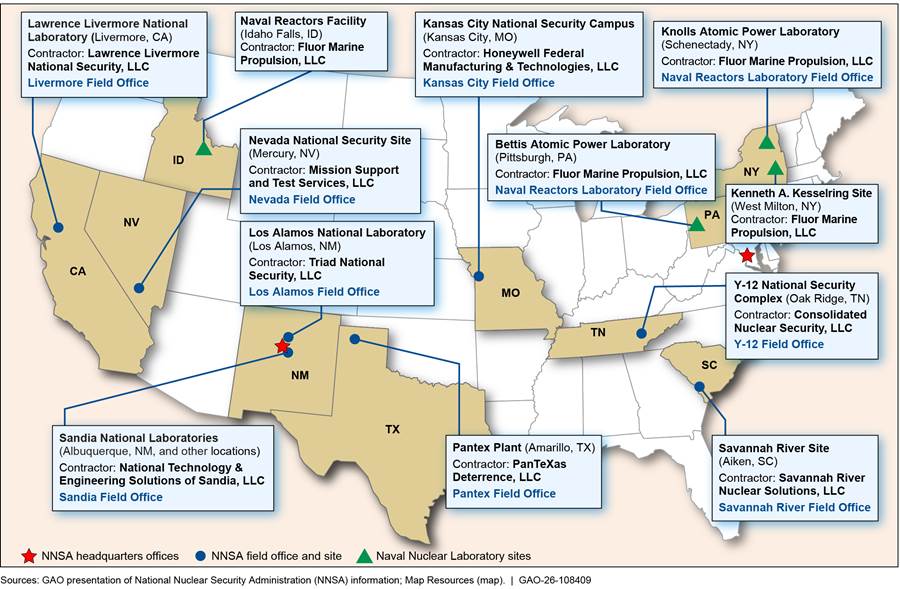
The federal government’s use of M&O contracts to manage the nation’s nuclear security infrastructure dates to the Manhattan Project during World War II, when the U.S. Army Corps of Engineers awarded contracts to attract and retain the scientific and technical talent necessary to develop the atomic bomb.[8] The Atomic Energy Act of 1954 codified this model, providing the Atomic Energy Commission—the predecessor agency to DOE and NNSA—the ability to contract with private sector entities to operate government-owned facilities.[9] NNSA continues to use M&O contracts to operate the eight laboratories, sites, and plants that carry out the nation’s nuclear security missions and the M&O contract for the sites of the Naval Nuclear Laboratory that designs and engineers naval nuclear power propulsion (see fig. 1). M&O contractors are responsible for managing daily operations and executing program and project activities. NNSA reported obligating almost $24 billion to its M&O contracts in fiscal year 2025.
Figure 1: Sites with National Nuclear Security Administration (NNSA) Management and Operating (M&O) Contracts
This historical and unique contracting model differs from contracts awarded by
other federal agencies in that, for example, the M&O contractor is
responsible for the integration of scientific, technical, and infrastructure
functions, all under a broad statement of work. Subpart 17.6 of the FAR
authorizes agencies with sufficient statutory authority and the need for
contracts to manage and operate their facilities to use the M&O form of
contract consistent with the FAR requirements. DOE, including NNSA, is the only
agency that has exercised this authority.
Contract type and fee type. NNSA’s M&O contracts are generally cost-reimbursement contracts and may include a fee component that is either fixed-fee, award-fee, incentive-fee, or a combination of fee types. Cost-reimbursement contracts allow the government to contract for work when circumstances do not allow it to sufficiently define its requirements or estimate its costs to allow for a fixed-price contract. In the case of NNSA’s M&O contracts, the nature of work related to nuclear research and development and the evolving needs of the government support the use of a cost-reimbursement structure. However, the use of line items for some discrete deliverables within the M&O scope of work, such as well-defined construction projects, can support firmer pricing structures.
Under a cost-reimbursement contract, the government reimburses a contractor for allowable costs incurred, to the extent prescribed by the contract. In contrast, under a fixed-price contract, the contractor accepts responsibility for completing a specified amount of work for a fixed price. Figure 2 shows the government’s and contractor’s share of cost and performance risk under various contract types.

In cost-reimbursement contracts, the government may also pay a fee that is either fixed at the outset of the contract or adjustable based on performance criteria set out in the contract or both. For fixed-fee contracts, the contractor earns a specified fee or profit based on progress toward the work to be completed, regardless of performance. For incentive-fee contracts, the contractor earns a fee by meeting objective performance measures that can be linked to cost and may also be linked to schedule and quality performance. For award-fee contracts, the contractor earns a fee based on a rating of performance. Award-fee contract types are used when it is not feasible to devise predetermined objective incentive targets based on cost, technical performance, or schedule, with the focus instead being on subjective criteria. NNSA award-fee contracts include both subjective and objective performance criteria. See table 1 for the fee structures used in NNSA’s M&O contracts.
|
Site contract |
Contractor |
Date awarded |
NNSA budget estimates for fiscal year 2026 enacted appropriations |
Contract Typec |
|
Lawrence Livermore National Laboratory |
Lawrence Livermore National Security, LLC |
05/09/2007 |
$2,547,326,000 |
Award-fee |
|
Savannah River Sitea |
Savannah River Nuclear Solutions, LLC |
01/10/2008 |
$1,837,143,000 |
Award-fee |
|
Y-12 National Security Complex |
Consolidated Nuclear Security, LLC |
01/08/2013 |
$2,422,479,000 |
Fixed-fee and award-fee |
|
Kansas City National Security Campus |
Honeywell Federal Manufacturing & Technologies, LLC |
07/09/2015 |
$1,589,509,000 |
Award-fee |
|
Sandia National Laboratories |
National Technology and Engineering Solutions of Sandia, LLC |
12/16/2016 |
$2,995,698,000 |
Fixed-fee and award-fee |
|
Nevada National Security Site |
Mission Support and Test Services, LLC |
05/12/2017 |
$787,262,000 |
Fixed-fee and award-fee |
|
Los Alamos National Laboratory |
Triad National Security, LLC |
06/08/2018 |
$4,713,578,000 |
Fixed-fee and award-fee |
|
Naval Nuclear Laboratoryb |
Fluor Marine Propulsion, LLC |
07/12/2018 |
$1,953,961,000 |
Fixed-fee |
|
Pantex Plant |
PanTeXas Deterrence, LLC |
06/13/2024 |
$1,181,971,000 |
Fixed-fee and award-fee |
Source: GAO analysis of NNSA documentation. | GAO‑26‑108409
aThis contract was originally managed by DOE’s Office of Environmental Management and was transferred to NNSA in October 2024.
bNNSA’s site estimates did not include information for the Kenneth A. Kesselring Site of the Naval Nuclear Laboratory.
cThe contract type listed here is as described in DOE documentation. NNSA M&O contracts may contain multiple fee types, including either fixed-fee, award-fee, incentive-fee, or a combination of fee types.
Contractor performance evaluation. For contracts with an award fee component, NNSA evaluates the performance of the M&O contractors through annual evaluations to determine the award fee to be paid to the contractor. NNSA develops the Performance Evaluation and Measurement Plan before the beginning of each fiscal year of an ongoing contract (that is, the beginning of the evaluation period). This document establishes expectations for the contractor’s performance and describes how the responsible NNSA offices will evaluate and measure performance against those expectations. The plan provides a blueprint for how the evaluations will be used to determine the contract’s award fees, award terms, and any other incentives. At the end of each evaluation period, NNSA develops the Performance Evaluation Report. NNSA uses this report to document the performance rating, fees, and any other incentives that will be awarded to the contractor.
Construction Projects Within NNSA’s M&O Contracts
Managing large and complicated sites means construction and maintenance projects (also known as capital asset projects) of various sizes can be a significant element within the scope of M&O contracts.[10] NNSA’s sites include unique nuclear and high-hazard facilities as well as security infrastructure and an extensive network of general infrastructure, such as offices, roads, and parking structures. Construction projects valued over $34 million must be funded by specific annual appropriations and are referred to as “line-item construction” due to having their own funding line in the agency’s budget, although this is separate from having a line item in the contract.
As of January 2026, DOE reported that NNSA’s project portfolio included 40 budget line-item construction projects that are estimated collectively to cost over $47 billion. In addition to those budget line-item construction projects, M&O contractors carry out a significant number of minor construction projects—those estimated to cost no more than $34 million to complete—each year in the nuclear security enterprise.[11] These projects include additions, new or replacement facilities, and installations or upgrades that do not change a facility’s footprint.
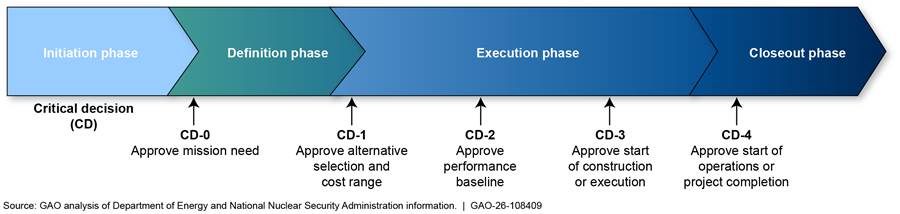
NNSA has specific policies and guidance for managing capital asset projects, including DOE Order 413.3B, Program and Project Management for the Acquisition of Capital Assets. The goal of this order is to deliver projects within their original approved cost and schedule estimates (baselines) and that meet mission performance and other requirements. Large capital asset projects—those with total estimated costs exceeding $50 million—go through management reviews and approval processes called “critical decisions” as projects move from planning and design to construction. Specifically, there are five decisions over the life cycle of a project that serve as milestones. See figure 3 for the typical progression through the decision points for DOE and NNSA large capital asset projects, according to DOE Order 413.3B.[12] As of June 2026, DOE reported that NNSA had 21 ongoing capital asset projects that had project budgets over $90 million and had achieved critical decision 2.
Figure 3: Department of Energy’s Project Phases and Critical Decision Milestones for Capital Asset Projects
NNSA’s M&O Contracts Use Line Items Minimally, Particularly for Construction Projects
NNSA uses line items in its M&O contracts minimally, including line items covering five of 21 ongoing capital asset projects across the nuclear security enterprise as of June 2026.[13] Although NNSA’s contracts vary slightly in the number and type of line items, there are several common line items included in M&O contracts. These line items cover M&O work to implement NNSA’s programmatic research and development and production; work for other agencies under Strategic Partnership Project agreements; and construction; sometimes with subline items for specific construction projects, contract extensions, and transition periods between contractors when an M&O contract is recompeted.[14] All contracts had four or fewer line items as of June 2026. The Lawrence Livermore National Laboratory (Livermore) contract—which has not been recompeted since 2007—is the only contract with no line items (see table 2). NNSA officials said they have been adopting a more standard line item structure for contracts as they are recompeted.
|
Contract |
Line itemsa |
Line or subline items for construction and related subprojects |
|
Y-12 National Security Complex |
CLIN 0001: M&O Workb CLIN 0002: Uranium Processing Facility CLIN 0003: Capital Construction Projects |
CLIN 0002: Uranium Processing Facility CLIN 0002A: Main Process Building CLIN 0002B: Salvage and Accountability Building CLIN 0002C: Process Support Facilities CLIN 0002D: Mechanical Electrical Building CLIN 0002E: Substation CLIN 0002F: Site Infrastructure and Services CLIN 0002G: Site Readiness |
|
Sandia National Laboratories |
CLIN 0001: M&O Work CLIN 0002: Strategic Partnership Projects CLIN 0003: Capital Construction Projects |
CLIN 0003AA: Power Sources Capability |
|
Savannah River Site |
CLIN 0001: M&O Work CLIN 0007: Capital Construction Projects |
CLIN 0007AA: Savannah River Plutonium Processing Facility |
|
Nevada National Security Site |
CLIN 0001: M&O Work CLIN 0002: Strategic Partnership Projects CLIN 0003: Capital Asset Projects |
CLIN 0003A: 138kV Power Transmission System Replacement |
|
Los Alamos National Laboratory |
CLIN 0001: Transition Period CLIN 0002: M&O Work CLIN 0003: Strategic Partnership Projects CLIN 0004: Capital Construction Projects |
0 |
|
Kansas City National Security Campus |
CLIN 0001: M&O Work CLIN 0002: Strategic Partnership Projects and Other Reimbursable Work |
0 |
|
Pantex Plant |
CLIN 0001: Transition Period CLIN 0002: M&O Work CLIN 0003: Strategic Partnership Projects CLIN 0004: Capital Construction Projects |
0 |
|
Lawrence Livermore National Laboratory |
None |
0 |
|
Naval Nuclear Laboratory |
CLIN 0001: M&O Transition Period CLIN 0002: M&O Base Period CLIN 0003: M&O Option Period |
0 |
Source: GAO analysis of National Nuclear Security Administration (NNSA) documentation. | GAO-26-108409
aNNSA convention is to use a four-digit numbering system for line items, starting with 0001. Sublines are designated with a letter or letters following the line item number (e.g., 0001A).
bThe Y-12 contract M&O line item contains subline items for Strategic Partnership Projects.
NNSA line items in its M&O contracts fall into three categories:
· M&O Work. This line item covers programmatic mission-related work and mission support activities, as well as construction not specifically provided with a separate line item and all maintenance and operation of facilities at the site. NNSA typically prices M&O work as cost-plus-fixed-fee and award fee, except for the Naval Nuclear Laboratory which is cost-plus-fixed-fee. The M&O line item may also contain subline items to distinguish between transition, base, and option periods.[15] In other cases, the transition period may be a standalone line item separate from M&O work. NNSA officials said the transition period is a separate line item when performed under a separate price structure from M&O base and option periods (i.e., generally cost reimbursable with no fee or firm-fixed-price). Every contract includes an M&O line item except at Livermore, where the entire contract is considered a single M&O scope of work.
· Strategic Partnership Projects. This line item covers Strategic Partnership Projects, formerly known as the Work for Others program. These projects allow work to be performed at DOE’s laboratories, plants, and sites for both federal agencies and nonfederal entities, provided several requirements are met, including that projects do not hinder DOE’s core mission or put laboratories, plants, and sites in competition with the private sector. NNSA typically prices this work as cost-plus-fixed-fee, and the full cost of the work, including overhead, is reimbursed by the benefiting entity via agreements. Six M&O contracts have this line item and the Livermore contract includes this work under the contract’s single scope of work. The number of Strategic Partnership Projects varies by site and over 95 percent of this work is performed at Los Alamos National Laboratory (Los Alamos), Sandia National Laboratories (Sandia), the Kansas City National Security Campus, the Nevada National Security Site, and Livermore.[16]
· Capital Construction Projects. This line item includes construction projects, typically high-value projects that meet the definition of capital asset projects under DOE policy, as agreed to by NNSA and the contractor.[17] The top-level construction line item is informational, with subline items added as agreed by the contractor and NNSA for specific projects (i.e., only those projects added as subline items are within the construction line item scope of work). An exception to this practice is the line item for the Uranium Processing Facility at Y-12, which NNSA awarded as a standalone line item with subline items for various subprojects. The Y-12 contract also contains a separate capital construction line item that can be used for other projects but, as of February 2026, had not been used.
NNSA has used line items for construction projects minimally. Five of NNSA’s 21 capital asset projects that achieved critical decision 2 as of June 2026 are covered by separate line items in the M&O contracts, and three other projects have been completed as line items since 2014 (see table 3).
|
Contract |
Line item |
Year added to contract as line item |
Total estimated line item cost |
Fee structure |
Status |
|
Y-12 National Security Complex |
Uranium Processing Facilitya |
2014 |
$8,468,810,786 |
Cost-plus-fixed-fee, award-fee, and incentive-fee |
Ongoing |
|
Sandia National Laboratories |
Power Sources Capability Construction |
2025 |
$306,968,689 |
Cost-plus-fixed-fee |
Ongoing |
|
Savannah River Site |
Savannah River Plutonium Processing Facilityb |
2023 |
$25,000,000,000c |
Cost-plus-award-fee |
Ongoing |
|
Nevada National Security Site |
138kV Power Transmission System Replacement |
2021 |
$38,900,000 |
Firm-fixed-price |
Completed |
|
Los Alamos National Laboratory |
Transuranic Waste Facility, Phase B Subproject |
2014 |
$97,291,000 |
Cost-plus-incentive-fee |
Completed |
|
Los Alamos National Laboratory |
Radiological Laboratory and Utility Office Building – Equipment Installation 2 |
2016 |
$215,000,000 |
Cost-plus-incentive-fee |
Completed |
Source: GAO analysis of National Nuclear Security Administration (NNSA) documentation. | GAO‑26‑108409
aThis line item includes two capital asset projects that achieved critical decision 2 as of June 2026: the Main Process Building and the Salvage and Accountability Building.
bThis line item includes two capital asset projects that achieved critical decision 2 as of June 2026: the Administrative Building and the High Fidelity Training and Operations Center.
cThis amount is the estimated total project cost NNSA used as a budgetary placeholder in its budget justification for fiscal year 2026.
· Uranium Processing Facility. According to officials, this was the first construction project that NNSA added as a separate line item. It was added to the solicitation for the Y-12 contract during the competition for the contract that started in 2014. An official said that this project was added as a line item in response to ongoing contractor performance issues, as it would allow NNSA to establish separate requirements and isolate the performance fee from broader M&O work.
· Savannah River Plutonium Processing Facility. This project was added to the Savannah River Site contract in 2023, and, according to officials and a contractor representative, was the first project subline item since the construction projects line item was added to the contract in 2020. DOE’s Office of Environmental Management managed the contract at the time this line item was added.[18] Officials said that DOE added the subline item to better track project-specific funding and to develop a fee plan that would drive contractor performance.
· Power Sources Capability. This project at Sandia was initiated under CLIN 0001 (M&O work) and became the first capital construction project at Sandia to be moved under CLIN 0003 (capital construction projects) in September 2025 after it reached the critical decision 2/3 milestone. According to an NNSA contracting officer, the Office of Partnership and Acquisition determined that the project must be added to CLIN 0003 because of a clause in the contract and the language for CLIN 0003 that was inserted during the contract competition in 2017.[19] The project is cost-plus-fixed-fee and therefore does not have an award fee plan based on performance.[20]
Another three projects have been completed as separate line items in current or former contracts. Specifically, one construction project at the Nevada National Security Site valued at under $100 million—the 138kV Power Transmission System Replacement project—was completed in 2024 as a separate line item. In addition, two projects were completed as sublines under a previous version of the Los Alamos contract—the Transuranic Waste Facility Subproject and the Radiological Laboratory and Utility Office Building – Equipment Installation Phase 2 project.
· 138kV Power Transmission System Replacement. This project at the Nevada National Security Site was added through contract modification in 2021 as a subline item under the line item for capital asset projects. It was the first and only project added as a separate line item to the contract, according to officials and contractor representatives. NNSA officials said they used a separate line item for this project to acquire the project on a firm-fixed-price basis. The negotiated final project cost for this project was roughly $39 million.[21]
· Transuranic Waste Facility Project, Phase B Subproject. In response to a DOE initiative to improve the management and structure of construction projects under M&O contracts, NNSA and the Los Alamos M&O contractor agreed to establish pilot projects to establish new terms and conditions associated with design and construction. The Transuranic Waste Facility project was selected as the pilot project to separate design and construction scope from the M&O scope and to develop unique terms and conditions associated with contractor performance. These unique terms and conditions included implementing a hard cost cap or cost share approach on the selected pilot project whereby if the contractor does not meet performance targets, the cost cap or cost share will shift some cost burden to the contractor. Under this line item, the contractor was to complete work necessary on the Transuranic Waste Facility project to achieve critical decision 4 (project completion). The contractor was to receive incentive payment upon achieving beneficial occupancy for non-nuclear operations.[22] This line item was incorporated into the contract via modification in 2014.
· Radiological Laboratory and Utility Office Building – Equipment Installation Phase 2. This line item was another project agreed to by NNSA and the Los Alamos M&O contractor to separate a specific portion of the design and construction scope of the project from the M&O line item. It was added to the contract on May 1, 2016, via modification, and was based on a supplemental agreement between the contractor and NNSA as part of a 1-year contract extension. Officials said that the project was selected to incentivize cost and schedule, and that the negotiated scope of work on the project was expected to be completed within the 1-year contract extension. Project documentation shows that the contractor largely completed the line item’s scope of work within the designated period of performance.
NNSA officials told us they are considering at least two other construction projects at Sandia as candidates for separate contract line items. These projects are the Combined Radiation Environments for Survivability Testing project and the Microsystems Engineering, Science and Applications Photolithography Capability project.
NNSA officials said that the agency has no plans to add line items for any other type of contract deliverables, such as for weapon acquisition programs. Officials told us that the nature of most M&O work—such as research and development—does not lend itself to individual line items, because it is highly variable and the requirements are not easily defined. Officials stated that they believe that the current line item structure makes the most sense for separating deliverables at NNSA sites. Specifically, contract transition periods are separately identifiable because they are performed under a different contract type from the M&O base period—for example, a no-fee transition period as compared to a base period that is generally cost-plus-award-fee. The Strategic Partnership Projects work is also distinguishable from M&O work because it has distinct non-DOE funding sources, a separate agreement or agreements for each project, and is cost-plus-fixed-fee. NNSA officials and contractor representatives we interviewed said that they are satisfied with the number and structure of line items in the contract and expressed little interest in expanding the number or type of line items beyond those already in the contract.
Line Items Could Improve Accountability and Contractor Performance, but Add Administrative Burdens
According to NNSA officials and M&O contractor representatives, there are several benefits and drawbacks of using line items in M&O contracts, especially when using line items for construction projects. According to officials and contractors, line items are intended to enhance accountability and contractor performance by allowing for tailoring of contract types, fee structures, performance evaluations, and enhancing transparency of procurement data. In theory, these benefits could result in improved contractor performance in delivering projects on time and on budget, if properly executed. However, officials and contractors said that it is too early to determine whether line items have improved contractor performance, and not all officials and contractors expected that line items would improve performance. Further, officials and contractors said line items increase the administrative burden for federal and contractor staff. While implementing line items may result in additional administrative burden, line items could improve accountability and contractor performance if properly executed, according to officials and contractors.
Line Items Have Several Benefits That Could Improve Accountability and Contractor Performance, if Properly Executed
NNSA officials and M&O contractor representatives told us that there are several benefits of using line items, especially for construction projects, such as tailored contract types, fee structures, performance evaluations, and enhanced transparency of procurement data. Officials said that these benefits could improve accountability and contractor performance, if properly executed.
· Tailored contract type. Officials told us that having line items allows NNSA to use different contract types and fee structures within the overall M&O contract, which can result in better risk sharing, pricing, and enhanced oversight if incentives are properly aligned with desired outcomes.[23] Because NNSA’s M&O contracts are typically structured as cost-reimbursable, the government bears a higher share of the cost risk. This structure is generally appropriate for activities with less defined requirements, like research and development activities related to the M&O mission work. However, for well-defined or commercial-type construction projects, such as aboveground utilities like NNSA’s 138kV Power Transmission System Replacement Project, NNSA found that a firm-fixed-price structure could deliver better value to the government by placing more risk for cost overruns on the contractor.[24] Figure 4 displays the types of contracts available to the government as they relate to the risk of paying cost overruns in applicable acquisition phases.
Guidelines from the Defense Acquisition University suggest selecting a contract
type based on how well defined the requirements are.
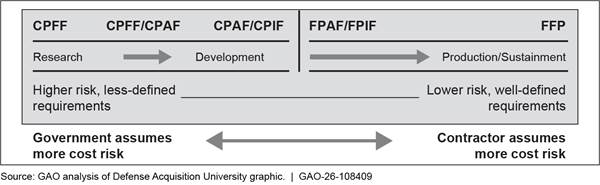
Note: Contract types described include cost-plus-fixed-fee (CPFF); cost-plus-award-fee (CPAF); cost-plus-incentive-fee (CPIF); fixed-price-award-fee (FPAF); fixed-price-incentive-fee (FPIF); and firm-fixed-price (FFP).
When construction work is included in the M&O line item the work is priced as cost-reimbursable because that is the pricing structure of the M&O line item. However, as more is known about certain discrete requirements, the use of line items can facilitate establishing firmer pricing for separately identifiable goods and services.[25] For example, certain construction projects undergo the critical decision process and by the time these projects reach critical decision 2/3 approval, the requirements are known, and the project is ready for execution. When requirements are well known, certain construction work could be priced as firm-fixed-price, according to an official, which could reduce the government’s risk for cost overruns. To use firm fixed pricing for a construction project within the M&O contract, the project would need to be on a separate line item.[26]
Line items allow NNSA to provide pricing structures that are tailored to each deliverable. For example, NNSA determined it was in the best interest of the government to execute the 138kV Power Transmission System Replacement Project at the Nevada National Security Site as firm-fixed-price. Using a separate line item for the project allowed NNSA to use a firm-fixed-price structure. However, despite using a firm-fixed-price structure, when the project cost increased due to a change in requirements, the government covered the increased cost through a contract modification. Therefore, as this example shows, a fixed-price contract does not necessarily mean that the cost to government does not increase, if, for example, requirements change.
As the example above shows, although line items allow for different contracting structures for deliverables, whether the project achieves the desired cost and schedule is dependent on project implementation and, for fixed-price contracts, an accurate understanding of project requirements at the time of award. Furthermore, of the six completed or ongoing construction project line items, one—the 138kV Power Transmission project—was contracted as firm-fixed-price, whereas the others were contracted as cost-reimbursable. Therefore, NNSA’s use of line items to acquire projects on a firm-fixed-price basis has been very limited.
· Tailored fee structure. In addition to allowing for separate contract types, line items also allow NNSA to use separate fee incentives for different deliverables, which can reduce risk to the government.[27] For example, for the Uranium Processing Facility line item at Y-12, NNSA was able to transition the project fee structure from strictly cost-plus-award-fee to include an incentive-fee component at the completion of the design milestone.
However, using line items to tailor incentive fees can be ineffective when fees are not linked to desired objectives. Officials said that poorly aligned fee structures could incentivize outcomes that do not achieve the intended objectives. For example, officials said that when they used a separate line item for the Transuranic Waste Facility project at Los Alamos, the government incentivized the wrong outcome. Specifically, the line item was written to provide the fee to the contractor once the project obtained a certificate of beneficial occupancy for the facility. Although the contractor achieved this outcome and received the fee, the facility was not yet operational for its intended nuclear work. In this case, the incentive was not linked to the desired outcome.[28] Officials said it can be problematic to set objectives early in the project development process when requirements are uncertain. Officials said that setting performance objectives after critical decision 2/3, when a project is ready for construction, could help better align fee incentives to desired outcomes.
· Tailored performance evaluations. Officials said that using line items for construction projects could incentivize better contractor performance by enhancing visibility in the performance evaluation. Specifically, line items with an award or incentive fee component will have a separate fee plan and evaluation tied to project-specific outcomes. Therefore, the line item serves to separate the project performance evaluation from the annual Performance Evaluation and Measurement Plan process NNSA uses to evaluate the M&O line item. Although the M&O performance evaluation process includes a rating for the contractor’s performance on construction projects, officials said that when performance on all site activities is evaluated together, poor performance in one area tends to be obscured by good performance in other areas. Officials said they have seen instances of the contractor receiving significant fees for M&O work despite poor performance on construction projects. Therefore, separating the performance evaluation process for certain construction projects can create more visibility for performance and accountability for award fees on those projects.
Although line items give NNSA another option for incentivizing contractor performance, officials also said that line items on their own do not necessarily improve performance. Officials said that, despite the implementation of line items for some projects, NNSA projects continue to experience performance issues, such as cost and schedule overruns. For example, the Uranium Processing Facility project at Y-12 has been operating under its own line item and performance plan since 2014. However, according to NNSA officials, over subsequent years NNSA paid the contractor less than $40 million out of roughly $220 million of available fee due to poor contractor performance. The project continued to experience poor contractor performance until December 2024, when NNSA revised the project baseline cost and schedule, adding nearly $4 billion and an 8-year delay to reach full operations.[29] Officials told us that since re-baselining the project in 2024, the contractor has maintained cost and schedule targets.
Officials said that other strategies to address performance issues either in concert with line items for construction projects or within the broader M&O line item could include developing clearer requirements and ensuring incentives are aligned to desired outcomes, among others.
· Tailored terms, conditions, and requirements. Line items can be used to tailor contract terms, conditions, and requirements separately from the main M&O line item scope of work. For example, an M&O contractor representative said there are standard environmental, safety, and health requirements that relate to the M&O scope of work that are not aligned with standard commercial practices for construction work. The representative said that applying too many M&O requirements that are not aligned with a typical construction environment slows down work and requires more money and time to execute. Therefore, the representative said work could be made more efficient by separating requirements when the nature of the work is different.
· Improved visibility of project costs. NNSA officials and M&O contractor representatives told us line items provide greater visibility into project-specific costs. They said designating a separate line item gives NNSA and the contractor enhanced visibility of project performance and cost allocation, ensuring project totals accurately reflect actual resource consumption.[30] However, officials told us that creating a separate line item does not change the underlying indirect cost allocation methodologies or a re-evaluation of how site indirect costs are distributed. Instead, separate line items serve as a tool for enhanced transparency, allowing federal management to better monitor costs. Officials noted that while separate line items improve cost transparency, they do not inherently generate net cost savings for the government, as the total amount of site indirect costs remains unchanged.
· Improved tracing of budget funds to project costs. NNSA officials and M&O contractor representatives told us that line items can be used to trace budget funds to costs for separate deliverables, such as construction projects. Specifically, each M&O contract has a broad scope of work and multiple budget accounts that are used for funding site activities. NNSA and the M&O contractors said they have project management tools and systems for tracing funding sources from multiple budget accounts to activities at the site.[31] However, they also said that using these tools is a manual process and resource intensive.[32] Officials said that because large construction projects have specific appropriations, it makes sense for them to have a line item in the contract as well to enhance traceability.
Line Items Can Increase Administrative Burden
NNSA officials and M&O contractor representatives told us line items can increase administrative burden by, for example, requiring significant additional staff hours to develop and negotiate the terms and conditions, and to establish and manage separate performance evaluations. While some NNSA and M&O contractor officials told us the administrative burden associated with line items can be significant, other officials told us the administrative burden is often overstated and part of the normal duty of contract oversight. Specifically, officials and contractors said the drawbacks to using line items include the following:
· Developing and renegotiating contract terms. According to officials, adding line items to a contract after it has been awarded opens the whole contract to renegotiation and requires negotiating the terms, conditions, and fee of the line item. For example, NNSA officials told us they decided not to pursue a separate line item for the High Explosive Synthesis, Formulation, and Production Facility project at the Pantex Plant because they felt it would take too long to negotiate and therefore not support the project’s schedule. Furthermore, any subsequent changes to the terms of a line item, such as cost or schedule, need to be documented in contract modifications, which officials said take additional time to process because it requires involvement from procurement officials at NNSA headquarters.
· Managing separate performance evaluations. According to officials, there is a significant investment of staff resources to develop and implement a tailored fee plan and performance evaluation for separate line items. Performance evaluations are typically associated with cost-plus-award-fee line items that contain subjective evaluation measures. For example, the Uranium Processing Facility and Savannah River Plutonium Processing Facility projects include award fee plans and a tailored performance evaluation separate from the M&O performance evaluation. According to officials, NNSA and the contractor invest a significant amount of time to develop and implement individual performance plans and evaluations for project award fees. For example, officials from NNSA’s Office of Infrastructure told us that it took a group of about 30 to 40 staff and contractors to put together the award fee plan for the Savannah River Plutonium Processing Facility project. However, this level of effort only applies to line items with award fees—firm-fixed-price or cost-plus-fixed-fee line items do not have award fee plans. For example, the 138kV Power Transmission System Replacement project and the Power Sources Capability project line items were executed as firm-fixed-price and cost-plus-fixed-fee, respectively, and therefore did not require award fee plans.
· Tracking contractor hours. One official said if contractors had personnel working on more than one line item, they would have to track time worked on each line item, which requires additional steps. For example, officials would have to differentiate the work under each line item, in order to prevent cost mischarging.
·
More federal staff hours spent tracking costs. Officials
said that although line items are helpful for ensuring the accountability of
funds, having more line items particularly for smaller projects would require
more federal official involvement in tracking project costs, as typically the
M&O contractors track costs and invoicing information.
NNSA Lacks Clear Criteria for Determining When to Use Line Items and Has Not Fully Documented Lessons Learned
Although NNSA has been using separate contract line items for a limited number of construction projects since 2014, agency guidance does not have clear criteria for determining when contracting officers should use separate line items within an M&O contract. In addition, officials told us that they have discussed lessons learned from using separate line items for construction projects. However, NNSA has not conducted a formal analysis or fully documented the lessons learned regarding the agency’s use of separate line items in M&O contracts, including when to use line items.
NNSA has an informal process for determining which construction projects will be acquired as separate line items in the contract. Officials told us that contracting officers in NNSA’s Office of Infrastructure and Office of Partnership and Acquisition Services coordinate during a project’s acquisition planning process to make this determination. Officials said the decisions are made on a case-by-case basis, and that they consider several factors, such as project size, complexity, and desired fee and incentive structure. According to officials, they generally consider a separate line item when the project (1) has a total project cost of at least $50 million, (2) involves complex scope or risks, (3) requires distinct project milestones, (4) relies on dedicated appropriations, and (5) has high visibility and accountability requirements. Officials said they also consider the availability of federal staff resources to handle the additional administrative oversight required to manage separate performance measures for each line item. However, these criteria are not documented in any policy or guidance.
Additionally, it is unclear the extent to which NNSA has applied these criteria consistently at all sites and for all projects. Although the projects for which NNSA has established separate line items or subline items appear to meet at least some of the informal criteria that officials cited, there are potentially other projects that meet those criteria but do not have separate line items. For example, the capital construction line item in the current Los Alamos contract states that projects over $50 million will only be considered for addition as subline items to the contract once they have reached the critical decision 2/3 milestone. However, the contract has no project subline items. Officials told us that they have never used line items for construction projects in the current Los Alamos contract. However, there are three subprojects ongoing as part of the Los Alamos Plutonium Pit Production Project that could meet the contract’s definition for inclusion under the construction line item.[33]
NNSA officials provided different explanations for the lack of project line items at Los Alamos. Officials stated that the agency had determined that projects involving work on nuclear facilities or that are supported by a larger ratio of self-performance by the M&O contractor (i.e., not substantially subcontracted by the prime contractor) were not deemed appropriate for subline items. However, this rationale appears to contradict NNSA’s decision to include a line item for the Uranium Processing Facility at Y-12. Officials also told us that there had been discussions about adding project line items at Los Alamos but that in the end the agency and contractor did not have the desire to renegotiate the contract and commit resources to implementing the line items.
Whether a particular construction project can be a line item in the contract also depends on the language in the contract. Specifically, we found that NNSA’s contracts have clauses with different definitions of capital construction and whether a project needs to reach a certain milestone before it can be added as a separate line item. For example, as stated above, the Los Alamos contract defines capital construction projects as those with a total cost for design and construction exceeding $50 million, and that separate line items will only be considered when projects have attained the critical decision 2/3 milestone. By comparison, the Savannah River Site contract defines capital construction projects as those with a total cost for design and construction exceeding $20 million, and it does not limit line items to projects that have reached a specific milestone. Therefore, the criteria for including construction projects as line items varies by contract.
Most of NNSA’s contracts and project line items predate government-wide requirements for consistent use of line items in FAR Subpart 4.10. Officials said NNSA’s use of line items has been based on the FAR since the requirements became effective in 2019. However, except for the Pantex Plant contract, all NNSA M&O contracts predate the FAR requirement and therefore may or may not conform to current standards for consistent use of line items. In 2024, NNSA issued a Contract Specialist Guide to provide guidance on implementing FAR Subpart 4.10. Although the guidance provides instructions for contracting officers on how to capture separately identifiable goods or services on individual line items, it does not define those characteristics nor clarify how officials should determine which activities or projects should be performed under which line item in the contract.
Furthermore, NNSA acquires goods or services through M&O contracts other than large construction projects that potentially are separately identifiable, such as minor construction projects and site security services. For example, as we reported in 2024, NNSA’s program offices undertook 414 minor construction projects from fiscal year 2019 to July 2023.[34] Since these projects can be identified and separated out from other items being acquired and they can be delivered or performed individually, they could also be considered separately identifiable under NNSA’s guidance. However, NNSA officials said they have no plans to add additional goods or services as separate line items beyond those already included.
The DOE Acquisition Guide states that DOE’s policy is to treat all of its contractors consistently and fairly and to provide uniform and consistent application of DOE policies and procedures in acquisitions. However, NNSA’s contracts have different definitions and requirements for capital construction line items, and NNSA’s process for deciding how and when to use separate line or subline items is informal and not documented in policy or guidance. The Standards for Internal Control in the Federal Government state that management should implement control activities through policies, and that these policies should be documented. Without a documented policy, NNSA lacks reasonable assurance that contracting officers are using consistent and appropriate criteria at every site when making decisions about which deliverables are given separate line items. For example, NNSA may not be using line items for deliverables that it could more efficiently or effectively manage under a separate fee structure or performance plan. Further, NNSA may be using line items for certain deliverables based on specific language in the contract rather than based on a determination that a line item is the most effective or efficient approach for managing that project. As a result, NNSA may be missing opportunities to improve accountability and contractor performance, especially for construction projects, and this could negatively impact NNSA’s broader modernization effort.
In addition, NNSA could better understand when and how to use line items by fully conducting and documenting lessons learned from its past use of line items. For example, an M&O contractor representative told us that there should be a lessons learned initiative on the use of line items in their contract so that the agency can improve the effectiveness and timing of the negotiation in preparation for an upcoming potential project line item. Although NNSA has been using separate line items for construction projects since 2014, NNSA officials said they have not conducted any analysis regarding the agency’s use of line items. NNSA officials told us they have shared lessons learned through discussions but could provide documented lessons learned for one project. However, the scope of these lessons learned was limited to the benefits and drawbacks of using line items to acquire a construction project on a fixed-price basis. NNSA has not documented lessons learned on its overall contracting strategy of using line items or using line items for construction projects with an award or incentive fee component.
The DOE Acquisition Guide requires lessons learned to be documented for acquisition practices relating to an M&O contract that differ substantively from practices previously used at the site and could potentially be used for future acquisitions, such as significant changes to contract scope, award, or incentive fee practices. NNSA’s use of line items is substantively different from how NNSA has traditionally acquired construction projects in its M&O contracts. By documenting lessons learned, NNSA can help ensure it retains information about the effect of line item acquisitions on project outcomes. This information could help NNSA to more effectively and appropriately use line items to support its broader modernization effort. For example, documented lessons learned could allow NNSA to better understand when using line items produces benefits for the agency. In turn, this knowledge could help NNSA avoid expending administrative resources on ineffective acquisition approaches.
Conclusions
NNSA faces billions of dollars in cost overruns and years of delays with projects across the nuclear security enterprise. To improve accountability and contractor performance, the agency has used separate line items in its M&O contracts for a limited number of projects, focusing on those that it considers to be high-value, high-risk projects with specific congressional appropriations.
Creating separate line items for construction projects or other separately identifiable deliverables has several benefits that could improve accountability and contractor performance, including the ability to set different fee structures and performance incentives, as well as better tracing of funding and visibility of project costs, according to officials and contractors. However, using line items for acquisitions by itself has not yet led to improved project performance or direct cost savings. Line items enable, but do not guarantee, different management approaches to acquisitions. Furthermore, officials said that more administrative resources are needed to negotiate and manage separate line items, including developing award fee plans and performance evaluations.
Because line items have potential benefits and drawbacks, NNSA continues to make decisions on an individual basis about the best way to structure each acquisition, including whether to manage a deliverable, such as a construction project, as a separate line item. Although NNSA has informal criteria for making these decisions, without documenting these criteria in policy or guidance, the agency may be making decisions inconsistently, missing opportunities to benefit from using line items, or using line items ineffectively. For example, most construction projects at NNSA sites continue to be acquired under the broad M&O scope of work, but some of them could benefit from having separate line items in M&O contracts. Conversely, inappropriate use of line items can expend administrative resources on ineffective acquisition approaches. Furthermore, NNSA has not conducted comprehensive analyses or fully documented lessons learned from this relatively recent acquisition practice. Documenting lessons learned could help ensure that NNSA makes decisions about the use of separate line items for certain projects or other deliverables informed by the experience of past practices.
Recommendations for Executive Action
We are making the following two recommendations to NNSA:
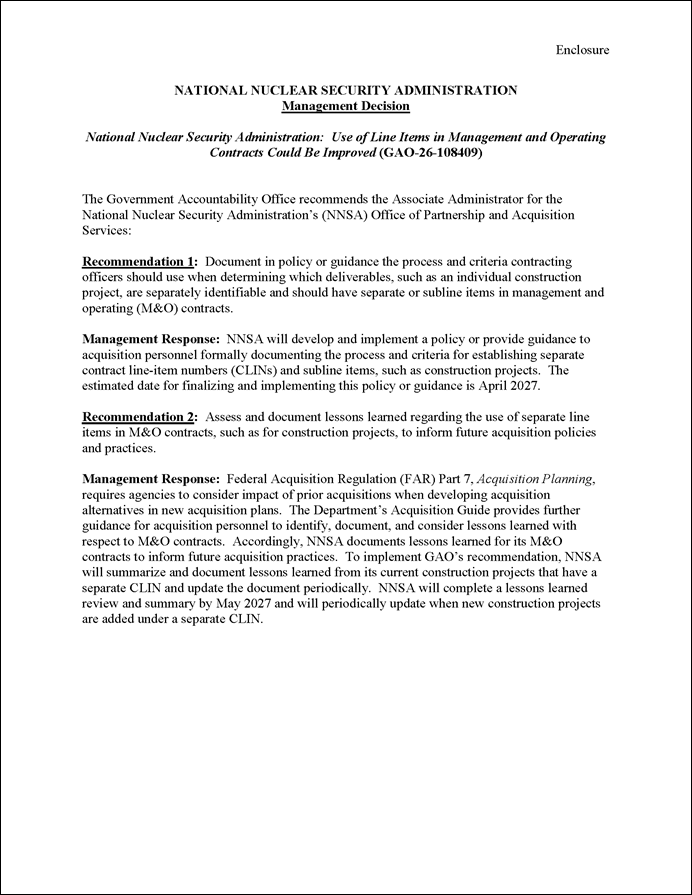
The Associate Administrator for NNSA’s Office of Partnership and Acquisition Services should document in policy or guidance the process and criteria contracting officers should use when determining which deliverables, such as an individual construction project, are separately identifiable and should have separate line or subline items in M&O contracts. (Recommendation 1)
The Associate Administrator for NNSA’s Office of Partnership and Acquisition Services should assess and document lessons learned regarding the use of separate line items in M&O contracts, such as for construction projects, to inform future acquisition policies and practices. (Recommendation 2)
Agency Comments
We provided a draft of this report to NNSA for comment. In its written comments (reproduced in appendix I), NNSA acknowledged our findings and outlined planned actions to address our recommendations. These actions, if implemented as planned, would address our recommendations. NNSA also separately provided technical comments, which we incorporated as appropriate.
We are sending copies of this report to the appropriate congressional committees, the Secretary of Energy, the NNSA Administrator, and other interested parties. In addition, the report is available at no charge on the GAO website at https://www.gao.gov.
If you or your staff have any questions about this report, please contact me at bawdena@gao.gov. Contact points for our Offices of Congressional Relations and Media Relations may be found on the last page of this report. GAO staff who made key contributions to this report are listed in appendix II.
Allison Bawden
Managing Director, Natural Resources and Environment
List of Committees
The Honorable Roger Wicker
Chairman
The Honorable Jack Reed
Ranking Member
Committee on Armed Services
United States Senate
The Honorable John Kennedy
Chair
The Honorable Patty Murray
Ranking Member
Subcommittee on Energy and Water Development
Committee on Appropriations
United States Senate
The Honorable Mike Rogers
Chairman
The Honorable Adam Smith
Ranking Member
Committee on Armed Services
House of Representatives
The Honorable Chuck Fleischmann
Chairman
The Honorable Marcy Kaptur
Ranking Member
Subcommittee on Energy and Water Development and Related Agencies
Committee on Appropriations
House of Representatives
GAO Contact
Allison Bawden, bawdena@gao.gov
Staff Acknowledgments
In addition to the contact named above, Ryan Gottschall (Assistant Director), Daniel Will (Analyst in Charge), Adrian Apodaca, John Bornmann, Kevin Bray, Lidiana Cunningham, Frank Garro, and Travis Rayome made key contributions to this report.
The Government Accountability Office, the audit, evaluation, and investigative arm of Congress, exists to support Congress in meeting its constitutional responsibilities and to help improve the performance and accountability of the federal government for the American people. GAO examines the use of public funds; evaluates federal programs and policies; and provides analyses, recommendations, and other assistance to help Congress make informed oversight, policy, and funding decisions. GAO’s commitment to good government is reflected in its core values of accountability, integrity, and reliability.
Obtaining Copies of GAO Reports and Testimony
The fastest and easiest way to obtain copies of GAO documents at no cost is through our website. Each weekday afternoon, GAO posts on its website newly released reports, testimony, and correspondence. You can also subscribe to GAO’s email updates to receive notification of newly posted products.
Order by Phone
The price of each GAO publication reflects GAO’s actual cost of production and distribution and depends on the number of pages in the publication and whether the publication is printed in color or black and white. Pricing and ordering information is posted on GAO’s website, https://www.gao.gov/ordering.htm.
Place orders by calling (202) 512-6000, toll free (866) 801-7077,
or
TDD (202) 512-2537.
Orders may be paid for using American Express, Discover Card, MasterCard, Visa, check, or money order. Call for additional information.
Connect with GAO
Connect with GAO on X,
LinkedIn, Instagram, and YouTube.
Subscribe to our Email Updates. Listen to our Podcasts.
Visit GAO on the web at https://www.gao.gov.
To Report Fraud, Waste, and Abuse in Federal Programs
Contact FraudNet:
Website: https://www.gao.gov/about/what-gao-does/fraudnet
Automated answering system: (800) 424-5454
Media Relations
Sarah Kaczmarek, Managing Director, Media@gao.gov
Congressional Relations
David A. Powner, Acting Managing Director, CongRel@gao.gov
General Inquiries
[1]Congressional Budget Office, Projected Costs of U.S. Nuclear Forces, 2025 to 2034 (April 2025).
[2]GAO, Nuclear Security Enterprise: Assessments of NNSA Major Projects, GAO‑26‑107777 (Washington, D.C.: Feb. 26, 2026).
[3]GAO, High-Risk Series: Heightened Attention Could Save Billions More and Improve Government Efficiency and Effectiveness, GAO‑25‑107743 (Washington, D.C.: Feb. 25, 2025).
[4]In NNSA’s contracts, contract line item numbers are abbreviated as “CLINs”. In this report, we use the term “line item” instead of CLIN for readability and consistency with its use in the Federal Acquisition Regulation. NNSA also uses the term “line-item construction” to refer to construction projects with specific congressional appropriations (i.e., a budget line item). We refer to line-item construction as budget line-item construction to distinguish the term from contract line items—the subject of this report.
[5]The DOE Acquisition Guide provides guidance that is necessary to clarify, implement, or supplement information in the Department of Energy Acquisition Regulation.
[6]GAO, Standards for Internal Control in the Federal Government, GAO‑25‑107721 (Washington, D.C.: May 2025).
[7]DOE issued a class deviation to the FAR pursuant to Executive Order 14275, Restoring Common Sense to Federal Procurement, Exec. Order No. 14275, 90 Fed. Reg. 16447 (Apr. 18, 2025). DOE contracting officers are directed to follow the deviations in lieu of the FAR, including Part 4. Though modified and renumbered as Subpart 4.202, the general requirement of Subpart 4.10 for contracts to include line items still exists. In addition, on June 23, 2026, the Office of Federal Procurement Policy within the Office of Management and Budget published a proposed rule in the Federal Register to revise parts 6, 7, 10, 18, 26, 37, 41, and 52 of the FAR. 91 Fed. Reg. 37636 (June 23, 2026).
[8]The FAR defines M&O contracts as agreements under which the government contracts for the operation, maintenance, or support, on its behalf, of a government-owned or government-controlled research, development, special production, or testing establishment, wholly or principally devoted to one or more major programs of the contracting agency. 48 C.F.R. § 17.601.
[9]Act of Aug. 30, 1954, ch. 1073, § 1, amending Act of Aug. 1, 1946, ch. 724, § 161(m) (codified as amended at 42 U.S.C. § 2201(m)).
[10]Capital asset projects consist of both construction projects and major items of equipment, which are capital equipment or software that is designed and fabricated or acquired in support of a DOE mission activity. An example of a major item of equipment is the Calciner project at the Y-12 National Security Complex. For further information on NNSA’s major projects, see GAO, Nuclear Security Enterprise: Assessments of NNSA Major Projects, GAO‑26‑107777 (Washington, D.C.: Feb. 26, 2026).
[11]The minor construction threshold—currently $34 million—limits what NNSA can spend on these projects. GAO, National Nuclear Security Administration: Better Performance Tracking and Documentation Needed for Minor Construction Projects, GAO‑24‑105848 (Washington, D.C.: Jan. 25, 2024). In December 2022, the James M. Inhofe National Defense Authorization Act for Fiscal Year 2023, Pub. L. No. 117-263, § 3113(a), 136 Stat. 2395, 3053 (2022), amended the Atomic Energy Act to set the minor construction threshold at $30 million. Those same amendments allowed the NNSA administrator to adjust that amount based on inflation. In February 2024, NNSA published a rule increasing the threshold to $34 million. Subsequently, the National Defense Authorization Act for Fiscal Year 2026, Pub. L. No. 119-60, § 3113(b), 139 Stat. 718, 1458, repealed the applicable section of the Atomic Energy Act and enacted a new provision that also set the minor construction threshold at $30 million and allowed the Administrator to adjust the amount for inflation. Pub. L. No. 119-60, § 3113(a), 139 Stat. at 1426 (codified at 10 U.S.C. § 6271).
[12]Critical decisions 2 and 3 can be achieved simultaneously and denoted as critical decision 2/3.
[13]Specifically, DOE reported 21 ongoing capital asset projects that achieved critical decision 2 as of June 2026.
[14]Strategic Partnership Project agreements allow work to be performed at DOE’s laboratories, plants, and sites for both federal agencies and nonfederal entities, provided several requirements are met, including that projects do not hinder DOE’s core mission or put laboratories, plants, and sites in competition with the private sector.
[15]The contract may refer either to periods or terms. The contract’s base period of performance is typically 5 years, with option periods as described in the contract that are available for NNSA to exercise to extend the contract. Decisions to exercise option periods can be based on contractor performance.
[16]GAO, Nuclear Security Enterprise: Strategic Partnership Projects Can Support Mission, Operations, and Research, GAO-26-108229 (Washington, D.C.: Sep. 10, 2026).
[17]Specifically, capital asset projects as defined in DOE Order 413.3B, Program and Project Management for the Acquisition of Capital Assets.
[18]Management of the Savannah River Site contract transferred from DOE’s Office of Environmental Management to NNSA in October 2024.
[19]The language in the Sandia contract establishes that the contractor will perform capital construction projects as sublines under CLIN 0003. Capital construction projects are defined as projects with a total anticipated cost exceeding $50 million for design and construction. Construction projects below $50 million are within the scope of CLIN 0001 (M&O work). The total estimated cost for the Power Sources Capability project at critical decision 2/3 approval was $400 million.
[20]Per the terms of the line item, NNSA will withhold roughly 4 percent of the fee until the contractor achieves critical decision 4, as a performance incentive.
[21]Although this final project cost was less than the $50 million cost threshold for capital asset projects as defined in the contract line item for construction, the total project cost approved at critical decision 2/3 was $50.3 million.
[22]“Beneficial occupancy” includes completion of electrical, mechanical, and fire systems as well as procedures and training for non-nuclear operations.
[23]When services in a contract are separately identified, users of procurement data can identify opportunities for improved pricing strategies. For example, collecting information on discrete recurring cost reimbursement services may enable the government to transition a cost-reimbursement line item to a fixed-price line item as more is known about the requirements. Although M&O contracts are typically reimbursable contracts, the use of line items may facilitate the use of tailored contract types and incentives for certain discrete services included within the overall M&O scope of work.
[24]In the closeout report for this project, NNSA found that for well-defined projects, especially non-nuclear commercial construction projects, firm fixed pricing can be advantageous in several ways. For example, using a firm-fixed-price structure provided the M&O contractor incentive to meet or be ahead of schedule and helped to manage and control costs, among other benefits. The report stated that NNSA should strongly consider using firm-fixed-price for future projects.
[25]See 48 C.F.R. § 16.103(c) (“In the course of an acquisition program, a series of contracts, or a single long-term contract, changing circumstances may make a different contract type appropriate in later periods than that used at the outset. In particular, contracting officers should avoid protracted use of a cost-reimbursement or time-and-materials contract after experience provides a basis for firmer pricing.”) and 48 C.F.R. § 16.104(e) (“Combining contract types. If the entire contract cannot be firm-fixed-price, the contracting officer shall consider whether or not a portion of the contract can be established on a firm-fixed-price basis.”).
[26]According to officials, one typical benefit of a fixed-price contract arrangement is the ability to withhold payment to the contractor until performance is completed or meets any predefined technical milestones. However, NNSA M&O contractors draw down funds on a letter of credit arrangement as they make disbursements. Thus, the contractors are fully reimbursed for any costs incurred regardless of progress in meeting technical milestones. To fully take advantage of the benefits of a fixed price arrangement, processes would need to be established to (1) segregate costs incurred for fixed price line items and (2) collect funds from the M&O corporate parents to reimburse costs incurred.
[27]Award- and incentive-fee contracts are intended to offset a portion of the risk that would have been owned by the government if a cost-reimbursement arrangement such as cost-plus-fixed-fee was used. In a cost-plus-fixed-fee arrangement, the contractor has no incentive to control costs other than a ceiling price that the government is willing to pay, since the contractor receives the same amount of profit regardless. Award and incentive fees offset the government’s risk by enabling the reduction of profit if the contractor’s performance does not meet or exceed the requirements of the contract—also called placing the contractor’s fee “at risk.” As a result, the contractor is motivated to keep costs low, deliver a product on time, and make decisions that improve the quality of the product.
[28]According to the FAR, performance-based acquisition means an acquisition structured around the results to be achieved as opposed to the manner by which the work is to be performed. 48 C.F.R. § 2.101.
[29]We have previously reported on cost and schedule delays with the Uranium Processing Facility. See GAO, Modernizing the Nuclear Security Enterprise: Opportunities Exist to Better Prepare for Delay in New Uranium Processing Facility, GAO‑25‑107330 (Washington, D.C.: Sept. 18, 2025).
[30]Direct cost means any cost, such as labor and materials, that benefits a particular program or project. Indirect cost means any cost not directly assignable to a specific program or project but rather that supports a company’s business operations. Examples of costs that are typically classified as indirect costs include administrative costs, site support, and other support functions. The final cost is the sum of the total direct costs plus the indirect costs distributed to a program or project.
[31]Officials said they use earned value management and work breakdown structure tools to trace funding. Earned value management measures the value of work accomplished in a given period and compares it with the planned value of work scheduled for that period and with the actual cost of work accomplished. A work breakdown structure defines in detail the work necessary to accomplish a program’s objectives.
[32]In 2022, we recommended that NNSA develop an approach, such as through changes to the work breakdown structure or analytical tools, to ensure that all program elements, including crosscutting and multi-programmatic costs, are included in total program costs. As of July 2025, NNSA did not have plans to implement the recommendation. NNSA officials told us that the agency is able to use common financial reporting to identify most program costs, but crosscutting or multi-programmatic costs have not been developed and are therefore not currently available to officials. See GAO, National Nuclear Security Administration: Actions Needed to Improve Usefulness of Common Financial Data, GAO‑22‑104810 (Washington, D.C.: Feb 17, 2022).
[33]These three subprojects had achieved critical decision 2/3 as of February 2026 and were estimated to each cost more than $50 million. These Los Alamos Plutonium Pit Production Project subprojects are the 30 Base Equipment Installation ($1.86 billion), Decontaminating and Decommissioning ($529 million), and West Entry Control Facility ($209 million). More information on these subprojects is provided in GAO, Nuclear Security Enterprise: Assessments of NNSA Major Projects, GAO‑26‑107777 (Washington, D.C.: Feb. 26, 2026).
[34]GAO, National Nuclear Security Administration: Better Performance Tracking and Documentation Needed for Minor Construction Projects, GAO‑24‑105848 (Washington, D.C.: Jan. 25, 2024).