
Report to Congressional Committees
United States Government Accountability Office
A report to congressional committees
Contact: Travis Masters at masterst@gao.gov
What GAO Found
The Federal Emergency Management Agency (FEMA) and the Army Corps of Engineers have key responsibilities for disaster response and recovery activities. Contracting with local businesses—those that reside or primarily do business in declared major disaster areas—is one way to fulfill their responsibilities. Both have policies and guidance to promote local vendor use, but they do not monitor associated data on this use. As a result, they do not know the extent to which they are using local vendors or helping jump-start the local economy.
Further, the contracting officers that GAO interviewed were not always aware of how to identify the local disaster area. Under federal regulations, a major disaster area is generally defined in the official presidential disaster declaration. However, some contracting officers identified the local area incorrectly or did not understand how to do so. For example:
· FEMA. One contracting officer stated that they identified the entire state of Tennessee as the local area instead of staying within the declared disaster area in anticipation that other parts of the state might be added later.
· Corps. One contracting officer responsible for four contracts for the Maui Wildfires stated that there was not an official way to identify a local area.
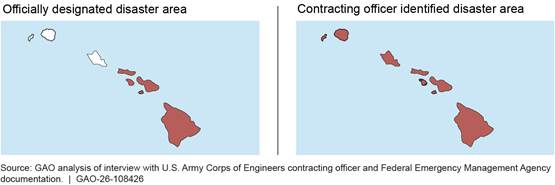
The Corps has taken efforts to ensure that its contracting officers correctly identify the local area, but FEMA has yet to fully address the issue. For example, its three contracting officers who identified the local area incorrectly had received training on local vendor use. This indicates a need for additional action. Until FEMA takes additional steps to ensure that its contracting officers correctly identify the local area, it could miss opportunities to both award contracts to local vendors and help communities jump-start economic recovery after a disaster.
Additionally, all the selected Corps’s contracts were missing documents related to the use of local vendors. Federal regulations require contracting officers who award a post-disaster contract to a nonlocal vendor to document their justification in the contract file. Without these justifications, the Corps lacks assurance its contracting officers are making an effort to use local vendors as appropriate. Ensuring that contracting officers fully comply with federal regulations can provide the Corps with greater certainty that it is succeeding in its efforts to contract with local vendors and assist with the economic recovery of a local area.
Why GAO Did This Study
U.S. communities devastated by natural disasters often rely on federal aid for their recovery. To meet their disaster response and recovery responsibilities, FEMA and the Corps contract with businesses to obtain some of the goods and services needed for these recovery activities. Under federal law, they are required to provide a preference for contracting with businesses defined by regulation as local—relative to the declared disaster area—to the extent feasible and practicable. This preference may help jump-start the local economy.
The American Relief Act of 2025 includes a provision for GAO to conduct work related to certain natural disasters. GAO’s report assesses the extent to which (1) FEMA and the Corps promote and monitor the use of local vendors for disaster response, and (2) contracting officers followed requirements for local vendor use for selected contracts.
GAO selected three major disasters: Hurricane Helene, the Maui wildfires, and Hurricane Ian; collected, analyzed, and confirmed the reliability of relevant data; reviewed laws, regulations, policies, and guidance; interviewed agency officials and contracting officers; and assessed a nongeneralizable sample of contracts from the three selected disasters.
What GAO Recommends
GAO is making four recommendations to FEMA and the Corps, including that they establish processes to monitor local vendor use; that FEMA ensures that its contracting officers accurately identify the local area; and that the Corps ensures that its contracting staff comply with requirements to document when they use nonlocal vendors. Both agencies concurred with the recommendations.
No table of contents entries found.
This is a work of the U.S. government and is not subject to copyright protection in the United States. The published product may be reproduced and distributed in its entirety without further permission from GAO. However, because this work may contain copyrighted images or other material, permission from the copyright holder may be necessary if you wish to reproduce this material separately.
Abbreviations
DHS Department of Homeland Security
FAR Federal Acquisition Regulation
FEMA Federal Emergency Management Agency
OCCPO Office of the Chief Component Procurement Officer
PKEMRA Post-Katrina Emergency Management Reform Act
PRISM Procurement Request Information System Management
September 3, 2026
Congressional Committees
Natural disasters like fires, floods, and hurricanes are occurring more frequently in the U.S., requiring significant federal assistance to support recovery efforts in affected communities. Federal contracts for life-saving or life-sustaining goods and services play a key role in supporting communities in the immediate aftermath of a disaster and in long-term recovery. The Federal Emergency Management Agency (FEMA)—a component within the Department of Homeland Security (DHS)—and the Army Corps of Engineers are two agencies with responsibilities for disaster response and recovery activities. These agencies frequently contract with the private sector to obtain goods and services needed for these activities. For example, FEMA and the Corps collectively obligated almost $6 billion on contracts for response and recovery efforts for three major disasters from fiscal years 2022 to 2024—Hurricane Helene, Hurricane Ian, and the Maui wildfires.
Congress also plays a role in disaster response, with various federal statutes aimed at helping communities with recovery efforts. The Robert T. Stafford Disaster Relief and Emergency Assistance Act, as amended, contains mechanisms to provide federal assistance to affected communities in the aftermath of a major disaster and jump-start the economy through the award of contracts to local businesses in the disaster area.[1] The Federal Acquisition Regulation (FAR) implements the Stafford Act requirement to provide a preference in awarding emergency response contracts to local firms where feasible and practicable.[2] Our prior work identified issues related to the use of local vendors following a disaster. For example, in 2019, we found that FEMA and the Corps did not consistently justify awards to nonlocal vendors and that the Corps did not always define the local area accurately when using a local area set-aside.[3]
The American Relief Act of 2025 included a provision for us to conduct work related to Hurricanes Helene and Milton, and other disasters declared in calendar years 2023 and 2024.[4] This report addresses the use of post-disaster contracts and assesses the extent to which (1) FEMA and the Corps promote and monitor the use of local vendors for disaster response, and (2) contracting officers followed requirements for local vendor use for selected contracts.
For both objectives, we focused our work on FEMA—the primary federal disaster relief agency—and the Corps, which had the largest mission assignment obligations from fiscal years 2023 through 2025.[5] We then selected three major disasters: Hurricane Ian (September 2022), Maui wildfires (August 2023), and Hurricane Helene (September 2024). Our selections were based on a mix of disaster types, geographic diversity, and from among those with the highest total obligations on the disasters as identified by FEMA’s internal contract writing system, the Procurement Request Information System Management (PRISM). We also analyzed contract obligation data for these disasters from this system for FEMA and from the Federal Procurement Data System for the Corps. We assessed the reliability of the data by reviewing documentation for both systems, interviewing knowledgeable officials, and conducting electronic testing to detect obvious errors and inconsistencies. We determined the data were reliable to report overall contract obligations for all three disasters for FEMA and for two of the three disasters for the Corps.[6]
To assess the steps FEMA and the Corps took to promote and monitor the use of local vendors, we:
· reviewed relevant laws and regulations, including the Stafford Act, the Post-Katrina Emergency Management Reform Act (PKEMRA), and the FAR;
· reviewed relevant FEMA and Corps policy and guidance;
· interviewed agency officials about their policies and practices to promote and monitor local vendor usage; and
· reviewed FEMA and Corps internal tracking sheets to determine if or how the agencies were monitoring local vendor use.
We assessed this information against criteria in Standards for Internal Control in the Federal Government, specifically the principle that management should use quality information to achieve the entity’s objectives.[7]
To assess the extent to which contracting officers took steps prior to award that aligned with local vendor requirements:
· We selected a nongeneralizable sample of 40 contracts based on a mix of low and high dollar obligation values, a mix of product and service types, and a mix of awards to local and nonlocal vendors. We excluded advance contracts and other contract vehicles that were not awarded in response to specific disasters from the review since local vendor preference is for post-disaster contracts.[8] We found the data to be reliable for the purposes of selecting contracts for our review and to report contract obligations.
· We selected 25 FEMA contracts—12 awarded to local vendors and 13 awarded to nonlocal vendors. These contracts were from all three of our selected disasters.
· We selected 15 Corps contracts—seven awarded to local vendors and eight awarded to nonlocal vendors. These contracts were from the Maui wildfires and Hurricane Helene. The Corps did not code all of the contracts it awarded for Hurricane Ian in the Federal Procurement Data System. It only coded its advance contracts—which we excluded from our review—as associated with that disaster.
· We reviewed and assessed contract file documents, such as market research reports, solicitations, and justifications for awarding emergency response contracts to nonlocal vendors, as applicable, against selected requirements related to disaster contracting.[9] For the purposes of this report, we refer to these justifications as nonlocal justification, and these contracts as disaster contracts. We chose these requirements due to challenges identified in our previous reports on the use of local area set-asides.[10]
· We assessed this information against criteria in Standards for Internal Control in the Federal Government, specifically the principle that states management should implement control activities through policies and procedures.[11]
· We interviewed a nongeneralizable sample of 21 contracting officers who were responsible for our 40 selected contracts. We asked all these contracting officers about the resources they use to identify local vendors, what challenges exist in relation to contracting with local vendors, the evidence they use to determine if a vendor is local, and contract-specific questions such as about missing documentation.
We conducted this performance audit from April 2025 to September 2026 in accordance with generally accepted government auditing standards. Those standards require that we plan and perform the audit to obtain sufficient, appropriate evidence to provide a reasonable basis for our findings and conclusions based on our audit objectives. We believe that the evidence obtained provides a reasonable basis for our findings and conclusions based on our audit objectives.
Background
Federal Role in Disaster Response
Responsibility for responding to a disaster generally begins at the state and local level, with the federal government providing assistance for incidents that exceed state and local ability to respond. Under the Stafford Act, the president may declare a major disaster in response to a request by the governor of a state or territory, or the chief executive of a tribal government, to obtain federal assistance.[12] The act further authorizes the president to provide financial and other assistance in response to a disaster.
The National Response Framework is a guide to how the federal government, states and localities, and other public and private sector institutions should respond to disasters and emergencies.[13] Under this framework, FEMA is the lead agency to coordinate the federal disaster response efforts across 30 federal agencies. One way FEMA coordinates disaster response is through mission assignments. Mission assignments are work orders that direct agencies, like the Corps, to use the authorities and resources granted to these agencies under federal law in support of direct assistance to state, local, tribal, and territorial governments. Agencies may choose to fulfill mission assignments through federal contracts.
The framework also provides a coordinating structure for federal interagency support. Certain federal agencies have primary responsibilities for core response areas, known as emergency support functions, and some may serve as support agencies for other emergency support functions. For example, the Corps coordinates and is the primary agency for the Public Works and Engineering emergency support function. This includes debris removal and emergency repair of damaged public infrastructure. During Hurricane Helene, the Corps’s mission assignments included establishing temporary emergency power, debris removal, and water system assessments and emergency repairs.
Federal Requirements for Contracting with Local Vendors
A preference for using local vendors following a disaster was initially established in PKEMRA, which amended the Stafford Act.[14] PKEMRA was enacted after preparedness and response failures associated with Hurricane Katrina, which hit the Gulf Coast in 2005. It includes several provisions related to contracting, such as establishing a preference for local vendors.[15] Specifically, for contracts or agreements with organizations, firms, or individuals, the provisions of the act include, in part:
· for major disaster assistance activities, agencies shall provide a preference, to the extent feasible and practicable, to organizations, firms, and individuals residing or doing business primarily in the area affected by the major disaster or emergency;
· preference may be given for local vendors, either through an evaluation preference or a local area set-aside; and
· disaster response contracts not awarded to local vendors shall be justified in writing in the contract file. As implemented in the FAR, this justification must also be approved by the contracting officer.
The FAR further defines several key terms and requirements related to using local vendors following a disaster. For example, it states that a local firm is a private organization, firm, or individual residing or doing business primarily in a major disaster or emergency area. It defines a major disaster or emergency area as the area included in the official presidential disaster declaration(s), as well as any additional areas that DHS identifies. Major disaster declarations and emergency declarations are published in the Federal Register.[16]
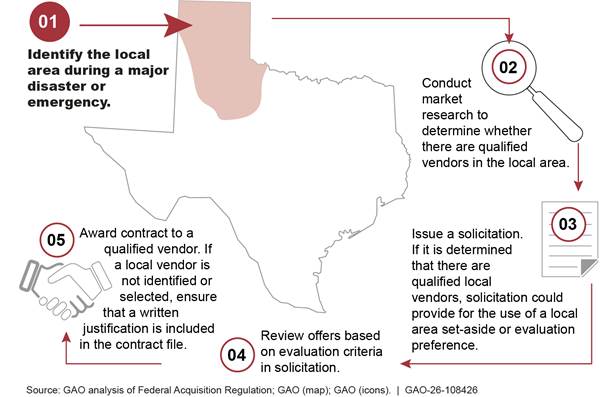
In addition, the FAR outlines the steps contracting officers are to take when awarding post-disaster contracts. This includes implementing the preference for awarding post-disaster contracts to a local vendor based on related laws and regulations.[17] This preference can be given through a solicitation evaluation preference or a local area set-aside. To inform market research, agencies identify the specific geographic area affected by the major disaster or emergency based on the major disaster declaration. We refer to this as the local area for that disaster.[18] The FAR also requires contracts not awarded to a local firm to be justified in writing in the contract file and approved by a contracting officer. Figure 1 outlines the steps contracting officers are to generally take when awarding post-disaster contracts based on related laws and regulations.
Figure 1. Steps a Contracting Officer Generally Takes to Implement Local Vendor Preference in Post-Disaster Contracts
Key FEMA Offices for Disaster Contracting and Contract Review Policy
FEMA’s contracting efforts are supported by the contracting workforce within its Office of the Chief Component Procurement Officer (OCCPO) and spread across FEMA’s headquarters and 10 regional offices. OCCPO is responsible for providing acquisition services to support FEMA programs, partners, and the survivor community in accordance with the laws, rules, and regulations governing the federal acquisition process. Two primary divisions within OCCPO are tasked with implementing its strategic vision. According to FEMA:
· The Acquisition Operations Division is responsible for awarding contracts. This division includes the Disaster Acquisition Response Teams, which are made up of contracting officers, contracting specialists, and quality assurance specialists.
· The Acquisition Programs and Policy Management Division provides acquisition support services, such as Industry Liaison and Quality Review Sections. The Industry Liaison Section administers FEMA’s Industry Liaison and Small Business Programs and ensures compliance with local and small business requirements. Staff in these offices help contracting officers with market research, including outreach to local and small businesses.
Key Corps Offices for Disaster Contracting and Contract Review Policy
The Directorate of Contracting heads the Corps’s contracting efforts, and delegates contracting authority to eight divisions led by senior contracting officers. Within these divisions are districts where contracting officers are located. According to the Corps, when a disaster hits, the district with responsibility for the disaster area is tasked with managing the disaster response.
· The Contracting Chief of the respective district assigns contracting officers to award and manage any necessary contracts. In addition, an Emergency Response official stated that the districts can elevate disaster responses to the headquarters level if the scale of the disaster requires more resources.
· The Emergency Response Branch is a component of the Corps Headquarters Directorate of Contracting. This branch provides disaster response training to contracting officers, offers strategic advice to help use advance contract tools, and performs other support functions that enable the districts to effectively execute contracts in support of disaster response.[19]
FEMA and the Corps Promote but Do Not Monitor Their Use of Local Vendors
Both FEMA and the Army Corps promote local vendor use
through their policies and practices. FEMA collects information about its use
of local vendors, but does not monitor these data. The Corps, on the other
hand, does not have an established or uniform process for collecting or
analyzing data about its use of local vendors.
FEMA and the Corps Have Policies and Practices to Promote Local Vendor Use
Both FEMA and the Corps have policies and practices that promote local vendor use. These policies are included in acquisition manuals, and the practices include training and vendor outreach.
Acquisition manuals. Both agencies have guides that instruct contracting officers on how to contract with local vendors and establish broad goals for local vendor use.
· FEMA promotes local vendor use through its FEMA Acquisition Manual and Disaster Contracting Desk Guide, which explain how to implement required statutes and regulations.[20] Additionally, the Acquisition Manual states that contracting officers should try to transition from advance contracts to local vendors within 6 months of a disaster event, or sooner if practicable. The manual also generally establishes a local vendor evaluation preference that allows FEMA contracting officers to award a contract to a local vendor if its price is 10 percent higher than a competing nonlocal vendor.[21]
· The U.S. Army Corps of Engineers Contract Specialist Proficiency Guide implements some of the FAR requirements for contracting with local vendors for the acquisition of construction and architect-engineering services.[22] It also directs contracting officers to transition from advance contracts to local vendors, unless the Head of Contracting Agency determines in writing that it is not feasible or practicable.
Training. Both agencies provide training aimed at promoting local vendor use.
· FEMA has annual training for contracting officers that includes relevant information on local vendor contracting requirements. FEMA conducts a Disaster Contracting Training course, which officials stated is offered at least once a year, typically prior to hurricane season. The training covers topics such as how to define a local area and when the use of a nonlocal justification is required. These officials also told us they offer a Disaster Contracting Webinar at least once a year. The webinar traditionally includes topics related to local businesses during a disaster, such as how to set up a local set-aside or transition to local vendors. They also noted that topics discussed can vary and are based on lessons learned from the prior year’s disaster efforts.
· The Corps also has a variety of optional contracting officer trainings. For example, as part of training offered to new Chiefs of Contracting, the Corps has a module for Emergency Management that discusses how to contract with local vendors. A Corps official stated that even though the course was designed for new Chiefs of Contracting, any contracting personnel can take it. Further, the Corps offered a disaster contracting class in March 2025 that addressed local vendor contracting requirements. This included how to define the local area for major disasters and emergencies, and when contracting officers need to include a written nonlocal justification for awarding a disaster contract to a nonlocal vendor. The Corps also offers ad hoc training through ongoing disaster coordination meetings, in which Emergency Response branch officials said they discuss various issues, including Stafford Act requirements.
Vendor outreach. Both agencies conduct outreach to educate vendors on disaster contracting opportunities. This includes industry days where agency officials meet with local vendors to discuss the government’s requirements and assist new vendors in understanding how to work with the federal government. For example, FEMA’s Industry Liaison team told us that it held three industry days to support the housing mission in North Carolina after Hurricane Helene. As a result of that outreach, the team noted a significant increase in local vendor responses to its Request for Information for housing needs in the state. Similarly, a Corps contracting officer stated that they held an industry day with local vendors and recorded vendors’ capability statements. According to the contracting officer, this helped identify qualified vendors after subsequent disasters.
Even with the agencies’ promotion of awarding local vendors disaster recovery contracts, contracting officers identified circumstances where vendor inexperience and constrained capacity hindered a local vendor’s ability to support disaster response activities:
· Inexperience working with the federal government. Several FEMA and Corps contracting officers stated that some local vendors do not have a lot of experience working with the federal government. For example, to receive a contract award, a vendor is required to register with SAM.gov, the government’s primary contracting website.[23] One FEMA contracting officer explained that this registration process can take a long time and can be challenging to complete for vendors that do not have previous experience working with the government. Similarly, a Corps contracting officer stated that small businesses that have never done work for the government, which can include local businesses, can find this registration process confusing and complicated. The contracting officer further stated that this could cause delays in the registration process.[24]
Other contracting officers stated that if a vendor has not worked with the federal government before, there can be a learning curve when competing for and executing contracts. For example, a Corps contracting officer stated that inexperienced vendors sometimes do not understand the terms used in government solicitations and often do not understand how to submit proposals. According to a FEMA contracting officer, sometimes new vendors do not know how to properly fulfill the requirements of a government contract and cannot always keep pace with the work that needs to be completed.
· Vendor capacity constraints. Contracting officers stated that vendor capacity can also be an issue. For example, a Corps contracting officer explained that local vendors may have been affected by the disaster and may not have the resources (e.g., people, equipment, or facilities) available to assist. This contracting officer identified one instance where a local vendor was unable to compete for a contract after a levee breach because its equipment was underwater.
FEMA Collects but Does Not Monitor Data on Local Vendor Use
FEMA collects data on contracts awarded to local vendors through a mandatory field in its contract writing system—PRISM—but does not monitor or ensure the accuracy of this data field. According to FEMA officials, when entering contract information into PRISM, contracting officials are required to indicate if the awarded contract went to a local vendor via a yes/no checkbox. If this choice is not selected, the system will not allow the contracting officer to continue with data entry. Based on our review of the data contracting officers entered into PRISM, approximately 3 percent, or $85 million of the $2.9 billion in contract obligations, was identified as being on contracts awarded to local vendors for the three disasters in our review. However, FEMA OCCPO officials acknowledged they do not have a process to monitor their local vendor use or whether advance contracts are transitioning to local vendors within 6 months and said they are considering ways they can increase the use of PRISM data moving forward. However, as of January 2026, officials had not yet developed a process to monitor their local vendor use. Further, FEMA officials stated they do not take any steps to verify whether the data—on if a vendor is local or not—is entered into PRISM are accurate. Of the nongeneralizable sample of 25 FEMA contracts in our review, we found that 22 were coded correctly.[25]
The Stafford Act, as amended by PKEMRA, provides a preference for local vendors. This may help jump-start economic recovery of an affected area. And, as noted above, FEMA’s Acquisition Manual identifies a goal for transitioning from advance contracts to local vendors within 6 months of the disaster event; sooner if practicable. Additionally, Standards for Internal Control in the Federal Government states that management should use quality information to achieve the entity’s objective.[26] Without a process for monitoring the quality of the data related to its use of local vendors for disaster response, FEMA is not well positioned to determine the full extent of its local vendor use or whether it is making progress toward its goal of transitioning to local vendors within 6 months of a disaster event. Further, by monitoring the data, FEMA would have greater visibility into the extent to which the billions of dollars in contract obligations are going to local vendors to help jump-start the local economy.
Corps Lacks Data to Monitor Local Vendor Use
The Corps does not consistently collect or monitor data on its local vendor use at either an enterprise-wide or district level. According to a Corps Emergency Branch official, local vendor use following a disaster is monitored within individual Corps district offices. Each of these eight offices is managed by the District Contracting Chief. We found that the extent to which each district collects information on local vendor use varied. For instance:
· Two districts told us they collected data on post-disaster subcontractors, including whether those subcontractors were local. One of these districts said it used these data to identify local businesses for other LA Wildfire contracts. Using these data, the district reported obligating $75 million on contracts awarded to these businesses following the Los Angeles wildfires. However, neither district identified any efforts to collect data on their contracts with prime local contractors.
· One district said it did not collect any data on local vendor use because it only uses advance contracts for disaster response. As noted earlier, advance contracts are not subject to local vendor requirements.
· Two districts did not collect data on local vendors.
· Three districts had not experienced any disasters that required them to award any contracts.
To implement Stafford Act requirements to provide a preference for local vendors, the Corps’s Contract Specialist Proficiency Guide states that advance contracts must transition to local firms unless the Head of the Contracting Agency determines in writing that it is infeasible or impractical. However, the Corps has not established a consistent approach that would allow it to ensure that the districts are collecting comparable data on their local vendor use following a disaster. Further, little to none of the information collected within the contracting districts is shared with Corps headquarters or the emergency response branch. As a result, the Corps does not know whether the districts that have awarded disaster contracts are contracting with local vendors to the extent feasible, as outlined in its guidance.
Standards for Internal Control in the Federal Government states that management should use quality information to achieve the entity’s objective.[27] Establishing a process to collect and monitor data on local vendor use would better enable the Corps to determine the extent to which the billions of dollars in these contract obligations are going to local vendors. Such a process would also better position the Corps to determine whether it is progressing toward its goal of transitioning advance contracts to local vendors, or if it is helping with the economic recovery of a local area affected by a disaster.
FEMA and Corps Contracting Officers Did Not Always Follow Selected Requirements for Local Vendor Use
Selected Contracting Officers Did Not Always Identify the Local Area Correctly
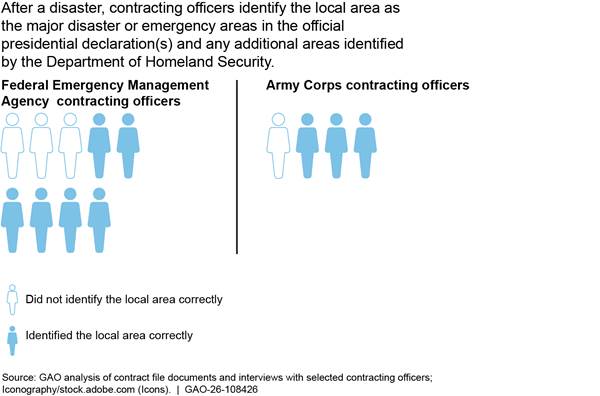
Selected FEMA and Corps contracting officers did not always identify or were not always aware of how to correctly identify the local area. Specifically, four of the 13 contracting officers who awarded contracts to local vendors identified the entire state as the major disaster area instead of the counties designated by the disaster declaration (see fig. 2).
Figure 2: Selected Contracting Officers Did Not Always Identify or Were Not Always Aware of How to Correctly Identify the Local Area
FEMA Local Area Identification
The three FEMA contracting officers who incorrectly identified the local area had different reasons for why they expanded the geographic areas beyond what was included in the declared major disaster area. For example:
· A contracting officer responsible for awarding a contract for on-site interpretation services inconsistently identified the local area by sometimes including all five counties in Hawaii, rather than the three counties that were part of the declared major disaster area. This contracting officer stated that because the additional counties they added were close to the declared major disaster area, they considered the counties to be within the local area, even though they were on different islands.
· The contracting officer responsible for awarding a contract for armed security services identified the entire state of Tennessee as the local area in the solicitation instead of only counties within the declared disaster area. According to FEMA, the contracting officer considered the entire state as the local area because they anticipated that other parts of the state might be added to the declared disaster area later.
However, FEMA contracting officers cannot expand the declared major disaster area on their own. Rather, FEMA regulations delegate this authority to FEMA’s Assistant Administrator for the Disaster Assistance Directorate, based on a request from a governor of the affected state.[28]
In 2015, we identified similar confusion among FEMA contracting officers on how to define the local area for set-asides.[29] We recommended that FEMA provide new or updated guidance to ensure that all contracting officers are aware of the regulatory definition of a local disaster area. FEMA concurred and issued guidance and required training on how to define the local disaster area in accordance with the FAR. All three of the selected FEMA contracting officers in our review who incorrectly identified the local area said they received some training on the use of local vendors, indicating the need for additional clarification from FEMA.
Standards for Internal Control in the Federal Government states that management should implement control activities through policies and procedures.[30] Without taking additional steps to clarify how to identify the local area, FEMA could be missing opportunities to award contracts to local vendors and further help affected communities.
Corps Local Area Identification
One of the four Corps contracting officers responsible for local contracts was unaware of what constituted the local area when determining if the awards went to local vendors. For example, the Corps contracting officer stated that there was not an official way to determine the local area for their four contracts that did not use local set-aside procedures, in response to the 2023 Maui wildfires.[31]
Since the Maui wildfires, a Corps official identified efforts they have undertaken to help ensure that contracting officers correctly identify the local area for individual disasters. Specifically, according to an official from the Emergency Response Branch, the Corps initiated pre-disaster kickoff meetings in April 2024 to provide an opportunity for officials to discuss relevant disaster contracting topics. For example, as part of the kickoff meetings for Hurricane Helene, management discussed how the local area should be identified.
Selected Contracting Officers Did Not Always Justify Nonlocal Vendor Use in Writing
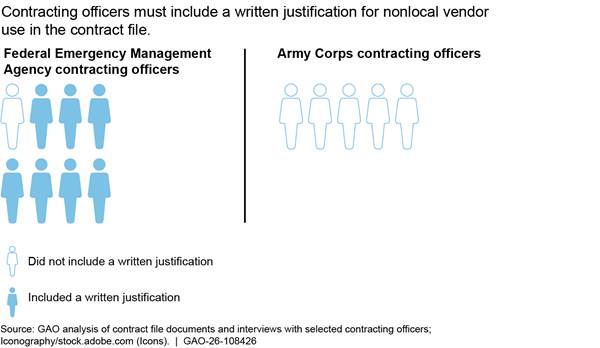
One FEMA contracting officer and five Corps contracting officers who awarded contracts to nonlocal vendors did not document their nonlocal justifications, as required by the FAR.[32] See figure 3.
Figure 3: Selected FEMA and Corps Contracting Officers Did Not Always Justify Their Use of Nonlocal Vendors
FEMA Documentation
Seven of the eight FEMA contracting officers included the required justification for awarding contracts to nonlocal vendors in their 11 respective contract files. The contracting officer who did not include the required nonlocal justification in their two selected disaster contract files has since left FEMA, and the contracting officer who took over these contracts stated they did not know why these justifications were missing.
Corps Documentation
None of the five Corps contracting officers responsible for awarding the selected nonlocal disaster contracts developed written justifications when we requested them. Collectively, these contracting officers were responsible for eight selected contracts. They created six of the eight written justifications after we requested them, and cited several reasons for not previously completing them:
· One contracting officer stated that they did not have time to complete the required justifications. They explained that they did their due diligence to look for local vendors, but completing what they considered to be paperwork was not a priority compared to awarding the contract.
· One contracting officer stated that they forgot to document their search for local vendors and complete the required justifications. After we discovered that the documents were missing, the contracting officer drafted the justifications.
· One contracting officer acknowledged that the awardee was not located in a county within the declared disaster area, but they did not complete a written justification for a nonlocal vendor. They explained that they “colloquially” considered the chosen vendor as local since it was within the state of Hawaii.
· One contracting officer stated that they did not prepare a separate nonlocal justification as required because the reasons a local vendor was not chosen could be found in other parts of the contract file. For example, they said that relevant information was in the market research report.
In April 2019, we reported that the Corps had not documented its use of nonlocal vendors.[33] At that time, we recommended that it provide guidance and tools to ensure requirements for contracting with local vendors, including justification requirements, were met. The Corps concurred, and in October 2019, issued guidance and developed a tool emphasizing that the contracting officer must sign a justification when making an award to a nonlocal vendor. Additionally, the Corps has a supervisory review requirement for all contract files. According to the U.S. Army Corps of Engineers Acquisition Instruction, the contracting officer shall ensure that a compliance review is conducted on every contract action, regardless of the dollar amount.[34] Contracting officers can use a checklist to complete this review. However, these checklists are not specific to disaster contracts and do not include checking the requirements for the inclusion of nonlocal justifications.
In addition to the FAR requirements previously noted, Standards for Internal Control in the Federal Government states that management should implement control activities through policies and procedures.[35] Taking additional steps to implement controls to better communicate and enforce requirements, such as reemphasizing the importance of documenting nonlocal vendor awards through additional training or guidance, will provide the Corps with greater certainty that it is making an effort to contract with local vendors as appropriate and assist with the economic recovery of a local area.
Conclusions
Natural disasters require significant federal assistance to support recovery efforts in affected communities. The Stafford Act, as amended by PKEMRA, gives preference to local vendors when awarding disaster-related contracts, which can spur local economic recovery. FEMA and the Corps have taken positive steps to promote the use of local vendors in their policies and procedures. However, by not monitoring their use of local vendors, they do not know whether they are meeting their goals to transition from using contracts awarded before a major disaster or emergency occurred to local vendors, nor can they monitor progress toward broader goals related to the economic recovery of a local area.
Further, FEMA and the Corps have opportunities to reemphasize the importance of implementing federal regulations. By taking additional steps to ensure that contracting officers are properly identifying the local disaster area, FEMA would have greater assurance that contracting officers are awarding contracts to local vendors. Further, the Corps can better ensure that contracting officers are complying with contract documentation requirements for contract awards to nonlocal vendors. Additionally, taking these steps could better support the goal of jump-starting the local economy by awarding contracts to businesses in the disaster area.
Recommendations for Executive Action
We are making four recommendations in total, including two to FEMA and two to the Corps:
The FEMA Administrator should ensure the Office of the Chief Component Procurement Officer establishes a process to monitor its local vendor use, including assessing the reliability of any data used in the process. (Recommendation 1)
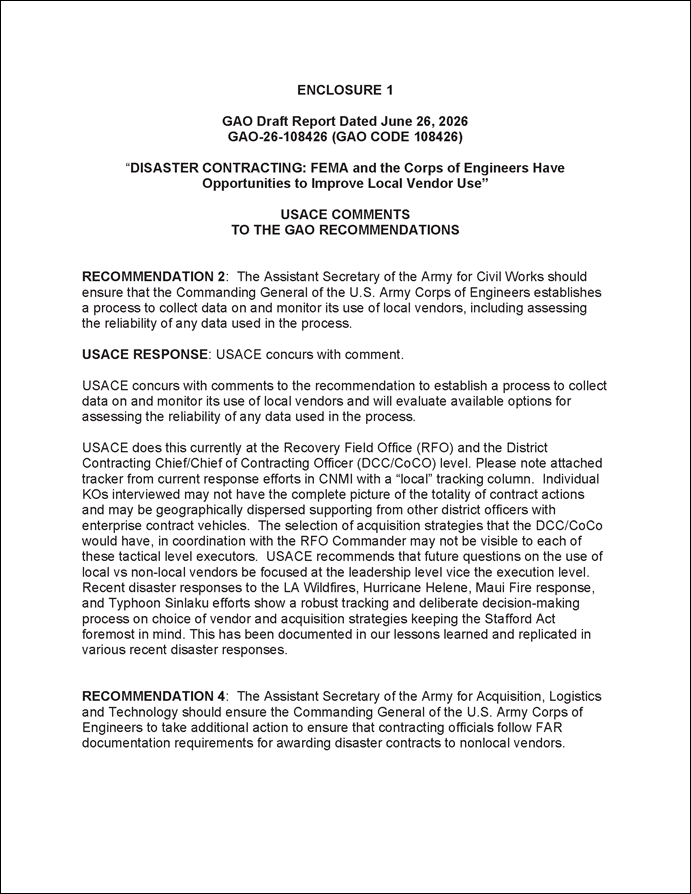
The Assistant Secretary of the Army for Civil Works should ensure that the Commanding General of the U.S. Army Corps of Engineers establishes a process to collect data on and monitor its use of local vendors, including assessing the reliability of any data used in the process. (Recommendation 2)
The FEMA Administrator should ensure the Office of the Chief Component Procurement Officer take additional action to clearly communicate existing FAR requirements and ensure that contracting officers correctly identify the local area for disaster contracts. (Recommendation 3)
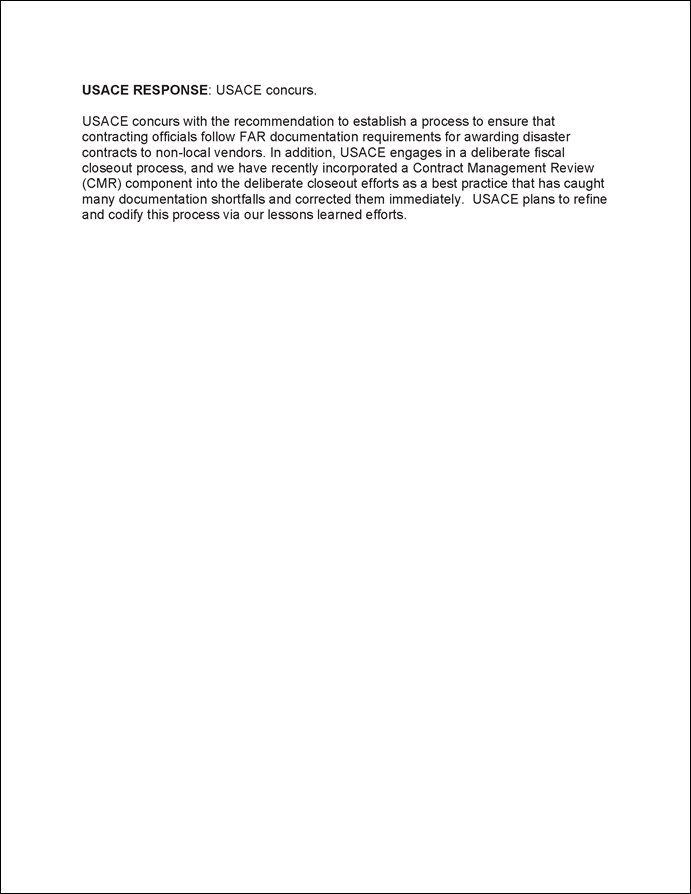
The Assistant Secretary of the Army for Acquisition, Logistics and Technology should ensure the Commanding General of the U.S. Army Corps of Engineers to take additional action to ensure that contracting officials follow FAR documentation requirements for awarding disaster contracts to nonlocal vendors. (Recommendation 4)
Agency Comments
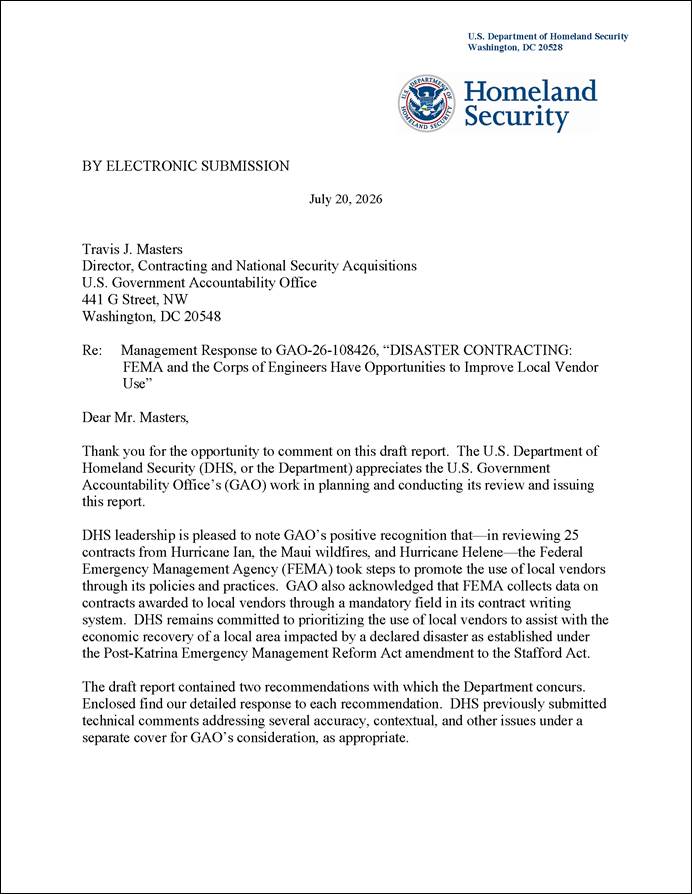
We provided a draft of this report to the Department of Defense and DHS for review and comment. DHS and the Army provided written comments, which are reproduced in appendixes I and II respectively. The Corps concurred with both of our recommendations. In response to recommendation two, the Corps noted that it is currently collecting data on local vendors within recovery field offices and district contracting offices. Officials provided one example of collecting these data in response to a recent disaster but acknowledged they are in the early stages of communicating with district offices about a process to consistently collect data on local vendors. We think this is a good first step toward implementing our recommendation and will monitor these actions to determine if they meet its intent.
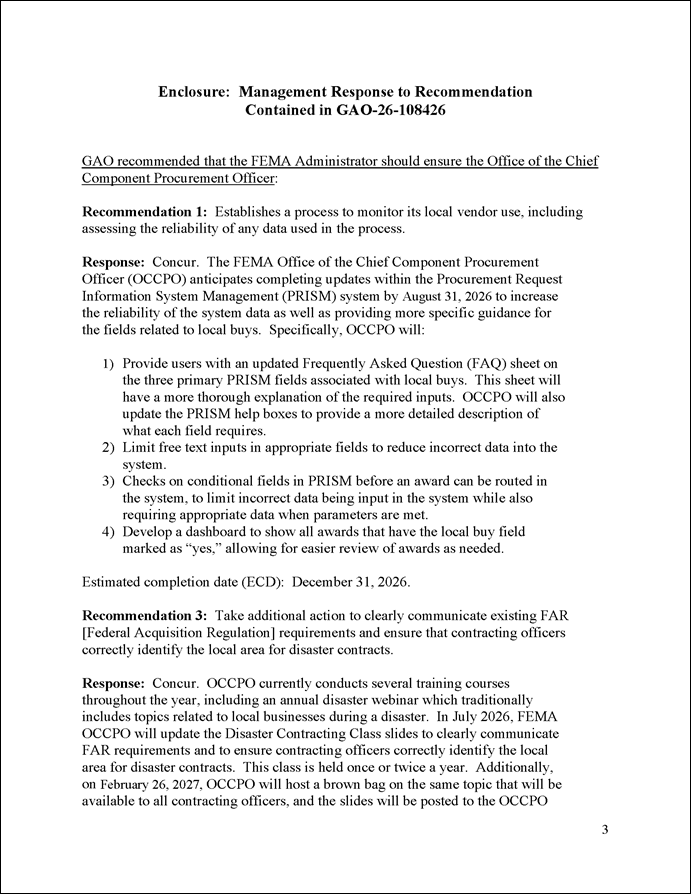
DHS concurred with both of our recommendations to FEMA and described actions it plans to take to address them. For example, FEMA stated that it will update its Disaster Contracting Class slides to clearly communicate FAR requirements and ensure that contracting officers correctly identify the local area for disaster contracts. Additionally, FEMA plans to conduct a brown bag workshop on this topic in early 2027—available to all contracting officers—and will post the training slides afterward. FEMA also provided technical comments, which we incorporated into the report as appropriate.
We are sending copies of this report to the appropriate congressional committees; the Secretary of Homeland Security; the Administrator, Federal Emergency Management Agency; the Secretary of Defense; the Assistant Secretary of the Army for Civil Works; the Chief of Engineers and Commanding General of the U.S. Army Corps of Engineers; and other interested parties. In addition, the report will be made available at no charge on the GAO website at http://www.gao.gov.
If you or your staff have any questions about this report, please contact me at MastersT@gao.gov. Contact points for our Offices of Congressional Relations and Media Relations may be found on the last page of this report. GAO staff who made major contributions to this report are listed in appendix III.
Travis J. Masters
Director, Contracting and National Security Acquisitions
List of Committees
The Honorable Shelley Moore Capito
Chairman
The Honorable Sheldon Whitehouse
Ranking Member
Committee on Environment and Public Works
United States Senate
The Honorable Rand Paul, M.D.
Chairman
The Honorable Gary C. Peters
Ranking Member
Committee on Homeland Security and Governmental Affairs
United States Senate
The Honorable John Kennedy
Chair
The Honorable Patty Murray
Ranking Member
Subcommittee on Energy and Water Development
Committee on Appropriations
United States Senate
The Honorable Katie Britt
Chair
The Honorable Chris Murphy
Ranking Member
Subcommittee on Homeland Security
Committee on Appropriations
United States Senate
The Honorable Andrew Garbarino
Chairman
The Honorable Bennie G. Thompson
Ranking Member
Committee on Homeland Security
House of Representatives
The Honorable Sam Graves
Chairman
The Honorable Rick Larsen
Ranking Member
Committee on Transportation and Infrastructure
House of Representatives
The Honorable Chuck Fleischmann
Chairman
The Honorable Marcy Kaptur
Ranking Member
Subcommittee on Energy and Water Development, and Related Agencies
Committee on Appropriations
House of Representatives
The Honorable Mark Amodei
Chair
The Honorable Henry Cuellar
Ranking Member
Subcommittee on Homeland
House of Representatives

GAO Contact:
Travis J. Masters, masterst@gao.gov
Staff Acknowledgments:
In addition to the contact named above, the following staff members made key contributions to this report: Meghan C. Perez (Assistant Director), Victoria Klepacz (Analyst-in-Charge), Dan Corstange, Victor Elliott, Lorraine Ettaro, Edward Harmon, Robin Harris, Ying Long, Jenny Shinn, Urvi Shukla, Sylvia Schatz, and Alyssa Weir.
The Government Accountability Office, the audit, evaluation, and investigative arm of Congress, exists to support Congress in meeting its constitutional responsibilities and to help improve the performance and accountability of the federal government for the American people. GAO examines the use of public funds; evaluates federal programs and policies; and provides analyses, recommendations, and other assistance to help Congress make informed oversight, policy, and funding decisions. GAO’s commitment to good government is reflected in its core values of accountability, integrity, and reliability.
Obtaining Copies of GAO Reports and Testimony
The fastest and easiest way to obtain copies of GAO documents at no cost is through our website. Each weekday afternoon, GAO posts on its website newly released reports, testimony, and correspondence. You can also subscribe to GAO’s email updates to receive notification of newly posted products.
Order by Phone
The price of each GAO publication reflects GAO’s actual cost of production and distribution and depends on the number of pages in the publication and whether the publication is printed in color or black and white. Pricing and ordering information is posted on GAO’s website, https://www.gao.gov/ordering.htm.
Place orders by calling (202) 512-6000, toll free (866) 801-7077,
or
TDD (202) 512-2537.
Orders may be paid for using American Express, Discover Card, MasterCard, Visa, check, or money order. Call for additional information.
Connect with GAO
Connect with GAO on X,
LinkedIn, Instagram, and YouTube.
Subscribe to our Email Updates. Listen to our Podcasts.
Visit GAO on the web at https://www.gao.gov.
To Report Fraud, Waste, and Abuse in Federal Programs
Contact FraudNet:
Website: https://www.gao.gov/about/what-gao-does/fraudnet
Automated answering system: (800) 424-5454
Media Relations
Sarah Kaczmarek, Managing Director, Media@gao.gov
Congressional Relations
David A. Powner, Acting Managing Director, CongRel@gao.gov
General Inquiries
[1]Robert T. Stafford Disaster Relief and Emergency Assistance Act, Pub. L. No. 93-288 (1974) (codified as amended at 42 U.S.C. § 5121 et seq.).
[2]FAR 26.201 defines a local firm as a private organization, firm, or individual residing or doing business primarily in a major disaster or emergency area. For the purposes of this report, we refer to these firms as “local vendors.” In addition, FAR 52.226-3(d) lists ways that a vendor may be considered local beyond just residing or primarily doing business in the area. Examples include a record of past work in the set-aside area and the number of permanent employees the vendor employs in the set-aside area, among others.
[3]GAO, 2017 Disaster Contracting: Actions Needed to Improve the Use of Post-Disaster Contracts to Support Response and Recovery, GAO‑19‑281 (Washington, D.C.: Apr. 24, 2019).
[4]Pub. L. No. 118-158, 138 Stat. 1723, 1754 (2024).
[5]Mission assignments are work orders that FEMA issues to direct other federal agencies to utilize the authorities and the resources granted to these agencies under federal law.
[6]The Corps did not code all of the contracts it awarded for Hurricane Ian in the Federal Procurement Data System. It only coded its advance contracts as associated with that disaster. Advance contracts are established prior to disasters and are typically needed to quickly provide life-sustaining goods and services in the immediate aftermath of disasters. Because these contracts were excluded from our review, we did not include any Hurricane Ian contracts in our Army Corps analysis. To learn more about advance contracts see GAO, 2017 Disaster Contracting: Action Needed to Better Ensure More Effective Use and Management of Advance Contracts, GAO‑19‑93 (Washington, D.C.: Dec. 6, 2018).
[7]GAO, Standards for Internal Control in the Federal Government, GAO‑25‑107721 (Washington, D.C.: May 15, 2025).
[8]FEMA also refers to advance contracts as national stand-by response contracts.
[9]This review focuses on contracts and task orders awarded from fiscal years 2019 through 2024. As such, references to FAR requirements are as of fiscal year 2024, and do not include revisions to the FAR that occurred after that time frame. The FAR is currently undergoing a complete overhaul called the Revolutionary FAR Overhaul. Executive Order 14275 directs the Office of Federal Procurement Policy to reduce the FAR to what is required by statute and is necessary for streamlined and efficient federal procurement. Exec. Order No. 14275, 90 Fed. Reg. 16,447 (Apr. 15, 2025). The updated version of the FAR is referred to as FAR (deviation), while the version in place prior to the overhaul is referred to as FAR (legacy). The FAR (legacy) is referenced in this report since we conducted this performance audit prior to the FAR (deviation). DOD and DHS components are reforming acquisition processes, including an overhaul of their respective FAR supplements. Exec. Order No. 14265, 90 Fed. Reg. 15621 (Apr. 9, 2025).
[12]42 U.S.C. § 5170. The Stafford Act, as amended, permits the president to declare a major disaster after a state’s governor or chief executive of an affected Indian tribal government—a governing body of an Indian or Alaska Native tribe, band, nation, pueblo, village, or community that is under the federally recognized Indian Tribe List Act of 1994 —finds that the emergency or major disaster is of such a severity and magnitude that responding to it is beyond the State, Indian tribal government, and local government’s capabilities. 42 U.S.C. §§ 5170(a)-(b), 5122(6). Governor means the chief executive of any state, which includes, among others, Puerto Rico and the U.S. Virgin Islands. 42 U.S.C.§ 5122 (4)(5).
[13]Department of Homeland Security, National Response Framework, 4th ed. (Oct. 28, 2019).
[14]PKEMRA was enacted in Title VI of the Department of Homeland Security Appropriations Act, 2007, Pub. L. No. 109-295.
[15]PKEMRA also included requirements for FEMA to award contracts before a disaster, pre-positioned to ensure that goods and services are in place to help rapidly mobilize resources in immediate response to disasters. Although PKEMRA does not apply to the Corps, the Corps awards indefinite-delivery contracts as a preparedness measure as part of its Advanced Contracting Initiative. This program was developed and implemented specifically for emergency and disaster scenarios.
[16]FAR 26.201. These declarations are available at https://www.fema.gov/disasters/disaster/declarations. In addition, according to FEMA regulations, FEMA’s Assistant Administrator for the Disaster Assistance Directorate, based on a request from a governor, can expand the definition of a major disaster or emergency area. 44 C.F.R. § 206.40(b)-(c).
[17]For example, the FAR identifies requirements for when contracting officers choose to limit competition to only potential local vendors within a specific geographic area, known as a local area set-aside.
[18]For local area set-asides, contracting officers can define the local area to be smaller than the declared major disaster area. FAR 26.202-1.
[19]In September 2025, we reported that FEMA and the Corps have different workforce structures and levels of scalability, and each agency relies on a limited number of permanent staff and on-call disaster responders. Recent disasters strained each agency’s staff capacity, including exhausting the number of available staff for key response functions and longer-term response missions. In some cases, response efforts required staff to put their primary responsibilities on hold. GAO Disaster Assistance High-Risk Series: Federal Response Workforce Readiness, GAO‑25‑108598 (Washington, D.C.: Sept. 2, 2025).
[20]FEMA, FEMA Acquisition Manual (Apr. 2025) and Disaster Contracting Desk Guide (2022).
[21]The price preference can be increased when market research indicates the cost of doing business in the declared disaster or emergency area is higher than normal.
[22]U.S. Army Corps of Engineers, Contract Specialist Proficiency Guide (Mar. 19, 2021).
[23]At the time of our review, FAR 26.205(a) and 18.102(b) stated that contracting officers must consult the Disaster Response Registry via https://www.sam.gov to determine the availability of contractors for debris removal, distribution of supplies, reconstruction, and other disaster or emergency relief activities inside the United States and outlying areas.
[24]According to the SAM.gov registration page, it can take up to 10-15 days for business registrations to become active.
[25]Of the three contracts entered incorrectly, two were coded as being awarded to a local vendor when they were not, and one was coded as being awarded to a nonlocal vendor when it was awarded to a local vendor.
[28]44 C.F.R. 206.40(b) states that the Assistant Administrator for the Disaster Assistance Directorate has been delegated authority to designate the affected areas eligible for supplementary federal assistance under the Stafford Act.
[29]GAO, Disaster Contracting: FEMA Needs to Cohesively Manage Its Workforce and Fully Address Post-Katrina Reforms, GAO‑15‑783 (Washington, D.C.: Sept. 29, 2015).
[31]FAR 26.202-1.
[32]FAR 26.204.
[34]U.S. Army Corps of Engineers, U.S. Army Corps of Engineers Acquisition Instruction (June 3, 2019).