
Report to Congressional Committees
United States Government Accountability Office
A report to congressional committees
For more information, contact: Chris Currie at CurrieC@gao.gov
What GAO Found
The increasing number and complexity of disasters demonstrates the need to ensure that the Federal Emergency Management Agency’s (FEMA) workforce can meet its core mission to help people before, during, and after disasters. In response to 2025 presidential directives, many federal agencies have taken steps to reduce the size of their workforces. In fiscal year 2025, FEMA employed about 25,134 employees, on average. However, over 4,300 employees separated from FEMA in fiscal year 2025—a 55 percent increase in separations from fiscal year 2024 (see figure). These separations have resulted in a loss of institutional knowledge and experienced personnel, according to FEMA officials, and have exacerbated longstanding workforce challenges.
In 2025, FEMA rescinded its strategic plan. As a result, the agency has no overall strategic direction on which to base workforce planning—a systematic and continuous process for identifying the size and composition of a workforce needed to achieve an agency’s mission. Without a strategic plan that outlines clear goals and objectives, FEMA cannot effectively determine its future workforce needs, potentially putting its mission at risk.
In addition, GAO found that FEMA did not base its 2025 and 2026 workforce reduction decisions, proposed future workforce actions, or workforce policy changes on the results of a workforce analysis—an assessment of the current state of the workforce and a forecast of future organizational requirements. FEMA took these actions without assessing whether it had the necessary staffing capacity to meet its mission, including its statutory requirements. Without workforce planning, FEMA is not positioned to determine whether it has the right number of people with the right skills in the right positions at the right time to meet its mission. Further, for more than a decade, GAO has identified challenges FEMA has encountered in maintaining a sufficient workforce to effectively meet its mission. Although FEMA has made progress towards addressing some of these challenges, actions by Congress would provide additional accountability to ensure that FEMA maintains a workforce capable of meeting its mission while addressing long-standing workforce management challenges.
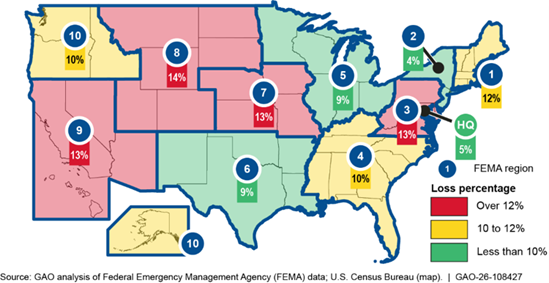
Percentage of Headquarters and Regional FEMA Staff Separations Due to Voluntary Workforce Reduction Programs, Jan. 20, 2025–Jan. 10, 2026
Why GAO Did This Study
FEMA has long-standing workforce management challenges that make supporting disaster response and recovery difficult. As such, GAO added strengthening FEMA’s disaster workforce and capacity to its High Risk List in February 2025.
GAO was asked to review FEMA’s ability to provide effective staffing for disaster response and recovery and how FEMA is addressing any workforce challenges. This report examines (1) how FEMA’s workforce changed in 2025 and 2026; (2) the extent to which FEMA has strategic direction to identify workforce needs; and (3) the extent to which FEMA has assessed the ability of its workforce to meet its mission needs.
GAO evaluated FEMA’s workforce planning efforts against key practices for workforce planning and analyzed data on FEMA’s workforce size and composition. GAO also reviewed documentation related to (1) workforce changes and decisions in 2025 and 2026 and (2) FEMA’s strategic direction. Lastly, GAO interviewed FEMA officials in headquarters and all 10 regions.
What GAO Recommends
GAO recommends that Congress consider requiring that significant FEMA workforce decisions be informed by the results of the agency’s workforce planning process. Congress should also consider requiring FEMA to report to Congress on the results of its workforce planning process prior to the start of each year’s hurricane season.
GAO is also making three recommendations to FEMA, including that it issue a strategic plan with clear goals and objectives and develop and implement a workforce planning process that includes a workforce analysis. DHS agreed with the recommendations.
Abbreviations
CORE Cadre of On-Call Response and Recovery Employees
DHS Department of Homeland Security
FEMA Federal Emergency Management Agency
OPM Office of Personnel Management
Post-Katrina Act Post-Katrina
Emergency Management Reform Act
of 2006
Stafford Act Robert
T. Stafford Disaster Relief and Emergency
Assistance Act
This is a work of the U.S. government and is not subject to copyright protection in the United States. The published product may be reproduced and distributed in its entirety without further permission from GAO. However, because this work may contain copyrighted images or other material, permission from the copyright holder may be necessary if you wish to reproduce this material separately.
August 4, 2026
Congressional Committees
In recent years, natural disasters have become more frequent and costlier, requiring higher levels of federal support. The Federal Emergency Management Agency (FEMA) leads the federal response to disasters.
Recent disasters, such as the multiple concurrent disasters the nation experienced in 2024, demonstrate the need to ensure FEMA’s workforce can effectively and efficiently respond to disasters. For example, Hurricanes Helene and Milton affected the Southeast less than 2 weeks apart in September and October 2024. FEMA responded by deploying 13,500 employees, the highest number of employees deployed in the agency’s history, according to agency officials. The concurrent disasters strained FEMA’s staff capacity. According to FEMA officials, the multi-state impacts of the two hurricanes occurring within weeks of each other required the agency to deploy recovery staff from outside the affected region, and FEMA deployed employees who were not fully trained for response and recovery activities.
Further, only 4 percent of FEMA’s incident management workforce—the agency’s primary field support for disasters—was available to deploy in November 2024 after these two disasters. As such, strengthening FEMA’s disaster workforce and capacity is one of the key challenges we identified in our February 2025 high-risk area Improving the Delivery of Disaster Assistance.[1]
FEMA has long-standing workforce management challenges that make supporting disaster response and recovery difficult.[2] For example, we reported in May 2023 that FEMA had a staffing gap of approximately 35 percent across different positions at the beginning of fiscal year 2022.[3] As another example, in July 2025, floods in Texas killed over 130 people. We recently reported that as of July 4, 2025, when the deadly Texas floods began, FEMA reported 15 percent of its incident management workforce was available.[4] We also reported that following the floods, FEMA faced challenges providing call center support to Texas flood survivors due to a reduction in its call center staff.[5]
Since January 2025, FEMA has experienced significant changes that have impacted FEMA’s workforce. For example, since January 20, 2025, the President issued several memorandums and executive orders directing federal agencies to reduce the size of their workforces and restrict hiring.[6] As a result, FEMA has faced a variety of reductions in its workforce—both voluntary and involuntary—as well as changes to key policies and documents that guide its workforce.[7] Further, the President established the FEMA Review Council to evaluate FEMA’s ability to meet its mission and make recommendations for improving the agency.[8] As of July 2026, both the administration and Congress continued to contemplate a variety of significant decisions related to FEMA.[9]
We were asked to review FEMA’s ability to provide effective staffing for disaster response and recovery, particularly for multiple or concurrent disasters, and how FEMA is addressing any workforce challenges.[10] This report examines (1) how FEMA’s workforce changed in 2025 and 2026; (2) the extent to which FEMA has strategic direction to identify workforce needs; and (3) the extent to which FEMA has assessed the ability of its workforce to meet its mission needs.
To address our first objective, we reviewed executive branch actions, including executive orders, presidential memorandums, and guidance from the Office of Personnel Management (OPM) relevant to FEMA’s workforce. We also reviewed Department of Homeland Security (DHS) and FEMA documentation and communications regarding FEMA operations and workforce and policy decisions, including guidance for implementing executive branch memorandums, executive orders, and DHS directives related to workforce changes in 2025 and 2026. In addition, we interviewed FEMA headquarters officials and officials from all 10 regions to understand the changes FEMA’s workforce underwent in 2025 and 2026 given recent executive and DHS directives and the impact of those changes on the workforce.
Further, we obtained summary data from FEMA about its workforce size and composition. To identify high-level workforce numbers and the number of personnel participating in workforce reduction programs, we reviewed summary data from the National Finance Center payroll information and internal agency trackers.[11] To update our prior work, we also reviewed data from FEMA’s Deployment Tracking System to determine if FEMA continued to face staffing gaps in 2023 and 2024 within its cadres.[12] To assess the reliability of FEMA’s payroll data from the National Finance Center and Deployment Tracking System, we used data reliability information collected from our prior work, including interviews and written responses with agency officials and reviews of data system documentation. We also interviewed and obtained written responses from knowledgeable officials to determine the extent to which FEMA used the data systems consistently over time. Based on these steps, we determined that the data presented in this report were sufficiently reliable for our purposes. Based upon our reliability assessment of FEMA’s Deployment Tracking System data, we concluded the target data for 2023 and 2024 were sufficiently reliable for our purposes. However, similar data for 2025 and 2026 were not comparable for our reporting purposes of identifying staffing gaps in 2025 and 2026 due to changes the agency made in its collection.[13]
To address our second objective, we reviewed FEMA documentation that included guidance and communications regarding FEMA’s Strategic Plan and its strategic direction as it related to its workforce. We also reviewed FEMA policies and guidance related to managing its workforce. We interviewed FEMA officials from headquarters and all 10 regions to understand how FEMA develops its strategic direction for its workforce and how that strategic direction is being implemented. Further, we asked officials how FEMA’s strategic direction guides workforce decisions. We assessed FEMA’s strategic direction related to its workforce against key practices identified in OPM’s Workforce Planning Guide.[14]
To address our third objective, we reviewed FEMA policies, guidance, and communications regarding FEMA operations and workforce decisions in 2025 and 2026. We reviewed relevant FEMA documentation to understand FEMA’s workforce planning process and the extent to which FEMA assessed its workforce prior to implementing workforce changes in 2025 and 2026. We also reviewed relevant documentation to determine the extent to which FEMA had plans to ensure it would have the capacity to meet mission needs in the future. In addition, we interviewed FEMA officials from both headquarters and all 10 regions to understand FEMA’s workforce planning efforts, the impact of workforce reduction programs, policy changes made in 2025 and 2026, and how those policy changes have impacted FEMA’s workforce and its ability to meet mission needs. We assessed whether FEMA made workforce decisions using key practices for workforce planning, including OPM’s Workforce Planning Guide, GAO’s Key Talent Management Strategies, and GAO’s Key Principles for Effective Strategic Workforce Planning.[15]
We conducted this performance audit from April 2025 to August 2026 in accordance with generally accepted government auditing standards. Those standards require that we plan and perform the audit to obtain sufficient, appropriate evidence to provide a reasonable basis for our findings and conclusions based on our audit objectives. We believe that the evidence obtained provides a reasonable basis for our findings and conclusions based on our audit objectives.
Background
FEMA Authorities
FEMA’s mission is to reduce the loss of life and property and protect the nation from all hazards, including natural disasters and acts of terrorism, by leading and supporting the nation in a risk-based, comprehensive emergency management system of preparedness, protection, response, recovery, and mitigation.[16] To carry out this mission, FEMA administers programs under various statutory authorities.
|
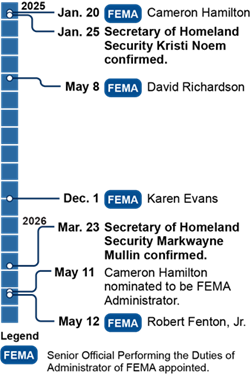
Leadership Changes at the Department of Homeland Security (DHS) and Federal Emergency Management Agency (FEMA) The Post-Katrina Emergency Management Reform Act of 2006 stipulates that FEMA shall have an Administrator that is appointed by the President and confirmed by the Senate. The Administrator should have a demonstrated ability and knowledge of emergency management and homeland security, as well as at least 5 years of executive leadership and management experience. However, since January 2025, FEMA has not had a Senate-confirmed Administrator and has had four Senior Officials Performing the Duties of FEMA Administrator, as of July 2026– the longest FEMA has not had a confirmed Administrator and the highest turnover in at least 15 years. On May 11, 2026, the President nominated Cameron Hamilton to be the Administrator of FEMA; however, as of July 2026 he had not yet been confirmed. In addition, since January 25, 2025, DHS—of which FEMA is a component—has had two Secretaries. For information on GAO’s decision regarding the legality of FEMA appointments in 2025, see B‑337082.
Source: GAO analysis of presidential appointment information. | GAO‑26‑108427. |
The Robert T. Stafford Disaster Relief and Emergency Assistance Act (Stafford Act), enacted in 1988, generally defines the federal government’s role during the response and recovery phases after a disaster.[17] The Stafford Act establishes the programs and processes through which FEMA provides disaster assistance when effective response and recovery are beyond the capabilities of state and local governments.[18] FEMA responds to and supports a significant number of major disasters and emergencies each year and manages recovery projects across hundreds of prior disasters. As of June 2, 2026, FEMA had response and recovery operations for 1,079 open disaster declarations.[19]
The Homeland Security Act of 2002 transferred FEMA into the then-newly established DHS.[20] After Hurricane Katrina in 2005, the Post-Katrina Emergency Management Reform Act of 2006 (Post-Katrina Act) codified many of FEMA’s responsibilities and further defined the relationship between DHS and FEMA. For example, FEMA is to develop a federal response capability that can act effectively and rapidly to deliver assistance essential to saving lives or protecting or preserving property or public health and safety in a natural disaster, act of terrorism, or other man-made disaster. In addition, FEMA is to develop and coordinate the implementation of a risk-based, all-hazards strategy for preparedness that builds those common capabilities necessary to respond to such disasters while also building the unique capabilities necessary to respond to specific types of incidents that pose the greatest risk to the nation.[21] Additionally, the Post-Katrina Act provides that no asset, function, or mission of FEMA may be diverted for the principal and continuing use of any other entity within DHS and that the Secretary may not substantially or significantly reduce the authorities, responsibilities, or functions of FEMA or the capability of FEMA to perform those missions, authorities, and responsibilities.[22]
Types of FEMA Employees
· Stafford Act employees. Under the Stafford Act, FEMA has the authority to augment its permanent full-time staff with temporary personnel, which enables FEMA to scale up or down depending on the timing and magnitude of disasters.[23] Stafford Act employees include (1) local hires, who are temporary employees who support FEMA’s response to specific disasters; (2) FEMA’s Cadre of On-Call Response Recovery Employees (CORE), who are temporary full-time employees hired to directly support response and recovery efforts related to disasters; and (3) reservists, who are temporary employees who are on-call and work intermittently as required during incident management operations.
· Title 5 employees. Title 5 of the U.S. Code establishes the law for managing human resources in the federal government. Title 5 provides FEMA the authority to hire employees that make up FEMA’s day-to-day workforce, who are responsible for administering the agency’s ongoing program activities in headquarters and regional offices. During disasters, these employees can be deployed as needed.
· DHS Surge Capacity Force. The Post-Katrina Act established that employees from DHS and other federal agencies could volunteer to participate in DHS’s Surge Capacity Force.[24] DHS’s Surge Capacity Force is used to augment FEMA’s disaster workforce when a disaster or emergency exceeds the capacity of the FEMA disaster workforce.
See figure 1 for more information on FEMA’s employee types.
Figure 1: Summary of Employee Types in the Federal Emergency Management Agency (FEMA) Disaster Workforce
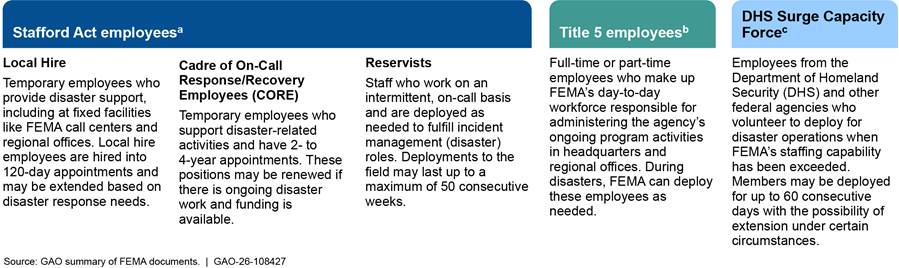
aThe Robert T. Stafford Disaster Relief and Emergency Assistance Act (Stafford Act) generally defines the federal government’s role during response and recovery after a presidential major disaster or emergency declaration and establishes key programs and processes through which the federal government provides disaster assistance. See 42 U.S.C. § 5121 et seq. Under the Stafford Act, FEMA has the authority to augment its permanent full-time staff with temporary personnel. 42 U.S.C. § 5149(b)(1).
bTitle 5 of the United States Code establishes the law for managing human resources in the federal government.
cThe Post-Katrina Emergency Management Reform Act of 2006 established DHS’s Surge Capacity Force. 6 U.S.C. § 711.
FEMA’s Workforce Composition
FEMA’s workforce is designed to scale up or down depending on the timing and magnitude of disasters. As of April 18, 2026, FEMA reported employing approximately 20,968 personnel.[25] FEMA’s incident management workforce, or its disaster workforce, is organized into 23 cadres.[26] Cadres are groups of FEMA employees organized by type of work (organizational or programmatic function). They are comprised of full-time and intermittent staff who perform incident-related duties during disaster response. These groups are based on skills and experience and generally deploy to an incident at varying points in the response and recovery phases, depending on their function. For example, the Individual Assistance cadre deploys right after a disaster strikes to help ensure that individuals and families have access to FEMA programs and information in a timely manner.
Cadres play a key role in keeping FEMA ready to deploy the right people to the right jobs quickly during a disaster, according to FEMA documentation. Temporary local hires and reservists are hired to positions within cadres, while CORE and permanent full-time employees are assigned to cadres for deployment purposes when a disaster occurs.[27] Our prior work discussed FEMA’s challenges related to ensuring its cadres are appropriately staffed to respond to disasters.[28]
FEMA Mechanisms to Allocate and Prioritize Staffing
When a disaster occurs, FEMA considers several factors to determine how to allocate and prioritize staffing resources including, but not limited to, the affected area and estimated costs. The more complicated or widespread a disaster is, the greater the staffing needs will be. Through May 2025, FEMA determined the order in which staffing types are deployed by organizing staff into one of four tiers, as shown in figure 2.[29]
Figure 2: Order in Which the Federal Emergency Management Agency (FEMA) Deploys its Workforce to a Disaster
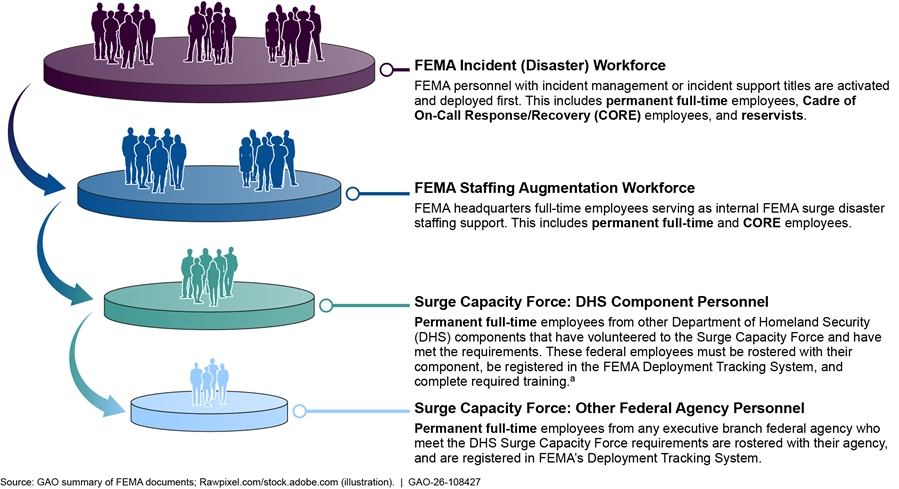
Note: In July 2026, FEMA officials told us that due to changes in policy over the last year, FEMA no longer distinguishes between the Incident Workforce and Staffing Augmentation Workforce. According to FEMA officials, personnel with incident management or incident support titles are activated and deployed based on their employee type and duty station. Personnel from within the impacted region are deployed, followed by national field forward assets, such as incident management COREs and Reservists, then followed by staff from FEMA headquarters and full-time staff located outside the impacted region.
aFEMA uses the Deployment Tracking System to assign and track the deployment of disaster response and recovery personnel.
FEMA has standard processes to determine the number and type of staff to deploy to a disaster area based on identified needs. When field leadership identifies a specific staffing need, the agency’s Deployment Tracking System identifies staff members that hold the specific title and skills requested. To obtain a title, employees must complete certain qualification requirements for the specific position. FEMA provides employees with opportunities to obtain a title through training, position-specific experience, and individual coaching. In 2025, FEMA assigned all employees a title, which specifies their principal roles and responsibilities.[30]
Role of OPM
OPM was established as a standalone agency in 1978 to oversee federal workforce management.[31] The agency guides and supports federal agencies’ workforce management by developing and overseeing government-wide workforce policies and systems. OPM is also responsible for certain government-wide personnel management activities. As we have recently reported, since January 20, 2025, the President has issued several memorandums and executive orders directing federal agencies to reduce the size of their workforces and restrict hiring. OPM has issued guidance with more detailed instructions on how agencies should reduce the size of their workforces.[32] Specifically, OPM provided guidance on restrictions regarding hiring civilian employees, the government-wide deferred resignation program, the termination of probationary employees, and agency reorganization plans.
Workforce Planning
Workforce planning is a systematic and continuous process for identifying the size and composition of a workforce needed to achieve an organization’s goals and objectives. OPM’s Workforce Planning Guide outlines a five-step process to be used continually to meet workforce planning objectives.[33] See figure 3 for more information on this process.
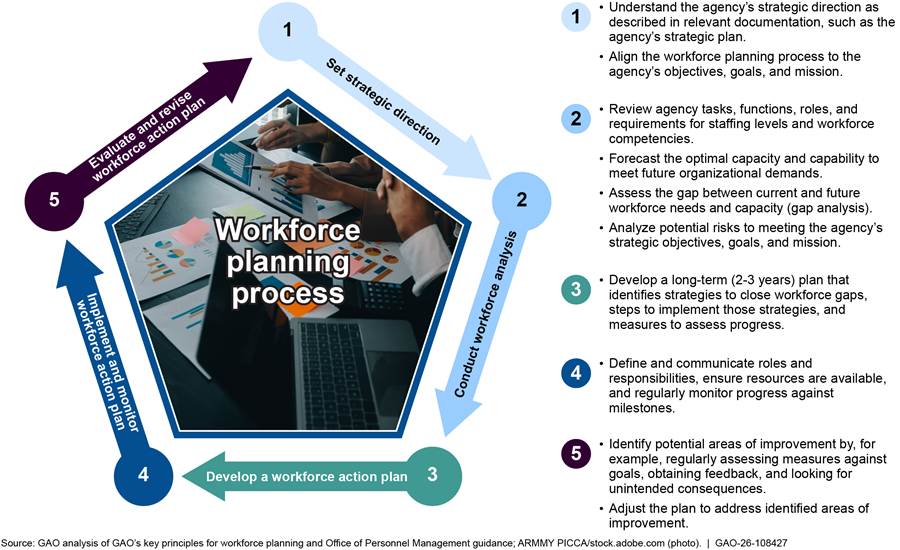
Note: GAO has identified key principles of strategic workforce planning, including determining the critical skills and competencies needed for an agency to achieve its current and future mission and goals. Key principles also include developing human capital strategies that are tailored to address identified gaps and improve the contribution of those skills and competencies. See GAO, Human Capital: Key Principles for Effective Strategic Workforce Planning, GAO‑04‑39 (Washington, D.C.: Dec. 11, 2003). In addition, the Office of Personnel Management’s Workforce Planning Guide describes a continuous five-step process agencies should use in workforce planning, identifies plan components, and explains the links the plan should have to agency strategic planning. See Office of Personnel Management, Workforce Planning Guide, ES-03483-11/2022 (Washington, D.C.: Nov. 2022).
As shown above, the second step in the workforce planning process includes an analysis of current staffing levels and workforce competencies and a forecast of future workforce competencies and staffing requirements. In addition, a gap analysis evaluates the gap between the workforce demands and the workforce supply and can reveal gaps in staffing levels and in skills and competencies.
FEMA Staff Reductions Led to Loss of Experienced Personnel
FEMA experienced changes to its workforce as a result of workforce reductions in 2025 and 2026 due to voluntary workforce reduction programs, termination of probationary employees, and non-renewal of CORE contracts. For example, approximately 17 percent of FEMA’s workforce (over 4,300 employees) separated from the agency in fiscal year 2025—a 55 percent increase in separations from fiscal year 2024, as shown in table 1. FEMA was also subject to a hiring freeze beginning in January 2025, which was in effect until May 2026, according to officials. FEMA officials reported that these workforce reductions have had negative impacts on FEMA’s workforce, including a loss of institutional knowledge and experienced personnel.
Table 1: Federal Emergency Management Agency (FEMA) Workforce Information, October 2022 Through Mid-May 2026
|
Time period |
Number of personnel employeda |
Number of new hires |
Number of separations |
|
Fiscal year 2023 |
22,855 |
3,952 |
2,767 |
|
Fiscal year 2024 |
23,863 |
4,275 |
2,791 |
|
Fiscal year 2025 |
25,134 |
2,907 |
4,321 |
|
October 1, 2025 (beginning of fiscal year 2026) through May 16, 2026 |
21,742 |
134 |
2,545 |
Source: GAO analysis of FEMA data. | GAO‑26‑108427
aThese numbers are based on National Finance Center data and reflect the average total employees over 26 pay periods in each time period, unless otherwise noted, including any hirings and separations that occurred within those pay periods.
Voluntary workforce reduction programs. FEMA reported that 1,502 employees separated from the agency as a result of voluntary workforce reduction programs between January 20, 2025, and January 10, 2026.[34] OPM and DHS each offered a voluntary workforce reduction program: a federal government-wide Deferred Resignation Program and a DHS-specific Workforce Transition Program. The DHS Workforce Transition Program consisted of three programs: the Deferred Resignation Program, the Voluntary Early Retirement Authority, and the Voluntary Separation Incentive Payment.[35] See figure 4 for more information on the two Deferred Resignation Programs offered to FEMA employees.
Figure 4: 2025 Voluntary Workforce Reduction Programs Offered to Federal Emergency Management Agency (FEMA) Employees
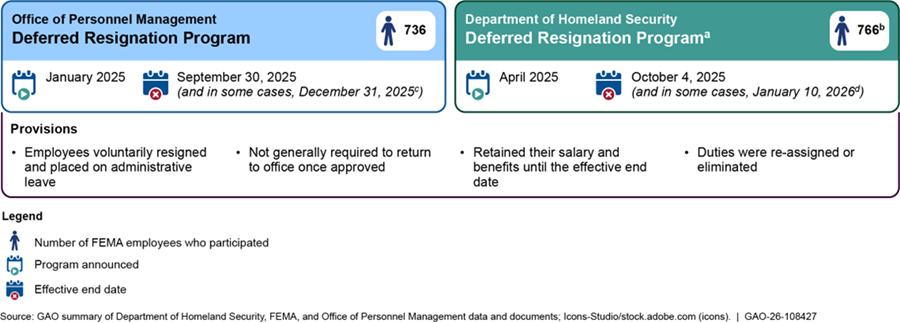
aThe Department of Homeland Security’s (DHS) Deferred Resignation Program was offered under DHS’s Workforce Transition Program, which also offered eligible employees Voluntary Early Retirement Authority and the Voluntary Separation Incentive Payment. The Voluntary Early Retirement Authority allows an agency to downsize or restructure by giving certain eligible federal employees the option to retire early and begin receiving their pension and other benefits sooner than usual. The Voluntary Separation Incentive Payment authority allows agencies that are downsizing or restructuring to offer eligible employees a one-time payment to encourage them to separate from their agency. The payment can be up to $25,000 or the amount of severance pay the employee would normally get, whichever is less. Employees can leave by resigning, retiring normally, or, if allowed, retiring early.
bAccording to agency officials, FEMA employees who participated in the DHS Deferred Resignation Program could take advantage of multiple options within the Workforce Transition Program offered by DHS, if eligible. This number includes participants who may have taken advantage of the multiple options.
cIn some cases, an employee approved for the Deferred Resignation Program had a retirement date between October 1, 2025, and December 31, 2025. In those cases, the deferred resignation date would be extended to match the employee’s retirement date.
dIn some cases, an employee approved for the Workforce Transition Program had an immediate retirement date between October 5, 2025, and January 10, 2026. January 10, 2026, was the last day for immediate retirement that qualified under the Workforce Transition Program.
Regions reported that between 4 and 14 percent of their staff separated from the agency as a result of the 2025 Deferred Resignation and Workforce Transition Programs, while FEMA headquarters reported that 5 percent of its staff separated as part of these programs. Figure 5 shows the percentage of staff in headquarters and each region who accepted a Deferred Resignation or Workforce Transition Program offer.
Figure 5: Percentage of FEMA Headquarters (HQ) and Regional Staff Separations Due to 2025 Voluntary Workforce Reduction Programs
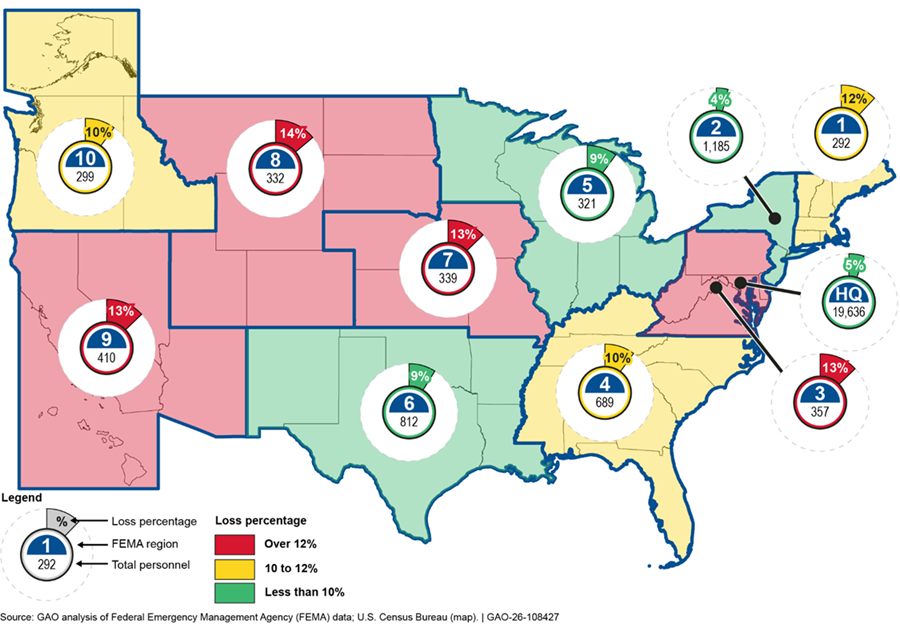
Notes: Voluntary workforce reduction programs offered to FEMA employees in 2025 included a federal government-wide Deferred Resignation Program and a DHS-specific Workforce Transition Program, which consisted of three programs: the Deferred Resignation Program, the Voluntary Early Retirement Authority, and the Voluntary Separation Incentive Payment.
To calculate the percentage of staff separations, we used data on the average number of total staff in HQ and each region in fiscal year 2025 and the number of employees that FEMA reported had participated in one of the voluntary workforce reduction programs offered to FEMA employees.
|
Workforce Reductions May Impact FEMA’s Staff Augmentation Strategies We reported in September 2025 that, in light of workforce reductions, FEMA planned to use staff augmentation strategies to fill agency gaps. Specifically, in June 2025, FEMA officials told us that they planned to leverage their Surge Capacity Force to fill FEMA’s staffing gaps. However, agencies that comprise the Department of Homeland Security’s (DHS) Surge Capacity Force—including other components within DHS, such as the Transportation Security Administration, and external federal agencies, such as the Department of Treasury—also experienced workforce reductions in 2025. FEMA officials told us that they anticipated having about 240 employees available for surge support for the 2026 hurricane season, down from 600 in 2025. According to FEMA officials, FEMA staff meet with agencies’ points of contact monthly to discuss how many staff will be available for activations to assist FEMA as part of the DHS Surge Capacity Force. However, workforce reductions at the agencies that comprise the DHS Surge Capacity Force may limit the number of personnel available to deploy. For more information on DHS’s Surge Capacity Force, see GAO‑25‑108598. Source: GAO analysis of Federal Emergency Management Agency (FEMA) documentation and interviews with officials. | GAO‑26‑108427 |
Termination of probationary employees and nonrenewal of CORE contracts. FEMA also reduced its workforce through termination of probationary employees—those who have not yet completed the service requirements necessary to finalize their appointments.[36] Specifically, in fiscal year 2025, FEMA terminated 159 probationary employees, according to FEMA officials.[37] A government-wide court-order subsequently provided that FEMA, along with other agencies, was not to terminate additional probationary employees and to update each employee’s personnel files to reflect that the termination was not performance- or conduct-based.[38] DHS reported to the court that it had updated the personnel files of 329 terminated DHS probationary employees, some of whom were FEMA employees.[39] FEMA officials told us that, in some cases, terminating probationary employees created challenges because some of these employees held hard-to-fill positions or had specialized skillsets. These terminations included employees with specific job titles such as engineers, environmental historic preservation specialists, and grant specialists, as well as those in certain cadres, such as the External Affairs and Logistics cadres.[40]
In addition, starting in January 2026, certain CORE employees’ appointments were not renewed. In fiscal year 2025, FEMA employed approximately 11,039 CORE employees—the largest portion of FEMA’s workforce on average (see fig. 6).[41] However, as of April 18, 2026, FEMA employed 9,808 CORE employees, according to FEMA officials. FEMA officials told us that between January 1, 2026, and April 4, 2026, 152 out of 778 CORE employees’ terms were not renewed, and additional CORE renewals were pending a decision by DHS and FEMA leadership.[42]
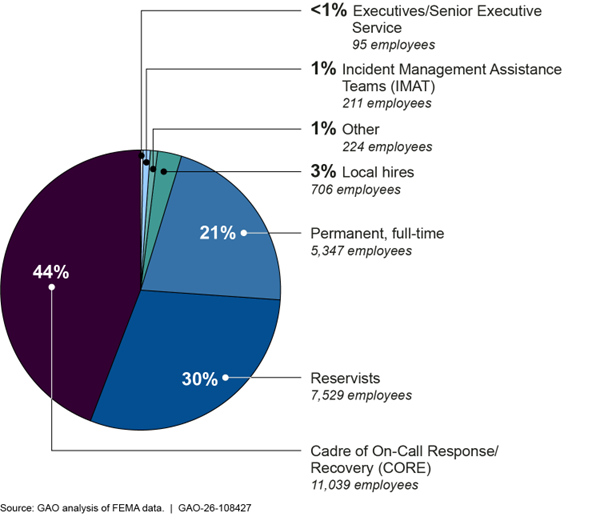
Note: CORE employees are a type of temporary full-time employee hired to directly support response and recovery efforts related to disasters. Local hires are temporary employees who support FEMA’s response to specific disasters. Permanent full-time employees are federal employees who support FEMA’s mission areas and operations on a daily basis. Reservists are temporary employees who work intermittently on not-to-exceed 2-year appointments during incident management operations and must be available to deploy as needed. The “other employees” category includes temporary employees. Percentages may not add to 100 percent due to rounding.
|
Katrina Declaration Letter On August 25, 2025, about 190 current and former FEMA employees signed a letter referred to as the Katrina Declaration Letter. The letter was addressed to the FEMA Review Council and Congress and warned that much of the progress in disaster response and recovery achieved since Hurricane Katrina had been reversed by recent executive actions. 34 employees publicly signed the letter, while others signed it anonymously. In response to the letter, the Department of Homeland Security subsequently put all employees that publicly signed the letter on indefinite administrative leave on August 26, 2025. According to FEMA officials, these same employees were reinstated to full duty on April 30, 2026. Source: GAO analysis of Federal Emergency Management Agency (FEMA) and congressional documentation. | GAO‑26‑108427 |
In January 2026, a coalition of labor organizations, nonprofit groups, and local governments filed a complaint alleging that DHS’s actions to remove FEMA’s decision-making authority regarding workforce reductions, the elimination of CORE and reservist positions, and the imposition and implementation of targets for workforce reduction are unlawful.[43] The complaint alleges that these actions violate, and cause FEMA to violate, FEMA’s statutory duties and the Post-Katrina Act provision that prohibits DHS from substantially or significantly reducing the authorities, responsibilities, or functions of FEMA or the capability of FEMA to perform those missions, authorities, and responsibilities. As part of this case, the government filed a notice on May 1, 2026, indicating that FEMA has initiated contact to offer new appointments to those CORE employees whose appointments were not renewed in January 2026.[44]
Hiring freeze. In January 2025, the President directed an executive branch-wide hiring freeze of civilian positions through October 15, 2025.[45] In October 2025, the President signed an executive order stating that no federal civilian position that is vacant may be filled, and no new positions may be created without additional approval or where required by applicable law, unless consistent with required annual staffing plans.[46] The executive order required that agencies prepare an annual staffing plan to ensure hiring was only done in the highest-need areas and aligned with the priorities of the administration.[47]
|
DHS Actions Impacting FEMA’s Ability to Meet Its Mission The Secretary of Homeland Security has made policy decisions that have impacted how FEMA conducts its daily business. For instance, in June 2025, DHS issued a memo stating that the Secretary of Homeland Security must sign off on all contracts, grants, and awards exceeding $100,000. This memo remained in effect until its recission by Secretary Markwayne Mullin in April 2026. Some FEMA officials stated that their ability to administer grants was delayed because of the new requirement for the Secretary to approve funding. In addition, officials in six of 10 regions stated that the loss of employees in 2025 who oversaw grants was an added challenge. The combination of the June 2025 DHS memo and loss of some grants staff may have limited FEMA's ability to administer grants in a timely manner. Source: GAO analysis of Department of Homeland Security (DHS) and Federal Emergency Management Agency (FEMA) documents and interviews with officials. | GAO‑26‑108427 |
According to FEMA officials, until May 2026, FEMA was under a hiring freeze and was only hiring positions that DHS identified as essential or mission-critical.[48] As a result, FEMA was not able to close previously identified staffing gaps through hiring efforts.[49] See appendix III for more information on FEMA’s past steps to address staffing gaps.[50] FEMA officials reported that on May 18, 2026, the hiring freeze was partially lifted, and guidance sent to top level managers, among others, stated that FEMA was hiring specific priority positions approved by DHS.[51]
Loss of experienced FEMA personnel. Workforce reduction programs in 2025 led to a loss of leadership and institutional knowledge, according to FEMA officials in headquarters and seven out of 10 regions. FEMA had on average 95 to 100 Senior Executive Service employees between fiscal year 2023 and fiscal year 2025. However, according to FEMA officials, 58 Senior Executive Service employees separated from the agency between January 20, 2025, and January 10, 2026.[52] Of these employees, 24 separated as part of a workforce reduction program. For comparison, in the prior 3 fiscal years, the agency reported just under 13 Senior Executive Service separations on average per year. Officials from one of the 10 regions stated that a lack of experience among the workforce will make responding to large-scale disasters more difficult and less efficient. Officials from other regions reported that they now have a high proportion of leadership serving in an acting capacity, who are less experienced in their new roles.[53] Officials from one region reported that it has not been significantly impacted by a loss of leadership.
FEMA Lacks Strategic Direction to Identify Workforce Needs
Absence of Strategic Direction Hinders Workforce Planning
In May 2025, FEMA rescinded its 2022-2026 Strategic Plan and, as a result, has no overall strategic direction on which to base its workforce planning. The Government Performance and Results Modernization Act of 2010 and Office of Management and Budget Circular A-11 require agencies to develop a strategic plan.[54] The Office of Management and Budget Circular A-11 states that an agency’s strategic plan should include objectives an agency hopes to accomplish. It also states that a strategic plan should include the long-term goals the agency aims to achieve, which actions the agency will take to realize those goals, and how the agency will address challenges and risks that may hinder reaching the identified objectives. Although these requirements apply to DHS, they also serve as a framework for components, such as FEMA, to conduct long-term planning.
In addition, according to OPM’s Workforce Planning Guide, to successfully plan and forecast future workforce requirements, agencies must first have a clear understanding of the agency’s strategic direction as described in an agency’s strategic plan.[55] However, in May 2025, FEMA issued a memo rescinding the FEMA 2022-2026 Strategic Plan because it contained goals and objectives that bore no connection to the White House’s priorities or to FEMA accomplishing its mission, according to the memo. The memo stated that the revised strategy, which FEMA planned to develop in the summer of 2025, would tie directly to FEMA executing its mission essential tasks. As of July 2026, FEMA has not released a revised or updated strategic plan and, as a result, FEMA has no strategic plan to provide strategic direction upon which to base its workforce planning.
FEMA officials told us that several documents related to FEMA’s workforce were being revised.[56] For example, officials told us in September 2025 that FEMA’s Deployment Guide and DHS Surge Capacity Force Program Guide, which outline deployment requirements and protocols, among other things, were under revision with estimated completion dates throughout fiscal year 2026. As of April 2026, these key documents continued to be under revision, and FEMA officials could not provide us with a planned timeline for when the revised strategic plan or other key documents would be released.
As mentioned previously, in January 2025, the President established the FEMA Review Council to evaluate FEMA’s ability to meet its mission and make recommendations for reforming the agency.[57] The FEMA Review Council was originally tasked with issuing a report with recommendations 180 days after its first public meeting.[58] However, the FEMA Review Council missed its deadlines to provide its report three times, once at the 180 day mark, and again in December 2025 and March 2026. In March 2026, the White House extended the FEMA Review Council until May 29, 2026, or until 10 days after it produces recommendations, whichever comes first.[59] On May 7, 2026, the FEMA Review Council publicly released its report and recommendations.[60] The report included 10 recommendations, one of which recommended FEMA conduct a strategic review of personnel requirements to determine appropriate staffing levels.
When we met with FEMA officials in April 2026, they told us that they have not issued a revised strategic plan because they were waiting for DHS and FEMA Review Council guidance related to potential agency changes. A strategic plan provides the necessary direction for workforce planning. Without a strategic plan that outlines clear goals and objectives, FEMA continues to operate without the strategic direction on which to base its analysis of future workforce needs to ensure it can meet its mission. Delaying strategic planning to wait for guidance from DHS and the FEMA Review Council leaves FEMA at risk of being unprepared and under-resourced to effectively respond to future disasters and meet its statutory requirements. Further, without a strategic plan that outlines clear goals and objectives, FEMA cannot effectively determine its future workforce needs, potentially putting its mission at risk.
FEMA Delayed Workforce Planning Due to Pending FEMA Review Council Recommendations
FEMA has not taken steps to assess workforce needs amidst staffing uncertainties caused by policy and workforce changes in 2025 and 2026. As mentioned above, the FEMA Review Council was directed to assess FEMA’s ability to capably respond to disasters. As part of its responsibilities, the FEMA Review Council was tasked with producing a report that, among other things, assesses FEMA’s disaster response efforts in the past 4 years—including sufficiency of staffing—and makes recommendations for improvement.[61] As discussed above, the FEMA Review Council was delayed in producing its final report and recommendations several times. Although the FEMA Review Council was delayed in issuing its report, FEMA was waiting on the FEMA Review Council recommendations before determining how it would assess current and future staffing needs. As such, FEMA did not continue to conduct workforce planning for future incidents, such as the 2026 hurricane season, according to FEMA officials in headquarters and all 10 regions.
Prior to the FEMA Review Council publicly releasing its report, FEMA officials reported being constrained in updating their workforce plans and guidance, including identifying future workforce needs, due to a lack of departmental guidance and the absence of recommendations from the FEMA Review Council. Officials told us that they have been operating in uncertainty and confusion while still trying to meet the mission with the staff they have. While officials from two regions stated that they had begun some workforce planning exercises in anticipation of the FEMA Review Council recommendations, most stated that, in the absence of the FEMA Review Council recommendations or guidance from FEMA headquarters, they have continued to rely on existing FEMA workforce policies. Although the FEMA Review Council publicly released its report in May 2026, implementing the proposed recommendations will require legislative and regulatory action and will likely take time, according to the report. However, proactive planning could proceed in parallel with potential future actions to implement the recommendations identified by the FEMA Review Council.
FEMA Has Not Assessed How Its Workforce Decisions Impact Its Ability to Meet Mission Needs
FEMA did not base its workforce reduction decisions or proposed future workforce actions on an analysis of the current state of its workforce or a forecast of future requirements. Further, FEMA made workforce policy changes in response to workforce reductions without assessing whether such changes would ensure the agency had the necessary staffing capacity to respond to current or future disasters.
OPM’s Workforce Planning Guide states that workforce decisions should be based on a workforce plan that includes a workforce analysis.[62] A workforce analysis determines whether an agency’s workforce has the necessary composition to meet its mission. In addition, according to GAO’s Key Talent Management Strategies, agencies should measure the outcomes of their workforce management efforts and assess how these outcomes helped meet their mission.[63] Similarly, according to GAO’s Principles for Effective Strategic Workforce Planning, determining the skills and competencies needed to achieve an agency’s mission and goals is particularly essential amidst changes in the federal government.[64]
DHS and FEMA did not assess whether offering the voluntary workforce reduction programs to employees would improve or limit FEMA’s ability to meet its mission needs moving forward, and the effort was not targeted or limited based on the agency’s workforce needs and gaps.[65] Further, we found no evidence that DHS and FEMA leadership assessed whether the nonrenewal of CORE employees’ contracts in January 2026 would affect FEMA’s ability to respond to disasters and, in May 2026, FEMA began offering those employees new appointments.
In April 2025, as part of its efforts to increase staff capacity in response to workforce reductions, FEMA issued a memorandum entitled Every Employee is an Emergency Manager, which clarified requirements for FEMA employees related to titling, availability, deployment, training, and accountability. As part of the memo’s ethos that “every employee is an emergency manager,” all employees must be assigned a title within FEMA’s disaster workforce. As such, the memo required every headquarters and regional full-time employee to have either a primary or auxiliary disaster workforce title except those with a required services title, as discussed above.[66] In addition, FEMA clarified that all employees must meet the minimum availability and deployment requirements associated with their assigned title. FEMA officials stated they are using indicators, such as deployment requests accepted, to determine if this new model is working as intended.[67] However, FEMA did not assess whether these policy changes in totality would be effective in ensuring FEMA would be able to meet its mission now or in the future despite fewer staff onboard.
Further, according to court filings and in response to Executive Order 14356, DHS directed FEMA to develop and submit an annual staffing plan for fiscal year 2026. This plan was to take a “bottom-up” approach to determine staffing levels needed to support the president’s priorities, mission-critical areas, and statutory obligations.[68] Pursuant to these instructions, according to court filings, FEMA’s program and regional offices analyzed their staffing needs and recommended that FEMA maintain the current staffing level of about 23,000 employees. However, according to the court filings, the staffing plan FEMA submitted to DHS in December 2025 included an approximately 50 percent cut, reducing the staffing level to 11,383 employees. While there is conflicting information about the reason for the proposed 50 percent reduction, there is also no indication that it was based on an analysis of FEMA’s organizational demands. For example, according to these court filings, as part of the development of the annual staffing plan, FEMA did not rely on the program and regional offices’ staffing analysis that recommended 23,000 employees.[69]
FEMA officials stated that they did not conduct an assessment to determine if the workforce reduction efforts and policy changes in 2025 and 2026 would impact its capacity to respond to disasters. When we met with officials, some told us they were waiting on the final report and recommendations from the FEMA Review Council before implementing any new policies related to workforce planning, as discussed above. Further, FEMA officials told us they did not have information about why the agency’s annual staffing plan was not based on an analysis of mission needs. However, FEMA officials stated that it had been difficult for them to conduct a workforce analysis and workforce forecasting due to uncertainty regarding what the FEMA Review Council might recommend. In April 2026, prior to the FEMA Review Council releasing its report, FEMA officials told us that without direction from the FEMA Review Council, they were “wandering around in the dark.” As mentioned above, while the FEMA Review Council publicly released its report in May 2026, implementing the proposed recommendations will require legislative and regulatory action and will likely take time. In the meantime, disasters continue to affect communities across the nation, and FEMA’s mission to respond to those disasters has not changed.
Without engaging in a workforce planning process in accordance with OPM’s Workforce Planning Guide that includes an analysis of (1) the current workforce, (2) the agency’s future needs based on its strategic direction, and (3) the gap between the two, FEMA cannot ensure that its workforce has the right number of people with the right skills in the right positions at the right time to meet its mission. Further, without a workforce planning process, FEMA cannot ensure that the annual staffing plan developed in response to Executive Order 14356 will be able to accurately identify the staffing levels needed for FEMA to effectively meet its mission. With the start of the 2026 hurricane season and the increasing cost and complexity of federal support as natural disasters become more frequent and intense, FEMA is facing similar or greater risk of disaster workforce capacity and competency limitations than the agency faced in 2024 following Hurricanes Helene and Milton.
Further, FEMA is at risk of not being able to meet its statutory requirements and its mission as stated in the Post-Katrina Act if it makes workforce decisions that are not based on an understanding of its current workforce and mission demands. For more than a decade, we have identified challenges that FEMA has encountered in maintaining a sufficient workforce to effectively meet its mission and have made numerous recommendations to FEMA to improve its workforce management.[70] Although FEMA has made progress towards implementing many of these recommendations, the agency continues to face challenges related to workforce planning and ensuring it has the right people, in the right positions, at the right time to meet its mission.
By requiring that significant FEMA workforce decisions be informed by the results of its workforce planning process, including a workforce analysis, Congress can provide additional accountability, ensuring that FEMA is able to meet its statutory mission and get back on track towards addressing these long-standing workforce challenges. Requiring that such workforce planning form the basis for workforce decisions, Congress can ensure that DHS and FEMA have the information necessary to act consistent with the Post-Katrina Act requirement that DHS not substantially or significantly reduce FEMA’s ability to perform its mission and responsibilities.
By requiring FEMA to report to Congress on the results of its workforce planning process prior to hurricane season, Congress can enhance its oversight of FEMA. For example, this requirement could help Congress ensure that the agency is transparent in its efforts to maintain a workforce capable of meeting its mission, including providing effective response and recovery during and after disasters, as statutorily required. By requiring FEMA to report to Congress on the results of its workforce planning process annually, Congress would have greater assurance that FEMA is making informed workforce decisions.
Conclusions
FEMA leads the federal response to a significant number of major disasters and emergencies each year and manages recovery projects across hundreds of prior disasters. It is imperative that FEMA have the staff necessary to respond effectively and rapidly to deliver assistance essential to saving lives. However, FEMA has faced long-standing workforce management challenges, including staffing shortages. These challenges have been exacerbated by recent workforce reductions and an ongoing hiring freeze, resulting in the loss of experienced leadership and skills.
Trends indicate increasing intensity and frequency of natural disasters, thereby increasing the risk that FEMA may require large-scale deployments akin to those in 2024, when staffing shortages led to reassignments of recovery staff and deployment of undertrained personnel. Despite these risks, FEMA has not taken steps to assess its current and future workforce needs. For example, in May 2025, FEMA rescinded its 2022-2026 Strategic Plan, leaving FEMA without strategic direction. Without a strategic plan, and without a plan to develop one until receiving guidance from DHS and the FEMA Review Council, FEMA does not have a strategic direction upon which it can base an analysis of its workforce needs. As a result, FEMA is at risk of being unprepared and under-resourced to effectively respond to future disasters.
Further, FEMA implemented workforce reductions in 2025 and 2026 without considering its long-term mission needs. FEMA did not base its workforce reduction decisions or proposed future workforce actions on an analysis of the current state of its workforce or a forecast of future requirements. As a result, FEMA does not know the impact of these changes on its capacity to meet mission needs now or in the future. Further, FEMA’s proposed staffing changes, as part of its annual staffing plan, are not based on a workforce analysis and, as such, FEMA cannot be assured that the agency is positioned to effectively meet its mission needs. If FEMA continues to wait for potential mission changes, which require legislative action or other agency actions, it risks having critically low staffing levels in the event of large or concurrent disasters in the 2026 hurricane season, such as those seen during the 2024 hurricane season.
Further, FEMA faces reduced institutional knowledge and experience gaps resulting from the 2025 and 2026 workforce reductions. Continuing to delay workforce planning will amplify these vulnerabilities, especially those demonstrated in prior seasons with staffing shortfalls affecting over half of FEMA’s disaster workforce. Proactive planning could proceed in parallel with implementing the recommendations identified by the FEMA Review Council, ensuring continuity under existing authorities and reducing risks of ineffective response.
Without engaging in a workforce planning process that includes an analysis of (1) the current workforce, (2) the agency’s future needs based on its strategic direction, and (3) the gap between the two, FEMA cannot ensure that its workforce has the right number of people with the right skills in the right positions at the right time to meet its mission now or in the future. Further, without engaging in workforce planning before making significant workforce decisions, FEMA is at risk of not being able to meet its statutory requirements. Congress can better ensure that FEMA has a workforce capable of meeting its statutory requirements by requiring that significant workforce decisions be informed by its workforce planning process. Congress can also help ensure transparency and accountability in such planning by requiring that FEMA report to Congress on the results of its workforce planning process each year.
Matters for Congressional Consideration
We are recommending the following two matters for congressional consideration:
Congress should consider requiring that significant FEMA workforce decisions be informed by the results of the agency’s workforce planning process. (Matter for Consideration 1)
Congress should consider requiring FEMA report to Congress on the results of its workforce planning process prior to the start of each year’s hurricane season. (Matter for Consideration 2)
Recommendations for Executive Action
We are making a total of three recommendations to FEMA. Specifically:
The FEMA Administrator should issue a FEMA Strategic Plan that includes clear goals and objectives. (Recommendation 1)
The FEMA Administrator should develop and implement a workforce planning process that includes a workforce analysis, which assesses its workforce and mission needs, in accordance with OPM’s Workforce Planning Guide. (Recommendation 2)
The FEMA Administrator should ensure that its annual staffing plan developed in response to Executive Order 14356 is informed by its workforce planning process. (Recommendation 3)
Agency Comments and Our Evaluation
We provided a draft of this product to DHS for review and comment. DHS provided comments which are reproduced in appendix IV. In its comments, DHS agreed with our three recommendations and described FEMA’s planned actions to address them. FEMA also provided technical comments, which we incorporated as appropriate.
DHS agreed with our first recommendation that FEMA develop a strategic plan with clear goals and objectives. DHS stated that FEMA will develop and issue a FEMA Strategic Plan, to include clear goals and objectives. DHS also agreed with our second recommendation that FEMA develop and implement a workforce planning process. DHS stated that FEMA would lead and design the implementation of an agency-wide workforce analysis and planning process.
However, DHS indicated that FEMA would wait until a FEMA Administrator was confirmed before starting to implement these two recommendations. While developing a strategic plan and designing and implementing an agency-wide workforce analysis and planning process will address the intent of these two recommendations, we continue to believe that continuing to wait for direction from a confirmed FEMA Administrator leaves FEMA at risk of being unprepared and under-resourced to effectively respond to future disasters.
We are sending copies of this report to the appropriate congressional committees, the Secretary of Homeland Security, and other interested parties. In addition, the report is available at no charge on the GAO website at https://www.gao.gov. If you or your staff have any questions about this report, please contact me at CurrieC@gao.gov. Contact points for our Offices of Congressional Relations and Media Relations may be found on the last page of this report. GAO staff who made key contributions to this report are listed in appendix V.

Christopher P. Currie, Director
Homeland Security and Justice
List of Committees
The Honorable Rand Paul, M.D.
Chairman
The Honorable Gary C. Peters
Ranking Member
Committee on Homeland Security and Governmental Affairs
United States Senate
The Honorable Katie Britt
Chair
The Honorable Chris Murphy
Ranking Member
Subcommittee on Homeland Security
Committee on Appropriations
United States Senate
The Honorable Josh Hawley
Chairman
The Honorable Andy Kim
Ranking Member
Subcommittee on Disaster Management, District of Columbia, and Census
Committee on Homeland Security and Governmental Affairs
United States Senate
The Honorable Andrew R. Garbarino
Chairman
The Honorable Bennie G. Thompson
Ranking Member
Committee on Homeland Security
House of Representatives
The Honorable Sam Graves
Chairman
The Honorable Rick Larsen
Ranking Member
Committee on Transportation and Infrastructure
House of Representatives
The Honorable Mark Amodei
Chairman
The Honorable Henry Cuellar
Ranking Member
Subcommittee on Homeland Security
Committee on Appropriations
House of Representatives
The Honorable Scott Perry
Chairman
The Honorable Greg Stanton
Ranking Member
Subcommittee on Economic Development, Public Buildings, and Emergency
Management
Committee on Transportation and Infrastructure
House of Representatives
GAO’s past work has identified long-standing workforce management challenges facing the Federal Emergency Management Agency (FEMA)—including maintaining sufficient numbers of staff with the right qualifications and skills—that make supporting response and recovery efforts difficult. For instance, we have previously reported that FEMA has faced challenges deploying staff with the right qualifications and skills to meet disaster response needs, particularly in years where there were large or concurrent disasters, such as 2017 and 2024.[71]
FEMA’s management of its workforce challenges and staffing levels has limited its capacity to provide effective disaster assistance. For instance, we reported in March 2019 that following the two major hurricanes in 2017—Irma and Maria—FEMA faced high levels of turnover that resulted in challenges. Officials in three Puerto Rico municipalities we interviewed said that discontinuity in FEMA personnel caused them to have duplicative conversations with FEMA. An official from one municipality described the disruption that had been caused by repeated changes in FEMA personnel, especially when their point of contact at FEMA changed at least six times since the hurricanes. We reported that FEMA officials acknowledged that more personnel with expertise in the alternative procedures process are needed to administer the Public Assistance program and assist subrecipients in Puerto Rico.[72]
Further, for more than a decade, we have identified challenges that FEMA has encountered in maintaining a sufficient workforce to effectively meet its mission and have made numerous recommendations to FEMA to improve its workforce management.[73] For example, in May 2023 we reported that FEMA had an overall staffing gap of approximately 35 percent across different positions at the beginning of fiscal year 2022. We also found that FEMA had a growing need for disaster staff but faced challenges with attrition and increased employee burnout. FEMA attributed this, in part, to the year-round pace caused by the COVID-19 pandemic and increasing number of disasters. We made three recommendations for FEMA to better monitor and evaluate its hiring process and efforts to address staffing gaps, which FEMA has implemented.[74]
We also reported in May 2020 that many responders had declined deployments in recent disasters because of burnout or severe conditions in the field. We made three recommendations to FEMA, which FEMA has implemented. For example, we recommended that FEMA develop a plan to address information challenges to enhance field leadership’s ability to identify and leverage staff skills and manage staff workload. We also recommended that FEMA assess how effectively it deploys available staff to disasters to meet field needs.[75]
FEMA is responsible for responding to both new and preexisting (older) disasters. We previously reported that FEMA began the 2024 and 2025 hurricane seasons with only 17 percent and 15 percent, respectively, of its incident management workforce available to respond to disasters.[76] These shortages were primarily because staff were already in the field supporting other major disasters and emergencies. When FEMA does not have enough staff to deploy to new disasters, it must pull staff from older, open disasters to respond to urgent, life-saving operations. This can further slow the recovery efforts of older disasters. For example, we recently found that following the Texas flooding in July 2025, FEMA faced staffing shortages in its call centers for survivors. FEMA officials said this is because the agency had reduced its surge support resources by about 50 percent after call volume began to normalize in early 2025. FEMA officials said this allowed the agency to focus on addressing prior Individual Assistance declarations, including the record number of 56 Individual Assistance declarations in 2024. However, this shift led to Texas flood survivors experiencing long wait times and unanswered calls.[77]
We have made numerous recommendations to help FEMA better manage catastrophic or concurrent disasters. While FEMA has made progress implementing many of these recommendations, long-standing challenges remain. Because of this, in February 2025, we added Improving the Delivery of Disaster Assistance to GAO’s High-Risk List and identified FEMA’s disaster workforce and capacity as an area that FEMA needs to strengthen to make necessary progress.[78]
In 2025 and 2026, the Federal Emergency Management Agency’s (FEMA) workforce was impacted by several governmentwide and agency policy changes. For example, FEMA took steps to comply with several executive branch orders to reduce or alter its workforce or operations.
See figure 7 for a timeline of recent, key executive branch and policy changes.
Figure 7: Timeline of Executive Branch Actions and Policy Changes Affecting FEMA’s Workforce, January 2025 to May 2026
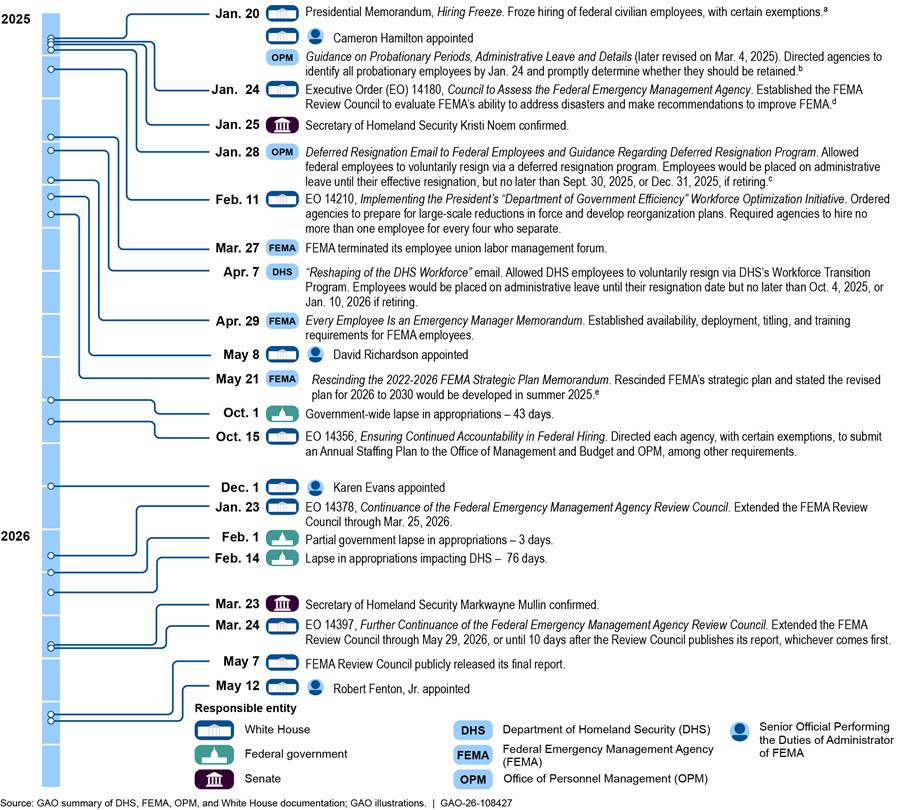
aExemptions include military personnel of the armed forces and positions related to immigration enforcement, national security, and public safety.
bA later email stated agencies should separate probationary employees not designated as “mission critical” by February 17, 2025. Two federal district courts issued orders temporarily pausing the termination of probationary employees and required their reinstatement at approximately 20 agencies. See Maryland v. USDA, No. 1:25-CV-00748 (D. Md. Mar. 13, 2025); Am. Fed’n of Gov’t Emp., AFL-CIO v. OPM, No. 3:25-cv-01780 (N.D. Cal. Feb. 19, 2025). These orders were stayed, respectively, by the U.S. Court of Appeals for the 4th Circuit and the U.S. Supreme Court. In the former case, in September 2025, the U.S. Court of Appeals for the 4th Circuit found that the states lacked standing, and the district court subsequently dismissed the lawsuit. Also in September, the U.S. District Court for the Northern District of California issued an order prohibiting OPM from directing any other agency to terminate the employment of any federal employee. The government subsequently filed a notice of appeal, which is ongoing as of July 2026.
cThis action was challenged in court, but the U.S. district court dismissed the case for lack of jurisdiction and lack of standing. The plaintiffs appealed the decision to the U.S. Court of the Appeals for the First Circuit. Am. Fed’n of Gov’t Emp., AFL-CIO v. Ezell, Case No, 1:25-cv-10276 (D. Mass. Feb. 4, 2025).
dThe FEMA Review Council was initially established for a period of one year.
eAs of April 2026, FEMA has not issued a revised strategic plan.
The Federal Emergency Management Agency (FEMA) was taking steps prior to 2025 to address staffing gaps identified in 2023 and 2024. Historically, FEMA has established workforce targets to identify how many total employees are needed within each title to successfully accomplish its mission.[79] As previously mentioned, we reported in 2023 that FEMA faced challenges with its workforce and had staffing gaps in many of its cadres.
FEMA had developed workforce targets for fiscal year 2023, 2024, and 2025, according to officials.[80] In addition, according to July 2024 agency documentation, FEMA had implemented the goal that all Incident Management cadres must achieve their workforce targets by the end of fiscal year 2026.[81] However, these workforce targets were suspended in 2025, according to FEMA officials.
We found that in 2023 and 2024, FEMA continued to face staffing gaps between its workforce targets and its actual workforce in various cadres, but it was making progress.[82] According to FEMA officials, in 2024, FEMA was taking steps to meet its workforce targets. For example, FEMA was taking steps to streamline its workforce target process by setting up a designated office within FEMA to work with cadre leadership to identify appropriate targets, according to officials. Further, officials in seven out of 10 FEMA regions told us that prior to the 2025 hiring freeze they were taking steps to hire employees and focus their recruitment efforts to fill high priority gaps.
We found that on October 1, 2023, 13 of FEMA’s 23 Cadres were less than 70 percent filled.[83] However, a little over a year later, on November 12, 2024, four fewer than the prior year were less than 70 percent filled. Cadres such as Field Leadership and Public Assistance faced some of the largest staffing gaps on both days. See figure 8 for staffing gaps for each of these dates by cadre.
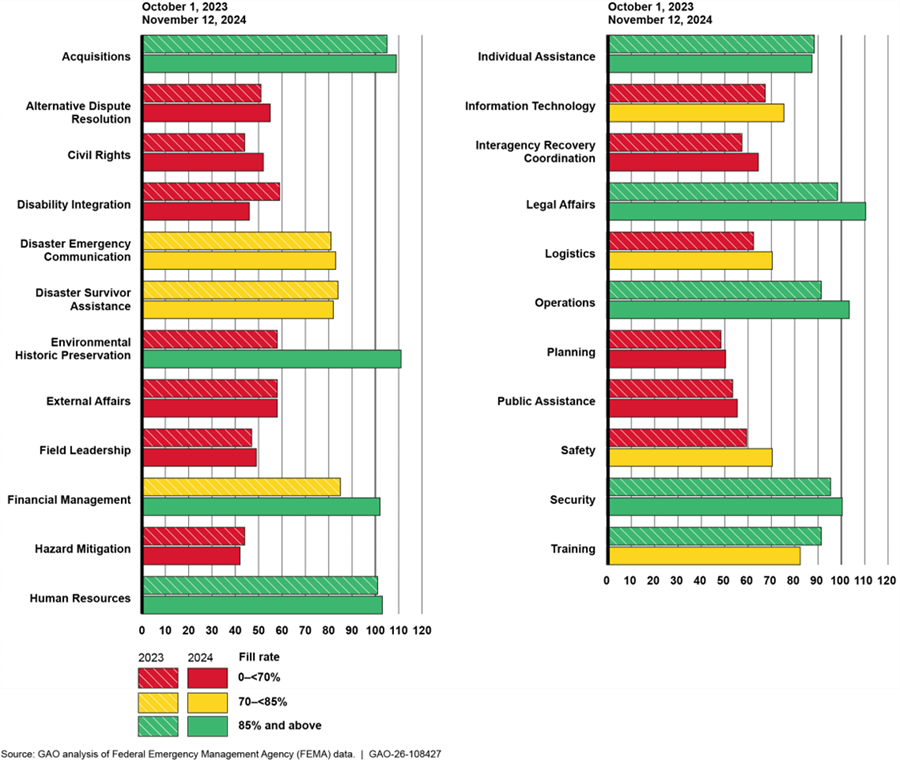
Notes: Fill rate indicates the percentage rate by which FEMA fills or makes progress toward its estimated workforce targets with its actual workforce. We based the ranges for fill rates on ranges FEMA used in its documentation.
FEMA uses the Deployment Tracking System to track workforce targets and the number of current FEMA staff at any given time. The Deployment Tracking System does not have the capability to calculate averages or retrieve data retroactively, according to FEMA officials. For this reason, we used data from dates that FEMA had available.
In July 2026, FEMA officials told us that FEMA has 22 cadres after merging the Civil Rights and Disability Integration cadres.
Chris Currie, CurrieC@gao.gov
In addition to the contact named above Sonja Ware (Assistant Director), Hadley Nobles (Analyst in Charge), Holland Freeman Casenhiser, Elizabeth Dretsch, Eric Hauswirth, Caitlin Jackson, Tracey King, and Kevin Reeves made key contributions to this report.
The Government Accountability Office, the audit, evaluation, and investigative arm of Congress, exists to support Congress in meeting its constitutional responsibilities and to help improve the performance and accountability of the federal government for the American people. GAO examines the use of public funds; evaluates federal programs and policies; and provides analyses, recommendations, and other assistance to help Congress make informed oversight, policy, and funding decisions. GAO’s commitment to good government is reflected in its core values of accountability, integrity, and reliability.
Obtaining Copies of GAO Reports and Testimony
The fastest and easiest way to obtain copies of GAO documents at no cost is through our website. Each weekday afternoon, GAO posts on its website newly released reports, testimony, and correspondence. You can also subscribe to GAO’s email updates to receive notification of newly posted products.
Order by Phone
The price of each GAO publication reflects GAO’s actual cost of production and distribution and depends on the number of pages in the publication and whether the publication is printed in color or black and white. Pricing and ordering information is posted on GAO’s website, https://www.gao.gov/ordering.htm.
Place orders by calling (202) 512-6000, toll free (866) 801-7077,
or
TDD (202) 512-2537.
Orders may be paid for using American Express, Discover Card, MasterCard, Visa, check, or money order. Call for additional information.
Connect with GAO
Connect with GAO on X,
LinkedIn, Instagram, and YouTube.
Subscribe to our Email Updates. Listen to our Podcasts.
Visit GAO on the web at https://www.gao.gov.
To Report Fraud, Waste, and Abuse in Federal Programs
Contact FraudNet:
Website: https://www.gao.gov/about/what-gao-does/fraudnet
Automated answering system: (800) 424-5454
Media Relations
Sarah Kaczmarek, Managing Director, Media@gao.gov
Congressional Relations
David A. Powner, Acting Managing Director, CongRel@gao.gov
General Inquiries
[1]GAO, High-Risk Series: Heightened Attention Could Save Billions More and Improve Government Efficiency and Effectiveness, GAO‑25‑107743 (Washington, D.C.: Feb. 25, 2025).
2GAO, FEMA Disaster Workforce: Actions Needed to Improve Hiring Data and Address Staffing Gaps, GAO‑23‑105663 (Washington, D.C.: May 2, 2023); and FEMA Workforce: Long-Standing and New Challenges Could Affect Mission Success, GAO‑22‑105631 (Washington, D.C.: Jan. 20, 2022). For more information about FEMA’s long-standing workforce management challenges, see appendix I. We have made recommendations over the years to improve FEMA’s workforce management issues. While FEMA has made progress implementing many of these recommendations, challenges remain.
[4]GAO, Disaster Assistance High-Risk Series: Federal Response Workforce Readiness, GAO‑25‑108598 (Washington, D.C.: Sept. 2, 2025).
[5]GAO, Disaster Assistance High-Risk Series: FEMA Assistance for Disaster Survivors, GAO‑26‑108154 (Washington, D.C.: Apr. 22, 2026).
[6]GAO, Federal Agency Workforce Changes: Update for July 2025 to January 2026, GAO‑26‑108583 (Washington, D.C.: June 17, 2026) and Federal Agency Workforce Changes: Update for January to June 2025, GAO‑26‑108719 (Washington, D.C.: Feb. 24, 2026).
[7]See appendix II for a timeline of key executive branch actions and policy changes that affected FEMA in 2025 and 2026.
[8]Exec. Order No. 14180, Council to Assess the Federal Emergency Management Agency, 90 Fed. Reg. 8743 (Jan. 31, 2025).
[9]See, e.g., H.R.152, 119th Cong. (2025), H.R. 316, 119th Cong. (2025), H.R. 1245, 119th Cong. (2025), H.R. 2342, 119th Cong. (2025), H.R. 4669, 119th Cong. (2025), S. 861, 119th Cong. (2025).
[10]GAO conducted this review in response to the American Relief Act, 2025 and requests from congressional members. The American Relief Act, 2025, includes a provision for GAO to conduct audits and investigations related to Hurricanes Helene and Milton, and other disasters declared pursuant to the Robert T. Stafford Disaster Relief and Emergency Assistance Act (Stafford Act) in calendar years 2023 and 2024. Pub. L. No. 118-158, 138 Stat. 1723, 1754 (2024).
[11]The National Finance Center is a shared service provider for financial management services and human resources management services for federal agencies including FEMA.
[12]Cadres are groups of FEMA employees organized by type of work (organizational or programmatic function). The Deployment Tracking System is maintained by FEMA’s Workforce Management Division, which coordinates personnel deployment programs under the Stafford Act. The Deployment Tracking System assigns and tracks the deployment of disaster response and recovery personnel.
[13]FEMA has historically established workforce targets to identify how many total employees are needed within each title (disaster response role or responsibility) to successfully meet its mission. However, according to FEMA officials, in 2025 FEMA made various changes in the titling process as a result of new requirements that all employees receive a title. Therefore, we could not use workforce targets for fiscal years 2025 and 2026 to identify staffing gaps as we did for previous years. Specifically, employees who were not previously titled received new titles, and some outdated or unneeded titles were archived. As a result, FEMA’s workforce target data in fiscal years 2025 and 2026 include changes in titling and do not reflect how many people were hired to fill specific workforce gaps.
[14]Office of Personnel Management, Workforce Planning Guide, ES-03483-11/2022 (Washington, D.C.: Nov. 2022).
[15]GAO, Federal Workforce: Key Talent Management Strategies for Agencies to Better Meet Their Mission, GAO‑19‑181 (Washington, D.C.: Mar. 28, 2019) and Human Capital: Key Principles for Effective Strategic Workforce Planning, GAO‑04‑39 (Washington, D.C.: Dec. 11, 2003).
[16]6 U.S.C. § 313(b)(1).
[17]42 U.S.C. § 5121 et seq.
[18]See 42 U.S.C. §§ 5170, 5191.
[19]This number includes major disasters, emergencies, and fire management assistance.
[20]Pub. L. No. 107-296, § 503, 116 Stat. 2135, 2213.
[21]6 U.S.C. § 313.
[22]6 U.S.C. § 316.
[23]42 U.S.C. § 5149(b)(1).
[24]6 U.S.C. § 711.
[25]This number includes 6,674 reservists and five local hire employees serving on 120-day appointments, according to FEMA officials.
[26]FEMA’s cadre program areas are: Acquisitions, Alternative Dispute Resolution, Civil Rights, Disability Integration, Disaster Emergency Communications, Disaster Field Training Operations, Disaster Survivor Assistance, Environmental Historic Preservation, External Affairs, Field Leadership, Financial Management, Hazard Mitigation, Human Resources, Individual Assistance, Information Technology, Logistics, Interagency Recovery Coordination, Office of Chief Counsel, Operations, Planning, Public Assistance, Safety, and Security. In July 2026, FEMA officials told us that the Civil Rights and Disability Integration cadres had merged.
[27]For example, a permanent full-time employee may work day-to-day in a FEMA headquarters office, such as FEMA’s Office of Policy and Program Analysis, but may also serve as a Logistic Specialist in FEMA’s Logistics cadre when deployed if the employee completed the relevant qualification requirements, such as a certification for a specific task. Similarly, when deployed to a disaster, Surge Capacity Force volunteers are assigned to a cadre based on their skillset.
[28]See GAO‑25‑108598.
[29]In July 2026, FEMA officials told us that due to changes in policy over the last year, FEMA no longer distinguishes between the Incident Workforce and Staffing Augmentation Workforce. According to FEMA officials, personnel with incident management or incident support titles are activated and deployed based on their employee type and duty station. Personnel from within the impacted region are deployed, followed by national field forward assets, such as incident management COREs and Reservists, then followed by staff from FEMA headquarters and full-time staff located outside the impacted region.
[30]In 2025, FEMA assigned every headquarters and regional full-time employee a primary or auxiliary incident management or incident support title, except for employees with a required service title. FEMA employees with an incident management or incident support title may have more than one title, according to FEMA officials. Further, auxiliary (secondary) incident management titles are generally within a given staff member’s career progression track and are most often in a lower-level position for which they were previously qualified, such as a manager holding a subordinate title in a specialist position. Prior to 2025, not all employees were titled, according to FEMA officials.
[31]5 U.S.C. § 1101.
[33]Office of Personnel Management, Workforce Planning Guide.
[34]January 10, 2026, was the last day for immediate retirement that qualified under the DHS Workforce Transition Program, one of the workforce reduction programs available to FEMA employees.
[35]Permanent full-time and Senior Executive Service employees were generally eligible for both programs. For the OPM program, eligible employees also included CORE employees but did not include employees in the Office of National Continuity Programs. FEMA’s Office of National Continuity Programs guides the planning, implementation and assessment of continuity programs that enable federal, state, local, tribal and territorial governments to continue performing essential functions and delivering critical services when typical operations are disrupted by an emergency. For the DHS program, probationary and reemployed annuitants were not eligible to participate. Intermittent staff who are on-call respond to respond to disasters, such as reservists and local hires, and part-time employees were not eligible for either program.
[36]In general, probationary employees have not completed the service requirements necessary to finalize their appointments because they have been in their positions for less than one year.
[37]According to FEMA officials, of the 159 probationary employees terminated in fiscal year 2025, 144 employees were terminated in February 2025.
[38]Order on Cross-Motions for Summary Judgment, Am. Fed’n of Gov’t Emp., AFL-CIO v. OPM, No. 3:25-cv-01780 (N.D. Cal. Sept. 12, 2025) (ECF No. 261). The government filed an appeal of this decision, and the case is ongoing. Am. Fed’n of Gov’t Emp., AFL-CIO v. OPM, No. 25-5875 (9th Cir. Sept. 18, 2025).
[39]Declaration of Roland Edwards in Response to the Court’s September 12, 2025, Order, Am. Fed’n of Gov’t Emp., AFL-CIO v. OPM, No. 3:25-cv-01780 (N.D. Cal. Nov. 21, 2025) (ECF No. 272-7).
[40]The External Affairs cadre engages stakeholders in Congress; the media; state, local, tribal, and territorial governments; the private sector; and internal FEMA employees during incidents and steady state operations. The Logistics cadre coordinates and monitors all aspects of resource planning and movement, among other things, during the life of an incident. While DHS made some exceptions to the hiring freeze for “mission critical roles,” officials told us that not all hard-to-fill positions were determined to be mission critical by DHS.
[41]CORE employees generally serve 2-to-4-year terms. CORE appointments end on the not-to-exceed date of an appointment, unless the appointment is extended or renewed based on FEMA’s evolving operational needs and workload.
[42]In court filings, FEMA has provided slightly different numbers of CORE employees affected by the nonrenewals. In Senior Official Performing the Duties of Administrator Karen Evans’ declaration in February 2026, she stated that FEMA had 303 CORE employees with not-to-exceed dates from January 1, 2026, through January 31, 2026, and that 192 of them were not reappointed. However, DHS rescinded nonrenewals for 33 of those 192 CORES within one week, resulting in 159 non-renewals in January 2026. Declaration of Karen S. Evans in Support of Defendants’ Opposition to Plaintiffs’ Motion for a Preliminary Injunction, Am. Fed’n of Gov’t Emp., AFL-CIO v. Trump, No. 3:25-cv-03698 (N.D. Cal. Feb. 19, 2026) (EFC No. 312-1). A May declaration by the Acting Chief Human Capital Officer stated that between January 1, 2026, and January 21, 2026, FEMA had 178 CORE employees whose terms were set to end in that period. Thirty of those employees resigned or retired from employment before their terms of employment expired, leaving 148 CORE employees whose terms expired in January 2026. Declaration of Jeff M. Neurauter, Am. Fed’n of Gov’t Emp., AFL-CIO v. Trump, No. 3:25-cv-03698 (N.D. Cal. May 7, 2026) (ECF No. 383-1).
[43]Am. Fed’n of Gov’t Emp, AFL-CIO v. Trump, No. 3:25-cv-03698 (N.D. Cal. Jan. 30, 2026). As previously mentioned, CORE employees are temporary full-time FEMA employees hired to directly support response and recovery efforts related to disasters.
[44]According to court filings, FEMA offered the 148 CORE employees whose terms expired in January 2026 new terms of appointment of 6 months or one year, depending on the needs of the agency. Of these employees, 94 accepted the offer, 14 declined, and 40 had not yet responded. Declaration of Jeff M. Neurauter, Am. Fed’n of Gov’t Emp., AFL-CIO v. Trump, No. 3:25-cv-03698(N.D. Cal. May 7, 2026) (ECF No. 383-1). As of July 2026, cross motions for partial summary judgment had been filed, and the case was ongoing.
[45]See The White House, Hiring Freeze, 90 Fed. Reg. 8247 (Jan. 28, 2025); Memorandum on Extension of Hiring Freeze (Apr. 17, 2025); and Ensuring Accountability and Prioritizing Public Safety in Federal Hiring (July 7, 2025).
[46]Exec. Order No. 14356, Ensuring Continued Accountability in Federal Hiring, 90 Fed. Reg. 48387 (Oct. 20, 2025). The order does not apply to the Executive Office of the President; noncareer positions requiring Presidential appointment or Senate confirmation; non-career positions in the Senior Executive Service; Schedule C or Schedule G positions in the excepted service; military personnel of the Armed Forces; positions related to immigration enforcement, national security, or public safety; or appointment of officials through temporary organization hiring authority.
[47]Exec. Order No. 14356, Ensuring Continued Accountability in Federal Hiring, 90 Fed. Reg. 48387 (Oct. 20, 2025).
[48]FEMA officials told us that across the agency DHS approved five job series as mission critical occupations as of September 2025. However, according to FEMA officials, FEMA was not allowed to hire externally during the hiring freeze, even for those five occupations. Further, officials also told us that they requested an additional 15 positions be included as mission critical. We recently reported that FEMA has taken steps to request additional staffing for positions which are highly technical such as those conducting environmental and historic preservation reviews. However, as of February 2026, requests for additional staff had not been approved due to the hiring freeze, according to FEMA officials. See, GAO, Puerto Rico Grid Recovery: Limited Progress Towards Stability and Opportunities Exist to Improve Federal Assistance, GAO‑26‑107772 (Washington, D.C.: June 2, 2026).
[50]Based on our data reliability assessment, we concluded that FEMA’s workforce target data for 2023 and 2024 were sufficiently reliable for our purposes. However, similar data for 2025 and 2026 were not comparable for our reporting purposes of identifying staffing gaps in 2025 and 2026 due to changes the agency made to its collection.
[51]According to FEMA, 347 positions, such as contract specialist, federal coordinating officer, regional administrator, and security specialist, among others, where identified as priority positions.
[52]According to agency data, 24 Senior Executive Service employees separated from the agency between January 25, 2025, and June 1, 2025, just before the start of the 2025 hurricane season.
[53]In some cases, staff who are backfilling vacant leadership positions or filling new roles in an acting capacity are not receiving the compensation for the positions they are filling. Rather, they are receiving the salary and benefits of their prior position, according to officials.
[54]Pub. L. No. 111-352, 124 Stat. 3866 (2011); Office of Management and Budget, Circular No. A-11: Preparation, Submission, and Execution of the Budget (Washington, D.C.: Aug. 29, 2025).
[55]Office of Personnel Management, Workforce Planning Guide.
[56]According to FEMA officials, these documents are being revised in accordance with FEMA’s standard document revision cycle. Officials stated that FEMA Directive 112-12: Development and Management of FEMA Policy and Doctrine identifies the cycle time for when all FEMA policies and doctrines are to undergo review and revision.
[57]The goal of the FEMA Review Council is to advise the President—through the Assistant to the President for National Security Affairs, the Assistant to the President for Homeland Security, and the Director of the Office of Management and Budget—on the existing ability of FEMA to capably and impartially address disasters occurring within the United States and to advise the President on all recommended changes related to FEMA to best serve the national interest. The FEMA Review Council was comprised of 13 members including the Departments of Homeland Security and Defense Secretaries; current and former state Governors; state and local officials and emergency managers; and FEMA officials. Exec. Order No. 14180, Council to Assess the Federal Emergency Management Agency, 90 Fed. Reg. 8743 (Jan. 31, 2025).
[58]The FEMA Review Council announced five public meetings in the Federal Register: May 20, 2025; July 9, 2025; August 28, 2025; December 11, 2025; and May 7, 2026. The December meeting was canceled.
[59]The White House first issued an extension to the FEMA Review Council through March 25, 2026. Exec. Order No. 14378, Continuance of the Federal Emergency Management Agency Review Council, 91 Fed. Reg. 3993 (Jan. 29, 2026). The White House then issued another extension to the FEMA Review Council in March 2026. Exec. Order No. 14397, Further Continuance of the Federal Emergency Management Agency Review Council, 91 Fed. Reg. 15509 (March 27, 2026).
[60]The FEMA Review Council, Final Report: The President’s Council to Assess the Federal Emergency Management Agency (May 7, 2026).
[61]Exec. Order No. 14180, Council to Assess the Federal Emergency Management Agency, 90 Fed. Reg. 8743 (Jan. 31, 2025).
[62]OPM’s Workforce Planning Guide states that workforce planning is a systematic and continuous process for identifying the size and composition of a workforce needed to achieve an organization’s goals and objectives. The guidance outlines a five-step process to be used continually to meet workforce planning objectives. These steps include setting an agency’s strategic direction, conducting a workforce analysis, developing a workforce action plan, implementing and monitoring the plan, and evaluating and revising the plan to continuously improve results. See Office of Personnel Management, Workforce Planning Guide.
[63]According to GAO’s Key Talent Management Strategies, agencies should assess the skills, competencies, and workforce numbers needed to achieve their objectives. See GAO‑19‑181.
[65]According to FEMA officials, while FEMA program management reviewed the extent to which participation in the Voluntary Separation Incentive Payment program portion would harm mission capacity, FEMA did not review the effect of participation in DHS’s Deferred Resignation Program or the Voluntary Early Retirement Authority on mission capacity. FEMA officials told us that program management only reviewed certain positions for the Voluntary Separation Incentive Payment portion of the DHS Workforce Transition because participation in that program would result in the elimination of that position. However, FEMA officials told us that if an employee was opting to participate in multiple Workforce Transition Program offerings, they had no input on whether the separation of that employee would impact mission capacity.
[66]Specifically, the memo stated that all staff must be assigned a title within FEMA’s incident management or incident support workforce categories, with a limited set of employees assigned a title in the required services category. Headquarters and regional full-time employees received a primary and/or an auxiliary title. Managers reviewed all current titles held by headquarters and regional full-time employees and removed titles that were no longer needed or relevant from employees’ responsibilities. According to officials in some regions, revising and updating titles has encouraged regions to title employees in multiple roles or ensure that existing titles are accurate, up to date, and aligned with the region’s needs. Further, officials said that updating employee titles was beneficial because it enabled them to identify staffing or skills gaps and archive titles that are no longer needed to respond to disasters.
[67]We have previously reported on the challenges FEMA has faced with employees not accepting a deployment order when available. See GAO‑20‑360.
[68]According to a DHS email, components were tasked with distributing the staffing plan template to their lowest-level offices to complete specific sections as part of the “bottom-up” approach.
[69]According to FEMA officials, DHS also tasked FEMA with developing an interim staffing plan focused on filling the large number of vacancies in FEMA leadership positions considered to be critical vacancies.
[70]For more information about FEMA’s long-standing workforce management challenges and our recommendations, see appendix I.
[71]GAO, FEMA Disaster Workforce: Actions Needed to Address Deployment and Staff Development Challenges, GAO‑20‑360 (Washington, D.C.: May 4, 2020).
[72]GAO, Puerto Rico Hurricanes: Status of FEMA Funding, Oversight, and Recovery Challenges, GAO‑19‑256 (Washington, D.C.: Mar. 14, 2019).
[73]For more information on our prior work on FEMA’s long-standing workforce management challenges, see GAO, FEMA Workforce: Long-Standing and New Challenges Could Affect Mission Success, GAO‑22‑105631 (Washington, D.C.: Jan. 20, 2022); Emergency Management: FEMA Has Made Progress, but Challenges and Future Risks Highlight Imperative for Further Improvements, GAO‑19‑617T (Washington, D.C.: June 25, 2019); and Disaster Response: FEMA Has Made Progress Implementing Key Programs, but Opportunities for Improvement Exist, GAO‑16‑87 (Washington, D.C.: Feb. 5, 2016).
[74]GAO, FEMA Disaster Workforce: Actions Needed to Improve Hiring Data and Address Staffing Gaps, GAO‑23‑105663 (Washington, D.C.: May 2, 2023).
[76]GAO, Disaster Assistance High-Risk Series: Federal Response Workforce Readiness, GAO‑25‑108598 (Washington, D.C.: Sept. 2, 2025).
[77]GAO, Disaster Assistance High-Risk Series: FEMA Assistance for Disaster Survivors, GAO‑26‑108154 (Washington, D.C.: Apr. 22, 2026).
[78]GAO, High-Risk Series: Heightened Attention Could Save Billions More and Improve Government Efficiency and Effectiveness, GAO‑25‑107743 (Washington, D.C.: Feb. 25, 2025).
[79]In prior reports we referred to workforce targets as force structure targets. For additional information, see GAO, FEMA Disaster Workforce: Actions Needed to Improve Hiring Data and Address Staffing Gaps, GAO‑23‑105663 (Washington, D.C.: May 2, 2023). For the purposes of this report, we refer to force structure targets as workforce targets.
[80]To determine its workforce targets—also called force structure targets—FEMA uses the Force Structure Modification Process. This process uses statistical modeling methods to estimate the baseline number of staff FEMA needs within each cadre. These high-level targets are adjusted on an annual basis if there is a program change or other justification that a cadre may have for scaling up or down. According to FEMA officials, force structure targets have not been formally reviewed or replaced as of July 2026.
[81]FEMA, Memorandum Operations Cadre Interim Hiring Ceiling Increase, (Washington, D.C.: July 30, 2024).
[82]FEMA uses the Deployment Tracking System to track its workforce targets and actual size of its workforce–also called force strength actuals or force capacity—on a daily basis. For the purposes of this report, we refer to force strength actuals as FEMA’s actual workforce. The Deployment Tracking System does not have the capability to calculate averages or retrieve data retroactively, according to FEMA officials. For this reason, we used data that FEMA had available from October 1, 2023, and November 12, 2024.
[83]In July 2026, FEMA officials told us that FEMA has 22 cadres after merging the Civil Rights and Disability Integration cadres.