
Report to Congressional Requesters
United States Government Accountability Office
A report to congressional requesters
Contacts: Anne Sit-Williams at sitwilliamsa@gao.gov or Elizabeth Repko at repkoe@gao.gov
What GAO Found
The Infrastructure Investment and Jobs Act (IIJA) and Inflation Reduction Act (IRA) provided budget authorities for transportation, infrastructure, and energy projects. Together, the four agencies selected for this review—the Environmental Protection Agency (EPA), Department of the Interior (Interior), National Telecommunications and Information Administration (NTIA), and Department of Transportation (DOT)—obligated a majority of their IIJA or IRA funding.
· IIJA. Of the approximately $574.7 billion provided to them, the four agencies obligated about 76 percent and disbursed about 54 percent of obligated funds for fiscal years 2022 to 2025.
· IRA. Of the around $53.7 billion provided to them, EPA, Interior, and DOT obligated about 72 percent and disbursed about 60 percent of obligated funds for fiscal years 2022 through 2025. In July 2025, Congress rescinded $6.4 billion of the three agencies’ unobligated IRA funds per agencies’ data.
Most selected agencies reported developing new processes to review IIJA and IRA funding in response to dozens of executive orders issued starting January 20, 2025. The agencies used a variety of approaches to implement reviews, such as searching for terms from executive orders like “diversity” or “environmental justice.” Senior leadership for all selected agencies made final decisions on whether awards should be approved without modification, modified (funded with changes to terms or amounts), or canceled (discontinued), according to selected agencies’ officials and documentation. The extent to which agencies continued to obligate and disburse IIJA and IRA funds during their reviews varied within and across agencies.
As a result of their reviews, selected agencies reported approving about 9,500 awards ($128 billion) and canceling about 800 ($17.8 billion). More than 2,500 awards were pending a decision ($33.6 billion) as of varying dates shown below.
Status of Selected Agencies’ Infrastructure Investment and Jobs Act and Inflation Reduction Act Funding Reviews, as of the Dates Indicated
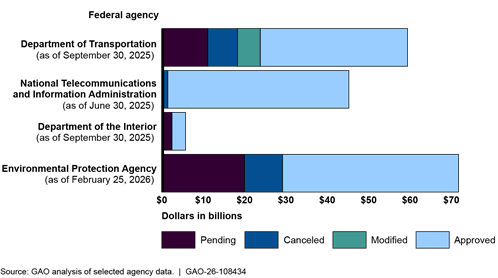
Note: Canceled awards include terminated, rescinded, or withdrawn awards, or awards discontinued by a recipient.
Why GAO Did This Study
The IIJA and IRA provided billions in federal funding to agencies to distribute through mechanisms like grants and loans. Beginning in January 2025, executive orders directed agencies to pause this funding to review it for consistency with administration priorities. Grant recipients have raised concerns that delays in distributing these funds affect their ability to implement their projects.
GAO was asked to review the status of IIJA and IRA funding. This report describes selected agencies’ (1) IIJA and IRA budget authority, obligations, rescissions, and disbursements for fiscal years 2022 to 2025; (2) processes for reviewing IIJA and IRA funding in response to executive orders; and (3) IIJA and IRA funding review status.
To address these objectives, GAO selected agencies with among the highest amount of combined IIJA and IRA funding. Of these agencies, GAO selected EPA, Interior, NTIA, and DOT for this report. GAO will report on the Department of Energy and Department of Agriculture separately.
GAO analyzed the IIJA and IRA and financial data from agencies’ accounting systems and the agencies’ policies and guidance for reviewing IIJA and IRA funding. GAO also analyzed and summarized selected agency review data and found these data to be sufficiently reliable for the purpose of describing the status of reviews with some limitations. For example, EPA and NTIA did not provide all requested data. GAO also interviewed selected agency officials for each of the objectives.
|
Abbreviations |
|
|
|
|
|
Assistant Secretary |
Assistant Secretary of Policy, Management and Budget |
|
BEAD |
Broadband Equity, Access and Deployment Program |
|
DOT |
Department of Transportation |
|
EPA |
Environmental Protection Agency |
|
FAA |
Federal Aviation Administration |
|
FAR |
Federal Acquisition Regulation |
|
FHWA |
Federal Highway Administration |
|
GGRF |
Greenhouse Gas Reduction Fund |
|
IIJA |
Infrastructure Investment and Jobs Act |
|
IRA |
Inflation Reduction Act |
|
NTIA |
National Telecommunications and Information Administration |
|
OA |
Operating Administration |
|
OBBBA |
One Big Beautiful Bill Act |
|
OMB |
Office of Management and Budget |
|
OST |
Office of the Secretary of Transportation |
This is a work of the U.S. government and is not subject to copyright protection in the United States. The published product may be reproduced and distributed in its entirety without further permission from GAO. However, because this work may contain copyrighted images or other material, permission from the copyright holder may be necessary if you wish to reproduce this material separately.
July 22, 2026
Congressional Requesters
The Infrastructure Investment and Jobs Act (IIJA) and Inflation Reduction Act (IRA) provided billions in federal funding to agencies to support a wide range of efforts, such as the development of transportation and energy infrastructure.[1] Starting on January 20, 2025, the President issued executive orders that directed federal agencies to review, revise, or cancel some or all of their IIJA or IRA funding. In response to executive orders and new administration priorities, some federal agencies reviewed their funding for consistency with these priorities. Some agencies paused their disbursement of IIJA or IRA funds during their reviews. States, nonprofits, and other award recipients have publicly reported concerns that delays in the distribution of these funds could affect their ability to implement their projects and risked agencies’ ability to achieve objectives identified in the IIJA and IRA.
You asked us to review the status of IIJA and IRA funding. This report describes
1. selected agencies’ IIJA and IRA budget authority, and related rescissions, obligations, and disbursements for fiscal years 2022 to 2025;[2]
2. selected agencies’ processes for reviewing IIJA and IRA funding in response to executive orders and administration priorities; and
3. the status of selected agencies’ IIJA and IRA funding reviews.
To address these objectives, we selected four agencies for which the IIJA and IRA provided among the highest amount of combined appropriations: the Environmental Protection Agency (EPA), Department of the Interior, the Department of Commerce’s National Telecommunications and Information Administration (NTIA), and the Department of Transportation (DOT).[3] These four agencies were provided $628.4 billion in combined IIJA and IRA budget authority available for all or part of the fiscal year 2022 through fiscal year 2025 period.[4] More information on each agency’s IIJA and IRA funding status can be found in appendix I (EPA), appendix II (Interior), appendix III (NTIA), and appendix IV (DOT).
We initially selected six agencies with the highest amount of combined IIJA and IRA funding, including the Department of Energy and Department of Agriculture. We will report on the status of IIJA and IRA funding for these two agencies in a forthcoming report.[5]
To describe selected agencies’ IIJA and IRA budget authority, rescissions, obligations, and disbursements from fiscal year 2022 to fiscal year 2025, we analyzed the IRA, the IIJA, and certain related statutes; interviewed agency officials; and analyzed financial data from the selected agencies’ accounting systems or USAspending.gov.[6] To assess the reliability of these data, we interviewed agency officials and compared the financial information to other available sources, such as the Department of the Treasury’s Centralized Accounting Reporting System or applicable statutes. Based on our analysis, we found the data agencies reported to us to be sufficiently reliable for our purposes with some limitations. EPA, Interior, and DOT provided these data as of September 30, 2025, the most recent data at the time of our request. However, NTIA provided us with data through June 30, 2025, but as of December 2025 declined to provide additional data on obligations and disbursements from July 1, 2025, through September 30, 2025.
To describe selected agencies’ processes for reviewing IIJA and IRA funding in response to executive orders and administration priorities, we obtained and analyzed the selected agencies’ policies and guidance for reviewing IIJA and IRA funds. We also conducted interviews or obtained written responses from agency officials responsible for overseeing or implementing the reviews. The information we obtained from these interviews is not generalizable to any reviews that other federal agencies may have conducted. We asked agency officials to describe the agency’s funding review process, including roles and responsibilities and review documentation, guidance, and timelines. Based on our analysis of this information, we identified similarities and differences across our selected agencies.
To describe the status of selected agencies’ IIJA and IRA funding reviews, we reviewed agencies’ data on the status of their reviews. We assessed the reliability of the funding review status data by manually reviewing the data for anomalies (such as duplicate entries), interviewing agency officials, and reviewing publicly available information, among other steps. We determined these data to be sufficiently reliable for describing the reported status of selected agencies’ IIJA and IRA funding reviews. Because we could not corroborate the accuracy of agencies’ funding review status data against other available information, the status we report reflects the information agencies reported to us. We also identified some limitations in the data:
· NTIA provided us with data on the status of its funding review through June 30, 2025, but as of December 2025 declined to provide additional data through the end of fiscal year 2025. However, NTIA subsequently provided some information covering July 2025 through September 2025, as well as technical comments on the draft report, and we incorporated that information into our report where relevant and appropriate.
· The status of EPA’s efforts to recover $20 billion it had disbursed to a private bank that served as the financial agent for two Greenhouse Gas Reduction Fund programs is unclear.[7] While EPA announced that it canceled the grants associated with these programs, its data still show the grants to be fully obligated as of March 2026. As a result, we reported these funds as pending a final outcome.
We conducted this performance audit from April 2025 to July 2026 in accordance with generally accepted government auditing standards. Those standards require that we plan and perform the audit to obtain sufficient, appropriate evidence to provide a reasonable basis for our findings and conclusions based on our audit objectives. We believe that the evidence obtained provides a reasonable basis for our findings and conclusions based on our audit objectives.
Background
Federal Funding Process Overview
Federal law provides funds to agencies through appropriations and contract authority, among other ways. Agencies either spend funds directly, such as on employee salaries, or award these funds to other entities through a variety of different mechanisms. For IIJA and IRA funding that agencies reviewed in response to executive orders and administration priorities, these include the following:
· Formula grants. Agencies distribute grant funds to eligible recipients in accordance with a distribution formula prescribed by law or administrative regulation.[8]
· Discretionary grants. Under a discretionary grant program, agencies generally award funds to eligible recipients through a process in which agency officials review and select applications for alignment with criteria, in keeping with specific statutory authority.[9]
· Cooperative agreements. Using cooperative agreements, federal agencies award funds similarly to grants. The key difference is that under a cooperative agreement, the federal agency providing the assistance is expected to have substantial involvement with the recipient in carrying out the funded activity, whereas substantial involvement is not expected under a grant agreement.[10]
· Direct loans. A direct loan is a disbursement of funds by the government to a nonfederal borrower under an agreement that requires the repayment of such funds either with or without interest.[11]
· Contracts. In the context of federal acquisition, contracts are mutually binding legal relationships obligating a seller to furnish supplies or services and the buyer, a federal agency, to pay for them. In this context, contracts do not include grants and cooperative agreements.[12]
· Interagency agreements. An interagency agreement is a written agreement entered into between two federal agencies, or major organizational units within an agency, which specifies the goods to be furnished or tasks to be accomplished by one agency (the servicing agency) in support of the other (the requesting agency).[13]
Award funding follows a life cycle from statutory authorization or appropriation through award closeout. For GAO’s review, two key agency actions in this life cycle are obligation and disbursement.
· An obligation is a definite commitment that creates a legal liability of the government for the payment of goods and services ordered or received.[14] An obligation may also be a legal duty on the part of the United States that could mature into a legal liability by virtue of actions on the part of the other party beyond the control of the United States.[15] The creation of an obligation does not necessarily lead to immediate expenditure of obligated funds.
· A disbursement is a payment made by a federal agency, by cash or cash equivalent, to liquidate a federal obligation.[16] For example, a disbursement can occur when an agency reimburses a grant recipient for the federal share of the costs of the project for which the agency obligated funds.
An agency may only obligate funds during the period in which they are available. Specifically, statutes may provide funds with a fixed period of availability, which is a definite amount of time that funds are available to agencies for obligation.[17] Statutes may also provide “no-year” funds, which are funds that remain available for agency obligation for an indefinite period of time or until expended.
Formula grant funding is generally considered obligated when appropriations for the program are enacted and become available for obligation.[18] For other awards, the time it takes an agency to obligate funds varies by agency and funding mechanism. Some agencies obligate funds when they publicly announce and issue an award. Other agencies obligate funds months or even years after announcing an award because, for example, recipients must satisfy certain requirements, like environmental reviews, before the agency obligates the grant funding.[19]
Similarly, after an agency obligates its funding, the time it takes to disburse such funding to a recipient varies by agency and award and is often based on actions taken by the recipient. For example, agencies may reimburse recipients for expenses in increments driven by the progress of a recipient’s project. Disbursements may be for payment of obligations made in prior years.
Agencies may also cancel or modify awards at different points in their life cycle, which may be subject to certain requirements that depend on the type of award and reason for cancellation.[20]
· Cancellation, in the context of our report, means that an award was discontinued for any of a variety of reasons. For example, this may include termination of an obligated award, awards for which funding was rescinded by law, retraction of an unobligated award previously announced, and discontinuance initiated by a recipient.
· Modification, in the context of our report, means that an agency or recipient changed the terms or amount of the award, but the project continues with federal support. It includes both unobligated and obligated awards.
Federal law may establish requirements for agency reporting of obligations and disbursements. For example, executive agencies must report obligation and disbursement data for each of their appropriations accounts to USAspending.gov.[21] Congress may also request further information. For example, the Joint Explanatory Statement on the Consolidated Appropriations Act, 2026 directed DOT to submit information on all awarded but unobligated discretionary grant funding, as well as certain other types of project funding, to certain congressional committees within 120 days of the enactment of the act and at a specified interval thereafter.[22]
Infrastructure Investment and Jobs Act and Inflation Reduction Act
The IIJA and IRA provided funding to federal agencies for a range of projects and programs.
IIJA. In November 2021, Congress passed the IIJA, which provided funding to federal agencies to support transportation; clean energy; broadband; and other infrastructure projects, such as for roads and bridges.[23] The IIJA provided agencies with funding to award through a variety of mechanisms, including formula grants, discretionary grants, loans, and other types of funding.
The time periods in which IIJA required agencies to obligate their IIJA funding varied. For the selected agencies, some funds are available for an indefinite period of time, while other funds have specific periods of availability after which any unobligated funds will expire.
IRA. In August 2022, Congress passed the IRA, which provided funding for new and existing federal financial assistance programs that support emissions reductions, renewable energy, climate resilience, and energy efficient infrastructure, among other purposes.[24] The IRA provided funding to agencies, in some cases specifying that agencies could use them to award funds through grant, contracts, and other mechanisms.
Like the IIJA, the time periods in which IRA required agencies to obligate their IRA funding varied. For the selected agencies, some funds expire between fiscal years 2024 and 2031; other funds are available for an indefinite period of time.
Subsequent statutes rescinded or transferred some budget authority provided in the IIJA and IRA. In July 2025, the unobligated balances for many IRA-funded programs were rescinded by Public Law 119-21, commonly known as the One Big Beautiful Bill Act (OBBBA).[25] Additionally, in February 2026, the Consolidated Appropriations Act, 2026, rescinded and transferred unobligated balances of IIJA funding for certain programs.[26]
Executive Orders
Beginning on January 20, 2025, the President issued multiple executive orders that identified administration priorities and directed federal agencies to review or revise some or all of their IIJA and IRA funding for consistency with these priorities (see table 1).
Table 1: Selected Executive Orders Related to Agencies’ Review of Infrastructure Investment and Jobs Act (IIJA) and Inflation Reduction Act (IRA) Funding
|
Executive order |
Summary of provisions related to agencies’ review of IIJA and IRA funding |
|
Ending Radical and Wasteful Government DEI Programs and Preferencing Exec. Order No. 14151, 90 Fed. Reg. 8339 (Jan. 20, 2025) |
Directs agencies to, among other things, (1) terminate to the maximum extent allowed by law “equity-related” grants and (2) provide the Director of the Office of Management and Budget (OMB) with a list of all federal grantees who received federal funding to advance diversity, equity, inclusion, or accessibility or “environmental justice” programs, services, or activities since January 2021. Agencies are to conduct these activities in consultation with the Attorney General, the Director of OMB, and the Director of the Office of Personnel Management, as appropriate. |
|
Unleashing American Energy Exec. Order No. 14154, 90 Fed. Reg. 8353 (Jan. 20, 2025) |
Directs agencies to, among other things, (1) immediately pause the disbursement of IRA and IIJA funds and (2) review their processes, policies, and programs for issuing grants, loans, contracts, or any other financial disbursements of such funds for consistency with the law and administration energy-related policies as described in the executive order. Agencies are to submit the results of their review to the Director of OMB and Assistant to the President for Economic Policy and are not to disburse these funds until the Director of OMB and Assistant to the President for Economic Policy have determined that such disbursements are consistent with review recommendations. |
|
Implementing the President’s “Department of Government Efficiency” Cost Efficiency Initiative Exec. Order No. 14222, 90 Fed. Reg. 11095 (Feb. 26, 2025) |
Directs agencies to, among other things, review covered grants in consultation with the Department of Government Efficiency and, where appropriate and consistent with applicable law, terminate or modify covered contracts or reallocate spending to promote efficiency and advance administration policies. Prioritizes review of funds disbursed under covered grants to educational institutions and foreign entities. |
Source: GAO analysis of selected executive orders. | GAO‑26‑108434
Note: GAO identified these executive orders based on those that selected agencies reported using to prompt or guide their reviews of IIJA and IRA grant funding. This is not intended to be an exhaustive list of all executive orders related to agencies’ reviews of IIJA and IRA funding.
Obligation and Disbursement of IIJA and IRA Funds Varied Across Selected Agencies
Selected Agencies Obligated About Three-Quarters of Their IIJA Funds and Disbursed Just Over Half of the Obligated Amounts
In total, the IIJA provided approximately $574.7 billion for fiscal year 2022 through fiscal year 2025 to the four agencies we selected.[27] Collectively, the agencies obligated about $434.2 billion (76 percent) of their IIJA funds and disbursed about $235.6 billion (54 percent) of their obligated funds. In total, these agencies ultimately disbursed about 41 percent of their IIJA budget authority for fiscal year 2022 to fiscal year 2025.[28] As shown in figure 1, the extent to which these agencies obligated and disbursed their IIJA funds varied.
Figure 1: Selected Agencies’ Infrastructure Investment and Jobs Act Budget Authority, Obligations, and Disbursements for Fiscal Years 2022 to 2025, as of Dates Indicated
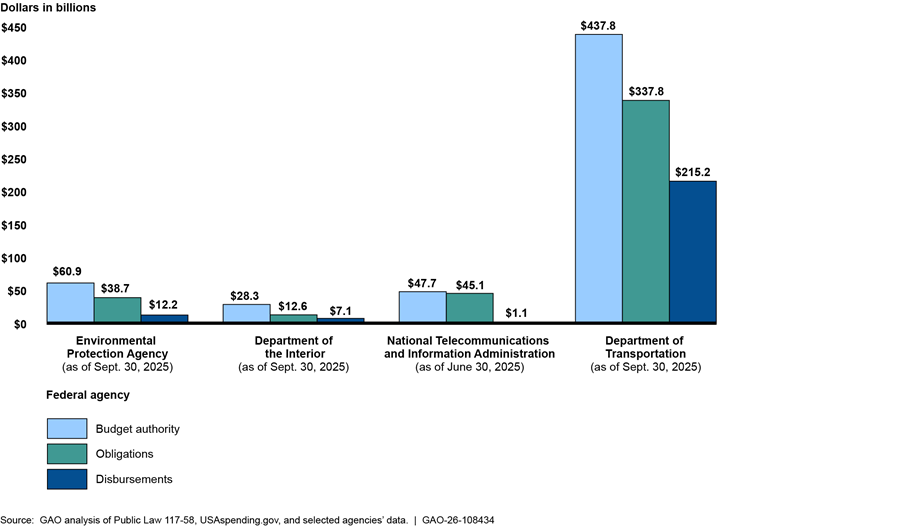
Note: We did not include budget authority for which the entire period of availability occurs after September 30, 2025, as these funds were not available for obligation during the period we reviewed. For the Department of Transportation, we only included budget authority provided for grant programs.
The extent to which each selected agency obligated its IIJA funds varied for reasons such as the extent to which recipients satisfied obligation requirements or because of legal requirements that govern when an agency can obligate funds. For example, about 40 percent of Interior’s IIJA appropriations funded its Abandoned Mine Lands program, a program that grants funds to eligible states and Tribes to address public health and safety and environmental hazards associated with abandoned coal mines on eligible lands. The law requires Interior to obligate funds in an equal amount annually for this program over 15 years.[29]
Similarly, selected agencies’ disbursement of IIJA funds varied for reasons such as timing of recipients’ projects. For instance, about 89 percent of NTIA’s IIJA funding was for the Broadband Equity, Access and Deployment Program (BEAD), a formula-based grant program to support deployment of broadband infrastructure in underserved areas. NTIA disbursed about 2 percent of the funding it obligated, likely due to the status of its programs. For example, according to NTIA officials, most BEAD awards had not yet reached the project implementation phase—the phase at which NTIA disburses funds to recipients—as of June 30, 2025. In June 2025, NTIA published a BEAD Restructuring Policy Notice, which rescinded approvals of recipients’ final proposed plans, modified BEAD requirements, and required recipients to submit new plans aligned with the modified requirements.
Also, while we did not collect data to allow us to analyze if any unobligated funds expired in fiscal year 2025, two agencies reported IIJA funding that expired on October 1, 2025. DOT reported that $370.6 million in IIJA funds expired on October 1, 2025, and $101.9 million became unavailable to the original announced recipients and were subject to reallocation.[30] Additionally, Interior reported that $91,000 of IIJA funds appropriated to its U.S. Geological Survey office had expired.
Selected Agencies Obligated About Three-Quarters of Their IRA Funds and Disbursed More Than Half of the Obligated Amounts
The IRA provided $53.7 billion for fiscal years 2022 through fiscal year 2025 to three of the four selected agencies.[31] In total, these agencies obligated about $38.8 billion (72 percent) of their IRA funds and disbursed about $23.3 billion (60 percent) of the funds they obligated as of September 30, 2025. In total, these agencies ultimately disbursed about 43 percent of IRA budget authority for fiscal year 2022 through fiscal year 2025 to recipients as of September 30, 2025.
In July 2025, the OBBBA rescinded the unobligated balances for certain IRA-funded programs.[32] In total, the three selected agencies that received IRA funds reported that the OBBBA rescinded at least $6.4 billion of the $53.7 billion (12 percent) that the IRA provided to them. For example, the OBBBA rescinded unobligated balances for DOT’s Neighborhood Access and Equity program ($2.3 billion), EPA’s Environmental and Climate Justice Block Grants program ($479 million), and Interior’s program for hiring National Park Service employees ($414 million), among other programs.[33] As shown in figure 2, the extent to which these agencies obligated and disbursed their IRA funds varied.
Figure 2: Selected Agencies’ Inflation Reduction Act (IRA) Appropriations, Obligations, Disbursements, and Rescissions of Unobligated Funds for Fiscal Years 2022 Through 2025, as of September 30, 2025
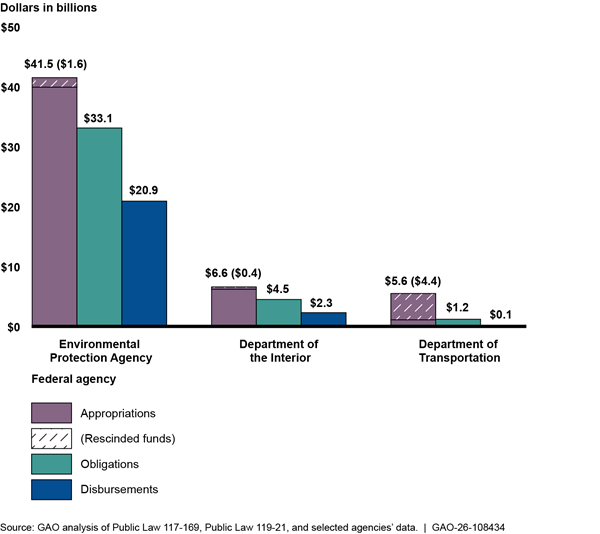
Note: We did not include budget authority for which the entire period of availability occurs after September 30, 2025, as these funds were not available for obligation during the period we reviewed. The IRA did not provide funding for the National Telecommunications and Information Administration. In July 2025, Public Law 119-21, commonly known as the One Big Beautiful Bill Act, rescinded the unobligated balances of several programs for which the IRA appropriated funding to the Environmental Protection Agency, Department of the Interior, and Department of Transportation (DOT). For DOT, we only included budget authority provided for grant programs.
Similar to the IIJA obligations described above, the extent to which each agency obligated or disbursed its IRA funds varied for reasons such as program structure or the type of projects funded. For example, while DOT obligated around 20 percent of its IRA funding, it obligated 98 percent of its funding for Fueling Aviation’s Sustainable Transition – Technology program. This program supported projects related to low-emission aviation technologies. According to DOT, certain requirements (e.g., environmental reviews) do not apply to these projects, which could result in shorter obligation timelines.
Moreover, depending on program structure, agency-reported disbursements may not reflect actual payments to a program recipient. For example, almost half of the funding the IRA provided to EPA was for the National Clean Investment Fund and the Clean Communities Investment Accelerator programs, which together with Solar for All, constitute the IRA Greenhouse Gas Reduction Fund. EPA reported that it obligated and disbursed all of the almost $20 billion the IRA provided for these two programs. However, according to EPA officials, the amount that EPA reported as disbursements is currently under litigation and frozen at a private bank that serves as the financial agent for two of the Greenhouse Gas Reduction Fund programs, rather than being available for use by program recipients.[34]
Most Selected Agencies Developed New Processes to Review IIJA and IRA Funding in Response to Executive Orders
In response to a wide range of executive orders, selected agencies reported initiating reviews of IIJA and IRA funding announced or obligated between January and March 2025, with three agencies using new review processes.[35] While agency processes varied, all agencies relied on senior leaders to make final decisions about award approvals, modifications, and cancellations, according to agency documentation and officials. Similarly, while three of the four agencies paused some funding during their reviews, the extent to which agencies continued to obligate and disburse funding during these reviews varied.
Executive Orders Prompted Most Selected Agencies to Develop New Review Processes
All selected agencies reported that executive orders prompted their review of IIJA and IRA funding that agencies announced or obligated before January 20, 2025. Guidance and officials from selected agencies identified dozens of executive orders that prompted or guided their reviews. The effect of each of these executive orders on the selected agencies’ review processes varied because the scope of an executive order may not be applicable to each agency. However, all four selected agencies reported that Executive Order 14154, Unleashing American Energy, prompted or guided their review of IIJA and IRA funding.[36] In addition to executive orders, two of the four agencies (NTIA and Interior) reported that Office of Management and Budget (OMB) memos and guidance also prompted or influenced their reviews of IIJA and IRA funding.
Most selected agencies developed new processes to implement their funding reviews. Specifically, officials from three of the four selected agencies reported that their agency developed its IIJA or IRA funding review processes on or after January 20, 2025. In contrast, according to EPA officials, EPA used an existing process to review IIJA and IRA funding. These officials reported that EPA leadership has historically reviewed already-awarded grant funding with every change in administration.
Agencies initiated most IIJA and IRA funding reviews within weeks of the issuance of the executive orders they cited. Three of four agencies issued internal memos or guidance directing IIJA and IRA funding reviews between January 21, 2025, and March 30, 2025.
Additionally, three agencies conducted more than one review of IIJA and IRA funding in response to executive orders or administration priorities. The scope and timing of these reviews varied and were prompted by different executive orders or guidance. Specifically:
· NTIA reviewed the same awards twice—once in January 2025 and again in March 2025. In January 2025, NTIA initiated a review of its IIJA awards in response to an OMB memo.[37] NTIA reviewed the awards again in March 2025, in response to Executive Order 14222, Implementing the President’s “Department of Government Efficiency” Cost Efficiency Initiative.[38]
· In March 2025, DOT began concurrently reviewing unobligated and obligated awards using different processes and in response to different executive orders. Specifically, a DOT task force reviewed awards that were announced, but unobligated as of January 20, 2025, in response to multiple executive orders.[39] Concurrently, DOT’s operating administrations and Office of the Secretary of Transportation offices reviewed obligated funds awarded between January 20, 2021, and January 20, 2025.
· According to Interior officials and documentation, from January 2025 through February 2025, Interior reviewed all IIJA and IRA programs. In September 2025, Interior began a review of IIJA and IRA awards, in response to Executive Order 14154, Unleashing American Energy, which directed agencies, among other things, to review funding for consistency with the administration’s energy-related policies.[40] During the same period, starting in February 2025, Interior reviewed each individual obligation to determine alignment with other applicable executive orders, including Executive Order 14151, which directs agencies, among other things, to terminate “equity-related” grants.[41]
Senior Leaders Made Award Decisions
All four selected agencies relied on decisions by senior leadership about whether awards should be approved (without modification), approved but modified, or canceled (discontinued, including withdrawing funding for announced and unobligated awards, or terminating obligated awards), according to agency documentation and officials. Program offices across the four agencies played different roles in IIJA and IRA funding reviews.
· The review process at three of the four agencies (DOT, NTIA, and Interior) started with program offices and culminated with decisions by senior leadership. In these agencies, program offices reviewed and made recommendations on whether specific awards or programs should be approved, modified, or canceled. Senior leaders reviewed these recommendations and made final award decisions.
· At one agency—EPA—senior leadership conducted the review, made final decisions about IIJA and IRA awards, and communicated these decisions to its grants management office.
Two agencies (DOT and NTIA) reported using keyword searches or similar approaches to identify awards for leadership review. According to agency documents and officials, these agencies flagged awards for potential conflicts with administration priorities by identifying awards with key terms from relevant executive orders, such as “diversity,” “equity,” “inclusion,” and “environmental justice.” If award documents included these terms, program offices provided the award to leadership to make approval, modification, or cancellation decisions. In some cases, agencies also identified awards with terms specific to the scope of the agency’s missions and responsibilities for leadership review. For example, DOT directed offices to identify projects with scopes that included elements such as bicycle or electric vehicle infrastructure for potential conflicts with certain executive orders and administration priorities, identified in DOT guidance.[42]
Three Agencies Paused Obligations or Disbursements During Review
The extent to which selected agencies continued to obligate and disburse IIJA and IRA funds during their reviews also varied both across and within agencies. For example:
· EPA. According to a declaration in a civil case, EPA temporarily paused disbursements for IRA awards selected for cancellation. This included awards in the Environmental and Climate Justice program. EPA continued to disburse IIJA and IRA funds for awards not selected for cancellation.[43]
· Interior. According to agency officials and documents, Interior intermittently paused all obligations and disbursements of IIJA and IRA funds to allow for funding reviews.
· NTIA. NTIA officials told us that they continued obligating and disbursing funds during their review.
· DOT. DOT officials told us that, while the agency continued to disburse funding for already-obligated awards during its review, it did not obligate funds for announced but unobligated awards until they had been reviewed and approved by the Secretary of Transportation.
Agencies Reported Approving the Majority of the Funding Under Review but Had Not Yet Decided on Thousands of Awards
Selected agencies reported that they approved approximately 9,500 awards totaling about $128 billion as of various dates from June 2025 to February 2026. The four agencies also reported that they had yet to make decisions on more than 2,500 awards totaling about $33.6 billion and reported canceling about 800 awards totaling about $18 billion.[44] NTIA and DOT reported between February and April 2026 that they had made final decisions on many of these pending awards. The extent to which agency reviews of IIJA and IRA funding delayed disbursement and obligation of these funds varied, according to agency officials.
Agencies Reported Approving Most Funding, but Tens of Billions in Funding Remained Under Review
The four agencies reported that they approved about 9,500 of the approximately 13,000 awards (74 percent) they reviewed with or without modifications, totaling more than $128 billion.[45] Of these agencies, EPA reported approving the largest share of the awards under its review (90 percent), while NTIA approved the largest share of funding under its review (96 percent).
Three of the four agencies (EPA, NTIA, and DOT) reviewed awards at the project level. In contrast, Interior reviewed and approved individual obligations and disbursements for programs as part of its review process. However, Interior announced in September 2025 that it approved all outstanding invoices submitted as of September 19, 2025. As a result, Interior’s awards approved without modification reflect the status of disbursements made.
The four agencies reported that they had yet to make decisions on 2,528 awards totaling about $33.6 billion, $20 billion of which consists of two of EPA’s IRA-funded Greenhouse Gas Reduction Fund grant programs, as of various dates from June 30, 2025, to February 25, 2026. While the EPA Administrator announced termination of these programs, according to public reporting, these funds remain frozen in the private bank that serves as these programs’ financial agent as of April 2026. EPA has not provided additional information on the status of these funds. As a result, we treat these funds as pending a final decision.
The status of selected agencies’ reviews of IIJA and IRA awards is shown below (see table 2). We requested that agencies provide the status of their reviews as of September 30, 2025. However, agencies provided their status as of dates ranging from June 30, 2025, to February 25, 2026.
Table 2: Status of Selected Agencies’ Reviews of Infrastructure Investment and Jobs Act (IIJA) and Inflation Reduction Act (IRA) Awards as of Dates Indicated (Dollars in Billions)
|
Federal agency |
Amount approved without modification (number of awards) |
Amount approved with modification (number of awards) |
Amount canceleda (number of awards) |
Amount pending final outcome (number of awards) |
Total amount subject to review (number of awards) |
|
Environmental Protection Agency (as of February 25, 2026)b |
$42.5 (3,388) |
- |
$9.2 (372) |
$20.0 (8)c |
$71.7 (3,768) |
|
Department of the Interior (as of September 30, 2025) |
$2.1 (2,787)d |
$0 (4)e |
$0 (56)e |
$2.3 (1,992) |
$4.5 (4,839) |
|
National Telecommunications and Information Administration (as of June 30, 2025) |
$43.8 (294) |
- |
$1.4 (120)f |
$0.2 (8)g |
$45.4 (491) |
|
Department of Transportation (as of September 30, 2025) |
$34.4 (2,270) |
$5.5 (841) |
$7.2 (248)h |
$11.1 (520) |
$60.5 (3,879) |
|
Total |
$122.8 (8,739) |
$5.5 (845) |
$17.8 (796) |
$33.6 (2,528) |
$182.1 (12,977) |
Source: GAO analysis of data from selected agencies and interviews with agency officials. | GAO‑26‑108434
Note: Dashes indicate that the agency stated there were not any awards in that specific category. Number of awards and total funding amounts may not equal the sum of each column for a variety of reasons. For example, agencies may not have taken any action on all (or a portion) of an award due to external circumstances, but that award was no longer under review and so is not pending a final decision. Such situations could occur if, for instance, a recipient completed a project before the agency made a decision on an award.
aFor the purposes of our report, an award with a status of “canceled” includes any obligated or unobligated award or that did not continue. Cancellation includes the termination of obligated awards by agencies or recipients, as well as the withdrawal of announced but unobligated awards due to agency decisions, recipient cancellation, or statutory rescissions.
bWhile the Environmental Protection Agency (EPA) provided these data as of February 25, 2026, EPA officials told us they had previously completed the agency’s review of awards in summer 2025. Therefore, we concluded that data are not substantially different from those from September 30, 2025.
cEPA provided us with the status of individual IIJA and IRA awards it reviewed. In March 2025, the EPA Administrator announced termination of $20 billion of grant agreements awarded under two IRA Greenhouse Gas Reduction Fund programs. However, according to EPA’s review, these grants remain fully obligated as of March 2026. The status of these funds is unclear due to ongoing litigation, and the undistributed funds continue to be frozen in the private bank that serves as the program’s financial agent.
dFor the Department of the Interior, this amount and number represent disbursements approved. According to Interior officials, Interior approved all outstanding invoices submitted as of September 19, 2025. Therefore, they considered the disbursement amount the best representation of awards approved without modification.
eFor Interior, the four modified awards totaled $3 million and the 56 canceled awards totaled approximately $33 million; therefore, these amounts round to zero dollars.
fAccording to National Telecommunications and Information Administration (NTIA) officials, NTIA terminated Digital Equity Act awards in response to direction from the Secretary of Commerce separate from the review process. This included 58 awards that were previously obligated and subsequently terminated and 62 applications NTIA had recommended for award but had not yet obligated, which were subsequently withdrawn.
gNTIA officials reported in February 2026 that NTIA ultimately canceled five of the eight pending awards and modified the scope of the remaining three. We did not include this information in the table above because NTIA did not provide information on when and how it made these decisions.
hThe Department of Transportation (DOT) reported that 178 awards totaling just over half of the $7.2 billion canceled were canceled by recipients or had funding rescinded by statute, and DOT terminated or withdrew 70 awards totaling $3.4 billion.
As shown in table 2, selected agencies canceled about 800 awards, worth a combined total of about $18 billion. EPA and DOT accounted for $16.4 billion (over 90 percent) of these canceled awards. EPA’s Solar for All program under the Greenhouse Gas Reduction Fund accounts for $7.0 billion, or about 39 percent, of the canceled amount. In addition, according to DOT officials, over half ($3.8 billion) of the awarded funding DOT reported as canceled ($7.2 billion) was a result of either statutory rescissions or because recipients canceled awards. DOT officials stated that recipients may cancel awards for reasons such as the inability to match federal funds.
Though selected agencies provided us with data through dates falling between June 2025 and February 2026, agency officials or public information provided some updates on agency reviews as of April 2026. Specifically:
· Interior. As of April 1, 2026, Interior continued to review obligations and disbursements for alignment with Executive Order 14154 and other executive orders issued since January 20, 2025, and had yet to make decisions on most obligations and disbursements, according to agency officials.
· NTIA. As of February 2026, NTIA withdrew five of the eight pending awards and modified the scope of the remaining three, according to NTIA.
· DOT. Officials reported that through April 24, 2026, DOT approved an additional 228 projects totaling $139 million and withdrew three projects totaling $31 million. DOT officials told us that as of April 2026, 293 awards remained under review.
While all four agencies reported canceling awards, two agencies—DOT and NTIA—decided to cancel some funding separately from the processes described above. For example, NTIA officials told us that Digital Equity Act awards were terminated because the President determined that the program was not constitutional, and not as part of the review process.[46] Nearly half of the Digital Equity Act awards had been obligated prior to NTIA’s review and were approved through NTIA’s IIJA funding review process before they were subsequently terminated.[47]
Most Agencies Reported No Effects on Obligations or Disbursement Time Frames from Their Reviews
While we did not review data on the timing of agencies’ obligations and disbursements, agencies reported that their reviews of IIJA and IRA funding had varying effects on the timeliness of obligations and disbursements of these funds. For example, Interior told us that their IIJA and IRA funding reviews resulted in a longer-than-usual time frame for obligating and disbursing some funding. Specifically, of the 19 bureaus and offices within Interior that administer IIJA or IRA funds, 13 told us that their time frames for approval and disbursement of those funds have been delayed because of the reviews.[48] As of April 2026, agency officials told us that Interior had not made final determinations as to whether to resume most awards funded by IIJA and IRA for the programs that required further review, and that the agency has not set a deadline for completion of its review.
In contrast, three agencies (DOT, NTIA, and EPA) told us that they did not believe their review processes resulted in delays. For example, DOT officials told us that because DOT typically takes several years to obligate funding after announcing an award, they did not believe the additional time DOT took to review announced but unobligated IIJA and IRA awards resulted in delays.
Agency Comments
We provided a draft of this report to EPA, Interior, Commerce, and DOT for review and comment. The agencies provided technical comments, which we incorporated as appropriate.
We are sending copies of this report to the Administrator of the Environmental Protection Agency, the Secretary of the Interior, the Secretary of Commerce, and the Secretary of Transportation. In addition, the report is available at no charge on the GAO website at https://www.gao.gov.
If you or your staffs have any questions about this report, please contact Anne Sit-Williams sitwilliamsa@gao.gov or Elizabeth Repko at repkoe@gao.gov. Contact points for our Offices of Congressional Relations and Media Relations may be found on the last page of this report. GAO staff who made key contributions to this report are listed in appendix V.
Anne Sit-Williams
Director
Financial Management and Assurance
Elizabeth Repko
Director
Physical Infrastructure
List of Requesters
The Honorable Amy Klobuchar
Ranking Member
Committee on Agriculture, Nutrition, and Forestry
United States Senate
The Honorable Jared Huffman
Ranking Member
Committee on Natural Resources
House of Representatives
The Honorable Yassamin Ansari, House of Representatives
The Honorable Becca Balint, House of Representatives
The Honorable Nanette Diaz Barragán, House of Representatives
The Honorable Joyce Beatty, House of Representatives
The Honorable Donald S. Beyer, Jr., House of Representatives
The Honorable Sanford D. Bishop, Jr., House of Representatives
The Honorable Brendan F. Boyle, House of Representatives
The Honorable Shontel M. Brown, House of Representatives
The Honorable Julia Brownley, House of Representatives
The Honorable Nikki Budzinski, House of Representatives
The Honorable Salud Carbajal, House of Representatives
The Honorable Ed Case, House of Representatives
The Honorable Sean Casten, House of Representatives
The Honorable Gilbert Ray Cisneros, Jr., House of Representatives
The Honorable Yvette D. Clarke, House of Representatives
The Honorable Emanuel Cleaver, II, House of Representatives
The Honorable Steve Cohen, House of Representatives
The Honorable J. Luis Correa, House of Representatives
The Honorable Jim Costa, House of Representatives
The Honorable Jasmine Crockett, House of Representatives
The Honorable Danny K. Davis, House of Representatives
The Honorable Diana DeGette, House of Representatives
The Honorable Chris Deluzio, House of Representatives
The Honorable Mark DeSaulnier, House of Representatives
The Honorable Adriano Espaillat, House of Representatives
The Honorable Dwight Evans, House of Representatives
The Honorable Cleo Fields, House of Representatives
The Honorable Shomari Figures, House of Representatives
The Honorable Bill Foster, House of Representatives
The Honorable Laura Friedman, House of Representatives
The Honorable Maxwell Alejandro Frost, House of Representatives
The Honorable John Garamendi, House of Representatives
The Honorable Jesús G. “Chuy” García, House of Representatives
The Honorable Robert Garcia, House of Representatives
The Honorable Sylvia R. Garcia, House of Representatives
The Honorable Dan Goldman, House of Representatives
The Honorable Maggie Goodlander, House of Representatives
The Honorable Jim Himes, House of Representatives
The Honorable Chrissy Houlahan, House of Representatives
The Honorable Val Hoyle, House of Representatives
The Honorable Glenn Ivey, House of Representatives
The Honorable Jonathan L. Jackson, House of Representatives
The Honorable Sara Jacobs, House of Representatives
The Honorable Pramila Jayapal, House of Representatives
The Honorable Julie Johnson, House of Representatives
The Honorable Marcy Kaptur, House of Representatives
The Honorable Robin L. Kelly, House of Representatives
The Honorable Timothy M. Kennedy, House of Representatives
The Honorable Ro Khanna, House of Representatives
The Honorable Raja Krishnamoorthi, House of Representatives
The Honorable Greg Landsman, House of Representatives
The Honorable Rick Larsen, House of Representatives
The Honorable George Latimer, House of Representatives
The Honorable Susie Lee, House of Representatives
The Honorable Teresa Leger Fernandez, House of Representatives
The Honorable Mike Levin, House of Representatives
The Honorable Ted W. Lieu, House of Representatives
The Honorable Zoe Lofgren, House of Representatives
The Honorable Doris Matsui, House of Representatives
The Honorable Lucy McBath, House of Representatives
The Honorable April McClain Delaney, House of Representatives
The Honorable Betty McCollum, House of Representatives
The Honorable James P. McGovern, House of Representatives
The Honorable LaMonica McIver, House of Representatives
The Honorable Gregory W. Meeks, House of Representatives
The Honorable Gwen S. Moore, House of Representatives
The Honorable Jared Moskowitz, House of Representatives
The Honorable Seth Moulton, House of Representatives
The Honorable Kevin Mullin, House of Representatives
The Honorable Jerrold Nadler, House of Representatives
The Honorable Joe Neguse, House of Representatives
The Honorable Eleanor Holmes Norton, House of Representatives
The Honorable Johnny “Johnny O” Olszewski, Jr., House of Representatives
The Honorable Jimmy Panetta, House of Representatives
The Honorable Scott H. Peters, House of Representatives
The Honorable Brittany Pettersen, House of Representatives
The Honorable Mark Pocan, House of Representatives
The Honorable Mike Quigley, House of Representatives
The Honorable Delia C. Ramirez, House of Representatives
The Honorable Emily Randall, House of Representatives
The Honorable Jamie Raskin, House of Representatives
The Honorable Deborah K. Ross, House of Representatives
The Honorable Andrea Salinas, House of Representatives
The Honorable Mary Gay Scanlon, House of Representatives
The Honorable Robert C. “Bobby” Scott, House of Representatives
The Honorable Adam Smith, House of Representatives
The Honorable Eric Sorensen, House of Representatives
The Honorable Darren Soto, House of Representatives
The Honorable Melanie Stansbury, House of Representatives
The Honorable Greg Stanton, House of Representatives
The Honorable Haley M. Stevens, House of Representatives
The Honorable Marilyn Strickland, House of Representatives
The Honorable Suhas Subramanyam, House of Representatives
The Honorable Mark Takano, House of Representatives
The Honorable Shri Thanedar, House of Representatives
The Honorable Bennie G. Thompson, House of Representatives
The Honorable Mike Thompson, House of Representatives
The Honorable Dina Titus, House of Representatives
The Honorable Jill Tokuda, House of Representatives
The Honorable Ritchie J. Torres, House of Representatives
The Honorable Lori Trahan, House of Representatives
The Honorable Lauren Underwood, House of Representatives
The Honorable Juan Vargas, House of Representatives
The Honorable Nydia M. Velázquez, House of Representatives
The Honorable Debbie Wasserman Schultz, House of Representatives
The Honorable Maxine Waters, House of Representatives
The Honorable Nikema Williams, House of Representatives
The Infrastructure Investment and Jobs Act (IIJA) and Inflation Reduction Act (IRA) provided a combined $102.4 billion in budget authority for fiscal year 2022 through fiscal year 2025 to the Environmental Protection Agency (EPA) to support various environmental programs.[49] Beginning on January 20, 2025, the President issued multiple executive orders that identified administration priorities and directed federal agencies to review or revise some or all of their grant funding for consistency with these priorities.
In late January 2025, EPA’s leadership began an agencywide review of existing grants, including those funded by IIJA and IRA appropriations, for alignment with these executive orders. EPA leadership completed its review of individual grants in summer 2025 and subsequently canceled 372 IRA awards totaling about $9.2 billion, while not canceling any IIJA awards.[50] In addition, the EPA Administrator announced the cancellation in March and August 2025 of $27 billion in grants awarded under the IRA Greenhouse Gas Reduction Fund, which included the National Clean Investment Fund, the Clean Communities Investment Accelerator, and Solar for All programs.[51] Though EPA reported canceling the grants awarded under the National Clean Investment Fund and the Clean Communities Investment Accelerator programs, EPA data show the grants associated with these two programs to be fully obligated as of March 2026.
EPA’s IIJA and IRA Appropriations, Obligations, Disbursements, and Rescissions
IIJA Funding
The IIJA provided about $60.9 billion of budget authority to EPA for fiscal years 2022 through 2026.[52] As of September 30, 2025, EPA had obligated almost two-thirds of its IIJA appropriations ($38.7 billion) and disbursed almost one-third ($12.2 billion) of the funding it had obligated, according to EPA data. As of September 30, 2025, EPA disbursed about 20 percent of IIJA budget authority for fiscal years 2022 through 2026.
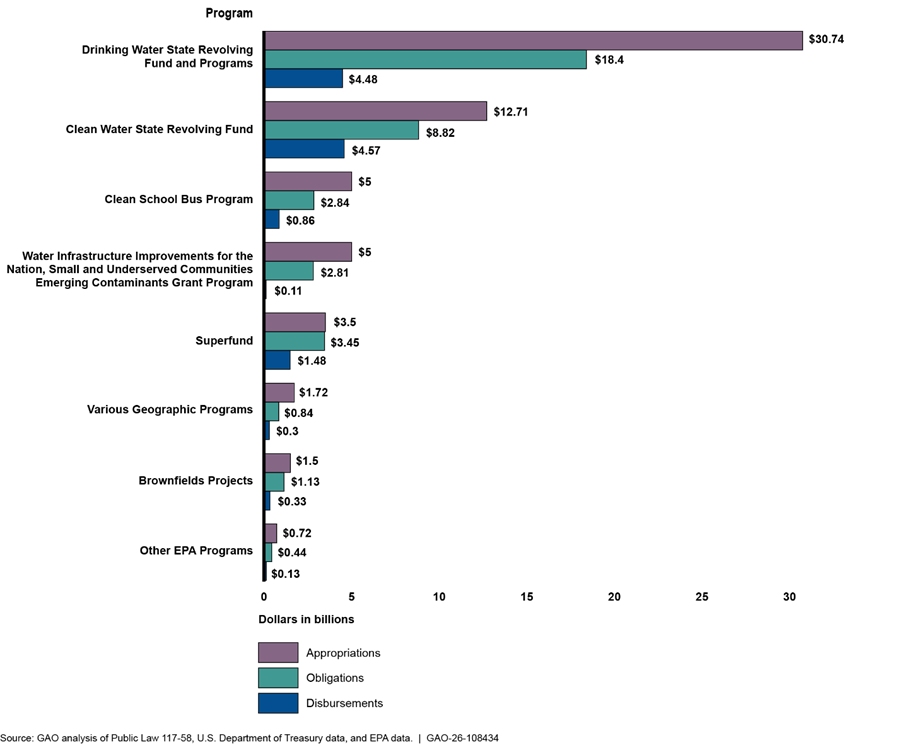
EPA’s Drinking Water State Revolving Fund formula grant program accounts for about half of its IIJA appropriations ($30.7 billion). EPA obligated about 60 percent of the appropriations for this program and disbursed almost 25 percent of the obligated amount as of September 30, 2025. Figure 3 presents the status of IIJA appropriations, obligations, and disbursements among EPA’s various IIJA-funded programs.
Figure 3: Environmental Protection Agency (EPA) Infrastructure Investment and Jobs Act Appropriations, Obligations, and Disbursements as of September 30, 2025
Note: We did not include budget authority for which the entire period of availability occurs after September 30, 2025, as these funds were not available for obligation during the period we reviewed. Appropriated funds include certain amounts designated for administrative costs and EPA operations. As a result, these amounts may not be available for awarding grants.
IRA Funding
The IRA provided EPA approximately $41.5 billion in budget authority for grants, technical assistance, and administrative expenses to reduce greenhouse gas emissions and enhance climate resilience, among other things. As of September 30, 2025, EPA had obligated more than three-quarters of its available IRA appropriations for fiscal years 2022 through 2025 ($33.1 billion) and disbursed more than half ($20.8 billion) of the funding it had obligated, according to EPA data. As of September 30, 2025, EPA disbursed about 50 percent of IRA appropriations for fiscal years 2022 through 2025. More than one-quarter of the funding was appropriated for the Greenhouse Gas Reduction Fund’s National Clean Investment Fund discretionary grant program; EPA disbursed these funds to the private bank that serves as the program’s financial agent and maintains the funds for distribution to grant recipients. Table 3 presents IRA appropriations, obligations, and disbursements among EPA’s various programs.
Table 3: Environmental Protection Agency (EPA) Inflation Reduction Act Appropriations, Rescissions, Obligations, and Disbursements as of September 30, 2025 (Dollars in Millions)
|
EPA IRA programs |
Appropriated |
Rescinded |
Obligated |
Disbursed |
|
Greenhouse Gas Reduction Fund: National Clean Investment Fund |
$11,970.00 |
Expired |
$11,970.00 |
$11,970.00 |
|
Greenhouse Gas Reduction Fund: Clean Communities Investment Accelerator |
$8,000.00 |
Expired |
$8,000.00 |
$8,000.00 |
|
Greenhouse Gas Reduction Fund: Solar For All |
$7,000.00 |
Expired |
$570.08 |
$91.99 |
|
Climate Pollution Reduction Grants |
$5,000.00 |
$77.27 |
$4,918.04 |
$219.18 |
|
Environmental and Climate Justice Block Grants |
$3,000.00 |
$479.38 |
$2,262.12 |
$288.10 |
|
Reduce Air Pollution at Ports |
$3,000.00 |
- |
$2,954.86 |
$26.03 |
|
Methane Emissions and Waste Reduction Incentive Program |
$1,550.00 |
$148.48 |
$1,401.48 |
$54.96 |
|
Clean Heavy Duty Vehicles |
$1,000.00 |
$362.26 |
$628.56 |
$24.69 |
|
Other EPA Programs |
$936.00 |
$518.77 |
$416.54 |
$192.32 |
|
Total |
$41,456.00 |
$1,586.16 |
$33,121.68 |
$20,867.27 |
Source: GAO analyses of Public Law 117-169, U.S. Department of Treasury data, and EPA data. | GAO‑26‑108434
Note: Dashes indicate that there were no amounts associated with the indicated program and funding action. We did not include budget authority for which the entire period of availability occurs after September 30, 2025, as these funds were not available for obligation during the period we reviewed. Appropriated funds include certain amounts designated for administrative costs and EPA operations, and as a result, these amounts may not be available for awarding grants. Public Law 119-21, commonly known as the One Big Beautiful Bill Act, was enacted on July 4, 2025, and repealed Section 134 of the Clean Air Act that established the Greenhouse Gas Reduction Fund (GGRF) and rescinded unobligated funding. An Act to provide for reconciliation pursuant to title II of H. Con. Res. 14, Pub. L. No. 119-21, title VI, § 60002, 139 Stat. 72, 154. According to EPA officials, the agency disbursed all obligated GGRF National Clean Investment Fund and Clean Communities Investment Accelerator funds to the private bank that serves as the GGRF’s financial agent and maintains the funds for distribution to grant recipients. However, the status of these GGRF grants is unclear due to ongoing litigation, and the undistributed funds are currently frozen with the financial agent.
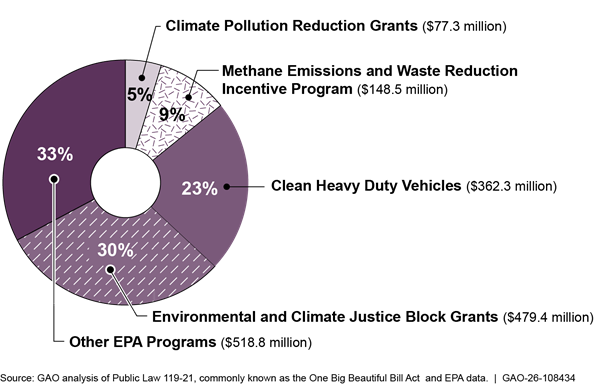
In July 2025, Public Law 119-21, commonly known as the One Big Beautiful Bill Act (OBBBA), rescinded around $1.6 billion in unobligated balances for several EPA programs for which the IRA appropriated funding (see fig. 4).[53]
Figure 4: Environmental Protection Agency (EPA) Inflation Reduction Act Rescissions, as of September 30, 2025
Note: After September 30, 2025, EPA recorded further rescissions totaling $1.2 billion, primarily affecting the Environmental and Climate Justice Block Grants program. Litigation on the propriety of EPA’s termination of these grants is pending resolution as of April 2026. See Woonasquatucket River Watershed Council v. U.S. Dep’t of Agric., 778 F. Supp. 3d 440 (D.R.I. 2025), appeal docketed No. 25-1428 (1st Cir. argued Feb. 5, 2026).
EPA’s IIJA and IRA Funding Review Process and Status
In January 2025, EPA leadership conducted what agency officials described as a centralized programmatic review of existing IIJA and IRA grants for consistency with the new administration’s priorities as outlined in executive orders. According to agency officials, EPA used a process from prior changes in administrations to conduct this review. Table 4 provides a summary of the review. EPA leadership made final determinations for each award under review. EPA leadership completed its review in summer 2025. Thereafter, the agency’s grants management team notified awardees whose grants were canceled and began closeout procedures. Following its review, EPA did not cancel any IIJA awards and canceled 372 IRA awards (totaling approximately $9.2 billion), according to our analysis of EPA data.
|
|
EPA’s funding review |
|
Scope |
3,768 obligated awards totaling $71.7 billion. |
|
Process |
EPA leadership determined the alignment of existing awards with executive orders and administration priorities. Leadership sent its decisions to the grants management team to notify recipients of any cancellations. All new funding actions initiated by program offices or regional divisions require approval by the cognizant office director or regional division director. Funding actions greater than $100,000 require approval from the principal deputy chief administrative officer and the organization’s senior resource official. |
|
Status of funds during review |
For existing awards, disbursements from programs selected for cancellation were paused through February 2025, at which point it began closeout procedures. For new funding actions, once an obligation is approved, funds are disbursed in accordance with normal operating procedures. |
|
Review status |
EPA completed its review of existing awards in summer 2025. EPA leadership approved 3,388 awards totaling $42.5 billion and canceled 372 awards totaling $9.2 billion. As of April 2026, the status of eight grants totaling $19.97 billion is unclear due to ongoing litigation. New funding actions are reviewed and approved in accordance with normal operating procedures. |
Source: GAO analysis of EPA information and interviews with EPA officials. | GAO‑26‑108434
Review Scope and Processes
In late January 2025, EPA leadership began assessing the alignment of grants previously awarded, including those funded by the IIJA and the IRA, with the new administration’s priorities as reflected in executive orders, according to an EPA official. An EPA official stated that agency leadership has historically reviewed existing grant funding with every change in presidential administration. Furthermore, EPA officials stated that the agency did not perform funding reviews in response to specific executive orders. Instead, EPA officials explained that each official is responsible for monitoring and ensuring executive order compliance for their specific programs or divisions.
According to EPA officials, EPA leadership completed the review of existing awards in summer 2025 and sent its decisions to EPA’s Office of Mission Support, whose grants management team notified awardees of cancellations and began grant closeout procedures. An agency official told us that no policies or other documentation to corroborate this review process exist. According to EPA’s April and May 2025 declarations in a civil case, EPA paused disbursements through February 2025 to recipients of IRA grant programs selected for cancellation.[54] However, an EPA official stated that they did not believe the additional time EPA took to review already awarded grants resulted in delays in disbursing funds.
To review new IIJA and IRA funding actions, agency officials stated EPA used its contracts and grants enterprise review process, which is a process also used during prior changes in administrations. Under this process, each program office or regional division initiates all new funding actions, including obligations and amendments. The process also requires the approval of the cognizant office director or regional division director, or their respective designees, to ensure compliance with executive orders and administration priorities. Additionally, the principal deputy chief administrative officer and the organization’s senior resource official must provide final approval for all funding actions greater than $100,000. Once funds are obligated, no additional program or regional office reviews are required prior to disbursement. As of March 2026, EPA officials stated that this review process is still in place and the agency would reevaluate its continuing need in the future.
IIJA and IRA Funding Review Status
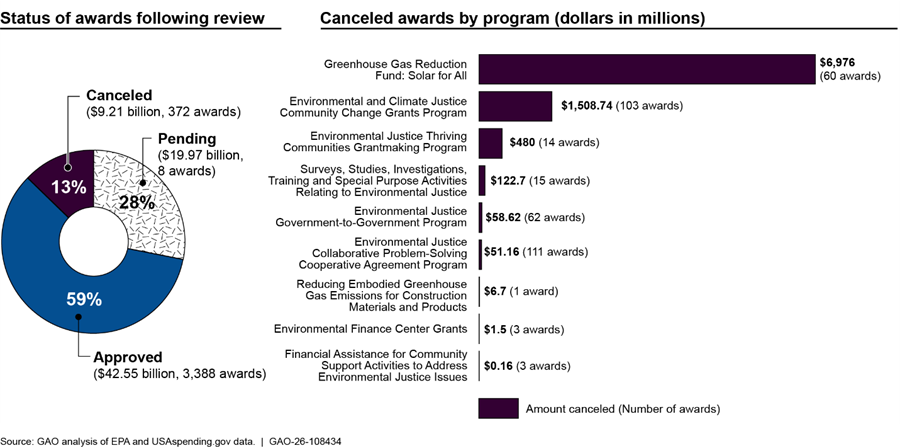
EPA officials reported that agency leadership did not modify any IIJA and IRA awards following its grant review process and it canceled only certain IRA-funded awards.[55] By the time EPA completed its review in summer 2025, leadership had approved 2,590 IIJA and 798 IRA grants (totaling around $42.5 billion) and canceled 372 IRA grants (totaling around $9.2 billion), according to EPA-provided data.[56] The Greenhouse Gas Reduction Fund’s Solar for All program accounted for over three-quarters of EPA’s IRA award cancellations ($7.0 billion) (see fig. 5).[57]
Additionally, in March 2025, the EPA Administrator publicly announced the cancellation of almost $20 billion in grants awarded for the Greenhouse Gas Reduction Fund’s National Clean Investment Fund and Clean Communities Investment Accelerator programs. The OBBBA repealed Section 134 of the Clean Air Act that established the Greenhouse Gas Reduction Fund and rescinded unobligated funding.[58] Though grants awarded under these two Greenhouse Gas Reduction Fund programs are canceled according to EPA, EPA review data show these grants as fully obligated as of March 2026. The status of the IRA funding for these programs is unclear due to ongoing litigation, and the undistributed funds continue to be frozen in the private bank that serves as the financial agent for two programs under the Greenhouse Gas Reduction Fund.
Figure 5: Status of Infrastructure Investment and Jobs Act (IIJA) and Inflation Reduction Act (IRA) Awards Subject to Review, as Reported by the Environmental Protection Agency (EPA), as of February 25, 2026
Note: In March 2025, the EPA Administrator publicly announced the cancellation of eight awards totaling almost $20 billion in IRA funding for the Greenhouse Gas Reduction Fund’s (GGRF) National Clean Investment Fund and Clean Communities Investment Accelerator programs. The figure above includes these awards as pending because the status of the IRA funding for these programs is unclear due to ongoing litigation, and the undistributed funds continue to be frozen in the private bank that serves as the GGRF’s financial agent. Though grants awarded under these two GGRF programs are canceled according to EPA, EPA review data show these grants as fully obligated as of March 2026.
Appendix II: Interior’s Infrastructure Investment and Jobs Act and Inflation Reduction Act Funding Status
The Infrastructure Investment and Jobs Act (IIJA) and Inflation Reduction Act (IRA) appropriated a combined $34.9 billion to the Department of the Interior for fiscal years 2022 through 2025.[59] These funds supported various programs, such as water infrastructure projects and projects that address long-standing health and safety risks from abandoned coal mines, orphaned oil, and gas wells.[60]
After the President issued Executive Order 14154, Unleashing American Energy, on January 20, 2025, Interior paused all obligations and disbursements on IIJA- and IRA-funded programs and began reviewing the programs to determine whether they aligned with the administration’s priorities as stated in this and other executive orders.[61] Although certain obligations and disbursements have resumed, as of September 30, 2025, Interior’s review was ongoing, with over $2 billion of disbursements pending approval.
Interior IIJA and IRA Appropriations, Obligations, Disbursements, and Rescissions
IIJA Funding
The IIJA appropriated about $28.3 billion to Interior for fiscal years 2022 through 2025, according to Interior data. As of September 30, 2025, Interior has obligated 45 percent of its IIJA appropriations ($12.6 billion) and disbursed 56 percent of the funding it had obligated ($7.07 billion). As of September 30, 2025, Interior disbursed about 25 percent of IIJA appropriations for fiscal years 2022 through 2025.
The extent that Interior obligated and disbursed its funds varied across the agency’s IIJA-funded programs. For example, about 40 percent of Interior’s IIJA appropriations ($11.29 billion) funded the Abandoned Mine Lands program. This program grants funds to eligible states and Tribes to address public health and safety and environmental hazards associated with abandoned coal mines on eligible lands after reviewing and approving their applications.[62] According to statute, the Abandoned Mine Lands program must allocate and distribute funding—which was appropriated in fiscal year 2022—on an equal annual basis over a 15-year period.[63] As of September 30, 2025, Interior obligated about 20 percent ($2.28 billion) of the appropriated funding and disbursed about 42 percent ($950 million) of the obligated amount for this program (see table 5).
Table 5: Department of the Interior Infrastructure Investment and Jobs Act (IIJA) Appropriations, Obligations, and Disbursements, as of September 30, 2025 (Dollars in Millions)
|
Interior bureau or office IIJA program |
Appropriateda |
Obligated |
Disbursed |
|
Bureau of Indian Affairs |
|
|
|
|
All programs |
$372.80 |
$293.31 |
$174.04 |
|
Bureau of Reclamation |
|
|
|
|
Aging Infrastructure Account |
$2,362.90 |
$1,024.79 |
$449.53 |
|
Water & Groundwater Storage, and Conveyance |
$1,110.00 |
$231.76 |
$103.33 |
|
Other Bureau of Reclamation programsb |
$3,167.10 |
$2,352.85 |
$921.80 |
|
Central Utah Project Completion Act Office |
|
|
|
|
Central Utah Project |
$50.00 |
$50.00 |
$49.79 |
|
Office of Surface Mining Reclamation and Enforcement |
|
|
|
|
Abandoned Mine Lands |
$11,293.00 |
$2,278.03 |
$952.85 |
|
Office of Wildland Fire |
|
|
|
|
Wildland Fire Management |
$1,195.40 |
$911.35 |
$649.67 |
|
Orphaned Wells Program Office |
|
|
|
|
All programs |
$4,677.00 |
$1,767.82 |
$654.49 |
|
U.S. Fish and Wildlife Service |
|
|
|
|
All programs |
$364.00 |
$329.89 |
$135.21 |
|
U.S. Geological Survey |
|
|
|
|
All programs |
$446.67 |
$406.76 |
$258.21 |
|
Multiple Bureaus/Offices |
|||
|
Ecosystem Restoration Program |
$763.00 |
$623.00 |
$507.77 |
|
Indian Water Rights Settlement Completion Fund |
$2,500.00 |
$2,334.36 |
$2,214.06 |
|
Total |
$28,301.87 |
$12,603.92 |
$7,070.75 |
Source: Interior IIJA data. | GAO‑26‑108434
aIIJA, Pub. L. No. 117-58, 135 Stat. 429 (2021). We did not include budget authority for which the entire period of availability occurs after September 30, 2025, as these funds were not available for obligation during the period we reviewed. Appropriated amounts include one-half of 1 percent of the amounts made available under certain sections of the IIJA for transfer to the Office of Inspector General of the Department of the Interior, and include certain amounts designated for administrative costs and Interior operations. As a result, these amounts may not be available for awards.
bDivision J, Title III of the IIJA provided the Bureau of the Reclamation with funding for 12 program and activity areas: Aging Infrastructure Account, Aquatic Ecosystem Restoration and Protection Projects, Colorado River Drought Contingency Plan, Colorado River Endangered Species Recovery and Conservation, Dam Safety Program, Multi-Benefit Projects to Improve Watershed Health, Rural Water Projects, Water Desalination Projects, Water & Groundwater Storage and Conveyance, Water Recycling, Watershed Management Projects, and WaterSMART Grants.
IRA Funding
The IRA appropriated approximately $6.6 billion to Interior for fiscal years 2022 through 2025, according to Interior data. As of September 30, 2025, Interior obligated about 68 percent of its IRA appropriation ($4.5 billion) and disbursed about 52 percent of the funding it had obligated ($2.3 billion). As of September 30, 2025, Interior disbursed about 35 percent of IRA appropriations for fiscal years 2022 through 2025.
Similar to its IIJA funding, the extent to which Interior obligated its IRA funding varied across its programs. The IRA appropriated about 60 percent ($4.0 billion) for drought mitigation. In total, Interior has obligated almost 70 percent ($2.79 billion) of its drought mitigation funds and disbursed approximately 52 percent of the obligated amount ($1.46 billion) as of September 30, 2025.
In July 2025, Public Law 119-21, commonly known as the One Big Beautiful Bill Act (OBBBA), rescinded all unobligated IRA balances of some Interior programs that received IRA appropriations (i.e., National Park Service employee hiring, Conservation and Resilience, Conservation and Ecosystem Restoration, and certain Fish and Wildlife Service programs).[64] In total, the OBBBA rescinded approximately $445 million of the IRA appropriations to Interior (see table 6).
Table 6: Department of the Interior Inflation Reduction Act (IRA) Appropriations, Rescissions, Obligations, and Disbursements as of September 30, 2025 (Dollars in Millions)
|
Interior bureau or office IRA programs |
Appropriateda |
Rescissions |
Obligated |
Disbursed |
|
Bureau of Indian Affairs |
||||
|
All programs |
$385.00 |
- |
$293.52 |
$198.69 |
|
Bureau of Reclamation |
||||
|
Drought Mitigation |
$4,000.00 |
- |
$2,790.82 |
$1,461.39 |
|
Other Bureau of Reclamation Programs |
$587.50 |
- |
$237.20 |
$13.06 |
|
National Park Service |
||||
|
National Park Service Employees |
$500.00 |
$413.59 |
$86.38 |
$85.58 |
|
National Park Service Deferred Maintenance |
$200.00 |
- |
$200.00 |
$200.00 |
|
U.S. Fish and Wildlife Service |
||||
|
All programs |
$250.00 |
$7.78 |
$242.04 |
$118.46 |
|
U.S. Geological Survey |
||||
|
All programs |
$23.50 |
- |
$20.56 |
$14.80 |
|
Multiple Bureaus/Offices |
||||
|
Conservation and Ecosystem Restoration |
$250.00 |
$10.21 |
$239.18 |
$79.95 |
|
Conservation and Resilience |
$250.00 |
$13.07 |
$236.64 |
$74.72 |
|
Environmental Reviews |
$150.00 |
- |
$108.58 |
$63.35 |
|
Other |
||||
|
All other programs |
$50.90 |
- |
$40.76 |
$9.64 |
|
Total |
$6,646.90 |
$444.65 |
$4,495.68 |
$2,319.64 |
Source: Interior IRA data. | GAO‑26‑108434
Note: Dashes indicate that there were no amounts associated with the indicated program and funding action.
aAppropriated amounts include certain amounts designated for administrative costs and Interior operations, and as a result, these amounts may not be available for awards. We did not include budget authority for which the entire period of availability occurs after September 30, 2025, as these funds were not available for obligation during the period we reviewed.
Interior’s IIJA and IRA Funding Review Process and Status
Interior developed new processes to review awards funded by IIJA and IRA appropriations for consistency with executive orders issued since January 20, 2025, according to Interior documentation and officials.[65] Interior created one process in response to the January 20, 2025, Executive Order 14154, Unleashing American Energy.[66] Interior developed additional processes in February 2025 to determine whether awards aligned with other executive orders. Table 7 provides a summary of these reviews. As of April 1, 2026, Interior continued to review obligations and disbursements for alignment with Executive Order 14154 and other executive orders issued since January 20, 2025, and had yet to make decisions on most obligations and disbursements.
|
|
Interior’s funding review |
|
Scope |
4,839 awards totaling $4.5 billion. |
|
Process |
Executive Order 14154.a Staff in the Infrastructure Office and Office of the Solicitor reviewed programs funded through the Infrastructure Investment and Jobs Act (IIJA) and Inflation Reduction Act (IRA) to determine whether they aligned with administration priorities as set out by executive order and provided recommendations to the Assistant Secretary of Policy, Management and Budget (Assistant Secretary). In February 2025, the Assistant Secretary made a determination on which programs aligned with administration priorities and which required further review. In September 2025, Interior began reviewing IIJA and IRA funding at the award level instead of at the program level. Between December 2025 and January 2026, bureau and office senior leadership reviewed all existing awards and made recommendations to the Acting Assistant Secretary about whether to continue obligating and disbursing funds for those awards. According to Interior officials, since January 2026, the Acting Assistant Secretary continued to review the bureau and office senior leadership recommendations. Additional executive orders.b Program office managers reviewed award requirements for compliance with the executive orders and submitted their recommendations to department and bureau contracting and financial assistance offices for obligation or disbursement. The bureau contracting and financial assistance offices reviewed and, as applicable, modified terms and conditions of grant agreements and contracts to align with the executive orders. As part of this process, starting in February 2025, an email from the Assistant Secretary stated that that he was required to review and approve obligations and modifications over $50,000. |
|
Status of funds during review |
Executive Order 14154. After initially pausing all IIJA and IRA obligations and disbursements, Interior resumed processing obligations and disbursements for programs determined to align with Executive Order 14154 in February 2025. The Assistant Secretary approved obligations and disbursements on a case-by-case basis for programs that required further review. In April 2025, Interior resumed certain IIJA and IRA disbursements in response to a court order.c In September 2025, for programs that required further review, Interior began only processing disbursements for work completed and invoiced on or before September 19, 2025, and would not process new obligations or disbursements, pending the award-level review. As of September 2025, the Acting Assistant Secretary had not made final determinations as to whether to resume about 2,000 awards, totaling $2.3 billion funded by IIJA and IRA for the programs that required further review. Additional executive orders. IIJA and IRA obligations and disbursements were not paused specifically in response to this review. |
|
Review status |
Executive Order 14154. As of April 2026, Interior officials told us that the agency had not set a deadline for completion of its review and had yet to make decisions on most awards. Additional executive orders. Reviews are completed on an as-needed basis. |
Source: GAO summary of Interior information and interviews with Interior officials. | GAO‑26‑108434
aExec. Order No. 14154, Unleashing American Energy, 90 Fed. Reg. 8353 (Jan. 20, 2025).
bInterior officials told us that they considered several different executive orders when conducting this review. These include Exec. Order No. 14151, Ending Radical and Wasteful Government DEI Programs and Preferencing, 90 Fed. Reg. 8339 (Jan. 20, 2025); Exec. Order No. 14156, Declaring a National Energy Emergency, 90 Fed. Reg. 8433 (Jan. 20, 2025); Exec. Order No. 14181, Emergency Measures To Provide Water Resources in California and Improve Disaster Response in Certain Areas, 90 Fed. Reg. 8747 (Jan. 24, 2025); and Exec. Order No. 14308, Empowering Commonsense Wildfire Prevention and Response, 90 Fed. Reg. 26175 (June 12, 2025), among others.
cWoonasquatucket River Watershed Council v. U.S. Dep’t of Agric., 778 F. Supp. 3d 440 (D.R.I. 2025), appeal docketed No. 25-1428 (1st Cir. argued Feb. 5, 2026). Interior officials stated that Interior resumed disbursements for financial assistance agreements, such as cooperative agreements of grants. However, they also stated that disbursements for contracts were not subject to the court order.
Executive Order 14154 Review Process
In January 2025, in response to Executive Order 14154 and guidance from the Office of Management and Budget on implementing the order, Interior paused all obligations and disbursements from programs funded by the IIJA and IRA, according to Interior officials.[67] Subsequently, staff in the Infrastructure Office and Office of the Solicitor began reviewing the programs funded by the IIJA and IRA to determine whether they aligned with administration priorities as set out by the executive order. Following its review, the Infrastructure Office provided the Assistant Secretary of Policy, Management and Budget (Assistant Secretary) with the results of its review and its recommendations according to Interior officials and documentation.
On February 19, 2025, the Assistant Secretary determined that certain programs aligned with administration priorities as set out by the executive order, and that Interior bureaus and offices could resume obligations and disbursements for those programs. These included programs related to abandoned mine lands, orphaned wells, wildland fire management, and drought mitigation. However, the Assistant Secretary also determined that certain other programs required further review. These included programs related to ecosystem restoration, conservation and resilience, fish and wildlife service programs, and tribal climate resilience. The Assistant Secretary approved exceptions on a case-by-case basis for obligations or disbursements for these programs, according to Interior officials.
In April 2025, Interior resumed certain IIJA and IRA disbursements in response to a court order.[68] On September 19, 2025, the Acting Assistant Secretary of Policy, Management and Budget (Acting Assistant Secretary) announced that the office would review IIJA and IRA funding at the award level instead of the program level going forward. On October 7, 2025, the Acting Assistant Secretary clarified that for programs that required further review, Interior would only process disbursements for work completed and invoiced on or before September 19, 2025, and would not process new obligations or disbursements, pending the award-level review. He noted that obligations and disbursements could continue for programs that, in February 2025, the Assistant Secretary had determined aligned with administration priorities. As of September 30, 2025, the Acting Assistant Secretary had not made final determinations as to whether to resume about 2,000 awards, totaling $2.3 billion, funded by IIJA and IRA for the programs that required further review.
Between December 2025 and January 2026, bureau and office senior leadership reviewed all existing awards and made recommendations to the Acting Assistant Secretary about whether to continue obligating and disbursing funds for all IIJA and IRA awards. According to Interior officials, since January 2026, the Acting Assistant Secretary continued to review the bureau and office senior leadership recommendations. In April 2026, Interior officials told us that the agency had not set a deadline for completion of its review and had yet to make decisions on most awards. Figure 6 depicts the timeline of Interior’s funding review.
Figure 6: Department of the Interior’s Reported Timeline of Funding Reviews in Response to Executive Order (EO) 14154, Unleashing American Energy
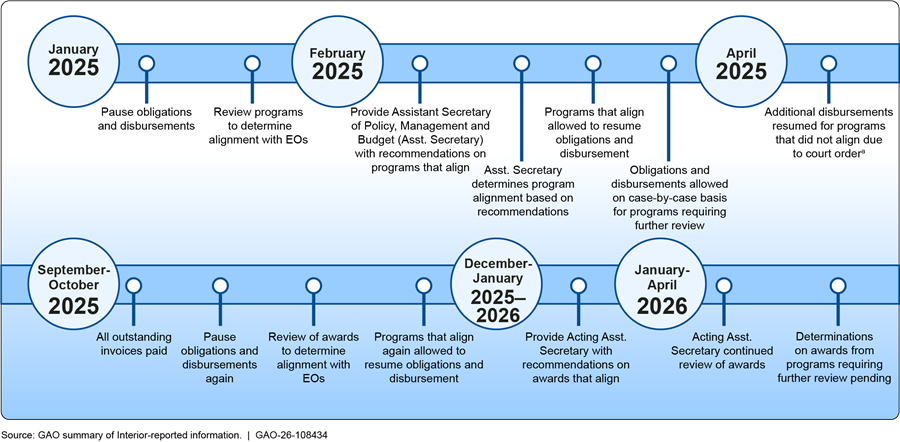
aWoonasquatucket River Watershed Council v. U.S. Dep’t of Agric., 778 F. Supp. 3d 440 (D.R.I. 2025), appeal docketed No. 25-1428 (1st Cir. argued Feb. 5, 2026).
Other Reviews Involving IIJA or IRA Appropriations
Interior officials stated that other executive orders prompted agencywide funding reviews. These included executive orders related to diversity, equity, and inclusion that were not specific to awards funded by IIJA or IRA appropriations.[69]
The review process in response to these executive orders was generally initiated at the bureau or office level, according to Interior officials. Under this process, program office managers reviewed contract and other award requirements for compliance with the executive orders and Secretary of the Interior’s orders before submitting their recommendations to department and bureau contracting and financial assistance offices for obligation or disbursement. The bureau contracting and financial assistance offices then reviewed and, as applicable, modified terms and conditions of grant agreements and contracts to align with the executive orders. As part of this process, starting in February 2025, an email from the Assistant Secretary of Policy, Management, and Budget stated that he was required to review and approve obligations and modifications over $50,000.
IIJA and IRA Funding Review Status
According to our analysis of Interior’s data, the agency had approved about 48 percent of the funding it reviewed (totaling about $2.1 billion). Interior was still reviewing about 52 percent (totaling about $2.3 billion) of IIJA and IRA funding subject to review, as of September 30, 2025 (see table 8). Interior reviewed and approved individual obligations and disbursements for programs as part of its review process starting in January 2025 but, in September 2025, approved all outstanding invoices submitted as of September 19, 2025, according to Interior officials. As a result, Interior’s amount approved without modification reflects the status of disbursements made.
Table 8: Status of the Department of the Interior’s Review of Infrastructure Investment and Jobs Act (IIJA) and Inflation Reduction Act (IRA) Obligations and Disbursements, as of September 30, 2025 (Dollars in Millions)
|
Bureau/office |
Amount approved without modification (number of awards) |
Amount approved with modification (number of awards) |
Amount canceled (number of awards) |
Amount pending final decision (number of awards) |
Total amount subject to review (number of awards) |
|
Bureau of Indian Affairsa |
$204.19 (92) |
- |
$1.81 (4) |
$165.69 (69) |
$371.69 (165) |
|
Bureau of Reclamation |
$1,148.15 (409) |
- |
- |
$79.02 (49) |
$1,227.17 (458) |
|
National Park Service |
$25.12 (289) |
$0.21 (2) |
$1.63 (6) |
$204.64 (537) |
$231.60 (834) |
|
Office of Surface Mining Reclamation and Enforcement |
$282.34 (76) |
- |
- |
- |
$282.34 (76) |
|
Orphaned Wells Program Office |
$133.67 (89) |
- |
- |
- |
$133.67 (89) |
|
U.S. Fish and Wildlife Service |
$111.26 (393) |
- |
$1.69 (3) |
$1,542.73 (782) |
$1,655.68 (1,178) |
|
U.S. Geological Survey |
$80.01 (261) |
- |
- |
- |
$80.01 (261) |
|
Bureau of Land Management |
$45.11 (355) |
- |
$1.19 (11) |
$301.53 (492) |
$347.83 (858) |
|
Office of Wildland Fire |
$105.16 (763) |
- |
- |
- |
$105.16 (763) |
|
Departmental Offices |
$8.12 (60) |
$3.07 (2) |
$26.59 (32) |
$34.74 (63) |
$72.52 (157) |
|
Total |
$2,143.13 (2,787) |
$3.28 (4) |
$32.91 (56) |
$2,328.35 (1,992) |
$4,507.67 (4,839) |
Source: GAO analysis of Interior data. | GAO‑26‑108434
Note: Dashes indicate that the agency stated there were not any awards in that specific category. The amount and number approved without modification represents disbursements approved. According to Interior officials, Interior approved all outstanding invoices submitted as of September 19, 2025. Therefore, they considered the disbursement amount the best representation of awards approved without modification. The amount approved with modification and the amount canceled represent obligations that were modified or canceled as a result of the review. The amount pending final decision represents disbursements pending approval. The Central Utah Project has obligated and disbursed all its IIJA funding as of September 30, 2025, and thus did not provide a list of reviewed IIJA-funded awards. Also, according to Interior officials, generally total dollar amounts and awards may not equal the sum of each column because certain funds were obligated but recipients had not yet requested (invoiced for) disbursement.
aThe Bureau of Indian Affairs only included award information for programs that required further review as part of these data.
We received responses from 19 Interior bureaus and offices that administer IIJA or IRA funds. Thirteen told us that their time frames for approval and disbursement of these funds have been affected because of agency reviews.[70] Specifically, the pauses in IIJA or IRA funds during the ongoing review process resulted in delays in invoice payments. Two offices stated that their time frames were not affected, as their programs resumed in February 2025. Four bureaus and offices did not respond to our inquiry.
The Infrastructure Investment and Jobs Act (IIJA) appropriated about $47.7 billion to the National Telecommunications and Information Administration (NTIA) for fiscal years 2022 through 2025 for grant programs to support broadband deployment and adoption.[71] NTIA developed new processes to review all existing IIJA grant funding for consistency with executive orders issued since January 20, 2025. As part of these processes, the Secretary of Commerce makes final decisions for each award under review. NTIA reviewed 491 awards worth $45.4 billion and, as of June 30, 2025, approved about 96 percent of the funding under review. Through a separate process, NTIA also canceled 120 of these awards totaling $1.4 billion.
NTIA IIJA Appropriations, Obligations, and Disbursements
As of June 30, 2025, NTIA obligated approximately 95 percent of its IIJA funding ($45.1 billion) and disbursed about 2 percent of the funding it obligated ($1.1 billion), according to NTIA data.[72] About 89 percent of the funding ($42.5 billion) the IIJA appropriated to NTIA was for the Broadband Equity, Access and Deployment Program (BEAD), a formula grant program to support broadband infrastructure in underserved areas. According to NTIA officials, most BEAD awards had not yet reached the project implementation phase—the phase at which funds would be disbursed to recipients—as of June 30, 2025 (see fig. 7).[73] In June 2025, NTIA published a BEAD Restructuring Policy Notice, which rescinded approvals of recipients’ final proposed plans, modified BEAD requirements, and required recipients to submit new plans aligned with the modified requirements.
Figure 7: National Telecommunications and Information Administration’s (NTIA) Infrastructure Investment and Jobs Act Appropriations, Obligations, and Disbursements for Fiscal Years 2022 to 2025, as of June 30, 2025
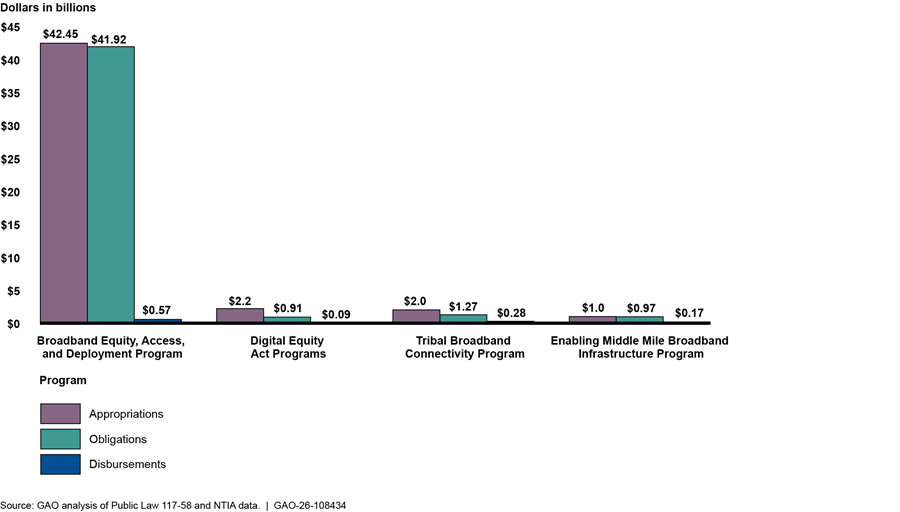
Note: We did not include budget authority for which the entire period of availability occurs after September 30, 2025, as these funds were not available for obligation during the period we reviewed. In this figure, the amounts include administrative costs, which are a small percentage of available funding. For example, under the Broadband Equity, Access, and Deployment Program, NTIA may use up to 2 percent of amounts appropriated for administrative purposes. 47 U.S.C. § 1702(d)(1).
NTIA IIJA Funding Review Process and Status
NTIA developed new processes to review all existing IIJA grant funding for consistency with executive orders issued since January 20, 2025. As part of these processes, the Secretary of Commerce makes final decisions for each award under review.
NTIA’s Office of Internet Connectivity and Growth, which oversees IIJA grant funding, reviewed all IIJA awards twice using similar processes.[74] Specifically, the office conducted (1) a review at the direction of the Office of Management and Budget (OMB) in January 2025 and (2) a subsequent review in response to Executive Order 14222, Implementing the President’s “Department of Government Efficiency” Cost Efficiency Initiative, in March 2025.[75] NTIA completed its OMB-directed review of IIJA awards and completed most of its Executive Order 14222 review as of June 30, 2025. NTIA approved most of the funding it reviewed but canceled 120 grant awards, totaling about $1.4 billion. However, NTIA officials told us that the Secretary of Commerce directed these cancellations, and they were not a result of the review processes described below.
OMB-Directed Review
In response to an OMB memo issued on January 27, 2025, the Office of Internet Connectivity and Growth reviewed 393 IIJA awards against requirements in seven executive orders, according to our analysis of NTIA’s review documentation.[76] According to this documentation, the office used keyword searches for terms such as “racial,” “climate change,” “justice,” “cultural,” and “diversity, equity, inclusion” to identify awards that may include activities that were inconsistent with the administration’s priorities, as identified in the executive orders. For awards that included such terms, the office identified actions to address potential conflicts with executive orders—such as revising the scope or wording of an award—or noted when these terms were included in the award because of legal requirements. NTIA officials told us that they did not have information on whether other offices or entities inside or outside the NTIA conducted further review of these awards.
According to our analysis of NTIA’s review data, NTIA found that 15 of the 393 awards it reviewed (about 4 percent) contained language that could indicate a potential conflict with an executive order. Specifically, NTIA identified the following awards:
· Ten awards that referred to ethnic, racial, or cultural groups and environmental reviews. Because these references were due to legal requirements, NTIA recommended no specific action on these awards.
· Five awards that referred to undocumented or underserved populations, “DEI” (diversity, equity, inclusion), “cultural” groups, or “climate change.” NTIA recommended modifying the scope or language of the awards as needed to ensure alignment with the executive orders.
NTIA provided the review data and documentation described above to us in August 2025. At that time, officials told us that they had not identified any awards that presented conflicts with executive orders. However, as noted above, we found 15 awards for which NTIA identified conflicts with executive orders when we reviewed the data. We asked NTIA for information on outcomes of this review and the status of these awards, including any modifications, pauses, or terminations. NTIA did not provide this information.
Executive Order 14222 Review
On March 11, 2025, the Department of Commerce issued guidance directing each of its components to review grants in response to Executive Order 14222.[77] The guidance specified that each grant award must be reviewed and approved by politically appointed leadership or designees and that awards over $100,000 required Secretary of Commerce approval.
NTIA reviewed 491 awards worth $45.4 billion, over 80 percent of which were obligated at the time of review, according to our analysis of NTIA’s funding review data as of June 30, 2025. About 14 percent consisted of applications that NTIA’s Office of Internet Connectivity and Growth recommended for award, but for which funds had not yet been obligated. NTIA officials stated that the primary criteria they used to review awards were the Notices of Funding Opportunity—required public announcements of funding that include information on eligibility and requirements—for each program. According to NTIA officials, the agency will continue to use its review process to approve funding as NTIA receives new applications.
In its IIJA review data, NTIA reported that about 60 percent of the awards and 96 percent of the funding under review were approved. The Secretary had yet to make decisions on eight recommended awards totaling about $168.8 million, as of June 30, 2025 (see fig. 8). NTIA officials told us in February 2026 that NTIA ultimately withdrew five of these eight awards and modified the scope of the remaining three, but it is not clear when NTIA took these actions.[78]
Figure 8: Status of National Telecommunications and Information Administration’s (NTIA) Infrastructure Investment and Jobs Act (IIJA) Funding Review, as of June 30, 2025
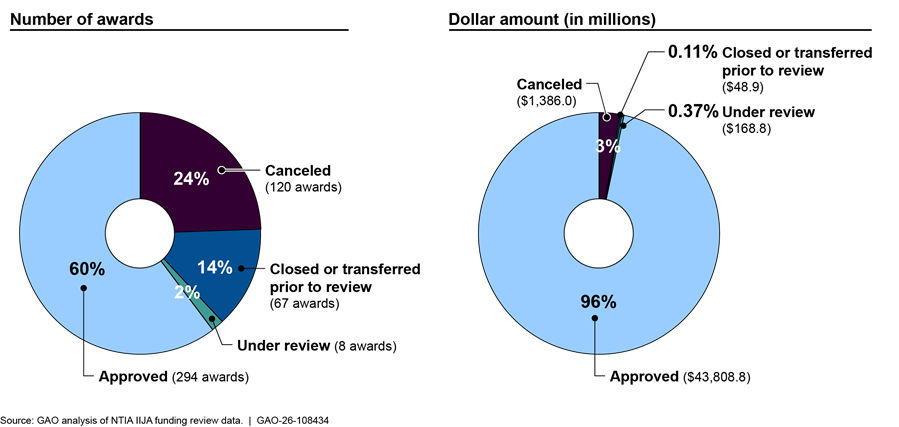
Note: Cancellation in our report refers to an award that was discontinued for any of a variety of reasons. These may include (1) termination of an obligated award, (2) awards for which funding was rescinded by law, (3) retraction (i.e., withdrawal) of an unobligated award, and (4) discontinuance initiated by a recipient. According to NTIA officials, Digital Equity Act awards were terminated in response to direction from the Secretary of Commerce separate from the review process. This included 58 awards that were previously obligated and subsequently terminated and 62 applications NTIA had recommended for award but not yet obligated, which were subsequently withdrawn.
According to NTIA’s review data, the 120 canceled awards were all Digital Equity Act awards totaling about $1.4 billion.[79] Specifically, 58 previously obligated awards totaling $806.3 million were approved in March 2025 through NTIA’s review process and were later terminated.[80] Additionally, 62 recommended, but unobligated awards, totaling $579.6 million, were withdrawn. According to NTIA officials, the Secretary of Commerce terminated the Digital Equity Act grant programs on May 9, 2025, after the President determined that the program was not constitutional, and not through NTIA’s review process.[81]
In August 2025, NTIA officials told us that neither of the review processes above resulted in delayed obligations or disbursements of IIJA funding.
Appendix IV: DOT’s Infrastructure Investment and Jobs Act and Inflation Reduction Act Funding Status
Together, the Infrastructure Investment and Jobs Act (IIJA) and Inflation Reduction Act (IRA) provided about $443.4 billion in budget authority for formula and discretionary grant funding to the Department of Transportation (DOT) for fiscal years 2022 through 2025 to support transportation infrastructure and related projects.[82] In March 2025, DOT initiated two separate reviews of the discretionary grants funded by these statutes in response to several executive orders and DOT guidance. As of September 30, 2025, DOT had approved thousands of awards and canceled dozens of others.[83] However, hundreds of DOT awards remained under review as of September 30, 2025; DOT officials told us 293 awards remained under review as of April 2026.
DOT IIJA and IRA Funding, Obligations, Disbursements, and Rescissions
IIJA Funding
The IIJA provided about $437.8 billion for DOT formula and discretionary grant funding for fiscal years 2022 through 2025.[84] As of September 30, 2025, DOT obligated more than three-quarters of this IIJA funding ($337.8 billion) and disbursed almost two-thirds of the funding it obligated ($215.2 billion). As of September 30, 2025, DOT disbursed about 49 percent of its IIJA budget authority for fiscal years 2022 through 2025.
DOT’s IIJA funding, obligations, and disbursements varied across operating administrations (OA)—components within DOT focused on specific transportation modes—and offices within the Office of the Secretary of Transportation (OST).[85] The IIJA grant funding the Federal Highway Administration (FHWA) received for fiscal years 2022 through 2025 accounts for the majority of DOT’s IIJA grant funding provided for those fiscal years.[86] FHWA accounts for more than two-thirds of DOT’s obligations ($231.9 billion of $337.8 billion) and nearly 80 percent ($165.2 billion of $215.2 billion) of DOT’s disbursements as of September 30, 2025. See table 9 for the variation in obligations and disbursements across OAs.
Table 9: Status of Department of Transportation Obligations and Disbursements for Infrastructure Investment and Jobs Act Grants for Fiscal Years 2022 Through 2025, as of September 30, 2025 (Dollars in Billions)
|
Operating administration or office |
Obligated |
Disbursed |
|
Federal Aviation Administration |
$11.3 |
$6.7 |
|
Federal Highway Administration |
$231.9 |
$165.2 |
|
Federal Motor Carrier Safety Administration |
$2.3 |
$1.6 |
|
Federal Railroad Administration |
$35.1 |
$7.0 |
|
Federal Transit Administration |
$51.4 |
$31.5 |
|
Maritime Administration |
$0.4 |
$0.09 |
|
National Highway Traffic Safety Administration |
$3.9 |
$2.8 |
|
Office of the Secretary of Transportation |
$0.6 |
$0.2 |
|
Pipeline and Hazardous Materials Safety Administration |
$0.9 |
$0.1 |
|
Total |
$337.8 |
$215.2 |
Source: GAO analysis of USAspending.gov data. | GAO‑26‑108434
Note: We accessed the USAspending.gov data on June 18, 2026, and analyzed the obligations and disbursements for the awarding sub-agency. The IIJA provided about $437.8 billion for DOT formula and discretionary grant funding for fiscal years 2022 through 2025. We rounded all dollar amounts to the nearest billion or hundred million. We did not include budget authority for which the entire period of availability occurs after September 30, 2025, as these funds were not available for obligation during the period we reviewed. IIJA grant funding is not available for obligation until the start of the fiscal year for which it was authorized or appropriated. See, e.g., 23 U.S.C. § 118; 31 U.S.C. § 1341. DOT may not disburse the funding until after it has been obligated. In February 2026, the Consolidated Appropriations Act, 2026 rescinded and transferred unobligated balances of IIJA funding for certain DOT programs. See Pub. L. No. 119‑75, 140 Stat. 173 (2026).
IRA Funding
The IRA provided approximately $5.6 billion for five DOT discretionary grant programs for fiscal year 2022, as shown in table 10.[87] These programs are administered by two OAs: the Federal Aviation Administration (FAA) and FHWA. More than half of the funding was provided for FHWA’s Neighborhood Access and Equity Grant program. In total, as of September 30, 2025, DOT obligated about $1.2 billion and disbursed about $112 million of its IRA funding, according to DOT data. As of September 30, 2025, DOT disbursed about 2 percent of its IRA funds. The extent to which DOT obligated and disbursed IRA funding varied across the five programs (see table 10).
Table 10: Status of Department of Transportation (DOT) Inflation Reduction Act (IRA) Budget Authority for Grants Provided for Fiscal Year 2022, as of September 30, 2025 (Dollars in Thousands)
|
Operating administration and program |
Budget authority |
Rescissions |
Obligated |
Disbursed |
|
Federal Aviation Administration |
|
|
|
|
|
Fueling Aviation’s Sustainable Transition – Technology (FAST-Tech) |
$46,530 |
$757 |
$45,773 |
$13,133 |
|
Fueling Aviation’s Sustainable Transition through Sustainable Aviation Fuels (FAST-SAF) |
$244,530 |
$228,816 |
$15,714 |
$1,556 |
|
Federal Highway Administration |
|
|
|
|
|
Environmental Review Implementation Funds |
$100,000 |
$59,490 |
$31,192 |
$14,661 |
|
Low Carbon Transportation Materials Program |
$2,000,000 |
$1,841,318 |
$156,282 |
$2,283 |
|
Neighborhood Access and Equity Grant Program |
$3,205,000 |
$2,295,338 |
$906,140 |
$80,275 |
|
Total |
$5,596,060 |
$4,425,719 |
$1,155,100 |
$111,908 |
Source: GAO analysis of the IRA and DOT data. | GAO‑26‑108434
Note: The IRA provided about $5.9 million in funding to DOT for the administration and oversight of the IRA aviation grant programs, but we did not include these funds in the table above because such funding is not grant funding. These funding amounts do not reflect the rescissions of unobligated balances of program funding under Public Law 119‑21, commonly known as the One, Big, Beautiful Bill Act, which was enacted in July 2025. See An Act To provide for reconciliation pursuant to title II of H. Con. Res. 14, Pub. L. No. 119‑21, §§ 40010, 60019, 60023‑60024, 139 Stat. 72, 137, 156‑157 (2025).
In July 2025, Public Law 119-21—commonly known as the One Big Beautiful Bill Act—rescinded the unobligated balances for all five DOT grant programs for which the IRA provided funding.[88] See figure 9 for rescinded amounts by program.
Figure 9: Department of Transportation (DOT) Inflation Reduction Act (IRA) Grant Funding Rescinded as of September 30, 2025
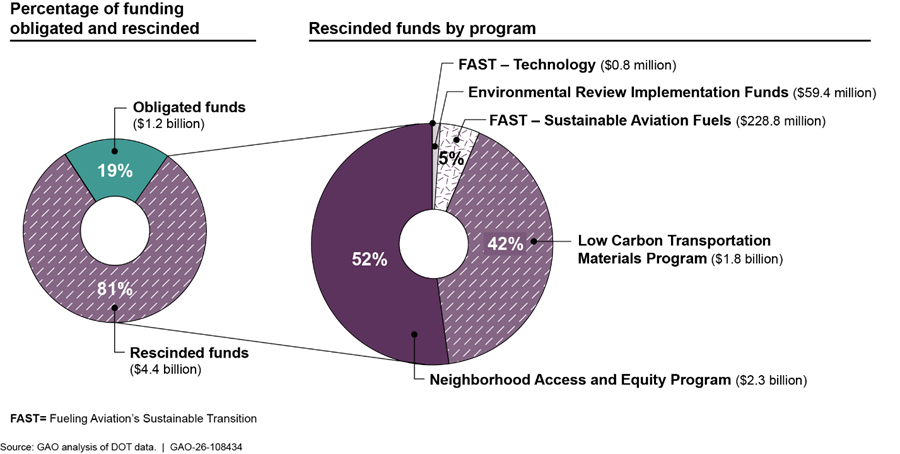
Note: In July 2025, Public Law 119‑21, commonly known as the One, Big, Beautiful Bill Act, rescinded unobligated balances of funding the IRA appropriated for these DOT programs. See An Act To provide for reconciliation pursuant to title II of H. Con. Res. 14, Pub. L. No. 119‑21, §§ 40010, 60019, 60023‑60024, 139 Stat. 72, 137, 156‑157 (2025). Funding amounts are rounded to the nearest hundred million.
DOT’s IIJA and IRA Funding Review Process and Status
DOT developed centralized processes to review its IIJA and IRA discretionary grant awards for consistency with executive orders and administration priorities.[89] DOT officials told us that DOT did not review formula funds.[90] All the DOT grant funding provided by the IRA was for discretionary grant programs. Discretionary funding accounts for about 23 percent of DOT’s IIJA funding. According to DOT officials, DOT used two separate processes to review awards based on each award’s obligation status: (1) the Executive Order 14222 process and (2) the grants review task force process (see table 11).
Table 11: Summary of the Department of Transportation’s (DOT) Funding Reviews as of September 30, 2025
|
|
Executive Order 14222 reviewa |
Grants review task force review |
|
Scope |
5,810 fully or partially obligated discretionary grant awards across 130 programs.b |
3,879 mostly unobligated discretionary grant awards totaling $60.5 billion across 94 programs.c |
|
Process |
Operating Administrations (OA) and offices in the Office of the Secretary of Transportation (OST) identified awards for which the scope and purpose were inconsistent with administration priorities reflected in nine executive orders, based on key terms. OAs and OST offices recommended such awards to department leadership for approval (continuing as-is), modification (changing terms or amounts), or cancellation. |
OAs and OST offices reviewed awards for potential conflict with four executive orders and administration priorities, and recommended actions such as approving, modifying, or canceling awards to a task force of senior leadership. According to DOT guidance, the task force made final recommendations to the Secretary of Transportation, who made final decisions. |
|
Status of funds during review |
DOT officials said that the agency continued to disburse funding for these awards during the review. |
DOT did not take any action (obligation or disbursement) on awards under review until the Secretary of Transportation approved them. |
|
Review status |
According to officials, DOT concluded its review in April 2025. DOT data showed that OAs and OST offices identified 2,231 awards (about 38 percent) for leadership review. In April 2026, DOT officials stated that all the awards identified for leadership review continued without changes. |
Of the awards it reviewed, DOT approved 3,111 (80 percent) of the awards for obligation, canceled 248 awards (6 percent), and had not made decisions on 520 awards (13 percent), as of September 30, 2025. According to DOT officials, 293 awards remained under review as of April 2026. |
Source: GAO analysis of DOT information and interviews with DOT officials. | GAO‑26‑108434
Note: DOT officials told GAO that the agency reviewed 21 obligated awards under both review processes. Cancellation in our report refers to an award that was discontinued for any of a variety of reasons. These may include (1) termination of an obligated award, (2) awards for which funding was rescinded by law, (3) withdrawal of an unobligated award, and (4) discontinuance initiated by a recipient.
aExecutive Order 14222, Implementing the President’s “Department of Government Efficiency” Cost Efficiency Initiative, in part, directed agencies to review covered grants in consultation with the Department of Government Efficiency and, where appropriate and consistent with applicable law, terminate or modify, including through renegotiation, covered grants to reduce overall federal spending or reallocate spending to promote efficiency and advance administration policies. Exec. Order No. 14222, 90 Fed. Reg. 11095 (Feb. 26, 2025).
bDOT did not provide funding totals for the awards under Executive Order 14222 review.
cDOT also reviewed 272 partially obligated awards and 34 fully obligated awards under its task force review process. DOT officials said that DOT included obligated awards in this process if, for example, the grant agreement required amendments and needed to be re-signed.
In April 2026, DOT officials told us that all of the more than 2,000 obligated awards identified for leadership review in DOT’s Executive Order 14222 review continued without changes after DOT completed its review in April 2025. Additionally, DOT approved more than three-quarters of the about 3,900 unobligated awards it reviewed through its task force as of September 30, 2025, according to DOT data.
Executive Order 14222 Review
DOT undertook a onetime review of obligated funding awarded on or after January 20, 2021—including awards funded by the IIJA and IRA—in response to Executive Order 14222, Implementing the President’s “Department of Government Efficiency” Cost Efficiency Initiative.[91] According to our analysis of DOT data, this review included 5,810 obligated awards across 130 grant programs OAs identified.
To implement this executive order, on March 11, 2025, DOT directed all OAs and OST offices to review all fully or partially obligated discretionary grants and cooperative agreements and identify those whose scope or purpose are inconsistent with the administration’s priorities as identified in nine executive orders.[92] As part of this Executive Order 14222 review, DOT asked the OAs and OST offices to consider whether the discretionary grants or cooperative agreements fund any activities or entities specified in its guidance. The OAs and OST offices were to provide any such awards to department leadership for review. OAs and OST offices conducted their reviews by identifying awards that used terms related to environmental justice, equity, gender ideology, or domestic energy resources, among others. DOT officials said that the agency continued to disburse funding for awards during the review.
Based on this process, DOT’s OAs and OST offices identified more than one-third of the obligated awards they reviewed as potentially conflicting with executive orders or administration priorities, according to our analysis of DOT’s review data. Specifically, of the approximately 5,800 obligated awards they reviewed, OAs and OST offices identified 2,231 awards (38 percent) that potentially conflicted with at least one of the executive orders or administration priorities.[93]
The extent to which each OA and OST office identified obligated awards for leadership review varied. Based on our analysis of DOT’s review data, seven of the nine OAs and OST offices that reviewed obligated awards identified at least some awards for leadership review. However, two of the OAs, FHWA and the National Highway Traffic Safety Administration, identified about 90 percent of the awards they reviewed as potentially conflicting with executive orders or administration priorities (see fig. 10).
Figure 10: Number of Awards the Department of Transportation’s (DOT) Operating Administrations and Offices Identified for Leadership Review in Response to Executive Order 14222
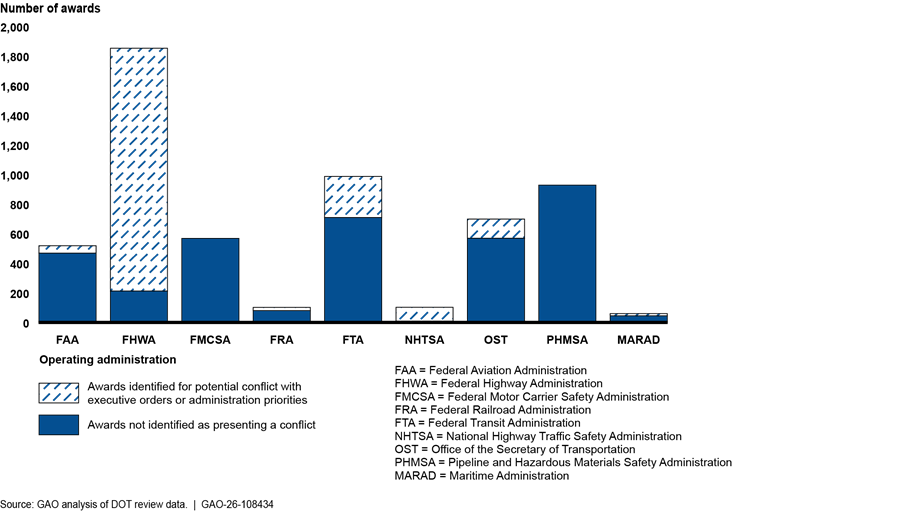
Note: Executive Order 14222, Implementing the President’s “Department of Government Efficiency” Cost Efficiency Initiative, in part, directed agencies to review covered grants in consultation with the Department of Government Efficiency and, where appropriate and consistent with applicable law, terminate or modify, including through renegotiation, covered grants to reduce overall federal spending or reallocate spending to promote efficiency and advance administration policies. Exec. Order No. 14222, 90 Fed. Reg. 11095 (Feb. 26, 2025). DOT’s Executive Order 14222 review included obligated (both fully and partially) discretionary grant funding awarded between January 20, 2021, and January 20, 2025. Both FHWA and OST reviewed awards under the Reconnecting Communities Pilot Program and Neighborhood Access and Equity Program. As a result, the figures above may double count some awards. DOT officials told us that both components reviewed these awards because they both administer the program.
DOT officials told us that after OAs and OST offices submitted their results, DOT determined that about half of the more than 2,000 awards identified for leadership review contained minor conflicts that were quickly resolved and required little or no action. For example, OAs identified awards with programs or activities that used language covered by the executive order because of statutory requirements. Additionally, officials said that OAs overreported potential conflicts because they identified awards that included terminology that was similar but unrelated to the executive orders.
According to officials, DOT offices recommended to leadership that the other approximately half of awards that OAs and OST offices identified for leadership review be handled through DOT’s task force process, which was beginning around the time DOT concluded its review under Executive Order 14222. In April 2026, DOT officials told us that the task force did not review these awards and DOT did not take any action on them. DOT officials also said that about half of the awards under review had concluded as planned. For instance, recipients may have completed all the activities within the scope of the award or the period of performance ended.
Task Force Review
Separately from its Executive Order 14222 review of obligated awards, DOT developed a review process for other awards, including IIJA and IRA awards, that DOT had announced, but not yet obligated, as of January 20, 2025, in response to several executive orders.[94] According to our analysis of DOT data, the task force reviewed about $60.5 billion in funding for 3,879 discretionary grants and cooperative agreements across 94 discretionary grant programs. About 92 percent of these awards were not obligated at the time of DOT’s review.[95]
As with its Executive Order 14222 review, DOT’s task force review began with reviews by the OAs and OST offices. The review culminated in final decisions by the Secretary of Transportation, according to DOT’s guidance. In March 2025, DOT directed each OA and OST office to review individual projects to identify unobligated or partially obligated awards having project scopes that include elements such as equity, diversity, climate change, and environmental justice or bicycle or electric vehicle infrastructure.[96] Later that month, DOT recommended that OAs and OST offices prioritize awards for review in part based on whether large sums of program funding could be obligated for awards within the next 2 weeks.
DOT’s guidance described the task force process as follows:
1. OAs and OST offices review each award for the elements above, among others, and recommend to the task force whether each award should be canceled, modified, or proceed without changes (approved).
2. The task force—composed of OA and OST leadership and the Deputy Secretary of Transportation—review and agree or disagree with recommended actions. If the task force disagrees, the award repeats the task force review process.
3. The task force sends agreed-upon recommendations to the Secretary for final decisions on awards. If the Secretary disagrees, the award repeats the task force review process.
As of September 30, 2025, DOT’s task force had approved most of the awards under review for obligation, about one-quarter of those with modifications.[97] Based on our analysis of DOT data, DOT approved a total of 3,111 awards with or without modification, totaling $39.9 billion. This represented about 66 percent of the $60.5 billion DOT reviewed. DOT modified more than 800 of the awards it approved. DOT officials told us that such modifications may include adjusting the grant award terms and conditions or the scope of activities funded, leading to lower award amounts. Most modifications DOT made were to terms and conditions, and we identified one award for which DOT approved less than the announced award amount.
While DOT’s task force approved most of the awards it reviewed, hundreds of others were canceled or remained under review. DOT reported that 178 awards totaling just over half of the $7.2 billion canceled were canceled by recipients or statute, and DOT terminated or withdrew 70 awards totaling $3.4 billion.[98] According to DOT, recipients canceled awards for a variety of reasons, such as the recipient’s inability to meet matching funding requirements. Additionally, DOT had not yet made final decisions on 520 awards totaling $11.1 billion (see fig. 11).
Figure 11: Status of Awards Reviewed by the Department of Transportation’s (DOT) Task Force as of September 30, 2025
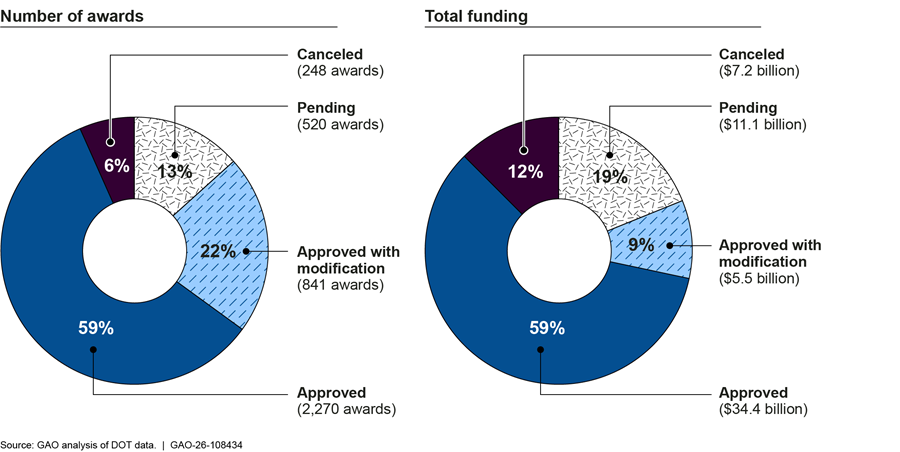
Note: The task force—composed of operating administration and Office of the Secretary of Transportation leadership and the Deputy Secretary of Transportation—makes recommendations to the Secretary of Transportation, who makes final award decisions. Cancellation in our report refers to an award that was discontinued for any variety of reasons. This may include (1) termination of an obligated award, (2) awards for which funding was rescinded by law, (3) retraction (i.e., withdrawal) of an unobligated award, and (4) discontinuance initiated by a recipient.
The awards DOT reported as canceled were generally for larger amounts than the awards DOT approved. The average amount for awards canceled by DOT was $29 million, more than twice the average amount for approved awards ($12.8 million).
The extent to which DOT approved, modified, or canceled awards through its task force review varied across OAs and offices, according to our analysis of DOT’s review data. For example, DOT approved all 113 Pipeline and Hazardous Materials Safety Administration grants under review as of September 30, 2025. In contrast, it approved about 60 percent of the FHWA grants under review (336 of the 562 FHWA grants). The other approximately 40 percent of FHWA awards were either canceled (8 percent) or remained under task force review (32 percent) as of September 30, 2025. While OST offices had the most awards (107) and funding ($2.9 billion) canceled, FAA had the highest proportion (22 percent) of awards canceled (62 of 276 awards). See figure 12 for DOT’s review status by OA.
Figure 12: Status of Grant Awards Reviewed by the Department of Transportation (DOT) Task Force, by Operating Administration, as of September 30, 2025
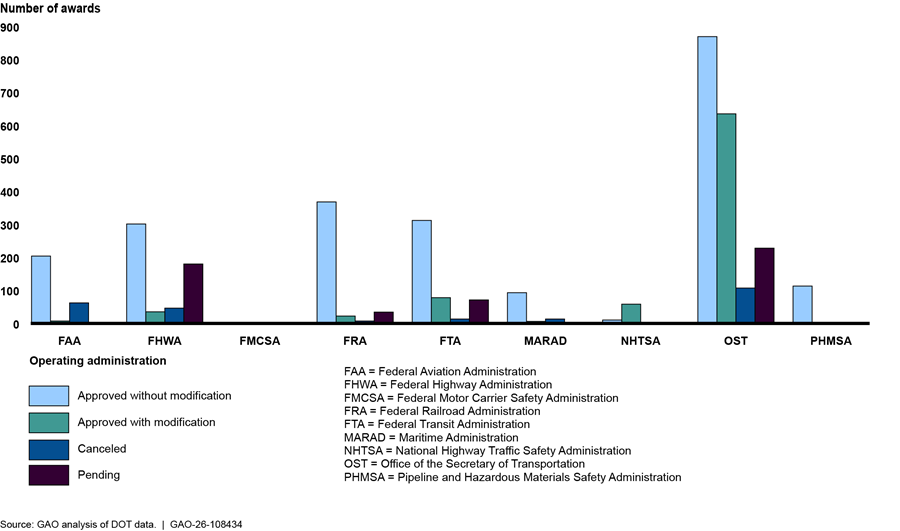
Note: The task force—composed of operating administration and Office of the Secretary of Transportation leadership and the Deputy Secretary of Transportation—makes recommendations to the Secretary of Transportation, who makes final award decisions. Cancellation, in the context of our report, means that an award was discontinued for any of a variety of reasons. For example, this may include (1) termination of an obligated award, (2) awards for which funding was rescinded by law, (3) retraction (i.e., withdrawal) of an unobligated award previously announced, and (4) discontinuance initiated by a recipient.
Similarly, the extent to which DOT approved, modified, or canceled awards varied across the 94 programs included in its task force review, according to DOT’s review data.
Approved. For about 45 percent of the programs with awards under review (42 of 94), DOT approved for obligation all the awards it reviewed. Conversely, for about 7 percent of the programs (7 of 94), DOT reported that none of the 155 awards under review for these programs were approved as of September 30, 2025 (see fig. 13).[99] For one of these seven programs—the Low-Carbon Transportation Materials Grant Program—statutory rescission of its unobligated balances of funding resulted in the cancellation of all the awards under task force review.
Figure 13: Share of Department of Transportation (DOT) Programs by Percentage of Awards Approved Through Its Task Force Funding Review as of September 30, 2025
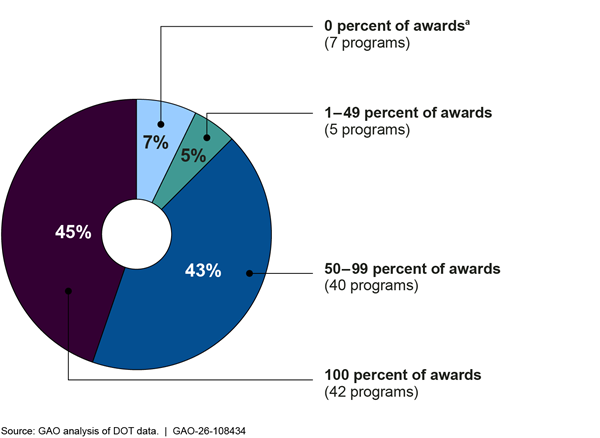
Note: The task force—composed of operating administration and Office of the Secretary of Transportation leadership and the Deputy Secretary of Transportation—makes recommendations to the Secretary of Transportation, who makes final award decisions.
aFor one of the seven programs with zero awards approved, statutory rescissions resulted in the cancellation of all the awards under task force review. Specifically, in July 2025, Public Law 119‑21—commonly known as the One, Big, Beautiful Bill Act—rescinded unobligated balances of funding the Inflation Reduction Act appropriated for the Low-Carbon Materials Grant program. See An Act to provide for reconciliation pursuant to title II of H. Con. Res. 14, Pub. L. No. 119‑21, § 60024, 139 Stat. 72, 157 (2025).
Approved with modifications. About 60 percent of the 841 awards approved for obligation with modifications were in the Safe Streets and Roads for All program.[100] DOT officials told us that changes to these awards focused on removing the equity analysis components of the awards, and that none of the modifications resulted in changes to award amounts. Additionally, of the $5.5 billion DOT approved with modifications, over half (about $2.9 billion) was for three programs: Better Utilizing Investments to Leverage Development (BUILD), National Infrastructure Project Assistance (Mega), and Nationally Significant Freight and Highway Projects (INFRA) awards.
Canceled. DOT did not cancel any awards for more than 70 percent of the programs with awards under review (67 of 94) as of September 30, 2025. In contrast, DOT reported that more than 50 percent of awards in five programs were canceled, largely due to statutory rescissions. Three of these five programs were funded by the IRA and their unobligated balances of funding were rescinded by the One, Big, Beautiful Bill Act.[101] DOT canceled 27 awards totaling $11.3 million in the remaining two programs: the Aircraft Pilots Workforce Development Grant Program and the Aviation Maintenance Technical Workforce Grant Program. According to DOT, these programs were structured in two phases and FAA—the OA that administers the program—has the discretion to determine whether to fund the second phase. DOT officials said that all recipients received funding for the first year, but FAA determined that only five of the 32 recipients should receive funding for the second year.
Pending final decision. In total, more than $11 billion for awards across 44 programs remained under review by DOT as of September 30, 2025. More than 85 percent of the pending funding was in 10 of these 44 programs (see fig. 14).
Figure 14: Funding Pending Department of Transportation (DOT) Task Force Review Decision, by Program, as of September 30, 2025
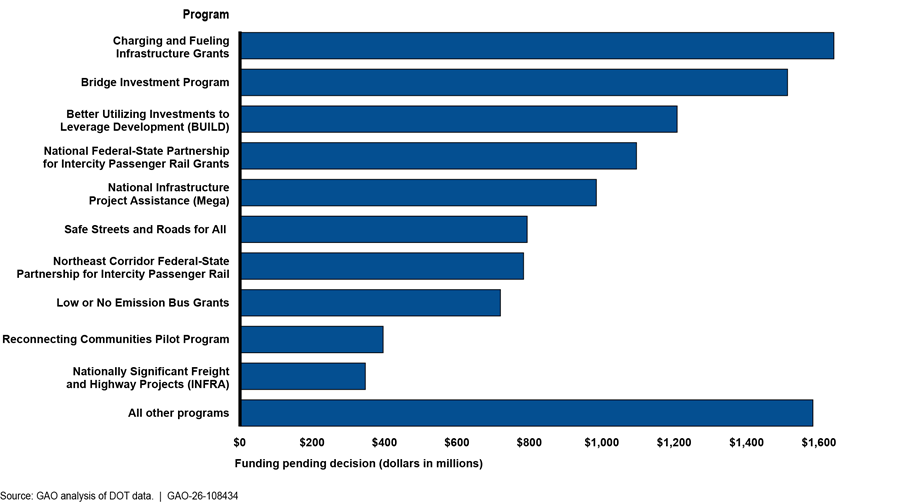
Note: The task force—composed of operating administration and Office of the Secretary of Transportation leadership and the Deputy Secretary of Transportation—makes recommendations to the Secretary of Transportation, who makes final award decisions. In February 2026, the Consolidated Appropriations Act, 2026 rescinded and transferred unobligated balances of funding provided under the Infrastructure Investment and Jobs Act for certain DOT grant programs. See Pub. L. No. 119‑75, 140 Stat. 173 (2026).
While increases in the time it takes to obligate an award can result in increased project costs and longer project timelines, DOT officials said that the agency’s review processes have not delayed the obligation or disbursement of IIJA or IRA grant funding. DOT officials told us that because DOT sometimes takes up to several years to obligate announced funding, the time it has taken the agency to implement these review processes has had little effect on its typical obligation time frames.[102] DOT officials told us that as of April 2026—about 1 year after DOT began its review—293 awards remained under review.
Additionally, DOT reported that $370.6 million in IIJA funds across six FHWA programs expired on October 1, 2025.[103] DOT did not identify the number of awards affected because, according to officials, the affected programs had Notices of Funding Opportunity covering multiple fiscal years, and in general, each fiscal year’s funding for those programs is obligated once a project is ready. DOT said this makes it difficult to attribute these funds to specific projects. DOT also reported that $101.9 million in IIJA funds across seven Federal Transit Administration programs became unavailable to the original announced recipients and was subject to reallocation as of October 1, 2025.[104]
Anne Sit-Williams, sitwilliamsa@gao.gov
Elizabeth (Biza) Repko, repkoe@gao.gov
In addition to the contacts named above, Matt Barranca (Assistant Director), Joshua Marcus (Assistant Director), Katherine Raymond (Analyst in Charge), Rebecca Riklin (Analyst in Charge), Princess Adrineda, Seth Brewington, Kristen Foster, Joanne Howard, Jason Kirwan, Mary-Catherine P. Overcash, Kristine Papa, Malika Williams, and Jennifer Wilson made key contributions to this report.
The Government Accountability Office, the audit, evaluation, and investigative arm of Congress, exists to support Congress in meeting its constitutional responsibilities and to help improve the performance and accountability of the federal government for the American people. GAO examines the use of public funds; evaluates federal programs and policies; and provides analyses, recommendations, and other assistance to help Congress make informed oversight, policy, and funding decisions. GAO’s commitment to good government is reflected in its core values of accountability, integrity, and reliability.
Obtaining Copies of GAO Reports and Testimony
The fastest and easiest way to obtain copies of GAO documents at no cost is through our website. Each weekday afternoon, GAO posts on its website newly released reports, testimony, and correspondence. You can also subscribe to GAO’s email updates to receive notification of newly posted products.
Order by Phone
The price of each GAO publication reflects GAO’s actual cost of production and distribution and depends on the number of pages in the publication and whether the publication is printed in color or black and white. Pricing and ordering information is posted on GAO’s website, https://www.gao.gov/ordering.htm.
Place orders by calling (202) 512-6000, toll free (866) 801-7077,
or
TDD (202) 512-2537.
Orders may be paid for using American Express, Discover Card, MasterCard, Visa, check, or money order. Call for additional information.
Connect with GAO
Connect with GAO on X,
LinkedIn, Instagram, and YouTube.
Subscribe to our Email Updates. Listen to our Podcasts.
Visit GAO on the web at https://www.gao.gov.
To Report Fraud, Waste, and Abuse in Federal Programs
Contact FraudNet:
Website: https://www.gao.gov/about/what-gao-does/fraudnet
Automated answering system: (800) 424-5454
Media Relations
Sarah Kaczmarek, Managing Director, Media@gao.gov
Congressional Relations
David A. Powner, Acting Managing Director, CongRel@gao.gov
General Inquiries
[1]Infrastructure Investment and Jobs Act, Pub. L. No. 117-58, 135 Stat. 429 (2021); An Act to provide for reconciliation pursuant to title II of S. Con. Res. 14, Pub. L. No. 117-169, 136 Stat. 1818 (2022) (commonly known as the Inflation Reduction Act).
[2]Budget authority is authority provided by federal law to enter into financial obligations that will result in immediate or future outlays involving federal government funds. The basic forms of budget authority include (1) appropriations, (2) borrowing authority, (3) contract authority, and (4) authority to obligate and expend offsetting receipts and collections. The IIJA included over $551 billion in appropriations, contract authority, and mandatory budget authority for all Department of Transportation (DOT) grant programs for fiscal year 2022 through fiscal year 2026. Contract authority is a form of budget authority that permits obligations to be incurred in advance of appropriations. Contract authority is unfunded, and a subsequent appropriation is needed to liquidate or pay the obligations. For the other selected agencies, the IIJA and IRA provided only appropriations and no other forms of budget authority. GAO, A Glossary of Terms Used in the Federal Budget Process, GAO‑05‑734SP (Washington, D.C.: September 2005).
[3]Within the Department of Commerce, we selected NTIA because almost $48 billion of the approximately $51 billion the IIJA appropriated to Commerce was for NTIA programs.
[4]We did not include budget authority for which the entire period of availability occurs after September 30, 2025, as these funds were not available for obligation during the period we reviewed. For DOT, we only included budget authority provided for its grant programs.
[5]We expect to publish this report in September 2026.
[6]We analyzed DOT’s IIJA obligations and disbursements from USAspending.gov because we determined these data were reliable for our purposes. Executive agencies must report certain information on their obligation and disbursement of funds to Congress and the public. Agencies must report obligations and disbursements to USAspending.gov—the official source of federal spending information for the public. The Office of Management and Budget (OMB) and the Department of the Treasury provide guidance and policies related to USAspending.gov. The Federal Funding Accountability and Transparency Act of 2006, as amended, requires OMB to ensure the existence and operation of a single searchable website, accessible to the public at no cost, containing information on federal awards and on the status of agencies’ appropriations accounts. See Pub. L. No. 109-282, 120 Stat. 1186 (2006), codified as amended at 31 U.S.C. § 6101 note. USAspending.gov was established in response to this requirement.
[7]Public Law 119-21, commonly known as the One Big Beautiful Bill Act (OBBBA), was enacted on July 4, 2025, and repealed Section 134 of the Clean Air Act that established the Greenhouse Gas Reduction Fund (GGRF) and rescinded the unobligated funding for the GGRF. Of the fund’s $27 billion appropriation, the IRA provided almost $20 billion in funding for competitive grants to eligible nonprofit organizations through the $14 billion National Clean Investment Fund and $6 billion Clean Communities Investment Accelerator. According to EPA’s review data, these grants remain fully obligated as of March 2026. The status of these funds is unclear due to ongoing litigation. The GGRF also included the $7 billion Solar for All program, which EPA announced it had completely terminated in August 2025. Litigation challenging the legality of EPA’s termination of the program and the cancellation of the grants is pending resolution as of April 2026.
[9]See 2 C.F.R. § 200.1.
[10]31 U.S.C. § 6305.
[11]2 C.F.R. § 200.1; see also GAO‑05‑734SP.
[12]See Federal Acquisition Regulation (FAR) 2.101.
[13]Department of the Treasury, Interagency Agreement Guide (March 2013).
[14]GAO‑05‑734SP. Payment may be made immediately or in the future.
[16]GAO‑05‑734SP. Payments made to liquidate federal obligations include the issuance of checks, disbursement of cash, or electronic transfer of funds. These are also referred to as outlays.
[17]While agencies may incur obligations only during the funding’s period of availability, agencies have additional time after that period in which they may record, adjust, or liquidate properly incurred obligations. See 31 U.S.C. § 1552, 1553; see also GAO‑05‑734SP.
[18]See 31 U.S.C. § 1501(a)(5)(A). In contrast, DOT’s federal-aid highway formula funding authorized under IIJA § 11101(a)(1) is obligated by signing agreements required by statute. See 23 U.S.C. § 106.
[19]For our purposes, “federal award” generally refers to federal financial assistance and cost-reimbursement contracts that nonfederal entities receive directly from federal agencies or indirectly from a pass-through entity. 2 C.F.R. § 200.1. Here, we use “award” to include opportunities for such funding an agency has announced, regardless of obligation status.
[20]Grants, cooperative agreements, and loans may be terminated pursuant to 2 C.F.R. § 200.340. Contracts may be terminated pursuant to the terms of FAR Part 49, or otherwise pursuant to the terms of the individual contract. Cancellation provisions may vary for interagency agreements, which may be entered into pursuant to the Economy Act, 31 U.S.C. § 1535, as implemented by FAR Part 17.5, or more specific statutory authority.
[21]See Federal Funding Accountability and Transparency Act of 2006, Pub. L. No. 109-282, 120 Stat. 1186 (codified as amended at 31 U.S.C. § 6101 note).
[22]See 172 Cong. Rec. H1735 (daily ed. Jan. 22, 2026). The Joint Explanatory Statement also directed DOT to transmit a report to certain congressional committees that in part identifies each grant that (1) was obligated within a certain time period; (2) was subsequently terminated, withdrawn, or reduced in scope during calendar year 2025; and (3) remains in such changed status as of February 3, 2026. The report is to include the reason for each change in grant status, the grant recipient, and the amount and source of funds affected. See 172 Cong. Rec. H1734 (daily ed. Jan. 22, 2026).
[23]See Infrastructure Investment and Jobs Act, Pub. L. No. 117-58, 135 Stat. 429 (2021). The IIJA is the current surface transportation reauthorization act. The IIJA included over $551 billion in appropriations, contract authority, and mandatory budget authority for DOT grant programs for fiscal year 2022 through fiscal year 2026. Contract authority is a form of budget authority that permits obligations to be incurred in advance of appropriations. Contract authority is unfunded, and a subsequent appropriation is needed to liquidate or pay the obligations. GAO‑05‑734SP, 21.
[24]See An Act to provide for reconciliation pursuant to title II of S. Con. Res. 14, Pub. L. No. 117-169, 136 Stat. 1818 (2022) (commonly known as the Inflation Reduction Act). We have previously reported on provisions of the IRA related to tax administration, prescription drug pricing, federal buildings, and environmental review and data collection efforts.
[25]See An Act to provide for reconciliation pursuant to title II of H. Con. Res. 14, Pub. L. No. 119-21, 139 Stat. 72 (2025).
[26]See Pub. L. No. 119‑75, 140 Stat. 173 (2026).
[27]For DOT, we only included budget authority provided for its grant programs.
[28]NTIA provided obligation and disbursement data through June 30, 2025, but as of December 2025 declined to provide additional data through the end of fiscal year 2025. NTIA subsequently provided some information covering July 2025 through September 2025, as well as technical comments on the draft report, and we incorporated that information into our report where relevant. However, NTIA did not provide data on obligations and disbursements from July 1, 2025, through September 30, 2025.
[29]30 U.S.C. § 1231a, as enacted by the IIJA, authorized $11.293 billion to fund the Abandoned Mine Reclamation Fund. IIJA Division J, Title VI appropriated amounts consistent with this authorization.
[30]DOT officials reported that the $101.9 million was available until expended and did not expire from a financial perspective. According to DOT officials, some funds were not under DOT review at the time they expired or became unavailable to the original announced recipients.
[31]The IRA provided only budget authority for discretionary grants to DOT and did not provide any budget authority to NTIA.
[32]OBBBA, Pub. L. No. 119-21.
[33]OBBBA, §§ 50304, 60018, & 60019. After September 30, 2025, EPA recorded further rescissions totaling $1.2 billion, primarily affecting the Environmental and Climate Justice Block Grants program.
[34]GAO, Federal Awards: Selected Programs Did Not Fully Include Identified Practices to Enhance Oversight and Fraud Prevention, GAO‑26‑107444 (Washington, D.C.: Dec. 4, 2025).
[35]See table 1 for examples of executive orders that prompted agency reviews.
[36]Exec. Order No. 14154, Unleashing American Energy, 90 Fed. Reg. 8353 (Jan. 20, 2025).
[37]On January 27, 2025, OMB issued a memo, M-25-13, directing all federal agencies, to the extent permitted by law, to temporarily pause all obligation or disbursement of federal financial assistance pending a comprehensive analysis of all assistance programs to identify programs, projects, and activities implicated by the President’s executive orders. According to NTIA documents, OMB provided a template that directed agencies to evaluate awards against requirements in seven executive orders. While OMB rescinded M-25-13 in a subsequent memo, M-25-14, the underlying executive orders and their implementation requirements remained in effect. According to NTIA data and officials, the Office of Internet Connectivity and Growth continued to review awards after OMB rescinded the memo.
[38]The executive order directed agencies to, among other things, review covered contracts and grants in consultation with the Department of Government Efficiency and, where appropriate and consistent with applicable law, terminate or modify covered contracts and grants to reduce federal spending or reallocate spending to promote efficiency and advance administration policies. Exec. Order No. 14222, 90 Fed. Reg. 11095 (Feb. 26, 2025).
[39]DOT officials identified several executive orders as guiding their review, such as Exec. Order No. 14151, Ending Radical and Wasteful Government DEI Programs and Preferencing, 90 Fed. Reg. 8339 (Jan. 20, 2025); Exec. Order No. 14154, Unleashing American Energy, 90 Fed. Reg. 8353 (Jan. 20, 2025); and Exec. Order No. 14168, Defending Women from Gender Ideology Extremism and Restoring Biological Truth to the Federal Government, 90 Fed Reg. 8615 (Jan. 20, 2025).
[40]Exec. Order No. 14154.
[41]Exec. Order No. 14151.
[42]Of note, after January 2026, the Joint Explanatory Statement accompanying the Consolidated Appropriations Act, 2026 directed DOT not to terminate a federal award, neither in part nor in its entirety, nor require a renegotiation or rescoping of it, solely because the award no longer effectuates the program goals or agency priorities, unless departmental procedures are followed. 172 Cong. Rec. H1734 (daily ed. Jan. 22, 2026); Consolidated Appropriations Act, 2026, Pub. L. No. 119-75, 140 Stat. 173 (2026).
[43]Declaration of Deputy Assistant Administrator for Infrastructure and Extramural Resources, Office of Mission Support, EPA, Status Report, Ex. 1, ECF No. 51-1 Woonasquatucket River Watershed Council v. U.S. Department of Agriculture, 1:25-cv-00097 (D.R.I. 2025).
[44]Certain awards that were canceled represent withdrawal of a previously announced unobligated award. Therefore, not all cancellations resulted in deobligation of funds.
[45]NTIA provided review data through June 30, 2025, but as of December 2025 declined to provide additional data through September 30, 2025. However, NTIA subsequently provided information on the status of some awards, and we incorporated that information into our report where relevant. EPA provided data as of February 2026. Interior and DOT provided data as of September 30, 2025, as requested.
[46]Digital Equity Act of 2021, Pub. L. No. 117-58, div. F, tit. III, 135 Stat. 1209 (codified as amended at 47 U.S.C. §§ 1721-26). The Digital Equity Act was enacted as part of the IIJA. The National Digital Inclusion Alliance filed suit in the U.S. District Court for the District of Columbia to challenge the Department of Commerce’s termination of the Digital Equity Act competitive grant program. As explained in the federal government’s motion to dismiss, the Department of Commerce terminated Digital Equity Act grants after the President and Secretary of Commerce determined the Digital Equity Act included unconstitutional racial preferences. Defendant’s Motion to Dismiss at 6–7, National Digital Inclusion Alliance v. Trump, No. 25-cv-3606 (D.D.C. Feb. 6, 2026). The Digital Equity Act programs awarded grants to benefit covered populations, which the act defines to include individuals who are members of a racial or ethnic minority group. 47 U.S.C. § 1721(8)(G). As of June 2026, the lawsuit is still pending.
[47]We included these awards as “canceled” in table 2 because that was their final disposition.
[48]Two offices stated that their time frames were not affected because their programs resumed in February 2025, and four bureaus and offices did not respond to our inquiry.
[49]See IIJA, Pub. L. No. 117‑58, 135 Stat. 429 (2021); IRA, Pub L. No. 117‑169, 136 Stat. 1818 (2022). We did not include budget authority for which the entire period of availability occurs after September 30, 2025, as these funds were not available for obligation during the period we reviewed.
[50]For our purposes, “federal award” generally refers to federal financial assistance and cost-reimbursement contracts that nonfederal entities receive directly from federal agencies or indirectly from a pass-through entity. 2 C.F.R. § 200.1. Here, we use “award” to include opportunities for such funding an agency has announced, regardless of obligation status. Cancellation, in the context of our report, means that an award was discontinued for any of a variety of reasons. These may include termination of an obligated award, awards for which funding was rescinded by law, retraction of an unobligated award previously announced, and discontinuance initiated by a recipient.
[51]The IRA established and appropriated $27 billion to the Greenhouse Gas Reduction Fund (GGRF) to award competitive grants to nonfederal entities to support greenhouse gas reduction efforts. Of the $27 billion appropriation, the IRA provided almost $20 billion in funding for competitive grants to eligible nonprofit organizations through the $14 billion National Clean Investment Fund and $6 billion Clean Communities Investment Accelerator. The appropriated funds were available for obligation through September 30, 2024. The GGRF also included the $7 billion Solar for All program, which EPA announced it had terminated in August 2025. Litigation challenging the legality of EPA’s termination of the GGRF grants and programs is pending resolution as of April 2026.
[52]The IIJA appropriated EPA multiyear funds for use throughout the assigned period of availability of 2022 through 2026.
[53]An Act to provide for reconciliation pursuant to title II of H. Con. Res. 14, Pub. L. No. 119-21, title VI, §§ 60001-16, 139 Stat. 72, 154-56 (2025). After September 30, 2025, EPA recorded further rescissions totaling $1.2 billion, primarily affecting the Environmental and Climate Justice Block Grants program. Litigation on the propriety of EPA’s termination of these grants is pending resolution as of April 2026. See Woonasquatucket River Watershed Council v. U.S. Dep’t of Agric., 778 F. Supp. 3d 440 (D.R.I. 2025), appeal docketed No. 25-1428 (1st Cir. argued Feb. 5, 2026).
[54]Woonasquatucket River Watershed Council v. U.S. Dep’t of Agric., 778 F. Supp. 3d 440 (D.R.I. 2025), appeal docketed No. 25-1428 (1st Cir. argued Feb. 5, 2026).
[55]In response to Executive Order 14154, EPA discontinued certain reporting and benefit analysis related to disadvantaged communities that it previously required grantees to complete.
[56]EPA provided a grant review report from its Compass financial system and Next Generation Grants System. The report was generated on February 25, 2026, and may reflect additional obligations and disbursements, including on canceled awards, incurred after the completion of EPA’s review of existing funding in the summer of 2025.
[57]EPA’s decision to cancel the Solar for All grants program has been challenged, with lawsuits pending in multiple federal district courts.
[58]Pub. L. No. 119-21, title VI, §§ 60002, 139 Stat. 72, 154.
[59]We did not include budget authority for which the entire period of availability occurs after September 30, 2025, as these funds were not available for obligation during the period we reviewed.
[60]See IIJA, Pub. L. No. 117‑58, 135 Stat. 429 (2021); IRA, Pub L. No. 117‑169, 136 Stat. 1818 (2022).
[61]Exec. Order No. 14154, Unleashing American Energy, 90 Fed. Reg. 8353 (Jan. 20, 2025).
[62]Agencies distribute formula grant funds to eligible recipients in accordance with a distribution formula prescribed by law or administrative regulation.
[63]30 U.S.C. § 1231a(d); IIJA § 40701.
[64]See An Act to provide for reconciliation pursuant to title II of H. Con. Res. 14, Pub. L. No. 119-21, 139 Stat. 72 (2025).
[65]For our purposes, “federal award” generally refers to federal financial assistance and cost-reimbursement contracts that nonfederal entities receive directly from federal agencies or indirectly from a pass-through entity. 2 C.F.R. § 200.1. Here, we use “award” to include opportunities for such funding an agency has announced, regardless of obligation status. Cancellation, in the context of our report, means that an award was discontinued for any of a variety of reasons. These may include termination of an obligated award, awards for which funding was rescinded by law, retraction of an unobligated award previously announced, and discontinuance initiated by a recipient.
[66]Exec. Order No. 14154.
[67]Exec. Order No. 14154 and January 21, 2025, Office of Management and Budget Memorandum M-25-11, Guidance Regarding Section 7 of the Executive Order Unleashing American Energy.
[68]Woonasquatucket River Watershed Council v. U.S. Dep’t of Agric., 778 F. Supp. 3d 440 (D.R.I. 2025), appeal docketed No. 25-1428 (1st Cir. argued Feb. 5, 2026). Interior officials stated that Interior resumed disbursements for financial assistance agreements, such as cooperative agreements and grants. However, they also stated that disbursements for contracts were not subject to the court order.
[69]Interior officials told us that they considered several different executive orders when conducting this review. These include Exec. Order No. 14151, Ending Radical and Wasteful Government DEI Programs and Preferencing, 90 Fed. Reg. 8339 (Jan. 20, 2025); Exec. Order No. 14156, Declaring a National Energy Emergency, 90 Fed. Reg. 8433 (Jan. 20, 2025); Exec. Order No. 14181, Emergency Measures To Provide Water Resources in California and Improve Disaster Response in Certain Areas, 90 Fed. Reg. 8747 (Jan. 24, 2025); and Exec. Order No. 14308, Empowering Commonsense Wildfire Prevention and Response, 90 Fed. Reg. 26175 (June 12, 2025), among others.
[70]Eight bureaus (Bureau of Indian Affairs, Bureau of Land Management, Bureau of Ocean Energy Management, Bureau of Reclamation, Bureau of Safety and Environmental Enforcement, National Park Service, U.S. Fish and Wildlife Service, and U.S. Geological Survey) and five offices (Office of Environmental Policy and Compliance, Office of Insular Affairs, Office of Policy Analysis, Office of Restoration & Damage Assessment, and Orphaned Wells Program Office) indicated that their time frames for approving and disbursing IIJA and IRA funds have been affected because of the reviews.
[71]Pub. L. No. 117‑58, 135 Stat. 429 (2021). The Inflation Reduction Act did not provide funds to NTIA. We did not include budget authority for which the entire period of availability occurs after September 30, 2025, as these funds were not available for obligation during the period we reviewed.
[72]NTIA provided us with data through June 30, 2025, but, as of December 2025, declined to provide additional data through the end of fiscal year 2025. However, NTIA subsequently provided information on the status of some awards, and we incorporated that information into our report where relevant. NTIA also provided technical comments on the draft report, which we incorporated as appropriate. These amounts include amounts available to the agency for administrative costs. For example, under the Broadband Equity, Access and Deployment Program, NTIA may use up to 2 percent of amounts appropriated for administrative purposes. 47 U.S.C. § 1702(d)(1).
[73]For our purposes, “federal award” generally refers to federal financial assistance and cost-reimbursement contracts that nonfederal entities receive directly from federal agencies or indirectly from a pass-through entity. 2 C.F.R. § 200.1. Here, we use “award” to include opportunities for such funding an agency has announced, regardless of obligation status. Cancellation in our report refers to an award that was discontinued for any of a variety of reasons. These may include (1) termination of an obligated award, (2) awards for which funding was rescinded by law, (3) retraction (i.e., withdrawal) of an unobligated award, and (4) discontinuance initiated by a recipient.
[74]According to NTIA officials, the Office of Internet Connectivity and Growth reviews applications, selects recipients, and oversees award performance for IIJA funding appropriated to NTIA. NTIA officials also told us that the Department of Commerce’s National Institute for Science and Technology and National Oceanic and Atmospheric Administration handle the financial administration of NTIA’s grants, including verifying that recipients meet all financial requirements and conducting risk assessments prior to award. Under 2 C.F.R. § 200.206, this is required, and federal agencies must establish and maintain policies and procedures for risk assessments to consider issues such as an applicant’s financial stability and history of performance.
[75]Exec. Order No. 14222, Implementing the President’s “Department of Government Efficiency” Cost Efficiency Initiative, 90 Fed. Reg. 11095 (Feb. 26, 2025).
[76]On January 27, 2025, OMB issued a memo, M-25-13, directing all federal agencies, to the extent permitted by law, to temporarily pause all obligation or disbursement of federal financial assistance pending a comprehensive analysis of all assistance programs to identify programs, projects, and activities implicated by the President’s executive orders. According to NTIA documents, OMB provided a template that directed agencies to evaluate awards against requirements in seven executive orders. While OMB rescinded M-25-13 in a subsequent memo, M-25-14, the underlying executive orders and their implementation requirements remained in effect. According to NTIA data, the Office of Internet Connectivity and Growth continued to review awards after OMB rescinded the memo.
[77]The executive order directed agencies to, among other things, review covered contracts and grants in consultation with the Department of Government Efficiency and, where appropriate and consistent with applicable law, terminate or modify covered contracts and grants to reduce federal spending or reallocate spending to promote efficiency and advance administration policies. Exec. Order No. 14222, 90 Fed. Reg. 11095 (Feb. 26, 2025).
[78]While NTIA officials told us in July 2025 that they would continue to review, approve, and cancel awards on a rolling basis moving forward, NTIA did not provide information on its review progress from June 30, 2025, through September 30, 2025. Therefore, we were unable to determine the status of the eight pending awards during this time frame.
[79]Digital Equity Act of 2021, Pub. L. No. 117-58, div. F, tit. III, 135 Stat. 1209 (codified as amended at 47 U.S.C. §§ 1721–26). The Digital Equity Act was enacted as part of the IIJA. NTIA’s review data included 182 Digital Equity Act awards, but 62 awards had been closed out or transferred prior to the Secretary of Commerce terminating the program.
[80]NTIA officials told us that following the Digital Equity Act program termination, recipients had 120 days to close out award activities and submit reimbursement requests for eligible expenses, after which the funding would be deobligated. NTIA officials declined to provide information on the status of deobligations as of September 30, 2025.
[81]The National Digital Inclusion Alliance filed suit in the U.S. District Court for the District of Columbia to challenge Commerce’s termination of the Digital Equity Act competitive grant program. As explained in the federal government’s motion to dismiss, the Department of Commerce terminated Digital Equity Act grants after the President and Secretary of Commerce determined the Digital Equity Act included unconstitutional racial preferences. Defendant’s Motion to Dismiss at 6–7, National Digital Inclusion Alliance v. Trump, No. 25-cv-3606 (D.D.C. Feb. 6, 2026). The Digital Equity Act programs awarded grants to benefit covered populations, which the act defines to include individuals who are members of a racial or ethnic minority group. 47 U.S.C. § 1721(8)(G). As of June 2026, the lawsuit is still pending.
[82]See IIJA, Pub. L. No. 117‑58, 135 Stat. 429 (2021); IRA, Pub L. No. 117‑169, 136 Stat. 1818 (2022). We did not include budget authority for which the entire period of availability occurs after September 30, 2025, as these funds were not available for obligation during the period we reviewed.
[83]Here, we use “award” to include opportunities for such funding an agency has announced, regardless of obligation status. Cancellation in our report refers to an award that was discontinued for any of a variety of reasons. These may include (1) termination of an obligated award, (2) awards for which funding was rescinded by law, (3) retraction (i.e., withdrawal) of an unobligated award, and (4) discontinuance initiated by a recipient.
[84]Fiscal year 2022 was the first year that IIJA funding was available for obligation. The IIJA authorized and appropriated about $551 billion in DOT formula and discretionary grant funding for fiscal years 2022 through 2026, approximately $114 billion of which became available for obligation at the beginning of fiscal year 2026. In addition, the amounts of funding actually available for grants each fiscal year is typically less than the funding amounts specified in the IIJA due to, for example, authorized administrative takedowns.
[85]OST administers some grant programs and shares responsibilities for some grant programs with the OAs. We discuss OST offices below in relation to their grant administration responsibilities.
[86]Most of these funds were formula grant funding.
[87]The IRA provided about $5.9 million in funding to DOT for the administration and oversight of the IRA aviation grant programs, but we did not include these funds in our analysis because such funding is not grant funding. This approximately $5.6 billion in funding is available for obligation from fiscal year 2022 through fiscal year 2026.
[88]See An Act To provide for reconciliation pursuant to title II of H. Con. Res. 14, Pub. L. No. 119‑21, §§ 40010, 60019, 60023‑60024, 139 Stat. 72, 137, 156‑157 (2025).
[89]In a discretionary grant program, agencies generally award funds to eligible recipients through a competitive process in which agency officials review and select applications for alignment with specific criteria.
[90]Under a formula funding program, agencies distribute funds to all eligible recipients using a statutory formula. Because DOT officials told us that DOT did not review formula funding programs, they are not within the scope of the review processes discussed in this report.
[91]The executive order, in part, directed agencies to review covered grants in consultation with the Department of Government Efficiency and, where appropriate and consistent with applicable law, terminate or modify, including through renegotiation, covered grants to reduce overall federal spending or reallocate spending to promote efficiency and advance administration policies. Exec. Order No. 14222, 90 Fed. Reg. 11095 (Feb. 26, 2025). DOT officials told us that most of the obligated awards it reviewed were funded by the IIJA or IRA, but that this review may have included some funding provided by other sources.
[92]Seven of the nine executive orders are relevant to this report. They are Exec. Order No. 14151, Ending Radical and Wasteful Government DEI Programs and Preferencing, 90 Fed. Reg. 8339 (Jan. 20, 2025); Exec. Order No. 14154, Unleashing American Energy, 90 Fed. Reg. 8353 (Jan. 20, 2025); Exec. Order No. 14168, Defending Women from Gender Ideology Extremism and Restoring Biological Truth to the Federal Government, 90 Fed Reg. 8615 (Jan. 20, 2025); Exec. Order No. 14173, Ending Illegal Discrimination and Restoring Merit-Based Opportunity, 90 Fed. Reg. 8633 (Jan. 21, 2025); Exec. Order No. 14182, Enforcing the Hyde Amendment, 90 Fed. Reg. 8751 (Jan. 24, 2025); Exec. Order No. 14190, Ending Radical Indoctrination in K-12 Schooling, 90 Fed. Reg. 8853 (Jan. 29, 2025); and Exec. Order No. 14224, Designating English as the Official Language of the United States, 90 Fed. Reg. 11363 (Mar. 1, 2025). In addition to being either fully or partially obligated, DOT guidance specified that the discretionary grant agreements to be reviewed also had to be awarded on or after January 20, 2021, with a current period of performance.
[93]Both FHWA and OST reviewed awards under the Reconnecting Communities Pilot Program and Neighborhood Access and Equity Program. As a result, the figures above may double count some awards. DOT officials told us that both components reviewed these awards because they both administer the program.
[94]DOT officials identified several executive orders as guiding their review, such as Exec. Order No. 14151, Exec. Order No. 14154, and Exec. Order No. 14168. DOT likely had many awards announced but not yet obligated because of its obligation process. DOT obligates awards when DOT and an awardee sign a grant agreement. Prior to signing a grant agreement, DOT and awardees must satisfy the requirements of the grant program, such as planning and environmental reviews. Grant program requirements may vary depending on the program or project. In July 2025, we reported delays between DOT’s announcement of an award and the point at which DOT and an awardee sign a grant agreement. See GAO, Infrastructure Investment and Jobs Act: DOT Should Better Communicate Funding Status and Assess Risks, GAO‑25‑107166 (Washington, D.C.: July 24, 2025). DOT officials told us that while some awards funded by sources other than the IIJA and IRA may have been included in this review, most awards it reviewed were funded by the IIJA and IRA.
[95]The remaining 8 percent of awards were either partially obligated (272 awards totaling $13.6 billion) or fully obligated (34 awards totaling $201 million). The task force process included fully or partially obligated awards if (1) the grant agreement required amendments or (2) the recipient sought to exercise an option year (for cooperative agreements).
[96]DOT issued initial guidance on March 11, 2025, in which it directed OAs and OST offices to first identify programs for which award selections may have included these and certain other elements. According to that guidance, OAs and OST offices were then to conduct this project-by-project review and flag those project scope elements or activities for potential removal. DOT officials told us that after DOT began its review, its approach evolved and it instead conducted a project-by-project review for all of its discretionary grant programs.
[97]DOT officials said that when the Secretary approves an award through the task force, it means that the OA or OST office administering the award is approved to move forward with the regular obligation process, such as working with the recipient to ensure preobligation requirements are met and signing a grant agreement.
[98]DOT reported that the Secretary had approved 32 awards that were later canceled by the recipient, while another 39 were canceled by the recipient before DOT made a final decision. Additionally, DOT reported terminating seven awards totaling $54 million to support transportation safety research at University Transportation Centers. DOT officials said that, following an injunction, DOT reinstated two of these awards, which total $21 million. DOT officials also told us that these awards were terminated due to their misalignment with administration priorities and not as part of the task force review process.
[99]These programs include the Commercial Driver’s License Program; the Federal-State Partnership for State of Good Repair; the National Electric Vehicle Infrastructure discretionary grant set-aside; Research, Development, Demonstration and Deployment Projects; the Rural Autonomous Vehicle Research Program; Charging and Fueling Infrastructure Grants; and the Low-Carbon Transportation Materials Grant Program. Public Law 119-21, commonly known as the One Big Beautiful Bill Act (OBBBA) rescinded unobligated balances for the Low-Carbon Transportation Materials Grant Program.
[100]The IIJA established the Safe Streets and Roads for All program to fund regional, local, and tribal initiatives to prevent roadway fatalities and serious injuries. See IIJA § 24112 (codified at 23 U.S.C. § 402 note).
[101]These three programs were the Fueling Aviation’s Sustainable Transition through Sustainable Aviation Fuels Program, Neighborhood Access and Equity Grant Program, and the Low Carbon Transportation Materials Program. See IRA §§ 40007, 60501, 60506; OBBBA §§ 40010, 60019, 60024.
[102]DOT officials cited grant requirements and project timelines as a reason for the long obligation timeline. We have previously reported on delays in obligations of DOT’s IIJA discretionary grant funding. For the purposes of that report, DOT obligates discretionary grant funding when it executes a grant agreement with the awardee. See GAO‑25‑107166.
[103]According to DOT officials, not all of these funds were under DOT review at the time they expired.
[104]DOT officials noted that the Federal Transit Administration funds are available until expended. DOT officials explained that the Federal Transit Administration had 4 years to obligate these funds; after this time, unobligated funds became unavailable to the original announced recipient and were subject to reallocation. DOT officials said that these funds were not under DOT review at the time they became subject to reallocation.