
Report to Congressional Committees
United States Government Accountability Office
A report to congressional committees
Contact: James Reynolds at reynoldsj@gao.gov
What GAO Found
To strengthen the United States’ and its foreign partners’ security, the U.S. government sells or provides defense articles and services to more than 100 foreign governments and international organizations that request them. The Department of Defense (DOD), with other agencies, uses technology release and foreign disclosure policies and procedures—the TRFD processes—to determine whether to share sensitive military technology and intelligence with foreign partners. Generally, the TRFD processes start when a foreign partner submits a request to DOD. Designated officials manage the request to obtain approval from the relevant military departments and interagency stakeholders.

DOD officials identified operational challenges affecting the execution of the TRFD processes and described steps DOD is taking to mitigate them. According to officials, weighing the national security implications of releasing sensitive technology is inherently time consuming and specialized. Moreover, decision-making is distributed among multiple stakeholders, with different authorities, which may complicate coordination among these processes. To facilitate coordination, DOD is taking some mitigating steps and considering establishing a knowledge repository system to track TRFD policies and decisions.
DOD has taken steps to enact reforms of the TRFD processes. In November 2025, according to officials, DOD began implementing TRFD reforms that, according to officials, it intended to complete within a year. Officials also said that DOD was tracking progress on the reforms and, as of May 2026, had completed 26 of 33 reform action items. While DOD will likely undertake additional TRFD reforms in the future, it is on track to complete the current efforts by November 2026 because of support from senior DOD leadership and effective prioritization of the reforms, according to officials.
Why GAO Did This Study
In recent years, Congress and others have raised questions about the transparency and accountability of the TRFD processes. The National Defense Authorization Act for Fiscal Year 2024 required DOD to submit a report to Congress assessing various aspects of the TRFD processes. In December 2024, DOD submitted the report. In addition, in April 2025, Executive Order 14268 directed DOD to implement TRFD reforms as part of an effort to facilitate foreign military sales.
The joint explanatory statement accompanying the 2025 NDAA included a provision for GAO to conduct an independent assessment of DOD’s TRFD reform initiative. This report describes (1) DOD’s TRFD processes, (2) challenges related to the TRFD processes and steps DOD is taking to mitigate them, and (3) DOD’s progress in implementing organizational reforms proposed in its December 2024 report and directed in Executive Order 14268.
GAO reviewed documents from DOD, including DOD’s Security Assistance Management Manual. In addition, GAO met with DOD officials and attended a course for foreign disclosure officers.
|
Abbreviations |
|
|
|
|
|
DOD |
Department of Defense |
|
DSCA |
Defense Security Cooperation Agency |
|
DTSA |
Defense Technology Security Administration |
|
FDO |
foreign disclosure officer |
|
FMS |
Foreign Military Sales |
|
NDAA |
National Defense Authorization Act |
|
NDPC |
National Disclosure Policy Committee |
|
TRFD |
technology release and foreign disclosure |
This is a work of the U.S. government and is not subject to copyright protection in the United States. The published product may be reproduced and distributed in its entirety without further permission from GAO. However, because this work may contain copyrighted images or other material, permission from the copyright holder may be necessary if you wish to reproduce this material separately.
June 26, 2026
Congressional Committees
The United States provides defense articles and services, including highly sensitive U.S. military technology and classified information, to more than 100 foreign governments and international organizations that request them. After receiving such a request, the Department of Defense (DOD), working with other government agencies, uses the technology release and foreign disclosure (TRFD) processes to determine the U.S. government’s response.[1] DOD and the other agencies base these determinations on several factors, including relevant policies and authorities, the potential benefits of building the foreign partner’s capacity, and the need to maintain U.S. operational and technological advantages and protect critical technology and intelligence.
In recent years, Congress, defense industry stakeholders, and foreign partners have raised questions about the transparency and accountability of DOD’s TRFD processes. Questions have also been raised about the capacity of the TRFD processes to keep pace with the rapid rate of technological advancement and an increasing number of requests for defense articles and services processed by the U.S. Foreign Military Sales (FMS) program, of which TRFD forms a part. For example, a Department of State fact sheet reported that the U.S. government provided around $118 billion of defense articles and defense services through the FMS program in fiscal year 2024, compared with over $80 billion in the previous fiscal year—an increase of more than 45 percent.
The fiscal year 2024 National Defense Authorization Act (NDAA) contained a provision requiring DOD to submit a report to Congress reviewing or assessing various aspects of the TRFD processes, including the feasibility of consolidating functions involved in TRFD decisions.[2] In December 2024, DOD issued the required report, which we refer to as the 918 Report.[3] Subsequently, in April 2025, the Administration issued Executive Order 14268, calling for reforms to the FMS program, including reforms to consolidate TRFD approvals.[4]
The joint explanatory statement accompanying the fiscal year 2025 NDAA includes a provision for us to conduct an independent assessment of DOD’s TRFD reform initiative.[5] This report (1) describes the processes used to make TRFD decisions, (2) discusses challenges related to the TRFD processes as well as steps DOD is taking to mitigate them, and (3) describes DOD’s progress in implementing organizational reforms proposed in the 918 Report and directed in Executive Order 14268.
To address these objectives, we met with DOD and State officials including military department officials who manage the policies that govern the TRFD processes and personnel who operationalize FMS requests. We also attended a course for foreign disclosure officers in San Diego, California.
Additionally, to understand the TRFD processes, we reviewed various documents from DOD that explain the steps and stakeholders involved in TRFD decisions, including the military departments—the Army, Navy, and Air Force. These documents included relevant authorities governing TRFD, DOD training materials on foreign military sales and TRFD, and DOD’s Security Assistance Management Manual. We also met with DOD officials who create TRFD policies and with military department officials. [6]
To identify TRFD-related challenges and steps DOD is taking to mitigate them, we reviewed the 918 Report and reviewed DOD training materials and guidance. We also interviewed DOD officials at the policy level and personnel at the operational level (i.e., those whose primary workload involved processing FMS requests) in the military services to gain a better understanding of challenges experienced at various working levels.
To determine the extent to which DOD has made progress in implementing organizational reforms proposed in the 918 Report and directed in Executive Order 14268, we analyzed documents such as the 918 Report. We also obtained written and oral updates from DOD officials regarding the status and feasibility of reform efforts.
We conducted this performance audit from April 2025 to June 2026 in accordance with generally accepted government auditing standards. Those standards require that we plan and perform the audit to obtain sufficient, appropriate evidence to provide a reasonable basis for our findings and conclusions based on our audit objectives. We believe that the evidence obtained provides a reasonable basis for our findings and conclusions based on our audit objectives.
Background
To strengthen U.S. security and promote world peace, the U.S. government uses the Foreign Military Sales (FMS) program to sell defense articles and services, such as fighter jets, combat helmets, and military training, to foreign partners at their request. The FMS program is complex, subject to many legal authorities, and the transfer of defense articles and services can take many months to years. The program comprises five general phases: pre–letter of request, case development, case implementation, case execution, and case closure. The TRFD processes occur during the case development phase, when DOD obtains necessary approvals from the relevant U.S. agencies.
DOD’s Defense Security Cooperation Agency (DSCA) administers the FMS program, including tracking performance metrics and managing the development of FMS cases. The agency also manages the FMS Trust Fund, which contains monies collected through the procurement of defense articles and services as well as an administrative surcharge for each FMS case. This fund may be expended for FMS-related administrative costs.
The TRFD processes encompass the consideration of both technology release (i.e., the release of defense articles with sensitive technology) and foreign disclosure (i.e., the disclosure of sensitive information, such as briefings that include classified information). Decisions regarding the release of sensitive technologies to foreign partners are governed by DOD Instruction 2040.02, International Transfers of Technology, Articles, and Services, which establishes DOD policy; assigns responsibilities; and prescribes procedures for the international transfer of dual-use and defense-related technology, articles, and services.[7] The processes for approving technology release decisions are intended to, among other things, minimize risk that releasing the technology would compromise key technological advantages for the U.S. or allied forces.
In the past several years, DOD has taken steps to identify needed reforms of the TRFD processes. For example:
· In June 2022, the Secretary of Defense directed DOD to identify necessary improvements to the FMS process.
· As a result, DOD commissioned RAND to conduct a study of challenges related to the FMS process and recommendations to address them, which it published in 2024.[8] RAND’s report included a discussion of challenges related to the TRFD processes as well as key findings and recommendations regarding issues such as a lack of overall authority among DOD leadership to make and enforce TRFD decisions.
· In December 2024, DOD published its 918 Report, identifying challenges and making recommendations for reform. According to DOD, the core aim of these potential reforms was to establish policy and responsibilities intended to minimize complexities while ensuring timeliness and efficiency in processing requests. Defense Technology Security Administration (DTSA) officials, who took the lead in drafting the 918 Report, solicited input from DOD stakeholders and the military departments and met with operational- and senior-level staff to identify problems with the TRFD processes.[9]
In April 2025, Executive Order 14268, Reforming Foreign Defense Sales to Improve Speed and Accountability, stated that it is the administration’s policy to improve accountability, transparency, and efficiency and directed DOD and State to submit plans to improve transparency of foreign defense sales and consolidate TRFD approvals.[10]
DOD Has Specialized Processes for TRFD Decisions
The military departments and several government agencies work together to make TRFD decisions. TRFD decisions are required prior to the transfer of defense articles and defense services to allies and foreign partners. According to DOD officials, the military departments that own the requested technology or information conduct most TRFD reviews. However, because the transfer of sensitive technology or information can have implications outside the military departments, stakeholders from other agencies may conduct specialized reviews of the proposed technology release or information disclosure. The military departments’ reviews and these specialized reviews make up the TRFD processes.
Military Departments Determine Whether Existing Policy or Precedent Covers Requests for Sensitive Materials or Technology
The military departments initiate the review of foreign partners’ and international organizations’ FMS requests. According to DOD officials, the military departments manage the majority of TRFD reviews because, in most cases, they own the technology and can, if authorized, set policies regarding which technologies can be shared and with whom. The military departments consider a number of authorities and policies to determine whether a foreign partner’s request for a sensitive military technology or intelligence is covered by existing policy or precedent.[11] (For more information about these TRFD-related authorities and policies, see app. I.)
The TRFD processes’ initial phase generally starts when a foreign partner submits a request for a sensitive military technology to the relevant military department. A foreign partner may submit a request either formally, through a letter of request, or informally, through a conversation or an email exchange with the security cooperation organization officials located in that country’s U.S. embassy.[12] According to DOD officials, the military department designates a specialist—for example, a program management representative or foreign disclosure officer (FDO)—to oversee coordination and approval of the request, including TRFD.[13]
The FDO then initiates a “discovery” period that includes analysis of relevant agreements and policies to determine whether the U.S. government has previously authorized sharing the same or similar sensitive technologies with the foreign partner. The FDO determines whether the FMS request includes adequate information; if not, the FDO may request further clarification from the partner as needed. According to DOD officials, the discovery period—from receiving the request to determining whether a relevant precedent or policy exists—can last from a few days to a year. However, according to DSCA, Air Force, and Navy officials, delays at this point are rare. The officials estimated that delays affect less than 10 percent of the requests and usually occur when DOD is sharing a new technology.
If the FDO finds that the military department has a policy allowing it to share the technology with the foreign partner or that an applicable precedent exists, the FDO sends the request to DSCA for final approval. According to DOD officials, if the FDO finds no policy or precedent applicable to the foreign partner’s request, the FDO must either (1) coordinate within the military department to adopt a policy or (2) request approval from stakeholders of relevant specialized TRFD review processes, if the needed authority has not been delegated to that military department. Alternatively, the military department could deny the request.
Figure 1 shows a simplified depiction of DOD’s process for determining within the military departments whether existing policy or precedent covers a foreign partner’s request for sensitive technology.
Figure 1: Simplified Depiction of DOD Process for Determining Whether U.S. Policy or Precedent Covers Foreign Partner Requests for Sensitive Military Technology
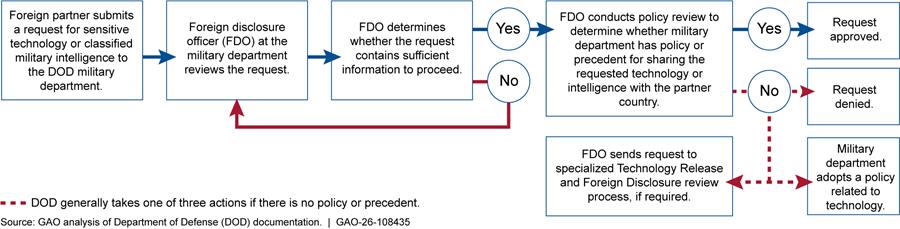
Note: According to DOD officials, if a request lacks sufficient information, an FDO can contact the foreign partner and other DOD officials for clarification.
TRFD Stakeholders Use Specialized Processes to Review Requests for Which No Precedent or Policy Exists
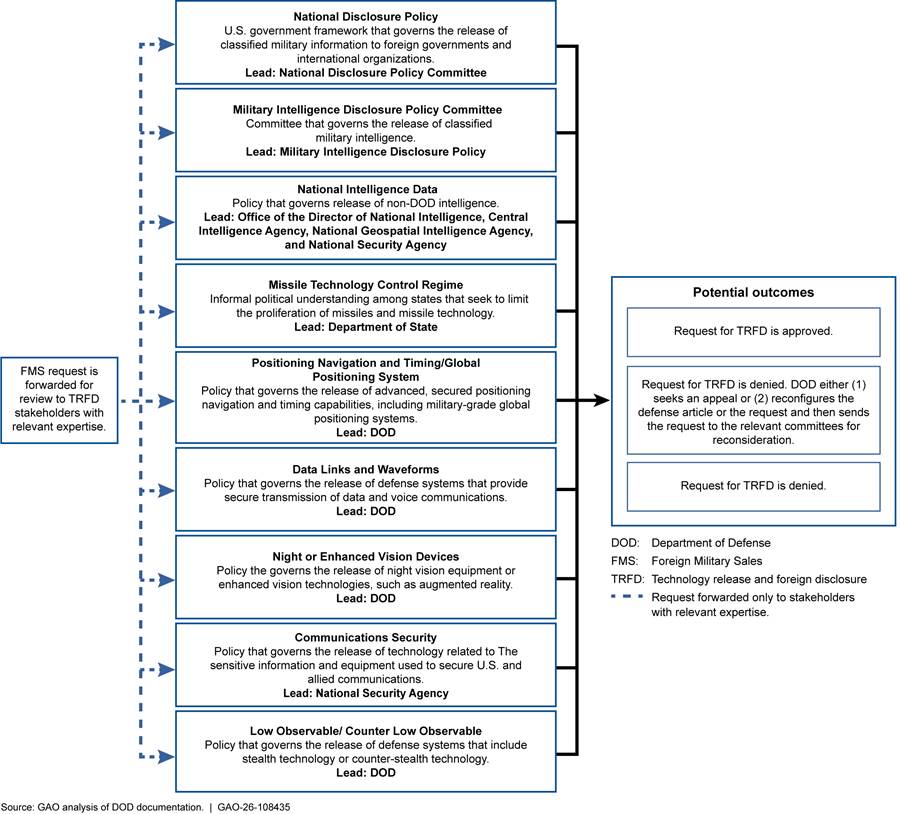
Stakeholders of relevant specialized TRFD review processes consider whether to approve foreign partner requests for sensitive technology or classified intelligence that are not covered by an existing policy or precedent and for which the military department does not have the authority to create the needed policy. One or more specialized reviews may be needed to address certain aspects of a request—for example, a technology that includes components owned by other military departments or that has a sensitive capability controlled by other DOD or U.S. agency stakeholders. DOD has reported that approximately 7,000 FMS cases undergo TRFD review each year, but, according to DOD officials, only certain cases require review through one or more of the specialized processes.
These specialized review processes, previously known as TRFD “pipes,” are managed by relevant DOD components and may involve interagency participation from the military departments and other U.S. agencies. The stakeholders use these processes to review FMS cases, applying TRFD policies that govern the release of specific sensitive technologies, including low-observable and counter-low-observable (i.e., stealth) technology, communications security, night or enhanced vision devices, global positioning systems, and items controlled by the Missile Technology Control Regime.[14]
For example, one of the stakeholders, the National Disclosure Policy Committee (NDPC), which includes members from the Department of State, the intelligence community, the military departments, and the Joint Chiefs of Staff, is responsible for determining whether to approve FMS requests that require an exception to the National Disclosure Policy. The policy was established as a framework for the approval or denial of the transfer of classified military information to foreign governments and international organizations.
In addition, foreign partners’ requests—including those subject to NDPC review—may undergo one or more other specialized review processes relevant to the requested technology. For example, a request for a fighter aircraft equipped with stealth technology, night vision technology, and global positioning technology might undergo review by stakeholders of the Low-Observable/Counter-Low-Observable process, the Night or Enhanced Vision Devices process, and the Positioning and Timing/Global Positioning System process.
If all relevant TRFD stakeholders approve the request, or if release of this technology or classified information to the foreign partner is already authorized, the FDO sends the request to DSCA for consideration and approval. Disapproval by any relevant stakeholder results in denial of the request. However, DOD officials told us that when a request is denied, they often try to identify the reason and work to reconfigure either the request or the technology to enable approval. For example, if the NDPC and stakeholders of the Low-Observable/Counter-Low-Observable review process have approved a request to transfer a sensitive defense article but stakeholders of the Communication Security review process do not approve it, DOD officials and the military departments might work to find an alternative communications device that would lead to approval of the transfer.
Figure 2 shows a simplified depiction of the specialized review processes for TRFD requests.
Figure 2: Simplified Depiction of Specialized Processes for Reviewing Foreign Requests for Sensitive Technology or Information Not Covered by Existing Precedent or Policy, as of December 2024
Officials Described Operational Challenges Related to TRFD Processes and Also Described Mitigating Steps
According to agency officials, the TRFD processes involve operational challenges that DOD is taking some steps to mitigate. These challenges include the time-consuming nature of the TRFD processes, the distributed nature of decision-making, limitations affecting information-sharing, and insufficient staffing. However, according to DOD’s 918 Report and multiple DOD officials and military departments, the TRFD processes generally work well, and the departments have been taking steps to mitigate challenges.
TRFD Processes Sometimes Involve Lengthy Deliberation but Can Be Expedited
DOD and State officials noted that the processes used to weigh the various national security implications of releasing sensitive military technology are inherently time consuming and specialized, although these deliberations can be expedited. According to DOD officials, stakeholders on the interagency committees consider, through the lens of their respective interests and specializations, the potential effects on national security of providing a foreign partner with military articles containing sensitive technology. State officials described the TRFD processes as necessarily deliberative, given the number of stakeholders involved as well as the increasing sophistication of technology being shared. The officials added that speeding up the TRFD processes is potentially dangerous because it is difficult to do so without sacrificing the processes’ integrity.
Nevertheless, the TRFD processes generally work well and communication among stakeholders is effective, according to DOD’s 918 Report and officials in DTSA, DSCA, and the military departments. For example, officials told us that most FMS cases needing TRFD approval go through the TRFD processes without delay. Officials said that most cases are approved during the military department phase of the TRFD processes because of policies that the military departments have previously established for the release or disclosure of the requested technologies or information. For example, one official estimated that over 70 percent of TRFD cases—such as, requests for follow-on support for, or updates to, previously shared technology—represent a continuation of existing sales and are therefore approved. In these instances, the responsible FDO reviews the request against existing policy and precedent and, if the request falls within DOD policy limitations for the partner nation, approves it using the FDO’s delegated authority. The remaining cases require some level of additional review, according to DOD officials.
In some cases, according to officials, a request may move through the TRFD processes more slowly than expected—that is, become entangled. Entanglement may result from a number of factors, including administrative matters, such as insufficient or unclear information in the TRFD request, the absence of required approvals from the military department or relevant interagency committees, or more substantive concerns, according to DOD officials. Although DOD officials estimated that entanglement affects a small percentage of TRFD cases, Air Force and Navy officials said that such cases may involve cutting-edge technology or attract media attention because of the high-profile nature of the partner country or technology involved.
Resolving entangled cases, including identifying the point of entanglement, can be difficult and time consuming, according to DOD officials. In such cases, FDOs must often follow up with the foreign partner for additional information and clarification. DOD documentation states that the NDPC has 10 days to review requests requiring an exception to the National Disclosure Policy, but other TRFD review processes may not have prescribed timeframes. For example, according to the 918 Report, the National Security Agency, which leads the Communications Security review process, does not have a specified timeline for technology release reviews. The report states that although the agency strives to complete reviews within 10 days, the time frames vary depending on the complexity of the cases and the number of organizations involved in the reviews.
In certain cases, substantive concerns may prevent or delay consensus among stakeholders, according to DOD officials. For example, a high-risk partner’s request for a complex defense system, such as an advanced fighter aircraft, might encounter such delays in the TRFD processes. In the past, DOD entities such as the Arms Transfer and Technology Release Senior Steering Group—a mechanism to elevate concerns and achieve closure—sought to facilitate consensus among TRFD stakeholders reviewing the TRFD case. Officials said that the group did not address entanglements effectively. However, according to DOD’s 918 Report, stakeholders agreed that DOD needs a mechanism for elevating entangled TRFD cases to expedite resolution. DTSA officials told us that ongoing reforms include the creation of a new steering group to review TRFD matters, including resolving entangled cases or elevating those that require senior-level attention.
Although the TRFD processes can be expedited in response to urgent requirements, doing so typically involves prioritizing certain cases over others. For example, according to the 918 Report, in February 2022, the administration prioritized the transfer of advanced technology to Ukraine in response to Russian aggression. DOD officials told us that as a result, they were able to provide timely and expedited approvals. One official told us that for some TRFD cases involving Ukraine, reviews that typically would have taken a year were completed within weeks. According to the 918 Report, some reviews were completed within hours because of the situation’s urgency. However, DOD officials told us that they had met Ukraine-related demands by relying heavily on overtime and deprioritizing other work, given the urgency of the requests to assist a country without an existing defense trade relationship with the United States. The 918 Report notes that the TRFD processes rely on staff capacity and that urgent requirements are expedited at the expense of other cases.
Decision-Making Is Distributed Among Multiple Stakeholders, but Efforts to Facilitate Collaboration Are Ongoing
According to DOD officials, no single entity or office has enforcement authority or ownership of the TRFD processes, given various delegated DOD authorities related to specialized reviews among TRFD stakeholders. For example, DOD officials told us that NDPC does not have the authority to direct a military department or any other specialized review process, such as the Low Observable/Counter–Low Observable Tri-Services review, to make a certain TRFD decision. They described the TRFD processes as a “hydra-headed” set of activities within the Office of the Secretary of Defense and within the military departments. The 2024 RAND study sponsored by DSCA noted the absence of a clear chain of command over the processes’ multiple stakeholders, with the result that no organization has absolute authority over TRFD cases.[15]
Additionally, a lack of standardized procedures sometimes complicates coordination among the military departments and interagency committees, according to DOD officials. Each military department follows the same overarching TRFD directives; however, each department also follows its own procedures for TRFD cases involving technology under its purview, which can complicate coordination among the departments. For example, the Navy’s Technology Transfer and Security Assistance Review Board issues Navy policy decisions for TRFD cases, whereas Army officials said that the Army does not have an equivalent policy-making body. As a result, according to DOD officials, it can be difficult to know which information, policy, or documentation should be provided to other military departments’ FDOs when interagency coordination is required.
DOD officials said that they are working to improve collaboration among TRFD stakeholders. For example, DOD officials told us that several TRFD interagency committees meet regularly to facilitate information sharing. One interagency committee official told us that the committee meets monthly with NDPC to discuss major efforts, provide briefings on upcoming requests, and establish priorities for reviewing forthcoming TRFD cases. Officials also said that they work to establish proactive, collaborative relationships. Consequently, according to DOD officials, communication among experienced staff is generally effective within and across agencies and the interagency committees.
Access to Information Can be Limited, but DOD Is Considering Ways to Address Some Issues
DOD officials told us that some staff involved in the TRFD processes have limited access to information, including policy repositories such as the National Disclosure Policy System, the NDPC’s system of record. Officials said that access to databases containing, among other things, classified information about sensitive technologies may be limited to senior officials or those with high-level clearances. Moreover, the reasons for denial or delayed fulfillment of a foreign partner’s TRFD request may not be communicated to stakeholders because they lack the required security clearance.
Officials also noted that a lack of visibility and communication regarding the causes of delayed approvals can cause frustration for foreign partners awaiting a response. For example, an official explained that if a partner’s request for a defense article involving sensitive technology required an exception to the National Disclosure Policy, the relevant interagency committees might discuss whether to make specific engineering changes to the technology in order to approve the TRFD request. However, the classification level for such discussions might exceed the FDO’s clearance, preventing the FDO from accessing related information, delaying review of the request, and limiting the informative value of updates for foreign partners.
In addition, FDOs do not always have access to all relevant policies or repositories for approved TRFD cases, according to FDOs from Army and Navy. Officials said that each military department has its own database to track TRFD cases. Further, the leader of each specialized TRFD process, as well as each interagency committee, also uses a separate system, such as a shared document management site, to track FMS requests and TRFD cases.[16] As a result, an official of a given military department may have limited access to information pertaining to other military departments. For example, if an Army FDO received a request for a weapons system with both Army and Navy components, the FDO would need information regarding the weapons system’s Navy components to identify any relevant existing policies. Officials told us that in such an instance, the Army FDO, lacking direct access, might ask a Navy FDO to identify any guidance and policy limitations relevant to the request.
According to the 918 Report, DOD is exploring establishing an agencywide common knowledge information system that would track policy decisions and exceptions across DOD. Officials we spoke with generally expressed support for the concept, saying such a system could be helpful. However, some officials expressed concerns about funding availability and technology challenges, particularly the possible security risks of consolidating various policies with potentially varying levels of information, sensitivity, and classification. Officials said that, whether in one system or several, access would continue to vary according to clearance levels and need-to-know considerations.
DOD Faces Staffing Shortages and Is Taking Some Steps to Ensure Timely TRFD Decisions
Staffing levels are insufficient to carry out the TRFD processes in a timely manner, according to most TRFD stakeholder organizations, including the military departments, that were surveyed for the 918 Report. For example, the 918 Report stated that the Navy had an estimated shortfall of 126 full-time TRFD-related employees and that the number of TRFD cases had increased while the number of staff had diminished. Of 10 organizations surveyed for the report, six reported having failed to meet deadlines for TRFD review and attributed some of these delays to inadequate staff resources.
In addition, DOD officials as well as military department officials told us that the volume of requests requiring a TRFD decision had increased. One military department official told us that although staff are expected to share a larger volume of sensitive information with foreign partners more quickly than ever before, staffing is insufficient to support the large increase in workload related to this goal. Officials identified factors such as mandatory staff rotations, government-wide hiring freezes, and retirements as contributing to a shortage of trained, skilled, and experienced FDOs needed to address the increasing workload of TRFD requests. For example, officials told us that some FDOs in the field serve rotations of 6 months to 3 years and often are moved to their next assignment just as they become proficient.
According to officials, they are addressing staff shortages through efforts such as training more staff to carry out FDO responsibilities as ancillary duties. Officials also said that they are considering interchange agreements between DOD and the intelligence community to facilitate hiring experienced FDO professionals to supplement DOD staffing. In the 918 Report, DOD recommended that organizations independently pursue appropriate resources to address insufficient staffing levels. In the same report, DSCA recommended that DOD provide relief for restrictions on hiring Excepted Service personnel for competitive service positions.
Some DOD officials identified additional policy limitations that affect their ability to address resource challenges. For example, according to a 2024 DSCA memorandum, deliberation and decision-making for TRFD cases cannot be funded by either foreign military sales or by administrative surcharges for such sales.[17] Officials told us that these limitations make it difficult to fund FDO positions and that they are considering ways to address this limitation. However, the memorandum clarified which activities necessary to comply with and implement the requirements of a TRFD decision may be funded by the FMS case or the administrative surcharge. According to officials, the memorandum expanded the types of FMS program activities that could be covered by the program’s administrative funds, which could help ease staffing constraints.[18]
DOD Is Taking Action to Implement TRFD Reforms
DOD Took Some Initial Steps to Reform the TRFD Processes
In the 918 Report, DOD noted that some steps to reform the TRFD processes had already been taken. For example, it stated that since 2017, the National Disclosure Policy had been updated quarterly to allow for faster response to TRFD requests by delegating decision-making authority to TRFD stakeholders, removing a requirement for NDPC approval for key allies or technology, according to officials. Officials told us that this and other revisions of the policy save approximately 10 business days of processing time for each case that NDPC would previously have needed to review.
Additionally, according to the 918 Report, DOD had consolidated some of the TRFD interagency committees since December 2016. For example, the report states that the members of the committee that reviews requests for low-observable and counter-low-observable technology (i.e., stealth technology) were also reviewing requests for defensive systems and anti-tamper systems, such as encryption and hardware protections. Previously, such issues had been addressed by separate interagency committees.
Following those initial efforts, DOD began working to produce the 918 Report, outlining reforms that the department proposed to improve the TRFD processes. Officials told us that they met with staff, including senior personnel, to identify needed reforms of the TRFD processes. For this purpose, DOD developed a set of questions and solicited input from 10 key DOD organizations, including the military departments.[19] Officials also mentioned that they gained insights from the RAND study and from trade and industry associations. According to the officials, the potential reforms included in the 918 Report were those that all stakeholders agreed were needed, regardless of feasibility or funding.
Since issuing the 918 Report in December 2024, DOD has taken steps toward implementing the proposed reforms. For example, according to officials, DOD is developing standardized metrics for tracking TRFD cases, which will allow all the military departments and interagency committees to use the same performance metrics. Examples of these metrics include number of FMS requests, number of requests reviewed, average TRFD review timeline, and number of reviews that exceed established timelines. Without these standardized data, TRFD stakeholders would continue to rely on personal experience when discussing TRFD cases. Table 1 shows the 918 Report’s findings and six categories of proposed reforms as well as the status of the reforms as of May 2026.
Table 1: Findings and Proposed Reforms in DOD’s 918 Report on Policies and Processes for Technology Release and Foreign Disclosure (TRFD), and Status of Reforms as of May 2026
|
918 Report finding |
Proposed reform (implementing entity) |
Status of reform implementationa |
|
Some organizations reported that their staffing levels were insufficient. |
Assessment of staffing levels Independently assess and pursue approval for appropriate TRFD resources within regular channels. (All TRFD stakeholders) |
Ongoing |
|
There was no agreement among the organizations regarding the consolidation of functions, but respondents agreed that there was a need for a mechanism to adjudicate entangled TRFD cases.b There was strong support for a common knowledge management system that would provide others insight into the status of TRFD requests. |
Assessment of feasibility and advisability of consolidating functions and organizations involved in TRFD decisions Issue memo encouraging the military departments and other international program stakeholders to bring entangled technology release and foreign disclosure (TRFD) cases to the Arms Technology Transfer Review Senior Steering Group or other similar oversight mechanism. (DTSA) Pursue establishing a common knowledge management system to serve as a policy decision repository and to track policy waiver/exceptions across the Department of Defense enterprise. (DSCA) |
Ongoing |
|
Of the statutes and regulations reviewed, none impede the effective processing of TRFD decisions. |
Review of statutes and regulations applicable to TRFD When reviewing entangled TRFD cases, determine whether a change in statute or regulation is required or would have mitigated the issue. (All TRFD stakeholders) |
Ongoing |
|
DOD supports anticipatory policies, has established them, and will continue to develop new ones.c |
Assessment of benefits of developing and implementing anticipatory policies for TRFD Instruct military departments and other stakeholders to continue to refresh anticipatory policies to reflect National Security Strategy, National Defense Strategy, and changes in geopolitical situations. (DTSA) |
Ongoing |
|
The defense support provided to Ukraine has demonstrated the ability of the TRFD enterprise to provide timely and expedited release approvals, but that effort put a strain on all other TRFD efforts. |
Assessment of lessons learned from Ukraine Refresh policies to reflect National Security Strategy, National Defense Strategy, Presidential direction, and changes in geopolitical situations. (That is, if another urgent conflict arises, the TRFD processes will be flexible enough to support all DOD requirements while minimizing impacts to routine TRFD actions.) (All TRFD stakeholders) |
Complete |
|
Not all organizations have documented processes and tracking methods. |
Establishment and reporting of metrics to assess performance and improve decision making Instruct military departments and stakeholders to document their processes, establish optimum timelines for processing reviews, and develop methods to track how many reviews take longer than the optimum timeline and the reason for delay. (DTSA) Military departments and other stakeholders to report metrics to the Foreign Military Sales Continuous Process Improvement Board. (All TRFD stakeholders) |
Ongoing |
Legend: DTSA = Defense Technology Security Administration, DSCA = Defense Security Cooperation Agency.
Source: Department of Defense (DOD). | GAO‑26‑108435
Note: The 918 Report is DOD’s Report on the Policies and Processes for Technology Release and Foreign Disclosure: Report to Congress Submitted in Accordance with Section 918(d) of the National Defense Authorization Act for Fiscal Year 2024, Public Law 118-30 (10 U.S.C. § 301 note). The report contains controlled unclassified information and therefore is not publicly available. Although the report title references Public Law 118-30, the National Defense Authorization Act for Fiscal Year 2024 can be found at Public Law 118-31.
aStatus of reform implementation was reported by DOD officials in May 2026.
bEntangled cases are those that move through the TRFD processes more slowly than the prescribed or typical timeframe.
cAnticipatory policies provide baseline TRFD review processes for specific technologies or systems to groups of potential recipient countries that the policies identify. To facilitate timelier processing and consideration when a need arises, these policies are created before a partner submits specific export requests.
Following the release of the 918 Report, Executive Order 14268, issued in April 2025, helped give weight and added impetus to ongoing TRFD reform efforts, according to officials. Notably, because no entity has comprehensive authority over the TRFD processes, the order authorized DOD to compel TRFD stakeholders in the military departments and interagency committees to carry out certain reforms, such as developing metrics for accountability, according to officials. The executive order states that reforming the foreign defense sales system would strengthen the security capabilities of U.S. allies and invigorate the U.S. defense industrial base. The order outlines several reform efforts aimed at improving transparency and accountability.
According to DOD officials, the reforms proposed in the 918 Report and required by the executive order overlap thematically by approximately 80 to 90 percent. Officials said that the 918 Report provided the foundation for their efforts to implement the executive order. The DOD memo implementing the executive order set a 90-day deadline for DOD to develop a plan to implement reforms.
DOD Drafted a Plan and Began Implementing TRFD Reforms
DOD has begun to implement TRFD reforms outlined in a plan that it submitted to DOD leadership in August 2025, according to DOD officials. Officials told us that the implementation plan consolidates reforms proposed by the 918 Report and actions required by Executive Order 14268. Officials noted that DTSA worked to ensure that the implementation plan avoided duplicative efforts, given overlap between reforms proposed in the 918 Report and required by the executive order. They stated that the plan includes 33 action items and establishes a 1-year internal deadline for completing them.
According to officials, overall FMS reform efforts are led by DOD’s Continuous Process Improvement Board, which was established in 2023 as a permanent accountability structure to track progress on recommendations approved by DOD leadership. Moreover, DTSA leads specific TRFD reform implementation efforts. DTSA has established a new senior review board, consisting of TRFD stakeholders and senior-level officials from each military department, to oversee the planned TRFD reforms, according to officials. Various TRFD stakeholders have responsibility for implementing these reforms.
DTSA has a detailed tracker that officials use to track progress in all aspects of the implementation plan. DTSA manages the tracker, and the military departments and other relevant stakeholders have some access to it. While reviewing the tracker we observed that, in addition to listing reform action items, it includes information such as the due date, milestones, the lead, and next steps for each item. According to DTSA officials, the tracker is updated frequently, and progress is reviewed weekly during meetings to assess whether items are on track for completion by due dates set at either 180 days or 365 days.
According to DTSA officials, DTSA initiated reform efforts in November 2025, after DOD senior leadership approved the implementation plan. Officials said that 26 of the plan’s 33 action items had been completed as of May 2026 and that DOD was on track to complete all 33 items by November 2026. DTSA officials said that, while DOD will likely undertake additional TRFD reforms in the future, they were on track to complete the current efforts by the 1-year deadline because of support from senior DOD leadership and effective prioritization of TRFD reform.
Agency Comments
We provided a draft of this report to the Departments of Defense and State for review and comment. DOD provided technical comments, which we incorporated as appropriate, and State did not provide comments.
We are sending copies of this report to the appropriate congressional committees and the Secretaries of Defense and of State. In addition, the report will be available at no charge on the GAO website at https://www.gao.gov.
If you or your staff have any questions about this report, please contact James Reynolds at reynoldsj@gao.gov. Contact points for our Office of Congressional Relations and Media Relations may be found on the last page of this report. GAO staff who made key contributions to this report are listed in appendix II.

James A. Reynolds
Director, International Affairs and Trade
List of Committees
The Honorable Roger F. Wicker
Chairman
The Honorable Jack Reed
Ranking Member
Committee on Armed Services
United States Senate
The Honorable Mitch McConnell
Chair
The Honorable Chris Coons
Ranking Member
Subcommittee on Defense
Committee on Appropriations
United States Senate
The Honorable Mike Rogers
Chairman
The Honorable Adam Smith
Ranking Member
Committee on Armed Services
House of Representatives
The Honorable Ken Calvert
Chairman
The Honorable Betty McCollum
Ranking Member
Subcommittee on Defense
Committee on Appropriations
House of Representatives
|
Agency |
Authority |
Purpose |
|
Department of Defense (DOD) |
DODI 2040.02 International Transfers of Technology, Articles, and Services |
Establishes DOD policy, assigns responsibilities, and prescribes procedures for the international transfer of dual-use and defense-related technology, articles, and services and directs the use of a DOD automated export license system. |
|
National Security Council |
NDP-1 National Disclosure Policy–1 |
Establishes procedures and criteria for the disclosure of classified military information to foreign governments and international organizations.a |
|
DOD |
DoDD 5230.11 Disclosure of Classified Military Information to Foreign Governments and International Organizations |
Establishes policy and assigns responsibilities governing disclosure of classified military information to foreign governments and international organizations (referred to in this issuance as “foreign disclosure”) in accordance with National Security Decision Memorandum (NSDM) 119, Executive Order 13526, and the National Disclosure Policy.b |
|
DOD, Under Secretary for Defense for Acquisition, Technology and Logistics |
DoDI 5230.28 Policy for Low Observable (LO) and Counter Low Observable (CLO) Programs |
Governs the Low-Observable/Counter-Low-Observable review process and determines which foreign military sales cases to elevate to the process’s stakeholders for approval.c |
|
DOD, Chairman of the Joint Chiefs of Staff (CJCS) |
CJCSI 6510.06A Communications Security Releases to Foreign Nations |
Governs the process for the release of communications security material and equipment to foreign partners. |
|
DOD |
DoDI 4630.09 Communications Waveform Management and Standardization |
Establishes policy, assigns responsibilities, and provides procedures for 1. management, standardization, and reuse of DOD software communication waveforms; 2. periodic review of waveforms as they mature, to ensure they provide interoperability, security, and operational value for DOD use; and 3. fostering of innovation by creating a process that allows waveform developers to submit conceptual waveforms for analysis and recommendations before either the developer or DOD makes significant investments in duplicative capabilities. |
|
DOD |
DoDI 4650.06 Position, Navigation, and Timing Management |
Implements policy, assigns responsibilities, and provides procedures for the DOD positioning, navigation, and timing enterprise (PNT), PNT cybersecurity, precise time and time interval, and celestial reference frame management Establishes policy and assigns responsibilities for DOD participants in domestic civil forums, international government, and civil PNT forums. |
Source: DOD. | GAO‑26‑108435
aNDP-1 is described in DoDD 5230.11.
bThe purpose of DoDD 5230.11 is described in DOD’s Security Assistance Management Manual, DSCA 5105.38-M.
cThe purpose of DoDI 5230.28 is described in the Air Force’s Systems Security Engineering Cyber Guidebook.
GAO Contact
James A. Reynolds at reynoldsj@gao.gov
Staff Acknowledgments
In addition to the contact named above, Kim Frankena (Assistant Director), Julia Jebo Grant (Analyst-in-Charge), Jina Yu (Senior Analyst), Gifty Owusu-Tawiah, Reid Lowe, Chris Keblitis, Samantha Lalisan, and Pamela Davidson made key contributions to this report.
The Government Accountability Office, the audit, evaluation, and investigative arm of Congress, exists to support Congress in meeting its constitutional responsibilities and to help improve the performance and accountability of the federal government for the American people. GAO examines the use of public funds; evaluates federal programs and policies; and provides analyses, recommendations, and other assistance to help Congress make informed oversight, policy, and funding decisions. GAO’s commitment to good government is reflected in its core values of accountability, integrity, and reliability.
Obtaining Copies of GAO Reports and Testimony
The fastest and easiest way to obtain copies of GAO documents at no cost is through our website. Each weekday afternoon, GAO posts on its website newly released reports, testimony, and correspondence. You can also subscribe to GAO’s email updates to receive notification of newly posted products.
Order by Phone
The price of each GAO publication reflects GAO’s actual cost of production and distribution and depends on the number of pages in the publication and whether the publication is printed in color or black and white. Pricing and ordering information is posted on GAO’s website, https://www.gao.gov/ordering.htm.
Place orders by calling (202) 512-6000, toll free (866) 801-7077,
or
TDD (202) 512-2537.
Orders may be paid for using American Express, Discover Card, MasterCard, Visa, check, or money order. Call for additional information.
Connect with GAO
Connect with GAO on X,
LinkedIn, Instagram, and YouTube.
Subscribe to our Email Updates. Listen to our Podcasts.
Visit GAO on the web at https://www.gao.gov.
To Report Fraud, Waste, and Abuse in Federal Programs
Contact FraudNet:
Website: https://www.gao.gov/about/what-gao-does/fraudnet
Automated answering system: (800) 424-5454
Media Relations
Sarah Kaczmarek, Managing Director, Media@gao.gov
Congressional Relations
David A. Powner, Acting Managing Director, CongRel@gao.gov
General Inquiries
[1]In making TRFD determinations, DOD and other agencies apply multiple policies and processes, which this report refers to collectively as the TRFD processes. Government and private sector officials often refer to these processes as technology security and foreign disclosure, or TSFD. We use “TRFD” because “technology release and foreign disclosure” appears in the National Defense Authorization Act for Fiscal Year 2024, Pub. L. No. 118-31, 137 Stat. 136 (2023), and a subsequent, related DOD report.
[2]Pub. L. No. 118-31, § 918(d), 137 Stat. at 371.
[3]Department of Defense, Report on the Policies and Processes for Technology Release and Foreign Disclosure: Report to Congress Submitted in Accordance with Section 918(d) of the National Defense Authorization Act for Fiscal Year 2024, Public Law 118-30 (10 U.S.C. § 301 note). The report contains controlled unclassified information and therefore is not publicly available. Although the report title references Public Law 118-30, the National Defense Authorization Act for Fiscal Year 2024 can be found at Public Law 118-31.
[4]Exec. Order No. 14268, Reforming Foreign Defense Sales to Improve Speed and Accountability, 90 Fed. Reg. 15631 (Apr. 9, 2025).
[5]Servicemember Quality of Life Improvement and National Defense Authorization Act for Fiscal Year 2025. Legislative Text and Joint Explanatory Statement to Accompany H.R. 5009 (January 2025), which was enacted as Pub. L. No. 118-159, 138 Stat. 1773 (2024).
[6]The data that we report related to the TRFD process, such as the estimated volume of cases, duration of the approval process, and military department staffing carrying out TRFD reforms, are estimates provided by DOD officials and were not independently validated. Where possible, we corroborated the information by consulting multiple DOD sources.
[7]Department of Defense, International Transfers of Technology, Articles, and Services, DODI 2040.02.
[8]Lisa Saum-Manning, Jefferson P. Marquis, Irina A. Chindea, Daniel Elinoff, Theiline Pigott, Elliott Brennan, Optimizing Foreign Military Sales Roles, Responsibilities, and Authorities (Santa Monica, Calif.: RAND Corporation, 2024).
[9]DTSA oversees TRFD reform.
[10]90 Fed. Reg. 15631 (Apr. 9, 2025).
[11]Although DOD uses the TRFD processes to consider both the release of sensitive technology and the disclosure of classified intelligence, this report focuses primarily on technology release because TRFD reforms have generally focused on the sharing of technology through the FMS program.
[12]According to DSCA policy, security cooperation organization is the generic term for DOD organizations that are located in a foreign partner country and assigned responsibilities to carry out security cooperation management functions.
[13]According to DOD officials, each military department establishes its own specialist support. The Air Force and Navy consolidate their specialist support at the headquarters level by combining both technology security and foreign disclosure responsibilities and authorities into one position (such as an FDO). In contrast, the Army separates technology security and foreign disclosure into individual specialist positions—for example, separate military department country desk officer (i.e., export policy specialists) and FDOs—at both headquarters and in the field.
[14]The Missile Technology Control Regime is an informal political understanding among states that seek to limit the proliferation of missiles and missile technology.
[15]Lisa Saum-Manning, et al., Optimizing Foreign Military Sales Roles, Responsibilities, and Authorities. Some of the key findings in the report focus on the lack of sufficient authorities to hold other organizations accountable and the absence of authority to compel action from other stakeholders.
[16]DOD Directive 5230.11, Disclosure of Classified Military Information to Foreign Governments and International Organizations, requires TRFD stakeholders to document all requests for disclosure of classified information, including decisions to disclose or deny the information, using their own record systems.
[17]Department of Defense, “Defense Security Cooperation Agency Policy Memorandum 24-14: Releasability and Exportability Activities Clarification,” March 1, 2024.
[18]For additional information about FMS administrative fees, see GAO, Foreign Military Sales: Financial Oversight of the Use of Overhead Funds Needs Strengthening, GAO‑18‑533 (Washington, D.C.: July 30, 2018). We are currently reviewing the Foreign Military Sales Trust Fund in response to a provision in a committee report accompanying the Fiscal Year 2026 National Defense Authorization Act. H.R. Rep. No. 119-231, at 299 (2025).
[19]These 10 organizations are the Office of the Under Secretary of Defense for Acquisition and Sustainment; Special Access Programs Central Office; Defense Security Cooperation Agency; Office of the Under Secretary of Defense for Research and Engineering; Office of the Under Secretary of Defense for Research and Engineering Missile Defense Agency; Office of the Under Secretary of Defense for Intelligence and Security; Department of the Army; Department of the Air Force; Department of the Navy; and National Security Agency.