
Report to Congressional Committees
United States Government Accountability Office
A report to congressional committees
Contact: Rashmi Agarwal at agarwalr@gao.gov
What GAO Found
The Department of Defense (DOD) used multiple strategies to fund support for southern border operations since the start of fiscal year 2025 and into fiscal year 2026. Specifically, DOD
· realigned $1.74 billion in funding from amounts appropriated for fiscal year 2025 from various funding categories;
· transferred $608 million from or through DOD’s Drug Interdiction and Counter-Drug Activities, Defense account;
· relied on military construction authorities to fund border barrier projects using $300 million from within existing military construction appropriation accounts;
· began obligating amounts from $1 billion appropriated in Public Law 119-21, commonly known as the One Big Beautiful Bill Act; and
· began providing some support to the Department of Homeland Security (DHS) in fiscal year 2026 that is eligible for reimbursement.
As of March 31, 2026, DOD has reported obligating $2.64 billion for southern border operations since the start of fiscal year 2025. These costs include DOD-directed activities, such as securing DOD-administered lands along the border, known as National Defense Areas, and constructing permanent border barriers. These costs also include DOD support to DHS in response to requests for assistance. Of the $2.64 billion DOD obligated, DOD reported $305 million is eligible for reimbursement by DHS.
DOD Southern Border Operations and Costs
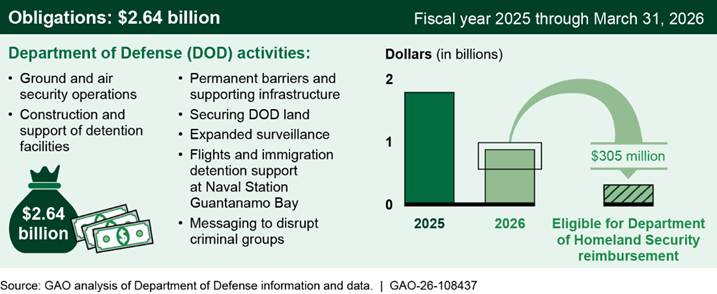
The Office of the Under Secretary of Defense (OUSD) (Comptroller) and the military services established a process for tracking southern border costs that included issuing guidance and business rules for pulling data from the military services’ financial ledgers into Advancing Analytics—known as Advana—DOD’s enterprise-level management system used for reporting. In addition, OUSD (Comptroller) officials stated they are working to finalize standard operating procedures that would codify DOD’s process to manage and execute costs of southern border operations and provide continuity in the event of personnel turnover.
Why GAO Did This Study
The nearly 2,000-mile-long U.S. border with Mexico is a critical point of entry for millions of people annually. However, it is also vulnerable to illegal border crossings, smuggling of drugs and contraband, and organized crime. In January 2025, the President declared a national emergency at the southern border and directed DOD to assist DHS in obtaining complete operational control of the border.
GAO was asked to review DOD’s costs to support operations at the southern border. Senate Report 119-39 accompanying a bill for the National Defense Authorization Act for Fiscal Year 2026 also includes a provision for GAO to examine similar issues. This report examines (1) how DOD has funded support for operations, (2) how much DOD has reported in costs, and (3) how DOD has tracked costs for its southern border operations since the start of fiscal year 2025.
GAO analyzed DOD documentation and guidance regarding funding sources and cost tracking processes. GAO analyzed cost summary reports for fiscal years 2025 and 2026. GAO also met with DOD officials and commands obligating the most funding for southern border operations.
GAO provided a draft of this report to DOD for review and comment. DOD did not provide official comments. DOD provided technical comments, which GAO incorporated as appropriate.
Abbreviations
Advana Advancing Analytics
CBP U.S. Customs and Border Protection
DHS Department of Homeland Security
DOD Department of Defense
ICE U.S. Immigration and Customs Enforcement
NDA National Defense Area
OBBBA One Big Beautiful Bill Act
OUSD (Comptroller) Office
of the Under Secretary of Defense
(Comptroller)
This is a work of the U.S. government and is not subject to copyright protection in the United States. The published product may be reproduced and distributed in its entirety without further permission from GAO. However, because this work may contain copyrighted images or other material, permission from the copyright holder may be necessary if you wish to reproduce this material separately.
July 13, 2026
Congressional Committees
The nearly 2,000-mile-long U.S. border with Mexico is a critical point of entry for millions of people annually.[1] However, the border is also vulnerable to illicit activity, such as illegal border crossings, smuggling of drugs and contraband, and organized crime. Within the Department of Homeland Security (DHS), U.S. Customs and Border Protection (CBP) is charged with a dual mission of facilitating legitimate travel and trade at U.S. borders while keeping terrorists and their weapons, criminals and their contraband, and inadmissible people out of the country.[2] DHS’s U.S. Immigration and Customs Enforcement (ICE) is responsible for enforcing, alongside CBP and other DHS law enforcement entities, the nation’s immigration laws and providing safe, secure, and humane confinement for noncitizens[3] in immigration detention facilities.[4] DHS can seek assistance from partners, such as the Department of Defense (DOD), to provide capabilities and resources. Historically, DOD service members have conducted activities at the border such as monitoring and surveillance, logistical support, and drug interdiction.
In January 2025, the President declared a national emergency at the southern border and directed DOD to assist DHS in obtaining complete operational control of the border.[5] The activities DOD conducts in support of DHS, and at the department’s own direction, have since expanded to include increased monitoring, further border barrier construction, and immigration detention support. According to DOD, the department has deployed thousands of service members in support of southern border operations since January 2025.
We were asked to review DOD’s costs to support operations at the southern border. Senate Report 119-39 accompanying a bill for the National Defense Authorization Act for Fiscal Year 2026 also includes a provision for us to examine similar issues.[6] This report examines (1) how DOD has funded support for southern border operations since the start of fiscal year 2025, (2) how much DOD has reported in costs for southern border operations since the start of fiscal year 2025, and (3) how DOD has tracked costs for its southern border operations since the start of fiscal year 2025.
For our first objective, we analyzed documentation from DOD to determine how it funded southern border operations since the start of fiscal year 2025. This included federal laws and regulations and documentation of DOD’s movement of funds. We also met with the Office of the Under Secretary of Defense (OUSD) (Comptroller) and military service officials, to further understand the context around funding sources used to support these operations.
For our second objective, we analyzed DOD’s Homeland Border Security Initiatives Execution reports that DOD provided to Congress from February 2025 to March 2026, which summarize DOD’s costs to support its southern border operations (hereafter referred to as cost summary reports).[7] These reports were based primarily on data from DOD’s enterprise-level management system, Advancing Analytics (Advana),[8] which collects and aggregates data via a direct interface with military services’ financial management systems.[9] To understand how the cost summary reports were developed, we reviewed and compared calculations across the reports, as well as discussed with DOD officials the steps they take to ensure that the data from Advana are correctly incorporated into the reports. We also discussed with cognizant officials any trends and inconsistencies we identified across these reports.
While we cannot ascertain the complete reliability of Advana or the systems that feed data into Advana, we believe the data from the cost summary reports provide acceptable approximations of obligations for DOD border operations at the time of our analysis.[10]
For our third objective, we assessed DOD’s processes and procedures for tracking costs since the start of fiscal year 2025 against DOD’s own guidance in memorandums and regulations. We met with OUSD (Comptroller) and select DOD commands obligating[11] the most operation and maintenance funding in fiscal year 2025 for southern border operations to further understand these processes and procedures. Operation and maintenance funding is used for expenses such as military force operations, civilian salaries, minor construction projects, training and education, and base operations support. We used obligations of operation and maintenance funds to select DOD commands to meet with because these funds form the largest share of southern border operations costs.[12]
We conducted this performance audit from April 2025 to July 2026 in accordance with generally accepted government auditing standards. Those standards require that we plan and perform the audit to obtain sufficient, appropriate evidence to provide a reasonable basis for our findings and conclusions based on our audit objectives. We believe that the evidence obtained provides a reasonable basis for our findings and conclusions based on our audit objectives.
Background
Department of Defense Funding
Many of DOD’s activities and programs are funded through appropriation acts, which are typically passed annually by Congress and signed into law by the President.[13] Appropriation acts generally provide legal authority for federal agencies, including DOD, to incur obligations, which are legal commitments to pay for goods and services, and to make payments for specified purposes. After appropriation acts provide DOD this authority for DOD’s various appropriation accounts, DOD then allocates funding from those accounts to its activities and programs.
In some cases, the initial allocations of funding may not be sufficient because of changes in DOD’s operations. In these cases, where it has the authority to do so, DOD will often realign funding via a transfer or reprogramming action from one program or activity to another to fund items it deems a priority based on its current operations. Transfers involve shifting all or part of the appropriated amounts in one appropriation or fund account to another. Agencies may transfer such amounts only as specifically authorized by law. Reprogrammings involve shifting funds within an appropriation or fund account to use them for purposes other than those contemplated at the time of appropriation.
Certain realignment actions require prior congressional approval in which DOD submits a request to the congressional defense committees. These can include, among other realignments, (1) transfers using the general or special transfer authority or (2) reprogrammings that exceed threshold amounts established by Congress.[14] Reprogrammings below these threshold amounts, called “below threshold actions,” do not require congressional approval.[15] Additionally, internal realignment actions do not require prior congressional approval.[16] These realignment actions, as described by DOD, are approved by OUSD (Comptroller) and relate to the reclassification or reassignment of funds that (1) do not involve a change in the substance of the program; (2) involve an increase in procurement quantities that do not otherwise require prior congressional approval; or (3) are transfers to or from transfer accounts.[17] Transfer accounts include the Drug Interdiction and Counter-Drug Activities, Defense account.[18]
DOD realigns funding either through a transfer between appropriations or a reprogramming action within sub-accounts of an appropriation, generally after establishing its budget baseline. Typically, DOD establishes this baseline based off the amounts specified in the explanatory statements accompanying the DOD appropriation acts for each fiscal year. DOD then provides Congress with a document outlining its baseline funding that considers all its available appropriations—called the DD 1414 Base for Reprogramming Actions. DOD uses this document to outline the initial baseline of funds for a specific fiscal year and to document any subsequent planned changes to that baseline including through transfers or reprogramming actions.[19]
DOD may also receive reimbursement for certain expenses incurred in support of other agencies, such as reimbursement for the provision of certain capabilities or resources in support of DHS. Specifically, section 277 of title 10, U.S. Code requires, to the extent otherwise required by the Economy Act of 1932 or other applicable law, that a civilian law enforcement agency to which DOD provides support under chapter 15 of title 10 or section 502(f) of title 32 reimburse DOD for such support unless the reimbursement is waived by the Secretary of Defense.[20] The section states that the Secretary of Defense may waive this reimbursement if such support either (1) is provided in the normal course of military training or operations or (2) results in a benefit to the element of DOD or the National Guard personnel providing the support that is substantially equivalent to that which would otherwise be obtained from military operations or training.[21]
Comptroller Roles and Responsibilities
The Under Secretary of Defense (USD) (Comptroller) is the principal advisor to the Secretary of Defense for budgetary and financial matters, including financial management, accounting policy and systems, and budget formulation and execution.[22] In this role, USD (Comptroller) is to, among other things:
· direct, manage, and provide policy guidance for and oversight of DOD financial management activities;
· provide guidance and oversight for all matters relating to common enterprise financial data, financial data standards, and the linkages of financial data to program and performance aspects of DOD business operations; and
· promote accuracy and reliability in accounting and operating data.
In addition, USD (Comptroller) is responsible for overall financial policy for contingency operations and works with the USD (Policy) to determine the most responsive method of financing for contingency operations.[23] The heads of the DOD components, including the secretaries of the three military departments (Army, Navy, and Air Force), are responsible for ensuring that guidance is disseminated to the appropriate unit level that details the required cost collection and reporting procedures and methodology for contingency operations.
DOD Used Multiple Strategies to Fund Support for Southern Border Operations Since the Start of Fiscal Year 2025
DOD used multiple strategies to fund support for southern border operations. Specifically, DOD realigned $1.74 billion in funding from amounts appropriated for fiscal year 2025 from various funding categories. Additionally, DOD transferred $608 million from or through the department’s Drug Interdiction and Counter-Drug Activities, Defense account, and, according to DOD, relied on military construction authorities to fund border barrier projects using $300 million from existing military construction appropriation accounts.[24] In fiscal year 2026, DOD began using $1 billion in funding appropriated in Public Law 119-21—commonly known as the One Big Beautiful Bill Act (OBBBA). Separately, DOD began providing some support to DHS that is eligible for reimbursement.[25]
Realignment of funds to support southern border operations as part of establishing a fiscal year 2025 budget baseline. DOD realigned $1.74 billion to support southern border operations in fiscal year 2025. Of this amount, 73 percent was realigned from DOD’s Facilities Sustainment, Restoration, and Modernization program, which focuses on the maintenance and renovation of existing military facilities necessary to keep them in good working order (see table 1).[26]
Table 1: Categories of Funding from Which DOD Realigned Funds for Southern Border Operations in Fiscal Year 2025
|
Categories of funding |
Amount (millions) |
Percent of total |
|
Facilities Sustainment, Restoration, and Modernizationa |
$1,264 |
73% |
|
Permanent Change of Station Operational Travelb |
$200 |
12% |
|
Permanent Change of Station Rotational Travelc |
$136 |
8% |
|
All other (including transfers within budget line items)d |
$137 |
8% |
|
Total |
$1,737 |
100% |
Source: Department of Defense (DOD) documentation. | GAO‑26‑108437
Note: Percentages may not sum to 100 because of rounding. In July 2025, $290 million in funding was restored to Army military personnel permanent change of station travel. DOD officials stated that these funds were re-aligned to southwest border operations in the initial budget baseline but restored from the Army operation and maintenance account.
aThe Facilities Sustainment, Restoration, and Modernization category includes maintenance and renovation of existing military facilities necessary to keep them in good working order.
bThe Permanent Change of Station Operational Travel category includes the movement of service members, dependents, household goods, personal effects, and privately owned vehicles to and from permanent duty stations.
cThe Permanent Change of Station Rotational Travel category includes the movement of service members, dependents, household goods, personal effects, and privately owned vehicles to and from duty stations outside the continental United States.
d”All other” includes supplies and equipment, training support, unemployment benefits, and base operating support, among other categories.
DOD realigned these funds to support southern border operations for fiscal year 2025, using a different approach than in typical years given that the Full-Year Continuing Appropriations and Extensions Act, 2025 in general funded DOD at fiscal year 2024 levels and had no accompanying explanatory statement directing funding.[27] DOD realigned billions of dollars from various funding categories to support southern border operations as part of the DD 1414 Base for Reprogramming Actions for fiscal year 2025. This realignment of funds was done at the direction of the Secretary of Defense and to fulfill priorities stated in executive orders issued in January 2025, according to OUSD (Comptroller) officials.
These realignments were then incorporated as part of the budget baseline for fiscal year 2025 in the DD 1414 submitted to Congress in May 2025. DOD officials said this DD 1414 was established and submitted after consultation with Congress, within the appropriation levels provided in the Full-Year Continuing Appropriations and Extensions Act, 2025. Officials further stated that transfer or reprogramming procedures were not applicable prior to the establishment and submission of the fiscal year 2025 DD 1414.
Transfers, and reprogramming, and other actions to support southern border operations after establishing a fiscal year 2025 budget baseline. After establishing its budget baseline for fiscal year 2025 in the DD 1414, DOD made several transfer or reprogramming actions to shift funds between appropriations or within appropriation sub-accounts, respectively, to fund its southern border operations.
· On April 25, 2025, DOD transferred $161 million from the Drug Interdiction and Counter-Drug Activities appropriation account[28] to the operation and maintenance appropriation account of the Army.[29] According to DOD officials, this $161 million was to support CBP operations.
· On May 19, 2025, DOD transferred $447 million from the Navy Defense Working Capital Fund appropriation account through the Drug Interdiction and Counter-Drug Activities, Defense appropriation account.[30] According to DOD officials, of the $447 million, $442 million was for support to ICE detention operations, and the other $5 million was to reimburse military department expenses related to immigration detention operations at Naval Station Guantanamo Bay. DOD’s approval stated that the funds were available for transfer primarily because of “higher than planned aviation and maritime sales in the prior year and lower than planned disbursements for long-lead time acquisitions.”
· On May 28, 2025, DOD notified Congress that it would utilize section 2803 of title 10, U.S. Code, authority to construct border barrier projects at the Barry M. Goldwater Range in Arizona at a cost of $200 million, reprogrammed from other military construction.[31] The $200 million consisted of $50 million reprogrammed by each of the three military departments and an additional $50 million from defense-wide accounts.
· On August 7, 2025, DOD notified Congress that it would utilize authority under section 2808 of title 10, U.S. Code, to fund border barrier construction projects at the New Mexico Annex of Fort Huachuca, Arizona, at a projected cost of $100 million.[32] DOD indicated that these amounts would come from various other military construction projects.
OBBBA funding. The OBBBA appropriated $1 billion to DOD, available from fiscal year 2025 to fiscal year 2029, for certain border operations. DOD first began obligating OBBBA funding in fiscal year 2026 and, according to DOD officials, plans to obligate all the OBBBA funding during fiscal year 2026. As of March 31, 2026, DOD had obligated $472 million of these funds.
Reimbursable support in fiscal year 2026. DOD reported providing support to DHS on a nonreimbursable basis in fiscal year 2025; however, DOD is providing some support to DHS that is eligible for reimbursement in fiscal year 2026. As of March 31, 2026, DOD’s reporting indicates that it has provided $305 million in support to DHS in fiscal year 2026 that is eligible for reimbursement.[33]
DOD Reported Obligating $2.64 Billion for Southern Border Operations Since the Start of Fiscal Year 2025
As of March 31, 2026, DOD has reported obligating $2.64
billion for southern border operations since the start of fiscal year 2025. DOD
provided this information in regular cost summary reports to Congress since
February 2025.[34]
These costs include DOD-directed activities, such as securing DOD-administered
lands along the border, known as National Defense Areas (NDA), and constructing
barriers on military installations, as well as DOD support to DHS in response
to DHS requests for assistance.
Obligations by Category
Through fiscal year 2025, DOD’s reporting included five categories of costs for southern border operations. Starting in fiscal year 2026, DOD added categories and changed definitions for some of the categories and corresponding activities to account for the reimbursable support it was providing to DHS. Figure 1 below shows obligations by category and fiscal year, and Appendix I outlines the changes in categories from fiscal year 2025 to fiscal year 2026.
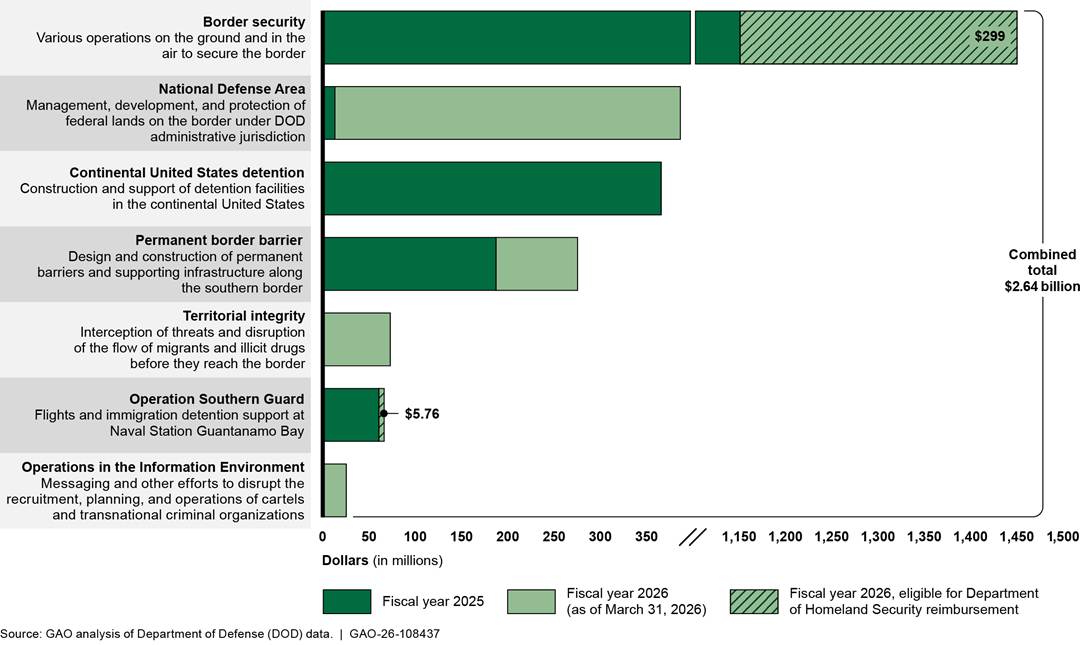
Note: Categories are those that DOD reported in its cost summary reports. In fiscal year 2026, DOD reporting includes border security activities conducted on National Defense Areas in the separate National Defense Area category, while in fiscal year 2025, these activities were previously included in the Border Security category. DOD obligations for Border Security and Operation Southern Guard were provided to DHS on a reimbursable basis in fiscal year 2026. DOD reported no costs for continental U.S. detention in fiscal year 2026 and removed this category from its reporting.
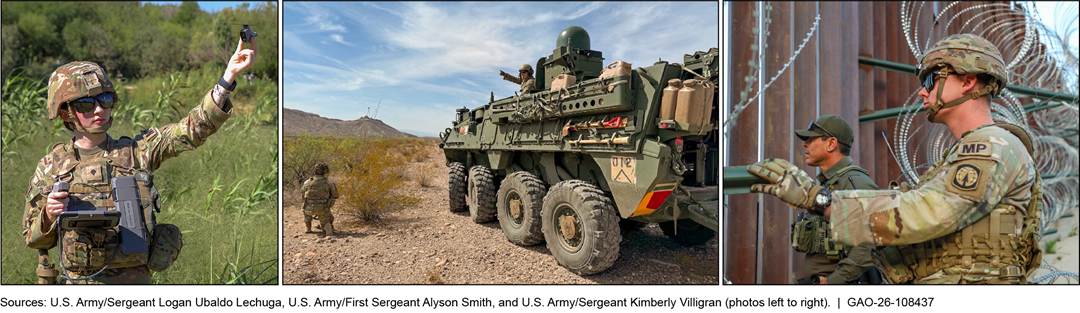
Border security. The category of cost that had the largest obligations since the start of fiscal year 2025 was border security. DOD reported obligating $1.45 billion (or 55 percent of the $2.64 billion) for border security from the start of fiscal year 2025 to March 31, 2026. According to DOD cost reporting, this cost category includes various operations on the ground and in the air to secure the border such as detection and monitoring, training support, aviation, supply chain support, and intelligence analysis (see fig. 2). The types of activities DOD included in border security changed in fiscal year 2026. Namely, in fiscal year 2026, DOD reporting includes border security activities conducted on NDAs in the separate NDA category, while in fiscal year 2025, these activities were previously included in the Border Security category. DOD continues to include border security activities conducted outside the limits of the NDAs in the border security category for fiscal year 2026 reporting. DOD officials told us they made these changes in reporting to differentiate support provided to DHS on a reimbursable basis in fiscal year 2026 from DOD-directed activity not eligible for DHS reimbursement on NDAs.
National Defense Area (NDA). The next largest amount, $387 million since the start of fiscal year 2025 (15 percent), was for the NDA category.[35] NDA costs include land management and development of the NDAs, which according to U.S. Northern Command, permit DOD to establish and enforce a controlled perimeter and control access to the area, just as it would on any other part of a military installation.[36] These costs include establishing and marking NDA boundaries with signs, fences, and buoys, among other things, according to DOD. In fiscal year 2025, DOD cost reporting included an NDA category, which included costs to manage and develop NDAs, but according to an OUSD (Comptroller) official, border security operations, such as patrolling in the NDAs, were categorized under the “border security” category. However, in fiscal year 2026, the NDA category now includes costs for securing the NDAs, such as the mobilization of military personnel, reconnaissance, and monitoring technology for surveillance. DOD officials told us they made these changes in reporting to differentiate support provided to DHS on a reimbursable basis in fiscal year 2026 from DOD-directed activity not eligible for DHS reimbursement on NDAs.
There are currently five NDAs: (1) New Mexico NDA, (2) Texas NDA, (3) South Texas NDA, (4) Yuma NDA, and (5) California NDA. Additionally, a sixth NDA has been announced, the Del Rio-Falcon NDA. Each NDA is administered by an existing DOD installation (see fig. 3). DOD officials said that for each of these areas, the military service that administers the existing installation will be responsible for administering the NDA and for paying the costs associated with it.
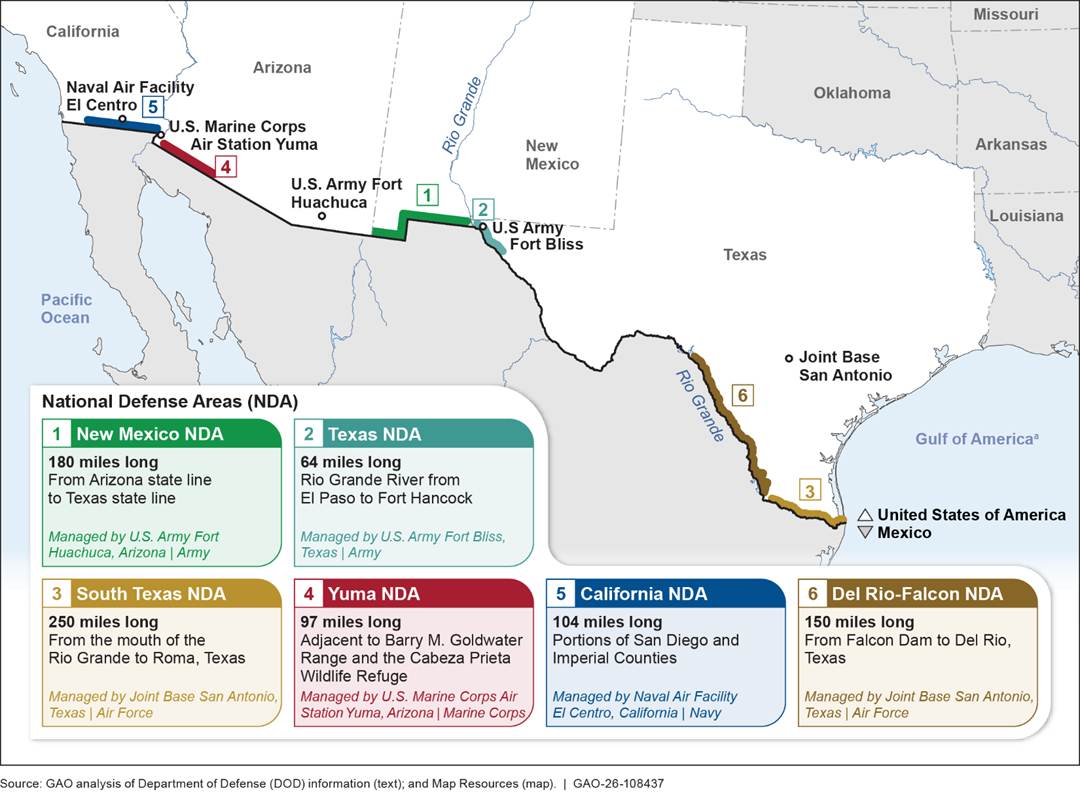
Note: There are currently five NDAs: (1) New Mexico NDA, (2) Texas NDA, (3) South Texas NDA, (4) Yuma NDA, and (5) California NDA. A sixth NDA has been announced, the Del Rio-Falcon NDA. Additionally, the California National Defense Area (NDA) is non-contiguous, according to DOD officials.
aIn January 2025, the President issued Executive Order 14172 directing the Secretary of the Interior to take all appropriate actions to rename as the “Gulf of America” the U.S. Continental Shelf area bounded on the northeast, north, and northwest by the states of Texas, Louisiana, Mississippi, Alabama and Florida and extending to the seaward boundary with Mexico and Cuba in the area previously referred to as the Gulf of Mexico. Exec. Order No. 14,172, Restoring Names that Honor American Greatness, 90 Fed. Reg. 8,629, 8,630, 4(b) (Jan. 20, 2025).
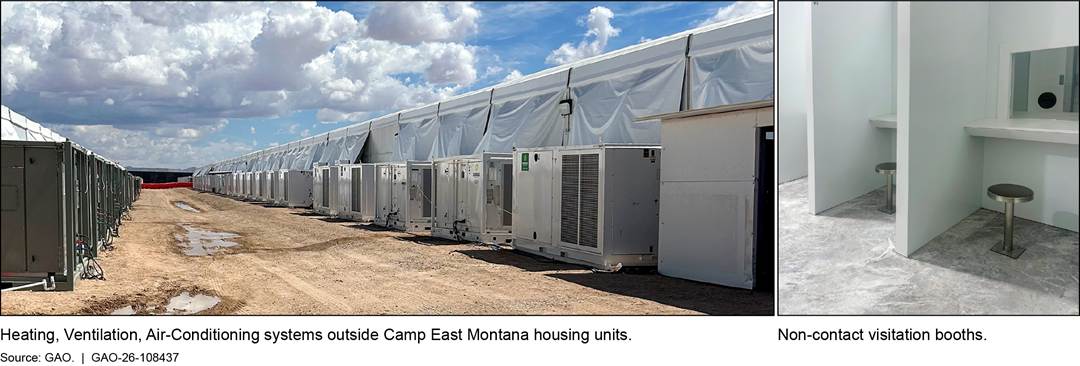
Continental United States detention. DOD reported obligating $366 million (14 percent) since the start of fiscal year 2025 for construction and support of immigration detention facilities in the continental United States. Specifically, this category includes costs for support of ICE’s Enhanced Hardened Facility in El Paso, Texas, and construction and support of the Camp East Montana detention facility in El Paso, Texas (see fig. 4).[37] The Enhanced Hardened Facility closed in August 2025. Additionally, while DOD awarded and administered a task order from an existing contract vehicle for the Camp East Montana detention facility in fiscal year 2025, it was administratively transferred to ICE in fiscal year 2026.[38] As a result, DOD reported no costs for continental U.S. detention in fiscal year 2026, as of March 31, 2026, and has removed this category from its reporting.
Permanent border barrier. DOD reported obligating $275 million (10 percent) in the permanent border barrier category since the start of fiscal year 2025. Permanent border barrier costs include the design and construction of permanent barriers and supporting infrastructure along the southern border, according to DOD cost reporting. According to DOD, the Army Corps of Engineers awarded a contract for $174 million for a border barrier at the Barry M. Goldwater Range in Arizona (see fig. 5).[39] According to Army Corps of Engineers officials, the contract includes clearing the land; installing a water line; installing a patrol road along the barrier; and installing the barrier, which is a 30-foot steel bollard barrier. Construction began on October 15, 2025. As of May 6, 2026, the barrier was complete, and about one-third of the patrol road remained to be completed. The entire project is scheduled to be completed by August 17, 2026.
According to DOD, the Army Corps of Engineers awarded another construction contract for about $79 million in December 2025 for the installation of approximately 6 miles of permanent border barrier in the New Mexico NDA.[40] The project includes installing the barrier, which is a 30-foot steel bollard barrier, patrol roads, access roads, drainage features, and access gates. Construction began on March 3, 2026. As of May 6, 2026, about 36 percent of the barrier was complete. The entire project is scheduled to be completed by October 2, 2026.
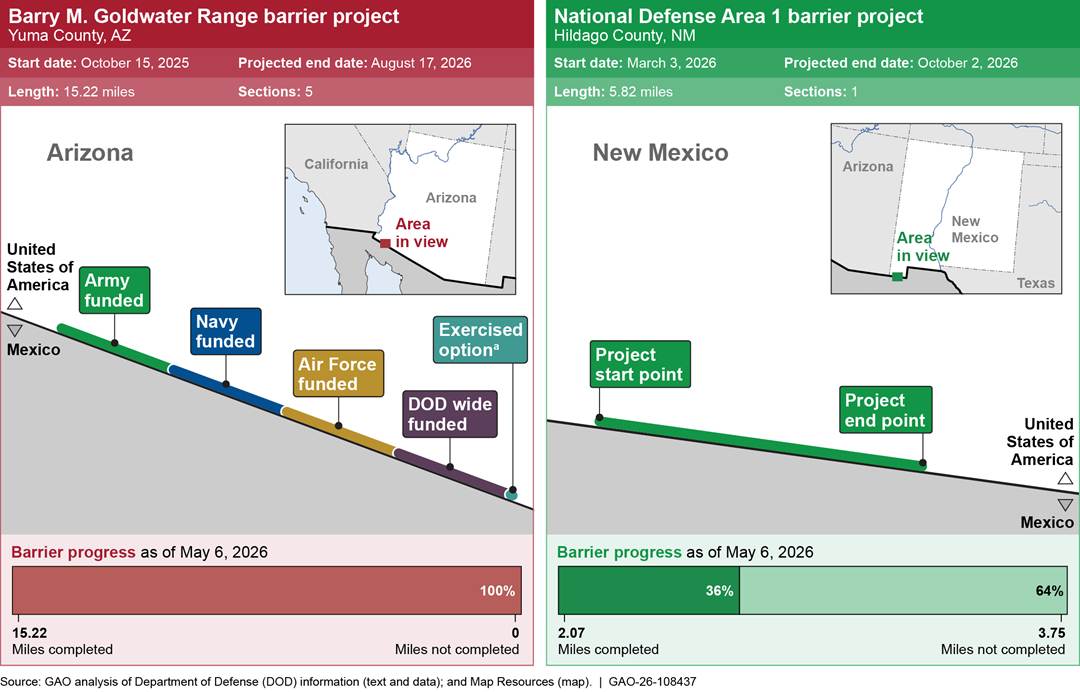
aIn December 2025, the U.S. Army Corps of Engineers exercised an option in the original contract that modified the contract to include construction of up to an additional roughly .29-mile barrier section for $7.6 million. According to Department of Defense (DOD) officials, this section is funded with remaining funds from the original $200 million reprogrammed for the other sections.
Territorial integrity. DOD added this category in fiscal year 2026 and reported obligating $73 million (3 percent) for this category as of March 31, 2026. According to DOD cost reporting, the territorial integrity category includes costs for intercepting threats and disrupting the flow of migrants and illicit drugs before they reach the border. This includes expanded surveillance and sensor networks in the air, sea, and subsurface environments. According to DOD officials, territorial integrity activities involve using technology to expand surveillance and countersurveillance in the air, land, and sea in order to fully secure the border.
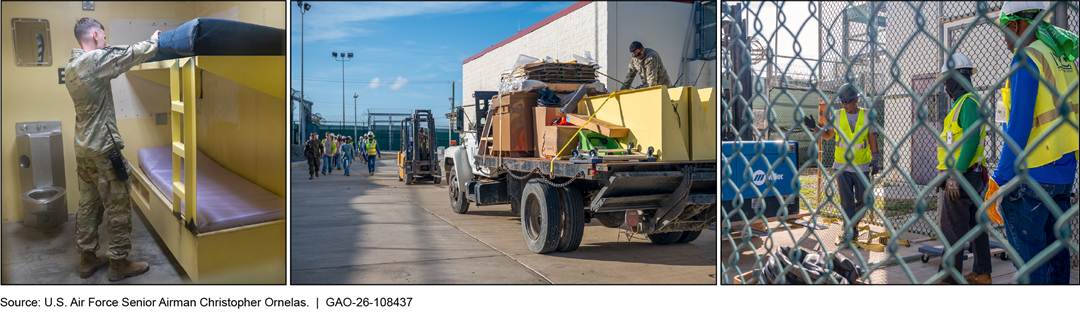
Operation Southern Guard. DOD reported obligating $66 million (3 percent) for Operation Southern Guard since the start of fiscal year 2025 to March 31, 2026. According to DOD cost reporting, Operation Southern Guard includes costs for DOD support of DHS-led immigration detention operations at Naval Station Guantanamo Bay including transportation and flights, housing of detainees, security, logistics, and medical support (see fig. 6). Most of these costs were incurred at the start of the operation at the beginning of calendar year 2025 to move DOD personnel and equipment and set up a joint task force headquarters, according to DOD officials. The mission was subsequently downsized by mid-February, according to DOD officials. Officials said it was deemed infeasible to detain the planned 30,000 noncitizens, in part because it was cost-prohibitive to build facilities that met ICE detention standards. DOD support to DHS reported in the Operation Southern Guard category was provided on a reimbursable basis from the start of fiscal year 2026.
Operations in the Information Environment. DOD added this category in fiscal year 2026 and reported obligating $25 million (1 percent) as of March 31, 2026. According to DOD cost reporting, Operations in the Information Environment includes costs for using messaging and targeted efforts to disrupt the recruitment, planning, and operations of cartels and transnational criminal organizations before they reach the border. According to DOD officials, activities in this category involve conducting operations that hinder designated foreign terrorist organizations from recruiting, planning, and trafficking across the U.S. southern border, Mexico, and Latin America.
Obligations by Appropriation Category
Of the $2.64 billion that DOD obligated for southern border operations as of March 31, 2026, the majority of obligations were in the operation and maintenance appropriation category ($1.75 billion or 66 percent) followed by the military personnel category ($487 million or 18 percent). (see fig. 7).
Figure 7: DOD Southern Border Obligations, by Appropriation Categories, Start of Fiscal Year 2025 to March 31, 2026
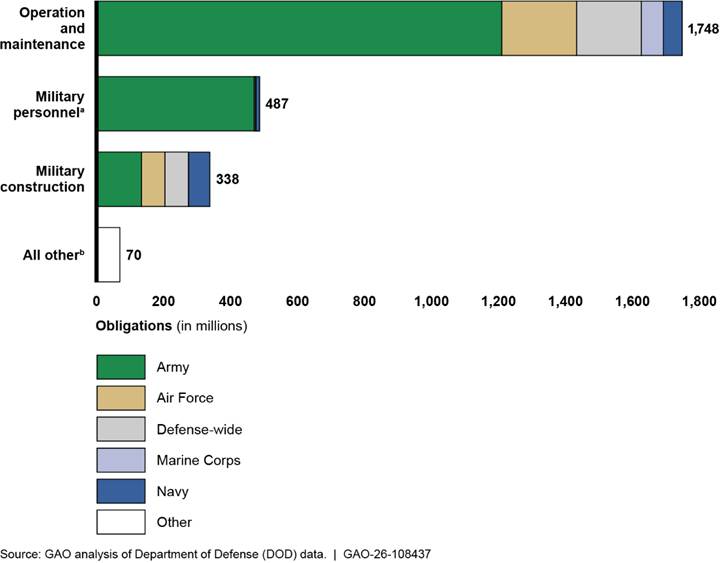
Note: Air Force operation and maintenance and military personnel amounts include those incurred by the Space Force. Obligations are as of March 31, 2026, except military personnel appropriation obligations in certain categories for Army, Navy, and Air Force, which are as of the end of February 2026.
a”Military personnel” includes Navy obligations of $10.8 million, Air Force obligations of $3.8 million, and Marine Corps obligations of $1.3 million.
b”All other” includes the following appropriation categories: research, development, test, and evaluation; other procurement; and Defense Health Program.
Among specific appropriation accounts, obligations were greatest from three appropriations accounts for the military services: operation and maintenance, Army ($1.21 billion); military personnel, Army ($471 million); and operation and maintenance, Air Force ($223 million).
Among the amounts that the Army obligated from its operation and maintenance appropriation, the largest categories of cost were for training and operation of units ($631 million) and activities essential to land forces readiness ($375 million). Among the amounts that the Army obligated from its military personnel appropriation ($471 million), the largest categories were for basic pay for service members ($252 million) and basic allowance for housing ($70 million).
From the military construction appropriation category ($338 million total), $191 million was obligated for the border barrier at Barry M. Goldwater Range in Arizona, and $83 million was obligated for the border barrier in New Mexico. The remainder was for housing for service members and planning and design for the border barriers.
DOD Followed Contingency Cost Reporting Processes to Track Costs for Southern Border Operations
OUSD (Comptroller) and the military services established a process for tracking southern border costs that included issuing guidance and business rules for pulling data from the military services’ financial ledgers into Advana (Army, Navy, Marine Corps, and Air Force).[41]
OUSD (Comptroller) issued a memorandum on April 25, 2025, outlining the requirements for budget execution and cost reporting for certain contingency operations including DOD’s southern border operations.[42] The memorandum stated that Advana would be the authoritative and only source for reporting on the use of funds for border operations. The memorandum also stated that DOD components, including the military services, have provided business rules, which allow Advana to directly pull transaction details from their systems, and that components must continue to validate budget execution and cost data in Advana for accuracy and completeness.
The military services have general contingency cost reporting guidance or other financial guidance that they use for reporting costs to include those for southern border operations.[43] For example, the Department of the Army’s Guidance for Reporting on Costs for Contingency and Non-contingency Operations discusses the use of proper codes to enable automatic reporting through Advana. In addition, the military services have documentation outlining specific codes for categories of cost for southern border operations.
The military services, in coordination with OUSD (Comptroller), updated their business rules in fiscal year 2025 as new categories of support for southern border operations were added and at the start of fiscal year 2026 to identify amounts obligated under OBBBA funding. The selected military service commands we interviewed generally implemented coding and tracking guidance as required by these business rules.
According to DOD officials, both OUSD (Comptroller) analysts and DOD component analysts validate the execution data on a consistent basis, typically through data calls, or individual reconciliation, prior to submission of the cost summary reports to Congress in order to provide timely and accurate execution reporting.
OUSD (Comptroller) officials stated they are also working to finalize standard operating procedures that would codify DOD’s process to manage and execute costs of southern border operations and provide continuity in the event of personnel turnover. In April 2026, these officials stated they are coordinating with all necessary components to finalize the procedures.
Agency Comments
We provided a draft of this report to DOD for review and comment. DOD did not provide official comments. DOD provided technical comments, which we incorporated as appropriate.
We are sending copies of this report to the appropriate congressional committees, the Secretary of Defense, the Under Secretary of Defense (Comptroller), and other interested parties. In addition, the report is available at no charge on the GAO website at https://www.gao.gov.
If you or your staff have any questions concerning this report, please contact me at AgarwalR@gao.gov. Contact points for our Offices of Congressional Relations and Media Relations may be found on the last page of this report. GAO staff who made key contributions to this report are listed in appendix II.
Rashmi Agarwal
Director, Defense Capabilities and Management
List of Committees
The Honorable Roger Wicker
Chairman
The Honorable Jack Reed
Ranking Member
Committee on Armed Services
United States Senate
The Honorable Mitch McConnell
Chair
The Honorable Christopher Coons
Ranking Member
Subcommittee on Defense
Committee on Appropriations
United States Senate
The Honorable Mike Rogers
Chairman
The Honorable Adam Smith
Ranking Member
Committee on Armed Services
House of Representatives
The Honorable Ken Calvert
Chairman
The Honorable Betty McCollum
Ranking Member
Subcommittee on Defense
Committee on Appropriations
House of Representatives
DOD’s Cost Categories for Homeland Border Security Initiatives Execution Reports from Fiscal Year 2025 to Fiscal Year 2026 and Obligations by Fiscal Year
Department of Defense (DOD) started reporting costs for southern border operations in February 2025 for fiscal year 2025 in two categories: border security and Operation Southern Guard. DOD added three additional categories at various points in 2025 and renamed the reports Homeland Border Security Initiatives Execution Reports in the July 1, 2025, report. Starting with the first report for fiscal year 2026, DOD made changes to reflect two new categories (territorial integrity and Operations in the Information Environment) and reimbursable support (see tables 2–3 below).
|
Category in DOD cost reporting |
Fiscal year 2025 |
Fiscal year 2026 (as of February 28) |
|
Border security |
Costs for various operations on the ground and in the air to secure the southern border. Reported support provided to the Department of Homeland Security (DHS) on a nonreimbursable basis. |
Only those costs for various operations to secure the border outside the National Defense Areas. Support provided to DHS on a reimbursable basis. |
|
Permanent border barrier |
Costs for design and construction of permanent barriers and supporting infrastructure. No changes from fiscal year 2025 to fiscal year 2026. Permanent border barrier costs in the fiscal year 2026 reports are cumulative since the start of fiscal year 2025; the other category costs in the fiscal year 2026 reports are only for that fiscal year. DOD activity not in support of DHS so not reimbursable. |
|
|
Continental United States detention |
Costs of construction and support of the East Montana Detention Facility and costs of detention activities at the U.S. Immigration and Customs Enforcement’s (ICE) Enhanced Hardened Facility. Both facilities located in El Paso, Texas. Support provided to DHS on a nonreimbursable basis. |
No costs in fiscal year 2026 and category removed from reporting. Contract to operate East Montana Detention Facility administratively transferred to ICE at the start of the fiscal year and no further use of ICE’s Enhanced Hardened Facility for detention. |
|
National Defense Area |
Costs to manage and develop National Defense Areas. DOD activity not in support of DHS so not reimbursable. |
Costs to manage and develop National Defense Areas. In addition, costs to secure the National Defense Areas that previously were included in the border security category in fiscal year 2025. DOD activity not in support of DHS so not reimbursable. Obligated amounts from Public Law 119-21, commonly known as the One Big Beautiful Bill Act (OBBBA).a |
|
Territorial integrity |
Category not included in reporting. |
New category for fiscal year 2026. Costs for intercepting threats before they reach the U.S., including through expanded surveillance. DOD activity not in support of DHS so not reimbursable. Obligated amounts from OBBBA.a |
|
Operation Southern Guard |
Costs for support of detention at Naval Station Guantanamo Bay. Support provided to DHS on a nonreimbursable basis. |
Costs for support of detention at Naval Station Guantanamo Bay. Support provided to DHS on a reimbursable basis. |
|
Operations in the Information Environment |
Category not included in reporting. |
New category for fiscal year 2026. Costs for efforts, including messaging, to disrupt transnational criminal organizations before they reach the border. DOD activity not in support of DHS so not reimbursable. Obligated amounts from OBBBA.a |
Source: GAO analysis of Department of Defense (DOD) information. | GAO‑26‑108437
aAn Act to provide for reconciliation pursuant to title II of H. Con. Res. 14, Pub. L. No. 119-21, tit. II, 20011 (2025). This section appropriated $1 billion to DOD, available from fiscal year 2025 to fiscal year 2029, for deployment of military personnel in support of border operations; operations and maintenance activities in support of border operations; counter-narcotics and counter-transnational criminal organization mission support; the operation of National Defense Areas and construction in these areas; and temporary detention of migrants on DOD installations, in accordance with chapter 15 of title 10, U.S. Code.
Table 3: Homeland Border Security Initiatives Execution Report Obligations, by Category and Fiscal Year (FY), millions of dollars
|
Category in DOD cost reporting |
FY 2025 |
FY 2026 |
Total |
Portion of |
|
Border security |
$1,151 |
$299 |
$1,450 |
$299 |
|
National Defense Area |
$13 |
$373 |
$387 |
n/ab |
|
Continental United States detention |
$366 |
n/ab |
$366 |
n/ab |
|
Permanent border barrier |
$187 |
$88 |
$275 |
n/ab |
|
Territorial integrity |
n/ab |
$73 |
$73 |
n/ab |
|
Operation Southern Guard |
$61 |
$5.8 |
$66 |
$5.8 |
|
Operations in the Information Environment |
n/ab |
$25 |
$25 |
n/ab |
|
Total |
$1,778 |
$865 |
$2,643 |
$305 |
Source: GAO analysis of Department of Defense (DOD) information. | GAO‑26‑108437
Note: Totals may be more or less than sum of columns due to rounding. Army, Navy, and Air Force military personnel appropriation obligations in the border security and Operation Southern Guard categories are as of February 28, 2026.
aReimbursable” refers to DOD support provided to the Department of Homeland Security on a reimbursable basis as reported by DOD in fiscal year 2026 (as of March 31).
bn/a = not applicable
GAO Contact
Rashmi Agarwal, AgarwalR@gao.gov
Staff Acknowledgments
In addition to the contact named above, Richard Geiger (Assistant Director), William Tedrick (Analyst in Charge), Sharon Ballinger, Erik Goepner, Elisebet Lalisan, Stephanie Moriarty, Shannon Murphy, and Carter Stevens made key contributions to this report.
The Government Accountability Office, the audit, evaluation, and investigative arm of Congress, exists to support Congress in meeting its constitutional responsibilities and to help improve the performance and accountability of the federal government for the American people. GAO examines the use of public funds; evaluates federal programs and policies; and provides analyses, recommendations, and other assistance to help Congress make informed oversight, policy, and funding decisions. GAO’s commitment to good government is reflected in its core values of accountability, integrity, and reliability.
Obtaining Copies of GAO Reports and Testimony
The fastest and easiest way to obtain copies of GAO documents at no cost is through our website. Each weekday afternoon, GAO posts on its website newly released reports, testimony, and correspondence. You can also subscribe to GAO’s email updates to receive notification of newly posted products.
Order by Phone
The price of each GAO publication reflects GAO’s actual cost of production and distribution and depends on the number of pages in the publication and whether the publication is printed in color or black and white. Pricing and ordering information is posted on GAO’s website, https://www.gao.gov/ordering.htm.
Place orders by calling (202) 512-6000, toll free (866) 801-7077,
or
TDD (202) 512-2537.
Orders may be paid for using American Express, Discover Card, MasterCard, Visa, check, or money order. Call for additional information.
Connect with GAO
Connect with GAO on X,
LinkedIn, Instagram, and YouTube.
Subscribe to our Email Updates. Listen to our Podcasts.
Visit GAO on the web at https://www.gao.gov.
To Report Fraud, Waste, and Abuse in Federal Programs
Contact FraudNet:
Website: https://www.gao.gov/about/what-gao-does/fraudnet
Automated answering system: (800) 424-5454
Media Relations
Sarah Kaczmarek, Managing Director, Media@gao.gov
Congressional Relations
David A. Powner, Acting Managing Director, CongRel@gao.gov
General Inquiries
[1]U.S. Customs and Border Protection generally refers to the land border with Mexico as the “southwest border.” In this report, we use the term “southern border” to be inclusive of other DOD activities, including detention support at Naval Station Guantanamo Bay.
[2]See 6 U.S.C. § 211(c).
[3]For purposes of our report, we use the term “noncitizen,” to refer to an “alien,” defined under U.S. immigration law as any person who is not a U.S. citizen or national, or “migrant” as used in DOD or DHS documentation, except when quoting language which includes the term “alien” or “migrant” in statute, regulation, or executive orders. Specifically in our audit work, we have found that DOD and DHS documentation often uses various terms such as “alien,” “migrant,” and “noncitizen,” among other words or phrases, in reference to those of non-U.S. nationality.
[4]See 8 U.S.C. §§ 1226, 1231, 1357. GAO has issued reports on immigration detention facilities. See, for example, Immigration Detention: DHS Should Define Goals and Measures to Assess Facility Inspection Programs, GAO‑25‑107580 (Washington, D.C.: May 21, 2025).
[5]Exec. Order No. 14,165, Securing Our Borders, 90 Fed. Reg. 8,467 (Jan. 20, 2025); Proc. No. 10,886, Declaring a National Emergency at the Southern Border of the United States, 90 Fed. Reg. 8,327 (Jan. 20, 2025).
[6]S. Rep. No. 119-39, at 196 (2025).
[7]We began our analysis with the February 2025 report because it was the first one available for fiscal year 2025. The cost data in the February 2025 report are the cumulative total since the start of fiscal year 2025 (i.e., Oct. 1, 2024).
[8]DOD’s Financial Management Regulation establishes Advana as an official DOD repository of common enterprise data and establishes the roles and responsibilities of OUSD (Comptroller) and DOD components in the development, maintenance, and use of Advana to ensure that any data product that relies on DOD data originates from an authoritative source of transaction-level detail. DOD 7000.14-R, Financial Management Regulation, vol. 1, ch. 10, ADVANA Common Enterprise Data Repository for the Department of Defense (June 2023).
[9]We did not review budget execution at the level of individual transactions in the military services’ financial management systems. The Army Audit Agency is conducting an audit to determine if the Army accurately recorded and reported costs in support of southern border operations and if the Army was fully and accurately reimbursed for all eligible costs in support of southern border operations. This audit is expected to be complete by the end of calendar year 2026.
[10]DOD’s financial management has been on GAO’s High-Risk List since 1995 due to long-standing issues including ineffective processes, aging systems, and inadequate controls; incomplete corrective action plans; and the need for more effective monitoring and reporting. DOD has not received an audit opinion on its annual department-wide financial statements. See GAO, High-Risk Series: Heightened Attention Could Save Billions More and Improve Government Efficiency and Effectiveness, GAO‑25‑107743 (Washington, D.C.: Feb. 25, 2025).
[11]An obligation is a definite commitment that creates a legal liability of the government for the payment of goods and services ordered or received, or a legal duty on the part of the United States that could mature into a legal liability by virtue of actions on the part of the other party beyond the control of the United States. GAO, A Glossary of Terms Used in the Federal Budget Process, GAO‑05‑734SP (Washington, D.C.: September 2005).
[12]We met with the following commands: U.S. Army North; U.S. Army South; U.S. Marine Corps Forces, Pacific; U.S. Fleet Forces Command; U.S. Pacific Fleet; Air Mobility Command; and Air Combat Command. At the time of our selection, these commands accounted for, among operation and maintenance obligations for southern border support, 99.8 percent of Army obligations, 97.8 percent of Marine Corps obligations, 77.1 percent of Navy obligations, and 61.7 percent of Air Force obligations, respectively.
[13]DOD may also operate under a continuing resolution, which is a type of temporary appropriation act that provides budget authority for federal agencies, specific activities, or both to continue in operation when a regular appropriation act has not been enacted by the beginning of a fiscal year. GAO recently reported on DOD operations under continuing resolutions in Defense Budget: Effects of Continuing Resolutions on Selected Activities and Programs Critical to DOD’s National Security Mission, GAO‑26‑107065 (Washington, D.C.: Jan. 21, 2026).
[14]Threshold amounts for reprogramming actions are typically established by Congress in the explanatory statements or conference reports accompanying DOD appropriations acts. The reprogramming threshold in fiscal years 2025 and 2026 was $15 million for the following appropriation accounts: operation and maintenance; military personnel; procurement; and research, development, test, and evaluation. DOD uses Reprogramming Action – Prior Approval DOD Form 1415-1 to request prior approval from congressional committees.
[15]According to DOD’s Financial Management Regulation, these reprogramming actions are considered minor and provide components with the discretionary flexibility to realign—within prescribed limits—congressionally approved funding to satisfy unforeseen, higher priority requirements within the appropriation. DOD 7000.14-R, vol. 3, ch. 6, Reprogramming of DOD Appropriated Funds (September 2015).
[16]DOD uses Reprogramming Action – Internal Reprogramming DOD Form 1415-3 to notify congressional committees of these realignments.
[17]DOD 7000.14-R, vol. 3, ch. 6.
[18]In fiscal years 2025 and 2026, the Drug Interdiction and Counter-Drug Activities, Defense appropriation is available for DOD drug interdiction and counter-drug activities, and for transfer to other DOD appropriations including military personnel; operation and maintenance; procurement; and research, development, test, and evaluation. It is the principal means used to finance DOD’s counter-narcotics activities, and from this appropriation, DOD use the counter-narcotics fund to implement counter-narcotics activities as well as counter-transnational organized crime activities related to narcotics trafficking.
[19]Specifically, the DD 1414 identifies line items within each appropriation covered in annual DOD appropriations acts and any changes, including as a result of congressional action or planned transfers or reprogrammings. DOD 7000.14-R, vol. 3, ch. 6, Reprogramming of DOD Appropriated Funds (September 2015).
[20]10 U.S.C. § 277. The Economy Act states that the head of an agency (e.g., Secretary of Homeland Security) may place an order with another agency, in this case DOD, for goods or services if (1) amounts are available; (2) the head of the ordering agency, in this case DHS, decides the order is in the best interest of the United States government; (3) the agency to fill the order (DOD) is able to provide or get by contract the ordered goods or services; and (4) the head of the agency (Secretary of Homeland Security) decides that ordered goods or services cannot be provided by contract as conveniently or cheaply by a commercial enterprise. Under the Economy Act, the ordering agency must promptly reimburse the agency that provides support upon that agency’s written request. See generally 31 U.S. Code §§ 1535-1536.
[21]10 U.S.C. § 277(c).
[22]See DOD Directive 5118.03, Under Secretary of Defense (Comptroller)/Chief Financial Officer, Department of Defense (Apr. 4, 2023).
[23]DOD 7000.14-R, vol. 12, ch. 23, Contingency Operations (December 2017).
[24]DOD uses amounts from the military construction appropriation account for major construction projects such as bases, schools, missile storage facilities, medical/dental clinics, military family housing, sensitive compartmented information facilities, and research and development installations.
[25]An Act to provide for reconciliation pursuant to title II of H. Con. Res. 14, Pub. L. No. 119-21, tit. II, § 20011 (2025) (hereafter, OBBBA). This section appropriated $1 billion to DOD, available from fiscal year 2025 to fiscal year 2029, for deployment of military personnel in support of border operations; operations and maintenance activities in support of border operations; counter-narcotics and counter-transnational criminal organization mission support; the operation of national defense areas and construction in these areas; and temporary detention of migrants on DOD installations, in accordance with chapter 15 of title 10, U.S. Code.
[26]Facilities sustainment, restoration, and modernization activities are generally funded by amounts from the 1-year operation and maintenance appropriation, and (1) address day-to-day facility maintenance requirements, (2) restore facilities whose age is excessive or that have been damaged, (3) alter facilities to implement new or higher standards or to accommodate new functions or missions, and (4) demolish and dispose of obsolete and excess structures.
[27]See generally Pub. L. No. 119-4, tit. IV (2025). According to the Congressional Research Service, in years in which Congress produces an explanatory text accompanying an appropriations measure, this text is typically considered the most authoritative source of congressional action or intent with regard to that measure. Congressional Research Service, Appropriations Report Language: Overview of Development and Components, R44124 (Washington, D.C.: Mar. 22, 2023).
[28]According to DOD officials, the department is providing some support to DHS for southern border operations under section 284 of title 10, U.S. Code, which provides DOD with the authority to support the counter-drug activities or activities to counter-transnational organized crime of federal or other law enforcement agencies. Specifically, under section 284(b), the Secretary of Defense may provide such support for purposes of (1) maintenance and repair of DOD equipment made available to an agency; (2) maintenance, repair, or upgrading of other types of equipment for certain purposes; (3) transportation of certain personnel and supplies; (4) establishment and operation of bases of operations or training facilities for the purpose of facilitating counter-drug activities or activities to counter transnational organized crime of DOD or any federal, state, local, or tribal law enforcement agency within or outside the United States; (5) relevant training of law enforcement personnel; (6) detection, monitoring and communication of certain air, sea, and surface traffic; (7) construction of roads and fences and installation of lighting to block drug smuggling corridors across international boundaries of the United States; (8) establishment of command, control, communications, and computer networks for improved integration of law enforcement, active military, and National Guard activities; (9) provision of linguist, intelligence analysis, and planning services; and (10) aerial and ground reconnaissance. 10 U.S.C. § 284(b).
[29]DD 1415-3: Fiscal Year 25-29 Internal Reprogramming, Drug Interdiction and Counter-Drug Activities, Defense (DHS Request) (Apr. 25, 2025).
[30]DD 1415-1: Fiscal Year 25-11 Prior Approval Reprogramming, Drug Interdiction and Counter-Drug Activities, Defense (DHS Request) (May 19, 2025). The Navy Working Capital Fund is a revolving fund that finances Department of the Navy activities that provide products and services on a reimbursable basis. Working capital funds operate as self-supporting entities that conduct a regular cycle of businesslike activities. They function from the fees charged for goods and services provided to customers, such as other DOD components or federal agencies.
[31]See Fiscal Year 25-07 Military Construction Reprogramming, Emergency Military Construction on the Barry M. Goldwater Range (May 28, 2025). Section 2803, “Emergency Construction,” states that, subject to certain conditions, the Secretary of Defense or secretaries of the military departments may carry out a military construction project not otherwise authorized by law if the secretary determines (1) that the project is vital to the national security or to the protection of health, safety, or the quality of the environment, and (2) that the requirement for the project is so urgent that deferral of the project for inclusion in the next Military Construction Authorization Act would be inconsistent with national security or the protection of health, safety, or environmental quality, as the case may be. 10 U.S.C. § 2803(a). Pursuant to a congressional request, GAO expects to issue a legal decision later this year regarding whether DOD complied with statutory requirements when it obligated military construction funds to build a border barrier on the Barry M. Goldwater Range.
[32]Specifically, DOD notified Congress that this construction is being performed under the emergency authorities of section 2808 of title 10, U.S. Code. Secretary of Defense Letters to Chairs of the House and Senate Committees on Appropriations (Aug. 7, 2025). Section 2808 states that the Secretary of Defense, in the event of a declaration of war or the declaration by the President of a national emergency in accordance with the National Emergencies Act (50 U.S.C. § 1601 et seq.) that requires use of the armed forces, may authorize the secretaries of the military departments to undertake military construction projects not otherwise authorized by law that are necessary to support such use of the armed forces. 10 U.S.C. § 2808(a).
[33]For fiscal year 2027, the President’s budget requested $1.47 billion for DOD southern border operations-related purposes. See Fiscal Year 2027 Department of War Budget Overview Book (Apr. 20, 2026). This requested amount does not include the $1 billion the OBBBA appropriated to DOD for certain border operations, which is available from fiscal year 2025 to fiscal year 2029.
[34]These cost summary reports are called Homeland Border Security Initiatives Execution reports. We began our analysis with the February 2025 report because it was the first one available for fiscal year 2025. The cost data in the February 2025 report are the cumulative total since the start of fiscal year 2025 (i.e., Oct. 1, 2024). The latest report we used in our analysis is the March 2026 report that has cost data as of March 31, 2026, with the exception of the military personnel appropriation data for Army, Navy, and Air Force in certain categories, which are as of the end of February 2026.
[35]For purposes of this report, an NDA is an area of federal land along the southern border of the United States under the administrative control of a DOD military installation, via jurisdiction transfer from or other agreement with another federal agency, as directed by National Security Presidential Memorandum-4, Military Mission for Sealing the Southern Border of the United States and Repelling Invasions (Apr. 11, 2025) and implementing guidance.
[36]Specifically, the President directed the establishment of NDAs in National Security Presidential Memorandum-4, which directed the Secretaries of Defense, Interior, Agriculture, and Homeland Security to take all appropriate actions to provide for the use, use and jurisdiction, or the transfer and acceptance of jurisdiction, over such federal lands that are reasonably necessary to enable military activities to occur on a military installation under the jurisdiction of DOD.
[37]The Enhanced Hardened Facility was formerly operated by CBP as the El Paso Central Processing Center. In March 2025, CBP’s contract to operate the facility expired. The Army awarded a new contract, and ICE began operating the facility.
[38]See Immigration Detention: Waste and Performance Issues at Camp East Montana Provide Valuable Lessons for Future Facilities, GAO‑26‑108886 (Washington, D.C.: June 9, 2026).
[39]Pursuant to a congressional request, GAO expects to issue a legal decision later this year regarding whether DOD complied with statutory requirements when it obligated military construction funds to build a border barrier on the Barry M. Goldwater Range.
[40]According to DOD, the construction is being performed under the emergency authorities of section 2808 of title 10, U.S. Code. Section 2808 states that the Secretary of Defense, in the event of a declaration of war or the declaration by the President of a national emergency in accordance with the National Emergencies Act (50 U.S.C. § 1601 et seq.) that requires use of the armed forces, may authorize the secretaries of the military departments to undertake military construction projects not otherwise authorized by law that are necessary to support such use of the armed forces. 10 U.S.C. § 2808(a).
[41]For the purposes of this report, Space Force costs are included within Air Force costs because the Space Force uses the Air Force financial ledger and tracking processes.
[42]Under Secretary of Defense Comptroller Memorandum, Department of Defense Reporting Guidance for Southwest Border Support, Border Security Operations, Hurricanes Florence, Harvey, Irma, and Maria (Apr. 25, 2025). According to DOD officials, southern border operations are not a contingency operation according to the specific definition contained in section 101(a) of title 10, U.S. Code because homeland defense is a core and enduring mission of DOD. However, DOD follows contingency cost reporting processes for it. DOD’s Financial Management Regulation also states that its definition of “contingency operation” is more encompassing than the specific definition contained in section 101(a). DOD 7000.14-R, vol. 12, ch. 23, Contingency Operations (December 2017).
[43]For example: Department of the Army, Guidance for Reporting on Costs for Contingency and Non-contingency Operations (January 2024); Department of the Navy, Contingency Reporting Guidance (December 2025); and Department of the Air Force, Fiscal Year 2025 Fiscal Guidance.