
Report to Congressional Requesters
United States Government Accountability Office
A report to congressional requesters
For more information, contact: Jill Naamane at naamanej@gao.gov
What GAO Found
The Department of Housing and Urban Development (HUD) reduced its workforce by 29 percent in 2025 and modified the types of programs it funds in response to presidential directives and executive branch guidance. HUD largely achieved workforce reductions through deferred resignation programs. Over half the employees who separated had at least 10 years of service at HUD, including 41 percent with more than 20 years of service. HUD did not publish notice of any reorganization plans that led to field office closures in 2025, though in 2026 it announced plans to consolidate one field office into a nearby regional office.
Workforce Changes at the Department of Housing and Urban Development (HUD) in 2025
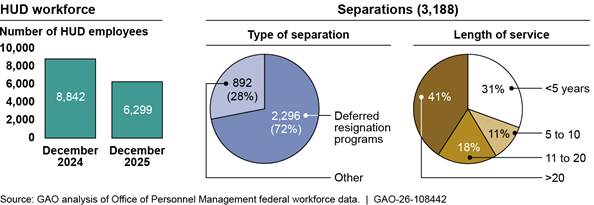
Note: Percentages may not sum to 100 due to rounding.
About half of HUD’s 68 active grant programs made new awards in fiscal year 2025, but the median value of those awards was higher than in previous years. HUD also terminated about 21 percent of its active contracts in 2025, valued at about $367 million. Most terminated contracts involved professional or IT services.
Representatives of 20 stakeholder organizations GAO interviewed—including fair housing grantees and agencies, public housing agencies, and Section 8 project-based rental assistance property managers—reported confusion, delays, and operational disruptions following HUD’s changes. Nearly all said that experienced points of contact had left, making it harder to navigate HUD programs. Fair housing stakeholders reported reducing services or staffing during monthslong funding gaps. Stakeholders also reported delays with physical inspections of HUD-assisted properties.
Since January 2025, HUD has reported launching initiatives aimed at increasing efficiency and streamlining operations. For example, HUD reported developing a unified grants system to standardize grant administration and a project voucher initiative to automate aspects of rental assistance processing. HUD did not respond to GAO’s requests to discuss these initiatives or provide supporting documentation. As a result, Congress and the public have limited information on the status or effectiveness of these initiatives.
Why GAO Did This Study
HUD administers programs related to housing assistance, community development, and fair housing. To carry out these programs, HUD headquarters and field staff work with public housing agencies, private property owners, nonprofit organizations, and other stakeholders.
Executive orders and other actions issued in 2025 called for workforce and program changes at HUD. GAO was asked to examine the effects of these changes. This report describes (1) changes HUD made to its workforce, field office structure, and grant and contract spending in 2025; (2) effects of those changes on selected HUD functions reported by housing stakeholders; and (3) steps HUD has publicly reported to manage the changes.
HUD did not respond to GAO’s requests for information throughout the audit. GAO analyzed publicly available 2025 data on HUD’s workforce, terminated contracts, and grant spending. GAO selected three HUD functions for review, chosen to reflect a mix of funding levels and other criteria: (1) enforcement of the Fair Housing Act and Violence Against Women Act of 1994, (2) administration of the Section 8 Project-Based Rental Assistance Program, and (3) coordination of inspections of HUD-assisted properties.
GAO also conducted four site visits and interviewed representatives of a nongeneralizable selection of 20 local and national housing organizations, including public housing agencies and fair housing organizations. GAO also reviewed court documents and publicly available data, and agency documentation related to HUD’s workforce and efficiency planning.
|
Abbreviations |
|
|
|
|
|
|
|
DEI |
diversity, equity, and inclusion |
|
|
FHAP |
Fair Housing Assistance Program |
|
|
FHEO |
Office of Fair Housing and Equal Opportunity |
|
|
FHIP |
Fair Housing Initiatives Program |
|
|
FY |
fiscal year |
|
|
HUD |
Department of Housing and Urban Development |
|
|
IT |
information technology |
|
|
OPM |
Office of Personnel Management |
|
|
PBRA |
Section 8 Project-Based Rental Assistance |
|
|
PHA |
public housing agency |
|
|
RIF |
reduction in force |
|
|
SAM.gov |
System for Award Management |
|
This is a work of the U.S. government and is not subject to copyright protection in the United States. The published product may be reproduced and distributed in its entirety without further permission from GAO. However, because this work may contain copyrighted images or other material, permission from the copyright holder may be necessary if you wish to reproduce this material separately.
September 30, 2026
Congressional Requesters
The Department of Housing and Urban Development (HUD) administers a wide variety of programs aimed at strengthening communities, preventing housing discrimination, and helping households obtain affordable housing. Beginning in January 2025, in response to presidential directives, HUD took steps to reduce its workforce, streamline operations, and change the types of programs it funds.[1] For example, HUD offered employees opportunities to voluntarily resign, announced reviews and terminations of grants and contracts that did not align with administration priorities, and reportedly planned to close 34 of its 54 field offices.[2] These changes prompted questions from members of Congress about potential effects on HUD’s capacity and service delivery.[3]
You asked us to examine the effects of workforce reductions, grant and contract terminations, and field office closures on HUD’s ability to meet its statutory obligations and carry out its mission, as well as the extent to which HUD followed statutory requirements in planning and implementing these changes. This report describes
1. changes HUD has made to its workforce, field office structure, and grant and contract spending since January 2025;
2. the effects of those changes on selected HUD functions, as reported by HUD housing stakeholders; and
3. steps HUD has publicly reported to manage these changes.
To describe changes to HUD’s workforce, we analyzed Office of Personnel Management (OPM) federal workforce data as of February 2026 on hires and separations from December 2024 to December 2025. To assess the reliability of these data, we reviewed related documentation and performed manual testing. We determined the data were sufficiently reliable for reporting on changes in HUD’s number of employees, hires, and separations. To describe changes HUD made to its field office structure, we reviewed Federal Register notices from January 2025 through June 2026 for plans to consolidate, relocate, or close field offices.
To describe changes in HUD’s grant and contract spending, we analyzed USAspending.gov data on the number and value of new grants awarded in fiscal year (FY) 2025 and compared them with the same data from FY 2016 through FY 2024. We also analyzed System for Award Management (SAM.gov) data on contracts HUD terminated from January 20, 2025, to December 31, 2025. To assess the reliability of both sets of data, we reviewed documentation and performed electronic testing. We determined the data were sufficiently reliable for describing changes in grant and contract spending.
To identify effects reported by HUD housing stakeholders, we selected three HUD functions because they had high funding levels, some degree of field office involvement, and reportedly experienced staffing reductions: (1) enforcement of the Fair Housing Act and Violence Against Women Act of 1994, (2) administration of the Section 8 Project-Based Rental Assistance (PBRA) program, and (3) coordination of property inspections.
We conducted site visits to four cities with HUD field or regional offices: San Francisco, California; Omaha, Nebraska; Manchester, New Hampshire; and Nashville, Tennessee. We selected these locations to provide geographic diversity, reflect a mix of urban and rural settings, and include locations where HUD offices reportedly experienced staffing changes. During the visits, we interviewed representatives of fair housing stakeholders—Fair Housing Initiatives Program (FHIP) grantees and Fair Housing Assistance Program (FHAP) agencies—as well as public housing agencies (PHA) and private property managers. We also interviewed representatives of national organizations representing fair housing, affordable housing management, and PHAs and reviewed information submitted in court cases involving HUD regarding the effects of funding disruptions and potential reductions in force.[4] While information collected through our site visits and other interviews cannot be generalized to the larger population of HUD housing stakeholders, it provides perspectives on effects experienced by stakeholders.
To describe steps HUD has publicly reported to manage these changes, we reviewed publicly available documentation on its initiatives and plans. HUD officials did not provide information in response to our requests on various topics, including any activities HUD is planning or recent changes to steps reported in public documents, as discussed later in the report. For more information on our objectives, scope, and methodology, see appendix I.
We conducted this performance audit from April 2025 to September 2026 in accordance with generally accepted government auditing standards. Those standards require that we plan and perform the audit to obtain sufficient, appropriate evidence to provide a reasonable basis for our findings and conclusions based on our audit objectives. We believe that the evidence obtained provides a reasonable basis for our findings and conclusions based on our audit objectives.
Background
HUD’s Structure and Partners
HUD administers a wide variety of programs through a network of staff in its Washington, D.C., headquarters, 10 regional offices, and 54 field offices.[5] Regional and field office staff partner with local PHAs, private property owners, and nonprofits to implement HUD programs and services related to affordable housing, fair housing, property inspections, and other areas.
HUD is required by law to have an office in every state to ensure the adequate processing of applications for loan and mortgage insurance under the National Housing Act.[6] Before reorganizing a HUD field, regional, insuring, or area office, HUD must issue a notice in the Federal Register that includes a cost-benefit analysis of the proposed action.[7]
Selected HUD Programs and Functions
HUD headquarters and field office staff help carry out the following programs and functions discussed in this report:
Fair Housing Act enforcement. HUD’s Office of Fair Housing and Equal Opportunity (FHEO) investigates housing discrimination complaints, promotes fair housing laws and education, and conducts civil rights compliance reviews. FHEO also administers FHAP, which funds state and local enforcement agencies to investigate and resolve complaints of housing discrimination, and FHIP, which funds state and local governments, nonprofit organizations, or other private or public entities to carry out programs designed to obtain enforcement of fair housing laws, and to provide education and outreach. HUD is to use funding to conduct—through contracts with fair housing enforcement organizations—a range of investigative activities designed to carry out testing, discover and remedy discrimination in real estate markets, and provide technical assistance to local fair housing organizations.[8]
Violence Against Women Act enforcement. FHEO enforces the Violence Against Women Act in HUD-assisted (subsidized) housing. The act seeks to protect survivors of domestic and dating violence, sexual assault, and stalking from being denied admission, evicted, or denied housing assistance because of their status.[9] FHEO carries out this responsibility through rulemaking, oversight of housing providers, compliance monitoring, and complaint investigations.
Section 8 Project-Based Rental Assistance Program. PBRA provides approximately 1.3 million affordable housing units for low-income and very low-income families.[10] PBRA assistance is attached to a housing unit and households benefit from the assistance if they continue to live in the unit. HUD pays property owners the difference between the tenant’s contribution and a rent set by HUD.
Physical Inspections of HUD-Assisted Properties. HUD’s Real Estate Assessment Center primarily uses contractors to inspect multifamily and public housing properties on a risk-based schedule, generally every 1 to 3 years. Property owners, including PHAs and PBRA property managers, are responsible for correcting identified deficiencies, and HUD field office staff monitor their compliance.
Executive Orders and HUD Actions in 2025
Beginning in January 2025, the President issued several memorandums and executive orders directing federal agencies to reduce the size of their workforces and align their programming with new administration priorities. In response, HUD took steps to reduce staffing and modify the types of programs it funds (see table 1). Several housing groups and other HUD stakeholders challenged some of these actions in court.
|
Date |
Description |
|
January 20, 2025 |
Presidential Memorandum, Hiring Freeze, 90 Fed. Reg. 8247 Ordered a hiring freeze on federal civilian employees throughout the executive branch. Directed the Office of Personnel Management (OPM) to issue guidance on reducing the size of the federal workforce. |
|
January 20, 2025 |
Exec. Order 14151, Ending Radical and Wasteful Government DEI Programs and Preferencing, 90 Fed. Reg. 8339 Required that all diversity, equity, and inclusion (DEI) offices and positions be terminated, to the maximum extent allowed by law, within 60 days. |
|
January 28, 2025 |
OPM, Deferred resignation email to federal employees and Guidance Regarding Deferred Resignation Program Established a government-wide deferred resignation program that allowed federal employees to voluntarily resign and be placed on administrative leave until September 30, 2025, or December 31, 2025, if retiring between October 1 and December 31, 2025. |
|
February 11, 2025 |
Exec. Order 14210, Implementing the President’s ‘Department of Government Efficiency’ Workforce Optimization Initiative, 90 Fed. Reg. 9669 Directed federal agency heads to prepare for large-scale reductions in force (RIF).a |
|
February 19–20, 2025 |
Review and cancellation of contracts On February 19, the Secretary of the Department of Housing and Urban Development (HUD) announced that HUD had begun reviewing $260 million in contracts he characterized as wasteful. On February 20, HUD announced it had canceled $4 million in contracts it characterized as related to DEI. |
|
February 26, 2025 |
Exec. Order 14222, Implementing the President’s ‘Department of Government Efficiency’ Cost Efficiency Initiative, 90 Fed. Reg. 11095 Directed federal agency heads to review all covered contracts and grants within 30 days and, where appropriate and consistent with applicable law, terminate or modify them to reduce or reallocate overall spending. |
|
February 27, 2025 |
Termination of 78 HUD Fair Housing Initiatives Program (FHIP) grants HUD notified 78 FHIP grantees in 33 states that it was terminating their grants “at the direction of [the] Department of Government Efficiency” because the grants “no longer effectuate the program goals or agency priorities.” |
|
March 13, 2025 |
Massachusetts Fair Housing Center et al. v. HUD et al. Challenged HUD’s termination of 78 FHIP grants, alleging that the agency unlawfully terminated congressionally funded fair housing enforcement grants. HUD reinstated the grants in March 2025. |
|
March 31, 2025 |
HUD offers deferred resignation program HUD opened an agency-specific deferred resignation program on March 31, 2025; the program closed on April 11, 2025. |
|
April 28, 2025 |
American Federation of Government Employees, AFL-CIO, et al. v. Trump et al. Challenged administration efforts, including those involving HUD, to carry out large-scale federal workforce reductions and agency reorganizations without congressional authorization. As of August 2026, the lawsuit was ongoing. |
|
June 24, 2025 |
National Fair Housing Alliance, et al. v. HUD et al. Alleged that HUD unlawfully withheld congressionally approved Fair Housing Initiatives Program (FHIP) funding. The plaintiffs alleged that HUD did not release funding for the second and third years of multiyear grants awarded in 2023 and 2024 or make new FY 2024 FHIP awards. On April 8, 2026, HUD noted in a motion that it had executed second and third-year grant agreements for certain grants subject to this litigation. As of August 2026, the court issued a stay on the case until further order of the court. |
|
September 16, 2025 |
HUD Office of Fair Housing and Equal Opportunity (FHEO) Memorandum, Fair Housing Act Enforcement and Prioritization of Resources Stated that FHEO would no longer prioritize cases involving appraisal bias, environmental justice, criminal history, and gender identity. It also withdrew guidance on disparate impact, criminal record-screening, and protections for people with limited English proficiency, among other guidance. |
|
September 17, 2025 |
FHEO Memorandum, Notice of the Withdrawal of FHEO Guidance Documents Announced the rescission of additional guidance, including on assistance animals. |
|
September 2025 |
FHEO Memorandum, FY 2025 Guidance Package for the Fair Housing Assistance Program (FHAP) Provided instructions for using grant funds and stated that FHAP agencies would not be reimbursed for discrimination cases based on sexual orientation, gender identity, criminal records, or limited English proficiency.b |
|
October 4, 2025 |
American Federation of Government Employees, AFL-CIO, et al. v. U.S. Office of Management and Budget et al. Alleged that the government lacked authority to carry out RIFs during a federal shutdown and that OPM unlawfully issued instructions to agencies to administer RIFs during the lapse in appropriations, which began October 1. |
|
October 10, 2025 |
RIF notices issued to 442 employees during government shutdown HUD issued RIF notices to 442 employees, according to court documents. The largest planned reductions were in FHEO, affecting 114 employees, and the Real Estate Assessment Center, affecting 91 employees. On October 15, a federal judge temporarily blocked the planned RIFs. HUD rescinded these RIFs on November 13, 2025. |
Source: GAO analysis of presidential directives, agency announcements and guidance, and related lawsuits. | GAO‑26‑108442
aA reduction in force is the federal government’s process for eliminating positions due to agency reorganizations, reduced funding, or reduced workload.
bOn March 16, 2026, 15 states and the District of Columbia challenged this guidance package and related funding conditions in State of Illinois et al. v. HUD. The plaintiffs alleged that HUD unlawfully narrowed fair housing enforcement and threatened to withhold FHAP funding from state agencies that enforce broader state-law protections. As of June 2026, HUD had not rescinded the guidance.
HUD Lost 29 Percent of Its Staff, and About Half of Its Grant Programs Did Not Make Awards in 2025
HUD’s Workforce Decreased by 29 Percent, Mostly Through Deferred Resignation
HUD’s workforce decreased by about 29 percent between December 2024 and December 2025, from about 8,800 to about 6,300 employees (see fig. 1). In total, 3,188 employees separated from HUD in 2025, according to OPM federal workforce data.[11] Of these, 2,296 employees, or about 72 percent, left through a voluntary HUD-sponsored or
government-wide deferred resignation program.[12] The remaining 892 left through terminations, retirements, resignations, or other means. Additionally, from January 2025 to December 2025, HUD hired 193 employees.
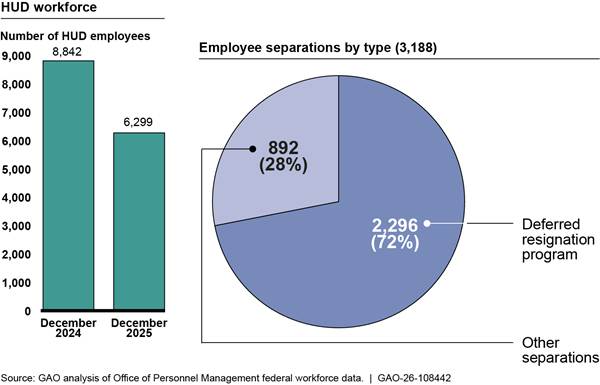
Note: Employee separations do not equal the change in HUD’s workforce from December 2024 to December 2025 because employee counts also reflect changes in pay status. For example, employees entering or returning from unpaid leave affect workforce totals but are not counted as hires or separations. Data shown reflect Office of Personnel Management data as of February 2026.
Over half of the separated employees had worked at HUD for at least 10 years, including 41 percent who had over 20 years of service (see fig. 2). In contrast, 5 percent of employees (169) had less than 1 year of service; 48 of these employees were terminated.[13]
Figure 2: Department of Housing and Urban Development Employee Separations by Length of Service, 2025
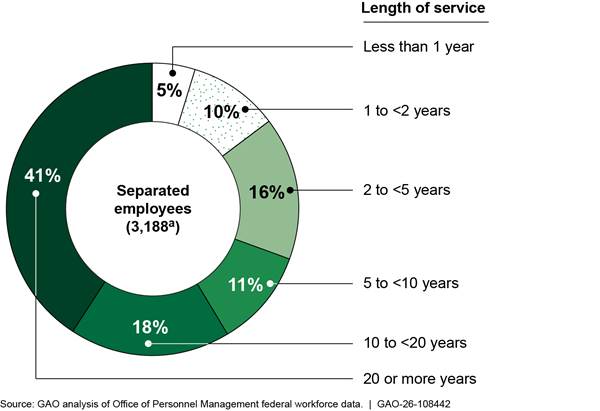
Note: Percentages do not sum to 100 due to rounding. Data shown reflect Office of Personnel Management data as of February 2026.
aTotal includes six separations with missing length-of-service data.
According to federal workforce data, the largest numbers of separations occurred among employees whose official duty stations were in the District of Columbia (792 employees), California (158), and Texas (126).[14] Other locations experienced larger proportional workforce separations. For example, staff decreased by 79 percent in Utah, 62 percent in Arkansas, and 57 percent in Virginia when compared with December 2024 levels (see fig. 3).[15]
Figure 3: Employee Separations by State at the Department of Housing and Urban Development (HUD) in 2025
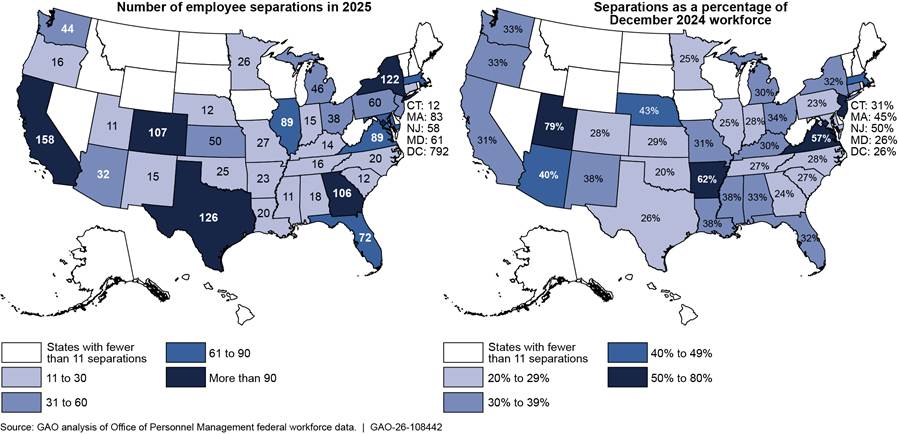
Note: States with fewer than 11 employees or separations are concealed to ensure privacy. Percentages represent separations as a share of each state’s December 2024 HUD workforce. Locations reflect the employees’ official duty stations. Data shown reflect Office of Personnel Management data as of February 2026.
Our review of HUD’s Federal Register notices—which HUD is required to publish before reorganizing a field office—found that HUD did not initiate any field office reorganizations in 2025. However, on June 24, 2026, HUD issued a notice of intent to relocate and consolidate its Kansas City, Missouri, Field Office into the Kansas City, Kansas, Regional Office.[16]
HUD’s FY 2027 budget justification states that HUD expects to largely maintain the 2025 staffing reductions while strategically backfilling critical positions.[17]
About Half of HUD’s Grant Programs Did Not Make New Awards in 2025, but Median Award Values Generally Increased
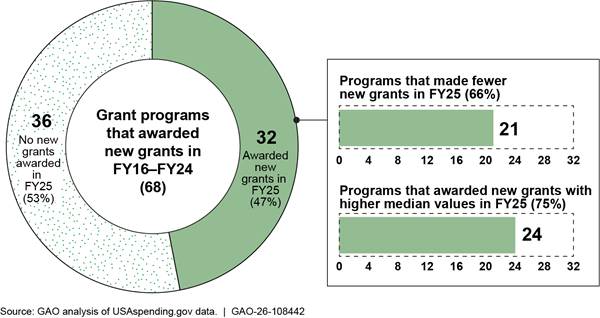
HUD administers various programs that award grants to state and local governments, PHAs, and nonprofits for community development, affordable housing, homelessness assistance, and other purposes. Of the 68 HUD programs that made new grant awards from FY 2016 through FY 2024, 32 made new awards in FY 2025, according to our analysis of USAspending.gov data.[18] Twenty-one of those 32 programs made fewer new awards in FY 2025 than their median annual number from FY 2016 through FY 2024. However, 24 had higher median award values in FY 2025 than during the earlier period (see fig. 4). Appendix II contains additional information on HUD’s FY 2025 grant spending.
Figure 4: Most Department of Housing and Urban Development Grant Programs That Made New Awards in Fiscal Year (FY) 2025 Made Fewer New Awards but Had Higher Median Award Values
HUD Terminated About 21 Percent of Its Contracts in 2025
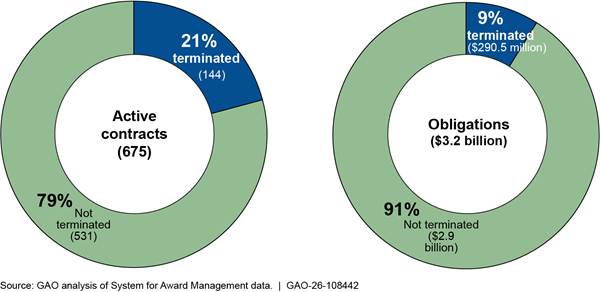
HUD terminated 144 of its 675 active contracts (about 21 percent) in 2025, according to our analysis of SAM.gov data (see fig. 5).[19] The terminated contracts had a total value of about $367 million, of which HUD obligated about $291 million (about 9 percent of its total contract obligations for 2025).[20] About 81 percent of the terminated contracts were related to professional or information technology (IT) services.[21] Appendix III provides additional information on contracts HUD terminated in 2025.
Figure 5: Department of Housing and Urban Development Terminated About One-Fifth of Its Active Contracts and 9 Percent of Obligations in 2025
Stakeholders Reported Confusion, Delays, and Operational Disruptions
HUD stakeholders we spoke with reported that the agency’s workforce, spending, and other changes in 2025 resulted in confusion about agency contacts and guidance, delays in communication, and operational strain during funding disruptions. We interviewed representatives of 20 stakeholder organizations, including FHIP grantees, FHAP agencies, PHAs, PBRA property managers, and national housing organizations.[22] HUD did not provide information in response to our questions about these reported issues.
Confusion About Changes to Contacts, Guidance, and Meetings
Nearly all stakeholders we interviewed described confusion following the departure of experienced HUD staff, and most also cited cancellations of standing meetings with the agency and changes in HUD guidance.
· Loss of experienced points of contact. Nearly all stakeholders told us that longtime HUD contacts left in early 2025 without warning or a handoff, making it harder to get reliable information and answers. One fair housing stakeholder said all its HUD contacts had left, including employees with decades of experience and relatively new hires. Another said they no longer knew where to refer Violence Against Women Act complaints. Stakeholders told us that before 2025, they often contacted field or regional staff, sometimes daily, with questions about complex grant renewals or project approvals.
Most stakeholders also expressed concern about a loss of institutional or local knowledge. Most said that newly assigned HUD staff lacked experience with complex programs and processes, and that the information they received was not always as reliable or consistent as before. For example, one fair housing stakeholder said a new HUD employee was unaware of basic legal distinctions when advising on fair housing requirements. Stakeholders noted that the loss of institutional knowledge and unreliable information could lead to inconsistent implementation of program requirements.
· Disruptions to standing meetings and conferences. National housing organizations and two fair housing stakeholders reported cancellations of standing meetings and reduced HUD participation in conferences in 2025. One stakeholder said their twice-monthly meetings with Office of Public Housing staff were canceled in January 2025 without warning, and HUD staff did not respond to follow-up emails. Another said HUD, historically an active participant in its annual conference, did not participate in 2025.
Stakeholders said these disruptions reduced knowledge sharing and created uncertainty about agency contacts. Two fair housing stakeholders said they previously had regular check-ins with HUD grant administrators, which also allowed HUD staff to learn about and share best practices. All FHIP grantees and FHAP agencies we interviewed said they were either unsure who their grant administrator was or had less communication with a newly assigned grant administrator.
· Rescinded or insufficient guidance. Stakeholders reported confusion when HUD rescinded guidance or did not issue new guidance explaining how to comply with new executive orders. Two fair housing stakeholders said HUD rescinded guidance on accommodating requests for emotional support animals without replacing it. One of these stakeholders told us they researched the changes and created new materials for housing providers and tenants, while the other said they did not have the resources to do so.[23] National housing organizations similarly said HUD directed members to modify existing plans to align with executive orders but did not explain what changes were required. According to the national organizations, when field office staff could not provide clear answers, members turned to national organizations for assistance.
Delayed Communications and Program Operations
Stakeholders described delays in communication and program operations in 2025.
· Delayed responses from HUD staff. Nearly all stakeholders we interviewed reported reduced responsiveness from HUD staff in 2025. One fair housing stakeholder noted that questions that previously received same-day responses could take up to 30 days. Three stakeholders attributed the delays to increased workloads and said they thought the remaining HUD staff were working hard to respond. Three PHAs said they had not experienced delayed responses.
· Delayed approvals. Most stakeholders reported delayed approvals for activities such as training, grant proposals, and press releases after regional and field office staff were directed to route requests through HUD headquarters. One PBRA property manager said approval to refinance a rehabilitation project that began in 2024 remained pending well into 2026, creating financial pressure. One fair housing stakeholder also said they learned one week before a conference that HUD training funds could not be used, requiring them to find alternative funding.
· Delayed fair housing complaint processing and closure. Nearly all FHIP grantees and FHAP agencies we interviewed said changes to HUD’s complaint process increased case closure times. Two fair housing stakeholders said complaints are now sent to a centralized online form rather than regional FHEO staff, and that they no longer receive prompt confirmation or updates. Stakeholders also linked longer processing times to increased workloads.[24] Two fair housing stakeholders said that because of FHEO workforce reductions, FHEO started referring more fair housing cases to them, increasing their workloads and wait times for complainants.
· Delayed property inspections. A PHA, three PBRA property managers, and a national housing organization reported inspection delays in 2025, while two PHAs and one property manager said they did not experience delays. One PHA said historically HUD contractors would reach out early in the year to schedule inspections throughout the year. However, the PHA noted that they believe, because of the workforce reductions in 2025, contractors did not reach out until November that year and scheduled hundreds of unit inspections during a 2-week period between Thanksgiving and Christmas, creating an administrative burden for the PHA. One PBRA property manager said several inspections were delayed or canceled in 2025 because of slow responses from HUD, potentially delaying the identification and correction of needed maintenance. According to the property manager, as of April 2026, those inspections had not been scheduled.
· Delayed assistance with technology. PHAs and PBRA property managers reported delays in accessing HUD technology systems in 2025. They attributed the delays to fewer HUD staff with technical knowledge of and administrative rights to the systems. For example, one PHA could not access HUD’s grant and subsidy disbursement system for 3 months after it hired a new executive director. Staff at the PHA said that it took time to find a HUD employee with the proper administrative rights to the system to grant its new executive director access to the system. During that period, the PHA used reserve funds to cover salaries, utilities, and other operating costs but was unable to pay some contractors.
Funding Disruptions
All FHIP grantees and FHAP agencies, along with two PHAs and three PBRA property managers, reported gaps in HUD funding in 2025 that strained their operations. Four stakeholders said they reduced services as a result, affecting fair housing enforcement and affordable housing services.
· Monthslong gaps in fair housing grant funding. As described earlier, in February 2025, HUD terminated 78 FHIP grants and did not release funding for the second and third years of existing multiyear awards, resulting in a 10-month funding gap.[25] Grantees we spoke with reported reducing staff, services, or office space as a result. One reported that they stopped all fair housing testing, accepted fewer new complaints, and referred potential clients elsewhere or to HUD. Another FHIP grantee said it opened 25 discrimination cases during the 10-month funding gap, compared with 82 during the preceding 10 months.
· Delayed rental assistance payments and loss of grant funding. Two PBRA property managers said delayed rental assistance payments led them to delay or reduce routine maintenance, potentially resulting in more costly repairs later. Members of a national affordable housing organization and two PBRA property managers also reported losing grants supporting resident services. For example, the national organization told us that HUD changed the terms of a previously awarded $23 million grant to one of its members. The member intended to use the grant for upgrades to housing for older adults and people with disabilities, including installing air conditioning units, but could no longer use the funds because of the term changes.
HUD Reported Initiatives to Improve Efficiency
Since 2025, HUD has reported launching initiatives aimed at increasing efficiency and streamlining operations. These efforts included establishing a HUD Efficiency Task Force to streamline grant and other business processes, modernize IT systems, and simplify rules and regulations, according to HUD’s 2025 agency financial report published in December 2025.[26]
The report described other initiatives, including the following:
HUD Unified Grants System. HUD reported developing this system to consolidate and standardize the grant process and increase transparency into how grantees and PHAs spend grant funding. According to the report, the new system will use artificial intelligence for multiple functions, including analyzing grantee expenditures for early identification of fraud, waste, and abuse.
Project Voucher. HUD reported that this initiative aims to improve the integrity and efficiency of rental assistance programs by analyzing voucher payments to identify improper payments. Additional proposed activities include collecting tenant documentation through a web-based portal to identify missing information and automating the calculation of rental assistance payments based on tenant documentation.
HUD EfficienCX. HUD reported that EfficienCX is intended to improve the efficiency of service delivery through proposed projects such as streamlining HUD’s website and consolidating customer service phone numbers into a single point of contact.
These initiatives may help HUD modernize and improve the delivery of its programs and services. However, it is too soon to assess their effectiveness or the extent to which they will help HUD achieve its mission. HUD officials did not respond to our request to discuss the status of these efforts—including any changes made since these efforts were announced—or the extent to which they believe they will address the effects stakeholders reported in our interviews. As a result, Congress and the public have limited information on the status or effectiveness of these efforts.
Agency Comments
We provided a draft of this report to HUD for review and comment. HUD provided technical comments, which we incorporated as appropriate.
As agreed with your offices, unless you publicly announce the contents of this report earlier, we plan no further distribution until 14 days from the report date. At that time, we will send copies to the appropriate congressional committees, the Secretary of Housing and Urban Development, and other interested parties. In addition, the report will be available at no charge on the GAO website at https://www.gao.gov. If you or your staff have any questions about this report, please contact me at naamanej@gao.gov. Contact points for our Offices of Congressional Relations and Media Relations may be found on the last page of this report. GAO staff who made key contributions to this report are listed in appendix IV.
Jill Naamane
Director, Financial Markets and Community Investment
List of Requesters
The Honorable Elizabeth Warren
Ranking Member
Committee on Banking, Housing, and Urban Affairs
United States Senate
The Honorable Maxine Waters
Ranking Member
Committee on Financial Services
House of Representatives
The Honorable Cory A. Booker
United States Senate
The Honorable Alex Padilla
United States Senate
The Honorable Tina Smith
Committee on Banking, Housing, and Urban Affairs
United States Senate
The Honorable Raphael Warnock
United States Senate
This report describes (1) changes the Department of Housing and Urban Development (HUD) made to its workforce, field office structure, and grant and contract spending since January 2025; (2) the effects of those changes on selected HUD functions reported by HUD housing stakeholders; and (3) steps HUD has publicly reported to manage these changes.
To address our first objective, we analyzed Office of Personnel Management (OPM) federal workforce data as of February 2026 covering HUD employees from December 2024 to December 2025. We analyzed employee hires and separations, including separations through deferred resignation programs, by separation type, length of service, and official duty station.
To assess the reliability of the data, we reviewed information on OPM’s website and conducted manual data testing. We found the data sufficiently reliable for purposes of reporting HUD employee hires and separations and analyzing separations by type, length of service, and official duty station. However, we determined the program-office data provided by HUD in the federal workforce data were not sufficiently reliable for analyzing hires and separations by program office. We requested program office hires and separations data directly from HUD, but HUD did not provide information in response to our request or respond to our questions about how it compiles and submits information to OPM. As a result, we could not analyze separations by program office. OPM’s data also does not include regional- or field-office-level data, so we could not analyze employee changes at those levels.
To describe changes to HUD’s field office structure, we reviewed Federal Register notices published by HUD from January 2025 through June 2026 that contained the terms “field,” “cost benefit,” “reorganization,” or “consolidation.”[27] We identified 78 notices, one of which discussed consolidating and relocating one field office.[28] We also requested from HUD, but did not receive, information on field office restructurings, consolidations, or closures.
To describe changes in HUD’s grant spending, we analyzed USAspending.gov data to identify the 68 HUD grant programs that awarded at least one new grant from FY 2016 through FY 2025.[29] For each program, we compared the number and median value of new awards made in FY 2025 with the median annual number and median award value from FY 2016 through 2024.[30] To assess the reliability of the data, we reviewed USAspending.gov documentation and performed electronic testing on data we used. We determined that the data were sufficiently reliable for reporting on the number and value of new grants. We could not analyze the number or value of grants HUD terminated in 2025 because data on terminated grants are not publicly available and HUD did not provide information in response to our request.
To describe contracts HUD terminated in 2025, we analyzed data from the System for Award Management (SAM.gov), formerly maintained in the Federal Procurement Data System, to identify the number and value of terminated contracts and their obligations.[31] To identify active contracts, we searched SAM.gov for contracts with performance periods ending after January 20, 2025, as of January 19, 2025. We then identified active contracts terminated for convenience from January 20 to December 31, 2025, and analyzed them by services provided, HUD program office, and business size.[32]
To assess the reliability of these data, we reviewed SAM.gov documentation and performed electronic testing on data we used. We determined the data were sufficiently reliable for reporting on the number, value, obligations, and characteristics of terminated contracts.
To address the second objective, we selected three HUD functions for our discussions with stakeholders about the effects of HUD’s workforce and other changes in 2025: (1) enforcement of the Fair Housing Act and Violence Against Women Act, (2) administration of the Section 8 Project-Based Rental Assistance program (PBRA), and (3) coordination of property inspections. We selected these functions because they had high funding levels, involved field offices to some degree, and had reportedly experienced staffing reductions.
We conducted site visits to San Francisco, California; Nashville, Tennessee; Manchester, New Hampshire; and Omaha, Nebraska, in March and April 2026. We selected these locations to provide geographic diversity, a mix of urban and rural perspectives, and include locations with reported HUD staffing changes. To identify locations with a mix of settings, we used the U.S. Department of Agriculture’s Rural-Urban Commuting Area categories (metropolitan, micropolitan, small town, and rural) to identify cities in states that ranked in the 75th percentile for each category. We also reviewed court documents and news articles to identify field offices that reportedly experienced workforce reductions or received reduction-in-force notices that were later blocked by a court. In addition, we selected one location with a HUD regional office to obtain the perspectives of stakeholders who work with a regional office rather than a field office.
Across the four selected locations, we interviewed representatives of four Fair Housing Initiatives Program (FHIP) grantees, two Fair Housing Assistance Program (FHAP) agencies, four public housing agencies (PHA), three PBRA property management companies, and one state housing agency that managed PBRA properties.[33] In each location, we interviewed at least one FHIP grantee, PHA, and PBRA property manager. We interviewed FHAP agencies in two of the four locations.[34]
Our interviews focused on the effects of HUD’s workforce reductions, grant and contract terminations, and funding disruptions on housing stakeholders, particularly as they related to our three selected HUD functions. We also planned to interview HUD field office staff in each location regarding the effects of staffing reductions on these functions and staff workloads, but HUD did not provide contact information or facilitate our interviews with field office staff in response to our request.
In addition, from August 2025 to April 2026, we conducted semi-structured interviews with representatives from six national housing organizations: the Council of Large Public Housing Authorities, National Affordable Housing Management Association, National Association of Housing and Redevelopment Officials, National Fair Housing Alliance, National Low Income Housing Coalition, and Public Housing Authorities Directors Association. The information collected through our site visits and other interviews cannot be generalized to the larger population of HUD housing stakeholders.
In total, we interviewed 20 HUD stakeholder organizations, including six national organizations and 14 organizations from site visits. To characterize how many of the 20 HUD stakeholder organizations reported an effect, we used “nearly all” for 16 to 20 stakeholder organizations, “most” for 10 to 15, and “several” for five to nine. We also reviewed relevant court documents from HUD lawsuits related to the effects of funding disruptions and potential reductions in force.[35]
To address the third objective, we reviewed publicly available information regarding steps HUD has taken or plans to take to manage the changes initiated in 2025. This information included congressional budget justifications, annual financial reports, and testimony before Congress. HUD officials did not provide information in response to our requests to discuss the status of these efforts nor the extent to which they may address the effects stakeholders reported.
We conducted this performance audit from April 2025 to September 2026 in accordance with generally accepted government auditing standards. Those standards require that we plan and perform the audit to obtain sufficient, appropriate evidence to provide a reasonable basis for our findings and conclusions based on our audit objectives. We believe that the evidence obtained provides a reasonable basis for our findings and conclusions based on our audit objectives.
Appendix II: Grants Awarded by the Department of Housing and Urban Development, Fiscal Year 2016–Fiscal Year 2025
This appendix provides additional information on Department of Housing and Urban Development (HUD) grant spending from fiscal year (FY) 2016 through FY 2025.
Active HUD Grants and Obligations
In FY 2025, HUD had 41,053 active grants, a 12 percent increase from the median annual number of grants from FY 2016 through FY 2024 (see fig. 6).[36] Total obligations for active grants in FY 2025 were 3 percent higher than the median annual total during the previous period—approximately $28.3 billion compared with $27.6 billion. Figure 6 shows the annual number of HUD grants and their total obligations from FY 2016 through FY 2025.
Figure 6: Annual Number of Active Department of Housing and Urban Development Grants and Their Total Obligations, Fiscal Year 2016–Fiscal Year 2025
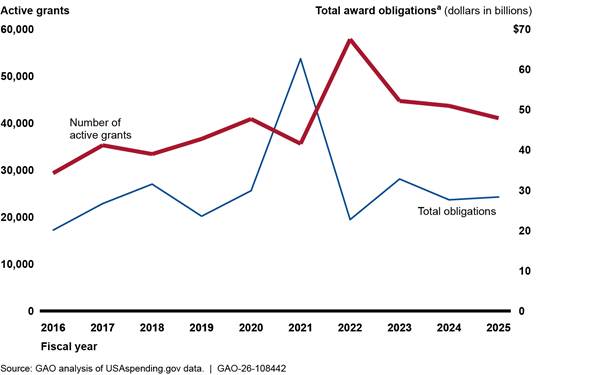
Note: Active grants include both new awards and awards made in previous years that are still disbursing funds.
aObligation values are adjusted for inflation to 2025 dollars.
Grant Awards by Program Office and Grant Program
Table 2 compares the number and value of new awards made by HUD program offices in FY 2025 with median annual figures from FY 2016 through FY 2024.
Table 2: Most Department of Housing and Urban Development (HUD) Program Offices Made Fewer New Awards in Fiscal Year (FY) 2025, but Median Award Values Generally Increased Compared to Previous Years
|
Program office |
Median annual number of new grant awards, FY 2016–FY 2024 |
Number of new grant awards, FY 2025 |
Median award value, FY 2016–FY 2024a |
Median award value, FY 2025a |
|
Office of Community Planning and Development |
10,174 |
8,502 |
$230,195 |
$276,362 |
|
Office of Fair Housing and Equal Opportunity |
205 |
176 |
$131,547 |
$125,000 |
|
Office of Housing |
439 |
264 |
$33,994 |
$184,467 |
|
Office of Policy Development and Research |
17 |
47 |
$437,181 |
$1,200,435 |
|
Office of Public and Indian Housing |
10,604 |
9,933 |
$75,188 |
$121,829 |
|
Office of Lead Hazard Control and Healthy Homes |
90 |
175 |
$811,122 |
$1,500,000 |
|
HUD |
22,055 |
19,097 |
$123,880 |
$178,506 |
Source: GAO analysis of USAspending.gov data. | GAO‑26‑108442
Note: We used medians rather than averages to mitigate the effects of extreme values during the COVID-19 pandemic.
aAward values are adjusted for inflation to
2025 dollars.
Table 3 identifies HUD grant programs that made at least one new grant award from FY 2016 through FY 2024 and indicates whether they made new awards in FY 2025.
Table 3: HUD Grant Programs That Made At Least One New Award in Fiscal Year (FY) 2016–FY 2024, by Whether They Made New Awards in FY 2025
|
Grant programs that made new awards in FY 2025 |
Grant programs that did not make new awards in FY 2025a |
|
Community Compass Technical Assistance and Capacity Building |
Assisted Living Conversion for Eligible Multifamily Housing Projects |
|
Community Development Block Grant – Entitlement Communities |
Choice Neighborhoods Implementation Grants |
|
Community Development Block Grant – Insular Areas Program |
Choice Neighborhoods Planning Grants |
|
Community Development Block Grant – Non-Entitled Counties in Hawaii Program |
Community Development Block Grant – American Recovery and Reinvestment Act Entitlement Grants (Recovery Act Funded) |
|
Community Development Block Grant – Pathways to Removing Obstacles |
Community Development Block Grant – Insular Areas Program (Recovery Act Funded) |
|
Continuum of Care Program |
Community Development Block Grant – National Disaster Resilience Competition |
|
Emergency Solutions Grant Program |
Community Development Block Grant - Technical Assistance Program |
|
Eviction Protection Grant Program |
Demolition and Revitalization of Severely Distressed Public Housing |
|
Fair Housing Assistance Program |
Doctoral Dissertation Research Grant Program |
|
Fair Housing Organization Initiatives |
Economic Development Initiative - Community Project Funding and Miscellaneous Grants |
|
Family Self-Sufficiency Program |
Fair Housing Initiatives Program Education and Outreach Initiative |
|
General Research and Technology Activity |
Healthy Homes Technical Studies Grants |
|
Green and Resilient Retrofit Program |
Healthy Homes Weatherization Cooperation Demonstration Grants |
|
HOME Investment Partnerships Program |
Housing Counseling Assistance Program |
|
Housing Counseling Training Program |
Housing Counseling Program Homeownership Initiative |
|
Housing Opportunities for Persons with AIDS |
Jobs Plus Pilot Initiative |
|
Housing Trust Fund |
Lead Hazard Control for High Risk Areas |
|
Indian Community Development Block Grant Program |
Lead Technical Studies Grants |
|
Indian Housing Block Grant Program |
Lead-Based Paint Capital Fund Program |
|
Lead Hazard Reduction Demonstration Grant Program |
National Homeless Data Analysis Project |
|
Lead Hazard Reduction Grant Program |
Neighborhood Stabilization Program (Recovery Act Funded) |
|
Multifamily Housing Service Coordinators |
Office of Native American Programs Training and Technical Assistance for Indian Housing Block Grant Program |
|
Native Hawaiian Housing Block Grant |
Pay for Success Permanent Supportive Housing Demonstration |
|
Older Adults Home Modification Grant Program |
Preservation of Affordable Housing |
|
Private Enforcement Initiatives |
Rural Housing and Economic Development |
|
Public Housing Capital Fund |
Section 202 Supportive Housing for the Elderly Program |
|
Public Housing Operating Fund |
Section 4 Capacity Building for Community Development and Affordable Housing Program |
|
Resident Opportunity and Supportive Services – Service Coordinators |
Section 8 Moderate Rehabilitation Single Room Occupancy Program |
|
Rural Capacity Building for Community Development and Affordable Housing Grants |
Section 811 Supportive Housing for Persons with Disabilities |
|
Section 8 Housing Choice Vouchers |
Self-Help Homeownership Opportunity Program |
|
Section 811 Project Rental Assistance Program |
Shelter Plus Care |
|
Youth Homelessness Demonstration Program |
Supportive Housing Program |
|
|
Tenant Education and Outreach Program |
|
|
Transformation Initiative Research Grants - Sustainable Community Research Grant Program |
|
|
Tribal Colleges and Universities Program |
|
|
Veterans Housing Rehabilitation and Modification Pilot Program |
Source: GAO analysis of USAspending.gov data on Department of Housing and Urban Development (HUD) programs. | GAO‑26‑108442
aGrant programs that did not make new awards in FY 2025 may nevertheless have remained active by disbursing funds from previously awarded multiyear grants.
This appendix provides information on Department of Housing and Urban Development (HUD) contracts terminated for convenience from January 20 to December 31, 2025.[37] Our analysis of HUD contract data in the System for Award Management (SAM.gov), formerly maintained in the Federal Procurement Data System, identified 144 terminated contracts.
Contract Terminations by Type of Service
Table 4 presents the number and value of these contracts, their obligations, and the types of services provided.
Table 4: Department of Housing and Urban Development Contracts Terminated for Convenience, by Type of Service, Jan. 20, 2025–Dec. 31, 2025
|
Categorya |
Number of terminated contracts |
Percentage of terminated contracts |
Total value of terminated contracts |
Percentage of total value |
Obligations |
Percentage of obligations |
|
Professional services |
88 |
61% |
$229,330,933 |
62% |
$203,900,803 |
70% |
|
Information technology |
28 |
19% |
$121,452,814 |
33% |
$71,693,638 |
25% |
|
Human capital |
9 |
6% |
$1,647,256 |
0% |
$1,628,256 |
1% |
|
Office management |
8 |
6% |
$8,827,363 |
2% |
$8,827,363 |
3% |
|
Facilities and construction |
5 |
3% |
$411,787 |
0% |
$411,787 |
0% |
|
Transportation and logistics services |
5 |
3% |
$5,448,431 |
1% |
$4,307,347 |
1% |
|
Research and development |
1 |
1% |
$151,966 |
0% |
$151,966 |
0% |
|
Total |
144 |
100% |
$367,270,551 |
100% |
$290,921,160 |
100% |
Source: GAO analysis of System for Award Management (SAM.gov) and U.S. General Services Administration information. | GAO‑26‑108442
Note: Percentages may not sum to 100 due to rounding.
aWe derived these categories from product and service codes in SAM.gov using the General Services Administration’s Category Management Taxonomy.
Contract Terminations by HUD Program Office
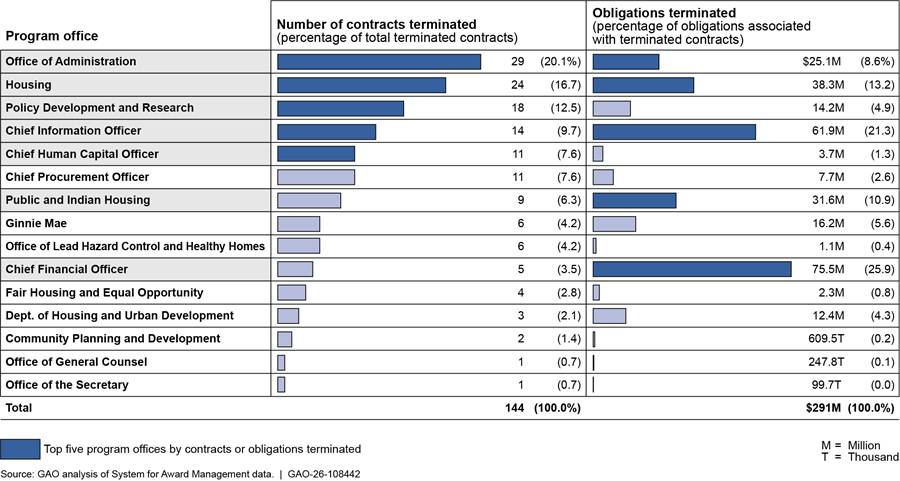
Fifteen HUD program offices terminated contracts between January 20, 2025, and December 31, 2025. Figure 7 presents the number of contracts terminated and their obligations by HUD program office. The figure highlights the five program offices with the greatest number of terminated contracts and the five with the highest obligations.
Figure 7: Department of Housing and Urban Development Contracts Terminated and Their Obligations, by Program Office, Jan. 20, 2025–Dec. 31, 2025
Note: Percentages do not sum to 100 due to rounding.
Examples of HUD contracts terminated by selected program offices include the following:
· Terminated fair housing contracts. The Office of Fair Housing and Equal Opportunity (FHEO) terminated four contracts with a total value of approximately $3.8 million and obligations of approximately $2.35 million. These contracts were related to the Information Resource Center for the Fair Housing Initiatives Program and Fair Housing and Equal Opportunity; FHEO program review and support services; Property Appraisal Valuation and Equity business development and support services; and Affirmatively Furthering Fair Housing support services.
· Terminated property inspection contracts. The Office of Public and Indian Housing terminated two contracts with a total value and obligations of approximately $28.6 million. These contracts were related to support services for Real Estate Assessment Center property inspections, including physical assessments of HUD-assisted and insured properties, health risk assessments, assessments of the effectiveness of standards and procedures, and documentation support for enforcement actions and sanctions.
Contract Terminations by Business Type
Table 5 compares active and terminated HUD contracts by business type. Small businesses accounted for a smaller share of terminated contracts than other businesses.
Table 5: Department of Housing and Urban Development Contracts Active as of Jan. 20, 2025, and Terminated Through Dec. 31, 2025, by Business Type
|
Business types |
Number of contracts active as of Jan. 20, 2025 |
Percentage of active contracts |
Number of contracts terminated, Jan. 20, 2025–Dec. 31, 2025 |
Percentage of terminated contracts |
|
Small business |
457 |
68% |
87 |
60% |
|
Other than small business |
218 |
32% |
57 |
40% |
|
Total |
675 |
100% |
144 |
100% |
Source: GAO analysis of System for Award Management data. | GAO‑26‑108442
GAO Contact
Jill Naamane at naamanej@gao.gov
Staff Acknowledgments
In addition to the contact named above, Christine McGinty (Assistant Director), Sarah Garcia (Analyst in Charge), Chelsea Carter, Heather Chartier, Suellen Foth, Garrett Hillyer, Jill Lacey, Krista Loose, Alberto Lopez, Marc Molino, Emily O’Brien, and David Raymond made key contributions to this report.
The Government Accountability Office, the audit, evaluation, and investigative arm of Congress, exists to support Congress in meeting its constitutional responsibilities and to help improve the performance and accountability of the federal government for the American people. GAO examines the use of public funds; evaluates federal programs and policies; and provides analyses, recommendations, and other assistance to help Congress make informed oversight, policy, and funding decisions. GAO’s commitment to good government is reflected in its core values of accountability, integrity, and reliability.
Obtaining Copies of GAO Reports and Testimony
The fastest and easiest way to obtain copies of GAO documents at no cost is through our website. Each weekday afternoon, GAO posts on its website newly released reports, testimony, and correspondence. You can also subscribe to GAO’s email updates to receive notification of newly posted products.
Order by Phone
The price of each GAO publication reflects GAO’s actual cost of production and distribution and depends on the number of pages in the publication and whether the publication is printed in color or black and white. Pricing and ordering information is posted on GAO’s website, https://www.gao.gov/ordering.htm.
Place orders by calling (202) 512-6000, toll free (866) 801-7077,
or
TDD (202) 512-2537.
Orders may be paid for using American Express, Discover Card, MasterCard, Visa, check, or money order. Call for additional information.
Connect with GAO
Connect with GAO on X,
LinkedIn, Instagram, and YouTube.
Subscribe to our Email Updates. Listen to our Podcasts.
Visit GAO on the web at https://www.gao.gov.
To Report Fraud, Waste, and Abuse in Federal Programs
Contact FraudNet:
Website: https://www.gao.gov/about/what-gao-does/fraudnet
Automated answering system: (800) 424-5454
Media Relations
Sarah Kaczmarek, Managing Director, Media@gao.gov
Congressional Relations
David A. Powner, Acting Managing Director, CongRel@gao.gov
General Inquiries
[1]See, for example, Exec. Order No. 14210, Implementing the President's "Department of Government Efficiency" Workforce Optimization Initiative, 90 Fed. Reg. 9669 (Feb. 14, 2025), and Exec. Order 14151, Ending Radical and Wasteful Government DEI Programs and Preferencing, 90 Fed. Reg. 8339 (Jan. 29, 2025).
[2]Kriston Capps, “HUD Plans to Eliminate Dozens of State and Local Field Offices,” Bloomberg, March 5, 2025.
[3]We and others have previously identified workforce capacity and planning challenges at HUD. In 2016, we identified persistent management challenges, including in human capital planning, and made eight recommendations to improve HUD’s planning, governance, and program oversight, all of which were implemented. GAO, Department of Housing and Urban Development: Actions Needed to Incorporate Key Practices into Management Functions and Program Oversight, GAO‑16‑497 (Washington, D.C.: July 20, 2016). HUD’s Office of Inspector General also identified human capital management as a top management challenge each fiscal year but one from 2016 to 2024, but not in fiscal year 2025, citing increased staffing levels and workforce planning efforts. HUD, Top Management Challenges Facing the U.S. Department of Housing and Urban Development in FY 2025 (Washington, D.C.: Oct. 15, 2024).
[4]We reviewed court documentation from American Federation of Government Employees, AFL-CIO, et al. v. Trump, et al., 3:25-cv-03698, (N.D. Cal. 2025); American Federation of Government Employees, AFL CIO, et al. v. United States Office of Management and Budget, et al., 3:25-cv-08302, (N.D. Cal. 2025); National Fair Housing Alliance, et al. v. Department of Housing and Urban Development, et al., 1:25-cv-01965, (D.D.C. 2025); Massachusetts Fair Housing Center, et al. v. Department of Housing and Urban Development, et al., 3:25-cv-30041, (D. Mass. 2025); State of Maryland, et al. v. United States Department of Agriculture, et al., 1:25-cv-00748, (D. Maryland 2025); and State of Illinois et al. v. United States Department of Housing and Urban Development, et al., 3:26-cv-02262, (N.D. Cal. 2025).
[5]In June 2025, HUD announced it planned to relocate its headquarters from Washington, D.C., to Alexandria, VA. As of June 2026, the relocation is ongoing.
[6]12 U.S.C. § 1735f–12.
[7]The cost-benefit analysis must include (1) an estimate of cost savings; (2) an estimate of the additional cost which will result from the reorganization; (3) a study of the impact on the local economy; and (4) an estimate of the effect of the reorganization on the availability, accessibility, and quality of services provided for recipients of those services. 42 U.S.C. § 3535(p).
[8]42 U.S.C. § 3616a. Fair housing enforcement organizations are private nonprofit organizations that receive and investigate complaints about fair housing, test compliance, and bring enforcement actions for violations. 42 U.S.C. § 3616a(h). Fair housing testing uses covert comparisons of housing providers’ treatment of similarly situated individuals to gather evidence for existing complaints or identify systemic discrimination that may support future cases.
[9]34 U.S.C. § 12491.
[10]Section 8 Project Based Rental Assistance refers to certain project-based rental assistance provided under section 8 of the Housing Act of 1937, as amended, to which HUD refers as “Project-based Section 8.” 42 U.S.C. § 1437f.
[11]Because workforce data are dynamic, subtracting separations from the December 2024 workforce and adding hires will not necessarily equal the December 2025 workforce. For example, employees entering or returning from unpaid leave affect workforce totals but are not counted as hires or separations.
[12]In addition to the government-wide deferred resignation program, HUD offered an agency-specific deferred resignation program in March 2025. The government-wide deferred resignation program allowed federal employees who agreed to resign or retire by September 30, 2025, and in some cases December 31, 2025, to be placed on administrative leave while retaining their salary and benefits in the interim. See Office of Personnel Management, Guidance Regarding Deferred Resignation Program (Washington, D.C.: Jan. 28, 2025). HUD did not provide information in response to our request about its agency-specific deferred resignation program, so we could not confirm its requirements or whether HUD offered additional incentives.
[13]Most HUD employees are on a probationary period for the first year of employment.
[14]OPM federal workforce data do not identify employees by HUD regional or field office, so we could not analyze separations at those levels. We also determined that OPM’s data on separations and hires by HUD program offices are unreliable, so we could not analyze separations by program office. We requested program office data from HUD, but HUD did not provide information in response to our request.
[15]Some states lost relatively large proportions of their HUD staff but are concealed to ensure privacy because they had fewer than 11 employees. For example, one state had four HUD employees, three of whom separated in 2025.
[16]The notice included a cost-benefit analysis on the effect of the plan and advised the public that the plan could take effect in 90 days. 91 Fed. Reg. 38009 (June 24, 2026). HUD did not provide information in response to our request about planned field office reorganizations or closures.
[17]U.S. Department of Housing and Urban Development, Congressional Justifications 2027 (Apr. 2026).
[18]We used USAspending.gov data to identify HUD grant programs that awarded new grants in any fiscal year from FY 2016 through FY 2025. Programs that did not award new grants in FY 2025 may have still been active by disbursing funds from previously awarded multiyear grants. We excluded one additional program—the Community Development Block Grant - Preservation and Reinvestment Initiative for Community Enhancement—which made no new grant awards from FY 2016 through FY 2024 but made awards in FY 2025.
[19]We analyzed data from SAM.gov, formerly maintained in the Federal Procurement Data System, on HUD contracts terminated for convenience between January 20, 2025, and December 31, 2025. Federal contracts can be completely or partially terminated for convenience when it is in the government’s interest, unrelated to the contractor’s performance. A complete termination ends all performance of work under the contract, whereas a partial termination terminates part, but not all, of the work that has not been completed and accepted under a contract. FAR 2.101. Because SAM.gov does not distinguish between a full and partial termination, our analysis includes both.
[20]Total contract value represents the maximum amount of funding that can be obligated under a contract. Obligations represent the specific amount of appropriated funds officially committed by a government agency to a contractor. The difference between the contract’s value and the amount obligated does not equal direct cost savings. For example, agencies may incur costs associated with contract terminations, such as contractor expenses for disposing of inventory or settling subcontracts.
[21]Terminated professional service contracts included administrative and executive services, communications and outreach modernization, and program support services. Terminated IT contracts included contracts for software licenses, maintenance, and development of technology systems.
[22]Information obtained during our interviews is not generalizable to the broader population of HUD housing stakeholders. The 20 HUD stakeholder organizations comprised six national organizations and 14 organizations included in our site visits. To characterize how many stakeholder organizations reported an effect, we used “nearly all” for 16 to 20 stakeholder organizations, “most” for 10 to 15, and “several” for five to nine.
[23]See FHEO, Notice of the Withdrawal of FHEO Guidance Documents (Sept. 17, 2025).
[24]FHEO is statutorily required to investigate every complaint within 100 days unless it is impracticable to do so. On June 12, 2026, HUD announced in a press release that FHEO had reduced its backlog of fair housing cases by 27 percent. However, because HUD did not provide information in response to our request about changes to FHEO’s processes, we could not independently verify the reported reduction.
[25]As a result of the Massachusetts Fair Housing Center et al. v. Department of Housing and Urban Development, et al. lawsuit, HUD restored the 78 terminated FHIP grants in March 2025. Massachusetts Fair Housing Center, et al. v. Department of Housing and Urban Development, et al., 3:25-cv-30041 (D. Mass. 2025), ECF 34. In separate litigation, HUD noted that the second- and third-year for active Private Enforcement Initiatives awards have been executed, and award grant agreements have been finalized and executed for 80 of the 106 FY 2024 FHIP. National Fair Housing Alliance v. U.S. Department of Housing and Urban Development, 1:25-cv-01965, (D.D.C. 2025), ECF. No. 74, Defendants’ Motion for Stay, or in the Alternative, to Dismiss at 1.
[26]The report does not provide dates for when the selected initiatives began, nor expected milestones until completion. U.S. Department of Housing and Urban Development, Agency Financial Report: Fiscal Year 2025 (Dec. 18, 2025).
[27]Before reorganizing a HUD field, regional, insuring, or area office, HUD must issue a notice in the Federal Register that contains a cost-benefit analysis of the effects of the plan, among other requirements. 42 U.S.C. § 3535(p).
[28]91 Fed. Reg. 38009 (June 24, 2026).
[29]One additional grant program, the Community Development Block Grant - Preservation and Reinvestment Initiative for Community Enhancement, did not award any new grants from FY 2016 through FY 2024 but awarded new grants in FY 2025. We excluded this program from our analysis.
[30]Because the COVID-19 pandemic created outliers in the data, we calculated median values instead of averages to mitigate the effects of extreme values. Grant programs that did not make new awards in FY 2025 may nevertheless have remained active by disbursing funds from previously awarded multiyear grants.
[31]The Federal Procurement Data System served as the centralized contract database, repository, and web-based tool for agencies to report and review their contract actions. The General Services Administration is incrementally transitioning Federal Procurement Data System capabilities to SAM.gov. Federal contracts can be completely or partially terminated for convenience when it is in the government’s interest, unrelated to the contractor’s performance. Because SAM.gov does not distinguish between full and partial terminations, our analysis includes both.
[32]We categorized terminated contracts by type of service using product and service codes in SAM.gov and the General Services Administration’s Category Management Taxonomy. We used the contracting officer’s determination of business size to classify businesses receiving HUD contracts as “small” or “other than small.”
[33]For our purposes, we considered the state housing agency to be a PBRA property manager because it managed PBRA properties.
[34]Two of our selected cities—Nashville and Manchester—did not have FHAP agencies. In addition, one of the four FHIP grantees we interviewed did not receive FHIP funding in 2025 and chose not to reapply. We therefore did not include this organization in our analysis of FHIP funding disruptions and changes in fair housing complaint processing because it was not a grantee during 2025.
[35]We reviewed court documents from the following cases: American Federation of Government Employees, AFL-CIO, et al. v. Trump, et al., 3:25-cv-03698, (N.D. Cal. 2025); American Federation of Government Employees, AFL CIO, et al. v. United States Office of Management and Budget, et al., 3:25-cv-08302, (N.D. Cal. 2025); National Fair Housing Alliance, et al. v. Department of Housing and Urban Development, et al., 1:25-cv-01965, (D.D.C. 2025); Massachusetts Fair Housing Center, et al. v. Department of Housing and Urban Development, et al., 3:25-cv-30041, (D. Mass. 2025); State of Maryland, et al. v. United States Department of Agriculture, et al., 1:25-cv-00748, (D. Maryland 2025); and State of Illinois et al. v. United States Department of Housing and Urban Development, et al., 3:26-cv-02262, (N.D. Cal. 2025).
[36]Active grants include both new awards and awards made in previous years that are still disbursing funds. Because the COVID-19 pandemic created outliers in the data, we calculated median values instead of averages to mitigate the effects of extreme values.
[37]We analyzed data from SAM.gov on HUD contracts that were active as of January 19, 2025, and terminated for convenience from January 20, 2025, to December 31, 2025. Federal contracts can be completely or partially terminated for convenience when it is in the government’s interest, unrelated to the contractor’s performance. Because SAM.gov does not distinguish between full and partial terminations, our analysis includes both.