
Committee on Health, Education, Labor and Pensions, U.S. Senate
United States Government Accountability Office
A report to the Ranking Member, Committee on Health, Education, Labor and Pensions, U.S. Senate
Contact: John E. Dicken at dickenj@gao.gov
What GAO Found
In 2024, about 82 percent of women of reproductive age reported using some form of contraception in the past 12 months, according to research from KFF. Most private health plans are generally required to cover the full range of contraceptives for women. The Department of Labor (DOL), the Centers for Medicare & Medicaid Services (CMS)—an agency within the Department of Health and Human Services—and states each have responsibilities for overseeing private health plans, including plans' coverage of contraception. See table for descriptions of their general oversight responsibilities and activities.
DOL, CMS, and States’ General Responsibilities for Overseeing Private Health Plans
|
|
Oversight authority |
Oversight activities |
|
DOL
|
Private employer-sponsored group health plans
|
Responding to enrollee complaints Conducting investigations in response to systemic concerns identified from various sources, such as complaints |
|
CMS
|
Non-federal governmental plans Qualified health plans offered through the federally-facilitated exchanges Group and individual plans in certain states that do not have authority to enforce federal requirements or are not otherwise enforcing requirements |
Conducting annual plan reviews and certification Conducting individual complaint investigations Conducting market conduct examinations of potential systemic compliance issues |
|
States
|
Individual health plans and some group health plans sold in their state
|
Conducting premarket health plan reviews Collecting individual complaints Carrying out market conduct examinations |
Source: GAO review of information from CMS, DOL, selected state officials and prior GAO work. | GAO-26-108446
Note: The Department of Treasury oversees certain aspects of PPACA compliance for church plans, which were outside the scope of our report.
Of the plans for which they have oversight responsibility, DOL and CMS identified instances of noncompliance within the last 6 years. For example,
· DOL identified noncompliance with federal contraceptive coverage requirements in three investigations DOL conducted in the last 6 years, according to DOL officials. For example, DOL found that a pharmacy benefit manager required enrollees to try other types of contraception before covering the medically necessary, preferred method at no cost-sharing. According to DOL officials, this pharmacy benefit manager revised its practices and reprocessed the associated claims.
· CMS identified instances of health plan noncompliance with federal contraceptive coverage requirements in three out of five market conduct examinations conducted in the last 6 years. For example, CMS found that one health plan failed to provide coverage of contraceptive coverage services without cost-sharing. Officials say this health plan revised its practices and reprocessed the associated claims.
Why GAO Did This Study
Two-thirds of Americans receive their health coverage through private health plans. Private health plans must generally cover a range of contraceptives without cost-sharing including oral contraceptives, intrauterine devices, and female sterilization services, among others. Concerns have been raised by stakeholders and researchers that health plan enrollees have been denied coverage for certain contraceptive products or services.
GAO was asked to review oversight by federal and state agencies of group and individual health plans’ compliance with federal contraceptive coverage requirements. This report provides information on payments enrollees made for contraceptives, including cost-sharing; perspectives from stakeholder organizations and health plans about contraceptive coverage requirements; and federal and state oversight of federal contraceptive coverage requirements.
To conduct this review, GAO analyzed available data from the Agency for Healthcare Research and Quality on contraceptive prescription purchases; reviewed literature to identify information about when enrollees had cost-sharing for contraceptives; reviewed federal guidance issued by CMS and DOL; and interviewed officials from DOL, CMS, six selected states, selected health plans, and selected stakeholder organizations, including those representing enrollees and providers. GAO selected these states to capture variation in rurality and state laws, among other criteria.
GAO provided a draft of this report to the Department of Health and Human Services and DOL. The agencies provided technical comments that we incorporated as appropriate.
|
Abbreviations |
|
|
|
|
|
CMS |
Centers for Medicare & Medicaid Services |
|
DOL |
Department of Labor |
|
ERISA |
Employee Retirement Income Security Act of 1974 |
|
FDA |
Food and Drug Administration |
|
HRSA |
Health Resources and Services Administration |
|
NAIC |
National Association of Insurance Commissioners |
|
PPACA |
Patient Protection and Affordable Care Act |
This is a work of the U.S. government and is not subject to copyright protection in the United States. The published product may be reproduced and distributed in its entirety without further permission from GAO. However, because this work may contain copyrighted images or other material, permission from the copyright holder may be necessary if you wish to reproduce this material separately.
September 24, 2026
The Honorable Bernard Sanders
Ranking Member
Committee on Health, Education, Labor, and Pensions
United States Senate
Dear Ranking Member Sanders:
In 2024, more than eight in 10 women (82 percent) of reproductive age reported using some form of contraception in the past 12 months, according to research from KFF.[1] Under the Patient Protection and Affordable Care Act (PPACA), most private health insurance plans (health plans) are generally required to cover the full range of contraceptives and contraceptive care for women without cost sharing—the portion of health plan costs that enrollees are expected to pay for when accessing specific care.[2]
Specifically, health plans are generally required to cover, without cost sharing, preventive care and screenings provided for in the Health Resources and Services Administration’s (HRSA) Women’s Preventive Services Guidelines, which includes at least one form of contraception in each of the methods that the U.S. Food and Drug Administration (FDA) has identified for women in its current Birth Control Guide.[3] Health plans may generally choose to reasonably exclude coverage for, or impose cost sharing requirements on, other forms of contraception within these method categories—a practice called medical management.[4] In addition, health plans should have an exceptions process that is not unduly burdensome on the individual or their provider that allows enrollees to request and gain access to, without cost sharing, contraceptive products or services their plan does not cover but their medical provider determines is medically necessary.[5] To request an exception, providers are generally required to submit a statement explaining the medical necessity of a product or service to an enrollee’s health plan.[6]
According to sub-regulatory guidance, federal agencies have received some complaints that enrollees have been denied contraceptive coverage, in some cases due to the application of unreasonable medical management techniques—that is, the choice to exclude coverage for, or impose cost sharing requirements for, certain products or services.[7] Stakeholder organizations and researchers have also noted that health plans’ medical management can affect enrollees’ ability to access contraception at no cost. For example, the National Women’s Law Center stated that cost sharing for contraception creates a burden for women and can cause women to forgo contraception.[8] Additionally, a 2022 U.S. House of Representatives Committee on Oversight and Reform report found that most health plans surveyed denied an average of at least 40 percent of exception requests related to contraceptive coverage.[9]
The Department of Labor (DOL), the Centers for Medicare & Medicaid Services (CMS)—an agency within the Department of Health and Human Services, and states each have responsibilities for overseeing private health plans, including plans’ coverage of contraceptive care.[10] You asked us to review federal and state agencies’ oversight of group and individual health plans’ compliance with federal contraceptive coverage requirements. This report describes what is known about payments enrollees made for contraceptives, including cost sharing; perspectives from stakeholder organizations and health plans about contraceptive coverage requirements; and federal and state oversight of federal contraceptive coverage requirements.
To describe what is known about when enrollees had cost sharing for contraceptives, we reviewed published literature from January 2020 through April 2026 and found three relevant articles. We also analyzed available data on contraceptive prescription purchases from the Medical Expenditure Panel Survey from the Agency for Healthcare Research and Quality for 2020 through 2023, which were the most recent years of data available at the time of our review. We assessed the reliability of available data by reviewing relevant documentation and interviewing knowledgeable agency officials and found them to be sufficiently reliable for the purposes of reporting.
To describe federal and state oversight of federal contraceptive coverage requirements, we reviewed federal guidance issued by DOL and CMS, as well as other agency documentation. We also interviewed DOL and CMS officials about agency oversight activities, including any identified instances of noncompliance with contraceptive coverage requirements. We also interviewed a nongeneralizable selection of six states about their oversight efforts and perspectives on health plans’ compliance with contraceptive coverage requirements. We selected these states to capture variation in rurality, state laws related to contraceptive coverage, and CMS direct enforcement authority in a state.[11] In addition, we interviewed representatives from a nongeneralizable selection of eight health plans and seven stakeholder organizations, including those representing enrollees and providers. A more detailed description of our scope and methodology is included in appendix I.
We conducted this performance audit from April 2025 to September 2026 in accordance with generally accepted government auditing standards. Those standards require that we plan and perform the audit to obtain sufficient, appropriate evidence to provide a reasonable basis for our findings and conclusions based on our audit objectives. We believe that the evidence obtained provides a reasonable basis for our findings and conclusions based on our audit objectives.
Background
Private Health Insurance
The majority of Americans receive their health coverage through private health plans, either by purchasing health coverage directly or receiving coverage through their employer. In 2024, about 222.7 million people—or about 66 percent of individuals in the United States—had coverage through private health plans, according to the U.S. Census Bureau. In general, those who obtain private health coverage do so in the individual or group market. In 2023, an estimated 165 million non-elderly individuals had coverage sponsored by employers, and 16.3 million individuals were covered by plans purchased through health insurance exchanges—or Marketplaces—established through PPACA. The individual market includes health plans purchased directly from an insurer both on and off the health insurance exchanges—markets that operate within each state where eligible individuals and small employers can compare and select among qualified health insurance plans offered by participating issuers. The group market—which includes small and large groups—is mostly made up of employer-sponsored health plans. Among employer-sponsored plans in the United States, about 60 percent are self-funded.[12] Self-funded plans are plans for which the employer pays for employee health care benefits directly, bearing the risk of covering medical benefits generated by beneficiaries.
Federal Agency and States’ Role in Overseeing Private Health Plans
DOL, CMS, and state agencies are responsible for overseeing private health plans, including health plans’ coverage of contraceptive care. Which entity or agency has oversight responsibility depends on (1) the type of coverage, such as group or individual health plans; (2) whether it is sold on a health insurance exchange; and (3) whether the health plan is self-funded or fully insured.[13]
· DOL. DOL’s Employee Benefits Security Administration is generally responsible for overseeing private employer-sponsored group health plans under the Employee Retirement Income Security Act of 1974, as amended (ERISA).[14] This includes both fully insured plans and self-funded plans. Employers that choose to self-fund are generally not subject to traditional state insurance laws.
· CMS. CMS is generally responsible for overseeing non-federal governmental plans, such as plans for employees of state and local governments, and qualified health plans offered through the federally-facilitated exchanges.[15] If CMS determines that a state has failed to substantially enforce applicable requirements, CMS is also responsible for enforcing those requirements for issuers of group and individual plans in that state.[16] If a state informs CMS that it does not have authority to enforce one or more of the applicable provisions of the Public Health Service Act, and the state has not entered into a collaborative arrangement, CMS has the responsibility to directly enforce the relevant provisions in the state with respect to health insurance issuers in the group and individual markets.[17] These states include Missouri, Tennessee, Texas, and Wyoming.
· States. States are generally responsible for overseeing insurance sold in their state, including individual health plans and fully insured group health plans offered by state-licensed issuers. Group health plans offered by employers that self-fund their health benefits are generally not subject to state insurance laws.
Contraceptive Coverage and Exceptions Processes
Federal agencies have issued sub-regulatory guidance in the form of Frequently Asked Questions (FAQs) to clarify requirements related to federal contraceptive coverage. For example, federal agencies issued FAQs about Affordable Care Act Implementation Part 54 in 2022. This document contains information on the coverage of contraceptive products, including unreasonable medical management techniques; coverage of products and services associated with contraceptives; and exceptions processes when a contraceptive is medically necessary.[18]
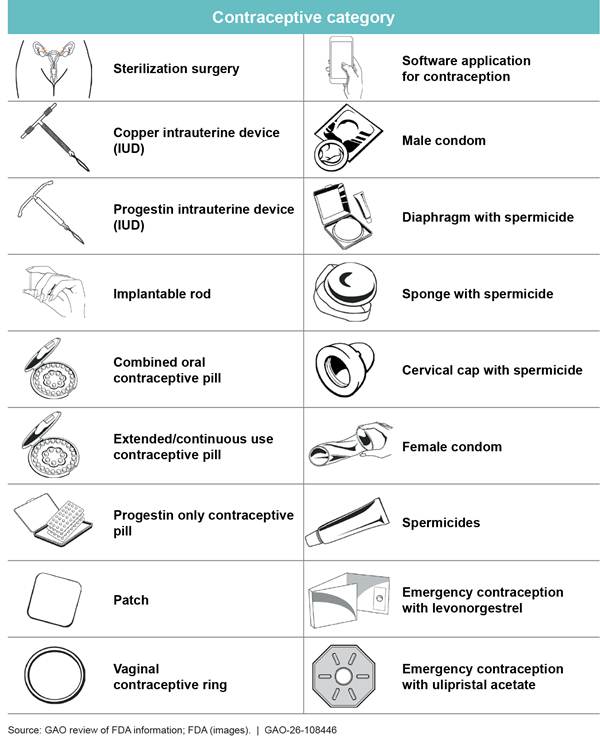
· Coverage of contraceptive products. As mentioned earlier, health plans are required to cover, without cost sharing, at least one form of contraception in each of the categories that the FDA has identified for women in its Birth Control Guide. These include categories for oral contraceptives, intrauterine devices, and contraceptive rings, among others. Figure 1 provides examples of FDA contraceptive method categories.
Figure 1: Examples of U.S. Food and Drug Administration (FDA) Contraceptive Method Categories
· Necessary services associated with contraceptives. Health plans are required to cover necessary products and clinical services associated with contraceptives without cost sharing. Clinical services include the associated services needed for provision of a contraceptive product or service, such as anesthesia, laboratory tests, and patient education and counseling. For example, anesthesia for a tubal ligation surgical procedure for contraceptive purposes must be covered by health plans without any cost sharing to an individual.
· Exceptions process for contraceptives when medically necessary. Health plans should have an exceptions process that allows enrollees to request and gain access to, without cost sharing, contraceptive products and services their plan does not cover but their medical provider determines is medically necessary.[19] For example, a health plan must provide coverage, without cost sharing, for a brand name contraceptive even if a generic or other brand name contraceptive in that category is fully covered by the plan if it is medically necessary. Health plans’ exceptions processes for contraceptives determined medically necessary by a provider must be accessible, transparent, and sufficiently expedient such that they are not unduly burdensome on enrollees or providers, according to federal sub-regulatory guidance.
What is known about when enrollees had cost sharing for contraceptives according to literature and data?
While there is no comprehensive information on the extent to which there is cost sharing for contraception for enrollees, available literature and data provided some limited information about cost sharing or payments by enrollees. Available literature and data we reviewed provided information about payments enrollees made for contraceptives, including cost sharing. However, the literature and data did not indicate if that cost sharing was appropriate or inappropriate. Payment by an enrollee may be appropriate if their health plan does not cover a chosen contraceptive method without cost sharing but does cover another contraceptive product or service in the same FDA method category and the enrollee’s chosen contraceptive method is not medically necessary.
Literature. Available literature from three articles we reviewed identified instances when enrollees had cost sharing for contraception. For example, a peer-reviewed analysis of medical claims for women between the ages of 15 and 44 years enrolled in a large employer-sponsored health plan found that 10 percent of oral contraceptive users had cost sharing in 2018.[20] The articles did not comment on the appropriateness of the cost sharing.
Data. Our analysis of data from the Agency for Healthcare Research and Quality’s Medical Expenditure Panel Survey from 2020 through 2023 provided information on contraceptive prescription purchases by women of reproductive age with an out-of-pocket payment.[21] Specifically, an estimated 16.5 percent of privately insured women of reproductive age with contraceptive prescription purchases during this time had an out-of-pocket payment.[22] The data do not indicate whether those payments were appropriate or inappropriate.
What type of enrollee complaints did selected stakeholder organizations receive about contraceptive coverage requirements?
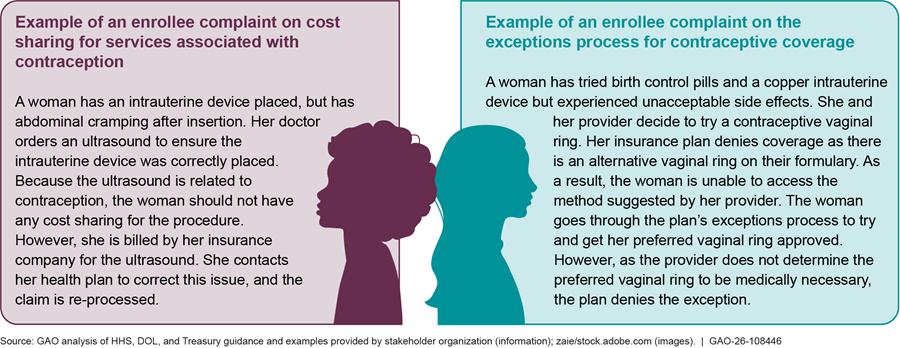
Representatives we interviewed from two stakeholder organizations reported receiving enrollee complaints related to cost sharing for clinical services for contraception. A consumer or enrollee complaint is a report filed by an enrollee regarding delays, claims denials, or unsatisfactory settlements by health plans. Representatives from these two stakeholder organizations noted that individuals commonly have challenges obtaining certain clinical services related to contraceptives without cost sharing, such as anesthesiology related to female sterilization. As mentioned earlier, clinical services related to contraception may include contraceptive counseling, follow up care, laboratory tests, and more. Health plans are required to cover clinical services without cost sharing. If health plans impose cost sharing for clinical services, this represents a financial barrier for enrollees, according to representatives from one stakeholder organization. See figure 2 for illustrative examples related to enrollees’ experiences with contraceptive coverage.
Figure 2: Illustrative Examples of Enrollee Experiences with Contraceptive Coverage
Enrollee complaints have been an important tool to monitor contraceptive coverage because complaints are a reflection of enrollees’ actual experiences with their contraceptive coverage, according to officials from one stakeholder organization we interviewed. However, according to KFF, a health policy research and information organization, these complaints might be of limited use in evaluating the extent of health plan compliance given that many enrollees do not make complaints because they do not understand requirements for health plan coverage, their rights to complain, or to whom they should complain.
What steps do selected health plans take to comply with federal contraceptive coverage requirements?
Officials from the eight selected health plans we interviewed told us they take various steps to ensure compliance with federal contraceptive coverage requirements, such as through their benefit design. Officials from one of these selected health plans said they also routinely review the plan’s billing codes to ensure there is no inappropriate cost sharing for contraceptive coverage. In another example, officials from three selected health plans said they monitor federal guidance on an ongoing basis and make associated changes to plan benefit design as needed. Officials from three selected health plans said they also take steps to ensure their exceptions process is not unduly burdensome. For example, officials from one plan told us they simplified their exceptions process in response to agency guidance by streamlining the number of required forms, decreasing the level of detail providers and patients must include, and making it possible to access the process through multiple means such as fax and online portal.
Officials we interviewed from three selected plans identified challenges in ensuring compliance with federal contraceptive coverage requirements. For example, officials from one health plan said that improper coding of claims by providers is a challenge because it can lead to cost sharing for the enrollee. If an enrollee receives a contraceptive medication or procedure as well as other non-contraceptive care during a visit, the provider must list the contraceptive code first, so the claim is processed as a preventive visit and the enrollee does not have cost sharing.
How does DOL oversee health plans’ compliance with federal contraceptive coverage requirements?
According to agency officials and documentation we reviewed, DOL oversees employer-sponsored group health plans’ compliance with federal contraceptive coverage requirements by responding to enrollee complaints and conducting investigations as part of standard oversight.
Complaint investigations. DOL officials told us they receive complaints from enrollees about specific circumstances. Complaints may come from numerous sources, such as enrollees or other enforcement agencies. DOL Benefits Advisors assist enrollees with complaints by providing them with information to be sure they understand their rights and how to pursue action.
DOL takes several steps to investigate enrollee complaints, according to their enforcement manual.
· When a case is opened, DOL assigns an investigator who will notify the enrollee of their health plan’s response to the complaint.
· DOL must provide the enrollee with quarterly updates on the progress of the investigation.
· DOL notifies the enrollee when their issue is resolved or the investigation is closed, whichever occurs first.
DOL officials told us that DOL may resolve some complaints without conducting a broader investigation. DOL officials told us Benefits Advisors resolve complaints informally by contacting the plan, analyzing the facts and circumstances related to the complaint, researching the law, and reviewing documents and information provided by the plan and enrollee to determine the validity of the complaint. If it appears that there is a plan-wide problem, Benefits Advisors may refer the matter for further investigation. DOL officials told us that Benefit Advisors typically informally resolve and close complaints or make formal investigation referrals within a few months of receipt.
Targeted investigations. DOL conducts investigations of plan and service provider compliance in response to systemic concerns identified from various sources, according to officials.[23] DOL’s manual for health plan investigations instructs DOL to conduct plan-level investigations of fully-insured and self-insured group health plans to ensure compliance with health plan requirements under Title I of ERISA and to pursue widespread compliance opportunities when appropriate.[24]
DOL’s enforcement manual directs DOL to open an investigation if it acquires information indicating a potential ERISA violation. DOL most commonly initiates an investigation of health plan compliance with federal contraceptive requirements after receiving individual complaints, according to officials. It may also initiate an investigation based on information received from advocacy groups, public inquiries, and letters from members of Congress sent on behalf of their constituents, according to DOL officials.
When opening an investigation, investigators are responsible for identifying the reasons for opening the case, including:
· the relevant facts that form the basis for opening an investigation;
· the nature of the complaint or other information received; and
· the specific ERISA sections potentially violated, among other information.
After opening a case, DOL officials are typically responsible for developing and implementing an investigative plan, which includes plans for requesting and obtaining relevant information from the health plan or service provider. Officials are also responsible for conducting a full review of compliance with applicable federal health care laws, according to DOL’s enforcement manual.[25] Officials told us that health plan-level investigations also include an operational review of a year of a health plan’s claims data. As part of these reviews, DOL checks if a plan applied cost sharing to any claims for preventive services.
When a DOL investigation identifies compliance violations, the agency will determine whether to pursue corrective action through voluntary compliance. According to DOL officials, voluntary compliance could include requesting a health plan reform its plan terms or re-adjudicate claims. If a health plan does not voluntarily comply, the DOL investigator will prepare a report to be referred to DOL’s Office of the Solicitor that includes information on established violation(s) that remain uncorrected; voluntary compliance efforts; and recommendation(s) for remedies. Recommended actions may include civil monetary penalties. Routine investigations are generally to be completed within 18 months, while more complicated investigations generally are to be completed within 30 months.
What complaints and instances of noncompliance has DOL identified in its oversight of federal contraceptive coverage requirements?
Through its oversight of federal contraceptive coverage requirements, DOL has received complaints regarding contraceptive coverage and conducted investigations that identified three service providers that were not in compliance with contraceptive coverage requirements from April 2020 through June 2026, according to DOL officials.
Complaints. DOL officials told us that they received an estimated 367 complaints and questions related to contraceptive coverage between April 1, 2020, and June 22, 2026. DOL officials said this number is an estimate because their tracking system categorizes contraceptive-related complaints and questions as “preventive services” generally—of which they had 686 during this time period—so they had to manually identify those for contraceptives. For example, DOL officials told us they were able to conduct a manual keyword search in their tracking system and identified 11 complaints related to brand-name contraceptives.
DOL officials told us the most common types of complaints they received related to contraceptive coverage included:
· lack of coverage for newer methods of contraception, (e.g., newer brand-name drugs);
· step therapy requirements (i.e., having to try other types of contraception before an individual’s preferred method could be covered with no cost sharing);
· cost sharing associated with the removal of contraception (e.g., IUD removal); and
· unclear, burdensome, or slow exceptions processes.
Noncompliance. DOL identified noncompliance with federal contraceptive coverage requirements in three investigations DOL conducted between April 1, 2020, and June 22, 2026, according to officials. In one investigation, DOL found that a pharmacy benefit manager was not in compliance with contraceptive coverage requirements because it was using step therapy. The pharmacy benefit manager removed the step therapy criteria from its exceptions process and reprocessed the associated claims, according to DOL officials.
In a second investigation, DOL found that a service provider was not in compliance with federal contraceptive coverage requirements because it failed to offer an exceptions process for contraceptive coverage, according to DOL officials. This service provider imposed prior authorization and step therapy requirements, in particular for a brand-name contraceptive gel, according to DOL officials. According to DOL officials, this service provider developed an exceptions process for this contraceptive as a result of the investigation. As of July 2026, this is an ongoing investigation.
In a third investigation, DOL raised concerns with a pharmacy benefit manager’s exceptions process materials, according to DOL officials. As a result of this investigation, the pharmacy benefit manager revised its written materials to clarify its exceptions process.
How does CMS oversee health plans’ compliance with federal contraceptive coverage requirements?
According to agency documents and officials we interviewed, CMS oversees health plans’ compliance with federal contraceptive coverage requirements in states where it has jurisdiction by conducting annual plan reviews and certification, individual complaint investigations, and market conduct examinations. CMS’s compliance efforts cover qualified health plans offered through the federally-facilitated exchange, group and individual health plans in some states, and non-federal government plans in all states, the District of Columbia, and the territories.
Annual health plan reviews and certifications. CMS conducts premarket document reviews of health plans in states where CMS has the authority to do so. CMS officials are responsible for reviewing plan documents to evaluate compliance with rules, including federal contraceptive coverage requirements. Officials told us they review plan documents to identify language pertaining to cost sharing, exclusions, medical necessity, and medical management protocols (e.g., prior authorization), and assess if that language is consistent with sub-regulatory guidance for reasonable medical management for contraception. If CMS identifies issues in the plan documents, CMS asks the issuer to make corrections prior to the products being offered for sale, according to CMS policy.
Complaint investigations. CMS conducts investigations of individual complaints to oversee health plan compliance with federal contraceptive coverage requirements. CMS officials told us complaints come from a variety of sources, including individuals, enrollee and advocacy organizations, political and federal leadership, advocates, and Congress.
CMS officials described steps involved in complaint investigations, including those related to contraceptive coverage requirements.
· If CMS identifies an instance of potential noncompliance through a complaint investigation, the responsible entity—the health plan that is alleged to be in violation of the law—has an opportunity to submit documentation to demonstrate that it has complied with the law.
· CMS reviews information submitted by the health plan to determine whether a plan is not in compliance with contraceptive coverage requirements.
· If the health plan is not compliant, CMS will work with the plan to develop a corrective action plan to address the areas of noncompliance. Corrective actions could consist of a health plan revising internal processes or re-adjudicating claims, if necessary.
CMS officials said if an enrollee files a complaint but does not respond to any CMS follow-up, then the complaint is not counted or tracked because CMS cannot confirm the enforcement authority needed to start an investigation.
Market conduct examinations. CMS carries out market conduct examinations to investigate potential systemic compliance issues. Market conduct examinations generally take between 18 and 24 months, according to CMS officials. CMS carries out market conduct examinations of selected plans in states where it has enforcement authority.[26] In addition, CMS carries out market conduct examinations on non-federal government health plans, such as plans offered by state and local governments, in all jurisdictions.
CMS selects plans to include in market conduct examinations for various reasons including an increase in complaints that indicate a systemic problem or findings of a prior examination, among others. According to CMS’s market conduct examination standard operating procedures, CMS may initiate an investigation of a potential violation based on any information that indicates non-compliance, which includes federal contraceptive coverage requirements. Information indicating a potential violation may include complaints from an enrollee or entity, or reports from state insurance departments, the National Association of Insurance Commissioners, and other federal and state agencies. If the investigation produces evidence of a potential violation, CMS may initiate a market conduct examination to determine whether the entity has a systemic issue causing non-compliance. CMS officials told us the majority of market conduct examinations focused on contraception were triggered by advocacy groups reporting systemic issues to CMS based on enrollee input.
When conducting a market conduct examination, CMS may review policy forms, claims data, claims denials, or changes in rates and premiums, among other items, according to CMS standard operating procedures. When CMS identifies a case of noncompliance, CMS requires the health plan to undertake corrective actions to remedy the violation. This may include revising plan documents, notifying enrollees of the violation and allowing them to submit new claims, requiring the health plan to conduct a self-audit of claims associated with specific service codes, re-adjudicating all such claims, and providing reimbursement to enrollees where appropriate.
What complaints and instances of noncompliance has CMS identified in its oversight of federal contraceptive coverage requirements?
Through its oversight of contraceptive coverage requirements, CMS has received complaints and identified some instances of health plan noncompliance from April 2020 through April 2026.
Complaints. CMS officials told us that they received an estimated 38 complaints related to contraceptive coverage from January 2022—when CMS systematically began tracking these complaints—through April 2026. CMS officials said that this number is an estimate because they categorize complaints as “preventive services” generally—of which they had 45 during this time period—so they had to manually identify those for contraceptives. The most common complaints were related to health plans denying claims for contraceptives that should be covered, or imposing cost sharing, according to CMS officials. For example, CMS officials said they received complaints that health plans were not covering contraceptive clinical services, such as anesthesia for female surgical sterilization procedures, with no cost sharing. Officials told us they have also seen complaints related to health plans denying claims or imposing cost sharing for an FDA-approved phone application for pregnancy prevention as well as health plans’ exceptions processes.
Noncompliance. CMS identified instances of health plan noncompliance with federal contraceptive coverage requirements in three out of five market conduct examinations initiated in 2021 in Texas, where CMS has direct enforcement oversight authority.[27] For example, CMS found that one health plan failed to provide coverage of preventive services without cost sharing and denied preventive health services claims.
Although CMS did not find compliance violations in two of the five market conduct examinations, CMS observed some business practices that were not consistent with federal guidance regarding coverage of preventive services in one of them. For example, in one of these market conduct examinations, CMS stated it had concerns about the transparency of the health plan’s exceptions process for contraception. CMS officials told us that an observation is less severe than a compliance violation, and it does not involve correction actions or civil monetary penalties. See Table 1 for information about these CMS market conduct examinations.
Table 1: Centers for Medicare & Medicaid Services (CMS) Selected Market Conduct Examinations Related to Contraceptive Coverage in Texas Health Plans
|
Health Plan Number |
Compliance Violation Found Related to Contraception |
Observation or Concern Related to Contraception |
Summary of Violation or Observation/Concern |
|
Health Plan #1 |
✓ |
|
CMS found that this health plan failed to provide coverage of preventive health services without cost sharing. |
|
Health Plan #2 |
✓ |
|
CMS found that this health plan required enrollees to complete step therapy and improperly applied cost sharing related to contraception. |
|
Health Plan #3 |
✓ |
|
CMS found that this health plan failed to provide coverage of preventive services without cost sharing. |
|
Health Plan #4 |
|
✓ |
CMS found that this health plan’s medical management techniques, including its exceptions process, were unreasonable and did not defer to the attending provider. |
|
Health Plan #5 |
|
✓ |
CMS found that this health plan’s exceptions process was not easily accessible and transparent. CMS also found that this health plan required enrollees to fail first other formulary options first for a specific contraceptive drug, resulting in coverage denials or imposition of cost sharing.a |
Source: GAO analysis of CMS Market Conduct Examinations. | GAO‑26‑108446
Note: CMS used a risk-based methodology to select health plans in Texas for these market conduct examinations by examining health plans’ market share, number of covered lives, and where CMS received complaints, according to CMS officials.
aStep therapy is a practice by which health plans require individuals to fail first using other contraceptive services or products within the same category of contraception before the plan or issuer will approve coverage for the preferred service or product.
CMS officials said that CMS implemented corrective actions for the three Texas health plans found to be in violation, including requiring plans to conduct a self-audit, re-adjudicate claims, provide a list of all re-adjudicated claims to CMS, and update internal plan processes so they are compliant. These three market conduct examinations resulted in $200,000 related to contraception returned to enrollees, according to CMS officials. CMS did not assess any civil monetary penalties related to health plans’ noncompliance with contraceptive coverage requirements.
Additionally, CMS identified noncompliance with contraceptive coverage requirements as part of a complaint investigation initiated in 2024, according to CMS officials. Specifically, a health plan in Arkansas charged cost sharing for three claims related to a contraceptive phone application. CMS officials told us this health plan re-adjudicated the claims and paid a total of $341.97 in restitution for them. Additionally, the health plan changed its classification for preventive services such that future claims would be covered with no cost sharing to enrollees, according to CMS officials.
How do selected states oversee health plans’ compliance with federal contraceptive coverage requirements?
Officials from four selected states in our review told us they oversee health plans’ compliance with contraceptive coverage requirements by conducting premarket health plan reviews, collecting individual complaints, and conducting market conduct examinations. CMS was responsible for conducting oversight of federal contraceptive coverage requirements in two of our selected states where CMS has direct enforcement authority. While these two states conduct oversight activities for state contraceptive coverage requirements, they do not include review of federal requirements, according to state officials.
Premarket reviews. Officials from four selected states said they oversee health plan compliance with federal contraceptive coverage requirements through premarket policy form reviews. All four states described using a premarket review process that includes reviewing documentation submitted by plans to ensure compliance with requirements, including the contraceptive coverage requirement. These reviews occur prior to health plans entrance into the market, according to our selected states. In cases where the state finds that a plan is not in compliance, officials from several selected states reported they ask the health plan to make necessary corrections until the plan comes into compliance.
Individual complaints. Officials from four selected states reported receiving, compiling, and responding to complaints. Complaints may come from enrollees, insurers, or health care providers, according to officials from these selected states.
Officials from the selected states described similar steps for their complaint investigations. For example, officials from one state told us they review documentation from the enrollee and health plan to determine if there was a compliance issue, communicate the results back to the enrollee and health plan, including if any corrective actions need to be taken to address identified noncompliance.
Market conduct examinations. Officials from four selected states said they conduct market conduct examinations in response to issues that may be more systemic.
States use the National Association of Insurance Commissioners’ (NAIC) Market Conduct Regulation Handbook to guide examinations.[28] According to the handbook, once a state determines a market conduct examination is necessary, officials decide the timing, type, and location of the examination, and the participating entities.[29] The handbook describes steps that may be involved in market conduct examinations, including those related to contraceptive coverage.
· The examiner provides the health plan with a notice of the examination that includes the basis for the examination; the scope, intent and period to be covered and estimated start and end date; requests for data (e.g., claims data), among other information.
· If an examiner identifies potential noncompliance, they request a written explanation or acknowledgment of the error from the health plan.
· The examination team develops a report that summarizes the findings of the examination.
· If an examination identifies noncompliance, the state’s insurance department determines an enforcement strategy that may include corrective actions. Officials from the four selected states described a range of corrective actions available for use in cases of health plan noncompliance, such as requiring revisions to health plans’ procedures or administrative processes, restitution, imposing penalties on a per violation basis, and suspending or revoking insurers’ licenses to do business in the state in extreme circumstances.
What complaints and instances of noncompliance have selected states identified in their oversight of federal contraceptive coverage requirements?
Officials from four selected states in our review reported that they received complaints and some selected states identified instances of health plan noncompliance from April 2020 through April 2026 as part of their oversight of federal contraceptive coverage requirements.[30]
Complaints. Officials from four selected states told us they received varying volumes of complaints on contraception between April 2020 and April 2026. For example, one selected state reported receiving 81 complaints involving contraception during this time period. In contrast, officials from another state told us they had not received any complaints about contraception. Officials from another selected state said they received two complaints about clinical services that led them to initiate a market conduct examination into coverage of clinical services.
Noncompliance. Two of the selected states included in our review identified cases of health plan noncompliance with contraceptive coverage requirements between April 2020 and April 2026.[31] Officials from one of these states told us they worked with health plans to address compliance issues with their contraceptive coverage and did not take any enforcement actions. The other selected state investigated the state’s three largest health plans after receiving complaints that individuals were billed for cost sharing for clinical services related to contraception. The investigation found that from October 1, 2017, through December 31, 2021, these health plans inappropriately billed about 9,000 enrollees in the amount of $1.5 million. According to state officials, the health plans involved were required to make restitution payments to enrollees and conduct regular self-audits.
How do DOL, CMS, and selected states coordinate efforts to oversee federal contraceptive coverage requirements?
DOL, CMS, and selected states take several steps to coordinate their oversight of contraceptive coverage requirements, according to officials we interviewed. For example, DOL and CMS officials told us they have an interagency workgroup and hold routine coordination meetings to ensure they are consistent when determining whether complaints constitute violations of contraceptive coverage requirements. In addition, officials said they routinely share and review letters to be sent to health plans that are under investigation to be sure their interpretations of requirements are consistent across agencies. CMS officials said if they receive a complaint about a health plan over which CMS does not have authority, CMS sends the complaint to the agency with jurisdiction and defers to them to investigate the complaint.
DOL, CMS, and state regulators routinely meet with the National Association of Insurance Commissioners, according to officials from CMS, DOL, and selected states. During these meetings, officials typically discuss current operational and enforcement issues, CMS officials said. Contraceptive coverage is not a standing item or regular topic at these meetings, they said. However, contraceptive coverage requirements have been discussed on an ad hoc basis as issues have come up over the years. DOL officials said they have frequent contact with the National Association of Insurance Commissioners and state regulators as issues come up, for example if a state wants clarification on federal regulations.
Agency Comments
We provided a draft of this report to the Department of Health and Human Services and DOL for review and comment. The Department of Health and Human Services and DOL provided technical comments that we incorporated as appropriate.
We are sending copies of this report to the appropriate congressional committees, the Secretary of Health and Human Services, the Secretary of Labor, and other interested parties. In addition, the report will be available at no charge on GAO’s website at http://www.gao.gov.
If you or your staff have any questions about this report, please contact me at DickenJ@gao.gov. Contact points for our Office of Congressional
Relations and Media Relations can be found on the last page of this report. Other major contributors to this report are listed in appendix II.
Sincerely,

John E. Dicken
Director, Health Care
To describe what is known about when health plan enrollees had cost sharing for contraceptives, and health plan compliance with federal contraceptive coverage requirements, we reviewed published literature from January 2020 through April 2026. To identify potential studies for inclusion in our review, a research librarian searched various databases, such as ProQuest and Scopus, for both peer-reviewed or scholarly articles, and publications from associations, non-profits, and think tanks. The search terms used to locate relevant citations included “contraceptive,” “Affordable Care Act,” and “coverage,” among others. After excluding duplicates, we identified and reviewed 31 abstracts. Of the 31 abstracts, we found 10 abstracts to be relevant to our topic. For these abstracts we found relevant, we obtained and reviewed the full study and selected three that met the following criteria (1) when enrollees paid for contraceptives; or (2) health plan compliance with federal contraceptive coverage requirements. For a complete list of the studies GAO reviewed, see below.
In addition to the literature review, we analyzed available data from the Agency for Healthcare Research and Quality Medical Expenditure Panel Survey (MEPS). MEPS provides nationally representative estimates of health care use, expenditures, sources of payment, and health insurance coverage, and includes information on prescription contraceptive purchases. We calculated the estimated proportion of women of reproductive age (ages 15-44) with full year private insurance from 2020 through 2023—the most recent years available—that did and did not have a payment for a contraceptive prescription purchase. Our analysis was limited to contraceptives that can be obtained at a pharmacy (e.g., pills, patches). Contraceptives requiring office visits (e.g., intra-uterine devices), clinical services, surgical procedures, and patient education and counseling are not reflected in the data. We assessed the reliability of MEPS data by reviewing Agency for Healthcare Research and Quality documentation on the data, such as codebooks, and interviewing agency officials knowledgeable about the data. We determined that these data were sufficiently reliable for the purposes of our reporting objectives.
To obtain information about how the Department of Labor (DOL), the Centers for Medicare & Medicaid Services (CMS), and selected states oversee compliance with federal contraceptive coverage requirements, we reviewed agency sub-regulatory guidance about implementation of contraceptive coverage requirements. We also reviewed DOL and CMS standard operating procedures on health plan enforcement and compliance activities. In addition, we interviewed DOL and CMS officials about their oversight activities for federal contraceptive coverage requirements conducted within the last 6 years.
To obtain information on selected states’ oversight, we interviewed officials from six state departments of insurance about their oversight of contraceptive coverage requirements and their experiences with federal and state laws and regulations on contraceptive coverage. We selected states based on criteria such as rurality, state laws related to contraceptive coverage, and CMS direct enforcement authority in a state.[32] Based on these criteria, we selected Massachusetts, Missouri, Texas, Utah, Vermont, and Washington. The views of these officials are not generalizable to all states.
We also interviewed representatives of eight health plans to obtain health plans’ perspectives on state and federal oversight of contraceptive coverage requirements. We selected plans that operated in one of our six selected states and based on criteria including variation in plan size, plan type offerings (e.g., group and individual plans), and organization type (e.g., national for-profit; regional; non-profit). Based on these criteria, we selected Blue Cross Blue Shield of Vermont, Cambia Health Solutions, Aetna Health Plans, Elevance Health, Kaiser Foundation Health Plan of Washington, LifeWise Health Plan of Washington, Mass General Brigham Health Plan, and University of Utah Health Insurance Plan. The views of these representatives are not generalizable to all health plans but rather provide illustrative examples.
Lastly, we interviewed representatives from seven stakeholder organizations about state and federal oversight of health plans’ compliance with the federal contraceptive coverage requirements. We selected these organizations to capture a range of perspectives from stakeholders who represent health plans, employers, enrollees, state regulators, providers, and pharmacy benefit managers. Based on these criteria, we selected the National Association of Insurance Commissioners, AHIP, Pharmaceutical Care Management Association, Business Group on Health, National Women’s Law Center, National Conference of State Legislatures, and American College of Obstetricians and Gynecologists. The views of the representatives are not generalizable.
Studies GAO Reviewed
Chuang, Cynthia H., Carol S. Weisman, Guodong Liu, et al. “Impact of the Affordable Care Act on Prescription Contraceptive Use and Costs among Privately Insured Women, 2006–2020.” Women’s Health Issues 34, no. 1 (January – February 2024): 7–13.
Frederiksen, Brittni, Mathew Rae, and Alina Salganicoff. “Out-of-pocket spending for oral contraceptives among women with private insurance coverage after the Affordable Care Act.” Contraception: X, vol. 2 (July 2020): 100036.
Solomon, Matthew D., Eve F. Zaritsky, Margaret Warton, et al. “Effects of the Affordable Care Act on Contraception, Pregnancy, and Pregnancy Termination Rates.” Obstetrics & Gynecology 145, no. 2 (February 2025): 196–203.
GAO Contact
John E. Dicken at DickenJ@gao.gov
Staff Acknowledgments
In addition to the contact named above, Amy Leone (Assistant Director) Lily Schultze (Analyst-in-Charge), Sam Amrhein, Margot Bolon, Cynthia Khan, Eric Peterson, Jeanne Murphy-Stone, and Roxanna Sun made key contributions to this report.
The Government Accountability Office, the audit, evaluation, and investigative arm of Congress, exists to support Congress in meeting its constitutional responsibilities and to help improve the performance and accountability of the federal government for the American people. GAO examines the use of public funds; evaluates federal programs and policies; and provides analyses, recommendations, and other assistance to help Congress make informed oversight, policy, and funding decisions. GAO’s commitment to good government is reflected in its core values of accountability, integrity, and reliability.
Obtaining Copies of GAO Reports and Testimony
The fastest and easiest way to obtain copies of GAO documents at no cost is through our website. Each weekday afternoon, GAO posts on its website newly released reports, testimony, and correspondence. You can also subscribe to GAO’s email updates to receive notification of newly posted products.
Order by Phone
The price of each GAO publication reflects GAO’s actual cost of production and distribution and depends on the number of pages in the publication and whether the publication is printed in color or black and white. Pricing and ordering information is posted on GAO’s website, https://www.gao.gov/ordering.htm.
Place orders by calling (202) 512-6000, toll free (866) 801-7077,
or
TDD (202) 512-2537.
Orders may be paid for using American Express, Discover Card, MasterCard, Visa, check, or money order. Call for additional information.
Connect with GAO
Connect with GAO on X,
LinkedIn, Instagram, and YouTube.
Subscribe to our Email Updates. Listen to our Podcasts.
Visit GAO on the web at https://www.gao.gov.
To Report Fraud, Waste, and Abuse in Federal Programs
Contact FraudNet:
Website: https://www.gao.gov/about/what-gao-does/fraudnet
Automated answering system: (800) 424-5454
Media Relations
Sarah Kaczmarek, Managing Director, Media@gao.gov
Congressional Relations
David A. Powner, Acting Managing Director, CongRel@gao.gov
General Inquiries
[1]Frederiksen, et al., Contraceptive Experiences, Coverage, and Preferences: Findings from the 2024 KFF Women’s Health Survey, KFF (Washington, D.C.: Nov. 2024). The KFF Women’s Health Survey, a nationally representative survey of women in the United States was fielded in May and June 2024 and includes a sample of 3,901 women of reproductive age (18-49). KFF was formerly known as the Kaiser Family Foundation.
[2]See Pub. L. No. 111-148, tit. I, § 1001(5), 124 Stat. 119, 131 (2010) (codified at 42 U.S.C. § 300gg-13). Specifically, section 2713 of the Public Health Service Act, as added by PPACA, mandates that private health insurance plans provide coverage for specific preventive services without cost sharing. Covered services include recommended immunizations, screenings for chronic diseases and cancers, and approved contraceptives.
While we refer to enrollees, requirements apply to enrollees, participants, and beneficiaries.
[3]The HRSA-supported guidelines recommend that the full range of FDA-approved contraceptives, effective family planning practices, and sterilization procedures be available as part of contraceptive care. The full range of contraceptives for women includes those listed in the FDA’s Birth Control Guide as posted on December 22, 2021: (1) sterilization surgery for women, (2) implantable rods, (3) copper intrauterine devices, (4) intrauterine devices with progestin (all durations and doses), (5) injectable contraceptives, (6) oral contraceptives (combined pill), (7) oral contraceptives (progestin only), (8) oral contraceptives (extended or continuous use), (9) the contraceptive patch, (10) vaginal contraceptive rings, (11) diaphragms, (12) contraceptive sponges, (13) cervical caps, (14) condoms, (15) spermicides, (16) emergency contraception (levonorgestrel), and (17) emergency contraception (ulipristal acetate), and any additional contraceptives approved, cleared, or granted by the FDA. See U.S. Food and Drug Administration, Birth Control Guide, accessed July 11, 2025.
[4]Health plans may use reasonable medical-management techniques only within a specified category of contraception (or group of substantially similar products that are not included in a specified category) and only to the extent the HRSA-supported guidelines do not specify the frequency, method, treatment, or setting for the provision of a recommended preventive item or service that is a contraceptive service or FDA-approved, -cleared, or -granted product.
[5]Department of Health and Human Services, U.S. Department of Labor, and U.S. Department of Treasury, FAQs about Affordable Care Act Implementation Part 54 (July 28, 2022).
[6]Medical necessity refers to health care services or supplies needed to diagnose or treat an illness, injury, condition, disease, or its symptoms that meet accepted standards of medicine, according to the National Association of Insurance Commissioners. Understanding Health Care Bills: What is Medical Necessity?” National Association of Insurance Commissioners, Accessed July 9, 2026.
[7]Department of Health and Human Services, U.S. Department of Labor, and U.S. Department of Treasury, FAQs about Affordable Care Act Implementation Part 54 (July 28, 2022).
[8]“Denying Coverage of Contraceptives Harms Women,” National Women’s Law Center, accessed May 20, 2026.
[9]The U.S. House of Representatives Committee on Oversight and Reform, Barriers to Birth Control: An Analysis of Contraceptive Coverage and Costs for Patients with Private Insurance (October 25, 2022).
[10]The Department of Treasury oversees certain aspects of PPACA compliance for church plans, which were outside the scope of our report.
[11]According to research organizations, some states require that health plans cover all FDA-approved contraceptive products without cost sharing, which goes beyond the current federal requirement.
[12]Mark Katz Meiselbach, Jeffrey Marr, and Yang Wang. “Enrollment Trends In Self-Funded Employer-Sponsored Insurance, 2015 And 2021.” Health Affairs, vol. 43, no. 1.
[13]Group health plans may be self-funded, fully insured, or a mix of the two. Fully insured plans are plans for which the employer purchases coverage from a state-regulated issuer.
[14]See 29 U.S.C. § 1002 et seq.
[15]Some states who use the federally-facilitated exchange conduct their own compliance reviews to ensure coverage meets federal requirements, including contraceptive coverage requirements, according to CMS officials.
[16]42 U.S.C. § 300gg-22(a)(2).
[17]CMS has direct enforcement authority in four states that are not enforcing health insurance market reforms: Missouri, Tennessee, Texas, and Wyoming. Additionally, CMS has collaborative enforcement agreements with states that lack authority to enforce federal requirements. CMS will form a collaborative arrangement with any state that is willing and able to perform regulatory functions but lacks enforcement authority. To the extent that CMS and a state agree on a collaborative approach, the state will perform the same regulatory functions with respect to the applicable PHS Act provisions as it does to ensure compliance with state law and will seek to achieve voluntary compliance from issuers if the state finds a potential violation. Similarly, enrollees will continue to contact the state for inquiries and complaints relating to PHS Act requirements. Under this collaborative approach, if the state finds a potential violation and is unable to obtain voluntary compliance from an issuer, it will refer the matter to CMS for possible enforcement action.
[18]Department of Health and Human Services, U.S. Department of Labor, and U.S. Department of Treasury, FAQs about Affordable Care Act Implementation Part 54 (July 28, 2022).
[19]Department of Health and Human Services, U.S. Department of Labor, and U.S. Department of Treasury, FAQs about Affordable Care Act Implementation Part 54 (July 28, 2022).
[20]Brittni Frederiksen, Matthew Rae, and Alina Salganicoff, “Out-of-Pocket Spending for Oral Contraceptives Among Women with Private Insurance Coverage After the Affordable Care Act,” Contraception: X, vol. 2, (2020).
[21]Out-of-pocket costs are the portion of expenses an individual must pay directly from personal funds, without reimbursement or coverage by a third-party source like a health plan.
[22]The 95 percent confidence interval for this estimate is (13.6, 19.3). The standard error for this estimate is 1.5.
[23]Service providers refer to third–party administrators or other outside professionals (e.g., pharmacy benefit managers) hired by health plans.
[24]ERISA gives the Secretary of Labor direct responsibility and authority to investigate violations of Title I of ERISA with respect to health plans. Health investigations may include a review of all applicable ERISA provisions including PPACA requirements.
[25]Per DOL’s enforcement manual, DOL’s reviews of employer-sponsored group plans include a compliance review of the ERISA group plan requirements under parts 6 and 7 relating to all applicable health laws, including PPACA, among others.
[26]CMS is responsible for overseeing group and individual plans in certain states that do not have state authority to enforce federal requirements or are otherwise not enforcing these requirements. These states include Missouri, Tennessee, Texas, and Wyoming.
[27]If a state informs CMS that it does not have authority to enforce one or more of the applicable provisions of the Public Health Service Act or is not otherwise enforcing the provisions, CMS has the responsibility to directly enforce the relevant provisions in the state with respect to health insurance issuers in the group and individual markets. See 45 C.F.R. §150.203(a). CMS has direct enforcement authority in four states that are not enforcing PPACA requirements: Missouri, Tennessee, Texas, and Wyoming.
[28]National Association of Insurance Commissioners, Market Regulation Handbook, 2025, Volume I – IV (Washington, D.C., National Association of Insurance Commissioners, 2025). The handbook is a guide to be used by each jurisdiction as a tool for developing jurisdiction-specific procedures and guidelines.
[29]Market conduct examination into a health plan can be conducted by a single state or by two or more jurisdictions. Most are single state examinations. States may also participate in multi-jurisdictional examinations (e.g., an investigation led by a few states for the benefit of all jurisdictions into a large national insurer’s practices related to contraceptive coverage). All jurisdictions are encouraged to use an NAIC tracking system for market conduct examinations. This allows for information sharing between jurisdictions about the status of market conduct examinations.
[30]In one of the two selected states in which CMS had direct enforcement authority, officials told us they refer complaints to CMS that they do not have authority to review.
[31]CMS was responsible for conducting oversight of contraceptive coverage requirements in two of our selected states where CMS has direct enforcement authority.
[32]According to research organizations, some states require that health plans cover all U.S. Food and Drug Administration-approved contraceptive products without cost sharing (with an exception for therapeutically equivalent products), which goes beyond the current federal requirement.