
Report to Congressional Committees
United States Government Accountability Office
A report to congressional committees
Contact: David Marroni at MarroniD@gao.gov
What GAO Found
The Federal Assets Sale and Transfer Act of 2016 (FASTA) established a temporary process to reduce the inventory of federal civilian real property and the time it takes to dispose of such property. FASTA created the Public Buildings Reform Board (Board) to recommend properties for disposal for approval in each of several rounds. Once approved, the General Services Administration (GSA) takes a primary role in implementation. FASTA also established a fund to help with disposal costs.
The last year of FASTA implementation is underway, with two approved rounds—2019 and 2025—and a final round expected to be released before the Board ceases operations in December 2026. As of August 2026, 14 properties (of 23 recommended and approved) have been disposed of for a total of about $576 million in sales proceeds. Most of these disposals were from the 2019 round. Timeframes for completing disposal on many 2025 round properties are not clear due to shifting cost and schedule estimates.
Stakeholders said that FASTA’s main benefit is the potential for funding to offset disposal costs, but the uncertainty of accessing this funding has been a significant challenge. Proceeds from initial FASTA disposals are deposited into a fund—the Asset Proceeds and Space Management Fund—that can be accessed to cover the costs of future disposals, subject to congressional appropriation. While Congress appropriated $90 million from 2016 to 2022 for the fund, it did not provide additional FASTA appropriations from 2023 to 2025. Without this appropriation, GSA could not access the full amount of sales proceeds.
Timeline of Cumulative Amounts Deposited into and Appropriated from the Asset Proceeds and Space Management Fund
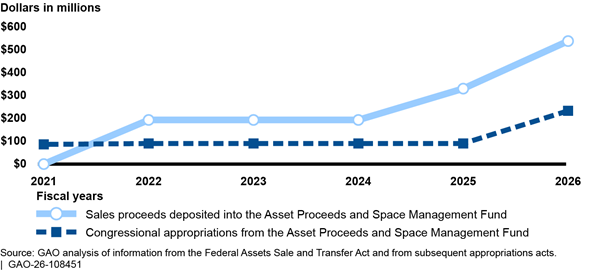
In 2026, Congress appropriated an additional about $143 million in FASTA proceeds. However, other longstanding disposal challenges remain. For example, stakeholders said relocating tenants is a challenge, particularly for the 2025 round, as most of these properties remain occupied by federal tenants. GSA and the Board suggested improvements to FASTA if it were extended beyond 2026, including greater access to FASTA sales proceeds.
Why GAO Did This Study
The federal government owns hundreds of thousands of buildings that cost billions of dollars annually to occupy, operate, and maintain. Disposing of real property that federal agencies no longer need—but continue to pay for—has been a longstanding challenge. The process for disposing of unneeded property may take years, with the federal government bearing the property costs until the disposal is completed.
FASTA includes provisions for GAO to review the Board’s recommendations and selection process and annually review agencies’ efforts to implement the FASTA recommendations. This report describes (1) the status of the FASTA disposal process and (2) insights from FASTA implementation as of the Second Round (2025).
GAO reviewed published reports, relevant federal laws and regulations. GAO interviewed officials from the Board, GSA, and four selected tenant agencies occupying properties recommended under FASTA. GAO also conducted site visits to four selected FASTA properties included in the 2025 round recommendations. In addition, GAO analyzed GSA real property disposal data from January 1, 2020, through August 5, 2025, to review the amount of time it takes to dispose of federal properties.
What GAO Recommends
GAO is not making new recommendations in this report. In prior reports on FASTA, GAO made recommendations to strengthen the process, including that GSA develop a process to collect, share, and apply lessons learned from FASTA implementation. GSA has taken steps toward implementing this recommendation, but it remains open as of August 2026.
|
Abbreviations |
|
|
|
|
|
Asset Proceeds Fund |
Asset Proceeds and Space Management Fund |
|
Board |
Public Buildings Reform Board |
|
FASTA |
Federal Assets Sale and Transfer Act of 2016 |
|
Forrestal |
James V. Forrestal Federal Building |
|
GSA |
General Services Administration |
|
High-Value Round |
High-Value Assets Round |
|
IRS |
Internal Revenue Service |
|
Lipinski |
William O. Lipinski Federal Building |
|
OMB |
Office of Management and Budget |
|
Peachtree Summit |
Peachtree Summit Federal Building |
|
River Road |
4700 River Road building |
|
USDA |
U.S. Department of Agriculture |
|
USE IT Act |
Utilizing Space Efficiently and Improving Technologies Act |
This is a work of the U.S. government and is not subject to copyright protection in the United States. The published product may be reproduced and distributed in its entirety without further permission from GAO. However, because this work may contain copyrighted images or other material, permission from the copyright holder may be necessary if you wish to reproduce this material separately.
September 21, 2026
The Honorable Shelley Moore Capito
Chairman
The Honorable Sheldon Whitehouse
Ranking Member
Committee on Environment and Public Works
United States Senate
The Honorable Sam Graves
Chairman
The Honorable Rick Larsen
Ranking Member
Committee on Transportation and Infrastructure
House of Representatives
The federal government owns hundreds of thousands of buildings that cost billions of dollars annually to occupy, operate, and maintain. Disposing of real property that federal agencies no longer need—but continue to pay for—has been a longstanding challenge.[1] The process for disposing of unneeded and underutilized federal real property may take years, sometimes decades, with the federal government bearing the cost of the property until the disposal is completed. We previously reported that the steps in the disposal process, including meeting statutory requirements related to historic preservation and environmental remediation, can be expensive and time-consuming.[2]
The Federal Assets Sale and Transfer Act of 2016 (FASTA) established a new, temporary process to reduce the inventory of federal civilian real property and the time it takes to dispose of such property.[3] Specifically, FASTA established a temporary independent board—the Public Buildings Reform Board (Board)—to recommend property for disposal to the Office of Management and Budget (OMB) for approval in each of several rounds. The most recent of these rounds began in 2025. Upon OMB approval, federal agencies in conjunction with the General Services Administration (GSA), are responsible for implementing the Board’s recommendations. GSA—which plays an important role in disposing of excess federal real property—has taken a primary role in implementation. FASTA also established a new funding mechanism to help with disposal costs.
FASTA includes provisions for us to review the Board’s recommendations and selection process and annually review agencies’ efforts to implement the FASTA recommendations. We have a body of work examining FASTA.[4] In this report, we describe: 1) the status of the FASTA disposal process, and 2) insights from FASTA implementation as of the Second Round (2025) of recommended property disposals.
To describe the status of the FASTA process, we reviewed and analyzed documentation from GSA, OMB, and the Board related to federal real property disposals and FASTA.[5] This documentation included the Board’s publicly issued reports and GSA information that contributed to the Board’s recommendations, such as projected timelines for disposing of the recommended properties. We reviewed relevant federal laws and regulations. We interviewed GSA officials and Board members and staff.[6] We also attended the Board’s public meetings in July 2025, January 2026, and June 2026, during which Board members discussed potential properties to recommend for disposal. In addition, we conducted site visits to four selected properties recommended for disposal in the Second Round:
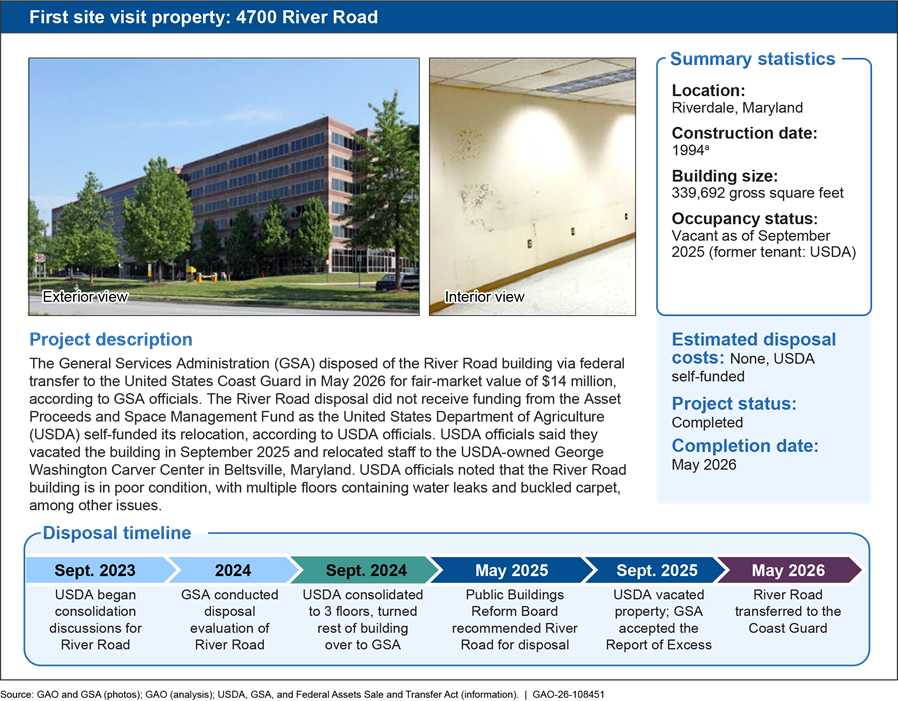
1) 4700 River Road (River Road), Riverdale, Maryland;
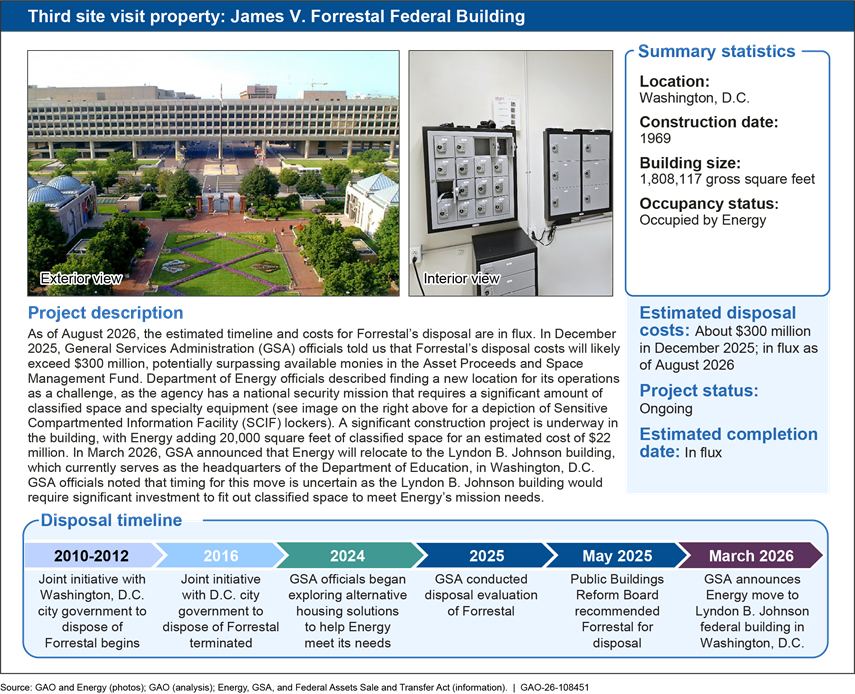
2) James V. Forrestal Federal Building (Forrestal), Washington, D.C.;
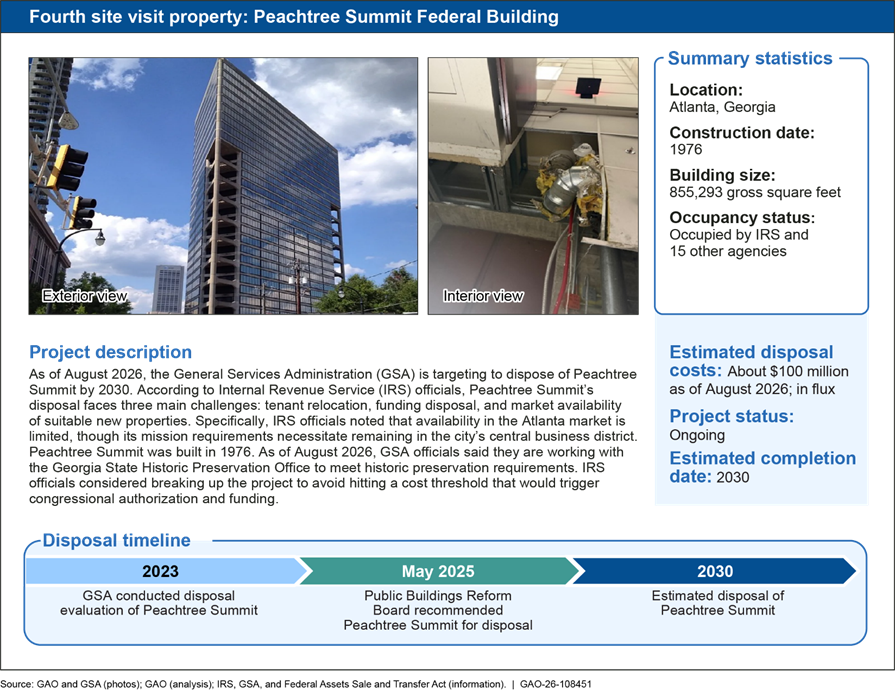
3) Peachtree Summit Federal Building (Peachtree Summit), Atlanta, Georgia; and
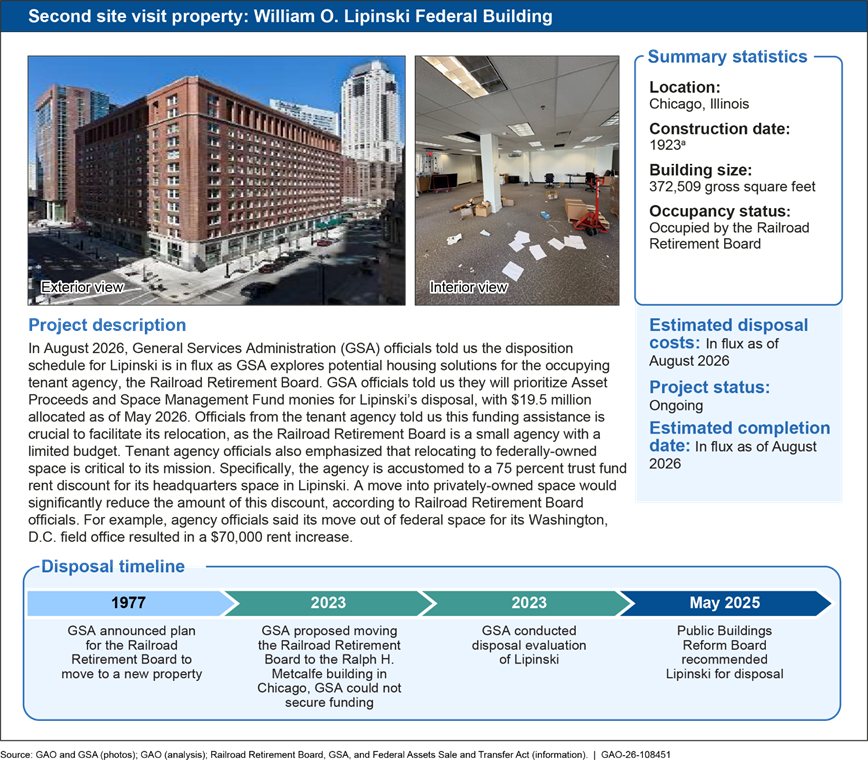
4) William O. Lipinski Federal Building (Lipinski), Chicago, Illinois.
We also interviewed officials from selected federal tenant agencies occupying these properties. Selected tenant agencies are the:
1) United States Department of Agriculture (USDA);
2) Department of Energy;
3) Internal Revenue Service (IRS); and
4) Railroad Retirement Board.
We selected these site visit properties to account for variation across identified potential barriers to disposal (e.g., environmental remediation needs); identified costs associated with disposal; and occupying federal tenant agencies.
To describe insights on FASTA implementation as of the 2025 Round, we reviewed and analyzed documentation from GSA, OMB, and the Board related to federal real property disposals and FASTA. We interviewed officials from GSA, the Board, and four selected federal agencies occupying some of the properties recommended for disposal in the 2025 Round, as described above.[7] To understand whether FASTA has affected the amount of time to dispose of federal properties, we obtained and analyzed available GSA property and sales data and information for all completed disposals from January 1, 2020, through August 5, 2025, including both FASTA and non-FASTA disposals. These data were the most recent available at the time of our review. We assessed the reliability of the data by performing electronic testing and logic checks, reviewing technical documentation, and interviewing GSA officials. We determined that the data were sufficiently reliable for the purpose of describing the length of time for disposing of federal properties. See appendix I for more detailed information on the scope and methodology of our analysis of GSA disposal data.
We conducted this performance audit from April 2025 to September 2026 in accordance with generally accepted government auditing standards. Those standards require that we plan and perform the audit to obtain sufficient, appropriate evidence to provide a reasonable basis for our findings and conclusions based on our audit objectives. We believe that the evidence obtained provides a reasonable basis for our findings and conclusions based on our audit objectives.
Background
Traditional Disposal Process
GSA generally acts as the disposal agency for surplus real property, including surplus real property that is owned by other agencies.[8] GSA initiates its disposal process when a federal agency determines it no longer needs its real property and notifies GSA of the excess property.[9]
GSA disposes of most properties—including the majority of properties disposed of under FASTA as of August 2026—through competitive sale to the public, generally through auctions, sealed bids, or brokered sales.[10] GSA’s disposal of federal properties may also include transfers to other government agencies or to state and local entities or some eligible nonprofit institutions for a public use. Title V of the McKinney-Vento Homeless Assistance Act requires GSA to prioritize the property for homeless assistance providers, state and local governments, or eligible nonprofits if it was deemed suitable to assist the homeless.[11] As directed by statute, the initial FASTA High-Value Assets Round (High-Value Round) waived this requirement, but subsequent rounds are subject to it.[12]
We previously reported that the steps in the real property disposal process, including meeting statutory requirements related to preserving historical properties and the environment, can be expensive and time-consuming for agencies.[13] For example, agencies reported that environmental remediation can cost millions of dollars and delay their ability to dispose of properties. In addition, screening for possible public use, such as for homeless assistance, can increase the time required to dispose of certain properties.
Both prior to reporting a property as excess and throughout the disposal process, compliance with other requirements such as historic preservation and environmental remediation may incur additional financial obligations. Depending on whether the property is owned by GSA or another landholding agency, the funds to offset these costs may come from the landholding agency’s salaries and expenses or operations and maintenance accounts, meaning that preparing real property for disposal may compete with an agency’s ongoing funding requirements.
FASTA Disposal Process
FASTA created a multi-round process in which the Board, OMB, and GSA work together to identify, recommend, approve, and implement disposal projects. Under FASTA, federal agencies are required to submit building disposal candidates to OMB, GSA, and the Board.[14] FASTA created a process to identify and prioritize unneeded federal civilian real properties to facilitate and expedite sale or disposal. However, FASTA disposals of GSA-owned properties generally follow the traditional process, subject to timelines imposed by FASTA.
The initial FASTA round, known as the High-Value Round, began in 2019.[15] The High-Value Round directed that identified properties be sold, while later rounds allowed for other methods of disposal, such as federal transfer.[16] FASTA directed the Board to identify at least five federal properties with target proceeds between $500 and $750 million for the High-Value Round.[17] Figure 1 outlines the timeline of FASTA, including the upcoming and planned final round of the process, expected in 2026. The Board will cease operations on December 31, 2026, but GSA will continue to implement the Board’s recommendations.
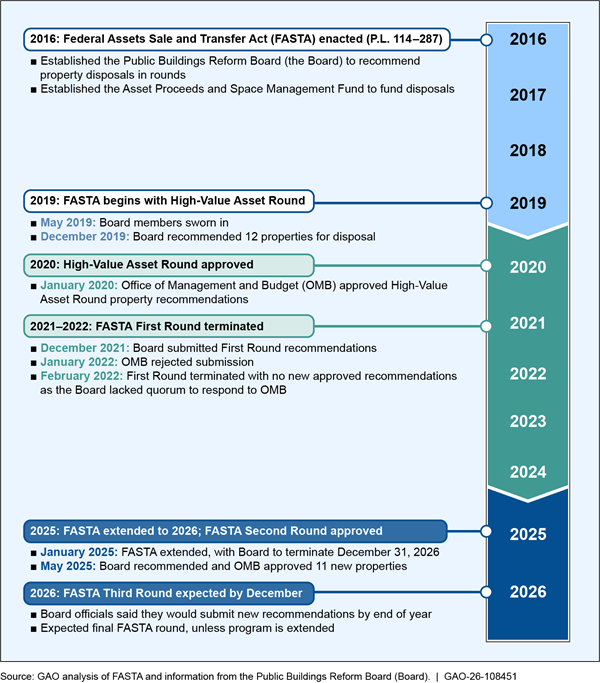
FASTA also established the Asset Proceeds and Space Management Fund (Asset Proceeds Fund), administered by GSA, to help agencies cover costs associated with implementing Board recommendations. In general, sales proceeds from each round were to be deposited into the Asset Proceeds Fund. These funds were then available to be used to carry out future actions pursuant to OMB-approved Board recommendations, including disposal-related actions, subject to the appropriations process. This made each round of FASTA partially dependent on the success of previous rounds. However, recent amendments to FASTA direct net proceeds, including sales proceeds, from Second Round disposals as well as disposals completed after December 31, 2026, to the real property account of the agency that owned the property at the time it was determined to be excess, also referred to as the landholding agency.[18] In addition, these amendments allow for OMB to approve or disapprove of the Board’s property recommendations individually, rather than as a unit, beginning for the Third Round.[19]
Recent Actions Related to Federal Disposals
In 2025, new legislation and regulatory action from GSA have increased activity related to disposing of federal real property. Enacted in January 2025, the Utilizing Space Efficiently and Improving Technologies (USE IT) Act required certain agencies to measure and report the utilization of their federal buildings starting in 2026.[20] The same law included the changes to FASTA net proceeds noted above.[21] According to GSA officials, this may incentivize agencies to participate in the program. Further, following two rounds of utilization reporting, GSA and OMB are required to take steps to reduce underutilized space, including consolidating space or disposing of excess space, for tenant agencies that repeatedly fail to meet a minimum utilization rate.
In March 2025, GSA announced it would begin disposing of federally owned office buildings using what it described as an accelerated approach. We previously reported that GSA has not clearly defined the purpose of its accelerated approach and recommended that GSA establish performance goals that link to the approach.[22]
Finally, in December 2025, GSA rescinded the majority of regulations implementing its disposal authority with the intent to streamline its regulations not required by statute, according to GSA.[23] GSA officials told us they do not expect significant changes to the disposal process, including FASTA disposals, as a result of these changes because its authorities are codified in statute.
Status of the FASTA Disposal Process
What are the results of FASTA as of August 2026?
As of August 2026, 14 properties have been disposed of under FASTA for a total of about $576 million. All but two of those properties were from the 2019 High-Value Round.
· High-Value Round (2019). During this round, the Board recommended 12 properties for disposal.[24] All 12 properties have sold for a total of about $538 million as of August 2026, with these sales proceeds deposited into the Asset Proceeds Fund. The highest value asset on the list—Laguna Niguel—took the longest to dispose, selling for $207 million in June 2026. An initial attempt to sell Laguna Niguel was terminated in May 2025 following allegations of possible collusion related to antitrust issues during the online auction, according to GSA and Board officials.[25]
· First Round (2022). The FASTA First Round was terminated in 2022, in part due to a lack of information on costs to implement recommended disposals. The Board submitted these recommendations in December 2021, and OMB rejected the submission in January 2022.[26] In its rejection, OMB cited a lack of information on disposal project implementation costs, noting limited assurances the recommendations could be implemented with available resources in the Asset Proceeds Fund.[27] Ultimately, the round terminated without OMB approval of any of the Board’s recommendations.[28]
· Second Round (2025). In May 2025, the Board submitted and received OMB approval for the 11 properties recommended as part of FASTA’s Second Round.[29] As of August 2026, GSA has disposed of two of these properties. The first of these properties—known by its address at 7th & D streets in Washington, D.C.—sold for $24 million in March 2026. The second property—known by its address on River Road in Riverdale, Maryland—was disposed of in May 2026 via federal transfer to the Coast Guard for $14 million, according to GSA officials.[30] Recent FASTA amendments routed proceeds from Second Round disposals to the landholding agency’s appropriate real property account.[31] Therefore, while two Second Round properties have been disposed of as of August 2026, funds deposited into the Asset Proceeds Fund remain at about $538 million. The about $38 million in proceeds from these Second Round sales are available to GSA—the landholding agency of both 7th & D and River Road—but as with the Asset Proceeds Fund, these funds remain subject to appropriation and must be used for disposal-related activities.
For additional information on the status and implementation plans for High-Value Round and Second Round properties, see discussion below and appendixes II and III.
How did the Board select properties for disposal in the Second Round?
Board officials said they primarily relied on GSA data and information to select properties for the Second Round and limited their recommendations to disposals that could be implemented with anticipated funding in the Asset Proceeds Fund.[32] Specifically, Board officials said they made property recommendations based on information developed by GSA in 2023 and 2024, for properties where GSA had already contacted the tenant agencies to initiate disposal activities.[33] According to GSA officials, GSA also provided the Board with additional relevant information and data on specific property footprints, implementation costs, and relocation options for tenants. GSA officials told us that the Board appeared to select properties for the Second Round that GSA had already identified for potential disposal. The Board confirmed that it did so to support GSA’s efforts and obtain access to the Asset Proceeds Fund to implement these disposals. However, the Board noted a few recommendations that were not based primarily on input from GSA, such as it independently identifying the Brickell Plaza building in Miami, Florida.
Further, Board officials noted that OMB indicated it would limit its support for Second Round recommendations to properties for which disposal costs could be implemented with anticipated funding in the Asset Proceeds Fund. As a result, the Board ensured its recommendations consisted of properties where the combined estimated disposal costs totaled between $400 and $500 million. This range matched the expected level of the Asset Proceeds Fund once all High-Value Round properties sold, according to Board officials.[34]
According to Board officials, the Board worked with a consultant to use information from GSA to focus on properties located in strong real estate markets, such as Washington, D.C.; Boston, Massachusetts; and Miami, Florida, for its Second Round recommendations.[35] The Board also considered factors including deferred maintenance, taxpayer return, reduction of operations and maintenance costs, and input from local officials in making its recommendations.
What progress has GSA made in implementing the Second Round recommendations?
GSA has disposed of two of the 11 properties recommended in the Second Round as of August 2026. Specifically, as noted above, GSA sold the 7th & D property in March 2026 for about $24 million. According to GSA officials, the sale of this property moved relatively quickly since the property was already identified for disposal and was vacant when the Board made its recommendation. In addition, according to GSA officials, GSA conducted a federal transfer of the River Road property for $14 million in May 2026.[36] The River Road property was similarly vacant at the time of disposal, as the former tenant USDA vacated the property in September 2025.[37] See appendix III for more information.
Timeframes for completing disposal of the remaining nine recommended properties from the Second Round are not clear due to outdated and shifting estimated costs and schedules.[38] According to GSA officials, the cost and schedule estimates provided to the Board were point-in-time estimates based on assumptions and data from 2023 and 2024 and have changed significantly. For example, GSA officials said the cost estimates for disposing of the Forrestal building, which serves as the Department of Energy’s headquarters, are in flux. Energy officials said this fluctuation is in part due to the difficulty of identifying new space within GSA’s portfolio that meets Energy’s square footage and classified space needs. In March 2026, GSA and Energy announced plans to relocate from Forrestal—which includes approximately 967,000 square feet of usable space—to the Lyndon B. Johnson Federal Building—which includes about 385,000 square feet of usable space.[39] The Lyndon B. Johnson building houses the Department of Education, which would need to relocate its staff to other space for Energy to move in. As of August 2026, GSA officials noted that timing for this move is uncertain as the Lyndon B. Johnson building would require investment to fit out classified space to meet Energy’s mission needs.
GSA officials noted that they continue to work with Energy and other agency officials to dispose of the FASTA Second Round properties, including working on agency space needs and to develop funding plans, particularly for tenant relocation. Specifically, GSA is prioritizing funding from the Asset Proceeds Fund for the disposals of the Brickell Plaza building in Miami, Florida, which houses multiple federal agencies, and the Captain John Foster Williams Coast Guard building in Boston, Massachusetts. GSA officials said they are prioritizing these buildings in part due to the funding needs of the federal agencies occupying these properties, as these agencies do not expect to be able to cover disposal costs through their respective budgets. In addition, GSA is prioritizing funding for the disposal of the William O. Lipinski building in Chicago, Illinois, which officials said they expect to dispose once the current tenant (the Railroad Retirement Board) relocates. In May 2026, GSA officials told us they planned to use $19.5 million from the Assets Proceeds Fund for tenant relocation and other disposal costs for Lipinski. In August 2026, GSA officials said that the Lipinski disposal remains a top priority but indicated that the budget and disposition schedule are being refined.
What is the status of the Third Round of FASTA?
According to Board officials, the Board anticipates submitting its Third Round property recommendations to OMB in September 2026, to allow time for review and comment before the Board terminates in December 2026. As noted earlier in the report, unlike prior FASTA rounds, OMB may approve or reject the Board’s Third Round recommendations piecemeal rather than as a unit, as a result of the 2025 FASTA reforms.[40] According to Board officials, this will allow them to submit a more robust list of recommendations in the Third Round, as there is less risk of the round being rejected in total.
In addition, Board officials told us they believe that none of the properties the Board anticipates recommending in the Third Round have previously been identified by GSA for disposal, and some properties are not owned by GSA, though Board officials said they do not have full insight into the properties GSA is considering.[41] This differs from the approach in the Second Round, which mostly included GSA-owned properties previously identified for disposal.[42] Board officials stated that the Board is prioritizing identifying new properties for disposal in its Third Round recommendations, and is focusing on deferred maintenance, occupancy, potential interested buyers, and local market conditions as selection factors. Board officials noted that it has been challenging to select Third Round properties as many high-value, high-impact properties were selected for previous FASTA rounds. The Board also worked with a consultant to complete more detailed analyses and suggest potential recommendation candidates.
Insights from FASTA Implementation as of the Second Round of Recommended Property Disposals
What do available data indicate about the time it takes to dispose of FASTA properties?
Our analyses of available GSA data on disposals between 2020 and 2025 showed that FASTA disposals were generally completed in less time than non-FASTA disposals.[43] Specifically, our analysis of the median duration of disposals showed that FASTA disposals were five months shorter, with half of FASTA disposals completed in about 6 months or less, while half of non-FASTA disposals were completed in about 11 months or less.[44] However, we found several outlier values (i.e., disposal durations that differed greatly from other durations in the dataset) that may skew the estimates of non-FASTA disposals (see fig. 2).[45] There are several factors that may affect disposal timelines, such as the waiver of certain screening requirements and building vacancy status, making it difficult to determine why FASTA disposals were generally completed in less time than non-FASTA disposals for the High-Value Round.[46]
Figure 2: Time to Dispose of Federal Properties Sold Between January 2020 and August 2025, According to General Services Administration (GSA) Data
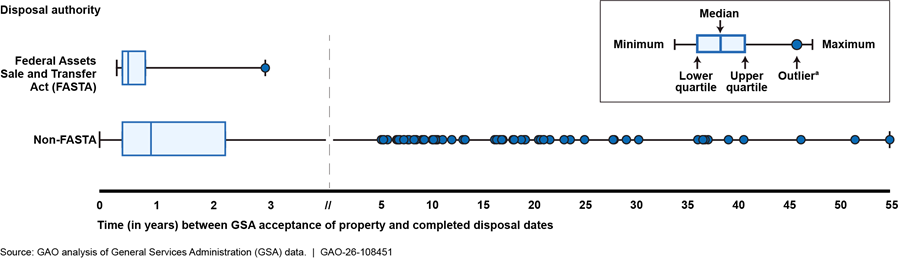
Note: Available FASTA data at the time of our review was limited to the 11 properties in the High-Value Assets Round sold between January 2020 and August 2025. This excludes the Laguna Niguel property from this round, which sold in June 2026.
aOutliers are data values that differ greatly from other values in the dataset. We considered sale times to be outliers if they fell outside the middle 50 percent of sales. Using this approach, sale times above 1.3 years for FASTA properties and 4.8 years for non-FASTA properties were considered upper outliers.
In addition, we conducted statistical testing to account for the presence of outliers, which corroborated the results of our median analysis. This analysis also suggested that FASTA may be associated with an even greater decrease in time to dispose of a property as compared to our analysis of the median duration of disposals, as discussed above. However, due to limited information—including the small number of FASTA disposals overall—we could not determine whether other factors, such as building vacancy status, may be confounding associations, or whether the effect is practically meaningful.[47] Specifically, we analyzed GSA disposal data for 433 of the 435 completed disposals with non-zero timeline information from January 1, 2020, the earliest date of High-Value Round sales, through August 5, 2025, the most recent date for which data were available at the time of our review. All 11 of the FASTA disposals in our data set—of the total 435—were recommended as part of the High-Value Round. The amount of time for these disposals may not be representative of all FASTA disposals, as the High-Value Round was exempted from certain requirements, such as homeless assistance screening, which can lengthen the disposal process. See appendix I for more information on our data analysis, results, and limitations.
In conducting this analysis, we identified data quality issues, including missing values. For example, GSA initially provided us with data on disposals from January 2020 through August 2025 that had nearly 45 percent of values missing across the two key variables we used to assess disposal timelines—the Acceptance and Completed disposal dates. After we identified the missing information, GSA provided us with an updated data set. While we were able to use these data to complete our analyses, the updated data had 6 percent of values missing for the two key variables. According to GSA officials, they could not fill in the remaining missing values because staff who worked on those projects were no longer with the agency.[48] In April 2026, we reported that GSA was not using quality disposal data.[49] We recommended that GSA establish and implement a plan to ensure that disposal and sales data are of sufficient quality. GSA agreed with our recommendation and identified actions it plans to take in response. As of August 2026, the recommendation remains open.
What are stakeholders’ views on the key benefits and challenges of FASTA as of the Second Round?
Stakeholders, consisting of officials from GSA, the Board, and the four selected tenant agencies, described the benefits and challenges of FASTA, including that its main benefit is the potential for funding from the Asset Proceeds Fund. Stakeholders emphasized the uncertainty of accessing this funding as a recurring and remaining challenge.
FASTA is a spotlight. Board officials said that FASTA has helped bring attention to issues surrounding federal real property management, including challenges addressing low utilization and high deferred maintenance. This attention, in turn, helped advance certain properties for disposal. In addition, Board officials stated that its activities in support of FASTA helped draw attention to the management of federal real property, including longstanding issues with low building utilization and high deferred maintenance costs.[50] For example, since its inception in 2019, the Board has generally published reports on an annual basis and has held 13 public meetings.[51] In these meetings, the Board discussed its recent work on federal real property issues, such as the properties it is considering for potential disposal and consolidation.
Funding uncertainty remains a challenge. Stakeholders said FASTA’s main benefit is potential access to monies in the Asset Proceeds Fund to offset disposal costs.[52] However, officials from the Board, GSA, and all four selected tenant agencies we spoke with emphasized the challenge of uncertain access to FASTA funding. For example, Railroad Retirement Board officials stated that the uncertainty of whether it will receive FASTA funding is a significant challenge, as the financial impact of the agency having to fund a relocation from its budget would be devastating to its mission. Officials from the Board also described funding as the biggest challenge with the FASTA process, particularly identifying properties to recommend without knowing how much of the FASTA sales proceeds in the Asset Proceeds Fund Congress will provide as part of the appropriations process. In addition, because some estimated disposal costs have increased since the Board made its Second Round recommendations, GSA officials said the Asset Proceeds Fund will not cover all Second Round FASTA disposals even with the addition of proceeds from the sale of the Laguna Niguel property from the High-Value Round, which was completed in June 2026.[53]
What contributed to the challenge of funding uncertainty in earlier FASTA rounds?
While Congress appropriated some funding at the inception of the FASTA program, it did not consistently provide appropriations in the following years, and the funds appropriated did not match the pace of cumulative proceeds deposited into the Asset Proceeds Fund from the High-Value Round.[54] Specifically, while proceeds from the sale of High-Value Round properties reached over $193 million in fiscal year 2022, Congress appropriated a cumulative total of $90 million from the Asset Proceeds Fund from fiscal years 2016 through 2022.[55] From fiscal years 2023 to 2025, Congress did not appropriate any funding; the total of the sales proceeds deposited into the Asset Proceeds Fund reached about $194 million by the end of fiscal year 2022. In fiscal year 2026, Congress appropriated an additional about $143 million to the Asset Proceeds Fund—bringing the total appropriated funds to $233 million. In that same year, the Laguna Niguel property sold, increasing funding deposited into the Asset Proceeds Fund to about $538 million. As shown in figure 3, the difference in cumulative funds deposited into and appropriated from the Asset Proceeds Fund between fiscal years 2022 and 2026 ranged from about $100 million to over $300 million. Without congressional appropriation, GSA could not access the full amount of sales proceeds deposited into the Asset Proceeds Fund.
Figure 3: Timeline of Cumulative Amounts Deposited into and Appropriated from the Asset Proceeds and Space Management Fund (Asset Proceeds Fund)
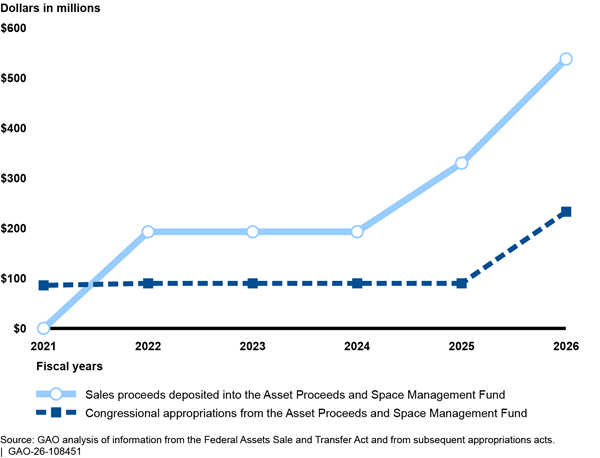
Note: The first property recommended under FASTA was sold in fiscal year 2022. Prior to 2021, Congress provided initial appropriations. This figure represents the cumulative—not annual—amounts of sales proceeds deposited into and congressional appropriations from the Asset Proceeds Fund. The cumulative total of sales proceeds deposited into the Asset Proceeds Fund through fiscal year 2026 is about $538 million as of August 2026, representing sales proceeds of High-Value Assets Round properties. This figure does not include proceeds from Second Round FASTA disposals as FASTA was amended in 2025 to provide proceeds from those disposals to the landholding agency rather than the Asset Proceeds Fund.
In recent fiscal years, GSA sought funding alternatives for disposals, according to GSA officials. For example, in its budget justifications for fiscal years 2025 through 2027, GSA requested funding for its new Optimization Program to support disposals, which officials noted could be used to fill gaps in FASTA funding.[56] In total, according to GSA officials, GSA allocated about $470 million for fiscal years 2025 and 2026 for the Optimization Program from congressional appropriations. However, GSA officials also noted that these funds are subject to other requirements, such as congressional approval for any projects above the prospectus threshold, which they said can extend timelines and contribute to planning uncertainty.[57] According to officials, GSA has submitted a prospectus for the fiscal year 2026 funds, but GSA has not received necessary approvals.[58]
As discussed above, in fiscal year 2026, Congress appropriated about $143 million from the Asset Proceeds Fund.[59] GSA officials told us the agency is working to prioritize and allocate these funds among Second Round property disposals. For example, as noted earlier in this report, GSA officials told us in May 2026 that they planned to allot $19.5 million toward the Lipinski building’s disposal costs.
In addition to funding uncertainty, what challenges have stakeholders identified when implementing FASTA?
Throughout the FASTA process, stakeholders have identified several implementation challenges in addition to the funding uncertainty described above, with tenant relocation being a particular challenge in the Second Round.[60]
Tenant relocation. Officials we spoke to from the Board, GSA, and three of the four selected tenant agencies described tenant relocation as a challenge for Second Round implementation.[61] According to GSA, most of the properties recommended under FASTA were occupied when OMB approved the recommendations. Stakeholders told us it is a challenge to identify new space and funding to relocate tenants for several Second Round properties. For example, Energy officials discussed the difficulty of finding a new building to replace its headquarters space in Forrestal that meets its mission requirements for square footage and classified space. Officials from IRS noted the mission benefits of its current location in Peachtree Summit that would be lost upon relocation, such as the co-location of some departments that may be separated upon a move to a new building. GSA officials also said that Peachtree Summit houses over a dozen federal agencies and identifying agency requirements and finding lease opportunities to accommodate them will require significant coordination.
Environmental and historic preservation requirements. Officials we spoke to from the Board, GSA, and one of the selected tenant agencies noted continued challenges meeting requirements related to historic preservation or environmental remediation. For example, Board officials told us GSA did not receive any bids when it first attempted to sell the Laguna Niguel property due to specific historic preservation requirements related to GSA’s sale.[62] Board officials also noted that there were unforeseen environmental issues that contributed to sale delays for the Menlo Park property in the High-Value Round. GSA officials noted anticipated challenges meeting historic preservation requirements for the disposal of Peachtree Summit and said that GSA is working with the Georgia State Historic Preservation Office to complete a review under the National Historic Preservation Act.[63]
Stakeholder collaboration. Officials from GSA and the Board described challenges maintaining a collaborative working relationship to carry out FASTA, particularly related to identifying properties for the upcoming Third Round.[64] Officials from the Board and GSA described a lack of transparency and a deteriorating relationship ahead of the Third Round, citing issues sharing relevant information. GSA officials said the Board was not always candid or forthcoming about its potential property selections, noting that the Board’s site visits to certain properties of interest resulted in multiple inquiries from the media that disrupted GSA operations.[65] Board officials told us they coordinated their site visits with local GSA officials rather than GSA’s central office, but that they provided a list of properties they planned to visit to the GSA central office. Board officials also noted that GSA was reluctant to share financial planning insights and occupancy data. Officials from both the Board and GSA told us that the relationship between the Board and GSA was more productive during the Second Round, as they coordinated closely on these recommendations prior to release. In August 2026, Board officials told us they continue to meet with GSA at least twice a month to coordinate. However, Board officials said that GSA provides minimal input, feedback, and documentation in these meetings on the properties the Board is considering for the Third Round FASTA submission. In August 2026, GSA officials affirmed that the Board and GSA meet as necessary but noted that the Board continues to meet with external stakeholders without coordinating with GSA, resulting in confusion and frustration for GSA tenants and stakeholders.
Data availability and quality. Board officials described concerns with the availability and quality of real property data for identifying disposal candidates for its Third Round recommendations. For example, they noted that data available in the Federal Real Property Profile—the federal government’s database for tracking real property assets—was unreliable and may be inaccurate for basic building characteristics, such as deferred maintenance needs.[66] As we previously reported, federal agencies other than GSA have not been incentivized to fully participate in the FASTA process, including providing data on potential disposal candidates.[67] As noted earlier in the report, under FASTA, federal agencies are required to submit building disposal candidates to OMB, GSA, and the Board.[68] OMB issued a call for this data in January 2025—nearly five years after its last data call in October 2020, according to Board officials. In addition, Board officials said they hoped to obtain occupancy data required under the USE IT Act from GSA or OMB to inform its Third Round recommendations, but—similar to other federal real property databases—they expect these data to have gaps and be difficult to validate. Board officials said they have not received complete USE IT Act data as of August 2026.
What improvements did GSA and the Board suggest if FASTA were extended beyond 2026?
Officials from GSA and the Board suggested improvements to the FASTA process if the program were extended beyond 2026, including increased access to sales proceeds and additional stakeholder transparency. Congress extended the temporary FASTA program once in the past, and the Board is seeking additional authorities to further extend its mandate beyond the Third Round.
Increased access to sales proceeds. Officials from both the Board and GSA suggested increased access to sales proceeds to help expedite tenant relocations and prepare properties for sale, as use of FASTA sales proceeds remains subject to prospectus approval and appropriation. For example, Board officials said Congress should identify and implement a legal mechanism with permanent appropriation for proceeds from real property sales, but which still provides congressional oversight. In addition, in a May 2026 testimony, GSA advocated for increased access to the Federal Buildings Fund, additional authority to reinvest property sales proceeds, and an increased prospectus limit to support its mission needs.[69]
Changes to federal rules. GSA and Board officials noted support for changes to federal rules that may expedite the disposal process and reduce costs to federal agencies. Specifically, both of these stakeholders expressed concern over a budgetary scoring rule that requires leaseback arrangements—in which a federal agency signs a lease to remain in a property after it is sold to be scored as capital leases. According to GSA officials, this means that disposal processes cannot begin until several steps for tenant relocation take place, including identifying a new location, approving a relocation plan, acquiring a lease, and receiving the funding necessary to carry out these steps. GSA and the Board have noted support for changes that would allow leasebacks to be scored as operating leases, thus giving GSA and tenants more time for relocation planning that can occur concurrently with steps necessary to dispose of the property. According to GSA and Board officials, another advantage of leasebacks is that such arrangements allow the federal government to move capital costs, including for maintenance, to the private sector lessor during the period of the leaseback.
Increased stakeholder transparency and coordination. Officials from both the Board and GSA suggested changes to improve their relationship moving forward, recommending increased transparency and coordination. Officials from the Board suggested increased transparency from GSA, including GSA sharing financial insights and utilization data with the Board, and engaging its tenant agencies to coordinate with the Board. GSA officials similarly suggested increased coordination with the Board, particularly regarding stakeholder outreach on potential properties the Board may recommend. GSA officials also suggested working together to reach consensus on the Board’s recommendations and specific transaction strategies before the Board submits its reports to OMB. We previously recommended that GSA work with the Board and OMB to develop a process to collect, share, and apply lessons learned from FASTA implementation, including on any lessons related to increased collaboration.[70] GSA has partially implemented this recommendation by developing an initial list of lessons learned following the High-Value Round, but still needs to develop lessons learned for the other FASTA rounds to fully address it.
Agency Comments
We provided a draft of this report to the Board, Energy, GSA, IRS, the Railroad Retirement Board, and USDA for review and comment. The Board, Energy, and GSA provided technical comments, which we incorporated, as appropriate. IRS, the Railroad Retirement Board, and USDA did not have any comments on our draft report.
We are sending copies of this report to appropriate congressional committees, the Executive Director of the Board, the Secretary of Energy, the Administrator of the GSA, the Commissioner of the IRS, and the Secretary of Agriculture. In addition, the report is available at no charge on the GAO website at http://www.gao.gov.
If you or your staff members have any questions about this report, please contact me at MarroniD@gao.gov. Contact points for our Offices of Congressional Relations and Media Relations may be found on the last page of this report. GAO staff who made key contributions to this report are listed in appendix IV.
David Marroni, Director
Physical Infrastructure
This appendix describes the scope and methodology for our analysis of General Services Administration (GSA) real property disposal data. We received GSA data on all completed disposals from January 1, 2020—the earliest date that Federal Assets Sale and Transfer Act of 2016 (FASTA) recommended properties could be sold following the Public Building Reform Board’s (Board) High-Value Assets Round (High-Value Round) recommendations in December 2019—through August 5, 2025, the most recent date for which data were available.[71]
We analyzed the data to identify characteristics of and compare differences between FASTA and non-FASTA disposals, including (1) methods used to complete the disposals, (2) types of properties sold, (3) federal agencies that owned the properties, (4) the final sale price of the property, and (5) the length of time it took to dispose of them. To assess the reliability of the data, we reviewed related GSA documentation such as data dictionaries, performed electronic testing and logic checks, and interviewed GSA officials to understand the data and systems used.
We found a select group of variables reliable for the purpose of reporting the characteristics of 445 disposals from January 1, 2020, to August 5, 2025. These included disposal method, disposal authority, property type, date of acceptance of the Report of Excess, the completed disposal date, and property value.[72] In instances where we identified incomplete information, we requested GSA use individual records to provide updated data and ensure our analysis included complete information.
We determined other variables were unreliable due to a large number of missing values (e.g., the start and end dates of the homelessness screening period), which limited our ability to conduct an analysis of duration of the phases of the disposal process. Additionally, due to incomplete timeline information for all disposals, we limited our timeline analysis to the 433 disposals from January 1, 2020, through August 5, 2025, which had non-zero completed disposal dates and were not missing timeline information. Of the 435 total disposals, 11 were disposed of through the FASTA process and 424 were disposed of through the traditional disposal process. The small number of FASTA disposals compared to non-FASTA disposals limits the conclusions that can be drawn from this analysis.
For our timeline analysis, we excluded two non-FASTA disposals which had the same acceptance and completed disposal dates, resulting in a timeline value of 0 days. For these 433 disposals, we used the variables we identified as reliable for our purposes to calculate descriptive statistics and conduct a statistical analysis to determine whether FASTA disposal was associated with a significant reduction in the median time to sell a property.[73] We conducted a non-parametric statistical test using linear rank scores, as it does not assume a ‘normal’ distribution of the data and works well for highly skewed data with extreme outliers.
To account for the small number of FASTA disposals, we used ‘exact’ small sample methods. Statistical significance was set at the 0.05 (5%) level. Since the test was suggestive of a significant difference, we conducted a 50th quantile regression analysis to test the association between the median time to sell a property and the use of FASTA disposal authority, while holding other property characteristics such as property type constant. We used a quantile regression since it is robust to outliers, handles non-constant variance, and does not assume normality.[74]
While statistical analysis of available data suggests the usage of the FASTA disposal process is associated with a decrease in time to sell a property, limited information (including the small number of FASTA sales overall) makes it unknown whether other factors may be confounding such an association, and whether the effect on reducing the sale time is practically meaningful. Our regression model, like all regression models, is subject to limitations. Most importantly, factors that may be related to our outcomes of interest may not be available in the data and omitting them could have introduced bias to results. The results of our analysis are associational and do not imply a causal relationship.
See Table 1 for the status of FASTA High-Value Assets Round property disposals.
|
Property recommended |
Property location |
Disposal Status |
Date disposed |
Sale price |
|
Shelley-New Sweden Park & Ride Lot |
Idaho Falls, ID |
Disposed |
10/14/2021 |
$268,000 |
|
WestEd Office Building |
Los Alamitos, CA |
Disposed |
12/06/2021 |
$27 million |
|
Edison Job Corps Center (excess land) |
Edison, New Jersey |
Disposed |
12/15/2021 |
$4 million |
|
Sacramento Job Corps Center (excess land) |
Sacramento, CA |
Disposed |
01/10/2022 |
$12 million |
|
Nike Site (excess land) |
Gaithersburg, MD |
Disposed |
01/14/2022 |
$12 million |
|
Ronald Reagan Federal Building and Courthouse |
Harrisburg, PA |
Disposed |
02/04/2022 |
$10 million |
|
Information Operations and Research Center |
Idaho Falls, ID |
Disposed |
04/29/2022 |
$2 million |
|
Auburn Complex |
Auburn, WA |
Disposed |
05/19/2022 |
$80 million |
|
Southwest Fisheries Science Center |
Pacific Grove, CA |
Disposed |
06/06/2022 |
$5 million |
|
Veterans Affairs Denver Medical Center |
Denver, CO |
Disposed |
09/23/2022 |
$41 million |
|
Menlo Park Complex |
Menlo Park, CA |
Disposed |
08/11/2025 |
$137 million |
|
Chet Holifield Federal Building (Laguna Niguel) |
Laguna Niguel, CA |
Disposed |
6/30/2026 |
$207 million |
Source: GAO summary of information from the Public Buildings Reform Board, the General Services Administration, and the Congressional Research Service. | GAO‑26‑108451
Notes: All High-Value Assets Round properties were disposed of via sale. Most sales prices are rounded to the nearest million dollars.
See Table 2 for the status of FASTA Second Round property disposals.
|
Property recommended |
Property location |
Disposal Status |
Date disposed |
Disposal method |
Sale price |
|
4700 River Road (River Road) |
Riverdale, MD |
Disposed |
05/05/2026 |
Federal transfer at fair market valuea |
$14 million |
|
Federal Office Building - 7th & D |
Washington, D.C. |
Disposed |
03/23/2026 |
Sale |
$24 million |
|
James V. Forrestal Building (Forrestal) |
Washington, D.C. |
Not disposed |
N/A |
Unknown |
N/A |
|
Wilbur J. Cohen Building |
Washington, D.C. |
Not disposed |
N/A |
Unknown |
N/A |
|
Albuquerque Lease Consolidation |
Albuquerque, NM |
Not disposed |
N/A |
Lease consolidationa |
N/A |
|
Brickell Plaza |
Miami, FL |
Not disposed |
N/A |
Unknown |
N/A |
|
Captain J.F. Williams Coast Guard Building |
Boston, MA |
Not disposed |
N/A |
Unknown |
N/A |
|
Estes Kefauver Federal Building, Annex, and Parking Deck |
Nashville, TN |
Not disposed |
N/A |
Unknown |
N/A |
|
LaBranch Federal Building |
Houston, TX |
Not disposed |
N/A |
Unknown |
N/A |
|
Peachtree Summit Federal Building |
Atlanta, GA |
Not disposed |
Anticipated disposal in 2030 |
Unknown |
N/A |
|
William O. Lipinski Federal Building |
Chicago, IL |
Not disposed |
Uncertain |
Unknown |
N/A |
Source: GAO summary of information from the Federal Assets Sale and Transfer Act and the General Services Administration. | GAO‑26‑108451
Note: Sales prices are rounded to the nearest million dollars.
aAfter the High-Value Round, the Board’s recommendations for each round could include recommendations for “consolidation, exchange, co-location, reconfiguration, lease reductions, sale, out lease, and redevelopment of Federal civilian real properties” as well as the process to be followed by agencies to carry out those recommendations. Federal Assets Sales and Transfer Act, Pub. L. No. 114-287, § 12(h)(1), 130 Stat. 1463 (codified as amended at 40 U.S.C. § 1303 note). Federal agencies are generally required to “complete all recommended actions” within 6 years of Office of Management and Budget approval. Id. § 14(a)(2).
Below are profiles of four selected properties we visited that were recommended for disposal in the Second Round of the Federal Assets Sale and Transfer Act of 2016.
aAcquired by the federal government in 2015.
aAcquired by the federal government in 1942.
GAO Contact
David Marroni, MarroniD@gao.gov
Staff Acknowledgments
In addition to the contact named above, Matthew Cook (Assistant Director), Elaina Stephenson (Analyst-in-Charge), Melissa Bodeau, Emily Crofford, Timothy Jackson, Colleen Taylor, Frances Tirado, Erin Villareal, Malika Williams, Alicia Wilson, and Elizabeth Wood made key contributions to this report.
The Government Accountability Office, the audit, evaluation, and investigative arm of Congress, exists to support Congress in meeting its constitutional responsibilities and to help improve the performance and accountability of the federal government for the American people. GAO examines the use of public funds; evaluates federal programs and policies; and provides analyses, recommendations, and other assistance to help Congress make informed oversight, policy, and funding decisions. GAO’s commitment to good government is reflected in its core values of accountability, integrity, and reliability.
Obtaining Copies of GAO Reports and Testimony
The fastest and easiest way to obtain copies of GAO documents at no cost is through our website. Each weekday afternoon, GAO posts on its website newly released reports, testimony, and correspondence. You can also subscribe to GAO’s email updates to receive notification of newly posted products.
Order by Phone
The price of each GAO publication reflects GAO’s actual cost of production and distribution and depends on the number of pages in the publication and whether the publication is printed in color or black and white. Pricing and ordering information is posted on GAO’s website, https://www.gao.gov/ordering.htm.
Place orders by calling (202) 512-6000, toll free (866) 801-7077,
or
TDD (202) 512-2537.
Orders may be paid for using American Express, Discover Card, MasterCard, Visa, check, or money order. Call for additional information.
Connect with GAO
Connect with GAO on X,
LinkedIn, Instagram, and YouTube.
Subscribe to our Email Updates. Listen to our Podcasts.
Visit GAO on the web at https://www.gao.gov.
To Report Fraud, Waste, and Abuse in Federal Programs
Contact FraudNet:
Website: https://www.gao.gov/about/what-gao-does/fraudnet
Automated answering system: (800) 424-5454
Media Relations
Sarah Kaczmarek, Managing Director, Media@gao.gov
Congressional Relations
David A. Powner, Acting Managing Director, CongRel@gao.gov
General Inquiries
[1]GAO, High-Risk Series: Heightened Attention Could Save Billions More and Improve Government Efficiency and Effectiveness, GAO‑25‑107743 (Washington D.C.: Feb. 25, 2025).
[2]GAO, Federal Real Property: GSA Should Leverage Lessons Learned from New Sale and Transfer Process, GAO‑23‑104815 (Washington, D.C.: Oct. 7, 2022).
[3]Pub. L. No. 114-287, 130 Stat. 1463 (codified as amended 40 USC § 1303 note).
[4]See GAO, Federal Real Property: Additional Documentation of Decision Making Could Improve Transparency of New Disposal Process, GAO‑21‑233 (Washington D.C.: Jan. 29, 2021); Federal Real Property: Several Factors May Limit Efforts to Reduce Space under New Sale and Transfer Process, GAO‑22‑105345 (Washington D.C.; Dec. 8, 2021); and GAO‑23‑104815.
[5]Throughout this report, we use “as of” dates to note the status of the ongoing FASTA process.
[6]We contacted OMB to request an interview in June 2025 and May 2026 and did not receive a response.
[7]In this report we refer to these entities as “stakeholders” in the FASTA process.
[8]Statute provides that the Administrator of General Services is to supervise and direct the disposition of surplus property, with some exceptions. 40 U.S.C. § 541.
[9]The term “excess property” means property under the control of a federal agency that the agency head determines is not required to meet the agency’s needs or responsibilities. 40 U.S.C. § 102(3). Surplus property is defined to mean excess property that GSA determines is not required to meet the needs or responsibilities of any federal agency. Id. § 102(10).
[10]GAO, Federal Real Property: GSA Should Create Goals to Ensure New Approach Saves Money and Accelerates Disposals of Unneeded Property, GAO‑26‑107760 (Washington, D.C.: April 9, 2026).
[11]Title V of the McKinney-Vento Homeless Assistance Act, as amended, contains provisions that enable the transfer of certain unutilized, underutilized, excess, and surplus property to assist the homeless. 42 U.S.C. § 11411. Screening property to determine if it is suitable for this purpose is statutorily required. Id. See also associated regulations in 41 C.F.R. Part 102-71, subpart B (GSA); 24 C.F.R. Part 581 (Department of Housing and Urban Development); 45 C.F.R. Part 12a (Department of Health and Human Services).
[12]FASTA directed GSA to initiate the sale of the High-Value Round properties “notwithstanding any other provision of law (including section 501 of the McKinney-Vento Homeless Assistance Act)” except for certain environmental considerations specified in FASTA. FASTA § 12(b)(6)(A) (codified as amended 40 U.S.C. § 1303 note).
[13]GAO, Federal Real Property: Improving Data Transparency and Expanding the National Strategy Could Help Address Long-standing Challenges, GAO‑16‑275 (Washington, D.C.: Mar. 31, 2016) and Federal Real Property: National Strategy and Better Data Needed to Improve Management of Excess and Underutilized Property, GAO‑12‑645 (Washington, D.C.: June 20, 2012).
[14]FASTA § 11 (codified as amended 40 U.S.C. § 1303 note). FASTA defines “federal agency” as “an executive department or independent establishment in the executive branch of the Government, and a wholly owned Government corporation.” FASTA § 3(4) (codified as amended 40 U.S.C. § 1303 note).
[15]We previously reported that high-value properties are defined as those that have a replacement value of at least $1 million. See GAO‑21‑233.
[16]After the High-Value Round, the Board’s recommendations for each round could include recommendations for “consolidation, exchange, co-location, reconfiguration, lease reductions, sale, out lease, and redevelopment of Federal civilian real properties” as well as the process to be followed by agencies to carry out those recommendations. FASTA § 12(h)(1) (codified as amended 40 U.S.C. § 1303 note).
[17]Per FASTA, after the initial High-Value Round, the Board’s First Round was to recommend properties with a total value of no greater than $2.5 billion, and the Second Round was to recommend properties with a total value of no greater than $4.75 billion. See FASTA § 12(h)(2) (codified as amended 40 U.S.C. § 1303 note). The Third Round did not have any value targets defined in statute.
[18]Net proceeds may be used for certain disposal related costs and activities, subject to appropriations. FASTA § 20 (codified as amended 40 U.S.C. § 1303 note); see also Thomas R. Carper Water Resources Development Act of 2024 (“WRDA 2024”), Pub. L. 118-272, § 2301(k), 138 Stat. 2992, 3217. We previously reported that numerous federal entities have statutory authority to retain proceeds from building disposals. See GAO, Federal Building Management: Building Disposal Authorities Provide Varying Degrees of Flexibility and Opportunities for Use, GAO-17-123 (Washington, D.C.: Dec. 8, 2016). Otherwise, under current law, net proceeds are generally deposited in the Treasury as miscellaneous receipts. 40 U.S.C. § 571.
[19]FASTA § 13(c) (codified as amended 40 U.S.C. § 1303 note); see also WRDA 2024, § 2301(j), 138 Stat. at 3217.
[20]See WRDA 2024 § 2302, 138 Stat. at 3218–3220.
[21]Id. § 2301(k), 138 Stat. at 3217.
[22]See GAO‑26‑107760. GSA agreed with the recommendation. It remains open as of August 2026.
[23]Until December 2025, GSA’s Federal Management Regulation laid out a detailed process for disposing of excess and surplus property. 41 C.F.R. part 102-75 (2024). The majority of these regulations have been rescinded. See Federal Management Regulation; Aligning the Federal Management Regulation (FMR) With the Administration’s Deregulatory Priorities, 90 Fed. Reg. 58,408 (Dec. 16, 2025). see also 91 Fed. Reg. 3214 (Jan 20, 2025) (ratification notice).
[24]In April 2021, OMB withdrew approval of one of the properties—the Federal Archives and Records Center in Seattle, WA. GSA subsequently decided to sell a single Board recommendation, located on the same campus in Idaho Falls, Idaho, as two separate properties: (1) the Information Operations and Research Center, and (2) the Shelley-New Sweden Park and Ride Lot. As a result, there were ultimately 12 total properties for sale as part of the High-Value Round. See appendix II for more information.
[25]According to GSA officials, the sale of the Laguna Niguel property was terminated by the Department of Justice’s antitrust review required under 40 U.S.C. § 559.
[26]OMB, OMB Response to Public Buildings Reform Board Round 1 Submission (Jan. 26, 2022).
[27]In addition to concerns over financial planning, OMB officials determined that the Board’s First Round submission did not meet its criteria related to stakeholder consultation and schedule requirements. OMB also noted that the Board and GSA needed to increase coordination, including coming to an agreement on the list of recommended properties.
[28]Following OMB’s rejection of the First Round submission, the Board determined that it did not have the quorum required under FASTA to respond to OMB’s concerns and to resubmit its recommendations after two Board members resigned. FASTA provides that five Board members shall constitute a quorum for the purposes of conducting business and three or more Board members shall constitute a meeting of the Board. FASTA § 5(b), 130 Stat. at 1466.
[29]Public Buildings Reform Board, Second Round Report (May 21, 2025). In a letter to the Board dated May 23, 2025, OMB approved of all 11 recommended Second Round properties. The Board has recommended, and OMB has approved, a total of 23 properties under FASTA as of August 2026.
[30]According to GSA officials, the federal transfer for River Road took place at fair market value of $14 million. After the High-Value Round, the Board’s recommendations for each round could include recommendations for “consolidation, exchange, co-location, reconfiguration, lease reductions, sale, out lease, and redevelopment of Federal civilian real properties” as well as the process to be followed by agencies to carry out those recommendations. FASTA § 12(h)(1) (codified as amended 40 U.S.C. § 1303 note).
[31]FASTA § 20 (codified as amended 40 U.S.C. § 1303 note); see also WRDA 2024, § 2301(k), 138 Stat. at 3217.
[32]See Public Buildings Reform Board, Second Round Report: Recommendations Pursuant to the Federal Assets Sale and Transfer Act of 2016 (May 2025).
[33]For information on how properties were selected for previous FASTA rounds, see GAO‑21‑233 and GAO‑23‑104815.
[34]The Asset Proceeds Fund ultimately reached about $538 million in deposited proceeds following the sale of all High-Value Round properties.
[35]Throughout the FASTA process the Board has worked with the commercial real estate firm Jones Lang LaSalle to conduct independent analysis of the properties considered for recommendation.
[36]As noted above, FASTA was amended to direct proceeds from FASTA Second Round disposals to be returned to the landholding agency, rather than deposited into the Asset Proceeds Fund. Therefore, while two properties from the Second Round have been disposed of, amounts deposited into the Asset Proceeds Fund remain at about $538 million as of August 2026.
[37]According to officials from USDA and GSA, USDA provided all needed funding for its move and no monies from the Asset Proceeds Fund were expended for the disposal of the River Road property.
[38]GSA officials said these fluctuations are in part due to changing customer requirements. GSA officials said that they would ideally like to engage with agencies earlier in the disposal process to identify and develop requirements (e.g., square footage, special space needs). GSA officials told us that delays often occur when this information is incomplete, subject to change, or slow to be finalized.
[39]According to Energy officials, Energy may need to identify supplemental space in one or two other locations due to the limited size of the Lyndon B. Johnson building, though specific plans have not been determined.
[40]FASTA § 13(c) (codified as amended 40 U.S.C. § 1303 note); see also WRDA 2024, § 2301(j), 138 Stat. at 3217.
[41]The Board is considering 34 properties to recommend for disposal in the Third Round, including several properties concentrated in the Southeast region of the U.S., as discussed by Board officials in public meetings held by the Board in January 2026 and June 2026. The properties being considered include offices, surplus land, and parking structures.
[42]One property recommended in the Second Round is not owned by GSA—the Albuquerque Lease Consolidation property that is leased by USDA. See appendix II for more information.
[43]The starting date for our analysis uses the date when GSA formally accepted a Report of Excess from another agency requesting GSA carry out a disposal—termed the “Acceptance Date.” The end date is the date that the sale is financially closed and completed—termed the “Completed Disposal Date.” According to GSA officials, agencies and GSA typically take preliminary steps to complete required activities on a possible disposal prior to GSA accepting the Report of Excess. Our analysis does not include this part of the disposal process. As a result, actual disposal timelines may be longer than what our analysis of available data shows.
[44]Available FASTA data with non-missing timeline information at the time of our review was limited to the 11 properties in the High-Value Round and 424 non-FASTA properties sold between January 2020 and August 2025, a total of 435 properties. This excludes the Laguna Niguel property from the High-Value Round, which sold in June 2026. In addition, our data analysis did not include the sale of the Second Round 7th & D property sold in March 2026 or the transfer of River Road in May 2026.
[45]The median disposal time for all disposals was about 11 months. We used median for our analysis to account for the significant influence outlier values can have on averages. For example, the time to dispose of FASTA properties ranged from nearly 4 months to nearly 3 years, and time to dispose of non-FASTA properties ranged from 0 months to over 54 years, which results in an average difference of disposal times of around 2 years and 8 months (average FASTA disposals were about 9 months and non-FASTA disposals were over 3 years).
[46]Board officials said that some FASTA disposals may have been completed in less time than non-FASTA disposals as they were already in GSA’s disposal pipeline, or because FASTA allowed for the waiver of certain public benefit screenings. GSA officials agreed with the Board’s perspective and added that funding from the Asset Proceeds Fund contributed to expedited disposal schedules by covering the tenant relocation expenses of some FASTA properties.
[47]In addition, GSA officials told us that GSA only accepted Reports of Excess for properties that had completed required disposal activities for the FASTA High-Value Round in advance, which may have contributed to shorter disposal cycles.
[48]In March 2025, GSA’s Public Buildings Service began a major reorganization, including reducing staff levels by about 50 percent. See GAO, Federal Real Property, Leading Practices Could Help GSA Better Achieve Its Reorganization Goals, GAO‑26‑108155 (Washington, D.C.: Apr. 14, 2026).
[49]See GAO‑26‑107760.
[50]In March 2026, the Board reported that the federal real estate portfolio had over $50 billion in deferred maintenance liabilities, exceeding the amount previously estimated by GSA, according to the Board. Public Buildings Reform Board, The Cost of Inaction: Deferred Maintenance in GSA’s Portfolio, (March 5, 2026). The GSA Administrator cited a different estimate of $26 billion in deferred maintenance liabilities in a March 2026 testimony. GSA, Statement of Edward C. Forst GSA Administrator before the House Committee on Transportation and Infrastructure, Subcommittee on Economic Development, Public Buildings, and Emergency Management, (March 4, 2026). GAO has not assessed either estimated figure.
[51]These reports include submissions for each of the FASTA rounds, as well as interim reports and testimonies. The reports are available online: Reading Room, Public Buildings Reform Board, accessed August 31, 2026, https://www.pbrb.gov/reading-room/.
[52]We previously reported that a lack of upfront funding to cover disposal costs is a longstanding challenge. See GAO‑23‑104815.
[53]For example, in December 2025, GSA officials told us that costs to dispose of the Forrestal property are expected to exceed $300 million.
[54]Only sales proceeds from High-Value Round disposals were deposited into the Asset Proceeds Fund. As described above, proceeds from Second Round FASTA sales, as well as disposals completed after December 31, 2026, will be returned to the landholding agency for use for disposal-related activities, subject to congressional appropriation. GSA officials said this amendment provided no new incentives or authorities to GSA, resulting in no process efficiencies for the Second or Third FASTA rounds. The impact of this change is unclear as GSA is the landholding agency for most properties recommended under FASTA as of the Second Round. In addition, whether proceeds are routed through the Asset Proceeds Fund or the landholding agency, they remain subject to congressional appropriation.
[55]Congress provided the Asset Proceeds Fund with an initial $86 million in funding between fiscal years 2016 and 2021. In fiscal year 2022, Congress appropriated an additional $4 million to the fund, bringing the total appropriated funds in the Asset Proceeds Fund to $90 million.
[56]In its budget justifications, GSA describes the purpose of the Optimization Program as being to reconfigure and renovate core assets under GSA’s jurisdiction, custody, or control to support efforts to optimize space and reduce the government’s footprint. According to GSA officials, the Optimization Program is an initiative within Special Emphasis Programs, which is a component of GSA’s Federal Buildings Fund Major Repairs and Alterations appropriation that funds multiple distinct initiatives aligned with GSA priorities.
[57]Building repairs and alterations, as well as construction and acquisition projects, that are expected to cost more than a specified dollar threshold—referred to as prospectus-level projects—must be submitted to certain congressional committees for authorization and funding. Prospectus-level projects involve major work or acquisitions that are estimated to cost more than a statutorily prescribed amount ($3.961 million for fiscal year 2026 construction projects), which GSA’s Administrator is authorized to adjust annually to reflect a percentage increase or decrease in construction costs during the prior calendar year. See 40 U.S.C. § 3307. We previously reported that the prospectus process can pose challenges to GSA’s ability to effectively manage its assets. See GAO, Federal Real Property: GSA Should Fully Assess Its Prospectus Process and Communicate Results to Its Authorizing Committees, GAO‑22‑104639 (Washington, D.C.: Jan. 21, 2022).
[58]Per 40 U.S.C. § 3307, appropriations for projects above a certain threshold may only be made if the project’s prospectus has been fully approved by the House Transportation and Infrastructure and the Senate Environment and Public Work Committees. In providing appropriation from the Federal Buildings Fund for repairs and alterations, which includes GSA’s Optimization Fund, the Consolidated Appropriations Act, 2026 stipulates that “additional projects for which prospectuses have been fully approved may be funded under this category only if advance approval is obtained from the Committees on Appropriations of the House of Representatives and the Senate.” Pub. L. No. 119-75, 140 Stat. 173, 471. As of August 2026, only the House Transportation and Infrastructure Committee has approved the FY2026 Optimization Fund Prospectus. GSA officials told us the inability to obligate these funds contributes to extended timelines and planning uncertainty.
[59]GSA requested about $193 million from the Asset Proceeds Fund in its fiscal year 2026 budget justification and received about $143 million in appropriations. GSA also requested about $193 million from the Asset Proceeds Fund in its fiscal year 2027 budget request. Consolidated Appropriations Act, 2026, Pub. L. No. 119-75, 140 Stat. 173, 473. As of August 2026, about $538 million in sales proceeds has been deposited into the Asset Proceeds Fund.
[60]We have previously reported on the challenges of earlier FASTA rounds. See GAO‑21‑233 and GAO‑23‑104815.
[61]The fourth tenant agency (USDA) had already vacated its space at River Road in September 2025. Therefore, tenant relocation challenges did not apply.
[62]As noted earlier in the report, the initial sale of Laguna Niguel was terminated due to antitrust compliance issues, according to GSA and Board officials. The property ultimately sold in June 2026.
[63]Section 106 of the National Historic Preservation Act requires federal agencies to assess how their projects might affect historic properties—those eligible for inclusion on the National Register of Historic places—and includes a consultation process to mitigate potential harm. 54 U.S.C. § 306108; see also 36 C.F.R. part 800. Generally, buildings that have achieved historical significance in the last 50 years are ineligible for inclusion on the Register. Peachtree Summit was built in 1976. As of September 2026, the Advisory Council on Historic Preservation is considering revising the statute’s implementing regulations. RIN: 3010-AA10.
[64]We previously reported collaboration challenges between the Board and GSA during the High-Value Round, following a change in sales strategy. We also found that increased collaboration between the Board and GSA may help mitigate delays completing required due diligence activities. See GAO‑23‑106848. We also previously recommended that GSA work with the Board and OMB to develop a process to collect, share, and apply lessons learned from FASTA implementation, including on any lessons related to increased collaboration. See GAO‑23‑104815. GSA has partially implemented this recommendation by developing an initial list of lessons learned following the High-Value Round but still needs to develop lessons learned for the other FASTA rounds to fully address it.
[65]GSA officials told us they received multiple inquiries from the media and state and local officials regarding the Board’s potential property selections, some of which GSA was not considering for disposal, following Board outreach to the properties of interest. GSA officials told us that responding to these inquiries disrupted their operations and diverted resources from GSA’s ongoing disposal activities.
[66]GSA officials told us they are responsive to the Board’s data requests on individual properties, which they said requires a significant amount of work. However, we previously reported issues with the overall Federal Real Property Profile data. See GAO, Federal Real Property: GSA Should Improve and Streamline Its Real Property Inventory, GAO‑26‑107968 (Washington, D.C.: June 8, 2026). See also GAO‑12‑645 and GAO‑16‑275.
[67]We previously reported that agencies have not been incentivized to participate in FASTA and that long-standing issues with the Federal Real Property Profile data limited the Board’s identification of potential FASTA candidates. See GAO‑23‑104815. According to Board officials, this contributed to the Board’s reliance on data and information provided by GSA to make its property selections.
[68]FASTA § 11 (codified as amended 40 U.S.C. § 1303 note).
[69]Federal agencies that occupy property controlled by GSA pay rent into the Federal Buildings Fund, which is GSA’s sole source of funds to manage those buildings. GSA also maintains custody and control of the Asset Proceeds Fund. See GSA, Statement of Edward C. Forst GSA Administrator before the Senate Committee on Appropriations, Subcommittee on Financial Services and Government, (May 13, 2026).
[70]See GAO‑23‑104815.
[71]Pub. L. No. 114-287, 130 Stat. 1463 (codified as amended 40 U.S.C. § 1303 note). FASTA created a multi-round process in which the Board, OMB, and GSA work together to identify, recommend, approve, and implement disposal projects. The initial FASTA round, known as the High-Value Round, began in 2019.
[72]Consistent with statements from GSA officials in prior reporting, we determined a property to be ‘high value’ if the estimated fair market value is over $1 million. See GAO, Federal Real Property: Additional Documentation of Decision Making Could Improve Transparency of New Disposal Process, GAO‑21‑233 (Washington D.C.: Jan. 29, 2021). In instances of missing data, we used the final sale price or actual proceeds to determine value.
[73]The starting date for our analysis uses the date when GSA formally accepted a Report of Excess from another agency requesting GSA carry out a disposal—termed the “Acceptance Date.” The end date is the date that the sale is financially closed and completed—termed the “Completed Disposal Date.” According to officials, agencies and GSA typically take preliminary steps to complete activities on a possible disposal prior to GSA accepting the Report of Excess. This analysis does not include this informal part of the disposal process. As a result, actual disposal timelines may be longer than what our analysis of available data shows.
[74]To ensure the consistency of our results, we conducted a sensitivity assessment by evaluating nested regression models for consistency in model fit using Wald and rank-score Tau goodness-of-fit measures. All controlled models were statistically significant at the 0.05 level. We also evaluated the statistical significance and direction of the association between disposal authority and time to sell for each of these models. All models were generally consistent in the significance and direction of association between disposal authority and time to sell, however, three of the eight models we tested did not have a statistically significant association.