
Report to Congressional Requesters
United States Government Accountability Office
A report to congressional requesters
Contact: Nathan Tranquilli at TranquilliN@gao.gov
What GAO Found
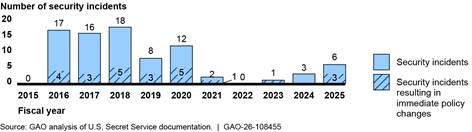
The Secret Service protects the President, Vice President, visiting foreign dignitaries, and others. From fiscal year 2015 through fiscal year 2025, the Secret Service’s budget increased while the number of its protectees fluctuated, particularly around changes in presidential administrations. During this time, there were 83 security incidents. The Secret Service updated its protection policies in response to 25 of them.
Secret Service Policy Changes in Response to Incidents, Fiscal Years 2015–2025
Secret Service policy does not require that personnel document their rationale when they determine an incident does not warrant a protection policy update. However, Secret Service officials told GAO that doing so would be important because it shows an incident was fully reviewed. In the absence of this information, it is sometimes unclear why the Secret Service maintained the status quo. For example, the Secret Service encountered drone incidents from 2015 to 2021, but did not update its policies to address civilian use of drones prior to July 2024, when a shooter used a drone in an assassination attempt of then-former President Trump. Revising its policy to require personnel to document the rationale for not making policy changes after incidents would provide the Secret Service with more complete information when considering protection policy updates to mitigate future threats.
Further, the Secret Service has not reviewed and updated protection policies in a timely manner. These policies are to be reviewed and updated within 4 years of issuance, but the Secret Service has not reviewed or updated eight of 22 protection policies within the required time frame. Secret Service officials said they try to make timely updates but are not always able to identify personnel available to do so. Revising its policy to assign responsibility to specific positions for updating protection policies within required time frames could help the Secret Service incorporate the most current techniques into advance planning.
Finally, since 1991, the Secret Service and Diplomatic Security Service, the protective division within the Department of State, have not updated a key memorandum of understanding that delineates the two entities’ roles and responsibilities for securing the President and others traveling abroad, and foreign dignitaries traveling to the United States. Much has changed over the intervening years, such as the emergence of drone threats, and updating the memorandum would provide the two entities an opportunity to respond to evolving roles, responsibilities, and advance techniques.
Why GAO Did This Study
Recent attacks and threats of violence against Secret Service protectees highlight the importance of the Secret Service’s protective mission. These incidents include the July 2024 assassination attempt of then-former President Trump, the alleged assassination attempt of President Trump at the April 2026 White House Correspondents’ Dinner, and the shooting near Vice President Vance’s motorcade in May 2026.
GAO was asked to examine the Secret Service’s protection policies. This report addresses, among other things, (1) how the Secret Service protection budget and number of protectees changed from fiscal year 2015 through fiscal year 2025; and (2) the extent to which the Secret Service has updated its protection policies.
GAO analyzed data and reviewed documentation related to protection policies for the Secret Service and Diplomatic Security Service from fiscal year 2015 through fiscal year 2025. GAO also conducted interviews with officials from the Secret Service and Diplomatic Security Service, as well as eight other selected federal, state, and local entities with protection responsibilities.
What GAO Recommends
GAO is making four recommendations, including two to revise current Secret Service policies to (1) require that personnel document why protection policy updates are not needed after incidents, and (2) assign responsibility for policy updates, and one each to the Secret Service and the Department of State to update their memorandum of understanding. The Department of Homeland Security, which includes the Secret Service, and the Department of State concurred with the recommendations.
|
Abbreviations |
|
|
|
|
|
|
|
DPD |
Dignitary Protective Division |
|
|
OPO |
Office of Protective Operations |
|
|
PPD SAIC |
Presidential Protective Division special agent in charge |
|
|
VPD |
Vice Presidential Protective Division |
|
This is a work of the U.S. government and is not subject to copyright protection in the United States. The published product may be reproduced and distributed in its entirety without further permission from GAO. However, because this work may contain copyrighted images or other material, permission from the copyright holder may be necessary if you wish to reproduce this material separately.
September 3, 2026
The Honorable Bennie G. Thompson
Ranking Member
Committee on Homeland Security
House of Representatives
The Honorable Seth Magaziner
Ranking Member
Subcommittee on Counterterrorism and Intelligence
Committee on Homeland Security
House of Representatives
A number of recent attacks and threats of violence against U.S. Secret Service protectees reflect a heightened threat environment and highlight the importance of the Secret Service’s protective mission. For example, in July 2024 in Butler, Pennsylvania, and September 2024 in West Palm Beach, Florida, individuals attempted to assassinate then-former President Donald Trump. Further, in May 2024 and January 2025, individuals threatened to kill then-President Joe Biden. More recently, in April 2026, an individual allegedly attempted to assassinate President Donald Trump at the White House Correspondents’ Dinner in Washington, D.C. And, in May 2026, an individual fired shots near Vice President J.D. Vance’s motorcade in Washington, D.C.
In July 2025, we reported that, due in part to policy gaps during the July 2024 assassination attempt, a gunman evaded the Secret Service and its law enforcement partners—injuring then-former President Trump and two participants and killing a participant.[1] However, we found that Secret Service advance team personnel and others responsible for securing the July 2024 rally did not refer to Secret Service policies because the policies were broad and did not provide specific details regarding roles and responsibilities.[2] We recommended that the Secret Service, among other things, develop a resource that provides agents with a clear understanding of tasks to secure a protected event.[3] The Department of Homeland Security agreed with these recommendations and has taken steps to address some of them, such as developing a list of assets that can be requested to secure protectees.[4] By implementing all of these recommendations, the Secret Service could ensure that agents are equipped with updated policies and requirements, which would help them be better prepared to address known threats and secure protectees at future events.
You asked us to examine the Secret Service’s protection policies for securing protectees. This report addresses (1) how the Secret Service compares to Diplomatic Security Service and U.S. Marshals Service, regarding their protective mission, pre-visit planning policies, and training and service requirements; (2) how the Secret Service protection budget and number of its protectees and protective visits changed from fiscal year 2015 through fiscal year 2025; and (3) the extent to which the Secret Service has assessed its protection policies.
To examine how the Secret Service’s protective mission, pre-visit planning policies, and training and service requirements compare to other entities, we identified 13 federal entities other than the Secret Service that have protection responsibilities.[5] Based on the similarities between the Secret Service and two federal entities in their statutory authorities as well as the number and type of protectees for whom they are responsible, we selected Department of State’s Diplomatic Security Service and the Department of Justice’s U.S. Marshals Service to compare to the Secret Service. We reviewed data from these three entities on the number of full-time protectees and protective visits as of fiscal year 2025—the most recent fiscal year for which they had complete data at the time of our analysis.[6] We then reviewed and compared the entities’ policies for protective advance planning domestically and abroad to identify similarities and differences in planning.[7] We also reviewed documentation and interviewed senior officials from the three selected entities on their training and service requirements for staff to serve in protective roles.
Finally, including these three entities, we interviewed 10 federal, state, local, and nonprofit entities with protection responsibilities and identified how many of these entities reported looking to the Secret Service, Diplomatic Security Service, or U.S. Marshals Service for examples of best practices or training for protection.[8] We selected these entities based on a variety of factors, including whether federal entities with protection responsibilities identified these entities as partner entities for protection operations, entities experienced recent executive protection challenges, or entities reported plans to develop executive protection standards.
To describe how the Secret Service protection budget and number of protectees and protective visits have changed over time, we reviewed Secret Service data on the number of protectees, protective visits, and protection-related costs for related visits for fiscal year 2015 through fiscal year 2025. Though the Secret Service has budget data for fiscal years 2015 through 2025, our comparative analysis across all funding categories is limited to fiscal years 2020 through 2025 because this was the five-year time frame that the Secret Service included separate amounts for “Mission Support,” “Field Operations,” and others, some of which also fund protection-related activities.[9] We reviewed changes in the protection-related portion of the Secret Service’s total enacted budget and supplemental appropriations for fiscal year 2015 through fiscal year 2025. We analyzed the budget to determine whether these changes coincided with protection-related statutory or policy changes. We analyzed the data to determine whether the number of protectees and visits coincided with presidential administration changes, changes in the size of the First Family, and changes affecting travel, such as the COVID-19 pandemic. We reviewed data and related documentation and interviewed officials for obvious errors and determined the data were sufficiently reliable to describe changes in the Secret Service budget and number of protectees and protective visits.
To examine the extent to which the Secret Service assesses its protection policies, we obtained and reviewed documentation of the Secret Service’s 2022 policy for updating protection policies, to include whether as part of making updates the Secret Service assesses information from security incidents (i.e., unusual protective events) that occur during its protective visits.[10] We examined the Secret Service’s protection policies and guidance for domestic visits, foreign visits, and visits involving foreign dignitaries.[11]
We identified 83 Secret Service security incidents for fiscal years 2015 through 2025 and compared them to agency policy to determine whether the rationale for not updating the protection policies after an incident was documented and, if not, why not.[12] We also compared time frames for when the Secret Service updated protection policies to agency policy.[13]
We conducted this performance audit from June 2025 to September 2026 in accordance with generally accepted government auditing standards. Those standards require that we plan and perform the audit to obtain sufficient, appropriate evidence to provide a reasonable basis for our findings and conclusions based on our audit objectives. We believe that the evidence obtained provides a reasonable basis for our findings and conclusions based on our audit objectives.
Background
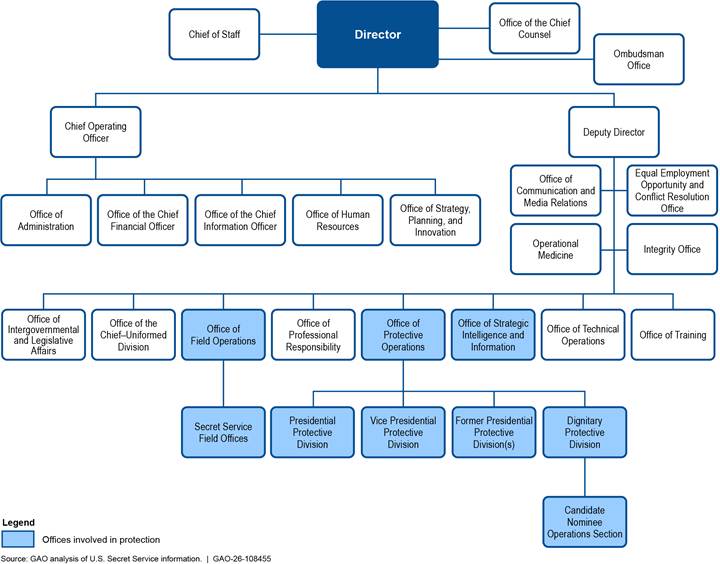
The Secret Service, within the Department of Homeland Security, carries out an integrated mission of protection and investigations. Its protection mission is to provide physical protection for the President, Vice President, their immediate families, and visiting foreign dignitaries, among others,[14] as well as for facilities such as the White House Complex.[15] Its investigative mission is to investigate a wide range of crimes that threaten U.S. financial systems, such as financial and computer-based fraud.[16] The Secret Service has over 150 domestic and international field offices that support its protective and investigative missions within their respective geographic areas. For additional information on offices and divisions carrying out these responsibilities, see figure 1.
The Secret Service Secures Various Types of Protectees
The Secret Service is responsible for protecting the President, Vice President, former Presidents, major candidates and nominees for certain political offices, individuals specified as protectees in Presidential memoranda, and foreign dignitaries, among others. See appendix I for additional information on examples of protectees.
· President. The Presidential Protective Division is responsible for protecting the sitting U.S. President, members of the First Family, and other individuals at the direction of the President. The division also provides physical security for the White House Complex, which includes the White House, the Eisenhower Executive Office Building, the New Executive Office Building, and the Treasury buildings (main and annex), as well as other Presidential Offices, the First Family’s private residence(s), and other locations where the President and First Family visit or reside.
· Vice President. The Vice Presidential Protective Division is responsible for protecting the U.S. Vice President and members of the Second Family.[17] The division also provides physical security for the Naval Observatory Complex, Vice Presidential Offices, the Second Family’s private residence, and other locations where the Vice President and Second Family visit or reside.
· Former Presidents. A former President may elect to receive lifetime Secret Service protection. A former President’s child, if under the age of 16, is also eligible for protection.[18] If a former President elects to receive such protection, they will be assigned a protective division (e.g., Barack Obama Protective Division). These divisions also provide physical security for the residences of former Presidents.
· Candidates and nominees. The Candidate Nominee Operations Section, within the Dignitary Protective Division, is responsible for protecting major candidates and nominees for the office of the President and Vice President at designated events related to the presidential campaign.[19]
· Individuals Specified as Protectees in Presidential Memoranda. Various protective divisions are responsible for Presidential Memoranda protectees.[20] For example, according to Secret Service officials, the Dignitary Protective Division provides protection for the U.S. Trade Representative, and the Presidential and Vice Presidential Protective Divisions provide protection for the President’s Chief of Staff and Deputy Chief of Staff, the Secretary of Homeland Security, the White House Press Secretary, and the Secretary of the Treasury.
· Foreign Dignitaries. The Dignitary Protective Division is responsible for protecting visiting foreign chiefs of state (also known as heads of state), heads of government, and accompanying spouses while they are in the U.S.[21]
The Secret Service Conducts Protective Advances Domestically and Abroad
The Secret Service and other entities coordinate to ensure a secure environment for planned movements and sites prior to a protectee’s visit to a specific location. The Secret Service refers to this planning as an “advance,” which it conducts when protectees travel domestically and abroad. To secure a location, the Secret Service will form an “advance team” with a mix of agents from the local field office and other divisions and request assets, such as specialized personnel and equipment. For additional information on protective detail and advance team staffing, see appendix II.
· Domestic advances. The Secret Service secures protectees traveling within the continental U.S. and U.S. territories. As part of this process, the Secret Service advance team works with the appropriate Secret Service protective divisions and field offices as well as local, state, and federal law enforcement to plan and execute security arrangements. Examples of domestic advances include visits, such as presidential campaign events (e.g., rallies), State of the Union addresses, and others.
· Foreign advances. The Secret Service also secures protectees travelling outside of the continental U.S. and U.S. territories. For example, the President may travel to foreign countries to participate in global summits and conferences, state visits to other countries, meetings with heads of state or government, among others. As part of this process, the Secret Service advance team will coordinate with the Department of State and relevant U.S. embassy personnel and foreign law enforcement through the responsible Secret Service foreign field office.
· Advances involving foreign dignitaries. The Secret Service secures foreign dignitaries visiting the U.S. for official and non-official visits. As part of the process, the Secret Service advance team assigns a threat level to the foreign dignitary for protective staffing and resource planning. The Secret Service advance team works with the foreign mission and relevant Secret Service field offices. An example of an advance involving foreign dignitaries includes the United Nations General Assembly.
Secret Service Roles and Responsibilities for Advance Planning
As shown in table 1, Secret Service advance teams have certain members with key roles and responsibilities in the planning process.
Table 1: Key Secret Service Advance Team Member Roles and Responsibilities for Domestic Advances, Foreign Advances, and Advances Involving Foreign Dignitaries
|
Member |
Description of responsibilities |
|
Field Office Special Agent in Charge |
· Coordinates decisions related to the operational security environment, in conjunction with the lead advance agent, including evaluating all equipment and personnel requirements prior to the formal requests being made. · Notifies the other partners of pending events. · Communicates with the lead advance agent regarding any schedule changes, meetings with local police, intelligence concerns, requests, and any other information regarding the event, among other responsibilities. |
|
Office of Protective Operations Deputy Assistant Director |
· Coordinates with Secret Service headquarters following the death, serious injury, or illness of a protectee or Secret Service employee. · Coordinates with the U.S. embassy and host country officials in the event of an emergency to evacuate a Secret Service protectee or Secret Service employee. · Manages executive-level communication with host government officials. |
|
Lead Advance Agent |
· Serves as a conduit between the protective division detail and the field office. · Completes advance planning documents and submits them to the Special Agent in Charge of the protective division or the Field Office Special Agent in Charge. · Conducts site walkthroughs with relevant members of the advance team and local law enforcement partners. |
|
Detail Leader |
· Coordinates and supervises security for a visit and works with the Field Office Special Agent in Charge regarding resource requests. · Provides briefings to the head of state or head of government. |
|
Site agent |
· Identifies site-specific vulnerabilities, documents them in the site security plan, and determines what resources and countermeasures are needed to address them. · Ensures all security personnel have been briefed on current threat intelligence, communication procedures, and emergency response measures. · Ensures other advance team members and individuals assigned to various posts within and around the site receive instructions. |
Source: GAO analysis of U.S. Secret Service information. | GAO‑26‑108455
Secret Service Advance Planning Policies
The Secret Service’s advance planning policies vary among domestic visits, foreign visits, and visits to the U.S. by foreign dignitaries. Based on our analysis, the Secret Service’s advance planning policies can be split into five phases, as shown in figure 2.[22]
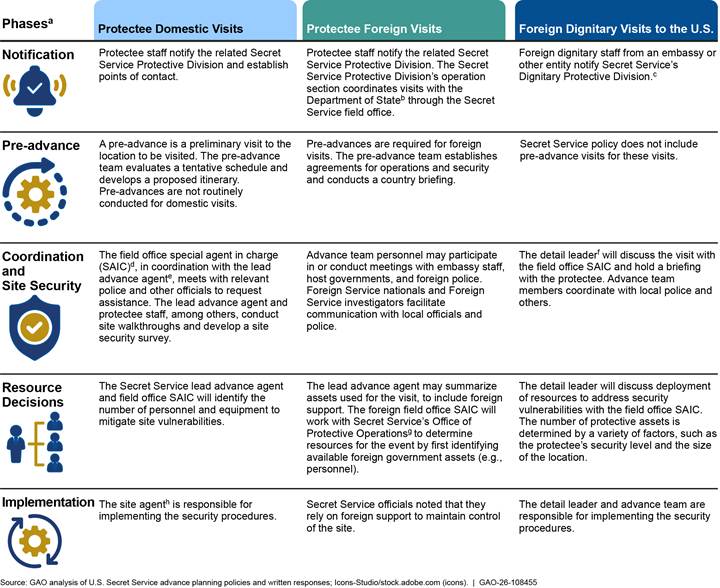
aWe condensed the Secret Service’s seven phases of advance planning into five based on our analysis of Secret Service protection planning policies. For example, we combined the Secret Service’s review of historical files of prior visits into the notification phase.
bDepartment of State personnel from Diplomatic Security Service or an embassy or mission will work with the Secret Service when full-time protectees travel abroad or when foreign dignitaries travel to the U.S.
cThe Dignitary Protective Division secures visiting foreign heads of state and heads of government and their accompanying spouses, designated domestic government officials, and others as directed by the President.
dThe field office special agent in charge coordinates decisions related to the operational security environment.
eThe lead advance agent serves as the conduit between the protective division detail and the field office, completes related documents, and coordinates site walkthroughs with partners.
fThe detail leader coordinates and supervises security for a visit and provides briefings to the head of state or head of government.
gThe Office of Protective Operations is responsible for planning, directing, coordinating and implementing protective operations, and manages policies and programs related to these activities.
hThe site agent identifies site-specific vulnerabilities, documents them in the site security plan, and determines what resources and countermeasures are needed to address them.
Selected Federal Entities with Protection Responsibilities
Other federal entities have protection responsibilities and secure protectees when they travel domestically and abroad.
Diplomatic Security Service. Diplomatic Security Service within the Department of State is responsible for protecting the Secretary of State, other current or former U.S. government officials at the request of the Secretary of State, foreign dignitaries or official visitors, and resident dignitaries.[23] The Secretary’s Detail is responsible for the protection of the Secretary of State and the Secretary’s family if a threat warrants their protection. The Dignitary Protection Division is responsible for other protectees, including Special Envoys, current or former U.S. government officials at the request of the Secretary of State, the Acting U.S. Representative to the United Nations, visiting foreign dignitaries (below the level of heads of state or heads of government), and certain foreign officials who reside in the U.S.
U.S. Marshals Service. U.S. Marshals Service within the Department of Justice is responsible for ensuring the safety of the federal judiciary.[24] The Judicial Security Division’s Office of Protective Operations has primary responsibility for protective advances. When deemed necessary through risk or threat-based assessments, U.S. Marshals Service provides security for the Supreme Court justices (when requested by the Supreme Court of the United States Police Department), the deputy attorney general, federal judges, the Secretary of Health and Human Services, the Office of Management and Budget Director, and others.
Secret Service Had More Full-Time Protectees, and the Three Entities Have Similar Advance Planning Processes
The Secret Service provides full-time protection for the largest number of protectees and has a similar advance planning process as Diplomatic Security Service and U.S. Marshals Service. Additionally, each entity’s training covers all phases of protective advance planning, and other federal, state, and local entities look toward them for best practices or training.
The Secret Service Had More Full-Time Protectees Than Diplomatic Security Service and U.S. Marshals Service in Fiscal Year 2025
We found that, among the Secret Service, Diplomatic Security Service, and U.S. Marshals Service, the Secret Service was responsible for the largest number of full-time protectees at one time (43, on average), followed by U.S. Marshals Service (20, on average), and Diplomatic Security Service (5) in fiscal year 2025.[25] In addition to full-time protectees, these entities may also protect individuals on a temporary basis. For example, while the Secret Service typically provides protection for former Vice Presidents for up to 6 months after the end of the Vice President’s incumbency, the Secretary of Homeland Security may direct the Secret Service to provide temporary protection for them at any time thereafter.[26] Another example of temporary protectees is foreign dignitaries, for whom the Secret Service and Diplomatic Security Service only provide protection while they are in the U.S.
The Secret Service, Diplomatic Security Service, and U.S. Marshals Service Have Similar Advance Planning Processes
The Secret Service, Diplomatic Security Service, and U.S. Marshals Service are responsible for protective advance planning domestically and abroad, and our analysis found that the entities generally have a similar process for doing so. Additionally, the Secret Service and Diplomatic Security Service have a similar process for protective advance planning to secure foreign dignitaries visiting the U.S. U.S. Marshals Service is not responsible for protecting foreign dignitaries, so it does not have such a process.
We found that in fiscal year 2025, the Secret Service conducted more protective visits than Diplomatic Security Service. The U.S. Marshals Service was unable to provide the number of visits by protectees for which it provided protection because instead it tracks the number of protective visits personnel took.[27] For additional information on the number of protective visits conducted by the Secret Service and Diplomatic Security Service, see table 2.
Table 2: Protective Visits Conducted by the Secret Service and Diplomatic Security Service during Fiscal Year 2025
|
|
Total visits |
Domestic visits |
Foreign visits |
Foreign dignitary visits |
|
Secret Service |
7,641 |
5,156 (67 percent) |
372 (5 percent) |
2,113 (28 percent) |
|
Diplomatic Security Service |
559 |
258 (46 percent) |
129 (23 percent) |
172 (31 percent) |
Source: GAO analysis of U.S. Secret Service and Diplomatic Security Service information. | GAO‑26‑108455
Domestic advances. We found that the three federal entities generally have a similar planning process for domestic advances. For example, as part of the coordination and site security phase, each entity has a process for (1) developing and reviewing threat assessments or (2) documenting vulnerabilities of a site in a site security plan. See appendix III for additional information on each entity’s advance planning policies for domestic protectee visits.
Foreign advances. We found that the three federal entities generally have a similar planning process for foreign advances. For example, as with domestic advances, for the coordination and site security phase, each entity has a process for (1) developing and reviewing threat assessments or (2) documenting site vulnerabilities in a site security survey or plan. Unique to foreign advances for this phase, entities have a process to consider logistics, such as country weapons clearances, coordinate with Department of State and embassy staff, and liaise with foreign police. See appendix IV for additional information on each entity’s advance planning policies for foreign protectee visits.
Foreign dignitary advances. We found that the Secret Service and Diplomatic Security Service generally have a similar advance planning process for foreign dignitaries visiting the U.S.[28] For example, the coordination and site security phase similarly involves a process for developing a site security plan. In addition, during this phase, entities share information with foreign dignitary staff, including information about the protection process, logistics, security responsibilities, and expectations for the visit. Further, the Secret Service’s Dignitary Protective Division will conduct a re-assessment, either annually or on a visit-by-visit basis, to determine whether to elevate or lower a foreign dignitary’s threat level. See appendix V for additional information on each entity’s advance planning policies for foreign dignitaries.
Short notice advance planning. Though all three entities have preferred lead times to conduct protective advances, protectee visits may require short notice advance planning.[29]
· For the Secret Service, agency policy states that in the event of a short notice advance, advance team components will make concerted efforts to ensure that all aspects of the advance are completed as thoroughly as they would if given adequate lead time, and advance teams will work to ensure a secure environment for the protectee.[30] Secret Service officials stated that core elements of the advance planning process, such as coordination and site security and resource decisions, may be expedited for short notice advances, but not omitted. In fiscal year 2025, the Secret Service conducted 500 short notice advances, of which 152 involved foreign dignitaries (30 percent), followed by former President Joe Biden with 75 advances (15 percent), and the First Family with 71 advances (14 percent).
· For the Diplomatic Security Service, its officials stated that short notice visits require expedited advances and, for Secretary of State travel that does not afford time for the Secretary’s Detail to conduct the advance, personnel may rely on advance support from agents assigned to regional security offices.
· For the U.S. Marshals Service, its officials stated that advance planning is dependent on lead time, and visits are scalable based on resources.
Secret Service, Diplomatic Security Service, and U.S. Marshals Service Training Address All Phases of Protective Advances
The Secret Service, Diplomatic Security Service, and U.S. Marshals Service have training and time-in-grade service requirements for their personnel to serve on protective details. In addition, all three entities include all phases of protective advance planning in their training. We also found that other federal, state, local, and nonprofit entities with protective missions look to the Secret Service, Diplomatic Security Service, and U.S. Marshals Service for best practices for training and protection.
Training requirements. The Secret Service, Diplomatic Security Service, and U.S. Marshals Service cover all five phases of protective advance planning in their basic training, as well as training for both domestic and foreign protective advances.[31]
In addition to basic training, each entity requires or offers supplemental training for their protection mission. For example, the Secret Service and Diplomatic Security Service stated they require all agents to take additional training upon being staffed to any permanent position on a protective detail, and U.S. Marshals Service offers refresher training for personnel in its Judicial Security Division’s Office of Protective Operations.
Service requirements. The Secret Service and Diplomatic Security Service have time-in-service requirements to serve on a protective detail. Both the Secret Service and Diplomatic Security Service have time-in-service requirements before personnel may be assigned to permanent protective positions. They require 3 and 2 years of service at a field office, respectively.[32] The U.S. Marshals Service does not require personnel to serve for a certain length of time but requires personnel to be a criminal investigator at the General Schedule 13 level or higher to serve in a permanent protective position.[33]
Best practices for training and protection. We found that federal, state, local, and nonprofit entities look to the Secret Service, Diplomatic Security Service, and U.S. Marshals Service for best practices for training and protection. Specifically, we spoke with officials at 10 federal, state, local, and nonprofit entities with protection responsibilities—including the Secret Service, Diplomatic Security Service, and U.S. Marshals Service. Officials at eight of these entities told us either they referred to the Secret Service as having best practices for training and protection, or they incorporated Secret Service training as part of their curriculum. For example, according to U.S. Capitol Police officials, U.S. Capitol Police’s Dignitary Protection Division supervisors participate in Secret Service protection courses.[34] New York Police Department officials further noted that they look to the Secret Service and Diplomatic Security Service for tactics and how best to secure a protectee and a site. Further, members of the Board of Executive Protection Professionals noted that the Secret Service and Diplomatic Security Service have similar protection training, and other entities cannot compare to how these two entities secure protectees.
Though the Secret Service was the most frequently cited entity for best practices for training and protection, seven entities noted that they looked to Diplomatic Security Service and three entities noted that they looked to the U.S. Marshals Service for best practices for training and protection.[35] For example, as part of the Federal Bureau of Investigation’s evaluation of its own training, it invites U.S. Marshals Service, among other entities, to discuss tactics, techniques, and procedures for protection.[36]
Secret Service Funding Increased as the Agency Responded to Fluctuating Protection Demands
The Secret Service’s total enacted budget increased steadily while the proportion of funding dedicated to protection fluctuated from fiscal year 2015 through fiscal year 2025. During this time frame, the number of Secret Service full-time protectees fluctuated, generally peaking with presidential administration changes, while the number of visits coincided with large-scale events, such as securing foreign dignitaries attending the United Nations General Assembly.
The Secret Service’s Budget Increased while the Proportion of Funding Dedicated to Protection Fluctuated, During Fiscal Years 2015–2025
According to our analysis of Secret Service data, from fiscal year 2015 through fiscal year 2025, the Secret Service’s total enacted budget increased about 82 percent from $1.84 billion in fiscal year 2015 to $3.4 billion in fiscal year 2025.[37] Also, based on our analysis of Secret Service data, around 40 percent of the Secret Service’s total enacted budget was dedicated to “Protective Operations”—with $920 million (50 percent) in fiscal year 2015, to $1.02 billion (38 percent) in fiscal year 2020, to $1.43 billion (43 percent) in fiscal year 2025. The remainder was dedicated to field operations (e.g., criminal investigations of financial crimes), mission support, training, and other items, such as research and development.
Funding for Protective Operations is a program, project, and activity in the Secret Service’s total enacted budget. Though the Secret Service has budget data for fiscal years 2015 through 2025, our comparative analysis across all funding categories is limited to fiscal years 2020 through 2025 because this was the time frame that the Secret Service included separate amounts for “Mission Support,” “Field Operations,” and others, some of which also fund protection-related activities.
See figure 3 for additional information on the increase of the Secret Service’s total enacted budget from fiscal year 2020 to fiscal year 2025.
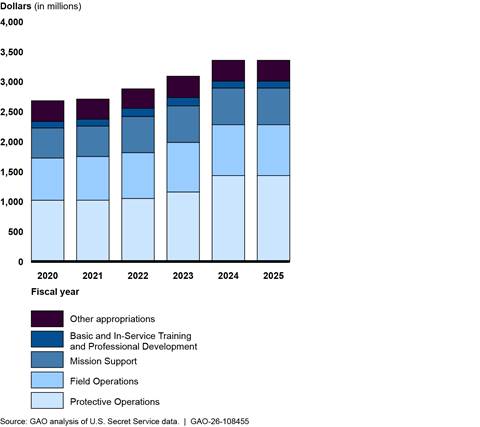
Note: The Secret Service’s total enacted budget includes funding for both its protective and investigative missions. “Other appropriations” include three additional categories (1) “Contributions for Annuity Account” which refers to payments personnel receive once they retire from the Secret Service; (2) “Procurement, Construction, and Improvements” which refers to obtaining assets, erecting, expanding, or improving facilities; and, (3) “Research and Development” which refers to identifying, exploring, and demonstrating new technologies and capabilities related to the Secret Service mission. In addition to the amounts identified in the figure, the Secret Service also received protection-related supplemental appropriations that were separate from the Secret Service annual appropriations.
The Secret Service’s total enacted budget accounts for recurring protective needs, such as securing national special security events including the United Nations General Assembly, State of the Union addresses, presidential addresses to Joint Sessions of Congress with the Supreme Court in attendance, and state funerals in the National Capital Region. The Secret Service noted cost drivers for these activities include lodging, transportation, and other services from non-federal sources. From fiscal year 2020 through fiscal year 2025, the programs, projects, and activities include the following:
· Protective Operations. This program received the most funding across each year—with $1.02 billion (38 percent) in fiscal year 2020 and $1.43 billion (43 percent) of the Secret Service’s total enacted budget in fiscal year 2025. “Protective Operations” funds the protection of individuals, including the President, the Vice President, their families, visiting foreign dignitaries, and others. Protective Operations also funds the security of locations, including the White House Complex, and certain events, such as national special security events.
· Field Operations. This program received the next highest funding across each year—with $703.98 million (26 percent) in fiscal year 2020 and $848.80 million (25 percent) of the Secret Service’s total enacted budget in fiscal year 2025. “Field Operations” funds activities of domestic and foreign field offices, headquarters divisions, and the Cyber Fraud Task Forces of the Office of Investigations. This program funds activities that support detection and investigation of criminal activity, and includes support for traveling protective details, protective advance work, and protection of national special security events.
· Mission Support. This program received the next highest funding across each year—with $500.45 million (19 percent) in fiscal year 2020 and $610.54 million (18 percent) of the Secret Service’s total enacted budget in fiscal year 2025. “Mission Support” funds enterprise management and administrative services that sustain day-to-day business management operations, some of which is related to protection, such as agency planning and performance management, oversight of travel requests, and acquiring goods and services.
· Basic and In-service Training and Professional Development. This program received the least funding across each year—with $110.53 million (4.1 percent) in fiscal year 2020 and $115.84 million (3.5 percent) of the Secret Service’s total enacted budget in fiscal year 2025. “Basic and In-Service Training and Professional Development” funds basic and advanced training, including protection-related training, as well as supplies, equipment, and upkeep of the James J. Rowley Training Center.
· Other. Other programs received combined funding of $344.44 million (12.8 percent) in fiscal year 2020 and $347.82 million (10.4 percent) of the Secret Service’s total enacted budget in fiscal year 2025. These programs include three categories (1) “Contributions for Annuity Account” which refers to payments personnel receive once they retire from the Secret Service; (2) “Procurement, Construction, and Improvements” which refers to obtaining assets, erecting, expanding, or improving facilities; and, (3) “Research and Development” which refers to identifying, exploring, and demonstrating new technologies and capabilities related to the Secret Service mission.
From fiscal year 2020 through fiscal year 2025, the Secret Service received protection-related supplemental appropriations that were separate from the Secret Service annual appropriations. Specifically, in September 2024, the Secret Service was appropriated $231 million for operations necessary to carry out protective operations, including the 2024 presidential campaign and national special security events upon the Secret Service transmitting information responsive to congressional inquiries into the assassination attempt of then-former President Trump.[38]
Number of Secret Service Full-Time Protectees Varied, Peaking During Presidential Administration Changes, During Fiscal Years 2015–2025
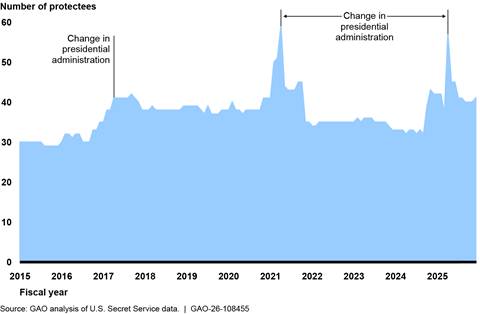
The number of Secret Service full-time protectees varied from fiscal year 2015 through fiscal year 2025, from an annual low of 30 protectees on average in fiscal year 2015 to a high of 45 protectees on average in fiscal year 2021.[39] According to our analysis, several factors contributed to the variation in the number of Secret Service full-time protectees. These factors include the sitting President’s family size, the number of protectees for whom the President directs protection, the number of major presidential and vice presidential candidates identified during a presidential campaign, and the number of protectees during presidential administration changes.
For example, during presidential administration changes, the Secret Service was generally responsible for the highest number of full-time protectees, with 41 protectees in January 2017, 59 protectees in January 2021, and 57 protectees in January 2025. Additional protectees for whom the Secret Service would be responsible during a presidential administration transition include the sitting President and Vice President, the President-elect and Vice President-elect, and their families. See figure 4 for additional information on variation in the number of Secret Service full-time protectees from fiscal year 2015 through fiscal year 2025.
During this time frame, the July 2024 attempt to assassinate then-former President Trump also resulted in the Secret Service providing enhanced protection. The Enhanced Presidential Security Act of 2024, enacted following that assassination attempt, extended the same standards for assigning agents to major candidates as previously applied solely to the President and Vice President.[40] To address this law, the Secret Service updated a policy in April 2025 that included minimum protective detail staffing requirements for certain protectees.[41]
Specifically, the President, Vice President, President-elect, Vice President-elect, and major presidential and vice presidential candidates are now assigned certain advance team members, including a field office supervisor, lead advance agent, site agent, and others. Further, after the assassination attempt of then-former President Trump, Secret Service officials noted that a number of protectees received enhanced security after July 2024. For example, according to these officials, the protection of then-former President Trump and then-Vice President Kamala Harris were elevated to that of a sitting U.S. President.
The Secret Service Secured More Visits Involving Foreign Dignitaries Than
Other Protectees, Including Sitting U.S. Presidents, During Fiscal Years
2015–2025
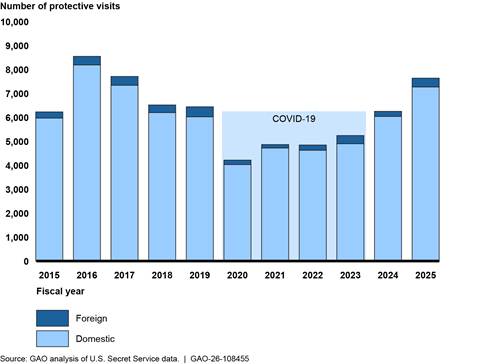
The Secret Service conducted a total of 68,518 protective visits from fiscal year 2015 through fiscal year 2025. Of those visits, 65,301 (95.3 percent) were domestic—meaning they took place within the U.S., including visits involving foreign dignitaries—and 3,217 (4.7 percent) were abroad.
During the COVID-19 pandemic, from fiscal year 2020 through fiscal year 2023, the Secret Service conducted fewer domestic and foreign protective visits. Specifically, the Secret Service conducted 4,792 protective visits on average each year from fiscal year 2020 through 2023, compared to 6,947 protective visits on average each year from fiscal year 2024 through 2025. See figure 5 for information on Secret Service domestic and foreign protective visits from fiscal year 2015 through fiscal year 2025.
Figure 5: Secret Service Domestic and Foreign Protective Visits, By Location, Fiscal Years 2015–2025
From fiscal year 2015 through fiscal year 2025, the Secret Service conducted more visits involving foreign dignitaries than for other protectees, including the sitting U.S. President and First Family. Specifically, in fiscal year 2025, of the 7,641 protective visits, 2,113 visits (28 percent) involved foreign dignitaries, and 1,829 visits (24 percent) involved the sitting U.S. President and First Family. Each year, except during the COVID-19 pandemic, the Secret Service secured the highest number of foreign dignitaries in September because of individuals attending the United Nations General Assembly, which convenes annually in September. For example, in fiscal year 2025, of the 2,113 visits involving foreign dignitaries, 915 visits (43 percent) occurred in September. See figure 6 for more information about Secret Service protective visits by protectee type from fiscal year 2015 through fiscal year 2025.
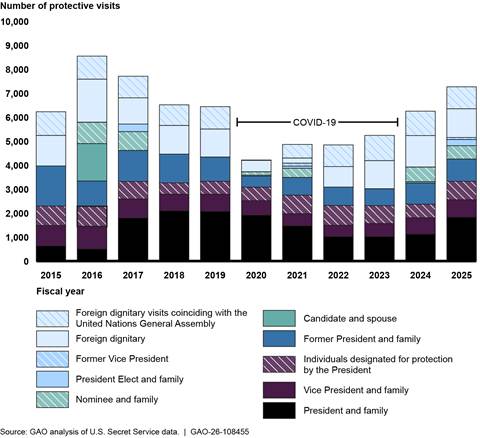
Note: The Secret Service refers to the protection of individuals designated by the President as “Presidential memoranda” protectees. The Secret Service is authorized under 18 U.S.C. § 3056(a)(7) to protect major presidential and vice presidential candidates and, within 120 days of a general presidential election, the spouses of such candidates. The Secretary of Homeland Security, in consultation with an advisory committee consisting of the Speaker of the House, House Minority Leader, Senate Majority Leader, Senate Minority Leader, and one additional member chosen by the other members of the committee, designate major presidential and vice presidential candidates and nominees to be protected by Secret Service. Id.
Secret Service Has Not Documented Its Rationale for Not Updating Protection Policies After Incidents or Made Timely Updates
The Secret Service has not documented its rationale in cases where it decided to maintain the status quo and not make protection policy updates in response to security incidents that the agency designates as unusual protective events.[42] In addition, the Secret Service has not consistently reviewed and updated its protection policies within required time frames.
The Secret Service Has Not Documented Why Some Security Incidents Did Not Warrant a Policy Update
The Secret Service’s May 2026 policy on security incident reporting requires its personnel to document security incidents on a form, which includes whether immediate protection policy changes were made, within 7 calendar days following an incident. This policy also states that the Office of Protective Operations is to review all information created or maintained related to a security incident to identify operational-related deficiencies and actions that need to be taken to mitigate risk, including immediate policy changes or updates. Further, the Secret Service’s policy on security incident reporting requires that incidents are to be reviewed on an annual basis, or more frequently, if needed, to ensure that documentation has been reviewed and maintained.[43] As shown in figure 7, from fiscal year 2015 through fiscal year 2025, the Secret Service reviewed 83 security incidents and made protection policy changes in response to 25 of them.[44]
Figure 7: Secret Service Protection Policy Changes in Response to Security Incidents, Fiscal Years 2015–2025
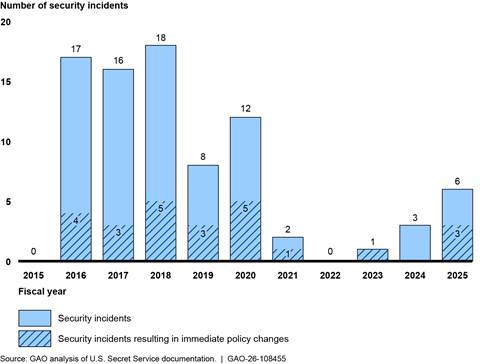
Note: The Secret Service refers to security incidents as unusual protective events. These incidents most commonly involved unlawful entry into a protected location, encountering suspicious vehicles, and disruptions, such as disruption of a protectee’s motorcade route. The Secret Service provided documentation on 83 reports of security incidents. This figure excludes information from one security incident for which Secret Service officials could not provide documentation regarding whether it resulted in immediate protection policy changes (i.e., within 7 calendar days). The Secret Service updated protection policies in response to 25 of 83 security incidents.
Secret Service officials said some security incidents did not require an immediate protection policy change because they did not identify any operational deficiencies, incident mitigation strategies were effective, and the incidents did not result in harm to a protectee or disruption of an event. However, Secret Service security incident reporting policy does not require its personnel to document their rationale in the relevant form when they decide an incident does not warrant a protection policy change.
|
Secret Service Security Incidents Involving Drones in 2015, 2016, and 2021 · In December 2015, on a return trip from a golf outing, an individual operated a drone that inadvertently came into contact with President Barack Obama’s motorcade in Hawaii. · In May 2016, an individual flew a drone approximately 200 feet over a crowd at a rally in San Jose, California, for then-presidential candidate Bernie Sanders. · In January 2021, Secret Service personnel observed multiple drones at the Presidential Inauguration shortly before then-President Joe Biden arrived. The Secret Service personnel did not immediately identify that the drones were U.S. Customs and Border Protection’s authorized aircraft. Following the incident, the Secret Service made an immediate policy change to clarify who within the Secret Service has lead responsibility for drone countermeasures. In each of these incidents, the Secret Service did not make policy updates to address when civilians use drones and cause a security incident. Source: GAO review of U.S. Secret Service information. | GAO‑26‑108455 |
For example, the Secret Service encountered three incidents involving drones in 2015, 2016, and 2021, and did not update its protection policies to address civilian use of drones after any of these incidents.[45] In addition, it did not document the rationale for maintaining the status quo.
In July 2024, a drone was used during the assassination attempt targeting then-former President Donald Trump. The shooter at the Butler, Pennsylvania rally successfully flew the drone for approximately 11 minutes over the crowd, which helped the shooter position himself to fire at then-former President Donald Trump, wounding him and two others, and killing a rally attendee.
If Secret Service officials had documented the rationale for maintaining the status quo after the incidents involving drones in 2015, 2016, and 2021, that information could have been available for consideration as part of the Secret Service’s annual review process, potentially illustrating the emerging trend of drone involvement in security incidents prior to a drone being used in the 2024 assassination attempt.[46]
In 2025, the Secret Service established a new Protective Readiness section, and in February 2026, issued related guidance.[47] This guidance specifies that the Secret Service is to review security incidents continuously to identify recurring issues and risks, in addition to annual or more frequent reviews required in the Secret Service’s incident reporting policy. However, neither the incident reporting policy or the protective readiness guidance require Secret Service personnel to document their rationale for maintaining the status quo after incidents.
Secret Service officials acknowledged that documenting their rationale for maintaining the status quo could be important to reflect that the incident was fully reviewed and the decision to not make a protection policy change was deliberate and based on a risk assessment. Revising the security incident reporting policy to require Secret Service personnel document in the standard form their rationale when they decide a security incident does not warrant a protection policy change could help the Secret Service have more complete information when considering protection policy updates to help prevent such incidents from happening again.
The Secret Service Has Not Consistently Reviewed and Updated Its Protection Policies Within Required Time Frames
The Secret Service has not consistently reviewed and updated its protection policies within 4 years as required. Secret Service’s March 2022 policy on issuing, maintaining, and organizing protection policies states that the office responsible for a given protection policy is to review and update the policy no later than 4 years from its original issuance date to integrate any operational or procedural changes that may have affected its overall content. If no changes are necessary, the March 2022 policy specifies that the office is to reauthorize the protection policy via a new policy memorandum.[48]
Our analysis of Secret Service protection policies issued from 2001 through 2025 found that the Secret Service had reviewed and updated 14 of 22 protection policies related to domestic and foreign protective advance planning within 4 years of their issuance dates. For example, in May 2025, the Secret Service updated its policy for establishing and maintaining communications systems for a protective advance.[49] By updating this policy, the Secret Service has more resilient communication for protective advances and clarity for site security requirements.
However, our analysis found that the Secret Service has not reviewed or updated eight of the 22 protection policies related to domestic and foreign protective advance planning within 4 years of their issuance dates. These policies cover a range of guidelines for conducting advances, such as emergency situations involving protectees, foreign advances for the President and Vice President, motorcade guidance, and site security. Three of the eight policies that have not been updated are specific to foreign protective advances. For example, a Secret Service policy that its personnel use for protective advances abroad is dated July 2001. This policy includes requirements and considerations that are unique to Secret Service protection policies for the Vice President’s foreign visits.[50] For additional information on the status of Secret Service advance planning policies, see appendix VI.
Secret Service officials told us that they work to identify outdated policies and address evolving requirements, but personnel do not always follow the March 2022 policy to review and, as appropriate, update protection policies within 4 years of their issuance dates. They told us that updates are sometimes impacted by the Secret Service’s operational tempo and the ability to identify personnel to review and draft updates. We found the Secret Service’s current policy on issuing, maintaining, and organizing protection policies does not assign responsibility to specific positions within the relevant offices for ensuring protection policies are updated. Revising the policy to assign responsibility to specific positions within the relevant offices for consistently reviewing and updating protection policies within required time frames could help the Secret Service incorporate the most current protection techniques into advance planning efforts.
The Secret Service and Diplomatic Security Service Have Not Updated Their Protection Memorandum of Understanding
The Secret Service and Diplomatic Security Service entered into a protection memorandum of understanding in 1991. This memorandum delineates separate and joint roles and responsibilities for securing the President and other full-time protectees traveling abroad and foreign dignitaries traveling to the U.S.[51] The memorandum states that it is to be reviewed and updated annually or at the request of either entity to ensure the productive operation of their protective mission.
We found that the Secret Service and Diplomatic Security Service have not reviewed and updated this memorandum since it was initiated in 1991. As a result, the memorandum does not include current references to department legal authorities or current individuals and offices with protection responsibilities involved in the advance process. For example, the memorandum does not include additional protectees for whom the Secret Service is responsible, such as former Vice Presidents and their spouses, which was added in 2008.[52]
In addition, the memorandum does not address the threat of drones, technology that has become widely available since 1991 and which may enter or operate in restricted areas where protectees visit or reside.[53] Moreover, the memorandum states that the Secret Service is within the Department of the Treasury and that the Secret Service is authorized to secure individuals at the direction of the Secretary of the Treasury. However, the Secret Service has been a component within the Department of Homeland Security since March 2003.[54]
Both the Secret Service and Diplomatic Security Service referred to the memorandum as the guidance they use for conducting joint protection responsibilities. For example, the memorandum states that in cases where joint travel occurs for protectees of the Secret Service and Diplomatic Security Service, representatives of both entities will attend liaison meetings with the host country and law enforcement.
In addition, when an individual to whom the Diplomatic Security Service affords protection is in the immediate presence of an individual to whom the Secret Service affords protection, the memorandum states that the entities will work together to ensure protection of both protectees through cooperation and mutual support. In both instances, neither Secret Service nor Diplomatic Security Service current advance policies cover these aspects of coordinating.[55] Since the memorandum is outdated, personnel do not have up-to-date guidance for processes involving joint protection.
The Secret Service and Diplomatic Security Service officials acknowledged that they have not reviewed and updated the memorandum annually or as needed. Secret Service officials told us they do not think the memorandum needs to be updated. Specifically, they noted that responsibilities in the memorandum are referenced in a presidential policy directive and statutes.[56] Secret Service officials also said they believe provisions of the memorandum are consistent with relevant legal authorities.
However, based on our analysis, neither the policy directive nor the statutes cover the Secret Service’s or Diplomatic Security Service’s separate or joint roles and responsibilities for coordinating to secure full-time protectees travelling abroad or foreign dignitaries traveling to the U.S. Further, Diplomatic Security Service officials told us that while they considered updating the memorandum in 2022, they never engaged with the Secret Service and there have been no further attempts to re-define or reaffirm roles of the two entities. The Diplomatic Security Service officials also stated that operating under a memorandum from 1991 was unacceptable.
Reviewing and updating the memorandum would provide the two entities an opportunity to ensure that their personnel understand their responsibilities for responding to evolving roles, responsibilities, and advance techniques during joint protection operations.
Conclusions
Over the past decade, there have been multiple attacks and threats of violence against Presidents and other political leaders. Against this backdrop, the Secret Service is responsible for the challenging mission of protecting high-profile individuals from harm. The Secret Service is widely viewed as a role model agency emulated by others with protection responsibilities. For both its protectees and other protective entities, it is important that the Secret Service consistently reviews and updates its protection policies in response to emerging threats and new information.
More often than not, the Secret Service has not updated its protection policies following security incidents, and Secret Service policy does not require its personnel to document their rationale for maintaining the status quo in these instances. As a result, the Secret Service does not have complete information when considering whether to update protection policies during annual reviews. Some of the missing information has been relevant to subsequent attacks. For example, the Secret Service did not document its rationale for maintaining the status quo following multiple incidents involving drones from 2015 to 2021. In July 2024, an attacker used a drone in the assassination attempt of then-former President Trump. Revising its security incident reporting policy to require documentation of the rationale for decisions to maintain the status quo after security incidents would provide the Secret Service with more complete information when considering protection policy updates intended to mitigate future threats.
Additionally, Secret Service officials have not reviewed and updated several documents governing protection policies within required time frames. The Secret Service has not consistently followed its policy to review and update protection policies within 4 years of issuance. Revising its policy to assign an individual within the relevant offices to consistently review and update protection policies within required time frames could help the Secret Service incorporate current protection techniques.
Further, the Secret Service’s memorandum of understanding with the Diplomatic Security Service has not been updated since 1991 despite the memorandum’s requirement that it be reviewed and updated annually. Much has changed over the intervening years, and by ensuring that their staff review and update the memorandum, the Secret Service and Diplomatic Security Service could improve how they respond to evolving roles, responsibilities, and advance techniques under joint protection scenarios.
Recommendations for Executive Action
We are making a total of four recommendations, including three to the Secret Service and one to the Department of State. Specifically:
The Director of the U.S. Secret Service should revise its policy on security incident reporting to require its personnel to document their rationale in the standard form when they decide a security incident (i.e., unusual protective event) does not warrant a protection policy change. (Recommendation 1)
The Director of the U.S. Secret Service should revise its policy on issuing, maintaining, and organizing protection processes to assign responsibility to specific positions within the relevant offices for consistently reviewing and updating protection policies within required time frames. (Recommendation 2)
The Director of the U.S. Secret Service, in collaboration with the Assistant Secretary of State for Diplomatic Security, should review and update the 1991 memorandum of understanding that delineates separate and joint roles and responsibilities for securing the President and other full-time protectees traveling abroad, and foreign dignitaries traveling to the U.S. (Recommendation 3)
The Secretary of State should direct the Assistant Secretary of State for Diplomatic Security, in collaboration with the Director of the U.S. Secret Service, to review and update the 1991 memorandum of understanding that delineates separate and joint roles and responsibilities for securing the President and other full-time protectees traveling abroad, and foreign dignitaries traveling to the U.S. (Recommendation 4)
Agency Comments and Our Evaluation
We provided a draft of this report to the Departments of Homeland Security, Justice, and State. The Departments of Homeland Security and State provided written comments that are reprinted in appendixes VII and VIII, respectively, and summarized below. The Departments of Homeland Security and Justice provided technical comments, which we addressed as appropriate.
The Department of Homeland Security concurred with our three recommendations to the Director of the Secret Service. Regarding the recommendation for the Secret Service to revise its policy to require personnel to document their rationale when they decide a security incident does not warrant a policy change, the department stated that the Secret Service will update its policy to require the remedial activities section in incident after-action reports to include the rationale for when incidents do not warrant a policy change. This action could address the intent of our recommendation to help the Secret Service have complete information when considering protection policy updates to help prevent such incidents from happening again.
For the recommendation for the Secret Service to revise its policy to assign responsibility to specific positions for reviewing and updating protection policies within required time frames, the department stated the Secret Service will update its policy to require each directorate to identify a point of contact responsible for these activities. Further, the department noted that in cases where a directorate is unable to meet review time frames, the responsible contact will coordinate with the Secret Service Office of Strategy, Planning, and Innovation to develop a plan to prioritize reviews of and updates to outdated policies. These actions could address the intent of our recommendation and help the Secret Service incorporate the most current protection techniques into advance planning efforts.
Both the Departments of Homeland Security and State concurred with our recommendations to review and update the 1991 memorandum delineating roles and responsibilities for securing full-time protectees traveling abroad and foreign dignitaries travelling to the U.S. The Department of Homeland Security stated that the Secret Service will establish a working group that will work with the Department of State, as appropriate, to review and update the memorandum. Similarly, the Department of State noted that it will initiate coordination with the Secret Service and work jointly to assess the current framework, identify any needed updates, and ensure the memorandum reflects current operational requirements and best practices. The actions identified by both departments could address the intent of the recommendations and ensure that personnel understand their responsibilities for responding to evolving roles, responsibilities, and advance techniques during joint protection operations.
In addition to concurring with our three recommendations to the Director of the Secret Service, the Department of Homeland Security asserted that the report lacked context about the extent to which the Secret Service strives to make timely policy updates. We believe the report provides appropriate context regarding the Secret Service’s effort to make timely policy updates.
We are sending this report to the appropriate congressional committees, the Secretaries of Homeland Security and State, and the Attorney General. In addition, the report is available at no charge on the GAO website at https://www.gao.gov.
If you or your staff have any questions about this report, please contact Nathan Tranquilli at TranquilliN@gao.gov. Contact points for our Offices of Congressional Relations and Media Relations may be found on the last page of this report. GAO staff who made key contributions to this report are listed in appendix IX.

Nathan Tranquilli
Acting Director, Homeland Security and Justice
Appendix I: Secret Service, Diplomatic Security Service, and U.S. Marshals Service Protectees as of Fiscal Year 2025
Table 3 provides the number of full-time protectees for the Secret Service, Diplomatic Security Service, and U.S. Marshals Service, as well as examples of full-time and temporary protectees for each entity, as of fiscal year 2025.
Table 3: Number of Full-Time Protectees and Examples of Protectees for the Secret Service, Diplomatic Security Service, and U.S. Marshals Service as of Fiscal Year 2025
|
Agency |
Number of full-time protectees |
Examples of full-time and temporary protectees |
|
Secret Service |
43 (average)a |
· The President, the Vice President (or other officer next in the order of succession to the Office of the President), the President-elect, the Vice President-elect, and their immediate families · Former Presidents, their spouses, and their children under 16 years of age · Visiting heads of foreign states or governments and other distinguished foreign visitors to the U.S. · Official representatives of the U.S. performing special missions abroad when the president directs that Secret Service protection be provided · Major presidential and vice presidential candidates and, within 120 days of the general presidential election, the spouses of such candidatesb · Former Vice Presidents, their spouses, and their children who are under 16 years of age, for a period of no more than 6 months after the end of their incumbencyc · Other officials and executives by order of Presidential memorandumd |
|
Diplomatic Security Service |
5 |
· Heads of a foreign state, official representatives of a foreign government, and other distinguished visitors to the U.S.e · The Secretary of State and Deputy Secretary of State · Official representatives of the U.S. government traveling abroad and their immediate families · Foreign missions and international organizations within the U.S.f · Departing Secretary of State for up to 180 days after termination of their incumbency · An individual designated by the President or President-elect to serve as the Secretary of State |
|
U.S. Marshals Service |
20 (average)g |
· Supreme Court Justices when traveling outside of Washington D.C. (when requested by the Supreme Court of the United States Police Department) · Federal judges · Federal prosecutors and court officials, the Deputy Attorney General, and other executives and officials · Federal jurists, court officers, witnesses, and other threatened people in the interest of justice where criminal intimidation impedes on the functioning of the judicial process or any other official proceeding · The Secretary of Health and Human Services · The Office of Management and Budget Director |
Source: GAO analysis of the U.S. Secret Service, Diplomatic Security Service, and U.S. Marshals Service information. | GAO‑26‑108455
Note: For this report, “full-time protectee” refers to individuals federal entities protect on a permanent basis, such as the Secret Service protecting the President and Vice President and Diplomatic Security Service protecting the Secretary of State. In addition to full-time protectees, these entities may also protect individuals on a temporary basis, such as for a predetermined length of time or for the duration of a specific trip (e.g., Diplomatic Security Service providing protection for a visiting foreign dignitary only for the time in which they are in the U.S.).
aIn fiscal year 2025, the Secret Service protected, on average, 43 full-time protectees. Throughout this time frame, the Secret Service protected a low of 37 and a high of 57 full-time protectees.
bMajor presidential and vice presidential candidates refer to individuals identified as such by the Secretary of Homeland Security after consultation with an advisory committee consisting of the Speaker of the House of Representatives, the minority leader of the House of Representatives, the majority and minority leaders of the Senate, and one additional member selected by the other members of the committee. 18 U.S.C. § 3056(a)(7).
cThe Secretary of Homeland Security shall have the authority to direct the Secret Service to provide temporary protection for any of these individuals at any time thereafter if the Secretary or designee determines that information or conditions warrant such protection. 18 U.S.C. § 3056(a)(8).
dThe Secret Service refers to the protection of additional individuals specifically designated by the President as “Presidential Memoranda” protectees. See 18 U.S.C. § 3056(a)(6).
eDiplomatic Security Service only provides protection while the protectee is in the U.S.
f”Foreign mission” generally means any mission to or agency or entity in the U.S. which is involved in the diplomatic, consular, or other activities of, or which is substantially owned or effectively controlled by a foreign government or an organization (other than an international organization, as defined in 22 U.S.C. § 4309(b)) representing a territory or political entity which has been granted diplomatic or other official privileges and immunities under the laws of the U.S. or which engages in some aspect of the conduct of the international affairs of such territory or political entity, including any real property of such a mission and including the personnel of such a mission. 22 U.S.C. § 4302(a)(3). “International organization” generally means a public international organization designated as such pursuant to the International Organizations Immunities Act (22 U.S.C. §§ 288-288f-2) or a public international organization created pursuant to a treaty or other international agreement as an instrument through or by which two or more foreign governments engage in some aspect of their conduct of international affairs, and an official mission (other than a U.S. mission) to such a public international organization, including any real property of such an organization or mission and including the personnel of such an organization or mission. 22 U.S.C. § 4309(b).
gIn fiscal year 2025, U.S. Marshals Service protected, on average, 20 full-time protectees.
|
Secret Service Career Progression Phases · Phase I. At the beginning of a Special Agent’s career, they are typically assigned to a field office for 3-4 years. · Phase II. After completing Phase I, a Special Agent is typically assigned to a permanent protective division located in Washington, D.C. for 6-8 years. · Phase III. After completing Phase II, a Special Agent may either o opt-in to continue in their current protective assignment, o request a transfer to another permanent protective assignment, o request a transfer to a Washington, D.C.-based headquarters or training assignment, or o request reassignment to a field office. Phase III assignments typically last 3 years. Source: GAO summary of U.S. Secret Service information. | GAO‑26‑108455 |
The Secret Service has a process to identify whom to assign to protective divisions.[57] According to Secret Service officials, each year, the Secret Service Special Agent Reassignment Committee, comprised of managers of multiple Secret Service directorates, will review a list of Special Agents who may be eligible to be assigned to protective divisions based on meeting physical fitness and length of service requirements. Then, the committee will assign eligible Special Agents to protective divisions with position vacancies. Before serving in divisions, Special Agents will complete protective detail training, where they must meet a minimum threshold of physical fitness. Once they complete training, they will report to their division.
According to Secret Service officials, filling advance team assignments varies among the protective divisions.
· Presidential and Vice Presidential Protective Divisions. Secret Service officials stated that the protective divisions fill advance teams for the President, Vice President, President-Elect, and Vice President-Elect. The operations sections solicit personnel through shift leaders. According to Secret Service officials, the shift leader then submits selected personnel to the operations sections based on merit, experience, ongoing advance progression, and availability. Secret Service officials also noted that the operations sections compile final lists to submit to protective division leadership. Protective division leadership then select the staff for advance teams.
· Former President Protective Divisions. Secret Service officials stated that the protective divisions fill advance teams for former presidents. They fill advance team leadership roles, such as the lead advance agent or site agent, from protective division personnel. Secret Service officials also stated that roles not filled by protective division personnel will be filled by the local Secret Service field office overseeing the visit or other field offices if there are manpower constraints.
· Candidate Nominee Operations Section. Secret Service officials stated that the local Secret Service field office fills advance teams for visits involving a presidential candidate or nominee or vice presidential candidate or nominee. The operations section fills these teams the year before a campaign begins. The section will initially fill them by the local Secret Service field office personnel where the event will be held. Secret Service officials also stated that if the local field office is unable to staff the advance team, the section will select Special Agents currently serving a 21-day rotation with the division.
Table 4 provides additional details on the Secret Service, Diplomatic Security Service, and U.S. Marshals Service advance protective planning policies for domestic advances as of fiscal year 2025. It is organized by the Secret Service’s five-phase advance planning process.[58]
|
Phase |
Secret Service |
Diplomatic Security Service |
U.S. Marshals Service |
|
Notification |
The protectee’s staff notifies the Secret Service protective division of a planned visit. The protective division then notifies the Office of Protective Operations, the affected field office(s), and any other divisions that may be involved in the visit. |
The Office of Protection submits an Action Memo to the Office of the Secretary for approval. |
The Chief Inspector sends a Detail staffing request to District or Division management. |
|
Pre-Advance |
The Secret Service conducts a preliminary visit to the location where the event is to occur. The pre-advance team evaluates a tentative schedule and develops a proposed itinerary for the protectee.a |
The Protective Liaison Division or Dignitary Protection facilitates walkthroughs at local airports, the U.S Capitol, or the White House. |
The advance agent schedules a site visit and conducts a walkthrough prior to the protectee visit. |
|
Coordination and site security |
The protective detail reviews the initial threat assessments prepared by the Protective Intelligence and Assessment Division. The Special Agent in Charge, in coordination with the lead advance agent, meets with relevant police and other officials to request assistance. Secret Service advance team members, protectee’s staff, and others conduct a walkthrough to assess the site. Advance team members also request and review copies of operational plans prepared by law enforcement partners. |
Dignitary Protection Advance agents begin the advance coordination and site security efforts, including planning meetings with staff and law enforcement agencies. Advance agents will conduct site surveys of locations to be visited, hotels, or other officially scheduled meeting sites. |
The Office of Protective Operations Senior Inspector evaluates potential threats and gathers intelligence. The Senior Inspector then develops security plans and arrangements. Finally, the Senior Inspector conducts a security assessment of the site. |
|
Resource decisions |
The site agent creates a site security plan by identifying site-specific areas of concern and determining what resources and countermeasures are needed. The lead advance agent completes a resource justification to define personnel and other resource needs, which the Office of Protective Operations reviews to assign staff for the visit. |
Following walkthroughs of the proposed venues and based on the proposed schedule and threat reporting, Diplomatic Security Service will decide whether to implement additional security features (e.g., walkthrough metal detectors). The Agent in Charge will make formal requests for personnel, services, and equipment as necessary. |
The Office of Protective Operations Senior Inspector contacts local police area command to notify them of the visit and request state and local police escorts. |
|
Implementation |
The lead advance agent conducts a final briefing for Secret Service personnel assigned to the visit to provide information on intelligence matters, emergency response plans, and other pertinent information. The lead advance agent is also responsible for the protective advance, and the site agent is responsible for implementing the procedures needed to create a secure environment at the assigned site. |
The site advance agent will be at the site prior to the arrival of the detail. After arrival, the advance agent will thoroughly brief all Special Agents regarding site security when time permits. |
The Office of Protective Operations Senior Inspector conducts the final site inspection. |
Source: GAO analysis of documentation from the U.S. Secret Service, Diplomatic Security Service, and U.S. Marshals Service. | GAO‑26‑108455
Note: Based on our analysis, the Secret Service’s protective advance planning process has five-phases: (1) “notification” in which another entity informs the Secret Service of a visit; (2) “pre-advance” in which the Secret Service conducts a preliminary visit to the location to be visited; (3) “coordination and site security” in which Secret Service staff coordinate with one another and external actors (e.g., local law enforcement) to request assistance and conduct a site survey or security assessment of the location; (4) “resource decisions,” in which the Secret Service and law enforcement entities determine the allocation of staff and assets (e.g., equipment) needed for the visit; and (5) “implementation,” in which the Secret Service executes the protective advance. We condensed the Secret Service’s seven phases of advance planning into five based on analysis of Secret Service protection planning policies. For example, we combined the Secret Service’s review of historical files of prior visits into the notification phase.
aThe Secret Service does not routinely conduct pre-advances for domestic visits. Pre-advances are conducted for Presidential and Vice Presidential foreign visits.
Table 5 provides additional details on the Secret Service, Diplomatic Security Service, and U.S. Marshals Service advance protective planning policies for foreign advances as of fiscal year 2025. It is organized by the Secret Service’s five-phase advance planning process.[59]
|
Phase |
Secret Service |
Diplomatic Security Service |
U.S. Marshals Service |
|
Notification |
The Secret Service Protective Division Operations Section coordinates with the Department of State and the appropriate U.S. Embassy through the responsible Secret Service foreign office and facilitates completion of paperwork (e.g., country clearances). Upon arrival, the lead advance agent, through the Special Agent in Charge of the field office, notifies the Ambassador, Deputy Chief of Mission, or the Regional Security Officer. |
Diplomatic Security Service notifies the appropriate Regional Security Officer immediately about the visit. The Regional Security Officer serves as the liaison with local law enforcement and post personnel and facilitates access to embassy or consulate grounds. |
U.S. Marshals Service notifies the appropriate Embassy or Regional Security Officer of protectee travel and requests security assistance for the visit. |
|
Pre-advance |
The Secret Service’s Presidential and Vice Presidential protective divisions conduct a preliminary visit to the location to be visited by a protectee and establish agreements with appropriate partners to ensure the operational and security requirements of each protective division are met. At the conclusion of the pre-advance, the pre-advance team conducts a briefing with protective detail leadership and advance team members, including information such as foreign counterpart contacts, operational and security agreements with the host government, and any other relevant information. |
Advance agents collaborate with Regional Security Offices and travel in advance of the visit. The advance team interacts with local law enforcement and discusses operational, administrative, and logistical planning. |
The advance agent schedules a site visit and conducts a walkthrough prior to the protectee visit. |
|
Coordination and Site Security |
The protective detail reviews the initial threat assessments prepared by the Protective Intelligence and Assessment Division. Prior to departing Washington, D.C., the foreign lead advance agent plans for country briefings, country and weapons clearances, advance team logistics, room and vehicle builds, and post stander schedules, among other things. Advance team personnel conduct meetings for embassy staff, host governments, and foreign police. The lead advance agent coordinates the activities of all advance team members and maintains liaison with White House Staff; Embassy personnel; and local police, and others.a |
Diplomatic Security Service reviews threat reporting, the planned guest list, and the public’s access to the venue to determine if it should implement additional security features (e.g., walkthrough metal detectors). Advance agents begin the advance coordination and site security efforts, including planning meetings with staff and law enforcement agencies. Advance agents will conduct site surveys of locations to be visited as well as hospitals and emergency planning elements. |
U.S. Marshals Service coordinates all security arrangements for the site, including the establishment of secure areas, identification and neutralization of hazards, and mitigation of any risk of harm or embarrassment. It also coordinates with the Embassy to discuss visit logistics, obtain weapons clearance, and arrange a security briefing for detail members. Additionally, it evaluates potential threats, conducts a site survey, and gathers intelligence. |
|
Resource Decisions |
The foreign field office Special Agent in Charge determines the foreign government’s assets available to support the visit (e.g., personnel, protective vehicles, etc.). The Special Agent in Charge assigns the necessary number of district supervisors and field office personnel. |
The Diplomatic Security Service Office of Protection determines the scope and staffing of the advance based on the threat reporting, official schedule, locations to be visited, and available support levels by host government law enforcement partners. |
U.S. Marshals Service assigns a Senior Inspector from the region of the visit as the Agent in Charge of the protective operation. |
|
Implementation |
The lead advance agent conducts a final briefing for Secret Service personnel assigned to the visit to provide information on intelligence matters, emergency response plans, and other pertinent information. The lead advance agent is also responsible for the protective advance, and the site agent is responsible for implementing the procedures needed to create a secure environment at the assigned site.b |
The site advance agent arrives to the site prior to the arrival of the detail. After arrival, the advance agent thoroughly briefs all Special Agents regarding site security. |
An Office of Protective Operations Senior Inspector conducts the final site inspection. |
Source: GAO analysis of documentation from the U.S. Secret Service, Diplomatic Security Service, and U.S. Marshals Service. | GAO‑26‑108455
Note: Based on our analysis, the Secret Service’s protective advance planning process has five-phases: (1) “notification” in which another entity informs the Secret Service of a visit; (2) “pre-advance” in which the Secret Service conducts a preliminary visit to the location to be visited; (3) “coordination and site security” in which Secret Service staff coordinate with one another and external actors (e.g., local law enforcement) to request assistance and conduct a site survey or security assessment of the location; (4) “resource decisions,” in which the Secret Service and law enforcement entities determine the allocation of staff and assets (e.g., equipment) needed for the visit; and (5) “implementation,” in which the Secret Service executes the protective advance. We condensed the Secret Service’s seven phases of advance planning into five based on analysis of Secret Service protection planning policies. For example, we combined the Secret Service’s review of historical files of prior visits into the notification phase.
aSecret Service officials stated that they rely on foreign support to maintain control of the site during a protectee visit.
bSecret Service officials stated that they rely on foreign support to maintain control of the site during a protectee visit.
Appendix V: Selected Federal Entities’ Foreign Dignitary Advance Planning Policies as of Fiscal Year 2025
Table 6 provides additional details on the Secret Service’s and Diplomatic Security Service’s advance planning policies for foreign dignitary advances to the U.S. as of fiscal year 2025. It is organized by the Secret Service’s five-phase advance planning process.[60]
Table 6: Secret Service’s and Diplomatic Security Service’s Advance Planning Policies for Foreign Dignitary Advances to the U.S. as of Fiscal Year 2025
|
Phase |
Secret Service |
Diplomatic Security Service |
|
Notification |
The Dignitary Protective Division receives notification of a foreign dignitary visit from an embassy or mission, the Department of State, or the White House. The lead advance agent coordinates with U.S. federal entities to request that the dignitary be given expedited customs and immigration requirements to facilitate movement of the dignitary and their staff. Additionally, the lead advance agent or the site agent advises the Transportation Security Administration and airline officials that a foreign dignitary will be travelling on a specific flight, and advance personnel ensure foreign security staff obtain necessary weapon authorizations. |
Foreign missions make dignitary requests to the Department of State via diplomatic note or note verbale. Upon receiving the request, the Dignitary Protection Division reviews it and asks the Office of Intelligence and Threat Analysis to conduct an analysis. The Dignitary Protection Division determines whether to accept or decline the request. Prior to the protectee’s arrival, the lead advance agent prepares to ensure the protectee’s safety upon arrival and during the visit. |
|
Pre-advance |
Secret Service policy does not include pre-advance visits as part of its foreign dignitary protective advance process. According to Secret Service officials, sometimes a foreign country will conduct a pre-advance ahead of a visit, which may involve the Dignitary Protective Division and local field office. |
Diplomatic Security Service policy does not include pre-advance visits as a mandatory part of its foreign dignitary protective advance process. However, pre-advances may be approved considering the complexity of a visit, threat considerations, or other factors. |
|
Coordination and Site Security |
The detail leader discusses the visit with the field office Special Agent in Charge and briefs the chief or head of state or government protectees about Secret Service protective policy. On an annual basis, the Dignitary Protective Division conducts a reassessment of all chief or heads of state or government threat levels. The division may elevate or lower the threat levels at the discretion of the Dignitary Protective Division Special Agent in Charge in consultation with the Office of Protective Operations Assistant Director. |
The site advance agent conducts a site survey that includes all pertinent security and logistic information. The Agent in Charge is responsible for planning, administering, and supervising the protective detail and makes initial contacts and formal requests as necessary to meet the projected requirements for the visit. |
|
Resource Decisions |
The detail leader discusses the deployment of resources to address vulnerabilities with the field office Special Agent in Charge. The Dignitary Protective Division determines the size of the detail and protective assets based on a combination of factors, including the security level designation, type of visit, travel schedule, public exposure of the visit, and the size and scope of the locations the foreign dignitary will visit. |
The Office of Protection determines the scope and staffing of advance elements based on the initial reporting, official schedule, locations to be visited, and available support levels by law enforcement partners. |
|
Implementation |
The detail leader and advance team implement the security arrangements for the visit. The site agent establishes a secure environment. |
The site advance agent arrives at the site prior to the arrival of the protective detail to meet the motorcade and lead all walking formations. The lead advance agent supervises the advance team and is responsible for all aspects of the advance. |
Source: GAO analysis of interviews and documentation from the U.S. Secret Service and Diplomatic Security Service. | GAO‑26‑108455
Note: Based on our analysis, the Secret Service’s protective advance planning process has five-phases: (1) “notification” in which another entity informs the Secret Service of a visit; (2) “pre-advance” in which the Secret Service conducts a preliminary visit to the location to be visited; (3) “coordination and site security” in which Secret Service staff coordinate with one another and external actors (e.g., local law enforcement) to request assistance and conduct a site survey or security assessment of the location; (4) “resource decisions,” in which the Secret Service and law enforcement entities determine the allocation of staff and assets (e.g., equipment) needed for the visit; and (5) “implementation,” in which the Secret Service executes the protective advance. We condensed the Secret Service’s seven phases of advance planning into five based on analysis of Secret Service protection planning policies. For example, we combined the Secret Service’s review of historical files of prior visits into the notification phase.
Table 7 includes a list of all 22 Secret Service policies for domestic and foreign advances as of July 2026. The table lists each policy, its current effective date, and whether the Secret Service has updated or reauthorized it within the 4-year time frame required by agency policy.[61] As of July 2026, eight of the 22 policies (36 percent) have not been updated or reauthorized within four years of issuance.
Table 7: Update or Reauthorization Status of Secret Service Advance Planning Policies as of July 2026
|
Secret Service policy |
Current effective date |
Updated within 4 years |
|
Vice Presidential Protective Division (VPD)-05: Foreign Advance |
Jul. 16, 2001 |
No |
|
Dignitary Protective Division (DPD)-09(04): Foreign Dignitary Identification |
Jul. 13, 2004 |
No |
|
DPD-08: Equipment and Equipment Tracking |
Jul. 13, 2004 |
No |
|
Office of Protective Operations (OPO)-13: Crisis/Emergency Situations Involving Protectees |
Aug. 24, 2007 |
No |
|
Presidential Protective Division (PPD)-05: Foreign Advance |
June 2, 2015 |
No |
|
DPD-03(03): Motorcades |
May 5, 2019 |
No |
|
OPO-05: Foreign Visit Procedures |
Dec. 20, 2019 |
No |
|
OPO-06: Site Security |
May 10, 2022 |
No |
|
OPO-07: Motorcades |
Mar. 22, 2023 |
Yes |
|
OPO-04: Protective Advance Guidelinesa |
June 20, 2023 |
Yes |
|
DPD-03(04): Visit Procedures and Logistics |
Aug. 28, 2023 |
Yes |
|
DPD-03(01): Foreign Dignitary Visits and Protective Details |
Feb. 16, 2024 |
Yes |
|
OPO-02: Protective Operations – General |
Mar. 27, 2024 |
Yes |
|
OPO-16: Suicide/Homicide Bomber Advance Guidelines and Response Procedures |
Apr. 30, 2024 |
Yes |
|
OPO-24: Protective Operations Staffing and Logistics |
Nov. 7, 2024 |
Yes |
|
OPO-25: Protective Operations Accountability |
Apr. 4, 2025 |
Yes |
|
OPO-03(01): Protective Advance – Overview |
Apr. 10, 2025 |
Yes |
|
OPO-03(02): Advance Team Components |
Apr. 10, 2025 |
Yes |
|
OPO-03(03): Protective Advance Meetings and Briefings |
Apr. 10, 2025 |
Yes |
|
OPO-03(04): Situation Reports |
Apr. 10, 2025 |
Yes |
|
OPO-14: Protective Surveys, Hospital Surveys, General Surveys |
May 23, 2025 |
Yes |
|
OPO-08: Communications |
May 27, 2025 |
Yes |
Source: GAO analysis of U.S. Secret Service information. | GAO‑26‑108455
aSecret Service officials noted that this policy was rendered obsolete as of February 2026.
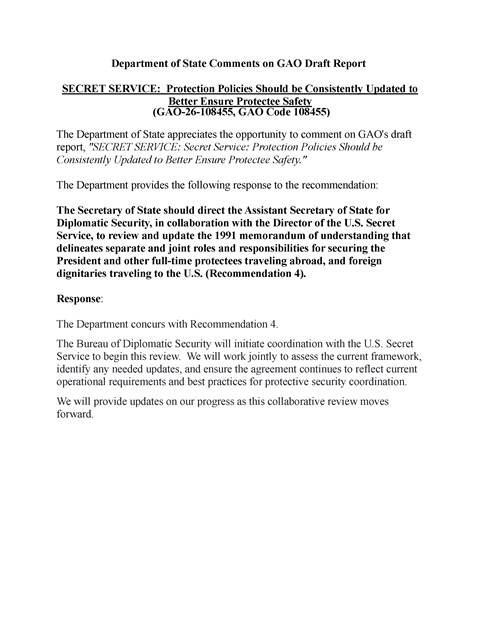
GAO Contact
Nathan Tranquilli, TranquilliN@gao.gov
Staff Acknowledgments
In addition to the contact named above, Luis E. Rodriguez (Assistant Director), Khaki LaRiviere Bryant (Analyst-in-Charge), Alyssa Skarbek, Michael Volgman-Mercuri, Triana D. McNeil, Joseph Cruz, Matthew Luciano, R.J. Taylor, Howard Arp, Lauri Barnes, Willie Commons III, Roshni Dave, Michele Fejfar, Miriam Carroll Fenton, Eric Hauswirth, Leah Nash, Jim Reynolds, and Tatiana Winger made key contributions to this report.
The Government Accountability Office, the audit, evaluation, and investigative arm of Congress, exists to support Congress in meeting its constitutional responsibilities and to help improve the performance and accountability of the federal government for the American people. GAO examines the use of public funds; evaluates federal programs and policies; and provides analyses, recommendations, and other assistance to help Congress make informed oversight, policy, and funding decisions. GAO’s commitment to good government is reflected in its core values of accountability, integrity, and reliability.
Obtaining Copies of GAO Reports and Testimony
The fastest and easiest way to obtain copies of GAO documents at no cost is through our website. Each weekday afternoon, GAO posts on its website newly released reports, testimony, and correspondence. You can also subscribe to GAO’s email updates to receive notification of newly posted products.
Order by Phone
The price of each GAO publication reflects GAO’s actual cost of production and distribution and depends on the number of pages in the publication and whether the publication is printed in color or black and white. Pricing and ordering information is posted on GAO’s website, https://www.gao.gov/ordering.htm.
Place orders by calling (202) 512-6000, toll free (866) 801-7077,
or
TDD (202) 512-2537.
Orders may be paid for using American Express, Discover Card, MasterCard, Visa, check, or money order. Call for additional information.
Connect with GAO
Connect with GAO on X,
LinkedIn, Instagram, and YouTube.
Subscribe to our Email Updates. Listen to our Podcasts.
Visit GAO on the web at https://www.gao.gov.
To Report Fraud, Waste, and Abuse in Federal Programs
Contact FraudNet:
Website: https://www.gao.gov/about/what-gao-does/fraudnet
Automated answering system: (800) 424-5454
Media Relations
Sarah Kaczmarek, Managing Director, Media@gao.gov
Congressional Relations
David A. Powner, Acting Managing Director, CongRel@gao.gov
General Inquiries
[1]GAO, Secret Service: Gaps in Policy and Threat Information Sharing Hindered Efforts to Secure 2024 Trump Campaign Rally, GAO-25-108568SU (Washington, D.C.: Jul. 11, 2025).
[2]The Secret Service refers to planning as an “advance,” which they conduct when protectees travel domestically and abroad.
[3]We made eight recommendations to the Secret Service, including (1) to develop a resource that provides agents, by role, with readily available information needed to have a clear understanding of the tasks they need to complete to properly secure a protected event; (2) to change Secret Service policies to (a) proactively share threat information internally and (b) establish methods for sharing potential trends and tactics adversaries may use against a protectee with those responsible for designing site security; (3) to develop a process to ensure actionable threat information is shared with individuals developing the site security plan; (4) to develop a readily-available list of assets that may be requested to secure protectees, along with circumstances under which they are likely to be provided; (5) to develop and implement a process that manages risks for resource allocation decisions for a protected event; (6) to adhere to existing policy or document training requirements for Secret Service counter drone operators; (7) to document requirements for the new Aviation and Air Security Division, including outlining the oversight and internal control mechanisms it will employ; and (8) to develop a policy to require the Secret Service personnel to conduct a capability assessment to identify audio and communication challenges along with mitigation measures prior to a large or complex protectee event. GAO-25-108568SU.
[4]As of July 2026, the Secret Service fully implemented three recommendations, partially addressed four recommendations, and has not taken steps to address one recommendation.
[5]We identified the following 13 federal entities: the (1) Department of the Army’s Criminal Investigation Division, (2) Department of State’s Diplomatic Security Service, (3) Department of Agriculture’s Office of Safety, Security, and Protection, (4) Department of Energy’s Office of Environment, Health, Safety, and Security’s Office of Special Operations, (5) Department of Veterans Affairs’ Office of Security and Law Enforcement, (6) Department of Transportation’s Office of Intelligence, Security, and Emergency Response, Protective Services Division, (7) Federal Reserve’s Protective Services Unit, (8) Internal Revenue Service Commissioner’s Protection Detail, (9) U.S. Capitol Police’s Protective Services Bureau, (10) Supreme Court of the United States’s Police Department, (11) U.S. Marshals Service, (12) Federal Bureau of Investigation’s Protective Security Section, and (13) U.S. Immigration and Customs Enforcement’s Homeland Security Investigations.
[6]For this report, “full-time protectee” refers to individuals federal entities protect on a permanent basis, such as the Secret Service protecting the President and Vice President and Diplomatic Security Service protecting the Secretary of State. We reviewed data and related documentation, interviewed officials or reviewed written responses from officials for obvious errors and determined the data were sufficiently reliable to describe the number of full-time protectees and protective visits.
[7]Secret Service, Office of Protective Operations (OPO)-03(01): Protective Advance Overview (Washington, D.C.: Apr. 10, 2025), OPO-05: Foreign Visit Procedures (Washington, D.C.: Dec. 20, 2019), and Dignitary Protective Division (DPD)-03(01): Foreign Dignitary Visits and Protective Details (Washington, D.C.: Feb. 16, 2024). Department of State, 12 Foreign Affairs Handbook (FAH) 2-H-100: Protective Missions of Diplomatic Security (Washington, D.C.: Mar. 29, 2019) and 12 FAH 2-H-120: Advances (Washington, D.C.: Apr. 19, 2019). U.S. Marshals Service, Procedure for Operational Advances Standard Operating Procedure Version 1.0 (Washington, D.C.: Oct. 4, 2024).
[8]We interviewed the following 10 entities: (1) the Secret Service, (2) Diplomatic Security Service, (3) U.S. Marshals Service, (4) U.S. Capitol Police, (5) the Department of Justice’s Federal Bureau of Investigation, (6) Texas Department of Public Safety, (7) Michigan State Police Department, (8) New York Police Department, (9) the Board of Executive Protection Professionals, and (10) the Department of Homeland Security’s Federal Law Enforcement Training Center. We selected the state and local entities with protection responsibilities in Texas, Michigan, and New York because federal entities suggested that we interview them. The Board of Executive Protection Professionals is a multidisciplinary standards body with members with prior service at the Secret Service, Diplomatic Security Service, and other private sector executive protection professionals. We did not count instances in which entities referred to themselves as having best practices.
[9]The Secret Service’s total enacted budget includes funding for both its protective and investigative missions.
[10]Secret Service, OSP-03(01): U.S. Secret Service Directives System (Washington, D.C.: Mar. 25, 2022). An unusual protective event is a security incident that interrupts the normal protective activities of the Secret Service. Secret Service, OPO-19: Unusual Protective Events and Incident Reporting Protocols (Washington, D.C.: May 15, 2026).
[11]For example, for the Secret Service, we reviewed Secret Service, OPO-05: Foreign Visit Procedures (Washington, D.C.: Dec. 20, 2019), Secret Service, OPO-03: Protective Advance – Overview (Washington, D.C.: Apr. 10, 2025), Secret Service, DPD-03(01): Foreign Dignitary Visits and Protective Details (Washington, D.C.: Feb. 16, 2024), and OPO-03(02): Advance Team Components (Washington, D.C.: Apr. 10, 2025). Diplomatic Security Service has two protection policies that we reviewed: 12 FAH-2 H-120, Advances (Washington, D.C.; Apr. 19, 2019) and 12 FAH-2 H-100, Protective Missions of Diplomatic Security (Washington, D.C.: Mar. 29, 2019).
[12]Secret Service officials identified a total number of 84 security incidents for fiscal years 2015 through 2025. However, of these 84 security incidents, Secret Service officials noted that they could not locate documentation of one security incident. As a result, we excluded this security incident because Secret Service officials could not tell us if it resulted in an immediate process change.
[13]OSP-03(01).
[14]18 U.S.C. § 3056(a).
[15]18 U.S.C. § 3056A(a).
[16]18 U.S.C. § 3056(b).
[17]The Vice Presidential Protective Division may provide protection to other individuals at the direction of the Director of the Secret Service, as authorized by law.
[18]18 U.S.C. § 3056(a)(4). Pursuant to 18 U.S.C. § 3056(a)(3), under the direction of the Secretary of Homeland Security, the Secret Service is generally authorized to protect former Presidents and their spouses for their lifetimes. This protection may be declined.
[19]18 U.S.C. § 3056(a)(7). The Secret Service is authorized by law to protect major presidential and vice presidential candidates and, within 120 days of a general presidential election, the spouses of such candidates. The Secretary of Homeland Security, in consultation with an advisory committee consisting of the Speaker of the House, House Minority Leader, Senate Majority Leader, Senate Minority Leader, and one additional member chosen by the other members of the committee, designate major presidential and vice presidential candidates and nominees to be protected by Secret Service. Id.
[20]The Secret Service refers to the protection of additional individuals specifically designated by the President as “Presidential Memoranda” protectees.
[21]18 U.S.C. § 3056(a)(5)-(6). According to Secret Service policy, a head of government is the leader of the ruling party and chief of the Executive Branch. Heads of government are typically found in parliamentary forms of government (i.e., Prime Minister, Chancellor, or Premier). Secret Service, DPD-03(01): Foreign Dignitary Visits and Protective Details (Washington, D.C.: Feb. 16, 2024).
[22]We condensed the Secret Service’s seven phases of advance planning into five based on our analysis of Secret Service protection planning policies. For example, we combined the Secret Service’s review of historical files of prior visits into the notification phase.
[23]Diplomatic Security Service may protect heads of a foreign state, official representatives of a foreign government, and other distinguished visitors to the U.S., while in the U.S. 22 U.S.C. § 2709(a)(3)(A). The Secret Service is authorized to protect visiting heads of foreign states or foreign governments and other distinguished foreign visitors to the U.S. and official representatives of the U.S. performing special missions abroad when the President directs that such protection be provided. See 18 U.S.C. § 3056(a)(5)-(6).
[24]28 U.S.C. § 566(e)(1)(A).
[25]For this report, “full-time protectee” refers to individuals federal entities protect on a permanent basis, such as the Secret Service protecting the President and Vice President and Diplomatic Security Service protecting the Secretary of State. Though the Secret Service, Diplomatic Security Service, and U.S. Marshals Service generally provided data about the number of full-time protectees for various years for fiscal years 2015 through 2025, we focused on fiscal year 2025 to provide the most up-to-date number of full-time protectees and to provide context for similarities and differences in protection training and service requirements.
[26]The Secret Service protects former Vice Presidents, their spouses, and their children who are under 16 years of age for a period of no more than 6 months after the date the former Vice President leaves office. The Secretary of Homeland Security may direct the Secret Service to provide temporary protection for any of these individuals at any time thereafter if the Secretary or designee determines that information or conditions warrant such protection. 18 U.S.C. § 3056(a)(8).
[27]For fiscal year 2025, the U.S. Marshals Service personnel took 1,521 personnel visits, 1,432 (94 percent) were domestic, and 89 (6 percent) were foreign.
[28]Neither the Secret Service nor Diplomatic Security Service policies include a pre-advance as part of the foreign dignitary advance planning. This is because pre-advances are generally not routine for domestic advances, of which foreign dignitary visits are a subset.
[29]For this report, “lead time” refers to the length of time between the advance team’s arrival at the site of the protectee’s planned visit and the execution of the advance.
[30]OPO-03(01).
[31]Basic training curriculum specific to protection or protection-related information lasts 4 weeks for the Secret Service, 5 weeks for Diplomatic Security Service, and approximately 4 weeks for U.S. Marshals Service.
[32]Diplomatic Security Service agents generally complete a 2-year domestic field office assignment immediately after completing training. During this period, agents may serve temporarily on permanent protective details in non-leadership roles and conduct security advances.
[33]According to the Office of Personnel Management, the General Schedule is a classification and pay system that covers the majority of civilian white-collar federal employees in professional, technical, and clerical positions. The General Schedule has 15 grades, with General Schedule 1 being the lowest and General Schedule 15 being the highest. For example, U.S. Marshals Service requirements to be a criminal investigator at the General Schedule 13 grade level state that personnel must have served at least 1 year at the General Schedule 12 grade level and performed relevant duties including conducting criminal investigations, apprehending federal fugitives, conducting investigations of threats to the judiciary and those persons designated by the Attorney General, among other things. U.S. Marshals Service officials stated that staff belonging to a General Schedule level lower than 13 may serve on protective details on a temporary basis. Officials further stated that such staff are required to take a 1-week basic protection training course from the Federal Law Enforcement Training Center before they can assume such a position.
[34]The U.S. Capitol Police is a federal agency responsible for protecting members of Congress, as well as staff, visitors, and facilities. 2 U.S.C §§ 1961(a), 1966.
[35]Additionally, three entities’ officials stated they looked to the Bureau of Alcohol, Tobacco, Firearms, and Explosives; two entities’ officials stated they looked to the Drug Enforcement Administration; one entity’s officials stated they looked to the New York City Police Department and the New York State Police Executive Services Unit; one entity’s officials stated they looked to the Department of Commerce and Department of Defense; and one entity’s officials stated they looked to U.S. Capitol Police, the Federal Bureau of Investigation, the Federal Law Enforcement Training Center’s Motorcade Operations Training Program, and a private sector entity.
[36]The Federal Bureau of Investigation provides protection for the U.S. Attorney General, Federal Bureau of Investigation Director, and Federal Bureau of Investigation Deputy Director. Department of Justice, Justice Management Division, DOJ Order 1705: Executive Protection (Washington, D.C.: Jan. 15, 2021). The Federal Bureau of Investigation may also assist in the protection of the President. See 28 U.S.C. § 533(2).
[37]The Secret Service’s total enacted budget includes funding for both its protective and investigative missions. Further, although the enacted amounts presented are not adjusted for inflation, they generally increased overall when adjusted for inflation.
[38]Continuing Appropriations and Extensions Act of 2025. Pub. L. No. 118-83, § 136, 138 Stat. 1524, 1531 (2024).
[39]For this report, “full-time protectee” refers to individuals federal entities protect on a permanent basis. Secret Service full-time protectees refer to individuals other than foreign dignitaries for which the Secret Service is responsible for their protection, such as the President, Vice President, their families, and former presidents.
[40]Enhanced Presidential Security Act of 2024, Pub. L. No. 118-91, § 2, 138 Stat. 1560, 1560 (2024).
[41]OPO-03(02).
[42]The Secret Service refers to security incidents as unusual protective events. An unusual protective event is a security incident that interrupts the normal protective activities of the Secret Service (e.g., unlawful entry at or suspicious vehicle near a protected facility, a bomb threat, or a person disrupting a protectee’s conference speech). The events are usually caused by unexpected human, technical, or physical security activities, but can also include natural disasters and accidental fires. Secret Service, OPO-19: Unusual Protective Events and Incident Reporting Protocols (Washington, D.C.: May 15, 2026).
[43]OPO-19.
[44]Over the course of our review, the Secret Service could not readily retrieve documentation of all 84 security incidents from fiscal year 2015 through fiscal year 2025. Secret Service officials were unable to locate forms for four incidents that occurred in fiscal years 2018 and 2024 at the White House Complex and a protected location of then-former President Trump in Nashville, Tennessee. Subsequently, Secret Service officials located forms for three of the four incidents and could not explain why the other form was missing. We excluded the missing security incident form because Secret Service officials could not tell us if it resulted in an immediate policy change. As a result of our review, Secret Service officials noted in April 2026 that they are developing an improved methodology for intake and processing of incidents.
[45]For this report, “drone” refers to unmanned aircraft vehicles and systems. An unmanned aircraft is an aircraft without the possibility of direct human intervention from within or on the aircraft. 14 C.F.R. § 1.1. Unmanned aircraft system means an unmanned aircraft and its associated elements (including communication links and the components that control the unmanned aircraft) that are required for the safe and efficient operation of the unmanned aircraft in the airspace of the U.S.
[46]OPO-19.
[47]Secret Service, Office of Protective Operations, Protective Readiness Section (Washington, D.C.: Feb. 25, 2026).
[48]The “responsible office” is the organizational unit assigned functional responsibility for the subject matter of a given policy (e.g., Office of Protective Operations for Office of Protective Operations policies). A “Policy Memorandum” is a document comprising publication information regarding the scope of a policy and an Impact Statement that provides reference to new content or revisions. Secret Service policy states that if no changes are necessary, the responsible office will reauthorize the policy via a specifically worded Policy Memorandum and revise the date on the policy to reflect the reauthorization date. Secret Service, OSP-03(01): U.S. Secret Service Directives System (Washington, D.C.: Mar. 25, 2022).
[49]Secret Service, OPO-08: Communications (Washington, D.C.: May 27, 2025). The updated version of this policy added guidance on communication methods for Secret Service personnel when establishing a primary, alternate, contingency, and emergency communications plan to ensure redundant communications.
[50]Secret Service, VPD-05: Foreign Advance (Washington, D.C.: Jul. 16, 2001).
[51]Memorandum of Understanding Between the U.S. Secret Service and the Department of State Bureau of Diplomatic Security on the Protection of U.S. and Foreign Dignitaries (Washington, D.C.: 1991). This memorandum superseded a prior document, Statement of Agreement: United States Secret Service and Department of State (Washington, D.C.: Jan. 24, 1979).
[52]Former Vice President Protection Act of 2008, Pub. L. No. 110-326, § 102, 122 Stat. 3560, 3560 (2008) (codified at 18 U.S.C. § 3056(a)(8)).
[53]See FAA Reauthorization Act of 2018, Pub. L. No. 115-254, §§ 341-384, 132 Stat. 3186, 3284-3323 (2018).
[54]Homeland Security Act of 2002, Pub. L. No. 107-296, § 821, 116 Stat. 2135, 2224 (2002) (codified at 6 U.S.C. § 381).
[55]Over the course of our review, we found that two key Diplomatic Security Service protection policies for planning advances domestically and abroad had not been updated annually, as required by State Department policy. Specifically, the two policies had not been updated since March and April 2019. As a result of our review, Diplomatic Security Service officials told us in March 2026 that they are in the process of updating the Foreign Affairs Handbook, including these two policies.
[56]White House, Presidential Policy Directive 22: National Special Security Events (Washington, D.C.: Mar. 28, 2013). 18 U.S.C. § 3056 and 22 U.S.C. § 4802.
[57]Secret Service, OPO-02: Protective Operations – General (Washington, D.C.: Mar. 27, 2024).
[58]We condensed the Secret Service’s seven phases of advance planning into five based on analysis of Secret Service protection planning policies. For example, we combined the Secret Service’s review of historical files of prior visits into the notification phase.
[59]We condensed the Secret Service’s seven phases of advance planning into five based on analysis of Secret Service protection planning policies. For example, we combined the Secret Service’s review of historical files of prior visits into the notification phase.
[60]We condensed the Secret Service’s seven phases of advance planning into five based on analysis of Secret Service protection planning policies. For example, we combined the Secret Service’s review of historical files of prior visits into the notification phase.
[61]Secret Service, OSP-03(01): U.S. Secret Service Directives System (Washington, D.C.: Mar. 25, 2022).