
Report to Congressional Committees
United States Government Accountability Office
A report to congressional committees
Contact: Sharon M. Silas at silass@gao.gov
What GAO Found
More than 9 million enrolled veterans are eligible to receive health care services through the Department of Veterans Affairs’ (VA) Veterans Health Administration (VHA) each year. Veterans who meet certain requirements (such as having a 100 percent service-connected disability or being former prisoners of war) are also eligible to receive VA dental benefits. According to VA, about 26 percent of VHA-enrolled veterans were eligible to receive dental benefits as of February 2026.
According to VHA data, the number of veterans eligible for VA dental benefits increased from fiscal years 2020 through 2025, resulting in an overall increase of approximately 70 percent from fiscal year 2020 through fiscal year 2025.
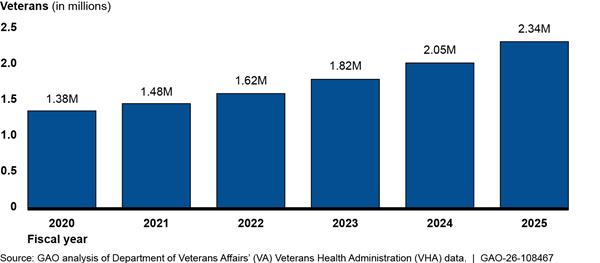
The increase in the number of veterans eligible for dental benefits was largely driven by increases in veterans eligible because of a 100 percent service-connected disability rating or a 100 percent service-connection compensation rate due to the inability to work, according to VHA data.
GAO’s review of VHA data regarding demographic characteristics of veterans eligible for VA dental benefits (age, sex, race and ethnicity, and rurality of residence) from 2020 through 2025 found that the largest increase in veterans eligible for VA dental benefits occurred among younger veterans (under age 50). Specifically, younger veterans composed 21 percent of eligible veterans in 2020 compared to 36 percent in 2025. Other demographic characteristics of veterans remained relatively constant.
Using VHA data for 2025, GAO estimated that if all veterans with heart disease were eligible for dental benefits, the number of veterans eligible for VA dental benefits could increase by 25 percent from about 2.45 million to about 3.07 million. VHA officials and dental providers from selected facilities reported that if such an expansion were to occur, VA may need to consider hiring additional dental providers and increasing dental clinic space to accommodate it.
Why GAO Did This Study
According to VA, poor oral health can affect veterans’ overall health. Additionally, the American Heart Association and others have reported a link between poor oral health and other serious health conditions, such as heart disease.
Congress has considered expanding eligibility for VA dental benefits to veterans with a diagnosis of heart disease. For example, the Senator Elizabeth Dole 21st Century Veterans Healthcare and Benefits Improvement Act required VA to begin a pilot program in 2026 in which VA provides dental benefits to certain veterans with heart disease.
The act also includes a provision for GAO to examine VA dental services and benefits. This report describes (1) the population of veterans eligible for VA dental benefits and (2) the potential effect of including all veterans with heart disease in the population eligible for VA dental benefits.
GAO interviewed VHA officials and reviewed VHA documentation and data for calendar and fiscal years 2020 through 2025, the most recent full years of data available. GAO interviewed dental providers and staff from three VHA facilities, selected because they participated in a pilot program through which veterans without VA dental benefits could receive free or reduced-cost dental care. GAO also collected information from VA lead dentists and interviewed representatives from four relevant national organizations and three veterans service organizations, selected because they represent dental providers or could provide information about veterans’ dental care experiences.
|
Abbreviations |
|
|
|
|
|
FY |
fiscal year |
|
VA |
Department of Veterans Affairs |
|
VADIP |
Department of Veterans Affairs Dental Insurance Program |
|
VHA |
Veterans Health Administration |
|
VISN |
Veterans Integrated Service Network |
This is a work of the U.S. government and is not subject to copyright protection in the United States. The published product may be reproduced and distributed in its entirety without further permission from GAO. However, because this work may contain copyrighted images or other material, permission from the copyright holder may be necessary if you wish to reproduce this material separately.
September 23, 2026
The Honorable Jerry Moran
Chairman
The Honorable Richard Blumenthal
Ranking Member
Committee on Veterans’ Affairs
United States Senate
The Honorable Mike Bost
Chairman
The Honorable Mark Takano
Ranking Member
Committee on Veterans’ Affairs
House of Representatives
More than 9 million enrolled veterans are eligible to receive health care services through the Department of Veterans Affairs’ (VA) Veterans Health Administration (VHA) each year. Some VHA-enrolled veterans who meet certain requirements (such as having a 100 percent service-connected disability or being former prisoners of war) are also eligible to receive outpatient comprehensive dental benefits from VA.[1] According to VA, approximately 26 percent (more than 2 million) of VHA-enrolled veterans were eligible to receive dental benefits from VA as of February 2026. VA obligated about $3.1 billion for dental care in fiscal year (FY) 2025 and expects that costs for such care will continue to increase in subsequent years.[2]
Veterans are more likely to experience adverse oral health conditions than the non-veteran population for several reasons, including the cost of and inability to find dental care, according to the American Institute on Disparities in Public Health and CareQuest Institute for Oral Health.[3] Furthermore, according to a 2019 VA Federal Register notice, poor oral health can have a significant negative effect on veterans’ overall health and can result in significant costs for veterans and VA, both in medical claims (e.g., emergency department visits) and work productivity loss.[4]
The American Heart Association and others have reported a link between poor oral health and other serious health conditions, such as ischemic heart disease (referred to as “heart disease” in this report unless otherwise stated).[5] For example, researchers found that tooth loss and gum disease are associated with an elevated risk of heart disease.[6]
While only certain veterans are eligible to receive comprehensive dental care from VA, VA has provided opportunities for veterans to access dental care that is not paid for by VA through other methods, such as purchasing discounted dental insurance or participating in a pilot program in which dental partners (e.g., dental schools) provide free or reduced-cost services. In addition, the Senator Elizabeth Dole 21st Century Veterans Healthcare and Benefits Improvement Act, enacted in 2025, requires VA to conduct a pilot program to expand dental benefits for certain veterans diagnosed with heart disease. According to the act, VA should assess the pilot program’s effect on multiple topics, including the participating veterans’ perceived quality of life, employability, and emergency room visits.[7]
However, widespread expansion of dental benefits may pose challenges, given VA has reported that the growth in veterans’ dental eligibility continues to outpace growth in dental clinic space and VA’s dental provider workforce capacity. Such workforce capacity issues are not specific to VA as the Health Resources and Services Administration has projected national shortages for all dentists and dental hygienists.[8]
The Senator Elizabeth Dole 21st Century Veterans Healthcare and Benefits Improvement Act includes a provision for us to examine VA dental services and benefits.[9] This report describes (1) the population of veterans eligible for VA dental benefits and (2) the potential effect of including all veterans with heart disease in the population eligible for VA dental benefits. The report also provides analyses on (1) VHA’s use of teledentistry, (2) VHA’s dental records systems, (3) the VA Dental Insurance Program (VADIP), and (4) VHA’s VETSmile pilot program. See appendixes I through IV.
To describe the population of veterans eligible for VA dental benefits, we reviewed VHA documentation on dental eligibility and analyzed VHA data on (1) veterans eligible for VA dental benefits as a proportion of VHA-enrolled veterans in FY 2020 through FY 2025; (2) veterans eligible for and using VA dental benefits in 2020 through 2025; (3) demographic characteristics of these veterans in 2020 through 2025; and (4) VHA facilities that provided dental services to eligible veterans in 2020 through 2025.[10] In this report, we focus on comprehensive VA dental benefits unless otherwise noted and refer to them as “dental benefits.”[11]
To describe the potential effect of including all veterans with heart disease in the population eligible for VA dental benefits, we analyzed VHA data for 2025 on (1) veterans who received care for a diagnosis of heart disease, including veterans who were and were not eligible for VA dental benefits; (2) demographic characteristics of these veterans; and (3) VHA dental facilities associated with the addresses of veterans’ primary residences.[12] To assess the reliability of VHA’s data for both objectives, we interviewed knowledgeable officials and conducted electronic checks of the data for missing, illogical, and inconsistent values. We found the data sufficiently reliable for the purposes of our work.
We also collected information via a structured questionnaire from Veterans Integrated Service Network (VISN) lead dentists regarding key considerations for VHA if eligibility for VA dental benefits were expanded to veterans with heart disease.[13] In addition, we interviewed officials from VHA’s Office of Dentistry and officials, dental providers, and other staff from three selected VHA facilities that provide dental care.[14] We also gathered information from selected veterans service organizations and interviewed representatives of a nongeneralizable selection of four relevant national organizations.[15]
For more information on the objectives, scope, and methodology of our review, see appendix V.
We conducted this performance audit from April 2025 to September 2026 in accordance with generally accepted government auditing standards. Those standards require that we plan and perform the audit to obtain sufficient, appropriate evidence to provide a reasonable basis for our findings and conclusions based on our audit objectives. We believe that the evidence obtained provides a reasonable basis for our findings and conclusions based on our audit objectives.
Background
VHA Dental Services
VHA offers veterans who are eligible to receive dental benefits a wide range of services, including regularly scheduled cleanings and X-rays, restorative procedures (e.g., fillings, crowns, bridges), oral surgery and tooth extractions, and dentures.[16] Veterans eligible for VA dental benefits may receive care through the direct care system (at a VHA facility) or through the Veterans Community Care Program (community care).[17]
Veterans accessing dental services from VHA dental providers (such as dentists, dental hygienists, and dental assistants) may travel to VHA facilities to receive in-person dental care or receive dental services through teledentistry.[18] (See app. I for more information on VHA’s use of teledentistry.)
According to VHA Office of Dentistry officials, VHA dental providers are responsible for documenting veterans’ dental diagnoses, treatment plans, completed treatment, and clinical notes in one of two electronic dental record systems. Such information should be documented in the veteran’s broader medical records to allow dental providers to see prior treatments, current medical issues, allergies, and medications. (See app. II for more information on VHA’s dental record systems.)
VHA’s Organizational Structure for Dental Services
VHA’s Office of Dentistry is responsible for developing policies and overseeing dental services and operations at the national level. According to VHA Office of Dentistry officials, as of June 2026, 256 of VHA’s approximately 1,380 health care facilities had dental programs. About 90 percent of these dental programs were located in VA medical centers or multi-specialty community-based outpatient clinics.[19]
All VHA facilities, including those with dental programs, are located within the 18 VISNs, which are responsible for providing guidance and oversight of dental and other medical programs in VHA facilities within their respective regions. Each VISN has at least one lead dentist, and according to VHA policy, the lead dentists are responsible for providing leadership in dental operations to all VHA facilities within their respective VISN. Responsibilities include identifying and assessing oral health needs of eligible veterans and providing support and guidance for the development and implementation of VHA’s Office of Dentistry’s recommendations within their VISN.[20]
Eligibility for VA Dental Benefits
VHA determines whether veterans are eligible to receive dental care using separate, more specific criteria than the criteria it uses to determine eligibility for medical benefits.[21] Specifically, VHA determines whether veterans are eligible to receive dental benefits using factors such as military-service disability ratings and whether veterans receive monthly compensation payments for a service-connected dental disability or condition.[22] These factors determine veterans’ dental benefit class, and thus, the scope of treatment they are eligible to receive. Veterans who qualify for dental benefits are eligible to receive any outpatient dental care that is reasonably necessary and clinically determined by the treating dentist to meet the veteran’s dental needs, whereas veterans who qualify for outpatient focused dental benefits are generally eligible to receive dental care that is more limited in scope, such as a one-time course of treatment to address a certain health condition.[23] (See tables 9 and 10 in app. VI for additional information on dental benefit classes for veterans eligible for VA dental benefits.)
In addition to providing dental care for veterans eligible to receive dental benefits, VA has implemented other efforts to help veterans access dental care that is not paid for by VA. Examples include:
· VA Dental Insurance Program (VADIP). VA contracts with private insurers to offer VHA-enrolled veterans discounted dental insurance.[24] Veterans who enroll in a VADIP plan are responsible for paying any premiums, deductibles, and coinsurance. (See app. III for more information about VADIP.)
· VETSmile pilot program. VHA’s VETSmile pilot program linked veterans to dental partners, such as dental schools, that agreed to provide veterans with free or reduced-cost dental care at no additional cost to VA. This pilot program began in July 2021 and ended in June 2026. (See app. IV for more information about the VETSmile pilot program.)
The Number of Veterans Eligible for VA Dental Benefits Increased Each Year from Fiscal Years 2020 Through 2025
The Number of Veterans Eligible for VA Dental Benefits Increased 70 Percent from Fiscal Years 2020 Through 2025
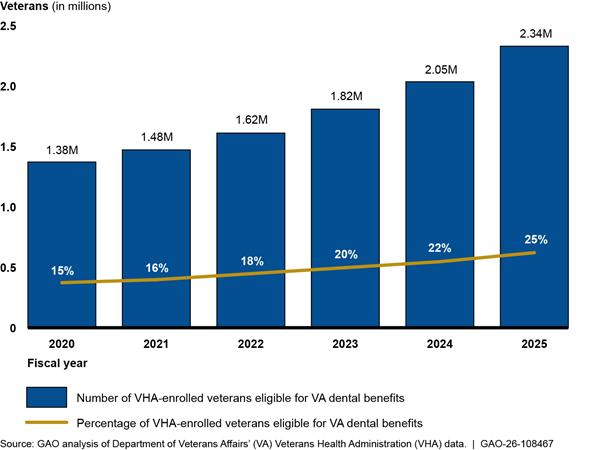
Based on our analysis of VHA data, the number and percentage of VHA-enrolled veterans eligible for VA dental benefits increased each year from FY 2020 through FY 2025. Specifically, the number of eligible veterans increased approximately 70 percent from about 1.38 million in FY 2020 to about 2.34 million in FY 2025.[25] Over this time, the percentage of VHA-enrolled veterans eligible for VA dental benefits increased from 15 percent to 25 percent (see fig. 1).[26]
Figure 1: Number and Percentage of VHA-Enrolled Veterans Eligible for VA Dental Benefits, Fiscal Years 2020–2025
Note: The number of veterans eligible for VA dental benefits includes veterans eligible for comprehensive dental benefits at any time in a given year. Veterans who qualify for comprehensive dental benefits are eligible to receive any outpatient dental care that is reasonably necessary and clinically determined by the treating dentist to meet the veteran’s dental needs.
According to VHA data, the increase in the number of veterans eligible for dental benefits was largely driven by increases in veterans eligible because of a 100 percent service-connected disability rating or a 100 percent service-connection compensation rate due to the inability to work.[27] Specifically, the number of veterans eligible for VA dental benefits in this group increased by 82 percent from about 1.31 million in 2020 to about 2.38 million in 2025.[28] (See tables 9 and 10 in app. VI for additional information on dental benefit classes for veterans eligible for VA dental benefits.)
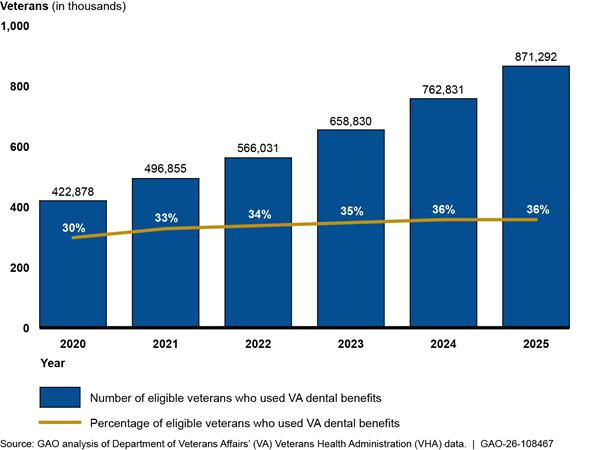
The number and percentage of veterans eligible for VA dental benefits who used those benefits also increased from 2020 through 2025.[29] Specifically, the number of veterans using their benefits doubled from about 420,000 in 2020 to about 870,000 in 2025.[30] During this time, the percentage of eligible veterans using their benefits increased from 30 percent in 2020 to 36 percent in 2025 (see fig. 2). (See table 13 in app. VI for additional information on the number and characteristics of veterans using VA dental benefits.)
Note: The number of veterans eligible for VA dental benefits includes veterans eligible for comprehensive dental benefits at any time in a given year. Veterans who qualify for comprehensive dental benefits are eligible to receive any outpatient dental care that is reasonably necessary and clinically determined by the treating dentist to meet the veteran’s dental needs.
Due in part to more veterans becoming eligible for and using VA dental benefits, the number of veterans’ dental visits at VHA facilities doubled from about 1 million in 2020 to about 2 million in 2025.[31] VHA facilities in the South and West experienced the largest percentage increases—115 percent and 114 percent, respectively—in dental visits over these years.[32] (See table 11 in app. VI for additional information on veterans’ dental visits at VHA facilities.)
The Number of Veterans Under Age 50 Eligible for VA Dental Benefits Increased from 2020 Through 2025
Our analysis of VHA data from 2020 through 2025 showed an increase in the number of veterans under age 50 eligible for VA dental benefits. Other demographic characteristics of veterans eligible for VA dental benefits—sex, race and ethnicity, and rurality of residence—remained relatively constant during this time frame. (See tables 12 and 13 in app. VI for additional information on the demographic characteristics of veterans eligible for and using VA dental benefits.)[33]
Age. The number of younger veterans (under age 50) eligible for VA dental benefits increased the most among the different age groups from 2020 through 2025. Younger veterans composed 21 percent of eligible veterans in 2020 compared to 36 percent in 2025 (see fig. 3).
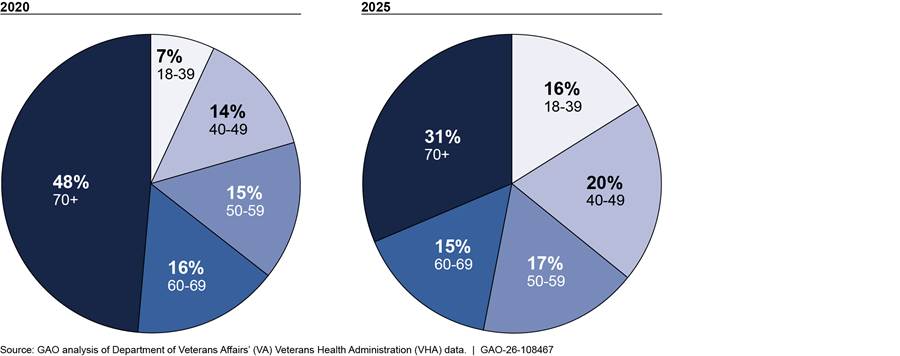
Notes: The percentages for each category reflect the proportion of veterans in that category who were eligible for comprehensive VA dental benefits relative to the total number of veterans eligible for comprehensive VA dental benefits at any time in 2020 (1.40 million veterans) and 2025 (2.45 million veterans). Veterans who qualify for comprehensive dental benefits are eligible to receive any outpatient dental care that is reasonably necessary and clinically determined by the treating dentist to meet the veteran’s dental needs. VHA data included 20 and 34 veterans with an unknown age in 2020 and 2025, respectively; we excluded veterans with an unknown age from this figure. Totals may not add to 100 percent due to rounding.
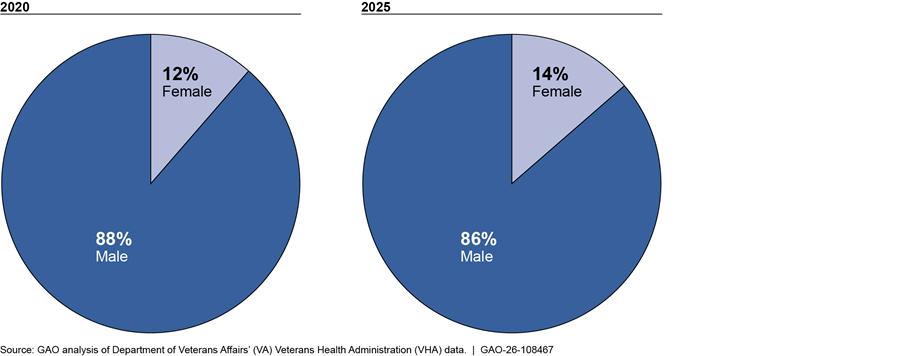
Sex. The composition of veterans eligible for VA dental benefits by sex remained relatively unchanged from 2020 through 2025. Male veterans composed 88 percent of eligible veterans in 2020 compared to 86 percent in 2025, while female veterans composed 12 percent in 2020 compared to 14 percent in 2025 (see fig. 4).
Note: The percentages for each category reflect the proportion of veterans in that category who were eligible for comprehensive VA dental benefits relative to the total number of veterans eligible for comprehensive VA dental benefits at any time in 2020 (1.40 million veterans) and 2025 (2.45 million veterans). Veterans who qualify for comprehensive dental benefits are eligible to receive any outpatient dental care that is reasonably necessary and clinically determined by the treating dentist to meet the veteran’s dental needs.
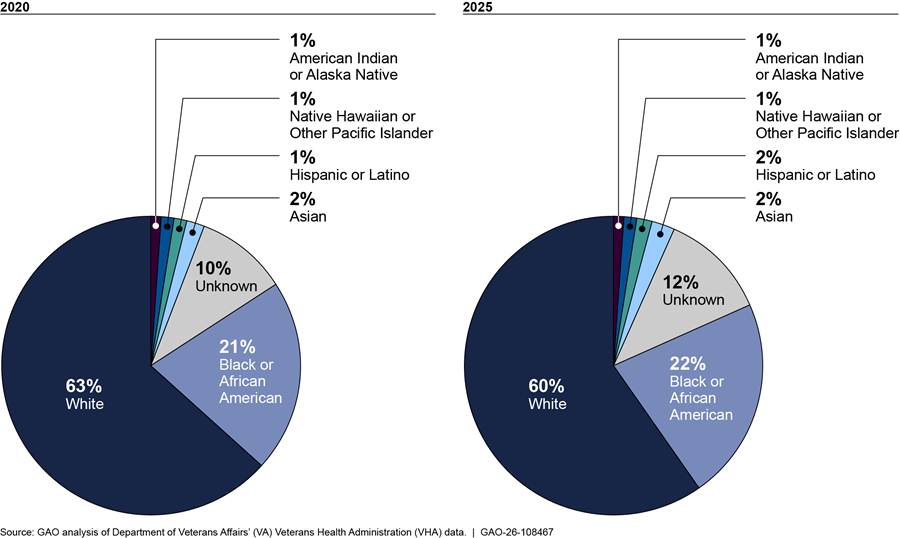
Race and ethnicity. The racial and ethnic composition of veterans eligible for VA dental benefits remained relatively similar from 2020 through 2025. For example, Black or African American veterans composed 21 percent of eligible veterans in 2020 compared to 22 percent in 2025, while White veterans composed 63 percent in 2020 compared to 60 percent in 2025 (see fig. 5).
Notes: The percentages for each category reflect the proportion of veterans in that category who were eligible for comprehensive VA dental benefits relative to the total number of veterans eligible for comprehensive VA dental benefits at any time in 2020 (1.40 million veterans) and 2025 (2.45 million veterans). Veterans who qualify for comprehensive dental benefits are eligible to receive any outpatient dental care that is reasonably necessary and clinically determined by the treating dentist to meet the veteran’s dental needs. According to VHA officials, the Hispanic or Latino category includes veterans whose record reflects Hispanic or Latino as the race value but does not reflect veterans who may identify as both another race and Hispanic or Latino. According to VHA officials, the race and ethnicity of some veterans may be unknown if veterans choose not to disclose this information, the data are not recorded in VHA systems, or it is otherwise unavailable. Totals may not add to 100 percent due to rounding.
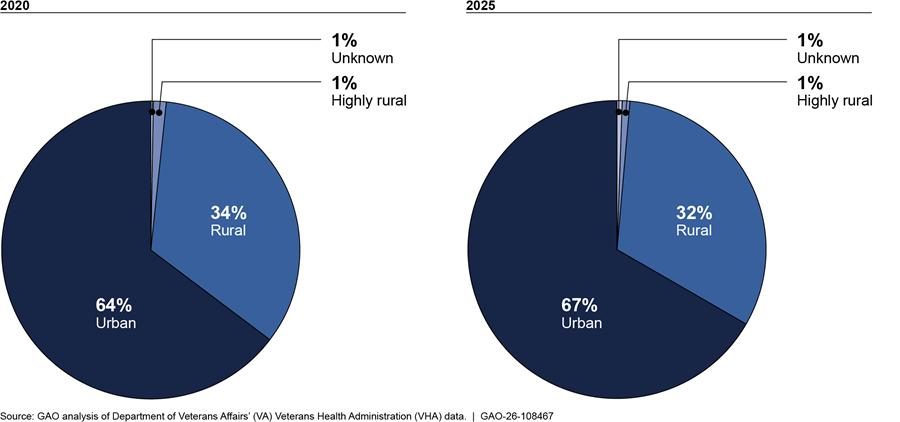
Rurality of residence. The composition of veterans eligible for VA dental benefits by the rurality of their residence also remained relatively similar from 2020 through 2025. For example, veterans living in urban areas composed 64 percent of eligible veterans in 2020 compared to 67 percent in 2025, while veterans living in rural areas composed 34 percent in 2020 compared to 32 percent in 2025. Similarly, veterans living in highly rural areas composed 1 percent of eligible veterans in both 2020 and 2025 (see fig. 6).
Notes: The percentages for each category reflect the proportion of veterans in that category who were eligible for comprehensive VA dental benefits relative to the total number of veterans eligible for comprehensive VA dental benefits at any time in 2020 (1.40 million veterans) and 2025 (2.46 million veterans). The total number of veterans by rurality of residence differs from the totals for the other demographic characteristics due to a difference in the dates when VHA compiled the data. Veterans who qualify for comprehensive dental benefits are eligible to receive any outpatient dental care that is reasonably necessary and clinically determined by the treating dentist to meet the veteran’s dental needs. VHA data categorized veterans—based on the county of their address—as living in urban, rural, highly rural, and insular areas such as U.S. territories. In our analysis, we combined the categories for highly rural and insular areas, and the combined category is represented as highly rural in this figure. According to VHA officials, the rurality of a veteran’s residence may be unknown if the veteran’s address is missing or incomplete in VHA data. Totals may not add to 100 percent due to rounding.
Expanding VA Dental Benefits to All Veterans with Heart Disease Could Increase the Number Eligible by 25 Percent
Expanding Dental Benefits Could Lead to a 25 Percent Increase in Eligible Veterans, Including More Older Veterans
As noted earlier, Congress has considered expanding eligibility for VA dental benefits to veterans with a diagnosis of heart disease. For example, the Senator Elizabeth Dole 21st Century Veterans Healthcare and Benefits Improvement Act required VA to begin a 2-year pilot program by January 2, 2026, in which VA provides dental benefits to certain veterans with a diagnosis of heart disease.[34]
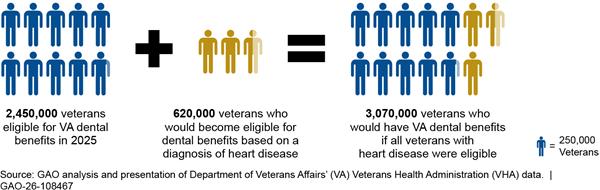
Our analysis of VHA data shows that if eligibility were expanded to all veterans with heart disease, the number of veterans eligible for VA dental benefits could increase by 25 percent from about 2.45 million to about 3.07 million, based on 2025 data (see fig. 7).[35] In 2025, approximately 930,000 veterans received care for a diagnosis of heart disease, including about 310,000 who were eligible and 620,000 who were not eligible for VA dental benefits.
Figure 7: Estimated Number of Veterans Who Would Be Eligible for VA Dental Benefits If Eligibility Were Expanded to Include All Veterans with Heart Disease
Notes: The number of veterans eligible for VA dental benefits includes veterans eligible for comprehensive dental benefits at any time in 2025. Veterans who qualify for comprehensive dental benefits are eligible to receive any outpatient dental care that is reasonably necessary and clinically determined by the treating dentist to meet the veteran’s dental needs. Veterans with heart disease refers to veterans who received care for a diagnosis of ischemic heart disease in 2025. In this report, we refer to ischemic heart disease as “heart disease.” The estimated increase in veterans eligible for VA dental benefits assumes expansion of eligibility to include all veterans with heart disease and does not account for any other potential future changes in eligibility.
An expansion of veterans eligible for VA dental benefits would also likely lead to an increase in the number of veterans using those benefits, based on our analysis. In 2025, 46 percent of the approximately 310,000 veterans who were eligible for dental benefits and received care for a diagnosis of heart disease used their dental benefits. If a similar percentage of potential newly eligible veterans with heart disease used their benefits, it could lead to an increase of about 290,000 veterans using dental benefits.[36]
Expanded eligibility could also lead to more older veterans becoming eligible for VA dental benefits. Based on 2025 VHA data, the number of veterans eligible for dental benefits aged 60 and above would increase by 51 percent from about 1.14 million who were eligible in 2025 to about 1.72 million in the expanded group. In addition, veterans aged 60 and above would compose 56 percent of eligible veterans in the expanded group compared to 46 percent of eligible veterans in 2025 (see fig. 8). (See table 14 in app. VII for more information on potential changes in other demographic characteristics.)
Figure 8: Estimated Change in Veterans Who Would Be Eligible for VA Dental Benefits If Eligibility Were Expanded to Include All Veterans with Heart Disease, by Age Group
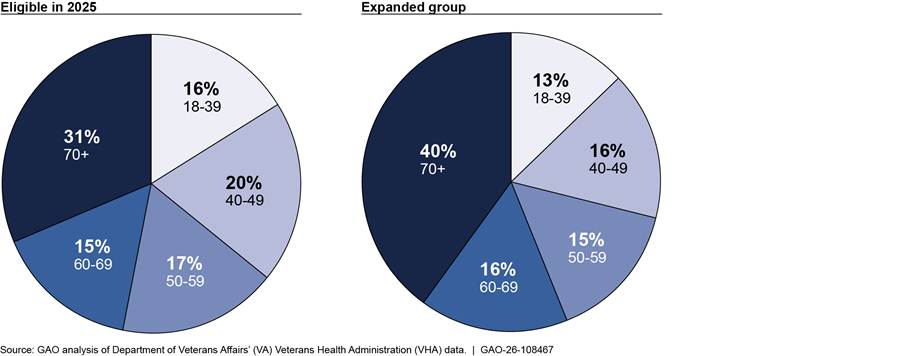
Notes: For 2025, the percentages for each age group category reflect the proportion of veterans in that category who were eligible for comprehensive VA dental benefits relative to the total number (2.45 million) of veterans eligible for comprehensive VA dental benefits at any time in that year. For the expanded group, the percentages for each category reflect the proportion of veterans in that category who would have been eligible for comprehensive VA dental benefits in 2025 relative to the total number (3.07 million) of veterans eligible for comprehensive VA dental benefits at any time in that year.
Veterans who qualify for comprehensive dental benefits are eligible to receive any outpatient dental care that is reasonably necessary and clinically determined by the treating dentist to meet the veteran’s dental needs. Veterans with heart disease refers to veterans who received care for a diagnosis of ischemic heart disease in 2025. In this report, we refer to ischemic heart disease as “heart disease.” The estimated change in veterans eligible for VA dental benefits is based on VHA data regarding veterans who received care for a diagnosis of heart disease in 2025. The estimated change assumes expansion of eligibility to include all veterans with heart disease and does not account for any other potential future changes in eligibility. Totals may not add to 100 percent due to rounding.
Furthermore, VHA facilities in all regions would likely experience an increase in veterans eligible for VA dental benefits, with facilities in the Midwest and Northeast experiencing the largest percentage increases if all veterans with heart disease were eligible for benefits. Specifically, the number of veterans eligible for VA dental benefits would likely increase by 48 percent for Midwest facilities and 39 percent for Northeast facilities if eligibility were expanded to all veterans with heart disease (see table 1).[37] (See table 15 in app. VII for additional information on potential changes in eligible veterans by VISN and region.)
Table 1: Estimated Change in Veterans Who Would Be Eligible for VA Dental Benefits If Eligibility Were Expanded to Include All Veterans with Heart Disease, by Region, 2025
|
Regiona |
Veterans eligible for dental benefitsb |
Veterans who would become eligible for dental benefits based on a diagnosis of heart diseasec |
Total |
Percent |
|
Northeast (26) |
224,415 |
88,442 |
312,857 |
39% |
|
South (48) |
1,307,685 |
252,814 |
1,560,499 |
19% |
|
Midwest (34) |
340,582 |
162,160 |
502,742 |
48% |
|
West (31) |
562,972 |
113,987 |
676,959 |
20% |
|
Total (139) |
2,435,654 |
617,403 |
3,053,057 |
25% |
Source: GAO analysis of Department of Veterans Affairs’ (VA) Veterans Health Administration (VHA) data. | GAO‑26‑108467
aWe determined the region based on VHA data regarding (1) the VHA “parent” dental facility—for example, a VA medical center that provides dental care—associated with the geographic location of a veteran’s primary residence; and (2) the Veterans Integrated Service Network (VISN) to which each VHA dental facility was assigned as of June 2026. At the time we obtained this information, VHA was divided into 18 VISNs that were responsible for providing guidance and oversight of VHA facilities within their respective regions. On July 15, 2026, VA updated its website to reflect that it had reorganized the VISN structure from 18 to five VISNs. See “Veterans Integrated Service Networks,” Department of Veterans Affairs, last modified August 14, 2026, https://department.va.gov/integrated-service-networks. As such, our analyses are based on data obtained from VHA prior to the reorganization. For purposes of this table, we assigned each VISN to a region according to the U.S. Census region its boundaries predominantly fall within.
VHA “parent” dental facilities reflect a subset of all VHA facilities providing dental care to veterans; therefore, the total number of facilities in this table is lower than the total number of VHA facilities providing dental visits. According to VHA data, the VHA “parent” dental facility was unknown for 15,699 veterans eligible for dental benefits in 2025 and 4,925 veterans who would become eligible for dental benefits based on a diagnosis of heart disease if benefits were expanded to include that population. We excluded veterans with unknown associated VHA “parent” dental facilities from this table.
bThe number of veterans eligible for dental benefits includes all veterans eligible for comprehensive VA dental benefits at any time in 2025, including veterans with and without a diagnosis of heart disease. Under comprehensive dental benefits, VHA provides any outpatient dental care that is reasonably necessary and clinically determined by the treating dentist to meet an eligible veteran’s dental needs. Outpatient focused dental benefits are generally more limited in scope (e.g., a one-time course of treatment to address a certain health condition). Some veterans with heart disease may already receive limited dental services through focused benefits. In 2025, about 12,000 veterans with heart disease received dental services through focused benefits.
cVeterans with heart disease refers to veterans who received care for a diagnosis of ischemic heart disease in 2025. In this report, we refer to ischemic heart disease as “heart disease.”
VHA Officials and Dental Providers Noted Key Considerations for VHA to Meet Potential Increased Demand for Dental Services
VHA officials and dental providers identified key considerations—including staffing, space, and care needs—for VHA to meet increased demand for services if eligibility for VA dental benefits were expanded to all veterans with heart disease.[38] For example, lead dentists for 17 of the 18 VISNs reported that VHA dental staff or community care providers in their respective VISNs would face significant challenges in meeting the potential increased demand. VHA officials and dental providers told us that key considerations include the following:
· Dental clinic staffing. Lead dentists for all 18 VISNs reported that facilities in their VISN do not have the staffing levels needed to meet current demand, as of February 2026.[39] As such, VHA may need to hire additional dental providers—such as dentists, dental assistants, and dental hygienists—to treat an increase in the number of eligible veterans, according to VHA officials and dental providers. Projected nationwide staffing shortages in these professions may make hiring dental staff particularly challenging.
· Dental clinic space. VHA officials and dental providers told us that VHA may need to expand dental clinic space to accommodate an increase in veterans eligible for dental benefits. Expanding dental space could include adding treatment rooms to existing facilities or establishing new dental clinics.
· Dental care needs of newly eligible veterans. VHA officials said that veterans who become eligible for dental benefits may require several visits to address dental care needs because they may have had limited prior access to dental care. Initial dental treatment plans for such veterans could take up to 2 years to complete, according to VHA officials, before the plans can shift to primarily preventative care. As a result, VHA may need to address extensive initial care needs of newly eligible veterans.
· Coordination of care. Newly eligible veterans with heart disease may be older and more medically complex.[40] According to officials, to care for this population VHA may need to increase care coordination between dentistry and other VHA medical services, particularly cardiology and primary care. For example, VHA would need to facilitate medical history review and medication reconciliation when a veteran’s heart condition affects dental treatment planning.
In addition, VHA dental providers stated that expansion of eligibility for VA dental benefits could lead to longer wait times and increased community care referrals.
· Longer dental appointment wait times. Without additional dental providers and dental space, eligible veterans may wait longer for dental appointments at VHA facilities. Lead dentists for two VISNs told us that many VHA facilities have wait times for dental appointments of more than 28 days. Similarly, representatives from the three veterans service organizations we spoke with noted that veterans often have lengthy wait times to receive dental care at VHA facilities.
· Increased referrals to community care dental providers. Expansion of eligible veterans may also lead to increased referrals to community care dental providers.[41] For example, VHA dental providers at one facility told us they send veterans to community care providers for root canals—despite having an in-house specialist—because the clinic does not have enough capacity to meet demand. However, providers noted that veterans may face long wait times with community providers as well.[42]
Agency Comments
We provided a draft of this report to VA for review and comment. VA provided technical comments, which we incorporated as appropriate.
We are sending copies of this report to the appropriate congressional committees, the Secretary of Veterans Affairs, and other interested parties. In addition, the report is available at no charge on the GAO website at https://www.gao.gov.
If you or your staff have any questions about this report, please contact me at silass@gao.gov. Contact points for our Offices of Congressional Relations and Media Relations may be found on the last page of this report. GAO staff who made key contributions to this report are listed in appendix VIII.
Sincerely,

Sharon M. Silas
Director, Health Care
To answer the questions that follow, we reviewed available documentation from the Department of Veterans Affairs’ (VA) Veterans Health Administration (VHA) and interviewed officials from VHA’s Office of Dentistry about VHA’s use of teledentistry to provide dental services to veterans. We also interviewed officials, dental providers, and staff from selected VHA facilities regarding VHA’s use of teledentistry.[43] We collected information from Veterans Integrated Service Network (VISN) lead dentists regarding uses of teledentistry and considerations associated with its use.[44] We gathered information on veteran experiences using teledentistry from interviews with selected veterans service organizations.[45] We also interviewed representatives of relevant national organizations regarding the use of teledentistry.[46]
We analyzed VHA data from 2020 through 2025 on the number of dental encounters (referred to as visits in this report) delivered via teledentistry and the number and characteristics of VHA facilities using teledentistry. To assess the reliability of these data, we manually reviewed the data for errors and spoke with knowledgeable VHA officials about the sources of the data. Based on our review, we found the data sufficiently reliable for the purposes of reporting information on teledentistry visits and VHA facilities using teledentistry.
We conducted a literature search to identify articles pertaining to the use of teledentistry and considerations (e.g., benefits, challenges) associated with its use in the United States. We searched ProQuest, EBSCO, SCOPUS, and Lexis/Nexis-Scientific Journals databases for peer-reviewed articles, conference papers, or government reports published from January 1, 2020, through January 23, 2026, that described the use of teledentistry or considerations associated with its use.[47] From this search, we identified 42 unique and potentially relevant articles. We reviewed each article to determine if it provided information on the use of teledentistry or benefits or challenges associated with teledentistry. Of the 42 articles, 25 met these criteria. We used information from these articles to provide context for evidence collected from the other sources regarding VHA’s use of teledentistry.
1. What is teledentistry?
VHA defines teledentistry as the use of information technology and telecommunications to facilitate the delivery of oral health care, consultation, and education when the provider and patient are not in the same physical location.[48]
Through teledentistry, providers may deliver synchronous dental care (real-time patient-provider interactions via video or other communications technology) or asynchronous dental care (transmission of recorded patient health information for later evaluation by a provider). VHA officials told us that VHA uses both synchronous and asynchronous forms of teledentistry.
2. What services has VHA provided through teledentistry?
According to VHA officials and dental providers, VHA has provided limited types of dental services through teledentistry. VHA officials and dental providers we spoke with told us that practical applications of teledentistry are narrow due to the hands-on nature of dental care, and as such, in-person care is necessary to address the majority of dental care needs.
VHA officials and dental providers identified certain dental services for which teledentistry can be useful, such as (1) accessing or consulting with dental specialists, (2) enhancing the triage process, (3) completing pre- or post-operative consultations, (4) providing patient education, and (5) reviewing treatment plans. For example, the Orlando VA Medical Center uses teledentistry to enable remote dental specialists to evaluate images of veterans’ oral lesions captured at other VHA facilities. Dental providers and staff at this facility told us that this application of teledentistry allows more rapid triage of veterans needing additional care, while reducing travel for veterans.
|
Uses of Teledentistry Some articles from our literature search described services provided through teledentistry within the United States. For example: · Case study on the use of teledentistry in response to the COVID-19 pandemic at a small dental clinic in Missouri. Teledentistry was used for limited patient evaluation and triage, hygiene assessments, patient consultations, specialist consultations, and community outreach. · Review of teledentistry applications in orthodontics. Teledentistry was identified in one review article as useful for preliminary orthodontic consultations, explaining diagnosis and treatment plans, and providing guidance regarding minor emergencies that can be handled at home, among other uses. · Evaluation of the use of teledentistry consultations prior to routine oral and maxillofacial surgery procedures during the COVID-19 pandemic. This article found that teledentistry consultation could be used to conduct preoperative assessments for treatment planning. |
Source: GAO analysis of articles on teledentistry. | GAO‑26‑108467
Notes: See Nathan Suter, “Teledentistry Applications for Mitigating Risk and Balancing the Clinical Schedule,” Journal of Public Health Dentistry, vol. 80, no. S2 (2020): S126-S131; Jae Hyun Park, Janet H. Kim, Leah Rogowski, Sumayah Al Shami, and Scott E. I. Howell, “Implementation of Teledentistry for Orthodontic Practices,” Journal of the World Federation of Orthodontists, vol. 10, no. 1 (2021): 9-13; and Pooja Gangwani, Ryan Mooneyham, Changyong Feng, Dorota Kopycka-Kedzierawski, and Antonia Kolokythas, “Accuracy of Telemedicine Consultations in Oral and Maxillofacial Surgery During the COVID-19 Pandemic,” Journal of Oral and Maxillofacial Surgery, vol. 81, no. 1 (2023): 65-71.
3. How many teledentistry visits did VHA provide from 2020 through 2025?
According to VHA data, teledentistry visits accounted for approximately 0.2 percent of total dental visits at VHA facilities that provided dental care from 2020 through 2025.[49] (See table 2.)
Table 2: Dental Visits Provided in Person or via Teledentistry Across VHA Facilities Providing Any Dental Care, 2020–2025
|
|
Year |
|
|||||
|
2020 |
2021 |
2022 |
2023 |
2024 |
2025 |
Total |
|
|
Number of dental visits |
998,490 |
1,479,205 |
1,620,474 |
1,792,116 |
1,936,698 |
2,030,110 |
9,857,093 |
|
Number of in-person dental visits (% of dental visits) |
993,732 (99.5%) |
1,476,109 (99.8%) |
1,618,122 (99.9%) |
1,789,257 (99.8%) |
1,934,043 (99.9%) |
2,027,302 (99.9%) |
9,838,565 (99.8%) |
|
Number of teledentistry visits (% of dental visits) |
4,758 (0.5%) |
3,096 (0.2%) |
2,352 (0.1%) |
2,859 (0.2%) |
2,655 (0.1%) |
2,808 (0.1%) |
18,528 (0.2%) |
Source: GAO analysis of Department of Veterans Affairs’ (VA) Veterans Health Administration (VHA) data. | GAO‑26‑108467
Notes: VHA data includes the number of dental visits provided to veterans eligible for comprehensive or focused VA dental benefits at any time in a given year. Under comprehensive dental benefits, VHA provides any outpatient dental care that is reasonably necessary and clinically determined by the treating dentist to meet an eligible veteran’s dental needs. Outpatient focused dental benefits are generally more limited in scope (e.g., a one-time course of treatment to address a certain health condition).
Dental visits include care provided in VHA facilities through the direct care system and exclude care provided through the Veterans Community Care Program. VHA facilities include VA medical centers and other types of facilities (e.g., community-based outpatient clinics) that provide dental care. Our review of VHA data on dental visits indicated that the VHA facility that delivered care was unknown for a small proportion of visits (0.01 percent of dental visits from 2020 through 2025). We included these visits in this table. According to VHA data, there were no dental visits with unknown VHA facility information in 2021, 2022, and 2025. In 2020, 2023, and 2024, there were 1, 79, and 990 dental visits respectively with unknown facility information. According to VHA officials, VHA facility information may be unknown for a given dental visit as a result of data entry errors at the VHA facility.
According to VHA data, the proportion of dental visits delivered via teledentistry was higher in 2020 (0.5 percent) as compared to the proportion from 2021 through 2025, which ranged from 0.1 percent to 0.2 percent. VA officials told us that VHA used teledentistry to a greater extent during the COVID-19 pandemic, which is consistent with the increased use of teledentistry in the United States during this period, according to some articles from our literature search.[50]
4. How many VHA facilities provided teledentistry visits from 2020 through 2025?
According to VHA data for 2020 through 2025, among VHA facilities that provided any dental care in a given year, the proportion of VHA facilities providing at least one teledentistry visit ranged from approximately 11 percent to approximately 29 percent. (See table 3.) The proportion of VHA facilities providing teledentistry visits was the highest in 2020—approximately 29 percent (68 of 237 facilities)—decreasing to approximately 11 percent (29 of 254 facilities) in 2025. As mentioned earlier, VA officials told us that VHA used teledentistry to a greater extent during the COVID-19 pandemic.
|
|
Year |
|||||
|
2020 |
2021 |
2022 |
2023 |
2024 |
2025 |
|
|
Number of facilities that provided any dental care |
237 |
235 |
243 |
249 |
255 |
254 |
|
Number (percentage) of facilities that delivered at least one teledentistry visit |
68 (28.7%) |
59 (25.1%) |
42 (17.3%) |
29 (11.6%) |
28 (11.0%) |
29 (11.4%) |
Source: GAO analysis of Department of Veterans Affairs’ (VA) Veterans Health Administration (VHA) data. | GAO‑26‑108467
Notes: VHA data includes the number of dental visits provided to veterans eligible for comprehensive or focused VA dental benefits at any time in a given year. Under comprehensive dental benefits, VHA provides any outpatient dental care that is reasonably necessary and clinically determined by the treating dentist to meet an eligible veteran’s dental needs. Outpatient focused dental benefits are generally more limited in scope (e.g., a one-time course of treatment to address a certain health condition).
Dental visits include care provided in VHA facilities through the direct care system and exclude care provided through the Veterans Community Care Program. VHA facilities include VA medical centers and other types of facilities (e.g., community-based outpatient clinics) that provide dental care. Our review of VHA data on dental visits indicated that the VHA facility that delivered care was unknown for a small proportion of visits (0.01 percent of dental visits from 2020 through 2025). We excluded these visits from this table because they may reflect care provided at multiple VHA facilities. According to VHA data, there were no dental visits with unknown VHA facility information in 2021, 2022, and 2025. In 2020, 2023, and 2024, there were 1, 79, and 990 dental visits respectively with unknown facility information. According to VHA officials, VHA facility information may be unknown for a given dental visit as a result of data entry errors at the VHA facility.
From 2020 through 2025, the majority of VHA facilities that provided any care via teledentistry were VA medical centers, ranging from about 62 percent to about 82 percent of all VHA facilities that provided at least one teledentistry visit in each year. Over the same time period, the majority of VHA facilities that provided any care via teledentistry were located in urban areas (ranging from about 88 percent in 2020 to 100 percent in 2025). (See table 4.) Although the majority of VHA facilities providing care via teledentistry were located in urban areas, veterans accessing teledentistry services from these VHA facilities may reside in any area, including urban, rural, highly rural, and insular areas.[51]
Table 4: Number and Percentage of VHA Facilities That Provided at Least One Dental Visit via Teledentistry, by Facility Type and Rurality, 2020–2025
|
|
Year |
||||||
|
Facility characteristica |
2020 |
2021 |
2022 |
2023 |
2024 |
2025 |
|
|
Facility type (number and percentage of facilities as a proportion of facilities providing at least one teledentistry visit) |
VA medical center |
56 (82.4%) |
46 (78.0%) |
32 (76.2%) |
20 (69.0%) |
19 (67.9%) |
18 (62.1%) |
|
Multi-specialty community-based outpatient clinic |
8 (11.8%) |
9 (15.3%) |
6 (14.3%) |
6 (20.7%) |
6 (21.4%) |
7 (24.1%) |
|
|
Primary care community-based outpatient clinic |
1 (1.5%) |
1 (1.7%) |
1 (2.4%) |
1 (3.4%) |
2 (7.1%) |
2 (6.9%) |
|
|
Health care center |
1 (1.5%) |
1 (1.7%) |
1 (2.4%) |
0 (0.0%) |
0 (0.0%) |
1 (3.4%) |
|
|
VA community living center |
1 (1.5%) |
1 (1.7%) |
1 (2.4%) |
1 (3.4%) |
0 (0.0%) |
0 (0.0%) |
|
|
Other outpatient servicesb |
1 (1.5%) |
3 (5.1%) |
1 (2.4%) |
1 (3.4%) |
1 (3.6%) |
1 (3.4%) |
|
|
Rurality (number and percentage of facilities as a proportion of facilities providing at least one teledentistry visit) |
Urban |
60 (88.2%) |
54 (91.5%) |
40 (95.2%) |
29 (100.0%) |
28 (100.0%) |
29 (100.0%) |
|
Rural |
8 (11.8%) |
5 (8.5%) |
2 (4.8%) |
0 (0.0%) |
0 (0.0%) |
0 (0.0%) |
|
|
Total number of VHA facilities providing at least one teledentistry visit |
68 |
59 |
42 |
29 |
28 |
29 |
|
Source: GAO analysis of Department of Veterans Affairs’ (VA) Veterans Health Administration (VHA) data. | GAO‑26‑108467
Notes: VHA data includes the number of dental visits provided to veterans eligible for comprehensive or focused VA dental benefits at any time in a given year. Under comprehensive dental benefits, VHA provides any outpatient dental care that is reasonably necessary and clinically determined by the treating dentist to meet an eligible veteran’s dental needs. Outpatient focused dental benefits are generally more limited in scope (e.g., a one-time course of treatment to address a certain health condition).
Dental visits include care provided in VHA facilities through the direct care system and exclude care provided through the Veterans Community Care Program. Our review of VHA data on dental visits indicated that the VHA facility that delivered care was unknown for a small proportion of visits (0.01 percent of dental visits from 2020 through 2025). We excluded these visits from this table because they may reflect care provided at multiple VHA facilities. According to VHA data, there were no dental visits with unknown VHA facility information in 2021, 2022, and 2025. In 2020, 2023, and 2024, there were 1, 79, and 990 dental visits respectively with unknown facility information. According to VHA officials, VHA facility information may be unknown for a given dental visit as a result of data entry errors at the VHA facility.
aFacility characteristics are based on information provided by VHA for VHA facilities providing dental services. According to this information, all VHA facilities that provided dental services from 2020 through 2025 were either in urban or rural areas; no VHA facilities were identified as being in highly rural or insular areas.
bVHA defines “other outpatient services” as sites in which veterans receive services that do not meet the criteria to be classified as a community-based outpatient clinic or health care center. See Department of Veterans Affairs, VHA Handbook 1006.2: VHA Site Classifications and Definitions (Washington D.C.: Dec. 30, 2013). One example of an “other outpatient services” VHA facility that provided teledentistry visits in 2025 was the Erie East VA Clinic, which is a standalone dental clinic, according to information from VHA officials.
Regionally, VHA facilities in the Northeast provided the highest proportion (approximately 0.3 percent) of dental visits via teledentistry in 2025. VHA facilities in the Midwest provided no dental visits via teledentistry in 2025. Most of the 18 VISNs (13 of 18 VISNs) provided 0.1 percent or less of dental visits via teledentistry in 2025. Five VISNs provided more than 0.1 percent of dental visits via teledentistry, including VISN 1, VISN 2, VISN 5, VISN 6, and VISN 21. (See table 5.)
Table 5: VHA Facilities Providing Teledentistry Visits Across VHA Facilities Providing Dental Services, by Veterans Integrated Service Network (VISN), 2025
|
VISNa |
Number of facilities providing dental services |
Number of facilities providing at least one teledentistry visit |
Proportion of facilities providing at least one teledentistry visit |
Number of dental visits |
Number of teledentistry visits |
Proportion of teledentistry visits to total dental visits |
|
Northeast |
40 |
5 |
12.5% |
272,121 |
783 |
0.3% |
|
VISN 1 |
11 |
2 |
18.2% |
70,682 |
201 |
0.3% |
|
VISN 2 |
18 |
2 |
11.1% |
117,902 |
581 |
0.5% |
|
VISN 4 |
11 |
1 |
9.1% |
83,537 |
1 |
0.0% |
|
South |
105 |
11 |
10.5% |
894,129 |
728 |
0.1% |
|
VISN 5 |
9 |
3 |
33.3% |
62,273 |
253 |
0.4% |
|
VISN 6 |
14 |
1 |
7.1% |
115,608 |
189 |
0.2% |
|
VISN 7 |
17 |
0 |
0.0% |
137,739 |
0 |
0.0% |
|
VISN 8 |
21 |
2 |
9.5% |
203,117 |
77 |
0.0% |
|
VISN 9 |
10 |
2 |
20.0% |
96,070 |
38 |
0.0% |
|
VISN 16 |
15 |
2 |
13.3% |
122,784 |
164 |
0.1% |
|
VISN 17 |
19 |
1 |
5.3% |
156,538 |
7 |
0.0% |
|
Midwest |
47 |
0 |
0% |
325,205 |
0 |
0.0% |
|
VISN 10 |
14 |
0 |
0.0% |
121,745 |
0 |
0.0% |
|
VISN 12 |
12 |
0 |
0.0% |
86,855 |
0 |
0.0% |
|
VISN 15 |
9 |
0 |
0.0% |
47,785 |
0 |
0.0% |
|
VISN 23 |
12 |
0 |
0.0% |
68,820 |
0 |
0.0% |
|
West |
62 |
13 |
21.0% |
538,655 |
1,297 |
0.2% |
|
VISN 19 |
17 |
0 |
0.0% |
118,327 |
0 |
0.0% |
|
VISN 20 |
12 |
0 |
0.0% |
84,510 |
0 |
0.0% |
|
VISN 21 |
14 |
9 |
64.3% |
152,097 |
1,285 |
0.8% |
|
VISN 22 |
19 |
4 |
21.1% |
183,721 |
12 |
0.0% |
|
Total |
254 |
29 |
11.4% |
2,030,110 |
2,808 |
0.1% |
Source: GAO analysis of Department of Veterans Affairs’ (VA) Veterans Health Administration (VHA) data. | GAO‑26‑108467
Notes: VHA data includes the number of dental visits provided to veterans eligible for comprehensive or focused VA dental benefits at any time in a given year. Under comprehensive dental benefits, VHA provides any outpatient dental care that is reasonably necessary and clinically determined by the treating dentist to meet an eligible veteran’s dental needs. Outpatient focused dental benefits are generally more limited in scope (e.g., a one-time course of treatment to address a certain health condition).
Dental visits include care provided in VHA facilities through the direct care system and exclude care provided through the Veterans Community Care Program. VHA facilities include VA medical centers and other types of facilities (e.g., community-based outpatient clinics) that provide dental care. Our review of VHA data on dental visits indicated that the VHA facility that delivered care was unknown for a small proportion of visits (0.01 percent of dental visits from 2020 through 2025). We excluded these visits from this table because they may reflect care provided at multiple VHA facilities. According to VHA data, there were no dental visits with unknown VHA facility information in 2021, 2022, and 2025. In 2020, 2023, and 2024, there were 1, 79, and 990 dental visits respectively with unknown facility information. According to VHA officials, VHA facility information may be unknown for a given dental visit as a result of data entry errors at the VHA facility.
aWe determined regions based on VHA data regarding the VISN to which each VHA facility was assigned as of June 2026. At the time we obtained data from VHA, VHA was divided into 18 VISNs that were responsible for providing guidance and oversight of VHA facilities within their respective regions. Due to past consolidation and reorganization of the VISNs, there were no longer VISNs numbered 3, 11, 13, 14, or 18. On July 15, 2026, VA updated its website to reflect that it had reorganized the VISN structure from 18 to five VISNs. See “Veterans Integrated Service Networks,” Department of Veterans Affairs, last modified August 14, 2026, https://department.va.gov/integrated-service-networks. As such, our analyses are based on data obtained from VHA prior to the reorganization. We assigned each VISN to a region according to the U.S. Census region its boundaries predominantly fall within.
Five of the 29 VHA facilities that delivered teledentistry visits in 2025 provided more than 2 percent of dental visits via teledentistry, ranging from 2.4 percent to 10.7 percent, according to VHA data. All of these facilities were located in urban areas. (See table 6.)
Table 6: VHA Facilities Providing More Than 2 Percent of Total Dental Visits via Teledentistry, by Veterans Integrated Service Network (VISN), Rurality, and Facility Type, 2025
|
VHA facilitya |
Region |
VISN |
Geographic location (rurality) |
Facility type |
Teledentistry visits as a percentage of total dental visitsb |
|
Southern Prince Georges County VA Clinic |
South |
VISN 5 |
Camp Springs, Maryland (urban) |
Primary care community-based outpatient clinic |
10.7% |
|
Erie East VA Clinic |
Northeast |
VISN 2 |
Syracuse, New York (urban) |
Other outpatient servicesc |
6.6% |
|
Edward P. Boland VA Medical Center |
Northeast |
VISN 1 |
Leeds, Massachusetts (urban) |
VA medical center |
4.4% |
|
San Francisco VA Medical Center |
West |
VISN 21 |
San Francisco, California (urban) |
VA medical center |
3.2% |
|
Richard A. Pittman VA Clinic |
West |
VISN 21 |
French Camp, California (urban) |
Multi-specialty community-based outpatient clinic |
2.4% |
Source: GAO analysis of Department of Veterans Affairs’ (VA) Veterans Health Administration (VHA) data and VA information. | GAO‑26‑108467
aFacility region, VISN, rurality, facility type, and teledentistry visits are based on data provided by VHA for VHA facilities providing dental services. Facility name and geographic location (city and state) reflects information on VA’s website as of June 2026. We determined regions based on the VISN to which each VHA facility was assigned as of June 2026. At the time we obtained data from VHA, VHA was divided into 18 VISNs that were responsible for providing guidance and oversight of VHA facilities within their respective regions. Due to past consolidation and reorganization of the VISNs, there were no longer VISNs numbered 3, 11, 13, 14, or 18. On July 15, 2026, VA updated its website to reflect that it had reorganized the VISN structure from 18 to five VISNs. See “Veterans Integrated Service Networks,” Department of Veterans Affairs, last modified August 14, 2026, https://department.va.gov/integrated‑service‑networks. As such, our analyses are based on data obtained from VHA prior to the reorganization. We assigned each VISN to a region according to the U.S. Census region its boundaries predominantly fall within. According to VHA data, all VHA facilities that provided dental services from 2020 through 2025 were either in urban or rural areas; no VHA facilities were identified as being in highly rural or insular areas.
bVHA data includes the number of dental visits provided to veterans eligible for comprehensive or focused VA dental benefits at any time in a given year. Under comprehensive dental benefits, VHA provides any outpatient dental care that is reasonably necessary and clinically determined by the treating dentist to meet an eligible veteran’s dental needs. Outpatient focused dental benefits are generally more limited in scope (e.g., a one-time course of treatment to address a certain health condition). Dental visits include care provided in VHA facilities through the direct care system and exclude care provided through the Veterans Community Care Program.
cAccording to information from VHA officials, the Erie East VA Clinic is a standalone dental clinic.
5. What are some key considerations for using teledentistry within VHA?
According to VHA officials and dental providers we spoke with, key considerations for using teledentistry at VHA facilities include the following:
· Considerations for veterans. Teledentistry may offer veterans greater flexibility to access VA dental services outside of a traditional dental clinic, according to VA officials and dental providers. Teledentistry may also reduce veterans’ travel time, especially for veterans in rural areas who live far away from VHA dental facilities.[52] However, unlike telehealth visits for certain medical issues, teledentistry may not replace in-person visits because in-person dental care is generally needed to address veterans’ needs.[53] In addition, veterans may not have reliable internet access or be comfortable using technology for teledentistry consultations.[54]
· Considerations for VHA dental providers and staff. Dental providers and staff must complete required teledentistry training and have access to equipment needed for teledentistry, according to VHA officials and dental providers. Even with training and resources, dental providers may find it challenging to make an accurate diagnosis without an in-person exam or based on images taken remotely, which may be of poor quality.[55] In addition, dental providers may be reluctant to adopt teledentistry because it diverts time away from providing in-person dental care.
· Considerations for VHA facilities. Teledentistry requires facilities to identify space for teledentistry clinics, redesign workflows and scheduling procedures to support teledentistry, hire and train additional dental providers and staff, strengthen technology infrastructure, and purchase specialized equipment (e.g., intraoral cameras), according to VHA officials and dental providers.[56]
To answer the questions that follow, we reviewed Department of Veterans Affairs’ (VA) Veterans Health Administration’s (VHA) dental policies and interviewed officials from VHA’s Office of Dentistry about core functions of VHA’s dental record systems and mechanisms that VHA uses to collect feedback and resolve user issues. We also interviewed six dental providers from three VHA facilities to obtain feedback on their experiences using one of VHA’s dental record systems.[57] The information we obtained from these interviews is not generalizable to other VHA facilities but provided important insights on dental record systems. In addition, we obtained information from lead dentists for all 18 Veterans Integrated Service Networks (VISN) in February 2026 on dental providers’ experiences using and obtaining resolutions from VHA’s Office of Dentistry for any technical challenges with VHA’s dental record systems.[58]
1. What dental record systems does VHA use?
VHA dental providers (such as dentists, dental hygienists, and dental assistants) use one of two dental record systems, which are applications within VHA’s broader electronic health record systems. The type of dental record system that dental providers use depends on which broader electronic health system the VHA facility uses where they provide services. Specifically:
· Dental providers use VHA’s Dental Record Manager Plus (referred to in this report as the legacy dental record system) at VA medical centers that use VHA’s legacy electronic health record system. As of September 2026, 153 VA medical centers use this electronic health record system.
· Dental providers use VHA’s Electronic Dental Record Manager (referred to in this report as the new dental record system) at VA medical centers that use VHA’s new electronic health record system. As of September 2026, 17 VA medical centers have transitioned to the new electronic health record system.[59]
VHA has announced plans to continue transitioning additional VA medical centers from VHA’s legacy electronic health record system to the new electronic health record system. VHA Office of Dentistry officials told us that dental staff immediately transition from using the legacy dental record system to the new dental record system when each VA medical center transitions to the new electronic health record system.
2. What functions do VHA’s dental record systems provide?
According to VHA Office of Dentistry officials, the legacy and new dental record systems are based on a standard set of workflows and structured data elements to ensure consistency in how VHA dental providers record dental information throughout VHA facilities. They told us both systems provide the same core functions to allow dental providers to document dental diagnoses, treatment plans, completed treatment, and clinical notes.
VHA officials told us that to support continuity of care, both dental record systems integrate with veterans’ broader medical records to allow dental providers to see prior treatments, current medical issues, allergies, and medications. According to VHA officials, updates and enhancements to both dental record systems are guided by clinical input and ongoing evaluation of dental providers’ needs.
3. Are dental providers satisfied with VHA’s dental record systems?
The majority of dental providers we spoke with reported that they are generally satisfied with VHA’s dental record systems. Specifically, we asked the 18 VISN lead dentists how satisfied dental staff in their VISNs are that the dental record system they use allows them to effectively perform the duties of their positions. In addition, we spoke with six dental providers across three selected VHA facilities who provided feedback on their satisfaction with the dental record system used in their facility (legacy dental record system).[60]
· Legacy dental record system. Lead dentists for 16 of the 18 VISNs using this system reported that staff in their VISN are generally satisfied that the legacy system allows them to effectively perform the duties of their positions. Feedback from some of these lead dentists included that the legacy system is user-friendly, rarely has issues, and provides standardized documentation for dental procedures. In addition, three dental providers from two of the three VHA facilities we interviewed told us that the legacy system is very comprehensive and reliable and that they have not experienced any challenges using it.
Lead dentists for the other two VISNs reported that dental staff in their VISNs are neutral or somewhat dissatisfied with the legacy system. One of these lead dentists reported that the legacy system requires too many clicks to navigate from one screen to another and that it uses outdated software. In addition, three dental providers from the third VHA facility we spoke with reported that the legacy system is not as easy to navigate and is less intuitive than dental record systems used in the private sector which increases the amount of training time for dental providers.
· New dental record system. Lead dentists for two of the three VISNs with dental staff that use the new system reported that dental staff in their VISN are very satisfied that the new system allows them to effectively perform the duties of their positions. The third VISN lead dentist reported that dental staff in their VISN are neutral on the topic and noted that dental staff have had no concerns with the new dental record system.
4. How does VHA collect feedback and resolve dental providers’ issues with VHA’s dental record systems?
According to VHA Office of Dentistry officials, they engage with dental record system users— such as dentists, dental hygienists, and dental assistants—to collect formal and informal feedback, and resolve user issues with VHA dental record systems using the following mechanisms:
· Help-desk logs. Dental providers can ask questions or provide comments or suggestions through each of the dental record systems by clicking a tab that generates an email directed to VHA dental software help-desk support. VHA officials and a contractor respond to these emails and coordinate meetings with dental providers or elevate issues to others as needed.
· Surveys or structured feedback requests. VHA Office of Dentistry officials said that they conduct surveys or structured feedback requests that focus on a variety of issues. For example, they conducted a survey in August and September 2024 that requested feedback about changes that dental staff would like VHA to implement for the legacy dental record system. This survey asked for suggestions for new reports or tools, training needs, ways to reduce administrative burden, or ideas to improve system performance and usability. Officials said that results from such surveys are made available to dental chiefs and that the Office of Dentistry provides updates and solicits feedback during monthly calls with VISN lead dentists.
· Office hours and site visits. VHA Office of Dentistry officials said that dental providers can engage with them and share feedback about the dental record systems during office hours or site visits.
VHA Office of Dentistry officials told us they expect to continue to use these dental provider feedback mechanisms to support ongoing improvement in usability and performance for both of VHA’s dental record systems.
5. Are dental providers satisfied with VHA’s resolution of technical or other challenges with VHA’s dental record systems?
The majority of lead dentists for the 18 VISNs reported that they and dental providers in their VISNs are generally satisfied with mechanisms available (e.g., help desk or others) to resolve technical or other challenges with both of VHA’s dental record systems.
· Legacy dental record system. Lead dentists for 16 of the 18 VISNs reported that dental staff in their VISN are generally satisfied with mechanisms available to help them resolve technical challenges with the legacy dental record system. In addition, the majority of lead dentists reported positive feedback that VHA Office of Dentistry officials or others are responsive to requests for help with any challenges. Lead dentists for the other two VISNs reported that dental staff in their VISN are neutral on the topic.
· New dental record system. VHA officials told us that they help triage and review support requests that are operational in nature, such as software programming, for the new dental record system. Lead dentists for two of the three VISNs using this system reported that dental staff in their VISN are generally satisfied with how VHA’s Office of Dentistry or others help them resolve challenges. One lead dentist reported that they had no concerns or feedback and the other said that VHA’s Office of Dentistry or others quickly address any issues. The lead dentist for the third VISN reported that staff are very dissatisfied and told us challenges with the new dental record system are related to the implementation of the broader new electronic health record system. These challenges include a lack of a reliable test environment within the new electronic health record system, issues following systemwide updates within that system, and problems routing help-desk tickets to the appropriate support contractor.[61] VHA Office of Dentistry officials told us that concerns related to the broader new electronic health record system are well known and they hold weekly meetings to review progress on software patch updates, technical support issues and training items.
To answer the questions that follow, we reviewed documentation and spoke with Department of Veterans Affairs (VA) and Veterans Health Administration (VHA) officials to discuss topics related to the VA Dental Insurance Program (VADIP) such as eligibility requirements and marketing efforts. We also obtained data from VHA on the number of veterans who were enrolled in VADIP from fiscal year (FY) 2020 through FY 2025. In addition, we spoke with the two private insurers that administer VADIP. We also spoke with stakeholders to discuss veterans’ awareness of VADIP and enrollment in the program, including (1) dental providers and primary care providers from three VHA facilities; (2) lead dentists for the 18 Veterans Integrated Service Networks (VISN); and (3) representatives from three veterans service organizations.[62]
1. What is VADIP and who is eligible to enroll?
VADIP is a program through which VA contracts with private insurers to offer VHA-enrolled veterans discounted dental insurance.[63] VADIP was established by the Caregivers and Veterans Omnibus Health Services Act of 2010 as a pilot program to provide premium-based dental insurance to veterans.[64] VADIP began as a pilot program in 2014, was reauthorized in 2016 to run until 2021, and was made a permanent program in 2021.[65]
VA’s role under VADIP is primarily to establish contracts with the private insurers and verify veterans’ eligibility.[66] VA contracts with private insurers that are responsible for administering dental insurance plan options and providing dental benefits. VA does not pay for any coverage or care through VADIP; veterans who enroll in a VADIP plan are responsible for paying any premiums, deductibles, and coinsurance.
2. What are the VADIP plan options and what services do they cover?
The two private insurers that administer VADIP offer veterans plan options with a range of coverage for diagnostic, preventive, and restorative dental care services. See table 7 for plan options and examples of covered services.
Table 7: Dental Plan Options Available Under Department of Veterans Affairs (VA) Dental Insurance Program (VADIP), as of June 2026
|
Insurer |
Plan option |
Examples of covered services |
|
A |
Plan 1: Lowest coverage |
Routine cleanings, X-rays, oral exams, sealants, fillings, simple extractions, and root canals. |
|
Plan 2: Medium coverage |
All benefits under Plan 1 plus additional coverage for procedures such as crowns and implants. |
|
|
Plan 3: Highest coverage |
All benefits under Plan 2 with higher coverage for major procedures (excludes orthodontia coverage). |
|
|
B |
Plan 1: Lowest coverage |
Routine cleanings, X-rays, oral exams, fillings, crowns, bridges, and dentures. |
|
Plan 2: Highest coverage |
All benefits under Plan 1 with higher coverage for some procedures and orthodontia coverage for dependent children up to age 19. |
Source: GAO analysis of VADIP insurer websites. | GAO‑26‑108467
Plan options vary in monthly premiums and other aspects. Plans with the highest coverage have higher monthly premiums and annual maximum allowances and lower coinsurance. Representatives from both insurers told us in March 2026 that among all veterans that enrolled in VADIP, the majority selected plan options with the highest level of coverage.
The current contracts with the insurers first went into effect September 2022 and included options that allowed the contract period to run through August 2027.[67] VA officials told us that in 2022, they assessed each of the plan option premium rates offered by the VADIP insurers (for the 2022 to 2027 contract period) and found that the rates were fair and reasonable and generally below those of comparable dental plans available to the public. VA officials told us in April 2026 that they had recently reviewed publicly available commercial dental plan rates and again found that VADIP rates were lower than those offered through commercial dental plans. According to VA, the lower rates established under VADIP result in VA being able to offer discounted private dental insurance to veterans.
3. How many veterans enrolled in VADIP from fiscal years 2020 through 2025?
The number of veterans enrolled in VADIP ranged from about 55,000 in FY 2020 to about 67,000 in FY 2025. The number of veterans enrolled each FY was consistently less than 1 percent of those eligible. For example, about 67,000 of about 9.2 million eligible veterans were enrolled in VADIP in FY 2025.[68] (See fig. 9.)
Figure 9: Veteran Enrollment in the Department of Veterans Affairs (VA) Dental Insurance Program (VADIP), Fiscal Years 2020–2025
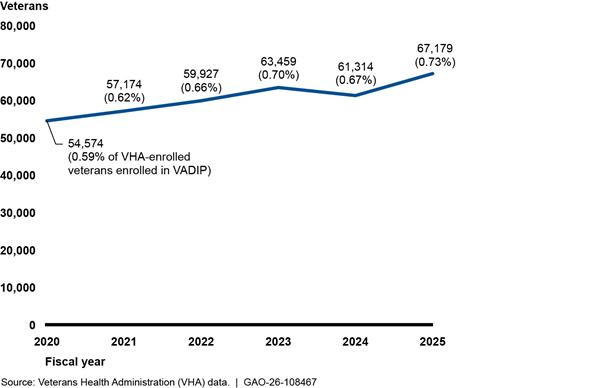
Notes: The blue line in this figure represents the number of unique veterans enrolled each year in VADIP. The percentages represent the proportion of unique veterans enrolled in VADIP relative to the number of unique VHA-enrolled veterans who were eligible to purchase VADIP each year.
4. What factors may affect whether veterans decide to enroll in VADIP?
Stakeholders we spoke with told us that several factors may contribute to veterans’ low enrollment in VADIP, including the following:
· Lack of awareness. VA officials, VHA dental providers and primary care providers, and representatives from two of the three veterans service organizations we spoke with told us that they do not believe most veterans are aware of VADIP.[69]
· Cost. According to VA officials, they have made efforts to make VADIP as affordable as possible. However, VA officials, representatives from two veterans service organizations, and representatives from the two dental insurers told us that cost can be a factor as some veterans may not be able to afford to purchase dental insurance of any kind, including dental insurance offered through VADIP.
· Other factors. VA officials and representatives from the two dental insurers told us limited access to dental providers in veterans’ geographic areas may affect veterans’ decisions to enroll in VADIP. In addition, representatives from the two dental insurers told us veterans may not enroll in VADIP because they have private dental insurance through their employers or another source and VHA officials said they may not enroll because they are eligible to receive comprehensive dental benefits from VA.[70]
5. What approaches have VA and insurers used to increase veterans’ awareness of VADIP?
According to the contracts between VA and the two private insurers, both VA and the insurers have a role in marketing VADIP to eligible veterans. According to VADIP insurers, they use several methods to increase awareness of VADIP, including social media, print materials, and in-person engagement at veteran service organizations’ events to increase awareness.
VHA officials told us that VA has previously shared information about VADIP through social media and its website. VHA officials also told us that during the course of our review, they have taken steps or made plans to take additional steps to increase awareness of VADIP, which include the following:
· Creating VADIP brochure. In August 2025, VA created a two-page brochure explaining what VADIP is and the services it offers. VHA officials told us the brochure is available to all VA employees through VA’s Knowledge Management System and is intended to be used as a resource to provide veterans with information about the program. (See figure 10 for an excerpt of this brochure.)
Figure 10: Excerpt from the Department of Veterans Affairs (VA) Dental Insurance Program (VADIP) Brochure
· Adding VADIP information to VA’s Health Care Benefits Overview booklet. VA’s Health Care Benefits Overview booklet includes information about eligibility requirements, health benefits and services, and copayments that certain veterans may be charged. VHA officials told us they included detailed VADIP information in the most recent version of this booklet, which is available online.[71]
· Planning to add VADIP information to VHA’s Personalized Benefits Handbook. VHA’s Personalized Benefits Handbook is a guide specifically tailored for each veteran when he or she enrolls in VHA. It includes information such as the veteran’s health care benefits, copayments, and local facility contacts. VHA officials told us in June 2026 they were in the process of conducting an annual review of the handbook content and will include information about VADIP in an updated version.
· Planning to add VADIP information to VA’s online Welcome Kit. VA’s online Welcome Kit is a free, downloadable guide that provides a broad overview of services available to veterans and a guide to eligibility for benefits. VHA officials told us in June 2026 that they are making an effort to include information about VADIP in the Welcome Kit in the future.
To answer the questions that follow, we spoke with Department of Veterans Affairs (VA) Veterans Health Administration’s (VHA) officials and obtained documentation about the implementation of the VETSmile pilot program.[72] We also interviewed dental providers, primary care providers, and other staff from three VHA facilities that participated in the VETSmile pilot program to obtain feedback on their experiences with the program.[73] In addition, we spoke with two dental partners that participated in the VETSmile pilot program to obtain feedback on their experiences providing dental care to veterans through the program.
1. What is the VETSmile pilot program and when did VHA implement it?
The VETSmile pilot program was implemented by VHA to improve overall health by increasing access to dental services for VHA-enrolled veterans who were not eligible to receive dental benefits through VHA.[74] VETSmile linked these veterans with partners, such as dental schools, that agreed to provide veterans with free or reduced-cost dental care, at no additional cost to VHA. This pilot program began in July 2021 and ended in June 2026. (See fig. 11.)
Figure 11: Timeline of Veterans Health Administration’s Implementation of the VETSmile Pilot Program
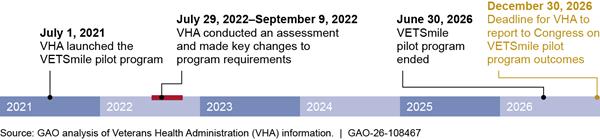
2. How many veterans received dental care through the pilot program?
Approximately 4,700 veterans received more than 101,000 dental procedures through the VETSmile pilot program from July 2021 through December 2025, according to VHA officials.[75] This amounted to approximately $14.4 million in donated dental care. (See fig. 12.)
Figure 12: Dental Care Provided Under the Veterans Health Administration’s VETSmile Pilot Program, July 2021–December 2025
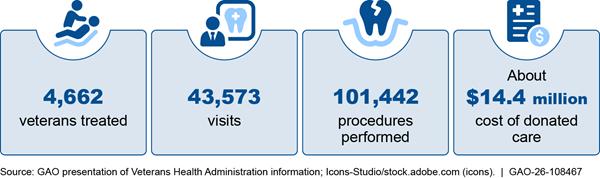
Note: Although the pilot program continued through June 2026, VHA officials told us they used program data through December 31, 2025, for the purpose of evaluating and reporting on the program.
According to VHA officials and two dental partners we spoke with, dental partners provided veterans with diagnostic, preventative, and restorative dental care, including services such as routine cleanings, dentures, implants, crowns, and fillings.
Some dental providers, primary care providers, and other staff we spoke with at three VHA facilities that participated in the VETSmile pilot program told us that veterans reported they were satisfied with the services they received under the VETSmile pilot program. Some said that the main challenge veterans reported was long wait times (e.g., several months) to receive dental care given the program’s high demand.
3. How many dental partners participated in the pilot program?
Fourteen dental partners participated in the program from July 2021, when VHA launched the VETSmile pilot program, through September 2022. According to VHA officials, seven partners were college or university dental schools and seven were federally qualified health centers.[76] Thirteen of these initial partners offered dental services to veterans at a reduced cost, and one offered dental services for free.
Shortly after the first year of the VETSmile pilot program’s implementation, the 13 dental partners that offered services at a reduced cost stopped participating in the pilot program. Specifically, from September 2022 to July 2024, the original dental partner that provided services for free was the only participating dental partner, according to VHA officials. In July 2024, a second dental partner agreed to provide services for free and joined the program.[77] (See fig. 13.)
Figure 13: Timeline of Dental Partner Participation in the Veterans Health Administration’s VETSmile Pilot Program
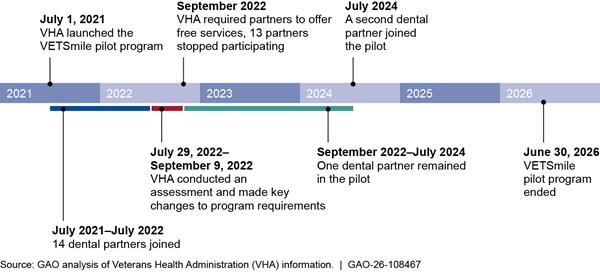
4. Why did dental partner participation change after the first year of the pilot program?
VHA made several key changes to program requirements that resulted in 13 of the 14 dental partners opting out of the program after the first year. Specifically, VHA officials told us that they conducted a strategic assessment from July 29, 2022, to September 9, 2022, to evaluate the pilot program’s effect and inform programmatic improvements. Following this assessment, VHA made the following changes:
· Dental partners must offer dental care for free. According to VHA, veterans responded more favorably to the dental partner that offered free dental services during the first year than to dental partners that offered reduced-cost dental services. As such, VHA began requiring all participating dental partners to offer dental care for free rather than at a reduced cost.
· Veterans must have referrals from VHA facilities. During the first year of the program, VHA used two models to connect veterans with VETSmile pilot program services: (1) VHA sent emails and mail to veterans notifying them that they could contact dental partners directly to coordinate VETSmile pilot program services, and (2) primary care providers at some VHA facilities provided veterans with referrals for care in the VETSmile pilot program. VHA found that having veterans contact VETSmile dental partners directly resulted in a very low veteran engagement rate and that continuing to invest time and resources in that method was not cost-effective.[78] As a result, VHA began requiring that veterans first obtain a referral from their primary care provider to receive VETSmile services.[79]
· Dental partners must agree to provide patient-level data. According to VHA officials, dental partners reported population-level data, such as the number of visits that veterans had, but did not provide patient-level data, such as the number of unique veterans they served, to VHA during the first year of the VETSmile pilot program. However, VHA reported that population-level data were not sufficient for VHA to effectively evaluate the implementation of the pilot program. As such, VHA officials told us that they began requiring dental partners to submit monthly reports including not only the number of visits, but also patient-level data, such as the number of veterans treated, number and type of procedures performed, and cost of care provided.
Among these changes, VHA officials identified the requirement that dental partners offer free dental services as the most consequential for limiting dental partner participation. VHA reported that this change significantly affected existing and potential dental partners’ willingness or ability to participate in the pilot program due to lack of financial sustainability or adherence with federal guidelines.[80]
5. What lessons did VHA identify based on program changes after the first year of the pilot program?
As noted above, VHA conducted a strategic assessment shortly after the first year of the VETSmile pilot program to comprehensively review program activities and data. Following that assessment, VHA made several key program changes and identified lessons learned. (See table 8.)
Table 8: Lessons Learned That the Veterans Health Administration (VHA) Identified Based on Key Changes to the VETSmile Pilot Program After the First Year
|
VETSmile pilot program feature for the first year |
Change after the first year |
VHA lessons learned |
|
Cost of services. Dental partners provided either free or reduced-cost dental services. |
Dental partners were required to provide free dental services. |
Veterans preferred dental partners that offered free dental services. As such, VHA determined that future pilot designs should ensure that there are no financial disincentives that may affect pilot participation. |
|
Accessing services. Veterans accessed VETSmile services by referral from VHA primary care providers or by contacting participating dental partners directly. |
All veterans had to receive a referral for dental services from their VHA primary care provider. |
Referrals from VHA primary care providers were more effective in helping veterans engage in the program. As such, VHA determined that VHA providers should be engaged in future pilot designs to support veteran participation. |
|
Required data. According to VHA officials, dental partners reported population-level outcomes, such as the number of visits veterans had, rather than patient-level data, such as the number of veterans seen. |
According to VHA officials, dental partners were required to submit monthly reports with patient-level data, such as the number of veterans treated, number and type of procedures performed, and cost of care provided. |
VHA determined that patient-level data were needed to effectively evaluate the implementation of the pilot program. |
|
Partner funding. VHA did not provide funding for dental partners. |
No change. |
While veterans prefer free dental services, dental partners reported needing sustainable funding to provide this care. As such, VHA determined that future pilots that rely on community partner participation need to account for the funding required to incentivize partners’ participation. |
Source: GAO analysis of VHA information. | GAO‑26‑108467
Note: VHA launched the VETSmile pilot program on July 1, 2021, and made key changes to program requirements based on a strategic assessment after the first year. VHA implemented these program changes in September 2022.
6. How does VHA plan to evaluate the pilot program?
VHA is required to evaluate the VETSmile pilot program following its conclusion in June 2026 and to submit a report to Congress by December 30, 2026. VHA officials told us that VHA’s evaluation of the VETSmile pilot program was ongoing as of August 2026. According to the evaluation plan, VHA will assess the effect of the VETSmile pilot program on health services utilization, costs, and veteran experience. The evaluation plan indicates that VHA will include an analysis of whether participation in the VETSmile pilot program reduced emergency department or inpatient VHA costs, program effect and effectiveness, and veteran satisfaction with the program.
In April 2026, VHA officials told us they had no plans to implement other pilot programs related to dental care but would use lessons learned from the VETSmile pilot program to inform future pilot program development if they changed their position.
This report describes (1) the population of veterans eligible for Department of Veterans Affairs (VA) dental benefits and (2) the potential effect of including all veterans with heart disease in the population eligible for comprehensive VA dental benefits.[81] In this report, we focus on veterans who were eligible for comprehensive VA dental benefits unless otherwise noted and refer to these as “dental benefits.”[82]
To describe the population of veterans eligible for VA dental benefits, we reviewed Veterans Health Administration (VHA) documentation on dental eligibility and analyzed VHA data on (1) veterans eligible for VA dental benefits as a proportion of VHA-enrolled veterans in fiscal year (FY) 2020 through FY 2025, (2) veterans eligible for and using VA dental benefits in 2020 through 2025, (3) demographic characteristics of these veterans in 2020 through 2025, and (4) VHA facilities that provided dental services to eligible veterans in 2020 through 2025.[83] The FY 2025 VHA enrollment data and calendar year 2025 dental eligibility data were the most recently available full years of data at the time of our review.
To describe the potential effect of including all veterans with heart disease in the population eligible for VA dental benefits, we analyzed VHA data for 2025 on (1) veterans who received care for a diagnosis of heart disease, including veterans who were and were not eligible for VA dental benefits, (2) demographic characteristics of these veterans, and (3) VHA dental facilities associated with the addresses of veterans’ primary residences.[84]
We also collected information from lead dentists for all 18 Veterans Integrated Service Networks (VISN) regarding key considerations for VHA if eligibility for VA dental benefits were expanded to veterans with heart disease.[85] We obtained information from lead dentists via a structured questionnaire in February 2026, which included questions regarding current demand for dental services and potential increased demand for dental services if eligibility for VA dental benefits were expanded to include veterans with ischemic heart disease (referred to as heart disease in this report).
· Current demand. The structured questionnaire included a question to assess lead dentists’ perspectives on whether current dental provider staffing levels were generally sufficient to meet current demand for dental services at VHA facilities in their VISNs. For this question, lead dentists could select from the following options: strongly agree, agree, neither agree nor disagree, disagree, or strongly disagree. Lead dentists were also asked to comment on any challenges in meeting current demand for dental services.
· Potential increased demand. The structured questionnaire included a question to assess the extent to which lead dentists anticipated challenges meeting increased demand for dental services within their VISNs if eligibility for VA dental benefits were expanded to include all veterans with heart disease. For this question, lead dentists could select from the following options: no challenges, minor challenges, moderate challenges, or significant challenges. Lead dentists were also asked to comment on any anticipated challenges in meeting potential increased demand for dental services and steps VA could take to alleviate them.
In addition, we interviewed officials from VHA’s Office of Dentistry and officials, dental providers, and other staff from three VHA facilities that provide dental care.[86] We also gathered information on veteran experiences accessing VA dental benefits from interviews with selected veterans service organizations.[87] We also interviewed representatives of relevant national organizations regarding VA’s dental program and the effect of a potential expansion to include all veterans with heart disease in eligibility for VA dental benefits.[88] While information we obtained from these interviews is not generalizable, the interviews provided us with important perspectives on VA’s dental program and possible effects of program expansion.
To assess the reliability of VHA’s data for both objectives, we interviewed knowledgeable officials and conducted electronic checks of the data for missing, illogical, and inconsistent values. We found the data sufficiently reliable for the purposes of our work.
We conducted this performance audit from April 2025 to September 2026 in accordance with generally accepted government auditing standards. Those standards require that we plan and perform the audit to obtain sufficient, appropriate evidence to provide a reasonable basis for our findings and conclusions based on our audit objectives. We believe that the evidence obtained provides a reasonable basis for our findings and conclusions based on our audit objectives.
To describe the population of veterans eligible for Department of Veterans Affairs (VA) dental benefits, we analyzed Veterans Health Administration (VHA) data for 2020 through 2025 regarding veterans eligible for comprehensive VA dental benefits, use of comprehensive VA dental benefits by eligible veterans, and VHA facilities providing dental services to eligible veterans. We focused on veterans who were eligible for comprehensive VA dental benefits unless otherwise noted.[89]
Tables 9 through 13 provide information on veterans eligible for and using VA dental benefits. Specifically,
· Table 9 provides information on VA’s dental benefit classes.
· Table 10 provides information on veterans eligible for VA dental benefits by dental benefit class from 2020 through 2025.
· Table 11 provides information on veterans’ dental visits from 2020 through 2025, including veterans who received care based on both comprehensive and focused VA dental benefits.
· Table 12 provides information on the number and demographic characteristics of veterans eligible for VA dental benefits from 2020 through 2025.
· Table 13 provides information on the number and demographic characteristics of eligible veterans using VA dental benefits from 2020 through 2025.
|
Scope of dental care provided |
Dental benefit class |
Description |
|
Comprehensivea |
Class I |
Veterans with a compensableb (10 percent or greater) service-connected dental disability or condition are eligible for dental care to maintain oral health and chewing function, including repeat care. |
|
Class II(a) |
Veterans with a noncompensable, service-connected dental disability or condition resulting from combat wounds or service trauma may receive treatment for correction. |
|
|
Class II(c) |
Veterans who were prisoners of war are eligible for any needed dental care, including repeat care. |
|
|
Class IV |
Veterans with 100 percent service-connected disabilities or who are receiving the 100 percent service-connection compensation rate because they are unable to work are eligible for any needed dental care, including repeat care. |
|
|
Focusedc |
Class II |
Recently discharged veterans with a noncompensable, service-connected dental disability or condition shown to have been in existence at time of discharge may be provided treatment for a one-time dental correction. |
|
Class II(b) |
Certain homeless or other enrolled veterans may receive limited dental benefits as a one-time course of dental care. |
|
|
Class III |
Veterans may receive treatment of an oral condition related to the management of a service-connected medical condition under active treatment. |
|
|
Class V |
Veterans enrolled in the Department of Veterans Affairs’ (VA) vocational rehabilitation program may receive dental care to the extent needed to enter or remain in the program, secure employment, or achieve independent daily living. |
|
|
Class VI |
Veterans scheduled for a hospital admission or who are receiving medical care under chapter 17 of title 38 U.S.C. may receive outpatient dental care which is medically necessary (i.e., the dental condition is clinically determined to be complicating the medical condition for which the veteran is being treated). |
Source: Veterans Health Administration (VHA). | GAO‑26‑108467
Notes: Outpatient dental care eligibility is determined based on existing laws and regulations. 38 U.S.C. §§ 1710(c), 1712, 2062; 38 C.F.R. §§ 17.160–17.166. See Department of Veterans Affairs, VHA Handbook 1130.01(1): Veterans Health Administration Dental Program (Washington D.C.: Feb. 11, 2013, amended Mar. 10, 2020). Veterans eligible for VA dental benefits may receive care through the direct care system (at a VHA facility) or through the Veterans Community Care Program.
aVeterans who qualify for comprehensive dental benefits are eligible to receive any outpatient dental care that is reasonably necessary and clinically determined by the treating dentist to meet the veteran’s dental needs.
bVeterans with a compensable disability or condition may receive monthly tax-free compensation payments from VA according to the severity of their disability or condition.
cVeterans who qualify for outpatient focused dental benefits are eligible to receive dental care that is generally more limited in scope, such as one-time course of treatment to address a certain health condition.
Table 10: Veterans Eligible for Comprehensive VA Dental Benefits, by Dental Benefit Class, 2020–2025
|
|
Year |
|
|
|||||
|
Dental benefit classa |
2020 |
2021 |
2022 |
2023 |
2024 |
2025 |
Change 2020-2025 |
Percent change 2020-2025 |
|
Class Ib |
133,887 |
142,991 |
153,756 |
166,558 |
179,824 |
199,351 |
65,465 |
49% |
|
Class II(a)c |
5,957 |
6,485 |
7,320 |
8,474 |
9,632 |
10,860 |
4,903 |
82% |
|
Class II(c)d |
2,684 |
2,149 |
1,736 |
1,420 |
1,198 |
1,021 |
-1,663 |
-62% |
|
Class IVe |
1,305,766 |
1,415,758 |
1,592,029 |
1,774,057 |
2,022,646 |
2,378,498 |
1,072,732 |
82% |
|
Total unique veterans |
1,400,520 |
1,510,178 |
1,683,279 |
1,862,848 |
2,104,894 |
2,451,323 |
1,050,803 |
75% |
Source: GAO analysis of Department of Veterans Affairs’ (VA) Veterans Health Administration (VHA) data. | GAO‑26‑108467
aVHA has nine dental benefit classes. See table 9 in this appendix for full descriptions of these dental benefit classes. Outpatient dental care eligibility is determined based on existing laws and regulations. 38 U.S.C. §§ 1710(c), 1712, 2062; 38 C.F.R. §§ 17.160–17.166. See Department of Veterans Affairs, VHA Handbook 1130.01(1): Veterans Health Administration Dental Program (Washington D.C.: Feb. 11, 2013, amended Mar. 10, 2020).
Veterans in dental benefit classes I, II(a), II(c), and IV are considered eligible for comprehensive VA dental benefits. Veterans who qualify for comprehensive dental benefits are eligible to receive any outpatient dental care that is reasonably necessary and clinically determined by the treating dentist to meet the veteran’s dental needs. The number of veterans eligible for VA dental benefits includes veterans eligible for comprehensive dental benefits at any time in a given year. According to VHA officials, veterans may qualify for comprehensive dental benefits through more than one dental benefit class; therefore, the total number of unique veterans eligible for comprehensive VA dental benefits is lower than the sum of veterans in each dental benefit class in a given year.
Compared to comprehensive VA dental benefits, outpatient focused VA dental benefits are generally more limited in scope (e.g., a one-time course of treatment to address a certain health condition). Some veterans received limited dental services through focused VA dental benefits from 2020 through 2025. In 2020, approximately 39,000 veterans received dental services through focused VA dental benefits. In 2025, approximately 42,000 veterans received dental services through focused VA dental benefits.
bClass I includes veterans with a compensable, service-connected dental disability or condition. Veterans with a compensable disability or condition may receive monthly tax-free compensation payments from VA according to the severity of their disability or condition.
cClass II(a) includes veterans with a noncompensable, service-connected dental disability or condition resulting from combat wounds or service trauma.
dClass II(c) includes veterans who are former prisoners of war.
eClass IV includes veterans whose service-connected disabilities have been rated at 100 percent or who receive a 100-percent service-connection compensation rate because they are unable to work.
Table 11: Number of Dental Visits Provided to Veterans, by Veterans Integrated Service Network (VISN) and Region of VHA Facility Delivering Care, 2020–2025
|
|
Year |
|
|||||
|
VISN and region |
2020 |
2021 |
2022 |
2023 |
2024 |
2025 |
Percent change |
|
Northeast (42) |
138,767 |
211,049 |
229,018 |
248,399 |
263,603 |
272,121 |
96% |
|
VISN 1 (12) |
36,478 |
52,128 |
61,122 |
67,716 |
71,345 |
70,682 |
94% |
|
VISN 2 (19) |
60,945 |
95,232 |
99,595 |
108,108 |
112,626 |
117,902 |
93% |
|
VISN 4 (11) |
41,344 |
63,689 |
68,301 |
72,575 |
79,632 |
83,537 |
102% |
|
South (110) |
415,613 |
631,315 |
715,090 |
794,250 |
849,180 |
894,129 |
115% |
|
VISN 5 (9) |
32,419 |
50,814 |
52,548 |
51,963 |
59,382 |
62,273 |
92% |
|
VISN 6 (14) |
46,931 |
77,128 |
90,727 |
100,479 |
107,726 |
115,608 |
146% |
|
VISN 7 (18) |
71,448 |
91,783 |
106,844 |
130,811 |
137,023 |
137,739 |
93% |
|
VISN 8 (21) |
97,857 |
144,848 |
158,776 |
175,350 |
187,297 |
203,117 |
108% |
|
VISN 9 (12) |
45,820 |
69,561 |
74,176 |
80,790 |
91,152 |
96,070 |
110% |
|
VISN 16 (16) |
45,679 |
79,166 |
97,588 |
107,428 |
116,604 |
122,784 |
169% |
|
VISN 17 (20) |
75,459 |
118,015 |
134,431 |
147,429 |
149,996 |
156,538 |
107% |
|
Midwest (50) |
192,670 |
272,178 |
275,944 |
294,073 |
320,784 |
325,205 |
69% |
|
VISN 10 (14) |
73,462 |
103,340 |
102,868 |
112,436 |
120,376 |
121,745 |
66% |
|
VISN 12 (12) |
45,611 |
71,711 |
75,175 |
76,928 |
83,242 |
86,855 |
90% |
|
VISN 15 (10) |
25,674 |
30,721 |
32,227 |
38,822 |
44,672 |
47,785 |
86% |
|
VISN 23 (14) |
47,923 |
66,406 |
65,674 |
65,887 |
72,494 |
68,820 |
44% |
|
West (64) |
251,439 |
364,663 |
400,422 |
455,315 |
502,141 |
538,655 |
114% |
|
VISN 19 (17) |
49,042 |
72,490 |
78,473 |
93,981 |
105,082 |
118,327 |
141% |
|
VISN 20 (12) |
40,839 |
52,344 |
62,168 |
75,411 |
80,111 |
84,510 |
107% |
|
VISN 21 (16) |
73,844 |
103,102 |
106,016 |
118,023 |
132,636 |
152,097 |
106% |
|
VISN 22 (19) |
87,714 |
136,727 |
153,765 |
167,900 |
184,312 |
183,721 |
109% |
|
Total (266) |
998,489 |
1,479,205 |
1,620,474 |
1,792,037 |
1,935,708 |
2,030,110 |
103% |
Source: GAO analysis of Department of Veterans Affairs’ (VA) Veterans Health Administration (VHA) data. | GAO‑26‑108467
Notes: VHA data includes the number of dental visits provided to veterans eligible for comprehensive or focused VA dental benefits at any time in a given year. Under comprehensive dental benefits, VHA provides any outpatient dental care that is reasonably necessary and clinically determined by the treating dentist to meet an eligible veteran’s dental needs. Outpatient focused dental benefits are generally more limited in scope (e.g., a one-time course of treatment to address a certain health condition).
Dental visits include care provided in VHA facilities through the direct care system and exclude care provided through the Veterans Community Care Program. Our review of VHA data on dental visits indicated that the VHA facility that delivered care was unknown for a small proportion of visits (0.01 percent of dental visits from 2020 through 2025). We excluded these visits from this table because they may reflect care provided at multiple VHA facilities. According to VHA data, there were no dental visits with unknown VHA facility information in 2021, 2022, and 2025. In 2020, 2023, and 2024, there were 1, 79, and 990 dental visits with unknown facility information, respectively. According to VHA officials, VHA facility information may be unknown for a given dental visit as a result of data entry errors at the VHA facility.
We determined the region based on VHA data regarding the VISN to which each VHA dental facility was assigned as of June 2026. At the time we obtained data from VHA, VHA was divided into 18 VISNs that were responsible for providing guidance and oversight of VHA facilities within their respective regions. Due to past consolidation and reorganization of the VISNs, there were no longer VISNs numbered 3, 11, 13, 14, or 18. On July 15, 2026, VA updated its website to reflect that it had reorganized the VISN structure from 18 to five VISNs. See “Veterans Integrated Service Networks,” Department of Veterans Affairs, last modified August 14, 2026, https://department.va.gov/integrated-service-networks. As such, our analyses are based on data obtained from VHA prior to the reorganization. For the purposes of this table, we assigned each VISN to a region according to the U.S. Census region its boundaries predominantly fall within.
Table 12: Number and Percentage of Veterans Eligible for VA Dental Benefits, by Demographic Characteristic, 2020–2025
|
Year |
|
|||||||
|
Demographic characteristic |
2020 |
2021 |
2022 |
2023 |
2024 |
2025 |
Percent change 2020-2025 |
|
|
Total |
|
1,400,520 |
1,510,178 |
1,683,279 |
1,862,848 |
2,104,894 |
2,451,323 |
75% |
|
Age |
18-39 |
98,677 |
127,015 |
168,513 |
220,786 |
291,541 |
400,650 |
306% |
|
|
|
(7%) |
(8%) |
(10%) |
(12%) |
(14%) |
(16%) |
|
|
|
40-49 |
192,560 |
227,802 |
274,779 |
324,904 |
388,254 |
482,816 |
151% |
|
|
|
(14%) |
(15%) |
(16%) |
(17%) |
(18%) |
(20%) |
|
|
|
50-59 |
211,361 |
240,574 |
277,756 |
315,284 |
360,241 |
426,833 |
102% |
|
|
|
(15%) |
(16%) |
(17%) |
(17%) |
(17%) |
(17%) |
|
|
|
60-69 |
221,783 |
240,814 |
268,657 |
295,060 |
331,191 |
379,206 |
71% |
|
|
|
(16%) |
(16%) |
(16%) |
(16%) |
(16%) |
(15%) |
|
|
|
70+ |
676,119 |
673,955 |
693,554 |
706,791 |
733,642 |
761,784 |
13% |
|
|
|
(48%) |
(45%) |
(41%) |
(38%) |
(35%) |
(31%) |
|
|
|
Unknown |
20 |
18 |
20 |
23 |
25 |
34 |
70% |
|
|
|
(0%) |
(0%) |
(0%) |
(0%) |
(0%) |
(0%) |
|
|
Sex |
Male |
1,237,616 |
1,324,685 |
1,466,820 |
1,615,130 |
1,818,481 |
2,110,947 |
71% |
|
|
|
(88%) |
(88%) |
(87%) |
(87%) |
(86%) |
(86%) |
|
|
|
Female |
162,904 |
185,493 |
216,459 |
247,718 |
286,413 |
340,376 |
109% |
|
|
|
(12%) |
(12%) |
(13%) |
(13%) |
(14%) |
(14%) |
|
|
Race and ethnicitya |
American Indian or Alaska Native |
18,341 |
19,786 |
21,928 |
24,217 |
27,431 |
31,696 |
73% |
|
(1%) |
(1%) |
(1%) |
(1%) |
(1%) |
(1%) |
|
||
|
|
Asian |
25,757 |
29,701 |
34,973 |
40,954 |
48,445 |
58,137 |
126% |
|
|
|
(2%) |
(2%) |
(2%) |
(2%) |
(2%) |
(2%) |
|
|
|
Native Hawaiian or Other Pacific Islander |
19,218 |
20,771 |
23,067 |
25,484 |
28,727 |
32,852 |
71% |
|
|
(1%) |
(1%) |
(1%) |
(1%) |
(1%) |
(1%) |
|
|
|
|
Black or African American |
294,162 |
326,338 |
371,754 |
414,845 |
467,791 |
534,060 |
82% |
|
|
(21%) |
(22%) |
(22%) |
(22%) |
(22%) |
(22%) |
|
|
|
|
Hispanic or Latino |
19,860 |
22,699 |
26,586 |
30,908 |
36,305 |
43,740 |
120% |
|
|
(1%) |
(2%) |
(2%) |
(2%) |
(2%) |
(2%) |
|
|
|
|
White |
885,635 |
940,237 |
1,031,506 |
1,128,566 |
1,268,169 |
1,463,595 |
65% |
|
|
|
(63%) |
(62%) |
(61%) |
(61%) |
(60%) |
(60%) |
|
|
|
Unknown |
137,547 |
150,646 |
173,465 |
197,874 |
228,026 |
287,243 |
109% |
|
|
|
(10%) |
(10%) |
(10%) |
(11%) |
(11%) |
(12%) |
|
|
Rurality of residenceb |
Highly rural |
17,590 |
18,320 |
19,657 |
20,890 |
22,818 |
25,668 |
46% |
|
|
(1%) |
(1%) |
(1%) |
(1%) |
(1%) |
(1%) |
|
|
|
Rural |
473,241 |
503,919 |
554,512 |
605,679 |
676,940 |
778,352 |
64% |
|
|
|
|
(34%) |
(33%) |
(33%) |
(32%) |
(32%) |
(32%) |
|
|
|
Urban |
903,775 |
981,513 |
1,101,699 |
1,228,125 |
1,395,764 |
1,636,789 |
81% |
|
|
|
(64%) |
(65%) |
(65%) |
(66%) |
(66%) |
(67%) |
|
|
|
Unknown |
7,506 |
8,179 |
9,262 |
10,309 |
11,912 |
14,962 |
99% |
|
|
|
(1%) |
(1%) |
(1%) |
(1%) |
(1%) |
(1%) |
|
Source: GAO analysis of Department of Veterans Affairs’ (VA) Veterans Health Administration (VHA) data. | GAO‑26‑108467
Notes: The number of veterans eligible for VA dental benefits includes veterans eligible for comprehensive dental benefits at any time in a given year. Veterans who qualify for comprehensive dental benefits are eligible to receive any outpatient dental care that is reasonably necessary and clinically determined by the treating dentist to meet the veteran’s dental needs. Percentages appearing in parentheses for each category reflect the proportion of veterans in that category eligible for comprehensive VA dental benefits relative to the total number of veterans eligible for comprehensive VA dental benefits each year. The total number of veterans by rurality of residence for each year differs from the totals for the other demographic characteristics due to a difference in the dates when VHA compiled the data.
aAccording to VHA officials, the Hispanic or Latino category in VHA data includes veterans whose record reflects Hispanic or Latino as the race value but does not reflect veterans who may identify as both another race and Hispanic or Latino. According to VHA officials, the race and ethnicity of some veterans may be unknown if veterans choose not to disclose this information, the data are not recorded in VHA’s systems, or it is otherwise unavailable.
bVHA data categorized veterans—based on the county of their address—as living in urban, rural, highly rural, and insular areas such as U.S. territories. In our analysis, we combined the categories for highly rural and insular areas, and the combined category is represented as highly rural in this table. According to VHA officials, the rurality of a veteran’s residence may be unknown if the veteran’s address is missing or incomplete in VHA data.
Table 13: Number and Percentage of Eligible Veterans Using VA Dental Benefits, by Demographic Characteristic, 2020–2025
|
|
Year |
|
||||||
|
Demographic characteristic |
2020 |
2021 |
2022 |
2023 |
2024 |
2025 |
Percent change 2020-2025 |
|
|
Total |
|
422,878 |
496,855 |
566,031 |
658,830 |
762,831 |
871,292 |
106% |
|
Age |
18-39 |
41,541 |
52,290 |
62,258 |
76,329 |
93,990 |
112,887 |
172% |
|
|
|
(42%) |
(41%) |
(37%) |
(35%) |
(32%) |
(28%) |
|
|
|
40-49 |
49,032 |
61,042 |
75,407 |
94,807 |
118,539 |
143,739 |
193% |
|
|
|
(25%) |
(27%) |
(27%) |
(29%) |
(31%) |
(30%) |
|
|
|
50-59 |
73,544 |
89,127 |
104,384 |
122,614 |
142,451 |
163,701 |
123% |
|
|
|
(35%) |
(37%) |
(38%) |
(39%) |
(40%) |
(38%) |
|
|
|
60-69 |
81,964 |
89,683 |
101,615 |
119,449 |
139,800 |
163,399 |
99% |
|
|
|
(37%) |
(37%) |
(38%) |
(40%) |
(42%) |
(43%) |
|
|
|
70+ |
176,797 |
204,712 |
222,366 |
245,629 |
268,048 |
287,564 |
63% |
|
|
|
(26%) |
(30%) |
(32%) |
(35%) |
(37%) |
(38%) |
|
|
|
Unknowna |
0 |
1 |
1 |
2 |
3 |
2 |
— |
|
|
|
n/a |
n/a |
n/a |
n/a |
n/a |
n/a |
|
|
Sex |
Male |
372,463 |
433,261 |
489,478 |
565,608 |
650,861 |
738,920 |
98% |
|
|
|
(30%) |
(33%) |
(33%) |
(35%) |
(36%) |
(35%) |
|
|
|
Female |
50,415 |
63,594 |
76,553 |
93,222 |
111,970 |
132,372 |
163% |
|
|
|
(31%) |
(34%) |
(35%) |
(38%) |
(39%) |
(39%) |
|
|
Race and ethnicityb |
American Indian or Alaska Native |
5,538 |
6,455 |
7,379 |
8,522 |
9,962 |
11,304 |
104% |
|
(30%) |
(33%) |
(34%) |
(35%) |
(36%) |
(36%) |
|
||
|
|
Asian |
7,173 |
9,558 |
12,203 |
15,148 |
18,637 |
22,545 |
214% |
|
|
|
(28%) |
(32%) |
(35%) |
(37%) |
(38%) |
(39%) |
|
|
|
Native Hawaiian or Other Pacific Islander |
6,298 |
7,256 |
8,404 |
9,780 |
11,446 |
13,087 |
108% |
|
|
(33%) |
(35%) |
(36%) |
(38%) |
(40%) |
(40%) |
|
|
|
|
Black or African American |
100,063 |
121,182 |
142,987 |
169,337 |
196,432 |
224,496 |
124% |
|
|
(34%) |
(37%) |
(38%) |
(41%) |
(42%) |
(42%) |
|
|
|
|
Hispanic or Latino |
6,190 |
7,645 |
9,271 |
11,296 |
13,729 |
16,313 |
164% |
|
|
(31%) |
(34%) |
(35%) |
(37%) |
(38%) |
(37%) |
|
|
|
|
White |
269,284 |
311,192 |
345,920 |
395,098 |
452,126 |
512,896 |
90% |
|
|
|
(30%) |
(33%) |
(34%) |
(35%) |
(36%) |
(35%) |
|
|
|
Unknown |
28,332 |
33,567 |
39,867 |
49,649 |
60,499 |
70,651 |
149% |
|
|
|
(21%) |
(22%) |
(23%) |
(25%) |
(27%) |
(25%) |
|
|
Rurality of residencec |
Highly rural |
5,462 |
6,230 |
6,911 |
7,611 |
8,565 |
9,571 |
75% |
|
|
(31%) |
(34%) |
(35%) |
(36%) |
(38%) |
(37%) |
|
|
|
|
Rural |
141,493 |
164,708 |
183,390 |
210,922 |
241,509 |
272,952 |
93% |
|
|
|
(30%) |
(33%) |
(33%) |
(35%) |
(36%) |
(35%) |
|
|
|
Urban |
274,527 |
324,277 |
373,780 |
438,095 |
510,284 |
585,958 |
113% |
|
|
|
(30%) |
(33%) |
(34%) |
(36%) |
(37%) |
(36%) |
|
|
|
Unknown |
1,387 |
1,642 |
1,963 |
2,220 |
2,542 |
3,162 |
128% |
|
|
|
(18%) |
(20%) |
(21%) |
(22%) |
(21%) |
(21%) |
|
Source: GAO analysis of Department of Veterans Affairs’ (VA) Veterans Health Administration (VHA) data. | GAO‑26‑108467
Notes: The number of veterans eligible for VA dental benefits includes veterans who were eligible for and used comprehensive dental benefits at any time in a given year. Veterans who qualify for comprehensive dental benefits are eligible to receive any outpatient dental care that is reasonably necessary and clinically determined by the treating dentist to meet the veteran’s dental needs. Percentages appearing in parentheses represent the extent to which eligible veterans in a particular group used their benefits within a given year (e.g., percent of eligible veterans aged 50-59 who used their benefits in the year). The total number of veterans by rurality of residence for each year differs from the totals for the other demographic characteristics due to a difference in the dates when VHA compiled the data.
Compared to comprehensive VA dental benefits, outpatient focused VA dental benefits are generally more limited in scope (e.g., a one-time course of treatment to address a certain health condition). Some veterans received limited dental services through focused VA dental benefits from 2020 through 2025. In 2020, approximately 39,000 veterans received dental services through focused VA dental benefits. In 2025, approximately 42,000 veterans received dental services through focused VA dental benefits.
aIn this row, we use “n/a” to indicate that we did not calculate a percentage due to the low number of veterans with unknown age.
bAccording to VHA officials, the Hispanic or Latino category in VHA data includes veterans whose record reflects Hispanic or Latino as the race value but does not reflect veterans who may identify as both another race and Hispanic or Latino. According to VHA officials, the race and ethnicity of some veterans may be unknown if veterans choose not to disclose this information, the data are not recorded in VHA’s systems, or it is otherwise unavailable.
cVHA data categorized veterans—based on the county of their address—as living in urban, rural, highly rural, and insular areas such as U.S. territories. In our analysis, we combined the categories for highly rural and insular areas, and the combined category is represented as highly rural in this table. According to VHA officials, the rurality of a veteran’s residence may be unknown if the veteran’s address is missing or incomplete in VHA data.
Appendix VII: Information on Potential Expansion of Eligibility for Department of Veterans Affairs Dental Benefits
To describe the potential effect of including all veterans with heart disease in the population eligible for Department of Veterans Affairs (VA) dental benefits, we analyzed Veterans Health Administration (VHA) data for 2025.[90] We analyzed data regarding veterans’ eligibility for VA dental benefits, receipt of care for a diagnosis of heart disease, and VHA dental facilities associated with the addresses of veterans’ primary residences. We focused on veterans who were eligible for comprehensive VA dental benefits unless otherwise noted.[91]
Tables 14 and 15 provide information on the potential effect of including all veterans with heart disease in the population eligible for VA dental benefits. Specifically,
· Table 14 provides information on potential changes in the number and demographic characteristics of veterans who would become eligible for VA dental benefits if eligibility included all veterans with heart disease.
· Table 15 provides information on potential changes in eligible veterans by Veterans Integrated Service Network (VISN) and region.[92]
Table 14: Estimated Change in Veterans Who Would Be Eligible for VA Dental Benefits If Eligibility Were Expanded to Include All Veterans with Heart Disease, by Demographic Characteristic, 2025
|
Demographic characteristic |
Veterans eligible for dental benefits |
Veterans who would become eligible for dental benefits based on a diagnosis of heart diseasea |
Total |
Percent change |
|
|
Total |
|
2,451,323 |
622,328 |
3,073,651 |
25% |
|
Age |
18-39 |
400,650 |
1,693 |
402,343 |
0% |
|
|
|
(16%) |
(0%) |
(13%) |
|
|
|
40-49 |
482,816 |
6,727 |
489,543 |
1% |
|
|
|
(20%) |
(1%) |
(16%) |
|
|
|
50-59 |
426,833 |
33,219 |
460,052 |
8% |
|
|
|
(17%) |
(5%) |
(15%) |
|
|
|
60-69 |
379,206 |
117,977 |
497,183 |
31% |
|
|
|
(15%) |
(19%) |
(16%) |
|
|
|
70+ |
761,784 |
462,710 |
1,224,494 |
61% |
|
|
|
(31%) |
(74%) |
(40%) |
|
|
|
Unknown |
34 |
2 |
36 |
15% |
|
|
|
(0%) |
(0%) |
(0%) |
|
|
Sex |
Male |
2,110,947 |
604,486 |
2,715,433 |
29% |
|
|
|
(86%) |
(97%) |
(88%) |
|
|
|
Female |
340,376 |
17,842 |
358,218 |
5% |
|
|
|
(14%) |
(3%) |
(12%) |
|
|
Race and ethnicityb |
American Indian or Alaska Native |
31,696 |
5,474 |
37,170 |
17% |
|
(1%) |
(1%) |
(1%) |
|
||
|
|
Asian |
58,137 |
3,507 |
61,644 |
6% |
|
|
|
(2%) |
(1%) |
(2%) |
|
|
|
Native Hawaiian or Other Pacific Islander |
32,852 |
4,904 |
37,756 |
15% |
|
|
(1%) |
(1%) |
(1%) |
|
|
|
|
Black or African American |
534,060 |
60,354 |
594,414 |
11% |
|
|
(22%) |
(10%) |
(19%) |
|
|
|
|
Hispanic or Latino |
43,740 |
4,025 |
47,765 |
9% |
|
|
(2%) |
(1%) |
(2%) |
|
|
|
|
White |
1,463,595 |
494,915 |
1,958,510 |
34% |
|
|
|
(60%) |
(80%) |
(64%) |
|
|
|
Unknown |
287,243 |
49,149 |
336,392 |
17% |
|
|
|
(12%) |
(8%) |
(11%) |
|
|
Rurality of residencec |
Highly rural |
25,668 |
29,433 |
55,101 |
115% |
|
|
(1%) |
(5%) |
(2%) |
|
|
|
Rural |
778,353 |
224,893 |
1,003,245 |
29% |
|
|
|
|
(32%) |
(36%) |
(33%) |
|
|
|
Urban |
1,636,789 |
366,528 |
2,003,317 |
22% |
|
|
|
(67%) |
(59%) |
(65%) |
|
|
|
Unknown |
14,962 |
1,474 |
16,436 |
10% |
|
|
|
(1%) |
(0%) |
(1%) |
|
Source: GAO analysis of Department of Veterans Affairs’ (VA) Veterans Health Administration (VHA) data. | GAO‑26‑108467
Notes: The number of veterans eligible for VA dental benefits includes veterans eligible for comprehensive dental benefits at any time in 2025. Veterans who qualify for comprehensive dental benefits are eligible to receive any outpatient dental care that is reasonably necessary and clinically determined by the treating dentist to meet the veteran’s dental needs. Percentages appearing in parentheses represent the extent to which a particular group composes the entire group of veterans eligible for VA dental benefits or who would become eligible based on 2025 data. The estimated change in veterans eligible for VA dental benefits is based on VHA data regarding veterans who received care for a diagnosis of heart disease in 2025. The estimated change assumes expansion of eligibility to include all veterans with heart disease and does not account for any other potential future changes in eligibility. The total number of veterans eligible for dental benefits in 2025 by rurality of residence differs from the totals for the other demographic characteristics due to a difference in the dates when VHA compiled the data.
aVeterans with heart disease refers to veterans who received care for a diagnosis of ischemic heart disease in 2025. In this report, we refer to ischemic heart disease as “heart disease.”
bAccording to VHA officials, the Hispanic or Latino category in VHA data includes veterans whose record reflects Hispanic or Latino as the race value but does not reflect veterans who may identify as both another race and Hispanic or Latino. According to VHA officials, the race and ethnicity of some veterans may be unknown if veterans choose not to disclose this information, the data are not recorded in VHA’s systems, or it is otherwise unavailable.
cVHA data categorized veterans—based on the county of their address—as living in urban, rural, highly rural, and insular areas such as U.S. territories. In our analysis, we combined the categories for highly rural and insular areas, and the combined category is represented as highly rural in this table. According to VHA officials, the rurality of a veteran’s residence may be unknown if the veteran’s address is missing or incomplete in VHA data.
Table 15: Estimated Change in Veterans Who Would Be Eligible for VA Dental Benefits If Eligibility Were Expanded to Include All Veterans with Heart Disease, by VISN and Region, 2025
|
VISN and region |
Veterans eligible |
Veterans who would become |
Total |
Percent |
|
Northeast (26) |
224,415 |
88,442 |
312,857 |
39% |
|
VISN 1 (8) |
65,732 |
26,129 |
91,861 |
40% |
|
VISN 2 (9) |
79,144 |
28,382 |
107,526 |
36% |
|
VISN 4 (9) |
79,539 |
33,931 |
113,470 |
43% |
|
South (48) |
1,307,685 |
252,814 |
1,560,499 |
19% |
|
VISN 5 (6) |
100,856 |
18,667 |
119,523 |
19% |
|
VISN 6 (7) |
211,060 |
33,941 |
245,001 |
16% |
|
VISN 7 (8) |
233,444 |
35,266 |
268,710 |
15% |
|
VISN 8 (7) |
229,414 |
60,046 |
289,460 |
26% |
|
VISN 9 (5) |
103,937 |
32,635 |
136,572 |
31% |
|
VISN 16 (8) |
185,692 |
39,290 |
224,982 |
21% |
|
VISN 17 (7) |
243,282 |
32,969 |
276,251 |
14% |
|
Midwest (34) |
340,582 |
162,160 |
502,742 |
48% |
|
VISN 10 (11) |
125,485 |
63,115 |
188,600 |
50% |
|
VISN 12 (8) |
67,784 |
29,627 |
97,411 |
44% |
|
VISN 15 (7) |
74,958 |
29,275 |
104,233 |
39% |
|
VISN 23 (8) |
72,355 |
40,143 |
112,498 |
55% |
|
West (31) |
562,972 |
113,987 |
676,959 |
20% |
|
VISN 19 (8) |
130,789 |
28,359 |
159,148 |
22% |
|
VISN 20 (8) |
105,725 |
27,289 |
133,014 |
26% |
|
VISN 21 (7) |
121,955 |
23,305 |
145,260 |
19% |
|
VISN 22 (8) |
204,503 |
35,034 |
239,537 |
17% |
|
Total (139) |
2,435,654 |
617,403 |
3,053,057 |
25% |
Source: GAO analysis of Department of Veterans Affairs’ (VA) Veterans Health Administration (VHA) data. | GAO‑26‑108467
Notes: The number of veterans eligible for VA dental benefits includes veterans eligible for comprehensive VA dental benefits at any time in 2025. Veterans who qualify for comprehensive dental benefits are eligible to receive any outpatient dental care that is reasonably necessary and clinically determined by the treating dentist to meet the veteran’s dental needs. In this report, we refer to ischemic heart disease as “heart disease.” The estimated change in veterans eligible for VA dental benefits is based on VHA data regarding veterans who received care for a diagnosis of heart disease in 2025. The estimated change assumes expansion of eligibility to include all veterans with heart disease and does not account for any other potential future changes in eligibility.
We determined region based on VHA data regarding (1) the VHA “parent” dental facility—for example, a VA medical center that provides dental care—associated with the geographic location of a veteran’s primary residence; and (2) the Veterans Integrated Service Network (VISN) to which each VHA dental facility was assigned as of June 2026. At the time we obtained data from VHA, VHA was divided into 18 VISNs that were responsible for providing guidance and oversight of VHA facilities within their respective regions. Due to past consolidation and reorganization of the VISNs, there were no longer VISNs numbered 3, 11, 13, 14, or 18. On July 15, 2026, VA updated its website to reflect that it had reorganized the VISN structure from 18 to five VISNs. See “Veterans Integrated Service Networks,” Department of Veterans Affairs, last modified August 14, 2026, https://department.va.gov/integrated‑service‑networks. As such, our analyses are based on data obtained from VHA prior to the reorganization. For the purposes of this table, each VISN was assigned to a region according to the U.S. Census region its boundaries predominantly fall within.
VHA “parent” dental facilities reflect a subset of all VHA facilities providing dental care to veterans; therefore, the total number of facilities in this table is lower than the total number of VHA facilities providing dental visits. According to VHA data, the associated VHA “parent” dental facility was unknown for 15,699 veterans eligible for dental benefits in 2025 and 4,925 veterans who would become eligible for dental benefits based on a diagnosis of heart disease if benefits were expanded to include that population. We excluded veterans with unknown associated VHA “parent” dental facilities from this table.
aVeterans with heart disease refers to veterans who received care for a diagnosis of ischemic heart disease in 2025.
GAO Contact
Sharon M. Silas, silass@gao.gov.
Staff Acknowledgments
In addition to the contact named above, Jill Center (Assistant Director), Erin K. Rubens (Analyst-in-Charge), Kelly Husted, and Michelle Paluga made key contributions to this report. Also contributing were Ann Marie Cortez, Joycelyn Cudjoe, Laura Elsberg, David Jones, Diona Martyn, Jose Pablo Rojas, Charmaine Stevenson, Jeffrey Tamburello, and Cathy Hamann Whitmore.
The Government Accountability Office, the audit, evaluation, and investigative arm of Congress, exists to support Congress in meeting its constitutional responsibilities and to help improve the performance and accountability of the federal government for the American people. GAO examines the use of public funds; evaluates federal programs and policies; and provides analyses, recommendations, and other assistance to help Congress make informed oversight, policy, and funding decisions. GAO’s commitment to good government is reflected in its core values of accountability, integrity, and reliability.
Obtaining Copies of GAO Reports and Testimony
The fastest and easiest way to obtain copies of GAO documents at no cost is through our website. Each weekday afternoon, GAO posts on its website newly released reports, testimony, and correspondence. You can also subscribe to GAO’s email updates to receive notification of newly posted products.
Order by Phone
The price of each GAO publication reflects GAO’s actual cost of production and distribution and depends on the number of pages in the publication and whether the publication is printed in color or black and white. Pricing and ordering information is posted on GAO’s website, https://www.gao.gov/ordering.htm.
Place orders by calling (202) 512-6000, toll free (866) 801-7077,
or
TDD (202) 512-2537.
Orders may be paid for using American Express, Discover Card, MasterCard, Visa, check, or money order. Call for additional information.
Connect with GAO
Connect with GAO on X,
LinkedIn, Instagram, and YouTube.
Subscribe to our Email Updates. Listen to our Podcasts.
Visit GAO on the web at https://www.gao.gov.
To Report Fraud, Waste, and Abuse in Federal Programs
Contact FraudNet:
Website: https://www.gao.gov/about/what-gao-does/fraudnet
Automated answering system: (800) 424-5454
Media Relations
Sarah Kaczmarek, Managing Director, Media@gao.gov
Congressional Relations
David A. Powner, Acting Managing Director, CongRel@gao.gov
General Inquiries
[1]Under comprehensive dental benefits, VHA provides any outpatient dental care that is reasonably necessary and clinically determined by the treating dentist to meet an eligible veteran’s dental needs. Outpatient focused dental benefits are generally more limited in scope (e.g., a one-time course of treatment to address a certain health condition). See Department of Veterans Affairs, VHA Handbook 1130.01(1): Veterans Health Administration Dental Program (Washington D.C.: Feb. 11, 2013, amended Mar. 10, 2020). In our analyses for this report, we focus on comprehensive VA dental benefits unless otherwise noted and refer to them as “dental benefits.”
[2]An obligation is an amount that the federal government is legally committed to pay for goods and services. An agency incurs an obligation, for example, when it places an order, signs a contract, awards a grant, purchases a service, or takes other actions that require it to make a payment.
[3]See The American Institute of Dental Public Health and CareQuest Institute for Oral Health, Veteran Dental Care Stimulates the Economy and Improves Overall Health (Boston, Mass.: Apr. 2022). The American Institute on Disparities in Public Health was previously known as The American Institute of Dental Public Health. According to the Centers for Disease Control and Prevention, oral health refers to health of the teeth, gums, and entire oral-facial system. See “About Oral Health,” Centers for Disease Control and Prevention, accessed on June 25, 2026, https://www.cdc.gov/oral-health/about/index.html.
[4]See 84 Fed. Reg. 68,301, 68,302 (Dec. 13, 2019).
[5]Ischemic heart disease—sometimes called coronary artery disease or coronary heart disease—is a condition in which narrowed or blocked arteries restrict blood flow to the heart muscle.
[6]See, for example, Louis Hardan, Anthony Matta, Rim Bourgi, Carlos Enrique Cuevas-Suárez, Walter Devoto, Maciej Zarow et al., “Association Between Dental and Cardiovascular Diseases: A Systematic Review,” Reviews in Cardiovascular Medicine, vol. 24, no. 6 (2023): 159.
[7]Pub. L. No. 118-210, § 144, 138 Stat. 2706, 2748-51 (2025). According to VA, the agency’s goal is to provide at least 50 veterans with dental care in the first year of the pilot program. Department of Veterans Affairs, Fiscal Year 2027 Budget Submission (Washington, D.C.: Apr. 2026).
[8]See Health Resources and Services Administration, State of the U.S. Health Care Workforce (Dec. 2025).
[9]Pub. L. No. 118-210, § 151, 138 Stat. at 2760.
[10]VHA provided FY data on the number of VHA-enrolled veterans; therefore, we used FY VHA data on the number of veterans eligible for VA dental benefits to calculate the proportion of eligible veterans. The remainder of our analyses include VHA data by calendar year. The FY 2025 VHA enrollment data and calendar year 2025 dental eligibility data were the most recently available full years of data at the time of our review. As of June 2026, VHA operated 170 medical centers and nearly 1,200 outpatient clinics, which include multi-specialty community-based outpatient clinics, primary care community-based outpatient clinics, and other types of sites that offer outpatient services. We refer to these collectively as “VHA facilities” unless otherwise noted.
[11]According to VHA officials, determining dental eligibility is complex and VHA typically focuses on veterans eligible for comprehensive rather than focused VA dental benefits. They said this is because of the high costs associated with comprehensive dental benefits and because veterans receiving focused VA dental benefits comprise a much smaller percentage than those receiving comprehensive VA dental benefits. Additionally, one official said that VHA does not track the number of veterans eligible to receive focused VA dental benefits, only the number of veterans who access focused VA dental benefits.
[12]According to officials, VHA identifies veterans with ischemic heart disease based on whether they received care for a diagnosis of ischemic heart disease within a given year.
[13]At the time we conducted our analyses (from April 2025 through June 2026), VHA was divided into 18 areas, referred to as VISNs, based on geographical location. On July 15, 2026, VA updated its website to reflect that it had reorganized the VISN structure from 18 to five VISNs. See “Veterans Integrated Service Networks,” Department of Veterans Affairs, last modified August 14, 2026, https://department.va.gov/integrated-service-networks. As such, VISN-related analyses in this report are based on information and data obtained from VHA prior to the reorganization.
[14]We interviewed officials, dental providers, and other staff from the following facilities between September 2025 and February 2026: (1) Margaret Cochran Corbin VA Campus (New York, New York), (2) James J. Peters VA Medical Center (Bronx, New York), and (3) Lincoln VA Clinic (Lincoln, Nebraska). We selected these facilities based on their participation in a pilot program that linked veterans with dental partners, such as dental schools, that agreed to provide veterans with free or reduced-cost dental care.
[15]We interviewed representatives from three veterans service organizations: Disabled American Veterans, Paralyzed Veterans of America, and Veterans of Foreign Wars. We selected these veterans service organizations because they have released written materials or expressed interest in legislation related to VA’s funding or expansion of dental care for veterans. We interviewed representatives from the American Dental Association, the National Association of Veterans Affairs Physicians and Dentists, CareQuest Institute for Oral Health, and the American Institute on Disparities in Public Health (formerly the American Institute of Dental Public Health). We selected the American Dental Association and National Association of Veterans Affairs Physicians and Dentists based on their role as national organizations representing dental providers. We selected CareQuest Institute for Oral Health and the American Institute on Disparities in Public Health because these organizations have released written materials related to dental care for veterans.
[16]Veterans who qualify for comprehensive dental benefits are eligible to receive any outpatient dental care that is reasonably necessary and clinically determined by the treating dentist to meet the veteran’s dental needs, whereas veterans who qualify for outpatient focused dental benefits are generally eligible to receive dental care that is more limited in scope, such as a one-time course of treatment to address a certain health condition. In this report, we focus on comprehensive VA dental benefits unless otherwise noted and refer to them as “dental benefits.” (See tables 9 and 10 in app. VI for additional information on dental benefit classes for veterans eligible for VA dental benefits.)
[17]Veterans may be eligible to obtain dental or medical care from non-VHA providers through the Veterans Community Care Program if they face certain challenges accessing care at VHA medical facilities, such as long wait times to schedule an appointment or lengthy travel distances. However, we reported in 2022 that VHA officials cited challenges in scheduling community care appointments for veterans with certain types of providers, including general and specialized dentists, due, in part, to an insufficient number of non-VHA providers participating in the Veterans Community Care Program. See GAO, Veterans Community Care Program: VA Needs to Strengthen Its Oversight and Improve Data on Its Community Care Network Providers, GAO‑23‑105290 (Washington D.C.: Nov. 10, 2022).
In this report, we focus on comprehensive dental care provided through VHA’s direct care system (at a VHA facility) unless otherwise noted. We have ongoing work related to dental services provided through the Veterans Community Care Program and plan to report on the results of that work later in 2026.
[18]VHA defines teledentistry as the use of information technology and telecommunications to facilitate the delivery of oral health care, consultation, and education when the provider and patient are not in the same physical location. See Department of Veterans Affairs, VHA Directive 1130(1): Veterans Health Administration Dental Program (Washington D.C.: Mar. 6, 2020, amended Dec. 21, 2022).
[19]According to VHA officials, dental programs were also located in primary care community-based outpatient clinics and other types of VHA facilities.
[20]See Department of Veterans Affairs, VHA Directive 1130(1).
[21]Outpatient dental care eligibility is determined based on existing laws and regulations. See 38 U.S.C. §§ 1710(c),1712, 2062; 38 C.F.R. §§ 17.160-17.166.
[22]VA uses a rating schedule to assign veterans with service-connected conditions a disability rating from 0 to 100 percent (in increments of 10 percentage points) based on the severity of their disability. The disability rating represents how much a veteran’s disability decreases his or her overall health and ability to function and is used to calculate monthly disability compensation payments. The disability rating also determines veterans’ eligibility for other VA benefits and services, such as dental and housing benefits. In January 2026, we reported that VA began a comprehensive effort to update its disability rating schedule in 2009 and plans to complete updates in fiscal year 2026. See GAO, VA Disability Benefits: Progress Made but VA Decisions on Veterans’ Claims Continue to Be Based, in Part, on Outdated Criteria, GAO‑26‑108844 (Washington D.C.: Jan. 14, 2026).
[23]For purposes of this report, dental care refers to comprehensive dental care provided in an outpatient setting. Veterans with a compelling medical need, such as a defined dental condition that has a significant impact on the medical management of the veteran may also receive dental services in inpatient settings, regardless of their service connection. Veterans who are not eligible for VA dental benefits may receive outpatient emergent or urgent dental care when such care is necessary to address acute pain or for a dental condition which is determined to endanger their lives or health (e.g., to treat a significant infection or uncontrolled bleeding). However, in such cases, veterans must be informed that they are not eligible to receive dental benefits and advised that they must be billed for all emergency dental treatment that VA provides. See Department of Veterans Affairs, VHA Handbook 1130.01(1).
[24]Current or surviving spouses or dependent children of a veteran or service member who are enrolled in the Civilian Health and Medical Program of the VA are also eligible to enroll in VADIP.
[25]VHA provided data on the number of VHA-enrolled veterans by fiscal year. The remainder of this report includes VHA data on veterans eligible for VA dental benefits by calendar year.
[26]From FY 2020 through FY 2025, the number of VHA-enrolled veterans ranged from about 9.1 million to 9.2 million veterans.
[27]VA assigns veterans a disability rating of 0 to 100 percent based on the severity of their service-connected conditions. Veterans with a 100 percent service-connected disability rating receive the maximum standard monthly compensation amount. Veterans with a 100 percent service-connected disability rating or who receive a 100 percent service-connection compensation rate due to unemployability are eligible for VA dental benefits. Veterans may also be eligible for dental benefits for other reasons, such as having a service-connected dental condition or having been a prisoner of war.
[28]The numbers of eligible veterans by their dental benefit class are presented by calendar year and differ from the overall eligibility numbers above, which are presented by fiscal year. According to VHA officials, the Sergeant First Class Heath Robinson Honoring our Promise to Address Comprehensive Toxics Act of 2022 significantly broadened eligibility for enrollment in VHA health care for veterans exposed to burn pits, Agent Orange, and other toxic substances. Pub. L. No. 117-168, 136 Stat. 1759. This law changed the process for qualifying for disability benefits, including by adding presumptive service connection for conditions linked to certain toxic exposures. According to VA, from the law’s enactment in August 2022 through December 2025, about 1.8 million veterans had been approved for disability claims related to the law. According to VA, there were 494,045 veterans with approved claims related to the law where the veteran had a 100 percent service-connected disability rating as of December 31, 2025. We have previously reported on veterans’ toxic exposures. See GAO, Veterans Health: Information About Veterans’ Exposure to Open-Air Burning in Vietnam, GAO‑25‑107504 (Washington D.C.: July 31, 2025).
[29]Overall utilization of VHA health care services has also increased. For example, according to VA congressional budget justifications for FY 2022 and FY 2027, the number of VHA outpatient visits increased approximately 36 percent from about 114 million in FY 2020 to about 155 million in FY 2025.
[30]Additionally, some veterans received limited dental services through focused VA dental benefits from 2020 through 2025. In 2020, approximately 39,000 veterans received dental services through focused VA dental benefits. In 2025, approximately 42,000 veterans received dental services through focused VA dental benefits.
[31]According to one article, U.S. dental visits were lower at the onset of the COVID-19 pandemic in 2020, which may have contributed to lower numbers of dental visits in 2020 than in other years. See Ashley M. Kranz, Annie Chen, Grace Gahlon, Bradley D. Stein, “2020 Trends in Dental Office Visits During the COVID-19 Pandemic,” The Journal of the American Dental Association, vol. 152, no. 7 (2021): 535. From 2021 through 2025, the number of dental visits at VHA facilities increased 37 percent from about 1.5 million in 2020 to about 2 million in 2025.
[32]We determined the region based on VHA data regarding the VISN to which each VHA facility was assigned as of June 2026. As mentioned earlier, at that time, VHA was divided into 18 VISNs that were responsible for providing guidance and oversight of VHA facilities within their respective regions. We assigned each VISN to a region according to the U.S. Census region its boundaries predominantly fall within.
[33]VHA has previously reported on the demographic characteristics of VHA patients. See Department of Veterans Affairs, Veterans Health Administration Office of Health Equity, National Veteran Health Equity Report 2021: Focus on Veterans Health Administration Patient Experience and Health Care Quality (Washington, D.C.: Sept. 2022).
[34]Pub. L. No. 118-210, § 144, 138 Stat. at 2748-51.
[35]The estimated potential increase in veterans eligible for VA dental benefits is based on VHA data regarding veterans who received care for a diagnosis of heart disease and assumes expansion of eligibility to include all veterans with heart disease. It does not account for any other potential future changes in eligibility. According to an official, VHA identifies veterans with heart disease based on whether veterans receive care for a diagnosis of heart disease within a given year. As such, veterans who may have previously received care for a diagnosis of heart disease prior to 2025, but did not receive care for a diagnosis of heart disease in 2025, are not included. The 2025 data were the most recently available full year of data at the time of our review.
[36]The estimated increase in veterans using VA dental benefits assumes expansion of eligibility to include all veterans with heart disease and does not account for any other potential future changes in eligibility. Additionally, some veterans with heart disease may already receive limited dental services through focused benefits. In 2025, about 12,000 veterans with heart disease received dental services through focused benefits.
[37]These estimates were based on the VHA dental facility associated with the geographic location of a veteran’s primary residence.
[38]We gathered information from VHA Office of Dentistry officials and VHA dental providers, including VISN lead dentists and dentists at three selected VHA facilities.
[39]Representatives from two of the three veterans service organizations we spoke with also stated that VHA has limited dental staff to meet demand for services from veterans who are already eligible for VA dental benefits.
[40]According to the American Dental Association, older adults may have comorbid conditions such as hypertension and may regularly use several medications. See “Aging and Dental Health,” American Dental Association, last modified August 24, 2023, https://www.ada.org/resources/ada-library/oral-health-topics/aging-and-dental-health.
[41]According to VHA dental providers, VHA staff must coordinate that care, and VHA providers must review and approve treatment plans from community care providers.
[42]We previously found that VHA facilities are often unable to schedule veterans’ appointments with community dental providers within 30 days. See GAO‑23‑105290. As mentioned earlier, we have ongoing work related to dental services provided through the Veterans Community Care Program.
[43]We interviewed officials, dental providers, and staff from the following three VHA facilities between September 2025 and February 2026: (1) Margaret Cochran Corbin VA Campus (New York, New York), (2) James J. Peters VA Medical Center (Bronx, New York), and (3) Lincoln VA Clinic (Lincoln, Nebraska). We selected these facilities based on their participation in VHA’s VETSmile pilot program, which is described in appendix IV. According to officials, dental providers, and staff we interviewed, none of these three facilities provided care via teledentistry at the time of our interviews, though one facility described plans to implement a new teledentistry program in 2026. The information we obtained from these interviews is not generalizable to other VHA facilities. We also interviewed Orlando VA Medical Center dental providers and staff in March 2026 regarding this facility’s teledentistry pilot, which began in October 2024.
[44]At the time we obtained this information, VHA was divided into 18 areas, referred to as VISNs, based on geographical location. On July 15, 2026, VA updated its website to reflect that it had reorganized the VISN structure from 18 to five VISNs. See “Veterans Integrated Service Networks,” Department of Veterans Affairs, last modified August 14, 2026, https://department.va.gov/integrated-service-networks. As such, we obtained information from VISN lead dentists prior to the reorganization.
VISNs provide oversight and guidance to the VHA facilities within their respective regions. Each VISN has at least one lead dentist, and according to VHA policy, the lead dentists are responsible for providing leadership in dental operations to all VHA facilities within their respective VISN. See Department of Veterans Affairs, VHA Directive 1130(1): Veterans Health Administration Dental Program (Washington D.C.: Mar. 6, 2020, amended Dec. 21, 2022). VHA Office of Dentistry officials told us that VISN lead dentists usually hold positions as VA medical center dental chiefs who provide dental services to veterans. Officials told us VISN lead dentists hold regular meetings with other VA medical center dental chiefs in their VISN, which allows them to be aware of any issues in the field and elevate them to VHA’s Office of Dentistry as necessary. We obtained information via a structured questionnaire from lead dentists for all 18 VISNs about their perspectives regarding VHA’s use of teledentistry.
[45]We interviewed representatives from three veterans service organizations: Disabled American Veterans, Paralyzed Veterans of America, and Veterans of Foreign Wars. We selected these veterans service organizations because they have released written materials or expressed interest in legislation related to VA’s funding or expansion of dental care for veterans.
[46]We interviewed representatives from the American Dental Association, the National Association of Veterans Affairs Physicians and Dentists, CareQuest Institute for Oral Health, and the American Institute on Disparities in Public Health (formerly the American Institute of Dental Public Health). We selected the American Dental Association and National Association of Veterans Affairs Physicians and Dentists based on their role as national organizations representing dental providers. We selected CareQuest Institute for Oral Health and the American Institute on Disparities in Public Health because these organizations have released written materials related to dental care for veterans.
[47]The search terms we used were teledentistry, tele-dentistry, teledental, oral telemedicine, and dental telemedicine.
[48]VHA policy defines teledentistry and identifies teledentistry-related resources for VHA facilities and providers. See Department of Veterans Affairs, VHA Directive 1130(1).
[49]According to VHA data, a total of 266 VHA facilities provided dental care from 2020 through 2025. The number and set of VHA facilities providing dental care varied from year to year, ranging from 235 to 255 facilities. (See table 3.) VHA facilities that provided dental care during this time included VA medical centers as well as other types of facilities, such as community-based outpatient clinics. (See table 4 for more information on types of VHA facilities providing dental care.)
Our review of VHA data on dental visits by VHA facility indicated that the VHA facility delivering care was unknown for a small proportion of visits (0.01 percent of dental visits from 2020 through 2025). According to VHA, dental visits for which the VHA facility was unknown may reflect care provided at multiple VHA facilities. According to VHA data, there were no dental visits with unknown VHA facility information in 2021, 2022, and 2025. In 2020, 2023, and 2024, there were 1, 79, and 990 dental visits respectively with unknown facility information. According to VHA officials, VHA facility information may be unknown for a given dental visit as a result of data entry errors at the VHA facility.
[50]See Sung Eun Choi, Lisa Simon, Sanjay Basu, and Jane R. Barrow, “Changes in Dental Care Use Patterns Due to COVID-19 Among Insured Patients in the United States,” The Journal of the American Dental Association, vol. 152, no. 12 (2021): 1033-1043; Tamanna Tiwari, Vuong Diep, Eric Tranby, Madhuli Thakkar-Samtani, and Julie Frantsve-Hawley, “Dentist Perceptions About the Value of Teledentistry,” BMC Oral Health, vol. 22, no. 1 (2022): 176; and K.A. Atchison, J.L. Fellows, R.E. Inge, and R.W. Valachovic, “The Changing Face of Dentistry: Perspectives on Trends in Practice Structure and Organization,” JDR Clinical & Translational Research, vol. 7, no. S1 (2022): 25S-30S.
[51]VHA data described here pertains to the characteristics (such as rurality) of VHA facilities providing teledentistry visits rather than the location of veterans receiving teledentistry services.
[52]Some articles from our literature search addressed the promise of teledentistry for reducing travel time or increasing access to dental care for patients living in rural areas. For example, see Tamanna Tiwari, Vuong Diep, Eric Tranby, Madhuli Thakkar-Samtani, and Julie Frantsve-Hawley, “Dentist Perceptions About the Value of Teledentistry,” 176; and Md Refat Readul Islam, Rafiqul Islam, Sultana Ferdous et al., “Teledentistry as an Effective Tool for the Communication Improvement Between Dentists and Patients: An Overview,” Healthcare, vol. 10, no. 8 (2022): 1586. In addition, representatives we interviewed from the CareQuest Institute for Oral Health indicated that teledentistry may be especially beneficial for veterans in rural settings.
[53]Representatives from three veterans service organizations we spoke with had received either no or very limited feedback from veterans regarding VHA teledentistry services. Representatives from one veterans service organization told us that a few veterans who had been offered VHA teledentistry services expressed skepticism that their dental care needs could be addressed without in-person care.
[54]Some articles from our literature search addressed patients’ familiarity with or access to technology required for teledentistry. For example, one article noted patients’ lack of information technology literacy and infrastructure limitations such as inadequate internet access may be obstacles to the use of teledentistry. See Medhavi Malpe, Sonali G. Choudhari, Nikhilesh Nagatode, and Pramita Muntode Gharde, “Beyond the Chair: Exploring the Boundaries of Teledentistry,” Cureus, vol. 16, no. 6 (2024): e62286.
[55]Some articles from our literature search addressed the issue of diagnostic accuracy when using teledentistry. For example, one article noted that limitations in image quality or lack of tactile feedback may reduce diagnostic accuracy. See Sergiu Drafta, Andrei Macris, and Alexandru E. Petre, “Innovations on the Horizon: Teledentistry, Artificial Intelligence, and Hybrid Models to Improve Oral Health for Vulnerable Communities,” Frontiers in Oral Health, vol. 6 (2025): 1649715.
[56]Some articles from our literature search described the role of specialized equipment, such as intraoral cameras, in teledentistry. For example, one article discussed the importance of training regarding the use of intraoral cameras. See Scott E. I. Howell and Brooke Fukuoka, “Teledentistry for Patient-centered Screening and Assessment,” Dental Clinics of North America, vol. 66, no. 2 (2022): 195-208.
[57]We interviewed dental providers from the following three VHA facilities between September 2025 and February 2026: (1) Margaret Cochran Corbin VA Campus (New York, New York), (2) James J. Peters VA Medical Center (Bronx, New York), and (3) Lincoln VA Clinic (Lincoln, Nebraska). We selected these facilities based on their participation in VHA’s VETSmile pilot program, which is described in appendix IV.
[58]At the time we obtained this information, VHA was divided into 18 areas, referred to as VISNs, based on geographical location. On July 15, 2026, VA updated its website to reflect that it had reorganized the VISN structure from 18 to five VISNs. See “Veterans Integrated Service Networks,” Department of Veterans Affairs, last modified August 14, 2026, https://department.va.gov/integrated-service-networks. As such, we obtained information from VISN lead dentists prior to the reorganization.
Each VISN has at least one lead dentist and according to VHA policy, the lead dentists are responsible for providing leadership in dental operations to all VHA facilities within their respective VISN. See Department of Veterans Affairs, VHA Directive 1130(1): Veterans Health Administration Dental Program (Washington D.C.: Mar. 6, 2020, amended Dec. 21, 2022). VHA Office of Dentistry officials told us that VISN lead dentists usually serve as VA medical center dental chiefs who provide dental services to veterans. Officials told us VISN lead dentists hold regular meetings with other VA medical center dental chiefs in their VISN, which allows them to be aware of any issues in the field and elevate them to VHA’s Office of Dentistry as necessary. We obtained information via a structured questionnaire from lead dentists for all 18 VISNs in February 2026. Information provided was based on the dental record system or systems that the lead dentists and other dental providers in their VISN used at that time. The structured questionnaire included the following response options (very satisfied, somewhat satisfied, neither satisfied nor dissatisfied (i.e., neutral), somewhat dissatisfied, and very dissatisfied) as well as an opportunity to provide narrative feedback.
[59]VA has deployed the new electronic health record system incrementally, starting with the first VA medical center in October 2020, four VA medical centers in 2022, one VA medical center in 2024, and as of September 2026, 11 VA medical centers in 2026. VA plans to deploy the new electronic health record system to two more VA medical centers in October 2026. All of the implemented or planned deployments through 2026 are located in three VISNs. Additionally, VA reported plans to continue deploying the new electronic health record system to all VA medical centers by 2031.
We have previously reported on VA’s implementation of the new electronic health record system. See GAO, Electronic Health Records: VA Needs to Address Management Challenges with New System, GAO‑23‑106731 (Washington, D.C.: May 18, 2023) and Electronic Health Records: VA Making Incremental Improvements in New System but Needs Updated Cost Estimate and Schedule, GAO‑25‑106874 (Washington, D.C.: Mar.12, 2025).
[60]Dental providers in all three facilities were using the legacy dental record system as of February 2026.
[61]We have previously reported on user satisfaction with VA’s new electronic health record system and found that select users have expressed dissatisfaction with it. See GAO‑23‑106731 and GAO‑25‑106874.
[62]We interviewed officials, dental providers, primary care providers, and other staff from the following three VHA facilities between September 2025 and February 2026: (1) Margaret Cochran Corbin VA Campus (New York, New York), (2) James J. Peters VA Medical Center (Bronx, New York), and (3) Lincoln VA Clinic (Lincoln, Nebraska). We selected these facilities based on their participation in the VHA VETSmile pilot program, which is described in appendix IV. The information we obtained from these interviews is not generalizable to other VHA facilities.
At the time we obtained this information, VHA was divided into 18 areas, referred to as VISNs, based on geographical location. On July 15, 2026, VA updated its website to reflect that it had reorganized the VISN structure from 18 to five VISNs. See “Veterans Integrated Service Networks,” Department of Veterans Affairs, last modified August 14, 2026, https://department.va.gov/integrated‑service‑networks. As such, we obtained information from VISN lead dentists prior to the reorganization. VISNs provide oversight and guidance to the VHA facilities within their respective regions. Each VISN has at least one lead dentist and according to VHA policy, the lead dentists are responsible for providing leadership in dental operations to all VHA facilities within their respective VISN. See Department of Veterans Affairs, VHA Directive 1130(1): Veterans Health Administration Dental Program (Washington D.C.: Mar. 6, 2020, amended Dec. 21, 2022). VHA Office of Dentistry officials told us that VISN lead dentists usually hold positions as VA medical center dental chiefs who provide dental services to veterans and serve as field advisors in the VISN lead dentist role.
We interviewed representatives from three veterans service organizations: Disabled American Veterans, Paralyzed Veterans of America, and Veterans of Foreign Wars. We selected these veterans service organizations because they have released written materials or expressed interest in legislation related to VA’s funding or expansion of dental care for veterans.
[63]See 38 U.S.C. § 1712C; 38 C.F.R. § 17.169. Current or surviving spouses or dependent children of a veteran or service member who are enrolled in the Civilian Health and Medical Program of the VA are also eligible to enroll in VADIP.
[64]Pub. L. No. 111-163, § 510, 124 Stat. 1130, 1162.
[65]Department of Veterans Affairs Dental Insurance Reauthorization Act of 2016, Pub. L. No. 114-218, § 2, 130 Stat. 842; Department of Veterans Affairs Expiring Authorities Act of 2021, Pub. L. No. 117-42, § 2, 135 Stat. 342.
[66]VA also conducts other activities, such as marketing VADIP through VA’s website and reviewing and approving insurers’ marketing materials.
[67]The current contracts contained a base contract that was effective from the date of the award and included four, 1-year option periods which VA exercised, extending the performance through August 2027.
[68]According to VHA data, about 9.2 million veterans were enrolled in VHA in fiscal year 2025.
[69]These dental providers included lead dentists for 16 of the 18 VISNs and VHA dental providers from two of the three selected VHA facilities. In addition, primary care providers from two of the three selected VHA facilities also said they believe that most veterans are not aware of VADIP and primary care providers from the third selected VHA facility said they were not sure whether veterans are aware of VADIP.
[70]More than 9 million veterans are eligible to receive health care services through VHA each year. Some VHA-enrolled veterans are also eligible to receive outpatient comprehensive dental care from VA if they meet certain requirements such as having a 100 percent service-connected disability or having been a prisoner of war. According to VA, approximately 26 percent of VHA-enrolled veterans were eligible to receive dental benefits from VA or community providers as of February 2026. VHA officials told us that although all VHA-enrolled veterans are eligible to purchase dental insurance through VADIP, it is unlikely that VHA-enrolled veterans who are eligible to receive comprehensive dental care through VA would do so.
We have ongoing work related to dental services provided through the Veterans Community Care Program and plan to report on the results of that work later in 2026.
[71]See Department of Veterans Affairs, IB 10-185 Health Care Benefits Overview 2026, vol. 1 (Mar. 2026).
[72]VHA’s Center for Innovation for Care and Payment was established under the VA MISSION Act of 2018 to identify and test pilot programs aimed at reducing expenditures while preserving or enhancing the quality of care provided by VHA. Pub. L. No. 115-182, § 152, 132 Stat. 1393, 1432. VHA’s Center for Care and Payment Innovation carried out the VETSmile pilot program.
[73]We interviewed dental providers, primary care providers, and other staff from the following three VHA facilities between September 2025 and February 2026: (1) Margaret Cochran Corbin VA Campus (New York, New York), (2) James J. Peters VA Medical Center (Bronx, New York), and (3) Lincoln VA Clinic (Lincoln, Nebraska). We selected these three facilities based on their participation in the VETSmile pilot program.
[74]More than 9 million veterans are eligible to receive health care services through VHA each year. Some VHA-enrolled veterans are also eligible to receive dental care from VHA if they meet certain requirements such as having a 100 percent service-connected disability or having been a prisoner of war. According to VA, approximately 26 percent of VHA-enrolled veterans were eligible to receive comprehensive dental care from VA or community care providers as of February 2026. We also have ongoing work related to dental services provided through the Veterans Community Care Program and plan to report on the results of that work later in 2026.
[75]Although the program continued through June 2026, VHA officials told us they used program data through December 31, 2025, for the purpose of evaluating and reporting on the program.
[76]Federally qualified health centers receive federal funds to provide health care services to underserved areas and populations.
[77]The New York University College of Dentistry began participating in the VETSmile pilot program in July 2021. The University of Nebraska Medical Center College of Dentistry joined the VETSmile pilot program in July 2024.
[78]According to VHA, veterans who were referred to the dental partner that offered free dental care by their primary care providers in the first year had a 67 percent engagement rate (i.e., the number of veterans seen compared to the number of veterans referred). Conversely, veterans who were notified by emails and mail that they could contact dental partners that offered reduced-cost services directly had a 3.7 percent engagement rate (i.e., the number of veterans seen compared to the number of veterans notified).
[79]Veterans who were enrolled to receive care in five VHA facilities were eligible to participate in the VETSmile pilot program because these VHA facilities coordinated referrals for the two VETSmile dental partners. Three VA medical centers operated by the New York Harbor Health Care System coordinated referrals since the beginning of the program: Margaret Cochran Corbin VA Campus (New York, New York), Brooklyn VA Medical Center, and St. Albans VA Medical Center (Queens, New York). Two additional VHA facilities began coordinating referrals in March 2023 and July 2024, respectively: The James J. Peters VA Medical Center (Bronx, New York); and Lincoln VA Clinic (Lincoln, Nebraska).
[80]Specifically,
VHA reported that Health Resources and Services Administration guidelines place
limitations on the discounts that community health centers and federally
qualified health centers could provide. Such limitations led to concerns with
potential partners’ ability to adhere to VETSmile’s pro bono model while also
complying with these guidelines. As such, these dental partners’ lack of
ability to offer free services restricted their ability to participate in the
VETSmile pilot program.
We conducted outreach to obtain the views of dental partners who opted out
after the first year of the program but did not receive sufficient response to
be able to report on them.
[81]In this report, we refer to ischemic heart disease as “heart disease.”
[82]VHA determines whether veterans are eligible to receive dental care using separate, more specific criteria than the criteria it uses to determine eligibility for medical benefits. Under comprehensive dental benefits, VHA provides any outpatient dental care that is reasonably necessary and clinically determined by the treating dentist to meet an eligible veteran’s dental needs. Outpatient focused dental benefits are generally more limited in scope (e.g., a one-time course of treatment to address a certain health condition). See Department of Veterans Affairs, VHA Handbook 1130.01(1): Veterans Health Administration Dental Program (Washington D.C.: Feb. 11, 2013, amended Mar. 10, 2020).
[83]Regarding demographic characteristics, according to officials, VA does not routinely collect data on veterans’ tribal membership. However, starting in April 2023, enrolled tribal members could apply for an exemption to VHA health care copayments by providing documentation of their tribal membership status. VHA officials stated that 6,184 living, VHA-enrolled veterans had obtained this copayment exemption after verifying their tribal membership, as of December 31, 2025. Similarly, officials told us VA does not require employment status information for determining VA dental eligibility and does not maintain comprehensive information on veterans’ employment status.
According to VHA Office of Dentistry officials, as of June 2026, 256 of VHA’s approximately 1,380 health care facilities had dental programs. About 90 percent of these dental programs were located in VA medical centers or multi-specialty community-based outpatient clinics. According to VHA officials, dental programs were also located within primary care community-based outpatient clinics and other types of VHA facilities.
[84]Based on VHA information, VHA identified veterans who received care for a diagnosis of ischemic heart disease using codes from the International Classification of Diseases, Tenth Revision, Clinical Modification, which is a standardized system used to code diseases and reason for visits in all health care settings. VHA used a range of specific codes that indicate veterans received care for a diagnosis of ischemic heart disease. Our analyses are based on VHA data using these specific codes in categories I20, I23, I24, and I25. Furthermore, according to officials, VHA identifies veterans with ischemic heart disease based on whether they received care for a diagnosis of ischemic heart disease within a given year.
[85]At the time we obtained this information, VHA was divided into 18 areas, referred to as VISNs, based on geographical location. On July 15, 2026, VA updated its website to reflect that it had reorganized the VISN structure from 18 to five VISNs. See “Veterans Integrated Service Networks,” Department of Veterans Affairs, last modified August 14, 2026, https://department.va.gov/integrated-service-networks. As such, we obtained information from VISN lead dentists prior to the reorganization. VISNs provide oversight and guidance to the VHA facilities within their respective regions. Each VISN has at least one lead dentist and according to VHA policy, the lead dentists are responsible for providing leadership in dental operations to all VHA facilities within their respective VISN. See Department of Veterans Affairs, VHA Directive 1130(1): Veterans Health Administration Dental Program (Washington D.C.: Mar. 6, 2020, amended Dec. 21, 2022). VHA Office of Dentistry officials told us that VISN lead dentists usually serve as VA medical center dental chiefs who provide dental services to veterans. Officials told us VISN lead dentists hold regular meetings with other VA medical center dental chiefs in their VISN, which allows them to be aware of any issues in the field and elevate them to VHA’s Office of Dentistry as necessary.
As of January 2026, two VISNs had two lead dentists. For these VISNs, we requested that the two lead dentists coordinate and provide a single response to the structured questionnaire.
[86]We interviewed dental providers and other staff from the following three VHA facilities between September 2025 and February 2026: (1) Margaret Cochran Corbin VA Campus (New York, New York) (2) James J. Peters VA Medical Center (Bronx, New York), and (3) Lincoln VA Clinic (Lincoln, Nebraska). We spoke with six dental providers at these three VHA facilities. We selected this nongeneralizable sample of facilities based on their participation in VHA’s VETSmile pilot program, which is described in appendix IV.
[87]We interviewed representatives from three veterans service organizations: Disabled American Veterans, Paralyzed Veterans of America, and Veterans of Foreign Wars. We selected these veterans service organizations because they have released written materials or expressed interest in legislation related to VA’s funding or expansion of dental care for veterans.
[88]We interviewed representatives from the American Dental Association, the National Association of Veterans Affairs Physicians and Dentists, CareQuest Institute for Oral Health, and the American Institute on Disparities in Public Health (formerly the American Institute of Dental Public Health). We selected the American Dental Association and National Association of Veterans Affairs Physicians and Dentists based on their role as national organizations representing dental providers. We selected CareQuest Institute for Oral Health and the American Institute on Disparities in Public Health because these organizations have released written materials related to dental care for veterans.
[89]Under comprehensive dental benefits, VHA generally provides any outpatient dental care that is reasonably necessary and clinically determined by the treating dentist to meet an eligible veteran’s dental needs. Outpatient focused dental benefits are generally more limited in scope (e.g., a one-time course of treatment to address a certain health condition). In our analyses for this report, we focus on comprehensive dental benefits and refer to them as “dental benefits.”
[90]In this report, we refer to ischemic heart disease as “heart disease.”
[91]Under comprehensive dental benefits, VHA provides any outpatient dental care that is reasonably necessary and clinically determined by the treating dentist to meet an eligible veteran’s dental needs. Outpatient focused dental benefits are generally more limited in scope (e.g., a one-time course of treatment to address a certain health condition). In our analyses for this report, we focus on comprehensive dental benefits and refer to them as “dental benefits.”
[92]At the time we conducted our analyses (from April 2025 through June 2026), VHA was divided into 18 areas, referred to as VISNs, based on geographical location. On July 15, 2026, VA updated its website to reflect that it had reorganized the VISN structure from 18 to five VISNs. See “Veterans Integrated Service Networks,” Department of Veterans Affairs, last modified August 14, 2026, https://department.va.gov/integrated-service-networks. As such, VISN-related analyses in this report are based on information and data obtained from VHA prior to the reorganization. VISNs provide oversight and guidance to the VHA facilities within their respective regions.