
Report to Congressional Requesters
United States Government Accountability Office
A report to congressional requesters
Contact: Nathan Tranquilli at TranquilliN@gao.gov
What GAO Found
The Department of Justice (DOJ) routinely forms task forces to investigate national security issues and criminal activity, including various forms of trafficking, terrorist threats, and violent gang activity. Through these task forces, DOJ law enforcement agencies partner with thousands of nonfederal officers from state, local, tribal, and territorial law enforcement agencies.
All four of the DOJ components GAO reviewed—the Bureau of Alcohol, Tobacco, Firearms, and Explosives (ATF); Drug Enforcement Administration (DEA); Federal Bureau of Investigation (FBI), and the U.S. Marshals Service—use training to communicate task force officer roles and responsibilities. This training includes the DOJ components’ legal authorities and policies, including how to conduct federal investigations or exercise federal law enforcement authorities. However, ATF, DEA, and FBI allow nonfederal officers to engage in task force operations (e.g., serve warrants) before they have completed their initial task force officer training. Requiring nonfederal task force officers to complete training on relevant legal authorities and policies before engaging in task force operations would ensure components achieve the intent of their training and reduce the risk that officers will participate in task force operations without fully understanding the federal authorities they were deputized to exercise.
ATF, DEA, FBI, and the U.S. Marshals Service policies require federal supervision of nonfederal task force officers, such as reviewing investigative reports and monitoring performance. These policies also require employees to report allegations of misconduct by nonfederal task force officers to their management. However, GAO found the four DOJ components do not have guidelines and criteria for field managers (such as the special agent in charge of a field office) to apply in adjudicating such allegations. By establishing guidelines field managers can use to adjudicate misconduct allegations, such as the conditions under which nonfederal officers should be removed from a task force, DOJ components can ensure they are applying the same criteria across their task forces. In the absence of such guidelines, there is increased risk of inconsistent adjudications, which could jeopardize the integrity of task force operations and erode public trust in task force effectiveness.
Why GAO Did This Study
DOJ deputizes nonfederal officers to serve on federal task forces to obtain valuable insights into regional or local criminal activity and assist the investigative work of DOJ’s federal law enforcement officers.
GAO was asked to review DOJ task force policies for nonfederal officers. This report addresses, among other things, the extent to which DOJ components have policies and procedures to (1) communicate task force roles and responsibilities and (2) supervise nonfederal task force officers.
To address these objectives, GAO analyzed component-level policies, task force agreements, and laws; and interviewed officials from the four components DOJ identified as leading task forces. To identify policies and procedures implemented at the field- and task force-levels, GAO reviewed documents and interviewed members of a nongeneralizable sample of eight task forces, based on task force type and location.
What GAO Recommends
GAO is making seven recommendations, including that (1) ATF, FBI, and DEA update policies to require nonfederal task force officers to receive training on legal authorities and policies before using their new federal deputation authority, and (2) that they along with the U.S. Marshals Service develop guidelines for field management to use when adjudicating misconduct allegations against nonfederal task force officers. DOJ agreed with all seven recommendations.
|
Abbreviations |
|
|
|
|
|
|
|
DOJ |
Department of Justice |
|
|
ATF |
Bureau of Alcohol, Tobacco, Firearms, and Explosives |
|
|
DEA |
Drug Enforcement Administration |
|
|
FBI |
Federal Bureau of Investigation |
|
|
USMS |
United States Marshals Service |
|
|
FTCA |
Federal Tort Claims Act |
|
This is a work of the U.S. government and is not subject to copyright protection in the United States. The published product may be reproduced and distributed in its entirety without further permission from GAO. However, because this work may contain copyrighted images or other material, permission from the copyright holder may be necessary if you wish to reproduce this material separately.
August 3, 2026
The Honorable Richard J. Durbin
Ranking Member
Committee on the Judiciary
United States Senate
The Honorable Jon Ossoff
United States Senate
Department of Justice (DOJ) components lead task forces that include deputized nonfederal officers to execute certain federal law enforcement functions.[1] Specifically, the Bureau of Alcohol, Tobacco, Firearms, and Explosives (ATF); Drug Enforcement Administration (DEA); Federal Bureau of Investigation (FBI); and U.S. Marshals Service (USMS) form task forces to investigate national security issues and criminal activity, including various forms of trafficking (e.g., drugs and firearms), terrorist threats, and violent gang activity, and to conduct fugitive apprehension. ATF, DEA, FBI, and USMS partnered with thousands of state, local, tribal, and territorial law enforcement officers on 1,663 task forces across the U.S. as of April 2026. These nonfederal officers may provide valuable insights into regional or local criminal activity to assist the investigative work of DOJ’s federal law enforcement officers. According to DOJ components, they allocated nearly $2 billion in fiscal year 2025 for these task forces from various funding sources, such as through the Assets Forfeiture Fund.[2]
According to component policies, to work on these task forces, nonfederal law enforcement officers must be deputized to exercise federal law enforcement authorities (e.g., serving federal warrants) while under the supervision of the federal government. While federal law enforcement authorities may be similar to the authorities a nonfederal officer exercises at their parent agency (i.e., the nonfederal law enforcement agency that employs them), there may be important differences in how those nonfederal authorities are exercised based on the officer’s state or local jurisdiction. For example, some states require certain officers to wear body cameras in undertaking various law enforcement activities while some DOJ components may limit task force officers’ use of body worn cameras. Specifically, DOJ policy states nonfederal task force officers are generally prohibited from recording certain individuals, such as undercover personnel and confidential informants, or events related to national security and other sensitive matters.[3] While DOJ components consider nonfederal officers key contributors on their task forces, such officers have in the past been the subject of misconduct allegations while working on the task force. Depending on the outcome of these misconduct allegations, the officer may be removed from the task force.[4]
You asked us to review DOJ task force policies for nonfederal officers. This report (1) describes how DOJ components determine eligibility for nonfederal officers to serve on a task force, (2) evaluates the extent to which DOJ components have policies and procedures to communicate task force roles and responsibilities, and (3) evaluates the extent to which DOJ components have policies and procedures to supervise the activities of nonfederal task force officers and adjudicate allegations of misconduct against them.
To address our first two objectives on task force officer eligibility and communication of roles and responsibilities, we analyzed component policies and task force agreements (e.g., memoranda of understanding) to identify task force eligibility requirements, deputation requirements, officer roles and responsibilities, and training requirements.[5] To address our third objective on task force supervision and allegations of misconduct, we analyzed component policies on nonfederal officer supervision and processes for reporting allegations of misconduct against nonfederal officers. We compared component policies to Standards for Internal Control in the Federal Government, which, in part, provide standards for how management responds to internal risk factors. Risk factors may include the level of experience among its personnel and how management implements control activities, such as by documenting in policies and procedures what is expected.[6]
For all three objectives, we interviewed headquarters officials from the four components that DOJ identified as leading task forces with nonfederal law enforcement officer participation—ATF, DEA, FBI, and USMS.[7] To identify policies and procedures implemented at the task force level, we selected a nongeneralizable sample of eight task forces by randomly selecting two task forces from each component using the components’ lists of task forces. We then interviewed the task forces’ field-level supervisors.[8] We also interviewed component internal oversight officials (e.g., Internal Affairs officials) and officials from the DOJ Office of Inspector General to understand their relevant oversight roles.
We also analyzed components’ data on the number and type of task forces each component led as of December 2025 to understand the breadth of investigative work nonfederal task force officers may be assigned.[9] We analyzed the data for duplicates and verified the corrected data that removed the duplications with the relevant components. We created categories to describe the types of criminal activity task forces address and vetted our categorization with each of the components. They confirmed that as of April 2026, the number of task forces was comparable to data previously provided. We also analyzed components’ data on the number of nonfederal law enforcement officers DEA, FBI, and USMS deputized from fiscal years 2021 through 2025.[10] To assess the reliability of these data, we reviewed written responses and documentation on how the data were extracted and compiled. The components maintain data on deputized officers in a way that did not allow us to aggregate the data across the three components, but we found the data to be sufficiently reliable for reporting the number of officers each of the individual components deputized within the timeframe listed above. We discuss these limitations later in this report.
We conducted this performance audit from May 2025 to August 2026 in accordance with generally accepted government auditing standards. These standards require that we plan and perform the audit to obtain sufficient, appropriate evidence to provide a reasonable basis for our findings and conclusions based on our audit objectives. We believe that the evidence obtained provides a reasonable basis for our findings and conclusions based on our audit objectives.
Background
Types of DOJ Task Forces
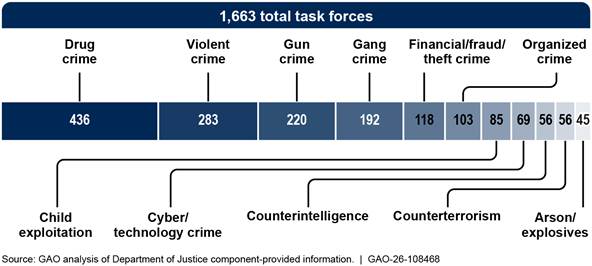
DOJ components can form task forces on a permanent or temporary basis based on components’ and local law enforcement agencies’ needs to combat a new or increased threat. Likewise, if there is no longer a need for the task force or it cannot be staffed to be effective, DOJ components can dissolve the task force. As a result, the number of task forces can vary and change over time. As of April 2026, ATF, DEA, FBI, and USMS partnered with nonfederal law enforcement agencies and officers on 1,663 task forces across the U.S. to combat various criminal activities, apprehend fugitives, and protect national security interests.[11] All the task forces featured in figure 1 include deputized nonfederal officers.
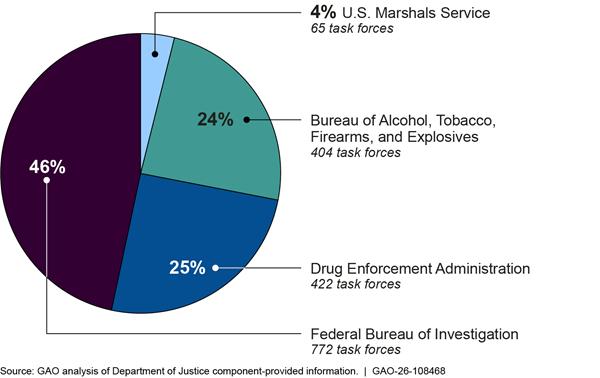
Note: This figure represents a point-in-time snapshot based on task force lists provided by components between May and December 2025. Although these numbers naturally fluctuate, ATF, DEA, FBI, and USMS officials confirmed in April 2026 that their current totals remain comparable to these historical figures.
Components may self-initiate a task force or a statute may direct DOJ to form a task force. For example, an FBI Joint Terrorism Task Force investigates terrorist acts that affect U.S. interests and aims to disrupt and prevent terrorist acts, which may include apprehending individuals who are planning to commit such acts. Additionally, the Presidential Threat Protection Act of 2000 led to the creation of permanent Regional Fugitive Task Forces. USMS directs and coordinates these task forces to locate and apprehend fugitives wanted by federal or nonfederal law enforcement with the goal of improving public safety and reducing violent crime. DOJ task forces may also address many types of criminal activity with the intent of improving public safety. Figure 2 shows the various types of task forces DOJ components lead as of April 2026.
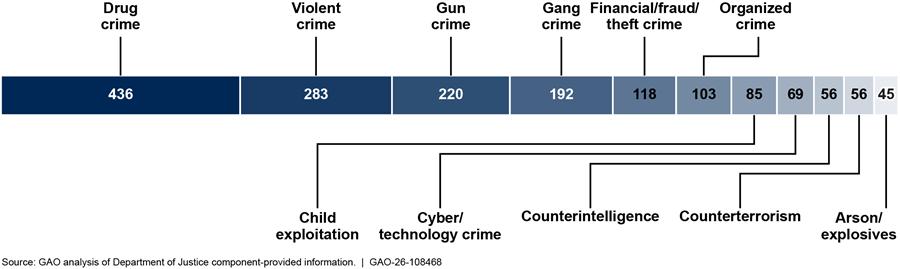
Note: This figure represents a point-in-time snapshot based on task force lists provided by components between May and December 2025. Although these numbers naturally fluctuate, officials from the Bureau of Alcohol, Tobacco, Firearms, and Explosives (ATF); Drug Enforcement Administration (DEA); Federal Bureau of Investigation (FBI); and U.S. Marshals Service (USMS) confirmed in April 2026 that their current totals remain comparable to these historical figures. We categorized task forces based on descriptions provided by the individual components and each task force is assigned to one category only (e.g., a task force cannot be categorized as both a firearms trafficking and a violent crime task force). We vetted our categorization with the components and adjusted based on their feedback.
According to component policies, nonfederal law enforcement officers must be under the supervision of the federal government while working on a DOJ-led task force. DOJ task forces operating in field offices provide multiple layers of supervision over task force officers. For example, the special agent in charge or U.S. marshal is typically the most senior official in charge of the entire field office, which may operate more than one task force. A supervisory special agent or a deputy U.S. marshal is the federal official who conducts day-to-day oversight of nonfederal task force officers and the task force. Throughout the report, we refer to this individual as the task force supervisor.
Deputation Authority under Titles 18 and 21 of the U.S. Code
Nonfederal law enforcement officers must be deputized to exercise federal law enforcement authorities (e.g., serving federal warrants) while working on a DOJ-led task force. The Attorney General delegated the authority to deputize nonfederal law enforcement officers to serve on DOJ task forces to officials at USMS, DEA, and FBI. Title 18 deputation is relevant to law enforcement work involving a broad array of criminal activity, while Title 21 deputation is relevant specifically to criminal activity involving controlled substances. ATF does not have deputation authority and must work with USMS to get task force officers deputized. Prior to April 2026, the FBI did not have Title 18 deputation authority and worked with USMS to get task force officers deputized.
· USMS and FBI Title 18 deputations. The USMS Director is authorized to deputize nonfederal law enforcement officers to enforce criminal offenses under Title 18 of the U.S. Code, which covers a variety of offenses, such as those related to criminal street gangs, kidnapping, and robbery. Deputized officers have the authority to, among other things, carry firearms, make arrests without a warrant for any offense against the U.S. committed in their presence, seek and execute arrest and search warrants, and serve subpoenas. Additionally, in April 2026, the Acting Attorney General delegated deputation authority under Title 18 to the FBI. Due to the recency of the memo, we did not include the FBI’s delegation authority in our analysis. Therefore, for purposes of this report, we do not include information on FBI’s new Title 18 deputation authority and procedures.
· DEA and FBI Title 21 deputations. DEA and FBI deputation authority for nonfederal law enforcement officers is narrower and only allows those officers to enforce controlled substances-related offenses, such as those involving drug trafficking, under Title 21 of the U.S. Code. Once deputized, personnel can assist with federal investigations of controlled substances-related offenses, such as those involving drug trafficking. Deputized officers have the authority to, among other things, carry firearms; execute and serve search warrants, arrest warrants, administrative inspection warrants, subpoenas, and summonses; make arrests without warrant for any offense against the U.S. committed in their presence; and make seizures of property. DEA does not utilize nonfederal law enforcement officers to investigate violations of laws contained in Title 18 of the U.S. Code, according to officials.
Nonfederal task force officers can also be deputized under both Title 18 and Title 21. For example, FBI may deputize a nonfederal task force officer serving on a gang-related FBI task force to enforce the controlled substances-related offenses contained in Title 21 and have USMS deputize the officer to enforce the criminal offenses contained in Title 18. Figure 3 shows DOJ components’ deputation authorities.
Figure 3: Deputation Authority of U.S. Marshals Service, Federal Bureau of Investigation, and Drug Enforcement Administration, as of April 2026
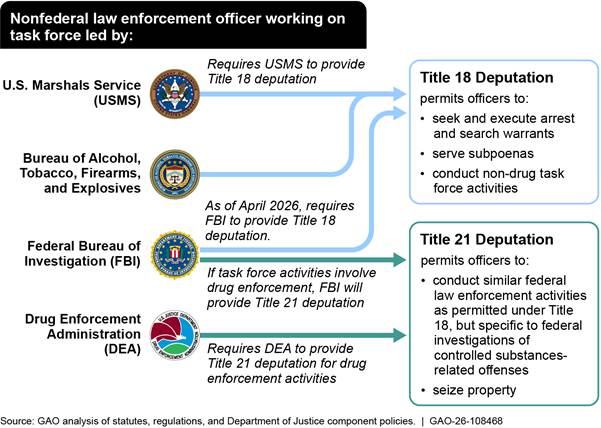
Note: The figure provides examples of deputation authority under Titles 18 and 21 of the U.S. Code. Nonfederal law enforcement officers must be deputized to exercise federal law enforcement authorities while working on a DOJ-led task force. DEA does not use nonfederal law enforcement officers to investigate violations of laws contained in Title 18 of the U.S. Code. ATF does not have deputation authority and must work with USMS to get officers deputized. Prior to April 2026, the FBI did not have Title 18 deputation authority and worked with USMS. While the Acting Attorney General delegated deputation authority under Title 18 to FBI in April 2026, due to the recency of the memo, we did not include the FBI’s delegation authority in our analysis. Therefore, only USMS’s process is described later in the report.
DOJ components have thousands of nonfederal law enforcement officers deputized to exercise federal law enforcement authorities.[12] For example, from fiscal years 2021 through 2025, USMS deputized approximately 25,000 nonfederal law enforcement officers under Title 18 to serve on task forces led by ATF, FBI, and USMS.[13] During that same time period, DEA deputized nearly 10,000 nonfederal law enforcement officers under Title 21 to serve on its task forces.[14] FBI provided data that showed that during the same time period, it also deputized nearly 13,000 law enforcement officers under Title 21 to serve on its task forces, but this number also includes federal law enforcement officers, as FBI was unable to exclude them from its data.[15]
All Four Components Have Eligibility Policies and Procedures for Nonfederal Officers
ATF, DEA, FBI, and USMS work with nonfederal law enforcement agencies to identify officers to serve on their task forces and have policies and procedures for determining their initial and continued eligibility. Initial eligibility refers to (1) the screening process a component uses to determine if a nonfederal law enforcement officer can be nominated for deputation, and (2) the screening process a component with deputation authority uses to determine if the officer can be deputized to join a task force. Continued eligibility refers to the renewal of the deputation and the officer’s ability to continue serving on a task force.
Initial eligibility. We found that all four components have established requirements that nonfederal law enforcement officers must meet to be eligible to serve on their task forces. For instance, we found that all four components’ task force policies require nonfederal officers to be in good standing with their parent agency (e.g., no current internal investigations), have at least one year of law enforcement experience, be authorized to carry a firearm, and pass a background check.[16] Appendix II provides a comparison of eligibility requirements across components.
Task forces from all four components work with parent agencies to identify candidates with specific attributes to serve on their task forces before sponsoring them to be deputized. For example, four of the eight task force supervisors we spoke with said they ask for a list of candidates from nonfederal law enforcement agencies they work closely with to identify potential task force officers. Additionally, three of eight task force supervisors, including two who also ask for a list of candidates, said they conduct interviews with potential nonfederal task force officers to determine whether they would be a good fit (e.g., team player) to serve on the task force. One task force supervisor also noted looking for individuals with specialized skills, such as experience working drug enforcement investigations. Once a task force supervisor identifies a nonfederal officer to serve on a task force, the lead component for the task force enters into an agreement with the nonfederal task force officer’s parent agency and sponsors their deputation application.
As components with deputation authority, USMS, DEA, and FBI also set eligibility requirements regarding deputation for the nonfederal task force officer candidates seeking to join DOJ component task forces.[17] Deputation involves nonfederal task force officer candidates undergoing a background check, which may include a credit check, and a review of their firearms qualification. It also requires the parent agency to attest that the candidate is in good standing.[18]
For Title 18 deputation, if the candidate clears the component’s required checks, the candidate’s application is sent to USMS for further review.[19] For Title 21 deputation, the candidate’s application is sent to DEA or FBI headquarters for adjudication. If the candidate’s application for deputation is approved, the component swears in the nonfederal officer. Figure 4 depicts the deputation process.
Figure 4: Title 18 and Title 21 Deputation Process for Nonfederal Task Force Officers, as of April 2026
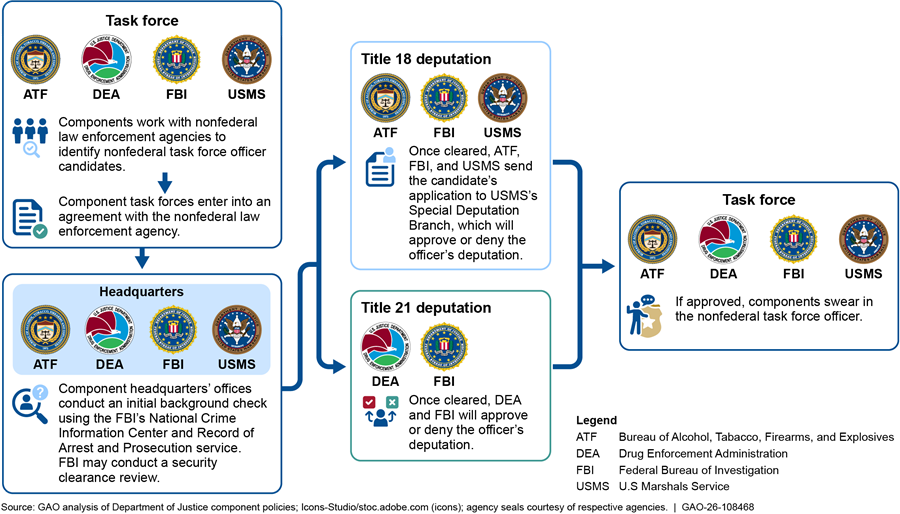
Note: Nonfederal task force officers can be deputized under both Title 18 (by USMS) and Title 21 (by DEA or FBI) of the U.S. Code. For example, nonfederal task force officers serving on gang-related FBI task forces may require both deputations. The Acting Attorney General also delegated deputation authority under Title 18 to FBI in April 2026. We did not include FBI’s Title 18 authority in our analysis due to the recency of the memo.
Continued eligibility. According to task force supervisors, while the length of time deputized nonfederal officers have served on a task force has ranged from two years to over 10 years, the nonfederal task force officer’s deputation requires periodic renewal. Specifically,
· USMS policy for deputation under Title 18 states that a nonfederal task force officer’s deputation is up for renewal every three years.
· DEA policy for deputation under Title 21 states that a nonfederal task force officer’s deputation is renewed every four years if the officer wants to continue serving on the task force for longer than four years.
· FBI policy for Title 21 deputation states that the deputation ends on October 1 of the year after the officer is deputized.[20]
Deputation renewal is contingent upon a background check and, in the case of Title 18 deputation renewal through USMS, must also include confirmation from the nonfederal task force officer’s parent agency that the officer is still in good standing. All component headquarters’ officials told us that they use the same national arrest databases used in the initial vetting process to continuously determine if the nonfederal task force officers have been arrested.
Agreements and Training Communicate Officers’ Responsibilities, but Not All Components Require Training Before Operations
ATF, DEA, FBI, and USMS officials said the primary ways
they communicate a nonfederal task force officer’s roles and responsibilities
are through (1) agreements (e.g., memoranda of understanding), and (2)
training. However, we found that ATF, DEA, and FBI allow nonfederal officers to
engage in operations before they have completed their initial task force officer
training. For purposes of this report, task force operations mean those law
enforcement activities related to interviews, arrests, searches, and
surveillance, or other activities requiring federal deputation.
All Four Components Use Agreements to Communicate Roles and Responsibilities to Nonfederal Task Force Officers
ATF, DEA, FBI, and USMS use written agreements to communicate nonfederal task force officers’ roles and responsibilities while serving on a DOJ task force. Each uses standardized agreement templates to describe the task force’s legal authorities and objectives, and coordination between the parent agency and component.[21] Additionally, we found all the agreement templates included information on the roles and responsibilities of the nonfederal task force officer while serving on a DOJ task force.[22] For example, the agreement templates:
· Outlined the deputized nonfederal task force officer responsibilities relevant to each task force, such as disrupting illicit drug trafficking and identifying and targeting individuals or groups for prosecution of violent crimes.
· Stated deputized nonfederal task force officers are subject to federal supervision and must abide by relevant DOJ’s and the respective component’s policies and procedures.
· Stated that if nonfederal task force officers fail to adhere to DOJ’s and the respective component’s policies and procedures, they can be removed from the task force at the discretion of the task force supervisor.[23]
DEA headquarters officials told us that they never modify their agreements, as nonfederal task force officers are expected to adhere to DEA policies and procedures. Alternatively, officials from ATF, FBI, and USMS headquarters told us that they do not typically modify agreements with parent agencies unless there are differences in policy between the two. These officials explained this helps ensure consistency across task forces within their components because they enter into agreements with hundreds of nonfederal law enforcement agencies and cannot operate under hundreds of agreements with different provisions. Appendix III provides a comparison of selected types of information included in the four components’ task force agreements.
In instances where law enforcement practices differ between the components and the parent agency, officials stated that components may modify the agreement to clarify which policies to follow and under what circumstances while engaging in task force operations. For example, according to a USMS task force supervisor we interviewed, USMS added an addendum to its agreement with a parent agency in a jurisdiction that required law enforcement officers to use a body-worn camera while engaging in any law enforcement operations, including USMS task force operations. Specifically, the addendum to the original agreement includes the DOJ and USMS body-worn camera policies and procedures nonfederal law enforcement officers must follow while operating on a USMS task force.[24] Additionally, FBI officials from one task force we interviewed said if there is a difference in use-of-force policies, FBI modifies the agreement to state the nonfederal task force officer will adhere to the parent agency’s use-of-force policy, rather than FBI’s use-of-force policy, when conducting task force operations.
Task force supervisors may also tailor nonfederal task force officers’ roles and responsibilities on the task force to ensure that they are not violating a parent agency’s policies during task force operations. For example, officials from DEA and FBI headquarters said that differences in policy between a parent agency and their component may be handled on a case-by-case basis, and task force officers may be excused from an activity not permitted by their parent agency. For example, a DEA task force supervisor stated that their nonfederal task force officers could not be involved in immigration-related work. Additionally, an ATF task force supervisor we interviewed said in cases where parent agency and component policies differ, the nonfederal task force officer might not participate in certain parts of the investigative or operational work. For example, if a nonfederal task force officer’s parent agency requires the officer to wear a body-worn camera while conducting interviews, the officer would not be assigned that duty while on the task force.
Three Components Do Not Require Nonfederal Officers to Complete Initial Task Force Officer Training before Starting Operations
All four components require nonfederal task force officers to take initial task force officer training. In addition to the written agreements, components use training to communicate nonfederal task force officers’ roles and responsibilities while serving on DOJ-led task forces. However, we found that ATF, DEA, and FBI do not require nonfederal task force officers to complete their initial task force officer training on relevant legal authorities, policies, and procedures before they can engage in task force operations.
ATF, DEA, FBI, and USMS have initial task force officer training that is required of nonfederal task force officers after they join the task force, which all four components’ headquarters officials and five of eight task force supervisors identified as a way to communicate the roles and responsibilities to nonfederal task force officers.[25]
The following are what each component has determined to be the purpose of initial task force officer training.
· ATF’s policies state that the purpose of the initial task force officer training is to ensure nonfederal task force officers have the appropriate level of knowledge and understanding of task force operations to help them achieve the mission and performance goals of the task force on which they are serving.
· DEA headquarters officials told us that the training is intended to provide newly deputized task force officers with the necessary information on the DEA’s operational procedures.
· FBI headquarters officials stated that the initial task force officer training is designed to introduce officers to DOJ and FBI authorities and to familiarize them with the information contained in the agreements.
· USMS headquarters officials said its initial task force officer training is designed to ensure nonfederal task force officers understand how to operate in the USMS environment and understand USMS policies and procedures.
Four of eight task force supervisors we interviewed also said initial training is designed to teach nonfederal task force officers the component’s policies and procedures for conducting their investigations and how to operate in the federal law enforcement environment.[26] For example, an FBI task force supervisor told us that the initial task force officer training communicates to a nonfederal task force officer their roles and responsibilities, and applicable rules and regulations.
Initial task force officer training required by the components may include expectations regarding nonfederal task force officer conduct and task force mission-specific courses, such as on investigative report writing, evidence handling, tactical training, legal procedures, and Fourth Amendment issues. Table 1 provides examples of initial task force officer training courses.[27]
Table 1: Examples of Initial Task Force Officer Training Courses for Nonfederal Task Force Officers, by Department of Justice (DOJ) Component
|
Component |
Examples of initial task force officer training courses |
Training format |
|
Bureau of Alcohol, Tobacco, Firearms, and Explosives |
Legal Procedures, Firearms Violations; and Fourth Amendment Issues |
In person |
|
Drug Enforcement Administration |
Evidence Handling; Legal and Liability Issues; and Use of Force |
In person |
|
Federal Bureau of Investigation |
Legal Training and Use of Force |
Virtual |
|
U.S. Marshals Service |
Operational Planning; Use of Force; and Legal Issues |
Virtual |
Source: GAO summary of DOJ component training curriculum. | GAO‑26‑108468
Standards for Internal Control in the Federal Government state that management should establish expectations of competence for key roles and respond to internal risk factors.[28] The four components established expectations of nonfederal task force officer competence through the completion of the initial task force officer training. For example, ATF’s, DEA’s, and FBI’s task force program policies establish varying timeframes for training completion, as shown in table 2.
Table 2: Department of Justice (DOJ) Components’ Requirements for Initial Nonfederal Task Force Officer Training
|
Component |
Component requirements for completing initial task force officer training |
Policy includes requirement for completing training prior to engaging in operations?a |
|
Bureau of Alcohol, Tobacco, Firearms, and Explosives |
Component policy does not require that initial task force officer training be completed before engaging in task force operations. Officials stated they expect nonfederal task force officers to complete initial training within 2 years of joining the task force. |
No |
|
Drug Enforcement Administration |
Component policy does not require that initial task force officer training be completed before engaging in task force operations. The policy requires nonfederal task force officers with less than one year of task force experience to complete task force officer training school. Officials explained that there is not a policy requiring nonfederal task force officers to attend the training after being on the task force for over a year, but they expect nonfederal task force officers to complete this training within 1 year. |
No |
|
Federal Bureau of Investigation |
Component policy does not require that initial task force officer training be completed before engaging in task force operations. The policy requires nonfederal task force officers to complete their initial training within 6 months of being sworn in on the task force. |
No |
|
U.S. Marshals Service |
Component policy requires that initial task force officer training be completed before engaging in task force operations. The policy states a nonfederal task force officer must complete initial training within 15 days of joining the task force. |
Yes |
Source: GAO analysis of DOJ component training information. | GAO‑26‑108468
aFor purposes of this report task force operations generally mean those law enforcement activities related to interviews, arrests, searches, and surveillance, or other activities requiring federal deputation.
However, we found that ATF, DEA, and FBI allow nonfederal task force officers to engage in task force operations before completing their initial task force officer training, including training on components’ applicable legal authorities, policies, and procedures. As a result, these components risk nonfederal task force officers engaging in task force operations without complete knowledge of the federal authorities components expect them to exercise. ATF, DEA, and FBI headquarters officials told us nonfederal task force officers can engage in task force operations before completing their initial task force officer training for two main reasons: because nonfederal task force officers have at least one year of law enforcement experience, and federal agents provide direct supervision of nonfederal task force officers.
· Nonfederal task force officer experience. To be eligible to serve on a DOJ component task force, nonfederal task force officers must meet the minimum deputation requirements to exercise federal law enforcement authorities, including having at least one year of experience as a sworn law enforcement officer. As such, all eight task force supervisors we interviewed stated that these officers are generally already aware of law enforcement practices.
However, deputized nonfederal task force officers are only required to have one year of prior law enforcement experience and may not have the subject matter expertise on conducting federal investigations or exercising federal law enforcement authorities, such as executing federal arrest and search warrants, prior to joining the component’s task force.
· Federal supervision. To mitigate the risk of nonfederal task force officers not adhering to the components’ applicable legal authorities, policies, and procedures when conducting task force operations, officials from ATF, DEA, and FBI said they ensure task force officers are directly supervised by senior federal agents on such operations. For example, two DEA task force supervisors told us nonfederal task force officers can engage in task force operations before completing initial training because they receive on-the-job training from a senior agent on the task force to help guide them on cataloguing evidence and writing investigative reports.
However, the capacity of a task force supervisor to provide on-the-job training may vary depending on the number of officers supervised. For example, among the eight task force supervisors we interviewed, one said the task force only had one nonfederal officer to supervise while five supervised between four and 14 nonfederal task force officers.[29] Additionally, these task force supervisors have duties in addition to direct supervision of task force officers; therefore, the level of supervision may vary by task force within a component.
ATF and DEA officials said that while they would like to get nonfederal task force officers trained as soon as possible after joining the task force, requiring them to complete their initial task force officer training before engaging in task force operations is impractical because they currently only offer this training in-person. Specifically, the officials told us that nonfederal officers may join task forces at any time and conducting individual in-person training sessions on a rolling basis is not practical. ATF officials added that it would be costly. Instead, they provide in-person training to groups of new nonfederal task force officers as funding allows. However, two of the eight task force supervisors we interviewed said they would like their nonfederal task force officers to receive initial training sooner than they are currently receiving it.
We recognize the resources required to provide individualized in-person training. However, there are alternative means of delivering training on legal authorities and component policies and procedures. For example, ATF, DEA, and FBI could use existing virtual platforms to administer a self-paced training module or require task force supervisors to administer a standardized on-the-job training protocol to ensure their nonfederal task force officers are proficient in legal authorities, policies, and procedures. This training would not replace the in-person task force officer training required for new nonfederal task force officers. Rather, early training on legal authorities and component policies could augment existing training to, at a minimum, ensure that new nonfederal task force officers understand the components’ task force policies and procedures and the legal authorities they were deputized to exercise. Further, before taking their training on legal authorities and component policies and procedures, nonfederal officers could observe task force operations before fully participating and using their new authority.
Updating ATF, FBI, and DEA’s policy to require that nonfederal task force officers receive initial training on relevant federal legal authorities and policies before engaging in task force operations (i.e., activities relating to interviews, arrests, searches, and surveillance, or other activities requiring federal deputation) would help ensure components achieve the intent of the training by having nonfederal officers understand the authorities under which they will be operating in the federal law enforcement environment.
Policies Describe Federal Supervisory Role, but Field Management Does Not Have Guidelines for Adjudicating Misconduct
DOJ component policies outline the supervisory structure of task forces and require that a federal task force supervisor directly supervises nonfederal task force officers. Additionally, all four components have procedures in place for reporting allegations of nonfederal task force officer misconduct. However, we found that when field management (e.g., the special agent in charge) is responsible for adjudicating these allegations, components do not have guidelines for field management to follow when handling these cases.
Component Policies Require Federal Supervision of Nonfederal Task Force Officers
DOJ component policies require federal, field-level supervision of task force operations, including an official who oversees the field office and a task force supervisor. We found that all eight task forces we selected had federal, field-level supervision. At the field level for all four components, the special agent in charge or U.S. marshal is typically the most senior official in charge of the field office.[30] These individuals are responsible, on their own or through subordinate officials, for overall task force management, negotiating task force agreements with parent agencies, and removing task force officers, if necessary.
For the direct supervision of nonfederal task force officers and task force operations, a task force supervisor conducts day-to-day oversight.[31] Figure 5 depicts some of the task force supervisor’s responsibilities and duties.
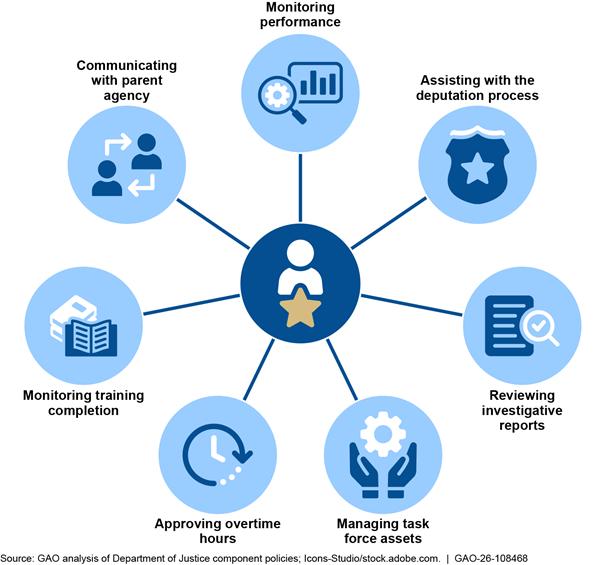
DOJ component policies detail the task force supervisor’s responsibilities. These may include (1) reviewing investigative reports, (2) monitoring performance, (3) communicating with parent agencies, and (4) handling administrative duties. All eight task force supervisors we interviewed confirmed carrying out some of these supervision responsibilities.
Reviewing investigative reports. We found that all four components have policies for the task force supervisor to review nonfederal task force officers’ investigative reports. For example, a USMS task force official told us the task force supervisor conducts regular reviews of investigative reports to gauge the quality of a nonfederal task force officer’s work.
Monitoring performance. All four components’ policies instruct the task force supervisor to informally or formally monitor the nonfederal task force officer’s performance. For example, a DEA task force supervisor told us that most performance evaluations involve verbal, informal conversations with the nonfederal task force officer. DEA policy recommends a formal performance evaluation if the nonfederal task force officer is not meeting the standards outlined in the DEA task force agreement.
Communicating with parent agencies. We found that all four components have policies for federal supervisors to communicate with the nonfederal task force officer’s parent agency. All eight task force supervisors we interviewed stated that the task force supervisor maintains regular contact with the nonfederal task force officer’s parent agency. For example, a USMS task force official told us the task force supervisor communicates performance issues to the parent agency.
Handling administrative duties. All four components’ policies require the task force supervisor to handle various administrative duties, such as reviewing and approving overtime hours, monitoring training completion, assisting with the deputation process, and managing task force assets. For example, ATF policy requires the task force supervisor to ensure nonfederal task force officers can only accrue overtime while in overtime status.
Component Policies Require Reporting Misconduct but Do Not Have Guidelines for Field Adjudication
We found that all four components’ policies require employees to report allegations of nonfederal task force officer misconduct but components do not have guidelines for field management to use when responsible for adjudicating such allegations.[32] Employees may report allegations to a field supervisor, the component’s internal oversight body (e.g., Internal Affairs), or the DOJ Office of the Inspector General.[33] Component policies also require each component’s internal oversight body to report allegations to the DOJ Office of the Inspector General, which has discretion over whether to investigate misconduct allegations or return those investigations to the component.[34]
Officials from the DOJ Office of the Inspector General told us that the Inspector General Act of 1978 empowers them to investigate all instances of nonfederal task force officer misconduct relating to the administration of DOJ programs and operations.[35] If the Office of the Inspector General accepts a complaint for investigation, it may coordinate its investigation with the relevant component’s internal oversight body.[36] If an allegation of misconduct is criminal in nature and prosecutable, the Office of the Inspector General works with the relevant U.S. Attorney’s Office to prosecute the nonfederal task force officer. Officials told us if the U.S. Attorney’s Office declines prosecution, the Office of the Inspector General drafts a report of its investigation and provides it to the relevant component for appropriate action. See figure 6 for a depiction of the reporting process.
Figure 6: Department of Justice (DOJ) Component Misconduct Allegation Reporting, Investigation, and Adjudication Process
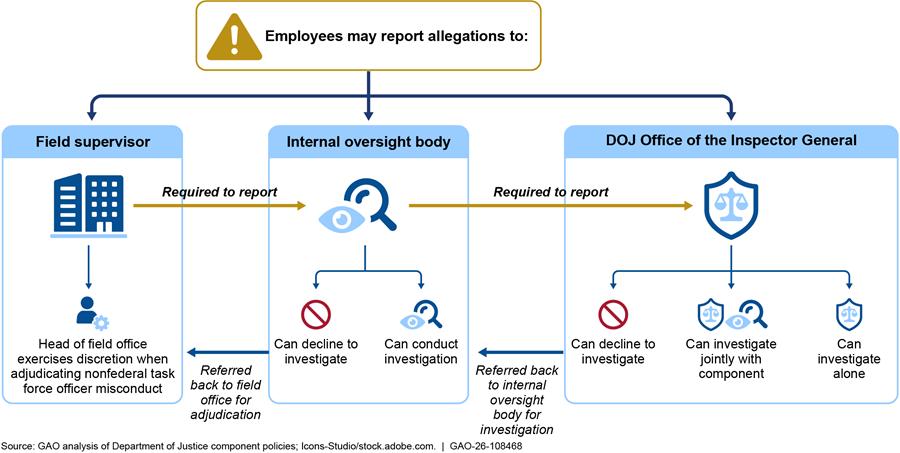
If the Office of the Inspector General declines to open an investigation, it will return the complaint to the relevant component’s oversight body for investigation.[37] According to component policies and component headquarters officials, the internal oversight body tracks the allegation in an internal database and may conduct its own investigation or refer the misconduct allegation back to the head of the originating field office for adjudication.[38] For example, according to DEA policy, the DEA Office of Professional Responsibility conducts investigations and provides its findings to the Board of Professional Conduct. ATF policy states that the ATF Internal Affairs Department also conducts investigations and provides its recommendations to the Office of Professional Responsibility and Security Operations.[39] At the field level, an investigation into an allegation of nonfederal task force officer misconduct can result in removal from the task force. For example, DEA headquarters officials told us that a nonfederal task force officer who self-reported an arrest for driving under the influence was terminated and returned to their parent agency.
However, we found that DOJ component policies do not have guidelines for the field to use when adjudicating allegations of nonfederal task force officer misconduct. Federal internal control standards state that management should implement control activities through policies and procedures, such as by documenting in policies what is expected.[40] The standards also state that management should define objectives clearly to enable the identification of risks. In the context of field-level management, decisions regarding allegations of misconduct against nonfederal task force officers should be implemented free of subjectivity, which can harm task force morale and erode public trust in task forces.
As described below, component field offices do not have guidelines to use when adjudicating allegations of nonfederal task force officer misconduct.
· ATF. ATF policy states that most allegations of nonfederal task force officer misconduct are the responsibility of ATF field management to address. However, the policy does not include guidelines for ATF field management to use in instances where it is responsible for adjudicating these allegations. ATF headquarters officials explained this is because adjudication decisions depend on the individual circumstances of each allegation.
· DEA. DEA policy requires its internal oversight body to provide guidance to any field office that reports allegations of nonfederal task force officer misconduct, but the policy does not define this guidance.[41] DEA headquarters officials told us that the field office special agent in charge uses discretion when deciding how to adjudicate allegations against a nonfederal task force officer, since the special agent in charge has administrative control over a nonfederal officer’s participation on the task force.
· FBI. FBI policy does not provide guidelines for its field offices to use when adjudicating allegations of nonfederal task force officer misconduct. Specifically, FBI policy states that a field office may remove a nonfederal task force officer for violating any law or FBI policy or at FBI’s discretion. But the policy does not provide guidelines on how to exercise that discretion. FBI headquarters officials told us its internal oversight body investigates and adjudicates allegations against nonfederal task force officers who hold security clearances.[42] If the allegation is substantiated, the internal oversight body denies the officer access to FBI space and systems. However, the relevant special agent in charge at the field level uses their discretion when deciding whether to remove an officer from task force operations during an ongoing investigation.[43] Additionally, FBI headquarters officials told us that if the DOJ Office of the Inspector General returns an allegation against a nonfederal task force officer to FBI, the agency refers the allegation to field management for awareness and any action deemed appropriate.
· USMS. USMS policy does not provide guidelines for the field to use when adjudicating allegations of nonfederal task force officer misconduct.[44] For example, USMS policy states that the field is responsible for investigating and adjudicating allegations of nonfederal task force officer misconduct. Furthermore, USMS policy instructs field offices to conduct investigations of misconduct fairly and appropriately, to conclude investigations within 30 days of receipt, and to ensure secure storage of all investigative materials. However, the policy directive does not provide further guidelines for adjudicating allegations, such as when to remove a nonfederal task force officer from the task force.
According to component policy and component officials, field-level management may use their discretion when addressing allegations of nonfederal task force officer misconduct and adjudicate allegations on a case-by-case basis, but components do not have guidelines for field management to use. Further, components do not have guidelines that lay out what is expected regarding whether a nonfederal task force officer can continue to participate in task force operations during a misconduct investigation. For example, ATF and DEA headquarters officials told us the nonfederal task force officer cannot participate in operations during an ongoing misconduct investigation. FBI headquarters officials told us the special agent in charge can use their discretion when deciding whether to suspend a nonfederal task force officer during an investigation. USMS headquarters officials told us that a nonfederal task force officer may be able to participate in operations during a misconduct investigation because the severity of the misconduct determines whether the officer can continue to participate in such operations.[45]
The DOJ Office of the Inspector General reported in 2024 that USMS applied inconsistent practices across task forces when investigating misconduct allegations.[46] Specifically, the Office of the Inspector General found that while some task forces remove officers during active misconduct investigations, other task forces continue to use officers in task force operations.
Additionally, in instances where field management exercises discretion in allowing an officer to continue participating in task force operations, management risks jeopardizing future prosecutions resulting from those operations. For example, DOJ policy requires prosecutors to disclose to the defense any information about witnesses’ credibility or that could affect the admissibility of prosecution evidence. Such information could include a misconduct allegation against a nonfederal task force officer who must later serve as a prosecution witness.[47] Two of the eight task force supervisors described possible risks of keeping a nonfederal task force officer actively working on the task force during a misconduct investigation. Specifically, a DEA task force supervisor told us that removing the officer from operations lessens the risk of further allegations against the officer, and an ATF headquarters official told us that removing the officer mitigates the risk to task force operations.
Although nonfederal task force officers are not employed by the relevant DOJ component, they are required to follow DOJ and component policies and procedures, including those involving standards of conduct. Components have developed policies for adjudicating federal employee misconduct, but those do not apply to nonfederal task force officers. For example, DEA created a table of guidelines that categorizes types of misconduct and proposed actions to take against its employees based on the misconduct. The DOJ Office of the Deputy Attorney General, which is responsible for providing overall supervision and direction to DOJ organizational units,[48] has the visibility across the components necessary to help ensure guidelines established by the components for their field offices provide sufficient information to avoid subjectivity and maintain an appropriate level of consistency.
By developing guidelines for adjudicating allegations of nonfederal task force officer misconduct, including defining expectations regarding a nonfederal task force officer’s status during an active misconduct investigation, components can help ensure field office management does not risk the integrity of the task force’s operations and public trust in task force effectiveness. It would also help ensure field managers are applying the same criteria when adjudicating such allegations of misconduct.
Conclusions
Partnering with deputized nonfederal officers on task forces provides DOJ components the opportunity to gain valuable insights into regional and local criminal and national security issues. These task forces enhance the investigative work of DOJ federal law enforcement with the intent to improve public safety. To serve on these task forces, nonfederal officers must be deputized and trained to exercise federal law enforcement authority. However, ATF, DEA, and FBI do not require nonfederal task force officers to receive this training on federal law enforcement authority before participating in task force operations (i.e., activities relating to interviews, arrests, searches, and surveillance, or other activities requiring federal deputation). This increases the risk that nonfederal officers will participate in task force operations without fully understanding the federal authorities they were deputized to exercise. Requiring all nonfederal task force officers to complete initial training on legal authorities and component policies before participating in task force operations will help ensure components achieve the intent of the training by having nonfederal officers understand the authorities under which they will be operating in the federal law enforcement environment.
While nonfederal task force officers must adhere to DOJ and component policies and standards of conduct, they may face allegations of misconduct. Although ATF, DEA, FBI, and USMS have requirements to report and investigate these allegations, these components have not established guidelines to inform field management decisions when the responsibility for adjudicating such allegations is delegated to that level. In the absence of guidelines, officials expressed different perspectives about the conditions under which nonfederal officers should be removed from or remain on federal task forces during an investigation. Not having guidance risks field management using inconsistent criteria to adjudicate misconduct, which could jeopardize the integrity of task force operations and erode public trust in task force effectiveness. By developing guidelines for field management to use when adjudicating misconduct, components can ensure field managers adjudicate allegations of nonfederal task force officer misconduct across the component according to the same criteria.
Recommendations for Executive Action
We are making seven recommendations, including two recommendations each to ATF, DEA, and FBI, and one recommendation to USMS.
The Director of the Bureau of Alcohol, Tobacco, Firearms, and Explosives should update its policy to include a requirement for nonfederal task force officers to receive their initial training on federal legal authorities and policies before engaging in task force operations requiring their use of federal deputation authority. (Recommendation 1)
The Administrator of the U.S. Drug Enforcement Administration should update its policy to include a requirement for nonfederal task force officers to receive their initial training on federal legal authorities and policies before engaging in task force operations requiring their use of federal deputation authority. (Recommendation 2)
The Director of the Federal Bureau of Investigation should update its policy to include a requirement for nonfederal task force officers to receive their initial training on federal legal authorities and policies before engaging in task force operations requiring their use of federal deputation authority. (Recommendation 3)
The Director of the Bureau of Alcohol, Tobacco, Firearms, and Explosives, in consultation with the Office of the Deputy Attorney General, should develop guidelines to inform field management decisions when adjudicating allegations of nonfederal task force officer misconduct. (Recommendation 4)
The Administrator of the U.S. Drug Enforcement Administration, in consultation with the Office of the Deputy Attorney General, should develop guidelines to inform field management decisions when adjudicating allegations of nonfederal task force officer misconduct. (Recommendation 5)
The Director of the Federal Bureau of Investigation, in consultation with the Office of the Deputy Attorney General, should develop guidelines to inform field management decisions when adjudicating allegations of nonfederal task force officer misconduct. (Recommendation 6)
The Director of the U.S. Marshals Service, in consultation with the Office of the Deputy Attorney General, should develop guidelines to inform field management decisions when adjudicating allegations of nonfederal task force officer misconduct. (Recommendation 7)
Agency Comments and Our Evaluation
We provided a draft of this report to DOJ for review and comment. DOJ communicated via email that the department concurred with all seven recommendations. However, for recommendations one through three, DOJ raised concerns that the language in the draft could be interpreted to prevent nonfederal task force officers from participating in certain activities during the onboarding process, such as observing task force operations, and requested we revise it. We revised the recommendations to make clear that nonfederal task force officers should receive initial training on federal legal authorities and policies before using their new deputation authority rather than before the federal deputation itself. We also included additional contextual information in the body of the report to reflect these changes.
DOJ also provided technical comments via email, which we have incorporated into the report as appropriate.
The DOJ Office of the Inspector General did not provide written comments on the draft report, but did provide technical comments, which we have incorporated into the report as appropriate.
We are sending copies of this report to the appropriate congressional committees and to the Attorney General. In addition, the report is available at no charge on the GAO website at http://www.gao.gov.
If you or your staff members have any questions about this report, please contact me at TranquilliN@gao.gov. Contact points for our Offices of Congressional Relations and Public Affairs may be found on the last page of this report. GAO staff who made key contributions to this report are listed in appendix IV.
Sincerely,
Nathan Tranquilli
Acting Director, Homeland Security and Justice
Appendix I: Illustrations of Judicial Actions and Claims Related to Nonfederal Department of Justice Task Force Officers
This overview describes the key types of judicial actions and claims that might be brought against nonfederal task force officers and the United States related to the activities of nonfederal officers serving on Department of Justice (DOJ) task forces. It reflects our independent analysis of publicly available information, including existing case law, on these types of judicial actions and claims.
We prepared this overview by conducting legal research of statutes, case law, and articles on available judicial actions and claims. We obtained case-specific information, such as dockets and pleadings, from the Public Access to Court Electronic Records system. This appendix is illustrative, and as such does not identify every type of action and claim that might be asserted related to the activities of nonfederal DOJ task force officers.
Criminal Actions
Example 1: Federal prosecution for alleged violation of federal criminal law
Summary of Action. These prosecutions arise under federal law and can involve different charges against defendants, depending on the nature of the alleged criminal misconduct. The United States has the burden of proving beyond a reasonable doubt every fact necessary to constitute the crime charged.
Applicability to Nonfederal Task Force Officers. The United States can prosecute nonfederal task force officers for violations of federal law related to their service on a DOJ task force. Table 3 provides illustrative examples of federal prosecutions of nonfederal task force officers.
Table 3: Illustrative Examples of Federal Prosecutions of Nonfederal Officers Serving on Department of Justice (DOJ) Task Forces
|
Case |
Allegations |
Outcome |
|
United States v. Winstead |
The defendant, in his capacity as a nonfederal task force officer with the U.S. Marshals Service, allegedly assaulted a handcuffed individual, thereby depriving him of the right to be free from objectively unreasonably force.a |
The defendant pleaded guilty to a violation of the law prohibiting deprivation of rights under color of law and was sentenced to a term of imprisonment of 22 months.b He was also ordered to pay an assessment of $100 and a fine of $2000. |
|
United States v. Hickox and United States v. Earrey |
Conspiracy allegations against both defendants regarding defrauding the United States: The defendants allegedly conspired to defraud the United States of the right to the conscientious, loyal, faithful, disinterested, and unbiased services, decisions, actions, and performance of duties in their official capacity as nonfederal task force officers with the Drug Enforcement Administration (DEA), free from corruption, improper influence, dishonesty, and fraud. As part of the conspiracy, the United States alleged that the defendants did the following: (1) stole and diverted U.S. currency and drugs that had been lawfully seized during criminal investigations and converted the same to their own use and benefit; (2) stole and diverted seized items by breaking into evidence bags, removing part or all of the seized property, and re-sealing the evidence bags or repackaging the remaining seized property into substitute evidence bags; (3) stole and diverted seized items by taking custody of evidence that had been marked for official destruction and falsely representing to the DEA or the Nassau County, Florida Sheriff’s Office that the items had been destroyed, including by preparing and submitting forged certificates of destruction to the agencies; (4) falsified official law enforcement records, and made materially false statements in official law enforcement records, to conceal the theft of lawfully seized U.S. currency and drugs from evidence; and (5) distributed the stolen drugs to individuals to be sold. Additional allegations against the defendant in United States v. Hickox: The defendant allegedly: (1) possessed with intent to distribute a controlled substance; (2) conspired to distribute and possess with intent to distribute a controlled substance; (3) stole firearms which had moved in interstate or foreign commerce; (4) possessed a machinegun; (5) possessed a firearm that had been shipped and transported in interstate commerce, from which the manufacturer’s serial number had been removed, altered, and obliterated; and (6) attempted to evade and defeat the assessment of income tax due and owing by him to the United States for calendar years 2020, 2021, and 2022.c Additional allegations against the defendant in United States v. Earrey: The defendant allegedly: (1) knowing that he was an unlawful user of and addicted to a controlled substance, possessed, in and affecting interstate and foreign commerce, firearms and ammunition; (2) sold ammunition to an individual, knowing and having reasonable cause to believe that the individual had been previously convicted of a crime punishable by imprisonment for a term exceeding one year; and (3) conspired to distribute and possess with intent to distribute a controlled substance.d |
The defendant in United States v. Hickox pleaded guilty to conspiring to defraud the United States, tax evasion, and conspiracy to possess with intent to distribute controlled substances and was sentenced to a term of imprisonment of 210 months.e He was ordered to pay an assessment of $300 and restitution of $98,053 to the Internal Revenue Service and was also ordered to forfeit assets in the amount of $421,218.61.e The defendant in United States v. Earrey pleaded guilty to possessing a firearm as an unlawful user of a controlled substance, conspiring to defraud the United States, and conspiring to possess with intent to distribute controlled substances and was sentenced to a term of imprisonment of 108 months.f He was also ordered to pay an assessment of $300. |
Source: GAO analysis of court documentation. | GAO‑26‑108468
aInformation, United States v. Winstead, No. 3:24-CR-00044 (S.D. Miss. Apr. 26, 2024), Dkt. No. 1.
bJudgment, United States v. Winstead, No. 3:24-CR-00044 (S.D. Miss. May 27, 2025), Dkt. No. 27.
cSuperseding Indictment, United States v. Hickox, No. 3:23-CR-00047 (M.D. Fla. Sept. 6, 2023), Dkt. No. 25.
dSuperseding Indictment, United States v. Earrey, No. 3:23-CR-00047 (M.D. Fla. Sept. 6, 2023), Dkt. No. 25.
eJudgment, United States v. Hickox, No. 3:23-CR-00047 (M.D. Fla. Jan. 28, 2025), Dkt. No. 135; Ord. of Restitution, United States v. Hickox, No. 3:23-CR-00047 (M.D. Fla. Mar. 7, 2025), Dkt. No. 143.
fJudgment, United States v. Earrey, No. 3:23-CR-00047 (M.D. Fla. Apr. 18, 2025), Dkt. No. 166.
Example 2: State prosecution for alleged violation of state criminal law
Summary of Action. This type of prosecution arises under state law and can involve different charges against defendants, depending on the nature of the alleged criminal violations. The state has the burden of proving beyond a reasonable doubt every fact necessary to constitute the crime charged.
Applicability to Nonfederal Task Force Officers. States might attempt to prosecute nonfederal task force officers for violations of state law related to their service on a DOJ task force, although this kind of action may be dismissed on Constitutional grounds or based on immunities that are available under state law. Nonfederal task force officers who are indicted in state court may be entitled to immunity under the Supremacy Clause of the Constitution.[49] Under this Supremacy Clause immunity, a state generally cannot punish a federal officer who (1) performed an act authorized by federal law and (2) in performing that authorized act, did no more than what was necessary and proper.[50] Courts regularly conclude that federal defendants should not be subject to state prosecution because they are entitled to Supremacy Clause immunity.[51] Courts have also, however, rejected federal defendants’ arguments that this immunity applies to state charges against them.[52] Federal defendants may also be entitled to immunities that are available under state law, such as self-defense immunity. Table 4 provides illustrative examples of state prosecutions of nonfederal task force officers.
Table 4: Illustrative Examples of State Prosecutions of Nonfederal Officers Serving on Department of Justice (DOJ) Task Forces
|
Case |
Allegations |
Outcome |
|
Georgia v. Kim |
First Indictment: A Fulton County, Georgia grand jury returned an indictment against the defendant, who was a nonfederal member of a Federal Bureau of Investigation task force, related to a task force operation that resulted in the death of a suspect. The indictment charged the defendant with involuntary manslaughter and violation of oath, for causing the suspect’s death by recklessly entering the suspect’s apartment in violation of the task force’s operation plan.a Second Indictment: A Fulton County, Georgia grand jury returned a second indictment against the defendant, related to the same task force operation that resulted in the death of a suspect. The indictment charged the defendant with felony murder, aggravated assault, and violation of oath, for shooting at the suspect with a handgun.b |
First Indictment: The U.S. District Court for the Northern District of Georgia dismissed the indictment, concluding that the defendant was immune to its charges under the Supremacy Clause of the Constitution.c In reaching this conclusion, the court reasoned the defendant’s challenged actions were authorized by federal law and were necessary and proper.d Second Indictment: The district court dismissed the indictment, concluding that the defendant was entitled to self-defense immunity under Georgia law.e |
|
Michigan v. Keely |
The State of Michigan charged the defendant, who was a nonfederal member of a U.S. Marshals Service task force, with second-degree murder and involuntary manslaughter related to his participation in a task force operation that resulted in the death of a suspect.f |
The U.S. District Court for the Western District of Michigan dismissed the charges, concluding that the defendant was immune to them under the Supremacy Clause of the Constitution.g This case is on appeal to the U.S. Court of Appeals for the Sixth Circuit. |
Source: GAO analysis of court documentation. | GAO‑26‑108468
aDirect Indictment, Georgia v. Kim, No. 22-SC-185426 (Fulton Super. Ct. Dec. 16, 2022).
bDirect Indictment, Georgia v. Kim, No. 22-SC-185427 (Fulton Super. Ct. Dec. 16, 2022).
cOp. & Ord., Georgia v. Kim, No. 1:23-CR-00287 18 (N.D. Ga. June 3, 2025), Dkt. No. 71.
dId. at 8-9.
eId. at 24.
fCompl. Felony, Michigan v. Keely, No. 24-60116-FY (62B Jud. Dist., 17th Jud. Cir. May 28, 2024).
gMichigan v. Keely, No. 1:24-CR-00115, 2025 U.S. Dist. LEXIS 100680, *27 (W.D. Mich. May 28, 2025).
Civil Claims
Example 3: Claim arising under the Federal Tort Claims Act
Summary of Claim. The Federal Tort Claims Act (FTCA) provides a cause of action and waives sovereign immunity “for injury or loss of property, or personal injury or death caused by the negligent or wrongful act or omission of any employee of the Government while acting within the scope of his office or employment….”[53] In reviewing the merits of an FTCA claim, courts apply the substantive law of the place where the event occurred,[54] so the legal analysis of a claim depends on the nature of the alleged tort and the jurisdiction where it allegedly occurred. The plaintiff generally has the burden of proving their FTCA claim by a preponderance of the evidence.
Applicability to Nonfederal Task Force Officers. FTCA claims are only available against the United States—they are not available against nonfederal task force officers in their official or individual capacity. These task force officers are immunized from individual common-law tort claims that arise while they were acting within the scope of their employment, and the United States is substituted for the task force officers as the sole defendant.[55]
While FTCA claims are not available against nonfederal task force officers, these claims can involve the activities of nonfederal task force officers. An individual detailed to a federal agency can be considered a federal employee for purposes of the FTCA.[56] This can include nonfederal task force officers.[57] If a plaintiff cannot establish that the nonfederal task force officer was acting on behalf of the United States at the time of the incident, then the claim will likely be dismissed.[58]
There are several exceptions to the FTCA’s waiver of immunity that the United States can invoke to dismiss claims arising under the FTCA that involve the activities of nonfederal task force officers.[59] For instance, under the discretionary function exception, immunity is not waived for claims “based upon the exercise or performance or the failure to exercise or perform a discretionary function or duty on the part of a federal agency or an employee of the Government….”[60] Courts apply a two-part test to determine whether this exception applies. First, they determine whether the decision “involves an element of judgment or choice.”[61] If the answer to this question is “no,” then the exception does not apply. If the answer is “yes,” courts move to the second step of the analysis and determine “whether that judgment is of the kind that the discretionary function exception was designed to shield.”[62] As framed, the exception focuses on whether the actions of nonfederal task force officers are susceptible to policy analysis.[63] Table 5 provides an illustration of the application of this FTCA exception to a case involving nonfederal task force officers.
Table 5: Illustration of Application of Discretionary Function Exception to Federal Tort Claims Act (FTCA) Case Involving Nonfederal Officers Serving on a Department of Justice (DOJ) Task Force
|
Case |
FTCA Allegations |
Court Analysis |
|
Van Loo v. United States |
Four nonfederal law enforcement officers participated in a U.S. Marshals Service task force operation that resulted in the death of a suspect. The plaintiff, which is the estate of the suspect who died during the task force operation, alleged that these task force officers engaged in negligence when they failed to develop a plan to safely execute the arrest of the suspect or failed to follow the plan, failed to establish an adequate incident command structure, and failed to conduct the operation with adequate communications.a |
The U.S. District Court for the Western District of Washington relied on the discretionary function exception to dismiss the FTCA claim involving the nonfederal task force officers. In applying the first part of the discretionary function test, the court concluded that the applicable U.S. Marshals Service policies did not require any particular course of action in apprehending the suspect, “and their decision about whether, when, or how to do so was imbued with discretion.”b As a result, the court also determined, as to the second part of the test, that the officers’ decisions are susceptible to policy analysis. It explained that in the Ninth Circuit there is “a strong presumption that law enforcement activities subject to discretionary guidelines are grounded in policy considerations because the investigation of crime involves policy judgments at the core of the executive branch.”c Given this presumption, the court concluded that there was some plan to arrest the suspect and some command structure for the operation, which was enough to satisfy the second part of the test. The court acknowledged that a county prosecuting attorney raised serious concerns about the task force’s plan, but stated that it was not its role to decide if the task force’s plan was good, complete, or thorough.d |
Source: GAO analysis of court documentation. | GAO‑26‑108468
aSecond Am. Compl., Van Loo v. United States, No. 3:23-CV-05618 31-32 (W.D. Wash. June 26, 2024), Dkt. No. 89.
bVan Loo v. United States, No. 3:23-CV-05618, 2025 U.S. Dist. LEXIS 38670, *56 (W.D. Wash. Mar. 4, 2025).
cId. at *59 (quoting Gonzalez v. United States, 814 F.3d 1022, 1032 (9th Cir. 2016) (internal quotations omitted)).
dId. at *62-63.
Example 4: Alleged violation of the Constitution under Bivens v. Six Unknown Named Agents of the Federal Bureau of Narcotics, 403 U.S. 388 (1971)
Summary of Claim. Civil damages for constitutional violations are available against federal officers only in limited circumstances, as recognized by the U.S. Supreme Court. Congress has not enacted a statute providing for such damages. In 1971, in Bivens v. Six Unknown Named Agents of the Federal Bureau of Narcotics, the U.S. Supreme Court recognized an implied cause of action to seek damages related to a Fourth Amendment claim for an unlawful, warrantless arrest and search.[64] Later, in 1979 and 1980, the U.S. Supreme Court expanded Bivens to encompass a Fifth Amendment claim for employment dismissal based on sex and an Eighth Amendment claim for failure to provide adequate medical treatment.[65] In the intervening decades, the U.S. Supreme Court “consistently refused to extend Bivens to any new context or new category of defendants.”[66]
In 2022, the U.S. Supreme Court emphasized that “recognizing a cause of action under Bivens is a disfavored judicial activity.”[67] Rather, “in most every case,” Congress is better positioned than courts to recognize such a cause of action, given “Congress’ preeminent authority in this area.”[68] Further, courts “may not fashion a Bivens remedy if Congress already has provided, or has authorized the Executive to provide, an alternative remedial structure.”[69] The plaintiff has the burden of proving their Bivens claim by a preponderance of the evidence.
Applicability to Nonfederal Task Force Officers. Nonfederal task force officers are operating under color of federal law when they fulfill their law enforcement duties as members of a federal task force.[70] As a result, Bivens claims can be asserted against them in their individual capacity for their task force-related activities.[71] Under the U.S. Supreme Court’s framework, to be successful, a Bivens claim against a nonfederal task force officer would need to fall within one of the three claims that the Court already recognized, or be recognized as a new claim available under Bivens.
Various federal courts, including several courts of appeal, have declined to recognize a Bivens claim in any new context related to the participation of nonfederal law enforcement personnel in federal task forces.[72]
If a court concludes that a plaintiff has identified a viable Bivens claim, nonfederal task force officers can assert an immunity defense in response to it.[73] They will be entitled to qualified immunity “if (1) their conduct does not violate clearly established constitutional rights, or (2) it was objectively reasonable for them to believe their acts did not violate those rights.”[74]
Example 5: Alleged violation of 42 U.S.C. § 1983
Summary of Claim. Section 1983 claims arise from alleged violations of the Constitution or laws of the United States when law enforcement officers are acting under color of state law (and not federal law). The elements of each claim will depend on the nature of the alleged constitutional or statutory violation. The plaintiff has the burden of proving their section 1983 claim by a preponderance of the evidence.
Applicability to Nonfederal Task Force Officers. These civil claims are generally not available against nonfederal task force officers in their individual or official capacity, provided they are fulfilling their law enforcement duties as members of a federal task force.[75] This is the case even when nonfederal task force officers are executing state arrest warrants or investigating state crimes, provided they are acting within the scope of their federal task force responsibilities.[76] Thus, generally, to prevail on this claim against a nonfederal task force officer, a plaintiff would need to show that, despite the officer’s participation in a federal task force, he was not acting within the scope of those responsibilities when he took the action at issue.
As with Bivens claims, nonfederal task force officers can assert a qualified immunity defense in response to section 1983 claims, along with any other available defenses.
Appendix II: Comparison of Components’ Nonfederal Task Force Officer Candidate Eligibility and Deputation Requirements
The Bureau of Alcohol, Tobacco, Firearms, and Explosives (ATF); Drug Enforcement Administration (DEA); Federal Bureau of Investigation (FBI); and U.S. Marshals Service (USMS) each have established requirements nonfederal law enforcement officers must meet to be eligible to serve on their task forces. For instance, we found that all four components’ task force policies require nonfederal officers to be in good standing with their parent agency (e.g., no current internal investigations), have at least a year of law enforcement experience, be authorized to carry a firearm, and pass a background check.[77] Table 6 provides a comparison of eligibility requirements across components.
Table 6: Selected Eligibility Requirements by Department of Justice (DOJ) Components to Work on DOJ Task Forces
|
|
DOJ component |
|||
|
Component eligibility requirements to join task force |
Bureau of Alcohol, Tobacco, Firearms, and Explosives |
Drug Enforcement Administration |
Federal Bureau of Investigation |
U.S. Marshals Service |
|
Able to obtain a security clearance |
— |
— |
ü |
— |
|
Authorized to carry a firearm |
ü |
ü |
ü |
ü |
|
Certified state or local law enforcement officer |
ü |
ü |
ü |
ü |
|
Background check (which can include fingerprinting and credit check) |
ü |
ü |
ü |
ü |
Legend: A ü indicates a requirement. A – indicates absence of a requirement.
Source: GAO analysis of DOJ component task force eligibility and deputation requirements for nonfederal task force officers. | GAO‑26‑108468
As components with deputation authority, USMS, DEA, and FBI set deputation eligibility requirements for the nonfederal task force officer candidates looking to join DOJ component task forces. Table 7 provides selected eligibility requirements for USMS for deputation under Title 18 and DEA and FBI for deputation under Title 21.[78]
Table 7: Selected Eligibility Requirements Set by Deputizing Components within the Department of Justice (DOJ)
|
Deputation eligibility requirements |
U.S. Marshals Service (USMS) Title 18 deputation |
Drug Enforcement Administration (DEA) Title 21 deputation |
Federal Bureau of Investigation (FBI)a Title 21 deputation |
|
Federal sponsoring agency deems the nonfederal task force officer to be suitable to serve on their task force |
ü |
ü |
ü |
|
Task force supervisor confirms that the nonfederal task force officer’s background checks are favorable and have been completed |
üb |
ü |
ü |
|
Parent agency letter or certification that the nonfederal task force candidate is suitabile to serve on the task force and is not the subject of any internal investigations |
ü |
ü |
ü |
|
Nonfederal task force officer candidate must: |
|
||
|
· Be a U.S. citizen |
ü |
— |
— |
|
· Be currently employed as a full-time law enforcement officer by a nonfederal law enforcement agency and have one year of law enforcement experience |
ü |
üc |
üd |
|
· Have not been convicted of a domestic violence crime |
ü |
ü |
— |
|
· Meet firearm qualifications |
ü |
ü |
ü |
|
· Comply with the DOJ component’s policies and procedures |
ü |
ü |
ü |
Legend: A ü indicates a requirement. A – indicates absence of a requirement.
Source: GAO analysis of deputation requirements for nonfederal task force officers. | GAO‑26‑108468
aIn April 2026, the Acting Attorney General also delegated deputation authority under Title 18 to the FBI. Due to the recency of the memo, we did not include this delegated authority in our analysis
bUSMS deputation requirements for nonfederal task force officer candidates to serve on one of their own task forces includes a copy of the candidate’s favorable background check results. USMS deputation requirements for nonfederal task force officer candidates to serve on Bureau of Alcohol, Tobacco, Firearms, and Explosives or FBI task forces requiring Title 18 deputation requires the task force supervisor to attest that the nonfederal task force officer candidate’s background check is complete and favorable.
cDEA policy states that nonfederal task force officer candidates should have two years of law enforcement experience to be eligible for Title 21 deputation. However, in April 2026, DEA officials told us that while the policy states the two-year requirement, they will accept nonfederal task force candidates with one year of law enforcement experience for Title 21 deputation, as the availability of nonfederal task force candidates that meet their needs to serve on a DEA task is limited.
dFBI’s Title 21 deputation criteria did not specify years of law enforcement experience.
The Bureau of Alcohol, Tobacco, Firearms, and Explosives (ATF); Drug Enforcement Administration (DEA); Federal Bureau of Investigation (FBI); and U.S. Marshals Service (USMS) each use standardized agreement templates to describe a task force’s legal authorities and objectives, and coordination between the parent agency and component. Table 8 provides a comparison of selected types of information included in Department of Justice (DOJ) components’ task force agreements. Due to the large number of various types of task forces FBI operates, the table below was compiled based on two agreement templates we received from FBI. Other agreement templates may or may not include the information in the first column.
|
Information included in agreements with parent agencies |
Bureau of Alcohol, Tobacco, Firearms, and Explosives (ATF) |
Drug Enforcement Administration |
Federal Bureau of Investigation |
U.S. Marshals Service (USMS) |
|
Authorities to investigate and enforce offenses under the agreement |
ü |
ü |
ü |
ü |
|
Deconfliction (i.e., security measures to protect sharing of task force operational information) |
ü |
— |
— |
— |
|
Handling of and adhering to component policy regarding using informants and confidential sources |
ü |
— |
ü |
ü |
|
Nonfederal task force officer adherence to DOJ and component policies and procedures while on the task force |
ü |
ü |
ü |
üa |
|
Nonfederal task force officer adherence to DOJ’s Less-Than-Lethal Devices policy and requirement to carry less-than-lethal devices while engaging in task force operationsb |
—c |
— |
ü |
ü |
|
Nonfederal task force officers’ body worn camera use |
ü |
— |
—d |
ü |
|
Nonfederal task force officer compliance with component’s use of force policy |
ü |
— |
—e |
ü |
|
Nonfederal task force officer and supervisor responsibilities regarding task force activities, such as case assignments, information sharing, and reports |
ü |
— |
ü |
ü |
|
Supervision (day-to-day supervision and administrative control of nonfederal task force officers) |
ü |
ü |
ü |
ü |
Legend: A ü indicates the information is in the agreement. A – indicates the absence of the information in the agreement.
Source: GAO analysis of DOJ component task force agreements. | GAO‑26‑108468
aUSMS’s short-term task force agreement template does not state that nonfederal task force officers must abide by DOJ and USMS’s policies and procedures. However, this information is included in USMS’s Task Force Standard Operating Procedures.
bFor purposes of this report task force operations generally mean those law enforcement activities related to interviews, arrests, searches, and surveillance, or other activities requiring federal deputation.
cWhile this policy is not explicitly mentioned in the agreement, ATF officials told us that the agreement with parent agencies requires nonfederal task force officers to adhere to all ATF and DOJ policies, which includes the less-than-lethal devices policy.
dAccording to our analysis, only one of the two FBI MOU templates included language on body-worn camera use. However, according to FBI officials, language concerning body worn camera use is included within FBI’s Joint Task Force Policy Guide, Section 4.20.
eNonfederal task force officers are to follow their parent agency use of force policy.
GAO Contact
Nathan Tranquilli, TranquilliN@gao.gov
Staff Acknowledgments
In addition to the contact named above, Erin O’Brien (Assistant Director), Susanna Kuebler (Analyst-in-Charge), Pamela Davidson, Eric Hauswirth, Triana McNeil, Kristiana D. Moore, Ryan Nary, Mazarine-Claire Penzin, Kevin Reeves, Janet Temko-Blinder, and Christopher Zubowicz made key contributions to this report.
The Government Accountability Office, the audit, evaluation, and investigative arm of Congress, exists to support Congress in meeting its constitutional responsibilities and to help improve the performance and accountability of the federal government for the American people. GAO examines the use of public funds; evaluates federal programs and policies; and provides analyses, recommendations, and other assistance to help Congress make informed oversight, policy, and funding decisions. GAO’s commitment to good government is reflected in its core values of accountability, integrity, and reliability.
Obtaining Copies of GAO Reports and Testimony
The fastest and easiest way to obtain copies of GAO documents at no cost is through our website. Each weekday afternoon, GAO posts on its website newly released reports, testimony, and correspondence. You can also subscribe to GAO’s email updates to receive notification of newly posted products.
Order by Phone
The price of each GAO publication reflects GAO’s actual cost of production and distribution and depends on the number of pages in the publication and whether the publication is printed in color or black and white. Pricing and ordering information is posted on GAO’s website, https://www.gao.gov/ordering.htm.
Place orders by calling (202) 512-6000, toll free (866) 801-7077,
or
TDD (202) 512-2537.
Orders may be paid for using American Express, Discover Card, MasterCard, Visa, check, or money order. Call for additional information.
Connect with GAO
Connect with GAO on X,
LinkedIn, Instagram, and YouTube.
Subscribe to our Email Updates. Listen to our Podcasts.
Visit GAO on the web at https://www.gao.gov.
To Report Fraud, Waste, and Abuse in Federal Programs
Contact FraudNet:
Website: https://www.gao.gov/about/what-gao-does/fraudnet
Automated answering system: (800) 424-5454
Media Relations
Sarah Kaczmarek, Managing Director, Media@gao.gov
Congressional Relations
David A. Powner, Acting Managing Director, CongRel@gao.gov
General Inquiries
[1]For the purposes of this review, we focus on task forces led by DOJ components. DOJ components participate in other interagency task forces, but we did not include such task forces because nonfederal officers on these task forces may be under the supervision of more than one agency.
[2]ATF and USMS largely fund task forces from the Assets Forfeiture Fund, which covers overtime salaries, travel, fuel, training, equipment, and other similar costs of state and local law enforcement officers that are incurred in a joint law enforcement operation. According to FBI, most funding for these task forces is for FBI personnel who participate on these task forces. Non-personnel costs for FBI are provided through a mixture of direct FBI funding and reimbursable funding programs, including the Assets Forfeiture Fund and Health Care Fraud and Abuse Control. DEA also uses the Assets Forfeiture Fund, among other sources.
[3]DOJ, Use of Body-Worn Cameras by Federally Deputized Task Force Officers (Washington, D.C.: Oct. 29, 2020).
[4]Additionally, nonfederal task force officers may be the subject of misconduct allegations related to work performed for their parent agency or while in an off-duty capacity. Appendix I contains a legal analysis on how courts may approach actions and claims related to the activities of nonfederal officers serving on DOJ task forces.
[5]In April 2026, the Acting Attorney General delegated to the FBI the authority to deputize state and local law enforcement officers with Title 8 (related to immigration offenses) and Title 18 investigative authority. Due to the recency of the memo, we did not include this delegation authority in our analysis. Therefore, our work focuses on the deputation process USMS established for Title 18 deputation.
[6]GAO, Standards for Internal Control in the Federal Government, GAO‑25‑107721 (Washington, D.C.: May 2025).
[7]In January 2025, the administration created the framework for Homeland Security Task Forces that may, in part, leverage existing task force structures at DOJ. Through Executive Order 14159, the President directed the Attorney General and the Secretary of Homeland Security to establish Homeland Security Task Forces. According to the Executive Order, these new task forces are to eliminate criminal cartels, foreign gangs, and transnational criminal organizations throughout the U.S. See Exec. Order No. 14159, 90 Fed. Reg. 8443 (Jan. 20, 2025). As part of establishing these new task forces, the administration dissolved DOJ’s Organized Crime and Drug Enforcement Task Forces unit and many of its task forces. However, select task forces that this unit previously led will become Homeland Security Task Forces, according to agency officials. Because the Homeland Security Task Forces and the Organized Crime and Drug Enforcement Task Forces were being either set up or dissolved during our review, we did not include them in the scope of our review.
[8]To elicit a variety of responses, we ensured the task forces we selected covered different types of investigations (e.g., violent crime and counterterrorism) and represented different geographic regions. We also ensured the task forces we selected covered states whose law enforcement-related policies differed from federal policies.
[9]These data represent a point-in-time snapshot based on task force lists provided by components between May and December 2025. Although these numbers naturally fluctuate, ATF, DEA, FBI, and USMS officials confirmed in April 2026 that their current totals remain comparable to these historical figures. We categorized task forces based on descriptions provided by the individual components and assigned each task force to one category only (e.g., a task force cannot be categorized as both a firearms trafficking and a violent crime taskforce). We vetted our categorization with the components and adjusted it based on their feedback.
[10]ATF does not have the authority to deputize nonfederal law enforcement officers.
[11]These data represent a point-in-time snapshot based on task force lists provided by components between May and December 2025. Although these numbers naturally fluctuate, ATF, DEA, FBI, and USMS officials confirmed in April 2026 that their current totals remain comparable to these historical figures.
[12]Components maintain data on deputized officers in a way that did not allow us to aggregate the data across the three components. Additionally, a nonfederal officer may be deputized by FBI under Title 21 and USMS under Title 18 and adding deputation data across components could overstate the number of officers. We further describe how components maintain their deputation data below.
[13]USMS’s data include instances in which a nonfederal law enforcement officer was seeking to renew their existing deputation with the DOJ task force.
[14]DEA’s data do not include instances in which a nonfederal law enforcement officer was seeking to renew their existing deputation with the DOJ task force.
[15]See also 28 C.F.R. pt. 0, subpt. R, app. §§ 10, 11 (delegating certain functions and authority under title 21). FBI’s data include instances in which a law enforcement officer was seeking to renew their existing deputation with the DOJ task force.
[16]FBI may require nonfederal task force officer candidates to qualify for a security clearance, depending on the requirements of the FBI task force they are serving on, such as a Joint Terrorism Task Force. In April 2026, USMS officials told us that they will soon implement a requirement for a security clearance for nonfederal task force officers needing access to sensitive information or unescorted access to USMS space.
[17]Other nonfederal law enforcement personnel can be on a DOJ-led task force without being deputized because they provide administrative support to the task force or conduct intelligence work. This report focuses on deputized nonfederal task force officers.
[18]In April 2026, USMS officials told us that they are updating the security clearance requirement for nonfederal task force officers for Title 18 deputation but did not provide timeframes for implementing this change.
[19]While the Acting Attorney General delegated to the FBI the authority to deputize state and local law enforcement officers with Title 8 (related to immigration offenses) and Title 18 investigative authority, due to the recency of the memo, we did not include this delegation authority in our analysis.
[20]For example, if a nonfederal task force officer receives Title 21 deputation from FBI on June 9, 2025, that authority will expire on October 1, 2026.
[21]According to ATF, USMS, DEA, and FBI headquarters officials, they regularly review agreement templates and update them as needed. The use of templates helps components ensure consistency across their task forces. Components may not update agreement templates each time DOJ or a component issues a new policy, because their expectation is that nonfederal task force officers are to follow DOJ and component policies. According to headquarters officials from all four components, they communicate any changes in policy to nonfederal partners.
[22]USMS’s short-term task force agreement template does not state nonfederal task force officers are subject to federal supervision or mention removal from the task force for not following policies and procedures. However, this information is included in USMS’s Task Force Standard Operating Procedures.
[23]Nonfederal task force officers can be removed for additional reasons, such as allegations of misconduct, which we describe later in this report.
[24]In 2020, DOJ issued a body worn camera policy for nonfederal task force officers that generally permitted task force officers to use body-worn cameras during an attempt to serve an arrest warrant and execute a search warrant. DOJ also required the body-worn camera to be turned off once the scene had been determined to be secured. The policy permitted components to issue standard operating procedures to implement nonfederal task force officer use of body-worn cameras consistent with the policy. ATF, FBI, and USMS each have body-worn camera policies that permit their use by nonfederal task force officers. DEA headquarters officials told us that DEA does not have a policy for body-worn camera use by nonfederal task force officers.
[25]This initial task force officer training is separate from other trainings that nonfederal task force officers are required to complete on an annual basis while serving on a DOJ task force, such as training on information security.
[26]The other four task force supervisors did not speak to this issue directly when discussing task force officer training requirements.
[27]Timeframes for completing initial task force officer training vary by component. Officials from all four components described task force officers having recurring training. Additionally, all four component officials use recordkeeping databases to track the completion of nonfederal task force officers’ required training.
[29]USMS had between 50 and about 100 nonfederal task force officers on the two task forces we interviewed. However, those are state-wide and regional task forces, unlike the other components’ task forces, which may cover a smaller geographical area.
[30]Per FBI’s website, an Assistant Director in Charge heads FBI’s New York, Los Angeles, and Washington Field Offices due to their large size.
[31]All four components’ policies state that a supervisory special agent or a deputy U.S. marshal conducts day-to-day oversight of these officers and task force operations.
[32]Between fiscal years 2020 and 2025, ATF, DEA, FBI, and USMS received a total of 491 allegations of misconduct against nonfederal task force officers. Examples of such allegations include losing one’s federal credentials and using excessive force.
[33]The component internal oversight bodies are: ATF’s Internal Affairs Division, DEA’s Office of Professional Responsibility, FBI’s Internal Affairs Section and Security Integrity and Investigations Section, and USMS’s Office of Professional Responsibility-Internal Affairs.
[34]In addition, DOJ employees have a duty to, and shall, report to the DOJ Office of the Inspector General, or to their supervisor or their component’s internal affairs office for referral to the Office of the Inspector General, any allegation of waste, fraud, or abuse in a DOJ program or activity. 28 C.F.R. § 45.11.
[35]See 5 U.S.C. § 406(a)(2).
[36]The Office of the Inspector General may also work with the component’s security office or overseas office depending on the nature of a specific allegation. In some instances, the Office of the Inspector General works with a separate component to investigate an allegation from the originating component (e.g., working with DEA to investigate an FBI nonfederal task force officer accused of misconduct involving narcotics).
[37]According to officials from the DOJ Office of the Inspector General, when deciding whether to return an administrative (i.e., noncriminal) investigation to a component’s oversight body, the Office of the Inspector General typically considers whether the component is equipped to investigate the matter and whether the Office of the Inspector General’s statutory independence is required for a successful investigation.
[38]The component databases are IA Pro (ATF), the DEA Disciplinary Management System (DEA), Javelin (FBI), and the Misconduct, Investigations, and Discipline Case Management System (USMS). USMS also tracks nonfederal task force officer removals in its Capture database.
[39]USMS headquarters officials told us the internal oversight body does not have jurisdiction to investigate nonfederal task force officer misconduct and refers allegations to the field for investigation.
[41]DEA’s Board of Professional Conduct receives the results of all completed investigations but can only recommend actions for nonfederal task force officers because they are not DEA employees.
[42]The FBI’s Security Division uses Security Executive Agent Directive 4, National Security Adjudicative Guidelines, published by the Office of the Director of National Intelligence, when adjudicating allegations of nonfederal task force officer misconduct with a material security nexus.
[43]FBI headquarters officials told us that in instances involving non-clearance holders, the oversight body conducts an evaluation of the alleged misconduct and provides an opinion regarding whether the nonfederal task force officer can continue to access FBI space and systems.
[44]USMS headquarters officials told us the agency is currently developing a new standard operating procedure for handling nonfederal task force officer misconduct. The policy will require USMS to document liaison with the parent agency and to record the outcome of the parent agency’s misconduct investigation.
[45]USMS’s internal oversight body developed a triage system for ranking allegations against nonfederal task force officers, but USMS headquarters officials told us that the triage system is strictly for categorizing referrals to the Inspector General and is not for use by the field. The triage systems rank allegations by severity on a scale from “1” (e.g., intentional and improper discharge of a firearm) to “3” (e.g., failure to exercise proper hygiene and adhere to dress standards in the workplace).
[46]Department of Justice, Office of the Inspector General, Audit of the U.S. Marshals Service’s Special Deputation Authority, 24-116 (Washington, D.C.: Sept. 2024).
[47]Department of Justice, “Policy Regarding the Disclosure to Prosecutors of Potential Impeachment Information Concerning Law Enforcement Agency Witnesses,” Justice Manual (Washington, D.C.).
[48]28 C.F.R. § 0.15(b).
[49]U.S. Const. art. VI, cl. 2. Under the Supremacy Clause, the Constitution, treaties, and federal law “shall be the supreme Law of the Land.” Id. In the context of nonfederal officers serving on DOJ task forces, this means that federal law supersedes otherwise applicable state laws, if certain conditions are met.
[50]See In re Neagle, 135 U.S. 1, 75 (1890).
[51]See, e.g., Johnson v. Maryland, 254 U.S. 51, 56 (1920); Ohio v. Thomas, 173 U.S. 276, 283-84 (1899); In re Neagle, 135 U.S. at 75-76; Texas v. Kleinert, 855 F.3d 305, 314-15, 320 (5th Cir. 2017) (affirming dismissal of indictment based on defendant’s immunity under the Supremacy Clause); Wyoming v. Livingston, 443 F.3d 1211, 1230-31 (10th Cir. 2006) (affirming dismissal of indictment based on defendants’ immunity under the Supremacy Clause); New York v. Tanella, 374 F.3d 141, 147-49, 152 (2d Cir. 2004) (affirming district court’s holding that the defendant was entitled to federal immunity under the Supremacy Clause); Kentucky v. Long, 837 F.2d 727, 752 (6th Cir. 1988) (affirming dismissal of indictment under the Supremacy Clause); Baucom v. Martin, 677 F.2d 1346, 1350-51(11th Cir. 1982) (affirming declaratory judgment that a federal agent could not be subject to a state prosecution under the Supremacy Clause); Clifton v. Cox, 549 F.2d 722, 723, 730 (9th Cir. 1977) (affirming grant of defendant’s petition for a writ of habeas corpus regarding state prosecution, based on the Supremacy Clause).
[52]See, e.g., North Carolina v. Cisneros, 947 F.2d 1135, 1138, 1140 (4th Cir. 1991) (concluding that the defendant could not establish Supremacy Clause immunity); Arizona v. Files, 36 F. Supp. 3d 873, 883-85 (D. Ariz. 2014) (holding that Supremacy Clause immunity did not apply because the defendant did not honestly or reasonably believe that his conduct was necessary to perform his duties).
[53]28 U.S.C. § 1346(b)(1).
[54]Id.; Castro v. United States, 34 F.3d 106, 110 (2d Cir. 1994).
[55]Laible v. Lanter, 91 F.4th 438, 441 (6th Cir. 2024) (citing 28 U.S.C. §§ 2679(b)(1), (d)(1)).
[56]See 5 U.S.C. § 3374(c)(2); 21 U.S.C. § 878(b) (state and local law enforcement officers performing designated functions on behalf of the Drug Enforcement Administration shall be subject to 5 U.S.C. § 3374(c)); 28 U.S.C. § 2671 (employees of the federal government include “persons acting on behalf of a federal agency in an official capacity, temporarily or permanently in the service of the United States, whether with or without compensation”).
[57]Laible, 91 F.4th at 442.
[58]See Lopez v. United States, 696 F. Supp. 3d 1238, 1242-46 (N.D. Ga. 2023) (dismissing FTCA-related claim against the United States where the defendant was a nonfederal task force officer, but was not acting on behalf of the Federal Bureau of Investigation at the time of the incident).
[59]28 U.S.C. § 2680; see Van Loo v. United States, No. 3:23-CV-05618, 2025 U.S. Dist. LEXIS 38670, *52 (W.D. Wash. Mar. 4, 2025) (granting summary judgment on two counts pursuant to the discretionary function exception). The United States cannot assert qualified immunity as a defense to a claim based on the FTCA’s waiver of sovereign immunity. See Castro, 34 F.3d at 111.
[60]28 U.S.C. § 2680(a).
[61]Van Loo, 2025 U.S. Dist. LEXIS 38670, at *53 (quoting Berkovitz by Berkovitz v. United States, 486 U.S. 531, 536 (1988)).
[62]Id. (quoting Berkovitz by Berkovitz, 486 U.S. at 536).
[63]Id.
[64]403 U.S. 388, 389 (1971).
[65]Davis v. Passman, 442 U.S. 228, 231, 248-49 (1979); Carlson v. Green, 446 U.S. 14, 16 n.1, 17-23 (1980).
[66]Ziglar v. Abbasi, 582 U.S. 120, 135 (2017).
[67]Egbert v. Boule, 596 U.S. 482, 491 (2022) (internal quotation omitted).
[68]Id. at 492.
[69]Id. at 493(internal quotation omitted).
[70]See, e.g., Thai v. Cnty. of Los Angeles, 127 F.4th 1254, 1259-63 (9th Cir. 2025), cert. denied, 146 S. Ct. 299 (2025); Nelson v. Weber, No. 3:16-CV-05680, 2017 U.S. Dist. LEXIS 111742, *8 (W.D. Wash. May 19, 2017) (collecting cases).
[71]See, e.g., Lombardi v. Whitman, 485 F.3d 73, 78 (2d Cir. 2007); Simmat v. U.S. Bureau of Prisons, 413 F.3d 1225, 1231 (10th Cir. 2005); Payne v. Brown, No. 3:25-CV-00825, 2026 U.S. Dist. LEXIS 20320, *15-16 (S.D. Ill. Jan. 30, 2026) (holding that plaintiff could proceed with Bivens claim under the Fourth Amendment against nonfederal task force officer). Bivens claims are not available against nonfederal task force officers in their official capacity because the United States did not waive sovereign immunity as to those claims. See, e.g., Wilson v. City of Cherry Hill, No. 10-CV-3866, 2011 U.S. Dist. LEXIS 92305, *18 (D.N.J. Aug. 18, 2011); Chin v. Wilhelm, 291 F. Supp. 2d 400, 404 (D. Md. 2003).
[72]See, e.g., Orellana v. Godec, 145 F.4th 516, 522-27 (4th Cir. 2025) (declining to recognize Bivens claim against nonfederal task force officers in new context under the Fourth Amendment); Robinson v. Sauls, 102 F.4th 1337, 1344-47 (11th Cir. 2024) (same); Logsdon v. U.S. Marshals Serv., 91 F.4th 1352, 1356-61 (10th Cir. 2024) (same); Van Loo v. United States, No. 3:23-CV-05618, 2025 U.S. Dist. LEXIS 38670, *45-51 (W.D. Wash. Mar. 4, 2025) (same); Escobar v. Correa, No. 22-CV-08434, 2024 U.S. Dist. LEXIS 158838, *2, *6-11 (S.D.N.Y. Sept. 4, 2024) (same); Challenger v. Bassolino, No. 18-CV-15240, 2023 U.S. Dist. LEXIS 113126, *17-28 (D.N.J. June 30, 2023) (same); Moore v. City of Dallas, No. 3:22-CV-0714, 2023 U.S. Dist. LEXIS 47218, *31-34 (N.D. Tex. Mar. 17, 2023) (declining to recognize Bivens claims against nonfederal task force officer in new context under the Fourth, Fifth, and Fourteenth Amendments), aff’d, 2024 U.S. App. LEXIS 5185 (Mar. 4, 2024); Hari v. Smith, No. 20-CV-1455, 2022 U.S. Dist. LEXIS 37179, *49-54 (D. Minn. Jan. 31, 2022) (declining to recognize Bivens claims against nonfederal task force officers in new context under the First, Fourth, and Sixth Amendments).
[73]See, e.g., Farag v. United States, 587 F. Supp. 2d 436, 452, 468-71 (E.D.N.Y. 2008) (quoting Zellner v. Summerlin, 494 F.3d 344, 367 (2d Cir. 2007) and rejecting qualified immunity defense at the summary judgment stage of proceedings); Chin v. Wilhelm, No. CCB-04-4054, CCB-02-1551, 2006 U.S. Dist. LEXIS 13101, *16-22 (D. Md. Mar. 24, 2006), aff’d, 2006 U.S. App. LEXIS 32075 (4th Cir. Dec. 29, 2006).
[74]Farag, 587 F. Supp. 2d at 468; see also Qualified Immunity, Black’s Law Dictionary (12th ed. 2024) (defined as”[i]mmunity from civil liability for a public official who is performing a discretionary function, as long as the conduct does not violate clearly established constitutional or statutory rights”).
[75]See, e.g., Van Loo, 2025 U.S. Dist. LEXIS 38670, at *26-40; Escobar, 2024 U.S. Dist. LEXIS 158838, at *16-18; Challenger, 2023 U.S. Dist. LEXIS 113126, at *9-15; Moore, 2023 U.S. Dist. LEXIS 47218, at *24-26; Ramirez v. City of Trenton, No. 21-CV-10283, 2022 U.S. Dist. LEXIS 78124, *7-8 (D.N.J. Apr. 29, 2022) (collecting cases); Hari, 2022 U.S. Dist. LEXIS 37179, at *42-43; Yassin v. Weyker, No. 16-CV-2580, 2020 U.S. Dist. LEXIS 206742, *11-13 (D. Minn. Sept. 30, 2020) (collecting cases), aff’d, 39 F.4th 1086 (8th Cir. 2022); Nelson, 2017 U.S. Dist. LEXIS 111742, at *8 (collecting cases).
[76]See, e.g., Van Loo, 2025 U.S. Dist. LEXIS 38670, at *36-38; Escobar, 2024 U.S. Dist. LEXIS 158838, at *17-19; Challenger, 2023 U.S. Dist. LEXIS 113126, at *13-14 (collecting cases); Nelson, 2017 U.S. Dist. LEXIS 111742, at *11.
[77]FBI may require nonfederal task force officer candidates to qualify for a security clearance.
[78]While the Acting Attorney General also delegated deputation authority under Title 18 to the FBI in April 2026. We did not include this delegated authority in our analysis due to the recency of the memo.