
Report to the Committee on Armed Services, House of Representatives
United States Government Accountability Office
A report to the Committee on Armed Services, House of Representatives
Contact: Kristy E. Williams at WilliamsK@gao.gov
What GAO Found
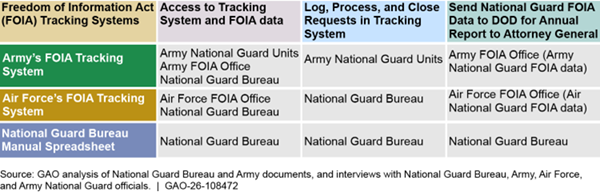
The National Guard Bureau (NGB) collects and tracks Freedom of Information Act (FOIA) data from all three National Guard components—NGB, Army National Guard, and Air National Guard. NGB reports FOIA data to the Department of Defense (DOD). NGB officials stated they provide Army National Guard and Air National Guard FOIA data to the Army and the Air Force, respectively. The National Guard tracks data on FOIA requests received, processed, and backlogged through various systems (see figure).
GAO found discrepancies in the accuracy of reported data that officials responsible for reporting National Guard FOIA data were unable to explain. Specifically, GAO found that the numbers of FOIA requests received, processed, and backlogged by the Army National Guard differed between Army National Guard and NGB data for fiscal years 2016 through 2024, in part because there is no single, standardized process across the National Guard components for verifying the accuracy of FOIA data. Moreover, FOIA managers that improperly log FOIA requests and the absence of tools to verify data entries have affected the accuracy of reported data. Without a standardized process to verify the accuracy of National Guard FOIA data, such as the number of FOIA requests received and processed or the extent of backlogs, NGB may continue to inaccurately report FOIA data and hinder transparency for Congress and the public.
National Guard FOIA officials identified challenges with insufficient staffing and inconsistent communication that have affected the timely processing of FOIA requests. However, NGB has not fully addressed these challenges. For example,
· NGB has not analyzed its headquarters workforce needs to know how many full-time equivalent staff are currently needed to process FOIA requests in a timely manner and address backlogs.
· NGB has not developed a plan to improve communication between NGB and officials responsible for processing FOIA requests in the field through a shared online environment.
Addressing data discrepancies and identified challenges can help DOD and the NGB report data more accurately and process FOIA requests more efficiently.
Why GAO Did This Study
FOIA enables the public to request access to government records and information from any federal executive branch agency. Each year, hundreds of thousands of FOIA requests are filed. For example, NGB continues to face challenges processing such requests within the 20-day time frame that FOIA requires.
House Report 118-529 includes a provision for GAO to review the National Guard’s FOIA program. This report evaluates the extent to which (1) NGB and DOD have taken steps to ensure the accuracy of reported FOIA data, including request backlogs; and (2) NGB has identified and addressed challenges associated with the processing of FOIA requests.
GAO reviewed NGB and DOD policies on FOIA processing. It also analyzed National Guard FOIA data for fiscal years 2016 through 2024 and distributed a survey to Army and Air National Guard FOIA officials asking about policies and factors that affect timely processing of requests, among other issues. GAO also interviewed NGB and military service officials.
What GAO Recommends
GAO is making six recommendations, including that NGB develop a process to verify FOIA data accuracy, determine appropriate staffing levels needed to ensure the timely processing of FOIA requests, and develop a plan to improve communication between NGB and National Guard FOIA officials in the field. DOD concurred with GAO’s recommendations and outlined actions it plans to take toward their implementation.
|
Abbreviations |
|
Air Force FOIA Office Office of the Department of the Air Force Chief Information Officer |
|
Army FOIA Office Army Records Management Directorate |
|
DOD Department of Defense |
|
DOJ Department of Justice |
|
HQ Headquarters |
|
FOIA Freedom of Information Act |
|
NGB National Guard Bureau |
|
OPR Office of Primary Responsibility |
This is a work of the U.S. government and is not subject to copyright protection in the United States. The published product may be reproduced and distributed in its entirety without further permission from GAO. However, because this work may contain copyrighted images or other material, permission from the copyright holder may be necessary if you wish to reproduce this material separately.
June 11, 2026
The Honorable Mike Rogers
Chairman
The Honorable Adam Smith
Ranking Member
Committee on Armed Services
House of Representatives
The Freedom of Information Act (FOIA) enables the public to request access to records from any federal executive branch agency, subject to certain exemptions.[1] Each year, individuals and entities file hundreds of thousands of these requests for information on numerous topics that could help contribute to the understanding of government actions. However, backlogs have increased as federal agencies face persistent challenges processing requests within required time frames. For example, the Department of Defense (DOD) continues to face challenges processing requests within the time frames that FOIA requires.[2] As a result, the backlog of FOIA requests continues to grow. These backlogs have also affected the National Guard Bureau (NGB), which is responsible for the administration of the National Guard for the 50 states, the District of Columbia, Guam, Puerto Rico, and the U.S. Virgin Islands.[3]
In March 2024, we reported that agency FOIA officers cited factors such as staffing challenges and complex requests as contributing to backlogs. We found that the Department of Justice’s (DOJ) Office of Information Policy helps agencies administer FOIA, but additional guidance and other resources could better support agency efforts to address backlogs.[4] We recommended that the Office of Information Policy develop a process to more closely examine the data agencies report on component-level FOIA requests and average request processing times. We also recommended that the Office of Information Policy update the materials for its training on annual FOIA reporting. DOJ agreed and has addressed these recommendations. Specifically, in 2024, the Office of Information Policy provided documentation showing that it had strengthened its process for reviewing agencies’ annual FOIA report submissions and updated its training materials for agencies to use in preparing their annual FOIA reports.
House Report 118-529 includes a provision for us to review the National Guard’s FOIA program and examine challenges associated with processing FOIA requests in a timely manner.[5] This report evaluates the extent to which (1) NGB and DOD have taken steps to ensure the accuracy of reported National Guard FOIA data, including request backlogs; and (2) NGB has identified and addressed challenges associated with the processing of FOIA requests.
For both objectives, we reviewed relevant DOD, NGB, Army, and Air Force guidance regarding the processing of FOIA requests. In addition, we developed and distributed a survey to Army National Guard FOIA managers and Air National Guard FOIA monitors in each of the 50 states, the District of Columbia, Guam, Puerto Rico, and the U.S. Virgin Islands. We distributed the survey to all 54 Army National Guard units and received responses from 40, for a response rate of 74.1 percent. We also distributed the survey to 99 of the 109 Air National Guard units and wings listed in NGB’s Air National Guard FOIA monitor point of contact list and received responses from 58, for a response rate of 58.6 percent.[6] The survey focused on National Guard Bureau, Army, and Air Force FOIA policies and training; the volume of FOIA requests received, processed, and backlogged; and factors that create challenges to processing FOIA requests in a timely manner. We interviewed cognizant NGB, Army, and Air Force FOIA officials; Army National Guard FOIA managers; and Air National Guard monitors at the state and wing level on how they track, report, and verify their FOIA data, as well as to gain insight on how challenges they identified impacted implementation and execution of processing FOIA requests.[7]
For our first objective, we reviewed and evaluated FOIA data from various sources on the number of requests received, processed, and backlogged across the National Guard from fiscal year 2016, the year in which FOIA was most recently amended, and the first year for which DOD’s FOIA raw data are publicly available, to fiscal year 2024, the most recent year for which they were available at the time of our review.[8] To assess the reliability of the data, we compared FOIA data from DOJ’s FOIA.gov website, NGB, survey responses, and Army and Air Force FOIA offices, as discussed later in the report. We compared NGB’s efforts to DOD guidance and Standards for Internal Control in the Federal Government, which include standards related to management’s responsibility to design control activities to achieve objectives, respond to risks, and use quality information to achieve objectives.[9]
For our second objective, we surveyed National Guard FOIA managers and monitors to assess how widespread key challenges associated with processing FOIA requests in a timely manner are. We compared NGB’s efforts to address these challenges with DOD’s and DOJ’s FOIA policies and guidance.[10] We also compared this information with the Office of Personnel Management’s Workforce Planning Guide, as well as the Standards for Internal Control in the Federal Government, specifically that management should internally communicate the necessary quality information to achieve the entity’s objectives; establish an organizational structure, assign responsibility, and delegate authority to achieve the entity’s objectives; and implement control activities through policies.[11] See appendix I for additional details on our scope and methodology.
We conducted this performance audit from April 2025 to June 2026 in accordance with generally accepted government auditing standards. Those standards require that we plan and perform the audit to obtain sufficient, appropriate evidence to provide a reasonable basis for our findings and conclusions based on our audit objectives. We believe that the evidence obtained provides a reasonable basis for our findings and conclusions based on our audit objectives.
Background
The FOIA Process
FOIA generally requires federal executive branch agencies to respond to a request within 20 working days, and a request is considered backlogged if it is pending beyond the statutory time frames.[12] As outlined in FOIA, the response should include a determination of which documents the agency will produce and the exemptions the agency will claim with respect to any withheld information.[13] Agencies are then required to promptly provide the responsive documents to the requester. A decision to deny a request must inform the requester of the reasons for denial and the right to appeal. If the agency determines the request presents unusual circumstances, it may extend the 20-day time limit by up to 10 working days by providing written notice to the requester.[14] If the request cannot be processed within the extended time limit, the agency must notify the requester and offer the opportunity to limit the scope of the request so that it may be processed within that time limit. The requester and agency may also arrange for an alternative time frame for processing the request or a modified request.
FOIA requires federal executive branch agencies, including DOD, to submit two annual reports. The first is a FOIA Annual Report submitted by each agency to the Attorney General and the Director of the Office of Government Information Services; the second is a report submitted by each agency’s Chief FOIA Officer to DOJ.[15]
DOD’s FOIA Annual Report. DOD’s Director of Administration and Management is to submit the DOD FOIA Annual Report on a fiscal year basis.[16] This report includes information on the number of FOIA requests received, processed, and backlogged, as well as denied requests and exemptions for that fiscal year, for the department overall and by DOD component. The comprehensive report is available on the Privacy, Civil Liberties, and Transparency website’s FOIA section.[17] The number of FOIA requests, received, processed, and backlogged as reported in DOD’s Annual Report to the Attorney General are also available on DOJ’s FOIA.gov website.[18]
DOD’s Chief Freedom of Information Act Officer Report to the Department of Justice for 2026. This report detailed notable achievements and challenges in DOD’s administration of the FOIA. These include DOD initiatives to evaluate the allocation of agency personnel resources needed to respond to current and anticipated FOIA demands; how DOD components used data or processing metrics to help ensure efficient management of their FOIA workload; steps taken to greater utilize technology; and steps taken to remove barriers to access, improve timeliness in responding to requests, and reduce backlogs.[19]
Department of Justice FOIA Resources
DOJ’s Office of Information Policy provides resources to help agencies administer their FOIA programs, including guidance on agency FOIA regulations and backlog reduction plans. Examples of such resources include the
· Guidance for Agency FOIA Regulations, which provides information on aspects of FOIA administration that can be addressed in regulations as a matter of good practice. The guidance also provides a template with suggested language that all agencies can use as they publish or update their FOIA regulations.[20]
· Guidance on Backlog Reduction Plans, which outlines considerations for agencies as they work to develop backlog reduction plans, such as a focus on leadership support and employee buy-in. The guidance also outlines individualized approaches to self-assess and accurately identify the primary causes of an agency’s backlogs; set clear goals and mechanisms for accountability; and maintain flexibility in the goals, approach, and timing.[21]
· FOIA Self-Assessment Toolkit, which assists agencies in conducting self-assessments of their FOIA programs.[22] The toolkit consists of modules with various milestones to help agencies conduct in-depth analyses of their FOIA programs, such as examining (1) whether an agency has an efficient and effective initial mail intake and mail review process; and the agency’s (2) FOIA workflow, and (3) understanding of the requirements for conducting FOIA searches, knowledge of the agency’s record systems, and the efficiency and effectiveness of their search procedures, among other things.
National Guard and Other DOD Entities Responsible for Administering and Supporting National Guard FOIA Program
The National Guard and multiple DOD entities and officials, including the following, have responsibilities for administering and supporting the National Guard FOIA Program.
· The National Guard Bureau (NGB) is responsible for administering the DOD FOIA Program within the National Guard. NGB develops guidance, and direction on processing National Guard FOIA requests and is the point of contact for NGB and Air National Guard FOIA processing and compliance. NGB is also the initial denial authority for Army National Guard and Air National Guard FOIA requests.
· Other National Guard components include the Army National Guard and the Air National Guard, which are comprised of units and wings in all 50 states, the District of Columbia, Guam, Puerto Rico, and the Virgin Islands. These units assign an Army National Guard FOIA manager or Air National Guard FOIA monitor, respectively, to process FOIA requests applicable to their specific unit or wing.[23]
· The Office of the Assistant to the Secretary of Defense for Privacy, Civil Liberties, and Transparency is under the Director of Administration and Management. The office serves as the FOIA appellate authority for the Office of the Secretary of Defense, the Joint Staff, the combatant commands, designated defense agencies, and DOD field activities for information denied under FOIA with respect to adverse determinations. The Director of Administration and Management serves as DOD’s Chief FOIA Officer.
· The Army Records Management Directorate (HQ Army FOIA Office) provides oversight for Army records management operations and develops regulations, guidance, and training for uniformed and civilian personnel.[24] This office also develops records retention and disposal authorizations that meet Army needs and obtains approval from the Archivist of the United States.[25]
· The Office of the Department of the Air Force Chief Information Officer (Air Force FOIA Office) has overall responsibility for the Air Force Records Management Program and the Air Force FOIA Program.[26] The Senior Agency Official for Records Management, appointed by the Chief Information Officer, is responsible for ensuring the Air Force efficiently and properly complies with all applicable records management statutes, regulations, and policies. The Air Force FOIA Public Liaison Office administers the procedures necessary to implement the Air Force FOIA Program, submits reports to the Directorate for Oversight and Compliance, and provides guidance and instructions to Air Force FOIA Requester Service Centers.
DOD and NGB FOIA Guidance
The following DOD guidance and NGB procedures direct how DOD program components, including the National Guard Bureau, should support and administer their FOIA programs:
· Part 286 of Title 32, Code of Federal Regulations is DOD’s FOIA regulation and contains the rules that the public follows in requesting information from DOD in accordance with FOIA, as amended, and how those requests will be processed by DOD.[27] It includes DOD’s decentralized system for responding to FOIA requests and how requesters must reasonably describe the records sought and provide sufficient detail to enable personnel to locate those records with a reasonable amount of effort.
· DOD Directive 5400.07 establishes DOD’s FOIA program and policy and assigns FOIA responsibilities across the department.[28] The directive provides that the department’s FOIA program is intended to promote transparency and accountability by (1) adopting a presumption in favor of disclosure in all release decisions involving the FOIA, and (2) responding promptly to FOIA requests in a spirit of cooperation. Additionally, under the directive DOD’s FOIA program (3) provides DOD records requested by members of the public, unless those records are exempt from disclosure in accordance with Section (b) of the FOIA, and (4) works with the Office of Government Information Services to resolve disputes between FOIA requesters and DOD.
· DOD Manual 5400.07 includes general provisions and guidelines regarding establishing FOIA Requester Service Centers, procedures for processing FOIA requests, and exemptions.[29]
· The Department of the Army Freedom of Information Act Program regulation provides policies and procedures to govern the Army’s FOIA implementation.[30] The regulation also contains the rules that govern requests for information from the Department of the Army, in accordance with FOIA, and explains how those requests will be processed. This regulation applies to the regular Army, Army National Guard, the U.S. Army Reserve, and the Army and Air Force Exchange Service.
· The Air Force Manual for the FOIA Program adds responsibilities and procedures applicable to the Air Force processing of FOIA requests, in addition to the procedures established in DOD Manual 5400.07.[31] The Air Force Manual applies to all regular Air Force military personnel and civilians; contractors in the performance of their duties under an Air Force contract; and the Air Force Reserve, Air National Guard, and Civil Air Patrol when performing functions for the Air Force, and in accordance with DOD Directive 5100.3, Support of the Headquarters of Combatant and Subordinate Unified Commands.
· NGB has additional procedures for documenting, searching for, and responding to FOIA requests, including the Army National Guard FOIA/Privacy Act Manager Toolkit, which provides Army National Guard FOIA managers involved in the FOIA process with a quick reference for processing requests and standardizing public response letters on FOIA matters. Also, the NGB and Air National Guard FOIA checklists instruct NGB FOIA specialists and Air National Guard FOIA monitors on how to process FOIA requests. It also assigns actions to the Office of Primary Responsibility for searching and reviewing records to determine whether the records are appropriate for release or withholding in response to a FOIA request.[32]
National Guard’s FOIA Process
The National Guard’s FOIA process is decentralized across the three main National Guard components: NGB, Air National Guard, and Army National Guard. The NGB FOIA Requester Service Center processes requests for records created by the Chief of the National Guard Bureau’s Joint Staff, Personal Staff, and Special Staff. In March 2009, NGB also took over responsibility for processing FOIA requests pertaining to Air National Guard records.[33] The Army National Guard processes its own FOIA requests through the appropriate Army National Guard FOIA Requester Service Center.[34] Figure 1 outlines the NGB, Air National Guard, and Army National Guard processes in more detail.
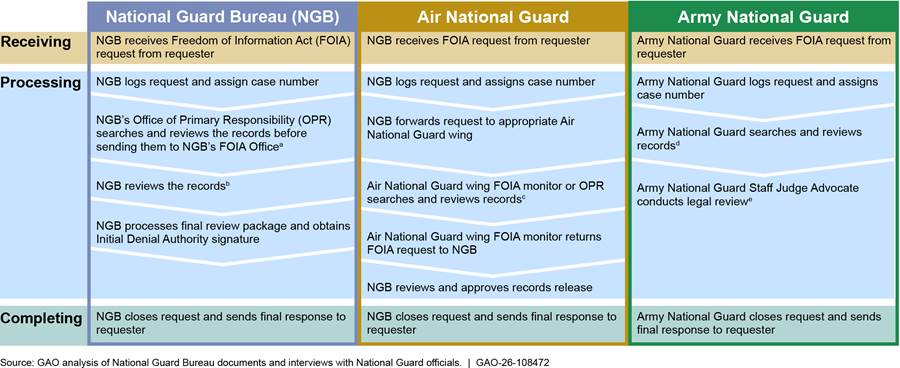
aOPR consists of individuals tasked to search for records. Individuals within this office search for and review records, identify information to be withheld, apply the applicable FOIA exemption, and return the records to NGB’s Joint Staff FOIA Office, according to NGB officials.
bNGB’s Joint Staff FOIA Office receives the records from OPR, reviews them, prepares final response package, applies and finalizes redactions, and sends the package for review by the NGB’s Information and Privacy Office Chief, according to NGB officials. NGB’s General Counsel also reviews the final response package to ensure legal sufficiency to release or withhold records in accordance with the FOIA, according to NGB officials.
cThe Air National Guard wing’s OPR searches for and reviews records, identifies information to be withheld, applies any recommended FOIA exemption, and completes and returns the checklist to the Air National Guard wing FOIA monitor.
dFOIA requests are referred to NGB for review if Army National Guard determines that requested records require partial or full denial.
eArmy National Guard Staff Judge Advocate reviews the record to ensure that the release is proper or subject to withholding/denial.
National Guard Bureau and DOD Collect and Report National Guard FOIA Data but Are Unable to Fully Verify the Accuracy of the Data
National Guard Bureau Collects and Reports FOIA Data
NGB collects FOIA data from all three National Guard components (NGB, Army National Guard, and Air National Guard). NGB report their FOIA data to DOD and, according to NGB officials, provide Army National Guard and Air National Guard FOIA data to the Army and Air Force, respectively. NGB officials stated they use an Excel spreadsheet to manually track NGB FOIA cases and numbers and to log and assist with compiling data across all three National Guard FOIA programs. NGB FOIA data refers to FOIA requests involving NGB Joint Staff and the Army and Air National Guard Readiness Centers, according to NGB officials. The Army and Air Force track Army National Guard and Air National Guard FOIA data, respectively, to include the number of requests received, processed, and backlogged through their tracking systems, as outlined below.
|
Key Terms Requests received is the number of FOIA requests received in one fiscal year. Requests processed is the number of FOIA requests that have been worked and closed in one fiscal year. Requests backlogged is the number of requests pending at the end of the fiscal year that are beyond the statutory period for a response. Source: DOD FOIA Annual Report for Fiscal Year 2024. | GAO-26-108472 |
· The HQ Army FOIA Office manages the Freedom of Information and Privacy Acts Case Tracking System (FACTS) that provides data collected during the administrative processing of FOIA/Privacy Act cases for the Army National Guard.[35]
· According to officials, the Air Force FOIA Office manages eFOIA/FOIAXPress, a commercial-off-the-shelf, web-based FOIA request tracking, management, and reporting software application to manage the entire lifecycle of FOIA requests and appeals for the Air National Guard.[36]
The Army and Air Force leverage data in these systems to report Army National Guard and Air National Guard FOIA data to DOD. NGB also has access to and can utilize these systems to compile FOIA annual reports. Figure 2 outlines the FOIA tracking systems used by National Guard components.
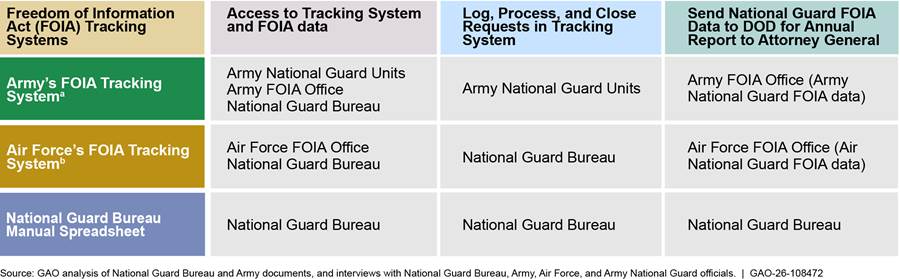
aThe Army’s FOIA Tracking System is the Freedom of Information and Privacy Act Case Tracking System (known as “FACTS”).
bThe Air Force’s FOIA Tracking System is eFOIA/FOIAXPress.
NGB provided us with annual FOIA reports captured from the Army and Air Force’s FOIA tracking systems. According to NGB officials, these systems allow NGB to extract and compile historical data on FOIA processing. NGB archives and consolidates these reports within a historical tracking sheet and uses the data captured through these two systems to prepare annual reports to the Air Force, Army, and Office of the Secretary of Defense, as needed, according to NGB officials. Although they are not responsible for logging and tracking such requests, some Air National Guard FOIA monitors stated that they internally track their FOIA data through their own internal systems and spreadsheets.
National Guard Bureau and DOD Are Unable to Fully Verify the Accuracy of Reported National Guard FOIA Data
The National Guard Bureau and the Departments of the Army and Air Force each track data on FOIA requests received, processed, and backlogged, but there is no single, standardized process across the components for verifying the data. The varied approaches for tracking FOIA data have contributed to discrepancies in the accuracy of reported data.
Discrepancies Exist in FOIA Data Reporting Across the National Guard Bureau and Army and Air National Guard
Based on our comparison of NGB, Army National Guard, Air National Guard, and FOIA.gov data, we found discrepancies across the components in the total numbers of FOIA requests reported as received, processed, and backlogged for each fiscal year from 2016 through 2024.
NGB FOIA data. Based on our comparison of NGB FOIA data with FOIA.gov data for fiscal years 2016 through 2024, we identified discrepancies in the total number of FOIA requests reported as backlogged for fiscal year 2017, and in the number of FOIA requests reported as received and backlogged for fiscal year 2024 (see table 1 in appendix II). Specifically, we found that NGB’s data from fiscal year 2017 reported a backlog size (119) that was 70 percent greater than what was reported at FOIA.gov (70). According to data from fiscal year 2024, NGB received either 204 FOIA requests (NGB data) or 222 requests (FOIA.gov) and reported a backlog size (492) that was 3 percent greater than what was reported at FOIA.gov (477). NGB officials stated they were unsure why NGB FOIA numbers provided by NGB and FOIA.gov were different from each other.
Army National Guard FOIA data. Based on our comparison of Army National Guard FOIA data and NGB data, we identified discrepancies in the total number of FOIA requests received and processed, as well as existing backlogs in every fiscal year from 2016 through 2024 (see table 2 in appendix II).[37] Specifically, we found that the numbers of FOIA requests received, processed, and backlogged by the Army National Guard differed between Army National Guard and NGB data every fiscal year. The magnitude of the differences ranged from 1.2 percent to 31.3 percent, with an average of 5.5 percent (received), 6.7 percent (processed), and 12.6 percent (backlogged). NGB officials stated they were unsure why the Army National Guard numbers provided by NGB and the Army’s FOIA Office were different from each other, even though they use the same system to track FOIA requests.
We also found discrepancies with the Army’s FOIA data when compared with data provided by Army National Guard FOIA managers that responded to our survey. For example, Army National Guard FOIA managers that responded to our survey reported that they processed a total of 660 requests in fiscal year 2024, compared to 443 and 456 processed requests reported by NGB and the Army, respectively.[38] We also found that Army’s FOIA data indicated that an Army National Guard unit had over 200 backlogged requests at the end of fiscal year 2024, but the Army National Guard FOIA manager from that unit stated in their survey response that they had two backlogged requests. We found other similar instances where the number of requests received, processed, and backlogged reported by individual Army National Guard units in the survey did not match with Army’s FOIA data.[39]
Air National Guard FOIA data. Based on our comparison of Air National Guard FOIA data and NGB data, we identified discrepancies in the total number of FOIA requests received, processed, and backlogged in multiple fiscal years from 2016 through 2024 (see table 3 in appendix III). Specifically, we found that the number of FOIA requests received differed every fiscal year, the number of FOIA requests processed differed in 4 of the 9 years, and the number of FOIA requests backlogged differed in 8 of the 9 years. The magnitude of the differences ranged from 0 to 35.7 percent, with an average of 8.6 percent (received), 4.3 percent (processed), and 3.1 percent (backlogged). NGB officials stated they were unsure why the Air National Guard FOIA numbers provided by NGB and Air Force’s FOIA Office were different from each other, even though they use the same system to manage and track Air National Guard FOIA requests.[40] Air Force officials said that NGB is usually responsible for inputting Air National Guard FOIA requests into the Air Force’s FOIA tracking system, but this can vary.[41]
Accuracy of FOIA Data Impacted by Improper Logging of Requests and the Absence of Verification Tools
We found that two factors, the improper logging of FOIA requests and the absence of verification tools, impacted the accuracy of FOIA data.
· Improper Logging of Requests. NGB, Army, and Air Force officials stated that discrepancies can occur when data is inaccurately logged into their tracking systems and then entered in the annual FOIA report. NGB officials added that the NGB program is susceptible to errors in data entry due to the lack of an electronic tracking system. NGB officials stated that typical errors leading to discrepancies include incorrectly entering the request type––e.g., FOIA, Privacy, Consultation––and date received.
In addition, Army National Guard FOIA managers stated that misreports can happen when FOIA cases are improperly logged into the Army’s FOIA tracking system or not logged in at all. One Army National Guard FOIA manager stated that the previous FOIA manager did not log or process any of their FOIA requests into the tracking system. Another Army National Guard FOIA manager stated that in some instances, a FOIA request had been closed and sent back to the requester for some time, however the request was not closed in the Army’s FOIA tracking system, making it count as a backlog. That same manager stated that at the end of the fiscal year, the Army’s FOIA tracking system gets overwhelmed due to too many users logging cases into the system at the same time. As a result, the system can time out or reset, causing improper counts as well as duplicative requests. Another Army National Guard FOIA manager stated that their previous FOIA manager may have entered FOIA and Privacy Act requests and categorized them all as FOIA requests in the tracking system. Other Army National Guard FOIA managers stated they did not have access to the Army’s FOIA tracking system to log and process their FOIA cases.
· Absence of Verification Tools. NGB, Army, and Air Force FOIA offices do not have tools capable of verifying FOIA data entries within their respective tracking systems. NGB officials stated that the manual spreadsheet they use to track NGB FOIA data is updated each time they get a new request and is also updated when an analyst processes or updates information on a request. NGB has metrics to verify the accuracy and validate information in the spreadsheet, including for the monthly, quarterly, and annual reports submitted to their FOIA liaison on the number of requests received, processed, and backlogged, according to NGB officials.[42]
However, NGB officials stated that the spreadsheet is unable to verify data entry, which, if this ability existed, would allow a user to immediately detect an inaccurate entry. For example, NGB officials said that when information on a past reporting year is improperly entered by even a single received- or closed-request date or type, such an error will impact the numbers for the current and future years. NGB officials also stated that they use a fiscal year log to track all three programs, but that the log contained too much data and led to data corruption issues on multiple occasions, which required NGB FOIA staff to manually reconstitute the log using archived data. In June 2025, NGB officials stated that NGB was in the process of transitioning to an electronic tracking system that should improve tracking accuracy, which they predicted would be ready in 3-6 months. In January 2026, NGB officials stated that they were in the process of migrating to an “electronic tracking system” (eFOIA) but did not know when the transition was expected to be completed.
Specific to Army National Guard FOIA data verification, an Army FOIA official stated that the reliability of FOIA data is dependent on how FOIA managers input information into the Army’s FOIA tracking system, and the system does not automatically verify to know whether FOIA cases are entered incorrectly. Instead, the Army official stated that they pull a report from their FOIA tracking system and see if it matches the numbers that the components send to them and work to identify any discrepancies in the numbers when they conduct their quarterly and annual reports. Moreover, Army National Guard FOIA managers we spoke with and provided responses to our survey stated they were not aware that NGB and Army’s FOIA data showed Army National Guard as having different number of FOIA requests received, processed, and backlogged than what they had reported.
Specific to Air National Guard FOIA data verification, NGB officials said the Air Force will task NGB to verify that the information entered within the Air Force’s FOIA tracking system is accurate and complete. However, Air Force officials stated that the data they pull from their tracking system is only as good as what FOIA managers put into it. Also, Air Force officials added that their FOIA tracking system has no quality control and only one check and balance feature that recognizes potential duplicate requests. According to Air Force officials, the only check and balance feature that the Air Force’s tracking system has is when the name and information is similar and looks like a duplicate. For example, when a user inputs information that is similar to an existing request, it will prompt the user to confirm or deny if their request is a duplicate, according to Air Force officials.
DOD Manual 5400.07 requires DOD FOIA Program Components to track annual FOIA request data as requests are processed to facilitate the accurate compilation of the statistics needed to complete the DOD FOIA Annual Report to the Attorney General.[43] Moreover, Standards for Internal Control in the Federal Government provide that management should design control activities to achieve objectives and respond to risks.[44] In doing so, management compares actual performance to planned results throughout the organization and analyzes differences; uses control activities over information processing that include checking data entries and controlling access to data, files, and programs; and records transactions promptly to maintain their value in controlling operations and making decisions. Standards for Internal Control in the Federal Government also state that management should use quality information to achieve the entity’s objectives. In doing so, management obtains relevant data from reliable internal and external sources that are reasonably free from error and bias and faithfully represent what they purport to represent in a timely manner based on identified information requirements.[45] Also, management evaluates both internal and external sources of data for reliability.
NGB, the HQ Army FOIA Office, and the Air Force FOIA Office have not verified the accuracy of FOIA data, including data related to received and processed requests and any backlogs, because there is no process in place to do so. In January 2026, NGB officials stated they have begun to take steps to develop a process to verify FOIA data provided by National Guard FOIA officials but have not formalized it due to competing priorities and a lack of staff and resources. In February 2026, NGB officials stated that they amended the number of NGB backlogged requests for fiscal year 2017 after reporting the initial number to DOD, but that they were not certain whether DOD received their amendment. Also, NGB officials stated that it was possible that the Army and Air Force made additional amendments to Army and Air National Guard numbers during the fiscal years in which we identified discrepancies, but NGB officials could not confirm whether these amendments were the reasons why the data did not match.
In March 2026, NGB officials stated that they have not created a process, but that they plan to coordinate with the Army and Air Force to ensure accuracy of annual reports through the establishment of quarterly reports to resolve discrepancies. Furthermore, an Army official stated that the Army is working to enhance the Army’s FOIA tracking system to include more detailed information in the future, such as the ability to store and redact the actual records, and identifying advanced technologies that can better support data verification. Air Force officials added that the responsibility of ensuring accuracy is on all the subcomponents and each subcomponent’s FOIA Officer or FOIA personnel.
The lack of a process to more closely examine and verify the accuracy of National Guard FOIA data, such as FOIA requests received and processed, or the degree to which there are backlogs, could lead to further improper logging of FOIA requests, inaccurate reporting of FOIA data and lack of transparency for Congress and the public. It could also impair NGB’s ability to determine what resources, if any, are needed to address backlogs or where those resources should be directed.
NGB Has Not Fully Addressed Various Challenges Associated with the Timely Processing of FOIA Requests
The National Guard Bureau (NGB) and National Guard FOIA officials have identified four key challenges affecting the timely processing of FOIA requests but have not fully addressed them. The challenges relate to staffing, communication, training, and NGB FOIA policies and guidance. NGB and National Guard FOIA officials we interviewed described these challenges, and the results from our survey of National Guard FOIA officials indicated how prevalent they were.
Staffing. Insufficient staffing continues to be a challenge for the timely processing of FOIA requests, according to NGB officials and survey responses we received from National Guard officials. In 2014, NGB conducted a personnel study that identified a need for 11 full-time equivalent staff to manage the NGB and Air National Guard FOIA programs and the Privacy, Civil Liberties and Transparency program.[46] According to NGB officials, NGB’s staffing levels decreased from ten full-time equivalent staff in fiscal year 2018 to six full-time equivalent staff in fiscal year 2019. NGB then experienced increasing backlogs beginning in 2019 following a staffing turnover, including the loss of its chief and multiple FOIA subject matter experts. Subsequently, the number of FOIA requests received by NGB increased from 173 in fiscal year 2018 to 245 in fiscal year 2019.[47] An increase in FOIA requests related to events such as the January 6, 2021, attack on the Capitol and demonstrations in the summer of 2020 following the death of Mr. George Floyd, as well as an increase in FOIA litigation, further contributed to NGB’s backlog, according to NGB officials.
NGB officials told us that they currently do not have enough full-time equivalent staff to process FOIA requests within the 20-day statutory time frame and manage the number of reported backlogs. As of fiscal year 2025, NGB had five full-time equivalent staff, less than half as many as officials said the NGB’s 2014 personnel study recommended. NGB officials further noted that they have not been able to reach their needed staffing levels due to the recent DOD hiring freeze.[48]
In our survey, we asked National Guard FOIA officials how significant, if at all, staffing is in preventing their office from processing FOIA requests in a timely and accurate manner, as well as in addressing backlogs. According to 45 percent (44 of 98) of National Guard survey respondents, staffing is a somewhat significant or very significant factor. However, of the 44 survey respondents who identified staffing as a significant challenge, 31 reported they did not have a backlog and the other 13 reported having a backlog of fewer than ten FOIA requests at the end of fiscal year 2024.
Between fiscal year 2016 and 2024, National Guard components employed one FOIA officer 77 percent of the time. Specifically, 66 percent (65 of 98) of survey respondents stated that this is because processing FOIA is an additional duty to their other responsibilities, which respondents stated include managing their component’s records and privacy programs.
According to the Office of Personnel Management’s Workforce Planning Guide, agencies should conduct a workforce analysis that includes assessing the difference between the current workforce and future workforce based on business needs, and forecasting the optimal capacity and capability.[49] DOJ’s Office of Information Policy’s Guidance on Backlog Reduction Plans states that agencies should conduct self-assessments to identify causes of backlogs, including whether staffing is adequate and whether process efficiencies can be gained by identifying patterns in request types.[50]
Although NGB has identified staffing as a challenge for the timely processing of FOIA requests, NGB does not know the number of full-time equivalent staff it currently needs to process FOIA requests in a timely manner and address backlogs because it has not analyzed its headquarters workforce needs since its 2014 personnel study. NGB officials told us in June 2025 that they had planned to conduct a staffing analysis of their headquarters staff in 2025, but that this analysis was put on hold due to a government workforce optimization initiative directed by the Secretary of Defense.[51] NGB officials stated that, as of January 2026, they had not conducted a staffing analysis and they did not have a timeline on when they planned to conduct a staffing analysis. Instead, in March 2026, NGB officials stated they developed instructions to improve intake processing of FOIA requests that would be included in updated guidance. However, conducting a staffing analysis, along with developing a process to more closely examine and verify the accuracy of National Guard FOIA data, could help NGB determine the appropriate staffing levels needed to ensure the timely processing of FOIA requests and to address backlogs.
Communication. Delayed response times, outdated contact lists, and inconsistent communication between National Guard FOIA officials, NGB, and individuals responsible for searching records (referred to as Office of Primary Responsibility) affect the timely processing of requests, according to National Guard FOIA officials.[52] Specifically, 44 percent (43 of 98) of National Guard FOIA survey respondents stated that their level of communication with NGB was a somewhat or very significant factor preventing them from processing FOIA requests in a timely and efficient manner. Two National Guard FOIA survey respondents described helpful and responsive communication from NGB. However, four survey respondents stated that sometimes it took days or weeks to receive a response from NGB to a question or inquiry regarding processing and referring FOIA requests, while some stated they did not receive a response at all.
|
Examples of National Guard FOIA Managers’ and Monitors’ Perspectives on Communication with the NGB when Processing FOIA Requests One Air National Guard FOIA monitor stated that they can call or email NGB officials at any time and that National Guard Bureau (NGB) has been helpful and responsive. One Air National Guard FOIA monitor stated that NGB tasked their wing with a Freedom of Information Act (FOIA) request several months after it was submitted to NGB from the requester. One Air National Guard FOIA monitor stated that there were instances where NGB would ask them about the status of a FOIA request that NGB tasked to them, even though that request was already completed and sent to NGB several months beforehand. Three Air National Guard FOIA monitors stated that they were able to process and send back the request to NGB within the allotted 20-day requirement but were unsure when the requester received a response to their request, as NGB never sent the FOIA monitor a receipt of acknowledgement. Two National Guard FOIA officials stated that when they first began their roles, they received no communication from NGB and as a result lacked knowledge on the FOIA process. Source: GAO interviews with National Guard FOIA officials. | GAO-26-108472 |
We also found that NGB’s Army National Guard FOIA manager and Air National Guard FOIA monitor point of contact lists were outdated, with many phone numbers no longer in service, or with people who no longer worked as FOIA managers or monitors. In addition, multiple emails were returned and flagged as undeliverable. According to NGB officials, the FOIA managers or monitors are responsible for notifying NGB that they have started in their role.[53] NGB officials stated that they may learn that the contact changed when they task a FOIA request to a state or wing, or when a requester notifies NGB that they have not heard back about a request. In these cases, NGB officials said they reach out to the component or wing to confirm the new point of contact. However, one Air National Guard FOIA monitor that we interviewed stated that NGB repeatedly tasked FOIA requests to their wing’s previous FOIA monitor, even after sending multiple reminders to NGB. Army and Air Force FOIA officials we spoke with had different perspectives on updating contact information. Specifically,
· An Army FOIA official stated that they believe it is the HQ Army FOIA Office’s responsibility to update and maintain the Army National Guard FOIA point of contact list. However, that same official said that if they receive an Army National Guard FOIA request and do not have an updated point of contact for Army National Guard, they will send the request to NGB.
· Air Force FOIA officials stated they did not know whether their FOIA office or NGB was responsible for maintaining the Air National Guard FOIA point of contact list.
Moreover, 49 percent (48 of 98) of National Guard FOIA officials that responded to our survey identified communication with the Office of Primary Responsibility as a challenge for processing FOIA requests. Five National Guard FOIA officials we interviewed stated that waiting for acknowledgement or responses from the Office of Primary Responsibility with the necessary records challenged their ability to complete FOIA requests. Four National Guard FOIA officials we interviewed stated that the Office of Primary Responsibility often did not send necessary records needed to complete and close a request or did not prioritize or comply with the FOIA process.
DOD Directive 5105.77 states that the Chief of the NGB is responsible for supervising the NGB’s functions as the channel of communication on National Guard matters with the states.[54] DOJ’s Office of Information Policy’s Guidance on Backlog Reduction Plans outlines key areas agencies should consider, including how proactive, clearer communication can lead to a reduction of the volume of records awaiting processing and improved response times.[55] Additionally, Standards for Internal Control in the Federal Government state that management should internally communicate the necessary quality information to achieve the entity’s objectives, such as communicating quality information down and across reporting lines to enable personnel to perform key roles in achieving objectives, addressing risks, and supporting the internal control system.[56]
In January 2026, NGB officials stated that they were beginning to develop a framework to establish a shared online environment between NGB and National Guard FOIA officials in the field. The environment would include tools and resources for National Guard FOIA personnel for processing requests, such as a shared messaging channel and postings of all updated guidance and sample letters. However, NGB officials stated that a lack of staff and resources and other competing priorities have affected their ability to formalize these efforts, including developing a plan to establish a shared online environment and a timeline for the plan.
In March 2026, NGB officials stated they created a shared messaging channel to share information on the FOIA program with Army National Guard units. However, NGB officials stated they are unable to include Air National Guard wings in this shared messaging channel due to information technology challenges. NGB officials added that as part of creating this shared online environment, they are also in the process of updating their internal workspace to include updated standard operating procedures. However, they did not provide timeframes for the completion of this effort. Without a formal plan that includes a timeline to improve communication between NGB and National Guard FOIA officials through a shared online environment that includes tools and resources for processing requests, these offices may continue to experience challenges in processing FOIA requests in a timely manner.
Training. FOIA training on how to process FOIA requests at the National Guard level is perceived to be insufficient, according to National Guard FOIA officials, in part due to the infrequency of training and lack of in-person opportunities. According to NGB officials, FOIA specialists in headquarters receive training through DOD, DOJ, and NGB, but NGB does not provide consistent or standardized training to National Guard FOIA officials in the field. NGB officials stated that National Guard FOIA officials in the field can access training provided by DOD and DOJ.
According to 54 percent (53 of 98) of survey respondents, training is a somewhat significant or very significant factor preventing them from processing FOIA requests in a timely and efficient manner. Seven National Guard FOIA officials we surveyed stated they received little to no FOIA training from NGB when they began and that they had to self-train and rely on on-the-job training to learn how to successfully process a FOIA request. Of those that did receive FOIA training, some officials stated that it was insufficient due to the infrequent nature and format of the training. For example,
· Six National Guard FOIA officials we surveyed said they did not receive recurring training as they continued in their position as a FOIA manager or monitor. These officials said it was important to have recurring training because new employees or officials who handle FOIA requests may not retain all information they have learned.
· Two Army National Guard FOIA managers we interviewed told us that training has mostly been online and called for in-person training opportunities.
Other concerns we heard about FOIA training, including about training offered by DOJ, were that it did not provide guidance specific to FOIA processing for the National Guard at the state-level, or how to better understand NGB’s expectations, handle exemptions and redactions, and process FOIA requests. Proposed improvements included continued and consistent training from NGB and in-person training events with other National Guard FOIA officials with whom they could network and gain insight.
Perspectives vary on who is responsible for providing FOIA training to National Guard FOIA officials. NGB officials stated they can provide training to Army National Guard FOIA managers and Air National Guard FOIA monitors as needed, but it is the responsibility of Army National Guard units to ensure that they provide training to their FOIA managers and to notify NGB if they need training. In addition, Air Force officials stated that while they are able to provide FOIA training to Air National Guard components, guidance is unclear regarding who is responsible for providing such training to National Guard FOIA officials. An Army official stated that it is the Army’s responsibility to provide FOIA training to Army FOIA managers at the components, including Army National Guard. National Guard FOIA officials that we interviewed stated that they believe NGB should be responsible for providing FOIA training.
DOD guidance states that DOD FOIA program component heads are responsible for conducting training on the provisions of FOIA for component personnel.[57] In addition, FOIA requires the Chief FOIA Officer of each agency to offer training to agency staff regarding their responsibilities in processing FOIA requests.[58] Standards for Internal Control in the Federal Government state that management should establish an organizational structure, assign responsibility, and delegate authority to achieve the entity’s objectives. In doing so, management considers the overall responsibilities assigned to each unit, determine what key roles are needed to fulfill the assigned responsibilities, and establish the key roles.[59] Also, leading practices for interagency collaboration that we have identified call for collaborating agencies to work together to define and agree on their respective roles and responsibilities, including how the collaborative effort will be led.[60] In doing so, agencies can clarify who will do what, organize their joint and individual efforts, and facilitate decision-making.
National Guard FOIA officials have not received standardized or consistent training because NGB has not collaborated with the Army and Air Force to clarify the roles and responsibilities of each component in developing and standardizing training to Army National Guard FOIA managers and Air National Guard FOIA monitors in the field responsible for processing FOIA requests. Also, NGB has not collaborated with Army and Air Force to clarify which entities are responsible for providing FOIA training for Army National Guard FOIA managers and Air National Guard FOIA monitors. Various parties disagreed as to who should provide the training. For example, NGB officials stated that responsibility for providing training should fall on the individual Army National Guard units. These officials also cited limited staffing and resources and other competing priorities as reasons why they are unable to provide more consistent and standardized training. Army and Air Force officials we spoke with had differing perspectives, with an Army official indicating that the Army should be responsible for providing training to Army National Guard units and Air Force officials stating that they were unsure who should provide training to Air National Guard wings.
Until the Chief of the NGB collaborates with the Army and Air Force to clarify what entity is responsible for developing and standardizing training and ensures that FOIA training is provided for all National Guard FOIA officials, the NGB, Army, and Air Force cannot be certain that those processing FOIA requests have the proper training to do so consistently and in a timely manner.
NGB FOIA Guidance and Procedures. NGB has guidance and procedures on how to process FOIA requests at the component level, including a toolkit and checklist with instructions on how to process FOIA requests. However, National Guard FOIA officials stated they perceive the guidance to be unclear or outdated. For example, 35 percent (34 of 98) of National Guard FOIA officials that responded to our survey believe that FOIA policies and guidance were a somewhat or very significant factor in preventing them from processing FOIA requests in a timely manner and addressing backlogs. When asked to explain, two survey respondents said that the toolkit, a guidance document that provides Army National Guard FOIA managers involved in the FOIA process with a quick reference for processing requests and standardizing public response letters on FOIA matters, had not been updated since 2016.[61] Twelve survey respondents said NGB provided insufficient guidance about FOIA request processing. We heard similar concerns from FOIA managers and monitors we spoke with. For example:
· An Army National Guard FOIA manager stated that the toolkit lacked updated guidance on how to send requests to an Army command for documents and how to manage and search for electronic records.
· An Army National Guard FOIA manager stated that guidance lacked clear instructions on how to perform redactions.
· An Air National Guard FOIA monitor stated that NGB provided generic forms in their processing packet, for example, a memorandum that requires filling out whether they found or did not find records and certification of records searches, but that there is confusion about how to fill out the forms.
· Two Air National Guard FOIA monitors stated that they received little or no guidance from NGB on how to process FOIA requests.
Another concern was that lack of clear and consistent guidance has led to mistakes in processing FOIA requests. For example, one Army National Guard FOIA manager in our survey stated that unclear guidance can lead to inconsistent application of exemptions and potential errors. Another Army National Guard FOIA manager stated that they processed several cases based on what they believed to be current guidance, only to find out after sending them to NGB for the review and release determination that the policy had changed.
In addition, National Guard FOIA officials stated they rely on their internal standard operating procedures or created their own internal policies and specific step-by-step guidance on how to process FOIA requests in the absence of what they perceived as clear and consistent guidance from NGB. For example, officials from one Air National Guard wing stated that they created internal step-by-step guidance that specified its roles and responsibilities in processing FOIA requests, such as tasking the Office of Primary Responsibility to search for and collect records, reviewing records and suggested redactions, and providing those records to NGB. Moreover, officials from one Army National Guard unit stated that they developed their own internal policies and procedures that clarified the steps taken to process FOIA requests, provided additional sample letter templates for responding to FOIA requesters and to certain FOIA requests, and developed additional self-assessment criteria to use during periodic inspections to help improve their FOIA program.
DOD Directive 5400.07 states that DOD FOIA Program Component heads should administer the DOD FOIA Program within their components, to include publishing any additional guidance necessary for the implementation of the directive.[62] Standards for Internal Control in the Federal Government provide that, in implementing control activities, management periodically reviews policies, procedures, and related control activities for continued relevance and effectiveness in achieving the entity’s objectives or addressing related risks.[63]
NGB has not addressed perceptions of identified deficiencies in current NGB guidance and procedures on processing FOIA requests, such as specific guidance on exemptions and redactions, because, according to its officials, they have not finalized and distributed a program manual for FOIA policies and processes to National Guard FOIA officials. In January 2026, NGB officials stated that they were in the process of drafting an NGB manual for the FOIA program. However, NGB officials stated they have not finalized and distributed the manual. Finalizing and distributing the manual would better position NGB to help ensure FOIA policies and processes, such as guidance on exemptions and redactions, are fully clear and consistently implemented.
Conclusions
FOIA allows individuals to request access to records from federal executive branch agencies, ensuring government transparency and accountability. DOD submits and reports annual FOIA data to the Attorney General, but issues with the accuracy and reliability of National Guard data make it difficult to determine what data is being reported by NGB, the Army (for Army National Guard), and Air Force (for Air National Guard). NGB has taken steps to improve data verification but has not developed a process to more closely examine and verify the accuracy of National Guard FOIA data. Developing a process to more closely examine and verify the accuracy of National Guard FOIA data will help DOD better ensure transparency for Congress and the public.
NGB and National Guard FOIA officials identified key staffing, communication, training, and guidance challenges that affect the timely processing of FOIA requests. Specifically, NGB’s ability to identify staffing levels needed to timely process FOIA requests depends on accurate and reliable FOIA data and a staffing analysis. NGB officials stated they have taken steps to improve communication between the bureau and National Guard FOIA officials; however, NGB has not finalized or implemented a plan to do so. National Guard FOIA officials have asked for more FOIA training from NGB but are unable to offer it in a more consistent or standardized manner, according to NGB officials. Nevertheless, NGB officials have the opportunity to collaborate with Army and Air Force to clarify roles and responsibilities related to developing, standardizing, and providing training to National Guard FOIA officials. Providing additional formalized and updated guidance would give National Guard FOIA officials greater clarity and help mitigate delays and mistakes in processing FOIA requests.
Recommendations for Executive Action
We are making six recommendations to the Department of Defense. Specifically:
The Secretary of Defense should ensure the Chief of the National Guard Bureau, in coordination with the Department of the Army and the Department of the Air Force, develops a process for relevant FOIA offices to more closely examine and verify National Guard FOIA data, such as FOIA requests received, processed, and backlogged. (Recommendation 1)
The Secretary of Defense should ensure the Chief of the National Guard Bureau analyzes NGB headquarters’ FOIA workforce needs using verified FOIA data and determine the staffing level needed to timely process FOIA requests and address backlogs, if present. (Recommendation 2)
The Secretary of Defense should ensure that the Chief of the National Guard Bureau finalize and implement a plan, including a timeline, to establish a shared online environment to improve communication between National Guard Bureau and National Guard FOIA officials in the field includes available tools and resources applicable to processing FOIA requests, and that these tools and resources are made available to National Guard FOIA personnel. (Recommendation 3)
The Secretary of Defense should ensure that the DOD Chief FOIA Officer and the Chief of the National Guard Bureau, in collaboration with the Department of the Army and the Department of the Air Force, clarify the roles and responsibilities of each component in developing and standardizing training to Army National Guard FOIA managers and Air National Guard FOIA monitors. (Recommendation 4)
The Secretary of Defense should ensure that the Chief of the National Guard Bureau, in collaboration with the Department of the Army and the Department of the Air Force, clarifies roles and responsibilities of each component in providing training for FOIA managers and monitors. (Recommendation 5)
The Secretary of Defense should ensure the Chief of the National Guard Bureau finalizes and distributes to National Guard FOIA officials a FOIA program manual for National Guard Bureau FOIA policies and processes, such as guidance on exemptions and redactions. (Recommendation 6)
Agency Comments
We provided a draft of this report to DOD for review and comment. DOD concurred with our recommendations and outlined actions it plans to take to implement them. For example, DOD provided information about NGB’s planned efforts to implement enhanced data validation controls within case management and tracking processes for FOIA data; to conduct a comprehensive, data-driven assessment of workforce requirements; to develop a plan to clarify roles and responsibilities in developing, standardizing, and providing training; and to incorporate available tools, resources, guidance, and program support materials into its shared online environment for FOIA managers and monitors. DOD’s comments are reproduced in appendix III. DOD also provided technical comments, which we incorporated as appropriate.
We are sending copies of this report to the appropriate congressional committees, the Secretary of Defense, and the Chief of the National Guard Bureau. In addition, the report is available at no charge on the GAO website at https://www.gao.gov.
If you or your staff have any questions about this report, please contact me at williamsk@gao.gov. Contact points for our Offices of Congressional Relations and Media Relations may be found at the end of this report. GAO staff who made key contributions to this report are listed in appendix IV.
Kristy E. Williams
Director, Defense Capabilities and Management
This report evaluates the extent to which (1) the National Guard Bureau (NGB) and the Department of Defense (DOD) have taken steps to ensure the accuracy of reported National Guard Freedom of Information Act (FOIA) data, including request backlogs; and (2) NGB has identified and addressed challenges associated with the processing of FOIA requests.
For both objectives, we focused on National Guard’s management of its FOIA program. To gain an understanding of how NGB manages its FOIA program, we reviewed the FOIA; DOD, Army, and Air Force FOIA policies; NGB guidance and procedures; and interviewed NGB and National Guard FOIA officials. To gain an understanding of how Army National Guard FOIA managers and Air National Guard FOIA monitors manage their FOIA program, we developed and distributed a survey questionnaire to all 54 Army National Guard units and to 99 of the 109 Air National Guard units and wings listed in NGB’s Air National Guard FOIA monitor point of contact list, including the 50 states, District of Columbia, and the territories of Guam, Puerto Rico, and U.S. Virgin Islands.[64] The survey focused on NGB, Army, and Air Force FOIA policies and guidance, volume of FOIA requests received, processed, and backlogged, and factors that create challenges to processing FOIA requests in a timely manner.
To ensure that the questions were clear, comprehensible and technically correct, we conducted four pretests of our draft survey with two Army National Guard FOIA managers and two Air National Guard FOIA monitors. During the pretests conducted by teleconference, we asked participants to read the instructions and each survey question aloud and asked the National Guard FOIA managers and monitors to tell us how they interpreted the question. We then discussed the instructions and questions with officials to identify any problems and potential solutions by determining whether (1) the instructions and questions were clear and unambiguous, (2) the terms we used were accurate, (3) the survey was unbiased, (4) the survey did not place an undue burden on the officials completing it. We noted any potential problems and modified the survey as appropriate. We sent the self-administered PDF form and a cover email to the Army National Guard FOIA managers and Air National Guard FOIA monitors on September 8, 2025, and asked them for their designated FOIA manager or monitor to complete the survey and email it back to us within 2-3 weeks. We closed the survey on September 30, 2025. We received responses from 40 out of 54 (74.1 percent) Army National Guard FOIA managers, and from 58 out of 99 (58.6 percent) Air National Guard FOIA monitors. We received 98 total responses for an overall response rate of 64.1 percent. Due to our response rate, the results of this survey are non-generalizable.
Further, we interviewed a non-generalizable sample of three Army National Guard units and three Air National Guard wings. We selected these units and wings using factors to help us identify and describe a range of experiences and challenges faced by National Guard FOIA officials, including units and wings that are diverse in terms of number of FOIA requests received, processed, and backlogged, and the challenges they face. We also included some whose FOIA data was inconsistent across data sources (i.e., NGB, Army, Air Force, FOIA.gov).
For both objectives, we interviewed officials from the following organizations from DOD and the National Guard:
· Army Records Management Directorate
· Office of the Department of the Air Force Chief of Information Officer
· National Guard Bureau
· Army National Guard units
· Air National Guard wings
To address our first objective, we obtained and reviewed National Guard FOIA data provided to us from NGB, the Army Records Management Directorate (HQ Army FOIA Office), Office of the Department of the Air Force Chief Information Officer (Air Force FOIA Office), and FOIA data available on the Department of Justice’s FOIA.gov website. Specifically, we reviewed NGB’s FOIA data on National Guard Bureau, Army National Guard, and Air National Guard number of FOIA requests received, processed, and backlogged by fiscal year from 2016 to 2024. We selected these fiscal years because fiscal year 2016 was the year in which FOIA was most recently amended, and the first year in which DOD’s FOIA raw data was available to the public and fiscal year 2024 was the most recent year in which DOD’s FOIA raw data was available to the public during our review.[65] We reviewed the HQ Army FOIA Office’s FOIA data for Army National Guard, and the Air Force FOIA Office’s FOIA data for Air National Guard, specifically the number of requests received, processed, and backlogged, and by fiscal year from 2016 to 2024. We also reviewed comparable data from Army National Guard and Air National Guard components we collected via survey (described above).
We took steps to compare and assess the reliability of information that National Guard Bureau provided to us about the number of National Guard FOIA requests received, processed, and backlogged from fiscal year 2016 to fiscal year 2024 across the three components. In particular, we cross-checked FOIA data provided by National Guard Bureau with FOIA data available on DOJ’s FOIA.gov website, and FOIA data provided by the Army and Air Force’s FOIA offices specific to Army National Guard and Air National Guard, respectively. We interviewed NGB, Army, and Air Force FOIA officials, and National Guard FOIA managers and monitors at the state and wing level on how they track, report, and verify their FOIA data. Based on these steps, we determined that FOIA data from the National Guard Bureau, HQ Army FOIA Office, and Air Force FOIA Office were not sufficiently reliable.
We compared National Guard Bureau’s efforts with DOD guidance on tracking and ensuring accuracy of FOIA data.[66] We also compared the National Guard Bureau’s efforts with Standards for Internal Control in the Federal Government and determined that design control activities and using quality information were significant to this objective, along with the associated underlying principles that management should:
· design control activities to achieve objectives and respond to risks.[67] In doing so, management compares actual performance to planned results throughout the organization and analyzes differences; uses control activities over information processing that include checking data entries and controlling access to data, files, and programs; and records transactions promptly to maintain their value in controlling operations and making decisions; and
· use quality information to achieve the entity’s objective. In doing so, management obtains relevant data from reliable internal and external sources that are reasonably free from error and bias and faithfully represent what they purport to represent in a timely manner based on the identified information requirements.[68] Management also evaluates both internal and external sources of data for reliability.
To address our second objective, we interviewed cognizant National Guard Bureau and National Guard officials who receive, process, and complete FOIA requests to obtain their perspectives on issues and challenges associated with processing FOIA requests in a timely manner. We also analyzed NGB’s and National Guard efforts to address these challenges.
We then surveyed Army National Guard FOIA managers and Air National Guard FOIA monitors (as described above) to assess how widespread the challenges are. We presented them with a list of potential challenges identified by NGB and by National Guard FOIA officials (volume of requests, staffing, FOIA staff training, FOIA policies and guidance, communication with NGB and others) and asked them to indicate how significant each factor is (very significant, somewhat significant, not at all significant) in preventing their office from processing FOIA requests in a timely and accurate manner. The survey also asked them, for all factors they believe are somewhat or very significant, to describe how those factors prevent the timely and accurate processing of FOIA requests.
With the survey, we also collected and analyzed staffing data, including the number of military personnel, civilians, and contractors. We reviewed similar staffing data from NGB. The survey also informed our judgmental selection of National Guard FOIA officials (described above) whom we interviewed to better understand how staffing impacted implementation and execution of processing FOIA requests from a wide range of perspectives and experiences.
We evaluated the extent to which NGB has taken steps to address the various challenges identified against criteria relevant to each challenge. We compared NGB’s efforts to address their headquarters staffing challenges with the Office of Personnel Management’s Workforce Planning Guide and the Department of Justice’s Office of Information Policy’s Guidance on Backlog Reduction Plans.[69]
We also reviewed Army National Guard FOIA manager and Air National Guard FOIA monitor point of contact lists provided by NGB and compared that list with FOIA point of contact lists provided by the HQ Army FOIA Office and the Air National Guard Readiness Center for accuracy. We compared NGB’s efforts to address communication challenges with DOD guidance on NGB’s responsibility as the channel of communications on National Guard matters and the Department of Justice’s Guidance on Backlog Reduction Plans.[70] We compared NGB’s efforts involving communication with National Guard FOIA officials and determined that quality information of Standards for Internal Control in the Federal Government were significant to this objective, along with the associated underlying principles that management should internally communicate the necessary quality information to achieve the entity’s objectives, such as communicating quality information down and across reporting lines to enable personnel to perform key roles in achieving objectives, addressing risks, and supporting the internal control system.[71]
We compared NGB’s efforts to address training with statutory requirements and DOD guidance.[72] We compared these efforts with leading practices for interagency collaboration that we identified in prior work, and also determined that establishing structure, responsibility, and authority of Standards for Internal Control in the Federal Government were significant to this objective, along with the associated underlying principle that management should establish an organizational structure, assign responsibility, and delegate authority to achieve the entity’s objectives. As part of this process, management considers the overall responsibilities assigned to each unit, determines what key roles are needed to fulfill the assigned responsibilities, and establishes the key roles.[73]
We identified and evaluated relevant DOD and National Guard Bureau FOIA policies, including DOD Directive 5400.07 and DOD Manual 5400.07, and National Guard Bureau FOIA guidance and procedures, specifically the National Guard Bureau’s Army National Guard FOIA Toolkit and the NGB and Air National Guard FOIA checklists that provide guidance on how to process FOIA requests, such as conducting and certifying records searches.[74] We compared NGB efforts to address this challenge and determined that the control activities of Standards for Internal Control in the Federal Government were significant to this objective, along with the associated underlying principle that management should implement control activities through policies. As part of this process, management periodically reviews policies, procedures, and related control activities for continued relevance and effectiveness in achieving the entity’s objectives or addressing related risks.[75]
We conducted this performance audit from April 2025 to June 2026 in accordance with generally accepted government auditing standards. Those standards require that we plan and perform the audit to obtain sufficient, appropriate evidence to provide a reasonable basis for our findings and conclusions based on our audit objectives. We believe that the evidence obtained provides a reasonable basis for our findings and conclusions based on our audit objectives.
Based on our comparison of National Guard Bureau (NGB) Freedom of Information Act (FOIA) data and FOIA.gov data for fiscal years 2016 through 2024, we identified discrepancies between these data in the total number of FOIA requests reported as backlogged for fiscal year 2017 and in the number of FOIA requests reported as received and backlogged for fiscal year 2024, as reported by NGB and FOIA.gov (see table 1).
Table 1: Comparison of Data from NGB and FOIA.gov on the Total NGB FOIA Requests Received, Processed, and Backlogged, Fiscal Years 2016–2024
|
Fiscal year |
Received (reported by NGB) |
Received (reported by FOIA.gov) |
Processed (reported by NGB) |
Processed (reported by FOIA.gov) |
Backlogged (reported by NGB)a |
Backlogged (reported by FOIA.gov)a |
|
2016 |
133 |
133 |
116 |
116 |
107 |
107 |
|
2017 |
129 |
129 |
105 |
105 |
119 |
70 |
|
2018 |
173 |
173 |
111 |
111 |
188 |
188 |
|
2019 |
245 |
245 |
277 |
277 |
147 |
147 |
|
2020 |
205 |
205 |
230 |
230 |
121 |
121 |
|
2021 |
261 |
261 |
196 |
196 |
190 |
190 |
|
2022 |
190 |
190 |
119 |
119 |
271 |
271 |
|
2023 |
270 |
270 |
120 |
120 |
399 |
399 |
|
2024 |
204 |
222 |
141 |
141 |
492 |
477 |
|
Total |
1810 |
1828 |
1415 |
1415 |
492 |
477 |
Source: GAO analysis of National Guard Bureau (NGB) and FOIA.gov data. | GAO‑26‑108472
aThe total number of Freedom of Information Act (FOIA) requests backlogged in a given fiscal year (FY) represents backlogs that have not been resolved from prior and current fiscal years.
Based on our comparison of Army National Guard FOIA data, we identified discrepancies between NGB and Army data on the total number of FOIA requests received and processed, as well as existing backlogs in every fiscal year from 2016 through 2024 (see table 2).
Table 2: Comparison of Data from the NGB and the Army on Total Army National Guard FOIA Requests Received, Processed, and Backlogged, Fiscal Years 2016–2024
|
Fiscal year |
Received (reported by NGB) |
Received (reported by Army) |
Processed (reported by NGB) |
Processed (reported by Army) |
Backlogged (reported by NGB)a |
Backlogged (reported by Army)a |
|
2016 |
387 |
420 |
311 |
367 |
116 |
128 |
|
2017 |
472 |
487 |
470 |
490 |
135 |
150 |
|
2018 |
401 |
444 |
377 |
404 |
125 |
141 |
|
2019 |
381 |
423 |
418 |
458 |
84 |
100 |
|
2020 |
541 |
556 |
558 |
574 |
64 |
84 |
|
2021 |
839 |
891 |
560 |
629 |
166 |
179 |
|
2022 |
491 |
501 |
440 |
450 |
225 |
240 |
|
2023 |
559 |
569 |
515 |
521 |
261 |
282 |
|
2024 |
675 |
694 |
443 |
456 |
467 |
495 |
|
Total |
4746 |
4985 |
4092 |
4349 |
467 |
495 |
Source: GAO analysis of National Guard Bureau (NGB) and Army data. | GAO‑26‑108472
aThe total number of Freedom of Information Act (FOIA) requests backlogged in a given fiscal year represents backlogs that have not been resolved from the prior and current fiscal years. NGB officials stated they do not know which Army National Guard units the backlogs are coming from within the Army National Guard.
Based on our comparison of Air National Guard FOIA data, we identified discrepancies between data from NGB and Air Force on the total number of FOIA requests received and processed, as well as existing backlogs in multiple fiscal years from 2016 through 2024 (see table 3).
Table 3: Comparison of Data from NGB and Air Force on Total Air National Guard FOIA Requests Received, Processed and Backlogged, Fiscal Years 2016–2024
|
Fiscal year |
Received (reported by NGB) |
Received (reported by Air Force) |
Processed (reported by NGB) |
Processed (reported by Air Force) |
Backlogged (reported by NGB)a |
Backlogged (reported by Air Force)a |
|
2016 |
136 |
137 |
147 |
148 |
68 |
69 |
|
2017 |
125 |
125 |
67 |
69 |
122 |
120 |
|
2018 |
79 |
105 |
69 |
56 |
148 |
164 |
|
2019 |
185 |
119 |
223 |
187 |
111 |
101 |
|
2020 |
209 |
208 |
242 |
242 |
62 |
62 |
|
2021 |
183 |
184 |
63 |
63 |
168 |
164 |
|
2022 |
173 |
174 |
29 |
29 |
311 |
313 |
|
2023 |
235 |
244 |
56 |
56 |
493 |
498 |
|
2024 |
235 |
242 |
20 |
20 |
690 |
699 |
|
Total |
1560 |
1538 |
916 |
870 |
690 |
699 |
Source: GAO analysis of National Guard Bureau (NGB) and Air Force data. | GAO‑26‑108472
aThe total number of Freedom of Information Act (FOIA) requests backlogged in a given fiscal year represents backlogs that have not been resolved from prior and current fiscal years. NGB officials stated they do not know which Air National Guard wings the backlogs are coming from within the Air National Guard.
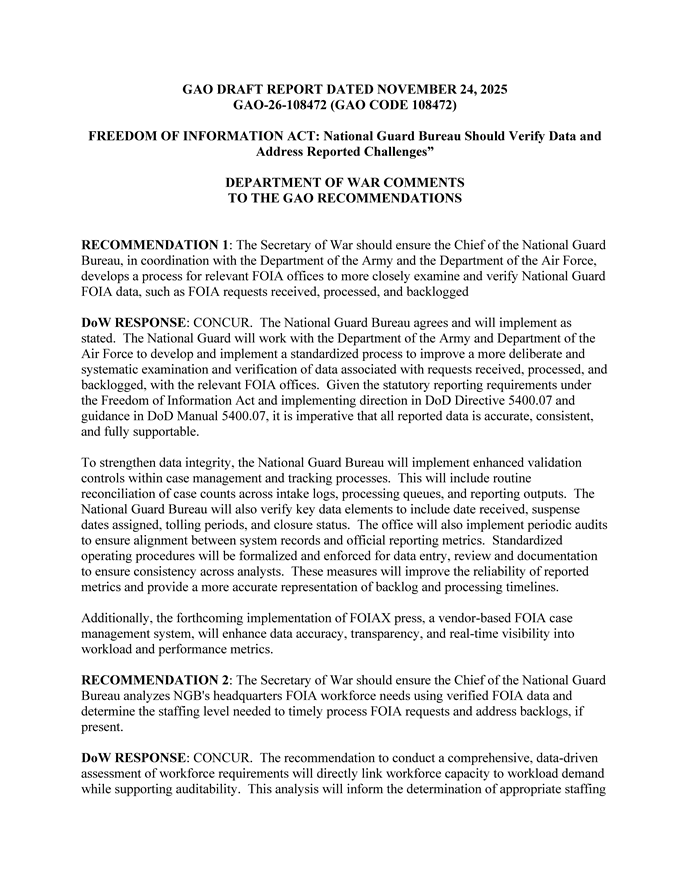
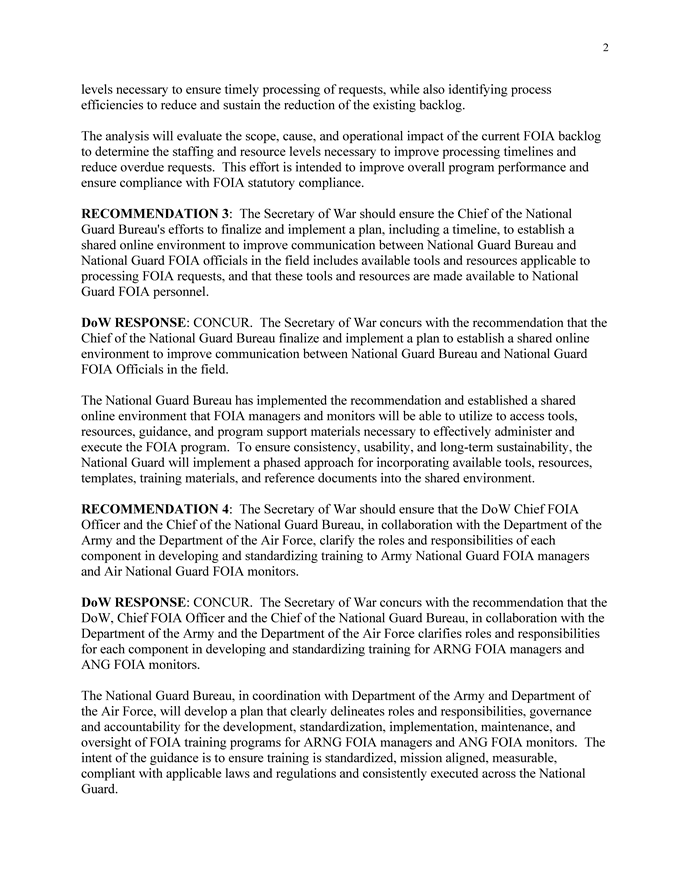
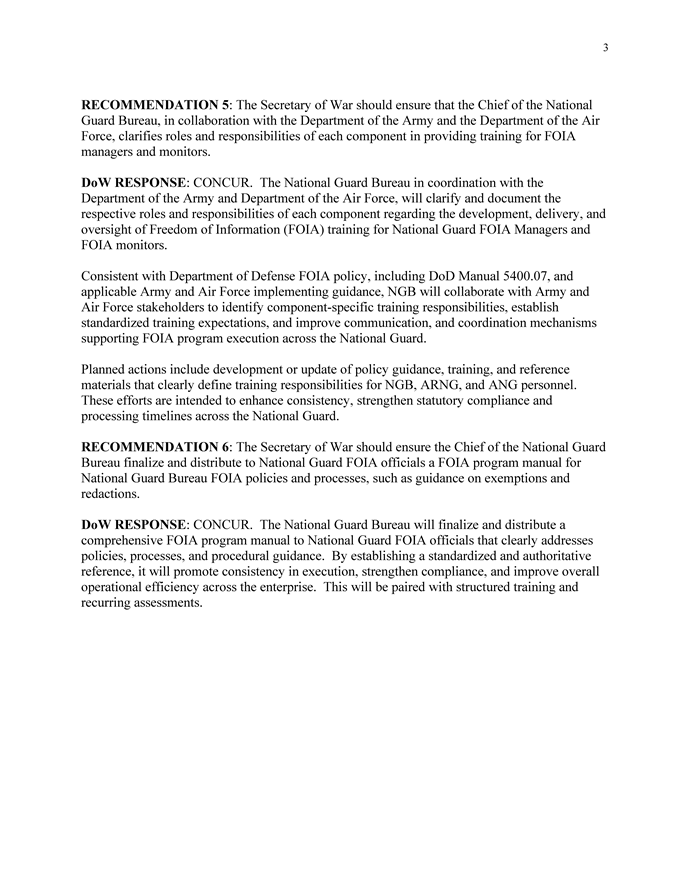
GAO Contact
Kristy E. Williams, williamsk@gao.gov
Staff Acknowledgments
In addition to the contact named above, the following staff members made key contributions to this report: Vincent Balloon (Assistant Director), Samuel Woo (Analyst in Charge), Jesse Andrews, Alma Atassi, Caroline Christopher, Chad Hinsch, Jeff A. Larson, Claire Saint-Rossy, Theologos Voudouris, Emily Wentworth, and Lillian Moyano Yob.
The Government Accountability Office, the audit, evaluation, and investigative arm of Congress, exists to support Congress in meeting its constitutional responsibilities and to help improve the performance and accountability of the federal government for the American people. GAO examines the use of public funds; evaluates federal programs and policies; and provides analyses, recommendations, and other assistance to help Congress make informed oversight, policy, and funding decisions. GAO’s commitment to good government is reflected in its core values of accountability, integrity, and reliability.
Obtaining Copies of GAO Reports and Testimony
The fastest and easiest way to obtain copies of GAO documents at no cost is through our website. Each weekday afternoon, GAO posts on its website newly released reports, testimony, and correspondence. You can also subscribe to GAO’s email updates to receive notification of newly posted products.
Order by Phone
The price of each GAO publication reflects GAO’s actual cost of production and distribution and depends on the number of pages in the publication and whether the publication is printed in color or black and white. Pricing and ordering information is posted on GAO’s website, https://www.gao.gov/ordering.htm.
Place orders by calling (202) 512-6000, toll free (866) 801-7077,
or
TDD (202) 512-2537.
Orders may be paid for using American Express, Discover Card, MasterCard, Visa, check, or money order. Call for additional information.
Connect with GAO
Connect with GAO on X,
LinkedIn, Instagram, and YouTube.
Subscribe to our Email Updates. Listen to our Podcasts.
Visit GAO on the web at https://www.gao.gov.
To Report Fraud, Waste, and Abuse in Federal Programs
Contact FraudNet:
Website: https://www.gao.gov/about/what-gao-does/fraudnet
Automated answering system: (800) 424-5454
Media Relations
Sarah Kaczmarek, Managing Director, Media@gao.gov
Congressional Relations
David A. Powner, Acting Managing Director, CongRel@gao.gov
General Inquiries
[1]5 U.S.C. § 552. Exemptions to disclosure include instances where records (or portions of them) are protected from public disclosure by one of nine exemptions (e.g., classified information) or fit within one of three special law enforcement record exclusions (e.g., informant records).
[2]For requests, the statutory period for processing requests is 20 working days from receipt, after which the request is considered backlogged. This 20-day period may be extended for an additional 10 working days if unusual circumstances arise, such as when there is a need to (1) search for and collect the requested records from field facilities or other establishments that are separate from the office processing the request; (2) search for, collect, and appropriately examine a voluminous amount of records which are demanded in a single request; or (3) consult with another agency having a substantial interest in the determination of the request, which consultation shall be conducted with all practicable speed. When a request for expedited processing is received, the FOIA Officer must determine whether to grant the request for expedited processing within 10 calendar days of its receipt.
[3]NGB is a joint activity of the Department of Defense. The bureau serves as the channel of communications on all matters pertaining to the National Guard, the Army National Guard of the United States, and the Air National Guard of the United States between the Department of the Army, Department of the Air Force, and the States. See 10 U.S.C. § 10501. NGB also serves as a liaison in coordinating domestic operations with federal agencies, state officers, and combatant commands. See Chief of the National Guard Bureau Instruction 3000.04, National Guard Bureau Domestic Operations (Jan. 24, 2018). The National Guard is the primary combat reserve component of the Army and Air Force and serves throughout the 50 states, territories, the District of Columbia, and across the globe.
[4]GAO, Freedom of Information Act: Additional Guidance and Reliable Data Can Help Address Agency Backlogs, GAO‑24‑106535 (Washington, D.C.: Mar. 7, 2024). As of August 2025, the Department of Justice implemented all four recommendations.
[5]H.R. Rep. No. 118-529, at 146-47 (2024).
[6]We obtained the point of contact list for Army National Guard FOIA managers and Air Force FOIA monitors from NGB in July 2025. We took steps to verify the accuracy of these lists prior to distributing the survey in September 2025. We did not send a survey to Air National Guard units and wings where we were unable to verify the point of contact or to those indicating that FOIA requests were handled by another entity.
[7]For the purposes of our report, we use “National Guard Bureau (NGB) officials” when referring to National Guard Bureau personnel; and we use “National Guard FOIA officials” when referring to both Army National Guard FOIA managers and Air National Guard FOIA monitors.
[8]5 U.S.C. § 552. The Freedom of Information Act was enacted in 1966 and most recently amended in 2016.
[9]DOD Manual 5400.07, DOD Freedom of Information Act (FOIA) Program (Jan. 25, 2017) and GAO, Standards for Internal Control in the Federal Government, GAO‑14‑704G (Washington, D.C.: September 2014).
[10]DOD Directive 5400.07, DOD Freedom of Information Act (FOIA) Program (Apr. 5, 2019); DOD Manual 5400.07; Department of Justice, Guidance for Agency FOIA Regulations, last updated June 26, 2019, accessed February 27, 2026, https://www.justice.gov/oip/oip-guidance/guidance-agency-foia-regulations; and Department of Justice, Guidance on Backlog Reduction Plans, last updated Aug. 21, 2025, accessed February 2, 2026, https://www.justice.gov/oip/oip-guidance/guidance-backlog-reduction-plans.
[11]Office of Personnel Management, Workforce Planning Guide (November 2022) and GAO‑14‑704G.
[12]FOIA applies to records created by federal executive branch agencies; it does not cover records held by Congress, the courts, or state and local government agencies. See 5 U.S.C. § 552. A FOIA request must reasonably describe the records it seeks. For requests, the statutory period is 20 working days from receipt, after which the request is considered backlogged. When a request for expedited processing is received, the FOIA Officer must determine whether to grant the request for expedited processing within 10 calendar days of its receipt.
[13]5 U.S.C. § 552.
[14]This 20-day period may be extended for an additional 10 working days if unusual circumstances arise, such as the need to (1) search for and collect the requested records from field facilities or other establishments that are separate from the office processing the request; (2) search for, collect, and appropriately examine a voluminous amount of records which are demanded in a single request; or (3) consult with another agency having a substantial interest in the determination of the request, which consultation shall be conducted with all practicable speed.
[15]5 U.S.C. § 552. In prior years, the requirements for the Chief FOIA Officer Reports differed depending upon whether the agency received more than 50 requests in the preceding fiscal year. For the 2026 Chief FOIA Officer Reports, only agencies that received 100 or more requests in Fiscal Year 2024 will be required to submit a Chief FOIA Officer report. See also Department of Justice, Guidelines for 2026 Chief FOIA Officer Reports, last updated December 1, 2025, accessed February 26, 2026.
[16]DOD Directive 5400.07.
[17]DOD, DOD Annual FOIA Report to the Attorney General, last accessed March 13, 2026, https://pclt.defense.gov/DIRECTORATES/FOIA/DoD-Annual-Reports-to-AG.aspx.
[18]DOJ, FOIA.gov, last accessed March 13, 2026, https://www.foia.gov/.
[19]DOD, Chief Freedom of Information Act Officer Report to the Department of Justice For 2026.
[20]DOJ, Guidance for Agency FOIA Regulations.
[21]DOJ, Guidance on Backlog Reduction Plans.
[22]DOJ, FOIA Self-Assessment Toolkit, (February 2023), accessed March 16, 2026, https://www.justice.gov/d9/2023-03/foia_self-assessment_toolkit_2023_update.pdf.
[23]An Army National Guard FOIA manager is responsible for the administration and oversight of their component’s FOIA program. An Air National Guard FOIA monitor serves as a point of contact for FOIA managers and assists in locating and providing records within their specific wing to the FOIA manager for review. See Army Regulation 25-55, The Department of the Army Freedom of Information Act Program (Oct. 19, 2020) and Air Force Manual 33-302, Freedom of Information Act Program (Apr. 27, 2018).
[24]National Archives and Records Administration, Department of Defense, Department of the Army Records Management Program, Records Management Inspection Report (September 2023).
[25]Army Regulation 25-400-2, Army Records Management Program (Nov. 18, 2022).
[26]Air Force Instruction 33-322, Records Management and Information Governance Program (June 26, 2025).
[27]32 C.F.R. part 286.
[28]DOD Directive 5400.07, DOD Freedom of Information Act (FOIA) Program (Apr. 5, 2019).
[29]DOD Manual 5400.07, DOD Freedom of Information Act (FOIA) Program. FOIA Requester Service Centers typically serve as the first point of contact at agencies for any requester (or potential requester) who has a question about how the FOIA works. Such questions can range from very general inquiries about the kinds of records maintained at the agency, to more specific questions directly related to a request that has already been made. Decentralized agencies with several components are likely to need a dedicated FOIA Requester Service Center for each component. See DOJ, The Importance of Quality Requester Services: Roles and Responsibilities of FOIA Requester Service Centers and FOIA Public Liaisons, last updated July 22, 2021, accessed on March 2, 2026.
[30]Army Regulation 25-55, The Department of the Army Freedom of Information Act Program (Oct. 19, 2020).
[31]Air Force Manual 33-302, Freedom of Information Act Program (Apr. 27, 2018).
[32]National Guard Bureau, Army National Guard FOIA/Privacy Act Manager Toolkit (Jan. 12, 2016). The toolkit includes instructions on how to process FOIA requests, such as logging the FOIA request into the Army’s FOIA tracking system to generate a case number, sending the initial acknowledgement letter to the requestor within 10 business days, tasking offices for records with a 5-day suspense date, preparing a final response to the requestor, obtaining legal reviews from a staff judge advocate, and closing the FOIA request in compliance with statutory requirements. The toolkit also includes an overview of the exemptions in the FOIA statute and how to perform basic redaction of records. NGB also provides separate form templates to Air National Guard monitors that must be filled out when conducting a search for records, and a record of freedom information processing cost (DD-2086). The FOIA checklist and forms are typically included with each FOIA request by NGB to Air National Guard FOIA monitors, according to Air National Guard officials.
[33]National Guard Bureau Memorandum for ANG Wing FOIA/Privacy Managers, ANG FOIA Program Centralization (Mar. 24, 2009).
[34]The Army National Guard established Requester Service Centers in each of the 50 states, the District of Columbia, Guam, Puerto Rico, and the U.S. Virgin Islands. NGB officials stated that the Army National Guard receives and processes FOIA requests separately at each component, while NGB serves as their initial denial authority.
[35]Army Records Management and Declassification Agency, Freedom of Information and Privacy Acts Case Tracking System FACTS User Guide 2.0 (Feb. 12, 2014). For the purposes of this report, we will refer to the Freedom of Information and Privacy Acts Case Tracking System (FACTS) as the “Army’s FOIA tracking system.” An Army official told us that the Army Records Management and Declassification Agency was renamed the “Army Records Management Directorate.”
[36]U.S. Office of Personnel Management, Privacy Impact Assessment for FOIAXpress and Public Access Link (PAL) (June 26, 2025). For the purposes of this report, we will refer to eFOIA (FOIAXpress) as “Air Force’s FOIA tracking system”.
[37]NGB officials stated that they were unable to provide a detailed breakdown of Army National Guard FOIA data, including by state or territory. Therefore, NGB officials stated that they did not know the extent to which Army National Guard backlogs exist or where they originate. The Army’s FOIA office was able to provide that data.
[38]We received a 74.1 percent response rate from Army National Guard FOIA managers to our survey.
[39]The DOD FOIA Annual Report to the Attorney General and FOIA.gov does not separate Army National Guard FOIA data from the Army’s FOIA data. Thus, there is no visibility as to which numbers and data were submitted to generate the annual report.
[40]NGB officials stated that they were unable to provide a detailed breakdown of Air National Guard FOIA data, including by state, territory, or wing. As a result, NGB does not know the extent to which Air National Guard FOIA backlogs exist and where they originate. Air Force FOIA officials stated that their tracking system cannot provide a breakdown of the Air National Guard FOIA data by wing, state, or territory because the wings within their respective states and territories do not have separate accounts to track their FOIA requests. The DOD FOIA Annual Report to the Attorney General and FOIA.gov does not separate Air National Guard FOIA data from Air Force’s FOIA data. Thus, there is no visibility as to which numbers and data were submitted to generate the annual report.
[41]Air Force officials stated that Air Force headquarters received FOIA requests that were meant for the Air National Guard wings and have inputted the requests into their tracking system before sending the request to the correct office.
[42]According to National Guard Bureau officials, these reports are submitted to the FOIA liaison at the Privacy, Civil Liberties, and Transparency Directorate.
[43]DOD Manual 5400.07, DOD Freedom of Information Act (FOIA) Program. DOD FOIA Program Components include the Department of the Army, the Department of the Air Force, and National Guard Bureau.
[46]Full-time equivalent (FTE) employment means the total number of regular straight-time hours worked (i.e., not including overtime or holiday hours worked) by employees, divided by the number of compensable hours applicable to each fiscal year. Office of Management and Budget, Circular No. A-11: Preparation, Submission, and Execution of the Budget. (Aug. 29, 2025). U.S. Army Manpower Analysis Agency and U.S. Air Force Personnel Center, Manpower and Organizational Assessment of the National Guard Bureau (Feb. 23, 2015).
[47]These specific numbers for these fiscal years had no discrepancies when comparing NGB data to FOIA.gov data.
[48]A hiring freeze is a temporary suspension on the recruiting and hiring of new employees in some or all parts of the executive branch for a set period. The Secretary of Defense ordered a hiring freeze on February 28, 2025, with limited exemptions. See Secretary of Defense Memorandum, Immediate Civilian Hiring Freeze for Alignment with National Defense Priorities (Feb. 28, 2025).
[49]U.S. Office of Personnel Management, Workforce Planning Guide (November 2022).
[50]Department of Justice, Guidance on Backlog Reduction Plans, (last updated Aug. 21, 2025), accessed February 2, 2026, https://www.justice.gov/oip/oip-guidance/guidance-backlog-reduction-plans.
[51]The workforce optimization initiative was part of a broader effort to determine civilian reductions based on a comprehensive readiness impact analysis on the size and appropriate mix of the Total Force. Secretary of Defense Memorandum, Immediate Civilian Hiring Freeze for Alignment with National Defense Priorities (Feb. 28, 2025).
[52]An Office of Primary Responsibility is an individual or office tasked with searching and reviewing records to determine whether the records are appropriate for release or withholding in response to a FOIA request. An Army National Guard official said these individuals can be in various locations within the state. For the purposes of this report, we will refer to individuals responsible for searching records as Office of Primary Responsibility.
[53]Army guidance applicable to Army National Guard states that commanders designate a FOIA program manager or FOIA official, in writing, and inform the Army FOIA Office of the appointment. Air Force guidance applicable to Air National Guard states that agency commanders must appoint a FOIA manager in writing and send the FOIA manager’s name and contact information to the Secretary of the Air Force’s Office of the Chief Information Officer (SAF/CIO). Army Regulation 25-55, The Department of the Army Freedom of Information Act Program (Oct. 19, 2020) and Air Force Manual 33-302, Freedom of Information Act Program (Apr. 27, 2018).
[54]DOD Directive 5105.77, National Guard Bureau (NGB) (Oct. 30, 2015) (incorporating change 1, effective Oct. 10, 2017).
[55]Department of Justice, Guidance on Backlog Reduction Plans.
[57]DOD Directive 5400.07. DOD guidance identifies DOD FOIA program components to include the Department of the Army, Department of the Air Force, and National Guard Bureau. DOD Manual 5400.07, DOD Freedom of Information Act (FOIA) Program (Jan. 25, 2017).
[58]5 U.S.C. § 552 (j)(2)(F).
[60]GAO, Government Performance Management: Leading Practices to Enhance Interagency Collaboration and Address Crosscutting Challenges, GAO‑23‑105520 (Washington, D.C.: May 24, 2023).
[61]National Guard Bureau, Army National Guard FOIA/Privacy Act Manager Toolkit.
[62]DOD Directive 5400.07.
[64]We distributed the survey to 99 of the 109 Air National Guard units and wings listed in NGB’s Air National Guard FOIA monitor point of contact list. We did not send a survey to Air National Guard units and wings where we were unable to verify the point of contact or to those indicating that FOIA requests were handled by another entity.
[65]5 U.S.C. § 552. The Freedom of Information Act was enacted in 1966 and most recently amended in 2016.
[66]Department of Defense Manual 5400.07, DOD Freedom of Information Act (FOIA) Program (Jan. 25, 2017).
[69]Office of Personnel Management, Workforce Planning Guide (November 2022) and Department of Justice, Guidance on Backlog Reduction Plans.
[70]Department of Defense Directive 5105.77, National Guard Bureau (NGB) (Oct. 30, 2015) (incorporating change 1, effective Oct. 10, 2017). Department of Justice, Guidance on Backlog Reduction Plans.
[72]5 U.S.C. § 552 and DOD Directive 5400.07.
[74]DOD Directive 5400.07, DOD Manual 5400.07, and National Guard Bureau, Army National Guard FOIA/Privacy Act Manager Toolkit (Jan. 12, 2016).