
Report to Congressional Requesters
United States Government Accountability Office
A report to congressional requesters
For more information contact: Dawn G. Locke at LockeD@gao.gov
What GAO Found
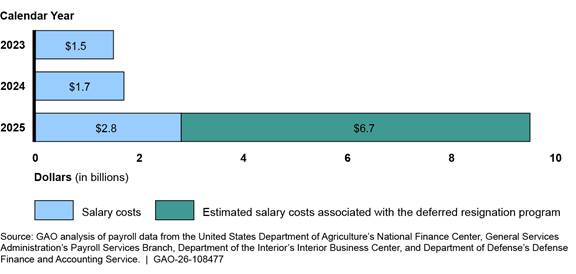
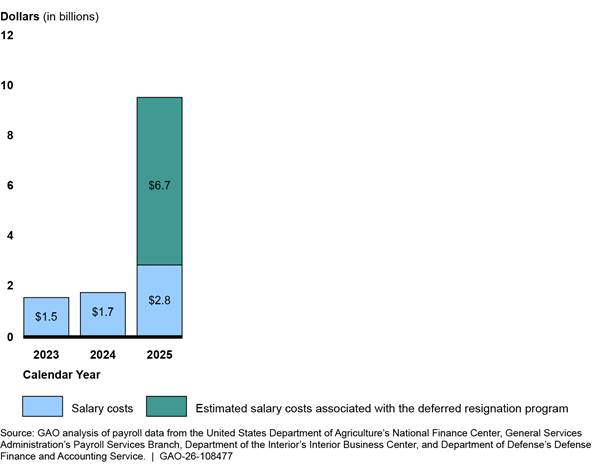
GAO’s review of payroll data found that federal agencies’ use of paid administrative leave increased by 435 percent from 2023 to 2025. GAO estimates federal agencies in our review spent $9.5 billion in salary costs on paid administrative leave in 2025, a sixfold increase from 2023. In 2025, the Office of Personnel Management (OPM) directed agencies to use paid administrative leave to support the deferred resignation program, which generally allowed federal employees to be placed on leave until they resigned or retired by September 30, 2025. Using program assumptions and internal time and attendance data provided by payroll service providers, GAO calculated about $6.7 billion of that amount was associated with deferred resignation program.
GAO identified limitations with the paid administrative leave data reported by agencies, which could overstate the actual amount used. For example, GAO found that agencies reported 144 percent more paid administrative leave used in pay periods with a public holiday in 2023 through early 2025. Holidays should not be reported as paid administrative leave, and OPM has issued guidance to help address this data issue. OPM does not plan to retroactively fix such historical errors in data released to the public. Fully disclosing any data limitations that remain unaddressed could help users make informed decisions about how to use these data.
OPM does not know the actual costs of the paid administrative leave used for workforce reduction efforts, including the deferred resignation program. One of the administration’s stated principles for current workforce reduction efforts is to trim the budget topline by reducing full-time equivalent positions. To support these efforts, federal agencies used millions of workdays of paid administrative leave. To calculate long-term savings, OPM needs to know short-term costs of paid administrative leave used for these efforts. However, OPM cannot easily and accurately do this because the paid administrative leave used for workforce reduction efforts is reported with other types of general paid administrative leave. Without a mechanism to track paid administrative leave for workforce reduction efforts, federal leaders may not have the data needed to understand whether government-wide cost saving goals are being met.
Why GAO Did This Study
Paid administrative leave for federal employees is an excused absence without loss of pay or charge to leave. It is a cost to taxpayers as employees receive full pay without performing job duties.
The Administrative Leave Act, enacted on December 23, 2016, highlighted congressional concern that agency use of paid administrative leave exceeded reasonable amounts. The act requires OPM to address how agencies use and record paid administrative leave.
We were asked to review how OPM has facilitated agencies’ use and reporting of paid administrative leave to be consistent with the Administrative Leave Act and other requirements. This report (1) describes the uses and salary costs of paid administrative leave at agencies from 2023 through 2025, (2) reviews how OPM discloses the limitations of paid administrative leave data released to the public, and (3) reviews how OPM tracks the costs of paid administrative leave for workforce reduction efforts.
GAO analyzed payroll data from 76 agencies, including 19 Chief Financial Officers Act agencies, which make up approximately 95 percent of the civilian workforce. GAO also reviewed OPM guidance and documents and interviewed relevant agency officials.
What GAO Recommends
GAO recommends that OPM (1) publicly disclose data reliability issues that remain unaddressed to improve the transparency of paid administrative leave data OPM releases, and ( 2) create a new category of paid administrative leave in the Enterprise Human Resources Integration payroll system for agencies to report paid administrative leave used to support workforce reduction efforts. OPM agreed with these recommendations.
|
Abbreviations |
|
|
|
|
|
CFO Act |
Chief Financial Officers Act |
|
EHRI |
Enterprise Human Resources Integration |
|
OPM |
Office of Personnel Management |
This is a work of the U.S. government and is not subject to copyright protection in the United States. The published product may be reproduced and distributed in its entirety without further permission from GAO. However, because this work may contain copyrighted images or other material, permission from the copyright holder may be necessary if you wish to reproduce this material separately.
September 15, 2026
The Honorable Gary C. Peters
Ranking Member
Committee on Homeland Security and Governmental Affairs
United States Senate
The Honorable James Lankford
Chairman
The Honorable John Fetterman
Ranking Member
Subcommittee on Border Management, Federal Workforce, and Regulatory Affairs
Committee on Homeland Security and Governmental Affairs
United States Senate
Paid administrative leave for federal employees is an excused absence without a loss in pay or a reduction in leave. This leave can be costly because employees receive pay without performing job duties and could be a significant financial commitment for agencies when used extensively. The appropriate oversight and use of paid administrative leave has been a long-standing concern with Congress. In 2014, we found that agencies did not report the use of paid administrative leave comparably or reliably. This affected data quality and limited agencies’ ability to understand how frequently the leave is used and identify instances of abuse.[1]
The Administrative Leave Act, enacted on December 23, 2016, included language highlighting congressional concerns that agencies’ use of paid administrative leave had exceeded reasonable amounts.[2] According to Congress, paid administrative leave should be used sparingly. Federal regulations also state that it is appropriate to use paid administrative leave for brief or short periods of time.[3]
The Administrative Leave Act of 2016 also created new paid administrative leave categories and stated that agencies should ensure that paid administrative leave is recorded accurately and consistently so that it can be managed and overseen effectively. The act required the Office of Personnel Management (OPM) to publish regulations on the acceptable uses and the proper recording of paid administrative leave. OPM further outlined the scope of the acceptable uses of paid administrative leave by directing agencies to place federal workers on paid administrative leave as part of workforce reduction efforts in 2025 and 2026. While there are appropriate uses for this leave and federal agencies are provided with the flexibility to use it at their discretion, the use of paid administrative leave comes at a cost to taxpayers. For the purposes of this report, we refer to all categories of administrative leave created under the Administrative Leave Act as “paid administrative leave.” This includes administrative leave (for general purposes), administrative leave (for investigative purposes), investigative leave, notice leave, and weather and safety leave.
We were asked to review how OPM has facilitated agencies’
use and reporting of paid administrative leave to be consistent with the
Administrative Leave Act and other requirements. In this report, we
(1) describe agencies’ use and the associated salary costs of paid
administrative leave reported from calendar years 2023 through 2025,
(2) review how OPM discloses the limitations of paid administrative leave data
released to the public, and (3) review how OPM tracks the costs of paid
administrative leave for workforce reduction efforts.
For all objectives, we reviewed the Administrative Leave Act of 2016, OPM regulations, guidance, and technical documentation, as well as payroll service provider documentation. For the first objective on the uses and salary costs of paid administrative leave, we collected and analyzed data from four payroll service providers for calendar years 2023 through 2025.[4] We received payroll data from a total of 76 agencies, including 19 Chief Financial Officers (CFO) Act agencies, which make up approximately 95 percent of the civilian workforce for those years.[5] These data include paid administrative leave hours used by federal employees biweekly for every pay period from January 2023 through December 2025.
To calculate the salary costs of paid administrative leave, we matched employees’ leave records with their pay information. We calculated each federal employee’s per hour gross base pay and multiplied that hourly pay rate by the number of paid administrative leave hours reported for each pay period. We then aggregated the total salary costs for each agency and across our dataset. We also analyzed factors behind patterns of increased usage, including for the deferred resignation program and public holidays.[6] For example, to estimate how many paid administrative leave hours were used to support the deferred resignation program, we used payroll service provider’s internal codes, where available. Where payroll service provider codes were not available, we made professional judgments based on programmatic details and OPM’s guidance.[7] We adjusted our assumptions by cross-referencing our initial data results with deferred resignation program separation data published on OPM’s Federal Workforce Data website to ensure our estimate was comparable to data reported by agencies.
For the second objective on OPM plans to address paid administrative leave data limitations, we reviewed OPM reporting guidance and information listed on OPM’s public Federal Workforce Data website. We discussed data limitations observed from our data outputs with OPM and the payroll service provider officials to understand whether and how they were being addressed.
For the third objective on how OPM tracked the salary costs of paid administrative leave used to support workforce reduction efforts, we analyzed relevant OPM guidance to agencies and payroll service providers. We interviewed officials at the four payroll service providers in our scope to understand how they record paid administrative leave data for workforce reduction efforts. We also interviewed OPM officials about their approach to estimating the amount of paid administrative leave used for workforce reduction efforts.
We conducted this performance audit from April 2025 to September 2026 in accordance with generally accepted government auditing standards. Those standards require that we plan and perform the audit to obtain sufficient, appropriate evidence to provide a reasonable basis for our findings and conclusions based on our audit objectives. We believe that the evidence obtained provides a reasonable basis for our findings and conclusions based on our audit objectives.
Background
Paid Administrative Leave Policies Updated in Law and Regulations
The Administrative Leave Act, enacted on December 23, 2016, included language highlighting congressional concerns that the use of paid administrative leave by federal agencies exceeded reasonable amounts, resulting in significant costs to the federal government.[8] Before then, there was no specific statutory authority for the use of paid administrative leave.
In our prior reports, and as cited in the 2016 Senate and House committee reports, we found that inconsistent policies and varying data across agencies resulted in inadequate documentation of the federal agencies’ use of paid administrative leave.[9] The committee reports also noted our findings that the data on the use of paid administrative leave were inaccurate and inconsistent.[10]
Agencies authorize paid administrative leave at their discretion. While it is not an employee entitlement, paid administrative leave provides federal agencies with workforce flexibility. Federal agencies may grant paid administrative leave for a variety of reasons.[11] For example, agencies can grant paid administrative leave to federal employees for blood donation, voting, geographic relocation for military spouses, and workforce reduction efforts, among other reasons.
The Administrative Leave Act required the Director of OPM to publish final regulations that instruct agencies on the acceptable uses and proper recording of paid administrative leave by September 19, 2017, 270 days after the law’s enactment.[12] OPM published the final rule for weather and safety leave on April 10, 2018, nearly 2 years after enactment of the law. The final rule for administrative, investigative, and notice leave was published on December 17, 2024, almost 8 years after enactment of the Administrative Leave Act. According to OPM officials, the rules were delayed to analyze and resolve various issues that were raised in comments on the proposed regulations.
After both final rules were published, OPM required that payroll service providers comply with these regulatory changes by September 13, 2025. To help agencies and payroll service providers implement the rules, OPM provided them with a template for internal policies, memorandums, technical guides, fact sheets, and briefings. See figure 1 for a timeline of changes to paid administrative leave policies.
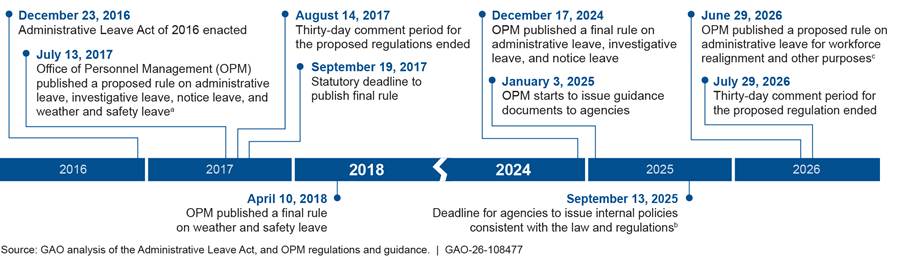
aWhile weather and safety leave and the other paid administrative leave categories were both included in the July 13, 2017, proposed rule, OPM later determined that it would better serve agencies if it published the regulations for weather and safety leave first, separately from the other types of paid administrative leave.
bThe weather and safety final rule stated that OPM would delay the enforcement of the reporting requirements for weather and safety leave pending the publication of the final rule for the remaining categories of paid administrative leave.
cThe proposed rule would codify some existing OPM policies on agency discretion to grant administrative leave, including for blood donation, voting, geographic relocation for military spouses, and workforce reduction efforts, among other reasons.
New Requirements for Agencies’ Reporting and Use of Paid Administrative Leave
OPM requires that agencies report usage data for five categories of paid administrative leave (see table 1). OPM’s December 2024 regulations included two categories of paid administrative leave specifically related to an agency’s investigation of an employee for misconduct and other adverse actions:
1. administrative leave (for investigative purposes), and
2. investigative leave.
The administrative leave (for investigative purposes) category applies when an agency places an employee on an initial period of leave related to an investigation. The duration of that period is no more than 10 workdays per calendar year.[13] The investigative leave category applies when an agency determines that an extended investigation beyond the initial 10-workday limit is required.[14]
|
Paid administrative leave category |
U.S. code sections; federal regulations |
Allowable uses |
Limitations on use |
|
Administrative leave (for general purposes) |
5 U.S.C. § 6329a; 5 C.F.R. § 630, subpart N |
Used for purposes not mentioned below. Examples could include reasonable tardiness, blood donation, voting activities, and physical fitness. |
No limits. Agencies can establish regular acceptable uses in policy or through ad hoc approval. |
|
Administrative leave (for investigative purposes) |
5 U.S.C. § 6329a; 5 C.F.R. § 630, subpart N |
Used when an employee is the subject of an investigation such as for alleged misconduct, security threats, criminal conduct, or adverse actions. |
Not to exceed 10 workdays per employee each calendar year. |
|
Investigative leave |
5 U.S.C. § 6329b; 5 C.F.R. § 630, subpart O |
Used when an employee is the subject of an extended investigation. |
Investigative leave can only be granted after an employee reaches the 10-workday limit described above. An agency may place an employee on investigative leave for up to three increments of 30 workdays, or up to 90 workdays. If an investigation lasts beyond 90 workdays, the agency must submit a report to the relevant congressional committees of jurisdiction that includes an explanation as to why the employee was placed on investigative leave for an extended period of time. |
|
Notice leave |
5 U.S.C. § 6329b; 5 C.F.R. § 630, subpart O |
Used between when an employee is provided notice of a proposed adverse action and that adverse action becoming effective, or when the agency notifies the employee that no adverse action will be taken. |
No limits. |
|
Weather and safety leave |
5 U.S.C. § 6329c; 5 C.F.R. § 630, subpart P |
Used when employees are prevented from safely traveling to or performing work at an approved location due to (1) an act of God, (2) a terrorist attack, or (3) another condition that prevents employees from safely traveling to or performing work at an approved location. |
No limits. |
Source: GAO analysis of 5 U.S.C. §§ 6329a-6329c and OPM regulations including 5 C.F.R. § 630, subparts N-P. | GAO‑26‑108477
OPM required the payroll service providers to modify their systems to enable agencies to report under these new categories. OPM also required the payroll service providers to create and use separate categories to report paid holiday time off and other types of paid time off in nonduty status.[15]
Paid Administrative Leave for Workforce Reduction Efforts
Since January 2025, in response to presidential directives, many federal agencies have taken steps to reduce and reshape their workforces through voluntary or involuntary programs, including through deferred resignation programs.[16] The deferred resignation programs allow employees to resign from their positions and to retain their pay and benefits until the end of the deferred resignation period. Executive branch employees first received an email from OPM on January 28, 2025, with the subject line, “Fork in the Road,” offering them the 2025 government-wide deferred resignation program.
To help support these efforts, OPM directed agencies to place an employee on paid administrative leave when the agency component in which the employee works is being eliminated or restructured, or when the agency determines that the employee’s absence from the office is in the interest of the government.[17] According to OPM guidance:
· Employees who accept the deferred resignation program should promptly have their duties re-assigned or eliminated and be placed on paid administrative leave until the end of the deferred resignation period, with limited exceptions.[18] The 2025 government-wide deferred resignation program period ended on September 30, 2025 (unless the employee elected an earlier resignation date), or by December 31, 2025, for retiring employees. For fiscal year 2026 agency-specific deferred resignation programs, OPM guidance stated that agencies may use up to 6 months of paid administrative leave to support workforce reduction efforts.[19]
· Employees who accepted an agency-specific voluntary early retirement or voluntary separation incentive payment for workforce reduction purposes could be placed on paid administrative leave. Agencies can pair the deferred resignation program with Voluntary Early Retirement Authorizations and Voluntary Separation Incentive Payments offers if they determine it necessary to achieve workforce reduction objectives.[20]
· Employees who were involuntarily separated through a reduction in force could be placed on paid administrative leave from the time they were first notified until their separation date.
Starting in calendar year 2026, OPM encouraged agencies to establish policies limiting paid administrative leave used for workforce reduction efforts to 12 weeks to ensure consistent use government-wide, unless a higher threshold is jointly approved by OPM and the Office of Management and Budget.[21] OPM guidance states that agencies and their payroll service providers should report paid administrative leave used to support workforce reduction efforts to OPM under the administrative leave (for general purposes) category.[22] In June 2026, OPM published a proposed rule to amend regulations that address the appropriate uses of administrative leave in connection with workforce reduction efforts, including the deferred resignation program. See figure 2 for a timeline of key OPM guidance and events related to agencies’ use of paid administrative leave to support workforce reduction efforts.
Figure 2: Timeline of Selected Office of Personnel Management (OPM) Guidance and Events Related to the Use of Paid Administrative Leave for Workforce Reduction Efforts, December 2024–December 2025
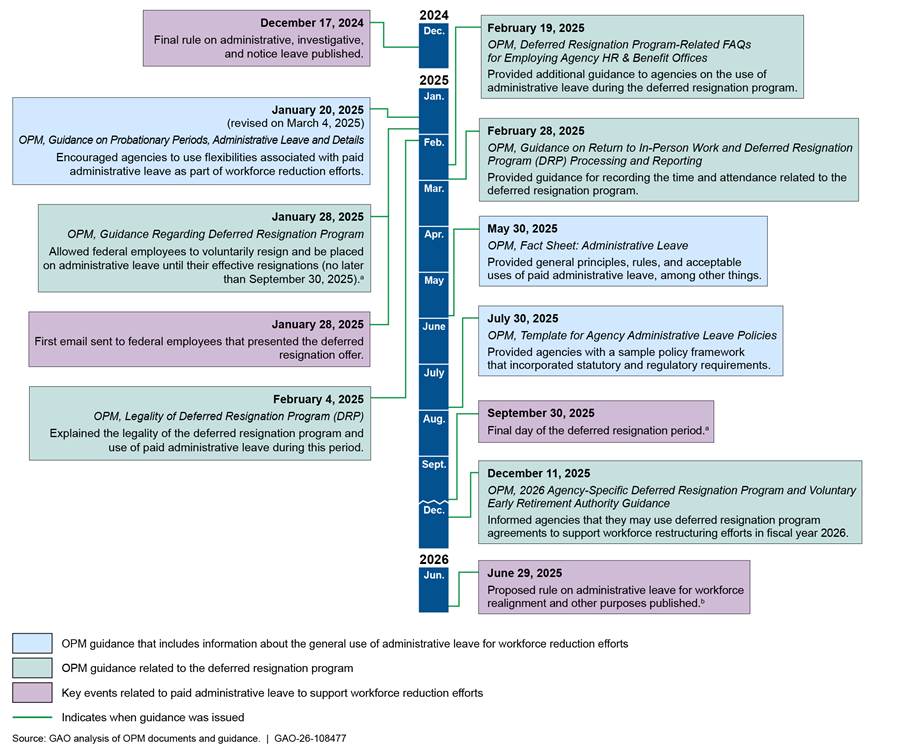
aFederal employees who had a retirement date planned between October 1, 2025, and December 31, 2025, were still eligible for the deferred resignation program and could extend their deferred resignation date to match their retirement date past the September 30, 2025, date listed in deferred resignation program guidance.
bOPM’s proposed rule would add a list of specific examples of acceptable uses of administrative leave such as in connection with voluntary deferred resignation programs, involuntary separation via a reduction in force, and other workforce uses. Administrative Leave for Workforce Realignment and Other Purposes, 91 Fed. Reg. 39032, 39037 (proposed June 29, 2026).
Payroll Service Providers
Federal agencies largely rely on four payroll service providers to process employee pay: the United States Department of Agriculture’s National Finance Center, General Services Administration’s Payroll Services Branch, Department of the Interior’s Interior Business Center, and Department of Defense’s Defense Finance and Accounting Service.[23] Federal employees use electronic time and attendance systems to record time spent on different work and leave activities. Payroll data provide information on how federal employees allocate their time—reflected in hours charged to specific categories of work and use of leave. Every 2 weeks, information for approximately 2 million federal civilian employees is transmitted to OPM from these four payroll service providers. As part of preparing data to be uploaded, the payroll service providers standardize and collate certain fields to meet the technical standard required by OPM to report data to the Enterprise Human Resources Integration (EHRI) payroll data system. EHRI is the primary government-wide data source for federal employees’ payroll, personnel, training, and retirement data.
Federal Workforce Data Website
In January 2026, OPM launched a new public-facing data website for civilian workforce data called the Federal Workforce Data website.[24] The Federal Workforce Data website includes payroll data not previously released to the public, including hours of paid administrative leave used government-wide. The paid administrative leave data published on the website include historical data beginning in calendar year 2015. The website is sourced from OPM’s EHRI system and other OPM data sources, including USAJOBS.[25] Users can download paid administrative leave summary data and can create visualizations that allow them to explore trends over specific time frames. This is consistent with our prior recommendation to OPM to make payroll data publicly available.[26]
Recent Increase in Paid Administrative Leave Usage Was Largely Driven by the Deferred Resignation Program
Agencies’ Use of Paid Administrative Leave Increased by 435 Percent with a Total Salary Cost of $9.5 Billion in 2025
Our analysis of data provided by the four payroll service providers found that the government-wide use of paid administrative leave increased by 435 percent from calendar years 2023 to 2025, largely driven by the 2025 deferred resignation program.[27] Specifically, the number of workdays of paid administrative leave reported increased from about 4 million workdays and 4.4 million workdays in calendar years 2023 and 2024, respectively, to about 21.6 million workdays in 2025.[28] See figure 3 for the paid administrative leave used by federal employees by biweekly pay periods from 2023 through 2025.
Figure 3: Total Paid Administrative Leave Workdays Reported to Four Payroll Service Providers, 2023–2025
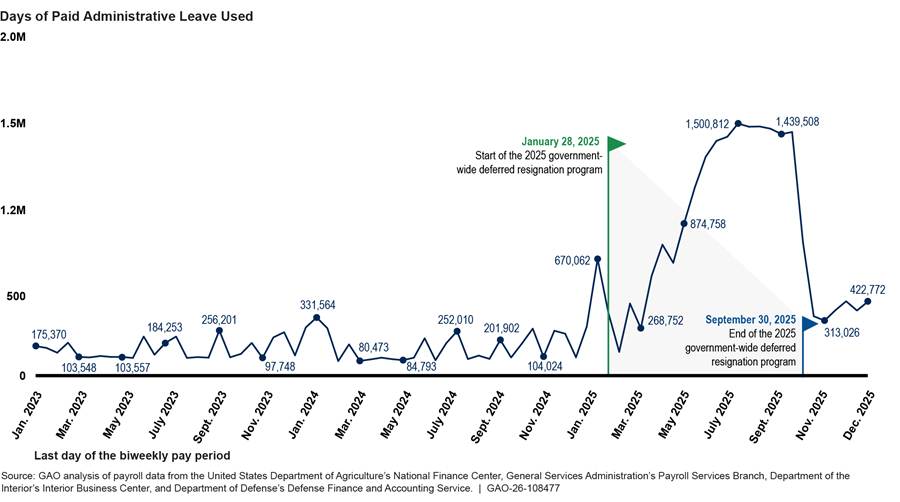
Note: Some federal employees who accepted the deferred resignation program could have still been on the payroll after the September 30, 2025, date listed in deferred resignation program guidance. Specifically, federal employees who had a retirement date planned between October 1, 2025, and December 31, 2025, were still eligible for the deferred resignation program and could extend their deferred resignation date to match their retirement date. Additionally, some of those employees could have been furloughed as part of the federal government funding gap between October 1, 2025, and November 12, 2025. Furloughed federal employees who were still in the deferred resignation program would not have used paid administrative leave during that period.
As part of the 2025 deferred resignation program, OPM directed agencies to place federal employees on paid administrative leave as early as January 28, 2025, and through September 30, 2025, with some retiring federal employees receiving paid administrative leave through December 31, 2025. As a result, the total number of federal employees granted paid administrative leave and the average use by each employee both increased from 2023 to 2025. Our analysis found that the number of individual employees granted paid administrative leave increased from around 750,000 in 2023 to nearly 900,000 in 2025, while the average number of hours reported by employees increased from about 5 workdays to about 24 workdays.
We estimate that 70 percent of the paid administrative leave used in calendar year 2025 supported the deferred resignation program.[29] We also estimate that about 144,312 employees from the agencies in our analysis reported paid administrative leave for this purpose. Paid administrative leave usage peaked in July 2025 at nearly 3 million workdays; approximately 2.5 million of those workdays were associated with the deferred resignation program. In 2023 and 2024, fewer than 600 federal employees took more than 90 workdays of paid administrative leave; in 2025, almost 100,000 employees took more than 90 workdays of paid administrative leave (see table 2).
|
|
Fewer than 10 workdays |
Greater than 10 workdays |
Greater than 30 workdays |
Greater than 60 workdays |
Greater than 75 workdays |
More than 90 workdays |
|||||
|
Calendar year 2023 |
|||||||||||
|
|
626,667 |
118,361 |
8,006 |
1,407 |
702 |
567 |
|||||
|
Calendar year 2024 |
|||||||||||
|
|
747,472 |
131,224 |
2,666 |
1,090 |
662 |
530 |
|||||
|
Calendar year 2025 |
|||||||||||
|
|
630,482 |
253,184 |
135,881 |
126,529 |
112,410 |
98,758 |
|||||
Source: GAO analysis of payroll data from the United States Department of Agriculture’s National Finance Center, General Services Administration’s Payroll Services Branch, Department of the Interior’s Interior Business Center, and Department of Defense’s Defense Finance and Accounting Service. | GAO‑26‑108477
According to our calculations, the agencies in our review spent around $9.5 billion in calendar year 2025 in salary costs for paid administrative leave, a sixfold increase from 2023.[30] We estimate that more than $6.7 billion of that amount is associated with the deferred resignation program (see fig. 4).
Figure 4: Salary Costs of Total Paid Administrative Leave Reported to Four Payroll Service Providers, 2023–2025
Nearly 800 Federal Employees Reported More Than a Work Year of Paid Administrative Leave from 2023 Through 2025
Our analysis of data provided by the four payroll service
providers found cases where individual federal employees used a large amount of
paid administrative leave in calendar years 2023 through 2025 (see table 3).
Specifically, we found that 779 individual employees reported more than
1 work year of paid administrative leave, with an estimated total salary cost
of about $108 million.
|
10 days or fewer |
11–20 days |
1–3 months |
3–6 months |
6–9 months |
9–12 months |
1–1.5 years |
1.5–2 years |
2–3 years |
|
1,116,390 |
124,128 |
167,968 |
91,264 |
48,669 |
11,153 |
583 |
161 |
35 |
Source: GAO analysis of payroll data from the United States Department of Agriculture’s National Finance Center, General Services Administration’s Payroll Services Branch, Department of the Interior’s Interior Business Center, and Department of Defense’s Defense Finance and Accounting Service. | GAO‑26‑108477
Note: For our analysis of payroll service provider data, workdays equal 8 hours, 5 workdays equal a work week, 21 workdays equal a work month, and 260 workdays equal a work year. A work year is also equal to 2,080 work hours, which is the measure for full-time equivalent positions. A full-time equivalent position is defined as the total number of regular hours worked by employees divided by the number of compensable hours applicable to each year.
These large uses of paid administrative leave persist almost 8 years after the enactment of the Administrative Leave Act, which was intended to curb such charges.[31] We identified two potential factors driving the large amounts of paid administrative leave reported from 2023 through 2025.[32]
· Investigations. As we reported in 2014, the most common use of paid administrative leave that resulted in a higher count was likely related to investigations into federal employees’ alleged misconduct or criminal actions. Typical uses of paid administrative leave are usually not more than a workday during a pay period, such as for voting, tardiness, or blood donation. We found in 2014 that personnel matters were the most common reasons that agencies cited for higher-than-average amounts of paid administrative leave data in fiscal years 2011 through 2013.[33]
·
Workforce reduction efforts. Since 2025, employees
reported high amounts of paid administrative leave as part of the deferred
resignation program and other workforce reduction efforts. Employees who
accepted the deferred resignation agreement but had an established retirement
date after September 30, 2025, could have received paid administrative leave
for nearly a whole year—from January 28, 2025, through December 31, 2025.
Further, OPM guidance states that agencies could offer federal employees under
investigation for misconduct and other adverse actions a deferred resignation
agreement. This could have also led to federal employees using an extended
amount of paid administrative leave for workforce reduction efforts rather than
for investigative purposes.
OPM Does Not Fully Disclose Limitations of Publicly Released Paid Administrative Leave Data
While OPM currently discloses some data limitations related to paid administrative leave on the Federal Workforce Data website, a more comprehensive list of data quality issues would improve transparency of the data. In January 2026, OPM launched a new website to make data on the federal workforce publicly available. Since the Federal Workforce Data website was launched, OPM released paid administrative leave hours used by federal agencies to the public for the first time.
OPM shares data validation results and completeness metrics on the website to promote transparency, to highlight known limitations, and to support the continuous improvement of the federal human resources data system. As of July 2026, OPM disclosed to the public that the payroll data it publishes on the Federal Workforce Data website:
· are initial, preliminary sets while OPM conducts a data quality assessment;
· may not be complete because some agencies are not yet reporting data using the five categories of paid administrative leave;[34] and
· may contain administrative leave hours reported by agencies using both the old data element (displayed as “administrative leave – previous” on the Federal Workforce Data website) and the new paid administrative leave categories.
However, we have found additional issues that affect the accuracy and reliability of paid administrative leave data posted on the Federal Workforce Data website not included in OPM’s disclosures. Our analysis of the four payroll service providers’ payroll data suggests that some employees may have incorrectly reported holiday leave as paid administrative leave, which could overstate the amount of leave actually used by employees.[35] Specifically, the 24 pay periods that had public holidays from January 2023 through January 2025 averaged 144 percent more paid administrative leave hours than the pay periods that did not have a public holiday (see fig. 5).[36]
OPM has long maintained, even prior to the enactment of the Administrative Leave Act, that public holidays and holidays declared by the President are not an acceptable use of paid administrative leave.[37] Public holidays should be recorded as “Paid Holiday Time Off,” not paid administrative leave.
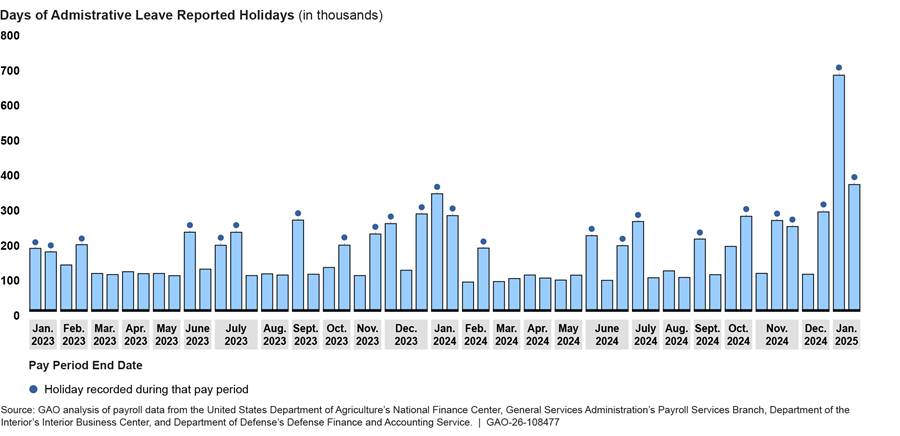
In February 2025, OPM provided payroll service providers with technical information to modify the data field for reporting the hours associated with Paid Holiday Time Off. In July 2025, OPM provided agencies with an administrative leave policy template that detailed acceptable uses of paid administrative leave, which included the proper way to record holiday leave. However, the data previously published on the Federal Workforce Data website likely contain tens of thousands of hours of holiday leave that may have been incorrectly reported as paid administrative leave. For instance, the President issued an executive order to close the federal government for a National Day of Mourning for President Carter on January 9, 2025. We found a large increase—more than the previous three pay periods combined—in the amount of paid administrative leave used in the pay period that corresponded with this day.
We found additional reporting errors that may also overstate agencies’ use of paid administrative leave. They include employees misreporting other types of paid leave, such as preventative health screenings, union activities, and court leave, to OPM as paid administrative leave.[38] We found tens of thousands of records of these other paid leave types that are granted under a legal authority other than the Administrative Leave Act that may have been misreported to OPM as paid administrative leave.
Since December 2024, OPM has issued agencies and payroll service providers guidance that should help them report paid administrative leave more consistently and in accordance with statutory requirements. In June 2026, OPM published a proposed rule with a noncomprehensive list of examples of acceptable agency uses of paid administrative leave.[39]
Additionally, OPM officials stated that they initiated a data quality assessment of payroll data and they expect to complete their assessment by the end of fiscal year 2026. OPM officials said they started this assessment, in part, to address a previous recommendation of ours to evaluate existing internal control activities and develop new control activities for EHRI payroll data to improve the reliability of those data.[40] OPM officials did not specifically explain how or whether they plan to publicly disclose additional limitations found as part of the data quality assessment. While these OPM actions could help improve agencies’ recording and reporting of paid administrative leave data going forward, OPM officials stated that they do not plan to retroactively fix the historical errors currently released on the Federal Workforce Data website.
We have previously reported that a key practice of transparent and useful federal websites is the disclosure of data quality issues and limitations.[41] This can include descriptions of the completeness, timeliness, and accuracy of the data, including any findings from the ongoing data quality assessments.[42] Leaving historical data unaddressed in the Federal Workforce Data website may be a reasonable management decision as agency leaders determine priorities and make tradeoffs to ensure the best use of existing resources. However, it will be important for known limitations to be disclosed for Federal Workforce Data website users.
The Federal Workforce Data website acknowledged the need to deliver high-quality data to ensure that users have access to useful and accurate information in a timely manner.[43] The website also states that reliable data are essential for understanding and managing the federal workforce.[44] Given it has been almost a decade since the Administrative Leave Act was passed, in part, to help address inaccuracies and inconsistencies of paid administrative leave data, it is critical that OPM follow through on addressing limitations in paid administrative leave data. Disclosing quality issues of the paid administrative leave data that will remain as part of the historical dataset can help users make informed decisions about whether and how to use these data.
OPM Faces Complications in Determining Actual Salary Costs of Using Paid Administrative Leave for Workforce Reduction
OPM does not know the actual costs of paid administrative leave used for workforce reduction efforts, including the paid administrative leave to support the 2025 deferred resignation program, because this category is not tracked separately in payroll systems. One of this administration’s principles for federal agency reorganization and workforce reductions is to decrease the budget topline by reducing full-time equivalent positions in fiscal years 2025, 2026, and 2027.[45]
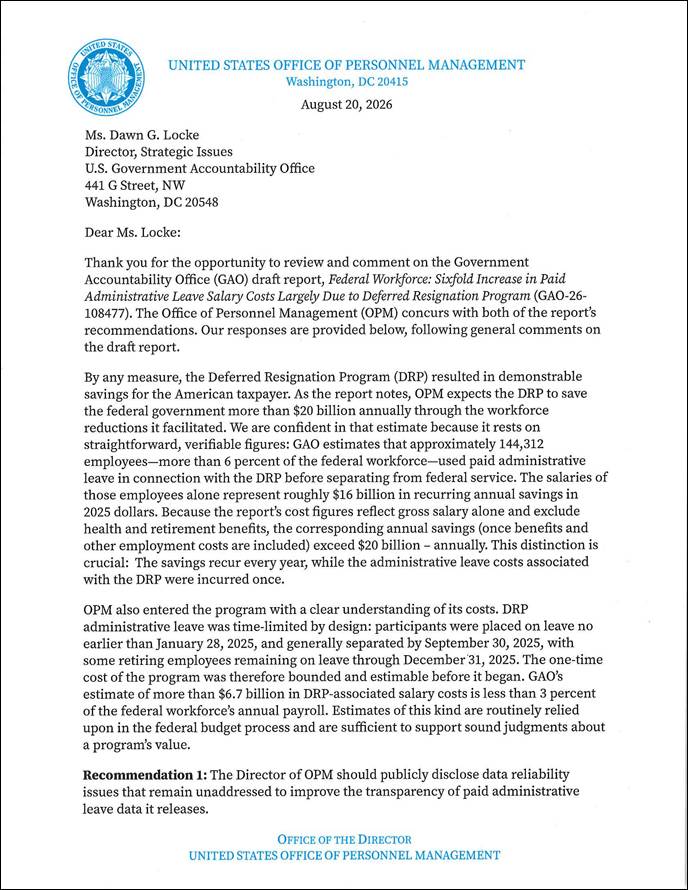
To help meet this goal, OPM directed agencies to use paid administrative leave for the 2025 government-wide deferred resignation program. OPM has since directed agencies to continue using paid administrative leave for more workforce reduction efforts in 2026.[46] In June 2026, OPM published a proposed rule authorizing the use of administrative leave for workforce reductions and other purposes. The proposed rule states that the temporary costs of providing paid administrative leave can generate large long-term savings by reducing federal staffing levels.[47] OPM’s leadership expects the deferred resignation program to save the federal government more than $20 billion annually.[48]
To calculate the long-term government-wide savings of workforce reduction efforts, OPM needs to know the short-term costs of using paid administrative leave. However, OPM cannot easily and accurately do this because it did not create a separate paid administrative leave category in the payroll data system to use when reporting these specific paid leave hours to OPM.[49]
Without this data category, OPM must use a cumbersome process to generate an estimate of how much paid administrative leave each individual employee used as a part of workforce reduction efforts and the associated costs. Specifically, to determine the salary costs of the paid administrative leave used as part of the 2025 deferred resignation program, OPM officials must match the hours of paid administrative leave recorded in the payroll data system with a federal employee’s separation record from a separate human resources data system.[50] This process can be complex and can only be conducted after an employee has separated from the federal government.
Moreover, this retroactive matching process will likely produce an overestimate since paid administrative leave used for workforce reduction efforts and other general purposes are reported under the same category.[51] Because these hours cannot be differentiated once they are reported to OPM, the actual total of administrative leave hours used for only workforce reduction efforts is unknown.[52] OPM officials stated that they have started to conduct a matching process to calculate the amount of paid administrative leave used to support the 2025 deferred resignation program and anticipate the analysis to be completed in fiscal year 2026. OPM officials stated that this analysis will be complicated because the 2025 deferred resignation program hours were not tracked separately within OPM’s payroll system.
Without an accurate understanding of how much paid administrative leave costs the federal government, there is no way to accurately determine to what extent the government-wide cost-savings goal is being met. OPM officials stated that they have no plans to create an additional subcategory of paid administrative leave associated with workforce reductions. While they did not explain specifically, they said that they may revisit this issue in the future. Nevertheless, OPM guidance allows agencies and payroll service providers to create internal accounting codes specific to the deferred resignation program to allow agency tracking and reporting capabilities. We found that two of the four payroll service providers created a separate new internal time and attendance code to track the paid administrative leave used to support the deferred resignation programs at their client agencies. However, these data are automatically combined into the general administrative leave category when transmitted to OPM. As a result, the deferred resignation program subcategory tracked by these two payroll service providers is lost once the data are uploaded into OPM’s system.
The creation of a dedicated paid administrative leave category in OPM’s EHRI payroll data system for agencies and payroll service providers to report paid administrative leave used to support workforce reduction efforts would increase the accuracy of OPM’s cost savings calculations. These data would help federal leaders understand to what extent future workforce reduction efforts are ultimately meeting the goal of reducing the federal budget. A key practice of evidence-based policymaking is to collect data and evidence to understand whether progress is made toward a goal.[53]
Given the significant costs of using paid administrative leave for workforce reduction efforts—which we estimated to be around $6.7 billion in 2025—it will be important for OPM and agencies to have accurate and precise tracking of future uses, which could be accomplished through the creation of a new subcategory. Otherwise, OPM will be unable to reliably determine whether these efforts are delivering meaningful cost savings as intended. Creating a separate administrative leave category associated with workforce reduction efforts could provide the data to do so.
Conclusions
The Administrative Leave Act created discrete reporting categories intended to be used consistently across the government. OPM has taken steps to provide agencies and payroll service providers with guidance and instructions to implement these new requirements for reporting and tracking paid administrative leave data. However, agencies continue to inconsistently use and report paid administrative leave data, which could result in inaccurate counts of hours reported to OPM’s payroll system. More robust public disclosures on the Federal Workforce Data website of paid administrative leave data quality limitations, such as known errors in the past data, would help ensure that data users are aware of reliability issues of OPM’s payroll data. The absence of paid administrative leave data used for workforce reduction efforts hinders OPM and policymakers’ ability to understand the extent to which they are meeting government-wide cost saving goals for workforce reductions.
Recommendations for Executive Action
We are making two recommendations to OPM:
The Director of OPM should publicly disclose data reliability issues that remain unaddressed to improve the transparency of paid administrative leave data OPM releases. (Recommendation 1)
The Director of OPM, in coordination with agencies and payroll service providers, should create a new category of paid administrative leave in the Enterprise Human Resources Integration payroll data system for agencies to report paid administrative leave used to support workforce reduction efforts. (Recommendation 2)
Agency Comments
We provided a draft of this report to OPM, the Departments of Agriculture, Defense, the Interior, and the General Services Administration for review and comment.
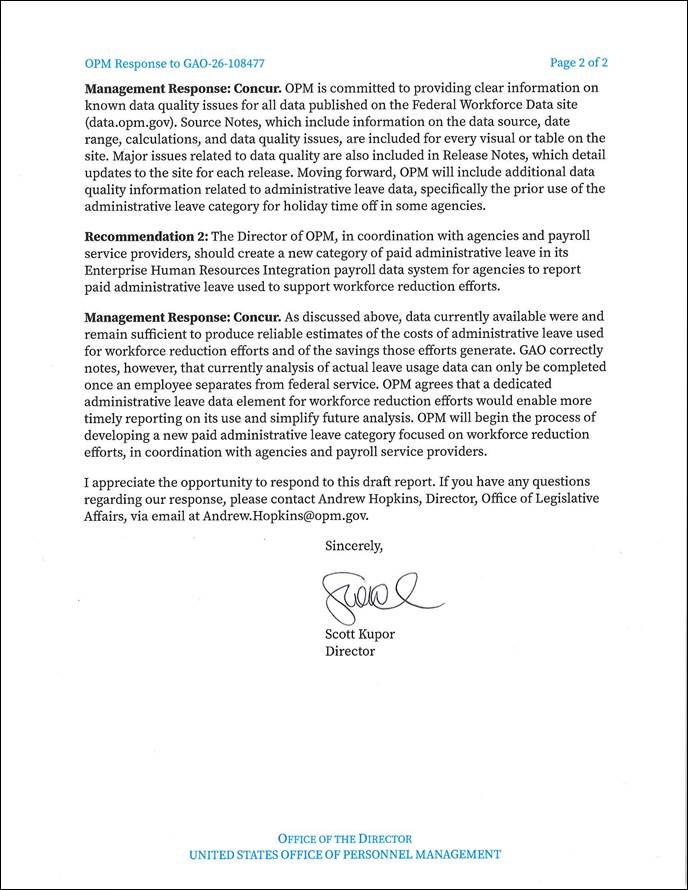
In its comments, reproduced in appendix III, OPM concurred with both recommendations and stated that it intends to implement them. The Departments of Agriculture and Defense had no comments. The Department of the Interior provided technical comments, which we incorporated as appropriate. The General Services Administration did not provide comments.
We are sending copies of this product to the appropriate
congressional committees; the Director of the Office of Personnel Management;
the Secretaries of the Departments of Agriculture, Defense, and the Interior;
the Administrator of the General Services Administration; and other interested
parties. In addition, the report is available at no charge on the GAO website
at https://www.gao.gov.
If you or your staff have any questions concerning this product, please contact me at LockeD@gao.gov. Contact points for our Offices of Congressional Relations and Media Relations may be found on the last page of this report. GAO staff who made key contributions to this report are listed in appendix IV.

Dawn G. Locke
Director, Strategic Issues
We collected and analyzed over 18.5 million payroll records from about 1.6 million federal employees from 76 agencies, including 19 of the 24 Chief Financial Officers (CFO) Act agencies, for calendar years 2023 through 2025.[54] To conduct this analysis, we relied on data from four payroll providers that together process payrolls for 99 percent of the entire federal civilian workforce and 23 of the 24 CFO Act agencies.[55] They include: the United States Department of Agriculture’s National Finance Center, the General Services Administration’s Payroll Services Branch, the Department of the Interior’s Interior Business Center, and the Department of Defense’s Defense Finance and Accounting Service.[56] These providers were also interviewed for a previous report of ours on paid administrative leave, which helped to provide a basis of comparison over time.[57] Because we did not receive data from all covered agencies, including four CFO Act agencies, our analysis covered 95 percent of the civilian workforce.[58]
We requested payroll data from the four payroll providers for individual federal employees for every biweekly pay period in calendar years 2023 through 2025. We removed records from judicial and legislative branch agencies because the Administrative Leave Act only applies to executive agencies.[59]
Standardized and Cleaned Four Datasets
We took steps to standardize and to clean the data we received from the four payroll service providers that we selected. Office of Personnel Management (OPM) uses a series of automated edit tests to ensure that the data being uploaded by the payroll service providers to the Enterprise Human Resources Integration (EHRI) data system conform to the same technical specifications and format. However, this process occurs when the service providers upload the data to OPM. The four payroll service providers sent us data before OPM’s validation process, and therefore, each used different internal field names and data formats. To ensure that our analysis was consistent across all agencies, we created new fields to disaggregate, aggregate, or standardize the various types of data field formats.
We removed several leave categories from our count of records that had descriptions that were not consistent with paid administrative leave as defined in OPM regulations and guidance. In general, these leave categories that were removed either matched an active EHRI field, such as paid parental leave, or are not included in OPM’s administrative leave guidance or regulations, such as presidential directives.[60] See table 4 for a sample of leave categories that were removed from our analysis and the number of total workdays that correspond to each.
|
Leave categories |
Number of records |
Number of workdays |
|
Labor/Management |
13,154 |
41,659 |
|
Mid-Term Negotiations |
176 |
156 |
|
Other Paid Time in Non-Duty Status |
7,027 |
8,490 |
|
Paid Parental Leave for Adoption |
15,626 |
59,490 |
|
Paid Parental Leave for Birth |
900,113 |
4,812,883 |
|
Paid Parental Leave for Foster Care |
26,641 |
87,010 |
|
Parental Bereavement Leave |
3,152 |
4,923 |
|
Term Negotiations |
1,592 |
4,145 |
|
Presidential Directives |
9 |
49 |
|
All other leave categories |
8,559 |
16,382 |
|
Total |
976,049 |
5,035,187 |
Source: GAO analysis of payroll data from the United States Department of Agriculture’s National Finance Center, General Services Administration’s Payroll Services Branch, Department of the Interior’s Interior Business Center, and Department of Defense’s Defense Finance and Accounting Service. | GAO‑26‑108477
Additionally, we adjusted the data to ensure that we captured employee record corrections.[61] According to officials from the four payroll service providers, they each handled these corrections in different ways. Accordingly, we updated some records to ensure that we reported the hours of paid administrative leave in the pay period in which they were used, rather than on the date that the correction was made to the system.
Conducted Electronic Data Tests and Interviewed Knowledgeable Officials
We conducted electronic testing and interviewed cognizant officials at all four payroll service providers and OPM to assess the reliability of the payroll data. In our high-level validation tests, we examined the data for any missing data fields, duplicate records, potential misreporting, and outliers. We analyzed the initial set of outputs to determine if the data were complete and consistent with our general expectations, and we adjusted the analysis based on those findings.
We also conducted data reliability interviews with relevant payroll service provider officials to determine if there were any data reliability concerns or limitations. The payroll service providers did not raise any issues about the reliability of these data relevant to our purposes. Our assessment determined that the data are sufficiently reliable to describe the use and cost of paid administrative leave reported to OPM in calendar years 2023 through 2025.
Nevertheless, these data do contain some limitations. First, we did not verify with individual agencies whether their employees used paid administrative leave in accordance with their internal policies, statutes, or OPM regulations. We analyzed payroll data that payroll service providers sent to OPM as paid administrative leave. Therefore, there could be instances where employees used paid administrative leave incorrectly or should have used the paid administrative leave code but did not. As a result of these potential reporting errors, our calculations could be different than the actual paid administrative leave used by employees.
Second, the final rule published by OPM in December 2024 created five categories of paid administrative leave and provided agencies until September 13, 2025, to begin reporting those categories to OPM. As a result, those categories were implemented by agencies at different times throughout 2025.[62] Prior to the new categories, all paid administrative leave was coded as general administrative leave. Because different agencies may have started collecting these data at different points in 2025, comparing the totals of certain categories of administrative leave used by individual agencies could be potentially misleading since, for example, a low total may simply reflect a delayed reporting start date rather than genuinely low usage.
Calculated Use and Salary Costs of Paid Administrative Leave Reported to OPM
We calculated the use and salary costs of paid administrative leave data by pay period between calendar years 2023 and 2025. Federal employees report the paid administrative leave they use biweekly as part of the time and attendance process, which the payroll providers then report to OPM every 2 weeks. Since not all of the payroll providers use the same pay period number in their payroll records, we used the actual dates of the record to standardize reporting across payroll service providers and agencies.
Additionally, in some cases, the data that we received overlapped 2 calendar years. For reporting purposes, we used the year that was listed in the data field that reports the end date of the pay period. Therefore, in some cases, the paid administrative leave may have been actually used in a previous calendar year if the leave was taken around the end of December but the leave was reported in the following calendar year. We analyzed either 77 or 78 pay periods of payroll data for each agency depending on the payroll service provider’s pay period schedule.
Amounts of Paid Administrative Leave Used
To summarize the amount of paid administrative leave used, we totaled the number of hours across the dataset. We converted the paid administrative leave hours to both workdays and as full-time equivalent positions by dividing the total hours by eight and by 2,080, respectively. A full-time equivalent position is defined as the total number of regular hours worked by employees divided by the number of compensable hours applicable to each fiscal year. We used a matching process to determine the use of administrative leave over the calendar year by individual federal employees. Specifically, we used employees’ unique identifiers to track an employee’s use of administrative leave over the calendar year.[63]
Salary Costs of Paid Administrative Leave Used
To determine salary costs, we used actual employee salaries and work schedules, where available. We calculated each federal worker’s per hour gross base pay by dividing the total gross pay by the number of work hours reported in that pay period. In cases where the number of hours worked by a federal employee during a pay period was not available, we used 80 hours as the standard number of hours for a full-time worker. To calculate the salary cost of each record, we multiplied that hourly pay rate by the total number of administrative leave hours reported by each federal employee for each pay period. To generate the total salary costs, we then aggregated the salary costs calculated for each record across the agencies in our data and government-wide. We did not assess other types of related costs of employees being placed on paid administrative leave, such as the costs of health or retirement benefits. Similarly, we did not analyze other types of secondary costs of paid administrative leave, such as productivity or efficiency costs.
Paid Administrative Leave Used for the Deferred Resignation Program
Our approach to determining the total amount of paid administrative leave used to support the deferred resignation program and the associated salary costs differed by payroll service provider. National Finance Center and Defense Finance and Accounting Service officials stated that they each created a new internal time and attendance code to track the paid administrative leave to support the deferred resignation program. Therefore, we totaled the hours and salary costs of those records that were marked with that specific deferred resignation program code.
Officials from the two other providers—the Interior Business Center and General Services Administration—stated that they did not have a specific deferred resignation code. Therefore, we made programmatic assumptions based on existing data fields and explanations from payroll service provider officials. For example, Interior Business Center staff explained that they coded the deferred resignation program hours under the general paid administrative leave category, as instructed by OPM.
We applied several programmatic assumptions to both sets of data. In general, OPM guidance states that employees who accept the deferred resignation should promptly have their duties reassigned or eliminated and be placed on paid administrative leave until the end of the deferred resignation period, which was September 30, 2025, unless the employee elected an earlier resignation date.[64] However, federal employees who had a retirement date planned between October 1, 2025, and December 31, 2025, were still eligible for the deferred resignation program and could extend their deferred resignation date to match their retirement date past the September 30, 2025, date listed in deferred resignation program guidance.
Therefore, we created the following assumptions for both Interior Business Center and General Services Administration data to generate an estimated number of paid administrative leave hours used to support the deferred resignation program:
1. Paid administrative leave used to support the 2025 deferred resignation program was only in calendar year 2025.
2. Employees who were accepted into the deferred resignation program took paid administrative leave and generally did not separate from the federal government right away.
3. Employees who were accepted into the deferred resignation program could have been granted paid administrative leave for all of May, June, July, August, and most of September—or 5 or more months.
4. Administrative leave taken before January 28, 2025 was not due to the deferred resignation program.
5. Records that had administrative leave totals of fewer than 8 hours in a single pay period were likely not used for the deferred resignation program.
6. Any covered employee who reported more than 80 hours of paid administrative leave between January 28, 2025, and December 31, 2025, was likely in the deferred resignation program. We selected this specific threshold because, generally, paid administrative leave is used for brief or short periods of time, usually for not more than 1 workday, and not for multiple days straight, which was common for the deferred resignation program.
After calculating an initial estimate of hours used to support the deferred resignation program, we cross-referenced our results with data from the Federal Workforce Data website to determine if our assumption resulted in a relatively equivalent number of federal workers (after prorating the total based on the agencies in our dataset). We found that the estimated total using these two methods was around 7 percent different than the total of federal employees listed on the Federal Workforce Data website who had separated.
|
Agency |
Workdays |
Full-time equivalents |
Salary costs |
|
Department of Agriculture |
2,189,368 |
8,421 |
$736,972,409 |
|
Department of Commerce |
707,850 |
2,723 |
$399,729,696 |
|
Department of Defense |
10,415,706 |
40,060 |
$4,357,480,380 |
|
Department of Energy |
474,087 |
1,823 |
$275,552,179 |
|
Department of Health and Human Services |
1,504,279 |
5,786 |
$747,996,516 |
|
Department of Homeland Security |
2,606,801 |
10,026 |
$1,064,913,700 |
|
Department of Housing and Urban Development |
320,623 |
1,233 |
$167,477,361 |
|
Department of the Interior |
1,359,637 |
5,229 |
$525,420,745 |
|
Department of Justice |
744,481 |
2,863 |
$358,486,994 |
|
Department of Labor |
4,437 |
17 |
$1,805,856 |
|
Department of Transportation |
773,378 |
2,975 |
$413,919,086 |
|
Department of Treasury |
5,354,323 |
20,594 |
$1,890,296,460 |
|
Department of Veterans Affairs |
1,770,187 |
6,808 |
$721,944,397 |
|
Environmental Protection Agency |
433,450 |
1,667 |
$233,017,603 |
|
General Services Administration |
398,455 |
1,533 |
$224,082,620 |
|
National Science Foundation |
39,862 |
153 |
$25,173,694 |
|
Office of Personnel Management |
59,371 |
228 |
$34,141,748 |
|
Small Business Administration |
204,292 |
786 |
$76,332,600 |
|
U.S. Agency for International Development |
40,319 |
155 |
$25,913,659 |
|
Other agencies in our data |
637,521 |
2,452 |
$386,164,303 |
|
Government-wide |
30,038,424 |
115,532 |
$12,666,822,006 |
Source: GAO analysis of payroll data from the United States Department of Agriculture’s National Finance Center, General Services Administration’s Payroll Services Branch, Department of the Interior’s Interior Business Center, and Department of Defense’s Defense Finance and Accounting Service. | GAO‑26‑108477
Note: Our analysis included 76 agencies, including 19 Chief Financial Officers (CFO) Act agencies identified in the table. We did not receive data from four other CFO Act agencies, the Department of Education, National Aeronautics and Space Administration, Nuclear Regulatory Commission, and Social Security Administration. We did not include another CFO Act agency, the Department of State, in our analysis because it processes its own payroll and is not serviced by a payroll service provider. The remaining 57 agencies’ data were combined in the “Other agencies in our data.”
GAO Contact
Dawn G. Locke, LockeD@gao.gov
Staff Acknowledgments
In addition to the contact named above, Shirley Hwang (Assistant Director), Georgette Hagans and Chris Woika (Analysts-in-Charge), McLeod Brown, Michael Bechetti, Pamela Davidson, Robert Gebhart, Sherrice Kerns, Krista Loose, Steven Lozano, Steven Putansu, Mercedes Wilson-Barthes, and Clarette Yen made key contributions to this report.
The Government Accountability Office, the audit, evaluation, and investigative arm of Congress, exists to support Congress in meeting its constitutional responsibilities and to help improve the performance and accountability of the federal government for the American people. GAO examines the use of public funds; evaluates federal programs and policies; and provides analyses, recommendations, and other assistance to help Congress make informed oversight, policy, and funding decisions. GAO’s commitment to good government is reflected in its core values of accountability, integrity, and reliability.
Obtaining Copies of GAO Reports and Testimony
The fastest and easiest way to obtain copies of GAO documents at no cost is through our website. Each weekday afternoon, GAO posts on its website newly released reports, testimony, and correspondence. You can also subscribe to GAO’s email updates to receive notification of newly posted products.
Order by Phone
The price of each GAO publication reflects GAO’s actual cost of production and distribution and depends on the number of pages in the publication and whether the publication is printed in color or black and white. Pricing and ordering information is posted on GAO’s website, https://www.gao.gov/ordering.htm.
Place orders by calling (202) 512-6000, toll free (866) 801-7077,
or
TDD (202) 512-2537.
Orders may be paid for using American Express, Discover Card, MasterCard, Visa, check, or money order. Call for additional information.
Connect with GAO
Connect with GAO on X,
LinkedIn, Instagram, and YouTube.
Subscribe to our Email Updates. Listen to our Podcasts.
Visit GAO on the web at https://www.gao.gov.
To Report Fraud, Waste, and Abuse in Federal Programs
Contact FraudNet:
Website: https://www.gao.gov/about/what-gao-does/fraudnet
Automated answering system: (800) 424-5454
Media Relations
Sarah Kaczmarek, Managing Director, Media@gao.gov
Congressional Relations
David A. Powner, Acting Managing Director, CongRel@gao.gov
General Inquiries
[1]See, GAO, Federal Paid Administrative Leave: Additional Guidance Needed to Improve OPM Data, GAO-15-79 (Washington, D.C.: Oct. 17, 2014). We subsequently found issues in the Office of Personnel Management’s (OPM) Enterprise Human Resources Integration payroll data system that could indicate the potential for reliability issues that would limit OPM’s ability to fully leverage the data in support of its mission. See, GAO, Federal Human Resources Data: OPM Should Improve the Availability and Reliability of Payroll Data to Support Accountability and Workforce Analytics, GAO-17-127 (Washington, D.C.: Oct. 7, 2016). In 2025, OPM implemented a recommendation to develop guidance for agencies on which activities to enter as paid administrative leave in agency time and attendance systems.
[2]Pub. L. No. 114– 328, § 1138, 130 Stat. 2000, 2460-2470 (2016), codified at 5 U.S.C. §§ 6329a-6329c.
[3]5 C.F.R. § 630.1403(a)(3).
[4]We removed records from judicial and legislative branch agencies because the Administrative Leave Act only applies to executive branch agencies. The dataset reflects data received from the four payroll service providers and may include some entities that are not subject to the requirements of the Administrative Leave Act. The four federal payroll service providers in our review are the Department of Agriculture’s National Finance Center, the General Service Administration’s Payroll Services Branch, the Department of the Interior’s Interior Business Center, and the Department of Defense’s Defense Finance and Accounting Service. These providers process payroll for more than 99 percent of federal civilian employees.
[5]31 U.S.C. § 901(b). The 19 CFO Act agencies included in our analysis are the Departments of Agriculture, Commerce, Defense, Energy, Health and Human Services, Homeland Security, Housing and Urban Development, the Interior, Justice, Labor, Transportation, the Treasury, and Veterans Affairs, as well as the Agency for International Development, Environmental Protection Agency, General Services Administration, National Science Foundation, Office of Personnel Management, and Small Business Administration. We did not receive data for four agencies: the Department of Education, National Aeronautics and Space Administration, Nuclear Regulatory Commission, and Social Security Administration. We also did not include the Department of State, another CFO Act agency, in our analysis because it has its own payroll processing center. See appendix I for further detail on how we performed our data analysis.
[6]OPM guidance does not consider public holidays to be an acceptable use of paid administrative leave. OPM instructed agencies and federal employees to code hours of leave used for the 11 annual public holidays created by statute and any presidentially declared holidays as “Paid Holiday Time Off” rather than as paid administrative leave.
[7]See appendix I for the full list of assumptions used to generate the estimated number of people who reported paid administrative leave as part of the deferred resignation program.
[8]5 U.S.C. § 6329a note.
[9]GAO-15-79 and GAO‑17‑127.
[10]Report of the Committee on Homeland Security and Governmental Affairs, United States Senate, to accompany the Administrative Leave Act of 2016, S. Rep. No. 114-292, at 4 (2016) and Report of the Committee on Oversight and Government Reform, United States House of Representatives, to accompany the Administrative Leave Act of 2016, H. Rept. 114-520 at 3 (2016).
[11]According to OPM guidance, an agency may provide paid administrative leave only if the absence is directly related to the agency’s mission, the absence is officially sponsored or sanctioned by the agency, the absence will clearly enhance the professional development or skills of the employee in the employee’s current position, or the absence is in the interest of the agency or the government as a whole.
[12]5 U.S.C. § 6329a(c)(1).
[13]5 U.S.C. § 6329a(b)(1); 89 Fed. Reg. 102,256 (Dec. 17, 2024) (codified at 5 C.F.R. § 630, subpart N).
[14]5 U.S.C. § 6329b(b)(3); 89 Fed. Reg. 102,256 (Dec. 17, 2024) (codified at 5 C.F.R. § 630, subpart O).
[15]Other types of paid time off in nonduty status include leave that is provided to federal employees under separate authorities for which there is not an established data reporting category. For example, this includes rest and recuperation leave for employees serving in combat zones or other high-risk, high-threat posts. (22 U.S.C. § 4083(a)).
[16]See, for example, Exec. Order No. 14210, Implementing the President’s “Department of Government Efficiency” Workforce Optimization Initiative, 90 Fed. Reg. 9669 (Feb. 14, 2025).
[17]Office of Personnel Management, Guidance on Probationary Periods, Administrative Leave and Details (Washington, D.C.: Jan. 20, 2025, revised Mar. 4, 2025), Guidance Regarding Deferred Resignation Program, (Washington, D.C.: Jan. 28, 2025), and Legality of Deferred Resignation Program (Washington, D.C.: Feb. 4, 2025).
[18]GAO, Federal Agency Workforce Changes: Update for January to June 2025, GAO-26-108719 (Washington, D.C.: Feb. 24, 2026), and Office of Personnel Management, Guidance on Return to In-Person Work and Deferred Resignation Program Processing and Reporting (Washington, D.C.: Feb. 28, 2025).
[19]Office of Personnel Management, 2026 Agency-Specific Deferred Resignation Program and Voluntary Early Retirement Authority Guidance (Washington, D.C.: Dec. 11, 2025).
[20]The Voluntary Early Retirement Authority program allows eligible federal employees to retire early with benefits. The Voluntary Separation Incentive Payments program allows agencies to offer employees lump-sum payments up to $25,000 as an incentive to voluntarily separate.
[21]Office of Personnel Management, Template for Agency Administrative Leave Policies (Washington, D.C.: July 30, 2025).
[22]Office of Personnel Management, Guidance on Return to In-Person Work and Deferred Resignation Program Processing and Reporting (Washington, D.C.: revised Feb. 28, 2025).
[23]The Department of State has its own payroll processing center and is the only CFO Act agency not serviced by one of these four payroll service providers.
[24]The Federal Workforce Data website (https://data.opm.gov) replaced FedScope.
[25]The USAJOBS website (https://www.usajobs.gov), which is managed by OPM, is the primary source for information about federal jobs and employment opportunities. OPM uses the website to fulfill its statutory obligation to establish and keep a comprehensive list of all announcements of vacant positions in the competitive service.
[26]Our prior work found that payroll data could potentially be used for accountability, research, and data-driven human resource management and policy decision-making and should therefore be made publicly available. See GAO‑17‑127.
[27]We analyzed payroll data from around 95 percent of the civilian workforce. Our analysis included data from 76 agencies, including 19 of the 24 CFO Act agencies. We did not verify whether the paid administrative leave codes in our dataset were used appropriately by federal employees at the individual employee level. We analyzed payroll data that payroll service providers sent to OPM as paid administrative leave; however, there could be instances where employees used the paid administrative leave code incorrectly or should have used the paid administrative leave code but did not. Therefore, our calculations could be different than the actual paid administrative leave used. See appendix I for further details on how we performed our analysis.
[28]To report workdays, we divided the number of paid administrative leave hours reported by 8 hours. These calendar year totals may not equal the total percent change reported due to rounding.
[29]To estimate this percentage, we used data fields created by two payroll service providers within their internal systems to track paid administrative leave for the deferred resignation program. For providers lacking a dedicated tracking code, we applied assumptions to estimate which federal employees entered the program. See appendix I for our estimation methodology.
[30]We calculated federal employee’s salary costs using an employee’s gross pay per pay period. We did not assess other types of related costs of employees being placed on paid administrative leave, such as the costs of health or retirement benefits. Similarly, we did not analyze other types of secondary costs of paid administrative leave, such as productivity or efficiency costs. See appendix II for the calculated salary costs of the paid administrative leave used by agencies in our scope.
[31]In 2014, we found that 263 employees charged between 1 and 3 years of paid administrative leave from fiscal years 2011 through 2013, with an estimated salary cost of $31 million related to personnel matters. See GAO‑15‑79.
[32]While the Administrative Leave Act established specific categories—including investigative leave—we did not analyze data according to those categories because agencies were not required to start using them until the end of our review time frame, on September 13, 2025. Further, several agencies did not fully implement these reporting categories until June 2026.
[33]GAO‑15‑79. In a subsequent report, we found that several factors can contribute to the length of time an employee is on paid administrative leave for personnel matters. These factors include (1) adverse action legal procedural requirements and the length of time needed for completing investigations related to misconduct, fitness for duty, or security clearance issues; (2) limited options other than administrative leave; and (3) agency inefficiencies in resolving administrative leave cases as expeditiously as possible. See, GAO, Administrative Leave: Evaluation of DHS’s New Policy Can Help Identify Progress toward Reducing Leave Use, GAO-16-342 (Washington, D.C.: Mar. 23, 2016).
[34]We found this reporting delay to be related to technical issues and when two payroll service providers received OPM guidance and other technical issues. Specifically, National Finance Center officials stated they had outdated technical guidance from OPM on how to format their payroll systems to begin reporting the five categories of paid administrative leave and other categories of paid leave included in guidance. At our urging, the National Finance Center asked and received these instructions in January 2026 and began reporting the new categories of paid administrative leave to OPM in June 2026. General Services Administration officials explained that, with OPM approval, they opted to complete their system modernization effort before reporting under the new categories. The General Service Administration began reporting under the new paid administrative categories to OPM in May 2026, after its system updates were completed.
[35]We only reviewed data from payroll service providers, and therefore, we did not verify whether the paid administrative leave codes were used appropriately by federal employees at the individual employee level. Additionally, there could be legitimate reasons to explain some of the spikes in the data during pay periods with public holidays. For example, federal agency heads have the authority to grant paid administrative leave, usually not more than 2 hours, for an early dismissal the day before a holiday, which could have increased usage around some holidays.
[36]We calculated the average number of paid administrative hours between holiday and non-holiday pay periods only within the 54 pay periods that occurred before the start of the deferred resignation program. The high levels of paid administrative leave used to support the deferred resignation program beginning on January 28, 2025, would have likely skewed our analysis.
[37]The President has the authority to issue executive orders to excuse employees from duty on the day before or after a holiday (most commonly on December 24).
[38]We did not analyze Enterprise Human Resources Integration (EHRI) payroll data as part of our analysis, and therefore, we did not cross analyze these categories to verify which leave categories were sent and accepted by OPM as paid administrative leave.
[39]Administrative Leave for Workforce Realignment and Other Purposes, 91 Fed. Reg. 39032, 39037 (proposed June 29, 2026).
[41]GAO, Open Data: Treasury Could Better Align USAspending.gov with Key Practices and Search Requirements GAO‑19‑72 (Washington, D.C.: Dec. 13, 2018).
[42]The Information Quality Act and implementing guidance issued by the Office of Management and Budget directs agencies to establish standards of information quality. See, Pub. L. No. 106-554, § 515, 114 Stat. 2763, 2763A-153 (2000); and Office of Management and Budget, Guidelines for Ensuring and Maximizing the Quality, Objectivity, Utility, and Integrity of Information Disseminated by Federal Agencies, 67 Fed. Reg. 8452, 8458-59 (Feb. 22, 2002).
[43]Each federal agency is responsible for the quality of the data it submits to OPM’s EHRI system. As the owner of that system, OPM is responsible for ensuring that the information it publishes meets accuracy and completeness standards. Before data are disseminated to the public, agencies are directed to develop procedures for reviewing and documenting data quality, including the objectivity, utility, and integrity of information.
[44]We have also noted that reliable payroll data have the potential to be used for data-driven human resource management and policy decision making, among other things. See GAO‑17‑127.
[45]Office of Personnel Management and Office of Management and Budget, Guidance on Agency RIF and Reorganization Plans Requested by Implementing The President’s “Department of Government Efficiency” Workforce Optimization Initiative, memorandum to heads of executive departments and agencies (Feb. 26, 2025).
[46]Office of Personnel Management, 2026 Agency-Specific Deferred Resignation Program and Voluntary Early Retirement Authority Guidance (Washington, D.C.: Dec. 11, 2025).
[47]Administrative Leave for Workforce Realignment and Other Purposes, 91 Fed. Reg. 39032 (proposed June 29, 2026). The proposed rule’s comment period ended on July 29, 2026.
[48]Office
of Personnel Management, “What They Got Wrong About
The Deferred Resignation Program,” accessed May 6, 2026,
https://www.opm.gov/news/secrets-of-opm/what-they-got-wrong-about-the-deferred-resignation-program.
[49]Recent workforce reduction efforts began in January 2025 after OPM issued the final rule in December 2024, which included five categories of paid administrative leave. Agencies have the discretion to grant general paid administrative leave when an agency determines that no other paid leave is available and that the employee’s absence is directly related to the agency’s mission needs.
[50]OPM created a new secondary legal authority code in its government-wide human resources system to track which federal workers separated from the government through deferred resignation programs. Human resource officials report this code to OPM for employees as part of regular personnel data updates, but not as part of the payroll data system. To calculate how much paid administrative leave was for workforce reduction efforts, OPM would need to match records that have the secondary legal authority code in its human resources system with paid administrative leave data reported to payroll data system for each federal employee.
[51]Some examples of paid administrative leave that could be granted and reported under administrative leave (for general purposes) include blood donation, tardiness, physical fitness activities, agency-approved volunteer activities, and voting.
[52]When the 2025 deferred resignation program began in January 2025, payroll service providers were not yet required to report the new categories of paid administrative leave until September 13, 2025. Prior to the implementation, the paid administrative leave granted for workforce reduction efforts was recorded with every other type of paid administrative leave, including investigations. Workforce reduction efforts are currently captured under the general administrative leave category.
[53]GAO, Evidence-Based Policymaking: Practices to Help Manage and Assess the Results of Federal Efforts, GAO-23-105460 (Washington, D.C.: July 12, 2023).
[54]We did not receive data for four agencies: the Department of Education, National Aeronautics and Space Administration, Nuclear Regulatory Commission, and Social Security Administration. The Department of State was not included in our analysis because it acts as its own payroll provider for submitting payroll data to the Office of Personnel Management (OPM).
[55]31 U.S.C. § 901(b).
[56]The 19 CFO Act agencies in our analysis were spread over the four payroll service providers. Specifically, the Departments of Agriculture, Commerce, Homeland Security, Housing and Urban Development, Justice, Labor, and the Treasury; Small Business Administration; and United States Agency for International Development were covered by the National Finance Center. The Departments of Defense, Energy, Health and Human Services, and Veterans Affairs were covered by Defense Finance and Accounting Services. The Departments of the Interior and Transportation; Environmental Protection Agency; and National Science Foundation were covered by the Interior Business Center. The General Services Administration and Office of Personnel Management were covered by the General Services Administration.
[57]GAO, Federal Paid Administrative Leave: Additional Guidance Needed to Improve OPM Data, GAO-15-79 (Washington, D.C.: Oct. 17, 2014).
[58]To determine how many federal employees were employed by each federal agency at the time of our analysis, we analyzed data published on OPM’s Federal Workforce Data website.
[59]The dataset reflects data received from the four payroll service providers and may include some entities that are not subject to the requirements of the Administrative Leave Act.
[60]While we analyzed the EHRI data standards, we did not analyze EHRI payroll data as part of our analysis. Therefore, we did not cross-analyze these categories to verify which leave categories were sent and accepted by OPM as paid administrative leave.
[61]An employee correction occurs when a federal employee incorrectly marked that they were granted paid administrative leave during a pay period but then sent a correction to the payroll service provider in the time and attendance system to correct the record.
[62]Officials from one of the payroll service providers stated that they did not fully implement these reporting categories until June 2026.
[63]We were not able to track the same employee across different agencies if they transferred jobs because each payroll service provider used different unique identifiers.
[64]Office of Personnel Management, Guidance on Probationary Periods, Administrative Leave and Details (Washington, D.C.: Jan. 20, 2025, revised Mar. 4, 2025), Guidance Regarding Deferred Resignation Program, (Washington, D.C.: Jan. 28, 2025), and Legality of Deferred Resignation Program (Washington, D.C.: Feb. 4, 2025).