
Report to Congressional Committees
United States Government Accountability Office
A report to congressional committees
Contact: Elizabeth Repko at RepkoE@gao.gov
What GAO Found
Personal protective equipment (PPE)—such as masks and gloves—helps minimize exposure to hazards, including illnesses. In response to the COVID-19 pandemic (March 2020–May 2023), the Federal Emergency Management Agency (FEMA) and the Department of Transportation (DOT) expedited the transportation of PPE by air and helped mitigate supply chain challenges.
· FEMA. From March through June 2020, FEMA conducted Project Airbridge, in which FEMA paid for the air transportation of PPE from overseas to the U.S. to reduce shipment times. FEMA funded 437 flights to transport approximately 1.2 billion PPE items, primarily gloves, masks, and gowns.
· DOT. DOT used selected legal authorities to help expedite the transportation of PPE by air and to provide transportation industry stakeholders with regulatory relief that could have expedited the transportation of PPE. For example, DOT’s Federal Aviation Administration issued exemptions from certain regulations during the COVID-19 pandemic to allow certain passenger air carriers to transport cargo in the passenger cabins of aircraft.
DOT and other federal agencies also coordinated with transportation industry stakeholders specifically to mitigate supply chain issues and keep goods moving during the pandemic, which may have expedited the transportation of PPE.
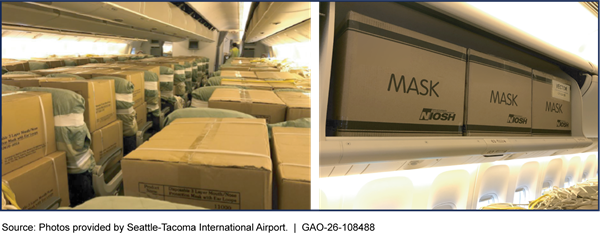
Boxes of Personal Protective Equipment Transported in the Passenger Cabin of an Aircraft During the COVID-19 Pandemic
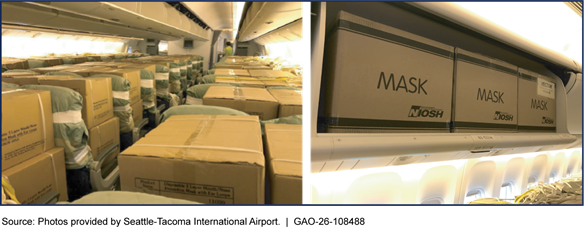
Stakeholders GAO interviewed shared perspectives on methods to expedite the transportation of PPE used during the COVID-19 pandemic, and many said that an increased federal role was unnecessary or could have had negative consequences. For example, two stakeholders cited the use of “peel piles” to designate areas at ports for containers from specific shippers as a method used to expedite goods during the pandemic, including PPE. Many stakeholders said they did not think more federal involvement was needed in expediting the transportation of PPE during the pandemic, or that increased federal involvement could have had negative consequences. For example, stakeholders said that federal involvement in prioritizing a container on a ship could have caused delays at ports. Furthermore, several of these stakeholders stated that the private sector and industry partners were better suited to take the lead in expediting the transportation of goods through the supply chain.
Why GAO Did This Study
During the COVID-19 pandemic, significant challenges, including global demand and supply chain issues, made it difficult to quickly access PPE. Delays in the transportation of PPE may have contributed to the spread of COVID-19, which killed nearly 1.2 million people in the U.S. as of June 1, 2024.
Public Law 118-159 includes a provision for GAO to review the expedited transportation of PPE during the COVID-19 pandemic. This report describes, among other things, (1) how DOT and other relevant federal agencies expedited the transportation of PPE during the pandemic, including using selected legal authorities to do so; and (2) selected industry stakeholder perspectives on methods used to expedite the transportation of PPE during the COVID-19 pandemic, including their views on whether an increased federal role was needed.
GAO reviewed documentation and interviewed officials from five federal agencies that played a role in expediting the transportation of PPE: DOT, FEMA, Health and Human Services (HHS), the Department of Defense, and the Federal Maritime Commission. GAO also reviewed relevant statutes, regulations, and executive orders and analyzed available data from FEMA and HHS that described the amount and type of PPE that these agencies transported during the COVID-19 pandemic.
GAO interviewed a nongeneralizable sample of 21 stakeholders representing three groups relevant to the transportation of PPE: transportation industries, health care distributors, and port authorities. GAO selected these stakeholders based on factors including geographic diversity, involvement in federal efforts to expedite the transportation of PPE, or market share of their respective industry.
|
Abbreviations |
|
|
|
|
|
DOD |
Department of Defense |
|
DOT |
Department of Transportation |
|
DPA |
Defense Production Act of 1950, as amended |
|
FAA |
Federal Aviation Administration |
|
FEMA |
Federal Emergency Management Agency |
|
FMCSA |
Federal Motor Carrier Safety Administration |
|
FRA |
Federal Railroad Administration |
|
HHS |
Department of Health and Human Services |
|
MARAD |
Maritime Administration |
|
PPE |
personal protective equipment |
This is a work of the U.S. government and is not subject to copyright protection in the United States. The published product may be reproduced and distributed in its entirety without further permission from GAO. However, because this work may contain copyrighted images or other material, permission from the copyright holder may be necessary if you wish to reproduce this material separately.
September 14, 2026
The Honorable Ted Cruz
Chairman
The Honorable Maria Cantwell
Ranking Member
Committee on Commerce, Science, and Transportation
United States Senate
The Honorable Sam Graves
Chairman
The Honorable Rick Larsen
Ranking Member
Committee on Transportation and Infrastructure
House of Representatives
During the COVID-19 pandemic, a range of challenges—including global demand, supply chain issues, and limited domestic production—made it difficult to quickly access personal protective equipment (PPE).[1] PPE—such as face shields, masks, respirators, gowns, and gloves—helps minimize exposure to hazards, including illnesses. Even when PPE could be manufactured and purchased, delays in shipping often prevented medical professionals and others from receiving it quickly. These transportation delays may have contributed to the spread of COVID-19, which killed nearly 1.2 million people in the U.S. as of June 1, 2024, according to the Centers for Disease Control and Prevention.
During the pandemic, federal agencies, including the Department of Transportation (DOT) and the Federal Emergency Management Agency (FEMA), as well as the transportation industry, took actions to help expedite the transportation of PPE. For the purposes of this report, we define “expediting” the transportation of a good as reducing the amount of time the good spends in transit using various methods, such as prioritizing the transportation of that good over other goods.
The Servicemember Quality of Life Improvement and National Defense Authorization Act for Fiscal Year 2025 includes a provision for GAO to review the roles that DOT and other relevant federal agencies played in expediting the transportation of PPE and how relevant stakeholders interacted during the COVID-19 pandemic to transport PPE, among other things.[2] In this report, we describe
1. how DOT and other relevant federal agencies expedited the transportation of PPE during the COVID-19 pandemic, including using selected legal authorities to do so; and
2. selected industry stakeholder perspectives on methods used to expedite the transportation of PPE during the COVID-19 pandemic, including their views on whether an increased federal role was needed.
To describe how DOT and other relevant federal agencies expedited the transportation of PPE during the COVID-19 pandemic, we selected five federal agencies that played a role in doing so: DOT, FEMA, the Department of Defense (DOD), the Federal Maritime Commission, and the Department of Health and Human Services (HHS).[3] We also selected seven relevant offices and operating administrations within DOT: the Federal Aviation Administration (FAA); the Federal Motor Carrier Safety Administration (FMCSA); the Federal Highway Administration; the Maritime Administration (MARAD); the Federal Railroad Administration (FRA); the Office of the Assistant Secretary for Aviation and International Affairs; and the Office of Intelligence, Security, and Emergency Response.[4] We reviewed relevant statutes, regulations, executive orders, and agency documentation. We also interviewed officials from these selected agencies, offices, and operating administrations regarding their roles and responsibilities related to transporting PPE; their legal authorities that could be used to help expedite the transportation of PPE; and whether they used those legal authorities during the pandemic.
In addition, we analyzed available data from FEMA and HHS that described the amount and type of PPE that these federal agencies transported during the COVID-19 pandemic. Because there is no single source of data describing the total amount of PPE that federal agencies transported, we obtained these data to provide examples of selected federal agencies’ efforts. To assess the reliability of these data, we interviewed agency officials about their data collection and quality control practices. We determined that these data were sufficiently reliable for our purpose of describing the amount of PPE that selected federal agencies transported during the pandemic.
We also analyzed U.S. Census Bureau trade statistics from January 2018 through December 2024 to describe the amount and type of PPE imported during the COVID-19 pandemic. We chose this period to examine how imports changed after the pandemic compared with what they were before, for context. To assess the reliability of these data, we reviewed relevant documentation and conducted electronic data testing. We determined that these data were sufficiently reliable for our purposes of describing the amount of PPE imported during the pandemic. See appendix I for more information on how we analyzed these data.
To describe industry stakeholder perspectives on methods used to expedite the transportation of PPE during the COVID-19 pandemic, including their views on whether an increased federal role was needed, we interviewed a nongeneralizable sample of 21 stakeholders.[5] These selected stakeholders represented three groups relevant to the transportation of PPE: transportation industries, health care distributors, and port authorities.[6] We interviewed representatives from these groups about a range of topics, such as their role in transporting and expediting PPE during the COVID-19 pandemic, how they coordinated with different stakeholders and federal agencies to do so, and challenges they experienced. We used a range of criteria to select industry stakeholders to interview, such as geographic diversity, involvement in federal efforts to expedite PPE, or market share of their respective industry. In addition, in September 2025, we conducted site visits to Seattle and Los Angeles to meet with selected port authorities and terminal operators.
We conducted this performance audit from May 2025 through September 2026 in accordance with generally accepted government auditing standards. Those standards require that we plan and perform the audit to obtain sufficient, appropriate evidence to provide a reasonable basis for our findings and conclusions based on our audit objectives. We believe that the evidence obtained provides a reasonable basis for our findings and conclusions based on our audit objectives.
Background
PPE Imports During the COVID-19 Pandemic
According to U.S. Census Bureau trade statistics, the U.S. imported approximately $108 billion in PPE from January 2018 through December 2024; of this, $65 billion was imported during the pandemic (January 2020 through December 2022) (see fig. 1).[7] Nearly 40 percent of PPE imported into the U.S. during the pandemic—approximately $25 billion in PPE—was imported through West Coast ports.[8] Approximately $19 billion, or about 30 percent, of PPE imported during the COVID-19 pandemic was imported through the Los Angeles district (including the ports of Los Angeles and Long Beach).[9]
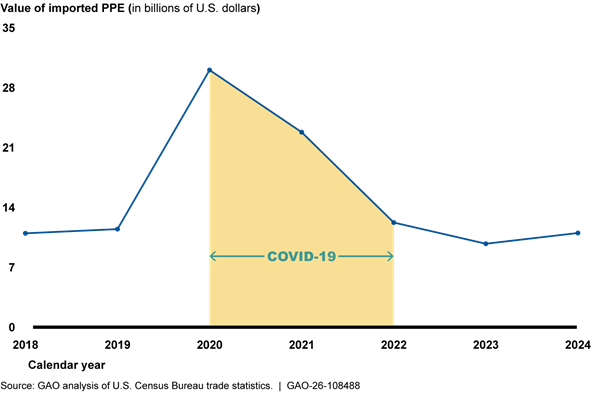
Note: We have adjusted all import values for inflation, using monthly import price indices from the Bureau of Labor Statistics to identify the average inflation adjustment for 2024, which we used as the base for the yearly adjustments.
Of the approximately $65 billion in PPE imported during the pandemic, over $20 billion was for masks, and $27 billion was for gloves (see table 1).
Table 1: Dollar Value of Personal Protective Equipment (PPE) Imported During the COVID-19 Pandemic, 2020 – 2022
|
PPE type |
Total value (in millions of dollars)a |
|
Aprons |
$98 |
|
Gloves |
27,635 |
|
Gowns |
3,819 |
|
Hair nets |
63 |
|
Headgear |
904 |
|
Masks |
20,696 |
|
Protective garments |
7,637 |
|
Protective goggles |
2,990 |
|
Shoe covers |
1,293 |
|
Total |
$65,135 |
Source: GAO analysis of U.S. Census Bureau trade statistics. | GAO‑26‑108488
aWe adjusted all import values for inflation, using monthly import price indices from the Bureau of Labor Statistics to identify the average inflation adjustment for 2024, which we used as the base for the yearly adjustments.
Challenges at Ports During the COVID-19 Pandemic
We and others identified various factors that contributed to congestion at ports during the COVID-19 pandemic.[10] After the onset of the COVID-19 pandemic in March 2020, the number of U.S. import shipments overall declined briefly, before rebounding from July 2020 through December 2021 and exceeding prepandemic levels.[11] This increase in cargo volume, together with other factors—including limited storage space, reduced capacity due to labor shortages, and limited technology and equipment—contributed to congestion at ports. The Congressional Research Service reported in 2021 that dozens of ships were at anchor waiting to dock at ports in locations such as Los Angeles and Long Beach. Figure 2 shows examples of challenges at ports related to transporting goods during the pandemic. These challenges at ports resulted in delays for all goods, including PPE, during the pandemic. The Health Industries Distributors Association estimated that medical supplies, including PPE, were delayed an average of 37 days throughout the transportation system.[12] This included an average 17-day delay at ports, 11-day delay by rail, and 9-day delay by motor carrier.
Figure 2: Examples of Challenges at Ports Related to Transporting Goods During the COVID-19 Pandemic
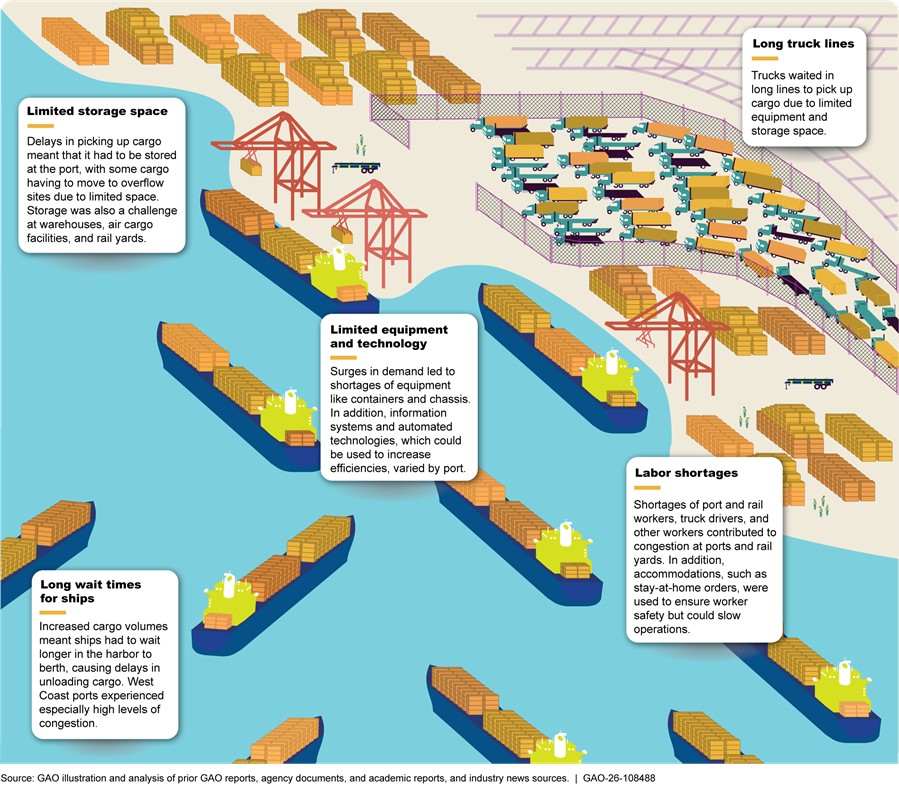
Labor shortages. The U.S. International Trade Commission reported that port, rail, and motor carrier industries faced labor shortages, which caused delays in transporting goods.[13] Specifically, according to Customs and Border Patrol, the Port of Los Angeles had a backlog of containers in May and June 2020 because warehouse operators had reduced their staff when cargo drastically declined at the beginning of the COVID-19 pandemic. This reduction led to a lack of available staff when cargo volumes increased after a few months.
Limited equipment and technology. The fluctuations in demand during the COVID-19 pandemic also highlighted limitations in technology and equipment. For example, when demand rebounded, some ports experienced shortages of chassis and storage containers. In addition, information systems and automated technology, which could be used to increase efficiencies, varied by port. We previously reported that U.S. ports have adopted automated technology to varying degrees. Port stakeholders have said that these technologies’ effects on the workforce and security, as well as their performance, have been mixed.[14] For example, a port authority representative told us that port automation would not have prevented many of the supply chain delays and disruptions that arose during the COVID-19 pandemic.
Federal Supply Chain Roles and the COVID-19 Pandemic Response
We and others have previously reported on the roles of FEMA, HHS, and DOT in assisting the supply chain during the COVID-19 pandemic, including their efforts to assist in the transportation of PPE.
· FEMA. FEMA was responsible for reviewing resource requests and making priorities and allocation decisions for health and medical resources needed to respond to the spread of COVID-19 within the U.S.[15] In addition, FEMA was responsible for coordinating the distribution of those resources across the federal government, private sector, and other strategic partners in the civilian market. This included distribution to state, local, tribal, and territorial governments, as well as to private entities, such as hospitals.
· HHS. HHS led the federal public health and medical response during the COVID-19 pandemic, including transporting PPE from the Strategic National Stockpile to areas of need. The Strategic National Stockpile is a multibillion-dollar inventory of drugs, vaccines, and supplies that can be provided to states, localities, territories, and Tribes during emergencies. HHS transported approximately $278 million PPE from the Strategic National Stockpile during COVID-19, including approximately $206 million worth of masks. We previously reported on HHS’s efforts to distribute PPE from the Strategic National Stockpile during COVID-19.[16] HHS also could make priorities and allocation decisions for health and medical resources needed to respond to the spread of COVID-19 within the U.S.[17]
· DOT. DOT regulates and oversees various modes of cargo transportation—including trucking, rail, and air. Within DOT, FAA oversees the safety and efficiency of the national airspace system and distributes federal financial assistance to airports for airport infrastructure.[18] DOT does not generally have a role in port ownership and operations. DOT supports ports by providing guidance, participating in training exercises, and providing funding for infrastructure projects.[19]
In September and November 2020, we reported on the actions that HHS and FEMA had taken—with support from DOD—to mitigate supply shortages and expand the medical supply chain, chiefly through the Supply Chain Task Force.[20] The Supply Chain Task Force, later renamed the Supply Chain Advisory Group, was the primary federal body coordinating and managing supply chain responsibilities. We refer to both in this report as the Supply Chain Advisory Group. Charged with maximizing the nationwide availability of supplies and equipment, the Supply Chain Advisory Group focused on accelerating the delivery of supplies, including PPE.[21]
FEMA and DOT Expedited the Transportation of PPE Primarily by Air, with Support from Other Federal Agencies
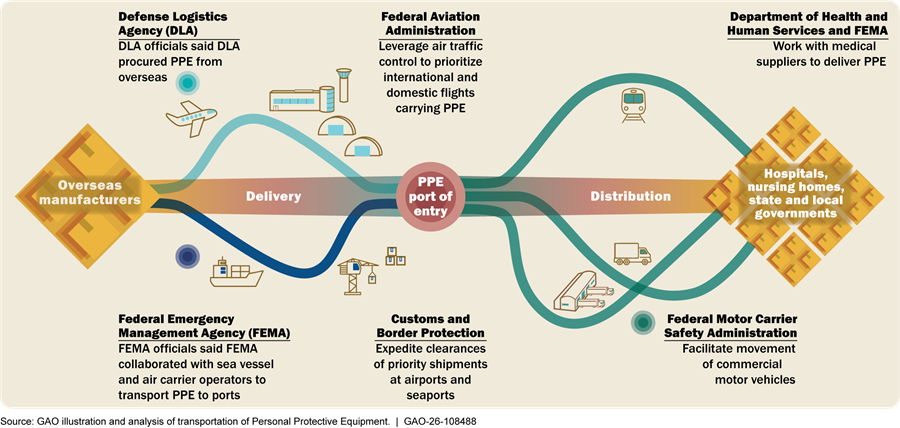
In response to the COVID-19 pandemic, FEMA initiated Project Airbridge in March 2020 to expedite the transportation of PPE and other medical supplies by air from overseas manufacturers. FEMA also worked with HHS and DOD to help ensure that PPE was distributed to locations where it was most needed. In addition, DOT used selected legal authorities during the COVID-19 pandemic to expedite the transportation of PPE by air and provide regulatory relief that could have helped expedite the transportation of PPE by rail or highway. (See fig. 3.) Finally, some federal agencies shared information and coordinated with other federal agencies and transportation industry stakeholders to mitigate supply chain issues during the pandemic.
Figure 3: Selected Federal Roles in Transporting Personal Protective Equipment (PPE) Through the Supply Chain During the COVID-19 Pandemic
FEMA Imported PPE by Air, and Other Federal Agencies Identified Needs and Provided Support
From March through June 2020, FEMA conducted Project Airbridge to reduce the time it took to receive supplies, including PPE, from overseas manufacturers. FEMA initiated Project Airbridge to serve as a temporary solution to shortages in the domestic supply of PPE.[22] Under Project Airbridge, FEMA paid for the commercial air transportation of supplies from an overseas port to a port in the U.S. According to FEMA, it arranged for air transportation to the US, and the medical distributors received the PPE at the airport for delivery to the medical distributors’ warehouses. Medical supply distributors agreed to distribute at least 50 percent of the transported PPE to customers at a reasonable price to areas FEMA and HHS prioritized.
FEMA officials said Project Airbridge reduced shipment times from an estimated 40 days to 7 days by using air freight instead of sea shipments. According to data that FEMA provided, FEMA funded 437 flights from March through June 2020 as part of Project Airbridge. In addition, FEMA worked with six medical supply distributors to transport and distribute approximately 1.2 billion PPE items, primarily gloves, masks, and gowns (see table 2).
Table 2: Personal Protective Equipment (PPE) Items Imported by FEMA Project Airbridge, March–June 2020
|
PPE type |
Total PPE items transported |
|
Gloves |
945,128,493 |
|
Masks |
126,190,250 |
|
Gowns |
66,633,405 |
|
PPE apparel |
6,753,055 |
|
N95 masks |
5,146,420 |
|
Face shields |
2,751,824 |
|
Coveralls |
1,473,960 |
|
KN95 masksa |
1,200,000 |
|
Aprons |
45,000 |
|
Respirators |
8,000 |
|
Total |
1,155,330,407 |
Source: GAO analysis of Federal Emergency Management Agency (FEMA) Project Airbridge data. | GAO‑26‑108488
aN95 masks are approved by the National Institute for Occupational Safety and Health to filter at least 95 percent of airborne particles. See 42 C.F.R. § 84.170. KN95 masks are not approved by the National Institute for Occupational Safety and Health to meet the same standard. However, for part of the COVID-19 pandemic, the Food and Drug Administration authorized certain KN95 masks for health care use, provided certain conditions were met, under an emergency use authorization.
Several federal agencies provided support to FEMA’s Project Airbridge. For example, FAA prioritized flights, and the Office of the Assistant Secretary for Aviation and International Affairs expedited economic licensing processes for certain air carriers, as described below.[23] In addition, Customs and Border Protection expedited the customs clearance process for Project Airbridge flights and formed the COVID-19 Cargo Resolution Team to mitigate challenges related to importing PPE and other pandemic-related products. The team worked with FEMA daily to alert ports that shipments of critical medical supplies were arriving and helped expedite the arrival and clearance of 418 of the 437 Project Airbridge flights.[24] FEMA officials also said that the Department of State played a key role in facilitating the movement of PPE through China and resolving customs issues with the Chinese government.
In addition to leading Project Airbridge, FEMA worked with HHS and the Defense Logistics Agency on the Supply Chain Advisory Group to assess demand for PPE, identify sources of PPE overseas, and procure and transport medical supplies and PPE for Project Airbridge and the Strategic National Stockpile.
· Assessing demand for PPE. HHS officials said HHS and FEMA created the Supply Chain Control Tower to identify COVID-19 outbreaks and monitor data on the market demand for PPE in each state, to determine where PPE could be distributed to address shortages. Specifically, HHS officials said they used the Supply Chain Control Tower to, among other things, monitor weekly survey data from medical facilities, including from over 2,000 hospitals, on the number of days’ worth of PPE they had left. HHS used these data to coordinate the transportation of PPE from medical distributors to areas with shortages. To do this, HHS worked with its 11 existing motor carriers, integrated express carriers, and air cargo partners to transport PPE from the Strategic National Stockpile to medical facilities with PPE shortages.
· Identifying sources of PPE. FEMA officials said FEMA and HHS worked to identify available PPE from overseas sources. They began this effort to resupply the Strategic National Stockpile but shifted to identifying sources of PPE for the overall U.S. market. Once the Supply Chain Advisory Group assessed PPE demand in states, FEMA and HHS collaborated to identify manufacturing companies overseas that had available PPE. FEMA officials said the agency then coordinated with the State Department to verify that the manufacturer was a legitimate company and with the Food and Drug Administration to verify the quality of the PPE.
· Procuring and transporting PPE. The Defense Logistics Agency worked with FEMA and HHS to procure and arrange transportation for the PPE from overseas manufacturers once they had identified a source. Defense Logistics Agency officials said the agency supported 43 FEMA agreements to acquire PPE and antigen tests for states, and 23 HHS agreements to procure medical goods, including PPE, for the Strategic National Stockpile, nursing homes, and test sites.[25] Defense Logistics Agency officials said these shipments were delivered to government warehouses owned by FEMA and HHS. According to officials, FEMA and HHS then worked with medical suppliers to organize the delivery of PPE to hospitals or other areas, as needed.[26] According to FEMA, two maritime carriers were used to ship PPE from Asia to the West Coast along a 10-day direct sailing route. FEMA used these carriers because they consistently had available space on their direct sailing vessels, which allowed FEMA to avoid port delays.
DOT Used Selected Legal Authorities to Help Expedite the Transportation of PPE, Primarily by Air
DOT used selected legal authorities during the COVID-19 pandemic to expedite the transportation of PPE by air and to provide regulatory relief that could have helped expedite the transportation of PPE. Through our review of statutes, regulations, and executive orders, and our interviews with DOT offices and operating administrations, we and DOT identified eight selected DOT legal authorities that could help expedite the transportation of PPE (see table 3).
Table 3: Selected DOT Legal Authorities That Could Help Expedite the Transportation of Personal Protective Equipment (PPE)
|
DOT office or operating administration |
Legal authority |
Description of legal authority |
Used during COVID-19 pandemic |
|
Federal Aviation Administration (FAA) |
49 U.S.C. § 40103 |
FAA may modify or revoke its assignments of the use of the navigable airspace when required in the public interest.a |
Yes |
|
Regulatory relief |
FAA may grant exemptions from certain FAA safety regulations, if it finds that the exemption is in the public interest.b |
Yes |
|
|
Office of the Assistant Secretary for Aviation and International Affairs |
Emergency interstate air transportation by foreign air carriers |
DOT may temporarily exempt foreign air carriers from certain statutory requirements and limitations to allow them to carry cargo in interstate air transportation in certain markets, to the extent it decides an exemption is in the public interest and if it makes certain findingsc The Office of the Assistant Secretary for Aviation and International Affairs may exercise this authority.d |
Yes |
|
Expedited economic licensing for foreign air carriers, upon request |
DOT may issue permits to foreign air carriers authorizing them to transport cargo between a place in the U.S. and a place outside the U.S. by aircraft and for compensation, if it makes certain findings.e The Office of the Assistant Secretary for Aviation and International Affairs may exercise this authority.f Foreign air carriers can request expedited proceedings for this economic licensing.g |
Yes |
|
|
Federal Motor Carrier Safety Administration (FMCSA) |
Regulatory relief |
FMCSA may grant temporary waivers of compliance with, and exemptions from, its safety regulations under certain circumstances.h |
Yes |
|
Federal Railroad Administration (FRA) |
Regulatory relief |
FRA may issue temporary emergency waivers of compliance with any part of its railroad safety regulations, if it makes certain determinations, which include that the waiver is not inconsistent with railroad safety and is necessary to address an actual, or impending, emergency situation or emergency event.i |
Yes |
|
Office of Intelligence, Security, and Emergency Response |
Defense Production Act of 1950 (DPA), Title Ij |
The President has delegated DPA, Title I authorities to DOT with respect to all forms of civil transportation.k These delegated authorities, in part, permit DOT to require the acceptance and priority performance of certain contracts or orders over others to promote the national defense.l The Office of Intelligence, Security, and Emergency Response may exercise DOT’s delegated, DPA, Title I authorities and oversees the implementation of the Transportation Priorities and Allocation System, which are DOT regulations that provide guidance and procedures for the use of such authorities.m |
No |
|
Maritime Administration (MARAD) |
DPA, Title VIIn |
The President has delegated DPA, Title VII authorities to DOT with respect to all forms of civil transportation.o These authorities, in part, permit DOT to consult with representatives of business, industry, and other interests to develop and establish voluntary agreements to help provide for the national defense.p MARAD, in consultation with the Office of Intelligence, Security and Emergency Response, may exercise DOT’s delegated DPA Title VII, authorities as they relate to the use of maritime industry-related facilities and services, such as port facilities and sealift support, and maritime-related voluntary agreements.q |
No |
Source: GAO analysis of statutes, regulations, executive orders, and Department of Transportation (DOT) information. | GAO‑26‑108488
aFAA is required to assign the use of the navigable airspace by regulation or order necessary to ensure the safety of aircraft and the efficient use of airspace. 49 U.S.C. § 40103
bSee 49 U.S.C. § 44701(f).
cFor example, DOT must find that because of an emergency created by unusual circumstances not arising in the normal course of business, air carriers holding certain certificates cannot accommodate traffic in those markets. See 49 U.S.C. § 40109(g).
dSee 49 C.F.R. § 1.25a(b)(6)(i).
eForeign air carriers that do not hold these permits are prohibited from providing such transportation. See 49 U.S.C. §§ 40102, 41301‑41302.
f49 C.F.R. § 1.25a(b)(6)(ii)(B).
gSee 14 C.F.R. § 302.11(e).
hSee 49 U.S.C. §§ 31133(a)(10), 31136(e); 49 C.F.R. § 1.87(f).
iSee 49 U.S.C. § 20103(g); 49 C.F.R. § 1.89(a). FRA emergency waivers must be requested. See 49 C.F.R. § 211.45.
jSee Pub. L. No. 81‑774, 64 Stat. 798 (1950) (codified as amended at 50 U.S.C. § 4501 et seq.). Title I of the DPA is codified as amended at 50 U.S.C. § 4511.
kSee Exec. Order No. 13603, National Defense Resources Preparedness, § 201, 77 Fed. Reg. 16651, 16652 (Mar. 16, 2012).
lSee 50 U.S.C. § 4511(a); Exec. Order No. 13603 § 201. However, DOT may only exercise its delegated DPA Title I authorities to support approved programs. See Exec. Order No. 13603 § 202; 49 C.F.R. §§ 33.2, 33.20. An “approved program” is a program that the Secretary of Defense, Secretary of Energy, or Secretary of Homeland Security has determined to be necessary or appropriate to promote the national defense, in accordance with Section 202 of Executive Order 13603. 49 C.F.R. § 33.20. The DPA defines “national defense” to include emergency preparedness activities conducted under Title VI of the Robert T. Stafford Disaster Relief and Emergency Assistance Act (Stafford Act). 50 U.S.C. § 4552(14); Stafford Act, Title VI (codified as amended at 42 U.S.C. § 5195 et seq.).
mSee 49 C.F.R. § 1.45(q); 49 C.F.R. pt. 33 (Transportation Priorities and Allocation System).
nSee DPA § 708 (codified as amended at 50 U.S.C. § 4558).
oSee Exec. Order No. 13603 § 401.
pSee 50 U.S.C. § 4558; 44 C.F.R. § 332.1. However, DOT may only exercise its DPA Title VII authorities after certain conditions are met. For example, DOT must find that conditions exist that may pose a direct threat to the national defense or its preparedness programs and obtain the required findings and approvals from certain other executive agencies, such as the Federal Emergency Management Agency. See 50 U.S.C. § 4558(c); 44 C.F.R. § 332.2.
qSee 49 C.F.R. § 1.93(l).
Expediting Air Operations and Economic Licensing Processes
FAA and the Office of the Assistant Secretary for Aviation and International Affairs officials used two of the legal authorities described in table 3 to prioritize flights carrying PPE and to expedite the economic licensing process for foreign air carriers transporting PPE.
· Prioritizing flights carrying PPE. FAA officials said FAA used its legal authority to prioritize takeoffs and landings for domestic and international cargo flights carrying PPE.[27] Specifically, FAA officials said they coordinated with air traffic control towers, command centers, and industry stakeholders to identify flights with PPE and to prioritize those flights for departure or arrival. FAA began to use this authority at the start of the COVID-19 pandemic to support FEMA’s effort to import PPE through Project Airbridge and continued to use it after Project Airbridge ended. In total, FAA prioritized 4,417 flights carrying PPE from April 2020 through September 2020.[28]
· Expediting economic licensing. Officials from the Office of the Assistant Secretary for Aviation and International Affairs said the office used its legal authority to expedite the economic licensing process, upon request, for foreign air cargo carriers transporting PPE for FEMA’s Project Airbridge.[29] Specifically, officials said they worked with FEMA daily during the pandemic to help FEMA identify flights carrying emergency supplies for Project Airbridge. The office informed air cargo carriers and integrated express carriers of the steps needed to receive an economic license to transport goods to the U.S. and helped them expedite the licensing process. According to officials, the office granted licenses for 2,200 flights transporting PPE primarily from China to the U.S. from March 2020 through March 2022.
Providing Regulatory Relief
Some DOT operating administrations used their legal authorities during the COVID-19 pandemic to provide relief from their respective regulations via exemptions or waivers. DOT officials said that DOT’s operating administrations issued these exemptions or waivers to keep the supply chain moving for all types of goods, not specifically for PPE.
· Passenger-to-freight exemptions. FAA issued exemptions from certain FAA regulations during the COVID-19 pandemic to allow certain passenger air carriers to transport cargo in the passenger cabins of aircraft.[30] FAA issued these exemptions to ensure continued air transportation, as passenger travel declined during the pandemic. One association representing the aviation industry said some air carriers used the passenger-to-freight exemption to expedite the transportation of PPE during the pandemic. As shown in figure 4, some airlines used this exemption to transport cargo, such as PPE, in the aircraft’s passenger cabin. The exemption described actions air carriers must take to address safety concerns of using the exemption to transport cargo in passenger cabins. For example, FAA provided specific requirements for restraining cargo on passenger seats and limitations on cargo weight and loading.
Figure 4: Boxes of Personal Protective Equipment Transported in the Passenger Cabin of an Aircraft During the COVID-19 Pandemic
· Hours-of-service exemptions. FMCSA issued an exemption, in part, from its hours-of-service regulations for drivers actively transporting supplies necessary for community safety and the prevention of community transmission of COVID-19, including PPE.[31] FMCSA’s hours-of-service regulations generally provide that the maximum driving time for commercial motor vehicle operators transporting property is 11 hours within a 14-hour period.[32] This exemption allowed, but did not require, drivers to exceed this maximum.[33] FMCSA officials said that motor carriers may have used this exemption during the pandemic and, if so, that this could have helped expedite the transportation of PPE. In August 2021, FMCSA issued an extension and amendment of this exemption, which provided that motor carriers were to begin reporting their use of the exemption each month through FMCSA’s portal.[34] FMCSA officials said that motor carriers were not required to report to FMCSA on their use of the exemption and that they did not receive any reports from motor carriers. Representatives of one motor carrier told us that they were aware this exemption was available but did not experience a driver shortage that would require them to use this exemption. The motor carrier representative also stated that a consideration in using these exemptions is that extending drivers’ hours could lead to a potential safety risk for drivers and pedestrians.
· Inspections and testing waivers. FRA issued emergency waivers of compliance with certain FRA regulations upon request, in part, to address workforce shortages that were preventing railroads from complying with such regulations.[35] For example, some rail associations requested FRA to permit freight railroads to move locomotives between facilities even if they had not inspected and tested the locomotives within the periods specified in FRA regulations, and FRA granted them a waiver of those regulations. FRA officials said freight cars may have had reduced inspections, which could have helped expedite the transportation of PPE. While available, the waivers were not widely used because most rail companies were able to keep their operations moving without using the waivers, representatives from a rail association said.
Using Defense Production Act Authorities
The President has delegated DPA, Title I authorities to DOT with respect to all forms of civil transportation.[36] These delegated authorities, in part, permit DOT to require the acceptance and priority performance of certain contracts or orders over others to promote the national defense.[37] These authorities could help expedite the transportation of PPE during a national emergency.[38]
According to DOT, it did not use its DPA, Title I authorities during the COVID-19 pandemic.[39] To do so, DOT officials said DOT must receive a request from an agency with relevant jurisdiction, such as FEMA or HHS, and that it did not receive such a request during the pandemic. FEMA and HHS officials said they did not have any transportation concerns that required DOT intervention during that period.[40]
DOT’s Office of Intelligence, Security, and Emergency Response collaborated regularly with other agencies to determine whether using DOT’s delegated DPA Title I authorities was necessary to help expedite PPE during the COVID-19 pandemic.[41] Officials said the office has an established process to receive and process requests for other agencies to use DOT’s delegated DPA, Title I authorities.[42] During the pandemic, this process included weekly interagency meetings with DPA Program Managers from agencies such as HHS, FEMA, and DOD to discuss the execution of priority ratings and identify needs for agencies to provide DPA support. FEMA and HHS officials told us they were aware of DOT’s request process but that they used other methods to increase the supply of PPE, such as through Project Airbridge, as described above. DOT officials said the agency has continued to participate in a monthly DPA interagency working group to coordinate with other agencies on potential DPA requests.
The President has delegated DPA, Title VII authorities to DOT with respect to all forms of civil transportation, which, in part, permit DOT to consult with representatives of industry, business, and other interests to establish voluntary agreements to help provide for the national defense.[43] MARAD, in consultation with the Office of Intelligence, Security, and Emergency Response, may exercise DOT’s delegated DPA, Title VII authorities.[44] DOT officials said that DOT did not use its delegated DPA, Title VII authorities to enter into new voluntary agreements during the COVID-19 pandemic because neither FEMA or HHS requested it to do so. MARAD has two existing voluntary agreements with the maritime industry that were established before the pandemic: the Voluntary Tanker Agreement and the Voluntary Intermodal Sealift Agreement. DOT officials said MARAD did not use these agreements to help expedite PPE during the pandemic because their scopes and purposes would not have been useful to the transportation of PPE. For example, the Voluntary Intermodal Sealift Agreement provides DOD with access to commercial sealift services and systems, including intermodal equipment, when DOD deploys military forces during a national emergency or wartime operation, or when DOD determines it is necessary for national security or contingency operations, which did not occur during the pandemic.[45]
DOT and Other Federal Agencies Shared Information and Coordinated with the Transportation Industry to Mitigate Supply Chain Issues
DOT’s offices and operating administrations shared information and coordinated with other federal agencies and transportation industry stakeholders to mitigate supply chain issues during the COVID-19 pandemic. In addition, other federal agencies, such as the U.S. Transportation Command and the Federal Maritime Commission, coordinated with transportation industry stakeholders to keep goods moving through the supply chain. These efforts may have helped expedite the transportation of PPE.
According to DOT officials, DOT operating administrations also participated in discussions with transportation industry stakeholders to share information about the COVID-19 pandemic and distribute PPE to their respective industries.
· Motor carrier industry. FMCSA officials said the agency held daily calls with the motor carrier industry to discuss the industry’s immediate needs and transportation challenges, including those related to the usage of PPE. FMCSA officials said they also helped address the industry’s PPE needs by representing motor carriers on the Supply Chain Advisory Group and requesting that FEMA distribute cloth face masks to motor carrier companies. In addition, FMCSA officials said the agency also issued press releases to inform the motor carrier industry of exemptions from certain motor carrier regulations.
· Maritime industry. MARAD officials said the agency hosted biweekly calls with maritime stakeholders, including port authorities, longshoremen’s unions, and U.S. flag vessel operators, to provide COVID-19 updates and learn about challenges the maritime industry was encountering. According to MARAD officials, MARAD also received and processed around 2.4 million cloth face masks from FEMA and distributed them to around 500 maritime industry stakeholders.
· Rail industry. FRA officials said they participated in regular calls with rail associations to discuss the pandemic’s impact on railroad employees and operations, including the daily number of employees testing positive for COVID-19, staffing issues, and supply chain challenges. As part of these calls, FRA officials said they received reports from railroads on their use of emergency relief provisions and distributed cloth face masks to rail workers.
DOT’s Office of Intelligence, Security, and Emergency Response responded to requests for information from other agencies, primarily through the Supply Chain Advisory Group. Specifically, officials from this office said that one of their roles during the COVID-19 pandemic was to coordinate requests for information between the Supply Chain Advisory Group and DOT operating administrations on issues related to transportation.
According to officials, this information-sharing role sometimes involved the transportation of PPE. For example, Office of Intelligence, Security, and Emergency Response officials said they facilitated communications between the Supply Chain Advisory Group and the Office of the Assistant Secretary for Aviation and International Affairs when the advisory group had questions about air freight applications.
Other federal agencies also shared information and coordinated with transportation industry stakeholders to transport PPE outside of Project Airbridge and Supply Chain Advisory Group efforts.
· U.S. Transportation Command. U.S. Transportation Command officials said they held calls with sea vessel operators once every other week. Officials said they worked with sea vessel operators to use these calls to share information on challenges affecting the maritime supply chain, such as port congestion caused by lines of ships waiting to offload cargo at ports. U.S. Transportation Command officials said that while U.S. flag vessels typically receive priority berthing access at ports, U.S. flag vessels had to compete with other sea vessel carriers for berthing access due to high volumes of ships during the COVID-19 pandemic. One sea vessel operator that transported PPE said the calls helped U.S. flag vessels get to ports and offload cargo faster.
· Federal Maritime Commission. Federal Maritime Commission officials said the agency’s role was focused on advocacy and coordination during the COVID-19 pandemic.[46] For example, Federal Maritime Commission commissioners sent a letter to MARAD recommending that MARAD prioritize providing critical medical supplies, including PPE, to the U.S. maritime workforce. Representatives from one health care distributor industry association said the Federal Maritime Commission also communicated with industry stakeholders during the pandemic and worked with medical distributors to help them expedite PPE shipments at ports, as described below.
Stakeholders Identified Methods Used to Expedite the Transportation of PPE; Many Said an Increased Federal Role Was Not Needed
Stakeholders Generally Did Not Know Which Shipments Contained PPE, but Some Identified Methods to Expedite Goods
Several of the 21 stakeholders we interviewed, specifically those that transport goods, said that a key challenge in expediting the transportation of PPE is the difficulty in identifying which shipments contain PPE.[47] These stakeholders said they have limited information about, or may not know, the contents of their cargo, which may be due to how the cargo is labeled or classified. For instance, one stakeholder said that they generally do not have specific information about the contents of their containers, unless the goods are hazardous.
Some stakeholders, including representatives of port operators and a sea vessel operator, said that having more information about the contents of shipments could help identify which shipments contain PPE and may need to be expedited. Stakeholders suggested options for providing that information, such as tracking databases, customs designations, and commodity- or class-based freight ratings.[48]
Despite the challenge of having limited information about the contents of containers, the stakeholders we interviewed identified some methods to expedite goods, including PPE. For example, stakeholders cited three methods used during the COVID-19 pandemic.[49]
· Priority berthing. All four of the sea vessel operators we spoke with said that having priority berthing at a port helped them to more quickly transport goods during the pandemic. These stakeholders were able to receive priority berthing for different reasons, including having agreements with port operators and unions, having their own port terminal, or carrying specific types of goods (such as U.S. government or sustenance goods).
· Peel piles. Peel piles are designated areas at ports for containers from a specific shipper. Two stakeholders, representing a port operator and health care distributors, said they used peel piles specifically to expedite the transportation of PPE during the pandemic. Some stakeholders told us that peel piles are an effective way of moving cargo efficiently because they allow drivers to easily access a specific collection of containers. For example, a representative of a port terminal operator said that peel piles help port terminals avoid situations in which drivers need to dig out certain cargo from a big pile. However, stakeholders said peel piles are generally used for a large number of containers and that PPE shipments typically are not big enough to warrant a peel pile. One port operator stated that they made an exception during the pandemic and created peel piles for PPE because the product was needed.
· “Skip the line” pass. Two stakeholders representing health care distributors said that systems were available at ports for truck drivers to pick up medical supplies through a “skip the line” pass to expedite PPE during the pandemic. For example, one stakeholder said they worked with ports to develop a system for truck drivers carrying medical supplies to skip to the front of the truck queue. This method would ensure that truck drivers picking up needed medical supplies, including PPE, did not have to wait in the same line as other drivers that were picking up less critical items, such as furniture. However, the two motor carriers we interviewed were either not aware of, or did not use, this system to expedite the transportation of PPE.
Some representatives of ports and port terminal operators suggested that changing the ways that cargo is loaded and stowed on ships and unloaded at ports could be used as another method to expedite the transportation of goods, including PPE. For example, stakeholders said that containers could be placed strategically on a ship for quicker removal and that using technology or designated chassis could help unload priority containers faster. However, some representatives of sea vessel operators said that changing the methods of loading, stowing, and unloading ships would not be an effective way to prioritize shipments based on their operations. For instance, ships are loaded based on weight requirements and origin and destination points, making it challenging to reorganize containers. Additionally, moving containers around more than necessary increases the risk of damaging their contents.
Many Stakeholders Said an Increased Federal Role in Expediting the Transportation of PPE During the Pandemic Was Not Needed
Many stakeholders said they generally did not think that more federal involvement was needed in expediting the transportation of PPE during the COVID-19 pandemic, or that increased federal involvement in expediting goods could have negative consequences. Specifically, several of these stakeholders stated that the private sector and industry partners were better suited to take the lead in expediting the transportation of goods through the supply chain. For example, one stakeholder that transports goods said their networks were already set up to efficiently move goods through the supply chain and could be designed to optimize service, cost, and the time it takes to deliver a shipment. Moreover, representatives of a port operator and sea vessel operator said that, if the federal government had taken steps to prioritize a certain ship or container on a ship, it could have resulted in more delays at ports due to the extra time needed to reorganize containers.
Stakeholders in the transportation industry did not identify any effects that expediting the transportation of PPE during the COVID-19 pandemic had on the transportation of other goods. However, some stakeholders had mixed views on the effect of increasing the federal role in expediting the transportation of PPE on the transportation of other goods. Two stakeholders representing port terminal operators said it would be possible to effectively expedite one good without affecting the delivery of other goods. For example, one stakeholder said that having sufficient communication and planning across the supply chain could mitigate any potential effects of prioritizing a specific good to expedite. On the other hand, two other stakeholders thought that an increased federal role in expediting the transportation of PPE could delay other goods or have unintended consequences on critical shipments. For example, a representative of a sea vessel operator that transports sustenance goods to Hawaii and Alaska expressed concerns about deprioritizing these goods to accommodate PPE shipments.
Several stakeholders provided examples of ways that the federal government could have provided additional support to industry in expediting the transportation of PPE during the COVID-19 pandemic.[50] Specifically, stakeholders suggested that the federal government could have increased the amount of communication, guidance, and data it provided to help industry partners leverage transportation networks and identify which shipments contained PPE and needed to be expedited. Some stakeholders found that federal information-sharing efforts during the pandemic were helpful, such as the Supply Chain Control Tower’s data on identifying priority areas for PPE distribution.
DOT has taken steps to provide more support to industry and increase the resilience of the national supply chain since the COVID-19 pandemic. In 2021, as required by the Infrastructure Investments and Jobs Act, DOT established the Multimodal Freight Office, to administer and oversee certain DOT multimodal freight grant programs.[51] It develops and manages the National Freight Strategic Plan, and facilitates information sharing on freight issues between the public and private sector. One such information-sharing effort is the Freight Logistics Optimization Works, a public-private partnership that facilitates information sharing between government and industry. According to DOT, this effort can help industry stakeholders anticipate changes in the supply chain and take proactive steps to mitigate delays and has helped DOT establish routine communication with maritime freight stakeholders.[52] One stakeholder that transports goods said that receiving real-time and forward-looking data as a part of this effort has been helpful and is useful during a supply chain bottleneck.[53] Additionally, DOT’s 2026 National Freight Strategic Plan details DOT’s efforts to pursue national freight policy goals, including making the national freight system more resilient to disruptions.[54] The plan establishes a coordinated national framework for strengthening the safety, efficiency, resilience, security, innovation, and workforce of the U.S. freight system.
Agency Comments
We provided a draft of this report to DOT, DOD, the Department of Homeland Security, the Federal Maritime Commission, and HHS for review and comment. DOT, DOD, the Department of Homeland Security, and HHS provided technical comments, which we incorporated, as appropriate. The Federal Maritime Commission did not have any comments on this report.
We are sending copies of this report to the appropriate congressional committees, the Secretary of Transportation, the Secretary of Defense, the Secretary of Homeland Security, the Chairman of the Federal Maritime Commission, and the Secretary of Health and Human Services. In addition, the report is available at no charge on the GAO website at https://www.gao.gov.
If you or your staff have any questions about this report, please contact me at RepkoE@gao.gov. Contact points for our Offices of Congressional Relations and Media Relations may be found on the last page of this report. GAO staff who make key contributions to this report are listed in appendix II.

Elizabeth (Biza) Repko
Director, Physical Infrastructure
To describe the amount and type of personal protective equipment (PPE) imported during the COVID-19 pandemic, we analyzed U.S. Census Bureau trade statistics trade data from January 2018 through December 2024. We chose this period to examine how imports changed after the COVID-19 pandemic compared with what they were before, for context. For the purposes of this analysis, we identified the pandemic as taking place from January 2020 through December 2022.[55]
U.S. Census Bureau trade statistics, a widely used source analyzing U.S. international trade, do not contain precise data on imports of products related to COVID-19. As a result, we identified Harmonized Tariff Schedule codes related to PPE at the 10-digit category.[56] Specifically, to identify Harmonized Tariff Schedule codes related to PPE, we relied on the U.S. International Trade Commission’s April and June 2020 list of Harmonized Tariff Schedule codes of medical supplies relevant to COVID-19, which includes codes specific to PPE.[57] Because the U.S. International Trade Commission revises Harmonized Tariff Schedule codes regularly, we tracked changes to these categories using documentation it published.[58] Some of these categories represent more than one product, and some categories contain products that are not directly relevant to COVID-19 responses. Therefore, the values presented may overestimate the imports of products directly relevant to COVID-19 responses. Nevertheless, the values are useful indicators for tracking import trends of such products. While the U.S. Census Bureau tracks the quantity of items imported, we excluded quantity data from our review because quantity data were not required for some products prior to 2019.
We express import values in U.S. dollars to characterize trends in imports and to establish trends in a single unit of measure. Since the unit of measure for quantity (e.g., kilogram or dozens of units) may differ across products, using quantity to portray trends in import volume could be misleading, since it would be unclear whether changes were driven by changes in the composition of products being imported, which might have different units of measurement or weight, or actual changes in quantity. We adjusted all import values for inflation, using monthly import price indices from the Bureau of Labor Statistics to identify the average inflation adjustment for 2024, which we used as the base for the yearly adjustments.
To assess the reliability of these data, we reviewed relevant documentation, received responses to questions from knowledgeable U.S. International Trade Commission officials, and conducted electronic data testing. We determined that the data were sufficiently reliable for our purposes of describing the amount of PPE imported during the COVID-19 pandemic.
Elizabeth (Biza) Repko, RepkoE@gao.gov
In addition to the contact named above, Maria Mercado (Assistant Director), Mikey Erb (Analyst in Charge), Lilia Chaidez, Melanie Diemel, Sarah Farkas, Chloe Kay, Robert Letzler, Camilla Ma, Mary-Catherine P. Overcash, Paras Sharma, Alison Snyder, Laurel Voloder, Alicia Wilson, and Elizabeth Wood made key contributions to this report.
The Government Accountability Office, the audit, evaluation, and investigative arm of Congress, exists to support Congress in meeting its constitutional responsibilities and to help improve the performance and accountability of the federal government for the American people. GAO examines the use of public funds; evaluates federal programs and policies; and provides analyses, recommendations, and other assistance to help Congress make informed oversight, policy, and funding decisions. GAO’s commitment to good government is reflected in its core values of accountability, integrity, and reliability.
Obtaining Copies of GAO Reports and Testimony
The fastest and easiest way to obtain copies of GAO documents at no cost is through our website. Each weekday afternoon, GAO posts on its website newly released reports, testimony, and correspondence. You can also subscribe to GAO’s email updates to receive notification of newly posted products.
Order by Phone
The price of each GAO publication reflects GAO’s actual cost of production and distribution and depends on the number of pages in the publication and whether the publication is printed in color or black and white. Pricing and ordering information is posted on GAO’s website, https://www.gao.gov/ordering.htm.
Place orders by calling (202) 512-6000, toll free (866) 801-7077,
or
TDD (202) 512-2537.
Orders may be paid for using American Express, Discover Card, MasterCard, Visa, check, or money order. Call for additional information.
Connect with GAO
Connect with GAO on X,
LinkedIn, Instagram, and YouTube.
Subscribe to our Email Updates. Listen to our Podcasts.
Visit GAO on the web at https://www.gao.gov.
To Report Fraud, Waste, and Abuse in Federal Programs
Contact FraudNet:
Website: https://www.gao.gov/about/what-gao-does/fraudnet
Automated answering system: (800) 424-5454
Media Relations
Sarah Kaczmarek, Managing Director, Media@gao.gov
Congressional Relations
David A. Powner, Acting Managing Director, CongRel@gao.gov
General Inquiries
[1]For the purposes of this report, we date the pandemic’s onset to March 11, 2020, when the World Health Organization declared the COVID-19 outbreak to be a global pandemic. The public health emergency declared by the Secretary of Health and Human Services for COVID-19 ended on May 11, 2023.
[2]See Pub. L. No. 118-159, § 3522, 138 Stat. 1773, 2311 (2024).
[3]Through our review of GAO, Congressional Research Service, and Office of Inspector General reports and discussions with federal agencies and industry stakeholders, we identified these agencies as having a role in administrative or logistical efforts to expedite the transportation of PPE during COVID-19.
[4]We identified these operating administrations and Secretarial offices as relevant to our review based on discussions with DOT and our review of DOT documentation. We refer to DOT Secretarial offices as DOT offices in this report.
[5]For reporting purposes, we used the following indefinite quantifiers to describe collective responses from our interviewees: “some” is three to five, “several” is six to 10, and “many” is 11 or more.
[6]To represent transportation industries, we selected 1) two motor carriers, 2) three terminal operators, 3) one air cargo handler, 4) two rail carriers, 5) four sea vessel operators, and 6) one integrated express carrier. Integrated express carriers operate air and ground transportation and provide “door-to-door” service (e.g., FedEx and UPS). In addition, we selected three port authorities, two health care distributors, and three industry associations—one representing rail carriers, one representing health care distributors, and one representing air cargo carriers.
[7]U.S. Census Bureau trade statistics—a widely used source analyzing U.S. international trade—do not contain precise data on import values of products related to COVID-19. As a result, we estimated the import value of all product types and categories within those types, using the Harmonized Tariff Schedule of the U.S. statistical reporting numbers and associated product groupings listed by the U.S. International Trade Commission. See U.S. International Trade Commission, COVID-19 Related Goods: U.S. Imports and Tariffs (Updated), Investigation No. 332-576, USITC Publication 5073 (Washington, D.C.: June 2020). We adjusted all import values for inflation, using monthly import price indices from the Bureau of Labor Statistics to identify the average inflation adjustment for 2024, which we used as the base for the yearly adjustments.
[8]We identified ports and airports in Oregon, Washington, and California as West Coast ports. These cover five customs district codes: 25, 27, 28, 29, and 30. For context, there are 47 district codes.
[9]The Los Angeles district contains 14 ports and airports: the port of Los Angeles, the port of Long Beach, Ventura, Port Hueneme, Capitan, Morrow Bay, Los Angeles International Airport, Ontario International Airport, Las Vegas airport, TNT Express, IBC Pacific, Meadows Field Airport, DHL-HUB, and UPS-Ontario.
[10]For example, the U.S. International Trade Commission reported that air freight experienced supply chain challenges during COVID-19, in addition to ports. Air cargo experienced a decrease in capacity to transport freight in the cargo holds of passenger aircraft due to cancelled flights. This decreased capacity, coupled with increased demand, resulted in a steep increase in air freight rates. International Trade Commission, The Impact of the COVID-19 Pandemic on Feight Transportation Services and U.S. Merchandise Imports.
[11]GAO, COVID-19: CBP Acted to Mitigate Challenges Affecting Its Trade Operations, GAO‑22‑105034 (Washington D.C.: Sept. 19, 2022).
[12]To develop this estimate, representatives from the Health Industry Distributors Association surveyed a total of 14 health care distributors on the amount of time that medical supplies were delayed, on average, during the fourth quarter of 2021.
[13]U.S. International Trade Commission, The Impact of the COVID-19 Pandemic on Feight Transportation Services.
[14]GAO, Port Infrastructure: U.S. Ports Have Adopted Some Automation Technologies and Report Varied Effects, GAO‑24‑106498 (Washington, D.C.: Mar. 19, 2024).
[15]See Exec. Order No. 13911, Delegating Additional Authority Under the Defense Production Act With Respect to Health and Medical Resources To Respond to the Spread of COVID-19, § 4, 85 Fed. Reg. 18403, 18404‑18405 (Mar. 27, 2020); 44 C.F.R. Part 333. Health and medical resources needed to respond to the spread of COVID-19 within the U.S. included PPE. Exec. Order No. 13909, Prioritizing and Allocating Health and Medical Resources to Respond to the Spread of COVID-19, § 1, 85 Fed. Reg. 16227, 16227 (Mar. 18, 2020); Exec. Order No. 13911 § 1. In April 2020, the President issued a memo directing FEMA, in consultation with HHS, to allocate certain PPE for domestic use. See Memorandum on Allocating Certain Scarce or Threatened Health and Medical Resources to Domestic Use (Apr. 3, 2020).
[16]GAO, COVID-19: Sustained Federal Action Is Crucial as Pandemic Enters Its Second Year, GAO‑21‑387 (Washington, D.C.: Mar. 31, 2021); COVID-19: Continued Attention Needed to Enhance Federal Preparedness, Response, Service Delivery, and Program Integrity, GAO‑21‑551 (Washington, D.C.: July 19, 2021); and Public Health Preparedness: HHS Should Address Strategic National Stockpile Requirements and Inventory Risks, GAO‑23‑106210 (Washington, D.C.: Oct. 17, 2022); Also, GAO, COVID-19: Federal Efforts Could Be Strengthened by Timely and Concerted Actions, GAO‑20‑701 (Washington D.C.: Sept. 21, 2020); and COVID-19: Urgent Actions Needed to Better Ensure an Effective Federal Response, GAO‑21‑191 (Washington D.C.: Nov. 30, 2020).
[17]See Exec. Order No. 13909 § 2.
[18]GAO, Air Cargo: DOT Should Communicate Data Limitations and Identify Stakeholder Challenges, GAO‑25‑107334 (Washington, D.C.: July 23, 2025).
[19]GAO, U.S. Port Infrastructure: DOT and DHS Offer Funding and Other Assistance Ports Can Use to Improve Disaster Resilience, GAO‑25‑107159 (Washington, D.C.: Mar. 20, 2025).
[20]GAO‑20‑701 and GAO‑21‑191.
[21]The Supply Chain Advisory Group focused on four key supply activities: helping preserve existing supplies, accelerating the delivery of supplies, expanding the production of supplies, and gathering data to help allocate scarce supplies. The Supply Chain Advisory Group transitioned its responsibilities to HHS in late January 2021.
[22]Although Project Airbridge reduced shipment times to transport PPE into the U.S., a Department of Homeland Security Office of the Inspector General report found that FEMA did not sufficiently assess whether medical supply distributors needed Project Airbridge to stabilize their supply chains. In addition, FEMA did not ensure that distributors delivered PPE to health care facilities, as agreed. Department of Homeland Security, Office of Inspector General, FEMA Did Not Provide Sufficient Oversight of Project Airbridge, OIG-23-14 (Washington, D.C.: February 2023).
[23]The Office of the Assistant Secretary for Aviation and International Affairs may issue permits to foreign air carriers authorizing them to transport cargo between a place in the U.S. and a place outside the U.S. by aircraft and for compensation, if it makes certain findings. Foreign air carriers that do not hold these economic licenses are prohibited from providing such transportation. See 49 U.S.C. §§ 40102, 41301-41302; 49 C.F.R. § 1.25a(b)(6)(ii)(B) (delegating these authorities to the Office of the Assistant Secretary for Aviation and International Affairs).
[25]DOD officials said that these agreements resulted in over $360.3 million worth of PPE to support FEMA and $3.2 billion worth of PPE to support HHS.
[26]DOD’s U.S. Transportation Command supported HHS with six requests for assistance during COVID-19. Four requests were for the U.S. Transportation Command to transport needles and syringes from overseas to the U.S.; one was to airlift personnel between two points in the U.S., and one was to move personnel and COVID-19 test kits from overseas into the U.S. However, none of these efforts involved the transportation of PPE.
[27]FAA is required to assign the use of the navigable airspace by regulation or order necessary to ensure the safety of aircraft and the efficient use of airspace and may modify or revoke its assignments when required in the public interest. See 49 U.S.C. § 40103.
[28]According to data from DOT’s Bureau of Transportation Statistics, U.S. airlines operated around 1.7 million domestic flights from April through September 2020.
[29]The Office of the Assistant Secretary for Aviation and International Affairs may issue permits to foreign air carriers authorizing them to transport cargo between a place in the U.S. and a place outside the U.S. by aircraft and for compensation, if it makes certain findings. Foreign air carriers that do not hold these permits are prohibited from providing such transportation. See 49 U.S.C. §§ 40102, 41301‑41302; 49 C.F.R. § 1.25a(b)(6)(ii)(B) (delegating these authorities to the Office of the Assistant Secretary for Aviation and International Affairs). Foreign air carriers can request expedited proceedings for this economic licensing. See 14 C.F.R. § 302.11(e).
[30]See e.g., Federal Aviation Administration, Exemption No. 18584, Partial Grant of Exemption, Regulatory Docket No. FAA-2020-0492 (July 10, 2020). FAA may grant exemptions from certain FAA safety regulations if it finds that the exemption is in the public interest. See 49 U.S.C. § 44701(f).
[31]See Federal Motor Carrier Safety Administration, Emergency Declaration No. 2020-002 Under 49 CFR § 390.23 (Mar. 13, 2020). FMCSA may grant temporary waivers of compliance with, and exemptions from, its safety regulations under certain circumstances. See 49 U.S.C. §§ 31133(a)(10), 31136(e); 49 C.F.R. § 1.87(f).
[32]See 49 C.F.R. § 395.3.
[33]In addition, FMCSA’s extension of its exemption clarified that drivers are not exempt from its regulations prohibiting them from operating commercial motor vehicles when they are, for example, fatigued, in such a way that impairs, or is likely to impair, their ability or alertness so as to make it unsafe for them to drive. The extension also stated that motor carriers may not require or permit fatigued drivers to operate these vehicles, and drivers who inform motor carriers that they need immediate rest must be given at least 10 consecutive hours of rest before driving again. See Federal Motor Carrier Safety Administration, Extension and Expansion of Emergency Declaration No. 2020-002 Under 49 CFR § 390.25 (Apr. 8, 2020).
[34]See Federal Motor Carrier Safety Administration, Extension and Amendment of Emergency Declaration No. 2020-002 Under 49 CFR § 390.25 (Aug. 31, 2021).
[35]See Federal Railroad Administration, Re: Request for Relief in FRA Emergency Docket FRA-2020-0002 related to Coronavirus Disease 2019 (COVID-19) (Mar. 25, 2020). FRA may issue temporary emergency waivers of compliance with any part of its railroad safety regulations, if it makes certain determinations, which include that the waiver is not inconsistent with railroad safety and is necessary to address an actual or impending emergency situation or emergency event. See 49 U.S.C. § 20103(g); 49 C.F.R. § 1.89(a).
[36]See Pub. L. No. 81‑774, 64 Stat. 798 (1950) (codified as amended at 50 U.S.C. § 4501 et seq.); Exec. Order No. 13603, National Defense Resources Preparedness, § 201, 77 Fed. Reg. 16651, 16652 (Mar. 16, 2012). Title I of the DPA is codified as amended at 50 U.S.C. § 4511.
[37]See 50 U.S.C. § 4511(a); Exec. Order No. 13603 § 201. However, DOT may only exercise its delegated DPA, Title I authorities to support approved programs. See Exec. Order No. 13603 § 202; 49 C.F.R. §§ 33.2, 33.20. An “approved program” is a program that the Secretary of Defense, Secretary of Energy, or Secretary of Homeland Security has determined to be necessary or appropriate to promote the national defense, in accordance with Section 202 of Executive Order 13603. 49 C.F.R. § 33.20. The DPA defines “national defense” to include emergency preparedness activities conducted under Title VI of the Robert T. Stafford Disaster Relief and Emergency Assistance Act (Stafford Act). 50 U.S.C. § 4552(14); Stafford Act, title VI (codified as amended at 42 U.S.C. § 5195 et seq.)
[38]We previously reported that DOD used other DPA authorities to increase domestic manufacturing capacity of medical supplies during COVID-19. GAO‑20-701.
[39]In our prior review, we found that DOT had not placed a priority rating on contracts or orders during fiscal years 2018 through 2024. See GAO, Defense Production Act: Information Sharing Needed to Improve Use of Authorities, GAO‑25‑107688 (Washington D.C.: June 12, 2025).
[40]Both agencies used their delegated DPA Title I authorities to issue one allocation order in April 2020 to control the distribution of certain scarce or threatened health and medical resources, including PPE, within the commercial market during the pandemic. They issued this allocation order to ensure that companies were not hoarding or exporting these resources outside of the U.S., and the order was unrelated to DOT’s delegated authority to issue a priority rating. Allocation orders control the distribution of materials, services, or facilities in the U.S. commercial market deemed necessary to support national defense. GAO‑25‑107688.
[41]The Office of Intelligence, Security, and Emergency Response may exercise DOT’s delegated DPA, Title I authorities and oversees the implementation of the Transportation Priorities and Allocation System, which are DOT regulations that provide guidance and procedures for the use of such authorities. See 49 C.F.R. § 1.45(q); 49 C.F.R. pt. 33 (Transportation Priorities and Allocation System).
[42]The Office of Intelligence, Security, and Emergency Response receives Form OST F 1254, which other agencies and entities can submit to the Office of Intelligence, Security, and Emergency Response to request special priorities assistance from DOT. See 49 C.F.R. § 33.40.
[43]See DPA § 708 (codified as amended at 50 U.S.C. § 4558); Exec. Order No. 13603 § 401.
[44]See 49 C.F.R. § 1.93(l). However, MARAD may only exercise these delegated authorities as they relate to the use of maritime industry-related facilities and services, such as port facilities and sealift support, and maritime-related voluntary agreements, and only if certain conditions are met. For example, MARAD must find that conditions exist that may pose a direct threat to the national defense or its preparedness programs and obtain the required findings and approvals from certain other executive agencies, such as FEMA. See 50 U.S.C. § 4558(c); 44 C.F.R. § 332.2; 49 C.F.R. § 1.93(l).
[45]MARAD’s other voluntary agreement, the Voluntary Tanker Agreement, was designed to provide DOD with the commercial tanker capacity to transport petroleum and petroleum products necessary to meet national defense contingency requirements.
[46]The Federal Maritime Commission is an independent federal agency responsible for the economic regulation of the commercial transportation of cargo by water between the U.S. and foreign countries. See 46 U.S.C. § 46101(a); 46 C.F.R. § 501.2. It does not have specific authorities that would allow it to expedite the transportation of PPE at ports.
[47]Many stakeholders also cited challenges they experienced transporting all types of goods, including PPE, during the pandemic. These challenges were similar to those described above and included port congestion, port infrastructure and equipment limitations, labor shortages, and maintaining worker safety.
[48]We and other federal agencies have reported on challenges related to supply chain visibility and tracking the shipments of medical supplies during the COVID-19 pandemic, as well as on how limited information about commodities coming through ports can impact port congestion. Following a period of port congestion at West Coast ports in 2014 and 2015, we reported on the need for additional information on supply chains and commodity flows to address freight bottlenecks. We recommended that DOT identify and collect freight information and develop high-quality, reliable supply chain information, which DOT addressed in its 2020 National Freight Strategic Plan. According to DOT officials, by improving freight data on supply chains, DOT can better identify problems, aid in prioritizing and planning infrastructure investments, and support national freight policy goals. GAO, West Coast Ports: Better Supply Chain Information Could Improve DOT’s Freight Efforts, GAO‑17‑23 (Washington, D.C.: Oct. 31, 2016). A Congressional Research Service report on PPE production during the COVID-19 pandemic suggested that Congress could consider authorizing federal agencies to collect more data on supply chain information and the status of U.S. production and distribution. Congressional Research Service, COVID-19 and Domestic PPE Production and Distribution: Issues and Policy Options, R46628 (Washington, D.C.: December 2020). A Department of Homeland Security Office of the Inspector General report found that FEMA, under pressure to expedite critical medical supplies, did not follow established business practices for tracking shipments, which limited its visibility into the resources shipped and received. Department of Homeland Security Office of Inspector General, FEMA Did Not Effectively Manage the Distribution of COVID-19 Medical Supplies and Equipment, OIG-23-34 (Washington, D.C.: July 2023).
[49]Representatives of rail carriers said that rail carriers have limited ability to expedite goods, such as PPE, because rail carriers are on fixed networks with fixed speeds. In addition to the methods described below, one health care distributor adapted its distribution process to ensure that PPE reached its destination sooner. This stakeholder said the company saved weeks by working with third-party logistics companies to deliver PPE to the destinations immediately surrounding ports, instead of shipping these products to their regional hubs before sending them out for distribution.
[50]Stakeholders also suggested other ways the federal government could support industry in expediting goods generally, such as increasing information sharing, providing port infrastructure investments, supporting the availability of truck drivers, and improving coordination and leadership across federal agencies.
[51]See Pub. L. No 117-58, § 21101, 135 Stat. 429, 652-657 (2021) (codified at 49 U.S.C. § 118).
[52]In 2025, we recommended that DOT fully assess the reliability of the air cargo data it collects and communicate the limitations of these data. We also recommended that DOT evaluate existing sources of information and routinely communicate with air cargo stakeholders to identify challenges to the efficient movement of air cargo. DOT identified steps it plans to take to address these recommendations. GAO‑25‑107334.
[53]In June 2026, DOT announced DOT’s American Supply Chain Sovereignty Initiative in which DOT plans to develop a high-visibility dashboard linking major logistics hubs, including the Port of Los Angeles, with ocean carriers, trucking companies, rail operators, and retailers. This initiative aims to increase operational efficiency and enhance security across supply chains. According to DOT, if certain proposed legislation is enacted, DOT and the Department of Homeland Security will be able accelerate the movement of cargo being imported by participants in a certain Customs and Border Protection’s program through this initiative.
[54]U.S. Department of Transportation, 2026 National Freight Strategic Plan (Washington, D.C.: May 2026).
[55]For the purposes of this report, we date the pandemic’s onset to March 11, 2020, when the World Health Organization declared the COVID-19 outbreak to be a global pandemic. The public health emergency declared by the Secretary of Health and Human Services for COVID-19 ended on May 11, 2023. Because we report yearly values of imports, we decided to include all of 2020, as most months of that year were included in the pandemic, and to exclude 2023, as most months of that year were not included in the pandemic.
[56]The Harmonized Tariff Schedule comprises a hierarchical structure for describing all goods in trade for duty, quota, and statistical purposes. This structure is based upon the international Harmonized Commodity Description and Coding System, administered by the World Customs Organization in Brussels; the 4- and 6-digit product categories are subdivided into 8-digit unique U.S. rate lines and 10-digit nonlegal statistical reporting categories. According to the U.S. International Trade Commission, classification of goods in this system must be done in accordance with the General and Additional U.S. Rules of Interpretation, starting at the 4-digit heading level to find the most specific provision and then moving to the subordinate categories.
[57]See U.S. International Trade Commission, COVID-19 Related Goods: U.S. Imports and Tariffs, Investigation No. 332-576, USITC Publication 5047 (Washington, D.C.: April 2020); and COVID-19 Related Goods: U.S. Imports and Tariffs, (Updated) Investigation No. 332-576, USITC Publication 5073 (Washington, D.C.: June 2020).
[58]The Committee for the Statistical Annotation of Tariff Schedules, more commonly known as the “484(f) Committee,” is an interagency committee made up of representatives from the U.S. International Trade Commission, Customs and Border Protection, and the U.S. Census Bureau. The 484(f) Committee adds, removes, or modifies the nonlegal 10-digit statistical reporting numbers in the Harmonized Tariff Schedule and Schedule B. The 484(f) forms have been published twice annually since 2019.