
Report to the
Ranking Member Subcommittee on Health
Committee on Veterans’ Affairs
House of Representatives
United States Government Accountability Office
A report to the Ranking Member, Subcommittee on Health, Committee on Veterans’ Affairs, House of Representatives
For more information, contact: Alyssa M. Hundrup at hundrupa@gao.gov
What GAO Found
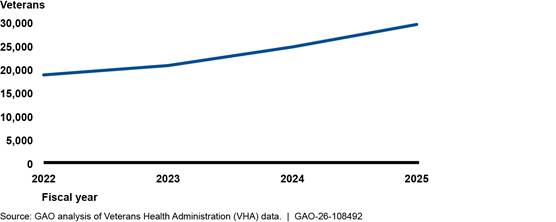
Within the Department of Veterans Affairs (VA), the Veterans Health Administration (VHA) is responsible for providing enrolled veterans access to reproductive health care, including fertility care. From fiscal years 2022 through 2025, VHA data show that approximately 8 million veterans used some type of VHA health care. Around 30,000 veterans had an infertility diagnosis in fiscal year 2025, an increase from the approximately 19,000 veterans with an infertility diagnosis in fiscal year 2022. VHA officials said there may be several reasons for the increase, such as expansions VHA made to eligibility for fertility care in 2024.
VHA’s Office of Women’s Health communicates about available fertility care through various methods, such as a fertility webpage and brochures. GAO found some interested veterans may be unaware of VHA’s fertility care. For example, stakeholders said male veterans may not seek out or may find it difficult to seek out eligibility information because it comes from Office of Women’s Health. GAO determined that VHA has not implemented key performance practices related to its communication. By implementing such practices, VHA could better assess progress towards its communication goals and increase the effectiveness of its outreach to veterans about fertility care. This would allow VHA to identify and make any needed adjustments to better ensure its efforts reach veterans who may need fertility care.
VHA changed its process for determining veterans’ eligibility for fertility care in October 2024. Under the change, VA medical center fertility teams are responsible for making these decisions instead of VHA at the national level. However, GAO identified challenges with the process after October 2024. For example, GAO found fertility team composition and skill level varied at selected facilities. VHA officials from these facilities said that it can be challenging to determine veterans’ eligibility, which can affect the care they receive. GAO also found that teams at two facilities did not consistently provide written notifications of eligibility decisions to veterans as required. Federal standards for internal control state that agencies are to identify, analyze, and respond to change as part of their risk assessment efforts. Assessing the changes it made to its eligibility determination process would allow VHA to determine whether the process is working as intended or whether adjustments are needed, in turn, ensuring it is best serving veterans.
Why GAO Did This Study
Infertility—the inability to conceive or sustain a pregnancy—can affect both men and women. Research suggests veterans may experience infertility for a variety of reasons including injuries in combat, environmental exposures, or trauma sustained during military service, which impacts treatment options. To be eligible to receive certain fertility care, such as in vitro fertilization, a veteran’s infertility must be causally related to a service-connected disability—an injury or illness incurred or aggravated during military service—or to the treatment of one.
GAO was asked to review issues related to infertility among veterans. This report, among other objectives, describes (1) available data on infertility among veterans for fiscal years 2022 through 2025; examines (2) VHA’s efforts to provide information to veterans and providers about available fertility care; and (3) VHA’s eligibility determination process for fertility care.
GAO reviewed VHA documentation and data for fiscal years 2022 through 2025; interviewed VHA officials, staff involved with fertility care at four VA medical centers, and four veterans integrated service networks (selected based on presence of fertility staff, geography, and facility complexity); and interviewed eight veterans, six veterans service organizations, and two national organizations (selected based on focus on infertility and national reach).
What GAO Recommends
GAO recommends that VHA (1) implement key performance management practices to increase the effectiveness of its communications on fertility care; and (2) determine whether the fertility eligibility determination process is working as intended, making adjustments as needed. VA concurred with GAO’s recommendations.
This is a work of the U.S. government and is not subject to copyright protection in the United States. The published product may be reproduced and distributed in its entirety without further permission from GAO. However, because this work may contain copyrighted images or other material, permission from the copyright holder may be necessary if you wish to reproduce this material separately.
|
Abbreviations |
|
|
|
|
|
VA |
Department of Veterans Affairs |
|
VHA |
Veterans Health Administration |
|
VISN |
Veterans Integrated Service Network |
September 29, 2026
The Honorable Julia Brownley
Ranking Member
Subcommittee on Health
Committee on Veterans’ Affairs
House of Representatives
Dear Ranking Member Brownley:
Infertility—the inability to conceive or sustain a pregnancy—affects both men and women and rates of infertility in the United States have increased in recent years.[1] This includes veterans who may experience infertility associated with their military service. For instance, genital and spinal cord injuries incurred during military service or environmental exposures from military service may be associated with infertility. As a result, veterans may experience difficulty conceiving children.
Within the Department of Veterans Affairs (VA), the Veterans Health Administration (VHA) is responsible for providing veterans with timely access to high-quality reproductive health care, including fertility care.[2] Veterans who decide to seek fertility care through VA can receive fertility care at one of the VA medical centers VHA operates or from non-VHA providers in the community through the Veterans Community Care Program.[3] However, veterans mostly receive fertility care in the community. Although veterans may receive an initial evaluation and treatment of infertility at a VA medical center, other more complex fertility care services such as in vitro fertilization are not available at VA medical centers.[4] From fiscal year 2022 through 2025, VHA estimates that it paid about $41.5 million for veterans to receive fertility care in the community.[5]
Any VHA user who may be experiencing infertility can receive general fertility care, which includes fertility evaluation and certain treatments, but excludes treatment related to assisted reproductive technology.[6] Veterans can also receive assisted reproductive technology services, such as in vitro fertilization, if their infertility is causally related to one of their service-connected disabilities incurred or aggravated during their military service or to the treatment of one of their service-connected disabilities.[7] VHA requires each of its 139 VA medical centers to have a fertility team that generally includes interdisciplinary representatives from gynecology, urology, and community care, among others. These teams are to determine veterans’ eligibility for service-connected fertility care and coordinate veterans’ fertility care, which includes providing referrals to providers in the community and tracking the services veterans are receiving, among other things.
VHA’s fertility care policies and eligibility determination process have changed over time, and VHA has expanded its eligibility criteria in recent years. Specifically, prior to October 2024, VHA officials from its national Office of Women’s Health and Office of Integrated Veteran Care made eligibility determinations for receiving service-connected fertility care.[8] However, VHA required VA medical centers to establish fertility teams in January 2024, and in October 2024, VHA shifted the responsibility for making eligibility determinations to the newly formed local VA medical center fertility teams. In addition, in April 2024, VHA amended its policy to remove marital status as a consideration for determining eligibility for service-connected fertility care and to allow the use of donor sperm, eggs, and embryos as long as the donor sperm, eggs, and embryos are provided at no cost to VHA.[9]
You asked us to review issues related to infertility among veterans and the fertility care available at VHA. In this report, we
1. describe what available data indicates about infertility among veterans for fiscal years 2022 through 2025;
2. describe factors that may contribute to infertility among veterans;
3. examine VHA’s efforts to provide information to veterans and providers on the fertility care available at VHA;
4. describe the guidance VHA provides VA medical center fertility teams; and
5. examine VHA’s process for determining veterans’ eligibility for fertility care.
To describe what available data indicate about infertility among veterans, we obtained and reviewed data from VHA on veteran infertility diagnosis and treatment for fiscal years 2022 through 2025 (the most recent data at the time of our review). These included data on the number and characteristics of veterans with a diagnosis of infertility and those who had received fertility care. To assess the reliability of these data, we interviewed relevant VHA officials, reviewed related documentation, and examined the data for obvious errors. Based on these steps, we determined the data were sufficiently reliable for the purposes of our reporting objective.
To describe factors that may contribute to infertility among veterans, we conducted a literature search and reviewed relevant research published from January 2015 through June 2025. Through our review, we identified 13 research articles that were relevant and methodologically sound.
To examine VHA’s efforts to provide information to veterans and providers on the fertility care available at VHA, we reviewed the types of information VHA provides to veterans and providers and how it disseminates the information. We examined whether these efforts are consistent with strategies in VHA’s Office of Women’s Health 2024 Strategic Plan.[10] We also evaluated the extent to which VHA’s efforts to provide information on fertility care are consistent with key performance management practices we have identified in prior work.[11]
To describe the guidance VHA provides to VA medical center fertility teams, we reviewed available VHA documentation to identify the guidance it provides to VA medical centers. We also interviewed VHA officials and medical center staff, as described below.
To examine VHA’s process for determining veterans’ eligibility for fertility care, we reviewed VHA documentation on the eligibility determination process. We also interviewed VHA officials, VA medical center staff, and veterans as described below. We assessed VHA’s process against standards for internal control in the federal government for risk assessment, which state that agencies should identify, analyze, and respond to changes.[12] We also evaluated the extent to which VHA’s efforts to evaluate its eligibility determination process are consistent with key evidence building activities we have identified in our prior work.[13] Finally, we examined whether VHA’s efforts are consistent with a goal in VHA’s Office of Women’s Health 2024 Strategic Plan.[14]
Additionally, to answer all five objectives, we reviewed relevant VHA documentation on fertility care, including information on the fertility care VHA offers and the eligibility criteria for that care. In addition, we interviewed VHA officials from the national Office of Women’s Health and Office of Integrated Veteran Care, who are responsible for providing oversight and guidance to VA medical centers for fertility care. We also interviewed fertility team members and other staff involved with fertility care, such as community care staff, at a nongeneralizable selection of four VA medical centers in the following locations: Fayetteville, Arkansas; Leeds, Massachusetts; Detroit, Michigan; and Seattle, Washington. We selected these VA medical centers to obtain variation in geography, facility complexity, and fertility staff presence. We also interviewed officials from the four Veterans Integrated Service Networks (VISN) associated with each of the selected VA medical centers at the time of our review.[15]
We also interviewed representatives from eight selected stakeholder groups: six veterans service organizations, one patient advocacy organization, and one foundation to obtain their perspectives on fertility care at VHA.[16] We selected these stakeholder groups based on their interest in or focus on fertility care for veterans and national reach. We also interviewed eight individual veterans about their experiences seeking fertility care at VHA. To identify these veterans, we provided a flyer to the stakeholder groups we interviewed, who then advertised the opportunity for veterans to share their experiences with VHA fertility care. Information we obtained from our interviews are not generalizable but provide illustrative examples of veterans’ experiences with VHA fertility care. See appendix I for more details on our objectives, scope, and methodology.
We conducted this performance audit from May 2025 to September 2026 in accordance with generally accepted government auditing standards. Those standards require that we plan and perform the audit to obtain sufficient, appropriate evidence to provide a reasonable basis for our findings and conclusions based on our audit objectives. We believe that the evidence obtained provides a reasonable basis for our findings and conclusions based on our audit objectives.
Background
A number of factors may contribute to infertility. According to the Centers for Disease Control and Prevention, being older, smoking, excessive alcohol use, or being overweight can increase infertility risk in both men and women.[17] Additionally, being underweight or excessively stressed increases infertility risk in women, while illicit drug use, exposure to environmental toxins or radiation, history of trauma to the testes, and frequent exposure of the testes to high temperatures increases infertility risk in men.[18] About 10.4 percent of women aged 20 to 49 in 2022-2023 had ever used some form of medical help to get pregnant, according to a 2025 Centers for Disease Control and Prevention analysis.[19] More specifically, among women aged 20 to 49, about 6.9 percent had ever had infertility testing on themselves or their partner and about 1.6 percent had ever used in vitro fertilization or other assisted reproductive technology procedures.
VHA Fertility Care
VHA defines infertility as the inability to achieve a successful pregnancy based on a patient’s medical, sexual, and reproductive history, age, physical findings, diagnostic testing, or any combination of these factors; or the need for medical intervention, including, but not limited to the use of donor eggs or sperm or donor embryos in order to achieve a successful pregnancy, either as an individual or with a partner.[20] VHA offers general fertility care, such as fertility evaluation, as part of the VA medical benefits package. However, a veteran must have a service-connected disability that is causally related to their infertility diagnosis to qualify for other care, such as in vitro fertilization. See table 1 for an overview of the fertility care available through VHA.
|
|
General fertility care |
Service-connected fertility carea |
|
Relevant VHA policy |
VHA Directive 1332 |
VHA Directive 1334(1) |
|
Eligibility |
Available to any veteran enrolled in VA health care, or as otherwise authorized by 38 C.F.R. § 17.37. |
Veteran must have · a service-connected disability that is causally related to their infertility; or · treatment of a service-connected disability that is causally related to their infertility (e.g., chemotherapy).c |
|
Available services |
Evaluation (examples) · History and physical exam · Laboratory tests · Imaging services such as ultrasounds Treatment (examples) · Surgical treatments for conditions affecting fertility · Consultation for reversal of sterilization · Intrauterine inseminationb · Sperm retrieval techniques for intrauterine insemination |
Assisted reproductive technology includes, but is not limited to · in vitro fertilization; · embryo transfer; and · gamete (egg and sperm) and embryo cryopreservation.d All other fertility counseling and treatment available under the medical benefits package. |
Source: GAO analysis of Veterans Health Administration (VHA) documentation. | GAO‑26‑108492
aA service-connected disability is an injury or illness incurred or aggravated during military service.
bIntrauterine insemination is a procedure in which a small tube is inserted through the cervix into the uterus to deposit a washed and concentrated sperm sample.
cService-connected fertility care can also be provided to a veteran’s spouse, if the veteran has met the eligibility criteria.
dAssisted reproductive technology is any treatment or procedure that includes the handling of human eggs and sperm or embryos, outside of the human body, for the purpose of establishing pregnancy. In vitro fertilization is an assisted reproductive technology procedure in which an egg is removed from a mature ovarian follicle and fertilized by a sperm cell outside the body. Then the fertilized egg, also known as an embryo, is allowed to develop in a protected environment for several days. It is then either transferred into a uterus or frozen (cryopreserved).
According to VHA policy, certain fertility care is subject to limits to what VA will cover. Specifically, both intrauterine insemination and in vitro fertilization have the following limits:
· Intrauterine insemination. Veterans are limited to 6 intrauterine insemination cycles per pregnancy.
· In vitro fertilization. Veterans can make six attempts to achieve three completed cycles. According to VHA policy, an egg retrieval where an embryo transfer does not occur is considered an attempt, whereas it is considered a completed cycle if an embryo is transferred into the uterus, regardless of whether a pregnancy or live birth results. Over the lifetime of the veteran, the in vitro fertilization benefit is complete once they have completed three embryo transfer cycles.
VHA Fertility Care Administration
Within VHA, officials from the national Office of Women’s Health and the Office of Integrated Veteran Care both have a role in providing oversight and guidance to the VA medical centers and VISNs for fertility care.
· The Office of Women’s Health is responsible for the development of national policy and procedures for providing or authorizing fertility care. The office is also to provide consultation and implementation guidance to VA medical centers and VISNs and is the office responsible for developing and disseminating public-facing education materials about VHA’s fertility care.
· The Office of Integrated Veteran Care collaborates with the Office of Women’s Health in providing consultations to VA medical centers and VISNs about fertility care.[21] These offices are also expected to develop education and training materials for VA medical centers and VISNs. The Office of Integrated Veteran Care is also responsible for ensuring that eligible veterans have access to fertility care throughout the VA health care system and in the community.
Each of the 139 VA medical centers is responsible for establishing a fertility team. VHA recommends that such teams generally include interdisciplinary representatives from gynecology, urology, and community care, among others. In addition to the VA medical center fertility teams, VHA policy requires each VISN to have a regional fertility team to provide guidance and expertise to the VA medical center teams within their network. Such teams are to be comprised of VISN staff, such as a women’s health program lead, as well as subject matter experts within the VISN, such as gynecologists or urologists. The VISN fertility teams are also to conduct certain reviews of eligibility, according to VHA’s fertility guidebook, such as when a veteran requests a decision review of a VA medical center’s eligibility decision.[22] For example, if a veteran disagrees with a VA medical center’s eligibility determination, the veteran can request a higher-level review. Then a single more experienced or senior decisionmaker from the team who is new to the veteran’s case would conduct a new review of the case using the same evidence and make an independent determination of whether the veteran is eligible for service-connected fertility care as well as whether VHA followed all processes required by law.[23]
Process for Receiving Fertility Care Through VHA
The process for a veteran to obtain fertility care starts with their VHA provider, such as a primary care physician, entering a consult into the veteran’s electronic health record to request fertility care. Once the provider enters a consult, the veteran can begin receiving general fertility care at a VA medical center or in the community.[24] Some veterans may also seek service-connected fertility care. To qualify for such services, the fertility team at the veteran’s VA medical center must review the veteran’s case to determine whether the infertility diagnosis is causally related to one of the veteran’s service-connected disabilities or the treatment for one of their service-connected disabilities.[25] Once a determination is made, the fertility team is to send the veteran a letter to notify them of the eligibility decision.[26] If determined eligible, VA medical center staff are then responsible for coordinating the care veterans receive from community providers since service-connected fertility care is provided in the community. See figure 1 for an overview of the VA medical center process for receiving fertility care.
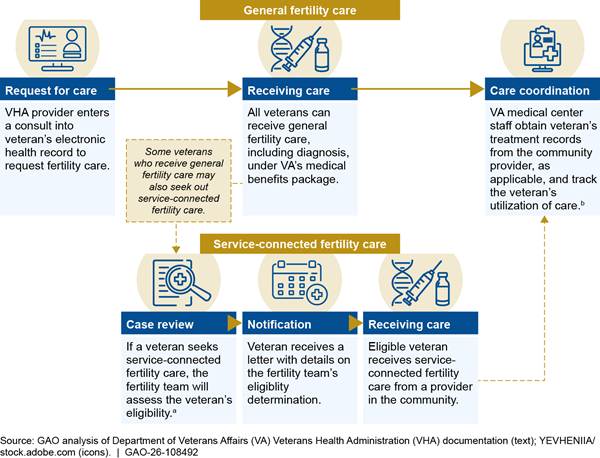
Note: In this report, GAO defines fertility evaluation and treatments that are not assisted reproductive technology as “general fertility care” and treatments involving assisted reproductive technology, including in vitro fertilization as “service-connected fertility care.” Assisted reproductive technology is any treatment or procedure that includes the handling of human eggs and sperm or embryos, outside of the human body, for the purpose of establishing pregnancy.
aA service-connected disability is an injury or illness incurred or aggravated during military service. To be eligible for service-connected fertility care, a veteran’s infertility must be causally related to one of their service-connected or due to treatment of one of their service-connected disabilities (e.g., chemotherapy).
bAccording to VHA policy, certain services have limits. For example, VHA has a lifetime limit on the number of in vitro fertilization cycles a veteran can attempt.
Veterans Community Care Program
The Veterans Community Care Program was established in June 2018 under the VA MISSION Act of 2018.[27] The program provides health care, including fertility care, to eligible veterans when they face challenges accessing care at VHA, among other factors. There are six criteria that can qualify a veteran to receive care under the Veterans Community Care Program.[28] For example, veterans may qualify for community care when required services are not available at any VHA facility, such as intrauterine insemination or in vitro fertilization for eligible veterans. VHA’s Office of Integrated Veteran Care oversees two contractors that are responsible for maintaining five regional networks of providers in the community (known as community care networks) to deliver health care services, including fertility care, to veterans.
VHA Data Show That Infertility Diagnoses and Treatment Among Veterans Have Increased from Fiscal Year 2022 Through 2025
According to VHA data, the number of veterans diagnosed with infertility increased across the time period of our review. Overall, from fiscal year 2022 through fiscal year 2025, approximately 8 million veterans received some kind of health care from VHA. Within that, the number diagnosed with infertility from fiscal year 2022 through fiscal year 2025, rose from just under 19,000 veterans to just under 30,000. VHA officials said there may be several reasons for the increase, such as expansions VHA made to eligibility for fertility care and the recovery of fertility services following the COVID-19 pandemic. In April 2024, VHA expanded eligibility for fertility care for veterans with service-connected disabilities, with the changes going into effect approximately halfway through fiscal year 2024.[29] Subsequently, from fiscal year 2024 to fiscal year 2025, VHA data show the number of veterans with a diagnosis that was causally related to one of a veteran’s service-connected disabilities or treatment for one of their service-connected disabilities nearly doubled, going from 597 to 964.[30] (See fig. 2.)
Figure 2: Number of Veterans with an Infertility Diagnosis and Service-Connected Infertility Diagnosis, Fiscal Years 2022-2025
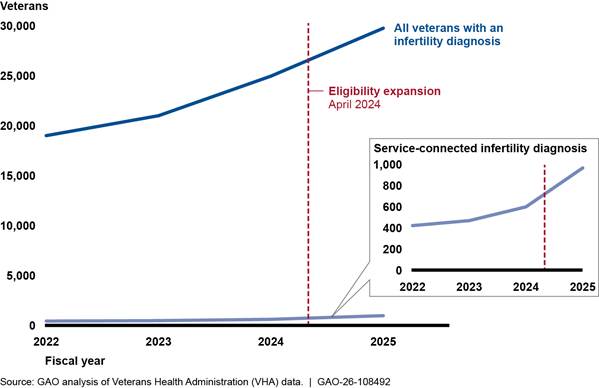
Notes: These data include veterans who received a diagnosis in fiscal years 2022-2025; it excludes veterans who may have infertility but either were not diagnosed or received a diagnosis in a different fiscal year. Thus, these data represent a snapshot in time and may not be reflective of all veterans with infertility.
A service-connected disability is an injury or illness incurred or aggravated during military service. In this report, GAO defines treatments involving assisted reproductive technology, including in vitro fertilization as “service-connected fertility care.” A “service-connected infertility diagnosis” is a diagnosis that is causally related to one of a veteran’s service-connected disabilities or treatment for one of their service-connected disabilities. Assisted reproductive technology is any treatment or procedure that includes the handling of human eggs and sperm or embryos, outside of the human body, for the purpose of establishing pregnancy.
The data we report on the number of veterans with a service-connected infertility diagnosis represents veterans who received service-connected fertility care. This is because, according to VHA officials, the closest way to definitively determine that a veteran had a service-connected infertility diagnosis, was to review whether the veteran’s medical record indicates the veteran received services VHA classifies as service-connected fertility care.
In April 2024, VHA expanded eligibility for fertility care by removing marital status as a consideration for determining eligibility for service-connected fertility care and to allow for the use of donor sperm, eggs, and embryos for service-connected fertility care as long as those are provided at no cost to VHA.
As figure 2 shows, infertility diagnoses that were causally related to one of a veteran’s service-connected disabilities or treatment for one of their service-connected disabilities accounted for a small proportion of overall infertility diagnoses. These diagnoses made up about 3.2 percent of all reported infertility diagnoses in 2025.
In fiscal year 2025, certain veteran demographic groups were more likely to receive an infertility diagnosis than others. Among veterans with an infertility diagnosis, the most common demographics represented were non-Hispanic, White, and aged 35 to 44 (see fig. 3).
Figure 3: Percentage of Veterans with an Infertility Diagnosis by Sex, Ethnicity, Race, and Age in Fiscal Year 2025
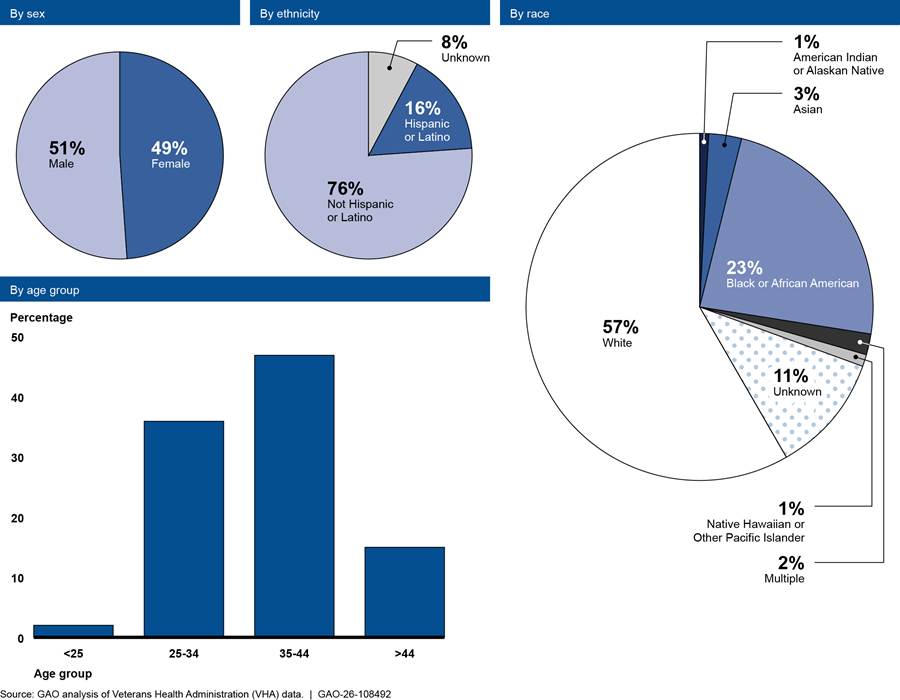
Note: These data only include veterans who received a diagnosis in fiscal year 2025 (n=29,739); it excludes veterans who may have infertility but either were not diagnosed or received a diagnosis in a different fiscal year. Thus, these data represent a snapshot in time and may not be reflective of all veterans with infertility. The unknown data reported in this figure for ethnicity and race combine the categories of unknown and declined to answer from VHA’s data. The demographics of veterans diagnosed with infertility in fiscal year 2025 shown in the figure are similar to what VHA data show across fiscal years 2022 through 2025.
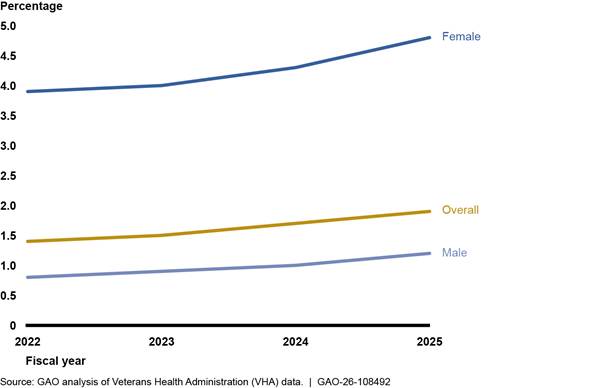
As figure 3 shows, the majority of veterans (about 84 percent) diagnosed with infertility between fiscal years 2022 and 2025 were aged 25 to 44. Overall, out of all veterans in this age group receiving VHA care, VHA data show about 3 percent received an infertility diagnosis. The percentages increased slightly over the 4-year period and were higher for females than males (see fig. 4).[31]
Figure 4: Percentage of Veterans Aged 25 to 44 with an Infertility Diagnosis, by Sex, Fiscal Years 2022-2025
Note: These data only include veterans who received a diagnosis in fiscal years 2022-2025; it excludes veterans who may have infertility but either were not diagnosed or received a diagnosis in a different fiscal year. Thus, these data represent a snapshot in time and may not be reflective of all veterans with infertility.
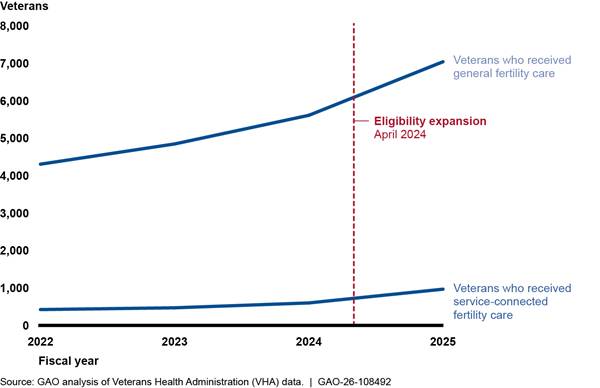
Beyond infertility diagnoses, the number of veterans seeking fertility care also increased from fiscal years 2022 through 2025. VHA data show the number of veterans who received general fertility care increased from just over 4,000 to just over 7,000 over the 4-year period; those who received service-connected fertility care increased from 420 to 964 (see fig. 5).[32]
Figure 5: Number of Veterans with an Infertility Diagnosis Who Received Fertility Care from VHA, Fiscal Years 2022-2025
Notes: These data only include veterans who received a diagnosis in fiscal years 2022-2025; it excludes veterans who may have infertility but sought care in a different fiscal year. Thus, these data represent a snapshot in time and may not be reflective of all veterans with infertility.
In this report, GAO defines fertility evaluation and treatments that are not assisted reproductive technology as “general fertility care” and treatments involving assisted reproductive technology, including in vitro fertilization as “service-connected fertility care.” A service-connected disability is an injury or illness incurred or aggravated during military service. Assisted reproductive technology is any treatment or procedure that includes the handling of human eggs and sperm or embryos, outside of the human body, for the purpose of establishing pregnancy. In April 2024, VHA expanded eligibility for fertility care, when it removed marital status as a consideration for determining eligibility for service-connected fertility care and to allow for the use of donor sperm, eggs, and embryos for service-connected fertility care as long as those are provided at no cost to VHA.
All veterans needing fertility care to conceive a child are eligible to receive general fertility care as part of VA’s medical benefits package. However, data on the number of veterans seeking this type of care indicates that more veterans are diagnosed with infertility each year than those who seek treatment for infertility. For example, in fiscal year 2025, VHA data show more than four times as many veterans were diagnosed with infertility compared to those who sought treatment, with 29,739 diagnosed compared to 7,035 seeking treatment. There are many reasons why a veteran might receive a diagnosis but not seek treatment in a given year, including financial concerns, other life circumstances (i.e., moving, return to active duty), or emotional stress.
Various Factors May Contribute to Infertility Among Veterans, Including Injuries Sustained During Military Service
Based on our literature search and interviews with eight veterans and representatives of eight stakeholder groups, we identified several factors that may be associated with veterans’ infertility. These factors include mental health conditions, injuries sustained during military service, delays in conceiving children, and toxic exposures during military service. See table 2 for examples we identified from our literature review and interviews with stakeholders.
Table 2: Examples of Factors That Can Affect the Fertility of Veterans, According to Literature and Stakeholder Interviews
|
Factors associated with infertility |
Examples from literature review |
Examples from stakeholder interviews |
|
Mental health conditions |
· Male veterans who were diagnosed with post-traumatic stress disorder or major depression were more likely to have lower sperm quality than those without mental health conditions, according to a 2017 study of 714 post-9/11 male veterans. · A 2015 study of 68,442 post-9/11 female veterans found that those with an infertility diagnosis were more likely to have a mental health diagnosis and reported military sexual trauma than those without an infertility diagnosis. |
· According to a stakeholder, depression, traumatic brain injuries, and post-traumatic stress disorder can negatively affect fertility for a variety of reasons, including medication side effects. |
|
Injuries sustained during military service |
· A 2022 study that reviewed the literature on the sexual health-related complications and fertility implications among male service members who sustained injuries during service found that o the use of improvised explosive devices increased the frequency of blast injuries that often result in significant genitourinary injuries (i.e., injuries to reproductive or urinary organs); and o advances in combat trauma care have resulted in more service members surviving genitourinary injuries and returning home with diminished sexual function and fertility. · A 2021 study of 3,018 veterans found that military sexual assault is significantly associated with an increased risk of infertility for female veterans. |
· One veteran said they sustained injuries from a blast injury while deployed overseas resulting in a double amputation and as a result, they were diagnosed with infertility related to their service-connected disability. |
|
Delays in conceiving children |
· A 2022 study that reviewed the literature on the sexual health-related complications and fertility implications among male service members who sustained injuries during service stated that servicemembers typically spend their most fertile years in service. · A 2021 survey of military and veteran families found that unique characteristics of being in the military, such as deployments and relocations, add an additional obstacle to conceiving children. As a result, servicemembers may choose to delay starting a family. |
· Fertility can be a challenge, as veterans are often older when they get out of service and start their families, according to one stakeholder. · A stakeholder reported that servicemembers may experience interruptions in trying to conceive children due to being called to duty. · According to a stakeholder, veterans spend their prime reproductive years in military service. This is especially the case for dual military couples who are deployed at different times. |
|
Toxic exposures during military service |
· A 2022 study of 2,601 veterans found that multiple exposure rates were higher among veterans who self-reported infertility than among veterans who did not self-report infertility. Toxic exposure examples include extreme heat, petrochemicals, solvents, asbestos and polychlorinated biphenyls. |
· One stakeholder said that research indicates a possible correlation between toxic exposures and infertility. · Another stakeholder stated that veterans face exposures during their service that may result in issues that surface later in life. For example, there could be complications from burn pit or other toxic exposures that may not be proven to be service-connected. |
Source: GAO analysis of literature and interviews with veterans and representatives from selected stakeholder groups. | GAO‑26‑108492
Note: GAO identified and analyzed 13 relevant articles published from January 2015 through June 2025 and summarized themes related to veteran infertility. GAO also conducted interviews with six veterans service organizations, one patient advocacy organization, one foundation, and eight individual veterans. GAO selected the stakeholder groups based on their focus on and knowledge of veteran infertility and national reach, and GAO worked with these groups to conduct outreach to individual veterans. Information presented here reflects examples from the broader themes GAO heard across our interviews and may not reflect individual representative perspectives of all those included in the interviews or veterans generally.
VHA Has Various Methods to Provide Information on Available Fertility Care, but It Has Not Implemented Key Performance Management Practices
VHA’s Office of Women’s Health Provides Various Communications, Such as a Dedicated Page Within Its Website, to Provide Information on Available Fertility Care
Based on our review of VHA’s Office of Women’s Health documents and selected reviews at four VA medical centers, we found VHA has various methods in place to provide information to veterans and providers on VHA’s available fertility care, all managed by VHA’s Office of Women’s Health. For example, the Office of Women’s Health maintains a fertility focused page within its website and has developed brochures explaining fertility benefits that are available to be distributed to veterans as appropriate. According to VISN and VA medical center officials, these methods are intended to help veterans understand the fertility care available to them. VHA’s communication methods are the primary responsibility of the women’s health services because VHA has designated the Office of Women’s Health as the office responsible for establishing VHA’s fertility care policy, which includes conducting outreach.
See table 3 for an overview of selected examples of VHA methods for communicating with veterans and providers.
|
Communication Method |
Description |
|
VHA Website – Women’s Health Section |
VHA maintains a VA Fertility & Family Building Services page within the Office of Women’s Health website. This page provides information on the fertility care VHA offers as well as the eligibility criteria for that care. The page has a basic question and answer section and also includes links to VHA’s Directives, which contain more detailed information on VHA’s benefits. |
|
Podcast |
“She Wears the Boots,” a VA-sponsored podcast from VHA’s Office of Women’s Health, recorded an episode on fertility benefits for veterans in September 2024. As of August 2026, a link to the podcast recording is available through VHA’s website. |
|
Brochures and other printed materials |
VHA’s Office of Women’s Health has developed two brochures specific to fertility care. One brochure is titled Fertility Services, and another brochure is titled Fertility Preservation for Medical Indications. According to VA medical center officials at one of the four sites we interviewed, these brochures are placed in the women’s health clinic at their site. Additionally, printed materials are made available to providers to share with patients. |
|
Veteran town halls and other events |
VA medical center and Veterans Integrated Service Network (VISN) officials we interviewed said they present information on available fertility care at veteran town halls. For example, one VA medical center holds two town halls a year and, according to officials, every presentation includes information about available fertility care. Officials from the four VA medical centers also said they take brochures and other materials that the Office of Women’s Health has developed to other outreach events such as women’s health events to share with veterans. |
|
VHA providers and other VA medical center staff |
VHA providers can also provide veterans with information about available fertility care during appointments. For example, one veteran we interviewed said she first learned about the fertility care available through VHA during a visit with her primary care provider. Women veterans program managers at two VA medical centers said that they respond to inquiries from veterans about VHA’s fertility services and will connect them to relevant resources or providers. One VA medical center official reported that its center had set up a preset option for an infertility inquiry within VHA’s online portal that allows veterans to message their providers. Through this option, veterans can submit questions directly to relevant staff. The official said that in addition to helping individual veterans, having an infertility inquiry as a preset option also promotes broader awareness that fertility care is available at that center. |
Source: GAO analysis of Veterans Health Administration (VHA) documentation and interviews with VHA and Department of Veterans Affairs (VA) medical center and VISN officials. | GAO‑26‑108492
Note: GAO conducted interviews with VHA officials at four VA medical centers and their associated VISNs, which we selected based on geography, complexity level, and presence of fertility staff. GAO also interviewed VHA program staff at central office. At the time we obtained this information, VHA was divided into 18 areas, referred to as VISNs, based on their geographical location. On July 15, 2026, VA updated its website to reflect that it had reorganized the VISN structure from 18 to five VISNs: see https://department.va.gov/integrated-service-networks. As such, we obtained information from VISN officials prior to the reorganization.
VHA, through the Office of Women’s Health, also takes steps to give providers information on available fertility care, so the providers can then share relevant information with veterans in their care.[33] For example, fertility team members from the four VA medical centers said they share information with VHA providers in women’s health clinics, as well as other types of providers such as primary care and dental. One VISN, one VA medical center, and one VHA official also reported presenting information to providers from certain specialties more likely to treat patients dealing with infertility, including urology and oncology. In addition, an official from one VA medical center reported that the VA medical center provides a pocket guide on women’s health to all new staff, which includes a page on fertility benefits.
For fiscal year 2026, VHA created memorandums of understanding with certain fertility specialists, such as subject matter experts on urology and andrology, to help expand knowledge of male fertility issues across the VHA system.[34] Through these memorandums, these specialists have agreed to provide their expertise to fertility teams at other VA medical centers who are tasked with reviewing veteran fertility cases. However, VHA officials indicated that, as of April 2026, no sites had sought such consultations since the memorandums were created.
VHA Has Not Implemented Key Performance Management Practices to Help Ensure Veterans and Providers Are Aware of Fertility Care
VHA’s Office of Women’s Health outlined strategies intended to help ensure veterans and providers have awareness of the fertility care available at VHA. Specifically, the Office of Women’s Health 2024 Strategic Plan includes strategies to (1) improve outreach to women veterans through enhanced communication across multiple platforms and through multiple channels, and to (2) educate patients on reproductive health options.[35] However, VHA does not have information on the extent to which it is meeting these communication strategies because it has not implemented key performance management practices we have identified in prior work. Our prior work defines performance management as a three-step process by which agencies should (1) set goals with quantitative targets and time frames to identify the results they seek to achieve, (2) collect performance information to measure progress towards meeting those goals, and (3) use that information to assess results and inform decisions to ensure further progress towards achieving its goals.[36]
Office of Women’s Health officials said they previously used a dashboard to track data on objectives from its strategic plan, but as of March 2026 it was no longer in use as they prepare to update the strategic plan.[37] An official from the Office of Women’s Health said she was not aware of a specific mechanism the office is using to determine whether its efforts to increase awareness of fertility care have been successful. Officials from the Office of Women’s Health also said that, as of June 2026, they are working to update the office’s strategic plan. These officials said they expect the new strategic plan to include goals related to outreach and education. However, they said it is too soon to provide specifics on what those goals will be. In the interim, Office of Women’s Health officials confirmed its 2024 strategic plan remains in effect.
Through our interviews, we identified information indicating that some interested veterans may be unaware of VHA’s fertility care, including eligibility criteria for that care. Specifically, according to representatives from two veterans service organizations, a veteran, and officials from a fertility team we interviewed, veterans may be confused about eligibility and the type of infertility services VHA offers. This is because some VHA providers may not know what fertility care VHA offers or may provide inaccurate information to veterans about this care. For example, one veteran reported being told initially that VHA had an age cutoff for fertility treatment but was later told there was not one. This veteran also reported receiving miscommunication of covered benefits. Specifically, the veteran was told that they were responsible for the cost of storage of embryos. However, according to VHA policy, the storage of embryos is covered without limitation for veterans who are eligible for service-connected fertility care for the life of the veteran. A veterans service organization representative said that some veterans have reported being told by providers that VHA does not provide fertility testing, which may result in veterans not receiving services they are eligible for.[38]
Additionally, stakeholders said that VHA’s communication methods are not fully reaching some veterans, especially male veterans, in need of fertility care. For example, fertility team members at one VA medical center and a veterans service organization representative said male veterans may not seek out or find it difficult to seek out information that is provided through the Office of Women’s Health. One VISN official explained that male veterans would not otherwise typically interact with women’s health staff and may think that the information about fertility care women’s health staff can provide is not applicable to them. For example, one male veteran said that walking into a women’s health clinic to request an appointment for fertility care was difficult. The community clinic the veteran was referred to initially turned him away and incorrectly told him that their office only sees women. In addition, a VISN official noted that some male veterans have expressed irritation and embarrassment about being referred to a women’s health clinic for questions about fertility care, which may be a barrier to seeking assistance. Furthermore, according to this VISN official, veterans’ providers do not always have accurate information about fertility care when it is not their specialty.
One veterans service organization representative said outreach to veterans should be more widespread and not come solely from the Office of Women’s Health. Instead, this official said information on VHA’s available fertility care services should also be provided to veterans at primary care clinics, spinal cord injury centers, and anywhere veterans potentially in need of fertility care are present. According to this representative, a lot of veterans do not understand that VHA provides an in vitro fertilization benefit to those eligible for service-connected fertility care because these services lack visibility. As described above, the Office of Women’s Health is the office responsible for conducting outreach about fertility care. An Office of Women’s Health official stated, that having this office be solely responsible for education and outreach can be challenging because infertility can affect any veteran, not just female veterans.
The information we obtained raises questions about the extent to which VHA is meeting its objectives. Setting quantifiable goals with time frames to determine progress towards communication goals for VHA fertility care, collecting data on progress towards those goals, and then making changes as appropriate would be consistent with key performance management practices. For example, the Office of Women’s Health could set a goal to hold a certain number of town halls for veterans each year where information on infertility is presented and collect data on the number of both male and female veterans who attend those sessions. Another potential goal could be to collaborate with other VHA offices (such as the Office of Primary Care or the Spinal Cord Injuries and Disorders Program Office) on numbers or types of communication that disseminate information about fertility care.
As it updates its strategic plan, the Office of Women’s Health has the opportunity to establish goals regarding communication to veterans about fertility care and collect information to measure progress towards meeting those goals. Implementing these key performance management practices would provide VHA with comprehensive information on the extent to which its methods for communicating to veterans about fertility care are successful or whether further changes may be needed.
VHA Offers Guidance to Medical Center Fertility Teams
VHA offers guidance to VA medical center fertility teams to help them carry out their responsibilities, including determining veterans’ eligibility for service-connected fertility care, according to VHA documentation and officials (see table 4).[39] The guidance VHA has developed is available to all VA medical center fertility teams to access through an internal VHA website and includes eligibility criteria and administrative process steps.
|
Type of support |
Description |
|
VHA Directives |
Policy documents that define VHA’s eligibility criteria for fertility evaluation and treatment including the following: · VHA Directive 1332 Fertility Management – defines general fertility care available to any veteran enrolled in VA health care. · VHA Directive 1334(1) In Vitro Fertilization Counseling and Services Available to Certain Eligible Veterans and Their Spouses – describes fertility care available to veterans with infertility caused by a service-connected disability or treatment of that disability.a |
|
Fertility Guidebook |
A manual that officials from VHA’s Office of Women’s Health and the Office of Integrated Veteran Care developed in 2023 to provide fertility policy guidance, information on recommended fertility team roles and responsibilities, among other information. According to the guidebook, it is intended to be a resource for navigating VHA fertility benefits for referring providers, fertility team members, case managers, clinical pharmacy specialists, and administrators. |
|
Fertility team process orientation |
Slide presentation available as a resource to medical centers that provides an overview of the required administrative steps fertility teams must follow when processing a review of a VHA benefit determination to comply with requirements under the Veterans Appeals Improvement and Modernization Act of 2017, including notifying the veteran of eligibility decisions.b |
|
Fertility community of practice calls |
VHA’s Office of Women’s Health and Office of Integrated Veteran Care co-lead a monthly fertility community of practice call that is open to all medical center staff. In these calls, VHA officials said they provide updates to policy and guidance, answer questions, and present case studies. Examples of case studies include how to determine eligibility for veterans with a history of elective sterilization, or those in same-sex relationships. Officials from one of our selected VHA’s Veterans Integrated Service Networks (VISN) said that they also have a VISN-wide fertility community of practice call in addition to the national call. According to the officials, the VISN-wide call was initiated after staff at the VA medical centers in the VISN expressed an interest in having it as a resource. |
|
National subject matter expert support |
VA medical center staff and VISN officials can submit questions to VHA subject matter experts through an online dashboard. According to VHA officials, questions and corresponding answers submitted through the dashboard are saved into a searchable repository. As VHA’s subject matter experts, Office of Women’s Health officials said they meet with the Office of Integrated Veteran Care officials to review and respond to the questions submitted on a weekly basis. According to the officials, they generally provide responses within 1 week of receiving questions through the dashboard. The Office of Women’s Health has also used ad hoc memorandums of understanding with specialist providers at VA medical centers to offer subject matter expertise in male infertility across VHA. In one such agreement, for example, a specialist agreed to provide expert input into complex clinical cases and education to fertility teams when those instances are identified. |
Source: GAO analysis of Veterans Health Administration (VHA) documentation and interviews with VHA and Department of Veterans Affairs (VA) medical center and VISN officials. | sGAO‑26‑108492
Note: GAO conducted interviews with VHA officials at four VA medical centers and their associated VISNs, which GAO selected based on geography, complexity level, and presence of fertility staff. GAO also interviewed VHA program staff at central office. VHA requires each VA medical center and VISN to have a fertility team that generally includes interdisciplinary representatives from gynecology, urology, and community care, among others. At the time we obtained this information, VHA was divided into 18 areas, referred to as VISNs, based on geographical location. On July 15, 2026, VA updated its website to reflect that it had reorganized the VISN structure from 18 to five VISNs: see https://department.va.gov/integrated‑service‑networks . As such, we obtained information from VISN officials prior to the reorganization. VHA also established the VHA Office of Veterans Community Care and retired the Office of Integrated Veteran Care in July 2026 as part of the reorganization effort. We refer to this office as the Office of Integrated Veteran Care in the table because this was the name of the office during our audit work.
aUnder this directive, fertility care is also available to a veteran’s spouse, if the veteran has met the eligibility criteria.
bThe Veterans Appeals Improvement and Modernization Act of 2017 made changes to the decision review process, giving veterans more options for reviewing VA’s eligibility decisions. Pub. L. No. 115-55 §§ 2(g), 2(h), 131 Stat. 1105, 1107-09 (codified as amended at 38 U.S.C. §§ 5104B, 5104C). Notice of eligibility decisions for fertility care must follow the requirements of the act. Pub. L. No. 115-55 § 2(e), 131 Stat. at 1106 (codified as amended at 38 U.S.C. § 5104(b)).
VHA Changed Its Process for Making Eligibility Decisions, But Has Not Assessed the Effectiveness of the Change
VHA Shifted Responsibility for Eligibility Decisions to VA Medical Center Fertility Teams
In October 2024, VHA changed its process to shift the responsibility for making eligibility decisions for veterans’ service-connected fertility care to VA medical center fertility teams. VHA’s Office of Women’s Health and Office of Integrated Veteran Care made this change to support the expanded eligibility and to bring decision making closer to the point of care for the veteran, according to VHA documentation. Prior to October 2024, a national fertility team within VHA comprised of subject matter experts from the Office of Women’s Health and the Office of Integrated Veteran Care, such as gynecology, urology and pharmacy specialists, determined eligibility for all veterans seeking service-connected fertility care across VA medical centers.
In internal documentation planning the change, VHA identified several risks including a moderate lack of skills and knowledge among impacted employees at the medical centers. VHA proceeded in making the change and as of October 1, 2024, VA medical center fertility teams became responsible for determining veterans’ eligibility for service-connected fertility benefits. However, we identified challenges selected fertility teams face in implementing the process as well as examples where some VHA requirements were not followed. VHA Office of Women’s Health officials acknowledged the challenges teams identified. However, VHA has not assessed whether the changes it made to its eligibility determination process are working as intended or whether additional adjustments are needed.
Selected VA Medical Center Fertility Teams Reported Challenges in Making Eligibility Decisions
In interviews with officials from four selected VA medical centers and their associated VISN offices, fertility teams identified several challenges in determining veterans’ eligibility for service-connected fertility benefits:
· Establishing that a veteran’s infertility is service-connected can be difficult. According to fertility team members at all four VA medical centers, some eligibility determinations are straightforward, but it is often difficult to establish whether a veterans’ service-connected disability is causally related to their infertility. For example, according to a VHA provider who specializes in male reproductive health, most infertility in males has no known cause and as such, it can be difficult to establish a service-connection for male veterans. Similarly, infertility in female veterans can have a wide variety of causes, including endometriosis, post-traumatic stress disorder, and military sexual trauma, some or none of which may be service-connected, according to VHA officials.[40]
|
Data on Wait Times for Fertility Care in the Community VHA data on wait times provide insight into veterans’ ability to access fertility care in the community. According to VHA data on fertility care consults during fiscal year 2025, veterans waited between 19 and 55 days from when the consult was entered into the veteran’s electronic health record to obtain an infertility care appointment scheduled in the community, with an average wait time of 33 days. VHA data also showed that veterans waited between 42 and 64 days from when the appointment was scheduled to attend and be seen by an infertility provider in the community, with an average wait time of 53 days. Source: GAO analysis of Veterans Health Administration (VHA) data and documentation. | GAO‑26‑108492 |
According to several fertility team members, it can also take a long time to determine whether a veteran’s infertility is related to a service-connected disability. Veterans and their providers often must provide fertility teams with additional health-related information such as updated testing to help the teams determine eligibility. According to fertility teams, this means they may need to review and discuss the veteran’s case more than once. The fertility teams we interviewed met with varying frequency, ranging from weekly to monthly. As a result, it can take longer to determine eligibility in cases where the team must meet more than once to review updated information. According to VHA documentation, it can take 4 to 6 weeks to determine that an infertility diagnosis is related to a service-connected disability and get an appointment in the community. However, it can take longer, according to fertility team members at the four VA medical centers we interviewed. For example, one fertility team detailed a particular case where they met several times to review the veteran’s information but still could not agree on an eligibility decision. The team debated for over 6 months before sending the veteran to the VISN-level fertility team for a higher-level review and determination about eligibility.
· Varying composition and relevant expertise among fertility teams. The fertility guidebook provides recommended fertility team member roles and responsibilities, including the VA medical center chiefs of staff, pharmacy, primary care, and representatives from women’s health, gynecology, urology and community care. According to the selected VA medical center fertility teams and VHA officials we interviewed, fertility teams vary in staff composition and levels of relevant expertise in fertility that can make it difficult to make a clinical determination. For example, one fertility team includes a provider who specializes in reproductive endocrinology and a urologist trained in male fertility. However, other fertility teams do not have a gynecologist or urologist. According to VHA data, in fiscal year 2025, of the 139 VA medical centers with fertility teams, 40 VA medical centers did not have a gynecologist on staff and 29 did not have a urologist.[41] In one instance a VA medical center we interviewed did not have a gynecologist or urologist on staff. Instead, the fertility team was comprised of other staff such as community care coordinators and nurse practitioners who specialize in women’s or reproductive health. One fertility team member we interviewed stated that they did not feel like they had the subject matter expertise to make eligibility decisions. According to another staff member, when staff do not have the relevant expertise, personal biases can play a role in eligibility decisions.
Further, specialty providers may be on staff at a VA medical center, but they may decide not to participate on a fertility team or may have limited time to participate due to their workload. For example, one VA medical center had a urologist on staff, however, this provider opted to not participate on the fertility team due to workload constraints.
A VHA official from the Office of Women’s Health acknowledged that it can be difficult to get gynecologists and urologists to participate on the fertility teams. The official explained that VHA productivity standards require providers to spend the majority of their time on direct patient care. VA calculates productivity metrics based on providers’ clinical duties only. The time a provider spends determining a veteran’s eligibility as a fertility team member does not count as direct patient care, according to VHA officials. This means that providers may decide they cannot participate on fertility teams due to workload and competing priorities.
In January 2024, when each VA medical center was initially required to establish a fertility team, the medical centers were also directed to record the fertility teams’ initial composition through an online dashboard and update it on a quarterly or as needed basis, according to VHA memorandum and guidance.[42] However, VHA officials said they did not review medical center fertility teams’ composition in 2024 or whether the medical centers have updated membership information, as called for in the guidebook. VHA officials said they are unsure whether the information on the dashboard about fertility team composition is accurate or up to date. As such, VHA officials lack visibility regarding the composition across the 139 medical center fertility teams.
Selected VA Medical Centers and VISNs Are Not Following Some Requirements Related to Eligibility Determinations
We found selected VISNs have not established VISN-level teams as required by VHA. Specifically, two VISNs we interviewed have relied on VA medical centers instead of establishing their own VISN-level fertility teams. The two VISNs developed memorandums of understanding with a VA medical center within their networks to have that fertility team serve as the VISN-level team. In both VISNs, officials said the VA medical centers were chosen because they have a high volume of veterans seeking service-connected fertility care, and thus more experience reviewing cases. VHA officials from the Office of Women’s Health stated that they were not aware of agreements VISNs have made to use VA medical center fertility teams instead of creating their own, and that this is not the process they recommend. A VHA official said that by delegating responsibility to the VA medical center, the VISN reduces its understanding and intended level of oversight of fertility care within the VISN.
Additionally, at the four selected VA medical centers in our review, we found that fertility teams did not consistently conduct required activities related to eligibility determinations among other aspects of veterans’ fertility care.[43] For example, VHA requires fertility teams to provide written notification to veterans for all eligibility determinations made for service-connected care. Specifically, letters are to be sent to all veterans seeking such care and must meet requirements included in law.[44] However, we found that two VA medical centers we reviewed only sent letters when veterans were determined to be ineligible for care, according to fertility team members at each VA medical center. In addition, one veteran we spoke to said they did not receive a letter and thus were unsure why they were determined ineligible. As a result, they were not sure why the decision was made in this way, or what additional information the fertility team may have needed to determine their eligibility for the fertility care they were seeking.
VHA officials developed an optional fertility letter generator tool for fertility teams to use in preparing required letters. With the tool, VA medical center staff can enter information about how the eligibility determination was made, and then the tool automatically generates the letter covering the required elements. Office of Women’s Health Officials said they offer fertility teams training on how to use the tool, but do not require its use or otherwise monitor the extent to which letters are sent or include required elements.
VHA Has Not Assessed the Effectiveness of Changes It Made to Its Eligibility Determination Process for Service-Connected Fertility Care
The challenges and noncompliance with VHA policies we identified at selected VA medical centers and VISNs represent potential risks associated with VHA’s decision to shift responsibility for eligibility decisions to VA medical centers. Furthermore, these findings raise questions about the extent to which VHA’s process for making eligibility decisions is working as intended. VHA Office of Women’s Health officials acknowledged difficulties fertility teams have reported in determining eligibility for service-connected fertility care. In response to these challenges, the officials said that fertility team members can ask questions during the monthly fertility community of practice calls. Additionally, Office of Women’s Health and Office of Integrated Veteran Care officials told us they regularly work on developing additional guidance for medical centers and use the monthly fertility community of practice calls to share such guidance.
Although VHA assessed the risks of changing its process in 2024 and has since provided tools and guidance for fertility teams to conduct required activities, it has not assessed whether the changes it made to its process for determining eligibility for veterans’ service-connected fertility care are working as intended. Undertaking such an assessment would be consistent with standards for internal control in the federal government, which state that agencies should identify, analyze, and respond to change by developing a process to assess changes.[45] This assessment would also be consistent with our prior work, which states that agencies need evidence about whether federal programs are achieving intended results.[46] Once an agency completes such an assessment, it can make adjustments to respond any identified risks as needed.
Further, according to the Office of Women’s Health Strategic Plan, a goal of the office is to ensure high-quality, patient driven care for veterans.[47] VHA officials from the Office of Women’s Health agreed that it is unclear whether certain aspects of the process are working in the best way to serve veterans’ needs and that there may be opportunities to improve the eligibility determination process. Undertaking an assessment and making any needed adjustments to its process would help ensure that veterans are receiving appropriate eligibility determinations and notifications, thereby increasing the likelihood that eligible veterans have the opportunity to receive such care. It also would provide an opportunity for VHA to more comprehensively assess the risks related to the types of challenges and instances of noncompliance we identified in our review and make changes as appropriate.
Conclusions
With a growing number of veterans experiencing infertility, along with the variety of factors that can affect fertility, VHA’s fertility care services are critical to ensure veterans receive the reproductive health care they need. In April 2024, VHA expanded eligibility for fertility care, and has several communication methods such as a dedicated page within the Women’s Health website to share information on the fertility care available at VHA. As it updates its strategic plan, the Office of Women’s Health has the opportunity to also implement key performance practices, including establishing goals and performance measures for communicating to veterans about fertility care. By implementing such practices, VHA could better assess progress towards its communication goals and increase the effectiveness of its outreach to veterans about fertility care. This would allow VHA to identify and make any needed adjustments to better ensure its efforts reach veterans who may need fertility care.
VHA changed its eligibility determination process for service-connected fertility care, shifting responsibility to individual VA medical center fertility teams to make such decisions. VHA has provided guidance and tools to fertility teams but the selected fertility teams in our review reported challenges in determining veterans’ eligibility for service-connected fertility care, especially in complex cases. Assessing whether its new eligibility determination process is working as intended would provide an opportunity for VHA to more comprehensively assess the risks related to the types of challenges and instances of noncompliance we identified in our review. By also making adjustments as needed, VHA could help ensure that eligible veterans receive such care by providing appropriate eligibility determinations and notifications.
Recommendations for Executive Action
We are making the following two recommendations to VHA:
The Under Secretary for Health should direct the Office of Women’s Health to implement key performance management practices to increase the effectiveness of its communications related to VHA fertility care and eligibility by (1) setting goals with quantitative targets and time frames, (2) collecting data to measure progress towards those goals, and (3) using these data to assess performance and make adjustments as needed. (Recommendation 1)
The Under Secretary for Health should determine whether the fertility eligibility determination process is working as intended, making adjustments as needed. (Recommendation 2)
Agency Comments
We provided a copy of this report to VA for review and comment. In its comments, reproduced in appendix II, VA concurred with our recommendations. VA also provided technical comments that we incorporated as appropriate.
We are sending copies of this report to the appropriate congressional committees, the Secretary of Veterans Affairs, and other interested parties. In addition, the report is available at no charge on the GAO website at https://www.gao.gov. If you or your staff have any questions about this report, please contact me at hundrupa@gao.gov. Contact points for our Offices of Congressional Relations and Media Relations may be found on the last page of this report. GAO staff who made key contributions to this report are listed in appendix III.
Sincerely,

Alyssa M. Hundrup
Director, Health Care
We were asked to review issues related to infertility among veterans and the fertility care available at the Veterans Health Administration (VHA), within the Department of Veterans Affairs (VA). In this report, we
1. describe what available data indicates about infertility among veterans for fiscal years 2022 through 2025;
2. describe factors that may contribute to infertility among veterans;
3. examine VHA’s efforts to provide information to veterans and providers about the fertility care available at VHA;
4. describe the guidance VHA provides VA medical center fertility teams; and
5. examine VHA’s process for determining veterans’ eligibility for fertility care.
To answer our first objective, we obtained and reviewed data from VHA on veteran infertility diagnosis and treatment for fiscal years 2022 through 2025 (the most recent complete fiscal years of data at the time of our review). These included data on the number and characteristics of veterans with a diagnosis of infertility and those who had received fertility care. Specifically, we reviewed data on the number of veterans with an infertility diagnosis in each fiscal year both overall and by age, sex, race, and ethnicity and data on the total number of veterans who received at least one health care service from VHA of any kind during our time period.[48] For certain analyses, we specified veterans aged 25-44 to focus on veterans of prime reproductive age.[49] For example, we calculated the percentage of veterans aged 25-44 (i.e., rate) with an infertility diagnosis by dividing the number of veterans aged 25-44 with a diagnosis by the total number of veterans in that age group with at least one health care service for each fiscal year. Finally, we reviewed data on the number of veterans who received general fertility care, which any VHA user can seek. We also reviewed data on the number of veterans who received service-connected fertility care, which only certain veterans are eligible for.[50] To assess the reliability of these data, we interviewed relevant VHA officials from the national Office of Women’s Health and Office of Integrated Veteran Care, who are responsible for providing oversight and guidance to VA medical centers for fertility care, about the data.[51] We also reviewed related documentation, such as data dictionaries, and reviewed the data for obvious errors. Based on these steps, we determined the data were sufficiently reliable for the purposes of our reporting objectives.
To answer our second objective, we conducted a literature search and reviewed relevant research to identify factors that may contribute to infertility among veterans. For the literature search, we conducted a structured search of multiple databases using various terms related to our objective, including medical terms related to fertility and infertility, medical terms for specific diagnoses related to or causing infertility, nonmedical terms used to describe infertility, and terms for relevant interventions such as assisted reproductive technology and in vitro fertilization.[52] We limited our search to English language materials published from January 2015 through June 2025. We conducted searches that focused on both infertility among veterans and among the general population of the United States. Our structured search identified 63 articles. Two analysts independently reviewed summary information from each of the 63 articles to determine their relevance to our review. After completing their independent reviews, the two analysts met to discuss the results and determined their concurrence on the articles to select for full-text review. Of the 63 articles, we identified 24 for full-text review.
To review the 24 articles, we used a structured format to identify (1) relevance to the report objective, (2) the area or population studied (U.S. veterans), and (3) the methodology used, including any limitations. Two analysts completed the full-text review. Of the 24 articles reviewed, we determined 13 were methodologically sound and relevant to our objective. For a complete list of the articles, see the bibliography at the end of this report.
In addition, we interviewed representatives from eight stakeholder groups: six veterans service organizations, one patient advocacy organization, and one foundation about fertility care for veterans to understand factors that can affect veterans’ fertility.[53] We selected these stakeholder groups based on their interest in or focus on fertility care for veterans and national reach. We also interviewed eight individual veterans about their experiences seeking fertility care at VHA. To identify veterans, we provided a flyer to the stakeholder groups we interviewed to disseminate to veterans to advertise the opportunity for veterans to meet with us virtually to share their experiences with VHA fertility care. Information we obtained from these interviews are not generalizable across stakeholder groups or veterans.
To answer our third objective, we reviewed VHA documentation on the types of information VHA provides to veterans and providers on the fertility care that VHA offers, such as brochures and VHA webpages, as well as how it disseminates information on fertility care. In addition, we interviewed VHA officials from the Office of Women’s Health and Office of Integrated Veteran Care and reviewed officials’ written responses about their efforts to make veterans and providers aware of available fertility care, including their communication methods. We also interviewed staff involved with fertility care at a nongeneralizable selection of four VA medical centers about their efforts to increase awareness among veterans and providers. We selected VA medical centers at the following locations to obtain variation in geography, facility complexity, and fertility staff presence: Fayetteville, Arkansas; Leeds, Massachusetts; Detroit, Michigan; and Seattle, Washington. At these VA medical centers, the staff we interviewed included fertility team members, such as providers like gynecologists, urologists, women’s health nurse practitioners, as well as community care staff and women’s veteran program managers.[54]
We also interviewed officials from the four Veterans Integrated Service Networks (VISN) associated with each of the selected VA medical centers about their role in the fertility care process and the support they provide to VA medical center fertility teams.[55] In addition, we interviewed representatives from the stakeholder groups about veterans’ and providers’ awareness of the fertility care available for veterans at VHA. We also interviewed eight veterans who we identified with outreach we conducted through stakeholder groups, to understand how they learned about the fertility care VHA offers. Information we obtained from these interviews is not generalizable across VA medical centers, VISNs, stakeholder groups, or veterans. Finally, we interviewed representatives from the two contractors who manage VHA’s networks of community providers to understand their role in providing veterans fertility care in the community.
We used this information to examine whether VHA’s efforts to provide information to veterans and providers on the fertility care available at VHA are consistent with two of the strategies in VHA’s Office of Women’s Health 2024 Strategic Plan.[56] Specifically, those strategies require VHA to educate patients on reproductive health options and to improve outreach to women veterans through enhanced communication across multiple platforms and through multiple channels. We also examined VHA’s efforts to assess how it provides information on fertility care against performance management criteria we identified in prior work to determine the extent to which these efforts are consistent with key performance management practices.[57] Specifically, these criteria define performance management as a three-step process by which agencies (1) set goals with quantitative targets and time frames to identify the results they seek to achieve, (2) collect performance information to measure progress towards meeting its goals, and (3) use that information to assess results and inform decisions to ensure further progress towards achieving its goals.
To answer our fourth objective, we reviewed available VHA documentation on fertility care, including VHA’s two directives on fertility care that define VHA’s eligibility criteria for fertility care, guidance documents, such as VHA’s fertility guidebook for VA medical center and VISN officials, and information on the VA medical center fertility teams.[58] In addition, we interviewed VHA officials from the Office of Women’s Health and Office of Integrated Veteran Care about the guidance they provide to VA medical centers and VISN fertility teams. We also interviewed staff at the four selected VA medical centers and four associated VISNs about the guidance their fertility teams use.
To answer our fifth objective, we reviewed VHA documentation related to VHA’s process for determining veterans’ eligibility for fertility care, such as the VHA directives on fertility care and VHA’s fertility guidebook, documents related to the planning efforts for the change to local eligibility determinations, and a VHA memorandum outlining requirements for VA medical centers and VISNs related to fertility care.[59] We interviewed VHA officials from the Office of Women’s Health and Office of Integrated Veteran Care, staff at the four selected VA medical centers and four associated VISNs about their eligibility determination process. We also interviewed the eight veterans about their experiences seeking fertility care. We used this information to assess VHA’s efforts against federal internal control standards for risk assessment, which state that agencies should identify, analyze, and respond to changes.[60] We also examined VHA’s efforts to evaluate its eligibility determination process against performance management criteria we identified in prior work to determine the extent to which these efforts are consistent with evidence building activities.[61] Specifically, these criteria state that agencies need evidence about whether federal programs are achieving intended results. Such evidence can be obtained through program evaluation. Finally, we assessed whether its process is consistent with the goal in VHA’s Office of Women’s Health 2024 Strategic Plan, which states that the Office of Women’s Health seeks to ensure that women veterans receive high quality, patient driven health care.[62]
We conducted this performance audit from May 2025 to September 2026 in accordance with generally accepted government auditing standards. Those standards require that we plan and perform the audit to obtain sufficient, appropriate evidence to provide a reasonable basis for our findings and conclusions based on our audit objectives. We believe that the evidence obtained provides a reasonable basis for our findings and
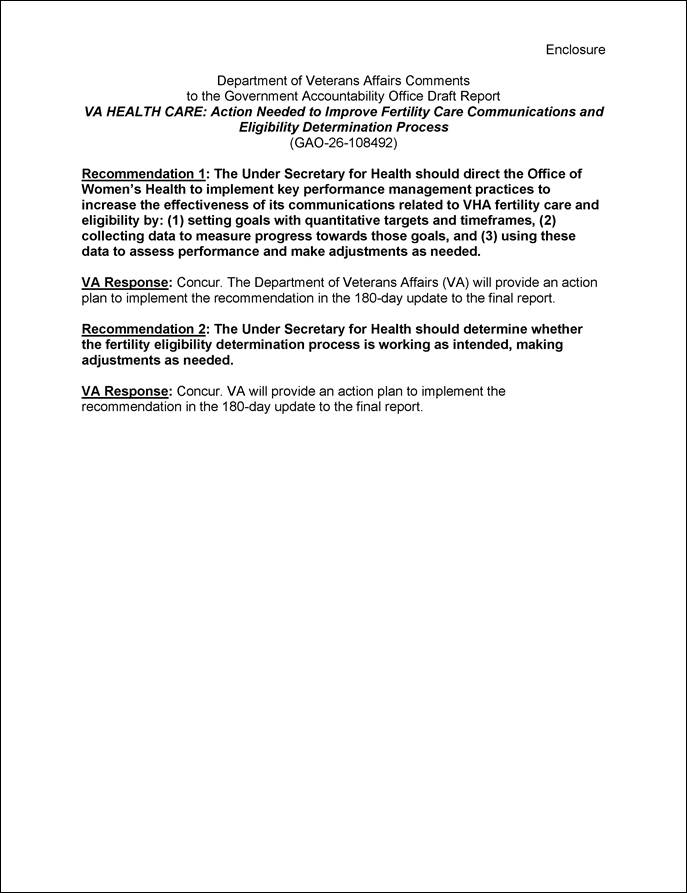
GAO Contact
Alyssa M. Hundrup, hundrupa@gao.gov
Staff Acknowledgments
In addition to the contact named above, Rebecca Rust Williamson (Assistant Director), Alison Goetsch (Analyst-in-Charge), Michael Fienberg, and Maggie Gearhart made key contributions to this report. Also contributing were Sarah Craig, Q. Akbar Husain, David Jones, Diona Martyn, Jeff Tamburello, Ann Marie Cortez, and Cathleen Whitmore.
Blue Star Families. 2021 Military Family Lifestyle Survey Comprehensive Report: Family Building. Encinitas, Calif.: 2022.
Castillo Jr., Otilio, Irene K. Chen, Eliad Amini, Faysal A Yafi, and David W. Barham. “Male Sexual Health Related Complications Among Combat Veterans.” Sexual Medicine Reviews, vol. 10 (2022): 691-697.
Goossen, Rachel P., Karen M. Summers, Ginny L. Ryan, et. al. “Ethnic Minority Status and Experiences of Infertility in Female Veterans.” Journal of Women’s Health, vol. 28, no. 1 (2019): 63-68.
Halpern, Joshua A., Joshua S. Jue, and Ranjith Ramasamy. “Infertility Evaluation and Access to Assisted Reproductive Technologies Among Male Military Veterans: Analysis of the South Florida Veterans Affairs Experience.” Translational Andrology and Urology, vol. 7, suppl. 2 (2018): S188-S192.
Katon, Jodie G., Katherine J. Hoggatt, Vidhya Balasubramanian, et. al. “Reproductive Health Diagnoses of Women Veterans Using Department of Veterans Affairs Health Care.” Medical Care, vol. 53, no. 4, suppl. 1 (2015): S63-S67.
Kroll-Desrosiers, Aimee, Laurel A. Copeland, Michelle A. Mengeling, and Kristin M. Mattocks. “Infertility Services for Veterans Enrolled in Veterans Health Administration Care.” Journal of General Internal Medicine, vol. 38, no. 10 (2023): 2347–2353.
Lindaman, Luke A., J. Richard Pilsner, Aimee R. Kroll-Desrosiers, Sally Haskell, Cynthia A. Brandt, and Kristin M. Mattocks. “Semen Quality Parameters Among U.S. Veterans of Operation Enduring Freedom, Operation Iraqi Freedom, and Operation New Dawn.” Military Medicine, vol. 182, (2017): e1775-e1781.
Mancuso, Abigail C., Michelle A. Mengeling, Andrea Holcombe, and Ginny L. Ryan. “Lifetime Infertility and Environmental, Chemical, and Hazardous Exposures Among Female and Male U.S. Veterans.” American Journal of Obstetrics and Gynecology, vol. 227, no. 5 (2022): 744.e1-744.e12.
Mattocks, Kristin, Aimee Kroll-Desrosiers, Laurie Zephyrin, et al. “Infertility Care Among OEF/OIF/OND Women Veterans in the Department of Veterans Affairs.” Medical Care, vol. 53, no. 4, suppl. 1 (2015): S68-S75.
Mattocks, Kristin M., Valerie Marteeny, Lorrie Walker, Aimee Kroll-Desrosiers, and Michelle Mengeling. “Examining Veterans’ Experiences With In Vitro Fertilization Provided Under P.L. 114-223.” Medical Care, vol. 61, no. 4 (2023): 192-199.
McDermott, Megan C., Megan G. Musilli, Jill E. Brown, et. al. “Female-Specific Health Care of Military Female-Designated Service Members and Veterans: A Systematic Overview of Reviews.” Military Medicine, vol. 189, no. 9/10 (2024): e1917-e1930.
Ryan, Ginny L., Michelle A. Mengeling, James C. Torner, Andrea Holcombe, and Anne G. Sadler. “Sexual Assault and Lifetime Infertility Diagnosis in Male and Female U.S. Military Veterans.” Fertility and Sterility, vol. 116, no. 3, Supplement (2021): e46.
Tierney, Katherine I., Arthur L. Greil, and Ann V. Bell. “Trends in Infertility Prevalence and Treatment Seeking in the United States: Results from the National Survey of Family Growth 1995 through 2017-2019.” Fertility and Sterility, vol. 120, no. 4, (2023): 914-916.
The Government Accountability Office, the audit, evaluation, and investigative arm of Congress, exists to support Congress in meeting its constitutional responsibilities and to help improve the performance and accountability of the federal government for the American people. GAO examines the use of public funds; evaluates federal programs and policies; and provides analyses, recommendations, and other assistance to help Congress make informed oversight, policy, and funding decisions. GAO’s commitment to good government is reflected in its core values of accountability, integrity, and reliability.
Obtaining Copies of GAO Reports and Testimony
The fastest and easiest way to obtain copies of GAO documents at no cost is through our website. Each weekday afternoon, GAO posts on its website newly released reports, testimony, and correspondence. You can also subscribe to GAO’s email updates to receive notification of newly posted products.
Order by Phone
The price of each GAO publication reflects GAO’s actual cost of production and distribution and depends on the number of pages in the publication and whether the publication is printed in color or black and white. Pricing and ordering information is posted on GAO’s website, https://www.gao.gov/ordering.htm.
Place orders by calling (202) 512-6000, toll free (866) 801-7077,
or
TDD (202) 512-2537.
Orders may be paid for using American Express, Discover Card, MasterCard, Visa, check, or money order. Call for additional information.
Connect with GAO
Connect with GAO on X,
LinkedIn, Instagram, and YouTube.
Subscribe to our Email Updates. Listen to our Podcasts.
Visit GAO on the web at https://www.gao.gov.
To Report Fraud, Waste, and Abuse in Federal Programs
Contact FraudNet:
Website: https://www.gao.gov/about/what-gao-does/fraudnet
Automated answering system: (800) 424-5454
Media Relations
Sarah Kaczmarek, Managing Director, Media@gao.gov
Congressional Relations
David A. Powner, Acting Managing Director, CongRel@gao.gov
General Inquiries
[1]C. N. Nugent and A. Chandra, Infertility and Impaired Fecundity in Women and Men in the United States, 2015-2019, National Health Statistics Reports, no. 202 (Hyattsville, Md.: National Center for Health Statistics, Apr. 24, 2024).
[2]This includes veterans who are enrolled in VHA health care or otherwise authorized to receive hospital or outpatient care under 38 C.F.R. § 17.37.
[3]Veterans may qualify for community care—care that VHA pays for veterans to receive from non-VHA providers—if VHA does not offer the needed service or if VHA cannot schedule an appointment for the covered veteran within a specified number of days from the date or the request or within a certain driving time from the veteran’s residence.
[4]Additionally, the spouse of such an eligible veteran can be covered for all fertility counseling and treatment that VHA offers, including both intrauterine insemination and in vitro fertilization. Intrauterine insemination is a procedure in which a small tube is inserted through the cervix into the uterus to deposit a washed and concentrated sperm sample. In vitro fertilization is an assisted reproductive technology procedure in which an egg is removed from a mature ovarian follicle and fertilized by a sperm cell outside the body. Then the fertilized egg, also known as an embryo, is allowed to develop in a protected environment for several days. It is then either transferred into a uterus or frozen (cryopreserved).
[5]This estimate includes paid claims during this time frame for fertility treatments and counseling in the community for veterans only. It does not include paid claims for veterans’ family members or special veteran programs (e.g., Civilian Health and Medical Program of VA or VA’s Foreign Medical Program).
[6]Assisted reproductive technology is any treatment or procedure that includes the handling of human eggs and sperm or embryos, outside of the human body, for the purpose of establishing pregnancy.
[7]In this report, we define fertility evaluation and treatments that are not assisted reproductive technology as “general fertility care” and treatments involving assisted reproductive technology, including in vitro fertilization, as “service-connected fertility care.”
[8]In July 2026, VHA established the VHA Office of Veterans Community Care and retired the Office of Integrated Veteran Care as part of a reorganization effort. We refer to this office as the Office of Integrated Veteran Care throughout our report because this was the name of the office during the period of our audit work.
[9]VHA adopted these changes in response to changes the Department of Defense made to its policy for active-duty service members. VHA is authorized to provide fertility evaluation and treatment, including assisted reproductive technology services, to eligible veterans and their spouses, respectively, as provided in Department of Defense Policy. See 38 C.F.R. §§ 17.380 and 17.412.
[10]Department of Veterans Affairs, Veterans Health Administration, Office of Women’s Health 2024 Strategic Plan, (Washington, D.C.: 2024).
[11]GAO, Evidence-Based Policymaking: Practices to Help Manage and Assess the Results of Federal Efforts, GAO‑23‑105460 (Washington, D.C.: July 12, 2023).
[12]Internal control is a process management uses to help an agency achieve its objectives. See GAO, Standards for Internal Control in the Federal Government, GAO‑25‑107721 (Washington, D.C.: May 15, 2025).
[14]VHA, Office of Women’s Health 2024 Strategic Plan.
[15]In addition to the 139 fertility teams at VA medical centers, VHA policy requires each VISN to have a fertility team. At the time we conducted our analyses (from May 2025 to June 2026), there were 18 regional VISNs responsible for managing and overseeing the VA medical centers within their defined areas. On July 15, 2026, VA updated its website to reflect that it reorganized the VISN structure from 18 to five VISNs. See https://department.va.gov/integrated-service-networks. As such, VISN-related analyses in this report are based on information and data obtained from VHA prior to the reorganization.
[16]We interviewed representatives from American Legion, Disabled American Veterans, Iraq and Afghanistan Veterans of America, Military Officers Association of America, Paralyzed Veterans of America, Wounded Warrior Project, RESOLVE: The National Infertility and Family Building Association, and the Bob Woodruff Foundation.
[17]Centers for Disease Control and Prevention, “Infertility: Frequently Asked Questions,” accessed May 14, 2026, https://www.cdc.gov/reproductive-health/infertility-faq/index.html.
[18]Centers for Disease Control and Prevention, “Infertility: Frequently Asked Questions.
[19]C.N. Nugent and A. Chandra, Use of Fertility Services in Women Ages 20–49 in the United States: 2022–2023, National Center for Health Statistics Data Brief, no. 542 (Hyattsville, Md.: National Center for Health Statistics, Dec. 17, 2025).
[20]VHA’s policy on fertility care states that for patients having regularly occurring, unprotected intercourse with a partner with opposite-sex gametes (i.e., egg or sperm) and without any known infertility for either partner, evaluation of infertility should be initiated at 12 months when the partner with a uterus and ovaries is under the age of 35 and at 6 months when that partner is aged 35 or older.
[21]According to VHA policy, the Office of Integrated Veteran Care is to assist with these consultations on an as needed or requested basis, and the consultations include ensuring Office of Community Care participation in the VA medical center and VISN fertility teams and consultations related to issues with access or claims, among other things.
[22]The fertility guidebook is a manual VHA developed in 2023 to provide fertility policy guidance, among other information.
[23]The Veterans Appeals Improvement and Modernization Act of 2017 made changes to the decision review process, giving veterans more options for reviewing VA’s eligibility decisions. Notification of eligibility decisions for fertility care must follow the requirements of the act. Pub. L. No. 115-55 § 2(e), 131 Stat. 1105, 1106 (codified as amended at 38 U.S.C. § 5104). Among other things, under the decision review process VA has the “duty to assist,” which means it must make reasonable efforts to assist a claimant in obtaining the evidence the claimant needs to support their claim for a benefit. See 38 U.S.C. § 5103A.
[24]According to VHA documentation, it is not possible to disaggregate all costs for care provided at VA medical centers that may contribute to a veteran’s fertility evaluation but are not specifically defined as fertility treatments.
[25]Within VA, the Veterans Benefits Administration is responsible for adjudicating whether a veteran’s disability is service-connected.
[26]The fertility team is to send a letter referred to as an eight-point notice decision, which must meet requirements outlined in law. This letter should (1) identify the issues adjudicated; (2) summarize the evidence considered; (3) summarize the applicable laws and regulations; (4) identify favorable findings; (5) identify elements not satisfied leading to a denial of benefit; (6) explain how to obtain or access evidence used in making the decision; (7) explain the procedure for obtaining review of the decision; and (8) if applicable, identify the criteria that must be satisfied to grant service connection. See 38 U.S.C. § 5104.
[27]Pub. L. No. 115-182, §§ 101-109, 132 Stat. 1393, 1395-1418.
[28]See 38 U.S.C. § 1703; 38 C.F.R. §§ 17.4010, 17.4040.
[29]In April 2024, VHA removed marital status as a consideration for determining a veteran’s eligibility for service-connected fertility care, and it allowed veterans to use donor sperm, eggs, and embryos as long as they were provided at no cost to VA.
[30]The data we report on the number of veterans with a service-connected diagnosis and the number of veterans who received service-connected fertility care are the same. This is because, according to VHA officials, the closest way to definitively determine that a veteran has a service-connected infertility diagnosis, is if the veteran’s medical record indicates they have received services that VHA classifies as service-connected fertility care.
[31]These rates represent the proportion of all veterans who accessed at least one VHA service between fiscal year 2022 and fiscal year 2025 who were diagnosed with infertility. The rate is lower than the sum of the rates for all 4 years, as some veterans may have been diagnosed in more than one fiscal year.
[32]Of all veterans who received at least one VHA service for any reason, the proportion of those who received general and service-connected fertility care in that same time frame also increased, rising from 0.07 percent to 0.11 percent and from 0.007 percent to 0.015 percent respectively.
[33]According to a VHA official, VHA’s community care contractors are supposed to educate community providers per the community care contracts. For example, both contractors have developed a document for community providers about VHA fertility care, which includes information about available benefits and eligibility requirements for veterans. VHA reviews the information the contractors develop and share with community providers, according to VHA officials.
[34]Andrology is a medical specialty focused on the male reproductive system and male urological issues.
[35]VHA, Office of Women’s Health 2024 Strategic Plan.
[37]For example, to support the objective that VHA offer comprehensive women’s health services, the Office of Women’s Health had a goal to increase the percentage of women veterans assigned to a women’s health primary care provider.
[38]Fertility testing is one of the services available under general fertility care. All veterans enrolled in VHA health care are eligible to receive general fertility care, which is part of VA’s medical benefits package.
[39]Service-connected fertility care includes services, such as in vitro fertilization, for which the veterans’ infertility must be causally related to one of the veteran’s service-connected disabilities or the treatment of one of their service-connected disabilities for the veteran to be eligible. A service-connected disability is an injury or illness incurred or aggravated during military service. Conversely, general fertility care is available to any veteran enrolled in VA health care.
[40]A. C. Mancuso, M. A. Mengeling, A. Holcombe, and G. L. Ryan, “Lifetime Infertility and Environmental, Chemical, and Hazardous Exposures Among Female and Male U.S. Veterans,” American Journal of Obstetrics and Gynecology, vol. 227, no. 5 (2022): 744.e1-e12.
[41]According to VHA officials, there is one provider specifically trained in reproductive endocrinology and approximately 43 urologists who have training on male infertility staffed across the 139 VA medical centers nationwide.
[42]See Standardized Fertility Interdisciplinary Team Requirements for Veterans Integrated Service Networks and VA Medical Centers, Operational Memorandum (Jan. 18, 2024) and Department of Veterans Affairs, Veterans Health Administration, Fertility Guidebook, (Washington, D.C.: 2025).
[43]After an eligibility determination is made and the veteran is notified of such determination, fertility teams are required to conduct care coordination activities, including tracking fertility care and ensuring certain care, such as the number of in vitro fertilization cycles, do not exceed authorized limits. In our review of such activities at four VA medical centers, we found variation in method and extent to which these tracking activities occurred. For example, one center did not track fertility care against benefit limitations and instead relied on the community provider to do so.
[44]These letters are called eight-point notice decisions and must meet requirements included in law. This letter should (1) identify the issues adjudicated; (2) summarize the evidence considered; (3) summarize the applicable laws and regulations; (4) identify favorable findings; (5) identify elements not satisfied leading to a denial of benefit; (6) explain how to obtain or access evidence used in making the decision; (7) explain the procedure for obtaining review of the decision; and (8) if applicable, identify the criteria that must be satisfied to grant service connection. See 38 U.S.C. § 5104.
[47]See VHA, Office of Women’s Health 2024 Strategic Plan.
[48]It is possible for veterans to obtain a diagnosis at more than one discrete point in time, so the sum of diagnoses from each fiscal year would be greater than the unique total across fiscal years. To address this, we also had VHA provide the unique number of veterans who received an infertility diagnosis from fiscal years 2022 through 2025.
[49]VHA data show that veterans under 25 represented about 2 percent of all infertility diagnoses and veterans aged 45 and older represented about 15 percent of all infertility diagnoses between fiscal years 2022 and 2025.
[50]In this report, we define fertility evaluations and treatments that are not assisted reproductive technology as “general fertility care” and treatments involving assisted reproductive technology, including in vitro fertilization, as “service-connected fertility care”. A service-connected disability is an injury or illness incurred or aggravated during military service. To receive service-connected fertility care a veteran’s infertility must be causally related to one of the veteran’s service-connected disabilities or the treatment for one of their service-connected disabilities. The data we report on the number of veterans with a service-connected diagnosis and the number of veterans who received service-connected fertility care are the same. This is because, according to VHA officials, the closest way to definitively determine that a veteran has a service-connected infertility diagnosis is if the veteran’s medical record indicates they have received services that VHA classifies as service-connected fertility care.
[51]In July 2026, VHA established the VHA Office of Veterans Community Care and retired the Office of Integrated Veteran Care as part of a reorganization effort. We refer to this office as the Office of Integrated Veteran Care throughout our report because this was the name of the office during the period of our audit work.
[52]Examples of specific search terms that we used or used variations of include “veteran,” “fertility,” and “reproductive health,” among others. The databases we searched included EBSCO, Scopus, ProQuest, ProQuest Dialog, National Technical Information Service in ProQuest Dialog, Harvard Think Tank Search, and Policy Commons.
[53]We interviewed representatives from American Legion, Disabled American Veterans, Iraq and Afghanistan Veterans of America, Military Officers Association of America, Paralyzed Veterans of America, Wounded Warrior Project, RESOLVE: The National Infertility and Family Building Association, and the Bob Woodruff Foundation.
[54]VHA policy requires each VA medical center to have a fertility team that is responsible for making eligibility determinations for service-connected fertility care. See Department of Veterans Affairs, Fertility Management, VHA Directive 1332 (Washington, D.C.: May 13, 2024). Each VA medical center is also required to designate a women’s veteran program manager who is responsible for overseeing and ensuring that their VA medical center has the necessary services and resources to care for women veterans’ health. See Department of Veterans Affairs, Women Veterans Program Manager, VHA Directive 1330.02 (Washington, D.C.: Aug. 10, 2018).
[55]In addition to the 139 fertility teams at VA medical centers, VHA policy also requires that each VISN have a fertility team to support fertility teams at VA medical centers and to conduct certain reviews of eligibility (e.g., if a veteran disagrees with a VA medical center’s determination and requests a higher-level review). See Department of Veterans Affairs, Fertility Management. At the time we conducted our analyses (from May 2025 to June 2026), there were 18 regional VISNs responsible for managing and overseeing the VA medical centers within their defined areas. We interviewed officials from VISNs 1, 10, 16, and 20 during that time. On July 15, 2026, VA updated its website to reflect that it reorganized the VISN structure from 18 to five VISNs. See https://department.va.gov/integrated-service-networks. As such, VISN-related analyses in this report are based on information and data obtained from VHA prior to the reorganization.
[56]Department of Veterans Affairs, Veterans Health Administration, Office of Women’s Health 2024 Strategic Plan, (Washington, D.C.: 2024).
[57]GAO, Evidence-Based Policymaking: Practices to Help Manage and Assess the Results of Federal Efforts, GAO‑23‑105460 (Washington, D.C.: July 12, 2023).
[58]See Department of Veterans Affairs, Fertility Management, VHA Directive 1332 (Washington, D.C.: May 13, 2024); and In Vitro Fertilization Counseling and Services Available to Certain Eligible Veterans and Their Spouses, VHA Directive 1334(1) (Washington, D.C.: Mar. 12, 2021, amended Apr. 4, 2024).
[59]See Department of Veterans Affairs, Assistant Under Secretary for Health for Integrated Veteran Care, Standardized Fertility Interdisciplinary Team Requirements for Veterans Integrated Service Networks and VA Medical Centers, Operational Memorandum (Jan. 18, 2024).
[60]Internal control is a process management uses to help an agency achieve its objectives. See GAO, Standards for Internal Control in the Federal Government, GAO‑25‑107721 (Washington, D.C.: May 15, 2025).
[62]VHA, Office of Women’s Health 2024 Strategic Plan.