
Report to Congressional Committees
United States Government Accountability Office
A report to congressional committees
Contact: Lori Atkinson at AtkinsonL@gao.gov
What GAO Found
The Federal Agency Performance Act of 2024 (FAPA) amends statutory requirements for the Office of Management and Budget (OMB) and federal agencies to manage performance and address crosscutting issues, such as improving food safety and ensuring cybersecurity. For example, OMB is now required to achieve crosscutting goals within a presidential term and agencies are required to conduct strategic reviews to assess whether relevant organizations, programs, and activities are contributing as planned to progress on agency goals.
OMB has made limited progress in implementing new requirements. For example, OMB established new crosscutting goals in December 2025—within the first year of the administration as required. However, OMB’s August 2025 guidance to agencies does not address all statutory requirements for strategic reviews. For example, the guidance does not fully address four requirements related to involving agency leaders and stakeholders. Without guidance that accurately communicates each requirement, agencies risk conducting ineffective strategic reviews, limiting the usefulness of the information decision-makers have to improve performance and ensure that crosscutting issues are addressed.
The Departments of Homeland Security (DHS) and the Treasury had policies, procedures, and guidance for their strategic review processes that addressed most, but not all requirements. The Department of State and the General Services Administration (GSA) have not developed such documents. Further, none of the four agencies GAO selected had fully implemented new requirements for strategic reviews. Without documents that fully reflect requirements, the four agencies risk conducting strategic reviews that do not sufficiently assess progress toward their goals nor provide agency leaders with the information they need to identify risks and improve performance.
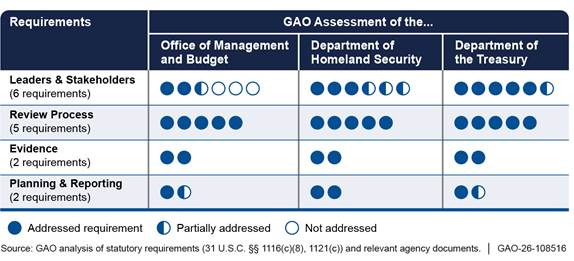
DHS, Treasury, and GSA have plans to implement strategic reviews in 2026—the first year after OMB issued guidance—but State would not confirm plans to do so. Without conducting annual reviews, State leadership is missing a critical opportunity to assess performance to learn what worked well and what did not and identify actions to improve results moving forward.
Why GAO Did This Study
To effectively address crosscutting issues such as delivering disaster relief, the federal government needs to coordinate efforts across organizational boundaries. GAO’s work continues to identify challenges the federal government faces in effectively managing its activities and addressing crosscutting issues.
FAPA includes provisions for GAO to review its implementation. This report assesses the extent to which (1) OMB implemented FAPA’s new government-wide requirements, and (2) selected agencies addressed FAPA’s strategic review requirements.
To do so, GAO reviewed information on Performance.gov and OMB’s 2025 annual update to guidance. GAO also reviewed policies, procedures, and guidance and interviewed relevant officials at the four selected agencies about their strategic review processes and coordination with OMB. GAO selected four agencies from a population of 13 that were included in its past work on strategic reviews. The four selected agencies ranged in size (i.e., number of full-time equivalent employees) and varied in types of missions, programs, and activities.
What GAO Recommends
GAO recommends that OMB revise its guidance and the four selected agencies develop process documentation to fully address statutory requirements for strategic reviews. GAO also recommends that State conduct a strategic review in 2026.
DHS, GSA, State, and Treasury agreed with the recommendations and described planned actions to address relevant statutory requirements. OMB did not provide comments.
Abbreviations
CAP cross-agency priority
DHS Department of Homeland Security
FAPA Federal Agency Performance Act of 2024
GPRA Government Performance and Results Act of 1993
GPRAMA GPRA Modernization Act of 2010
GSA General Services Administration
OMB Office of Management and Budget
This is a work of the U.S. government and is not subject to copyright protection in the United States. The published product may be reproduced and distributed in its entirety without further permission from GAO. However, because this work may contain copyrighted images or other material, permission from the copyright holder may be necessary if you wish to reproduce this material separately.
June 23, 2026
Congressional Committees
Given the size and scope of the federal government, many of the results it seeks to achieve—such as improving food safety, ensuring cybersecurity, and delivering disaster relief—are crosscutting in nature. Successfully addressing those crosscutting issues requires the coordinated efforts of more than one federal agency, level of government, or sector.[1] Our work continues to identify challenges the federal government faces in effectively managing its activities and addressing crosscutting issues. In annual reports issued from 2011 to 2026, we identified more than 2,000 actions for Congress or executive branch agencies to reduce, eliminate, or better manage fragmentation, overlap, and duplication; achieve other cost savings; or enhance revenue collection.[2] In addition, in the 2025 update to our High-Risk List, we identified many persistent crosscutting issues that agencies have been working to address over time.[3]
The Government Performance and Results Act of 1993 (GPRA), as amended, creates an integrated, crosscutting performance planning and reporting framework at both the government-wide and agency levels to support the federal government’s achievement of results.[4] The Federal Agency Performance Act of 2024 (FAPA) amends and expands certain requirements for the Office of Management and Budget (OMB) and agencies.[5] For example, it sets forth a requirement for agencies to conduct annual reviews of progress towards the strategic goals and objectives established in their strategic plans.[6] As part of those reviews, which were to begin after FAPA was enacted in 2024, agencies are to assess whether various organizations, programs, and activities—both within and external to the agency—contributed to each goal and objective as planned.[7]
FAPA includes provisions for us to review the act’s implementation.[8] This report assesses the extent to which (1) OMB implemented FAPA’s new government-wide requirements, and (2) selected agencies addressed FAPA’s strategic review requirements.
To address the first objective, we reviewed information that OMB made available on Performance.gov—the federal government’s central website for performance information—and its 2025 annual update to guidance for implementing GPRA, FAPA, and other related laws.[9] In addition, we sought information from OMB staff in December 2025 and March 2026 on FAPA implementation and plans related to cross-agency priority (CAP) goals and Performance.gov updates. As of June 2026, OMB had not provided information in response to our questions.
To assess both OMB’s coordination with agencies for our first objective and agencies’ implementation of strategic reviews for our second objective, we selected four agencies—the Departments of Homeland Security (DHS), State, and the Treasury; and the General Services Administration (GSA). We selected these four agencies from a population of 13 agencies that were included in our past work on strategic reviews.[10] Selecting from this population allowed us to leverage past findings related to selected agencies’ strategic reviews. The four selected agencies ranged in size (i.e., number of full-time equivalent employees) and varied in types of missions, programs, and activities. We reviewed relevant policies, procedures, and guidance to determine if the selected agencies were in a position to address applicable statutory requirements for strategic reviews in 2025 and moving forward. We also interviewed relevant performance management officials at the selected agencies about OMB coordination and their agencies’ strategic review processes.
For both objectives, we assessed the extent to which OMB’s and selected agencies’ actions addressed FAPA’s 15 statutory requirements for strategic reviews using a three-point scale:
· addressed—meaning that OMB guidance or agency documentation addressed all elements of the requirement;
· partially addressed—meaning that OMB guidance or agency documentation addressed some but not all elements of the requirement; and
· not addressed—meaning that OMB guidance or agency documentation did not address any elements of the requirement.
We conducted this performance audit from May 2025 to June 2026 in accordance with generally accepted government auditing standards. Those standards require that we plan and perform the audit to obtain sufficient, appropriate evidence to provide a reasonable basis for our findings and conclusions based on our audit objectives. We believe that the evidence obtained provides a reasonable basis for our findings and conclusions based on our audit objectives.
Background
FAPA amended requirements for OMB related to CAP goals and Performance.gov that were first established by the GPRA Modernization Act of 2010 (GPRAMA).[11] FAPA also codified agency strategic reviews, which were directed by OMB guidance starting in 2012. Below we discuss CAP goals, Performance.gov, and strategic reviews in further detail highlighting (1) our past findings on related effective practices and needed improvements, and (2) how FAPA amended their implementation.
CAP Goals
GPRAMA requires OMB to coordinate with agencies to develop federal government priority goals (known as CAP goals). CAP goals are 4-year outcome-oriented goals covering a number of crosscutting mission areas as well as goals to improve management across the federal government.[12] Examples of past CAP goals include those related to job training, broadband access, and science, technology, engineering and math education. GPRAMA requires management CAP goals that cover federal financial, human capital, IT, procurement and acquisition, and real property management.[13] To encourage continuity across administrations, GPRAMA established a schedule for CAP goals to be established approximately 1 year after a presidential term started and to run for 4 years—through the first year of the next presidential term.[14] GPRAMA also required a leader for each performance goal (i.e., annual target) established for a CAP goal.[15]
We have previously reviewed OMB’s and agencies’ actions to adopt and implement each administration’s set of CAP goals since they were first established in 2012.[16] In those reports, we identified opportunities for OMB to improve implementation of each set of CAP goals. These included actions to more fully develop implementation plans, and strengthen periodic reviews and public reporting of progress. As of June 2026, OMB had addressed 14 of our 17 past recommendations related to CAP goals.[17] We discuss the three recommendations that remain open—which we made in a review of the 2022-2025 CAP goal set—later in this report.[18]
In addition, our prior work identified key considerations for OMB and agencies in implementing CAP goals (see sidebar).[19] FAPA codified several of these considerations as requirements, which took effect after FAPA was enacted in 2024.
|
Key Considerations for Implementing Cross-Agency Priority Goals In September 2021, we identified key considerations to facilitate cross-agency priority goal implementation by the Office of Management and Budget and agencies, which include: · Establish the goal: Establish a balanced set of outcome-oriented mission and management-focused goals that reflect the government’s highest policy priorities. · Identify goal leaders and contributors: Identify co-leaders and sub-goal leaders to facilitate leadership, continuity, and agency buy-in. · Identify resources to support implementation: Dedicate resources to goal implementation, including funding, staffing, and technology. · Use performance information: Focus on improving the quality and use of data to routinely assess goal progress and a shared commitment to continuous improvement. · Report results: Assess and report progress on goal achievement at the end of the goal periods. Source: GAO‑21‑104704. | GAO‑26‑108516 |
FAPA revisions to CAP goal requirements cover:
· Timing. CAP goals are to align with a presidential term.[20]
· Goal achievement. Each CAP goal is to (1) include plans to successfully achieve the goal within the 4-year implementation period, and (2) cite any specific resource requests in the President’s Budget that support goal achievement.[21]
· Co-goal leaders. Each CAP goal is to have at least two co-leaders—at least one from the Executive Office of the President and at least one from an agency that contributes to the goal.[22]
· Reporting. OMB is to publish a final report at the end of the 4-year CAP goal period, comparing actual results to overall planned performance.[23]
Performance.gov
GPRAMA requires a single, government-wide website to communicate government-wide and agency performance information.[24] OMB implemented this website as Performance.gov in 2011. Our prior work has found opportunities for OMB to enhance Performance.gov.[25] For example, in 2013 we found that OMB had not established a full baseline set of performance, customer satisfaction, and other metrics for Performance.gov.[26] We recommended that OMB track all metrics and, where appropriate, create goals for those metrics, such as setting a target level of increases in website user satisfaction, to help identify and prioritize potential improvements to the website. As of June 2026, OMB had taken some actions toward addressing this recommendation, including using a third-party tool that would allow it to establish performance goals. By establishing goals, OMB and its implementing partners would have tools to understand whether the website is performing as expected, and what actions may be needed to achieve desired results.
FAPA requires OMB to ensure that Performance.gov:
· Retains information. OMB is to archive and preserve the information made available on the website.[27]
· Incorporates statutory requirements. Performance.gov is to meet the requirements of the 21st Century Integrated Digital Experience Act, which requires federal websites to be accessible, consistent, not duplicative, searchable, encrypted, designed around user needs, customizable, and mobile friendly.[28]
· Provides complete reporting. Performance.gov is to include final progress reports on agency priority goals and CAP goals at the end of the goal period.[29]
Strategic Reviews
|
Strategic Goals and Objectives Since 1993, various laws and Office of Management and Budget (OMB) guidance have established a federal performance management framework, which requires agencies to develop a hierarchy of goals, including “general goals and objectives.” 5 U.S.C. § 306(a)(2). OMB’s guidance for this framework is Circular No. A-11, Preparation, Submission, and Execution of the Budget, pt. 6 (August 2025). Through this guidance, OMB established and defined strategic goals and objectives as two different types of goals. Strategic goals: These goals are outcome-oriented statements of aim or purpose. They articulate what the agency wants to achieve to advance its mission and address relevant problems, needs, challenges, and opportunities. Strategic objectives: These goals break strategic goals down into the outcomes or impacts the organization is intending to achieve through its various activities. They are usually outcome oriented to reflect core mission and service-related functions, as well as the breadth of the organization’s efforts. Source: GAO analysis of relevant laws and OMB
guidance. |
In its guidance for implementing GPRAMA, OMB established an annual process in which each agency is to review progress in achieving the strategic goals and objectives established in its strategic plans (see sidebar for the distinction between strategic goals and objectives).[30] Our prior work examining selected agencies’ experiences in implementing strategic reviews found that reviews helped agencies focus their leadership’s attention and raise visibility with OMB on strategic objectives that needed the highest-level attention and focus to drive progress.[31]
In addition, our prior work identified practices that agencies can use to facilitate effective strategic reviews (see sidebar).[32] FAPA codified many of these practices as requirements for agencies.
|
Practices for Effective Strategic Reviews · Establish a process for conducting strategic reviews · Clarify and clearly define measurable outcomes for each strategic objective · Review the strategies and other factors that influence the outcomes and determine which are most important · Identify and include key stakeholders in the review · Identify and assess evidence related to strategic objective achievement · Assess effectiveness in achieving strategic objectives and identify actions needed to improve implementation and impact · Develop a process to monitor progress on needed actions Source: GAO‑15‑602. | GAO‑26‑108516 |
FAPA requires agencies to conduct strategic reviews consistent with guidance issued by OMB.[33] Specific requirements relate to:
· Senior leaders and stakeholders. Strategic reviews are to be led and supported by senior officials and involve internal and external stakeholders.[34]
· Review process. Agencies are to annually review progress made toward covered goals and identify risks to and likelihood of goal achievement.[35]
· Evidence. Agencies are to use performance information and other evidence to assess goal progress and identify and prioritize additional evidence needs.[36]
· Planning and reporting. Agencies are to report strategic review results in their annual performance reports and, for at-risk goals, identify improvement strategies.[37]
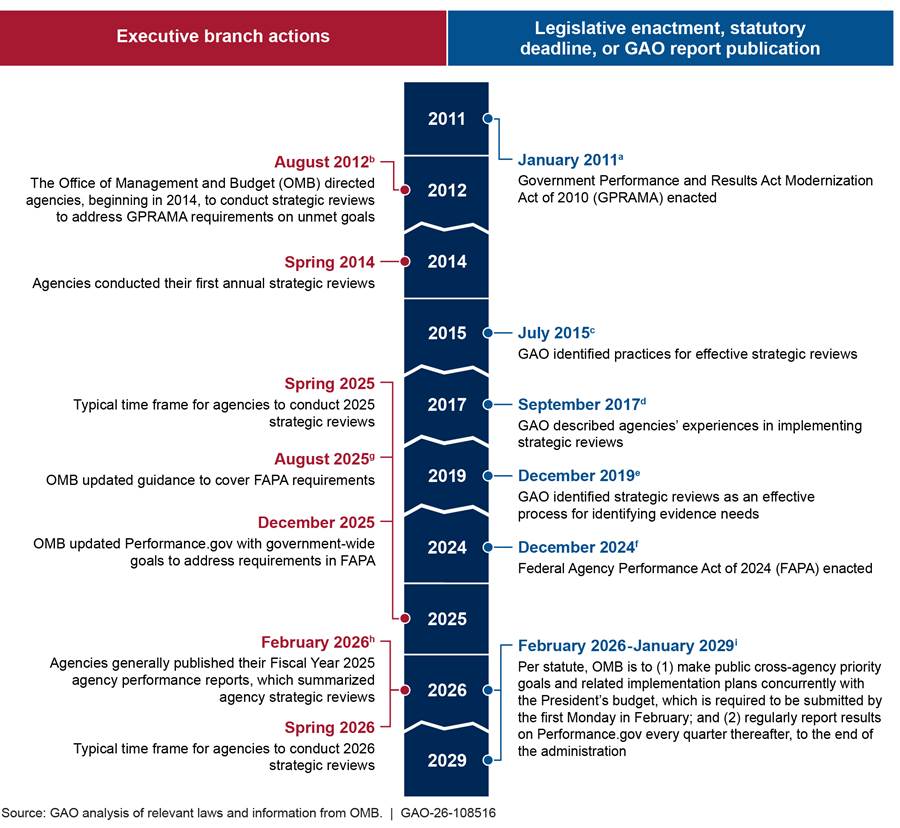
Figure 1 shows selected milestones related to the three sets of requirements—CAP goals, Performance.gov, and agency strategic reviews—including GPRAMA enactment in 2011, FAPA enactment in 2024, and other milestones through the end of the current administration (i.e., January 2029).
Figure 1: Selected Milestones Related to the Development and Implementation of Federal Agency Performance Act of 2024 Requirements
aPub. L. No. 111-352, 124 Stat. 3866 (2011).
bOffice of Management and Budget, Circular No. A-11, Preparation, Submission and Execution of the Budget, pt. 6, § 270 (August 2012).
cGAO, Managing for Results: Practices for Effective Agency Strategic Reviews, GAO‑15‑602 (Washington, D.C.: July 29, 2015).
dGAO, Managing for Results: Selected Agencies’ Experiences in Implementing Strategic Reviews, GAO‑17‑740R (Washington, D.C.: Sept. 7, 2017).
eGAO, Evidence-Based Policymaking: Selected Agencies Coordinate Activities, but Could Enhance Collaboration, GAO‑20‑119 (Washington, D.C.: Dec. 4, 2019).
fPub. L. No. 118-190, 138 Stat. 2653 (2024).
gOffice of Management and Budget, Circular No. A-11, Preparation, Submission, and Execution of the Budget, pt. 6 (August 2025).
hSome agencies have the option to publish the annual agency performance report as a performance section of a performance and accountability report. In those instances, the report was to be published in November 2025.
iAlthough the President’s budget is required to be submitted by the first Monday in February, administrations do not always meet this deadline.
OMB Has Not Fully Implemented FAPA’s New Statutory Requirements
OMB Has Made Limited Progress in Implementing New Requirements for CAP Goals and Performance.gov
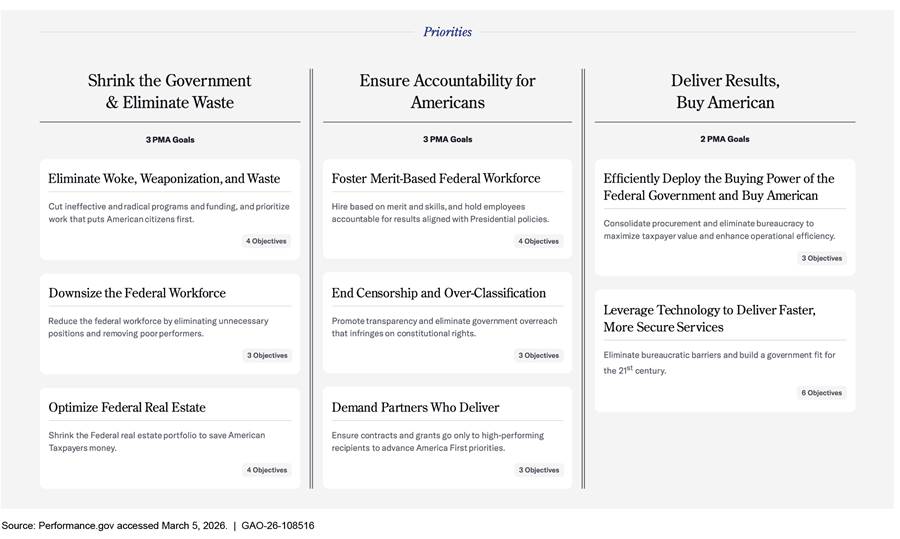
OMB released the President’s Management Agenda in December 2025 through executive memorandum and on Performance.gov.[38] The President’s Management Agenda identified eight goals and 30 objectives the administration wants to pursue (see figure 2). OMB stated that the President’s Management Agenda fulfills statutory requirements for priority goals, including publishing those goals within the first year of an administration.[39] OMB stated in its August 2025 update to Circular A-11 that federal government priority goals are commonly referred to as CAP goals or President’s Management Agenda goals.
CAP goals and related implementation details in the federal performance plan are due with the President’s budget on the first Monday in February.[40] In April 2026, OMB published the President’s budget, but OMB did not designate which goals and objectives in the 2025 President’s Management Agenda are considered CAP goals nor release related implementation details.[41] In December 2025 and March 2026, we asked OMB staff if the goals in the President’s Management Agenda were the new CAP goals and, if not, what guidance and procedures were in place to ensure it publicly identifies the new CAP goals no later than concurrently with the President’s Budget. As of June 2026, OMB had not provided information in response to our questions.
In April 2023, we found that OMB’s designation of CAP goals came in August 2022, 5 months after the submission of the President’s budget in March 2022.[42] We recommended that OMB develop guidance and procedures to ensure that CAP goals are updated or revised and made publicly available concurrently with the submission of the budget, as required by statute.
We also found that OMB had not designated CAP goals addressing two management areas required by statute: IT management and federal real property management. The federal government faces long-standing challenges with both of those areas. We made two recommendations for OMB to designate CAP goals related to those areas. As of June 2026, OMB had not taken action to address any of the three recommendations. We will continue to monitor OMB’s progress implementing new CAP goals and addressing these recommendations.[43]
OMB has minimally updated Performance.gov during this administration. OMB archived information from the prior administration and released the President’s Management Agenda on Performance.gov, but had not otherwise updated the website, as of June 2026.[44]
In December 2025 and March 2026, we asked OMB staff about actions they have taken to ensure that the site conforms with 21st Century Integrated Digital Experience Act requirements, as required by FAPA.[45] Under the law, federal websites are to be accessible and consistent, among other requirements.[46] As of June 2026, OMB had not updated the website nor provided information in response to our questions.
Updating Performance.gov is a long-standing challenge. In August 2016, we found that OMB had not met all GPRAMA public reporting requirements for Performance.gov.[47] We recommended that OMB and its implementing partners ensure the information presented on Performance.gov consistently complies with GPRAMA public reporting requirements for the website’s content.[48] As of June 2026, OMB had taken some steps to address this recommendation in past iterations of the website, but did not respond to our questions in December 2025 and March 2026 on planned actions to more fully develop the current administration’s version of Performance.gov to provide all required information. We will continue to monitor OMB’s progress implementing FAPA’s new requirements for Performance.gov and addressing this recommendation.
OMB Guidance for Agency Strategic Reviews Does Not Reflect All Statutory Requirements
Based on our analysis of OMB’s August 2025 guidance to agencies, it addresses 10 of 15 of FAPA’s requirements for implementing strategic reviews.[49] Figure 3 presents our assessment of each requirement.
Figure 3: Extent to Which the Office of Management and Budget’s August 2025 Guidance Addressed Statutory Strategic Review Requirements in the Federal Agency Performance Act of 2024
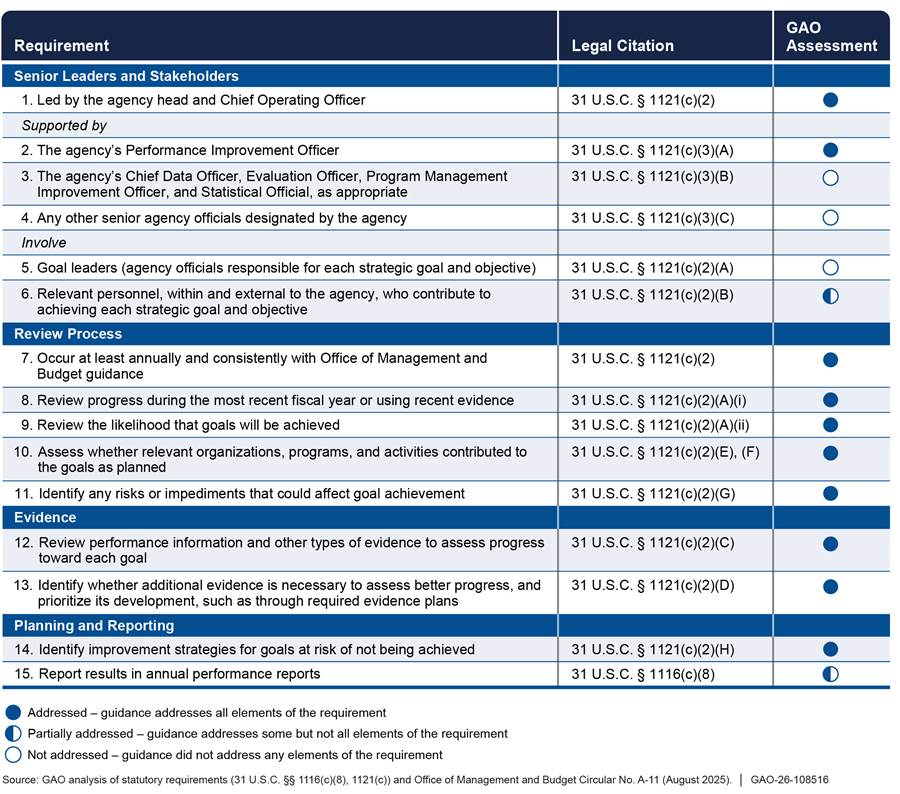
While OMB’s August 2025 guidance fully addressed review process and evidence requirements, the guidance was mixed in addressing statutory requirements related to senior leaders and stakeholders and planning and reporting.
Senior leaders and stakeholders. OMB guidance addresses the requirements that agencies’ strategic reviews should be (1) led by the agency head and Chief Operating Officer, and (2) supported by the agency Performance Improvement Officer. However, the guidance does not include requirements for goal leaders and other senior agency officials to be involved in strategic reviews, including specific roles for the agency’s Chief Data Officer, Evaluation Officer, Program Management Improvement Officer, and Statistical Official. Moreover, while the guidance addresses internal coordination with relevant personnel, it does not address requirements for external coordination. Figure 4 provides excerpts of OMB’s guidance for strategic reviews, showing where relevant requirements for senior leaders and stakeholders were covered or missing.
Figure 4: Excerpts from OMB Guidance About the Federal Agency Performance Act of 2024’s Requirements for Strategic Reviews
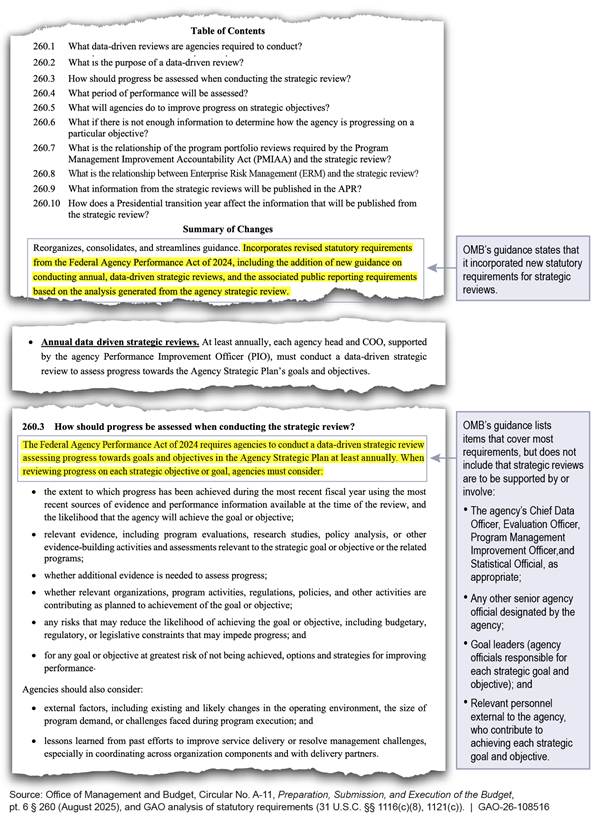
In December 2025 and March 2026, we asked OMB why its guidance did not cover these four stakeholder-related requirements. As of June 2026, OMB had not provided us with a response to either of our inquiries. These gaps in OMB guidance could result in agencies not including all relevant officials and stakeholders in their reviews. This, in turn, limits an agency’s ability to fully leverage expertise in assessing progress and identifying opportunities for improvement.
Planning and reporting. OMB guidance directs agencies to (1) identify improvement strategies for at-risk goals, and (2) report results of reviews in annual reports, as required. However, the guidance is inconsistent with the statutory requirement to report results in annual performance reports. Instead, it provides an exception to the reporting requirement in a presidential transition year. Specifically, OMB guidance states that agencies have flexibility in presidential transition years to not report on strategic review results for goals and objectives developed under the prior administration that are no longer aligned with the current administration’s policies or priorities (see fig. 5).
Figure 5: Excerpt from Office of Management and Budget Guidance About Reporting Strategic Review Results
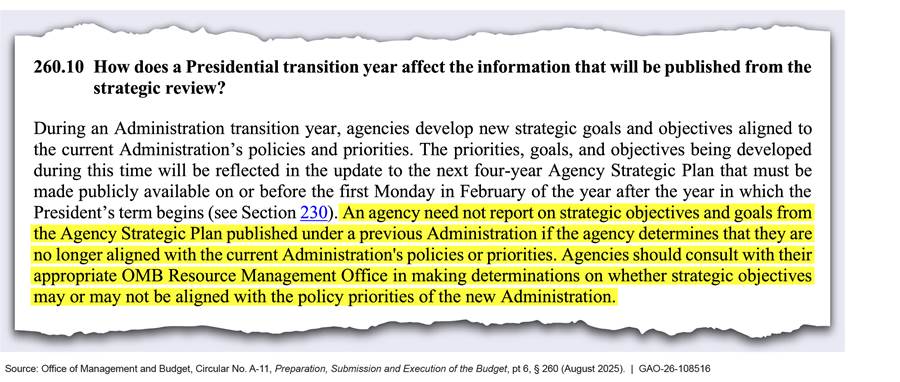
This guidance from OMB is incorrect as agencies are required by FAPA to include a summary of their strategic review results in their annual performance reports.[50] OMB has included similar exceptions to reporting results in its annual updates to its guidance since 2017—when agencies conducted strategic reviews in response to OMB direction prior to FAPA’s enactment in December 2024. In March 2026, we shared this discrepancy with OMB. As of June 2026, OMB had not provided us with an explanation for the difference between its guidance and the requirement. This purported exception to the reporting requirement may limit transparency on the results agencies achieved and where improvements may be needed.
According to the Standards for Internal Control in the Federal Government, a federal entity should communicate relevant and quality information with appropriate external parties regarding matters that impact the functioning of the internal control system, such as complying with relevant statutory requirements.[51] OMB guidance provides a definitive interpretation of legal requirements that cut across agencies and, in turn, can help ensure agencies address those requirements consistently. However, OMB did not communicate complete and accurate information to agencies about strategic review requirements.
Agencies are required to conduct strategic reviews consistent with OMB guidance.[52] The Departments of Homeland Security (DHS) and State and the General Services Administration (GSA) stated that they rely on OMB guidance to meet statutory strategic review requirements under FAPA.[53] Without guidance that both addresses all relevant statutory requirements and accurately communicates each requirement, agencies risk conducting incomplete and ineffective strategic reviews. Effective implementation of strategic reviews can help agencies to (1) identify opportunities to reduce, eliminate, or better manage instances of fragmentation, overlap, and duplication; and (2) inform decision-makers so they can assess the relative contributions of various programs to a given objective.
Selected Agencies Did Not Fully Address Strategic Review Requirements in 2025
Our review found that none of the four selected agencies fully addressed new statutory requirements for strategic reviews in 2025. FAPA requires federal agencies to conduct annual strategic reviews of progress toward achieving goals and objectives established in their strategic plans.[54] DHS conducted a strategic review in 2025, while GSA, State, and Treasury did not. Further, none of the selected agencies had policies, procedures, or guidance for strategic reviews that fully reflected statutory requirements.
DHS Conducted a Strategic Review in 2025 While State, Treasury, and GSA Did Not
DHS’s 2025 strategic review assessed fiscal year 2024 and the first quarter of fiscal year 2025 performance. According to officials, DHS components began preparing for the strategic review in fall 2024—before FAPA’s new statutory requirements were enacted. They said that the review was completed in spring 2025, before OMB updated its guidance to reflect those requirements. DHS officials said the review provided several benefits, including an opportunity to examine progress across DHS components, inform resource decisions for agency leadership, and support forward-looking analysis.
Officials at State, Treasury, and GSA told us they did not conduct strategic reviews in 2025, as required. They cited differing reasons for not conducting the reviews:
· According to State officials, the agency was focused on internal restructuring efforts in 2025. State officials described other reviews the agency conducted in 2025, such as contracts and foreign assistance reviews. They stated that those assessments served a similar purpose to a strategic review by providing evidence to inform decision making.
· According to Treasury officials, in lieu of a strategic review in 2025, they focused on changes to goals for the department’s next strategic plan to be published in 2026.[55] For that effort, they gathered input from approximately 80 leaders from across the department and focused on identifying strengths, weaknesses, opportunities, and threats to inform emerging issues for the next strategic plan. Treasury officials also told us that this effort leveraged results from the 2024 strategic review.[56]
· GSA officials told us that OMB instructed them in July 2025 to not conduct a strategic review but provided no documentation to us that conveyed this instruction.[57]
In February 2026, Treasury and GSA officials told us that they plan to resume strategic reviews in 2026. Specifically, GSA officials told us they plan to complete their next review in spring 2026. Treasury officials said they plan to complete their strategic review in May 2026 to establish a baseline for performance for the 2026-2030 strategic planning cycle.
In February 2026, State officials informed us that the agency had not yet determined the scope or structure of its 2026 strategic review, as the department had recently published a new strategic plan in January 2026.[58] In addition, in June 2026, State officials told us they had not determined a time frame for resuming strategic reviews. As previously stated, agencies are required to conduct strategic reviews annually. Without conducting annual reviews, State leadership is missing a critical opportunity to assess agencywide performance during the prior year, learn what worked well and what did not, and identify actions to improve results moving forward. Without such information, State lacks assurance that key management decisions—such as identifying and implementing new strategies or changing existing programs and operations—are based on a portfolio of credible evidence and targeted at mitigating significant risks or addressing performance shortfalls.
Opportunities Exist for Selected Agencies to Ensure Future Strategic Reviews Address All Statutory Requirements
Two selected agencies—DHS and Treasury—have long-standing policies, procedures, and guidance that direct their strategic review processes. They originally developed this process documentation after OMB’s 2012 guidance directed agencies to conduct strategic reviews. Therefore, they developed these materials prior to FAPA’s enactment in December 2024, which established statutory requirements for strategic reviews.
Both agencies reported taking actions to update their process documentation to help ensure they would meet new statutory requirements in future reviews. We found that their process documentation addresses most, but not all FAPA requirements. The other two agencies—GSA and State—have limited process documentation for current or future strategic reviews.
DHS and Treasury Process Documentation Addresses Most, but Not All Requirements for Future Reviews
DHS. We found that DHS’s existing strategic review process documentation fully addresses 12 of the 15 FAPA requirements.[59] Figure 6 identifies our assessment of DHS’s process for each requirement.
Figure 6: Extent to Which the Department of Homeland Security’s Strategic Review Process Documentation Addresses Federal Agency Performance Act of 2024 Requirements, as of June 2026
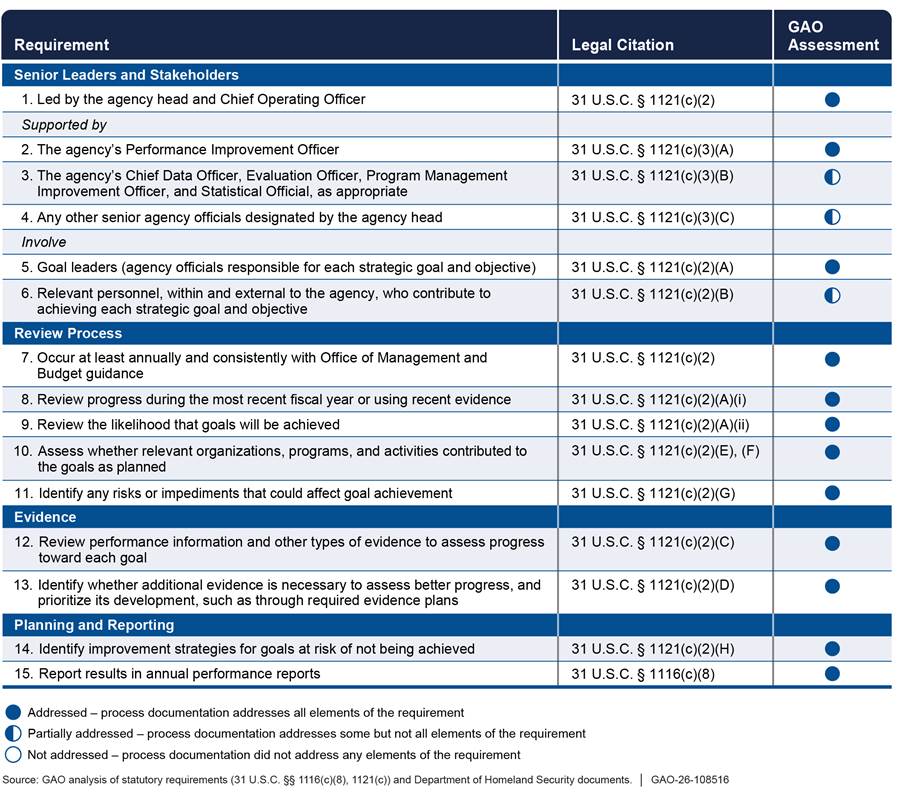
Note: Key Department of Homeland Security (DHS) strategic review documents we analyzed included Fiscal Year 2025 Strategic Review Deliverables, DHS Organizational Performance Management Guidance, Program Area Progress Review, and the Learning Agenda Template. These documents were developed prior to the Federal Agency Performance Act of 2024’s enactment and used in DHS’s 2025 strategic review—the most recent process the department had completed at the time of our analysis. In February 2026, DHS officials told us they were working to update existing documentation to address new requirements, but did not provide us with any revised documents to review or time frames for when those revisions would be complete.
As shown in figure 6, DHS’s process documentation fully addresses requirements related to process review, evidence, and planning and reporting. Conducting regular reviews using recent performance information can help agency leadership monitor progress toward strategic goals, assess the likelihood of achieving them, and identify risks or impediments early. In addition, reviewing performance information and other evidence can help the agency make more informed, evidence-based decisions about program effectiveness and progress toward strategic objectives. Further, reporting results in annual performance reports can help the agency enhance transparency and accountability by providing stakeholders with clearer information on progress, challenges, and planned improvements.
DHS’s process documentation is mixed in ensuring appropriate senior leaders and stakeholders are involved in its strategic review process. The agency head and Chief Operating Officer are required by statute to lead the process, with support from the Performance Improvement Officer and other senior agency officials.[60] Documents we reviewed address these requirements.
DHS’s process documentation does not fully address two requirements to specify support roles and responsibilities for other senior agency officials—including the Chief Data Officer, Evaluation Officer, Program Management Improvement Officer, and Statistical Official. DHS officials provided evidence that these officials have been invited to participate in past strategic reviews, but process documentation does not specify their roles and responsibilities to ensure they are consistently included. Without describing expected support from all key officials in documentation, DHS risks missing opportunities to identify gaps in data, evidence needs, or evaluation methods needed to assess progress on strategic goals and objectives.
In addition, DHS’s strategic review process documentation does not address the requirement to involve personnel external to DHS who contribute to achieving each strategic goal and objective. Without process documentation specifying how relevant officials should be involved, DHS has not positioned itself to ensure it fully leverages available expertise to assess progress toward its goals or identify opportunities to improve performance. Our prior work has shown that involving key stakeholders in strategic reviews is important because achieving outcomes often involves contributions from multiple entities, including other federal agencies, levels of government, and sectors. We have reported that agencies may benefit from considering perspectives from relevant third-party experts, such as academics, professional associations, and advocacy groups.[61]
In February 2026, DHS officials told us they were working to update the agency’s strategic review process documentation to reflect OMB’s updated guidance.[62] However, OMB’s guidance does not fully reflect all statutory requirements, as we noted previously. As DHS completes this update, it is important for DHS to also ensure that its updated strategic review policies, procedures, and guidance reflect all statutory requirements. Without doing so, DHS cannot ensure that its strategic reviews consistently address all required elements.
Treasury. As we previously reported in September 2017, Treasury has developed a variety of documents to guide and facilitate its strategic review process.[63] We found that Treasury’s existing process documentation addresses 13 of 15 FAPA requirements.[64] See figure 7 for our assessment.
Figure 7: Extent to Which the Department of the Treasury’s Strategic Review Process Documentation Addresses Federal Agency Performance Act of 2024 Requirements, as of June 2026
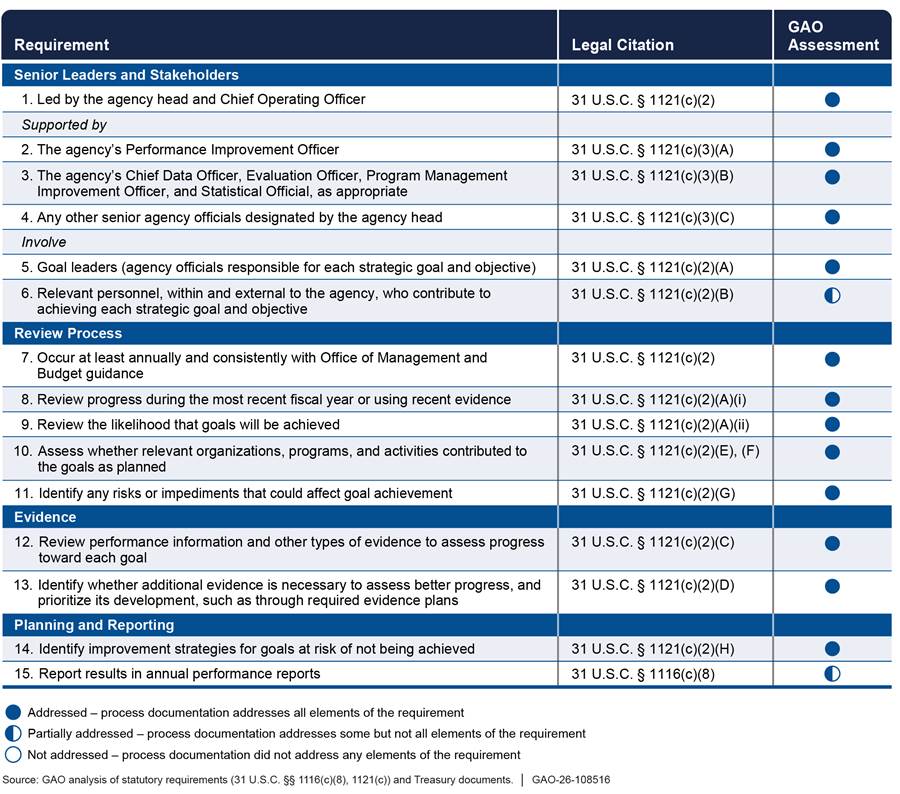
Note: Key Treasury documents we reviewed include the Standard Operating Procedure, Project Charter, Goal Analytical Guide, and Strategic Objective Lead Training Agenda. According to Treasury officials, some of the process documentation they provided us with was from the agency’s 2024 strategic review—the most recent review it conducted—and would be used in future reviews. Other documentation was newly prepared for Treasury’s 2026 review.
As shown in figure 7, Treasury’s process documentation fully addresses requirements related to the review process and evidence. As previously stated, meeting these requirements can help agency leadership monitor progress toward strategic goals, assess the likelihood of achieving them, and identify risks early. Addressing these requirements can also inform more evidence-based decisions about program effectiveness and progress toward strategic objectives.
Treasury’s strategic review documentation addresses most requirements related to involving senior leaders and stakeholders. However, it does not fully address the requirement to involve external personnel who contribute to achieving each strategic goal and objective. Treasury provided some documentation demonstrating how external entities, such as trade associations and financial institutions, contribute to Treasury progress on goals and objectives. But it did not describe how external personnel should be involved in the strategic review process itself. Without involving external personnel in the review process, Treasury risks missing perspectives from and opportunities to collaborate with other organizations that assist in achieving its goals and objectives. As we have previously reported, when outcomes are complex and involve multiple organizations, it is important to establish how existing collaboration mechanisms can facilitate joint data collection, analysis, and reporting.[65]
Treasury’s process documentation addresses the planning requirement to identify improvement strategies, but did not fully address the requirement to report results in annual performance reports. Treasury officials stated that the department communicates the results of strategic reviews in Treasury’s annual congressional budget justification and annual performance report. However, without documenting this requirement in process documentation, there is a risk that the results of Treasury’s strategic reviews will not be consistently reported in its annual performance report. Such reporting can enhance transparency of the results Treasury is achieving for its strategic goals and objectives.
GSA and State Have Not Taken Steps to Develop Process Documentation to Ensure Future Strategic Reviews Address All Statutory Requirements
As of March 2026, GSA and State had limited strategic review process documentation for future reviews.
GSA. As of March 2026, GSA did not have detailed process documentation for its strategic reviews. In response to our request for such materials in September 2025, GSA provided its overall performance management policy, a six-page document that addresses a range of activities related to implementing Government Performance and Results Act of 1993 requirements and related OMB guidance. The policy focuses on the responsibilities of GSA officials in conducting performance management activities, and only mentions strategic reviews as part of the Performance Improvement Officer’s responsibilities. In addition, GSA’s performance management policy, established in December 2023, predates the enactment of FAPA and therefore does not address new requirements for strategic reviews. GSA officials stated that the agency relies on OMB guidance for conducting its strategic reviews. Because OMB’s guidance is incomplete, GSA’s planned strategic reviews in 2026 are at risk of not addressing all statutorily required elements.
State. As of June 2026, State had not provided timeframes or milestones for updating its guidance to align with new statutory requirements. In February 2026, State officials stated that they develop new strategic review procedures each year and had not updated the agency’s strategic review process documentation to reflect FAPA requirements.[66] As noted earlier, State published a new strategic plan in January 2026. In June 2026, officials informed us that the department was implementing the plan. However, as described earlier, State had not yet determined the scope or structure of its 2026 strategic review.
Agencies are responsible for ensuring they address relevant statutory requirements. Without fully documented processes, GSA and State risk conducting strategic reviews that do not fully address statutory requirements, including that they occur annually. We have previously identified that establishing and documenting a review process—including related policies, procedures, and guidance—supports effective strategic reviews.[67] Without sufficient documentation to guide their process, strategic reviews may not provide decision-makers with a comprehensive, evidence-based assessment of progress toward strategic objectives, identify crosscutting risks, or inform timely corrective actions.
Conclusions
The federal government seeks to achieve results in numerous crosscutting areas. However, our work continues to identify challenges the federal government faces in effectively working across agency boundaries, levels of government, and different sectors to make progress. Effective implementation of FAPA’s new statutory requirements—for both OMB and agencies—could help address these challenges and ensure meaningful progress is made towards crosscutting goals.
However, OMB and the four selected agencies have not fully implemented all requirements. Addressing our past recommendations related to cross-agency priority goals and Performance.gov could help ensure OMB effectively addresses related requirements. In addition, revising its guidance to fully reflect FAPA’s new statutory requirements would help ensure that agencies are aware of and understand congressional expectations for conducting their annual strategic reviews.
Even without comprehensive guidance from OMB, agencies are responsible for ensuring they address relevant statutory requirements. DHS, Treasury, and GSA have plans and time frames for conducting strategic reviews in 2026 as required, but State does not. In addition, fully developing their own documentation—such as policies, procedures, and guidance—for their strategic review processes would help all four agencies ensure that they consistently address all requirements.
Recommendations for Executive Action
We are making a total of seven recommendations, including two recommendations each to OMB and State, and one recommendation each to DHS, Treasury, and GSA. Specifically:
The Director of OMB should revise its guidance for agency strategic reviews to fully address all statutory requirements related to senior leaders and stakeholders. (Recommendation 1)
The Director of OMB should revise its guidance for agency strategic reviews to fully address the statutory requirement for agencies to annually report on results. (Recommendation 2)
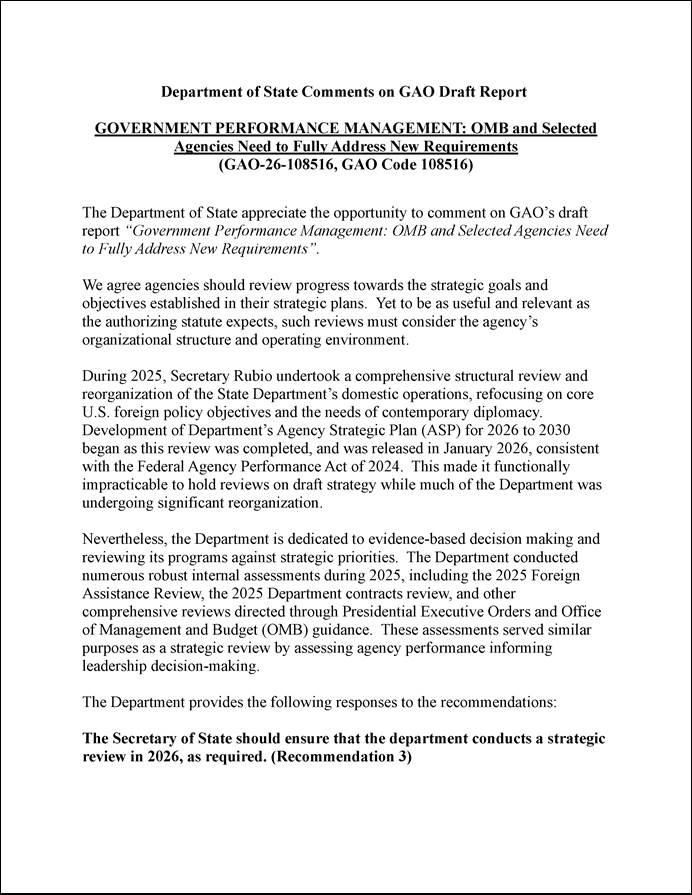
The Secretary of State should ensure that the department conducts a strategic review in 2026, as required. (Recommendation 3)
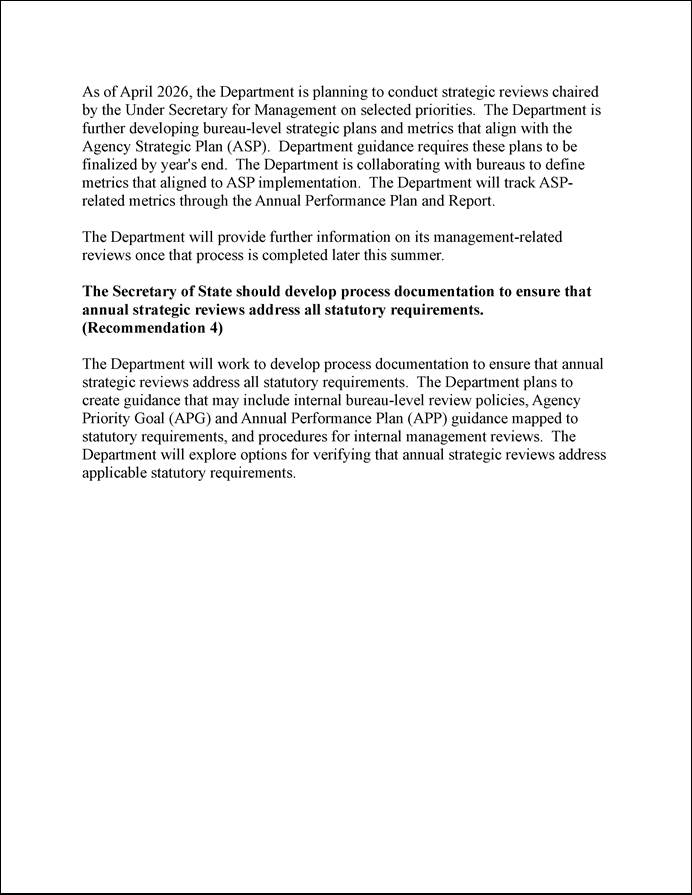
The Secretary of State should develop process documentation to ensure that annual strategic reviews address all statutory requirements. (Recommendation 4)
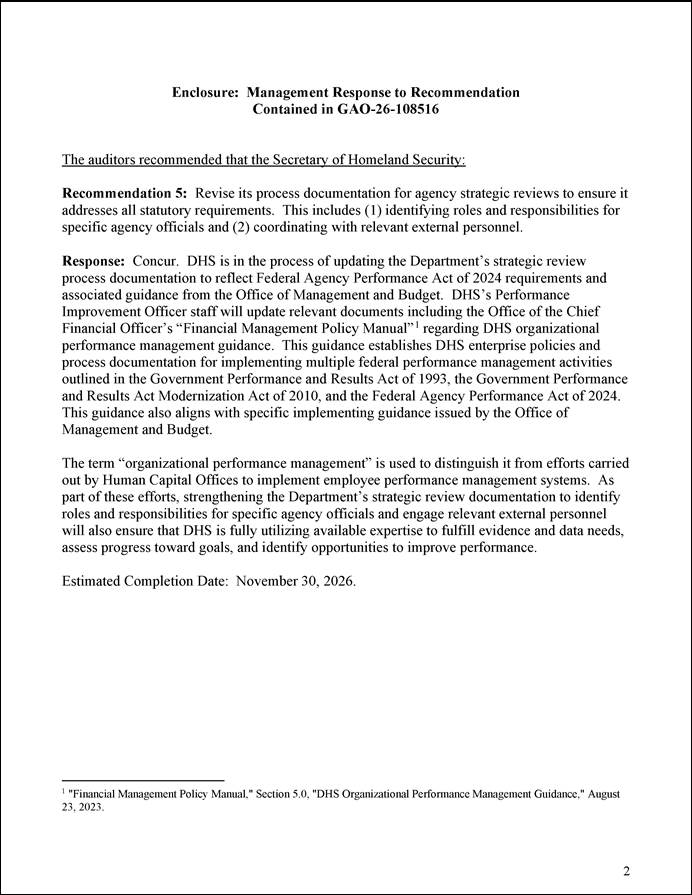
The Secretary of Homeland Security should revise its process documentation for agency strategic reviews to ensure it addresses all statutory requirements. This includes (1) identifying roles and responsibilities for specific agency officials, and (2) coordinating with relevant external personnel. (Recommendation 5)
The Secretary of the Treasury should revise its process documentation for agency strategic reviews to ensure it addresses all statutory requirements. This includes (1) coordinating with relevant external personnel, and (2) reporting results in an annual performance report. (Recommendation 6)
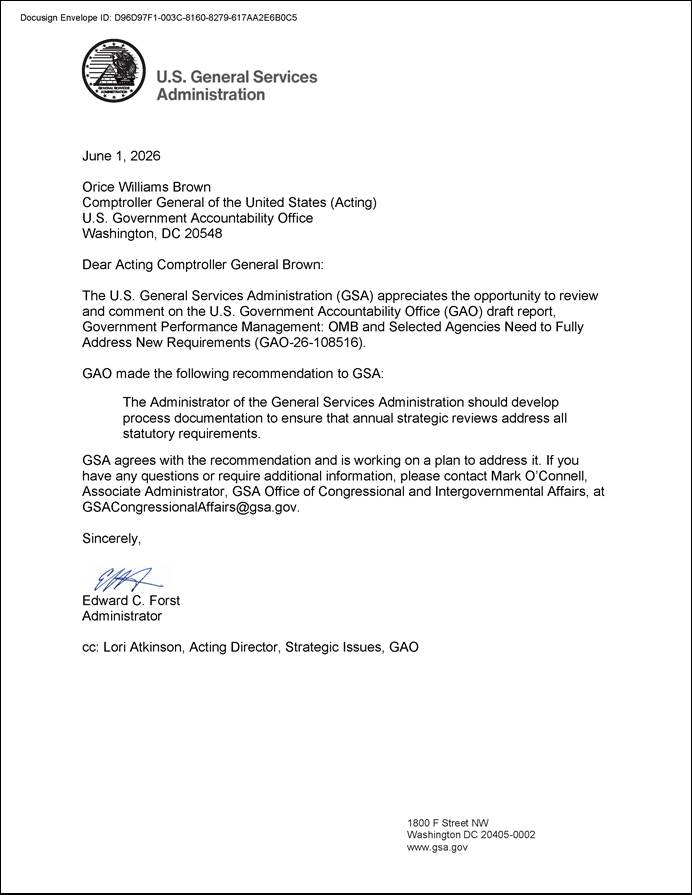
The Administrator of the General Services Administration should develop process documentation to ensure that annual strategic reviews address all statutory requirements. (Recommendation 7)
Agency Comments
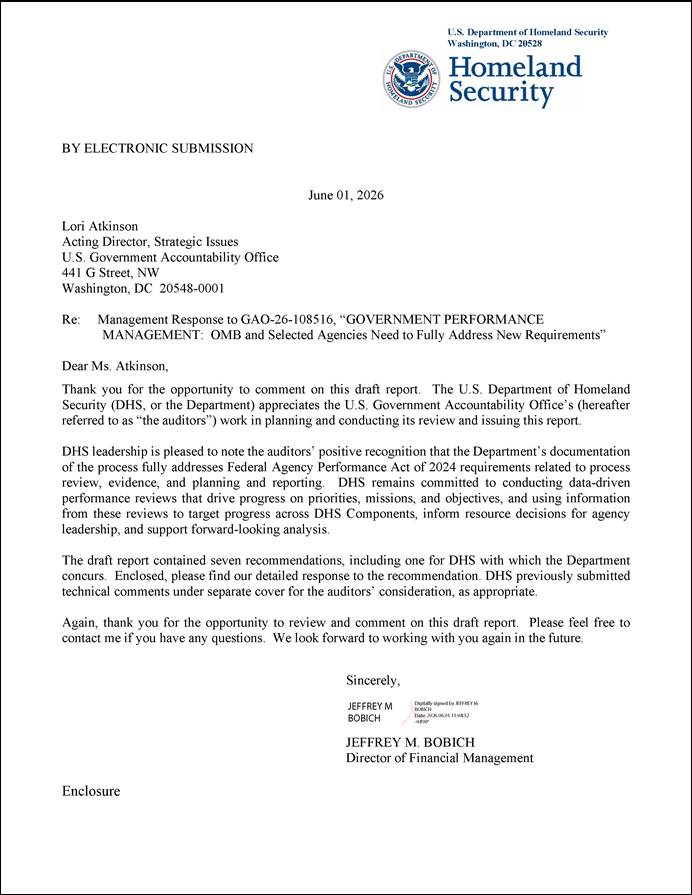
We provided a draft of this report to OMB, DHS, State, Treasury, and GSA for review and comment. OMB did not provide comments on the report. DHS, State, Treasury, and GSA provided comments in which they agreed with our recommendations. Each described actions it was taking to implement relevant statutory requirements. DHS, State, and GSA provided written comments, which are reprinted in appendixes I, II, and III, respectively. Treasury provided comments via email. In addition, State provided technical comments, which we incorporated as appropriate.
We are sending copies of this report to appropriate congressional committees, the Director of OMB, the Secretaries of Homeland Security, State, and the Treasury, the Administrator of GSA, and other interested parties. This report will also be available at no charge on the GAO website at https://www.gao.gov. If you or your staff have any questions about this report, please contact Lori Atkinson at AtkinsonL@gao.gov. Contact points for our Offices of Congressional Relations and Media Relations may be found on the last page of our report. Key contributors to this report are listed in appendix IV.

Lori Atkinson
Acting Director, Strategic Issues
List of Committees
The Honorable Rand Paul, M.D.
Chairman
The Honorable Gary C. Peters
Ranking Member
Committee on Homeland Security and Governmental Affairs
United States Senate
The Honorable James Lankford
Chairman
The Honorable John Fetterman
Ranking Member
Subcommittee on Border Management, Federal Workforce and
Regulatory Affairs
Committee on Homeland Security and Governmental Affairs
United States Senate
The Honorable James Comer
Chairman
The Honorable Robert Garcia
Ranking Member
Committee on Oversight and Government Reform
House of Representatives
The Honorable Pete Sessions
Chairman
The Honorable Kweisi Mfume
Ranking Member
Subcommittee on Government Operations
Committee on Oversight and Government Reform
House of Representatives
GAO Contact
Lori Atkinson at AtkinsonL@gao.gov
Staff Acknowledgments
In addition to the above contact, Benjamin T. Licht (Assistant Director), Shelby Kain (Analyst-in-Charge), Justine Augeri, Michael Bechetti, Jeff DeMarco, Amalia Konstas, Dawn G. Locke, Steven Putansu, Erik Shive, and Andrew J. Stephens made significant contributions to this report.
The Government Accountability Office, the audit, evaluation, and investigative arm of Congress, exists to support Congress in meeting its constitutional responsibilities and to help improve the performance and accountability of the federal government for the American people. GAO examines the use of public funds; evaluates federal programs and policies; and provides analyses, recommendations, and other assistance to help Congress make informed oversight, policy, and funding decisions. GAO’s commitment to good government is reflected in its core values of accountability, integrity, and reliability.
Obtaining Copies of GAO Reports and Testimony
The fastest and easiest way to obtain copies of GAO documents at no cost is through our website. Each weekday afternoon, GAO posts on its website newly released reports, testimony, and correspondence. You can also subscribe to GAO’s email updates to receive notification of newly posted products.
Order by Phone
The price of each GAO publication reflects GAO’s actual cost of production and distribution and depends on the number of pages in the publication and whether the publication is printed in color or black and white. Pricing and ordering information is posted on GAO’s website, https://www.gao.gov/ordering.htm.
Place orders by calling (202) 512-6000, toll free (866) 801-7077,
or
TDD (202) 512-2537.
Orders may be paid for using American Express, Discover Card, MasterCard, Visa, check, or money order. Call for additional information.
Connect with GAO
Connect with GAO on X,
LinkedIn, Instagram, and YouTube.
Subscribe to our Email Updates. Listen to our Podcasts.
Visit GAO on the web at https://www.gao.gov.
To Report Fraud, Waste, and Abuse in Federal Programs
Contact FraudNet:
Website: https://www.gao.gov/about/what-gao-does/fraudnet
Automated answering system: (800) 424-5454
Media Relations
Sarah Kaczmarek, Managing Director, Media@gao.gov
Congressional Relations
David A. Powner, Acting Managing Director, CongRel@gao.gov
General Inquiries
[1]Concurrent with this report, we are issuing another report focused on how the federal government can address crosscutting issues. See GAO, Government Performance Management: Insights from Subject-Matter Specialists on Addressing Crosscutting Performance Challenges, GAO‑26‑108601 (Washington, D.C.: June 23, 2026).
[2]GAO, 2026 Annual Report: Opportunities to Reduce Duplication, Overlap, and Fragmentation and Achieve an Additional One Hundred Billion Dollars or More in Future Financial Benefits, GAO‑26‑108505 (Washington, D.C.: May 12, 2026).
[3]GAO, High-Risk Series: Heightened Attention Could Save Billions More and Improve Government Efficiency and Effectiveness, GAO‑25‑107743 (Washington, D.C.: Feb. 25, 2025). At least 18 of the areas on the current High-Risk List involve coordinated efforts across agencies and other entities. For example, for one area, modernizing the complex U.S. financial regulatory system, responsibilities are fragmented among multiple regulators that have overlapping authorities.
[4]Pub. L. No. 103-62, 107 Stat. 285 (1993). GRPA was updated and expanded by the GPRA Modernization Act of 2010. Pub. L. No. 111-352, 124 Stat. 3866 (2011).
[5]Pub. L. No. 118-190, 138 Stat. 2653 (2024).
[6]In 2012, OMB established strategic reviews as part of its federal performance management guidance to agencies. Agencies began conducting strategic reviews in line with OMB’s guidance in 2014. The statutory requirement for agencies to conduct strategic reviews was established by FAPA in 2024.
[7]31 U.S.C. § 1121(c).
[8]Pub. L. No. 118-190, § 8, 138 Stat. at 2656–2657.
[9]Office of Management and Budget, Memorandum 26-03, President’s Management Agenda (Washington, D.C.: Dec. 8, 2025), and Circular No. A-11 Part 6, The Federal Performance Framework for Improving Program and Service Delivery (Washington, D.C.: August 2025). Related laws covered by this OMB guidance include the Program Management Improvement Accountability Act and the Foundations for Evidence-Based Policymaking Act of 2018. Pub. L. No. 114-264, 130 Stat. 1371 (2016); Pub. L. No. 115-435, 132 Stat. 5529 (2019).
[10]Across three reports, our work examined strategic review processes at 13 agencies: the Departments of Agriculture, Education, Health and Human Services, Homeland Security, Housing and Urban Development, Labor, State, and the Treasury, as well as the General Services Administration, Environmental Protection Agency, National Aeronautics and Space Administration, Small Business Administration, and U.S. Agency for International Development. For those reports, we selected the 13 agencies based on experience with evidence-based approaches for reviewing agency performance, strategic review processes that addressed areas of fragmentation, overlap, and duplication, and high-risk issues identified in our past work, and variation in use of performance information as reported in a past survey. See GAO, Evidence-Based Policymaking: Selected Agencies Coordinate Activities, but Could Enhance Collaboration, GAO‑20‑119 (Washington, D.C.: Dec. 4, 2019); Managing for Results: Selected Agencies’ Experiences in Implementing Strategic Reviews, GAO‑17‑740R (Washington, D.C.: Sept. 7, 2017); and Managing for Results: Practices for Effective Agency Strategic Reviews, GAO‑15‑602 (Washington, D.C.: July 29, 2015).
[11]Pub. L. No. 118-190, § 2–5, 138 Stat. at 2653–2656, codified at 31 U.S.C. §§ 1115(a)(3), 1116(c)(8), 1120(a)(2), 1121(c), 1122(a)(2), (b)(6), (c)(5). GPRAMA enhanced GPRA to create a more integrated and crosscutting performance management framework to better address long-standing federal performance challenges and to provide greater accountability for results. The framework includes cross-agency priority goals, annual performance plans, quarterly performance reviews, and a website for reporting performance information.
[12]31 U.S.C. § 1120(a).
[13]31 U.S.C. § 1120(b).
[14]Pub. L. No. 111-352, § 5, 124 Stat. at 3873–3874. In its report accompanying the legislation, the Senate Committee on Homeland Security and Governmental Affairs stated that it expected many of the CAP goals to stay constant over time, including across administrations, since the challenges are not likely to be overcome during a 4-year period. S. Rep. No. 111-372, at 8 (2010).
[15]Pub. L. No. 111-352, § 3, 124 Stat. at 3868.
[16]See, for example, GAO, Government Performance Management: Actions Needed to Improve Transparency of Cross-Agency Priority Goals, GAO‑23‑106354 (Washington, D.C.: Apr. 4, 2023); Managing for Results: Government-Wide Actions Needed to Improve Agencies’ Use of Performance Information in Decision-Making, GAO‑18‑609SP (Washington, D.C.: Sept. 5, 2018); Managing for Results: OMB Improved Implementation of Cross-Agency Priority Goals, But Could Be More Transparent About Measuring Progress, GAO‑16‑509 (Washington, D.C.: May 20, 2016); Managing for Results: OMB Should Strengthen Reviews of Cross-Agency Goals, GAO‑14‑526 (Washington, D.C: June 10, 2014); Managing For Results: Executive Branch Should More Fully Implement the GPRA Modernization Act to Address Pressing Governance Challenges, GAO‑13‑518 (Washington, D.C: June 26, 2013); and Managing for Results: GAO’s Work Related to the Interim Crosscutting Priority Goals under the GPRA Modernization Act, GAO‑12‑620R (Washington, D.C.: May 31, 2012).
[17]For more information, see GAO, Government Performance Management: Implementing GAO’s Recommendations Would Help OMB Address Crosscutting Challenges, GAO‑25‑108008 (Washington, D.C.: Sept. 30, 2025). Appendix I in that report provides information about our past CAP goal recommendations.
[19]GAO, Government Performance Management: Key Considerations for Implementing Cross-Agency Priority Goals and Progress Addressing GAO Recommendations, GAO‑21‑104704 (Washington, D.C.: Sept. 28, 2021).
[20]31 U.S.C. § 1120(a)(2)(A), (B).
[21]31 U.S.C. § 1120(a)(2)(C), (D).
[22]31 U.S.C. § 1115(a)(3).
[23]31 U.S.C. § 1122(c)(5)(B).
[24]31 U.S.C. § 1122.
[25]For example, see GAO, Performance.gov: Long-Term Strategy Needed to Improve Website Usability, GAO‑16‑693 (Washington, D.C.: Aug. 30, 2016); and Managing for Results: Leading Practices Should Guide the Continued Development of Performance.gov, GAO‑13‑517 (Washington, D.C.: June 6, 2013).
[27]31 U.S.C. § 1122(a)(4).
[28]31 U.S.C. § 1122(a)(2)(E). The 21st Century Integrated Digital Experience Act requires federal websites to be designed around user needs by, among other things, using qualitative and quantitative data to determine user goals, needs, and behaviors. Pub. L. No. 1115-336, 132 Stat. 5025 (2018), codified at 44 U.S.C. § 3501 note. These data could include metrics that we previously recommended that OMB and GSA track for Performance.gov. See GAO‑13‑517.
[29]31 U.S.C. § 1122(c)(5)(B). In April 2023, we found that OMB did not consistently report quarterly progress toward achieving CAP goals as required by GPRAMA. More consistent public reporting could provide greater transparency and allow for reporting on final progress achieved at the end of a goal period. Such final reporting would help ensure continuity between CAP goal cycles. This reporting would also provide information on progress toward addressing long-standing federal management challenges and high-risk areas. We recommended that OMB develop guidance to ensure that the progress toward implementing the most recent CAP goals was publicly reported at the end of each 4-year goal period. We closed this recommendation as implemented, based on new statutory requirements in FAPA. See GAO, Government Performance Management: Actions Needed to Improve Transparency of Cross-Agency Priority Goals, GAO‑23‑106354 (Washington, D.C.: Apr. 4, 2023).
[30]OMB directed agencies to undertake strategic reviews starting in 2014.
[33]31 U.S.C. § 1121(c)(2).
[34]31 U.S.C. § 1121(c)(2), (3).
[35]31 U.S.C. § 1121(c)(2).
[36]31 U.S.C. § 1121(c)(2)(C), (D).
[37]31 U.S.C. §§ 1116(c)(8), 1121(c)(2)(H).
[38]Office of Management and Budget, President’s Management Agenda, Memorandum 26-03 (Washington, D.C.: Dec. 8, 2025). The President’s Management Agenda identifies an administration’s key management reform priorities and initiatives across the federal government. It also communicates and organizes goals, objectives, and implementation strategies. In addition, the President’s Management Agenda provides a management framework for identifying and implementing CAP goals. For additional information, see GAO‑23‑106354.
[39]Officials at GSA and Treasury told us that their agencies had been involved to varying extents with OMB’s efforts to develop the next set of CAP goals. In addition, GSA officials told us their agency expects to continue its role in managing regular updates to Performance.gov about CAP goal implementation and progress.
[40]The due date for CAP goals and the federal performance plan was established by GPRAMA in 2011 and was not revised by FAPA. 31 U.S.C. §§ 1115(a), 1120(a)(2).
[41]31 U.S.C. §§ 1105(a), 1120(a)(2)(B). The President’s budget for fiscal year 2027 was released on April 3, 2026.
[42]GAO, Government Performance Management: Actions Needed to Improve Transparency of Cross-Agency Priority Goals, GAO‑23‑106354 (Washington, D.C.: Apr. 4, 2023).
[43]GPRAMA includes provisions for us to periodically review implementation of the act, including CAP goals. Pub. L. No. 111-352, § 15(b)(2)(C), 124 Stat. at 3883–3884.
[44]31 U.S.C. § 1122. In addition to information on CAP goals, Performance.gov is to include (1) information on agency priority goals, including quarterly progress updates; and (2) agency strategic plans, annual performance plans, and annual performance reports, which identify an agency’s mission, strategic goals, strategic objectives, and performance goals.
[45]31 U.S.C. § 1122(a)(2)(E).
[46]Pub. L. No. 1115-336, 132 Stat. 5025 (2018), codified at 44 U.S.C. § 3501 note.
[48]OMB’s implementing partners include GSA, which assists OMB with Performance.gov’s technical platform, and the agencies that provide performance information available for publication on the website.
[49]OMB Circular No. A-11, Part 6 (August 2025).
[50]31 U.S.C. § 1116(c)(8).
[51]GAO, Standards for Internal Control in the Federal Government, GAO‑25‑107721 (Washington, D.C.: May 2025).
[52]31 U.S.C. § 1121(c)(2).
[53]Treasury officials told us that their strategic reviews are informed by OMB’s guidance, but they use additional sources to ensure they meet statutory requirements.
[54]31 U.S.C. § 1121(c)(2).
[55]Agencies are required by statute to publish their new strategic plans concurrent with the President’s budget in any year following the year in which the term of the President commences. 5 U.S.C. § 306(a). Treasury published its strategic plan for 2026-2030 in April 2026.
[56]Treasury conducted its 2024 strategic review prior to the enactment of new statutory requirements in December 2024. According to Treasury officials, the 2024 strategic review was the final review for the department’s prior strategic plan, and assessed overall progress of the goals established in that plan.
[57]We were unable to verify this statement with OMB. Officials at the other three selected agencies did not report receiving this instruction from OMB when we asked.
[58]U.S. Department of State, Agency Strategic Plan Fiscal Years 2026-2030 (January 2026).
[59]We reviewed process documentation from DHS’s 2025 strategic review—the most recent review the department completed at the time of our analysis. These documents included a progress review template, a risk register, and a learning agenda for data and evidence building, among others. In February 2026, DHS officials told us they were working to update existing documentation to address FAPA’s new requirements, but did not provide us any revised documents to review or time frames for when those revisions would be complete.
[60]31 U.S.C. § 1121(c)(2), (3).
[62]DHS officials did not provide us any revised documents to review or time frames for when those revisions would be complete.
[63]Treasury established a structured strategic review process that included a communication plan, defined roles and responsibilities, and documented lessons learned through after action assessments and a maturity model to improve future reviews. See GAO‑17‑740R.
[64]According to Treasury officials, some of the process documentation they provided us was from the agency’s 2024 strategic review—the most recent review it conducted—and would be used in future reviews. Other documentation was newly prepared for Treasury’s 2026 review.
[66]In February 2026, State provided examples of documentation used in past reviews, including from 2022 and 2023. However, we did not assess this documentation against statutory requirements because, according to State officials, the documentation would not be used in future reviews.