
Report to Congressional Requesters
United States Government Accountability Office
A report to congressional requesters
Contact: Elizabeth Repko at RepkoE@gao.gov
What GAO Found
Federal agencies disposed of over $10 billion of unneeded personal property from July 2023 through fiscal year 2025. Generally, when a federal agency determines it no longer needs an item of personal property to fulfill its mission, the agency must report the item to the General Services Administration (GSA) to be disposed of through GSA’s online Personal Property Management System (PPMS). The unneeded property reported within this study’s time frame varied across a range of characteristics, from new bandages originally worth under $1, to airplanes in usable condition originally worth over $20 million.
GAO found that about 9 percent of this property was reused, meaning it was transferred to another federal agency, donated for use by state or local governments, or was sold to the public. Certain factors may have affected whether this property was reused. For example, items with a higher original acquisition cost and those that were reported along with online photographs were more likely to be reused.
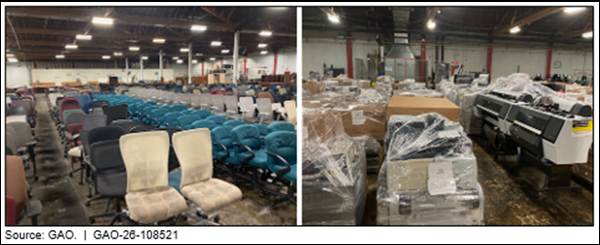
GSA has three core efforts to help agencies dispose of unneeded property but has not fully assessed their effectiveness consistent with key performance management practices. These efforts include (1) online platforms to help facilitate unneeded property disposal; (2) educational resources, such as guidance and on-demand training; and (3) direct assistance to agencies to help dispose of unneeded personal property. GSA has developed a scorecard to help measure performance, but the measures it includes are not aligned with GSA’s desired outcomes, such as timely disposals and providing a return on investment to taxpayers. The scorecard also excludes measures related to GSA’s core efforts of providing educational resources and direct assistance. Due to these gaps, GSA may not be collecting or using information that could help the agency fully assess those efforts’ effectiveness. As GSA aims to optimize the federal building portfolio, the amount of unneeded personal property is likely to grow. Assessing the effectiveness of its efforts can help GSA make decisions that improve its management of the personal property disposal process and stewardship of taxpayer dollars.
Why GAO Did This Study
GSA facilitates and manages the disposal of tens of millions of federal personal property items annually—a process that aims to reuse as much of that property as possible.
GAO was asked to review the outcomes of the federal personal property disposal process and GSA’s role in ensuring the effectiveness of the process. This report (1) examines the amount of personal property federal agencies disposed of through GSA, and the factors that may affect their reuse; and (2) evaluates the extent to which GSA has assessed the effectiveness of its property disposal efforts consistent with key performance management practices.
GAO analyzed GSA data on federal personal property disposals from July 2023—when GSA’s PPMS began—through fiscal year 2025 (the most recent data available at the time of GAO’s request); reviewed GSA guidance documents, training materials, and outreach efforts to educate agencies on the disposal process; evaluated GSA’s performance information related to the disposal process; compared GSA’s efforts to key performance management practices; conducted interviews with GSA officials; and conducted a site visit to a GSA warehouse in Virgina.
What GAO Recommends
GAO is making two recommendations that GSA (1) develop and incorporate into its scorecard performance measures that are aligned with its core efforts and (2) identify, collect, and use the data it needs to assess the effectiveness of its personal property disposal efforts. GSA agreed with the recommendations.
Abbreviations
GSA General Services Administration
ICPM Interagency Committee on Property Management
PPMS Personal Property Management System
USE IT Act Utilizing Space Efficiently and Improving Technologies Act
This is a work of the U.S. government and is not subject to copyright protection in the United States. The published product may be reproduced and distributed in its entirety without further permission from GAO. However, because this work may contain copyrighted images or other material, permission from the copyright holder may be necessary if you wish to reproduce this material separately.
September 16, 2026
The Honorable Gary C. Peters
Ranking Member
Committee on Homeland Security and Governmental Affairs
United States Senate
The Honorable James Lankford
Chairman
Subcommittee on Border Management, Federal Workforce and Regulatory Affairs
Committee on Homeland Security and Governmental Affairs
United States Senate
Each year, federal agencies dispose of hundreds of millions of dollars in personal property that they determine is excess or is no longer needed. Personal property is any government property except real property, government records, and certain naval vessels, and consists of millions of items ranging from common ones—such as office supplies, nuts and bolts, and food—to specialized industrial equipment, medical supplies, and airplanes. While in some cases, agencies’ unneeded personal property is in poor condition or obsolete, many items are new or in good working order. Because the federal government invests taxpayer funds when an agency first purchases this personal property, it promotes reuse by other federal agencies to minimize new procurement costs, as well as by non-federal entities to maximize the property’s public benefit. As the federal government prioritizes optimizing its physical footprint through office closures and consolidation, the amount of unneeded personal property will likely grow, increasing the importance of ensuring the effectiveness of the overall disposal process.[1]
Federal statute requires executive branch agencies to maintain up-to-date inventories of their personal property and promptly report to the General Services Administration (GSA) the personal property they no longer require to meet their needs.[2] Additionally, agencies seeking to acquire personal property must, “as far as practicable,” obtain for reuse personal property that is unneeded by other agencies instead of purchasing new personal property.[3] GSA facilitates and manages the general personal property disposal process for federal agencies.[4] One way it does so is by maintaining an electronic platform—the Personal Property Management System (PPMS)—where agencies can report their unneeded personal property and other federal agencies and eligible entities can obtain that personal property. This system helps to manage the disposal process through which personal property can be transferred or donated from one entity to another, among other outcomes.
You asked us to review the outcomes of the federal personal property disposal process and GSA’s role in ensuring the effectiveness of the process. This report (1) examines the amount of personal property federal agencies have disposed of through GSA, and the factors that may affect the reuse of unneeded personal property; and (2) evaluates the extent to which GSA has assessed the effectiveness of its efforts to manage the disposal of unneeded personal property consistent with key performance management practices.
To examine the amount of personal property federal agencies disposed of through GSA, and the factors that may affect the reuse of unneeded personal property, we analyzed record-level data from PPMS on all personal property that agencies reported to GSA from July 2023—when PPMS first became operational—through fiscal year 2025, the most recent data available at the time of our request.[5] We analyzed the data to determine the disposal outcomes of that property—that is, whether it was transferred, donated, sold, or abandoned or destroyed—and property characteristics, such as its condition and original acquisition cost, the type of personal property, and which agencies reported the personal property.[6] We limited our analysis to include only PPMS records of personal property that agencies disposed of through the typical disposal process, and we excluded records that were still in the disposal process at the time of our analysis and those where the owning agency withdrew the personal property listing.[7]
To identify the factors that may affect whether unneeded personal property is reused (i.e., transferred, donated, or sold), we reviewed prior GAO work, GSA training and guidance documents, and interviewed knowledgeable GSA officials. We also analyzed PPMS data to determine whether some of the identified factors were supported by the data. We evaluated the completeness of these data (i.e., whether specific fields in PPMS included required information) and determined that the data were sufficiently reliable for the purposes of describing the amount and disposal outcomes of personal property disposed of by agencies.
To describe GSA’s efforts to manage the disposal of unneeded personal property, we reviewed statutes and regulations related to GSA and its role in the disposal process. Additionally, we reviewed guidance documents the agency developed on the disposal process, including how the process works, user guides for how to report and acquire personal property, and guidance for various stakeholders with a role in the disposal process, such as agency property management officials. We attended virtual GSA trainings and reviewed training materials offered to federal agencies on the disposal process, as well as corresponding training materials and post-training surveys. We also reviewed other relevant GSA documentation, including reports that summarized data on various aspects of the disposal process and information from the agency’s presentations at a federal interagency group related to personal property management. We also interviewed GSA officials that manage the disposal process and visited GSA’s personal property warehouse in Springfield, Virginia.
To examine the extent to which GSA has assessed the effectiveness of its disposal efforts, we reviewed the agency’s budget documents, strategic plans, performance scorecards, and reports that summarized personal property disposal data. We also interviewed GSA officials involved in managing the disposal process about the types of performance information they collect, how they use that information, and the goals of the disposal process, among other related topics. We compared the information we collected against the three key performance management practices developed in our prior work: (1) set goals to identify the desired outcomes organizations seek to achieve, (2) collect performance information to measure progress, and (3) use that information to assess results and inform decisions to ensure further progress towards achieving those goals.[8] For the analysis, we used a three-point scale to determine whether GSA’s efforts generally aligned, partially aligned, or were not aligned with the key practices. For the key practices where evidence of GSA efforts reflected elements of the practice to a large or full extent, we determined the efforts generally aligned with the key practice. For those key practices where evidence of GSA efforts reflected some, but not all, elements of the practice, we determined the efforts partially aligned with the key practice. For those key practices where evidence demonstrated that GSA efforts did not reflect, or minimally reflected, elements of the practice, we determined the efforts were not aligned with the key practice.
We conducted this performance audit from May 2025 to September 2026 in accordance with generally accepted government auditing standards. Those standards require that we plan and perform the audit to obtain sufficient, appropriate evidence to provide a reasonable basis for our findings and conclusions based on our audit objectives. We believe that the evidence obtained provides a reasonable basis for our findings and conclusions based on our audit objectives.
Background
When agencies have internally screened their personal property and determined that it is no longer needed—the first step in the disposal process—they are generally required to promptly report it to GSA and then dispose of it in accordance with the disposal process set forth in federal regulations.[9] While agencies are ultimately responsible for disposing of their unneeded personal property, GSA’s role is to facilitate and manage the disposal process.
Two GSA offices share the role of facilitating and managing the disposal process. The Office of Governmentwide Policy develops policies, publishes guidance, and provides information on best practices in federal property management. This office also chairs the Interagency Committee on Property Management (ICPM), which is composed of officials from federal agencies that manage personal property. ICPM promotes the efficient and economical use of personal property and sound government-wide personal property policies. The second office, the Office of Personal Property Management, helps federal agencies dispose of unneeded personal property. At the same time, it helps other federal agencies, state, local, and public organizations, and other eligible entities acquire these items.[10]
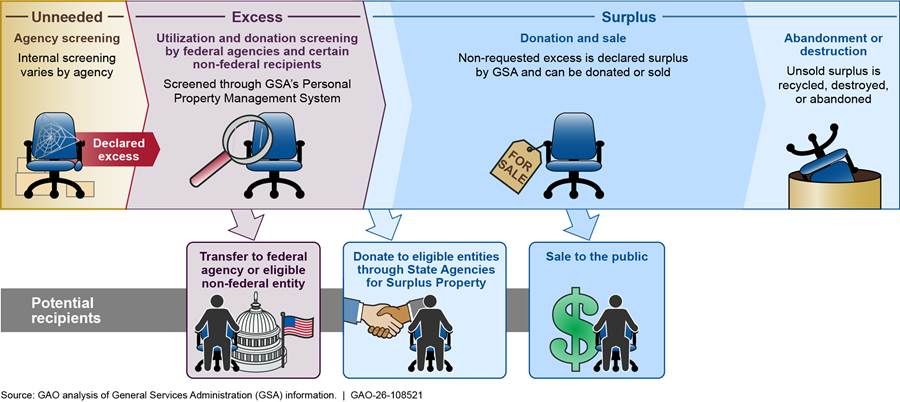
Federal agencies use GSA’s PPMS to report unneeded personal property.[11] Among the information agencies must include in the reporting system are various characteristics of the unneeded personal property, including its condition and the original acquisition cost. Once personal property is reported to PPMS, there are generally four typically sequential, potential personal property disposal steps (see fig. 1). According to GSA, as of March 2026, this process takes, on average, about 44 days.
· Transfer. Unneeded personal property is first made available to be transferred to other federal agencies, typically at no cost other than shipping and transportation.[12]
· Donation. If no federal agencies request the personal property for transfer, the personal property generally may be donated to eligible entities through State Agencies for Surplus Property, which acquire property for prospective donees.[13] These state agencies can view and make requests for available personal property in PPMS.
· Sale. Personal property not donated may then move to the next step of the process, in which typically, personal property listings are posted on GSAAuctions.gov to be sold to the public.[14]
· Abandonment or destruction. If personal property is not sold, the agency that owns the personal property may then abandon or destroy the personal property.[15] Abandonment or destruction of federal personal property can include recycling, crushing, or sending to a landfill.
Agencies Disposed of Millions of Items Through GSA, with Factors Like Cost Affecting Reuse
Agencies Disposed of Over 48 Million Personal Property Items
According to our analysis of GSA’s data, from July 2023 through fiscal year 2025,[16] federal agencies disposed of more than 48 million unneeded personal property items across over 880,000 listings in PPMS.[17] The total original acquisition cost of these items, as reported by agencies, amounted to over $10 billion.[18]
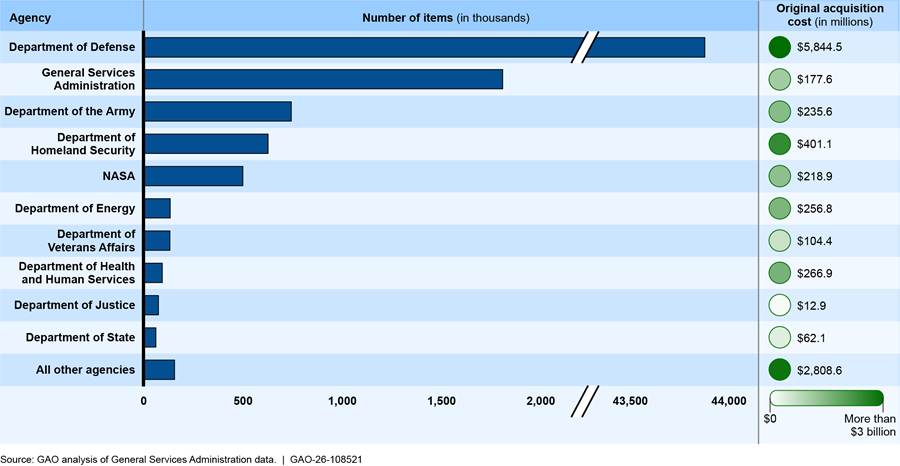
Over 190 federal bureaus—within 53 different agencies—disposed of at least one personal property item during this time period. Among these agencies, the Department of Defense disposed of the vast majority of personal property items, accounting for about 91 percent of all disposed personal property and about 56 percent (or over $5.8 billion) of the total original acquisition cost of all disposed personal property. Figure 2 provides additional details about agencies’ personal property disposals.
Figure 2: Top 10 Agencies by Number of Disposed Personal Property Items with Original Acquisition Cost, July 2023-Sept. 2025
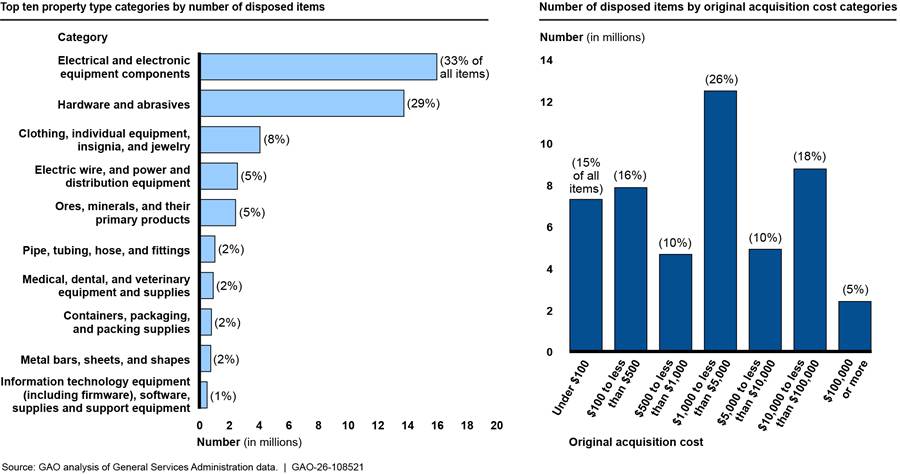
Agencies disposed of a wide range of personal property: from small, low value items, such as tape and bandages with estimated original acquisition costs of under $1, to large, high value items, such as airplanes with estimated original acquisitions costs greater than $20 million. Our analysis of GSA data found that nearly 60 percent of all disposed personal property had an original acquisition cost of $1,000 or more—about a third of which originally cost $10,000 or more (about 23 percent of all disposed personal property). Most disposed items fell into a few broad categories, with electrical and electronic equipment and hardware and abrasives (e.g., sandpaper, polishing compounds) comprising about 62 percent of all disposed personal property (see fig. 3).[19]
Our data analysis showed that most personal property, as reported by agencies, was in new or usable condition. As previously noted, agencies must indicate the condition of unneeded personal property when reporting it to GSA, choosing among the following five options:
· new/unused: personal property in new or unused condition that can be used immediately without modifications;
· usable: personal property that shows some wear but can be used without significant repair;
· repairable: personal property that is unusable in its current condition but can be economically repaired;
· salvageable: personal property with value more than its basic material content, but repair or rehabilitation is impractical and/or uneconomical; and
· scrap: personal property that has no value except its basic material content.
Roughly 56 percent of personal property was reported as new/unused, and 25 percent was reported as usable. The remaining personal property was reported in repairable condition (16 percent), scrap condition (about 3 percent), and salvageable condition (less than 1 percent).[20] Although personal property in new/unused condition accounted for the majority of the total quantity of reported unneeded personal property, these items accounted for only 16 percent of the total original acquisition cost of all reported unneeded personal property. According to GSA officials, this is because many of the items reported as new/unused are consumable items of lower value, such as clothing, food and disposable food service items, and office supplies, among others.
Cost and Other Factors May Affect Whether Unneeded Personal Property Is Reused
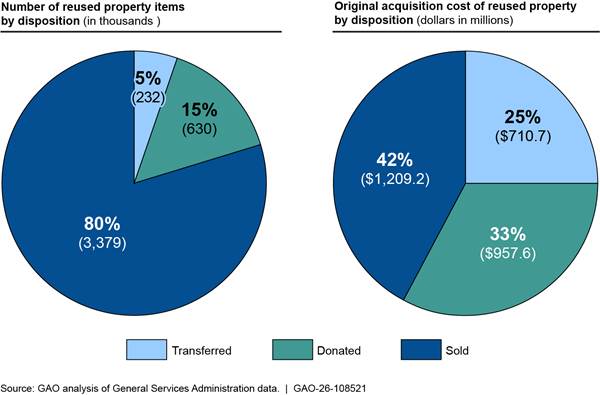
Of the over 48 million disposed items in our selected time frame, about 9 percent, or more than 4.2 million items, were reused—that is, transferred, donated, or sold (see fig. 4).[21] The total estimated original acquisition cost of this reused personal property amounted to over $2.8 billion, or about 28 percent of the original acquisition cost of all disposed personal property.[22]
Figure 4: Percent of Reused Personal Property Items and Their Original Acquisition Cost by Disposition, July 2023-Sept. 2025
Through our review of GSA documents, our prior work, and interviews with GSA officials, we identified various factors that may affect whether unneeded personal property is reused.[23] As discussed below, the original acquisition cost and inclusion of photographs in personal property listings are among the factors we identified.
Original Acquisition Cost. As noted above, our analysis found that the quantity of reused personal property items accounted for about 9 percent of all disposed personal property. However, the original acquisition cost of these items accounted for 28 percent of the value of all disposed personal property. The disproportionate share by value suggests that personal property of greater value may be more likely to be reused.
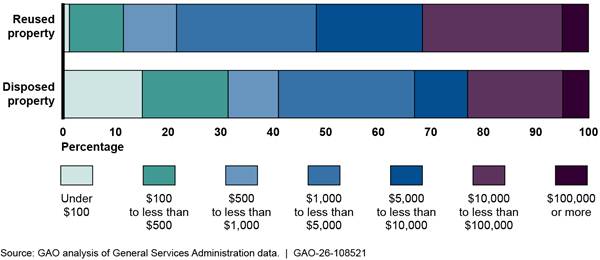
Our analysis found that about 52 percent of all reused personal property originally cost $5,000 or more, while such personal property accounted for about 33 percent of all disposed personal property. At the other end of the original acquisition cost spectrum, we found that about 22 percent of all reused personal property originally cost less than $1,000, though such personal property accounted for about 41 percent of all disposed personal property (see fig. 5).
Figure 5: Proportion of All Personal Property Reported for Disposal and Reused Personal Property, by Original Acquisition Cost, July 2023-Sept. 2025
Listing photographs. Our data analysis appears to support the emphasis GSA has placed on including photographs of personal property items in PPMS listings to increase the likelihood they are reused. For example, GSA’s Property Custodian Guide states that photographs and detailed descriptions “should be provided…to encourage selection at the [transfer], donation, and sales stages.” The presentation slides that accompanied a training on “Reporting Excess Personal Property” stated that inclusion of photographs and sufficient item descriptions can save agencies time by shortening screening times and reducing inquiries about listed personal property and can increase sales proceeds.
Our analysis of PPMS data found that 12 percent of all personal property listings in our time frame (about 110,000 listings) included a photograph. However, about 46 percent of all listings that included a photograph had at least one item reused, while only 8 percent of listings without a photograph included at least one item that was reused. According to GSA officials, agencies may have resource or system limitations that may prevent them from submitting photographs when reporting unneeded personal property.
Although GSA requires agencies to report other important information in their unneeded personal property listings, such as property condition, GSA does not require agencies to include a photograph in their listings. Officials said that requiring agencies to include photographs in their listings could lead to agencies choosing to abandon or destroy property rather than report it to PPMS because of the additional resources it could take to include photographs. GSA officials said that because of this, they focus on training and encouraging agencies to submit photographs and on making the photograph upload process easier.
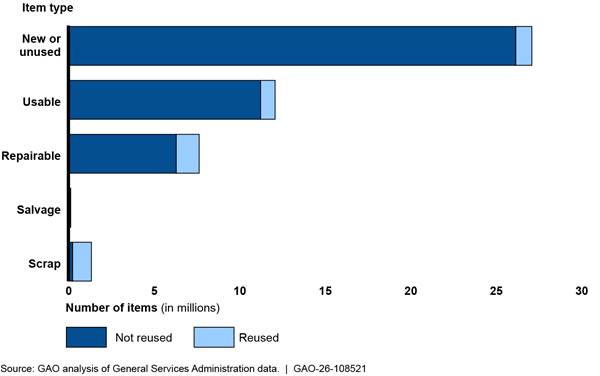
Condition. According to our analysis of GSA’s data and our prior work, property condition affects how unneeded personal property is reused. Overall, our analysis of GSA’s data found that out of all reused personal property, about 32 percent was in repairable condition, 26 percent was in scrap condition, about 22 percent was in new/unused condition, and 20 percent was in usable condition (less than 1 percent was in salvageable condition).[24] Personal property in repairable and scrap condition had the highest percentage of reuse. For instance, of all disposed personal property in repairable condition, nearly 18 percent was reused, and of all disposed personal property in scrap condition, about 84 percent was reused (see fig. 6).
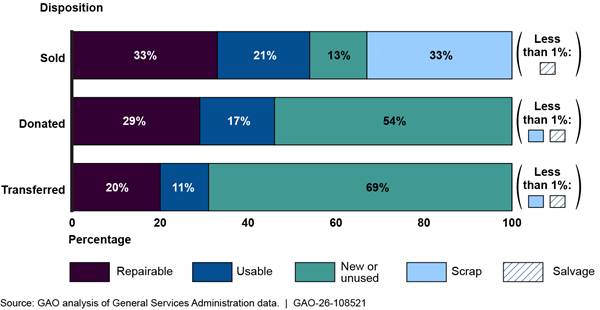
A further analysis of these reused items of personal property suggests that personal property in better condition tends to be relatively more desirable in the earlier stages (i.e., transfer and donation) of the disposal process. For example, we found that about 69 percent of personal property that was transferred to another federal agency was in new condition, followed by 54 percent of personal property that was donated, and 13 percent of personal property that was sold. As discussed above, a high proportion of personal property in repairable or scrap condition was reused. We also found that most of the personal property that is sold at auction is in repairable or scrap condition, each making up about 33 percent of personal property sold (see fig. 7). The vast majority of this personal property was various types of “scrap” metals (e.g., iron, steel, aluminum), wires, and lead acid batteries.
Figure 7: Percentage of Reused Personal Property Items by Condition and Disposal Outcome, July 2023-Sept. 2025
GSA Has Not Fully Assessed the Effectiveness of Its Property Disposal Efforts
GSA Provides Resources and Direct Assistance to Facilitate Agencies’ Disposal Efforts
GSA has three core efforts to help agencies dispose of unneeded property, including the creation of online platforms for property disposal, development of educational resources related to those platforms and the overall disposal process, and the provision of direct assistance to federal agencies.
Online platforms. GSA developed and maintains the two online platforms used to facilitate the disposal of unneeded property, PPMS and GSA Auctions. GSA created PPMS in 2023 to consolidate a few separate property management systems and improve the disposal process. In 2023, ICPM reported that the transition to PPMS will make it easier to upload and edit photos, search for unneeded property by location or state, and enable users to be automatically notified of newly reported unneeded property that meets their agency’s needs. GSA also developed and manages GSAAuctions.gov, the platform agencies use to sell their unneeded property to the public that could not first be transferred or donated to eligible entities.
Educational resources. GSA produces a variety of educational resources to help agencies understand the disposal process and navigate the PPMS and GSAAuctions.gov platforms. For example, GSA has published guidance documents on its website that provide an overview of the personal property disposal process, including comprehensive information about the procedures agencies should follow. It has also published guidance to assist those with roles in the disposal process, including national utilization officers at agencies, property custodians, and agency officials responsible for approving transfers and donations. Furthermore, GSA produces numerous user guides, fact sheets, and checklists for those looking to dispose of or acquire unneeded property. Other resources it has developed include a series of on-demand online training courses on specific topics, such as how to report unneeded property, search for reported property, and upload photographs of property into PPMS.
Direct assistance to agencies. During our review period, GSA conducted live, online training courses on various disposal topics, such as the overall disposal process, disposal options for agencies preparing to relocate, and how to use certain property disposal authorities (e.g., abandonment and destruction authority). GSA also has field representatives who work with agency officials in their assigned geographic areas to dispose of unneeded property. These representatives assist with onsite screening and inspecting unneeded property and work to expedite property disposal resulting from agency renovations, relocations, or space reductions. For example, for agencies with unneeded property located in the greater Washington, D.C. area, GSA offers to store and take full accountability of the property for a fee and will handle all the details of the disposal process. As previously mentioned, GSA chairs ICPM, where it periodically shares updates about its efforts and facilitates information sharing with the officials at member agencies responsible for property disposal. For example, in 2026, GSA provided a statistical overview of property disposals in fiscal year 2025, PPMS technical updates, and future PPMS enhancements to increase efficiency. It also presented a new artificial intelligence tool that it says will dramatically reduce the time that GSA sales contracting officers spend on developing descriptions of unneeded property.
GSA Has Not Fully Assessed the Effectiveness of Its Efforts
While GSA has several efforts in place to assist agencies in disposing of unneeded personal property, it has not fully assessed the effectiveness of these efforts. Assessing the effectiveness of its efforts consistent with three key performance management practices can help GSA make decisions that improve its results. Those practices, identified in our prior work and summarized below, provide a framework to help federal leaders and employees build and use evidence to assess their efforts.[25]
· Define desired outcomes. High-performing organizations establish long-term strategic goals and related objectives to set a general direction for their efforts. Additionally, such organizations establish one or more performance goals—including a quantitative target and time frame against which performance can be measured—to define the expected near-term results. These performance goals and measures should be clearly aligned with outcomes and cover the organization’s core efforts. Doing so can reinforce the connection between the long-term strategic goals and the day-to-day (i.e., core) efforts of managers and staff.
· Collect performance information. High-performing organizations identify and collect performance information that allows them to connect core efforts to strategic goals and determine the need for additional information.
· Use performance information. High-performing organizations have mechanisms in place to use the performance information they collect to assess their progress toward goals (i.e., comparing results to planned targets) and to inform management decisions.
With respect to each of the three performance management practices, we used a three-point scale to determine whether GSA’s efforts generally aligned, partially aligned, or were not aligned with the key practices.
Define Desired Outcomes
GSA’s efforts to define desired outcomes partially align with key performance management practices. According to GSA officials, the desired outcomes for the Office of Personal Property Management’s disposal efforts are captured in the office’s mission statement. Specifically, the office’s mission is “to provide the services, expertise, and tools that will ensure the timely, effective, and efficient disposition of the federal government’s personal property assets, yielding the greatest return on investment to the taxpayer.”
The Office of Personal Property Management has developed a scorecard with performance measures that officials told us establishes annual goals for property disposal. The scorecard, which GSA updates monthly, tracks eight measures, seven of which have a target and a time frame (see table 1).
Table 1: GSA Personal Property Management Scorecard Performance Measures and Targets, Fiscal Year 2025
|
Performance measure |
Annual performance target |
|
Cycle time for transfer and donation |
19 days |
|
Cycle time for sale of property |
30 days |
|
Cycle time for full disposal process |
49 days |
|
Percent of disposal proceeds reimbursed to agencies |
75.0 percent |
|
Cost of goods sold as a percentage of gross sales |
55.3 percent |
|
Sales revenue |
$37,371,000 |
|
Original acquisition cost of property |
$1 billion |
|
Number of items reused |
No target |
Source: GAO analysis of General Services Administration information. | GAO‑26‑108521
GSA officials told us they do not have a target for the number of items reused because the measure is largely outside of the GSA’s control. They explained that agencies may have different ways of accounting for items and provided the following examples of how 100 unneeded chairs and 50 unneeded desks could be reported:
· 1 item of 100 chairs and 1 item of 50 desks (2 total items)
· 10 items of 10 chairs and 5 items of 10 desks (15 total items)
· 100 items of 1 chair and 50 items of one desk (150 total items)
· 1 line item of one lot of 100 chairs and 50 desks (1 total item)
While providing some information about what it hopes to achieve through its disposal process, the scorecard does not fully define GSA’s desired outcomes for its core efforts. Further, GSA has not aligned the performance measures in its scorecard with the desired outcomes cited in its mission statement. For instance, the scorecard does not indicate how these measures support GSA’s broader desired outcomes such as timely, efficient, and effective disposal or return on investment to the taxpayer. When asked, GSA officials acknowledged they had not included information that would allow clear alignment of their measures and desired outcomes on the scorecard but indicated they would be able to do so.
Further, while tracking to various outcomes of the disposal process, the performance measures on the scorecard do not cover all of GSA’s core efforts to facilitate that process. For example, the scorecard does not contain performance measures related to providing educational resources and direct assistance to customers. GSA provided us with dashboards containing three additional performance measures and fiscal year 2026 targets. These measures include:
(1) number of people trained in personal property management;
(2) average instructor rating based on training participant survey feedback; and
(3) customer satisfaction based on surveys sent to PPMS and GSAauctions.gov users. (See below for more information on these surveys.)
GSA officials told us these measures are not included on the scorecard because information about training and customer satisfaction is stored in a different system. However, they noted that it would be possible to add these measures to the scorecard and that having all the information in one place would better reflect their efforts. Officials also told us reviewing their current scorecard could allow them to consider additional performance measures that could better connect their core activities with their desired outcomes.
By aligning the performance measures and targets for its core efforts with its desired outcomes and incorporating them into its management scorecard, GSA would be better able to demonstrate the extent that the services, expertise, and tools it provides to other federal agencies contribute toward achieving timely, effective, and efficient disposals, and prudent stewardship of taxpayer dollars.
Collect Performance Information
GSA’s data collection—which officials told us comes from its property disposal platforms and customer satisfaction surveys related to its mission—partially aligns with key performance management practices. Officials told us that they collect performance information that is readily available to them; but because their performance measures are not aligned with their core efforts as mentioned above, GSA does not know whether they have identified the data it would need to assess its efforts.
GSA collects information from PPMS that may align with the measures on its scorecard, such as cycle time, original acquisition cost of disposed items, and sales information. GSA has also developed numerous dashboards and other reports based on data from PPMS that help it understand where opportunities for improvement exist. For example, among other information, these dashboards include information on auction items that received no bids, agencies that have not reported any unneeded property recently, and the number of people at each agency who have attended training.
GSA also collects data from two different types of customer satisfaction surveys. First, GSA collects data from transactional surveys that it sends to users of PPMS and GSAAuctions.gov. Once users take certain actions—for example, request an item in PPMS or win an auction on GSAAuctions.gov—the system automatically sends a user survey that asks questions about their experience with the system. Illustrative questions include the user’s overall satisfaction with the process, the ease of doing business, and the confidence with deciding to request an item based on the listing’s description and photographs. Second, GSA collects information from training courses and ICPM meeting attendees. Surveys sent to training attendees, for example, ask about whether the training met learner needs, the quality of the presenter, and the extent the learner would recommend the training to a colleague.
Because GSA officials have not aligned the performance measures in its scorecard with the agency’s desired outcomes, as mentioned above, it has not determined whether additional information is needed to assess the effectiveness of its core efforts. By identifying the information that it would need to fully assess its efforts, GSA may find that it could use data it already collects, such as information from its PPMS and training surveys, or it may find that it needs to collect additional information. By first aligning its performance measures to its core efforts on its scorecard, GSA would have the opportunity to then identify and collect the data it would need to assess its core efforts.
Use Performance Data
GSA’s use of performance data partially aligns with key performance management practices. GSA has mechanisms in place to use the data it collects to assess progress toward the goals the agency has set and inform its decision-making process. First, GSA officials told us they use PPMS cycle time data to track agency progress toward the targets GSA has developed. GSA also runs a report that identifies federal agencies that previously reported property in PPMS but have not done so recently. According to GSA officials, this report enables them to follow up with those agencies to see if they are having trouble reporting property. GSA field representatives also use data they capture to target advertisements of available unneeded property to users who have expressed interest in that type of property.
GSA also has two internal groups that meet to review data and develop action plans to make improvements to personal property disposal efforts. First, GSA’s Customer Impact Team is led by the Office of Personal Property Management and consists of staff within each of the office’s different subject areas. Team members view results from the two transactional surveys discussed above. When the team meets, members discuss patterns and identify areas causing negative customer feedback and other areas for improvement. GSA also has a Sales Advisory Board comprising sales contracting officers from GSA’s sales offices. According to GSA officials, the board provides a structured approach to conduct a variety of analytical and evaluative tasks that help ensure continuous process improvement and adequate sales expertise within the Sales Program. The board assesses sales metrics with the goal of assessing sales methodologies and evaluating sales resources and recommending at least one process or resource improvement per meeting. With these mechanisms in place, GSA is well-positioned to incorporate more outcome-oriented data collection into its decision-making processes.
However, as noted above, GSA has not assessed whether it would need to identify and collect additional data to fully assess the effectiveness of its core efforts. As such, GSA’s use of data is limited to the information it currently collects. In addition, when considering whether additional performance measures could better connect their core efforts with their desired outcomes, GSA may determine that some of the information it already collects but is not used for performance measurement could be used for that purpose.
Conclusions
GSA facilitates and manages the disposal of tens of millions of unneeded personal property items annually. As GSA continues in this role, identifying performance measures for its core efforts and aligning these efforts to its scorecard could better enable GSA to demonstrate the effectiveness of its efforts and assess the need to make any improvements. As the federal government strives to optimize its physical footprint, the amount of unneeded personal property associated with consolidated or closed offices is likely to grow. As such, it is important to ensure that GSA’s efforts and resources in managing the personal property disposal process are helping achieve prudent stewardship of taxpayer dollars.
Recommendations for Executive Action
We are making the following two recommendations to GSA:
(1) The Administrator of the General Services Administration should develop and incorporate performance measures into the Office of Personal Property Management’s scorecard that are aligned with its desired outcomes and its core personal property disposal efforts. These performance measures should include quantifiable targets and time frames. (Recommendation 1)
(2) The Administrator of the General Services Administration should identify, collect, and use performance data that GSA needs to fully assess the effectiveness of its core personal property disposal efforts. (Recommendation 2)
Agency Comments
We provided a draft of this report to GSA for review and comment. In its comments, reproduced in appendix I, GSA agreed with our recommendations and said it is working on a plan to address them. GSA also provided technical comments, which we incorporated as appropriate.
We are sending copies of this report to the appropriate congressional committees and the Administrator of the General Services Administration. In addition, the report is available at no charge on the GAO website at https://www.gao.gov.
If you or your staff have any questions about this report, please contact me at RepkoE@gao.gov. Contact points for our Offices of Congressional Relations and Media Relations may be found on the last page of this report. GAO staff who made key contributions to this report are listed in appendix II.

Elizabeth Repko
Director, Physical Infrastructure
GAO Contact
Elizabeth Repko, RepkoE@gao.gov
Staff Acknowledgements
In addition to the contact named above, Nancy Lueke (Assistant Director), Matt Rowen (Analyst in Charge), Kathleen Drennan, Delwen Jones, Grant Mallie, Terence Lam, Josh Ormond, Steve Rabinowitz, Katherine Raymond, Michael Soressi, and Elizabeth Wood made key contributions to this report.
The Government Accountability Office, the audit, evaluation, and investigative arm of Congress, exists to support Congress in meeting its constitutional responsibilities and to help improve the performance and accountability of the federal government for the American people. GAO examines the use of public funds; evaluates federal programs and policies; and provides analyses, recommendations, and other assistance to help Congress make informed oversight, policy, and funding decisions. GAO’s commitment to good government is reflected in its core values of accountability, integrity, and reliability.
Obtaining Copies of GAO Reports and Testimony
The fastest and easiest way to obtain copies of GAO documents at no cost is through our website. Each weekday afternoon, GAO posts on its website newly released reports, testimony, and correspondence. You can also subscribe to GAO’s email updates to receive notification of newly posted products.
Order by Phone
The price of each GAO publication reflects GAO’s actual cost of production and distribution and depends on the number of pages in the publication and whether the publication is printed in color or black and white. Pricing and ordering information is posted on GAO’s website, https://www.gao.gov/ordering.htm.
Place orders by calling (202) 512-6000, toll free (866) 801-7077,
or
TDD (202) 512-2537.
Orders may be paid for using American Express, Discover Card, MasterCard, Visa, check, or money order. Call for additional information.
Connect with GAO
Connect with GAO on X,
LinkedIn, Instagram, and YouTube.
Subscribe to our Email Updates. Listen to our Podcasts.
Visit GAO on the web at https://www.gao.gov.
To Report Fraud, Waste, and Abuse in Federal Programs
Contact FraudNet:
Website: https://www.gao.gov/about/what-gao-does/fraudnet
Automated answering system: (800) 424-5454
Media Relations
Sarah Kaczmarek, Managing Director, Media@gao.gov
Congressional Relations
David A. Powner, Acting Managing Director, CongRel@gao.gov
General Inquiries
[1]For example, the Utilizing Space Efficiently and Improving Technologies (USE IT) Act directs GSA and the Office of Management and Budget to take steps, such as consolidating or disposing of building space, if agencies underutilize their building space, as measured by metrics and compared to thresholds established in the statute. Pub. L. No. 118-272, § 2302, 138 Stat. 3218 (2025).
[2]40 U.S.C. § 524(a).
[3]40 U.S.C. § 524(b); see also 41 C.F.R. § 102-36.10(a).
[4]Some agencies, such as the Department of Defense, also have independent personal property disposal authority.
[5]PPMS was preceded by a system called GSAXcess that served the same purpose as PPMS. We analyzed PPMS data at the individual property listing level. For example, this could be a listing of 10 chairs sold individually, or it could be a listing of 10 chairs that are being sold as a single lot, among other options.
[6]If reported personal property is not obtained by a federal, state, or local government agency, a nonprofit organization, other eligible entity, or a member of the general public, the owning agency may dispose of the personal property through the abandon and destroy process. Abandonment and destruction are subject to provisions in 41 C.F.R. § 102-36.165-70.
[7]There are other ways that federal agencies may dispose of personal property outside the typical process, such as through the exchange/sale authority. The exchange/sale authority allows executive agencies to trade in or sell their personal property and use that credit or proceeds to help pay for new, similar personal property. This lowers the overall cost of the replacement items. See 40 U.S.C. § 503. According to GSA officials, agencies may withdraw personal property from the disposal process, typically because the agency found another use for the property. We excluded such records because the personal property items were not ultimately disposed.
[8]GAO, Evidence-Based Policymaking: Practices to Help Manage and Assess the Results of Federal Efforts, GAO‑23‑105460 (Washington, D.C.: July 12, 2023); and Executive Guide: Effectively Implementing the Government Performance and Results Act, GAO/GGD‑96‑118 (Washington, D.C., June 1, 1996).
[9]Generally, executive agencies must dispose of their personal property through GSA’s disposal process, but some also have independent authorities that allow them to directly provide specific types of property to certain non-federal recipients.
[10]Within the Office of Personal Property Management are the Utilization and Donation Program and the Sales Program. The Utilization and Donation Program promotes the efficient use and disposal of personal property through transferring it to other federal agencies or by donation to state and local or other eligible entities. When unneeded personal property cannot be disposed of through transfer or donation, the Sales Program provides services to federal agencies for the sale of unneeded personal property directly to the public.
[11]Agencies can report unneeded personal property to PPMS in three different ways: (1) enter information about the unneeded personal property directly into the online PPMS interface; (2) submit a manual “Standard Form 120: Report of Excess Personal Property” to GSA to be entered into PPMS; and (3) “batch” upload unneeded personal property records into PPMS directly from an agency’s inventory management system.
[12]In certain situations, federal agencies may acquire the personal property for authorized use by federal contractors, cooperatives, and project grantees.
[13]See 40 U.S.C. § 549. Eligible recipients of such property include state, municipal, and tribal governments and nonprofit educational or public health organizations. Public airports and the American National Red Cross may submit requests for donation property directly to GSA. 41 C.F.R. § 102-37.20.
[14]There are other methods of sales, including live auctions and fixed-price sales.
[15]Agencies may choose to abandon or destroy their personal property items at any point of the disposal process if an authorized agency official has made a written determination that the personal property has no commercial value or the estimated cost of its continued care and handling would exceed the estimated proceeds from its sale.
[16]All data points in this section describe information from this time period, which is from when PPMS was operationalized through the most recent full-year data available at the time of our request.
[17]Each listing can include multiple items. Additionally, while some listings may contain multiple items, the unit of analysis is singular. For example, an agency may report a single pallet of 20 computers; in this instance, the quantity of items reported would be 1. Because of this, the number of items reported here represents the minimum number of items agencies disposed of.
[18]PPMS includes a field in which agencies must provide the original acquisition cost of personal property items the agencies are reporting as unneeded personal property to GSA. According to GSA officials, agencies do not always know what the original acquisition cost of an item was due to missing information, and agency officials may complete this field using their best estimate. GSA officials said they look for potentially incorrect values in the field and will contact agency officials to make sure accurate estimates are entered.
[19]The federal government uses 80 numerical codes, called Federal Supply Group codes, to categorize different types of personal property items.
[20]There were 94 records that did not have a value for condition that we have excluded from our reporting. The total is greater than 100 due to rounding.
[21]There may be instances where property is transferred, donated, or sold and is not actually reused; however, for the purposes of our report, we refer to such property as being reused. Conversely, property that is not transferred, donated, or sold, may still be reused in other ways. For example, personal property that is not transferred, donated, or sold in the disposal process may eventually be reused by the agency.
[22]Similarly, our prior work found that 8 percent of all unneeded personal property reported by agencies during the fiscal year 2016 to fiscal year 2020 time frame was transferred to other agencies, but this personal property accounted for 12 percent of the total acquisition cost of all reported unneeded personal property during that time.
[23]Our prior work also identified other factors, such as the availability of items that meet agency needs and transportation costs, that could affect whether property is reused. GAO, Federal Personal Property: Better Internal Guidance and More Action from GSA Are Needed to Help Agencies Maximize Use of Excess, GAO‑22‑104626 (Washington, D.C.: June 28, 2022).
[24]The total is greater than 100 due to rounding.
[25]GAO‑23‑105460 and GGD-96-118.