
Report to Congressional Requesters
United States Government Accountability Office
A report to congressional requesters
Contact: David Marroni, marronid@gao.gov
What GAO Found
In 2021, the U.S. Postal Service (USPS) published a 10-year strategic plan, which it has periodically updated, that aims to achieve financial sustainability and service excellence. Since that time, USPS has lengthened the expected delivery times of some First-Class Mail to align with strategic plan initiatives intended to cut costs.
· Effective October 2021, USPS added 1 to 2 days to its expected delivery times for certain products to accommodate its transportation change from air to ground.
· In April 2025, USPS further changed expected delivery times by eliminating end-of-day or afternoon collection at the over 24,000 post offices that are more than 50 miles from a Regional Processing and Delivery Center.
Additionally, USPS lowered its service performance targets—the percentage of mail it expects to meet service standards—in fiscal year 2021 and has not met most targets since then. While intended to achieve cost savings, USPS’s strategic plan initiatives have slowed service for some mail and had a disproportionate impact on rural customers, according to oversight entities and industry stakeholders.
U.S. Postal Service’s (USPS) Service Performance for Selected First-Class Mail Products, Fiscal Years 2021–2025
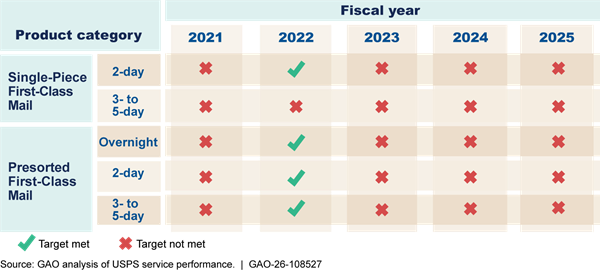
USPS has tried to address service performance in several ways, including using diagnostic tools and regular operational meetings. However, ongoing service performance issues indicate that USPS’s actions have not been sufficient. Moreover, broader challenges—such as USPS’s poor financial condition—may contribute to the difficulty in doing so. Given persistent concerns about service performance, it is important that USPS clearly communicate about its ongoing and planned actions to address this issue, even as it seeks to cut costs, as well as about the challenges it faces. The upcoming update to USPS’s strategic plan, which is planned for 2027, presents an opportunity for USPS to communicate this information to Congress, the public, and relevant stakeholders.
Why GAO Did This Study
USPS has long faced challenges meeting its mission in a financially self-sufficient manner. Under its current strategic plan, USPS has sought to improve its finances and service performance. Balancing service performance with financial viability poses a significant ongoing challenge for USPS.
GAO was asked to review USPS service performance issues. This report examines (1) changes USPS has made to service standards for market-dominant products and to related operations since 2021; (2) how the cost-cutting initiatives in USPS’s strategic plan have affected service performance and customers; and (3) the extent to which USPS’s actions have addressed service performance issues, and how USPS has communicated ongoing and planned actions to Congress and the public.
GAO reviewed USPS documents, including its annual reports to Congress for fiscal years 2020 through 2025. GAO also reviewed USPS Office of Inspector General reports, as well as Postal Regulatory Commission (PRC) reports and relevant advisory opinions. GAO selected First-Class Mail for this review, because it is one of the market-dominant products USPS uses to assess its service performance. GAO also interviewed USPS officials, PRC commissioners and staff, and five stakeholders that included commercial mailers and mailer organizations on topics related to USPS service performance.
What GAO Recommends
GAO recommends that USPS include details about its ongoing and planned actions to improve service performance in the next update of its strategic plan. USPS agreed with this recommendation.
|
Abbreviations |
|
|
|
|
|
OIG |
Office of Inspector General |
|
PRC |
Postal Regulatory Commission |
|
USPS |
U.S. Postal Service |
This is a work of the U.S. government and is not subject to copyright protection in the United States. The published product may be reproduced and distributed in its entirety without further permission from GAO. However, because this work may contain copyrighted images or other material, permission from the copyright holder may be necessary if you wish to reproduce this material separately.
September 17, 2026
The Honorable Robert Garcia
Ranking Member
Committee on Oversight and Government Reform
House of Representatives
The Honorable Kweisi Mfume
Ranking Member
Subcommittee on Government Operations
Committee on Oversight and Government Reform
House of Representatives
The U.S. Postal Service’s (USPS) mission is to provide prompt, reliable, and efficient universal postal service.[1] However, USPS has long faced challenges meeting its universal postal service mission in a financially self-sufficient manner.[2] As part of its efforts to address these challenges, USPS and its Board of Governors published Delivering for America (strategic plan) in March 2021.[3] This 10-year strategic plan, which it has periodically updated, outlines high-level strategies, such as operational changes and capital investments, as well as congressional, regulatory, and administrative actions that USPS projected would enable it to achieve financial sustainability and service excellence.[4]
However, we have found that despite USPS taking significant actions under its own authority—including implementing strategic plan initiatives—it still cannot fully fund its current level of services and financial obligations.[5] The USPS Office of Inspector General (OIG) reported in May 2025 that balancing service performance with the need to remain financially viable in a changing market poses a significant challenge for USPS.[6] As we have reported, this challenge will likely persist, given USPS’s poor financial condition.[7]
You asked us to review issues related to USPS service performance. This report examines (1) the changes USPS has made to service standards for market-dominant products and to related operations since it launched its strategic plan in 2021; (2) how the cost-cutting initiatives in USPS’s strategic plan have affected service performance and customers; and (3) the extent to which USPS’s actions have addressed service performance issues, and how USPS has communicated ongoing and planned actions to Congress and the public.
To examine the changes USPS has made to its service standards and operations, we reviewed our prior work on USPS; USPS documents, including its strategic plan; and changes to service standards. We selected First-Class Mail as the market-dominant product for our review because it is USPS’s primary monopoly product, and USPS uses market-dominant products to assess whether USPS’s service performance meets agency goals.
To determine how USPS’s strategic plan initiatives have affected service performance and customers, we analyzed USPS’s performance targets and results from its annual reports to Congress for fiscal years 2020 through 2025. We assessed the reliability of USPS’s data on performance targets and results by reviewing the data for consistency, and for any outliers or obvious errors. Based on our review, we determined that these data were sufficiently reliable for our purposes of comparing USPS’s performance against its targets.
We focused our work on three cost-cutting initiatives that USPS, USPS OIG, the Postal Regulatory Commission (PRC), and five postal industry stakeholders cited. We selected the stakeholders, which included commercial mailers and organizations that represent mailers, for their knowledge about USPS mailing operations and insight into how strategic plan initiatives and operational changes have affected service performance and customers. The three initiatives we selected were: (1) air to ground transportation; (2) processing and delivery network redesign; and (3) Regional Transportation Optimization. We also reviewed USPS OIG reports, PRC reports, including PRC’s Annual Compliance Determination reports for fiscal years 2020 through 2025 and relevant PRC advisory opinions.
To evaluate the extent to which USPS actions have addressed service performance issues and how USPS has communicated ongoing and planned actions, we reviewed USPS documents related to its fiscal year 2025 and 2026 National Performance Assessment, in which it assessed USPS managers and staff on a range of performance indicators including service performance.[8] We also reviewed information that USPS officials provided on actions that USPS has taken to monitor and address service performance, as well as, the USPS OIG reports and recent PRC advisory opinions mentioned above. In addition, we assessed USPS actions against the external communication principle in the Committee of Sponsoring Organizations of the Treadway Commission Internal Control-Integrated Framework.[9]
For all of our objectives, we interviewed USPS officials about USPS service performance, strategic plan initiatives, and other topics relevant to this report. We also interviewed PRC commissioners and staff, as well as the five selected postal industry stakeholders.
We conducted this performance audit from June 2025 to September 2026 in accordance with generally accepted government auditing standards. Those standards require that we plan and perform the audit to obtain sufficient, appropriate evidence to provide a reasonable basis for our findings and conclusions based on our audit objectives. We believe that the evidence obtained provides a reasonable basis for our findings and conclusions based on our audit objectives.
Background
USPS Market-Dominant Products
USPS earns nearly all of its revenue from delivering mail and packages. Starting in 2006, under the Postal Accountability and Enhancement Act, USPS’s mail products were divided into two categories: market-dominant and competitive.[10] Market-dominant products are those that USPS has a statutory monopoly over or that USPS provides a large share of, with limited competition.[11] Examples of market-dominant products include First-Class Mail, USPS Marketing Mail, and Periodicals.[12] USPS competitive products are all other products that USPS offers, including Priority Mail and USPS Ground Advantage package service.
Market-dominant products are important to USPS’s operations and financial condition, as they represent approximately 95 percent of total volume processed annually by USPS and are among USPS’s most profitable products. However, the decline in USPS’s market-dominant products volume that started in 2007 is a key cause of its financial troubles. These products are price-capped, and price increases are constrained by factors that are largely outside USPS’s control, such as inflation.
USPS’s Financial Condition and Strategic Plan
As we have reported, USPS’s business model is unsustainable due to rising costs, declining mail volume, and an increasing number of USPS delivery points. As a result, USPS’s financial viability has been on our High Risk List since 2009.[13] USPS was created to be financially self-sufficient, but it has lost money almost every fiscal year since 2007. Beginning that year, USPS recorded consistent net losses as revenue declined and personnel-related expenses, representing the bulk of its expenses, continued to increase. Revenues from postal operations were not sufficient to cover expenses, resulting in annual net losses from fiscal year 2007 through fiscal year 2025.[14]
In 2021, USPS introduced its 10-year strategic plan to achieve financial self-sufficiency while continuing to meet its statutory obligations.[15] The plan, whose goals are to improve USPS’s financial condition and service performance, states that USPS seeks to modernize its network, meet a changing marketplace, and prompt changes from Congress. According to USPS, the strategic plan it is a “living plan” that it constantly evaluates and updates; USPS last published a public update of the plan in 2024.[16] Since introducing the strategic plan, USPS has taken many actions, including making significant changes to its processing and delivery network and transportation logistics, to reduce expenses and improve efficiency.
As part of the changes to its processing and delivery network, USPS has been building new facilities and updating existing facilities to create a new regional hub-and-spoke network that USPS says will improve service and network efficiency. USPS included additional information about the structure of this new network in its update to the strategic plan. This redesigned network features
· Regional Processing and Distribution Centers that are larger facilities that sort all mail and packages that are being sent to other regions as well as mail that will be delivered in its region;
· Regional Transfer Hubs that aggregate mail and packages to travel through the network;
· Local Processing Centers that sort mail and some packages as it enters the processing network, including adding postmarks, and for delivery in its region[17];
· Sorting and Delivery Centers that aggregate mail-carrier operations from several smaller current locations within some local areas; and
· Delivery Units, where mail and packages depart for final delivery.
USPS further organizes mail flow into three legs that correspond with the collection, network processing, and delivery of mail and packages. Figure 1 shows the redesigned USPS network, and how single-piece First-Class mail moves from collection to delivery.
Figure 1: Movement of U.S. Postal Service (USPS) Single-Piece First-Class Mail from Collection to Delivery
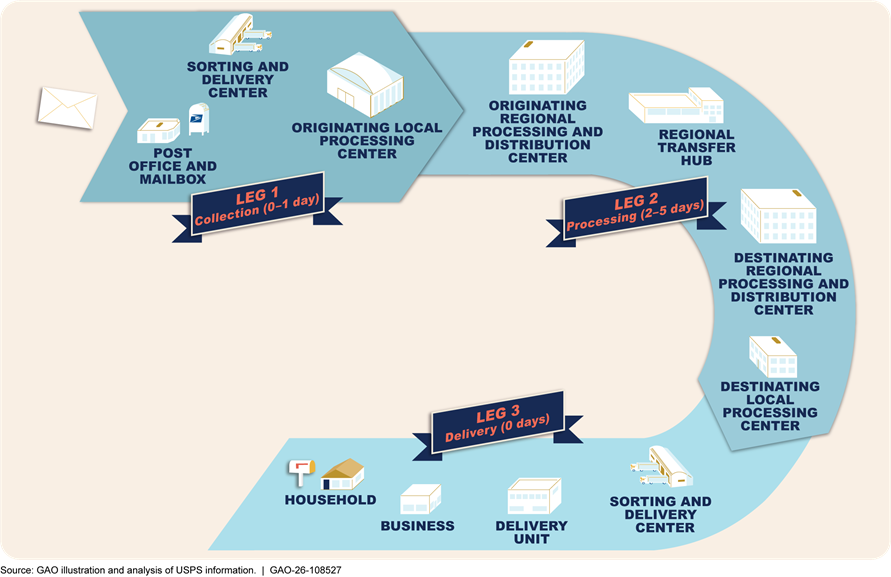
Note: Some mail can enter the USPS network at facilities other than a Sorting and Delivery Center or Post Office. Bulk and presorted mail may enter the USPS processing network at any point including Regional Processing and Distribution Centers through Delivery Units.
USPS has also made changes to its transportation logistics to align with changes to its processing and delivery network. For example, USPS has shifted mail volume from air to ground transportation. In its 2024 update to the strategic plan, USPS also provided some information on the Regional Transportation Optimization initiative, discussed later in this report, which eliminates end-of-day collection at post offices more than 50 miles from a Regional Processing and Distribution Center. As of June 2026, USPS had only realigned a portion of its transportation network, and it planned to roll out further changes on a regional basis over the course of several years.
USPS Service Standards and Performance
USPS sets its own service standards, which are the expected number of days for delivery after a mail piece or package is accepted by USPS. According to USPS, these standards account for processing times and transportation within the network and are meant to provide senders and recipients with a reliable time frame for when they can expect their mail and packages to arrive. Service standards can vary for different mail products and classes.
USPS defines service performance as the measurement of the speed and reliability of mail service. USPS measures the speed of mail—that is, the number of days—from when USPS accepts the mail into its processing network to delivery. It determines the service performance of that mail by comparing the speed of service with its service standards. Under current USPS processes, service performance measurement begins when USPS takes possession of the mail. Depending on the type of mail, the process for measuring service performance can include statistical sampling of scanning data and other measures from origination to destination.[18]
USPS uses the Service Performance Measurement system for market-dominant mail products.[19] The system uses barcode-scanning data from specific market-dominant products to determine the time mail was accepted, processed, and delivered.[20] In addition, when mail does not meet requirements for mail preparation or comply with certain business rules, such as when key barcode-scan data are missing, the mail is excluded from the system.[21]
In addition to setting its service standards, USPS sets its own targets for service performance. These targets—the percentage of mail that USPS expects to meet service standards—help USPS determine its service performance, which is one of the most important metrics that USPS tracks. According to USPS officials, USPS considers the prior fiscal year’s performance, as well as expected operational capacity and ongoing network improvements and modernization efforts, when setting targets for the next fiscal year.
The Postal Service Reform Act of 2022 directed USPS to establish reasonable performance targets for market-dominant products—such as First-Class Mail—each year and report the previous fiscal year’s performance targets to PRC for evaluation.[22] The results of PRC’s evaluation can be found in its Annual Compliance Determination report, which we discuss below.
USPS Oversight Bodies
In addition to USPS’s Board of Governors, two other bodies have oversight roles related to USPS service performance: PRC and USPS OIG.[23]
In addition to its other authorities, such as for regulating postal rates, PRC has primary oversight of USPS’s service performance. PRC has stated that it views enhancing transparency as its primary responsibility related to service performance.[24] Specifically, PRC adjudicates certain service complaints, offers advisory opinions regarding certain proposed changes to postal services upon USPS request, issues an Annual Compliance Determination report and must approve changes to USPS’s internal service performance measurement system.[25]
Key components of PRC responsibility include receiving and addressing service complaints, developing advisory opinions, and conducting annual compliance reviews.
Service complaints. Interested parties may file complaints with PRC if they believe USPS’s operations violate certain requirements, such as meeting service performance targets or considering certain factors, such as the postal customers’ needs and projected mail volume and revenues, when establishing service standards.[26] PRC advises consumers that the complaint process is a complex legal proceeding that typically requires an attorney’s assistance. PRC officials were able to identify only 15 possible service complaint filings it received from April 2021 through January 2026. If PRC determines the complaint is justified, then PRC must order USPS to take actions that PRC considers appropriate to achieve compliance and remedy the effects of noncompliance.[27]
Advisory opinions. Federal law requires that USPS seek an advisory opinion from PRC for changes “in the nature of postal services which will generally affect service on a nationwide or substantially nationwide basis.”[28] The process of developing advisory opinions involves multiple steps, including the following: USPS holds prefiling conferences with PRC and the public to solicit feedback; PRC publishes a notice in the Federal Register; USPS officially files the proposal; PRC solicits public participation and feedback; and PRC publishes its advisory opinion.[29] While not required, USPS may submit a response to an opinion.
PRC’s advisory opinions are nonbinding, meaning USPS does not have to accept or act on any recommendations that PRC may include in its advisory opinion. Therefore, USPS sets its own service standards, and carries out the operations to deliver that service, with only non-binding advice from PRC. PRC has published several advisory opinions related to USPS’s service standards since the launch of the strategic plan. These include a recent advisory opinion focusing on changes called for in the strategic plan that affect service, such as Regional Transportation Optimization, and raising concerns that ongoing network changes disproportionately impact rural areas.[30]
Annual compliance review. Released every March, PRC’s Annual Compliance Determination report (annual compliance review) focuses on USPS’s Annual Compliance Report, which USPS submits to PRC to provide information on postage rates and service, among other things.[31] PRC’s annual compliance review must include a written determination on whether USPS did not meet any service standards in effect during that year.[32]
If PRC determines USPS did not meet the service standards, then PRC must issue a directive in the same way it would respond to a complaint justifiably alleging noncompliance.[33] Unlike advisory opinions, annual compliance review directives are binding. They are essentially an order for USPS action and USPS must respond to them, often by the following year’s compliance review.[34] For example, in its most recent annual compliance review, PRC’s directives included that USPS should take action to improve service performance results for all non-compliant products in the next fiscal year.[35]
USPS OIG also oversees USPS’s service performance. USPS OIG is responsible for detecting and preventing fraud, waste, and abuse in USPS programs and operations.[36] Additionally, USPS OIG is to lead, coordinate, and recommend policies for activities designed to promote economy, efficiency, and effectiveness in administering postal programs and operations.[37] Specific to service performance, USPS OIG is required to regularly audit the data collection systems and procedures that USPS uses to collect information and prepare its Annual Compliance Report.[38]
USPS Lengthened Expected Delivery Times for Certain First-Class Mail to Align with Strategic Plan Initiatives
USPS has increased the expected number of days for delivery of some First-Class Mail—which most household customers rely on for everyday mail such as letters and bill payments—twice since its strategic plan was issued in 2021. According to USPS officials, USPS did so to account for the decline in mail volume, particularly single-piece First-Class Mail, and the effects of operational changes associated with some of the strategic plan’s cost-cutting initiatives, and to improve reliability of mail services.
Effective October 2021, USPS modified its service standards by adding 1 to 2 days for delivery of certain First-Class Mail, resulting in a delivery window of 1 to 5-days.[39] USPS did so to align mail delivery with its shift from air transportation to mostly ground transportation. Prior to the launch of its strategic plan, USPS relied on an air network to meet its 3-day service standards for moving mail across the country. While the air-to-ground initiative cut USPS’s air transportation expenses, which we discuss later, it also lengthened the expected delivery time for some First-Class Mail. With these changes, USPS maintained a service standard of 1 to 2 days for First-Class Mail traveling less than 140 miles. However, the service standard for First-Class Mail traveling further than 140 miles either remained 3 days or changed to 4 or 5 days, depending on the distance.[40] (See fig. 2.)
Figure 2: U.S. Postal Service (USPS) First-Class Mail Service Standards Based on Distance, Effective October 1, 2021
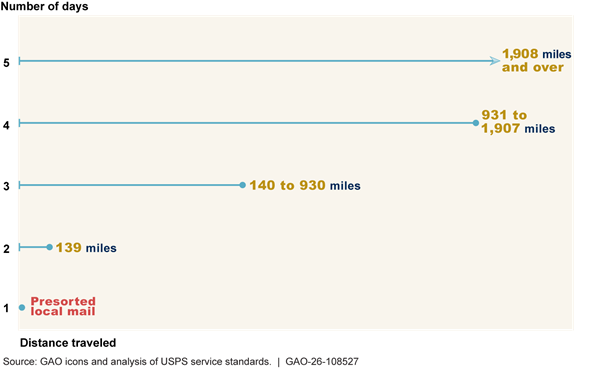
Note: Presorted local mail is prepared by commercial mailers that sort the mail by ZIP Code, or destination, traveling within a local area of less than 139 miles.
In April 2025, USPS made further changes to the expected delivery time, which USPS officials characterize as a refinement, for certain First-Class Mail. Specifically, USPS eliminated the end-of-day or afternoon collection at post offices more than 50 miles from a Regional Processing and Distribution Center, as part of its Regional Transportation Optimization and network redesign initiatives.[41] This change reduced mail pickup to once a day for affected post offices. This meant that mail dropped off at an affected post office after the morning collection could have at least 1 day added to the expected delivery time as it would not be collected until the next business day. USPS officials told us that this change in pick-up time primarily affects outgoing mail and packages from areas affected by the Regional Transportation Optimization initiative. They said that because most mail enters the USPS network within 50 miles of a Regional Processing and Distribution Center, incoming mail is generally unaffected by this change.
While most mail retained the same 1 to 5 days service standard for domestic First-Class Mail, this change lengthened the expected delivery time within this service standard for some mail while shortening it for other mail.[42] For example, according to PRC, after April 2025, the service standard for a single-piece First-Class letter from Tulsa, Oklahoma—which is more than 50 miles from the nearest regional hub—to New York City is 5 days. The expected delivery time for this mail was 3 days prior to 2021, and 4 days after the 2021 service standard change. Conversely, USPS officials noted that there are also cases in which mail service improved under the Regional Transportation Optimization initiative, due to more efficient transportation of some mail. For example, after April 2025, mail moving from Oklahoma City, Oklahoma to Columbus, Ohio, now has a 3-day service standard, as opposed to a 4-day service standard prior to the 2025 service standard change.
In addition, beginning in April 2025, USPS no longer counts Sundays or federal holidays as part of the service standard measurement for mail. USPS officials told us that only mail that entered its network the day before a Sunday or holiday would be affected by this change. For example, mail dropped off on a Saturday afternoon before a federal holiday may stay at the post office for 3 days before USPS begins processing it on Tuesday and the service standard of 1 to 5 days begins.
Cost-Cutting Initiatives in USPS’s Strategic Plan Have Contributed to Declines in Service Performance and Customer Experience
USPS Has Not Met Most of Its Targets for How Much Mail Will Meet Service Standards, Despite Lowered Targets
According to USPS’s 2021 strategic plan, USPS’s goal after the plan’s implementation was to deliver 95 percent of mail on time. However, from fiscal year 2020 to fiscal year 2026, USPS substantially lowered its service performance targets (i.e., the percentage of mail USPS expects to meet service standards). USPS officials said USPS did this in part to address past unrealistic targets and accommodate ongoing network changes. Over this period, USPS reduced the service performance targets for single-piece First-Class Mail from 96.50 percent to 87.00 percent for 2-day mail, and from 95.25 percent to 81.50 percent for 3- to 5-day mail. (See fig. 3.)
Figure 3: Changes to Service Performance Targets for U.S. Postal Service (USPS) Single-Piece First-Class Mail, Fiscal Years 2020–2026
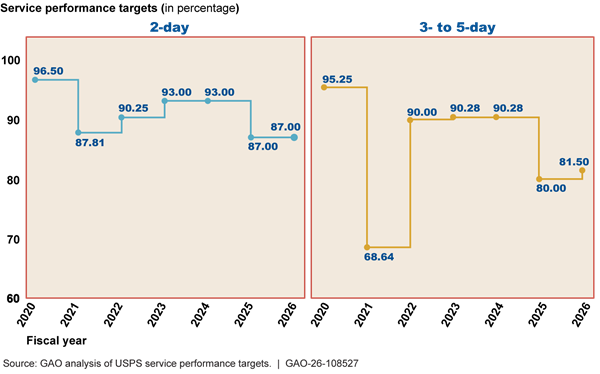
Note: According to USPS, it temporarily reduced targets for fiscal year 2021 in response to the challenges posed by the ongoing COVID-19 pandemic and disruptions in the transportation network. USPS increased its targets for fiscal years 2022 and 2023 as it recovered from the pandemic and factored in the effects of the lengthened service standard. USPS again lowered its targets in fiscal year 2025 as it implemented network updates.
Despite substantially lowering its service performance targets and lengthening service standards in fiscal year 2021, USPS has not met most of its targets since it started implementing the cost-cutting initiatives in its strategic plan.[43] For example, USPS has not met most of its targets for First-Class Mail since fiscal year 2022, the first full fiscal year of the strategic plan. (See fig. 4.) More broadly, 20 of 27 categories of market-dominant products failed to meet service performance targets in fiscal year 2025.[44] According to USPS officials, USPS did not meet many of its service performance targets long before the implementation of the strategic plan, in part due to longstanding structural and operational performance issues.[45]
Figure 4: U.S. Postal Service’s (USPS) Service Performance for Selected First-Class Mail Products, Fiscal Years 2021–2025
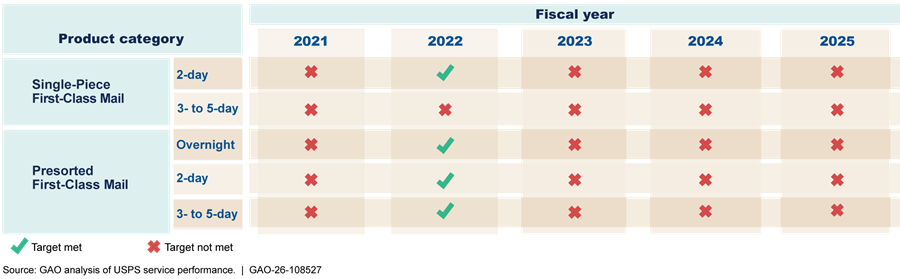
Note: Single-Piece First-Class Mail represents the performance of single-piece First-Class Mail letters, postcards and flats. Presorted First-Class Mail represents the performance of commercial presorted First-Class Mail letters, postcards, and flats. In fiscal year 2022, USPS attributed its service improvements to actions it took to implement its strategic plan.
Moreover, USPS’s oversight bodies have expressed concerns that the percentage of mail USPS considered to be delivered on time may be lower than reported. As we described earlier in this report, in April 2025 USPS began excluding Sundays and holidays as part of its expected delivery date calculation. According to PRC, while this change has resulted in as much as a 2.1-percent increase in on-time performance for some products, that improvement is due to the calculation change and not more efficient service.[46]
Additionally, USPS excludes certain mail from service performance measurement.[47] According to USPS officials, the percentage of First-Class Mail excluded from measurement in fiscal years 2023 through 2025 ranged from 19 to 23 percent.[48] The exclusion of mail from service performance measurement is an area of concern for USPS’s oversight bodies. For example, according to USPS OIG, USPS excludes some mail from service performance measurement due to limitations in technology and ongoing mail-scanning issues. In addition, USPS OIG also reported that the data USPS collected from scans during collections and delivery may not be representative of overall service performance.[49] PRC has also expressed concerns about mail exclusion and is currently reviewing USPS’s Service Performance Measurement system to ensure it produces accurate, reliable, and representative results.[50]
Three of the five industry stakeholders we spoke with also raised concerns about how mail excluded from performance measurement affects USPS’s on-time mail reporting. For example, one industry stakeholder we spoke with said that because excluded mail often represents delayed deliveries or mail that has been in the network for more than 30 days, USPS’s on-time performance would likely be lower if USPS counted mail it excludes from service performance measurement.
Cost-Cutting Initiatives in USPS’s Strategic Plan Have Contributed to Slower Service, Particularly for Rural Customers
USPS has missed service performance targets and provided slower service due, at least in part, to its implementation of the cost-cutting initiatives in its strategic plan, according to USPS, PRC, USPS OIG, and all five industry stakeholders we spoke with. Specifically, they cited three initiatives that have directly impacted USPS’s service performance: the shift from air to ground transportation, the redesign of its processing and delivery network, and the Regional Transportation Optimization initiative.[51]
Air to ground transportation. One of the first strategic plan initiatives that USPS implemented was shifting mail transportation from a mix of air and ground transportation to mostly ground transportation. As noted above, one reason that USPS added 2 additional days to its service standards was because it takes longer to move mail across the country using ground rather than air transportation. USPS estimated in 2021 that shifting mostly to ground transportation would affect about 38.5 percent of First-Class Mail.[52] According to USPS, reducing its air cargo usage helped decrease its air transportation expenses by approximately $640 million in fiscal year 2024 and by $435 million in fiscal year 2025.[53] However, in fiscal year 2025, USPS shifted some First-Class Mail from ground back to air transportation to optimize costs of the air network and improve service performance. According to a July 2026 USPS OIG report, USPS has been increasingly relying on the air network to transport First-Class Mail and Marketing Mail, rather than continuing to transport these products via ground.[54] USPS OIG found that USPS has decided to do so to meet its September 2024 primary air cargo contractual minimums and avoid higher expenses.[55] According to USPS OIG, while the contract offers financial benefits for USPS, the volume requirement leaves USPS with little choice but to fly First-Class Mail — even though doing so contradicts previous decisions to extend delivery standards to allow for ground transport.
Processing and delivery network redesign. USPS has attributed some service performance issues to its ongoing shift to a regional model for its processing and delivery network. USPS officials told us they have encountered temporary challenges in implementing the network changes, which have impacted service performance. Officials expect these impacts will abate once USPS has finished redesigning its network, which they expect USPS to achieve in 2031, finances permitting. However, PRC, and USPS OIG have raised concerns that these challenges could impact service performance for an undetermined number of years.[56] Additionally, all five industry stakeholders we spoke with raised concerns that the network redesign has degraded service performance. One of those stakeholders said the ongoing service issues have become the new normal for operations.
For example, USPS OIG found that the initial rollout of USPS’s Regional Processing and Distribution Centers in multiple regions resulted in declines in service performance. Specifically, the USPS OIG found that USPS’s initial Regional Processing and Distribution Centers, located in Richmond and Atlanta, experienced significant declines.[57] USPS officials told us that these regions had below average service performance prior to the launch of the Regional Processing and Distribution Centers.
Subsequent USPS OIG reports found that service had improved in those two regions, but that service performance at the Atlanta facility was still below the national average and USPS goals while the Richmond facility saw many classes of mail meeting the national average.[58] Further, the USPS OIG has reviewed two other Regional Processing and Distribution Centers, in Boise and Indianapolis.[59] They found that there was a temporary service performance decline in Indianapolis lasting about four months before service improved and the Boise facility did not have a service decline at its launch.
Regional Transportation Optimization. As discussed above, USPS made additional adjustments to the expected delivery time for some mail to align with its Regional Transportation Optimization initiative. USPS estimated that reducing mail pickup to once a day for post offices more than 50 miles from a Regional Processing and Distribution Center would save an estimated $650 million annually on transportation costs and improve efficiencies in the processing network.[60] USPS expects this initiative to affect over 24,000 of the nation’s approximately 33,700 post offices. According to USPS officials, as of May 2026, the initiative’s implementation affected approximately 15,000 post offices.
PRC issued an advisory opinion in January 2025 describing the impacts of the Regional Transportation Optimization initiative and advising against the initiative in its current form.[61] Nevertheless, in April 2025, USPS proceeded with implementing the initiative. USPS disagreed with PRC’s concerns and maintained that even with the initiative’s operational changes, USPS would deliver First-Class Mail within the current service standard. USPS officials also stated that these changes allowed USPS to enter mail volume into the network earlier and move it further and faster. Further, USPS stated that the Regional Transportation Optimization initiative would result in transportation cost savings. However, PRC reported in January 2025 that it could not confirm the cost savings USPS’s expected to achieve from the Regional Transportation Optimization initiative, or that the saving would significantly improve USPS’s financial health.[62]
USPS has said the Regional Transportation Optimization initiative affects both urban and rural areas.[63] However, PRC, USPS OIG, and three of the five industry stakeholders we spoke with raised the concern that the initiative, and any decline in service it causes, will likely disproportionately impact rural customers. This is because rural post offices are more likely than post offices in other areas to be further than 50 miles from the nearest Regional Processing and Delivery Center. As discussed above, the Regional Transportation Optimization initiative could add at least 1 day to the expected delivery time of mail sent from affected post offices, and according to USPS officials, outgoing mail and packages would be most affected by the changes with incoming mail generally not affected. An April 2025 PRC analysis showed that the initiative could result in downgraded service for approximately 64 percent of single-piece First-Class Mail in rural areas, compared with approximately 38 percent in non-rural areas.[64] PRC has stated that it is important for USPS to weigh possible cost savings against the amount of mail affected by service downgrades, especially for rural customers.[65]
According to USPS officials, PRC did not differentiate inbound versus outbound mail in its analysis, and therefore they did not agree with PRC’s conclusions. The officials acknowledged that the Regional Transportation Optimization initiative affects outgoing mail and packages from areas 50 miles or more from a Regional Processing and Distribution Center. However, they said the initiative does not affect incoming mail to rural areas because most mail enters the USPS network within 50 miles of a Regional Processing and Distribution Center. Further, USPS officials noted that in some cases, like in service examples discussed earlier in this report, the Regional Transportation Optimization initiative could improve service performance in some areas.
The expected delivery time for mail sent by rural customers could be further affected by USPS’s April 2025 decision to exclude Sundays and holidays from its service standard calculations.[66] According to PRC, this change will result in some mail taking an extra day or more to be delivered, especially for rural customers, whose post offices no longer have end-of-day or afternoon pickup. USPS officials disagreed with PRC on this issue, noting that while there could be an additional day added to USPS customers sending single-piece mail from an area affected by the Regional Transportation Optimization initiative, the mail they received would not be affected in the same way for the same reason explained above.[67]
Furthermore, USPS adopted a rule in late 2025 to clarify that postmarks do not automatically reflect the date mail was dropped off at a post office. Rather, they reflect the date mail first entered USPS’s processing network.[68] This means a postmark could occur 1 to 3 calendar days after mail is dropped off.[69] For example, mail dropped off at the Tulsa, Oklahoma, post office on Saturday afternoon before a holiday will leave the post office on Tuesday morning, postmarked at the processing facility where it enters the USPS network when the service clock officially begins on Tuesday, and may be delivered to the recipient in New York City the following Saturday. While the elapsed time between drop-off and delivery is 7 calendar days, it would still count as on-time within the current 5-day service standard. Table 1 shows additional examples of USPS First-Class mail service sent from locations more than 50 miles from a Regional Processing and Distribution Center affected by the Regional Transportation Optimization initiative.
Table 1: Examples of Service for Single-Piece First-Class Mail in Areas Affected by the U.S. Postal Service’s (USPS) Regional Transportation Optimization Initiative
|
Service standard |
Drop-off day |
Day of postmark and start of service standard measurement |
Day of delivery |
Total elapsed days |
|
2-days (1-139 miles) |
Saturday |
Monday (excludes Sunday) |
Tuesday |
3 days |
|
3-days (140-930 miles) |
Saturday (Holiday Weekend) |
Tuesday (excludes Sunday and Monday) |
Thursday |
5 days |
|
4-days (931-1907 miles) |
Saturday |
Monday (excludes Sunday) |
Thursday |
5 days |
|
5-days (1908 miles or more) |
Saturday (Holiday Weekend) |
Tuesday (excludes Sunday and Monday) |
Saturday |
7 days |
Source: GAO summary of USPS information. L GAO‑26‑108527
Note: USPS eliminated the end-of-day or afternoon collection at post offices more than 50 miles from a Regional Processing and Distribution Center as part of its Regional Transportation Optimization initiative.
These changes impact rural customers and clear communication about how changes might affect their service could address concerns they may have with USPS service performance. For example, a customer at a post office affected by the Regional Transportation Optimization initiative may not be aware of changes that USPS has made to mail pick-up or understand what those changes mean for delivery times, especially of time-sensitive mail like bill payments or tax filings. PRC has encouraged USPS to seek ways to clearly communicate these changes to customers, including how the initiative affects the postmark date and delivery of mail.[70] USPS officials stated that they did undertake communication efforts, including doing public outreach discussed later in this report and developing an online tool to help customers understand transit times, as well as other actions discussed below.[71]
USPS Has Not Sufficiently Addressed Service Performance Issues or Clearly Communicated How It Plans to Do So
USPS Has Attempted to Address Service Performance Issues by Creating a Chief Performance Office and Diagnostic Tools, Among Other Actions
According to USPS officials, USPS has attempted to address service performance issues in multiple ways, including by conducting its annual performance assessment; creating a new Chief Performance Office; and monitoring service performance through diagnostic tools and dashboards; and holding regular management and staff meetings focused on service performance issues.
Annual performance assessment. USPS officials identified the annual National Performance Assessment as its primary tool for holding managers and supervisors accountable, because it assesses performance indicators from across USPS, including service performance, and links results to employee compensation.[72] The assessment is a standalone web-based system that uses score cards to track performance and supports the USPS pay-for-performance system.[73] It includes a range of performance indicators, such as revenue and customer experience, that align with agency goals. USPS officials said that USPS applies different weights to performance when calculating scorecards, and those weights may change year to year based on USPS priorities. For example, USPS officials told us that in fiscal year 2026, service performance represented 5 percent of the total National Performance Assessment score for relevant employees, while financial indicators like revenue, total operating expenses, and income had weights of ranging from 5.5 percent to 10 percent.[74] Officials told us this difference reflects the greater importance of financial indicators for USPS.
Poor performance in one National Performance Assessment category would not necessarily mean that an employee would not receive a performance pay increase. Given that the assessment weighs many indicators, poor results for service performance could be offset by good performance in other areas. In addition, USPS officials said executive bonuses are separate from the National Performance Assessment and can be awarded as a retention bonus or to recognize performance that is above standards.
Chief Performance Office. USPS officials told us that in response to ongoing operational performance issues, including service performance, USPS created the Chief Performance Office on January 25, 2025. They said the office’s focus was improving performance and accountability across USPS functions, such as processing and delivery. According to USPS officials, the office has helped develop some of the new diagnostic tools and dashboards that USPS is using to monitor service performance, and it participates in regular meetings on service performance. We discuss these diagnostic tools and meetings below. According to USPS officials, the Chief Performance Office has now been integrated into the Chief Solutions and Strategy Office, which continues the functions established by the Chief Performance Office. The officials said this office, in coordination with other offices, can take actions to address service performance issues, including performing analysis or deploying tools.[75] Additionally, according to USPS officials, the Chief Solutions and Strategy Office centralizes USPS’s network planning, which they believe improved coordination around its network transformation planning and activities.
Diagnostic tools and dashboards. USPS officials said USPS has created diagnostic tools and dashboards to help staff monitor service performance and operations. According to the officials, some of these diagnostic tools provide greater visibility into service performance failures. For example, some tools can report on the time that mail spends in the USPS network and other information related to processing and delivery that can help staff identify problems affecting service performance. In addition, USPS officials noted they had created more dashboards and interfaces that would allow staff to run reports and monitor specific elements of the USPS network. USPS officials also said USPS has a rapid response team that redirects support technicians to help locations that have encountered issues.
Regular management and staff meetings. USPS officials told us they use regular meetings to monitor service performance. Given the large scope of its network and the ongoing changes to its processing and delivery network, internal communication across the agency is important. USPS officials told us these meetings are integral to USPS’s ability to monitor and address service issues. The meetings include various levels of USPS managers and staff, who discuss and address any service performance issues. For example, according to USPS officials, in daily collaborative meetings at headquarters, top-level management, such as staff from the Chief Performance Office, reviews daily operational conditions and performance by location to identify any service issues.
In addition to the headquarters meetings, USPS officials told us about other regular meetings held virtually that involve other USPS staff. These meetings include a nationwide daily call among USPS headquarters staff and other relevant parties to discuss operating conditions and review locations that have had an increasing number of customer complaint calls.[76] Additionally, according to officials, in a daily field call that includes processing and distribution field directors, participants review mail conditions across the country, service performance at the field level, and mail volumes by location. Further, USPS officials said that during peak season, USPS holds calls 3 days a week with anywhere from 80 to 120 mailing customers, to discuss operating conditions and provide an update on the general state of the network.[77]
USPS’s Actions Have Not Been Sufficient to Address Service Performance Issues and It Has Not Clearly Communicated Its Improvement Plans
While USPS’s actions, including those described above, have helped address some service performance issues, USPS is still unable to meet its service standards and targets. USPS officials told us that service performance is essentially a byproduct of its operational performance. That is, as USPS has faced operational and financial challenges, particularly as it makes significant changes to its network, service performance has been impacted. The officials also noted that even before implementing its strategic plan, USPS was not meeting service performance targets. While changes to its processing network have disrupted service in some areas, USPS officials view the changes as necessary to improve USPS’s financial condition. Moreover, the officials believed the changes were making the network more reliable, resulting in incremental improvements to service.
However, oversight bodies and industry stakeholders have expressed concerns that network changes are not improving service performance, and that USPS’s actions have not effectively addressed ongoing service performance issues. As noted earlier in this report, PRC and USPS OIG have made recommendations, and industry stakeholders have given feedback to USPS related to its recent operational changes and impacts on service performance.
USPS’s response to these recommendations and feedback has varied. For example, in a recent advisory opinion, PRC expressed concerns with USPS’s implementation of service and network changes related to its strategic plan and recommended actions USPS could take to improve service, including reevaluating aspects of its Regional Transportation Optimization initiative.[78] Specifically, PRC recommended that USPS reevaluate the 50-mile threshold it uses to determine the areas that the Regional Transportation Optimization initiative affects.[79]
USPS’s implementation of its redesigned network is another area of concern for USPS’s oversight bodies and stakeholders. As discussed earlier in the report, USPS’s implementation of its initial Regional Processing and Distribution Centers, resulted in persistent service performance issues. USPS officials have maintained that any service impacts from these changes are temporary, but as we noted above, concerns remain about the effects of implementation. For example, in January 2025, USPS OIG found that while USPS had improved service at its Richmond Regional Processing and Distribution Center, which was the first to open in July 2023, performance scores remained below its targets, and First-Class mail scores were below the national average.[80] Further, in July 2025, USPS OIG found that while USPS had made some improvements in service performance at its Atlanta Regional Processing and Distribution Center, which opened in February 2024 and is one of USPS’s largest processing and distribution facilities, its service performance was still well below the national average.[81]
USPS officials told us that they have applied lessons learned from the implementation of these initial Regional Processing and Distribution Centers to subsequent facilities. As discussed earlier, subsequent implementations of Regional Processing and Distribution Centers have not had the same service performance impact as they did in Richmond and Atlanta. Further, USPS officials told us that since the publication of the USPS OIG reports on the Richmond and Atlanta facilities, service in those regions has further improved. They said that according to their internal data, both the facilities were currently performing at the national average for service performance.
However, as described earlier, USPS has not met its service performance targets in recent years, so while service at these facilities may have improved it is still below USPS’s service performance targets. USPS’s mission is to provide prompt, reliable, and efficient universal postal service, with a performance goal of providing high quality service. According to USPS officials, USPS management is aware of the complexities of its business environment and the risks it faces in achieving its service goals. Further, the officials know that service performance is an ongoing area of concern for USPS customers, and they maintain their actions to date are addressing concerns.
Given these concerns, it is important that USPS clearly communicates about its ongoing and future actions to improve service performance. According to the internal control framework that USPS uses, communicating with external parties, such as with oversight bodies and industry stakeholders, is a key practice.[82] Specifically, the framework calls for communicating relevant and timely information that allows external entities to readily understand events, activities, or other circumstances that may affect how they interact with an agency.
However, USPS has not provided detailed, public-facing documentation of its ongoing and planned actions to improve service performance, or when it expects to start meeting its service standards as a result of those actions. In its last update to its strategic plan, USPS provided a high-level overview of its network transformation plans, but no details on its implementation status or time frames. Similarly, the plan introduced the nationwide implementation of the Regional Transportation Optimization initiative but did not include time frames for its implementation.[83] Moreover, concerns about transparency with regards to USPS’s service performance and operational changes have been raised. For example, in its January 2025 advisory opinion, PRC recommended that USPS could improve its communication with customers about how changes in service standards and service performance measurement might affect them.[84] USPS officials told us that in both April and July 2025, they undertook efforts to inform customers of changes in service standards and operations. These efforts included social media posts, signs in post offices, industry alerts, and press releases.
The upcoming update to USPS’s strategic plan, which USPS officials said is planned for 2027, presents an opportunity for USPS to communicate about its ongoing and planned actions to improve service performance, and the expected impact of these actions on USPS’s ability to meet service performance standards.[85] Including more information on these actions in a public document like the strategic plan would help external parties, such as Congress, the public, and relevant stakeholders, better understand USPS’s actions and set expectations for possible results.[86] Further, doing so would help USPS highlight challenges it faces in improving service performance that are beyond its control, such as its unsustainable business model. We have previously suggested that Congress address USPS’s unsustainable business model by resolving the fundamental tension between the level of postal service the nation requires and what revenue USPS can reasonably be expected to generate.[87]
Conclusions
USPS has taken actions to improve its service performance, but it still has been unable to meet its targets for how much mail will meet service standards, even after lowering those targets and lengthening expected delivery times to account for the impact of USPS’s cost-cutting initiatives. These ongoing issues indicate that USPS’s efforts have not been sufficient to improve service performance, and that broader challenges like USPS’s continuing financial struggles and unsustainable business model may contribute to the difficulty in doing so. Given the persistent concerns of oversight bodies and industry stakeholders about service performance issues, it is important that USPS clearly communicate with the public and Congress about its ongoing and planned actions to meet service performance targets even as it seeks to cut costs. Clear communication would improve accountability for service performance and help USPS highlight challenges that are beyond its control, such as its unsustainable business model, and actions it cannot take given its poor financial condition. The upcoming update to USPS’s strategic plan, which is planned for 2027, presents an opportunity for USPS to publicly communicate this information.
Recommendation for Executive Action
The Postmaster General, in the next update of USPS’s strategic plan, should include details about USPS’s ongoing and planned actions to improve service performance, the expected impact of those actions on USPS’s ability to meet its service performance targets, and any challenges USPS faces in improving service performance. (Recommendation 1)
Agency Comments
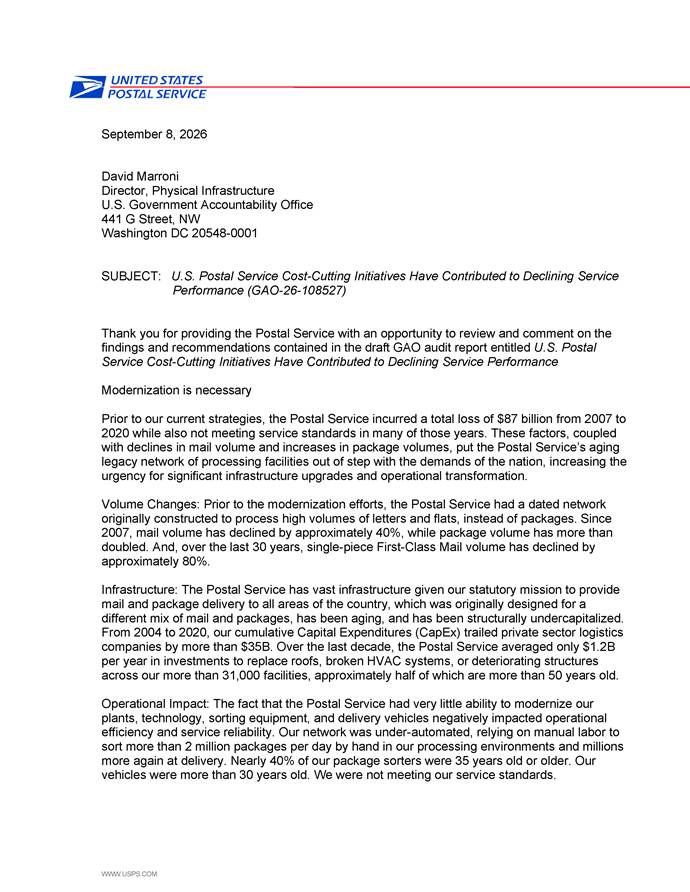
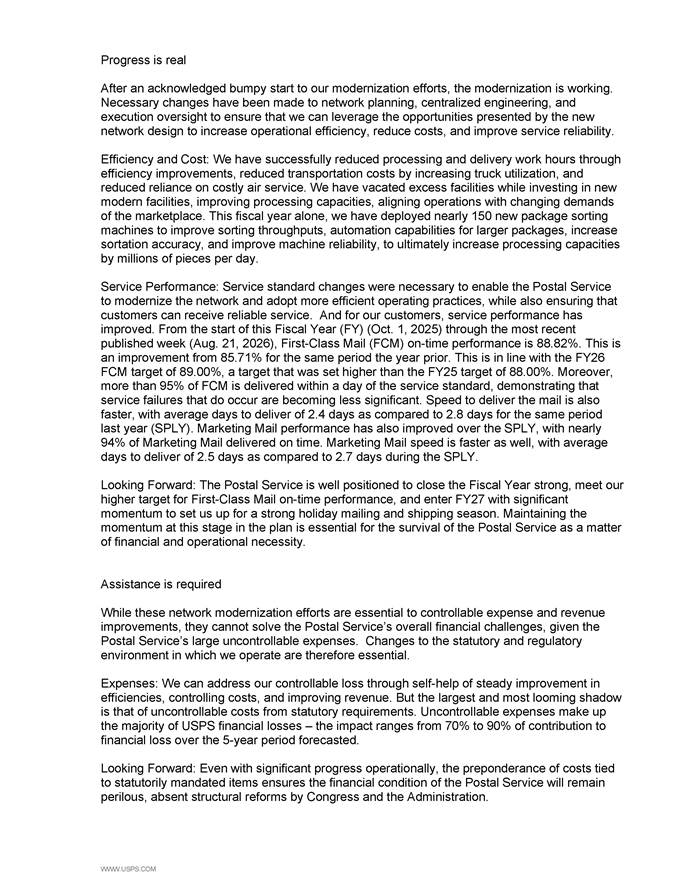
We provided a draft of this report to USPS and PRC. In its comments, reproduced in appendix II, USPS agreed with the recommendation and stated that despite some challenges in implementing updates to its processing and delivery network, these changes have improved efficiency for processing and delivery, as well as reduced transportation costs and employee work hours. USPS further stated that while it is taking action to address its financial condition and service performance issues, it cannot solve the overall challenges it faces without statutory and regulatory assistance.
In its comments, reproduced in appendix III, PRC also agreed with our recommendation to USPS and stated its belief that increased visibility is integral to improved service performance. PRC also suggested its authority over USPS's service performance be strengthened to better balance USPS operational discretion and regulatory oversight. Further, PRC suggested we reiterate our previous recommendation that Congress reassess and determine the level of universal postal service the nation requires. Our matter for congressional consideration on this issue remains open, as Congress can help address USPS's unsustainable business model by addressing the tension between the level of postal services required and the revenue USPS can reasonably generate.
USPS and PRC also provided technical comments, which we incorporated as appropriate.
We are sending copies of this report to the appropriate congressional committees, the Postmaster General, and other interested parties. In addition, the report is available at no charge on the GAO website at https://www.gao.gov.
If you or your staff have any questions about this report, please contact me at marronid@gao.gov. Contact points for our Offices of Congressional Relations and Media Relations may be found on the last page of this report. GAO staff who made key contributions to this report are listed in appendix III.

David Marroni
Director, Physical Infrastructure
Table 2: U.S. Postal Service’s (USPS) Service Performance Targets and Results, Fiscal Years (FY) 2020–2025
|
|
FY 2020 |
FY 2021 |
FY 2022 |
FY 2023 |
FY 2024 |
FY 2025 |
||||||||
|
Product category |
Target |
Result |
Target |
Result |
Target |
Result |
Target |
Result |
Target |
Result |
Target |
Result |
||
|
Single-Piece |
2-day |
96.50% |
91.47% |
87.81% |
86.44% |
90.25% |
91.34% |
93.00% |
90.68% |
93.00% |
86.44% |
87.00% |
83.19% |
|
|
3-to 5-day |
95.25% |
78.83% |
68.64% |
63.20% |
90.00% |
83.62% |
90.28% |
83.52% |
90.28% |
72.61% |
80.00% |
72.76% |
||
|
Presorted |
Overnight |
96.80% |
94.72% |
93.99% |
93.38% |
94.75% |
94.92% |
95.00% |
94.75% |
95.00% |
93.30% |
94.00% |
93.10% |
|
|
2-day |
96.50% |
92.77% |
89.20% |
88.29% |
93.00% |
93.36% |
95.00% |
93.68% |
95.00% |
91.40% |
92.00% |
91.81% |
||
|
3-to 5-day |
95.25% |
89.89% |
84.11% |
80.87% |
90.50% |
91.49% |
92.20% |
92.10% |
93.00% |
86.66% |
88.00% |
87.83% |
||
|
First-Class Mail Letter and Flat Compositec |
96.00% |
89.73% |
84.88% |
82.69% |
91.00% |
91.00% |
92.50% |
91.43% |
92.50% |
86.47% |
88.00% |
86.15% |
||
|
Marketing Mail and Periodicals Composited |
91.80% |
88.38% |
86.62% |
87.12% |
91.50% |
92.86% |
93.37% |
94.20% |
94.36% |
93.53% |
94.00% |
93.09% |
||
|
Market Dominant Compositee |
N/A |
N/A |
85.86% |
85.30% |
91.25% |
92.14% |
93.00% |
93.18% |
93.08% |
90.55% |
91.40% |
90.22% |
||
Target met is in green font; Target not met is in red font
Source: GAO analysis of USPS documents. l GAO‑26‑108527
Note: Data are from USPS’s Annual Performance Reports for fiscal years 2020 through 2025. USPS has four corporate performance goals: High-Quality Service, Excellent Customer Service, Safe Workplace and Engaged Workforce, and Financial Health. Each performance goal has one or more performance indicators, which are metrics that USPS uses to measure outcomes and assess whether it has achieved the performance goals. See 39 U.S.C. §§ 2803 and 2804.
aSingle-Piece First-Class Mail represents the performance of single-piece First-Class Mail letters, postcards, and flats.
bPresorted First-Class Mail represents the performance of commercial presorted First-Class Mail letters, postcards, and flats.
cFirst-Class Mail Letter and Flat Composite represents the weighted average of the performance of single-piece First-Class Mail and Presorted First-Class Mail across all service standards, weighted by volume.
dMarketing Mail and Periodicals Composite is a composite indicator of the percentage of all Marketing Mail and Periodicals. This includes Marketing Mail letters, Marketing Mail flats, and Periodicals.
eMarket Dominant Composite was introduced in fiscal year 2021 and includes letters and flats of all First-Class Mail, Marketing Mail, Periodicals, Bound Printed Matter, and all parcels of Library Mail, Media Mail, and Bound Printed Matter. The score for this category is generated by dividing the total volume (of all classes, shapes, and service standards) by the number of pieces delivered on time and is reported as a cumulative year-to-date score
GAO Contact
David Marroni, marronid@gao.gov
Staff Acknowledgments
In addition to the contact named above, Kyle Browning (Assistant Director), Betsey Ward-Jenks (Analyst in Charge), Melanie Diemel, Rosa Leung, Michael Soressi, Laurel Voloder, and Elizabeth Wood made key contributions to this report.
The Government Accountability Office, the audit, evaluation, and investigative arm of Congress, exists to support Congress in meeting its constitutional responsibilities and to help improve the performance and accountability of the federal government for the American people. GAO examines the use of public funds; evaluates federal programs and policies; and provides analyses, recommendations, and other assistance to help Congress make informed oversight, policy, and funding decisions. GAO’s commitment to good government is reflected in its core values of accountability, integrity, and reliability.
Obtaining Copies of GAO Reports and Testimony
The fastest and easiest way to obtain copies of GAO documents at no cost is through our website. Each weekday afternoon, GAO posts on its website newly released reports, testimony, and correspondence. You can also subscribe to GAO’s email updates to receive notification of newly posted products.
Order by Phone
The price of each GAO publication reflects GAO’s actual cost of production and distribution and depends on the number of pages in the publication and whether the publication is printed in color or black and white. Pricing and ordering information is posted on GAO’s website, https://www.gao.gov/ordering.htm.
Place orders by calling (202) 512-6000, toll free (866) 801-7077,
or
TDD (202) 512-2537.
Orders may be paid for using American Express, Discover Card, MasterCard, Visa, check, or money order. Call for additional information.
Connect with GAO
Connect with GAO on X,
LinkedIn, Instagram, and YouTube.
Subscribe to our Email Updates. Listen to our Podcasts.
Visit GAO on the web at https://www.gao.gov.
To Report Fraud, Waste, and Abuse in Federal Programs
Contact FraudNet:
Website: https://www.gao.gov/about/what-gao-does/fraudnet
Automated answering system: (800) 424-5454
Media Relations
Sarah Kaczmarek, Managing Director, Media@gao.gov
Congressional Relations
David A. Powner, Acting Managing Director, CongRel@gao.gov
General Inquiries
[1]39 U.S.C. §§ 101(a), 403(a).
[2]GAO, U.S. Postal Service: Action Needed to Fix Unsustainable Business Model, GAO‑26‑107336 (Washington, D.C.: Dec. 16, 2025).
[3]U.S. Postal Service, Delivering for America: Our Vision and Ten-Year Plan to Achieve Financial Sustainability and Service Excellence (Washington, D.C.: Mar. 23, 2021).
[4]USPS issued an update to the plan in 2024 to meet the statutory requirement under 39 U.S.C. § 2802(b) of an updated strategic plan issued at least every 3 years covering a 5 year period. See U.S. Postal Service, Delivering for America 2.0: Fulfilling the Promise (Washington, D.C.: Sept. 30, 2024). USPS sought actions in its strategic plan from Congress and other parts of the executive branch to help it become more financially self-sufficient. Specifically, USPS requested eliminating its required prefunding payments for retiree health benefits, establishing health care plans for only postal workers and retirees, integrating retiree health benefits with Medicare, and reducing its obligation for Civil Service Retirement System pension benefits.
[5]GAO, High-Risk Series: Heightened Attention Could Save Billions More and Improve Government Efficiency and Effectiveness, GAO‑25‑107743 (Washington, D.C.: Feb. 25, 2025).
[6]U.S. Postal Service Office of Inspector General, Delivering for America: First‑Class Mail and Priority Mail Service Performance Update, 25-028-R25 (Arlington, VA: May 7, 2025).
[8]The National Performance Assessment is not used to determine compensation for craft employees, such as letter carriers or mail handlers, that have collective bargaining agreements.
[9]Committee of Sponsoring Organizations of the Treadway Commission’s Internal Control-Integrated Framework (2013). The Committee of Sponsoring Organizations of the Treadway Commission’s Internal Control-Integrated Framework is a set of practices that we have identified as reasonable and relevant internal-control criteria standards to use in evaluating USPS’s activities. This framework is recognized as a leading framework for designing, implementing, and conducting internal control and assessing the effectiveness of internal control. It provides a means to apply internal control to any type of entity and requirements for an effective system of internal control.
[10]Pub. L. No. 109-435, 120 Stat. 3198 (2006).
[11]In an unregulated market, such a dominant market position would likely enable a firm to exercise market power, under which it could set prices above cost without the risk of losing a significant level of business to other firms offering similar products. See 39 U.S.C. § 3642.
[12]First-Class Mail comprises single-piece and presorted letters, postcards, and flats. USPS Marketing Mail is mostly used for advertising and sales-related messages. Periodicals are newspapers, magazines, and other periodical publications. USPS divides mail into different classes. Each class of mail has different features, service levels, postage rates, and subdivisions, called products, which are usually based on different physical characteristics.
[14]USPS recorded net income of about $56 billion in fiscal year 2022 due to the effect of the Postal Service Reform Act of 2022. The act, among other things, cancelled USPS’s missed retiree health care prefunding payments, which USPS reported as a one-time, noncash benefit of about $57 billion. For additional information on USPS’s financial condition see GAO‑26‑107336.
[15]U.S. Postal Service, Delivering for America: Our Vision and Ten-Year Plan to Achieve Financial Sustainability and Service Excellence.
[16] See U.S. Postal Service, Delivering for America 2.0: Fulfilling the Promise.
[17]Some Local Processing Centers add marks to mail postage (i.e., cancel mail) to indicate it USPS has taken possession of the mail—such as applying a postmark—or marks such as barcodes for data collection.
[18]According to USPS, for commercial mail, performance is measured end to end using a combination of census measurement from entry to destination processing and statistical sampling from destination processing through final delivery. For Single-Piece First-Class Mail, performance is measured through a three-step approach using statistical sampling from collection to the first scan at the origin facility and again from destination processing to final delivery, with a census scan—based measurement between the origin and destination facilities.
[19]USPS’s service performance measurement process is documented in the Service Performance Measurement Plan and related methodology documents, which are publicly filed with PRC.
[20]The Service Performance Measurement system uses data from scans of Full‑Service mail, which is presorted First-Class Mail that has Intelligent Mail Barcodes on the envelopes. The Intelligent Mail Barcode is a 65-bar USPS barcode used to sort and track letters and flats.
[21]USPS officials noted that there are various reasons why barcode scan issues can occur, such as barcode quality issues or mismatches between physical and digital representations of the barcode.
[22]Pub. L. No. 117-108, § 201, 136 Stat. 1127, 1144–46 (codified at 39 U.S.C. § 3692).
[23]As USPS’s governing body, the Board of Governors directs USPS’s exercising of its authorities. See 39 U.S.C. § 202(a). This report discusses USPS’s internal oversight of, and actions to address issues with, service performance below.
[24]According to PRC, “The Commission views its primary responsibility in the area of service performance as enhancing transparency into actual service performance. When service performance goals are not being met, the Commission directs that corrective action be taken. When results are not forthcoming, the Commission historically has increased the reporting requirements on the Postal Service to improve transparency.” Postal Regulatory Commission, Order No. 2512, Docket No. C2013-10 (May 27, 2015).
[25]See 39 C.F.R. §§ 3000.102(a), 3055.4. Advisory opinions and the Annual Compliance Determination report can also include other USPS oversight topics. For the purposes of this review, we focused on service performance.
[26]39 U.S.C. § 3662(a). PRC has stated that it “interprets the statutory provisions of [the Postal Accountability and Enhancement Act] as allowing service performance issues to be brought to the attention of the Commission through either the complaint process or during an annual compliance review.” Postal Regulatory Commission, Order No. 2512, Docket No. C2013-10, at 19 (May 27, 2015). In reviewing such issues, PRC evaluates compliance “in reference to separately published service performance ‘goals’ (also referred to as ‘targets’).” Id. at 8. Additionally, PRC has stated that the “design or revision of service standards may be challenged” for not considering the required factors and objectives. Id. at 12.
[27]39 U.S.C. § 3662(c).
[28]39 U.S.C. §3661(b).
[29]See 39 C.F.R. Part 3020.
[30]Postal Regulatory Commission, Advisory Opinion on Service Changes Associated with First-Class Mail and Periodicals, Docket No. N2021-1 (Washington, D.C.: July 20, 2021); Advisory Opinion on Service Changes Associated with First-Class Package Service, Docket No. N2021-2 (Washington, D.C.: Sept. 29, 2021); and Operational and Service Standard Changes to Meet Statutory Requirements for Reliable, Efficient High Quality Service and Financial Sustainability Through an Integrated Mail and Package Network, Docket No. N2024-1 (Washington, D.C.: Oct. 4, 2024.).
[31]The Annual Compliance Determination focuses on compliance issues identified in 39 U.S.C. §§ 3653(b) and 3705(e). Information from the Annual Compliance Report, which USPS is required to submit 90 days after the close of the fiscal year, is also included in the USPS Annual Report to Congress.
[32]39 U.S.C. § 3653(b)(2).
[33]39 U.S.C. § 3653(c).
[34]PRC can only levy fines against USPS in cases where it finds that USPS has been deliberately noncompliant with applicable postal law.
[35]Postal Regulatory Commission, Annual Compliance Determination Report, Fiscal Year 2025 (Washington, D.C.: Mar. 27, 2026).
[36]39 C.F.R. § 230.1(d).
[37]39 C.F.R. § 221.3(b)(2)(i).
[38]39 U.S.C. § 3652(a).
[39]Revised Service Standards for Market-Dominant Mail Products, 86 Fed. Reg. 43941 (Aug. 11, 2021) (codified at 39 C.F.R. Part 121). Prior to October 2021, the USPS First-Class Mail service standard was a 1-to 3-day standard for the contiguous United States. Effective October 2021, USPS modified its service standards for certain First-Class Mail and Periodicals.
[40]U.S. Postal Service, Delivering for America: What you need to know about the United States Postal Service Plan to achieve financial sustainability and service excellence.
[41]USPS also changed how it sorted mail from 3-digit to 5-digit ZIP Code pairs to allow for greater precision and organization of mail flow into origin, processing, and destination.
[42]GAO, U.S. Postal Service Primer: Updated Answers to Key Questions About Reform Issues, GAO-26-107657 (Washington, D.C.: Dec. 17, 2025).
[43]See appendix I for more information on USPS’s High-Quality Service performance goals and indicators from its corporate performance outcomes under 39 U.S.C. §§ 2803 and 2804 for fiscal years 2020 through 2025.
[44]Postal Regulatory Commission, Annual Compliance Determination Report: Fiscal Year 2025.
[45]Some service performance issues predate the 2021 strategic plan. As USPS noted in the plan, “We have failed to meet service commitments to our customers for many of our mail and package products. In particular, we have not met First Class Mail service targets in eight years.”
[46]Postal Regulatory Commission, Order No 8761, Docket No. RM2024-9, PI2025-2 (Mar. 28, 2025). In Order No. 8761, PRC ordered USPS to provide parallel service performance results for affected market-dominant products both with and without the Sunday/Holiday Exclusion. Postal Regulatory Commission, Annual Compliance Determination Report: Fiscal Year 2025.
[47]According to USPS OIG, mail excluded from service performance measurement may not meet requirements for mail preparation or comply with certain business rules, including barcode scanning issues. For example, mail missing critical data scans, such as no scan to start the measurement clock are excluded.
[48]First-Class Mail includes Presorted First-Class Mail and Single-Piece First-Class Mail.
[49]U.S. Postal Service Office of Inspector General, Accuracy of Reported Service Performance, 23-168-R24 (Arlington, VA: June 26, 2024). USPS OIG made seven recommendations to address issues with reported service performance. USPS agreed with six recommendations and disagreed with one.
[50]Starting in July 2024, PRC is reviewing USPS’s Service Performance Measurement system in Docket RM2024-9.
[51]USPS’s strategic plan had a range of initiatives, and there could be others that affected service performance.
[52]According to USPS, First-Class Mail within the contiguous lower 48 states would be affected.
[53]According to USPS, total transportation expenses were about $8.8 billion in fiscal year 2024 and $8.4 billion in fiscal year 2025. Transportation expenses in fiscal year 2025 were $0.2 billion more than the plan estimate, due to the effects of USPS’s efforts to realign and streamline its transportation system, including shifting mail back to air transportation in the second half of fiscal year 2025.
[54]U.S. Postal Service, Office of Inspector General, Effectiveness of Mail Transported by Air, 26-033-R26 (Arlington, VA: July 1, 2026). USPS OIG made two recommendations to address issues with planning and forecasting and to align the air cargo contract with network changes. USPS agreed with the recommendation to improve forecasting models for future mail volume estimates. USPS disagreed with the other recommendation, which called for an updated cost-benefit analysis to determine whether terminating the current contract and pursuing a new air cargo contract with a shorter base term with option years would provide the needed flexibility to align contracted air capacity with ongoing volume and network changes.
[55]According to the USPS OIG, the new agreement, valued at more than $10 billion and effective through March 2030, uses a per-cubic-foot pricing structure tied to average daily volume.
[56]As of June 2026, USPS had activated 18 of 60 planned Regional Processing and Distribution Centers.
[57]U.S. Postal Service, Office of Inspector General, Effectiveness of the New Regional Processing and Distribution Center in Richmond, VA, 23-161-R24 (Arlington, VA: Mar. 28, 2024); and Network Changes: Effectiveness of the New Regional Processing and Distribution Center in Atlanta, GA, 24-074-R24 (Arlington, VA: Aug. 28, 2024).
[58]U.S. Postal Service, Office of Inspector General, Network Changes: Progress on Improvements at Atlanta, GA, Regional Processing and Distribution Center, 25-039-R25 (Arlington, VA: July 8, 2025); and Network Changes - Progress on Improvements at Richmond, VA, Regional Processing and Distribution Center, 24-152-R25 (Arlington, VA: Jan. 27, 2025).
[59]U.S. Postal Service, Office of Inspector General, Effectiveness of the New Regional Processing and Distribution Center in Boise, ID, 25-038-R25, (Arlington, VA: June 16, 2025); and U.S. Postal Service, Office of Inspector General, Effectiveness of the New Regional Processing and Distribution Center in Indianapolis, IN, 25-093-R26, (Arlington, VA: Feb. 2, 2026.
[60]USPS made this estimate in its filings before the PRC, in Docket No. N2024-1.
[61]U.S. Postal Regulatory Commission, Advisory Opinion on the Operational and Service Standard Changes Related to the Delivering for America Plan, Docket No. N2024-1 (Washington, D.C.: Jan. 31, 2025).
[62]Postal Regulatory Commission, Advisory Opinion on the Operational and Service Standard Changes Related to the Delivering for America Plan, Docket No. N2024-1. USPS’s total transportation expense was about $8.8 billion in fiscal year 2024, about 10 percent of its total expenses of about $89 billion.
[63]USPS applies the Census Bureau’s definitions to determine whether an address is in a rural or urban area.
[64]Postal Regulatory Commission, Postal Service Implements Nationwide Changes to Mail Service.
[65]Postal Regulatory Commission, Advisory Opinion on the Operational and Service Standard Changes Related to the Delivering for America Plan, Docket No. N2024-1.
[66]USPS officials told us that only mail that enters its system the day prior to a Sunday or holiday would be affected.
[67]According to USPS in July 2026, about 3.4 percent of fiscal year 2026 single-piece First-Class Mail volume measured to date consists of rural mailpieces that start the clock on a Saturday or the day before a holiday and are therefore affected by USPS’s decision to exclude Sundays and holidays from its service standard calculations.
[68]90 Fed. Reg. 52883 (Nov. 24, 2025); USPS Domestic Mail Manual Section 608.11, “Postmarks and Postal Possession.” USPS states that if a customer needs an item postmarked with the date it was dropped off at a post office, they should go inside a post office and request a local postmark.
[69]A postmark identifies when mail enters the processing system, making it the start of the service standard calculation. Service standards use this official date to calculate exactly when the item should reach its destination.
[70]Postal Regulatory Commission, Advisory Opinion on the Operational and Service Standard Changes Related to the Delivering for America Plan, Docket No. N2024-1.
[71]USPS provides an online USPS Transit Time Map at https://www.usps.com/service-standards/.
[72]The National Performance Assessment is not used to determine the compensation of craft employees, such as letter carriers or mail handlers, that have collective bargaining agreements.
[73]The National Performance Assessment informs USPS’s pay for performance program, which includes two systems, one for field employees and one for headquarters employees. According to USPS officials, both systems use the same scorecard but have slightly different performance indicators and score methodology, based on the employee and their location. USPS officials told us that the assessment had 33 unique scorecard types, 49 unique indicators, and 18,025 unique scorecards.
[74]USPS officials noted that the National Performance Assessment has indicators that apply to more areas than just service. Other indicators include employee safety, retainment, and separations and the assessment also has indicators for customer experience and competitive products
[75]Other USPS offices that have a role in monitoring USPS service performance are the Chief Logistics and Infrastructure Office; Chief Processing and Distribution Office; Chief Retail and Delivery Office; Chief Customer & Marketing Office; and Chief Data and Analytics Office.
[76]Examples of relevant parties for these meetings include USPS staff from customer service centers, the ticketing help desk, and the government relations team.
[77]Peak season refers to the period of November through January, when there is an increase in mail volume that can significantly strain USPS’s processing and distribution network.
[78]Postal Regulatory Commission, Advisory Opinion on the Operational and Service Standard Changes Related to the Delivering for America Plan, Docket No. N2024-1. The advisory opinion for Docket No. N2024-1 had 38 recommendations, including 16 that were specifically categorized as Regional Transportation Optimization recommendations.
[79]USPS disagreed with PRC’s recommendation that USPS consider using other methods to supplement its current threshold for determining which post offices are affected by the Regional Transportation Optimization initiative (i.e., 50 miles from a Regional Processing and Distribution Center). USPS also disagreed with PRC’s recommendation that USPS use its extensive data on its facilities to consider other, more flexible thresholds.
[80]U.S. Postal Service, Office of Inspector General, Network Changes - Progress on Improvements at Richmond, VA, Regional Processing and Distribution Center.
[81]U.S. Postal Service, Office of Inspector General, Network Changes: Progress on Improvements at Atlanta, GA, Regional Processing and Distribution Center.
[82]Committee of Sponsoring Organizations of the Treadway Commission’s Internal Control-Integrated Framework (2013).
[83]U.S. Postal Service, Delivering for America 2.0 - Fulfilling the Promise.
[84]USPS agreed with these recommendations.
[85]39 U.S.C. § 2802(b) requires USPS to update and revise its strategic plan at least every 3 years.
[86]Committee of Sponsoring Organizations of the Treadway Commission’s Internal Control-Integrated Framework (2013). Communication with external parties enables management to obtain and share information about risks, regulatory matters, changes in circumstances, customer satisfaction, and other relevant information.
[87]GAO, U.S. Postal Service: Congressional Action Is Essential to Enable a Sustainable Business Model. GAO‑20‑385 (Washington, D.C.: May 7, 2020). Specifically, we stated that Congress should consider reassessing and determining (1) the level of universal postal service the nation requires; (2) the extent to which USPS should be financially self-sustaining and what changes to law would be appropriate to enable USPS to meet this goal; and (3) the most appropriate institutional structure for USPS. Congress took some actions in response to these findings, specifically through the Postal Service Reform Act of 2022, but has not fully addressed these fundamental questions about the future of USPS.