
Report to Congressional Committees
United States Government Accountability Office
A report to congressional committees
Contact: James R. Dalkin at dalkinj@gao.gov
What GAO Found
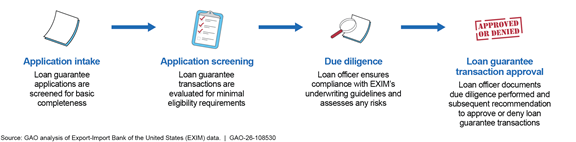
The Export-Import Bank of the United States’ (EXIM) loan guarantee transactions are approved by EXIM’s Board of Directors, staff with individual delegated authority, or delegated authority lenders. The underwriting process for loan guarantee transactions approved by EXIM includes several steps, such as screening applications for completeness, reviewing for minimal eligibility requirements, and performing due diligence to assess transactions’ risks.
EXIM followed its underwriting guidelines but has not fully leveraged available data to identify participants with delinquent federal nontax debt. By law, a person owing certain outstanding delinquent federal nontax debt is generally not eligible for loans or loan guarantees.
EXIM has a policy to review participants for delinquent federal nontax debt using the System for Award Management’s Debt Subject to Offset data during the underwriting process prior to EXIM’s Board of Directors’ approval. However, its policy does not require a review for such debt in transactions approved by staff with individual delegated authority.
EXIM has relied on a third-party vendor database since April 2023 to screen all loan guarantee participants for delinquent federal debt. While the database may identify participants that are delinquent on some federal tax debt, it does not identify those with delinquent federal nontax debt (e.g., delinquent student loans).
The Payment Integrity Information Act of 2019 requires executive agencies to use the Do Not Pay system to ensure that they make awards and payments—including loan guarantees—only to eligible recipients. EXIM does not have policies and procedures to use Do Not Pay to review transaction participants for delinquent federal debt prior to approval.
The System for Award Management and Do Not Pay are available at no cost and can provide more delinquent federal debt data than the third-party vendor; this could help EXIM make better-informed eligibility decisions prior to transaction approval.
Why GAO Did This Study
EXIM’s mission is to support the export of U.S. goods and services through direct loans, loan guarantees, working capital loan guarantees, and export credit insurance.
EXIM’s legal authorization includes a provision for GAO to evaluate EXIM’s underwriting process for its loan guarantee transactions. This report assesses the extent to which EXIM complied with its guidelines for vetting and monitoring delegated authority lenders and underwriting loan guarantee transactions approved by the Board of Directors or staff with individual delegated authority to mitigate credit risk from October 1, 2022, to December 31, 2025.
To conduct this review, GAO reviewed EXIM’s policies and procedures for loan guarantees, interviewed EXIM officials, and tested approved loan guarantee transactions made from October 1, 2022, to December 31, 2025.
What GAO Recommends
GAO is recommending that EXIM develop and implement underwriting procedures to use available resources, including the System for Award Management and Do Not Pay, to help ensure that loan guarantee transactions are not approved for ineligible participants with delinquent federal debt. EXIM agreed with GAO’s recommendation.
Abbreviations
Board Board of Directors
CRTI Character, Reputational, and Transaction Integrity
DAL delegated authority lender
DCIA Debt Collection Improvement Act of 1996, as amended
DNP Do Not Pay
DSO Debt Subject to Offset
EXIM Export-Import Bank of the United States
GRID Global Risk Information Database
IDA individual delegated authority
OMB Office of Management and Budget
SAM System for Award Management
SPS Secure Payment System
This is a work of the U.S. government and is not subject to copyright protection in the United States. The published product may be reproduced and distributed in its entirety without further permission from GAO. However, because this work may contain copyrighted images or other material, permission from the copyright holder may be necessary if you wish to reproduce this material separately.
September 16, 2026
The Honorable Tim Scott
Chairman
The Honorable Elizabeth Warren
Ranking Member
Committee on Banking, Housing, and Urban Affairs
United States Senate
The Honorable French Hill
Chairman
The Honorable Maxine Waters
Ranking Member
Committee on Financial Services
House of Representatives
The Export-Import Bank of the United States (EXIM) is a wholly owned government corporation and the official export credit agency of the United States. EXIM’s mission is to support the export of U.S. goods and services through four major products: direct loans, loan guarantees, working capital loan guarantees, and export credit insurance. EXIM provides this assistance when private-sector lenders are unwilling or unable to provide financing at acceptable rates.
EXIM’s loan and loan guarantee transactions are approved by EXIM’s Board of Directors (Board), staff with individual delegated authority (IDA), or by delegated authority lenders (DAL). The underwriting process for loan and loan guarantee transactions approved by EXIM includes several steps, such as screening applications for completeness, reviewing for minimal eligibility requirements, and performing due diligence using EXIM’s underwriting guidelines to assess transactions’ risks.[1]
To continue its operations, EXIM needs Congress to periodically reauthorize its charter.[2] Without reauthorization, EXIM’s general statutory authority will end after December 31, 2026.[3] The legislation that reauthorized EXIM in 2012 includes a provision for GAO to evaluate EXIM’s underwriting process for its loan and loan guarantee transactions.[4] Because EXIM’s Office of Inspector General recently reported on the underwriting of loans, we limited our review to loan guarantee transactions.[5] Specifically, this report assesses the extent to which EXIM complied with its guidelines for vetting and monitoring DALs and underwriting loan guarantee transactions approved by the Board or staff with IDA to mitigate credit risk from October 1, 2022, to December 31, 2025. This report is our fourth in response to the 2012 provision.[6]
To determine the extent to which EXIM complied with its underwriting guidelines, we reviewed EXIM’s policies and procedures for loan guarantees. These policies and procedures included those related to EXIM’s vetting and monitoring DALs as well as processes for loan guarantee transactions approved by EXIM’s Board and staff with IDA.
We also tested (1) a nongeneralizable sample of 12 DALs to determine the extent to which EXIM complied with selected guidelines to vet and monitor DALs and (2) a generalizable sample of 60 loan guarantee transactions to determine the extent to which EXIM complied with selected underwriting guidelines for transactions approved by the Board or staff with IDA. For additional details on our scope and methodology, see appendix I.
We conducted this performance audit from May 2025 to September 2026 in accordance with generally accepted government auditing standards. Those standards require that we plan and perform the audit to obtain sufficient, appropriate evidence to provide a reasonable basis for our findings and conclusions based on our audit objective. We believe that the evidence obtained provides a reasonable basis for our findings and conclusions based on our audit objective.
Background
EXIM’s Organizational Structure
EXIM operates under the leadership of a president who also serves as Chairman of EXIM’s Board. The Board is structured to include five members, and all positions are appointed to a 4-year term by the President of the United States with the advice and consent of the U.S. Senate. The Board is responsible for adopting and amending bylaws for the proper management and functioning of EXIM.
EXIM’s organizational structure includes various offices and divisions operating under its president. The divisions are responsible for underwriting loans and loan guarantees, including processing applications, evaluating the compliance of transactions with policies, performing financial analyses, negotiating financing terms, and presenting credit recommendations for approvals.
EXIM also delegates authority to lenders to approve loan guarantees within authorized limits. EXIM vets these lenders before approving them to become DALs. The DALs then underwrite and approve loan guarantee transactions on EXIM’s behalf.[7]
EXIM’s loan guarantees are a form of federal financial assistance that assists U.S. companies by guaranteeing financing to creditworthy foreign buyers for purchases of U.S. capital goods and services. EXIM guarantees repayment to lenders on loans to foreign buyers purchasing U.S. exports and for loans made to U.S. exporters. Lenders are willing to take on the risk of making loans to facilitate U.S. exports knowing that EXIM guarantees repayment in case of default.
EXIM’s loan guarantee transactions are approved through three methods:
· Delegated authority lenders. EXIM and DALs execute agreements allowing DALs to underwrite and approve loan guarantee transactions within their authorized dollar limits and EXIM guarantees up to 90 percent of the outstanding principal amount.[8] EXIM has established policies and procedures for vetting and monitoring DALs, such as performing due diligence on each lender seeking DAL status and conducting DAL examinations to determine whether the DALs are processing, closing, and executing disbursements in accordance with prudent lending practices.
· EXIM staff with individual delegated authority. Generally, loan guarantee transactions with financed amounts of $25 million or less are underwritten by EXIM loan officers and approved by EXIM staff with IDA (hereinafter referred to as IDA-approved transactions).
· EXIM’s Board. Generally, loan guarantee transactions with financed amounts greater than $25 million are underwritten by EXIM loan officers and approved by EXIM’s Board (hereinafter referred to as Board-approved transactions).[9] EXIM’s policies for Board-approved transactions require additional due diligence procedures before being submitted to EXIM’s Board for final approval. Specifically:
· All Board-approved transactions must be reviewed by EXIM’s Transaction Review Committee, which provides feedback and guidance to loan officers.
· For Board-approved transactions of $30 million or more, EXIM’s policies require that the transaction be sent to the National Advisory Committee, which allows other agencies the opportunity to provide comments to EXIM’s Board.[10]
· Board-approved transactions that are $100 million or more are preliminarily approved by the Board and then sent to Congress for a 35-day notification period and to the Office of the Federal Register for publication for a 25-day comment period.
Figure 1 depicts the three methods EXIM uses to approve loan guarantee transactions.
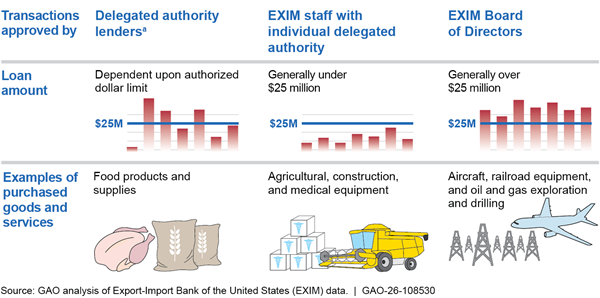
aDelegated authority lenders are authorized by EXIM to underwrite and approve loan guarantee transactions without the agency’s prior approval.
Overview of Underwriting Process for EXIM-Approved Loan Guarantee Transactions
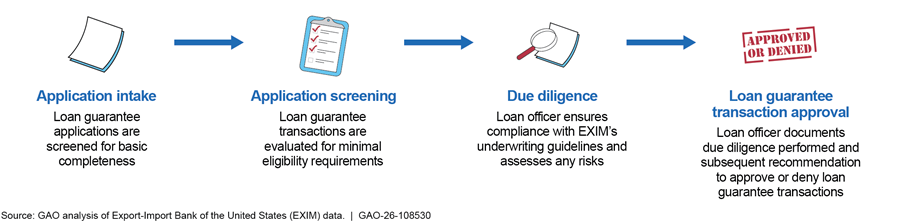
Lenders apply to EXIM for loan guarantees on loans they are underwriting for the sale of U.S. exports to foreign buyers. According to EXIM, loan participants fill the following roles: applicant, U.S. exporter, buyer, guarantor, lender, supplier, export credit agency, agent, borrower, and non-U.S. exporter or supplier.[11] An entity or individual can hold one or more roles. EXIM’s underwriting process for approving loan guarantee transactions includes the following steps:
· Application intake. When applications for loan guarantee transactions are initially received, EXIM staff review them for basic completeness.
· Application screening. After applications for loan guarantee transactions are determined to be complete, they are assigned to EXIM loan officers, who evaluate the transactions for minimal eligibility requirements.
· Due diligence. EXIM’s policies and procedures require a loan officer to perform due diligence on a transaction prior to approval to ensure that it complies with EXIM’s underwriting guidelines and to assess any risks the transaction may pose to EXIM. EXIM documents the results of this due diligence in a memorandum included in the loan transaction files. Examples of EXIM’s due diligence include reviewing the following:
· participants’ credit and financial history;
· participants’ character, professional experience, and reputation (referred to as the Character, Reputational, and Transaction Integrity (CRTI) review);[12] and
· required assessments from other EXIM subject-matter experts.[13]
· Transaction approval. After performing the required due diligence procedures, an EXIM loan officer documents their recommendation to approve or deny the transaction in a memorandum. The memorandum and supporting documentation are then forwarded to EXIM’s Board or EXIM staff with IDA for final approval.[14]
Figure 2 summarizes selected underwriting processes EXIM performs for loan guarantee transactions.
EXIM Followed Its Underwriting Guidelines, but Delinquent Federal Debt Data Were Not Always Reviewed
EXIM Followed Selected Guidelines for Vetting and Monitoring DALs
We found that for our sample of 12 DALs, EXIM followed selected guidelines for vetting and monitoring DALs. Specifically, we found that
· DAL agreements were signed by the appropriate officials from EXIM and the DALs;
· EXIM obtained the required documentation of the DALs’ authorized officers;
· the DALs had approved transactions within the authorized dollar limits specified in the DAL agreements; and
· EXIM had conducted the required DAL examinations and reported either a “Pass” or “Pass with Qualification” rating, and no examinations had resulted in a “Fail” rating.[15]
Figure 3 presents the results of our evaluation of EXIM’s compliance with selected guidelines for vetting and monitoring our sample of 12 DALs.
Figure 3: GAO’s Evaluation of EXIM’s Compliance with Selected Guidelines for Vetting and Monitoring Delegated Authority Lenders (DAL)
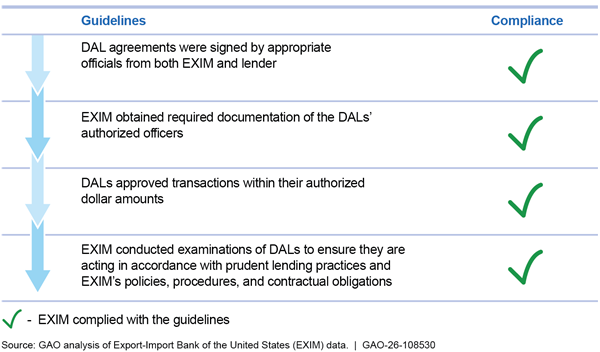
Note: DALs are authorized by EXIM to underwrite and approve loan guarantee transactions without the agency’s prior approval.
EXIM Followed Its Guidelines for Underwriting Loan Guarantee Transactions
We found that EXIM complied with selected underwriting guidelines for the six Board-approved and 54 IDA-approved loan guarantee transactions in our review. Specifically, we found that EXIM conducted due diligence procedures, performed required assessments, and appropriately documented transaction approvals by EXIM’s Board or staff with IDA.[16]
Figure 4 presents the results of our evaluation of EXIM’s compliance with selected underwriting guidelines for loan guarantee transactions approved by EXIM’s Board or staff with IDA.
Figure 4: GAO’s Evaluation of EXIM’s Compliance with Selected Underwriting Guidelines for 60 Sample Loan Guarantee Transactions
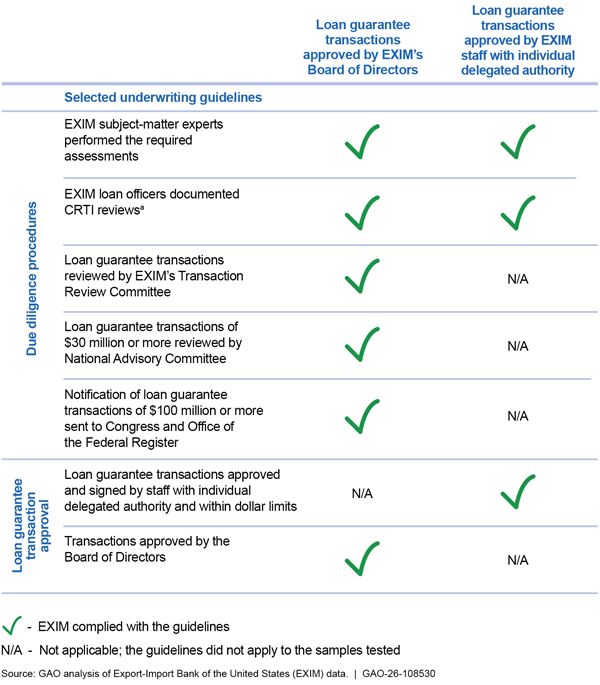
aEXIM did not complete a Character, Reputational, and Transaction Integrity (CRTI) review of the lender in one of the sample transactions we reviewed. However, EXIM performed and documented CRTI reviews of the same lender on three other occasions without identifying any issues.
Due Diligence
We found that EXIM’s loan officers and other EXIM subject-matter experts documented the results of the due diligence procedures performed to assess the feasibility and viability of the transactions in our sample. For example, we found that there was documentation of a loan officer’s review of participants’ credit and financial histories, as required by EXIM’s policy. We also found that there was documentation that subject-matter experts conducted required technical assessments.
Additionally, EXIM documented that it completed a CRTI review for all but two of the sample loan guarantee transactions. For one sample transaction, the application was withdrawn and EXIM did not perform a CRTI review. We concluded that because the application was withdrawn, the sample transaction did not require a CRTI review. For the other sample transaction, which EXIM approved in April 2025, EXIM provided documentation that it had performed a CRTI review for the borrower and buyer but not the lender. However, EXIM provided additional documentation that it had performed three CRTI reviews that resulted in no identified issues with the lender: in March 2023, July 2024, and January 2026. Therefore, we did not consider this to be an exception.
Additional Due Diligence for Board Transactions Prior to Transaction Approval
EXIM provided documentation that the Transaction Review Committee and the National Advisory Committee reviewed all six Board-approved sample transactions, as required by EXIM policy. Additionally, EXIM documented that the Board-approved transactions in our sample that were over $100 million were sent to Congress for a 35-day notification period and to the Office of the Federal Register for publication for a 25-day comment period, as required.
Transaction Approval
We found that EXIM complied with selected policies and procedures for approving loan guarantee transactions either through the Board or staff with IDA. Specifically, EXIM’s Board approved transactions greater than $25 million, as required, and documented these approvals in Board meeting minutes. Further, for all 54 IDA-approved sample transactions we tested, the loan guarantee transactions were within the $25 million limit allowed by their delegated authority.
EXIM’s Procedures Do Not Require a Review of Available Delinquent Federal Debt Data for All Loan Guarantee Transactions
EXIM has some procedures for reviewing loan participants in loan guarantee transactions for delinquent federal nontax debt (e.g., delinquent small business loans and student loans), which, unless a limited exception applies, would make a participant not eligible for federal loan guarantees.[17] EXIM also has some procedures for reviewing participants for delinquent federal tax debt. These procedures occur both prior to and after approval of loan guarantee transactions. EXIM uses different databases—managed by a private, third-party vendor or the federal government—that contain information about nonfederal entities and individuals to help verify eligibility. However, the databases contain different data, and EXIM does not consistently use the database with delinquent federal nontax debt to verify eligibility of transaction participants prior to loan guarantee approval to help mitigate credit risk and improper payment risk.[18]
EXIM has a policy to review loan guarantee participants for delinquent federal nontax debt during the underwriting process prior to Board approval. Specifically, EXIM uses the System for Award Management’s (SAM) Debt Subject to Offset (DSO) data element to identify loan guarantee participants with delinquent federal nontax debt before the Board approves a loan guarantee transaction.[19] However, EXIM’s policy does not include procedures to review SAM’s DSO to identify such debt for IDA-approved transaction participants. By law, a person owing certain outstanding delinquent federal nontax debt is generally not eligible for loans or loan guarantees.[20]
EXIM’s procedures for reviewing participants for Board- and IDA-approved transactions include the following:
· GRID. EXIM officials stated that the agency has relied on a third-party vendor database—Moody’s Analytics’ Global Risk Information Database (GRID)—since April 2023 to screen all participants in Board- and IDA-approved transactions for delinquent federal debt, among other potential risks to EXIM.[21] According to Moody’s, GRID has thousands of sources of information, one of which is SAM’s Exclusion Records, which includes some parties that were excluded due to delinquent federal tax debt.[22]
According to EXIM officials, the agency began using GRID because it believed the database included SAM’s Exclusion Records and the DSO data elements. SAM’s DSO identifies participants that have delinquent federal nontax debt subject to collection under the Treasury Offset Program.[23] However, after we requested documentation that GRID included SAM’s DSO, EXIM contacted a Moody’s representative and was informed that GRID does not include the DSO data element. Thus, while GRID may identify participants that are delinquent on some federal tax debt, it does not identify those with delinquent federal nontax debt.
· Credit reports. EXIM’s guidance requires loan officers to obtain and review credit reports on transaction participants to check whether a participant is delinquent on any federal debt (tax or nontax). However, as we reported in 2019, some delinquent federal tax debt may not appear on a credit report unless the Internal Revenue Service has filed a lien on it.[24]
· Self-certifications. According to EXIM officials, applicants are required to self-certify prior to submitting their loan applications that they are not delinquent on any federal debt, among other things. Specifically, applicants are required to conduct their own due diligence by checking the applicable SAM database to determine if they are eligible to receive federal financial assistance and acknowledge that their statements are true and correct.[25]
In 2019, we reported that EXIM would be better positioned to assess the relevant compliance, fraud, and repayment risks by reviewing SAM’s DSO to identify delinquent federal debts and recommended that EXIM assess the practicality of doing so.[26] In response, EXIM created a policy to review loan guarantee participants for delinquent federal nontax debt using SAM’s DSO during the underwriting process prior to Board approval.
During our review of Board-approved transactions, we found that EXIM did perform CRTI reviews using GRID. However, EXIM did not always follow its policy using SAM’s DSO to review participants for delinquent federal nontax debt for Board-approved transactions. Specifically, we found that two of the six Board-approved sample transactions did not have evidence that EXIM reviewed SAM’s DSO for all participants. For instance, one sample transaction had evidence that EXIM reviewed SAM’s DSO only for the lender, and the other sample had evidence that EXIM only reviewed for the borrower. When we inquired with EXIM about the inconsistencies, EXIM officials stated the agency applies a risk-based framework when determining which participants to review for SAM’s DSO based on the participant’s role in the transaction. However, the policy does not include such a framework. EXIM officials also stated that some EXIM staff interpret the policy differently and the officials are in the process of updating the policy.
EXIM officials stated that, since April 2023, the agency has relied on GRID to identify delinquent federal debt (both tax and nontax) for both Board- and IDA-approved transactions. As noted earlier, however, EXIM was informed by a Moody’s representative in May 2026 that GRID does not include SAM’s DSO, which identifies participants that have delinquent federal nontax debt subject to collection under the Treasury Offset Program. EXIM officials stated that they are exploring options, including a review of SAM’s DSO.
In addition, EXIM does not have policies and procedures to use the Do Not Pay (DNP) federal database system to review transaction participants for delinquent federal debt prior to loan guarantee approval.[27] The Payment Integrity Information Act of 2019 requires executive agencies to use DNP to ensure that they make awards and payments (such as federal financial assistance provided in the form of loan guarantees) only to eligible recipients.[28] In March 2025, the President issued an executive order to federal agencies to direct more robust use of DNP to help prevent improper payments.[29] In August 2025, the Office of Management and Budget (OMB) provided additional guidance to federal agencies on implementing the March 2025 executive order.[30] EXIM’s compliance plan, submitted to OMB on June 23, 2025, for implementing the executive order does not include plans to use DNP to review applicants for delinquent federal debt. EXIM officials stated that the agency does not have a waiver that would exempt it from the requirements to use DNP.
Additionally, EXIM officials stated that because the Department of the Treasury checks DNP before it disburses payments, EXIM does not need to use DNP independently.[31] EXIM provided an example of the Treasury check before disbursement (i.e., a post-approval control). Specifically, EXIM provided evidence of a payment not being processed by Treasury due to the participant having an active delinquent federal debt in the Treasury Offset Program database. The payment was not processed by Treasury in December 2025, as initiated by EXIM, and as of July 2026, EXIM stated that the transaction had not been processed by Treasury due to the active delinquent debt.
However, Treasury’s post-approval control to flag a payment after a transaction is approved would not capture other transaction participants with delinquent federal debt during the underwriting process prior to approval. For example, in the event of a defaulted guaranteed loan, Treasury would check DNP for the lender prior to disbursing payment to the lender. However, searching delinquent federal debt at this time would not identify other participants, such as a borrower or applicant, with delinquent federal debt.
Without fully leveraging readily available DSO data for all transactions—Board- and IDA-approved—prior to loan guarantee approval, EXIM is potentially forgoing opportunities to identify participants with delinquent federal nontax debt. SAM and DNP are available for agencies to use at no cost and can provide more delinquent federal debt data than GRID and credit reports. By using these data sources, especially prior to transaction approval, EXIM can make better-informed eligibility decisions and enhance its oversight of taxpayer dollars while ensuring that it fulfills its mission.
Conclusions
EXIM supports the export of U.S. goods and services in part through providing loan guarantees. EXIM conducts due diligence procedures during the underwriting process to assess risks that these loan guarantee transactions may pose to the agency. These procedures include reviewing participants for delinquent federal debt, which would affect eligibility, and EXIM relies primarily on GRID to do so. GRID includes sources for some delinquent federal tax debt; however, it does not include delinquent federal nontax debt. EXIM could access DSO delinquent federal nontax debt data through other readily available resources, such as SAM and DNP. By not using these resources prior to transaction approval, EXIM is missing opportunities to identify participants with delinquent federal debt and limiting its ability to make informed eligibility decisions and mitigate credit risk and improper payment risk.
Recommendation for Executive Action
EXIM’s Chief Operating Officer should ensure that the agency develops and implements underwriting procedures to use available resources, including SAM and DNP, to help ensure that loan guarantee transactions are not approved for ineligible participants with delinquent federal debt. (Recommendation 1)
Agency Comments
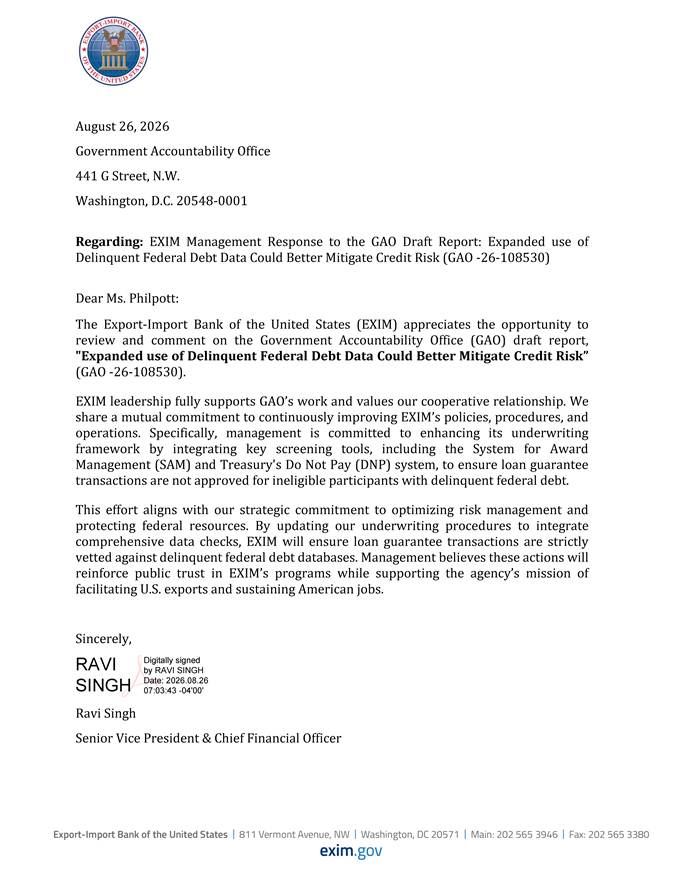
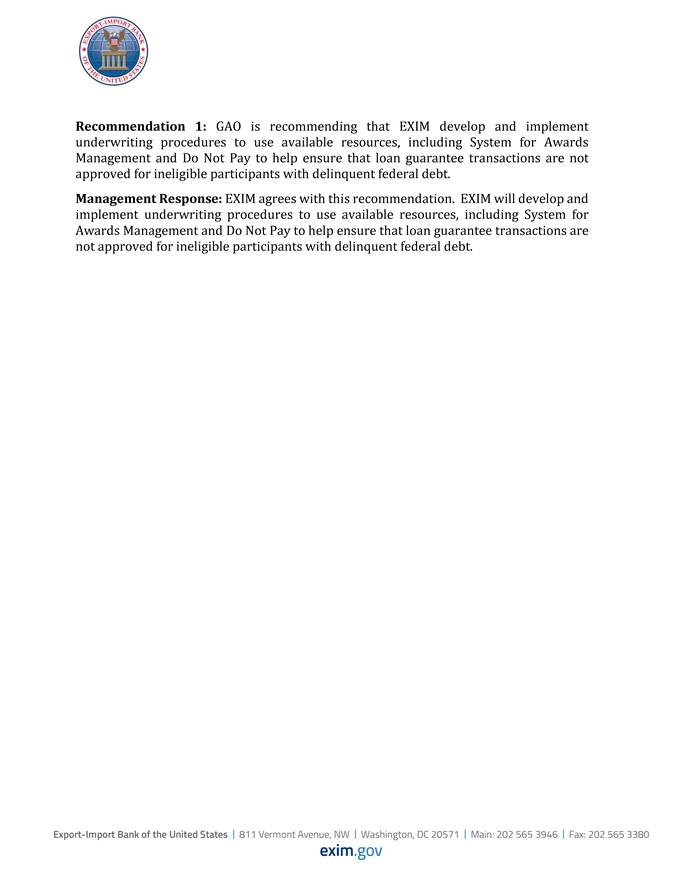
We provided a draft of this report to EXIM for review and comment. In its comments, reproduced in appendix III, EXIM agreed with the recommendation and stated that management is committed to enhancing its underwriting framework by integrating key screening tools, including SAM and DNP, and described planned action to address the recommendation. EXIM also provided a technical comment, which we incorporated as appropriate.
We are sending copies of this report to the appropriate congressional committees and to the President and Chair of the Export-Import Bank of the United States. In addition, the report will be available at no charge on the GAO website at https://www.gao.gov.
If you or your staff have any questions about this report, please contact me at dalkinj@gao.gov. Contact points for our Offices of Congressional Relations and Media Relations may be found on the last page of this report. GAO staff who made key contributions to this report are listed in appendix IV.
James R. Dalkin
Director
Financial Management and Assurance
This report assesses the extent to which the Export-Import Bank of the United States (EXIM) complied with selected underwriting guidelines for loan guarantees to mitigate credit risk from October 1, 2022, to December 31, 2025.
To address our objective, we reviewed EXIM’s guidelines and processes for vetting and monitoring delegated authority lenders (DAL), the lenders to which EXIM delegates authority to underwrite EXIM-backed financing on its behalf.[32] We also reviewed EXIM’s underwriting guidelines for loan guarantees as stated in its policies and procedures, which encompass processes for loan guarantee transactions approved by EXIM’s Board of Directors (Board) and EXIM staff with individual delegated authority (IDA).
Additionally, we reviewed EXIM’s policies and procedures as well as relevant statutory and regulatory requirements and executive guidance; the Department of the Treasury’s Bank Secrecy Act regulations; federal internal control standards; EXIM’s Loan, Guarantee and Insurance Manual and Working Capital Guarantee Program Manual; various policies on EXIM’s Credit Program Portal; and EXIM’s Charter.[33] We tested selected underwriting guidelines as written in EXIM’s policies and procedures that were applicable to all loan guarantee transactions within our scope period and did not include additional procedures that were specific to individual divisions. We coordinated with EXIM’s Office of Inspector General to ensure that there were no duplications or overlaps in our reporting. We also reviewed prior GAO reports related to EXIM’s underwriting process and summarized prior recommendations in appendix II.
We interviewed EXIM officials, including staff with IDA, to understand the agency’s underwriting processes, including the due diligence processes for determining creditworthiness of participants, vetting and monitoring DALs, underwriting and approving loan guarantee transactions, and underwriting and approving transactions through EXIM’s application processing systems. Additionally, we inquired with EXIM officials regarding any updates to relevant manuals and guidance and how the agency communicates its guidelines to staff.[34]
Because of the differences between the underwriting processes for loan guarantee transactions and the vetting and monitoring DALs, we divided our sample population into two groups. To determine the extent to which EXIM complied with selected underwriting guidelines for transactions approved by the Board and staff with IDA, we obtained EXIM’s population of all approved loan guarantee transactions from October 1, 2022, to December 31, 2025. The population included data such as borrower name, authorization amount and date, lender name, and transaction approval type (i.e., IDA or Board). The total loan guarantee population contained 268 transactions. We tested a generalizable sample of 60 loan guarantee transactions: six Board-approved and 54 IDA-approved.[35]
To determine the extent to which EXIM complied with selected underwriting guidelines to vet and monitor DALs, we tested a nongeneralizable sample of 12 DALs. To select our sample, we obtained EXIM’s population of all DALs from October 1, 2022, to December 31, 2025 (a total of 25 DALs).
For both generalizable and nongeneralizable samples, we obtained supporting documents, including credit, Board, and decision memorandums, and examination reports. Additionally, we inquired with EXIM officials to obtain further information on the underwriting process for loan guarantee transactions as well as the process for vetting and monitoring DALs.
We conducted this performance audit from May 2025 to September 2026 in accordance with generally accepted government auditing standards. Those standards require that we plan and perform the audit to obtain sufficient, appropriate evidence to provide a reasonable basis for our conclusions based on our objective. We believe that the evidence obtained provides a reasonable basis for our conclusions based on our audit objective.
Table 1: Status of Prior GAO Recommendations to Enhance Loan Guarantee Underwriting Procedures at the Export-Import Bank of the United States (EXIM), as of September 2026
|
Recommendation |
Status and comments |
|
Export-Import Bank: Enhancements Needed in Loan Guarantee Underwriting Procedures and for Documenting Fraud Processes, GAO‑14‑574 |
|
|
The Chairman of the Export-Import Bank of the United States should direct the appropriate officials to establish mechanisms to oversee compliance with EXIM’s existing procedures, prior to loan guarantee approval, for (1) obtaining credit reports for transaction borrowers or documenting why they were not applicable; (2) documenting certain eligibility procedures, including the Character, Reputational, and Transaction Integrity (CRTI) reviews for medium-and long-term loan guarantee transactions, export item eligibility, and country eligibility; and (3) documenting the analysis of country exposure. |
Closed - Implementeda EXIM updated its Loan, Guarantee, and Insurance Manual to address this recommendation. Specifically, EXIM updated the manual to clearly indicate when credit reports for various transactions participants should be obtained. EXIM also updated the manual to clarify how to document the determination of eligibility procedures and the analysis of country exposure prior to loan guarantee approval. |
|
The Chairman of the Export-Import Bank of the United States should direct the appropriate officials to develop and implement procedures, prior to loan guarantee approval, for (1) verifying that transaction applicants are not delinquent on federal debt, including using credit reports to make such a determination, and (2) performing assessments of collateral for nonaircraft medium- and long-term loan guarantee transactions. |
Closed – Implemented EXIM updated its Loan, Guarantee, and Insurance Manual to clarify how credit reports should be used to determine that applicants are not delinquent on federal debt, as well as the steps loan officers should take if delinquent federal debt is discovered. EXIM also updated the manual to state that evaluating the contract, which identifies the collateral, should be used as the appropriate assessment of collateral for nonaircraft medium- and long-term loan guarantee transactions prior to approval. |
|
The Chairman of the Export-Import Bank of the United States should direct the appropriate officials to develop and implement detailed instructions, prior to loan guarantee approval, for (1) preparing and including all required documents or analyses in the loan file and (2) using credit reports in the risk assessment and due diligence process. |
Closed – Implemented EXIM updated its Loan, Guarantee, and Insurance Manual to include a list of required documentation and analysis to be performed prior to loan guarantee approval to ensure that loan files are complete. EXIM also updated the manual to clearly indicate when credit reports should be received and reviewed during the loan application assessment. |
|
The Chairman of the Export-Import Bank of the United States should direct the appropriate officials to update the CRTI review process to include the search of databases to help identify transaction applicants with delinquent federal debt that would then not be eligible for loan guarantees. |
Closed – Implemented The EXIM Office of Inspector General concluded that EXIM complied with the intent of the Do Not Pay Initiative. Specifically, EXIM reviewed and revised its CRTI process. In addition, EXIM revised its Loan, Guarantee, and Insurance Manual to enhance its use of credit reports to check for federal debt of U.S. participants. |
|
The Chairman of the Export-Import Bank of the United States should direct the appropriate officials to document EXIM’s current risk-based approach for scheduling delegated authority lender examinations. |
Closed – Implemented EXIM revised its Loan, Guarantee, and Insurance Manual to update its guidelines for scheduling delegated authority lender examinations based on lender risk. In addition, the manual defined the annual interval for the exams to be between 10 and 16 months. If extensions are granted beyond this annual interval, the manual requires documentation of the justification for the extension. |
|
Recommendation |
Status and comments |
|
Export-Import Bank: Enhancements Needed in Credit Program Underwriting Policies and Procedures, GAO‑19‑43 |
|
|
The Chief Operating Officer of EXIM should consider establishing documented policies and procedures for (1) determining medium-term delegated authority lenders’ eligibility for continued participation in EXIM’s programs and (2) decertifying or taking other appropriate actions for such lenders that do not meet compliance or eligibility standards. |
Closed – Implemented EXIM established documented policies and procedures for (1) determining medium-term delegated authority lenders' eligibility for continued participation in EXIM's programs and (2) decertifying or taking other appropriate actions for such lenders that do not meet compliance or eligibility standards. |
|
The Chief Operating Officer of EXIM should establish documented policies and procedures for periodically reviewing credit programs in which the government bears more than 80 percent of any loss to determine whether private-sector lenders should bear a greater share of the risk. |
Closed – Implemented EXIM established documented policies and procedures for periodically reviewing credit programs in which the government bears more than 80 percent of any loss to determine whether private-sector lenders should bear a greater share of the risk. |
|
Recommendation |
Status and comments |
|
Export-Import Bank: EXIM Should Explore Using Available Data to Identify Applicants with Delinquent Federal Debt, GAO‑19‑337 |
|
|
EXIM's Chief Operating Officer should direct EXIM's Credit Review and Compliance Division to assess and document the practicality of incorporating into its preauthorization CRTI reviews searches of data elements in the System for Award Management (SAM) that indicate delinquent federal debts owed by applicants, and, if practical, implement relevant approaches—such as manual searches or batch matching. |
Closed – Implemented EXIM created a policy to include using SAM’s Debt Subject to Offset (DSO) to review participants in transactions approved by EXIM’s Board of Directors.b |
|
EXIM’s Chief Operating Officer should direct EXIM's Credit Review and Compliance Division to assess and document the practicality of incorporating into its postauthorization CRTI reviews searches of data elements in SAM that indicate delinquent federal debts owed by applicants and participants, and, if practical, implement relevant approaches—such as manual searches or batch matching. |
See status and comments above. |
Source: GAO analysis of prior GAO reports. | GAO‑26‑108530
Note: This table only includes prior recommendations that are related to enhancing EXIM’s loan guarantee underwriting procedures.
aThroughout table, “Closed – Implemented” denotes that EXIM has taken actions that satisfy the intent of the recommendation.
bAs reported in GAO‑26‑108530, EXIM does not have a policy for reviewing SAM’s DSO for transactions approved by individual delegated authority (IDA). In addition, for all loan guarantee transactions approved by EXIM’s Board and staff with IDA, EXIM relies on a third-party vendor database to identify delinquent federal debt, which does not include SAM’s DSO.
GAO Contact
James R. Dalkin, dalkinj@gao.gov
Staff Acknowledgments
In addition to the contact named above, Michelle Philpott (Assistant Director), Tiffany Chau (Auditor in Charge), James Ashley, Seth Brewington, Marcia Carlsen, Elon Coar, Lauren Stacy Fassler, Lijia Guo, Jason M. Kelly, Jason Kirwan, Vivian Ly, Kimberly Maire, and Maria Morton made significant contributions to this report.
The Government Accountability Office, the audit, evaluation, and investigative arm of Congress, exists to support Congress in meeting its constitutional responsibilities and to help improve the performance and accountability of the federal government for the American people. GAO examines the use of public funds; evaluates federal programs and policies; and provides analyses, recommendations, and other assistance to help Congress make informed oversight, policy, and funding decisions. GAO’s commitment to good government is reflected in its core values of accountability, integrity, and reliability.
Obtaining Copies of GAO Reports and Testimony
The fastest and easiest way to obtain copies of GAO documents at no cost is through our website. Each weekday afternoon, GAO posts on its website newly released reports, testimony, and correspondence. You can also subscribe to GAO’s email updates to receive notification of newly posted products.
Order by Phone
The price of each GAO publication reflects GAO’s actual cost of production and distribution and depends on the number of pages in the publication and whether the publication is printed in color or black and white. Pricing and ordering information is posted on GAO’s website, https://www.gao.gov/ordering.htm.
Place orders by calling (202) 512-6000, toll free (866) 801-7077,
or
TDD (202) 512-2537.
Orders may be paid for using American Express, Discover Card, MasterCard, Visa, check, or money order. Call for additional information.
Connect with GAO
Connect with GAO on X,
LinkedIn, Instagram, and YouTube.
Subscribe to our Email Updates. Listen to our Podcasts.
Visit GAO on the web at https://www.gao.gov.
To Report Fraud, Waste, and Abuse in Federal Programs
Contact FraudNet:
Website: https://www.gao.gov/about/what-gao-does/fraudnet
Automated answering system: (800) 424-5454
Media Relations
Sarah Kaczmarek, Managing Director, Media@gao.gov
Congressional Relations
David A. Powner, Acting Managing Director, CongRel@gao.gov
General Inquiries
[1]EXIM offers loans directly (technically referred to as direct loans) to foreign buyers to finance the buyers’ purchase of goods and services from U.S. exporters. EXIM also guarantees repayment of loans (technically referred to as loan guarantees). EXIM’s loan guarantees provide financing to creditworthy foreign buyers of U.S. capital goods and services. EXIM guarantees a loan in the event of a default. EXIM’s working capital loan guarantees cover loans by private lenders to U.S. exporters for working capital funds, which are used to produce or market goods and services for export. EXIM’s export credit insurance covers up to 95 percent of payments due to U.S. exporters or lenders after sale of goods or services to foreign buyers.
[2]As EXIM is a government corporation, the statutory text establishing it and governing its operations is referred to as a charter. EXIM is chartered under the Export-Import Bank Act of 1945, as amended, which is classified at 12 U.S.C. §§ 635-635t (EXIM’s charter). EXIM’s charter includes a defined termination date, which has been periodically extended by laws reauthorizing the entity. 12 U.S.C. § 635f.
[3]The Further Consolidated Appropriations Act, 2020 (Pub. L. No. 116-94, div. I, title IV, 133 Stat. 2534, 3021-26 (Dec. 20, 2019)), extended EXIM’s general statutory authority for 7 years, through December 31, 2026.
[4]See the Export-Import Bank Reauthorization Act of 2012, Pub. L. No. 112-122, § 17(a), 126 Stat. 350, 359 (May 30, 2012), which is classified at 12 U.S.C. § 635a-6(a). Subsequently, the Export-Import Bank Reform Reauthorization Act of 2015 (Pub. L. No. 114-94, div. E, title LI, § 51003, 129 Stat. 1312, 1763 (Dec. 4, 2015)), amended the 2012 reauthorization act to enact a new EXIM provision that requires GAO to evaluate EXIM’s fraud control procedures. See 12 U.S.C. § 635a-6(b). The latest report on such fraud control procedures was issued in May 2026. GAO, Export-Import Bank: Improved External Stakeholder Engagement Could Enhance Fraud Risk Management, GAO-26-108469 (Washington, D.C.: May 19, 2026).
[5]Export-Import Bank of the United States, Office of Inspector General, Audit of EXIM’s Direct Loan Program, OIG‑AR‑25‑05 (Washington, D.C.: September 2025).
[6]The three prior reports are GAO, Export-Import Bank: Enhancements Needed in Loan Guarantee Underwriting Procedures and for Documenting Fraud Processes, GAO‑14‑574 (Washington, D.C.: Sept. 9, 2014); Export-Import Bank: Enhancements Needed in Credit Program Underwriting Policies and Procedures, GAO‑19‑43 (Washington, D.C.: May 14, 2019); and Export-Import Bank: Loan and Loan Guarantee Program Updates in Response to COVID-19, GAO‑23‑105560 (Washington, D.C.: Nov. 30, 2022).
[7]DALs underwrite and approve loan guarantees without needing EXIM’s prior approval. The delegated authority level dictates the respective loan dollar amount limits, individually and in the aggregate, up to which DALs can approve EXIM’s guarantee. For this report, we did not test loan guarantee transactions underwritten by DALs.
[8]There are six levels of delegated authority, which represents the dollar limit that DALs can approve for loans to their respective aggregate loan dollar amount for their authority level. The higher the level of delegated authority, the larger the dollar amount the DALs can approve.
[9]Certain loan guarantees in the working capital program with loan amounts ranging from $25 million to $50 million are underwritten and approved by staff with IDA.
[10]The other agencies given an opportunity to provide comments include the Departments of Commerce, the Treasury, and State; the Office of Management and Budget; and the Office of the U.S. Trade Representative.
[11]In this report, we define “participants” as the applicants, borrowers, and lenders participating in loan guarantee transactions.
[12]As part of its CRTI reviews, EXIM staff may perform additional due diligence measures as needed based on the extent of the transaction’s risk as part of its participant screening process, such as contacting the Department of State and searching the debarment lists from other multilateral groups. These multilateral groups include the United Nations, World Bank Group, and African Development Bank. A debarment is an exclusion of a contractor from government contracting for a specified period due to various types of misconduct.
[13]Subject-matter experts, such as engineers or attorneys, assess the legal, technical, economic, or environmental risks of loan guarantee transactions.
[14]Transactions that have a reasonable assurance of repayment are recommended for approval.
[15]EXIM’s policies state “Pass” ratings indicate substantial compliance, with only minor weaknesses. “Pass with Qualification” indicates overall adequate compliance, except within a limited area of concern. “Fail” indicates a serious lack of compliance. A “Pass with Qualification” rating requires subsequent corrective action, while a “Fail” rating requires immediate suspension of delegated authority.
[16]For one of the 60 sample transactions, EXIM began the underwriting process, but the transaction application was subsequently withdrawn while it was still in the due diligence process; thus, the total sample size was 59 loan guarantee transactions.
[17]31 U.S.C. § 3720B.
[18]The Payment Integrity Information Act of 2019 defines an improper payment as one that should not have been made or was made in an incorrect amount under statutory, contractual, administrative, or other legally applicable requirements. Improper payments include duplicate payments as well as any payment made to an ineligible recipient; for an ineligible good or service; and for a good or service not received, except for those payments where authorized by law. 31 U.S.C. § 3351(4).
[19]SAM, administered by the General Services Administration, is an official U.S. government website that contains information on entities that have registered to do business with the federal government. A delinquent federal nontax debt is considered legally enforceable for purposes of referral to Treasury’s Bureau of the Fiscal Service’s Treasury Offset Program for centralized offset if there has been a final agency determination that the debt is due and there are no legal bars to collection. See 31 U.S.C. § 3701(b) and 31 C.F.R. § 285.5(b). Offset occurs when the U.S. government withholds part or all of a debtor’s federal payment to satisfy the debtor’s delinquent nontax debt owed to the U.S. government. 31 C.F.R. § 285.5.
[20]Under the Debt Collection Improvement Act of 1996, as amended (DCIA), and implementing DCIA regulations issued by Treasury’s Bureau of the Fiscal Service, which administers the Treasury Offset Program, persons who are delinquent on federal nontax debts may not obtain federal loan guarantees, including such assistance provided by EXIM, until they satisfactorily resolve their delinquency (e.g., pay in full or negotiate a new repayment plan). See 31 U.S.C. § 3720B and 31 C.F.R. § 285.13.
[21]GRID identifies participants with potential risks, such as sanctions and watchlist designations. EXIM provided documentation of its use of GRID in its reviews for the 60 loan guarantee transactions in our sample.
[22]The Exclusion Records database identifies parties excluded from receiving federal benefits and awards, such as delinquent federal tax debt of more than $3,000, contracts, certain subcontracts, and federal financial assistance (e.g., EXIM loan guarantee) due to fraud and related offences, contract performance failures, and from knowingly doing businesses with other participants that are on the excluded records.
[23]The Treasury Offset Program is a centralized federal debt collection program run by Treasury’s Bureau of the Fiscal Service. It identifies people who owe delinquent federal nontax debt to the federal government and helps collect the debt by holding back federal payment to the debtor (i.e., administrative offset).
[24]GAO, Export-Import Bank: EXIM Should Explore Using Available Data to Identify Applicants with Delinquent Federal Debt, GAO‑19‑337 (Washington, D.C.: May 23, 2019).
[25]According to EXIM’s policies and procedures, applicants are required to check SAM’s Exclusion List to determine whether parties are excluded from receiving federal financial assistance. EXIM’s policies and procedures do not require applicants to check SAM’s DSO during the self-certification process.
[26]See app. II for the status of prior GAO recommendations for EXIM’s loan guarantee underwriting procedures.
[27]DNP is administered by Treasury’s Bureau of the Fiscal Service. Agencies use DNP to match data about a potential payment recipient with data across multiple databases to verify eligibility for payment and thus help agencies prevent paying ineligible nonfederal entities or individuals. DNP uses data points, like a company’s business name, Unique Entity identifier, and Taxpayer Identification Number, to check whether an entity appears within a set of federal exclusion databases. DNP also includes SAM’s DSO data. As part of this data-matching process, an agency compares information about a potential payment recipient (e.g., a company’s business name, a Unique Entity Identifier, or a Taxpayer Identification Number) to information in DNP that would identify the entity or individual as a potentially ineligible recipient.
[28]Payment Integrity Information Act of 2019, which has been codified, in relevant part, at 31 U.S.C. § 3354.
[29]Exec. Order No. 14249, Protecting America’s Bank Account Against Fraud, Waste, and Abuse (Mar. 25, 2025), reprinted in 90 Fed. Reg. 14011 (Mar. 28, 2025).
[30]Office of Management and Budget, Preventing Improper Payments and Protecting Privacy Through Do Not Pay, M-25-32 (Aug. 20, 2025).
[31]According to EXIM officials, when payments are loaded into the Treasury Secure Payment System (SPS) for disbursement, the system performs a validation to determine whether the recipient has a delinquent debt that has been referred to the Treasury Offset Program. If a match is identified, SPS rejects the payment transaction. The system generates a Treasury Offset Program warning message indicating that the payment associated with the recipient’s Taxpayer Identification Number has an active debt in the database, and as a result of the match, the payment cannot be processed in its current form.
[32]We did not include export credit insurance or direct loans in the scope of our audit.
[33]Treasury’s Bank Secrecy Act regulations are codified, in part, at 31 C.F.R. § 1020.220 (Customer identification program requirements for banks), and at 31 C.F.R. § 1010.620 (Due diligence programs for private banking accounts); GAO, Standards for Internal Control in the Federal Government, GAO‑25‑107721 (Washington, D.C.: May 2025); Export-Import Bank of the United States, Loan, Guarantee and Insurance Manual (December 2020 and September 2024); Export-Import Bank of the United States, Working Capital Guarantee Program Manual (Mar. 15, 2019); and Export-Import Bank Act of 1945, as amended, classified at 12 U.S.C. §§ 635-635t (EXIM’s charter).
[34]Because EXIM updated its policies and procedures during our scope period, we reviewed the policies and procedures in place when the loan guarantees in our review were approved as well as the revised procedures.
[35]Because we used a probability-based sampling method, each of our samples was only one of many samples that we might have drawn. For one of the 60 sample transactions, EXIM began the underwriting process, but the transaction application was subsequently withdrawn. According to EXIM, the Character, Reputational, and Transaction Integrity (CRTI) review can be completed at various stages of the underwriting process, and for this transaction, it was not completed as it was closed without further processing due to the application being withdrawn. Therefore, we concluded that the CRTI review was not applicable for this transaction.