
Report to Congressional Committees
United States Government Accountability Office
A report to congressional committees
For more information, contact: Triana McNeil at McNeilT@gao.gov
What GAO Found
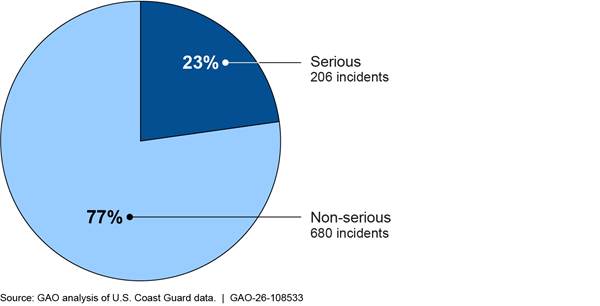
Fires on vessels are among the most dangerous and challenging incidents to which firefighters can respond. Vessels may also carry hazardous cargo, like lithium-ion batteries, further complicating marine firefighting responses. According to U.S. Coast Guard data, there were 886 nearshore marine fires that occurred between 2015 and 2025. About one quarter (206) of these resulted in either death, injury, over $200,000 in damage, or a total loss of the vessel.
The U.S. Coast Guard is the principal federal agency responsible for overseeing marine safety. For marine firefighting, the Coast Guard plays a coordinating role while land-based fire departments extinguish fires. Following a marine fire that resulted in two firefighter deaths in 2023, the Coast Guard established a task force to address various marine firefighting challenges. The task force has taken several steps to address them but gaps remain.
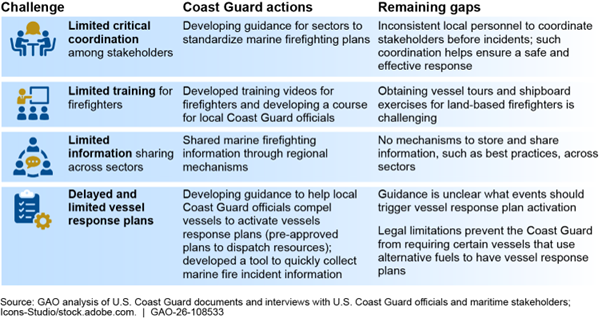
Designating consistent Coast Guard field personnel to lead coordination before marine fires occur, facilitating more hands-on training for firefighters on vessels, and establishing an information sharing mechanism would help ensure firefighters have the knowledge and skills necessary to safely and effectively extinguish vessel fires. Further, developing guidance on what warrants vessel response plan activation would help ensure resources are quickly mobilized and better ensure the safety of firefighters.
The number of vessels that use alternative fuels continues to grow. However, legal limitations prevent the Coast Guard from requiring nontank vessels that use alternative fuels—such as ferries powered by lithium-ion batteries—to have vessel response plans related to hazardous substance discharges. These limitations predate the widespread use of alternative fuels. Having that authority would empower the Coast Guard to better ensure vessels and firefighters can quickly receive assistance in the event of a fire.
Why GAO Did This Study
The Coast Guard has issued regulations requiring certain vessels to have response plans that identify the resources that would respond to marine fires related to oil discharges.
The National Defense Authorization Act for Fiscal Year 2026 includes a provision for GAO to review, among other things, the Coast Guard’s efforts related to marine firefighting. This report examines (1) how frequently nearshore marine fires occur and the characteristics of those fires and (2) what challenges exist in marine firefighting and how the Coast Guard is addressing them.
GAO analyzed Coast Guard data for 2015 through 2025; reviewed Coast Guard guidance and investigative reports; and interviewed Coast Guard officials, fire chiefs based in seven Coast Guard sectors, and representatives from maritime and firefighting stakeholder associations.
What GAO Recommends
Congress should consider amending existing law to ensure that owners and operators of nontank vessels that use alternative fuels prepare vessel response plans related to hazardous substance discharges.
GAO is also making five recommendations to the Coast Guard, including to designate marine firefighting coordination responsibilities to specific field positions, engage with fire departments to coordinate training, establish a mechanism to store and share marine firefighting information, and develop factors maritime stakeholders and the Coast Guard should consider regarding vessel response plan activation. The Coast Guard agreed with all five recommendations.
Abbreviations
Department of Homeland Security (DHS)
Federal Emergency Management Agency (FEMA)
Vessel Response Plan (VRP)
This is a work of the U.S. government and is not subject to copyright protection in the United States. The published product may be reproduced and distributed in its entirety without further permission from GAO. However, because this work may contain copyrighted images or other material, permission from the copyright holder may be necessary if you wish to reproduce this material separately.
September 29, 2026
The Honorable Ted Cruz
Chair
The Honorable Maria Cantwell
Ranking Member
Committee on Commerce, Science, and Transportation
U.S. Senate
The Honorable Sam Graves
Chair
The Honorable Rick Larsen
Ranking Member
Committee on Transportation and Infrastructure
House of Representatives
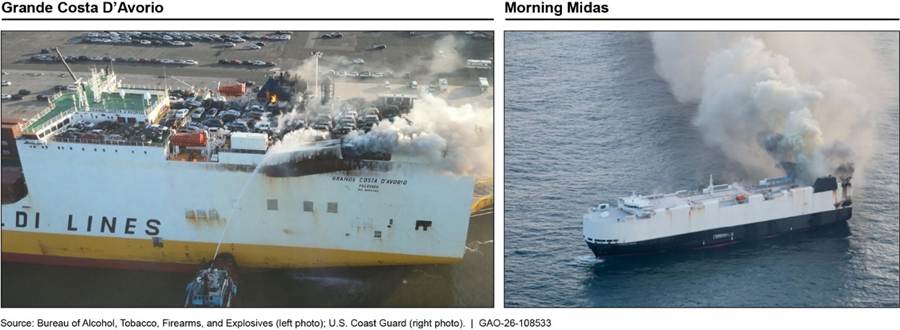
Fires on vessels are among the most dangerous and challenging incidents to which firefighters can respond. Marine firefighting presents unique hazards and implications, such as vessel instability from flooding, confined onboard spaces, and the need for specialized resources and equipment that may be unavailable in the affected port. For example, in 2023, land-based firefighters responded to a fire on the Grande Costa D’Avorio in the port of Newark, New Jersey. While fighting the vessel fire, several firefighters got disoriented and lost amid the smoke and unfamiliar vessel layout. Two firefighters lost their lives and several others were injured.
Cargo can further complicate marine firefighting responses. For example, lithium-ion battery fires can result in the battery overheating and releasing large volumes of toxic gases that can catch fire very quickly and are difficult to extinguish. In June 2025, the Morning Midas cargo vessel, which was transporting electric and hybrid vehicles with lithium-ion batteries, caught fire and sank off the coast of Alaska. Vessels may also carry hazardous cargo in shipping containers which firefighters cannot readily identify or locate, further complicating the response. Figure 1 shows the Grande Costa D’Avorio and Morning Midas marine fires.
The U.S. Coast Guard, a multi-mission maritime military service within the Department of Homeland Security (DHS), is the principal federal agency responsible for overseeing marine safety, including as it relates to vessels and waterfront facilities. Although the Coast Guard has no specific statutory responsibility to fight marine fires, it has traditionally been responsible for saving life and property on U.S. waters. The Coast Guard provides a regulatory framework for certain aspects of marine firefighting and generally plays a coordinating role while land-based fire departments are responsible for carrying out the actual firefighting. Fire departments have additional support from maritime industry stakeholders, such as vessel and facility operators, professional salvage and marine firefighting providers, and port authorities.[1] Although the Coast Guard has issued some planning guidance for marine firefighting, safety experts and marine industry stakeholders have raised questions about overall preparedness for nearshore marine fires, and about the Coast Guard’s coordination with other stakeholders during such events.[2]
The National Defense Authorization Act for Fiscal Year 2026 includes a provision for GAO to review the state of marine firefighting authorities, jurisdiction, and plan review, along with other considerations with respect to fires at waterfront facilities (including vessel fires) and vessel fires on the navigable waters of the U.S. The provision encompasses the Coast Guard’s role in this area, such as its efforts to collaborate with non-federal entities to reduce the risks to local communities of marine fires and its methods of documenting and sharing best practices throughout the maritime community for responding to vessel fires.[3] This report examines (1) how frequently nearshore marine fires occur and the characteristics of those fires and (2) what challenges exist in marine firefighting and how the Coast Guard is addressing them.
To address these objectives, we conducted in-person site visits and video interviews with local Coast Guard officials, fire department officials, and maritime stakeholder representatives on coordination, training, and responding to nearshore marine fires. We selected seven locations based on geographic dispersion, types of vessel traffic, presence of land-based firefighters responding to marine fires, and other considerations, such as vessels that operate in remote areas and require alternative planning for marine fires.[4] These seven locations were: (1) Houston, Texas; (2) Baltimore, Maryland; (3) Puget Sound, Washington; (4) the Ohio River Valley; (5) the Great Lakes; (6) Los Angeles and Long Beach, California; and (7) western Alaska. In addition to our interviews, we observed firefighters receiving a tour of a vessel, marine firefighting equipment and other resources, and local coordination meetings on marine firefighting.
To examine how frequently nearshore marine fires occurred, we analyzed Coast Guard data for calendar years 2015 through 2025 (the most recent years available). We analyzed data for frequency and characteristics of nearshore marine fires, including identifying possible trends by location, types of vessels, types of incidents, consequences (e.g., deaths, injuries, pollution, and property damage costs), and whether fire departments responded.[5] To assess data reliability, we discussed data collection methods with agency officials, conducted electronic testing to identify potential anomalies, and reviewed agency procedures for data quality. We determined that the data were sufficiently reliable for the purpose of reporting frequency and characteristics of nearshore marine fires.
To identify marine firefighting challenges and assess how the Coast Guard is addressing them, we reviewed Coast Guard documentation, such as marine firefighting policy and guidance, marine firefighting plans, investigative reports, and other documented tools the Coast Guard developed. We also reviewed National Transportation Safety Board reports. In addition to meeting with local officials during our site visits, we interviewed Coast Guard headquarters officials about the Coast Guard’s efforts to address marine firefighting challenges. We also interviewed representatives from maritime and firefighting stakeholder associations, including the American Salvage Association, the Passenger Vessel Association, the U.S. Chamber of Shipping, the International Association of Fire Fighters, and the International Association of Fire Chiefs. We discussed marine firefighting challenges related to authorities, jurisdiction, planning, training, coordinating, and responding to nearshore marine fires.[6] Additionally, we interviewed three salvage and marine firefighting providers and a representative from one private entity that coordinates response activities on behalf of vessel owners.[7] We compared the Coast Guard’s efforts to address challenges against Coast Guard policies, federal internal control standards, and National Fire Protection Association guidance.[8] We also reviewed relevant laws and regulations, including those related to vessel plans for responding to a worst case oil or hazardous substance discharge (or a substantial threat of such a discharge).
We conducted this performance audit from June 2025 to September 2026 in accordance with generally accepted government auditing standards. Those standards require that we plan and perform the audit to obtain sufficient, appropriate evidence to provide a reasonable basis for our findings and conclusions based on our audit objectives. We believe that the evidence obtained provides a reasonable basis for our findings and conclusions based on our audit objectives.
Background
The Coast Guard has authority to render aid to individuals and protect property at any time and place where its facilities and personnel are available and can be used effectively.[9] It is also generally responsible for ensuring the safe movement of maritime traffic and keeping ports safe and open. For example, it may take necessary action to protect U.S. navigable waters and their resources from harm caused by damage, destruction, or loss of a vessel or structure.[10] These roles may at times create tension with other law which acknowledges that fire prevention and control are a state and local responsibility.[11] The Coast Guard also has specific environmental protection authorities and responsibilities that give it key coordination and oversight roles.[12] For example, the Coast Guard is the predesignated federal on-scene coordinator during incidents involving oil and hazardous substances, including ones where there are fires. Table 1 provides key Coast Guard and maritime stakeholder roles and responsibilities specifically related to marine firefighting in more detail.
Table 1: Key Coast Guard and Maritime Stakeholders with Roles and Responsibilities Related to Marine Firefighting
|
Coast Guard headquarters officials |
The Office of Marine Environmental Response Policy provides guidance, policy, and tools for planning and operations to prevent, respond to, and mitigate the threat and consequences of oil and hazardous substance discharges in U.S. waters, including incidents caused by marine fires. Coast Guard Vessel Response Plan Program officials review and approve vessel response plans (plans that identify resources that would respond to an oil spill, including a spill resulting from a fire) submitted by vessel owners or operators. |
|
Local Coast Guard officials |
Local Coast Guard officials include the Captain of the Port, a local commander who holds broad, specialized authority over, among other things, vessel movements, port safety, and security operations. Additionally, port security/recovery specialists, emergency management specialists, and other civilian personnel support various marine firefighting related functions, such as overseeing port-level security plans, conducting risk assessments with maritime stakeholders, and managing contingency planning and preparedness. |
|
Land-based firefighters |
Local municipal fire departments are typically the first to respond to nearshore marine fires, such as those on vessels moored near a port.a Their first priority is saving lives. |
|
Vessel facility owners or operators |
The owner holds legal title or beneficial interest to a vessel; the operator owns or contracts to operate the vessel. If the vessel is required to have a vessel response plan, these individuals employ shore-based representatives (called “qualified individuals”) to help coordinate the proper response to an incident. |
|
Salvage and marine firefighting providers |
Third-party entities that provide personnel, equipment, or supplies necessary to perform salvage or marine firefighting services based on regulatory standards. These services are identified in vessel response plans and arranged by contract or other approved means. |
|
Local port authorities |
Local governmental entities that own or administer the land or facilities at the port. |
Source: GAO analysis of Coast Guard and other maritime information. I GAO‑26‑108533
aNearshore is defined as waters that are within 3 nautical miles from the shoreline, inland rivers, and U.S. waters of the Great Lakes.
Pursuant to delegated authority, the Coast Guard issued regulations that, among other things, require tank vessels, which are vessels with large amounts of oil onboard, and nontank vessels to have vessel response plans (VRPs) for oil discharges.[13] These VRPs must describe the measures a vessel owner or operator would take to respond to a worst case oil discharge (or a substantial threat of such a discharge), including discharges resulting from a marine fire or explosion. These plans must also identify the resources to support the response, such as external firefighting teams. For this purpose, vessel owners and operators enter into contracts with resource providers to secure their services. These resource providers may, in turn, subcontract with owners of other vessels, such as tugboats or other assets, to provide additional response capabilities. The Coast Guard has a program to review and approve VRPs to ensure they comply with regulations and that vessel owners and operators have the capacity to respond to a potential incident, including one involving a marine fire. Since December 2020, the Coast Guard has expended about $1 million annually on its VRP program.
We previously identified issues with the Coast Guard’s processes for reviewing and approving VRPs.[14] For example, we found that some subcontracts provide that the vessels are obligated to respond, as available, which raised questions as to whether they are committed to respond to an incident. We recommended that the Coast Guard analyze incidents where VRPs have been activated to determine whether or how the Coast Guard should improve its VRP reviews. In response, in March 2025, the Coast Guard updated its Marine Environmental Response and Preparedness program policy manual to require Coast Guard units to track and report VRP activations, including details of any deficiencies identified. In addition, the Coast Guard developed a process for its VRP program to assess data on VRP activations for programmatic risks and identify potential recommendations for improvements. VRPs are discussed in greater detail later in the report.
Due to recent marine fires which have involved the loss of firefighters and mariners’ lives and highlighted how challenging marine fires can be, the Coast Guard’s Office of Marine Environmental Response Policy recognized the need to provide related guidance to address emergent needs.[15] In January 2024, the Coast Guard established a National Salvage and Marine Firefighting Task Force (the Task Force), which includes representatives from the Coast Guard, local fire departments, the maritime industry, and academia. The Task Force is intended to identify challenges and improve planning and preparedness for maritime incidents, including marine fires.
Hundreds of Serious Marine Fires Occurred Over the Past Decade with Deadly and Costly Consequences
Hundreds of marine fires over the past decade have occurred, some of which resulted in deaths, injuries, and millions of dollars in financial losses. More specifically, there were 886 nearshore marine fires during 2015 through 2025, according to Coast Guard data.[16] About one-quarter of them were serious marine incidents, as shown in figure 2. According to a Coast Guard regulation, serious marine incidents include Coast Guard-reportable casualties and accidents that result in death, injury requiring professional treatment beyond first aid, property damage exceeding $200,000, or vessel loss.[17] Seven fire chiefs we spoke with across the U.S. stated marine fires are generally low frequency, high consequence events.
Note: All of these serious marine fires are serious marine incidents. A serious marine incident is generally (1) any Coast Guard-reportable marine casualty or accident that results in death, injury requiring professional medical treatment beyond first aid, property damage exceeding $200,000, or actual or constructive total vessel loss; (2) discharge of 10,000 gallons of oil into the navigable waters of the U.S.; or (3) discharge of a reportable quantity of a hazardous substance into the navigable waters of the U.S. or release of a reportable quantity of a hazardous substance into the environment of the U.S. See 46 C.F.R. § 4.03-2. “Non-serious” does not imply that the fire was not a significant or serious occurrence. These other fires are marine casualties or accidents, as defined in 46 C.F.R. § 4.03-1.
According to Coast Guard data, marine fires often begin in vessel galleys or engine rooms. The National Transportation Safety Board has found various probable causes of these fires, including improper maintenance; damaged vessel materials or parts; improperly overseen fueling or unloading of cargo; and hazardous cargo or tools, such as a lithium-ion battery in a handheld radio.
Serious marine fires have occurred on all three coasts, the Great Lakes, and some inland waterways but have been concentrated in several regions, including the Pacific Northwest, western Gulf Coast, and New England.[18] Local fire departments responded to at least 79 serious marine fires, according to Coast Guard data.[19] Figure 3 shows the locations of these marine fires, including incidents where data showed fire departments responded.
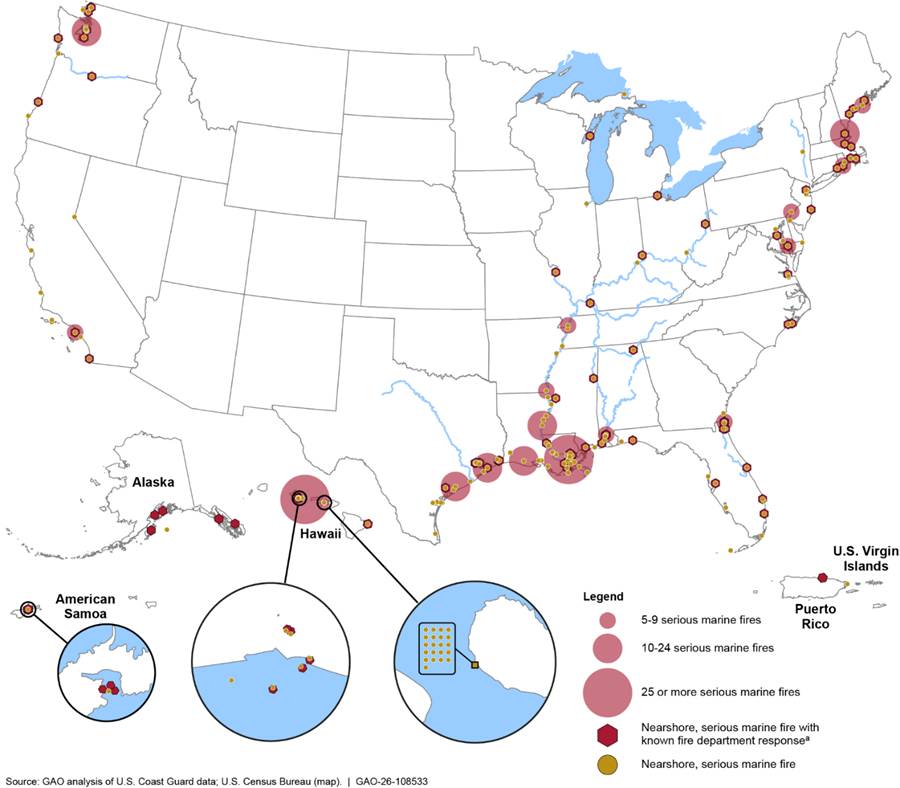
Note: We identified nearshore incidents as being within 3 nautical miles from the U.S. coastline, in inland rivers, or in U.S. waters of the Great Lakes, based on geographic coordinates recorded in U.S. Coast Guard data. All of these serious marine fires are serious marine incidents. A serious marine incident is generally (1) any Coast Guard-reportable marine casualty or accident that results in death, injury requiring professional medical treatment beyond first aid, property damage exceeding $200,000, or actual or constructive total vessel loss; (2) discharge of 10,000 gallons of oil into the navigable waters of the U.S.; or (3) discharge of a reportable quantity of a hazardous substance into the navigable waters of the U.S. or release of a reportable quantity of a hazardous substance into the environment of the U.S. See 46 C.F.R. § 4.03-2. Some marine fires involved more than one vessel. Coast Guard Sector Honolulu reported 21 incidents resulting from the 2023 wildfires on Maui. Proportional circles identify areas where more than five incidents occurred within a 100-mile radius. Circle size reflects the severity of incidents within that area.
aTo identify incidents in which firefighters responded to marine fires, we reviewed narratives in a free form text field that officials use to describe the incidents for terms commonly associated with land-based fire departments, such as “fire department,” “fire dept,” and “firefighter.” The Coast Guard does not require officials to document whether a fire department responded.
In addition to the geographic dispersion, Coast Guard data show there are various types of marine vessels that have been involved in serious marine fires, as shown in figure 4.
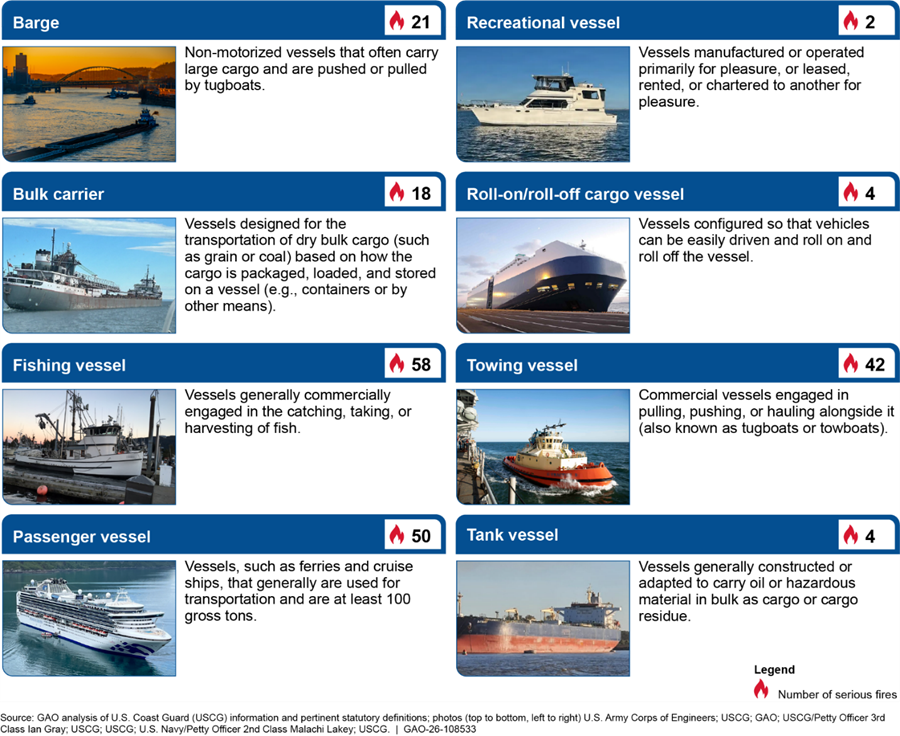
Note: Bulk carrier includes the Coast Guard categories of “bulk carrier,” “general dry cargo ship,” and “tank ship.” The remaining vessels involved in serious marine incidents were miscellaneous vessels, unspecified vessels, or offshore vessels. All of these serious marine fires are serious marine incidents. A serious marine incident is generally (1) any Coast Guard-reportable marine casualty or accident that results in death, injury requiring professional medical treatment beyond first aid, property damage exceeding $200,000, or actual or constructive total vessel loss; (2) discharge of 10,000 gallons of oil into the navigable waters of the U.S.; or (3) discharge of a reportable quantity of a hazardous substance into the navigable waters of the U.S. or release of a reportable quantity of a hazardous substance into the environment of the U.S. See 46 C.F.R. § 4.03-2. Some marine fires involved more than one vessel.
The frequency of marine fires and the types of vessels involved in those fires varied across Coast Guard districts. The Coast Guard’s Heartland District recorded the highest number of serious marine fires from 2015 through 2025, due to fires along the Texas and Louisiana coasts, and on the Mississippi River. Towing vessels were the most common type of vessels involved in serious marine fires in that district, followed by barges and fishing vessels. Other Coast Guard districts showed a stronger concentration of serious marine fires involving vessels other than towing vessels. For example, fishing vessels were the most prevalent type of vessel involved in serious marine fires in several districts. Figure 5 shows that both the frequency of serious marine fires and the vessel types involved differed by Coast Guard district.
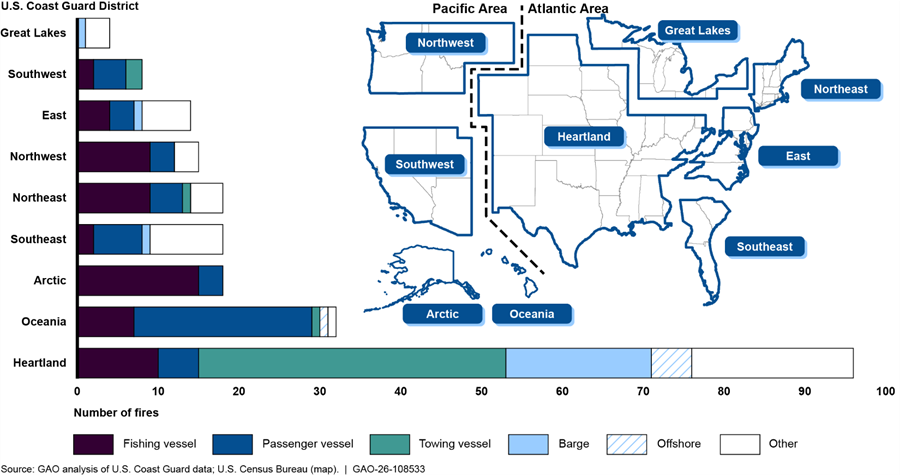
Note: Nearshore is defined as waters that are within 3 nautical miles from the shoreline, inland rivers, and U.S. waters of the Great Lakes. All of these serious marine fires are serious marine incidents. A serious marine incident is generally (1) any Coast Guard-reportable marine casualty or accident that results in death, injury requiring professional medical treatment beyond first aid, property damage exceeding $200,000, or actual or constructive total vessel loss; (2) discharge of 10,000 gallons of oil into the navigable waters of the U.S.; or (3) discharge of a reportable quantity of a hazardous substance into the navigable waters of the U.S or release of a reportable quantity of a hazardous substance into the environment of the U.S. See 46 C.F.R. § 4.03-2. For total serious nearshore marine fires by vessel type, “Other” includes bulk carriers, dry cargo ships, roll-on/roll-off cargo vessels, tank vessels, recreational vessels, and miscellaneous or unspecified vessels. In the Oceania District, Sector Honolulu reported 21 incidents resulting from the 2023 wildfires on Maui.
Serious marine fires sometimes resulted in life-and-death consequences. From 2015 through 2025, 55 people died and 50 were injured in serious marine fires. Passenger vessel fires were responsible for 62 percent of deaths (34 deaths) and 52 percent of people injured (26 people), as shown in figure 6. Additionally, serious marine fires resulted in over $536 million in property damage for the same time period. Bulk carriers, fishing vessels, and cargo ships configured so that vehicles can easily roll on and off were responsible for the most property damage costs associated with these fires (82 percent).
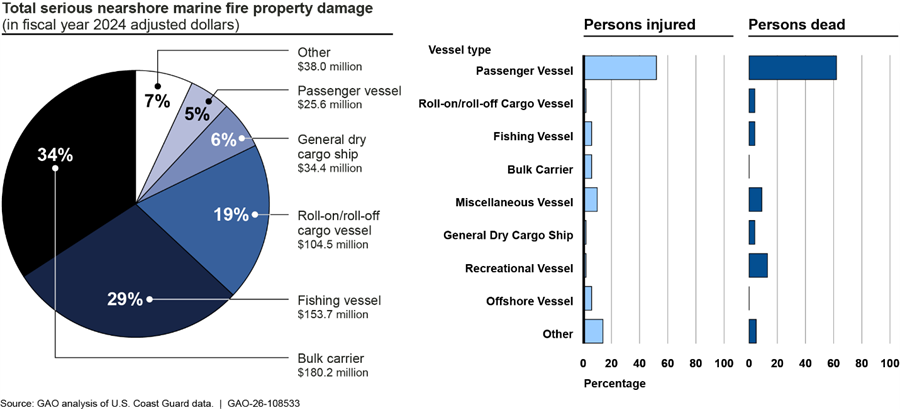
Note: Nearshore is defined as waters that are within three nautical miles from the shoreline, inland rivers, and U.S. waters of the Great Lakes. All of these serious marine fires are serious marine incidents. A serious marine incident is generally (1) any Coast Guard-reportable marine casualty or accident that results in death, injury requiring professional medical treatment beyond first aid, property damage exceeding $200,000, or actual or constructive total vessel loss; (2) discharge of 10,000 gallons of oil into the navigable waters of the U.S.; or (3) discharge of a reportable quantity of a hazardous substance into the navigable waters of the U.S or release of a reportable quantity of a hazardous substance into the environment of the U.S. See 46 C.F.R. § 4.03-2. For total serious nearshore marine fire property damage, “Other” includes towing vessels, recreational vessels, offshore vessels, barges, tank vessels, miscellaneous or unspecified vessels, or a combination of vessels when an incident involved more than one vessel (e.g., a barge and a towing vessel). For persons injured or dead in these incidents, “Other” includes barges, towing vessels, tank vessels, unspecified vessels, or a combination of vessels when an incident involved more than one vessel (e.g., a barge, a dry cargo ship, and a towing vessel).
Serious nearshore marine fires also resulted in environmental consequences. For example, barges and other vessels were responsible for 99 percent of gallons of oil spilled in serious marine fires from 2015 through 2025—nearly 500,000 gallons total. There were also at least nine fires at marine waterfront facilities reported to the Coast Guard during this period.[20]
Coast Guard is Developing Tools to Address Marine Firefighting Challenges, but Gaps Remain
The Task Force and maritime stakeholders identified several challenges related to marine firefighting, including limited coordination at the port level, insufficient training and funding, and issues with VRP activation. The Coast Guard is addressing these challenges by, among other things, developing training and guidance for sectors to standardize marine firefighting plans. However, gaps remain, as shown in figure 7.
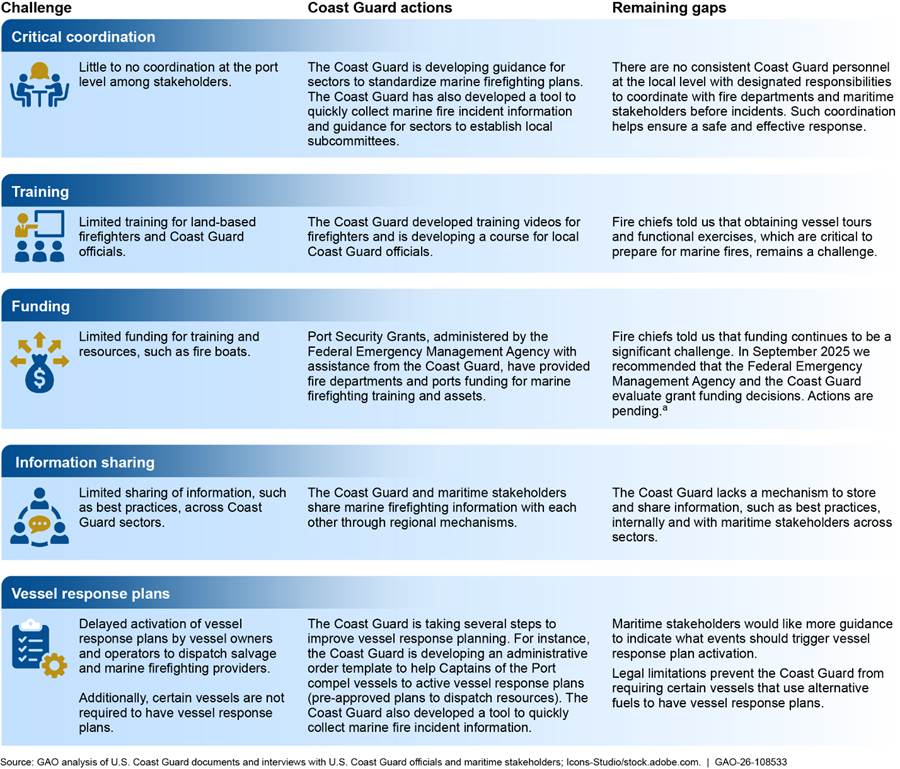
Note: Captains of the Port are local commanders who hold broad, specialized authority over, among other things, vessel movements, port safety, and security operations.
aSee GAO, Port Security: FEMA Should Improve Transparency of Grant Decisions, GAO‑25‑107587 (Washington, D.C.: Sept. 17, 2025).
Critical Coordination
The Task Force, the National Transportation Safety Board, and marine firefighting stakeholders identified little to no coordination on marine firefighting among the Coast Guard, land-based fire departments, and maritime stakeholders (e.g., port authorities) at the port level as a challenge.[21] For example, the National Transportation Safety Board found that poor communication during the response to the June 2022 Spirit of Norfolk marine fire contributed to the severity of the fire and resulted in further damage to the vessel.[22] One maritime stakeholder told us that improved coordination would have mitigated the damage, and that their organization encouraged more engagement with fire departments following the incident.
The Task Force has developed and continues to develop several tools to address this coordination gap. For example, it is developing guidance for sectors to standardize marine firefighting plans that stress the importance of coordinated action among firefighters, vessel representatives, and Coast Guard Captains of the Port to ensure firefighter safety when responding to marine fires.[23] Coast Guard officials told us the guidance will be finalized in early 2027. The Task Force also developed a quick response card in August 2025 to help Coast Guard Command Center personnel gather information during marine fires and facilitate coordination, such as determining if onboard firefighting systems are operable, so firefighters can respond with the right equipment. Finally, the Task Force provided guidance in July 2025 for sectors to establish local salvage and marine firefighting subcommittees to support coordinated marine firefighting responses.[24] As of June 2026, one of the seven Coast Guard sectors we spoke with established a subcommittee, and five sectors utilize subcommittees run by local fire chiefs or government officials, according to Coast Guard officials and fire chiefs from these sectors.[25]
While the Coast Guard has taken steps to improve coordination, we found that the Coast Guard lacks consistent personnel at the local level with designated marine fire coordination responsibilities to lead these efforts before a marine fire occurs. In some sectors, civilian Coast Guard officials, such as port security/recovery specialists, who are responsible for coordinating exercises for security incidents, lead marine firefighting efforts even though this is not part of their official duties.[26] A port security/recovery specialist in one sector told us they lead coordination because of their passion and experience working on marine firefighting issues. Coast Guard officials stated that not having dedicated civilian staff for marine firefighting planning and response coordination is a major shortfall that has been identified as a recurring challenge in Coast Guard reports for over a decade.
Conversely, fire chiefs from three of six sectors we spoke with told us they lead coordination rather than the Coast Guard due to the absence of a Coast Guard lead and because they want to ensure their departments are prepared for marine fires.[27] Fire chiefs from two sectors in which fire chiefs lead coordination noted the lack of a Coast Guard lead with marine firefighting knowledge is often due to Coast Guard military personnel rotating to new locations every few years, which has created a coordination vacuum. One fire chief told us they must train the newly rotated Coast Guard officials, including Captains of the Port, on local emergency and fire response techniques and command practices. Moreover, a Captain of the Port from one sector and a port security/recovery specialist and a fire chief from another sector told us that the preparedness of ports varies based on the expertise and level of engagement of local Coast Guard personnel. As a result, they said that coordination suffers when lead coordinators leave.
The Coast Guard’s Marine Environmental Response and Preparedness commandant instruction states that Coast Guard personnel are responsible for coordinating and maintaining relationships with firefighting stakeholders.[28] Another Coast Guard commandant instruction states that internal controls are important to every aspect of the mission and requires management to follow Standards for Internal Control in the Federal Government.[29] According to these standards, management must establish an organizational structure, assign responsibility, and delegate authority to achieve the entity’s objectives.
Coast Guard officials told us that the Coast Guard lacks sufficient staff to dedicate consistent coordinators in each sector. However, the Coast Guard is committed to increasing its military workforce by at least 15,000 people in the coming years, according to Coast Guard planning documents. Further, fire chiefs operating in sectors with Coast Guard port security/recovery specialists leading marine firefighting coordination credit these officials for strong coordination before an incident. By having specific field unit positions with designated marine firefighting coordination responsibilities, the Coast Guard would be able to better maintain institutional knowledge and build the necessary relationships to consistently coordinate marine firefighting resources at the local level. Doing so will help ensure ports and local firefighters are more prepared when a fire occurs.
Training
Training for Firefighters
The Coast Guard, the National Transportation Safety Board, and fire chiefs identified limited available training for land-based firefighters on how to prepare for and respond to marine fires as a challenge. For example, in a January 2024 analysis of marine firefighting capabilities, the Coast Guard identified that the Port of Charleston had only 15 trained firefighters available to respond to marine fires. This is despite finding that other ports needed significantly more (over 100 firefighters) to respond to previous serious fires on large vessels.[30] The National Transportation Safety Board also found that insufficient marine firefighter training contributed to two firefighter deaths and nine firefighter injuries during two marine fires on roll-on/roll-off cargo vessels. However, fire chiefs in four of six sectors we spoke with told us they have trouble justifying paying for firefighting training because of their constrained budgets. They also cited limited available time given their other firefighting responsibilities. Fire chiefs in two sectors also said they would have to pay costly overtime.
To address this challenge, Coast Guard officials told us that the Coast Guard partnered with the International Association of Fire Fighters to develop an 8-hour marine firefighting awareness training course. According to the Association, participants completed virtual exercises to better understand roles and jurisdiction, risk management, and the marine environment. The Task Force finalized the training in April 2026 and firefighters from the Newark Fire Department (whose firefighters responded to the Costa D’Avorio vessel fire) were the first students to take the course, according to Coast Guard officials.
The Coast Guard also partnered with an emergency response organization to develop a free, public online training course. This 12-module course provides an overview of marine firefighting resources, tactical considerations, and vessel hazards, among other topics. For example, as shown in figure 8, these training videos explain that firefighters must slowly open sealed doorways from the side to prevent an explosive reaction from built-up heat and smoke. The videos also show that firefighters may have to enter rooms through small spaces while carrying heavy and bulky equipment. The training was launched in April 2026. Officials from one Coast Guard sector and one fire department told us the videos will help firefighters with little experience responding to marine fires be better prepared to respond.
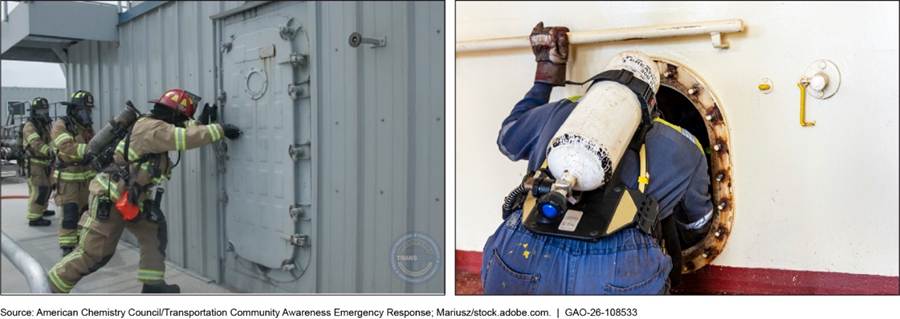
While these virtual training opportunities are a useful first step, some Coast Guard officials stated that tactical, hands-on training, like vessel tours and functional vessel fire exercises, better prepares firefighters for complex fire incidents, rather than virtual training alone. For example, Coast Guard officials from six sectors we met with told us firefighters need more hands-on training for marine firefighting. However, fire chiefs in three sectors told us that they have trouble scheduling vessel tours, like the one shown in figure 9, and exercises due to limited time vessels have in port. Additionally, five out of nine Coast Guard firefighting plans from different sectors we reviewed do not encourage the Coast Guard, fire departments, and maritime stakeholders to coordinate marine fire-related training exercises or vessel tours for land-based firefighters.
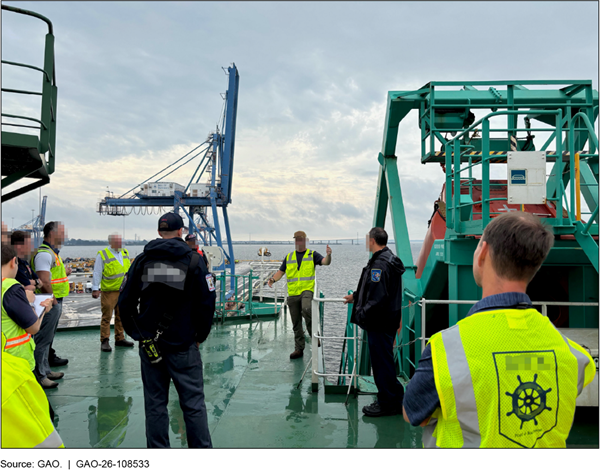
The Coast Guard Captain of the Port is responsible for vessel safety, safety of waterfront facilities, and protecting the marine environment.[31] These officials are also responsible for coordinating federal, state, and commercial resources that respond to certain vessel fires.[32] Further, draft Coast Guard guidance to standardize marine firefighting plans indicates that the Captain of the Port works with local officials, including fire departments, to maintain effective firefighting plans. Coast Guard officials told us National Fire Protection Association guidance is the technical authority for marine firefighting planning. This guidance states that frequent training, including vessel tours and functional exercises, is necessary to maintain a state of readiness.[33] Furthermore, the DHS Homeland Security Exercise and Evaluation Program highlights the importance of operations-based exercises, which include drills, functional exercises, and full-scale exercises.[34]
The Coast Guard previously recommended fire departments initiate coordinating with the Coast Guard for shipboard education and training in response to the Grande Costa D’Avorio fire in November 2023.[35] However, firefighters lack the authority to access vessels for tours and exercises without approval from vessel owners or operators. Fire chiefs in three sectors told us they would like the Coast Guard to help facilitate such tours and exercises. Furthermore, since Task Force efforts have been undertaken, Coast Guard officials stated that the responsibility for initiating coordination falls to local Captains of the Port.
The Coast Guard’s December 2025 investigative report of the Grande Costa D’Avorio vessel fire stated that responding firefighters had received classroom training but had knowledge gaps that hands‑on practical experience could fill.[36] The last training exercise that was offered to the responding firefighters occurred 9 years before the Grande Costa D’Avorio incident and one of the responding firefighters attended. As a result, the Coast Guard investigators recommended that each Captain of the Port establish a shipboard exercise program that convenes all firefighting stakeholders to test marine firefighting plans and improve responses to marine fires. The Coast Guard Assistant Commandant for Prevention Policy agreed that firefighters need more hands-on training and stated the Task Force would develop hands-on exercise program guidance.
However, the Task Force has not developed hands-on exercise program guidance as of September 2026. While its draft guidance for updating marine firefighting plans includes language supporting vessel tours and an exercise program to test marine firefighting plans, it does not require the Coast Guard to coordinate with fire departments and maritime stakeholders to participate in an exercise or guide Captains of the Port on how to develop such a program.[37]
According to Coast Guard officials, the Task Force has not developed guidance for a hands-on exercise program because it prioritized developing guidance for standardized marine firefighting plans and the initial responder training videos. Further, Coast Guard officials stated the Coast Guard is not the correct federal agency to develop or provide oversight of hands-on marine firefighting training, and that it cannot require private vessel owners to host tours. We acknowledge the Coast Guard’s limitations related to marine firefighting training. However, the Coast Guard is positioned to help coordinate opportunities, such as vessel tours, with local officials and fire departments that could ensure they are better prepared for marine fires. In addition, while the Coast Guard cannot direct vessel owners or operators or fire departments to participate in hands-on training, it can ensure Coast Guard personnel are coordinating opportunities for vessel tours when willing and interested stakeholders would like to be better prepared for marine fires.
With more shipboard training opportunities and exercises that convene all firefighting stakeholders to test marine firefighting plans and improve responses to marine fires, land-based firefighters and maritime stakeholders may be better prepared to safely and effectively respond to marine fires. By proactively engaging with fire departments and other maritime stakeholders to coordinate hands-on shipboard training experience, the Coast Guard would help ensure firefighters get more access to various types of vessels, further mitigating the dangers of fighting marine fires.
Training for Coast Guard Officials
The Coast Guard identified limited training for Coast Guard officials as a challenge in coordinating marine fire responses. In a January 2024 analysis of marine firefighting capabilities, the Coast Guard identified that since at least August 2020 its officials responsible for coordinating marine fire response resources lacked necessary training.[38] In this analysis, the Coast Guard cited various past marine fires, such as the Spirit of Norfolk vessel fire in June 2022 where response coordinators, including the Coast Guard, did not effectively communicate with firefighters. To ensure that Coast Guard officials have the skills, knowledge, and proficiency necessary to effectively coordinate and oversee marine fire responses, the Coast Guard recommended developing a training course for its personnel in January 2024.
As of May 2026, the Coast Guard is in the early stages of developing a training curriculum for its personnel. The course is intended to help participants better understand the complexities of marine fires, assess unique risks, and better train its personnel on managing coordinated fire responses. The training is intended to ensure the Coast Guard personnel involved in coordinating and overseeing responses to these fires are better prepared to protect the lives and safety of those responding and prevent negative impacts on the maritime environment and commercial activity. According to Coast Guard officials, the course will likely be contractor-led and take approximately 6 to 12 months to finalize.
Funding
Coast Guard officials and fire chiefs identified limited funding for formal marine firefighting training and resources as a significant challenge. While formal marine firefighting training is available at several institutions across the U.S., as discussed above, fire chiefs in four sectors we spoke with told us they have trouble justifying firefighting training because of constrained budgets.[39] For example, while tuition for one firefighter to attend a 5-day training course may cost $500, one fire chief told us the total cost of attendance would be around $6,000 because of enrollment, lodging, and overtime costs.
Furthermore, some fire departments lack resources, such as fireboat assets and water pumps, to provide effective responses to marine fires. For example, fire chiefs in two sectors told us they have aging fireboats that were unusable when needed. The largest and most capable fireboat operated by the Baltimore City Fire Department was undergoing maintenance and inoperable when a container vessel struck the Francis Scott Key Bridge in March 2024, according to the fire chief. Although there was no fire onboard the vessel, the risk was significant, according to the National Transportation Safety Board, because of the hazardous nature of the cargo, which included lithium-ion batteries. Another fire chief told us some smaller fire departments in more remote areas may have fewer than five firefighters, some of whom are volunteers, with no resources to combat marine fires.
Fire chiefs in four sectors we spoke with told us they have used federal funds from the Federal Emergency Management Agency’s (FEMA) Port Security Grant Program, administered with assistance from the Coast Guard, to pay for training or assets, including fire boats, as shown in figure 10.[40] However, fire chiefs from four sectors said acquiring these grants is challenging. One fire chief said getting these grants for marine firefighting support is challenging when competing with other Coast Guard missions and priorities in the application process, such as a training exercise for protecting the port from criminal activity.[41]
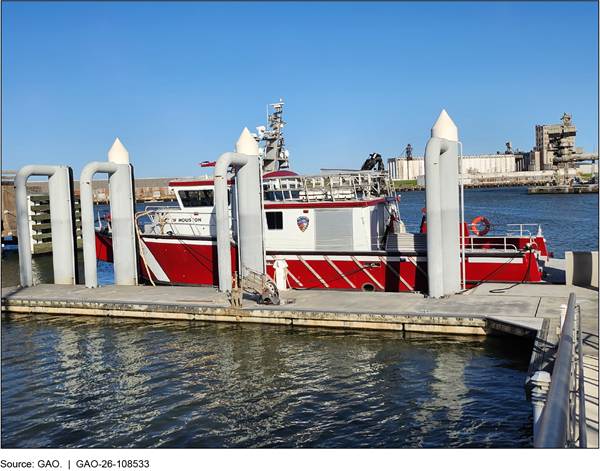
We reported on FEMA and the Coast Guard’s management of the Port Security Grant Program in September 2025 and found that the application evaluation process lacks transparency.[42] We made three recommendations to FEMA and the Coast Guard that, if implemented, will improve transparency of grant decisions, including for fire departments that apply for the grants. As of March 2026, FEMA reported taking action to incorporate detailed descriptions of the application evaluation process, disclose accurate review criteria, and conduct an assessment to determine if the grant program’s results are consistent with goals. We will continue to monitor FEMA’s actions to implement the recommendations.
Information sharing
|
Examples of Marine Firefighting Information Sharing Locally Members of the Salvage and Marine Firefighting Subcommittee in Coast Guard Sector Maryland-National Capital Region discussed response techniques from local and international fire incident case studies during a September 2025 meeting. For example, subcommittee members discussed how firefighters effectively suffocated a fire with nitrogen on a roll-on/roll-off cargo vessel with 60 electric vehicles on board, the MV Delphine, at a Belgian port in April 2025. During a February 2026 meeting, the Puget Sound Marine Firefighting Commission hosted an official from a salvage and marine firefighting provider to present on steps responders took to prepare for lithium-ion battery hazards in response to a November 2025 fire on the One Henry Hudson near the Port of Los Angeles. Source: GAO analysis of U.S. Coast Guard and Seattle Fire Department information. | GAO‑26‑108533 |
We found that Coast Guard officials and maritime stakeholders share information and best practices regionally, but do not consistently share information with colleagues outside their areas of responsibility. For example, Coast Guard officials and fire chiefs from five sectors we spoke with told us they discuss best practices and case studies proactively at their local subcommittee meetings. We also observed officials sharing information at local meetings, as discussed in the sidebar. However, these meetings are mostly attended by officials based in the region.
Furthermore, the Coast Guard does not have a mechanism to store and share marine firefighting information, such as best practices, more broadly across all Coast Guard sectors and with maritime stakeholders. For example, Task Force officials told us they share lessons learned from case studies in an ad hoc manner during monthly calls with Coast Guard officials or in quarterly newsletters. However, Coast Guard officials told us that maritime stakeholders cannot access these internal Coast Guard sources. One maritime stakeholder expressed frustration about limited information and best practice sharing between responders on the east and west coasts.
Without access to knowledge from different regions, the ability of the Coast Guard and maritime stakeholders to apply lessons learned by maritime colleagues is limited. This includes lessons learned on new and emerging issues in marine firefighting. For example, the Coast Guard’s Research and Development Center produced a report highlighting lithium-ion battery hazards, fire suppression tactics related to them, and the growing presence of these hazards within the maritime environment.[43] During a meeting with us, one fire chief identified this Coast Guard report on lithium-ion batteries. Officials participating in the meeting were previously unaware of the report, even though the report states that timely delivery of the report to maritime partners is imperative to mitigate potential harm following incidents involving these batteries.
Coast Guard officials from two sectors we spoke with told us that a mechanism for the Coast Guard to store and share marine firefighting information, such as best practices, across sectors would help spread useful information for effective planning and responses to marine fires. Fire chiefs from four Coast Guard sectors, as well as representatives from four maritime stakeholders, told us they would also benefit from such a mechanism. For example, a fire chief told us a mechanism to store and share information on marine fires would help fire departments more easily identify case studies to review rather than manually searching maritime incident reports.
According to Coast Guard internal control standards, management should communicate relevant and quality information both internally to enable personnel to perform key roles in achieving objectives and externally so that appropriate external parties can help the entity achieve its objectives. Providing avenues for Coast Guard officials in one sector to share information and best practices with other sectors and external stakeholders, such as fire departments and port officials, would help facilitate knowledge sharing.
The Coast Guard lacks such a mechanism because it retired Homeport, an internal system used to share information with maritime stakeholders, in April 2025 due to costs and system obsolescence, according to officials. As of July 2026, Coast Guard officials told us they were testing a replacement system, but they have yet to assess the system’s capabilities and determine whether external stakeholders will be authorized to access the system.
Establishing a mechanism to store and share marine firefighting information, such as best practices, would help ensure that Coast Guard officials and marine firefighting stakeholders across the U.S. can access the most current tactics for responding to marine fires. For example, sectors that have had recent serious marine fires could add after-action reports or other relevant information for the benefit of other Coast Guard officials and stakeholders. Additionally, fire chiefs in all six sectors we spoke with told us they are aware of the hazards of lithium-ion battery fires, but there are no standard methods to extinguish them. As more firefighters encounter these fires and learn more effective tactics to address them, a mechanism to share information on this topic would allow information about new methods to be quickly shared. Ultimately, having a mechanism to share marine firefighting information, such as best practices, both internally and externally would help the Coast Guard and stakeholders more effectively prepare for and respond to marine fires.
Vessel Response Plans
Coast Guard officials and fire chiefs from across the U.S. cited a number of concerns related to VRPs. For example, they said vessel owners or operators may delay contacting the shore representatives (called “qualified individuals”) or mobilizing resources to activate VRPs due to the costs associated with deploying additional resources. However, if a VRP is not activated in a timely manner, vessel representatives risk a worsening marine fire incident that may endanger first responders or risk the total loss of the vessel. Additionally, the Coast Guard does not have regulations requiring certain vessels—such as tank vessels or nontank vessels (e.g., ferries or passenger ships) that use alternative fuels—to have VRPs related to hazardous substance discharges. Officials in four of seven Coast Guard sectors we spoke with, and representatives from two professional salvage and marine firefighting companies said that not requiring certain vessels to have response plans is a gap. Vessels that carry or use these hazardous substances can pose significant environmental and human risks if they catch fire or discharge those substances.
Delayed VRP Activation
According to the Coast Guard, delayed activation of VRPs by vessel owners or operators can hinder timely response during marine fire incidents. More specifically, delayed activation of a VRP may result in the delayed dispatch of pre-contracted resources to mitigate a worst case environmental scenario. Officials from four of seven Coast Guard sectors we spoke with said VRP activation is a challenge, and officials from two of these sectors stated vessel owners and operators may be reluctant to activate VRPs due to the costs of deploying additional resources.
Additionally, representatives from a salvage and marine firefighting provider stated the “wait and see” approach, where a plan is not activated until the situation deteriorates, endangers firefighters. For example, in the Grande Costa D’Avorio incident, the VRP was not activated until 8 hours after the fire started and after land-based firefighters had boarded the vessel and began fighting the fire, according to the Coast Guard investigative report for the incident. The report stated that earlier VRP activation may have limited fire growth and reduced damage to the vessel. During another incident, aboard the Höegh Xiamen, the Coast Guard reported the VRP was not activated until after the local fire department had boarded and was fighting the fire, during which flammable hot vapor was released and resulted in explosions that injured nine firefighters.
The Coast Guard has provided some information to the public about VRP activation. In 2016, it published a marine safety information bulletin stating that activation of a VRP for oil is triggered when the master of the vessel has determined that the resources and personnel available on board cannot meet the needs of an actual or potential incident.[44] This bulletin clarified that VRP activation is the implementation and execution of the response protocols and resources outlined in the VRP.
The Task Force has also taken steps to provide additional information to Coast Guard officials about VRP activation. It developed a quick response card for Coast Guard officials to use to collect information during fires and is establishing new guidance for sectors to develop standardized marine firefighting plans. The Task Force included elements in these tools to support VRP activation decisions. For example, these tools, similar to the marine safety information bulletin, indicate that VRPs must be activated when a vessel representative determines that onboard firefighting resources and personnel may not meet the needs to address an actual or potential incident. They also prompt the Coast Guard personnel coordinating the response to a marine fire to confirm whether a VRP exists and whether it has been activated at the outset of their coordination efforts. Finally, the Coast Guard is developing an administrative order template to support Captains of the Port in directing vessel representatives to activate VRPs.
However, existing guidance may be insufficient, and the Coast Guard has not developed or distributed more detailed guidance, such as examples of vessel fire scenarios that warrant VRP activation, that vessel representatives and Coast Guard officials could use for decision-making. For instance, local Coast Guard officials and representatives from two maritime stakeholder associations we met with said it is unclear what events should trigger VRP activation. They also said vessel owners and operators do not consistently request salvage and marine firefighting services by activating their VRPs at similar decision points. For example, representatives from one association stated it is common for vessel representatives to wait 6 to 8 hours to activate VRP resources, such as professional marine firefighters.
A Coast Guard commandant instruction states that internal controls are important to every aspect of the mission and require management to follow federal internal control standards. According to these standards, management should communicate relevant and quality information externally so that appropriate external parties can help the entity achieve its objectives, address related risks, and support its internal control system. Additionally, management should communicate relevant and quality information internally down and across reporting lines to enable personnel to understand and perform key roles in achieving objectives, addressing risks, and supporting the internal control system.
Coast Guard officials stated that vessel owners and operators and Captains of the Port must have flexibility to use their discretion based on the unique circumstances of individual fires. Additionally, while Coast Guard officials stated they believe additional clarity would be beneficial, resources are constrained. However, Coast Guard officials and maritime stakeholders are unsure which events warrant VRP activation and the tools the Task Force has produced do not provide the information needed to guide decision making. To assist Coast Guard officials and maritime stakeholders, the Coast Guard could compile examples of when VRPs were appropriately activated or identify factors to consider in deciding when to activate VRPs based on prior marine fires.
If a VRP is not activated in a timely manner, vessel representatives risk a worsening marine fire incident that may endanger first responders, risk the total loss of the vessel, and cause detrimental effects to the marine environment. By developing and distributing more information, such as factors maritime stakeholders and Coast Guard sectors should consider for VRP activation, the Coast Guard could better plan for and coordinate responses during marine fires. Further information could also help vessel owners and operators and Captains of the Port, who may not regularly deal with marine fires, decide when to take appropriate action, thereby avoiding response delays and the risks associated with a worsening fire.
Fires Involving Tank Vessels and Hazardous Substances
Tank vessels carrying hazardous substances in bulk are not currently required to have a VRP related to the actual or potential discharge of those substances, which could delay emergency response. Tank vessels carrying hazardous substances in bulk as cargo or cargo residue may pose significant environmental and human risks in the event of a fire or discharge. For example, styrene monomer (used to make plastics, paints, and synthetic rubber) can release highly explosive vapors when the chemical heats above certain temperatures and rapidly ignites, as shown in an incident involving a tank vessel in figure 11.
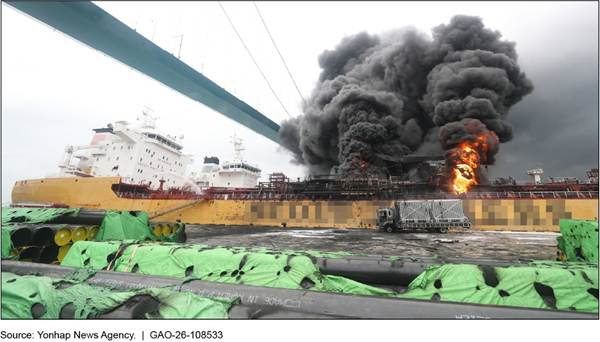
Note: In 2019, a cargo tank vessel called the Stolt Groenland was loaded with 20 different chemical cargoes in Houston, Texas. Three of the cargo tanks contained styrene monomer, a hazardous substance. During a cargo transfer in South Korea, one of the tanks with the styrene monomer overheated, ruptured, and caught fire, resulting in explosions and the release of chemical vapors.
The Oil Pollution Act of 1990 requires the issuance of regulations that would require an owner or operator of a tank vessel to prepare a VRP for responding to a worst case discharge (or a substantial threat of a discharge) of hazardous substances, including one involving a fire hazard.[45] However, the Coast Guard has not issued regulations to comply with this mandate. In 1999, the Coast Guard proposed regulations that would require certain tank vessels that could cause substantial or significant harm to the environment by discharging a hazardous substance to have VRPs related to those substances.[46] In 2019, the Coast Guard withdrew the proposed regulations rather than finalizing them.[47]
According to the Coast Guard, it withdrew its proposed regulations in 2019 so it could reassess chemical industry spill response capabilities and gaps in existing regulatory requirements, which delayed issuing regulations on hazardous substance response plans for tank vessels. At that time, the Coast Guard stated it remained committed to fulfilling the mandate under the Oil Pollution Act of 1990.
Coast Guard officials we spoke with stated they were not involved with the Coast Guard’s past decision to withdraw the proposed regulations. Furthermore, Coast Guard officials stated they were in the process of rulemaking on a different issue, and their office does not have the time and resources to go through the rulemaking process on another issue simultaneously. However, the Oil Pollution Act of 1990 requires the issuance of regulations for tank vessel owners and operators to prepare a VRP for a worst case hazardous substance discharge (or a substantial threat of such a discharge). This requirement has not been met for more than thirty years.[48] Coast Guard officials confirmed the authority to issue these regulations was delegated to the Coast Guard.[49]
By issuing regulations requiring owners and operators of tank vessels to prepare VRPs for a worst case discharge (or a substantial threat of such a discharge) of hazardous substances, the Coast Guard would be complying with a legal requirement. These regulations would also strengthen maritime stakeholders’ efforts to prevent and respond to marine fire incidents involving hazardous substances. For example, having pre-planned and pre-contracted resources in a VRP would help ensure salvage and marine firefighting providers are available to respond to a serious tank vessel fire involving hazardous substances in a timely manner. In doing so, the Coast Guard and maritime stakeholders may prevent or mitigate harm to first responders and the environment.
Fires Involving Nontank Vessels and Hazardous Substances
The Coast Guard and Maritime Transportation Act of 2004 requires the issuance of regulations requiring owners or operators of nontank vessels to have VRPs for certain actual and potential oil discharges, but not for any actual or potential hazardous substance discharges.[50] The Coast Guard and Maritime Transportation Act of 2006 defines “nontank vessel” to include a self-propelled vessel that “carries oil of any kind as fuel for main propulsion.”[51] As a result, the Coast Guard’s existing regulations are limited to certain actual and potential oil discharges and do not cover nontank vessels that use alternative fuel sources—such as ferries powered by lithium-ion batteries or containerships powered by ammonia.[52]
Vessels that use alternative fuels are becoming increasingly common and pose significant environmental risks as well as risks to land-based firefighters, according to Coast Guard and industry reports.[53] These reports indicate that the worldwide battery-powered vessel fleet grew from 142 vessels in 2017 to 1,006 vessels in 2024, with an additional 1,584 confirmed orders for battery-powered vessels through 2027. For example, ferries are prominent in the battery-powered fleet, though many vessel types are implementing this technology. Additionally, Coast Guard and industry reports indicate that the U.S. electric fleet is expected to grow as charging infrastructure is developed and increasing numbers of foreign-flagged deep draft vessels are being retrofitted with hybrid systems. One fire chief stated that exposure to vapor from lithium-ion battery fires can be career-ending for firefighters.
Officials in four of seven Coast Guard sectors we spoke with, and representatives from two professional salvage and marine firefighting companies, indicated that not requiring certain vessels to have response plans is a gap. According to salvage and marine firefighting providers, vessel owners will not pay for resources to respond to these incidents without a requirement for them to have a VRP. Furthermore, these providers stated their companies will not acquire additional resources to respond to alternative fuel fires if vessel owners are not required to plan for these disasters by establishing VRPs. Meanwhile, land-based firefighters may not be prepared to fight fires on alternative fuel vessels. Professional salvage and marine firefighting providers said they could not begin responding to these fires for 3 to 4 days while the parties finalized contracting details with vessel owners. One fire chief stated figuring out how to put out fires on vessels with alternative fuels was extremely worrisome. Officials from another fire department noted that there are no agreed upon tactics for extinguishing lithium-ion battery fires.
The Coast Guard is generally responsible for ensuring the safe movement of maritime traffic and keeping ports safe and open. For example, it may take necessary action to protect U.S. navigable waters and their resources from harm caused by damage, destruction, or loss of a vessel or structure.[54] The Coast Guard is also generally the lead federal agency responsible for preparedness and response to oil discharges and hazardous substance releases in coastal areas.
However, given the limited delegation of rulemaking authority regarding nontank VRPs and the statutory definition of “nontank vessel” under current law, the Coast Guard cannot require nontank vessels that use alternative fuel sources to have VRPs for worst case hazardous substance discharges (and the substantial threat of such discharges), including those caused by fires.
Amending the Federal Water Pollution Control Act to ensure owners and operators of nontank vessels that use alternative fuels prepare VRPs for responding to certain actual and potential hazardous substance discharges would better ensure that these vessels and local firefighters can quickly receive necessary assistance in the event of a fire onboard and be better prepared to fight the fire.
Conclusions
Marine fires present unique hazards that require a coordinated response by the Coast Guard, land-based firefighters, and maritime stakeholders. Firefighters have tragically died while fighting complex fires on vessels. The Coast Guard and maritime stakeholders identified challenges, including ones related to marine firefighting coordination, training, knowledge sharing, and delays activating VRPs to dispatch resources. The Task Force has taken several steps to address these challenges, including developing guidance to coordinate with local stakeholders, guidance to standardize marine firefighting plans, online training for firefighters, and tools to clarify when to activate VRPs.
However, gaps remain. These include designating consistent Coast Guard personnel to lead coordination in advance of marine fires, facilitating more hands-on training for firefighters, and establishing a mechanism to share knowledge across all Coast Guard sectors and among maritime stakeholders. Taking action to close these gaps would ensure responders have the skills, knowledge, and experience necessary to effectively extinguish vessel fires. Additionally, clarifying factors that warrant VRP activation and complying with a legal mandate that would require owners and operators of tank vessels to prepare VRPs to respond to worst case discharges (and the substantial threat of such discharges) of hazardous substances would help ensure professional salvage and marine firefighters quickly mobilize to respond to an incident.
Further, legal limitations prevent the Coast Guard from requiring nontank vessels that use alternative fuels from having VRPs related to worst case discharges (and the substantial threat of such discharges) of those substances. Permitting the Coast Guard to require owners and operators of nontank vessels that use alternative fuels to prepare VRPs for responding to certain actual and potential discharges of hazardous substances would better ensure these vessels and land-based firefighters quickly receive necessary assistance from professional salvage and marine firefighters and are better prepared to fight resulting fires.
Matter for Congressional Consideration
Congress should consider amending the Federal Water Pollution Control Act to ensure that owners and operators of nontank vessels that use alternative fuels prepare vessel response plans for responding to worst case discharges of hazardous substances and the substantial threat of such discharges. (Matter for Consideration 1)
Recommendations for Executive Action
We are making the following five recommendations to the Coast Guard:
The Commandant of the Coast Guard should designate, in coordination with Captains of the Port, marine firefighting coordination responsibilities to specific field unit positions. (Recommendation 1)
The Commandant of the Coast Guard should ensure Captains of the Port, or their designees, engage with fire departments and maritime stakeholders to coordinate shipboard training opportunities, including vessel tours and exercises. (Recommendation 2)
The Commandant of the Coast Guard should establish a mechanism to store and share marine firefighting information, such as best practices, with Coast Guard officials and maritime stakeholders. (Recommendation 3)
The Commandant of the Coast Guard should develop and distribute information to maritime stakeholders and Coast Guard sectors on factors to consider when determining whether vessel response plans should be activated for marine fires. For example, the Coast Guard could compile examples of when vessel response plans were appropriately activated or identify factors to consider in deciding when to activate vessel response plans based on prior marine fires. (Recommendation 4)
The Commandant of the Coast Guard should issue regulations pursuant to the Oil Pollution Act of 1990 requiring owners and operators of tank vessels to prepare vessel response plans for responding to worst case discharges of hazardous substances and the substantial threat of such discharges. (Recommendation 5)
Agency Comments
We provided a draft of this report to DHS for review and comment. In its comments, reproduced in appendix I, DHS agreed with all five of our recommendations. DHS also provided technical comments, which we incorporated as appropriate.
We are sending this report to the appropriate congressional committees, the Secretary of Homeland Security, and the Commandant of the Coast Guard. In addition, this report is available at no charge on the GAO website at https://www.gao.gov.
If you or your staff members have any questions about this report, please contact Triana McNeil at mcneilt@gao.gov. Contact points for our Offices of Congressional Relations and Media Relations may be found on the last page of this report. GAO staff who made key contributions to this report are listed in appendix II.

Triana McNeil
Director, Homeland Security and Justice
Triana McNeil, mcneilt@gao.gov
In addition to the contact named above, Paul Hobart (Assistant Director), Kelsey Hawley (Analyst-in-Charge), Nasreen Badat, William Denekamp, Christopher Hatscher, Eric Hauswirth, Heather Macleod, Shannon Murphy, Erin Villareal, and Christopher Zubowicz made key contributions to this report.
The Government Accountability Office, the audit, evaluation, and investigative arm of Congress, exists to support Congress in meeting its constitutional responsibilities and to help improve the performance and accountability of the federal government for the American people. GAO examines the use of public funds; evaluates federal programs and policies; and provides analyses, recommendations, and other assistance to help Congress make informed oversight, policy, and funding decisions. GAO’s commitment to good government is reflected in its core values of accountability, integrity, and reliability.
Obtaining Copies of GAO Reports and Testimony
The fastest and easiest way to obtain copies of GAO documents at no cost is through our website. Each weekday afternoon, GAO posts on its website newly released reports, testimony, and correspondence. You can also subscribe to GAO’s email updates to receive notification of newly posted products.
Order by Phone
The price of each GAO publication reflects GAO’s actual cost of production and distribution and depends on the number of pages in the publication and whether the publication is printed in color or black and white. Pricing and ordering information is posted on GAO’s website, https://www.gao.gov/ordering.htm.
Place orders by calling (202) 512-6000, toll free (866) 801-7077,
or
TDD (202) 512-2537.
Orders may be paid for using American Express, Discover Card, MasterCard, Visa, check, or money order. Call for additional information.
Connect with GAO
Connect with GAO on X,
LinkedIn, Instagram, and YouTube.
Subscribe to our Email Updates. Listen to our Podcasts.
Visit GAO on the web at https://www.gao.gov.
To Report Fraud, Waste, and Abuse in Federal Programs
Contact FraudNet:
Website: https://www.gao.gov/about/what-gao-does/fraudnet
Automated answering system: (800) 424-5454
Media Relations
Sarah Kaczmarek, Managing Director, Media@gao.gov
Congressional Relations
David A. Powner, Acting Managing Director, CongRel@gao.gov
General Inquiries
[1]The National Fire Protection Association is the authority on matters of professional firefighting and certifications. We discuss National Fire Protection Association guidelines later in the report.
[2]For the purposes of this report, nearshore is defined as waters that are within 3 nautical miles from the shoreline, inland rivers, and U.S. waters of the Great Lakes.
[3]Pub. L. No. 119-60, div. G, tit. LXXIV, § 7401(b), 139 Stat. 718, 1783-84 (2025).
[4]The Port of Houston Authority requires certain ships and barges to pay a harbor fee, which assists in defraying administrative expenses incurred by the Port of Houston Authority relating to, among other things, aiding in the extinguishing of marine fires. The Port of Houston Authority uses this fee to fund a port-specific fire department rather than using local land-based firefighters from the Houston municipality.
[5]We used a Geographic Information System (GIS) to identify a 3 nautical mile geodesic buffer around the coastline of the continental U.S. and territories and any incidents in inland rivers and U.S. waters of the Great Lakes. We limited our analysis to incidents that occurred within those areas based on geographic coordinates recorded in the Coast Guard’s Marine Information for Safety and Law Enforcement system. Additionally, the Coast Guard data did not contain a categorical variable indicating a fire department response to a nearshore fire. To identify incidents in which firefighters responded to marine fires, we reviewed narratives in a free form text field that officials use to describe the marine fires for terms commonly associated with land-based fire departments, such as “fire department,” “fire dept,” and “firefighter.” The Coast Guard does not require officials to document whether a fire department responded.
[6]Maritime stakeholder associations were selected based on their representation of key maritime industry groups. Firefighting associations were selected for their expertise and representation of land-based firefighting entities.
[7]We selected the private entities based on their participation in Coast Guard salvage and marine firefighting activities.
[8]U.S. Coast Guard, Marine Environmental Response and Preparedness (COMDTINST 16000.14B) (Washington, D.C.: Mar. 2025); U.S. Coast Guard, Management’s Responsibility for Internal Controls and Reporting Requirements (COMDTINST 5200.10A) (Washington, D.C.: Nov. 2022); GAO, Standards for Internal Control in the Federal Government, GAO‑25‑107721 (Washington, D.C.: May 15, 2025); and National Fire Protection Association, 1405 Guide for Land-Based Fire Departments That Respond to Marine Vessel Fires (2026).
[9]14 U.S.C. § 521(b)(1); see also 14 U.S.C. § 102(4).
[10]46 U.S.C. § 70011(a)(2).
[11]Federal Fire Prevention and Control Act of 1974, Pub. L. No. 93-498, § 2(5), 88 Stat. 1535.
[12]See Exec. Order No. 12777, Implementation of Section 311 of the Federal Water Pollution Control Act of October 18, 1972, as Amended, and the Oil Pollution Act of 1990, 56 Fed. Reg. 54757 (Oct. 18, 1991), as amended; Department of Homeland Security, Delegation to the Commandant of the U.S. Coast Guard, Delegation Number 00170.1 (Revision No. 01.2) (Mar. 8, 2021); U.S. Coast Guard, Marine Environmental Response and Preparedness (COMDTINST 16000.14B) (Washington, D.C.: Mar. 2025).
[13]These regulations were collectively issued pursuant to the Oil Pollution Act of 1990, the Coast Guard and Maritime Transportation Act of 2004, and the Coast Guard and Maritime Transportation Act of 2006.
[14]See GAO, Coast Guard: Improved Analysis of Vessel Response Plan Use Could Help Mitigate Marine Pollution Risk, GAO‑20‑554 (Washington, D.C.: Sept. 29, 2020).
[15]The Office of Marine Environmental Response Policy provides guidance, policy, and tools for planning and operations to prevent, respond to, and mitigate the threat and consequences of oil and hazardous substance discharges in U.S. waters, including incidents caused by marine fires.
[16]The marine fires we refer to in this report were each reported in Coast Guard data and associated with either an initial fire, a reflash, or an explosion. They are all considered nearshore.
[17]A serious marine incident is generally (1) any Coast Guard-reportable marine casualty or accident that results in death, injury requiring professional medical treatment beyond first aid, property damage exceeding $200,000, or actual or constructive total vessel loss; (2) discharge of 10,000 gallons of oil into the navigable waters of the U.S.; or (3) discharge of a reportable quantity of a hazardous substance into the navigable waters of the U.S. or release of a reportable quantity of a hazardous substance into the environment of the U.S. See 46 C.F.R. § 4.03-2. Reportable quantities of hazardous substances are identified in other regulations. See 40 C.F.R. §§ 117.3, 302.4. For the purposes of our analysis, we used the Coast Guard’s designation of “serious” in the data. We generally refer to these incidents as serious marine fires throughout the report.
[18]Coast Guard Sector Honolulu reported 21 incidents resulting from the 2023 wildfires on Maui. There were also other incidents of fires spreading from land to a marine vessel. For example, in 2019, a fire in New Jersey spread from the pier to a nearby vessel named the Addison Rose, severely damaging the vessel. According to Coast Guard data, there was no one onboard the vessel and the local fire department was able to successfully extinguish the fire onboard the vessel and the pier.
[19]The Coast Guard data did not contain a categorical variable indicating a fire department response to a nearshore fire. To identify incidents in which firefighters responded to serious marine fires, we reviewed narratives in a free form text field that officials use to describe the marine fires for terms commonly associated with land-based fire departments, such as “fire department,” “fire dept,” and “firefighter.” The Coast Guard does not require officials to document whether a fire department responded. As such, while the data did not always indicate a fire department response, Coast Guard officials and maritime stakeholders said fire departments are typically the first responders responsible for putting out marine fires if a fire exceeds the crew’s capabilities to extinguish it. Therefore, they likely responded to more incidents than indicated in the data. In some cases, the land-based firefighters were actively involved in the marine firefighting response (e.g., boarding the vessel or pumping water onto the vessel from the shore or a boat) and in other cases they arrived after the fire was extinguished by the crew but assessed the situation.
[20]The Coast Guard provided data on fires at waterfront facilities from 2015 through August 2025. According to Coast Guard officials, there is generally no requirement for facilities to report fires to the Coast Guard except when there is a fire on a vessel moored at the facility at a pier or dock. Coast Guard officials stated the Coast Guard’s jurisdiction for such an incident is the fuel or liquid pipeline that is the first valve ashore to the facility. See 46 C.F.R. § 4.05-1 (limiting requirement to report certain vessel fires to the Coast Guard to the vessel’s owner, agent, master, operator, or person in charge). As a result, Coast Guard data on fires at facilities are likely less comprehensive than for vessels.
[21]U.S. Coast Guard Office of Marine Environmental Response Policy, Vessel Response Plan Program and National SMFF Task Force (Washington, D.C.: May 14, 2025)
[22]National Transportation Safety Board, Marine Investigation Report: Engine Room Fire Aboard Passenger Vessel Spirit of Norfolk, Elizabeth River, Norfolk, Virginia, June 7, 2022, MIR-23-22 (Washington, D.C.: Sept. 29, 2023).
[23]These marine firefighting plans are a required component of Coast Guard Area Contingency Plans. At the port level, an Area Contingency Plan is a reference document developed by a committee of local stakeholders to coordinate responses to environmental emergencies and oil spills within a defined geographic area. The Coast Guard is the designated lead agency for planning and response in coastal zones and certain major inland water bodies.
[24]U.S. Coast Guard, Captain of the Port (COTP) Salvage and Marine Firefighting (SMFF) Planning Requirements/Guidance (ALCOAST 332/25) (Washington, D.C.: July 2025).
[25]The seventh Coast Guard sector has established a local subcommittee, but a stakeholder told us the committee is not active.
[26]Port security/recovery specialists are responsible for preparing and validating plans for effective and efficient responses to all port safety and security, maritime transportation system disruption, and salvage and marine firefighting contingencies for which the Coast Guard community will respond. Assignments may include (1) planning and coordinating meetings with port stakeholders regarding port safety and security and marine transportation system recovery policies, (2) coordinating vessel security and marine transportation system recovery exercises, and (3) projecting funding needs for planning and exercise activities.
[27]We did not meet with an associated fire department from the seventh location we selected—western Alaska— because fire department officials from that area told us marine fires occur very infrequently, and their involvement is limited.
[28]See U.S. Coast Guard, Marine Environmental Response and Preparedness (COMDTINST 16000.14B) (Washington, D.C.: Mar. 2025).
[29]See U.S. Coast Guard, Management’s Responsibility for Internal Controls and Reporting Requirements (COMDTINST 5200.10A) (Washington, D.C.: Nov. 2022).
[30]During formal marine firefighting training courses, which we discuss later in this report, firefighters are generally trained to meet qualification standards. See National Fire Protection Association, 1010 Standard on Professional Qualifications for Firefighters (2024).
[31]See 33 C.F.R. § 1.01-30.
[32]See U.S. Coast Guard, Marine Environmental Response and Preparedness (COMDTINST 16000.14B) (Washington, D.C.: Mar. 2025).
[33]See National Fire Protection Association, 1405 Guide for Land-Based Fire Departments That Respond to Marine Vessel Fires (2026). The National Fire Protection Association is a nonprofit organization that provides over 300 sets of standard practices related to firefighting and fire prevention.
[34]See U.S. Department of Homeland Security, Homeland Security Exercise and Evaluation Program (Jan. 2020). Under the Homeland Security Exercise and Evaluation Program, drills are defined as operations-based exercises employed to validate a single operation or function. Functional exercises are designed to assess and evaluate capabilities and functions in a realistic, real-time environment. Full-scale exercises are typically more complex and resource intensive compared to drills and functional exercises and often include multiple agencies, jurisdictions, organizations, and real-time movement of resources.
[35]U.S. Coast Guard, By Land and Sea — Firefighting Preparation is Key! (Marine Safety Alert 09-23). (Washington, D.C.: Nov. 20, 2023).
[36]U.S. Coast Guard, Report of the Investigation into the Fire and Subsequent Land-Based Firefighter Fatalities Onboard Grande Costa D’Avorio (9465382) While Conducting Cargo Operations at Berth 18, Port Newark, New Jersey on July 5, 2023 (Washington, D.C.: Dec. 3, 2025).
[37]Coast Guard marine firefighting plans reference federal exercise program guidelines which provide guidance for a coordinated exercise program. For instance, these guidelines suggest conducting an annual salvage and marine firefighting exercise in which salvage and marine firefighting companies deploy equipment. They also suggest conducting a full-scale exercise every four years in which appropriate representatives from federal, state, and local government, and other members of the response community participate. However, these non-binding guidelines do not state that land-based fire departments should be included as participants in these drills and exercises. See U.S. Coast Guard, Environmental Protection Agency, U.S. Department of Transportation, U.S. Department of the Interior 2016 National Preparedness for Response Exercise Program Guidelines, version 2016.1.
[38]U.S. Coast Guard, Salvage and Marine Firefighting (SMFF) Front-End Analysis (Norfolk, VA: Jan. 8, 2024).
[39]Examples of marine firefighting schools include the (1) Hampton Roads Marine Firefighting School and annual Marine Firefighting Command School located at the Port of Virginia, (2) Resolve Marine Academy in Ft. Lauderdale, (3) Texas A&M Engineering Extension Service in College Station, and (4) Maritime Institute of Technology and Graduate Studies in Baltimore and Seattle, which offer hands-on training for firefighters responding to fires. These schools charge between $500 and $2,700 per firefighter for a 5-day course, according to information published on their respective websites.
[40]The Port Security Grant Program is a risk-based grant program that provides funds to public and private sector entities to implement security plans and correct Coast Guard-identified vulnerabilities at U.S. ports. See 46 U.S.C. § 70107. Coast Guard officials based in different regions of the U.S. review grant applications and evaluate them for project feasibility, eligibility, and effectiveness. See GAO, Port Security: FEMA Should Improve Transparency of Grant Decisions, GAO‑25‑107587 (Washington, D.C.: Sept. 17, 2025).
[41]According to Coast Guard officials, while projects do get submitted and approved for marine firefighting, the Port Security Grant Program is not specifically designed to be a mechanism for funding marine firefighting training or resources. Coast Guard officials further stated FEMA Assistance to Firefighters Grants are also available to assist with funding for training and other resources. See 15 U.S.C. § 2229.
[42]See GAO‑25‑107587.
[43]U.S. Coast Guard, Research and Development Center, Lithium Battery Fire Hazards in the Maritime Environment (New London, CT: Apr. 2025).
[44]U.S. Coast Guard, FAQS | NPREP 2016: Vessel Response Plan Exercises – Government Initiated Unannounced Exercises (GIUEs) and Salvage and Marine Fire Fighting (SMFF) (MER-MSIB 12-16) (Washington, D.C.: Aug. 15, 2016) (quoting Salvage and Marine Firefighting Requirements; Vessel Response Plans for Oil, 73 Fed. Reg. 80618, 80626 (Dec. 31, 2008)).
[45]Pub. L. No. 101-380, tit. IV, subtit. B, § 4202(a)(6), 104 Stat. 484, 529-30 (pertinent portion codified at 33 U.S.C. § 1321(j)(5)(A)(i)). This provision is an amendment to the Federal Water Pollution Control Act.
[46]64 Fed. Reg. 13734 (Mar. 22, 1999).
[47]84 Fed. Reg. 2800 (Feb. 8, 2019).
[48]The Oil Pollution Act of 1990 required these regulations to be issued by August 18, 1992. Pub. L. No. 101-380, tit. IV, subtit. B, § 4202(b)(4), 104 Stat. 484, 532.
[49]According to Coast Guard officials, the authority to issue these regulations was delegated to the Coast Guard in Executive Order 12777 and Department of Homeland Security, Delegation to the Commandant of the U.S. Coast Guard, Delegation Number 00170.1 (Revision No. 01.2) (Mar. 8, 2021).
[50]Pub. L. No. 108-293, tit. VII, § 701(b)(2)(B), 118 Stat. 1028,1067 (pertinent portion codified at 33 U.S.C. § 1321(j)(5)(A)(ii)). These regulations relate to a worst case discharge, and to a substantial threat of such a discharge, of oil. This provision is an amendment to the Federal Water Pollution Control Act.
[51]Pub. L. No. 109-241, tit. VI, § 608, 120 Stat. 516, 558 (pertinent portion codified at 33 U.S.C. § 1321(a)(26)(C)). This provision is an amendment to the Federal Water Pollution Control Act. Under this provision, a “nontank vessel” is defined as a self-propelled vessel that (1) is at least 400 gross tons as measured under 46 U.S.C. § 14302, or, for vessels not measured under that section, as measured under 46 U.S.C. § 14502; (2) is not a tank vessel; (3) carries oil of any kind as fuel for main propulsion; and (4) operates on the navigable waters of the U.S., as defined in 46 U.S.C. § 2101.
[52]See 33 C.F.R. §§ 155.5010, 155.5015(a)(1).
[53]U.S. Coast Guard, Research and Development Center, Lithium Battery Fire Hazards in the Maritime Environment (New London, CT: Apr. 2025); DNV, Veracity, Alternative Fuels Insight (Batteries).
[54]46 U.S.C. § 70011(a)(2).