

Report to Congressional Addressees
United States Government Accountability Office
A report to congressional addressees
Contact: Elizabeth Repko at repkoe@gao.gov and Nathan Tranquilli at tranquillin@gao.gov
What GAO Found
Rideshare and taxi services help meet the transportation needs of people in the U.S, but stakeholders have raised questions about the services’ safety. Available data sources do not provide a full picture of the number of rideshare and taxi assaults against drivers and passengers from 2021 through 2025. There is no federal requirement to collect such data, but GAO identified some sources at the federal, local, and industry level. For example:
· Two federal databases provide some information. For example, the Bureau of Labor Statistics estimated 20 nonfatal injuries to taxi and rideshare drivers due to violent acts by other people from 2023 through 2024, not including self-employed drivers. Most rideshare and taxi drivers are self-employed (i.e., classified by companies as independent contractors).
· GAO analyzed police data in two cities and found 424 rideshare- and taxi-related assaults in Los Angeles from 2021 through 2023 and 109 in Chicago from 2023 through 2025. These assaults made up less than 1 percent of the overall number of reported assaults in each city during those time periods.
· Three ridesharing companies voluntarily report some assault data. For example, in 2021 and 2022, two companies publicly reported billions of rides, with a combined 52 fatal assaults and 4,469 of the five most serious types of sexual assault. One of these companies also reported 75,693 reported incidents of other types of sexual assault (e.g., attempted kissing and touching) and sexual misconduct (e.g., leering and explicit comments and gestures). As of June 2026, these companies have not reported the number of assaults for 2023 through 2025 or data on non-fatal physical assaults.
· Two taxi companies gave GAO non-public data on assaults. For example, one national taxi company identified that it had 17 verified reports of physical assault and three verified reports of sexual assault from 2021 through 2025.
Selected rideshare companies launched three new safety features, which add to features rideshare and taxi companies had in place.
New Rideshare Safety Features Since 2024
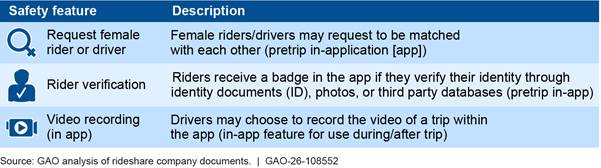
A driver advocacy group and some drivers GAO interviewed identified benefits of the new features. For example, drivers in four of five interviews GAO conducted appreciated the additional passenger verification features. However, they noted technical issues with certain video trip recordings. Representatives from one rideshare company said they have made improvements to the recording feature.
Why GAO Did This Study
Sami’s Law, enacted in 2023, provides for GAO to study and report every 2 years on the safety of rideshare and taxi drivers and passengers. GAO issued two reports in 2024 on this topic. Specifically, GAO reported on the lack of assault data in GAO-24-106742. In GAO-24-107093, GAO reported on the range of in-application and in-vehicle features that rideshare and taxi companies offer to help ensure safety.
This report describes (1) available data on the number of assaults on rideshare and taxi drivers and passengers from 2021 through 2025 and (2) safety features selected rideshare and taxi companies have implemented since 2024, among other topics.
To conduct this work, GAO collected and analyzed available data from two federal databases and two city databases that GAO previously identified as tracking rideshare and taxi assault data. GAO also reviewed documents and interviewed representatives from a nongeneralizable selection of four rideshare and four taxi companies. GAO selected companies to vary in size and location, among other factors. GAO analyzed data from three ridesharing companies’ public reports and websites. GAO requested additional non-public data from all eight companies to further understand the scope of assaults. Two taxi companies provided data; three rideshare companies declined to provide non-public data; and the other two taxi companies and one rideshare company do not maintain databases with which to track assault data. Therefore, this report uses publicly reported company data and attributes the information as appropriate throughout. GAO also conducted five nongeneralizable group interviews with nine self-identified rideshare drivers and individual interviews with 15 taxi drivers.
This is a work of the U.S. government and is not subject to copyright protection in the United States. The published product may be reproduced and distributed in its entirety without further permission from GAO. However, because this work may contain copyrighted images or other material, permission from the copyright holder may be necessary if you wish to reproduce this material separately.
July 24, 2026
The Honorable Ted Cruz
Chairman
The Honorable Maria Cantwell
Ranking Member
Committee on Commerce, Science, and Transportation
United States Senate
The Honorable Sam Graves
Chairman
The Honorable Rick Larsen
Ranking Member
Committee on Transportation and Infrastructure
House of Representatives
The Honorable Christopher H. Smith
House of Representatives
Many people in the U.S. use ridesharing and taxis to help meet their transportation needs.[1] For example, rideshare companies reported making over a billion trips in the U.S. in 2021 and 2022. However, after instances of fatal and sexual assaults, stakeholders and media outlets have raised questions about the safety of rideshare and taxi services. For example, The New York Times reported on instances of passenger sexual assault and issues with driver background checks.[2]
Sami’s Law, enacted in 2023, provides for GAO to conduct a study related to the safety of rideshare and taxi drivers and passengers.[3] We issued two reports in 2024 in response to this law.[4] This report describes (1) available data on the number of assaults on rideshare and taxi drivers and passengers from 2021 through 2025; (2) safety features selected rideshare and taxi companies have implemented since 2024; and (3) background check requirements for prospective rideshare and taxi drivers in selected states and localities.
To inform all objectives, we reviewed documents and interviewed representatives from four rideshare and four taxi companies. We selected four rideshare companies: Uber and Lyft, which service most of the U.S. market, as well as HopSkipDrive and Hitch to understand the experiences of additional rideshare companies. We selected four taxi companies—Madison Taxi, Yellow Cab of Chicago, Yellow Cab of LA, and zTrip—based on a variety of factors, including their operation in states with high numbers of taxi drivers and to obtain geographic diversity. zTrip operates in cities across the country, while the other selected companies operate in specific cities.
To describe the available data on rideshare and taxi assaults, we reviewed federal, industry, and local sources:
· Federal data. We collected and analyzed available data from calendar years 2021 through 2025 from two federal databases—the National Crime Victimization Survey and Survey of Occupational Injuries and Illnesses.[5] These were the only databases with available data for our years of focus.[6] Additionally, we interviewed federal officials to identify any significant changes to their databases’ data collection methodologies since our last report.[7]
· Industry data. We analyzed available data for calendar years 2021 through 2025 from companies’ public safety reports and websites and interviewed company officials. None of the four selected taxi companies publicly report assault data. Public data from three selected rideshare companies were not available for all types of assaults and all years of focus.[8] To better understand the full scope of assaults, we requested non-public assault data from the selected rideshare and taxi companies. Two selected taxi companies provided data to GAO; three rideshare companies declined to provide non-public data; and the other two taxi companies and one rideshare company do not maintain databases with which to track assault data. As a result, we include company-reported data and attribute the information as appropriate throughout the report.
· Local data. We collected and analyzed available data for calendar years 2021 through 2025 from Los Angeles and Chicago law enforcement agencies’ public databases. We selected these two law enforcement agencies based on interviews and research for this study as well as our past work, which identified these two agencies as entities that classified rideshare or taxi assaults within their broader databases.
To assess the reliability of these data sources, we interviewed the owners of the data and reviewed documents. For industry data, we interviewed company officials and reviewed documents describing data collection and categorization methods. We found the data sufficiently reliable for presenting available data on rideshare and taxi assaults.
To describe the safety features selected rideshare and taxi companies have implemented since 2024, we reviewed documents and interviewed representatives from the selected rideshare and taxi companies. We also conducted five group interviews with nine self-reported rideshare drivers about their experiences using safety features. We recruited these drivers through a variety of means including social media posts and outreach with driver groups. We also conducted interviews with 15 taxi drivers at the Ronald Reagan Washington National Airport taxi holding lot. These interviews are non-generalizable and do not represent the views of all drivers. In addition, we interviewed representatives from one rideshare driver and one taxi industry association to learn about their groups’ and members’ views about the safety features. Finally, we updated a literature search conducted for our previous reports to identify new research on the efficacy of rideshare and taxi safety features.
To identify background check requirements for prospective rideshare and taxi drivers, we selected states and localities in which there have been legislative or other efforts related to rideshare and taxi safety or imposter drivers (i.e., individuals who pose as rideshare or taxi drivers but are not affiliated with an application or company, or drivers who are affiliated with an application but offer rides outside the application). While the perspectives of these selected states and localities are non-generalizable, the information provides insights into efforts related to rideshare and taxi safety. The states we selected were Florida, Rhode Island, and Colorado. The localities we selected were Miami Dade County and Broward County in Florida. We searched statutes, regulations, and municipal code provisions in selected states and localities generally using a core set of search terms to identify background check requirements that apply statewide or countywide for these industries.[9] We then interviewed officials involved in regulating rideshare and taxis from our selected states and localities to verify and clarify our legal research.[10] Appendix I contains a more detailed discussion of our objectives, scope, and methodology.
We conducted this performance audit from June 2025 to July 2026 in accordance with generally accepted government auditing standards. Those standards require that we plan and perform the audit to obtain sufficient, appropriate evidence to provide a reasonable basis for our findings and conclusions based on our audit objectives. We believe that the evidence obtained provides a reasonable basis for our findings and conclusions based on our audit objectives.
 Background
Ridesharing is an on-demand, technology-enabled service that connects passengers with drivers who provide transportation services through digital apps. Two major rideshare companies—Uber and Lyft—provide service nationwide, and smaller rideshare companies may offer services in certain geographic areas or specialize in providing services to certain populations. According to a Transportation Research Board report, most rideshare drivers are not employees of the company they drive for; rather, they are classified by these companies as independent contractors.[11]
Taxis represent a more traditional type of for-hire, personal transportation. Taxis conduct street-hail rides, but some also offer rides arranged through a digital app or other means. Unlike rideshare companies, taxi companies tend to operate locally or regionally, rather than nationally. Taxi drivers may be either classified as independent contractors or employees of the company for which they drive.[12]
Rideshare and taxi services can be regulated by states, localities, or both. These regulations can include requirements for criminal background checks for prospective rideshare and taxi drivers. Historically taxis tend to be regulated at the local level, according to a report from the Transportation Research Board.[13]
Some rideshare and taxi passengers and drivers have been victims of violence. For example, according to the National Crime Victimization Survey, from 2015 through 2019, taxi drivers experienced nonfatal workplace violence at a rate of 45.4 victimizations per 1,000 workers.[14] Research conducted by an industry group that represents rideshare drivers, in conjunction with advocacy groups, found that app-based workers such a rideshare drivers experience physical assaults, carjackings, and other types of violent acts.[15] Violence against rideshare and taxi passengers has been less well studied, but some incidents have received national attention. For example, in 2019, Sami Josephson was murdered by an individual impersonating a rideshare driver.
Due to limited data and underreporting, the full extent of such violence against rideshare and taxi drivers and passengers is unknown. We previously reported that there is no federal requirement to collect data specifically on assaults against drivers and passengers of rideshare and taxi vehicles.[16] Additionally, collecting consistent data is challenging in part because the occurrence of assaults is considered to be underestimated.[17] Violent crime, including sexual violence, has historically been underreported to law enforcement.[18] We have reported that victims often do not report sexual violence to law enforcement for several reasons, such as feelings of guilt or shame or fear of not being believed. According to the Centers for Disease Control, sexual violence is a significant problem in the U.S. with nearly half of women and more than one in six men experiencing some form of contact sexual violence in their lifetimes.[19]
Available Data on the Number of Rideshare- and
Taxi-Related Assaults from 2021 Through 2025
We identified some rideshare- and taxi-related assault data at the federal, local, and industry level. As we found in 2024, the available data provide some information on rideshare- and taxi-related assaults, but none—individually or collectively—provide a complete picture.[20] These data sources have limitations, based on their scope and the purpose for which data were collected. Below we provide available data we identified at the federal, local, and industry level.
Federal Data
Two federal databases provide some limited information about the number of assaults on drivers but not assaults on passengers.
· Bureau of Justice Statistics’ National Crime Victimization Survey. According to this data, there were an estimated 44,411 non-fatal violent victimizations of taxi drivers from 2019 through 2024.[21] The non-fatal violent victimizations of taxi drivers make up approximately 0.5 percent of the total estimated 8.9 million non-fatal violent victimizations that occurred in the workplace during that time period.[22]
· Bureau of Labor Statistics’ Survey of Occupational Injuries and Illnesses. According to this data, from 2023 through 2024, there were an estimated 20 non-fatal injuries to taxi or rideshare drivers that led to days away from work due to “violent acts by other persons.”[23] This number does not include data on self-employed rideshare and taxi drivers, including Uber or Lyft drivers.[24] This survey’s annualized incident rate data show that rideshare and taxi drivers have a higher incidence rate of injuries due to violent acts by other persons compared to all occupations. Specifically, for 2023 through 2024, for every 10,000 full-time rideshare and taxi drivers, 8.4 workers experience nonfatal occupational injuries and illnesses from violent acts by other persons that led to days away from work. This compares with 2.6 workers across all occupations in the private industry.
Local Data
Two selected cities’ law enforcement databases provide some information about the number and nature of assaults on rideshare and taxi drivers and passengers in those cities.
· Los Angeles. Using the Los Angeles Police Department’s (LAPD) publicly available data from 2021 through 2023, we identified 424 reported and verified incidents of rideshare- and taxi-related assaults.[25] These include incidents involving taxi driver victims, rideshare driver victims, and rideshare driver suspects.[26] The 424 rideshare and taxi assaults make up about 0.2 percent of the 179,359 total reported and verified assaults related to physical and sexual assaults in Los Angeles during that time period. According to LAPD’s assault data, there were about seven times as many reported and verified physical assaults than sexual assaults. Additionally, rideshare drivers were suspects in nearly four times more reported sexual assaults than they were victims (see table 1). In contrast, they were victims in nearly three times more reported physical assaults than they were suspects. [27]
|
Type of victim or suspect |
Physical assaultsa |
Sexual assaultsb |
Total |
|
Taxi driver victims |
28 |
1 |
29 |
|
Rideshare driver victims |
249 |
11 |
260 |
|
Rideshare driver suspects |
95 |
40 |
135 |
|
Total |
372 |
52 |
424 |
Source: Los Angeles Police Department (LAPD) data portal and GAO analysis. | GAO‑26‑108552
Notes: This table does not contain information on taxi driver suspect-related assaults because the LAPD data do not include a code to identify such assaults.
According to LAPD analysts, the data in the public data portal do not include reports found to be false or baseless. Therefore, the data portal does not include all crimes reported to LAPD.
We analyzed LAPD crime data published from 2021 through 2023 because of changes to the data system. First, in 2024, LAPD transitioned to a new crime reporting system; therefore, the 2024 and 2025 data are not comparable to previous years. Second, in the new crime reporting system, the specific coding used to identify more information about crime incidents, including rideshare- and taxi-related assaults, is no longer publicly available.
aIn this table, physical assaults include assaults identified in the LAPD data portal for crimes related to homicide, aggravated assault, battery, simple assault, brandishing weapons, stalking, and threats.
bIn this table, sexual assaults include assaults identified in the LAPD data portal for crimes related to rape, human trafficking for commercial sexual acts, and other sexual offenses—such as lewd conduct, indecent exposure, battery with sexual connotations, and “peeping Tom.”
· Chicago. Using the Chicago Police Department’s (Chicago PD) data from 2023 through 2025, we identified 109 reported and verified incidents of rideshare- and taxi-related assaults.[28] Overall, there were 37,615 reported and verified assaults related to physical and sexual assaults in Chicago during that time period. The 109 rideshare and taxi assaults make up about 0.3 percent of the overall number of assaults. According to Chicago PD’s assault data, there were about 10 times as many reported and verified physical assaults than sexual assaults. Additionally, rideshare services had six times more reported and verified physical assaults than did taxi services.[29] Finally, all reported and verified sexual assaults we identified were rideshare services-related (see table 2.)[30]
|
Type of service |
Physical assaultsa |
Sexual assaultsb |
Total |
|
Taxi services |
14 |
0 |
14 |
|
Rideshare services |
85 |
10 |
95 |
|
Total |
99 |
10 |
109 |
Source: GAO analysis of data provided by Chicago Police Department. | GAO‑26‑108552
Notes: Calendar years 2023 through 2025 were the only years with crime data available for both rideshare and taxi services. According to Chicago Police Department analysts, they began collecting data on rideshare-related crimes in 2023. In contrast, Chicago Police Department has been collecting data on taxi-related crimes since 1999.
aIn this table, physical assaults include assaults identified in the Chicago Police Department data portal for crimes related to homicide, aggravated assault, battery, simple assault, and other types of offenses—including harassment, intimidation, and stalking.
bIn this table, sexual assaults include assaults identified in the Chicago Police Department data portal for crimes related to criminal sexual abuse, criminal sexual abuse against children, aggravated sexual assault, and other sexual offenses—including public indecency, “peeping Tom,” and obscene or lewd telephone calls.
Like available federal data, assault data from cities are not complete or comparable. For example, according to LAPD and Chicago PD analysts, the variables that identify rideshare and taxi assaults are subjective and depend on the judgment or perspective of the officer or analyst inserting the information. Additionally, according to LAPD analysts, these variables may include instances of assaults that fall outside the scope of our review. For example, data describing the number of rideshare driver suspects could include altercations with other drivers unrelated to a specific trip. And because these variables are not required fields in the two law enforcement databases, some rideshare and taxi assaults may not be identified and counted.
Neither LAPD nor Chicago PD track assaults specific to imposter drivers. For those cities, we reviewed media reports for 2024 and 2025 to identify any such assaults. In Los Angeles, we identified two instances of alleged assaults involving imposter drivers. In Chicago, we identified three incidents involving imposter drivers.
Industry Data
Of the rideshare and taxi companies we selected, larger, national companies—Uber, Lyft, and HopSkipDrive—collect and publicly report data on certain assaults. Representatives from two taxi companies, zTrip and Yellow Cab of LA, told us they collect, but do not publicly report data. Representatives from the remaining companies—Hitch, Madison Taxi, and Yellow Cab of Chicago—said they collect information but do not maintain databases to track assault data.
As previously stated, there is no federal requirement for reporting assaults on rideshare drivers and passengers. Uber, Lyft, and HopSkipDrive voluntarily publish data on the prevalence of fatal physical assaults and some sexual assaults (see table 3).[31] Uber and Lyft have released such data as of 2022. HopSkipDrive has annually released the percentage of trips with serious safety issues through 2025, but not the number of incidents.[32] All three companies reported that incidents of fatal physical assault or serious sexual assault in 2021 or 2022 were less than or equal to 0.0002 percent of total rides provided by the respective company, for each type of assault. Additionally, in May 2026, Lyft published data on its website for other categories of sexual assault and misconduct, beyond those included in its safety reports.[33] Specifically Lyft reported 29,731 other incidents of sexual assault and misconduct in 2021 and 45,962 such incidents in 2022. Of these additional incidents, 6,720 are incidents of sexual assault ranging from attempted kissing of a sexual body part to attempted touching of a non-sexual body part. The majority (68,651) involve incidents of sexual misconduct ranging from verbal threats of sexual assault and indecent exposure to staring or leering. See appendix II for additional rideshare assault data.
Table 3: Number of Fatal Physical and Serious Sexual Assaults Reported Publicly by Selected Rideshare Companies, 2021–2022
|
|
Fatal
physical |
Most
serious types |
||
|
|
2021 |
2022 |
2021 |
2022 |
|
Ubera |
16 |
20 |
1,080 |
1,637 |
|
Lyftb |
10 |
6 |
714 |
1,038 |
|
HopSkipDrivec |
0 |
0 |
0 |
0 |
|
Total |
26 |
26 |
1,794 |
2,675 |
Source: Publicly issued company safety reports from Uber, Lyft, and HopSkipDrive, and communications with HopSkipDrive representatives. | GAO‑26‑108552
Notes: According to Uber representatives, Uber will publish its next safety report by the end of 2026. According to Lyft representatives, Lyft has not announced the anticipated date for its next safety report. Lyft’s and Uber’s upcoming safety reports will include certain assault data for more recent years.
Uber, Lyft, and HopSkipDrive use the Sexual Misconduct and Violence Taxonomy created by RALIANCE to categorize unwanted sexual experiences that occur related to rides arranged through a company’s app. The taxonomy includes 21 categories of sexual assault and misconduct. For prior safety reports, Uber and Lyft publicly reported the number of reported incidents and percentage of rides with incidents for the five most serious types of sexual assault, and HopSkipDrive reported the percentage of rides with incidents for 10 acts of sexual violence, including the five most serious types of sexual assault. In addition, RALIANCE audited and validated how Uber, Lyft, and HopSkipDrive classified sexual assault data using the taxonomy for the information included in each company’s safety reports. In May 2026, Lyft published data on the 16 other categories of sexual assault and misconduct, as well as two additional categories for unspecified sexual assault and misconduct.
aAccording to Uber’s 2021-2022 Safety Report, the percentage of fatal physical assaults was about 0.000002 percent of Uber’s total trips for both 2021 and 2022. The percentage of the five most serious types of sexual assaults was about 0.0001 of Uber’s total trips for 2021 and 2022 combined.
bAccording to Lyft’s 2020-2022 Safety Report, the percentage of fatal physical assaults in 2021 and 2022 was about 0.0000022 and 0.0000011 percent of rides for 2021 and 2022, respectively. The percentage of the five most serious types of sexual assaults in 2021 and 2022 was about 0.00016 and 0.00019 of Lyft’s total trips, respectively.
cFor each year and type of assault, HopSkipDrive publicly reported 0.000 percent of rides with any incident. HopSkipDrive previously confirmed that the number of fatal physical assaults and sexual assaults for the categories listed in its public safety reports was zero for years 2021–2022. HopSkipDrive has also issued reports showing 0 percent of rides with serious safety incidents for 2023-2025, but representatives did not confirm that the number of such assaults was zero for those years.
Sami’s Law provides for us to report on the incidence of fatal and non-fatal physical assault and sexual assault on drivers and passengers, including assaults by imposter drivers.[34] To address this mandate, we requested data from Uber, Lyft, and HopSkipDrive on the number of all assaults from 2023 to 2025, including fatal and non-fatal physical assaults and all types of sexual assault.[35] The companies declined to provide such information beyond what was in public safety reports. Lyft later published information on additional categories of sexual assault and misconduct, as described above, but not on non-fatal physical assaults. Uber representatives cited the need to conduct their data quality verification processes, which we discuss below.
Uber, Lyft, and HopSkipDrive derive their assault data from reports that drivers and passengers submit to the companies or from reports collected from a third party, such as law enforcement agencies or insurance companies. The rideshare companies then publicly report a subset of these incidents. The companies do not report data on non-fatal assaults. Additionally, Uber and HopSkipDrive do not report on the number of assaults classified in all remaining 16 sexual assault and misconduct categories. These 16 categories range from verbal threat of sexual assault to flirtatious remarks, staring, or leering. According to Uber, reported incidents in these categories are more subjective, harder to consistently categorize, and they have lower confidence in the accuracy of the classifications. They also stated that the publicly reported data have also gone through their data quality verification processes, including internal reviews, categorization of sexual assaults, and third-party verifications.
The four selected taxi companies vary on how they collect data and information, though none publicly report data on assaults.[36] For example, for zTrip, a larger national company with 28 service areas across 39 cities and 20 states, representatives stated that they collect some data. According to zTrip representatives, they received 17 verified reports of physical assault and 3 verified reports of sexual assault from 2021 through 2025. Yellow Cab of LA also stated that they maintain a database of assaults. For 2024 through 2025, they reported receiving four reports of drivers who were physically assaulted by passengers, one report where a driver physically assaulted a passenger, and no reports of sexual assaults. According to the representatives from the other two taxi companies, although they maintain records of incidents, they do not maintain databases that categorize those incidents. Representatives from all the selected taxi companies noted that, to their recollection, their drivers and passengers rarely experienced taxi assaults. As in our 2024 report, representatives from our four taxi companies noted that they typically collect their data for various purposes, including informing law enforcement agencies, meeting reporting requirements with contracted agencies, and enhancing driver safety training.[37]
Safety Features Selected Rideshare and Taxi Companies Have
Implemented since 2024
Selected rideshare companies have launched three new safety features since our prior report in 2024 (see table 4).[38] These safety features build on the features offered by rideshare and taxi companies that we reported on in 2024. Below we describe these features and provide feedback from a driver advocacy group and interviews with a limited number of drivers.[39] (The features in table 4 do not constitute a full list of features that rideshare and taxi companies have in place. For a broader list of safety features that rideshare and taxi companies have in place, see appendix III.)
|
Safety feature |
Description |
|
Request female rider or driver |
Female riders/drivers may request to be matched with each other (pretrip in-application (app)) |
|
Rider verification |
Riders receive a badge in the app if they verify their identity through identity documents (ID), photos, or third-party databases (pretrip in-app) |
|
Video recording (in-app) |
Drivers may choose to record the video of a trip within the app (in-app feature for use during/after trip) |
Source: GAO analysis of rideshare company documents. | GAO‑26‑108552
Request Female Rider or Driver
Two major rideshare companies have begun offering female riders and drivers the ability to match with each other.[40] A third, smaller rideshare company told us they were exploring the possibility of adding this feature. According to representatives from one rideshare company, when the women preference option is enabled, matches are not guaranteed, and availability can vary depending on time and location. They reported that the company deployed this feature to make women on the platform more comfortable and confident, especially for late night rides. They also reported that women drivers and riders provided feedback specifically requesting the ability to pair with other women.
One study reported that over one-third of respondents to a non-generalizable survey of female rideshare drivers had experienced an incident that made them feel unsafe or uncomfortable.[41] The study suggested options to improve safety for female drivers, including expanding options for women to request being matched with other women passengers. One group representing rideshare drivers noted this feature may put some riders at ease but added that it was too soon to know whether the feature was effective at improving safety.
Rider Verification
Two major rideshare companies have launched new safety features to allow riders to verify their identity to deter fraud and increase trust for drivers. The verification process involves checking riders’ account information provided during signup against third-party databases. Alternatively, riders can upload government identity documents (e.g., driver’s license) along with a selfie to verify their identity. One of these companies also provides drivers with additional information on riders, including a photo, before the driver accepts the ride.
According to representatives from one rideshare company, the rider profiles are rider verification tools that were added after drivers requested more information about who gets in their vehicles. Representatives from the other company noted that they provide a badge to verified riders to build trust and accountability and so drivers can make an informed decision about the types of riders they choose.
A group representing rideshare drivers, and some drivers we spoke with, identified benefits of new passenger verifications. According to the advocacy group, the new rider verification features are better than when no rider verification was available. Drivers in four interviews we conducted also appreciated the passenger verification features, particularly the passenger photos one rideshare company makes available.
However, both the advocacy group and drivers we interviewed raised concerns about the effectiveness of passenger verification features. For example, drivers in four of the interviews said they believed that passengers could still create fake identities. Additionally, some drivers noted that the apps do not require passengers to use photos of themselves for the passenger photo. Representatives from the advocacy group also reported that people may still be able to buy a stolen credit card on the Dark Web and use that to create an account. Criminals can then use the apps to shop for a car they want to carjack, declining rides until they get one that is desirable, according to these representatives.
Industry groups and drivers from four interviews expressed a desire for additional verification for passengers, like how drivers verify their identities in the rideshare apps. The group representing rideshare drivers stated that drivers are required to submit photos in real time in the app to verify their identity, and passengers should have to go through similar processes. According to these representatives, if a driver was assaulted, this would allow the rideshare company to share the photo with the police to aid investigations.
Representatives from one rideshare company stated that the verified rider badge does not guarantee someone’s identity; for example, a verified account holder may request a trip for a family member using their account. However, it can still help build trust on the platform.
 In-App Video Recording
|
Effectiveness of Video Recording Although not specific to in-app recording, there has been research studying the effectiveness of security cameras in reducing homicides of taxi drivers. According to one 2013 study, cities that mandated security cameras experienced a threefold reduction in homicides of taxi drivers compared with cities without these mandates. Source: Cammie K.C. Menendez et al., “Effectiveness of Taxicab Security Equipment in Reducing Driver Homicide Rates,” American Journal of Preventative Medicine, vol. 45, no. 1 (July 2013). | GAO‑26‑108552 |
One major rideshare company has begun offering drivers the option to record videos of their trips within the app. This feature allows drivers to record video directly from their phones, without the need for a dashcam. Another smaller rideshare company plans to offer in-app video and audio recording for riders more broadly in the coming year. The legal requirements to obtain consent when recording vary among states and localities.[42] One major rideshare company told us that to help ensure compliance with these laws when drivers use the in-app recording feature, riders are notified that their trip will be recorded before their ride begins and given the opportunity to cancel without penalty. According to representatives from the major rideshare company, the hope is that recording can encourage respectful interactions and add accountability during rides.
Drivers in one interview reported using the in-app recording features. However, drivers in three interviews raised concerns with the in-app recording feature, including technical issues and issues with data access. Specifically, some drivers reported that they preferred using their own dash cameras, or third-party recording apps, because they have more control over the recordings.[43]
According to representatives from the rideshare company, while some drivers experienced reliability challenges with early versions of the recording feature, the company has invested significantly in improving its functionality. Additionally, they reported that neither drivers nor the company have access to in-app recording footage to protect passenger privacy, unless a safety incident is reported. These representatives reported that the company would provide police access to the footage if it received a subpoena or if the passenger approved its release.
Taxi Driver Views on Safety
Features
Taxi drivers we spoke with generally did not use an app to book rides or use in-app safety features. Four drivers reported using security cameras.[44] One noted that they received a camera through a local government program. However, two drivers said they did not use the city provided camera because they were not very good quality. When asked if any additional features would help them feel safer, two drivers mentioned having physical emergency buttons that would alert the police. One driver noted he used to have this in his taxi but did not anymore. Another driver said that a partition and camera would help him feel safe but added that both are expensive. Drivers noted that they feel safer now that they carry less cash as credit card payments increased.
Legal Requirements for Background Checks of Prospective
Ridesharing and Taxi Drivers in Selected States and Localities
All three selected states and two localities have background check requirements in law for prospective rideshare or taxi drivers.[45] State and local legal requirements for these background checks vary.[46]
· Rideshare drivers. All three of our selected states have background check requirements for prospective rideshare drivers, but these requirements vary. For example, Florida and Rhode Island require local and national background checks.[47] In these two states, rideshare companies have a choice of conducting the background check themselves or using a third-party company. Neither state requires the background checks to include fingerprint searches.[48] By contrast, Colorado’s requirements vary depending on whether rideshare drivers obtain a background check through a process conducted by state officials or a third-party company. Specifically, the process conducted by state officials includes a national and state background check with fingerprint searches, whereas the process conducted by a third-party company consists of a national and state or local background check that does not include a fingerprint search. The two localities we reviewed, Broward County and Miami-Dade County in Florida, are both precluded by state law from imposing their own background check requirements for prospective rideshare drivers.
· Taxi drivers. Both Rhode Island and Colorado have background check requirements for prospective taxi drivers. Colorado requires state and national background checks including a fingerprint search, while Rhode Island requires state background checks but not a fingerprint search. Florida does not have statewide background check requirements for prospective taxi drivers, but the two selected Florida localities we reviewed have their own local requirements. The localities’ requirements vary; for example, while Broward County requires fingerprint searches, Miami-Dade County does not. In addition, Broward County requires sex offender searches, while Miami-Dade County only requires such checks if the taxi company chooses to conduct the background check instead of having the driver obtain a chauffeur’s registration from the county.[49]
For additional information on the various background check requirements for the selected states and localities see appendix IV.
Selected states and localities also undertake efforts to oversee background checks of prospective drivers. These efforts may help to address imposter drivers as well as individuals who have used stolen personal information to fraudulently pass background checks and become drivers.[50]
· In-field background check verification. Broward County officials told us that staff conduct daily spot checks of taxi drivers in high-tourism areas, such as beach hotels or the airport. These checks are to ensure the drivers have the required chauffeur’s registration issued by the county, which requires a background check. Colorado officials also told us that they have conducted spot checks of rideshare drivers at various locations, including airports, to verify that drivers have passed a background check. To limit impostor drivers, officials said that they also review drivers’ licenses and rideshare app profiles during these checks to verify they match. Rhode Island and Miami Dade County officials said that they had also conducted in-field operations to verify that rideshare drivers’ licenses and registrations matched their app profiles. Relatedly, Miami Dade County officials have trained the Miami Dade County Sheriff’s Office and other local law enforcement agencies on efforts to identify unlicensed for-hire transportation providers, such as imposter drivers.
· Oversight of background check processes. Rhode Island officials oversee background check requirements for rideshare drivers by confirming that companies have a written driver vetting policy in place. Colorado officials told us that their oversight of rideshare driver background checks has led to changes in companies’ background check processes in certain instances. Specifically, officials told us that they had identified, through a review of a random sample of rideshare drivers in 2017, instances of drivers with disqualifying criminal histories passing background checks. Under resulting settlement agreements with one rideshare company and the third-party company that conducts background checks for another rideshare company, those companies agreed to proactively conduct background checks on an annual basis for all active rideshare drivers in Colorado, even though Colorado law only requires criminal background checks to be conducted every 5 years.
Agency Comments
We provided a draft of this report to the Departments of Health and Human Services, Justice, Labor, and Transportation, and the Federal Trade Commission, for review and comment. The Departments of Justice and Labor provided technical comments, which we incorporated, as appropriate. The Departments of Health and Human Services and Transportation and the Federal Trade Commission did not have any comments.
We are sending copies of this report to the appropriate congressional committees; the Secretaries of Health and Human Services, Labor, and Transportation; the Attorney General; the Chair of the Federal Trade Commission; and other interested parties. In addition, the report is available at no charge on the GAO website at https://www.gao.gov.
If you or your staff have any questions concerning this report, please contact either of us at RepkoE@gao.gov or TranquilliN@gao.gov. Contact points for our Offices of Congressional Relations and Media Relations may be found on the last page of this report. GAO staff who made key contributions to this report are listed in appendix V.

Elizabeth Repko
Director, Physical Infrastructure

Nathan Tranquilli
Acting Director, Homeland Security and Justice
Appendix I: Objectives, Scope, and Methodology
This report describes (1) available data on the number of assaults on rideshare and taxi drivers and passengers from 2021 through 2025; (2) safety features selected rideshare and taxi companies have implemented since 2024; and (3) background check requirements for prospective rideshare and taxi drivers in select states and localities.[51]
To inform all three objectives, we reviewed documents and interviewed representatives from four rideshare and four taxi companies. We selected four rideshare companies: Uber, Lyft, HopSkipDrive, and Hitch. We selected Uber and Lyft because these companies cover the vast majority of the rideshare market in the U.S. We selected HopSkipDrive and Hitch to understand the experiences of additional rideshare companies; we also selected HopSkipDrive because it publishes safety reports that include data on assaults. We selected four taxi companies—Madison Taxi, Yellow Cab of Chicago, Yellow Cab of LA, and zTrip— based on a variety of factors, including their operation in states with high numbers of taxi drivers and to obtain geographic diversity. We reviewed Uber, Lyft, HopSkipDrive, zTrip, and Yellow Cab of LA for our 2024 report, allowing us to identify changes these companies may have experienced. We added Hitch, Yellow Cab of Chicago, and Madison Taxi in the current analysis to provide insight into additional companies’ experiences.
To describe the available data on rideshare and taxi assaults, we reviewed federal, industry, and local sources.
· Federal data. We collected and analyzed available data from calendar years 2021 through 2025 from two of the six federal databases we identified as containing some information on rideshare and taxi assaults in our prior report.[52] Specifically, the Bureau of Justice Statistics’ National Crime Victimization Survey and Bureau of Labor Statistics’ Survey of Occupational Injuries and Illnesses were the only databases with relevant data available for our years of focus.[53] Additionally, we interviewed federal officials to identify any significant changes to their databases’ data collection methodologies since our last report.[54]
· Industry data. We collected and analyzed data for calendar years 2021 through 2025 from the selected rideshare companies’ public safety reports and websites and interviews with rideshare and taxi company representatives. Public data were not available for all years of focus. For rideshare companies that told us they collect data on assaults, we requested data beyond what are publicly available from Uber, Lyft and HopSkipDrive. They declined to provide such data. During the course of our review, Lyft released additional information on sexual assault and misconduct in the remaining categories outside of the five most serious types of assault. We include company-reported data and attribute the information as appropriate throughout the report. We requested data from other selected rideshare and taxi companies as well. Two provided data (Yellow Cab of LA and zTrip), and the others did not maintain databases to track assault data.
· Local data. We collected and analyzed available data for calendar years 2021 through 2025 from Los Angeles and Chicago law enforcement agencies’ public databases. We selected these two law enforcement agencies based on interviews and research for this study as well as our past work, which identified that Chicago and Los Angeles law enforcement agencies classified rideshare or taxi assaults within their broader databases. We reviewed available data dictionaries and crime code information, and interviewed Chicago and Los Angeles law enforcement data analysts, to understand what data are available, how the data are collected and reported, and data limitations. We downloaded data from each city’s data portal and reviewed, cleaned, and filtered the data to those specific to rideshare- and taxi-related physical and sexual assault crimes. The rideshare- and taxi-related assault data we identified are based on selected crime codes that fell under physical assault and sexual assault definitions and method codes that identified rideshare- and taxi-related incidents.[55] To identify media reports of imposter driver alleged assaults in these cities, we searched in ProQuest databases (including Global Newsstream Collection) and Nexis. Search strings included variations and combinations of keywords relating to rideshare, taxicabs, violence, and assault, as well as keywords for Chicago or Los Angeles. We reviewed results about violent incidents that had occurred in 2024 or 2025, in the Chicago or Los Angeles areas, and involved a taxi or rideshare driver or passenger, and we identified the subset of these that reported imposter driver assaults.
To assess the reliability of these data sources, we interviewed the owners of the data, reviewed our prior data assessments, and assessed the data to identify missing and duplicate cells and extraneous variables. For industry data, we interviewed company representatives and reviewed documents describing data collection and categorization methods. We found the data sufficiently reliable for presenting available data on rideshare and taxi assaults.
To describe the safety features selected rideshare and taxi companies have implemented since 2024, we reviewed documents and interviewed representatives from the selected rideshare and taxi companies, as described above. We also conducted five group interviews with nine self-reported rideshare drivers about their experiences using safety features. We recruited drivers through a variety of means, including social media posts and outreach with driver groups. We also conducted interviews with 15 taxi drivers at the Ronald Reagan Washington National Airport taxi holding lot. These interviews are non-generalizable and do not represent the views of all rideshare and taxi drivers. However, they provide illustrative examples of drivers’ use of, and opinions on, safety features. In addition, we interviewed representatives from one rideshare driver association and one taxi industry association to learn about their and their members’ views on the safety features. Finally, we conducted a literature search to identify new research on the efficacy of rideshare and taxi safety features.[56]
To identify background check requirements for prospective rideshare and taxi drivers, we selected states and localities in which there have been legislative or other efforts related to rideshare or taxi safety or imposter drivers (i.e., individuals who pose as rideshare or taxi drivers but are not affiliated with an application or company, or drivers who are affiliated with an application but offer rides outside the application). While the experiences of these selected states and localities are non-generalizable, the information provides insights into efforts related to rideshare and taxi safety. The states we selected were Florida, Rhode Island, and Colorado. The localities we selected were Miami Dade County and Broward County in Florida. We selected these localities in part because, coupled with the inclusion of Florida in our review, they provide an opportunity to describe the application of both state and local background check requirements on prospective drivers.
We then searched statutes, regulations, and municipal code provisions in the five selected states and localities using a core set of search terms to identify background check requirements that apply statewide or countywide for these industries. We conducted our legal review from September 2025 to January 2026. Subsequently, we interviewed officials from the selected states and localities to verify and clarify our legal research.[57] If a selected state or locality identified an applicable legal provision or characteristic of the background check that our review did not, we incorporated this provision or characteristic into our legal analysis. Our descriptions of states’ and localities’ applicable laws do not reflect any amendments made to them after we completed our review for that particular state or locality.
For the selected states and localities, we identified the following characteristics of the background check requirements through a legal search of state statutes and regulations and municipal code provisions and interviews with the selected states and localities:
1. whether a background check is required for all prospective rideshare and taxi drivers in the particular state or locality;
2. which parties are required to conduct the background check, including whether the background check must be performed by state or local officials, the rideshare or taxi company, a third party, or some combination or variation of these parties;[58]
3. the scope of the background check (local, state, or national);
4. whether the background check includes a fingerprint search; and
5. whether the background check includes a sex offender search and, if so, for what scope (state or national).
The results of this analysis can be found in appendix IV.
We conducted this performance audit from June 2025 to July 2026 in accordance with generally accepted government auditing standards. Those standards require that we plan and perform the audit to obtain sufficient, appropriate evidence to provide a reasonable basis for our findings and conclusions based on our audit objectives. We believe that the evidence obtained provides a reasonable basis for our findings and conclusions based on our audit objectives.
|
|
Uber |
Lyft |
HopSkipDrivea |
||||||||
|
|
2021 |
2022 |
2021 |
2022 |
2021 |
2022 |
|
||||
|
Five most serious categories |
|
|
|
|
|
|
|
||||
|
Attempted non-consensual sexual penetration |
103 |
182 |
57 |
74 |
0 |
0 |
|
||||
|
Non-consensual kissing: non-sexual body part |
126 |
212 |
56 |
97 |
0 |
0 |
|
||||
|
Non-consensual kissing: sexual body part |
147 |
191 |
60 |
117 |
0 |
0 |
|
||||
|
Non-consensual sexual penetration |
148 |
207 |
124 |
135 |
0 |
0 |
|
||||
|
Non-consensual touching: sexual body part |
556 |
845 |
417 |
615 |
0 |
0 |
|
||||
|
Additionally reported categories |
|
|
|
|
|
|
|
||||
|
Attempted kissing: non-sexual body part |
N/R |
N/R |
14 |
17 |
0 |
0 |
|
||||
|
Attempted kissing: sexual body part |
N/R |
N/R |
115 |
137 |
0 |
0 |
|
||||
|
Attempted touching: non-sexual body part |
N/R |
N/R |
571 |
910 |
0 |
0 |
|
||||
|
Attempted touching: sexual body part |
N/R |
N/R |
95 |
184 |
0 |
0 |
|
||||
|
Comments or gestures: asking personal questions |
N/R |
N/R |
7,318 |
11,603 |
N/R |
N/R |
|
||||
|
Comments or gestures: comments about appearance |
N/R |
N/R |
2,157 |
3,975 |
N/R |
N/R |
|
||||
|
Comments or gestures: explicit comments |
N/R |
N/R |
2,820 |
4,729 |
N/R |
N/R |
|
||||
|
Comments or gestures: explicit gestures |
N/R |
N/R |
45 |
106 |
N/R |
N/R |
|
||||
|
Comments or gestures: flirting |
N/R |
N/R |
9,270 |
12,486 |
N/R |
N/R |
|
||||
|
Displaying indecent material |
N/R |
N/R |
248 |
388 |
N/R |
N/R |
|
||||
|
Indecent photography/video without consent |
N/R |
N/R |
12 |
29 |
N/R |
N/R |
|
||||
|
Masturbation/indecent exposure |
N/R |
N/R |
1,494 |
2,179 |
N/R |
N/R |
|
||||
|
Non-consensual touching: non-sexual body part |
N/R |
N/R |
1,706 |
2,971 |
0 |
0 |
|
||||
|
Soliciting sexual act |
N/R |
N/R |
2,353 |
3,862 |
N/R |
N/R |
|
||||
|
Staring or leering |
N/R |
N/R |
1,325 |
2,116 |
N/R |
N/R |
|
||||
|
Unspecified sexual misconduct |
N/R |
N/R |
89 |
91 |
N/R |
N/R |
|
||||
|
Unspecified sexual violence |
N/R |
N/R |
59 |
83 |
N/R |
N/R |
|
||||
|
Verbal threat of sexual assault |
N/R |
N/R |
40 |
96 |
N/R |
N/R |
|
||||
N/R = Not reported
Source: Publicly issued company safety reports from Uber, Lyft, and HopSkipDrive, Lyft website, and communications with HopSkipDrive representatives. | GAO‑26‑108552
Notes: Uber, Lyft, and HopSkipDrive use the Sexual Misconduct and Violence Taxonomy created by RALIANCE to categorize unwanted sexual experiences that occur related to rides arranged through a company’s app. The taxonomy includes 21 categories of sexual assault and misconduct. RALIANCE audited and validated how Uber, Lyft, and HopSkipDrive classified sexual assault data using the taxonomy for the information included in each company’s safety reports.
In safety reports, Uber and Lyft publicly reported the number of reported incidents and percentage of rides with incidents for the five most serious types of sexual assault, and HopSkipDrive typically reported the percentage of rides with incidents for 10 acts of sexual violence, including the five most serious types of sexual assault. In May 2026, Lyft published data on its website for the 16 other RALIANCE categories of sexual assault and misconduct, as well as two additional categories for unspecified sexual assault and misconduct.
aFor each year and type of assault, HopSkipDrive publicly reported 0.000 percent of rides with any incident. HopSkipDrive previously confirmed that the number of fatal physical assaults and sexual assaults for the categories listed in its public safety reports was zero for years 2021–2022. HopSkipDrive has also issued reports showing zero percent of rides with serious safety incidents for 2023-2025, but representatives did not confirm that the number of such assaults was zero for those years.
To enhance the safety of drivers and passengers, rideshare and taxi companies may offer features through a mobile app, such as trip monitoring, or in the vehicle, such as security cameras. See table 6 below for a description of the features and how many selected rideshare and taxi companies offer each feature.[59]
Table 6: Selected Safety Features that Rideshare and Taxi Companies May Offer to Drivers and Passengers
|
Feature |
Description |
|
|
Pretrip in-application (app) feature |
||
|
License plate number |
Passengers can view the license plate number in the app and match it to the vehicle to ensure they enter the correct vehicle. Four selected rideshare companies and one selected taxi company offer this feature. |
|
|
Name and photo |
The driver’s name and photo are available to passengers, and the passenger’s name, and in some cases photo, are available to drivers to ensure the driver and passenger can identify each other. Four selected rideshare companies and two selected taxi companies offer this feature. |
|
|
Ratings |
Drivers and passengers can see how a passenger or driver is rated, which they can use when arranging a ride or to inform future rides. Two selected rideshare companies and two selected taxi companies offer this feature. |
|
|
Vehicle make and model |
Passengers can view the make, model, and image of the vehicle to ensure they enter the correct vehicle. Four selected rideshare companies and four selected taxi companies offer this feature. |
|
|
Verification code |
Drivers and passengers use codes—such as a QR code, four-digit pin, or code word—to confirm trip details. Three selected rideshare companies and one selected taxi company offer this feature. |
|
|
In-app feature for use during or after trip |
||
|
Audio recording |
Drivers and passengers may choose to record the audio of a trip within the app and then may share it with the company after the ride has ended. Three selected rideshare companies and one selected taxi company offer this feature. |
|
|
Emergency call button |
If drivers or passengers need immediate assistance, this button can connect them with emergency responders. Such a button can connect the driver or passenger to a security professional who can call or text them, call 911 on their behalf, or connect them with their local emergency number directly. Two selected rideshare companies offer this feature. One selected taxi company offers an in-app emergency call button for both drivers and passengers. Two selected taxi companies offer this feature only to drivers. |
|
|
Location sharing |
This feature allows drivers and passengers to share their trip information and location with a friend or family member, either during a single ride or for all rides. Three selected rideshare companies and three selected taxi companies offer this feature. |
|
|
Report a driver or passenger |
Drivers and passengers may use the app to report safety issues that occurred during a trip. Three selected rideshare companies and three selected taxi companies offer this feature. |
|
|
Trip monitoring |
Real-time trip monitoring can enable rideshare and taxi companies to identify any irregularities that occur during the trip, such as unplanned stops or detours, and provide live support. Four selected rideshare companies and one selected taxi company offer this feature. |
|
|
In-vehicle feature |
||
|
Driver identification |
Rideshare or taxi vehicles may display a driver’s identification, license number, or similar credentials in or on the vehicle. This identification helps passengers ensure that their driver is licensed and authorized to provide services. One selected rideshare company offers this feature, but only in locations where it is required. Four selected taxi companies offer this feature. |
|
|
Panic button |
A panic button allows drivers to quickly and silently call for help in the event of an emergency. Pushing the panic button may illuminate a light on the outside of the vehicle, alert authorities, or trigger some other response. Two selected taxi companies offer this feature. |
|
|
Partition |
Partitions provide a physical barrier between the front and back part of a vehicle. None of the selected rideshare or taxi companies offer this feature. |
|
|
Security camera |
Rideshare and taxi vehicles may have security cameras that record the inside of the vehicle during trips. Recordings may be used to aid in incident response or as a deterrence, according to representatives of several rideshare and taxi companies. Four selected rideshare companies and four selected taxi companies either require or allow the use of a security camera during trips. |
|
|
Uniforms |
Driver uniforms can help passengers identify their drivers. One selected rideshare company offers this feature. |
|
|
Vehicle markings and decals |
Rideshare and taxi companies may have a standard decal to affix to the vehicle. Taxi companies may also display their company name and certificate number on the vehicle. These vehicle markings help ensure that passengers enter an authorized vehicle. Four selected rideshare companies and four selected taxi companies offer this feature, although not all require them. Some jurisdictions require vehicles to display markings, so companies may issue identifying vehicle markers to comply with local requirements. |
|
Source: GAO analysis of rideshare and taxi company documents and interviews with their representatives. | GAO‑26‑108552
Note: We selected four rideshare companies: Uber and Lyft, which service most of the U.S. market, as well as smaller HopSkipDrive and Hitch to understand the experiences of additional rideshare companies. We selected four taxi companies—Madison Taxi, Yellow Cab of Chicago, Yellow Cab of LA, and zTrip—based on a variety of factors, including their operation in states with high numbers of taxi drivers and to obtain geographic diversity.
We conducted a legal review of relevant statutes, regulations, and municipal code provisions that require statewide or countywide background checks for prospective rideshare and taxi drivers in five selected states and localities, and conducted interviews with state and local officials to verify and clarify our legal research, from September 2025 to January 2026.[60] Table 7 summarizes the results of this search; we provide additional details on the background check requirements for each state and locality beneath the table.
For information on background check requirements in other states for prospective rideshare drivers as of December 2023 and prospective taxi drivers as of April 2024, see our 2024 report which includes the results of our search of state statutes and regulations for the 50 states and Washington D.C. Our methodology for the legal review of selected states’ and localities’ background check requirements in this study differs from the methodology used in the prior GAO study on this topic, which included only those legal requirements as explicitly outlined in the text of the applicable laws of each state and locality, and, accordingly, certain findings differ.[61]
Table 7: Background Check Requirements for Prospective Rideshare and Taxi Drivers, by Selected State and Locality, as of January 2026
|
State/locality |
Service |
Is a criminal background check required? |
Which parties are required to conduct the background check? |
What scopes are required for the background check? |
Does the background check include a fingerprint search? |
Does the background check include a sex offender search, and, if so, for what scope(s)? |
|
Florida |
Rideshare |
Yes |
Company/third party on company’s behalf |
Local and national |
No |
Yes – national |
|
Taxi |
No, not regulated at state levela |
N/A |
N/A |
N/A |
N/A |
|
|
Miami-Dade County |
Rideshare |
Locality specific requirements preempted by statewide requirementsb |
N/A |
N/A |
N/A |
N/A |
|
Taxi |
Yes |
Option: local officials or company |
If conducted by local officials, local and state. If conducted by company, local, state, and national |
No, both for checks conducted by local officials and company |
If conducted by local officials, no.c If conducted by company, yes – state and national |
|
|
Broward County |
Rideshare |
Locality specific requirements preempted by statewide requirementsb |
N/A |
N/A |
N/A |
N/A |
|
Taxi |
Yes |
Local officials |
State and national |
Yesd |
Yes – state and national |
|
|
Rhode Island |
Rideshare |
Yes |
Company/third party on company’s behalf |
Local and national |
No |
Yes – national |
|
Taxi |
Yes |
State officials |
State |
No |
Noe |
|
|
Colorado |
Rideshare |
Yes |
Option: state officials or third party |
If conducted by state officials – state and national. If conducted by third party – national and state or local |
If conducted by state officials – yesd If conducted by third party – no |
If conducted by state officials, check would identify certain sexual offenses. If conducted by third party, yes – national |
|
Taxi |
Yes |
State officials |
State and national |
Yesd |
Check would identify certain sexual offenses |
N/A = Not applicable
Source: GAO analysis of selected states’ and localities’ background check requirements for prospective rideshare and taxi drivers based on relevant legal authorities and interviews with state and local officials. | GAO‑26‑108522
Note: We conducted our legal review of relevant statutes, regulations, and municipal code provisions that require statewide or countywide background checks for prospective rideshare and taxi drivers in the selected states and localities from September 2025 to January 2026. We selected states and localities in which there have been legislative or other efforts related to rideshare or taxi safety or related to imposter drivers (i.e., individuals who pose as rideshare or taxi drivers but are not affiliated with an application or company, or drivers who are affiliated with an application but offer rides outside the application).
aWhile Florida does not have a state law requiring background checks for prospective taxi drivers, Broward County and Miami-Dade County, Florida, regulate background checks for taxi drivers at the local level.
bFlorida state law requires a background check for all prospective rideshare drivers and preempts localities from imposing their own requirements. Fla Stat. § 627.748(12), (17). Localities that do not have locality-specific background check requirements for drivers are considered null or not applicable (N/A) for subsequent categories.
cPursuant to Miami-Dade County Code § 31-303(e), a prospective driver would be disqualified if the check revealed certain sexual offenses.
dOne vehicle for states and localities to conduct Federal Bureau of Investigation (FBI) criminal history record fingerprint checks for noncriminal justice purposes is through provisions contained in the Departments of State, Justice, and Commerce, the Judiciary, and Related Agencies Appropriation Act, 1973, Pub. L. No. 92-544, 86 Stat. 1109. Pursuant to this Act, the FBI is authorized to use funds for the exchange of identification records, including criminal history record information, with officials of state and local governments for purposes of employment and licensing if this is authorized by state statute and approved by the Attorney General, which has been delegated to the FBI. According to the FBI, it is incumbent upon states to submit legislation that contains a reference to an FBI fingerprint-based background check to the FBI for review so that the FBI can ensure it complies with the Act.
According to the FBI, it has approved Colorado’s access to FBI criminal history records for the purpose of certain drivers’ licensing through Colo. Stat. § 40-10.1-110. Pursuant to Colorado state law, rideshare drivers may obtain a background check through the procedures set forth in § 40-10.1-110 or through a privately administered check. Colo. Stat. § 40-10.1-605(3). Taxi drivers must obtain a background check through the procedures set forth in § 40-10.1-110. Furthermore, according to the FBI, it has approved Broward County’s access to FBI criminal history records for the purpose of chauffeur’s registration licensing.
eBackground checks that do not include a sex offender search may still identify and disqualify individuals based on certain sexual offenses.
Florida
Florida law requires a background check for all prospective rideshare drivers pursuant to which the rideshare company must conduct, or have a third-party conduct, a local and national criminal background check that includes a national sex offender search.[62] A fingerprint search is not required.[63]
Florida does not have a state law that requires background checks for all prospective taxi drivers. Locality-specific background check requirements for taxi drivers in certain Florida counties are discussed below.
Miami-Dade County
Localities in Florida are preempted by state law from regulating rideshare companies. Accordingly, in Miami-Dade County, there are no locality-specific background check requirements for rideshare drivers apart from Florida statewide requirements.[64]
Miami-Dade County law requires a background check for all prospective taxi drivers. To become a taxi driver, an individual may either obtain a chauffeur’s registration from the county or the taxi company may conduct the background check through a county-approved agency.[65] According to Miami-Dade County officials, if a driver obtains a chauffeur’s registration, then county officials conduct a local and state background check by using the Florida Department of Law Enforcement’s database. Officials also told us that the background check does not include a fingerprint search or sex offender search. If the taxi company conducts the background check, then the law requires a local, state, and national background check through a county-approved agency, including a review of criminal records in all Florida counties in which the background check reveals that the individual has ever committed a crime, as well as any county where the individual has resided in the last 7 years.[66] The law does not require a fingerprint search but it does require a search of state and national sex offender databases.[67]
Broward County
In Broward County, there are no locality-specific background check requirements for rideshare drivers apart from Florida statewide requirements, as localities in Florida are preempted by state law from regulating rideshare companies.[68]
Broward County law requires a state and national background check for all prospective taxi drivers.[69] The background check is conducted by local officials when prospective taxi drivers apply for a chauffeur’s registration.[70] The background check includes a fingerprint search submitted to the Florida Department of Law Enforcement and the FBI.[71] According to Broward County officials, the background check also includes a state and national sex offender search.
Rhode Island
Rhode Island requires background checks for prospective rideshare and taxi drivers. Pursuant to Rhode Island law, rideshare companies must conduct, or have a third-party conduct, a local and national criminal background check that includes a national sex offender search.[72] The background check for prospective rideshare drivers does not require a fingerprint search.[73]
Under Rhode Island law, no person may operate a taxi until they have first obtained a special license from the Division of Public Utilities and Carriers pursuant to the Division’s rules and regulations.[74] Rhode Island officials explained that state regulations do require a background check for all taxi drivers before they can receive a license. Officials told us that state officials conduct the background check, which is statewide in scope, and that the background check does not include a fingerprint search or a sex offender search.
Colorado
Colorado law requires background checks for prospective rideshare and taxi drivers in the state. Pursuant to Colorado law, rideshare drivers must either obtain a background check through procedures that apply to certain other for-hire motor carriers, including taxis, or through a privately administered national and state or local background check.[75] If the background check is privately administered, then a fingerprint search is not required, although the background check must include a national sex offender search.[76]
Prospective taxi drivers, and rideshare drivers that fulfill their background check requirement through procedures applicable to most for-hire motor carriers, must undergo a state and national background check that includes a fingerprint search through the Colorado Bureau of Investigation and the FBI.[77] If the results of the fingerprint search reveal a record of arrest without a disposition, drivers are required to submit to an additional name-based judicial record check.[78] The law does not explicitly require a sex offender search as part of the background check; however, Colorado officials told us that the check would identify certain sexual offenses.
GAO Contacts
Elizabeth
Repko, repkoe@gao.gov
Nathan Tranquilli, tranquillin@gao.gov
Staff Acknowledgments
In addition to the contacts named above, Gretta Goodwin (Director), Joanie Lofgren (Assistant Director), Valerie Kasindi (Assistant Director), Catrin Jones (Analyst in Charge), Howard Arp, Leila Braun, Willie Commons III, Sarah Craig, Delwen Jones, Ethan Levy, Rebecca Morrow, Kai Nielson, Josh Ormond, Pamela Snedden, Amanda Sutter, John Tamariz, Jeff Tessin, Alicia Wilson, and Elizabeth Wood made key contributions to this report.
The Government Accountability Office, the audit, evaluation, and investigative arm of Congress, exists to support Congress in meeting its constitutional responsibilities and to help improve the performance and accountability of the federal government for the American people. GAO examines the use of public funds; evaluates federal programs and policies; and provides analyses, recommendations, and other assistance to help Congress make informed oversight, policy, and funding decisions. GAO’s commitment to good government is reflected in its core values of accountability, integrity, and reliability.
 Obtaining Copies of GAO Reports
and Testimony
Obtaining Copies of GAO Reports
and Testimony
The fastest and easiest way to obtain copies of GAO documents at no cost is through our website. Each weekday afternoon, GAO posts on its website newly released reports, testimony, and correspondence. You can also subscribe to GAO’s email updates to receive notification of newly posted products.
Order by Phone
The price of each GAO publication reflects GAO’s actual cost of production and distribution and depends on the number of pages in the publication and whether the publication is printed in color or black and white. Pricing and ordering information is posted on GAO’s website, https://www.gao.gov/ordering.htm.
Place orders by calling (202) 512-6000, toll free (866) 801-7077,
or
TDD (202) 512-2537.
Orders may be paid for using American Express, Discover Card, MasterCard, Visa, check, or money order. Call for additional information.
Connect with GAO
Connect with GAO on X,
LinkedIn, Instagram, and YouTube.
Subscribe to our Email Updates. Listen to our Podcasts.
Visit GAO on the web at https://www.gao.gov.
To Report Fraud, Waste,
and Abuse in Federal Programs
Contact FraudNet:
Website: https://www.gao.gov/about/what‑gao‑does/fraudnet
Automated answering system: (800) 424-5454
Media Relations
Sarah Kaczmarek, Managing Director, Media@gao.gov
Congressional Relations
David A. Powner, Acting Managing Director, CongRel@gao.gov
General
Inquiries
[1]Ridesharing services are also called “ridesourcing” or “ridehailing” services. In addition, rideshare companies can be called “transportation network companies” or “transportation network providers.” For the purposes of this report, we use the term rideshare company.
[2]Emily Steel, "Uber's Festering Sexual Assault Problem," The New York Times, August 6, 2025, https://www.nytimes.com/2025/08/06/business/uber‑sexual‑assault.html; and Emily Steel and Erin Schaff, "Uber Cleared Violent Felons to Drive. Passengers Accused Them of Rape," The New York Times, December 22, 2025, https://www.nytimes.com/2025/12/22/business/uber‑background‑checks‑sexual‑assault.html.
[3]This study is to include the incidence of assaults against rideshare and taxi drivers and passengers in 2024 and 2025; background check requirements for prospective rideshare and taxi drivers; and safety steps taken by the companies. Pub. L. No. 117-330, § 2, 136 Stat. 6114, 6114-15 (2023) (codified at 34 U.S.C. § 41313).
[4]In one report, we found some federal and non-federal sources collect data on assaults on rideshare and taxi drivers and passengers. However, the available data cannot fully describe the extent of assaults in these industries. GAO, Ridesharing and Taxi Safety: Information on Assaults against Drivers and Passengers, GAO‑24‑106742 (Washington, D.C.: Feb. 22, 2024). In a separate report, we examined background check requirements and safety features available in rideshares and taxis. GAO, Ridesharing and Taxi Safety: Information on Background Checks and Safety Features, GAO‑24‑107093 (Washington, D.C.: Sept. 9, 2024).
[5]In the National Crime Victimization Survey, crimes are classified by the year of the survey and not the year of the crime.
[6]In our 2024 report, we identified six databases that collected some information on assaults on rideshare and taxi industries for calendar years 2019 and 2020. Of those six databases, three publicly reported some information on assaults against drivers. See GAO‑24‑106742 for more information on all six databases and the number of assaults for those years.
[7]Within the Department of Justice, we interviewed officials from the Bureau of Justice Statistics (BJS). Within the Department of Labor (DOL), we interviewed officials from the Bureau of Labor Statistics.
[8]Specifically, these companies have not reported the number of assaults for 2023 through 2025 or data on non-fatal physical assaults. The other selected rideshare company does not publicly report assault data.
[9]We conducted our legal review from September 2025 to January 2026. Our descriptions of states’ and localities’ applicable laws do not reflect any amendments made to them after we completed our review for that particular state or locality.
[10]We spoke with officials from all selected states and localities except Florida, which did not respond to our outreach but provided written information. Our methodology for the legal review of selected states’ and localities’ background check requirements in this study differs from the methodology used in the prior GAO study on this topic, which included only those legal requirements explicitly outlined in the text of the applicable laws of each state and locality, and, accordingly, certain findings differ. For more information about the methodology used in the prior GAO study, see GAO‑24‑107093.
[11]Transportation Research Board, National Academies of Sciences, Engineering, and Medicine, Between Public and Private Mobility: Examining the Rise of Technology-Enabled Transportation Services (Washington, D.C.: The National Academies Press, 2016).
[12]Transportation Research Board, Between Public and Private Mobility.
[13]Transportation Research Board, Between Public and Private Mobility.
[14]Other transportation occupations included in the report had lower rates. For example, bus drivers had a rate of about 16 per 1,000 during that time. However, the study did not calculate whether the taxi driver rate was statistically significantly higher than other transportation professions. These data include workers that are 16 years and older. Erika Harrell et al., Indicators of Workplace Violence, 2019 (Washington, D.C.: Bureau of Justice Statistics, July 2022), https://bjs.ojp.gov/content/pub/pdf/iwv19.pdf.
[15]Gig Workers Rising, PowerSwitch Action, and Action Center on Race and the Economy, Murdered Behind the Wheel: An Escalating Crisis for App Drivers (spring 2023). In this report, an app-based worker is defined as someone who works for an app corporation to provide rides or deliveries on its platform.
[17]Centers for Disease Control and Prevention, National Center for Injury Prevention and Control, The National Intimate Partner and Sexual Violence Survey: 2016/2017 Report on Sexual Violence (Atlanta, GA: June 2022); and Chad Sniffen, Julia Durnan, and Janine Zweig, Helping Industries to Classify Reports of Sexual Harassment, Sexual Misconduct, and Sexual Assault (Washington, D.C.: RALIANCE, 2018).
[18]GAO, Sexual Violence Data: Actions Needed to Improve Clarity and Address Differences Across Federal Data Collection Efforts, GAO‑16‑546 (Washington, D.C.: July 19, 2016).
[19]Centers for Disease Control and Prevention, National Center for Injury Prevention and Control, The National Intimate Partner and Sexual Violence Survey (NISVS): 2023/2024 Sexual Violence Data Brief (Atlanta, GA: December 2025).
[20]In our prior report, officials from four of the five selected state agencies we reviewed explained that assault data were collected at the local level, through law enforcement agencies. California was the only state we identified that regularly collects assault data from rideshare companies. Specifically, the California Public Utilities Commission requires rideshare companies to submit information about their operations annually, including information about assault and harassment incidents that drivers, passengers, or members of the public reported to them. These data are not currently published or reported publicly. GAO‑24‑106742.
[21]The National Crime Victimization Survey makes nationally representative estimates of non-fatal victimizations reported and not reported to law enforcement. According to BJS, in the National Crime Victimization Survey, a victimization is measured as the total number of times that people or households were victimized by crime. For violent crime, the number of victimizations is equal to the number of victims of the crime. Violent victimization includes rape or sexual assault, robbery, aggravated assault, and simple assault but excludes homicide because the survey is based on interviews with victims. The 95 percent confidence interval, or margin of error, around the 44,411 estimate is +/- 25,720 victimizations. Sample sizes for violent victimizations against taxi drivers were not sufficient to produce reliable estimates separately for each year. The sample size for taxi passenger violent victimizations was insufficient to provide a reliable aggregate estimate for the 2019-2024 time frame. Additionally, BJS transitioned to a redesigned National Crime Victimization Survey instrument in 2025. According to BJS officials, the redesigned instrument was updated to reflect changes to occupations and business industry over time and to be consistent with other industry and occupational coding. While it now captures rideshare drivers, which were not previously included, the occupational grouping includes “taxi driver, rideshare driver, or chauffeur.” As a result, taxi and rideshare drivers cannot be separated from chauffeurs in the survey data.
[22]Using a 95 percent confidence interval, the margin of error for BJS’s total workplace victimization estimate is +/- 703,804 victimizations.
[23]The Survey of Occupational Injuries and Illnesses estimates the incidence and number of non-fatal workplace injuries and illnesses. According to officials from the Bureau of Labor Statistics, the database underwent a revision to its data collection methodology. Specifically, starting in 2023, the Bureau of Labor Statistics started publishing its injury data using its third iteration of the Occupational Injuries and illnesses Classification System. Of note, this third iteration more explicitly separates the event concepts of “violence by other person” and “intentional self-harm” than the previous version of the classification system. As a result, any data starting in 2023 may not be comparable to data collected prior to 2023.
[24]According to the Bureau of Labor Statistics’ Occupational Outlook Handbook, in 2024, 92 percent of taxi drivers are considered self-employed. According to a Transportation Research Board report, most rideshare drivers are not employees of the company they drive for; rather, they are classified by these companies as independent contractors.
[25]According to LAPD analysts, the data found in the public data portal do not include reports found to be false or baseless. Therefore, the data portal does not include all crimes reported to LAPD. Although 2021 through 2025 LAPD crime data are available, we reviewed crime data published from 2021 through 2023 because of changes to LAPD’s data system. First, in 2024, LAPD transitioned to a new crime reporting system that follows the standards set by the Federal Bureau of Investigation’s (FBI) National Incident Based Reporting System. Therefore the 2024 and 2025 data are not comparable to previous years. Second, in the new crime reporting system, the specific coding used to identify more information about the crime incidents, including taxi- and rideshare-related assaults, was no longer publicly available. Since the transition to the new system, the coding was recently added and is in use for internal purposes, but LAPD stated they will not retroactively review 2024 and 2025 data to add missing codes.
[26]According to LAPD analysts, LAPD uses specific variables to identify incidents related to taxi driver victims, rideshare driver victims, and rideshare driver suspects. The crime data from LAPD’s public portal do not contain information on assaults by taxi driver suspects because LAPD’s data do not include a variable that identifies crimes in which the taxi driver is a suspect. Further, LAPD analysts noted that number of assaults involving rideshare driver suspects can include instances of assaults against passengers and assaults unrelated to passengers, such as altercations with other drivers. In addition, rideshare driver victims and taxi driver victims can include instances where drivers were victims of non-passenger assailants, such as other drivers. Finally, LAPD has a variable to identify victims that were vehicle occupants or passengers, which can include rideshare and taxi passengers. LAPD analysts noted that the variable may not be reliable due to data entry issues.
[27]Of the 179,359 reported and verified LA assaults from 2021 through 2023, 167,785 incidents (93.5 percent) were physical assaults and 11,574 (6.5 percent) were sexual assaults.
[28]Chicago PD analysts provided us with crime data with variables that allowed us to identify rideshare- and taxi-related incidents but did not allow us to identify whether the driver or passenger was the victim or suspect. Calendar years 2023 through 2025 were the only years with crime data available for both rideshare and taxi services. According to Chicago PD analysts, they began collecting data on rideshare-related crimes in 2023. In contrast, Chicago PD has been collecting data on taxi-related crimes since 1999.
[29]The City of Chicago’s public data portal includes data on ride-hail and taxi trips reported by transportation network provider and taxi payment processing companies. According to the reported data, there were about 13.5 times as many ride-hail trips as taxi trips in Chicago during this time period. Specifically, there were approximately 268 million ride-hail trips and 19.9 million taxi trips reported in Chicago for 2023 through 2025.
[30]Of the 37,615 reported and verified Chicago assaults from 2023 through 2025, 35,558 incidents (94.5 percent) were physical assaults and 2,057 (5.5 percent) were sexual assaults.
[31]Uber, Lyft, and HopSkipDrive use RALIANCE’s Sexual Misconduct and Violence Taxonomy to categorize reported incidents of sexual assault related to rideshare trips. RALIANCE is a national partnership working to end sexual violence. In 2018, RALIANCE, in collaboration with the Urban Institute, released a joint report, Helping Industries to Classify Reports of Sexual Harassment, Sexual Misconduct, and Sexual Assault, to help industries and companies more effectively categorize reports of sexual harassment, sexual misconduct, and sexual assault. According to the joint report, the Sexual Misconduct and Violence Taxonomy categorizes 21 acts of sexual violence into two overarching categories—sexual assault and sexual misconduct. The sexual assault category consists of 10 types of sexual assaults, organized in increasing order of severity. The five most serious types of sexual assault in the taxonomy are non-consensual kissing of a non-sexual body part, attempted non-consensual penetration, non-consensual touching of a sexual body part, non-consensual kissing of a sexual body part, and non-consensual sexual penetration. In safety reports, Uber and Lyft publicly reported the number of reported incidents and percentage of rides with incidents for the five most serious types of sexual assault, and HopSkipDrive typically reported the percentage of rides with incidents for 10 acts of sexual violence, including the five most serious types of sexual assault.
[32]In its safety reports from 2021 through 2024, HopSkipDrive reported 0.000 percent of rides with incidents for 10 categories of sexual assault, including the five most serious types of assaults reported on by two other rideshare companies. In its 2025 report, HopSkipDrive reported 0.000 percent of rides with incidents for only the five most serious types of sexual assault.
[33]Lyft’s previously issued public safety reports only include data on the five most serious categories of sexual assault. The May 2026 data included data for all 21 categories in the RALIANCE taxonomy. According to company representatives, Lyft plans to report on all 21 categories of sexual assault and misconduct from the RALIANCE taxonomy in the next safety report.
[34]Pub. L. No. 117-330, § 2, 136 Stat. 6114, 6114-15 (2023).
[35]According to a Hitch representative, they were not aware of any physical or sexual assault at their company and so do not maintain data on assaults.
[36]In our 2024 report, we interviewed representatives from five selected taxi companies. Representatives told us they collected data related to passenger and driver safety, which might include assault data, through various means. Further, they used the collected data for various purposes, including identifying trends for driver training and insurance claims, but they did not publicly report data. Representatives from taxi companies we interviewed said they had experienced few assaults in recent years; most said they had no assaults recorded in their data for the 2019–2020 time frame. GAO‑24‑106742.
[38]Selected taxi companies did not report launching any new features since 2024. Some of the companies we spoke with reported improvements to existing safety features. For example, one taxi company reported that they have made improvements to their security cameras.
[39]We were only able to recruit a limited number of drivers through our recruitment methods. We conducted five group interviews with nine rideshare drivers. The driver input in this report is anecdotal and cannot be generalized to all drivers. Where available, we used information from our literature review to supplement our findings.
[40]Both major companies allow women to set a preference to be matched with other women. According to Uber representatives, Uber also allows riders to make on-demand requests for a ride with a women driver, with the option to select a different ride if the wait time is too long or to reserve a ride with a woman driver in advance. According to Lyft documents, Lyft’s feature increases the chances of, but does not guarantee matching, and whether a match is made depends on a variety of factors, including how close other drivers are to the rider and the number of ride requests from women and nonbinary people at that time.
[41]National Institute for Congestion Reduction, From Taxis to Ridehailing: Examining Gender Issues for Female Drivers and Passengers (Tampa, FL: August 2024), https://doi.org/10.5038/CUTR-NICR-Y3-2-9. The total number of respondents to the driver survey was 170.
[42]In certain states, all parties involved must consent to the recording of a conversation. See, e.g., Cal. Penal Code § 632; Fla. Stat. § 934.03. According to information provided by two major rideshare companies, drivers should review their state and local laws to ensure that they comply with legal requirements around consent for recording.
[43]The Future of Privacy Forum, a nonprofit organization that provides analysis and best practices on data protection and technology initiatives, collaborated with one major rideshare company to create a privacy guide for U.S. based rideshare drivers who install dash cameras in their vehicles. The guidance notes that legal requirements for the recording of conversations differ across states and sets forth best practices for the use of dash cams in vehicles, including providing prominent and effective notice of recording, limiting use and sharing of recordings, and protecting recordings through appropriate safeguards.
[44]Certain states may have specific legal requirements related to the use of these cameras. See, e.g., 52 Pa. Code § 1017.74.
[45]The selected states and localities are Colorado, Florida, Rhode Island, Boward County, and Miami Dade County. Generally, we use the term law to refer to relevant statutes, regulations, and municipal code provisions, unless otherwise indicated. We conducted our legal review of state and local laws, as well as interviewed state and local officials, from September 2025 to January 2026.
[46]As we have previously reported, rideshare companies and taxi companies may conduct background checks whether or not there is a legal requirement to do so. All selected rideshare and taxi companies for this report, as well as for our 2024 report, reported that all their prospective drivers receive background checks. GAO‑24‑107093.
[47]For the purposes of this report, we use the term “national background check” to include background checks state laws identify as national in scope. State laws frequently use this or similar terminology to describe background check requirements that are national in scope. This “national” designation does not necessarily mean that a state requires an FBI criminal history record fingerprint check. For additional information on the various background check requirements for the selected states and localities see appendix IV.
[48]As previously reported, criminal background checks can be name-based or fingerprint-based. Name-based background checks may use several identifiers to match an applicant with a specific criminal record, including name, aliases, date of birth, social security number, or address. FBI fingerprint-based background checks for noncriminal justice purposes rely on positive identification by matching an individual’s fingerprints with the associated criminal history record information, which may include other information such as a name, aliases, date of birth, sex, race, and social security number. For states to conduct FBI fingerprint checks, they must be authorized to do so through provisions contained in the Departments of State, Justice, and Commerce, the Judiciary, and Related Agencies Appropriation Act, 1973, Pub. L. No. 92-544, 86 Stat. 1109, 1115 (hereinafter referred to as Public Law 92-544). Pursuant to Public Law 92-544, the FBI is authorized to use funds for the exchange of identification records, including criminal history record information, with officials of state and local governments for the purposes of employment and licensing if this is authorized by state statute and approved by the Attorney General. GAO‑24‑107093.
[49]Our review did not include specifying the source of the sex offender search. According to the FBI, a search of the National Crime Information Center’s National Sex Offender Registry would not be conducted if an FBI fingerprint check is not conducted. For additional information on the various background check requirements for the selected states and localities see appendix IV.
[50]Imposter drivers are individuals who pose as rideshare or taxi drivers but are not affiliated with an application or company, or drivers who are affiliated with an application but offer rides outside the application.
[51]This is the second in a series of mandated studies on the safety of rideshare and taxi drivers and passengers. Sami’s Law, enacted in 2023, provides for GAO to conduct a study related to the safety of rideshare and taxi drivers and passengers, including the incidence of assaults against rideshare and taxi drivers and passengers in 2024 and 2025; background check requirements for prospective rideshare and taxi drivers; and safety steps taken by the companies. Pub. L. No. 117-330, § 2, 136 Stat. 6114, 6114-15 (2023) (codified at 34 U.S.C. § 41313). We issued two reports in 2024 for the first round of the mandate. See GAO, Ridesharing and Taxi Safety: Information on Assaults against Drivers and Passengers, GAO‑24‑106742 (Washington, D.C.: Feb. 22, 2024); and Ridesharing and Taxi Safety: Information on Background Checks and Safety Features, GAO‑24‑107093 (Washington, D.C.: Sept. 9, 2024).
[53]For the following four databases, we determined that their data collection methodologies or definitions did not allow for reportable data: the Census of Fatal Occupational Injuries, the Occupational Safety and Health Administration Information System, the National Electronic Injury Surveillance System-Occupational Supplement, and National Vital Statistics System. Of note, we previously reported taxi driver fatality data from the Census of Fatal Occupational Injuries. Officials from the Bureau of Labor Statistics noted that the data system has no publishable estimates of fatal injuries of taxi drivers related to violent acts by other persons for the years of our study because the data are not available, reveal confidential information, or are not reliable.
[54]Within the Department of Justice, we interviewed officials from the Bureau of Justice Statistics and Federal Bureau of Investigation. Within the Department of Labor, we interviewed officials from the Bureau of Labor Statistics and Occupational Safety and Health Administration. Within the Department of Human and Health Services, we interviewed officials from the National Institute for Occupational Safety and Health and National Center for Health Statistics. We also interviewed officials at the Department of Transportation and Federal Trade Commission.
[55]We selected physical and sexual assault crime codes using each’s city’s crime codes. For each city, we selected physical assault and sexual assault crime codes that met physical and sexual assault definitions as defined by FBI-related documentation. In addition, Chicago and Los Angeles law enforcement agencies used method codes—which provide more context and information on the crimes committed—to organize and inform their crime data. Both law enforcement agencies had method codes specific to rideshare- and taxi-related incidents, which were either available in the public data portal or to share by request.
[56]We searched select ProQuest databases, including Criminology Collection and Research Library; select EBSCO databases, including Business Source Corporate Plus; all databases in ProQuest Dialog; Scopus; Harvard Think Tank Search; Policy Commons; and Lexis+. We generally limited our scope to research published since June 2023 to exclude research we identified as part of our prior report.
[57]We spoke with officials from all selected states and localities except Florida, which did not respond to our outreach but provided written information. Our methodology for the legal review of selected states’ and localities’ background check requirements in this study differs from the methodology used in the prior GAO study on this topic, which included only those legal requirements as explicitly outlined in the text of the applicable laws of each state and locality, and, accordingly, certain findings differ. For more information about the methodology used in the prior GAO study on this topic, see GAO‑24‑107093.
[58]When a law provides options for satisfying the background check requirement, we identified the parties that conduct the background check for each applicable option, as well as other relevant characteristics of each option (scope, fingerprint search, and sex offender search).
[59]We reviewed documents and interviewed representatives from four rideshare and four taxi companies. We selected Uber and Lyft, which represent most of the U.S. market, as well as HopSkipDrive and Hitch to understand the experiences of additional rideshare companies. We selected four taxi companies—Madison Taxi, Yellow Cab of Chicago, Yellow Cab of LA, and zTrip—because they operate in states with high numbers of taxi drivers and to obtain geographic diversity.
[60]The selected states and localities are Colorado, Florida, Rhode Island, Broward County, and Miami Dade County. We selected states and localities in which there have been legislative or other efforts related to rideshare or taxi safety or related to imposter drivers (i.e., individuals who pose as rideshare or taxi drivers but are not affiliated with an application or company, or drivers who are affiliated with an application but offer rides outside the application). We selected these criteria because they provided states and localities that might have had recent efforts underway related to rideshare and taxi companies. While the perspective of these selected states and localities is non-generalizable, the information provides insights about efforts related to rideshare and taxi safety.
[61]For more information about the methodology used in the prior GAO study on this topic, see GAO, Ridesharing and Taxi Safety: Information on Background Checks and Safety Features, GAO‑24‑107093 (Washington, D.C.: Sept. 9, 2024).
[62]Fla. Stat. § 627.748(12). For the purposes of this report, we use the term “national background check” to include background checks state laws identify as national in scope. State laws frequently use this or similar terminology to describe background check requirements that are national in scope. This “national” designation does not necessarily mean that a state requires a Federal Bureau of Investigation (FBI) criminal history record fingerprint check. Furthermore, our review did not include specifying the source of the sex offender search. According to the FBI, a search of the National Crime Information Center’s National Sex Offender Registry would not be conducted if an FBI fingerprint check is not conducted.
[63]Id.
[64]Fla. Stat. § 627.748(17).
[65]Miami-Dade Cnty. Code §§ 31-93; 31-303.
[66]Miami-Dade Cnty. Code § 31-93(f).
[67]Id.
[68]Fla. Stat. § 627.748(17).
[69]Broward Cnty. Code § 22½-8.
[70]Id.
[71]Id. One vehicle for states and localities to conduct FBI criminal history record fingerprint checks for noncriminal justice purposes is through provisions contained in the Departments of State, Justice, and Commerce, the Judiciary, and Related Agencies Appropriation Act, 1973, Pub. L. No. 92-544, 86 Stat. 1109. Pursuant to this Act, the FBI is authorized to use funds for the exchange of identification records, including criminal history record information, with officials of state and local governments for purposes of employment and licensing if this is authorized by state statute and approved by the Attorney General, which has been delegated to the FBI. According to the FBI, it is incumbent upon states to submit legislation that contains a reference to an FBI fingerprint-based background check to the FBI for review so that the FBI can ensure it complies with the Act. According to the FBI, it has approved Broward County’s access to FBI criminal history records for the purpose of chauffeur’s registration licensing.
[72]39 R. I. Gen. Laws § 39-14.2-7; 815 R.I.C.R. 50-10-5.5.4.
[73]Id.
[74]39 R.I. Gen. Laws § 39-14-20; 815 R.I.C.R. 50-10-2.2.8 (requiring prospective taxi drivers to submit to the state a “record of all criminal convictions obtained from the Bureau of Criminal Identification of the Department of the Attorney General”).
[75]Colo. Stat. §§ 40-10.1-605(3)(a), 40-10.1-110; 4 Colo. Code Regs. § 723-6-6712.
[76]Colo. Stat. § 40-10.1-605(3)(a).
[77]Colo. Stat. § 40-10.1-110(1). According to the FBI, it has approved Colorado’s access to FBI criminal history records for the purpose of certain drivers’ licensing through Colo. Stat. § 40-10.1-110. See also 4 Colo. Code Regs. § 723-6-6114.
[78]Colo. Stat. § 40-10.1-110(1.5).