
Report to Congressional Committees
United States Government Accountability Office
A report to congressional committees
For more information, contact: Elizabeth Repko, RepkoE@gao.gov
What GAO Found
The Infrastructure Investment and Jobs Act of 2021 (IIJA) required the U.S. Department of Transportation (DOT) to establish the Office of Multimodal Freight Infrastructure and Policy (Multimodal Freight Office, or Office). Its responsibilities include coordinating with other agencies, states, and the private sector; assisting cities and states to improve freight mobility; and carrying out the goals of the national multimodal freight policy.
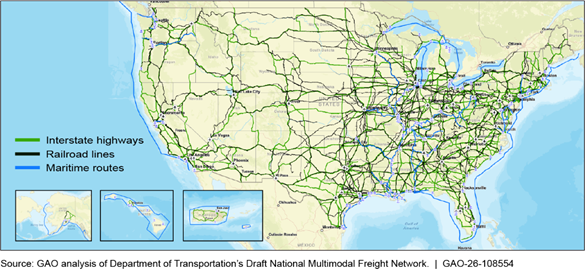
The IIJA directs the Multimodal Freight Office to administer certain policies and programs, such as developing and managing the National Freight Strategic Plan and the National Multimodal Freight Network, which connects highways, railroads, and maritime routes. DOT has taken steps toward meeting almost all of its statutory requirements. For example, DOT plans to release an updated National Freight Strategic Plan in 2026 and is updating the National Multimodal Freight Network.
U.S. National Multimodal Freight Network
DOT has not completed one of the office’s statutory requirements–periodically reporting to Congress on the activities of the Multimodal Freight Office. Officials stated that the Office had not done so because it had limited staff and was focused on other activities. While the Office briefed congressional staff in 2023, without periodic reporting, Congress has limited visibility into the activities the Office has conducted since then. Having recent information is important as Congress considers how the Office could support federal surface transportation programs, and any potential legislation related to the upcoming reauthorization.
To prevent potential duplication when forming the Multimodal Freight Office, DOT formed a task force in 2023 to review multimodal freight responsibilities across the department. The task force established complementary roles between the office and other DOT administrations, according to DOT officials. DOT officials and transportation industry associations GAO met with said they found the Office helpful as a single point of contact able to respond to freight-related incidents and could help address freight issues, such as the nationwide shortage of truck parking for commercial drivers.
Why GAO Did This Study
The U.S. freight transportation network is vital to the nation, moving over 20 billion tons of freight in 2024 over an extensive, interconnected network. DOT is responsible for ensuring the safe, efficient, and reliable movement of freight over this network. The IIJA included a provision for GAO to review the activities of the Multimodal Freight Office.
This report examines (1) the progress DOT has made in meeting its statutory requirements related to the Multimodal Freight Office and (2) how DOT identified and managed any areas of duplication and improved efficiency for freight issues across the department when establishing the Multimodal Freight Office.
GAO interviewed DOT officials on steps taken toward meeting the statutory requirements. GAO analyzed internal DOT documents on the agency’s activities to manage any duplication and improve efficiency in multimodal freight efforts when establishing the Multimodal Freight Office. GAO also interviewed DOT operating administration officials; four stakeholders from the trucking, railroad, air, and maritime freight transportation industries; and one state transportation association on their views on activities of the office. GAO selected these stakeholders, as they represent the major modes of freight transportation in the U.S., per DOT’s draft National Multimodal Freight Network.
What GAO Recommends
GAO is making one recommendation for DOT to report to Congress with updates on the activities of the Multimodal Freight Office. DOT agreed with the recommendation.
Abbreviations
AASHTO American
Association of State Highway and
Transportation Officials
BTS Bureau of Transportation Statistics
CRISI Consolidated
Rail Infrastructure and Safety
Improvement
DOT Department of Transportation
FAST Fixing America’s Surface Transportation
FLOW Freight Logistics Optimization Works
IIJA Infrastructure Investment and Jobs Act
INFRA Nationally
Significant Multimodal Freight and
Highway Projects
Mega National Infrastructure Assistance program
NFSP National Freight Strategic Plan
NMFN National Multimodal Freight Network
RFI Request for Information
This is a work of the U.S. government and is not subject to copyright protection in the United States. The published product may be reproduced and distributed in its entirety without further permission from GAO. However, because this work may contain copyrighted images or other material, permission from the copyright holder may be necessary if you wish to reproduce this material separately.
April 20, 2026
The Honorable Ted Cruz
Chairman
The Honorable Maria Cantwell
Ranking Member
Committee on Commerce, Science, and Transportation
United States Senate
The Honorable Sam Graves
Chairman
The Honorable Rick Larsen
Ranking Member
Committee on Transportation and Infrastructure
House of Representatives
The U.S. freight transportation network is vital to the national economy, moving approximately 20 billion tons of freight in 2024 over an extensive, interconnected network of roads, rail lines, inland waterways, pipelines, and airways. The U.S. Department of Transportation (DOT) is responsible for overseeing the U.S. freight network and for ensuring the safe, efficient, and reliable movement of freight.
The Infrastructure Investment and Jobs Act of 2021 (IIJA) established the Office of Multimodal Freight Infrastructure and Policy (Multimodal Freight Office, or Office) within DOT.[1] The Office is to coordinate with other agencies, states, and the private sector; assist cities and states with improving freight mobility; and carry out the goals of the national multimodal freight policy. These goals include identifying infrastructure improvements, policies, and innovations that reduce congestion and eliminate bottlenecks.
As Congress deliberates on the next surface transportation authorization, it has an interest in how the Multimodal Freight Office is carrying out these goals and other activities. For example, in July 2025 we reported that while the Office is uniquely positioned to leverage information and relationships with DOT’s operating administrations and freight stakeholders, the Office had not taken steps to identify and address air cargo freight challenges or communicate with air cargo stakeholders about these challenges.[2]
Section 21101 of the IIJA contains a provision for us to review the activities carried out by the Secretary of Transportation under 49 U.S.C. § 118. This report examines (1) the progress DOT has made in meeting its statutory requirements related to the Multimodal Freight Office and (2) how DOT identified and managed any areas of duplication and improved efficiency for freight issues across the department when establishing the Multimodal Freight Office.
To examine the steps taken by the Multimodal Freight Office to meet its statutory requirements, we reviewed relevant federal statutes to identify the requirements for DOT related to the Office. We reviewed DOT documentation, such as organizational charts, internal DOT orders, and Federal Register notices, and interviewed officials from the Multimodal Freight Office about how they interpreted and implemented the identified statutory requirements and steps taken toward the identified requirements. We compared this evidence against the identified statutory requirements. We also reviewed our prior work and DOT reports on freight transportation.[3]
To examine how DOT identified and managed duplication and improved efficiency on freight issues within DOT when forming the Multimodal Freight Office, we reviewed internal planning documents and relevant DOT organizational manuals.[4] We also interviewed four operating administrations, including the Federal Highway Administration, Federal Railroad Administration, Maritime Administration, and the Federal Aviation Administration; and the Office of the Secretary of Transportation on the creation and current responsibilities of the Multimodal Freight Office.[5] We reviewed the 10 DOT operating administrations and selected the four operating administrations whose mission included the efficient movement of goods through the U.S. freight transportation system and focused on supporting a major transportation mode. In addition, we considered whether the operating administration was involved in a multimodal freight program or activity, such as administering a grant program or reviewing state freight plans.
We also interviewed five transportation associations on their views of the Office. These included four industry transportation associations representing major freight transportation industries, such as trucking, rail, air, and maritime shipping industries.[6] We selected these stakeholders, as they represent the transportation modes that are included in the DOT draft National Multimodal Freight Network.[7] We also interviewed representatives from a state transportation association, the American Association of State Highway and Transportation Officials, for their perspectives. Information from our interviews with these stakeholders is not generalizable.
We conducted this performance audit from June 2025 to April 2026 in accordance with generally accepted government auditing standards. Those standards require that we plan and perform the audit to obtain sufficient, appropriate evidence to provide a reasonable basis for our findings and conclusions based on our audit objectives. We believe that the evidence obtained provides a reasonable basis for our findings and conclusions based on our audit objectives.
Background
The U.S. freight transportation system is a complex network made up of millions of miles of different transportation modes and links between those modes. For example, according to DOT’s Bureau of Transportation Statistics, the flow of freight containers through the U.S. could involve transit on ships, trucks, trains, and barges, and through marine terminals, and distribution centers.[8] The freight system consists of approximately four million miles of highways and roads; 140,000 miles of rail lines; 25,000 miles of inland and coastal waterways; 2.8 million miles of pipelines; and more than 5,000 public airports.[9] The capital assets that make up the extensive freight system, such as ports, highways, rail systems, airports, and pipelines, were valued at $11.1 trillion in 2023.[10] See figure 1 for a depiction of the U.S. multimodal freight network, with an illustrative regional example of the Great Lakes region.
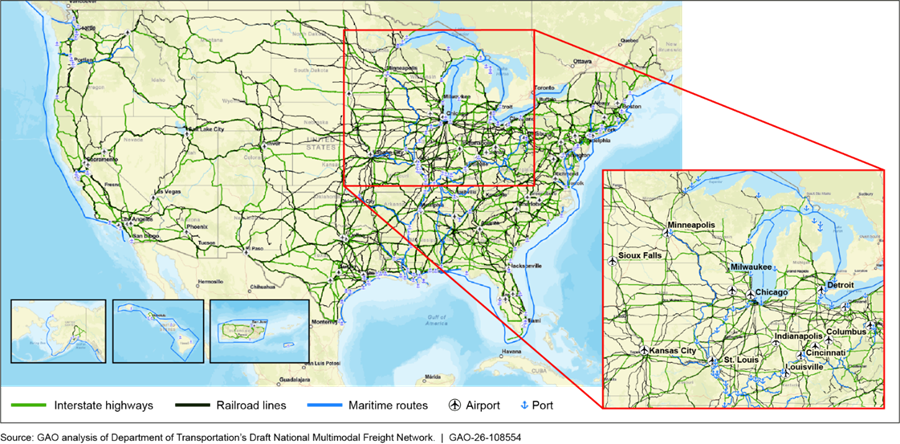
According to a recent Bureau of Transportation Statistics report, trucking is the largest single mode of freight transportation, measured by volume and value, moving 64.6 percent of the total freight volume and 72.6 percent of the total value in 2024 (see table 1).[11] However, many shipments use more than one mode from origin to destination. Nearly one-third of shipments measured by ton-miles (movement of one ton over one mile) travel more than 2,000 miles and require more than one mode to reach their destination.[12]
|
Transportation mode |
Total tons of freight |
Total value of freight (current dollars) |
|
Trucking |
12.84 billion |
$18.08 trillion |
|
Rail |
1.5 billion |
$752 billion |
|
Water |
772 million |
$363 billion |
|
Air (air and truck) |
7 million |
$809 billion |
|
Pipeline |
4.03 billion |
$1.53 trillion |
|
Totala |
19.9 billion |
$24.91 trillion |
Source: GAO analysis of Bureau of Transportation Statistics data. | GAO‑26‑108554
aTotal tons and value of freight includes freight moved by modes not represented in the table, such as mail, other, or unknown. These were the most recent data available at the time of our review.
According to DOT, the COVID-19 pandemic and recent transportation incidents, such as the collapse of the Francis Scott Key Bridge in Baltimore in 2024, challenged the resiliency of the U.S. multimodal freight transportation system.[13] A Bureau of Transportation Statistics report also noted that the ability of the U.S. freight transportation system to adjust to volatile demands or disruptions is limited, due to years of emphasis on efficient logistics and lean supply chains.[14] For example, the surge in consumer spending pushed imports to record highs by the end of summer 2021, resulting in unprecedented movements of containers by ship to U.S. ports and leading to unusual numbers of ships waiting to access ports. In addition, the collapse of the Francis Scott Key Bridge in Baltimore caused thousands of cars and trucks per day to divert to other roads and cost an estimated $1.7 billion weekly in supply chain disruptions.[15]
DOT has a range of freight-related roles and responsibilities. DOT’s Office of the Secretary of Transportation and certain operating administrations are responsible for a number of discretionary grant programs that focus on freight movement and multimodal projects. The Office of the Secretary of Transportation programs include the National Infrastructure Project Assistance grants program (Mega) and the Nationally Significant Multimodal Freight and Highway Projects grants program (INFRA).[16] The operating administrations provide funding for eligible multimodal infrastructure projects through programs like the Federal Railroad Administration’s Consolidated Rail Infrastructure and Safety Improvements (CRISI) Program and support transportation safety, among other responsibilities.[17] DOT administers over 100 IIJA grant programs, including approximately 67 discretionary grant programs.[18]
The Fixing America’s Surface Transportation (FAST) Act of 2015, as amended by the IIJA, established a number of multimodal freight efforts. Specifically, the FAST Act established a national multimodal freight policy and required DOT to develop a National Freight Strategic Plan to implement the goals of this policy.[19] In 2020, DOT published the first National Freight Strategic Plan, which established a national multimodal freight strategy to guide U.S. DOT freight policy and activities.[20] The FAST Act also required DOT to establish the National Multimodal Freight Network, with designations for freight facilities and corridors that are critical to freight movement and supply chains, to, among other things, assess and support federal investments to achieve the national multimodal freight policy.[21] The IIJA required the Multimodal Freight Office to carry out these activities.
The IIJA also set out a number of purposes for the Multimodal Freight Office, such as to carry out the national multimodal freight policy; administer and oversee certain multimodal freight grant programs; and promote and facilitate the sharing of information between the private and public sectors with respect to freight issues, among other things.[22] The Multimodal Freight Office was established within the Office of the Secretary of Transportation in September 2023 to cover three primary functions: multimodal infrastructure policy, multimodal freight operations, and multimodal freight research.
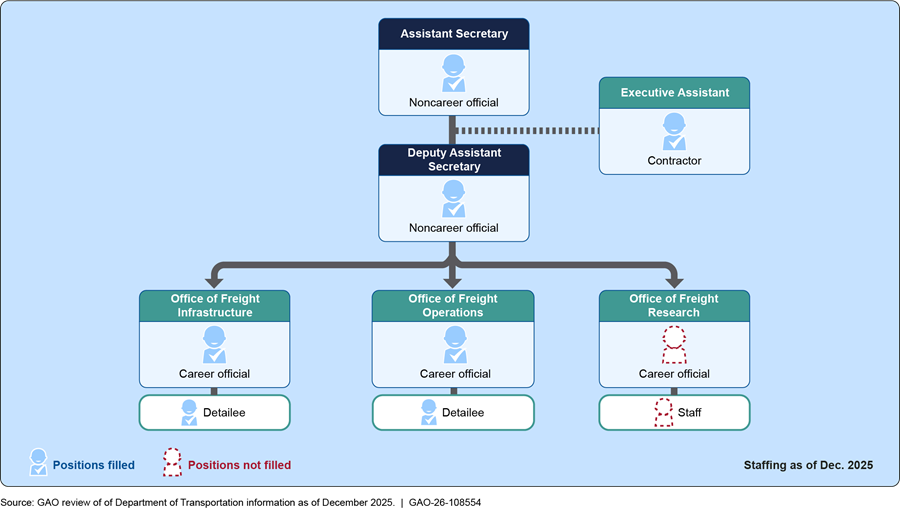
Between its establishment in September 2023 and December 2025, the Office has ranged in size between four and nine personnel, including full-time staff, rotational detailees from other DOT offices, and political appointees, according to Multimodal Freight Office officials. As of December 2025, the Office was staffed by two political appointees, two full-time career officials, two detailees and an executive assistant (see fig. 2).[23]
Figure 2: Organizational Chart for the Multimodal Freight Office Positions Filled as of December 2025
DOT Has Taken Steps Toward Meeting Almost All Statutory Requirements
The Multimodal Freight Office Has Taken Steps and Plans Additional Action to Address Requirements
The IIJA directs the Multimodal Freight Office to administer certain policies and programs in support of the purposes set forth in statute, including developing the National Freight Strategic Plan, overseeing the development and updating of state freight plans, and administering certain multimodal freight grant programs.[24] The Multimodal Freight Office has taken steps toward meeting these statutory requirements, as well as almost all of the other requirements set forth in statute. Some examples include the following:
· National Freight Strategic Plan. Multimodal Freight Office officials stated that they are working on updating the plan, with support from DOT’s Volpe Center.[25] According to Office officials, as of February 2026, the updated plan was undergoing final review and clearance within DOT.
· State freight plans. In February 2026, DOT released its updated guidance on state freight plans.[26] Multimodal Freight Office officials stated they expect to review the first of the state freight plans due for their 4-year update in 2026.
·
Administering certain multimodal freight grant programs.
DOT officials noted that the Multimodal Freight Office fulfills this
requirement by providing key policy direction on eligibility and selection
criteria for certain multimodal freight grant programs, including INFRA. For
example, officials said the Assistant Secretary for Multimodal Freight,
supported by subject matter experts in the Multimodal Freight Office, provides
guidance on developing the selection process used to select recipients for
freight grant program awards. The Assistant Secretary, or their designee, also
serves on the senior review team to review assigned ratings and make selection
recommendations, as appropriate. According to DOT, because the statute does not
provide a definition for the term “administer,” DOT has broad discretion in
deciding how to carry out its multimodal freight grant programs. DOT noted that
it allows other policy offices, in addition to the Multimodal Freight Office,
to assist in administering these programs; however, the Multimodal Freight
Office plays a vital role in their administration.
According to Multimodal Freight Office officials, the Office has had to meet these statutory requirements, in addition to other activities as assigned by the Secretary of Transportation, with limited staff and without a confirmed Assistant Secretary to lead the Office for most of 2025.[27] See appendix I for more information on the statutory requirements related to the Multimodal Freight Office and DOT’s actions toward meeting those requirements.
In addition to these actions to meet their statutory requirements, Multimodal Freight Office officials stated that they have also acted in support of the statutory purposes of the Office, such as by promoting and facilitating the sharing of information on freight issues between the public and private sectors through the Freight Logistics Optimization Works (FLOW) initiative.[28] According to Multimodal Freight Office officials, the Office has also been working with other federal agencies on various freight issues, such as trade and supply chain issues with the Department of Commerce and cargo theft and security issues with the Department of Homeland Security and the Department of Justice.[29]
Multimodal Freight Office officials told us in December 2025 that the Assistant Secretary was in the process of determining priorities and next steps for the Office, including further actions toward meeting their statutory requirements. Multimodal Freight Office officials stated that they are planning to continue their work on finalizing the updated National Freight Strategic Plan and the draft National Multimodal Freight Network and will continue to work with DOT’s Bureau of Transportation Statistics on freight forecasting tools in 2026.[30] In addition, officials stated that they expect to continue to provide input on DOT freight-related grant programs. For example, officials plan to review notices of funding opportunity and grant applications for certain other discretionary grant programs that have a multimodal freight component, such as the Maritime Administration’s Port Infrastructure Development Program and the Federal Railroad Administration’s CRISI program.
DOT Has Not Reported to Congress on the Multimodal Freight Office
Under the IIJA, the Secretary of Transportation was to notify Congress not later than one year after enactment (November 2022), in addition to periodic updates every 180 days.[31] This report and subsequent updates were to include information describing the programs and activities administered or overseen by the Office and their status, the Office’s current and projected staffing (including how many positions were eliminated or transferred to the Office), and whether any DOT offices or functions were consolidated into the Office or eliminated, among other things. In addition, internal control standards for federal agencies provide that management should externally communicate relevant and quality information with appropriate external parties.[32]
Multimodal Freight Office officials stated that DOT officials involved in the initial establishment of the Office met the requirement to provide a report to Congress through briefings with congressional staff in June and September 2023. They stated that these briefings discussed the programs and activities planned and underway at DOT that were set to be administered by the Multimodal Freight Office. However, DOT has not provided periodic updates to Congress per the IIJA requirement. DOT officials stated that they have not provided any further reports due to the Office having a limited number of staff and those staff were focused on meeting other IIJA statutory requirements and activities assigned by the Secretary of Transportation.[33] In the years since DOT officials provided their initial briefings, the Office has new staff and leadership and has taken on a number of new activities, as described above. Without periodic updates, Congress has limited visibility into the activities of the Office and the extent to which it is effectively administering the programs and the activities it oversees. Additionally, the current authorization for federal surface transportation funding expires at the end of fiscal year 2026. Providing this update in a timely manner could help Congress as it considers how the Multimodal Freight Office can support federal surface transportation programs and the upcoming reauthorization.
DOT Reviewed Agency Multimodal Freight Responsibilities when Designing the Multimodal Freight Office to Prevent Duplication and Improve Coordination
Prior to the formal establishment of the Multimodal Freight Office, DOT reviewed freight-related responsibilities across the department to prevent duplication in freight efforts and to establish better coordination with the freight transportation industry and within DOT. To carry out these efforts, in January 2023, DOT formed a Freight Office Implementation Task Force to develop the mission, structure, and responsibilities of the Multimodal Freight Office. According to DOT officials, this task force was led by the Office of the Under Secretary for Policy and included the participation of officials from the Federal Railroad Administration, Federal Highway Administration, Maritime Administration, Bureau of Transportation Statistics, and Office of the Assistant Secretary for Transportation Policy.
According to DOT officials, the Implementation Task Force conducted a review of DOT-wide freight responsibilities to stand up the Office, which prevented the Office’s responsibilities from being duplicative. The task force’s planning documents outline their efforts and considerations when designing the Multimodal Freight Office, including reviewing freight-related responsibilities across the agency for potential duplication.[34] We reviewed these documents and found that the task force worked to try to prevent potential duplication when forming the Multimodal Freight Office by documenting the division of freight responsibilities across DOT.[35] By designating the lead office and supporting roles for freight programs and activities, DOT designed the Multimodal Freight Office to have clear roles that would help prevent potential duplicative efforts. For example, the Office was assigned to lead the effort to update the National Freight Strategic Plan and National Multimodal Freight Network, to support freight programs already led by the operating administrations, and to advise on project selections for freight grants implemented by other offices. According to DOT and operating administration officials, the Office was designed to have complementary, not duplicative, roles.
The Implementation Task Force also considered the strategic use of department resources as part of their planning efforts to establish the Multimodal Freight Office. For example, task force planning documents showed that DOT considered options to effectively use resources, such as when to use federal staff versus contractors and the possibility of consolidating resources and staff into the Office. However, while these options were considered at the time, DOT officials told us that no offices were consolidated (although some functions were transferred, as discussed below) into the Multimodal Freight Office when it was established. Moving forward, the Office has an approved staffing plan that will enable hiring new staff in the coming year, according to DOT officials. In addition, as of February 2026, DOT has plans to undertake a workforce analysis that will review potential future staffing needs.
According to Multimodal Freight Office officials, the December 2024 DOT Organizational Manual reflects the results of the Implementation Task Force review.[36] The manual describes the proposed activities of the Multimodal Freight Office and other offices within the Office of the Under Secretary for Policy. Our review of the manual and other DOT organizational documents indicates the Office took over a number of freight responsibilities that were previously under the responsibility of the Office of the Chief Economist within the Office of the Assistant Secretary for Transportation Policy. These responsibilities included developing and coordinating national multimodal freight policy within the department and promoting and facilitating the sharing of freight information between the public and private sectors. See appendix II for more information on the transfer of freight responsibilities to the Office.
According to Multimodal Freight Office officials, the Office did not take over any freight programs or responsibilities held by the operating administrations and largely took over coordination and certain approval roles from the Office of the Under Secretary for Policy. Operating administration officials confirmed that they now coordinate with the Multimodal Freight Office to carry out a range of freight-related responsibilities, when previously they may have coordinated with other offices within the Office of the Under Secretary for Policy. Operating administration officials said that it is helpful to have the Multimodal Freight Office lead on multimodal freight issues, such as developing and managing the National Freight Strategic Plan and coordinating with them to provide input and modal-specific data.
According to operating administration officials and representatives from the five transportation associations we met with, the Multimodal Freight Office plays a beneficial role as a single point of contact to help coordinate on multimodal freight issues. These officials and representatives identified ways this role is beneficial for coordination both within DOT and with the freight industry. Specifically:
· Coordination on freight-related incidents. Federal Highway Administration officials said that having a single point of contact is helpful when there are freight-related incidents, as the Multimodal Freight Office can mobilize the operating administrations and industry stakeholders. According to representatives from one transportation association, they found it useful when the Office was able to organize informal stakeholder discussions during the Red Sea Shipping Crisis and the 2024 Francis Scott Key Bridge incident in Baltimore.[37] Maritime Administration officials said that the Multimodal Freight Office has a broader mission than the Maritime Administration—which is focused on promoting U.S. flag vessel owners and operators. As a result, during the Red Sea Shipping Crisis, the Office was able to coordinate with foreign flag cargo owners and U.S. importers and buyers and talk through the issues they were experiencing.
· Coordination on broader freight issues. Maritime Administration officials said that the Multimodal Freight Office serves as a high-level point of contact within DOT and has a broad awareness of freight issues, positioning the Office to coordinate across DOT and with the freight industry to address freight issues. Representatives from four of the five transportation associations we spoke with said that the Multimodal Freight Office engaged with them to coordinate on freight issues when the Office was first stood up. In addition, representatives from three transportation associations said the Office could further help with freight challenges by continuing to support increased coordination with industry associations on challenges that cut across the supply chain, such as truck parking.[38] For example, Maritime Administration officials highlighted that a lack of truck parking leads to issues for the entire U.S. transportation system and can be a key multimodal freight issue for U.S. ports, due to limited space.[39] Representatives from one transportation association also said that trucking is the primary linkage between modes. Further, issues around truck parking could be addressed with improved coordination among federal, state, and local entities to better plan for roadway improvements, specifically that connect to airport cargo and freight facilities.[40]
Conclusions
The efficient movement of freight across transportation modes is critical to the U.S. economy. DOT’s Multimodal Freight Office is in a unique position to look across modes and identify opportunities to enhance federal support for freight transportation. Despite making progress on a range of efforts in recent years, DOT has not completed required periodic reporting to Congress on the Multimodal Freight Office’s activities since the Office was first established in September 2023. Such reporting should include the Office’s involvement in grant programs that could enhance multimodal freight transportation, how DOT has managed the Office’s staffing levels, and plans for the Office’s staffing capacity going forward. This information is important for congressional decision-makers to help ensure that the Office is meeting its statutory requirements and providing benefits to the U.S. freight transportation system when they consider reauthorizing federal surface transportation programs.
Recommendation for Executive Action
The Secretary of Transportation should report to Congress on the activities of the Multimodal Freight Office since September 2023, including updates of descriptions of the programs and activities administered or overseen by the Office, such as freight-related grants, and current and future staffing levels. (Recommendation 1)
Agency Comments and Our Evaluation
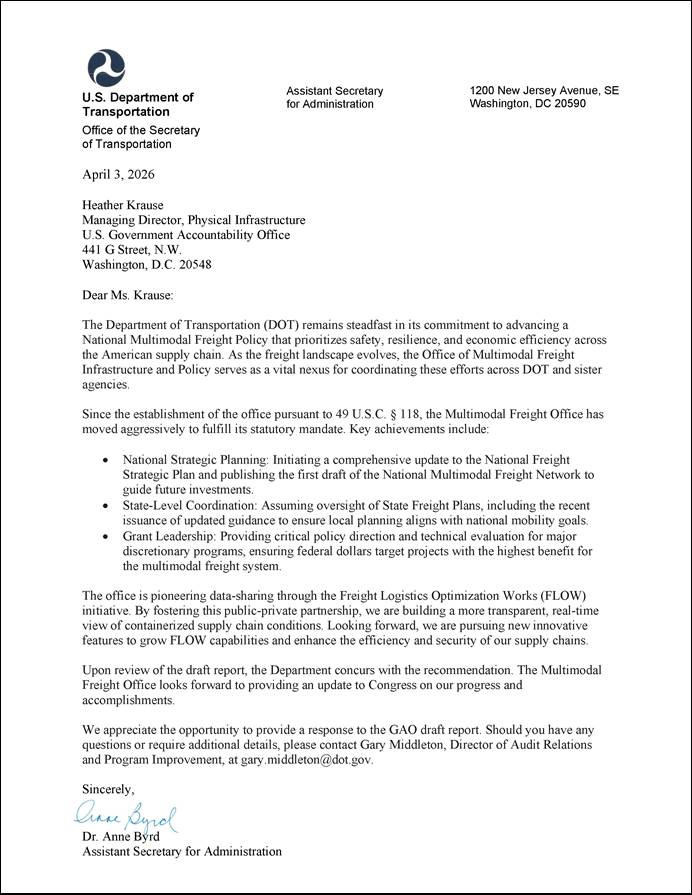
We provided a draft of this report to DOT. DOT provided written comments, which are reproduced in appendix III. In its response, DOT agreed with our recommendation to report to Congress on the activities of the Multimodal Freight Office since September 2023. DOT also provided technical comments, which we incorporated, as appropriate.
We are sending copies of this report to the appropriate congressional committees, the Secretary of Transportation, and other interested parties. In addition, the report is available at no charge on the GAO website at https://www.gao.gov.
If you or your staff have any questions about this report, please contact me at Repkoe@gao.gov. Contact points for our Offices of Congressional Relations and Media Relations may be found on the last page of this report. GAO staff who made key contributions to this report are listed in appendix IV.
Elizabeth Repko
Director, Physical Infrastructure
Appendix I: Department of Transportation Efforts on Statutory Requirements for the Multimodal Freight Office
|
Requirements related to the Multimodal Freight Office |
Description |
Steps taken by the Department of Transportation (DOT) |
|
Develop and manage the National Freight Strategic Plan (NFSP) in 49 U.S.C. § 70102. |
The NFSP must include an assessment of the National Multimodal Freight Network, forecasts of freight volumes, and strategies to improve freight intermodal connectivity, among other elements. The Multimodal Freight Office is responsible for developing and updating the NFSP every 5 years, after providing notice and an opportunity for public comment and consulting with state departments of transportation and other stakeholders. |
In December 2025, Multimodal Freight Office officials stated that they were continuing to work on updating the NFSP, which was last updated in 2020, with support from DOT’s Volpe Center. In July 2025, DOT issued a request for comment and received 69 comments when the comment period closed one month later.a As of February 2026, Multimodal Freight Office officials stated that the updated NFSP plan was undergoing final review and clearance within DOT. The plan will include analysis that uses the Draft National Multimodal Freight Network (see below) as a baseline for addressing statutory requirements. |
|
Develop and manage the National Multimodal Freight Network (NMFN) in 49 U.S.C. § 70103 |
As outlined in 49 U.S.C. § 70102, the required contents of the NFSP include several references to the NMFN as the baseline network for assessing conditions and performance and identifying bottlenecks and best practices for improved performance. The Multimodal Freight Office must solicit input from stakeholders, provide notice and an opportunity to comment on the draft system, and consider statutorily prescribed factors to designate a NMFN, with the goals of improving network and intermodal connectivity and using measurable data as part of the assessment of freight movement. After the initial designation, the NMFN must be redesignated every 5 years. |
In April 2024, DOT published a request for information (RFI) on the best approach to identifying critical freight facilities and corridors that will make up the NMFN.b In January 2025, DOT published a draft of the NMFN reflecting the comments received in response to the RFI. DOT also requested comments or proposed modifications to the Draft NMFN, which were due in February 2025.c According to Multimodal Freight Office officials, as of December 2025, the Office was actively reviewing and incorporating feedback in preparation for the next phase of input from states on the NMFN. |
|
Oversee the development and updating of the state freight plans in 49 U.S.C. § 70202 |
The Multimodal Freight Office is to provide guidance or best practices relating to the development and updating of state freight plans. States that receive funding under the National Highway Freight Program are required to develop a freight plan for the immediate and long-term planning activities and investments of the state with respect to freight and to update that plan at least once every 4 years. |
According to officials, the Multimodal Freight Office took over the review and approval of state freight plans from DOT’s Undersecretary for Policy. DOT’s state freight plans guidance was last updated and issued in 2023. In February 2026, DOT released updated guidance on state freight plans. Multimodal Freight Office officials stated that as Federal Highway Administration (FHWA) staff are the first points of contact for states in updating their state freight plans, Multimodal Freight Office officials will reach out to ensure that FHWA staff know about the updated state freight plan guidance. |
|
Administer multimodal freight grant programs, including the Nationally Significant Multimodal Freight and Highway Projects (INFRA) program, and establish procedures for analyzing and evaluating applications for grants under those programs. |
Some examples of multimodal freight grant programs in which the Multimodal Freight Office has been involved include the INFRA program at 23 U.S.C. § 167, which provides funding for eligible multimodal freight and highway projects of national or regional significance, including those that improve the safety, efficiency, and reliability of the movement of freight; the National Infrastructure Assistance (Mega) program at 49 U.S.C. § 6701, which provides funding for eligible surface transportation infrastructure projects, including freight intermodal projects that, among other criteria, are likely to generate national or regional economic, mobility, or safety benefits; the Rural Surface Transportation Grant program at 23 U.S.C. § 173, which provides grants to improve and expand the surface transportation infrastructure in rural areas; the Port Infrastructure Development program, which provides funding for projects that improve the safety, efficiency, and reliability of the movement of goods into, out of, around, and within a port; and the Consolidated Rail Infrastructure and Safety Improvements (CRISI) program at 49 U.S.C. 22907, which provides funding for projects that improve railroad safety, efficiency, and reliability. |
DOT officials stated that the Multimodal Freight Office fulfills the requirement to administer certain multimodal freight grant programs through its involvement in the grant process, such as by providing key policy direction on eligibility and selection criteria for those programs. Officials said the Assistant Secretary for Multimodal Freight, supported by subject matter experts in the Multimodal Freight Office, provides guidance on developing the selection process used to select recipients for freight grant program awards. The Assistant Secretary, or designee, also serves on the senior review team to review assigned ratings and to make selection recommendations, as appropriate. According to DOT, because the statute does not provide a definition for the term “administer,” DOT has broad discretion in deciding how to carry out its multimodal freight grant programs. DOT noted that it allows other policy offices, in addition to the Multimodal Freight Office, to assist in administering these programs; however, the Multimodal Freight Office plays a vital role in their administration. According to DOT officials, other INFRA program responsibilities, such as organizing the evaluation task force, providing guidance and technical assistance to applicants, and conducting post award oversight, are handled primarily by the Office of Infrastructure Deployment within the Office of the Assistant Secretary for Transportation Policy. The Office of Infrastructure Deployment handles these coordinating responsibilities for several multimodal grant programs, both freight and nonfreight, and is able to efficiently deploy resources across these programs throughout the calendar year. Both the Multimodal Freight Office and the Office of Transportation Policy report up to the Office of the Under Secretary of Transportation, which is, therefore, responsible for all relevant program management activities. |
|
Assist states in the establishment of (a) state freight advisory committees under 49 U.S.C. § 70201 and (b) multistate freight mobility compacts under 49 U.S.C. § 70204. |
State advisory committees are responsible for advising the state on freight-related priorities, issues, projects, and funding needs; serving as a forum for discussion; and communicating and coordinating regional priorities, among other roles. Multistate freight mobility compacts may advise on freight-related priorities, issues, projects, and funding needs that impact multistate freight mobility and supply chains, among other activities. |
In February 2026, DOT released updated Guidance on State Freight Plans and State Freight Advisory Committees. In this guidance, DOT stated that it strongly encourages states to use a collaborative process for freight planning that involves relevant stakeholders to establish and continue state freight advisory committees. Multimodal Freight Office officials noted other steps they have taken to meet this requirement, such as a presentation at the American Association of State Highway and Transportation Officials (AASHTO) Special Committee on Freight at the AASHTO Annual Meeting in November 2025. While officials noted that they have not yet coordinated extensively with states, they noted there are numerous longstanding groups with state participation, such as AASHTO, and freight-specific working groups that DOT participates in. In these groups, states can talk about freight challenges and share updates with DOT. The Multimodal Freight Office officials stated that, in the future, they hope to engage more with these entities and to host a webinar for the forthcoming NFSP as a way to promote the NFSP and the updated requirements to states and private industry. |
|
Provide to the Bureau of Transportation Statistics input regarding freight data and planning tools. |
|
Multimodal Freight Office officials stated that the Office is providing guidance in new and evolving freight areas and working with the Bureau of Transportation Statistics (BTS) to work on changes in freight data and planning tools (new mapping tools and various surveys). They stated that they are actively reviewing freight forecasting tools with BTS. |
|
Work with the modal administrations of DOT to encourage multimodal collaboration. |
|
According to Multimodal Freight Office officials, the Office is involved in both formal and informal groups with other operating administrations to enhance collaboration. For example, the Office leads the Freight Working Group, a formal working group within DOT that is working on updates to the NFSP and that makes sure the views of the freight community are considered in the agency’s decision-making process. This group meets periodically to make sure DOT’s operating administrations are part of the process. |
|
Ensure that the Multimodal Freight Office is adequately staffed and funded. |
DOT may consolidate office functions into the Multimodal Freight Office and transfer positions from other DOT offices upon determining that the positions are necessary to carry out the purposes of the Multimodal Freight Office. |
DOT officials stated that the Multimodal Freight Office relies on a mix of full-time staff, rotational detailees from other offices, and contracted support (including multiple individuals at BTS) to deliver on its statutory responsibilities. The Multimodal Freight Office identifies opportunities where additional staff will enhance DOT’s capacity to achieve its objectives; they will work with the department’s Office of the Secretary of Transportation’s Human Resource Office to ensure those needs are reflected in approved staffing plans and that recruitment and hiring proceed in accordance with government policy. As of December 2025, the Multimodal Freight Office had an Assistant Secretary and a Deputy Assistant Secretary for Multimodal Freight Infrastructure and Policy. It also has filled two of three career official positions (with the head of the Office of Multimodal Freight Research and three subordinate staff positions vacant) and an executive assistant. In February 2026, DOT officials stated that the Office of Personnel Management has an approved staffing plan for the Office that will enable it to hire new staff in the coming year. Further, DOT plans to undertake a workforce analysis that will look at potential future needs. |
|
Make publicly available on the website of DOT a description of the Multimodal Freight Office. |
Website is to include a description of the programs managed or made available by the Multimodal Freight Office and the eligibility requirements for those programs. |
Information on the Multimodal Freight Office’s programs and eligibility requirements for those programs are available on its public-facing website, at: https://www.transportation.gov/freight. |
|
Report to Congress, not later than 1 year after the date of enactment of the Investment and Jobs Act of 2021 (IIJA), § 21101, and every 180 days thereafter, until the date on which DOT determines that the requirements of § 21101 have been met. |
Report is to include (1) the programs and activities of the Multimodal Freight Office and their status; (2) the number of employees working in the Multimodal Freight Office, the total number of employees expected to join, and the total number of positions that were eliminated or transferred to the Multimodal Freight Office; (3) whether any offices or office functions were consolidated into the Multimodal Freight Office or eliminated; (4) any other relevant actions; and (5) any recommendations for legislation that may be needed to implement § 21101. |
Multimodal Freight Office officials stated that DOT officials briefed Congress in 2023 on the programs and activities planned and underway at DOT to be administered by the Office. However, DOT has not provided periodic updates to Congress per the IIJA requirement since those initial briefings. DOT officials stated that they have not provided any further reports due to the Office’s limited staff and that those staff were focused on meeting other IIJA statutory requirements and other activities assigned by the Secretary of Transportation. |
|
Consider duplication in freight responsibilities across DOT, which may consist of transferring positions to the Multimodal Freight Office or consolidating offices or office functions. |
IIJA § 21101 allows DOT to consolidate into the Multimodal Freight Office any office or office function within DOT that the Secretary determines has duties, responsibilities, resources, or expertise that support the purposes of the Multimodal Freight Office. DOT may eliminate any office if the Secretary determines that (A) the purposes of the office are duplicative of the purposes of the Multimodal Freight Office; (B) the office or the functions of the office have been substantially consolidated with the Multimodal Freight Office; (C) the elimination of the office will not adversely affect the requirements of DOT under any federal law; and (D) the elimination of the office will improve the efficiency and effectiveness of the programs and functions conducted by the office.d |
Prior to the formal establishment of the Multimodal Freight Office in 2023, DOT formed a Freight Office Implementation Task Force to develop the mission, structure, and responsibilities of the Multimodal Freight Office. The Freight Office Implementation Task Force reviewed multimodal freight responsibilities across the department to prevent potential duplication and to allocate staffing and budgetary resources to achieve the planned activities of the office in future years. DOT officials noted that the effort to review freight functions across the agency prevented the Office’s responsibilities from being duplicative with the other operating administrations. |
Source: GAO analysis of statutes and DOT data and interviews with DOT officials. | GAO‑26‑108554
Notes: In addition to the statutory requirements related to the Multimodal Freight Office, 49 U.S.C. § 118 sets forth purposes for the Office, including to carry out the national multimodal freight policy; to promote and facilitate the sharing of information between the private and public sectors with respect to freight issues; to conduct research on improving multimodal freight mobility, to oversee the freight research activities of the various components within DOT; to liaise and coordinate with other federal departments and agencies; and to carry out other duties, as prescribed by the Secretary of DOT. Multimodal Freight Office officials told us that they are undertaking several efforts in support of these purposes, including promoting and facilitating the sharing of information between the public and private sector with respect to freight issues through the Freight Logistics Optimization Works initiative and coordinating with other federal agencies on various freight issues, including trade and supply chain issues with the Department of Commerce, and cargo theft and security issues with the Department of Homeland Security and the Department of Justice.
aNational Freight Strategic Plan 2025 Update: Request for Information, 90 Fed. Reg. 31751 (July 15, 2025).
bRequest for Information on Goals, Criteria, Thresholds, and Measurable Data Sources for Designating the National Multimodal Freight Network, 89 Fed. Reg. 25913 (Apr. 12, 2024).
cDraft Designation of National Multimodal Freight Network and State Input Process, 90 Fed. Reg. 2781 (Jan. 13, 2025).
dBefore exercising these authorities, DOT must obtain reprogramming approval from the House and Senate Committees on Appropriations. Consolidated Appropriations Act, 2026, Pub. L. No. 119-75, div. D, tit. I; Consolidated Appropriations Act, 2024, Pub. L. No. 118-42, 138 Stat. 25, 299.
Appendix II: Functions Moved from the Office of the Assistant Secretary for Transportation Policy to the Multimodal Freight Office
Table 3: Summary of Freight Functions Transferred from the Office of the Chief Economist Within the Office of the Assistant Secretary for Transportation Policy to the Multimodal Freight Office
|
Freight functions of the Office of the Chief Economist outlined in the 2021 Department of Transportation (DOT) Organizational Manual |
Freight Functions transferred to the Multimodal Freight Office in the 2024 DOT Organizational Manual |
|
Develops and coordinates national freight transportation policy within DOT and among federal agencies to support commercial goods movement |
Develop and coordinate national multimodal freight policy within DOT Liaise and coordinate with other federal departments and agencies on freight transportation policy |
|
Works with state departments of transportation and metropolitan planning organizations in large metropolitan areas to heighten awareness of critical freight transportation issues and logistical considerations in commercial transportation operations |
In coordination with DOT’s operating administrations, assist cities and states in developing freight mobility and supply chain expertise |
|
Focuses on systemic freight transportation needs from the perspective of users (e.g., shippers, logistics services, etc.) |
Promote and facilitate the sharing of information between the private and public sectors, with respect to freight issues Conduct research on improving multimodal freight mobility |
|
Addresses cross-cutting freight transportation issues, as required by law or as raised by the Secretary and DOT’s operating administrations |
Identifies gaps in data and evidence necessary to make critical secretariat decisions about policy, programs, and regulations related to multimodal freight and ensures that DOT builds data and evidence to fill those gaps |
|
Targets freight research needs in coordination with the Assistant Secretary for Research and Technology |
Coordinate the freight research activities of the various agencies within DOT |
Source: GAO review of DOT 2021 and 2024 Organizational Manuals. | GAO‑26‑108554
GAO Contact:
Elizabeth Repko, Repkoe@gao.gov
Staff Acknowledgments:
In addition to the contact named above, Maria Wallace (Assistant Director), Greg Hanna (Analyst in Charge), Melissa Bodeau, Kristin Petroff, Damon McCarthy, Rebecca Morrow, Kelly Rubin, Justin Snover, and Malika Williams made key contributions to this report.
The Government Accountability Office, the audit, evaluation, and investigative arm of Congress, exists to support Congress in meeting its constitutional responsibilities and to help improve the performance and accountability of the federal government for the American people. GAO examines the use of public funds; evaluates federal programs and policies; and provides analyses, recommendations, and other assistance to help Congress make informed oversight, policy, and funding decisions. GAO’s commitment to good government is reflected in its core values of accountability, integrity, and reliability.
Obtaining Copies of GAO Reports and Testimony
The fastest and easiest way to obtain copies of GAO documents at no cost is through our website. Each weekday afternoon, GAO posts on its website newly released reports, testimony, and correspondence. You can also subscribe to GAO’s email updates to receive notification of newly posted products.
Order by Phone
The price of each GAO publication reflects GAO’s actual cost of production and distribution and depends on the number of pages in the publication and whether the publication is printed in color or black and white. Pricing and ordering information is posted on GAO’s website, https://www.gao.gov/ordering.htm.
Place orders by calling (202) 512-6000, toll free (866) 801-7077,
or
TDD (202) 512-2537.
Orders may be paid for using American Express, Discover Card, MasterCard, Visa, check, or money order. Call for additional information.
Connect with GAO
Connect with GAO on X,
LinkedIn, Instagram, and YouTube.
Subscribe to our Email Updates. Listen to our Podcasts.
Visit GAO on the web at https://www.gao.gov.
To Report Fraud, Waste, and Abuse in Federal Programs
Contact FraudNet:
Website: https://www.gao.gov/about/what-gao-does/fraudnet
Automated answering system: (800) 424-5454
Media Relations
Sarah Kaczmarek, Managing Director, Media@gao.gov
Congressional Relations
David A. Powner, Acting Managing Director, CongRel@gao.gov
General Inquiries
[1]Pub. L. No 117-58, § 21101, 135 Stat. 429, 652-57 (2021) (codified at 49 U.S.C. § 118). Additionally, the IIJA authorized and appropriated funding for federal surface transportation programs through fiscal year 2026.
[2]GAO, Air Cargo: DOT Should Communicate Data Limitations and Identify Stakeholder Challenges, GAO‑25‑107334 (Washington D.C.: July 23, 2025). In this report, we recommended, among other things, that the Secretary of Transportation ensure that the Assistant Secretary for Multimodal Freight Infrastructure and Policy evaluate existing sources of information and routinely communicate with air cargo stakeholders to identify challenges to the efficient movement of air cargo and determine whether the agency needs to take steps to help address the challenges. As of March 2026, DOT had not yet taken steps to address the recommendation.
[3]For examples, see GAO, Transportation Grants: Implementation of Recommendations to Improve Documentation Would Enhance Program for Large, Complex Projects, GAO‑25‑107102 (Washington D.C.: Nov. 13, 2024); Surface Transportation: Action Needed to Guide Implementation of Build America Bureau and Improve Application Process, GAO‑19‑279 (Washington D.C.: Mar. 11, 2019); Department of Transportation, Bureau of Transportation Statistics, Transportation Statistics Annual Report 2025 (Washington, D.C.: Dec. 2024); and Department of Transportation, National Freight Strategic Plan, (Washington, D.C.: 2020).
[4]For this report, we consider duplication to occur when two or more agencies or programs are engaged in the same activities or provide the same services to the same beneficiaries. GAO, Fragmentation, Overlap, and Duplication: An Evaluation and Management Guide, GAO‑15‑49SP (Washington, D.C.: Apr. 14, 2015).
[5]Federal Aviation Administration officials we met with told us they had not coordinated with the Multimodal Freight Office and were not able to provide any insight into the circumstances surrounding the establishment of the Office or perspective on the Office’s current operations.
[6]We interviewed representatives from the Association of American Railroads, Airports Council International, American Trucking Association, and the World Shipping Council.
[7]DOT’s draft National Multimodal Freight Network includes designated marine ports, airports, waterways, rail, and highways.
[8]Bureau of Transportation Statistics, Transportation Statistics Annual Report 2025.
[9]U.S. Department of Transportation, National Freight Strategic Plan (2020). Public airports include large commercial airports and general aviation airports that serve a wide range of users. U.S. Department of Transportation, Bureau of Transportation Statistics, Transportation Statistics Annual Report 2024 (Washington, D.C.: December 2024).
[10]Bureau of Transportation Statistics, Transportation Statistics Annual Report 2025. These were the most recent data available at the time of our review.
[11]Bureau of Transportation Statistics, Transportation Statistics Annual Report 2025.
[12]Bureau of Transportation Statistics, Transportation Statistics Annual Report 2024.
[13]On March 26, 2024, a cargo ship leaving the Port of Baltimore struck the Francis Scott Key Bridge, causing collapse of the bridge, closing a major interstate highway link through the city and temporarily rerouting freight truck and ship traffic in the area. Bureau of Transportation Statistics, Transportation Statistics Annual Report 2024.
[14]U.S. Department of Transportation, Bureau of Transportation Statistics, Transportation Statistics Annual Report 2021 (Washington, D.C.: 2020).
[15]Bureau of Transportation Statistics, Transportation Statistics Annual Report 2024.
[16]The Mega Program provides grants to support large, complex infrastructure projects that are difficult to fund by other means and likely to generate national or regional economic, mobility, or safety benefits. 49 U.S.C. § 6701. The INFRA program awards competitive grants for multimodal freight and highway projects of national or regional significance to improve the safety, efficiency, and reliability of the movement of freight and people in and across rural and urban areas. 23 U.S.C. § 117.
[17]The CRISI Program provides grants to eligible projects that improve the safety, efficiency, and reliability of intercity passenger and freight rail, including projects to enhance multimodal connections between rail service and other transportation modes. 49 U.S.C. § 22907.
[18]GAO, Infrastructure Investment and Jobs Act: DOT Should Better Communicate Funding Status and Assess Risks, GAO‑25‑107166 (Washington, D.C.: July 24, 2025).
[19]Pub. L. No. 114-94, § 8001, 129 Stat. 1312, 1605-06 (2015) (codified as amended at 49 U.S.C. §§ 70101-70102).
[20]U.S. Department of Transportation, National Freight Strategic Plan. Pursuant to § 70102, the National Freight Strategic Plan must be updated every 5 years.
[21]FAST Act § 8001 (codified as amended at 49 U.S.C. § 70103). The National Multimodal Freight Network has not yet been finalized. According to Multimodal Freight Office officials, as of December 2025, the Office was actively reviewing and incorporating feedback in preparation for the next phase of input from states on the forthcoming National Multimodal Freight Network.
[22]The goals of the national multimodal freight policy include identifying infrastructure improvements, policies, and operational innovations that reduce congestion and eliminate bottlenecks and improving the safety, security, efficiency, and resiliency of multimodal freight transportation. 49 U.S.C. § 70101. Other purposes of the Multimodal Freight Office include to conduct research on improving multimodal freight mobility and to oversee the freight research activities across DOT; to assist cities and states in developing freight mobility and supply chain expertise; to liaise and coordinate with other federal departments and agencies; and to carry out other duties, as prescribed by the Secretary of Transportation. 49 U.S.C. § 118(c).
[23]The Consolidated Appropriations Act, 2026, provided $5,000,000 for the Multimodal Freight Office, and the accompanying Joint Explanatory Statement provided that $3,000,000 of that amount is for the Freight Logistics Optimization Works (FLOW) program. Pub. L. No. 119-75, div. D, tit. I. The Consolidated Appropriations Act, 2024, and the Consolidated Appropriations Act, 2023, each provided $2,000,000 for the Multimodal Freight Office. Pub. L. No. 118-42, 138 Stat. 25, 299 (2024); Pub. L. No. 117-328, 136 Stat. 4459, 5093 (2023).
[24]IIJA § 21101. See app. I for more information on the statutory requirements related to the Multimodal Freight Office and the actions taken toward meeting those requirements.
[25]DOT’s Volpe Center serves as a federal resource positioned to provide multidisciplinary, multimodal transportation expertise on behalf of DOT’s operating administrations, the Office of the Secretary of Transportation, other federal agencies, state and local governments, academia, and industry.
[26]See Guidance on Multimodal State Freight Plans and State Freight Advisory Committees, 91 Fed. Reg. 8950 (Feb. 24, 2026).
[27]The Office did not have an Assistant Secretary in place from January to October 2025.
[28]According to DOT, FLOW is a public-private partnership to build an integrated view of supply chain conditions in the United States. The FLOW program collects purchase order information from importers, in addition to logistics supply, demand, and throughput data from participants. Participants then receive data that provide a broad, daily view of the current conditions of the overall logistics network, beyond what they may observe within their own operations.
[29]See Protecting America’s Supply Chain From Cargo Theft-Request for Information, 90 Fed. Reg. 45309 (Sept. 19, 2025).
[30]Under 49 U.S.C. § 70102(b)(1), the National Freight Strategic Plan must include an assessment of the condition and performance of the National Multimodal Freight Network.
[31]IIJA § 21101. The IIJA was enacted on November 15, 2021. The IIJA also specifies that DOT will issue these reports every 180 days after the initial report until the Secretary determines that certain requirements are met.
[32]GAO, Standards for Internal Control in the Federal Government, GAO‑25‑107721 (Washington, D.C.: May 15, 2025).
[33]As mentioned above, the Office has ranged in size between four and nine personnel since its establishment in September 2023 and December 2025. However, as of December 2025, the Multimodal Freight Office had two full-time staff, two detailees, an executive assistant and two political appointees (the Assistant Secretary and the Deputy Assistant Secretary).
[34]IIJA § 21101 allows DOT to consolidate into the Multimodal Freight Office any office or office function within DOT that the Secretary determines has duties, responsibilities, resources, or expertise that support the purposes of the Multimodal Freight Office. DOT may eliminate any office, if the Secretary determines that (A) the purposes of the office are duplicative of the purposes of the Multimodal Freight Office; (B) the office or the functions of the office have been substantially consolidated with the Multimodal Freight Office; (C) the elimination of the office will not adversely affect the requirements of DOT under any federal law; and (D) the elimination of the office will improve the efficiency and effectiveness of the programs and functions conducted by the office. Before exercising these authorities, DOT must obtain reprogramming approval from the House and Senate Committees on Appropriations. Consolidated Appropriations Act, 2026, Pub. L. No. 119-75, div. D, tit. I; Consolidated Appropriations Act, 2024, Pub. L. No. 118-42, 138 Stat. 25, 299.
[35]GAO generally considers duplication to occur when two or more agencies or programs are engaged in the same activities or provide the same services to the same beneficiaries. GAO‑15‑49SP.
[36]DOT Order 1101.10D, U.S. Department of Transportation, Office of the Under Secretary of Transportation for Policy, dated December 2024.
[37]The Red Sea Shipping Crisis refers to the numerous attacks by the Houthis, a militant group, on international shipping from October 2023 to July 2025. The attacks targeted vessels from many countries and led to maritime traffic being diverted from the Red Sea, thus driving up global shipping costs. Congressional Research Service, Yemen: Conflict, Red Sea Attacks, and U.S. Policy IF 12581 (July 2025).
[38]According to the Federal Highway Association, truck parking shortages are a national safety concern. It is essential that commercial truck drivers have access to safe, secure, and accessible truck parking. With projected growth in e-commerce and truck traffic, the demand for truck parking will continue to outpace the supply of public and private parking facilities and will only exacerbate the truck parking problems experienced in many regions of the United States.
[39]According to a DOT report, inadequate truck parking can make it more difficult to reliably deliver goods to consumers and lead to concerns for both freight worker security and cargo security, if secure truck parking is not available. U.S. Department of Transportation, Supply Chain Assessment of the Transportation Industrial Base: Freight Logistics (February 2022).
[40]GAO has previously reported that not having sufficient parking or staging areas for trucks at airports can lead to congestion and delays in the movement of goods, and the Multimodal Freight Office is uniquely positioned to leverage existing information and relationships with operating administrations and stakeholders to routinely collect information on these and other challenges. GAO‑25‑107334.