
Report to Congressional Committees
United States Government Accountability Office
A report to congressional committees
Contact: William Russell at russellw@gao.gov.
What GAO Found
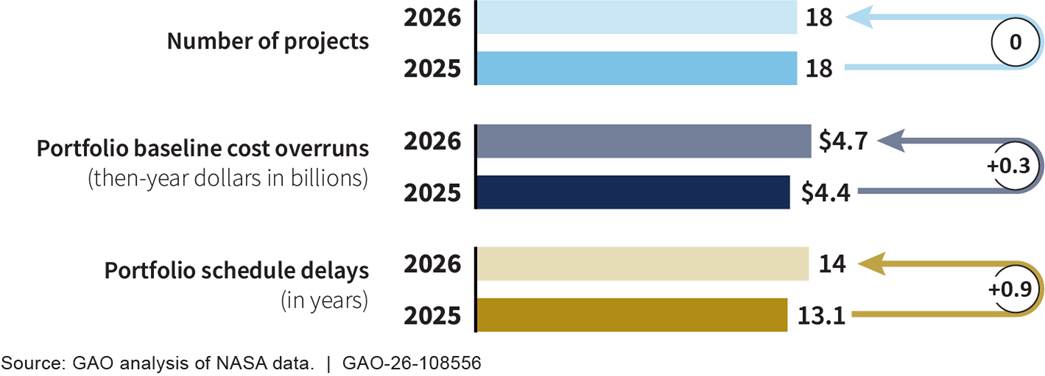
Most of the National Aeronautics and Space Administration’s (NASA) major projects in development reported no schedule delays or cost overruns in the last year. These projects are in the phase of building and testing their designs. Two of these 18 projects reported annual schedule delays (totaling 2 months) and three reported cost overruns (totaling $501.4 million). Similarly, the portfolio’s cumulative costs and delays increased slightly, from $4.4 billion to nearly $4.7 billion and from 13.1 years to 14 years, respectively. The Orion crew capsule accounts for over half of the major projects’ annual cost overruns and almost 75 percent of their cumulative cost overruns.
In February and March 2026, NASA announced significant changes to its Artemis missions—its effort to create a sustained lunar operations. The changes included revising the focus of the planned Artemis III, IV, and V missions, and pausing work on three Artemis projects. These projects include the Gateway, a small space station in lunar orbit that would have supported lunar missions. Under its new plan, NASA plans to shift its focus to infrastructure that enables sustained lunar surface operations.
Implementing changes to the Artemis missions will create acquisition management challenges for NASA as each Artemis-related project adjusts to the new plans. For example, two Artemis projects were reporting technical and programmatic risks that were likely to delay their schedules. Acting on GAO’s prior recommendations to improve cost transparency, establish cost and schedule controls, and better manage acquisition risk could provide opportunities for NASA to strengthen its acquisition management.
In response to the administration’s directive to reduce the size of the federal workforce, NASA reduced its civil servant workforce by 4,000 staff—or nearly 22 percent—in 2025. To date, 25 of 36 projects have reported effects from the reduced staffing. Subsequently, in February 2026, the NASA Administrator announced plans to resume hiring and address skill gaps. The President’s fiscal year 2027 budget request, however, proposes to reduce funding for NASA by more than 20 percent. This request contributes to the ongoing uncertainty as to whether NASA will be able to hire the workforce needed to address skills gaps.
GAO will continue to closely monitor NASA’s management of the Artemis projects, as well as the agency’s efforts to address workforce challenges.
Why GAO Did This Study
NASA plans to invest at least $70 billion in estimated life-cycle costs for its portfolio of major projects (those with costs over $250 million). These projects aim to explore the solar system, return U.S. astronauts to the lunar surface, and advance aeronautic technologies. House explanatory statements have included provisions for GAO to prepare status reports on these projects. This is GAO’s 18th annual report in response to those provisions.
GAO assessed (1) the cost and schedule performance of NASA's major projects in development; (2) the risks that could affect major project performance in the future; and (3) how NASA’s workforce reductions since March 2025 have impacted its ability to manage its portfolio of major projects. This report also includes summaries of NASA's 36 major projects.
GAO collected and analyzed data on the 36 current NASA major projects; visited NASA facilities; interviewed officials; analyzed cost and schedule performance for the 18 projects in development; reviewed NASA’s recent changes to the Artemis missions; analyzed workforce data; and reviewed documents and reports.
What GAO Recommends
In its prior work, GAO made multiple recommendations to improve NASA's management of major projects. NASA has generally agreed with these recommendations, but has not yet addressed some in the areas of cost transparency and program cost and schedule controls. As of May 2026, NASA also had not yet fully implemented two recommendations to improve its acquisition management, which GAO identified as high priority.
Abbreviations
AEPS Advanced Electric Propulsion System
AOS Atmosphere Observing System
ASI Agenzia Spaziale Italiana
CCP Commercial Crew Program
CDR critical design review
COSI Compton Spectrometer and Imager
DAVINCI Deep Atmosphere
Venus Investigation of Noble gases,
Chemistry, and Imaging
DraMS Dragonfly Mass Spectrometer
DSL Deep Space Logistics
EGS Exploration Ground Systems
EHP Extravehicular
Activity and Human Surface Mobility
Program
EPFD Electrified Powertrain Flight Demonstration
ESA European Space Agency
ESO Earth System Observatory
EUS Exploration Upper Stage
EVA Extravehicular Activity
FY fiscal year
GE GE Aerospace
GSFC Goddard Space Flight Center
GRACE-C Gravity Recovery and Climate Experiment-Continuity
HALO Habitation and Logistics Outpost
HLS Human Landing System
ICPS Interim Cryogenic Propulsion System
IMAP Interstellar Mapping and Acceleration Probe
ISRO Indian Space Research Organisation
ISS International Space Station
JPL Jet Propulsion Laboratory
KDP key decision point
LBFD Low Boom Flight Demonstrator
LTV Lunar Terrain Vehicle
MSFC Marshall Space Flight Center
MCR mission concept review
MDR mission definition review
ML2 Mobile Launcher 2
MMRTG Multi-Mission Radioisotope Thermal Generator
MSR Mars Sample Return
MUSE MUlti-slit Solar Explorer
NEO Near Earth Object
NISAR NASA—ISRO Synthetic Aperture Radar
OCHCO Office of the Chief Human Capital Officer
Orion Orion Multi-Purpose Crew Vehicle
ORR operational readiness review
PDR preliminary design review
PMM Precipitation Measuring Mission
PPE Power and Propulsion Element
Roman Nancy Grace Roman Space Telescope
ROSA Rosalind Franklin Support and Augmentation
RPOD rendezvous proximity operations and docking
SBG Surface Biology and Geology
SCIPA Spacecraft Integrated Payload Assembly
SDR system definition review
SEP Solar Electric Propulsion
SFD Subsonic Flight Demonstrator
SIR system integration review
SLD Sustaining Lunar Development
SLS Space Launch System
SMD Science Mission Directorate
SRL Sample Retrieval Lander
SRR system requirements review
TBD to be determined
TIR Thermal Infrared
USDV United States Deorbit Vehicle
UVEX UltraViolet Explorer
ULA United Launch Alliance
VenSAR Venus Synthetic Aperture Radar
VERA Voluntary Early Retirement Authority
VERITAS Venus Emissivity,
Radio Science, InSAR, Topography, and
Spectroscopy
VSIP Voluntary Separation Incentive Package
VSWIR Visible and Short Wave Infrared
WFI Wide Field Instrument
This is a work of the U.S. government and is not subject to copyright protection in the United States. The published product may be reproduced and distributed in its entirety without further permission from GAO. However, because this work may contain copyrighted images or other material, permission from the copyright holder may be necessary if you wish to reproduce this material separately.
July 23, 2026
Congressional Committees
Each year, the National Aeronautics and Space Administration (NASA) invests billions of dollars in a wide range of major projects to help execute important missions. We define major projects as a project or program with an estimated life-cycle cost of over $250 million.[1] NASA’s major projects aim to observe Earth’s oceans, land, and atmosphere; explore the solar system; and advance aeronautics research, among other things. As of fiscal year 2026, NASA estimates that the total life-cycle cost of its portfolio of 36 major projects will be at least $70 billion. Of these 36 projects, 18 are in development—the phase in which NASA is building and testing hardware—and NASA successfully completed four of these projects. In addition, in April 2026, NASA successfully completed the second of several planned Artemis missions to extend human presence beyond low-Earth orbit. During Artemis II, astronauts conducted a lunar flyby, during which they tested life support and other systems on the Orion Multi-Purpose Crew Vehicle (Orion) spacecraft and participated in science activities, before a safe splashdown.
While NASA continued to work toward achieving its ambitious science and exploration agenda, 2025 also introduced considerable uncertainty to NASA’s major project portfolio. The fiscal year 2026 President’s Budget Request proposed canceling 19 of the 36 major projects in NASA’s portfolio and reducing the agency’s overall budget and workforce. Although NASA’s fiscal year 2026 appropriation generally maintained NASA’s funding at stable levels from fiscal year 2025, the President’s fiscal year 2027 budget request again proposed large funding reductions.
NASA’s planning and execution of its major projects has been on our high-risk list continuously for over 3 decades due to the agency’s history of cost growth and schedule delays in developing its major systems. NASA has taken steps to reduce its acquisition risks and improve project cost and schedule performance. Since we initially designated NASA’s acquisition management as high-risk, we have made numerous recommendations to help the agency reduce its acquisition risk. NASA has implemented many of these recommendations, but it needs to take additional actions to fully address all of them. Most importantly, in our 2025 high-risk report, we found that NASA continued to face challenges controlling cost growth and schedule delays for its most expensive and highest priority projects.[2] Further reducing risk will be critical as NASA embarks on several new, large projects, including projects needed to conduct the Artemis missions. These projects are complex and specialized and often rely on state-of-the-art space technology.
The explanatory statement of the House Committee on Appropriations accompanying the Omnibus Appropriations Act, 2009 includes a provision for us to prepare project status reports on selected large-scale NASA programs, projects, and activities, which we refer to as major projects.[3] The explanatory statement accompanying the Consolidated Appropriations Act, 2024 includes a similar provision.[4]
This is our 18th annual report on NASA’s major projects. Our objectives were to assess (1) the cost and schedule performance of NASA’s major projects in development; (2) the challenges and opportunities that could affect major project performance in the future; and (3) the effects, if any, of workforce reductions on NASA’s ability to manage its portfolio of major projects.
This report also includes assessments of individual major NASA projects. When NASA determines that a project has an estimated life-cycle cost of over $250 million, we include that project in our annual review through its launch or the end of its development. Appendix I includes 20 assessments for NASA projects and programs that have either passed key milestones or are expected to exceed $2 billion in total life-cycle costs. Appendix II includes descriptions of 11 projects that are early in their life cycles and are not expected to exceed $2 billion in total life-cycle costs.
To conduct our work, we collected cost, schedule, and workforce data for each project via data collection questionnaires that we sent to NASA headquarters and project offices. To assess the cost and schedule performance of NASA’s portfolio of major projects, we analyzed these data and compared the performance of current projects to their cost and schedule baselines. We also reviewed project documentation and interviewed projects for information on project risks and workforce changes. In addition, we reviewed agency announcements and documentation on changes to the Artemis missions and assessed how those changes might present challenges or opportunities for NASA’s management of its portfolio of major projects in the future. Further, we analyzed data on NASA workforce separations, retirements, and hires, and interviewed officials within NASA’s Office of the Chief Human Capital Officer (OCHCO) on agency plans to assess and address workforce needs. Appendix III contains detailed information on our scope and methodology.
We conducted this performance audit from June 2025 to July 2026 in accordance with generally accepted government auditing standards. Those standards require that we plan and perform the audit to obtain sufficient, appropriate evidence to provide a reasonable basis for our findings and conclusions based on our audit objectives. We believe that the evidence obtained provides a reasonable basis for our findings and conclusions based on our audit objectives.
Background
NASA’s Project Management Policy and Life Cycle for Major Projects
The primary NASA policy that guides its project management for major projects is NASA Procedural Requirements 7120.5F.[5] This policy establishes the requirements by which NASA formulates and implements projects, including the life-cycle phases.
The life cycle for NASA space flight projects consists of two phases: (1) formulation, which takes a project from concept development to preliminary design; and (2) implementation, which includes activities like building, launching, and operating the system. NASA further divides formulation and implementation into phases A through F. Major projects must get approval from senior NASA officials at key decision points before they can enter each new phase. Figure 1 depicts NASA’s life cycle for space flight projects.
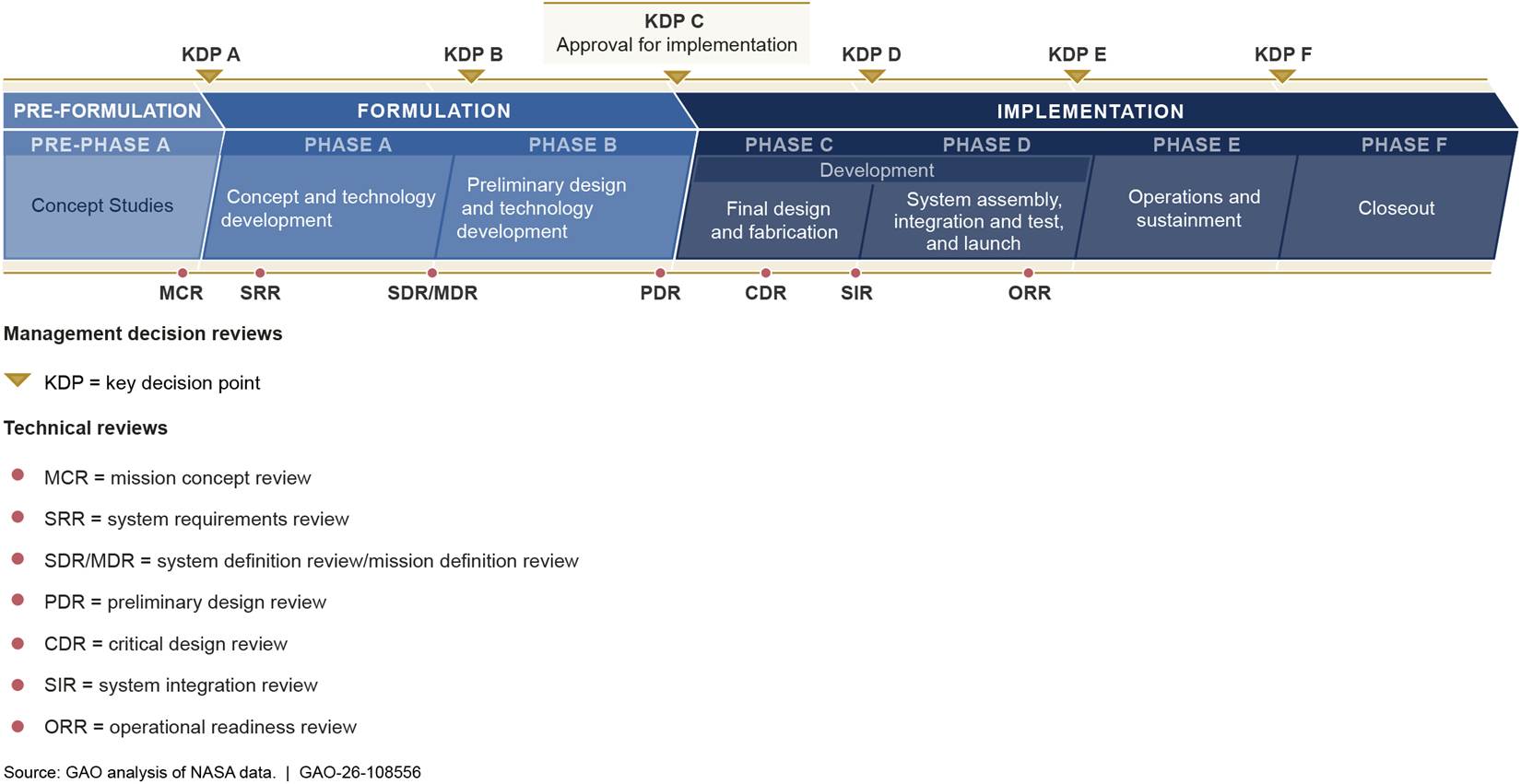
Project formulation consists of phases A and B:
· Prior to beginning phase A, NASA conducts a mission concept review to evaluate the feasibility and maturity of proposed mission concepts and associated planning.
· In phase A, a project team develops a range of preliminary cost and schedule estimates for uses such as budget planning.[6]
· During this phase, the agency is to conduct a system requirements review and system definition review/mission definition review. These reviews help ensure that the project’s performance requirements and proposed system architecture or technical approach are aligned with the mission’s performance requirements.
· During phase B, the project team develops programmatic measures and technical leading indicators that track various project metrics such as requirement changes, staffing demands, and mass and power utilization. Near the end of formulation, leading up to the preliminary design review, the project team is to complete technology development and the preliminary design. Formulation culminates in a review at key decision point C, at which point senior leaders determine whether and how the project proceeds into the next phase and approves any additional actions. This is also the point where cost and schedule baselines are set.
Implementation follows key decision point C and consists of phases C, D, E, and F. In this report, we refer to projects in phases C and D as being in development.
· The project team is to hold a critical design review during the latter half of phase C to determine whether the design performs as expected and is stable enough to support proceeding with the final design and fabrication. After the critical design review and just prior to beginning phase D, the project team completes a system integration review to evaluate the readiness of the project and associated supporting infrastructure to begin system assembly, integration, and test.
· In phase D, the project team performs system assembly, integration, test, and launch activities. During the latter half of phase D, the project team is to hold an operational readiness review to ensure that all system and support hardware, software, personnel, and procedures are ready for operations.
· Phases E and F consist of operations, sustainment, and project closeout.
NASA Cost and Schedule Commitments
Major NASA projects have two sets of cost and schedule commitments—the management agreement and the agency baseline commitment.
· Management agreement. According to NASA policy, the management agreement should be viewed as a contract between NASA and the program or project manager.[7] The executing center’s project manager has the authority to manage the project within the parameters outlined in this agreement, which includes cost and schedule reserves that the project manager controls.[8] Cost reserves are for costs that projects expect to incur—for instance, risk mitigation—but are not yet allocated to a specific part of the project. Schedule reserves are extra time in project schedules that managers can allocate to specific activities, elements, and major subsystems to mitigate delays or address unforeseen events. If the project requires additional time or money beyond the management agreement, NASA headquarters may allocate headquarters-held reserves, which represent the difference between the agency baseline commitment and the management agreement.
· Agency baseline commitment. The agency baseline commitment includes the cost and schedule baselines against which the agency’s performance on a project is measured. The agency baseline commitment includes additional cost and schedule reserves above the amount allocated to the project in the management agreement. Headquarters may hold these reserves above the project level. The baselines generally include life-cycle costs broken out by formulation, development, and operations; and a key schedule milestone event such as a launch readiness date to denote the end of development and the start of operations.[9]
When a project is no longer meeting certain conditions in the agency baseline commitment, NASA replans or rebaselines the project. In certain cases, when the agency has reasonable cause to believe that the latest estimated costs or schedule are likely to overrun the baseline estimates by a certain amount, NASA is required to notify Congress. See table 1 for an overview of characteristics of NASA replans and rebaselines.
|
|
Description |
Potential congressional reporting requirement |
|
Replan |
A replan is a process by which a program updates or modifies its plans. It is driven by changes in program or project cost parameters, such as if development cost growth is 15 percent or more of the estimate in the baseline report or a major milestone is delayed by 6 months or more from the baseline’s date. A replan does not require a new project baseline to be established. |
When the NASA Administrator determines that development cost growth is likely to exceed the development cost estimate by 15 percent or more, or a program milestone is likely to be delayed from the baseline’s date by 6 months or more, NASA must submit a report to the Committee on Science, Space, and Technology of the House of Representatives and the Committee on Commerce, Science, and Transportation of the Senate.a |
|
Rebaseline |
Rebaselining is the process that results in a change to the project’s agency baseline commitment. NASA initiates a rebaseline if the estimated development cost exceeds the baseline development cost estimate by 30 percent or more, or if the NASA Associate Administrator determines other events make a rebaseline appropriate. |
In addition to the replan reporting noted above, should a program exceed its development cost baseline by more than 30 percent, the program must be reauthorized by Congress and rebaselined in order to expend funds to continue work beyond a specified time frame.b |
Source: GAO analysis of NASA Policy and 51 U.S. Code Sec. 30104. | GAO‑26‑108556
a51 U.S.C. § 30104(e)(1).
b51 U.S.C. § 30104(f).
NASA Project Management Policy and Project Category Types
NASA’s key project management policy includes requirements that define category thresholds for projects.[10] These thresholds determine the level of internal oversight and approval a project receives depending on its life-cycle cost and other criteria. The category definitions do not affect NASA’s statutory external reporting requirements to report progress against cost and schedule baselines to congressional committees for projects with life-cycle costs over $250 million.[11]
NASA identifies its highest priority, most expensive projects and programs as category 1 projects. These projects typically have life-cycle cost estimates of $2 billion or more. However, projects can also be classified as category 1 due to other factors. These factors include the project’s level of radioactive material, distinction as a human space flight project, or its priority level. Priority level is determined by the importance of the activity to NASA, the extent of international participation (or joint effort with other government agencies), or level of risk associated with the development of the spacecraft or payload. See table 2 for NASA project category cost threshold definitions.
|
Category |
Project life-cycle cost threshold |
Decision authority |
|
1 |
Over $2 billion |
NASA Associate Administrator |
|
2 |
$365 million to $2 billion |
Mission Directorate Associate Administrator |
|
3 |
Less than $365 million |
Source: GAO analysis of NASA Procedural Requirements 7120.5F.
| GAO‑26‑108556
NASA Projects We Reviewed in Our 2026 Assessment
This year, NASA’s portfolio of major projects includes 36 projects. Eighteen of these projects are in development, meaning they set cost and schedule baselines against which project performance can be measured.[12] Seventeen of the projects are in formulation and have not yet set cost or schedule baselines. One project, the Commercial Crew Program (CCP), has a tailored project life cycle and project management requirements and did not establish a cost or schedule baseline. NASA designated 15 of these 36 projects as category 1.
Additionally, of these 36 total projects, 11 are related to the Artemis missions. The goal of NASA’s Artemis enterprise is to return U.S. astronauts to the surface of the moon, establish a sustained lunar presence, and ultimately achieve human exploration of Mars. NASA has begun development of multiple highly complex, interdependent systems required to enable lunar surface exploration.
Figure 2 illustrates all 36 projects and programs we reviewed this year, by life-cycle phase, and includes designations for those related to the Artemis missions or that are category 1.
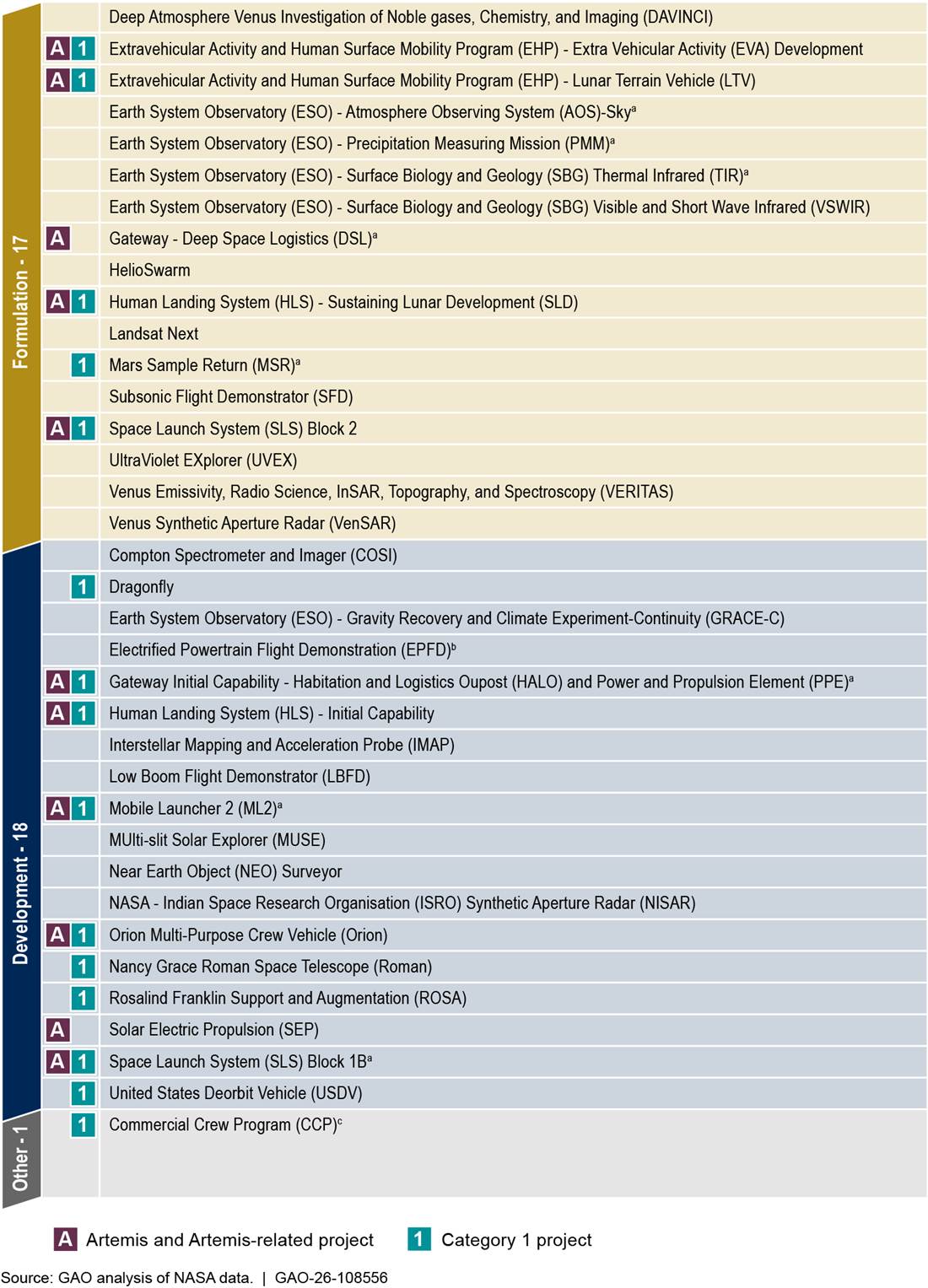
aNASA announced plans to pause or otherwise stopped work on the following projects during GAO’s review: ESO-SBG-TIR, ESO-AOS-Sky, Mars Sample Return, Gateway Initial Capability, Gateway-DSL, SLS Block 1B, and ML2. PMM was previously known as AOS-Storm. According to NASA officials and the agency’s fiscal year 2025 operating plan, the majority of AOS-Storm will not proceed to the next phase. NASA’s remaining contribution to the Japan Aerospace Exploration Agency-managed PMM now only includes science expertise and launch.
bNASA canceled the EPFD project.
cThe Commercial Crew Program has a tailored
project life cycle and project management requirements and did not establish a
cost or schedule baseline. It is not included in GAO’s cost and schedule
analyses for the development portfolio.
During the course of our review, NASA completed development on the Interstellar Mapping and Acceleration Probe (IMAP); the Low Boom Flight Demonstrator (LBFD); the NASA – Indian Space Research Organisation (ISRO) Synthetic Aperture Radar (NISAR); and Orion.
Changes to NASA’s Artemis Missions
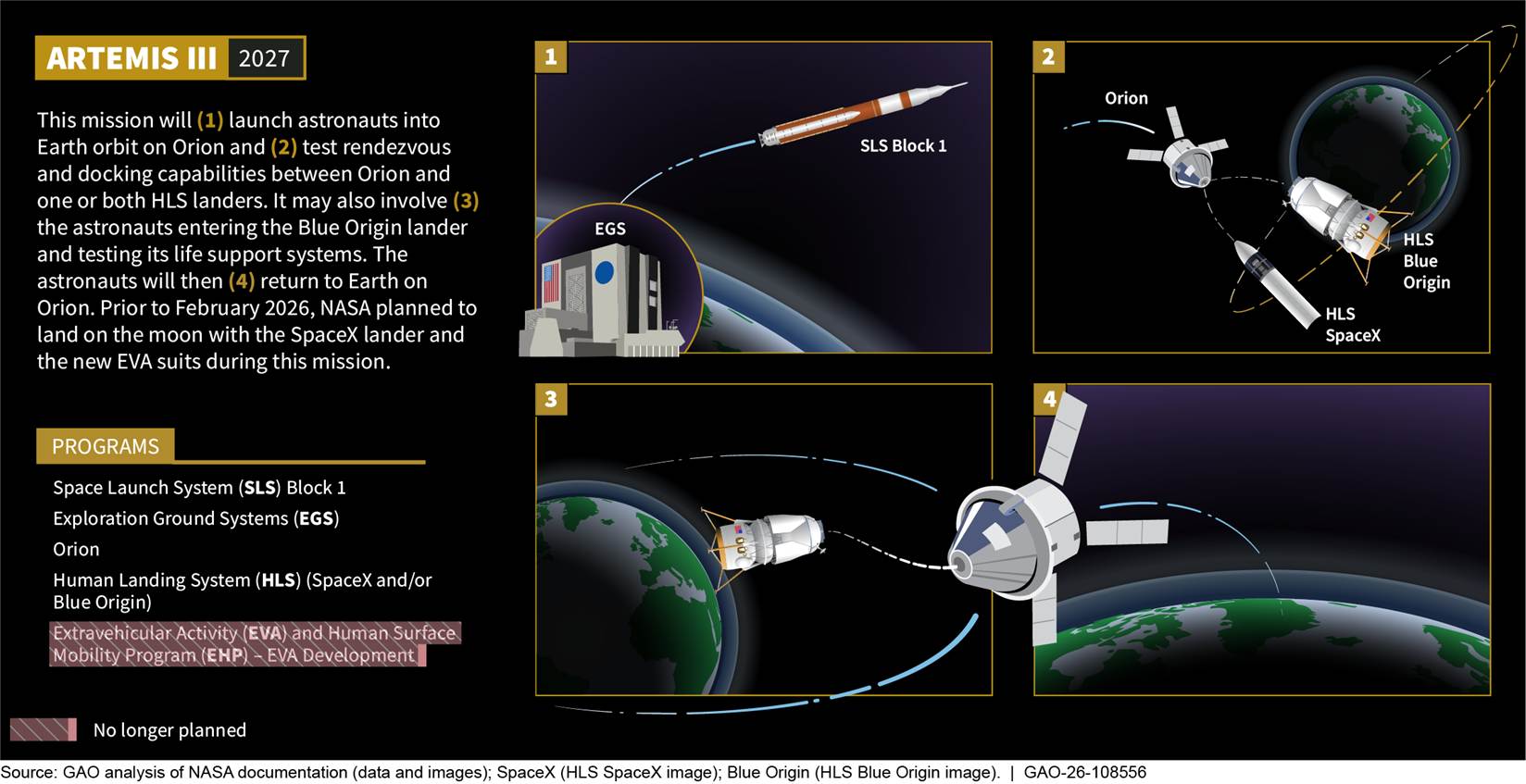
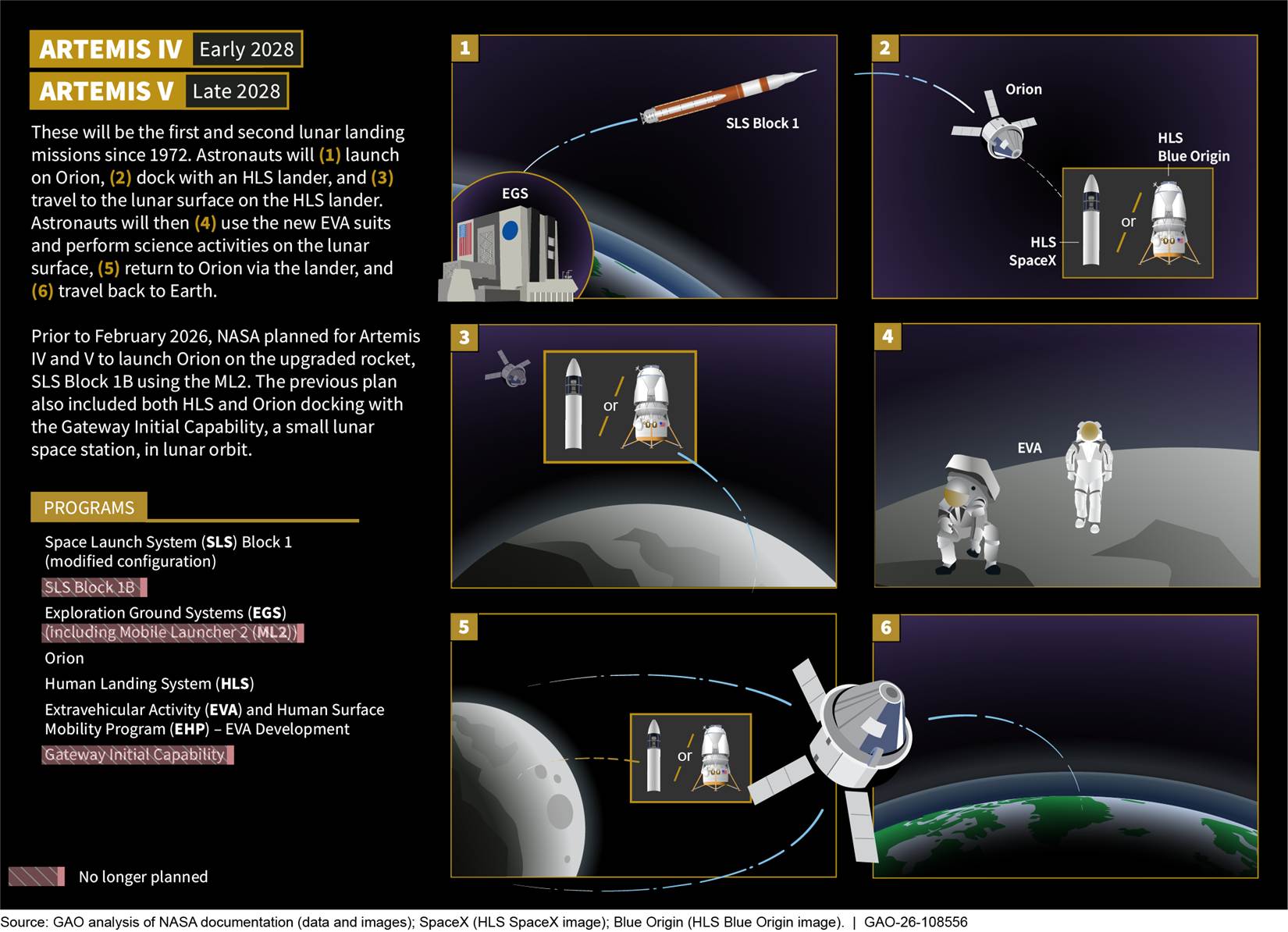
In February 2026, NASA announced significant changes to its Artemis missions to return humans to the lunar surface.[13] NASA officials stated that the primary reason for the changes was to increase the flight cadence of the Space Launch System (SLS) rocket and reduce risk for the first lunar landing by standardizing the SLS rocket’s configuration. NASA will achieve these goals by adding a new mission, now called Artemis III, and by no longer using an upgraded upper stage capability for the SLS rocket. Figure 3 describes this new mission.
The Artemis IV mission, planned for early 2028, will now demonstrate the first lunar landing. Human Landing System (HLS) lander readiness will determine which provider carries the crew to and from the lunar surface. Artemis V is expected to follow in late 2028 and will also demonstrate a lunar landing. In response to direction in a December 2025 executive order on space policy, NASA also announced that it intends to pause developing the Gateway—a small space station in lunar orbit that would have been used to support lunar landing missions—in its current form and shift focus to infrastructure that enables sustained lunar surface operations.[14] See figure 4 below.
NASA’s Fiscal Years 2026 and 2027 President’s Budget Requests
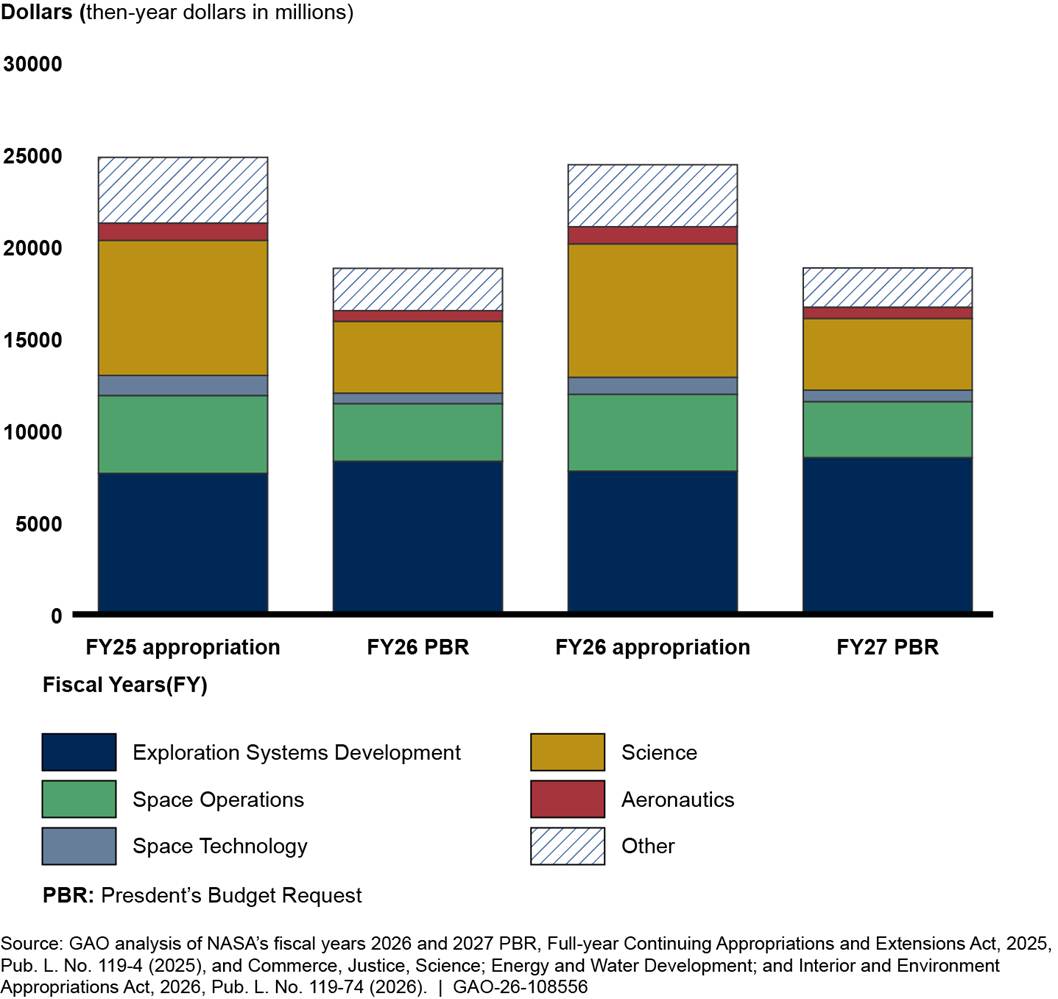
NASA has faced budget uncertainty as the President’s Budget Request in fiscal years 2026 and 2027 proposed significant reductions from prior year appropriations. The fiscal year 2026 President’s Budget Request proposed a 24 percent reduction in the agency’s funding level compared to the fiscal year 2025 enacted appropriation. However, the Commerce, Justice, Science; Energy and Water Development; and Interior and Environment Appropriations Act, 2026, largely maintained NASA’s funding levels from fiscal year 2025.[15] Further, the 2027 budget request included a 23 percent decrease from NASA’s fiscal year 2026 appropriation. As of May 2026, Congress had not passed NASA’s fiscal year 2027 appropriation. See figure 5.
Figure 5: Comparison of Fiscal Years 2025 and 2026 Appropriations with Fiscal Years 2026 and 2027 President’s Budget Requests
Workforce Separation Programs at NASA in 2025
Since January 2025, federal agencies have taken steps to reduce the size of their workforces in response to a presidential directive.[16] Potential steps included offering incentives for civil servants to voluntarily resign or retire, implementing reductions in force, and placing a hiring freeze on most positions. NASA offered the following separation programs for its civil servant workforce in 2025:
· Voluntary Early Retirement Authority. Also referred to as VERA or “early out” retirement, this separation program temporarily lowers the age and service requirements to increase the number of employees who are eligible for retirement during periods of substantial restructuring, reshaping, downsizing, or reorganization.
· Voluntary Separation Incentive Payment. Also referred to as VSIPs or “buyout,” this separation program allows agencies that are downsizing or restructuring to offer employees lump-sum payments up to $25,000—or the employee’s severance pay amount, whichever is less—as an incentive to voluntarily retire or resign.
· Deferred Resignation Program. This separation program allowed civil servants who agree to resign or retire by a given date to be placed on administrative leave while retaining their salary and benefits in the interim. In January 2025, the Office of Personnel Management established a government-wide deferred resignation program that allowed civil servants to resign by September 30, 2025, or retire by December 31, 2025. NASA OCHCO officials stated that the Office of Personnel Management granted NASA authority to offer the deferred resignation program two additional times, which allowed participating NASA civil servants, with limited exceptions, to retire or resign by January 9, 2026.
Schedule Delays and Cost Overruns Were Limited Across the Portfolio, but Most Artemis Projects Were Under Review
Most Projects Reported No Annual Schedule Delays and Cost Overruns
Most major projects in development in NASA’s portfolio reported no schedule delays or cost overruns over the last year. Only four of the 18 major projects are anticipating additional schedule delays or cost overruns to the estimates they reported last year, with delays totaling 2 months and overruns totaling a half-billion dollars (see table 3).
Table 3: Changes to Cost and Schedule Estimates for Major NASA Projects and Programs in Development Since GAO’s 2025 Assessment
|
Changes since 2025 GAO assessment |
|||
|
Annual performance status |
Project(s) |
Schedule delay (months) |
Cost growth (dollars in millions) |
|
First year estimate reported |
ROSA, USDV |
N/A |
N/A |
|
Underrunning prior estimate |
IMAP |
(3) |
(22.2) |
|
Romana |
0 |
(1.0) |
|
|
No change from prior year |
COSI, Dragonfly, EPFDb, ESO-GRACE-C, Gateway Initial Capabilityc, HLS-Initial Capabilityd, ML2c, MUSE, NEO Surveyora, SEPd |
0 |
0 |
|
Overrunning prior estimate |
LBFDa |
1 |
0 |
|
NISAR |
1 |
11.0 |
|
|
SLS Block 1Bc |
0 |
229.4 |
|
|
Orion |
0 |
261.0 |
|
|
Subtotal overruns |
|
2 |
501.4 |
|
Subtotal underruns |
|
(3) |
(23.2) |
|
Total |
|
(1) |
478.2 |
Legend: ROSA: Rosalind Franklin Support and Augmentation; USDV: United States Deorbit Vehicle; IMAP: Interstellar Mapping and Acceleration Probe; Roman: Nancy Grace Roman Space Telescope; COSI: Compton Spectrometer and Imager; EPFD: Electrified Powertrain Flight Demonstration; ESO-GRACE-C: Earth System Observatory Gravity Recovery and Climate Experiment - Continuity; HLS: Human Landing System; ML2: Mobile Launcher 2; MUSE: MUlti-slit Solar Explorer; NEO: Near Earth Object; SEP: Solar Electric Propulsion; LBFD: Low Boom Flight Demonstrator; NISAR: NASA - Indian Space Research Organisation (ISRO) Synthetic Aperture Radar; SLS: Space Launch System; Orion: Orion Multi-Purpose Crew Vehicle.
Source: GAO analysis of NASA data. | GAO‑26‑108556
Note: Positive values indicate cost growth or launch delays compared to the prior year reported estimates. Values in parentheses indicate cost decreases or earlier than planned launch dates compared to the prior year reported estimates. Data for GAO’s current assessment are generally as of January 2026. See appendix III for additional details.
aThe LBFD, Roman, and NEO Surveyor projects reported lower development cost estimates in January 2026. Because NASA had not finalized the estimates at the time of this report, GAO did not include them in its analysis.
bNASA canceled the EPFD project.
cNASA took actions to stop work associated with the ML2 and SLS Block 1B projects and announced that it will pause Gateway Initial Capability. As a result, their costs and schedules are under review and any overruns reported are based on the scope of work for the projects before they were paused. Until that review is complete, information presented above is based on the latest estimates that GAO received from NASA.
dThe HLS Initial Capability project cost and
schedule are currently under review. The SEP project schedule is also under
review. Until these reviews are complete, information presented is based on the
latest estimates that GAO received from NASA.
Two of the 18 major projects in the portfolio reported minor schedule delays this year.
· LBFD reported an annual schedule delay of 1 month to its first flight. This flight occurred in October 2025, more than 3.5 years past its original baseline date of January 2022 and a year past its rebaselined date of October 2024. Officials attributed the additional month delay to several factors, including additional time needed for software updates and additional taxi test runs.
· NISAR reported an annual schedule delay of 1 month to its launch date. This flight occurred in July 2025, more than 2.5 years past its original baseline date of September 2022 and 9 months past its rebaselined date of October 2024. The project also reported an $11 million cost overrun, which officials attributed to a 3-month launch delay from April 2025 to July 2025. The project also reported a 2-month extension of the commissioning phase, during which spacecraft systems are checked and mission controllers establish routine communications and control to ensure proper operations after launch. Launch delays were due to a launch failure on a separate ISRO mission, and a subsequent investigation to ensure that the anomaly responsible for the launch failure would not affect the launch vehicle ISRO was providing to NISAR. The project extended the commissioning phase after the lapse in appropriations to allow the project time to complete a post-launch review.
Two Artemis projects accounted for approximately 98 percent of the total annual cost overruns.[17] Specifically:
· Orion’s latest cost overrun associated with the 7-month delay to its launch, from September 2025 to April 2026, is $261 million. We previously reported this delay in our June 2025 report. Orion’s overruns account for 52 percent of the portfolio’s annual cost overruns.
· Prior to NASA’s February 2026 announcement that the Space Launch System (SLS) Block 1B will no longer be used in upcoming Artemis missions, the project had reported a projected cost overrun of $229.4 million.[18] The project reported that these overruns were due to delays in the completion and delivery of major system components—including the Universal Stage Adapter, Exploration Upper Stage, and payload adapter—and a delay of 1 month to the targeted completion date of the project’s development. By using its schedule reserves to absorb the delay, the project was working within its baselined schedule, but only had 1 month of additional schedule reserves remaining. SLS Block 1B’s cost overruns account for 46 percent of the portfolio’s annual cost overruns.
NASA launched IMAP under its baselined development cost and ahead of its baselined schedule. Specifically, the project launched in September 2025, 3 months before its committed launch readiness date. As a result, it transferred $22.2 million in unused development cost reserves that were budgeted through its original baseline date of December 2025 into the operations phase. A little over half of this funding was used to address previously identified cost increases in operations due to inflation and rate adjustments and the remaining funds were used to increase cost reserves in phase E.
Cumulative Schedule Delays and Cost Growth Increased Slightly for the Portfolio
In 2026, the cumulative schedule delays and cost growth of the portfolio of major projects in development increased slightly.
Schedule. The portfolio’s cumulative schedule delays increased by 11 months since our last annual report, from 13.1 years to 14 years. These schedule changes include the following:
· Adding 12 months to account for the schedule underrun experienced by two projects that left the portfolio since our last report.[19]
· Subtracting 1 month to account for the total portfolio annual schedule underrun as seen in table 3 above.
Cost. The portfolio’s cumulative cost growth increased by approximately $311 million since our last annual report, from $4.4 billion to $4.7 billion. These cost changes include the following:
· Subtracting $167.3 million in cost overruns for two projects that left the portfolio since our last report.
· Adding $478.2 million to account for the total portfolio annual increase as seen in table 3 above.
Figure 6 illustrates the cumulative cost changes for the portfolio since our 2016 annual report.
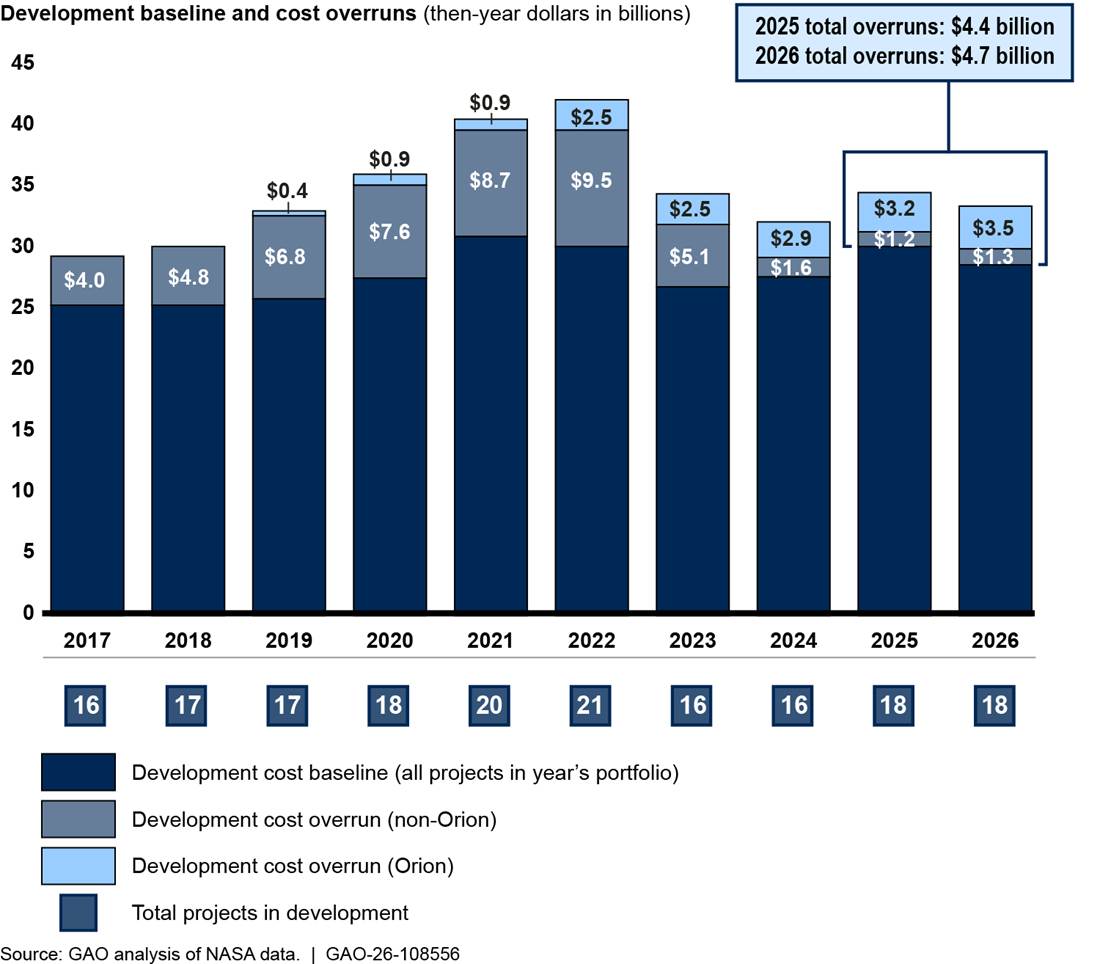
Note: The years in the figure are the years that GAO issued its annual assessment of major projects. Data for GAO’s current assessment are generally as of January 2026. See appendix III for additional details. Underruns for all individual projects are included and incorporated in the net portfolio development cost overruns. Some values do not sum due to rounding.
Fluctuations in the portfolio composition can profoundly affect the portfolio’s collective cost and schedule performance. The performance of projects in the portfolio—the positive or negative changes to cost and schedule performance reported by individual projects—and changes in the composition of the portfolio—major projects exiting and entering the development phase—affect the portfolio’s cumulative performance. Projects that complete development and leave the portfolio will reduce the cumulative baseline costs and, depending on their performance, can reduce or increase the portfolio’s collective cost and schedule overruns. Projects entering development primarily increase the portfolio’s baseline costs but are unlikely to immediately affect cost and schedule performance. To determine whether the portfolio’s cumulative performance is improving or deteriorating, these fluctuations must be understood separately from the performance of projects in the portfolio.
Next year, changes to the portfolio’s project composition are expected to positively affect its cumulative performance. For example:
· Orion will leave the portfolio because it launched in April 2026, removing significant delays and overruns that the program had experienced. Specifically, it will remove 3 years of schedule delays, $6.8 billion in baselined development costs, and approximately $3.5 billion in development cost overruns—or 73 percent of the current portfolio’s total development cost overruns.[20] Orion’s cost overruns have increasingly been a driver of the cumulative overruns, as seen in figure 6 above.
· LBFD and NISAR are leaving the portfolio after first flight and launch in 2025, respectively, and will collectively take with them 6.5 years of schedule delays and over $600 million in cost overruns.
· As of May 2026, NASA decided to discontinue SLS Block 1B. As a result, its baselined costs and projected cost overruns discussed above will no longer be included in our analysis.[21]
· In addition, any new projects entering development in the coming year are unlikely to experience cost overruns or schedule delays in their first year of development.
Most Artemis Project Estimates Were Under Review Due to Mission Changes and Performance Challenges
At the time of our analysis, NASA was reviewing five of the six Artemis and Artemis-related projects’ cost and schedule estimates due to Artemis mission changes, as well as performance challenges. Therefore, our analysis of cost and schedule performance does not reflect pending decisions about the future of these projects. Four of these five projects—SLS Block 1B, Mobile Launcher 2 (ML2), Gateway Initial Capability, and HLS Initial Capability (HLS IC)—are among NASA’s most expensive and complex projects.
Three Artemis projects were under review at the time of our analysis after NASA paused them, primarily due to Artemis mission changes as well as anticipated schedule delays. In February 2026, NASA announced it no longer plans to use SLS Block 1B and ML2, citing changes to the Artemis missions, as previously discussed, as well as significant challenges to their schedules. In March 2026, NASA announced plans to pause work on the Gateway Initial Capability for Artemis missions, also citing hardware and schedule challenges and a newly-defined mission for a moon base.[22] All of these projects faced significant challenges completing their original scope of work without delays. At the time of our analysis, the agency had not yet outlined the future scope of these projects or the extent to which it will adjust their latest estimates, update their baselines, or cancel them in light of the latest mission changes.
· NASA originally planned for the SLS Block 1B vehicle’s first launch to be part of the prior Artemis IV mission, but mission changes and eroding cost and schedule performance led the agency to require an alternative upper stage to meet these mission requirements. NASA stopped work on the SLS Block 1B exploration upper stage in favor of standardizing the SLS rocket to enable faster future launches.
· NASA has not yet reported any cost or schedule overruns for the ML2 project; however, according to NASA, ML2’s contractor, Bechtel, was behind schedule in its anticipated delivery. NASA officials said that it would have been difficult to support NASA’s previous plans for an Artemis mission launch in 2028 without significant mitigation efforts. Further, our analysis indicates that as of February 2026, the contractor’s estimated costs for the prior scope of work could have exceeded what the project’s baseline could accommodate by over $100 million. In February 2026, NASA halted construction on ML2 and directed Bechtel to stop this work. As of April 2026, officials said they were in the process of considering the best path forward for the project, which included options to complete or modify the tower for use with the updated upper stage configuration for SLS.
· NASA has not yet reported any significant cost or schedule overruns for the Gateway Initial Capability. However, the project was facing schedule delays due to multiple risks associated with its previous plans for an Artemis mission September 2028 launch date. Some of these risks were related to a corrosion issue on the Habitation and Logistics Outpost (HALO) that placed significant schedule risk to its launch date prior to NASA’s announcement to pause the project. NASA announced in March 2026 that it plans to repurpose applicable Gateway hardware and leverage existing international partner commitments for future efforts.
Two Artemis-related projects were under review due to technical and programmatic challenges. HLS IC and SEP are reporting technical and programmatic risks that are likely to delay their development end dates, but NASA has not yet developed new estimates for our reporting this year. Specifically:
· HLS IC reported significant risk to the first lunar landing mission schedule and was exploring alternative approaches with its lead contractors when the agency announced changes to the Artemis missions in February 2026. The project had experienced setbacks in development testing and in determining interface requirements. As a result, its key demonstrations for transferring propellant and performing an uncrewed demonstration mission were already delayed by over a year. But, these delays had not yet extended beyond the program’s schedule baseline. The new Artemis mission requirements that NASA announced in early 2026 will require changes to the scope of work for HLS IC. NASA officials said that both the project’s cost and schedule were under review. As a result, it is not yet clear how or whether the agency will adjust the existing cost and schedule baselines.
· The SEP project expected additional delays to complete the life qualification test of its high-powered solar electric propulsion thrusters beyond both its rebaselined milestone date of October 2028 and current planned date of January 2029. The project has noted that changes to the thruster contract and requirements, the lapse in appropriations, and non-conformances over the course of the project led to delays in starting the required 3.5 years of life qualification testing. As of April 2026, the project was in the process of reviewing its latest schedules. Project officials said that transitioning to the Space Reactor-1 Freedom spacecraft would reduce the number of hours the thruster has to operate.[23] They also said they expect the updated requirements will reduce the schedule delays, though the full amount of schedule improvement is still under review.
The agency is also in the process of making significant changes to its Artemis missions, which will affect the scope of work, cost, and schedule associated with several of its Artemis projects. Until the agency decides on its path forward, we are unable to report on the cost and schedule performance of these projects. Given these changes and uncertainties on the horizon for NASA’s Artemis-related projects, we will continue to track NASA’s progress making decisions about the future of these projects so we can continue to monitor their performance.
Artemis Mission Changes Introduce Challenges and Opportunities for NASA’s Acquisition Management
NASA’s recently announced changes to its Artemis missions will create challenges and opportunities for its acquisition management. In particular, each Artemis-related project will need to adjust to the new mission plans that NASA announced in February and March 2026. However, recommendations that we made to NASA in our previous work could provide an opportunity for the agency to strengthen its acquisition management as it works to implement these changes.
NASA Faces Management Challenges as It Adjusts Artemis Missions Plans
NASA is facing management risks as it executes its recently announced changes to the Artemis III, IV, and V missions. To accomplish these changes, the agency will need to adjust project plans to support those missions. This may include updating project baselines or modifying contracts to align with a new scope of work. For projects that are no longer part of the next three missions, NASA will need to decide whether they are part of missions after Artemis V or to cancel those projects. Because of the interrelated nature of the Artemis missions, each of these individual project decisions can affect other projects in the portfolio. See table 4 for a summary of anticipated or planned changes.
Table 4: Anticipated and Planned Changes to NASA’s Major Projects as a Result of Updated Artemis Mission Campaign
|
Major project |
Artemis missions |
Anticipated and planned changes |
|
Extravehicular Activity (EVA) Development |
IV, V |
In June 2026, NASA officials said that they plan to fly a stand-in version of a suit on the Blue Origin lander during the Artemis III mission to reduce future mission risk and gather data about launch conditions. They further said that they plan to demonstrate an EVA capability on the International Space Stations (ISS) in the same time period. |
|
Gateway – Initial Capability |
To be determined |
NASA announced that it plans to pause Gateway in its current form and shift focus to infrastructure that enables sustained lunar surface operations. The agency is evaluating how it might use prior Gateway hardware. For example, the power and propulsion element may be repurposed for a future nuclear electric propulsion demonstration, and Habitation and Logistics Outpost (HALO) subsystems and other components could be repurposed on future moon base modules. |
|
Human Landing System (HLS) – Initial Capability (IC) |
III, IV, V |
NASA will likely need to adjust the scope of the HLS IC project due to changes to the Artemis missions. The project’s cost and schedule baselines for the initial capability include work for the SpaceX lander to conduct a lunar landing mission. The current baselines do not include scope for the newly announced Artemis III mission, which will execute a low-Earth orbit docking and rendezvous demonstration between Orion and one or both HLS providers—SpaceX and Blue Origin. In addition, it does not include the acceleration options NASA solicited from both providers for the first lunar landing missions. Any government-driven changes to the firm-fixed-price contracts between NASA and the HLS providers could result in program cost growth and schedule delays. |
|
HLS – Sustaining Lunar Development |
To be determined |
NASA has not yet announced whether any Artemis missions will use these versions of the lunar landers. |
|
Lunar Terrain Vehicle (LTV) |
To be determined |
NASA announced that it is revising its approach for its LTV Services contract to support the development of a permanent moon base. It said that this initiative will focus on acquiring multiple crewed and uncrewed rovers with initial operating capabilities by 2028. Due to the change in plans, the agency reported that it solicited proposals from the contractors for a simplified design. In May 2026, NASA announced awards to Lunar Outpost and Astrolab to build and deliver LTVs to the lunar surface. Previously, NASA had planned to select one provider to develop the LTV in 2026 to provide a full set of capabilities in 2030. NASA plans to seek additional LTV vendors in 2027. The agency’s goal is to allow vendors to compete for rover deliveries every 18 to 24 months thereafter. |
|
Exploration Ground Systems (EGS), including Mobile Launcher 2 (ML2)a |
III, IV, V |
NASA paused work on the ML2. The EGS program was developing ML2 to launch an upgraded version of the Space Launch System (SLS) Block 1B. NASA has not announced its plans for the hardware and software already built for ML2. In April 2026, Moon to Mars officials said that they are evaluating options for the future use of the ML2 hardware and project office. In addition, the EGS program will now have to modify its launch infrastructure to accommodate the use of a Vulcan Centaur V upper stage instead of an upgraded SLS upper stage for future Artemis missions. |
|
Orion Multi-Purpose Crew Vehicle (Orion)a |
III, IV, V |
The Orion program will have to evaluate the availability of its hardware and the operational capabilities needed due to the mission changes. For example, NASA now needs an Orion crew capsule ready for the Artemis V mission, 2 years earlier than planned. This includes working with the European Space Agency to accelerate the delivery of the service module—which provides propulsion and consumables for the Orion capsule. In addition, now that the Orion capsule will not dock with the Gateway for the Artemis IV or V missions, the program will have to adjust its operations to instead dock directly with the SpaceX and Blue Origin landers, and operate in a different lunar orbit than previously planned. Further, in March 2026, NASA issued a request for information from industry for human-rated transportation concepts from launch to rendezvous and docking operations with both HLS providers. NASA is seeking input from the current providers for solutions that will, for example, evolve existing systems to increase cadence, reduce cost, and accelerate readiness. NASA is also seeking new entrants for an alternative that would address the requirements of a human-class transportation system. |
|
SLSa, including SLS Block 1B |
III, IV, V |
NASA no longer plans to pursue SLS Block 1B, the planned SLS upper stage upgrade. Instead, it plans to implement a standardized configuration of the SLS rocket. This change will necessitate the use of a new upper stage for the SLS rocket because NASA has only one remaining interim cryogenic propulsion stage. In place of SLS Bock 1B, NASA prepared a justification to award a sole-source contract to United Launch Alliance for its Vulcan Centaur V upper stage and plans to use it with minor modifications. In April 2026, Moon to Mars officials said that NASA had requested information from the SLS contractor on how hardware and software manufactured and developed to date for the SLS Block 1B could be repurposed on the SLS Block 1 configuration. As part of the March 2026 request for information noted above for Orion, NASA is seeking information from industry entrants for human-rated transportation concepts that would include for ‘end-to-end’ transportation from Earth launch through arrival to an orbital transport location, rendezvous and docking with existing HLS provider, and return to Earth. |
Source: GAO analysis of NASA data. | GAO‑26‑108556
aThe SLS, EGS, and Orion programs completed their baselines for their initial capability demonstrations with Artemis I for SLS and EGS and Artemis II for Orion. The Orion program’s baseline included funding for a rendezvous, proximity operations, and docking (RPOD) capability development. NASA officials said that RPOD hardware development will be completed by the end of fiscal year 2026 with the RPOD Systems Acceptance Review. Officials said that they will continue to track the costs until the capability is developed. The SLS Block 1B and ML2 projects’ key schedule milestones were not tied to a specific Artemis mission, but rather their design certification review and the delivery of the ML2 hardware to NASA, respectively.
Managing the changes described in the table presents a significant acquisition management challenge to NASA. NASA will have to coordinate across multiple projects and contractors as changes to one project may have cascading effects on another. For example, NASA’s choice to stop work on the SLS Block 1B project in favor of procuring a Vulcan Centaur V will drive changes to the Exploration Ground System (EGS) and Orion programs. The EGS program will now have to modify its Mobile Launcher 1 tower for the Vulcan Centaur V upper stage, and the Orion program will have to modify its interfaces between the capsule and the launch vehicle to launch on top of the Centaur upper stage.
Additionally, NASA will have to execute these changes rapidly to achieve an accelerated mission cadence. Specifically, NASA is striving to achieve an annual launch rate following Artemis III. Comparatively, NASA needed almost 3.5 years between the Artemis I and II missions. NASA’s Moon to Mars program office—which focuses on hardware development, mission integration, and risk management functions for programs critical to the Artemis missions—will be responsible for managing the mission schedules, risks, and changes discussed above as NASA moves forward with its new plan for the Artemis campaign.[24]
Opportunities for NASA to Improve Acquisition Management
The findings and recommendations in our prior work could provide NASA with important context to improve acquisition management as it begins to execute its new Artemis approach. As of May 2026, NASA was in the process of making several key decisions on how it will implement this new approach. This includes making programmatic decisions for the acquisition of the Centaur V upper stage for the SLS rocket and reviewing the cost and schedule baselines for the HLS initial capability. In addition, it includes adjusting project and mission schedules to the new plans.
Over the past 12 years, we made recommendations to help NASA improve its program management and oversight, particularly in the areas of: (1) cost transparency, (2) program cost and schedule controls, (3) minimizing risk, and (4) updating key analyses to develop realistic project and mission schedules.[25]
· We recommended that NASA increase cost transparency for missions and programs. For example, as of May 2026, NASA has not created a life-cycle cost estimate for the first Artemis lunar landing mission, as we recommended in December 2019.[26] We recommended that it do so to provide management with critical cost-risk information to improve the use of resources in the present and future. In addition, a life-cycle cost estimate for this mission could provide transparency into the cost of the programs necessary to execute the mission.
· We recommended that NASA establish cost and schedule controls. NASA implemented some of our recommendations related to establishing cost and schedule baselines for several Artemis program capability upgrades.[27] Specifically, in August 2021, NASA updated its space flight program and management requirements to clarify that capability upgrades will be treated as projects, which will include holding technical and programmatic reviews like other major development projects. NASA subsequently established baselines for the SLS Block 1B capability upgrade and the ML2, for example. Establishing the separate cost and schedule baselines for capability upgrades provides decision-makers with transparency into costs and enables the agency to assess long-term affordability and progress.
· We recommended that NASA minimize risk in programmatic decisions. More specifically, we encouraged NASA leadership to better position projects for successful execution by not approving programmatic decisions that compound technical challenges. These decisions include allowing projects to establish insufficient cost and schedule reserves, approving cost and schedule baselines that do not follow best practices, pursuing aggressive schedules, and proceeding with immature technologies.[28]
For example, in 2021 and again in 2023, we found that NASA’s planned pace to develop SpaceX’s human landing system was much faster than other spaceflight programs, even though a lander is inherently more complex than those programs because it supports human spaceflight.[29] While NASA initially planned to avoid extensive technology development, the contractor proposals for HLS included technologies with relatively low maturity levels.[30] In 2023, we noted the project had a large volume of complex technical work to complete—such as maturing its technologies.[31] As of May 2026, SpaceX has not yet demonstrated a critical technology it is developing to store and transfer propellant while in orbit, which is necessary for it to execute its plan for landing astronauts on the moon.[32]
· We recommended that NASA update analyses as risks change to develop more realistic schedules. For example, at the project level, we recommended that the James Webb Space Telescope project update its joint cost and schedule confidence level analysis after experiencing technical challenges in 2018, prior to the project entering its last stages of integration and test.[33] A joint cost and schedule confidence level is an integrated analysis of a project’s cost, schedule, risk, and uncertainty. The result of this analysis indicates a project’s likelihood of meeting a given set of cost and schedule targets.
At the mission level, in September 2022, we found that NASA had not conducted a schedule risk analysis for the Artemis II mission.[34] We recommended that the agency complete one as close as possible to the completion of the Artemis I mission, and NASA conducted this analysis for the Artemis II mission in September 2023. NASA officials said that the results of this analysis provided insight into a more realistic set of potential launch dates. They said they considered the results, as well as other factors—including hardware progress and testing—when updating the launch readiness date for Artemis II to April 2026.
NASA is also taking other steps to change how it approaches acquisitions. In March 2026, the NASA Administrator outlined several acquisition approaches to strengthen NASA’s capability and accountability, among other things. Two areas of improvement identified were ensuring that (1) requirements are not overly specified, as that can drive cost growth and schedule delays; and (2) contract types align with technical maturity and risk. The administrator directed each mission directorate to review contracts over $10 million within 60 days, for example, to propose more simplified requirements and review use of contract types.
We will continue to monitor NASA’s efforts to implement the changes it recently announced to its Artemis mission campaign and to manage risks within and across the projects supporting these missions. This includes monitoring changes to the projects that support those missions and the establishment of any new projects, as well as how NASA is managing the integration aspects of the missions, such as for mission costs, overall schedules, and risks.
NASA’s Workforce Reductions Are Affecting Project Management and Created a Need for a Workforce Assessment
NASA’s workforce has experienced uncertainty and change over the past year, in part due to differences between funding proposed in the fiscal year 2026 President’s Budget Request and NASA’s fiscal year 2026 appropriation as enacted.[35] In response to the administration’s directive to reduce the size of the federal workforce, NASA reduced its civil servant workforce by approximately 22 percent in 2025. A majority of NASA major projects reported that the reduced civil servant workforce has negatively affected them, although these effects vary. However, the Commerce, Justice, Science; Energy and Water Development; and Interior and Environment Appropriations Act, 2026 funded NASA for fiscal year 2026 at a higher level than what was proposed in the fiscal year 2026 President’s Budget Request, contributing to NASA’s decision to resume hiring to rebuild its workforce and address skill gaps in key areas. The President’s Budget Request for fiscal year 2027 once again proposes to reduce NASA’s budget, creating uncertainty as to whether NASA will be able to hire the workforce needed to fill identified skills gaps.
NASA Reduced Its Civil Servant Workforce Based on Government-Wide Initiatives
In February 2025, the administration issued a presidential directive calling for workforce reductions across government.[36] In response, NASA took steps to reduce the size of its workforce, resulting in the subsequent loss of over 4,000 civil servants, or approximately 22 percent of its civil service workforce, by January 2026. These incentivized separations and retirements took place across the agency. According to NASA officials, the reductions affected each of the mission directorates at NASA headquarters in Washington, D.C. and each NASA center across the country. See figure 7.
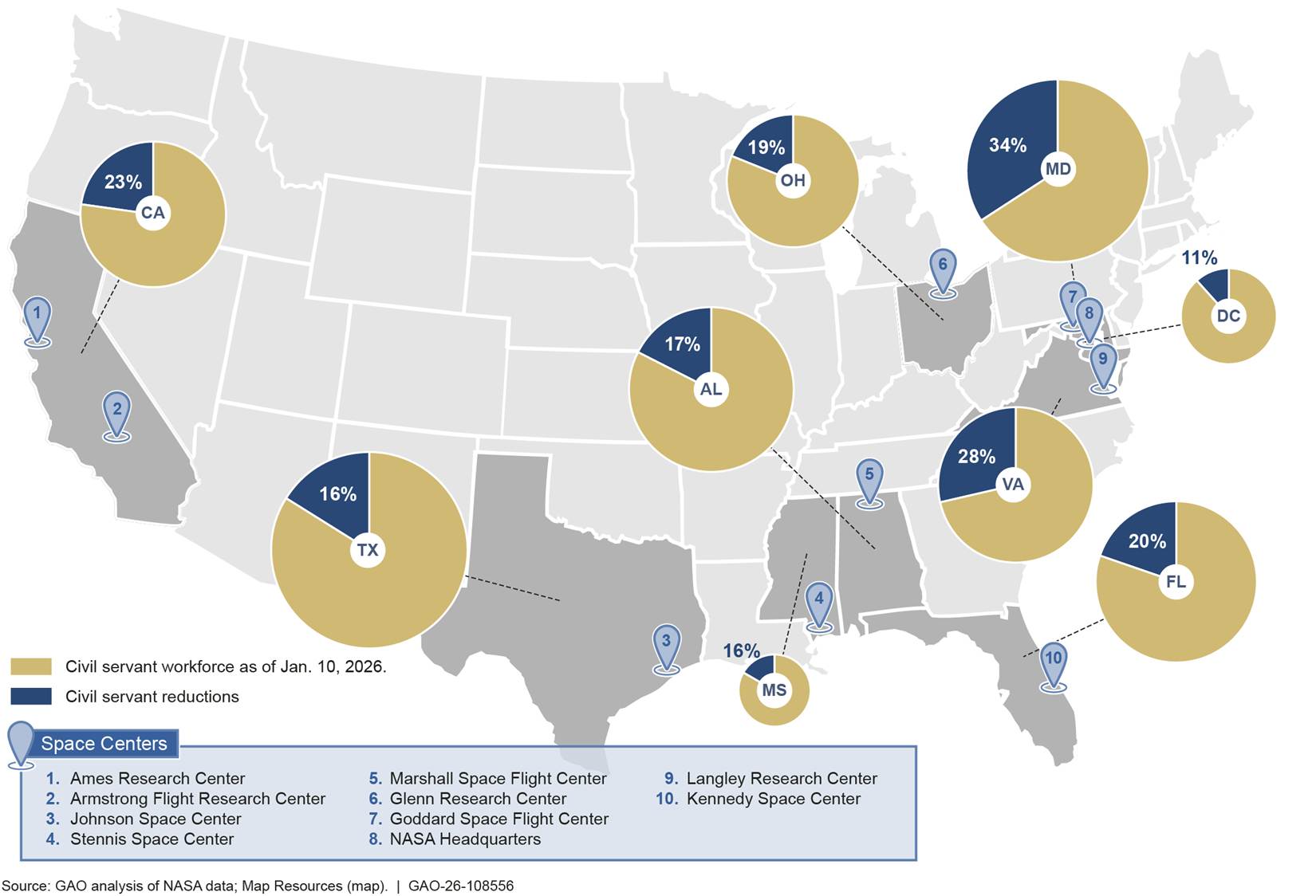
Note: Data on workforce changes are shown by state, not by NASA center. NASA centers may have employees in more than one state. The size of each circle is scaled relative to the number of civil servants in that state.
The Jet Propulsion Laboratory (JPL) NASA’s Federally Funded Research and Development Center in Pasadena, California, which is managed for NASA by Caltech, also reduced its staffing levels.[37] In October 2025, JPL announced that it would lay off approximately 550 employees, representing about 10 percent of its total workforce. These cuts followed similar reductions to the JPL workforce in 2024. At that time, JPL reported laying off about 855 employees due to budget constraints and uncertainties, particularly surrounding the Mars Sample Return mission.
The civil servant departures have left NASA’s workforce out of balance with NASA’s programmatic needs. The fiscal year 2026 President’s Budget Request proposed $18.8 billion for NASA, which was $6 billion less than the agency received in appropriations for fiscal year 2025. The budget request proposed canceling 19 major projects, and NASA officials said the proposed level would have corresponded to a 32 percent reduction in NASA’s civil servant workforce. However, contrary to the funding cuts proposed in the fiscal year 2026 President’s Budget Request, the higher funding levels of fiscal year 2025 were largely maintained in NASA’s fiscal year 2026 appropriations.[38] NASA is currently making decisions about the direction of several of those projects proposed for cancelation and their associated workforce needs.
The funding uncertainty was particularly pronounced for projects in NASA’s Science Mission Directorate (SMD). The fiscal year 2026 President’s Budget Request proposed that over half of the reduction come out of the SMD budget, wherein 13 major projects were proposed for cancelation. However, this reduction was not reflected in NASA’s fiscal year 2026 appropriation, which included similar funding for SMD as NASA’s fiscal year 2025 appropriation.[39] The funding uncertainty for SMD projects will continue in fiscal year 2027. The fiscal year 2027 President’s Budget Request proposed a 23 percent reduction to NASA’s total budget, including a 46 percent reduction to the SMD budget.
Effects of Workforce Reductions Vary Across Major Projects
The major projects across NASA’s centers are experiencing varying effects from the reduced civil service workforce levels. Of the 36 projects in the portfolio, 25 reported that they had been affected by the workforce reductions. According to agency officials, individual projects within the portfolio have generally addressed the loss of workforce by having remaining civil servants take on the responsibilities of those who left. Some projects, however, have reported more serious negative effects from the workforce reductions. Specific examples reported by NASA officials include the following:
· The SLS program at Marshall Space Flight Center noted the loss of almost 20 percent of its civilian workforce. The program is analyzing succession planning and overall workforce effects and is considering tracking workforce as a risk after Artemis II.
· The Orion program at Johnson Space Center reported that it lost approximately 10 percent of its civil servant workforce and faces challenges in filling several key positions. Referring to the hiring freeze in place at the time, program officials said they need release of hiring authority to begin the process of filling some of these positions. Moon to Mars program officials, however, said that they have taken steps—including meeting with civil servants and contractors—to ensure all the programs supporting Artemis II, including Orion, were not affected by the workforce reductions.
· The Near Earth Object (NEO) Surveyor project reported that JPL has had several workforce reductions (layoffs) over the course of the last year. These affected personnel in leadership roles as well as team members who supported hands-on hardware development.
· The Deep Atmosphere Venus Investigation of Noble gases, Chemistry, and Imaging (DAVINCI) project at Goddard Space Flight Center suffered substantial impacts through civil service workforce reductions and transfers. The fiscal year 2026 President’s Budget Request proposed canceling the project, but NASA continued the project based on the fiscal year 2026 appropriation.[40] DAVINCI lost critical team members with leadership roles in program management and engineering to the deferred resignation program and was unable to backfill the positions in fiscal year 2025. This resulted in the program rescoping planned risk reduction activities for fiscal year 2025 to ensure that all critical formulation schedule milestones were met. According to NASA officials, fiscal year 2026 funding allowed DAVINCI to restore staffing to the levels required to maintain the project’s formulation schedule.
Moving forward, some centers may be challenged to meet the workforce needs of the mission directorates because of the reduced civil servant workforce. Some centers, particularly those that encountered large workforce losses, may not be able to adequately staff all planned work. For example, three NASA centers are responsible for managing 23 of the 36 major projects in the portfolio. Each of these centers encountered workforce reductions based on proposed project cancelations. See table 5.
|
Center |
Location |
Number of Major projects managed |
Number of Major Projects proposed for cancelation in President’s Budget Request fiscal year 2026 |
Workforce Reduction as of January 2026a |
|
Goddard Space Flight Center (GSFC) |
Maryland |
9 Science Projects |
6 Science Projects |
34% |
|
Marshall Space Flight Center (MSFC) |
Alabama |
4 Exploration Projects, |
2 Exploration Projects |
17% |
|
Jet Propulsion Laboratory (JPL) |
California |
9 Science Projects |
6 Science Projects |
10% |
Source: GAO analysis of NASA data on workforce, the fiscal year 2026 President’s Budget Request. | GAO‑26‑108556
aThe civil servant workforce reductions shown for GSFC and MSFC represent the reductions in their home state; NASA centers may have employees in more than one state. The Caltech workforce reduction shown for JPL is based on JPL data.
NASA Is Assessing Its Workforce Needs to Identify Skill Gaps and Inform Hiring and Training Plans
NASA is assessing its current workforce needs as part of its strategic workforce planning and in response to a February 2026 directive from the NASA Administrator. NASA officials indicated that these analyses will inform the agency’s workforce plans moving forward.
· Strategic workforce planning. NASA’s OCHCO plans to ensure alignment of the workforce with NASA’s fiscal year 2026 appropriations and the priorities established in the new workforce directive. NASA’s strategic workforce planning process allows the mission directorates, which receive funding for missions, to assign work and inform workforce planning at NASA’s centers. OCHCO officials told us that the agency was delayed completing the strategic workforce planning process for fiscal year 2026 because of the funding and programmatic uncertainty. These uncertainties included the reductions in funding and personnel, project cancelations proposed in the fiscal year 2026 President’s Budget Request, and the timing of the agency’s fiscal year 2026 appropriation. NASA officials told us that the new workforce directive largely superseded the agency’s annual strategic workforce planning process for fiscal year 2026.
· New workforce directive. In February 2026, after the agency received its fiscal year 2026 appropriation, the NASA administrator issued a workforce directive. The directive stated that NASA must restore and retain in-house engineering, operational, and scientific excellence, and reclaim technical autonomy. The directive also stated that NASA aims to expand its civil servant workforce and move away from using contractors for core functions. Further, it stated that NASA’s dependence on contractors had eroded internal capabilities, increased program risk, and reduced flexibility in addressing technical challenges.[41]
The directive tasks NASA’s center directors, mission directorate leadership, and OCHCO to take several actions, including the following:
· Conduct a workforce assessment identifying (1) outsourced or missing technical and operational expertise and provide a proposal to convert core roles to civil service; and (2) engineering, operational, scientific, manufacturing, and other mission-critical work currently outsourced, and provide a proposal for what should be brought in-house.
· Create an implementation plan to convert or add targeted roles to civil service, and address contract changes, renegotiations or terminations, timelines, and cost implications.
· Establish a streamlined onboarding process that ensures candidates can be rapidly brought into civil servant positions.
· Assess and develop internal training and mentorship initiatives to ensure continuity of knowledge and technical depth across generations of NASA engineers, operations personnel, and technicians.
NASA officials stated that they will have more clarity on their workforce plans after the agency completes these actions, which they expect to occur in late spring 2026. Prior to the directive, OCHCO had identified skill gaps in mission critical areas for major programs. These areas include but are not limited to the following: aerospace engineering, mechanical engineering, electrical engineering, computer engineering, and information technology and cybersecurity.
OCHCO officials stated that due to the gradual workforce reductions through January 2026, the impact of the reductions has not yet been fully realized across the agency. In the past, however, NASA projects were adversely affected when sufficient staff were unavailable to meet project needs. For example, the Psyche mission—a spacecraft intended to travel to a metal-rich asteroid orbiting the sun between Mars and Jupiter—was delayed a year in part due to staffing shortages in critical positions. It did not launch until October 2023, after NASA added about $132 million to its development costs. Psyche’s challenges also had cascading effects on other projects, including delaying the Venus Emissivity, Radio Science, InSAR, Topography, and Spectroscopy mission for at least 3 years.
NASA has taken initial steps to address workforce shortfalls. In March 2026, NASA and OPM announced the creation of NASA Force under the auspices of the U.S. Tech Force.[42] OPM established the U.S. Tech Force to recruit technical professionals into federal service. NASA Force represents a dedicated effort to recruit talent within the broader initiative. NASA Force will identify and place new employees with technical skills into mission-critical roles supporting NASA’s exploration, research, and advanced technology priorities. According to agency officials, the NASA Force positions will be 2-year term appointments that the agency can convert to permanent positions if desired.
However, ongoing budget uncertainty could affect these plans past fiscal year 2026. As previously noted, the President’s Budget Request for fiscal year 2027 again proposes significant funding reductions for NASA. Congress has yet to pass NASA’s proposed fiscal year 2027 budget. If the agency were funded at the level requested, it could lead to further workforce reductions or possibly forestall planned hiring. We will continue to monitor the actions NASA takes to fill skills gaps and the extent to which changes in NASA’s workforce affect its ability to manage its portfolio of major projects.
Agency Comments
We provided a draft of this report to NASA for its review and comment. In its written comments, reprinted in appendix VII, NASA generally agreed with the findings of the report. NASA also provided technical comments, which have been addressed in this report, as appropriate.
We are sending copies of the report to the NASA Administrator and interested congressional committees. In addition, the report is available at no charge on GAO’s website at http://www.gao.gov.
If you or your staff have any questions about this report, please contact me at RussellW@gao.gov. Contact points for our Offices of Congressional Relations and Media Relations may be found on the last page of this report. GAO staff who made major contributions to this report are listed in appendix VIII.

William Russell
Director, Contracting and National Security Acquisitions
List of Committees
The Honorable Jerry Moran
Chair
The Honorable Chris Van Hollen
Ranking Member
Subcommittee on Commerce, Justice, Science, and Related Agencies
Committee on Appropriations
United States Senate
The Honorable Jerry Moran
Chair
The Honorable Tammy Duckworth
Ranking Member
Subcommittee on Aviation, Space, and Innovation
Committee on Commerce, Science, and Transportation
United States Senate
The Honorable Hal Rogers
Chairman
The Honorable Grace Meng
Ranking Member
Subcommittee on Commerce, Justice, Science, and Related Agencies
Committee on Appropriations
House of Representatives
The Honorable Mike Haridopolos
Chairman
The Honorable Valerie Foushee
Ranking Member
Subcommittee on Space and Aeronautics
Committee on Science, Space, and Technology
House of Representatives
.
In the following section, we present project assessments of 21 National Aeronautics and Space Administration (NASA) projects and programs.
There are 20 assessments in a two-page or one-page profile format.[43] We provide assessments for projects and programs that have proceeded past their preliminary design review or that NASA designated as category 1.
· Each assessment generally includes a description of the project or program’s objectives; information about the NASA centers and international partners involved in the project; the lead contractor or developer (as determined by NASA); the project’s cost and schedule performance; and a brief narrative describing the project’s current status.[44]
· These assessments also describe challenges we identified. We outline the extent to which each project faces cost, schedule, or performance risks, if applicable.
We provided NASA’s project offices with an opportunity to review drafts of the assessments prior to their inclusion in this report. The project offices provided both technical corrections and general comments. We integrated the technical corrections as appropriate and summarized the general comments at the end of each project assessment.
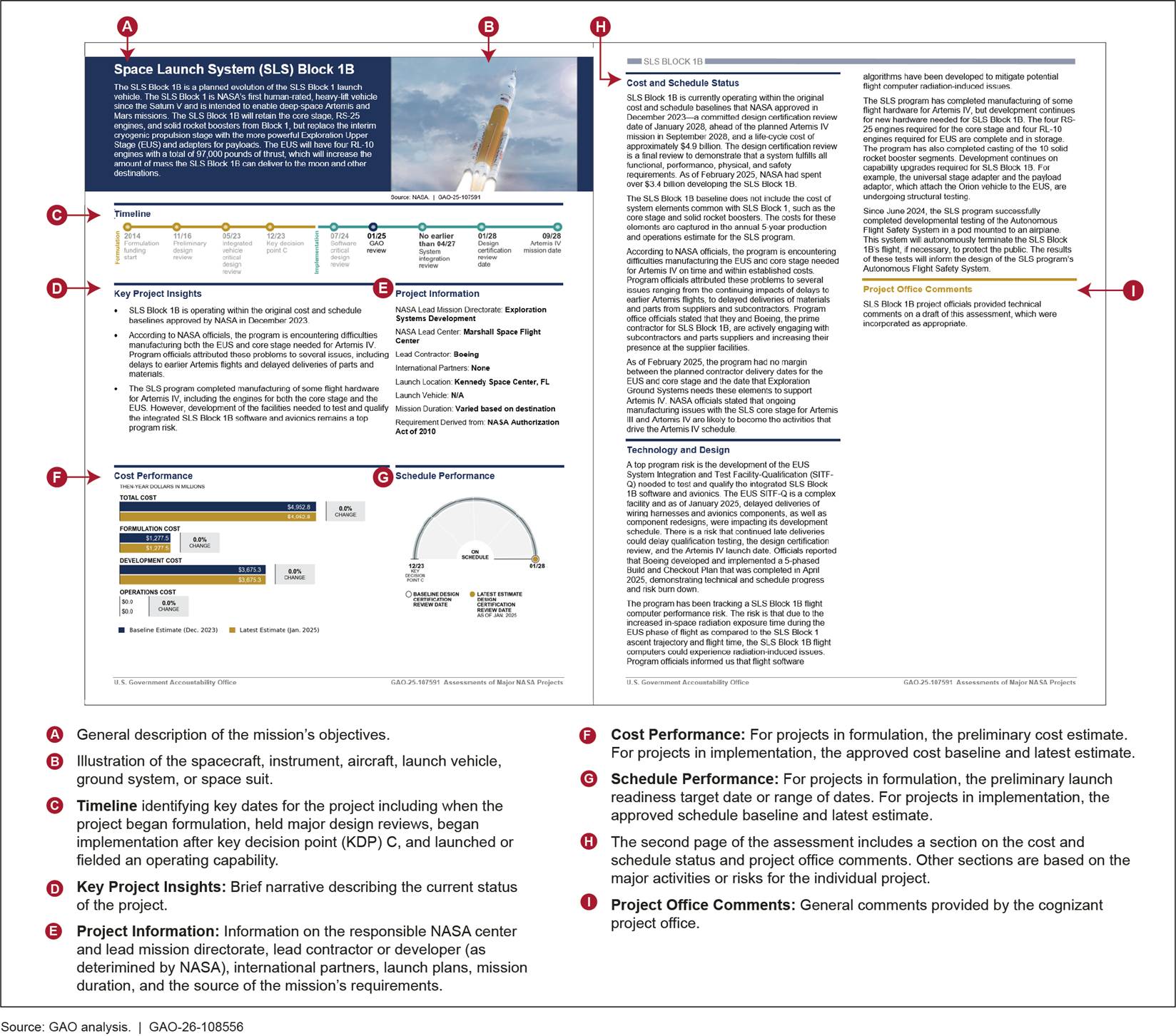
See figure 8 for an illustration of an example assessment layout. Additional source information for images and figures can be found in appendix IX.
Extravehicular Activity and Human Surface Mobility Program (EHP) – Extravehicular Activity (EVA) Development
The EVA Development project is responsible for providing space suits and other hardware to support astronaut activities for Artemis missions and the International Space Station (ISS). The project office oversees development that will demonstrate, certify, and deliver: (1) tools the crew will use for science and maintenance tasks; (2) interfaces the crew will use to connect to other systems, like the Human Landing System (HLS) and ISS; and (3) space suits, including the portable life-support backpack and the pressurized garment that wraps around the astronauts.

Source: NASA. | GAO-26-108556

Key Project Insights
· The EVA Development project has already completed several design reviews and plans to achieve another design review milestone in 2026. NASA and Axiom plan to conduct the first vacuum chamber test with a human subject after this milestone.
· NASA delayed the project’s key decision point C milestone—the point at which NASA sets cost and schedule baselines—pending review by the new administrator.
· Project officials said potential changes to the HLS provider for the Artemis IV or V missions may require some space suit interface modifications to accommodate the Blue Origin lander.
· The project is tracking a risk that concurrent assembly and testing of the qualification and flight suits could lead to rework and schedule delays if issues are discovered. It proposed to address this risk by identifying potential risk areas in the design, and by considering vibration tests on the qualification suit prior to assembling the flight suit.
Project Information
NASA Lead Mission Directorate: Exploration Systems Development
NASA Lead Center: Johnson Space Center
Lead Contractor: Axiom Space
International Partners: None
Launch Location: N/A
Launch Vehicle: HLS and Commercial Resupply Services
Mission Duration: 10 years
Requirement Derived from: NASA Strategic Plan
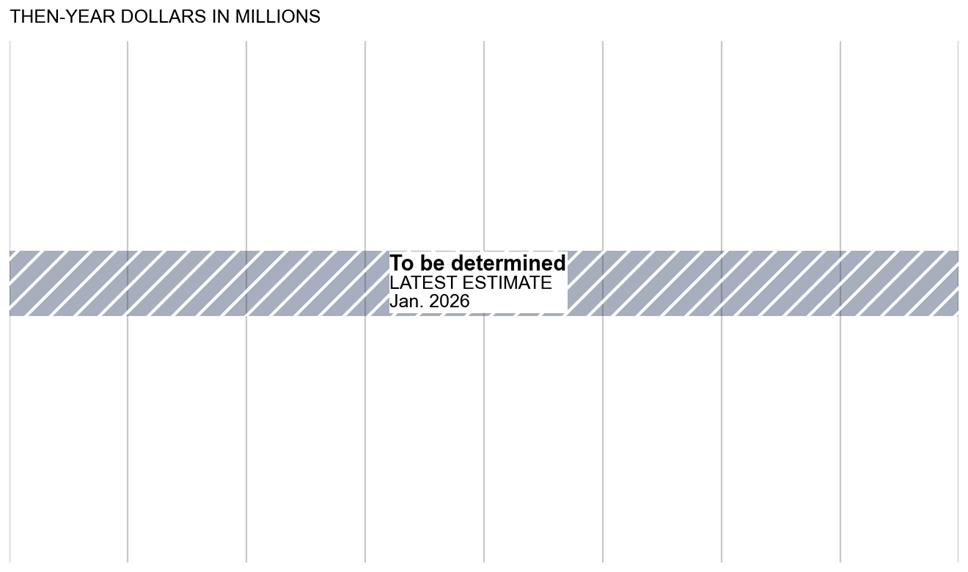
Preliminary Cost
Preliminary Schedule
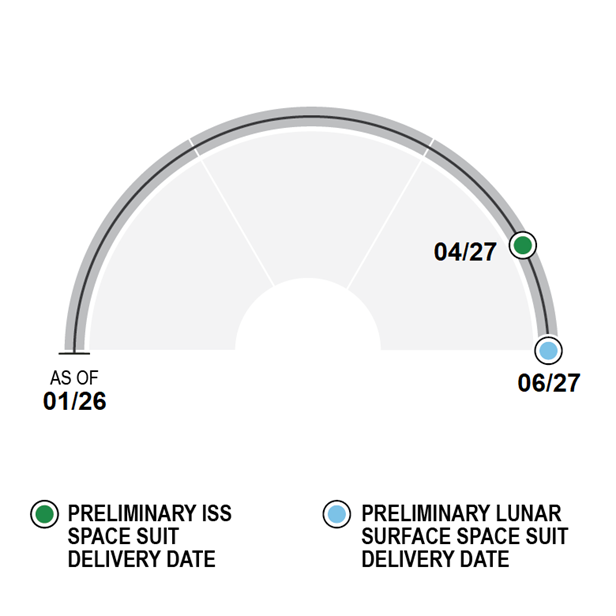
Cost and Schedule Status
In July 2025, the EVA Development project completed its second preliminary design review (PDR)-informed sync review to assess Axiom’s ISS space suit development. NASA’s review board identified several issues during the review, including a high-risk, aggressive schedule and poor vendor schedule performance. These issues have resulted in Axiom being behind schedule and will likely create a significant backlog in the upcoming development work. Project officials said the backlog of work identified by the board is related to the first-time assembly of the qualification unit and resolving any issues discovered during that process. Axiom will be responsible for covering cost growth associated with any schedule delays due to its firm-fixed-price contract with NASA.
NASA delayed the project’s key decision point C milestone—at which NASA sets cost and schedule baselines—pending review by the new administrator. EVA Development project officials said the project was scheduled to hold the review in October 2025, but the agency deferred the meeting and has not yet rescheduled it.
NASA and Axiom plan to achieve a combined Artemis and ISS critical design review in fall 2026. The project is working to complete its review of the critical design review documentation by late summer 2026. Axiom was planning to complete a vacuum chamber test of the space suit with a human subject as part of the critical design review milestone, but project officials said that Axiom will now complete the test as part of suit qualification testing.
Technology and Design
Axiom’s space suit design does not meet several sizing requirements, which could constrain the crew selection for the lunar landing mission. According to NASA risk documentation, limited hardware availability and the unlikely ability to test components that meet the full range of crew size could result in limited crew options to reduce the chance of injury. NASA plans to mitigate this risk by completing a measurement check of all active NASA crew members and having Axiom develop additional sizes to meet requirements.
NASA is also pursuing some alternate technologies for the portable life-support system and tools for the incapacitated crew rescue requirement in parallel to Axiom’s suit development. The alternate technologies include a light-weight option for the backplate and oxygen regulator for the portable life support system. Additionally, project officials said it is unlikely that a crew member would be completely incapacitated during the lunar landing mission, but NASA is mitigating this risk by developing tools to return an injured crew member back to the lander. To assess its options for this type of crew rescue, project officials sought independent concepts for those tools from NASA staff outside of the project. They also researched commercially available technology.
Integration and Test
NASA and Axiom are working to increase pressurized suit testing time on the training, qualification, and flight suits. They recently increased the number of suited tests, including 50 they conducted in the first quarter of fiscal year 2026. The project will ramp up the testing cadence to six events per week, including testing in several partial gravity simulating facilities.
The assembly of the life-support system and testing of the first qualification unit are critical steps for suit development. Axiom began assembly of the portable life-support system for the qualification unit in May 2026. The project team plans to assemble hardware for the system for the flight suits as soon as components are available.
Because the project will not fully test the qualification suits before assembling the flight suits, it is tracking a risk related to the concurrent assembly and testing of the qualification and flight suits. Issues discovered during testing of the qualification suit could drive potential rework on the flight suit, as well as schedule delays. To reduce this risk, the project is considering vibration testing of the first qualification unit to uncover any issues that could require disassembly and redesign prior to assembling the flight units. By delaying assembly until after this test, NASA could mitigate the risk of disassembly and redesign work on the flight hardware. To further address this risk, NASA evaluated areas of potential risk on Axiom’s design features through component-level assessments. NASA also plans to work with Axiom to define qualification testing the contractor must complete prior to specific assembly and test activities on the flight space suit to avoid rework.
Other Issues to Be Monitored
In February 2026, NASA announced a new mission in 2027 to test system capabilities in an Earth orbit, now called Artemis III. Project officials said there is currently no plan for suit testing during this mission with either HLS lander. However, project officials said they are evaluating an option to fly a space suit mass simulator on a lander to assess the vehicle launch environment during the mission. NASA also plans to have the crew test a suit on the International Space Station for initial validation testing in microgravity ahead of a lunar landing. For the Artemis IV or V missions, project officials said that they may have to make modifications to the space suit system interfaces and identify opportunities to reduce suit mass given the differences between the Blue Origin and SpaceX landers.
Project Office Comments
In commenting on a draft of this assessment, NASA officials noted that the assessment does not reflect all ongoing programmatic changes stemming from adjustments made to the Artemis campaign in February and March 2026. Officials also provided technical comments, which were incorporated as appropriate.
Extravehicular Activity and Human Surface Mobility Program (EHP) - Lunar Terrain Vehicle (LTV)
The LTV is a transportation system that will enable crew members to explore the lunar surface and allow NASA to conduct remote science operations. NASA intends for the LTV to support a permanent lunar base, with initial operating capabilities by 2028. In addition to serving as a mode of transportation, the LTV will: (1) transport and deploy small payloads; (2) conduct science operations with its robotic arm; (3) produce multimedia content of landings, points of interest, and crew activities; and (4) support science activities between crewed missions.
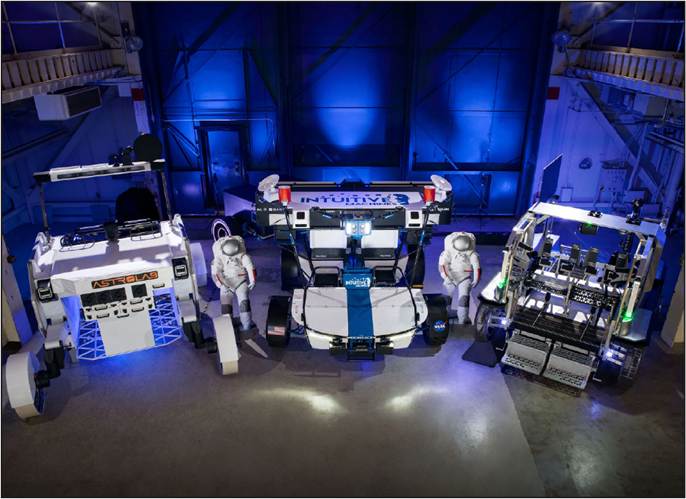
Source: NASA. | GAO-26-108556
Current Status
In 2025, the project completed its feasibility phase and system definition review. In this phase, LTV’s three contractors—Intuitive Machines, Lunar Outpost, and Astrolab—completed their individual preliminary design reviews with no major issues and also produced drivable test models.
NASA’s procurement approach for LTV is evolving. In March 2026, the agency announced that the project was adopting a phased task order approach. Subsequently, in May 2026, NASA announced awards to Lunar Outpost and Astrolab to build and deliver LTVs to the lunar surface. In 2027, NASA plans to seek additional LTV vendors. NASA’s goal is to allow vendors to compete for rover deliveries every 18 to 24 months thereafter.
The project is tracking several risks. For example, one risk is the LTV’s ability to return to the lander within 45 minutes during an emergency. The project plans to conduct additional testing with selected designs in 2026. Officials said initial virtual tests indicate that achieving this capability will be challenging but achievable with the right training and experience. The project is also tracking the risk of the LTV encountering unanticipated extreme temperatures and conditions caused by other lunar assets, such as sunlight reflecting off the lander, according to officials. To mitigate this risk, the project plans to create a working group of all lunar projects and conduct additional integrated thermal modeling.
Project Information
NASA Lead Mission Directorate: Exploration Systems Development Mission Directorate
NASA Lead Center: Johnson Space Center
Lead Contractor(s): Intuitive Machines; Lunar Outpost; Astrolab
International Partners: None
Launch Location: To be determined by NASA
Launch Vehicle: To be determined by NASA
Mission Duration: 10 years
Requirement Derived from: Space Policy Directive 1 and 2022 NASA Strategic Plan
Next Major Project Event: Key decision point B (to be determined)
Preliminary Cost
Preliminary Schedule
Project Office Comments
In commenting on a draft of this assessment, NASA officials noted that the assessment does not reflect all ongoing programmatic changes stemming from adjustments made to the Artemis campaign in February and March 2026. Officials also provided technical comments, which were incorporated as appropriate.
Gateway Initial Capability
NASA planned for the Gateway to serve as a research platform, staging point for human and robotic exploration in deep space, and technology test bed for future Mars exploration. The program was composed of three U.S.-led projects: Power and Propulsion Element (PPE), Habitation and Logistics Outpost (HALO), and Deep Space Logistics (DSL). The PPE and the HALO make up the Gateway’s initial capability and together could support a crew in space—with the PPE providing power and propulsion and the HALO providing a space for crew to live. NASA planned to launch the PPE and the HALO together prior to the Artemis mission that was to first use the Gateway to house crew before, during, and after the lunar landing.
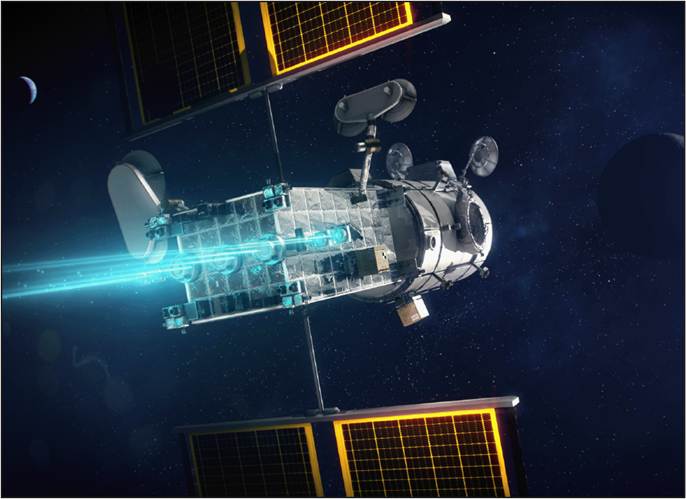
Source: NASA. | GAO-26-108556
Timeline

Key Project Insights
· In March 2026, NASA announced it will pause the Gateway Initial Capability program and instead focus on infrastructure that enables sustained lunar surface operations. NASA plans to repurpose applicable Gateway equipment to support lunar surface and other objectives.
· Prior to the announcement, the Gateway Initial Capability—comprised of the PPE and the HALO—was operating within its cost and schedule baselines. However, the program’s top risk was its ability to maintain the baseline launch readiness date of December 2027.
· As of January 2026, assembly, integration, and test activities were proceeding for both projects.
· The overall program schedule was driven by the HALO project, which was investigating corrosion found on its primary structure. Program officials were working to determine the root cause and likely effect on the project’s schedule.
Project Information
NASA Lead Mission Directorate: Exploration Systems Development
NASA Lead Center: Johnson Space Center (Gateway and HALO); Glenn Research Center (PPE)
Lead Contractors: Lanteris Space Systems (PPE); Northrop Grumman Space (HALO)
International Partners: European Space Agency; Japan Aerospace Exploration Agency; Canadian Space Agency
Launch Location: Kennedy Space Center, FL
Launch Vehicle: Falcon Heavy
Mission Duration: 15 years
Requirement Derived from: Space Policy Directive 1 and 2018 NASA Strategic Plan
Cost Performance – Under review
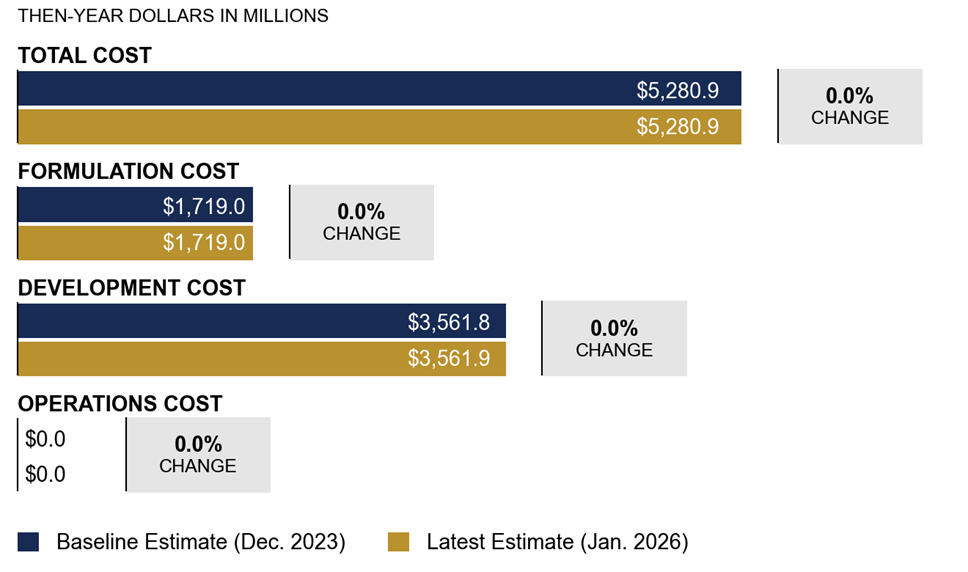
Schedule Performance – Under review
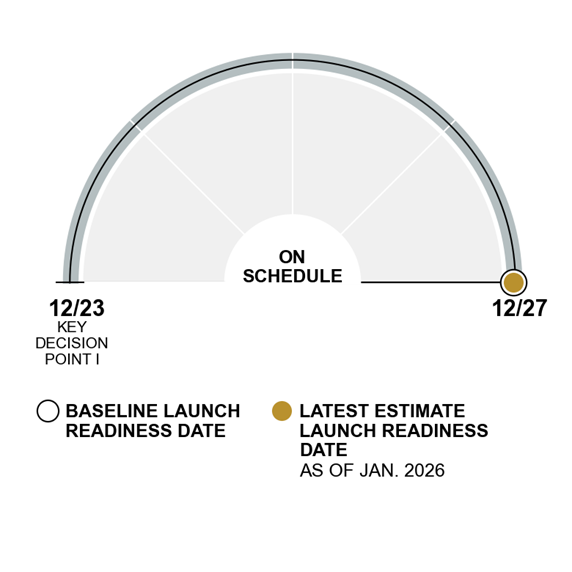
Cost and Schedule Status
In March 2026, NASA announced that it intends to pause the Gateway Initial Capability, as a part of its new strategy to focus on infrastructure that enables sustained lunar surface operations and build a lunar base. The agency also announced that it plans to repurpose applicable Gateway hardware and leverage existing international partner commitments for future efforts. For example, NASA officials announced the Space Reactor–1 Freedom program, which is a pathfinder mission to deliver science payloads to Mars. NASA plans to repurpose the PPE as part of a nuclear electric propulsion-powered system for this mission. Officials expect to launch this system in December 2028. For the HALO, NASA documentation indicates some of its components could be repurposed on future moon base modules. In April 2026, NASA directed its HALO contractor to stop work, except for a limited set of efforts.
Prior to this announcement, the Gateway Initial Capability was operating within the cost and schedule baselines established in December 2023. Its cost baseline of $5.3 billion includes the cost for the initial capability, the launch vehicle, and program support for integration and launch. The HALO project and the PPE project each make up about one-third of this overall cost. Its schedule baseline was for the comanifested vehicle’s launch readiness date of December 2027. Comanifested means that both elements were planned to launch together on a single vehicle. Program officials stated that the comanifested vehicle would need to launch at least a year before its planned use in its related Artemis mission to allow time for the vehicle to transit from Earth to the moon and prepare for docking.
Prior to the announcement, the program’s top risk was related to the comanifested vehicle’s planned launch schedule to support an Artemis mission in 2028. Program documentation shows that the schedule risk was driven by completing hardware builds for the HALO and the PPE, verification activities, test and facility availability, and the launch site processing schedule, among other factors. The combination of these risks indicated that the program would have likely exceeded its baseline schedule by more than 6 months. To mitigate this risk, the program was planning to implement schedule efficiencies and reductions of hardware and software content.
Technology and Design
Prior to the announcement that the program would be paused, the Gateway program was tracking a risk related to whether the design of the comanifested vehicle could successfully meet its mission. NASA risk documentation indicates this risk was driven by the challenges that the program and the HALO project have had related to the comanifested vehicle exceeding its mass allocation, based on the capacity of the launch vehicle. The HALO’s mass has been the primary driver of the overage.
To address this concern, the project identified over 1,000 kilograms of mass reduction opportunities, primarily to the HALO. Program officials said these reductions have all been approved and are in various stages of implementation. As a result, they said they had a viable plan in place to off-load sufficient mass to bring the HALO to within its launch mass requirements. However, they noted that these design changes could result in a reduction in capability.
Integration and Test
HALO. Prior to the announcement about pausing the program, assembly, integration, and test of the HALO primary structure continued at the contractor facility. Program officials reported that they completed the first part of the system integration review, after previously delaying the review by 13 months due to delays in primary structure testing and module delivery.
According to program officials, the HALO project was the primary schedule risk for Gateway’s Initial Capability. HALO project officials were investigating the root cause of microscopic corrosion found on the primary structure. The contractor observed one location of corrosion just prior to shipping the HALO to the project—and prior to the announcement. However, following delivery, officials reported that the project found additional areas of corrosion. In response, the project formed a team to conduct extensive testing on the primary structure. It also paused all other integration work on the primary structure while it investigates the root cause of the corrosion issue and conducts remediation work. As of January 2026, the project team had not yet found the root cause and was still developing a more specific estimate of the likely effect on the schedule.
PPE. Prior to the announcement about pausing the program, the PPE project received the third of three flight thrusters from the SEP project in November 2025. Officials said they started installing the thrusters on the PPE spacecraft. Officials reported that assembly of the PPE was about 90 percent complete as of January 2026, and that environmental testing would begin following integration of the primary spacecraft.
Project Office Comments
In commenting on a draft of this assessment, program officials stated that they agreed with the assessment. NASA officials also noted that the assessment does not reflect all ongoing programmatic changes stemming from adjustments made to the Artemis campaign in February and March 2026. Officials provided technical comments, which were incorporated as appropriate.
Human Landing System (HLS) – Initial Capability (IC)
The HLS program is developing transportation systems that will deliver crew from lunar orbit to the lunar surface, provide capabilities for lunar surface extravehicular activities, and then return the crew to lunar orbit to enable their return to Earth. SpaceX and Blue Origin will each lead the design, development, testing, and evaluation of an HLS vehicle; NASA will certify system design and flight readiness. NASA plans to use either or both vehicles to support crewed lunar landings in 2028. Prior to a crewed landing, the providers must conduct an uncrewed lunar landing flight test.
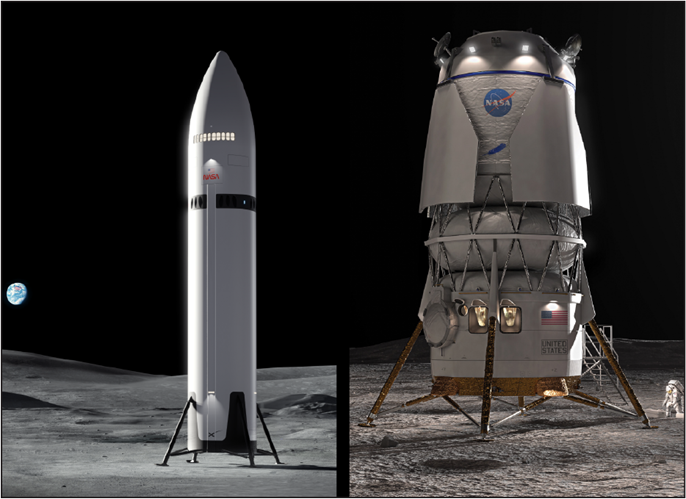
Source: SpaceX and Blue Origin. | GAO-26-108556
Timeline

Key Project Insights
· In February 2026, NASA announced changes to the Artemis missions. This included adding a new Artemis mission before a crewed lunar landing in 2028 to test docking between one or both landers and the Orion crew capsule in Earth orbit in 2027.
· Prior to the announced changes, the program was working within its cost and schedule baselines but faced significant schedule risks. As a result of those risks as well as the Artemis mission changes, NASA is currently reviewing the project’s cost and schedule estimates.
· The HLS-IC program is exploring ways to accelerate the development of the SpaceX and Blue Origin HLS systems by simplifying the elements of their landing strategies to support a crewed lunar landing in 2028.
· SpaceX’s development of its cryogenic propellant transfer technology, which is a major component of its lunar landing strategy, remains a top program risk. Demonstrations of this technology have been delayed due to SpaceX’s challenges with its Starship vehicle tests.
Project Information
NASA Lead Mission Directorate: Exploration Systems Development
NASA Lead Center: Marshall Space Flight Center
Lead Contractors: SpaceX and Blue Origin
Launch Location: SpaceX – multiple launch locations; Blue Origin – Cape Canaveral, Florida
Launch Vehicle: SpaceX – Super Heavy Booster; and Blue Origin – New Glenn
Mission Duration: 6.5 – 33 days
Requirement Derived from: National Space Policy Directive 1 and NASA Strategic Plan
Cost Performance – Under review
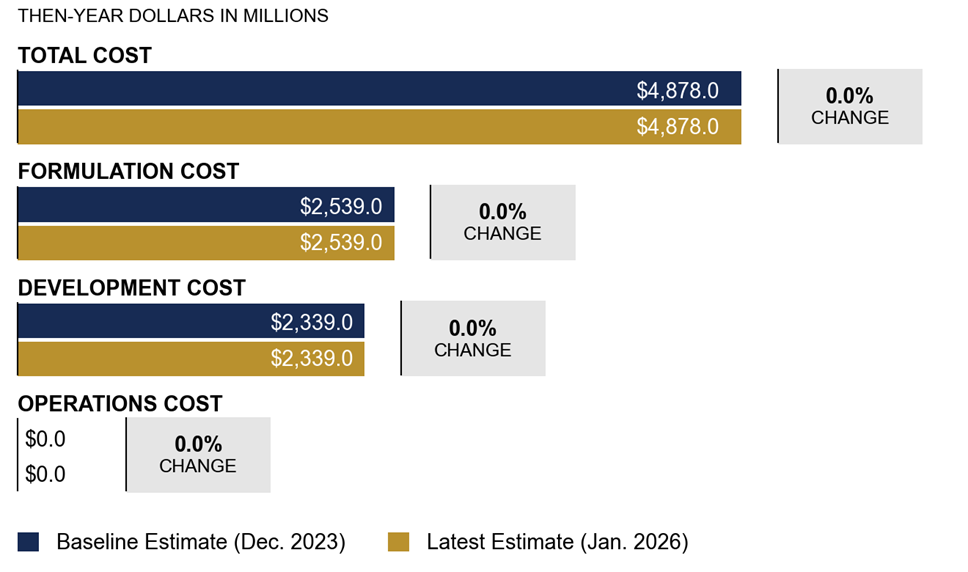
Schedule Performance – Under review
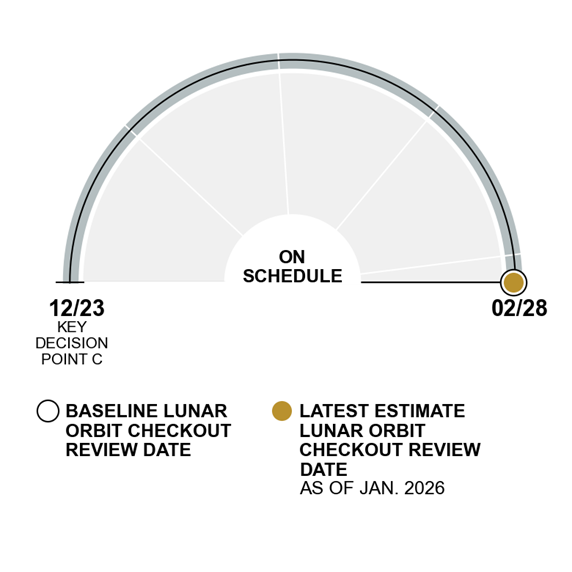
Cost and Schedule Status
The HLS-IC program is operating within the cost and schedule baselines that NASA established in December 2023. However, these costs and the schedule are under review. NASA set the cost baseline at $4.9 billion and tied the schedule baseline to a February 2028 lunar orbit checkout review of SpaceX’s HLS Starship. This review was planned to examine the readiness of Starship to receive crew from the Orion spacecraft and support a crewed lunar landing.
In February 2026, however, NASA announced changes to the Artemis mission campaign, which directly impact the scope of the HLS-IC project. Specifically, NASA added a new mission—now called Artemis III—that will test rendezvous and docking capabilities of the Orion spacecraft in Earth orbit—with one or both commercial landers from SpaceX and Blue Origin—in 2027. The original plan for Artemis III was a crewed lunar landing in 2028 with the SpaceX lander. NASA continues to target the first Artemis lunar landing mission—now called Artemis IV—in calendar year 2028. HLS officials stated that the agency could attempt two crewed lunar landings in 2028: one with a SpaceX lander and one with a Blue Origin lander.
As a result of these revisions to schedules and future mission profiles, the HLS-IC project’s cost and schedule baselines are likely to change and are currently under review. The project had already reported significant risk to the original lunar landing mission schedule prior to the announced changes, as described in more detail below.
Mission Design Changes
NASA issued task order requests in 2025 and 2026 to both SpaceX and Blue Origin for proposals to evaluate alternatives that would allow HLS to support a calendar year 2028 crewed lunar landing. SpaceX was originally the only provider working toward this lunar landing. But NASA is currently working with both providers to identify opportunities to simplify their architectures and operations to accelerate their readiness for landings. According to HLS officials, an accelerated approach is necessary because SpaceX encountered developmental challenges during calendar year 2025 and was at significant risk of missing the agency’s 2028 crewed lunar landing timeline.
The HLS program has also established a cross-program NASA tiger team to evaluate the feasibility of the HLS providers’ alternatives for acceleration. This team includes members from the HLS and Orion programs, the Moon to Mars program office, and the Flight Operations Directorate. After completing the evaluation, the team will present recommendations to agency leadership for consideration. HLS officials stated that NASA plans to decide about the new mission architecture in summer 2026; and that lander maturity and readiness will determine which provider will carry the astronauts to the lunar surface and back to Orion in lunar orbit before the crew returns home aboard Orion.
Testing and Development
SpaceX has faced a series of testing challenges. In 2025, it lost three Starship spacecraft during flight testing and a fourth when a nitrogen tank failed during ground testing. SpaceX addressed the flight test failures through a series of design changes, and the ground testing failure through ground processing changes. These changes resulted in successful sub-orbital flight tests in August 2025 and October 2025. The issue with the nitrogen tank reappeared, however, ahead of ground testing for the subsequent flight test.
The program also identified a number of significant schedule and performance risks to SpaceX’s ability to complete development of key systems. For example:
· SpaceX’s progress in developing its cryogenic fuel management technologies is a top risk for the program. At present, SpaceX’s plan for landing astronauts on the moon requires on-orbit propellant transfer between multiple Starship vehicles in low-Earth orbit before the HLS Starship can be sent to and dock with the Orion spacecraft in lunar orbit. Starship’s next major flight milestones for the HLS are a long duration flight test and a propellant transfer test. Both tests are scheduled for 2026.
· Another top risk is SpaceX’s progress in developing the Starship’s Raptor main engine—which is needed to meet the HLS-IC requirements—and addressing issues identified through testing. According to HLS officials, the latest version of the Raptor engine incorporates improvements such as welded fuel joints designed to prevent the fuel leaks that resulted in the loss of the Starship vehicle during flight testing in March 2025. Flight test 12, conducted in May 2026, was the first flight test of the new version of the engine.
Furthermore, SpaceX is more than a year behind its original schedule for key events. These include the critical design review, the long duration and propellant transfer demonstrations, and the uncrewed lunar landing flight test. HLS officials also stated that they anticipate encountering technical challenges in the development of the third version of the Starship vehicle, which SpaceX plans to use for the first Starship orbital test flights.
Project Office Comments
In commenting on a draft of this assessment, NASA officials noted that the assessment does not reflect all ongoing programmatic changes stemming from adjustments made to the Artemis campaign in February and March 2026. Officials did not have any technical corrections on the assessment.
Human Landing System (HLS) – Sustaining Lunar Development (SLD)
The HLS program’s SLD effort will demonstrate expanded capabilities beyond initial lunar landing missions to support a lasting crewed presence on the moon. These capabilities include transporting additional crew, docking with other spacecraft, and operating on the lunar surface for extended durations. SpaceX and Blue Origin will each develop lunar landers to deliver these expanded capabilities for future lunar landing missions. As of April 2026, NASA has not specified the timing of these missions. NASA will certify that the contractors’ lunar lander designs meet its requirements and are safe for crew.
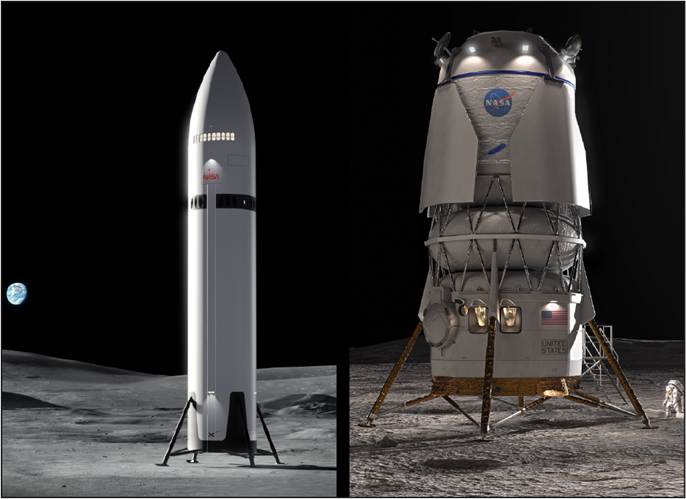
Source: SpaceX and Blue Origin. | GAO-26-108556
Current Status
SpaceX is working toward a preliminary design review and its initial moon landing capability, which is critical for its SLD design progress. NASA is tracking a risk related to flammability specifically for the SpaceX SLD lander. The program plans to mitigate this risk by conducting several tests to better understand the risk and identify safe crew cabin hardware.
HLS officials said that Blue Origin completed most of its preliminary design review activities, but a large amount of work remains to achieve its critical design review planned for December 2026. Blue Origin made some progress on its rocket, called New Glenn. After previous successful tests, the rocket exploded in May 2026 during a test at the launch pad. Blue Origin is working to redesign and rebuild their launch pad architecture. Blue Origin also completed thermal vacuum testing of their MK1 cargo lander at a NASA facility.
NASA is tracking a risk that if Blue Origin’s cryogenic propellant storage and transfer technology is immature, it could affect the schedule of future Artemis missions. Blue Origin and NASA plan to mitigate the risk by conducting propellant transfer tests on the ground and during the uncrewed demonstration mission. NASA is also tracking a related risk that Blue Origin’s cryocooling system could underperform, which could result in losing more propellant than expected. The program plans to address this by testing and analyzing models of the integrated cooling system.
Project Information
NASA Lead Mission Directorate: Exploration Systems Development
NASA Lead Center: Marshall Space Flight Center
Lead Contractors: SpaceX; Blue Origin
International Partners: None
Launch Location: SpaceX–multiple launch locations; Blue Origin–Cape Canaveral, FL
Launch Vehicle: SpaceX–Super Heavy Booster; Blue Origin–New Glenn
Mission Duration: 6-33 days
Requirement Derived from: Space Policy Directive-1
Next Major Project Event: SpaceX–Preliminary Design Review (August 2026); Blue Origin–Critical Design Review (December 2026)
Preliminary Costa
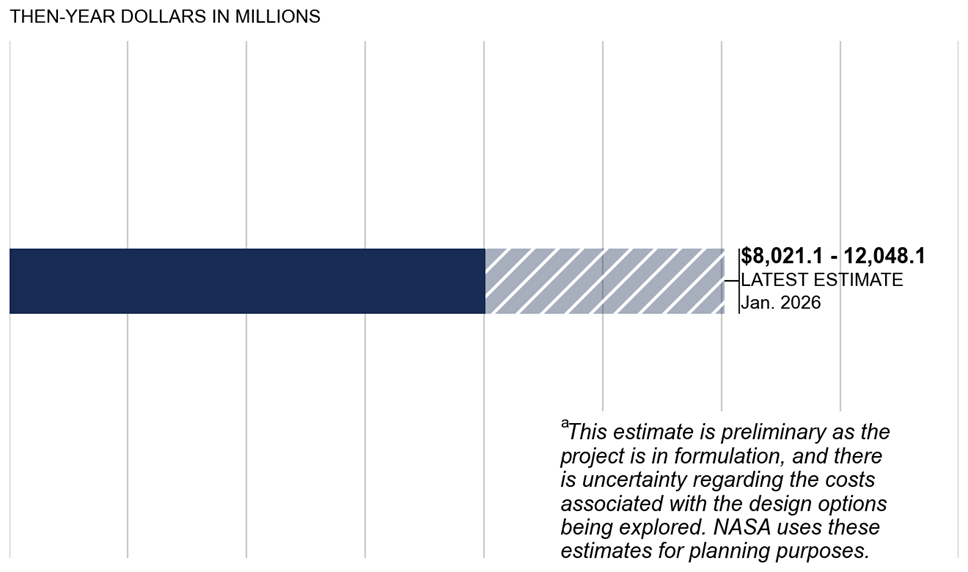
Preliminary Schedule – Under review
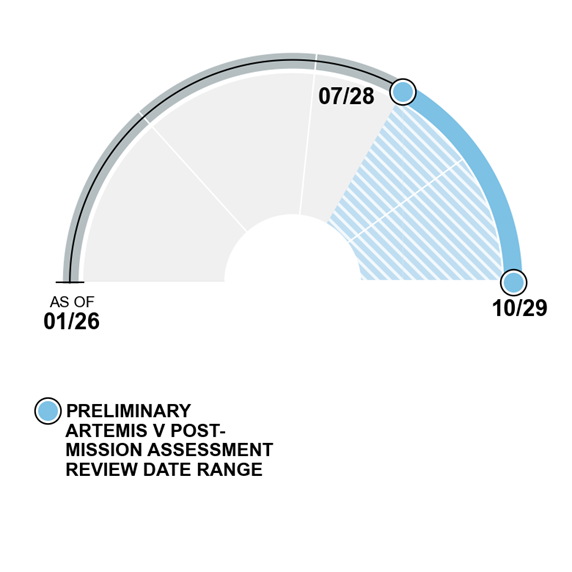
Project Office Comments
In commenting on a draft of this assessment, NASA officials noted that the assessment does not reflect all ongoing programmatic changes stemming from adjustments made to the Artemis campaign in February and March 2026. Officials did not have any technical corrections on the assessment.
Mobile Launcher 2 (ML2)
ML2 is a project within the Exploration Ground Systems program that was planned to provide a new launch platform and tower for the Space Launch System (SLS) Block 1B vehicle with the upgraded Exploration Upper Stage. While ML2 looks similar and has the same role as the Mobile Launcher 1 used for Artemis I and II, ML2 was planned to be a larger structure with new connections to support the taller SLS Block 1B vehicle. The mobile launcher platform and tower support the SLS vehicle and Orion Multi-Purpose Crew Vehicle (Orion) spacecraft during vehicle stacking, transportation to the launch pad, and launch. In addition, it provides all fuel, power, and environmental control connections to the vehicle up until launch.
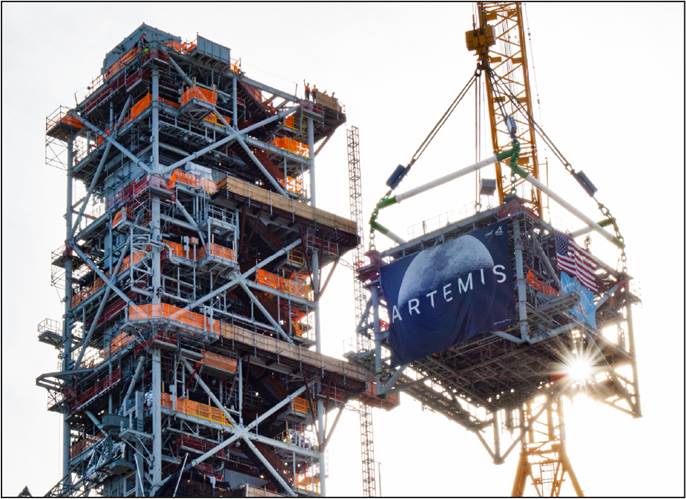
Source: Bechtel. | GAO-26-108556
Timeline

Key Project Insights
· NASA suspended work on ML2 in February 2026 but, as of April 2026, had not yet determined the path forward for the project. NASA no longer plans to use SLS Block 1B for upcoming Artemis missions because it intends to standardize the SLS configuration to enable a faster launch cadence. Officials said they are assessing how to best utilize ML2 assets for future missions, including options to complete the tower or to modify it for use with the standardized SLS configuration.
· Bechtel—the lead contractor—reported anticipated contract cost growth and schedule delays to NASA during the last year. The schedule delays were significant enough that it would have been difficult for the project to support NASA’s previous plans for an Artemis mission launch in 2028 using ML2 without significant mitigation efforts.
· As of February 2026, the ML2 tower has largely been constructed. However, there are at least 7 months of construction and commissioning activities remaining to complete the tower.
Project Information
NASA Lead Mission Directorate: Exploration Systems Development
NASA Lead Center: Kennedy Space Center
Lead Contractor: Bechtel
International Partners: None
Requirement Derived from: Consolidated Appropriations Act, 2018
Cost Performance – Under review
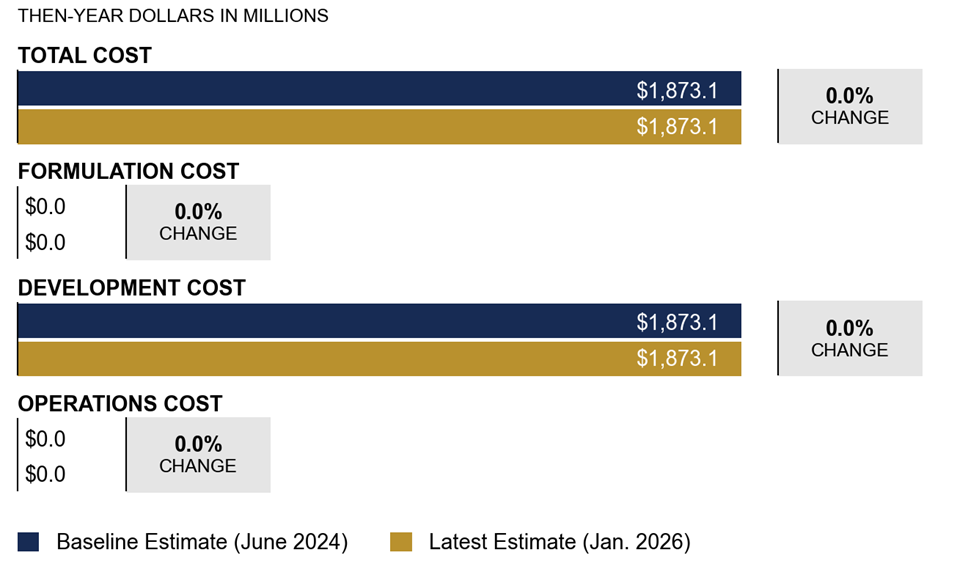
Schedule Performance – Under review
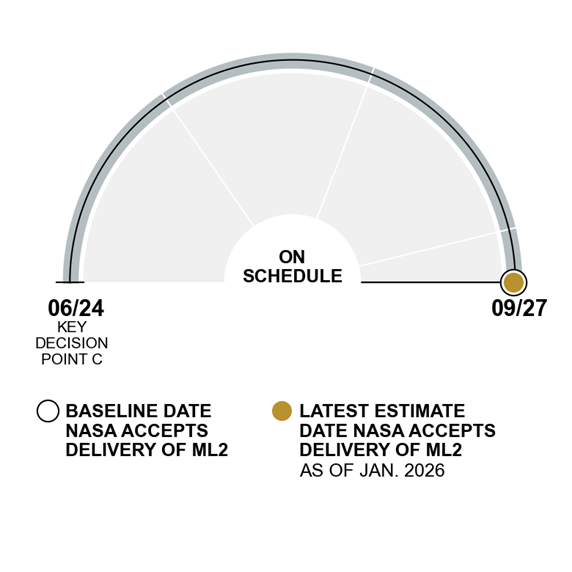
Cost and Schedule Status
As of April 2026, the ML2 project was currently paused and its cost and schedule under review. In February 2026, NASA announced changes to the Artemis mission campaign and its plans to standardize the configuration of the SLS for future missions. This standardization effort does not include using the Exploration Upper Stage, which ML2 is being built to support. The agency also issued a suspension of work order to Bechtel the same day it publicly announced changes to upcoming Artemis missions. NASA officials said the ML2 structure was put into a safe configuration while the agency considers the best path forward for the project. According to these officials, options include NASA or Bechtel completing the tower or modifying the tower for use with the standardized SLS configuration.
NASA partially attributes its decision to the project’s development delays. Since late 2023, Bechtel has been working to deliver the tower by November 2026. However, as of February 2026, NASA was estimating delivery between March and July 2027. While delivery in that time frame would still be in advance of ML2’s schedule baseline, it would not have supported an Artemis IV launch before 2029 without significant mitigations, given the time needed for verification and validation activities and integration with Orion and SLS Block 1B.
Bechtel also reported anticipated cost growth on its contract that our analysis indicates could have led the project to exceed its $1.9 billion cost baseline had it not been paused. The baseline factored in an allowance of costs for risk and uncertainty, but our analysis indicates that Bechtel’s reported anticipated final cost, as of February 2026, exceeds this allowance by over $100 million. This contractor estimate predates recent changes to the Artemis campaign, and officials said the contract did not reflect the increased estimate at the time the project suspended work. NASA officials said that estimated contract cost growth was based on Bechtel needing to keep its workforce available to quickly install late hardware when it arrived.
Performance Challenges
Recent anticipated cost increases and schedule delays continue a years-long trend. For example, the contract value increased from $383 million in June 2019 to what NASA now reports as over $1.1 billion, as of February 2026. Furthermore, when the contract was initially awarded, final evaluations of the tower were to have been completed by February 2023. Until the pause, NASA was estimating delivery delays into 2027.
According to NASA documentation, the contractor’s performance fluctuated over the years. Initial challenges with the weight and design of the ML2 structure led to steel delivery delays, which delayed the start of construction. Bechtel was then able to assemble a large portion of the tower in a timely fashion.
However, according to NASA officials, Bechtel experienced significant performance issues in the months leading to NASA’s decision to pause the project. According to NASA documentation from December 2025, Bechtel’s unrecoverable cost overruns, schedule degradation, and cost of remaining work posed a significant risk to NASA’s available budget. NASA assessed that Bechtel’s emerging inefficiencies and subcontractor performance issues jeopardized NASA's ability to support the prior Artemis schedule.
Construction
Prior to the project’s pause, NASA and Bechtel had made significant progress on the construction of ML2. According to NASA officials, almost all procurements for the tower are complete and construction was about 80 percent complete, as of February 2026. Bechtel had installed all 10 of the tower modules on the tower’s base, and officials said that all but two umbilical arms had been installed. These arms connect the tower to the rocket and spacecraft and provide things like electrical support and propellant. Bechtel was also installing piping for cryogenic propellant and electrical and data cabling. After that, the project planned to move into commissioning activities—which officials said is when NASA ensures that systems work together. NASA anticipated more than 7 months of these activities.
According to NASA officials, electrical and data cabling are the largest outstanding construction work for ML2. They said that most of the cabling work was deferred while Bechtel stacked the tower modules. As a result, officials said Bechtel had installed only 3 percent of the cabling, as of February 2026. Officials said the cabling runs from the base of the tower and through the umbilical arms to connect with SLS and Orion. These cables power and communicate with the vehicles and are challenging to fabricate because they must be durable against weather, include numerous redundancies, and withstand significant temperatures during launch. According to officials, quality issues with the delivered cables contributed to installation delays. NASA reports the cabling was a key schedule driver for ML2 during the last year. Officials said NASA experienced similar issues and delays with ML1 as well.
Project Office Comments
In commenting on a draft of this assessment, NASA officials noted that the assessment does not reflect all ongoing programmatic changes stemming from adjustments made to the Artemis campaign in February and March 2026. Officials also provided technical comments, which were incorporated as appropriate.
Solar Electric Propulsion (SEP)
The SEP project is a technology demonstration that aims to develop high-powered solar electric propulsion technologies for NASA exploration. Solar electric propulsion uses energy from the sun to ionize and accelerate gas, resulting in higher fuel efficiency. This reduces the mass of propellant needed for spaceflight missions beyond low-Earth orbit, compared to conventional chemical propulsion systems. The SEP project is developing an Advanced Electric Propulsion System (AEPS) that is planned to fly on the Power and Propulsion Element (PPE). Specifically, the project is building and testing two qualification thrusters and managing the assembly of three flight thrusters for the PPE.
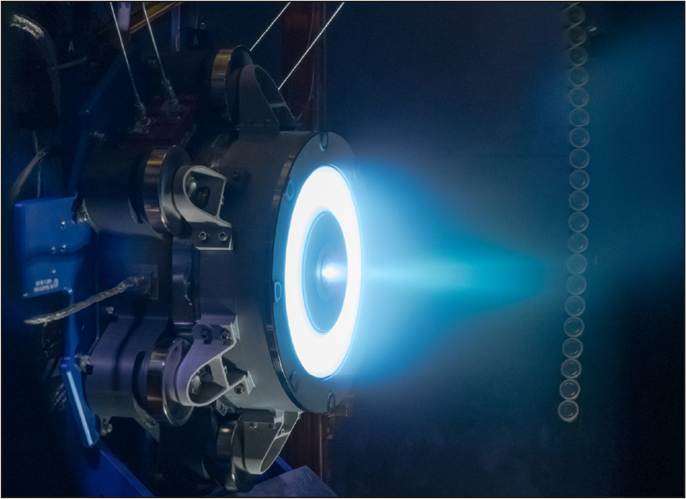
Source: Jef Janis, Alcyon Technical Services. | GAO-26-108556
Timeline

Key Project Insights
· The SEP project exceeded its rebaselined costs by $20 million and its schedule by 3 months due to design changes that addressed new requirements impacting hardware compatibility with the PPE.
· The project is tracking the risk of additional schedule delays beyond January 2029, largely due to fabrication and testing delays on the flight and qualification thrusters. However, project officials said they do not anticipate additional cost growth.
· NASA officials are considering adjustments to the long duration wear test plan for the second qualification model to mitigate the effect of a potential schedule breach.
· The SEP project delivered the three flight model thrusters to the PPE project in 2025, and testing continues on its two qualification models.
· As part of NASA’s changes to the Artemis missions, in March 2026, NASA announced that the PPE, including the SEP thrusters, would be used for the Space Reactor-1 Freedom program, a nuclear electric propulsion-powered system to deliver science payloads to Mars.
Project Information
NASA Lead Mission Directorate: Space Technology
NASA Lead Center: Glenn Research Center
Lead Contractor: Aerojet Rocketdyne
International Partners: None
Launch Location: Kennedy Space Center, FL (with the PPE)
Launch Vehicle: Falcon Heavy (with the PPE)
Mission Duration: 15 years (with the PPE)
Requirement Derived from: 2018 Strategic Objectives 2.2, 3.1, and 4.2
Cost Performance
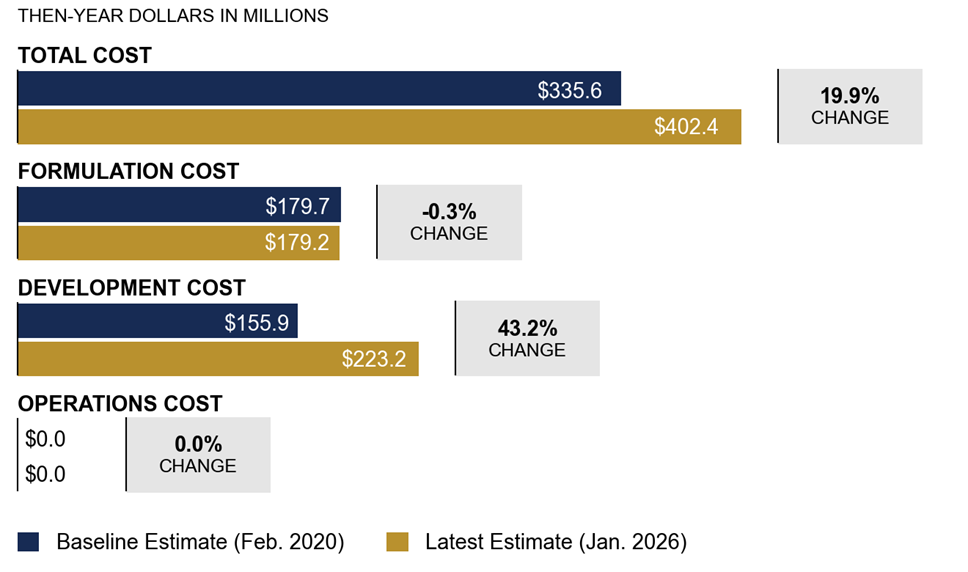
Schedule Performance – Under review
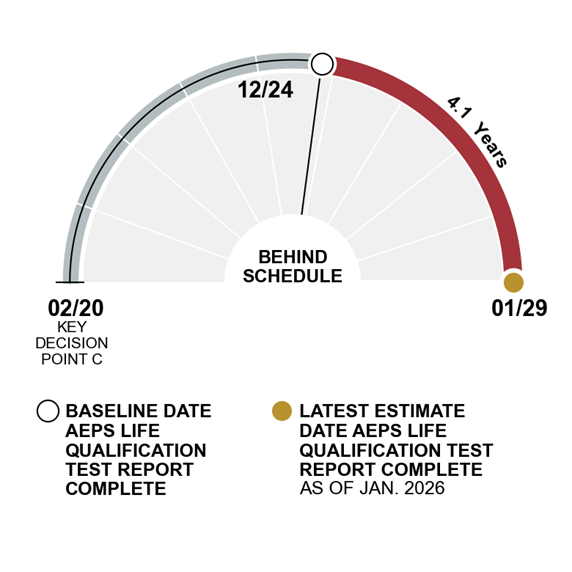
Cost and Schedule Status
As of February 2026, the SEP project had exceeded its rebaselined costs by $20 million and its schedule by 3 months. These increases occurred in 2023 because the project redesigned its thruster harnesses—the groupings of wire or cable that transmit signals and electrical power—in response to new requirements impacting hardware compatibility with the PPE spacecraft.
According to project documentation, as of April 2026, the project was tracking the risk that it could breach its current agency baseline commitment milestone date of October 2028 by at least 6 months total. The final milestone date is the end of long duration wear testing on the second qualification thruster. The risk is due to the combined effect of previous fabrication delays on the flight and qualification models, the lapse in appropriations in 2025, and ongoing testing delays on the two qualification models. In 2025, the project prioritized completing the flight models ahead of building and testing the second qualification model.
Project officials said headquarters-held cost reserves are sufficient, and they do not expect additional cost growth beyond the current cost commitment.
Integration and Test
The SEP project delivered all three flight model thrusters to the PPE project by November 2025. Despite the previous fabrication delays, these delivery dates were within the rebaselined schedule targets. SEP officials said the PPE project installed the first two thrusters on the PPE spacecraft and could install the third one as early as March 2026.
At the same time, the project has experienced delays in testing both qualification models. It completed the final step of environmental testing—thermal vacuum testing— on the first qualification model in January 2026, after a series of delays totaling over 1 year. These delays were due to test set up issues at the Jet Propulsion Laboratory and other factors. The project added an additional check-out test using an engineering test unit thruster to mitigate concerns with the test facility before completing tests on the qualification model.
Following completion of the thermal vacuum test, the project continues to investigate the cause of discoloration discovered on the qualification model’s insulation material and wiring. Project officials said the discoloration did not cause a significant enough concern to delay the PPE project’s installation of the flight thrusters.
The second qualification model completed acceptance testing and an additional vibration test as a result of the harness redesign that the project implemented in 2024. The project implemented the updated harness design on all three flight models and the second qualification model. The project did not implement the updated harness design on the first qualification model because that model was already assembled at the time. Upon completion of this vibration test, the project will begin long duration wear testing on the second qualification model at Glenn Research Center. Specifically, the project plans to complete a total of 23,000 hours, or over 2.5 years, of this testing on the second qualification model.
Project officials said they are exploring ways to increase test efficiency, including by increasing the amount of time the thruster is actively being tested. According to project officials, active testing would typically occur about 70 percent of the time the thruster is in the test chamber. The remaining time is needed to maintain the test chamber. The SEP project’s schedule originally allowed 4 years to complete the long duration wear testing. Project officials said the earliest they could start the testing is August 2026, leaving about 2 years to complete the test within the current schedule baseline.
Project officials said they are also considering potential changes to the test approach—including reducing the number of testing hours required to mitigate the potential schedule breach. Any changes to the testing approach will also be coordinated with relevant project teams and the Space Technology and Exploration Systems Development mission directorates. These directorates, respectively, lead the SEP and the PPE projects.
In March 2026, NASA officials announced the Space Reactor–1 Freedom program, which would repurpose the PPE as part of a nuclear electric propulsion-powered system to deliver science payloads to Mars. Officials expect to launch this system in December 2028.
Project Office Comments
In commenting on a draft of this assessment, NASA officials noted that the assessment does not reflect all ongoing programmatic changes stemming from adjustments made to the Artemis campaign in February and March 2026. In June 2026, officials further reported that the updated mission profile for the Space Reactor-1 Freedom program reduced the thruster operating hour requirement. As a result, the life qualification test schedule is expected to stay within the current January 2029 constraint. Officials also provided technical comments, which were incorporated as appropriate.
Space Launch System (SLS) Block 1B and Block 2
The SLS program was working toward the planned evolution of the SLS Block 1 launch vehicle, which NASA currently uses for the Artemis missions. Block 1B would retain certain elements of Block 1 but would include a more powerful Exploration Upper Stage (EUS) and adapters for payloads. Specifically, the EUS engines would provide increased thrust, allowing Block 1B to deliver more mass to the moon and other destinations. Block 2 will also retain elements of Block 1, as well as Block 1B, but will further develop the solid rocket boosters for additional lift, enabling heavier payloads.
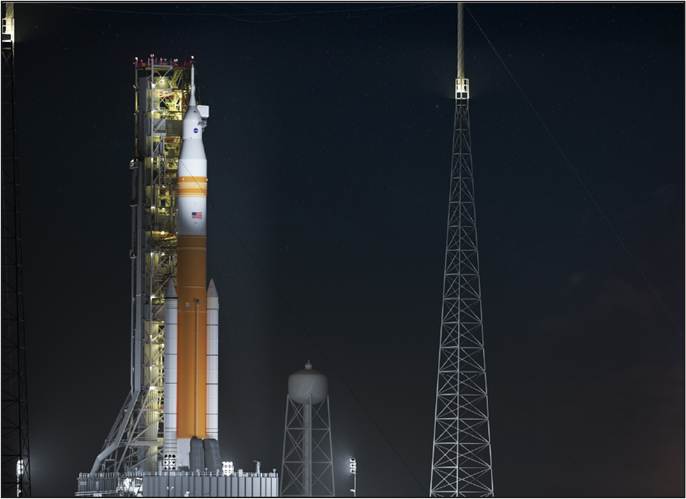
Source: NASA. | GAO-26-108556
Timeline – Block 1B

Key Project Insights
· NASA canceled the Block 1B project in May 2026. This follows NASA’s announcement, in February 2026, that it no longer plans to use SLS Block 1B for future Artemis missions because it intends to standardize the SLS configuration and accelerate the launch cadence. NASA also noted concerns with cost and schedule performance.
· At this stage of the program, there was no fully built EUS flight hardware, as the program had been conducting developmental testing and just beginning hardware production.
· After using the three available Block 1 upper stages, NASA will replace the planned Block 1B EUS with a commercial upper stage, Centaur V, from United Launch Alliance (ULA). ULA manufactured the Block 1 upper stage.
· Before stopping work, the Block 1B project estimated a $229.4 million development cost overrun as a result of development delays.
· The Block 2 booster project conducted a successful test firing of the solid rocket booster in 2025 but has not yet set baselines or estimates.
Project Information
NASA Lead Mission Directorate: Exploration Systems Development
NASA Lead Center: Marshall Space Flight Center
Lead Contractor: Boeing (integrator)
International Partners: None
Launch Location: Kennedy Space Center, FL
Launch Vehicle: N/A
Mission Duration: Varied based on destination
Requirement Derived from: NASA Authorization Act of 2010
Next Major Project Event for Block 2: Key Decision Point C (to be determined)
Cost Performance – Under review
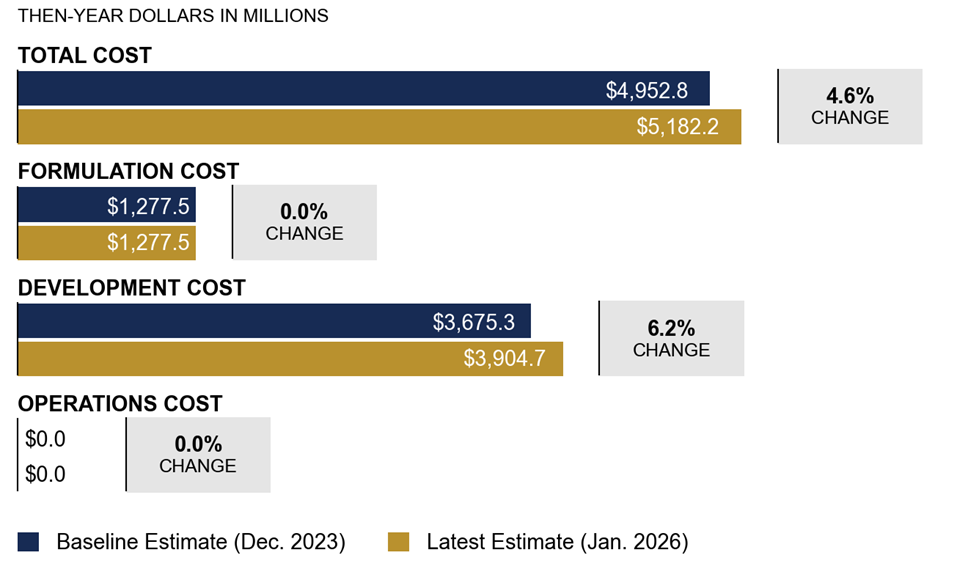
Note: The graphic represents SLS Block 1B. The preliminary cost estimate for SLS Block 2 is to be determined.
Schedule Performance – Under review
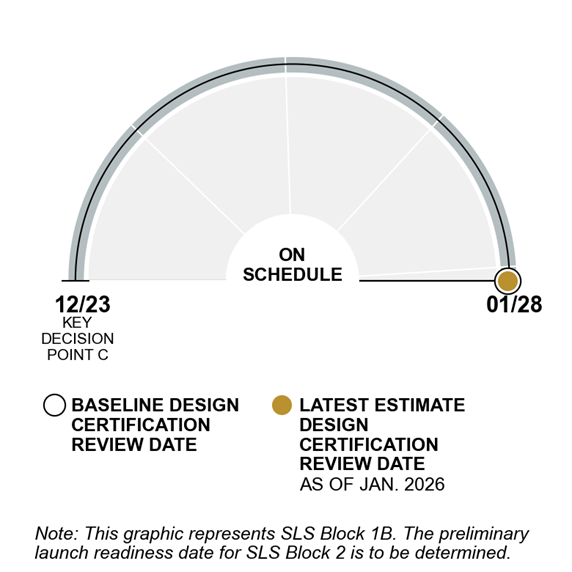
SLS Block 1B Cost and Schedule Status
NASA canceled the Block 1B project in May 2026. This follows NASA’s announced changes to the Artemis campaign in February 2026, including plans to standardize the SLS configuration for future missions. NASA stated that standardizing the SLS design and increasing its flight rate will improve crew safety and reduce costs to fund additional missions. NASA also noted the project was facing cost challenges and schedule delays.
As part of the standardization effort, NASA does not plan to use the EUS on any upcoming Artemis missions. In February 2026, NASA issued stop-work orders to Boeing (the lead contractor/integrator) and Leidos Dynetics (a contractor responsible for major work on the project, the Universal Stage Adapter). Then, in May 2026, NASA terminated for convenience the portions of its contracts with Boeing for the EUS and sent a request for proposal to Leidos Dynetics to rescope its contract to align with NASA’s current approach for SLS.
NASA reported that the project had exceeded its approved cost baseline prior to the announcement. NASA approved the Block 1B baselines in December 2023. At that time, the committed design certification review date was January 2028, ahead of the planned Artemis IV mission in September 2028, and the baselined life-cycle cost was approximately $4.9 billion. In August 2025, NASA projected an increase of $229.4 million, or 6.2 percent, to Block 1B development costs for the scope of work it committed to in its cost baseline. NASA attributed this to delays in the completion and delivery of major system components like the Universal Stage Adapter, EUS, and payload adapter, as well as an anticipated delay to the design certification review milestone. This final review demonstrates that a system fulfills all applicable requirements.
SLS Changes
To standardize the SLS configuration, NASA is now pursuing an alternate upper stage for the Artemis V mission planned for 2028. The SLS program originally planned to use the Block 1 configuration—which includes a ULA Interim Cryogenic Propulsion System (ICPS) upper stage—for the first three launches of the Artemis mission campaign. Beyond this initial configuration, NASA planned to upgrade to the Block 1B configuration that uses the EUS. Currently, NASA plans to use a dummy upper stage for the newly defined Artemis III mission in low-Earth orbit and the single remaining ICPS for the first lunar landing mission, Artemis IV.
While ULA’s ICPS upper stage was used on previous missions, ULA retired that production line in support of developing its new Vulcan Centaur fleet. The Vulcan Centaur V is the upper stage for ULA’s Vulcan rocket, is comparable in size, and has common avionics and software with the ICPS. In March 2026, NASA approved a sole-source contract approach, with ULA to procure the Vulcan Centaur V upper stages for subsequent missions. According to NASA officials, this approach will entail relatively minor modifications to existing hardware, such as moving the propellant umbilical line down a few feet on the launch tower.
SLS Block 1B Progress
The SLS program completed manufacturing of some Block 1B flight hardware, but NASA halted work on the new Block 1B systems before they completed development. All four RL-10 engines required for the EUS, as well as the RL-10 test engines designed to operate at sea level, are complete. The sea-level engines eliminate the need for a costly altitude diffuser on the test stand. Additionally, the new Block 1B elements—the EUS, universal stage adapter, and payload adapter—were all progressing through developmental and structural testing when NASA halted work. Boeing was also beginning production of flight hardware. For example, all seven EUS subassemblies needed for the first EUS flight unit were in production.
The program faced delays in the manufacturing of core stages for the next two Artemis missions and was tracking related cost and schedule risks. This includes delays to core stage 4, which was planned to fly with the Block 1B configuration and will now be used for the standardized SLS configuration. Officials attributed the delays to contractor performance, parts availability, and supply chain issues that interrupted planned production on multiple occasions, thereby delaying manufacturing.
SLS Block 2 Progress
Program officials stated that NASA is focused on near-term Artemis missions, and there has been no contract activity to terminate or extend Block 2 development. Further, NASA has yet to estimate the cost and schedule for Block 2 development. NASA officials acknowledged the need for replacement boosters if NASA decides to use SLS beyond an Artemis VIII mission. In March 2026, NASA issued a request for information from industry for commercial space transportation options.
Despite the cancelation of the Block 1B work, testing continued in 2025 on the development of composite casings for future solid rocket boosters. For example, Northrup Grumman—the booster contractor—conducted a successful test firing of the booster. NASA officials stated that, since then, the contractor and NASA have been conducting post-test analysis to understand the overall design and to inform schedules for future use on the standard configuration if NASA decides to use SLS beyond Artemis VIII.
Project Office Comments
In commenting on a draft of this assessment, NASA officials noted that the assessment does not reflect all ongoing programmatic changes stemming from adjustments made to the Artemis campaign in February and March 2026. Officials also provided technical comments, which were incorporated as appropriate.
Commercial Crew Program (CCP)
CCP oversees the development of crew transportation systems by commercial companies to carry NASA astronauts to and from the International Space Station (ISS). The program is working with Boeing and SpaceX to design, develop, test, and operate these crew transportation systems. NASA must certify that these systems meet its standards for human spaceflight before the companies can fly crewed missions to and from the ISS. NASA certified SpaceX in November 2020. As of March 2026, SpaceX has flown 12 crewed missions for NASA. Once Boeing’s system is certified, NASA plans to alternate missions to the ISS between the providers.
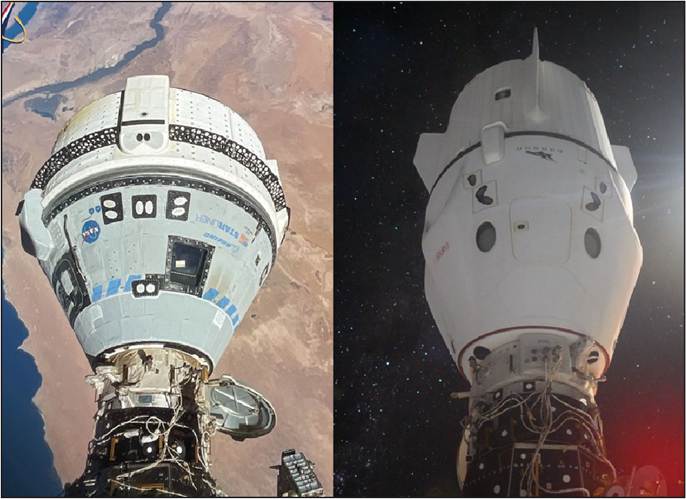
Source: NASA. | GAO-26-108556
Current Status
CCP and Boeing are planning to fly a cargo mission prior to holding Boeing’s certification review. After certification, Boeing can conduct crewed service missions to the ISS, using its Starliner spacecraft. NASA modified Boeing’s contract to repurpose one of six crewed service missions to the ISS to a cargo-only mission. CCP officials explained that having an additional mission before the certification review will help validate system performance in an operational environment after ground testing and investigation of the thruster failures and helium leaks that occurred during Boeing’s 2024 crewed flight test. NASA further modified Boeing’s contract to cancel two of the five remaining service missions.
In February 2026, NASA released a report into the propulsion system anomalies that occurred during Boeing’s crewed flight test and resulted in the spacecraft returning to Earth without crew. The report described a complex interplay of hardware failures, qualification gaps, leadership missteps, and cultural breakdowns that collectively posed risks to crew safety. Root causes cited in the NASA report included NASA’s incomplete systems knowledge of Boeing’s spacecraft and Boeing’s inadequate systems engineering and reliance on subcontractors without sufficient oversight. For example, insufficient thruster testing led to knowledge gaps.
Project Information
NASA Lead Mission Directorate: Space Operations
NASA Lead Center: Kennedy Space Center
Lead Contractors: Boeing; SpaceX
Launch Location: Cape Canaveral Space Force Station, FL
Launch Vehicle: Boeing—Atlas V; SpaceX—Falcon 9
Requirement Derived from: NASA Strategic Plan
Next Major Project Event: Boeing cargo mission (launch dates under review)
Cost Performance
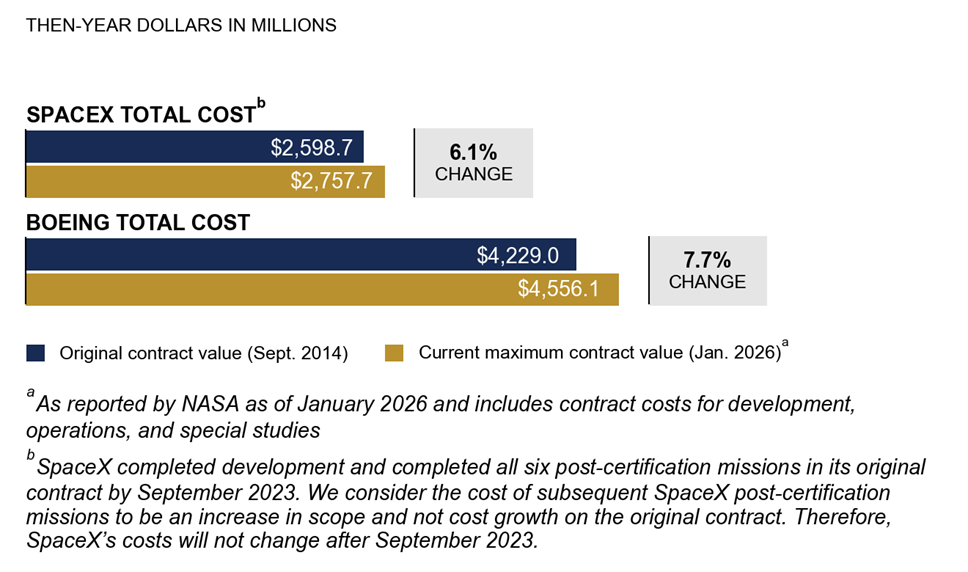
Schedule Performance – Under review
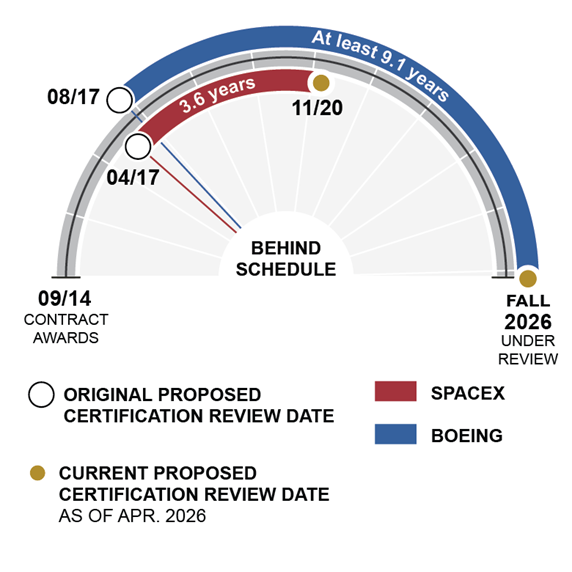
Project Office Comments
In commenting on a draft of this assessment, CCP officials noted that significant progress has been made on Boeing’s post-crewed flight test activities, including integrated NASA/Boeing test campaigns, closing out in-flight anomalies, and addressing recommendations from the investigative report. Officials said NASA is assessing readiness and launch window opportunities. Officials also provided technical comments on this draft, which were incorporated as appropriate.
Compton Spectrometer and Imager (COSI)
COSI is a space telescope that will perform wide-field imaging and surveys of the gamma-ray radiation sources in space to answer questions about the structure and evolution of the galaxy. Specifically, the telescope will study the origin of antimatter in the Milky Way, element formation in supernovae, and the extreme environments of black holes and gamma-ray bursts. The telescope’s detectors will collect high-energy radiation data for the instrument.
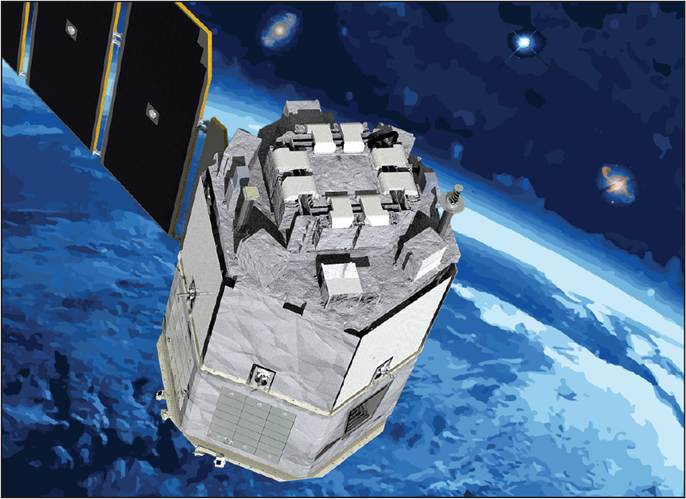
Source: University of California, Berkeley. | GAO-26-108556
Current Status
The COSI project is operating within its cost and schedule baselines and is working toward an earlier launch date. The project team reports that, while issues with the cryostat pose a schedule risk, the project currently has sufficient cost and schedule reserves to cover potential risks. The cryostat allows the detectors to remain at the correct temperature.
The project identified two issues related to the cryostat. First, the fasteners that secure the detector holder had little to no clearance with a high-voltage component. This resulted in the need to adjust the hardware, which requires the detector housing to be removed from the cryostat. The project used some schedule reserves as it worked to address this issue. However, the project can perform this mitigation while it integrates and tests other components to try to avoid significant delays. The COSI team is monitoring the schedule while it disassembles the payload and addresses this issue.
Second, the project addressed an issue with cooling the cryostat. In 2025, the project reported difficulty with cooling an engineering model to 90 Kelvin or less—the ideal temperature for the detectors to collect data. However, the project achieved significantly lower temperatures for the flight model of the cryostat. Further, the project reported that preliminary tests showed that, if needed, operating at slightly higher temperatures would not result in significant data issues. As of February 2026, the project considers the issue resolved.
Project Information
NASA Lead Mission Directorate: Science
NASA Lead Center: Goddard Space Flight Center
Lead Developer: University of California, Berkeley
International Partners: Agenzia Spaziale Italiana (Italy)
Launch Location: Cape Canaveral Space Force Station, FL
Launch Vehicle: Falcon 9
Mission Duration: 24 months
Requirement Derived from: 2010 Astrophysics Decadal Survey
Next Major Project Event: System integration review (September 2026)
Cost Performance
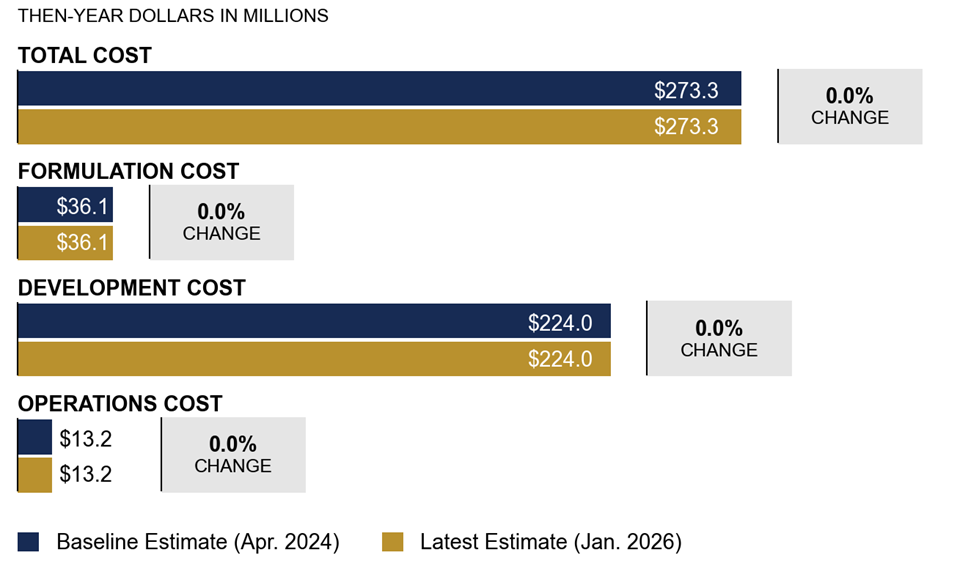
Schedule Performance
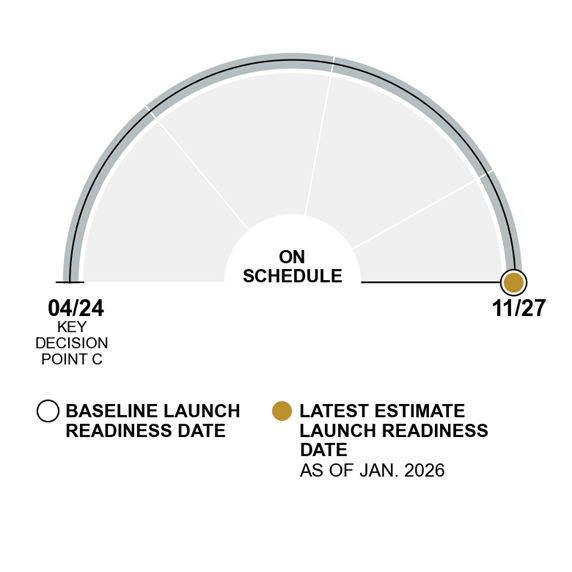
Project Office Comments
COSI project officials provided technical comments on a draft of this assessment, which were incorporated as appropriate.
Dragonfly
Dragonfly is a rotorcraft lander that will visit Titan—Saturn’s largest moon—and fly like a drone to sample and examine dozens of sites and search for the building blocks of life. It will explore organic dunes and the deposits of an impact crater where liquid water and complex organic materials key to life once existed together for possibly tens of thousands of years. It will also investigate how far prebiotic chemistry has progressed. This mission is the first time that NASA will fly an eight-bladed rotorcraft and take advantage of Titan’s dense atmosphere to gather science on another planetary body. It will fly its entire science payload to new places for repeated and targeted access to surface materials.
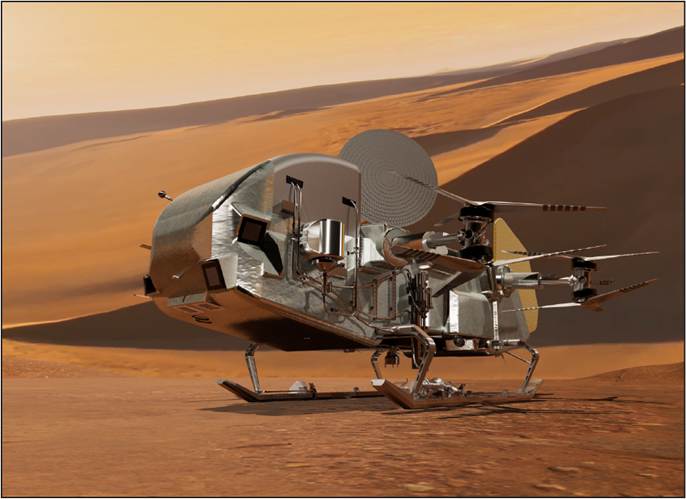
Source: Johns Hopkins University Applied Physics Laboratory. | GAO-26-108556
Timeline

Key Project Insights
· The Dragonfly project continues to operate within its life-cycle cost of $3.4 billion. The project received additional funding that NASA headquarters had held for the project to maintain the launch readiness date of July 2028.
· In February 2026, the project started lander integration and testing activities. Additionally, it continues to make progress in developing Dragonfly’s subsystems and instruments.
· NASA project officials were informed by the Department of Energy, which is providing the project’s Multi-Mission Radioisotope Thermoelectric Generator (MMRTG), that the MMRTG will provide less thermal power than the project requires for the current operational plan. According to the project’s analysis of the MMRTG’s performance, the decreased performance will affect the way the project operates Dragonfly. For example, the analysis indicated the need for increased recharge time on Titan’s surface.
Project Information
NASA Lead Mission Directorate: Science
NASA Lead Center: Marshall Space Flight Center
Lead Developer: Applied Physics Laboratory
International Partners: Centre National d'Etudes Spatiales (France); Japan Aerospace Exploration Agency; German Aerospace Center
Launch Location: Kennedy Space Center, FL
Launch Vehicle: Falcon Heavy
Mission Duration: 10 years
Requirement Derived from: 2011 Planetary Science Decadal
Cost Performance
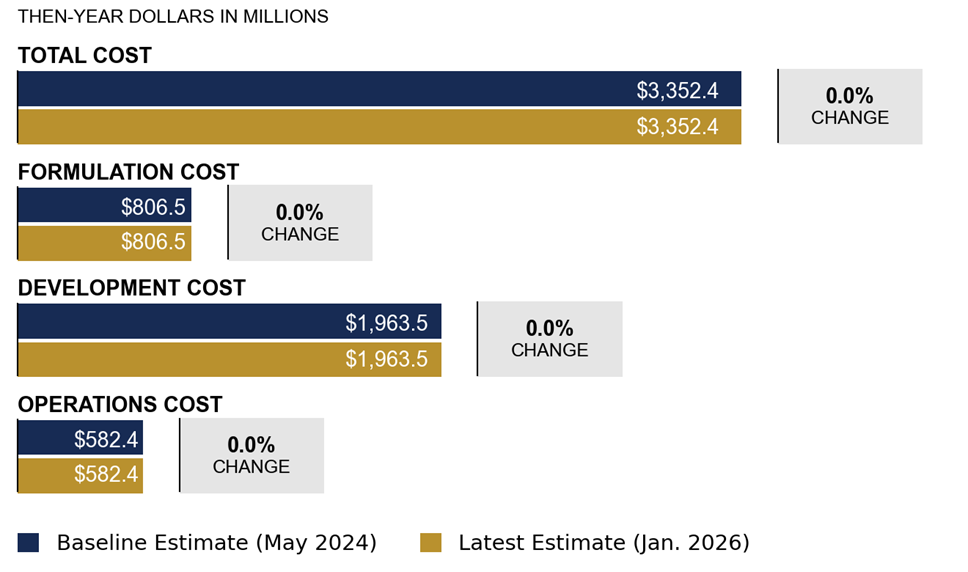
Schedule Performance
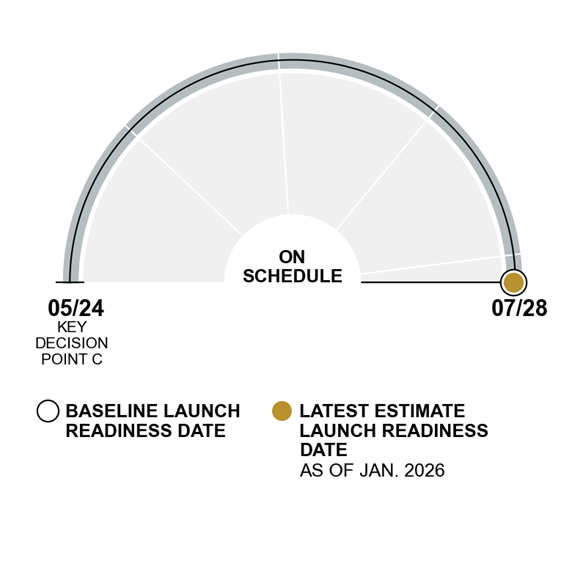
Cost and Schedule Status
The Dragonfly project continues to operate within its cost and schedule baselines but has faced challenges with how NASA phased its funding across fiscal years. For example, in fiscal year 2025, the project requested cost reserves from future fiscal years to complete the work. According to the project, NASA provided additional funding for fiscal year 2026 to augment its reserves. The project needed this funding because some work that was previously planned for fiscal year 2025 was shifted into fiscal year 2026 due to prior funding constraints.
The Dragonfly project worked with NASA to mitigate potential funding shortfalls in future years. In April 2026, NASA agreed to provide Dragonfly with approximately $216 million in additional funding held by headquarters because of the remaining work necessary to meet the launch readiness date of July 2028.
Design, Integration, and Test
The Dragonfly project successfully completed the lander and mission critical design reviews in March 2025 and April 2025, respectively. However, at the time of the reviews, the project did not meet our leading practice of releasing at least 90 percent of its design drawings at critical design review. This leading practice lowers the risk of projects experiencing design changes and subsequent cost and schedule growth. As of January 2026, the project had released 82 percent of the mission design drawings.
In February 2026, Dragonfly started its integration and testing activities, which it plans to continue at the Applied Physics Laboratory through mid-2027. For example, the project powered on and tested the lander’s Integrated Electronics Module, which contains its core avionics for command and data handling, guidance and navigation, and communications. Both the Integrated Electronics Module and Power Switching Units were connected to Dragonfly’s wiring system and passed their first power-service checks.
Instrument Status
The project continues to make progress in developing Dragonfly’s subsystems and its instruments. For example:
· The project completed all flight hardware production of the Dragonfly Gamma-ray and Neutron Spectrometer, an instrument used to determine elemental composition beneath the lander without requiring sampling. For example, it completed assembly of and integrated the boards into the flight data processing unit.
· According to project documentation, flight production is proceeding as planned for the Dragonfly Geophysics and Meteorology Package, a suite of geophysical and meteorological sensors. The package includes a seismometer to detect Titanquakes and understand the level of seismic activity on an icy moon with a liquid subsurface ocean.
· The vendor delivered the flight navigation camera for the Dragonfly Camera Suite. These cameras will image Titan’s terrain and help Dragonfly navigate and determine landing areas of scientific interest. The project is continuing to test other camera system components.
· The vendor delivered the flight hardware for the Drill for Acquisition of Complex Organics to Goddard Space Flight Center (GSFC), where it underwent testing. This drill will deliver surface material to the Dragonfly Mass Spectrometer (DraMS)—which will study the chemical complexity and diversity of Titan's solid surface—for analysis. The project identified an anomaly with an avionics card during this testing, but it resolved the issue and assembly continued. Flight hardware production remains on track, and the project is working to mitigate some of the efficiency it lost due to reworking the avionics cards.
· GSFC may deliver the DraMS late for integration and testing. This is due to fabrication and assembly issues, such as a power supply board that needed to be refabricated. Project documentation states that further delays could increase costs over the allocated budget, specifically for DraMS for fiscal year 2026. Project officials noted that the team at GSFC is working weekends and extended shifts to recover the schedule. The GSFC officials are also exploring options to change the flow of integration and testing to provide more schedule margin.
Other Issues to Be Monitored
NASA project officials were informed by the Department of Energy that the MMRTG will produce less thermal power than the project requires under the current concept of operations. The MMRTG will charge the lander’s battery and will power other systems, such as fans, pumps, and radios. A project analysis of the current MMRTG power capability indicates that this shortfall will result in increased battery recharge time on Titan’s surface. Having to spend more time recharging will affect Dragonfly operations and may reduce the amount of data that Dragonfly is able to collect. The project has not yet incorporated the revised MMRTG performance data into operations scenarios for cruise and surface concept of operations.
Project Office Comments
Dragonfly project officials provided technical comments on a draft of this assessment, which were incorporated as appropriate.
Electrified Powertrain Flight Demonstration (EPFD)
EPFD was a technology demonstration project overseeing the commercial development of hybrid electric-powered aircraft. The program was working with two industry partners—GE Aerospace (GE) and magniX—to mature Electrified Aircraft Propulsion technologies for commercial aircraft through ground and flight demonstrations. These technologies can lead to lower operating costs, improve fuel efficiency, and reduce noise emissions. Both contractors were developing a megawatt-class powertrain system. GE’s system aimed to inform future application for narrow-body aircraft, while magniX’s aimed to inform future application for regional aircraft.

Source: GE Aerospace and magniX. | GAO-26-108556
Current Status
NASA canceled the EPFD project and plans to close it out in 2026. This is 2 years before the planned development end (first electrified flight), and after spending 30 percent of planned development funding. Project officials said NASA canceled the project as part of an effort to save costs by reducing lower priority activities, which would allow the agency to focus on addressing higher priorities.
In July 2025, NASA initiated terminations of the magniX and GE contracts for the government’s convenience. However, according to officials, following NASA’s fiscal year 2026 appropriation, NASA renewed its contract with GE for megawatt-class hybrid-electric ground and flight testing to advance hybrid and Electrified Aircraft Propulsion technologies in 2026 outside of the EPFD project. NASA plans to complete this testing in parallel with closeout activities, including a lessons learned review.
Officials stated that data obtained from the project and the new GE work can help to advance design and modeling tools for future aircraft configurations, technology investments, and demonstrations. For example, the project has collected information to predict the impact and benefits of electrified aircraft propulsion technology on next-generation commercial aircraft. It also has data from ground testing that simulated cruise conditions for GE’s and magniX’s propulsion systems.
Project Information
NASA Lead Mission Directorate: Aeronautics Research
NASA Lead Center: Virtual Project Office
Lead Contractors: magniX and GE Aerospace
International Partners: None
Requirement Derived from: Aeronautics Research Mission Directorate Strategic Implementation Plan 2019 and 2023
Last Major Project Event: Project Closeout Memo (July 2026)
Cost Performance
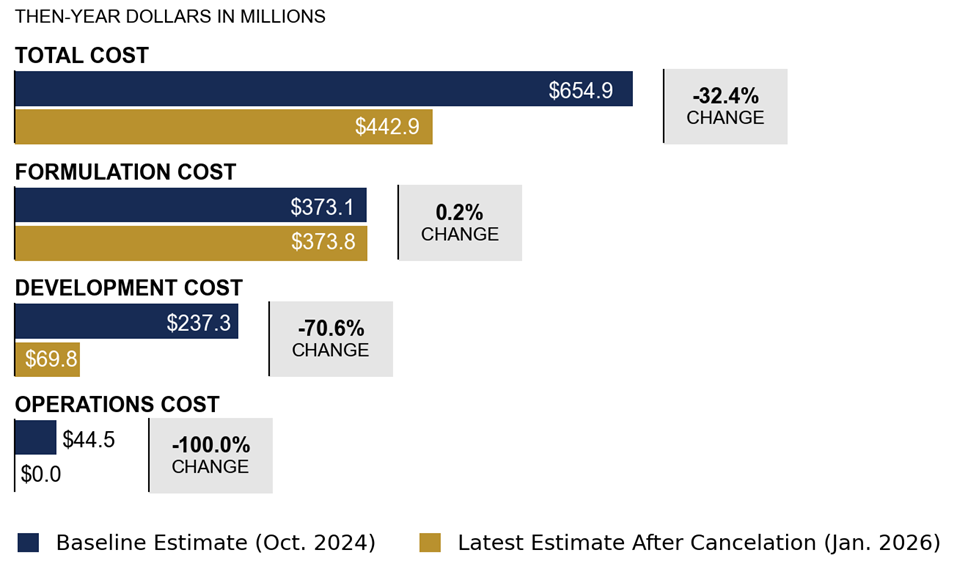
Schedule Performance
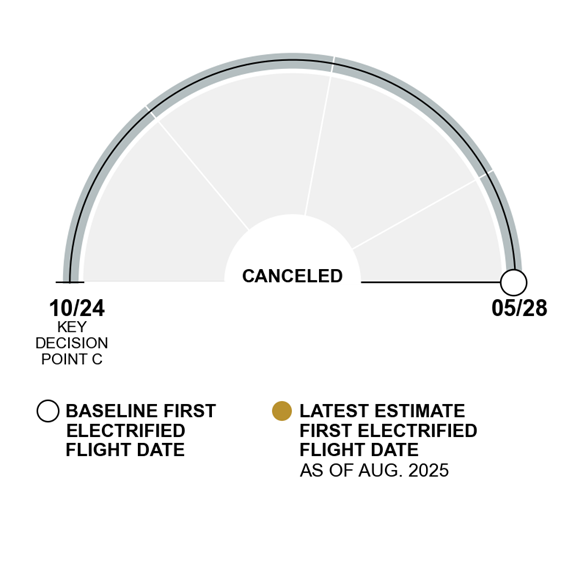
Project Office Comments
EPFD project officials provided technical comments on a draft of this assessment, which were incorporated as appropriate.
Earth System Observatory – Gravity Recovery and Climate Experiment – Continuity (GRACE-C)
GRACE-C consists of two satellites that will continue more than 20 years of large-scale mass change observations used to assess drought and to understand sea level rise, Earth’s energy imbalance, and ice mass loss. It is a successor to the GRACE (2002-2017) and GRACE-Follow On (2018-present) missions. The project’s primary instrument—called a laser ranging interferometer—precisely measures the distance between the satellites as they respond to Earth’s gravitational pull, enabling monthly measurements of water and land mass.
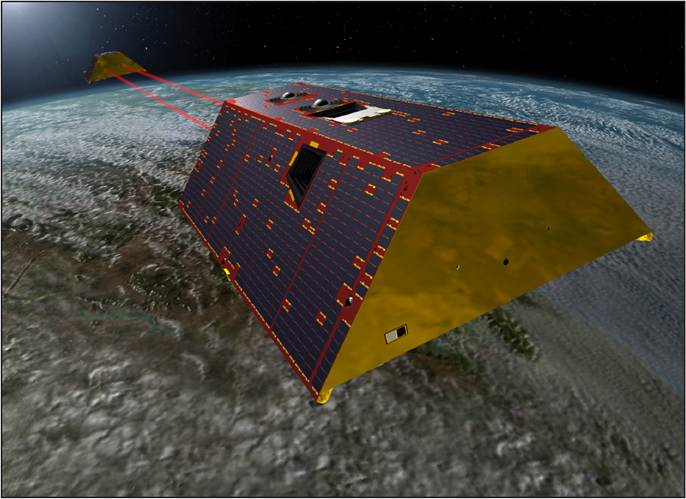
Source: NASA/JPL. | GAO-26-108556
Current Status
The GRACE-C project is currently working within the cost and schedule baselines NASA set in 2024. It successfully completed its system integration review in October 2025; and is proceeding with the system assembly, integration and test, and launch phase. Specifically, the project integrated the power systems on both spacecraft; and integration and testing is underway for the rest of the flight system and primary instrument.
The project’s top risk is that the German Aerospace Center faced delays in developing the Optical Bench System, a component of the primary instrument. Further delays leading to a late delivery of the system could delay completion of the instrument’s integration and testing. This could then threaten on-time delivery of the instrument for integrated spacecraft assembly, test, and launch operations. The project is coordinating with its German counterparts to mitigate the risk and officials said they are assessing options to optimize the instrument’s testing schedule.
The project is also tracking a risk to its cost reserves due to the exchange rate between the U.S. dollar and the euro, which is increasing the cost of work completed by European contractors, and a rate increase by the Jet Propulsion Laboratory (JPL), which manages the project. Officials stated that JPL adjusts its rates for overhead costs on an annual basis, but the recent increase was larger than NASA anticipated. However, the project reported that it is comfortable with its current reserve levels.
Project Information
NASA Lead Mission Directorate: Science
NASA Lead Center/ Developer: Jet Propulsion Laboratory
International Partners: German Aerospace Center
Launch Location: Vandenberg Space Force Base, CA
Launch Vehicle: Falcon 9
Mission Duration: 5 years
Requirement Derived from: Program Level Requirement Appendix
Next Major Project Event: Operational Readiness Review (October 2028)
Cost Performance
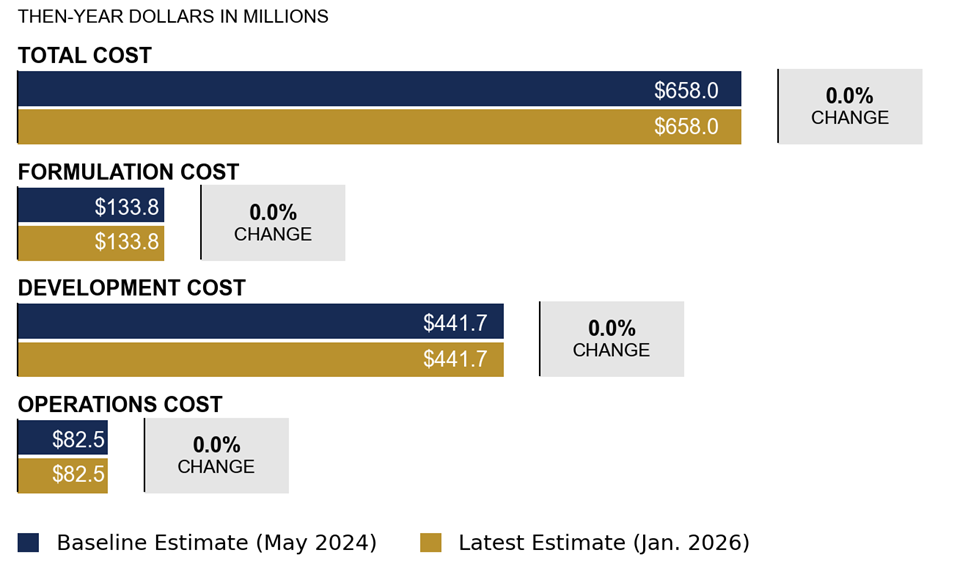
Schedule Performance
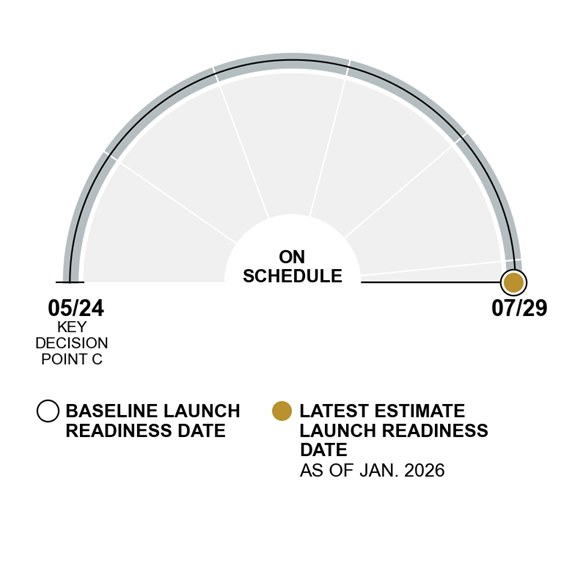
Project Office Comments
GRACE-C project officials provided technical comments on a draft of this assessment, which were incorporated as appropriate.
Earth System Observatory – Surface Biology and Geology – Thermal Infrared (SBG-TIR)
SBG-TIR is an instrument that will capture temperature and thermal emission data to help map wildfires, identify volcanic hot spots, and improve agricultural efficiency and urban planning. The project is managed through a partnership between NASA and Agenzia Spaziale Italiana (ASI). NASA will contribute the TIR instrument and manage the ground antenna network during operations. ASI will contribute the visible near infrared camera, spacecraft, and launch vehicle and conduct mission operations.
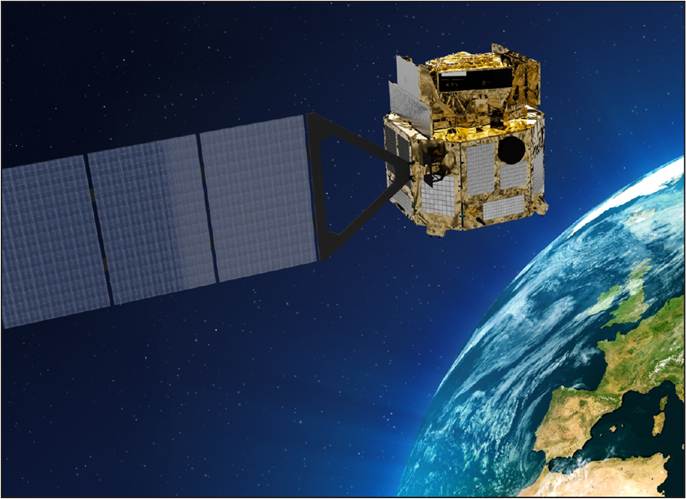
Source: Thales Alenia Space. | GAO-26-108556
Current Status
NASA’s fiscal year 2025 operating plan states that the SBG-TIR project will not continue to the next phase of development. As a result, NASA officials said the project has no planned path forward. In addition, the President’s Budget Request for fiscal year 2026 proposed canceling SBG-TIR. NASA directed the project to limit spending in May 2025, and the project responded by suspending acquisitions and international travel and reducing its workforce. Project officials stated that they are currently working with NASA to determine next steps and are developing options for descoping work.
The project is continuing to develop two components of the TIR instrument with remaining funds. First, officials stated that the project delivered the Fast Analog Low-Noise-Converter integrated circuits, which enable fast processing of large quantities of information in April 2026. Second, it had planned to deliver the focal plane array, but thermal testing revealed damage to printed circuit board assemblies located on the array. Officials said that the Jet Propulsion Laboratory is working with a subcontractor to reduce delivery delays related to addressing this issue.
In addition, officials stated that the project supported the ASI-convened preliminary design review for the infrared camera in November 2025.
Project Information
NASA Lead Mission Directorate: Science
NASA Lead Center/Developer: Jet Propulsion Laboratory
International Partners: Agenzia Spaziale Italiana (Italy)
Launch Location: Korou, French Guiana
Launch Vehicle: Vega-C (ASI provided)
Mission Duration: 3 years
Requirement Derived from: 2017 Earth Science Decadal Survey
Next Major Project Event: Key decision point C (postponed indefinitely)
Preliminary Costa
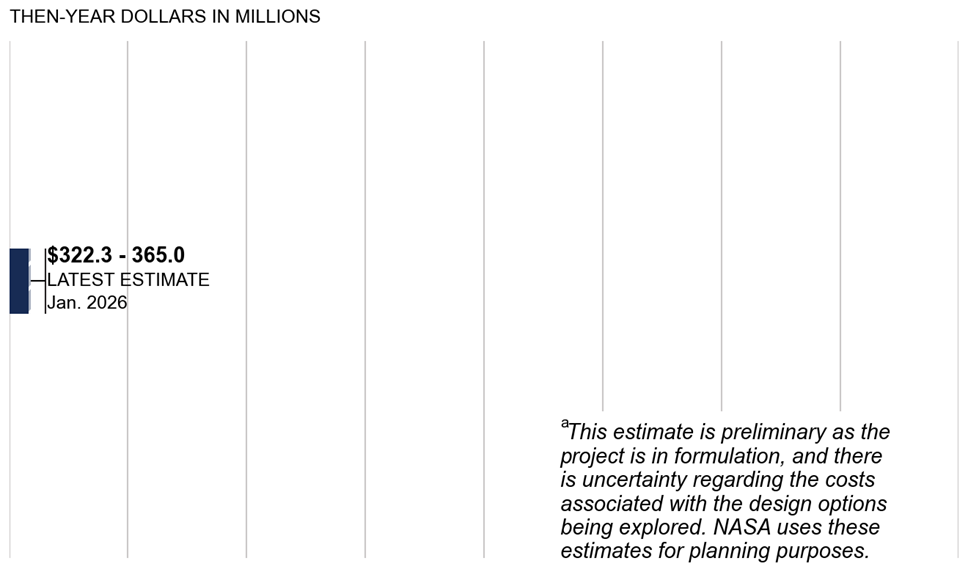
Preliminary Schedule – Under review
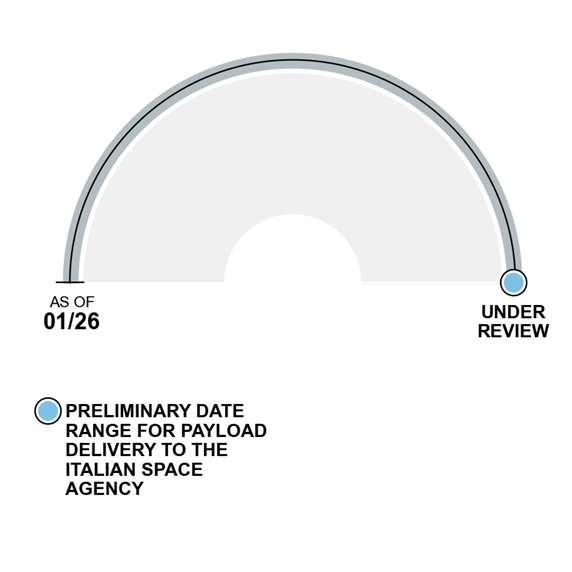
Project Office Comments
SBG-TIR project officials provided technical comments on a draft of this assessment, which were incorporated as appropriate.
Mars Sample Return (MSR)
The MSR program was a joint endeavor between NASA and the European Space Agency. It planned to collect Martian samples gathered by the Mars Perseverance Rover and bring them safely back to Earth for study and analysis. NASA’s planned contributions included the Sample Retrieval Lander (SRL); the Mars Ascent Vehicle; and the sample Capture, Containment, and Return System. The European Space Agency’s planned contributions included the Earth Return Orbiter. This mission was planned to be the first launch from the surface of another planet and the first international, interplanetary relay effort.
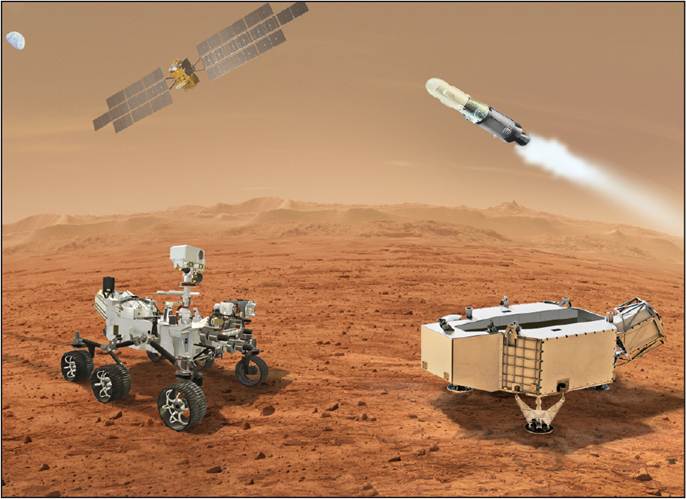
Source: Jet Propulsion Laboratory. | GAO-26-108556
Current Status
MSR was proposed for cancelation in the Fiscal Year 2026 President’s Budget Request, which cited it as unaffordable. In September 2025, NASA directed the program to reduce scope and focus on SRL descent stage, sample transfer system, and related subsystems development. The program reported initiating closeout activities and is anticipating completion of these activities consistent with funding levels in fiscal year 2026. In April 2026, the program reported that it completed its descent system preliminary design review and began reducing staff. The remaining staff will focus on some elements of SRL that may be applicable for future missions. NASA has not yet determined how it will further develop MSR technologies under the Mars Future Missions program.
According to officials, while preparing for project closeout NASA continued to coordinate with the European Space Agency (ESA) on NASA’s Mars lander engines. The MSR program reported procuring engines for SRL and ESA’s Rosalind Franklin Rover mission concurrently. NASA funded the engines for the ESA mission through the Rosalind Franklin Support and Augmentation (ROSA) project. The MSR program developed an engine delivery approach to meet ROSA’s schedule.
Prior to the cancelation, the program did not have current preliminary cost and schedule estimates. These estimates were under review as NASA considered major changes to the MSR architecture to save on cost and schedule. Potential changes included NASA-led and commercial options for SRL. NASA estimated that leveraging existing technology could return samples to Earth as early as 2035—5 years sooner than previously reported—and with a total life-cycle cost of under $11 billion. Officials noted that consideration of contract requirements and acquisition approaches for a commercial heavy lander had begun. NASA began closing out the program before it completed its assessment of these options.
Before closeout activities began, the program took steps to refine the revised NASA-led architecture during 2025. These steps included the completion of preliminary design reviews for power, propulsion, and sample transfer and handling subsystems. According to program officials, it completed all design and analysis for the Mars Ascent Vehicle—the rocket that would bring samples to an orbiter for return to Earth—in September 2025. The project also completed testing of the sample tube transfer system with the Perseverance rover test system and the SRL prototype hardware.
Project Information
NASA Lead Mission Directorate: Science
NASA Lead Center: NASA Headquarters
Lead Developer: Jet Propulsion Laboratory
Launch Location: Eastern Range, FL (Sample Retrieval lander); and French Guiana (Earth Return Orbiter)
Launch Vehicle: TBD
Mission Duration: 5 years
Requirement Derived from: 2011 and 2023 Planetary Science and Astrobiology Decadal Surveys
Next Major Project Event (prior to cancelation): Preliminary design review
Project Office Comments
MSR project officials provided technical comments on a draft of this assessment, which were incorporated as appropriate.
MUlti-slit Solar Explorer (MUSE)
MUSE is a spacecraft that will observe the sun’s extreme-ultraviolet radiation and obtain high-resolution images of the sun’s atmosphere. Its goal is to understand the processes that heat the solar atmosphere and drive space weather events, such as solar flares and eruptions. These events can affect the functioning of satellites, the accuracy of global positioning systems, power grids on Earth, and the safety of astronauts, among other things. The instrument on the spacecraft consists of an imager with a large field of view and a spectrograph, which will measure solar flares 35-100 times faster than current instruments. MUSE is based on the Interface Region Imaging Spectrograph spacecraft but includes some new parts to address obsolescence issues.
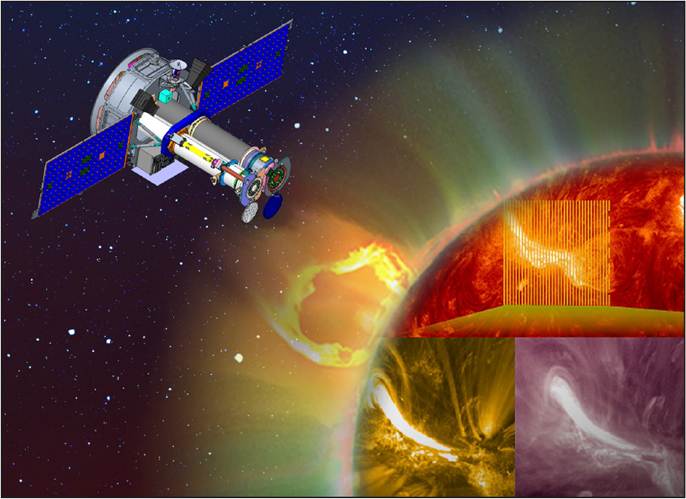
Source: NASA/Lockheed Martin Advanced Technology Center. | GAO-26-108556
Current Status
The MUSE project remains on track to launch in November 2027 but faces milestone delays and potential cost increases. For example, the project delayed its system integration review from April 2026 to September 2026 to account for instrument and spacecraft integration delays that the project attributes to subcontractor performance and delivery delays. According to project officials, the contractor is mitigating some schedule delays by planning additional 7-day work week activities during integration and test. However, the mitigation is not sufficient to recover from hardware delays. In addition, adding 7-day work week activities poses a risk to the project’s cost reserves as additional hours increase workforce costs.
Additionally, the project is tracking risks related to procurement delays. According to project officials, a vendor of custom mechanical parts experienced manufacturing challenges, and two subcontractors of avionics and communications systems also significantly delayed delivery, which prompted increased contractor and agency oversight. Officials said vendor capacity has also been a schedule challenge. For example, one supplier delayed delivering parts to MUSE because it prioritized another customer. Officials said that they expect improvements in schedule performance trends once the parts are received, after which the project can look for ways to accelerate the schedule.
Project Information
NASA Lead Mission Directorate: Science
NASA Lead Center: Goddard Space Flight Center
Lead Developer: Lockheed Martin Advanced Technology Center
International Partners: Italian Space Agency; German Aerospace Center; Norwegian Space Agency
Launch Location: Vandenberg Air Force Base
Launch Vehicle: Falcon 9
Mission Duration: 2 years
Requirement Derived from: 2013 Space and Solar Physics Decadal Survey
Next Major Project Event: System integration review (September 2026)
Cost Performance
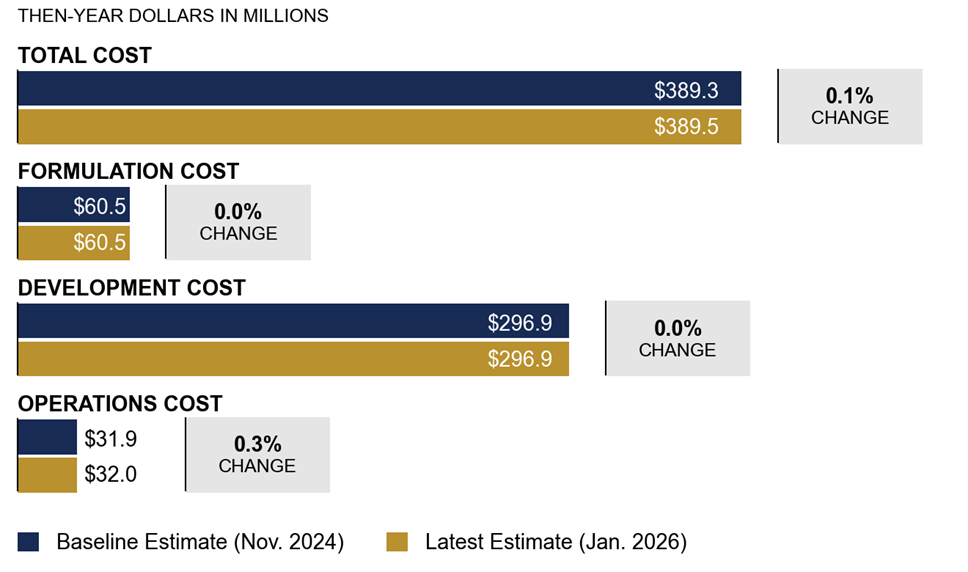
Schedule Performance
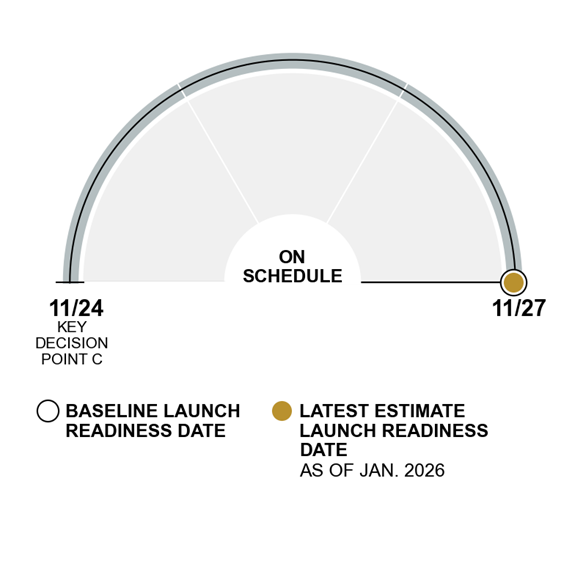
Project Office Comments
MUSE project officials provided technical comments on a draft of this assessment, which were incorporated as appropriate.
Near-Earth Object (NEO) Surveyor
The NEO Surveyor mission will use a space-based telescope to detect, track, catalog, and characterize NEOs—asteroids and comets—that could be potentially hazardous to Earth. The project aims to obtain detailed physical characterization data for at least two-thirds of potentially hazardous asteroids that are 140 meters or larger in diameter. It also aims to characterize the population of potentially hazardous NEOs to inform mitigation strategies. The NEO Surveyor project continues work previously done under the NEO Camera project.
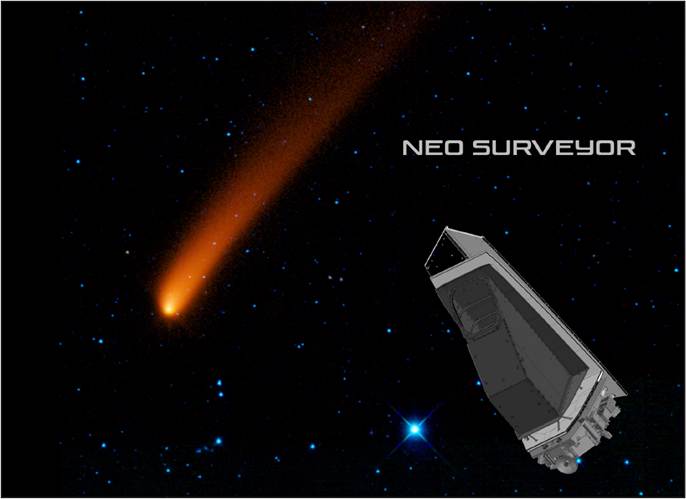
Source: NASA. | GAO-26-108556
Current Status
The NEO Surveyor project is operating within its cost and schedule baselines set in December 2022 but continues to face funding challenges largely due to how NASA had phased project cost reserves over time and technical challenges that led to schedule delays. The project has had insufficient cost reserves in recent years. To mitigate this, the project reported that it augmented its fiscal year (FY) 2025 cost reserves by shifting $35 million from FY 2026, based in part on launch vehicle savings. The project also reported concerns about low cost reserves in FY 2026 and FY 2027 to address cost risks, including further delays.
The project reported schedule challenges generally due to detector system anomalies and the new thermal vacuum testing facility’s readiness. The anomalies led to additional testing, detector replacement, and cabling alterations, which reduced schedule margin. The testing facility delays were due to needing extra rounds of cleaning and other issues. After characterization testing, the project identified issues with testing components cooling as expected, which may affect the facility’s ability to achieve the required thermal conditions to test the telescope in flight-like conditions. Continued test issues may delay instrument delivery.
Additionally, the project recently discovered that it may need to use three rather than two observations to sufficiently track NEO orbits and meet the project’s requirements, as initially planned. The project plans to conduct further testing by summer 2026 to determine options.
Project Information
NASA Lead Mission Directorate: Science
NASA Lead Center/Developer: Jet Propulsion Laboratory
International Partners: None
Launch Location: Kennedy Space Center, FL
Launch Vehicle: Falcon 9
Mission Duration: 5 years
Requirement Derived from: The George E. Brown, Jr. Near-Earth Object Survey Act, Pub. L. No. 109-155, § 321 (2005)
Next Major Project Event: System Integration Review (September 2026)
Cost Performance
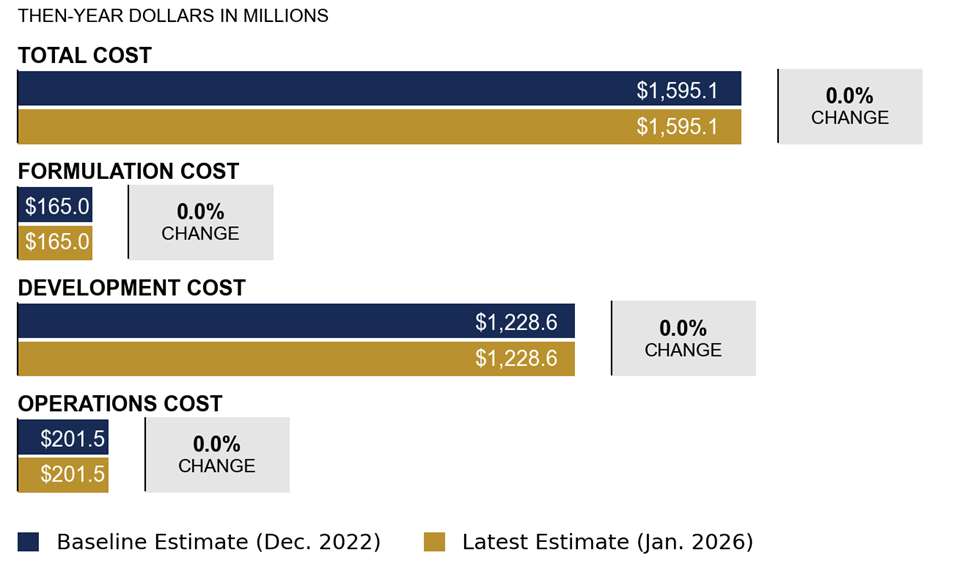
Schedule Performance
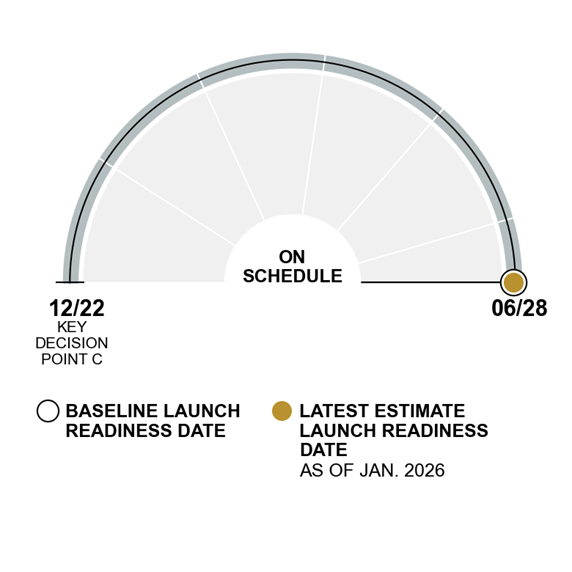
Project Office Comments
Project officials provided technical comments on a draft of this assessment, which were incorporated as appropriate.
Nancy Grace Roman Space Telescope (Roman)
Roman is an observatory designed to perform wide-field imaging and survey of the near-infrared sky. The mission plans to answer questions about the structure of the universe and expand our knowledge of planets beyond our solar system. Fully assembled, the observatory contains a 2.4-meter telescope and two instruments: the Wide Field Instrument and the Coronagraph Instrument. NASA plans to launch Roman to a point about 1 million miles from Earth. It is also planning a guest observer program to provide access to academic and other institutions.
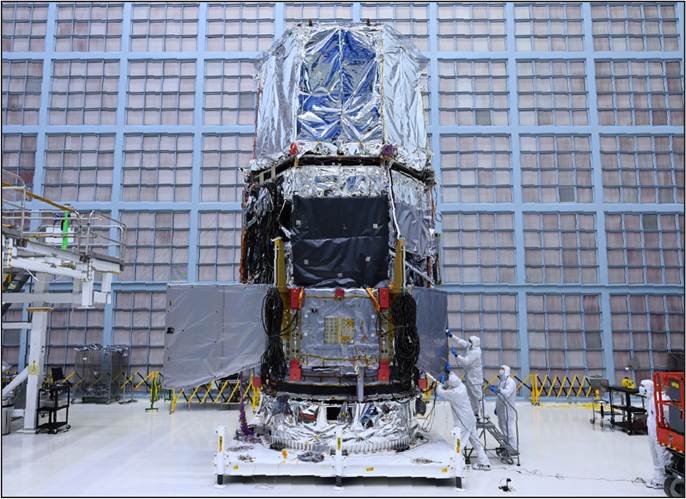
Source: NASA. | GAO-26-108556
Timeline

Key Project Insights
· The Roman project continues to operate within its replanned cost and schedule baselines. The replan was due to effects from the COVID-19 pandemic.
· The project’s replanned launch readiness date is May 2027, but it is working to an earlier launch readiness date of August 2026.
· The Roman observatory is fully assembled and finished testing. The project shipped it to the launch site in June 2026 for final prelaunch preparations.
· The project is working on solutions to reduce humidity on the observatory during launch site operations and a plan to clear the detectors of microscopic ice buildup in space.
· Development of the Roman ground system, which communicates with the observatory, is on schedule.
Project Information
NASA Lead Mission Directorate: Science
NASA Lead Center/ Developer: Goddard Space Flight Center
International Partners: European Space Agency; Centre National d’Etudes Spatiales (France); Japan Aerospace Exploration Agency; Max Planck Institute (Germany)
Launch Location: Kennedy Space Center, FL
Launch Vehicle: Falcon Heavy
Mission Duration: 5 years (does not include on-orbit commissioning)
Requirement Derived from: 2010 Astrophysics Decadal Survey
Cost Performance
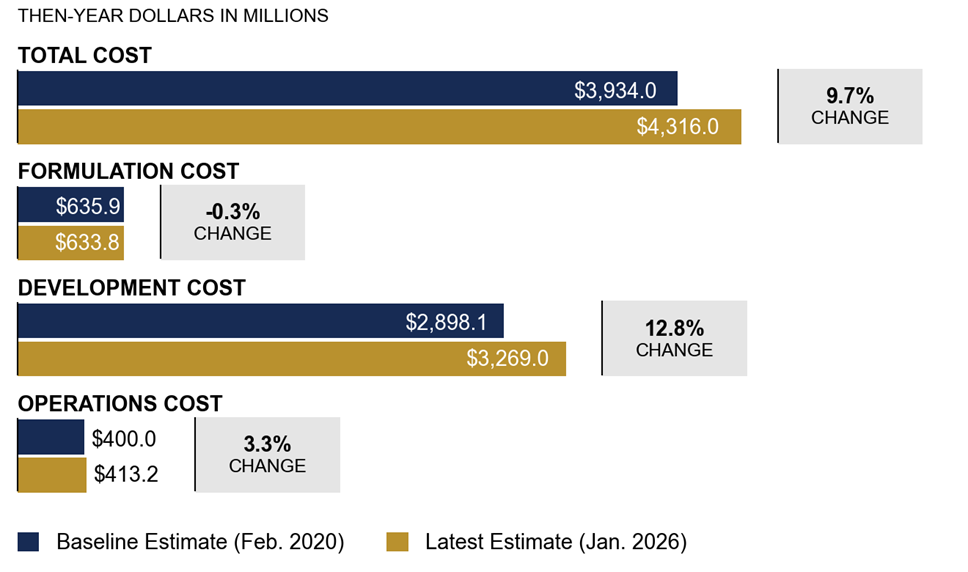
Schedule Performance
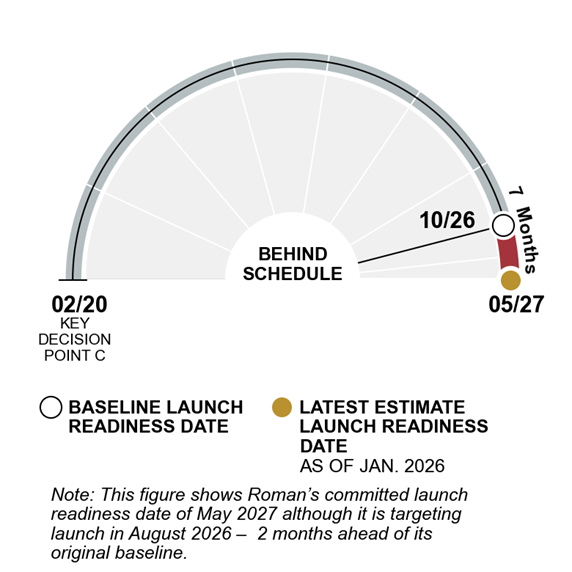
Cost and Schedule Status
The Roman project continues to operate within its replanned cost and schedule commitments, which were updated in June 2021. This replan set a life-cycle cost of $4.316 billion and a launch readiness date of May 2027. The project is working to an earlier launch readiness date of August 2026, which is 2 months earlier than the original October 2026 launch date.
During the 2025 lapse in appropriations, Roman’s integration and test activities were given excepted status, allowing the project to continue to work and maintain its earlier schedule. The project shipped the observatory to the launch site for final preparations in June 2026 after a pre-shipping review in May 2026.
Integration and Test
The project completed assembly of the observatory, and, in April 2026, officials announced that it completed testing. In 2025, the Spacecraft Integrated Payload Assembly (SCIPA), which is comprised of the telescope and instruments integrated with the spacecraft, was mechanically integrated with the outer barrel assembly, deployable aperture cover, and solar panels to form the observatory. Subsequently, the project completed electrical integration of the observatory.
Before its integration, the SCIPA was moved into the test chamber for thermal vacuum testing in August 2025. In this chamber, the SCIPA was subjected to extreme temperatures to mimic the environment it will experience in space to make sure that all the components were working and the instrument alignment and calibration were fully tested
After the project turned on the SCIPA during thermal vacuum testing, a communication issue emerged in the primary instrument, the Wide Field Instrument’s (WFI), electronics. As a result of this issue, one of the eighteen detectors could not transmit science data. While the testing proceeded, the project team developed a solution for this issue—it reprogrammed the subsystem used for programmable control and data handling for the detectors to bypass the issue. After the SCIPA came out of the chamber, the project team tested the fix and it worked on the flight hardware.
Project officials said that, during the SCIPA thermal vacuum testing, they identified cryogenic frost (microscopic ice) buildup on the WFI detectors. This buildup might develop fast enough to cause the detectors to lose scientific calibration. This resulted in spectrum distortion, according to project officials. A working group is assessing options to reduce humidity during launch site operations and minimize outgassing by drying out the observatory’s materials immediately after launch. Officials said they are now determining the schedule for decontamination cycles, or planned heating, to clear the detectors of cryogenic frost in space.
In addition, the Solar Array Sun Shield harness experienced higher temperatures than expected during the thermal vacuum test. This issue is being resolved by adjusting the thermal blanket configurations to allow for increased heat radiation. The solution is predicted to keep temperatures under 130 degrees Celsius, which is below the maximum allowable temperature of 150 degrees Celsius.
The project completed multiple test events for the completed observatory in 2026. These tests include vibration, acoustics, and separation shock testing, which are meant to ensure that the spacecraft can survive the launch environment. In February 2026 and March 2026, the project successfully completed vibration and acoustic testing, respectively.
Other Issues to Be Monitored
· The project is making progress on the ground system, which communicates with Roman, and remains on schedule. The Roman project has asked the Deep Space Network, used to communicate with spacecraft such as Roman, to adjust its maintenance schedule to ensure that a planned network-wide downtime event does not occur during Roman’s launch and early orbit period.
· The project continues to work on launch and commissioning plans. This includes the development of the Roman launch countdown procedures and the decision to launch criteria.
· The project fully integrated the Coronagraph Instrument into the observatory. This instrument is a technology demonstration designed to perform high contrast imaging and spectroscopy to study the atmospheres of nearby exoplanets. According to Roman officials, the instrument is undergoing routine software updates.
Project Office Comments
Roman project officials provided technical comments on a draft of this assessment, which were incorporated as appropriate.
Rosalind Franklin Support and Augmentation (ROSA)
The ROSA project supports the European Space Agency’s (ESA) ExoMars Rosalind Franklin Mission rover that will search for signs of life on Mars. NASA expanded its contributions after ESA ceased its partnership with Russia in 2022. NASA is contributing the Mars Organic Molecule Analyzer Mass Spectrometer. This vital component of the rover’s primary science instrument will analyze Martian subsurface samples to look for the building blocks of life. NASA will also provide (1) the launch vehicle, (2) lightweight radioisotope heaters to warm the rover on Mars, and (3) lander engines, among other things.
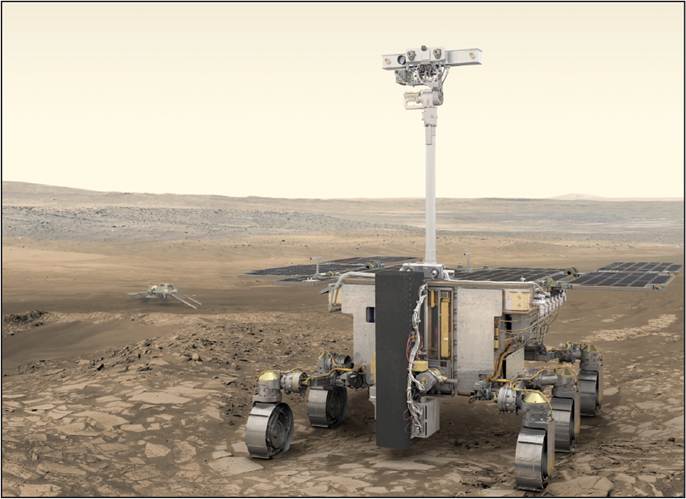
Source: ©ESA; ESA/ATG Medialab. | GAO-26-108556
Current Status
In April 2026, NASA approved the cost and schedule baselines for the ROSA project with the cost set at $396 million and a launch readiness date of December 2028. The project also set a baseline for the delivery of the lander engines in August 2026. In addition, NASA approved the project to enter the system assembly, integration and test, and launch phase at the same time. Officials said this approval was originally scheduled for June 2025 but was postponed because the project was proposed for cancelation in the Fiscal Year 2026 President’s Budget Request.
The project is making progress on the instrument and lander engines. NASA delivered the mass spectrometer to ESA in June 2025, and it is currently undergoing integration and testing. The next critical delivery is the lander engines. The project faced a schedule risk related to potential late deliveries of these engines because of production delays or technical issues. The ROSA project worked with the Mars Sample Return project, which manages the contract for the engines, to accelerate the deliveries. NASA expects to deliver all four engines on time.
ROSA’s top risk is the delay in receiving nuclear launch authorization, which is needed because the rover’s heaters contain nuclear material. NASA could not start the authorization process until the project selected a launch vehicle. The selection was delayed by 3 months because of the government shutdown. Project officials said that NASA is working on the authorization schedule with the Department of Energy to mitigate this risk.
Project Information
NASA Lead Mission Directorate: Science
NASA Lead Center/ Developer: Jet Propulsion Laboratory
International Partners: European Space Agency
Launch Location: Kennedy Space Center, FL
Launch Vehicle: Falcon Heavy
Mission Duration: 34 months
Requirement Derived from: NASA/ESA Memorandum of Understanding on Rosalind Franklin Mission Cooperation
Next Major Project Event: Lander engine delivery (August 2026)
Cost Performance
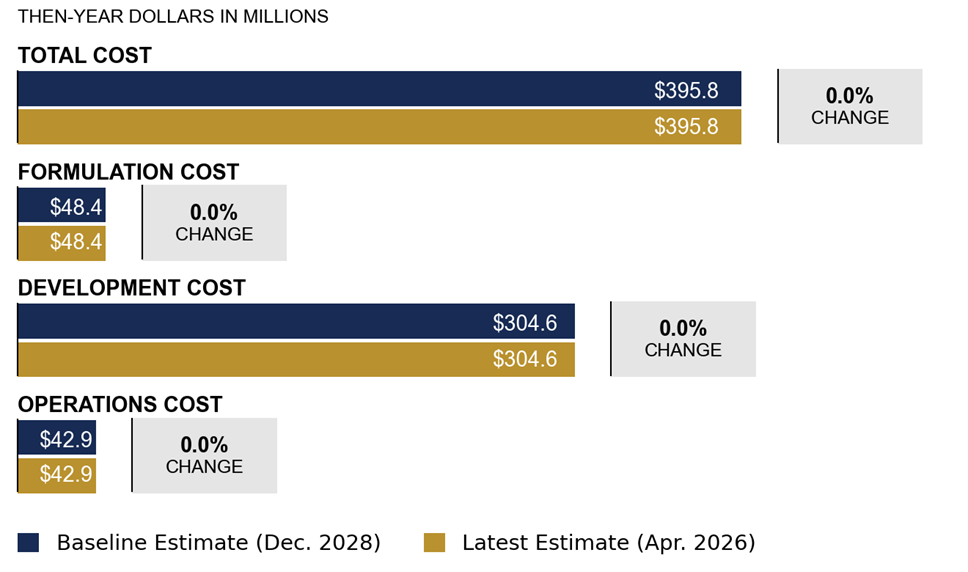
Schedule Performance
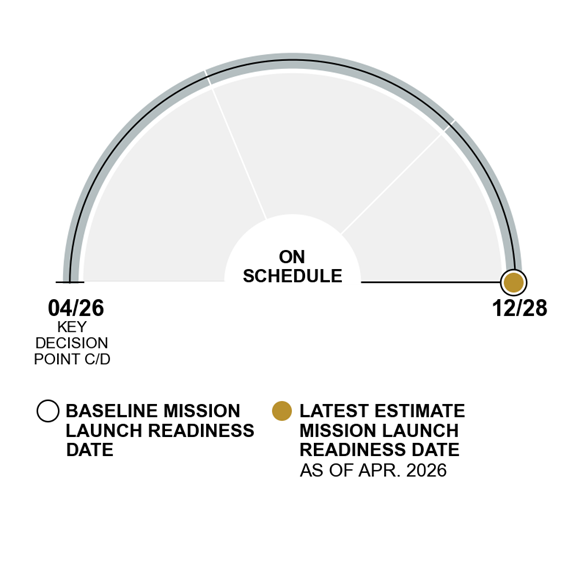
Project Office Comments
Project officials provided technical comments on a draft of this assessment, which were incorporated as appropriate.
United States Deorbit Vehicle (USDV)
The USDV is an uncrewed spacecraft that will deorbit the International Space Station (ISS) at the end of the station’s operational status in 2030. The spacecraft is meant to safely accomplish this through a controlled re-entry that minimizes risks to populated areas. NASA plans to launch USDV and dock it at the ISS 18 months before deorbiting. The USDV will fire its engines to push the ISS through low-Earth orbit, initiating the process for the ISS to naturally reenter Earth’s atmosphere. As part of the reentry process, both the ISS and USDV are expected to break up and fall into a remote part of the ocean.
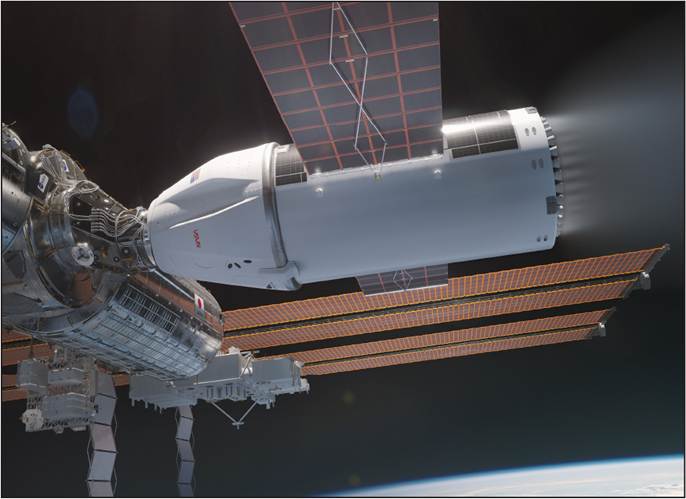
Source: ©2024 Space Exploration Technologies Corp. | GAO-26-108556
Current Status
In February 2026, NASA set cost and schedule baselines for the USDV project with costs set at $1.2 billion and the vehicle delivery readiness date in October 2028. The costs include both the reported $843 million contract with SpaceX for USDV and the future launch vehicle procurement. NASA plans to procure the launch vehicle through NASA’s Launch Services Program. Officials said the cost baseline includes the costs of the ISS workforce necessary to certify the USDV for docking and operation on ISS. The remainder of the resources needed for deorbit will be taken from the ISS sustaining and operations budget. The schedule baseline is 2 months beyond the estimated delivery date of August 2028, which will help provide margin for the planned launch date of mid-2029.
As part of the preliminary design review, completed in November 2025, officials said the project made changes to the Dragon capsule design. For example, to increase power capability for the USDV, SpaceX modified the capsule power system design. Additionally, the project is considering design solutions for the solar arrays mounted to the spacecraft’s trunk.
Furthermore, the project is addressing risks related to the USDV. For example, micrometeoroid or orbital debris damage is a potential risk. Officials stated that the modified design with additional shielding and additional testing will help to mitigate this risk. The project identified the lead time on long lead parts production as a schedule risk that contributed to the use of schedule margin.
Project Information
NASA Lead Mission Directorate: Space Operations
NASA Lead Center: Johnson Space Center
Lead Contractor: SpaceX
International Partners: None
Launch Location: TBD
Launch Vehicle: TBD
Mission Duration: 18 months
Requirement Derived from: Explanatory Statement, 168 Cong. Rec. S7819, S7947 (daily ed., Dec. 20, 2022), accompanying H.R. 2617, Consolidated Appropriations Act, 2023, which became Pub. L. No. 117-328
Next Major Project Event: Critical Design Review (February 2027)
Cost Performance
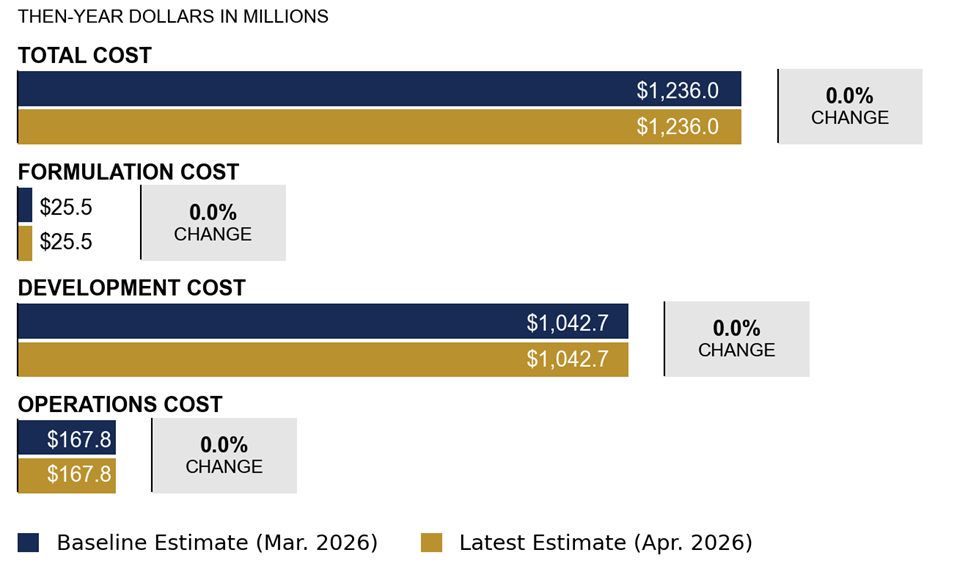
Schedule Performance
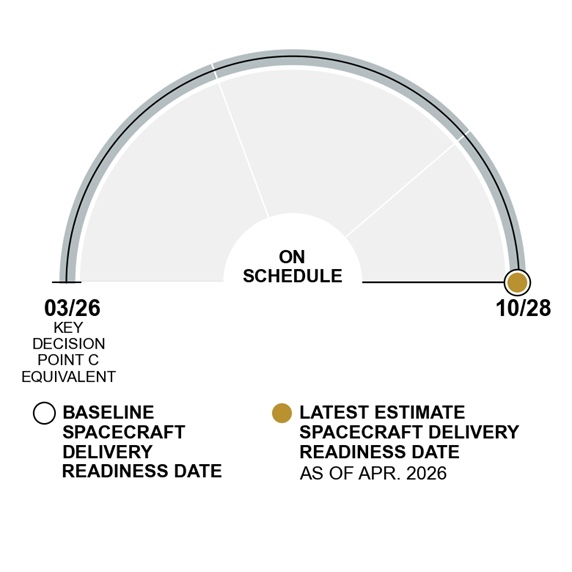
Project Office Comments
Project officials provided technical comments on a draft of this assessment, which were incorporated as appropriate.
Table 6 presents a list and descriptions of National Aeronautics and Space Administration (NASA) major projects that are early in formulation—or have not yet held preliminary design review—and that NASA has not designated as category 1.[45]
|
Project name |
Project description |
|
Deep Atmosphere Venus Investigation of Noble gases, Chemistry, and Imaging (DAVINCI) |
A spacecraft and deep atmosphere probe that will measure the composition and environmental properties of Venus’s atmosphere and surface to understand how the planet’s evolution diverged from Earth’s, and to determine whether it ever had oceans of liquid water. |
|
Earth System Observatory – Atmosphere Observing System - Sky (AOS-Sky) |
A spacecraft that will use remote sensing techniques to measure rain and clouds to improve weather and air quality predictions. |
|
Earth System Observatory – Precipitation Measuring Mission (PMM)a |
A Japan Aerospace Exploration Agency spacecraft that will continue the data record of critical precipitation measurements and provide advanced radar observations for accurate predictions of severe weather. |
|
Earth System Observatory – Surface Biology and Geology – Visible and Short-Wave Infrared (SBG-VSWIR) |
A spacecraft that will collect new global mapping measurements over oceans, coasts, and land to answer questions about natural resources, including critical minerals, agriculture, water quality, wildfire fuel, and water resources. |
|
Gateway – Deep Space Logistics (DSL) |
A project that will execute commercial end-to-end services to provide the Gateway with cargo deliveries, supplies, stowage, and trash disposal prior to crew arrival to maximize the length of crew stays on the Gateway. |
|
HelioSwarm |
A constellation or “swarm” of nine spacecraft that will measure fluctuations in the magnetic field and the motion of the solar wind. The mission will help improve our understanding of the dynamics of the sun, the sun-Earth connection, and the constantly changing space environment. It will also provide critical insights into the fundamental physics governing space and laboratory plasmas to help better understand fusion energy and plasma materials processing. This mission will provide information to help protect astronauts, satellites, and communications signals such as GPS. |
|
Landsat Next |
An Earth-observing satellite, developed by NASA and operated by the U.S. Geological Survey, to provide enhanced land imaging capability to continue the data record. |
|
Subsonic Flight Demonstrator |
A ground-based demonstration project that will develop and test ultra-efficient thin-wing technology on a full-scale demonstration aircraft to inform industry decisions associated with the next generation of commercial aircraft. |
|
UltraViolet EXplorer (UVEX) |
A space telescope that will provide a deep view of the ultraviolet sky, conduct a detailed study of nearby galaxies and enable follow-up observations of gravitational wave events and other stellar explosions. |
|
Venus Emissivity, Radio Science, InSAR, Topography, And Spectroscopy (VERITAS) |
A spacecraft that will orbit Venus at a low altitude to create high-quality maps of the planet’s surface and interior structure. The radar instrument will produce global topography and imaging; the spectrometer instrument will create a global map of rock types and study volcanic activity; and the telecom system will study the planet’s gravity field. The project will improve our understanding of how Venus became uninhabitable after starting out so Earth-like. |
|
Venus Synthetic Aperture Radar (VenSAR) |
An instrument that collects synthetic aperture radar imaging and polarimetry, altimetry, and microwave radiation measurements of Venus’s surface as part of the European Space Agency’s EnVision Mission to Venus. |
Source: GAO analysis of NASA data. | GAO‑26‑108556
aPMM is a Japan Aerospace Exploration Agency mission previously proposed as a portion of AOS-Storm. According to NASA officials and the agency’s fiscal year 2025 operating plan, the majority of AOS-Storm will not proceed to the next phase.
This is our 18th annual report assessing selected large-scale National Aeronautics and Space Administration (NASA) programs and projects. When NASA determines that a project has an estimated life-cycle cost of over $250 million, we include that project in our annual review up through its launch date or the end of its development.
Our objectives were to assess (1) the cost and schedule performance of NASA’s major projects in development, (2) the challenges and opportunities that could affect major project performance in the future; and (3) the effects, if any, of workforce reductions on NASA’s ability to manage its portfolio of major projects. We also generated individual project summaries. For a breakout of which projects are included in the portfolio’s cost and schedule analysis and which have either an assessment in appendix I or a description in appendix II, see figure 9 below.
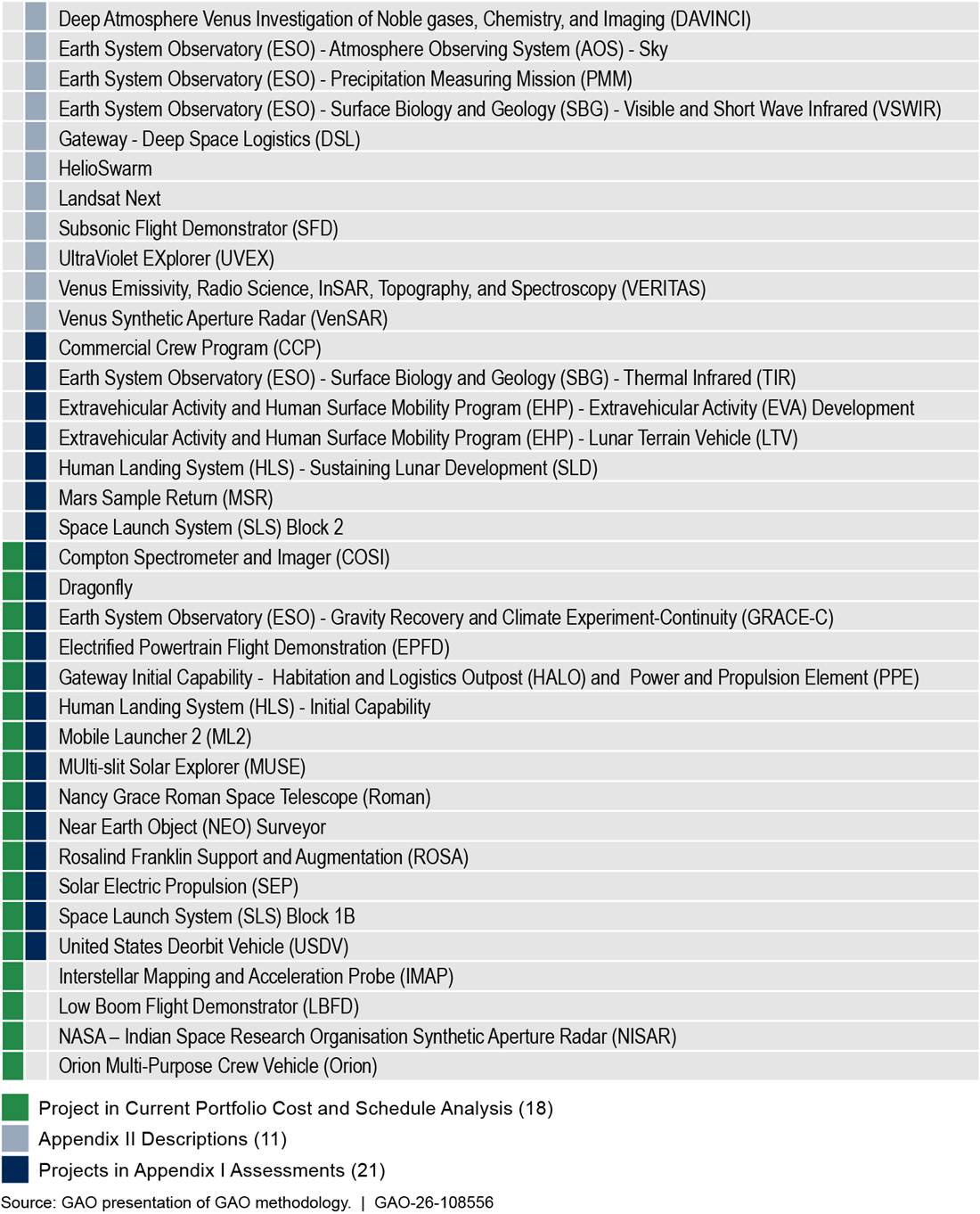
To conduct our review, we developed several standard data questionnaires. NASA’s Office of the Chief Financial Officer completed the questionnaires on project cost and schedule data. We compared the current questionnaire data to questionnaire data from our prior reviews to analyze long-term trends. We used another questionnaire that was completed by project offices to gather general data and information on the projects, such as their category, their technology and design maturity, key schedule events, and development partners.[46] The information available on individual projects depends on where the project is in its life cycle. For example, for projects in an early stage of NASA’s acquisition life cycle—called formulation—there are still unknowns about technology and design. Additionally, we used a third questionnaire completed by project offices to collect information on the lead contractors and developers associated with projects in our assessments and supplemented this with other information as needed.
To assess the cost and schedule performance of major NASA projects in development, we compared current development cost and schedule data we received from NASA for the 18 projects in development during our review to the projects’ original baselines.[47] All of these projects established their original baselines at Key Decision Point (KDP) C except for the United States Deorbit Vehicle (USDV), which established baselines at its outbrief for its preliminary design review. The Commercial Crew Program has a tailored project life cycle and project management requirements, so we excluded it from these analyses. Most of the latest estimates for cost and schedule data were as of January 2026 when we received our questionnaire responses from NASA. We incorporated cost and schedule exceptions to the January 2026 data up through April 2026.[48] Those exceptions include the following:
· For our portfolio-level cost and schedule analysis, we utilized the latest estimates we received for the Electrified Powertrain Flight Demonstration (EPFD) prior to its cancelation. For the EPFD individual assessment, we reported the estimates we received in January 2026 that reflected costs after its cancelation.
· The agency provided updated costs for Orion Multi-Purpose Crew Vehicle (Orion) and NISAR as of March 2026. It provided us baseline estimates for Rosalind Franklin Support and Augmentation and USDV that were completed in April 2026.
· Although the LBFD, Near Earth Object Surveyor, and Nancy Grace Roman Space Telescope projects provided us with estimates in January 2026 that indicated underruns from their latest signed key development milestone reviews, we determined that we would not report these underruns until the projects complete updated memorandums finalizing the release of funds. This decision is in alignment with how we have reported underruns in prior reports.
We determined that five projects’ cost and/or schedule are under review. These projects were Gateway Initial Capability, Human Landing System - Initial Capability, Mobile Launcher 2, Solar Electric Propulsion, and Space Launch System Block 1B. Because reviews associated with the cost and schedule for these projects are currently ongoing, we presented information based on the latest estimates that we received from NASA.
We took additional steps to assess the quality and reliability of the data, such as checking to ensure the data summed to the totals provided and reviewing any changes since our last data collection. We also followed up with the agency on any perceived errors or unexplained cost changes.
To examine longer-term trends for NASA’s portfolio of major projects in development, we compared the original baseline development costs as well as the total cumulative development cost and schedule overruns for the portfolio for each year from 2016 through 2026.
To assess annual cost and schedule performance, we compared the cost and schedule performance data received from NASA during this review to the performance data presented in the prior year’s report for all projects in development during our review.[49] This analysis identifies whether a project’s latest development cost or schedule estimates have changed from our prior year report. Prior year report cost and schedule estimates were generally based on data collected early in the calendar year that we issued our report. All cost information in this report is presented in nominal then-year dollars for consistency with budget data. We did not assess the cost and schedule performance of projects in formulation because they have not yet established baselines.
To assess the risks that could affect major project performance in the future, we leveraged the data collected for each project assessment on cost and schedule performance and project risks and challenges. We compared the projects’ previous schedules to the mission schedules announced for Artemis III through V. We interviewed officials in NASA’s Moon to Mars program office and discussed how some Artemis projects will need to adjust their plans to execute the newly described missions. We also reviewed project documentation—including quarterly status reports, schedules, risk assessments, and major project review documentation—and compared projects’ previous plans for work to be conducted for the Artemis III through V missions with the changes that were announced in February and March 2026 to these missions. These reviews allowed us to identify further challenges faced by NASA projects.
To determine how NASA’s workforce reductions are affecting project management, we reviewed how NASA reduced its workforce from March 2025 through January 2026, assessed the effects of workforce reductions on individual projects in the portfolio, and reviewed NASA’s plans for assessing its workforce needs to inform hiring and training plans.
To review how NASA reduced its workforce, we examined the President’s Budget Request for fiscal year 2026 to review the proposed civil servant workforce reduction plans and associated budget by mission directorate. We obtained and analyzed data collection instruments completed by NASA that enumerated actual workforce reductions from March 22, 2025, through January 10, 2026, by state across NASA.[50] We obtained available monthly and quarterly status reports for each project in the portfolio and quantified planned and actual project workforce levels from March 22, 2025, through January 10, 2026. We compared the actual workforce reductions with the proposed plans in the fiscal year 2026 President’s Budget Request to see how closely they aligned.
Additionally, we analyzed the appropriated funding in fiscal year 2026 for mission directorates as seen in the Commerce, Justice, Science; Energy and Water Development; and Interior and Environment Appropriations Act, 2026 and compared those with the proposed fiscal year 2026 budget to review year-to-year funding differences.[51] We also compared the appropriated funding levels in fiscal year 2026 with the appropriated funding for fiscal year 2025, as seen in the Full-Year Continuing Appropriations and Extensions Act, 2025, for NASA’s mission directorates to review how the funding changed from year to year.[52]
To assess the effects of the workforce reductions on individual projects in the portfolio, we collected written responses from each project about its workforce levels and any challenges related to workforce reductions in our project-level questionnaires. We also asked individual projects workforce related questions during interviews regarding the extent to which workforce reductions have affected either project progress or plans for future work. In addition, we analyzed quarterly and monthly project reports to identify instances where projects characterized workforce availability as a project risk or issue.
To review NASA’s plans for assessing its workforce needs to inform hiring and training plans, we obtained and analyzed the content of NASA’s February 2026 workforce directive. This allowed us to identify the steps the agency plans to take to restore the civil servant workforce and address operational shortfalls. We also interviewed officials and obtained written responses to workforce-related questions from officials within NASA’s human capital office. This allowed us to determine the extent to which NASA is addressing workforce risks, as well as an opportunity to discuss workforce data, ongoing and planned assessments, and the agency’s planned actions to fill workforce gaps.
Project Profile Information on Each Individual Project Assessment
This year, we developed assessments for 21 projects with estimated life-cycle costs greater than $250 million. We included individual assessments for NASA projects and programs that have either passed key milestones or that NASA designated as a category 1 project. We did not complete individual assessments for the NASA-Indian Space Organization – Synthetic Aperture Radar, Interstellar Mapping and Acceleration Probe, Low Boom Flight Demonstration, and Orion projects because they launched or flew prior to May 2026. For each assessment, we included a description of the project’s objectives; information concerning the lead NASA mission directorate, the NASA center, and international partners involved in the project, if applicable; the project’s cost and schedule performance, when available; key project dates; and a brief narrative describing the current status of the project. We also provided a detailed discussion of project challenges for selected projects, as applicable. In addition, we listed the lead contractor or developer in each assessment, meaning the entity NASA told us is performing the bulk of the development and integration work, whether that entity is a contractor or not, based on a questionnaire that we submitted to NASA.
In appendix II, we included 11 descriptions of projects that are early in formulation—or have not yet held preliminary design review as of January 1, 2026—and that NASA did not designate as category 1.
To assess the cost and schedule changes of each project, we obtained data directly from NASA’s Office of the Chief Financial Officer through our questionnaire. For the Commercial Crew Program, we obtained current cost and schedule data from NASA through a separate questionnaire. We also had NASA confirm preliminary estimates for the 17 projects in formulation as of January 2026. We included cost and schedule estimates for the early formulation projects that had selected a contractor or progressed to their preliminary design review phase.
To assess project schedules, we determined when NASA initiated the project, which is generally referred to as formulation start. NASA refers to a project’s start as KDP A or the beginning of the formulation phase. Projects selected as a result of a one-step announcement of opportunity enter formulation at KDP A. The end of development is determined at KDP C and could be the projected or actual launch date, first flight date, or review date. The implementation phase includes the operations of the mission and concludes with project disposal.
Project Challenges Discussion on Each Individual Project Assessment
To assess the status, risk, and challenges for each project, we submitted a questionnaire to each project office. In the questionnaire, we requested information on the maturity of critical technologies, the number of releasable design drawings or other design stability data at project milestones, and international partnerships.[53] When applicable, we compared the level of maturity of critical technologies at preliminary design review and the percentage of design drawings released at critical design review against our best practices.[54] The questionnaire also included questions on the project’s workforce and effects of the 2025 lapse in appropriations, commonly referred to as a government shutdown, if any. We also interviewed or received written responses from representatives from projects across multiple NASA centers to discuss the information on the questionnaires and the projects’ statuses. We did not interview representatives for projects that launched during our audit. We also conducted site visits at Goddard Space Flight Center and the Applied Physics Laboratory.
We then reviewed project documentation—including monthly status reports, schedules, risk assessments, and major project review documentation—to corroborate any testimonial evidence we received in the interviews. These reviews allowed us to identify further challenges faced by NASA projects. The second page of each two-page project assessment highlights key challenges that affected that project or could affect that project’s performance. For this year’s report, we identified challenges across the projects that we reviewed in the categories of cost and schedule, design, integration and test, launch vehicle, operations, and technology. These challenges do not represent an exhaustive or exclusive list and are based on our definitions and assessments, not those of NASA.
We conducted this performance audit from June 2025 to July 2026 in accordance with generally accepted government auditing standards. Those standards require that we plan and perform the audit to obtain sufficient, appropriate evidence to provide a reasonable basis for our findings and conclusions based on our audit objectives. We believe that the evidence obtained provides a reasonable basis for our findings and conclusions based on our audit objectives.
Appendix IV: Estimated Life-Cycle Costs and Launch Dates for Major NASA Projects in Development Assessed in GAO’s 2026 Report
The National Aeronautics and Space Administration (NASA) has six Artemis and Artemis-related projects in implementation. Implementation includes building, launching, and operating the system, among other activities. Table 7 shows the original cost and key schedule milestone baselines, set before the start of a project’s implementation phase, and also includes the current key schedule milestone dates and life-cycle cost estimates for these six projects.
Table 7: Life-Cycle Cost and Schedule Estimates of Artemis and Artemis-Related Major NASA Projects in Development
|
Project name |
Original baseline key schedule milestone date |
Current key schedule milestone date |
Original baseline life-cycle cost estimate (dollars in millions)a |
Current life-cycle cost estimate (dollars in millions) |
|
Gateway Initial Capabilityb,c |
December 2027 |
December 2027 |
5,280.9 |
5,280.9 |
|
HLS – Initial Capabilityd |
February 2028 |
February 2028 |
4,878.0 |
4,878.0 |
|
ML2c |
September 2027 |
September 2027 |
1,873.1 |
1,873.1 |
|
Orion |
April 2023 |
April 2026 |
11,283.5 |
14,756.0 |
|
SEPd |
December 2024 |
January 2029 |
335.6 |
402.4 |
|
SLS Block 1Bc |
January 2028 |
January 2028 |
4,952.8 |
5,182.2 |
Legend: HLS: Human Landing System; ML2: Mobile Launcher 2; Orion: Orion Multi-Purpose Crew Vehicle; SEP: Solar Electric Propulsion; and SLS: Space Launch System.
Source: GAO analysis of NASA data. | GAO‑26‑108556
Note: Data for GAO’s current assessment were collected as of January 2026. See appendix III for additional details. In addition, the Orion and SEP projects have rebaselined their estimates since their original baselines.
aAll original baselines in the table are from the project’s key decision point C or equivalent review.
bThe Gateway Initial Capability’s estimates include the cost and schedule of the Power and Propulsion Element and Habitation and Logistics Outpost projects, the launch vehicle, and portions of program mission execution essential for the launch.
cNASA took actions to stop work associated with the ML2 and SLS Block 1B projects and announced that it will pause Gateway Initial Capability. As a result, their costs and schedules are under review and any overruns reported are based on the scope of work for the projects before they were paused. Until that review is complete, information presented above is based on the latest estimates that GAO received from NASA.
dThe HLS Initial Capability project cost and schedule are currently under review. The SEP project schedule is under review. Until these reviews are complete, information presented is based on the latest estimates that GAO received from NASA.
Table 8 shows the original cost and key schedule milestone baselines, as well as the current key schedule milestone dates and life-cycle cost estimates, for 13 non-Artemis major NASA projects in implementation.
|
Project name |
Original baseline key schedule milestone date |
Current key schedule milestone date |
Original baseline life-cycle cost estimate (dollars in millions)a |
Current life-cycle cost estimate (dollars in millions) |
|
CCP-Boeingb |
August 2017 |
Fall 2026 |
4,229.0 |
4,556.1 |
|
CCP-SpaceXb |
April 2017 |
November 2020 |
2,598.7 |
2,757.7 |
|
COSI |
November 2027 |
November 2027 |
273.3 |
273.3 |
|
Dragonfly |
July 2028 |
July 2028 |
3,352.4 |
3,352.4 |
|
EPFDc |
May 2028 |
May 2028 |
654.9 |
655.6 |
|
ESO-GRACE-C |
July 2029 |
July 2029 |
658.0 |
658.0 |
|
IMAP |
December 2025 |
September 2025 |
781.8 |
781.8 |
|
LBFDd |
January 2022 |
October 2025 |
582.4 |
902.4 |
|
MUSE |
November 2027 |
November 2027 |
389.3 |
389.5 |
|
NEO Surveyord |
June 2028 |
June 2028 |
1,595.1 |
1,595.1 |
|
NISAR |
September 2022 |
July 2025 |
866.9 |
1,174.2 |
|
Romand |
October 2026 |
May 2027e |
3,934.0 |
4,316.0 |
|
ROSA |
December 2028 |
December 2028 |
395.8 |
395.8 |
|
USDV |
October 2028 |
October 2028 |
1,236.0 |
1,236.0 |
Legend: CCP: Commercial Crew Program; COSI: Compton Spectrometer and Imager; EPFD: Electrified Powertrain Flight Demonstration; ESO-GRACE-C: Earth System Observatory-Gravity Recovery and Climate Experiment – Continuity; IMAP: Interstellar Mapping and Acceleration Probe; LBFD: Low Boom Flight Demonstrator; MUSE: MUlti-slit Solar Explorer; NEO: Near Earth Orbit; NISAR: NASA – Indian Space Research Organisation (ISRO) Synthetic Aperture Radar; Roman: Nancy Grace Roman Space Telescope; ROSA: Rosalind Franklin Support and Augmentation; USDV: United States Deorbit Vehicle.
Source: GAO analysis of NASA data. | GAO‑26‑108556
Note: Data for GAO’s current assessment are generally as of January 2026. See appendix III for additional details. The LBFD and NISAR projects rebaselined their estimates since their original baselines.
aAll original baselines in the table are from the project’s key decision point C or equivalent review.
bThe Commercial Crew Program has a tailored project life cycle and project management requirements and did not establish a baseline. The cost values represent the original contract values and latest maximum contract values as reported by NASA.
cNASA canceled the EPFD project.
dThe LBFD, Roman, and NEO Surveyor projects reported lower development cost estimates in January 2026. Because NASA had not finalized the estimates at the time of this report, GAO did not include them in its analysis.
eThe Roman project’s committed launch readiness date is May 2027. The project is currently targeting an August 2026 launch date, which is 2 months ahead of its original baseline of October 2026.
NASA approved rebaselines for four major projects included in our review since they set their original cost and key schedule milestone baselines at key development point C. Table 9 shows the latest approved rebaselined estimates for cost and key schedule milestone dates, as well as the current estimates for cost and key schedule milestone dates for these projects.
Table 9: Approved Rebaseline and Current Life-Cycle Cost and Schedule Estimates for Major NASA Projects
|
Project name |
Date of latest approved rebaseline |
Latest approved rebaseline key schedule milestone date |
Current key schedule milestone date |
Latest approved rebaseline life-cycle cost estimate (dollars in millions) |
Current life-cycle cost estimate (dollars in millions) |
|
LBFDa |
January 2024 |
October 2024 |
October 2025 |
838.6 |
902.4 |
|
NISAR |
August 2022 |
October 2024 |
July 2025 |
1,118.0 |
1,174.2 |
|
Orion |
August 2021 |
May 2024 |
April 2026 |
13,811.0 |
14,756.0 |
|
SEPb |
March 2022 |
October 2028 |
January 2029 |
382.4 |
402.4 |
Legend: LBFD: Low Boom Flight Demonstrator; NISAR: NASA - Indian Space Research Organisation (ISRO) – Synthetic Aperture Radar; Orion: Orion Multi-Purpose Crew Vehicle; SEP: Solar Electric Propulsion.
Source: GAO analysis of NASA data. | GAO‑26‑108556
Note: Data for GAO’s current assessment are generally as of January 2026. See appendix III for additional details.
aLBFD reported lower development cost estimates in January 2026. Because NASA had not finalized the estimate at the time of this report, GAO did not include it in its analysis.
bThe SEP project’s schedule is under review. Until this review is complete, information presented is based on the latest estimates that GAO received from NASA.
Appendix V: Major NASA Projects and Programs in GAO’s Annual Reports from 2009 to 2026 That Completed Development
We included 52 National Aeronautics and Space Administration (NASA) major projects or programs in our annual reports from 2009 to 2026 whose development culminated in an event such as a launch, an achievement of minimum success criteria, or cancelation (see table 10).
Table 10: Major NASA Projects and Programs in GAO’s Annual Reports from 2009 to 2026 That Completed Development
|
Major project name |
Year first included in GAO annual report |
Date of development end |
Result of development |
|
Aquarius |
2009 |
2011 |
Launched |
|
Dawn |
2009 |
2007 |
Launched |
|
Double Asteroid Redirection Test |
2018 |
2021 |
Launched |
|
Europa Clipper |
2016 |
2024 |
Launched |
|
Exploration Ground Systems |
2016 |
2022 |
Demonstrated initial capability |
|
Gamma-ray Large Area Space Telescope |
2009 |
2008 |
Launched |
|
Glory |
2009 |
2011 |
Launched but did not reach orbit |
|
Global Precipitation Measurement Mission |
2009 |
2014 |
Launched |
|
Gravity Recovery and Climate Experiment Follow-On |
2014 |
2018 |
Launched |
|
Gravity Recovery and Interior Laboratory |
2010 |
2011 |
Launched |
|
Herschel |
2009 |
2009 |
Launched |
|
Ice, Cloud, and Land Elevation Satellite-2 |
2011 |
2018 |
Launched |
|
Ionospheric Connection Explorer |
2016 |
2019 |
Launched |
|
Interior Exploration using Seismic Investigations, Geodesy, and Heat Transport |
2014 |
2018 |
Launched |
|
Interstellar Mapping and Acceleration Probe |
2019 |
2025 |
Launched |
|
James Webb Space Telescope |
2009 |
2021 |
Launched |
|
Juno |
2010 |
2011 |
Launched |
|
Kepler |
2009 |
2009 |
Launched |
|
Landsat Data Continuity Mission |
2009 |
2013 |
Launched |
|
Landsat 9 |
2017 |
2021 |
Launched |
|
Low Boom Flight Demonstrator |
2018 |
2025 |
First Flight |
|
Laser Communications Relay Demonstration |
2018 |
2021 |
Launched |
|
Lucy |
2018 |
2021 |
Launched |
|
Lunar Atmosphere and Dust Environment Explorer |
2011 |
2013 |
Launched |
|
Lunar Reconnaissance Orbiter |
2009 |
2009 |
Launched |
|
Magnetospheric Multiscale |
2010 |
2015 |
Launched |
|
Mars 2020 |
2015 |
2020 |
Launched |
|
Mars Atmosphere and Volatile EvolutioN |
2011 |
2013 |
Launched |
|
Mars Science Laboratory |
2009 |
2011 |
Launched |
|
NASA–Indian Space Research Organisation Synthetic Aperture Radar |
2015 |
2025 |
Launched |
|
National Polar-orbiting Operational Environmental Satellite System Preparatory Project |
2009 |
2011 |
Launched |
|
On-Orbit Servicing, Assembly, and Manufacturing 1a |
2018 |
2024 |
Canceled |
|
Orbiting Carbon Observatory |
2009 |
2009 |
Launched but did not reach orbit |
|
Orbiting Carbon Observatory-2 |
2011 |
2014 |
Launched |
|
Origins-Spectral Interpretation-Resource Identification-Security-Regolith Explorer |
2013 |
2016 |
Launched |
|
Orion Multi-Purpose Crew Vehicle |
2012 |
2026 |
Launched |
|
Parker Solar Probeb |
2011 |
2018 |
Launched |
|
Plankton, Aerosol, Cloud, ocean Ecosystem |
2017 |
2024 |
Launched |
|
Psyche |
2018 |
2023 |
Launched |
|
Radiation Belt Storm Probes |
2010 |
2012 |
Launched |
|
Radiation Budget Instrument |
2017 |
2018 |
Canceled |
|
Solar Dynamics Observatory |
2009 |
2010 |
Launched |
|
Soil Moisture Active Passive |
2011 |
2015 |
Launched |
|
Space Launch System |
2012 |
2022 |
Launched |
|
Space Network Ground Segment Sustainment |
2013 |
2021 |
Achieved minimum success |
|
Spectro-Photometer for the History of the Universe, Epoch of Re-ionization and Ices Explorer |
2020 |
2025 |
Launched |
|
Stratospheric Observatory for Infrared Astronomy |
2009 |
2014 |
Full operational capability |
|
Surface Water and Ocean Topography |
2014 |
2022 |
Launched |
|
Tracking and Data Relay Satellite Replenishment (K&L) |
2011 |
2013 (K) 2014 (L) |
Launched |
|
Transiting Exoplanet Survey Satellite |
2015 |
2018 |
Launched |
|
Volatiles Investigating Polar Exploration Rover |
2021 |
2024 |
Canceled |
|
Wide-field Infrared Survey Explorer |
2009 |
2009 |
Launched |
Source: GAO analysis of NASA data and previously issued GAO reports. | GAO‑26‑108556
aPreviously known as Restore-L.
bPreviously known as Solar Probe Plus.
Appendix VI: Cumulative Development Cost and Schedule Performance for NASA’s Current Portfolio of Major Projects
Table 11: Cumulative Development Cost and Schedule Overruns for NASA’s Current Portfolio of 18 Major Projects in Development
|
|
|
|
Changes from original baseline to current assessment |
||
|
Current performance status |
Project |
Original baseline development cost estimate (then-year dollars in millions) |
Development schedule delay (years) |
Development cost overrun (then-year dollars in millions) |
Development cost growth percentage |
|
First year estimate reported |
ROSA |
304.6 |
0 |
0.0 |
0.0 |
|
USDV |
1,042.7 |
0 |
0.0 |
0.0 |
|
|
No variance expected from cost or schedule baselines |
COSI |
224.0 |
0 |
0.0 |
0.0 |
|
Dragonfly |
1,963.5 |
0 |
0.0 |
0.0 |
|
|
EPFDa |
237.3 |
0 |
0.0 |
0.0 |
|
|
ESO-GRACE-C |
441.7 |
0 |
0.0 |
0.0 |
|
|
HLS – Initial Capabilityb |
2,339.0 |
0 |
0.0 |
0.0 |
|
|
ML2c |
1,873.1 |
0 |
0.0 |
0.0 |
|
|
MUSE |
296.9 |
0 |
0.0 |
0.0 |
|
|
NEO Surveyord |
1,228.6 |
0 |
0.0 |
0.0 |
|
|
Underrunning original estimate |
IMAP |
589.5 |
-0.3 |
-22.2 |
-3.8 |
|
Overrunning original estimate |
Gateway Initial Capabilityc,e |
3,561.8 |
0 |
0.1 |
0.0 |
|
LBFDd |
467.7 |
3.8 |
301.2 |
64.4 |
|
|
NISAR |
661.0 |
2.8 |
312.0 |
47.2 |
|
|
Orion |
6,768.4 |
3.0 |
3,478.0 |
51.4 |
|
|
Romand,f |
2,898.1 |
0.6 |
370.9 |
12.8 |
|
|
SEPb |
155.9 |
4.1 |
67.3 |
43.2 |
|
|
SLS Block 1Bc |
3,675.3 |
0.0 |
229.4 |
6.2 |
|
|
Totals |
|
28,729.1 |
14 |
4,736.7 |
|
Legend: ROSA: Rosalind Franklin Support and Augmentation; USDV: United States Deorbit Vehicle; COSI: Compton Spectrometer and Imager; EPFD: Electrified Powertrain Flight Demonstration; ESO-GRACE-C: Earth System Observatory-Gravity Recovery and Climate Experiment – Continuity; HLS: Human Landing System; ML2: Mobile Launcher 2; MUSE: MUlti-slit Solar Explorer; NEO: Near Earth Orbit; IMAP: Interstellar Mapping and Acceleration Probe; LBFD: Low Boom Flight Demonstrator; NISAR: NASA – Indian Space Research Organisation (ISRO) Synthetic Aperture Radar; Orion: Orion Multi-Purpose Crew Vehicle; Roman: Nancy Grace Roman Space Telescope; SEP: Solar Electric Propulsion; SLS: Space Launch System.
Source: GAO analysis of NASA data. | GAO‑26‑108556
Note: Positive values indicate cost growth or launch delays compared to the prior year reported estimates. Values in parentheses indicate cost decreases or earlier than planned launch. Data for GAO’s current assessment are generally as of January 2026. See appendix III for additional details.
aNASA canceled the EPFD project.
bThe HLS Initial Capability project cost and schedule are currently under review. The SEP project schedule is under review. Until these reviews are complete, information presented is based on the latest estimates that GAO received from NASA.
cNASA took actions to stop work associated with the ML2 and SLS Block 1B projects and announced that it will pause Gateway Initial Capability. As a result, their costs and schedules are under review and any overruns reported are based on the scope of work for the projects before they were paused. Until that review is complete, information presented above is based on the latest estimates that GAO received from NASA.
dThe LBFD, Roman, and NEO Surveyor projects reported lower development cost estimates in January 2026. Because NASA had not finalized the estimates at the time of this report, GAO did not include them in its analysis.
eThe Gateway Initial Capability program’s estimates include the cost and schedule of the Power and Propulsion Element and Habitation and Logistics Outpost projects, the launch vehicle, and portions of program mission execution essential for the launch.
fThe Roman project’s committed launch readiness date is May 2027. The project is currently targeting an August 2026 launch date which is 2 months ahead of its original baseline of October 2026. Additionally, the cost and schedule estimates for Roman include the related technology demonstration mission, the Roman Coronagraph Instrument.
GAO Contact
William Russell, RussellW@gao.gov
Staff Acknowledgments
In addition to the contact named above, Erin Kennedy (Assistant Director); Tonya Woodbury (Analyst-in-Charge); Cassandra Ardern; John Armstrong; Paul Bauer; Dominique Belanger; Bonnie Binggeli; Tina Cota-Robles; Cassidy Cramton; Matthew T. Crosby; Lorraine Ettaro; Edward Harmon; Joy Kim; Meredith Allen Kimmett; Adie Lewis; Elana Maloul; Jose A. Ramos; Carrie Rogers; Kimberly Schuster; Hashem Shokravi; Matt St. Geme; Juli Steinhouse; Ryan Stott; Tom Twambly; John Warren; Alyssa Weir; and Adam Wolfe made significant contributions to this report.
This appendix contains credit, copyright, and other source information for images, tables, or figures in this product when that information was not listed adjacent to the image, table, or figure.
Front Cover Graphics
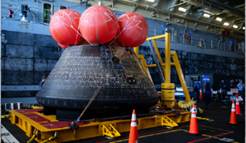 NASA
(Orion)
NASA
(Orion)
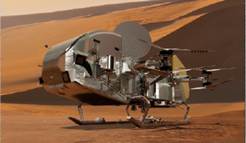 Johns
Hopkins University Applied Physics Laboratory (Dragonfly)
Johns
Hopkins University Applied Physics Laboratory (Dragonfly)
 NASA/Scott Wiessinger (Roman)
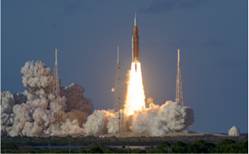 NASA
NASA
Project Assessment Graphics
 All cost performance figures: GAO
analysis of NASA data
All cost performance figures: GAO
analysis of NASA data
 All schedule performance figures: GAO
analysis of NASA data
All schedule performance figures: GAO
analysis of NASA data
 All timeline figures: GAO analysis of
NASA documentation
All timeline figures: GAO analysis of
NASA documentation
Source: GAO (icons)
NASA: Assessments of Major Projects. GAO‑25‑107591. Washington, D.C.: July 1, 2025.
NASA Artemis Missions: Exploration Ground Systems Program Could Strengthen Schedule Decisions. GAO‑25‑106943. Washington, D.C.: October 17, 2024.
Artemis Programs: NASA Should Document and Communicate Plans to Address Gateway’s Mass Risk. GAO‑24‑106878. Washington, D.C.: July 31, 2024.
NASA: Assessments of Major Projects. GAO‑24‑106767. Washington, D.C.: June 20, 2024.
NASA Artemis Programs: Lunar Landing Plans Are Progressing, but Challenges Remain. GAO‑24‑107249. Washington, D.C.: January 17, 2024.
NASA Artemis Programs: Crewed Moon Landing Faces Multiple Challenges. GAO‑24‑106256. Washington, D.C.: November 30, 2023.
Space Launch System: Cost Transparency Needed to Monitor Program Affordability. GAO‑23‑105609. Washington, D.C.: September 7, 2023.
NASA: Assessments of Major Projects. GAO‑23‑106021. Washington, D.C.: May 31, 2023.
NASA Lunar Programs: Improved Mission Guidance Needed as Artemis Complexity Grows. GAO‑22‑105323. Washington, D.C.: September 8, 2022.
NASA: Assessments of Major Projects. GAO‑22‑105212. Washington, D.C.: June 23, 2022.
NASA Lunar Programs: Moon Landing Plans Are Advancing but Challenges Remain. GAO‑22‑105533. Washington, D.C.: March 1, 2022.
NASA: Lessons from Ongoing Major Projects Could Improve Future Outcomes. GAO‑22‑105709. Washington, D.C.: February 9, 2022.
NASA: Lessons from Ongoing Major Projects Can Inform Management of Future Space Telescopes. GAO‑22‑105555. Washington, D.C.: December 1, 2021.
NASA Lunar Programs: Significant Work Remains, Underscoring Challenges to Achieving Moon Landing in 2024. GAO‑21‑330. Washington, D.C.: May 26, 2021.
NASA: Assessments of Major Projects. GAO‑21‑306. Washington, D.C.: May 20, 2021.
James Webb Space Telescope: Project Nearing Completion but Work to Resolve Challenges Continues. GAO‑21‑406. Washington, D.C.: May 13, 2021.
NASA Human Space Exploration: Significant Investments in Future Capabilities Require Strengthened Management Oversight. GAO‑21‑105. Washington, D.C.: December 15, 2020.
NASA: Assessments of Major Projects. GAO‑20‑405. Washington, D.C.: April 29, 2020.
NASA Lunar Programs: Opportunities Exist to Strengthen Analyses and Plans for Moon Landing. GAO‑20‑68. Washington, D.C.: December 19, 2019.
NASA Human Space Exploration: Persistent Delays and Cost Growth Reinforce Concerns over Management of Programs. GAO‑19‑377. Washington, D.C.: June 19, 2019.
NASA: Assessments of Major Projects. GAO‑19‑262SP. Washington, D.C.: May 30, 2019.
James Webb Space Telescope: Opportunity Nears to Provide Additional Assurance That Project Can Meet New Cost and Schedule Commitments, GAO‑19‑189. Washington, D.C.: March 26, 2019.
NASA Human Space Exploration: Integration Approach Presents Challenges to Oversight and Independence. GAO‑18‑28. Washington, D.C.: October 19, 2017.
NASA: Assessments of Major Projects. GAO‑18‑280SP. Washington, D.C.: May 1, 2018.
NASA: Assessments of Major Projects. GAO‑17‑303SP. Washington, D.C.: May 16, 2017.
NASA Human Space Exploration: Delay Likely for First Exploration Mission. GAO‑17‑414. Washington, D.C.: April 27, 2017.
NASA Human Space Exploration: Opportunity Nears to Reassess Launch Vehicle and Ground Systems Cost and Schedule. GAO‑16‑612. Washington, D.C.: July 27, 2016.
NASA: Assessments of Major Projects. GAO‑16‑309SP. Washington, D.C.: March 30, 2016.
Orion Multi-Purpose Crew Vehicle: Action Needed to Improve Visibility into Cost, Schedule, and Capacity to Resolve Technical Challenges. GAO‑16‑620. Washington, D.C.: July 27, 2016.
NASA: Assessments of Selected Large-Scale Projects. GAO‑15‑320SP. Washington, D.C.: March 24, 2015.
Space Launch System: Resources Need to be Matched to Requirements to Decrease Risk and Support Long Term Affordability. GAO‑14‑631. Washington, D.C.: July 23, 2014.
NASA: Actions Needed to Improve Transparency and Assess Long-Term Affordability of Human Exploration Programs. GAO‑14‑385. Washington, D.C.: May 8, 2014.
The Government Accountability Office, the audit, evaluation, and investigative arm of Congress, exists to support Congress in meeting its constitutional responsibilities and to help improve the performance and accountability of the federal government for the American people. GAO examines the use of public funds; evaluates federal programs and policies; and provides analyses, recommendations, and other assistance to help Congress make informed oversight, policy, and funding decisions. GAO’s commitment to good government is reflected in its core values of accountability, integrity, and reliability.
Obtaining Copies of GAO Reports and Testimony
The fastest and easiest way to obtain copies of GAO documents at no cost is through our website. Each weekday afternoon, GAO posts on its website newly released reports, testimony, and correspondence. You can also subscribe to GAO’s email updates to receive notification of newly posted products.
Order by Phone
The price of each GAO publication reflects GAO’s actual cost of production and distribution and depends on the number of pages in the publication and whether the publication is printed in color or black and white. Pricing and ordering information is posted on GAO’s website, https://www.gao.gov/ordering.htm.
Place orders by calling (202) 512-6000, toll free (866) 801-7077,
or
TDD (202) 512-2537.
Orders may be paid for using American Express, Discover Card, MasterCard, Visa, check, or money order. Call for additional information.
Connect with GAO
Connect with GAO on X,
LinkedIn, Instagram, and YouTube.
Subscribe to our Email Updates. Listen to our Podcasts.
Visit GAO on the web at https://www.gao.gov.
To Report Fraud, Waste, and Abuse in Federal Programs
Contact FraudNet:
Website: https://www.gao.gov/about/what-gao-does/fraudnet
Automated answering system: (800) 424-5454
Media Relations
Sarah Kaczmarek, Managing Director, Media@gao.gov
Congressional Relations
David A. Powner, Acting Managing Director, CongRel@gao.gov
General Inquiries
[1]For the purposes of our report, we use the term “project” to refer to capabilities under single project programs that NASA manages under a discrete baseline such as the Human Landing System (HLS) Initial Capability, HLS Sustaining Capability, and Space Launch System (SLS) Block 1B. We also use the terms “project” and “program” interchangeably when referring to single project programs that include the capability upgrades mentioned above, such as SLS, the Exploration Ground Systems (EGS), and the Orion Multi-Purpose Crew Vehicle (Orion).
[2]GAO, High-Risk Series: Heightened Attention Could Save Billions More and Improve Government Efficiency and Effectiveness, GAO‑25‑107743 (Washington, D.C.: Feb. 25, 2025).
[3]See Explanatory Statement, 155 Cong. Rec. 4419, 4593 (2009), on H.R. 1105, the Omnibus Appropriations Act, 2009, which became Pub. L. No. 111-8.
[4]Explanatory Statement, 170 Cong. Rec. S1398 (daily ed., Mar. 5, 2024), accompanying the Consolidated Appropriations Act, 2024, Pub. L. No. 118-42.
[5]NASA, NASA Space Flight Program and Project Management Requirements, Procedural Requirements 7120.5F (Aug. 3, 2021).
[6]Estimates established at key decision points A or B are preliminary and NASA does not consider these estimates as a formal commitment by the agency on cost and schedule for the mission deliverables.
[7]NASA’s spaceflight program and project management policy describe a program as a strategic investment by a mission directorate or mission support offices with a defined architecture and/or technical approach, requirements, funding, and a management structure that initiates and directs one or more projects. The policy further describes a project as a specific investment identified in a program plan having defined requirements, a life-cycle cost, a beginning, and an end.
[8]NASA refers to cost reserves as unallocated future expenses.
[9]For projects and programs that plan continuing operations and production with an unspecified end point, the operations cost estimate is established as part of the operational readiness review for 5 years and updated and documented annually for the next 5-year period.
[10]NASA, NASA Space Flight Program and Project Management Requirements, Procedural Requirements 7120.5F (Aug. 3, 2021).
[11]51 U.S.C. § 30104(c).
[12]Appendix IV includes a list of the projects in development in this year’s portfolio with their current cost and schedule estimates.
[13]NASA also announced changes to its plans for developing commercial stations in low-Earth orbit in March 2026. While these efforts are not included in NASA’s portfolio of major projects this year, please see GAO, Low-Earth Orbit: NASA Faces Impending Decisions for Replacing International Space Station with Commercial Stations, GAO‑26‑107805, (Washington, D.C.: June 17, 2026) for more information.
[14]Exec. Order No. 14,369, 90 Fed. Reg. 60,537 (Dec. 18, 2025).
[15]Pub. L. No. 119-74, div. A, tit. III (2026).
[16]Exec. Order No. 14,210, 90 Fed. Reg. 9669 (Feb. 14, 2025). We reported in February 2026 that staffing declined at nearly all major federal agencies, including NASA, in 2025. See GAO, Federal Agency Workforce Changes: Update for January to June 2025, GAO‑26‑108719 (Washington, D.C.: Feb. 24, 2026).
[17]NISAR’s $11 million cost overrun represents approximately 2 percent of the portfolio’s annual cost overruns.
[18]We use “cumulative overruns” to refer to when the latest estimates exceed the original baseline; conversely, underruns happen when the projections indicate the program will stay below the baseline. Here, the cost overruns are projections assuming the project will complete the full scope of work it committed to do in its original baseline.
[19]When a project is underrunning its schedule, it reduces the portfolio’s collective cumulative schedule overruns by that amount. When that project leaves the portfolio, its total underruns—the amount by which it reduced the portfolio’s collective cumulative overruns—is added back to the portfolio’s collective overruns. This generally results in an increase to the portfolio’s collective overruns.
[20]In August 2021, the Orion program rebaselined due to scope changes with the addition of the rendezvous, proximity operations, and docking system; program cost growth; significant outside influences (COVID-19 effects to NASA facilities); and schedule and technical issues with the European Space Agency-provided service module. Orion’s rebaselined launch date was May 2024. Our analysis uses the original cost and schedule baseline date, which was April 2023.
[21]The final costs will also be adjusted based on any contract termination costs that may be realized.
[22]Exec. Order No. 14,369, 90 Fed. Reg. 60,537 (Dec. 18, 2025). This order included a number of priorities including establishing initial elements of a permanent lunar outpost by 2030.
[23]In March 2026, NASA officials announced plans for the Space Reactor–1 Freedom spacecraft—a nuclear electric propulsion-powered system to deliver science payloads to Mars. The spacecraft would repurpose the Power and Propulsion Element of the Gateway, which includes electric propulsion thrusters provided by the SEP project.
[24]NASA established this office in 2023 and renamed it the Artemis program office in May 2026.
[25]A list of our related products is included at the end of this report.
[26]GAO, NASA Lunar Programs: Opportunities Exist to Strengthen Analyses and Plans for Moon Landing, GAO‑20‑68 (Washington, D.C.: Dec. 19, 2019).
[27]GAO, NASA: Actions Needed to Improve Transparency and Assess Long-Term Affordability of Human Exploration Programs, GAO‑14‑385 (Washington, D.C.: May 8, 2014); Space Launch System: Resources Need to be Matched to Requirements to Decrease Risk and Support Long Term Affordability, GAO‑14‑631 (Washington, D.C.: July 23, 2014); and NASA Human Space Exploration: Significant Investments in Future Capabilities Require Strengthened Management Oversight, GAO‑21‑105 (Washington, D.C.: Dec. 15, 2020).
[28]GAO, NASA Lunar Programs: Moon Landing Plans Are Advancing but Challenges Remain, GAO‑22‑105533 (Washington, D.C.: Mar. 1, 2022); NASA Lunar Programs: Significant Work Remains, Underscoring Challenges to Achieving Moon Landing in 2024, GAO‑21‑330 (Washington, D.C.: May 26, 2021); NASA: Actions Needed to Improve the Management of Human Spaceflight Programs, GAO‑19‑716T (Washington, D.C.: Sept. 18, 2019); and Orion Multi-Purpose Crew Vehicle: Action Needed to Improve Visibility into Cost, Schedule, and Capacity to Resolve Technical Challenges, GAO‑16‑620 (Washington, D.C.: July 27, 2016).
[29]GAO, NASA Artemis Programs: Crewed Moon Landing Faces Multiple Challenges, GAO‑24‑106256 (Washington, D.C.: Nov. 30, 2023); and GAO‑21‑330.
[30]GAO‑21‑330. For more information on technology maturity levels, see GAO, Technology Readiness Assessment Guide: Best Practices for Evaluating the Readiness of Technology for Use in Acquisition Programs and Projects [Reissued with revisions on Feb 11, 2020], GAO‑20‑48G (Washington, D.C.: Jan. 7, 2020).
[32]Our best practices work has shown that maturing technologies to a technology readiness level 6—which includes demonstrating a representative prototype of the technology in a relevant environment that simulates the harsh conditions of space—by preliminary design review can minimize risks for the systems entering product development. See GAO‑20‑48G.
[33]GAO, James Webb Space Telescope: Opportunity Nears to Provide Additional Assurance That Project Can Meet New Cost and Schedule Commitments, GAO‑19‑189 (Washington, D.C.: Mar. 26, 2019).
[34]GAO, NASA Lunar Programs: Improved Mission Guidance Needed as Artemis Complexity Grows, GAO‑22‑105323 (Washington, D.C: Sept. 8, 2022).
[35]Pub. L. No. 119-74, div. A, tit. III.
[36]Exec. Order No. 14,210 90 Fed. Reg. 9,669 (Feb. 14, 2025). We reported in February 2026 that staffing declined at nearly all major federal agencies, including NASA, in 2025. See GAO‑26‑108719.
[37]A Federally Funded Research and Development Center meets a special long-term research or development need which cannot be met as effectively by existing in-house or contractor resources. These centers enable agencies to use private sector resources to accomplish tasks that are integral to the mission and operation of the sponsoring agency. They are operated, managed, and/or administered by either a university or consortium of universities, other not-for-profit or nonprofit organization, or an industrial firm, as an autonomous organization or as an identifiable separate operating unit of a parent organization.
[38]See Full-Year Continuing Appropriations and Extensions Act, 2025, Pub. L. No. 119-4, § 1101(a)(2) (2025); and Commerce, Justice, Science; Energy and Water Development; and Interior and Environment Appropriations Act, 2026, Pub. L. No. 119-74, div. A, tit. III (2026).
[39]Pub. L. No. 119-74, div. A, tit. III; Pub. L. No. 119-4, § 1101(a)(2).
[40]Commerce, Justice, Science; Energy and Water Development; and Interior and Environment Appropriations Act, 2026, Pub. L. No. 119-74, div. A, tit. III (2026).
[41]According to data in the Federal Procurement Data System within the System for Award Management, NASA spent over $18 billion on contractor services in fiscal year 2024.
[42]Office of Personnel Management, Building the AI Workforce of the Future (Washington, D.C.: Dec. 15, 2025).
[43]SLS Block 1B and Block 2 are discussed in one assessment.
[44]The data are generally as of January 2026. For additional information, including any exceptions to this date, see appendix III.
[45]According to NASA’s key project management policy, NASA designates a project as category 1 if the total life-cycle cost of the project is over $2 billion, the project includes significant radioactive material, or the project has a human spaceflight component. Projects with lower life-cycle cost estimates are category 2 or 3 depending on their cost and priority level. NASA, NASA Space Flight Program and Project Management Requirements, Procedural Requirements 7120.5F (Aug. 3, 2021).
[46]According to NASA’s key project management policy, NASA designates a project as category 1 if the total life-cycle cost of the project is over $2 billion, the project includes significant radioactive material, or the project has a human spaceflight component. Projects with lower life-cycle cost estimates are category 2 or 3 depending on their cost and priority level. NASA, NASA Space Flight Program and Project Management Requirements, Procedural Requirements 7120.5F (Aug. 3, 2021).
[47]At least four projects—Orion Multi-Purpose Crew Vehicle (Orion), Solar Electric Propulsion (SEP), NASA - Indian Space Research Organisation (ISRO) – Synthetic Aperture Radar (NISAR), Low Boom Flight Demonstrator (LBFD)—have rebaselined, but we use the original baseline data when calculating cumulative overruns for the purposes of our analyses.
[48]One project, Dragonfly, sent us updated cost data dated April 30, 2026, but because we received it late in our audit, we were not able to incorporate those data throughout this report.
[49]GAO, NASA: Assessments of Major Projects, GAO‑25‑107591 (Washington, D.C.: July 1, 2025).
[50]To complete the workforce objective, we leveraged NASA workforce data obtained by another GAO team to determine how NASA workforce levels changed across the agency from March 22, 2025, through January 10, 2026. We assessed the reliability of the workforce data using our reliability standards as appropriate. See GAO, Federal Agency Workforce Changes: Update for January to June 2025, GAO‑26‑108719 (Washington, D.C.: Feb. 24, 2026).
[51]Pub. L. No. 119-74, div. A, tit. III (2026).
[52]Pub. L. No. 119-4, § 1101(a)(2) (2025).
[53]We did not collect this information for the Commercial Crew Program because we excluded it from the related portfolio analyses.
[54]GAO, Technology Readiness Assessment Guide: Best Practices for Evaluating the Readiness of Technology for Use in Acquisition Programs and Projects [Reissued with revisions on Feb. 11, 2020.], GAO‑20‑48G (Washington, D.C.: Jan. 7, 2020); and Best Practices: Capturing Design and Manufacturing Knowledge Early Improves Acquisition Outcomes, GAO‑02‑701 (Washington, D.C.: July 15, 2002).