
Report to Congressional Requesters
United States Government Accountability Office
A report to congressional requesters
Contact: Dawn G. Locke at locked@gao.gov
What GAO Found
Since January 2025, in response to presidential directives and accompanying Office of Personnel Management (OPM) guidance, many federal agencies have taken steps to reduce their probationary and trial employee staffing levels. These are employees who have not yet completed the service requirements necessary to finalize their appointments, either after being newly hired or after being appointed as a supervisor or manager. Probationary periods are generally 1 or 2 years during which probationary and trial employees have limited job protections.
An executive order and OPM guidance directed agencies to identify their probationary employees and determine who should be retained. When making termination decisions about probationary employees, federal agencies could now consider—in addition to employee performance and conduct—whether the individual’s continued employment would advance organizational goals. In December 2025, OPM proposed a rule that would make it the adjudicator of all appeals, replacing the U.S. Merit Systems Protection Board. This proposed probationary and trial period appeals regulation provides for appeals of such terminations to claims alleging discrimination based on partisan politics, marital status, or the agency’s failure to follow termination procedures. According to OPM, until a final rule is issued, there is no right to appeal.
GAO’s analysis of OPM’s Federal Workforce Data (FWD) found that, in 2025, probationary employees separated from 11 selected agencies at a slightly higher rate (19 percent) compared to all employees who separated from these agencies (15 percent). Over two-thirds of these separating probationary employees did so voluntarily (see figure) as did all employees who separated from these agencies.
Number and Percent of Personnel Actions by Type of Separation for Probationary Employees at Selected Agencies, 2025
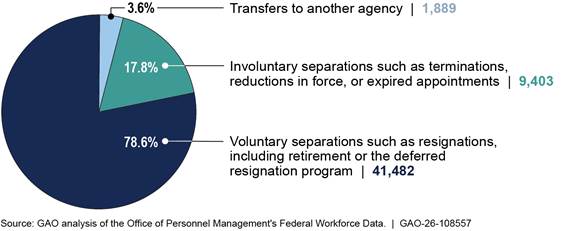
Across most selected agencies in 2025, a greater proportion of probationary employees separated compared to all employees who separated. At the Department of Energy, for instance, about 34 percent of probationary employees separated, compared with 19 percent of all employees. The Department of Defense recorded the largest number of probationary separations—about 20,000 employees—but separation rates for probationary employees and the overall Defense workforce were nearly identical, at about 14 percent.
Why GAO Did This Study
Since January 2025, several executive orders directed changes to the federal workforce including probationary employees. As a result, federal agencies, including those with health and safety missions, took steps to reduce their probationary and trial employee staffing levels.
GAO was asked to examine workforce changes affecting federal probationary and trial employees at agencies that focus on health or safety. This report describes (1) regulations and policies related to probationary and trial periods for federal employees, including updates since January 2025; and (2) trends in these employee separations at selected agencies from January through December 2025.
GAO analyzed workforce data on OPM’s FWD website from the following selection of 11 agencies, including 12 subcomponents, with health or safety missions: the Departments of Agriculture and Forest Service; Commerce and National Oceanic and Atmospheric Administration; Defense; Energy; Health and Human Services, Centers for Disease Control and Prevention, Food and Drug Administration, and National Institutes of Health; Homeland Security, Federal Emergency Management Agency, and Transportation Security Administration; the Interior, Bureau of Land Management, and National Park Service; Transportation and Federal Aviation Administration; Veterans Affairs, Veterans Health Administration, and Veterans Benefits Administration; the Environmental Protection Agency; and the Nuclear Regulatory Commission.
Abbreviations
|
CFO |
Chief Financial Officer |
|
CHCO |
Chief Human Capital Officer |
|
EEOC |
Equal Employment Opportunity Commission |
|
FWD |
Federal Workforce Data |
|
MSPB |
U. S. Merit Systems Protection Board |
|
OPM |
Office of Personnel Management |
|
RIF |
Reduction in Force |
This is a work of the U.S. government and is not subject to copyright protection in the United States. The published product may be reproduced and distributed in its entirety without further permission from GAO. However, because this work may contain copyrighted images or other material, permission from the copyright holder may be necessary if you wish to reproduce this material separately.
June 9, 2026
Congressional Requesters
Since January 2025, in response to presidential directives, regulations, and accompanying Office of Personnel Management (OPM) guidance, many federal agencies have taken steps to reduce their staffing levels.[1] These steps have included offering incentives for employees to voluntarily resign, implementing reductions in force, placing a hiring freeze on most federal positions, and terminating employees in probationary or trial periods. Exemptions to these directives have allowed agencies to hire certain staff. For example, Executive Order No.14356, Ensuring Continued Accountability in Federal Hiring, includes exemptions for positions related to immigration enforcement, national security, public safety, or where limiting hiring would conflict with applicable law.[2]
Employees in a probationary or trial period are those who have not yet completed the service requirements necessary to finalize their appointments, either after being newly hired, or after being appointed as a supervisor or manager. Probationary periods are generally 1 or 2 years, depending on the position.[3] Until the appointment is finalized, probationary and trial employees have limited job protections.
You asked us to examine workforce changes affecting federal probationary and trial employees whose agencies focus on the health and safety of the American people. For the purposes of this report, we refer to employees in a probationary or trial period collectively as probationary employees. This report describes
· the government-wide regulations and policies related to probationary and trial periods for federal employees, including updates issued since January 2025 regarding relevant separations; and
· trends in probationary and trial employee separations at selected Chief Financial Officers (CFO) Act agencies and subcomponents from January through December 2025.
To address the first objective, we reviewed executive orders, regulations, and guidance to describe the separations that could occur for probationary and trial employees and developed a timeline describing key changes, beginning with new directives issued in January 2025.
To address the second objective, we identified a judgmental selection of 11 CFO Act agencies with health and safety missions, including 12 subcomponents with more than 10,000 employees. The selection represents agencies with missions related to air travel safety; natural disasters; food safety; health (infectious diseases, chronic health conditions, and the opioid epidemic); national security; nuclear security and safety; and veterans’ health care benefits.[4] We analyzed data for these agencies from the OPM Federal Workforce Data (FWD) website, such as the size of their workforce, number of probationary and trial employees, and information about separations that reduced the number of probationary employees from January through December 2025.[5] Further, we used these data to describe staffing levels, including the number of employees serving in probationary or trial periods and information about separations at selected agencies and subcomponents in 2025. OPM released probationary employee data on the FWD website in March 2026, and we assessed the reliability of these data by reviewing related OPM documentation, interviewing knowledgeable OPM officials, and performing electronic data testing.[6] We determined the data were sufficiently reliable for our reporting purposes.
For both objectives, we interviewed OPM officials to obtain updates on changes to relevant policies and rules, and to clarify workforce data.
We conducted this performance audit from June 2025 to June 2026 in accordance with generally accepted government auditing standards. Those standards require that we plan and perform the audit to obtain sufficient, appropriate evidence to provide a reasonable basis for our findings and conclusions based on our audit objectives. We believe that the evidence obtained provides a reasonable basis for our findings and conclusions based on our audit objectives.
Background
The probationary period is the final stage of the hiring process for employees. Before 2025, when deciding on a probationary employee’s continued employment in the civil service, the agency was required to consider whether an employee’s performance and conduct were unsatisfactory. The U.S. Merit Systems Protection Board (MSPB) also noted that once an appointment was finalized, the individual became an employee who was given a considerable level of protection under the federal government’s merit system.[7]
2025 Executive Orders and OPM Guidance Broadened Agency Discretion to Terminate Probationary Employees and Limited Employee Recourse
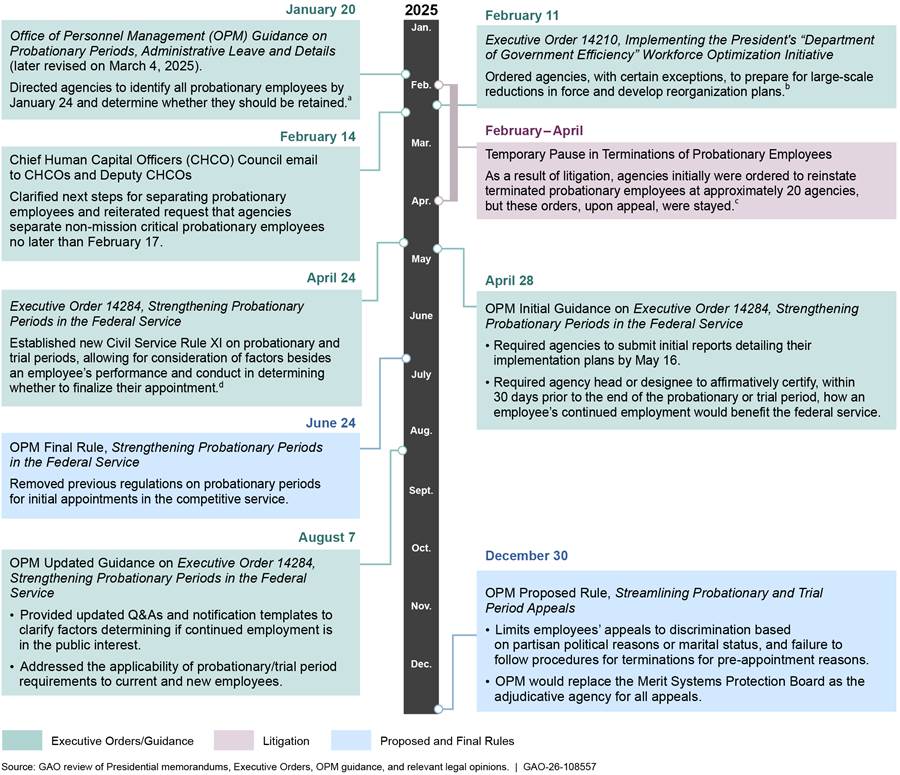
Beginning in January 2025, the President issued a series of executive orders, and OPM issued accompanying guidance and regulations, to clarify probationary periods (see fig. 1). The updates, in part, allow agencies to make final appointment decisions for reasons in addition to performance and conduct, such as whether continued employment serves the public interest.
Figure 1: Timeline of Selected Executive Orders, Rules, Government-wide Guidance, and Actions Related to Probationary Employees in the Federal Government in 2025
aIn a March 2025 update, OPM clarified that agencies were not directed to take any specific performance-based actions regarding probationary employees, and that agencies had ultimate decision-making authority over, and responsibility for, such personnel actions.
bThe executive order does not apply to military personnel and allows agency heads to exempt any position necessary to meet national security, homeland security, or public safety responsibilities.
cIncluding Maryland v. United States Dep’t of Agric., (D. Md) 1:25-CV-00748. In September 2025, the U.S. Court of Appeals for the 4th Circuit found that the states lacked standing and the district court subsequently dismissed the lawsuit. AFGE v. OPM, (N.D. Cal.) 3:25-cv-01780. In September 2025, the U.S. District Court for the Northern District of California issued an order that OPM lacked the authority to direct other agencies to terminate their probationary employees and violated the Administrative Procedure Act. The government subsequently filed a notice of appeal, which is ongoing.
dAgencies, in their sole and exclusive discretion, may consider four factors to assess whether an employee’s fitness for continued employment is in the public interest: the employee’s performance or conduct; the needs and interests of the agency; whether the employee’s continued employment would advance organizational goals of the agency or the government; and whether the employee’s continued employment would advance the efficiency of the service.
Since January 2025, Executive Order No. 14284, Strengthening Probationary Periods in the Federal Service, and OPM guidance directed agencies to identify their probationary employees and determine who should be retained. In February 2025, numerous federal agencies whose missions include a focus on protecting Americans’ health and safety began terminating probationary workers in accordance with the January 2025 direction. However, agency efforts to terminate probationary employees have been subject to several legal challenges. While agencies initially were ordered to reinstate probationary employees who had been terminated at applicable agencies, these orders, upon appeal, were stayed by the Supreme Court.[8]
On April 24, 2025, the President issued an executive order on Strengthening Probationary Periods in the Federal Service, which required an individual to demonstrate why it is in the public interest for the government to finalize their appointment to the civil service.[9] The order allows agencies to consider additional factors beyond employee performance and conduct when making termination decisions about probationary employees. These factors include whether the individual’s continued employment would advance organizational goals of the agency and efficiency of the service.
In addition, agencies are no longer required to provide terminated probationary employees with the agency’s conclusions about inadequate performance or conduct. Agency heads or designees are required to affirmatively certify a probationary employee’s continued employment within 30 days prior to the end of the probationary period. Additionally, the Director of OPM is authorized to issue regulations prescribing circumstances and procedures for an employee’s ability to appeal a termination during a probationary or trial period.
In December 2025, OPM proposed a rule that would change the appeals process for terminated probationary employees.[10] The proposed rule states that a probationary employee may appeal a termination only if they allege it was discrimination based on (1) partisan political reasons, (2) marital status, or (3) an agency’s failure to follow procedures for terminations based upon pre-appointment reasons.[11] In addition, under the proposed rule, OPM would replace MSPB as the adjudicative agency for all appeals.[12] OPM would adjudicate an appeal based on written record, unless it finds an investigation or hearing necessary. According to OPM, until a final rule is issued, there is no right to appeal.[13]
Probationary Employees Separated at a Slightly Higher Rate Compared to All Employees at Selected Agencies in 2025
During 2025, probationary employees separated from the selected agencies in our review at a slightly higher rate when compared to all employees who separated from these agencies. Approximately 19 percent of all probationary employees separated at the selected agencies compared to approximately 15 percent of all employees who separated from these selected agencies.[14]
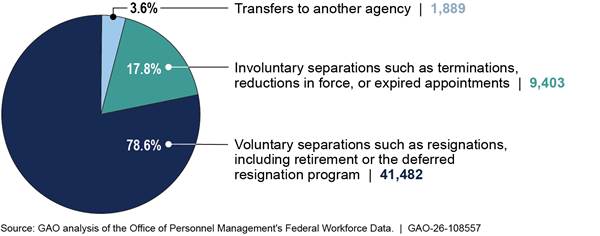
Of the total separations of probationary employees at the selected agencies, we found that over two-thirds voluntarily separated during 2025.[15] As shown in figure 2, 78.6 percent of separating probationary staff did so through resignations, including through retirements and a deferred resignation program.[16] Additionally, 17.8 percent of probationary employees involuntarily separated during 2025, through such actions as terminations or reductions in force (RIF).[17] The remainder of separations occurred due to transfers to another agency.
Figure 2: Number and Percent of Personnel Actions by Type of Separation for Probationary Employees at Selected Agencies, 2025
Note: With the data available, the number of employees in a probationary or trial period who separated after being newly hired cannot be distinguished from those who separated during a probationary period as a result of being recently promoted to a supervisory or managerial position.
We found that these percentages were similar when looking at all employees who separated from the selected agencies. Specifically, 78.9 percent of all employee separations were voluntary, 18.1 percent were involuntary, and 3 percent were due to transfers to another agency.
We also found that most of the selected agencies had higher percentages of probationary separations when compared to all employee separations, as shown in figure 3. At the Department of Energy, for example, while 19 percent of all agency employees separated during 2025, about 34 percent of probationary employees separated during this time. The Department of Agriculture showed a similar trend with about 30 percent of all agency employees separating versus nearly 42 percent of probationary employees separating during 2025.
This contrasts with the Department of the Interior, where nearly 31 percent of all agency employees separated during 2025 and about 22 percent of probationary employees separated.
Additionally, the Department of Defense had the most probationary employee separations (about 20,000) out of the selected agencies. However, the percentage of Defense probationary employees who separated versus that of all Defense employees who separated was nearly identical at about 14 percent. See figure 3 for a comparison of separation rates at the selected agencies.
Figure 3: Comparison of the Separation Rate for All Employees and Probationary Employees at Selected Agencies, 2025
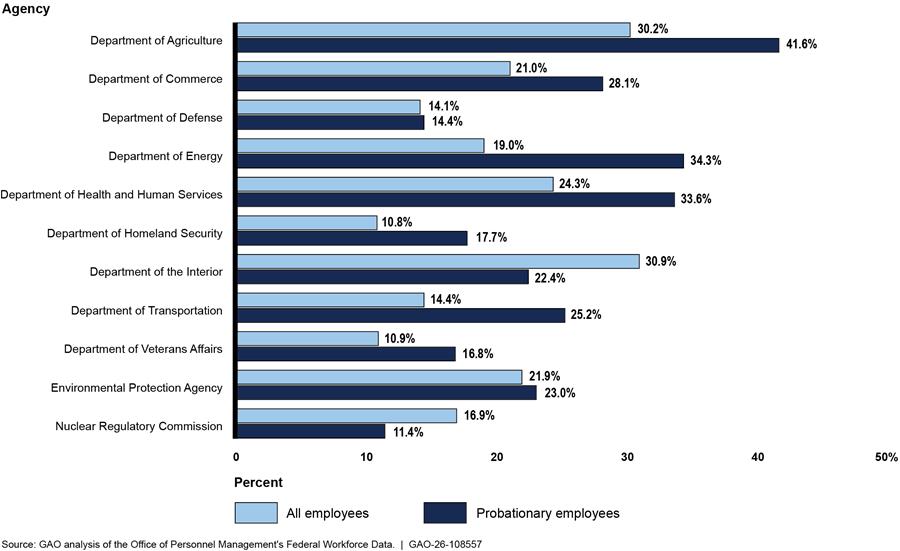
Note: This figure compares (1) the percentage of total separations out of all employees, and (2) probationary separations out of all probationary employees at the selected agencies. Separations as a percentage of the workforce are calculated based on the average number of employees at the beginning and end of the period. This is to account for changes in the size of the total workforce and probationary population, respectively, over the period.
For additional information on separated probationary employees at the selected agencies, including by location, see appendix I.
Agency Comments
We provided a draft of this report to the Office of Personnel Management (OPM) and the Department of Homeland Security (DHS) for review and comment. OPM provided technical comments, which we incorporated as appropriate. DHS did not have any comments on the report. We also notified the other selected agencies that we would be reporting on workforce reductions at their agencies using data available through OPM’s Federal Workforce Data website.
We are sending copies of this product to the appropriate congressional committees, the Director of the Office of Personnel Management; the Secretaries of the Departments of Agriculture, Commerce, Defense, Energy, Health and Human Services, Homeland Security, Interior, Transportation, and Veterans Affairs; the Administrator of the Environmental Protection Agency; Chairman of the Nuclear Regulatory Commission; and other interested parties. In addition, the report is available at no charge on the GAO website at https://www.gao.gov.
If you or your staff have any questions concerning this product, please contact me at LockeD@gao.gov. Contact points for our Offices of Congressional Relations and Media Relations may be found on the last page of this report. GAO staff who made key contributions to this report are listed in appendix II.
Dawn G. Locke
Director
Strategic Issues
List of Requesters
The Honorable Robert Garcia
Ranking Member
Committee on Oversight and Government Reform
House of Representatives
The Honorable Tammy Baldwin
United States Senate
The Honorable Richard Blumenthal
United States Senate
The Honorable Cory A. Booker
United States Senate
The Honorable Tammy Duckworth
United States Senate
The Honorable Kirsten Gillibrand
United States Senate
The Honorable Amy Klobuchar
United States Senate
The Honorable Edward J. Markey
United States Senate
The Honorable Jeffrey A. Merkley
United States Senate
The Honorable Chris Van Hollen
United States Senate
The Honorable Elizabeth Warren
United States Senate
The Honorable Ron Wyden
United States Senate
Appendix I: Data on Staffing Level Changes at Selected Agencies Including Employees in a Probationary or Trial Period During 2025
This appendix presents information about employees in a probationary or trial period at selected agencies during calendar years 2024 and 2025 according to the Office of Personnel Management’s Federal Workforce Data website.[18]
The tables that follow include data on overall staffing levels, the number of probationary employees, and the number and percentages of separations of all employees and probationary employees. They also provide details about separated probationary employees by geographic location. Types of separations include terminations, resignations, and other reasons such as transfers to other agencies.
Separations are calculated based on the average number of employees at the beginning and end of the period. This is to account for changes in the size of the workforce over the period. In some instances, agencies may have rehired employees after they were separated. However, the data do not indicate how many employees may have been rehired during these time periods.
Table 1: Changes to the Number of Federal Employees and Probationary Employees at Selected Agencies Including Separations, 2024–2025
|
Selected Agencies with Health and Safety Missions |
|
Workforce as of December 31, 2024 |
Workforce as of December 31, 2025 |
2025 Separations |
2025 Separations as Percentage of Workforce |
|
Department of Agriculture (USDA) |
All employees |
91,047 |
72,049 |
24,597 |
30.2 |
|
|
Probationary employees |
19,884 |
10,753 |
6,380 |
41.6 |
|
USDA/Forest Service |
All employees |
31,665 |
26,596 |
9,755 |
33.5 |
|
|
Probationary employees |
8,616 |
5,307 |
2,760 |
39.6 |
|
Department of Commerce |
All employees |
48,804 |
42,084 |
9,521 |
21.0 |
|
|
Probationary employees |
8,010 |
4,692 |
1,786 |
28.1 |
|
Commerce/National Oceanic and Atmospheric Administration |
All employees |
12,441 |
9,984 |
2,526 |
22.5 |
|
|
Probationary employees |
2,261 |
1,039 |
632 |
38.3 |
|
Department of Defense |
All employees |
778,188 |
707,378 |
104,540 |
14.1 |
|
|
Probationary employees |
162,899 |
118,196 |
20,204 |
14.4 |
|
Department of Energy |
All employees |
17,607 |
14,955 |
3,100 |
19.0 |
|
|
Probationary employees |
4,301 |
2,062 |
1,090 |
34.3 |
|
Department of Health and Human Services (HHS) |
All employees |
93,035 |
75,134 |
20,433 |
24.3 |
|
|
Probationary employees |
17,007 |
9,643 |
4,474 |
33.6 |
|
HHS/Centers for Disease Control and Prevention |
All employees |
12,788 |
9,769 |
3,071 |
27.2 |
|
|
Probationary employees |
2,609 |
1,274 |
697 |
35.9 |
|
HHS/Food and Drug Administration |
All employees |
21,026 |
16,602 |
4,547 |
24.2 |
|
|
Probationary employees |
3,060 |
1,610 |
672 |
28.8 |
|
HHS/National Institutes of Health |
All employees |
21,445 |
17,070 |
4,689 |
24.3 |
|
|
Probationary employees |
3,602 |
1,723 |
1,064 |
40.0 |
|
Department of Homeland Security (DHS) |
All employees |
231,337 |
227,584 |
24,769 |
10.8 |
|
|
Probationary employees |
34,111 |
34,192 |
6,039 |
17.7 |
|
DHS/Federal Emergency Management Agency |
All employees |
25,813 |
22,195 |
4,561 |
19.0 |
|
|
Probationary employees |
1,571 |
1,161 |
325 |
23.8 |
|
DHS/Transportation Security Administration |
All employees |
65,805 |
63,006 |
7,210 |
11.2 |
|
|
Probationary employees |
7,758 |
4,533 |
2,890 |
47.0 |
|
Department of the Interior |
All employees |
64,082 |
56,872 |
18,673 |
30.9 |
|
|
Probationary employees |
13,279 |
8,440 |
2,431 |
22.4 |
|
Interior/Bureau of Land Management |
All employees |
9,752 |
7,858 |
2,357 |
26.8 |
|
|
Probationary employees |
2,403 |
1,402 |
417 |
21.9 |
|
Interior/National Park Service |
All employees |
18,096 |
15,156 |
7,625 |
45.9 |
|
|
Probationary employees |
4,301 |
2,969 |
554 |
15.2 |
|
Department of Transportation (DOT) |
All employees |
57,462 |
53,512 |
8,004 |
14.4 |
|
|
Probationary employees |
5,137 |
3,625 |
1,103 |
25.2 |
|
DOT/Federal Aviation Administration |
All employees |
46,461 |
44,856 |
5,084 |
11.1 |
|
|
Probationary employees |
2,425 |
2,216 |
285 |
12.3 |
|
Department of Veterans Affairs (VA) |
All employees |
480,075 |
451,121 |
50,576 |
10.9 |
|
|
Probationary employees |
64,102 |
37,515 |
8,540 |
16.8 |
|
VA/Veterans Benefits Administration |
All employees |
34,791 |
30,718 |
3,936 |
12.0 |
|
|
Probationary employees |
11,043 |
6,213 |
1,378 |
16.0 |
|
VA/Veterans Health Administration |
All employees |
425,112 |
402,973 |
43,797 |
10.6 |
|
|
Probationary employees |
49,689 |
29,870 |
6,664 |
16.8 |
|
Environmental Protection Agency |
All employees |
16,990 |
14,661 |
3,463 |
21.9 |
|
|
Probationary employees |
3,751 |
2,190 |
684 |
23.0 |
|
Nuclear Regulatory Commission |
All employees |
2,955 |
2,646 |
473 |
16.9 |
|
|
Probationary employees |
447 |
306 |
3 |
11.4 |
Source: GAO analysis of the Office of Personnel Management’s Federal Workforce Data. | GAO‑26‑108557
Note: Separations as a percentage of all employees and probationary employees are calculated based on the average number of employees at the beginning and end of the period. This is to account for changes in the size of the workforce over the period. With the data available, the number of employees in a probationary or trial period who separated after being newly hired cannot be distinguished from those who separated during a probationary period as a result of being recently promoted to a supervisory or managerial position.
Figure 4: Percent of Probationary Employees Who Separated During Their Probationary or Trial Period at Selected Agencies by Location, 2025
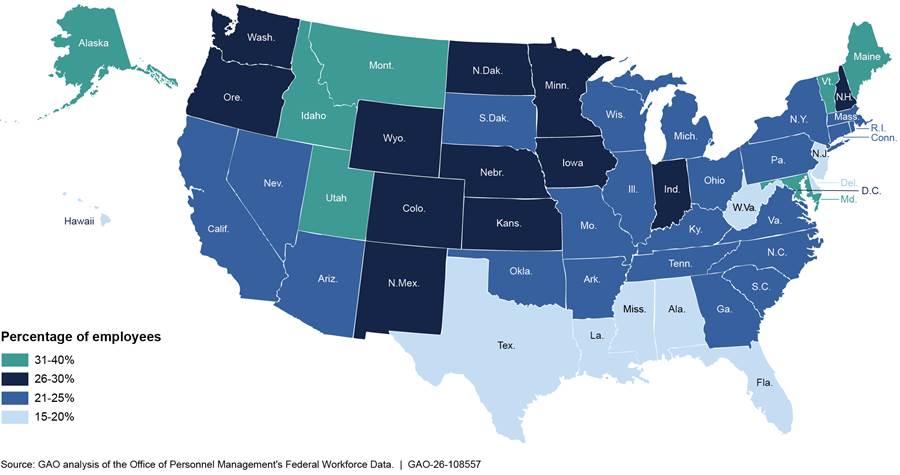
Note: The figure shows the combined number of employees who separated during a probationary or trial period from the Departments of Agriculture, Commerce, Energy, Health and Human Services, Interior, Transportation, and Veterans Affairs; Environmental Protection Agency; and Nuclear Regulatory Commission. Certain numbers of employees are not reported. For example, the Office of Personnel Management’s Federal Workforce Data redact location information for employees at the Departments of Defense and Homeland Security, as well as other employees in sensitive or national security related occupations. As a result, 191,643 employees who fell into that category are not reported. Additionally, for a small number of employees (1,427), location information was missing and is not reported.
Table 2: Number of Probationary Employees in January 2025 and Number of Probationary Employee Separations During 2025 at Selected Agencies by Location
|
Location |
Probationary Employees as of January 2025 |
Number of probationary employees separating (Jan.–Dec. 2025) |
|
Alabama |
1,880 |
250 |
|
Alaska |
1,126 |
327 |
|
Arizona |
4,167 |
742 |
|
Arkansas |
1,359 |
231 |
|
California |
10,577 |
1,924 |
|
Colorado |
4,207 |
973 |
|
Connecticut |
461 |
80 |
|
Delaware |
332 |
48 |
|
District of Columbia |
8,754 |
1,943 |
|
Florida |
7,166 |
1,059 |
|
Georgia |
6,053 |
1,103 |
|
Hawaii |
800 |
121 |
|
Idaho |
1,615 |
502 |
|
Illinois |
3,557 |
580 |
|
Indiana |
1,372 |
276 |
|
Iowa |
1,111 |
255 |
|
Kansas |
1,668 |
323 |
|
Kentucky |
1,239 |
243 |
|
Louisiana |
1,579 |
241 |
|
Maine |
657 |
145 |
|
Maryland |
10,797 |
2,585 |
|
Massachusetts |
1,947 |
393 |
|
Michigan |
2,495 |
426 |
|
Minnesota |
2,101 |
422 |
|
Mississippi |
1,347 |
207 |
|
Missouri |
2,651 |
479 |
|
Montana |
1,667 |
525 |
|
Nebraska |
979 |
227 |
|
Nevada |
1,694 |
331 |
|
New Hampshire |
383 |
93 |
|
New Jersey |
1,201 |
180 |
|
New Mexico |
2,966 |
641 |
|
New York |
4,081 |
699 |
|
North Carolina |
3,999 |
715 |
|
North Dakota |
708 |
168 |
|
Ohio |
2,800 |
520 |
|
Oklahoma |
2,356 |
438 |
|
Oregon |
2,861 |
683 |
|
Pennsylvania |
3,408 |
567 |
|
Rhode Island |
563 |
102 |
|
South Carolina |
1,931 |
318 |
|
South Dakota |
1,293 |
265 |
|
Tennessee |
2,280 |
464 |
|
Texas |
7,748 |
1,223 |
|
Utah |
1,554 |
391 |
|
Vermont |
427 |
107 |
|
Virginia |
5,691 |
1,177 |
|
Washington |
3,489 |
805 |
|
West Virginia |
1,699 |
219 |
|
Wisconsin |
2,018 |
394 |
|
Wyoming |
1,044 |
226 |
Source: GAO analysis of the Office of Personnel Management’s Federal Workforce Data. | GAO‑26‑108557
Note: The table shows the combined number of employees who separated during a probationary or trial period from the Departments of Agriculture, Commerce, Energy, Health and Human Services, Interior, Transportation, and Veterans Affairs; Environmental Protection Agency; and Nuclear Regulatory Commission. Certain numbers of employees are not reported. For example, the Office of Personnel Management’s Federal Workforce Data redact location information for employees at the Departments of Defense and Homeland Security, as well as other employees in sensitive or national security related occupations. As a result, 191,643 employees who fell into that category are not reported. Additionally, for a small number of employees (1,427), location information was missing and is not reported.
GAO Contact:
Dawn G. Locke at locked@gao.gov
Staff Acknowledgments:
In addition to the contact named above, Leah Q. Nash (Assistant Director), Jyoti Gupta (Analyst-in-Charge), Giny Cheong, Amalia Konstas, Krista Loose, Ulyana Panchishin, Dylan Stagner, Alicia White, Mercedes Wilson-Barthes, Elizabeth Wood, and Clarette Yen made key contributions to this report.
The Government Accountability Office, the audit, evaluation, and investigative arm of Congress, exists to support Congress in meeting its constitutional responsibilities and to help improve the performance and accountability of the federal government for the American people. GAO examines the use of public funds; evaluates federal programs and policies; and provides analyses, recommendations, and other assistance to help Congress make informed oversight, policy, and funding decisions. GAO’s commitment to good government is reflected in its core values of accountability, integrity, and reliability.
Obtaining Copies of GAO Reports and Testimony
The fastest and easiest way to obtain copies of GAO documents at no cost is through our website. Each weekday afternoon, GAO posts on its website newly released reports, testimony, and correspondence. You can also subscribe to GAO’s email updates to receive notification of newly posted products.
Order by Phone
The price of each GAO publication reflects GAO’s actual cost of production and distribution and depends on the number of pages in the publication and whether the publication is printed in color or black and white. Pricing and ordering information is posted on GAO’s website, https://www.gao.gov/ordering.htm.
Place orders by calling (202) 512-6000, toll free (866) 801-7077,
or
TDD (202) 512-2537.
Orders may be paid for using American Express, Discover Card, MasterCard, Visa, check, or money order. Call for additional information.
Connect with GAO
Connect with GAO on X,
LinkedIn, Instagram, and YouTube.
Subscribe to our Email Updates. Listen to our Podcasts.
Visit GAO on the web at https://www.gao.gov.
To Report Fraud, Waste, and Abuse in Federal Programs
Contact FraudNet:
Website: https://www.gao.gov/about/what-gao-does/fraudnet
Automated answering system: (800) 424-5454
Media Relations
Sarah Kaczmarek, Managing Director, Media@gao.gov
Congressional Relations
David A. Powner, Acting Managing Director, CongRel@gao.gov
General Inquiries
[1]See, for example, Presidential Memorandum, Hiring Freeze, 90 Fed. Reg. 8247 (Jan. 28, 2025); Exec. Order No. 14210, Implementing the President’s “Department of Government Efficiency” Workforce Optimization Initiative, 90 Fed. Reg. 9669 (Feb. 14, 2025); and Exec. Order No. 14284, Strengthening Probationary Periods in the Federal Service, 90 Fed. Reg. 17729 (Apr. 29, 2025). In addition, OPM issued a final rule entitled Strengthening Probationary Periods in Federal Service, 90 Fed. Reg. 26727 (June 24, 2025).
[2]Exec. Order No. 14356, Ensuring Continued Accountability in Federal Hiring, 90 Fed. Reg. 48387 (Oct. 20, 2025).
[3]Just as new hires in the competitive service are placed in a probationary period, new hires in the excepted service are placed in a trial period with similar limitations. In the competitive service, probationary periods are required by statute. 5 U.S.C. § 3321(a)(1). By regulation, OPM has provided for a 1-year probationary period. 5 C.F.R. § 11.2(a). Similarly, an individual in the excepted service must serve a trial period before finalization of their appointment. 5 C.F.R. § 11.3(a).
[4]Of the 24 CFO Act agencies, we selected the following agencies and subcomponents with health and safety missions: the Departments of Agriculture and Forest Service; Commerce and National Oceanic and Atmospheric Administration; Defense; Energy; Health and Human Services, Centers for Disease Control and Prevention, Food and Drug Administration, and National Institutes of Health; Homeland Security, Federal Emergency Management Agency, and Transportation Security Administration; the Interior, Bureau of Land Management, and National Park Service; Transportation and Federal Aviation Administration; Veterans Affairs, Veterans Health Administration, and Veterans Benefits Administration; as well as the Environmental Protection Agency and the Nuclear Regulatory Commission. We excluded certain agencies from our scope that were subject to the Office of Management and Budget and OPM exemptions from potential agency reduction in force and reorganization plans, such as for positions necessary to meet law enforcement, border security, or immigration enforcement responsibilities. Offices of Management and Budget and Personnel Management, Guidance on Agency RIF and Reorganization Plans Requested by Implementing the President’s “Department of Government Efficiency” Workforce Optimization Initiative (Feb. 26, 2025).
[5]For a more complete accounting of workforce personnel changes in the federal government, see GAO, Federal Agency Workforce Changes: Update for January to June 2025, GAO‑26‑108719 (Washington, D.C.: Feb. 24, 2026).
[6]We used OPM tenure group data to identify probationary employees in FWD, specifically employees serving under conditional appointments, or in probationary or trial periods.
[7]U.S. Merit Systems Protection Board, The Probationary Period: A Critical Assessment Opportunity (Washington, D.C.: August 2005). MSPB is an independent, quasi-judicial agency established to protect federal merit systems and the rights of individuals within those systems. It carries out its statutory responsibilities and authorities primarily by adjudicating individual employee appeals and by conducting merit systems studies. See 5 U.S.C. § 1204.
[8]Maryland v. United States Dep’t of Agric., (D. Md) 1:25-CV-00748; OPM v. AFGE, (N.D. Cal.) 3:25-cv-01780.
[9]Exec. Order No. 14284, Strengthening Probationary Periods in the Federal Service, 90 Fed. Reg. 17729 (Apr. 24, 2025).
[10]Streamlining Probationary and Trial Period Appeals, 90 Fed. Reg. 61070 (proposed Dec. 30, 2025).
[11]OPM guidance states that pre-appointment conditions include making false statements on applications/resumes or failure to qualify in an investigation.
[12]Employees who wish to pursue claims of discrimination under statutes administered by the Equal Employment Opportunity Commission (EEOC) would not be allowed to raise these claims with OPM and would need to pursue such complaints with the EEOC.
[13]OPM stated that there is currently no right to appeal probationary or trial period terminations because Executive Order No. 14284, Strengthening Probationary Periods in the Federal Service, revoked certain appeals.
[14]Separations as a percent of the probationary workforce are calculated based on the average number of probationary employees at the beginning and end of the period. This is to account for changes in the size of the workforce over the period. Of the approximately total 282,000 probationary employees at the selected agencies in 2025, about 53,000 separated. Of the approximately 1.8 million total employees at the selected agencies in 2025, about 268,000 separated.
[15]We consider the following separation types to be voluntary: resignation, deferred resignation, and retirement.
[16]Under the government-wide or an agency-specific deferred resignation program, federal employees could agree to resign or retire by a certain date and be placed on administrative leave while retaining their salary and benefits in the interim.
[17]OPM’s Guide to Processing Personnel Actions states that agencies are to document the reasons for separation actions. Reasons for separation may include employees terminated during a probationary or trial period, for unacceptable performance or conduct, the expiration of an appointment, or a RIF (i.e., the federal government process for eliminating positions due to agency reorganization, reduced funding, or reduced workload).
[18]Specifically, the data presented are as of December 31st of calendar years 2024 and 2025, as these dates provided the most recently available data.