
GAO-26-108571
A report to congressional requesters.
For more information, contact: Heather MacLeod at MacLeodH@gao.gov
What GAO Found
The problems of sexual assault and sexual harassment at the U.S. Coast Guard are not new. In its most recent report to Congress on this issue, covering fiscal year 2022, the Coast Guard reported 226 incidents of sexual assault and 88 incidents of sexual harassment. This report is required by law but fully included only 5 of the 11 required elements, partially included 4 of them, and did not include 2. Further, the Coast Guard submitted this report about 1 year late. The report covering fiscal year 2023 was due on January 15, 2024 and the report covering fiscal year 2024 was due on January 15, 2025. Both remained unissued, as of December 2025.
Comparison of U.S. Coast Guard’s Fiscal Year 2022 Annual Report on Sexual Assault and Sexual Harassment to Statutory Reporting Requirements
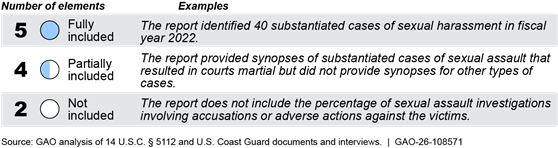
The Coast Guard’s process for compiling the annual report did not fully follow its own procedures. According to these procedures, cognizant program and legal offices are to conduct reviews. The service used outdated statutory language and templates with deficiencies over multiple years, raising questions about whether the legal review was sufficient. By ensuring that it addresses all required sexual assault and sexual harassment reporting requirements and meets the statutory deadline, the Coast Guard could better communicate complete and quality information for decision-making and oversight, and increase transparency to Congress on incidents of sexual assault and sexual harassment.
Why GAO Did This Study
Since 2010, the Coast Guard has been required by law to submit an annual report to Congress on reported incidents of sexual assault and, since 2018, sexual harassment involving members of the Coast Guard.
GAO was asked to review the Coast Guard’s process for annually reporting on sexual assault and sexual harassment to Congress. This report examines (1) the Coast Guard’s processes to identify and compile sexual assault and sexual harassment data, and (2) the extent to which the Coast Guard ensures that it reports on instances of sexual assault and sexual harassment to Congress as required.
GAO reviewed Coast Guard documentation on its processes for identifying and compiling sexual assault and sexual harassment data. GAO analyzed the extent to which the sexual assault and sexual harassment report for fiscal year 2022—the most recent year available—incorporated required elements by comparing them to the law (14 U.S.C. § 5112). GAO also interviewed Coast Guard officials from headquarters and from 5 of 9 Coast Guard districts.
What GAO Recommends
GAO is recommending that the Coast Guard ensure that (1) annual sexual assault and sexual harassment reports to Congress address all required elements and (2) the reports are issued on time. DHS concurred with the recommendations and stated that the Coast Guard will ensure that the annual reports address all required elements and are timely.
|
Abbreviations |
|
|
|
|
|
|
|
CGIS |
Coast Guard Investigative Service |
|
|
DHS |
Department of Homeland Security |
|
|
EO/EEO |
Equal Opportunity/ Equal Employment Opportunity |
|
|
SAPRR |
Sexual Assault Prevention, Response, and Recovery Program |
|
This is a work of the U.S. government and is not subject to copyright protection in the United States. The published product may be reproduced and distributed in its entirety without further permission from GAO. However, because this work may contain copyrighted images or other material, permission from the copyright holder may be necessary if you wish to reproduce this material separately.
January 14, 2026
Congressional Requesters
Sexual assault and sexual harassment can have lasting, harmful effects on victims and can disrupt mission readiness. Incidents of sexual assault and sexual harassment in the U.S. Coast Guard—a multi-mission maritime military service within the Department of Homeland Security that employs more than 55,000 people—are not new. In a 2020 investigation called “Operation Fouled Anchor,” the Coast Guard examined more than 100 separate allegations of sexual assault that occurred between 1990 and 2006 at the Coast Guard Academy, concluding that the Academy often mishandled these cases. Further, a congressional investigation found evidence that the Coast Guard intentionally withheld information about Operation Fouled Anchor from lawmakers and the public.[1] In a congressional hearing covering the operation, the former Commandant committed to provide complete and timely information to Congress in its ongoing investigations on the matter.[2]
Since 2004, Congress has taken steps to maintain federal oversight of the military services’ activities to prevent and respond to sexual assault and sexual harassment. These steps have included requiring the Coast Guard to submit an annual report to Congress on sexual assault and sexual harassment involving service members.[3] In one such report—its fiscal year 2022 report—the Coast Guard acknowledged that it had not transparently communicated the findings and scope of Operation Fouled Anchor in prior reports.[4] Relatedly, a November 2023 Coast Guard report developed in response to Operation Fouled Anchor concluded that drastic improvement was needed to address harmful behaviors, including sexual assault and sexual harassment. For example, the report highlighted that 18 percent of Coast Guard women and 4 percent of Coast Guard men who responded to the Workforce and Gender Relations survey reported having experienced sexual harassment.[5]
You asked us to review the Coast Guard’s process for annually reporting on sexual assault and sexual harassment to Congress.[6] This report examines (1) the Coast Guard’s processes to identify and compile sexual assault and sexual harassment data, and (2) the extent to which the Coast Guard ensures that it reports on instances of sexual assault and sexual harassment to Congress as required.[7]
To examine Coast Guard processes used to identify and compile sexual assault and sexual harassment data, we obtained and analyzed Coast Guard policies and command instructions describing the service’s complaint reporting procedures used to identify instances of sexual assault and sexual harassment.[8] We also reviewed documentation of Coast Guard processes—such as data entry forms and quality assurance procedures—to collect and compile the required data and other information on sexual assault and sexual harassment for the annual report.
In addition, we interviewed Coast Guard officials from headquarters and officials in 5 of 9 districts. These officials share responsibility for identifying, tracking, and maintaining sexual assault and sexual harassment data and compiling the data required for annual reporting.[9] We selected districts based on geographic dispersion and varying size of district area of commands (i.e., number of personnel). Field level officials interviewed include district and Coast Guard Academy leaders, sexual assault response coordinators, and victim advocate program specialists. The views from district and other field officials cannot be generalized to other districts or Coast Guard personnel that we did not interview; however, their views provided insight about Coast Guard processes to identify and compile sexual assault and sexual harassment data.
To examine the extent to which the Coast Guard ensures that it reports on instances of sexual assault and sexual harassment to Congress, we compared the annual report for fiscal year 2022 against the 11 elements required by law to be included in the report, determining the extent to which it included those elements.[10] We also assessed whether the Coast Guard submitted the report by the date required in statute. We focused on the 2022 report because it is the most recent one available since the reporting requirements were updated.[11] In addition, we reviewed a draft of the fiscal year 2023 report.
Further, we reviewed documents and interviewed Coast Guard headquarters officials who share responsibility for compiling required data and developing the annual reports. Documents included standard operating procedures related to tracking legislative requirements and preparing congressional reports, tasking emails, and routing information.[12] We also reviewed publicly available data on sexual assault and sexual harassment compiled by the Coast Guard to corroborate the instances of sexual harassment and assault that Coast Guard reported in its fiscal year 2022 report to Congress.[13]
Using the information from our analyses, document reviews, and interviews, we compared Coast Guard’s annual reporting processes to Coast Guard’s standard operating procedures for tracking legislation and preparing Congressional reports. We also compared the processes to Coast Guard’s Management’s Responsibility for Internal Controls and Reporting Requirements and Standards for Internal Control in the Federal Government for implementing effective control activities and ensuring quality information.[14]
We conducted this performance audit from July 2024 to January 2026 in accordance with generally accepted government auditing standards. Those standards require that we plan and perform the audit to obtain sufficient, appropriate evidence to provide a reasonable basis for our findings and conclusions based on our audit objectives. We believe that the evidence obtained provides a reasonable basis for our findings and conclusions based on our audit objectives.
Background
Definitions and Roles and Responsibilities
The Coast Guard defines sexual assault as intentional sexual contact characterized by use of force, threats, intimidation, or abuse of authority; or when the victim does not or cannot consent.[15] The Coast Guard defines sexual harassment as unwelcomed verbal, nonverbal, or physical conduct—amounting to sexual advances, demands or requests for sexual favors, or other conduct of a sexual nature. The conduct must also cause one to believe that submission to such conduct is a condition of the job or used as a basis for job-related decisions, or be so severe, repetitive, or pervasive —that it causes unreasonable interference with an individual’s work performance or creates an intimidating, offensive, or hostile work environment.[16]
As shown in table 1, several Coast Guard program offices and officials have responsibilities related to preventing and responding to sexual harassment and assault.
Table 1: Select Coast Guard Offices with Roles and Responsibilities Related to Sexual Assault and Sexual Harassment, as of November 2025
|
Coast Guard Sexual Assault Prevention, Response, & Recovery program |
Aims to eliminate sexual assault in the Coast Guard and provides response and recovery assistance services to victims when a sexual assault occurs. Program personnel include Sexual Assault Response Coordinators who serve as points of contact for coordinating care for victims in their area of responsibility and Victim Advocate Program Specialists who are trained and credentialed to ensure appropriate care is coordinated and provided to victims of sexual assault. |
|
Civil Rights Directorate |
Manages the Coast Guard’s civil rights policies including the separate and distinct procedures for filing an Equal Employment Opportunity or Equal Opportunity complaint of discriminatory harassment. Civil Rights personnel provide counseling, complaint investigation and processing, and training. |
|
Anti-Harassment Program Office |
Develops policy and provides guidance, direction, and coordination for the execution of the Anti-Harassment Program and receive and refers harassing behavior reports to an appropriate convening authority, among other duties. |
|
Coast Guard Investigative Service |
Investigates complaints or reports of sexual assault and may investigate sexual harassment that constitutes an offense by law. |
|
Judge Advocate General Special Victims Counsel Program |
Represents individuals eligible for military legal assistance, including civilian Coast Guard and DHS employees who are victims of an alleged sex-related offense. |
|
Office of the Chief Prosecutor |
Prosecutes a series of covered offenses, notably sexual assault under exclusive authority.a |
Source: GAO analysis of Coast Guard commandant instructions and messages I GAO‑25‑107658
aNational Defense Authorization Act for Fiscal Year 2022, Pub. L. 117-81, div. A, tit. V, subtit. D, Part 1, §§ 531(a)-(b), 533(2), 135 Stat. 1541, 1692-93, 1695-96 (2021) (codified as amended at 10 U.S.C. §§ 801(17), 824a).
Types of Internal and External Reporting
Coast Guard personnel have two options for reporting complaints of sexual assault through the service: restricted and unrestricted. The restricted reporting—which may only be made to a sexual assault response coordinator, victim advocate, or medical officer—permits a victim to confidentially disclose an alleged sexual assault and receive care without initiating a criminal investigation. In contrast, the unrestricted reporting initiates an investigation by Coast Guard Investigative Service (CGIS) and notification to the command (i.e., unit leadership).
Since 2010, the Coast Guard has been required by law to submit the previously discussed annual reports to Congress.[17] From 2010-2017, the report requirements covered only sexual assault; the statute was amended in 2018 to include sexual harassment. The statute was again amended in 2021 to include additional reporting requirements, such as the number of instances in which a victim of sexual assault was accused of misconduct or crimes collateral to the investigation of sexual assault committed against them.[18]
The Coast Guard Has Processes to Identify and Compile Complaints and Other Data for Sexual Assault and Sexual Harassment
The Coast Guard Has Formal Processes to Identify Complaints
The Coast Guard has formal processes through which its personnel can report complaints of sexual assault or sexual harassment. Coast Guard identifies and collects complaints made through these processes and compiles them for its report to Congress. For the fiscal year 2022 report, Coast Guard reported 226 incidents of sexual assault and 88 incidents of sexual harassment. The processes to report such incidents include the Sexual Assault Prevention, Response, and Recovery (SAPRR) Program process and the workplace harassment complaint processes—Anti-Harassment and Hate Incident and Equal Opportunity/ Equal Employment Opportunity (EO/EEO).[19]
· The purpose of the SAPRR program is to eliminate sexual assault within the Coast Guard and provide response services and recovery assistance if an assault occurs.
· The Anti-Harassment and Hate Incident policy’s main goal is to create and maintain a workplace free of sexual harassment and other harassing behavior by striving for prevention, conducting timely and independent investigations, taking corrective action, and fostering accountability.
· The purpose of the EO/EEO complaint process is to resolve and remedy the circumstances for individuals who may have been subjected to unlawful discrimination based on protected classes (e.g., sex).[20]
Figure 1 shows how complaints may be filed, who receives the complaint information, and where and how the Coast Guard maintains the data.
Figure 1: Coast Guard’s Process for Identifying and Maintaining Sexual Assault and Sexual Harassment Data
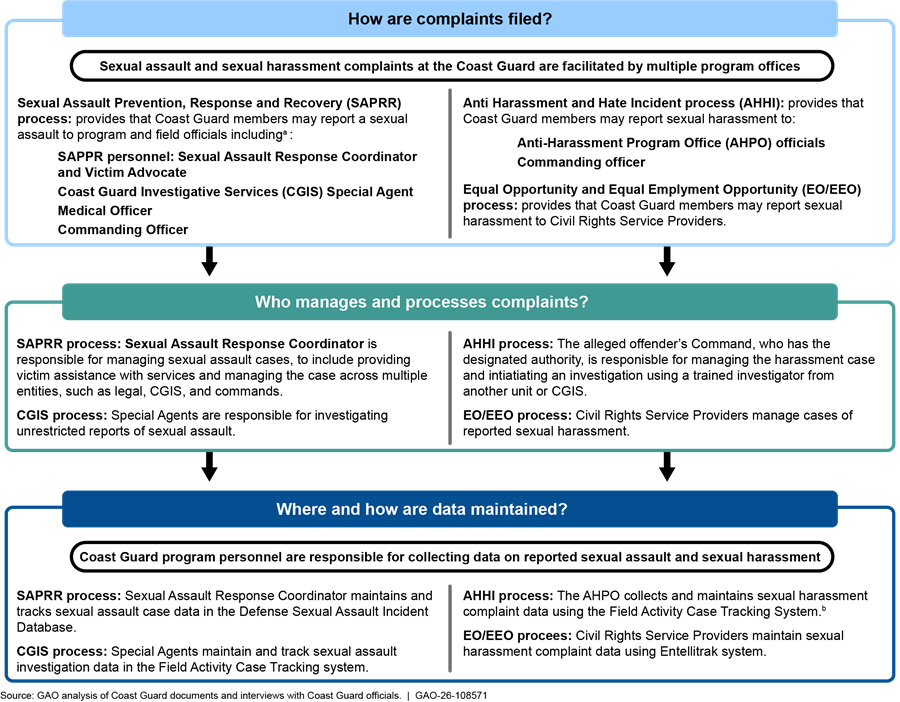
aCoast Guard personnel have two reporting options for complaints of sexual assault: restricted and unrestricted. The restricted reporting—which may only be made to a Sexual Assault Response Coordinator, victim advocate, or medical officer—permits a victim to confidentially disclose an alleged sexual assault and receive care without initiating a criminal investigation. In contrast, the unrestricted reporting initiates a probe by Coast Guard Investigative Service and notification to the Command.
bAccording to AHPO officials, Coast Guard used the Field Activity Case Tracking System for the reports covering fiscal years 2022 and 2023, but is transitioning to a new system for the report covering fiscal year 2024.
Coast Guard policies describe procedures to help ensure responsible program personnel are notified and required data collected for identified sexual assault and harassment complaints. For example, SAPRR policies require command to notify a Sexual Assault Response Coordinator in their area immediately after receiving an unrestricted report or third-party report of an incident.[21] Further, command must provide a Sexual Assault Incident Report—used to collect information about the complaint, including required data for reporting purposes—to the first captain (or civilian equivalent) and flag officer in the chain of command within 72 hours.[22] SAPRR procedures also require Coast Guard Investigative Service (CGIS) special agents in the field to notify the corresponding Sexual Assault Response coordinator immediately upon receipt of any report of sexual assault.[23] CGIS officials told us that they report sexual assaults by phone call or email to the servicing coordinator.
With respect to sexual harassment, policy requires commanding officers to notify and collect required data for the Anti-Harassment Program Office within 10 days of receiving a complaint. For EO/EEO complaints of sexual harassment, policy requires military commanders to attempt to resolve it in 15 calendar days. Civil Rights Service providers have 30 calendar days to inquire about, resolve, or issue a notice of a right to file a formal complaint for civilian personnel. If command is not able to resolve a military personnel complaint within 15 calendar days, the same 30-day process applicable to civilians begins.
Coast Guard district leaders, Sexual Assault Response coordinators, and Victim Advocate program specialists we spoke with were familiar with the policies and procedures for handling reports of sexual assault and sexual harassment. In addition, SAPRR Program and the Anti-Harassment Program officials said they coordinate with CGIS and commands to collect and maintain required information on sexual assault and sexual harassment complaints.[24] For example, Anti-Harassment Program officials told us they communicate with commands to collect information on the outcomes of sexual harassment investigations.
Multiple Coast Guard Offices Compile Data for Annual Reports
The Coast Guard has a process for compiling its annual report on sexual assault and sexual harassment to Congress. According to Coast Guard officials and documented procedures, several program offices are responsible for compiling and drafting required information for the report, as outlined in figure 2 below. The External Coordination Division begins this process by sending an email, which includes the statutory requirements and the previous report to Congress on sexual assault and harassment. Officials told us that SAPRR is also responsible for managing the drafting and review of the annual report. Coast Guard officials stated that the process for compiling the report is straightforward because they primarily seek to update the information from the previous report. The Department of Homeland Security and Office of Management and Budget are to review the report prior to release.[25]
Figure 2: Coast Guard Program Office Roles and Contributions to the Annual Report to Congress on Sexual Assault and Sexual Harassment, as of July 2025
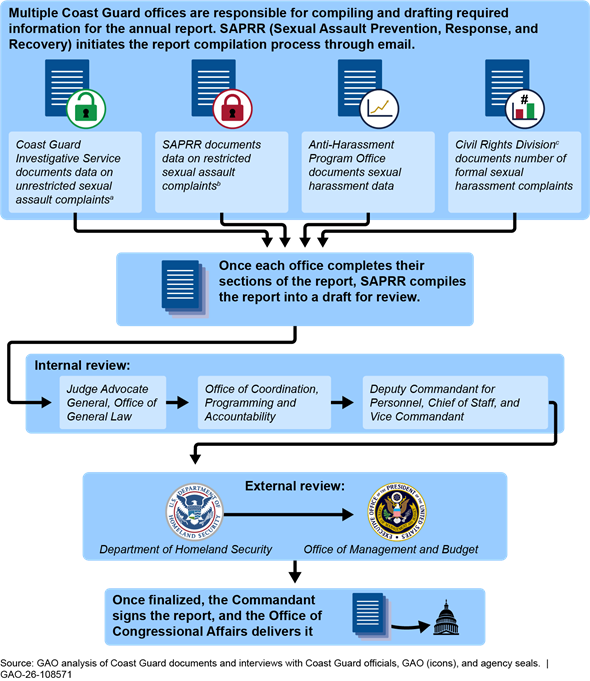
aCoast Guard personnel have two reporting options for complaints of sexual assault: unrestricted and restricted. The unrestricted reporting initiates an investigation by Coast Guard Investigative Service.
bThe restricted reporting—which may only be made to a Sexual Assault Response Coordinator, victim advocate, or medical officer—permits a victim to confidentially disclose an alleged sexual assault and receive care without initiating a criminal investigation.
Coast Guard Report to Congress Did Not Include All Required Elements and Was Not Delivered On Time
Our analysis indicates that, of the 11 required elements for inclusion in the sexual assault and sexual harassment annual report, the fiscal year 2022 report fully included five, partially included four, and did not include two.[26] Figure 3 shows the results of our analysis. In addition, the Coast Guard did not deliver the report to Congress by the mandated date.
Figure 3: Comparison of U.S. Coast Guard’s Fiscal Year 2022 Annual Report on Sexual Assault and Sexual Harassment to Statutory Reporting Requirements
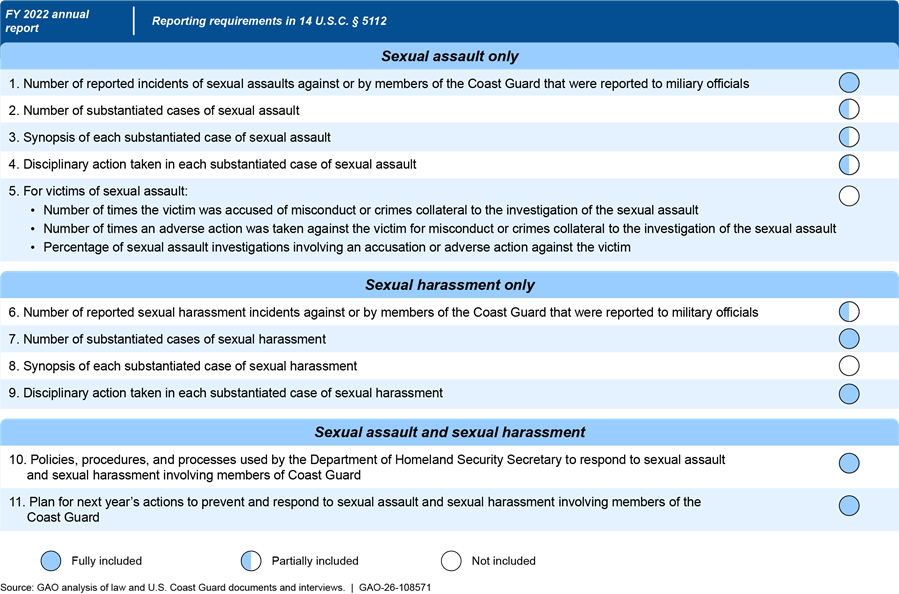
Note: The fiscal year 2022 report was the most recent report available at the time of our review. The Coast Guard interprets 14 U.S.C. § 5112(a) and (b)(1) to only require instances involving the Coast Guard’s military workforce. Accordingly, alleged instances of sexual assault that involve only civilian members of the Coast Guard are not included in the report. According to the Coast Guard, the report does include data on sexual harassment for civilian-on-civilian cases, but such information is not required to be included per 14 U.S.C. § 5112.
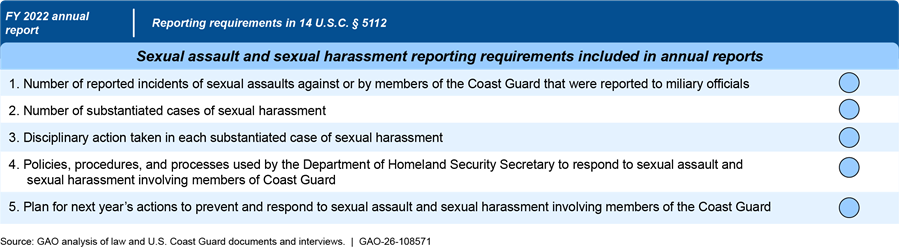
Fully included elements in the 2022 report. We found that the Coast Guard’s annual report fully addressed five of the 11 statutorily required elements, as shown in figure 4.[27]
Figure 4: Elements Required by Statute that Coast Guard Fully Included in its Fiscal Year 2022 Annual Report on Sexual Assault and Sexual Harassment
Note: See 14 U.S.C. § 5112. The fiscal year 2022 report was the most recent report available at the time of our review.
For example, the Coast Guard is required to report the number of sexual assaults against or by members of the Coast Guard that were reported to military officials.[28] The Coast Guard identified 226 reports of sexual assault in fiscal year 2022 involving the Coast Guard’s military workforce; it did not provide numbers for cases involving only civilian members of the Coast Guard.[29] As another example, the Coast Guard is required to provide the number of substantiated cases of sexual harassment.[30] The Coast Guard identified 40 substantiated cases of sexual harassment in fiscal year 2022.[31] In addition, the Coast Guard is required to provide a plan for the following year’s actions to prevent and respond to sexual assault and sexual harassment involving members of the Coast Guard.[32] The fiscal year 2022 report identified the publication of the policy manual among the planned actions for fiscal year 2023, for example.
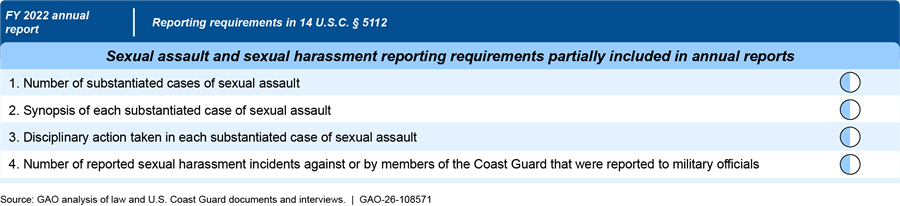
Partially included elements in the 2022 report. We found that the Coast Guard’s annual reports partially included four of the 11 statutorily required elements as shown in figure 5.
Figure 5: Elements Required by Statute that Coast Guard Partially Included in its Fiscal Year 2022 Annual Report on Sexual Assault and Sexual Harassment
Note: See 14 U.S.C. § 5112. The fiscal year 2022 report was the most recent report available at the time of our review.
The Coast Guard is required to share the number of substantiated cases of sexual assault—which the Coast Guard considers to be those when an accused person is found to have committed the offense—but the 2022 report did not fully do so.[33] For closed cases, the report identified the number of each type of “case disposition,” which included judicial punishment, non-judicial punishment, administrative action taken, and no action taken. In the 2022 report, the Coast Guard stated that the “no action” category can include complaints that were not substantiated or those where Coast Guard does not have jurisdiction. Otherwise, the report did not reference “substantiated” cases of sexual assault. As a result, although the number of each type of case disposition presumably included some cases that were substantiated, it is not clear in the reports which of these cases were considered substantiated.[34]
The Coast Guard is also required to provide a synopsis of each substantiated case of sexual assault.[35] The Coast Guard report for 2022 provided synopses for sexual assault cases tried by a court-martial in the fiscal year corresponding to the report, but did not provide synopses for sexual assault cases that were not tried by court-martial.[36]
Relatedly, the Coast Guard is to report on the disciplinary actions taken in each substantiated case of sexual assault.[37] The 2022 report contained disciplinary outcomes for sexual assault cases tried by courts martial in the fiscal year corresponding to the report. However, it did not contain disciplinary actions for those cases that were not tried by a court martial.[38] Because the Coast Guard did not clearly identify “substantiated cases,” there is no way to tell if the report fully met the requirements related to synopses and disciplinary actions.
The Coast Guard is also required to provide the number of sexual harassment incidents committed against or by members of the Coast Guard that were reported to military officials.[39] Coast Guard officials told us that the numbers in the 2022 report include the number of sexual harassment complaints from both the Anti-Harassment Program Office and formal complaints from the EO/EEO process. However, officials told us that the report did not include pre-complaint allegations resolved informally through the EO/EEO process, so the numbers may not be comprehensive.[40] Officials told us that they would include pre-complaint allegations in future reports.
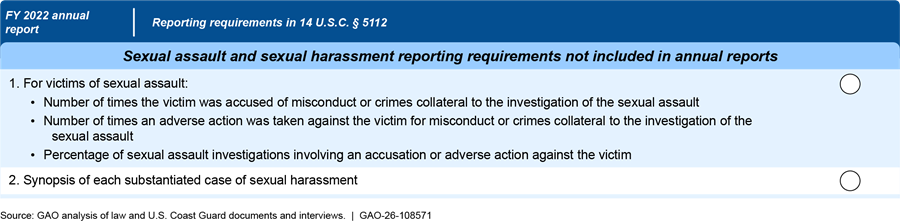
Elements not included in the 2022 report. We found that the Coast Guard’s annual report for fiscal year 2022 did not include two of the 11 statutorily required elements, as shown in figure 6.
Figure 6: Elements Required by Statute that Coast Guard Did Not Include in its Fiscal Year 2022 Annual Report on Sexual Assault and Sexual Harassment
Note: See 14 U.S.C. § 5112. The fiscal year 2022 report was the most recent report available at the time of our review.
The Coast Guard is required to report various information related to sexual assault victims: (1) the number of times that assault victims were accused of misconduct or crimes collateral to the assault investigation, (2) the number of times that adverse action was taken against the victim for misconduct or crimes collateral to the investigation, and (3) the percentage of sexual assault investigations involving an accusation or adverse action against the victim.[41] This requirement was enacted in January 2021, but the Coast Guard did not include any information responsive to it in the 2022 report. Coast Guard officials said they could not account for this absence. Going forward, officials said that the recently established Office of the Chief Prosecutor will begin to provide this information, and they anticipated that it would be in the report covering fiscal year 2023.
The law also requires the Coast Guard to provide a synopsis of each substantiated case of sexual harassment.[42] While the annual report listed the disciplinary actions taken for substantiated cases, it offers no synopses. Coast Guard officials said that they had been presenting actions without synopses since 2018 and could not explain why no synopses were in recent reports.
Missed delivery deadlines. The Coast Guard is also required to submit the report by January 15 of each year.[43] However, the service did not issue the report covering fiscal year 2022 until January 3, 2024—about a year late. The report covering fiscal year 2023 was due on January 15, 2024 and the report covering fiscal year 2024 was due on January 15, 2025. Both remained unissued, as of December 2025. Coast Guard officials attributed the delays of the 2022 report to the COVID-19 pandemic and the 2023 report in part to changes in administration priorities, which lengthened the review time. Specifically, officials said that because the 2023 report had not yet been issued when the new administration took office, they need to conduct additional review to align it with the 2025 diversity, equity, and inclusion-related executive orders.[44]
According to Coast Guard officials, they have been compiling reports the same way for several years and said they were not aware that the information in recent reports did not fully incorporate all elements. We reviewed two past reports as well as a draft fiscal year 2023 report and corroborated that the Coast Guard partially included, or did not include, certain elements consistently, as discussed above. Further, during our review and after we identified gaps in the report, Coast Guard officials acknowledged the 2023 report was incomplete and decided to revise it before issuance.
The Coast Guard’s most recent annual report to Congress on sexual assault and sexual harassment did not include all statutorily required elements because the service did not fully follow its standard operating procedures for tracking legislative requirements and compiling and approving congressional reports to be issued. Coast Guard procedures require officials to identify, track, and follow legislative changes and requirements specific to sexual assault and prevention through to completion.[45] The Coast Guard also has procedures for compiling and reviewing reports, generally, for Congress.[46] The Coast Guard’s process for compiling the fiscal year 2022 annual report did not fully follow procedures in two respects:
· According to the procedures, the Coast Guard is to review each enacted bill to identify requirements for the service and track the actions taken to implement these requirements through completion. But the Coast Guard’s tasking email initiating the process to compile the 2022 report used the outdated 2019 statutory requirements instead of the 2021 statutory requirements. Using outdated requirements raises questions about whether the legal review was sufficient—specifically why the review of the National Defense Authorization Act for Fiscal Year 2021 did not identify the amendments to the reporting requirements. Coast Guard officials said they were not aware that the previous report, used as a template for compiling the required information for future reports, contained outdated statutory requirements.
· Once the annual report is compiled, the Coast Guard is to obtain review from the internal program offices as well as a legal review from the Judge Advocate General. Further, an applicable Department of Homeland Security management directive requires authorization reports from the department or its components to be “legally sufficient.”[47] The use of outdated statutory language and deficiencies for multiple years raises questions about whether the legal review was sufficient.
Coast Guard and Standards for Internal Control in the Federal Government state that management should establish policies and procedures to achieve objectives and respond to risks, as well as use and communicate quality information to meet its objectives.[48] By ensuring that it addresses all required sexual assault and sexual harassment reporting requirements, including requirements that have changed since the prior report, the Coast Guard would better assemble and communicate complete and quality information for decision-making and increase transparency to Congress on incidents of sexual assault and sexual harassment.[49] Further, by issuing a timely, annual report, consistent with the statutory deadline, Coast Guard would better provide Congress with the opportunity for oversight of the service’s efforts to address sexual assault and sexual harassment.
Conclusions
Sexual assault and sexual harassment in the Coast Guard is a longstanding issue, and the service acknowledged it withheld sexual assault information gathered during Operation Fouled Anchor from lawmakers and the public. The service committed to provide complete and timely information to Congress moving forward.
While the Coast Guard is required to submit an annual report to Congress on sexual assault and sexual harassment involving service members, a lack of transparency with respect to incidents of sexual assault and sexual harassment from prior years’ reports remains. The Coast Guard has procedures in place to identify and compile incidents of sexual assault and sexual harassment. However, the service did not follow these procedures and the resulting report for fiscal year 2022 did not include all statutory elements. It used outdated requirements, and our review of several past reports as well as the draft fiscal year 2023 report determined the Coast Guard partially included, or did not include, some of the required elements consistently. Further, the report for fiscal year 2022 was submitted to Congress a year later than the statutory deadline and the reports for subsequent fiscal years remaining outstanding.
Ensuring that annual sexual assault and sexual harassment reports to Congress address all required elements and are delivered on time would provide Congress with timely and complete information it can use for oversight.
Recommendations for Executive Action
We are making the following two recommendations to the Coast Guard:
The Commandant of the Coast Guard should ensure that annual sexual assault and sexual harassment reports address all required elements, including requirements that have changed since the prior report. (Recommendation 1)
The Commandant of the Coast Guard should ensure that annual sexual assault and sexual harassment reports are issued on time. (Recommendation 2)
Agency Comments and Our Evaluation
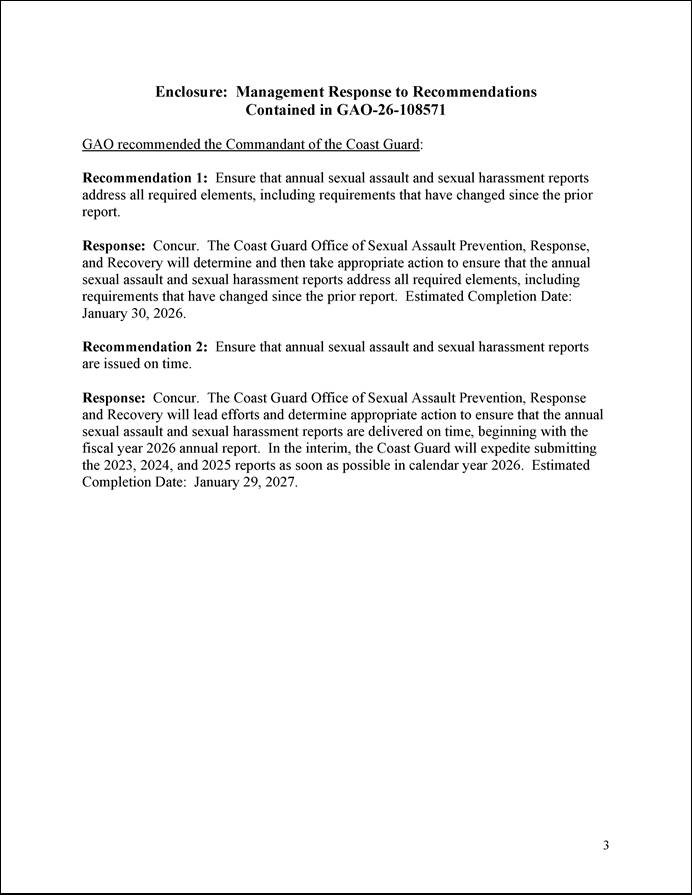
We provided a draft of this report to the Coast Guard for review and comment. In its comments, reproduced in appendix I, the Department of Homeland Security concurred with both recommendations and described the Coast Guard’s planned actions to address them.
DHS concurred with the recommendation to ensure that annual sexual assault and sexual harassment reports address all required elements (Recommendation 1). DHS stated that Coast Guard will determine and take appropriate action to ensure that the annual sexual assault and sexual harassment reports address all required elements, including requirements that have changed since the prior report.
DHS concurred with the recommendation to ensure that annual sexual assault and sexual harassment reports are issued on time (Recommendation 2). DHS stated that Coast Guard will lead efforts and determine appropriate action to ensure that the annual sexual assault and sexual harassment reports are delivered on time, beginning with the fiscal year 2026 annual report. In the interim, the Coast Guard will expedite submitting the 2023, 2024, and 2025 reports as soon as possible in calendar year 2026.
The Coast Guard also provided technical comments, which we incorporated as appropriate.
We are sending copies of this report to the appropriate congressional committees, the Secretary of Homeland Security, the Acting Commandant of the Coast Guard, and other interested parties. In addition, the report is available at no charge on the GAO website at http://www.gao.gov.
If you or your staff have any questions about this report, please contact me at MacLeodH@gao.gov. Contact points for our Offices of Congressional Relations and Public Affairs may be found on the last page of this report. GAO staff who made significant contributions to this report are listed in appendix II.

Heather MacLeod
Director, Homeland Security and Justice
List of Requesters
The Honorable Maria Cantwell
Ranking Member
Committee on Commerce, Science, and Transportation
United States Senate
The Honorable Sam Graves
Chairman
The Honorable Rick Larsen
Ranking Member
Committee on Transportation and Infrastructure
House of Representatives
The Honorable Salud Carbajal
Ranking Member
Subcommittee on Coast Guard and Maritime Transportation
Committee on Transportation and Infrastructure
House of Representatives
The Honorable Hillary Scholten
House of Representatives
GAO Contact
Heather MacLeod, at MacLeodH@gao.gov
Staff Acknowledgments
In addition to the contact named above, Paul Hobart (Assistant Director), Giff Howland (Analyst in Charge), Jamarla Edwards, Samantha Lyew, Landis Lindsey, and Ryan Basen made key contributions to this report.
The Government Accountability Office, the audit, evaluation, and investigative arm of Congress, exists to support Congress in meeting its constitutional responsibilities and to help improve the performance and accountability of the federal government for the American people. GAO examines the use of public funds; evaluates federal programs and policies; and provides analyses, recommendations, and other assistance to help Congress make informed oversight, policy, and funding decisions. GAO’s commitment to good government is reflected in its core values of accountability, integrity, and reliability.
Obtaining Copies of GAO Reports and Testimony
The fastest and easiest way to obtain copies of GAO documents at no cost is through our website. Each weekday afternoon, GAO posts on its website newly released reports, testimony, and correspondence. You can also subscribe to GAO’s email updates to receive notification of newly posted products.
Order by Phone
The price of each GAO publication reflects GAO’s actual cost of production and distribution and depends on the number of pages in the publication and whether the publication is printed in color or black and white. Pricing and ordering information is posted on GAO’s website, https://www.gao.gov/ordering.htm.
Place orders by calling (202) 512-6000, toll free (866) 801-7077,
or
TDD (202) 512-2537.
Orders may be paid for using American Express, Discover Card, MasterCard, Visa, check, or money order. Call for additional information.
Connect with GAO
Connect with GAO on X,
LinkedIn, Instagram, and YouTube.
Subscribe to our Email Updates. Listen to our Podcasts.
Visit GAO on the web at https://www.gao.gov.
To Report Fraud, Waste, and Abuse in Federal Programs
Contact FraudNet:
Website: https://www.gao.gov/about/what-gao-does/fraudnet
Automated answering system: (800) 424-5454
Media Relations
Sarah Kaczmarek, Managing Director, Media@gao.gov
Congressional Relations
A. Nicole Clowers, Managing Director, CongRel@gao.gov
General Inquiries
[1]Interim Report: Coast Guard Efforts to Conceal the Operation Fouled Anchor Investigation from Congress and the Public, Majority and Minority Staff Report Permanent Investigations Subcommittee, Committee on Homeland Security and Governmental Affairs, U.S. Senate, Dec. 20, 2024.
[2]Budget Oversight of the United States Coast Guard, Hearing Before the S. Subcomm. On Oceans, Fisheries, Climate Change, and Manufacturing and of The S. Comm on Commerce, Science, and Transportation, 118th Cong. (2023).
[3]William M. (Mac) Thornberry National Defense Authorization Act for Fiscal Year 2021, Pub. L. No. 116-283, div. G, tit. LVXXXV, § 8501(a)(7), 134 Stat. 3388, 4745-46 (2021) (codified at 14 U.S.C. § 5112) (requiring an annual report from the Coast Guard).
[4]U.S. Coast Guard, Sexual Assault in the U.S. Coast Guard (FY2022) Report to Congress (Jan. 3, 2024).
[5]U.S. Coast Guard, Accountability and Transparency Review Team Report, (Washington, D.C.: Nov. 2023).
[6]In this report when we reference submission of the report to Congress, we mean submission of the report to the following congressional committees specified by law: the Committee on Transportation and Infrastructure of the House of Representatives, the Committee on Homeland Security of the House of Representatives, and the Committee on Commerce, Science, and Transportation of the Senate. See 14 U.S.C. § 5112(a).
[7]See 14 U.S.C. § 5112.
[8]See, e.g., Coast Guard, Commandant Instruction 1754.10F, Sexual Assault Prevention, Response and Recovery (SAPRR) Program, (Washington, D.C.: April 13, 2023); Commandant Instruction 5350.6A., Harassing Behavior Prevention, Response and Accountability, (Washington, D.C.: Nov 13, 2025); Commandant Instruction 5520.5G U.S. Coast Guard, Coast Guard Investigative Service Roles and Responsibilities, (Washington, D.C.: Jan. 11 2023); and Commandant Instruction M5350.4E, U.S. Coast Guard Civil Rights Manual, (Washington D.C.: Oct. 21, 2020).
[9]The five selected districts are: Northeast, Heartland, Great Lakes, Northwest, and Arctic. As part of our field work, we also conducted one site visit to New England to meet with these officials in the Northeast District as well as at the Coast Guard Academy.
[10]See 14 U.S.C. § 5112. The fiscal year 2022 report is entitled: U. S. Coast Guard, Sexual Assault in the U.S. Coast Guard (FY2022) Report to Congress (Jan. 3, 2024). The statute includes a subsection labeled “contents” that contains five provisions.
14 U.S.C. § 5112(b)(1)-(5). Because some of the five provisions contain multiple elements, we did not count each provision as a single element, which would have resulted in a total of 5 elements. Instead, we identified in each provision the elements related to sexual assault, elements related to sexual harassment, or elements with no distinction and thus applicable to both sexual assault and sexual harassment, for a total of 11 elements. For example, we counted 14 U.S.C. § 5112(b)(1) as containing 4 separate elements: (1) number of sexual assaults against or by members of the Coast Guard reported to military officials; (2) of the number of reported cases of sexual assault, number of substantiated cases of sexual assault; (3) number of incidents of sexual harassment against or by members of the Coast Guard reported to military officials; and (4) of the number of reported cases of sexual harassment, the number of substantiated cases of sexual harassment.
[11]The reporting requirements have been in place since 2010 and generally require the Coast Guard to report on the number of sexual assaults and incidents of sexual harassment by or against members of the Coast Guard reported to military officials, as well as more detailed information about substantiated cases. See 14 U.S.C § 5112. Originally, the reporting requirements addressed only sexual assault, but in 2018 the statute was amended to include sexual harassment. It was last amended on January 1, 2021, to add reporting requirements such as the number of instances in which a victim of sexual assault was accused of misconduct or crimes collateral to the investigation of sexual assault committed against them.
[12]U.S. Coast Guard, External Coordination Division, Standard Operating Procedures for Enacted Legislative Requirements Tracking, Rev. Feb. 27, 2025; and U.S. Coast Guard, External Coordination Division, Standard Operating Procedures (SOP) For Congressional Reports, Feb. 7, 2023.
[13]We compared Coast Guard-reported instances of sexual harassment for the fiscal year 2022 annual report to reported sexual harassment in the Coast Guard’s Equal Employment Opportunity (EEO) data. This information is required to be disclosed publicly by the Notification and Federal Employee Antidiscrimination and Retaliation Act (No FEAR Act) and annual EEO program status report (Management Directive 715) for the same years.
[14]U.S. Coast Guard, Management’s Responsibility for Internal Controls and Reporting Requirements, COMDTINST5200.10A (Washington, D.C.: Nov. 2, 2022); GAO, Standards for Internal Control in the Federal Government, GAO‑14‑704G (Washington, D.C.: Sept. 2014).
[15]Sexual assault includes a broad category of sexual offenses consisting of rape, sexual assault, aggravated sexual contact, abusive sexual contact, forcible sodomy (forced oral or anal sex), or attempts to commit any of these acts.
[16]See Coast Guard, Commandant Instruction 1754.10F, Sexual Assault Prevention, Response and Recovery (SAPRR) Program, (Washington, D.C.: April 13, 2023) and Commandant Instruction 5350.6A., Harassing Behavior Prevention, Response and Accountability, (Washington, D.C.: Nov 13, 2025).
[17]14 U.S.C § 5112. After we provided our draft to DHS for comment, the National Defense Authorization Act for Fiscal Year 2026 was enacted. The current reporting requirements at 14 U.S.C. § 5112 remain unchanged, but the law adds new reporting requirements related to sexual assault and sexual harassment for the Coast Guard. The law also includes a provision for GAO to review whether the Coast Guard met the reporting requirements under 14 U.S.C. § 5112, among other things. See Pub. L. No. 119-60, div. G, tit. LXXV, subtit. A, sec. 7501(a)(2)(A)(ii), subtit. B, sec. 7511(a), § 2533, 139 Stat. 718 (2025).
[18]In addition to the sexual assault and sexual harassment statutory reporting requirement for Coast Guard, 14 U.S.C. § 5112, the No FEAR Act requires federal agencies, including the Coast Guard, to report certain data in both an annual report to Congress and in publicly available data updated quarterly. See Pub. L. No. 107-174, 116 Stat. 566 (2002) (codified as amended at 5 U.S.C. § 2301 note). The No FEAR Act reporting requirement applies to EEO discrimination claims on a variety of bases (age, sex, and religion, among others), and requires collection and publication of data related to the EEO regulatory process. In contrast, the sexual assault and sexual harassment reporting requirement applies only to claims of sexual assault and sexual harassment. Further, for such claims, 14 U.S.C. § 5112 does not limit the report to incidents reported through the EEO process. The EEO process is one of many ways in which an incident may be reported. Lastly, the statutory timeframes for each report differ. Accordingly, while the No FEAR Act report and the sexual assault and sexual harassment report each may be developed using some of the same data, the reports may not be a one-to-one match.
[19]Coast Guard manages the Equal Opportunity (EO) portion of this process for its military members and the Equal Employment Opportunity (EEO) portion of this process for civilian employees.
[20]The EO/EEO process has two phases: the informal “pre-complaint” process and the formal complaint process. The informal or “pre-complaint” process consists of counseling and the option to engage in alternative dispute resolution. The formal process involves a formal investigation, which could lead to legal action. The victim has the right to file a formal complaint if their concerns are not addressed during the informal process.
[21]See U.S. Coast Guard, Sexual Assault Prevention, Response and Recovery Program (COMDTINST 1754.10F) (Washington, D.C.: April 13, 2023).
[22]See U.S. Coast Guard, Sexual Assault Prevention, Response and Recovery Program (COMDTINST 1754.10F) (Washington, D.C.: April 13, 2023).
[23]CGIS has the responsibility to investigate all alleged incidents of sexual assault reported on an unrestricted basis. CGIS also may investigate all alleged incidents of sexual harassment or refer the matter for a command-led investigation. See U.S. Coast Guard, Sexual Assault Prevention, Response and Recovery Program (COMDTINST 1754.10F) (Washington, D.C.: April 13, 2023).
[24]SAPRR maintains sexual assault information in the Department of Defense’s Defense Sexual Assault Incident Database, a case-level database for the collection and maintenance of these data. The Anti-Harassment Program Office and Civil Rights Directorate maintain sexual harassment data in the Field Activity Case Tracking System and a commercial off-the-shelf system, respectively. The Civil Rights Directorate collects, maintains, and manages data for EO/EEO complaints. However, according to whistleblower testimony, some complaints of sexual assault were not recorded in these systems during the Operation Fouled Anchor investigation to prevent disclosure of those alleged instances of sexual assault to Congress. See United States Senate Permanent Subcommittee on Investigations, A Pervasive Problem: Voices of Coast Guard Sexual Assault and Harassment Survivors, Majority Staff Report (Washington, D.C.: Aug. 7, 2024). There is an ongoing Department of Homeland Security Office of Inspector General investigation related to the production of the report resulting from the Fouled Anchor investigation. Congress directed the Inspector General to review the timeline of all approval correspondence regarding the Operation Fouled Anchor report. Among other directives, the report is to provide a detailed accounting of if, when, and why the decision was made to withhold information regarding the investigation from Congress, the Coast Guard personnel involved in any such decision, and their respective roles. See Staff of H.R. Comm. on App., 118th Cong., Joint Explanatory Statement for Division C—Department of Homeland Security Appropriations Act 12 (Comm. Print 2024) In March 2025, DHS Office of Inspector General officials told us that their investigation of Operation Fouled Anchor is ongoing and therefore declined to provide additional detail on the scope of their investigation or estimated completion time frames. As of December 2025, their investigation was ongoing.
[25]DHS, Legislative Procedures, Management Directive 0420, Feb. 28, 2005.
[26]We reviewed a draft of the report for Fiscal Year 2023, which also did not fully include all required elements. As a result of our review, Coast Guard and DHS concluded that such information was missing and decided to withdraw the report approved by the Acting Commandant on June 6, 2025. A Coast Guard official informed us that they would update the report and submit it for review by DHS and the Office of Management and Budget.
[27]The statute requires the report to include policies, procedures, and processes implemented by the Secretary. 14 U.S.C. § 5112(b)(4)(34). The Coast Guard included in the report policies, procedures, and processes implemented by the Commandant. We considered this sufficient to meet the requirement.
[28]14 U.S.C. § 5112(b)(1).
[29]According to Coast Guard officials, sexual assault data pertain to adult-only cases because cases involving minors are within the jurisdiction of the Family Advocacy Program rather than the SAPRR program. In fiscal year 2022, there were five reports of sexual assault involving victims under the age of 18, which are not included in the Fiscal Year 2022 Report to Congress. Coast Guard officials said that they do not include civilian-on-civilian case data because they interpret the statute, 14 U.S.C. § 5112(a), (b)(1), to only require data that involve the Coast Guard’s military workforce. See 14 U.S.C. § 5112(a), (b)(1) (requiring “[t]he number of sexual assaults and incidents of sexual harassment against members of the Coast Guard, and the number of sexual assaults and incidents of sexual harassment by members of the Coast Guard”).
[30]14 U.S.C. § 5112(b)(1).
[31]According to the fiscal year 2022 report, a “substantiated” case of sexual harassment is one in which there is evidence to support the allegation of prohibited harassment. Further, the report states that an allegation of harassment need not meet the definition of unlawful harassment to be determined to be “substantiated.”
[32]14 U.S.C. § 5112(b)(4).
[33]14 U.S.C. § 5112(b)(1).
[34]The Department of Defense defines “not substantiated” in its reports to Congress related to sexual assault, meaning the allegation is false or baseless. According to the Department of Defense, two potential situations can lead to the conclusion that the allegations of a crime are not substantiated. A case against a particular subject is determined to be false when (1) evidence demonstrates that the accused person did not commit the offense, or (2) evidence refutes the occurrence of a crime. A case is determined to be baseless when it is improperly reported as a sexual assault.
[35]14 U.S.C. § 5112(b)(2).
[36]A court-martial in the Coast Guard is a formal military trial, used to adjudicate allegations of offenses against military law. Allegations underlying the synopses of cases tried by courts-martial may or may not have been made during the fiscal year covered by the report, according to Coast Guard.
[37]14 U.S.C. § 5112(b)(2).
[38]Allegations underlying the cases in which disciplinary action is described may or may not correspond to allegations made during the fiscal year covered by the report.
[39]14 U.S.C. § 5112(b)(1).
[40]The informal or “pre-complaint” process consists of counseling and the option to engage in alternative dispute resolution. The victim has the right to file a formal complaint if their concerns are not addressed in the informal process.
[41]14 U.S.C. § 5112(b)(5).
[42]14 U.S.C. § 5112(b)(2).
[43]14 U.S.C. § 5112(a).
[44]Coast Guard identified the following executive orders related to diversity, equity, and inclusion: Executive Order No. 14151, Ending Radical and Wasteful Government DEI Programs and Preferencing, 90 Fed. Reg. 8339 (Jan. 20, 2025); Executive Order No. 14173, Ending Illegal Discrimination and Restoring Merit-Based Opportunity, 90 Fed. Reg. 8633 (Jan. 21, 2025); and Executive Order No. 14185, Restoring America’s Fighting Force, 90 Fed. Reg. 8763 (Jan. 27, 2025).
[45]See U.S. Coast Guard, External Coordination Division, Standard Operating Procedures for Enacted Legislative Requirements Tracking, Rev. Feb. 27, 2025. In March 2022, we found that the Coast Guard did not have a method for historically tracking statutory requirements pertaining to sexual assault and their implementation. Instead, we found that the Coast Guard used informal taskers as needed to implement required changes. We recommended the service establish an oversight structure to track implementation of legislative requirements pertaining to sexual assault. See GAO, Sexual Assault: DOD and Coast Guard Should Ensure Laws Are Implemented to Improve Oversight of Key Prevention and Response Efforts, GAO‑22‑103973 (Washington, D.C.: March 2022).
[46]U.S. Coast Guard, External Coordination Division, Standard Operating Procedures (SOP) For Congressional Reports (Washington, D.C.: Feb. 7, 2023).
[47]DHS, Legislative Procedures, Management Directive 0420, February 28, 2005. According to the directive, an authorization report is any legislative report intended for transmittal to the Congress; it is required by enacted authorizing legislation or requested in a related congressional committee, chamber, or conference report and intended for transmittal to the Congress.
[48]U.S. Coast Guard, Management’s Responsibility for Internal Controls and Reporting Requirements, COMDTINST5200.10A (Washington, D.C.: Nov. 2, 2022); GAO, Standards for Internal Control in the Federal Government, GAO‑14‑704G (Washington, D.C.: Sept. 2014).
[49]Given the recent passage of the National Defense Authorization Act of Fiscal Year 2026 and its additional reporting requirements related to covered misconduct, which includes sexual assault and sexual harassment, it is especially critical that the Coast Guard review legislative changes to ensure inclusion of all required elements in its reports. See Pub. L. No. 119-60, div. G, tit. LXXV, subtit. B, sec. 7511(a), §§ 2533, 2539, 139 Stat. 718 (2025).