
Report to Congressional Committees
United States Government Accountability Office
A report to congressional committees
Contact: David Marroni at MarroniD@gao.gov
What GAO Found
The General Services Administration (GSA) owns and leases thousands of office buildings, which are used by federal employees and the public. The Architectural Barriers Act of 1968 (ABA) requires that certain GSA office buildings be accessible to individuals with physical disabilities. According to GSA officials and documentation, GSA reviews alteration, leasing, and construction projects throughout the design process for compliance with its ABA Accessibility Standard.
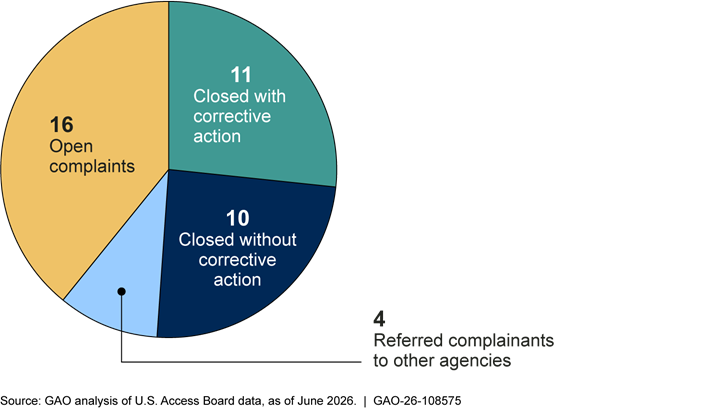
The U.S. Access Board (Board), an independent federal agency, enforces the ABA by addressing complaints of potential violations of applicable ABA standards. The Board generally relies on complaints rather than inspections due to resource constraints, according to Board officials. Anyone may file complaints with the Board alleging ABA noncompliance of GSA buildings. From October 2022 to June 2026, the Board received 41 ABA complaints about GSA’s office buildings and closed 25; 16 are still in process. Some stakeholders who were aware of the process said it was effective in addressing ABA complaints.
However, the public is generally unaware that it can file complaints on accessibility barriers in GSA office buildings, according to almost all the industry stakeholders, federal employee unions, and disability advocates GAO interviewed. Moreover, GSA has not publicized the ABA complaint process. The Board relies on complaints it receives through its complaint process to learn about potential ABA violations and enforce the ABA. Without public information from GSA on this process, such as in its buildings, people with disabilities may be unaware that they are able to file ABA complaints and barriers to the accessibility of GSA office buildings may go unremedied.
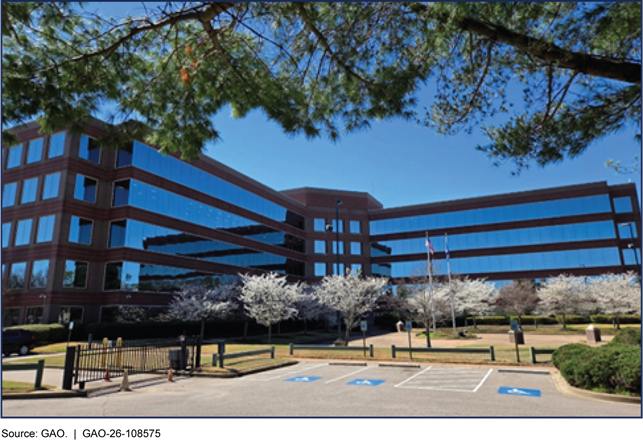
Accessible Parking Spaces at the Eaglecrest Building in Memphis, TN, Leased by the General Services Administration
Why GAO Did This Study
Tens of millions of Americans live with disabilities. Those individuals may need to access federal office buildings to work or to obtain government services. GSA’s national accessibility program helps ensure that these individuals can access the more than 6,000 office buildings owned or leased by GSA.
The Thomas R. Carper Water Resources Development Act of 2024 includes a provision for GAO related to GSA office buildings and the ABA. This report (1) describes GSA’s practices for ensuring compliance with the ABA during construction, alteration, and leasing of office buildings and recent changes to its ABA program; and (2) examines the extent to which ABA complaints about GSA office buildings are received and addressed, and the extent to which GSA makes individuals aware they can file complaints.
GAO reviewed relevant statutes, regulations, and agency documents. GAO conducted site visits to six GSA office buildings with open and closed ABA complaints and with recent construction, alteration, and leasing projects. GAO analyzed October 2022 to June 2026 complaint data from the Access Board. GAO also interviewed nine stakeholders including from industry organizations, federal employee unions, and disability advocates, as well as GSA and Access Board officials.
What GAO Recommends
The Administrator of the General Services Administration should take steps to increase awareness of the ABA process to file complaints about accessibility barriers in GSA office buildings. For example, GSA could post signs with information about filing ABA complaints at the entry areas of its office buildings. GSA agreed with GAO’s recommendation.
Abbreviations
|
ABA |
Architectural Barriers Act of 1968 |
|
GSA |
General Services Administration |
This is a work of the U.S. government and is not subject to copyright protection in the United States. The published product may be reproduced and distributed in its entirety without further permission from GAO. However, because this work may contain copyrighted images or other material, permission from the copyright holder may be necessary if you wish to reproduce this material separately.
September 22, 2026
The Honorable Shelley Moore Capito
Chairman
The Honorable Sheldon Whitehouse
Ranking Member
Committee on Environment and Public Works
United States Senate
The Honorable Sam Graves
Chairman
The Honorable Rick Larsen
Ranking Member
Committee on Transportation and Infrastructure
House of Representatives
Tens of millions of Americans live with disabilities. These individuals may need to be able to access federal office buildings to work or to access government services such as applying for benefits. The General Services Administration (GSA), which provides real estate and workspace services for federal tenant agencies, owns and leases more than 6,000 office buildings, according to fiscal year 2024 Federal Real Property Profile data.[1] These buildings are used by federal employees, with some buildings also used by members of the public. Such buildings include offices of the Internal Revenue Service, the Social Security Administration, and the Department of Veterans Affairs. The Architectural Barriers Act of 1968 (ABA) requires that certain GSA buildings, including those designed, built, or altered by or on behalf of GSA or leased by federal agencies after August 12, 1968, be accessible to individuals with physical disabilities.[2]
Two agencies ensure GSA office buildings comply with the ABA using two mechanisms. First, GSA, through its National Accessibility Program, conducts design reviews during the construction, leasing, or alteration process to ensure the building’s design complies with the ABA.[3] Second, any person, including members of the public, may file complaints alleging ABA noncompliance of buildings with the Architectural and Transportation Barriers Compliance Board, also known as the U.S. Access Board (“the Access Board”), which enforces compliance with GSA’s ABA Accessibility Standard.
The Thomas R. Carper Water Resources Development Act of 2024 includes a provision for GAO related to GSA office buildings and the ABA.[4] This report (1) describes GSA’s practices for ensuring compliance with the ABA during construction, alteration, and leasing of office buildings and recent changes to its ABA program, and (2) examines the extent to which ABA complaints about GSA office buildings are received and addressed, and the extent to which GSA makes individuals aware they can file complaints.
For all objectives, we reviewed relevant statutes, regulations, final rules, and guidance such as GSA’s ABA Accessibility Standard and Access Board regulations governing the ABA complaint process. We also reviewed GSA’s policies and procedures related to the accessibility of GSA office buildings and GSA’s and the Access Board’s policies and procedures for receiving and addressing ABA complaints.[5] We interviewed GSA officials about their regulations, policies, and procedures for ensuring compliance with the ABA during construction, alteration, and lease projects, and about their efforts to carry out those policies and procedures. We interviewed Access Board officials about their policies and procedures for receiving and addressing ABA complaints, and their efforts to carry out these policies and procedures. We also interviewed nine stakeholders representing federal employees, disability groups, and industry organizations to obtain their perspectives on GSA’s practices for ensuring compliance with the ABA and the Access Board’s procedures for receiving and addressing ABA complaints. These stakeholders included:
· Four organizations and one individual who advocate for individuals with disabilities. We selected these organizations and individual based on a literature search and recommendations from other stakeholders.
· Two unions that represent federal employees, because those unions advocate for federal employees and negotiate employee grievances about disability issues. We selected these unions based on their number of members as of September 2024, the latest data available.
· Two industry organizations, such as an association of architects. We selected these organizations based on a literature search and recommendations from other stakeholders.
We conducted six site visits to GSA office buildings.[6] For these site visits, we selected three cities. In each city, we visited one building about which a complaint was filed with the Access Board and one building with a recent construction, alteration, or leasing project. For buildings with complaints, we selected buildings with open and closed complaints. For buildings with a recent construction, alteration, or leasing project, we selected one building each with a new construction project from 2015 through 2025, a leasing project from 2022 through 2025, and an alteration project from 2022 through 2025.[7] At each building, we interviewed local officials to understand how GSA built compliance with the ABA into the design of the construction, alteration, and leasing projects and how the Access Board’s complaint process had been used. We also toured the buildings to observe how GSA addressed or is addressing accessibility barriers.
To determine the extent to which ABA complaints about GSA office buildings are received and addressed, and the extent to which GSA makes individuals aware they can file complaints, we analyzed October 2022 to June 2026 data on complaints about GSA office buildings which we obtained from the Access Board in June 2026. We tested the quality of the data to assess the accuracy and completeness of the dataset. For example, we tested to ensure no outliers were present for data fields used in our analysis. We also interviewed Access Board officials who are knowledgeable about the data set to ensure its reliability. We found the data to be sufficiently reliable for our purposes of assessing the number and disposition of ABA complaint cases for GSA office buildings.
We conducted this performance audit from June 2025 to September 2026 in accordance with generally accepted government auditing standards. Those standards require that we plan and perform the audit to obtain sufficient, appropriate evidence to provide a reasonable basis for our findings and conclusions based on our audit objectives. We believe that the evidence obtained provides a reasonable basis for our findings and conclusions based on our audit objectives.
Background
Architectural Barriers Act of 1968
The ABA requires buildings covered by the act to be accessible to individuals with physical disabilities.[8] In addition, the ABA requires GSA, in consultation with the Secretary of Health and Human Services, to prescribe standards for the design, construction, and alteration of certain covered buildings “to insure whenever possible that physically handicapped persons will have ready access to, and use of, such buildings.”[9] The ABA applies to buildings both owned and leased by GSA. Each of these buildings must comply with the ABA accessibility standards—issued by GSA—that are in effect at the time such building is designed, constructed, or altered.[10]
The ABA is one of several acts related to accessibility for individuals with disabilities. For example, the Americans with Disabilities Act of 1990, as amended requires public accommodations designed or constructed for first occupancy after January 26, 1993, to be accessible to people with disabilities.[11] This requirement applies to privately-owned public accommodations and commercial facilities that include hotels, restaurants, theaters, grocery stores, hospitals, and schools.
The Access Board
The Access Board is an independent federal agency established under the Rehabilitation Act of 1973 to carry out accessibility-related functions.[12] Since 1978, these functions have included establishing and maintaining the minimum accessibility guidelines and requirements for the standards issued under the ABA.[13] The Access Board issued the current version of its ABA minimum guidelines and requirements applicable to GSA office buildings in July 2004, and GSA adopted these guidelines and requirements as its ABA Accessibility Standard in November 2005.[14]
The Access Board is also responsible for enforcing accessibility standards issued under the ABA, including GSA’s ABA Accessibility Standard, for GSA’s office buildings as well as other buildings covered by the ABA.[15] The Access Board does this primarily via its complaint process, through which any person can file a written complaint with the Board alleging that a covered building does not comply with applicable ABA standards. It is the Access Board’s policy to maximize the accessibility and usability of buildings and facilities through amicable means, which includes the informal resolution of complaints.[16] See figure 1 for a description of the Access Board’s informal resolution process for ABA complaints, including those related to GSA office buildings.[17]
Figure 1: Process the U.S. Access Board (Access Board) Follows to Informally Resolve Architectural Barriers Act (ABA) Complaints Related to General Services Administration (GSA) Buildings
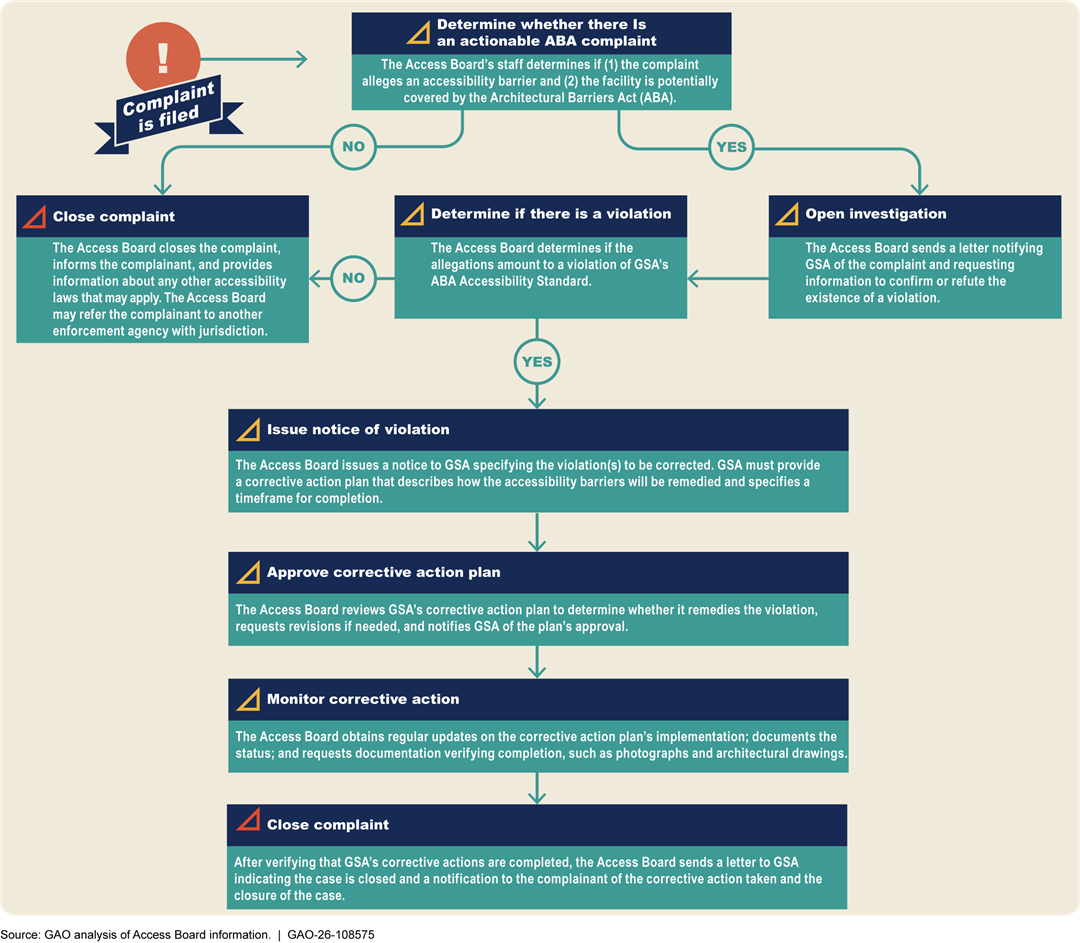
The Access Board publicizes the ABA complaint process through public events, such as training sessions and public meetings. The Access Board has offered training and webinars through online events available through its website and through events held in coordination with outside organizations. The Access Board also provides information on its complaint process through its news releases and its annual Performance and Accountability Report.[18] The Access Board links to the complaint process and its online complaint submission form on its public website.
GSA’s National Accessibility Program
GSA’s National Accessibility Program focuses on ensuring that individuals with disabilities do not face barriers when accessing GSA buildings. The program is responsible for ensuring that the requirements of its ABA Accessibility Standard are incorporated into the designs of all of GSA’s new, altered, and leased buildings. The program also sets GSA’s accessibility policy and interprets its ABA Accessibility Standard for GSA officials, tenant agencies, and other individuals and entities. GSA’s National Accessibility Officer manages the National Accessibility Program and serves as GSA’s liaison with the Access Board. Further, the program manages GSA’s involvement in the ABA complaint process for any complaints the Access Board receives regarding GSA’s owned and leased buildings.
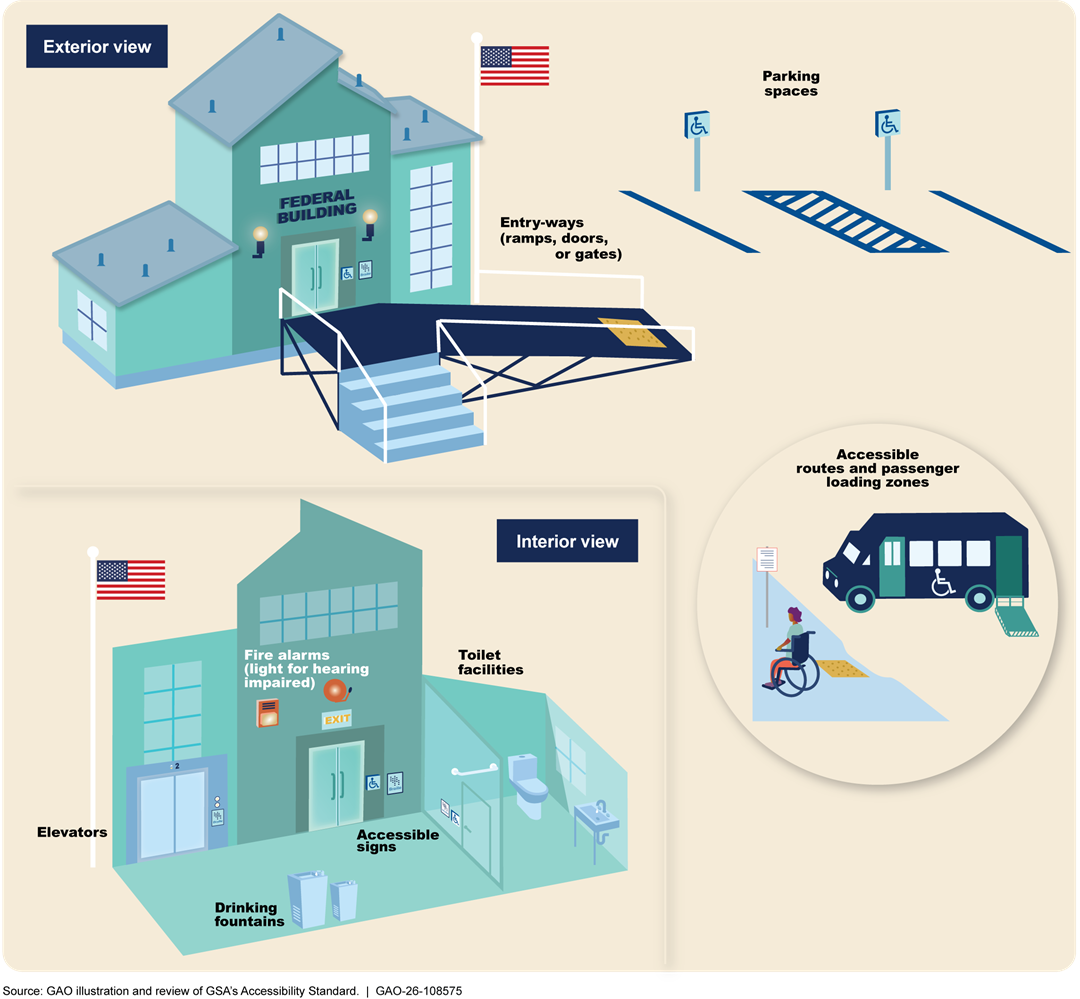
Accessible design under GSA’s ABA Accessibility Standard requires addressing numerous aspects of office buildings that may pose barriers to individuals with disabilities. Two disability advocates we interviewed said that individuals with disabilities most commonly encounter barriers in entering the building, navigating through the building, and using the bathrooms, because those aspects of the building are used by most people who visit the buildings. Accessibility features contained in GSA’s ABA Accessibility Standard to address such barriers include accessible parking spaces, ramps, doors, elevators, and bathrooms. Other accessibility features address other barriers, such as fire alarms that use flashing lights to alert individuals with hearing impairments (see fig. 2).
Figure 2: Examples of Accessibility Features to Be Included in General Services Administration (GSA) Office Buildings
GSA Reviews Office Building Projects for ABA Compliance at Multiple Stages, and Recently Restructured Its Accessibility Program
GSA’s Accessibility Specialists Review Projects to Ensure Compliance with the ABA
Under GSA’s National Accessibility Program, GSA officials review office building construction, alteration, and leasing project designs to ensure that the designs comply with GSA’s ABA Accessibility Standard. These reviews are conducted by GSA subject matter experts with knowledge of accessibility requirements, according to GSA officials.
According to GSA documents, these design reviews for accessibility occur throughout the design process. The subject matter experts initially review the design narrative to ensure it references the correct standards and provide general comments on early design documents.[19] As the design progresses and becomes more detailed, those subject matter experts review design documents at regular intervals to ensure compliance with accessibility standards (see table 1).
|
Stage of design |
Accessibility review conducted |
|
Design narrative |
Accessibility specialists review design narrative documents to ensure they reference correct and current standards. |
|
Concept development |
Because these early plans often lack sufficient detail to enable specific comments on accessibility features, accessibility specialists provide general comments regarding the building’s design. |
|
Design development |
Accessibility specialists review design drawings and provide comments referencing specific accessibility standards. |
|
60 percent of design complete |
Accessibility specialists conduct an in-depth review of features such as parking, accessible routes to the building, entrances, elevators, and bathrooms. At this stage, primary accessibility features should be sufficiently detailed for review. |
|
90 percent of design complete |
Accessibility specialists perform a final check to make sure design changes have not affected accessibility since the 60 percent review. If such design changes have occurred, the specialists will review specific elements for conformance with accessibility standards. |
Source: GAO review of General Services Administration (GSA) documentation | GAO‑26‑108575.
For lease projects, GSA leasing officials follow GSA guidance to ensure that proposed lease space conforms to its ABA Accessibility Standard. GSA’s master template lease agreement requires that leased space follow the accessibility requirements for individuals with disabilities in accordance with the ABA. After awarding a lease, GSA subject matter experts conduct design reviews of projects in leased space for conformance with accessibility requirements following the same process that GSA follows for its owned buildings, according to GSA officials. GSA accepts the space once construction is completed in conformance with the design documents and the lease agreement terms.[20]
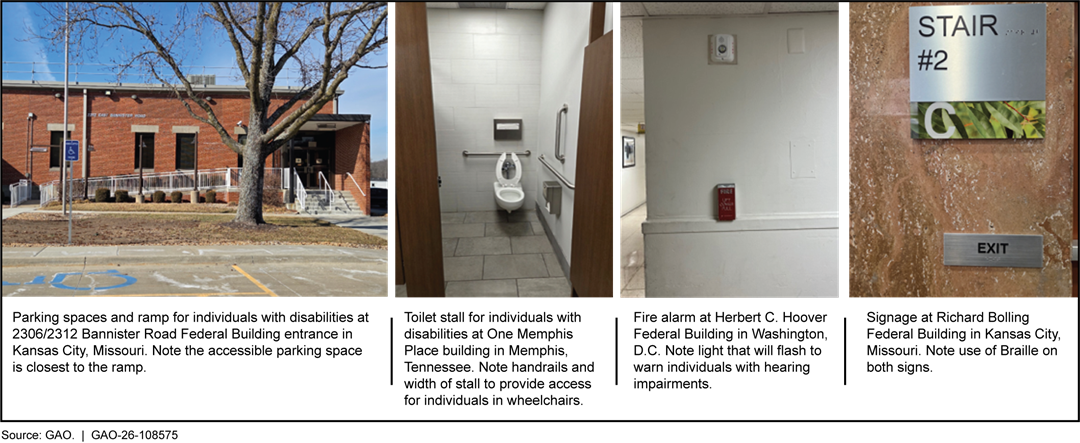
During our site visits, GSA officials described conducting accessibility reviews of their projects at regular intervals in the design process (see fig. 3 for examples of the accessibility features of some of the buildings we visited). Specifically, officials responsible for each of four buildings that had recent alteration or construction projects described conducting accessibility reviews when the design was about 60 percent and about 90 percent complete.
Figure 3: Examples of Accessibility Features in Selected Office Buildings Owned and Leased by the General Services Administration
During design reviews, officials often must balance accessibility with other priorities, such as historic preservation, security, and sustainability, according to GSA officials. For example, a historic building might have an entrance that is accessible only by stairs, and a state historic preservation officer has determined that altering the entrance to include a wheelchair ramp to comply with GSA’s ABA Accessibility Standard would threaten or destroy the historic significance of the building. In those circumstances, GSA’s ABA Accessibility Standard might allow for an alternative existing locked entrance with a notification system to be used to provide access, even though doing so would provide a diminished entry experience for an individual in a wheelchair.
GSA Restructured Its Accessibility Program in 2025
In 2025, GSA restructured its National Accessibility Program amid a broader reorganization effort. Specifically, in March 2025, GSA’s Public Buildings Service, which implements GSA’s National Accessibility Program, started a large-scale reorganization that reduced personnel, eliminated its previous regional structure, and replaced it with a more centralized structure.[21] Prior to this reorganization, accessibility officers in regional offices conducted many of the program’s tasks, such as design reviews. As part of this reorganization effort, GSA eliminated the regional accessibility officer positions and shifted their responsibilities to officials in headquarters, according to GSA officials.
GSA officials said that ABA subject matter experts in GSA’s headquarters will conduct the tasks previously assigned to the regional accessibility officers. To monitor the resources necessary to carry out its compliance efforts, GSA officials said that GSA monitors the timeliness of subject matter experts’ reviews, which include issues other than the ABA.[22] GSA found that between October 1, 2025, and May 3, 2026, 60-70 percent of subject matter expert reviews were completed on time, which suggested a staffing shortage for such experts, according to the officials. In April 2026, we reported that GSA had not conducted workforce planning before reducing its workforce by 45 percent as of November 2025 and recommended that the agency conduct strategic workforce planning that includes analyzing skills gaps.[23] GSA agreed with the recommendation and said that the agency has commenced strategic workforce planning to identify skill gaps and implemented a staffing and hiring plan.
In addition to restructuring the National Accessibility Program, GSA introduced a new tool and procedure for accessibility design reviews. Under this procedure, a GSA project manager or other official requesting a review would submit documents through an online form and subject matter experts would be assigned to review the documents. The National Accessibility Officer would retain ultimate responsibility for ensuring that the reviews are completed and for designating accessibility subject matter experts, according to GSA officials. In January 2026, GSA issued a policy concerning this new subject matter expert review process.[24]
GSA Revised Its Accessibility Regulations and Guidance in 2025
In addition to its ABA Accessibility Standard, GSA had two documents containing policies, requirements, and procedures that included accessibility guidance for office buildings as of January 2025:
· The National Accessibility Program Standards, Policies, and Procedures outlines GSA’s National Accessibility Program and the functions it performs.[25] This document provided direction on topics such as conducting design reviews of projects, the process for issuing modifications and waivers of its ABA Accessibility Standard, and limited information on GSA’s and the Access Board’s procedures for addressing ABA complaints.
· The P100 Facilities Standards for the Public Buildings Service contained a range of requirements and mandatory standards with which GSA buildings must comply, including an accessibility-related requirement that was not stated in GSA’s ABA Accessibility Standard.[26] Specifically, GSA had a requirement under its P100 Facilities Standards to install automatic door openers at all accessible public entrances even though they are not required to be installed under its ABA Accessibility Standard.[27]
In February 2025, GSA rescinded the P100 Facilities Standards for the Public Buildings Service and replaced them with its new Interim Core Building Standards.[28] GSA officials said that they made this change in response to four executive orders issued by the current administration and to remove requirements in its guidance that are not in statute.[29] The Interim Core Building Standards includes a much shorter list of requirements and mandatory standards applicable to GSA office buildings than the P100 Facilities Standards. However, the GSA memorandum containing the Interim Core Building Standards does provide that it is not intended to be a fully complete list of all applicable laws and regulations that may apply.
Before December 16, 2025, GSA’s Federal Management Regulation contained its ABA Accessibility Standard and other regulations implementing the ABA.[30] On December 16, 2025, GSA issued a final rule that removed the portions of the Federal Management Regulation that contained GSA’s ABA Accessibility Standard and other regulations implementing the ABA.[31]
According to GSA officials, GSA removed its regulations implementing the ABA because they contained information that is duplicative of the Access Board’s regulations located in 36 C.F.R. Part 1190 and Part 1191 and GSA is not required by statute to issue its ABA Accessibility Standard as a regulation in the Federal Management Regulation. According to the final rule, GSA sought to streamline and simplify regulations with an underlying statutory requirement and minimize regulations not required by law.
According to the officials, GSA does not plan to issue or redefine a new ABA Accessibility Standard. The officials said that its ABA Accessibility Standard is still in effect as it was prior to GSA’s December 2025 final rule. The officials also said that the ABA Accessibility Standard is referenced in the Interim Core Building Standards and the National Accessibility Program Standards, Policies, and Procedures.
According to GSA officials, GSA is currently updating its Interim Core Building Standards to reflect the changes GSA made to the program, such as the removal of the portions of the Federal Management Regulation. The officials said that GSA intends to issue the updated standards by the end of December 2026.
However, the officials said that the replacement of the P100 Facilities Standards meant that GSA no longer has a policy of requiring installation of automatic door openers at public entrances. According to the officials, no law requires such doors in all cases, although the officials noted there is a statute that requires compliance with the International Building Code and that the International Building Code requires automatic door openers in some buildings based on occupancy.
GSA has not rescinded its National Accessibility Program Standards, Policies, and Procedures nor has it updated the document to reflect the structural and guidance changes GSA implemented in 2025. In June 2026, GSA officials told us that they intend to issue a revised version of GSA’s National Accessibility Program Standards, Policies, and Procedures and update their accessible design website by October 2026.
The Access Board Closed Most of the ABA Complaints It Received, and GSA Does Not Publicize Ability to File Complaints
The Access Board Closed 25 of the 41 ABA Complaints It Received About GSA Office Buildings Between 2022 and 2026
From October 2022 to June 2026, the Access Board received 41 ABA complaints about the over 6,000 office buildings in GSA’s portfolio, according to Access Board data from June 2026.[32] These complaints cited 39 individual GSA office buildings. They varied in the number of barriers cited, but all cited fewer than five accessibility barriers. These complaints cited a range of accessibility barriers, such as lack of accessible parking, accessible entrances, and elevators.
The Access Board closed 25 of the 41 ABA complaints it received about GSA office buildings between October 2022 and June 2026. As mentioned earlier, the Access Board closes a complaint when (1) the corrective action is completed, (2) the Access Board determines that no corrective action is warranted, as no violation of an applicable ABA standard has occurred, or (3) the complainant is referred to another agency with jurisdiction. Of the 25 closed complaints, 11 complaints were closed with corrective action, 10 complaints were closed without corrective action, and the complainants in 4 complaints were referred to the tenant agencies occupying the buildings as complaints under Section 504 of the Rehabilitation Act of 1973.[33] The Access Board was processing 16 complaints as of June 2026. See figure 4.
Figure 4: Disposition of Architectural Barriers Act Complaints about General Services Administration Office Buildings Received by the Access Board from October 2022 to June 2026
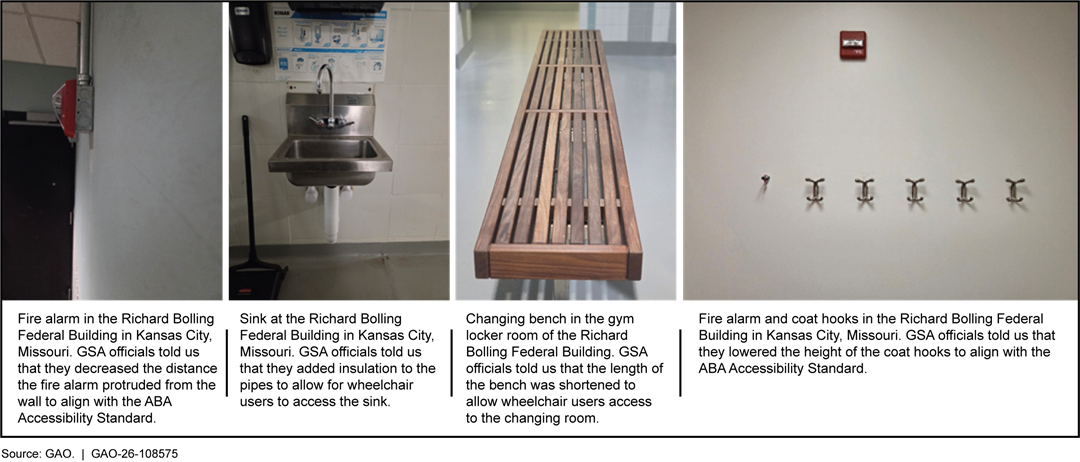
As of June 2026, the Access Board also had three open complaints that it received before October 2022. Each of these three complaints cited over 100 accessibility barriers. GAO visited one of the buildings with over 100 accessibility barriers listed on a complaint, the Richard Bolling Federal Building in Kansas City, Missouri. The alleged violations at this building included the visibility of fire alarms, sink heights, right-of-way clearances in changing rooms, and heights of coat hooks. GSA officials told us that the building had received a complaint with so many cited accessibility barriers because a third-party engineering firm conducted an accessibility survey and identified over 100 ABA violations.[34] GSA officials told us they had removed about half of the accessibility barriers and have identified solutions to address all remaining barriers. See figure 5 for examples of changes GSA made that officials said were intended to address ABA violations.[35]
Figure 5: Examples of Changes Made to the Richard Bolling Federal Building That General Services Administration (GSA) Officials Said Were Intended to Address Architectural Barriers Act (ABA) Violations
We interviewed seven stakeholders who were aware of the ABA process. Three stakeholders told us that the Access Board’s complaint process was effective in addressing ABA complaints. For example, representatives of one disability advocacy organization said that the Access Board adjudicated complaints better than other federal agencies with which the organization worked and was efficient and effective in doing so. Similarly, another stakeholder told us that the ABA complaint process helped a federal employee who had complained internally for years that a portion of their office was inaccessible. After the employee filed an ABA complaint, the Access Board worked with the building manager to resolve the complaint and educate the building manager on the requirements of the ABA.
Four stakeholders we interviewed who were aware of the ABA process noted that some complaints can take a substantial amount of time to resolve. As of June 2026, the median duration of an open complaint was about 6.5 months. GSA officials told us that it can take time to obtain funding to address the barrier in the complaint. Access Board officials told us that some recent complaints have taken longer than typical to close, due to staffing changes at the Access Board and GSA staff leaving the agency.
Access Board officials told us that they may be able to complete cases more quickly in the future because the Access Board and GSA have concluded recent periods of staffing and organizational change. Access Board officials said that GSA’s restructuring had led to less communication between the agencies during the transition, but Access Board and GSA officials said that they now regularly communicate regarding ABA complaints about GSA buildings.
GSA Does Not Publicize That Individuals Can File ABA Complaints About Its Office Buildings
The public is generally unaware of their ability to file ABA complaints, according to almost all the industry stakeholders, federal employee unions, and disability advocates we interviewed. We found that two stakeholders we interviewed were not aware of the ABA complaint process.[36] Seven stakeholders told us that they were aware of the ABA complaint process. Stakeholders who worked with the Access Board more often, such as disability advocates, were aware of the complaint process. Stakeholders who did not work with the Access Board, or who were not accessibility subject matter experts, such as the federal employee unions’ representatives we spoke with, were not aware of the ABA complaint process or their members’ ability to file ABA complaints. Six stakeholders said that individuals with disabilities generally would not know of their ability to file a complaint.
GSA’s policy for accessible design is to make its buildings accessible, thereby eliminating the need for special equipment or spaces intended solely for people with disabilities. GAO’s Standards for Internal Control in the Federal Government states that management should externally communicate the necessary quality information to achieve the entity’s objectives.[37] Communicating information to individuals about their ability to file ABA complaints could help GSA fulfill its policy of making its properties accessible by alerting GSA to accessibility deficiencies in its office buildings so that it can remedy those deficiencies.
As discussed earlier, the Access Board relies on complaints it receives through its complaint process to learn about potential ABA violations and enforce the ABA.[38] Despite the importance of the ABA complaint process, GSA does not publicize it. GSA officials told us that GSA does not post information in its office buildings publicizing that individuals may file ABA complaints about the buildings. On GAO’s six site visits to GSA office buildings, we did not see signage or other information that would inform visitors or federal employees that they may file an ABA complaint if they believe the building has an ABA accessibility barrier. Furthermore, GSA does not link to the Access Board’s ABA complaint form on its website.[39] The webpages for several individual GSA office buildings we reviewed also did not include links to the ABA complaint form or any notice that these buildings are subject to its ABA Accessibility Standard.
A GSA official told us that there would be a cost associated with purchasing and installing any new signage, and that GSA had not studied or prepared a cost estimate for such purchase and installation. The GSA official also told us that the agency could produce signs or develop other methods for communicating the ABA complaint process to those who access its office buildings, but that GSA was not required to publicize the process.
In the absence of information publicizing the ABA complaint process for GSA office buildings, people with disabilities may be unaware that they are able to file ABA complaints with the Access Board about accessibility barriers in buildings. They may also be unaware that the Access Board and GSA can work to remove these barriers. In addition to helping GSA achieve its policy goals to make buildings accessible, externally communicating quality information about the ABA complaint process could make members of the public and federal employees aware of their ability to file complaints about buildings with accessibility barriers and enable them to have barriers they face addressed.
Conclusions
Tens of millions of Americans live with disabilities and may need to be able to access federal office buildings to work or to access government services. To help ensure that these individuals can obtain the access they need, GSA has issued its ABA Accessibility Standard for these and certain other buildings. GSA also has a policy of making its buildings accessible, as required by the ABA, and GSA’s National Accessibility Program focuses on providing barrier-free facilities.
The Access Board has a process that allows individuals to file a complaint with the Access Board about potential ABA noncompliance of GSA office buildings. However, this process is not widely known, and GSA has not taken any steps to publicize the process. Since individuals may not be aware that they can file a complaint about buildings with accessibility barriers, the small number of complaints filed does not necessarily mean there is a high degree of GSA office buildings’ compliance with its ABA Accessibility Standard. In addition, individuals may be encountering accessibility barriers of which GSA is unaware and thus cannot remedy. If GSA publicized the ABA complaint process to help ensure that individuals are aware of their ability to file ABA complaints, individuals could be more aware that there was a potential remedy to any accessibility barriers they encounter in GSA office buildings. This information would assist GSA in achieving its policy of making all its buildings accessible.
Recommendation for Executive Action
The Administrator of the General Services Administration should take steps to increase awareness of the ABA process to file complaints about accessibility barriers in GSA office buildings. For example, GSA could post signs with information about filing ABA complaints at the entry areas of its office buildings. (Recommendation 1)
Agency Comments
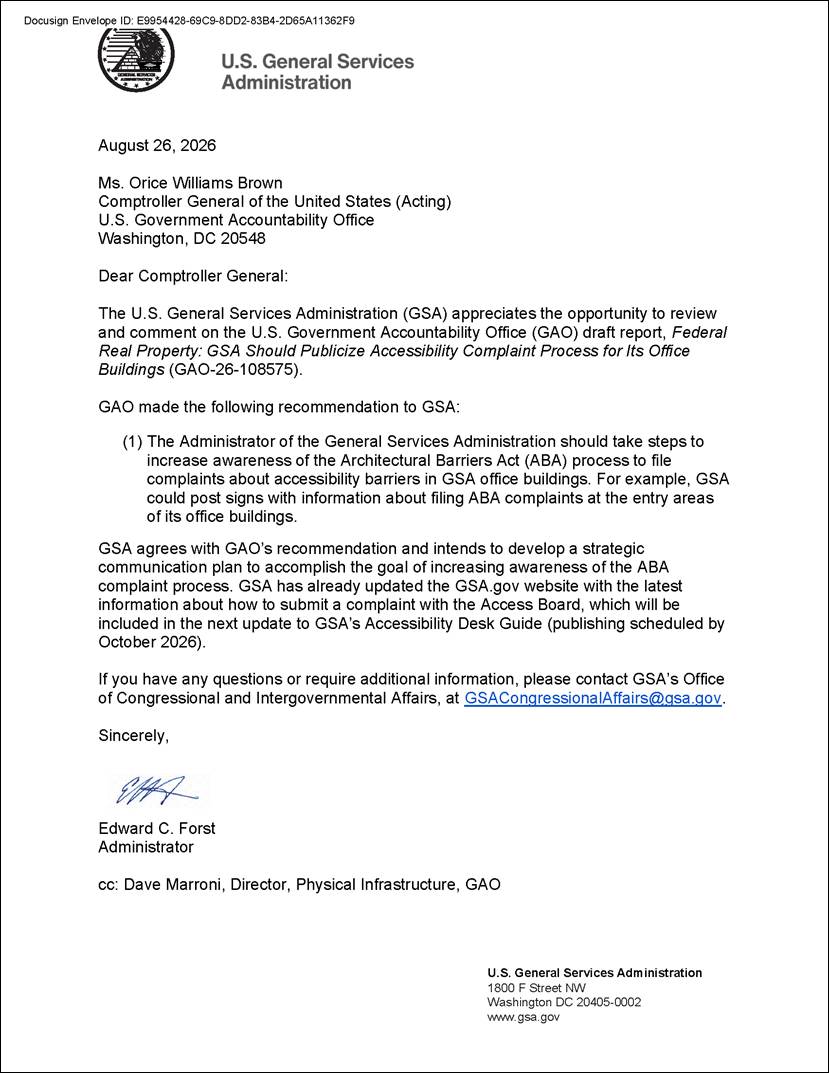
We provided a draft of this report to GSA and the U.S. Access Board for review and comment. We received written comments from GSA which are reproduced in Appendix I. GSA agreed with our recommendation and said that GSA intends to develop a strategic communication plan to accomplish the goal of increasing awareness of the ABA complaint process. The U.S. Access Board provided technical comments that we incorporated as appropriate.
We are sending copies of this report to the appropriate congressional committees, the Administrator of the General Services Administration, the Executive Director of the U.S. Access Board, and other interested parties. In addition, the report is available at no charge on the GAO website at https://www.gao.gov.
If you or your staff have any questions about this report, please contact me at MarroniD@gao.gov. Contact points for our Offices of Congressional Relations and Media Relations may be found on the last page of this report. GAO staff who made key contributions to this report are listed in appendix II.
David Marroni, Director
Physical Infrastructure
Appendix I: Comments from the General Services Administration
GAO Contact
David Marroni, MarroniD@gao.gov
Staff Acknowledgments
In addition to the contact named above, John W. Shumann (Assistant Director), Tobias Gillett (Analyst in Charge), Melissa Bodeau, Melanie Diemel, Lydie Loth, Mary-Catherine P. Overcash, Brian Stephenson, and Alicia Wilson made key contributions to this report.
The Government Accountability Office, the audit, evaluation, and investigative arm of Congress, exists to support Congress in meeting its constitutional responsibilities and to help improve the performance and accountability of the federal government for the American people. GAO examines the use of public funds; evaluates federal programs and policies; and provides analyses, recommendations, and other assistance to help Congress make informed oversight, policy, and funding decisions. GAO’s commitment to good government is reflected in its core values of accountability, integrity, and reliability.
Obtaining Copies of GAO Reports and Testimony
The fastest and easiest way to obtain copies of GAO documents at no cost is through our website. Each weekday afternoon, GAO posts on its website newly released reports, testimony, and correspondence. You can also subscribe to GAO’s email updates to receive notification of newly posted products.
Order by Phone
The price of each GAO publication reflects GAO’s actual cost of production and distribution and depends on the number of pages in the publication and whether the publication is printed in color or black and white. Pricing and ordering information is posted on GAO’s website, https://www.gao.gov/ordering.htm.
Place orders by calling (202) 512-6000, toll free (866) 801-7077,
or
TDD (202) 512-2537.
Orders may be paid for using American Express, Discover Card, MasterCard, Visa, check, or money order. Call for additional information.
Connect with GAO
Connect with GAO on X,
LinkedIn, Instagram, and YouTube.
Subscribe to our Email Updates. Listen to our Podcasts.
Visit GAO on the web at https://www.gao.gov.
To Report Fraud, Waste, and Abuse in Federal Programs
Contact FraudNet:
Website: https://www.gao.gov/about/what-gao-does/fraudnet
Automated answering system: (800) 424-5454
Media Relations
Sarah Kaczmarek, Managing Director, Media@gao.gov
Congressional Relations
David A. Powner, Acting Managing Director, CongRel@gao.gov
General Inquiries
[1]To determine the number of GSA office buildings, we used fiscal year 2024 data from the Federal Real Property Profile Management System. To assess its reliability, we reviewed documentation of the system and prior GSA assessments of the reliability of the data, obtained written responses from GSA officials about the data, and reviewed the data. We determined the data were sufficiently reliable for our purposes of providing approximate numbers of office buildings owned and leased by GSA. For purposes of this analysis, we included buildings designated as “Office,” “Courthouse,” or “Public-Facing Facility” in the data when determining the number of “office buildings.”
[2]See Pub. L. No. 90-480, 82 Stat. 718 (1968) (codified as amended at 42 U.S.C. § 4151 et seq.).
[3]The ABA requires covered buildings to meet applicable ABA standards that are in effect at the time of design, alteration, or construction. For the purpose of this report, “ABA compliance” means compliance with GSA’s ABA Accessibility Standard, which refers to all of the accessibility standards GSA has issued under the ABA.
[4]See Pub. L. No. 118-272, § 2308, 138 Stat. 2992, 3226 (2025).
[5]We included GSA owned and leased courthouses in our review because GSA owned and leased courthouses may also function as office buildings.
[6]For our site visits, we selected the 2306-2312 Bannister Road Federal Building and the Richard Bolling Federal Building in Kansas City, Missouri; Building 54 West Addition and the Herbert C. Hoover Federal Building in Washington, D.C.; and One Memphis Place and the Eaglecrest Building in Memphis, Tennessee.
[7]We included new construction projects from an earlier period than leasing and alteration projects because GSA had few new construction projects for office buildings between 2022 and 2025.
[8]Buildings covered by the ABA generally include those built or altered by or on behalf of the federal government, as well as those leased by federal agencies, after August 12, 1968. In addition, covered buildings must have an intended use that either: 1) will require them to be accessible to the public; or 2) may result in the residence or employment therein of physically handicapped individuals. See 42 U.S.C. § 4151.
[9]The ABA does not require GSA to issue accessibility standards for residential structures, the buildings, structures, and facilities of the Department of Defense, and the buildings of the United States Postal Service that are covered by the ABA. Instead of GSA, the ABA requires the Department of Housing and Urban Development, Department of Defense, and United States Postal Service, respectively, to issue accessibility standards for those structures, buildings, and facilities. See 42 U.S.C. § 4152‑4154a.
[10]See 42 U.S.C. § 4155.
[11]See Pub. L. No. 101‑336, tit. III, 104 Stat. 327, 353 (1990) (codified as amended at 42 U.S.C. § 12181 et seq.); 28 C.F.R. § 36.401(a)(1). The Americans with Disabilities Act of 1990, as amended also requires that any alterations that affect or could affect the usability of public accommodations after January 26, 1992, must, to the maximum extent feasible, accommodate people with disabilities in the altered portion of the public accommodation. See 42 U.S.C. §§ 12181 note, 12183(a); 28 C.F.R. § 36.402(a)(1).
[12]See Pub. L. No. 93-112, § 502, 87 Stat. 355, 391 (1973) (codified as amended at 29 U.S.C. § 792); 5 U.S.C. §§ 104‑105. At the end of fiscal year 2025, the Access Board had 24 employees and received about $10 million in appropriations, according to its Performance and Accountability Report for fiscal year 2025. See U.S. Access Board, Performance and Accountability Report, Independent Auditor’s Report, and Financial Statements for the Fiscal Year Ended September 30, 2025 (Washington, D.C.: Dec. 3, 2025).
[13]See Rehabilitation, Comprehensive Services, and Developmental Disabilities Amendments of 1978, Pub. L. No. 95‑602, tit. I, § 118(b)(3), 92 Stat. 2955, 2980 (1978).
[14]Architectural and Transportation Barriers Compliance Board, Americans with Disabilities Act (ADA) Accessibility Guidelines for Buildings and Facilities; Architectural Barriers Act (ABA) Accessibility Guidelines, 69 Fed. Reg. 44084 (July 23, 2004); General Services Administration, Federal Management Regulation; Real Property Policies Update, 70 Fed. Reg. 67786 (Nov. 8, 2005). The Access Board’s ABA minimum guidelines and requirements that GSA has adopted as its ABA Accessibility Standard are located in 36 C.F.R. Part 1191.
[15]Access Board regulations governing its enforcement of these standards, including its handling of complaints, are located in 36 C.F.R. Part 1150.
[16]See 36 C.F.R. §§ 1150.3. The Access Board may also issue citations requesting the ordering of relief necessary to ensure an agency’s compliance with applicable ABA standards. For example, the Access Board may issue a citation if there appears to be a failure to comply with an applicable standard, and such noncompliance cannot be corrected or resolved by informal resolution. Issuing a citation initiates formal proceedings before an administrative law judge, which may include hearings, to enforce the agency’s compliance. See 36 C.F.R. §§ 1150.42. We previously found that the Access Board’s collaboration with other federal agencies generally followed leading practices for collaboration in carrying out three selected collaborative efforts, including developing technical assistance with GSA. See GAO, U.S. Access Board, Interagency Efforts to Promote Accessibility for People with Disabilities Generally Followed Leading Collaboration Practices, GAO‑23‑105948 (Washington, D.C.: June 26, 2023).
[17]Access Board regulations provide that certain steps to informally resolve complaints must be taken within 180 days after all relevant agencies receive the complaint. See 36 C.F.R. § 1150.41(f). However, there is no legal deadline for achieving informal resolution. Because of this, Access Board officials said that they may, for example, extend investigations beyond that 180-day period, unless the Access Board issues a citation. According to Access Board officials, if applicable, the Access Board refers complainants that are not within the Access Board’s enforcement jurisdiction to the agency having such jurisdiction. For example, officials said that if appropriate, the Access Board would refer a complainant alleging a potential violation of the Americans with Disabilities Act of 1990 to the Department of Justice.
[18]U.S. Access Board, Performance and Accountability Report for the Fiscal Year Ended September 30, 2025.
[19]According to GSA officials, GSA may enter into architecture/engineering contracts for construction management services and in those circumstances the contractor will typically have a design reviewer on the team to assist GSA with the review of the project’s design documents. GSA also uses such contractors to review the existing condition of a building during the project planning stage of a renovation project, including identifying barriers to accessibility and recommending a solution that ensures compliance with the ABA, according to the officials.
[20]GSA can delegate its leasing authority to other agencies. See 40 U.S.C. §§ 121(d), 585(a). According to GSA officials, GSA reviews all planned construction actions that the delegated agency undertakes in accordance with the delegation agreement. According to the officials, GSA follows the same procedure for reviewing projects in buildings leased under delegated leasing authority as it does for reviewing projects in buildings that are owned and managed by GSA.
[21]The Public Buildings Service is responsible for acquiring, leasing, and maintaining federal real property for many federal agencies, including owning and leasing federal office space. For further information about the Public Building Service’s recent reorganization, see GAO, Federal Real Property: Leading Practices Could Help GSA Better Achieve Its Reorganization Goals, GAO‑26‑108155 (Washington, D.C.: Apr. 14, 2026).
[22]GSA requires project managers to involve subject matter experts in their projects at appropriate stages. The types of subject matter experts include those who are experts in portfolio, real estate, acquisition, design and construction, and facilities management, as well as environmental health, safety, and risk management.
[24]GSA, Implementation of Subject Matter Expert Review and Oversight Process for PBS Design, Construction, and Repair Projects (Washington, D.C.: Jan. 12, 2026).
[25]GSA, National Accessibility Program Standards, Policies, and Procedures (Washington, D.C.: Nov. 24, 2015).
[26]GSA, P100 Facilities Standards for the Public Buildings Service (Washington, D.C.: May 2024).
[27]GSA’s ABA Accessibility Standard requires at least 60% of public entrances to be accessible. These accessible public entrances may have manual doors only, provided they meet applicable accessibility standards.
[28]GSA Memorandum, Rescission of PBS P100 Facilities Standards, and Issuance of PBS Interim Core Building Standards (Washington, D.C.: Feb. 24, 2025). However, GSA’s National Accessibility Program Standards, Policies, and Procedures is still in effect.
[29]The four executive orders GSA specified were: Executive Order 14148 revoking certain executive orders and actions; Executive Order 14154, which includes a review all agency actions that potentially burden the development of domestic energy resource and subsequently suspend, revise, or rescind such actions; Executive Order 14192 establishing a regulatory cap and certain requirements related to incremental costs of regulations; and Executive Order 14219 establishing a process to review and repeal certain regulations and de-prioritizing the enforcement of certain regulations. See Exec. Order No. 14148, Initial Rescissions of Harmful Executive Orders and Actions, 90 Fed. Reg. 8237 (Jan. 20, 2025); Exec. Order No. 14154, Unleashing American Energy, 90 Fed. Reg. 8353 (Jan. 20, 2025); Exec. Order No. 14192, Unleashing Prosperity Through Deregulation, 90 Fed. Reg. 9065 (Jan. 31, 2025); Exec. Order No. 14219, Ensuring Lawful Governance and Implementing the President’s “Department of Government Efficiency” Deregulatory Initiative, 90 Fed. Reg. 10583 (Feb. 19, 2025).
[30]See 41 CF.R. Part 102‑76, Subpart C (in effect on Dec. 15, 2025).
[31]GSA, Federal Management Regulation; Aligning the Federal Management Regulation (FMR) With the Administration’s Deregulatory Priorities, 90 Fed. Reg. 58408 (Dec. 16, 2025). The Federal Management Regulation contains regulatory policies concerning property management and related administrative activities.
[32]We analyzed data from October 2022 because officials from the Access Board told us that they had changed data systems in October 2022. The majority of complaints the Access Board receives are not related to GSA office buildings. According to data from the Access Board, the Access Board received 1,107 total complaints in fiscal years 2022 through 2025. U.S. Postal Service buildings were the subject of most of those complaints. We included courthouses in the numbers of GSA office buildings.
[33]Section 504 of the Rehabilitation Act of 1973 prohibits discrimination against individuals with disabilities solely because of their disability, under any program or activity that receives federal financial assistance or is conducted by any federal executive agency, provided the individual otherwise qualifies for such programs or activities. See Pub. L. No. 93-112, § 504, 87 Stat. 355, 394 (1973) (codified as amended at 29 U.S.C. § 794). The Access Board does not have the authority to enforce Section 504.
[34]Third-party engineering firms may identify technical ABA noncompliance which may not actually pose a barrier to the daily use of a building. For example, a fire alarm that has been mounted on a wall 75 inches above the floor could extend 4.5 inches from the wall, when the maximum extension permitted under GSA’s Accessibility Standard is 4 inches. A GSA official told us that the other two buildings with complaints citing over 100 accessibility barriers were in the same GSA region at the time of the complaint filings as the Richard Bolling Federal Building and had accessibility surveys conducted on site.
[35]GSA staff responsible for the Richard Bolling Federal Building have been addressing the accessibility barriers cited in the complaint about the building since the complaint was filed in 2014. GSA officials told us that they had focused on violations which would cost less than $50,000 to address, which they said is the threshold requiring GSA officials to apply for funding from GSA’s national office. As of February 2026, GSA officials told us that they had removed 47 of the 118 accessibility barriers cited in the complaint.
[36]We interviewed nine stakeholders including disability advocates, representatives from federal employee unions, and representatives from industry organizations.
[37]GAO, Standards for Internal Control in the Federal Government, GAO‑25‑107721 (Washington, D.C.: May 15, 2025).
[38]Officials from the Access Board told us that they have begun conducting site inspections at specific locations about which they have received complaints but have not conducted any inspections of GSA office buildings. The purpose of these site visits is to determine the compliance of federal buildings with the ABA, according to Access Board officials. These officials told us that they would not conduct a site inspection without a complaint about the facility because conducting inspections in the absence of a complaint would require a major expenditure of resources and inspecting an entire facility could identify hundreds of violations, some of which might not significantly impact accessibility.
[39]GSA’s National Accessibility Program Standards, Policies, and Procedures document, linked on GSA’s website, contains a link to the Access Board’s complaint form, but the link connected to a “Page Not Found” webpage on the Access Board’s website as of May 18, 2026, http://gsa.gov/system/files/National_Accessibility_Program_Standards_Policies_and_Procedures_2-1.pdf.