
Report to Congressional Committees
United States Government Accountability Office
A report to congressional committees
Contact: Lori Atkinson at atkinsonl@gao.gov
What GAO Found
For decades, GAO has found that the federal government does not sufficiently coordinate or integrate crosscutting activities to improve its performance or address crosscutting management weaknesses. GAO held discussions with participants including former Office of Management and Budget (OMB) political appointees and staff, former cross-agency priority (CAP) goal leaders, and subject-matter specialists in performance management from outside of government. Participants said that CAP goals (4-year outcome-oriented goals) have provided a framework for addressing crosscutting federal performance issues. However, participants in all three groups told GAO that the implementation of CAP goals could be strengthened.
Discussion group participants shared their views on ways to help OMB and agencies more effectively implement CAP goals. These views are summarized as five broad approaches in the figure.
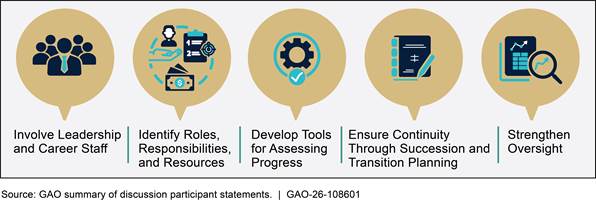
Note: These actions are not listed in any specific rank or order, and their inclusion should not be interpreted as a GAO endorsement. Implementing any one action or a combination of actions could require considerations such as implementation feasibility, resource and legal constraints, and tradeoffs between actions or taking no action at all.
Discussion group participants in all three discussion groups told GAO that the established CAP goal framework often helped to define ownership, created energy around shared priorities, and formed opportunities for agencies to work together. For example, participants shared that customer service CAP goals resonated across multiple administrations and tended to gain momentum over time. However, participants from all three groups also stated that CAP goals’ implementation challenges remained, including the use of inconsistent tools for assessing progress; varying levels of leadership engagement; and limited resources, such as staff and funding, to sustain efforts over time.
Discussion group participants suggested actions to help agencies more effectively implement CAP goals. Some of these actions include embedding CAP goal management efforts within federal agencies, capturing and publicly reporting accurate and appropriate data to assess progress, and providing resources to OMB and agencies to accomplish implementation.
Participants also highlighted other opportunities and mechanisms to address crosscutting federal performance challenges. Opportunities included creating a national performance council focused on mission delivery.
Why GAO Did This Study
GAO’s work continues to identify challenges the federal government faces in effectively managing its activities and addressing crosscutting challenges, such as in GAO’s high-risk areas of improving food safety oversight and ensuring cybersecurity.
The GPRA Modernization Act of 2010 (GPRAMA) updated the Government Performance and Results Act of 1993 (GPRA) to create a more integrated, crosscutting performance planning and reporting framework to support the federal government’s achievement of results. It requires OMB to work with federal agencies to establish CAP goals to address crosscutting mission areas as well as management challenges.
GPRAMA includes a provision for GAO to periodically assess the act’s implementation, including the CAP goals. This report examines discussion participants’ views on the CAP goal framework for addressing crosscutting federal performance challenges, and approaches to more effectively implement CAP goals and other opportunities.
GAO held a series of discussion groups and interviews in May and June 2025. Participants in these discussion groups and interviews represented three previous administrations that had implemented CAP goals. GAO also reviewed requirements related to CAP goals; related OMB A-11 guidance; information about CAP goals on Performance.gov; and GAO’s prior work on CAP goals, GPRAMA implementation, and performance management.
|
Abbreviations |
|
CAP cross-agency priority |
|
CEO Chief Executive Officer |
|
CIO Chief Information Officer |
|
FAPA Federal Agency Performance Act of 2024 |
|
FITARA Federal Information Technology Acquisition Reform Act |
|
GPRA Government Performance Results Act of 1993 |
|
GPRAMA GPRA Modernization Act of 2010 |
|
HUD Department of Housing and Urban Development |
|
OMB Office of Management and Budget |
|
OPPM Office of Performance and Personnel Management |
|
PIC Performance Improvement Council |
|
USICH U.S. Interagency Council on Homelessness |
|
VA Department of Veterans Affairs |
This is a work of the U.S. government and is not subject to copyright protection in the United States. The published product may be reproduced and distributed in its entirety without further permission from GAO. However, because this work may contain copyrighted images or other material, permission from the copyright holder may be necessary if you wish to reproduce this material separately.
June 23, 2026
Congressional Committees
The federal government faces a range of critical, crosscutting challenges that require effective management and coordination among federal agencies. For example, to achieve meaningful results in crosscutting areas such as improving food safety, ensuring cybersecurity, and preparing for public health emergencies, federal agencies need to coordinate with each other as well as across levels and sectors of government.[1] Our work continues to identify challenges the federal government faces in effectively managing its activities to address crosscutting issues.
The performance planning and reporting framework originally put into place by the Government Performance Results Act of 1993 (GPRA) and enhanced by the GPRA Modernization Act of 2010 (GPRAMA), provides important tools for decision-makers to coordinate and implement a response to such crosscutting performance challenges.[2] We have previously reported that the effective use of the framework and its tools could further improve the federal government’s performance.[3]
GPRAMA includes a provision for us to periodically evaluate and report on its implementation, including implementation of cross-agency priority (CAP) goals required under the law.[4] Since 2012, we have issued more than 40 products in response to this provision.[5] This report examines insights shared during discussion groups and interviews on the CAP goal framework. These included insights on addressing crosscutting federal performance challenges, approaches to more effectively implement CAP goals, and other opportunities to address these challenges.
To obtain views on the CAP goal framework, approaches to more effectively implement CAP goals, and other opportunities to address crosscutting performance challenges, we held a series of discussion groups and interviews in May and June 2025. Specifically, we selected 14 discussion participants from three categories to participate in structured discussions. These participants included: (1) former Office of Management and Budget (OMB) political appointees and career staff, from multiple administrations, who led federal performance and personnel management efforts; (2) former CAP goal leaders from OMB and federal agencies; and (3) subject-matter specialists from the private and nonprofit sectors, including universities, with expertise in performance management.
In addition, we held structured interviews with individuals unable to meet with their peers during the discussion groups. This approach enabled us to highlight the unique perspectives of former leaders across the three administrations directly involved in CAP goals’ implementation since their inception in 2012 through January 2025, and those with perspectives outside of the government.[6] For the purposes of this report, we refer to the individuals in the three discussion groups and interviews collectively as discussion group participants (participants).[7] To prepare for the discussions and interviews, we reviewed GPRAMA and Federal Agency Performance Act of 2024 (FAPA) requirements related to CAP goals, related OMB A-11 guidance, our past work, and relevant articles and publications.[8]
We analyzed the content from the discussion groups and interviews to identify approaches and opportunities to address CAP goals and other crosscutting federal performance challenges. We also shared our initial findings with the discussion participants for their technical comments and views. We incorporated their comments as appropriate. We did not attempt to independently validate the statements expressed by the participants. Comments summarized in this report do not necessarily represent the views of all participants, the organizations with which they are affiliated or were previously affiliated, or GAO.
In addition to the information we gathered from the discussion groups and interviews, we shared our initial findings with OMB staff for their technical comments and views. As of June 2026, OMB had not provided comments on our initial findings. Our study methods are summarized in greater detail in appendix I.
We conducted this performance audit from December 2024 to June 2026 in accordance with generally accepted government auditing standards. Those standards require that we plan and perform the audit to obtain sufficient, appropriate evidence to provide a reasonable basis for our findings and conclusions based on our audit objectives. We believe that the evidence obtained provides a reasonable basis for our findings and conclusions based on our audit objectives.
Background
Statutory Requirements for CAP Goal Framework
For decades, our work has found that the federal government does not sufficiently coordinate or integrate crosscutting activities to improve its performance or address crosscutting management weaknesses. For example, in a March 2004 review of GPRA implementation, we found that mission fragmentation and overlap among agencies made it difficult to address crosscutting national issues, such as homeland security, drug control, and the environment.[9] We recommended that Congress should require the development of a government-wide strategic plan, and that OMB should fully implement GPRA’s requirements for a government-wide performance plan to better integrate and coordinate crosscutting efforts.
GPRAMA, enacted in January 2011, addressed our 2004 recommendations and enhanced GPRA to create a more integrated and crosscutting performance management framework. This framework was intended to better address long-standing federal performance challenges and to provide greater accountability for results. Collectively the elements of this framework were intended to serve as a government-wide strategic plan. These elements changed the requirement of the government-wide performance plan to focus on implementing the strategic plan.[10] The framework includes:
· CAP goals, referred to in the law as long-term federal government priority goals that OMB and agencies are to establish every 4 years. GPRAMA requires that these goals cover (1) outcome-oriented goals for a limited number of crosscutting policy areas, to ensure that there is ample focus on achieving the goals over time, and (2) goals for management improvements across the federal government.[11] OMB is to define the level of performance to be achieved through the CAP goals.[12]
· Annual federal government performance plans that establish implementation plans and governance structures for the CAP goals.[13]
· Quarterly leadership-driven performance reviews carried out by the Director of OMB, with relevant parties, to review progress toward each CAP goal.[14]
· Progress updates reported on Performance.gov, a website implemented by OMB. OMB and agencies are to report (1) information on CAP goals and agency priority goals, including quarterly progress updates, and (2) agency strategic plans, annual performance plans, and annual performance reports, on a single, government-wide performance website.[15]
Key Entities Involved in Implementation of the CAP Goal Statutory Framework
The following key entities are involved in implementation of the CAP goal statutory framework, as described below.
OMB. GPRAMA requires OMB to coordinate with agencies to establish CAP goals and develop a federal government performance plan on how those goals will be achieved.[16] Additionally, the law requires OMB to review progress achieved toward implementing CAP goals with the appropriate agency officials and report progress on Performance.gov quarterly.[17] OMB provides guidance to agencies for implementing GPRAMA and related laws in its annual budget guidance, Circular No. A-11.[18]
Performance Improvement Council. The Performance Improvement Council (PIC) assists OMB with improving the performance of the federal government and achieving CAP goals. This assistance may include facilitating the exchange of useful practices among agencies and developing recommendations to streamline and improve agency performance management. OMB’s Deputy Director for Management chairs the PIC. Performance Improvement Officers from 24 major federal agencies make up the PIC.[19] The General Services Administration’s Office of Shared Solutions and Performance Improvement staff also support the PIC’s activities.[20]
CAP Goal Leaders. Goal leaders within OMB and federal agencies develop strategies to achieve goals, manage execution, and regularly review performance toward goal achievement. In addition, FAPA requires that each CAP goal have at least two lead officials jointly responsible for coordinating efforts to achieve the goal, including one from the Executive Office of the President and one from an agency identified as contributing to the goal.[21]
Crosscutting Federal Performance Challenges Identified in Our Prior Work
|
Examples of Crosscutting Challenges Identified in GAO’s Work The examples below illustrate crosscutting federal challenges: High-Risk Areas: · Food Safety Oversight · Ensuring Critical Cybersecurity · Federal Disaster Assistance Duplication, Overlap, and Fragmentation: · Public Health Emergency Preparedness · Federal Broadband Programs · Employment Support for Older Workers |
|
Source: GAO. See, GAO‑25‑107743; GAO‑26‑108505. │ GAO‑26‑108601 |

Many of the federal government’s most persistent management challenges stem from fragmented responsibilities and the need for sustained coordination across agencies and sectors. In the 2025 update to our High-Risk List, we identified many persistent crosscutting issues that agencies have been working to address over time.[22] Concerted action on High-Risk List areas is vital to build the capacity of the federal government and make progress on the current and emerging challenges facing the nation. In addition, in annual reports issued from 2011 to 2026, we identified more than 2,000 actions for Congress or federal agencies to reduce, eliminate, or better manage duplication, overlap, and fragmentation; achieve other cost savings; or enhance revenue collection.[23]
Additionally, in September 2025, we reported that the GPRAMA framework, including CAP goals, has produced improvements in government-wide performance management—such as clearer goals, better-defined roles, and more consistent public reporting. We found, however, that the framework’s overall effectiveness was uneven.[24] We also reported that OMB had not fully implemented more than one quarter of all GPRAMA-related recommendations we made to it since 2012. Most of these involve crosscutting issues such as establishing a complete federal program inventory, while others relate to improving transparency and the use of performance information. We reported that addressing these remaining recommendations would help OMB improve the efficiency and effectiveness of federal agencies, programs, and activities.[25]
Views on Approaches to Address Crosscutting Federal Performance Challenges
Participants from all three discussion groups said that CAP goals provided a framework for addressing crosscutting federal performance issues. However, they noted that implementation challenges remained.[26] They also identified approaches and opportunities that may improve the implementation of CAP goals and address other crosscutting challenges.
Discussion Participants Viewed CAP Goals as a Framework for Addressing Crosscutting Federal Performance Challenges
|
Example of a Participant’s Perspective on the Cross-Agency Priority Goals Framework “CAP goals set a stake in the sand—we are all going to row together to reach it.” Source: GAO discussion groups. │ GAO‑26‑108601 |
Discussion group participants, including former CAP goal leaders, former OMB staff, and other subject-matter specialists, shared their opinions about using the CAP goal framework to address crosscutting federal performance challenges. In all three discussion groups, at least one participant said that using CAP goals to address cross-agency priority areas continued to be beneficial by providing routine performance processes across agencies.
There have been instances where CAP goals have shown success in addressing long-standing, government-wide management challenges, according to participants in all three discussion groups. They cited examples, including goals focused on infrastructure permitting, customer service, and personnel security clearance reform, as discussed in more detail below. They said the established CAP goal framework sometimes helped to define ownership, created momentum around shared priorities, and formed opportunities for agencies to work together.
However, according to participants in all three discussion groups, the implementation of CAP goals could still be strengthened. These participants highlighted several challenges, discussed in more detail below, that hindered effective implementation of CAP goals.
Views on Approaches to More Effectively Implement CAP Goals
Participants in all three discussion groups shared their views on ways to help OMB and agencies more effectively implement CAP goals. We summarized these participants’ views and identified five broad approaches to effectively implement CAP goals (see fig. 1).
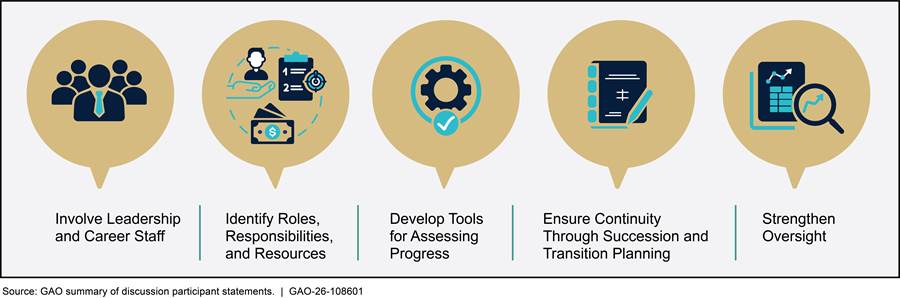
Note: These actions are not listed in any specific rank or order, and their inclusion should not be interpreted as a GAO endorsement. Implementing any one action or a combination of actions could require considerations such as implementation feasibility, resource and legal constraints, and tradeoffs between actions or taking no action at all.
|
|
Involve Leadership and Career Staff in CAP Goal Management to Ensure Buy-in, Leadership Support, and Continuity |

|
Example of a Participant’s Perspective on CAP Goal Management “To actually drive change… it cannot be a center-of-government initiative. It has to eventually be implemented inside agencies over the long term.” Source: GAO discussion groups. │ GAO‑26‑108601 |
According to at least one participant in each of the three discussion groups, successful CAP goals had the involvement of political and career leaders, senior leaders, and career staff. We heard from some former CAP goal leaders and former OMB staff that CAP goals showed the most progress when senior leaders paid attention and understood progress measures, and career staff were involved early in selection and strategy development.[27] For example, a former OMB staff member and a subject-matter specialist told us that customer service-related CAP goals tended to gain momentum because agency senior leaders publicly prioritized them and ensured that agency career staff were involved in shaping implementation plans early on.[28] This subject-matter specialist also noted that customer service goals resonated across administrations because they directly affect the public.
In contrast, sometimes CAP goals were designated with limited involvement of agency career staff, delivery teams, or frontline implementers, according to some participants in the three discussion groups. They said when goals were developed primarily by political leadership without sufficient career staff input, agencies sometimes lacked clarity about expectations, feasibility, and accountability for CAP goal implementation. This led to limited buy-in and unclear expectations for staff working on implementing the CAP goals, according to a former CAP goal leader and a former OMB staff member.
Participants in all three groups identified the following actions that officials involved in addressing crosscutting efforts could take to support this approach:
· Engage both political leaders and career staff to support CAP goal implementation and continuity. According to some former OMB staff, CAP goals were more likely to gain traction when senior political leaders provided attention and accountability, while career staff supported day-to-day coordination and progress over time. Participants said political leaders could help drive momentum by setting direction, convening agencies, and reinforcing expectations through regular engagement and public discussion of progress. At the same time, according to some subject-matter specialists and former CAP goal leaders, career civil servants were described as critical to maintaining continuity across administrations because they understood operational realities and could help identify implementation barriers and sustain coordination, as leadership priorities and personnel change.
· Embed CAP goal management efforts within federal agencies. According to some former OMB staff, CAP goals were unlikely to be implemented when they were not integrated into agency operations. They told us that CAP goals gained traction when dedicated implementation coordination bodies were embedded within agencies to support sustained execution over time.
|
|
Identify Roles, Responsibilities, and Resources |

|
Example of a Participant’s Perspective on CAP Goal Resources “CAP goal fund[ing] was a game changer…If you don’t have capacity, you’re not going to make progress on these goals.” Source: GAO discussion groups. │ GAO‑26‑108601 |
Agencies can make greater progress on CAP goals when roles and resources are clearly identified, according to some former OMB staff and a subject-matter specialist.[29] For example, a former OMB staff member and a former CAP goal leader said the CAP goals related to infrastructure permitting reform had clearly identified roles and resources, and the goal gained traction because it had an identified leadership structure and was backed by sustained funding.[30] Clearly designated leadership roles helped support coordination across agencies, especially when paired with dedicated funding.
On the other hand, unclear leadership roles and responsibilities between OMB and agencies may have caused limited prioritization of CAP goal activities and gaps in implementation, according to some former OMB staff and a subject-matter specialist. When roles were not clearly defined or reinforced, agencies lacked direction and follow-through, according to these participants.
Participants in all three groups identified actions that could support this approach:
· Emphasize the involvement and coordinating roles of OMB and agencies. According to some former OMB staff and former CAP goal leaders, CAP goals were more likely to gain traction when OMB clearly articulated its coordination role and worked with agencies to engage the appropriate implementing agency officials. For example, OMB’s ability to convene agencies and define CAP goals and related implementation tasks helped drive progress.[31]
· Appropriately target the goal and identify resources to accomplish implementation. According to some former OMB staff, CAP goals were more effective when they were targeted to address specific cross-agency challenges and supported with dedicated funding and staffing.[32] The participants described examples of resources that helped support implementation, such as specified funding for CAP goals, the fellows programs led by the White House, and agency delivery teams responsible for executing goal-related activities.[33]
|
|
Develop Tools to Consistently Assess Progress Over Time |

|
Example of a Participant’s Perspective on Assessing CAP Goal Progress “Having a consistent set of measures that exist in a public fashion, that Congress [and oversight entities are] interested in, and that are well understood by agencies is essential.” Source: GAO discussion groups. │ GAO‑26‑108601 |
Effective CAP goals include publicly available quantitative targets with clear milestones and related performance measures that could be used across administrations, according to some former OMB staff and a former CAP goal leader.[34] This transparency, according to another former CAP goal leader, could help agencies understand what had been accomplished and what work remained. In all three groups, at least one participant said that publicly available and consistent measures could help support continuity across administrations and provide a reference point for both internal management and external oversight.
According to some subject-matter specialists and former CAP goal leaders, it is difficult to measure progress when CAP goals change over time or are described in broad or qualitative terms. It can also be difficult to compare results across administrations for similar goals when there are inconsistent definitions, changing progress measures, and a lack of agreed-upon baselines, according to a subject-matter specialist and some former OMB staff.
Participants in all three groups identified actions that could support this approach:
· Develop standardized and consistent measures for CAP goals that continue over time. CAP goals that continued across administrations could be more effective when they relied on a stable set of measures that agencies understood and did not frequently revise, according to at least one participant in all three groups. For example, a former OMB staff member and a subject-matter specialist said consistent measures, such as consumer satisfaction scores, could be used to track progress over time.
· Capture and publicly report accurate and appropriate data to assess progress. In all three groups, at least one participant said that reliable data were critical to assessing CAP goal progress and avoiding incomplete conclusions. According to a former OMB staff member and a former CAP goal leader, data were most useful when paired with a clear progress reporting mechanism, such as publicly available dashboards or scorecards.
|
|
Ensure Continuity through Succession and Transition Planning |

|
Example of a Participant’s Perspective on CAP Goal Continuity “You could build support in Congress for some of these long-term, bipartisan, good government sorts of things where there could be an insistence that an administration pay attention to one or two or three things that are important... There are probably a few of those [things] that should endure administration to administration that I would focus on.” Source: GAO discussion groups. │ GAO‑26‑108601 |
CAP goals sustained momentum across administrations when they had bipartisan support, consistent leadership attention, and clear guidance, according to at least one participant in all three groups.[35] As an example, a former OMB staff member cited CAP goals focused on personnel security clearance reform.[36]
Conversely, according to at least one participant in all three discussion groups, CAP goals could lose momentum during presidential transitions due to slow appointed leadership onboarding, limited handoff time periods, and changes in administrations’ priorities. These challenges, according to a former CAP goal leader, often resulted in reduced continuity and required new teams to relearn constraints and implementation challenges.
Participants in all three groups identified the following three actions that officials could take to support this approach:
· Draw incoming administration attention to ongoing CAP goals during transition periods. CAP goals were rarely emphasized during formal administration transition processes, according to a former CAP goal leader. We heard from a subject-matter specialist and a former CAP goal leader that early and explicit discussion of CAP goals could help the incoming administration’s leaders understand ongoing efforts and make informed decisions about whether and how to continue them.
· Develop plans for how CAP goal initiatives could continue after the formal goal period ends. According to a former OMB staff member, CAP goals were more likely to endure when agencies considered how they could become part of regular agency operations or longer-term government-wide initiatives after the 4-year CAP goal period ended. A former CAP goal leader shared an example that the CAP goals related to federal infrastructure permitting reform continued to evolve beyond the CAP goal period. These efforts were continued through other interagency coordination mechanisms, such as the Federal Permitting Improvement Steering Council.
· Share CAP goal successes broadly and regularly as a method to communicate past and ongoing CAP goal efforts. Regular communication of CAP goal outcomes could reinforce accountability for results, sustain stakeholder interest, and help new teams understand the value of continuing the work, according to a former OMB staff member.[37] For example, some former OMB staff told us that publicly recognizing effective cross-agency efforts—such as through government-wide awards programs—could help highlight successful collaborations. This could make it easier for new CAP goal teams to see the tangible results of prior work.
|
|
Strengthen Oversight to Monitor and Report CAP Goals Progress |

|
Example of a Participant’s Perspective on CAP Goal Oversight “Congress said you’re not doing IT modernization… that [IT] scorecard was a bridge to address some of these gaps.” Source: GAO discussion groups. │ GAO‑26‑108601 |
According to some former OMB staff and former CAP goal leaders, enhanced oversight and reporting could help document accomplishments and remaining tasks. These participants also said documenting lessons learned from CAP goal implementation could help future goal teams avoid facing similar challenges as in the past.[38] Together, this documentation could give Congress and agency leaders an authoritative picture of progress and build on prior experience. For example, a former CAP goal leader and a former OMB staff member said that periodic reporting could establish a clear record of actions taken, identify gaps, and provide a baseline for assessing future administrations’ CAP goal performance.[39]
According to some former OMB staff and subject-matter specialists, responsibility for oversight of cross-agency initiatives is not clearly defined and is diffused among oversight entities, such as Congressional committees.[40] For example, one former OMB staff member said that because of generally siloed committee structures, Congress does not always have a mechanism to sustain focus on crosscutting federal performance issues over time.[41] Similarly, according to a former OMB staff member, inspectors general are largely not involved in cross-agency evaluations or initiatives. This lack of oversight can limit accountability for cross-agency initiatives, according to participants across all three groups.
Participants in all three groups identified the following three actions that could support this approach:
· Document best practices and develop and maintain a repository for lessons learned. According to at least one participant in all three groups, documenting best practices and lessons learned could help preserve institutional knowledge and reduce duplication of effort across administrations. Some of these participants told us that an authoritative repository maintained by an oversight entity could support continuity.
· Hold regular joint briefings of goal progress for congressional appropriators and authorizing committees. Regular briefings by OMB to relevant congressional appropriations and authorizing committees could help improve awareness of cross-agency CAP goal progress, according to a former OMB staff member and some former CAP goal leaders. Similarly, regular joint briefings could help align congressional oversight with legislative actions required to sustain CAP goals, a former OMB staff member said. We also heard from one participant in each of the three discussion groups that integrating these briefings into routine oversight could help ensure consistent attention from Congress on cross-agency priorities.
· Leverage a performance scorecard or another mechanism to capture useful data to confirm progress is being made. We heard from a former CAP goal leader that congressional use of performance scorecards, such as the Federal Information Technology Acquisition Reform Act (FITARA) scorecard, could help reinforce accountability when they capture useful data that focus on meaningful outcomes.[42] However, another former CAP goal leader cautioned that performance scorecards that track irrelevant data could impose burdens without improving insight into actual progress.
Other Opportunities Identified by Discussion Group Participants to Address Crosscutting Federal Performance Challenges
Discussion group participants highlighted other opportunities and mechanisms to address crosscutting federal performance challenges. Some of these opportunities would involve leveraging existing tools and mechanisms, and others would involve creating new entities, mechanisms, or processes. (See table 1).
Table 1: Other Opportunities and Mechanisms Identified by Discussion Group Participants to Address Crosscutting Federal Performance Challenges
|
Address crosscutting challenges through agency priority goals. |
|
Leverage interagency collaborative mechanisms to implement a crosscutting goal. |
|
Organize a group of performance-focused staff to support crosscutting goal teams. |
|
Create a national performance council and/or a performance commission focused on mission delivery. |
|
Create a permanent office for cross-agency priority goal support. |
|
Create continuous learning and improvement communities. |
Source: GAO analysis of group discussions. | GAO‑26‑108601
Note: These actions are not listed in any specific rank or order, and their inclusion should not be interpreted as a GAO endorsement. Furthermore, the summarized opportunities and mechanisms do not necessarily represent the views of all participants or the organizations with which they are affiliated. Implementing any one action or a combination of actions might require considerations such as implementation feasibility, resource and legal constraints, and tradeoffs between actions or taking no action at all.
|
OMB CAP Goal Guidance The Office of Management and Budget (OMB) provides cross-agency priority (CAP) goal guidance to agencies in Circular No. A-11. In its August 2025 update to this guidance, OMB stated that CAP goals can be complemented by other cross-agency coordination and goal-setting efforts.
Source: OMB Circular No. A-11, § 220.4. (August 2025). │ GAO‑26‑108601 |

Address crosscutting challenges through agency priority goals. Two or more agencies working together to implement a shared agency priority goal is another way to address crosscutting challenges, according to participants in our former OMB staff group. A former staff member said that some agencies previously developed shared agency priority goals to work on initiatives collaboratively and make progress in certain areas, such as the Departments of Housing and Urban Development (HUD) and Veterans Affairs’ (VA) shared goal to reduce veteran homelessness to 35,000 veterans by 2013.[43]
Leverage interagency collaborative mechanisms to implement a crosscutting goal. Interagency councils or task forces can provide capacity and consistency to support crosscutting goal efforts, according to participants in our former OMB staff group. The former staff stated the U.S. Interagency Council on Homelessness (USICH), which coordinated the efforts of several agencies to address veteran homelessness at the national level, was an example of an effective crosscutting collaborative group.[44]
Organize a group of performance-focused staff to support crosscutting goal teams. A group of performance-focused staff could be organized to provide effective crosscutting goal coordination and implementation support, such as developing a crosscutting goal framework and identifying relevant measures, according to a former OMB staff member and a subject-matter specialist. A former OMB staff member shared three examples of models to support such teams. These included,
· the bottom-up approach, such as agency Performance Improvement Officers’ involvement in the PIC, which drives the use of performance information and efforts to improve federal performance;
· the delivery unit model, such as United Kingdom’s delivery units which monitor and coordinate efforts in support of Prime Minister priorities;[45] and
· the center of excellence model, which could supply agencies with performance expertise and resources.
According to a subject-matter specialist, the statutory framework for the CAP goals could also be used to implement other cross-agency initiatives. For example, the subject-matter specialist stated that the prior administration used this approach to implement other initiatives involving multiple agencies, such as the Infrastructure Investment and Jobs Act, and the American Rescue Plan Act of 2021.
Create a national performance council and/or a performance commission focused on mission delivery. A national performance council, focused on mission delivery, could encourage cross-agency collaboration and coordinate performance efforts across agencies, if established, according to a participant in our subject-matter specialists’ group. A national performance council and/or commission could advise the President on actions that could improve policy delivery and implementation of cross-agency initiatives. For example, the National Economic Council, established in 1993, advises the President on U.S. and global economic policy, coordinates policymaking for domestic and international economic issues, ensures that policy decisions and programs are consistent with the President’s economic goals, and monitors implementation of the President’s economic policy agenda.
Alternatively, one subject-matter specialist stated that a commission, if established, could broadly advise the President on federal performance and develop specific actionable recommendations. For example, the subject-matter specialist stated that the Commission on Evidence Based Policymaking, which issued its final report in 2017, provided an example of a successful commission which garnered bipartisan support and developed specific actionable recommendations to establish the foundations for evidence-based policymaking.[46]
Create a permanent office for CAP goal support. A permanent office with rotating agency staff to support agency efforts, such as CAP goal implementation, is a helpful model, according to a subject-matter specialist we met with. The subject-matter specialist cited examples where this approach was used in other efforts, including the General Services Administration’s Office of Evaluation Sciences, which is an interdisciplinary team of evaluation experts that work across the federal government to help agencies build and use evidence.
Create continuous learning and improvement communities. Continuous learning and improvement communities could be created to bring leaders and groups together so they can learn from one another’s experiences, according to a former OMB staff member. For example, the former OMB staff member said that existing groups, like the PIC and Evaluation Officers Council, could strengthen their roles to facilitate the exchange of useful practices by regularly meeting with one another, across group lines, or to develop new learning communities, such as by bringing together evidence and performance experts.[47]
Agency Comments
We provided a draft of this report to OMB for review and comment. OMB did not provide comments on the report.
We are sending copies of this report to appropriate congressional committees, the Director of OMB, and other interested parties. This report will also be available at no charge on the GAO website at https://www.gao.gov.
If you or your staff have any questions about this report, please contact Lori Atkinson at atkinsonl@gao.gov. Contact points for our Offices of Congressional Relations and Media Relations may be found on the last page of our report. Key contributors to this report are listed in appendix III.
Lori Atkinson
Acting Director, Strategic Issues
List of Committees
The Honorable Rand Paul, M.D.
Chairman
The Honorable Gary C. Peters
Ranking Member
Committee on Homeland Security and Governmental Affairs
United States Senate
The Honorable James Lankford
Chairman
The Honorable John Fetterman
Ranking Member
Subcommittee on Border Management, Federal Workforce and Regulatory Affairs
Committee on Homeland Security and Governmental Affairs
United States Senate
The Honorable James Comer
Chairman
The Honorable Robert Garcia
Ranking Member
Committee on Oversight and Government Reform
House of Representatives
The Honorable Pete Sessions
Chairman
The Honorable Kweisi Mfume
Ranking Member
Subcommittee on Government Operations
Committee on Oversight and Government Reform
House of Representatives
The GPRA Modernization Act of 2010 (GPRAMA) includes a provision for us to periodically evaluate and report on its implementation.[48] This report examines views on the cross-agency priority (CAP) goal framework for addressing crosscutting federal performance challenges, and approaches to more effectively implement CAP goals and other opportunities to address these challenges.
To obtain these views, we held a series of discussion groups and interviews in May and June 2025. To prepare for the discussion groups and interviews, we reviewed
· information about CAP goals on Performance.gov, a public website; and
· our prior reports on CAP goals, GPRAMA implementation, and performance management.
We discussed the related work with GAO stakeholders knowledgeable about GPRAMA and the related GAO work.[49] We also met with two individuals knowledgeable about crosscutting performance issues to discuss these issues in the context of GPRAMA and CAP goals.[50] We summarized information we gathered about CAP goals into a discussion paper, which we provided to discussion group and interview participants prior to meeting with them.
We selected 14 discussion group and interview participants from three categories of individuals with experience and knowledge of implementing GPRAMA and CAP goals, as well as the federal government’s efforts to address crosscutting performance challenges. The participants included former leaders across the three administrations directly involved in CAP goals’ implementation since their inception in 2012 through January 2025, and those with perspectives outside of government.[51] These three categories included the following:
· former Office of Management and Budget (OMB) political appointees and career staff, from multiple administrations, who led federal performance and personnel management efforts;
· former CAP goal leaders from OMB and federal agencies; and
· subject-matter specialists from the private and nonprofit sectors, including universities, with expertise in performance management.
For the purposes of this report, we attribute individual participant opinions to one of these three discussion participant groups, and refer to the groups collectively, when appropriate, as discussion participants.[52]
To identify potentially relevant discussion participants in each of the three categories, we implemented a rigorous and systematic identification and selection process. This process ensured that all individuals participating in our groups had the knowledge and experience necessary to enhance our understanding of CAP goals, crosscutting performance challenges, and could provide illustrative examples. However, the perspectives gathered in our discussions were limited to the expertise of those who participated and are not intended to be comprehensive or generalizable beyond those individuals.
To identify potential participants, we reviewed prior GAO work to identify individuals interviewed for related work and reviewed archived Performance.gov webpages from previous administrations that were directly involved in CAP goals’ implementation since their inception in 2012 through January 2025 to identify former CAP goal leaders.
We also conducted a literature review to identify individuals who conducted and published research on performance management in articles and publications from January 1, 2021, through January 1, 2025.[53] In addition to this initial identification, we sought recommendations of potentially relevant discussion participants from a variety of sources, including GAO stakeholders who have knowledge of work in federal performance management. We reviewed the backgrounds of the referred individuals to identify those with expertise related to federal implementation of CAP goals and excluded any without expertise or experience specifically relevant to our engagement.
Following identification of potential discussion participants, we developed and applied criteria to the compiled list of potential participants. First, to ensure individuals were included in their most appropriate category we determined any individual who could fit into multiple roles would be included in the first group for which they qualified and excluded from other groups. The order of ranking for the groups was
1. former political appointees and career staff who worked at OMB on the implementation and management of the CAP goal process;
2. former CAP goal leaders from OMB and federal agencies; and
3. subject-matter specialists from the private and nonprofit sectors, including universities, with expertise in performance management.
Within the former OMB staff and former CAP goal leaders groups, we also sought to balance representation across administrations from the inception of CAP goals in 2012 through January 19, 2025, and between political appointees and career staff.[54] In addition, for the former CAP goal leader group, we selected at least one CAP goal leader from OMB and at least one from an agency. We also selected one CAP goal leader from each administration who had worked on more than one CAP goal, and for which one of those goals covered crosscutting policy or management-focused areas.[55] We prioritized selection of former CAP goal leaders who led at least two crosscutting policy or management-focused goals and CAP goals with more than one leader to identify backups, as needed.
We met with the individual discussion groups so that each discussion participant could participate in one discussion group with other participants of the same type, or in interviews, as needed. This approach enabled us to highlight the unique perspectives from different participant groups.[56]
We conducted a thematic content analysis of the discussion groups’ and interviews’ results to identify approaches and opportunities to address CAP goals and other crosscutting federal performance challenges. Specifically, during the first stage of the analysis, an analyst reviewed the results and identified statements that described the discussion participants’ views on approaches and opportunities to address crosscutting performance challenges. A second analyst conducted the same exercise to identify any additional participant statements for the approaches and opportunities categories. During the second stage of the analysis, the analysts met with additional members of the team to summarize the participant statements and identify content themes. The team identified five broad approaches to address crosscutting performance challenges as well as other opportunities to address these challenges. To help ensure the validity of results, a third analyst verified the summarized statements and corresponding themes. We also shared our initial findings with the discussion participants for their technical comments and views. We incorporated their comments, as appropriate.
In addition to the information we gathered from the discussion groups and interviews, we shared our initial findings with OMB for their technical comments and views. As of June 2026, OMB had not provided comments on our initial findings.
We conducted this performance audit from December 2024 to June 2026 in accordance with generally accepted government auditing standards. Those standards require that we plan and perform the audit to obtain sufficient, appropriate evidence to provide a reasonable basis for our findings and conclusions based on our audit objectives. We believe that the evidence obtained provides a reasonable basis for our findings and conclusions based on our audit objectives.
|
Discussion group |
Participant |
Participant affiliation as of March 2026 and/or within an administration from 2012 through January 2025 |
|
Former Office of Management and Budget (OMB) Staff |
Dustin Brown |
Former Deputy Associate Director, Office of Performance and Personnel Management (OPPM), OMB, Obama/Trump/Biden administrations |
|
Lisa Danzig |
Founder and Principal of Danzig, Coaching & Consultancy; Former Associate Director, OPPM, OMB, Obama administration |
|
|
Jenny Mattingley |
Vice President of Government Affairs at the Partnership for Public Service; Former Director White House Leadership Development Program and the Performance Improvement Council; General Services Administration; several relevant roles in Obama, Trump, and Biden administrations |
|
|
Shelley Metzenbaum |
Founder, The BETTER Project; Former Associate Director, OPPM, OMB, Obama administration |
|
|
Loren DeJonge Schulman |
Founder and Principal, Telos Lab; Former Associate Director, OPPM, OMB, Biden administration |
|
|
Former Cross-Agency Priority Goal Leaders |
Christine Harada |
Commissioner, California Public Utilities Commission; Former Senior Advisor, Office of Federal Procurement Policy, OMB, Biden administration |
|
Alex Herrgott |
President & Chief Executive Officer (CEO), The Permitting Institute; Former Executive Director, Federal Permitting Improvement Steering Council, Trump administration |
|
|
Maria Roat |
President MA Roat Consulting; Former U.S. Deputy Federal Chief Information Officer (CIO), OMB, Trump administration |
|
|
Tony Scott |
President & CEO, Intrusion; Former Federal CIO, OMB, Obama administration |
|
|
Subject-matter Specialists |
John M. Kamensky |
Emeritus Senior Fellow, IBM Center for The Business of Government |
|
Dr. Donald F. Kettl |
Professor Emeritus, University of Maryland |
|
|
Dr. Donald Moynihan |
Professor, Ford School of Public Policy, University of Michigan |
|
|
Dr. Kathryn Newcomer |
Director, The Trachtenberg School of Public Policy and Public Administration, The George Washington University |
|
|
Robert Johnston Shea |
CEO, GovNavigators |
Source: GAO. | GAO‑26‑108601
Lori Atkinson, atkinsonl@gao.gov
In addition to the contact named above, key contributors to this report were Sarah E. Veale (Assistant Director), Benjamin T. Licht (Assistant Director), Kari Terrio (Analyst in Charge), Jacob Harwas, and Karen L. Cassidy. In addition, Justine Augeri, Robert Gebhart, Dawn G. Locke, Steven Putansu, Robert Robinson, Amber Sinclair, and Andrew J. Stephens made significant contributions to this report.
The Government Accountability Office, the audit, evaluation, and investigative arm of Congress, exists to support Congress in meeting its constitutional responsibilities and to help improve the performance and accountability of the federal government for the American people. GAO examines the use of public funds; evaluates federal programs and policies; and provides analyses, recommendations, and other assistance to help Congress make informed oversight, policy, and funding decisions. GAO’s commitment to good government is reflected in its core values of accountability, integrity, and reliability.
Obtaining Copies of GAO Reports and Testimony
The fastest and easiest way to obtain copies of GAO documents at no cost is through our website. Each weekday afternoon, GAO posts on its website newly released reports, testimony, and correspondence. You can also subscribe to GAO’s email updates to receive notification of newly posted products.
Order by Phone
The price of each GAO publication reflects GAO’s actual cost of production and distribution and depends on the number of pages in the publication and whether the publication is printed in color or black and white. Pricing and ordering information is posted on GAO’s website, https://www.gao.gov/ordering.htm.
Place orders by calling (202) 512-6000, toll free (866) 801-7077,
or
TDD (202) 512-2537.
Orders may be paid for using American Express, Discover Card, MasterCard, Visa, check, or money order. Call for additional information.
Connect with GAO
Connect with GAO on X,
LinkedIn, Instagram, and YouTube.
Subscribe to our Email Updates. Listen to our Podcasts.
Visit GAO on the web at https://www.gao.gov.
To Report Fraud, Waste, and Abuse in Federal Programs
Contact FraudNet:
Website: https://www.gao.gov/about/what-gao-does/fraudnet
Automated answering system: (800) 424-5454
Media Relations
Sarah Kaczmarek, Managing Director, Media@gao.gov
Congressional Relations
David A. Powner, Acting Managing Director, CongRel@gao.gov
General Inquiries
[1]Concurrent with this report, we are issuing another report focused on how the federal government can address crosscutting performance challenges through implementation of the Federal Agency Performance Act of 2024 (FAPA). See GAO, Government Performance Management: OMB and Selected Agencies Need to Fully Address New Requirements, GAO‑26‑108516 (Washington, D.C.: June 23, 2026).
[2]Pub. L. No. 103-62, 107 Stat. 285 (1993); Pub. L. No. 111-352, 124 Stat. 3866 (2011).
[3]GAO, Government Performance Management: Implementing GAO’s Recommendations Would Help OMB Address Crosscutting Challenges, GAO‑25‑108008 (Washington, D.C.: Sept. 30, 2025).
[4]Pub. L. No. 111-352, § 15(b)(2)(C), 124 Stat. at 3883-3884. In addition, the Office of Management and Budget (OMB) must assess progress toward federal government priority goals on a quarterly basis. 31 U.S.C. § 1121(a). OMB stated in its August 2025 update to Circular No. A-11 that federal government priority goals are commonly referred to as CAP goals or President’s Management Agenda goals. OMB further stated that the administration uses the CAP goals, required by GPRAMA, to coordinate implementation and publicly track progress across federal agencies.
[5]See GAO, Federal Programs: OMB Needs to Continue Developing a Complete and Useful Inventory, GAO‑26‑107551 (Washington, D.C.: Mar. 5, 2026) and GAO‑25‑108008 that summarizes this prior work.
[6]Administrations following the enactment of GPRAMA on January 4, 2011, were required to designate and implement CAP goals. Therefore, our report includes discussion participants from the three prior administrations which covered the period from the inception of CAP goals in 2012 through January 19, 2025. OMB released a President’s Management Agenda in December 2025 that identified eight goals and 30 objectives. OMB stated in its August 2025 update to Circular No. A-11 that federal government priority goals are commonly referred to as CAP goals or President’s Management Agenda goals. The goals and objectives released in December 2025 were not assessed or discussed as part of our review. OMB, President’s Management Agenda, M-26-03 (Washington, D.C.: Dec. 8, 2025).
[7]See the List of Discussion Participants, Appendix II, at the end of this report.
[8]31 U.S.C. § 1120(a). Office of Management and Budget, Preparation, Submission and Execution of the Budget, Circular No. A-11, part 6 (July 2024).
[9]GAO, Results-Oriented Government: GPRA Has Established a Solid Foundation for Achieving Greater Results, GAO‑04‑38 (Washington, D.C.: Mar. 10, 2004).
[10]GPRAMA provisions (such as requirements for long-term federal government priority goals, annual federal government performance plans, and quarterly leadership-driven performance reporting) were intended to create a government-wide strategic planning process to address our previous findings and recommendations, according to the Senate Committee on Homeland Security and Governmental Affairs report that accompanied GPRAMA. S. Rep. No. 111-372, at 7 and 8 (2010).
[11]GPRAMA requires that OMB develop goals in a limited number of management areas including: 1) financial management; 2) human capital management; 3) IT management; 4) procurement and acquisition management; and 5) federal real property management. 31 U.S.C. § 1120(a)(1)(B). In April 2023, we found that OMB had designated CAP goals for three of the five required management areas: financial management, human capital management, and procurement and acquisition management. We recommended that OMB designate CAP goals addressing IT management and federal real property. Both of these recommendations remain open. GAO, Government Performance Management: Actions Needed to Improve Transparency of Cross-Agency Priority Goals, GAO‑23‑106354 (Washington, D.C.: Apr. 4, 2023). FAPA amended some of the GPRAMA requirements related to CAP goals, including that the goals are to be achievable within a single presidential term and that there is to be a final report at the end of the 4-year CAP goal period. Pub. L. No. 118-190, §§ 3(3), 4, 138 Stat. 2653, 2655 (2024), codified at 31 U.S.C. §§ 1120(a)(2)(C), 1122(c)(5)(B).
[12]31 U.S.C. § 1115(a).
[13]31 U.S.C. § 1115(a).
[14]31 U.S.C. § 1121(a).
[15]31 U.S.C. § 1122. GPRAMA requires certain agencies, including agencies identified in the Chief Financial Officers Act of 1990 and additional agencies determined by OMB, to develop a limited number of agency priority goals every 2 years. 31 U.S.C. § 1120(b). As stated, these goals are to reflect the highest priorities of each selected agency, as identified by the head of the agency, and be informed by CAP goals as well as input from relevant congressional committees.
[16]31 U.S.C. §§ 1115(a), 1120(a).
[17]31 U.S.C. § 1121(a).
[18]See Office of Management and Budget, Preparation, Submission and Execution of the Budget, Circular No. A-11, part 6 (Aug. 2025).
[19]31 U.S.C. § 1124(b)(1). The 24 agencies are those identified in the Chief Financial Officers Act of 1990. 31 U.S.C. §§ 901(b), 1120(b)(1).
[20]See, 31 U.S.C. § 1124(b)(3).
[21]31 U.S.C. § 1115(a)(3).
[22]GAO, High-Risk Series: Heightened Attention Could Save Billions More and Improve Government Efficiency and Effectiveness, GAO‑25‑107743 (Washington, D.C.: Feb. 25, 2025). At least 18 of the areas on the current High-Risk List involve coordinated efforts across agencies and other entities. We also recommended that Congress should consider requiring that interagency groups formed to address high-risk challenges use leading practices for collaboration. Also see: GAO, Government Performance Management: Leading Practices to Enhance Interagency Collaboration and Address Crosscutting Challenges, GAO‑23‑105520 (Washington, D.C.: May 24, 2023).
[23]Our May 2026 duplication and cost savings report identified new opportunities for achieving billions of dollars in potential financial benefits and improving the efficiency and effectiveness of a wide range of federal programs. GAO, 2026 Annual Report: Opportunities to Reduce Duplication, Overlap, and Fragmentation and Achieve an Additional One Hundred Billion Dollars or More in Future Financial Benefits, GAO‑26‑108505 (Washington, D.C.: May 12, 2026). In our 2026 report and our past annual reports, we have defined duplication, overlap, and fragmentation as follows: Duplication occurs when two or more agencies or programs are engaged in the same activities or provide the same services to the same beneficiaries. Overlap occurs when multiple agencies or programs have similar goals, engage in similar activities or strategies to achieve them, or target similar beneficiaries. Fragmentation refers to those circumstances in which more than one federal agency (or more than one organization within an agency) is involved in the same broad area of national need.
[26]As noted above, our report includes discussion participants from the three prior administrations which covered the period from the inception of CAP goals in 2012 through January 19, 2025. The current administration released its President’s Management Agenda after January 2025 and therefore we did not assess or discuss it as part of our review.
[27]These views align with our prior work, which highlighted the importance of identifying goal leaders and contributors—including co-leaders and sub-goal leaders—to ensure continuity and buy-in across administrations as a key consideration to facilitate CAP goal implementation. GAO, Government Performance Management: Key Considerations for Implementing Cross-Agency Priority Goals and Progress Addressing GAO Recommendations, GAO‑21‑104704 (Washington, D.C.: Sept. 28, 2021).
[28]Customer service is an agency’s interactions with customers, and customer experience is the public’s perceptions of and overall satisfaction with those interactions. The 2014–2017, 2018–2022 and 2022–2025 CAP goals included standalone CAP goals focused on improving federal customer experience and service. These goals included Customer Service (2014–2017 CAP goal), Improving Customer Experience with Federal Services (2018–2022 CAP goal) and Improving High Impact Federal Services (2022–2025 CAP goal).
[29]These findings align with our prior work, for example in September 2021, we reported that dedicating resources, including funding, staff, and technology, is a key consideration for implementing CAP goals. In May 2016, we found that OMB’s efforts to strengthen CAP goal team capacity, such as updating the governance structure and holding senior-level review meetings, helped increase leadership attention and improve interagency collaboration. Additionally, in April 2013, we found that the designation of senior-level officials to key performance management roles with responsibilities under GPRAMA helped elevate accountability for performance management within federal agencies and ensure high-level involvement. GAO‑21‑104704; GAO, Managing For Results: OMB Improved Implementation of Cross-Agency Priority Goals, But Could Be More Transparent About Measuring Progress, GAO‑16‑509 (Washington, D.C.: May 20, 2016); and Managing For Results: Agencies Have Elevated Performance Management Leadership Roles, but Additional Training Is Needed, GAO‑13‑356 (Washington, D.C.: Apr. 16, 2013).
[30]According to information from Performance.gov, infrastructure permitting reform refers to efforts to improve how the federal government conducts environmental reviews and makes permitting and authorization decisions for major infrastructure projects. CAP goals related to this topic aimed at making these processes more timely, coordinated, predictable, and efficient, while still ensuring that environmental and community impacts were appropriately considered. These CAP goals included the Infrastructure Permitting Modernization goal (2014–2017 CAP goal) and the Modernizing the Infrastructure Permitting Process goal (2018–2022 CAP goal). The infrastructure permitting reform CAP goals were also supported by statutory implementation structures, including the Federal Permitting Improvement Steering Council. The Council was established by the Fixing America’s Surface Transportation Act in 2015. 42 U.S.C. § 4370m-1. The Federal Permitting Improvement Steering Council coordinates federal environmental reviews and authorizations for infrastructure projects and works to improve the transparency, predictability, and timeliness of federal permitting decisions.
[31]In 2016, we reported that CAP goals were led jointly by staff from the Executive Office of the President and officials from key responsible agencies. These goal leaders were responsible for coordinating implementation across agencies, and OMB directed them to engage contributing agencies through existing interagency working groups, committees, and councils. At that time, Executive Office of the President offices serving as CAP goal leaders included the National Economic Council, the Office of Science and Technology Policy, and the U.S. Digital Service. GAO‑16‑509.
[32]FAPA requires that CAP goals explicitly cite to any specific contents in the President’s Budget that support the achievement of each goal. 31 U.S.C. § 1120(a)(2)(D).
[33]In 2016 we reported that Congress provided authority for the heads of executive departments and agencies, with OMB approval, to transfer up to $15 million for purposes of improving coordination, reducing duplication, and other activities related to the implementation of the CAP goals. Pub. L. No. 114-113, div. E, title VII, § 721 (Dec. 18, 2015). For example, OMB reported that the Infrastructure Permitting CAP goal was allocated $4.75 million and the Customer Service CAP goal was allocated $2.5 million. GAO‑16‑509. The White House Leadership Development Program is an annual cohort of career employees that work on the federal government’s highest priority and highest impact challenges. In 2016, we reported that these leadership fellows were selected and assigned to one of the CAP goal teams to address the need for strong leadership on the CAP goals, while leveraging existing resources. We found that effective interagency rotational assignments can achieve collaboration-related results. GAO‑21‑104704; GAO‑16‑509.
[34]In September 2021, we identified the use of performance information as a key consideration to facilitate CAP goals implementation and reported that organizations should focus on improving the quality and use of data to routinely assess goal progress. In July 2025, we found that OMB could not assess progress on customer experience improvements because it had defined its short-term goals too broadly to support meaningful measurement. Without clear goals and related performance measures, OMB lacked the tools needed to monitor and report on whether service providers achieved intended improvements over the CAP goal period. GAO, Federal Customer Experience: OMB Can Better Assess the Improvement Efforts of High Impact Service Providers, GAO‑25‑107652 (Washington, D.C.: July 28, 2025); Evidence-Based Policymaking: Practices to Help Manage and Assess the Results of Federal Efforts, GAO‑23‑105460 (Washington, D.C.: July 12, 2023); and GAO‑21‑104704.
[35]As mentioned above, GPRAMA requires that OMB develop goals in a limited number of management areas for which improvements are needed across the federal government. 31 U.S.C. § 1120(a)(1)(B). Further, at the time of GPRAMA enactment, the Senate Committee on Homeland Security and Governmental Affairs expected this provision would ensure that many of the CAP goals would stay constant and continue over time, including across administrations, given the long-term nature of these challenges. S. Rep. No. 111-372, at 8 (2010).
[36]According to information on Performance.gov, personnel security clearance reform refers to efforts to improve how the federal government conducts vetting processes to support a trusted federal workforce, including personnel security, suitability, and credentialing programs. CAP goals related to this topic aimed at making these processes more aligned, efficient, secure, and risk-informed. These CAP goals included Insider Threat and Security Clearance Reform (2014–2017 CAP goal) and Security Clearance, Suitability, and Credentialing Reform (2018–2022 CAP goal). We have also identified Government-wide Personnel Security Clearance Process as a high-risk area since 2018. GAO‑25‑107743.
[37]GPRAMA requires OMB to publish certain information regarding CAP goals on a public website. 31 U.S.C. § 1122(c). OMB publishes this information on www.performance.gov. In 2021, we identified reporting results as a key consideration for CAP goal implementation, as well as consistent with GPRAMA requirements. As part of this key consideration, we reported that goal teams should develop communications strategies to help share success stories and outcomes of the goals. GAO‑21‑104704.
[38]Our prior work identified creating a repository of lessons learned to share across goal teams a key consideration to facilitate CAP goals implementation. GAO‑21‑104704.
[39]See background of this report for more information about periodic reporting requirements for CAP goals.
[40]Oversight refers to the review, monitoring, and supervision of federal programs and activities.
[41]We previously reported that, although oversight can and does occur with authorizations and appropriations, Congress also has a separate oversight process available outside the traditional reauthorization/appropriations discussions. This oversight process provides Congress the means to hold agencies accountable for the economy, efficiency, and effectiveness of existing policies, programs, and agency operations. The committees primarily responsible for exercising this oversight are the Senate Committee on Homeland Security and Governmental Affairs and the House Committee on Oversight and Government Reform, although authorizing committees also engage in oversight reviews and hearings in connection with matters within their jurisdiction. GAO and agencies’ inspectors general support congressional oversight with analysis, evaluations, investigations, and reviews of various programs and operations. GAO, 21st Century Challenges: Reexamining the Base of the Federal Government, GAO‑05‑325SP (Washington, D.C.: Feb. 1, 2005).
[42]In November 2015, a subcommittee in Congress began issuing biannual scorecards as an oversight tool to monitor agencies’ progress toward implementing FITARA and subsequently, other IT-related issues. Carl Levin and Howard P. ‘Buck’ McKeon National Defense Authorization Act for Fiscal Year 2015, Pub. L. No. 113-291, div. A, title VIII, subtitle D, 128 Stat. 3292, 3438–3450 (2014). The scorecards rely on publicly available data to track and assign federal agencies letter grades (i.e., A, B, C, D, or F). We have reported that the FITARA scorecards have served as effective tools for monitoring federal agencies’ efforts in implementing statutory requirements and addressing other important IT issues. GAO, Information Technology: Biannual Scorecards Have Evolved and Served as Effective Oversight Tools, GAO‑22‑105659 (Washington, D.C.: Jan. 20, 2022).
[43]In 2014 we reported that HUD and the VA both had an agency priority goal of reducing homelessness. HUD had a goal “in partnership with VA, [to] reduce the number of homeless veterans to 35,000 by 2013, by serving 35,500 additional homeless veterans.” VA had an agency priority goal to “assist in housing 24,400 additional homeless veterans (12,200 per year) and reduce the number of homeless veterans to 35,000 in 2013.” GAO, Managing for Results: Implementation Approaches Used to Enhance Collaboration in Interagency Groups, GAO‑14‑220 (Washington, D.C.: Feb. 14, 2014).
[44]USICH is an independent establishment in the executive branch whose mission is to coordinate the federal response to homelessness. 42 U.S.C. § 11311. In 2014, we reported on approaches that effective interagency groups, including the USICH, used and found to be successful. GAO‑14‑220. In March 2025, the President issued an executive order to eliminate USICH’s non-statutory components and functions to the maximum extent consistent with applicable law. Exec. Order No. 14238, Continuing the Reduction of the Federal Bureaucracy, 90 Fed. Reg. 13,043 (Mar. 20, 2025). In November 2025, a federal district court permanently barred implementation of the executive order with respect to USICH. State of Rhode Island v. Trump, 2025 U.S. Dist. LEXIS 229340 (D.R.I.). The decision was pending appeal in the U.S. Court of Appeals for the First Circuit as of June 2026. State of Rhode Island v. Trump, Case No. 26-1070.
[45]The United Kingdom’s Prime Minister established the Prime Minister’s Delivery Unit in 2001 to oversee implementation of 20 major domestic policy priorities. The Unit built the capacity of the United Kingdom’s government to deliver results, by focusing on data and transparency. See, Performance-Informed Budgeting: Opportunities to Reduce Cost and Improve Service; Hearing Before the Senate Committee on the Budget, 111th Cong. 26-28 (2009) (statement of Sir Michael Barber, Partner, McKinsey & Company and Former Chief Adviser on Delivery to British Prime Minister Tony Blair).
[46]In March 2016, the Evidence-Based Policymaking Commission Act of 2016 established the Commission on Evidence Based Policymaking to conduct a comprehensive study of the data inventory, data infrastructure, database security, and statistical protocols related to federal policymaking and the agencies responsible for maintaining that data. Pub. L. No. 114-140, 130 Stat. 317 (2016). In total, the commission made 22 recommendations aimed at strengthening federal evidence building activities. Subsequently, the Foundations for Evidence-Based Policymaking Act of 2018, enacted in January 2019, created a framework intended to take a more comprehensive and integrated approach to federal evidence building activities. Pub. L. No. 115-435, 132 Stat. 5529 (2019). We reported in 2019 that, according to OMB, the Evidence Act addressed about half of the commission’s recommendations, advancing data and evidence-building functions in the federal government. GAO, Evidence-based Policymaking: Selected Agencies Coordinate Activities, but Could Enhance Collaboration, GAO‑20‑119 (Washington, D.C.: Dec. 4, 2019).
[47]The 24 agencies identified in the Chief Financial Officers Act of 1990 are required to designate Evaluation Officers. 5 U.S.C. § 313; 31 U.S.C. § 901(b). In December 2022, we reported that committees and working groups within another established council, the Chief Data Officers Council, met regularly, generally monthly, to host presentations on topics of interest to members, facilitate discussions and information sharing among members, and obtain input on members’ needs and priorities. Chief Data Officer Council: Progress in Strengthening Federal Evidence-Based Policymaking, GAO‑23‑105514 (Washington, D.C.: Dec. 15, 2022).
[48]Pub. L. No. 111-352, § 15(b)(2), 124 Stat. at 3883–3884.
[49]GAO, Government Performance Management: Implementing GAO’s Recommendations Would Help OMB Address Crosscutting Challenges. GAO‑25‑108008 (Washington, D.C.: Sept. 30, 2025); Federal Customer Experience: OMB Can Better Assess the Improvement Efforts of High Impact Service Providers, GAO‑25‑107652 (Washington, D.C.: July 28, 2025); Federal Programs: OMB Needs a Structure to Govern and a Plan to Develop a Comprehensive Inventory, GAO‑24‑107656 (Washington, D.C.: Sept. 25, 2024); Federal Customer Experience: OMB Has Taken Actions to Implement Cross-Agency Priority Goals, GAO‑24‑106632 (Washington, D.C.: June 6, 2024); Evidence-Based Policymaking: Practices to Help Manage and Assess the Results of Federal Efforts, GAO‑23‑105460 (Washington, D.C.: July 12, 2023); Government Performance Management: Actions Needed to Improve Transparency of Cross-Agency Priority Goals, GAO‑23‑106354 (Washington, D.C.: Apr. 4, 2023); Chief Data Officer Council: Progress in Strengthening Federal Evidence-Based Policymaking, GAO‑23‑105514 (Washington, D.C.: Dec. 15, 2022); Evidence-Based Policymaking: Survey Results Suggest Increased Use of Performance Information across the Federal Government, GAO‑22‑103910 (Washington, D.C.: Nov. 3, 2021); and Government Performance Management: Key Considerations for Implementing Cross-Agency Priority Goals and Progress Addressing GAO Recommendations, GAO‑21‑104704 (Washington, D.C.: Sept. 28, 2021).
[50]These two individuals were David M. Walker, former U.S. Comptroller General, and Jeanne DiFrancesco, Chief Executive Officer, ProOrbis and Founder and Executive Director, American Millennium Society, a non-partisan organization dedicated to innovation in public institutions to advance American competitiveness.
[51]Administrations following the enactment of GPRAMA on January 4, 2011, were required to designate and implement CAP goals. Therefore, our report includes discussion participants from the three prior administrations which covered the period from the inception of CAP goals in 2012 through January 19, 2025. OMB released a President’s Management Agenda in December 2025 that identified eight goals and 30 objectives. OMB stated in its August 2025 update to Circular No. A-11 that federal government priority goals are commonly referred to as CAP goals or President’s Management Agenda goals. The goals and objectives released in December 2025 were not assessed or discussed as part of our review. OMB, President’s Management Agenda, M-26-03 (Washington, D.C.: Dec. 8, 2025).
[52]See the List of Discussion Participants, Appendix II, at the end of this report.
[53]We searched the following sources: Scopus, ProQuest, EBSCO, ProQuest Dialog, Lexis+, National Academies, Harvard Think Tank, and Google Advanced.
[54]Administrations following the enactment of GPRAMA on January 4, 2011, were required to designate and implement CAP goals. Therefore, our report includes discussion participants from the three prior administrations which covered the period from January 4, 2011, through January 19, 2025.
[55]As discussed previously, GPRAMA requires that OMB establish goals for the federal government that include (1) outcome-oriented goals for a limited number of crosscutting policy areas, and (2) goals for management improvements across the federal government. 31 U.S.C. § 1120(a)(1)(A), (B).
[56]Appendix II includes a list of the discussion participants. The views of the participants are neither generalizable to the larger populations of former OMB practitioners, former CAP goal leaders, and subject-matter specialists, nor reflect the views of other parties that have a role in implementing the CAP goals, or in addressing crosscutting performance challenges.