
Report to Congressional Requesters
United States Government Accountability Office
A report to congressional requesters
Contact: Jessica Lucas-Judy at LucasJudyJ@gao.gov
What GAO Found
The Department of Government Efficiency (DOGE) began posting its estimated savings on a web page known as the Wall of Receipts on February 17, 2025. As of July 7, 2026, the Wall of Receipts reported savings of $110 billion across contracts, grants, and leases, but some savings estimates are incorrect or lack supporting evidence. While DOGE provided some information about estimated savings, several issues limit the transparency and reliability of these reported savings.
· DOGE was not transparent regarding methodologies used to calculate savings. Specifically, DOGE did not use its stated methodology to calculate the majority of savings associated with the contracts reported as terminated. For grants, DOGE did not provide sufficient information to verify the method used to calculate 96 percent of DOGE-reported savings. Similarly, the Wall of Receipts does not include an explanation of how the savings from terminated leases were calculated.
· The Wall of Receipts includes leases identified for termination before DOGE was established. Specifically,108 of the 264 leases identified for termination on the Wall of Receipts, about $15.3 million of the total $53.5 million in savings, were already in process for termination when DOGE was established.
· GAO’s review of selected contracts identified potential cost savings, but the basis for some reported savings is unknown. For example, DOGE reported $1.7 billion in savings on the Department of Defense’s Defense Health Agency contract for IT services at more than 700 military treatment facilities worldwide. While DOGE initially identified the contract for termination, in the end, no action was taken to terminate the contract, or to reduce scope, value, or funding. Thus, no savings were achieved.
While the Wall of Receipts includes some information about the data and sources underlying reported savings, it does not sufficiently disclose limitations affecting data quality. GAO’s key practices for transparently reporting government information state that federal government websites should disclose known data quality issues and limitations.
DOGE launched the initial iteration of the Wall of Receipts in February 2025 less than a month after the entity was established in January 2025. Since the initial launch, there have been no updates on the site to shed additional light on the cost savings methodology or to disclose any data limitations. As of July 7, 2026, the web page remains live. Because U.S. DOGE Service officials did not respond to requests for information, GAO could not determine the reasons why DOGE did not disclose data quality issues and limitations when the website first went live or at any time since then. Publicly reporting government data, such as on the Wall of Receipts, can have significant value. However, conveying the methodologies used to calculate savings, as well as any data limitations on the Wall of Receipts, would provide policymakers and the public with the needed caveats to better interpret and use the information.
Why GAO Did This Study
Federal agencies obligated more than $2 trillion for contracts, grants, and leases in fiscal year 2025. In an effort to transform federal spending and ensure transparency, the President issued several executive orders, including Executive Order 14158 to establish DOGE. Additionally, agencies were directed to establish agency DOGE teams and consult with these teams to review federal contracts, grants, and real estate.
GAO was asked to evaluate DOGE’s savings estimates listed on the Wall of Receipts for contract, grant, and lease terminations. This report assesses (1) the methodologies DOGE used to estimate savings from contracts, grants, and leases reported as terminated, and (2) the extent to which DOGE discloses any data limitations. This review covered savings data reported on the Wall of Receipts for contracts, grants, and leases from January 20, 2025, through July 7, 2026.
GAO analyzed data from the Wall of Receipts, publicly available federal databases, and information sources such as USASpending.gov. GAO also interviewed officials from selected federal agencies about the contracts or leases in their purview. DOGE did not respond to GAO’s request for information or interviews.
What GAO Recommends
GAO recommends that the Executive Office of the President, through the U.S. DOGE Service, should ensure that known data quality issues and limitations are prominently displayed on the Wall of Receipts. The U.S. DOGE Service did not provide comments on this report.
|
Abbreviations |
|
|
|
|
|
|
|
BIM |
Base Infrastructure Modernization |
|
|
DATA Act |
Digital Accountability and Transparency Act of 2014 |
|
|
DOD |
Department of Defense |
|
|
DOGE |
Department of Government Efficiency |
|
|
FAR |
Federal Acquisition Regulation |
|
|
FPDS |
Federal Procurement Data System |
|
|
GSA |
General Services Administration |
|
|
HHS |
Department of Health and Human Services |
|
|
USAID |
United States Agency for International Development |
|
This is a work of the U.S. government and is not subject to copyright protection in the United States. The published product may be reproduced and distributed in its entirety without further permission from GAO. However, because this work may contain copyrighted images or other material, permission from the copyright holder may be necessary if you wish to reproduce this material separately.
August 6, 2026
The Honorable Gary C. Peters
Ranking Member
Committee on Homeland Security and Governmental Affairs
United States Senate
The Honorable Richard Blumenthal
Ranking Member
Permanent Subcommittee on Investigations
Committee on Homeland Security and Governmental Affairs
United States Senate
Federal agencies obligated funding of more than $2 trillion for contracts, grants, and leases in fiscal year 2025. In an effort to transform federal spending and ensure transparency, in early 2025 the President directed the heads of federal agencies to implement a series of initiatives to reform government operations. To help advance these initiatives, the President established the United States DOGE Service (also known as the Department of Government Efficiency, hereafter referred to as “DOGE”), and directed agencies to establish DOGE teams to assist in carrying out administration priorities.[1] Executive Order 14222 directed agencies to consult with their agency DOGE teams to review federal contracts, grants, and real estate for termination or modification.[2] In response to this direction from the President, federal agencies have terminated or modified thousands of contracts, grants, and leases since January 20, 2025.
To measure progress and provide transparency into these efforts, DOGE developed a page on its public website, referred to as the “Wall of Receipts.”[3] The Wall of Receipts lists contracts, grants, and leases that DOGE claims have been terminated and associated savings estimates. DOGE released its first estimate of savings claims in February 2025 and continued to update the Wall of Receipts until January 1, 2026. According to the web page, DOGE aimed to present information “in a digestible and transparent manner consistent with applicable rules and regulations.” Such transparency can have value for the public and Congress where information is reliable and usable. Further, access to quality data on federal spending is important for policymaking, transparency and oversight of federal dollars, and fostering public trust in government.
A July 4, 2026 post on an official DOGE social media account indicated that the formal mission of DOGE has come to an end. However, as of July 7, 2026, the Wall of Receipts remains live.
You asked us to evaluate DOGE’s savings estimates listed on the Wall of Receipts, particularly those savings estimates for contract, grant, and lease terminations. In this report we assess (1) the methodologies DOGE used to estimate savings from contracts, grants, and leases reported as terminated; and (2) the extent to which DOGE discloses any relevant data limitations. Our review covered savings data reported on the Wall of Receipts for contracts, grants, and leases from January 20, 2025, through July 7, 2026.[4]
To address our first objective, we reviewed relevant executive orders.[5] We also spoke with knowledgeable agency officials to understand the agency circumstances when contracts and leases were identified for termination.[6] To determine what DOGE reported as savings for terminated contracts, grants, and leases, we analyzed publicly available data from the Wall of Receipts, including total reported savings, savings by agency, and the date DOGE reported contracts, grants, and leases as terminated.
To the extent possible, we linked the reported DOGE data with government databases and information sources, such as the Federal Procurement Data System (FPDS), USAspending.gov and the General Services Administration’s (GSA) lease tracker.[7] We did so to examine DOGE’s calculations using data from government databases. We determined the data from FPDS, USAspending.gov, and GSA information sources were sufficiently reliable for the purposes of providing insight into how DOGE estimated savings.
To determine how DOGE estimated savings for contracts, grants, and leases, we also reviewed the methodology for calculating savings described on the Wall of Receipts, and any underlying assumptions that were conveyed on the site. Using the Wall of Receipts data, we attempted to determine how DOGE calculated its reported savings. Specifically, we assessed the extent to which DOGE consistently adhered to its stated methodology or used other methodologies.[8]
To further evaluate how DOGE estimated savings, and its methodologies for doing so, we selected nongeneralizable samples of 31 contracts and 12 grants included on the Wall of Receipts for agencies with the greatest reported savings, for a more in-depth review. These agencies were the U.S. Agency for International Development (USAID), the Departments of Defense (DOD) and Health and Human Services (HHS) for reported savings from terminated contracts, and USAID and HHS for reported savings from terminated grants.[9] We reviewed all 264 GSA leases included on the Wall of Receipts.
For USAID, DOD, and HHS we used random selection within selected subsets of contracts and grants to form a nongeneralizable sample of reported savings for additional review. We requested documentation from the agencies for this sample. We reviewed documentation where it was provided, and we interviewed agency officials to understand the contracts, and leases included on the Wall of Receipts and the circumstances surrounding those terminations. USAID did not respond to our request for information on sampled contracts and grants.[10] HHS provided information on the requested contracts. HHS submitted the requested grant documentation; however, a technology issue prevented proper transfer of these grant documents in a timely manner.[11] We relied on publicly available information on contracts and grants in our sample to inform our review.
To address the second objective, which assesses the extent to which DOGE disclosed any relevant data limitations, we reviewed the Wall of Receipts. We also reviewed our prior work on key practices for transparently reporting government data.[12]
We requested to meet with DOGE and asked for responses to written questions. However, DOGE did not respond to our inquiries. Therefore, we were unable to clarify how DOGE estimated savings when the reported savings did not correspond to their stated methodologies or other calculations.
Additional details about our scope and methodology can be found in appendix I.
We conducted this performance audit from June 2025 to August 2026 in accordance with generally accepted government auditing standards. Those standards require that we plan and perform the audit to obtain sufficient, appropriate evidence to provide a reasonable basis for our findings and conclusions based on our audit objectives. We believe that the evidence obtained provides a reasonable basis for our findings and conclusions based on our audit objectives.
Background
Contracts, Grants, and Leases Included on Wall of Receipts
Contracts, grants, and leases are critical to the success of agency missions.
· Contracts. Federal agencies use contracts with vendors and organizations to procure a range of products and services such as cybersecurity software, consulting services, and aircraft carriers, among many others.
· Grants. The federal government uses grants to achieve national priorities through nonfederal parties, including entities such as state and local governments, educational institutions, and nonprofit organizations. Federal grants fund a wide range of public policy initiatives related to healthcare, infrastructure, income security and education, among others.
· Leases. GSA serves as the federal government’s primary civilian real estate agent. GSA provides space to executive branch tenant agencies in federally owned property as well as leased space in privately owned buildings.
The federal government spent about $2 trillion annually on contracts, grants, and leases in fiscal years 2024 and 2025 (see table 1).
|
Dollars in Billions |
||
|
Government Action |
Fiscal Year 2024 |
Fiscal Year 2025 |
|
Dollars obligated on contracts |
756.18 |
792.77 |
|
Dollars obligated on grants |
1,209.50 |
1,241.93 |
|
Lease portfolio (annual rent) |
5.78 |
5.75 |
|
Total Dollars Obligated on Contracts, Grants, and Leases |
1,971.46 |
2,040.45 |
Source: GAO analysis of USAspending.gov data as of April 2026 and General Services Administration Leasing Inventory, as of October 2025. | GAO‑26‑108615
Establishment of DOGE and Wall of Receipts
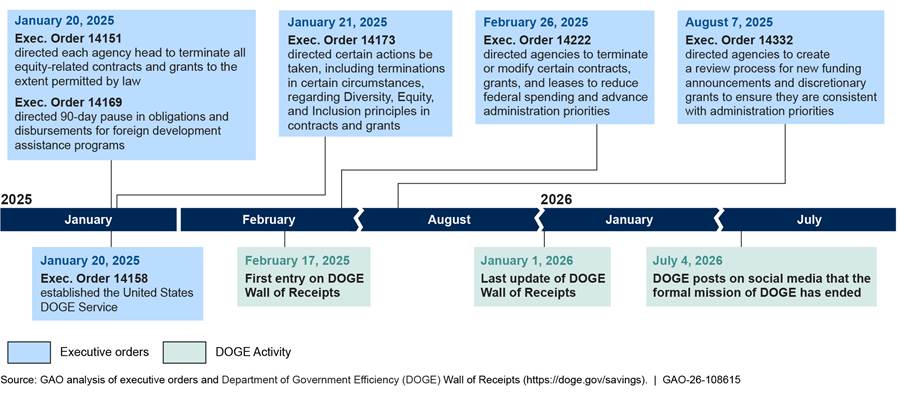
Executive Order 14158 established the United States DOGE Service (hereafter referred to as DOGE) within the Executive Office of the President, to be led by a U.S. DOGE Service Administrator.[13] The executive order also established the U.S. DOGE Service Temporary Organization, headed by the U.S. DOGE Service Administrator.[14] While the executive order does not call for the termination of the broader DOGE entity, the DOGE Temporary Organization terminated on July 4, 2026. DOGE and the temporary organization’s mission was to achieve DOGE’s agenda, including maximizing government efficiency. The executive order also called for the heads of executive branch agencies to establish DOGE teams at their respective agencies that coordinate with the U.S. DOGE Service and advise the agency on implementation of the DOGE agenda. Figure 1 depicts key executive orders and a timeline of events related to the Wall of Receipts. While the last update to the Wall of Receipts was made on January 1, 2026, the Wall of Receipts remains live as of July 7, 2026.
Figure 1: Timeline of Selected Executive Orders and Events Related to the Department of Government Efficiency (DOGE) and the Wall of Receipts
Notes:
Exec. Order No. 14151, Ending Radical and Wasteful Government DEI Programs and Preferencing, 90 Fed. Reg. 8339 (Jan. 29, 2025); Exec. Order No. 14158, Establishing and Implementing the President’s “Department of Government Efficiency,” 90 Fed. Reg. 8441 (Jan. 29, 2025); Exec. Order No. 14169, Reevaluating and Realigning United States Foreign Aid, 90 Fed. Reg. 8619 (Jan. 30, 2025); Exec. Order No. 14173, Ending Illegal Discrimination and Restoring Merit-Based Opportunity, 90 Fed. Reg. 8633 (Jan. 31, 2025); Exec. Order No. 14222, Implementing the President’s “Department of Government Efficiency” Cost Efficiency Initiative, 90 Fed. Reg. 11095 (Mar. 3, 2025); and Exec. Order No. 14332, Improving Oversight of Federal Grantmaking, 90 Fed. Reg. 38929 (Aug. 12, 2025).
While the last update to the Wall of Receipts was January 1, 2026, the Wall of Receipts remains live as of July 7, 2026.
Information Included on Wall of Receipts
DOGE began posting its estimated savings from contracts, grants, and leases on the Wall of Receipts on February 17, 2025. As of July 7, 2026, across contracts, grants and leases included on the Wall of Receipts, DOGE reported savings of $110.3 billion (see table 2). Including additional categories beyond contracts, grants, and leases, DOGE reported savings of $215 billion.[15] We identified issues limiting the transparency and reliability of these reported savings, which we will discuss later in the report.
Table 2: Number of Contracts, Grants, and Leases Reported on the DOGE Wall of Receipts and Associated Savings as of July 7, 2026
|
Award type |
Number of contracts, grants, and leases reported on Wall of Receipts |
DOGE-reported savings (dollars) |
|
Contractsa |
13,440 |
61.02 billion |
|
Grants |
15,887 |
49.21 billion |
|
Leasesb |
264 |
113.00 million |
|
Total |
29,591 |
110.34 billion |
Source: GAO analysis of data from the Department of Government Efficiency (DOGE) Wall of Receipts (https://doge.gov/savings) as of July 7, 2026. | GAO‑26‑108615
aWhile DOGE’s savings web page reported 13,440 contract terminations, we identified three instances where DOGE reported savings for one contract actually included multiple contracts; thus the 13,440 contracts DOGE reported represent 13,476 contracts.
bAs discussed later in this report, the $113 million in reported savings for the 264 leases was inaccurate. The information on the Wall of Receipts actually summed to $53.5 million.
DOGE posted updates approximately bi-weekly from February 2025 to May 2025 and then less frequently from June 2025 to January 2026.[16] In addition to reported savings for each award type, the Wall of Receipts generally includes:
· the agency associated with the reported contract, grant, or lease;
· for contracts, the vendor and a description of the contract;
· for grants, the recipient and description of the grant; and
· for leases, the location of the lease, the lease square footage, and a description of the type of lease termination.
The Wall of Receipts also includes an application programming interface, which provides access to additional fields not listed on the web page, such as the contract or grant award number.
DOGE reported most of the contracts, grants, and leases on the Wall of Receipts in the months immediately following issuance of Executive Order 14222 in February 2025 (see fig. 2). For example, DOGE reported 65 percent of the total terminated contracts, which accounted for 49 percent of the reported savings, by April 2025. For grants, DOGE reported 92 percent of the total grant terminations, accounting for 75 percent of the reported savings, by that same time.
The total number of leases DOGE reported as terminated and associated savings also decreased during the time frame of our review. For example, on March 30, 2025, DOGE reported 679 leases as terminated, totaling approximately $400 million in reported savings. From March 30, 2025, to January 1, 2026, 415 of the leases DOGE reported as terminated—accounting for about $346 million in reported savings—were removed from the Wall of Receipts because the leases were no longer being considered for termination. Following these changes, as of July 7, 2026, 264 leases, which DOGE reported as terminated, remained on the Wall of Receipts.
Figure 2 depicts the number of contracts, grants, and leases reported on the Wall of Receipts by month from January 2025 through June 2026.
Figure 2: Number of Contracts, Grants, and Leases Reported on the DOGE Wall of Receipts, by DOGE-Reported Month of Termination
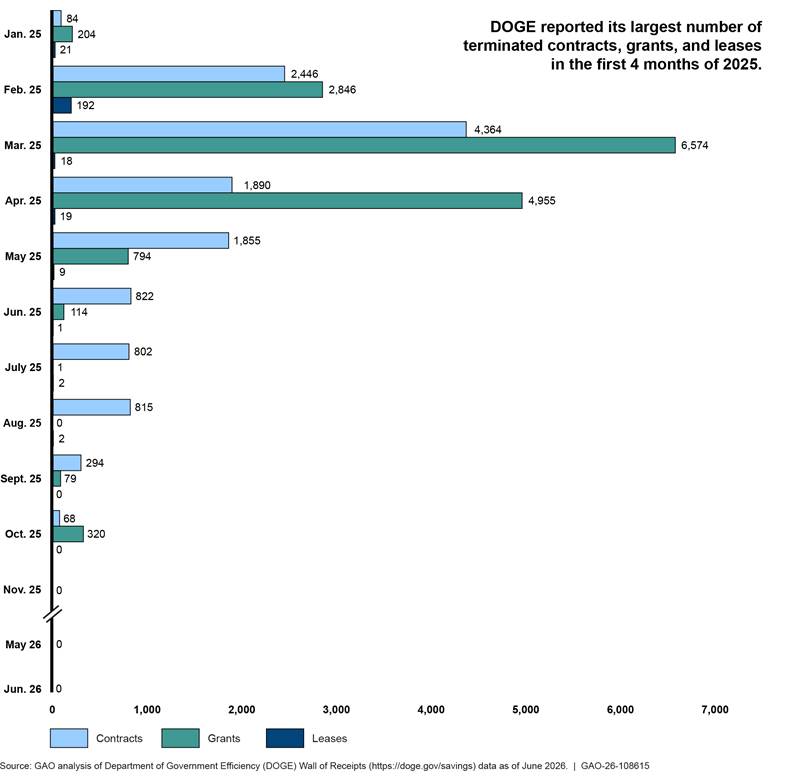
Note: While the Wall of Receipts reported 13,440 contract terminations, we identified three instances where DOGE reported savings for one contract actually included multiple contracts; thus the 13,440 contracts DOGE reported represent 13,476 contracts. The number of leases are the net leases identified for termination reported on the Wall of Receipts after some leases identified for termination were later rescinded. As of July 7, 2026, DOGE’s last update to the Wall of Receipts was in January 2026; however, the last reported month of termination was October 2025.
Government Databases and Information Sources
Authoritative government data on contracts, grants, and leases are available in various databases and information sources: FPDS, USAspending.gov, and GSA’s lease tracker.
FPDS
FPDS is the authoritative source for the federal government’s procurement data.[17] The system serves as the centralized contract database, repository, and comprehensive web-based tool for agencies to report and review their contract actions.[18] The Federal Acquisition Regulation (FAR) requires federal agencies to submit certain procurement data to FPDS.[19] The data it contains inform Congress, federal managers, oversight bodies, and the public about government contracting activity, including how many dollars agencies obligate for procurements.
USAspending.gov
USAspending.gov is a public facing repository of spending data for the federal government. The data on USAspending.gov include contracts, grants, loans, and other awards. This information is sourced from agency financial systems and data from external government-wide reporting systems, including FPDS. Unlike FPDS, USAspending.gov contains information on federal grants. The Digital Accountability and Transparency Act of 2014 (DATA Act) requires federal agencies to submit spending data for presentation on USAspending.gov.[20] The act requires federal agency expenditures to be disclosed and agency spending information to be linked to federal program activities so that policymakers and the public can more effectively track federal spending.
We have issued a series of reports on the DATA Act and USAspending.gov and made numerous recommendations.[21] Our prior reports identified significant data quality issues and challenges that may limit the usefulness of the data for Congress and the public.[22]
GSA’s Lease Tracker
GSA maintains an internal data tracker to help track and process terminations of federal agency real property leases. For the purposes of our review, GSA officials noted that these data are the most accurate information source for lease terminations. GSA’s tracker includes data fields such as annual rent, lease expiration date, and planned and actual termination dates; these fields are needed to calculate savings from leases identified for termination. The data in GSA’s lease tracker are populated from the Real Estate Across the United States real property management system, GSA’s primary tool to track and manage all of the government’s real property owned and leased assets.
Contract Termination Process
The FAR outlines the procedures and responsibilities for contract terminations and related actions, including the rights and obligations of both contractors and contracting officers.[23] The government may unilaterally terminate a contract, in whole or in part, for convenience when spending priorities or needs change or when it is in the government’s interest.[24] The government may also completely or partially terminate a contract for default (cause) due to the contractor’s actual or anticipated failure to perform, such as missing delivery schedules or violating contract terms.[25]
When the government terminates a contract for convenience, the contracting officer must issue a written termination notice to the contractor that states the effective date and whether the termination is whole or partial.[26] Unless the contracting officer provides an extension, the contractor generally must submit a termination settlement proposal within 1 year after the effective date of the termination.[27] When the government terminates a contract for convenience, it can incur termination settlement costs. Settlement costs are provided in the FAR, and include costs incurred, reasonable profit on performed work, disposition of inventories, settlement of subcontracts, and specified administrative and legal costs.[28]
Grant Termination Process
Generally, agencies can terminate awarded grants, consistent with the underlying authorization or grant agreement.[29] For example, the grant agreement could be terminated for failure to comply with terms and conditions, by mutual agreement, by the recipient, or if the award no longer effectuates agency priorities. Generally, termination requires written notice from the awarding agency.[30]
Upon termination of the grant, a grant recipient must close out the grant award pursuant to the terms of the grant and agency requirements, including by submitting required reports.[31] Grant closeout is a final point of accountability for grantees that helps to ensure they have met all financial requirements and have provided final reports, as required. During the closeout period, grantees must submit any remaining costs payable to them. Generally, within 120 days after the completion of the award, grantees must submit all financial, performance, and other reports as required by the terms and conditions of the award, including closeout costs for payments. The federal agency must make every effort to complete all closeout actions no later than 1 year after the end of the period of performance.
Termination of a federal grant may incur costs that would not have arisen had the grant not been terminated. These costs can include settlement expenses, such as accounting and legal costs, among others. For example, if authorized by the terms and conditions of the grant, the awarding agency may make a settlement for any upward or downward adjustment to the federal share of costs after the closeout reports are received.
Lease Termination Process
According to GSA officials, the process to terminate a lease is generally initiated when a tenant agency notifies GSA that it no longer needs the space.[32] GSA leases are negotiated with the private building owner and may authorize the government to terminate without penalty after a fixed or “firm term.”[33] A lease’s firm term ends at a pre-determined expiration date, at which point a lease enters its “soft term.”[34]
In general, when a federal lease is terminated, additional funding is usually required to vacate the space or move to a new location. For example, there are costs associated with identifying an alternative location, moving furniture, and designing and completing construction or tenant-requested improvements in the alternative space.
DOGE-Reported Savings Data for Contracts Lack Transparency; Savings for Selected Contracts Are Limited
Several issues limit the transparency and reliability of contract information on the Wall of Receipts. As of July 7, 2026, DOGE reported more than $61 billion in savings associated with 13,476 contracts that it reported as terminated. However, the Wall of Receipts does not include identifying information for 27.8 percent of the contracts, including all the contracts at the U.S. Agency for International Development (USAID) and 245 contracts at other agencies. In addition, the contract data on the Wall of Receipts that we could link to FPDS have other limitations. For example, DOGE reported all contracts on the Wall of Receipts as terminated, but our analysis of FPDS data shows that almost 2,000 contracts were not terminated. Moreover, DOGE did not apply its stated methodology for calculating more than half of the reported savings. In addition, DOGE’s stated methodology has limitations. For example, it does not reflect important aspects of contracting, including costs associated with contract terminations. Based on a detailed review of 21 selected contracts at DOD and the Department of Health and Human Services (HHS), we identified potential cost savings of $77.8 million in deobligated funds that could reduce federal spending or be spent on higher priority agency needs. We also identified other actions such as reducing total contract value or contract scope that could avoid future costs in some circumstances, which we consider to be potential cost avoidance. In some cases, however, work and associated costs were shifted to other contracts, which could constrain or eliminate potential savings. We also could not determine the basis for a portion or all of the DOGE reported savings for many of the 21 contracts we reviewed.[35]
Missing and Unreliable Data Limit Ability to Independently Assess Reported Savings
Data Gaps Limit Transparency
As of July 7, 2026, DOGE reported more than $61 billion in savings associated with 13,476 contracts that it reported as terminated. However, data gaps limit the ability to independently corroborate the data with other sources of federal contract information. Specifically, the Wall of Receipts does not include identifying information, such as contract numbers, for 3,751 (27.8 percent) of the 13,476 contracts it reported as terminated. These missing data on the Wall of Receipts include all 3,506 contracts reported as terminated at USAID, and 245 contracts at other agencies.[36] As such, we could not identify them in FPDS or take steps to corroborate the reported savings. Table 3 summarizes the extent to which contracts reported as terminated on the Wall of Receipts can be linked with contracts in FPDS.
|
Contract status |
DOGE contracts reported as terminated |
Percent of contracts |
DOGE-reported savings (dollars in billions) |
Percent of savings |
|
Linked to FPDS |
11,620 |
86.2 |
$53.8 |
88.2 |
|
Not Linked to FPDS |
1,856 |
13.8 |
$7.2 |
11.8 |
|
Total |
13,476 |
100.0 |
$61.0 |
100.0 |
Source: GAO analysis of data from Federal Procurement Data System (FPDS) as of April 2026 and Department of Government Efficiency (DOGE) Wall of Receipts (https://doge.gov/savings) as of July 7, 2026. | GAO‑26‑108615
Note: DOGE’s savings web page reported 13,440 contract terminations. We identified three instances where DOGE reported savings for one contract actually included multiple contracts; thus the 13,440 contracts DOGE reported represented 13,476 contracts.
To enable further analysis, we took additional steps to augment what was reported on the Wall of Receipts. Specifically, by the end of March 2025, USAID contract-identifying information was redacted from the Wall of Receipts. However, we downloaded USAID contract information before this occurred. We were therefore able to match the Wall of Receipts data to FPDS for 1,864 of the 3,506 contracts.[37] We also identified additional DOD contracts in FPDS using the “description” field on the Wall of Receipts.[38] Ultimately, we matched 11,620 contracts, which includes all but 1,856 of the total 13,476 contracts for which DOGE reported savings. Thus, while missing data remain, we reduced the percentage of contracts that could not be identified in FPDS from 27.9 percent to 13.8 percent, improving our ability to conduct further analysis.
DOGE Did Not Accurately Report Actions Taken on Contracts or Consistently Use Its Stated Methodology for Calculating Savings
Based on our analysis of FPDS data we found that DOGE did not accurately report actions taken on contracts. Specifically, DOGE reported all 13,476 contracts on the Wall of Receipts as terminated. Our analysis of the underlying FPDS data found that 43.2 percent of the reported savings are associated with contracts that were completely or partially terminated.[39] The remaining contracts were either not terminated, or we could not determine their status because DOGE did not provide enough data for us to link them to data in FPDS.[40] Figure 3 identifies the status of contracts in FPDS as of April 2026, and the DOGE reported savings associated with them.
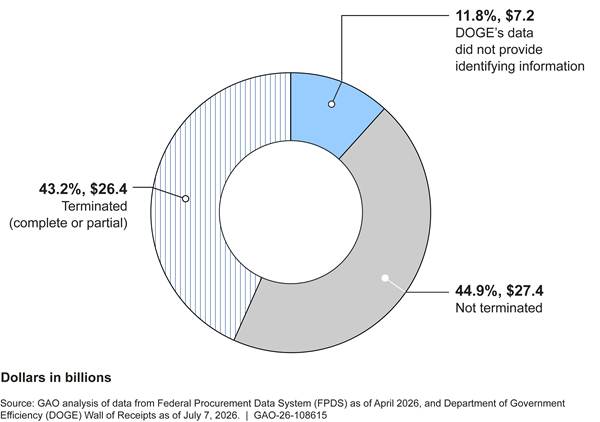
Notes: Terminated contracts have a termination action in FPDS. FPDS does not distinguish between complete and partial terminations. Therefore, an undetermined portion of the terminated contracts is still active. Contracts that were not terminated may have been subject to other actions including deobligations or reduction in total contract value. Department of State officials told us that because of the reduction in force at the U.S. Agency for International Development, there were several thousand contracts that were never updated in FPDS to report them as terminated. As a result, the FPDS data may marginally overstate the percentage of DOGE-reported savings associated with contracts that were not terminated. DOGE data did not provide enough identifying information for us to link some contracts to FPDS. Percentages in the figure do not sum to 100 percent due to rounding.
No termination action was taken on 2,503 of the contracts, representing $27.4 billion of reported savings.[41] In these cases, another action, such as reducing the total contract value or deobligating some funds could have occurred. Furthermore, DOGE reported no savings for 5,812, or 43.2 percent of all contracts it included on the Wall of Receipts.
We also found that DOGE did not consistently use its stated methodology for calculating savings or disclose limitations in a sufficient manner. This lack of methodological transparency further limits the reliability of the reported data. The Wall of Receipts states that savings were determined by calculating the difference between the contract’s total value, which is defined as the potential expenditure including options, and the amount currently obligated on the contract.[42] We attempted to replicate DOGE’s savings estimates based on our analysis of FPDS data. We found that DOGE followed its stated methodology for 7,710 contracts associated with 27.5 percent, or $16.8 billion, of the reported savings. For 3,910 contracts associated with 60.7 percent of the associated savings, we found that either DOGE used other calculations, such as a reduction in the total contract value or deobligation of funds from the contract, or we could not determine what method DOGE used to calculate the reported savings. DOGE did not respond to our request for interviews or clarification. Therefore, we were unable to obtain additional information about how the reported savings were calculated for those contracts for which the DOGE methodology was undetermined (see table 4).
Table 4: Extent to Which DOGE Followed Its Stated Methodology for Calculating Reported Contract Savings
|
DOGE contracts reported as terminated |
DOGE-reported savings (dollars in billions) |
Percent of savings |
|
|
DOGE followed its stated methodologya |
7,710 |
$16.8 |
27.5 |
|
DOGE did not follow its stated methodologyb |
3,910 |
$37.0 |
60.7 |
|
Unknown due to missing contract identifiers |
1,856 |
$7.2 |
11.8 |
|
Total |
13,476 |
$61.0 |
100.0 |
Source: GAO analysis of data from Federal Procurement Data System (FPDS) as of April 2026 and DOGE (Department of Government Efficiency) Wall of Receipts (https://doge.gov/savings) as of July 7, 2026. | GAO‑26‑108615
aThe Wall of Receipts states that savings were determined by calculating the difference between the total contract total value, which is defined as the potential expenditure including options, and the amount currently obligated on the contract.
bFor 1,431 contracts corresponding to $12.7 billion in reported savings, there was a deobligation or reduction in total contract value equal to the DOGE-reported savings, but this calculation did not correspond to DOGE’s stated methodology of contract value minus obligations. For 2,479 contracts corresponding to $24.3 billion in reported savings (40 percent) the DOGE methodology for calculating savings could not be determined.
Even in cases in which DOGE followed its stated methodology, it did not account for many complexities and nuances of federal contracting or sufficiently identify limitations. For example, the savings reported for terminated contracts do not account for subsequent obligations and deobligations that may be associated with termination settlement costs or contract close out. As such, the amount of reported savings is likely misstated. Finally, whether reductions in contract value will result in savings will depend on circumstances that are not yet known. We provide examples of some of these cases in the following section.
Some Selected Contracts Had Cost Savings, but the Basis for Some Reported Savings Was Unknown, and They Are Not Certain to Be Achieved
In our analysis of 21 selected contracts at DOD and HHS, we found significant variations in the amount of savings the agencies have achieved or could potentially achieve compared to what was reported on the Wall of Receipts, including cases where the basis for the savings is unknown.[43] Our analysis highlights some of the complexity of measuring savings on contracts and the limitations of DOGE’s approach.
We identified $77.8 million in deobligations in total across the 21 selected contracts. We also identified other actions such as reducing total contract value or contract scope that could avoid future costs in some circumstances, which we consider to be cost avoidance.[44] For these actions, savings are not certain to be realized.
|
How are cost savings defined in the context of federal contracting? For the purposes of this report, we consider cost savings to be financial benefits that result from actions that reduce federal costs or better target federal resources. These actions could be in the form of deobligations—reductions in the amount of funds obligated on a contract—which may allow those funds to be used for other purposes. However, if these funds are then used for similar work placed on a different contract, the amount of actual or net cost savings to the government may be reduced. We consider potential cost avoidance to be actions such as a reduction in the total value of a contract or a decision not to exercise an option period. These actions do not result in immediate savings. Further, if the total contract value is subsequently increased or another contract is awarded for similar work, savings will not be realized. Source: GAO analysis. | GAO‑26‑108615 |
In some cases, we found that agencies extended contracts and awarded new contracts for the same requirements after eliminating work, deobligating funds, or reducing total contract value, which suggests the agencies will not realize all of the reported savings. For example:
· We found that DOGE reported $62.7 million in savings on a $116.7 million Air Force contract for updating IT systems in support of the Air Force’s transformation initiatives. Air Force contracting officials reported deobligating $21.6 million from the contract while at the same time obligating funding. According to the contracting officer, the agency also modified the contract by eliminating work to be performed and reduced the total contract value by $74.8 million. According to Air Force officials, they subsequently extended the contract by 6 months, which increased the contract value and obligated $7.3 million. This gave them time to award a follow-on contract. Because the requirement still exists and the Air Force continues to meet this need with a new contract, the extent to which the Air Force will realize savings from these actions is unknown.
· Similarly, DOGE reported more than $28 million in savings on an Air Force contract awarded on behalf of the Defense Counterintelligence and Security Agency for financial management modernization. The agency descoped optional work and option periods and reduced the total contract value of $43.5 million by more than $28 million. However, contracting officials told us that they subsequently extended the contract by 6 months and then awarded another $27.4 million contract, without competing it, to the same contractor to complete the same work. A senior Air Force contracting official stated this approach can result in inefficiencies and cost increases due to higher negotiated labor rates, contractor escalation factors, increased facility and overhead expenses, subcontractor pricing adjustments, transition-related costs, and the loss of pricing efficiencies that may have been available through a timely competitive procurement. The official further noted that actual cost savings are only realized when planned expenditures are avoided or when the government’s total cost to achieve the required capability is reduced.
We identified a number of examples, including the four below, where there does not appear to be a basis for claiming all or a portion of the reported savings:
· DOGE reported more than $1.7 billion in savings on a DOD Defense Health Agency contract providing IT support at more than 700 military medical treatment facilities worldwide. While DOGE initially identified the contract for termination, DOD program leadership and contracting officials stated that they met with DOGE to discuss the work being conducted under this contract. Following the discussion, DOGE agreed no action should be taken to terminate the contract. Our analysis of contract documentation and FPDS shows that no action was taken to completely or partially terminate the contract, reduce scope or value, or deobligate funds. Thus, no savings were achieved. While no action was taken on the contract, the Wall of Receipts continued to report savings of more than $1.7 billion.
· DOGE reported $4 billion in savings on an Air Force contract that provides for IT modernization services – known as Base Infrastructure Modernization (BIM) – which will take place over 10 years at more than 187 Air Force locations worldwide. The Air Force reduced the total value of the contract by $3.75 billion, which is a 30 percent reduction from the original value of $12.5 billion. Air Force contracting officials could not explain the discrepancy between the $3.75 billion reduction and the $4 billion in savings that DOGE reported.[45] There is no certainty that the $3.75 billion will be saved. The contract was not terminated. Further, an Air Force official involved in planning and awarding the contract explained that the original total contract value was established based on extensive analysis of requirements and mission needs. He said that if the Air Force is not able to procure needed services under this contract, there may be a need to award new contracts and that the Air Force will miss out on the opportunity to leverage the efficiencies and cost savings already negotiated. He also explained that if obligations approach the total contract value, it can be increased with the required approvals and would likely be approved because of a critical mission need.
· DOGE reported $14.7 million in savings on a $21.3 million HHS contract for professional support to develop a public health reporting registry. This contract was not terminated, but it was closed when the period of performance ended. In the process of closing the contract, the agency deobligated $141,489 in remaining funding because the contractor earned less than the amount that was obligated on the contract. When the contract was closed, its value was approximately $21.2 million. Thus, the basis for the reported savings is unknown.
· DOGE reported $6.5 million in savings on a $12.9 million HHS contract for updates to a system for tracking early notification of community-based epidemics. HHS partially terminated this contract and descoped unfunded work potentially valued at more than $2 million. In a subsequent modification, the agency exercised an option and fully funded the remaining work, which increased the contract obligations by $4.5 million. As of January 2026, the contract value was $10.9 million. The contract remains active, and performance is ongoing.
Our sample included four contracts for which DOGE reported no savings, but we found that the agencies had taken action on two contracts which potentially resulted in some savings or future cost avoidance.
For example:
· DOGE reported no savings for the termination of a DOD contract valued at $184,460 at the time of award for subscriptions to a publication that covers legislative affairs information. DOD terminated the subscriptions along with the remaining option periods valued at $114,460 about 3 months after it exercised the first option year. The agency deobligated $35,600 but was unable to provide evidence that it recouped the deobligated funds.
· HHS awarded a contract for specialized medical support related to COVID-19 testing access in 2022. The total contract value was $1.1 billion at the time of award. We found that there were no funding actions after 2022, and no option periods were exercised. The agency deobligated approximately $50 million shortly before the contract expired in May 2025. According to agency officials, these funds have been rescinded. The agency deobligated an additional $232,382 when the contract was closed in December 2025. DOGE reported no savings.
See appendix II for additional details on the selected DOD and HHS contracts.
Limited Information Is Available About Grants DOGE Reported as Terminated
DOGE reported $49 billion in savings for 15,887 grants it reported as terminated. However, it is unknown how DOGE calculated those reported savings and what is included in them. This information cannot be examined fully in USAspending.gov due to data limitations on the Wall of Receipts.
Identifying grants DOGE reported as terminated. Approximately one out of every five grants the Wall of Receipts reported as terminated had insufficient data for us to identify them on USASpending.gov and thus corroborate the savings.[46] For example, data on the Wall of Receipts did not provide characteristics such as the type of grant or the type of assistance the grant provides. The unidentified grants accounted for more than 50 percent of the reported grant savings (see table 5).
Table 5: DOGE-Reported Grant Terminations and Savings and Linkage to USAspending.gov on the Wall of Receipts
|
DOGE-reported terminated grants |
Percent of grants |
DOGE-reported savings (dollars in billions) |
Percent of savings |
|
|
Linked to USAspending.gov |
12,359 |
77.8 |
$23.58 |
47.9 |
|
Not linkeda |
3,528 |
22.2 |
$25.63 |
52.1 |
|
Total |
15,887 |
100.0 |
$49.21 |
100.0 |
Source: GAO analysis of data from USAspending.gov as of February 2026 and Department of Government Efficiency (DOGE) Wall of Receipts (https://doge.gov/savings) as of July 7, 2026. | GAO‑26‑108615
aDOGE’s data did not provide sufficient detail to identify these grants in USAspending.gov. A total of 3,510 of the grants DOGE reported as terminated were not linked to USAspending.gov. An additional 18 included links to USAspending.gov but no data were available for those links.
The grant savings data listed on the Wall of Receipts were also inconsistent across agencies. Specifically, DOGE did not include USAspending.gov links corresponding to about 98 percent of the reported savings associated with HHS grants it reported terminated. However, DOGE included links corresponding to about 94 percent of the reported savings associated with USAID grants it reported terminated.
Calculating savings. The Wall of Receipts did not provide sufficient information to verify the method DOGE used to calculate savings, or what the savings consisted of, for 13,553 of the 15,887 grants it reported as terminated. This corresponds to about 96 percent of the DOGE-reported grant savings (see table 6).
The Wall of Receipts states that DOGE’s formula for calculating savings is the difference between the total value and the amount currently obligated. However, USAspending.gov, the official source of federal spending information, does not include the total value of individual grants. Therefore, it is unknown how DOGE applied this methodology. To attempt to determine how DOGE calculated its reported savings, we tried to replicate DOGE’s reported savings estimate using other formulas.[47] We applied these formulas to all the grants in the Wall of Receipts we could link to USAspending.gov. With these other formulas, we calculated DOGE’s reported savings estimate for 2,334 grants, corresponding to 4 percent of the total reported savings.
|
DOGE-reported terminated grants |
DOGE-reported savings (dollars in billions) |
Percent of savings |
|
|
DOGE method not verifieda |
13,553 |
$47.32 |
96.2 |
|
GAO calculations: Three different formulas resulted in same estimate as DOGEb |
2,334 |
$1.89 |
3.8 |
|
Total |
15,887 |
$49.21 |
100.0 |
Source: GAO analysis of data from USAspending.gov as of February 2026 and Department of Government Efficiency (DOGE) Wall of Receipts (https://doge.gov/savings) as of July 7, 2026. | GAO‑26‑108615
Notes: USAspending.gov data may not include final costs associated with potential settlement. Because of data limitations, our calculations examine the records in USAspending.gov as of February 2026 as opposed to DOGE’s date of termination.
aThis group includes the 3,510 grants DOGE reported as terminated for which DOGE omitted links to USAspending.gov and 18 grants for which DOGE included links to USAspending.gov but no data were available. The remainder were grants for which DOGE did not provide the method it used to calculate its reported savings.
bWe attempted to calculate DOGE’s reported savings estimate using three other formulas: (1) obligations less outlays; (2) total funding less obligations; and (3) total funding less outlays. When calculating total funding less obligations, we considered DOGE’s method to be not verified when DOGE savings equaled zero as these instances may be coincidental. When outlays were missing, we treated those as zero. We did not use these calculations as a means of determining savings associated with terminated grants. We cannot verify these savings or definitively determine whether they are understated or overstated based on the data from the Wall of Receipts or USAspending.gov alone. The purpose of this analysis was to attempt to determine how DOGE calculated its reported savings. Similarly, while it is unknown what the missing outlays should represent, for the purpose of trying to understand how DOGE calculated savings we assumed these missing outlays to be zero.
Even for the 2,334 terminated grants for which we could replicate DOGE’s reported savings estimate using other formulas, the amount of reported savings may not be realized. For example, it is unknown what closeout or settlement costs were included in the savings estimates, if any. Agencies collect detailed information associated with termination activities for each grant, but this information, including closeout and settlement costs, is not clearly identified on USAspending.gov. Understanding the extent of cost savings for grants, therefore, would have to be based on documentation for each individual grant. We requested documentation that would include information such as closeout and settlement costs for the 12 grants in our sample from HHS and USAID. HHS submitted the requested documentation; however, a technology issue prevented the proper transfer of these grant documents in a timely manner.[48] USAID did not respond to our request for information on sampled contracts and grants.
The Wall of Receipts Overstated Savings from Real Property Lease Terminations by More than $80 Million
DOGE Overstated Total Lease Savings Reported on the Wall of Receipts by More than $80 Million
As of July 7, 2026, DOGE listed 264 leases for termination on the Wall of Receipts that summed to $53.5 million in savings.[49] However, as noted earlier, DOGE reported an inaccurate total savings of $113 million for these leases, resulting in an overstated total savings of $59.5 million. Because DOGE declined to meet with us, we could not obtain an explanation for the error.
The number of leases identified for termination and associated savings DOGE reported on its Wall of Receipts decreased substantially from March 2025 to June 2026 (see fig. 4). On March 30, 2025, DOGE reported 679 leases for termination on the Wall of Receipts totaling approximately $400 million in savings.[50] Between March 30, 2025, and October 5, 2025, 415 of those leases were removed from the Wall of Receipts, leaving 264 leases for termination and reducing reported savings by $346 million to $53.5 million.
Figure 4: Total Number of DOGE-Identified Lease Terminations and Reported Savings, March 2025, to June 2026
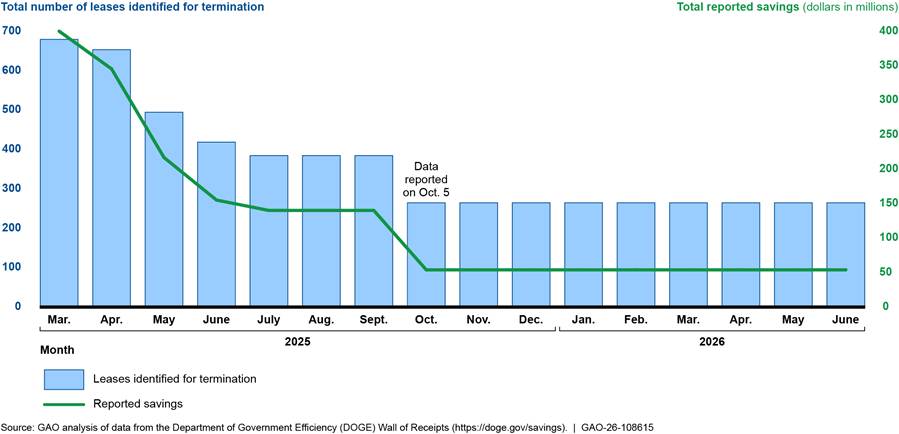
Note: We calculated the total reported savings for this figure by adding the estimated savings for each lease DOGE reported on its Wall of Receipts, rather than reporting the inaccurate total savings of $113 million that DOGE reported on its web page. The information reflects data reported on the DOGE Wall of Receipts toward the end of the month, unless otherwise noted.
DOGE also overstated total savings by including savings from leases GSA had identified for termination before January 20, 2025, prior to DOGE’s establishment. According to GSA officials, 108 of the 264 leases identified for termination on the Wall of Receipts were already in the process of being terminated by GSA when DOGE was established. The associated savings from those 108 leases accounted for roughly $15.3 million of the total $53.5 million in savings from the Wall of Receipts, or 29 percent.
DOGE further overstated savings on the Wall of Receipts from leases identified for termination by $7.3 million compared to data in GSA’s lease tracker, as of March 2026, in three ways:
· DOGE included estimated savings from 44 leases that were still active (e.g., identified terminations that were later rescinded), according to GSA data. This resulted in DOGE overestimating savings by $5.6 million compared to GSA’s data.[51]
· DOGE reported savings that were $1.3 million higher than GSA’s data for the 217 leases that had been terminated.
· DOGE also included savings of approximately $369,000 for three leases scheduled for termination that remain active as of May 2026.[52]
We found that DOGE overstated savings on the Wall of Receipts by $81.1 million. In total, savings from leases identified for termination on the Wall of Receipts was $31.8 million (see fig. 5).
Figure 5: Total and Overstated Savings DOGE Reported from Leases Identified for Termination on the Wall of Receipts
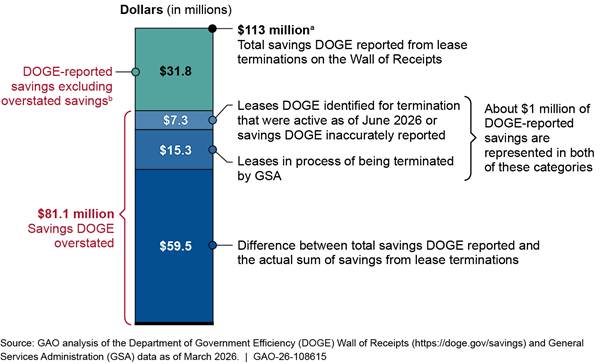
aNumbers may not add up due to rounding.
bAdditional costs associated with terminating a lease such as early termination fees or relocation costs are not included in the reported savings.
The Wall of Receipts does not describe how the savings for leases identified for termination were calculated, and DOGE did not respond to our requests for additional information. GSA officials said they estimated savings by multiplying the number of days remaining on the lease at the point GSA returned the space to the building owner by the daily lease rate.[53] We were able to confirm that DOGE used this calculation for the savings reported on the Wall of Receipts for most of the leases identified for termination.
DOGE Further Overstated Estimated Lease Savings by Not Factoring in Additional Costs
DOGE’s reported savings did not include additional costs for terminated leases, such as moving or relocation costs. GSA officials said that, in general, lease terminations or expirations have costs associated with moving to a new location or removing furniture and other property from the leased location. GSA officials said that these costs are factored into the decision to move or renew the lease and can be sizable, which can result in a decision to renew the lease based on cost. However, such costs were not available for the terminated leases because the leases were terminated without factoring in these additional costs.
DOGE also did not factor in any potential early termination fees into its reported savings. Of the 264 leases identified for termination on DOGE’s Wall of Receipts, 30 leases were in the firm term and therefore could have been subject to penalties, such as early termination fees.[54] Specifically, of those 30 leases, according to GSA data, six leases in the firm term were terminated or scheduled to be terminated as of July 7, 2026, and accounted for $5.9 million in estimated savings. However, any additional costs associated with leases terminated in the firm term were not included in DOGE’s reported savings.
In addition, DOGE did not incorporate the extra costs associated with lease terminations that were later rescinded into its reported savings. As leases were initially identified for termination, GSA sent termination notices to the building owners of those 679 leases. Afterward, some tenant agencies submitted requests to rescind their termination. In their requests, agencies provided justification for retaining their space, and GSA largely approved those requests, according to GSA officials. However, we found at least one instance when a lease identified for termination that was later rescinded led to higher costs. Specifically, officials from a tenant agency we spoke with provided an example where the building owner refused to rescind the lease termination, which forced GSA to renegotiate a new lease at a higher rate of over $1.5 million more per year than before with a 5-year firm term.
The Wall of Receipts Does Not Provide Sufficient Information on Data Quality Issues or Limitations
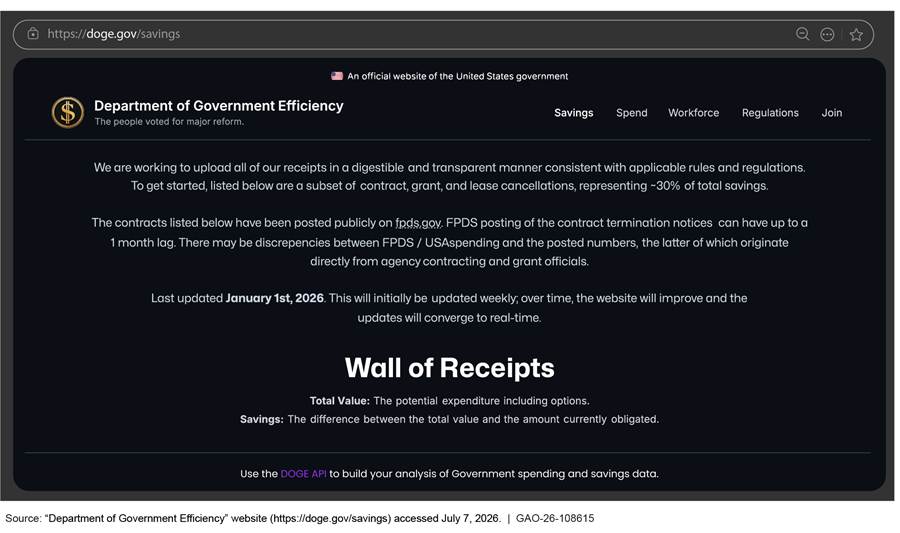
According to our key practices for transparently reporting government information, federal government websites should disclose known data quality issues and limitations, such as issues with the completeness, timeliness, or accuracy of the data.[55] This is important because providing information about the data allows users to determine whether it is suitable for their intended purposes and make informed decisions on whether and how to use it. However, the Wall of Receipts does not sufficiently disclose issues or limitations affecting data quality. The web page does include some information about the data, as shown in figure 6. Specifically, the web page states that the data on the Wall of Receipts represent a subset of contract, grant, and lease terminations and may not be consistent with government databases. It also states when the data were last updated. However, the web page includes limited information on the methodology for calculating reported savings. It does not include information about the data limitations described in this report. For example, the web page does not disclose that reported savings do not account for costs associated with contract termination, grant closeout, and lease termination, or that DOGE’s stated methodology was not consistently used to calculate reported savings.
Figure 6 shows a screen shot of the information about data limitations and methodology displayed on the Wall of Receipts.
Figure 6: Screen Shot of Information About Department of Government Efficiency Wall of Receipts Data Limitations and Methodology, as of July 7, 2026
DOGE launched the initial Wall of Receipts in February 2025 less than a month
after DOGE was established in January 2025.[56]
Since the initial launch, there have been no updates on the site that shed
additional light on the cost savings methodology or disclose any data
limitations. We asked DOGE if they were aware of any data quality issues and
limitations, and whether they planned to disclose them on the website. However,
DOGE did not respond to our inquiries.
While publicly reporting government data can have significant value, conveying the methodologies used to calculate savings, as well as any data limitations on the Wall of Receipts would provide policymakers and the public with the needed caveats to better interpret and use the information.
Conclusions
The Wall of Receipts provides data to policymakers and the public on DOGE’s estimated savings from termination of contracts, grants, and leases, but some savings estimates are incorrect or lack supporting evidence. The data quality issues identified in this report limit the value of the Wall of Receipts to policymakers. In addition, when government data are not reliable, it can hinder the public’s trust in government. Prominently displaying data limitations would enhance the value of the Wall of Receipts by providing users with the information that they need to interpret and use the data appropriately.
Recommendation for Executive Action
The Executive Office of the President, through the United States DOGE Service, should ensure that known data quality issues and limitations are prominently displayed on the Wall of Receipts. (Recommendation 1)
Agency Comments
We provided a draft of this report to the United States DOGE Service; the Departments of Defense, Energy, Health and Human Services, and State; the General Services Administration; and the U.S. Agency for International Development for review and comment. The Departments of Defense and Health and Human Services provided technical comments, which we incorporated as appropriate. The Departments of Energy and State, and the General Services Administration, said they did not have any comments on the report. The United States DOGE Service and the U.S. Agency for International Development did not provide comments on the report.
We are sending copies of this report to the appropriate congressional committees, the Acting Administrator of the Department of Government Efficiency, the Secretary of Energy, the Secretary of Health and Human Services, the Secretary of Defense, the Secretary of State, the Acting Administrator of the U.S. Agency for International Development, the General Services Administration, and other interested parties. In addition, the report is available at no charge on the GAO website at https://www.gao.gov.
If you or your staff have any questions about this report, please contact me at LucasJudyJ@gao.gov. Contact points for our Offices of Congressional Relations and Media Relations may be found on the last page of this report. GAO staff who made key contributions to this report are listed in appendix III.
Jessica Lucas-Judy
Director, Strategic Issues
Michael Hoffman
Chief Economist, Applied Research and Methods
David Marroni
Director, Physical Infrastructure
Tatiana Winger
Director, Contracting and National Security Acquisitions
This report assesses (1) the methodologies Department of Government Efficiency (DOGE) used to estimate savings for contracts, grants, and leases reported as terminated; and (2) the extent to which DOGE discloses any relevant data limitations.[57]
To understand the directions given to agencies, we reviewed relevant executive orders such as Executive Order 14158 establishing DOGE and Executive Order 14222 on implementation of the President’s DOGE Cost Efficiency Initiative.[58] We also spoke with knowledgeable agency officials to understand the agency circumstances when contracts and leases were identified for termination. In particular, we interviewed officials from the Departments of Defense (DOD), Energy, and State[59] and the General Services Administration (GSA).[60] The Department of Health and Human Services (HHS) provided written responses to our questions. We requested interviews with officials from the U.S. DOGE Service and the U.S. Agency for International Development (USAID) but those officials had not responded as of June 2026.
To determine the methodologies DOGE used to estimate savings, we analyzed publicly available information and data from the Wall of Receipts.[61] The Wall of Receipts and its data include total reported savings, savings by agency, and the date DOGE reported contracts, grants, and leases as terminated. Our review covered savings data reported on the Wall of Receipts for contracts, grants, and leases from January 20, 2025, to July 7, 2026.[62] A July 4, 2026 post on an official DOGE social media account indicated that the formal mission of DOGE has come to an end. However, as of July 7, 2026, the Wall of Receipts remains live. To the extent possible, we linked the DOGE reported data with government databases: the Federal Procurement Data System (FPDS) for contracts, USAspending.gov for grants, and GSA’s lease tracker.[63] We did so to examine DOGE’s calculations using data from government databases.
We assessed the reliability of data from the Wall of Receipts, FPDS, USAspending.gov, and GSA’s lease tracker. We did so by reviewing existing information about the databases and the data they collect. In addition, we conducted electronic testing of all databases to identify missing data, duplicate entries, invalid values, and other data reliability concerns. We interviewed GSA officials to understand the processes by which data from FPDS and GSA’s lease tracker were collected, maintained, and used. We determined the data from FPDS, USAspending.gov, and GSA’s lease tracker were sufficiently reliable for the purposes of providing insight into how DOGE estimated savings and for selecting a nongeneralizable sample.[64] Our report discusses the reliability of the Wall of Receipts data, including instances of incompleteness we identified.
We also reviewed the methodology for calculating savings described on the Wall of Receipts, and any underlying assumptions that are disclosed on the site. The Wall of Receipts states that savings were determined by calculating the difference between the contract’s total value, which is defined as the potential expenditure including options, and the amount currently obligated on the contract.[65] DOGE did not respond to our request for an interview or provide requested documentation. Using the Wall of Receipts data, we attempted to determine how DOGE calculated its savings. Specifically, we assessed the extent to which DOGE consistently adhered to its stated methodology or used other methodologies. We did not use these calculations as a means of determining savings associated with terminated contracts, grants, or leases. We cannot verify these savings or say whether they are understated or overstated based on the data from the Wall of Receipts or FPDS, USAspending.gov, or GSA’s lease tracker alone. The purpose of this analysis was to try to determine how DOGE calculated reported savings.
· For contracts, we applied DOGE’s stated methodology by calculating the difference between the contract’s total value, which is defined as the potential expenditure including options, and the amount currently obligated on the contract.[66] In addition, we attempted to replicate DOGE’s reported savings estimate using two other formulas: (1) reduction in base value only, and (2) deobligation alone or with a reduction in the base value.
· For grants, it is unknown how DOGE applied its stated methodology because “total value” is not displayed in USAspending.gov for grants, and the Wall of Receipts site does not say anything further. To try to determine how DOGE calculated reported savings, we attempted to replicate DOGE’s reported savings estimate using three other formulas: (1) obligations less outlays, (2) total funding less obligations, and (3) total funding less outlays.[67]
· For leases, we used data GSA maintains to track its tenant agencies’ lease terminations to help validate the lease termination data DOGE reported. Specifically, we applied GSA’s methodology by multiplying the number of days a lease was shortened by the daily rent cost.
To further evaluate the methodologies DOGE used to estimate savings, we selected nongeneralizable samples of 31 contracts and 12 grants DOGE reported as terminated at agencies with the greatest reported savings for a more in-depth review. We reviewed all 264 GSA leases DOGE listed as terminated on its Wall of Receipts as of July 7, 2026.
· For contracts, these agencies were USAID, DOD, and HHS. We selected 10 contracts per agency.[68]
· For grants, these agencies were USAID and HHS. We selected three to five grants per agency or component, as described below.
From USAID, DOD, and HHS we used random selection within selected subsets of contracts and grants to form nongeneralizable samples of reported savings for additional review.
· For contracts, to facilitate coordination and communication with agency officials responsible for the administration of the selected contracts, we limited the selection to no more than two components within each agency and no more than three locations within each agency and component.[69] We grouped eligible contracts based on three primary criteria: (1) contracts that were closed and not closed according to FPDS; (2) contracts corresponding to the highest (the largest 10 percent within each agency) and lowest (those with $0) reported savings; and (3) contracts representing the four available pricing types: cost type, fixed price, time and materials/labor hours, and other. We randomly selected contracts to be included in the sample from the groups associated with our three criteria. We used professional judgment to select which groups would provide variation across the criteria. For additional information on the sample characteristics see table 7.
|
Primary criteria |
Criteria options |
Breakdown of 11 contracts within Department of Defense |
Breakdown of 10 contracts within Department of Health and Human Services |
Breakdown of 10 contracts within United States Agency for International Development |
|
FPDS Closed Status |
Closed |
1 |
2 |
3 |
|
Not closed |
10 |
8 |
7 |
|
|
DOGE- Reported Savings |
$0 reported savings |
2 |
2 |
2 |
|
Top 10 percent of reported savings |
9 |
8 |
8 |
|
|
FPDS Pricing Type |
Cost type |
1 |
1 |
6 |
|
Fixed price |
7 |
5 |
1 |
|
|
Time and materials/labor hours |
1 |
4 |
2 |
|
|
Other |
2 |
0 |
1 |
Source: GAO analysis of data from Federal Procurement Data System (FPDS) and Department of Government Efficiency (DOGE) Wall of Receipts (https://doge.gov/savings) as of January 2026. | GAO‑26‑108615
Note: FPDS data do not distinguish between full and partial terminations.
· For grants, to facilitate coordination and communication with agency officials responsible for the administration of the selected grants, we limited the selection to no more than two components within each agency.[70] We grouped eligible grants based on those corresponding to the highest (the largest 10 percent within each agency) and lowest (those with $0) reported savings. We randomly selected grants to be included in the sample from those in the large and small reported savings groups across agency components. For additional information on the sample characteristics see table 8.
|
Criteria based on DOGE data |
Breakdown of 3 grants within the Centers for Disease Control and Prevention |
Breakdown of 5 grants within HHS National Institutes of Health |
Breakdown of 4 of grants within United States Agency for International Development |
|
$0 reported savings |
0 |
2 |
1 |
|
Top 10 percent of reported savings |
3 |
3 |
3 |
Source: GAO analysis of data from Department of Government Efficiency (DOGE) Wall of Receipts (https://doge.gov/savings) as of January 2026. | GAO‑26‑108615
Note: Because the DOGE data did not contain component level information, we also used the Department of Health and Human Service’s Tracking Accountability in Government Grants System data to help determine the agency component.
Because we made a nongeneralizable selection of agencies and components, our findings from the samples cannot be used to make inferences about the agencies and components overall or other agencies and components. However, we determined that the selection of these agencies and components was appropriate for our design and that the selection would generate valid and reliable evidence to support our work. Specifically, our sample drew from the largest reported savings and facilitated our ability to assess DOGE savings estimates and methodology.
We requested documentation from the agencies included in our samples of contracts and grants, and from GSA for the leases. For contracts and leases, we reviewed agency documentation to examine the costs associated with these reported terminations and where DOGE’s reported savings may have been inaccurate. We also interviewed agency officials to understand the contracts and leases that were terminated and the circumstances surrounding those terminations.[71] In addition:
· For contracts, we reviewed contract file documentation, interviewed agency officials, and obtained written responses to identify any savings.
· For grants, we requested grant documentation from HHS. HHS submitted the requested grant documentation; however, a technology issue prevented proper transfer of these grants in a timely manner.[72]
· For leases, we reviewed additional information on leases identified for termination included on the Wall of Receipts from GSA, such as the location, tenant agency, and term of the lease. We examined leases in GSA’s tracker within the scope of this review which included those where GSA sent termination notification letters to the agencies from January 20, 2025, to January 1, 2026.
To assess the extent to which DOGE disclosed any relevant data limitations, we reviewed the Wall of Receipts on a periodic basis throughout our review. We also reviewed our prior work on key practices for transparently reporting government data.[73] We requested to meet with DOGE and asked for responses to written questions. However, it did not respond to our inquiries. Therefore, we were unable to clarify how DOGE estimated savings when the reported savings did not correspond to their stated methodologies or other calculations.
We conducted this performance audit from June 2025 through August 2026 in accordance with generally accepted government auditing standards. Those standards require that we plan and perform the audit to obtain sufficient, appropriate evidence to provide a reasonable basis for our findings and conclusions based on our audit objectives. We believe that the evidence obtained provides a reasonable basis for our findings and conclusions based on our audit objectives.
For the selected contracts we reviewed, we identified actions taken that may result in cost savings or cost avoidance based on our independent review of contract file documentation and interviews with contracting officials. Deobligating funds previously obligated on a contract may allow those funds to be used for other purposes. If these funds are then used for similar work placed on a different contract, the amount of net cost savings to the government may be reduced. Similarly, this amount may be reduced by settlement costs related to a termination. In addition, future costs can potentially be avoided by actions such as (1) reducing the total contract value; (2) descoping or removing work, unfunded option periods, and individual tasks; and (3) reducing the upper limit of how much can be obligated in the future on orders placed on certain contracts. These actions can reduce or avoid future costs but do not result in immediate savings and are not certain to be realized.
|
|
|
Actions taken |
|
|
Contract description and status |
DOGE-reported savings |
Deobligations |
Other actions |
|
IT modernization services for more than 187 Air Force locations worldwide (Base Infrastructure Modernization (BIM) Status: Not terminated |
$4 billion |
$0 |
The agency reduced the total contract value of $12.5 billion by $3.75 billion. |
|
IT support for Defense Health Agency Military Medical Treatment Facilities worldwide Status: Not terminated |
$1,764,530,973 |
$0 |
With agreement from DOGE, the agency took no action on this contract, which has a total value of $2.4 billion. |
|
Transformation support for highly complex Air Force IT initiatives Status: Not terminated |
$832 million |
$0 |
The agency reduced the total contract value of $2.75 billion by $832 million. |
|
IT services for Air Force and Space Force at locations worldwide Status: Not terminated |
$700 million |
$0 |
The agency reduced the total agreement value of $5,712,635,494 by $700 million. |
|
Update IT systems in support of Air Force transformation initiatives Status: Not terminated |
$62,651,276 |
$21,612,519 The agency also obligated funding, resulting in a net deobligation of $12,422,628. |
The agency descoped work and reduced the total contract value of $116,662,858 by $74,777,767 through several modifications that also added funding. The agency later exercised an option to extend the contract by 6 months and increased the value by obligating $7,275,894. |
|
Professional expertise on IT initiatives for Air Force transformation Status: Terminated (closed) |
$32,909,213 |
$5,354,954 The agency subsequently obligated $354,954, resulting in a net deobligation of $5 million. |
The agency descoped work and reduced the contract value of $101,501,716 by $32,554,259. |
|
Cloud-based IT services for the Air Force Status: Not terminated |
$29,754,904 |
$0 |
The agency descoped tasks valued at $29,754,904, while subsequently adding funding for other tasks. |
|
Financial management modernization at the Defense Counterintelligence and Security Agency Status: Not terminated |
$28,377,949 |
$0 |
The agency removed option periods, descoped work, and reduced the total contract value of $43,456,260 by $28,377,949. Contracting officials stated that they later awarded a sole source follow-on contract for $27.4 million to the same contractor to complete the same work. |
|
Cloud-based IT services and cybersecurity for Air Force bases Status: Not terminated |
$21,612,519 |
$0 |
The agency descoped work and decreased the contract value. This was a continuation of a base contract and had many modifications as part of the transition to new contracts. |
|
Air Force annual subscription for research services Status: Terminated |
$0 |
$0 |
The agency terminated the contract in March 2025 after it was already fully funded and executed. |
|
Air Force subscriptions to a publication that covers legislative affairs information Status: Terminated (closed) |
$0 |
$35,600 The agency was unable to provide evidence that it recouped the deobligated funds. |
The agency terminated the contract for subscriptions and did not exercise future option periods valued at $114,460. |
Source: GAO analysis of information from Department of Government Efficiency (DOGE) Wall of Receipts (https://doge.gov/savings) as of January 2026, the Federal Procurement Data System as of January 2026, Department of Defense (DOD) contract documentation, and written responses from agency officials. | GAO‑26‑108615
Notes: Both completely and partially terminated contracts may be subject to settlement costs. For contracts and orders that are not listed in the table as closed or completely terminated, performance may be ongoing and the government may continue to obligate money against them.
In some cases, the deobligation and the reduction in total value amounts are the same, reflecting a single action that both deobligates funding and lowers the total value.
The selected contracts included indefinite delivery/indefinite quantity contracts and orders as well as a purchase order and a blanket purchase agreement that used simplified procedures. Indefinite delivery/indefinite quantity contracts may be used when the exact quantities and timing for products or services are not known at the time of award. These contracts must include a stated minimum and maximum quantity. Orders are placed to meet individual requirements. When quantities or tasks are eliminated or reduced, the total value may or may not decrease. Quantities and tasks can subsequently be added, resulting in an increase in the total value. In these cases, savings are not certain to be realized.
Multiple award indefinite delivery/indefinite quantity contracts are awarded to multiple contractors, potentially thousands, who can compete for orders under a fair opportunity process. A contractor with a multiple award indefinite delivery/indefinite quantity contract is only guaranteed a minimum quantity, and may never receive an order following this process, or may receive orders up to the stated maximum.
For multiple award indefinite delivery/indefinite quantity contracts and indefinite delivery/indefinite quantity base contracts, we only reviewed the contract reported on the DOGE Wall of Receipts, and not the orders placed against that contract.
For task orders and delivery orders, we did not review the indefinite delivery/indefinite quantity base contract or the other orders placed against it. In the table, we refer to these orders as contracts.
|
|
|
Actions taken |
|
|
Contract description and status |
DOGE-reported savings |
Deobligations |
Other actions |
|
Professional support for the National Center for Injury Control and Prevention Status: Terminated (partial) |
$18,521,652 |
$0 |
The agency descoped tasks and reduced the total contract value of $40,001,231 by $7,658,529. |
|
Professional support to develop a public health reporting registry Status: Not terminated (closed) |
$14,684,814 |
$141,489 |
The agency closed the contract and reduced the total contract value of $21,374,589 by $141,489 after the period of performance ended. |
|
Support services for the Centers for Disease Control and Prevention and center-wide offices Status: Terminated (partial) |
$13,104,374 |
$0 |
The agency descoped tasks and reduced the total contract value of $24,979,841 by $4,295,564. |
|
System updates for Early Notification of Community-Based Epidemics Status: Terminated (partial) |
$6,521,737 |
$0 |
The agency descoped tasks and reduced the total contract value of $12,875,732 by $2,019,591. The agency subsequently exercised an option period in July 2025. |
|
Professional expertise to support the Centers for Disease Control and Prevention’s Division of Nutrition, Physical Activity, and Obesity Status: Terminated (partial) |
$5,952,610 |
$0 |
The agency descoped tasks and subsequently reduced the potential total contract value by $2,216,544 to $22,492,655 as part of exercising an option that also obligated additional funds. |
|
Support to maintain a robust emergency management program Status: Terminated (partial) |
$5,910,766 |
$365,038 |
The agency descoped tasks by $5,017,032. However, the total contract value was not reduced, it remained at $7,054,001. The agency exercised the first option period in September 2025. |
|
Professional support for the Division for Heart Disease and Stroke Prevention Status: Terminated (partial) |
$5,273,688 |
$0 |
The agency descoped tasks but did not reduce the total contract value. A termination settlement is pending. The agency exercised the last option period in September 2025. |
|
Newborn screening lab support Terminated (partial) |
$2,945,945 |
$101,486 |
The agency removed tasks and reduced the total contract value by $101,486. The last option period was exercised in September 2025. |
|
Professional support for the Center for Surveillance, Epidemiology, and Laboratory Services Status: Terminated (partial) |
$0 |
$0 |
The agency did not reduce the total contract value of $747,753. The contractor submitted a settlement proposal for $5,024 in termination costs. The period of performance ended in July 2025. |
|
Specialized medical support related to COVID-19 testing access Status: Terminated (partial, closed) |
$0 |
$50,209,483 According to agency officials, Congress rescinded $49,977,100. |
The contract was originally valued at $1,142,544,690. It was awarded and funded at $54,406,890 in 2022. The remaining option periods were not exercised, and no additional funds were obligated. The agency partially terminated the contract shortly before it expired in May 2025. The total contract value reduction of $566,842,555 consisted of the remaining value of the unexecuted option periods. |
Source: GAO analysis of information from Department of Government Efficiency (DOGE) Wall of Receipts (https://doge.gov/savings) as of January 2026, the Federal Procurement Data System as of January 2026, Department of Health and Human Services contract documentation, and written responses from agency contracting officials as of April 2026. | GAO‑26‑108615
Notes: Both completely and partially terminated contracts may be subject to settlement costs. For contracts and orders that are not listed in the table as closed or completely terminated, performance may be ongoing and the government may continue to obligate money against them.
In some cases, the deobligation and the reduction in total value amounts are the same, reflecting a single action that both deobligates funds and lowers the total value.
The selected contracts include indefinite delivery/indefinite quantity contracts and orders, as well as a purchase order that used simplified procedures. Indefinite delivery/indefinite quantity contracts may be used when the exact quantities and timing for products or services are not known at the time of award. These contracts must include a stated minimum and maximum quantity. Orders are placed to meet individual requirements. When quantities or tasks are eliminated or reduced, total value may or may not decrease. Quantities or tasks can subsequently be added, resulting in an increase in the total value. In these cases, savings are not certain to be realized.
For task orders and delivery orders, we did not review the indefinite delivery/indefinite quantity base contract or the other orders placed against it. In the table, we refer to these orders as contracts.
GAO Contacts
Jessica Lucas-Judy LucasJudyJ@gao.gov, Michael Hoffman, HoffmanME@gao.gov, David Marroni, MarroniD@gao.gov, Tatiana Winger, WingerT@gao.gov
Staff Acknowledgments
In addition to the contacts named above, Keith Cunningham (Assistant Director), Angie Nichols-Friedman (Assistant Director), Laurel Plume (Assistant Director), Nisha Rai (Assistant Director), Jessica Berkholtz (Analyst-in-Charge), Justine Augeri, Jim Ashley, Rose Brister, Noelle Du Bois, Emily Crofford, Mikayla Ferg, James Holley, Suellen Foth, Catherine Kim, Sheila R. McCoy, Raquel Qualls-Hampton, Andrew Stavisky, Trevor Warner, Alyssa Weir, Crystal Wesco, and Alicia Wilson made key contributions to this report.
The Government Accountability Office, the audit, evaluation, and investigative arm of Congress, exists to support Congress in meeting its constitutional responsibilities and to help improve the performance and accountability of the federal government for the American people. GAO examines the use of public funds; evaluates federal programs and policies; and provides analyses, recommendations, and other assistance to help Congress make informed oversight, policy, and funding decisions. GAO’s commitment to good government is reflected in its core values of accountability, integrity, and reliability.
Obtaining Copies of GAO Reports and Testimony
The fastest and easiest way to obtain copies of GAO documents at no cost is through our website. Each weekday afternoon, GAO posts on its website newly released reports, testimony, and correspondence. You can also subscribe to GAO’s email updates to receive notification of newly posted products.
Order by Phone
The price of each GAO publication reflects GAO’s actual cost of production and distribution and depends on the number of pages in the publication and whether the publication is printed in color or black and white. Pricing and ordering information is posted on GAO’s website, https://www.gao.gov/ordering.htm.
Place orders by calling (202) 512-6000, toll free (866) 801-7077,
or
TDD (202) 512-2537.
Orders may be paid for using American Express, Discover Card, MasterCard, Visa, check, or money order. Call for additional information.
Connect with GAO
Connect with GAO on X,
LinkedIn, Instagram, and YouTube.
Subscribe to our Email Updates. Listen to our Podcasts.
Visit GAO on the web at https://www.gao.gov.
To Report Fraud, Waste, and Abuse in Federal Programs
Contact FraudNet:
Website: https://www.gao.gov/about/what-gao-does/fraudnet
Automated answering system: (800) 424-5454
Media Relations
Sarah Kaczmarek, Managing Director, Media@gao.gov
Congressional Relations
David A. Powner, Acting Managing Director, CongRel@gao.gov
General Inquiries
[1]Exec. Order No. 14158 reorganized and renamed the United States Digital Service to the United States DOGE Service (hereafter, referred to as “DOGE”). The order also established that the U.S. DOGE Service Temporary Organization, which terminated on July 4, 2026, to help advance these initiatives. Exec. Order No. 14158, Establishing and Implementing the President’s ‘‘Department of Government Efficiency’’ 90 Fed. Reg. 8441 (Jan. 29, 2025). Generally, agency DOGE teams included a team lead, an engineer, a human resources specialist, and an attorney.
[2]Exec. Order No. 14222, Implementing the President’s “Department of Government Efficiency” Cost Efficiency Initiative, 90 Fed. Reg. 11095 (Mar. 3, 2025).
[3]For purposes of this report, we refer to data reported on https://doge.gov/savings as the “Wall of Receipts” which is the term used on the DOGE web page.
[4]While the first entry on the Wall of Receipts was January 21, 2025, DOGE was established on January 20, 2025. As of July 7, 2026, the last update to the Wall of Receipts was on January 1, 2026.
[5]See Exec. Order No. 14151, Ending Radical and Wasteful Government DEI Programs and Preferencing, 90 Fed. Reg. 8339 (Jan. 29, 2025); Exec. Order No. 14158, Establishing and Implementing the President’s “Department of Government Efficiency,” 90 Fed. Reg. 8441 (Jan. 29, 2025); Exec. Order No. 14169, Reevaluating and Realigning United States Foreign Aid, 90 Fed. Reg. 8619 (Jan. 30, 2025); Exec. Order No. 14173, Ending Illegal Discrimination and Restoring Merit-Based Opportunity, 90 Fed. Reg. 8633 (Jan. 31, 2025); Exec. Order No. 14222, Implementing the President’s “Department of Government Efficiency” Cost Efficiency Initiative, 90 Fed. Reg. 11095 (Mar. 3, 2025); and Exec. Order No. 14332, Improving Oversight of Federal Grantmaking, 90 Fed. Reg. 38929 (Aug. 12, 2025).
[6]The General Services Administration serves as the federal government's primary civilian real estate agent and has the authority to lease properties for use by tenant agencies in privately owned buildings. We spoke with the Department of Energy in its capacity as a tenant agency. We have ongoing work on lease terminations and the Department of Energy was one of the tenant agencies selected for that engagement.
[7]GSA is incrementally transitioning FPDS capabilities to SAM.gov. All SAM.gov search results are unclassified contract actions above the micro-purchase threshold and modifications to previously reported data regardless of dollar value. SAM.gov is an integrated award environment hosted by GSA. This engagement obtained data from FPDS before the transition was complete.
[8]For contracts, we attempted to replicate DOGE’s reported savings estimate using two other formulas: 1) reduction in base value only and 2) deobligation alone or with a reduction in the base value. For grants, we attempted to replicate DOGE’s reported savings estimate using three other formulas: 1) obligations less outlays; 2) total funding less obligations; and 3) total funding less outlays. For leases, we applied GSA’s methodology by multiplying the number of days a lease was shortened by the daily rent cost. We did not use these calculations as a means of determining savings associated with terminated contracts, grants, or leases. We cannot verify these savings or definitively determine whether they are understated or overstated based on the data from the Wall of Receipts, FPDS, USAspending.gov, or GSA’s lease tracker alone.
[9]On the Wall of Receipts, DOGE uses the terms “cancelled” or “terminated” to describe the actions taken on the contracts, grants, and leases that resulted in reported savings. For the purposes of this report we refer to these actions as terminations. See for example Federal Acquisition Regulation (FAR) (codified) Part 49. The FAR is currently undergoing a complete overhaul called the Revolutionary FAR Overhaul. Executive Order 14275 directs the Office of Federal Procurement Policy to reduce the FAR to what is required by statute and is necessary for streamlined and efficient federal procurement. Exec. Order No. 14275, 90 Fed. Reg. 16447 (Apr. 18, 2025). DOD and the military components are reforming acquisition processes, including an overhaul of the Defense Federal Acquisition Regulation Supplement. Exec. Order No. 14265, 90 Fed. Reg. 15621 (Apr. 15, 2025). This review focuses on contracts awarded before 2025. As such, references to these acquisition regulations are to the codified version, and do not include deviations that occurred after that time frame.
[10]In March 2025, USAID and State notified Congress of their intent to undertake a reorganization of foreign assistance programming. We met with the Department of State to discuss USAID contracts and grants and were informed that the Department of State does not have access to information on terminated contracts and grants included in USAID legacy systems.
[11]We requested the HHS grant information in February 2026. HHS submitted the requested information in April 2026, however due to a technology issue, we did not receive it. We received the requested documentation in June 2026 after HHS resubmitted the information. We were not able to fully incorporate these data into our analysis. However, our preliminary review of the data indicates that they would likely not have changed our underlying finding.
[12]GAO, Open Data: Treasury Could Better Align USAspending.gov with Key Practices and Search Requirements, GAO‑19‑72 (Washington, D.C.: Dec. 13, 2018).
[13]Exec. Order No. 14158, Establishing and Implementing the President’s “Department of Government Efficiency,” 90 Fed. Reg. 8441 (Jan. 29, 2025).
[14]Exec. Order No. 14158, § 3, 90 Fed. Reg. 8441 (Jan. 29, 2025).
[15]On the Wall of Receipts, DOGE attributed these reported savings to a combination of asset sales, contract/lease cancellations and renegotiations, fraud and improper payment deletion, grant cancellations, interest savings, programmatic changes, regulatory savings, and workforce reductions.
[16]DOGE did not include an archive of changes reported to its Wall of Receipts. We started archiving daily downloads of the data reported on DOGE’s web page on March 30, 2025.
[17]GSA is incrementally transitioning FPDS capabilities to SAM.gov. This engagement obtained data from FPDS before the transition was complete.
[18]The Office of Federal Procurement Policy Act of 1974 required the Office of Management and Budget to establish a system for collecting and developing information about federal procurement contracts. See Pub. L. No. 93-400, § 6(d)(5), 88 Stat. 796, 797, codified as amended at 41 U.S.C. § 1122(a)(4).
[19]FAR § 4.606(a). Also, per FAR § 4.606(c), certain types of contract actions should not be reported to FPDS, such as contract actions in which the data would constitute classified information.
[20]Pub. L. No. 113-101, 128 Stat. 1146. Enacted on May 9, 2014, the DATA Act amended the Federal Funding Accountability and Transparency Act of 2006. See Pub. L. No. 109-282, 120 Stat. 1186 (codified at 31 U.S.C. § 6101 note). We refer to language added to the Federal Funding Accountability and Transparency Act of 2006 by the DATA Act as DATA Act requirements. On September 24, 2021, Congress passed and the President signed into law the Congressional Budget Justification Transparency Act of 2021 amending the Federal Funding Accountability and Transparency Act of 2006 to require the budget justifications and appropriation requests of agencies be made publicly available. See Pub. L. No. 117-40, 135 Stat. 337, codified at 31 U.S.C. § 6101 note.
[21]For our prior work on USAspending.gov and the DATA Act see, for example, GAO, Federal Spending Transparency: Opportunities to Improve USAspending.gov Data GAO‑24‑106214 (Washington, D.C.: Nov. 7, 2023) and DATA Act: Quality of Data Submissions Has Improved but Further Action Is Needed to Disclose Known Data Limitations, GAO‑20‑75 (Washington, D.C.: Nov. 8, 2019).
[22]While we have reported on improvements in overall data quality, challenges remain for completeness, accuracy, use of data standards, disclosure of data limitations, and overall data governance. Nevertheless, for the purposes of providing insight into how DOGE estimated savings, we determined the data from USAspending.gov were sufficiently reliable. For more information on our assessment of data reliability see appendix I.
[23]Termination of government contracts is governed by FAR Part 49.
[24]The following FAR clauses govern contract terminations for convenience: FAR 52.249-1 Termination for the Convenience of the Government (Fixed-Price) (Short Form), FAR 52.249-2 Termination for the Convenience of the Government (Fixed-Price), FAR 52.249-4 Termination for the Convenience of the Government (Services) (Short Form), FAR 52.249-6 Termination (Cost Reimbursement), and FAR 52.212-4(l) Commercial Products and Commercial Services, Termination for the Government’s Convenience.
[25]The following FAR clauses govern contract terminations for default: FAR 52.249-8 (Fixed-Price Supply and Service), FAR 52.249-10 (Default-Fixed-Price Construction), and FAR 52.249-6 (Cost-Reimbursement).
[26]See FAR Part 49 procedures and the relevant termination clauses.
[27]See FAR 49.202 and procedures in the applicable 52.249 clauses.
[28]See FAR 49.202 and the applicable termination clauses.
[29]Under certain circumstances, a grant recipient may be able to terminate their award consistent with the underlying grant agreement.
[30]See 2 C.F.R. § 200.341. Pursuant to the fiscal year 2026 Consolidated Appropriations Act, the Department of Health and Human Services is required to provide notification to the congressional appropriations committees of the reasons for any grant termination or non-continuation at least 3 days before providing notice of the termination. Pub. L. No. 119-75, § 524 (2026).
[31]Closeout is the process by which the awarding agency (1) determines that all applicable administrative actions, such as submission of financial and performance reports, and all required work of the award have been completed; and (2) takes certain required actions, such as making necessary adjustment to the federal share of the costs. See 2 C.F.R. § 200.344. The Office of Management and Budget has initiated a rulemaking to amend portions of the Uniform Administrative Requirements, Cost Principles, and Audit Requirements for Federal Awards. 91 Fed. Reg. 32198 (May 29, 2026). As of July 2026, this rulemaking is ongoing.
[32]For leases that GSA procures for tenant agencies, GSA serves as the lessee and pays rent to the building owner. The tenant agency pays monthly rent to GSA, which includes a fee for GSA’s services, and uses the leased space subject to the terms of an occupancy agreement with GSA. GSA charges tenants a set fee for a variety of services during the leasing process, such as developing requirements for leased space, negotiating leases and leasing terms, executing lease contracts, and performing post-contract services such as conducting inspections.
[33]The firm term is the non-cancelable duration of the lease during which the government has contractually committed to make rental payments with or without occupancy.
[34]Soft term refers to the portion of a lease’s term during which GSA may exercise termination rights under terms provided in the lease.
[35]DOGE reported a total of $7.5 billion in savings on the 21 contracts we analyzed.
[36]Other data that could not be linked include things like solicitations that are not reported in FPDS. A solicitation is a formal document published on SAM.gov that details requirements, terms, conditions, and evaluation criteria, allowing vendors to submit proposals or quotes.
[37]We relied on the date of termination, savings, and contract value fields to match the Wall of Receipts data to data that were previously posted on the website.
[38]DOGE omitted contract identifiers for 39 DOD contracts. We used the “description” field on the Wall of Receipts to identify 31 of these DOD contracts in FPDS.
[39]FPDS data do not distinguish between complete and partial terminations.
[40]We considered contracts that were not completely or partially terminated to be those that that were not closed and did not have a termination date according to FPDS.
[41]Department of State officials told us that because of the reduction in force at USAID, there were several thousand contracts that were never updated in FPDS to report them as terminated. Our estimate of the percentage of DOGE-reported contracts for which there was no termination action includes 391 contracts from USAID. As a result, the FPDS data are likely overstating the percentage of DOGE-reported contracts for which there was no termination action. Non-USAID contracts for which there was no complete or partial termination as of April 2026 account for 39 percent of total reported savings.
[42]The amount “currently” obligated is understood to mean the amount obligated on the date DOGE reported the termination.
[43]DOGE reported $7.5 billion in savings on the 21 contracts we analyzed. Because USAID officials were not able to respond to our requests for interviews and contract file documentation, we were unable to complete an analysis of the 10 selected USAID contracts in the same level of detail as we did for the other 21 selected contracts. See appendix I for information on how we selected the 31 contracts in our sample. See appendix II for more details on the DOD and HHS contracts we reviewed.
[44]For the purposes of this report, “total contract value” represents the maximum amount of funding that can be obligated on a contract. For example, this would include the base contract amount and all negotiated options, whether or not they have been exercised. A contract obligation represents the specific dollar amount of appropriated funds officially committed by a government agency to a contractor. It is a legally binding liability, recorded on a contract action report, that ensures funds are set aside for goods or services being acquired.
[45]DOGE did not respond to our requests for meetings or information.
[46]A total of 3,510 of the grants DOGE reported as terminated omitted links to USAspending.gov. An additional 18 included links to USAspending.gov but no data were available for those links.
[47]We attempted to calculate DOGE’s reported savings estimate using three other formulas: (1) obligations less outlays; (2) total funding less obligations; and (3) total funding less outlays. When calculating total funding less obligations, we considered DOGE’s method to be not verified when DOGE savings equaled zero as these instances may be coincidental. When outlays were missing we treated those as zero. We did not use these calculations as a means of determining savings associated with terminated grants. We cannot verify these savings or definitively determine whether they are understated or overstated based on the data from the Wall of Receipts or USAspending.gov alone. Similarly, while it is unknown what the missing outlays indicate, for the purposes of trying to understand how DOGE calculated savings, we assumed these missing outlays to be zero.
[48]We requested grants information from HHS in February 2026. HHS submitted the requested information in April 2026, however, due to a technology issue, we did not receive it. We received the requested documentation in June 2026 after HHS resubmitted the information. We were not able to fully incorporate these data into our analysis. However, our preliminary review of the data indicates that they would likely not have changed our underlying finding.
[49]All the leases that DOGE listed on the Wall of Receipts were GSA leases on behalf of various tenant agencies. We used data that GSA maintained to track its tenant agencies’ lease terminations to validate DOGE’s lease data. We were able to validate all but three leases DOGE identified for termination with GSA’s data. For the three unlinked leases, we validated the lease information through other GSA sources.
[50]DOGE did not include an archive of changes of information reported on the Wall of Receipts. We started archiving daily downloads of the data reported on DOGE’s web page on March 30, 2025. Any leases identified for termination prior to that date were not included in our review.
[51]According to GSA data, 21 of the 44 leases identified for termination that were later rescinded had zero savings.
[52]One of the active leases that DOGE identified for termination was in holdover status as of May 2026. Holdover status is when a federal tenant agency continues to occupy space beyond the expiration date of the lease term. In these cases, the government has no contractual right to occupy the premises but is continuing to do so. In these instances, it is GSA policy to continue to make monthly rental payments at the current rental rate determined by the expired lease.
[53]For the 79 leases that expired at the same time they were terminated, the calculated savings of each lease was zero. DOGE reported zero savings for 82 leases, but GSA data indicated that two of those leases identified for termination were later rescinded and one lease is scheduled to be terminated in September 2026, resulting in 79 leases with zero savings that we were able to validate.
[54]Of the other 234 leases identified for termination, 233 were in the soft term and one lease was in holdover status, according to GSA officials. Unlike leases in the firm term, for leases in the soft term, GSA may generally exercise termination rights under terms provided in each lease.
[55]GAO, Open Data: Treasury Could Better Align USAspending.gov with Key Practices and Search Requirements, GAO‑19‑72 (Washington, D.C.: Dec. 13, 2018). This report identifies key practices for transparently reporting government data and evaluates the extent to which USAspending.gov is consistent with those key practices.
[56]Executive Order 14158 was issued on January 20, 2025. Exec. Order No. 14158, Establishing and Implementing the President’s ‘‘Department of Government Efficiency”, 90 Fed. Reg. 8441 (Jan. 29, 2025). The Wall of Receipts went live on February 17, 2025.
[57]On the Wall of Receipts, DOGE uses the term “cancelled” or “terminated” to describe the actions taken on the contracts, grants, and leases that resulted in reported savings. For the purposes of this report, we refer to these actions as terminations. See for example Federal Acquisition Regulation (FAR) (codified) Part 49. The FAR is currently undergoing a complete overhaul called the Revolutionary FAR Overhaul. Executive Order 14275 directs the Office of Federal Procurement Policy to reduce the FAR to what is required by statute and is necessary for streamlined and efficient federal procurement. Exec. Order No.14275, 90 Fed. Reg. 16447 (Apr. 18, 2025). DOD and the military components are reforming acquisition processes, including an overhaul of the Defense Federal Acquisition Regulation Supplement. Exec. Order No. 14265, 90 Fed. Reg. 15621 (Apr. 15, 2025). This review focuses on contracts awarded before 2025. As such, references to these acquisition regulations are to the codified version, and do not include deviations that occurred after that time frame.
[58]Exec. Order. No. 14151, Ending Radical and Wasteful Government DEI Programs and Preferencing, 90 Fed. Reg. 8339 (Jan. 29, 2025); Exec. Order No. 14158, Establishing and Implementing the President’s “Department of Government Efficiency,” 90 Fed. Reg. 8441 (Jan. 29, 2025); Exec. Order No. 14169, Reevaluating and Realigning United States Foreign Aid, 90 Fed. Reg. 8619 (Jan. 30, 2025); Exec. Order No. 14173, Ending Illegal Discrimination and Restoring Merit-Based Opportunity, 90 Fed. Reg. 8633 (Jan. 31, 2025); Exec. Order No. 14222, Implementing the President’s “Department of Government Efficiency” Cost Efficiency Initiative, 90 Fed. Reg. 11095 (Mar. 3, 2025). Exec. Order No. 14332, Improving Oversight of Federal Grantmaking, 90 Fed. Reg. 38929 (Aug. 12, 2025).
[59]In March 2025, USAID and State notified Congress of their intent to undertake a reorganization of foreign assistance programming. We met with the Department of State to discuss USAID contracts and grants and were informed that the Department of State does not have access to information on terminated contracts and grants included in USAID legacy systems.
[60]GSA serves as the federal government's primary civilian real estate agent and has the authority to lease properties for use by tenant agencies in privately owned buildings. We spoke with the Department of Energy in its capacity as a tenant agency. We have ongoing work on lease terminations and the Department of Energy was one of the tenant agencies selected for that engagement.
[61]The Wall of Receipts is included in the DOGE web page at https://doge.gov/savings.
[62]While the first entry on the Wall of Receipts was January 21, 2025, DOGE was established on January 20, 2025. As of July 7, 2026, DOGE’s last update to the Wall of Receipts was January 1, 2026.
[63]Our linking efforts consider the 90-day delay for terminated DOD contracts to appear in FPDS. Therefore, the as-of review date must occur at least 90 days following January 1, 2026. GSA is incrementally transitioning FPDS capabilities to SAM.gov. All SAM.gov search results are unclassified contract actions above the micro-purchase threshold and modifications to previously reported data regardless of dollar value. SAM.gov is an integrated award environment hosted by GSA. This engagement obtained data from FPDS before the transition was complete.
[64]While there are some data reliability concerns with the outlays data in USAspending.gov, we determined that the field was reliable for our purposes of determining how DOGE calculated reported savings. The USAspending.gov data are as of February 2026.
[65]The Wall of Receipts does not specify whether this methodology applies to contracts, grants, and leases or a subset of these award types.
[66]Total value is defined by DOGE as representing potential expenditures including options. For the purposes of this report, “total contract value” represents the maximum amount of funding that can be obligated on a contract. For example, this would include the base contract amount and all negotiated options, whether or not they have been exercised. A contract obligation represents the specific dollar amount of appropriated funds officially committed by a government agency to a contractor. It is a legally binding liability, recorded on a contract action report, that ensures funds are set aside for goods or services being acquired.
[67]When calculating total funding less obligations, we considered DOGE’s method to be not verified when DOGE savings equaled zero as these instances may be coincidental. When outlays were missing, we treated those as zero. While it is not clear what the missing outlays should represent, for the purposes of trying to understand how DOGE calculated savings we assumed these missing outlays to be zero.
[68]For DOD, to capitalize on our existing coordination and communication with agency officials, we also judgmentally selected an additional contract with relatively high reported savings that was located at the same location as two of the other selected contracts.
[69]For DOD, we selected the Department of the Air Force and the Defense Health Agency because those organizations represented the top two largest total reported savings for DOD contracts that could be matched to FPDS. In particular, the Department of the Air Force and the Defense Health Agency represented about 27 percent and 9 percent of the total DOD reported savings, respectively. For HHS, we selected the Centers for Disease Control and Prevention because it represented about 70 percent of the total HHS reported savings. We treated USAID as a single component and thus sampled from all contracts that could be matched to FPDS.
[70]For HHS, we selected the Centers for Disease Control and Prevention and the National Institutes of Health. Because the DOGE data did not contain component level information, we used additional data to help determine the agency component. For instance, we assumed that trends in HHS’s Tracking Accountability in Government Grants System data would exist in the DOGE data. In particular, our analysis of HHS’s Tracking Accountability in Government Grants System found that the Centers for Disease Control and Prevention represents about 24 percent of terminated grants in HHS and National Institutes of Health represents about 64 percent of terminated grants. We thus assumed that Centers for Disease Control and Prevention and National Institutes of Health contain a large portion of both the DOGE-reported savings and number of terminated grants within HHS. We treated USAID as a single component and thus sampled from all grants that could be matched to USAspending.gov.
[71]In March 2025, USAID and State notified Congress of their intent to undertake a reorganization of foreign assistance programming. USAID did not respond to our request for information on sampled contracts and grants. We met with State to discuss USAID contracts and grants. State officials explained they do not have access to information on terminated contracts and grants included in USAID legacy systems.
[72]We requested grants information from HHS in February 2026. HHS submitted the requested information in April 2026, however, due to a technology issue, we did not receive it. We received the requested documentation in June 2026 after HHS resubmitted the information. We were not able to fully incorporate these data into our analysis. However, our preliminary review of the data indicates that they would likely not have changed our underlying finding.