
Report to Congressional Committees
United States Government Accountability Office
A report to congressional committees
Contact: Steve D. Morris at Morriss@gao.gov
What GAO Found
The U.S. Army Corps of Engineers enters into Project Partnership Agreements (PPA) with nonfederal sponsors to execute water resources projects. These PPAs include a clause to “hold and save the Government from damages arising from the project” except those due to the fault or negligence of the U.S. or its contractors. Corps officials said the clause may protect the federal government from legal costs by discouraging litigation—a key advantage.
Nonfederal sponsors described disadvantages they perceive with the clause. These include concerns about the scope of liability and conflicts with certain state laws. Corps officials said the agency has taken steps to address these reported disadvantages, such as including a provision in PPAs stating that the PPA does not obligate future appropriations where it would conflict with state law. Both Corps officials and nonfederal sponsors said that the clause has not been tested in court, so the financial impact of the clause remains uncertain.
Nonfederal sponsors and other stakeholders offered a range of recommendations to address what they reported as disadvantages of the clause. However, Corps officials told GAO that implementing such recommendations would increase costs for the Corps and conflict with statutory requirements. Even in light of the reported disadvantages, Corps officials and nonfederal sponsors continue to enter into PPAs, and they described a strong partnership.
Examples of Recommendations by Nonfederal Sponsors and Stakeholders to Address Reported Disadvantages of the Hold and Save Clause
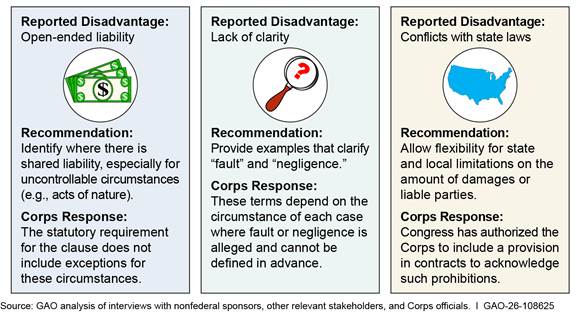
The Bureau of Land Management, Bureau of Reclamation, and U.S. Forest Service also include clauses in agreements to protect the U.S. against damages. To address related concerns, these agencies have taken steps such as allowing parties to purchase insurance instead. However, Corps officials said their legal requirements differ from other agencies, and therefore they cannot offer similar flexibilities.
Why GAO Did This Study
Through its Civil Works program, the Corps plans, designs, and constructs water resources projects nationwide for purposes including flood risk management, navigation, and ecosystem restoration. In fiscal year 2025, the Corps received approximately $8.8 billion to carry out these projects.
For such projects, the Corps enters into PPAs with nonfederal sponsors, which can include states, local governments and Tribes. Nonfederal sponsors have reported concerns about the statutorily required hold and save clause in these agreements.
The Thomas R. Carper Water Resources Development Act of 2024 includes a provision for GAO to review issues related to federal legal protections in PPAs, among other things. This report provides information on reported advantages and disadvantages of the clause, actions taken to address the reported disadvantages, recommendations by nonfederal sponsors and others regarding such clauses, approaches used by selected federal agencies to address concerns about similar clauses that protect the U.S. against damages, and Corps responses.
GAO reviewed relevant federal regulations, statutes, agency policies, and sample agreements. GAO also interviewed a group of 12 nonfederal sponsors, two other relevant stakeholders, and Corps headquarters and district officials based on certain criteria.
Abbreviations
BLM Bureau of Land Management
Corps U.S. Army Corps of Engineers
NAPA National Academy of Public Administration
PPA Project Partnership Agreement
Reclamation Bureau of Reclamation
WRDA Water Resources Development Act
This is a work of the U.S. government and is not subject to copyright protection in the United States. The published product may be reproduced and distributed in its entirety without further permission from GAO. However, because this work may contain copyrighted images or other material, permission from the copyright holder may be necessary if you wish to reproduce this material separately.
July 23, 2026
The Honorable Shelley Moore Capito
Chairman
The Honorable Sheldon Whitehouse
Ranking Member
Committee on Environment and Public Works
United States Senate
The Honorable Sam Graves
Chairman
The Honorable Rick Larsen
Ranking Member
Committee on Transportation and Infrastructure
House of Representatives
The U.S. Army Corps of Engineers plans, designs, and constructs water resources projects nationwide through its Civil Works program for purposes such as navigation, flood risk management, and ecosystem restoration.[1] In fiscal year 2025, the Corps received approximately $8.8 billion to carry out these projects.[2]
To implement its projects, the Corps enters legally binding agreements—known as Project Partnership Agreements (PPAs)—with nonfederal sponsors such as state or local government entities or federally recognized Tribes.[3] A PPA describes a project’s scope and outlines the cost-sharing and execution responsibilities of the parties to the agreement. Each PPA contains a statutorily required legal protection clause under which the nonfederal sponsor agrees to hold and save the United States free from damages due to the design, construction, or operation and maintenance of the project. There is an exception for damages due to the fault or negligence of the United States or its contractors.
The National Academy of Public Administration (NAPA) has reported concerns about the hold and save clause in PPAs. In a 2018 report, NAPA indicated that PPAs are reported as potentially placing an undue share of liability risk on nonfederal sponsors.[4] However, GAO and other federal entities have consistently endorsed inclusion of such clauses in federal agreements as a necessary safeguard to protect taxpayer funds, consistent with the Antideficiency Act.[5] Under the Act, an agency may not agree to accept open-ended liability in excess of an appropriation. By entering into an agreement to indemnify where the amount of the government’s liability is indefinite or unlimited, an agency would expose itself to liability in excess of an appropriation.
The Thomas R. Carper Water Resources Development Act of 2024 includes a provision for GAO to review issues related to federal legal protections in PPAs, among other things.[6] This report examines (1) reported advantages and reported disadvantages of the hold and save clause in PPAs, and actions taken to address the reported disadvantages; and (2) recommendations by nonfederal sponsors and others regarding such clauses, approaches used by selected federal agencies to address concerns about legal protections in agreements, and Corps responses. It also presents information on state approaches to liability requirements in hold and save clauses in construction agreements.
To address these objectives, we interviewed a geographically dispersed group of 12 nonfederal sponsors, two other relevant stakeholders with experience working on Corps-related issues, and Corps district and headquarters officials.[7] We conducted a systematic content analysis of the interview transcripts to identify common themes about reported advantages and disadvantages of the hold and save clause and recommendations from interviewees regarding such clauses. To identify perspectives from other federal agencies, we selected the Department of the Interior’s Bureau of Reclamation and Bureau of Land Management, and the Department of Agriculture’s U.S. Forest Service as agencies that (1) have a similar mission to the Corps, (2) include legal protections for the U.S. government in their agreements, and (3) execute agreements with nonfederal entities similar to those signing Corps PPAs. We also reviewed relevant federal statutes, regulations, agency policies, and sample agreements with legal protection clauses to understand the requirements regarding these clauses for these agencies. Finally, we examined all 50 U.S. states’ laws regarding hold and save clauses. For more detailed information on our scope and methodology, see appendix I.
We conducted this performance audit from June 2025 to July 2026 in accordance with generally accepted government auditing standards. Those standards require that we plan and perform the audit to obtain sufficient, appropriate evidence to provide a reasonable basis for our findings and conclusions based on our audit objectives. We believe that the evidence obtained provides a reasonable basis for our findings and conclusions based on our audit objectives.
Background
The Corps carries out a variety of civil works activities across 50 states; Washington, D.C.; the Commonwealth of Puerto Rico; and the U.S. Virgin Islands. Civil Works activities are also carried out in U.S. Territories including: Guam, American Samoa, and the Commonwealth of the Northern Mariana Islands. Partnerships with nonfederal sponsors allow the Corps to carry out water resources projects that address both local and national priorities through shared responsibilities and cost sharing.[8]
The Corps uses a multiphase process for these projects, including study, design, construction, and operations phases. Upon completion of project construction, or a functional portion thereof, with the exception of most navigation projects, the Corps notifies the nonfederal sponsor, which then assumes responsibility for operation, maintenance, repair, replacement, and rehabilitation of the project, or such functional portion thereof, under formal agreement. Such Corps projects are intended to benefit both nonfederal sponsors’ communities and the federal government.[9] For both, benefits can include reduced flood risk to homes and businesses, improved navigation to facilitate the movement of goods, and environmental restoration.
Corps water resources projects range from multi-decade efforts to smaller, targeted projects that can be completed in shorter time frames. The Picayune Strand Restoration Project in Collier County, Florida (Miller Pump Station)[10] and the Los Angeles River Ecosystem Restoration Project[11] serve as examples (see fig.1.).
Figure 1: The Picayune Strand Restoration Project (Miller Pump Station) and Los Angeles River Ecosystem Restoration Project (left to right)
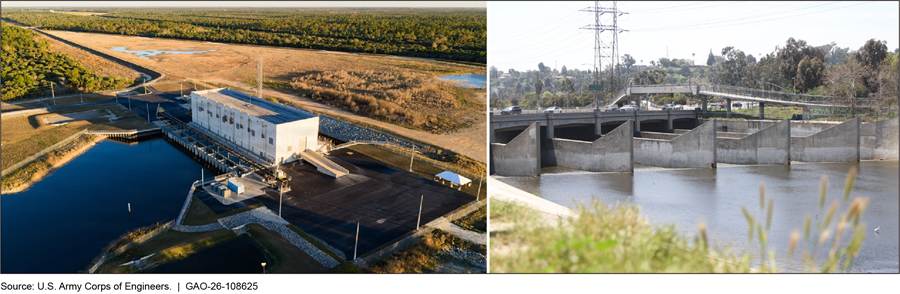
Note: The Picayune Strand Restoration Project (Miller Pump Station) in Florida is an example of a multidecade project. Its construction began in 2009 and is expected to be completed in 2026. By comparison, the Los Angeles River Ecosystem Restoration Project is a smaller, targeted project whose construction is expected to begin in the mid-2020s and be complete in the early 2030s.
The legal requirement to include a hold and save clause in PPAs for Corps projects has evolved over time. The earliest version of a requirement to include a hold and save clause in an agreement appears in the River and Harbor Act of 1910, which required the U.S. to be released from liability for a project before funds could be expended.[12] Congress established a more general statutory requirement of local indemnification as a condition for federal participation in flood control projects in the Flood Control Act of 1936, which conditioned construction on nonfederal sponsors agreeing to “hold and save the United States free from damages arising from construction works.”[13] This requirement was later extended to all PPAs with enactment of the Water Resources Development Act of 1986 (WRDA 1986). Specifically, the 1986 Act requires nonfederal sponsors to enter into binding agreements in which they agree to hold and save the United States free from damages due to the construction or operation and maintenance of the project, except for damages due to the fault or negligence of the United States or its contractors.[14]
Key Reported Advantages and Reported Disadvantages of the Hold and Save Clause
According to the Corps, a key reported advantage of the hold and save clause is that it protects the United States from certain costs, including damages not due to the fault or negligence of the United States or its contractors. Conversely, nonfederal sponsors report disadvantages related to assuming liability for damages that would fall to the Corps in absence of the hold and save clause, among other things. Corps officials and nonfederal sponsors stated that, to their knowledge, there have been no claims in which the hold and save clause was an issue. Both the Corps and nonfederal sponsors have taken steps to address reported disadvantages, and nonfederal sponsors continue to sign PPAs.
The Hold and Save Clause Protects the Corps but Has Reported Disadvantages for Nonfederal Sponsors
Corps officials, nonfederal sponsors, and other relevant stakeholders we interviewed identified several advantages and reported disadvantages of including hold and save clauses in Corps PPAs. Some advantages are mutual, while others benefit the federal government. Nonfederal sponsors said that the reported disadvantages impact them only.
Corps officials and nonfederal sponsors said that the hold and save clause clarifies each party’s roles and responsibilities, which, in turn, simplifies negotiations. Corps officials also said the clause provides an advantage to the Corps by focusing its financial obligations on construction costs, without the need to budget for potential future liabilities that could increase project costs. They said it may also discourage litigation against the federal government, protecting it from legal costs. According to these officials, this protection is the key advantage that the clause provides.
This key advantage is directly linked to the key reported disadvantage identified by nonfederal sponsors, specifically, their assumption of open-ended liability for project-related claims. This has been a long-standing issue between nonfederal sponsors and the Corps. In particular, in NAPA’s 2018 report on Corps PPAs, it reported that nonfederal sponsors believe they are asked to shoulder an unfair share of liability.[15]
Nonfederal sponsors identified additional reported disadvantages of the clause, including the following:
· lack of clarity of key terms (e.g., “fault” and “negligence”), which creates ambiguity about the scope of nonfederal sponsors’ liability;
· conflict with state laws, including laws regarding agreement provisions that shift liability for certain harms such as bodily injury or property damage (see app. II for further information on such laws);
· challenges in finding suitable partners not subject to state laws regarding indemnity, which may limit the number of eligible nonfederal sponsors; and
· prolonged negotiations if nonfederal sponsors raise concerns about including the clause, which may delay executing the agreement or the project.
The Corps and Nonfederal Sponsors Have Taken Steps to Address Reported Disadvantages, and Nonfederal Sponsors Continue to Partner with the Corps
Corps officials whom we interviewed discussed key steps that the agency has taken to address nonfederal sponsors’ concerns about reported disadvantages of the hold and save clause.
The Corps allows an amendment in its PPAs to state that the PPA does not obligate future appropriations where the agreement would conflict with state law, which can enable nonfederal sponsors to partner with the Corps.[16] Specifically, this amendment states that it “does not obligate future appropriations when doing so is inconsistent with constitutional or statutory limitations of a State or political subdivision thereof.” The Corps also allows nonfederal entities to partner with another entity (such as a nonprofit) to serve as the official nonfederal sponsor.
In addition to conflicts with state laws, the hold and save clause may also conflict with some tribal codes that govern Tribes. For example, a nonfederal sponsor told us that the references to damages in the PPA require them to waive sovereign immunity, which is in direct conflict with their tribal code. Corps officials told us that in 2016 the Corps removed the requirement that Tribes waive sovereign immunity in PPAs—eliminating a significant barrier that had discouraged Tribal participation. During our audit, we informed Corps officials that they may be missing an opportunity to widely share with Tribes the 2016 change in requirements. Corps officials agreed and as a result posted the 2016 guidance on the agency’s PPA website.
Corps officials and nonfederal sponsors we interviewed described a strong partnership and they continue to enter into PPAs. Nonfederal sponsors that we interviewed explained that they continue to enter PPAs because the Corps has the requisite expertise and funding for project construction. These nonfederal sponsors also explained that their local communities need the projects.
To address reported disadvantages of the hold and save clause, nonfederal sponsors we interviewed said that they take several approaches. For example, if the hold and save clause conflicts with state laws, nonfederal sponsors sometimes will obtain a waiver from the state, or the state will enact legislation allowing them to enter PPAs. They also partner with other entities, such as nonprofit organizations, that are not subject to their respective state laws. Alternately, they may purchase general liability insurance.
We found no cases in recent years in which the nonfederal sponsor assumed liability that would have fallen to the Corps in the absence of the hold and save clause. In addition, the nonfederal sponsors and Corps officials stated that to their knowledge there have been no claims in which the hold and save clause was a key or material issue. Accordingly, nonfederal sponsors’ concerns about open-ended liability are based largely on perceived risk rather than observed outcomes. The PPA clause’s actual financial impacts, such as the costs associated with paying damages that could have been shared with the Corps in the absence of the hold and save clause, remain unknown.
Nonfederal Sponsors’ and Stakeholders’ Recommendations for Change, Selected Agencies’ Approaches, and Responses from the Corps
Eliminating or Changing the Hold and Save Clause Would Raise Costs for the Corps and Conflict with Statutory Requirements
Nonfederal sponsors and other relevant stakeholders we interviewed recommended a range of modifications to the clause, including eliminating the clause in its entirety, to address reported disadvantages that they identified. However, according to Corps officials, these recommendations would alter the scope of federal liability and generally shift costs of damages from nonfederal sponsors to the Corps. Corps officials stated that implementing these recommendations would also raise other costs for the Corps and conflict with statutory requirements. Table 1 summarizes the recommendations and specific responses by the Corps.
Table 1: Recommendations by Nonfederal Sponsors and Stakeholders to Address Reported Disadvantages of the Hold and Save Clause in Project Partnership Agreements, and the Response from the U.S. Army Corps of Engineers
|
Reported disadvantage |
Recommendation |
Corps’s response |
|
Open-ended liability |
Limit the hold and save clause to elements required in statute by amending the clause to remove “design.”a |
The hold and save clause includes damages due to “design and construction” because the Corps incurs design costs as part of construction. Federal law requires the Corps to fund and share the design costs with nonfederal sponsors.b |
|
|
Identify where there is shared liability, especially for circumstances outside of both parties’ control (e.g., acts of nature). |
The current hold and save clause is based on statutory language, which does not include exceptions based upon acts of nature or other circumstances. |
|
Lack of clarity |
Expand the hold and save clause to note that the terms “negligence” and “fault” are defined by applicable state law. |
According to Army regulations, negligence claims for civil works projects are based on Federal Tort Claims Act precedent, upon a finding of liability under state tort law.c Cases must be heard in federal district court. |
|
|
Provide examples that clarify “fault” and “negligence” |
The terms “negligence” and “fault” depend heavily on the circumstances of each case where negligence or fault is alleged and require the application of multiple factual and legal standards such as duty, breach, causation, and damages. The terms cannot practically be defined in advance. |
|
Conflicts with state laws |
Allow flexibility for state and local limitations on the amount of damages or liable parties |
Congress has specifically authorized the Corps to include a provision for states with constitutional or statutory prohibitions against obligating future appropriations.d |
Source: GAO analysis of interviews with nonfederal sponsors, other relevant stakeholders, and Corps officials. | GAO‑26‑108625
Notes: In addition to the recommendations presented in this table, interviewees also reported a desire for the clause to be eliminated in its entirety.
aThe Water Resources Development Act of 1986 requires nonfederal sponsors to hold and save the U.S. free from damages due to the “construction or operation and maintenance” of projects. Pub. L. No. 99-662, §§ 101(e)(2), 103(j)(1), 100 Stat. 4082, 4083, 4086 (codified as amended at 33 U.S.C. §§ 2211(e)(2), 2213(j)(1)(A)). However, the current ecosystem restoration model PPA requires the nonfederal sponsor to hold and save the U.S. free from damages due to the “design, construction, operation, maintenance, repair, rehabilitation, and replacement of the project, except for damages due to the fault or negligence of the Government or its contractors.”
b33 U.S.C § 2215(c).
cArmy Regulations (AR) 27-20 at 2-24(a).
d42 U.S.C §1962d-5b(a)(3). Specifically, the Corps allows the PPA to be amended to specify that it “does not obligate future appropriations when doing so is inconsistent with constitutional or statutory limitations of a State or political subdivision thereof.”
Corps officials noted that their responses to nonfederal sponsors’ recommendations are hypothetical because there has not been a formal legislative proposal and approval from Congress to change the hold and save requirements. Corps officials also said that the hold and save clause follows statutory language closely, and this language does not offer flexibility to implement recommendations such as the ones above. In addition to the recommendations presented in table 1, interviewees recommended eliminating the clause. However, the Corps is statutorily required to include the clause based on the Water Resources Development Act of 1986.[17] Any change to the Corps’ share of liability would be inconsistent with the Antideficiency Act if the change has the potential to commit the agency to cover the cost of damages before the funds are approved by Congress. Further, the Water Resources Development Act of 1986 requires the Corps to include a hold and save clause in PPAs that specifies that the agency’s liability for damages is limited to those due to the fault or negligence of the United States or its contractors, while the remaining liability rests with nonfederal sponsors. Accordingly, Corps officials told us that requests to amend the hold and save clause language in individual PPAs are routinely denied.
Additionally, Corps officials told us that any shift in liability that would fall to the federal government, if the hold and save clause were removed, would increase the estimated cost of projects because the federal government would have to account for the estimated cost of potential future damages. This increase could mean that some projects would no longer be economically justifiable. In addition, estimating the potential liability associated with individual projects would require resources and could adversely affect the number of projects that the Corps could fund.
During our review, we identified several instances of slight differences between the language of the hold and save clause in executed PPAs and the Corps’ statutory requirements to include certain elements.[18] However, according to Corps officials, these differences do not increase costs for the Corps and are consistent with the Antideficiency Act. For example, for flood risk management, commercial navigation, and ecosystem restoration PPAs, the hold and save clause includes additional elements of “repair, rehabilitation, and replacement” because these are costs related to activities that are required by statute to be funded by nonfederal sponsors.[19] Corps officials stated that these and any other differences are intended to comply with statutory requirements for particular project purposes.
Other Federal Agencies Have Legal Protection Clauses, but Their Agreements’ Purposes and Statutory Requirements Differ from Corps PPAs
We identified three federal agencies that execute agreements with (1) clauses that protect the U.S. against damages, (2) nonfederal entities similar to those signing Corps PPAs, and (3) agencies that have a similar mission as the Corps with a focus on water resources management.[20] These agencies are the Bureau of Land Management (BLM), the Bureau of Reclamation (Reclamation), and the U.S. Forest Service. While these agencies do not include hold and save clauses specifically in their agreements, they include legal protection clauses that are meant to limit the federal government’s exposure to liability and to ensure nonfederal entities are responsible for certain damages (see app. III for more information).[21] Officials from BLM, Reclamation, and the Forest Service told us that these clauses are consistent with the Antideficiency Act in that the agencies do not agree to accept open-ended liability in excess of an appropriation. Figure 2 describes agreements, sample projects, and legal protection clauses for BLM, Reclamation, and the Forest Service.
Figure 2: Selected Federal Agencies That Include Legal Protection Clauses in Agreements with Nonfederal Entities
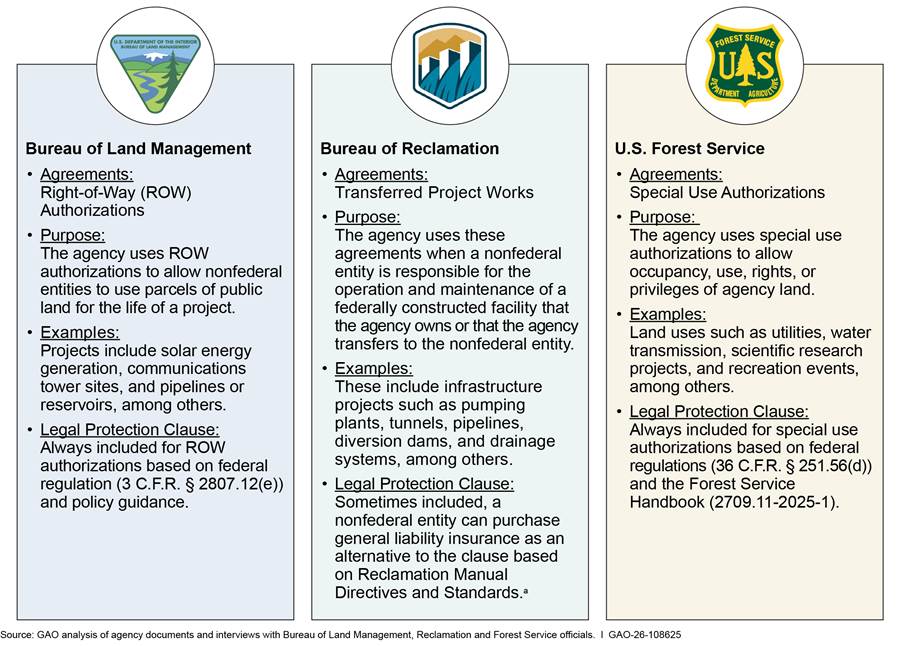
aWhen an entity purchases general liability insurance, Reclamation still requires a legal protection clause to cover any damage arising from actions not covered by the insurance policy.
As shown in table 2, Reclamation is the agency with agreements most similar to Corps PPAs. Both the Corps and Reclamation require nonfederal entities to take over operation and maintenance responsibilities for projects. This means the nonfederal entity is liable for damages that may arise throughout the operation and maintenance phase during the lifetime of the project. The Corps is a cost-sharing partner with nonfederal sponsors and works with nonfederal sponsors to design and construct projects. However, in most cases, the nonfederal sponsor is entirely responsible for operation, maintenance, repair, replacement, and rehabilitation costs for newly completed projects.[22]
|
Agency |
Agreement |
Enters with states and local units of government |
Agreements include some considerations for states with legal conflicts to legal protection clausesa |
Transfers operation and maintenance responsibilities to nonfederal entity |
|
U.S. Army Corps of Engineers |
Project Partnership Agreements |
Yes |
Yes |
Yes |
|
Bureau of Land Management |
Right-of-Way Authorizations |
Yes |
Yes |
No |
|
Bureau of Reclamation |
Reserved or Transferred Project Works |
Yes |
Yes |
Yesb |
|
U.S. Forest Service |
Special Use Authorizations |
Yes |
Yes |
No |
Source: GAO analysis of interviews with BLM, Reclamation, Forest Service and Corps officials. | GAO‑26‑108625
aConsiderations include adding statements in the agreements that identify the scope of the risk, modifying the legal protection clause for nonfederal entities that obtain insurance, or providing another type of amendment.
bReserved Works are facilities that are owned by the U.S. and are operated and maintained by Reclamation.
According to BLM, Reclamation, and Forest Service officials we interviewed, each agency has addressed concerns from nonfederal entities about legal protections in their agreements. For example:
· Nonfederal entities raised concerns to BLM officials about the scope of their financial risk exposure to liability in BLM’s agreements.[23] To address these concerns, BLM’s regulations state, “BLM will not impose strict liability for damage or injury resulting primarily from an act of war, an act of God, or the negligence of the United States, except as otherwise provided by law.”[24]
· Some states with statutory and constitutional conflicts expressed concerns with Reclamation’s legal protection clause. To address these concerns, Reclamation allows nonfederal entities to obtain commercial general liability insurance as an alternative to signing an agreement with a legal protection clause. The level of insurance coverage is determined by Reclamation based on the project size, risk, and complexity.
· Similarly, some entities raised concerns to Forest Service officials about conflicts with state laws. To address these concerns, Forest Service modifies the clause under certain conditions if state entities can ensure that insurance obtained provides adequate coverage for the United States.[25] According to Forest Service guidance, however, the agency’s preferred approach is to have nonfederal entities agree to the legal protection clause in the agreement.
Corps officials told us the agency is bound by specific legal requirements and could not offer similar flexibilities to limit liability or accept insurance as an alternative to the hold and save clause in PPAs. As stated previously, the only exception in Corps agreements is for damages due to the fault or negligence of the United States or its contractors. Corps officials said that the agency continues to work with nonfederal sponsors by providing guidance and working to address concerns about the hold and save clause on a case-by-case basis throughout the negotiation process. Corps officials and nonfederal sponsors told us they continue to enter PPAs, and they described a strong partnership in constructing water resources projects that benefit local communities and the nation.
Agency Comments
We provided a draft of this report to the Department of Defense, the Department of Agriculture, and the Department of the Interior for review and comment.
The Department of Defense’s Department of the Army and Interior’s Reclamation provided technical comments, which we incorporated as appropriate. The Department of Agriculture and Interior’s BLM did not have any comments on the report.
We are sending copies of this report to the appropriate congressional committees, the Secretary of Defense, the Assistant Secretary of the Army for Civil Works, the Chief of Engineers and Commanding General of the U.S. Army Corps of Engineers, the Secretary of Agriculture, the Secretary of the Interior, and other interested parties. This report will also be available at no charge on GAO’s website at https://www.gao.gov. If you or your staff have any questions about this report, please contact me at Morriss@gao.gov. Contact points for our Offices of Congressional Relations and Media Relations may be found on the last page of this report. GAO staff who made key contributions to this report are listed in appendix IV.
Steve D. Morris
Director, Natural Resources and Environment
This report examines (1) reported advantages and disadvantages of the hold and save clause in project partnership agreements (PPA), and actions taken to address the disadvantages; and (2) recommendations by nonfederal sponsors and others regarding such clauses, approaches used by other federal agencies to address concerns about legal protections in agreements, and responses by the U.S. Army Corps of Engineers.
For our first objective, we reviewed relevant federal statutes, regulations, agency policies, and sample agreements. We obtained perspectives about the advantages and disadvantages of hold and save clauses by interviewing a geographically dispersed group of nonfederal sponsors, other relevant stakeholders, and Corps district and headquarters officials.
Nonfederal sponsors. To identify nonfederal sponsors, we reviewed publicly available PPAs executed during fiscal years 2010 through 2024. We identified 167 executed PPAs within this time frame from 18 Corps districts nationwide. Our sample reflects PPAs from these districts only.[26] We selected a random nongeneralizable sample of nonfederal sponsors based on the geographic location of the Corps project, type of nonfederal sponsor (e.g., state, Tribe, municipality, nonprofit), purpose of the project (e.g., flood risk management, navigation, ecosystem restoration), and total estimated cost of the project at the time the agreement was executed. We selected and interviewed 12 nonfederal sponsors who executed Corps projects. The nonfederal sponsors we interviewed consisted of a nonprofit organization, seven local government entities, three state governments, and one Tribe. This group represents a range of experiences with the Corps that spans multiple projects, years of involvement, and partnership structures (e.g., when multiple nonfederal sponsors serve as co-sponsors to execute a single PPA).
Other relevant stakeholders. We identified other relevant stakeholders by conducting a literature review to purposefully select a sample that had expertise related to hold and save clauses in Corps PPAs. This sample included different types of organizations (such as research institutions and nonprofit organizations) and provided a balance of perspective of groups that were supportive, critical, and neutral of hold and save clauses in Corps PPAs. We selected six other relevant stakeholders for our sample; two of the six agreed to an interview. The two groups we interviewed represent nonprofit organizations that have conducted extensive research on the nature of partnerships between nonfederal sponsors and the Corps, one of which represents a forum of multiple states.
Army Corps of Engineers District Offices. We used the number of executed PPAs in each district between fiscal years 2010 through 2024 and the geographic location of each district to select three Corps districts. We interviewed Corps officials in districts that executed a low, medium, and high number of PPAs with nonfederal sponsors during fiscal years 2010 through 2024 to examine if the level of experience they had working with nonfederal sponsors to execute PPAs would affect their responses. We selected three districts: New York, Albuquerque, and Sacramento.
Based on our review of publicly available PPAs executed during fiscal years 2010 through 2024, we told Corps officials that information on executed PPAs was not easily accessible from Corps district websites as required by section 2003(c) of the Water Resources Development Act of 2007.[27] In response, the Corps took action to (a) remind districts that they should post executed PPAs on their websites and (b) centralize all executed PPAs from different districts on the Corps Model Agreements and Templates homepage. These steps help ensure transparency and accessibility for nonfederal sponsors who may be looking for examples of executed PPAs.
The information we collected during these interviews reflects the perspectives of each of those groups; however, views from these representatives are not generalizable to those we did not select and interview. We also conducted several interviews with Corps headquarters officials in the offices of the Assistant Secretary of the Army for Civil Works and the Chief Counsel. In these interviews, we discussed the Corps’ perspectives on the hold and save clause and the basis of its inclusion in PPAs. We also obtained the Corps’ response to recommendations made by nonfederal sponsors and other relevant stakeholders to address reported disadvantages of the clause. We also requested information on legal claims related to the hold and save clause. Corps officials said there were none of which they were aware.
To identify any claims against Corps projects, we selected fiscal years 2020 through 2024 to obtain examples of project-related legal claims or administrative proceedings, to ensure a timely response from the Corps and focus on recent claims. Corps officials identified two cases only, and we determined neither was applicable to our analysis because one involved an operating and management contract with a hold and save clause that differs from the those used in Corps PPAs, and the other did not address the hold and save clause. Additionally, nonfederal sponsors we interviewed did not identify any project-related claims brought against them.
We conducted a systematic content analysis of the interview transcripts using NVivo software to identify common themes.[28] We created an initial codebook of topic categories and themes discussed in the report. Because content analysis relies on the judgment of coders to determine whether qualitative data reflects particular themes, two analysts independently reviewed and coded all interview transcripts to ensure objectivity, accuracy, and consistency. Once the transcripts were coded, the analysts met to discuss coding discrepancies and reach agreement for final coding decisions. Next, we identified common subthemes discussed during our interviews. Examples of subthemes include the type of advantage of the hold and save clause (that is, legal or financial protection). Because we analyzed comments by themes, we did not use indefinite quantifiers. The themes discussed represent what we heard from multiple interviewees. Where applicable, we also included illustrative examples from the interviews.
For our second objective, we identified recommendations from nonfederal sponsors obtained through the interviews and interviewed Corps headquarters officials to obtain their responses. We identified eight federal agencies that are primarily focused on water resources management to select agencies with a similar mission to the Corps. Next, we further refined this selection by identifying the agencies that include legal protections in their agreements, partner with similar nonfederal entities as the Corps, and have a similar mission as the Corps with a focus on water resources management. Based on these criteria, we selected the Bureau of Land Management, the Bureau of Reclamation, and the U.S. Forest Service. We obtained responses from agency officials about their requirements and approaches to address any concerns raised by nonfederal entities. We also reviewed relevant federal statutes, regulations, agency policies, and sample agreements with legal protection clauses to understand the requirements for using and the application of these clauses for these agencies.
We also examined all 50 U.S. states’ laws regarding hold and save clauses. We identified a law review article from the Journal of the American College of Construction Lawyers that served as the basis of our analysis.[29] Using the information in the article as a framework, we reviewed, verified, and updated information on the relevant statutes in each state and identified (a) if a state prohibition limited parties from entering into contracts with hold and save clauses, (b) what type of contracts (e.g., design or construction contracts) were covered by the state prohibition, (c) what type of damages and acts (e.g., negligent or intentional acts) would be covered by the state prohibition, and (d) what, if any, impact the state prohibition may have had on Corps PPAs (see app. II for more information).
We conducted this performance audit from June 2025 to July 2026 in accordance with generally accepted government auditing standards. Those standards require that we plan and perform the audit to obtain sufficient, appropriate evidence to provide a reasonable basis for our findings and conclusions based on our audit objectives. We believe that the evidence obtained provides a reasonable basis for our findings and conclusions based on our audit objectives.
Appendix II: State Approaches to Liability Requirements in Hold and Save Clauses in Construction Agreements
State laws governing construction agreements vary considerably, but most impose some limitations on the extent to which one party may assume liability for damages caused by another party’s negligence. We found that 47 states have enacted statutes that void certain agreement provisions that shift liability for certain harms, e.g., bodily injury or property damage.[30]
Of these 47 states, 44 states apply such prohibitions to construction agreements—e.g., Corps’ Project Partnership Agreements—while others apply more narrowly to design agreements.[31] Three states—Alaska, Maine, and Nevada—do not have anti-indemnity statutes, although courts have generally upheld indemnification provisions only if the intent to shift liability was clearly expressed in an agreement.[32] The scope of statutory restrictions varies across states.
Generally, state approaches to hold and save clauses fall into the three categories presented below in table 3. For example, some states prohibit the hold and save liability requirement only for sole negligence, which we have categorized as an “intermediate” approach. Others prohibit provisions covering a party’s own negligence, which may include partial fault.
|
Category of approach |
Description |
Examples |
|
Broad (limited to indemnitor’s own negligence) |
Voids indemnification for another party’s sole or partial negligence |
Mississippi, New York |
|
Intermediate |
Voids indemnification only for sole negligence |
Tennessee, Michigan |
|
Limited |
Enforceable only if clearly expressed in contract |
Maine, Vermont |
Source: GAO analysis of Dean B. Thompson and Colin Bruns, Indemnity Wars: Anti-Indemnity Legislation Across the Fifty States, 8 Journal of the American College of Construction Lawyers 1 (2014). | GAO‑26‑108625
Many states distinguish between indemnification and insurance, often allowing parties to obtain insurance coverage for the indemnitee’s potential liability or to name additional insured parties even where hold and save clauses are restricted.[33] These distinctions can significantly affect how risk is allocated.
The Bureau of Land Management (BLM), the Bureau of Reclamation, the U.S. Forest Service, and the U.S. Army Corps of Engineers include legal protections in agreements with nonfederal entities. Table 4 includes the relevant clauses in the agreements we reviewed, which all aim to ensure adequate legal protection for the federal government. While these clauses include notable differences, they all ensure the costs of certain damages are the responsibility of the nonfederal entity.
|
Agency |
Agreements |
Relevant clauses |
|
U.S. Army Corps of Engineers |
Project Partnership Agreements |
“The Non-Federal Sponsor shall hold and save the Government free from all damages arising from design, construction, operation, maintenance, repair, rehabilitation, and replacement of the Project, except for damages due to the fault or negligence of the Government or its contractors.” |
|
Bureau of Land Management |
Right-of-Way Authorizations |
“The holder shall be liable for damage or injury to the United States to the extent provided by 43 C.F.R § 2807.12. The holder shall be held to a standard of strict liability for damage or injury to the United States resulting from fire or soil movement (including landslides and slumps as well as wind and water-caused movement of particles) caused or substantially aggravated by … [a]ctivities of the holder, applicant, or proponent, including but not limited to construction, operation, maintenance and termination of the facility.” |
|
Bureau of Reclamation |
Reserved and Transferred Project Works |
“Except for the sole negligence and intentional torts committed by employees of the United States, the Contractor agrees to indemnify the United States for, and hold the United States and all of its representatives harmless from, all damages resulting from suits, actions, or claims of any character, brought on account of any injury to any person or property arising out of any act, omission, neglect, or misconduct in the manner or method of performing any construction, care, operation, maintenance, and replacement; and supervision, examination, inspection, or other duties of the Contractor or the United States on transferred works required under this contract, regardless of who performs those duties.” |
|
U.S. Forest Service |
Special Use Authorizations |
“Subject only to the limits on the [holder’s/lessee’s/grantee’s] liability under the [name of and citation to state tort claims act] for tort liability, the holder/lessee/grantee] shall indemnify, defend, and hold harmless the United States for any costs, damages, claims, liabilities, and judgments arising from past, present, and future acts or omissions of the [holder/lessee/grantee] in connection with the use and occupancy authorized by this [permit/lease/easement].” |
Source: GAO analysis of documents from the Corps and from the Bureau of Land Management, Bureau of Reclamation, and the U.S. Forest Service. | GAO‑26‑108625
Note: In our report, we discuss slight differences we identified in the language of the hold and save clause in Corps Project Partnership Agreements we reviewed. The Corps hold and save clause in this table is from the ecosystem restoration model project partnership agreement, which was last updated in April 2022. The Bureau of Land Management and Forest Service clauses in the table have been abridged to improve readability. The Bureau of Reclamation clause is for transferred works, but similar, though not identical, language is used for reserved project works.
Steve D. Morris, morriss@gao.gov
In addition to the individual mentioned above, Tahra Nichols (Assistant Director), Danny Baez (Analyst in Charge), Lena Nour, Cynthia Norris, Rebecca Sero, Kevin Bray, Callie Johnson, Leslie Pollock, Julie Clark, Sarah Tempel, Christopher Forys, and Adrian Apodaca made key contributions to this report. John Barrett, Andony Payne, and Dedrick Moulton II also made important contributions.
The Government Accountability Office, the audit, evaluation, and investigative arm of Congress, exists to support Congress in meeting its constitutional responsibilities and to help improve the performance and accountability of the federal government for the American people. GAO examines the use of public funds; evaluates federal programs and policies; and provides analyses, recommendations, and other assistance to help Congress make informed oversight, policy, and funding decisions. GAO’s commitment to good government is reflected in its core values of accountability, integrity, and reliability.
Obtaining Copies of GAO Reports and Testimony
The fastest and easiest way to obtain copies of GAO documents at no cost is through our website. Each weekday afternoon, GAO posts on its website newly released reports, testimony, and correspondence. You can also subscribe to GAO’s email updates to receive notification of newly posted products.
Order by Phone
The price of each GAO publication reflects GAO’s actual cost of production and distribution and depends on the number of pages in the publication and whether the publication is printed in color or black and white. Pricing and ordering information is posted on GAO’s website, https://www.gao.gov/ordering.htm.
Place orders by calling (202) 512-6000, toll free (866) 801-7077,
or
TDD (202) 512-2537.
Orders may be paid for using American Express, Discover Card, MasterCard, Visa, check, or money order. Call for additional information.
Connect with GAO
Connect with GAO on X,
LinkedIn, Instagram, and YouTube.
Subscribe to our Email Updates. Listen to our Podcasts.
Visit GAO on the web at https://www.gao.gov.
To Report Fraud, Waste, and Abuse in Federal Programs
Contact FraudNet:
Website: https://www.gao.gov/about/what-gao-does/fraudnet
Automated answering system: (800) 424-5454
Media Relations
Sarah Kaczmarek, Managing Director, Media@gao.gov
Congressional Relations
David A. Powner, Acting Managing Director, CongRel@gao.gov
General Inquiries
[1]The Corps is a Department of Defense component that has military and civilian responsibilities.
[2]The Corps reported that, in fiscal year 2025, 55.3 percent of its civil works appropriations was for navigation, 20.9 percent was for flood risk management, and 7.3 percent was for its aquatic ecosystem restoration—its three primary business lines. U.S. Army Corps of Engineers, Fiscal Year 2025 Agency Financial Report (Washington, D.C.: 2025), 10-13.
[3]The Flood Control Act of 1970, as amended, requires the Army to enter into an agreement with a non-Federal interest before constructing a project or separable element of a project. Pub. L. No. 91-611, § 221, 84 Stat. 1818, 1831 (codified as amended at 42 U.S.C. § 1962d-5b(a)). Also, as of May 2026, there were 575 federally recognized Tribes in the contiguous U.S. and Alaska, which we refer to as Tribes in this report. 91 Fed. Reg. 4102 (Jan. 30, 2026). The federal government recognizes these Tribes to have the immunities and privileges available to such Tribes by virtue of their government-to-government relationship with the U.S. as well as the responsibilities, powers, limitations, and obligations of such Tribes.
[4]National Academy of Public Administration, The U.S. Army Corps of Engineers: An Evaluation of the Project Partnership Agreement Process (Washington, D.C.: 2018), 53.
[5]Generally, federal agencies may not obligate or expend federal funds in advance or in excess of an appropriation. 31 U.S.C. § 1341. Furthermore, no contract or purchase may be made on behalf of the federal government unless authorized by law or is under an appropriation adequate to fulfill it. 41 U.S.C. § 6301. This rule was first recognized by the Comptroller General’s predecessor, the Comptroller of the Treasury, in 1909. 15 Comp. Dec. 404 (1909). Numerous subsequent GAO and court decisions have followed the rule, and the Supreme Court endorsed it in 1996. See Hercules, Inc. v. United States, 516 U.S. 417, 427 (1996).
[6]Pub. L. No. 118-272, § 1244(b), 138 Stat. 2992, 3093 (2025).
[7]In this report, we discuss topics and perspectives that arose during the interviews we held with nonfederal sponsors that entered into and executed PPAs with the Corps between fiscal years 2010 through 2024; other relevant stakeholders; and Corps officials at three districts and headquarters. The information from those interviews presented in this report reflects the perspectives of each of those groups. Because we analyzed the interviews with nonfederal sponsors, other relevant stakeholders, and Corps districts by theme, we do not use indefinite quantifiers in our report. The information presented is not generalizable to all nonfederal sponsors that partner with the Corps. For more information about how we identified the themes and subthemes we discuss, see appendix I.
[8]See 33 U.S.C. § 2213 (requiring cost sharing and project partnership).
[9]Federal participation in Corps civil works projects is generally predicated on a determination that project benefits justify their costs. See Flood Control Act of 1936, Act of June 22, 1936, ch. 688, § 1, 49 Stat. 1570 (codified at 33 U.S.C. § 701a) (stating that projects should be authorized if “the benefits to whomsoever they may accrue are in excess of the estimated costs”); see also Water Resources Development Act of 1986, Pub. L. No. 99-662, § 101(e)(2), 100 Stat. 4082, 4083 (codified as amended at 33 U.S.C. § 2211) (establishing cost-sharing requirements for nonfederal sponsors, reflecting the expectation that projects provide both federal and nonfederal benefits).
[10]The Picayune Strand Restoration Project located in Collier County, Florida, is authorized under the Water Resources Development Act of 2007, Pub. L. No. 110-114, § 1001(15), 121 Stat. 1041, 1052.
[11]The Los Angeles River Ecosystem Restoration Program is authorized under Water Resources Development Act of 2016, Pub. L. No. 114-322, tit. I, § 1401(7), 130 Stat. 1628, 1714.
[12]Act of June 25, 1910, ch. 382, 36 Stat. 630, 638 (providing that no project funds shall be expended until, “the United States shall have been released from all claims for damages arising from the proposed diversion of the stream.”).
[13]Act of June 22, 1936, ch. 688, § 3, 49 Stat. 1570, 1571 (providing that no money shall be expended until local agencies “hold and save the United States free from damages due to the construction work.”).
[14]Pub. L. No. 99-662, §§ 101(e)(2), 100 Stat. 4082, 4083 (codified as amended 33 U.S.C. §§ 2211(e)(2), 2213(i)(1)(A)).
[15]National Academy of Public Administration, The U.S. Army Corps of Engineers: An Evaluation of the Project Partnership Agreement Process (Washington, D.C.: 2018), 53.
[16]See 42 U.S.C. § 1962d-5b(a)(3).
[17]Pub. L. No. 99-662, §§ 101(e)(2), 103(j)(1), 100 Stat. 4082, 4083 (codified as amended at 33 U.S.C. §§ 2211(e)(2), 2213(j)(1)(A)). The requirement to include a hold and save clause includes an exception for costs of damages due to the fault or negligence of the United States or its contractors, while the remaining liability rests with nonfederal sponsors.
[18]These differences, for example, included additional elements to the hold and save clause such as “monitoring” or “project-related betterments.”
[19]33 U.S.C. § 2213(j)(1).
[20]Throughout this report, we reference “nonfederal entities” as stakeholders who execute agreements with BLM, Reclamation, and Forest Service. This includes similar entities that execute Corps PPAs, such as states, municipalities, Tribes, and nonprofit organizations, among others.
[21]A hold and save clause purports to protect one party from facing legal claims or ever being held responsible in court. For the purposes of our report, we consider hold and save clauses an example of a legal protection clause, which we define as contractual provision to protect against third-party lawsuits, negligence claims, or other liabilities.
[22]Exceptions to this are for commercial navigation projects, where the Corps usually pays 100 percent of operation, maintenance, repair, replacement, and rehabilitation costs for projects with depths to 50 feet, and 50 percent of increased costs for depths in excess of 50 feet.
[23]In tort law, strict liability exists when a defendant is liable for committing an action that causes harm, regardless of the existence of negligence or intent to harm when committing the action.
[24]43 C.F.R § 2807.12(b)(1).
[25]Forest Service only negotiates modified liability language for states, its agencies, or its institutions. If the state can demonstrate that state law limits their obligation to sign the clause and the entity agrees to hold and save the United States free from damages to the extent of the entity’s self-insurance, obtains commercial general liability insurance, or participates in a self-insurance pool in an amount sufficient to cover the potential risk of tort liability.
[26]During the initial review and analysis, two districts were missed and therefore not included in our sample.
[27]Section 2003(c) of the Water Resources Development Act of 2007 states that the Chief of Engineers shall “ensure that each district engineer has made available to the public, including on the Internet, all partnership agreements entered into under this section within the preceding 10 years and all partnership agreements for water resources projects currently being carried out in that district,” among other things. Pub. L. No. 110-114, § 2003(c), 121 Stat. 1041, 1070 (codified at 42 U.S.C. § 1962d-5b(g)(1)).
[28]NVivo is a software program designed for analyzing qualitative information. For each open-ended response, we coded, organized, and analyzed responses under several relevant themes.
[29]Dean B. Thompson and Colin Bruns, Indemnity Wars: Anti-Indemnity Legislation Across the Fifty States, Journal of the American College of Construction Lawyers (2014).
[30]Through an indemnification provision, one party agrees to take financial responsibility for the liability of another party—in other words, to cover the losses experienced by the indemnified party if that party is successfully sued. In contrast, a hold and save clause purports to protect one party from facing legal claims or ever being held responsible in court.
[31]Four of these states, such as California and Colorado, also extend coverage to design-related contracts (e.g., architecture and engineering).
[32]See e.g., Emery Waterhouse Co. v. Lea, 467 A.2d 986, 993 (Me. 1983) (requiring clear and unequivocal expression of intent to indemnify a party for its own negligence); Colgan v. Agway, Inc., 150 Vt. 373, 375-76 (1988) (requiring clear contractual language to enforce indemnification for a party’s own negligence).
[33]See, e.g., Texas Insurance Code § 151.104; California Civil Code § 2782.05 (preserving the use of insurance and additional insured provisions notwithstanding statutory limits on indemnification).