
Report to Congressional Committees
United States Government Accountability Office
A report to congressional committees
Contact: William Russell at russellw@gao.gov
What GAO Found
Section 889 of the John S. McCain National Defense Authorization Act for Fiscal Year 2019 prohibits federal agencies from procuring covered telecommunications and surveillance equipment and services from five specific Chinese companies (and their affiliates or subsidiaries) or awarding contracts to companies that use such equipment and services. Following implementation in fiscal year 2019, agencies reduced spending with the five companies through fiscal year 2025 with no spending in three of those fiscal years. As of March 2026, GAO found that nearly 90 percent of companies with active government contracts in fiscal year 2025 represented publicly that they do not use equipment from these companies.
Federal Obligations to Five Identified Companies in Section 889 Prohibitions, Fiscal Years 2016-2025
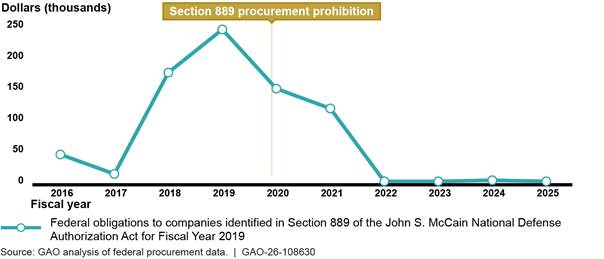
Note: Agencies could have used a waiver to make awards after 2019, which the statute permitted for a certain time.
The General Services Administration (GSA) and Department of Defense (DOD) have processes to help ensure they do not buy the prohibited equipment and services or contract with vendors that use such equipment and services. For example,
· GSA has automated processes to remove prohibited equipment and services on its Multiple Award Schedule contracts used by other agencies.
· DOD and GSA have search tools that contracting officers and purchase cardholders can use to determine how contractors represent their compliance with the prohibitions in the System for Award Management.
However, GSA and DOD do not broadly share their insights from implementing Section 889 prohibitions with other government agencies. This would include information about the five companies’ subsidiaries and affiliates and methods the two agencies have used to enhance insight into the supply chain. For example, based on its experience with Section 889 prohibitions, GSA has plans to expand its use of customs data to identify the origin of goods, which GAO previously reported is difficult to do. By sharing information about their experience with current prohibitions, GSA and DOD could help other agencies address additional upcoming statutory prohibitions, such as on semiconductors. Sharing information could also help improve compliance.
Why GAO Did This Study
Concerns about the U.S. government’s reliance on Chinese companies for telecommunications and information technology have existed for more than a decade. Government agencies have reported concerns that government procurement of certain foreign-made items could facilitate cyberattacks, espionage, and threats to U.S. national security.
A House report asked GAO to report on implementation of Section 889 prohibitions. GAO’s report assesses, among other objectives, how selected agencies have taken actions to ensure compliance with the prohibitions and the extent to which these agencies are sharing information to improve their ability to implement prohibition efforts.
GAO identified GSA and DOD processes for ensuring compliance with prohibitions and analyzed federal procurement and System for Award Management data. GAO focused on DOD and GSA as they together account for nearly two-thirds of fiscal year 2025 contract obligations and GSA supports procurements across government agencies. GAO also interviewed GSA and DOD officials to obtain their perspectives on government efforts to comply with prohibitions.
What GAO Recommends
GAO is making four recommendations, including that GSA and DOD periodically share subsidiary and affiliate information with other agencies, as well as practices that can inform future prohibition efforts. GSA and DOD concurred with the recommendations.
Abbreviations
|
DOD |
Department of Defense |
|
FAR |
Federal Acquisition Regulation |
|
FAR Council |
Federal Acquisition Regulatory Council |
|
GSA |
General Services Administration |
This is a work of the U.S. government and is not subject to copyright protection in the United States. The published product may be reproduced and distributed in its entirety without further permission from GAO. However, because this work may contain copyrighted images or other material, permission from the copyright holder may be necessary if you wish to reproduce this material separately.
September 22, 2026
Congressional Committees
The federal government depends on a complex and expansive network of telecommunications and video surveillance equipment to support its operations and disseminate information to the public. Threat assessments and incidents have raised concerns about cyber threats that may seek to exploit weaknesses in federal agencies’ equipment. For example, in 2019 the Director of National Intelligence reported that China presented a persistent cyber espionage threat to U.S. core military and critical infrastructure systems.[1] Also, since at least 2021, a Chinese-linked threat actor has reportedly infiltrated U.S. telecommunications and critical infrastructure sectors, which compromised sensitive telecommunications systems, exposed vulnerabilities, and exfiltrated data from telecommunications, energy, transportation, and water systems.[2] Due to ongoing concerns such as these, cybersecurity has been on our High Risk List since 1997.[3]
Several laws enacted over the past decade have prohibited agencies from procuring certain foreign-made items that could facilitate cyberattacks, espionage, and threats to U.S. national security.[4] One of these laws is Section 889 of the John S. McCain National Defense Authorization Act for Fiscal Year 2019.[5] It prohibits federal agencies from procuring certain telecommunications or surveillance equipment and services from five identified Chinese companies or their subsidiaries and affiliates or contracting with companies that use such equipment. The rulemaking process to implement the provisions in Section 889 began in 2019 and remains underway as of July 2026. Government contracting officers and purchase cardholders must take steps to determine that goods and services they procure do not include those covered by the prohibitions.
A House report accompanying the William M. (Mac) Thornberry National Defense Authorization Act for Fiscal Year 2021 includes a provision for GAO to report on the implementation of Section 889 prohibitions.[6] Our report assesses (1) how public comments related to implementing regulations for Section 889 prohibitions have been addressed; (2) how selected agencies have taken actions to ensure compliance with the prohibitions; and (3) the extent to which selected agencies are sharing information to address challenges and improve their prohibition implementation efforts.
We selected two agencies, the General Services Administration (GSA) and Department of Defense (DOD), to be included in our review because they accounted for almost two-thirds of the government’s $793 billion in obligations for products and services for fiscal year 2025. Further, GSA contracts are used throughout the federal government to buy a wide range of products and services, including telecommunications and video surveillance equipment.
To address objective one, we analyzed public comments submitted on the interim Federal Acquisition Regulation (FAR) rules implementing the prohibitions and Federal Register rulemaking summaries. We interviewed GSA and DOD representatives on the Federal Acquisition Regulatory Council (FAR Council) to determine the status of the Section 889 rulemaking process. We also interviewed representatives from four selected industry associations that provided comments during the rulemaking process to obtain their perspectives on the implementation of Section 889 prohibitions. These associations represent a cross-section of small and large businesses across different market sectors.
To address objective two, we analyzed documents and interviewed acquisition and cybersecurity officials from GSA and DOD to identify processes they have in place to help ensure compliance with prohibitions. We also analyzed federal procurement and System for Award Management data to determine the amount of obligations that agencies made to the five companies included in the Section 889 prohibitions and how contractors reported their compliance with Section 889 prohibitions. We refer to this contractor reporting as making representations throughout this report.[7] Additionally, we interviewed knowledgeable GSA officials about the data. We determined that the data were sufficient for the purpose of describing the number of government contractors that publicly represented that they are in compliance with Section 889 prohibitions as entered in the system.
To address objective three, we interviewed GSA and DOD officials on challenges they experienced implementing Section 889 prohibitions and actions they are taking to address them. We also discussed how they are sharing information and their experiences from Section 889 implementation with other federal agencies to aid future prohibition implementation. A more detailed description of our objectives, scope, and methodology is included in appendix I.
We conducted this performance audit from July 2025 to September 2026 in accordance with generally accepted government auditing standards. Those standards require that we plan and perform the audit to obtain sufficient, appropriate evidence to provide a reasonable basis for our findings and conclusions based on our audit objectives. We believe that the evidence obtained provides a reasonable basis for our findings and conclusions based on our audit objectives.
Background
National Security Concerns and Section 889 Prohibitions
Concerns about the government’s reliance on Chinese companies for telecommunications and information technology—and the related security risks—have existed for over a decade. For example:
· In November 2011, the House Permanent Select Committee on Intelligence initiated an investigation of the threats posed by Chinese telecommunications companies doing business with the U.S. The ensuing report stated that China has the means, opportunity, and motive to use telecommunications companies for malicious purposes.[8] It included recommendations that U.S. government systems should not use equipment, to include component parts, from Huawei and ZTE, two Chinese telecommunication companies. The report stated that Congress should consider legislation to better address the risk posed by telecommunications companies with ties to foreign governments or companies that cannot be clearly trusted to build critical infrastructure.
· The U.S.-China Economic and Security Review Commission stated in its 2018 report that Chinese firms had leveraged strong state support to become global leaders in information technology and network equipment manufacturing.[9] Further, it stated that U.S. telecommunications providers’ reliance on imports from China raises serious supply chain concerns. The report also stated that, while not all Chinese products are inherently risky, the U.S. government lacks essential tools to conduct rigorous supply chain risk assessments. This was followed by the 2019 report by the Director of National Intelligence mentioned earlier.
In 2019, the President issued an executive order that declared a national emergency to protect the U.S. information and communications technology and services supply chain from risks posed by foreign adversaries.[10] The executive order, among other things, prohibited the acquisition, import, and use of information and communications technology or services that are determined by the Secretary of Commerce, in consultation with various other heads of executive departments and agencies, (1) to be designed, developed, manufactured, or supplied by entities subject to the authority or direction of a foreign adversary, and (2) to pose an unacceptable risk.[11]
Amid these national security concerns, Congress passed the John S. McCain National Defense Authorization Act for Fiscal Year 2019, which included two prohibitions related to telecommunications and surveillance equipment. We refer to these throughout the report as procurement and use prohibitions. We also refer to the applicable equipment and services as covered equipment and companies described in the law as identified companies.[12] See table 1 for summaries of the procurement and use prohibitions.
|
Procurement prohibition |
Use prohibition |
|
As of August 13, 2019, executive agencies are prohibited from procuring or obtaining any equipment, system, or service that uses covered categories of telecommunications and video surveillance equipment or services produced or provided by five Chinese companies or their subsidiaries or affiliates as a substantial, essential, or critical component of any system. The five companies are Huawei Technologies Company, ZTE Corporation, Hytera Communications Corporation, Hangzhou Hikvision Digital Technology Company, and Dahua Technology Company. |
As of August 13, 2020, executive agencies are prohibited from contracting with any entity that uses covered telecommunications equipment or services from the same five companies as a substantial, essential, or critical component of any system. This prohibition is not limited to particular goods or services, so it applies to all federal contractors, regardless of what the contractor supplies. This prohibition also does not specify a dollar amount above which it applies, so it does apply to contracts below the micro-purchase threshold (generally $15,000) which are referred to as micro-purchases. |
Source: John S. McCain National Defense Authorization Act for Fiscal Year 2019, Pub. L. No. 115-232, § 889 (2018). | GAO‑26‑108630
Under the law, heads of executive agencies could waive the procurement and use prohibitions for 2 years following the prohibitions’ effective dates.[13] Afterward, the Director of National Intelligence, who is responsible for intelligence integration for the federal government, may waive the prohibitions if it is determined that the waiver is in the U.S.’s national security interests.
Agency and Company Responsibilities for Implementing Section 889 Prohibitions
Federal executive agencies have responsibilities for implementing Section 889 procurement and use prohibitions. Companies that contract with the federal government must also comply with the Section 889 solicitation provisions and contract clause. For example:
Developing regulatory rules. The FAR Council published two interim FAR rules that implement the Section 889 procurement and use prohibitions, with both being revised once.[14] Parts of the FAR were updated to include instructions for contracting officers on how to implement the prohibitions. The FAR was also updated with related solicitation provisions and a contract clause that describes contractor responsibilities. This includes contractors submitting an annual representation in the System for Award Management concerning the status of their compliance with the use prohibition after completing a reasonable inquiry designed to uncover the identity of producers and providers of covered equipment. Since taking effect, the interim rules have remained substantially unchanged since August 27, 2020. As of July 2026, there was no published timeframe for issuing final rules for the procurement and use prohibitions.
Implementing the prohibitions. Federal executive agencies are responsible for implementing the procurement and use prohibitions through their contracting and purchase card processes. Agencies issue policies, guidance, and procedures to assist contracting officers and the more than 295,000 government purchase cardholders that procure billions of dollars of goods and services generally through micro-purchases each year.
We found in May 2026 that agencies check the equipment attached to their networks to determine if they have covered equipment, though Section 889 does not prohibit agencies from using covered equipment or services that were procured before the procurement prohibition took effect.[15] We reviewed the methods that six selected agencies reported using to identify covered equipment and the steps they had taken to address risks associated with using covered equipment. We found that two of the six selected agencies identified covered equipment connected to their agencies’ information technology networks and took steps to address risks posed by the equipment. Three of the six agencies reported using some covered equipment not connected to their agencies’ information technology networks; officials said the agencies were taking steps to address the associated risks.
Information sharing. Congress created the Federal Acquisition Security Council in December 2018 as part of the Federal Acquisition Supply Chain Security Act of 2018.[16] The council is responsible for identifying supply chain risk management standards and guidelines, identifying and developing criteria for sharing information, engaging with non-federal stakeholders, coordinating with interagency committees, and providing recommendations on vendors that should be excluded from federal contracting. The Department of Homeland Security, acting through the Cybersecurity and Infrastructure Security Agency, is responsible for receiving and sharing information with federal agencies pertaining to supply chain risk management issues.[17] This could include information related to Section 889 prohibitions.
Assessing and reporting compliance. Commercial companies that want to do business with federal agencies must make a representation in the government’s System for Award Management as to (1) whether they do or do not provide covered equipment or services as part of their offered products of services to the government; and (2) whether they, after conducting a reasonable inquiry, do or do not use covered equipment or any equipment, system, or service that uses covered equipment or services.[18] Under the FAR contract clause implementing Section 889, if a contractor identifies covered telecommunications equipment or services being used during contract performance, it must submit a report of this finding within 1 business day to the agency contracting officer for the affected contract. The report must describe the item and readily available information about mitigation actions taken or recommended. The contractor must provide further information about mitigation steps taken and efforts to prevent future use of covered telecommunications equipment or services within 10 days.
Revolutionary FAR Overhaul and Model Deviation Language for Section 889
Separate from the rulemaking process for the interim rules, an acquisition reform effort known as the Revolutionary FAR Overhaul is underway that may change the FAR regulations that implement Section 889. Under this initiative, the FAR Council is working on revisions of all sections of the FAR based on Executive Order 14,275 that was issued in April 2025.[19] Beginning in 2025, the FAR Council released model deviation language—proposed language that agencies are expected to implement via agency memorandum until rulemaking for the Revolutionary FAR Overhaul is complete.
In August 2025, the FAR Council released model deviation language that changed how Section 889 prohibitions are implemented. The deviation consolidates the FAR part implementing Section 889 prohibitions with other security and supply chain prohibitions in a different part of the regulation.[20] This change was proposed to make it easier for industry to identify all prohibition requirements, its responsibilities, and a new approach for representations. Associated provisions and clauses were also consolidated and revised. Under the model deviation’s Section 889 provision, contractors are considered to have represented compliance with Section 889 prohibitions by submitting an offer.[21]
FAR Council Responded to Some Section 889 Comments and Further Regulatory Changes Are Pending
FAR Council Addressed Some Comments in Interim Rules for Prohibitions
The FAR Council responded to some public comments about the burden of implementing Section 889 prohibitions in interim rules it published in 2019 and 2020 and will consider other public comments when it issues final Section 889 rules in the future. Prior to the publication of the first two interim rules in 2019, the FAR Council held a meeting where the public shared its concerns about the development of rules for implementing the Section 889 prohibitions.
The public was also given the opportunity to submit written comments to the FAR Council on each version of the interim rules. A total of 102 comments were submitted by industry associations, contractors, and individuals on the four interim rules.[22] The FAR Council will publicly respond to the comments when publishing the Section 889 final rules, the date of which has not been announced. As shown in figure 1, 86 of the 102 written comments received in 2019 and 2020 pertained to the two interim rules for the use prohibition.
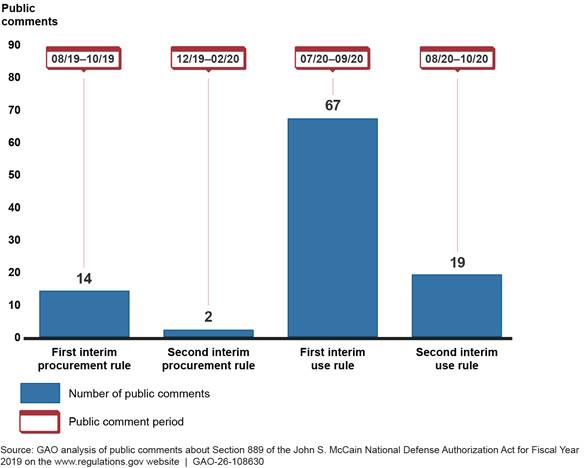
The written comments cited various concerns about how the new prohibitions would be implemented. Table 2 includes examples of some of the most cited concerns.
Table 2: Examples of Common Concerns Cited in Public Comments on Four Interim Rules Implementing Section 889 Prohibitions
|
Concern |
Examples of concerns mentioned in public comments |
|
Vague terminology |
Commentors wanted more clarity on the types of equipment or components that are prohibited; the meaning of terms, such as “use” and “substantial or essential component;” and whether the prohibitions apply to all areas of a company’s business or just its government business. |
|
No list of subsidiaries or affiliates for the five covered Chinese companies |
Commentors stated that the lack of information on subsidiaries and affiliates made it difficult for companies to ensure that they were not using covered equipment and suppliers in their supply chains. As a result, companies may inadvertently fail to comply with the prohibitions. |
|
Short reporting time frames |
Commentors stated that the requirement for a contractor to create a report within 24 hours of discovering its use of covered equipment, followed by creating a mitigation plan within 10 days, is onerous. These requirements may be difficult for small businesses that do not have enough staff or large firms that are geographically dispersed. |
|
Difficulty implementing prohibitions in foreign operations |
Commentors stated that covered equipment under Section 889 is often used extensively overseas and that other governments may not share the same concerns with the use of this equipment. |
|
Prohibitions are applied too broadly |
Commentors stated that the prohibitions were applied broadly, affecting all government procurements when taking a risk-based approach may be warranted to reduce the burden on industry and federal agencies. |
Source: GAO analysis of public comments about Section 889 of the John S. McCain National Defense Authorization Act for Fiscal Year 2019 on the www.regulations.gov website. | GAO‑26‑108630
The FAR Council modified the regulations in 2019 and 2020 to address concerns related to the burden of implementing the prohibitions. Industry representatives we met with said these modifications were important for helping contractors comply with the prohibitions. Specifically:
·
The FAR Council modified the process for companies to report
their compliance with the prohibitions. Instead of companies making a
representation of compliance with every offer, companies could make an annual
representation in the System for Award Management. This was included in the
second interim FAR rule for the procurement prohibition, effective December 13,
2019, and the second interim FAR rule for the use prohibition, effective
October 26, 2020.
· The FAR Council allowed companies to conduct a “reasonable inquiry” of their supply chains to identify whether they are using covered equipment. This was included in the first interim FAR rule for the use prohibition, effective August 13, 2020. A reasonable inquiry is defined in the FAR as an inquiry designed to uncover any information in the entity’s possession about the identity of the producer or provider of covered telecommunications equipment or services used by the entity.[23] This excludes the need to include an internal or third-party audit.
However, the FAR Council has not made any further revisions to regulations to address some of the concerns included in the written comments from 2020. As of July 2026, the council was working to finalize the interim rules.
Representatives from four industry associations we met with stated that despite the early concerns, companies they represent have not voiced additional complaints in the last 6 years. They stated that companies have adapted their processes to comply with the prohibitions. However, representatives noted that some concerns still exist. For example:
· Representatives from one association stated that the continued lack of a list of covered affiliates and subsidiaries strains industry’s ability to ensure compliance with Section 889 prohibitions.
· Representatives from two associations stated that the prohibitions should have been more narrowly applied to contractors within high-risk sectors, such as telecommunications or defense, instead of all contractors.
· Representatives from two associations stated that contractors are inconsistent in their interpretation and implementation of the prohibition requirements, and that the FAR Council could address this by clarifying the standards and steps needed for compliance.
·
Representatives from one association stated that the burden of
implementing the prohibitions contributes to reasons their members may avoid
working on federal government contracts.
FAR Reform Is Bringing Changes to Prohibition Implementation
Federal agencies are applying model deviation language the FAR Council issued in August 2025 for the Revolutionary FAR Overhaul that affects Section 889 prohibition implementation. As of July 2026, 29 departments and government agencies had issued class deviations relating to the FAR part on security and supply chain prohibitions.[24] GSA and DOD issued the class deviations in August 2025 and December 2025, respectively, instructing their contracting activities to follow the Revolutionary FAR Overhaul text implementing Section 889.[25] Officials from those agencies told us that they have begun incorporating the revised prohibition provisions into solicitations and contracts.
The FAR Council published a proposed rule for public comment in June 2026 to begin implementing the Revolutionary FAR Overhaul in regulations for multiple parts of the FAR, including those pertaining to the Section 889 prohibitions.[26] While largely similar to the model deviation language for Section 889 prohibitions, the proposed rule includes updated definitions for telecommunications and video surveillance equipment and services. It also includes guidance on what activities are not considered use of covered equipment or services to help clarify implementation. For example, the proposed rule released for public comment states that commercial sales, maintenance and testing services, and employees’ personal use of covered equipment are not considered use of covered telecommunications equipment or services. The public comment period closed in July 2026. GSA and DOD officials did not know what effect changes to Section 889 prohibitions made through rulemaking for the Revolutionary FAR Overhaul would have on the preexisting FAR Council efforts to finalize the interim Section 889 rules.
GSA and DOD Actions Help Ensure Compliance with Section 889 Prohibitions
GSA and DOD are taking several actions to help ensure that they and the federal agencies that use GSA Multiple Award Schedule contracts comply with the procurement and use prohibitions. This includes relying on company representations and the use of other enforcement mechanisms.
GSA and DOD Actions Facilitate Compliance with Procurement Prohibition
GSA and DOD took actions to develop new or leverage existing processes to implement and ensure compliance with the procurement prohibition. For GSA, these actions help ensure its own compliance during procurements and compliance for the federal agencies that procure goods and services from the schedule contracts that GSA manages. Under the Multiple Award Schedule program, GSA awards government-wide indefinite delivery contracts with stated prices for certain periods of time. Federal agencies may use these pre-existing contracts to order from a catalog of approximately 57 million commercial products and services, including telecommunications and video surveillance equipment and services.
Our analysis found that federal agencies have reduced spending on all telecommunications and surveillance equipment from the five identified companies since the Section 889 procurement prohibition took effect. Government-wide obligations on contracts awarded to these companies generally increased in the period before the law went into effect, peaking in fiscal year 2019. Afterward, obligations to these companies decreased. There were no obligations on any contracts awarded to these companies—whether they were for covered equipment or not—in 3 of the last 4 fiscal years of federal procurement data we analyzed.[27] See figure 2.
Figure 2: Federal Obligations on Contracts Awarded to Five Companies Identified in Section 889 Prohibitions (Fiscal Years 2016-2025)
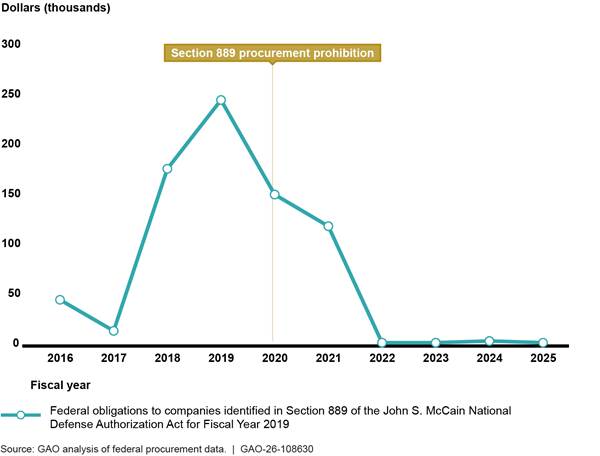
Note: Agency heads could waive prohibition requirements for the first 2 years following their enactments under certain circumstances per statute. These data exclude deobligations and did not allow GAO to identify whether the contracts involved covered equipment, as defined by statute. In fiscal year 2024, the Department of Defense made an obligation of less than $2,000 to an entity owned by Hytera for electrical components not generally considered telecommunication or surveillance equipment. GAO identified no obligations to identified companies in fiscal years 2022, 2023, and 2025.
GSA and DOD use a combination of guidance and regulation, information they collect on subsidiaries and affiliates, automated tools, and remediation efforts to help ensure their contracting officers and purchase cardholders do not procure covered items or services:
·
Guidance and regulation. GSA and DOD have each developed
guidance that provides directions to their contracting officers and the
acquisition community for implementing Section 889 and the interim rules. For
example, in August 2020, GSA created implementation guidance for its contracting
officers, including a decision tree outlining a process for determining whether
the procurement prohibition applies. GSA contracting officers are responsible
for ensuring the compliance of vendors awarded Multiple Award Schedule
contracts. Officials of other agencies placing task orders against
Multiple Award Schedule contracts are responsible for including Section 889
provisions in their orders. GSA previously created similar guidance for
purchase cardholders in August 2019.
DOD updated its supplemental acquisition regulation in December 2019 with an interim rule that incorporated Section 889 requirements.[28] DOD issued the final rule in January 2021.[29] It also issued guidance for implementing the prohibitions when awarding contracts or when using purchase cards, such as requirements to obtain vendor representations as to whether they provide covered equipment.
· Information on subsidiaries and affiliates. GSA and DOD are both collecting information on subsidiaries and affiliates of the five identified companies to help ensure that they are not procuring covered equipment or services from them. GSA officials stated that, as of May 2026, the agency had developed a list of about 700 subsidiaries and affiliates by using supply chain illumination tools, search algorithms, origin tracing, and real-time news alerts. GSA officials stated that in at least two instances, they terminated contracts with entities they had determined were subsidiaries to an identified company.
DOD officials stated that they use similar tools, as well as DOD’s own information to help ensure that contracts are not awarded to the five identified companies or their subsidiaries and affiliates. However, DOD officials told us they do not maintain a centralized list because it would quickly become outdated and potentially inaccurate given the dynamic nature of corporate structures. DOD officials were unaware of any contracts that were terminated because an entity was identified as a subsidiary or affiliate of an identified company.
· Automated tools. GSA and DOD developed tools that help contracting officers and purchase cardholders comply with the procurement prohibition. In November 2020, DOD developed a tool that allows users to request and receive vendors’ representation information from the System for Award Management through an automated email. In 2023, GSA launched an automated tool with assistance from the National Aeronautics and Space Administration that allows contracting officers and purchase cardholders to search how companies represented their compliance with Section 889 prohibitions in the System for Award Management. As discussed above, changes to representation reporting requirements implemented by the Revolutionary FAR Overhaul may affect the availability of this information to contracting officers and purchase cardholders in the future.
Since fiscal year 2019, GSA has used automated processes to identify and remove Section 889-prohibited covered equipment and services on contracts available through its Multiple Award Schedule program.[30] GSA officials told us that automated processes deleted more than 5,700 noncompliant items from catalogs in fiscal years 2024 and 2025. Further, GSA officials stated that from October 2025 to May 2026, GSA’s automated systems identified about 137,000 products before they were uploaded to the catalog that were not compliant with prohibitions, including Section 889. As a result, GSA officials said they were excluded from the catalog platform.
· Remediation efforts. GSA officials stated that the administration’s contracting officers, in accordance with agency policy, have worked with companies to remediate instances of noncompliance (i.e., the company was selling or using covered equipment). This could take the form of sending a letter of concern to a company describing the problem and providing a deadline for resolving it; requiring a company to submit a corrective action plan; or terminating a contract if a company continues to be noncompliant. Officials stated that as of May 2026, GSA had terminated 131 contracts with companies that did not accept contract modifications to add the Section 889 clause into their contracts. DOD officials stated that they are not aware of any contract terminations based on Section 889 but have policies for contracting officers to follow if noncompliance occurs. For example, noncompliance may result in corrective action requests or contractual remedies, including payment reduction and suspension of product acceptance activities.
Agencies Rely on Company Representations to Ensure Compliance with Use Prohibition
According to GSA and DOD officials, their agencies’ contracting officers and purchase cardholders rely on company representations when determining whether to award contracts or make micro-purchases. According to System for Award Management data from March 2026, almost 90 percent of companies that had federal contract activity in fiscal year 2025 represented that they did not use covered equipment.[31] Further, these companies received the majority (more than 98 percent) of all contract obligations made by federal agencies in fiscal year 2025.[32] Our analysis identified that about 2 percent of companies with federal contract activity in fiscal year 2025—about 1,800—represented using covered equipment. See figure 3.
Figure 3: Percentage of Companies That Represented Whether They Used Equipment Prohibited by Section 889, Fiscal Year 2025
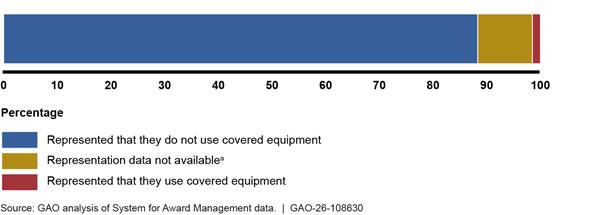
Note: Section 889 of the John S. McCain National Defense Authorization Act for Fiscal Year 2019 prohibited executive agencies from contracting with any entity that uses covered telecommunications equipment or services from five identified companies as a substantial, essential, or critical component of any system. Contractors are required to represent their compliance with this prohibition when registering in the System for Award Management.
aRepresentation data were not available for a number of companies. This included companies that, at the time of GAO’s search, had an inactive registration in the System for Award Management, were registered for financial assistance awards only (and therefore were not required to provide a representation) or elected not to display their registration information publicly.
In its August 2020 interim rule updating the use prohibition, the FAR Council did not define how a reasonable inquiry should be conducted beyond that it does not need to include an internal or third-party audit. As a result, some companies may have used different methods for gathering and analyzing data when conducting reasonable inquiries to support their representations in the System for Award Management. As mentioned earlier, several organizations that commented on the FAR interim rules, as well as some industry officials we spoke with, stated that companies’ efforts to comply with prohibitions, which require reasonable inquiries, are made more difficult because the five identified companies’ subsidiaries and affiliates are not listed.
GSA and DOD officials stated that contracting officers do not regularly check the accuracy of representations. This is because Section 889 interim rules and their agency policies permit contracting officers to rely on companies’ representations unless there is an independent reason to question them. For example, DOD officials stated that its contracting officers are authorized under agency policies to rely on companies' representations. If a contracting officer has an independent reason to question a representation, standard procedure requires them to consult with the requiring activity and legal counsel to determine the appropriate course of action.
GSA’s September 2022 guidance on cybersecurity supply chain risk management, however, requires contracting officers to take additional steps to gain insight into supply chain risks when warranted for certain procurements.[33] For example, contracting officers must ensure that the acquisition planning team consults with cybersecurity subject matter experts when assessing threats during procurements for information and communication technology products and services.
GSA and DOD officials said that the False Claims Act is a useful deterrent for false representations of Section 889 compliance because companies can incur monetary penalties for each false claim.[34] In addition, contractors liable for a False Claims Act violation may be suspended or debarred, meaning they would be excluded from receiving federal contracts for generally a period not exceeding 3 years.[35]
GSA and DOD Have Not Shared Information Widely with Other Agencies to Help Improve Prohibition Compliance
GSA and DOD have not shared information from their Section 889 implementation experience widely with other federal agencies that could help them comply with the prohibitions. This includes sharing insights into the types of challenges they are facing and ways they have identified to improve compliance efforts, as well as subsidiary and affiliate information they have collected for the five identified companies.
GSA and DOD Face Challenges Implementing Section 889 Prohibitions
GSA and DOD officials described several challenges they face when implementing Section 889. The challenges include (1) incomplete supply chain visibility, (2) difficulty complying with prohibitions when operating in foreign countries, and (3) difficulty obtaining representation information for micro-purchases. The agencies have taken steps to address some of these problems, but officials acknowledge that more needs to be done.
Incomplete Supply Chain Visibility
GSA and DOD officials stated that not having complete visibility of their supply chains makes it difficult to determine whether key components of telecommunications and video surveillance equipment they procure include covered equipment. For example, they do not know if they have identified all the subsidiaries and affiliates of the five identified companies. Officials stated that supply chain insight is further challenged when a single manufacturer produces identical pieces of equipment that are sold under different brand names.
Both agencies have initiatives to enhance supply chain visibility, but these initiatives still do not provide complete insight. For instance, in 2025, GSA established blanket purchase agreements to provide federal agencies with a readily available means to acquire commercial supply chain illumination services.[36] These services can help agencies obtain greater supply chain visibility and inform risk mitigation efforts that may help ensure compliance with procurement prohibitions. For example, these blanket purchase agreements provide access to business intelligence tools and analytic support that can assist with vendor vetting and supply network assessments. According to GSA officials, GSA used one of the commercial tools to help identify nearly 700 subsidiaries and affiliates of the five identified companies for Section 889 prohibitions. GSA officials told us that three other federal organizations have also awarded orders to use vendors from the blanket purchase agreements.
DOD also uses commercial supply chain illumination tools to gain insight into its supply chain, but DOD officials stated that the data must be further analyzed for decision-making purposes. We previously reported that the Air Force tested several commercial supply chain illumination tools and found them to be only 60-70 percent accurate.[37] The Air Force found that supply chain risks were highlighted where none existed, and the tools failed to identify suppliers that were included in supply chains.
In addition, in July 2025, we reported that DOD had two initiatives aimed at obtaining additional visibility into its weapon system supply chains.[38] The initiatives provide insights into the difficulty of identifying all the companies in a supply chain. Details of the two initiatives are as follows:
· One DOD initiative began in 2020 and is focused on identifying all the suppliers of parts on the F-35 Joint Stike Fighter aircraft. As of April 2025, DOD was able to identify the prime contractor and major subcontractors (first- and second-tier suppliers) for 30,000 of the 40,000 parts on the F-35. However, DOD had identified less than 10 percent of suppliers at lower tiers of the supply chain that provide components and raw materials for those parts. According to program officials, the department is pursuing ongoing efforts with industry to acquire additional parts and supplier data, but they stated that there are challenges in acquiring sub-tier data due to the lack of contractual requirements.
·
The other initiative, known as the Defense Industrial Base
Modeling and Analysis Project, is focused on collecting information about the
first- and second-tier suppliers on a multitude of DOD weapon systems and
programs. One DOD industrial base policy official we spoke with stated that, as
of May 2026, DOD had collected this information for nearly 700 weapon systems
and programs. While this initiative provides DOD with more supplier information
than is available in the Federal Procurement Data System, it does not provide
information on suppliers at the lower tiers of the supply chain that provide
raw materials and parts. See figure 4.
Figure 4: Change in Supply Chain Visibility Through the Defense Industrial Base Modeling and Analysis Project
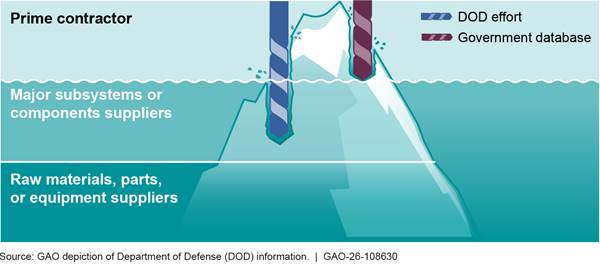
DOD officials stated that the efforts have not provided enough visibility into the supply chain to help the department proactively identify all foreign dependency risks, primarily because suppliers are not contractually required to provide such information to DOD. We recommended to DOD in our previous work that it take steps to enhance supply chain visibility. DOD concurred with our recommendations, and we continue to monitor its progress toward implementation.
Despite some limitations, information collected through these types of supply chain visibility efforts could also be used by contracting officers for implementing Section 889 and other procurement prohibitions. This includes a prohibition on procuring certain Chinese semiconductors and services beginning in December 2027.[39] Rulemaking was underway to implement this provision, as of July 2026.[40] To comply with both the Section 889 and the upcoming semiconductor prohibitions, agencies and contractors need to be aware of the subsidiaries and affiliates of the companies identified in those laws. These companies could exist at the raw materials, parts, or equipment level of the supply chain, as shown in figure 4 above.
Difficulty Complying with Prohibitions When Operating in Foreign Countries
DOD officials stated that the department has difficulty finding compliant alternative goods when conducting operations in foreign countries where a host nation’s telecommunications infrastructure is dependent on covered equipment or services. As a result, DOD identified three circumstances when it requires a waiver that allows it to procure equipment and services from companies that use covered equipment. One waives the use prohibition requirement for procurements categorized under hundreds of product and service codes for operations in regions with covered equipment in the telecommunications infrastructure, and for equipment that DOD determined the cybersecurity risk as none or low. For example, officials told us that some overseas fuel vendors may be unable to represent that they do not use covered equipment. The officials stated that the other two waivers, which are classified, are for procurements in foreign countries where covered equipment is part of the telecommunications infrastructure.
In fiscal year 2025, 31 percent of DOD’s total contract obligations—about $150 billion—were on contracts under the product and service codes included in the first waiver mentioned above. We identified that less than 1 percent of the $150 billion in obligations went to nearly 600 companies that represented they used covered equipment and no obligations went to identified companies.[41] DOD officials stated that the broad scope of the waiver was designed to provide comprehensive coverage for any contract or purchase card transactions within the designated categories. Officials stated that while the majority of contractors represent that they do not use covered equipment for transactions for the specified product and services, the waiver was operationally critical for a small subset of high-risk transactions. Officials acknowledged that the exact number of procurements that required the waiver's coverage remains undefined. They also stated DOD has ongoing efforts to determine whether product and service codes should be removed from the waiver.
Difficulty Obtaining Representation Information for Micro-purchases
DOD officials stated that the department is experiencing difficulty when obtaining company representation information for micro-purchases and transactions below the micro-purchase threshold. According to DOD officials, approximately half of the micro-purchases made by DOD purchase cardholders are with companies that have represented their compliance with Section 889 prohibitions in the System for Award Management. However, for those vendors not in the system because they do not have contracts with the government, DOD policy requires purchase cardholders to obtain representations. DOD officials said this can be a time-consuming process and the need to receive a representation or find an alternative source may delay the timely sourcing of products and services in contingency or emergency environments.
Both GSA and DOD officials also voiced concerns about purchase cardholders’ ability to quickly determine how vendors represent their compliance with Section 889 prohibitions if the rules for implementing the Revolutionary FAR Overhaul go into effect as currently written. As discussed above, the proposed changes to the FAR would omit the current requirement for vendors to provide an annual representation in the System for Acquisition Management. Instead, the proposed changes allow for this representation to be made within a contractor’s proposal.
If this revision goes into effect, it would remove the requirement for contractors to update their Section 889 compliance representation annually. GSA and DOD officials said that the automated tools that their agencies use for purchase cardholders to quickly search for representations would no longer provide current information for all contractors in the system. DOD officials stated that other federal agencies are aware of how the potential change to the regulations may affect representation data available to the government, but they have not discussed how to provide purchase cardholders with needed information quickly.
GSA and DOD Identified Ways to Improve Compliance Efforts but Have Not Shared Them Widely
GSA and DOD officials told us they identified information and methods to improve implementation of Section 889 procurement prohibitions and shared it with a limited number of agencies. Officials said they have not shared the information widely with other agencies because they are not required to do so. However, they stated that it is important to share information. The Department of Homeland Security’s Cybersecurity and Infrastructure Security Agency has forums that could assist in such an effort.
GSA and DOD have taken some steps to share information about subsidiaries and affiliates. For instance,
· GSA and DOD officials stated that they increased actions to share information on covered companies’ subsidiaries and affiliates with each other because of our inquiries for this review but have not done so widely with other executive agencies. According to officials, the agencies had occasionally shared information with each other, but following the start of our review they have held ad hoc meetings to share more information on subsidiaries and affiliates. A DOD official said they are looking to improve this process so that it is no longer ad hoc.
· GSA officials stated that they also shared information they identified on covered companies’ subsidiaries and affiliates with the Federal Acquisition Security Council in 2022 and 2025, in accordance with federal regulations and GSA policy.[42] GSA officials said they were unaware of whether the Department of Homeland Security’s Cybersecurity and Infrastructure Security Agency, the council’s information sharing agency, had disseminated the information or made it available to other agencies.
GSA officials identified other actions they have taken or plan to take to help ensure compliance with Section 889 prohibitions and future prohibitions. For example, GSA
· updated its policy and procedures in 2022 to establish requirements and recommendations related to market research when procuring information and communications technology to reduce supply chain risks;
· conducted industry outreach to help ensure that companies are aware of Section 889 and future prohibition expectations and that GSA understands the compliance challenges vendors face; and
· began plans to work with the Department of Homeland Security to expand access to customs data it found useful for identifying the origin of goods when implementing Section 889 prohibitions and believes will be useful for the upcoming semiconductor prohibition.
GSA and DOD officials stated that they have not shared information about subsidiaries and affiliates or their insights widely with other federal agencies because Section 889 does not require them to do so. The officials acknowledged that it is important to periodically share information on the identified companies’ subsidiaries and affiliates, as well as observations and successful actions related to implementing procurement prohibitions with other agencies. Officials stated that such collaboration could improve compliance efforts for Section 889 and other prohibition efforts. For example, an upcoming expansion of a DOD procurement prohibition on magnets and metals will take effect in January 2027 and an upcoming procurement prohibition on semiconductors will take effect in December 2027. Both prohibit the procurement of materials from or end items manufactured in specific countries. Implementation will require agencies and contractors to have deep insight into their supply chains for these items for compliance purposes.
Officials from both agencies said that the Cybersecurity and Infrastructure Security Agency could help facilitate information sharing. The Cybersecurity and Infrastructure Security Agency has several existing mechanisms where information can be shared. For example, it maintains and administers the Homeland Security Information Network for supply chain risk management information. It also facilitates information exchange and collaboration through task force meetings and other working forums and sessions. An official from the Cybersecurity and Infrastructure Security Agency we spoke with agreed that these mechanisms provide agencies an avenue to exchange information related to Section 889 implementation. Another official noted that the charter of a newly established advisory body that focuses on critical infrastructure also allows for the exchange of information on a wide range of security issues.[43]
While GSA and DOD represent nearly two-thirds of federal contract spending, all federal executive agencies have responsibilities for implementing Section 889 procurement and use prohibitions. Standards for Internal Control in the Federal Government state that management should communicate with, and obtain relevant and quality information from, appropriate external parties using established reporting lines. Periodically sharing subsidiary and affiliate information, as well as insights from Section 889 implementation, across the government could improve government-wide Section 889 compliance efforts and inform agencies’ implementation of future procurement prohibitions. It could also help agencies address known challenges earlier. Without sharing this information, agencies may take longer to detect and address compliance issues.
Conclusions
Since Section 889 prohibitions took effect in 2019, agencies and commercial companies have taken actions to ensure that they are not procuring or using covered items. While agencies had experience implementing prohibitions on other products and services prior to the Section 889 prohibitions, the broad applicability of the procurement and use prohibitions resulted in challenges for contractors and agencies. Early revisions to the interim rules have largely helped create a workable compliance framework for contractors, such as requiring an annual representation of compliance with the prohibitions rather than one with every contract award.
Despite progress, supply chain visibility and an effective means to share subsidiary information and lessons learned with others remain as challenges for GSA and DOD Section 889 compliance efforts. The challenges could also affect other future prohibitions. GSA and DOD are identifying ways to address challenges but have not yet shared this information widely with the other federal agencies that are also charged with Section 889 compliance. Agencies would benefit from sharing subsidiary and affiliate information with each other, as well as insights from implementing Section 889 rules. The Cybersecurity and Infrastructure Security Agency’s existing mechanisms for collecting and sharing data and information could offer a platform for this type of exchange among agencies. Sharing this information could have multiple benefits for government agencies. In addition to improving government-wide Section 889 compliance, shared knowledge could also inform agencies’ implementation of future procurement prohibitions. Further creating avenues to share information and notable practices could help agencies address known challenges sooner.
Recommendations for Executive Action
We are making a total of four recommendations, two to GSA and two to DOD.
The Administrator of GSA should ensure that GSA periodically shares subsidiary and affiliate information it collects with relevant federal agencies, including leveraging the Cybersecurity and Infrastructure Security Agency’s existing mechanisms, as appropriate. (Recommendation 1)
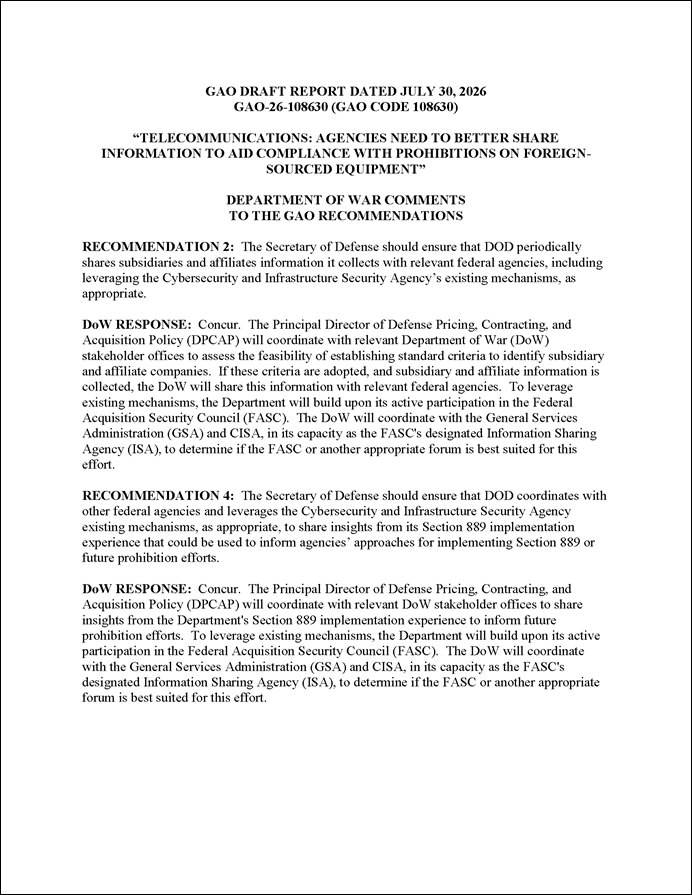
The Secretary of Defense should ensure that DOD periodically shares subsidiary and affiliate information it collects with relevant federal agencies, including leveraging the Cybersecurity and Infrastructure Security Agency’s existing mechanisms, as appropriate. (Recommendation 2)
The Administrator of GSA should ensure that GSA coordinates with other federal agencies and leverages the Cybersecurity and Infrastructure Security Agency’s existing mechanisms, as appropriate, to share insights from its Section 889 implementation experience that could be used to inform agencies’ approaches for implementing Section 889 or future prohibition efforts. (Recommendation 3)
The Secretary of Defense should ensure that DOD coordinates with other federal agencies and leverages the Cybersecurity and Infrastructure Security Agency’s existing mechanisms, as appropriate, to share insights from its Section 889 implementation experience that could be used to inform agencies’ approaches for implementing Section 889 or future prohibition efforts. (Recommendation 4)
Agency Comments
We provided a draft of this report to GSA, DOD, and the Department of Homeland Security for comment. GSA’s and DOD’s written comments are reproduced in appendix II and appendix III, respectively.
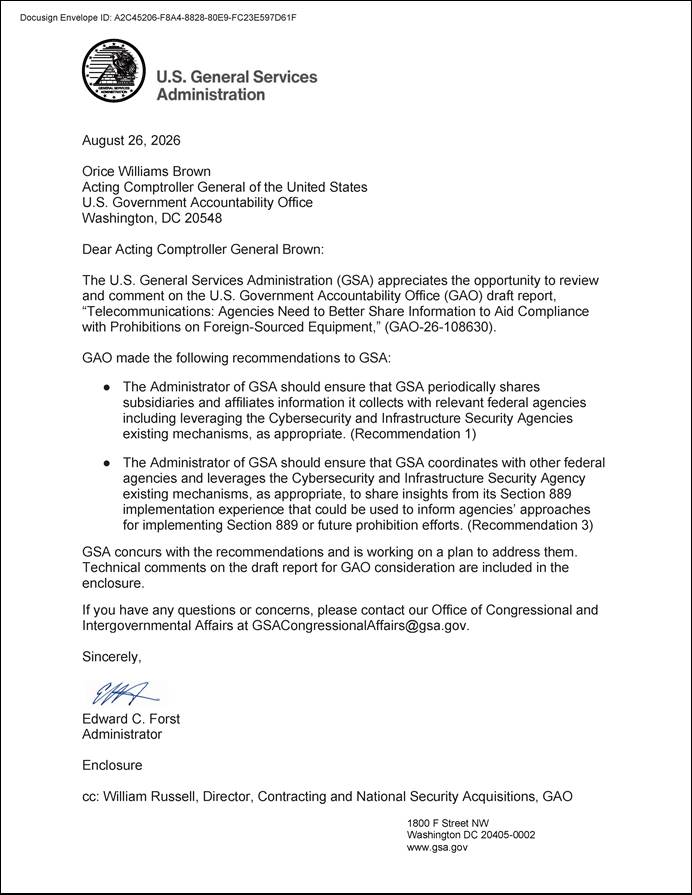
In its written comments, GSA concurred with our recommendations to share subsidiary and affiliate information, as well as its insights from implementing Section 889 prohibitions, with other federal agencies. GSA stated that it is working on a plan to address the recommendations.
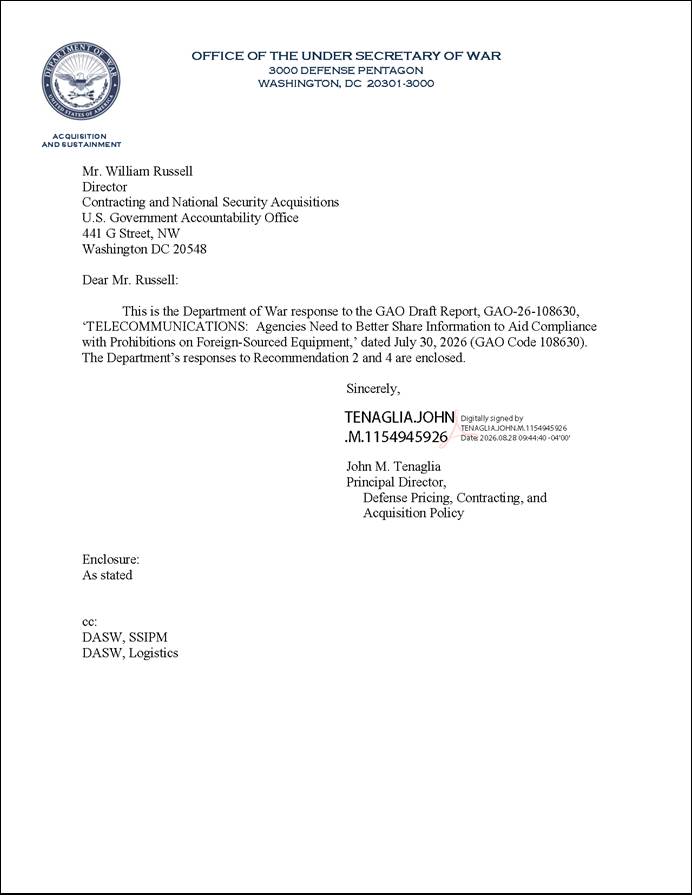
DOD also concurred with our recommendations. DOD stated that it will assess the feasibility of establishing criteria to identify subsidiary and affiliate information. If the criteria are adopted and subsidiary and affiliate information is collected, DOD will coordinate with GSA and the Cybersecurity and Infrastructure Security Agency to determine the appropriate forum to share the information with relevant federal agencies. DOD also stated that it will coordinate with GSA and the Cybersecurity and Infrastructure Security Agency to determine the appropriate forum to share insights from the department’s Section 889 implementation experience to inform future prohibition efforts.
GSA, DOD, and the Department of Homeland Security also provided technical comments, which we incorporated as appropriate.
We are providing copies of this report to the appropriate congressional committees, and to the Secretary of Defense, the General Services Administration, the Secretary of Homeland Security, and other interested parties. In addition, the report is available at no charge on the GAO website at https://www.gao.gov. If you or your staff have any questions about this report, please contact me at russellw@gao.gov. Contact points for our Offices of Congressional Relations and Media Relations may be found on the last page of this report. GAO staff who made key contributions to this report are listed in appendix IV.
William Russell
Director, Contracting and National Security Acquisitions
List of Committees
The Honorable Roger F. Wicker
Chairman
The Honorable Jack Reed
Ranking Member
Committee on Armed Services
United States Senate
The Honorable Mitch McConnell
Chair
The Honorable Christopher Coons
Ranking Member
Subcommittee on Defense
Committee on Appropriations
United States Senate
The Honorable Mike Rogers
Chairman
The Honorable Adam Smith
Ranking Member
Committee on Armed Services
House of Representatives
The Honorable Ken Calvert
Chairman
The Honorable Betty McCollum
Ranking Member
Subcommittee on Defense
Committee on Appropriations
House of Representatives
A House report accompanying the William M. (Mac) Thornberry National Defense Authorization Act for Fiscal Year 2021 includes a provision for GAO to report on executive agencies’ efforts to implement Section 889 of the National Defense Authorization Act for Fiscal Year 2019.[44] Section 889 prohibits executive agencies from purchasing or awarding contracts to entities that use certain telecommunications and surveillance equipment or services produced by five Chinese companies, including their affiliates and subsidiaries. Our report assesses (1) how public comments related to implementing regulations for Section 889 prohibitions have been addressed; (2) how selected agencies have taken actions to ensure compliance with the prohibitions, and (3) the extent to which selected agencies are sharing information to address challenges and improve their prohibition implementation efforts.[45]
We selected two agencies, the General Services Administration (GSA) and Department of Defense (DOD), to include in our review because they account for nearly two-thirds of the government’s $793 billion in obligations for products and services in fiscal year 2025. Further, GSA’s schedule contracts are used throughout the federal government to buy a wide range of products and services, including those related to telecommunications and video surveillance equipment.
To assess how public comments related to Section 889 prohibitions have been addressed, we
· analyzed the content of all 102 public comments available on the Regulations.gov website that were submitted in response to the 2019 and 2020 interim Federal Acquisition Regulation (FAR) rules implementing the prohibitions. Of the 106 comments that were originally submitted; three comments were shown as withdrawn on the website and one comment was noted as a duplicate. The comments were submitted by industry associations, contractors, and individuals. We used the information to identify commonly cited concerns.
· reviewed Federal Register summaries when interim prohibition rules were revised to determine the extent to which commonly cited concerns mentioned in the public comments were addressed. We interviewed GSA and DOD representatives on the Federal Acquisition Regulatory Council (FAR Council) to determine the status of the Section 889 rulemaking process.
· interviewed representatives from four industry associations to obtain their views on whether their concerns were resolved and whether new concerns have arisen since the interim rules were first published. The associations were: Airlines for America, the National Customs Brokers and Forwarders Association of America, Inc., the National Defense Industry Association, and the Security Industry Association. The associations represent companies in the airline; freight and shipping; national security and defense; and security industries, respectively. We selected the associations based on the range of comments they submitted during the rulemaking process and to ensure that we obtained views from a cross section of small and larger businesses across different market sectors.
We also reviewed potential changes to Section 889 implementation based on regulatory reforms the current administration is proposing through the Revolutionary FAR Overhaul, as well as deviations issued by the GSA and DOD to begin implementing the regulatory reforms.
To assess how GSA and DOD have taken actions to ensure compliance with the Section 889 prohibitions, we examined the policies, tools, and actions the agencies use to help ensure compliance. For example, we examined guidance and actions they use to remediate noncompliance, such as letters of concern transmitted by GSA to companies not in compliance and corrective actions submitted by companies. We also examined information related to automated tools the agencies’ contracting officers and purchase cardholders use to determine how companies represent their compliance with the prohibitions; automated tools used by GSA to detect and make unavailable covered equipment and services on multiple award schedules, and the lists GSA developed of affiliates and subsidiaries of the five identified companies. We interviewed cognizant GSA and DOD acquisition and cybersecurity policy officials to understand how their agency uses these actions and tools to identify and reduce noncompliance; and how, if at all, they share their lists of affiliates and subsidiaries with other federal agencies. We also discussed their use of any waivers to the prohibitions.
We analyzed Federal Procurement Data System data from fiscal years 2016 through 2025 to determine the effect the prohibitions had on the amount of federal obligations to the five identified companies covered in Section 889, identified by their unique entity identification number. We requested additional details from GSA and DOD for seven instances where we identified obligations to the five identified companies to understand the extent to which agencies had identified these awards and steps they may have taken to mitigate risks. We also analyzed System for Award Management data from March 2026 to determine how companies that had active contracts, subcontracts, or other transaction agreements reported in the Federal Procurement Data System or USAspending in fiscal year 2025 represented their compliance with prohibitions on selling covered equipment to federal agencies, as well as their use of the covered equipment. We refer to this contractor reporting as making representations throughout this report. We interviewed GSA officials responsible for managing the representations data inputted into the System for Award Management to understand the extent to which data is validated. We found this data to be sufficiently reliable for the purpose of describing the number of government contractors that publicly represented that they are in compliance with Section 889 prohibitions as entered into the system.
To evaluate the extent to which GSA and DOD are sharing information across the government to improve agencies’ ability to implement prohibition efforts, we interviewed GSA and DOD officials on challenges they experience implementing Section 889 prohibitions and their strategies for addressing these challenges. We also discussed how they are sharing subsidiaries and affiliates information with one another and more broadly with other agencies, as well as their experiences implementing Section 889. This includes their views on how to improve implementation of Section 889 and apply lessons learned to upcoming future prohibitions concerning magnets and semiconductors.
We conducted this performance audit from July 2025 to September 2026 in accordance with generally accepted government auditing standards. Those standards require that we plan and perform the audit to obtain sufficient, appropriate evidence to provide a reasonable basis for our findings and conclusions based on our audit objectives. We believe that the evidence obtained provides a reasonable basis for our findings and conclusions based on our audit objectives.
GAO contact
William Russell, russellw@gao.gov
Staff Acknowledgments
In addition to the contact named above, Cheryl Andrew, Assistant Director; Tom Twambly, Analyst in Charge; Suellen Foth; Stephanie Gustafson; Scott Hepler; Jean McSween; Sophia Payind; Matt St. Geme; and Adam Wolfe made key contributions to this report.
The Government Accountability Office, the audit, evaluation, and investigative arm of Congress, exists to support Congress in meeting its constitutional responsibilities and to help improve the performance and accountability of the federal government for the American people. GAO examines the use of public funds; evaluates federal programs and policies; and provides analyses, recommendations, and other assistance to help Congress make informed oversight, policy, and funding decisions. GAO’s commitment to good government is reflected in its core values of accountability, integrity, and reliability.
Obtaining Copies of GAO Reports and Testimony
The fastest and easiest way to obtain copies of GAO documents at no cost is through our website. Each weekday afternoon, GAO posts on its website newly released reports, testimony, and correspondence. You can also subscribe to GAO’s email updates to receive notification of newly posted products.
Order by Phone
The price of each GAO publication reflects GAO’s actual cost of production and distribution and depends on the number of pages in the publication and whether the publication is printed in color or black and white. Pricing and ordering information is posted on GAO’s website, https://www.gao.gov/ordering.htm.
Place orders by calling (202) 512-6000, toll free (866) 801-7077,
or
TDD (202) 512-2537.
Orders may be paid for using American Express, Discover Card, MasterCard, Visa, check, or money order. Call for additional information.
Connect with GAO
Connect with GAO on X,
LinkedIn, Instagram, and YouTube.
Subscribe to our Email Updates. Listen to our Podcasts.
Visit GAO on the web at https://www.gao.gov.
To Report Fraud, Waste, and Abuse in Federal Programs
Contact FraudNet:
Website: https://www.gao.gov/about/what-gao-does/fraudnet
Automated answering system: (800) 424-5454
Media Relations
Sarah Kaczmarek, Managing Director, Media@gao.gov
Congressional Relations
David A. Powner, Acting Managing Director, CongRel@gao.gov
General Inquiries
[1]Coats, Daniel R. Director of National Intelligence, Worldwide Threat Assessment of the U.S. Intelligence Community, a statement for the record to the Senate Select Committee on Intelligence, 116th Cong., 1st sess., January 29, 2019. Also, Office of the Director of National Intelligence, Annual Threat Assessment of the U.S. Intelligence Community (Mar. 14, 2026).
[2]For more information on this threat, see Cybersecurity and Infrastructure Security Agency, Cybersecurity Advisory: PRC State-Sponsored Actors Compromise and Maintain Persistent Access to U.S. Critical Infrastructure, Alert Code: AA24-038A (Feb. 7, 2024).
[3]For the most recent update, see GAO, High-Risk Series: Heightened Attention Could Save Billions More and Improve Government Efficiency and Effectiveness, GAO‑25‑107743 (Washington, D.C.: Feb. 25, 2025).
[4]Examples include prohibitions on the federal government from procuring or using (1) products and services from Kaspersky Lab (National Defense Authorization Act for Fiscal Year 2018, Pub. L. No. 115-91, § 1634 (2017)); (2) drones produced by certain foreign adversary companies (American Security Drone Act of 2023, Pub. L. No. 118-31, div. A, tit. XVIII, subtitle B (2023)); and (3) certain Chinese semiconductors and semiconductor-adjacent products and services (James M. Inhofe National Defense Authorization Act for Fiscal Year 2023, Pub. L. No. 117-263, § 5949 (2022)).
[5]John S. McCain National Defense Authorization Act for Fiscal Year 2019, Pub. L. No. 115-232, § 889 (2018).
[6]House Report No. 116-442 (2020). The House report also asked us to submit an interim report to congressional defense committees by August 2021. That initial report was not released to the public.
[7]Representations are statements of fact about an entity’s business specifics—such as its size, structure, or ownership—that an entity generally must provide in the System for Award Management to be eligible for certain federal awards.
[8]U.S. House of Representatives, Permanent Select Committee on Intelligence, Investigative Report on the U.S. National Security Issues Posed by Chinese Telecommunications Companies Huawei and ZTE (Washington, D.C: Oct. 8, 2012).
[9]U.S.-China Economic and Security Review Commission, 2018 Report to Congress of the U.S.-China Economic and Security Review Commission (Washington, D.C.: Nov. 2, 2018).
[10]Exec. Order No. 13,873, 84 Fed. Reg. 22,689 (May 15, 2019).
[11]The risks include (1) an undue risk of sabotage to or subversion of, among other things, the integrity, distribution, operation, or maintenance of information and communications technology or services in the U.S.; (2) an undue risk of catastrophic effects on the security or resiliency of the U.S.’s critical infrastructure or digital economy; or (3) an otherwise unacceptable risk to the national security of the U.S.
[12]Covered equipment or services, defined in the statute as “covered telecommunications equipment or services,” generally means any of the following: telecommunications equipment produced by Huawei Technologies Company or ZTE Corporation; for the purpose of public safety, security of government facilities, physical security surveillance of critical infrastructure, and other national security purposes, video surveillance and telecommunications equipment produced by Hytera Communications Corporation, Hangzhou Hikvision Digital Technology Company, or Dahua Technology Company; and telecommunications or video surveillance services provided by such entities or using such equipment. The term also includes the subsidiaries or affiliates of the five identified companies, as well as telecommunications or video surveillance equipment or services produced or provided by entities that the Secretary of Defense, in consultation with the Director of National Intelligence or the Director of the Federal Bureau of Investigation, reasonably believes to be owned, controlled by, or connected to the government of a covered foreign country. John S. McCain National Defense Authorization Act for Fiscal Year 2019, Pub. L. No. 115-232, § 889(f)(3) (2018).
[13]The entity seeking the waiver must provide to the agency head a compelling justification for the waiver, a full accounting of the presence of covered equipment, and a phase-out plan to eliminate the covered equipment. In turn, the agency head must submit the accounting of covered equipment and phase-out plan to appropriate congressional committees within 30 days. John S. McCain National Defense Authorization Act for Fiscal Year 2019, Pub. L. No. 115-232, § 889(d)(1) (2018).
[14]The FAR Council assists in the direction and coordination of government-wide procurement policy and procurement regulatory activities. Council membership consists of the Administrator for Federal Procurement Policy, the Administrator of the General Services Administration, the Secretary of Defense, and the Administrator of the National Aeronautics and Space Administration.
[15]GAO, Telecommunications: Selected Agencies Have Taken Steps to Address Risks of Equipment Linked to China, GAO‑26‑107668 (Washington, D.C.: May 19, 2026).
[16]Federal Acquisition Supply Chain Security Act of 2018, Pub L. No. 115-390, tit. II (2018) (codified at 41 U.S.C. §§ 1321–1328, 4713). The Federal Acquisition Security Council is an executive branch interagency council chaired by the Office of Management and Budget with representation from DOD and GSA, among others.
[17]The act requires the council to identify an agency to perform information sharing functions. The Federal Acquisition Security Council designated the Department of Homeland Security, acting primarily through the Cybersecurity and Infrastructure Security Agency, as the information sharing agency generally responsible for receiving and disseminating supply chain information for the council. 41 C.F.R. § 201-1.200.
[18]Entities that register in the System for Award Management to pursue federal contracts must complete a representations and certifications questionnaire designed to collect the data necessary about their business specifics to complete certain FAR provisions. Misrepresentation of information may subject an entity to civil penalties or criminal prosecution. A proposed rule as part of the Revolutionary FAR Overhaul plans to streamline the registration process by removing certain annual representations and certifications. Federal Acquisition Regulation: Revolutionary Federal Acquisition Regulation Overhaul Parts 1, 2, 4, 33, 39, 40, and 53, 91 Fed. Reg. 37,550, 37,553–37,554 (proposed June 23, 2026) (to be codified at 48 C.F.R. pts. 1, 2, 4, 33, 39, 40, 52, and 53).
[19]Exec. Order No. 14,275, 90 Fed. Reg. 16,447 (April 15, 2025). For the purposes of our report, the updated version of the FAR from the Revolutionary FAR Overhaul is referred to as FAR (deviation), while the version in place prior to the overhaul is referred to as FAR (legacy). The intent of the Revolutionary FAR Overhaul is to reduce the FAR to only provisions required by statute or essential to sound procurement. In making these reforms, the executive order discussed the difficulties that companies face when trying to do business with the federal government under the current FAR.
[20]FAR (deviation) Part 40. The Revolutionary FAR Overhaul moved Section 889 implementation from Part 4 to Part 40.
[21]Under the FAR (legacy), the Section 889 representation required checking a box that the offeror does or does not follow the prohibitions. FAR (legacy) §§ 52.204-24(d), 52.204-26(c). Under the FAR (deviation), offerors are considered to have represented their Section 889 compliance by submitting an offer. FAR (deviation) § 52.240-90(c). GSA officials told us no decision has been finalized regarding the use of the System for Award Management for collecting Section 889 representation information with respect to the Revolutionary FAR Overhaul. For DOD contracts, the model deviation language implementing the Revolutionary FAR Overhaul in the Defense FAR Supplement continues to require annual representations in the System for Award Management related to Section 889 compliance.
[22]Public comments on interim rules can be found at www.regulations.gov. A total of 106 written comments were originally submitted; three were withdrawn and one was a duplicate file.
[23]FAR (legacy) § 4.2101.
[24]Deviations from the FAR include using policies, procedures, solicitation provisions, contract clauses, methods, or practices of conducting acquisitions that are inconsistent with the FAR. Class deviations are used when more than one contract action will be affected by a deviation.
[25]While the class deviations were issued on these dates, they took effect on November 3, 2025, for GSA and on February 1, 2026, for DOD.
[26]Federal Acquisition Regulation: Revolutionary Federal Acquisition Regulation Overhauls Parts 1, 2, 4, 33, 39, 40, and 53, 91 Fed. Reg. 37,550 (proposed June 23, 2026) (to be codified at 48 C.F.R. pts. 1, 2, 4, 33, 39, 40, 52, and 53).
[27]Procurement data from the Federal Procurement Data System was part of our analysis. That data has now been integrated into the System for Award Management, which contained other data we used in our analysis.
[28]DOD is also subject to Section 1656 of the National Defense Authorization Act for Fiscal Year 2018, Pub. L. No. 115-91 (2017). Section 1656 is a prohibition similar to Section 889 that is specifically applicable to DOD’s nuclear deterrence and homeland ballistic missile defense missions. The interim rule implemented both Section 1656 and Section 889 requirements for DOD. Defense Federal Acquisition Regulation Supplement: Covered Defense Telecommunications Equipment or Services (DFARS Case 2018–D022), 84 Fed. Reg. 72231 (Dec. 31, 2019) (to be codified at 48 C.F.R. pts. 204, 212, 213, and 252).
[29]The final rule made two changes to the interim rule related to reporting timeframes. Defense Federal Acquisition Regulation Supplement: Covered Defense Telecommunications Equipment or Services (DFARS Case 2018–D022), 86 Fed. Reg. 3832 (Jan. 15, 2021) (to be codified at 48 C.F.R. pts. 204, 212, 213, and 252).
[30]GSA’s Multiple Award Schedule is also referred to as the GSA Schedule or Federal Supply Schedule.
[31]Companies include those that had prime contracts or other transaction agreements reported in the Federal Procurement Data System or subcontracts reported in USAspending. For more on DOD’s use of other transaction agreements, see GAO, Other Transaction Agreements: Improved Contracting Data Would Help DOD Assess Effectiveness, GAO‑25‑107546 (Washington, D.C.: Sept.3, 2025).
[32]Contracts may be awarded to companies that represent that they use covered equipment if there is an applicable waiver or exception defined in statute.
[33]GSA, Cyber-Supply Chain Risk Management (C-SCRM) Requirements and Best Practices for the Pre-Award Phases of the Acquisition Life Cycle. Federal Acquisition Service Policy and Procedure 2022-03 (Sep. 22, 2022).
[34]The False Claims Act provides treble damages and per-claim penalties for false claims submitted to the government, including claims submitted by federal contractors. 31 U.S.C. §§ 3729–3733.
[35]FAR (legacy) subpart 9.4.
[36]A blanket purchase agreement is a simplified method of filling anticipated repetitive needs for supplies or services. It functions as a “charge account,” with terms and conditions agreed upon when the blanket purchase agreement is established. A blanket purchase agreement is not a contract; therefore, the government is not obligated to purchase a minimum quantity or dollar amount and the contractor is not obligated to perform until it accepts an order under the blanket purchase agreement. Blanket purchase agreements do not obligate funds; funds are obligated when an order subsequently is placed. FAR (legacy) § 13.303.
[37]GAO, Defense Industrial Base: Actions Needed to Address Risks Posed by Dependence on Foreign Suppliers, GAO‑25‑107283 (Washington, D.C.: July 24, 2025).
[39]This prohibition also extends to semiconductor products or services determined by the Secretary of Defense or Secretary of Commerce, in consultation with the Director of National Intelligence or the Director of the Federal Bureau of Investigation, to be from an entity owned or controlled by a foreign country of concern. Currently, foreign countries of concern include North Korea, China, Russia, and Iran.
[40]Federal Acquisition Regulation: Prohibition on Certain Semiconductor Products and Services, 91 Fed. Reg. 7,223 (Feb. 17, 2026) (to be codified at 48 C.F.R. pts. 1, 2, 9, 12, 13, 39, 40, and 52).
[41]Nearly 102,000 companies represented that they do not use covered equipment. Representation data was unavailable for about 3,800 companies; we could not determine how these companies would have reported compliance with the prohibition.
[42]41 C.F.R. § 201-1.201. GSA Office of Policy and Compliance, Standard Operating Procedure (SOP): Sharing Supply Chain Risk Information (Sept. 2021).
[43]According to an agency official, in the past, the Cybersecurity and Infrastructure Security Agency could use groups within the Critical Infrastructure Partnership Advisory Council to share information. However, this council was disbanded. The Secretary of Homeland Security has since established a successor advisory body known as the Alliance of National Councils for Homeland Operational Resilience-Critical Infrastructure.
[44]H.R. Rep. No. 116-442 (2020); John S. McCain National Defense Authorization Act for Fiscal Year 2019, Pub. L. No. 115-232, § 889 (2018).
[45]This is our second report issued in response to this requirement. Our initial report was not released to the public.