
Report to Congressional Committees
United States Government Accountability Office
A report to congressional committees
Contact: David Marroni at MarroniD@gao.gov
What GAO Found
Federal buildings often contain special use spaces like meeting rooms and conference centers, some of which may be shared across agencies. Agencies varied in how they shared these spaces in the selected General Services Administration (GSA)-owned and -leased buildings GAO visited.
Interviewees, including officials from federal tenant agencies in those selected buildings, said that sharing these spaces can provide benefits, including:
· access to useful spaces their agency might not otherwise have,
· reduced costs and more efficient use of space (e.g., agencies do not need to lease or construct individual spaces), and
· increased collaboration between agencies.
However, interviewees also identified challenges to sharing, such as lack of awareness of what spaces are available or how to reserve them.
GSA, which manages federal real property for tenant agencies, publishes an online list of meeting spaces that agencies volunteered to share. The list includes information such as room descriptions and a point of contact to reserve the space. However, the list is not comprehensive—some tenant agencies have not added their space to the list, and some GSA rooms are not on the list. GSA periodically emails agencies to request that they update the list, and it relies on agencies to distribute the list to their staff. However, most agency officials GAO interviewed in selected buildings were not aware of GSA’s list. GSA officials noted that federal turnover in 2025 contributed to reduced awareness of the list. They said that starting in 2025, more of their reminder emails were undelivered. Officials said they worked with agencies to update their contacts, and that they may be able to use other mechanisms to more broadly distribute the list. Improving the comprehensiveness of the list and agency awareness of it could help agencies share special use spaces, which could in turn potentially reduce costs by supporting GSA’s efforts to ensure efficient use of federal space.
Why GAO Did This Study
In recent years, GSA and others have taken steps to reduce unneeded federal real property, particularly office space, but building utilization across the federal government remains low.
The Thomas R. Carper Water Resources Development Act of 2024 includes a provision for GAO to report on the use of special use spaces in federal buildings to determine levels of use and identify opportunities for sharing, collocating, and other efficiencies.
This report addresses 1) how agencies share special use spaces in selected GSA-owned and -leased buildings, 2) the reported benefits and challenges related to sharing special use spaces, and 3) GSA’s efforts to promote sharing of special use spaces.
GAO conducted in-person site visits at six federal buildings selected for geographic diversity and whether there were multiple tenants, among other criteria. These site visits were composed of 1) a review of data or documentation; 2) observation of special use spaces; 3) interviews with GSA officials; and 4) interviews with officials from federal tenant agencies in those buildings. GAO also reviewed available GSA documentation and assessed GSA efforts against its strategic goals and GAO leading practices for interagency collaboration.
What GAO Recommends
GAO recommends that GSA take additional steps to 1) improve the comprehensiveness of its federal meeting facilities list; and 2) increase tenant agency awareness of the list. GSA agreed with both recommendations and stated that it is developing a plan to address them.
Abbreviations
Fallon Federal Building George H. Fallon Federal Building
federal buildings federally owned or leased buildings
GSA General Services Administration
IT information technology
Kluczynski Federal Building John C. Kluczynski Federal Building
Metcalfe Federal Building Ralph H. Metcalfe Federal Building
This is a work of the U.S. government and is not subject to copyright protection in the United States. The published product may be reproduced and distributed in its entirety without further permission from GAO. However, because this work may contain copyrighted images or other material, permission from the copyright holder may be necessary if you wish to reproduce this material separately.
September 14, 2026
The Honorable Shelley Moore Capito
Chairman
The Honorable Sheldon Whitehouse
Ranking Member
Committee on Environment and Public Works
United States Senate
The Honorable Sam Graves
Chairman
The Honorable Rick Larsen
Ranking Member
Committee on Transportation and Infrastructure
House of Representatives
The federal government spends billions of dollars each year managing and leasing buildings. These include about 1,500 properties owned by the General Services Administration (GSA) and about 7,300 locations leased by GSA. We have emphasized the need for federal agencies to efficiently use these buildings, and underutilization is one reason that managing federal real property is on our High Risk List.[1] In recent years, GSA and others have taken steps to reduce unneeded real property, particularly office space, but building utilization across the federal government remains low.[2]
Federal office buildings often contain additional types of spaces, sometimes called special use spaces, that are or could be shared across agencies. While there is no uniform definition of special use spaces, for the purposes of this report, we are defining it to include fitness centers, conference centers, training centers, meeting rooms, food service operations/cafeterias, and other similar spaces.[3] GSA refers to most of these spaces as joint-use spaces.
The Thomas R. Carper Water Resources Development Act of 2024 contains a provision for GAO to report on the use of special use spaces in federal buildings to determine levels of use and identify opportunities for sharing, collocating, and other efficiencies.[4]
This report addresses 1) how agencies share special use spaces in selected GSA-owned and GSA-leased buildings, 2) the reported benefits or challenges related to sharing special use spaces, and 3) GSA’s efforts to promote sharing of special use spaces.[5]
To address all three objectives, we conducted in-person site visits at federal buildings (GSA-owned and -leased buildings) in four large GSA markets: Washington, DC; Chicago, IL; Baltimore, MD; and Denver, CO.[6] Table 1 lists the buildings we visited in each city. Activities during these site visits were composed of: 1) a review of data or documentation, if available (e.g., reservation information for special use spaces), 2) observation of special use spaces through photographs or in-person observation, 3) interviews with GSA officials, including those involved in building management at each building, and 4) interviews with a total of 18 federal tenant agency officials located in those buildings.[7] Our site visit selection criteria included geographic diversity, whether there were multiple federal tenant agencies in a building, whether there was a high concentration of federal buildings in one area, and interviewee recommendations.[8]
Table 1: List of General Services Administration (GSA)-Owned or -Leased Buildings Selected for GAO Site Visits
|
Building name |
Location |
GSA-owned or GSA-leased |
|
Bank of America Towers I and II |
Baltimore, MD |
GSA-leased |
|
Denver Federal Center |
Lakewood, CO |
GSA-owned |
|
George H. Fallon Federal Building |
Baltimore, MD |
GSA-owned |
|
John C. Kluczynski Federal Building |
Chicago, IL |
GSA-owned |
|
Ralph H. Metcalfe Federal Building |
Chicago, IL |
GSA-owned |
|
Ronald Reagan Building and International Trade Center |
Washington, DC |
GSA-owned |
Source: GAO analysis of GSA data. | GAO‑26‑108669
To address our second objective on benefits or challenges of sharing special use spaces, we interviewed two industry stakeholders that manage real estate and property. We selected these entities based on our prior work and our own research.
To address our third objective on GSA’s efforts to promote sharing of special use spaces, we reviewed available GSA documentation, such as its strategic documents (e.g., the 2027 Annual Performance Plan), policies, and website. We also asked tenant agencies to identify any GSA resources that helped agencies share special use spaces. In addition, we spoke with headquarters officials from three of the tenant agencies at the request of those officials. We focused these interviews on the extent to which agency headquarters officials were aware of GSA resources to promote sharing of space. We assessed GSA’s efforts to develop and provide such resources against its strategic goals, as well as selected leading practices we have previously identified for enhancing interagency collaboration when federal entities are engaged in activities (such as space sharing) intended to produce more value than could be produced when the entities act alone.[9] With respect to leading practices, we assessed GSA’s efforts to provide information to agencies about available special use spaces against the leading practice of “leverage resources and information,” as it was the most relevant.
We conducted this performance audit from July 2025 to September 2026 in accordance with generally accepted government auditing standards. Those standards require that we plan and perform the audit to obtain sufficient, appropriate evidence to provide a reasonable basis for our findings and conclusions based on our audit objectives. We believe that the evidence obtained provides a reasonable basis for our findings and conclusions based on our audit objectives.
Background
GSA acquires space on behalf of federal agencies through new construction, purchase, and leasing. GSA has the authority to assign space to other executive branch agencies in both buildings it owns and buildings it leases, and it is required by law to charge for furnishing space and services. The terms of a particular space assignment—including the amount GSA charges for rent—are formalized in an Occupancy Agreement. These agencies become tenants of GSA in those federally owned or leased buildings (federal buildings).[10]
GSA’s Public Buildings Service is responsible for overseeing and improving special use spaces that are open to all tenants, such as GSA conference centers, fitness centers, and cafeterias in GSA-managed federal buildings. Access to special use spaces may be limited to one agency, shared among multiple agencies in a building or on a campus, or available to additional GSA customer agencies in the neighboring area. Tenant agencies manage their own conference centers and meeting rooms, and in some cases, may charge a fee for other agencies to use the space. Some special use spaces, such as cafeterias, may also be available to the public. GSA’s Real Property Policy Division promotes and supports governmentwide programs to improve the efficiency of real estate management by federal agencies.
GSA has general policies related to pricing and space management, which can also apply to special use spaces. GSA’s Pricing Desk Guide outlines how GSA charges tenant agencies for use of cafeterias, fitness centers, and shared conference rooms. Specifically, GSA charges each tenant agency for these spaces based on the total occupancy in the building that the tenant agency leases.[11] Additionally, GSA’s Fitness Center Services Policy describes the actions tenant agencies need to take to establish fitness centers.[12] For example, the policy notes that agencies interested in having a fitness center must form a committee and establish a memorandum of agreement that identifies who is responsible for management of the fitness center and the fee structure, among other things.
Agencies Within Selected Buildings Vary in How They Share Special Use Spaces, Depending in Part on the Type of Space
According to GSA officials, there is no formal program to share special use spaces across tenant agencies or locations, but GSA and agencies located in our selected GSA-owned and GSA-leased buildings had various informal approaches to sharing space.[13] Agency approaches to sharing space varied depending on the type of special use space.
Conference Centers and Training Centers
Three buildings we visited had conference centers or training centers that were managed by GSA or a tenant agency. The GSA-managed center in one of these buildings was generally open to other agencies within the building or in nearby buildings. In the two other buildings, GSA had large, reservable conference rooms that were also open to other agencies. In addition, all three of these buildings had a center managed by a tenant agency that could be reserved by other agencies within the building. The following are examples of conference and training centers in our selected buildings:
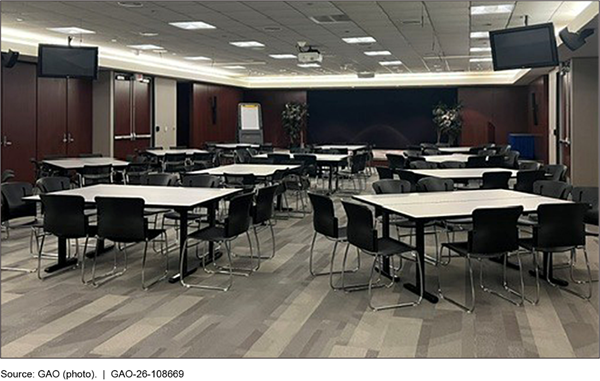
· GSA manages a conference center in the Ralph H. Metcalfe Federal Building (Metcalfe Federal Building) in Chicago, IL. It contains the largest meeting space in the building, as well as smaller breakout rooms. Figure 1 shows the large meeting room in this center. Officials from any federal agency may reserve this center, but GSA officials said that they prioritize reservations by the building’s tenants. To reserve this center, agency officials said they reach out to a specific GSA point of contact by phone or email. GSA officials said they track the use of this conference center closely, because it is in high demand. Specifically, GSA officials said there were 573 reservations in calendar year 2025. GSA officials collect information on which agency reserved the conference center, how many people were expected to attend, and room configurations, among other details.
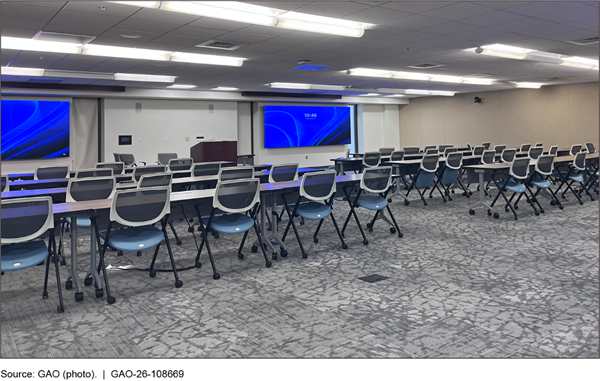
· The Department of Veterans Affairs manages a training center in the George H. Fallon Federal Building in Baltimore, MD (Fallon Federal Building). This training center has large meeting rooms that are equipped with technology that supports training and hybrid (in-person and virtual) meetings. It is available for reservation by the Department of Veterans Affairs, as well as other federal agencies. See figure 2 for a photograph of one of the available meeting rooms within this training center. According to officials from the Department of Veterans Affairs, there were 90 events (2,676 participants) at the training center in fiscal year 2024, and 39 events (1,224 participants) in fiscal year 2025.
Figure 2: Meeting Room in Training Center Managed by Tenant Agency in the George H. Fallon Federal Building (Baltimore, MD)
Meeting Rooms in Agency-Dedicated Space
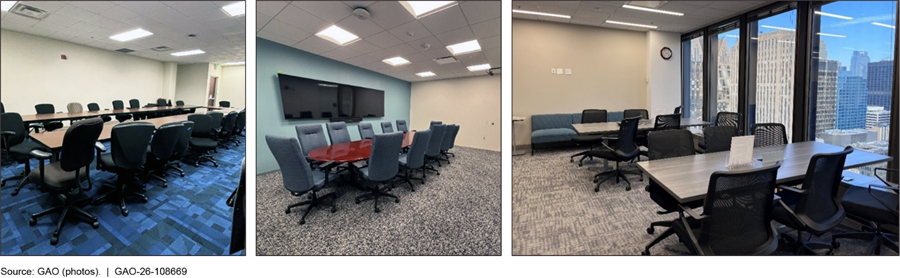
Tenant agencies we met with in selected buildings each had their own meeting rooms built into their dedicated space. Some agencies also had small “huddle rooms” for smaller groups. Officials from agencies with a smaller presence in a building (e.g., 25 or fewer employees in the agency’s dedicated space) told us that their larger meeting rooms tended to be large enough to meet their needs. Officials from agencies with more employees (e.g., over 100 employees in the agency’s dedicated space) told us they relied on larger rooms outside of their footprint, such as GSA-managed conference rooms, for certain types of meetings, such as all-hands meetings. Figure 3 shows examples of some meeting rooms in agency-dedicated space.
Most of the agency officials we spoke with (at 16 of 18 tenant agencies) said their agency did not formally track the use of meeting rooms, but some had reservation systems in place. For example, officials at some agencies said that they can reserve rooms through their email system. Other agencies reserved meeting rooms by contacting a designated individual or using paper sign-up sheets.
Agencies varied on whether they had shared or would share meeting rooms with other departments or agencies. Specifically, officials from five of 18 tenant agencies in selected buildings said that they have shared their meeting rooms with other agencies. Officials from an additional four tenant agencies said that they shared their rooms with other departments within their agency, but not outside agencies. The following are examples of agencies sharing meeting rooms in our selected buildings:
· Officials from an agency in the John C. Kluczynski Federal Building (Kluczynski Federal Building) in Chicago, IL, said their agency has facilitated the sharing of its meeting rooms by consolidating control of meeting rooms under a central administrative department. Availability can be communicated to all the agency’s departments and to other agencies in the building that are looking for space. Officials from this agency said that they do not charge other agencies for the use of the space, since the costs are already built into the occupancy lease agreement. Additionally, officials said they believe in sharing out of goodwill and to promote effective use of space. The spaces are made available for use on a reservation and approval basis. This agency has replicated this approach in other cities.
· Officials we spoke with at an agency in GSA-leased space at one of the Bank of America Towers in Baltimore said their agency recently blended its footprint with another federal agency. The two agencies have access to one another’s meeting spaces, including a larger conference room that is in a shared lobby at the front and center of the office.
· Officials we spoke with at an agency in the Denver Federal Center said that their agency has shared their large, 150-person meeting rooms with other agencies on the campus. They said they are happy to share those rooms because they are easily accessible to other agencies on the first and second floors of the building rather than behind a secure door on upper floors. They do not share their smaller meeting rooms, which are in the agency’s secure space.
Officials we spoke with from three of 18 tenant agencies located in selected buildings said that they were not opposed to sharing their private meeting rooms with other agencies but that no one had asked to use them. An official at one agency said that they were not sure how popular their meeting rooms would be with other agencies, as GSA meeting spaces may be easier to access (i.e., other agencies’ personnel would not need an escort to get into GSA space).
Officials from seven agencies said their agency was less likely to share certain designated conference and meeting rooms due to agency-specific privacy concerns.[14] For example, officials from one agency explained that their agency staff conduct confidential investigations, and officials from another agency said that their employees handle legal cases. In both situations, officials noted the importance of ensuring the confidentiality of conversations occurring in their agency-dedicated space. Additionally, some tenant agencies’ officials said that they deal with sensitive personally identifiable information and thus need to minimize the number of individuals from outside the agency entering their space.
Fitness Centers and Food Service Operations
Agencies may share special use spaces like fitness centers and food services, but many of those spaces were no longer in operation in our selected buildings. Specifically, there are fewer cafeterias since the COVID-19 pandemic. See figure 4 for examples of these spaces in our selected buildings. GSA officials provided documentation on how they track the status of fitness centers and food service operations in GSA-owned and -leased buildings.[15] In a few cases, GSA officials said they were considering turning some of those closed spaces into leasable tenant space.[16]
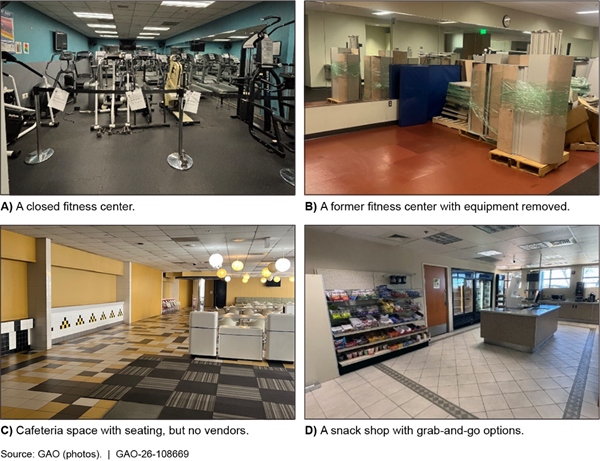
Fitness centers in some federal buildings have not reopened post-pandemic due to the time and resources associated with operating fitness centers, according to GSA officials. GSA officials noted that GSA does not manage fitness centers, so a committee of staff from tenant agencies must coordinate to open and manage a joint-use fitness center. Staff are not paid for that work, and fitness centers have added liability concerns, according to GSA officials.[17] Fitness centers in buildings we visited were generally closed or available to one agency.[18] The following are examples of fitness center status from our site visits:
· In the Kluczynski Federal Building, GSA officials said that the U.S. District Court had taken control of the fitness center following its closure during the pandemic. However, there is no requirement to share this space, and the U.S. District Court cited security concerns as a reason not to open the fitness center for use by other tenant agencies, according to GSA officials.
· In the Fallon Federal Building, GSA officials said they were considering turning a former fitness center into working space for a tenant agency.
· At the Denver Federal Center, a local private gym has a contract to operate a fitness center out of a building on the campus. The gym is available to federal employees to join as independent members.
· While the fitness centers at some buildings we visited were closed, in some cases employees still may have access to the fitness center locker rooms. For example, at the Metcalfe Federal Building, agency officials said that employees who bike to work used the locker rooms to shower and change clothes before work.
None of the buildings we visited had a functioning cafeteria, though most buildings we visited had a snack shop or café with grab-and-go food options. GSA officials said that they have seen vendors move away from opening cafeterias (which require more expense up front) to more flexible and less expensive formats, like food trucks, pop-up shops, vending machines, or grab-and-go markets. Food service spaces were open to all tenant agencies in a building, and in some cases, to the public. At the Metcalfe Federal Building, there was a cafeteria, but no vendors were operating out of the space at the time of our site visit in February 2026. GSA officials said that they are considering converting the cafeteria into office space and leasing it to an agency. At one building we visited at the Denver Federal Center, officials said the cafeteria had been continuously closed for nearly a year as of June 2026 and had been functionally non-operational for the majority of the previous five years.
Agency Officials and Industry Stakeholders Identified Benefits and Challenges to Sharing Special Use Spaces
Interviewees Identified Benefits to Sharing Space Such As Access to More Useful Space and Reduced Costs
In 26 interviews, GSA officials, agency officials within selected buildings, and industry stakeholders most commonly identified the following benefits to sharing special use spaces: 1) access to useful space that they may not otherwise have (15 of 26 interviewees); 2) reduced costs and a more efficient use of space (11 of 26 interviewees); and 3) increased collaboration between agencies (6 of 26 interviewees).
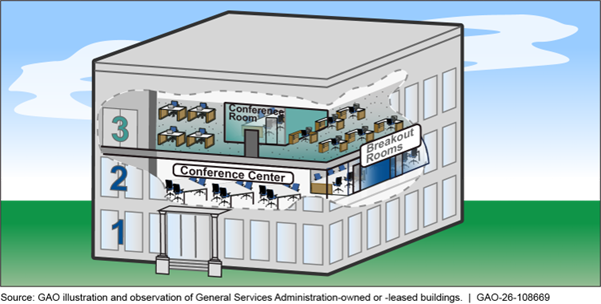
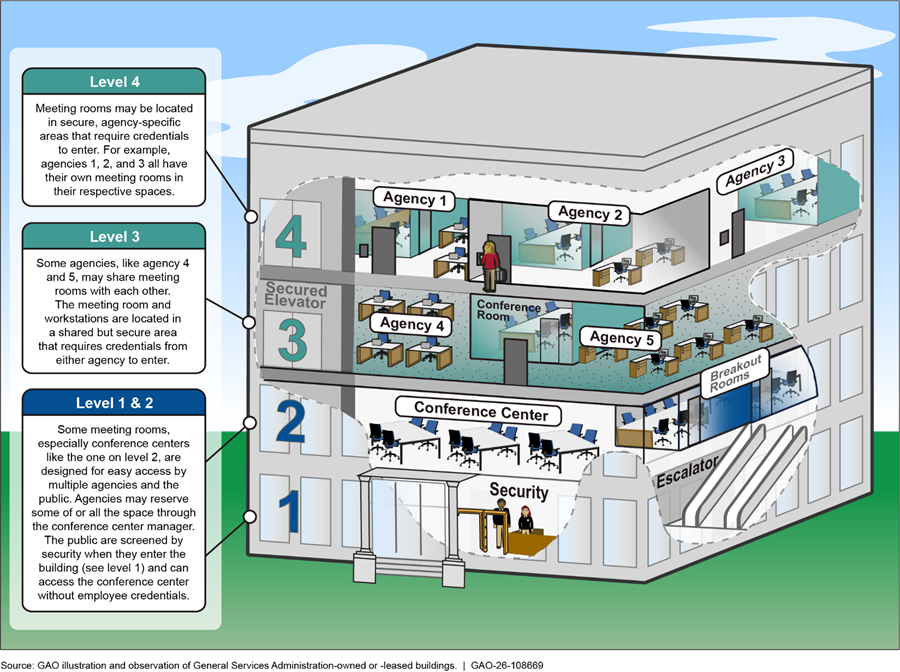
· Access to useful space. Fifteen of 26 interviewees highlighted benefits of sharing related to accessing useful and flexible space that they might not otherwise be able to access. Thirteen of these interviewees noted that large meeting spaces, such as conference centers, can be particularly useful for agencies. For example, officials from one agency said that large meeting spaces are well-suited for onboarding, training, and all-hands meetings that span multiple departments in an agency. Officials from another agency said that large meeting spaces can accommodate in-office “retreats” when budget constraints would otherwise prevent them. Certain larger spaces we observed were situated in parts of the building that were easier to access by the public for external stakeholder meetings. See figure 5 for an example of this set-up. For example, in one building, the GSA-managed conference center was on a main level and behind one entry security check, not in a dedicated agency space that would require additional entry checks or agency escorts.
· Reduced costs and more efficient use of space. Eleven of 26 interviewees identified benefits related to reduced costs and efficient use of space. Officials from one agency said that shared meeting spaces reduce redundant space across agencies. Specifically, they said if agencies share meeting spaces, individual agencies do not need to lease or construct individual spaces. These officials said that sharing space can maximize the use of existing square footage and lower overall operating costs. Additionally, GSA officials at one building we visited said that the availability of large, shared conference centers allows agencies to avoid renting hotel space, thus reducing costs. GSA officials at another building said that the availability of shared meeting spaces allows agencies to maintain a smaller and more efficient footprint while still having access to larger meeting spaces for occasional large events or all-staff meetings.
· Increased collaboration. Six of 26 interviewees identified collaboration as a benefit related to sharing space. For example, officials from some agencies said that sharing special use spaces creates opportunities to meet and collaborate with other federal employees they may not otherwise interact with. Specifically, officials from one agency said that in attending a meeting at a shared conference center with other federal agencies, they learned about a meeting space that they could use when they needed to have larger meetings. Officials from another tenant agency said that sharing space allows the agency to “be a team player” and get to know officials from other agencies.
Most of the benefits we heard associated with sharing special use spaces applied to meeting spaces (conference centers and meeting rooms), since the cafeterias and fitness centers in our selected buildings were generally not in operation. However, officials from some agencies noted that access to fitness centers and cafeterias provided employees benefits related to health and convenience.
Interviewees Said IT, Availability, and Awareness Are Challenges to Sharing Special Use Spaces
The most common challenges to sharing special use spaces that GSA officials, agency officials within selected buildings, and industry stakeholders identified were: 1) information technology (IT) issues (13 of 26 interviewees); 2) availability (10 of 26 interviewees); and 3) lack of awareness on how to find or reserve space (8 of 26 interviewees).[19]
· IT. Thirteen of 26 interviewees identified IT as a challenge to sharing spaces. Seven of these interviewees noted access issues due to differences in agency IT systems. For example, officials from some tenant agencies said that incompatible agency IT set-ups can make it difficult to log into the computer system in a shared conference room. Others said that accessing another agency’s Wi-Fi can be difficult or not permitted. Additionally, officials at one agency said that they have a firewall within their designated spaces and cannot access their system without it, making it difficult to use a shared conference room outside of their designated space. Six of the 13 interviewees that cited IT issues specifically identified the quality of the technology in shared spaces as a challenge. For example, officials from tenant agencies noted that the technology in large meeting spaces in multiple selected buildings is not updated. They said this outdated technology limits the usefulness of the meeting spaces. For example, rooms may lack videoconferencing capabilities or audio/visual equipment, or the technology may not work at all. A GSA official at one of the locations we visited agreed with the tenant agencies that the technology was outdated and explained that GSA weighs the cost of upgrading technology in a conference center against the potential future use of the space.
· Availability. Ten of 26 interviewees discussed challenges related to availability of special use spaces, particularly larger meeting spaces. Specifically, larger meeting spaces may be difficult to reserve when agencies need them, such as during months with busy conference schedules. Officials from one tenant agency said they have to reserve space at the building’s conference center months in advance or it will not be available due to high demand among other agencies. Additionally, officials from some agencies said that the more often meeting spaces are shared with other agencies, the harder it is to secure those meeting spaces for last-minute meetings. For example, GSA officials talked about an agency that needs its conference space whenever there is a natural disaster, but they cannot foresee when those events will occur.
· Awareness. Eight of 26 interviewees noted that agencies may lack awareness of which spaces are available, the process for reserving space, or whom to contact regarding availability or to reserve a space. Some interviewees noted it is difficult to know which spaces can be reserved and whether those spaces are available due to the lack of a universal reservation system for all agencies. Officials from one agency said that since there is no scheduling integration across agencies, they need to know whom to contact at other agencies regarding room availability. Most of the tenant agency officials we interviewed within selected buildings said that a centralized resource could help them identify and reserve shareable meeting space. They identified information that such a resource would ideally include, such as the capacity of rooms, the configurations offered, the technology available, a point of contact, and how much it costs to reserve the space, among other information. For example, an official from one agency said they may need a larger meeting space that is easy for the public to access, so knowing size and information on whether and how the public can access the space would be helpful in a resource.
In addition to the three challenges above, GSA officials and other interviewees identified billing and cost allocation as challenges to sharing spaces. GSA officials noted this is particularly challenging if the shared space is primarily dedicated to one agency, as GSA currently relies on tenants’ occupancy in a building to allocate costs for joint-use space. GSA officials noted that issues related to billing and costs could make it difficult for agencies to share their designated space. Some tenant agencies also raised this issue when discussing sharing their own space. For example, officials at one tenant agency said that agencies may be reluctant to share space due in part to difficulties estimating how to charge other agencies for use of the space and how to prioritize internal use over external use. Officials from another tenant agency said that they have chosen not to charge other agencies to use their designated space due to the administrative cost of doing so. In May 2026, GSA officials told us they completed a pilot that evaluated various ways to share office space, including meeting and training space, and that one aspect of the pilot was determining how to charge for access to such space. GSA officials said they are determining next steps for how to operationalize the pilot.
GSA officials from one selected building and officials from a tenant agency in another selected building also mentioned the difficulty planning for future needs, especially given recent developments such as changes in telework, return to office requirements, and technology changes. Specifically, they said these developments have made it difficult for GSA and tenant agencies to predict the need for conference rooms and other special use spaces, as well as for GSA to weigh the value of improving existing spaces (e.g., updating technology).
GSA Maintains a List of Meeting Spaces to Promote Space Sharing, but It Is Not Comprehensive or Well-Known by Agencies
GSA Maintains a List of Meeting Spaces to Promote Space Sharing, but It Is Not Comprehensive
GSA’s Office of Real Property Policy compiles a list of federal meeting spaces available for other agencies’ use (referred to as the Federal Meeting Space Tool or Federal Meeting Facilities report).[20] GSA has maintained this list for at least 13 years, and it is available through a publicly available link on GSA’s website.[21] According to GSA’s website, agencies’ participation in the list is voluntary and the list is not exhaustive, even of GSA spaces. While most of the meeting spaces on the list are GSA-managed, it also includes meeting spaces offered by other agencies. As of March 2026, GSA’s list included 83 GSA meeting spaces and 55 meeting spaces offered by 12 other agencies, including the Department of Defense and the Department of the Interior. In addition, the list has information about the features of the available meeting spaces, such as each space’s location, capacity, technological capabilities, cost, and a point of contact to reserve the space. GSA’s website states that the list is intended to help agencies reduce costs by using federal spaces for their meetings, conferences, and events.
GSA officials said they periodically ask participating agencies to update the information about their spaces on the list. Specifically, they said that GSA sends an email asking for updates to all points of contact from participating agencies on the list and provided examples of emails. Additionally, they said that at the monthly meetings of the Federal Real Property Council, GSA officials ask council members to add, remove, or update the information about their spaces on the list.[22] As discussed below, GSA has also taken steps to expand its outreach about the list to include other agencies.
GSA officials told us some agencies do not add meeting spaces to the list because of security concerns around sharing those spaces. Officials we spoke with from one agency confirmed this. However, GSA officials also said that some agencies with such security concerns have modeled GSA’s list internally. For example, according to GSA officials, the Department of Homeland Security does not add its space to GSA’s list, but they have developed a similar list for internal use.
We also observed that GSA’s list of meeting spaces is not comprehensive. For example, we noted that some GSA meeting rooms we saw on our site visits were not included on the list. GSA officials confirmed this and said that some GSA spaces are not listed because the office responsible for the list does not have a contact in every building.
In Response to Workforce Changes, GSA Has Taken Steps to More Frequently Update and Communicate About the List
GSA officials noted that recent workforce changes in the federal government have contributed to reduced awareness of the federal meeting spaces list.[23] Specifically, they explained that staff turnover in 2025 resulted in more of GSA’s reminder emails about the list going undelivered to agencies due to out-of-date points of contact. GSA officials said they depend on agencies to distribute the list to their staff, but that agency staff reductions and changes have made agencies’ contact lists out of date, too. The officials said this makes it difficult for agencies to distribute the list internally. Additionally, GSA said that following recent efforts to consolidate federal space, agencies have not added space to the list, and in some cases, have removed meeting spaces from the list because they are no longer available.
In response to these challenges, GSA officials said they have taken some steps in an effort to keep the list up to date. GSA officials said that in January 2026, they increased the frequency of their outreach emails from semi-annually to quarterly. They said most of GSA’s emails about the federal meeting spaces list are sent to the participating points of contact. However, the officials said that to increase the spaces offered on the list and the agencies using the list, GSA had also reached out to all the Small Agency Council agencies in July 2025 to invite them to participate in the list.[24] GSA officials said that at least two Small Agency Council agencies added spaces to the list after that email, and that those agencies are now also contacted quarterly for updates. Additionally, the officials said they are working with agencies to update the points of contact on the list as they find out about personnel changes.
Tenant Agency Officials Were Generally Unaware of GSA’s List of Meeting Spaces, but Noted Such a List Could Help Them Share Spaces
Officials from most of the tenant agencies within selected buildings were not aware of GSA’s federal meeting spaces list, according to our interviews. Specifically, officials from one out of the 18 tenant agencies we interviewed within selected buildings mentioned a resource that resembled the federal meeting spaces list, and those officials said they did not use the list because they thought the list was out of date. In contrast, headquarters officials from three agencies we spoke with had heard of the list but have not added their meeting spaces to the list.[25] The reasons these officials gave for not adding their meeting spaces to or using the list were that they did not have enough space to share, had their own space to use, or, as previously mentioned, had security concerns.
Some tenant agency officials in selected buildings said that GSA employees were a resource to locate and access meeting spaces outside their own agency space. For example, all tenant agency officials we interviewed in the Metcalfe Federal Building in Chicago said that the manager of GSA’s conference center in that building was an important resource to help identify available meeting space. Officials from two agencies in the Kluczynski Federal Building (located across the street from the Metcalfe Federal Building) also said GSA’s employees connected with the Metcalfe Federal Building conference center were a resource for identifying meeting spaces.
Additionally, officials from some tenant agencies in selected buildings mentioned that staff in other agencies are a resource to identify and access federal meeting spaces. For example, officials from one agency in the Bank of America Towers in Baltimore mentioned that if their own conference room could not accommodate a larger meeting, they could reach out to another agency in the area and ask to use their larger training room. Officials from another agency said that their Chicago field office space could not accommodate larger meetings but that a manager established a relationship with an employee from another agency that resulted in them being able to use that agency’s larger meeting room.
However, officials from some tenant agencies reported that recent changes in federal staffing levels have contributed to fewer relationships with staff in other agencies. For example, officials we interviewed from a tenant agency in a selected building said that their agency’s program support center (which included staff that assisted with identifying meeting space) was closed due to staffing reductions. These officials said that because of this, their agency’s departments do not share their special use space internally or with other agencies as often as they did before the staffing reductions.
As previously discussed, officials we interviewed from most agencies in selected buildings said a list of available federal meeting spaces could help them reduce costs or identify shareable meeting space. They told us they were not aware of GSA’s federal meeting spaces list, and some described potential benefits of such a resource:
· Some officials said that a list of available federal meeting spaces could help reduce their costs by identifying free or low-cost meeting spaces. For example, an agency official noted that since their employees are located across the country, such a list would help them pick a meeting location based on the cost of available space. One official said a list would help them find cost-free meeting space in their region for larger events, which they have once or twice a year.
· Officials from some tenant agencies we interviewed said that a list of available federal meeting spaces could also help them identify shareable meeting space. For example, some officials we interviewed were more aware of meeting spaces managed by GSA than similar tenant-owned spaces in their building. Furthermore, one agency official said that this list could help preserve information about available space amid staff turnover. GSA officials also said that with new utilization initiatives and space constraints, agencies are looking for opportunities to share space. They further noted that when they are obtaining new space for agencies, they consider nearby amenities, as well as the agency’s needs (such as how often they will need to access special use spaces).
GSA officials said that increasing agency awareness of the federal meeting spaces list could help support GSA’s focus on reducing the federal footprint and sharing space. This focus is reflected in GSA’s strategic goals related to optimizing the federal building portfolio. Specifically, one of GSA’s strategic goals is to optimize the federal buildings portfolio by increasing the utilization of federal space for GSA and customer agencies.[26] Per GSA’s 2027 annual performance plan, this will be accomplished by using tools to evaluate how agencies can co-locate and share spaces with the goal of reducing costs, offering flexible solutions, and leveraging underutilized space. In our prior work we found that a leading practice to enhance interagency collaboration is sharing relevant information and data.[27] GSA may be able to leverage existing efforts to broaden its distribution of the list beyond the tenant agency points of contact GSA already works with, which in turn could lead to more agencies using the list and adding their own spaces to it. For example, in our interviews, GSA officials noted that they could increase agency awareness of the list and suggested that one way to do so would be leveraging contact information from GSA’s Space Intake Portal (formerly Space Match).[28] GSA officials said they could use the Space Intake Portal’s contact list to update and distribute the federal meeting spaces list. In addition, GSA officials noted that they were considering using results from the previously mentioned pilot program to develop a tool to help agencies find and reserve space, which could include special use spaces. These actions that GSA is considering would be positive steps toward increasing agency awareness of opportunities to share special use spaces. However, GSA has not yet determined which actions it will take, or how, if, and when it will apply relevant findings from its pilot towards improving space sharing.
By taking additional steps to ensure a more comprehensive list and increase agency awareness, such as by leveraging existing efforts to more effectively communicate with agencies about its federal meeting spaces list, GSA could better meet its goals related to efficient use of space. In addition, these steps could help agencies increase collaboration and potentially reduce costs by sharing meeting spaces.
Conclusions
GSA and other federal agencies have taken some steps to more efficiently use space in federally owned and federally leased buildings. Many of those efforts have been focused on reducing excess office space, but additional efficiencies could be gained by further facilitating the sharing of meeting spaces, such as conference centers. However, there are challenges to sharing meeting spaces, including agencies’ lack of awareness of available space.
Both GSA and tenant agency officials agreed that GSA’s federal meeting spaces list could facilitate the sharing of meeting spaces. Agency participation and use of the list is voluntary, but opportunities exist for GSA to increase the comprehensiveness of the list by ensuring all of its relevant spaces are included on the list and encouraging other agencies to add their spaces to the list. In addition, opportunities exist for GSA to improve agency awareness of the list by more effectively communicating about it to agencies. For example, GSA could use its Space Intake Portal contact list to broaden its distribution of the list, or use lessons learned from its recent pilot to inform next steps. Increased agency awareness of the list could lead to more agencies adding space to the list. Helping agencies share meeting space could improve efficient use of this space, reduce agencies’ costs to maintain or rent meeting space, increase interagency communication, and provide support for agency mission needs.
Recommendations for Executive Action
We are making the following two recommendations to GSA:
The Administrator of GSA should improve the comprehensiveness of its federal meeting facilities list by adding all of GSA’s relevant meeting spaces to the list and encouraging other agencies to add their spaces to the list. (Recommendation 1)
The Administrator of GSA should take additional steps to increase tenant agency awareness of its federal meeting facilities list. This could include leveraging existing efforts, such as the results of GSA’s shared space pilot and contact lists from other GSA programs, like the Space Intake Portal. (Recommendation 2)
Agency Comments
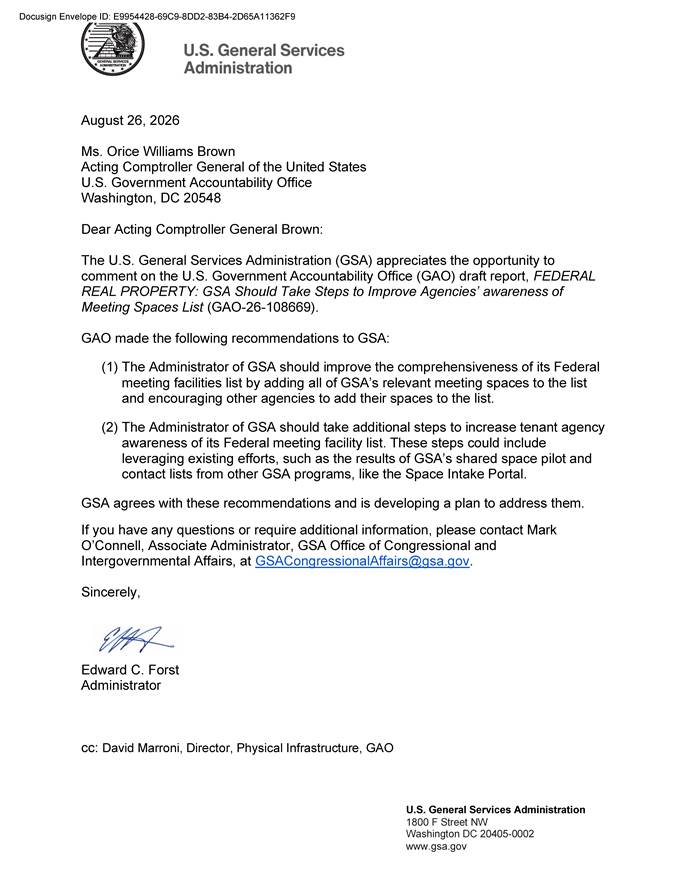
We provided a draft of this report to GSA and the Department of Veterans Affairs for review and comment. GSA provided written comments, which are reproduced in appendix I. The Department of Veterans Affairs did not have any comments on the report. GSA agreed with our recommendations and stated that it is developing a plan to address them.
We are sending copies of this report to the appropriate congressional committees, the Administrator of the General Services Administration, the Secretary of the Department of Veterans Affairs, and other interested parties. In addition, the report is available at no charge on the GAO website at https://www.gao.gov.
If you or your staff have any questions about this report, please contact me at MarroniD@gao.gov. Contact points for our Offices of Congressional Relations and Media Relations may be found on the last page of this report. GAO staff who made key contributions to this report are listed in appendix II.

David Marroni
Director, Physical Infrastructure
GAO Contact
David Marroni, MarroniD@gao.gov
Staff Acknowledgments
In addition to the contact named above, Crystal Huggins (Assistant Director); Madeline Welter (Analyst in Charge); Melissa Bodeau; Emily Crofford; Terence Lam; Shannon Murphy; Susan Murphy; Emilee Pugh Bell; Erin Villareal; Malika Williams; and Alicia Wilson made key contributions to this report.
The Government Accountability Office, the audit, evaluation, and investigative arm of Congress, exists to support Congress in meeting its constitutional responsibilities and to help improve the performance and accountability of the federal government for the American people. GAO examines the use of public funds; evaluates federal programs and policies; and provides analyses, recommendations, and other assistance to help Congress make informed oversight, policy, and funding decisions. GAO’s commitment to good government is reflected in its core values of accountability, integrity, and reliability.
Obtaining Copies of GAO Reports and Testimony
The fastest and easiest way to obtain copies of GAO documents at no cost is through our website. Each weekday afternoon, GAO posts on its website newly released reports, testimony, and correspondence. You can also subscribe to GAO’s email updates to receive notification of newly posted products.
Order by Phone
The price of each GAO publication reflects GAO’s actual cost of production and distribution and depends on the number of pages in the publication and whether the publication is printed in color or black and white. Pricing and ordering information is posted on GAO’s website, https://www.gao.gov/ordering.htm.
Place orders by calling (202) 512-6000, toll free (866) 801-7077,
or
TDD (202) 512-2537.
Orders may be paid for using American Express, Discover Card, MasterCard, Visa, check, or money order. Call for additional information.
Connect with GAO
Connect with GAO on X,
LinkedIn, Instagram, and YouTube.
Subscribe to our Email Updates. Listen to our Podcasts.
Visit GAO on the web at https://www.gao.gov.
To Report Fraud, Waste, and Abuse in Federal Programs
Contact FraudNet:
Website: https://www.gao.gov/about/what-gao-does/fraudnet
Automated answering system: (800) 424-5454
Media Relations
Sarah Kaczmarek, Managing Director, Media@gao.gov
Congressional Relations
David A. Powner, Acting Managing Director, CongRel@gao.gov
General Inquiries
[1]GAO, High Risk Series: Heightened Attention Could Save Billions More and Improve Government Efficiency and Effectiveness, GAO‑25‑107743 (Washington, D.C.: Feb. 25, 2025).
[2]The Utilizing Space Efficiently and Improving Technologies (USE IT) Act, enacted in January 2025, requires certain federal agencies, including GSA, to measure building utilization, based on building capacity and occupancy. Federal agencies began reporting in accordance with the USE IT Act in March 2026. This USE IT Act data showed low building utilization rates government-wide. According to GSA officials, approximately 22 percent of agency spaces were reported as exceeding the 60 percent utilization benchmark and 78 percent were reported as not doing so.
[3]Throughout the report, we refer individually to conference centers, training centers, and meeting rooms. In some places, we refer to these spaces collectively as meeting spaces.
[4]Pub. L. No. 118-272, § 2304(d) 138 Stat. 2992, 3224.
[5]We focused on GSA due to its role in obtaining space for federal agencies. GSA is responsible for managing federal real property for many federal agencies, including providing workspaces for more than 1 million federal employees. We were unable to measure or review utilization of special use spaces because GSA doesn’t track utilization across its buildings, according to GSA officials.
[6]We primarily focused on buildings in areas outside of Washington, D.C. because these areas tended to have more multi-tenant buildings and because we became aware of specific examples of sharing special use spaces in these areas.
[7]Our interviews at the Ronald Reagan Building and International Trade Center did not include federal tenant agencies, as most had already moved out ahead of the Federal Bureau of Investigation’s planned relocation of its headquarters to that building, according to GSA officials. Throughout the report, we sometimes use indefinite quantifiers, including “most” for more than half of a group of interviewees and “some” for half or fewer of a group.
[8]We assessed the geographic concentration of federal buildings by dividing study cities into consistent geographic units and calculating the number of federal buildings within each unit. This allowed us to identify and select buildings in areas where federal buildings were more densely clustered. We used the GSA Inventory of Owned and Leased Properties dataset in this analysis. We assessed the reliability of this data by reviewing existing information about the data and the system that produced them, and interviewing agency officials knowledgeable about the data. We determined the data were sufficiently reliable for the purposes of this report.
[9]GAO, Government Performance Management: Leading Practices to Enhance Interagency Collaboration and Address Crosscutting Challenges, GAO‑23‑105520 (Washington, D.C.: May 24, 2023). GAO developed these leading practices based on reviews of scholarly and peer-reviewed literature related to collaboration and interviews with agency officials and subject matter specialists, among others.
[10]We refer to agencies that have an occupancy agreement with GSA as tenant agencies throughout the report.
[11]General Services Administration, Public Buildings Service, Pricing Desk Guide, 5th Edition, (Washington, D.C.: August 1, 2020). For example, if an agency occupied 30 percent of a building, it would cover a proportional 30 percent of the costs for the shared spaces.
[12]General Services Administration, GSA Fitness Center Services Policy, (Washington, D.C.: December 16, 2020).
[13]While GSA does not have a formal program for sharing special use spaces, GSA officials told us that they have conducted pilot programs related to effectively sharing spaces, including special use spaces.
[14]This included one tenant agency that also indicated that they might share their meeting rooms with other agencies but had not been asked.
[15]Specifically, GSA provided us with spreadsheets containing lists of food services and fitness centers and information on the locations of those spaces. The spreadsheet of food services also contained information on characteristics of those spaces. For example, the inventory of food services contained information on the type of service (e.g., whether it was a cafeteria, vending machine, or prepackaged service, and whether it was open or closed).
[16]GSA officials said that they have a few strategies to repurpose cafeteria and fitness spaces, depending on demand. However, officials said it is very costly to repurpose space, and they do not do so unless an agency has asked for more space, Specifically, GSA officials said they have modified former cafeterias for agency use, but it has only happened a few times.
[17]According to GSA’s Fitness Center Services Policy, all joint-use fitness centers must be managed by an entity other than GSA to minimize risk to GSA. GSA’s only role in fitness centers, including joint-use fitness centers, is assisting with the build-out of the space and guiding the tenant agency or agencies through the process of establishing a fitness center.
[18]Specifically, fitness centers in two buildings were closed. Fitness centers in two other buildings were available for use by one agency in each of those buildings. At another building, the fitness center was open to federal employees on an individual membership basis. In our sixth selected building, there was a private fitness center chain that was open to the public.
[19]Similar to the previous section, the challenges interviewees identified were mainly associated with meeting spaces (conference centers and meeting rooms), since the cafeterias and fitness centers in our selected buildings were generally not in operation.
[20]Federal meeting spaces include training centers, conference centers, and other meeting rooms. GSA does not include information on fitness centers because, as previously mentioned, they generally do not have a role in managing fitness centers.
[21]See GSA’s website for their list of federal meeting spaces available for other agencies’ use. “Federal Meeting Facilities,” Real Property Policy Division, GSA, accessed June 22, 2026, https://www.gsa.gov/policy-regulations/policy/real-property-policy-division-overview/federal-meeting-facilities.
[22]The Federal Real Property Council includes agency Senior Real Property Officers, the Controller of the Office of Management and Budget (OMB), the Administrator of General Services, and any other officials or employees who the OMB Deputy Director for Management, who chairs the Council, determines to be necessary. 40 U.S.C. § 623(c)(1).
[23]We have previously reported that in response to executive orders, the total workforce for 22 agencies decreased by over 11 percent in 2025, with multiple agencies having declines of over 20 percent. GAO, Federal Agency Workforce Changes: Update for July 2025 to January 2026, GAO‑26‑108583 (Washington, D.C.: Jun. 17, 2026).
[24]The Small Agency Council is the voluntary management association of sub-Cabinet, independent Federal agencies. Established in 1986, the Council represents about 80 small agencies.
[25]As mentioned earlier, we spoke with headquarters officials from three of the tenant agencies, at the request of those officials.
[26]See GSA’s website for GSA’s Mission: “Mission and background,” About GSA, GSA, accessed June 25, 2026, https://www.gsa.gov/about-gsa/mission-and-background. To see GSA’s Fiscal Year 2027 Annual Performance Plan Strategic Objective 1.1: GSA, “Increase utilization of federal space for GSA and customer agencies,” Fiscal Year 2027 Annual Performance Plan, https://www.gsa.gov/system/files/FY_2027_GSA_Annual_Performance_Plan.pdf.
[28]GSA’s Space Intake Portal is tenant agencies’ starting point to submit detailed requests for space. Tenant agencies submit information to GSA’s Space Intake Portal on many topics, including description of a space need, contact information, location, mission/operational need statement, and shared space restrictions, among others.