
INDIAN AFFAIRS
Information on 2025 Workforce Reductions
Report to the Vice Chairman, Committee on Indian Affairs, U.S. Senate
United States Government Accountability Office
A report to the Vice Chairman, Committee on Indian Affairs, U.S. Senate
For more information, contact: Anna Maria Ortiz at OrtizA@gao.gov.
What GAO Found
The Department of the Interior’s Indian Affairs took actions to reduce its workforce in 2025 after presidential directives, executive branch-wide guidance, and directives from the Secretary of the Interior. Its total workforce, which was 7,470 in January 2025, decreased by a net 11 percent (846 staff) to 6,624 as of July 2025.
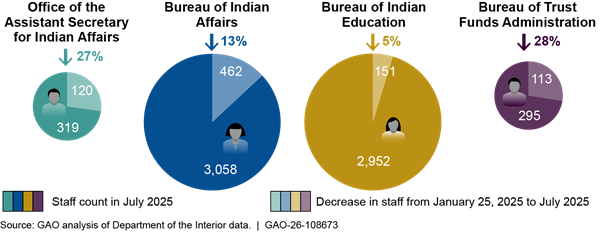
Staff separations through two deferred resignation programs accounted for most of the decrease. Indian Affairs implemented the first program, as directed by the Office of Personnel Management for executive agencies, in January and February 2025. Indian Affairs offered another program in May to (1) comply with executive direction and (2) offer voluntary separation to staff concerned about potential involuntary reductions in force. Some positions were excluded from the May program—such as positions in law enforcement, social work, and permitting—because of the nature of their job functions and responsibilities.
Indian Affairs officials said they had not yet analyzed projected cost savings or operational impacts from these staff reductions. However, officials observed that many staff who separated through the two programs were already eligible for retirement. Some remaining staff took on additional responsibilities to mitigate the effects of reductions. Some Indian Affairs staff said the reductions would exacerbate preexisting staffing limitations in their offices and make it more difficult to carry out their responsibilities serving Tribes.
Tribal leaders voiced concerns about the effects of the staff reductions. Some stated that Indian Affairs already did not have adequate staff to effectively carry out U.S. trust responsibilities and that service delivery was impaired. GAO has previously reported on the effect of long-standing shortcomings in workforce capacity at Indian Affairs and has several open recommendations to the agency to improve workforce planning.
Indian Affairs officials said there were no plans to reorganize or further reduce the workforce as of December 2025, but existing functions might need to be restructured or realigned to achieve administration priorities. Officials said they would develop supporting plans, if needed, to satisfy future policy decisions. Indian Affairs did not provide any comments on this report.
Why GAO Did This Study
The U.S. has undertaken a unique trust responsibility to protect and support Tribes and their members through treaties, statutes, and historical relations with Tribes. Federal laws require federal agencies to provide a variety of services and benefits to Tribes and their members. Indian Affairs provides services directly to Tribes or funding for tribally administered programs, including support for tribal government operations, law enforcement, and natural resources management.
GAO was asked to review Indian Affairs’ actions to downsize its workforce since January 2025. This report describes actions taken by Indian Affairs to reduce the size of the workforce, the number of staff reductions in 2025, initial observations from Tribes and Indian Affairs employees, and any Indian Affairs plans for additional workforce reductions.
GAO reviewed statutes, regulations, executive orders, guidance, and information from ongoing and prior work on Indian Affairs’ capacity and workforce planning. GAO reviewed workforce data from January 25, 2025, through July 31, 2025. GAO interviewed officials from Indian Affairs about actions, data, observations, and plans for downsizing its workforce and reviewed published comments that Tribes provided at tribal consultations.
Abbreviations
|
BIA |
Bureau of Indian Affairs |
|
BIE |
Bureau of Indian Education |
|
BTFA |
Bureau of Trust Funds Administration |
|
CHCO |
Chief Human Capital Officer |
|
DRP |
Deferred Resignation Program |
|
DOGE |
Department of Government Efficiency |
|
IRA |
Inflation Reduction Act of 2022 |
|
OMB |
Office of Management and Budget |
|
OPM |
Office of Personnel Management |
|
RIF |
Reductions in force |
|
VERA |
Voluntary Early Retirement Authority |
This is a work of the U.S. government and is not subject to copyright protection in the United States. The published product may be reproduced and distributed in its entirety without further permission from GAO. However, because this work may contain copyrighted images or other material, permission from the copyright holder may be necessary if you wish to reproduce this material separately.
January 27, 2026
The Honorable Brian Schatz
Vice Chairman
Committee on Indian Affairs
United States Senate
Dear Vice Chairman Schatz:
Beginning on January 20, 2025, presidential directives and guidance from the Office of Management and Budget (OMB) and Office of Personnel Management (OPM) directed federal agencies to downsize the federal workforce and restructure the federal government. In implementing this direction, the Department of the Interior’s Indian Affairs took actions to reduce the size of its workforce, which was 7,470 staff on January 25, 2025.
Indian Affairs provides a wide variety of services and funding for tribally administered programs to 575 federally recognized Tribes, serving approximately 2.5 million American Indians and Alaska Natives. Indian Affairs includes four components: the Office of the Assistant Secretary for Indian Affairs, the Bureau of Indian Affairs (BIA), the Bureau of Indian Education (BIE), and the Bureau of Trust Funds Administration (BTFA). These components carry out a broad range of missions, such as supporting tribal government operations, law enforcement, tribal schools, and natural resource management.
You asked us to review Indian Affairs’ actions to downsize its workforce since January 20, 2025. This report describes
· the actions Indian Affairs has taken to reduce the size of its workforce,
· the number of staff reductions,
· initial observations from Tribes and Indian Affairs employees about the loss of staff, and
· Indian Affairs’ plans for additional workforce reductions.
To address these objectives, we reviewed relevant statutes, regulations, executive orders, and guidance, as well as information from our ongoing and prior work on Indian Affairs’ capacity and workforce planning. We interviewed officials with Indian Affairs, including the senior advisor to the Secretary of the Interior exercising the delegated authority of the Assistant Secretary for Indian Affairs, regarding actions, data, observations, and plans for downsizing its workforce. In addition, we discussed observations about the reduced workforce during interviews conducted with agency staff during our other ongoing reviews.
To describe the staffing and capacity changes, we requested data from January 20, 2025, through July 31, 2025. Indian Affairs provided data from Interior’s Federal Personnel and Payroll System and internal spreadsheets developed specifically to track recent personnel changes. To assess data reliability, we conducted error checks, reviewed relevant documents, and interviewed agency officials knowledgeable about the data. Based on our assessment, we determined these data were sufficiently reliable for the purpose of presenting Indian Affairs’ workforce data as provided to us from the agency. We calculated net separations for each component using data on hires, terminations, retirements, and all other departure types.
To collect information on Tribes’ observations regarding the reduced workforce, in addition to the interviews discussed above, we reviewed Interior’s published summary of comments from Tribes at a tribal consultation. The information we obtained from these interviews and comments provides a broad perspective of relevant issues but is not generalizable to all entities.
We conducted our work from August 2025 to January 2026 in accordance with all sections of GAO’s Quality Assurance Framework that are relevant to our objectives. The framework requires that we plan and perform the engagement to obtain sufficient and appropriate evidence to meet our stated objectives and to discuss any limitations in our work. We believe that the information and data obtained, and the analysis conducted, provide a reasonable basis for any findings and conclusions in this product.
Background
The Department of the Interior and Indian Affairs’ Responsibilities
The United States has undertaken a unique trust responsibility to protect and support Tribes and their citizens through treaties, statutes, and historical relations with Tribes.[1] Specifically, federal laws require federal agencies to provide a variety of services and benefits to Tribes and their citizens. As several tribal leaders have previously noted, these trust obligations and responsibilities do not exist as a form of federal welfare but as a repayment on a nation-to-nation agreement.[2]
Indian Affairs consists of four components within Interior that provide services directly to Tribes or funding for tribally administered programs:
· The Office of the Assistant Secretary for Indian Affairs assists the Secretary of the Interior in fulfilling Interior’s trust responsibilities to Tribes and tribal citizens. The various offices within the Office of the Assistant Secretary for Indian Affairs have different functions: oversight and administration of programs pertaining to economic development and self-governance activities of Indian Affairs and leadership, policy, and oversight of budget, acquisition, property, accounting, fiscal services, information technology, planning, facilities operations, and human resources.
· BIA provides services directly to Tribes or funding for tribally administered programs. BIA conducts this work through central offices, 12 regional offices, and 83 agency offices located across the country. Central offices are responsible for developing policies, guidance, and training for the regional and agency offices. The central, regional, and agency offices jointly implement a broad range of programs, including road and bridge safety; domestic violence programs; financial assistance, including emergency and disaster assistance; public safety and justice programs, law enforcement, and court services; and trust services to assist Tribes and tribal citizens in managing and developing their lands and natural resources.
· BIE is responsible for providing quality education opportunities to American Indian and Alaska Native students at elementary and secondary schools and postsecondary institutions. BIE provides grants or contracts to Tribes to operate elementary, secondary, and postsecondary institutions. BIE also operates 55 elementary and secondary schools and two postsecondary institutions (Haskell Indian Nations University and Southwestern Indian Polytechnic Institute). BIE operates schools with BIE staff and staff that have annual employment contracts.[3]
· BTFA manages more than $8 billion in trust funds for Tribes and individuals with Individual Indian Money accounts.[4] Trust funds include payments from judgment awards, settlements of claims, land use agreements, royalties on natural resource use, other proceeds derived directly from trust resources, and financial investments. Within BTFA, the Trust Operations office is divided into four separate divisions responsible for field operations, accounting service to beneficiaries, settlement support, and information resources and trust records. The Trust Beneficiary Call Center can provide account updates and disbursement information, check the status of a request, and explain quarterly benefits. BTFA operates in field offices around the country that are primarily collocated with BIA agency offices.
Executive directives and Interior policies require agencies to consult with federally recognized Tribes on federal policies that have tribal implications.[5] Per Interior policy, tribal consultation is a formal, two-way, government-to-government dialogue between official representatives of Tribes and federal agencies to discuss federal proposals before the federal agency makes decisions on those proposals.[6] Interior policy is to provide sufficient notice to tribal leaders of the consultation. After the consultation, the agency is to explain to tribal leaders how the final agency decision incorporates tribal input.
Prior Reports on Workforce Capacity at Indian Affairs
We have previously reported on the impact of long-standing capacity challenges on Indian Affairs’ ability to provide services to Tribes and their citizens. In particular, since 2017, our High Risk List updates have identified challenges with workforce capacity within Indian Affairs bureaus.[7] In October 2023, we identified workforce capacity issues impeding Indian Affairs’ ability to provide services in a timely manner to support Tribes’ and individuals’ use of their land for residential and economic development purposes.[8] In March 2024, we found that a lack of workforce planning and insufficient staff capacity hinders BIE’s ability to conduct monitoring activities in schools that received COVID-19 relief funds.[9]
In November 2024, we reported that the appropriations from the Inflation Reduction Act of 2022 (IRA) for new and existing programs that serve Tribes and their citizens increased the workload for Indian Affairs components implementing IRA programs.[10] At the time, Indian Affairs officials said that the additional workload and competing priorities strained the agency’s already limited workforce capacity.[11] We made six recommendations to improve Indian Affairs’ workforce planning activities, none of which have been implemented. For example, we recommended that the Assistant Secretary for Indian Affairs track vacancy data in a systematic and centralized manner, as well as identify skills, knowledge, and competency gaps in mission-critical occupations across Indian Affairs.
Actions by the Executive Branch
Beginning January 20, 2025, the President, OMB, and OPM issued directives and guidance with stated goals including “restoring accountability, eliminating waste, bloat, and insularity, and reforming the federal workforce to maximize efficiency and productivity.”[12] These directives and guidance initiated a hiring freeze, a voluntary Deferred Resignation Program (DRP), and terminations of probationary employees and instructed agencies to develop plans for large-scale reductions in force (RIF) and reorganizations. Interior issued an order describing plans for consolidation as a result of the directives and guidance from the administration. See table 1.
Table 1: Timeline of Selected Workforce Actions by the President, OMB, OPM, and the Department of the Interior After January 20, 2025
|
Date |
Description |
|
January 20, 2025 |
Presidential Memorandum of January 20, 2025, “Hiring Freeze,” 90 Fed. Reg. 8247 (Jan. 28, 2025) The President issued a memorandum ordering a hiring freeze of federal civilian employees throughout the executive branch. The memorandum directed the Office of Management and Budget (OMB), in consultation with the Office of Personnel Management (OPM) and the U.S. Department of Government Efficiency (DOGE) Service, to submit a plan to reduce the size of the federal government’s workforce through efficiency improvements and attrition.a |
|
January 20, 2025 |
OPM Guidance on Probationary Periods, Administrative Leave and Details This guidance required agencies to provide OPM with a report identifying all probationary employees by January 24, 2025, and to promptly determine whether those employees should be retained.b The Chief Human Capital Officers (CHCO) Council subsequently communicated to agency CHCOs and deputy CHCOs that the council had asked that agencies separate probationary employees that the agencies had not identified as mission critical, no later than February 17, 2025.c The OPM guidance and agency terminations of probationary employees have been challenged in several lawsuits.d |
|
January 28, 2025 |
Deferred Resignation Program OPM released information allowing federal employees to voluntarily resign via a Deferred Resignation Program (DRP).e Deferred resignation was available to full-time federal employees, except for military personnel of the armed forces, employees of the U.S. Postal Service, and those in positions specifically excluded by the employing agency. OPM explained that electing employees would retain all pay and benefits, regardless of workload, until their effective resignation date, which could be no later than September 30, 2025. Electing employees would promptly have their duties reassigned or eliminated and be placed on administrative leave, except during necessary transition activities. Under the Department of the Interior’s DRP, employees who were eligible for early or normal retirement during calendar year 2025 could also accept the DRP but had to retire no later than December 31, 2025. |
|
February 11, 2025 |
Exec. Order 14210 of February 11, 2025, “Implementing the President’s ‘Department of Government Efficiency’ Workforce Optimization Initiative,” 90 Fed. Reg. 9669 (Feb. 14, 2025) This executive order directs federal agency heads to undertake preparations to initiate large-scale reductions in force (RIFs), consistent with applicable law.f |
|
February 26, 2025 |
OPM and OMB, “Guidance on Agency RIF and Reorganization Plans Requested by Implementing the President’s ‘Department of Government Efficiency’ Workforce Optimization Initiative” OMB and OPM issued guidance that noted that Exec. Order 14210 directed agency heads to promptly undertake preparations to initiate large-scale RIFs consistent with applicable law and prepare reorganization plans. The guidance outlines the principles agencies should achieve with reorganization plans, including better serving the American people, significantly reducing full-time equivalent positions by eliminating positions that are not required, reducing the real property footprint, and reducing the topline budget. |
|
March 13, 2025 |
Deadline for Phase 1 RIF and Reorganization Plans OMB and OPM instructed agencies to submit a Phase 1 RIF and reorganization plan no later than March 13, 2025. These plans were to include a timetable and the specific tools the agency will use in fiscal years 2025, 2026, and 2027 to achieve efficiencies, including continuation of the current hiring freeze and attrition through various means, including RIFs. For each tool in the Phase 1 plan, OMB and OPM requested the number of full-time equivalents reduced and any potential savings and an agency timetable. |
|
April 14, 2025 |
Deadline for Phase 2 RIF and Reorganization Plans The OMB and OPM guidance also request agencies to submit a Phase 2 plan for review and approval no later than April 14, 2025. The guidance asked that a number of elements be included in the plan (e.g., a proposed future organization chart, any proposed relocations of agency bureaus and offices from Washington, D.C., competitive areas for large-scale RIFs) and that the plans be targeted for implementation by September 30, 2025. |
|
April 17, 2025 |
Department of the Interior Secretary’s Order No. 3429, “Consolidation, Unification and Optimization of Administrative Functions” On April 17, 2025, in response to Exec. Order 14210, Interior issued Secretary’s Order No. 3429. The purpose of this order is to take steps to consolidate, unify, and optimize administrative functions within Interior to achieve effectiveness, accountability, and cost-savings. The order explains that Interior will undertake a unification and consolidation into the Office of the Secretary of functions across the department and its components. Functions to consolidate include human resources, information technology, financial management, training and development, international affairs, contracting, communications, and federal financial assistance, among other administrative functions. |
Source: GAO analysis of presidential directives, agency guidance, and related documentation. | GAO‑26‑108673
aIn Exec. Order 14158 of January 20, 2025, 90 Fed. Reg. 8441 (Jan. 29, 2025), the United States Digital Service was renamed the U.S. Department of Government Efficiency (DOGE) Service, and the U.S. DOGE Service Temporary Organization was established within the Executive Office of the President.
bOffice of Personnel Management, Guidance on Probationary Periods, Administrative Leave and Details, Memorandum to Heads and Acting Heads of Departments and Agencies (Jan. 20, 2025).
cEmail from CHCO Council, re: “Follow up: CHCO Council Special Session” (Feb. 14, 2025).
dIn one such case, the U.S. District Court for the Northern District of California recently partially granted plaintiffs’ motion for summary judgment, ruling that OPM lacked authority to direct agencies to terminate their employees. The court also permanently enjoined OPM from doing so, and defendant agencies from following any such OPM direction, except in accordance with OPM regulations at 5 C.F.R. § 5.3, and directed agencies to correct the stated bases for terminating probationary employees, while not ordering reinstatement of the employees. Am. Fed’n of Gov’t Emps. v. Off. of Personnel Mgmt., No. 3:25-cv-1780, 2025 U.S. Dist. LEXIS 179606 (N.D. Cal., Sept. 12, 2025) (appealed Am. Fed’n of Gov’t Emps. v. Off. of Personnel Mgmt., No. 25-5875 (9th Cir.)).
eThe DRP was challenged, although the case was dismissed. Am. Fed’n of Gov’t Employees v. Ezell, No. 1:25-cv-10276, 2025 U.S. Dist. LEXIS 187652 (D. Mass., Sept. 24, 2025). That dismissal has been appealed. Am. Fed’n of Gov’t Employees v. Kupor, No. 25-1959 (1st Cir.).
fWorkforce reduction actions stemming from Exec. Order 14210 are currently subject to a number of legal challenges. See, e.g., Am. Fed’n of Gov’t Emps. v. Trump, No. 3:25-cv-3698 (N.D. Cal.) (appealed Am. Fed’n of Gov’t Emps. v. Trump, No. 25-3293 (9th Cir.)); Nat’l Treasury Employees Union v. Trump, No. 1:25-cv-420 (D.D.C.).
Indian Affairs’ Actions to Reduce the Size of Its Workforce
In response to Presidential direction to downsize, Indian Affairs implemented a hiring freeze and offered two resignation programs in 2025. Indian Affairs initiated the hiring freeze on January 20, 2025. However, Indian Affairs has since hired a limited number of staff. According to the Acting Deputy Assistant Secretary for Management, Indian Affairs obtained waivers from OPM to hire staff for law enforcement, health, and public safety.
Indian Affairs implemented the initial DRP directed by OPM in January and February 2025. OPM’s instructions to agencies said that employees approved for the DRP should be placed on administrative leave promptly, unless the agency head determined that it was necessary for the employee to be actively engaged in transitioning job duties, in which case employees should be placed on administrative leave as soon as those duties are transitioned.[13] Employees could resign and retain pay and benefits until September 30, 2025, or earlier if the employee desired.
Interior employees had until February 12, 2025, to volunteer for the initial DRP. According to Indian Affairs officials, most employees across all components of Indian Affairs were eligible for this DRP. However, the Acting Deputy Assistant Secretary for Management said that employees focused on safety and employees working for BIE-operated schools were not eligible.
Additionally, Interior offered employees the ability to retire early through the Voluntary Early Retirement Authority (VERA), in conjunction with the initial DRP, to incentivize employee departures for individuals who otherwise might not choose to resign.[14] VERA temporarily lowers the age and years of service requirements in order to increase the number of employees who are eligible to retire.[15] With VERA, eligible employees can retire at age 50 with 20 years of service or at any age with 25 years of service. Under the terms of Interior’s DRP, employees who were eligible for either early or normal retirement during calendar year 2025 had to retire no later than December 31, 2025.
Interior offered two other resignation and retirement opportunities in March 2025 and April 2025 to certain employees. However, Interior exempted Indian Affairs programs pending the completion of consultations with Tribes. Interior’s announcement for the April resignation program noted that Interior was planning for RIFs and that the “goal with this workforce optimization is to offer an opportunity for the dedicated employees who have served the American people.”[16]
Although Indian Affairs had not yet consulted with Tribes, in May 2025, the agency offered another opportunity to Indian Affairs employees to resign or retire through a DRP. According to the Acting Deputy Assistant Secretary for Management, the agency initiated this DRP because of the executive direction to reduce the workforce. A DRP would allow employees to leave voluntarily and give Indian Affairs more control in reshaping the workforce than a potential RIF. With a DRP, Indian Affairs could also exclude some critical positions. Indian Affairs officials said involuntary staff reductions via RIF would likely lead to the loss of early-career staff who would be needed as the future workforce in these agencies. In addition, Indian Affairs officials told us that employees concerned about a potential RIF were requesting the DRP from Indian Affairs so that they could leave voluntarily.
Interior authorized this Indian Affairs’ DRP in a May 9, 2025, memorandum.[17] According to the memorandum, this program was available to certain employees in the Office of the Assistant Secretary for Indian Affairs, BIA, and BTFA. This DRP excluded BIE employees. The memorandum noted that Indian Affairs retained the discretion to limit or reject deferred resignation elections.
As with the initial resignation program, the May memorandum offered Indian Affairs employees the opportunity to resign, retire, or take early retirement and continue to receive pay and benefits until September 30, 2025. If approved, those employees would have an effective resignation date of September 30, 2025, or earlier, or an effective retirement date of December 31, 2025, or earlier. Employees had to express interest via an online form between May 9, 2025, and a deadline of May 16, 2025. According to Indian Affairs officials, after employees expressed interest, there was a time period during which they could withdraw. The officials said that the deadline for withdrawing varied among the components, but all withdrawals had to be concluded by July 31, 2025. Once approved for the DRP, employees had to be placed on administrative leave by May 23, 2025.
The May 2025 memorandum exempted a number of positions from participating in the resignation program due to the nature of the job functions and responsibilities. These included the occupational series, positions, or critical skillsets listed in table 2.
|
Agency |
Position |
|
Bureau of Indian Affairs (BIA) |
Public safety positions – law enforcement, security, and firefighters |
|
Social workers |
|
|
Positions supporting rate payer-funded activities (e.g., irrigation and power utilities), with written approval from the Senior Advisor to the Secretary, exercising the delegated authority of the Assistant Secretary Policy, Management and Budget |
|
|
Safety of Dams engineers |
|
|
Probate Strike Team positions |
|
|
Permitting positions (skills, knowledge, or other factors related to permitting activities for energy development) with written approval from the Senior Advisor to the Secretary, exercising the delegated authority of the Assistant Secretary Policy, Management and Budget |
|
|
Bureau of Trust Funds Administration (BTFA) |
Financial analysts |
|
Office of the Assistant Secretary for Indian Affairs, BIA, and BTFA |
Personnel security |
|
Engineers and architects in Water Resources, Transportation, and Facilities offices |
|
|
Self-determination positions with an awarding official warrant |
|
|
Cybersecurity |
Source: GAO analysis of Department of the Interior documents. | GAO‑26‑108673
Note: Information is from the Secretary of the Interior’s May 9, 2025, memorandum, Indian Affairs Programs and Organizations Limited Deferred Resignation/Retirement Program (DRP) and DRP with Voluntary Early Retirement Authority (VERA) Open Period – May 9, 2025, to May 16, 2025.
Indian Affairs Resignation Programs Led to Workforce Reductions
The size of Indian Affairs and its components’ workforce decreased in the first half of 2025 following the resignation programs and hiring freezes. Staff separations were attributable to the resignation programs, as well as other factors including retirements, other resignations, and terminations. Overall, Indian Affairs experienced a 11 percent net decrease (846 staff) in its total workforce, from 7,470 staff to 6,624, after January 25, 2025, according to data from Interior and its components—the Office of the Assistant Secretary, BIA, BTFA, and BIE—which independently tracked the number of staff who separated in 2025 (see fig. 1).[18]
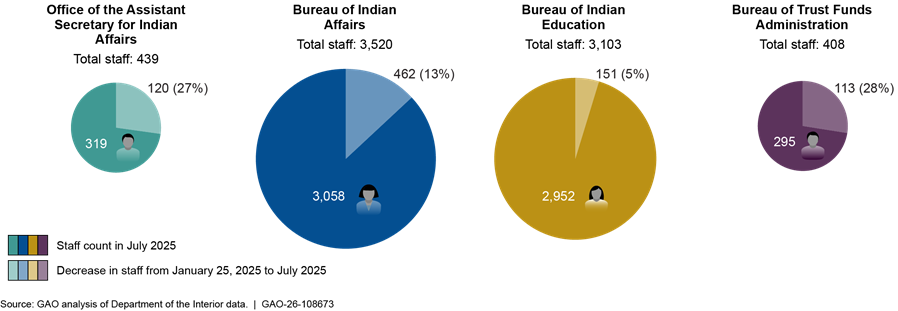
Note: The data for total staff are from January 25, 2025. The July staff counts for the Office of the Assistant Secretary for Indian Affairs, BIA, and BTFA are through July 31, 2025. The July staff count for BIE is through July 12, 2025. The decrease includes staff who elected the DRP before July 2025 but had an effective resignation or retirement date after July 2025.
Within the Office of the Assistant Secretary for Indian Affairs, BIA, BIE, and BTFA, almost every office experienced a decrease in staff, but the percent of decrease differed. Within the Office of the Assistant Secretary for Indian Affairs, each office that supports operations, such as the Office of Budget and Performance Management and Office of Human Capital, lost at least 20 percent of its staff, and the Office of Information Technology lost 35 percent. Three BIA central offices—the Office of Trust Services, the Office of the Director of BIA, and the Office of Indian Services—lost 15 percent, 24 percent, and 25 percent of staff, respectively. The Office of Justice Services had an overall workforce reduction of 4 percent. This office employs public safety officers, which were excluded from the Indian Affairs May DRP, and hired some staff.
Staff in all BIA regions decreased by between 10 percent (Western and Rocky Mountain regions) and 29 percent (Pacific region). The Alaska, Midwest, and Southern Plains regions each lost more than 20 percent of staff (see table 3).
|
Region |
Number of staff on January 25, 2025 |
Net decrease in staff |
Percent decrease in staff |
|
Alaska |
93 |
20 |
22% |
|
Eastern Oklahoma |
150 |
21 |
14% |
|
Eastern |
67 |
8 |
12% |
|
Great Plains |
316 |
46 |
15% |
|
Midwest |
123 |
26 |
21% |
|
Navajo |
208 |
35 |
17% |
|
Northwest |
332 |
53 |
16% |
|
Pacific |
99 |
29 |
29% |
|
Rocky Mountain |
265 |
27 |
10% |
|
Southern Plains |
136 |
36 |
26% |
|
Southwest |
221 |
31 |
14% |
|
Western |
442 |
45 |
10% |
Source: GAO analysis of Department of the Interior data. | GAO‑26‑108673
Note: We calculated net decrease in staff by including staff hires and staff separations through one of the Deferred Resignation Programs or through other resignations, termination, death, or retirement.
At BIE, of the employees eligible for the OPM-directed DRP, staff decreased by 9 percent.[19] The percentage decrease varied by office within BIE. For example, the School Operations Division—which includes acquisition, grants management, safety and facilities-related issues—lost 9 percent of its staff. At the postsecondary institutions, Haskell Indian Nations University and Southwestern Indian Polytechnic Institute, staff decreased by 11 percent and 5 percent, respectively.
Although school staff with annual contracts were excluded from both the OPM DRP and Indian Affairs DRP, this category decreased by 4 percent. A BIE official said that this was due to limited hiring while normal attrition continued. Appendix I provides details on the number of positions hired, separated with the DRPs, and other separations for each office in BIE.
At BTFA, all but one office lost at least 18 percent of staff, with some offices losing 50 percent or more. The Office of Business Management—which manages activities such as budget, finance, communications, and policy—lost half of its staff. The Trust Operations field staff—the primary point of contact for trust beneficiaries seeking information and services in conjunction with their trust assets—decreased by 26 percent. Appendix I provides details on the number of positions hired, separations through the DRPs, and other separations for each office in BTFA.
For the Office of the Assistant Secretary for Indian Affairs, BIA, and BTFA, most of the staff separating after January 25, 2025, were resigning or retiring through the two DRPs. However, a smaller portion of separations were other types, such as resignations and retirements outside of the DRPs. For example, of the staff separating from BIA after January 25, 2025, 76 percent were resigning or retiring through the DRPs and 24 percent separated outside of the DRPs. At BTFA, 91 percent of staff separating were resigning or retiring through the DRPs and 9 percent separated outside of the DRPs.
Most staff departing under the DRPs were experienced staff opting to retire or take early retirement, compared to those resigning. At the Office of the Assistant Secretary for Indian Affairs, 78 employees were retiring or taking early retirement compared to 27 resigning. At BIA, 290 employees were retiring or taking early retirement compared to 140 resigning. At BIE, four employees were retiring or taking early retirement compared to 27 resigning. At BTFA, 82 employees were retiring or taking early retirement compared to 21 resigning.
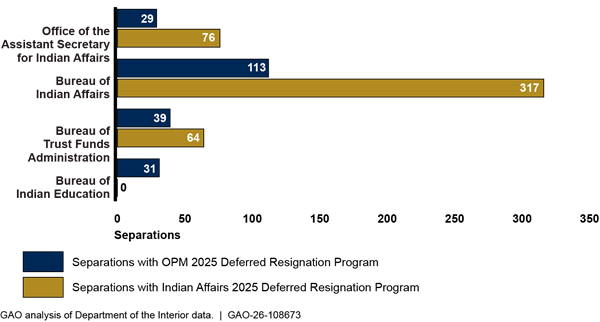
Overall, the number of staff separating through the DRP that Indian Affairs offered in May 2025 was higher than the number separating through the OPM-directed DRP offered in January and February 2025. For example, 113 BIA staff are separating through the OPM-directed DRP, but 317 are separating through Indian Affairs’ second DRP. Figure 2 shows information on DRP separations for all components.
Figure 2: Separations Through the OPM Directed Deferred Resignation Program Compared to the Indian Affairs Deferred Resignation Program
Indian Affairs and Tribes Provided Initial Observations About the Impacts of Workforce Reductions
Indian Affairs officials and Tribes provided initial observations about the potential impacts of actual and expected staff reductions at Indian Affairs. According to the Acting Deputy Assistant Secretary for Management, Indian Affairs is carrying out the administration’s goal of reducing the federal workforce while also upholding the trust and treaty obligations to Tribes and their citizens. According to this official, Indian Affairs believed it was better to reduce staff voluntarily (via the DRP) than to potentially have to involuntarily reduce staff later if budget cuts were to occur in fiscal year 2026.
Indian Affairs officials explained that many of the staff who separated through the DRPs were retirement eligible. The loss of senior employees can result in the loss of institutional knowledge, leadership, and expertise, which is not quickly replaced. These officials said that while this resulted in a loss of experienced staff, many of these staff were expected to leave Indian Affairs components in the near future anyway.
Indian Affairs officials also told us they had not analyzed any projected future cost savings from these staff reductions or the impacts of the staff reductions on operations. However, they provided initial observations about the effects of staff reductions. One Indian Affairs official said that while there had not been a wholesale gap in service, some service times likely increased. Another Indian Affairs official noted the loss of experienced staff in leadership roles, with a number of staff in an acting capacity. For example, as of June 2, 2025, six of the 12 BIA regional directors were acting and 12 of the 24 deputy regional director positions were acting or vacant.
Other staff expressed concerns about the effect of additional staff reductions on preexisting workforce capacity limitations. In meetings we held with BIA regional and agency offices between March 2025 and August 2025, some BIA staff told us that staff reductions due to the DRPs would exacerbate existing staffing limitations at their offices and make it more difficult to carry out their responsibilities serving Tribes. In prior GAO reports, we have found programs at BIA, BIE, and BTFA with long-standing capacity challenges, including limited staff and issues with retention.[20] Such circumstances make it difficult for components to meet mission needs across competing priorities.
Furthermore, some BIA agency staff described having to take on additional work beyond their primary area of responsibility because of recent staff departures. This resulted in delays in carrying out work related to their primary responsibility. Some BIA regional staff described confusion about which employees were leaving, which limited their ability to effectively plan for impending departures. They also described limited guidance from superiors about how to cover the responsibilities of departing staff.
BIA regional officials said departures left a void in specific programs. One regional director reported that some agency offices in the region did not have staff for agriculture, forestry, or realty programs. Another regional director said the region also lost a number of staff who assist with advising and processing funds for Tribes that have contracts that allow them to operate programs in lieu of BIA. The region also lost fire and social services staff. Another regional director said significant losses for the region included an environmental scientist and a hydrologist who handled dam safety.
Indian Affairs officials noted initial actions taken to mitigate the effects of staff reductions:
· The Acting BTFA Director explained that call wait times to the Trust Beneficiary Call Center initially increased but that the agency was able to realign the call system so field staff could assist with calls. The Acting Director said BTFA did not have any backlogs.
· The Acting Deputy Assistant Secretary for Management, the BIA Director of Field Operations, and the Acting Director of BTFA said they have had to rebalance the workload among staff, and staff have taken on additional responsibilities that are allowable in their positions.
· Indian Affairs officials also reported using other approaches to addressing workforce reductions, such as details and hiring waivers. Waivers have been approved for several health and safety positions such as law enforcement, firefighting, and social work. One BIA official explained that they were looking beyond the regional structure to pull together cross-regional teams in mission areas where they believed they lacked the capacity to handle a function well.
Leaders from Tribes voiced concerns about the effects of the staff reductions on trust responsibilities and service delivery during the tribal consultation sessions Indian Affairs held in May and June. Indian Affairs held the consultation to seek input on several topics, including the potential restructuring of Indian Affairs to support more efficient interactions with Tribes; the effectiveness of current funding structures, including identifying efficiency barriers to expedite funding to Tribes and tribal programs; and how to increase Indian Affairs’ support for tribal self-governance and self-determination.
During the consultation, a theme that tribal leaders and other participants highlighted was that Indian Affairs components, such as BIA, BTFA, and BIE, already did not have adequate staff to effectively carry out their trust responsibilities to Tribes and that staff reductions had adversely impacted service delivery. Some tribal leaders said that additional staff were needed and emphasized the efficiency benefits that come with having long-term, well-trained staff. Tribal leaders raised concerns about the loss of specialized knowledge, such as knowledge about service delivery to Tribes in Alaska, resulting from the loss of staff with extensive or specialized experience. Other concerns raised included that staff reductions took place before consultation, that limited information was provided to tribal leaders about future reorganization and staff reductions for tribal consultation, and that the consultation included unrelated, complex, contentious topics (i.e., related to permitting for energy development) in a single discussion.
Indian Affairs Reported That It Did Not Yet Have Future Reorganization and Workforce Reduction Plans
As of December 2025, Indian Affairs officials said they did not have plans to reorganize or further reduce the workforce. According to the Acting Deputy Assistant Secretary for Management, Indian Affairs received an exemption from Exec. Order 14210’s direction to agencies to prepare a workforce reduction plan, including RIFs, in order to perform tribal consultations and otherwise ensure tribal realty and trust obligations. Furthermore, presentation material at the tribal consultations held in May and June stated that Interior would consider whether to consolidate some of Indian Affairs’ functions after the consultations. As of September 2025, Indian Affairs officials confirmed that they were in the process of analyzing the results of the consultations but that they had not been directed to reorganize the way other Interior agencies were directed to.[21]
The Acting Deputy Assistant Secretary for Management said that as agency personnel evaluate the feedback from the tribal consultations—along with further direction and guidance from the administration, Department of the Interior, OPM, and OMB—there may be a need to restructure or realign existing functions to better achieve the administration’s priorities. In addition, the Acting Deputy Assistant Secretary for Management said fiscal year 2026 appropriations or other statutory language might also require Indian Affairs to restructure, depending on actual appropriated amounts. The Acting Deputy Assistant Secretary for Management said they would develop supporting plans, if needed, to satisfy future requirements and policy decisions.
Agency Comments
We provided a draft of this report to Indian Affairs for review and comment. Indian Affairs did not provide any comments on the report.
As agreed with your office, unless you publicly announce the contents of this report earlier, we plan no further distribution until 8 days from the report date. We are sending copies of this report to the relevant congressional committees, the Secretary of the Interior, the Assistant Secretary for Indian Affairs, and other interested parties. In addition, the report is available at no charge on the GAO website at http://www.gao.gov.
If you or your staff have any questions about this report, please contact me at ortiza@gao.gov. Contact points for our Offices of Congressional Relations and Public Affairs may be found on the last page of this report. GAO staff who made key contributions to this report are listed in appendix II.
Sincerely,
Anna Maria Ortiz
Director, Natural Resources and Environment
The following tables provide additional details about workforce departures from the four Indian Affairs components in 2025: the Office of the Assistant Secretary for Indian Affairs, the Bureau of Indian Affairs, the Bureau of Indian Education, and the Bureau of Trust Funds Administration.
Indian Affairs offered two Deferred Resignation Program (DRP) opportunities in 2025: an initial DRP directed by the Office of Personnel Management in January and February 2025, and a DRP initiated by Indian Affairs in May 2025. Indian Affairs employees had the opportunity to resign, retire, or take early retirement and continue to receive pay and benefits until September 30, 2025. If approved, those employees would have an effective resignation date of September 30, 2025, or earlier, or an effective retirement date of December 31, 2025, or earlier. The decreases noted in these tables include staff who elected either DRP, with or without Voluntary Early Retirement Authority (VERA), before July 31, 2025. This decrease includes staff who elected the DRP before July 2025 but had an effective resignation or retirement date after July 2025.
Table 4: Staff Changes in the Office of the Assistant Secretary for Indian Affairs, January 25, 2025–July 31, 2025
|
Office |
Staff on January 25, 2025 |
Hires |
Separations through Deferred Resignation Programs |
All other separations |
Net decrease |
Percent decrease |
|
Assistant Secretary for Indian Affairs Programs |
14 |
1 |
2 |
3 |
4 |
29% |
|
Deputy Assistant Secretary, Management |
|
|
|
|
|
|
|
Front Office |
9 |
0 |
5 |
0 |
5 |
56% |
|
Office of Budget and Performance Management |
28 |
0 |
6 |
1 |
7 |
25% |
|
Office of the Chief Financial Officer |
66 |
0 |
11 |
2 |
13 |
20% |
|
Office of Human Capital Management |
107 |
2 |
21 |
3 |
22 |
21% |
|
Office of Facilities, Property and Safety Management |
42 |
1 |
10 |
4 |
13 |
31% |
|
Office of Information Technology |
114 |
0 |
37 |
3 |
40 |
35% |
|
Subtotal, Deputy Assistant Secretary, Management |
366 |
3 |
90 |
13 |
100 |
27% |
|
Deputy Assistant Secretary, Policy and Economic Development |
|
|
|
|
|
|
|
Division of Capital Investment |
6 |
1 |
1 |
0 |
0 |
0% |
|
Division of Economic Development |
6 |
1 |
1 |
0 |
0 |
0% |
|
Office of Federal Acknowledgement |
8 |
0 |
0 |
0 |
0 |
0% |
|
Office of Indian Economic Development |
5 |
0 |
2 |
0 |
2 |
40% |
|
Office of Indian Gaming |
7 |
0 |
1 |
2 |
3 |
43% |
|
Office of Self-Governance |
11 |
0 |
2 |
1 |
3 |
27% |
|
Subtotal, Deputy Assistant Secretary, Policy and Economic Development |
43 |
2 |
7 |
3 |
8 |
19% |
|
Principal Deputy Assistant Secretary |
|
|
|
|
|
|
|
Office of Congressional and Legislative Affairs |
3 |
0 |
3 |
0 |
3 |
100% |
|
Office of Public Affairs |
4 |
0 |
0 |
1 |
1 |
25% |
|
Office of Regulatory Affairs and Collaborative Action |
7 |
0 |
2 |
0 |
2 |
29% |
|
White House Council on Native American Affairs |
2 |
0 |
1 |
1 |
2 |
100% |
|
Subtotal, Principal Deputy Assistant Secretary |
16 |
0 |
6 |
2 |
8 |
50% |
|
Total, Office of the Assistant Secretary for Indian Affairs |
439 |
6 |
105 |
21 |
120 |
27% |
Source: GAO analysis of Department of the Interior data. | GAO‑26‑108673
|
Office/region |
Staff on January 25, 2025 |
Hires |
Separations through Deferred Resignation Programs |
All other separations |
Net decrease |
Percent decrease |
|
Central offices |
|
|
|
|
|
|
|
Office of the Director |
29 |
0 |
6 |
1 |
7 |
24% |
|
Office of Indian Services |
32 |
0 |
7 |
1 |
8 |
25% |
|
Office of Justice Services |
747 |
21 |
18 |
33 |
30 |
4% |
|
Office of Trust Services |
260 |
2 |
28 |
14 |
40 |
15% |
|
Subtotal, central offices |
1068 |
23 |
59 |
49 |
85 |
8% |
|
Regions |
|
|
|
|
|
|
|
Alaska |
93 |
1 |
17 |
4 |
20 |
22% |
|
Eastern Oklahoma |
150 |
4 |
20 |
5 |
21 |
14% |
|
Eastern |
67 |
3 |
9 |
2 |
8 |
12% |
|
Great Plains |
316 |
8 |
50 |
4 |
46 |
15% |
|
Midwest |
123 |
2 |
21 |
7 |
26 |
21% |
|
Navajo |
208 |
19 |
46 |
8 |
35 |
17% |
|
Northwest |
332 |
7 |
44 |
16 |
53 |
16% |
|
Pacific |
99 |
0 |
21 |
8 |
29 |
29% |
|
Rocky Mountain |
265 |
13 |
33 |
7 |
27 |
10% |
|
Southern Plains |
136 |
0 |
34 |
2 |
36 |
26% |
|
Southwest |
221 |
8 |
30 |
9 |
31 |
14% |
|
Western |
442 |
17 |
46 |
16 |
45 |
10% |
|
Subtotal, regions |
2452 |
82 |
371 |
88 |
377 |
15% |
|
Total, Bureau of Indian Affairs |
3520 |
105 |
430 |
137 |
462 |
13% |
Source: GAO analysis of Department of the Interior data. | GAO‑26‑108673
|
Unit |
Staff on January 25, 2025 |
Hires |
Separations through the Office of Personnel Management (OPM) 2025 Deferred Resignation Program (DRP) |
All other separations |
Net decrease |
Percent decrease |
|
|
Staff eligible for DRP |
|
|
|
|
|
|
|
|
Director, Bureau of Indian Education |
30 |
0 |
4 |
1 |
5 |
17% |
|
|
Chief Academic Officer |
15 |
0 |
0 |
0 |
0 |
0% |
|
|
Deputy Director, School Operations |
108 |
0 |
7 |
3 |
10 |
9% |
|
|
Division of Performance & Accountability |
26 |
0 |
1 |
1 |
2 |
8% |
|
|
Education Human Resources |
38 |
0 |
2 |
1 |
3 |
8% |
|
|
Bureau Operated Schools |
26 |
0 |
3 |
0 |
3 |
12% |
|
|
Navajo Schools |
21 |
0 |
0 |
0 |
0 |
0% |
|
|
Tribally Controlled Schools |
20 |
0 |
0 |
1 |
1 |
5% |
|
|
Haskell Indian Nations University |
179 |
0 |
11 |
9 |
20 |
11% |
|
|
Southwest Indian Polytechnic Institute |
92 |
0 |
3 |
2 |
5 |
5% |
|
|
Subtotal, eligible staff |
555 |
0 |
31 |
18 |
49 |
9% |
|
|
Staff ineligible for DRP |
|
|
|
|
|
|
|
|
Bureau Operated K-12 Schools |
1251 |
8 |
0 |
61 |
53 |
4% |
|
|
Navajo K-12 Schools |
1297 |
4 |
0 |
53 |
49 |
4% |
|
|
Subtotal, ineligible staff |
2548 |
12 |
0 |
114 |
102 |
4% |
|
|
Total, Bureau of Indian Education |
3103 |
12 |
31 |
132 |
151 |
5% |
|
Source: GAO analysis of Department of the Interior data. | GAO‑26‑108673
Note: According to a BIE memorandum from February 27, 2025, the Department of the Interior and OPM determined that employees with annual employment contracts were not eligible for the OPM DRP because they have time-limited appointments. The Indian Affairs DRP excluded BIE staff.
|
Unit |
Staff on January 25, 2025 |
Hires |
Separations through Deferred Resignation Programs |
All other separations |
Net decrease |
Percent decrease |
|
Director |
2 |
0 |
1 |
0 |
1 |
50% |
|
Principal Deputy Bureau Director |
3 |
0 |
3 |
0 |
3 |
100% |
|
Chief of Staff |
4 |
0 |
0 |
0 |
0 |
0% |
|
Office of Beneficiary Experience |
4 |
0 |
1 |
0 |
1 |
25% |
|
Office of Business Management |
26 |
0 |
11 |
2 |
13 |
50% |
|
Office of Communication, Policy, and Training |
13 |
0 |
8 |
0 |
8 |
62% |
|
Office of Strategic Oversight and Planning |
33 |
0 |
6 |
0 |
6 |
18% |
|
Trust Operations – Field |
156 |
0 |
37 |
3 |
40 |
26% |
|
Trust Operations – Accounting |
79 |
0 |
17 |
4 |
21 |
27% |
|
Trust Operations – Settlement Support |
15 |
0 |
5 |
0 |
5 |
33% |
|
Trust Operations – Information Resources and Trust Records |
73 |
0 |
14 |
1 |
15 |
21% |
|
Total, Bureau of Trust Funds Administration |
408 |
0 |
103 |
10 |
113 |
28% |
Source: GAO analysis of Department of the Interior data. | GAO‑26‑108673
GAO Contact
Anna Maria Ortiz, OrtizA@gao.gov
Staff Acknowledgements
In addition to the contact named above, Paige Gilbreath (Assistant Director), Leigh White (Analyst in Charge), Ava Bagley, William Gerard, Gina Hoover, Gwen Kirby, Caroline Neidhold, Matt Ray, and Sara Sullivan made significant contributions to this report.
The Government Accountability Office, the audit, evaluation, and investigative arm of Congress, exists to support Congress in meeting its constitutional responsibilities and to help improve the performance and accountability of the federal government for the American people. GAO examines the use of public funds; evaluates federal programs and policies; and provides analyses, recommendations, and other assistance to help Congress make informed oversight, policy, and funding decisions. GAO’s commitment to good government is reflected in its core values of accountability, integrity, and reliability.
Obtaining Copies of GAO Reports and Testimony
The fastest and easiest way to obtain copies of GAO documents at no cost is through our website. Each weekday afternoon, GAO posts on its website newly released reports, testimony, and correspondence. You can also subscribe to GAO’s email updates to receive notification of newly posted products.
Order by Phone
The price of each GAO publication reflects GAO’s actual cost of production and distribution and depends on the number of pages in the publication and whether the publication is printed in color or black and white. Pricing and ordering information is posted on GAO’s website, https://www.gao.gov/ordering.htm.
Place orders by calling (202) 512-6000, toll free (866) 801-7077,
or
TDD (202) 512-2537.
Orders may be paid for using American Express, Discover Card, MasterCard, Visa, check, or money order. Call for additional information.
Connect with GAO
Connect with GAO on X,
LinkedIn, Instagram, and YouTube.
Subscribe to our Email Updates. Listen to our Podcasts.
Visit GAO on the web at https://www.gao.gov.
To Report Fraud, Waste, and Abuse in Federal Programs
Contact FraudNet:
Website: https://www.gao.gov/about/what-gao-does/fraudnet
Automated answering system: (800) 424-5454
Media Relations
Sarah Kaczmarek, Managing Director, Media@gao.gov
Congressional Relations
David A. Powner, Acting Managing Director, CongRel@gao.gov
General Inquiries
[1]Indian Trust Asset Reform Act, Pub. L. No. 114-178, § 101(3), 130 Stat. 432 (2016) (codified at 25 U.S.C. § 5601(3)). The fiduciary responsibilities of the United States to Indians are also founded in part on specific commitments made through written treaties and agreements securing peace, in exchange for which Indians have surrendered claims to vast tracts of land, which provided legal consideration for permanent, ongoing performance of federal trust duties. Id. at § 101(4).
[2]National Tribal Budget Formulation Workgroup, Building Health Equity with Tribal Nations: The National Budget Formulation Workgroup’s Recommendations on the Indian Health Service Fiscal Year 2023 Budget (May 2021), accessed December 22, 2025, https://www.nihb.org/resource/building‑health‑equity‑with‑tribal‑nations‑the‑national‑budget‑formulation‑workgroups‑recommendations‑on‑the‑indian‑health‑service‑fiscal‑year‑2023‑budget/.
[3]Staff with annual employment contracts have time-limited appointments for the school year.
[4]An Individual Indian Money account is an interest-bearing account that BTFA manages on behalf of an individual who has money or other assets held in trust for them by the federal government.
[5]In particular, Exec. Order 13175 of November 6, 2000, calls for federal agencies to consult with federally recognized Tribes on federal policies that have tribal implications—i.e., to have an accountable process to ensure meaningful and timely input by tribal officials. “Consultation and Coordination with Indian Tribal Governments,” 65 Fed. Reg. 67249 (Nov. 9, 2000); see also Interior, Departmental Manual: Intergovernmental Relations, pt 512, chs. 4, 5 (Washington, D.C.: November 2022). E.O. 13175 defines “policies that have tribal implications” as “regulations, legislative comments or proposed legislation, and other policy statements or actions that have substantial direct effects on one or more Indian tribes, on the relationship between the Federal Government and Indian tribes, or on the distribution of power and responsibilities between the Federal Government and Indian tribes.” E.O. 13175 at § 1, 65 Fed. Reg. at 67249. We have reported on tribal consultation, including federal agencies’ policies and processes for consulting with Tribes on infrastructure. GAO, Tribal Consultation: Additional Federal Actions Needed for Infrastructure Projects, GAO‑19‑22 (Washington, D.C.: Mar. 20, 2019).
[6]Department of the Interior, Departmental Manual: Intergovernmental Relations, pt. 512, chs. 4, 5 (Washington, D.C.: November 2022).
[7]See, e.g., GAO, High-Risk Series: Efforts Made to Achieve Progress Need to Be Maintained and Expanded to Fully Address All Areas, GAO‑23‑106203 (Washington, D.C.: Apr. 20, 2023).
[8]GAO, Tribal Issues: Bureau of Indian Affairs Should Take Additional Steps to Improve Timely Delivery of Real Estate Services [Reissued with revisions on Nov. 6, 2023], GAO‑24‑105875 (Washington, D.C.: Oct. 26, 2023).
[9]GAO, Bureau of Indian Education: Improved Oversight of Schools’ COVID-19 Spending is Needed, GAO‑24‑105451 (Washington, D.C.: Mar. 27, 2024).
[10]An Act to provide for reconciliation pursuant to Title II of S. Con. Res. 14, Pub. L. No. 117-169, 136 Stat. 1818 (2022) (commonly known as the Inflation Reduction Act).
[11]GAO, Indian Affairs: Additional Actions Needed to Address Long-standing Challenges with Workforce Capacity, GAO‑25‑106825 (Washington, D.C.: Nov. 13, 2024).
[12]Exec. Order 14210 of February 11, 2025, “Implementing the President’s ’Department of Government Efficiency’ Workforce Optimization Initiative,” 90 Fed. Reg. 9669 (Feb. 14, 2025).
[13]Office of Personnel Management, Guidance Regarding Deferred Resignation Program, Memorandum to Heads and Acting Heads of Departments and Agencies (Jan. 28, 2025).
[14]On January 31, 2025, Interior issued an email titled “2025 DOI Wide VERA Approval (In conjunction with DRP).”
[15]See, e.g., 5 C.F.R. §§ 831.114, 842.213.
[16]Department of the Interior, Office of the Secretary, Deferred Resignation/Retirement Program (DRP) and DRP with Voluntary Early Retirement Authority (VERA) Open Period – April 4, 2025 to April 9, 2025, memorandum (Apr. 4, 2025).
[17]Department of the Interior, Office of the Secretary, Indian Affairs Programs and Organizations Limited Deferred Resignation/Retirement Program (DRP) and DRP with Voluntary Early Retirement Authority (VERA) Open Period – May 9, 2025, to May 16, 2025, memorandum (May 9, 2025).
[18]To determine this overall decrease in the workforce, we included in our calculations the number of staff hired, the number separating through the DRPs (resigning, retiring, or early retirement), and other separations including resignation, termination, death, or retirement. Our calculations include all staff who separated, regardless of eligibility for either of the DRPs offered. The data for the Office of the Assistant Secretary for Indian Affairs, BIA, and BTFA are through July 31, 2025, and for BIE are through July 12, 2025. This decrease includes staff who elected the DRP before July 2025 but had an effective resignation or retirement date after July 2025.
[19]According to a BIE memorandum from February 27, 2025, Interior and OPM determined that employees with annual employment contracts were not eligible for the OPM-directed DRP because they had time-limited appointments. Consequently, we did not include BIE staff with such contracts in our calculations. As discussed previously, all BIE staff were excluded from Indian Affairs’ May DRP.
[20]GAO‑24‑105875; GAO‑24‑105451; GAO‑25‑106825; GAO, Indian Energy Development: Additional Actions by Federal Agencies Are Needed to Overcome Factors Hindering Development, GAO‑17‑43 (Washington, D.C.: Nov. 10, 2016); and GAO, Tribal Programs: Actions Needed to Improve Interior's Management of Trust Services, GAO‑23‑105356 (Washington, D.C.: Apr. 27, 2023).
[21]In relation to the presidential directives and guidance from OMB and OPM directing federal agencies to downsize the federal workforce and restructure the federal government, Indian Affairs officials told us they continuously look for opportunities to increase the efficiency and effectiveness of their programs and operations.