
Report to the Ranking Member, Subcommittee on Western
Hemisphere, Transnational Crime, Civilian Security, Democracy, Human Rights,
& Global Women’s Issues, Committee on
Foreign Relations, U.S. Senate
United States Government Accountability Office
A report to the Ranking Member, Subcommittee on Western Hemisphere, Transnational Crime, Civilian Security, Democracy, Human Rights, & Global Women’s Issues, Committee on Foreign Relations, U.S. Senate
Contact: Chelsa Kenney at kenneyc@gao.gov
What GAO Found
Many countries, including the U.S., are experiencing an increase in both the number and the proportion of older adults in their populations. According to the World Health Organization, the share of the global population aged 60 and over is expected to more than double from one billion in 2020 to 2.1 billion by 2050.
As countries experiencing population aging take steps to address the domestic effects, experts told GAO that global population aging may also affect the U.S. GAO identified three broad U.S. foreign policy interests that may be affected by aging abroad: national security, economic competitiveness, and global health and humanitarian assistance (see figure).
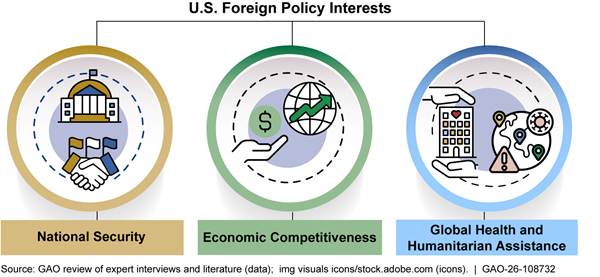
GAO identified several key implications of global aging populations for the U.S. by interviewing experts and conducting a literature review. For example, U.S. national security interests may be affected as allies spend more on healthcare for their aging populations, likely resulting in fewer available resources for defense spending. U.S. economic interests may also be affected by shrinking labor pools abroad, which could affect labor force competition and worldwide migration patterns. Lastly, global health interests may be influenced by the prevalence of chronic disease in aging populations. As a result, U.S. global health priorities may have to be adapted to the health-related risks and vulnerabilities faced by aging populations.
The Departments of Defense (DOD), Health and Human Services (HHS), and State have some efforts that indirectly address the implications of global aging. These agencies produce research and data, engage with partner nations, and provide health and humanitarian assistance. State’s regional bureaus train younger populations in other countries to replace skills lost when older individuals leave the workforce. Additionally, HHS researches the effects of aging and age-related conditions on populations both domestically and abroad. However, U.S. agencies do not provide foreign assistance that specifically addresses the needs of older populations, according to agency officials.
Why GAO Did This Study
According to the United Nations, population aging is occurring at an unprecedented pace and is poised to become one of the most significant social transformations of the twenty-first century. As the populations of partners and adversaries age, the U.S. may be affected by this trend. Stakeholders have increasingly identified global aging abroad as a potential strategic challenge for the U.S. Understanding the changes associated with global aging and their potential effects, including consequences for U.S. fiscal policy, may help inform U.S. strategic priorities and goals.
GAO was asked to examine the U.S. foreign policy implications of global aging and how U.S. agencies are considering these implications in their programming. This report examines (1) the implications of aging populations worldwide on U.S. foreign policy interests; and (2) U.S. agencies’ efforts to identify and address the implications of aging populations worldwide on U.S. interests.
To address these objectives, GAO interviewed experts and conducted a literature review to identify the implications of aging populations worldwide on U.S. foreign policy interests. GAO selected experts from academia and nongovernmental organizations to represent a balance of views. To identify agency efforts to address global aging, GAO reviewed relevant agency documents, policy guidance, and program documentation. GAO also spoke with officials at DOD, HHS, and State. GAO selected these agencies based on their roles in foreign assistance programming and policy development relevant to demographic change.
|
Abbreviations |
|
|
|
|
|
|
|
ACL |
Administration for Community Living |
|
|
DOD |
Department of Defense |
|
|
EU |
European Union |
|
|
HHS |
Department of Health and Human Services |
|
|
UN |
United Nations |
|
|
USAID |
United States Agency for International Development |
|
|
WHO |
World Health Organization |
|
This is a work of the U.S. government and is not subject to copyright protection in the United States. The published product may be reproduced and distributed in its entirety without further permission from GAO. However, because this work may contain copyrighted images or other material, permission from the copyright holder may be necessary if you wish to reproduce this material separately.
September 21, 2026
The Honorable Tim Kaine
Ranking Member
Subcommittee on Western Hemisphere, Transnational Crime, Civilian Security,
Democracy, Human Rights, & Global Women’s Issues
Committee on Foreign Relations
United States Senate
Dear Ranking Member Kaine:
Many countries, including the U.S., are experiencing an increase in both the number and the proportion of older adults in their populations. The world’s median age increased from approximately 22.2 years in 1950 to about 30.6 years in 2024.[1] According to the United Nations (UN), population aging is occurring at an unprecedented pace and is poised to become one of the most significant social transformations of the twenty-first century.[2] The World Health Organization (WHO) has projected the global population aged 60 and over will more than double from one billion in 2020 to 2.1 billion by 2050. By comparison, the world’s total population is projected to grow by only about 25 percent over approximately the same period, from roughly 7.8 billion to 9.7 billion.[3]
Some countries are taking steps in an attempt to address the effects of this demographic change, including implementing policies to encourage more births and preparing for a growing population of older adults. Policymakers have identified global aging abroad as a potential strategic challenge for the U.S. Understanding the changes associated with global aging and their potential effects, including consequences for U.S. fiscal policy, may help inform U.S. strategic priorities and goals.
You asked us to examine the U.S. foreign policy implications of global aging and how U.S. agencies are considering these implications in programming. This report examines (1) the implications of aging populations worldwide on U.S. foreign policy interests; and (2) U.S. agencies’ efforts to identify and address the implications of aging populations worldwide on U.S. interests.
To identify key implications of global aging, we interviewed experts and conducted a literature review focusing on the implications of aging populations worldwide on U.S. foreign policy interests. We selected 17 experts from academia and nongovernmental organizations to represent a range of informed perspectives on the topic of global aging. Experts demonstrated knowledge of the subject and worked for or published with a reputable source. To support our review of key implications, we conducted a literature review of 15 relevant scholarly articles and government reports. We identified literature through resource databases, online search queries, and expert recommendations.
To identify U.S. agencies’ efforts to identify and address the key implications, we reviewed relevant agency documents, policy guidance, and program documentation. We also interviewed officials from the Department of Defense, Department of Health and Human Services, and the Department of State. We selected these agencies based on their roles in foreign assistance programming and policy development relevant to demographic change from fiscal year 2020 to 2026.
We conducted this performance audit from September 2025 to September 2026 in accordance with generally accepted government auditing standards. Those standards require that we plan and perform the audit to obtain sufficient, appropriate evidence to provide a reasonable basis for our findings and conclusions based on our audit objectives. We believe that the evidence obtained provides a reasonable basis for our findings and conclusions based on our audit objectives.
Background
Population aging often refers to the rising share of older adults in a country’s total population, measured by the observed increase in the median age over time. As of 2026, the world median age is 31, and it is expected to reach 36 by 2050.[4] The share of the world’s population aged 65 and older reached 10.3 percent in 2024, more than doubling from roughly 5 percent in 1974. Moreover, according to the WHO, for the first time in history, in 2020 the number of people aged 60 and older outnumbered children younger than 5 years.
Population aging is often attributed to a combination of two factors: increased life expectancy and decreased fertility rates. If fertility rates decline while life expectancy continues to increase, the median age increases.
Steadily increasing life expectancy. Factors such as improved medical care and higher living standards have increased life expectancy worldwide. As people live longer, the use of goods and services changes, including increased demand for senior care and longer use of social programs. The UN projects that in high-income countries, the number of individuals aged 60 and above will rise from 245 million in 2005 to 406 million in 2050.
Decreasing fertility rates. The total fertility rate in a specific year is defined as the total number of children that would be born to each woman if she were to live to the end of her child-bearing years and give birth to children in alignment with the prevailing age-specific fertility rates. According to the UN, the decreases in fertility rate can be partially attributed to postponement of childbearing.[5] According to the UN, the global fertility rate currently stands at 2.25 live births per woman, down from 3.31 in 1990, and is projected to decline to approximately 2.1 by the late 2040s.[6] Fertility rates are much higher in Africa than in Europe and Asia.
The UN reports that the older population is growing globally both in absolute numbers and as a share of the total population.[7] In 2023, Europe and North America were the oldest regions. By 2050, one in four people living in Asia will be aged 60 years or older resulting in Eastern and South-Eastern Asia having the world’s oldest countries. According to the U.S. Census Bureau, the U.S. population will continue to age but remain younger than most developed countries.[8]
Even as the world ages, the rate at which populations age is not equal. The WHO states that while the increase in aging populations started in high-income countries, it is now low- and middle-income countries that are experiencing the greatest change (see fig. 1). According to the UN, most older people now live in less developed regions.
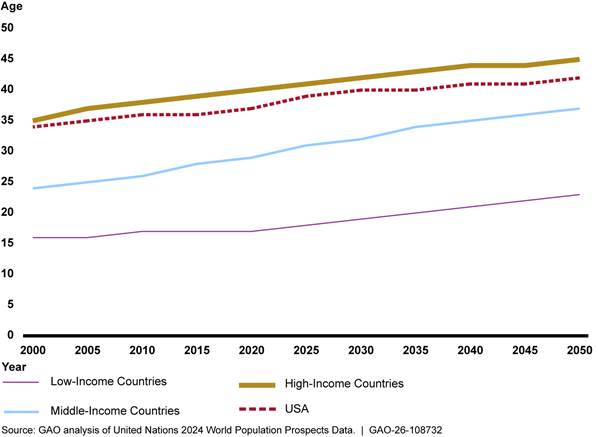
As of 2026, countries with higher incomes, including those in North America, have older populations than middle- and low-income countries. However, by 2050 most older people will be living in low- and middle-income countries. The change will create a disproportionate need for elder care and other services in those countries, according to the WHO.
Global Aging Is Predicted to Affect U.S. Security, Economic, and Global Health Interests
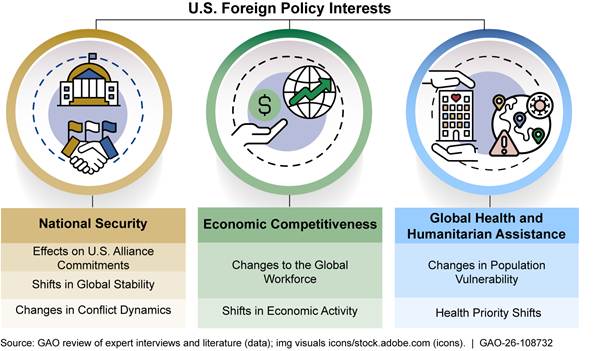
The growth in older populations worldwide has implications for U.S. national security, economic competitiveness, and global health and humanitarian assistance, according to experts. Our analysis of expert interviews and literature identified seven potential implications of aging abroad and their effects (see fig. 2).[9] Every expert who responded broadly concurred with the results of our analysis.[10]
Experts noted that population aging trends can be projected at least one generation into the future with some confidence because the cohorts that will enter older age in the coming decades have already been born. According to the UN and WHO, the current demographic trends of increased life expectancy and low fertility suggest that the global population of older adults will continue to grow. However, as one expert said, short-term projections of the implications of global aging can be difficult to make, and uncertainty increases significantly over longer time horizons. Many experts stated these implications are speculative because numerous variables could affect countries’ response to the challenges of aging and lead to different outcomes. For example, one expert noted that countries may respond differently due to political structures, resources, and cultural factors. Further, according to some experts, population aging is a new phenomenon that few nations have experienced and historical data on trends is limited.[11] Therefore, implications identified are not intended to represent future certainties; rather, they are presented to understand possible outcomes.
Global Aging Abroad May Contribute to Changes in U.S. Alliances, Global Stability, and Conflicts
Global aging may affect a country’s security capabilities, resources, and preferences which may alter the global security environment and affect U.S. security strategy. Experts noted three key implications that could affect interests related to U.S. national security:
Effects on U.S. Alliance Commitments. Population aging may affect alliance capabilities and roles to varying degrees.
Many experts said population aging places increased pressure on security alliances. For example, population aging and decreased fertility lead to a smaller pool of young people eligible for military service. U.S. allies may have difficulties meeting military recruitment rates, which in turn may undermine their alliance commitments. According to experts, nations across the Indo-Pacific region already face challenges meeting military recruitment targets, including nations with mandatory military service such as South Korea. One expert anticipates that North Korea will eventually have more military recruits than South Korea due to decreased fertility in South Korea, which may pose a threat to U.S. national security. State’s Strategic Plan for Fiscal Years 2026-2030 and the Department of Defense’s (DOD) Fiscal Year 2026 National Defense Strategy include objectives for partnerships and stability in the Indo-Pacific.[12] As aging further exacerbates these problems, U.S. agencies with programs in regions with aging populations could experience challenges addressing strategic priorities.
In addition, the national budgets of some key U.S. allies may change because growing proportions of aged populations can create fiscal pressures. Experts anticipate nations will experience tradeoffs among competing budget priorities. For example, some experts anticipate nations may compensate for the decline of military personnel through spending on technology, increasing overall military budgets.[13] Others stated that allied nations could reduce budgets for defense as spending increases for other priorities such as social pensions and health assistance. However, experts suggested a decline in available military financial resources may affect allies’ willingness and ability to support common defense interests, which could alter the global security environment.[14] Alternatively, other experts noted that countries’ attempts to mitigate effects of global aging could lead to deeper cooperation with the U.S. through established alliances and partnerships.
Shifts in Global Stability. Aging populations could create tension and conflict abroad, including among U.S. allies and adversaries.
According to many experts, aging may create social pressures that lead to domestic tensions and test state resilience. For instance, growing proportions of aged populations within countries may create challenges for societies as there are fewer middle-aged individuals who traditionally are the most economically productive group. This shrinking group places increased strain on national revenue as the tax base declines and the dependent younger and older groups grow. As a result, governments may experience reduced state capacity and face difficult political choices. These pressures and the national response can result in unrest. For example, the French government passed a law in 2023 raising the legal retirement age from 62 to 64, which sparked months of nationwide strikes and mass demonstrations.
Additionally, many experts stated that shifts in demographics and societal tension can lead to changes in political preferences and power over time. Some experts stated that growth in the proportion of older adults creates greater political visibility and influence that favors their interests over younger generations.[15] Moreover, one expert noted in countries such as Lebanon and Myanmar, demographic differences across majority and minority ethnic or religious groups can influence political power over time.[16] Variations in fertility or mortality across such groups may be reflected in political preferences as groups age at different rates. These circumstances can affect U.S. diplomatic relations and partnerships as political preferences and powers shift.
Change in Conflict Dynamics. Population aging may affect a nation’s likelihood of initiating conflict, but expert perspectives differ on the direction of the effect.
Some experts noted that aged populations may reduce a nation’s willingness and capacity for external conflict.[17] Due to resource constraints, both military and monetary, countries with aging populations may be less capable of warfare. In addition, because of lowered fertility rates and smaller family size, societies may experience increased aversion to casualties in conflict. Population aging may also contribute to lowered political appetite and fiscal capacity for initiating conflicts. As such, the U.S. may benefit from potential decreases in hostilities from adversaries but be adversely affected as U.S. allies are less able to meet alliance commitments.
Another perspective from experts is that aging countries could pose increased risk for conflict. Some experts told us countries may be inclined to use current military advantages to secure resources while their militaries are still relatively young, or before fiscal challenges arise. Alternatively, countries may also resort to external conflicts as a distraction or means of unifying their population in response to domestic tensions caused by aging. Therefore, under certain conditions, demographic change could accelerate strategic decision-making and use of conflict. One expert stated adversarial countries such as Russia and China may exploit this window of opportunity while they still have the population resources for military force to challenge U.S. national security interests.
Increases in Global Aging May Change Economic Competitiveness Worldwide
Aging populations affect the global workforce and economic activity, which in turn affects U.S. economic interests. Experts described two key effects on economic competitiveness:
Changes to the Global Workforce. Population aging leads to a smaller labor force, increased demand for certain labor market talent, and a change in the composition of the workforce.
Many experts stated that fertility decline results in a smaller labor pool, increasing the risk of labor shortages.[18] Without replacement, aged workers leaving the workforce create gaps in the labor market. For instance, one expert noted that gaps in certain industries such as farming raise concern over food production. Global competition for labor market talent is anticipated to increase due to declining labor supply. Some experts noted that certain sectors, such as healthcare, may experience greater demand for labor depending on need. Some aging countries are already beginning recruitment efforts. For example, the European Union (EU) is creating a union-wide platform to facilitate international recruitment of jobseekers from outside of the EU, particularly for occupations facing labor shortages because of demographic changes.
According to the International Monetary Fund, demographic differences and needs across countries can reshape demand and labor flows. For example, labor may gradually migrate from younger, relatively labor-abundant economies to older economies facing labor scarcity.[19] According to some experts, there may be greater global competition for labor in the care economy that could affect the U.S. Global competition stemming from these demographic trends may also influence domestic politics, international cooperation, and bilateral relationships for both aging societies abroad and the U.S., according to experts.
The increase in the proportion of aged populations could also affect the composition of the global workforce. The future workforce may include a higher proportion of aged workers and international labor.[20] Some experts stated that aging also greatly increases care burdens, which disproportionately fall on women, and may remove some women from paid employment.[21] These compositional changes can affect the productivity of a country’s economy.[22]
Changes to production capabilities, including reduced efficiency and labor force declines, can lead to slower economic growth. Many experts stated that an aged workforce is less productive due to increased susceptibility to diseases, low adaptability to new technologies, and difficulty transitioning occupations. However, another perspective from experts suggested that today’s aging cohort is healthier and more mentally capable for longer than in the past, potentially yielding more productive years.[23] Even so, declines in available labor needed to support a nation’s production capability may affect the amount of goods and services produced. The International Monetary Fund noted that under current policies, global output growth is projected to decline on average by about two percentage points through the end of the century, despite potential gains from healthy aging.[24]
Shifts in Economic Activity. Demographic shifts affect consumption and production patterns, economic investments, and priorities. Larger groups of older consumers have greater influence on market preferences and economic activity.[25] According to experts, economic activity may increasingly shift towards healthcare and human services in aging societies. One expert noted that some countries are already experiencing a decrease in consumption rates of certain goods due to aging. According to the American Association of Retired Persons (AARP), current projections also suggest older populations contribute significantly to the global economy through direct spending on goods and services, and these contributions are likely to rise as the proportion of aged populations increases.[26] In addition, changes in consumer preferences abroad can affect U.S. trade and production and present opportunities for U.S. exports.[27]
Experts and literature describe varying effects of population aging on innovation. Some experts suggested older populations are more economically risk-averse and less inclined to pursue certain investments. Further, a 2019 study examining macroeconomic trends in Organisation for Economic Co-operation and Development (OECD) economies noted, population aging can lead to lower rates of economic growth, investment, and interest rates, which may result in reduced entrepreneurial activity and consequences for a nation’s economy and global financial markets.[28] However, two other literature sources claimed older populations have greater financial resources and experience than younger groups and therefore are well positioned for entrepreneurial activity. More broadly, if population aging reduces the rate of population growth, this will result in a decrease in the demand for goods and services. This decrease can reduce the incentive to innovate in those markets and could also reduce the available pool of scientists that develop innovation given the decrease in population.[29]
Global Aging Will Make Populations More Vulnerable and May Change Health Priorities
Global aging will result in more vulnerable populations and alter the type of assistance needed, which may affect both U.S. global health priorities and foreign assistance.[30] Experts noted two key implications that could affect global health and humanitarian assistance:
Changes in Population Vulnerability. As aging cohorts grow, populations will be at increased risk of health-related vulnerabilities.
According to many experts, aging populations are likely to experience an increase in chronic disease and other health burdens. These populations will be affected by more non-communicable diseases such as dementia, cancer, and arthritis.[31] According to the World Bank, older populations and those with non-communicable diseases will be disproportionally harmed by pandemics of respiratory pathogens, such as COVID-19.[32] Further, one study noted that older adults living with immunocompromising conditions, such as HIV, may face multiple health conditions, increased risk of severe outcomes from infectious diseases, and challenges associated with managing multiple medications.[33] Such vulnerabilities pose potential global health risks and may test the health strategy and preparedness of nations, including the U.S.[34]
Additionally, aged populations are more vulnerable in disasters and conflict due to reduced mobility, cognitive decline, and other related concerns. An expert noted Ukraine has a large percentage of the population over 60 years of age that faces unique challenges in the ongoing war. With an increase in vulnerable populations, the need for more targeted assistance may affect humanitarian efforts. Further, one other expert noted that aging may increase the need for humanitarian assistance among older populations, including those with additional vulnerabilities such as disability and cognitive decline. U.S. assistance in regions with aging populations may change to reflect these needs.
Health Priority Shifts. Aging populations may shift the focus, service, and funding of healthcare around the world.
According to many experts, as populations age and life expectancy increases, nations may experience a transition in which infectious diseases decline as the top health priority and chronic, non-communicable diseases become more prevalent. As a result, nations may have less demand for treatment and care for acute illness and more demand for management of long-term conditions. For instance, some experts stated that aged societies will experience an increased need for long-term support services and geriatric care.
Experts further stated that the demand for age-related care pressures health systems to shift priorities and supply labor and resources to meet the needs of the population. As the share of adults age, demand for physicians, long-term care workers, and other health aides rise at the same time these societies experience more general declines in available labor. According to the World Bank, lower middle-income countries are already bearing the brunt of the non-communicable disease epidemic, which may worsen as the aging trend progresses.[35] A widening gap between healthcare demand and workforce capacity can strain health systems, increase costs, and reduce access to care. Experts stated that, alongside global competition for skilled healthcare workers, the U.S. may change the type of humanitarian assistance it provides worldwide.
Rising health care costs and associated social services may also result in higher health spending.[36] According to experts, some countries may provide government-funded financial assistance and healthcare in old age while others may rely on citizens to provide care for aged populations, which places pressure on their people as societies age. According to two literature sources, the Chinese government has made relatively limited commitments to support older age groups, continuing to emphasize family-based care for older adults. These changes in demographics, population vulnerabilities, and health priorities may affect U.S. humanitarian assistance programs. For instance, a 2022 study found that the number of adults aged 50 years and older accessing HIV treatment in the U.S. President’s Emergency Plan for AIDS Relief program countries has grown from 1.5 million in 2017 to 3.6 million in 2021.[37]
U.S. Agencies Have Efforts Indirectly Addressing Global Aging
Some U.S. Agencies Have Recognized the Growth of Global Aging and Have Taken Some Steps to Address It
Agency officials at the DOD, Department of Health and Human Services (HHS), and Department of State (State) said they were aware of the growing percentage of older populations abroad but did not have programming directly targeting these populations. For example, HHS has listed advancing the scientific understanding of the aging process as a priority in its unified strategy. However, DOD, HHS, and State do not operate foreign assistance programs that specifically address the needs of older populations, according to agency officials.
U.S. agencies previously had some limited programming that focused on the needs of aging populations in countries where they operated, such as United States Agency for International Development (USAID)-funded humanitarian assistance to older Ukrainians from 2022 to 2023.[38] USAID had also previously established some policies and guidance to account for or target the needs of older populations abroad. For example, USAID’s 2023 Gender Equality and Women’s Empowerment Policy included references to the specific risks and experiences of older women, noting they are at greater risk of structural inequalities in food systems and are more susceptible to harm during conflicts and crises.
U.S. agencies also had some efforts to study the security implications of aging abroad. For example, the National Intelligence Council’s Global Trends 2040 report examined global aging as a major structural force and assessed how rapidly aging and contracting populations in developed economies such as China, Japan, and Eastern Europe will weigh on economic growth.[39] As of June 2026, the National Intelligence Council had not published a successor to its 2021 Global Trends 2040 report, despite the series historically being released every four years.
According to DOD officials, DOD does not maintain a strategy or policy that addresses population aging in foreign nations as a distinct national security concern. DOD does not collect demographic data on aging populations in partner or adversary nations for the purpose of informing operational or strategic planning, according to DOD officials. DOD officials also stated that it has not funded research examining how aging demographics in foreign countries affect U.S. defense posture or alliance commitments. Further, DOD officials stated that it has not incorporated aging population trends in foreign nations into its threat assessments or similar efforts.
Agency officials stated there are various reasons for not having programming that specifically targets older populations abroad. Officials noted that shifting administration and legislative priorities as well as the uncertain implications of demographic trends have made this issue particularly difficult to address. One DOD official stated that because this is a “slow-moving problem,” it is difficult to plan for the long-term effects of this issue.
Some Agency Efforts Indirectly Address the Implications of Global Aging
U.S. agencies have several efforts in place that indirectly address the implications of global aging. These efforts include producing research and data, engaging diplomatically with partner nations, and providing health and humanitarian assistance (see table 1).
Table 1: Examples of U.S. Government Efforts that Indirectly Address the Implications of Global Aging
|
U.S. Efforts |
Description |
Example |
|
Research and Data |
U.S. agencies manage research and global data collection efforts to examine the effects of aging and age-related conditions. |
Department of Health and Human Service (HHS) supports the Alzheimer’s Disease Sequencing Project, a global effort to identify and describe the full range of genetic contributions to Alzheimer’s and related dementias. |
|
Diplomatic Engagement |
U.S. agencies engage with allies abroad to assist diplomatically in some areas related to global aging. |
State’s Agriculture Growing Rural Opportunities program supports economic resilience in rural Ukraine by helping farmers sustain the workforce pipeline in communities most affected by population decline, brought on in part by aging. |
|
Health and Humanitarian Assistance |
U.S. agencies have some humanitarian assistance programs that address the needs of older populations in the countries they serve. |
Organizations supported by State have provided healthcare and social support to older, chronically and terminally ill refugees and asylum seekers. |
Source: Agency documentation and GAO interviews with HHS and State officials. | GAO‑26‑108732
Research and Data. U.S. agencies manage research and data collection efforts that examine and indirectly address some implications of global aging. HHS conducts international research on aging and age-related conditions both domestically and abroad, including cancer, dementia, and cardiovascular disease. HHS’ National Institute on Aging also funds aging studies and data platforms in dozens of countries. For instance, HHS supports the Alzheimer’s Disease Sequencing Project and related follow-up studies to better identify the full range of genetic contributions to Alzheimer’s and related illnesses. In addition, according to HHS officials, the National Institute on Aging funded the longitudinal Health and Retirement Study, which surveys a representative sample of more than 20,000 Americans over the age of 50 every two years and has become the model for a growing network of comparable longitudinal aging studies around the world. According to agency officials, HHS has also funded training programs to prepare researchers abroad to study aging-related illnesses. For example, the National Institute on Aging has supported training of scientists examining aging and age-related diseases and conditions.
HHS and other U.S. agencies also coordinate with the U.S. Census Bureau, which conducts research on long-term demographic trends related to population aging. Census publishes the “An Aging World” report series to examine the demographic, health, and economic aspects of global population aging, including trends in life expectancy, health care systems, work and retirement, pensions, and old age poverty.[40]
Diplomatic engagement. U.S. agencies’ engagement with allies abroad indirectly addresses the implications of global aging. According to agency officials, HHS’s Office of Global Affairs represents the U.S. in international health forums that include discussions surrounding healthy aging. Prior to January 22, 2026, the office served as the primary liaison for U.S. government engagement with the WHO and advised and supported the U.S. delegation to the annual World Health Assembly.[41] The World Health Assembly addresses healthy aging through the UN Decade of Healthy Ageing resolution.[42]
HHS’ Administration for Community Living (ACL) engages with other countries to share information on how to address the needs of aging populations. According to officials, these efforts primarily involve sharing U.S. research and learning from researchers and policymakers both in the U.S. and abroad, particularly program design, policy trends, and best practices. According to HHS Officials, ACL also informally engages in bilateral and multilateral discussions with international stakeholders to exchange ideas on supporting aging populations. For example, ACL, along with State, has participated in discussions associated with the UN Open-Ended Working Group on Ageing, a subsidiary body of the UN focused on human rights and the protection of older persons. State’s Bureau of East Asian and Pacific Affairs has also led multilateral diplomatic engagements to address shared challenges posed by demographic change, including aging populations, through the Asia-Pacific Economic Cooperation forum, according to Department officials.[43]
State also has some programming to address economic changes in other countries brought about in part from their aging populations. For example, State’s regional bureaus provide assistance to younger populations in other countries, replacing skills lost when older populations leave the workforce. State’s Agriculture Growing Rural Opportunities program strengthens economic resilience in rural Ukraine by helping farmers sustain the workforce pipeline in communities most affected by population decline brought on in part as a result of aging.
Health and Humanitarian assistance. U.S. agencies have some humanitarian assistance programs that address the needs of older populations in the countries they serve.
Current global health programming has been affected by the growth of older populations abroad. HHS and State programming addressing diseases worldwide must engage more frequently with older populations in the countries they serve, according to agency officials. For instance, according to State officials, the number of people 50 or older living with HIV and AIDS abroad is increasing rapidly. According to State officials, these populations typically manage multiple chronic conditions alongside the virus, which means that their needs may be different than younger patients.
State also manages humanitarian and disaster response aid that reaches older civilians in conflict and disaster zones. State prioritizes humanitarian assistance based on need, which includes assistance for older individuals. State also funds humanitarian organizations that serve older people. State officials said that some organizations provide tailored programming for refugees, internally displaced people, or asylum seekers that may target older people specifically. For instance, the Jesuit Refugee Service has provided healthcare and social support to older chronically and terminally ill refugees and asylum seekers in South Africa.
Agency Comments
We provided a draft of this report to the Department of Defense (DOD), the Department of Health and Human Services (HHS), and the Department of State (State) for review and comment. DOD, HHS, and State did not have any comments on the report.
We are sending copies of this report to the appropriate congressional committees, the Secretary of Defense, the Secretary of Health and Human Services, the Secretary of State, and other interested parties. In addition, the report is available at no charge on the GAO website at https://www.gao.gov.
If you or your staff have any questions about this report, please contact me at kenneyc@gao.gov. Contact points for our Offices of Congressional Relations and Public Affairs may be found on the last page of this report. GAO staff who made key contributions to this report are listed in appendix III.
Sincerely,

Chelsa L. Kenney
Director, International Affairs and Trade
This report examines (1) the implications of aging populations worldwide on U.S. foreign policy interests; and (2) U.S. agencies’ efforts to identify and address the implications of aging populations worldwide on U.S. interests.
For our first objective, we interviewed 17 nongovernmental experts selected for their knowledge of global aging to obtain information on the potential implications of population aging on U.S. foreign policy interests. We used three methods to create lists of potential knowledgeable experts:
· a literature review of relevant articles, reports, and papers;
· snowball sampling, in which we asked initial contacts to refer additional experts; and
· background research.
We identified more than 100 experts and organizations. Our final selection criteria required individuals to meet the following qualifications to ensure relevance and credibility: held a graduate degree, were actively engaged in the issue area, and worked for or published with a reputable source.[44] Interview selection prioritized individuals based on subject matter relevance and extent to which they were identified across list methods; we also sought representation from a variety of affiliations such as academic, research, and think tank roles to capture differing viewpoints. Individuals moved up in priority if they were identified in related literature as a key contributor, or if multiple interviewees independently reference the same individual.
Based on these criteria, we selected 17 knowledgeable experts, which included individuals representing academia, think tanks, non-profits, and corporate research. See appendix II for the full list of experts and their affiliations.
We also conducted a literature review of scholarly articles and government reports related to the implications of global aging on U.S. foreign policy interests to support our review of key implications. Literature was identified using search queries of resource databases (including Scopus, ProQuest, and EBSCO), online searches, and expert recommendations. The search produced 69 sources.[45] To focus on recent research on the implications of global aging on the U.S. we included articles that met the following criteria:
· The article discussed the implications of global aging for the U.S. or the article was identified as support for implications noted by experts at interview without an explicit link to the U.S.,
· The article was published by a scholarly or government source, and
· The article was published between 2016 and 2026.
We reviewed the abstracts and identified 20 relevant studies for a more in-depth evaluation after applying these criteria. We developed a data collection instrument to systematically review these articles to obtain information on key implications for the U.S. One analyst evaluated and recorded each article’s implication(s) for the U.S. and captured how the information would be used in the data collection instrument. We then reviewed each article’s research methodology, including its data, outcome measures, control variables, limitations and analytic techniques. We then considered the main themes of the article and summarized its major findings. Article limitations were identified, and those that did not meet methodology requirements were removed from further analysis. Another analyst reviewed the remaining 15 articles and information captured by the first reviewer to confirm the information identified.
We analyzed information obtained from experts and literature to determine the key effects of global aging on U.S. foreign policy interests. Identified effects of global aging are speculative and uncertainties increase over longer time horizons due to the influence of numerous variables. To assess the reliability of our analysis, we obtained concurrence from experts we interviewed that the three foreign policy areas and seven key potential implications we identified reflected their broad understanding of the main possible effects. We determined that experts provided sufficient concurrence for our reporting requirements.
For our second objective, we reviewed documentation from the Department of State (State), Department of Defense (DOD), and Department of Health and Human Services (HHS), including policy guidance, organizational materials, and program-related reports. We selected these agencies based on their roles in foreign assistance programming and policy development relevant to demographic change from fiscal year 2020 to 2026.
We communicated with officials from State bureaus including the Bureau of Global Health Security and Diplomacy, the Bureau of Economic and Business Affairs, and other relevant regional bureaus to obtain information on the department’s role in planning, coordinating, and implementing programming to respond to aging trends abroad. We also contacted officials from DOD’s Office of the Secretary of Defense for Policy to understand any work they had done to examine such trends. In addition, we interviewed officials from HHS offices such as its Office of Global Affairs and Administration for Community Living to obtain information on their activities, interagency coordination efforts, and perspectives on opportunities and challenges associated with these efforts. We used information obtained through these interviews to better understand agency roles, responsibilities, coordination processes, and implementation practices. Where possible, we corroborated information obtained through interviews with agency documentation and other available evidence.
We conducted this performance audit from September 2025 to September 2026 in accordance with generally accepted government auditing standards. Those standards require that we plan and perform the audit to obtain sufficient, appropriate evidence to provide a reasonable basis for our findings and conclusions based on our audit objectives. We believe that the evidence obtained provides a reasonable basis for our findings and conclusions based on our audit objectives.
To inform our review of the implications of global aging on U.S. foreign policy, we selected and interviewed 17 nongovernmental experts based on their expertise and knowledge of global aging. Table 2 lists these knowledgeable experts and their title and affiliation.
|
Name |
Title |
Affiliation |
|
Jane Buchanan |
Director of Global Impact |
HelpAge USA |
|
Mathew Burrows |
Counselor in the Executive Office; Program Lead of the Center’s Strategic Foresight Hub |
Stimson Center |
|
Richard Cincotta |
Global Fellow |
Wilson Center |
|
Jonathan Cohen |
Professor of Clinical Population and Public Health Sciences; Director of Policy Engagement at the USC Institute on Inequalities in Global Health |
Keck School of Medicine, University of Southern California |
|
Kevin Daly |
Managing Director and Senior Economist, Global Macro Research Department |
Goldman Sachs |
|
Nicholas Eberstadt |
Henry Wendt Chair in Political Economy |
American Enterprise Institute (AEI) |
|
Jack A. Goldstone |
Hazel Professor of Public Policy |
George Mason University |
|
Mark L. Haas |
Professor of Political Science |
Duquesne University |
|
Vijeth Iyengar |
Senior Director of Global Aging, International Affairs |
American Association of Retired Persons (AARP) |
|
Richard Jackson |
President and Founder |
Global Aging Institute |
|
Amanda M. Klasing |
National Director of Government Relations and Advocacy |
Amnesty International USA |
|
Andrew Oros |
Professor of Political Science and International Studies; Senior Fellow and Director of the Japan Program |
Washington College; Stimson Center |
|
Eric Palomaa |
Director, Hess Center for New Frontiers |
Center for Strategic and International Studies |
|
Peter Rundlet |
Vice President of International Affairs |
AARP |
|
Jennifer Sciubba |
President and CEO |
Population Reference Bureau (PBR) |
|
Andrew J. Scott |
Professor of Economics |
London Business School |
|
Monica Duffy Toft |
Shelby Cullom Davis Professor of International Security Studies; Director, Center for Strategic Studies at the Fletcher School |
Tufts University |
Source: GAO review of information provided by the knowledgeable experts. | GAO‑26‑108732
GAO Contact
Chelsa Kenney, kenneyc@gao.gov
Staff Acknowledgments
In addition to the contact named above, Jeremy Latimer (Assistant Director), Anthony Costulas (Analyst-in-Charge), Sheerine Karamzadeh-Rahimi, Fralinda Zazay, Pedro Almoguera, Larissa Barrett, Bahareh Etemadian, Alexa Stechschulte, Madeline Barch, and Jieun Chang made key contributions to this report.
The Government Accountability Office, the audit, evaluation, and investigative arm of Congress, exists to support Congress in meeting its constitutional responsibilities and to help improve the performance and accountability of the federal government for the American people. GAO examines the use of public funds; evaluates federal programs and policies; and provides analyses, recommendations, and other assistance to help Congress make informed oversight, policy, and funding decisions. GAO’s commitment to good government is reflected in its core values of accountability, integrity, and reliability.
Obtaining Copies of GAO Reports and Testimony
The fastest and easiest way to obtain copies of GAO documents at no cost is through our website. Each weekday afternoon, GAO posts on its website newly released reports, testimony, and correspondence. You can also subscribe to GAO’s email updates to receive notification of newly posted products.
Order by Phone
The price of each GAO publication reflects GAO’s actual cost of production and distribution and depends on the number of pages in the publication and whether the publication is printed in color or black and white. Pricing and ordering information is posted on GAO’s website, https://www.gao.gov/ordering.htm.
Place orders by calling (202) 512-6000, toll free (866) 801-7077,
or
TDD (202) 512-2537.
Orders may be paid for using American Express, Discover Card, MasterCard, Visa, check, or money order. Call for additional information.
Connect with GAO
Connect with GAO on X,
LinkedIn, Instagram, and YouTube.
Subscribe to our Email Updates. Listen to our Podcasts.
Visit GAO on the web at https://www.gao.gov.
To Report Fraud, Waste, and Abuse in Federal Programs
Contact FraudNet:
Website: https://www.gao.gov/about/what-gao-does/fraudnet
Automated answering system: (800) 424-5454
Media Relations
Sarah Kaczmarek, Managing Director, Media@gao.gov
Congressional Relations
David A. Powner, Acting Managing Director, CongRel@gao.gov
General Inquiries
[1]United Nations, Department of Economic and Social Affairs, Population Division, World Population Prospects 2024, “Median Age of Population,” accessed August 12, 2026, https://population.un.org/dataportal/.
[2]United Nations, Department of Economic and Social Affairs, Population Division, World Population Ageing 2015, ST/ESA/SER.A/390 (New York: United Nations, 2015).
[3]United Nations, Department of Economic and Social Affairs, Population Division, World Population Prospects 2022: Summary of Results, UN DESA/POP/2021/TR/No. 3 (New York: United Nations, 2022).
[4]United Nations Department of Economic and Social Affairs (UN DESA). World Population Prospects 2024 Revision. Population Division.
[5]A trend toward later childbearing ages creates uncertainty about the extent to which declines in the total fertility rate are permanent or temporary. The total fertility rate declines during the initial stage of a trend to later childbearing, while births are delayed relative to historical averages, making it difficult to distinguish from a permanent decline.
[6]United Nations, Department of Economic and Social Affairs, Population Division, World Population Prospects 2024: Summary of Results (New York: United Nations, 2024). Replacement-level fertility is the level of fertility at which a population exactly replaces itself from one generation to the next, without migration. Replacement-level fertility is generally considered to be about 2.1 births per woman.
[7]United Nations, Department of Economic and Social Affairs, World Social Report 2023: Leaving No One Behind in an Ageing World (New York: United Nations, 2023).
[8]He, Wan, Daniel Goodkind, and Paul Kowal. An Aging World: 2015. International Population Reports P95/16-1. Washington, DC: U.S. Census Bureau, 2016. The U.S. Census Bureau projected that the U.S. will remain one of the youngest developed countries, with 20.9 percent of its population 65 and over in 2050. Immigration may play a role, as foreign-born mothers have higher fertility levels than native women and the foreign-born share of births is disproportionately higher than their share in the total population. In contrast, Japan was projected to continue to be the oldest country of those with a population greater than 50,000, with 40.1 percent age 65 and over in 2050.
[9]We conducted semi-structured interviews of these knowledgeable experts. While we had a common set of questions, some experts provided more information for certain foreign policy areas than others based on their expertise. As a result, not all experts provided the same examples nor number of responses. Therefore, some statements could not be attributed in relation to all experts. We use the term “some experts” to refer to instances in which two or three experts commented on an implication. We use the term “many experts” to refer to instances in which four or more experts commented on an implication. See appendix II for a list of the 17 knowledgeable experts and their titles and affiliations.
[10]Results identifying the seven potential implications of aging abroad and the three affected U.S. foreign policy interests were provided to all experts interviewed to obtain concurrence. Expert concurrence does not reflect agreement or endorsement of every implication or associated foreign policy but rather, reflects their understanding of the range of key potential implications of global aging. All experts interviewed provided written concurrence.
[11]The American Association of Retired Persons (AARP) noted that in 2006, Japan became the world’s first “super-aged” society when over 21 percent of its population reached age 65 or older. According to the Census Bureau, by 2050, 40 percent of all Japanese people are projected to be aged 65 and older, compared to 29 percent in 2020. By 2050, many countries will see trends similar to Japan. Derek Azar, Sam Dupre, Daniel Goodkind, and Lindsay Spell, “An Aging World: 2020.” (U.S. Census Bureau, Population Division, 2022).
[12]State’s Strategic Plan sets a goal for “peace and stability in the Indo-Pacific region.” This plan includes strengthening Indo-Pacific economies and deterring aggression through establishing a favorable military balance. DOD’s National Defense Strategy details efforts to “deter China in the Indo-Pacific through strength, not confrontation.” This plan seeks to work with allies and partners in the region to incentivize and enable them to do more for the collective defense.
[13]One expert noted that progress already made by current investments in technological advancements, such as artificial intelligence, will be beneficial as nations experience declines in military personnel.
[14]According to a 2019 study, “in recent years, U.S. officials have expressed growing frustration over the unwillingness of European powers to shoulder a higher share of the burdens to advance common goals.” Brooks, D. J., Brooks, S. G., Greenhill, B. D., & Haas, M. L. (2019). The Demographic Transition Theory of War: Why Young Societies Are Conflict Prone and Old Societies Are the Most Peaceful. International Security, 43(3), 53-95.
[15]According to RAND, “as China’s population ages, the party faces the dual challenge of managing an increasingly influential older demographic while ensuring the well-being of its younger citizens to maintain control.” Michael S. Pollard, Jennifer Bouey, Agnes Xiangzhen Wang, and Rakesh Pandey, Fertility Decline in China and Its National Military, Structural, and Regime Security (Santa Monica, CA: RAND, China Population Research, 2025).
[16]The State Department’s 2023 Reports on International Religious Freedom note Lebanon’s population has multiple recognized religious communities, including Muslims, Christians, and Jews. Myanmar’s population includes a Bamar ethnic majority, predominantly Buddhist, alongside numerous ethnic minorities whose identities are often linked with religious affiliation, including Christian-majority Kachin and Chin communities and Muslim Rohingya communities.
[17]One expert noted that until recently, the nations with the largest proportion of aged populations were democracies, and now as nations with autocratic leaders experience this change, researchers can observe their response. For instance, the ongoing conflicts involving the U.S., Russia, Ukraine, and Iran suggest that a higher median age may not curb a country’s willingness to use force.
[18]In addition, aging nations can experience higher old-age dependency ratios, where the number of individuals aged 65 and older increases relative to the number of working-age people, which weighs on growth and strains public finances because of higher spending on pensions, health care, and long-term care. International Monetary Fund. Research Dept. "Chapter 2: The Rise of the Silver Economy: Global Implications of Population Aging". In World Economic Outlook, April 2025, (USA: International Monetary Fund, 2025).
[19]International Monetary Fund, “The Rise of the Silver Economy: Global Implications of Population Aging.”
[20]Some experts noted that employers may compensate for changes in the composition of the workforce by increasing the use of supplemental technology for certain jobs. Additionally, assistive tools such as wearable technology that support strength and mobility may be incorporated to lengthen workforce participation.
[21]According to the World Bank, “one study of how caring for older parents affects midlife work across Colombia, Indonesia, Poland, and Egypt, found that providing long-term care to older parents (many of whom had chronic illnesses) was associated with significant reductions in employment, hours worked, and annual earnings for both women and men. But the effect was more pronounced among women and among caregivers providing over 10 hours of care per week.” World Bank, “Unlocking the Power of Healthy Longevity: Demographic Change, Non-communicable Diseases, and Human Capital.” Washington, DC: World Bank, 2024.
[22]We define “productivity” as a measure of economic performance that compares the quantity of goods and services produced (real output) with the quantity of inputs used to produce those goods and services. We define “production” as the process of using labor, capital, and other inputs to produce goods and services.
[23]A 2025 International Monetary Fund study of 41 advanced and emerging market economies shows, on average, a person who was 70 in 2022 had the same cognitive ability as a 53-year-old in 2000. International Monetary Fund, “The Rise of the Silver Economy: Global Implications of Population Aging.”
[24]International Monetary Fund, “The Rise of the Silver Economy: Global Implications of Population Aging."
[25]The AARP stated older consumers can affect the economy by changing gross domestic product, creating jobs, and increasing wages in industries that supply them with appropriate products and services. Jean Accius, Justin Ladner, and Staci Alexander, The Global Longevity Economy Outlook: People Age 50 and Older Are Making Unprecedented Economic Contributions and Creating Opportunity for Every Generation (Washington, DC: AARP Thought Leadership, November 2022).
[26]Accius, Ladner, and Alexander, “The Global Longevity Economy Outlook.”
[27]In 2025, the International Trade Administration noted that Japan’s emphasis on caregiving technology is creating opportunities for U.S. exporters to meet growing demand for the development of caregiving technologies. “U.S. Department of Commerce, International Trade Administration, “Japan Healthcare Caregiving Technologies,” Trade.gov, February 5, 2025.
[28]Yunus Aksoy, Henrique S. Basso, Ron P. Smith, and Tobias Grasl, "Demographic Structure and Macroeconomic Trends," American Economic Journal: Macroeconomics 11, no. 1 (2019): 193–222.
[29]Pierre Dubois, Olivier de Mouzon, Fiona Scott-Morton, and Paul Seabright, "Market size and pharmaceutical innovation," The RAND Journal of Economics 46, no. 4 (2015): 844-871.
Luís M. A. Bettencourt, José Lobo, Dirk Helbing, Christian Kühnert, and Geoffrey B. West, “Growth, Innovation, Scaling, and the Pace of Life in Cities,” The National Academy of Sciences of the United States of America 104, no. 17 (2007): 7301–7306.
[30]The WHO defines “vulnerability” of populations as the conditions determined by physical, social, economic, or environmental factors or processes which increase the susceptibility of an individual, a community, assets, or system to the impacts of hazards.
[31]According to the WHO, the main types of non-communicable diseases are cardiovascular diseases (such as heart attacks and stroke), cancers, chronic respiratory diseases (such as chronic obstructive pulmonary disease and asthma) and diabetes. World Health Organization. “Noncommunicable Diseases.” (2025).
[32]World Bank, “Unlocking the Power of Healthy Longevity.”
[33]Catherine Godfrey, Snigdha Vallabhaneni, Minesh Pradyuman Shah, and Anna Grimsrud, "Providing Differentiated Service Delivery to the Ageing Population of People Living with HIV," Journal of the International AIDS Society 25, suppl. 4 (2022): e26002.
[34]For instance, State’s America First Global Health Strategy identifies preventing pandemics as a key objective. As a result, population aging in partner countries could affect the U.S.’s capacity to monitor and implement such efforts.
[35]World Bank, “Unlocking the Power of Healthy Longevity.”
[36]According to the World Bank, “an aging population needs additional resources for social services, associated mostly with health systems and long-term care costs and pensions.” World Bank, “Unlocking the Power of Healthy Longevity.”
[37]Godfrey et al., "Providing Differentiated Service Delivery to the Ageing Population of People Living with HIV," e26002.
[38]In July 2025, the Secretary of State announced that USAID had ceased to implement foreign assistance and that foreign assistance programs that align with administration policies would be administered by State.
[39]National Intelligence Council, Global Trends 2040: A More Contested World (Washington, DC: Office of the Director of National Intelligence, March 2021), https://www.dni.gov/files/images/globalTrends/GT2040/GlobalTrends_2040_for_web1.pdf.
[40]Bacon, Rachel, Daniel Goodkind, Paul Kowal, Anne Morse, and Mitali Sen. An Aging World: 2025. U.S. Census Bureau, August 2026. Report no. P95-26-1.
[41]On January 20, 2025, President Trump signed Executive Order 14155 formally initiating the United States’ withdrawal from the WHO, which was completed on January 22, 2026. Exec. Order No. 14,155, 90 Fed. Reg. 8361 (Jan. 20, 2025).
[42]In 2020, the WHO and UN member states committed to a 10-year global plan of action to ensure all older people can live long and healthy lives, formally known as the UN Decade of Healthy Ageing (2021-2030). World Health Organization. Decade of Healthy Ageing: Plan of Action 2021-2030. Geneva: WHO, 2020. According to HHS officials, the U.S. is no longer engaged with WHO and is not advancing this referenced UN resolution and initiatives.
[43]According to State officials, in 2025, President Trump and fellow Asia-Pacific Economic Cooperation leaders endorsed its Collaborative Framework on Demographic Changes. This was the forum’s first Leaders-level statement to acknowledge these challenges and promote forward-looking policy solutions, including building resilient systems, modernizing human resource development, advancing health and care systems, promoting economic empowerment, and increasing labor force participation and retention.
[44]We performed an additional review for potential bias. This review was done through online search queries of the expert’s name and place of work followed by: “political affiliation,” “political bias,” and “political leaning.”
[45]These original results included many ineligible articles, such as articles related to the implications of global aging in the U.S., implications of global aging for other nations with no mention of the effect on the U.S., or articles that were not methodologically supported.