
Report to Congressional Committees
United States Government Accountability Office
A report to congressional committees.
For more information, contact: Hilary M. Benedict at benedicth@gao.gov.
What GAO Found
In fiscal year (FY) 2024, the most recent data available at the time of review, 11 federal agencies issued $4.4 billion in Small Business Innovation Research (SBIR) and Small Business Technology Transfer (STTR) awards, split almost equally between open and conventional topics. For open topics, agencies define broad areas of interest, and small businesses submit proposals defining potential agency needs and solutions. In contrast, for conventional topics, agencies define specific problems, and small businesses submit proposals that address those needs. One goal of SBIR and STTR is to increase commercialization of federally funded research and development (R&D), such as by selling to private industry or to federal agencies. To help achieve this goal, Congress began requiring the Department of Defense (DOD) to release open topic solicitations in FY 2023.
Open Topic Awards in the Small Business Innovation Research (SBIR) and Small Business Technology Transfer (STTR) Programs, Fiscal Years 2019–2024
Incomplete data prevent agencies from evaluating commercialization outcomes for open and conventional topic awards. At specific milestones, small businesses are required to report to the Small Business Administration (SBA) on commercial activity resulting from past awards. SBA maintains this information in a statutorily required database. However, GAO’s review of FY 2019 through FY 2024 awards showed small businesses submitted required data for less than half of their prior awards. Not all agencies communicate reporting requirements to applicants or ensure that applicants submitted required reports. Better conveying requirements to small businesses and ensuring compliance with these requirements could improve the completeness of the commercialization database.
Even if the share of companies submitting information increased, SBA officials said that they would not view the commercialization data as sufficiently reliable without validation and verification. They identified options to increase data reliability, such as incorporating information from other sources (like the Internal Revenue Service’s revenue data) or obtaining additional resources to validate the data. Statutory changes would be needed to change the commercialization data SBA collects. Reliable data would potentially enable SBA to provide decision makers with clearer insights into the different outcomes for open and conventional topic awards and the overall economic return on federal R&D.
Why GAO Did This Study
To help drive economic growth, 11 participating agencies provide SBIR and STTR funding to support small businesses that might otherwise face difficulties securing capital for R&D. SBA oversees the programs, including issuing guidance and reporting to Congress.
In connection with requirements for DOD to release open topics, the SBIR and STTR Extension Act of 2022 included a provision for GAO to review open topics in the programs. This fourth report examines FY 2024 awards, how open and conventional topic awards differ in terms of small businesses’ commercialization outcomes, and other objectives.
GAO analyzed data from the 11 participating agencies and SBA for over 6,000 awards issued in FY 2024. GAO examined SBA’s commercialization database for awards issued in FY 2019 through FY 2024. GAO reviewed statutory requirements and interviewed officials from SBA and participating agencies, as well as representatives from 20 randomly selected small businesses that received SBIR or STTR awards.
What GAO Recommends
GAO is making a total of 14 recommendations. Thirteen are to participating agencies to clearly communicate commercialization reporting requirements and check whether applicants adhere to these requirements. One recommendation is to SBA to submit a legislative proposal to Congress or pursue other actions to strengthen the reliability of commercialization data. The agencies agreed with the recommendations.
|
Abbreviations |
|
|
|
|
|
|
|
DOD |
Department of Defense |
|
|
DOE |
Department of Energy |
|
|
DHS |
Department of Homeland Security |
|
|
DOT |
Department of Transportation |
|
|
EPA |
Environmental Protection Agency |
|
|
FPDS |
Federal Procurement Data System |
|
|
FY |
fiscal year |
|
|
HHS |
Department of Health and Human Services |
|
|
NASA |
National Aeronautics and Space Administration |
|
|
NIH |
National Institutes of Health |
|
|
NIST |
National Institute of Standards and Technology |
|
|
NSF |
National Science Foundation |
|
|
R&D |
research and development |
|
|
SBA |
Small Business Administration |
|
|
SBIR |
Small Business Innovation Research |
|
|
STTR |
Small Business Technology Transfer |
|
|
USDA |
U.S. Department of Agriculture |
|
This is a work of the U.S. government and is not subject to copyright protection in the United States. The published product may be reproduced and distributed in its entirety without further permission from GAO. However, because this work may contain copyrighted images or other material, permission from the copyright holder may be necessary if you wish to reproduce this material separately.
September 29, 2026
Congressional Committees
Small businesses are important drivers of U.S. economic growth but can encounter difficulty accessing capital to fund research and development (R&D), which may ultimately impede their technological innovations. Congress established the Small Business Innovation Research (SBIR) and Small Business Technology Transfer (STTR) programs to enable small businesses to undertake and obtain the benefits of R&D.[1] Since SBIR and STTR were established in 1982 and 1992, respectively, the programs have issued over $82 billion in awards to over 34,000 small businesses.[2] The SBIR and STTR programs aim to
· stimulate technological innovation,
· meet federal R&D needs,
· foster diverse participation in innovation and entrepreneurship, and
· increase private-sector commercialization of innovations derived from federal R&D funding.[3]
The Small Business Act, as amended, requires certain federal agencies to participate in these programs. More specifically, federal agencies with an extramural research or R&D budget greater than $100 million are required to participate in the SBIR program, and agencies with such obligations greater than $1 billion are required to also participate in the STTR program.[4] Each agency manages its own program, while the Small Business Administration (SBA) oversees the programs, including issuing policy directives and required reports to Congress to inform them of the outcomes of the programs. Eleven federal agencies participate in the SBIR program or in both the SBIR and STTR programs: the Departments of Agriculture (USDA), Commerce, Defense (DOD), Education, Energy (DOE), Health and Human Services (HHS), Homeland Security (DHS), and Transportation (DOT); the Environmental Protection Agency (EPA); the National Aeronautics and Space Administration (NASA); and the National Science Foundation (NSF).[5] In fiscal year (FY) 2024, agencies issued approximately $4.4 billion in SBIR and STTR awards, according to our analysis of SBA data. Agencies generally make SBIR and STTR awards in the form of grants, contracts, cooperative agreements, or other transaction agreements.[6]
Participating agencies provide SBIR and STTR awards to small businesses to meet agency mission needs for R&D in an array of technology areas. Some agencies prioritize R&D that serves the broader public interest, such as technologies to mitigate fires in electric vehicle batteries or rapidly diagnose measles. In other instances, agencies focus on advancing technologies that the agencies themselves will use, such as technology to recycle water during space missions.
To meet these mission needs, participating agencies solicit proposals from small businesses in one or more annual award cycles. Solicitations include topics that generally take two forms: open or conventional. The Air Force within DOD began implementing open topics in 2018 and rapidly expanded the number of open topic awards issued over the next few years. The SBIR and STTR Extension Act of 2022 then required each DOD component to release at least one open topic solicitation per FY beginning with solicitations released in FY 2023, with a goal of increasing commercialization of DOD-funded technologies within and outside DOD.[7]
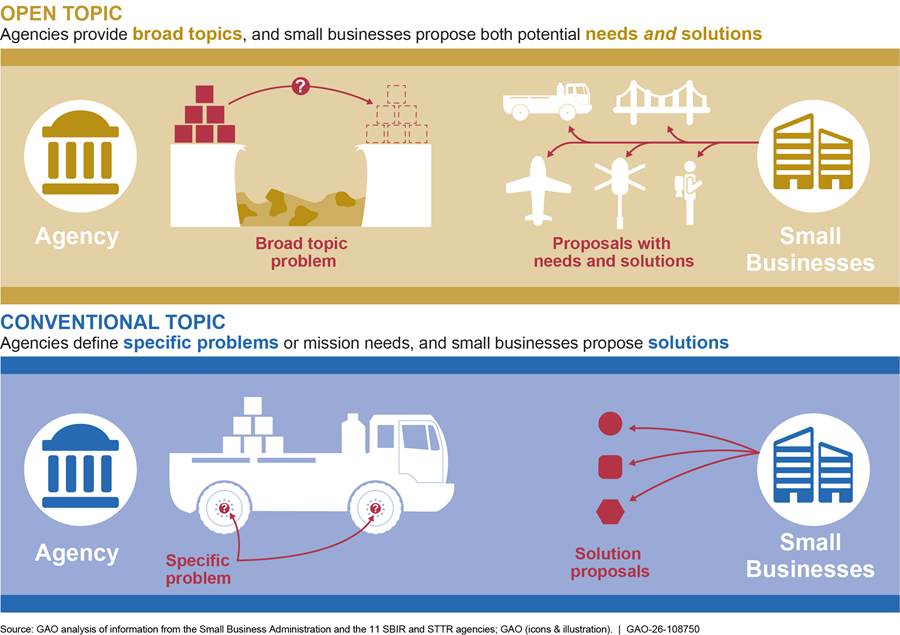
However, neither the authorizing legislation for the SBIR and STTR programs nor SBA’s policy directive, which provides agencies with specific SBIR and STTR implementation guidance, currently define open and conventional topics.[8] Therefore, in a 2023 report, we developed definitions of these topic types for the purposes of our analysis and reporting by coordinating with participating agencies.[9] See figure 1 for an illustration of how open and conventional topics differ, using our 2023 definitions.
Figure 1: Open and Conventional Topics in the Small Business Innovation Research (SBIR) and Small Business Technology Transfer (STTR) Programs, Based on GAO Definitions
In connection with the requirement for DOD components to release open topics, the SBIR and STTR Extension Act of 2022 includes a provision for us to issue a series of reports comparing several aspects of open and conventional topics.[10] This is our fourth and final report on this issue. In our first report, published in September 2023, we found that participating agencies used open topics to fund about 40 percent of SBIR and STTR awards from FY 2019 through FY 2021.[11] In our second report, published in September 2024, we found that some DOD components’ open topics were similar to their conventional topics, and we recommended DOD revise its open topic guidance to clarify how open and conventional topics should differ.[12] In our third report, published in September 2025, we found that participating agencies inconsistently categorized their open and conventional topics and we recommended that SBA develop formal definitions for open and conventional topics and provide that guidance to participating agencies.[13]
This report examines
1. The number and dollar amount of SBIR and STTR awards from open topics that participating agencies issued in FY 2024;
2. How participating agencies’ FY 2024 open and conventional topic awards compare in terms of competition, participation of nontraditional small businesses, first-time applicants and first time-awardees, the amount of time to notify applicants and issue awards, and what factors may account for any differences; and
3. How awardee progression through the phases of the SBIR and STTR programs differs between open and conventional topic awards, and how agencies evaluate this progression.
We interviewed officials from SBA and participating agencies about each agency’s use of open topics, SBIR and STTR program attributes, and funding and training opportunities that agencies offer to awardees to support progression through the phases.[14] We expanded on our prior analysis of participating agencies’ awards from FY 2019 through FY 2023 by collecting and analyzing award data for FY 2024 from SBA, which was the most recent year with sufficiently complete data available at the time of our review.[15] Additionally, we analyzed other agency data, such as Census Bureau data on rural counties. We also interviewed representatives from 20 randomly selected small businesses that had received SBIR or STTR awards about their experiences with agencies’ funding and training opportunities, among other topics.[16] For more information on our scope and methodology, see appendix I.
We conducted this performance audit from September 2025 to September 2026 in accordance with generally accepted government auditing standards. Those standards require that we plan and perform the audit to obtain sufficient, appropriate evidence to provide a reasonable basis for our findings and conclusions based on our audit objectives. We believe that the evidence obtained provides a reasonable basis for our findings and conclusions based on our audit objectives.
Background
Participating Agencies
The 11 participating agencies differ in how they implement their SBIR and STTR programs. Some agencies develop solicitation topics and decide whether topics will be open or conventional at the agency level. Other agencies develop topics at the component level. At some agencies, certain components may develop solicitation topics, while other components review proposals or issue awards. Figure 2 depicts the 11 participating agencies and their components that developed topics for SBIR and STTR program awards from FY 2019 through FY 2024.
Figure 2: Eleven Agencies Participating in the Small
Business Innovation Research (SBIR) and Small Business Technology Transfer
(STTR) Programs
Agencies and components that developed solicitation topics from FY 2019 through FY 2024
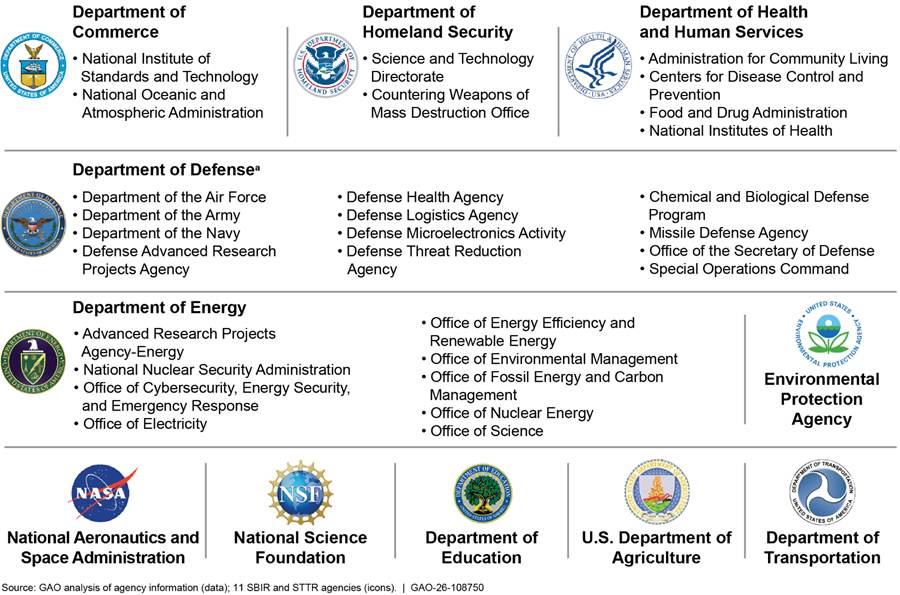
Note: From fiscal year 2019 through fiscal year 2024, all 11 agencies participated in SBIR. From fiscal year 2019 through fiscal year 2022, five of those agencies also participated in STTR (Departments of Defense, Energy, and Health and Human Services; National Aeronautics and Space Administration; and National Science Foundation). The Department of Agriculture began participating in STTR in fiscal year 2023.
aIn addition to the Department of Defense components listed, the National Geospatial-Intelligence Agency, the Strategic Capabilities Office, and the Space Development Agency also participate in the SBIR or STTR programs. However, according to agency officials, the National Geospatial-Intelligence Agency and Strategic Capabilities Office issue topics through the Office of the Secretary of Defense, while the Space Development Agency issues topics through the Department of the Air Force.
Program Time Frames, Award Limits, and Eligibility
SBA coordinates and oversees the efforts of the 11 agencies currently participating in the SBIR and STTR programs. As part of its oversight, SBA collects SBIR and STTR data from the participating agencies, aggregates the data, and uses the data to, among other things, monitor the programs and report to Congress. SBA developed and periodically updates a policy directive to guide how agencies operate their SBIR and STTR programs; the most recent update was in May 2023.[17] According to SBA’s policy directive, each participating agency is to issue a solicitation requesting proposals from small businesses that address certain topics, at least annually. Each participating agency is then to take the following steps:
1. review the proposals it receives,
2. determine which small businesses should receive awards,
3. notify pending awardees within the time frames required in statute for making a final decision, and
4. issue awards within the time frames recommended in SBA’s policy directive.
According to statute and SBA’s policy directive, most agencies must generally notify applicants of award decisions within 90 calendar days after a solicitation closes.[18] Participating agencies can submit a prior written request to SBA for a waiver to extend the notification deadline by up to 90 additional days.[19] The directive provides that most agencies should issue awards within 180 days after the solicitation closes.[20]
Participating agencies then issue awards for three phases of technology development: feasibility (Phase I), technology advancement (Phase II), and commercialization (Phase III) (see fig. 3).
Figure 3: Phases of the Small Business Innovation Research (SBIR) and Small Business Technology Transfer (STTR) Programs
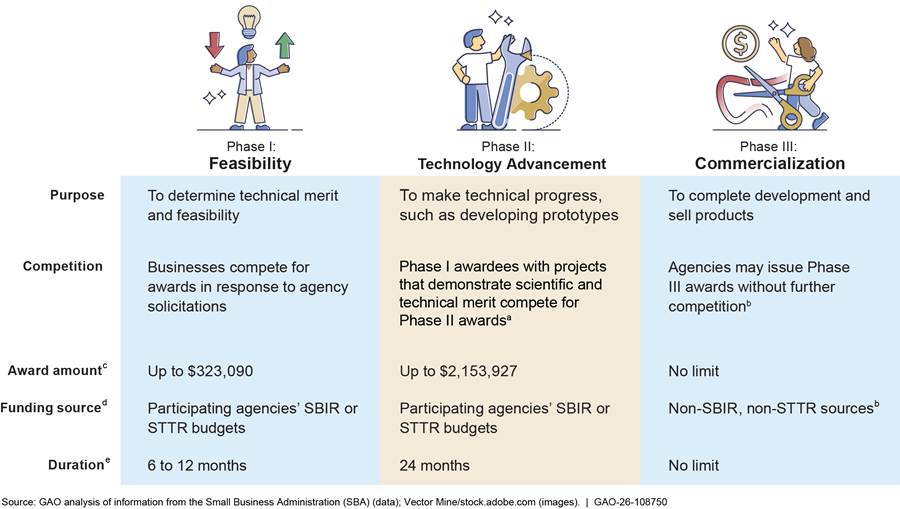
aThe Departments of Defense, Education, and Energy; the Department of Health and Human Services’ National Institutes of Health, and the National Aeronautics and Space Administration are authorized to issue Direct-to-Phase-II SBIR or STTR awards through fiscal year 2031 to businesses that did not receive a Phase I award but completed equivalent work using non-SBIR, non-STTR funds, following a determination by the agency head that the small business has determined the scientific and technical merit and feasibility of the ideas that appear to have commercial potential with respect to the project. 15 U.S.C. § 638(cc).
bPhase III funding can also come from nonfederal sources of capital, and Phase III awards funded with federal non-SBIR, non-STTR funding can also be used for the continuation of research or R&D that has been competitively selected using peer review or merit-based or scientific selection procedures. 15 U.S.C. § 638(e)(4)(C), (e)(6)(C).
cAuthorized award amounts are current as of April 2026. Maximum award amounts include any modifications to the original award amount. Agencies may seek a waiver from SBA to issue awards above the maximum values.
dSBIR or STTR budget refers to the portion of an agency’s extramural research or R&D budget designated for the SBIR or STTR programs.
eAgencies may provide longer performance periods where appropriate for particular projects.
To be eligible for awards, businesses must be primarily U.S.-owned for-profit firms that have 500 or fewer employees.[21] Small businesses can collaborate with other organizations through subcontracting to meet project needs, subject to program eligibility requirements. For example, small businesses can subcontract up to 33 percent of a SBIR Phase I project and 50 percent of a SBIR Phase II project to a consultant, a subcontractor, or both. Some agencies issue Direct-to-Phase-II SBIR or STTR awards to businesses that did not receive a Phase I award but completed equivalent work using non-SBIR, non-STTR funds.[22] However, Phase I is the typical entry point to the program for small businesses.
Phase III and Commercialization Reporting Requirements
Small businesses use SBIR and STTR awards to develop their technology and progress toward commercialization. Commercialization, as defined by the policy directive, is the process of developing, producing, and delivering products, processes, technologies, or services for sale to or use by the federal government or commercial markets. In this report, we use the term commercialization to encompass all commercial outcomes, such as sales revenue and outside investments. Achieving commercialization may take many years.
One potential commercialization outcome is a Phase III award issued by a federal agency. Drawing from agency funding sources outside of SBIR or STTR program funds, agencies issue Phase III awards directly to previous awardees without further competition (i.e., soliciting proposals from other companies). Agencies are authorized to issue Phase III awards for work that extends, derives from, or completes prior Phase I or II funded projects.
SBA is required to maintain a commercialization database that stores information reported by awardees on commercial activity resulting from their past SBIR or STTR awards.[23] The policy directive sets forth required information for awardees to enter into the database, including Phase III awards received from federal agencies, sales revenue or licensing agreements, and outside investments (such as venture capital funding). SBA uses self-reported information in the database to identify whether small businesses meet commercialization benchmarks, which determine eligibility for future Phase I and Direct-to-Phase-II awards.[24]
Small businesses update information for their awards by submitting company commercialization reports to sbir.gov. They are required to provide information on their Phase II awards in the commercialization database upon completion of the awards.[25] Small businesses are also required to update information on prior Phase II awards when submitting a proposal for a new SBIR or STTR Phase II award. Further, the Small Business Act, as amended, requires that businesses be requested to voluntarily update their information for at least 5 years after an award is completed.[26]
Agencies’ Awards from Open and Conventional Topics Were Almost Evenly Split in FY 2024, Consistent with Earlier Years
According to our analysis of SBA and participating agency award data, agencies issued about half of all SBIR and STTR awards in FY 2024 from open topics, similar to FY 2023. In FY 2024, only the Department of Commerce changed its use of open and conventional topics. Specifically, Commerce issued awards from both open and conventional topics in FY 2024 after issuing exclusively open topic awards in FY 2023. All agencies used the same funding mechanisms and reported the same typical customers (such as the agency itself or customers outside of the agency) for the FY 2024 awards as in FY 2023.
Consistent with FY 2023, Agencies Issued About Half of FY 2024 Awards from Open Topics, Valued at $2 Billion
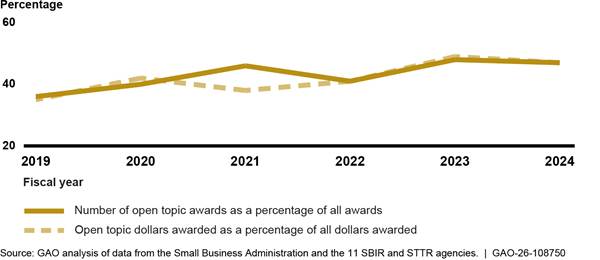
Agencies issued about 50 percent of all SBIR and STTR awards from open topics in FY 2024, similar to their use of open topics in FY 2023 and higher than in FY 2019 through FY 2022 (see fig. 4). Specifically, of the approximately $4.4 billion total SBIR and STTR awards issued in FY 2024, agencies issued approximately $2 billion in open topic awards. In comparison, agencies also issued about 50 percent of awards from open topics in FY 2023 and about 40 percent of awards from open topics in FY 2019 through FY 2022. For additional award information, including total awards from FY 2019 through FY 2024 and STTR awards issued in FY 2024, see appendix II.
Figure 4: Open Topic Awards in the Small Business Innovation Research (SBIR) and Small Business Technology Transfer (STTR) Programs by Year, Fiscal Year (FY) 2019–2024
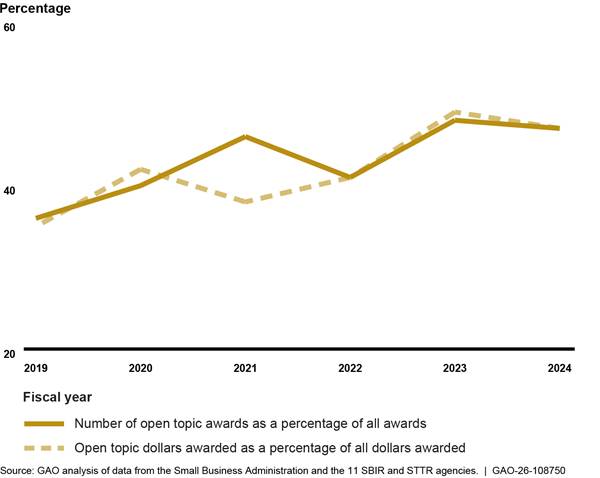
Note: Information includes SBIR and STTR awards. In FY 2021, the Department of Defense increased the number of open topic awards as a percentage of all awards, while the agency did not change its open topic dollars awarded as a percentage of all dollars awarded.
In FY 2024, three participating agencies exclusively issued open topic awards (USDA, Education, and NSF), four issued exclusively conventional topic awards (DHS, DOT, EPA, and NASA), and the remaining four issued both open and conventional topic awards (Commerce, DOD, DOE, and HHS). For additional information, see table 1.
Table 1: Participating Agencies’ Use of Open Topic Awards in the Small Business Innovation Research (SBIR) and Small Business Technology Transfer (STTR) Programs, Fiscal Year 2024
|
|
Number of awards |
Dollars awarded |
|||||
|
Agency |
Open topic awards |
Total awards |
Percentage |
Open topic dollars awarded (in millions) |
Total dollars awarded (in millions) |
Percentage |
|
|
Department of Agriculture |
123 |
123 |
100% |
$40.3 |
$40.3 |
100% |
|
|
Department of Education |
23 |
23 |
100% |
$14.0 |
$14.0 |
100% |
|
|
National Science Foundation |
461 |
461 |
100% |
$227.3 |
$227.3 |
100% |
|
|
Department of Commerce |
90 |
97 |
93% |
$25.4 |
$27.4 |
93% |
|
|
Department of Defense |
1,373 |
3,422 |
40% |
$1,141.0 |
$2,731.4 |
42% |
|
|
Department of Energya |
58 |
553 |
10% |
$30.0 |
$306.0 |
10% |
|
|
Department of Health and Human Services |
920 |
1,228 |
75% |
$545.0 |
$792.2 |
69% |
|
|
Department of Homeland Security |
0 |
31 |
0% |
$0 |
$15.2 |
0% |
|
|
Department of Transportation |
0 |
40 |
0% |
$0 |
$14.4 |
0% |
|
|
Environmental Protection Agency |
0 |
29 |
0% |
$0 |
$5.0 |
0% |
|
|
National Aeronautics and Space Administration |
0 |
437 |
0% |
$0 |
$174.4 |
0% |
|
|
Total |
3,048 |
6,444 |
47% |
$2,023.1 |
$4,347.6 |
47% |
|
Source: GAO analysis of data from the Small Business Administration and the 11 SBIR and STTR agencies. | GAO‑26‑108750
Note: Data for the number of awards and dollars awarded were from the Small Business Administration; data on topic type were provided by the participating agencies. All 11 agencies participated in SBIR, and six of the agencies participated in STTR in fiscal year 2024. Award amounts are rounded to the nearest $100,000. Percentages are rounded to the nearest 1 percent.
aSome Department of Energy solicitation topics contain multiple distinct topics, called subtopics. As a result, some Department of Energy open topic awards originated from solicitation topics that included both open and conventional subtopics.
Three agencies issued both open and conventional topic awards from FY 2019 through FY 2024: DOD, DOE, and HHS. The share of total awards issued from open topics differed across the three agencies. However, each agency issued a similar share of total awards from open topics in FY 2024 as in FY 2023 (see fig. 5). DOD components are each required to release at least one open topic solicitation per FY beginning with solicitations issued in FY 2023.[27] All 12 relevant DOD components released at least one open topic solicitation in FY 2024, in compliance with the statutory requirement.
Figure 5: Selected Agencies’ Open Topic Awards in Small Business Innovation Research (SBIR) and Small Business Technology Transfer (STTR) Programs, by Year, Fiscal Year (FY) 2019–2024
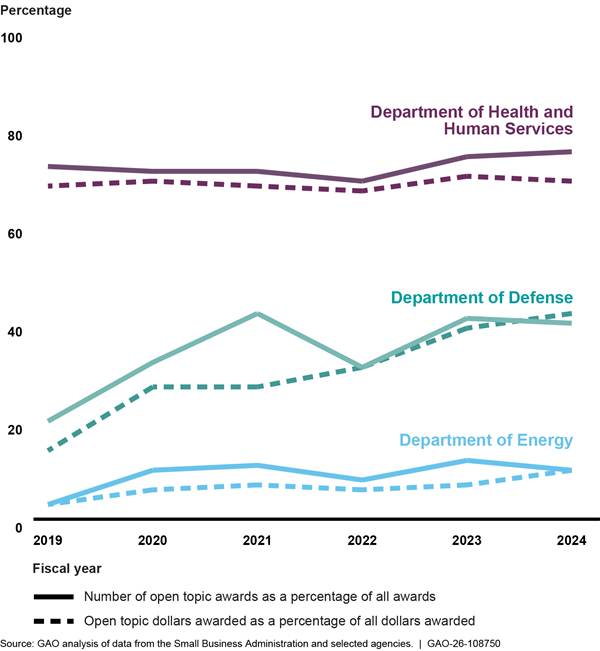
Note: Selected agencies are those that issued both open and conventional topic awards through SBIR or STTR from FY 2019 through FY 2024. While the Department of Commerce issued both open and conventional topic awards in FY 2024, it is excluded from this figure because it issued only open topic awards in some prior years.
Topic Types, Funding Mechanisms, and Customers in FY 2024 Were Largely Consistent with Earlier Years
Agencies used different mechanisms to fund a range of technologies that have varying potential customers. Most agencies used the same topic types in FY 2024 as FY 2023, and all used the same funding mechanisms and reported the same typical customers for the awards.
Topic types. Only the Department of Commerce changed its use of open and conventional topics between FY 2023 and FY 2024. While the agency issued only open topic awards in FY 2023, one component—the National Institute of Standards and Technology (NIST)—issued both open and conventional topic awards in FY 2024. NIST released conventional topics in a solicitation from its CHIPS Research and Development Office; these topics were related to microelectronics. All other participating agencies issued the same topic types in FY 2024 as FY 2023.
Consistent with our September 2023 report, officials from participating agencies told us that they continue to consider their goals for using the SBIR and STTR programs, such as mission needs or seeking to increase competition among applicants, when deciding to use open or conventional topics.[28] For example, NASA released only conventional topics in FY 2024, such as a topic funding technology to recycle water during space missions. A 2026 National Academies report found that NASA closely aligns its SBIR and STTR solicitations with the agency’s mission and technology needs and recommended that Congress not mandate that the agency offer open topics.[29] Because the agency’s needs—specialized technology for harsh environments—are very specific, NASA officials told us that there are limited internal commercialization opportunities for technologies proposed under open topics. In contrast, NSF has a broad agency mission of promoting scientific progress and released only open topics in FY 2024, such as a topic that funds any biomedical technology. Officials told us that they focus on funding new small businesses and that their comparatively broad open topics allow any small business to apply, including those whose technologies may not fit into other agencies’ topics.[30]
DOD continued to issue awards from both open and conventional topics in FY 2024. Officials said DOD uses conventional topics to address specific, technically challenging agency needs. On the other hand, open topics provide the agency with a vehicle to explore proposals with higher level of technical risk. In FY 2024, the agency updated its solicitation to include a definition of open topics and describe the difference between open and conventional topics. DOD officials said this was intended to ensure that small businesses understand the differences between the topic types.
Funding mechanism. Agencies used different funding mechanisms (contracts, grants, cooperative agreements, or other transaction agreements) to fund their SBIR and STTR awards (see fig. 6). All agencies used consistent funding mechanisms across both FY 2023 and FY 2024.
Figure 6: Participating Agencies’ Award Types, Typical Customers, and Funding Mechanisms in the Small Business Innovation Research (SBIR) and Small Business Technology Transfer (STTR) Programs, as of Fiscal Year (FY) 2024
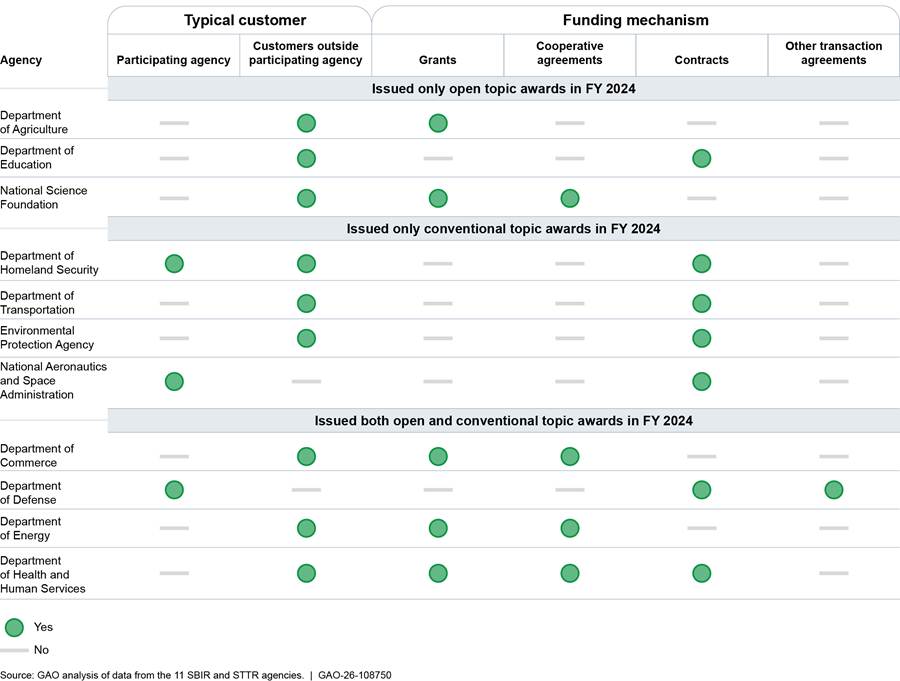
Typical customer. Across FY 2023 and FY 2024, all participating agencies had the same typical customers (internal or external) for technologies funded by their awards (see fig. 6). We define a customer as an end user of the technology developed through the SBIR or STTR award. Small business representatives we interviewed had a range of customers, including government agencies (e.g., local or federal government agencies) and nongovernment customers (e.g., manufacturers that use aluminum, oil and gas companies, or medical device manufacturers).
Officials at HHS and NIST—the only Commerce component that issued both open and conventional topic awards in FY 2024—stated that their typical customer was the same for both open and conventional topic awards. Consistent with our September 2024 report, DOD officials confirmed that the agency’s open and conventional topics continue to differ in identifying specific internal or external customers.[31] DOE officials said that they did not have the capacity to track this information.
Technology type. Agencies use SBIR and STTR awards to fund a range of technologies. For example, small business representatives we interviewed received awards to develop solutions related to medical devices, robotics, and learning applications. Of the agencies that issued both open and conventional topic awards in FY 2024, NIST, DOD, and HHS reported no difference in the technology types funded by open or conventional topics. We previously identified some differences in the technology types that DOE funded. For our September 2025 report, we found that a higher percentage of FY 2023 DOE Phase I open topic awards were related to environmental technologies and manufacturing, while a higher percentage of Phase I conventional topic awards were related to advanced instrumentation and sensors.[32]
Agencies Gave Fewer Open Topic Awards to Repeat Small Businesses, but Other Differences Varied
We found that open topic awards were spread across more small businesses than conventional topic awards in FY 2024, while other indicators of competition (applicant acceptance rate, first-time applicants, and first-time awardees) varied by agency and topic type. Agencies notified most small businesses of awards within required time frames and issued most awards within recommended time frames. Our analyses indicated that agencies differed in the amount of time to notify applicants of award decisions, the amount of time to issue awards, and the participation of nontraditional small businesses. But differences between topic types did not vary systematically. We also found that agencies provided a variety of outreach and assistance to small businesses, some of which was targeted at new or nontraditional businesses.
Agencies Issued a Smaller Share of Open Topic Awards to Repeat Small Businesses in FY 2024
Open topics had lower levels of award concentration than conventional topics in FY 2024, based on the number of awards per unique small business and the share of awards to multiple (repeat) awardees.[33] That is, open topic awards were spread across more small businesses than conventional topic awards were. However, while in our past reports we found that open topics generally faced higher competition based on the applicant acceptance rate, rate of first-time applicants, and rate of first-time awardees, this trend was not consistent across these metrics in FY 2024.[34]
Competition is multidimensional. In this report, we evaluate it using four indicators, defining higher competition as
· Lower levels of award concentration (awards spread across a higher number of unique small businesses)
· Lower applicant acceptance rates (a smaller share of proposals winning awards)
· Higher rates of first-time applicants (a higher share of businesses new to an agency’s SBIR and STTR programs applying for awards)
· Higher rates of first-time awardees (a higher share of businesses winning their first SBIR or STTR award from an agency)
However, it is important to note that this is not the only approach to evaluating competition. For example, SBA officials identified that the quality of applications is another important consideration. An agency may receive a high volume of low-quality applications from first-time applicants. While this would increase the rate of first-time applicants and lower the acceptance rate, it may not meaningfully increase competition.
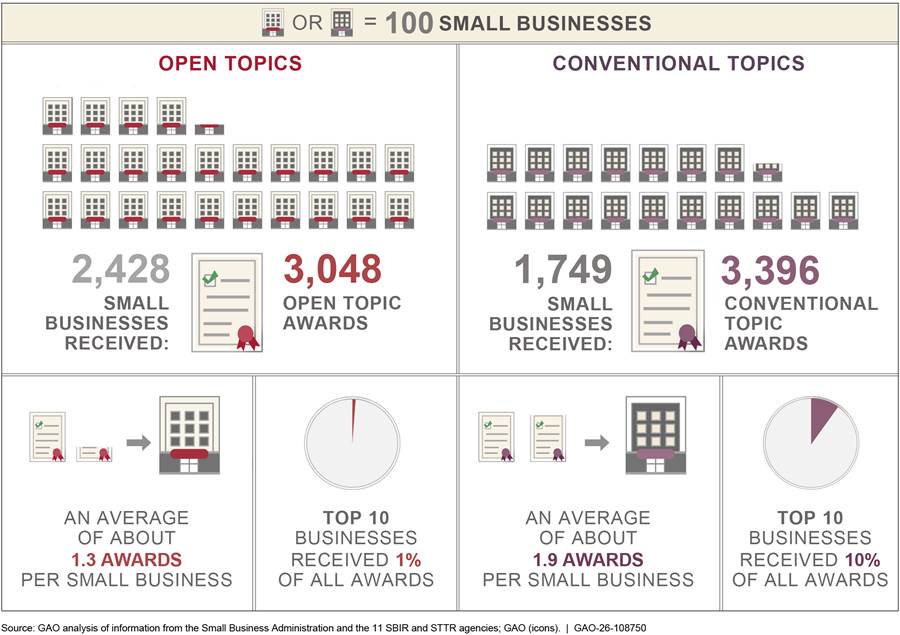
Award concentration. Compared to conventional topic awards, agencies issued a smaller number of open topic awards to a larger number of small businesses in FY 2024. The 11 participating agencies issued an average of 1.3 open topic awards per unique small business compared to 1.9 conventional topic awards per unique small business (see fig. 7).
Figure 7: Number of Businesses Receiving Open and Conventional Topic Awards in the Small Business Innovation Research (SBIR) and Small Business Technology Transfer (STTR) Programs, Fiscal Year 2024
Among the four agencies that issued awards from both topic types in FY 2024,
the difference in the average number of open and conventional topic awards per
small business was greatest for DOD (see table 2). The agency issued an average
of 1.4 open topic awards and 2.1 conventional topic awards per unique small
business.
Table 2: Open and Conventional Topic Awards Per Unique Business at Selected Agencies Participating in the Small Business Innovation Research (SBIR) and Small Business Technology Transfer (STTR) Programs, Fiscal Year 2024
|
|
Number of awards per unique business |
Dollars awarded per unique business |
||
|
Agency |
Open topic awards |
Conventional topic awards |
Open topic awards |
Conventional topic awards |
|
Department of Commerce |
1.1 |
1.0 |
$305,663 |
$285,365 |
|
Department of Defense |
1.4 |
2.1 |
$1,181,189 |
$1,667,065 |
|
Department of Energy |
1.1 |
1.4 |
$545,608 |
$772,995 |
|
Department of Health and Human Services |
1.1 |
1.1 |
$675,390 |
$908,601 |
Source: GAO analysis of data from the Small Business Administration and selected agencies. | GAO‑26‑108750
Note: Selected agencies are those that issued both open and conventional topic awards through SBIR or STTR in fiscal year 2024. Number of awards per business is rounded to the nearest tenth. Dollars awarded are rounded to the nearest dollar.
Additionally, we found that agencies issued a smaller share of open topic awards than conventional topic awards to multiple awardees.[35] The share of awards issued to multiple awardees is another indicator of award concentration. In FY 2024, agencies issued 4 percent of open topic awards to multiple awardees, compared to 28 percent of conventional topic awards. The agencies that issued no awards to multiple awardees in FY 2024 (Education and NSF) issued exclusively open topic awards. On the other hand, the agencies that issued the highest share of awards to multiple awardees (DHS and DOT, which issued 32 percent and 25 percent, respectively, of their FY 2024 awards to multiple awardees) issued exclusively conventional topic awards.[36]
This variation may be due in part to agency mission. For example, NSF focuses on early-stage research and officials told us that they focus on funding new small businesses. In contrast, for our March 2024 report, officials from several agencies told us that multiple awardees can help agencies meet specific R&D needs; DHS and DOT are among those agencies with specific R&D needs.[37] While multiple awardees can help meet agency needs, a 2026 National Academies report notes concerns from some DOD officials that repeatedly funding previous awardees can crowd out new applicants.[38] Beginning in FY 2027, agencies are required to set limits on the number of Phase I and Direct-to-Phase-II proposals a small business can submit.[39]
Among the four agencies that issued both topic types in FY 2024, DOD, DOE, and HHS issued a lower percentage of open topic awards than conventional topic awards to multiple awardees, while Commerce issued a similar share of open and conventional topic awards to these awardees. DOD had the greatest difference in multiple awardees between open and conventional topic awards (see table 3). For both DOD and HHS, the difference was statistically significant.[40] DOD officials said that the difference in open and conventional topic awards issued to multiple awardees reflects differing acquisition strategies, risk management profiles, and program structures. For example, officials said that small businesses with experience working with DOD and crafting proposals within a defined scope have a better chance of being selected for conventional topics, which define specific problems or agency needs. In contrast, open topics provide small businesses that are new to the SBIR and STTR programs, or who have less experience working with DOD, with an opportunity to break into the agency, according to DOD officials.
Table 3: Open and Conventional Topic Awards That Selected Agencies Made to Multiple Awardees in the Small Business Innovation Research (SBIR) and Small Business Technology Transfer (STTR) Programs, Fiscal Year 2024
|
|
Open topic awards |
Conventional topic awards |
||
|
Agency |
Number of awards to multiple awardees |
Percentage of awards to multiple awardees |
Number of awards to multiple awardees |
Percentage of awards to multiple awardees |
|
Department of Commercea |
1 |
1% |
0 |
0% |
|
Department of Defenseb |
68 |
5% |
708 |
35% |
|
Department of Energy |
10 |
17% |
101 |
20% |
|
Department of Health and Human Servicesb |
27 |
3% |
25 |
8% |
Source: GAO analysis of data from the Small Business Administration and selected agencies. | GAO‑26‑108750
Note: Selected agencies are those that issued both open and conventional topic awards through SBIR or STTR in fiscal year 2024. Multiple awardees are small businesses which received 16 or more Phase II awards over the last ten fiscal years, excluding the two most recently completed fiscal years. Percentages are rounded to the nearest 1 percent.
aGiven the low number of awards, we could not test for statistical significance for the Department of Commerce.
bThe difference between the percentage of open and conventional topic awards was statistically significant (p < .05).
Applicant acceptance rate. Across the 11 participating agencies, applicant acceptance rates ranged from 8 percent (Education) to 23 percent (USDA and NASA). The applicant acceptance rate is the percentage of proposals that resulted in an award.[41] Of the four agencies that issued both open and conventional topic awards in FY 2024, DOD and DOE had similar applicant acceptance rates across open and conventional topics, while Commerce and HHS had lower applicant acceptance rates for open topic awards (see table 4). For our September 2024 report, we found that several factors can influence the applicant acceptance rate, including the number of proposals received and agency R&D priorities.[42] Further, SBA officials noted that Phase II applicant acceptance rates can be influenced by additional factors, including whether the agency still considers a particular topic to be a priority or how the agency distributes funding between Phase I and Phase II awards.
Table 4: Selected Agencies’ Applicant Acceptance Rates for Open and Conventional Topics in the Small Business Innovation Research (SBIR) and Small Business Technology Transfer (STTR) Programs, Fiscal Year 2024
|
|
Open topic awards |
Conventional topic awards |
||
|
Agency |
Number of proposals |
Acceptance rate |
Number of proposals |
Acceptance rate |
|
Department of Commerce |
500 |
18% |
20 |
35% |
|
Department of Defense |
6,602 |
21% |
11,267 |
18% |
|
Department of Energy |
318 |
18% |
2,345 |
21% |
|
Department of Health and Human Services |
6,892 |
13% |
1,539 |
20% |
Source: GAO analysis of data from the Small Business Administration and selected agencies. | GAO‑26‑108750
Note: Selected agencies are those that issued both open and conventional topic awards through SBIR or STTR in fiscal year 2024. Acceptance rate is the percentage of proposals that resulted in an award. Calculations include both Phase I and Phase II awards. Data for the number of proposals were provided by selected agencies; data for the number of awards were from the Small Business Administration. Percentages are rounded to the nearest 1 percent.
Rate of first-time applicants. Across the participating agencies with data on first-time applicants, NSF had the highest rate of first-time applicants in FY 2024 (88 percent), while DOD had the lowest (12 percent).[43] Among the agencies that issued both open and conventional topic awards in FY 2024, DOD had a higher rate of first-time applicants for open topics than conventional topics, while Commerce and DOE had a higher rate for conventional topics (see table 5). Officials from the National Institutes of Health (NIH)—the HHS component that issued over 95 percent of HHS awards in FY 2024—stated that data on first-time applicants were not available for FY 2024.
Table 5: Open and Conventional Topic Awards That Selected Agencies Made to First-Time Applicants and First-Time Awardees in the Small Business Innovation Research (SBIR) and Small Business Technology Transfer (STTR) Programs, Fiscal Year 2024
|
|
Open topic awards |
Conventional topic awards |
||
|
Agency |
Percentage of first-time applicants |
Percentage of first-time awardees |
Percentage of first-time applicants |
Percentage of first-time awardees |
|
Department of Commerce |
70% |
51% |
100% |
100% |
|
Department of Defense |
15% |
34% |
10% |
10% |
|
Department of Energy |
19% |
33% |
25% |
32% |
|
Department of Health and Human Services |
N/A |
31% |
N/A |
14% |
Source: GAO analysis of data from the Small Business Administration and selected agencies. | GAO‑26‑108750
Note: Selected agencies are those that issued both open and conventional topic awards through SBIR or STTR in fiscal year 2024. Percent of first-time applicants is the number of first-time applicants divided by the total number of proposals. Percent of first-time awardees is the number of first-time awardees divided by the total number of awards. Calculations include both Phase I and Phase II awards. Data for the number of first-time applicants and first-time awardees were provided by selected agencies; data for the number of awards were from the Small Business Administration. Percentages are rounded to the nearest 1 percent.
Rate of first-time awardees. Across the participating agencies with data on first-time awardees, NSF had the highest rate of first-time awardees in FY 2024 (66 percent), while DOD and NASA had the lowest (20 percent).[44] Among the agencies that issued both open and conventional topic awards in FY 2024, DOD and HHS had a higher rate of first-time awardees for open topics than conventional topics, DOE had a similar rate for open and conventional topics, and Commerce had a higher rate for conventional topics (see table 5).
See appendix III for additional information on competition indicators at all participating agencies.
Agencies Notified More than 85 Percent of Small Businesses of Awards Within Required Time Frames in FY 2024
While agencies varied in the time to notify applicants about award decisions and to issue awards (i.e., finalize the funding agreement with the small business), agencies notified most applicants within required time frames (86 percent) and issued most awards within recommended time frames (81 percent).[45] We found that across the 11 participating agencies, agencies notified applicants within required time frames and issued awards within recommended time frames more often for open topic awards than for conventional topic awards. See appendix IV for more information on the amount of time to notify applicants of decisions and issue awards at the 11 participating agencies.
Between FY 2023 and FY 2024, some agencies experienced changes in the share of applicants that they notified within required time frames. For example, DOE met required notification time frames more often in FY 2024 than in FY 2023. The agency notified 96 percent of open topic awardees (up from 53 percent) and 72 percent of conventional topic awardees (up from 66 percent) within required time frames in FY 2024. DOE officials attributed this improvement to a streamlined due diligence process that centralized reviews and focused on applications selected for awards (rather than all applications).[46]
Agencies that issued both open and conventional topic awards in FY 2024 notified applicants of decisions for open topic awards and issued open topic awards faster than, or just as fast as, conventional topic awards. Of the four agencies, DOD and DOE had statistically significant differences between the amount of time to notify applicants of decisions for open and conventional topic awards. Both agencies notified applicants within required time frames more often for open topic awards (see fig. 8). Similarly, DOD and DOE issued more open topic awards than conventional topic awards within recommended time frames, though the difference was only statistically significant for DOD, which issued 85 percent of open topic awards and 60 percent of conventional topic awards within recommended time frames. HHS and NIST (the only Commerce component that issued both open and conventional topic awards in FY 2024) notified a similar share of open and conventional topic applicants of award decisions within required time frames and issued a similar share of open and conventional topic awards within recommended time frames.
Figure 8: Amount of Time to Notify Applicants of Decisions and Issue Awards for Selected Agencies in the Small Business Innovation Research (SBIR) and Small Business Technology Transfer (STTR) Programs, Fiscal Year 2024
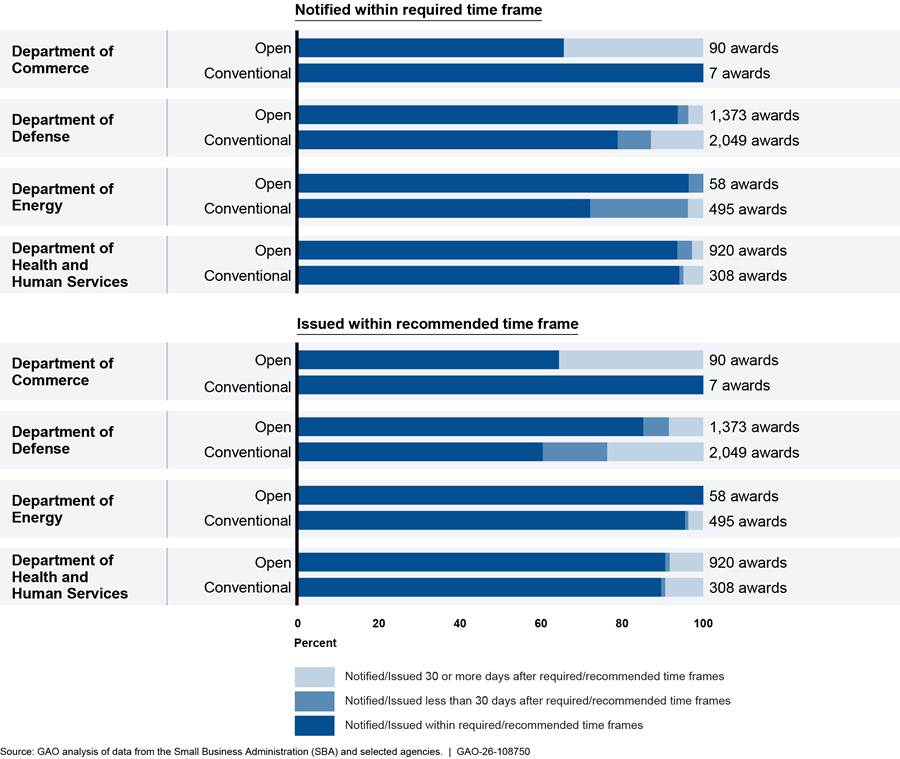
Note: Selected agencies are those that issued both open and conventional topic awards through SBIR or STTR in fiscal year 2024. SBA’s 2023 policy directive, in keeping with statutory time frames for agencies to make final decisions on proposals, generally requires these agencies to notify businesses within 90 calendar days after a solicitation closes, except the National Institutes of Health (NIH) within the Department of Health and Human Services, which has 1 year to notify businesses. SBA’s policy directive also provides that these agencies should issue an award within 180 calendar days after a solicitation closes, except NIH, which has 15 months. We did not consider cases in which agencies requested and were granted waivers from SBA as notifications within required time frames. Awards with missing data on notification or issuance are not included in the denominators for percentage calculations. Within the Department of Commerce, only the National Institute of Standards and Technology (NIST) issued both open and conventional topic awards in FY 2024. NIST notified applicants of outcomes within required time frames for all FY 2024 awards and issued 98 and 100 percent of open and conventional topic awards, respectively, within recommended time frames.
Three components issued more than 80 percent of DOD’s FY 2024 SBIR and STTR awards: Air Force, Army, and Navy. All of these components issued a greater share of open topic awards within recommended time frames than conventional topic awards. The difference between open and conventional topic awards was the greatest for the Air Force, which issued 91 percent of open topic awards and 55 percent of conventional topic awards within recommended time frames. For our September 2025 report, DOD officials told us that this was due to different contracting strategies.[47] Officials explained that the Air Force issues open topic awards internally via AFWERX—an organization within the Air Force with a mission of accelerating the transition of cutting-edge capabilities into the hands of Air Force members. AFWERX sets aside time during which contracting personnel focus solely on issuing open topic awards, allowing for faster award timelines. In contrast, officials said that conventional topic awards are issued by the sponsoring organization, not AFWERX.
Without a consistent trend across agencies, it is difficult to determine whether agencies’ use of open or conventional topics is related to the amount of time to notify applicants of award decisions or issue awards, even when limiting the analysis to those agencies that issued both topic types. For our September 2024 report, agency officials told us that several factors could affect the amount of time it took to notify applicants or issue awards, such as the number of proposals received, the number of available reviewers with expertise in specific technology areas, or the funding mechanisms used.[48]
Agencies can request waivers from SBA to exceed required notification time frames by up to 90 calendar days.[49] Four of the 11 participating agencies received waivers in FY 2024: USDA, Commerce, DOD, and DOE. These waivers applied to 134 open topic awards and 373 conventional topic awards issued in FY 2024 (8 percent of all awards). Agencies requested waivers for several reasons, including to meet due diligence requirements, to review large volumes of proposals, and to manage staff availability. When accounting for waivers, 89 percent of FY 2024 awards were notified within required time frames or within the extension window approved by SBA. See appendix IV for more information on waivers that agencies received for awards issued in FY 2024.
Share of Awards to Nontraditional Small Businesses Varied by Agency and Topic Type in FY 2024
Agencies differed in nontraditional small business participation, though they issued a similar share of awards to rural small businesses. There was no clear trend when comparing open and conventional topic awards within individual agencies.
Nontraditional Small Business Participation
We found no consistent differences in nontraditional small business participation between topic types in FY 2024. The SBIR and STTR Extension Act of 2022 referred to “non-traditional small business concerns” as including those owned by “women, minorities, and veterans.”[50] We analyzed data on three types of nontraditional small businesses (owned by individuals from socially and economically disadvantaged groups, women-owned, and veteran-owned) at the four agencies that issued both open and conventional topic awards that year.[51] We found that the difference between open and conventional topic awards was only statistically significant for HHS, which issued a higher share of conventional topic awards to nontraditional small businesses (see table 6). Commerce and DOD issued a higher percentage of open topic awards to nontraditional small businesses, while DOE issued a similar share of open and conventional topic awards to these small businesses.
Table 6: Open and Conventional Topic Awards That Selected Agencies Made to Nontraditional Small Businesses in the Small Business Innovation Research (SBIR) and Small Business Technology Transfer (STTR) Programs, Fiscal Year 2024
|
|
Open topic awards |
Conventional topic awards |
||
|
Agency |
Number of awards |
Percentage of awards |
Number of awards |
Percentage of awards |
|
Department of Commercea |
30 |
33% |
1 |
14% |
|
Department of Defense |
375 |
27% |
415 |
20% |
|
Department of Energy |
13 |
22% |
119 |
24% |
|
Department of Health and Human Servicesb |
191 |
21% |
80 |
26% |
Source: GAO analysis of data from the General Services Administration, Small Business Administration (SBA), and selected agencies. | GAO‑26‑108750
Note: Selected agencies are those that issued both open and conventional topic awards through SBIR or STTR in fiscal year 2024. The SBIR and STTR Extension Act of 2022 referred to “non-traditional small business concerns” as including those owned by “women, minorities, and veterans.” Pub. L. No. 117-183, § 7(b)(3), 136 Stat. 2180, 2189. In this report, we refer to businesses as being owned by individuals from socially and economically disadvantaged groups rather than minority-owned, consistent with SBA’s SBIR and STTR award data. Awards with missing data on nontraditional small businesses are not included in the denominators for percentage calculations. Percentages are rounded to the nearest 1 percent.
aGiven the low number of awards, we could not test for statistical significance for the Department of Commerce.
bThe difference between the percentage of open and conventional topic awards was statistically significant (p < .05).
Similar to our findings in prior years, agencies varied in the percentage of awards they issued to specific types of nontraditional small businesses:
· Socially and economically disadvantaged. Only HHS had a statistically significant difference between open and conventional topic awards issued to small businesses owned by individuals from socially and economically disadvantaged groups, issuing a higher percentage of conventional topic awards to these small businesses. DOE also issued a higher percentage of conventional topic awards than open topic awards to these small businesses, while DOD issued a higher percentage of open topic awards to them, though these differences were not statistically significant. Commerce issued a similar percentage of open and conventional topic awards to small businesses owned by individuals from socially and economically disadvantaged groups.
· Women-owned. Only DOD had a statistically significant difference between open and conventional topic awards issued to women-owned small businesses, issuing a higher percentage of conventional topic awards to these businesses. Commerce issued a higher share of open topic awards than conventional topic awards, and DOE and HHS issued a similar percentage of open and conventional topic awards to women-owned small businesses.
· Veteran-owned. DOD continued to issue the highest percentage of awards to veteran-owned small businesses. DOD and DOE had statistically significant differences between open and conventional topic awards issued to veteran-owned small businesses, issuing a higher percentage of open topic awards to these small businesses. Although not statistically significant differences, Commerce also issued a higher share of open topic awards than conventional topic awards to veteran-owned small businesses, while HHS issued a similar share of open and conventional topic awards to these small businesses.
See appendix V for additional information on participation of these businesses.
Rural Small Business Participation
Among the agencies that issued both open and conventional topic awards in FY 2024, all issued 2 percent or less of awards to rural small businesses.[52] The agencies issued a similar percentage of open and conventional topic awards to these small businesses, and the difference was not statistically significant for any of the agencies. See appendix II for additional information on the geographic distribution of SBIR and STTR awards in FY 2024.
Agencies Offered Varied Outreach and Assistance, Some of Which Targeted New or Nontraditional Small Businesses
SBA and participating agencies provide a variety of outreach and assistance to raise awareness of, encourage participation in, and help small businesses apply to the SBIR and STTR programs. In FY 2025, the last complete year of SBIR and STTR program activities at the time of this report, all participating agencies reported providing outreach or assistance to small businesses. This outreach and assistance included hosting webinars, attending conferences, and offering mentoring to small businesses (see table 7).
Table 7: Examples of Small Business Innovation Research (SBIR) and Small Business Technology Transfer (STTR) Program Outreach or Assistance in Fiscal Year 2025
|
Example |
Description |
|
Webinars |
The National Aeronautics and Space Administration (NASA) hosted a variety of webinars. One series focused on an upcoming solicitation release and attracted over 1,000 participants. Another series of “ask me anything” sessions was targeted at new and nontraditional small businesses. According to NASA officials, these sessions attracted over 500 participants and helped them understand whether their technologies were aligned with NASA priorities. |
|
Recurring office hours |
The Department of the Navy within the Department of Defense (DOD) offered virtual monthly SBIR and STTR office hours. Sessions averaged over 100 attendees and provided program overviews and live question and answer sessions. According to DOD officials, nearly 60 percent of attendees had not previously been involved with the SBIR and STTR programs. |
|
Attending conferences |
Officials from the Defense Advanced Research Projects Agency (DARPA), within DOD, attended conferences, including one held in California that had approximately 9,000 attendees. DARPA officials interacted with attendees via a panel, a booth, and a meeting that brought together agency officials with representatives from industry and academia. They also facilitated discussions between small businesses and prime defense contractors. According to DOD officials, proposals submitted to DARPA from California-based small businesses doubled following this engagement. |
|
America’s Seed Fund Week |
The Small Business Administration (SBA) hosted America’s Seed Fund Week. Speakers included representatives from participating agencies and organizations that received Federal and State Partnership Program awards. Sessions included a program overview, tips for preparing more competitive proposals, and panels with SBIR and STTR program directors. According to SBA officials, over 5,000 participants registered for the event. |
|
Phase 0 program |
The Department of Homeland Security offered the Phase 0 Program, which is intended to teach small businesses new to the SBIR program how to prepare a strong proposal. This program includes webinars available to all applicants and proposal preparation mentoring, which first-time applicants can apply to access. |
Source: GAO analysis of information from selected agencies. | GAO‑26‑108750
Note: The entries in this table are examples of outreach and assistance and do not represent all the participating agencies that engaged in a particular outreach or assistance activity.
All participating agencies either reported conducting outreach or assistance targeting small businesses new to the SBIR and STTR program or reported that their outreach or assistance was inclusive of new small businesses. For example, NASA hosted a series of four “ask me anything” sessions focused on attracting new small businesses. According to officials, these webinars were intended to help small businesses understand whether their technologies were aligned with NASA priorities and had over 500 participants, over 40 percent of whom had not contracted with NASA before.
Some agencies also reported targeting some outreach or assistance specifically at nontraditional small businesses. For example, DOD officials reported that the Office of Small Business Innovation delivered “SBIR 101” trainings in a variety of settings, including during a conference focused on small businesses owned by individuals from socially and economically disadvantaged groups and during virtual events aimed at first-time participants in the SBIR and STTR programs.[53]
Of the three agencies that released both open and conventional topics in FY 2025 (DOD, DOE, and HHS), DOD and HHS reported conducting outreach specifically focused on open topics.[54] This outreach was largely focused on agencies’ solicitations. For example, officials from a DOD component said that they held a webinar focused on their open topic solicitation, which over 400 people attended—the component’s most highly attended session to date. Officials from another DOD component reported using outreach to address how open topic proposals are solicited, evaluated, and awarded, which they said helped small businesses understand how to align proposals with mission needs.
Agencies Are Unable to Evaluate Awardees’ Progress Toward Commercialization, Including Differences Between Topic Types
We did not find systematic differences in the progression of open and conventional topic awardees from Phase I to Phase II, one measure of awardees’ progression through the SBIR and STTR programs and toward commercialization. Agencies offer funding and training opportunities to support small business progression through the phases of the program. Though small business representatives’ perspectives on the usefulness of the agency activities varied, they identified that a strong relationship with SBIR and STTR points of contact can support progression. While we found that both small businesses and agency officials need better information on federal Phase III awards, agencies are currently developing new training that may help address these issues. We also found that agencies are unable to fully evaluate SBIR and STTR awardee commercialization success, including differences between open and conventional topic awards, due to data limitations.
Data Show No Clear Trend in Phase I to Phase II Progression by Topic Type, Though Agency Assistance May Help Progression
Phase I to Phase II Award Progression Varies Among Agencies
Among the agencies that consistently issued both open and conventional topic awards in FY 2019 through FY 2024, we did not find that awardee progression from Phase I to Phase II differed consistently based on topic type. Moving from a Phase I award (which businesses use to determine technical merit and feasibility) to Phase II (which businesses use to make technical progress, such as by developing prototypes) is one measure of awardee progression through the SBIR and STTR programs and toward commercialization. We analyzed the extent to which Phase I awards issued by the agencies that awarded both topic types (DOD, DOE, and HHS) in FY 2019 though FY 2023 had progressed to Phase II by FY 2024. As shown in figure 9, we found that DOE’s Phase I open topic awards progressed to Phase II at a higher rate than conventional topic awards, while DOD Phase I conventional topic awards progressed to Phase II at a higher rate than open topic awards. HHS Phase I open and conventional topic awards progressed at similar rates.
Figure 9: Phase I to Phase II Progression of Selected Agencies’ Fiscal Year (FY) 2019–2023 Open and Conventional Topic Awards in the Small Business Innovation Research (SBIR) and Small Business Technology Transfer (STTR) Programs
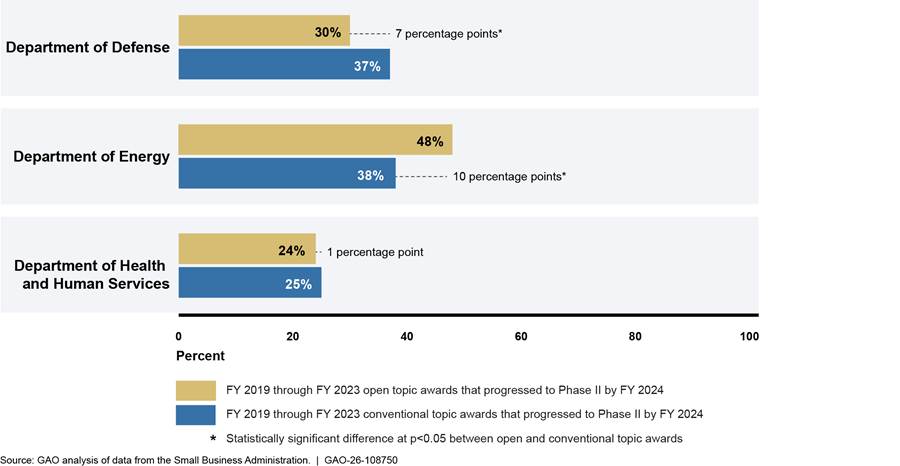
Note: Selected agencies are those that issued both open and conventional topic awards through SBIR or STTR in FY 2019 through 2024. Percentages are rounded to the nearest 1 percent. While Department of Commerce issued both open and conventional topic awards in FY 2024, it is excluded from this figure because it issued only open topic awards in some prior years.
DOD officials said that they track awardee progression from Phase I to Phase II and have observed different rates of progression for open and conventional topic awardees across components. For example, according to our analysis, a higher share of the Air Force’s FY 2019 through FY 2023 Phase I conventional topic awards progressed to Phase II by FY 2024 than open topic awards. DOD officials said that Phase I to Phase II progression is driven by the number of eligible proposals and available budget, and, within the Air Force, there is a smaller pool of eligible conventional topic awards. DOE and HHS officials said that they do not currently evaluate awardee progression from Phase I to Phase II, though in February 2026, DOE officials told us that they plan to monitor trends in this progression moving forward.
Participating agencies identified a range of reasons why Phase I awardees do not progress to Phase II. Officials from most agencies said that resource constraints affect awardee progression from Phase I to Phase II. Specifically, officials from some agencies said they receive more qualified applicants than they can fund. Officials from most agencies also said that awardees may not progress to Phase II for other reasons, such as if they lack a strong commercialization plan, demonstrated inadequate progress in Phase I, or have a weak technical approach.
Among the agencies that consistently issued both open and conventional topic awards in FY 2019 through FY 2024, only DOD identified different reasons that open and conventional topic awardees may not progress to Phase II. DOD officials said an open topic awardee may not progress if an awardee cannot find a government customer or convince DOD that the small business’s solution is relevant to a current problem. In comparison, DOD officials told us that a conventional topic awardee may not progress to Phase II if it is unable to solve DOD’s defined problem or if the pre-identified government customer no longer needs the proposed solution.
Agencies Offer Resources to Support Awardee Progression Through Program Phases
Participating agencies provide a variety of funding and training opportunities intended to support small business progression through the phases of the SBIR and STTR programs. Agencies offer additional funding that small businesses can use for a range of purposes, such as assisting with commercialization and technical decisions. For example, Technical and Business Assistance funding can be used for market research and intellectual property protection, while Commercialization Readiness Pilot Program funding can be used for late-stage research and development support not covered by Phase II awards, such as manufacturing costs and specialized technical assistance. Some agencies also offered training programs, such as I-Corps, an entrepreneurial training program that uses the customer discovery process to help researchers assess their inventions’ market potential. See figure 10 for more information on these opportunities.
Figure 10: Examples of Agency Opportunities to Support Small Business Progression through the Phases of the Small Business Innovation Research (SBIR) and Small Business Technology Transfer (STTR) Programs
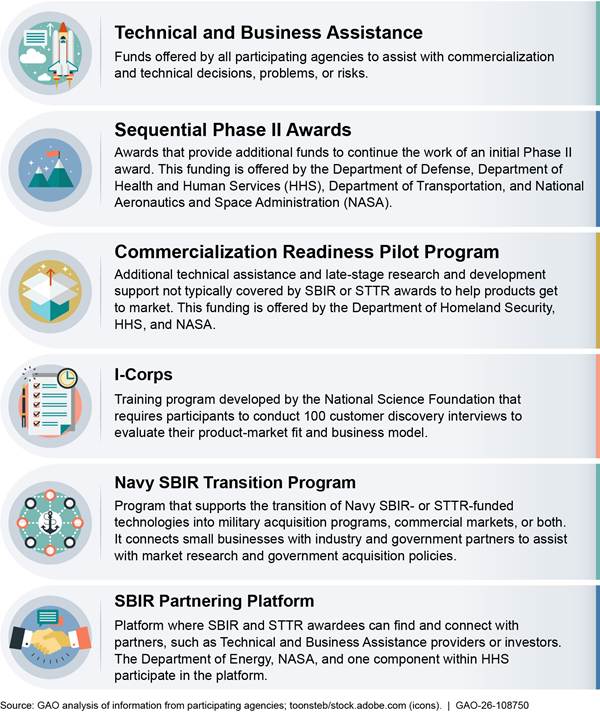
Note: The entries in this figure are examples of agency opportunities to support small business progression through SBIR and STTR program phases. They do not represent all funding and training opportunities that participating agencies offered.
A majority of small business representatives we interviewed had participated in at least one of the agency opportunities described above, but they shared mixed reviews. Some representatives said that these opportunities helped their small business progress through the phases of the program. For example, these representatives said the I-Corps program helped improve their understanding of business development and potential customers’ needs. Some small business representatives reported receiving Commercialization Readiness Pilot Program awards, which they found to be very helpful in supporting their commercialization efforts. For example, one representative said they used the award to improve their quality management system and achieve regulatory compliance, demonstrating to strategic partners the small business’s readiness to sell its product globally. Another small business representative used the award to establish a local production facility, ultimately selling millions of units of their product.
For some small business representatives, these opportunities were less helpful because they did not align with the companies’ goals. One small business representative said the I-Corps program and Technical and Business Assistance funding did not help the company commercialize because their intended customers were within the federal government, while these activities focused on commercializing outside of the government. Another small business representative said the Technical and Business Assistance program is focused on commercialization for technologies with large commercial markets and high potential return, which did not align with the company’s technology. Additionally, the representative said the I-Corps program was challenging because their customer base was limited in size and they were unable to participate in the required 100 customer interviews.[55]
In addition to the opportunities described above, some small business representatives said that the relationship with their SBIR and STTR points of contact, such as program managers and technical points of contact, were very important.[56] For some small businesses, this relationship supported their progression through program phases by facilitating connections with end users. For example, representatives from one small business said they worked closely with their SBIR and STTR points of contact, who helped them identify end users, develop the technology in a way that facilitated acquisition, and progress to commercialization.
However, some small businesses noted that SBIR and STTR points of contact may be less equipped to assist open topic awardees than conventional topic awardees. For example, one small business representative said that, within one DOD component they received awards from, open topic program managers were less interested, less incentivized to manage the project, and provided less guidance than conventional topic program managers. In contrast, the representative said that because conventional topic awards are designed to address specific challenges identified by federal agencies, program managers are incentivized to help move the proposed solution through the phases of the program. Further, some small business representatives said open topic program managers may be less knowledgeable about technologies funded by open topics, which may affect awardees’ progression.
Small Business Representatives Reported Receiving Limited Information about Federal Phase III Awards
Many small business representatives we interviewed reported receiving insufficient information or no guidance from their SBIR and STTR point of contact on progressing to a federal Phase III award. As previously noted, federal agencies issue Phase III awards to SBIR and STTR awardees without further competition using federal non-SBIR, non-STTR funding sources. Many small business representatives we interviewed used SBIR or STTR awards to develop technologies intended for government customers, and some representatives told us that a Phase III award from a federal agency was their commercialization goal. According to the Small Business Act, as amended, and SBA’s policy directive, agencies that pursue research, R&D, or production of technologies developed under the SBIR or STTR program should issue Phase III awards relating to the technology to the original SBIR or STTR awardees that developed the technology “to the greatest extent practicable,” consistent with an agency’s mission and optimal small business participation.[57]
We found that the agencies that issued the highest volume of Phase III awards according to agency data (DOD, DOE, DHS, and NASA) provide information on Phase III awards to awardees. According to our review of publicly available information, NASA, DOE, and the Department of the Navy within DOD publish Phase III guides on their websites. However, we found that the level of detail in their guidance varies. For example, NASA’s guidance provided a detailed overview of the internal processes and requirements and identifies points of contact. DOE’s guide focuses on authorities and eligibility without specific procedural details because, according to DOE officials, awardees typically pursue Phase III awards with other agencies.
Agencies also use webinars, commercialization workshops, and other formats to communicate Phase III information to awardees. DOD, DOE, DHS, and NASA all offer webinars or workshops. For example, DHS’s commercialization workshop covers topics such as licensing, data rights, and paths to commercialization. The information offered can vary within an agency. Within DOD, the Air Force provides Phase III information to awardees only as requested, while the Defense Advanced Research Projects Agency sends a weekly email with Phase III opportunities to all current and past awardees.
Some small business representatives told us that SBIR and STTR agency points of contact, such as program managers and technical points of contact, may misunderstand federal Phase III awards. For example, one small business representative told us that the federal agency point of contact asked the small business how to conduct a Phase III award. Further, some small business representatives said that SBIR and STTR agency points of contact may be disconnected from the agency’s acquisition workforce, which conducts Phase III awards. These representatives said that their points of contact were unable to connect awardees with the appropriate acquisition contacts within the agency and, without the necessary introductions, transitioning to Phase III was difficult.
Further, the acquisition workforce within an agency may not always be familiar with the Phase III process, creating a barrier for small businesses to sell products to the federal government under a Phase III award. For example, DOE guidance states that contracting officers for SBIR and STTR awards may not have prior experience issuing Phase III awards and directs awardees to notify the agency for assistance. Also, guidance from SpaceWERX—the innovation arm of the U.S. Space Force within the Department of the Air Force—highlights that small businesses may need to educate contracting partners on Phase III authorities and advantages. One small business representative we interviewed said that they tried discuss Phase III, but agency acquisition contacts were not knowledgeable about Phase III opportunities or processes. A 2024 Naval Postgraduate School report also found that AFWERX acquisition professionals may be unfamiliar with Phase III processes and the support that small businesses need to transition to Phase III, which creates barriers in small business progression.[58]
The Small Business Innovation and Economic Security Act, the April 2026 law reauthorizing the SBIR and STTR programs, seeks to address this challenge by requiring SBA, in coordination with DOD, the General Services Administration, and other agencies, to develop training for agencies’ contracting and acquisition workforce on Phase III agreements and contracts.[59] As of July 2026, SBA officials told us that they are working with DOD, the General Services Administration, and other relevant agencies to implement these requirements, including discussing requirements to update data elements with the General Services Administration and soliciting feedback from DOD’s acquisition workforce. DOD officials told us that they are developing a training program, which they plan to launch by FY 2028. While full implementation is pending, we anticipate that this training will help address the gaps in agency knowledge that we identified in our interviews with small businesses. By improving the contracting and acquisition workforce’s understanding of Phase III awards and processes, this training could help increase the rate of small businesses successfully transitioning to federal Phase III awards by making the process easier for small businesses to navigate.
Further, the act seeks to provide additional support to small businesses by expanding the role of SBA’s procurement center representatives—which help small businesses gain access to federal contracting opportunities—in federal Phase III awards. More specifically, the act requires that within 1 year, SBA must revise the SBIR and STTR program policy directive to require procurement center representatives to advocate for the maximum practicable use and transition to Phase III of SBIR- and STTR-developed products, services, and technologies.[60] This change could help address the gap raised by many small businesses we interviewed, who reported receiving insufficient Phase III information from SBIR and STTR points of contact and other agency officials. Requiring procurement center representatives to act as liaisons between agencies and small businesses could improve Phase III information sharing. However, due to the recent nature of these requirements, it is too early to evaluate whether they will fully resolve information gaps for small businesses or the contracting and acquisition workforce.
Commercialization Data Challenges Limit Insight into Small Business Success
Agencies Use a Range of Approaches to Evaluate Awardee Commercialization Outcomes
SBA and participating agencies take varying approaches to evaluating awardee progression to commercialization, which includes securing a federal Phase III award, selling on the commercial market, or licensing a technology. The Small Business Act, as amended, requires SBA to develop and maintain a commercialization database to be used for SBIR and STTR program evaluation.[61] The database stores information reported by awardees on commercial activity—such as sales revenue and outside investment—resulting from their past SBIR or STTR awards. SBA uses the database to evaluate whether awardees meet performance benchmarks.[62] Participating agencies also reported using a range of approaches to track awardee commercialization outcomes, including reaching out to past awardees and using business intelligence databases to collect information on past awardees’ sales and investments.
Some agencies developed their own tools to evaluate awardee commercialization outcomes. Specifically, DOE’s Advanced Research Projects Agency-Energy developed a tool that collects information on commercialization outcomes using government and business intelligence databases and small business responses to agency outreach. Similarly, officials told us that NASA developed a tool to create commercialization success reports using multiple data sources to identify licensing agreements, acquisitions, and other outcomes.
As described above, agencies use varying approaches to track commercialization success. However, none of the three agencies that consistently issued awards from both topic types in FY 2019 through FY 2024 (DOD, DOE, and HHS) identified the differences between open and conventional awardees’ progression to Phase III or other commercialization outcomes. Agency officials identified challenges to this evaluation, including data limitations.
Data on Federal Phase III Awards and Other Commercialization Outcomes Are Limited
Data limitations prevent agencies from fully evaluating how awardees progress to federal Phase III awards and other commercialization outcomes, including differences between open and conventional topic awards. Agencies are required to submit federal Phase III award information to SBA for the annual SBIR and STTR report to Congress.[63] SBA acknowledged in its FY 2022 report to Congress, the most recent report available at the time of our review, that Phase III reporting will likely continue to represent an underestimate of total Phase III funding due to data limitations.[64]
Federal Procurement Data System (FPDS) data on federal Phase III awards are currently unreliable and incomplete, according to officials from some participating agencies.[65] Agencies are often unaware of a small business’s prior Phase I and Phase II awards and may not code a contract as a Phase III award in FPDS. While FPDS includes a specific field to identify Phase III contracts, it was optional. Because of this, FPDS does not provide a complete picture of federal Phase III awards, according to SBA officials. Further, DOD officials said that FPDS did not require contracting officers to link Phase III awards to prior Phase I and Phase II awards, which prevented DOD from evaluating whether there were differences in the progression of open or conventional topic awards to federal Phase III awards. The National Academies identified a similar challenge in its 2026 review of DOD’s SBIR and STTR programs, noting that Phase III awards are not reported uniformly, which makes it challenging to track whether a DOD contract is a Phase III award.[66]
We could not evaluate whether there are differences in the share of open and conventional awardees that successfully progressed to federal Phase III awards among agencies that issued awards from both topic types. The 2026 act reauthorizing the SBIR and STTR programs aims to address these challenges. It requires the General Services Administration to update FPDS to require reporting on whether a contract is designated as a Phase III award and for agency contracting officers to link Phase II and III awards to relevant prior Phase I or Phase II SBIR or STTR awards.[67] We believe that implementing these changes will improve the reliability of this data, which could be used in the future to compare the progression of open and conventional topic awards to federal Phase III awards.
Challenges with data on outcomes outside of federal Phase III awards also hinder analyses of other awardee commercialization efforts. We found that small businesses are not consistently meeting commercialization reporting requirements. Awardees are required to report commercialization information to SBA at certain points. First, as noted above, agencies must require each Phase II awardee to submit commercialization information to SBA upon completion of its award. Second, small businesses are required to update information on any completed Phase II awards when they submit a proposal for a new Phase II award. However, our analysis of SBA’s commercialization database highlights a gap in monitoring small business commercialization reporting compliance for awards issued between FY 2019 and FY 2024. According to our review, small businesses submitted mandatory company commercialization reports for only 25 percent of all completed Phase II awards. Further, we found that compliance improved only marginally when small businesses faced the immediate incentive of securing additional funding for awards issued between FY 2019 and FY 2024. Specifically, when actively applying for a new Phase II award, businesses submitted required reports for only about 40 percent of their previously completed awards.
According to our review of participating agencies’ FY 2025 solicitations and related documents, we found that 6 of 11 agencies described the requirement for companies to submit company commercialization reports on any prior Phase II awards to SBA when submitting a new Phase II proposal (see fig. 11). Further, we found 3 of 11 agencies and one component within Commerce required Phase II applicants to submit proof of meeting this standard as part of their proposal (i.e., to upload a copy of the company commercialization report). While six other agencies require small businesses to submit commercialization information on past awards as part of their proposal (for example, via an agency-specific template), these agencies did not require applicants to submit a copy of their company commercialization report.
Figure 11: Small Business Innovation Research (SBIR) and Small Business Technology Transfer (STTR) Commercialization Reporting Requirements in Agency Solicitations
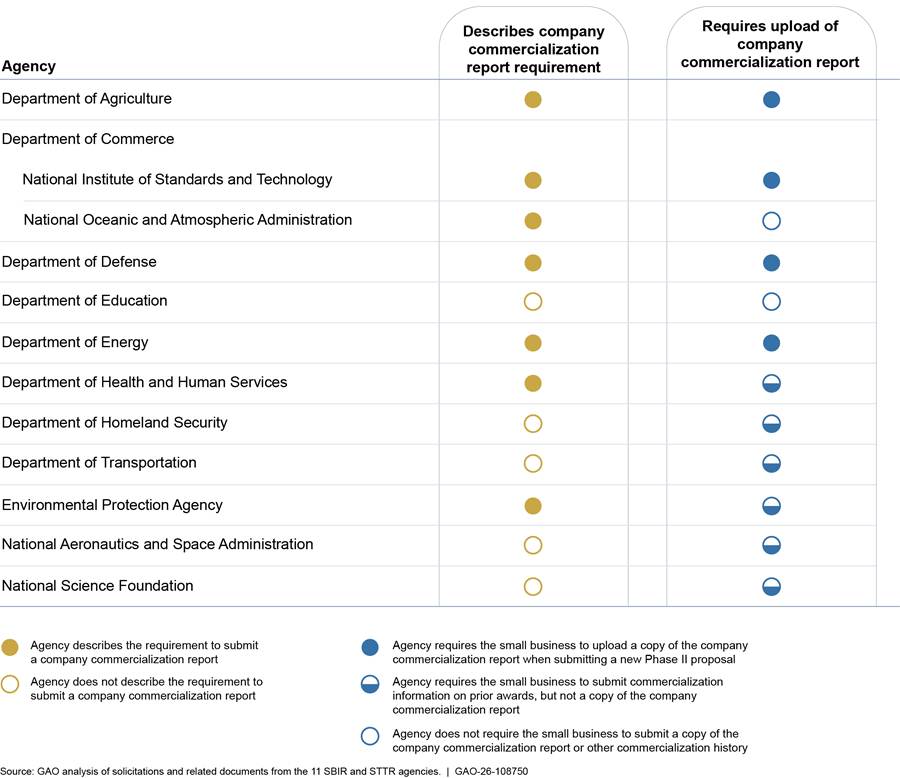
Note: The Small Business Administration maintains a commercialization database that stores information reported by awardees on the commercial activity resulting from their past SBIR or STTR awards. Small businesses are required to update information on their prior Phase II SBIR and STTR awards in the commercialization database when submitting a proposal for a new Phase II award and upon completion of a Phase II award. 15 U.S.C. § 638(k)(3). Awardees enter information into the commercialization database by submitting company commercialization reports.
There is widespread underreporting in SBA’s commercialization database, leaving it incomplete and not useful to analyze in its current form. Increasing small business adherence to commercialization reporting requirements by better conveying requirements to small businesses and ensuring compliance with these requirements could increase the share of awards with commercialization information in SBA’s database. Gathering this data is a first step toward obtaining a fuller picture of the outcomes of the SBIR and STTR programs. Improving the accuracy of the commercialization data would be a second step that, together with increasing small business reporting compliance, could increase the utility of the commercialization database.
As previously noted, the Small Business Act, as amended, requires SBA to develop and maintain the commercialization database for the purpose of SBIR and STTR program evaluation.[68] SBA’s policy directive requires awardees to input commercialization-related information, such as revenue from sales of new products or services and additional investment received, into the commercialization database, and these requirements correspond to the statutory requirements relating to this database.[69] However, SBA officials said that they are not currently using the database to assess the outcomes of the SBIR and STTR programs, including whether open or conventional topic awards achieve greater commercialization success. While federal internal controls state that agencies should obtain relevant data from reliable sources to evaluate performance and inform decision making, the commercialization database as currently designed does not provide for complete and accurate data to assess commercialization outcomes, according to SBA officials.[70]
The data in the commercialization database are incomplete in part because the reporting requirements are tied to a limited set of triggering events: the completion of a Phase II award and the submission of a new Phase II proposal. Small businesses are not required to provide commercialization data outside of these triggering events. Further, SBA officials noted that small businesses that are no longer actively seeking SBIR and STTR awards—such as those that have grown to exceed the programs’ size requirements—are not incentivized to submit commercialization data. This underreporting reduces SBA’s visibility into the programs’ biggest commercial successes. Finally, even if small businesses fully comply with existing commercialization reporting requirements, the data may remain incomplete. This is because commercialization frequently occurs years after an award concludes, a time frame during which small businesses face no reporting requirements if they are not applying for new awards.
Additionally, SBA officials told us that even if the share of companies submitting commercialization information increased, they would still not view the commercialization database as sufficiently reliable without comprehensive validation and verification of the self-reported data. Small businesses may have an incentive to overstate their commercialization success in self-reported data. As of April 2026, SBA only performed data validation and verification steps for a small subset of awardees as part of SBA’s assessment of whether small businesses meet performance benchmarks. According to SBA officials, expanding this verification to measure program effects and give a more complete picture of commercialization outcomes would require additional resources. For example, these resources could include dedicated personnel to perform data validation and verification.
SBA officials said that their ability to assess the SBIR and STTR programs could be improved through SBA gaining access to existing commercial or external federal data sources, such as revenue data from the Internal Revenue Service. This could improve the reliability of the self-reported commercialization data from small businesses. Since SBA maintains the commercialization database, it is best positioned to determine which data sources could realistically improve commercialization data and allow for a more comprehensive understanding of SBIR and STTR outcomes.
Ongoing statutory reporting requirements indicate Congress prioritizes tracking and understanding the commercialization outcomes of SBIR and STTR awards.[71] Because the requirements for the commercialization database are outlined in statute, SBA has limited flexibility in how they design the database. In order for SBA to change what commercialization data they collect or when small businesses are required to provide this data, statutory changes would be needed.[72] Further, SBA officials reported that expanding their validation and verification of the commercialization database would require additional resources. Identifying internal actions or developing a legislative proposal to allow SBA to strengthen the reliability of commercialization data, such as by identifying statutory changes to the commercialization database, obtaining access to external data, or securing resources for the verification and validation of self-reported data, would enable SBA and participating agencies to improve accountability for federal research funding and track program outcomes. It would further provide decision makers with clearer insights into the different commercialization outcomes for open and conventional topic awards, as well as the overall economic return on federal R&D.
Conclusions
Federal agencies have awarded billions of dollars to small businesses to develop and commercialize innovative technologies through the SBIR and STTR programs. While agencies used open topics to fund nearly half of all SBIR and STTR awards in FY 2024, the absence of reliable data on federal Phase III awards and other commercialization outcomes prevents SBA from comparing the commercialization success of open and conventional topics. This gap hinders SBA and congressional oversight of the SBIR and STTR programs because comprehensive, reliable data on commercialization are essential to understanding how effectively the programs help small businesses develop and sell new technologies. Recognizing the importance of these data, Congress took steps to improve data on federal Phase III awards in the most recent reauthorization of the programs. Implementing these recent statutory changes, improving commercialization data reported by small businesses, and submitting a proposal identifying further statutory changes or additional resources, such as dedicated personnel or access to outside data, would allow SBA to more comprehensively assess commercialization outcomes. This, in turn, would help Congress better understand program outcomes, maintain accountability for federal research funding, and provide additional insight into the return on investment for federal R&D.
Recommendations for Executive Action
GAO is making 14 recommendations, including two to Education (Recommendations 1-2), one to HHS (Recommendation 3), two to DHS (Recommendations 4-5), two to DOT (Recommendations 6-7), one to EPA (Recommendation 8), two to NASA (Recommendations 9-10), one to the National Oceanic and Atmospheric Administration (Recommendation 11), two to NSF (Recommendations 12-13), and one to SBA (Recommendation 14). Specifically:
The Secretary of Education should revise the agency’s future Phase II solicitations to communicate that applicants are required to submit updated commercialization reports to SBA for any prior Phase II awards. (Recommendation 1)
The Secretary of Education should require Phase II applicants to submit with their proposals proof that they updated commercialization information—such as a copy of updated commercialization reports—for Phase II awards that they completed within the last 5 years. (Recommendation 2)
The Secretary of Health and Human Services should require Phase II applicants to submit with their proposals proof that they updated commercialization information—such as a copy of updated commercialization reports—for Phase II awards that they completed within the last 5 years. (Recommendation 3)
The Secretary of Homeland Security should revise the agency’s future Phase II solicitations to communicate that applicants are required to submit updated commercialization reports to SBA for any prior Phase II awards. (Recommendation 4)
The Secretary of Homeland Security should require Phase II applicants to submit with their proposals proof that they updated commercialization information—such as a copy of updated commercialization reports—for Phase II awards that they completed within the last 5 years. (Recommendation 5)
The Secretary of Transportation should revise the agency’s future Phase II instructions to communicate that applicants are required to submit updated commercialization reports to SBA for any prior Phase II awards. (Recommendation 6)
The Secretary of Transportation should require Phase II applicants to submit with their proposals proof that they updated commercialization information—such as a copy of updated commercialization reports—for Phase II awards that they completed within the last 5 years. (Recommendation 7)
The Administrator of EPA should require Phase II applicants to submit with their proposals proof that they updated commercialization information—such as a copy of updated commercialization reports—for Phase II awards that they completed within the last 5 years. (Recommendation 8)
The Administrator of NASA should revise the agency’s future Phase II solicitations to communicate that applicants are required to submit updated commercialization reports to SBA for any prior Phase II awards. (Recommendation 9)
The Administrator of NASA should require Phase II applicants to submit with their proposals proof that they updated commercialization information—such as a copy of updated commercialization reports—for Phase II awards that they completed within the last 5 years. (Recommendation 10)
The Administrator of the National Oceanic and Atmospheric Administration should require Phase II applicants to submit with their proposals proof that they updated commercialization information—such as a copy of updated commercialization reports—for Phase II awards that they completed within the last 5 years. (Recommendation 11)
The Director of NSF should revise the agency’s future Phase II solicitations to communicate that applicants are required to submit updated commercialization reports to SBA for any prior Phase II awards. (Recommendation 12)
The Director of NSF should require Phase II applicants to submit with their proposals proof that they updated commercialization information—such as a copy of updated commercialization reports—for Phase II awards that they completed within the last 5 years. (Recommendation 13)
The Administrator of SBA should submit a legislative proposal to Congress or pursue other actions to strengthen the reliability of commercialization data. (Recommendation 14)
Agency Comments
We provided a draft of this report to Commerce, DHS, DOD, DOE, DOT, Education, EPA, HHS, NASA, NSF, SBA, and USDA for review and comment.
DHS, DOT, Education, EPA, HHS, NASA, and NSF concurred with our recommendations, and their written responses are reprinted in appendices VI through XII. In an email response on September 11, 2026, National Oceanic and Atmospheric Administration officials stated their concurrence with our recommendation to the agency. Additionally, in an email response on September 14, 2026, SBA officials stated their concurrence with our recommendation to SBA.
DOT, HHS, NASA, and SBA also provided technical comments, which we incorporated as appropriate. For example, DOT officials clarified that DOT issues Phase II instructions, instead of Phase II solicitations. To be consistent with DOT’s processes, we updated the wording of the recommendation to reflect this.
DOD, DOE, NIST, and USDA did not have any comments on the report.
We are sending copies of this report to the appropriate congressional committees; the Secretaries of Agriculture, Commerce, Defense, Education, Energy, Health and Human Services, Homeland Security, and Transportation; the Administrators of the SBA, Environmental Protection Agency, and National Aeronautics and Space Administration; the Director of the National Science Foundation; and other interested parties. In addition, this report will be available at no charge on the GAO website at http://www.gao.gov.
If you or your staff have any questions about this report, please contact me at BenedictH@gao.gov. Contact points for our Offices of Congressional Relations and Media Relations may be found on the last page of this report. GAO staff who made key contributions to this report are listed in appendix XIII.

Hilary M. Benedict
Director, Science, Technology Assessment, and Analytics
List of Committees
The Honorable Roger Wicker
Chairman
The Honorable Jack Reed
Ranking Member
Committee on Armed Services
United States Senate
The Honorable Joni Ernst
Chair
The Honorable Ed Markey
Ranking Member
Committee on Small Business and Entrepreneurship
United States Senate
The Honorable Mike Rogers
Chairman
The Honorable Adam Smith
Ranking Member
Committee on Armed Services
House of Representatives
The Honorable Brian Babin
Chairman
The Honorable Zoe Lofgren
Ranking Member
Committee on Science, Space, and Technology
House of Representatives
The Honorable Roger Williams
Chairman
The Honorable Nydia M. Velázquez
Ranking Member
Committee on Small Business
House of Representatives
The SBIR and STTR Extension Act of 2022 includes a provision requiring us to issue a series of reports comparing several aspects of open and conventional topics of federal agencies participating in the Small Business Innovation Research (SBIR) and Small Business Technology Transfer (STTR) programs.[73]
The scope of work includes the Small Business Administration (SBA) and the 11 participating agencies, including 29 components within the 11 agencies (see fig. 2 above). We identified possible components through our past work. We then asked agency officials to identify any other components that developed topics in FY 2024.
To address our objectives, we (1) collected and analyzed data to summarize and compare open and conventional topic awards from FY 2019 through FY 2024; (2) analyzed data to summarize small business commercialization reporting behavior for awards issued from FY 2019 through FY 2024; (3) reviewed agencies’ solicitations for commercialization reporting requirements; (4) interviewed representatives from 20 randomly selected small businesses that received Phase II awards in FY 2021; and (5) interviewed agency officials.
Summary and Comparison of Open and Conventional Topic Awards
To summarize and compare open and conventional topic awards from FY 2019 through FY 2024, we obtained data from multiple sources, cleaned the data as needed, assessed reliability, merged the data into a single dataset, compared summary data on awardee characteristics and the amount of time to notify applicants of award decisions and issue awards, and performed multivariate logistic regression analyses to assess whether differences were statistically significant.
SBA Award Data and Registry Data
Building on our prior analysis of participating agencies’ awards from FY 2019 through FY 2023, we collected and analyzed agencies’ award data for FY 2024.[74] This was the most recent year with sufficiently complete data available during our review. We downloaded publicly available award-level data from SBA’s SBIR.gov webpage.[75] The data include information on each award issued, the agency issuing the award, and the small business receiving the award (e.g., whether the business was women-owned at the time of the award).
To fill in missing unique entity identifiers for small businesses, we obtained data from SBA’s company registry as of February 2026. The registry is an SBA database of businesses registered to participate in the SBIR and STTR programs. The database includes fields that describe the businesses, including the unique entity identifier, as of the businesses’ most recent SBIR or STTR proposal. We used analytical software to merge the registry data with the award data, matching observations by business’s name. We then filled in missing values in the award data with unique entity identifiers from the registry data or from additional data provided by SBA. To assess reliability of the merged dataset, we identified outliers and invalid values.
For the award data, we collected written responses from agencies to clarify inconsistencies or other issues we identified. Based on agency responses, we cleaned the data, including updating values or removing awards that were outside our scope. After cleaning the data, we found the data elements we used to be sufficiently reliable for the purposes of our report.[76]
Participating Agency Open and Conventional Topic Data
We generated a field showing whether each award originated from an open or conventional topic in FY 2024. To populate the field, we either merged in data provided by the participating agency (matching the datasets using award information) or entered values based on agency information. We collected additional data and information from agencies until all awards in the award data were categorized as originating from open or conventional topics.
We then analyzed the data to summarize and compare open and conventional topic awards. Specifically, we calculated the total number of awards and dollars awarded in FY 2024, as well as the proportion of awards given to small businesses owned by women and individuals from socially and economically disadvantaged groups.[77] In addition, we calculated notification and issuance times using the solicitation close date, the date that agencies notified small businesses of the award, and the award issuance date. Notification time is the number of days between the date a solicitation closed (or, in some cases, when the agency received a proposal) and the date the agency notified the business whether it was selected for an award. Issuance time is the number of days between the date a solicitation closed (or in some cases, the agency received a proposal) and the date the agency issued the award to the business. For each agency, we then compared the calculated number of days with required notification and recommended issuance time frames.[78] For the agencies that issued awards from both topic types, we used multivariate logistic regression analysis to assess whether differences between open and conventional topic awards were statistically significant. Statistically significant differences are defined as p < .05 for the purposes of this report.
Participating Agency Waiver Data
We collected information from the participating agencies on waivers that they received from SBA to exceed required notification time frames for awards issued in FY 2024, including the solicitation number or topic code that received the waiver and the extended notification deadline approved by SBA.[79] We merged the waiver data with our award dataset for FY 2024, matching the datasets on solicitation number or topic code. We then calculated the number of open and conventional topic awards that received waivers and the proportion of awards that were notified within required time frames or within the extended notification deadline approved by SBA.
System for Award Management (SAM.gov) Registry Data
To obtain information on whether awards were issued to veteran-owned small businesses, we used the General Services Administration’s SAM.gov registration data for FY 2024. Small businesses are required to register on SAM.gov before submitting a SBIR, STTR, or other federal proposal, and registrations are valid for 1 year. We conducted logic tests and found the data to be sufficiently reliable to identify veteran-owned businesses. Using analytical software, we merged the SAM.gov data with our award dataset for FY 2024, matching the datasets using the unique entity identifier and the month of the award. We then calculated the proportion of awards issued to veteran-owned small businesses. For the agencies that issued awards from both topic types, we used regression analysis to assess whether differences between open and conventional topic awards were statistically significant.
Census Bureau Data
To determine whether awards were issued to rural small businesses, we used the Census Bureau’s county-level data on the percentage of the 2020 Census population located within rural blocks.[80] Using analytical software, we merged the Census Bureau data with our award dataset for FY 2024, matching on zip code. We categorized awardees as rural if they were located in counties where at least 66.9 percent of the 2020 Census population of the county was located within rural blocks, which encompasses the Census Bureau’s categories of “mostly rural” and “completely rural.” For the agencies that issued awards from both topic types, we used regression analysis to assess whether differences between open and conventional topic awards were statistically significant.
Identifying Multiple Awardees
To obtain information on whether awards were issued to multiple awardees (i.e., small businesses that received 16 or more Phase II awards over the last ten FYs excluding the two most recently completed FYs), we downloaded publicly available award-level data from SBA’s SBIR.gov webpage for FY 2013 through FY 2022.[81] We merged this data with our award dataset for FY 2024, matching on small business name, then identified whether a small business was a multiple awardee. For the agencies that issued awards from both topic types, we used regression analysis to assess whether differences between open and conventional topic awards were statistically significant.
SBA Agency Tracking Data
We obtained award-level data from SBA that included agency tracking numbers to connect Phase II awards with prior Phase I awards from FY 2019 through FY 2024. We conducted logic tests and found the data to be sufficiently reliable for our purposes. We then used the data to calculate the percentage of FY 2019 through FY 2023 Phase I open and conventional topic awards that progressed to Phase II at any time through FY 2024. For the agencies that issued awards from both topic types, we used regression analysis to assess whether differences between open and conventional topic awards were statistically significant.
We did not analyze small businesses’ progression to Phase III. We previously found that Phase III contracts listed in the Federal Procurement Data System could not be reliably matched to awards in the SBA award data.[82]
Summary of Small Business Commercialization Reporting Behavior
To analyze small business commercialization reporting behavior, we obtained data from multiple sources, assessed reliability, merged the data into a single dataset, and summarized the data.
From SBA, we obtained the commercialization database for awards issued in FY 2019 through FY 2024. This internal award-level dataset contains company commercialization reports submitted by small businesses as of January 2026. These reports include information on Phase III awards received from federal agencies, sales revenues, and outside investments (such as venture capital funding). We determined that the dataset was sufficiently reliable to summarize small business commercialization reporting behavior, but not to summarize awardee commercialization outcomes or compare these outcomes for open and conventional topic awards.
We then merged the commercialization database with the cleaned FY 2019 through FY 2024 SBIR and STTR award datasets developed for this review and prior open topics reports, matching the datasets on award number.[83] We calculated the proportion of FY 2019 through FY 2024 awards that met the two commercialization reporting requirements outlined in statute.[84] First, awardees are required to update commercialization information upon completion of the last deliverable of a Phase II award. We identified Phase II awards that were completed as of December 31, 2025, and calculated the proportion of these awards that were present in the commercialization database. Second, awardees are required to update commercialization information on prior Phase II awards when submitting a proposal for a new Phase II award. We identified Phase II awards that were completed prior to the proposal receipt date of the small business’s most recently awarded Phase II award. Then, we calculated the proportion of these awards that were present in the commercialization database.
Review of Agency Solicitations for Commercialization Reporting Requirements
To assess agencies’ communication of commercialization reporting requirements, we reviewed agencies’ FY 2025 solicitations or other relevant documents, such as applicant instructions or eligibility requirements. In our review, we determined whether the documents (1) included a description of the requirement for awardees to update commercialization information on any prior Phase II awards when submitting a proposal for a new Phase II award and (2) required applicants to submit proof of meeting this requirement (i.e., uploading a copy of the updated company commercialization report). See table 8 for a description of how we categorized solicitations.
Table 8: Categories Used to Determine Agencies’ Inclusion of Commercialization Reporting Requirements Within Small Business Innovation Research (SBIR) and Small Business Technology Transfer (STTR) Solicitations
|
Category |
Described commercialization reporting requirement |
|
Requirement described |
The document identifies that small businesses must submit an updated company commercialization report for any prior Phase II awards to the Small Business Administration (SBA) when submitting a proposal for a new Phase II award. |
|
Requirement not described |
The document does not identify that small businesses must submit an updated company commercialization report for any prior Phase II awards when submitting a proposal for a new Phase II award. |
|
Category |
Required company commercialization report upload |
|
Upload required |
The document requires that the small business submit a copy of the company commercialization reports for prior awards (downloaded from SBA) as part of their proposal for a new Phase II award. |
|
Upload not required, but other commercialization history required |
The document requires that the small business submit commercialization information for prior awards as part of their proposal for a new Phase II award, but not specifically a copy of the company commercialization report downloaded from SBA. |
|
No upload required |
The document does not require that the small business submit a copy of the company commercialization report downloaded from SBA or any other commercialization history as part of their proposal for a new Phase II award. |
Source: GAO. | GAO‑26‑108750
Interviews with Small Business Representatives
We interviewed representatives from 20 small businesses that received Phase II awards in FY 2021. We selected from the population of FY 2021 Phase II awardees because we wanted to obtain the perspectives of awardees with experience progressing through the phases of the SBIR and STTR program. This ensured that the small businesses had completed the Phase II award period, which is typically two years long, and had a period of at least two years for potential progress toward commercialization. Five agencies issued 95 percent of SBIR and STTR awards in FY 2021: the Departments of Defense (DOD), Energy (DOE), and Health and Human Services (HHS), the National Aeronautics and Space Administration (NASA), and the National Science Foundation (NSF). To reflect the award distribution, we randomly selected awardees from those five agencies after stratifying the FY 2021 Phase II awards by agency and—for the three agencies that issued both open and conventional topic awards in FY 2021 (DOD, DOE, and HHS)—topic type. We interviewed approximately a proportional number of small businesses from each of the five agencies based on the number of awards that the agency issued in FY 2021 (see table 9).
|
Agency |
Number of interviews with open topic awardees |
Number of interviews with conventional topic awardees |
Total number of interviews |
|
Department of Defense |
4 |
4 |
8 |
|
Department of Health and Human Services |
3 |
2 |
5 |
|
Department of Energy |
1 |
1 |
2 |
|
National Aeronautics and Space Administration |
0 |
2 |
2 |
|
National Science Foundation |
3 |
0 |
3 |
|
Total |
11 |
9 |
20 |
Source: GAO . | GAO‑26‑108750
In total, we interviewed representatives from 20 small businesses that had a range of characteristics, including number of employees and whether they were a nontraditional small business (see table 10). While we selected small businesses who received Phase II awards from DOD, DOE, HHS, NASA, or NSF in FY 2021, some also received awards from other participating agencies. All 11 participating agencies issued at least one award to at least one of the 20 small businesses that we interviewed. Because the selection was based on a nongeneralizable sample, the results of our 20 interviews cannot be used to make inferences about all firms that have received SBIR or SBIR awards.
Table 10: Selected Characteristics of the 20 Small Business Innovation Research (SBIR) and Small Business Technology Transfer (STTR) Fiscal Year 2021 Awardees That Were Interviewed
|
Characteristic |
|
Number of small businesses interviewed |
|
Number of employees |
Fewer than five employees |
4 |
|
5 to 10 employees |
4 |
|
|
11 to 50 employees |
8 |
|
|
More than 50 employees |
4 |
|
|
Nontraditional |
Owned by individuals from socially and economically disadvantaged groups |
3 |
|
Women-owned |
2 |
|
|
Veteran-owned |
0 |
|
|
Year that the small business began |
Before 2000 |
1 |
|
2000-2009 |
5 |
|
|
2010-2019 |
14 |
Source: GAO analysis of Small Business Administration data and information provided by small business representatives. | GAO‑26‑108750
We collected information on the small business representatives’ perspectives on funding and training opportunities offered by participating agencies to support awardee progression through the phases of the SBIR and STTR programs, among other topics. We then analyzed the interviews to identify themes and illustrative examples. We identified business and award characteristics, such as the business’s location and award phase, from SBA data and asked representatives to confirm this information.
Agency Interviews and Documentation
We interviewed officials or collected written responses from all 11 participating agencies on their SBIR and STTR program attributes, use of open topics, and funding and training opportunities to support awardee progression through the phases of the programs. Regarding program attributes, we collected information on typical customers (the agency itself or customers outside of the agency), funding mechanisms (grants, cooperative agreements, contracts, or other transaction agreements), and other issues. Regarding use of open topics, we collected information on participating agencies’ use of open topics in FY 2024 and FY 2025 and inquired about any anticipated future changes. We also collected information on the number of first-time applicants and awardees, number of proposals, and outreach and assistance efforts. Regarding agency opportunities to support awardee progression through the phases of the programs, we collected information on agency funding and training programs available to awardees. We also interviewed officials and collected written responses from SBA on the commercialization database, among other topics.
We reviewed the SBIR and STTR Extension Act of 2022, SBA’s 2023 SBIR and STTR Program Policy Directive, and the Small Business Innovation and Economic Security Act.[85] We also reviewed federal internal control standards.[86]
We conducted this performance audit from September 2025 to September 2026 in accordance with generally accepted government auditing standards. Those standards require that we plan and perform the audit to obtain sufficient, appropriate evidence to provide a reasonable basis for our findings and conclusions based on our audit objectives. We believe that the evidence obtained provides a reasonable basis for our findings and conclusions based on our audit objectives.
The figure below provides information on the number of awards and dollars awarded for open and conventional topics in FY 2019 through FY 2024.
Figure 12: Open and Conventional Topic Awards by Year in the Small Business Innovation Research (SBIR) and Small Business Technology Transfer (STTR) Programs, Fiscal Years 2019 through 2024
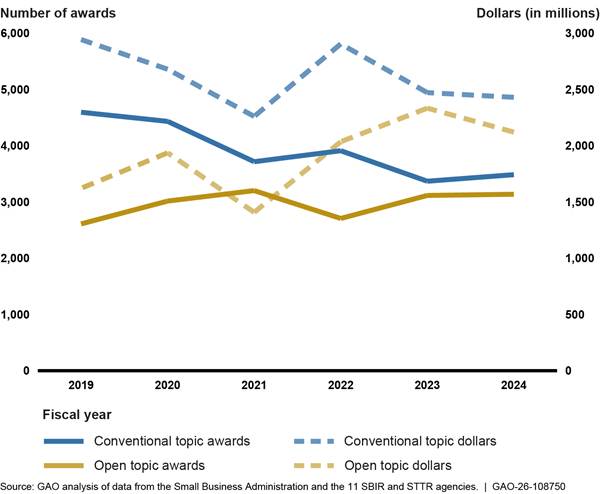
Note: Open and conventional topic dollars are adjusted for inflation using the gross domestic product price index.
The tables below provide information on the number of awards and dollars awarded in the STTR program compared to the SBIR program in FY 2024.
Table 11: Awards Issued by Participating Agencies from Small Business Technology Transfer (STTR) Program Open and Conventional Topics, Fiscal Year 2024
|
Agency |
Number of open topic awards from STTR |
Number of open topic awards from SBIR and STTR |
Percentage |
Number of conventional topic awards from STTR |
Number of conventional topic awards from SBIR and STTR |
Percentage |
|
Department of Agriculture |
18 |
123 |
15% |
0 |
0 |
0% |
|
Department of Defense |
282 |
1,373 |
21% |
369 |
2,049 |
18% |
|
Department of Energy |
10 |
58 |
17% |
65 |
495 |
13% |
|
Department of Health and Human Services |
201 |
920 |
22% |
31 |
308 |
10% |
|
National Aeronautics and Space Administration |
0 |
0 |
0% |
72 |
437 |
16% |
|
National Science Foundation |
65 |
461 |
14% |
0 |
0 |
0% |
Source: GAO analysis of data from the Small Business Administration and selected agencies. | GAO‑26‑108750
Note: Six agencies participated in STTR. Percentages are rounded to the nearest 1 percent.
Table 12: Dollars Awarded by Participating Agencies from Small Business Technology Transfer (STTR) Program Open and Conventional Topics, Fiscal Year 2024
|
Agency |
Dollars awarded from open STTR topics (in millions) |
Dollars awarded from open SBIR and STTR topics (in millions) |
Percentage |
Dollars awarded from conventional STTR topics (in millions) |
Dollars awarded from conventional SBIR and STTR topics (in millions) |
Percentage |
|
Department of Agriculture |
$4.5 |
$40.3 |
11% |
$0 |
$0 |
0% |
|
Department of Defense |
$156.6 |
$1,141.0 |
14% |
$218.6 |
$1,590.4 |
14% |
|
Department of Energy |
$3.9 |
$30.0 |
13% |
$31.0 |
$276.0 |
11% |
|
Department of Health and Human Services |
$89.2 |
$545.0 |
16% |
$15.2 |
$247.1 |
6% |
|
National Aeronautics and Space Administration |
$0 |
$0 |
0% |
$25.7 |
$174.4 |
15% |
|
National Science Foundation |
$28.5 |
$227.3 |
13% |
$0 |
$0 |
0% |
Source: GAO analysis of data from the Small Business Administration and selected agencies. | GAO‑26‑108750
Note: Six agencies participated in STTR. Award amounts are rounded to the nearest $100,000. Percentages are rounded to the nearest 1 percent.
The figure below provides information on SBIR and STTR dollars awarded by state in FY 2024.
Figure 13: Open and Conventional Topic Awards in the Small Business Innovation Research (SBIR) and Small Business Technology Transfer (STTR) Programs Across all 50 U.S. States and the District of Columbia, Fiscal Year 2024
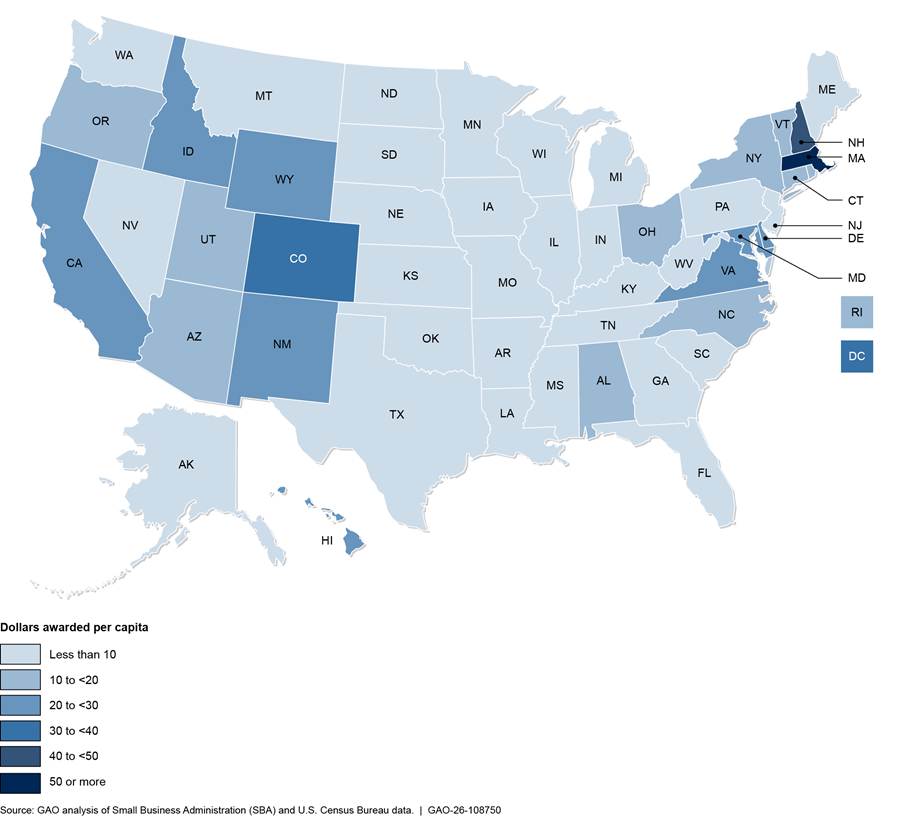
Note: State population estimates are as of July 1, 2025.
The tables below provide information on the share of awards agencies issued to multiple awardees and agencies’ applicant acceptance rates, rate of first-time applicants, and rate of first-time awardees.
Table 13: Open and Conventional Topic Awards Agencies Made to Multiple Awardees in the Small Business Innovation Research (SBIR) and Small Business Technology Transfer (STTR) Programs, Fiscal Year 2024
|
|
Open topic awards |
Conventional topic awards |
|||
|
Agency |
Number of awards to multiple awardees |
Percentage of awards to multiple awardees |
Number of awards to multiple awardees |
Percentage of awards to multiple awardees |
|
|
Department of Agriculture |
9 |
7% |
N/A |
N/A |
|
|
Department of Commercea |
1 |
1% |
0 |
0% |
|
|
Department of Defenseb |
68 |
5% |
708 |
35% |
|
|
Department of Education |
0 |
0% |
N/A |
N/A |
|
|
Department of Energy |
10 |
17% |
101 |
20% |
|
|
Department of Health and Human Servicesb |
27 |
3% |
25 |
8% |
|
|
Department of Homeland Security |
N/A |
N/A |
10 |
32% |
|
|
Department of Transportation |
N/A |
N/A |
10 |
25% |
|
|
Environmental Protection Agency |
N/A |
N/A |
1 |
3% |
|
|
National Aeronautics and Space Administration |
N/A |
N/A |
94 |
22% |
|
|
National Science Foundation |
0 |
0% |
N/A |
N/A |
|
N/A = agency did not issue awards from the topic type.
Source: GAO analysis of data from the Small Business Administration and the 11 SBIR and STTR agencies. | GAO‑26‑108750
Note: Multiple awardees are small businesses that received 16 or more Phase II awards over the last ten fiscal years, excluding the two most recently completed fiscal years. Percentages are rounded to the nearest 1 percent.
aGiven the low number of awards, we could not test for statistical significance for the Department of Commerce.
bThe difference between the percentage of open and conventional topic awards was statistically significant (p < 0.05).
Table 14: Agencies’ Applicant Acceptance Rates for Open and Conventional Topics in the Small Business Innovation Research (SBIR) and Small Business Technology Transfer (STTR) Programs, Fiscal Year 2024
|
|
Open topic awards |
Conventional topic awards |
||||
|
Agency |
Number of proposals |
Acceptance rate |
Number of proposals |
Acceptance rate |
||
|
Department of Agriculture |
533 |
23% |
N/A |
N/A |
||
|
Department of Commerce |
500 |
18% |
20 |
35% |
||
|
Department of Defense |
6,602 |
21% |
11,267 |
18% |
||
|
Department of Education |
281 |
8% |
N/A |
N/A |
||
|
Department of Energy |
318 |
18% |
2,345 |
21% |
||
|
Department of Health and Human Services |
6,892 |
13% |
1,539 |
20% |
||
|
Department of Homeland Security |
N/A |
N/A |
162 |
19% |
||
|
Department of Transportation |
N/A |
N/A |
383 |
10% |
||
|
Environmental Protection Agency |
N/A |
N/A |
143 |
20% |
||
|
National Aeronautics and Space Administration |
N/A |
N/A |
1,935 |
23% |
||
|
National Science Foundation |
2,742 |
17% |
N/A |
N/A |
||
N/A = agency did not issue awards from the topic type.
Source: GAO analysis of data from the Small Business Administration and the 11 SBIR and STTR agencies. | GAO‑26‑108750
Note: Acceptance rate is the percentage of proposals that resulted in an award. Calculations include both Phase I and Phase II awards. Data on the number of proposals were provided by participating agencies; data for the number of awards were from the Small Business Administration. Percentages are rounded to the nearest 1 percent.
Table 15: Open and Conventional Topic Awards Agencies Made to First-Time Applicants and First-Time Awardees in the Small Business Innovation Research (SBIR) and Small Business Technology Transfer (STTR) Programs, Fiscal Year 2024
|
|
Open topics |
Conventional topics |
||
|
Agency |
Percentage of first-time applicants |
Percentage of first-time awardees |
Percentage of first-time applicants |
Percentage of first-time awardees |
|
Department of Agriculture |
N/A |
46% |
N/A |
N/A |
|
Department of Commerce |
70% |
51% |
100% |
100% |
|
Department of Defense |
15% |
34% |
10% |
10% |
|
Department of Education |
N/A |
N/A |
N/A |
N/A |
|
Department of Energy |
19% |
33% |
25% |
32% |
|
Department of Health and Human Services |
N/A |
31% |
N/A |
14% |
|
Department of Homeland Security |
N/A |
N/A |
56% |
26% |
|
Department of Transportation |
N/A |
N/A |
68% |
53% |
|
Environmental Protection Agency |
N/A |
N/A |
N/A |
38% |
|
National Aeronautics and Space Administration |
N/A |
N/A |
21% |
20% |
|
National Science Foundation |
88% |
66% |
N/A |
N/A |
N/A = agency did not issue awards from the topic type or did not provide information on first-time applicants or first-time awardees.
Source: GAO analysis of data from the Small Business Administration and the 11 SBIR and STTR agencies. | GAO‑26‑108750
Note: Percent of first-time applicants is the number of first-time applicants divided by the total number of proposals. Percent of first-time awardees is the number of first-time awardees divided by the total number of awards. Calculations include both Phase I and Phase II awards. Data on the number of first-time applicants and first-time awardees were provided by participating agencies; data for the number of awards were from the Small Business Administration. Percentages are rounded to the nearest 1 percent.
The tables below provide information on the amount of time for agencies to notify applicants of decisions and issue open and conventional topic awards, as well as the number of waivers agencies received to exceed required time frames to notify applicants of award decisions.
Table 16: Amount of Time to Notify Applicants of Decisions in the Small Business Innovation Research (SBIR) and Small Business Technology Transfer (STTR) Programs, Fiscal Year 2024
|
Percentage of open and conventional topic awards that were notified within the required time frame |
||
|
Agency |
Open topic awards |
Conventional topic awards |
|
Department of Agriculture |
67% |
N/A |
|
Department of Commercea |
66% |
100% |
|
Department of Defenseb |
94% |
79% |
|
Department of Education |
87% |
N/A |
|
Department of Energyb |
96% |
72% |
|
Department of Health and Human Services |
94% |
94% |
|
Department of Homeland Security |
N/A |
100% |
|
Department of Transportation |
N/A |
100% |
|
Environmental Protection Agency |
N/A |
100% |
|
National Aeronautics and Space Administration |
N/A |
98% |
|
National Science Foundation |
86% |
N/A |
N/A = agency did not issue awards from the topic type
Source: GAO analysis of data from the Small Business Administration (SBA) and the 11 SBIR and STTR agencies. | GAO‑26‑108750.
Note: All 11 agencies participated in SBIR, and six of the agencies participated in STTR. SBA’s policy directive requires these agencies to notify businesses within 90 calendar days after a solicitation closes, except the National Science Foundation and the National Institutes of Health within the Department of Health and Human Services, which have 1 year to notify businesses. SBA, SBIR and STTR Program Policy Directive (May 3, 2023), § 7(c)(1). The directive’s required notification time frames are based on statutory requirements for agencies to make a final decision on SBIR and STTR proposals. 15 U.S.C. § 638(g)(4)(B), (o)(4)(B). We did not consider cases in which agencies requested and were granted waivers from SBA as on-time notifications. Awards with missing data on notification are not included in the denominators for percentage calculations. Percentages are rounded to the nearest 1 percent.
aGiven the low number of awards, we could not test for statistical significance for the Department of Commerce.
bThe difference between open and conventional topic awards was statistically significant (p < .05).
Table 17: Amount of Time to Issue Awards in the Small Business Innovation Research (SBIR) and Small Business Technology Transfer (STTR) Programs, Fiscal Year 2024
|
Percentage of open and conventional topic awards that were issued within the recommended time frame |
||
|
Agency |
Open topic awards |
Conventional topic awards |
|
Department of Agriculture |
91% |
N/A |
|
Department of Commercea |
64% |
100% |
|
Department of Defenseb |
85% |
60% |
|
Department of Education |
100% |
N/A |
|
Department of Energy |
100% |
96% |
|
Department of Health and Human Services |
91% |
90% |
|
Department of Homeland Security |
N/A |
94% |
|
Department of Transportation |
N/A |
83% |
|
Environmental Protection Agency |
N/A |
100% |
|
National Aeronautics and Space Administration |
N/A |
97% |
|
National Science Foundation |
96% |
N/A |
N/A = agency did not issue awards from the topic type.
Source: GAO analysis of data from the Small Business Administration (SBA) and the 11 SBIR and STTR agencies. | GAO‑26‑108750
Note: All 11 agencies participated in SBIR, and six of the agencies participated in STTR. SBA’s policy directive provides that these agencies should issue an award within 180 calendar days after a solicitation closes, except the National Science Foundation and the National Institutes of Health within the Department of Health and Human Services, which have 15 months. SBA, SBIR and STTR Program Policy Directive (May 3, 2023), § 7(c)(1). Awards with missing data on issuance are not included in the denominators for percentage calculations. Percentages are rounded to the nearest 1 percent.
aGiven the low number of awards, we could not test for statistical significance for the Department of Commerce.
bThe difference between open and conventional topic awards was statistically significant (p < .05).
Table 18: Waivers Received by Agencies to Exceed Required Time Frames to Notify Applicants of Decisions in the Small Business Innovation Research (SBIR) and Small Business Technology Transfer (STTR) Programs, Fiscal Year 2024
|
|
Open topic awards |
Conventional topic awards |
||||
|
Agency |
Number of awards that received waivers |
Percentage of awards notified within required time frames or within the waiver-approved time frames |
Number of awards that received waivers |
Percentage of awards notified within required time frames or within the waiver-approved time frames |
||
|
Department of Agriculture |
81 |
91% |
N/A |
N/A |
||
|
Department of Commerce |
11 |
77% |
0 |
100% |
||
|
Department of Defense |
7 |
94% |
55 |
79% |
||
|
Department of Energy |
35 |
100% |
318 |
94% |
||
N/A = agency did not issue awards from the topic type
Source: GAO analysis of data from the Small Business Administration (SBA) and selected agencies. | GAO‑26‑108750
Note: Agencies can request waivers from SBA to exceed required notification time frames. Selected agencies are those that reported receiving waivers from SBA for awards issued in fiscal year 2024. SBA’s policy directive requires these agencies to notify businesses within 90 calendar days after a solicitation closes, except the National Science Foundation and the National Institutes of Health within the Department of Health and Human Services, which have 1 year to notify businesses. Participating agencies can submit a request in writing to SBA for a waiver to extend the notification deadline by up to 90 additional days. SBA, SBIR and STTR Program Policy Directive (May 3, 2023), § 7(c)(1). The directive’s required notification time frames are based on statutory requirements for agencies to make a final decision on SBIR and STTR proposals. 15 U.S.C. § 638(g)(4)(B), (o)(4)(B). Awards with missing data on notification are not included in the denominators for percentage calculations. Percentages are rounded to the nearest 1 percent.
The tables below provide information on FY 2024 nontraditional small business participation in the SBIR and STTR programs at Commerce, DOD, DOE, and HHS—the four agencies that issued both open and conventional topic awards.
Table 19: Open and Conventional Topic Awards Selected Agencies Made to Small Business Owned by Individuals from Socially and Economically Disadvantaged Groups in the Small Business Innovation Research (SBIR) and Small Business Technology Transfer (STTR) Programs, Fiscal Year 2024
|
|
Open topic awards |
Conventional topic awards |
|||
|
Agency |
Number of awards |
Percentage of awards |
Number of awards |
Percentage of awards |
|
|
Department of Commercea |
11 |
13% |
1 |
14% |
|
|
Department of Defense |
173 |
13% |
183 |
9% |
|
|
Department of Energy |
7 |
12% |
77 |
16% |
|
|
Department of Health and Human Servicesb |
53 |
6% |
32 |
11% |
|
Source: GAO analysis of data from the Small Business Administration and selected agencies. | GAO‑26‑108750
Note: Selected agencies are those that issued both open and conventional topic awards through SBIR or STTR in fiscal year 2024. Awards with missing data on small businesses owned by individuals from socially and economically disadvantaged groups are not included in the denominators for percentage calculations. Percentages are rounded to the nearest 1 percent.
aGiven the low number of awards, we could not test for statistical significance for the Department of Commerce.
bThe difference between the percentage of open and conventional topic awards was statistically significant (p < .05).
Table 20: Open and Conventional Topic Awards Selected Agencies Made to Women-Owned Small Businesses in the Small Business Innovation Research (SBIR) and Small Business Technology Transfer (STTR) Programs, Fiscal Year 2024
|
|
Open topic awards |
Conventional topic awards |
|||
|
Agency |
Number of awards |
Percentage of awards |
Number of awards |
Percentage of awards |
|
|
Department of Commercea |
14 |
16% |
0 |
0% |
|
|
Department of Defenseb |
96 |
7% |
162 |
8% |
|
|
Department of Energy |
6 |
10% |
58 |
12% |
|
|
Department of Health and Human Services |
151 |
17% |
57 |
19% |
|
Source: GAO analysis of data from the Small Business Administration and selected agencies. | GAO‑26‑108750
Note: Selected agencies are those that issued both open and conventional topic awards through SBIR or STTR in fiscal year 2024. Awards with missing data on women-owned small businesses are not included in the denominators for percentage calculations. Percentages are rounded to the nearest 1 percent.
aGiven the low number of awards, we could not test for statistical significance for the Department of Commerce.
bThe difference between the percentage of open and conventional topic awards was statistically significant (p < .05).
Table 21: Open and Conventional Topic Awards Selected Agencies Made to Veteran-Owned Small Businesses in the Small Business Innovation Research (SBIR) and Small Business Technology Transfer (STTR) Programs, Fiscal Year 2024
|
|
Open topic awards |
Conventional topic awards |
|||
|
Agency |
Number of awards |
Percentage of awards |
Number of awards |
Percentage of awards |
|
|
Department of Commercea |
8 |
9% |
0 |
0% |
|
|
Department of Defenseb |
191 |
14% |
155 |
8% |
|
|
Department of Energyb |
4 |
7% |
7 |
1% |
|
|
Department of Health and Human Services |
12 |
1% |
3 |
1% |
|
Source: GAO analysis of data from the General Services Administration, Small Business Administration, and selected agencies. | GAO‑26‑108750
Note: Selected agencies are those that issued both open and conventional topic awards through SBIR or STTR in fiscal year 2024. Percentages are rounded to the nearest 1 percent.
aGiven the low number of awards, we could not test for statistical significance for the Department of Commerce.
bThe difference between the percentage of open and conventional topic awards was statistically significant (p < .05).
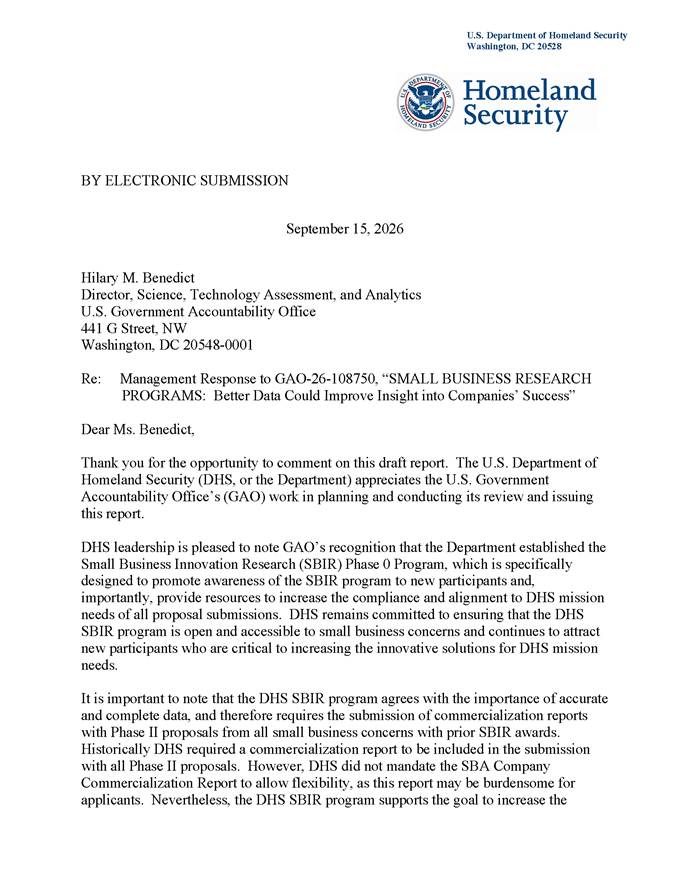
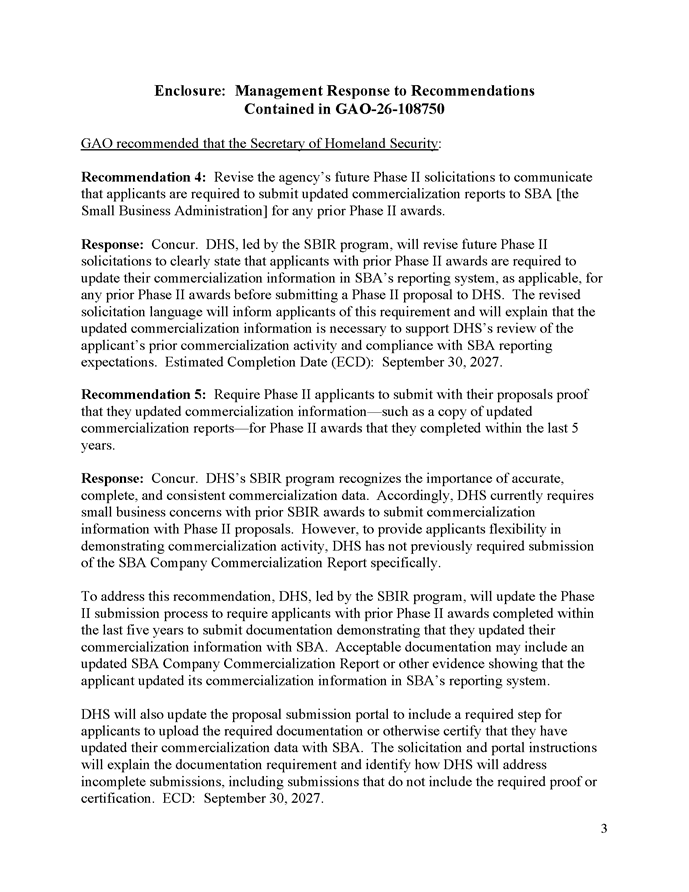
GAO Contact
Hilary M. Benedict at benedicth@gao.gov
Staff Acknowledgements
In addition to the contact named above, Eric Bachhuber (Assistant Director), Caroline Johnson (Analyst-in-Charge), Victoria Aysola, Ethan Brown, Amor Chambers, Virginia (Jenny) Chanley, Paul Kazemerksy, Won Lee, Anika McMillon, Alec McQuilkin, and Madeleine Orcales contributed to the report.
The Government Accountability Office, the audit, evaluation, and investigative arm of Congress, exists to support Congress in meeting its constitutional responsibilities and to help improve the performance and accountability of the federal government for the American people. GAO examines the use of public funds; evaluates federal programs and policies; and provides analyses, recommendations, and other assistance to help Congress make informed oversight, policy, and funding decisions. GAO’s commitment to good government is reflected in its core values of accountability, integrity, and reliability.
Obtaining Copies of GAO Reports and Testimony
The fastest and easiest way to obtain copies of GAO documents at no cost is through our website. Each weekday afternoon, GAO posts on its website newly released reports, testimony, and correspondence. You can also subscribe to GAO’s email updates to receive notification of newly posted products.
Order by Phone
The price of each GAO publication reflects GAO’s actual cost of production and distribution and depends on the number of pages in the publication and whether the publication is printed in color or black and white. Pricing and ordering information is posted on GAO’s website, https://www.gao.gov/ordering.htm.
Place orders by calling (202) 512-6000, toll free (866) 801-7077,
or
TDD (202) 512-2537.
Orders may be paid for using American Express, Discover Card, MasterCard, Visa, check, or money order. Call for additional information.
Connect with GAO
Connect with GAO on X,
LinkedIn, Instagram, and YouTube.
Subscribe to our Email Updates. Listen to our Podcasts.
Visit GAO on the web at https://www.gao.gov.
To Report Fraud, Waste, and Abuse in Federal Programs
Contact FraudNet:
Website: https://www.gao.gov/about/what-gao-does/fraudnet
Automated answering system: (800) 424-5454
Media Relations
Sarah Kaczmarek, Managing Director, Media@gao.gov
Congressional Relations
David A. Powner, Acting Managing Director, CongRel@gao.gov
General Inquiries
[1]The Small Business Innovation Development Act of 1982 established the SBIR program. Pub. L. No. 97-219, 96 Stat. 217. This act amended section 9 of the Small Business Act, Pub. L. No. 85-536, 72 Stat. 384 (1958), codified as amended at 15 U.S.C. § 638. The Small Business Technology Transfer Act of 1992 established the STTR program. Pub. L. No. 102-564, §§ 201–202, 106 Stat. 4249, 4256–61. This act made additional amendments to section 9 of the Small Business Act. The SBIR and STTR programs are authorized through September 30, 2031.
[2]The SBIR and STTR funding total is in nominal dollars and has not been adjusted for inflation.
[3]The SBIR and STTR programs are similar in that participating agencies identify topics for R&D projects and make awards to qualified small businesses. The STTR program also requires the small business awardees to partner with a nonprofit research institution, such as a university or federally funded R&D center. Both programs are to be carried out in accordance with statutory and regulatory requirements and under oversight and guidance of the Small Business Administration. See 15 U.S.C. § 638.
[4]15 U.S.C. § 638(f)(1), (n)(1)(A). Agencies’ R&D programs generally include funding for two types of R&D: intramural and extramural. Intramural R&D is conducted by employees of a federal agency in or through government-owned, government-operated facilities, or by contractors at government-owned, contractor-operated facilities. Extramural R&D is generally conducted by nonfederal employees outside of federal facilities. Federal agency, as defined under the statute, does not include agencies within the intelligence community. 15 U.S.C. § 638(e)(2).
[5]In this report, we refer to the agencies that issue SBIR and STTR awards as “participating agencies.” All 11 agencies participate in SBIR. In fiscal year 2024, six agencies participated in STTR: DOD, DOE, HHS, NASA, NSF, and USDA.
[6]Under the Federal Grant and Cooperative Agreement Act of 1977, grants and cooperative agreements are closely related but are distinguished by their expected degree of federal involvement. Under both funding mechanisms, the agency will transfer something of value, usually funds, to the recipient, to carry out a public purpose of support or stimulation authorized by federal law. Conversely, contracts are generally to be used when the principal purpose is to acquire property or services for the direct benefit or use by the U.S. government. 31 U.S.C. §§ 6303–6305. DOD also uses other transaction agreements for some awards, according to agency officials.
[7]Pub. L. No. 117-183, § 7(a), 136 Stat. 2180, 2188 (codified at 15 U.S.C. § 638(ww)).
[8]15 U.S.C. § 638; SBA, SBIR and STTR Program Policy Directive (May 3, 2023).
[9]GAO, Small Business Research Programs: Most Agencies Allow Applicants to Define Needs and Propose Solutions, GAO‑23‑106338 (Washington, D.C.: Sept. 29, 2023).
[10]Pub. L. No. 117-183, § 7(b), 136 Stat. 2180, 2188–89.
[12]DOD concurred with our recommendation. In May 2025, DOD updated guidance to clarify how the specificity of open and conventional topics should differ and we closed the recommendation. GAO, Small Business Research Programs: Agencies Broadly Solicit Ideas, but Clearer Guidance Could Improve DOD Efforts, GAO‑24‑107036 (Washington, D.C.: Sept. 30, 2024).
[13]SBA concurred with our recommendation. As of July 2026, we have not received information from SBA on the status of implementing the recommendation. GAO, Small Business Research Programs: Clearer Guidance Could Improve Award Data to More Effectively Measure Outcomes, GAO‑25‑107942 (Washington, D.C.: Sept. 23, 2025).
[14]We use the indefinite quantifiers, “some,” “several,” “majority,” and “most” to inform the reader of the approximate quantity of 11 participating agencies that provided a particular response. For the purposes of our review, “some” refers to 2 to 3 agencies, “several” refers to 4 to 5 agencies, a “majority” refers to 6 to 7 agencies, and “most” refers to 8 to 10 agencies.
[15]We refer to these data as SBA award data for the purposes of this report.
[16]We use the indefinite quantifiers, “some,” “several,” “many,” “majority,” and “most” to inform the reader of the approximate quantity of 20 small business representative interviewees that expressed a particular viewpoint. For the purposes of our review, “some” refers to 2 to 3 small business representatives, “several” refers to 4 to 6 small business representatives, “many” refers to 7 to 10 small business representatives, a “majority” refers to 11 to 15 small business representatives, and “most” refers to 16 to 19 small business representatives.
[17]SBA, SBIR and STTR Program Policy Directive (May 3, 2023).
[18]The statutory requirement relates to making a final decision on applications, while the directive extends this requirement to notifying applicants. Under the statute and directive, the required time frame for making a final decision and notifying applicants for one agency and one agency component—NSF and HHS’s National Institutes of Health (NIH)—is generally no more than 1 year after the solicitation closes. 15 U.S.C. § 638(g)(4)(B)(i), (o)(4)(B)(i); SBA, SBIR and STTR Program Policy Directive (May 3, 2023), § 7(c)(1).
[19]Participating agencies that miss the original notification deadline are required to develop programs or measures to reduce their notification and issuance time frames, regardless of whether they receive a waiver. SBA, SBIR and STTR Program Policy Directive (May 3, 2023), § 7(c)(1)(iv).
[20]The directive provides that NSF and NIH should issue awards no more than 15 months after the closing date. SBA, SBIR and STTR Program Policy Directive (May 3, 2023), § 7(c)(1).
[21]13 C.F.R. § 121.702; see generally 15 U.S.C. § 632(a).
[22]DOD, DOE, NIH within HHS, NASA, and the Department of Education are authorized to issue Direct-to-Phase-II SBIR or STTR awards through FY 2031, following a determination by the agency head that the small business has determined the scientific and technical merit and feasibility of the ideas that appear to have commercial potential with respect to the project. 15 U.S.C. § 638(cc).
[23]15 U.S.C. § 638(k)(2)(B).
[24]The commercialization rate benchmark applies when a company has received 16 or more Phase II awards during the past 10 FYs, excluding the two most recently completed FYs. It requires the company either to average at least $100,000 of sales and/or investments per Phase II award received during the period; or to have received a number of patents equal to or greater than 15 percent of the number of Phase II awards received during the period. See Small Business Innovation Research and Small Business Technology Transfer Programs Commercialization Benchmark, 78 Fed. Reg. 48537 (proposed Aug. 8, 2013), 78 Fed. Reg. 59410 (effective Nov. 15, 2013). Companies that have received 51 or more Phase II awards during the past 10 FYs, excluding the two most recently completed FYs, are subject to an increased performance standard, which is tiered based on the number of awards. 15 U.S.C. § 638(qq)(3)(B).
[25]15 U.S.C. § 638(k)(3); SBA, SBIR and STTR Program Policy Directive (May 3, 2023), § 10(g)(4); see also § 8(k).
[26]15 U.S.C. § 638(k)(3)(B)(ii); see SBA, SBIR and STTR Program Policy Directive (May 3, 2023), § 10(g)(7).
[27]15 U.S.C. § 638(ww). One component, the National Geospatial-Intelligence Agency, is not required to participate in the SBIR or STTR programs and thus is exempt from the requirement for DOD components to issue solicitations with at least one open topic per fiscal year. See 15 U.S.C. § 638(e)(2).
[29]National Academies of Sciences, Engineering, and Medicine, Review of the SBIR and STTR Programs at NASA (Washington, D.C.: The National Academies Press, 2026).
[30]In our September 2025 report, we found that nearly all of NSF’s topics would be considered “most broad” on a scale of “most narrow” to “most broad.” GAO‑25‑107942.
[31]GAO‑24‑107036. Specifically, a majority of both open and conventional topics provided a broad general use statement indicating that the technology could be incorporated for military or other DOD component use. Conventional topics varied in specificity when identifying a non-DOD customer, while a majority of open topics provided a broad commercial use statement.
[33]In our September 2025 report, we found that agencies’ open and conventional topics exhibit varying levels of specificity. GAO‑25‑107942. In this report, our analyses comparing various characteristics of open and conventional topic awards focus on comparing awards from topics that participating agencies designated as open or conventional.
[35]For the purposes of this report, multiple awardees are defined as small businesses that received 16 or more Phase II awards over the last ten FYs, excluding the two most recently completed FYs. This is consistent with SBA’s commercialization rate benchmark, which requires these firms to meet certain commercialization targets to be eligible for future Phase I or Direct-to-Phase-II SBIR or STTR awards.
[36]DHS and DOT issued a relatively small number of awards in FY 2024 compared to other agencies. DHS issued 31 awards, 10 of which were issued to multiple awardees. DOT issued 40 awards, 10 of which were issued to multiple awardees.
[37]GAO, Small Business Research Programs: Increased Performance Standards Likely Affect Few Businesses Receiving Multiple Awards, GAO‑24‑106398 (Washington, D.C.: March 29, 2024). Our March 2024 report defined multiple awardees as small businesses that received 50 or more Phase II awards across all participating agencies from FY 2011 through FY 2020, which is a higher threshold than we used in this report.
[38]National Academies of Sciences, Engineering, and Medicine, Review of the SBIR and STTR Programs at the Department of Defense (Washington, D.C.: The National Academies Press, 2026).
[39]15 U.S.C. § 638(aaa). Agencies can set these proposal limits on an FY basis, on a solicitation basis, or on a topic basis.
[40]We used multivariate logistic regression to estimate the statistical significance associated with differences between open and conventional topic awards for agencies that issued both types of awards. Statistically significant differences are defined as p < .05 for the purposes of this report. Given the low number of awards, we could not test for statistical significance for the Department of Commerce.
[41]Because of the way some agencies provided their data, these calculations include both Phase I and Phase II awards.
[43]First-time applicants and first-time awardees are applicants or awardees new to a particular agency’s SBIR or STTR program, not necessarily new to the SBIR or STTR program as a whole. Education, EPA, USDA, and the National Institutes of Health within HHS did not provide data on first-time applicants. Education did not provide data on first-time awardees.
[44]First-time awardees are not eligible for Phase II awards that are not Direct-to-Phase-II awards, so a more precise calculation of the percentage of first time-awardees would be the number of first-time awardees divided by the total number of Phase I and Direct-to-Phase-II awards (that is, divided by the total number of awards open to first-time awardees). However, it is not possible to make this calculation for all agencies because of the way some agencies provided their data, so to be able to report a percentage for all agencies that provided data on first-time awardees, we have included all Phase I and Phase II awards in these calculations, resulting in lower rates of first-time awardees.
[45]SBA’s SBIR and STTR Program Policy Directive § 7(c)(1) (May 3, 2023) states that NSF and NIH must generally notify small businesses whether or not they received an award no more than 1 year after the closing date of the solicitation and should issue the award no more than 15 months after the closing date of the solicitation. It states that other agencies must generally notify small businesses whether or not they received an award no more than 90 calendar days after the closing date of the solicitation and should issue the award no more than 180 calendar days after the closing date. See also 15 U.S.C. § 638(g)(4)(B), (o)(4)(B) (statutory time frame for making final decisions on proposals). As discussed below, if an agency determines that it requires additional time it can submit a waiver request to SBA. The 86 percent figure cited above does not include instances in which agencies requested and received waivers and notified applicants within the approved extension window.
[46]The SBIR and STTR Extension Act of 2022 requires the 11 participating agencies to implement due diligence programs to assess the security risks posed by small business applicants in four risk areas: cybersecurity practices, patent analysis, employee affiliations, and foreign ownership. Pub. L. No. 117-183, § 4, 136 Stat. 2180, 2181–86 (codified at 15 U.S.C. § 638(g), (o), (vv)).
[49]When submitting a written waiver request to SBA, agencies must specify the number of additional days needed to notify applicants, the reason for the extension, and the number of awards that will be affected.
[50]Pub. L. No. 117-183, § 7(b)(3), 136 Stat. 2180, 2189. For the purposes of this report, we refer to businesses as being owned by individuals from socially and economically disadvantaged groups, rather than minority-owned, consistent with SBA’s SBIR and STTR award data.
[51]Categories of nontraditional small businesses are not mutually exclusive. For example, a business could be both women- and veteran-owned. According to the Small Business Act, as amended, socially disadvantaged individuals are those who have been subjected to racial or ethnic prejudice or cultural bias due to their identity as a member of a group, and such groups include Black Americans, Hispanic Americans, Native Americans, Indian tribes, Asian Pacific Americans, Native Hawaiian organizations, and other minorities. 15 U.S.C. §§ 637(a)(5), 631(f)(1)(C). Economically disadvantaged individuals are socially disadvantaged individuals “whose ability to compete in the free enterprise system has been impaired due to diminished capital and credit opportunities as compared to others in the same business area who are not socially disadvantaged.” 15 U.S.C. § 637(a)(6)(A). Socially and economically disadvantaged small businesses are those that are at least 51 percent owned by, and whose management and daily business operations are controlled by, socially and economically disadvantaged individuals, economically disadvantaged Indian tribes, or economically disadvantaged Native Hawaiian organizations. 15 U.S.C. § 637(a)(4). A business is considered small if it is independently owned and operated, is not dominant in its field of operations, and meets any definitions or standards established by the SBA administrator. 15 U.S.C. § 632(a).
[52]In this report, we define rural small businesses as small businesses located in counties where at least 66.9 percent of the 2020 Census population of the county was in rural blocks. This includes counties categorized by the Census Bureau as “mostly rural” and “completely rural.”
[53]While the SBIR and STTR Extension Act of 2022 does not require DOD components to conduct outreach and assistance activities, the act includes a provision for GAO to describe DOD’s outreach and assistance efforts to encourage and prepare new and diverse small business concerns to participate in open topics. Pub. L. No. 117-183, § 7(b)(4), 136 Stat. 2180, 2189. In this report, we refer to “diverse” small businesses as nontraditional small businesses.
[54]While Commerce issued both open and conventional topic awards in FY 2024, the agency released only open topics in FY 2025.
[55]I-Corps teams are expected to conduct at least 100 interviews with potential customers and partners.
[56]Program managers develop topics and provide technical oversight of awards, among other roles. Technical points of contact are the primary government representatives that manage SBIR and STTR contracts.
[57]15 U.S.C. § 638(r)(4)(B); SBA, SBIR and STTR Program Policy Directive (May 3, 2023), § 4(c)(7).
[58]Department of Defense Management, SBIR/STTR Commercialization Phase III: Transition Barriers (Monterey, CA.: Naval Postgraduate School, 2024). This report was authored by personnel at a DOD academic institution.
[59]Pub. L. No. 119-83, § 5(2), 140 Stat. 755, 764 (codified at 15 U.S.C. § 638(r)(5)).
[60]Pub. L. No. 119-83, § 6(a), 140 Stat. 755, 764 (2026) (codified at 15 U.S.C. § 638(j)(4)). Procurement center representatives help small businesses gain access to federal contracting and subcontracting opportunities. See 15 U.S.C. § 644(l).
[61]15 U.S.C. § 638(k)(2).
[62]As noted above, these performance benchmarks determine eligibility for future Phase I and Direct-to-Phase-II awards. See Small Business Innovation Research and Small Business Technology Transfer Programs Commercialization Benchmark, 78 Fed. Reg. 48537 (proposed Aug. 8, 2013), 78 Fed. Reg. 59410 (effective Nov. 15, 2013); 15 U.S.C. § 638(qq). There are several performance benchmarks. For example, the commercialization rate benchmark applies when a company has received 16 or more Phase II awards during the past 10 FYs, excluding the two most recently completed FYs. It requires companies to demonstrate a certain level of sales and/or investments or patents.
[63]SBA, SBIR and STTR Program Policy Directive (May 3, 2023), § 10(h)(4)(xvi); 15 U.S.C. § 638(b)(7), (kk).
[64]SBA, Fiscal Year 2022 SBIR/STTR Annual Report.
[65]FPDS is the central repository for capturing information on federal contracting. It is managed by the General Services Administration.
[66]National Academies of Sciences, Engineering, and Medicine, SBIR and STTR Programs at the Department of Defense.
[67]Small Business Innovation and Economic Security Act, Pub. L. No. 119-83, § 8(b)(2)(B), (D), 140 Stat. 755, 767 (2026).
[68]15 U.S.C. § 638(k)(2).
[69]SBA, SBIR and STTR Program Policy Directive (May 2023), § 10(g)(6); 15 U.S.C. § 638(k)(2)–(3).
[70]GAO, Standards for Internal Control in the Federal Government, GAO‑25‑107721 (Washington, D.C.: May 15, 2025).
[71]See, e.g., 15 U.S.C. § 638(b)(7)(F), (b)(7)(K), (kk).
[72]See Administrative Procedure Act, 5 U.S.C. § 706; Loper Bright Enters. v. Raimondo, 603 U.S. 369 (2024).
[73]The act also includes a provision for us to report on the Department of Defense’s (DOD) efforts to encourage and prepare new and diverse small businesses to respond to these solicitations. Pub. L. No. 117-183, § 7(b), 136 Stat. 2180, 2188–89.
[74]For more information on how we collected data from FY 2019 through FY 2023, see our previous reports. GAO, Small Business Research Programs: Most Agencies Allow Applicants to Define Needs and Propose Solutions, GAO‑23‑106338 (Washington, D.C.: Sept. 29, 2023). GAO, Small Business Research Programs: Agencies Broadly Solicit Ideas, but Clearer Guidance Could Improve DOD Efforts, GAO‑24‑107036 (Washington, D.C.: Sept. 30, 2024). GAO, Small Business Research Programs: Clearer Guidance Could Improve Award Data to More Effectively Measure Outcomes, GAO‑25‑107942 (Washington, D.C.: Sept. 23, 2025).
[75]SBIR and STTR Award Data, accessed January 26, 2026, https://www.sbir.gov/awards.
[76]We did not assess the reliability of all fields (e.g., number of employees in the small business), because we did not use them for this report.
[77]Some awards were missing data on whether the small businesses were women-owned (approximately 2 percent missing) and socially and economically disadvantaged (approximately 3 percent missing). When calculating the proportion of awards won by women-owned businesses and businesses owned by individuals from socially and economically disadvantaged groups, we did not include awards with missing data.
[78]SBA, SBIR and STTR Program Policy Directive (May 3, 2023), § 7(c)(1). The directive’s required notification time frames are based on statutory requirements for agencies to make a final decision on SBIR and STTR proposals. 15 U.S.C. § 638(g)(4)(B), (o)(4)(B).
[79]Participating agencies can submit a request in writing to SBA for a waiver to extend the notification deadline by up to 90 calendar days.
[80]County-Level Urban and Rural Information for the 2020 Census, accessed January 26, 2026, https://www.census.gov/programs-surveys/geography/guidance/geo-areas/urban-rural.html.
[81]This threshold is based on the commercialization rate benchmark, which applies when a company has received 16 or more Phase II awards during the past 10 fiscal years, excluding the two most recently completed fiscal years. It requires the company either to average at least $100,000 of sales and/or investments per Phase II award received during the period; or to have received a number of patents equal to or greater than 15 percent of the number of Phase II awards received during the period.
[84]15 U.S.C. § 638(k)(3); see SBA, SBIR and STTR Program Policy Directive (May 3, 2023), § 10(g)(4).
[85]Pub. L. No. 117-183, 136 Stat. 2180; Pub. L. No. 119-83, 140 Stat. 755 (2026).
[86]GAO, Standards for Internal Control in the Federal Government, GAO‑25‑107721 (Washington, D.C.: May 15, 2025).