
Report to Congressional Committees
United States Government Accountability Office
A report to congressional committees
Contact: Chelsa Kenney at kenneyc@gao.gov
What GAO Found
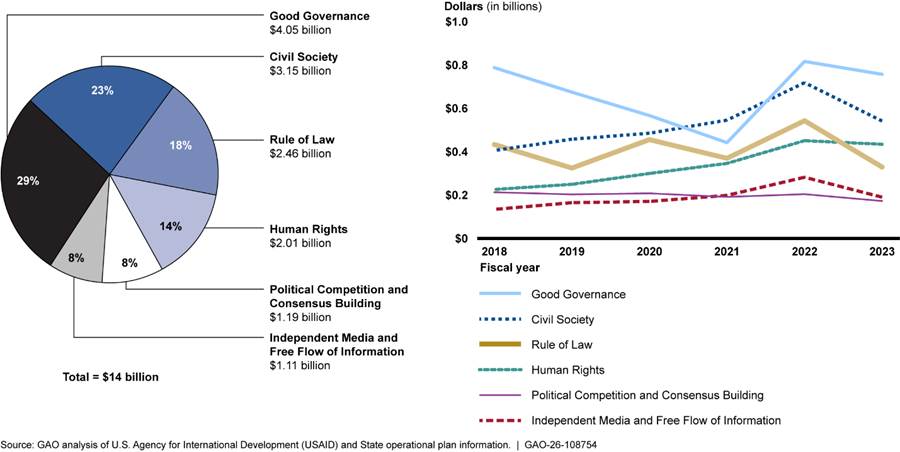
In fiscal years 2018 through 2023, the U.S. Agency for International Development (USAID) allocated about $9 billion and the State Department allocated about $5 billion for democracy assistance overseas. As the figure shows, allocations for the six categories of democracy assistance fluctuated during this period.

USAID and State officials and representatives of organizations implementing U.S. democracy assistance in four countries GAO selected for its review identified several types of challenges they faced in providing this assistance. These challenges comprised actions by the countries’ governments, such as harassment of civil society and media; aspects of the operating environment in each country, such as weak government capacity; and actions of U.S. and other donors, including competing diplomatic and democracy assistance priorities.
In the four selected countries, USAID and State did not plan to mitigate the risk that democracy assistance programs might have to shift, pause, or cease award activities that benefitted government entities. In fiscal years 2021 through 2024, after reported antidemocratic actions by the governments of some of the four countries, USAID and State paused or ceased assistance involving interaction with government entities and shifted assistance to nongovernmental entities. Agency officials told GAO that redirecting the assistance involved loss of programmatic momentum and confusion about how to proceed. GAO’s review of 12 awards found USAID and State had not developed plans to mitigate this risk. According to agency officials, USAID and State did not require such planning.
A January 2025 executive order paused all U.S. foreign development assistance. In April 2025, State began a reorganization of the department, and in July 2025, the Secretary of State announced that USAID had ceased implementing foreign assistance. For future democracy assistance, establishing a requirement to mitigate the risk of having to redirect it away from host-country government entities would help State ensure that any decisions to pivot assistance are implemented efficiently.
Why GAO Did This Study
The quality of democracy has eroded in countries across the globe in recent years, according to organizations that construct and monitor democracy indexes. In fiscal years 2018 through 2023, the U.S. allocated more than $2 billion annually for assistance to promote democracy overseas.
A 2023 House Appropriations Committee print includes a provision for GAO to assess democracy assistance that USAID and State have provided. This report (1) describes USAID’s and State’s democracy assistance allocations in fiscal years 2018 through 2023, (2) discusses challenges the agencies and partner organizations identified as affecting the provision of this assistance in selected countries, and (3) examines the extent to which the agencies planned to mitigate specific risks in providing this assistance.
GAO analyzed data on democratic erosion and reviewed agency data and documents. GAO also visited El Salvador, Georgia, Sri Lanka, and Tunisia, selected on the basis of data about democratic erosion and U.S. democracy assistance funding. In each country, GAO held discussion groups with agency officials and partner organization representatives.
This is a public version of a sensitive report that GAO issued in September 2025. Information that State deemed sensitive has been omitted.
What GAO Recommends
GAO is making two recommendations to State about mitigating risks related to democracy assistance that benefits host-country government entities. State neither agreed nor disagreed with these recommendations.
Abbreviations
ADS Automated Directives System
DRL Bureau of Democracy, Human Rights, and Labor
INL Bureau of International Narcotics and Law Enforcement Affairs
FACTSInfo Foreign Assistance Coordination and Tracking System
SPSD Standardized Program Structure and Definitions
State U.S. Department of State
USAID U.S. Agency for International Development
V-Dem Varieties of Democracy Institute
This is a work of the U.S. government and is not subject to copyright protection in the United States. The published product may be reproduced and distributed in its entirety without further permission from GAO. However, because this work may contain copyrighted images or other material, permission from the copyright holder may be necessary if you wish to reproduce this material separately.
March 9, 2026
The Honorable Lindsey Graham
Chair
The Honorable Brian Schatz
Ranking Member
Subcommittee on State, Foreign Operations, and Related Programs
Committee on Appropriations
United States Senate
The Honorable Mario Diaz-Balart
Chairman
The Honorable Lois Frankel
Ranking Member
Subcommittee on National Security, Department of State, and Related Programs
Committee on Appropriations
House of Representatives
U.S. strategic documents identify rising authoritarianism as a global challenge and note the importance of U.S. efforts to uphold democratic values around the world. U.S. agency efforts to promote democratic values globally have included the promotion of good governance; the promotion of rights for all citizens; and the prevention and reduction of corruption. In fiscal years 2018 through 2023, the U.S. allocated over $2 billion annually for democracy assistance, including allocations for Ukraine after Russia’s invasion in 2022.
Yet in recent years, democratic erosion—that is, degradation in the institutional quality of an established democracy[1]—has been occurring in countries across the globe, according to observers such as Freedom House and the Varieties of Democracy Institute (V-Dem).[2] According to a 2024 Department of State report, democratic erosion may occur through a series of discrete changes in the rules and informal procedures that shape elections, rights, and accountability.
House of Representatives Committee on Appropriations Print 50-348, accompanying the Consolidated Appropriations Act, 2023, includes a provision for us to assess democracy assistance provided by the U.S. Agency for International Development (USAID) and by State’s Bureau of International Narcotics and Law Enforcement Affairs (INL) and Bureau of Democracy, Human Rights and Labor (DRL).[3] We were also asked to review this assistance in light of the spread of democratic erosion.
However, after we began this work a January 20, 2025 executive order, “Reevaluating and Realigning United States Foreign Aid,” called for department and agency heads with responsibility for U.S. foreign development assistance programs to immediately pause new obligations and disbursements of development assistance funds to foreign countries and implementing nongovernmental organizations, international organizations, and contractors pending reviews of such programs for programmatic efficiency and consistency with U.S. foreign policy.[4] In March 2025, USAID and State notified Congress of their intent to undertake a reorganization of foreign assistance programming that would involve realigning certain USAID functions to State by July 1, 2025, and discontinuing the remaining USAID functions. State began the reorganization in April 2025. In July, the Secretary of State announced that USAID had officially ceased to implement foreign assistance.
In this report, we:
1) describe USAID’s and State’s allocations of funding for democracy assistance in fiscal years 2018 through 2023;
2) discuss challenges that USAID, INL, DRL, and their implementing partners identified as affecting the provision of this assistance in four selected countries that have experienced democratic erosion as of December 2024; and
3) assess the extent to which USAID, INL, and DRL planned to mitigate specific risks in providing this assistance as of December 2024.
This report is a public version of a sensitive report that we issued on September 11, 2025.[5] Our September report specified countries, among four we had selected for our review, whose governments had taken actions that were considered to be antidemocratic. State deemed some of this information to be sensitive and thus protected from public disclosure. Consequently, this public report does not attribute any specific actions taken by governments in the selected countries.
Although it provides more limited information than our sensitive report, this report uses the same methodology. Specifically, for both reports, we analyzed Freedom House and V-Dem data on freedom and democratic erosion around the world from 2018 through 2023. We also interviewed Freedom House and V-Dem representatives about their respective methodologies for compiling these data and reviewed documentation of these methodologies. We found the data sufficiently reliable for our purpose of identifying countries that can be said to have experienced greater or lesser degrees of democratic erosion during the specified period.
We used these data, in conjunction with allocations data from State’s Bureau of Foreign Assistance, to identify countries that both experienced democratic erosion during this period and received at least 1 percent of the combined total USAID and State democracy assistance allocations in fiscal years 2018 through 2023. After reviewing the data and conducting interviews with agency officials, we selected four countries—El Salvador, Georgia, Sri Lanka, and Tunisia—for case studies of USAID’s and State’s responses to democratic erosion. We also selected 12 awards implemented in these countries in fiscal years 2018 through 2023—two from USAID and one from DRL or INL for each of the four countries. We selected these awards by considering factors such as dollar amount, duration, connection to democratic erosion, type of democracy assistance provided, and whether the award was active at the time of our site visits.[6]
To describe USAID’s and State’s democracy assistance allocations in fiscal years 2018 through 2023, we obtained and analyzed foreign assistance data from the Foreign Assistance Coordination and Tracking System (FACTSInfo), which USAID and State use to manage data related to budgeting and performance. We reviewed data on foreign assistance allocations for democracy assistance, categorized according to the State’s Standardized Program Structure and Definitions (SPSD), which State uses to categorize all types of foreign assistance. Specifically, we reviewed operational plan data extracted from FACTSInfo by State’s Office of Foreign Assistance. We assessed the data’s reliability by looking for missing values and obtaining clarification from State officials. We found these data sufficiently reliable for reporting total allocations by year, by agency, by SPSD code, and by region.
In addition, we developed a questionnaire to collect data about USAID, DRL, and INL democracy assistance awards. According to agency officials, FACTSInfo does not aggregate obligated funds across USAID and State operating units, and so we used this questionnaire to obtain information about democracy assistance award amounts and obligations in selected countries as of December 31, 2023.
To discuss challenges that the agencies and their implementing partners identified as affecting the provision of democracy assistance, we reviewed documents for the selected awards in each of the four case-study countries. We also convened nine discussion groups of relevant stakeholders, including four groups comprising USAID and State agency officials who managed these awards, known as award managers, and five groups comprising representatives of organizations that implemented them, known as implementing partners.[7] We asked the participants to identify (1) the challenges they faced in managing or implementing democracy assistance in countries experiencing democratic erosion and (2) which of those challenges were the most significant. We gave the participants the opportunity to answer each question individually, and we made each answer visible to the group to enable cross-fertilization of ideas among group members.
To assess the extent to which the agencies took steps to address specific risks, we reviewed agency documents to determine the extent and sufficiency of risk mitigation planning during award design and implementation. Specifically, we reviewed documents for the 12 selected awards that USAID or State implemented in El Salvador, Georgia, Sri Lanka, and Tunisia, nine of which included assistance to government entities in the countries (this report refers to such entities as host-country government entities). We also reviewed USAID and State guidance for grants and cooperative agreements. In addition, we interviewed, or requested written statements from, USAID and State officials regarding the agencies’ responses to decisions to shift foreign assistance away from government entities in certain countries. We compared this information with relevant agency guidance[8] that was in effect during the period of our review and federal practices for evidence-based policymaking.[9] For more information about our objectives, scope, and methodology, see appendix I.
We conducted this performance audit from July 2023 to September 2025 in accordance with generally accepted government auditing standards. Those standards require that we plan and perform the audit to obtain sufficient, appropriate evidence to provide a reasonable basis for our findings and conclusions based on our audit objectives. We believe that the evidence obtained provides a reasonable basis for our findings and conclusions based on our audit objectives. Subsequently, from September 2025 to February 2026, we worked with State to prepare this version of our original sensitive report for public release.
Background
Prior to the start of State’s reorganization in April 2025, several joint State–USAID strategies included the promotion of democracy worldwide.[10] For example, the State–USAID Joint Strategic Plan for fiscal years 2022 through 2026 articulated the shared goal of strengthening democratic institutions, upholding universal values, and promoting human dignity.[11] Objectives within this goal included the promotion of good governance, led by USAID and DRL, and anticorruption efforts, led by USAID and INL. However, in May 2025, USAID officials from the Bureau of Democracy, Human Rights, and Governance told us that their mission had shifted and that closing the bureau was the priority.
Democracy programs are generally authorized by, and receive funding through, annual appropriations acts. In addition, federal law states that it is the policy of the U.S. to promote freedom and democracy in foreign countries as a fundamental component of U.S. foreign policy. This includes the promotion of “freedoms and rights, including the freedoms of association, of expression, of the press, and of religion, and the right to own private property” as well as “promoting universal democracy by promoting democratic institutions, including institutions that support the rule of law (such as an independent judiciary), an independent and professional media, strong legislatures, a thriving civil society, transparent and professional independent governmental auditing agencies, civilian control of the military, and institutions that promote the rights of minorities and women.”[12]
During the period of our review, USAID and State both used State’s SPSD, which identifies six general categories, or program areas, of democracy assistance: Rule of Law, Good Governance, Political Competition and Consensus Building, Civil Society, Independent Media and Free Flow of Information, and Human Rights. Each general program area has several specific subcomponents called program elements. Table 1 shows the six democracy assistance program areas and 24 program elements.
Table 1: U.S. Democracy Assistance Program Areas and Elements, According to State’s Foreign Assistance Standardized Program Structure and Definitions (SPSD) as of November 2025
|
Program area and definition |
Definition |
Program elements |
|
Rule of Law |
Rule of law is a principle under which all persons, institutions and entities, public and private, including the state itself, are accountable to laws that are publicly promulgated, independently adjudicated, equally applied and enforced. |
1.1: Constitutions, laws, and legal systems |
|
Good Governance |
This includes support for strengthening legislatures and local governments; capacity building; security sector reform; separation of powers through institutional checks and balances between the executive and legislative branches, in particular; and avenues within government structures for accountability and oversight. |
2.1: Legislative authority |
|
Political Competition and Consensus Building |
This assistance promotes legitimate contestation for ideas and political power through democratic political processes that reflect the will of the people. |
3.1: Consensus-building processes |
|
Civil Society |
This includes supporting a legal environment that protects and promotes civil society organizations; providing capacity development assistance to such organizations; bolstering government oversight and accountability activities; strengthening a democratic political culture that values civic engagement; and strengthening independent trade/labor unions. |
4.1: Enabling environment for civil society |
|
Independent Media and Free Flow of Information |
This assistance strengthens information- and media-related legal and regulatory frameworks and associated freedom of expression protections, including self-regulatory mechanisms and access to and freedom of information legislation. |
5.1: Enabling environment for media and free flow of
information |
|
Human Rights |
Human rights assistance supports programs that promote the inherent dignity of the individual and rights that are to be enjoyed by all without distinction as to race, color, sex, language, religion, national or social origin, property, birth, sexual orientation, gender identity, or other status. |
6.1: Human rights systems, policies, and protection |
Source: GAO analysis of State Department information. | GAO‑26‑108754
Note: The State Department maintains the foreign assistance definitions in the SPSD. During our review, USAID used these definitions for its activities because it also disbursed foreign assistance.
During the time of our review, USAID—through its country missions, regional offices, and Bureau of Democracy, Human Rights, and Governance—and State’s DRL and INL provided democracy assistance through awards. These awards typically took the form of grants to, or cooperative agreements with, commercial or nonprofit nongovernmental organizations, which the agencies refer to as implementing partners.[13] INL also used interagency agreements, such as an agreement to transfer funding to another U.S. agency or international agency in support of democracy assistance programming in a specific country.
An award to an implementing partner results in a series of documents, including an award agreement explaining what the implementing partner is expected to achieve and outlining monitoring and oversight terms. According to agency officials, a democracy assistance award may have included activities such as the following:
· Improving the capacity of civic organizations to influence public policy more effectively
· Providing training to officials and oversight institutions to identify ways to mitigate fraud and corruption in government procurement systems
· Building the capacity of local governments to boost domestic resource development and improve delivery of basic services
During our review, USAID’s Automated Directives System (ADS) contained guidance for providing democracy assistance and other types of foreign assistance through grants and cooperative agreements. As of May 2025, the ADS was no longer accessible online. State’s Federal Assistance Directive contains guidance for State’s grants and cooperative agreements.
USAID’s and State’s Democracy Assistance Allocations Totaled About $14 Billion in Fiscal Years 2018–2023
USAID Allocated About $9 Billion and State Allocated About $5 Billion in Democracy Assistance Worldwide
USAID and State data show that the two agencies’ combined democracy assistance allocations totaled about $14 billion in fiscal years 2018 through 2023.[14] USAID’s allocations accounted for about $9 billion, or 64 percent of the combined democracy assistance funding. State’s allocations accounted for about $5 billion, or 36 percent of the combined funding for democracy assistance; allocations to DRL accounted for $1.4 billion and allocations to INL accounted for $250 million.[15] Combined, USAID’s and State’s democracy assistance allocations increased from about $2.2 in fiscal year 2018 to about $2.4 billion in fiscal year 2023, or by about 10 percent (see fig. 1). The agencies’ combined democracy assistance allocations peaked at about $3 billion in fiscal year 2022, largely as a result of additional funding provided in supplemental appropriations for assistance to Ukraine.[16]
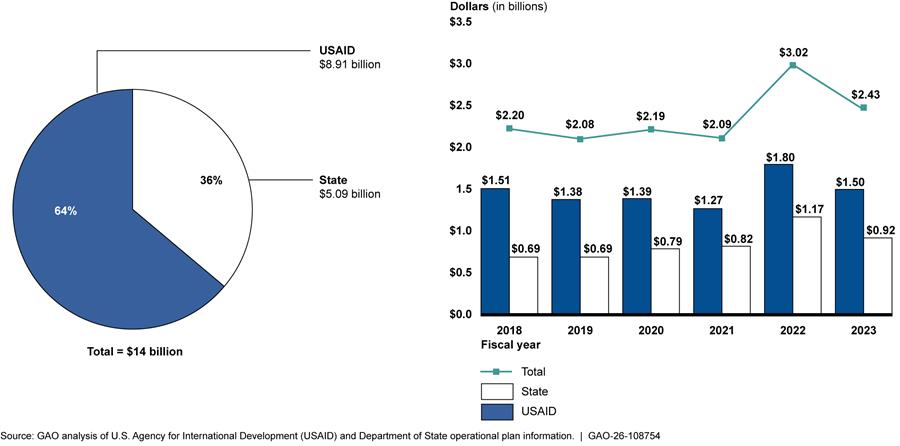
Note: Because of rounding, annual allocations shown may not sum to the totals. The data shown are based on operational plan data that USAID and State operating units submitted to State’s Office of Foreign Assistance. Operating units, such as USAID missions and State bureaus, include allocated amounts in their operational plans. The data shown include allocations for democracy assistance programs from annual appropriations acts as well as about $1 billion from two fiscal year 2022 Ukraine supplemental appropriations acts and one fiscal year 2023 Ukraine supplemental appropriations act.
During this period, U.S. democracy assistance focused on the Good Governance, Civil Society, and Rule of Law program areas, which accounted for about 70 percent of democracy assistance allocations worldwide. Allocations increased for assistance to promote human rights and strengthen civil society; fluctuated for assistance to support the rule of law and promote good governance; and remained relatively stable for assistance to facilitate political competition and to support independent media and free flow of information. See figure 2.
Figure 2: USAID and State Democracy Assistance Allocations, by Standardized Program Structure and Definitions Program Area, Fiscal Years 2018–2023
Note: Because of rounding, annual allocations shown may
not sum to the totals. The data shown are based on operational plan data
submitted by USAID and State operating units to State’s Office of Foreign
Assistance. Operating units, such as USAID missions and State bureaus, include
allocated amounts in their operational plans. The data shown include
allocations for democracy assistance programs from annual appropriations acts
as well as about $1 billion from two fiscal year 2022 Ukraine supplemental
appropriations acts and one fiscal year 2023 Ukraine supplemental
appropriations act.
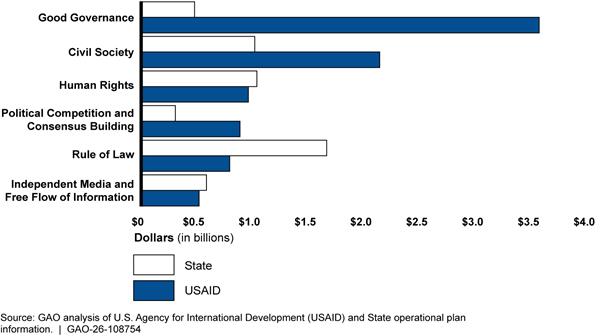
USAID’s allocations in fiscal years 2018 through 2023 generally focused on the Good Governance and Civil Society program areas, while State’s allocations generally focused on the Rule of Law program area (see fig. 3).
Figure 3: USAID and State Democracy Assistance, by Standardized Program Structure and Definitions Program Area, Fiscal Years 2018–2023
Note: Amounts shown have been rounded. The data shown are based on operational plan data submitted by USAID and State operating units to State’s Office of Foreign Assistance. Operating units, such as USAID missions and State bureaus, include allocated amounts in their operational plans. The data shown include allocations for democracy assistance programs from annual appropriations acts as well as about $1 billion from two fiscal year 2022 Ukraine supplemental appropriations acts and one fiscal year 2023 Ukraine supplemental appropriations act.
USAID’s and State’s allocations for democracy assistance during this period were also concentrated within certain SPSD program elements. Ten of the 24 program elements accounted for about $10.5 billion, or over 75 percent of the $14 billion allocated in fiscal years 2018 through 2023 (see table 2). The largest amounts were allocated for four program elements—Justice Systems and Institutions, Local Government and Decentralization, Civic Education, Citizen Participation and Public Accountability, and Non-Security Executive Authority—each of which had allocations of more than $1 billion.[17] Allocations for three of these program elements—Justice Systems and Institutions, Local Government and Decentralization, and Non-Security Executive Authority—totaled about $4.5 billion. Funding for these three program areas may be used to provide support and training to local and national host-country government institutions.
Table 2: Democracy Assistance Program Elements for Which State and USAID Allocated the Largest Amounts, Fiscal Years 2018–2023
|
Program element |
State |
USAID |
Total |
|
Justice Systems and Institutions |
$1.3 billion |
$479.8 million |
$ 1.8 billion |
|
Local Government and Decentralization |
$42.4 million |
$1.6 billion |
$ 1.6 billion |
|
Civic Education, Citizen Participation and Public Accountability |
$254.6 million |
$850.4 million |
$ 1.1 billion |
|
Non-Security Executive Authority – Function and Processes |
$72.2 million |
$1 billion |
$ 1.1 billion |
|
Civil Society Organizational Capacity Development |
$296.8 million |
$591.2 million |
$ 888 million |
|
Human Rights Systems, Policies and Protection |
$426.1 million |
$457.6 million |
$883.6 million |
|
Anti-Corruption Reforms |
$285.9 million |
$535.3 million |
$821.2 million |
|
Elections and Political Processes |
$252.8 million |
$556.2 million |
$809.1 million |
|
Equal Rights for Marginalized Communities |
$314.4 million |
$479.4 million |
$ 793.8 million |
|
Enabling Environment for Media and Free Flow of Information |
$398 million |
$ 294.5 million |
$ 692.5 million |
|
Total |
$3.7 billion |
$6.8 billion |
$10.5 billion |
Source: GAO analysis of U.S. Agency for International
Development (USAID) and State Department operational plan information. | GAO‑26‑108754
Note: Because of rounding, amounts shown may not sum to the totals. The data shown are based on operational plan data submitted by USAID and State operating units to State’s Office of Foreign Assistance. Operating units, such as USAID missions and State bureaus, include allocated amounts in their operational plans. The data shown include allocations for democracy assistance programs from annual appropriations acts as well as about $1 billion from two fiscal year 2022 Ukraine supplemental appropriations acts and one fiscal year 2023 Ukraine supplemental appropriations act.
USAID and State Allocated Largest Amounts for Democracy Assistance in Western Hemisphere and Europe and Eurasia Regions
According to USAID and State data, each agency allocated about half of its democracy assistance funding in fiscal years 2018 through 2023 for programs in the Western Hemisphere and the Europe and Eurasia regions.[18] In addition, USAID allocated about 17 percent of its democracy assistance funding in Africa and State allocated about 21 percent of its democracy assistance funding in the Near East region. (See fig. 4.) In the Western Hemisphere, Europe, and Eurasia, USAID allocated the largest amounts for the program element Local Government and Decentralization.[19] In those three regions, State allocated the largest amounts for the program element Justice Systems and Institutions[20]; in the Near East, State allocated the largest amounts for Human Rights Systems, Policies, and Protection.[21]
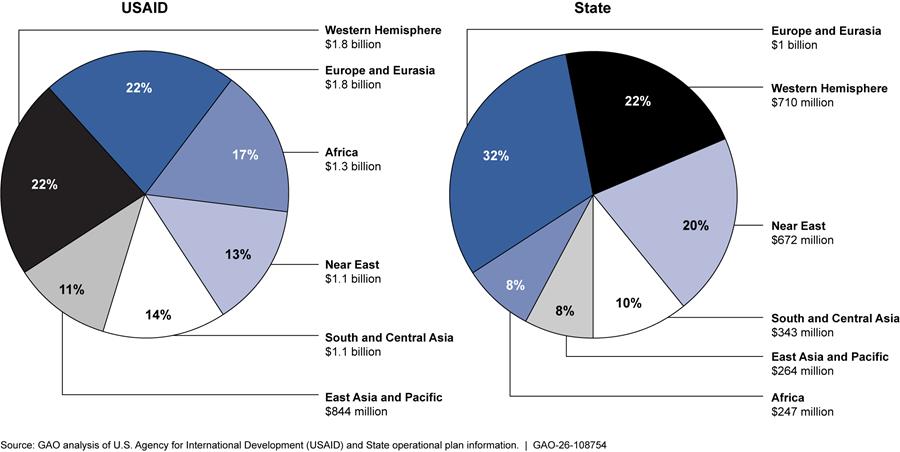
Note: Because of rounding, amounts shown may not sum to the totals. The totals exclude democracy assistance amounts not assigned to specific regions (e.g., allocations for USAID’s Bureau of Conflict Prevention and Stabilization, State’s Bureau of International Organizations, Bureau of Energy Resources, and Global Engagement Center). The data shown are based on operational plan data submitted by USAID and State operating units to State’s Office of Foreign Assistance. Operating units, such as USAID missions and State bureaus, include allocated amounts in their operational plans. The data shown include allocations for democracy assistance programs from annual appropriations acts as well as about $1 billion from two fiscal year 2022 Ukraine supplemental appropriations acts and one fiscal year 2023 Ukraine supplemental appropriations act.
In Selected Countries, About Half of U.S. Awards Had Some Focus on Democratic Erosion
USAID and State used about half of their democracy assistance awards in fiscal years 2018 through 2023 to combat democratic erosion in the four countries we selected for our review.[22] See table 3.
Table 3: U.S. Democracy Assistance Awards Reported by USAID, INL, and DRL in Selected Countries with Democratic Erosion Identified by Freedom House and Varieties of Democracy (V-Dem) Data, Fiscal Years 2018–2023
|
|
All democracy assistance |
Primary focus on democratic erosiona |
Partial focus on democratic erosionb |
No focus on democratic erosionc |
||||
|
Country |
Total awards |
Total awarded |
Number of awards |
Amount awarded |
Number of awards |
Amount awarded |
Number of awards |
Amount awarded |
|
El Salvador |
27 |
$236 million |
16 |
$141 million |
1 |
$6.7 million |
10 |
$88 million |
|
Georgia |
40 |
$222 million |
1 |
$10 million |
11 |
$60 million |
28 |
$152 million |
|
Sri Lanka |
24 |
$127 million |
13 |
$46 million |
5 |
$60 million |
6 |
$21 million |
|
Tunisia |
26 |
$215 million |
4 |
$4.7 million |
14 |
$134 million |
8 |
$76 million |
|
Total |
117 |
$799 million |
34 |
$201 million |
31 |
$261 million |
52 |
$337 million |
Legend: INL= Bureau of International Narcotics and Law Enforcement Affairs; DRL= Bureau of Democracy, Human Rights, and Labor.
Source: GAO analysis of U.S. Agency for International Development (USAID) and Department of State information. | GAO‑26‑108754
Notes: The data shown are total award amounts as of December 31, 2023, and have been rounded to the nearest million. The data represent awards that officials of USAID and of State’s Bureaus of International Narcotics and Law Enforcement Affairs (INL) and Democracy, Human Rights, and Labor (DRL) identified as active in these countries starting in fiscal year 2018. We asked USAID and State officials to choose from the categories primary focus, partial focus, and not a focus to describe the extent to which each award’s work was related to democratic erosion. We defined democratic erosion on the basis of descriptions of elements that Freedom House or V-Dem consider when assessing freedom and democracy around the world.
aAwards with a primary focus on democratic erosion are those for which all or most of the goals or objectives explicitly reference concepts such as democratic erosion, backsliding, illiberalism, autocracy, or threats to democracy and those that were established in response to a backsliding event or trend.
bAwards with a partial focus on democratic erosion may address democratic erosion in some but not all goals or objectives and may or may not have been established in response to a backsliding event or trend.
cAwards with no focus on democratic erosion are those that provide democracy assistance and can be categorized as such, according to State’s Standardized Program Structure and Definitions, but have no goals and objectives related to democratic erosion.
Stakeholders Identified Several Types of Challenges Affecting Democracy Assistance in Selected Countries
Participants in the nine discussion groups we held in 2024 in the four selected countries where democratic erosion was reported to have occurred—El Salvador, Georgia, Sri Lanka, and Tunisia—identified challenges that they perceived to affect the implementation of U.S. democracy assistance projects. We convened two types of groups in each country: (1) representatives of implementing partners for democracy assistance awards and (2) the USAID and State officials responsible for management and oversight of such awards. The groups identified three broad categories of challenges: (1) actions by the governments of the countries where the assistance was being provided—that is, the host-country governments; (2) the operating environments in the host countries; and (3) U.S. approaches to democracy assistance, competing priorities, and other donor actions.[23]
Host-Country Government Actions
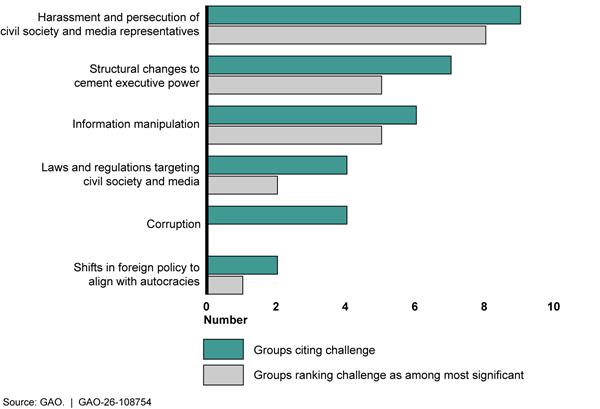
In all nine discussion groups, implementing partner representatives as well as USAID and State award managers identified challenges stemming from actions by host-country governments, ranking these challenges as among the most significant that affected democracy assistance projects. Discussion group participants said that host-country government actions often targeted civil society and media and undermined democratic objectives. Participants most often cited the following host-country government actions as significant challenges: (1) harassment and persecution of civil society and media representatives, (2) structural changes to cement executive power, and (3) information manipulation. See figure 5.
Figure 5: Numbers of Discussion Groups That Cited Host-Country Government Actions as Challenges and Ranked Them as Significantly Affecting Democracy Assistance Implementation in 2024
Note: From June to August 2024, we convened nine discussion groups of U.S. agency officials managing democracy assistance awards and of representatives of the organizations implementing such awards in four countries where democratic erosion was reported to have occurred. For more information, see appendix I.
|
“Defenders of democracy and whistleblowers on human rights violations are seen as enemies of the people and have been detained, harassed, and attacked.” –Discussion group participant Source: GAO. | GAO‑26‑108754 |
Harassment and persecution of civil society and media representatives. Eight of the nine groups that identified host-country government harassment and persecution of civil society and media representatives as a challenge ranked it among the most significant challenges affecting implementation of democracy assistance. Examples they cited included physical and digital surveillance, administrative actions such as unannounced audits, threats to implementing partner staff and their families, and arrests of implementing partner staff or project participants.
For instance, representatives of an implementing partner in one country told us that the organization had to adjust its implementation of several project activities after the government began arresting and harassing civil society advocates and journalists. Representatives of an implementing partner in another country told us that hostility and harassment caused some project staff to resign after receiving threatening phone calls at their homes. According to discussion group participants, these actions were intended to cause self-censorship among civil society representatives, civil servants, and the population at large. Groups in three of the four selected countries ranked harassment and persecution of civil society and media representatives as the most significant challenge they faced in implementing democracy assistance.
Structural changes to cement executive power. Five of the seven groups that identified structural changes to cement host-country government power in the executive branch as a challenge ranked it among the most significant. The actions they identified included centralizing and consolidating power in the executive branch; changing and weakening institutional roles to reduce accountability, participation, and inclusion; amending constitutions; and removing appointed officials or civil servants.
In three of the four selected countries, discussion groups identified such structural changes as their most significant challenge to implementing democracy assistance.
|
“Mis- and disinformation coming from the government pit people against civil society and lead to citizens’ believing multiparty democracy is not worth it.” –Discussion group participant Source: GAO. | GAO‑26‑108754 |
Information manipulation. Five of the six discussion groups that identified host-country government manipulation of information as a challenge ranked it among the most significant they had faced. Participants said that host-country governments manipulate information by disseminating misinformation (i.e., spreading false, inaccurate, or misleading information, regardless of intent to deceive) and disinformation (i.e., spreading false or misleading information with the intent to deceive or mislead); through unwillingness to counter mis- and disinformation disseminated by a foreign actor; by using information to fuel polarization; and by limiting access to public information.
For example, according to USAID officials and representatives of an implementing partner in one country, the partner had to adjust its project and use a new approach after a host-country government official spread disinformation about project participants.
Legal and regulatory actions targeting civil society and media. Two of the four discussion groups that identified as a challenge the introduction and implementation of laws and regulations targeting civil society and the media ranked it among the most significant challenges they had faced. Discussion group members cited laws requiring entities that receive foreign funding to register as organizations pursuing the interests of a foreign power; laws that constrained freedom of expression; and laws and regulations, broadly designed and arbitrarily enforced, that targeted civil society representatives and journalists.
Corruption. Four groups identified issues related to corruption as a challenge to implementing democracy assistance, although none identified such issues as among the most significant challenges they faced. Examples cited included government officials’ requiring payments or favors to carry out their duties.
Shifts in foreign policy to align with autocracies. One of the two groups that identified as a challenge host-country governments’ shifting of foreign policy to align with autocratic governments ranked it among the most significant. For example, participants described a host- country government’s altering its foreign policy in exchange for economic investments by autocracies such as China and then promoting these investments as being more beneficial than U.S. democracy projects.
Host-Country Operating Environment
In all nine discussion groups, implementing partner representatives as well as USAID and State award managers identified challenges related to the operating environment in the host country and ranked most of these challenges as among the most significant they had faced in implementing democracy assistance projects. Participants most often cited the following challenges related to the host-country operating environment: (1) socioeconomic factors, (2) capacity and weakening of civil society, (3) and host-country institutional capacity. See figure 6.
Figure 6: Numbers of Discussion Groups That Identified Challenges Related to Host-Country Operating Environment and Ranked Them as Significantly Affecting Democracy Assistance in 2024

Note: From June to August 2024, we convened nine discussion groups of U.S. agency officials managing democracy assistance awards and of representatives of the organizations implementing such awards in four countries where democratic erosion was reported to have occurred. For more information, see appendix I.
|
The lack of civic education means some people don’t know what democracy is; they don’t understand its elements and importance. –Discussion group participant Source: GAO. | GAO‑26‑108754 |
Socioeconomic factors. Six of the nine groups that identified socioeconomic factors as a challenge ranked them among the most significant they faced. Examples included lack of civic education among the population, poverty and lack of economic opportunities, lack of political participation of women and marginalized groups, and low prioritization of democracy assistance by both the host-country government and population. Specifically, discussion groups in two countries ranked the lack of civic education as among the most significant challenges. A group in in a third country cited the rapidly changing operating environment—including social unrest, economic reforms, and frequent changes in parliament leadership—as the most significant challenge they faced in implementing democracy assistance.
Five discussion groups identified the low prioritization of democracy assistance by host-country governments or populations as a challenge. Discussion group participants cited, as an example, host-country governments’ and populations’ prioritization of economic growth activities over democracy assistance activities. One discussion group ranked this as the most significant challenge.
|
“‘Democracy is a problem for the elite. People whose basic needs aren’t met aren’t focused on democracy.” –Discussion group participant Source: GAO. | GAO‑26‑108754 |
Capacity and weakening of civil society. Three of the seven discussion groups that identified the capacity and weakening of civil society as a challenge created by host-country operating environments ranked it among the most significant they faced. Examples included limited capacity of existing civil society organizations, lack of coordination among civil society organizations, and the shrinking of civil society, often through targeted efforts orchestrated by the host-country government.
In one country, a discussion group that ranked this as a significant challenge noted that some civil society groups lacked the institutional and financial management capacity to receive U.S. funding, while other groups closed due to fear. In another country, a group that ranked the weakening of civil society as among the most significant challenges said that the rapidly shrinking civic space had led to a silencing of independent voices and spread of disinformation and had limited citizen participation in decision making. USAID officials noted that the civic space in that country was shrinking—not because civil society was weak but because it was strong and influential and, as a result, the government had targeted it and intended to weaken it through legislative changes, prosecutions, intimidation, and violence.
Host-country institutional capacity. Seven groups identified challenges related to host countries’ institutional capacity, although none ranked these challenges among the most significant they faced. Such challenges consisted of weak or poorly performing government institutions; bureaucratic delays and overlap of missions and authority; and siloed and noninclusive institutions. For instance, a discussion group in one country noted that a lack of coordination among government institutions made it difficult to implement democracy assistance activities, as one office would claim authority while another office contradicted that claim. This made it difficult for the implementing partners to identify the offices they should work with to implement their activities.
U.S. Approaches to Democracy Assistance, Competing Priorities, and Other Donor Actions
In all nine discussion groups, implementing partner representatives as well as USAID and State award managers identified challenges stemming from competing U.S. priorities, funding and programmatic approaches, and other donor actions and ranked many of these challenges as among the most significant they faced in implementing democracy assistance projects. Participants most often cited as significant challenges U.S. policy positions and actions that competed with the goals of their projects. They also cited international donor community approaches, coordination, and priorities as significant challenges. See figure 7.
Figure 7: Numbers of Discussion Groups That Cited Challenges Related to U.S. Approaches, Competing Priorities, and Other Donor Actions and Ranked Them as Significantly Affecting Democracy Assistance in 2024

Note: From June to August 2024, we convened nine discussion groups of U.S. agency officials managing democracy assistance awards and of representatives of the organizations implementing such awards in four countries where democratic erosion was reported to have occurred. For more information, see appendix I.
Competing diplomatic and democracy assistance priorities. Four of the nine groups that identified competing priorities as challenges ranked them among the most significant they faced. At the time, such competing priorities included the U.S. approach to balancing diplomatic priorities with democracy assistance. For example, participants cited as challenges the U.S. government’s not taking a clear position regarding democratic backsliding and not openly confronting governments when backsliding occurred. Participants also cited the embassy’s not promoting democracy assistance as prominently as other types of development assistance, U.S agencies’ issuing policy directives and sanctions, and U.S. actions in other parts of the world.
For example, a discussion group in one country ranked the balance of U.S. diplomatic and democracy assistance priorities among the most significant challenges affecting the provision of democracy assistance. Participants observed that implementing partners were unsure how to manage gaps between such priorities. For example, according to the participants, the U.S. government had not publicly confronted the host-country government about certain undemocratic actions but had simultaneously funded activities to address such actions.
|
“There is a lack of long-term vision in projects; implementing partners and donors are too focused on quarterly reports and indicators. There is a mismatch between the short-term indicators and the actual needs of democracy.” –Discussion group participant Source: GAO. | GAO‑26‑108754 |
International donor community approaches, coordination, and priorities. Two of the six groups that identified challenges related to the international donor community ranked them among the most significant they had faced.[24] These challenges consisted of lack of coordination among bilateral and multilateral donors; donor priorities misaligned with country needs, including donors’ emphasis on short-term outputs rather than longer-term results; donors’ not adjusting their approach after democratic backsliding; and donors’ not ensuring the sustainability of funding. A discussion group in one country cited unsustainable donor funding as the most significant challenge.
U.S. funding and programmatic approaches. Three groups identified challenges related to the U.S. funding and programmatic approach. Such challenges included cumbersome procurement practices, burdensome paperwork and reporting requirements, and award designs that did not reflect contextual changes. However, none of the groups cited these challenges as among the most significant they had faced.
USAID and State Adapted Awards in Selected Countries with Democratic Erosion but Did Not Plan Sufficiently for Risk
USAID and State Used Formal and Informal Processes to Identify and Make Needed Changes to Awards
USAID and State used both formal and informal processes to identify and make necessary adjustments to democracy assistance awards we reviewed, according to award documentation as well as award managers and implementing partner representatives we spoke with.
Processes to Identify Needed Changes to Award Activities
At the time of our review, USAID and State used formal processes, such as reviewing regular progress reports and holding and documenting “Pause and Reflect” events, to identify any needed changes to award activities.[25] Progress reports for both USAID and State awards generally include award activities conducted, outputs of the activities, progress toward award objectives, and challenges that may impede progress. For example, an award manager for a 4-year award in one country told us that during the second year of its implementation, USAID conducted two formal assessments—a political economy analysis and a Pause and Reflect exercise—that identified a need to increase the award’s focus on civic outreach and education.
USAID and State also used informal processes, such as regular or ad hoc communication between the agency and the implementing partner, to identify needed changes to award activities. For example, several award managers and implementing partner representatives said that they engaged daily with their counterparts on the awards, while others described weekly or biweekly check-ins to share information and updates. Multiple implementing partner representatives characterized these discussions as open, honest, and helpful. The representatives also said that these discussions allowed both the agency and the partner to evaluate the progress of their awards, discuss challenges that they faced, and approve any changes to award activities that might be needed to address such challenges.
Processes to Make Needed Changes to Award Activities
As democratic contexts changed in the countries where the awards we reviewed were implemented, USAID and State’s flexible award designs allowed them to adjust award activities as needed without changing the high-level goals and objectives the awards were originally designed to achieve.
Often the agencies were able to make these adjustments without formally modifying the award. For example, an award manager in one country described how, as opposition political parties rapidly lost power to the ruling party, USAID decided to de-emphasize the strengthening of political parties as a focus of the award. The manager said that the agency pivoted award activities, without formally modifying the award, to focus on administration of elections and promotion of a pluralistic civil society to support the award’s other goals. Similarly, an award manager in another country told us that as a result of the passage of new legislation in that country, USAID and the implementing partner adjusted award activities, without formal modifications, to include additional support for participants who may be targeted under the law, allowing them to continue to work to achieve the award’s objectives.
In some cases USAID made formal award modifications, including extensions and cost increases, in response to changing democratic contexts. For example, the agency made multiple modifications to an award in one country, including increasing the total amount and extending the award’s timeline. The award manager and a representative of the implementing partner told us that this allowed them to adapt to new circumstances and continue their work longer than originally planned.
In another award modification, USAID extended the timeline of an award by a year without providing additional funds. According to the award manager and implementing partner representatives, USAID granted this extension after antidemocratic actions by the host-country government made planned work with local government entities impossible. USAID granted the extension to allow the award manager and the implementing partner to adjust their approaches as necessary to produce the desired results.
A majority of award managers and implementing partner representatives we spoke with told us they believed their awards allowed for sufficient flexibility to adjust award activities as needed—for example, in response to changing political or democratic contexts. Several implementing partner representatives also commended USAID’s and State’s flexibility and responsiveness in approving necessary adjustments to award activities and timelines.
USAID and State Shifted Assistance Away from Government Entities in Some Countries in Response to Democratic Erosion
From 2021 through 2024, USAID and State responded to events that the agencies identified as antidemocratic actions in several of the countries we selected for our review.[26] USAID and State shifted, paused, or ceased democracy assistance and other funding or activities benefitting host-country government entities after those countries’ governments took actions that the agencies identified as antidemocratic, according to agency documents.[27] For example, in one country, USAID and State paused bilateral funding deemed to benefit the host-country government, and they modified award activities to instead provide assistance to civil society, independent media, or the private sector. In another country, USAID ceased assistance to certain host-country government entities and redirected the assistance to local civil society and human rights organizations. Agency officials said that the agencies’ responses were intended to send a message that antidemocratic actions would have negative consequences and to encourage the governments to return to democratic principles.
USAID and State Did Not Plan to Mitigate Risk to Awards That Supported Host-Country Government Entities
Of the 12 USAID and State awards we reviewed, none of the nine awards with activities that directly benefited host-country government entities in El Salvador, Georgia, Sri Lanka, and Tunisia had documentation showing the agencies had planned to mitigate the risk that changes in the political operating environment in the countries, such as government antidemocratic actions, would affect their ability to interact with those entities.[28] Some of the USAID and State awards we reviewed included documentation that their implementing partners had developed plans to mitigate other types of risk. However, for the nine awards with activities involving direct interaction with host-country government entities, we found no documentation that USAID or State had planned to mitigate the risk of having to cease interacting with those entities and shift award activities to supporting nongovernmental entities.[29]
At the time of our review, USAID guidance required pre-award assessment of certain categories of risk. However, during our review, State announced its intention to take over some USAID functions and that USAID had ceased implementing foreign assistance. State guidance requires both assessment and mitigation of certain risks before and throughout the lifecycle of awards. The Federal Assistance Directive requires State to evaluate and plan to mitigate several types of risk before making an award and during award implementation. These types of risk include the operating environment where the award activities will be performed and the degree to which the activities are sensitive or difficult to achieve. One State risk assessment template we reviewed asks award managers to (1) consider whether the government of the country where the award operates restricts, surveils, or otherwise targets nongovernmental organizations or political groups, and (2) plan to mitigate accordingly. According to the template, these factors may impede the award recipient’s ability to carry out programming effectively.
According to USAID and State officials, neither agency required planning to mitigate the risk of having to cease interacting with host-country government entities for democracy awards requiring such interaction, despite the increasing frequency of antidemocratic actions globally, as reported by observers such as Freedom House and V-Dem. The Federal Assistance Directive requires State to take a proactive approach to detecting and addressing risk before making an award and throughout its lifecycle, including for awards that operate in unusual or difficult operating or political environments.[30] Moreover, our prior work has highlighted the importance of organizations’ anticipating future challenges and planning accordingly, including defining strategies to mitigate external risk factors.[31]
As a result of USAID’s and State’s lack of planning to mitigate this risk, inefficiencies arose in implementing the agencies’ decisions to cease activities that benefitted host-country government entities in several of the countries we selected for our review and to shift this assistance to support civil society organizations and other nongovernmental entities. Agency officials and implementing partners we spoke with expressed concerns about the implementation of these decisions, such as the resulting administrative burdens, loss of programmatic momentum, and confusion and uncertainty about how the changes should be carried out.
· In one country, the decision to cease working with affected government entities took effect shortly after USAID announced it, leaving no time to plan for managing necessary transitions to supporting civil society organizations. Senior USAID officials told us that implementation of the agency’s cessation and redirection of assistance was chaotic, because they were unsure how to implement it. A representative of an implementing partner that had engaged with the affected government entities before USAID redirected the assistance described its issuance as rushed and stated that the redirection had eroded the partner’s progress with those entities.
· In another country, representatives of multiple implementing partners told us that the pause in assistance benefitting the host-country government was confusing. Partners described a great deal of uncertainty as to how or whether they should move forward with their award activities. According to agency officials, the pause began soon after State announced it. This left relatively little time to plan how to pause award activities or modify them to support nongovernmental entities. The manager for one of the awards expressed concern about the pause’s potential damage to the relationships and trust that USAID had built with its partners in the host-country government. State officials also told us that they had received feedback from their partners regarding the pause’s potential chilling effect on further democracy assistance and that the pause would lead to a loss of momentum in efforts to strengthen democracy in the country.
· In a third country, an implementing partner representative described uncertainty about funding for the partner’s award as a result of recalibrating assistance. The representative told us that initially, during the second full year of the 5-year award, USAID informed the partner that because of the recalibration, the agency would not increase the award amount as it had previously planned. As a result, the partner would need to finish implementing the award a year earlier than planned. However, USAID later informed the partner that it would provide additional funding for the award’s final year as originally planned.
According to State, USAID ceased implementing any foreign assistance in July 2025. However, for any future U.S. democracy assistance that State provides, establishing a requirement to plan to mitigate the risk of having to shift, pause, or cease award activities involving interaction with host-country government entities and to adjust these plans as needed would help ensure that any decisions to pivot democracy assistance away from host-country government entities are implemented efficiently and cause minimal disruption. Additionally, it would allow for better safeguarding against waste by ensuring that democracy assistance programs are able to quickly and efficiently shift their activities to supporting nongovernmental entities if directed to do so.
Conclusions
The U.S. has historically supported the promotion of democratic values and processes as a foreign policy objective. In fiscal years 2018 through 2023, USAID and State allocated $14 billion in democracy assistance worldwide, including $4.5 billion intended to encourage democratic practices within host-country government institutions. However, analysis from observers such as Freedom House and V-Dem has shown that democracy is increasingly under attack across the globe. Antidemocratic actors and trajectories not only threaten U.S. foreign policy interests, they also create significant challenges for U.S. agencies and implementing partners providing U.S. assistance in locations where democracy is threatened. Major challenges that agency officials and their implementing partners identified include the harassment and persecution of civil society and independent media as well as structural changes to cement autocratic power.
State’s and USAID’s responses to antidemocratic actions in several of the countries we selected for our review show that the U.S. could decide to withdraw support for host-country government entities under similar circumstances in the future. In these countries, the pivots away from interaction with government entities in some cases happened very quickly and, because of an absence of planning for this risk, led to confusion, uncertainty, and disruption of U.S. programs. Planning for this possibility during the design of any future democracy assistance awards would help State prepare to redeploy significant amounts of democracy assistance funding more efficiently in vulnerable countries. Such planning would also strengthen State’s ability to promote democratic values in places where U.S. support is most critical.
Recommendations for Executive Action
A draft version of the sensitive report we published in September 2025 contained two recommendations to USAID. We removed those recommendations because the Secretary of State announced in July 2025 that USAID is no longer implementing foreign assistance. In addition, in the draft version of our sensitive report, we addressed our recommendations to State to State’s Undersecretary for Civilian Security, Democracy, and Human Rights or the head of any successor entity. We removed reference to the Undersecretary because the position was eliminated as of August 2025.
We are making the following two recommendations to State:
The Secretary of State should ensure that the head of any entity responsible for democracy assistance programs requires implementing partners to develop, during award design, a plan for mitigating the risk of having to shift, pause, or cease democracy assistance award activities that involve interacting with host-country government entities and to adjust this plan as needed throughout award implementation. (Recommendation 1)
The Secretary of State should ensure that the head of any entity responsible for democracy assistance programs requires award managers to review, during award design, plans for mitigating the risk of having to shift, pause, or cease democracy assistance award activities that involve interacting with host-country government entities and to monitor adherence to these plans throughout award implementation. (Recommendation 2)
Agency Comments
We provided a draft of our sensitive report to the Acting Administrator of USAID and the Secretary of State for review and comment. Additionally, we provided a draft of this public report to State for a sensitivity review. USAID had no comments about the sensitive report. State provided comments about the sensitive report that we have reproduced in appendix VI. In its comments, State neither agreed nor disagreed with our findings and recommendations. State also provided technical comments that we incorporated as appropriate.
We are sending copies of this report to the appropriate congressional committees, the Secretary of State, the Acting Administrator of USAID, and other interested parties. In addition, the report is available for no charge at https://www.gao.gov. If you or your staff have any questions about this report, please contact me at kenneyc@gao.gov. Contact points for our Offices of Congressional Relations and Media Relations may be found on the last page of this report. GAO staff who made key contributions to this report are listed in appendix VII.
Chelsa Kenney
Director, International Affairs and Trade
This report examines, in light of the spread of democratic erosion, democracy assistance provided by the U.S. Agency for International Development (USAID) and the Department of State’s Bureaus of Democracy, Human Rights and Labor (DRL) and International Narcotics and Law Enforcement Affairs (INL). This report:
1) describes USAID’s and State’s allocations of funding for democracy assistance in fiscal years 2018 through 2023;
2) discusses challenges that USAID, INL, DRL, and their implementing partners identified as affecting the provision of this assistance in four selected countries that have experienced democratic erosion as of December 2024; and
3) assesses the extent to which USAID, INL, and DRL planned to mitigate specific risks in providing this assistance as of December 2024.
This report is a public version of a sensitive report that we issued on September 11, 2025.[32] Our September report identifies countries, among four we selected for our review, whose governments had taken various actions that were considered to be antidemocratic. State deemed some of this information to be sensitive and thus protected from public disclosure. Consequently, this public version of our report does not attribute any specific actions taken by governments in the selected countries. Although this public report provides more limited information than the sensitive report, this report uses the same methodology.
To address our objectives for both reports, we first selected countries that had experienced democratic erosion, using data from Freedom House and Varieties of Democracy Research Institute (V-Dem) on freedom and democratic erosion around the world during the period from 2018 through 2023. We selected these two sources on the basis of interviews with USAID and State officials as well as interviews with officials at those organizations and because of the two organizations’ differing methodologies. According to Freedom House officials, its methodology is based on the Universal Declaration on Human Rights and assesses political rights and civil liberties. According to V-Dem documents, its methodology assesses five different principles of democracy: electoral, liberal, participatory, deliberative, and egalitarian. We found Freedom House and V-Dem data to be sufficiently reliable for the purposes of selecting countries reported to have experienced democratic erosion. Our initial pool of potential case study countries included all countries for which either Freedom House or V-Dem data showed at least a 5 percent decline in democracy from 2018 through 2023.
We used these data, in conjunction with allocations data from State’s Office of Foreign Assistance, to identify countries that had both experienced democratic erosion and also received significant amounts of U.S. democracy assistance during that period. We excluded countries that Freedom House rated “Not Free” in 2018 and countries that it rated “Free” in 2023, because these ratings indicated that these countries likely would not offer illustrative examples of democratic erosion or of U.S. efforts to respond to it. We also excluded countries with active conflicts during the selected period, such as Ukraine, and countries that had experienced abrupt transitions to autocracy during this period, such as Myanmar. In addition, we interviewed USAID and State officials to obtain their perspectives on democratic erosion in various countries.
Using the six geographical regions defined by State—sub-Saharan Africa, East Asia and the Pacific, Europe and Eurasia, the Near East (Middle East and North Africa), South and Central Asia, and the Western Hemisphere—we grouped by region the countries that had both experienced democratic erosion and received significant amounts of U.S. funding. We combined the Near East with sub-Saharan Africa and combined East Asia and the Pacific with South and Central Asia, which resulted in four world regions. We picked one country in each of the four regions: El Salvador in the Western Hemisphere; Georgia in Europe and Eurasia; Tunisia in the Near East/sub-Saharan Africa; and Sri Lanka in East Asi and the Pacific/South and Central Asia. (Apps. II through V show the extent of democratic erosion as measured by Freedom House and V-Dem in the four selected countries.)
To describe the agencies’ democracy assistance allocations in fiscal years 2018 through 2023, we requested allocations data from State’s Office of Foreign Assistance’s Foreign Assistance Coordination and Tracking System (FACTSInfo). Our analysis of allocations is based on operational plans that USAID and State operating units submit to the office, which stores them in FACTSInfo after notifying Congress of the allocations.[33] The data we received included operational plans that were approved or pending as of October 2024, when we received updated information in response to our request. The data also included information from three supplemental appropriations acts for Ukraine. We refer to these data as allocations because, according to State officials, USAID and State include allocation amounts in the operational plans. We reviewed these operational plan data because, according to agency officials, this was the most reliable way to separately analyze USAID and State allocations.
To discuss the challenges that agencies and implementing partners identified as affecting the provision of democracy assistance in the selected countries, we submitted a questionnaire to the agencies. From the responses to this questionnaire, we obtained information about the number of democracy assistance awards in each country; the award amounts as of December 31, 2023; the categorization of each award, according to the Standardized Program Structure and Definitions (SPSD); and each award’s degree of focus on democratic backsliding, among other factors. Using these results, we selected 12 USAID, DRL, and INL awards for democratic assistance in the four countries. For each country, we selected two USAID awards and one State award (either DRL’s or INL’s), using a protocol that considered the following factors: focus on democratic erosion, project description, funding amount, SPSD program area, and award start and end dates. Two team members independently selected four awards in each country and met to reconcile any selection differences. We then conducted semistructured interviews with the award managers and with representatives of the implementing partners for these awards.
In addition, in the four selected countries, we conducted a total of nine discussion groups of USAID and State award managers and implementing partner representatives who worked on democracy assistance awards, including the selected awards. From June to August 2024, we conducted two discussion groups, one for USAID and State award managers and another for implementing partner representatives, in each of the four countries. In Tunisia, we also conducted a second group of implementing partner representatives to accommodate the large number who wanted to participate. In each group, we asked participants (1) what challenges they faced in providing democracy assistance and (2) which of those challenges were most significant.
We conducted the discussion groups using the nominal group technique. Specifically, participants wrote ideas as brief phrases or statements in response to questions or problems that we presented. We listed group members’ ideas on a flip chart visible to the entire group; in doing so, we used a round-robin recording technique, asking for one idea from one group member at a time. Group members then discussed each idea in turn for the purpose of clarification, and some ideas were combined. Once a final list of ideas was established, we asked participants to rank them from most to least important.
We used the qualitative data resulting from the nine discussion groups to develop a content coding structure. Two analysts reviewed the qualitative data independently and applied the coding structure to determine which challenges in implementing democracy assistance were (1) the most common and (2) the most often voted to be significant in our selected countries. When the two analysts reached different conclusions about how to apply the coding structure to the data, they met to reconcile those differences.
To assess the extent to which USAID, DRL, and INL have taken steps to address specific risks in the selected countries, we reviewed agency documents, including documents for the 12 selected USAID, DRL, and INL awards in El Salvador, Georgia, Sri Lanka, and Tunisia. In three of these four countries, USAID or State had redirected democracy assistance away from host-country government entities or had paused or ceased working with them in response to the governments’ reported antidemocratic activities either before or during our work. We reviewed these documents to determine the extent of any planning for the risk of having to shift, pause, or cease award activities that involved interaction with host-country government entities.
We also reviewed agency guidance, including USAID’s Automated Directives System, which at the time of our review set forth USAID’s policies for identifying and managing risk in making awards. However, as of May 2025, the Automated Directives System was no longer accessible online, and in July the Secretary of State announced that USAID was no longer implementing foreign assistance. We reviewed State’s Foreign Assistance Directive, which lays out similar policies for State awards.[34] Further, we interviewed or requested written statements from agency officials regarding their experience of the redirection of assistance. Finally, we reviewed practices that we had previously identified that help federal agencies use evidence to effectively manage federal efforts.[35] These practices include assessing the environment in which the agencies conduct their work, to determine the internal and external factors that could affect their ability to achieve their goals, and defining strategies to address or mitigate these factors.
We conducted this performance audit from July 2023 to September 2025 in accordance with generally accepted government auditing standards. Those standards require that we plan and perform the audit to obtain sufficient, appropriate evidence to provide a reasonable basis for our findings and conclusions based on our audit objectives. We believe that the evidence obtained provides a reasonable basis for our findings and conclusions based on our audit objectives. We worked with State from September 2025 to February 2026 to prepare this version of the original sensitive report for public release.
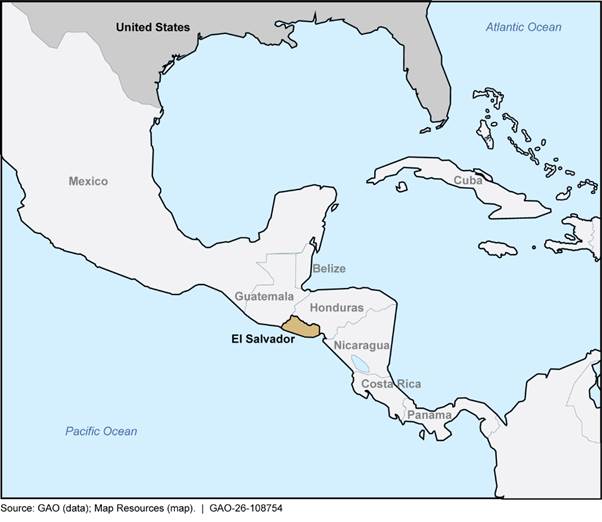
In 2017, according to Freedom House’s Freedom In the World index, El Salvador was a free country with credible elections and a free press. However, from 2018 to 2023, democracy in El Salvador declined notably, as measured by Varieties of Democracy (V-Dem) and Freedom House (see table 4). Freedom House’s measures show that electoral processes, political pluralism, functioning of government, freedom of expression, associational rights, and rule of law all eroded during this period. V-Dem’s measures show declines in several other aspects of democracy. For example, V-Dem’s measures show a 77 percent decline in liberal democracy, which comprises checks and balances on the executive, respect for civil liberties, the rule of law, and the independence of the legislature and the judiciary.
Table 4: Freedom House and V-Dem Overall Measures of Freedom and Democracy in El Salvador, 2018 and 2023
|
|
2018 |
2023 |
Change from 2018 to 2023 |
|
Freedom House |
67/100 |
53/100 |
-14 (-20.9%) |
|
V-Dem |
0.647 |
0.151 |
-.50 |
Source: GAO analysis of Freedom House and Varieties of Democracy (V-Dem) data. | GAO‑26‑108754
Note: Data shown for Freedom House reflect El Salvador’s overall score, on a scale of 0 to 100, for measures of political rights and civil liberties. Data shown for V-Dem reflect El Salvador’s score, on a scale of 0 to 1, for V-Dem’s Liberal Democracy Index.
In fiscal years 2018 through 2023, U.S. democracy assistance allocations for El Salvador, provided by the U.S. Agency for International Development (USAID) and the Department of State, totaled at least $97.5 million. In addition, according to State Department officials, USAID and State provided regional democracy assistance that included assistance for El Salvador not reflected in the El Salvador–specific total.

In 2017, according to Freedom House’s Freedom In the World index, Georgia was a partially free country on an improving democratic trajectory. However, from 2018 to 2023, Georgia’s democracy declined, as measured by Freedom House and Varieties of Democracy (V-Dem) (see table 5). Freedom House’s measures show that electoral processes, political pluralism, freedom of expression, and associational rights all declined during this period. V-Dem’s measures show declines in several other aspects of democracy. For example, liberal democracy (i.e., checks and balances on the executive, respect for civil liberties, the rule of law, and the independence of the legislature and the judiciary) declined by 2 percent. In addition, electoral democracy (i.e., the extent to which regimes hold clean, free, and fair elections) and participatory democracy (i.e., active citizen participation in political processes) contracted by 11 percent and 10 percent, respectively.
Table 5: Freedom House and V-Dem Overall Measurements of Freedom and Democracy in Georgia, 2018 and 2023
|
|
2018 |
2023 |
Change from 2018 to 2023 |
|
Freedom House |
63/100 |
58/100 |
-5 (-7.9%) |
|
V-Dem |
0.774 |
0.761 |
-0.013 |
Source: GAO analysis of Freedom House and Varieties of Democracy (V-Dem) data. | GAO‑26‑108754
Note: Data shown for Freedom House reflect Georgia’s overall score, on a scale of 0 to 100, for measures of political rights and civil liberties. Data shown for V-Dem data reflect Georgia’s score, on a scale of 0 to 1, for V-Dem’s Liberal Democracy Index.
In fiscal years 2018 through 2023, U.S. democracy assistance allocations for Georgia, provided by the U.S. Agency for International Development (USAID) and the Department of State, totaled more than $224 million. In addition, according to State officials, USAID and State provided regional democracy assistance that included assistance for Georgia not reflected in the Georgia-specific total.

In 2017, according to Freedom House’s Freedom In the World index, Sri Lanka was a partially free country. From 2018 to 2023, democracy in Sri Lanka declined slightly, as measured by Varieties of Democracy (V-Dem) and Freedom House (see table 6). Specifically, Freedom House measures show that the functioning of government and rule of law both declined during this period. V-Dem measures show slight declines in several other aspects of democracy. For example, V-Dem’s measure of liberal democracy (i.e., checks and balances on the executive, respect for civil liberties, the rule of law, and the independence of the legislature and the judiciary) declined by 10 percent, while its measure of electoral processes declined by about 6 percent.
Table 6: Freedom House and V-Dem Overall Measures of Freedom and Democracy in Sri Lanka, 2018 and 2023
|
|
2018 |
2023 |
Change from 2018 to 2023 |
|
Freedom House |
56/100 |
54/100 |
-2 (-3.6%) |
|
V-Dem |
0.764 |
0.688 |
-.08 |
Source: GAO analysis of Freedom House and Varieties of Democracy (V-Dem) data. | GAO‑26‑108754
Note: Data shown for Freedom House reflect Sri Lanka’s overall score, on a scale of 0 to 100, for measures of political rights and civil liberties. Data shown for V-Dem reflect Sri Lanka’s score, on a scale of 0 to 1, for V-Dem’s Liberal Democracy Index.
In fiscal years 2018 through 2023, U.S. democracy assistance allocations for Sri Lanka, provided by the U.S. Agency for International Development (USAID) and the Department of State, totaled at least $115.2 million. In addition, according to State officials, USAID and State provided regional democracy assistance that included assistance for Sri Lanka not reflected in the Sri Lanka–specific total.
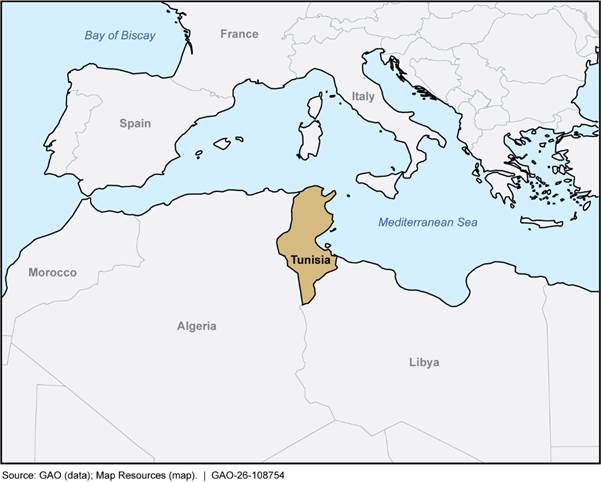
In 2017, according to Freedom House’s Freedom In the World index, Tunisia was a free country where citizens enjoyed then-unprecedented political rights and civil liberties. However, from 2018 to 2023, democracy in Tunisia contracted notably, as measured by Freedom House and Varieties of Democracy (V-Dem) (see table 7). Freedom House measures show that electoral processes, political pluralism, functioning of government, and rule of law all declined during this period. V-Dem measures show declines in several other aspects of democracy. For example, both liberal democracy (i.e., checks and balances on the executive, respect for civil liberties, the rule of law, and the independence of the legislature and the judiciary) and electoral democracy (i.e., the extent to which regimes hold clean, free and fair elections, among other things) declined by 36 percent.
Table 7: Freedom House and Varieties of Democracy (V-Dem) Overall Measurements of Freedom and Democracy in Tunisia, 2018 and 2023
|
|
2018 |
2023 |
Change from 2018 to 2023 |
|
Freedom House |
69/100 |
51/100 |
-18 (-26.1%) |
|
V-Dem |
0.877 |
0.558 |
-.319 |
Source: GAO analysis of Freedom House and V-Dem data. | GAO‑26‑108754
Note: Data shown for Freedom House reflect Tunisia’s overall score, on a scale of 0 to 100, for measures of political rights and civil liberties. Data shown for V-Dem reflect Tunisia’s score, on a scale of 0 to 1, for V-Dem’s Liberal Democracy Index.
In fiscal years 2018 through 2023, U.S. democracy assistance allocations for Tunisia, provided by the U.S. Agency for International Development (USAID) and the State Department, totaled more than $222 million. In addition, according to State officials, USAID and State provided regional democracy assistance that included assistance for Tunisia not reflected in the Tunisia-specific total.
GAO Contact
Chelsa Kenney, kenneyc@gao.gov
Staff Acknowledgments
In addition to the contact named above, Judith Williams (Assistant Director), Nicholas Jepson, Thomas Friend, Gergana Danailova-Trainor, Christopher Keblitis, Reid Lowe, and Thomas McCabe made key contributions to this report.
The Government Accountability Office, the audit, evaluation, and investigative arm of Congress, exists to support Congress in meeting its constitutional responsibilities and to help improve the performance and accountability of the federal government for the American people. GAO examines the use of public funds; evaluates federal programs and policies; and provides analyses, recommendations, and other assistance to help Congress make informed oversight, policy, and funding decisions. GAO’s commitment to good government is reflected in its core values of accountability, integrity, and reliability.
Obtaining Copies of GAO Reports and Testimony
The fastest and easiest way to obtain copies of GAO documents at no cost is through our website. Each weekday afternoon, GAO posts on its website newly released reports, testimony, and correspondence. You can also subscribe to GAO’s email updates to receive notification of newly posted products.
Order by Phone
The price of each GAO publication reflects GAO’s actual cost of production and distribution and depends on the number of pages in the publication and whether the publication is printed in color or black and white. Pricing and ordering information is posted on GAO’s website, https://www.gao.gov/ordering.htm.
Place orders by calling (202) 512-6000, toll free (866) 801-7077,
or
TDD (202) 512-2537.
Orders may be paid for using American Express, Discover Card, MasterCard, Visa, check, or money order. Call for additional information.
Connect with GAO
Connect with GAO on X,
LinkedIn, Instagram, and YouTube.
Subscribe to our Email Updates. Listen to our Podcasts.
Visit GAO on the web at https://www.gao.gov.
To Report Fraud, Waste, and Abuse in Federal Programs
Contact FraudNet:
Website: https://www.gao.gov/about/what-gao-does/fraudnet
Automated answering system: (800) 424-5454
Media Relations
Sarah Kaczmarek, Managing Director, Media@gao.gov
Congressional Relations
David A. Powner, Acting Managing Director, CongRel@gao.gov
General Inquiries
[1]According to the International Institute for Democracy and Electoral Assistance, democratic erosion, also known as democratic backsliding, is the deterioration of checks and balances and constitutional freedoms in nominally democratic societies. Democratic erosion can entail reduced media freedom and challenges to the rule of law. The institute notes that the path to democracy is not linear; countries may move toward democracy and away from it over time. See International Institute for Democracy and Electoral Assistance, The Global State of Democracy 2023: The New Checks and Balances (Stockholm: 2023).
[2]Freedom House is a nonprofit organization founded in 1941 in New York to promote American involvement in World War II. Freedom House publishes the annual Freedom in the World report, which provides information about civil liberties, political freedoms, and internet freedom in countries around the world. V-Dem, established in 2011 and housed in Sweden’s University of Gothenburg, collects and analyzes data for several core dimensions of democracy. Other organizations that compile information about democracy around the world include the Economist Intelligence Unit and the Democratic Erosion Consortium, which maintains the Democratic Erosion Event Dataset.
[3]The policy requirements, organizational structures, and funding information for State and USAID described in this report are accurate for the period of our review, fiscal years 2018 through 2023.
[4]Exec. Order No. 14,169, 90 Fed. Reg. 8619 (Jan. 20, 2025).
[5]GAO, Democracy Assistance: State Should Require Plans to Mitigate Effects of Reported Antidemocratic Actions Overseas, GAO‑25‑106971SU (Washington, D.C.: Sept. 11, 2025).
[6]For more information about how we selected countries and awards for review, see appendix I. See appendixes II through V for more information about the extent of democratic erosion, as measured by Freedom House and V-Dem, in the selected countries.
[7]These implementing partners included local, U.S.-based, and international nonprofit, nongovernmental organizations.
[8]Department of State, Federal Assistance Directive, ch. 2, sec. K (Oct. 1, 2024).
[9]GAO, Evidence-Based Policymaking: Practices to Help Manage and Assess the Results of Federal Efforts, GAO‑23‑105460 (Washington, D.C.: July 12, 2023).
[10]These strategies include State’s and USAID’s joint regional strategies for each of six geographical regions: Africa, East Asia and the Pacific, Europe and Eurasia, the Near East, South and Central Asia, and the Western Hemisphere.
[11]As of November 20, 2025, State’s website noted that the Joint Strategic Plan was being assessed for compliance with administration policies.
[12]22 U.S.C. § 8202.
[13]In the ADS, USAID defined a cooperative agreement as a legal instrument used where the principal purpose is the transfer of money, property, services or anything of value to the recipient in order to accomplish a public purpose of support or stimulation authorized by federal statute and where substantial agency involvement is anticipated. Conversely, a grant was defined as a legal instrument used where substantial agency involvement is not anticipated. USAID officials noted that democracy assistance is subject to the instructions in chapter 304 of the agency’s Automated Directives System, “Selecting the Appropriate Acquisitions and Assistance Instrument.” According to the ADS, contracts could be used in specific circumstances, such as construction or the procurement of evaluation services.
[14]This total represents all democracy assistance, including but not limited to awards related to democratic erosion. We are reporting allocations on the basis of operational plan data that USAID and State operating units submitted to State/F. Operating units, such as USAID missions and State bureaus, base their operational plans on amounts allocated. The data we are reporting include democracy assistance allocations from two fiscal year 2022 Ukraine supplemental appropriations acts and one fiscal year 2023 Ukraine supplemental appropriations act.
[15]Other State bureaus that received significant democracy assistance allocations during this time included the Bureau of European and Eurasian Affairs and the Bureau of Western Hemisphere Affairs. For more information, see figure 4.
[16]Congressional directives in House and Senate reports often guide agencies’ allocations for foreign assistance. According to State data, the following foreign assistance accounts were subject to democracy assistance–specific directives in fiscal years 2018 through 2023: Assistance for Europe, Eurasia, and Central Asia; the Democracy Fund; Development Assistance; the Economic Support Fund; and International Narcotics Control and Law Enforcement.
[17]The SPSD defines Non-Security Executive Authority as assistance to institutions at all levels of the executive branch of government, including offices, ministries, and independent governmental bodies but excluding government security agencies. Assistance provided for this program element includes assistance with policies, procedures, and skill sets (including leadership and strategic management) to guide operations; implementation and enforcement of laws, regulations and policies; and building of linkages among executive institutions and between the executive and other branches of government.
[18]The data we are reporting include allocations for democracy assistance programs from annual appropriations acts, and about $1 billion from two fiscal year 2022 Ukraine supplemental appropriations acts and one fiscal year 2023 Ukraine supplemental appropriations act.
[19]The SPSD defines this program element as the provision of technical assistance and training to strengthen subnational government functions, including development of budgets; raising of local revenue; provision of local public services; community planning; participation; and implementation of laws, regulations, policies, and programs. This assistance can also be used to develop or strengthen associations of local governments or local government officials. USAID regional totals do not include amounts not assigned to specific regions, such as allocations to USAID’s Bureau of Conflict Prevention and Stabilization.
[20]The SPSD defines this program element as assistance to improve the systems, capacity, and sustainability of civil and criminal justice sector and institutions, improve the ability and skills of justice sector actors, and enhance coordination amongst them where appropriate. Regional totals for State do not include amounts not assigned to a specific region, such as allocations to State’s Bureau of International Organizations, Bureau of Energy Resources, and Global Engagement Center.
[21]The SPSD defines this program element as support for systems to prevent and address human rights violations through early warning, monitoring, investigating, and reporting. This assistance is also used to promote respect for human rights and support human rights defenders through utilization of national, regional, and international legal systems for human rights protection and enforcement. Regional totals for State do not include amounts not assigned to a specific region, such as allocations to State’s Bureau of International Organizations, Bureau of Energy Resources, and Global Engagement Center.
[22]According to agency officials, there is no specific U.S. government approach that differentiates an award to combat democratic erosion from an award to promote democracy. When requesting information about awards that addressed democratic erosion in the four selected countries, we provided State and USAID with the following definitions for those with a primary, partial, or no focus on democratic erosion: Awards with a primary focus on democratic erosion are those for which all or most of the goals or objectives explicitly reference concepts such as democratic erosion, backsliding, illiberalism, autocracy, or threats to democracy and those that were established in response to a backsliding event or trend. Awards with a partial focus on democratic erosion may address democratic erosion in some but not all goals or objectives and may or may not have been established in response to a backsliding event or trend. Awards with no focus on democratic erosion are those that provide democracy assistance and can be categorized as such, according to the SPSD, but have no goals and objectives related to democratic erosion. For more detail on our methodology, see appendix I.
[23]We convened nine discussion groups from June to August 2024 in four countries where democratic erosion was reported to have occurred. In each country, we held separate groups for U.S. agency officials managing democracy assistance awards and for representatives of the implementing partners for such awards. For more information about our methodology, see appendix I.
[24]For the purpose of this
report, international donor community refers
to all bilateral and multilateral donors, including the U.S., and other
assistance providers such as nongovernmental organizations.
[25]USAID documents describe the Pause and Reflect process as a component of learning and adaptive management and define it as the act of taking time to think critically about ongoing activities and processes and plan for the best way forward. The process can encompass a broad range of activities that provide structure and intentionality to taking stock of organizational processes in addition to programming outcomes, successes, and challenges. According to USAID officials, the Pause and Reflect process involves both USAID award managers and implementing partners. During our review, officials said that the process is often built into award plans but is not used for every award.
[26]These events did not include military coups d’état and, as such, are not related to Section 7008 reporting. Section 7008 of the annual Department of State, Foreign Operations, and Related Appropriations Acts prohibits assistance to the government of any country whose duly elected head of government is deposed by military coup d’état or decree. See, e.g., Pub. L. No. 118-47, § 7008,138 Stat. 460, 758 (2024). This requirement does not apply to assistance to promote democratic elections or public participation in democratic processes or to support a democratic transition.
[27]According to USAID and State officials, the process for determining how the agencies would respond to antidemocratic actions in each country included an interagency review. The officials said that in all three cases, deliberations involved the National Security Council.
[28]Each of these nine awards was implemented by one or more international nongovernmental organizations or intergovernmental organizations, which then interacted with host-country government entities through award activities such as trainings, technical support, or discussion groups. Additionally, all 12 of the awards we reviewed included activities involving interactions with nongovernmental entities, such as civil society organizations or media outlets.
[29]Documentation for one USAID award showed that agency and implementing partner staff began to assess this risk midway through the award’s implementation, but only after they had to cease interacting with the government entities with which they had planned to work. The award documentation did not include a detailed plan to mitigate the risk.
[30]Department of State, Federal Assistance Directive, ch. 2, sec. K (Oct. 1, 2024).
[32]GAO, Democracy Assistance: State Should Require Plans to Mitigate Effects of Reported Antidemocratic Actions Overseas, GAO‑25‑106971SU (Washington, D.C.: Sept. 11, 2025).
[33]Operating units include, for example, USAID country missions and State functional bureaus.
[34]Department of State, Federal Assistance Directive, ch. 2, sec. K (Oct. 1, 2024).
[35]GAO, Evidence-Based Policymaking: Practices to Help Manage and Assess the Results of Federal Efforts, GAO‑23‑105460 (Washington, D.C.: July 2023).