
BORDER SECURITY
Improvements Needed to Increase Vehicle Scanning at Land Ports of Entry
Statement of Hilary M.
Benedict, Director,
Science, Technology Assessment, and Analytics
Before the Subcommittee on Border Security and Enforcement, Committee on Homeland Security, House of Representatives
For Release on Delivery Expected at 10:00 a.m. ET
United States Government Accountability Office
Chairman Guest, Ranking Member Correa, and Members of the Subcommittee:
I am pleased to be here today to discuss our work on U.S. Customs and Border Protection’s (CBP) non-intrusive inspection (NII) systems. Within the Department of Homeland Security (DHS), CBP is the lead federal agency charged with a dual mission of facilitating the flow of legitimate travel and trade at U.S. borders while also keeping terrorists and their weapons, criminals and their contraband, and inadmissible people out of the country. As part of its responsibilities, CBP coordinates the inspection and processing of pedestrians, passengers, and cargo at land, air, and sea ports of entry (POE).[1]
Land POEs are a key drug smuggling route for transnational criminal organizations. According to CBP, most illicit drugs, including fentanyl, enter the United States through southwest border POEs hidden in passenger vehicles or belongings, concealed in commercial vehicles, and carried by pedestrians.[2] To help detect illegal drugs and other contraband, CBP uses large- and small-scale NII systems, like X-ray machines, at land POEs to enable officers to inspect travelers and their belongings, and vehicles and their contents, without the need for unloading or disassembly.[3]
Since 2019, CBP’s NII program has received over $2 billion for NII systems, which it has used to enhance inspections of commercial and passenger vehicles and trains, and to increase the number of vehicles that are scanned using large-scale NII systems as they enter the United States. In 2021, the Securing America’s Ports Act required CBP to develop a plan to achieve 100 percent scanning of commercial and passenger vehicles and freight rail entering the United States at land POEs by 2027 using large-scale NII systems.[4]
My statement today discusses (1) how CBP assesses large-scale NII system performance, (2) the status of large-scale NII system deployment, and (3) CBP’s plans for future large-scale NII system deployments. This statement is based primarily on a report we published in September 2025 in response to a request to review the implementation and effectiveness of CBP’s NII program.[5]
To inform that report, GAO analyzed NII program documentation, including inspection procedures, performance data, and deployment plans, and interviewed program officials. GAO also interviewed and observed CBP officers conducting inspections at land POEs where large-scale NII systems had been deployed in preprimary inspection areas. More detailed information on the objectives, scope, and methodology for that work can be found in the report. Our work was performed in accordance with generally accepted government auditing standards.
Background
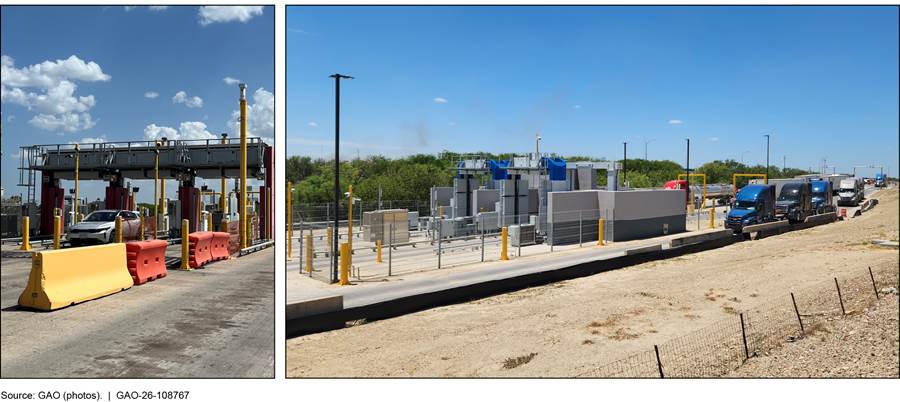
CBP began using large-scale NII systems to scan vehicles in 1996 and has generally deployed them in secondary inspection areas at land POEs. When deployed in secondary inspection areas, they are only used to scan vehicles that were referred by CBP officers in primary inspection. In 2020, CBP began deploying new large-scale NII systems in preprimary inspection areas—before a traveler is interviewed by a CBP officer, where vehicles are scanned before they reach the primary inspection booth (see fig. 1). Previously, NII systems were generally used only when an officer determined that further inspection was required after the interview. Placing NII systems in preprimary inspection areas significantly increases the number of vehicles scanned because all vehicles approaching a primary inspection booth that do not choose to go through an opt-out lane are scanned, rather than only those referred for secondary inspection.[6]
Figure 1: Non-Intrusive Inspection Systems in Passenger and Commercial Preprimary Inspection Areas at Land Ports of Entry in Mission, Texas (left) and Laredo, Texas (right)
As part of its overall inspection process, CBP uses large-scale NII systems to scan vehicles. These scans produce images that are reviewed by officers to identify any anomalies that might be contraband or hidden people. If officers identify any anomalies, the vehicles undergo further inspection, which can include the use of detection canines; small-scale NII systems such as videoscopes to look into hard-to-reach areas of vehicles or baggage scanners to scan vehicle contents to localize the anomalies; and manual inspection procedures.
CBP Assesses Large-Scale NII Performance, but Has Not Clearly Defined All Key Performance Parameters
CBP collects and uses performance data to help ensure that its large-scale NII systems are operational and available for use to scan vehicles. For example, these data include a daily list of system outages, and operational availability, which is the percentage of time systems are available for use.
CBP uses performance data to inform actions it takes to improve NII system performance. For example, CBP’s fiscal year 2024 target for system performance was for individual large-scale NII systems, and for the average across all large-scale NII systems, to have an operational availability of 95 percent or greater. However, in fiscal year 2024 just over half of individual large-scale systems met this target, while the average across all large-scale NII systems was 90 percent. CBP officials told us that CBP included penalty clauses in its new maintenance contracts in September 2024, which are intended to improve contractors’ accountability for maintaining the targeted level of operational availability.
In 2015, CBP established three key performance parameters for NII systems. These include (1) meeting an average NII imaging system operational availability of 95 percent, (2) inspecting 100 percent of all designated high-risk commercial vehicles and containerized cargo, and (3) maintaining 100 percent inspection of targeted containers, cargo, and international mail. According to DHS guidance, key performance parameters reflect the most important and nonnegotiable requirements that NII systems must meet to fulfill their purpose.
CBP collects data for operational availability and reports the results in its annual operational analysis reports. However, as we found in our September 2025 report, CBP has not clearly defined its other two key performance parameters or reported their results in operational analysis reports. Specifically, CBP has not clearly defined what “high-risk” means for the inspection rate key performance parameter or what maintaining 100 percent inspection of targeted containers, cargo, and international mail means for the examination key performance parameter. CBP officials said that because they are unclear how CBP intended to define or measure these key performance parameters, they have not reported data related to them.
Clearly defining its key performance parameters and using them for reporting would enable CBP to determine whether large-scale NII systems are working as intended. Doing so would also help CBP identify any system deficiencies or possible cost savings, achieve its objectives more efficiently and effectively, and help inform future procurement decisions. In our September 2025 report, we recommended that CBP should clearly define all NII key performance parameters and report performance using them. The agency concurred with the recommendation and said that its NII program will capture and clearly define system-level key performance indicators and reporting requirements for NII systems within new contract statements of work.
CBP Has Made Progress Deploying Large-Scale NII Systems, but Has Encountered Increased Costs and Schedule Delays
As part of its efforts to increase vehicle scanning at land POEs, CBP is deploying additional large-scale NII systems in preprimary inspection areas. Specifically, CBP is deploying low-energy portals (LEP) in passenger vehicle preprimary inspection areas and multi-energy portals (MEP) in commercial vehicle preprimary inspection areas. These systems will allow CBP to scan vehicles prior to primary inspection to identify potential anomalies and assist in determining whether to refer vehicles for secondary inspection, rather than only scanning vehicles referred for secondary inspection.
Beginning in fiscal year 2020, CBP awarded contracts to procure and deploy 153 large-scale NII systems to land POEs. As of February 2025, 52 of these 153 systems CBP planned to deploy were fully operational, nearly all located at preprimary inspection areas. An additional 101 systems were in preplanning, design, or construction phases (see table 1). These systems include 12 high-energy NII rail systems that CBP plans to deploy to replace existing gamma-ray systems that they are retiring.
Table 1: Deployment Status of U.S. Customs and Border Protection Large-Scale Non-Intrusive Inspection (NII) Systems at Land Ports of Entry, as of February 2025
|
Type of system |
Pre-planning |
Design |
Construction |
Fully operational |
Totala |
|
Low-energy portal (LEP) |
4 |
34 |
23 |
35 |
96 |
|
Multi-energy portal (MEP) |
6 |
7 |
15 |
17 |
45 |
|
High-energy NII rail |
0 |
11 |
1 |
0 |
12 |
|
Total |
10 |
52 |
39 |
52 |
153 |
Source: GAO analysis of U.S. Customs and Border Protection information. | GAO‑26‑108767
aTotal does not include three LEPs deployed to Donna, Texas, for the DHS Science and Technology demonstration that are no longer operational.
As a result of the deployment and use of LEPs and MEPs, CBP has increased its scanning of passenger vehicles from 2 percent in fiscal year 2020 to 8 percent in fiscal year 2024, and scanning of commercial vehicles from 16 percent to 27 percent during this same timeframe. Some factors have limited the use of the systems, such as limited staff and system outages. For example, when these systems are deployed in preprimary inspection areas at land POEs, they require additional staff to operate them and to review the images from the vehicle scans. CBP officials we met with at all four field offices with land POEs where large-scale NII systems had been deployed in preprimary inspection areas told us they did not always have sufficient staff to fully use the systems. CBP headquarters officials said they are discussing ways to mitigate staffing challenges, such as reviewing images at regional command centers rather than at the POEs, which could improve efficiency. Additionally, CBP officials at these POEs said that system outages, which were sometimes frequent or lengthy, have affected their operations.
In our September 2025 report we found that, although CBP has made progress deploying large-scale NII systems, it has encountered significant challenges that have led to deployments costing more and taking longer than expected.
CBP has developed and updated cost estimates for deploying MEP, LEP, and high-energy NII rail systems, but costs have exceeded those estimates. One reason for higher costs than anticipated are substantial increases in the costs for civil works and construction. For example, the estimated costs to install each MEP increased from $1.3 million in fiscal year 2020 to $4.1 million in fiscal year 2023. Further, in October 2024 CBP estimated the cost to complete installation of each remaining planned MEP system would range from $4.2 million to $9.7 million.
As a result, CBP has requested and received additional funding to deploy its large-scale NII systems and to meet its initial goals to increase vehicle scanning rates. According to CBP officials, in fiscal years 2019 through 2024, CBP received over $2.1 billion for the NII program (see table 2).[7] Most of these funds were intended for the deployment of large-scale NII systems in preprimary inspection areas. In October 2024, CBP reported that it had sufficient funds to finish deploying most of the large-scale NII systems but needed an additional approximately $173 million to complete deployment for 31 of the systems.
Table 2: U.S. Customs and Border Protection Reported Funding for Non-Intrusive Inspection Program Fiscal Years 2019 Through 2024 (dollars in millions)
|
Type of funding |
2019 |
2020 |
2021 |
2022 |
2023 |
2024 |
Total |
|
Procurement, Construction, & Improvements |
$570 |
$66 |
$0 |
$87 |
$95 |
$381 |
$1,199 |
|
Operations and Support |
$116 |
$127 |
$152 |
$167 |
$177 |
$177 |
$917 |
|
Total |
$686 |
$193 |
$152 |
$254 |
$273 |
$558 |
$2,117 |
Source: GAO analysis of U.S. Customs and Border Protection data. | GAO‑26‑108767
Large-scale NII system deployments have also taken longer than originally planned. The Securing America’s Ports Act required CBP to develop a plan to achieve 100 percent scanning of commercial and passenger vehicles and freight rail entering the United States at land POEs by 2027 using large-scale NII systems. As of February 2025, CBP did not expect to complete all of its planned large-scale NII deployments until December 2029. CBP’s original timelines to complete system deployments ranged from 12 to 24 months. However, some installations have taken longer than expected.
CBP officials identified various factors that have contributed to system deployments taking longer than expected. For example, some POEs require major site upgrades to enable NII systems to be installed in preprimary inspection, including the construction of command centers or installation of power and data connections to the new systems. In other instances, vendors have taken longer than expected to resolve issues encountered during system deployment, such as during site acceptance testing. CBP said they are aware of these issues and are taking actions to address them, such as considering future NII system installation needs when making infrastructure improvements at POEs along the northern border.
CBP’s Deployment Plans Do Not Include All Ports of Entry Along the Southwest Border, Including Three of its Highest-Traffic Locations
In response to the Securing America’s Ports Act, in January 2022 CBP submitted its plan to Congress to increase vehicle scanning with these large-scale NII systems at land POEs.[8] In its January 2022 scanning plan, CBP estimated that it would need 434 large-scale NII systems to achieve 100 percent scanning of vehicles and rail containers along the southwest and northern borders (see table 3). While the plan described how CBP intended to deploy large-scale NII systems to both the southwest and northern borders, CBP has focused its initial efforts on the southwest border because most CBP contraband seizures have occurred there.
Table 3 : Numbers of Additional Large-Scale Non-Intrusive Inspection (NII) Systems Needed for 100 Percent Scanning, Based on U.S. Customs and Border Protection Fiscal Year 2021 Scanning Plan
|
|
Low-energy portal (LEP) |
Multi-energy portal (MEP) |
High-energy NII rail |
Total |
|
Planned NII systems, total |
337a |
65 |
32 |
434 |
|
Current procurements, total Southwest border Northern border |
96 90 6 |
45 39 6 |
12 6 6 |
153 135 18 |
|
Future procurements, total Southwest border Northern border |
241 56 185 |
20 5 15 |
20 1 19 |
281 62 219 |
Source: GAO analysis of U.S. Customs and Border Protection information. | GAO‑26‑108767
Note: The total number of systems acquired and needing future procurement reflects CBP’s estimate of the number of multi-energy and low-energy portals and high-energy NII rail systems it would need to scan 100 percent of passenger and commercial vehicles and rail containers at the southwest and northern border land ports of entry. CBP made these estimates in its Large Scale Non-Intrusive Inspection Scanning Plan, Fiscal Year 2021 Report to Congress. Department of Homeland Security, U.S. Customs and Border Protection, Large Scale Non-Intrusive Inspection Scanning Plan, Fiscal Year 2021 Report to Congress (January 18, 2022).
aLEP totals include additional systems CBP plans to deploy in secondary inspection areas.
CBP submitted its fiscal year 2022 update in March 2023 including the steps it had taken to increase scanning.[9] Specifically, in its March 2023 scanning plan update, CBP reported procuring 129 large-scale NII systems for scanning passenger and commercial vehicles to be deployed at POEs along the southwest border, which, once fully deployed, would give CBP the capacity to scan up to 40 percent of passenger vehicles and 70 percent of commercial vehicles.
As we stated in our September 2025 report, however, the CBP scanning plan does not include NII system deployments needed to scan passenger vehicles at nine POEs along the southwest border. This includes three of its highest-traffic locations that together accounted for almost 24 percent of passenger vehicle crossings at all land border POEs in fiscal year 2024 (see table 4). Combined, these nine POEs comprised about 30 percent of total passenger vehicle traffic entering the United States and almost 40 percent of passenger vehicle traffic entering the United States at the southwest border in fiscal year 2024.
Table 4: Southwest Border Passenger Vehicle Crossings Not Included in U.S. Customs and Border Protection Deployment Plans, as of March 2023
|
|
Fiscal year 2024 passenger vehicle arrivals |
||||
|
Land border crossing |
Volume rank |
Vehicle count |
Percent of total, southwest border |
Percent of total, |
|
|
San Ysidro, CA |
1 |
15,112,930 |
19.8% |
15.4% |
|
|
Otay Mesa, CA |
2 |
6,244,660 |
8.2% |
6.3% |
|
|
Nogales-DeConcini Crossing, AZ |
11 |
2,200,556 |
2.9% |
2.2% |
|
|
Gateway to the Americas Bridge, TX |
17 |
1,553,481 |
2.0% |
1.6% |
|
|
Brownsville and Matamoros International Bridge, TX |
20 |
1,397,149 |
1.8% |
1.4% |
|
|
Gateway International Bridge, TX |
21 |
1,135,410 |
1.5% |
1.2% |
|
|
Andrade, CA |
29 |
605,876 |
0.8% |
0.6% |
|
|
Lukeville, AZ |
36 |
389,566 |
0.5% |
0.4% |
|
|
Naco, AZ |
37 |
336,582 |
0.4% |
0.3% |
|
|
Total |
|
28,976,210 |
38.0% |
29.4% |
|
Source: GAO analysis of U.S. Customs and Border Protection information. | GAO‑26‑108767
CBP officials told us they have not included the three high-traffic crossings because there is not enough space to install the large-scale NII systems in preprimary inspection areas (see fig. 2). While CBP has not determined how it will overcome the lack of space at these POEs, they are considering some possible solutions, including working with the DHS Science and Technology Directorate to develop LEPs that could be installed where space constraints and interference with radiation detectors make deployment of large-scale NII systems difficult. Other solutions they are considering include deploying the systems after the primary inspection booth, which they have done at other POEs; redeveloping the border crossings so there is enough space in preprimary; or installing the equipment across the international border, as they have done on the northern border, although this may not be possible on the southwest border.
Figure 2: Limited Space in the Preprimary Inspection Area at the DeConcini Passenger Vehicle Crossing, Nogales, Arizona
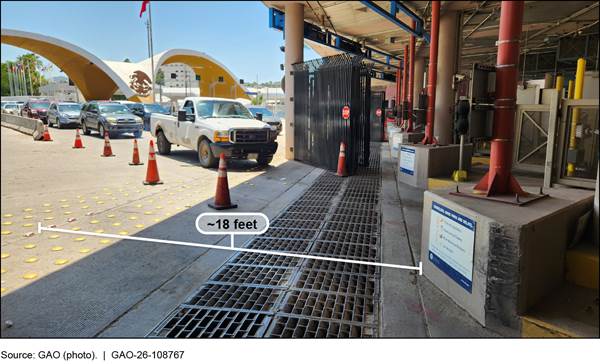
Note: The U.S.-Mexico international border is indicated by a line of red and white bumps, centered between the yellow bumps.
While CBP’s scanning plan states its intent to scan 100 percent of passenger and commercial vehicles and rail containers entering the United States at land POEs, the plan does not include the deployment of large-scale NII systems to some of CBP’s highest passenger traffic POEs along the southwest border. Without these crossings in its plan, CBP risks entry of many unscanned passenger vehicles, hampering its ability to prevent illegal drugs and other contraband from entering the United States.
In our September 2025 report, we recommended that CBP determine how to include deployment of large-scale NII systems to all southwest border land POEs in updates to its deployment plans. CBP concurred with GAO’s recommendation and said it is collaborating with the DHS Science and Technology Directorate to address the radiation interference between the large-scale NII systems and the radiation detection equipment, which could allow for placement of NII large-scale systems within limited real estate constraints.
We will continue to monitor CBP’s efforts to address our recommendations. Addressing our recommendations would strengthen CBP’s management of the NII program and its interdiction efforts to help it achieve its mission.
Chairman Guest, Ranking Member Correa, and Members of the Subcommittee, this concludes my prepared statement. I would be pleased to respond to any questions that you may have at this time.
Staff Acknowledgments
If you or your staff have any questions about this testimony, please contact Hilary M. Benedict, Director, Science, Technology Assessment and Analytics, at benedicth@gao.gov. Contact points for our Offices of Congressional Relations and Public Affairs may be found on the last page of this statement. GAO staff who made key contributions to this testimony are Rich Hung (Assistant Director), Maria Stattel (Analyst in Charge), Rebecca Gambler, Kirk Kiester, Dave Bieler, Nathan Hamm, Megan Graves, Ashley Stewart, Michele Fejfar, Mark Kuykendall, and Anika McMillon.
This is a work of the U.S. government and is not subject to copyright protection in the United States. The published product may be reproduced and distributed in its entirety without further permission from GAO. However, because this work may contain copyrighted images or other material, permission from the copyright holder may be necessary if you wish to reproduce this material separately.
The Government Accountability Office, the audit, evaluation, and investigative arm of Congress, exists to support Congress in meeting its constitutional responsibilities and to help improve the performance and accountability of the federal government for the American people. GAO examines the use of public funds; evaluates federal programs and policies; and provides analyses, recommendations, and other assistance to help Congress make informed oversight, policy, and funding decisions. GAO’s commitment to good government is reflected in its core values of accountability, integrity, and reliability.
Obtaining Copies of GAO Reports and Testimony
The fastest and easiest way to obtain copies of GAO documents at no cost is through our website. Each weekday afternoon, GAO posts on its website newly released reports, testimony, and correspondence. You can also subscribe to GAO’s email updates to receive notification of newly posted products.
Order by Phone
The price of each GAO publication reflects GAO’s actual cost of production and distribution and depends on the number of pages in the publication and whether the publication is printed in color or black and white. Pricing and ordering information is posted on GAO’s website, https://www.gao.gov/ordering.htm.
Place orders by calling (202) 512-6000, toll free (866) 801-7077,
or
TDD (202) 512-2537.
Orders may be paid for using American Express, Discover Card, MasterCard, Visa, check, or money order. Call for additional information.
Connect with GAO
Connect with GAO on X,
LinkedIn, Instagram, and YouTube.
Subscribe to our Email Updates. Listen to our Podcasts.
Visit GAO on the web at https://www.gao.gov.
To Report Fraud, Waste, and Abuse in Federal Programs
Contact FraudNet:
Website: https://www.gao.gov/about/what-gao-does/fraudnet
Automated answering system: (800) 424-5454
Media Relations
Sarah Kaczmarek, Managing Director, Media@gao.gov
Congressional Relations
David A. Powner, Acting Managing Director, CongRel@gao.gov
General Inquiries
[1]POEs are facilities that provide for the controlled entry into or departure from the United States. Specifically, a POE is any officially designated location (seaport, airport, or land border location) where CBP officers or employees are assigned to clear passengers, merchandise, and other items, collect duties, and enforce customs laws; and where CBP officers inspect persons seeking to enter or depart, or apply for admission into the United States, pursuant to U.S. immigration and travel controls. A single land POE may be composed of one or more crossings.
[2]James Mandryck, Deputy Assistant Commissioner, Office of Intelligence, U.S. Customs and Border Protection, U.S. Department of Homeland Security, Protecting the U.S. Homeland: Fighting the Flow of Fentanyl from the Southwest Border, testimony before the U.S. House of Representatives Committee on Homeland Security, Subcommittee on Border Security and Enforcement (Washington, D.C.: July 12, 2023).
[3]CBP officers use large-scale NII systems to scan entire vehicles. The process produces an image that CBP officers review to identify anomalies that may be an indication of contraband or hidden people. CBP officers use small-scale NII systems to localize those anomalies, among other things.
[4]Securing America’s Ports Act, Pub. L. 116-299, 134 Stat. 4906 (2021), codified at 6 U.S.C. § 211 note.
[5]GAO, Land Port Inspections: CBP Should Improve Performance Data and Deployment Plans for Scanning Systems, GAO‑25‑107379 (Washington, D.C.: Sep. 15, 2025).
[6]According to CBP officials, travelers may opt out of undergoing a scan by an NII system in preprimary inspection by using an opt-out lane to drive to the primary inspection booth, and officials at the POEs have discretion as to how vehicle inspections are handled when drivers choose to opt out.
[7]In July 2025, Congress passed the One Big Beautiful Bill Act, which included an appropriation of funds available to CBP for, among other things, NII. See Pub. L. 119-21 Title IV, Subtitle A, § 90004, 139 Stat. 72, 359.
[8]Department of Homeland Security, U.S. Customs and Border Protection, Large Scale Non-Intrusive Inspection Scanning Plan Fiscal Year 2021 Report to Congress (Washington, D.C.: January 18, 2022).
[9]Department of Homeland Security, U.S. Customs and Border Protection, Large Scale Non-Intrusive Inspection Scanning Plan - Annual Update Fiscal Year 2022 Report to Congress (Washington, D.C.: March 31, 2023). In November 2025, CBP issued its fiscal year 2024 update to its scanning plan.